February 11 - March 15, 2026
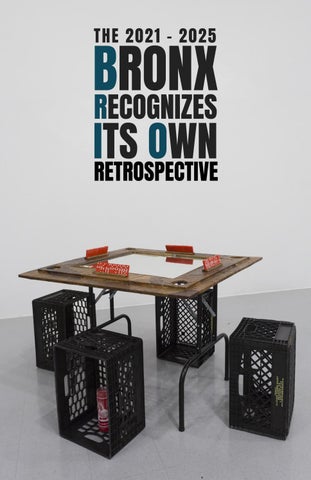
BCA’s Longwood Art Gallery presents the 2021–2025 BRIO Retrospective at Bronx River Art Center (BRAC) through an expanded curatorial approach that engages sister organizations in the Bronx and beyond. This exhibition brings together artists engaging pressing social, racial, environmental, and identitybased issues whose work reflects the breadth of contemporary artistic practice in the Bronx across mixed media, etching, painting, photography, installation, and textile.
The 2021–2025 BRIO Retrospective expands opportunities for artists to present their work in new contexts, reach broader audiences, and deepen engagement within the Bronx’s cultural landscape. Through initiatives such as BRIO, BCA continues to champion and amplify diverse voices and narratives, supporting artists whose work contributes meaningfully to the borough’s artistic life.
The BRIO Award affirms the essential role Bronx artists play in shaping the borough’s cultural life. A long-standing BCA initiative that honors the artistic excellence of Bronx-based artists, BRIO provides public recognition, as well as direct financial support through a $5,000 unrestricted grant to artists working across a wide range of disciplines.
Opening Reception
Wednesday, February 11, 2026, 6:00 PM – 8:00 PM
Bronx River Art Center (BRAC)
1087 East Tremont Avenue, Bronx, NY 10460
The Longwood Arts Project is the contemporary visual arts program of the Bronx Council on the Arts (BCA), with the mission to support artists and their work, especially emerging artists from underrepresented groups, such as people of color, the LGBTQ+ community, and women. The Longwood Art Gallery presents solo and group exhibitions of works of art produced in various media, through interdisciplinary practices that connect emerging artists, communities, and ideas within and beyond The Bronx.
Founded by visionary community leaders in 1962, the Bronx Council on the Arts (BCA) is a pioneer in advancing cultural equity in The Bronx. From our early beginnings as a presenter of affordable arts programming in select Bronx neighborhoods, we have grown into a cultural hub that serves the entire creative ecosystem of the borough. Our programs serve artists, the public, and the field at large by building connections, providing resources, and advocating for equitable practices. Then as of now, we focus on supporting the work of underrepresented groups – especially artists of color, women, and members of the LGBTQ+ community. Through this lens, we offer affordable programs for seniors and youth and provide direct services to over 1,500 artists and 250 community-based arts groups each year.
www.bronxarts.org
Bronx River Art Center (BRAC) is a culturally diverse, multi-arts, nonprofit organization that provides a forum for community, artists, and youth to transform creativity into vision. Our Education, Exhibitions, Artist Studios, and Presenting Programs cultivate leadership in an urban environment and stewardship of our natural resource — the Bronx River.
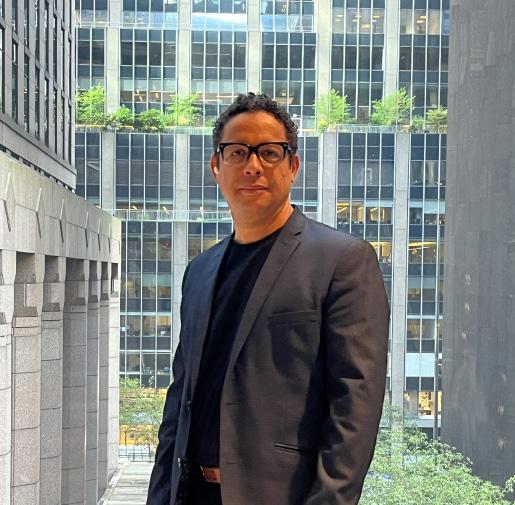
Juan Butten is a multidisciplinary visual artist born in Santo Domingo, Dominican Republic, and based in New York since 2024. His work focuses primarily on migration—both internal and transnational— understood as experiences of displacement, memory, and the reconstruction of identity. Through sculpture, installation, and painting, Butten develops fragile architectures, floating houses, and unstable territories that symbolize the migrant experience, always in transit between what is left behind and what one attempts to rebuild. His work addresses home as a mobile and vulnerable notion and proposes migration as a form of resistance and adaptation. In 2025, he was awarded the BRIO Award in Visual Arts, Mixed Media category.
Inspired by migration journeys — from rural landscapes to urban centers, and across oceans in search of new beginnings — the piece Se Vende Hielo reflects on the constant movement of individuals seeking dignity, opportunity, and belonging. This work speaks not only to internal displacement but also to transoceanic journeys, resonating with the experiences of those who leave familiar ground to rebuild life elsewhere. Like a vessel on a perpetual voyage, it condenses the longings, memories, and vulnerabilities of those who migrate carrying everything with them: their homes, their voices, their faith, their wounds.
Built from fragments gathered from the sea, the piece understands migration as an act of vital recycling: bodies and dreams remade with what remains, building futures over sediments of departure. These works drift, as people do, and their presence in different cities transforms them into witnesses of invisible crossings.
This work asks, gently and urgently: What stays behind when we leave? What refuses to let go? Can roots hold on while everything is in motion? In a world where displacement is no longer exception but rhythm, these floating homes whisper that migration is not absence — it is resistance, insistence, and the stubborn beauty of refusing to disappear.
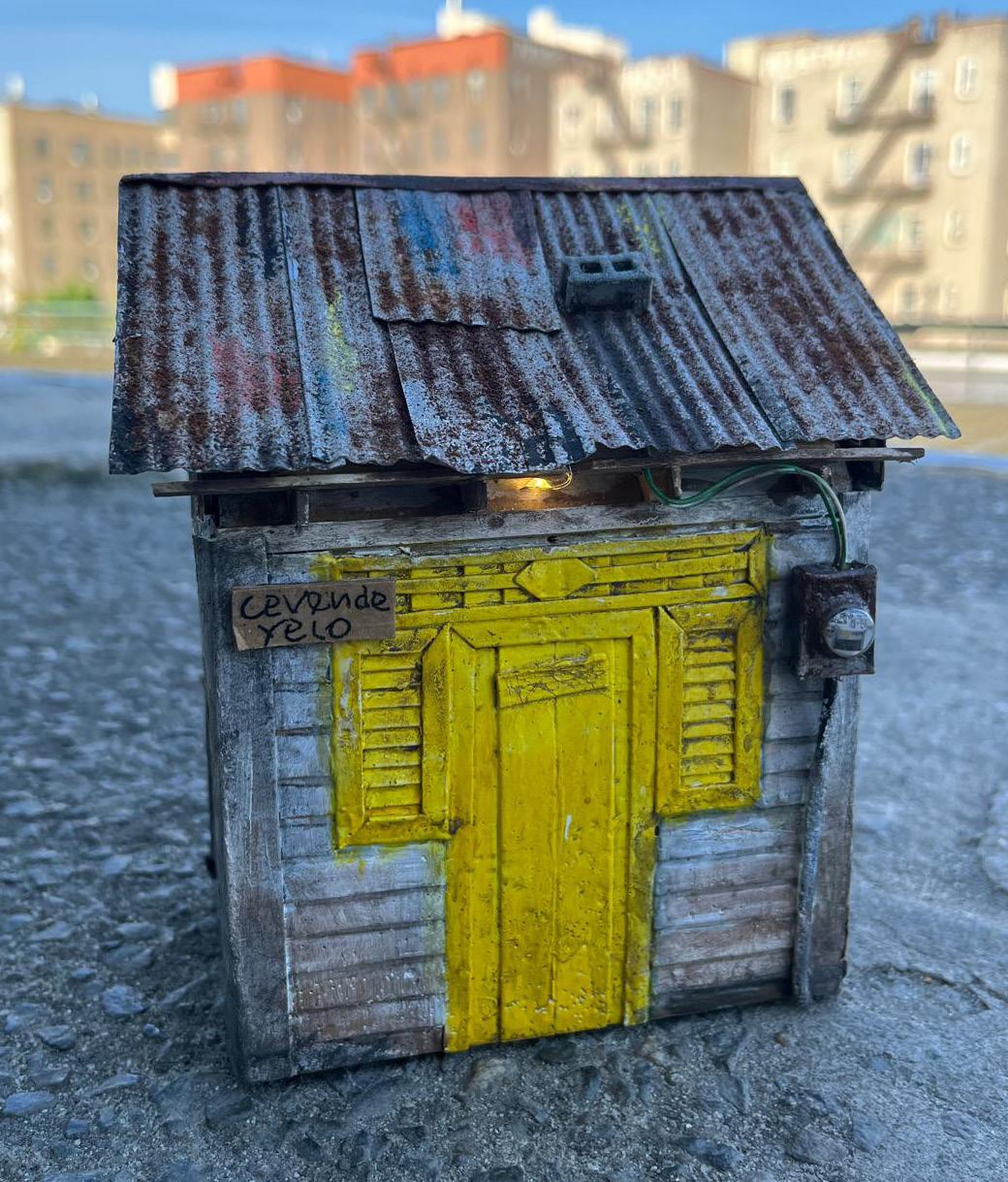
Juan Butten, Se Vende Hielo, 2025, Recycled Materials, Scratchbuilt
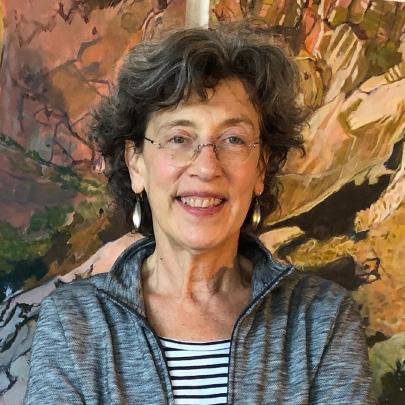
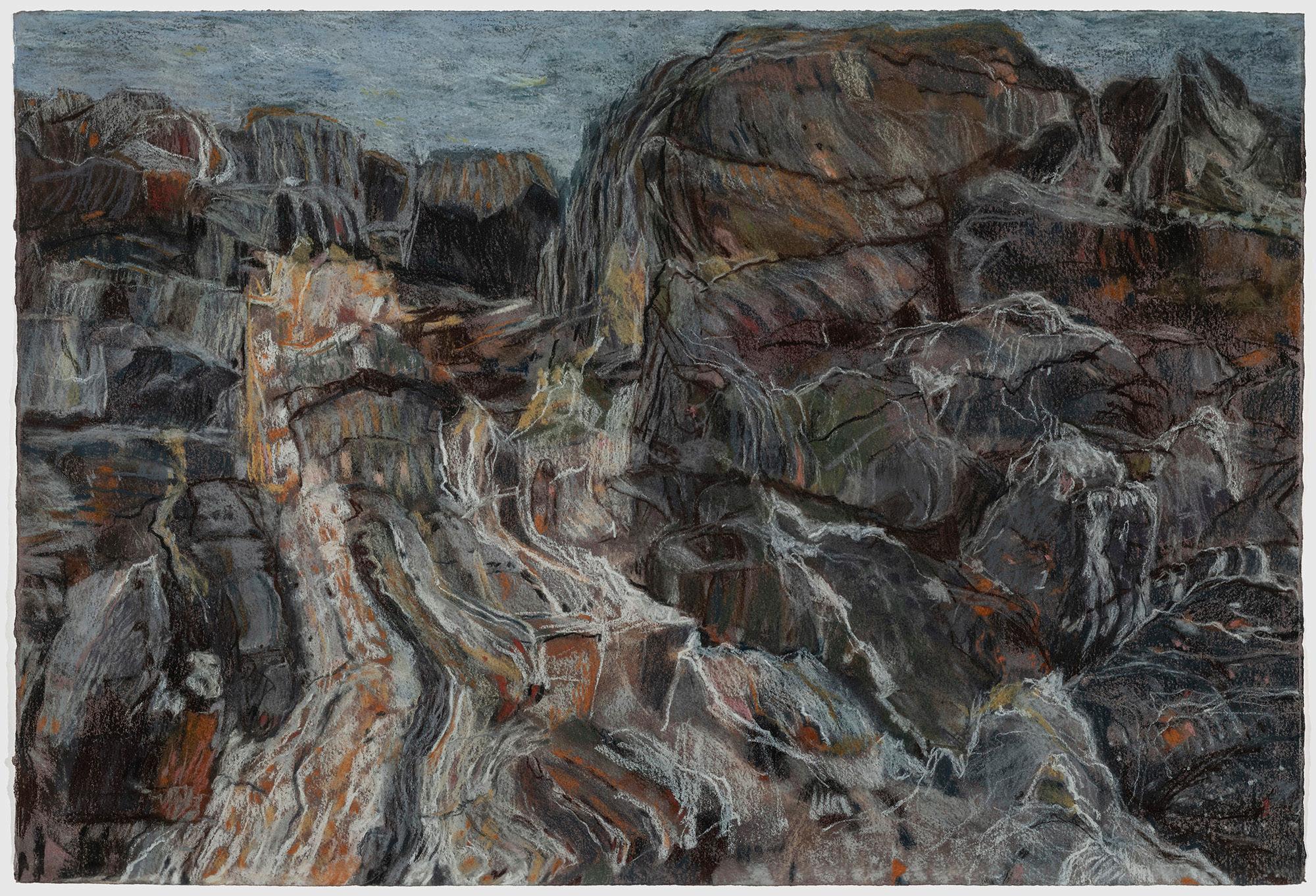
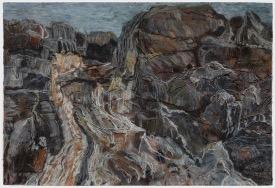
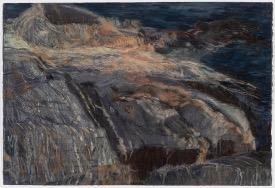
Shelley Haven, a Lower East Side born, Bronx-based visual artist, creates nature-inspired artworks investigating the beauty and power, the fragility and vulnerability of our environment. Her paintings, drawings, prints, and sculptures strive to inspire others to become present and engaged in nature, to be healed and strengthened there, to advocate for the preservation and expansion of our protected environment. Shelley extends her studio practice through collaborative projects - as founding designer-cover artist of And Then, a literary/arts print publication supporting dialogue across diverse professional and non-professional communities, and through international YouTube collaborations with composer/musicians and writers. Ms. Haven teaches in community and university settings.
Collections: Library of Congress, NYPL, MoMA, Stedelijk Museum, NYU, University of Iowa. Awards: BRIO, Puffin, MCAF, international and U.S. residencies. Solo and two-person exhibitions: Derfner Museum; Wave Hill; An Beal Bocht; NYPL; Binghamton, Fairleigh Dickinson and Iona Universities; Pfizer World Headquarters; Lesley Heller Gallery. Shelley’s artworks are collected and exhibited nationally and internationally.
I am drawn to places that speak to me of creative transformation and survival; I am fascinated by the fragile beauty and awesome power of nature. Hiking rugged terrain, walking shorelines and living with the Hudson River Palisades as a neighbor, I observe.
I search the architectural structure and map the geologic history of boulders, canyons and cliffs. I am challenged by their complexity;
and I observe and build the mass and track its fissures to embody both strength and fragility. I trace the movement of water and its solid mass, its transparency and reflective qualities. The appearance of great stability and the truth of perpetual transformation, sometimes slow and barely discernible, at other times, in a flash of destruction, compels me to create memories of place.
The impact of geologic history and human activity as well as the changing light with the progress of the day, the weather and the seasons keep all in flux. That change is the only constant is truly embodied here.
My work speaks of the resilient response of nature through the unceasing journey of time. It seeks to inspire others to discover and explore the environment near and far and to find creative paths to actively engage and live in harmony with our natural environment.
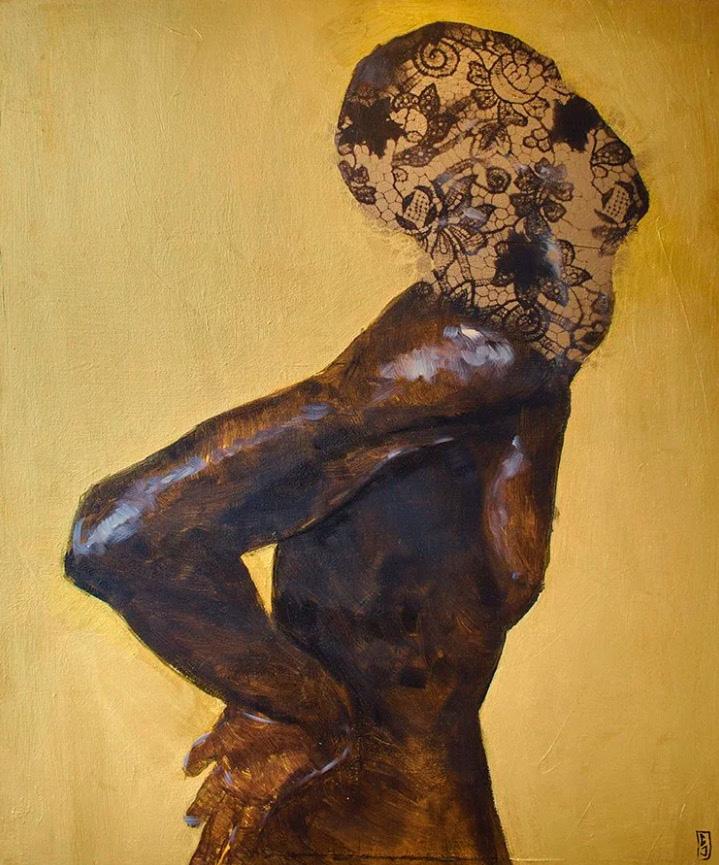
Born in La Habana, Cuba, Esteban Jiménez Guerra earned a BFA from the San Alejandro National Academy of Fine Arts in 2011. In 2012, he opened a studio gallery in Old Havana, where he exhibited his work, collaborated with other artists, and led community workshops for children. In 2013, he traveled to the United States as part of the artist collective The Wall to collaborate with the American collective Arte Libre, and has since lived and worked between Havana and New York. His work has been exhibited nationally and internationally, and he has been invited to participate in art fairs, symposiums, talks, and workshops at institutions including Detour Gallery (New Jersey), Cuban Art Space (New York), the Children’s Museum of the Arts (New York), the University of Massachusetts Boston, the University of Montevallo (Alabama), and the University of Essex (London). His work has also been featured in publications such as Green Beauty Magazine, Venü Magazine, the Faber Foundation, and Cuban Art News.
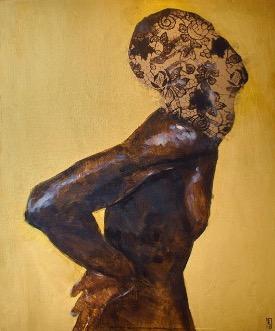
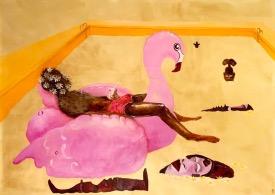
Esteban is a multi-disciplinary artist who works with mediums such as painting, sculpture, and photography. His art practice tackles concepts of ‘otherness’ pervasive in popular culture. Through his transformative and empowering representations of the human body, he seeks to contextualize these pre-constructed notions. Esteban perceives the body as a vessel bearing the intricate imprints of past traumas and shaped by personal lived experiences.
Drawing inspiration from philosophies rooted in Afro-Cuban spiritual practices (Abakua, Lucumi, and Regla Kimbisa), he endeavors to
redefine the narratives and contemporary systems that perpetuate racism and sexism. Esteban’s paintings are characterized by their mystical nature, centered around the Black experience. The characters in his works often appear layered with symbols and textures resembling magical beings.
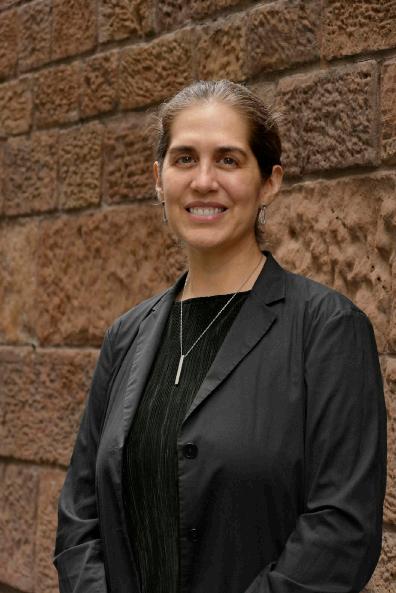
Jessica Lagunas is a New York City-based Latinx artist. Her work has been exhibited at Museo Amparo, Mexico; Museo de Arte Moderno de Medellín, Colombia; Museum of Contemporary Art Santa Barbara (CA); the Art Museum of the Americas (Washington, D.C.), the International Festival of Contemporary Arts–City of Women (Slovenia), The Bronx Museum of the Arts (NY), among others; and in biennials including Pontevedra (Spain), El Museo del Barrio (NY), Tirana (Albania), Cuenca (Ecuador), Caribbean (Dominican Republic) and Paiz (Guatemala); as well as in cities in the US, Europe and Latin America. Lagunas has received grants from the Joan Mitchell Foundation, NYSCA, Hispanic Society Museum & Library, Bronx Council on the Arts, City Artist Corps; and residencies at LMCC’s Workspace and Swing Space, Bronx Museum’s AIM, El Museo del Barrio, Wave Hill, The Center for Book Arts, Joan Mitchell Center, and Lost and Found Lab.
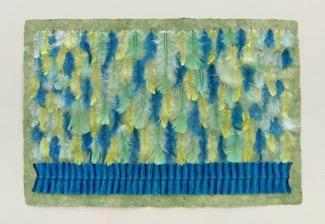
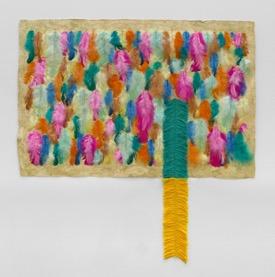
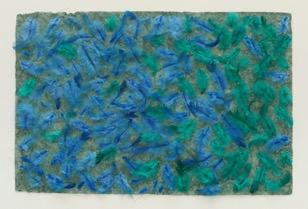
Most of my work uses minimum elements and unconventional materials— makeup, hair, feathers, organic materials. Throughout the years I’ve used a variety of media, and lately I’ve been focusing on abstract embroidery and weaving, using materials that bring me closer to nature, attracted by their seductive and tactile qualities and their fragile and ephemeral characters. Process is also crucial to me: the intricacy and laboriousness of each project as a reflection of time, producing a meditative and healing effect.
During the past few years, I have been inspired by a research fellowship at The Hispanic Society, where I focused on their textile collection, particularly their 16th century Featherwork Miter (Bishop’s hat), done with the PreHispanic technique Amantecayotl (feather mosaic) by the indigenous Amantecas artists in Mexico. The Miter motivated me to work with feathers, a material I had briefly worked with in the past. This inspiration led me to create a series of works both on paper and on fabric where I attach feathers with hand-embroidered French knots.
The works in this submission are the result of a continued exploration and variation with the use of dyed feathers on paper to create abstract compositions reminiscent of Latin America—particularly from growing up in Guatemala,—where the exuberance of color is very much present in its culture and everyday life. The vibrancy found in its markets is always prevalent—from fruits, vegetables, and traditional foods, flowers, handicrafts, textiles, toys, to traditional dances, festivities, and rituals, where the use of dyed feathers is oftentimes common.
Each panel is an abstract composition of dyed feathers on a colored Amate paper attached with a French knot, with a border all around to showcase the color of the paper as well. In some cases the feathers—which were a gift from an artist friend who bought them in a market in Mexico City—are fixed one on top of another, playing with gradation of feather sizes, going from larger to smaller.
The colors of the handmade fringes made with embroidery floss are picked from the colors of the feathers in each panel. They sometimes grow outside of the page and give the work another layer of manual labor. The macramé technique for all my fringes is Lark’s Head Knot.
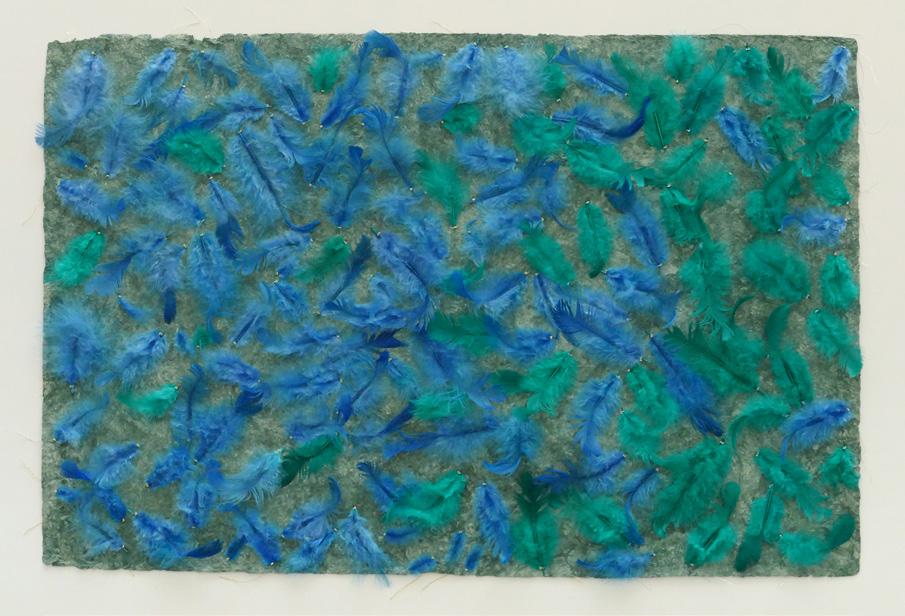
Jessica Lagunas, Untitled (Blue, Green), 2025, Dyed chicken feathers on Amate paper, metallic and synthetic threads, artist’s gray hair, 15.5” x 23”
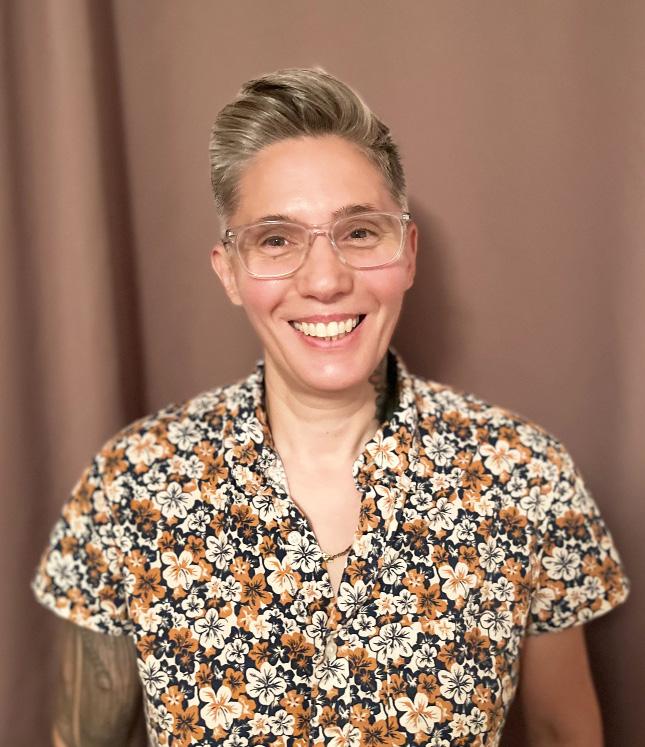
E. Lombardo (b.1977, Queens, New York) is a Queer American Bronxbased artist. They earned their MFA from The School of the Museum of Fine Arts at Tufts, in Boston, MA. Lombardo was a Bronx AIM Fellow and received a BRIO Award in 2021. Their work is in the permanent collections of The Museum of Fine Arts, Boston, The Academy Art Museum in Maryland, The Mead Museum at Amherst College, Boston Public Library, Wheaton College, and the College of Wooster Art Museum. Lombardo was a resident artist at the Wave Hill Winter Workspace, Bronx, NY, in 2024. Their studio practice examines art historical, sociopolitical, and pop cultural images to recognize and reveal entrenched patterns of human behavior. Their work examines how the narratives we consume and internalize, inform our understanding of identity.
I am a queer artist searching for signs of hope and progress in our society. Like a detective, I comb through images, collecting and presenting evidence to expose the systems of power that subjugate us. My work is best described as a mix of queer “magical thinking,” scathing social analysis, and pure romance.
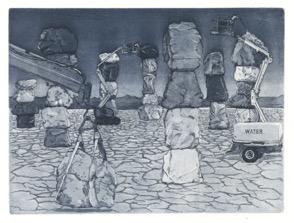
I am a representational artist working in printmaking, drawing, and painting. The work employs traditional methods of printmaking to create timeless works of social critique. My technical focus on copperplate etching has opened a portal between the past and present. I appropriate
the works of “old masters,” such as Goya and Raimondi, insert contemporary narratives to enliven the repetitive nature of destructive human behavior. The familiar compositions, intimate scale and delicately etched lines draw the viewer into a narrative culled from centuries of male dominated art history. My viewer is met with images of presentday social injustice, environmental and capitalist violence, and queer love. Ultimately, I appropriate historically iconic images to amplify marginalized voices while holding a mirror to our human failings. These etchings are my acts of defiance.
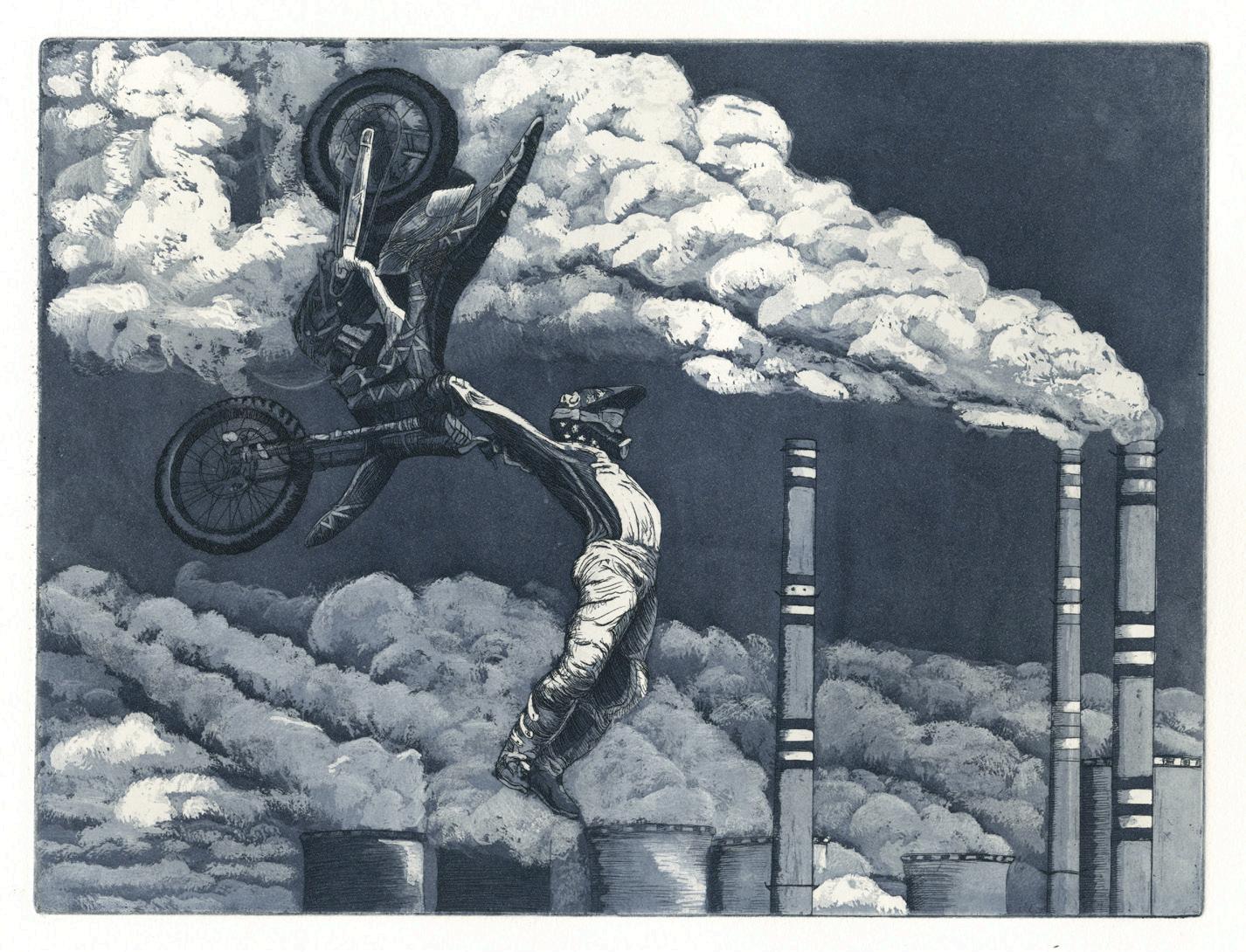
Sheet: 13” x 16”
Plate: 9” x 12”
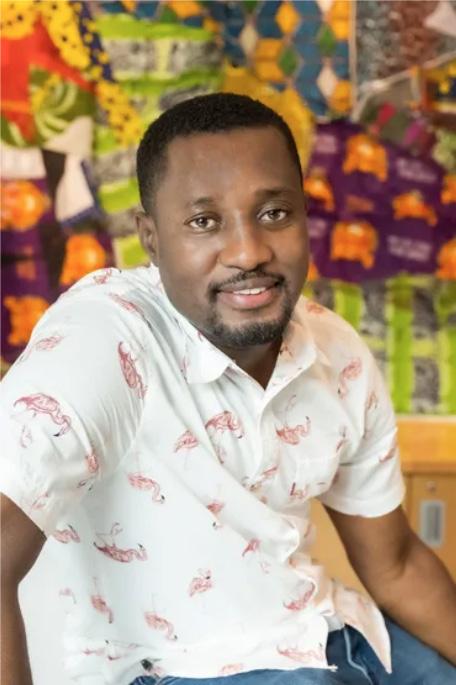
Ghanaian-born artist Tijay Mohammed has showcased his work on both national and international stages, gracing prestigious venues like the Katonah Museum of Art NY, the Hudson River Museum NY, Materials for the Arts NY, Art League, Houston TX, the Green Drake Art Gallery in Pennsylvania, Gallery 1202 CA, Ravel d’ Art in Côte d’Ivoire, and the National Museum of Ghana.
Tijay’s impact extends beyond exhibition spaces; he has spearheaded workshops and community-oriented projects for esteemed organizations, including the Studio Museum Harlem, Brooklyn Museum, Sugar Hill Children’s Museum of Art & Storytelling, Children’s Museum of Manhattan, Wallach Art Gallery, Lehman College, University of Ghana, and Pinto Community Centre in Trinidad and Tobago. His contributions have not gone unnoticed, garnering him various accolades and residences from renowned institutions such as The Laundromat Project, Wave Hill, Art Bridge, Materials for the Arts, Harmattan Workshop in Nigeria, Global Crit Clinic, and Asiko Artist Residency in Ghana. Grants from institutions like the Arts Fund, the Bronx Council on the Arts (BCA), and the Spanish Embassy Ghana Painters Award further attest to his artistic prowess.
The artist currently resides in the Bronx, NY, and maintains a studio in Ghana that serves as a sanctuary for visiting artists to interact with residents, promoting multicultural dialogue through story circles and art workshops.
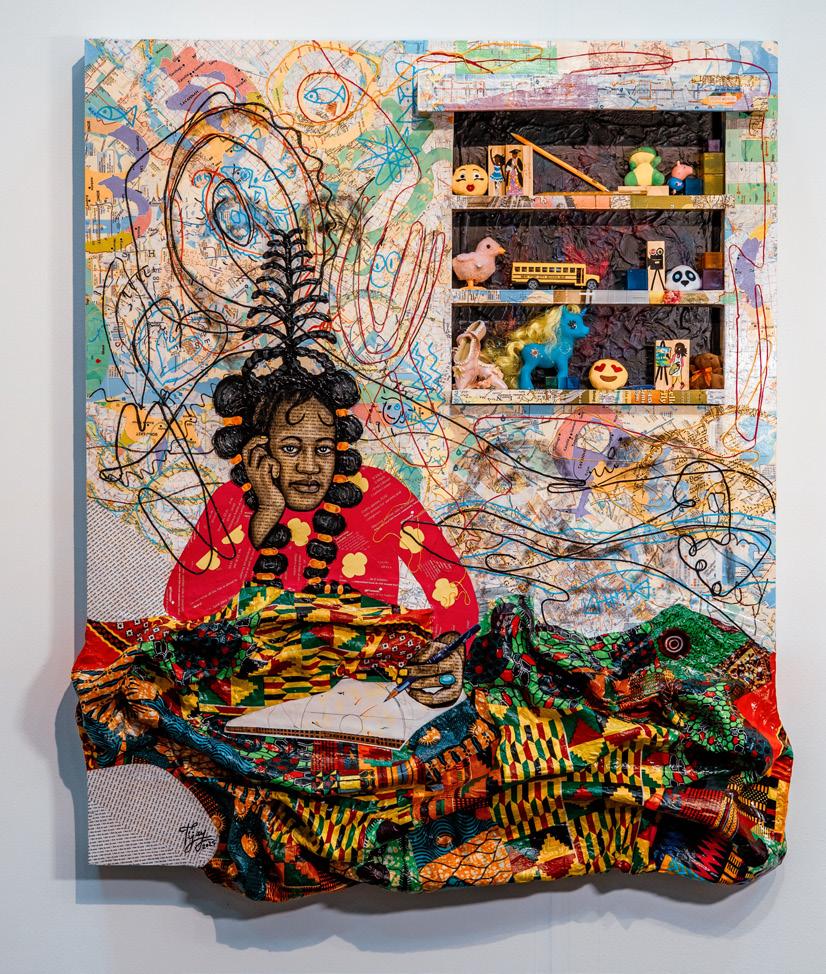
As an artist, I am driven by a passion for exploring issues that impact my community and humanity, and my work focuses on the concept of ‘excess’ in production and consumption, offering a solution through materials reuse and up-cycling. Through multimedia collages, site-specific installations,
mixed media paintings, and public sculptures, I reimagine waste as valuable materials, revealing the aesthetic and conceptual beauty of discarded items and challenging the notion of their worthlessness.
I create poetic representations of pressing issues like migration, childcare, gender, social, and environmental justice by repurposing everyday objects, such as fabric scraps, metro cards, jewelry, paper, and photographs. Through this process, I promote recycling as a response to climate change. My creative process is deeply rooted in history, as I reinterpret objects and stories to evoke a sense of nostalgia for place, time, and utopian cultures, while acknowledging the complexities of African and African American experiences. As a futurist, I am committed to making a positive impact in any community I am a part of, for the benefit of current and future generations.
Through an interactive approach commitment to community, self-love, and appreciation, inspired by the Ghanaian Adinkra symbol ‘Sankofa,’ which means ‘learning from the past to ensure a prosperous future.’
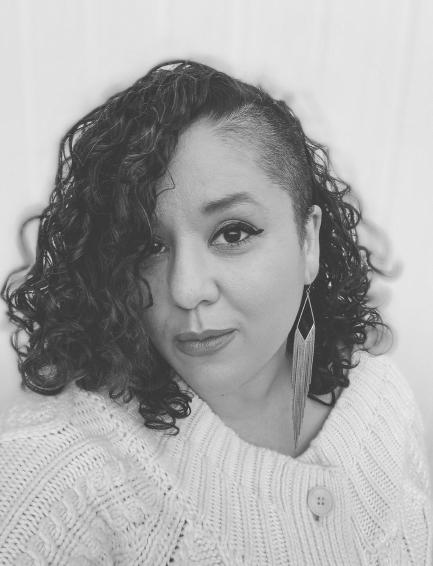
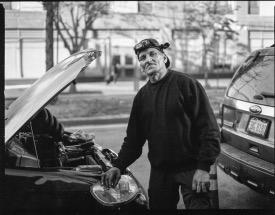
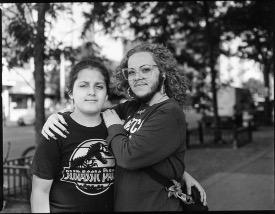
Abigail Montes is a documentary photographer and educator proudly from the South Bronx. She holds an AAS from LaGuardia Community College, a BFA from Saint John’s University, and a Certificate of Documentary Practice and Visual Journalism from the International Center of Photography (ICP).
Since 2013, Montes has dedicated herself to youthcentered initiatives utilizing the camera as a tool for change. Most notably she served as Co-Coordinator of ICP at THE POINT (2019-2025), facilitating free photography courses in the South Bronx, teaching the fundamentals of photography with social justice, self-esteem, community, and collaboration as thematic anchors.
In 2024, Montes joined the Seis Del Sur photo collective, documenting the struggles and resilience within the Puerto Rican diaspora of the South Bronx and striving to inspire the next generation of visual storytellers. Montes will graduate with an MFA in Photography from the Yale School of Art in 2027.
My introduction to Mel Rosenthal’s In the South Bronx of America (2001), was a powerful revelation. Until then, I was unaware of the activism that transformed my childhood neighborhood, once ravaged by redlining, divestment, and a decade of arson in the 1970s, into a gritty paradise sprinkled with block parties and basketball games. Rosenthal’s
ability to come back to his Bronx roots in a time of urban blight and shed light on the social injustice experienced there through image, text, and a collaborative approach with community, deeply inspired me. I sought to learn more about what happened to the Bronx by photographing the once burnt-out but now thriving neighborhood of Longwood/ Hunts Point that I call home.
Today, gentrification threatens to displace the very communities across the Bronx that have fought so hard to recover. Our friends and neighbors are under threat of deportation while crucial social and educational programs are consistently on the cutting board. Though grassroots organizations are actively resisting these forces, the fight for a just and equitable future remains ongoing. By focusing my lens on what we stand to lose, I aim to inspire the next generation to keep fighting to preserve what we have.

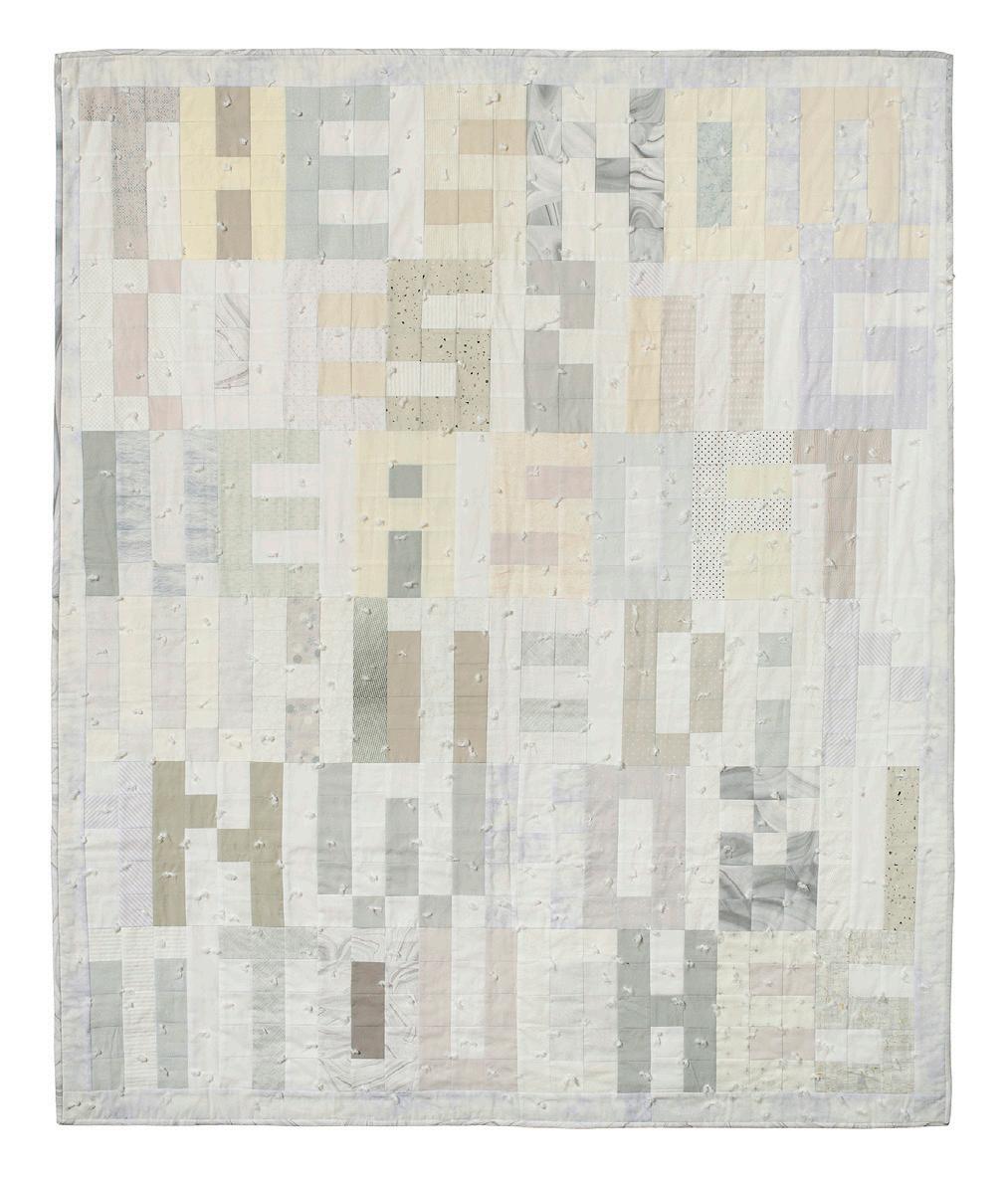
Amy Pryor is an interdisciplinary artist whose practice spans textile, collage, painting, printmaking, drawing, and sculpture to create artworks that reflect on contemporary culture. Her work often incorporates text, data, or mapping to explore the intersections between abstraction and landscape, with a particular focus on the built environment. Recent projects explore themes of identity, settlement, and symbolism through color and pattern. Pryor’s work has been exhibited at numerous galleries and cultural institutions, including Bronx Art Space, The Bronx Museum of Art, BRAC, Casita Maria Center for Arts and Education, Mixed Greens, 92Y TriBeCa, QuiltCon, and Wave Hill. She has contributed permanent public artworks for MTA Arts and Design, and NYC’s Department of Cultural Affairs’ Percent for Art program. Pryor has attended residencies at Skowhegan School of Art, the Vermont Studio Center, KinoSaito, Frans Masereel Centrum, and Governor’s Island with Bronx Art Space (2024) and Longwood Art Gallery BCA (2025).
I am a multidisciplinary artist working across sculpture, video, installation, public art, printmaking, painting, drawing, and textiles. Recently, my practice has focused on textile art, particularly American quilt-making traditions. Over the past four years, I have explored themes of patriotism, settlement, and identity through symbolic color, historical texts, and traditional quilt patterns.
My education introduced a hierarchy between craft and fine art, a distinction rooted in exclusionary institutions. I challenge this divide, recognizing that craft encompasses art forms practiced by women, Indigenous peoples, and marginalized communities.
Throughout my career, I have examined cultural narratives and contemporary issues, prioritizing sustainability by repurposing everyday materials. The textile industry’s history—from slavery and exploitation to modern environmental impact—underscores the urgency of sustainable practices. As I address patriotism, identity, and environmental concerns through textiles, I am committed to feminism, social equality, community, and inclusivity. I aim for my work’s accessible materials and thoughtful forms to engage diverse audiences.
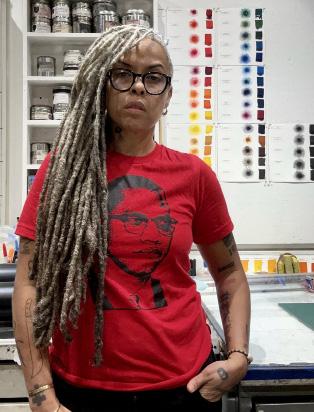
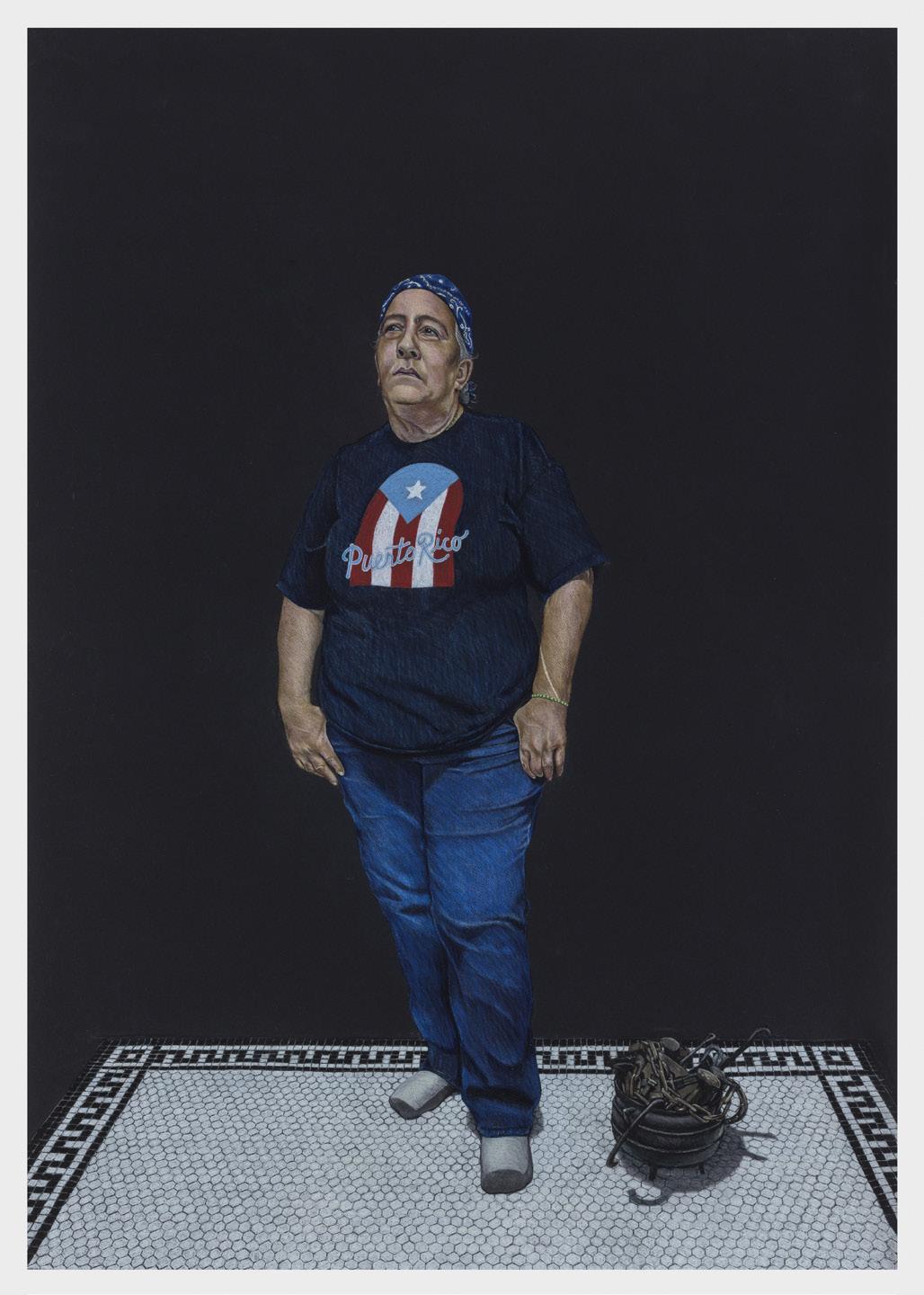
Shellyne Rodriguez (b. 1977) is a Bronx-based artist, educator, historian, writer, and community organizer who works in a variety of media, including drawing, painting, collage, and sculpture. Rodriguez stewards the histories and stories of people that have shaped her lived experience, describing her practice as “the depiction and archiving of spaces and subjects engaged in strategies of survival against erasure and subjugation.” Through her multidisciplinary practice, Rodriguez documents the ways in which the diverse social fabric of the South Bronx is rewoven as the people and cultures coexist. Rodriguez utilizes language, as well as cultural and sociopolitical references to create unified portraits of individuals from various communities formed in what she describes as the “periphery of empire.” Engaging with the legacy of the Ashcan School, who bore witness to the rise of the modern metropolis and depicted how the poor and working class in New York enclaves were transformed by this, Rodriguez views figures such as Alice Neel, Jane Dickson, and Martin Wong as an extension of this tradition and situates her practice alongside them. Rodriguez earned her MFA from Hunter College in studio art and her BFA in visual and critical studies from the School of Visual Arts. Her work has been shown at The Nathan Cummings Foundation, New York, NY; Cue Art Foundation, New York, NY; Casa Warmi, Quito, Ecuador; Queens
Museum, New York, NY; and El Museo del Barrio, New York, NY; among others. Rodriguez has held residencies at Hunter College, New York, NY and the Shandaken Project, Catskills, NY. She is an Adjunct Professor at the Cooper Union and has been a teaching artist at the Bronx Museum and Museum of Modern Art. Works by Rodriguez have recently been featured in group exhibitions at the Museum of the City of New York, New York, NY; Virginia MoCA, Virginia Beach, VA; National Academy of Design, New York, NY; and Museo de Arte Contemporáneo de Puerto Rico, San Juan, Puerto Rico; among others. Third World Mixtapes: The Infrastructure of Feeling, Rodriguez’s first solo exhibition with the gallery, was on view in Spring 2023. In Summer 2024, her work was included in P·P·O·W’s group exhibition Airhead. Pheonix Ladder: Monument to the People of the Bronx, Rodriguez’s new permanent, multimedia public artwork, was recently unveiled.
My work is a broke Baroque. A broken Baroque. Or just Quebrao which is “broken” in “broken Spanish” and an anagram for Baroque so it does the job of being both things in one word... and just like that, its baroqueness hides itself within its brokenness. That subversive way of being two things at once, of carrying within it all of the heavy shit one gets from the Western European canon while flamboyantly displaying its intervocalic consonant, which does everything to point to its class and its Carribean Latino origin is an effort at decolonizing itself.
This “being two things at once” is also a strategy of survival. Because in order to be what it is and be free... somewhat, it must be malleable. It must practice syncretism, which is the art of subversion. And like Santeria hid its Orishas within the Catholic pantheon, it must camouIlage itself. And when it Iights, its guerilla warfare or its the Capoeira hidden in the dance. My practice is an act, a gesture, a construction, and a narrative in the vein of decolonization.
This Quebrao as an iteration of decolonization, or guerilla warfare extends into the traditions of Hip Hop culture, born of the poor Black & Puerto Rican kids of the South Bronx. Hip Hop is a study in reinvention, in malleability, in pulling from a variety of sources to sample and remix and reinvent. It is a play with language, a pop, a lock, a BREAK. It bears witness, and the testimony is located in how an avant-garde arose literally from the ashes of burning buildings.
If the work is actively engaged in investigating strategies of survival, or evading capture, then the terrain which it must navigate is also a consideration in the work. This is a psychological terrain. This is where the work is hinged to the baroque. Weaving through the many iterations of false hope at the service of subjugation is a heavy and emotive task. The work aligns with the baroque to investigate the ever-present despair, which appears when the false hope has been extinguished. What might be deIined as a spiritual apathy.
Formally, the work seeks to create an emotive psychological space to draw the viewer into a moment where they encounter the trappings of false hope and chicanery and witness the collapse or the triumph of these devices as they are put in friction with a stealth and insurgent will to live and to thrive. The ongoing inquiry in the work is how to sway and bend and duck and run and scream and mend and scratch and break and heal and push forward, utilizing a variety of sources and mediums. To sample and remix. To think and to make. And what does that look like? On paper? In an object? As a narrative? As an action? As a gesture or a sound?
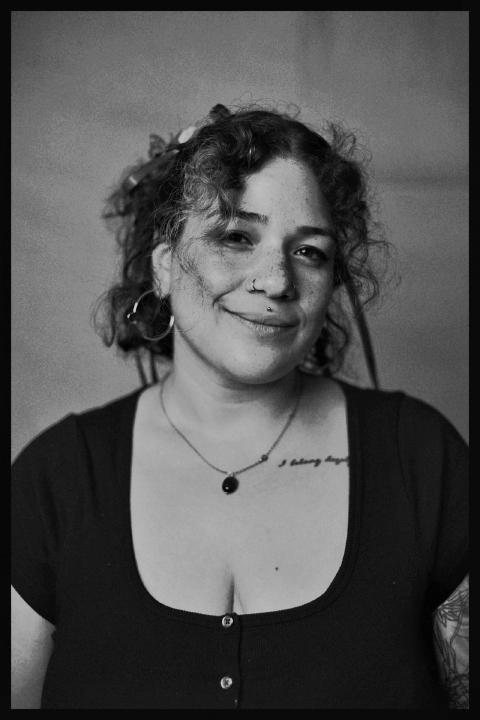
Misra Walker (b. 1992) is a Bronx-based community organizer, educator, and interdisciplinary artist working across sculpture, installation, and video. Walker’s work has been exhibited and screened at venues including Electronic Arts Intermix (EAI), Smack Mellon, Microscope Gallery, Westbeth Gallery, the Bronx Museum of the Arts, Crisis Galería (Lima), Undocumenta (Kassel), as well as in Berlin and Vancouver. Walker participated in the Whitney Independent Study Program (2024–25) and attended the Skowhegan School of Painting and Sculpture in 2023.
Walker holds an MFA from Mason Gross School of the Arts at Rutgers University and a BFA from The Cooper Union.
Guided by Marvin Gaye’s What’s Going On? and Lenin’s What Is to Be Done?, my practice examines capitalism-imperialism as a system that shapes bodies, labor, communities, and belief through class oppression, patriarchy, and white supremacy. I work across sculpture, installation, and time-based media, using archives, oral histories, popular culture, play, and ephemeral materials such as tobacco to make tangible histories of labor, resistance, and care.
My work draws from horror, game shows, and documentary, blending these genres with Bronx culture to reveal possibilities for solidarity,
collective refusal, and class consciousness. Central to my practice is a commitment to dialectical and historical materialism, emphasizing motion, interconnection, contradiction, and emergence. Time-based media and ephemeral materials are essential in my practice for their impermanence: nothing is fixed, everything exists in relation, and possibilities emerge through tension.
My work is not made in isolation. It is for—and made possible by— the workers who cut fresh sugarcane and bag fronto leaves the comrades who jump over turnstiles the people who speak in multiple tongues the lands that continue to inspire revolution
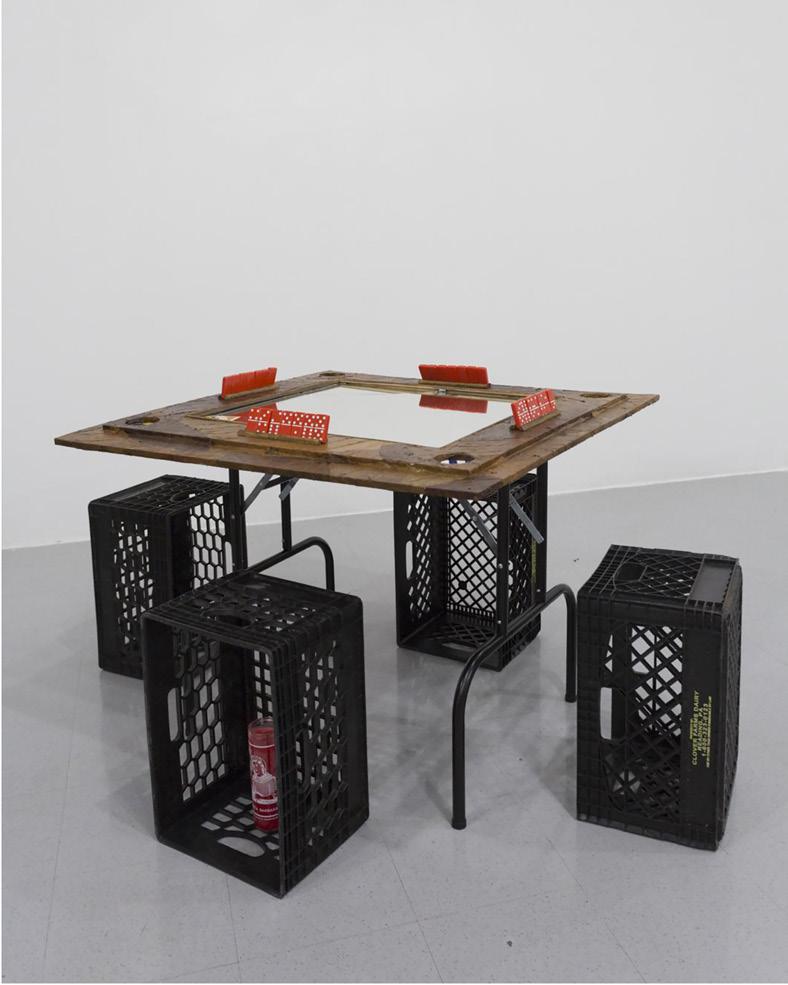
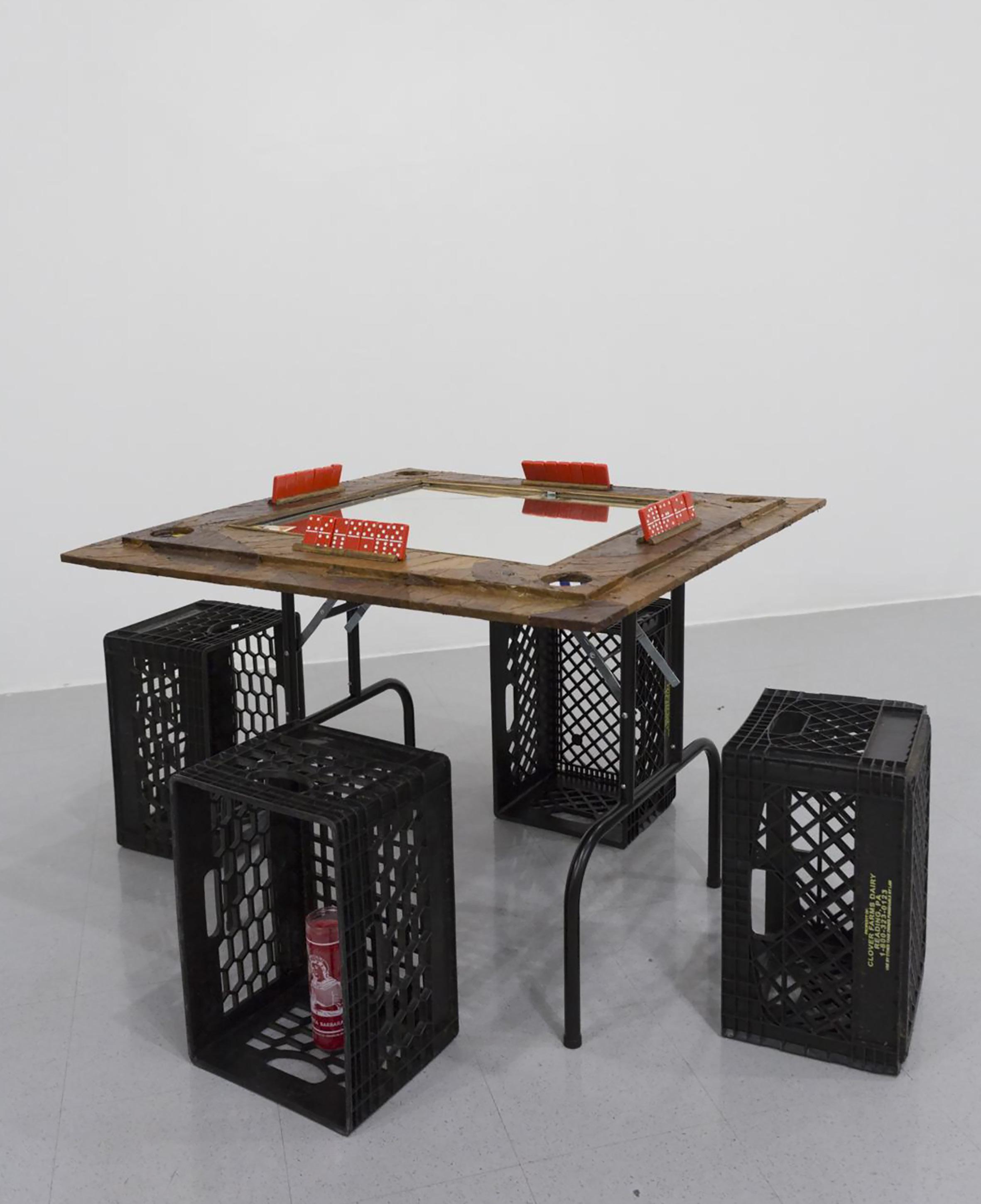
Misra Walker, You Can’t Sit With Us (Installation), 2019–2020, Tobacco leaves, wood, inkjet prints, mirror, found objects, 29” x 40” x 40”
All works courtesy of the artists unless otherwise noted.
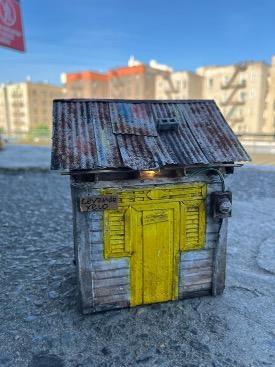
Juan Butten Se Vende Hielo, 2025
Recycled Materials, Scratchbuilt
6.5” x 5.75” x 5”
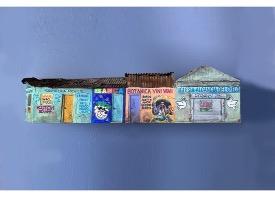
Juan Butten
Mall Rural, 2023
Recycled Materials, Scratchbuilt 6.75” x 27” x 7.5”
Shelley Haven
Larchmont Manor Park I, 2022
Pastels and watercolor on paper
18” x 22.25”
Shelley Haven
Larchmont Manor Park II, 2022
Pastels and watercolor on paper
18” x 22.25”
Esteban Guerra
N/T, 2023
Spray paint and oil on canvas
30” x 24”
Esteban Guerra
Last Rest, 2023
Spray paint and oil on canvas
60” x 43”
Jessica Lagunas
Untitled (Blue, Green, and Yellow), 2024
Dyed chicken feathers on Amate paper, hand-embroidered French knots and fringe (embroidery floss)
15.5” x 23”
Jessica Lagunas
Untitled (Carnival), 2024
Dyed chicken feathers on Amate paper, hand-embroidered French knots and fringe (embroidery floss)
23.5” x 23”
Jessica Lagunas
Untitled (Blue, Green), 2025
Dyed chicken feathers on Amate paper, metallic and synthetic threads, artist’s gray hair
15.5” x 23”
E. Lombardo
The Rodeo: Plate 3 - Between the Natural and the Artificial, 2023
Copperplate etching with aquatint
Sheet: 13” x 16”
Plate: 9” x 12”
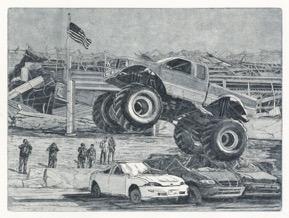
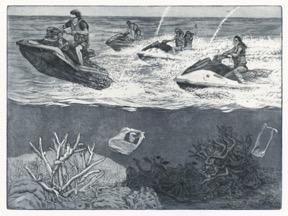
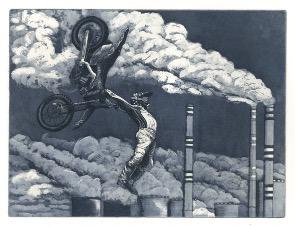
E. Lombardo
The Rodeo: Plate 17 (Currently Untitled), 2025
Copperplate etching with aquatint
Sheet: 13” x 16”
Plate: 9” x 12”
E. Lombardo
The Rodeo: Plate 11 (Currently Untitled), 2025
Copperplate etching with aquatint
Sheet: 13” x 16”
Plate: 9” x 12”
E. Lombardo
The Rodeo: Plate 20 - The agility and audacity, 2023
Copperplate etching with aquatint
Sheet: 13” x 16”
Plate: 9” x 12”
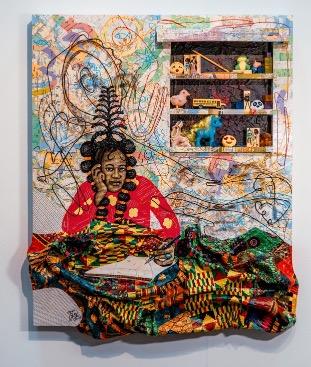
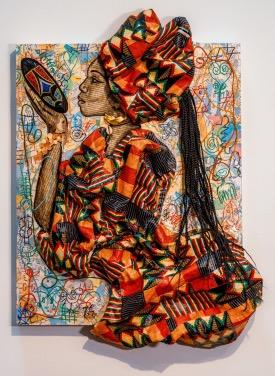
Tijay Mohammed
I am…4, 2025
Fabric, paper, yarn, thread, acrylic, watercolor, found objects, and plaster on a wooden board
48” x 36” x 6”
Tijay Mohammed
I am my ancestors wildest dream
2, 2025
Fabric, paper, yarn, thread, acrylic, watercolor, found objects, beads, cowry shell, artificial hair, and plaster on a wooden panel
27” x 28” x 6”
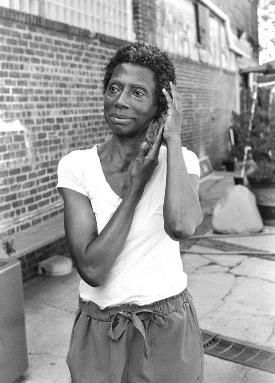
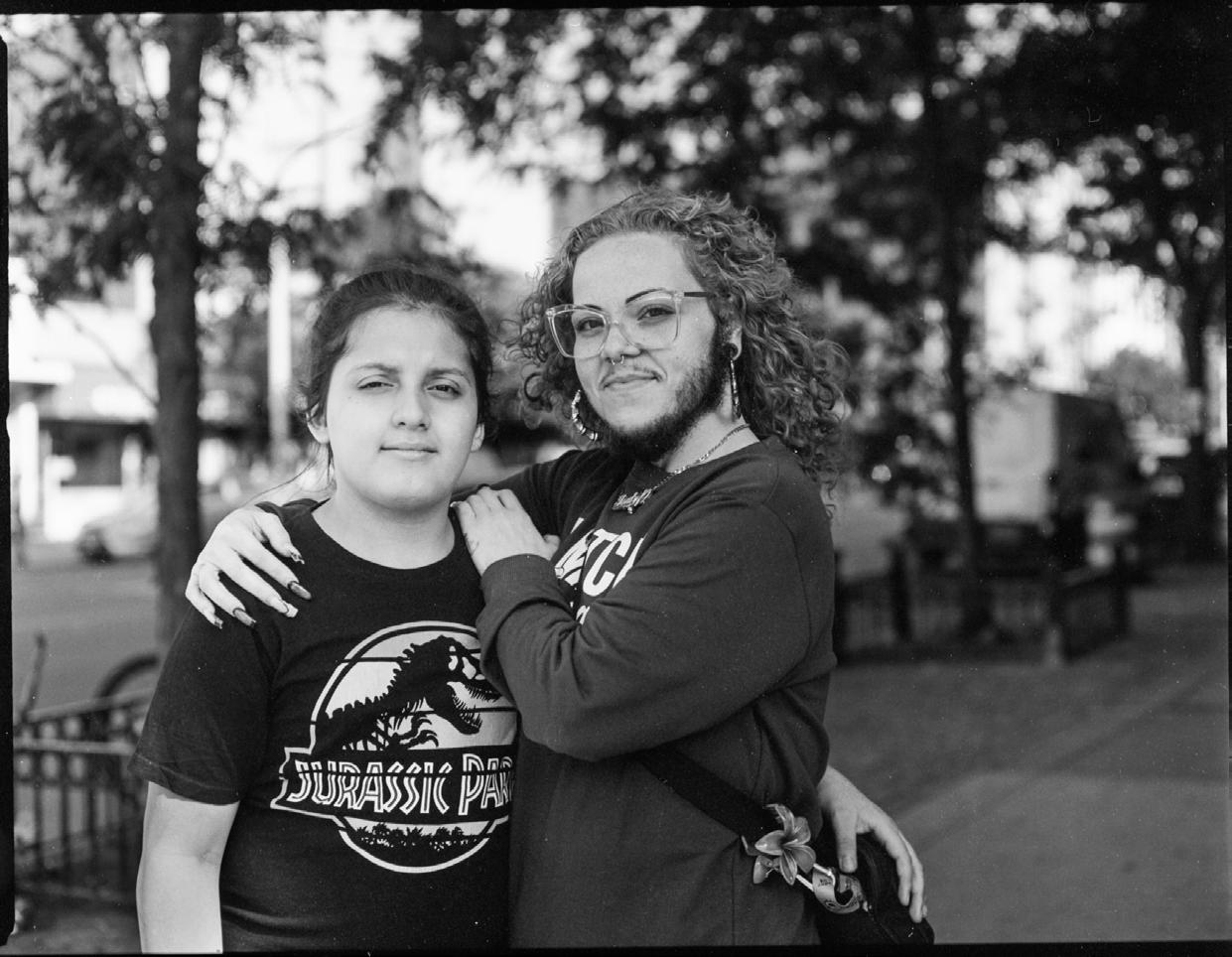
Abigail Montes
Rhonda, Hunts Point, 2025
Print from film negative
Abigail Montes
Gilbert “Chicky” Valle, Hunts Point, 2024
Print from film negative
Abigail Montes
Alma with her nephew, Hunts Point, 2024
Print from film negative
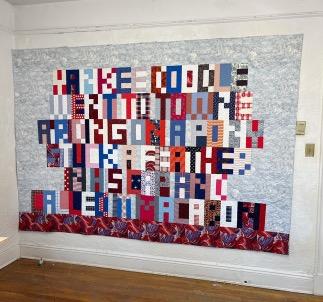
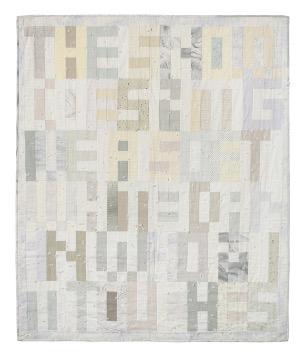
Amy Pryor
Yankee Doodle Quilt, 2024
Fabric, cotton batting, and thread
76” x 110”
Amy Pryor
Soft White Damn, 2022
Fabric, thread, cotton yarn
62” x 52”
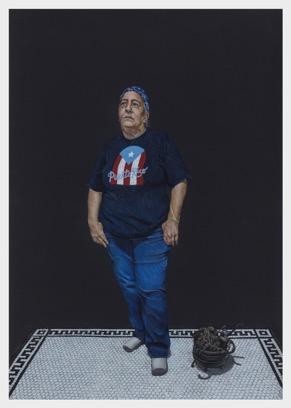
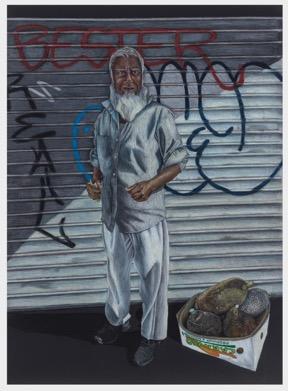
Shellyne Rodriguez
Lorine Padilla, The Elder (Post Savage Skulls), 2022
Colored pencil on paper
56.75” x 39.5”
Shellyne Rodriguez
Uncle’s Jack Fruit Hustle, 2022
Colored pencil on paper
59” x 43”
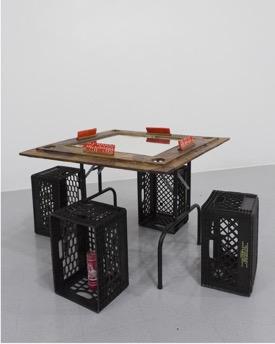
Misra Walker
You Can’t Sit With Us (Installation), 2019–2020
Tobacco leaves, wood, inkjet prints, mirror, found objects
29” x 40” x 40”

The Bronx Council on the Arts (BCA) is supported, in part, by public funds from the New York City Department of Cultural Affairs (DCLA) in partnership with the City Council; the New York State Council on the Arts with the support of the Office of the Governor and the New York State Legislature; Arts Midwest and the National Endowment for the Arts; the Coalition of Theaters of Color; the Cultural Immigrant Initiative; City Council Member Eric Dinowitz; and NYS Assemblymember Michael Benedetto. Also supported in part by the Howard Gilman Foundation, the Booth Ferris Foundation, the Scherman Foundation, the Altman Foundation, the Lily Auchincloss Foundation, the Tiger Baron Foundation, the New Yankee Stadium Community Benefits Fund, Amazon, BronxCare Health System, Northwestern Mutual Foundation, TD Bank, and Webster Bank.
Bronx Council on the Arts (BCA) 2700 E Tremont Ave Bronx, New York 10461 www.bronxarts.org