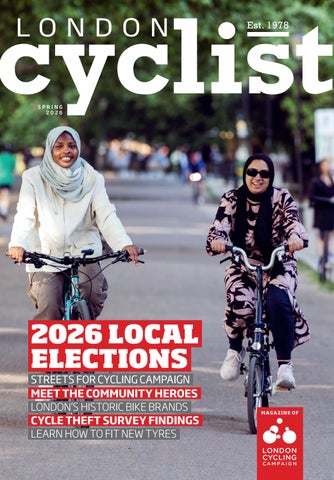
London Cyclist Spring 2026

Page 1


2026 LOCAL ELECTIONS

STREETS FOR CYCLING CAMPAIGN

MEET THE COMMUNITY HEROES

LONDON’S HISTORIC BIKE BRANDS

CYCLE THEFT SURVEY FINDINGS

LEARN HOW TO FIT NEW TYRES

News | Features | London | Travel | Ride Guide

Explore car-free parts of central London this spring: including this lush cycle lane at the Strand, lined with seating areas and cafes — the perfect meeting spot before a Somerset House exhibition or gig.

FEATURES

16 Streets For Cycling

Launching LCC’s local election campaign for a better, safer cycling network

22 Interview

We speak to Forest about its bikes, London background and future plans

28 Local Group Legends

Meet a few of the amazing volunteers promoting cycling in their communities

37 Cycle Theft Report

How new survey results are shaping our call for action on this growing crime

42 Beyond The Boroughs

We hear from Stevenage cyclists about LCC’s influence outside the capital

REGULARS

08 News

Cycle theft campaign; cyclist fatalities; driveless cars; and London Cycling Festival

11 Opinion

Why local activism’s so vital; involving kids in street design; lessons from history

66 Iconic Bikes

A brief history of the much-loved kids’ classic of the 1960s, Schwinn’s Sting-Ray

RIDE GUIDE

54 Ride

The second in our ‘Boundary Rides’ series kicks off from Mill Hill Broadway

58 Advice

Pro mechanic’s tips on how to fit new tyres without breaking into a sweat

62 Reviews

Crankbrothers shoes, Schwalbe tubes, plus lights, locks, tools and guidebooks

EDITORIAL

Never too late for real change

Cover photo: Andy Donohoe

Location: Central London

LONDON CYCLIST

Unit 206, The Record Hall, 16-16A Baldwin’s Gardens, London EC1N 7RJ n 020 7234 9310 n lcc.org.uk

EDITORIAL

IT’S LATE FEBRUARY as I write this piece, though a quick glance out the window might suggest otherwise. Rain’s battering down the rooftops as it’s done every day bar a handful since new year. It’s overcast and misty too, but the streets are still busy with schoolkids, parents, commuters, wheeling, walking and scooting, and an impressive count of wet-weather joggers. I’m adjacent to a popular cycle route and for the best part of three hours there’s no let-up in the colourful throng gurning through the storm. We’ve always bred hardy cyclists on these shores, only now there’s a whole lot more of us, and it’s heartening. I liken the scene to those wonderful press images from Scandi cities of folks biking through blizzards, business as normal — except the vibe’s much more British, soggier.

TIMy inbox pings and it’s news confirming plans for Oxford Street’s pedestrianisation have been approved — but cycling’s not made the cut. We’ve talked at length in these pages about the proposals for that iconic boulevard, offering examples on how responsible shared use works in similarly busy spaces in other major cities, so this looks set to be a missed opportunity of epic proportions. TfL simply says it “recognises the need to provide high-quality alternative routes through the area” — well they’ll need to be really close, really good and really high-capacity then, eh?

LCC MEMBERS’ LEGAL HELPLINE

Osbornes Law is the official legal partner of LCC, providing members with exclusive access to a legal helpline. If you’re involved in a collision or have a cycling-related legal issue, phone the cycling team at Osbornes for advice on 020 7681 8672.

Editor: John Kitchiner (london.cyclist@lcc.org.uk)

Design: Anita Razak

Contributors: Simon Munk, Tom Bogdanowicz, Sam Stephenson, Lucy Cooper, Tom Fyans, Rob Eves, Charlie Codrington, Carlton Reid

ADVERTISING

Sean Igoe (sean.igoe@lcc.org.uk)

SOCIAL MEDIA

TWITTER: @london_cycling

FACEBOOK: @LondonCyclingCampaign

INSTAGRAM: @london_cycling_campaign

Editorial, copyright, membership

LCC is not aligned with any political party. All views expressed in London Cyclist are those of the authors and are not necessarily endorsed by the editor, nor do they necessarily reflect LCC policy. All material is copyrighted and may not be reproduced without the written permission of the editor. Editorial content is independent of advertising. All LCC membership offers and discounts are presented entirely at the discretion of the provider.

London Cyclist is published by LCC.

MORE INFO: lcc.org.uk

MEMBERSHIP: lcc.org.uk/membership TO DONATE: lcc.org.uk/donate

LCC is a charitable limited company, reg no 1766411; charity no 1115789

London Cyclist is printed by Buxton Press on FSC certified carbon-balanced paper from responsible sources.

Report finds 40,000 cycles are being stolen in London every year

NEW LCC CAMPAIGN and petition launched in February, supported by Kryptonite, is calling for joined up action on cycle theft from the Metropolitan Police, UK government, Mayor of London, and Transport for London.

A JOIN THE CALL FOR ACTION ON CYCLE THEFT

cut in cycle theft, reinstating a theft taskforce.

n The Met to track cycle theft properly and enforce effectively both on-street and online.

n Government to follow the approach taken in France by making bike marking and registration mandatory.

The campaign was launched by publishing Broken Locks, Broken Promises — a new report that shows how cycle theft in London is so persistent, widespread and unpunished that it’s undermining targets to increase active travel and encourage cycle use.

The report finds that a significant proportion of people who have their bikes stolen simply stop cycling. And it estimates that 40,000 cycles are stolen in London every year, with only around 2% ever recovered. However, it also shows that it doesn’t have to be this way — comparisons illustrate that other countries and other police forces in the UK are doing a far better job at beating the thieves.

Key report recommendations include: n London’s Mayor to commit to a 10% yearly

n London councils, TfL and Network Rail to install secure cycle parking at stations and elsewhere.

n Bike retailers and secondhand sellers, including online marketplaces, to implement a code of practice and teach people about bike security, via public campaigns.

LCC surveyed nearly 2,000 London cyclists about their experiences of, and attitudes towards, cycle theft. A shocking threequarters of respondents reported that they, or members of their household, had had a bike stolen. And in four out of five cases, police took no action beyond an initial contact.

Read more about the report on page 37 of this magazine, or at lcc.org.uk/theft.

n Please sign the petition: action.lcc.org.uk/theft.

Photo: Andy Donohoe

Of all participants returned for more than one event. [74 people went on Kingston’s autumn ride]. MONTH in NUMBERS

TRIO OF FATALITIES BY EARLY FEBRUARY

ON 6 FEBRUARY, a 25-year-old man was arrested for killing an e-bike rider while ‘driving’ a horse and cart in Folly Lane, near the north circular on the Chingford/Walthamstow border. This marked the third cycling fatality of 2026 in London, at time of writing.

number of rides organised by LCC local groups in Q1-Q3 of 2025/26, excluding London Cycling Festival.

Prior to that, Clapham Cycles’ mechanic Irene Leardini, 39, was killed by a lorry driver on 20 January on a notoriously dangerous stretch of New Cross Road. LCC’s local group, Lewisham Cyclists, held a vigil and promised further campaigning around the road conditions there.

The first cycling fatality in 2026 was a 23-year-old man, killed by a turning car on Commercial Road in Tower Hamlets.

LCC continues to campaign on these roads specifically and the most dangerous junctions — but it’s also important to remember that cycling in London remains statistically very safe, despite these tragic and too frequent incidents.

LONDON CYCLING FESTIVAL RETURNS THIS SEPTEMBER ACROSS BOROUGHS

Sadly, RideLondon and its sister event FreeCycle are on indefinite pause. However, London Cycling Festival is back for a second year. On 20 September, rides and activities will be hosted in boroughs across the capital, along with three or four bigger events in east, west and central London. We have a working group of LCC members to help shape the event and we want this to be a real London-wide collaboration. Do you know a cycling club, community cycling group, bike shop, potential stallholder, volunteers or perhaps a few cycling enthusiasts who would like to be involved? Maybe you have a school bike bus, or scouts, guides and cubs groups that could sign up? Do you know a council officer or councillor who’d be keen? It’s already shaping up to be bigger and better than last year, so register your interest today. n For more info: tinyurl.com/LCF26-EOI.

GOOGLE’S DRIVERLESS ‘ROBOTAXIS’ TO HIT LONDON STREETS

WAYMO ‘ROBOTAXIS’ (from Google’s parent company, Alphabet) are being trialled right now on London’s streets, though currently with drivers in them for emergencies. The ‘autonomous vehicle’ (AV) or driverless private hire/taxi service is set to be followed by other operator trials in coming months.

Waymo’s vehicles are mapping and checking responses to the capital’s infamously complex streets without passengers, but the company and UK government have announced the plan is for full driverless (with passenger) trials by the end of 2026; Waymo is pushing for September.

Waymo makes much of its cautious driving and safety record compared to human-driven private hire, and operates in over 10 US cities already. But London is only the second city outside the US to get trials, after Tokyo, and is arguably the most complex city yet in terms of infrastructure and people’s behaviour on the roads.

LCC is watching the emerging situation around AV use closely. Our view so far is robotaxis could have severe risks for walking, wheeling and cycling, but also potentially benefits — and much will depend on the regulatory framework for them and how they roll out and scale.

Time to think local

While there’s much to be celebrated, Tom Fyans explains why your local elections campaigning is so important

ONE OF THE reasons that LCC has been so effective in campaigning for safer streets for cycling is that we’re able to influence both London-wide policy — like the Mayor’s Transport Strategy and TfL’s Business Plan — but also what councils do at the borough level through our local campaigning.

The local elections coming up in May are a great opportunity to secure commitments from local politicians of all parties to improve cycling in their borough. But for this to happen, our amazing groups and volunteers will need to be energised and ready for action. I’d like to recognise and celebrate the work of local campaigners on the frontline of what can be, at times, a toxic debate about local transport issues in their communities.

For inspiration, we need look no further than Tower Hamlets, where local activists have just won a massive legal victory for healthier and safer streets in their community, following a ruling by the Court of Appeal that the council had acted unlawfully in deciding to axe the traffic reduction schemes in Bethnal Green, Shoreditch and on Columbia Road. Save our Safer Streets, the local campaign group involved, described it as “a victory for local people who came

together when they saw that their community stood to lose the safer streets they really value”.

A few miles away in a very different part of London, I recently joined many LCC campaigners, councillors, TfL staff and Will Norman, London’s walking and cycling commissioner, on a celebratory ride across and around Lambeth Bridge to test out the new cycling infrastructure that has been at least 10 years in the making. In his speech, Will paid tribute to the tireless work of local volunteers, including those from LCC, who were key to ensuring there will now be a better and safer experience for the thousands of cyclists who use this busy crossing every day.

These are just two examples of local impact by local people, but there are countless others, and I’m proud to work for an organisation like LCC that supports ordinary people doing extraordinary things to improve their communities.

If you fancy getting more involved in your local group or

“Our amazing groups and volunteers will need to be energised and ready for action”
Tom

Chief Executive of the London Cycling Campaign

just want to do something to improve cycling where you live, read our feature on page 16. These actions work — even boroughs like Westminster have seen transformational change when preelection pledges of support become post-election policy.

In an increasingly chaotic political environment, I still take great comfort from the famous quote by American anthropologist Margaret Mead: “Never doubt that a small group of thoughtful, committed citizens can change the world; indeed it’s the only thing that ever has.”

Cycling fatalities update

I am deeply saddened by the tragic death of cyclist Irene Leardini on 20 January in Lewisham, after a collision involving a lorry while cycling on New Cross Road. I would like to thank our colleagues at Lewisham Cyclists, who held an emotional vigil for Irene on 6 February attended by friends, local cyclists, Lewisham deputy mayor, and the Lewisham North MP.

At the time of writing there have been three cyclist fatalities already this year, an intolerable situation that we’re urgently raising with TfL. We will redouble our efforts to end such tragedies. Our thoughts are with Irene’s family and friends.

Reimagining streets

Children should be at the centre of new street designs suggests Zeina Hawa, as there’s a lot we could learn

TRAMPOLINES, ZIPLINES from school buildings, giant waterslides, and floating gardens are not the first things that come to mind when thinking about improving our streets for walking and cycling. But these may just be the best entry points to the healthy street transformations our neighbourhoods need.

As designers and campaigners for better streets, we can sometimes get stuck in a monotone approach to street improvements — cycle lanes, green space, the usual suspects. Working with kids offers a fresh perspective, seeing things in simpler terms, going back to first principles of what a street is actually for: a valuable public space for socialising, organising, trading, playing, resting, making friends, taking risks, and moving around. Have it their way and every street would transform into a makeshift sports pitch with community gardens supplying the neighbourhood with endless amounts of potatoes, carrots and spinach, plus a nice spot of shade. Of course not every street can look like that and many will still need to perform some more strategic movement function, but the ideas and honesty of children do well to remind us of the priorities and

possibilities. The case for centring young people in street design also has the potential to rally a broader coalition of people around difficult but necessary conversations on road space reallocation that is focused on children, wellbeing, health, social interaction and what we want from our most valuable of public spaces.

Hands-on learning

To place children at the heart of street design, we’ve been championing creative engagement using a software version of Minecraft, a 3D sandbox game that allows you to build infinite worlds. The sessions are organised in workshops at primary schools, attended by local authority and Sustrans engineers, and local councillors. An interesting colearning process occurs where children can teach the use of the tool to adults, who in turn can guide children’s imagination towards workable street designs.

But it’s not only slides and ziplines that come out of these

“Working with kids offers a fresh perspective, seeing things in simpler terms”

sessions. We have important conversations about the healthy streets approach, and students summarise their design proposals and features, which we then collectively discuss and prioritise. Car-free playstreets also create the opportunity to experience a street completely differently. A playstreet in Hounslow saw a 300% increase in people walking and cycling on the day. Coupled with wider engagement, it’s a powerful entry point to bring on board the wider school community, supporting environments that are inviting, playful, imaginative, and ambitious in their capacity to reallocate space.

At The Chain Effect in Lebanon, where young people aren’t as exposed to cycling as a form of transport, we use street art and wall painting themed around mobility and the city as an entry point for similar conversations. It gets young people thinking about creating things in their neighbourhood.

When we hand children the tools to reimagine their home streets, they don’t just design better infrastructure. They remind us what these areas are fundamentally for: not just moving through, but living in. Their wildest ideas might not make the final plans, but the spirit behind them, as places of joy, connection and possibility, should.

Zeina Hawa is a new LCC trustee with a background in active travel charities

Society cyclists

Before cars became mainstream, even the upper classes travelled everywhere by bike, says Carlton Reid

INSTEAD OF stewing in social media, I escape, for a few hours each day, by flipping through period cycling magazines. I’m working on a hush-hush research project. I can’t yet reveal who commissioned the project, but it’s not breaching any confidentiality to discuss a few of the many 1890s cyclists I’ve been studying.

First, let me introduce you to the Bavaria-born artist Professor Herkomer, founder of the innovative and influential Herkomer School of Art, based in Bushey, 15 miles from central London. Herkomer was well known at the end of the Victorian age (literally, he painted the official portrait of the Queen on her deathbed) and, to art and social historians, he’s still a significant figure, noted for his portrayals of rural poverty. To me, he’s significant because he dotted everywhere by bike.

In truth, this wasn’t unusual for somebody of his social standing in the period. Herkomer was among

cycle use by the middle classes and social elites; cycling didn’t become a notably working-class form of transport until the 1920s.

“Professor Herkomer,” stated a magazine in 1896, “bicycles up to London two or three times a week, regarding Stanmore Hill as a mere joke, unworthy of a single thought.” (No mean feat as he rode a fixed wheel machine.)

Absolute independence

He also cycle toured, explained the full-page profile in The Cycling World Illustrated. “Cycling should be a pleasure and… never cause fatigue,” said Herkomer. “I make this a rule when touring, and as I have everything for the night with me, there is never the worrying necessity before me of having to get to a certain place. Absolute independence is the primary charm one achieves with a bicycle.”

He also told the magazine’s ‘lady journalist’ that cycling “has come to help English art, for it enables artists to see nature in a way that

would be impossible by any other mode of locomotion.”

Perhaps Herkomer cycled to the salons, clubs and grand houses of those he painted? He was famous for his portraiture, painting notable figures including fellow keen touring cyclist Thomas Hardy.

In 1895, Herkomer painted the portrait of England’s top divorce lawyer, Sir Francis Jeune. Writing in September that year to Herkomer from his home at Arlington Manor, Newbury, 73 miles from London, Sir Francis said: “We have just got here by way of bicycle from London.”

Sir Francis cycled that journey with his wife, Lady Jeune, author of an article of advice for women cyclists in the Badminton Magazine of Sports and Pastimes

Long-distance cycle commuting by elite figures might seem newsworthy to us — you might think they’d take the train instead — but it wouldn’t have been remarkable at the time, with cyclists dominating on the roads. In 1895 there were just a handful of cars in

Despite huge wins for cycling in London over the last decade, forward progress is not guaranteed — the next four years are vital. Here’s what we need from you for May’s local elections…

ON 27 MARCH, the day the ‘pre-election period’ kicks in and campaigning for London’s local council elections officially begins, we’ll launch our new Streets for Cycling campaign. As you hopefully already know, we’re asking all of the main candidates to be leader in their borough to commit to completing a safe and connected cycle network

where you live. And we really need your help to get that commitment. LCC members (and readers of London Cyclist) have a wide range of political views — just as politicians of just about every stripe can support or oppose cycling schemes. So the aim of this article and the campaign isn’t to push a particular party or voting approach down your throats. We run election campaigns not to score party political points, but to

ensure every candidate and every politician hears how delivering safer cycling is a priority for many voting residents.

Similarly, while many of you can doubtless think of weak cycling schemes or ones that are missing entirely in your area, hopefully you’re LCC members because you can also see the huge strides swathes of London have made to enable more, and a far wider range of, people to cycle than ever before.

More cycling doesn’t mean more problems

London currently sits at an average 1.5 million cycle trips made daily. That’s now a significant figure compared to daily tube and bus journeys, and the ‘mode share’ for cycling is increasing as cycling demographics diversify.

London becoming a world class city for cycling hasn’t happened overnight. It’s taken decades of pushing, cajoling and campaigning

for cycling infrastructure and safety to matter, in no small part thanks to the staff at LCC, our borough activists and you — your membership, your support helps hugely, as does every email you send to a local politician, or every time you join a meeting or volunteer with your local group.

This March to May, we’ll need your support more than ever. Because while cycling has come a massively long way in the last

decade — with LCC pushing successive Mayors Boris Johnson and Sadiq Khan successfully, and butting hard heads with senior TfL management, and working in every London borough to win change on the ground — all that progress is under threat. We face a current political situation internationally, nationally and across London that is completely unprecedented in its chaotic instability.

In outer London, a surging

Reform vote is bringing pressure on active travel policies due to Nigel Farage’s publicly-stated views on the subject. In multiple boroughs we’ll need to engage with candidates across the spectrum to persuade them that while many households may still own a car, that doesn’t mean all they want for the future is more congestion, pollution and inactivity. Indeed, progressing cycling schemes and delivering changes around town centres should be seen as a vote winner no matter which party a candidate represents.

While in inner London, and at the border between the two, we’re seeing boroughs where a surging Green vote oddly seems to be also sending the signal to Labour councils to ditch cycling in favour of a more car-centric outlook.

We’ve already seen portfolio leads shaken out due to council leadership refusing to back progress on active travel and more are due to come shortly we believe. While in Newham, the new Labour candidate to be Mayor of the borough seems

to be embracing the ‘war on cars’ culture warrior vote and is proposing in his initial leaflets to scrap any costs for parking a first car as a household — a step that on its own would cost a council already in parlous financial straits (as all London boroughs are currently) millions in lost revenue.

In times of chaos, ask for one simple thing

Moves like these are unfortunately being echoed across inner London too, with several councils that have long embraced active travel now starting to backtrack fast — this despite the main ‘opposition’ to them now being a revitalised Green Party which will surely seize on any wobbles on active travel as a stick to beat its rivals with?

In other words, whichever borough you live in, there’s a lot of instability and uncertainty as to what rising or falling political popularities means for the future. But there’s also a huge opportunity.

We’ve kept our ask for each leader really simple for that reason: finish the ‘strategic cycle network’

in the next term. This is really the single thing politicians can do, that’s within their grasp, that would boost cycling most.

TfL has already mapped out its vision of a core cycle network — and is providing funding to boroughs for it — and most outer boroughs only have relatively few priority connections to make, while most inner boroughs are well on their way to making them. It’s a case of some extra connections here and there, via cycle tracks or LTNs, or just careful routing and crossings. It won’t be perfect, but we don’t need that for now, we just need ‘good enough’ and ‘get on with it’.

It can’t be overstated how important ‘good enough’ is in this case. It’s the difference between you and your family and friends being able to cycle to the tube station, the pool, school and on to work, without just giving up. It might include roads that are a bit too busy to be great, or be a bit wiggly at times. But we need those routes joined up now, so that in four years we can ask for an even

better network. But for now, we’re keeping it simple.

Ask not what cycling can do for you but…

This is really important. And that’s why we’re begging you to do at least one thing between March and May, ideally three.

The first is to take our action when it goes live on 27 March. It takes just one minute — you feed your postcode in and our system populates a letter to each of the most likely candidates to lead your council after the election. Click ‘send’ and you’ll have done your part in ensuring candidates across the mainstream parties in your area hear that cycling is important and they can’t backslide on it.

Secondly, we’d obviously hope that you could share that action far and wide. Help make sure your friends, family, neighbours, anyone who you pass in the street who cycles, that bloke you bump into on the way to work, everyone gets the link to the action. The more people in each borough emailing the candidates, the more they’ll listen to us all.

Even better, if you feel really fired up about the local elections — and frankly we should all feel really fired up — then help out with one of the local LCC group activities.

The people we’re electing this May will really set the tone for the next four years of London living — and that takes us up to 2030, when we’re meant to be a ‘net zero’ city according to the Mayor. So these will be vital years at a pivotal point in London politics. We could see outer London boroughs trying to secede from the capital, we could

see inner London infighting, at this point we might just see flying pigs it’s so wild out there.

So thirdly, if you have any spare time from the end of March to the start of May, please do consider giving a bit of it to your local group. Our volunteers are lovely, knowledgeable and you can pick what works for you. We’re looking potentially for people to flyer commuter cyclists in a crew, to help run hustings and perhaps, most importantly, to meet the council leadership candidates and just chat — talk about your experiences in the borough, your hopes, your fears and their approach to cycling. We can brief you, but we also think most of you can and should simply talk about the changes that London has seen already to deliver better cycling, and where more changes are needed and schemes are missing.

Because in our experience that face-to-face human contact with council leaders tends to help them see cyclists as something other than a policy pain, and also can help you and local groups to see

these candidates as humans too. Sometimes meeting politicians can even be fun!

You can ask them out on a oneon-one bike ride, or perhaps with a small group from the borough, showing them the best and worst it has to offer at the moment. Again, we’re really keen that these local council elections are fun for LCC members and activists, but we’d really love the next leader of your council to know at least one cyclist, one who isn’t scared of them or thinks them a weirdo.

We’re asking each local group to do some basic research on what your council leader candidates appear to care most about, and therefore understand what it’s probably best to talk about.

Hopefully it shouldn’t be too daunting for lots of our groups and supporters to, at the very least, use our action system and send one email to the candidates during the pre-election period. So we’re equally hopeful that it shouldn’t be daunting for a few local activists in each borough to push for a meeting with candidates to make our case.

Why should they care about cycling?

Why now and why should any politician care about cycling? Well, the good news is that no matter the hue of the politician you’re talking to, or what their personal interests in politics lean towards, chances are the answer to the issues they care most about is, at least to a reasonable degree, cycling. That’s also what makes these particular local elections so important.

We’re hurtling through a chaotic and unstable time towards a set of critical climate-related and environmental deadlines for the world, for our country and for our city, that no politicians can afford to ignore.

In 2028, we’ll elect a Mayor again — Khan has suggested he might stay for another term, though this seems less likely to most commentators. And either way, the local elections and other political moments further ahead will likely see the mayoral candidates putting forward far more starkly competing visions for the future of London than ever before. Soon after will be 2030 — when the term for councils elected this May ends — which is when London is also meant to have become a net zero city on climate emissions, and well on its way to being a ‘vision zero’ city on road danger. That means the elected leaders this May will need to get their skates on, alongside the current Mayor, to deliver fairly radical changes to achieve these aims. Even the grey suits that tend to dominate TfL now routinely talk about a ‘sea change’ needed in the way roads work to hit such targets. So, again, regardless of

political leaning, cycling remains something of a magic bullet. Not only for carbon emissions or road danger, but for a healthier population and better-functioning NHS (inactivity-related ill health is

impacting NHS budgets severely), a more productive workforce, more efficient use of roadspace and/or resources, for more efficient tax spending and nicer places to live, cycling can be the answer.

THREE SIMPLE STEPS TO TAKE TODAY

There’s three things that every LCC member can do to help us win real change in your borough this local election cycle:

1. TAKE THE ACTION WHEN IT GOES LIVE ON 27 MARCH

It just takes one minute — enter your postcode, edit the email to council leadership candidates if you want, and hit ‘send’. It is super simple. But every person who does this adds to the voices telling candidates they need to do more, get a move on, be bolder, rather than do less or rip schemes out. You may not perfectly agree with the ask, you might have something else you view as more important, or you might just be busy, but we guarantee council leadership candidates will hear from people who want less cycling and less cycling schemes. It’s pull together now or four more years of dithering, delay and weak schemes in many areas.

2. SHARE THE ACTION

Ask friends, family, your cycling mates, your non-cycling mates, that bloke you nod to down the chip shop, to also sign the action. The more folks who hit the ‘take action’ button, the greater the voice we have.

3. AND IF YOU DO ONE MORE THING...

We know that just doing those first two things can be a big ask. But if you’ve got an hour to spare rather than just two minutes, then please contact your local LCC group. You can find their contact details on our website (lcc.org.uk/groups). Perhaps you can help speak to a politician, or go on a group ride, or help on a stall? But helping the local organisers ensure election-related activities go off with a bang again will really underline the borough-wide desire for more and better cycling conditions. And this stuff isn’t difficult or scary once you’re doing it. It’s a small time commitment for a what can be a huge outcome — and it’s actually fun too!

Interview: John Kitchiner/Lucy
Forest

LAURA ELMS

With Forest’s shared e-bikes becoming a common sight in many boroughs, we speak to the company’s VP of sustainability and communications about its London background and plans for future growth

We first started seeing Forest bikes on the streets of London around the time of the Covid pandemic — can you give a brief history of the company?

Forest was founded by our CEO Agustin Guilisasti, alongside co-founders Michael Stewart and Caroline Seton. The first Forest bikes were launched in 2020, with 200 e-bikes across Camden and Islington. Like many businesses, the pandemic was a tricky period for us, but it taught us how to be flexible and comfortable with ambiguity.

As the pandemic subsided in 2021, it was clear that commuting habits had changed; this gave us a belief that we were onto something, and there was a longterm future for shared micromobility in London. Since then, the demand for e-bikes and shared mobility has spread and we now have 20,000 e-bikes across 18 boroughs, serving over 1.5 million Londoners.

You’re a London company born and developed — where are you based and how many people do you employ?

When Forest first started, the whole team was based out of our warehouse in Southwark. Fast forward six years, we now have several warehouses across London that are primarily used for maintenance and charging batteries. Approximately 40 of our team work from our HQ in Moorgate, while a further 200 work in operational roles,

both as ‘Forest Guardians’, servicing bikes on-street, and in our warehouses. We are really proud of our London roots and you will see the ‘London is Our Home’ message on many of our bikes.

Why the name Forest? [It started as Human Forest].

The idea for Forest came from our founders’ ambition to create a micromobility platform that was a truly sustainable option for Londoners. The name ‘Human Forest’ was born from the idea that people working together could become like a forest, reducing emissions and protecting the air quality in our city. As the company grew, the name began to feel a little wordy, so it was shortened to Forest for stronger brand recognition. However, the commitment to sustainability remains exactly the same.

Tell us about the bikes? Where are they made, what are their key features and what’s their battery range?

Our bikes are manufactured in a solar-powered factory in China, but we refine and finesse them here in the UK. Many of our bikes are purchased secondhand, which helps us reduce our CO2 emissions. The batteries have a range of 50-80km (dependent on usage), but one of the key features that drew us to this model is its safety record — they’ve been proven to be safe in many different meteorological conditions, and are regularly retested to identify areas for improvement.

Ensuring our fleet is run in a sustainable manner is also a priority. By reusing parts and refurbishing bikes — rather than just buying new models — we’re keeping our environmental impact as low as possible.

We’re also working with the manufacturer of our bikes’ batteries, Okai, to supply batteries which retain their safety features while also allowing the cells to be replaceable, and therefore improve recyclability.

How much do they cost to use or hire? There’s free minutes involved with each rental isn’t there?

We want our bikes to be as affordable and accessible as possible for Londoners. Renting costs 33p per minute, but we also offer between one and 30 minutes of free riding depending on how urgently a bike needs to be moved to another part of the city. This means riders can pick up free minutes while we make sure our bikes are spread evenly across London.

Our shared e-bike service runs on a unique adsupported model. Every rider gets up to 30 minutes of free cycling each day and can earn even more free time by watching short in-app ads. We are also passionate about making sure free and discounted mobility is available to those who need it most. Through in-app ads, reduced cost rides and our ‘Friends of the Forest’ scheme, we offer subsidised rides for NHS workers, emergency service workers, students and pensioners. We also partner with employers through initiatives like Cycle to Work, giving even more Londoners access to affordable transport.

All of this helps us stay sustainable and affordable while balancing our growth and environmental goals.

What sets you apart from the other shared e-bike rental schemes we see?

What makes us different is that sustainability is at the heart of our operations. Since day one, we’ve prioritised using renewable energy to power our fleet and support vehicles. This means we’ve always had

Time-of-day data: shows around half of all Forest e-bike trips are made during peak rush hours

a relatively small carbon footprint, all of which has been offset through our conservation projects.

Elsewhere, we’ve been pioneering two important projects. The first is buying secondhand but unused bikes to reduce emissions from the production side. We also run an industry-leading refurbishment project, which means we reuse almost all of our bike parts and don’t just rely on and scrapping old bikes and worn parts and buying new.

And you have a commitment to plant a certain number of trees per year? How many have been planted and how many do you hope to plant over the next decade?

We are really proud of our longstanding partnership with The Great Reserve, a UK reforestation project. The Great Reserve has the goal of planting 100,000 great sequoias in the UK, via assisted migration. The goal is to protect the future of the giant sequoia, which is currently on the IUCN endangered species red list and whose numbers are declining each year.

We began working with The Great Reserve in 2024, and have planted 20 saplings as part of our partnership. This year we will continue to expand

that partnership with the planting of more sapling sequoias at the same site, helping to further offset our corporate emissions. For every sequoia planted, The Great Reserve also plants three native species to ensure biodiversity and only plants on pre-felled land.

How many bikes do you have in London and which boroughs do you operate in? Is there a geo-restriction to stop people taking them out of specified boroughs?

We currently have over 20,000 e-bikes across 18 boroughs, making us one of the largest shared e-bike operators in the city. Our growth is carefully managed and rooted in local partnerships. We work closely with councils to ensure our service supports local transport needs, prioritises safety and integrates seamlessly into communities.

Every e-bike is fitted with GPS technology, enabling the use of virtual boundaries (geofences) across the city. These allow us to actively manage where riding is permitted, helping to keep streets safer for all.

Have phone, will travel: find, unlock and track your rides with your smartphone

incredibly diverse, so there’s no single ‘typical’ Forest user. In terms of gender, around 30% of our users identify as women, 66% as men, and 5% as another gender identity or prefer not to say. Our largest age group is 25 to 35, but we welcome riders of all ages, with users ranging up to 80 years old.

At the moment, we don’t collect data on riders’ racial identity. However, this is something we’re actively exploring so we can better understand our community, identify where groups may be underrepresented, and make sure we’re serving everyone as effectively as possible.

Geographically, we have a particularly strong presence in south London, with Southwark, Wandsworth, and Lambeth among our top boroughs. We also see high levels of ridership in Islington and Camden, as well as in central London areas like Westminster. And around half of all Forest rides take place during peak commuting hours showing that commuters are one of our key user groups.

You collect a huge amount of data on users’ movements — what do you do with this data and how can you reassure people it’s being used safely and responsibly?

The data we collect on users, both quantitative data from riding habits and qualitative insights from user surveys, helps us build a better understanding of our riders, their needs, and how we can improve the Forest experience. This includes using start and end ride data to help our operations team distribute bikes to areas where demand is highest, while user feedback informs the development of new products to our existing service.

Every rider gets up to 30 minutes of free cycling every day and can earn more free time via in-app ads

Data is anonymised and aggregated wherever possible, in line with GDPR requirements, and we only collect what is necessary to deliver and improve the service. Access to personal data is strictly limited to authorised team members, stored securely using encrypted systems, and subject to robust internal governance and retention policies. We are transparent with users about what data we collect and why, and we do not sell personal data to third parties.

Is there ‘typical’ Forest e-bike user?

Just like London itself, our riders are

Research shows that people new to cycling are particularly drawn to shared e-bike rentals, so what can Forest do to help make London a safer place to cycle for everyone?

Through our Common Sense Club initiative — which has the backing of TfL and LCC — we help riders feel safer, more confident and better informed on London’s roads. But keeping Londoners safe goes beyond those riding our bikes. We want pedestrians, residents and businesses to feel comfortable around them too. Our in-app technology uses AI to check that bikes are parked responsibly, helping keep pavements, pathways and entrances clear. If issues do arise, obstructive bikes can be quickly reported via QR codes or on our dedicated phone line.

Cycling also plays a vital role in creating a cleaner, healthier city. Through our partnership with Octopus Energy, we are now the only Londonbased e-bike operator powered by zero-emission energy, with all our bikes and service vehicles running on 100% renewable power.

What about community partnerships...

We work closely with local organisations to support and invest in the places where we operate. This includes working with the Hounslow apprenticeship scheme, sponsoring local girls’ and women’s football teams, and running our Friends of the Forest scheme. We have also worked with Thames21, with our teams volunteering on a river clean-up day.

Obviously the biggest bugbear of the dockless hire bike schemes has been ‘dumping’, people just abandoning bikes wherever they feel like it. Forest has introduced parking bays in certain boroughs, but what more can be done?

We understand the concerns, and it is something we take seriously. From the very beginning, we have worked closely with boroughs on parking and have funded the creation of 2,600 parking bays since 2021. We also share data with boroughs to help them choose the best

London to Paris: Mayor Anne Hidalgo gets a close look at how the Forest bikes work

locations for new bays, and we use that same insight to guide our own recommendations.

At the same time, we are investing heavily in our technology, with in-app guidance and clear instructions to help riders park properly and reduce street clutter. Our local team also responds quickly when issues are reported, helping to make sure bikes do not cause obstruction or inconvenience.

However, the lack of dedicated parking infrastructure is still the biggest challenge across the industry. A more consistent, pan-London regulatory approach via the English Devolution Bill would make a huge difference. We fully support this legislation, which would ensure providers operate under one coherent regulatory framework mandated by TfL.

And what happens when users break the rules?

We take this very seriously and have clear rules in place to keep people safe. When those rules are not followed, we act on it, issuing warnings, fines and permanent bans for those who misuse the service, or leave bikes in unsafe or obstructive places.

What more will Forest be doing this year to make sure people use their bikes safely and responsibly?

At the end of last year we launched the Common Sense Club, an interactive initiative designed to help riders better understand the Highway Code and build good cycling habits while getting around the city. We’re now planning a second phase to reach even more users. Alongside this, we will also be running a series of sponsored cycle training programmes across London.

LCC’s LOCAL GROUP LEGENDS

Sam Stephenson meets just a few of the LCC volunteers going above and beyond for cycling in their boroughs

DID YOU KNOW that in your borough right now, there are LCC volunteers working tirelessly to bring safer cycling infrastructure to the area and get more people out on two (or more) wheels?

Most LCC members interact with their local group in the form of a ride or event, or perhaps by emailing about a particular issue you’d like investigated. But the story of what our volunteers do all year round is far greater than that.

It’s planning meetings with councillors, creating content for social media, launching petitions, writing to MPs, planning ride routes, putting on training for ride marshals, handing out flyers, engaging with the public, and so much more. Plus, for many, all of this is being done alongside full-time jobs, parenting and everything else that comes up.

Cycling in London is safer because of the work they do; more people, particularly families, feel confident to make local journeys by bike, because of group rides they’ve joined. So to shine a light on this vital work, we caught up with seven groups to find out more about what they do and what they’ve got planned for 2026.

SUZANNE BUCKINGHAM & ROGER MACE, KINGSTON CYCLING CAMPAIGN

When it comes to giving credit for the growing popularity for families cycling in Kingston, it’s hard to look past Suzanne and Roger. From the ‘bread pudding’ rides — a staple of the group’s calendar for more than 30 years — to the recent seasonal family-friendly rides, the group has helped show local people the cycling potential in their borough.

“When I first got involved, I could see there was a need to put something on to get more families cycling locally,” said Suzanne (pictured below, left). “And since starting the family-friendly rides, we’re speaking to more and more parents who, before riding with us, wouldn’t have thought about taking their children out on their bikes.”

“It’s nice seeing both new and familiar faces coming along,” added Roger, “and the rides are a great advert for what a truly cycle-friendly Kingston could look like.” Indeed, the group has been proactive in getting a variety of local politicians on the rides. “Having MPs or councillors come along has been great, because not only are they seeing the demand for cycling, but we’re also able to plan routes that show areas where they could really make a difference to the infrastructure,” said Suzanne.“Plus, I know for a fact there’s a councillors’ WhatsApp group, and those who come on our rides are always sharing pictures and videos, so it all helps reinforce the fact that cycling in Kingston is growing.”

So, looking ahead to the rest of 2026, is it going to be more of the same?

“Certainly,” said Roger, “but we’re also planning more rides that venture outside the borough, with our next ride potentially taking in four different areas, to again try and maximise political impact, and show locals the wider cycling possibilities.”

Photos: S & G Buckingham

While this article puts a variety of local groups’ rides and events in the spotlight, Kentish Town Pedals, run by the Camden group, is quite unique. Organised by Suzanne Weller, the rides are not only open for the public to join, but are also recommended to patients on the NHS.

“The idea came about from two GPs in Kentish Town, who cycled themselves, and wanted to take some of their patients out on a ride,” said Suzanne. “They then got in touch with LCC, who reached out to us, and the next thing we knew we had a ride created and we were off. We keep the routes at about five miles, so the perfect length for someone who might be just coming back to cycling, which is the case for most of the patients who get prescribed to come.”

For Suzanne, the benefits of being recommended for a ride such as theirs are clear to see: “We get people coming out who might be dealing with loneliness, stress, or a longterm health condition, and just being part of a community group can sometimes be transformational. For me personally, it’s also really nice to meet all these people from different backgrounds and make a connection with them through cycling.”

The rides serve as a reminder of the need for good safe cycling infrastructure too. “That’s fundamental,” added Suzanne, “because if participants only feel safe riding with the group, they won’t cycle independently and see the real benefits.”

Another measure of the success of the scheme has been that this year they hope to launch another ride in Kilburn. “Things have worked so well with the project in Kentish Town, that it made sense to start seeing where we could replicate it, and Kilburn seems the perfect place. It’s going to start as a six-month experiment, but the hope is that it can prove the success of the model, and then who knows where things might go from there.”

BRUCE LYNN, SOUTHWARK CYCLISTS

A volunteer with Southwark Cyclists since 2011, Bruce has been integral to the flourishing ride scene in the borough. Indeed, last year saw him organise (and, in many cases, lead) 99 rides!

“The secret to a great ride is to make it accessible and sociable,” said Bruce. “For all our rides, you’re guaranteed a coffee break, and with that comes the chance to meet some great people, and see parts of the borough that might have passed you by before.

“As for hitting just under 100 rides last year, once we settled into the routine of two a week, I knew we’d get

close, so it made for a very satisfying end total.”

But Bruce is also determined to make sure Southwark has more than enough marshals and ride leaders to keep the local events ticking along.

“Once the rides got more popular, I started getting a few people asking if they could lead or just marshal one or two, which I was more than happy to encourage. But while marshal courses are often held, the same wasn’t the case for ride leader ones. So, with the help of LCC, I hosted my own course and opened it up to anyone in London. Right from the first one we had people

from all over, so they’ve been great to put on throughout the year.”

It goes without saying that organising at least two rides a week, along with training, isn’t easy, so what keeps Bruce hooked?

“It’s an addictive feeling,” he said, “getting to the end of a ride and seeing smiling people thanking and clapping you, who wouldn’t want to keep going back to that? Which is why I always encourage people, once they’ve come on a ride with us and enjoyed it, to think about getting involved more, because it really is so rewarding when you do.”

YAHIA ABAZA & EMILE MATHIEU, TOWER HAMLETS WHEELERS

Over in Tower Hamlets, two of LCC’s newest volunteers, Emile and Yahia, have already been making strides for safer cycling in the borough.

“I’ve always been quite climate anxious, and I love cycling, so when I heard about the Tower Hamlets LCC group, I thought it would be a great way to bring about some positive local action,” said Emile, the group’s secretary. “Having moved from Oxford to London, I was also looking for a connection to my community, and to meet some new interesting people.”

“It’s a similar story for me,” said Yahia, the group’s coordinator, “I joined because I wanted to make a difference, and a lot of the problems in the world can be solved through smaller, local changes.”

But as they both soon found out, making headway in your area can take time. “I did think, when I first got involved, that it would be easier to

make an impact,” said Emile. “I hoped there would be a few more open doors politically, but that’s all been part of my learning experience.”

“Going into the group, I didn’t have any preconceived notions,” said Yahia, “but what’s been a nice surprise is how welcoming everyone has been, and how, even though there are a lot of different opinions, being able to communicate with everyone to find common ground is something we could all benefit from doing.”

While work in Tower Hamlets is challenging currently, this just emphasises why it’s important — and being part of an organised group makes it possible to challenge a council, for example. “At times it might seem like we’re pushing on locked doors, but that’s no reason to simply give up,” said Yahia, “we can still work to grow cycling in the community, and build awareness of its many benefits.”

“Regardless of how May’s local elections go, if we’re going to grow cycling our area, we need to be thinking longterm, and to have a foundation in place of people showing the demand for safer cycling.”

When you look at the discourse around cycling online, it can seem a very negative space, and at times one full of anger and discontent. All of this made the recent series of videos by LCC’s Wandsworth group on why children and young people like to cycle seem like a breath of fresh air. The campaigner behind the camera was Anne-Claire.

“One of the reasons I took up the project was the same reason why I first got involved with the local group,” she said. “Children at my son’s school were banned from cycling; a decision I couldn’t get my head around. I knew I needed help to fight this, so I found

the Wandsworth group, and while we couldn’t change the headteacher’s mind, volunteering with the group has been a really rewarding experience.”

While the headteacher remained firm, the group still thought that it was important to give the young people themselves a voice in why they should be allowed to cycle. “When Celia [Duncan], our coordinator, mentioned about doing some videos with teenagers, I had this experience with the school in the back of my mind,” said Anne-Claire. “I started reaching out to other parents of teenagers who like to cycle, and soon enough we had a great list of interviewees.

“What was so nice, right from the first interview, were the reasons they gave for choosing cycling — it was all so relatable to someone of any age, mixed in with very normal teenage things, like just wanting to ride because of the freedom it gives them.”

The videos proved popular, with the positive message cutting through to locals and beyond. Indeed, in a borough where safe cycling is far from the council’s main priority (Wandsworth still has the single most dangerous junction for cycling), all voices of support for active travel are needed if positive change is going to come from the May local elections.

ANNE-CLAIRE DUPUIS, WANDSWORTH CYCLING CAMPAIGN

KAREN

FLANAGAN & JONATHAN ROTHWELL, NEWHAM CYCLISTS

2025 saw Newham Council crowned ‘most improved’ by the Healthy Streets scorecard team, recognising the transformation that has taken place to make cycling safer in the borough. Huge credit for this deserves to go to the local LCC group, with volunteers Karen and Jonathan being integral members.

“It felt extraordinary as campaigners to hear that the changes we’d all pushed for had been recognised,” said Jonathan, “it’s a testament to years of campaigning by many volunteers, and the ambition we’re seeing from council officers.”

But for those of us who don’t ride through the borough, what is the cycling picture there? “Safety is very inconsistent,” said Karen. “We have

some fantastic infrastructure — for example, CS2 and 3, and the Royal Docks corridor — but we also have areas with no protection for cycling, like East Ham.” Clearly then, the work is far from over when it comes to bringing Newham up to standard on cycle safety, and the group are aware of this.

“It’s important for us to keep building regular partnerships with other groups and schools, because you’re effectively helping to build coalitions of people willing to advocate for active travel,” said Jonathan. “Consistency in your messaging is also key; I’ve been advocating for improvements to Westfield Avenue since 2017, so seeing that finally become a reality

a decade later is a really great feeling!”

Of course, the local elections in May aren’t far from any of our volunteers’ minds and for Karen and Jonathan they see 2026 as a year to push the council to go even further. “It’s no secret that a lot of campaigning is the domain of folks who are older, more affluent, and tend to own their own homes — which is why the pro-driving lobby is so good at making noise! But this doesn’t reflect the reality of our home borough,” said Jonathan.

“We’ll continue to spread the word that cycling is a cheap and convenient mode of transport, and the new infrastructure in Newham is making it much safer,” said Karen.

VERONICA CHAMBERLIN & CAROLINE OSBORNE, HARROW CYCLING CAMPAIGN

If you cycle in Harrow, chances are you’ve already heard of the Harrow Cycle Hub, run by the local LCC group’s Veronica Chamberlin. “The genesis of the hub came from the pandemic, and the cycle lanes that were put in temporarily when there were no cars on the road,” said Veronica.

“But because Harrow is so car dominated, when things got back to normal the council stripped back all this new infrastructure, resulting in many people stopping cycling altogether, because they lacked confidence on the busier roads. We found this to be the case particularly with women from south Asian communities. An amazing woman, Ifat Tejani, also recognised this problem, and with her help we got a

£4,000 grant from British Cycling, to start the Cycle Hub and start teaching.”

It was then at this point that Caroline first became involved. “I was looking for new volunteering opportunities,” said Caroline, “and Veronica mentioned they could do with some help with the communications side of things, which I was more than happy to give.”

What kind of services and sessions does the Cycle Hub provide now?

“One of our most popular events is the one we run with Wheels for All, where we provide adapted cycles to be ridden around the Civic Centre,” said Veronica. “Last year we had over 1,200 attendees, with the sessions operating every week weather permitting.”

“We also have our led rides,” said Caroline, “which saw 1,800 people join in 2025, alongside various mechanics’ courses, plus the seasonal events we put on at Easter, Christmas and Diwali.”

At the heart of the Harrow Cycle Hub is the local LCC group, something Veronica is keen to stress. “The Hub is very much a child of Harrow Cyclists,” she said. “We all wanted to do more to teach people to ride, and through that aim the Hub was created.

“Now, it’s grown beyond the local group, but it’s still very intertwined. Even from the campaigning side, I’m on the Harrow Council traffic and road safety advisory panel, representing both parties’ interests for more safe cycling infrastructure in the borough.”

CYCLE THEFT THE FIGHTBACK ON

A new report on cycle theft highlights the urgent action needed from police, councils and retailers. Tom Bogdanowicz considers the next steps

LCC’S NEW CYCLE theft report — Broken Locks, Broken Promises — previewed in a previous edition (London Cyclist, Autumn 2025) and just released — highlights the need for the Metropolitan Police, alongside local authorities, online sellers and retailers, to act on cycle theft.

In tandem with the report, LCC’s cycle theft survey of the same name — one of the largest ever conducted in London (a big thank you to all who contributed) — shows that not only have three-quarters of regular cyclists who responded been victims of bike theft, but that a very large (69%) proportion of them feel that the police action in response to their reports of theft was inadequate. In the submitted survey comments many of you, unsurprisingly, proposed the same actions as are listed in the report.

THE REPORT

The published version of the report makes seven recommendations to reduce cycle theft in London, focusing on the Mayor, Met, TfL and the government:

1) Demand a 10% cut in cycle theft each year of the mayoralty

We need key performance indicators for Transport for London (TfL) and the Met, and a commitment from them to achieve a 10% reduction in cycle theft in each year of the current mayoralty. Given this isn’t just a target for the Met, nor is it solely their responsibility to drive down cycle theft, the Mayor should assemble a high-level taskforce taking in his Walking & Cycling Commissioner, TfL, the police, Network Rail and representatives of the cycle industry, as well as government, potentially.

2) Track cycle theft properly

The Met should be systematically recording violent ‘bikejackings’, burglary involving cycles, geographical distribution of all cycle theft, participation of gangs, stolen sales hotspots (markets, exports, inter-city), online marketplaces (Facebook Marketplace, Gumtree, eBay, Craigslist, etc). In this, ‘bikejacking’ — violent muggings to steal cycles — must be treated as a serious crime and recorded separately for data analysis.

3) Enforce properly, on-street and online

The police must use bait bikes with trackers at theft hotspots; check cycle ownership if cyclists are stopped; conduct patrols at known hotspots; show police presence at known stolen goods’ marketplaces; follow up cycle thefts where a reasonable opportunity to catch the thief or track the cycle exists, both physically

and via online marketplaces too. Online marketplaces, such as Facebook, must also do much more to aid the police and cycle owners tracking stolen goods.

4) Make marking/registration mandatory

TfL and the cycling industry must advocate for a mandatory national bike marking and registration scheme from the government, so that every sale of a cycle, new or used, is tied to an individual. This means participation by all leading suppliers and retailers (including secondhand sellers — cycle-specific or not — and online sellers), with authentication by mobile message and email of those who register used cycles for sale. Registration of cycles sold, both new and used, is already mandatory in France.

5) Fund secure cycle parking

TfL, London boroughs and rail operators must build more secure cycle compounds, with secure entry and camera oversight, offering 24-hour free access for registered cycle owners. Secure residential and workplace parking must be expanded to fully meet demand. Secure cycle parking is one of the ways the Dutch have managed to reduce cycle theft.

6) Implement a code of practice

Cycle shops, online marketplaces and secondhand retailers must sign a charter agreed through the cycle industry to not service or resell bikes without identity records and security marking.

7) Run a high-profile public information campaign on cycle security

Cycle retailers, online and on the high street, should, alongside lock makers, provide prominent advice and

As far as you can see: cycle parking in Amsterdam
Photo: Britt Warburton

information on securing cycles: locking techniques, registering your bike, avoiding buying stolen goods, geo-tagging devices such as Tiles and Apple AirTags for higher-value cycles, angle grinder-proof locks. Such information could also be propagated by TfL, cycling organisations including LCC, highways authorities, the police and other stakeholders, including to all Bikeability students (leaflets/messages at schools for parents) and via online lock sales.

THE SURVEY

A shocking 74% of almost 2,000 of London’s regular cyclists told us they, or their household, had had a cycle stolen. And of those who reported the thefts to the police (a high 72%) just 9% said that it had been investigated. In the rest of theft cases there was either no response from the police (53%), or just a formal contact and no further action (26%).

The conclusion of most respondents (69%) was that the police response was inadequate. One said: “(Theft) involved five bicycles, three of them electric, with a combined value of more than £15k being stolen. The police took no action on any of the thefts — despite

Secure storage and more: at Waltham Forest’s modern cycle hub

there being CCTV of all three incidents. I’ve seen CCTV of the perpetrator of the second incident stealing someone else’s electric bike too. I’m a councillor and have regularly raised this with police.”

Some comments were more blunt: “London is lawless and bike theft is seen as acceptable. No one does anything”. Or “it’s a crime with no penalty”; “it’s ridiculous how there is no follow-up from police.”

THEFT IS A DAMPENER ON CYCLING

Nearly 90% of respondents to the survey considered police action on bike theft to be very or extremely important, with a quarter reporting that after a theft they either stopped cycling altogether for period or cycled less.

Another respondent said: “I was using a diamondrated Sold Secure lock with cable and my bike was locked to a solid Sheffield stand on a busy street. Gone without a trace. They stole a bike I loved dearly. It really makes you second guess if you should cycle somewhere and adds a layer of anxiety to going places because you are worried your bike won’t be there to take you home.”

One more similarly summed up their feelings: “I am Dutch, so I used to cycle everyday. I don’t feel I can do so in London because of bike theft.”

Recovery of stolen cycles in London and the arrest of suspects is disappointingly rare (around 2.6% of cycles reported stolen are recovered according to police data), yet it does happen, showing that it is not an impossible task: “Amazingly, the police recovered my beloved Brompton the same night an e-motorcyclist hijacked me in the street and made off with my bike over his shoulder. I knew the bike serial number and police traced someone attempting to put my Brompton on Bike Register that night, arrested them and I got my bike back next day. Incredible really.”

That rider’s surprise says it all. What we don’t know, because it was an anonymous survey, is which of London’s local police teams were involved in the betterthan-average recovery rate (8%) that some respondents noted. Given that a majority of respondents registered their bikes (see below), as well as reporting the thefts , the chances of recovery were likely to be higher.

BIKE OWNERSHIP

Another surprise in the survey, perhaps reflecting the enthusiasm for cycling of the respondents, was that 62% of rider households owned three or more cycles.

Sparks fly: staged image of how cycle thieves use portable grinders to cut locks

The likely conclusion is that if one family or household member cycles then everyone cycles (of course, there could be households where one member has a small fleet of cycles for every occasion). The message to politicians and policymakers is that if you are persuading more people to cycle then you are likely to convert whole families, so the cycle parking standards need to cater for that demand.

We also learned that 64% of London respondents rode their bikes daily and a further 28% rode them at least once a week.

CYCLE VALUE

Following news of ‘bike-jackings’ of high-end bikes, including many e-bikes and cargobikes, it can’t have escaped your notice that there are now cycles costing as much as £10,000. But they are the exception rather than the rule. The average value of a household’s collection of cycles in the survey was between £500 and £2,500. Regardless of the price, respondents describe theft as traumatic and many expressed fear of being mugged for their bike.

A common comment, especially from victims of theft, was that they now have a low-cost bike for travelling to high-risk locations. One respondent said he used a pink step-though bike to deter theft.

LOCKING & REGISTRATION

Respondents to the survey are clearly aware of good locking practice — most (80%) reported using toprated security locks costing £50 or more, in some cases after experiencing a theft. More than 18% also had security skewers for their wheels (to prevent part theft) and nearly 10% had devices like Airtags, Tiles or GPS devices attached to their bikes.

Impressively, fewer than 3% of respondents said their locks cost around £25 or less. And a strong majority of respondents (62%) registered their bikes on Bike Register or other databases, while 47% of bikes were also security marked (a number etched on the bike frame).

A large proportion of respondents’ bikes (49%) are kept in the home, with a further 14% stored in shared street hangars which, thanks to local campaigning, have become increasingly common over the last decade — though there’s still an estimated 60,000-person waiting list! Gardens and garden sheds account for 20% of survey cycle storage and that is where 15% of thefts took place.

How to keep your bike safe: explained at a Dublin event (top), and bike marking in London (right)

More than half of thefts (53%) reported in the survey took place away from home — either on the street or near stations.

RIDER COMMENTS

From the comments section of the survey it is clear that many of the action points listed in our report are already common knowledge in the cycling community. Rider after rider called for more secure parking, more police investigation, and more action to both deter theft and the criminal industry that it supports.

WHAT

YOU CAN DO

Please sign LCC’s petition to the Mayor to implement the action points in our report — namely setting up a cycle theft taskforce and cutting cycle theft by 10% every year. n action.lcc.org.uk/theft

BEYOND THE BOROUGHS

LCC’s hard work isn’t just influencing decision-makers in the capital. As Jill Borcherds of Cycling UK’s Stevenage Campaigns explains, the ripples are being felt in towns beyond the M25

THERE’S LIKELY a fair number of people reading this magazine who do not live in London itself. So what is the relevance of LCC for us? How can it impact on people, communities, and campaigning beyond the boroughs? From a Stevenage perspective it’s clear our residents have been gaining greatly from LCC’s work in the capital and have incorporated ideas and inspiration into local projects. The same is probably also applicable to many other towns a short commuting hop from central London.

About to celebrate its 80th anniversary, Stevenage was the first of the post-war ‘New Towns’ designed to alleviate pressure on London’s housing. Industrial and residential areas offered both homes and jobs, so journeys to work were short and suitable for active travel; to ensure safe crossing of the Great North Road, by 1955 a complete segregated

cycleway system was incorporated alongside the road network. Now, with a population of 90,000, the town retains a unique traffic-free walking, wheeling and cycling network — latest figures show just over 40km of fully separated tracks, with around 19km of additional shared use footway. Cyclists use another 10km of traffic-free rights of way too.

However, just like elsewhere, the car now dominates and cycling rates are pitifully low — only 2% of people ride to work, matching the national average in 2021. Parts of the cycle network have been broken by development, and newer retail and residential areas are entirely unconnected and inaccessible without meeting or travelling on main roads.

The best cycling network is only as good as its weakest links, so just like LCC our campaign focus is to make cycling a feasible, safe and easy choice for everyday journeys — to the places people want to go — as well as leisure cycling.

Sharing stories

Stevenage is a fast train ride from Kings Cross and through the City via Thameslink. Which means we have lots of commuters, and others who cycle in London, and they all get to see the fruits of LCC’s hard work when there, before returning to a very changed picture at home — a reversal of the later 20th century when Stevenage would have been ahead in terms of infrastructure. Now a new generation of families are moving out from London, attracted by more affordable housing, and they too have higher expectations of what good cycling facilities should be like.

Against this backdrop, we set up a face-to-face residents’ panel and an online Facebook group to inform our campaigning. Valuable input comes from individuals who have recent or current experience living and/or cycling in London. They are offering a critical voice and first-hand knowledge. They support our campaigns for better

lighting, for cycleway maintenance and cycle parking. Teun, originally from the Netherlands, lived near Victoria Park for three years and said: “We used to have to persuade people to look abroad to see how cycling can transform transport. London is helping to make sure we don’t have to anymore.”

Another new resident, Anita, formerly commuted from Stratford to Old Street along CS2 and now uses a typical cycleway running parallel to a main road in Stevenage, which has no lighting itself. She also has to lock her cycle unsafely outside the front of her building as the number of cycle hangers across the town has yet to reach double figures. But we can all point to the success and demand of various schemes in London to demonstrate what we are talking about to councillors.

Inspiring rides

Our proximity to London means we have been able to join big LCC campaign rides — sometimes bringing groups, cycling to join feeder rides from Barnet, or even taking the train and doing our own mini feeder ride from Kings Cross. Members of the Cycling UK Stevenage Campaigns group have been coming down for the LCC

women’s network rides since 2022 and they’ve proved inspiring. The network’s calls for physical safety, social safety and thinking beyond the commute are all very relevant for us too, so we’ve been using similar language to ask the same of our decision-makers and when speaking to the media.

Tina, who runs the Stevenage Cycling hub and has been campaigning in Stevenage since the 1990s said: “In Hertfordshire, women make around half as many trips by bike as men, and they’re more likely to be put off cycling by fear of traffic or isolated routes after dark. There should always be a route that feels safe and welcoming.”

Another local resident, Jenn, was concerned about lighting in Fairlands Valley park and asked a formal question to the Stevenage Borough Council focusing on the unsafe environment for women wanting to lead an active lifestyle. Subsequently, the Cycling Campaigns group supported Jenn to set up a petition and within a month it had more than 1,000 signatures and triggered a debate. As a result, the council undertook to investigate lighting in that area and this process is ongoing.

Learning experience

Over the last few years, we have also got to know several members of LCC’s women’s network steering group. They have come up to Stevenage to join rides we have organised on our cycleway network and the countryside around the town. Additionally, two of us joined the marshalling team for the most recent LCC Freedom Ride in February 2025. It was clear from the

start that the nature of the event meant that the planning had to be meticulous. Being part of the preparation meetings, the practice ride and the day itself was not only worthwhile in terms of supporting the event, but as a learning experience for our own future rides.

Our subsequent ‘glow ride’ last October, as part of the Cycling UK campaign calling for safer streets and better cycling infrastructure to enable more women to cycle, was informed by our direct experience of the LCC’s Freedom Rides. Connor Cashell, campaigns officer at Cycling UK, said: “The LCC Freedom Rides were a big inspiration for us when it came to planning our mass participation glow ride event last October. Our goal was to organise a national day of action under the ‘My ride. Our right’ banner and draw attention to the issue of women’s safety in cycling. Despite a storm, thousands of people across the UK came together to call for safer streets and better cycle routes, especially for women riding after dark.”

Already inspired by our London visits, Stevenage was one of the first places to sign up to organise a ride. And at the webinar for glow ride organisers across the UK lots of information was shared about how

the LCC Freedom Ride in February 2025 had been set up and run.

Cashell explained: “Seeing how LCC organised similar mass rides in London encouraged us to support local groups to organise their own glow rides, with the understanding that local campaigners and groups know their communities best. We recognised that when we share skills, insights and learnings, we strengthen our collective voice and inch closer to our collective vision of a more cycle-friendly nation. Together we can create a future where cycling is safe, accessible and celebrated across the UK.”

For us, there was something very empowering about the way the LCC women in London worked together to put on an event for women campaigning on behalf of women. Organising a ride which would specifically go to the places women avoid was daunting, but crucial details were learnt — even smaller points like planned regrouping points, and a practice ride in advance for marshals.

Our own route included a cycleway alongside a hoarding around a new development where ownership issues have left an underpass with no lighting. When campaigning to resolve this we compared the route to the

set of characteristics described in the methodology for LCC’s After Dark report. We identified multiple features of a socially unsafe cycleway — it’s unlit, has ambush points where someone can hide, it’s not overlooked, is neglected with evidence of antisocial behaviour and there are no escape routes. We drew attention to this and to the BBC’s coverage of the After Dark report, and while we await a permanent resolution, the developer acknowledged the seriousness of the problem and installed some solar-powered temporary lighting.

We are now planning to audit our cycle network in the same way as LCC did for the After Dark report. We will use this to contribute to a forthcoming review of the Local Cycling and Walking Infrastructure Plan and discussion

of the Stevenage Cycling Strategy. The names of documents may be different to those in London — and we currently have a two-tier local authority set up — but the messaging we can use effectively is completely transferable.

Overseas influence

Last year campaigners from Stevenage took part in two further key events that LCC organised and which were opened to those beyond London — the Community Skills Summit and study tour to Bruges and Ghent.

After the summit, our group member Teun said: “It refreshed my perspective. There is overall optimism that what LCC is trying to achieve is not only possible but in reach” and he expected there to be more parallels with London as local government reorganisation is due to split Hertfordshire into unitary authorities.

Visiting Belgium, another member Nadia identified things that were particularly relevant, not just to Stevenage but to the whole of the county which includes rural areas. “One of the things that stood out was how cycling infrastructure felt continuous rather than limited to specific urban areas. Routes didn’t suddenly stop at town

boundaries, which made cycling feel like a normal, everyday option for getting between places.

“Another noticeable difference was how clear and predictable the cycling environment felt. Routes were easy to follow, junctions were legible, and there was less reliance on local knowledge. This kind of consistency helps build confidence, especially for people who are newer to cycling. Small improvements like clearer signage, smoother transitions at junctions, and better continuity could make a big difference in encouraging more people to cycle beyond short, familiar trips.”

We returned so convinced of the value of the experience — meeting campaigners and decision-makers with a group of like-minded advocates — that we are now planning to have a similar trip to the Netherlands for campaigners and decision-makers from our county. Of course, yet again, our experience of the LCC organisation will prove invaluable.

So, yes, even if we don’t live in London, our LCC membership is certainly worthwhile. We gain from and are inspired by LCC campaigns as we cycle in London ourselves — where it has led, we’ve been happy to follow.

A VISUAL HISTORY OF

LONDON’S BIKE BRANDS

The capital’s rich history of cycle making is celebrated in our unique head-badge gallery. Tom Bogdanowicz collates the A-Z of these artisan builders...

IN WALTHAMSTOW, northeast London, there is a blue plaque to mark the residence, in Church Hill, of John Kemp Starley — the inventor of the modern cycle. But beyond that rare commemoration there is little visual record to celebrate the city’s exceptional contribution to cycling history.

Our unique visual gallery shows there were almost 100 cycle brands in the capital (of which a few still remain). Most were forgotten until the retro fans and hipsters of the 1980s and 1990s restored shedloads of vintage bikes as ‘fixies’. Expert decal maker Henry Lloyd made many fine restorations possible by reprinting the original transfers

and simultaneously creating an archive of both large and small bike brands. Many London cycle shops commissioned cycle frames from master framebuilders and badged them up as their own. Look hard and almost every borough can boast at least one bike brand or two.

For more details on some of these brands (which sometimes only provide initials on their badges) go to hlloydcycles.co.uk, or the Classic Lightweights and Classic Rendezvous websites. The images here are courtesy of Henry Lloyd or the bike makers.

n If you are aware of other brands that are not featured, please let us know: info@lcc.org.uk.

A RIDER’S ROAD TO RECOVERY

CYCLE LANES are designed to give riders confidence — protected space on some of the capital’s busiest roads. But for one London cyclist that sense of safety disappeared in an instant when a vehicle exited a side road, crossed the main carriageway and drove directly into his path. The impact threw him from his bike and he was rendered unconscious, only regaining awareness in the back of an ambulance. The driver had failed to stop at the scene.

In the aftermath of the collision he contacted Osbornes Law for help and quickly instructed specialist cycling accident solicitor Blanca Diego. With the driver untraced, Blanca pursued the claim through the Motor Insurers’ Bureau (MIB) under the Untraced Drivers’ Agreement, which compensates victims of hit-and-run and uninsured drivers. Liability for the accident was admitted.

Independent medical experts confirmed that the cyclist had sustained whiplash to the neck, soft

The cycling team at Osbornes Law explains why proper advice is vital in collision claims

tissue injuries to the mid and lower back, the loss of two front incisors, and significant psychological trauma. A consultant psychiatrist diagnosed moderate situational anxiety disorder alongside symptoms of post-traumatic stress disorder. The once confident and sociable cyclist developed a fear of travelling, and his day-to-day functioning was affected. Eight to ten sessions of cognitive behavioural therapy (CBT) were recommended.

Recognising the importance of early intervention, Blanca secured an interim payment of £1,000 from the MIB so that therapy could begin immediately.

The client later reflected: “I’d always felt safe using cycle lanes. Waking up in the ambulance and finding out the driver hadn’t even

stopped was shocking. Getting specialist support made a huge difference — it meant I could focus on my recovery instead of fighting the process.”

The MIB initially offered a compensation award of £23,000. But Blanca prepared a detailed Schedule of Loss, setting out the full impact of the collision and future care needs. Following negotiations, the case settled for just under £35,000. The final settlement more accurately reflected the physical injuries, dental damage and the considerable emotional consequences of the hit-and-run.

WHAT TO DO AT THE SCENE OF A COLLISION

Ride Guide

MILL HILL BROADWAY TO WEST RUISLIP

In the second of our new Boundary Rides series, Charlie Codrington whisks us away to the north-west fringes of the city where ancient tracks await

BOUNDARY RIDES stitch together the green edges of London, in point-to-point adventures where bridleways, ancient tracks and suburban oddities form one continuous thread. Each route begins and ends at a Zone 6 station, and is designed for slow exploration.

This leg runs from Mill Hill Broadway to West Ruislip, covering 30km, with 72% off-road terrain, making it a ride best suited to gravel bikes or mountain bikes. The opening stretch follows the Edgware Way cyclepath beside a busy road, before releasing into woodland, ridge lines and a scattering of glorious singletrack. Expect ruts in winter, puddles in spring and dust in summer, so ensure your tyres are up to the job.

Views from Stanmore Common, the line of Grim's Dyke, Metroland crescents, the Haste Hill miniature railway and a bus stop named 'By the Wood' all combine to give this ride a strong sense of place and character.

START: MILL HILL BROADWAY

A short roll from the brutalist, under-motorway cellar that is Mill Hill Broadway station brings you onto the Edgware Way cyclepath; it's not glamorous but purposeful, a safe ribbon beside fast-moving traffic guiding you toward open land. Soon the city peels back and the ride begins to breathe.

As surfaces soften to gravel and then to soil beneath trees, the ancient spine of Grim's Dyke rises ahead. This long, linear earthwork runs from Stanmore to Pinner and is one of the clearest examples of London’s forgotten boundaries. Its exact origins are uncertain, possibly Iron Age, possibly Roman, but its purpose was clear: to mark

territory, define control and separate one landscape from another. Long before boroughs, postcodes or roads, features like this shaped how land was understood and defended. Riding alongside it today, moss-soft and fern-lined, you follow a boundary that once mattered deeply, now absorbed quietly into the city’s green fabric.

STANMORE COMMON

It’s a gradual climb through mature woods to the summit of Stanmore Common, where the trees fall away and the sky opens wide. From here, Wembley Stadium’s arch is clearly visible on the southern horizon, bright and unmistakable against the city skyline. Further east sits the silhouette of

FACTFILE

DISTANCE: 30km (19 miles)

ASCENT: 320m

TERRAIN: gravel/tarmac paths, mix of quiet lanes

SUITABLE BIKES: gravel, mtb and (some) hybrids; need grippy tyres

START: Mill Hill Broadway station

FINISH: West Ruislip station

HIGHLIGHTS: North London woodlands, singletrack riding, Grim's Dyke, views from Stanmore Common, Haste Woods, Metroland

Harrow-on-the-Hill, layered rooftops rising from woodland like a miniature citadel, while away to the south-east the feint outline of the City and Canary Wharf lurk. It is one of the finest viewpoints anywhere on the entire Boundary Rides circuit.

This ridge is threaded with bridleways that delight anyone who loves a good name. Whomsoever Lane wanders through oak and birch, Merry Hill Road feels light and cheerful, while Delta Gain sounds more like a Cold War codeword than a suburban cul-de-sac. Riding them feels like rolling through a dictionary of old England.

Dropping toward Pinner and Hatch End, the architecture shifts. This is Metroland (or Metro-land), built in the 1920s and 30s to lure Londoners toward clean air and gardens. Red-tiled roofs, curved bay windows and stained-glass porches line the streets, suburbia sold as countryside. Riding through it, that promise still lingers.

3 HASTE HILL

At Haste Hill, the miniature railway twists through woodland like a child’s imagination made real; on running days, tiny steam engines puff and whistle through the trees. Even when quiet, the track adds a touch of charm and surprise.

Beyond Haste Hill lies Mad Bess’s Wood, named after a figure of local folklore. Little is known for certain about Mad Bess, but stories describe her as a wild and eccentric woman who roamed these woods laughing, singing and sometimes shouting at passers-by. Whether mad or simply free-spirited, her name lives on in this delightfully untamed pocket.

threading through meadows, willows and damp hollows where dragonflies hover. The riding here is narrow and earthy, rewarding wide tyres and relaxed handling. In winter it can be muddy and slow, adding to the sense that this is a proper off-road route rather than a polite park spin.

4 RUISLIP WOODS

Not far ahead, the modern world intrudes with the construction site of HS2. Fencing and machinery mark the route, but cyclists should not be deterred by the closed gate. A member of staff in the nearby hut will open it for riders passing through, usually with a friendly wave.

One final stretch of trail leads almost directly to West Ruislip station itself, tyres flecked with mud spots and legs quietly satisfied.

WHY YOU’LL LOVE IT

This ride shows London at its most quietly surprising. With 72% off-road riding and a landscape that feels rural almost from start to finish, it is a route best enjoyed on a sturdy bike. Names, landmarks and lore flavour every kilometre, from Grim's Dyke to Mad Bess’s Wood, it's a ride stitched from stories, silhouettes and soil.

The path then leads toward the River Pinn, a gentle watercourse

From here, the landscape softens again as the route slips through the outer woods and fields of Ruislip.

Scan the QR code on your smartphone to download London Cyclist rides for free.

MILL HILL BROADWAY TO WEST RUISLIP

HOW TO... FIT NEW TYRES

Like many bike maintenance jobs, swapping tyres or fitting new ones is a simple affair once a few key points are practised — and then it shouldn’t take more than a few minutes to complete. Once again, LCC’s partners at Fettle (fettle.cc) share more top tips here, to ensure you’re not missing a trick. And remember you can get discounts on bike servicing at tinyurl.com/LCCfettle.

1. WARM UP BEFORE YOU START

Cold rubber can be incredibly stiff and unyielding, making fitting harder. So before wrestling with tight beads, bring tyres and wheels indoors, warming them to

room temperature; this makes the rubber more pliable, easier to manipulate, and far less frustrating to install properly. A warm tyre is always a cooperative tyre.

2. USE THE RIM’S CENTRE CHANNEL

This is the pro mechanic’s secret. Most rims feature a deeper central channel or ‘well’. When unseating or fitting a tyre, ensure the bead sits firmly in this depression

rather than on the raised part. This creates essential slack, effectively increasing the tyre’s diameter and allowing the final tight section to pop over the rim wall easily.

3. INVEST IN QUALITY TYRE LEVERS

Cheap, bendy plastic levers often snap under pressure and can damage rims. Invest in stiff, wide composite ones designed for stubborn modern tubeless

combinations. Good tools provide better leverage. Use them to gently lift the bead, avoiding aggressive prying that could scratch the rim or pinch the inner tube inside.

4. LUBRICATION HELPS THINGS SLIDE

Friction is the enemy when seating tight tyres. If a bead won’t snap into place, squirt a little soapy water or tyre‑ mounting solution onto the bead (other lubricants can harm rubber or braking surfaces) — this helps it slide smoothly during inflation. It lowers the required pressure and ensures an even, secure seat for the optimum fit.

5. TAKE CARE AROUND THE VALVE AREA

The valve stem often prevents the tyre bead from dropping into the rim well, stealing valuable slack. When fitting the final section of a tyre, finish at the valve. Push

the valve up into the tyre slightly to ensure the tube isn’t trapped under the bead. This small adjustment often provides the millimetres needed to finish.

6. MASSAGE THE TYRE INTO PLACE

Avoid reaching for tyre levers for the final heave if possible. Instead, use your palms to roll or massage the tyre onto the rim. Grip the tyre opposite the valve and work your

hands around towards the final tight spot, maintaining tension. This technique stretches the casing slightly, often allowing you to pop the bead on manually.

7. CHECK FOR TRAPPED INNER TUBES

Before inflating, perform a thorough visual check. Pull the tyre back gently to ensure the inner tube isn’t pinched between the tyre bead and the rim wall. A

trapped tube will almost certainly explode with a loud bang upon inflation. Inspect both sides of the tyre. This quick check ensures tubes aren’t damaged/destroyed.

8.

CHECK PRESSURE AND SEATING

Find the manufacturer’s recommended pressure range printed on the tyre’s sidewall. Inflate firmly to seat the bead — listen for a satisfying ‘pop’ — but never

exceed the maximum PSI listed. Once the tyre sits evenly on the rim, lower the air to your preferred riding pressure. This ensures the tyre performs correctly.

NEW E-BIKES HOT TECH

Looking for a high quality, well-specced electric three wheeler? Then the Easy Rider is worth a test ride

FIRST THINGS first, this e-trike has an eyewatering price tag that’s right up there with the dearest cargobikes. But like those increasingly popular utility cycles, it really should be considered as quite a special active travel enabler. My elder sister Beth has had a knee replacement and developed osteoarthritis, all of which has left her unable to ride on two wheels as she used to, and while she’d tested other trikes with mixed success, she took to this vanRaam model like a duck to water.

Compared to other trikes she’s tried with a more upright riding position, the Easy Rider’s semirecumbent design offered a quicker, better learning curve; there is less

tendency for a rider to try and lean to balance, which often results in learners grinding to a halt. She also immediately loved the comfort and support of the seat itself and the angle-adjustable handlebars.

Beth’s previously not been keen on electric assist, especially cheaper e-bikes she’s tried that lacked sophisticated power sensing and left her feeling that the bike might run away with itself, meaning she always had fingers over the brakes. VanRaam’s own system, however, uses a centrally placed hub-style motor under the seat which is quiet, smooth through the modes and very responsive to pedalling inputs — it was exactly what she wanted with any such support.

VANRAAM EASY RIDER COMPACT n Electric version from £5,380 n vanraam.com
Busy bar: disc brakes, controllers, indicators
Built to last: Schwalbe Marathon Plus tyres

A 550Wh BM-branded battery sits further back under the seat and is removable. This is a 50kg+ e-trike, so range is never going to be huge, but even in hilly areas we visited we found that 20 miles was possible.

There are lots of other practical features Beth loved too, from the easy-to-use front parking brake to the optional soft-start throttle — this lets you easily get going uphill, should pedal assist in the lowest of the eight hub gears not be enough. And when you’re underway the torque-sensing power delivery is noiseless and, thanks to the single front wheel delta design, you can turn on a sixpence.

Other options include a powered reverse gear, indicator lights, tilting

rear cargo basket, anti-puncture tyres and larger (846Wh) battery.

There are obvious downsides though; the base weight reflects highly durable engineering but means the Easy Rider is difficult to lift and transport. While a 174x110x73cm size means you’ll

FACTFILE

n Dutch manufacturer vanRaam does a large range of different trikes, plus twin tandems and wheelchair bikes. A nonelectric Easy Rider costs from £2,265.

n In-house motor assist system promises a beautifully smooth and capable ride.

n Configurable build on the vanRaam website means there are likely to be options to suit your cycling needs.

n Three standard colours available.

need plenty of space for storage. For disabled cyclists there may be financial support to help offset the price tag and vanRaam works with various organisations to make its bikes as accessible as possible to less able cyclists — Bikeworks in London being just one good example.

VERDICT

+ Wider appeal of e-trikes for the less mobile and/or less confident means the Easy Rider Compact is a true enabler.

+ This is an e-trike of almost industrial quality that should last a lifetime.

+ Five-year warranty on frame.

Shock absorbers: suspension below the seat adds extra comfort over bumps
Metrics & modes: clearly visible on display
Power pack: battery attaches behind seat

BIKE GEAR & BOOKS

Reading, riding, tinkering or upgrading — here's a selection of the latest cycle products we've been testing over the winter months

MAGNICS MICROLIGHTS REAR SET

It's fair to say that the cycle lights industry has become something of a lumens arms race in recent years, a pursuit of ever-increasing brightness, beam strength and mindboggling mixes of pulse/flash LED modes. So it's great to see German brand Magnic Lights doing something a bit different. It's produced a range of small front and rear lights that are integrated into the brake blocks of older bikes that run caliper, cantilever or V-brakes (there's also a disc version, but it requires an adapter and is a less neat solution). There's no batteries or charging to worry about as the hidden 'tech' used is actually magnets — which means your wheel rim does need to be metal, not carbon.

Within the light housing there's a tiny wheel of alternating pole magnets; when the bicycle wheel rotates, the magnetic fields of the magnet wheels generate a current flow (the 'eddy current') and these are sufficient to attract or repel the magnet wheel and rotate it. The light body doesn't touch the rim like a dynamo might, it's contactless. They're super easy to fit too and once the brake shoe is set you can angle the light as you like. Long lasting, waterproof and with anti-theft screws, these are the sort of fit-andforget accessories we like. £75 pair, £39 single;

LOCH LOMOND & THE TROSSACHS

Following the same formula as the other excellent guides we've reviewed from the Vertebrate Publishing stable, author Stitz offers 15 route ideas in that beautiful belt of hills between Glasgow and Fort William. Some of our favourite sections of the West Highland Way and John Muir Way are included, plus that paradise of interlinked dirt trails around Aberfoyle that's now cleverly being marketed as 'Gravelfoyle'. Clearly annotated Ordnance Survey maps, factfiles and basic directions, and scene-setting images to tease you north — the planning's been done for you! n £15.95; adventurebooks.com

CRANKBROTHERS MALLET TRAIL LACE

Like saddle choice, shoe and pedal combinations for cyclists are very much a personal preference. Most of us go from basic plastic flat pedals (until they break) to more solid and durable flat pedals, and that's that. But after a few months/ years, a good number of us will experiment with 'clipless' (or clip-in) options — which is when the shoe combination comes in to play. And while it's fine to use almost any footwear, especially for short trips, there's several benefits to dedicated cycling shoes. Firstly, it saves your smart work clobber or expensive trainers getting trashed in the mixed bag of typical UK weather; the pins and ridges on flat pedals also rip into the soles of your shoes over time (that's how they grip). Secondly, street shoes of every type are too flexible and lack a solid midsole, one which offers a stable pedalling platform. So if you're thinking about switching things up, we'd recommend trying Crankbrothers' Mallets (clipless) or Stamp (flat) which, as a bonus, don't look odd down the pub.

We prefer laces, but there's a Boa-fitting version (£219.99) too, and both share the same rubber outsole, reinforced nylon shank, and extended cleat box (we recommend positioning cleats as rearward as possible for stability). The fit's roomy enough for winter socks and the heel cup's particularly comfy. Three colours, sizes 4-14 (including half sizes). n £169.99; extrauk.co.uk

SCHWALBE CLIK VALVE INNER TUBES

In a time where every corner of a modern bicycle has been tweaked to within an inch of its life, there's only one thing that's largely remained unchanged: the humble inner tube. Sure there's been different materials and thicknesses offered, even a challenge from tubeless set-ups, but for the most part it's been a case of choosing a Presta or Schrader valve and off you go. Which is crazy considering how often many of us have issues with faulty or blocked valves, or, most annoyingly, that unwanted loss of air as you remove a pump. Schwalbe's new Clik system finally addresses this — click your pump on, add air, remove et voilà! Luckily the new valves work with existing push-on Presta pumps, otherwise adapters are available. Simple but very effective. n From £9.99; schwalbe.com

LOST LANES SCOTLAND

PEDRO'S STARTER BENCH TOOL KIT

Alongside 'what's the best bike I can buy at such-and-such price point?', one of our top-ranking FAQs is about what tools you really need to start working on your bike at home. And, of course, it depends — on how involved you want to get and what you can afford. But your starting point should be a good allen key cluster, ideally including a couple of Torx wrenches, to suit all the bolts on your bike, plus tyre levers and a chain tool. As your mechanic skills progress, cable cutters become invaluable, as well as a pedal spanner, chain whip and cassette tool. This Pedro's starter kit includes all the above, and some quick-link pliers, in a robust little toolbox with room to build as you go. n £155; pedroseurope.eu

It's been a few years in the making, but the sixth book in the Lost Lanes series see us heading north of the border to explore the quiet roads and gravel trails of Scotland. And that added production time has certainly been well spent, with 50 additional pages compared to previous editions, making a grand 296 in total. The clean design really enhances the wonderful photography and delivers more of a 'coffee table read' than guidebook alone. But the intros, navigational advice, and comprehensive lists of pubs and pitstops are all on point. The maps are likewise given room to breathe, though if we're nitpicking the route outlines could be in slightly bolder colour for easier visibility.

There's routes from the Borders to the far Highlands, from 40km to 120k, all of which can be done in a day, though we'd suggest several warrant slower exploration or bothy stays. n £18.99; lostlanes.co.uk

HIPLOK URBAN D

It's already 15 years since Hiplok launched its innovative bodyworn cycle locks, followed in turn by myriad other security devices, even anchors and hangers for home use. A few editions back we looked at the DX1000, a hefty, pricey (£299) beast of a D-lock aimed at foiling angle-grinder attacks, but we're pleased to say that the latest addition we've been testing is considerably less weighty on both the hand and pocket, and still offers Sold Secure gold-rated protection.

The shackle is made from 13mm hardened steel covered in a rubberised coating so that it doesn't scratch your bike, and the 'locking area' (inside the shackle) is a decent 210x105mm, which is more than enough to be secured around frame, rear wheel and stand. The main cyclinder is built to defeat lock picking tools and double anti-rotation tabs on the ends of the shackle (where it meets the cylinder) mean a thief would actually have to cut both sides to force it open. You also get three coded replaceable keys and a bracket for easy frame mounting. As cycle theft continues to rise (see page 37), this is really the minimum level of lock we'd recommend in London. n £49.99; hiplok.com

Schwinn Sting-Ray

With popular tv shows and films embracing nostalgia for classic cycles, John Kitchiner looks back at one of the most influential models of all time

DIG DEEP INTO the old grey matter and longtime readers of this magazine might recall our potted history of ‘Marin’ Klunkers (Autumn 2019) and recognise the Schwinn name from there — its heavy cruiser frames from the 1930s onwards forming the backbone of early mountain bike design ideas. Well, the brand’s Sting-Ray shares clear aesthetic cues with those revamped predecessors, and an overlapping timeline, quickly becoming the kids’ bike to have in 1960s and 1970s America, and one of the best-selling bicycles of all time. It also paved the way for our own much loved and equally iconic Raleigh Chopper (London Cyclist, Winter 2018).

Schwinn introduced the original Sting-Ray in 1963 after the company realised kids in California had been customising their bikes to look like motorcycles. They were removing factory components and fitting 20in wheels, elongated ‘bucket’ seats, ‘sissy bars’ (vertical metal bars serving as a passenger backrest), and high-rise ‘ape hanger’ handlebars. Al Fritz, the company’s R&D lead at the time, produced a prototype in this style and was laughed off by the suits

in upper management; luckily for them he persisted and when the first run rolled off the production line it sold out instantly. 45,000 Sting-Rays were sold in just a few weeks and numbers continued to rise, to a point where, briefly, they weren’t able to keep up with demand due to a supply issue with tyres. The connection of the bike’s name with the (at the time) new Corvette also helped solidify the connection between it and famed sportscars of the era. Before long, the Sting-Ray was synonymous with suburban youth.

From the Sting-Ray would come extensive lines of banana-seat models, including the Fair Lady, Manta-Ray, Fastback, and what is the most memorable edition of all: the Krate. Super advanced, innovative features included front and rear suspension via a sprung fork and ‘floating’ saddle; a combination of drum-style front brake and mechanical disc brake out back; mixed 20in/16in wheels; and more chrome than a custom Harley. And, later, that beautiful ‘stick shift’ gear changer and headlamps.

Happily, Schwinn still makes very authentic-looking Krates today, the ‘grey ghost’ edition as desirable as ever.

Illustration : David Sparshott

Free gift when you refer a friend to LCC

When you introduce a friend to LCC membership, they’ll support our work campaigning for safer cycling in London and you’ll both receive a free gift.

Choose from a Kryptonite lock, Lezyne pump, or CatEye lights set.

New-member benefits

• Third-party insurance cover

• Discounted cycle insurance

• Free cycling legal advice

• Discounts with 160+ bike shops and top cycling retailers

• Subscription to London Cyclist magazine

• Free gift for you and a friend

Turn static files into dynamic content formats.

Create a flipbook