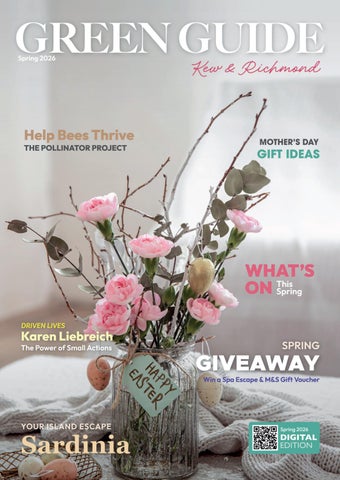
Welcome to our vibrant Spring 2026 issue, a season of renewal and fresh beginnings. As the days begin to lengthen and nature starts to blossom, we invite you to explore a collection of articles designed to inspire, inform, and delight.
For those dreaming of a spring/summer escape, our travel feature, “7 Reasons to visit Sardinia” [Page 28], offers a captivating glimpse into the Mediterranean’s gem. If relaxation is more your style, you won’t want to miss our exciting Deluxe Overnight Sunday Spa Break for Two with Breakfast & Treatment at Lifehouse Spa & Hotel [Page 26] giveaway, promising a rejuvenating retreat for one lucky winner. Families will find joy in the pages dedicated to the Children’s Book Festival [Page 35], celebrating the magic of storytelling and encouraging young minds to flourish.
We also turn our attention to the natural world with “The Pollinator Project”, which looks at how readers can help bees this spring [Page 15]. We also bring you an insightful interview in “Driven Lives” with Karen Liebreich [Page 12], offering inspiration and perspective. Finally, as we embrace new beginnings, discover practical advice on how to “Declutter Your Mind” [Page 8] for a clearer, more focused spring ahead.
We hope this issue brings you much enjoyment and serves as a perfect companion for the upcoming season.
Happy Reading! Green Guide Team
0203 773 5835 magazine@localgreenguide.co.uk
Green Guide magazine is designed, published, and promoted by Local Green Guide Ltd. While we have taken every precaution to ensure the accuracy of this publication and believe the statements herein to be correct, the publishers and promoters cannot assume responsibility for any inaccuracies. Reproduction of any portion of this publication without prior permission is strictly prohibited.
Osterley Park and House, Jersey Road, Isleworth, TW7 4RB
Help track down escaped animals hiding in the gardens and return them to the Tapestry Room in this fun spring trail. Enjoy a scenic walk through Osterley’s beautiful grounds as you complete the challenge.
28 March – 12 April 2026 | 10am – 5pm
London Zoo’s Zoonormous Egg Hunt
London Zoo, Regent’s Park, NW1 4RY
Search the Zoo for six giant Easter eggs, solve riddles and uncover secret letters in this family-friendly adventure. A perfect way to explore the zoo while keeping little explorers entertained.
28 March – 12 April 2026
The
Lindt GOLD BUNNY Hunt
Hampton Court Palace, East Molesey, KT8 9AU
Follow a garden trail to spot golden bunny statues and match the names on their famous red ribbons. Set against the stunning backdrop of Hampton Court’s spring gardens.
21 March – 12 April 2026
With an exciting line-up of events taking place across West London in 2026, families are spoilt for choice this spring. From interactive heritage hunts and immersive adventure trails to captivating theatre shows and hands-on workshops, there’s something to spark every child’s imagination. So gather your baskets, pop on your adventure hats, and get ready to hop into a spring packed with unforgettable fun and discovery!
The Enormous Crocodile
Rose Theatre, Kingston upon Thames, KT1 1HL
Roald Dahl’s greedy crocodile comes to life in this fun jungle adventure for families. Expect plenty of laughs, lively storytelling and colourful characters.
1 – 12 April 2026
An Ideal Husband
Lyric Hammersmith Theatre, W6 0QL
Oscar Wilde’s witty comedy of politics and scandal in a bold new production. A sharp and stylish evening of classic theatre for older audiences.
7 May – 6 June 2026
Easter Egg Hunt at Ham House
Ham House and Garden, Richmond, TW10 7RS
Explore the gardens on a Civil War themed trail packed with family activities. Discover history along the way as children complete the seasonal challenge.
28 March – 6 April 2026 | 10am – 5pm
Tortoise and the Hare
Polka Theatre, Wimbledon, SW19 1SB
A lively and humorous retelling of the much-loved racing tale. Packed with music, movement and plenty of audience fun.
2 – 31 May 2026
We’re Going on a Bear Hunt
Polka Theatre, Wimbledon, SW19 1SB
Join the classic family adventure through grass, river and forest in this stage adaptation. A warm and engaging production perfect for younger audiences.
25 March – 12 April 2026
Fairy Tales Exhibition
British Library, Euston Road, NW1 2DB
Step into magical worlds through books, costumes, puppets and interactive displays. An enchanting experience designed to spark imagination across generations.
27 March – 23 August 2026
Affordable Art Fair Battersea
Evolution London, Queenstown Road, Chelsea Bridge, SW11 4NJ
Browse thousands of contemporary artworks from UK and international galleries, all at accessible price points. Find original pieces to refresh your home, workspace or personal collection.
4 – 8 March 2026
RHS Chelsea Flower Show
Royal Hospital Chelsea, SW3 4SR
Discover stunning show gardens, floral displays and specialist shopping at this world-famous event. A must-visit for gardening enthusiasts and design lovers alike.
19 – 23 May 2026
Ealing Book Festival
Ealing, London
A celebration of books, authors and literary events for all ages. Featuring talks, workshops and family-friendly sessions.
29 April – 3 May 2026
The Spring Swing Ball
The Main Hall, Latymer Upper, King Street, W6 9LR
Swing into spring at our fabulous Spring Ball - a tribute to Harlem’s famous Savoy Ballroom (1926-1958) - with the authentic big band sounds of the incomparable Peter Long and his 14-piece Swing Orchestra, in the beautiful period main hall at Laytmer Upper, King Street, Hammersmith.
Live music from an all-star swingin’ big band, playing the music of the legendary Chick Webb, and Count Basie Orchestras
• Lulu’s pop-up bar - serving wines, beers, sodas, and the Savoy dancers’ favouritecoke floats!
• Dress to impress
• Fantastic wooden dance floor
• All welcome - no dance experience needed!
Future London: Easter Holidays
London Transport Museum, Covent Garden, WC2E 7BB
Design your vision of London in 100 years through creative, hands-on activities. Inspiration comes from historic artwork imagining the city’s future.
Easter Holidays 2026
Octonauts: Above & Beyond
Kew Gardens, Richmond, TW9 3AE
Join an exciting nature mission around the gardens with the Octonauts team. Interactive activities help children learn about wildlife and conservation.
28 March – 12 April 2026
Sounds of Blossom
Kew Gardens, Richmond, TW9 3AE
Enjoy immersive music installations celebrating blossom season. A peaceful sensory experience set among Kew’s flowering trees.
14 March - 6 April 2026
• PLUS! - fun open-level swing stroll class with Lindy hop legend Ryan Francois (7.45pm-8.30pm)
Saturday 14th March 2026
7.45pm-12.30am swingland.com/springball
3 REASONS TO PRIORITISE INTENTIONAL EXERcISE for your child...
1. Movement Builds the Architecture of the Brain
In the early years, the brain develops at remarkable speed, and movement plays a vital role in shaping it. When a child crawls, balances or hangs, neural pathways are strengthened, supporting memory, language, problem-solving and executive function. Intentional, structured movement does more than burn energy - it integrates sensory systems and strengthens the brain–body connection, helping children not only move well, but learn well
Early childhood is as much about emotional capability as academic success When children try again after wobbling or push beyond their comfort zone, they learn to manage frustration and persist through challenge. Physical activity supports self-regulation - a key predictor of long-term wellbeing and school success - while quietly building confidence, resilience and belief in their own abilities.
3. Strong Foundations Shape Sharper Minds
Balance, coordination and core strength are deeply linked to academic readiness The vestibular and proprioceptive systems developed through climbing and spinning support posture, concentration, handwriting and reading fluency. A child who can stabilise their body can more easily stabilise their attention. The groundwork for classroom confidence begins long before a child sits at a desk, with a strong, wellintegrated body
Why The Little Gym?
Gymnastics: The Ultimate Movement Sport
At The Little Gym, gymnastics is our child development movement of choice It moves the body through every plane and axis, making it a true “movement superfood ” Just as nutritious food fuels the body, movement fuels the brain Children who move more think more clearly, learn efficiently, and grow in confidence Gymnastics builds coordination, balance, and core strength w hile boosting focus and cognitive development supporting body and mind together.
Building Brains, Bodies and Confidence
At The Little Gym, children build more than physical skills. Through guided movement, they develop motor control, balance, spatial awareness, and body confidence They learn to problem-solve, take safe risks, and trust themselves As coordination and focus grow, so do creativity, resilience, and self-esteem. When children learn to move well first, they’re better prepared to sit, listen, and succeed later.
Our carefully designed programmes help children channel their energy while reaching key developmental milestones in a positive, non-competitive environment. Each child progresses at their own pace, supported by expert instructors and consistent encouragement In our purpose-built gyms, children build both gymnastics skills and social confidence, while parents relax in the glass-fronted lobby, connect with other families, and enjoy a moment to pause.
easter holiday camps
BOOKING NOW FOR
30 march - 12 april th th
No prior experience needed!
Our camps are designed for all children aged 3-12yrs, across every skill level. Whether your child is brand new or already a member, our instructors tailor activities so everyone feels confident, supported, and suitably challenged.
Flexible drop-off and pick-up options available. We know schedules can be tricky, so we offer: Early Drop-off: 9:00–10:00am and Lunch Club: 1:00–2:00pm Perfect for flexible drop-off before camp or a later pickup afterwards.
Free parking on Site! A short walk from Chiswick overground and Mortlake station, and situated on several bus routes.
A Spring Reset DECLUTTER YOUR MIND
Spring arrives quietly, bringing longer days and a natural urge to open the windows. That same shift often happens internally. After months of mental noise and overstimulation, we feel ready to clear space in our minds as well as our homes.
Start with awareness.
Mental clutter rarely appears overnight. More often, we build it ourselves — filling calendars, chasing productivity, comparing our lives to curated online versions of others. It becomes a steady buzz of unfinished thoughts, background worries, notifications, and decisions competing for attention. We switch between tasks without pause, surrounded by a flow of content that never fully allows the brain to process one thing before the next demands focus.
Before clearing anything, we must first recognise what we’ve been carrying and how much of it we placed there ourselves.
Once you recognise the pressure, the next step is to lower the volume. The brain was never designed for endless stimulation, and without space to process, everything starts to feel urgent.
A reset doesn’t require dramatic change. It begins with small boundaries — fewer notifications, single-tasking instead of multitasking, moments of stillness between demands. As input decreases, clarity begins to return.
This is not easy in a permanently connected world. Devices blur the line between work and rest, news and noise, urgency and importance.
Boundaries, then, must be deliberate. Curate what you consume. Set screen limits. Turn off non-essential alerts. Protect screen-free moments — especially at the beginning and end of the day — so your attention isn’t claimed before you’ve chosen where to place it.
When the mind has space to breathe, you can set the emotional tone of your day. Without it, stress builds quietly.
And stress rarely stays in the mind. It settles into the body — tight shoulders, shallow breathing, restless sleep. When pressure becomes constant, tension begins to feel normal.
A reset isn’t only about reducing messages and tasks. It’s physical, too. Gentle movement, slow walks, stretching, steady breathing. As spring draws you outside, use that momentum.
If we ignore the pressure and constant input, tension doesn’t disappear — it accumulates. Left unchecked, it settles in the mind and the body, gradually becoming the norm.
Spring offers a natural pause. A chance to clear space before overload takes hold. Small shifts now –reducing noise, protecting attention, moving more – allow both mind and body to reset before stress hardens into something heavier.
SPRING RESET RESOURCES
Riverside Runners
Free 5km fun run
Mondays 18:30 @ George IV, 185 Chiswick High Road, W4 2DR
Park Tennis Sessions - Free Saturdays 10:00 -11:00 @ Gunnersbury Park
AppBlock - Focus & Screen Help
The app helps limit distracting apps and create screen-free moments, so your mind has space to breathe.
Whether it's a hip replacement, knee surgery or a gastric bypass, transitioning home after surgery can be daunting. Our expert team provides the professional bridge you need, offering personalised support that ensures safety and speeds up healing.
• Caring for adults 18+
• Expert Post-Op Support
• Live-in Care
• Companionship & Home Help
• Specialist & Complex care
• Elderly Care
Walfinch Chiswick, Hammersmith and Kensington
Where fine-dining ingredients feel at home
Come for the steak and wine, stay for the hospitality and comfort.
Through its food, service and atmosphere, Flame & Fire creates memorable dining experiences for its guests.
Specialising in tender dry-aged steaks, carefully prepared and seasoned by its chefs and cooked to order, all steaks are dry-aged to enhance flavour and tenderness.
Last year, Flame & Fire earned a place among Europe’s ‘Top 100 Best Steak Houses of 2025’, awarded by Top 100 Businesses, a recognition that highlights its dedication to culinary excellence and warm, attentive service.
The restaurant also introduced Wagyu to its a la carte menu last year, featuring Kobe A5 Japanese steaks, followed by homemade Wagyu beef burgers, and most recently Wagyu beef croquettes.
In addition to its à la carte menu, Flame & Fire offers a great-value set menu on
Mondays, Wednesdays and Thursdays (two courses for £25 and three courses for £30).
Its Wednesday Steak Nights also offer excellent value, with a complimentary bottle of house wine and sides when ordering a Tomahawk steak for two to share.
Catering for groups, couples and individuals looking to enjoy quality steak and wine in relaxed surroundings, Flame & Fire is an ideal choice for any occasion.
15% OFF Your Bill
Reserve for March or April (Mon, Wed or Thu) and receive 15% off your à la carte food bill.
Quote Green Guide Chiswick magazine when booking to redeem.
Valid until 30 April 2026.
Protecting your property with Wills and LPAs
Safeguarding your property and loved ones with clarity and care
For many homeowners, buying property can be both stressful and exciting, which may leave homeowners overlooking a crucial step: planning for the unexpected. Whether you are creating a home or expanding your portfolio, protecting your property extends beyond its bricks and mortar. It calls for forward thinking, discreet advice and a clear plan for the future.
Creating a Will and Lasting Power of Attorney (LPA) may not seem urgent when you have just collected the keys to your new property, but they are essential. They ensure your wishes are respected, and your family is protected. Without them, decisions about your property and finances may end up in the hands of the courts instead of those you trust.
What happens without a Will?
Without a valid Will, the law decides who inherits your estate. The outcome is not always what families expect.
Unmarried partners may receive nothing, even where a property is shared. Married couples with children can find estates divided in ways that result in uncertainty or unintended consequences. Children from previous relationships may also be left vulnerable.
A professionally drafted Will removes doubt, giving you full control over who inherits your property and how, while sparing loved ones unnecessary delay, cost and distress.
Why LPAs matter
Lasting Powers of Attorney are equally important, yet even less well understood. An LPA allows you to appoint trusted individuals to manage your finances and property if you lose capacity through illness or accident.
Elnora Terakopian PARTNER
Without one, even a spouse or long-term partner cannot access bank accounts, deal with mortgage providers or manage household finances. Families are instead forced to apply to the Court of Protection, a process that is slow, expensive and emotionally draining at an already difficult time.
Common property pitfalls
Many people assume their partner or spouse can simply take over the property and mortgage if something happens. However, this is not always the case and certain legal gaps can leave families vulnerable.
Sole mortgage holders often assume their partner can manage or refinance the mortgage but this is not always the case if they do not have legal rights. Unmarried and cohabiting couples may not realise there is no automatic right to remain in the family home. Married couples are often surprised to learn that spouses have no authority to act on financial matters without an LPA. These gaps can leave families exposed at times of vulnerability.
Plan today, protect tomorrow
At Owen White Catlin, we help property owners plan for the future, sensitively, thoroughly and with complete clarity. Our approach is friendly, thoughtful, and tailored to your individual needs. We will help make sure your wishes are clearly recorded and your family is protected.
Contact us on 020 8987 1400 or email contact@owc.co.uk to book your initial meeting.
THE RISE OF REPAIR
What if the answer to rising costs and growing waste is simpler than we think: fixing what we already own? Picture your favourite kettle, steam hissing through chipped enamel. Does its story really have to end in the bin?
We have grown used to convenience. Packages arrive quickly. Replacing something is often easier, sometimes even cheaper, than repairing it. When a chair wobbles, a seam splits or a heel scuffs, we move on. Most of us have a drawer somewhere filled with things we meant to fix. We keep meaning to get around to them.
Still, there seems to be a shift happening.
Repair cafés, local craftspeople and specialist makers sit at the centre of this shift. These spaces offer practical skills, yes, but also reassurance. A broken zip or worn sole does not automatically mean an item has reached the end of its life. Across the UK, hundreds of repair café events now form part of a grassroots effort to keep items in use and out of landfill. It is quiet work, but it continues to grow.
In London, that momentum shows up in the numbers. A 2025 poll conducted for London Repair Week found that 77% of Londoners want to learn repair skills to save money. Financial pressure appears to be nudging everyday behaviour in a more sustainable direction.
The spending tells its own story. Research for London Repair Week in 2024 reported that Londoners spent an average of £464 each replacing items they believed could
have been repaired. Across the capital, that adds up to roughly £3.24 billion in replacement spending. Money that might have supported local workshops or simply kept well-made things going a little longer.
Repair carries a social dimension, too. The same London Repair Week research found that 56% of Londoners say repair workshops help them feel more connected to their community, with around one-third reporting they have made new friends at similar events.
Policy is starting to follow. The European Union’s Right to Repair directive, adopted in 2024 and taking effect in July 2026, will require manufacturers to provide spare parts and repair information even beyond warranty periods. Environmental awareness is also moving in this direction. A 2025 global study found that 62% of consumers are now actively repairing items to reduce waste. Choosing repair is no longer unusual, it feels expected.
Here in West London, the shift is easy to notice. Boots resoled after miles along the High Road. A bike tuned and back out along the Thames before Sunday lunch. These are small decisions, yet together they point to something deliberate, a neighbourhood quietly choosing longevity over impulse.
Across the area, repair cafés, skilled cobblers, tailors, bike mechanics and furniture restorers are already helping to make that choice possible, keeping the things we value in use for longer and closer to home.
BIKES & WHEELS
The London Cycle Workshop
Local independent cycle service and repair specialist
A: 42 Sheen Lane, East Sheen, SW14 8LP
T: 020 8075 5222
W: tlcw.co.uk/east-sheen-shop
Handlebars Haynes
Independent bike mechanic and pop-up repair sessions
A: The Teepee, 566 Chiswick High Road, W4 5YA
W: www.handlebarshaynes.co.uk
T: 07971 046553
COMMUNITY INITIATIVES
Twickenham Repair Café (check website for dates)
A: St Margarets Church Hall,130 St Margarets Road, St Margarets, Twickenham. TW1 1RL
Dr Karen Liebreich MBE is an author, historian, gardener and film-maker whose work spans research, writing and practical, community-led action. During her doctoral research in Florence, she came across archival material that revealed abuse scandals within the seventeenthcentury Catholic priesthood, forming the basis of her book Fallen Order. Many of her books begin not with an idea but with an encounter: The Letter in the Bottle emerged after a chance find, a story that captured public attention in France, while the discovery of an overgrown walled garden in Chiswick House and Gardens inspired both its restoration and her book The Family Kitchen Garden.
Alongside her writing, Karen has repeatedly turned ideas into action. When her children were very young, she founded the Baby Directory, a successful business she later sold. She now runs Abundance London, coordinates environmental, educational and public-realm projects across west London, and is currently working on a new book, The Lost Studio.
Karen has been at the heart of some of Chiswick’s most transformative initiatives, including the Chiswick Timeline, a 65-metre mural telling the area’s history through maps and art, and the co-founding of the Chiswick Flower Market, which has revitalised the local area. Awarded a MBE in 2013 for services to horticulture and education, her work is guided by a conviction that history, nature and community are strongest when they are part of everyday life.
Today you’re known as a writer, a gardener, and an environmental activist — but how did your career start?
My career isn’t really a career — it’s a series of serendipitous coincidences.
I studied history at university, but I didn’t want to pursue the academic field. I wanted to do something more international. At the end of my degree, I went to the careers office to see where I could use languages and work internationally, and I saw an application for the European University Institute. The most exciting thing was that the interview was in Florence.
I went to Italy to do a doctorate in history, and when I arrived, I didn’t really have a subject. The European University Institute is based in a beautiful ancient abbey in the hills above Florence. It had originally been run by a Catholic counter-reformation order that was completely unknown in England. The professor said, “Why don’t you see if they have an archive, and if there’s anything interesting?”
It turned out to be a fascinating order, with links to Galileo. Like many Catholic orders, it ran into problems with abusive priests. I ended up writing a book about it.
After that, I replaced a friend of mine at the French Institute in South Kensington. Then someone head-hunted me to the BBC to make documentaries because I had good French, German, and, by then, Italian.
Your books are very different from one another. Where does the inspiration come from?
A lot of it is chance. But a big factor is that I’m interested in everything. Everything is interesting.
One of my first books was Doing Business in Eastern Europe. I was working on a BBC programme just after Eastern Europe opened up. Nobody knew how to do business, least of all the incoming businessmen.
Then I said to the BBC books editor, “You should ask me to write a book about something I really know about — like skiing.” She said, “Well, actually, we do want a skiing book.” My brother was an Olympic skier and an engineer, so he understood the technical side — how skis bend and workso we co-wrote the next book together.
Later, the Chiswick House Kitchen Garden led to The Family Kitchen Garden, about how to garden with children, because I and my co-authors had spent years learning how to do that properly.
Another book came from pure chance — a friend found a letter in a bottle on a beach, and that became a story.
My career is a series of serendipitous coincidences. “
Karen with her Elephant bike and Echium pininana plants.
In the Kitchen Garden at Chiswick House (c) Anna Kunst
And the next one also came from chance: my aunt was an artist in Paris in the 1960s. She was murdered in 1970, and in 2021, someone rang my mother and said they’d found all her diaries and artwork in a skip. It turned out it wasn’t a skip at all — it was her entire studio, bricked up and hidden, like Sleeping Beauty, covered in ivy. The working title of the book is The Lost Studio
There’s no plan. It all comes from things that actually happen.
Your connection to nature runs through everything you do. Where did that begin?
We were always outside. We skied from a very young age. My mother learned to ski in a field behind her house in Czechoslovakia. My brother started at three; I started at six, on huge wooden planks that you had to carry uphill.
My parents also loved diving, so we spent a lot of time at the beach. My mother gardened, and there was an abandoned corner garden near where my parents lived. My brother and I started looking after it, asking neighbours for spare plants.
At school, we did a “Save the Whales” campaign. From early on, it was obvious to me that what we were doing to nature was wrong, and it’s only got worse.
You’ve taken that concern and turned it into local action. Can you describe what that looks like in practice?
We talk about climate change, but we also need to think about air pollution, flooding, drought, and biodiversity. We don’t feed ourselves properly. We don’t have enough pollinators. Our rivers are full of pollution. We need permeable ground, places to sit as we age, and flowers for insects. We have to make huge changes.
I don’t want to walk past fly-tipping and mattresses. I want to walk past flowers. It makes people happier — and it makes me happier too. Cycling here, I went past the first daffodils, a couple of hellebores, and the first snowdrops. It looks nice, I’m happy, and some bee will be happy to stick its nose in and get some pollen from it.
Your local projects are now well-known. Did it all start with Chiswick House Kitchen Garden?
Again, that was completely by chance. I was walking my dog in the park and came across
the walled garden at Chiswick House. It dates from 1682 and was completely overgrown and unknown. I saw workmen measuring a gate and asked what was behind it. They said it was going to be a retail outlet. Then we made a fuss and started a campaign. That night I climbed over the wall. It was ten-foot-high brambles. I asked if we could start gardening there, and they said no — we had to wait years for funding, or we had to prove that schools are interested in the project and raise some funds.
Who inspired you growing up to be so active and independent?
So we proved schools wanted to use it. We raised money. We set up a charity. And we showed them how it could be, beautiful and sustainable. Eventually, the authorities caught up, formed a trust, and secured major funding. At some point, we decided to walk away. We handed over our volunteers and even our grant. All we wanted was for the garden to be saved.
One of our targets was that 300 children would recognise a carrot — and eat one. The Kitchen Garden is one of our proudest achievements.
“
People need nature, and nature needs people. “
That project led to Abundance London. What inspired its creation?
Sarah Cruz and I realised how much fruit and vegetables were going to waste. We mapped fruit trees in the area and worked with schools to harvest them. Most of the fruit turned out to be in private gardens. People didn’t know what to do with it. If you have ninety kilos of apples in two weeks, you either let them rot or cut the tree down.
We now have a database of about ninety trees. For fifteen years, we’ve harvested fruit, pressed apples, and shared the produce. It’s a win-win.
All these projects take huge amounts of time and energy. How important was support at home?
Massively. I have a very supportive husband who has always done lots of childcare and has never treated my work as a hobby. He has always treated my projects as important and as a proper job, even if it is not paid.
My mother always worked. My parents were refugees from Central Europe after the Second World War. My father was a car mechanic; my mother worked as a welfare assistant.
They worked terribly hard. My mother handled the family finances and was a very strong woman. She’s still running her business at 94 — an online print and antique maps shop.
Looking ahead, what are your current projects?
We’re doing a big art project with schools around a redevelopment site, the old police station. The hoardings will become a forest, with lots of insects. Each child will do an insect, and we’ll build it up collectively. It’s a way of learning about local wildlife and making something beautiful together.
And then there’s The Lost Studio, which I’m working on now.
Finally, what motivates you to keep going?
The more we are surrounded by beauty, the better we feel. So yes, I’m doing it for me — for feeling good about myself and my environment — but also for nature and for other people. There isn’t just one reason.
We’re not here for very long. I can’t save the rainforest, but I can do something locally and know exactly where every penny goes. I know that, in our micro, unimportant way, we’re effective.
All those children who came to the Kitchen Garden — some of them will have had golden days, and some of them will learn from that, and it spreads.
Coming away from the willow-weaving on Saturday, I felt that thirty people went home feeling good. They’d been in the fresh air, made new friends, and created something nice.
Looking after green space should be a statutory obligation, like health or education. People need nature, and nature needs people. That’s really it.
Karen and Steve Nutt at the Abundance launch of the Butterfly artwork on the old Police Station, 2021
(c) Anna Kunst
WELLNESS FOR WOMEN WHO DON’T HAVE TIME FOR WELLNESS
By Daniela Milusheva
This March, we celebrate International Women’s Day and Mother’s Day. We celebrate women for everything we’re expected to be: mothers, professionals, caregivers, partners, friends. Strong. Reliable. Always available. And somewhere in the middle of all that, we are also supposed to take care of ourselves. Modern wellness routines require unlimited time and energy. But for many women, including me, that simply doesn’t fit into an already full schedule.
For me, wellness isn’t flashy or trendy. It’s simple and realistic. It’s protecting my energy, my nervous system, and my longterm health throughout my life.
Here are 5 simple steps (in no particular order) for long-term wellness that work for me.
1.
MANAGE YOUR ENERGY
At this stage of life, the days are full, no matter how well we plan them. So managing energy is more important than trying to create more time.
Stop stacking demanding tasks back-toback. I accepted that I don’t need to be available for everything and everyone. When I feel overwhelmed, I slow down.
Accept that our capacity changes throughout the month, and that energy shifts with hormones. I work with my energy now, not against it.
2. TRAINING MATTERS
Movement is important in midlife. But strength training becomes essential. It helps protect muscle and bone, supports metabolism, and keeps you strong, mobile, and independent as you age. The benefits are endless. However, going to the gym five times a week is unrealistic for many women with a full schedule.
Don’t wait to “find time”, aim for the possible. I walk more. I run in the mornings when I can. I do home workouts instead of skipping them.
I bought dumbbells and kettlebells, so I have no excuse. If I can’t make it to the gym, I can still train for 30 minutes, and that’s better than nothing. While motivation can’t be high all the time, “finding the way” helps with consistency.
3. PROTECT YOUR NERVOUS SYSTEM
Oh, life is so loud now. Constant notifications, conversations, decisions, responsibilities… That level of stimulation drains us, but it is part of our modern world. Start treating silence as a health practice. For me, that means quiet moments between transitions, fewer decisions in the evening and reading a book instead of scrolling on my phone.
Sometimes my husband and I sit next to each other without talking, simply because silence is what we both need, not because we have nothing to say. And that’s just nice.
I highly recommend the Longevity Debate episode of The Diary of a CEO, where four experts in women’s health talk about these topics in depth.
4. FUEL YOUR BODY, FOR TODAY AND FOR THE FUTURE
I’ve never been one to follow complicated skincare routines or spend time on beauty treatments. I believe healthy skin, hair, and energy start with what we put inside our bodies.
Choose food that truly nourishes and fuels the body. For me and my family, it means sticking mostly to home-cooked meals, fresh vegetables and fruit, good-quality protein, healthy fats like olive oil and nuts.
Limit alcohol and sugar. Sugar speeds up skin ageing, while alcohol affects internal ageing and overall health. They add more stress to the body than benefit, especially as hormones shift with age.
I also take supplements: vitamins for my immune system, magnesium for better sleep, and creatine for... well, its numerous benefits! This not only supports me now but also my future self as I move toward perimenopause and menopause.
5. KEEP IMPROVING YOUR MIND
I believe in caring for the brain, not just the body. Studies show that lifelong learning can help lower the risk of cognitive decline and dementia. But beyond that, learning keeps life interesting.
We have access to so much now, courses, podcasts, interviews, and conversations with experts we would have never reached a decade ago. There’s so much we can learn even while doing simple tasks, like folding the laundry or washing dishes, if we just take a moment to listen.
I rediscovered reading for pleasure. Not to improve, just to enjoy. Choosing a book over my phone in the evening settles my mind into one story instead of twenty open tabs.
Taking care of your mind is part of taking care of your future.
And the most important part – there is no “right” way to do wellness.
Wellness routines should fit your lifestyle, not the lifestyle promoted on social media or expected by others. Do what works for your season of life. Do what supports your energy, not your image. Do what you can sustain without pressure.
For women who don’t have time for wellness, that’s what actually matters.
THE POLLINATOR PROJECT HOW RESIDENTS CAN HELP BEES THIS SPRING
Small spaces, simple choices, real impact
May 20th is World Bee Day—a day to celebrate some of the smallest yet most vital creatures in our ecosystem. Bees pollinate about a third of the food we eat, yet they face an uphill battle against habitat loss, pesticides, and climate pressures. The good news? Even in a bustling neighbourhood like Chiswick, every balcony, window box, and tiny garden patch can play a part in helping them thrive this spring.
From terraced gardens to fourth-floor flats, there are simple, practical ways you can make a difference.
PLANT FOR EARLY POLLINATORS
Spring is critical. Bees emerging in March and April have limited food sources, so early-blooming plants are particularly valuable. Some favourites include:
WINDOW BOXES & BALCONIES CAN BUZZZZZ
No garden? No problem. Urban bees depend heavily on balcony and window box blooms. A well-planted box can feed dozens of insects and bring your outdoor space to life.
How to make a bee-friendly plant box:
Depth: 15–20cm of good compost
Plant mix: Combine one upright plant, one trailing, and one herb.
Good choices: Lavender (dwarf), thyme, nasturtium, calendula, verbena
Watering: Regularly, especially in dry spells. Dehydrated plants mean bees are left hungry.
Bonus: Let herbs flower before harvesting. Bees adore thyme and basil in bloom
SKIP THE PESTICIDES
Even small doses of common garden sprays can harm bees. Instead, encourage natural predators like ladybirds, spot-treat aphids with soapy water, and accept a little leaf damage, it is natural. Always look for peat-free, organic composts, and when in doubt, don’t spray at all.
A pesticide-free garden might seem small, but when multiplied across streets, it becomes a vital corridor for pollinators across London.
SUPPORTING BEES AND LOCAL SHOPS
Kew and Richmond are full of local options that support both pollinators and the community. Home and garden centres often stock native plants and peat-free compost, which is perfect for bee-friendly gardens. Local markets and independent florists are another great source. Try visiting the Chiswick Flower Market (check our Events Calendar for monthly dates) and ask for UK-grown plants.
Community plant swaps and school fairs are also a wonderful way to share seeds, cuttings, and gardening ideas while connecting with neighbours. Every time you request pollinatorfriendly plants, you’re sending a message: bees matter, and local demand helps shape what’s available on our shelves.
COLLECTIVE ACTION, BIG IMPACT
No single plant can save the bees, but dozens of gardens, balconies, and window boxes across Kew and Richmond sure can make a difference. When whole streets are blooming, they create little highways of food that pollinators depend on. Every flower counts!
Tip: Single-flower varieties are best. Bees can access nectar more easily than in double blooms.
Borage – fast-growing and adored by pollinators.
Crocus – among the earliest nectar sources, brightening lawns and borders.
Grape hyacinth (Muscari) – compact, perfect for pots.
Primrose – thrive in shady corners.
Rosemary – blooms early, feeding both bees and your kitchen.
WHEN SPRING COMES EARLY: WHAT THE MARKET IS REALLY TELLING US
By Daniel Madden Managing Director, Fine & Country Chiswick
and the shift has been unmistakable.
After a prolonged period of hesitation, the market at the premium end of West London is showing renewed momentum. December, typically a quieter month, proved unexpectedly busy. January has followed suit, with motivated buyers returning in greater numbers
To understand why, it’s worth looking back at the latter part of last year. Much of autumn was spent in a holding pattern. Proposed taxation changes announced in August 2025 introduced uncertainty , causing both buyers and sellers to pause while awaiting clarity from the November Budget. That uncertainty slowed what is usually one of t he most active periods of the year
Fine & Country Chiswick
13-15 Turnham Green Terrace, London, W4 1RG
+44 (0)20 8567 6757
Scan to get your instant valuation
Now that clarity has returned, and with the Budget having minimal impact on the housing market, we are seeing the release of pent-up demand Decisions that were deferred are now being revisited, and serious buyers are moving decisively
mortgage market. Increased competition between lenders has sharpened pricing and improved affordability, particularly at the premium end As borrowing becomes more attractive, demand increases, and with it, competition for high-quality homes
In practical terms, this is creating favourable conditions for well-presented, well-positioned properties Buyers are discerning, but they are also decisive when the right home comes to market. In many cases, this is translating into competitive bidding and strong outcomes where pricing, presentation, and strategy are aligned
For homeowners considering a move this year, this presents an interesting moment. Not necessarily because it is “the right time for everyone ” , but because market conditions are currently rewarding clarity, preparation, and informed decision-making Properties that are brought to market with a clear strategy,
strong marketing, and realistic positioning are standing out, while those without a considered approach are being left behind
At Fine & Country, we work exclusively in the premium sector,
but to help homeowners understand how current demand is shaping values locally, how buyers are behaving in real time, and how global exposure can amplify the appeal of exceptional homes In markets like this, insight and execution often make the difference between interest and outcome
Even for those not actively considering a move, having an accurate, up-to-date understanding of their position can be invaluable Markets move in cycles, and early signals, such as those we are seeing now, often provide the clearest insight
As spring arrives earlier than expected, the question for many homeowners is not “should I move?”, but rather “what does this market mean for me?”
By Daniel Madden Managing Director, Fine & Country Chiswick
Bee-utiful Seed Card
A charming plantable card that grows into wildflowers — a gift that keeps on blooming. £3.95
Mother’s Day Gin & H-Box Duo
A luxurious pairing of rich cacao gin and indulgent chocolates for a truly decadent treat. £43.95
Duet Style Limited Edition Hot Air Styler with Matching Heat-Resistant Bag. The ultimate salon-worthy styling tool for effortless, glossy hair days at home. £389.00 Ghd www.johnlewis.com
A meaningful personalised necklace featuring her initial and birthstone for a heartfelt touch. £89.00
www.theseedcardcompany.com
Barénia Eau de Parfum 60ml Mother’s Day Fragrance Gift Set. An elegant, timeless fragrance gift set that feels effortlessly sophisticated. £104.00 Hermès www.johnlewis.com
www.hotelchocolat.com www.oliverbonas.com
A soft organic cotton sweatshirt with delicate floral embroidery for effortless everyday style. £29.50 Suede Stitch Detail Moccasin Slippers £60.00
Cosy suede slippers that bring comfort and warmth to slow mornings at home.
Green Floral Embroidered Sweatshirt www.marksandspencer.com
Mother’s Day Superblends Collection Gift Box
A comforting selection of feelgood teas perfect for peaceful moments throughout the day. £16.49
www.twinings.co.uk
A cosy-luxe bundle complete with pyjamas, cashmere socks and a mug for dreamy weekend mornings. £145.00 The BreakfastIn-Bed Gift Box
www.thewhitecompany.com
A beautifully curated edit of mood-boosting wellbeing essentials for everyday balance. £50.00
A fun and thoughtful personalised box filled with light-hearted prompts to celebrate Mum. £12.95
www.fromlucy.com
www.wonderbly.com
A calming self-care collection designed to help her relax, recharge and feel pampered. £25.00 Mama Unwind Gift Set
For the mum who insists she “doesn’t need a thing,” an experience can be far more meaningful than a beautifully wrapped box. This Mother’s Day, consider gifting time together — something memorable, sustainable and genuinely personal. From relaxation to creativity, food to live music, West London offers thoughtful ways to celebrate mums who already have everything.
Relaxation & Well-Being Experiences
Treat her to a restorative spa day or holistic therapy session. A massage, sauna ritual or facial is a gift of proper switch-off time — and most local spas offer vouchers so she can book when it suits her.
Creative & Skill-Building Workshops
If she loves learning something new, try a pottery class at The Clay Garden (theclaygarden.com), or explore woodblock printing with Zena and Rose (zenaandrose.com). Sip-and-paint evenings, perfume or candle-making workshops, and local cooking or mixology classes are perfect for a shared creative afternoon.
Outings & Tastings
For mums who love discovering something delicious, a trip to Duck Pond Market in Richmond is a lovely way to spend Sunday morning, browsing stalls and picking out favourites to enjoy together at home.
If plants are more her thing, you could pick up something special from Chiswick Flower Market on her behalf. Seasonal bouquets, beautiful potted plants, and statement houseplants are thoughtful ways to gift something living and long-lasting.
Why not plan a theatre trip to Central London?
www.next.co.uk A personalised illustrated keepsake book celebrating everything that makes Mum one of a kind. From £23.99 An A-Z of Your Amazing Mum
www.oliverbonas.com
Uplifting shows like Mamma Mia! and Six the Musical remain hugely popular for a reason — feelgood, empowering and perfect for a memorable night out together. Pair it with dinner beforehand, and you’ve created a full experience, not just a gift.
Experiences create stories, laughter and connection — the kind of gifts that last far longer than flowers.
Pink Hearts and Bows Tea for Two Teapot Teacups and Tray
A sweet tea-for-two set adorned with hearts and bows for charming afternoon catchups. £36
The Pelvic Floor Revolution Comes to Chiswick
You may not know it, but there is a Pelvic Floor Revolution happening around the world.
For years the pelvic floor was a taboo subject not well understood. You can blame this on a historical lack of funding and interest in women’s health. This is now changing. There are articles in major women’s health magazines, podcasts, and even a new industry called FemTech – where women’s healthcare and technology are colliding to solve unmet needs.
And don’t you think it’s about time? If men wet their pants every time they sneezed, kicked a football or swung a golf club this would have been solved 50 years ago. Can I get an “Amen”?
Women have normalized bladder leaks and urgency as “part of being a woman”. This is simply not true. These issues are common, but not normal. Your body should not leak urine. Ever. Wearing bulky incontinence pads or incontinence diapers should not be something we settle for. These issues can be a sign of dysfunction in your pelvic floor, and you deserve to have that problem solved.
Numerous surveys show many women have no idea what the pelvic floor is or its purpose. UROSPOT is a healthcare provider passionate about changing this statistic.
As a private urological focused clinic, UROSPOT combines technology, education and health coaching
to help women (and men) say goodbye to bladder leaks, urgency, prolapse and other pelvic floor issues. The best part is you remain fully dressed and the treatment is 100% non-invasive. Nothing goes in your body, and no one is touching you.
The care plans are based on the expertise from a team of pelvic health experts including nurses, pelvic floor physiotherapists, physiotherapy assistants, and gynaecologists. You are surrounded by professionals coming together to help you. A key part of the care model is advanced, CE certified technology — a medical chair — that reboots the connection between your brain, bladder and pelvic floor, while contracting your pelvic floor 11,000 times in a single 28-minute session to help strengthen the muscles.
The level of education provided at UROSPOT is world class. “Why did nobody tell me this 10 years ago?” is a common question asked by clients exposed to the education throughout their care.
The pelvic floor is made up of a group of muscles at the base of your core. A weak pelvic floor is an issue, but so is a pelvic floor that is too tight, which can cause problems such as pain during intercourse. The goal is to balance the tone of these muscles so they can do their job properly. The care model at UROSPOT is designed to d o just that. With a fit and healthy pelvic floor people should feel confident and free.
“Finding this program was the best thing to have happened to me. I had become pretty recluse, and now I feel free and liberated from my circumstances. I have learned so much about my body that I didn’t know before – it’s a wonderful blessing”.
Book a complimentary consultation today. No GP referral required.
UROSPOT Chiswick
382 Chiswick High Road, Chiswick, London 020 3946 9588 chiswick@urospot.co.uk urospot.co.uk
THROUGH DOOR TO DOOR DISTRIBUTION
PRICES ARE SUBJECT TO VAT PER THOUSAND
WE ALSO OFFER DESIGN, PRINT, SOLUS, SHARED AND BESPOKE SERVICES
quotes@lggmarketing.co.uk 0203 773 5835
For those who hate the phrase ‘go hard or go home’. Come here.
We’re just not that kind of studio. Ours is a welcoming environment with empathetic instructors who’ll favour quality over quantity and feeling energised over feeling punished. You’ll find your nearest studio situated just off Chiswick High Road and right in the heart of Turnham Green. Ten. Your centre of balance.
events CALENDAR 2026
March
18:45 - 22:00 Weekly - Mondays
SWINGLAND
Learn to swing & jive!
Location
The Hammersmith Club, 11 Rutland Grove, W6 9DH swingland.com/a-train
Sat 07 BUY
Children’s Books Day by Chiswick Book Festival
Location
St Michael & All Angels Church & the Tabard Theatre Bath Road, Chiswick, W4 chiswickbookfestival.net
Last Wednesday of the month (except December, July & August) Reserve slot
Chiswick Business NetworkCo-work & Network
Location
Chiswick Cinema
First Saturday of the month
Ham Parade Market
Location
Ham Parade, KT2 5PU hamparademarket.org
Every weekend
Duck Pond Market
Location
Heron Square, Richmond upon Thames, TW9 1EP duckpondmarket.com/richmond
Chiswick Flower Market
Location
94-96 Chiswick High Road, W4 1SH meetup.com/chiswick-business-network/events/ FREE First Sunday of the month
Old Market Place
Chiswick High Rd, W4 2DR chiswickflowermarket.com
(worth £279)
£100 Marks & Spencer Voucher
Escape for a restful Sunday with an overnight stay, a spa treatment each, and breakfast included. Set in tranquil surroundings with luxury facilities, it’s the perfect opportunity to relax, recharge, and enjoy a peaceful night away for two. Win a £100 Marks & Spencer voucher to spend however you choose – the perfect treat for everyday essentials or something a little indulgence.
Who we are?
• 145 years of independent property expertise
• Family-owned & independent
• Established in Chiswick for over a century
• Deep local knowledge, personally delivered
• Regulated by the Royal Institution of Chartered Surveyors
• Serving Chiswick & surrounding areas including Kensington, Lewisham, Home counties & beyond.
Why Choose Us?
• Residential & Commercial Property
• Sales, lettings, surveys & valuations
• Block & estate management
• Specialist valuations, lease extensions & party wall matters
• Commercial advice including lease renewals, rent reviews & dilapidations
REASONS TO VISIT SARDINIA
By Alison James | Travel Writer
BEYOND BEAUTIFUL BEACHES
Sardinia’s beaches are some of the most beautiful in Europe - if not the world. Along 1800 kilometres of coastline, soft white sands meet waters of turquoise, emerald and deepest blue. Among the most stunning are those in the Villasimius area in the south-east of the islandluckily, where I was staying.
Located in a protected area dedicated to the conservation and preservation of a richly biodiverse marine life, the 20-plus beachesfrom wide golden ribbons like Campulongu to hidden coves such as Spiaggia Trois - are pristine and lapped by a crystal-clear azure sea. I soaked up the sun, interspersed with arguably the best snorkelling I’d ever experienced.
Another truly joyous morning was spent on horseback, exploring the picturesque countryside backing the beaches before returning to the stables along the sands.
DRAMATIC LANDSCAPES
Inland Sardinia reveals a strikingly different face. Much of the island remains mountainous, wild and sparsely populated. At its heart lies Gennargentu National Park, a rugged region of granite peaks, forests and high plateaus where shepherds still tend their flocks and ancient footpaths link remote villages.
I took an off-road tour by jeep with a highly competent driver at the wheel. The trip resembled a rocky, rural roller-coaster at times - an uberexhilarating experience with panoramic views more than making up for the odd white-knuckle moment. An impromptu picnic of locally cured meats, cheeses and red wine was the cherry on this particular cake.
Elsewhere, wetlands and lagoons support rich ecosystems, and the island is famed for its populations of pink flamingos. These protected landscapes highlight Sardinia’s remarkable biodiversity and its commitment to conservation.
I adore Italy, but am also partial to an island holiday. On paper, Sardinia sounded a good fit. In reality, it was even better. Here are seven reasons to visit this dazzling gem of an island set in the shimmering Mediterranean Sea.
3
ANCIENT CIVILISATIONS
Sardinia’s human history stretches back thousands of years. From Roman amphitheatres to medieval churches and coastal fortifications, history here feels embedded in the landscape rather than confined to museums. There is plentiful evidence of the indigenous people who occupied the island way before the Phoenicians, Carthaginians, Romans, Spanish, came, saw and conquered, and finally the Italians ruled in the 19th century.
The Nuragic people, native to Sardinia during the Bronze Age, left behind some 7000 stone structures known as Nuraghe. These conical dry-stone towers, unique to the island, are thought to have been fortresses, dwellings or religious sites. Closest to my base near Villasimius is the magnificent Nuraghe Diana. Rising about eight metres high, this ancient edifice is situated on a rocky outcrop. From the top, I could see the timeless coastline below and found myself easily imagining life here millennia ago.
CULTURE AND FESTIVALS
Despite centuries of outside influence, Sardinia has preserved a strong and distinctive cultural identity, and is alive with festivals, cultural events and traditional celebrations all year round - from ancient religious processions to lively carnivals and traditional pageants.
Sardinia’s biggest festivals include the grand religious procession of Sant’Efisio in the capital Cagliari; the Cavalcata Sarda in Sassari, celebrating traditional dress and horses; and the Sartiglia in Oristano, a dramatic medieval-style equestrian joust held during Mardi Gras.
Although on a smaller scale, I was enchanted by the Feast of San Raffaele Arcangelo in Villamisius, which takes place every autumn in honour of the town’s patron saint. By evening, as the streets glowed with lights, delicious aromas of grilled meats filled the air. Church bells rang as the procession began - the statue of San Raffaele was carried slowly through the town with some followers garbed in traditional Sardinian dress. After the solemnity of the ceremonial march, it was party time, complete with music, dancing, feasting and fireworks!
MARKETS
I love exploring markets and, as with festivals, Sardinia positively teems with ‘mercati’ - from authentic farmers’ markets where locals shop to lively gatherings - where you can find delicious, traditional foods. Pecorino Sardo & Fiore Sardo – rich Sardinian sheep’s-milk cheeses; Bottarga - cured fish roe known as Mediterranean caviar; Pane Carasau - thin, crisp bread native to the island; Malloreddus - a regionallyshaped pasta; and Mirto - a fragrant Sardinian myrtle berry liqueur.
During late spring, summer and early autumn, Sardinian towns and villages are alive with evening markets selling unique artisan items such as filigree silver jewellery, hand-painted ceramics, woven baskets (cestini), leather goods and cork crafts which reflect Sardinia’s cork forests.
Villasimius hosts such a ‘mercati’ along the Via del Mare during this time, and what a delight it is to wander through after an early dinner of local specialities such as the Su Tagliere de Sardigna charcuterie board, Ostriche con Agrumi di Sardegnaoysters finished with citrus zest and paired with wild finocchietto (fennel), and Zucchine alla Campidanese - fresh courgettes dressed with herbs and local olive oil. Sardinia’s flagship Rosato di Cannonau - the island’s most authentic rose wine with notes of wild strawberry, pomegranate, myrtle and rosemary - is the perfect accompaniment.
BLUE ZONE LIVING
Sardinia is one of only five recognised Blue Zones in the world - regions where residents live significantly longer than average, often into their hundreds.
On visiting the mountainous village of Seulo, I noticed how people move constantly without calling it exercise - eg, walking up and down hillsides and tending their gardens. Meals anchor the day with vegetables, beans, greens, sourdough bread, olive oil and small amounts of pecorino eaten slowly and always in the company of others. Meat is a treat, local red wine is enjoyed in moderation, and nothing is rushed. Elders sit at the centre of daily lifesharing stories, life experiences and dispensing wisdom. Social ties are constant - people drop in unannounced, laughter comes easily, and faith and tradition help give meaning to life. There is such an aura of contentment and belonging.
Being more ‘Blue Zone’ is one Sardinian souvenir I definitely tried to bring home with me.
FABULOUS PLACES TO STAY
From simple Airbnbs to polished guesthouses and luxury resorts, Sardinia offers somewhere for every kind of stay.
I knew I wanted comfort, calm, nature and a sense of ease. The Falkensteiner Resort Capo Boi (www.Falkensteiner Resort Capo Boi | Sardinia Family Resorts) felt right immediately. Tucked into a protected coastal area near Villasimius, it’s low-rise, quiet and designed to disappear into the landscape rather than dominate it. I enjoyed a leisurely swim in the sea every day and one afternoon booked a spa treatment, emerging lighter and unhurried as if the pace of the island had seeped into my body.
There’s a gentleness to the rhythm of life here - wellness without pressure and indulgence without excess. It echoed everything I’d been learning about Sardinia’s Blue Zone way of life – friendly people, good food, fresh air, gentle exercise and the luxury of truly unwinding.
(c) Falkensteiner Hotels and Residences
Chiswick Business Network
No elevator pitches, no long speeches or membership fees – just great networking!
Networking isn’t one-size-fits-all. We bring together a large, engaged community through speed networking, co-working and relaxed happy hour meetups across great Chiswick venues, creating more opportunities to connect, collaborate and grow. www.chiswickbusinessnetwork.co.uk
An award-winning local digital marketing agency helping businesses make sense of online marketing, attract more customers, and turn their websites into real enquiries.
T: 020 3488 7608
E: nicky.mckena@wsidigitaladvisors.uk
W: wsidigitaladvisors.uk
AzuraTech protects small businesses from cyber threats with expert cybersecurity and reliable IT support, ensuring data safety, continuity, and peace of mind daily.
T: 020 7157 8098
E: hello@azuratech.co.uk
W: azuratech.co.uk
High-quality branded merchandise from a trusted local, family-run business, boosting visibility and loyalty through clothing, drinkware, giveaways and ecofriendly promotional products.
T: 07813 323 984
E: quotes@merchexpressltd.co.uk
Struggling to be found online? I offer professional Website Design, SEO, Hosting and Digital Marketing to attract paying clients and grow your business.
T: 07709 852 364
E: theo@theoruby.com W: theoruby.com
Retirement is an opportunity but a big transition. We provide help through personalised coaching and free resources.
E: welcome@retirementpathways.co.uk
W: retirementpathways.co.uk
Your friendly Chiswick marketing expert helping businesses feel confident with social media and Linkedin. Mention this magazine for £20 off Linkedin Health Check.
At Unique People Consult, we don’t just manage processes — we connect people, nurture potential, and build longterm success. People Management and Career Development.
Meet Marjorie Gutierrez, Creative Business Strategist and founder of Smart Business Designs, bringing 25+ years of art shipping across London and New York.
T: 07429 073 289 W: smartbusinessdesigns.com
(c) Chiswick Business Network
LGG Marketing delivers reliable leaflet distribution campaigns within the M25 and surrounding counties, alongside in-house design and print services for businesses.
T: 020 3773 5835
E: hello@lggmarketing.co.uk
W: lggmarketing.co.uk
Struggling to identify your migraine triggers? Email to book your free 30 minute Migraine Trigger Insight call to discover how nutritionist Rachel Alderson can help.
E: rachel@rachelaldersonnutrition.com
W: rachelaldersonnutrition.com
Do you need ... To Reduce Pain?
Healthy Ageing? Antenatal / Postnatal Rehabilitation? Pilates Now! - offers Personalised Pilates in our Specialist Studio. Personal Training & groups of 4.
T: 07768 762 826
E: info@pilatesnow.org
W: pilatesnow.org
Anthony Coyle-Dowling - The Agency UK
Personal estate agent in West London overseeing every element from staging photography marketing through negotiation onward moves helping clients move with confidence.
T: 020 8090 7301
M: 07369 269 627
W: anthony.coyle-dowling@theagencyuk.com
Colour Analysis and Personal Styling Discover your most flattering colours for clothes, accessories and cosmetics. Shop smarter and feel more confident every day.
T: 07768 233 895
W: houseofcolour.co.uk/sandylancaster
Do you know CPR and how to use a defibrillator? Every minute counts. Learn today with training courses designed for everyone, of all experience levels.
T: 07939 044 220
E: info@no1firstaidinstructors.co.uk
W: no1firstaidinstructors.co.uk
Personal branding and portrait photography for discerning business owners and individuals. Story-led images crafted with intention, elegance, and presence. Contact Sadia Barlow Photography for a free consultation.
T: 07885 489 814
W: sadiabarlowphotography.co.uk
We offer a professional, friendly onestop design and print service to help customers communicate clearly and effectively in print and online.
T: 020 8810 9000
E: studio@firstfolio.co.uk
Audrey Zeitoun is an ICF-accredited life and relationship coach and couple therapist, supporting individuals and couples, locally and online, navigating life transitions, communication issues, love, and separation.
Premium videos for brands without in-house teams. Strategic storytelling that supports your 2026 marketing goals. Contact me today to book a 30min consultation.
T: 07989 686 099
E: hello@luckyjumperfilms.co.uk
Rachel Alderson Nutrition
Pilates Now! Studio & Online
Lucky Jumper Films
Audrey Zeitoun Coaching
EASTER RECIPES
A spring stroll deserves a worthy return home. Enter Chocolate Hot Cross Buns with a decadent twist, Lamb Shanks gently braised in red wine and herbs, and a sunshine-bright Blueberry Lemon Loaf with vanilla glaze. Three recipes that balance comfort with quiet sophistication.
Preheat oven to 165°C. Season lamb shanks generously with salt and pepper. Heat olive oil in a heavy, oven-safe pot or Dutch oven. Brown lamb shanks on all sides until deeply golden. Remove and set aside.
2. Build the flavour
In the same pot, add onions and carrots. Sauté until softened and lightly caramelised. Add garlic and tomato paste; cook for 1–2 minutes until fragrant. Pour in red wine, scraping up browned bits from the bottom. Simmer 5 minutes.
3. Braise
Return lamb shanks to the pot. Add stock, rosemary, thyme, and bay leaf. Liquid should come about halfway up the shanks. Cover and transfer to the oven. Braise for 2½–3 hours, turning shanks once or twice, until meat is fall-apart tender.
4. Finish
Remove herbs and bay leaf. If desired, simmer the sauce uncovered on the stovetop to thicken slightly. Add lemon zest just before serving for a fresh Easter lift.
To Serve
• Spoon rich sauce over the lamb
• Garnish with fresh rosemary or mint
• Serve with:
- Creamy mashed potatoes
- Roasted spring vegetables
- Buttered green beans or asparagus
Hot Cross Buns (With a Twist!)
Ingredients
To make 12 buns
For the dough
• 4 cups (500g) bread flour
• ¼ cup (50g) sugar
• 2 tsp instant yeast
• 1 tsp ground cinnamon
• ½ tsp nutmeg
• ½ tsp allspice
• ½ tsp salt
• 1 ¼ cups (300ml) warm milk
• 1 large egg
• 4 tbsp (60g) softened butter
For the glaze
• 3 tbsp warm apricot jam or honey
For the filling
• 170g chocolate chunks or chocolate spread (e.g., Nutella)
For the crosses
• ½ cup (60g) flour
• 5–6 tbsp water (enough to form a pipeable paste)
Method
1. Make the dough
In a large bowl, combine flour, sugar, yeast, spices, and salt. Add warm milk and the egg. Mix until a shaggy dough forms. Knead in the softened butter until smooth and elastic (about 8 minutes by mixer or 12 by hand). Cover and let rise until doubled — about 1 hour.
2. Shape & fill
Punch down the dough and divide into 12 equal balls. Flatten each piece into a small disc. Add a spoonful of chocolate spread or a few chocolate chunks to the centre.
Blueberry Lemon Loaf with Vanilla Glaze
Ingredients
For the loaf
•1½ cups (190g) all-purpose flour
•1 tsp baking powder
•½ tsp baking soda
•¼ tsp salt
•½ cup (115g) unsalted butter, softened
•¾ cup (150g) sugar
•2 large eggs
•1 tbsp lemon zest
•2 tbsp fresh lemon juice
•½ cup (120g) Greek yogurt or sour cream
•1 tsp vanilla extract
•1 cup (150g) fresh blueberries (tossed in 1 tbsp flour)
For the glaze
•1 cup (120g) powdered sugar
•2–3 tbsp fresh lemon juice
•½ tsp vanilla extract
Method
1. Prep
Preheat oven to 175°C. Line a loaf pan with parchment paper or grease well.
2. Make the batter
Whisk together flour, baking powder, baking soda, and salt. In a separate bowl, cream butter and sugar until light and fluffy. Beat in eggs one at a time. Add lemon zest, lemon juice, yogurt, and vanilla; mix until smooth.
Pinch the dough closed tightly to seal the chocolate inside. Place buns seam-side down on a parchment-lined tray. Cover and let rise again for 30–40 minutes.
3. Make the crosses
Mix flour with enough water to create a thick paste. Pipe a cross over each bun using a piping bag or a small zip bag with the corner cut off.
4. Bake
Bake at 190°C for 18–20 minutes, until golden brown.
5. Glaze
While still warm, brush buns with apricot jam or honey for a glossy finish. Enjoy them warm — the chocolate centre stays wonderfully molten!
Gently fold in dry ingredients until just combined. Fold in floured blueberries carefully.
3. Bake
Pour batter into prepared pan. Bake 50–60 minutes, or until a toothpick inserted in the centre comes out clean. Cool in pan 10 minutes, then transfer to a rack.
4. Glaze
Whisk powdered sugar, lemon juice, and vanilla until smooth and pourable. Drizzle generously over the cooled loaf, allowing it to drip down the sides.
Serving Tip
Top with fresh blueberries, thin lemon slices, and a few mint leaves for a bakerystyle presentation.
A YEAR TO REDISCOVER READING
This year, the UK is setting its sights on something both timeless and transformational: reading. The National Year of Reading is a Department for Education initiative, developed in partnership with organisations from across the literacy sector, and delivered through the nationwide campaign Go All In. Together, they invite individuals, families, schools and communities to rediscover the joy, inspiration and connection that reading brings to everyday life.
Rather than asking people to “find time to read”, Go All In flips the script: reading isn’t something separate from life, it’s the heartbeat of culture itself. Whether someone is into sport, music, food, gaming, film, fashion or creativity, reading can amplify that interest, bringing deeper understanding and richer experiences.
Statistics show that reading for pleasure has declined across age groups, from children and teens to adults. The National Year of Reading aims to address this trend by reconnecting reading with culture, community and personal interests, creating a more vibrant reading environment for everyone.
“ Reading transforms lives, opens doors, fuels imagination and gives every child the chance to succeed, regardless of their background. “
Bridget Phillipson Secretary of State for Education
For young children, reading often begins before they can read independently. Babies and toddlers benefit enormously from shared stories, rhymes and conversations. These early interactions unlock language development and set the stage for a positive relationship with books and stories.
As children enter school age, their interests flourish — from animals and adventure to sport and arts. Go All In emphasises that all reading counts, whether it’s a favourite book, comic, graphic novel, magazine or audiobook. When reading connects with personal passions, it builds confidence and creates positive habits that can last a lifetime.
Teenagers, in particular, may resist traditional reading formats, but that doesn’t mean they aren’t reading. Digital content, audiobooks, fan fiction and articles tied to real-world interests are all forms of reading that can help keep curiosity alive. Encouraging choice and autonomy helps young people explore texts that matter to them, reinforcing reading as a pleasure rather than a chore.
For adults, reading remains a powerful way to unwind, reflect and learn. Whether picking up a novel before bed, listening to an audiobook on a commute or browsing articles over coffee, reading supports mental wellbeing and lifelong learning. Shared reading experiences between parents and children, friends or community groups add connection and meaning, reinforcing reading as something deeply social and rewarding.
National Year of Reading 2026
Libraries, too, play a central role, offering free access to books, digital resources and events that bridge generations and interests. Throughout 2026, events and activities across the UK will celebrate reading in all its forms.
“
This is the biggest reading initiative the country has ever seen – and it’s just the beginning. Our ambition is to transform reading for generations. “
David Hayman Director | National Year of Reading
By bringing reading into culture and everyday life, Go All In hopes to spark lasting change, inspiring millions to read regularly, visit libraries, share stories and develop a lifelong love of reading. Whether someone is seven or seventy, reading offers a doorway to curiosity, connection and imagination for every stage of life.
To find out more about The National Year of Reading and discover events and activities happening throughout the year, visit goallin.org.uk
CHILDREN’S BOOKS DAY
Why we love them and why they matter!
As part of the National Year of Reading, the Chiswick Book Festival is set to host a special Children’s Books Day celebrating the stories, characters and creative minds that have shaped generations of young readers. Taking place on Saturday March 7th at St Michael & All Angels Church and the Tabard Theatre on Bath Road in Chiswick, the event aims to encourage children to make reading a lasting part of everyday life in the digital age.
The Festival is working closely with local schools and libraries, as well as three national arts organisations — Action for Children’s Arts, the Children’s Media Foundation, and the Cultural Policy Unit — to deliver a full and varied programme of talks, readings, screenings and craft activities across the day.
Its partnership with Chiswick Library in the London Borough of Hounslow further strengthens the Festival’s local focus. Jenny Griffiths, the Festival’s children’s books liaison and former Primary School Librarian of the Year, will contribute to a dedicated discussion entitled ‘Taking action for children’s arts in the National Year of Reading’.
There will be a special exhibition at St Michael & All Angels Church, ‘Chiswick’s Books for Children’, showcasing book covers, illustrations and television programmes linked to writers, illustrators, publishers and performers who have lived in Chiswick, highlighting the area’s rich contribution to children’s culture.
Explaining the thinking behind the programme, Torin Douglas, director of the Chiswick Book Festival, said: “The morning is aimed at parents, grandparents and those in the worlds of publishing, TV and theatre who look back fondly at the ‘golden age’ – and care about the future - of works for children”. He added: “Anyone who was a fan of Puffin Post, Blue Peter, Play School or the Polka Theatre will enjoy the morning. After lunch, we’ll open the church to families to celebrate some of today's children's authors and illustrators with readings, screenings
Chiswick celebrates a day of stories, creativity and family fun
Saturday March 7th
St Michael & All Angels Church & Tabard Theatre, W4
and craft activities, including plenty of puffins!”
What’s On
The morning programme, ‘The Golden Age of Books & Television’, brings together an exceptional group of speakers. Contributors include Janet Ellis (Blue Peter, Twice Upon A Time podcast), Vicky Ireland (Words & Pictures, Polka Theatre, Founder & Ambassador, Action for Children’s Arts), Jonathan Cohen (Play School, Jackanory), Lucy Briers (daughter of Richard Briers of Roobarb & Custard, Noddy, Watership Down and The Wind in the Willows), Alison Cole (Bod’s New Leaf, Cultural Policy Unit) and Greg Childs, director of the Children’s Media Foundation.
A highlight of the morning will be a discussion on the legacy of Kaye Webb, the influential editor who helped shape Puffin Books. Valerie Grove, author of Webb’s biography, will explore her influence in conversation with Janet Ellis, presenter of BBC Radio 4’s Great Lives: Kaye Webb. They will be joined by Jane Nissen, former editorial director of children’s books at Penguin, Methuen and Hamish Hamilton who launched her own list of out-of-print classics, and Sally Floyer, former Managing Director of Ladybird Books and of Beatrix Potter’s publisher, Frederick Warne. The session will be chaired by Torin Douglas.
After lunch, attention shifts to the Tabard Theatre, directly opposite the church, where ‘The Golden Age of Children’s Theatre’ will be discussed by Vicky Ireland, former artistic director of Polka Theatre, and David
Wood — writer, director and producer, described by The Times as ‘The National Children’s Dramatist’ and president of Action for Children’s Arts. The session will be chaired by Janet Ellis.
“We’re highlighting Chiswick’s own place in the untold story of children’s books” said Douglas. “Most of the day’s speakers live or grew up in Chiswick, as did Kaye Webb. The Observer once wrote that ‘Chiswick may be Britain’s most literary location’ and we can now see that it has a fine record in works for children too.”
Get ready for a day full of stories, imagination, creativity and discovery, celebrating the children’s books that shaped the past, and those inspiring the next generation of readers.
Ticket information
Tickets are on sale at www.chiswickbookfestival.net/ childrensbooks
More information
Chiswick Book Festival: admin@chiswickbookfestival.net
Any profits from Children’s Books Day will be donated to Action for Children’s Arts and the Heritage Conservation Fund of St Michael & All Angels Church.
Axel Scheffler, Chiswick Book Festival 2025 (c) Chiswick Book Festival
Kev Sutherland’s comic workshop, Chiswick Book Festival 2025
Chiswick Book Festival
THE CHILDREN’S CORNER
A Space for Young Talent and Bright Ideas
At Green Guide magazine, we believe every child deserves a voice and a stage to shine. The Children’s Corner is a special page dedicated to celebrating the creativity, curiosity, and compassion of our young readers.
Children have dreams, thoughts, and perspectives that inspire us all. Through this space, we aim to showcase their talents in writing, art, music, science, sports, or acts of kindness, and share their unique stories with our community.
While space in print is limited, additional submissions will be featured on our website.
Let’s celebrate the next generation with their talents, their ideas, and their dreams.
If your child is a rising star, a budding writer or artist, or simply has something meaningful to say, we’d love to hear from you. Whether it’s about sports, maths, science, creativity, or community spirit, this is their platform to shine.
We also invite local businesses and organisations to sponsor The Children’s Corner and help us highlight even more young voices.
Email:
magazine@localgreenguide.co.uk
oaring with the stars
All the planets Glooming with the moon On the deep rocky spot Nearby is Earth: let’s go!
Riddhi Maheshwari
9 years old
Year 4
Edison Primary School
SHOW YOU HOW IT’S DONE
It’s easy to show but it’s not easy to glow. I smile when I see you. I will show you how when we are together it’s stronger. I will show you how it’s done I feel so much better when it’s done I will find you when we are done, done, done
THE THREE MONSTERS
The princess Lura runs away with her brother Jace and they reach the magical island at night and stay at an old monastery.
In the morning, they walk out of the monastery and reach the shore of the sea. Today, there were high tides and they found a mouse trying to escape from the tides. They both change into their avenger suits to save the mouse.
The mouse leads them to the three monsters, Arkaza, Rokoshebo, and Doma. They both start to attack Doma and kill him. Then when they start attacking Rokoshebo, Jace gets his hand chopped off, so Lura needs to kill him alone. At the last moment, she kills him.
At the end when she starts attacking Arkaza, she gets a scratch and thinks she will lose. The King and Queen come and their soldiers kill him.
Orchard House School
OPEN MORNING
Thursday 30th April 10am-12pm
Discover our Early Years, Pre-Prep and Prep sites, tour our STEM Centre and Art Studio, and experience our bespoke Learning Orchard curriculum.
WHY ORCHARD HOUSE:
Outstanding 11+ results & scholarship offers
Specialist teachers from Nursery to Year 6
Small class sizes
Enriched education - STEM, Art, Sport, Music & Drama
Clubs & wraparound care - 7:30am–6pm
Book your place now:
LITTLE HANDS, BIG IDEAS
Development
Some of the most meaningful learning in childhood happens quietly — at a table covered in paper scraps, paint smudges, and half-finished ideas. Arts and crafts may look like simple play, but beneath the surface, they are shaping how children think, move, and understand themselves.
The process of creating, which includes trying, adjusting, and completing something of their own, quietly nurtures resilience, self-belief, and emotional regulation.
How Arts & Crafts Support Different Ages
Creativity as a Developmental Tool
When children engage in arts and crafts, they are doing far more than making art. They are learning to plan, make choices, and adapt when things don’t go as expected. Deciding where to place a sticker, how to mix colours, or which materials to use strengthens executive functioning, including attention, flexibility, sequencing, and problem-solving. These skills help children learn how to start tasks, stay focused, adjust strategies, and complete activities — abilities that carry directly into school and everyday life.
The physical benefits are just as important. Drawing, cutting, painting, threading, and moulding materials develop fine motor strength, hand-eye coordination, and precision. These movements strengthen the small muscles of the hands and fingers, supporting essential skills such as handwriting, buttoning clothes, using utensils, and managing classroom tools. Emotionally, creative work offers children a safe space to express feelings, manage frustration, and experience pride in their efforts. Because there is no single “right” result, children are free to explore without fear of failure. This openness helps them build confidence in their ideas, tolerance for mistakes, and comfort with imperfection.
Creative development evolves as children grow. While the tools may look similar, the purpose and benefits change significantly between toddlerhood and the school years.
Toddlers (Ages 1–3)
For toddlers, arts and crafts are all about discovery and sensory exploration. Smearing paint, squeezing clay, or scribbling with crayons helps little ones understand how their bodies move, how materials respond, and how their actions create results. At this stage, creative play supports multiple areas of development: it strengthens early hand muscles, builds coordination, encourages curiosity, and introduces cause-and-effect thinking. Materials like large crayons, finger paints, playdough, and water-based activities are ideal, allowing toddlers to enjoy the process rather than worrying about the product.
School-Age Children (Ages 4–8+)
As children grow, arts and crafts become more purposeful and goal-oriented. Schoolage kids begin planning their creations, following steps, and completing their projects. This stage fosters independence, patience, and self-regulation. Creative activities now help refine skills in multiple areas: improving focus and sustained attention, strengthening problem-solving and decision-making, honing hand-eye coordination and precision, and supporting emotional storytelling and self-expression. Structured projects, like drawing, collage, cutting, painting, or guided craft activities, allow children to balance creativity with skill development, while continuing to build confidence in their abilities and pride in their accomplishments.
Building Confidence Through Process, Not Perfection
One of the greatest gifts of arts and crafts is the way it reframes mistakes. A torn paper
or unexpected colour becomes part of the process, teaching children flexibility and resilience. These moments quietly reinforce emotional regulation and persistence.
Creative activities also encourage mindfulness. Repetitive motions such as colouring, painting, or working with clay can be calming, helping children slow down and stay present — a valuable counterbalance to busy schedules and screen-based stimulation.
Why Arts & Crafts Matter
Arts and crafts nurture the whole child. They strengthen thinking skills, refine physical coordination, and support emotional expression, all while allowing children to feel capable and heard.
Starting early helps children grow comfortable with creativity, effort, and selfexpression. Whether at home, in early-years settings, or in school, making space for creative play is an investment in confidence, resilience, and imagination.
LESSONS
The Crafthouse
E: fiona@thecrafthouseuk.com
W: thecrafthouseuk.com
A: 329 Upper Richmond Road West, East Sheen, SW14 8QR
Crafts and Play
E: info@craftsandplay.co.uk
W: craftsandplay.co.uk
A: 457 Upper Richmond Road West, East Sheen, SW14 7PR.
The Role of Arts & Crafts in Early
9X9 9X9 7
8 3 2
2
6x6 6x6 children’s 4
HOW TO PLAY
Sudoku is a 9x9 (classic, adult version), or 4x4 and 6x6 (children’s versions) grid puzzle game. In the adult version, the objective is to fill the 9×9 grid with digits so that each column, each row, and each of the nine 3×3 sub-grids that compose the grid (also called "boxes", "blocks", or "regions") contain all of the digits from 1 to 9. In the children’s version, the objective is to fill the 6×6 grid with digits so that each column, each row, and each of the six 2×3 sub-grids that compose the grid (also called "boxes", "blocks", or "regions") contain all of the digits from 1 to 6. You are provided with a partially completed puzzle for you to complete, with a single solution.