

HE WAS THE GOLDMAN SACHS VP. THE REUTERS EXPERT. THE REAL ESTATE ATTORNEY.
NOW HE’S GETTING APPROVEDTHELOANSYOURLOANOFFICER COULDN’T — AND YOURS MIGHT BE NEXT.
How 37 years at the intersection of financial markets and law changes what’s possible when you sit down to talk about your mortgage.
People who hear that a Goldman Sachs VP became a mortgage loan officer
usually ask: why? The answer is the most important thing you’ll read about choosing a mortgage advisor this year.
Here is something most loan officers will not tell you.
There is an invisible cost to working with the wrong advisor on your mortgage. It does not appear on your closing disclosure. It is not visible in your monthly payment. But over the life of a 30-year loan, it can represent tens of thousands of dollars in equity you never built, interest you didn’t have to pay, and options you never knew existed.
You never find out because the outcome looks fine. You close. You move in. The loan works.
You just don’t know that a different loan — with a different advisor — would have worked better.
The borrower came to Christopher Henwood with six non-conventional income sources. He had already been turned away from several other lenders.
Four other loan officers had looked at the file. None of them saw a path. The income didn’t fit the templates. The automated systems said no.
Henwood saw a puzzle and a challenge.
“It took us longer than normal and we needed to take a more holistic approach,” he recalls. “But we were able to get him approved and closed.” It took nearly every department at Northpointe Bank — including the management committee. It took the kind of methodical, relationship-driven navigation through a complex approval process that requires both deep financial knowledge and the internal credibility to make it happen.
The borrower is in his house.
Before you ask how — it helps to know who.
Christopher Henwood was a VP at Goldman Sachs. A VP at Lehman Brothers. He spent 20 years as a NYMEX floor trader, then ran his own firm. He appeared on Reuters as an on-air commodity and energy market expert. He practiced as a licensed New York real estate and securities attorney.
Then, in 2014, he became a mortgage loan officer and in 2018 moved to Northpointe Bank.
That is not a career detour. That is 37 years of financial and legal training converging on the one transaction that matters most to most Americans — the one where the information gap between advisor and borrower carries the highest long-term cost.
“I always like to start off with a very casual conversation where I get to know and really understand what the client’s goals are,” Henwood says. “Once I understand where they are coming from and what they want to achieve, I clearly lay out the process and timeline and what they can expect at every part of the process.”
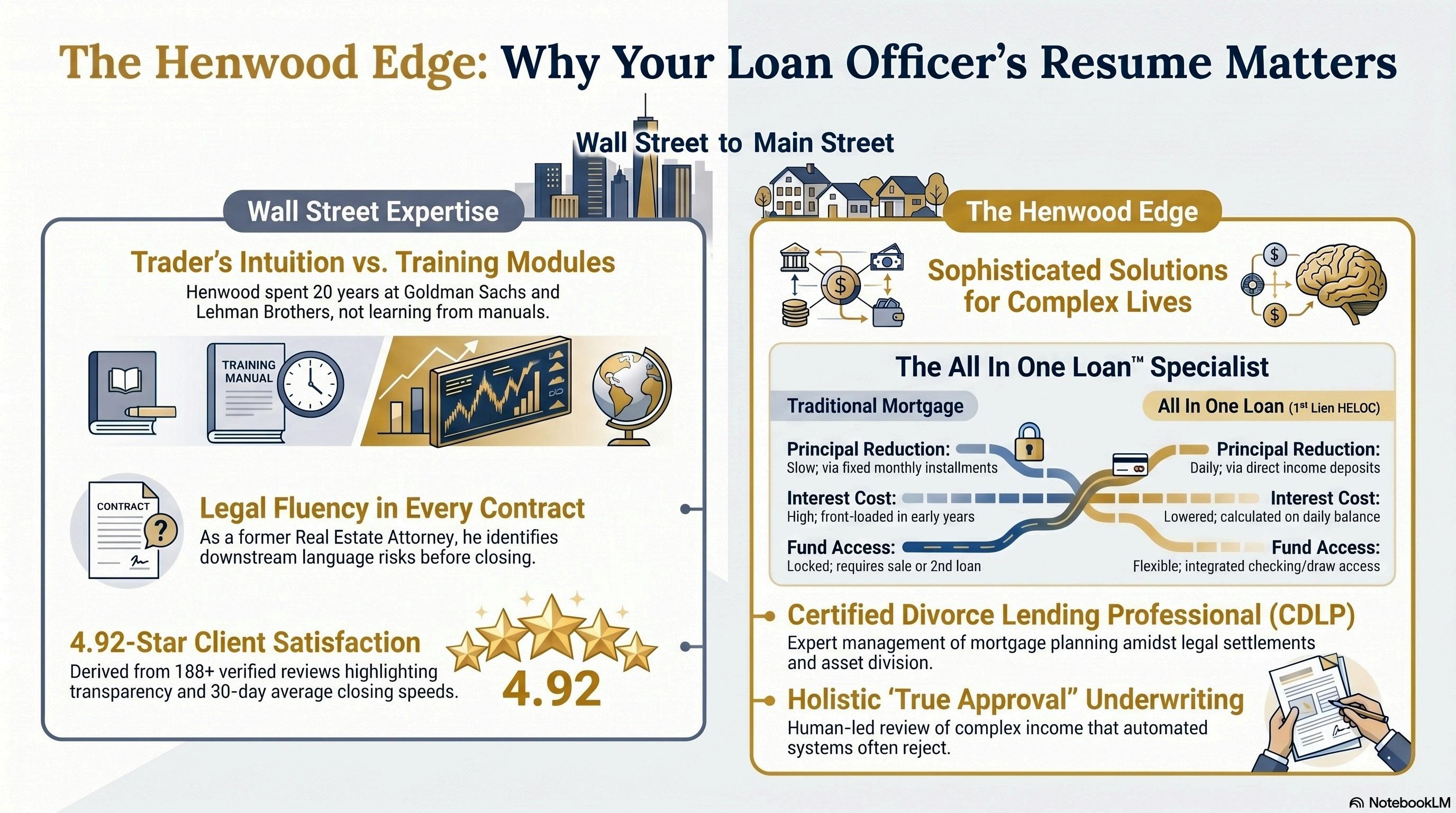
He is one of the very few loan officers in the country offering the All In One Loan — a first-lien HELOC that lets every dollar of income you deposit work against your principal balance before you spend it. On the right borrower profile, the difference in equity position over 10 years can be measurable in the six figures. He has 188 verified five-star reviews at a 4.92 average. 30-day close. All 50 states.
The question worth asking before your next mortgage conversation is not “what’s your rate?”
It is: what do you know that most loan officers don’t, and how will that change my outcome?
Henwood has a specific answer.
“ It took us longer than normal and we needed to take a more holistic approach
A CAREER NO TRAINING PROGRAM PRODUCES
Most loan officers learned money from inside the mortgage industry. They worked as agents, processors, or underwriters before stepping into the loan officer seat. Their understanding of how rates work, why markets move, and what drives the economic environment in which every client borrows — they got it from a training module and a rate sheet.
Chris Henwood got it from the floor of the New York Mercantile Exchange, starting in 1989.
What followed was a 20-year career as a commodities and energy trader — sectors driven by the same macroeconomic forces that move mortgage rates, experienced by Henwood not as numbers on a screen but as real-time decisions with real capital at stake. He rose to Vice President at Lehman Brothers, then Goldman Sachs, holding leadership roles at two institutions that sat at the center of global capital markets. In 1998, he launched his own trading firm and ran it through market cycles that tested every serious financial operator of that era.
Between 2009 and 2011, he moved into a different kind of financial communication: on-air commodity and energy expert for Reuters Insider. His job was translating complex market forces into analysis other professionals could act on — under camera pressure, in real time, without hedging. The skill that role demands — making complicated things clear to people making important decisions based on what you say — is the same skill he brings to every mortgage consultation now. The decision is just different.
Along the way, he earned a law degree and practiced as a licensed New York State attorney, focusing on Real Estate and Securities Law. He retired his law license in 2022.
In 2014, he joined the mortgage industry.
He brought with him 37 years of experience no training module produces and no amount of time as a loan officer can replicate.

WHAT MOST BORROWERS NEVER FIND OUT
Here is what happens when you work with a loan officer who doesn’t know about a product that would have been perfect for your situation: nothing unusual. You close. You move in. You start making payments on a loan that works.
You have no idea that a different structure — one your loan officer had never encountered — would have let every income deposit you make work against your principal balance daily, and potentially taken years off your payoff timeline. You don’t know what you didn’t get, because nobody told you it existed.
This is the invisible cost of working with the wrong loan officer. Not a bad outcome. Just a smaller outcome than you could have had. Most borrowers spend 30 years not finding out.
Two decades on Wall Street — now at your closing table.
Henwood’s background changes that equation in two ways: the depth of what he knows, and the way he uses it.
“ But we were able to get him approved and closed.

WHEN A CLIENT ASKS WHY RATES ARE WHERE THEY ARE
When a client asks Henwood why rates are where they are — or whether waiting three months to lock might cost more than it saves — they are not talking to someone who learned rates from a compliance module. They are talking to someone who spent 20 years watching Treasury yields, inflation expectations, commodity cycles, and Federal Reserve policy intersect in real time, who has a trader’s intuitive grasp of how those forces move and what they signal.
“I enjoy when there is a basic foundation of understanding around interest rates and their connection to the various relevant economic instruments,” Henwood says. That’s not a formality — it reflects a genuine orientation toward education as the foundation of the client relationship. A borrower who understands what drives their rate makes better decisions, asks sharper questions, and arrives at closing with confidence rather than residual anxiety about whether they got the right deal.
The math most borrowers are never shown.
His legal background adds a second layer that rarely shows up in a mortgage consultation. An attorney who practiced real estate and securities law reads purchase contracts, title commitments, and loan disclosures the way other professionals read their own correspondence — fluently, quickly, with an eye for language that can create problems downstream. Most loan officers rely on the title company and closing attorney to catch issues in the documentation. Henwood can catch them earlier in the process, and explain exactly what they mean to a borrower who isn’t a lawyer.
He was the Reuters expert who made complex things clear under pressure. He can do that with your loan documents.
THECONSULTATIONTHATSTARTSWITHYOURGOALS,NOTARATESHEET
The Henwood Edge: Wall Street expertise, applied to Main Street lending.
Walk into a mortgage consultation with most loan officers and you’ll get a rate sheet and a document checklist. Walk in with Chris Henwood and you’ll get a conversation.
“I always like to start off with a very casual conversation where I get to know and really understand what the client’s goals are,” Henwood explains. “Once I understand where they are coming from and what they want to achieve, I clearly lay out the process and timeline and what they can expect at every part of the process. I also have them ask me as many questions as they can so I can best address their concerns and educate them to increase their comfort level and confidence in the process.”
This is the philosophy of an attorney preparing a client for a transaction, not a salesperson moving a lead toward a close. Are they buying their first home and worried about whether they’ll be approved? Refinancing and trying to figure out whether the timing makes sense given where rates are? Interested in a product they read about online and want someone to tell them honestly whether it fits their situation? The answers determine everything that follows — the loan program, the pace, how much market context the conversation needs.
“When they call or text, I greet them enthusiastically as I would an old dear friend,” Henwood says. “I’m completely transparent with them and ensure they understand all aspects of the process.”
For clients who have worked with loan officers where transparency was selective — where the rate was clear but the costs weren’t, where the approval was fast but the full terms only came out at closing — that transparency is the deciding factor in whether they refer their friends.
“ I enjoy when there is a basic foundation of understanding around interest rates and their connection to the various relevant economic instruments
WHAT 188 FIVESTAR REVIEWS ACTUALLY MEAN
Christopher Henwood holds a 4.92-star average across more than 188 verified reviews on Experience.com. For over a year, that performance ranked him the number one loan officer in Parsippany, New Jersey.
Five-star mortgage reviews don’t come from clients who got a competitive rate and closed on time. Rate and timing are table stakes — the minimum expectation, not the thing anyone stays up late to write about. Enthusiastic reviews come from clients who felt heard through the process, who knew what was happening at each stage, who could reach their loan officer when a question came up at an inconvenient hour, and who emerged from the closing table feeling informed rather than just relieved it was over.
“I am most proud of the number of enthusiastic 5-star reviews I receive from my clients,” Henwood says — and “enthusiastic” is the word that matters. Enthusiastic reviews are written by clients who want other people to know. They are the organic output of an experience that exceeded what the borrower expected going in.
The repeat-client pattern tells the same story. “The vast majority of my clients come from referrals and repeat clients,” Henwood notes. “I am most proud of clients who consistently come back to me for help through multiple purchases. This really lets me know I am doing something right.” In an industry where many loan officers see a client once and move on, the client who returns for their second home, their investment property, and eventually their cash-out refinance is expressing something a review score can’t fully capture: the first transaction was handled so well that there was never a question about who to call next.

THE ALL IN ONE LOAN: A PRODUCT MOST
LENDERS HAVE NEVER HEARD OF
Educating borrowers on how to unlock home equity.
One of the specific reasons clients seek out Chris Henwood — rather than any competent loan officer — is access to a mortgage product most lenders don’t carry: the first-lien HELOC, available through Northpointe Bank as the All In One Loan.
A traditional mortgage is an installment loan. You borrow a fixed amount, make fixed monthly payments over 15 or 30 years, and watch your principal decline slowly — slowly because the vast majority of each early payment goes to interest rather than principal. Home equity builds, but it is locked inside the property. To access it, you take out a separate loan or you sell.
A first-lien HELOC works differently. Used as the primary mortgage, it functions like a checking account secured by your home. Your income deposits directly reduce your outstanding principal balance — every dollar sitting in the account before you spend it is working against your mortgage, reducing the interest that accrues daily. When you need funds, you draw from the line. For borrowers with steady and recurring income, the result can be a significantly accelerated payoff timeline and meaningfully reduced total interest paid — without a higher required monthly payment.
This is a sophisticated product. It requires a lender willing to carry it, an underwriting team capable of working with its nuances, and a loan officer who can explain it clearly enough that a borrower can make an honest evaluation of whether it fits their financial life. Northpointe Bank is among the very few lenders in the country currently offering it. Henwood is their licensed representative across all 50 states and Washington D.C.
“I would like to be known as the Go-To expert in 1st lien HELOC lending — the All In One Loan Program — in all of the United States,” Henwood says. His background in financial markets gives him a genuine understanding of why the product works the way it works. His legal background lets him explain the contractual structure precisely. And his education-first approach means borrowers leave the conversation knowing whether the product is right for them — not whether it’s being sold to them.
“ When they call or text, I greet them enthusiastically as I would an old dear friend

WHEN THE SYSTEM SAYS NO, NORTHPOINTE READS THE FILE
Most lenders plug a borrower’s numbers into an automated system. The system applies rules and produces an answer. It’s efficient, and it approves a large volume of loans. It also rejects borrowers who, with a more careful review, would qualify — people whose financial picture doesn’t fit a predetermined template but whose actual risk is sound.
“We have all of the benefits of a large lender as well as the flexibility of a smaller, independent lender,” Henwood explains. “Our underwriting department will often take a holistic approach to reviewing a client’s set of circumstances — allowing us to approve clients that get rejected elsewhere.”
Holistic underwriting means the underwriters examine the complete financial picture, not just what the scorecard surfaced. A self-employed borrower with variable
The All In One Loan, available through Northpointe Bank.
income, an investor with complex entity structures, a borrower returning from a financial hardship — each of these can look like elevated risk on a system and represent very manageable risk when a human examines the full context.
Northpointe also offers what it calls the True Approval program: a full underwrite of the borrower — based on complete financial documentation — before they have a signed purchase contract. This is a meaningful distinction from a standard preapproval letter, typically based on self-reported income and a soft credit pull. A True Approval is completed underwriting. When a seller’s agent sees it, the buyer’s financing isn’t a conditional estimate. It’s done.
CERTIFIED FOR THE CASES THAT CAN BREAK A TRANSACTION
Among the credentials Henwood holds, one stands apart: the CDLP — Certified Divorce Lending Professional.
Divorce mortgage planning is a niche most loan officers handle poorly — not from incompetence but from lack of training. When a couple is separating and one party needs to refinance the marital home, the mortgage process intersects with legal settlements, support calculations, and asset division in ways that create real risk if not managed carefully. The timing, the documentation, the way alimony and child support income are treated under lending guidelines — these details matter. Getting them wrong delays or kills the transaction.
Henwood’s background as a practicing real estate and securities attorney makes him particularly suited to this work. He can read a divorce settlement and identify the mortgage implications in the same pass. He can explain to a client — and to their divorce attorney — exactly what the lender will need and why, reducing the backand-forth that typically delays these transactions.
For clients in this situation, that precision is not a luxury. It is a form of protection.
HE PICKS UP
The mortgage process generates urgent questions at inconvenient hours. The appraisal comes back low on a Thursday evening. The underwriter asks for a document the borrower isn’t sure they have on a Friday morning. Closing is Monday and something in the title report looks unclear.
“I make myself available to all my clients when they need me,” Henwood says. “All of my clients can give me a call or shoot me a text and I’ll respond to them right away or as soon as I am able. This accessibility puts my clients at ease and allows them to get quick answers to questions or concerns.”
His average closing time of 30 days or less is partly a function of this. Fewer questions sit unanswered for days. Fewer document requests idle in an inbox. Problems that surface get addressed before they delay the timeline rather than at the closing table. For clients who’ve been through a mortgage process where reaching their loan officer meant a call center and a ticket number, this isn’t incidental. It’s the difference between a process that feels managed and one that feels managed for you.
ON THE FIELD, IN THE COMMUNITY
Christopher Henwood has officiated high school and middle school football games for 13 years. He volunteers with Second Harvest, a regional food bank.
Officiating football requires composure when the room is loud and the call is contested — fairness applied consistently, regardless of which side is making noise. Thirteen years of it reflects a disposition: toward showing up in situations where the reward is the work itself, not the recognition.
“My goal,” Henwood says, “is to empower each client to make the best decisions for their particular set of circumstances.” Straightforward file or complex one, firsttime buyer or repeat client, 30-day close or the kind of case that requires every department to go above and beyond — that orientation doesn’t change.
It’s what 188 clients tried to describe in a review. It’s what two dozen realtors across 20 long-term relationships bank on when they hand a buyer his number.
CALL CHRIS HENWOOD
The first conversation is about you — your goals, your situation, what you actually need. Not a product you’re being pointed toward. Not a rate sheet handed across a desk.
Henwood will ask what you’re trying to accomplish, lay out the full picture of what’s available to you, and tell you honestly whether the All In One Loan — or any other product — fits your situation. If it does, you’ll know by the end of that call. If it doesn’t, you’ll know that too, and you’ll have a clearer picture of what does.
That’s what 188 people gave five stars for.
Phone: 908-797-4269
Email: chris.henwood@northpointe.com NMLS #1280900
ABOUT CHRIS HENWOOD
Christopher J. Henwood is a Loan Officer at Northpointe Bank and a Certified Divorce Lending Professional (CDLP) with 37 years in the financial industry, including VP-level roles at Lehman Brothers and Goldman Sachs, two decades as a commodities and energy trader, and active practice as a New York State real estate and securities attorney. He is licensed in all 50 states and Washington D.C. and specializes in first-lien HELOC lending and divorce mortgage planning. NMLS #1280900.
Run your numbers at helocloancalculator.net — then call Chris.
helocloancalculator.net
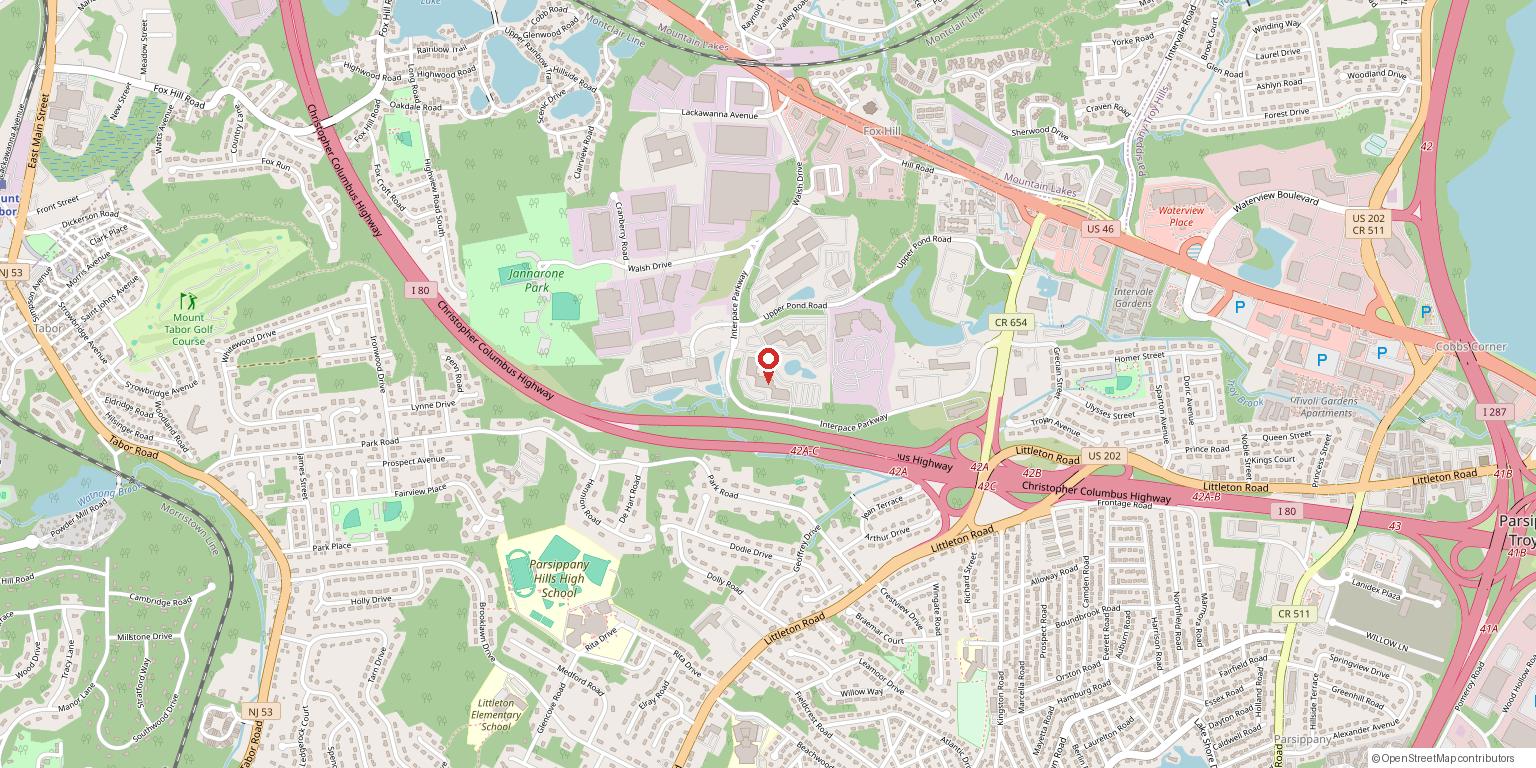
Chris Henwood - Northpointe Bank · View on Google →