A Personal Remembrance Day by The Toronto War Veterans Association
VOLUME 18 | ISSUE 3
THE OFFICIAL PUBLICATION OF THE TORONTO PROFESSIONAL FIRE FIGHTERS’ ASSOCIATION
Publications Agreement No: 41203011
Offer expires Dec 31, 2025 Offer expires Dec 31, 2025 Offer expires Dec 31. 2026 Offer Dec 31, 2025
Offer expires Dec 31, 2025
Offer expires Dec31, 31, 2025 Offer expires Dec 2025 Offer expires Dec 31, 2025 Offer expires Dec 31. 2026
Offer expires Dec 31, 2025
THE OFFICIAL PUBLICATION OF THE TORONTO PROFESSIONAL FIRE FIGHTERS’ ASSOCIATION
VOLUME 18 | ISSUE 3
IN THIS ISSUE 12
15
5
President’s Message
7
Secretary-Treasurer’s Message
9
Vice President’s Message
11
Chaplain’s Corner
12 Fire Investigations – Unmasking Confirmation Bias in Fire Investigation 15
22
Behind the Mask – Mental Wellness and Diet
18 Dr. Taylor Bischoff: From Logging Trails to Medical Director 21 The Impact of FIFA World Cup 2026 on Toronto Fire Services
24
38
FIRE WATCH (ISSN 1715-5134) is published by the TORONTO PROFESSIONAL FIRE FIGHTERS’ ASSOCIATION 14 Cosentino Drive, Toronto ON M1P 3A2 Tel: 416.466.1167 www.torontofirefighters.org E-mail: firewatch@torontofirefighters.org CHIEF EDITOR Michael Smith MANAGING EDITORS Chris Sornberger, Suzanne Boss Tel.: 416.466.1167 Fax: 416.466.6632 E-mail: firewatch@torontofirefighters.org SENIOR ASSISTANT EDITORS James Coones and Ken de Jong ASSISTANT EDITOR Matthew Spagnolo DESIGN AND ART DIRECTION Bryan Middleton FIRE WATCH PHOTOGRAPHER TPFFA Media Team CANADIAN PUBLICATIONS MAIL Agreement No: 41203011 PRINTED IN CANADA Copyright © 2026 Toronto Professional Fire Fighters’ Association ADVERTISING Please contact Bill Monson at 416.466.1167 or e-mail monson@torontofirefighters.org Merchant Card Acceptance
All rights reserved. No part of this publication may be reproduced in any form or by any means, electronic, mechanical, or otherwise without prior written permission from the publisher. FIRE WATCH is an official communication tool of the Toronto Professional Fire Fighters’ Association. The Toronto Professional Fire Fighters’ Association (TPFFA) does not assume responsibility for statements of fact or opinion made by any contributor. Comments made by individuals may not reflect the official position of the TPFFA. Acceptance and publication of articles, advertisements, products and services does not indicate endorsement of same by the TPFFA, and the TPFFA assumes no responsibility for their accuracy.
22
Toronto War Vets – My Remembrance Day
24 The Toronto Fire Celtic Society's Memorial Ride to Ottawa 28
Red Knights Motorcycle Club
30
Toronto Fire Historical Society
34 Never Shall We Forget 36
Retired Toronto Fire Fighters’ Association
38
The 2025 Annual TPFFA Children’s Christmas Party
40
3888 Recent Happenings
:
A Personal
Remembranc e Day by The
Toronto War Veterans Asso ciation VOLUME 18
On The Cover
THE OFFICIAL
PUBLICATION OF THE
| ISSUE 3
TORONTO PROFESSIO NAL FIRE FIGH TERS’ ASSO CIATION
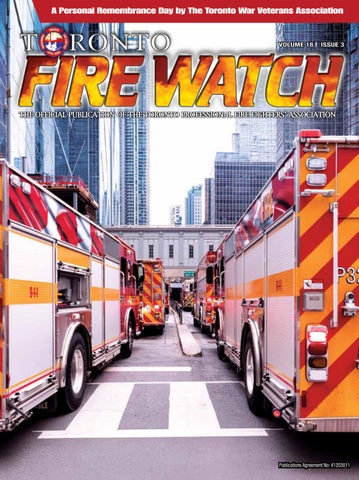
Toronto Fire apparatus staging at an incident at Union Station. Photo Credit: David Fillion, Getty Images
Publications Agreeme
nt No: 4120301
1
MT_Consolidate_Beach_HRES.pdf
1
2023-01-11
9:24 PM
LIVE LIFE ON YOUR OWN TERMS
C
We’ve all heard the expression you only live once. So, why not enjoy life on your own terms. Consider consolidating your existing debts into one monthly payment by taking advantage of your home's equity. Call Today!
M
Y
CM
MY
CY
CMY
K
ROBERT POSA
Mortgage Broker T. 416.931.7672 robert.posa@mortgagetrain.com www.mortgagetrain.com
TM
HOME AND AUTO INSURANCE
SAVE UP TO
40%
Corporate Office (Your Mortgage Professionals) #12756 Some conditions may apply O.A.C. License #M08005247
OUR FIREFIGHTER GROUP PROGRAM INCLUDES: Exclusive Group Insurance Rates – savings up to 40%! Superior claims counselling and support Personalized service by dedicated insurance experts After-hours claims service
We can also insure your: Motorcycle, Condo, Cottage, Rental Property, ATV, Snowmobile, Watercraft, Collector Cars, Mobile Homes, RVs, and more! CALL TO GET A FREE QUOTE AND RECEIVE A BONUS $20* GAS CARD! For CURRENT clients, you will also receive a FREE $20 Gas Card* for any qualified referral who receives a quote.
PROTECTING THOSE WHO PROTECT US FOR OVER 40 YEARS
*Terms and conditions apply.
SCAN FOR MORE INFO
PRESIDENT’S MESSAGE
S
ince December 16, when the arbitration award was released, it has been an exceptionally busy and demanding period. The award immediately generated a significant number of questions from members, many of which stem from decisions made by the arbitrator and the differing interpretations surrounding those decisions. As is often the case with arbitration outcomes, the language and intent behind certain rulings can be viewed in different ways, which has required ongoing clarification and communication. From the day the award was issued, our priority has been to work toward finalizing clear and accurate language that reflects exactly what changes have been made to our collective agreement. This process has proven to be complex and time-consuming. While the award established direction on a number of issues, there are still several items where details have not yet been fully agreed upon or finalized. Significant work remains before the updated agreement can be completed and distributed to the membership. In addition to these challenges, the award included substantial pay increases, as well as the introduction of an entirely new 3% premium pay tied to the Toronto Police contract. Implementing these financial changes requires careful coordination to ensure accuracy and fairness for all members. While the wage improvements represent an important step forward, they have also added another layer of administrative and interpretive work as we move toward finaliz-
ing the agreement. I understand that many members have expressed frustration and disappointment, particularly regarding the absence of improvements to benefits in this award. Over the past several weeks, I have personally responded to numerous emails and phone calls from members who feel strongly that benefits should have been enhanced. It is important for everyone to understand that benefits were a major focus during this process. Multiple proposals were brought forward, including improvements to retirement benefits, enhanced mental health supports, and increases to existing coverage amounts for a variety of services. There appears to be a misconception that these issues were not pursued or presented during arbitration. That is simply not the case. The arbitrator’s written decision clearly acknowledged the breadth of benefit-related proposals that were advanced on behalf of the membership. However, the arbitrator also noted the employer’s position that the newly awarded 3% premium represented a significant financial commitment. In his assessment, this premium effectively became the trade-off that limited additional gains in benefits during this round of bargaining. While this outcome may not align with everyone’s expectations, it is important to recognize the broader context in which arbitration decisions are made. Arbitrators weigh competing priorities, financial considerations, and comparators when determining awards. The result is often a
balance of gains and concessions, rather than success in every area. There is still a considerable amount of work ahead before the finalized collective agreement can be completed and shared with members. Once that process is finished, our focus will quickly shift toward the future. This current contract expires on December 31 of this year, and preparations for the next round of bargaining will begin shortly. At that time, we will be seeking bargaining submissions directly from the membership to help guide priorities moving forward. I look forward to reviewing the ideas and proposals that come from the floor in the next round. I remain optimistic that, with the 3% premium now firmly established, we will be in a stronger position to pursue meaningful improvements in other areas, including benefits and workplace supports. The progress achieved in this award lays important groundwork, and with continued engagement and input from members, we can build on that foundation in the negotiations ahead.
Michael Smith, President Toronto Professional Fire Fighters’ Association I.A.F.F. Local 3888
Vo l u m e 1 8 | I s s u e 3 | F I R E WAT CH
5
Less hassle. More value. Banking built for firefighters and their families. Enjoy straightforward banking, real savings, and support from people who understand your world. What you get: No-fee everyday banking Easy access to your money, anytime Free nationwide ATM access through the THE EXCHANGE Network Convenient digital tools that fit your lifestyle Plus: added savings through partner offers on insurance, credit cards, and investing.
Join our community of over 4000 firefighters and many Fire Associations across Ontario who’ve trusted us with their banking for over 80 years.
Open an account online or chat with one of our experts: signup.comtechfirecu.com 1-800-209-7444 | comtechfirecu.com Amherstview | Kingston | Mississauga | Ottawa | Toronto join.yncu.com 1-888-413-9628 | yncu.com Brantford | Cambridge | Guelph | Kitchener | London | Mitchell | Paris | Sault Ste. Marie | Stratford | Timmins | Waterloo | Windsor | Woodstock
SECRETARY-TREASURER’S MESSAGE Welcome to Arbitration
I
n the words of Lenny Kravitz, “It ain’t over ’til it’s over.” In my view, this aptly summarizes the arbitration process. In my previous article, we addressed the delay in the release of the arbitration award and what we were doing about it. Now that the decision has been released, we should turn our attention to the next steps. I understand that in today’s world, many people expect everything to happen instantaneously; however, that is not the case in every situation. If you recall the interim award issued in September 2024, two of the most significant outcomes were the addition of Truth and Reconciliation Day and the 4.75% pay increase. Both decisions were implemented relatively quickly. Why was that the case? The statutory holiday was to be implemented in the future—January 1, 2025—and the pay increase was retroactive to January 1, 2024. This required the City to address nine months of pay adjustments, while also allowing time to plan for the additional statutory holiday. By contrast, the December 16, 2025 decision awarded pay increases for 2025 (a split year) and 2026, along with the addition of a new 3% increment. As soon as January 1 arrived, we began hearing familiar questions: “Where’s the money?” and “Why hasn’t TFS initiated the pay increase?” The relatively swift implementation of the interim award may have created the impression that the City can simply press a button and resolve everything immediately. Anyone who has been a City employee for any length of time knows this is nearly impossible—there are many moving parts to consider. The arbitrator ruled on the pay increases and provided general guidelines but did not direct the parties on how implementation should occur. That responsibility was left to the parties. Given the significance and cost of the decision, it is understandable that the City and the Association initially
had differing views on implementation. At the time of writing, discussions are ongoing; however, by the time this article is published, the outcome may be known. As for where that 3% will ultimately be reflected—we shall see. Once implementation is finalized, the City can begin the back pay process. In this case, payroll must address twelve months in 2025 (including a split year) and approximately two months in 2026, incorporating the new 3% increment. This includes adjustments related to rank, recognition pay, designations, promotions, overtime, vacation, lieu days, and other earnings categories for approximately 3,300 members. These variables help explain why this back pay process is more complex than the implementation of the 2024 interim award. While it would be convenient if payroll adjustments required only a few keystrokes, the reality is considerably more complicated. I have been asked several times: “Was this a good award?” and “Did we win?” The answer depends largely on individual circumstances. A member relying on post-65 benefits may view the decision unfavourably, while a member whose pay rate has increased by 3% may view it positively. As a member of the bargaining team, I would characterize it simply as an award. I am disappointed that several of the benefit improvements we sought—particularly those related to post-65 coverage and mental health—were not achieved. However, I am pleased that the 3% increment has been addressed, allowing us to focus more fully on benefits in the next round of negotiations. The City strongly opposed the 3% increment, and understandably so—it represents a significant financial commitment. I have also heard comments such as, “Why didn’t everyone receive the 3%?” or “You sacrificed the younger members.” To be clear, the Association did not agree to the five years’ service requirement; we argued for a 3% increase across the board. Some
criticisms likely stem from a limited understanding of the arbitration process. Arbitrated decisions aim to strike a balance between both parties. If awards were consistently unreasonable or onesided, arbitrators would not remain in their roles for long. Although I was not present for all the City’s submissions regarding the 3% increment, the rationale appears evident. The increment was modeled in part on the Toronto Police Service’s 3% frontline increment, which applies upon reaching first-class constable status. Additionally, by delaying eligibility until five years of service, the City avoids paying approximately 30% of members at any given time. With approximately 200 recruits hired annually, this represents nearly 1,000 members with fewer than five years of service. Notably, members who previously waited eight years for a 3% increase will now wait five years and receive an additional 3% three years later. From that perspective, there are positive elements to acknowledge. In many arbitrated decisions that require joint implementation, there are growing pains, learning curves, and ongoing adjustments. This situation is no different. Let us remain patient, allow the process to unfold, and support one another. As Tom Petty famously said, “The waiting is the hardest part.” Stay Safe.
Chris Sornberger, Secretary-Treasurer Toronto Professional Fire Fighters’ Association I.A.F.F. Local 3888
Vo l u m e 1 8 | I s s u e 3 | F I R E WAT CH
7
Premium brands
Delivering dream kitchens is our specialty. A family-run business for over 80 years, Caplan’s prides itself in selling premium appliance brands and delivering quality, white-glove service to Torontonians.
Package pricing
White glove delivery
Book an appointment with one of our sales specialists today! caplans.ca |
416.767.1655 |
shop@caplans.ca
1111 Weston Rd | Toronto, M6N 3S3 | Just South of Eglinton Parking lot directly across from store
VICE PRESIDENT’S MESSAGE
Understanding The New Placeholder Roles in Operations
W
ith the release of the arbitrator’s award late last year, and another round of bargaining quickly approaching, I am going to use the next few articles to discuss some of the more significant changes to our collective agreement. In this edition, I am going to walk through the new changes to Article 45.01, in particular, the WSIB transfer language. The new language applies only to Operations, so to all of the brothers and sisters in our support divisions, I will focus on an issue more central to your jobs in the next one. The WSIB transfer language was an “agreed-to” item in bargaining, meaning it was negotiated by both parties without the need for a decision from the arbitrator. While there was consensus at the table, implementing a change like this has its challenges. The goal was straightforward: to protect the rights of members who are off on long-term WSIB, while relieving some of the strain placed on crews working through extended absences. Previously, when a member was off on long-term WSIB, the position remained frozen. Crews operated short-handed every shift, and there was no mechanism to fill the vacancy. A couple of years ago, TFS began temporarily filling these vacancies with new recruits. With so many new hires in the past five years, TFS was running short on training placements. But why couldn’t we extend this principle to all of our members? The solution was the creation of a “placeholder” role, allowing members to laterally transfer into positions temporarily vacated by long-term WSIB absences. The arrangement protects the returning member’s right to take back their original assignment, while opening opportunities that were previously unavailable. Logistically, the process works through mutual transfers. The member on WSIB is “mutualed” with the incoming placeholder to ensure no unintended vacancy is created and, in the case of officers, all apparatuses maintain an assigned captain.
The member on WSIB can then be “mutualed” again by another member who transfers into the placeholder’s old spot, and so on. If and when the member on WSIB returns, they are guaranteed their old spot back. The key principle is this: only the placeholder assumes the risk. If the member on WSIB returns, the placeholder is the only member at risk of being bumped. Consider a simple scenario: Captain A is off on WSIB. Captain B transfers into their spot as a placeholder. Captain C transfers into Captain B’s old spot. On paper, Captain A and B complete a mutual transfer. Then, Captain A and C complete another mutual transfer. Captain B is locked into the placeholder role for one year, consistent with our standard transfer rules, or two years for specialty apparatus. If Captain A returns within that period, Captain A resumes their original position. Captain B is then moved to an available vacancy, with a freeze-free transfer out. Captain C remains where they are in B’s former position. This past January was the first time we implemented the new process. As expected with any new system, there were growing pains. Most notably, some members were unclear whether they were applying for a placeholder role or a permanent vacancy. That was never the intent. Given the risk assumed by the placeholder, clarity is essential. Moving forward, members who wish to be considered for WSIB placeholder vacancies must clearly state this in the comment section of the transfer request form. See the highlighted portion of FCC 26-030. If no comment is included, the member will be considered only for permanent vacancies. A few additional points are important. When a member returns from WSIB, they usually complete retraining and/or a work-hardening process on modified duties. The return-to-work process is meant to prepare them for full duties. Until that process is completed and the returning member is ready for their original role, the placeholder will remain in the position. The bump occurs only
when the returning member is fully capable of resuming their operational role. If a member on WSIB retires, resigns, or transfers out, the placeholder will take over the position permanently. However, the one-year lock-in period begins when the placeholder first transfers into the role. It does not restart if the position later becomes permanent. If a separate permanent vacancy opens on the same truck while a placeholder is assigned, the placeholder does not automatically slide into that new vacancy. The new vacancy is awarded based on seniority, just like any other transfer. Some senior members may have been waiting specifically for a permanent opening and chose not to apply for a placeholder role (i.e., did not leave a comment in the comment section of their transfer request). If no more senior member has applied, only then will the placeholder be awarded the permanent vacancy. If the placeholder is awarded the permanent vacancy, then a new placeholder can transfer into the long-term absence position. As you can see, the concept is simple in writing but can be complicated in practice. Despite the early challenges, we believe this language provides valuable options for our members. We will continue refining the process to improve transparency and efficiency. I have no doubt that new challenges will arise as this process matures. If you have any questions or concerns about the transfer language as it stands right now, remember you can always call Chris Sornberger.
Justin D’Aloisio, Vice President Toronto Professional Fire Fighters’ Association I.A.F.F. Local 3888 Vo l u m e 1 8 | I s s u e 3 | F I R E WAT CH
9
Protection that shows up
For your family’s everday life. Learn more about exclusive group rates on home and auto insurance.
Call or visit our website for a quote: 844-999-7687 | westlandmygroup.ca/tpffa
I SPECIALIZE IN HOARDER PROPERTIES Hoarded homes can feel overwhelming. I bring 58 years of real estate experience to help families through the entire process — with dignity, privacy, and proven results. RE/MAX Hall of Fame broker Founder, Seniors Real Estate Advisors (SREA) Recommended by several Toronto fire inspectors
Barry Lebow, Broker barrylebow.com
416-399-2852 hoarderstoronto.com
CHAPLAIN’S CORNER
Fighting the Good Fight
O
ne of the best lessons my older brother ever taught me was simple: “It’s not the size of the dog in the fight, it’s the size of the fight in the dog.” At the time, it was meant for basketball. Don’t back down, play hard, and leave it all on the court. For a season of my life, that mindset served me well. It built grit, confidence, and resilience. The problem wasn’t the lesson itself. The problem was letting it apply to every situation. There were moments when I had plenty of fight in me, but no wisdom about where that fight belonged. Like the time someone cut in front of me at McDonald’s and, fully aware the person was six foot six and built like Dwayne Johnson, I chose to engage anyway. That was a lesson in confusing confidence with wisdom. Or the time my ankle was a little bit floppy, and instead of stopping, I taped it up and played the rest of the game. I finished strong that night— and missed the rest of the season. I had fight but lacked discernment. Not every fight is the same. Firefighters understand this instinctively. You don’t fight every fire the same way, or enter every structure the same way, or fully commit when conditions clearly say pull back. Experience teaches you that strength without strategy becomes dangerous. Knowing when to fight, where to fight, and how much to commit can save lives, including your own. That same principle applies far beyond the fireground. Fighting the good fight isn’t about constant resistance or proving toughness. It’s about choosing battles that matter and walking away from those that don’t. The public sees firefighters battling flames, chaos, and emergencies. What often goes unseen is the internal fight. The weight of cumulative
stress. The calls that linger longer than they should. The pressure to always be steady, composed, and strong. The slow burn of fatigue, isolation, or burnout. These fires don’t come with smoke or alarms. They build quietly, and if left unchecked, they can take more from you than any working fire ever could. Taking care of yourself—mentally, physically, emotionally, and spiritually—is not a sign of weakness. It’s maintenance. Just like checking your gear or drilling your skills, tending to the inside keeps you effective on the outside. You can’t keep fighting well if you’re running on empty. Fire service culture values toughness—and rightly so. But toughness without awareness eventually becomes a liability. There are moments to push through discomfort and moments when pushing only causes deeper damage. The goal isn’t just to win today’s battle. It’s to stay healthy enough to answer the call tomorrow, next year, and throughout an entire career. Firefighters relentlessly train skills, tactics, fitness, and teamwork. But the job demands more than physical readiness. It requires emotional resilience, moral clarity, and a sense of purpose that holds steady when the work gets heavy. What grounds you after the hard calls? What steadies you when the pressure builds? What keeps you moving forward when motivation runs low? Everyone answers those questions differently, but everyone needs answers. Purpose isn’t a luxury; it’s fuel. Without it, even the strongest firefighter eventually burns out. The good fight isn’t just about protecting others; it’s about not losing yourself in the process. The good fight is about integrity,
South Command Dan Chandran 647-242-9897 danieljchandran@gmail.com
about caring for your crew and your family, and about knowing when to stand firm and when to step back. Firefighters fight for their city every day. The fight that allows you to keep doing that well is quieter, ongoing, and intentional. Fight with strength, fight with wisdom, and fight the good fight. As a chaplain, I have the privilege of walking alongside firefighters in moments most people never see—after the sirens fade, after the gear is hung up, and after the adrenaline wears off. I’ve learned that the strongest people aren’t those who fight everything head-on, but those who live with clarity about why they fight, when they fight, and when they don’t. There is a kind of strength that doesn’t need to prove itself. A kind of courage that knows when to pause, breathe, and reset. A kind of leadership that serves others without destroying itself in the process. That kind of strength is rooted, steady, and sustainable. It values people over ego, wisdom over impulse, and wholeness over constant output. My hope for every firefighter is not just that you fight well on the fireground, but that you live well off it. That you carry a strength that lasts, a peace that steadies you, and a purpose that holds when the job gets heavy. Because the good fight is never just about what you’re facing; it’s about who you’re becoming along the way. Vo l u m e 1 8 | I s s u e 3 | F I R E WAT CH 11
Fire Investigations Unmasking Confirmation Bias in Fire Investigation
BY STUART WEST, TORONTO FIRE ACTING CAPTAIN, FIRE STATION 145-C
Avoiding Confirmation Bias in Fire Investigation
Fire investigation is a discipline that blends scientific analysis, critical thinking, and an unwavering commitment to uncovering the truth behind every incident. Whether determining the origin of a fire in a residential building or piecing together the chain of events in a large industrial fire, investigators face a myriad of challenges. Among the most subtle and potentially damaging is confirmation bias—a cognitive pitfall that can distort judgment and compromise the integrity of the investigative process. This article explores the nature of confirmation bias, its consequences in fire investigations, and proven strategies for investigators to recognize and avoid it, safeguarding the accuracy of their findings.
The Challenge and Impact of Confirmation Bias
Confirmation bias refers to the tendency for individuals to notice, favour, or seek out evidence that confirms their pre-existing beliefs or hypotheses, while undervaluing or ignoring information that might contradict those initial assumptions. There are many high-profile criminal cases that we have all heard of, usually in high-profile homicide investigations, whereby investigators allowed confirmation bias to pollute and poison the evidence. Unfortunately, in some cases, this has resulted in innocent people serving long prison sentences, only to be exonerated some years later. Fire investigations are not immune to this complication. In the high-stakes environment of fire investigation, this bias can emerge at any stage— from the moment the investigator arrives at the scene, to the formulation of hypotheses, analysis of physical evidence, and final reporting. For example, if an investigator suspects arson early on, they may— consciously or unconsciously—view subsequent clues through a lens that supports that narrative, 12
overlooking indicators of accidental ignition or mechanical failure. The repercussions of confirmation bias in fire investigation are significant and far-reaching. Relying on biased reasoning can lead to misinterpretation of fire patterns, faulty analysis of fire dynamics, and the mishandling or disregard of critical evidence. Ultimately, such errors may result in incorrect conclusions about the origin and cause of the fire, potentially implicating innocent parties or allowing arsonists to evade justice. Moreover, flawed reports can undermine public trust in forensic science and the justice system and may have financial, legal, and ethical ramifications for communities, insurers, and individuals alike.
Recognizing and Overcoming Bias
The subtlety of confirmation bias makes it a formidable challenge for even the most experienced investigators. It often manifests in the selective gathering of evidence, premature narrowing of hypotheses, or the use of leading questions during witness interviews. Investigators may find themselves gravitating towards familiar scenarios or relying on intuition rather than objective analysis. To counteract this, it is Vo l u m e 1 8 | I s s u e 3 | F I R E WAT CH 12
essential to cultivate self-awareness and adopt tools and techniques that illuminate potential blind spots throughout the investigative process. A disciplined, methodical approach is the foundation of unbiased fire investigation. Investigators should begin by collecting and documenting all available evidence before forming any opinions about the incident. Utilizing standardized protocols such as the scientific method encourages the objective evaluation of every piece of information—testing multiple hypotheses against the evidence, rather than seeking data that supports a single idea. Detailed scene notes, photographs, and diagrams further reinforce an impartial record of the investigation. To mitigate confirmation bias, investigators must go beyond simply considering alternative explanations— they should actively look for evidence that challenges their primary hypothesis. This mindset shift transforms the investigative process from one of affirmation to critical inquiry, ensuring that all plausible scenarios are rigorously evaluated. For instance, if electrical failure appears likely, the investigator should also scrutinize the possibility of human error, mechanical malfunction, or natural causes. No investigator works in isolation. Collaborating with colleagues and soliciting peer review injects fresh perspectives into the investigative process, helping to uncover overlooked details or alternate interpretations. Open dialogue and constructive critique foster a culture of intellectual honesty, where the focus remains squarely on the facts. In complex or high-profile cases, multidisciplinary teams—including fire scientists, engineers, and forensic experts—can pool expertise to reach more robust conclusions. Fire investigators must remain vigilant against cognitive biases by engaging in regular training and professional development. Workshops and courses on critical thinking, forensic methodology, and cognitive psychology equip investigators to recognize bias in themselves and others. Case studies that highlight
confirmation bias in real-world investigations can serve as cautionary tales and learning opportunities. The final investigative report is the culmination of weeks or months of work—and it must reflect an objective, balanced assessment of the evidence. Investigators should review all supporting documentation and ensure that alternative hypotheses are discussed and, where appropriate, ruled out based on evidence. Transparent language, clear references, and the inclusion of both supporting and contradictory data reinforce the report’s credibility and accuracy.
Conclusion
Confirmation bias is an insidious challenge in fire investigation, capable of skewing judgment and undermining the pursuit of truth. By fostering selfawareness, embracing scientific rigor, seeking peer input, and committing to ongoing education, investigators can detect and defeat bias before it corrupts their work. Through these practices, the profession maintains its integrity, delivers justice, and upholds the highest standards of forensic excellence. Stay safe.
Vo l u m e 1 8 | I s s u e 3 | F I R E WAT CH 13
NEVER PAY PERSONAL OR CORPORATE TAX AGAIN—LEGALLY PAYROLL DEBT: GONE!
HST DEBT: GONE!
HAVE CORPORATE DEBT?
WE BUY ALL YOUR CORPORATE DEBT—YOU START OVER!
WANNA STOP PAYING TAXES? SCAN THIS TO VISIT 911TAX.CA
Letter from the Editor…
Iyana Phakira
No matter your role in the fire service, this job asks a lot of the mind, day in and day out. When we talk about mental wellness in the fire service, the conversation usually goes straight to sleep, stress, and peer support. However, there’s another piece of the puzzle that doesn’t always get the attention it deserves, which is what we’re putting on our plates. In this article, we’re taking a closer look at the connection between diet and mental health, specifically within the fire service, not in a “perfect diet” kind of way but in a practical, realistic way that reflects the demands of shift work, long nights, interrupted meals, and station life. The article highlights the fact that in this field we face unique challenges such as unpredictable calls, fatigue, convenience foods, and the culture around food at the hall. What’s encouraging is that implementing small, manageable changes can still make a meaningful difference, especially when it comes to mood, focus, stress tolerance, and overall mental resilience. Diet isn’t a cure-all, and it doesn’t replace traditional mental health support, but it
TORONTO FIRE SERVICES PEER SUPPORT NEWSLETTER
is one of the tools we have some control over, even in a high-stress job. Whether it’s planning ahead for a long shift, making smarter snack choices, or simply noticing how certain foods affect your energy and mood, nutrition can be part of the bigger mental wellness picture. We hope this piece sparks conversation, reflection, and maybe even a few small changes, one meal at a time!
VOLUME 18 | ISSUE 3 | FIRE WATCH
1
Mental Wellness and Diet:
Why What Firefighters Eat Matters for the Mind BY ASAD RASTAGAR, TORONTO FIREFIGHTER, STATION 245-D
Firefighting is one of the most mentally demanding professions. Long shifts, disrupted sleep, exposure to trauma, and constant readiness place significant strain on emotional and psychological health. While mental wellness initiatives often focus on peer support, fitness, and critical incident stress management, one powerful factor is frequently overlooked: diet. Emerging research shows that nutrition plays a meaningful role in mental health. What firefighters eat can influence mood, stress tolerance, focus, and emotional regulation. For a profession that requires clear thinking under pressure, diet is not just about physical performance—it is part of mental resilience. The Brain–Body Connection The brain is one of the most energy-demanding organs in the body. It requires a steady supply of nutrients to function properly. Vitamins, minerals, healthy fats, and amino acids all contribute to the production of neurotransmitters—chemical messengers that influence mood, motivation, and sleep. When the body is under-fueled or fueled poorly, mental performance can suffer. Highly processed foods, excessive sugar, and frequent fast-food meals may lead to energy spikes and crashes, irritability, and difficulty concentrating. Over time, these patterns can contribute to inflammation in the body, which has been linked to symptoms of anxiety and depression. On the other hand, diets rich in whole foods provide the vitamins, minerals, healthy fats, and amino acids needed to support neurotransmitters that regulate mood and stress. Stable nutrition supports more consistent energy levels, which is especially important during long shifts and overnight calls.
2
Gut Health and Emotional Well-Being One of the most important developments in mental health research is the understanding of the gut– brain connection. A large portion of mood-related neurotransmitters is produced in the gut, making digestive health closely tied to emotional well-being. Diets rich in fiber, whole foods, and fermented products help maintain a healthy balance of gut bacteria. In contrast, diets heavy in processed foods may disrupt this balance, potentially influencing stress levels, sleep quality, and emotional regulation . What Research Tells Us About Firefighters’ Eating Habits Research examining firefighters’ dietary behaviors highlights an important reality: most firefighters know what healthy eating looks like. The challenge is not a lack of knowledge, but the environment and demands of the job. The way firefighters eat is shaped by shift work, workplace culture, time constraints, and broader lifestyle factors, and these eating patterns have important implications for their health, especially cardiovascular disease (CVD), obesity, and mental well-being. Unique Nutritional Challenges in the Fire Service Firefighters face real barriers when it comes to eating well: • Unpredictable call volumes interrupt meals • Night shifts disrupt appetite and hunger cues • Convenience foods are often the fastest option • Station culture can influence food choices •F atigue and stress can drive overeating or poor choices Despite strong awareness of health risks, many firefighters find it difficult to maintain consistent nutrition habits during shifts. These challenges can affect both physical health and mental well-being over time.
TORONTO FIRE SERVICES PEER SUPPORT NEWSLETTER
VOLUME 18 | ISSUE 3 | FIRE WATCH
Nutrition Strategies That Support Mental Resilience Mental wellness does not require a perfect diet—it requires better patterns over time. Small, realistic changes can make a noticeable difference. Helpful habits include: • Choosing whole foods more often than packaged foods • Including vegetables, fruits, and whole grains in meals • Eating lean proteins to support steady energy • Including healthy fats such as fish, nuts, and seeds • Staying hydrated throughout shifts • Balanced meals help stabilize blood sugar levels, which can reduce mood swings, irritability, and fatigue—all critical for high-stress environments • Eating well on shift • Planning meals ahead of long shifts • Sharing cooking responsibilities • Stocking healthier snacks for overnight calls • Encouraging balanced meals rather than restriction
Name
Lynn Sciberras Iyana Phakira Candice Roulette Sean O'Connell Gary Wharton Neil Beveridge Vallery Black Adina Kaufman Angelo Tagarelli Rodney Johnston Hugh Doherty John Drimmie Marcus Martyn Jones Kevin Scragg Cecil Law John Malcolmson Jocelyn Bourrie Kevin Hosier Jenna Wulf John Pagnotta Trayce Shaw Cary Stather Brian McAlinden Louise Chen Kent McDonald Asad Rastagar Greg Duncan Chris Pallister Dave Camplin Sidney Zigah Darren Taylor Tony Mellozzi Louis Chow Chris Rodrigues Robert Jackson Bernie Leufkens
Food can also be a source of connection. Shared, intentional meals can improve morale, reduce stress, and support a healthier station culture. Mindful Eating in a High-Stress Job Stress eating is common in emergency services. Mindful eating—paying attention to hunger, fullness, and how food affects energy and mood—can help firefighters better understand their body’s needs. Noticing how certain foods impact alertness, sleep, or emotional state allows for more informed choices without rigid rules or guilt. A Practical Takeaway Diet alone cannot prevent or treat mental health conditions, but it can be a supportive foundation. For firefighters, fueling the body properly supports the brain’s ability to manage stress, recover from trauma, and stay focused under pressure. Mental wellness is built from many small supports— nutrition is one of them, and it’s one that firefighters can control, one meal at a time.
TORONTO FIRE PEER SUPPORT TEAM CONTACT LIST Call 24/7/365: 416-338-9327
Station
Shift
Email Address
Tech Ops Days lynn.sciberras@toronto.ca HQ Comms /1 iyana.peerteam@gmail.com TFA Days candiroulet@gmail.com 233 FP/B sean80446@gmail.com 225 A gary_wharton@hotmail.com 114 A neilr.bev@gmail.com 333 A valleryblack@gmail.com 342 A adina_kaufman@hotmail.com 421 A angelo.hamtac@gmail.com 332 A rj3111@hotmail.com 231 A hugh.doherty@sympatico.ca 142 A johndrimmie@gmail.com 132 B m.martynjones@gmail.com 324 B kevintfspeersupport@icloud.com 235 B cecil.law@rogers.com 222 B johnmalcolmsonpeerteam@gmail.com 227 C j.bourrie@live.ca 226 C kevin.hosier@hotmail.com 227 C jennakwulff@gmail.com 231 C johnpagnotta@hotmail.com 315 C traycegshaw@gmail.com 324 C cstather@sympatico.ca 114 C bmcalinden@me.com 321 C louise.deanne.chen@gmail.com 132 C kentmc6@gmail.com 245 D asadullah_rastagar@hotmail.com 333 D greg.duncan@outlook.com 333 D chris_palli@hotmail.com 422 D dcamplin104@gmail.com 143 D smkz45@hotmail.com 341 D darren.taylor@rogers.com 313 D tonymellozzi@gmail.com 313 D chowl@live.com Mental Health Professional chris.rodrigues@toronto.ca Retired firejackt333@gmail.com Retired tapemeasure92@hotmail.com
Phone #
647-409-3135 647-784-2129 416-624-9452 905-510-2673 416-735-5845 905-466-8510 416-994-5276 416-949-5359 905-929-8548 647-223-2121 416-433-0446 905-903-2574 416 873-0954 416-540-6222 437-869-2126 416-553-6046 416-476-4219 416-320-7573 647-678 1077 905-424-1113 519-331-4943 289-314-8100 905-391-5118 416-919-8098 289-208-1226 647-606-3056 416-525-4995 905-741-5396 705-441-5418 416-990-0044 416-697-7842 416-562-0253 647-401-0821 416-338-9557 905-419-4545 905-449-3047
Chaplains Ted Leck Chaplain NORTH ted.leck@toronto.ca 647-461-4047 Tahseen Gill Chaplain EAST tahseen.gill@toronto.ca 416-737-2127 Daniel Chandran Chaplain SOUTH daniel.chandran@toronto.ca 647-518-9750 FIRE SERVICES NEWSLETTER VOLUME 18 | ISSUE 3 | FIRE WATCH ToddTORONTO Riley (Coordinator) ChaplainPEER SUPPORT WEST todd.riley@toronto.ca 416-788-1308
3
Dr. Taylor Bischoff: From Logging Trails to Medical Director BY BRAD MELDRUM, TORONTO FIRE ACTING CAPTAIN, FIRE STATION 325-C & MEMBER OF THE TFS EMS COMMITTEE
O
n June 17, 2025, Dr. Taylor Bischoff officially assumed the role of Medical Director for Toronto Fire Services (TFS). This appointment marked the culmination of a remarkable journey defined by resilience, intellectual curiosity, and an unwavering commitment to highquality emergency and pre-hospital medicine. Born in the early 1990s in British Columbia, Dr. Bischoff grew up immersed in the hardworking culture of the province’s logging heritage. Raised between New Westminster and the interior, in communities known for their lacrosse traditions and logging history, respectively, she was surrounded by a family where labour was both a necessity and a way of life. Her father’s family hailed from the small town of Celista, where logging formed the backbone of their livelihood; he managed 160 acres of land, harvesting timber while embodying a relentless work ethic that left a lasting impression on Taylor. Her mother, a social worker in some of Surrey’s most challenging
18
neighborhoods, modeled deep empathy, patience, and dedication to public service, skillfully balancing a demanding career with family responsibilities. These parental examples, demonstrated through action rather than words, profoundly shaped her character. Life in a logging family was far from easy. It demanded endurance, practical skills, and a strong work ethic. Dr. Bischoff learned responsibility early, not behind the wheel of a car but operating a D6 Caterpillar bulldozer through rugged terrain. Even during her first two summers of medical school, while many peers pursued research or leisure, she returned to the forest as a “swamper,” clearing brush, bucking logs, and handling heavy machinery under extreme conditions, to help fund her education. These grueling experiences built the resilience that would later serve her well in the highstakes world of emergency medicine. Determined to break free from New Westminster’s tight-knit social world, where “everybody went
to the same high school,” Dr. Bischoff applied exclusively to McGill University in Montreal, despite never having visited the city—a bold and risky move, as she reflects in hindsight. Accepted into its renowned science programs, she describes her undergraduate years as “phenomenal” and “a total blast.” She earned a bachelor’s degree in Evolutionary Biology and East African Field Studies. Initially captivated by taxonomy and the evolutionary classification of organisms, she dreamed of specializing in chondrichthyes (sharks) and becoming a “Shark Week” expert. Medicine only emerged as a serious option in her first year of undergrad. Still undecided, she applied simultaneously to law school, medical school, and a science master’s at McGill; medicine accepted her first, setting her path. A pivotal influence came from a close McGill friend, a senior who later became a successful cardiologist, who described medicine as analytical yet tactile work: intellectually demanding without a rigid 9-to-5 routine or sitting behind a desk. This resonated deeply with her preferences. Maintaining British Columbia residency ties, she matched at the University of British Vo l u m e 1 8 | I s s u e 3 | F I R E WAT CH 18
Columbia (UBC) for medical school, allowing her to return home. Medical school at UBC proved the most grueling challenge of her life, surpassing even parenting, serious illnesses, and major injuries. The first two years focused on classroom learning and afternoon clinics, but the third and fourth years immersed her in clinical rotations: short stints in unfamiliar settings where she often felt underqualified. This led to significant strain, feelings of futility, sleep deprivation from 30-hour on-call shifts followed by 5 a.m. pre-rounds, and little recovery time. The greatest difficulties were often social—navigating egos and challenging interactions—rather than the intellectual demands of the medicine itself. Despite the hardships, Dr. Bischoff still misses the immersion in higher education and remains deeply driven to continually acquire new knowledge. After earning her MD, Dr. Bischoff briefly considered law but quickly pivoted after shadowing an emergency physician at Royal Columbian Hospital in New Westminster. The fast-paced, highacuity environment of emergency medicine, where there was no long-term follow-up—only the swift move to the next critical case—felt like a natural fit. She found herself powerfully drawn to pre-hospital and critical care. When applying for residency, the University of Toronto (U of T) and Sunnybrook Health Sciences Centre stood out for their exceptional pre-hospital program, one of the strongest and most established in Canada. From her perspective as a medical student, Ontario’s prehospital medicine appeared more organizationally mature, especially in education and training. As a result, U of T became her top choice. In 2016, Dr. Bischoff began her residency at U of T. It was here she met former TFS Medical Directors
Dr. Mike Feldman and Dr. Morgan Hillier, along with leading prehospital researchers Dr. Sheldon Cheskes and Dr. Rick Verbeek. These mentors profoundly shaped her career; in particular, Dr. Feldman and Dr. Hillier honed her pre-hospital expertise and opened crucial doors to foundational opportunities. During the final years of residency, Dr. Bischoff pursued a Master’s in Medical Education at Johns Hopkins University, focusing on interprofessional medical education. Recognizing the need for advanced training to excel as a clinicianeducator, she embraced the degree. Though initially a personal learning pursuit, it proved instrumental in shaping the TFS Medical Program as it exists today. Post-residency, pre-hospital medicine jobs were scarce. Rather than stepping back, Dr. Bischoff stayed visible by volunteering, attending meetings, and contributing to research to keep her foot firmly in the pre-hospital door. In 2021, she secured her first fulltime emergency physician role at Sunnybrook Health Sciences Centre and began picking up casual shifts at Royal Victoria Regional Health
Centre (RVH) in Barrie, where she continues to work today. Her persistence paid off in 2022 when an interim Medical Director role opened after Dr. Hillier’s move to Toronto Paramedic Services. Strong endorsements from Dr. Feldman and Dr. Hillier, along with Base Hospital Manager Maud Huiscamp, a former paramedic and exceptional mentor, secured the position. Maud, a respected veteran alongside Feldman and Hillier, became another key advocate. In mid-2025, her role as Medical Director was formalized, including the first written contract between Sunnybrook and TFS in years, facilitated by Chief Jim Jessop and Maud Huiscamp. As Medical Director, Dr. Bischoff has navigated significant challenges. Early on, she managed the extraordinary pressures of overseeing a program coming out of COVID while adapting to a large, unionized organization. Coming from a non-union background, she found it eye-opening to understand how union dynamics intersect with training, education, and medical direction, shaping what can and cannot be implemented.
Vo l u m e 1 8 | I s s u e 3 | F I R E WAT CH 19
From Logging Trails to Medical Director ...Continued from page 19
Her current greatest challenge—the one that keeps her up at night—is addressing the high volume of lowacuity calls and prolonged on-scene times that erode crew morale and strain resources. To address this, she is leading innovative workarounds and collaborating closely with Dr. Sheldon Cheskes, Dr. Mike Feldman, and Chief Jim Jessop. Progress remains cautious, however, as current legislation has not kept pace with advancements in pre-hospital medicine, and any changes must prioritize patient and provider safety above all. Looking to the future of Toronto Fire Services, Dr. Bischoff envisions a system that consistently delivers high-quality, evidence-based prehospital care and sets the provincial benchmark. She is particularly focused on advancing resuscitation practices, including further research on dual sequential defibrillation and enhanced ventilation training. Closely aligned with this forwardlooking approach is Dr. Bischoff’s strong emphasis on developing and modernizing quality assurance. She credits Chief Shawn McCormick, Chief Rob Howe, and the dedicated training officers, for working
20
to build a far more robust and contemporary quality assurance program, one that positions TFS among Ontario’s leaders in this area. As Medical Director, she remains deeply committed to ensuring that all practices are safe for both patients and providers, while remaining clinically effective. She stresses that the only reliable way to confirm that care is meeting milestones and improving patient outcomes is through systematic review of actual results. In her view, this firmly establishes quality assurance as the central driver of evidence-based practice at TFS. Beyond clinical duties, Dr. Bischoff co-leads RVH’s Supplemental Emergency Medicine Experience (SEME), a three-month training course preparing family physicians for rural ERs, supported by the University of Toronto. She also serves as physician lead for paramedic education on the Education Subcommittee of the Ontario Base Hospital Group (OBHG), collaborating with provincial experts to advance standardized, high-quality paramedic training across Ontario. Dr. Bischoff expresses profound
gratitude for her TFS team, calling it a true privilege to work alongside such dedicated professionals. She regards Chief Jim Jessop as a close friend and admires Chief John Carson, Chief Shawn McCormick, all the medical Associate Training Instructors, and Recruit Training Officers who tirelessly deliver elite training and professionalism. The organization’s mutual respect and lack of animosity allow her to focus on medical and educational leadership while operational teams excel. She also misses collaborating directly with frontline firefighters and looks forward to getting back out on rideouts, where she can continue learning from those on the front lines. Deeply honored to align with TFS’s vision, Dr. Bischoff is committed to building a lasting legacy: safe, effective, evidence-based prehospital care delivered through collaboration, innovation, and unwavering respect for the team that makes it possible. Her journey from logging trails to medical leadership stands as an inspiring example of how grit, adaptability, and a passion for service can transform lives and systems alike.
Vo l u m e 1 8 | I s s u e 3 | F I R E WAT CH 20
The Impact of
FIFA World Cup 2026 on Toronto Fire Services BY CECIL LAW, TORONTO FIRE ACTING CAPTAIN, FIRE STATION 325-B & MEMBER OF THE TFS EMS COMMITTEE
T
oronto’s role as a host city for the FIFA World Cup 2026 will bring hundreds of thousands of visitors into the city over a concentrated period this summer. While the event offers global visibility and economic benefits, it also presents operational challenges for Toronto Fire Services (TFS), particularly related to medical calls, call frequency, and hazardous materials (hazmat) preparedness.
Medical Calls and Call Volume
Toronto Fire Services already manages a heavy workload, responding to hundreds of thousands of calls annually, the majority of which are medical or rescuerelated rather than active fires. Large-scale events like FIFA typically increase EMS demand, especially on match days and during fan-zone activities. Research on mass-gathering events shows higher rates of: • Dehydration and heat-related illness • Alcohol- and drug-related medical emergencies • Minor trauma from crowd density and celebrations These calls occur in addition to normal citywide emergencies, requiring TFS to carefully balance resources so that everyday response times are not affected.
Pressure on the Broader Health System
Toronto hospitals and emergency departments are already operating near capacity. An increase in EMS transports during FIFA could lead to longer offload times, temporarily reducing ambulance and fire-based medical availability. This places additional strain on TFS crews who must remain with patients until hospital transfer is complete. Public health monitoring during the tournament period further reflects the expectation of increased healthcare demand associated with large international gatherings.
Hazmat Preparedness
Hazmat calls remain a low-frequency but highimpact component of TFS operations. While FIFA
itself is unlikely to directly cause a surge in hazmat incidents, higher population density around venues and fan zones raises the risk of: • Chemical spills from vendors or sanitation systems • Suspicious substances requiring investigation. TFS hazmat teams will maintain heightened readiness through inspections, coordinated planning, and interagency collaboration.
Establishment of a Mass Casualty Incident Committee
In anticipation of increased operational complexity, a new Mass Casualty Incident (MCI) and Intentional Mass Casualty Incident Committee will be established within Toronto Fire Services. This strategic group will serve as a platform to align operational demands, training priorities, logistical readiness, and overall preparedness across the organization. The committee will play a vital role in supporting all TFS personnel by advancing awareness and best practices aimed at reducing health and safety risks while responding to MCIs. By strengthening coordination, standardization, and preparedness, the committee will enhance both operational excellence and member readiness. Additionally, the committee will serve as the initial point of contact for recommendations and concerns from all members of TFS, ensuring that frontline perspectives directly inform strategic planning and continuous improvement efforts.
Conclusion
The FIFA World Cup 2026 will likely lead to localized increases in medical calls and greater operational complexity for Toronto Fire Services, with hazmat preparedness remaining a critical contingency. Through strategic deployment, interagency coordination, and the establishment of a dedicated MCI committee, TFS is positioning itself to maintain both public safety and member preparedness during one of the largest events in the city’s history. Vo l u m e 1 8 | I s s u e 3 | F I R E WAT CH 21
www.tffwva.ca
3 Bridlington Street, Scarborough, Ontario M1H2L2 Wayne Bridger President
Paul Moffatt Secretary
Eric Motton Treasurer
MY REMEMBRANCE DAY BY MIKE OGLE, RETIRED TORONTO FIRE CAPTAIN
My Mother’s Cousin I have looked for years at a picture my mother had of her older brother, Clement McLeod, and her first cousin, George Dohaney. When asked, she would say that the picture was taken in London, England, during the war, when the two first cousins met up. She said that George was killed and that she really had no further information. She knew him, of course, as they would attend family functions, usually at the Monahan farm in Southfield, New Brunswick. George’s mother, Susanne Dohaney (née Monahan), was my grandmother Julia’s sister. When my mother passed, I inherited the picture and have had it hanging on the wall for many years. Last spring, a group from the Toronto Firefighters War Veterans Association, along with others, embarked on a battlefield tour in the Netherlands. It seemed the perfect opportunity to travel to Holland and Belgium on a battlefield
22
tour with some guys I worked with. Just before I left, I felt I had to find out about George, so I started checking the Commonwealth War Graves Cemetery website. His name and the location of his grave came up right away. When I went over the itinerary of the tour I was about to take, I realized I would be very close to the war grave site. As I investigated further, I found out a bit of his history. Warrant Officer Class II George Francis Dohaney (R/84638) had been assigned to RAF Squadron No. 9. He was the bomb aimer on an Avro Lancaster (No. ED689). He was one of a crew of eight. According to records of RAF Squadron No. 9, they were a specialized crew and had already completed 15 operations, including a bombing mission into Italy. The mission of July 3–4, 1943, was a bombing run to Cologne (Köln), Germany. While returning after successfully completing the mission, they were attacked and shot down by a German night fighter aircraft at 1:10 a.m. near the southeast
Vo l u m e 1 8 | I s s u e 3 | F I R E WAT CH 22
necessary protocols, and went looking for the book. The book was signed, and we headed for the gravesite. It was a nice way to close the loop. As there was still lots of time left on the car rental, we decided to visit the British Airborne Division’s war graves site just north of Arnhem in the town of Oosterbeek. These casualties were the result of the failed Operation Market Garden, which took place from September 17 to September 25, 1944. There are 21 Canadians buried there. Four were Canloan officers, six were members of the 23rd Regiment of Canadian Engineers, and 12 were air crew from the RCAF. We placed poppies and a Canadian flag on their graves. suburbs of Cologne. There were no survivors. At the site, the Germans could only recover two bodies. One was the plane’s pilot, Flight Lieutenant John Alfred Wakeford, and the other was George Dohaney. The Germans marked his grave, and it was later identified by the Commonwealth War Graves Commission after the war. He was then interred, along with 516 Canadian airmen, at the Rheinberg War Cemetery (CWGC). After close scrutiny of the tour schedule, it was apparent that the tour (based in Arnhem) would be closest to the cemetery I needed to get to on the 7th of May. The tour was taking us to the Arnhem Oosterbeek War Cemetery and then to the Groesbeek Freedom Museum and War Cemetery. I arranged with the tour guides that I would be accompanying them, but not by bus. I would rent a car so that I could leave from the museum and drive to the Rheinberg War Cemetery (CWGC) and visit the gravesite. With Paul Moffatt, Al Thomas, and my trusty navigator (WAZE), we left the museum for Germany. It was a pleasant drive, and the remnants of the former German border checkpoints could be seen, now a bit overgrown. With a couple of U-turns, we found the cemetery, which was located at the end of a very narrow lane. We visited the cemetery, performed the
Mike Ogle is a retired member of Toronto Fire Services. Mike’s career began with the Scarborough Fire Department Communications Division in 1990, transitioned to TFS upon amalgamation, and in 2008 transferred to the Training Division. Mike was also an executive member of L-3888. He retired in 2021 as a Captain.
Vo l u m e 1 8 | I s s u e 3 | F I R E WAT CH 23
BY JORDAN RITCHIE, PICKERING FIREFIGHTER
The Toronto Fire Celtic Society's
Memorial Ride to Ottawa
580 Kilometres of Purpose
When Dave Cossitt approached me to write this article about my experience with the 2025 Ride, I didn’t know what to say at first. I was honoured, of course, and humbled to be asked—but I wasn’t sure I’d be able to truly capture all my emotions and experiences in a single article. 24
Vo l u m e 1 8 | I s s u e 3 | F I R E WAT CH 24
My name is Jordan Ritchie, and I’ve been a firefighter for 14 years. I spent three years as a volunteer firefighter with Clarington Fire & Emergency Services before being hired fulltime by Pickering Fire Services in 2015, where I am now in my 11th year. I’ve always been surrounded by the fire service. My dad, Paul Scott Ritchie, was a Platoon Chief with Ajax Fire & Emergency Services and retired in September 2019 after 35 years of service. When I joined the fire service in 2012, my dad and I would make regular trips to Ottawa on the second weekend in September to pay our respects to those who had lost their lives in the line of duty. Most of the time, we didn’t know anyone being added to the wall—but unfortunately, there were a few ceremonies where we did recognize names. Never in my wildest dreams did I think I would one day return to Ottawa to add my dad’s name to that monument. I had known about the Ride for several years and had been indirectly involved in supporting it. Our association has supported the Ride through donations to the Canadian Fallen Firefighters Foundation and has served as a stopover in the past when riders passed through Pickering on the first day.
In early May 2024, my dad and I attended the Ontario Association of Fire Chiefs trade show in Mississauga, where we ran into Dave Cossitt. He was there with the Toronto Fire Celtic Society, thanking sponsors of the Ride. We chatted for a bit, and I mentioned that I’d really like to do the Ride one day—though the thought of squeezing into one of those cycling uniforms was a scary one. We laughed, and I left the show that day not knowing my dad was sick or that we would lose him to occupational cancer just four short weeks later. My dad passed away on Thursday, June 6, from pancreatic cancer. It was a very short and aggressive battle—only eight days from diagnosis to his passing. In that moment, I knew I wanted to do the Ride to honour his memory and the memory of the other firefighters being added to the wall. After losing my dad, I committed to the Ride. Still, the thought of riding more than 580 kilometres from Hamilton to Ottawa was daunting. I wouldn’t call myself a cyclist at all. I had picked up a passion for mountain biking in the fall of
Vo l u m e 1 8 | I s s u e 3 | F I R E WAT CH 25
The Toronto Fire Celtic Society's Memorial Ride to Ottawa...Continued from page 25
2019, but up to that point, the longest distance I’d ever ridden was about 25 or 30 kilometres in a single ride. It felt like an uphill battle before I even started. Thankfully, the support from other riders was incredible from the moment I signed up. From training tips and group rides to nutrition advice and equipment recommendations, the guidance was endless. Leading up to the Ride, I spent a lot of time talking with members about what gear I’d need and how to be self-sufficient over the three days. I was fortunate to be joined on the Ride by a friend and co-worker, John Moonlight. We arrived in Hamilton the night before the start. As we unloaded the car, John chuckled at how much I’d packed—I tend to bring everything, including the kitchen sink. We settled into the hotel and met up with several other riders who had travelled in from out of town for dinner. We shared a great meal, talked about the Ride, and discussed what to expect over the next few days.
Riding through Toronto was an experience in itself— dodging streetcar tracks, following police direction, and keeping the group tight. As we turned into the Toronto Fire Services Training Academy, we were greeted with loud applause and cheers from recruits and staff. After an incredible lunch, it was back on the road. As we left Toronto, I became emotional knowing we were heading into Durham Region. Entering Pickering, we rode past two of our stations, where crews stood outside cheering us on. Next was Ajax, where my dad had served for 35 years. Seeing duty crews and members of my family along the road was incredibly moving.
Day 1
The big day was upon us. John and I rode from the hotel to the Hamilton Fire Academy just minutes down the road. As we arrived, riders were making final adjustments—checking tire pressure, filling water bottles, and ensuring they had everything needed for the ride to Cobourg. After a large group photo, we were off. Leaving Hamilton under police escort was a rush. Riding as a peloton and maintaining position took focus. Within minutes, we faced our first major obstacle: descending from the upper portion of Hamilton Mountain down to the waterfront. It was a rough ride down, but once we reached the bottom, the group reformed, and we headed toward Toronto for lunch, with stops along the way in Oakville and Mississauga. 26
Vo l u m e 1 8 | I s s u e 3 | F I R E WAT CH 26
We stopped briefly in Whitby, where I was able to see my wife, Alexis, along with family and friends. It already felt like a major accomplishment—but we still had to reach Cobourg. After one final stop in Newcastle, we arrived in Cobourg around 6 p.m. Having ridden 196 kilometres, a few riders joked about making it a 200-kilometre day. I hopped back on my bike and chased them down to finish the distance. That evening, we cleaned up, enjoyed a cold drink, shared a well-earned dinner, and got some rest. Kingston was next.
Day 2
John and I were up early, checking the forecast—rain, and a lot of it. After breakfast, we loaded our bags into the support vehicles. Rain or shine, the Ride was happening. Within five minutes of leaving Cobourg, the skies opened and the wind picked up. We made several stops before reaching Belleville for lunch, soaked but in good spirits. Everyone was cold, wet, and tired, but determined. The ride to Kingston brought relentless rain and strong headwinds for nearly 170 kilometres. As we arrived at our hotel in downtown Kingston, the skies cleared, and the sun finally came out. We were greeted with cold drinks in the parking lot—a small but perfect reward. That evening, over dinner, riders reflected on the challenging day and shared advice on what to expect for the final push to Ottawa.
and shared long hugs before gathering with everyone to honour those being added to the wall. Five hundred eighty kilometres later, we had arrived. This was my first Ride supporting an incredibly important foundation. I can’t thank the Canadian Fallen Firefighters Foundation enough for the work they do to honour our fallen. The support they provided to our family and the 114 other families in attendance was incredible. This experience ignited a passion for riding that I didn’t know I had, and I will be riding again in 2026. Thank you to Dave Cossitt, the Toronto Fire Celtic Society, and the entire support crew. Without their tireless dedication, this Ride would not be possible. I rode those 580 kilometres carrying grief, pride, and purpose—and crossed the finish line knowing my dad’s name and the names of so many others will never be forgotten.
Day 3
I woke up with butterflies—the final day had arrived. After breakfast, we set out knowing we faced rolling hills and some tough climbs. The weather was finally on our side. After our first stop, we passed through Westport and split up for the famous Foley Mountain climb, agreeing to regroup at the top. It was one of the toughest climbs I’ve ever ridden. Once reformed, we continued toward Ashton for our final stop, briefly stopping at a local brewery to refill water before pushing on. As we entered Ottawa, we were met by the Ottawa Police Service motorcycle unit for the final escort. Riding along the Ottawa River toward LeBreton Flats was unforgettable. Dave asked me to join riders from Toronto Fire and Ottawa Fire at the front of the pack—an honour I’ll never forget. As we rounded the final bend, I heard bands and bagpipes and saw crowds cheering. The emotions hit all at once—pride, grief, exhaustion, and gratitude. I found my wife and family
Vo l u m e 1 8 | I s s u e 3 | F I R E WAT CH 27
Riding Miles, Raising Money, and Building Community BY MIKE NANDKISHUR, TORONTO FIRE ACTING CAPTAIN, FIRE STATION 231-B
Firefighters share certain traits. They are adventurous, obviously not risk-averse, and they enjoy each other’s company. Bikers share the same qualities. When you combine the two, you get the best of both worlds. Welcome to the Red Knights International Firefighters Motorcycle Club! In 1982, ten people got together at a small shop in Massachusetts with the idea of building a motorcycle club just for firefighters and their families. They formed the Red Knights, never imagining what it would become. It caught on quickly, and in 1984, firefighters from Toronto, Scarborough, North York, and Pickering received the first international charter, known as “Ontario 1.” There are three goals in the club—to enjoy the camaraderie of firefighters, to improve the image of motorcycle riders, and to do some community service. Our motto is “Loyal to Our Duty.” It’s a deliberate reference to our profession. We support the Toronto Firefighters Toy Drive, Camp Bucko, and the Canadian Fallen Firefighters Foundation (CFFF). Ontario 1 currently has 48 members, with a growing number of active Toronto firefighters. What was once an older group is becoming young once again. While formerly a mostly Goldwing/Harley club, we now see cruisers, bobbers, sport, dual-sport, Adventure (ADV), trikes, “streetfighter,” as well as the big tourers. If it’s street legal and you have a licence, we want you! There are no mandatory rides; just come when you can. Where do we ride? Don’t be intimidated by the thought of “iron butt” rides if that’s not your thing. We have rides of various lengths and skill levels. In May, we will host a fundraising ride that will only be about 120 km, with a scheduled stop. At the other end of the scale, we’re going to Alberta and Nova Scotia this year. All “ride-in” Ontario 1 events this year are Canadian.
28
Vo l u m e 1 8 | I s s u e 3 | F I R E WAT CH 28
Ontario 1 has an updated website (www.redknightsontario1.ca) where our 2026 Ride and Event Calendar can be found. It’s a big list for 2026, with events being suggested and added by the membership. Our Facebook page and chapter officers are also listed there. You can contact any of them for information about joining Ontario 1. No one is pressured to join, and we have a familiarization period for folks thinking about “patching in.” Any GTA firefighter is welcome at any meeting, event, or ride. We currently have members from Ops, Fire Prevention, and Communications, as we don’t exclude any division. The RKMC has over 400 chapters in 25 countries. At last count, it is the second-largest full-patch MC in the world, with 9,950 members. If you travel and you’re a Red Knight, there’s a network of support from Australia to Poland. You can get directions, recommendations on food and lodging, and emergency assistance from local firefighters who ride. With the “Help A Knight” program, you can find a place to stay or tools to borrow. The list of countries and chapters, as well as an interactive map, is at www.redknightsmc. com. This is the site for the International. How far does Ontario 1 travel? As the RKMC grew around the world, we began to expand our events. Outside of North America, Ontario 1 members have attended rallies and conventions in Austria, Germany, Italy, and Ireland. We’ve been taken on tours through the Alps and through Florence. This year, we’ll be travelling to England, as well as to the International Convention in Melbourne, Australia. For more information, visit www.redknightsontario1.ca or email us at rkmcontario1@gmail.com. This is going to be our busiest year ever, and it’s a great time to get involved. “Keep the shiny side up, and the rubber side down.”
Vo l u m e 1 8 | I s s u e 3 | F I R E WAT CH 29
30
Vo l u m e 1 8 | I s s u e 3 | F I R E WAT CH 30
Vo l u m e 1 8 | I s s u e 3 | F I R E WAT CH 31
TEL:416-759-8151 1217 LAWRENCE AVE W North York, ON M6A 1E2 (ACCESS FROM 68A EUGENE ST.)
Ultimate Security Services Inc. Tony Dileo, President 7 Oak St. York Ontario M9N 1R7. Canada 416.399.1550 EXT 222
Vo l u m e 1 8 | I s s u e 3 2 | F I R E WAT CH 32
Vo l u m e 1 8 | I s s u e 3 | F I R E WAT CH 33
October 8, 2025 to February 17, 2026 Donald Clark
October 8, 2025
Dennis Penovacz
January 13, 2026
William Humphries
October 20, 2025
Andrew Gordn Harrison
January 21, 2026
Keith Mayhew
November 4, 2025
Walter Dale Johnson
January 28, 2026
Norman Albert Patterson
November 24, 2025
Henry Joseph Reiner
January 31, 2026
William Duncan Walker
December 3, 2025
Rick Straub
February 8, 2026
Gregory ‘Greg’ Keele
December 6, 2025
Bill Purcell
February 9, 2026
Rob Carey
December 21, 2025
Donald James Warner
February 14, 2026
Marty McRae
January 3, 2026
Lloyd Clarence Bellaire
February 17, 2026
James Gordon McGillivray
January 11, 2026
Norman George Cook
February 26, 2026
34
Vo l u m e 1 8 | I s s u e 3 | F I R E WAT CH 34
They shall grow not old, as we that are left grow old; age shall not weary them, nor the years condemn. At the going down of the sun and in the morning, we will remember them.
Eric Adams Retired Toronto Fire Captain Eric Charles Adams peacefully passed away at St. Michael’s Hospital, Toronto, on September 12, 2023, after a brave battle with Non-Hodgkin’s Lymphoma at the young age of 75. Captain Adams devoted 32 years of his life to his Fire career, starting with the Scarborough Fire Department and retiring with the Toronto Fire Services. Brother Adams was a proud man who was always ready to share a good laugh with his family, friends and peers. He loved the outdoors, hiking, boating, kayaking; anything that could be explored, he would do. He always challenged himself mentally, physically and emotionally. He loved to make himself stronger and encouraged not only himself to learn and gain knowledge of the world we live in, but also those around him. Brother Adams was a man whom people wanted to be around; he made others feel important and heard. He will truly be missed.
Peter Michael Chitty After a 35-year long battle with an occupational disease, retired North York firefighter Peter Michael Chitty passed away quietly with his family by his side at the age of 81, on January 17, 2024. Before his career in the Fire Department, Peter was in the Canadian Air Force and served time with NATO between 1960 and 1966. A few years later, brother Chitty started his career with the fire department on January 6, 1969, and retired after 29 years of service on January 31, 1998. He worked at 111 (NY 13) for most of his career and served some time at station 123 (NY 13). Peter was well-liked by many and enjoyed bluegrass music as well as building custom log homes.
Aaron St. Pierre
November 12, 1974 – December 13, 2025
Vo l u m e 1 8 | I s s u e 3 | F I R E WAT CH 35
UNCERTAIN TIMES Greetings All!
We hope everyone is surviving the winter okay so far. New season, new fire chief, new union president— now it’s back to business. Suggesting that we live in uncertain times would be an understatement. It is indeed impossible to keep up with all the world’s events, especially with the increasing flood of social media content. The advice we give everyone, just like during political elections, is to vote locally. Life is tough enough to manage in your own backyard without all the noise. Just stay focused on your own environment and that which you have a stake in. This past spring, your executive established a number of goals that we wished to address going forward. Like most, many of our priorities have many moving parts, and we continue to navigate the challenges they present. We presented some at the spring meeting, and some of the items are still in the process of being revised. The most significant of our goals was the creation of more financial information. Those who attended the spring meeting know that we received some good feedback, and we have put the documents’ next version up for revision. It was our intent to have completed the next version for our fall membership meeting, but we were not able to make that happen. We hope to have more ready for the spring meeting in 2026. We will also be holding elections. All positions are open to nomination, and we will be sending out the appropriate information once it’s completed, as well as the formal date for the meeting. We continue to report on the “hot topics” of the day. Benefits still rank at the top of the list, with general housekeeping and some personal health always a close second. We are seeing more cases where 36
a major health concern has presented itself with little or no warning. Some may not even have a family doctor. This is of utmost importance for all our members as we age, and the Ministry of Health is making progress on improving this system. https://www.ontario.ca/page/find-familydoctor-or-nurse-practitioner#section-0 We urge all to see their medical specialist as often as necessary and not to ignore new aches and pains. At the risk of repetition, we are seeing members pass without a proper will and/or the required accompanying legal documents. This puts a strain on the system to track down the next of kin and causes huge delays in proceeding with our members’ final journey. As well, it’s critically important to make the necessary notifications as soon as the member has passed regarding any monies received (i.e., pension) after their date of death. This money must be returned, as this can cause huge legal issues. Lastly, this is a plea to ensure that respective contact information with L-3888 and the City is kept up to date. Finally, we will make another pitch to encourage all our families to post an obituary. We lost approximately 70 members in 2025 and were only able to publish 60 obituaries. There were members whose service we were unable to celebrate, which can only be done with express permission from the family (NOK). We do realize that some of the issue here stems from the member themselves, wishing to save their respective families the financial cost. Funerals can be expensive. A simple cremation followed by a small celebration of life can be done at modest expense. The celebration of life is for the living, so it’s important for family and friends to get together and celebrate their loss. Vo l u m e 1 8 | I s s u e 3 | F I R E WAT CH 36
The Bottom Line! Regardless of the claim, preferably before the receipt of the goods or services, make a pre-authorized claim though Green Shield Canada ON-LINE! Keep all documents, get hard copies! et a yearly prescription beforehand, G if possible, it’s easier to chat with your doctor hould the claim be approved, then follow S the process as required. hould the claim be denied, download all of the S documents ind the 3888 TPFFA webpage F (https://www.torontofirefighters.org) You need not log in! Locate the Make the selection and follow the prompts! his is the ONLY WAY to get one-on-one T representation from a benefits rep. The rep will advocate for you as best they can!
WSIB and ILLNESS TRACKING We encourage any and all members, past and present to reach out to us with whatever information you wish to share. Further, if a member has passed, we are reaching out to the families to share as well. We ask that all requests are made by the members themselves or directly from the family. Anyone who contacts us will be
forwarded to our WSIB Group. Even if the cancer is not on the current list, we are asking for all members to share, so that we have case material to help add future illnesses for review. The Next RTFFA membership meeting will be held on October 30, 2025, at the Union Office. Please consider attending.
RTFFA Membership Our membership drive is continuous, if you’re interested in becoming a member, feel free to contact us at active.retired@torontofirefighters. org. The dues ($25.00) are payable annually on the 1st of May and we will be holding two general membership meetings each year. One in the spring, where you can sign up and/or pay your dues in person, and another in the fall. Meetings will involve food and fellowship, what could be better! Come join us and Be Well.
Don’t forget to follow our Social Media Feeds:
On The web: https://www.retiredtorontofirefighters.org/ On Facebook: https://www.facebook.com/TFSRetirees On Twitter: https://x.com/tfsretirees
President Alan Thomas - Secretary/Treasurer Mike Neely - Al Falkner - Alan Hall - Ron Coates - Chuck West Vo l u m e 1 8 | I s s u e 3 | F I R E WAT CH 37
The 2025 Annual TPFFA Children's
Congratulations to Shirley & Isaiah for being the lucky draw winners for donating an unwrapped toy to families in need this holiday season.
38
Vo l u m e 1 8 | I s s u e 3 | F I R E WAT CH 38
Vo l u m e 1 8 | I s s u e 3 | F I R E WAT CH 39
The first Operations and CRR Recruit classes of 2026 start off their TPFFA Orientation Day by ‘filling the boot’! The recruit boot drives are one of the many ways we raise funds to help support MD Canada.
Jr. Fire Fighters in Training
40
Vo l u m e 1 8 | I s s u e 3 | F I R E WAT CH 40
On February 3, 2026, members of Toronto Fire honoured the casket of Canadian Soldier, Sebastian Halmagean, the 24-year-old Hamiltonian, who died at the end of January 2026 in Latvia where he was deployed, as he arrived at the Canadian Forces Base in Trenton.
2026 TPFFA Events: Easter Day Parade (Beaches) April 5, 2026 Off Duty & Media Awards Dinner and Charity Gala April 23, 2026 TPFFA Retirement Dinner (2025 Retirees) May 20, 2026 Toronto Fallen FF Memorial at TFS Fire Stn. 334 May 24, 2026 Rob Penney Slow Pitch Tournament June 11, 12, 15, 19, 26, 2026 TPFFA Family Picnic at Canada’s Wonderland July 9, 2026 TPFFA Charity Golf Tournament August 25, 2026 Labour Day Parade September 6, 2026 Canadian Fallen FF Memorial September 13, 2026 IAFF Fallen FF Memorial (Colorado Springs) September 19, 2026 Ontario Fallen FF Memorial October 4, 2026 Remembrance Day Ceremonies November 11, 2026 TPFFA Annual Children’s Christmas Party December 5, 2026
Vo l u m e 1 8 | I s s u e 3 | F I R E WAT CH 41
Glendale Funeral Home & Cemetery by Arbor Memorial
Kimberly Cristobal Licensed Cemetery & Funeral Pre Planning Director Assistant Manager
tel: 416-675-9489 ext 6623 • cell: 416-458-5101 after hours: 416-679-1803 • glendalememorial.ca email: kcristobal@arbormemorial.com 1810 Albion Road, Etobicoke, Ontario M9W 5T1
EMS 1%
CANUCK
GUIDING YOU AND PROTECTING YOUR EQUITY DURING THESE TURBULENT TIMES.
REAL ESTATE
DARREN BELL
SALES REPRESENTATIVE / RETIRED FIRE FIGHTER FULL SERVICE BROKERAGE
416-577-5198 darrencanuck@outlook.com darren.bell.canuck.real.estate Darren Bell Canuck Real Estate * Some conditions apply, please contact us for further details. Not intended to solicit buyers or sellers currently under contract. *Please inquire regarding discounts for properties under $500,000. * Canuck Real Estate Corp., Brokerage 416-237-0100