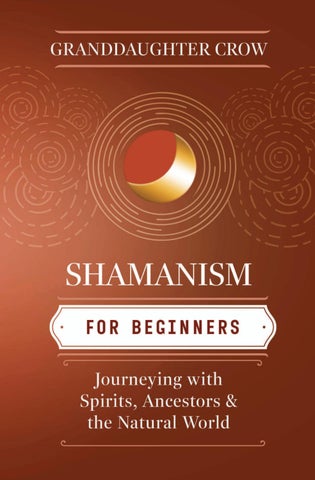
SHAMANISM FOR BEGINNERS
SelfSa nctuary.com
r nt o Re tu
n,
ba
rac ©T
r yU
About the Author I’m Granddaughter Crow—author, teacher, and medicine woman. I’m also Dr. Joy Gray, who holds a doctorate in leadership and organizational development. I walk with one foot in the modern world and one rooted in ancestral wisdom, and I help others do the same. As a proud member of the Navajo Nation, I come from a long line of spiritual leaders. I was raised with a deep reverence for nature and spirit. Over the years, I’ve come to blend that foundation with academic insight, leadership principles, and the raw truth of life experience. I’ve been honored as a Who’s Who in America listee, a Woman of the Year by the National Association of Professional Women, and a member of the Delta Mu Delta Honor Society. But beyond all the credentials, what matters most to me is this: helping you remember who you are. My mission is to inspire, to encourage, and to empower you to be your authenticity.
SHAMANISM FOR BEGINNERS
Journeying with Spirits, Ancestors & the Natural World GRANDDAUGHTER CROW
Shamanism for Beginners: Journeying with Spirits, Ancestors & the Natural World Copyright © 2027 by Granddaughter Crow. All rights reserved. No part of this book may be used or reproduced in any manner whatsoever, including internet usage, without written permission from Llewellyn Worldwide Ltd., except in the case of brief quotations embodied in critical articles and reviews. No part of this book may be used or reproduced in any manner for the purpose of training artificial intelligence technologies or systems. First Edition First Printing, 2027 Book design based on design by Rordan Brasington Book format by Samantha Peterson Cover design by Shira Atakpu Interior illustrations by Llewellyn Art Department Llewellyn Publications is a registered trademark of Llewellyn Worldwide Ltd. Library of Congress Cataloging-in-Publication Data Names: Granddaughter Crow, author Title: Shamanism for beginners : journeying with spirits, ancestors, and the natural world / by Granddaughter Crow. Description: First edition. | Woodbury, MN : Llewellyn Publications, a division of Llewellyn Worldwide Ltd, [2027] | Series: Llewellyn’s for beginners ; 58 | Includes bibliographical references. Identifiers: LCCN 2026040303 (print) | LCCN 2026040304 (ebook) | ISBN 9780738784168 trade paperback | ISBN 9780738784199 ebook Subjects: LCSH: Shamanism | Neoshamanism | Shamans Classification: LCC BL2370.S5 G7367 2027 (print) | LCC BL2370.S5 (ebook) LC record available at https://lccn.loc.gov/2026040303 LC ebook record available at https://lccn.loc.gov/2026040304 Llewellyn Worldwide Ltd. does not participate in, endorse, or have any authority or responsibility concerning private business transactions between our authors and the public. All mail addressed to the author is forwarded but the publisher cannot, unless specifically instructed by the author, give out an address or phone number. Any internet references contained in this work are current at publication time, but the publisher cannot guarantee that a specific location will continue to be maintained. Please refer to the publisher’s website for links to authors’ websites and other sources. Llewellyn Publications A Division of Llewellyn Worldwide Ltd. 2143 Wooddale Drive Woodbury, MN 55125-2989 www.llewellyn.com Printed in the United States of America GPSR Representation: UPI-2M PLUS d.o.o., Meduli eva 20, 10000 Zagreb, Croatia matt.parsons@upi2mbooks.hr
Other Books by Granddaughter Crow Belief, Being, and Beyond Hozho The Journey of the Soul Wisdom of the Natural World Shamanism and Your Shadow
Disclaimer The publisher and author assume no liability for any injuries caused to the reader that may result from the reader’s use of content contained in this publication. The information in this book is not intended to diagnose or treat any medical or emotional condition and must not be used as a replacement for proper medical care. Consulting with a trusted physical and mental healthcare practitioner is always recommended before beginning any exercise regimen or change in diet, and common sense is strongly urged when contemplating employment of the practices and substances described in this work.
I dedicate this book to the spirit of the shaman. From ancient ways to modernized expressions, the spirit of the shaman is timeless! I also dedicate this book to the seekers, the animistic perceivers, and the curious readers. May you be blessed along your journey!
Contents List of Exercises and Prayers xiii Introduction Chapter 1: What Is Shamanism?
1
13
Chapter 2: Basic Shamanistic Concepts
29
Chapter 3: Advanced Shamanistic Concepts Chapter 4: A Day in the Life of a Shaman
47 57
Chapter 5: Working with the Natural World Chapter 6: The Unseen Worlds
65
85
Chapter 7: Vision Quests and Journey Work Chapter 8: The Medicine Wheel
123
Chapter 9: Tools and Techniques
135
Conclusion
165
Glossary
169
Recommended Reading Bibliography
175
109
173
Exercises and Prayers The Natural World Is Animistic
31
Communicating with the Natural World
35
Connecting with Ancestors 45 Morning Blessings Prayer
58
Noon Awareness Prayer
59
Evening Gratitude Prayer
60
Relationships Prayer
61
Business and Finance Prayer
62
Health and Well-Being Prayer
63
Connecting with the Directions, Elements, and Life Cycles Connecting with the Seasons
74
Connecting with the Animal Kingdom
79
Connecting with the Four Bodies of Existence The Physical Body
99
The Emotional Body
100
The Mental Body
101
The Spiritual Body
103
Basic Drumming Technique 106 Vision Quest
112
Journey Work
118
Journey to the Lower World
119
Journey to the Middle World
120
Journey to the Upper World
121 xiii
98
69
xiv
Exercises and Prayers
Creating a Medicine Wheel
124
Working with a Medicine Wheel
131
Basic Drumming Technique (Repeated) Rattle Technique
143
Feather Technique 148 Earth-Based Colors: Ocher Consecrate Your Tools
152
157
Make a Smoke Cleansing Bundle Smoke Cleansing a Space
162
161
141
Introduction
Shamanism is an earth-based spiritual practice and also a way of life. It is not simply a discipline of ideas or a list of how one should or should not be. Shamanism is an animated expression of how we relate to the world around us and equally how the world around us relates to us. Shamanism is the understanding that we are a part of the natural world, not the superior part or an inferior part—an equal part. Just as miraculous as a sunset and significant as the smallest drop of water in the ocean, we are a part of it all. There are fundamental concepts within shamanism, such as animism, connecting with the natural world, journeying through the internal and external realms, acting as an intermediary between realms in order to bring balance to the community or tribe, a shaman’s initiation (a.k.a. shamanistic death), and the act of performing ritual or ceremony. We will cover all of these topics within this book. It is also significant to understand that shamanism is an ancient spiritual practice. It is practiced all around the globe, in different ways throughout different cultures. It is not subject to one race or culture. When I was asked to write this book, I wondered what I could bring that hasn’t already been written about by anthropologists or 1
2
Introduction
archaeologists. My answer is my lived experience as a shaman. I am known as Granddaughter Crow, and I am a Navajo woman who was born on the Navajo reservation in New Mexico. I was born to a long line of spiritual leaders, medicine people, and it courses through my veins. I actually didn’t take on the title of shaman. It was given to me. I will hold this title until the community stops recognizing me as such. This is the way I have come to understand my role as a shaman. Now, I am here to share this wisdom, perspective, and way of life with you. If you have found these pages, there is a reason. Through these pages, you will find a deeper connection with yourself and the animated, natural world around you, which is the basis to understanding shamanism. The natural world is our greatest teacher and continues to reveal its sacred wisdom, as it has throughout history. It is not a wonder that many books and articles on shamanism are written from the perspective of an anthropologist, an archaeologist, or even a curious journalist who has found themselves in an Indigenous culture far from their personal sense of familiarity. I say this because anthropologists study humankind, examining the different societies, cultures, behaviors, and biology. Within their study, they will come across different social structures that have a type of shaman or medicine person. The same can be said of archaeologists, who study humankind, societies, and cultures from a historical perspective. Many will also find ancient artifacts such as ritualistic burial sites, tools made from bones, and other sacred objects as well as cave paintings depicting spiritual figures. These remains connect the physical world with a supernatural or spiritual world—reminders that ancient civilizations also had shamans within their tribes to assist with rituals for hunting, exploring, and the sacred burials of tribal members. As we look into different cultures and societies around the world throughout time, we continue to discover a key role within tribes
Introduction 3
that can connect with both the seen and the unseen worlds (the physical world and the spiritual world) and act as an intermediary on behalf of the people to bring balance, healing, guidance, and more. This role was more than a physician, more than a counselor, more than a type of priest or priestess. This was a sacred position that transcended basic human understanding and connected with the spirits of the land, the community, and otherworldly beings.
What Is in This Book and How It Works It is my honor and privilege to bring you this book. Before I share with you the landscape of shamanism, I would like to let you know that this book may teach you different concepts, or it might confirm or solidify what you have been experiencing. That is how shamanism works, at times providing you with a new lesson and at times confirming the lessons that your soul has led you to. As you move through this book, hold the understanding that at times it might feel like you are learning something new, and at times you might experience a sensation of remembering. I cannot explain what you may or may not be experiencing, but I can let you know that shamanism is not a concept that you learn in your mind. Shamanism is a practice that your body experiences even if you can’t articulate it. First, we will explore the term shamanism from different aspects. As it is a spiritual path, we will define what the Divine is to a shaman. We will explore the role of a shaman within a tribe or community. In writing this book, I collected some frequently asked questions from many different groups and walks of life. I have added them in chapter 1 for you, the reader. In order to lay the foundational framework of shamanism, we will also begin with a deep dive into the core concepts of shamanism, such as animism, the natural world being an ally, journey
4
Introduction
work, initiation (a.k.a. shamanistic death), ritual, and ancestors. In addition, in chapter 3, I share some advanced shamanistic concepts such as psychedelics, soul retrieval, and shapeshifting. This chapter is for your edification, as these advanced topics come up when exploring shamanism. In chapter 4, I share with you a day in the life of a shaman so you can see what it looks like in practice. I provide different shamanistic prayers that one can say in the morning, at noon, and in the evening. I also provide prayers for the most common life situations that each of us experiences. There’s a relationship prayer, business and finance prayer, and prayer for health and well-being. Feel free to work with these prayers as a launching-off point as you begin. Once we cover the main concepts of shamanism, we will then approach the practices. I have added plenty of exercises for you to explore shamanism and embody this wisdom firsthand. I highly recommend journaling as you progress through this book for personal growth and reflection. Work with this book’s journal prompts to start your journal and continue to journal about your personal experience through the exercise process, as this will lead you to further self-knowledge and assist you with tracking your spiritual journey with shamanism. We will explore working with the natural world—plants, animals, seasons, and more—learning how to build a relationship with Mother Earth. Once we’ve explored the seen world, we will move into the unseen worlds. Here we will cover the three main worlds of shamanism: the upper world, the middle world, and the lower world. We will begin to explore these worlds through journey work and trance work. Yes, I will provide you with the tools and techniques for you to journey and have your own personal shamanic experience.
Introduction 5
Finally, I will take you through an exercise that will allow you to create your own medicine wheel and show you how to work with it for balance, healing, and wisdom. And finally, I wanted to provide you with a variety of tools and techniques that a shaman works with. Everything that is contained within this book is open information, and all the practices provided are here for you to do as you study the world of shamanism.
Cultural Sensitivity Although there was a time in our recent past when the term shaman, shamanism, or shamanic practitioner was held specifically to an Indigenous culture, now we have come to understand it in broader terms. This is to say that a shamanistic worldview and ideology is much larger than one culture. It is an expression of the sacred connection with the natural world and so much more. I am here to respectfully and consciously share it with you in this book. I see us as the tribe of the human race, a part of the natural world. However, depending on where your ancestors came from or what type of cultural upbringing you’ve had, there needs to be respect, cultural awareness, and cultural sensitivity—not only for other cultures but for your own culture, as each culture holds a sacredness. Keep in mind that in this day and age, there are many individuals who are unaware of their ancestors or removed from their cultural traditions for a number of different reasons. There are also more and more individuals who are discovering more of their ancestral background through DNA testing. It can be quite interesting to explore more of our personal ancestral history, but it also can be difficult to dig up the buried stories of our bloodlines. This difficulty may be experienced as challenging our identity or a feeling of loss. Each of us has a dynamic story, and there is beauty and
6
Introduction
sharp edges in all of history. Whatever your story is, may you find the balance within it all. That being said, you do not need to dig up all of your ancestral roots in order to be a shaman or understand shamanism. You can if you have an interest in that topic; however, shamanism is not merely based on a specific culture. There are many different types of shamans and shamanic practices. The three main categories that I will identify are traditional shamanism, core shamanism, and neo-shamanism, which I will cover in more detail in chapter 1. In short, traditional shamanism is a cultural expression that is handed down from generation to generation whereas core shamanism and neo-shamanism are not necessarily culturally focused. Hence, we do need to have cultural sensitivity when we are exploring shamanism, as some shamans only practice their sacred cultural ways—and this needs to be honored. As we approach the topic of cultural sensitivity, it’s important to understand several foundational terms, including cultural appropriation and cultural appreciation. As we grow our awareness around sensitivity, more terms will emerge, such as cultural assimilation, cultural representation, and both cultural eraser and cultural erasure. These terms are defined in the back of the book in the glossary. With these terms and basic understandings, we can bring more awareness of how to approach cultures outside of our own with respect as well as bring our own culture(s) respect. These two go hand in hand. First let’s define the term culture and what it can hold and express. Culture can be defined as “the customary beliefs, social forms, and material traits of a racial, religious, or social group.” With this dynamic definition, we can see that culture continues to evolve and expand. It is not subject to one specific form or another; it continues to express itself in many different ways. Take
Introduction 7
a moment to consider how many different cultures you might be a part of—to include a “set of shared attitudes, values, goals, and practices that characterizes an institution or organization.” 1 This could include the generation that you were born to, your taste in music, and even your political stance. When we consider the idea of cultural sensitivity, it is helpful to become more aware of our own personal cultural identification. This way we can understand ourselves in order to understand others—we are all one. Respect for self is the key to understanding how to be respectful to others. With this approach in mind, the following terms are continuously evolving within our dialect and consciousness in order to outline the framework of having healthy cross-cultural communications, which shows respect for you and others. As this consciousness expands, the best way to comprehend the meaning of these terms is to relate them to your personal sense of self-respect and then to consider and understand that others have a story, a background, a history around certain cultural sensitivities, and to respect that fact as a truth. Cultural appropriation is the “unacknowledged or inappropriate adoption of the practices, customs, or aesthetics of one social or ethnic group by members of another (typically dominant) community or society.” 2 In short, it is to take the creation of a culture and claim that it originated from another—think in terms of pirating something, or plagiarism. Cultural appreciation is the more acceptable approach and direct response to cultural appropriation through appreciating the 1. Merriam-Webster Dictionary, “culture,” accessed November 2025, https://www .merriam-webster.com/dictionary/culture. 2. Oxford English Dictionary, “cultural appropriation,” accessed March 2025, https://doi.org/10.1093/OED/8175480404.
8
Introduction
culture’s creations and giving them due credit. Additionally, it is to be aware of when you are invited to take part in their culture and when it is time to sit back and observe—respect. To give full credit, one must grasp the significance, value the creation, and understand how and why it was created. An example would be purchasing art from another’s culture with a full appreciation of the meaning behind their creation—credit where credit is due. A good rule of thumb is to respect every person. And if they invite you into their metaphoric homes (i.e., their culture, their social circle, their personal lives), treat that visit as though you were walking into their grandmother’s house—not everything is to be touched, talked about, or handled. This is the best way to understand cultural sensitivity. This is also a great framework for your own personal boundaries. Again, self-respect shows us how to respect others. On the other side of the coin, a culture cannot own the natural world—the elements, plants, animals, and seasons. However, a culture can express how they work with the natural world. In other words, anyone can connect with the elements and the natural world, but they should do so authentically. You may work with these energies in a respectful cultural way if available and appropriate or in a way that will express your authenticity in harmony with spirit and the natural world. With all of this being stated, the lessons within this book are open to you regardless of your personal cultural background. This book is written with cultural sensitivity in mind. There are closed cultural practices; however, I wrote this book for you. Feel free to be you and explore shamanism while keeping ethical principles in mind.
Introduction 9
Ethical Principles and Practices There is a natural bridge between cultural sensitivity and ethical principles and practices. Both hold the awareness of respect for self and respect for others outside of yourself. Trying to understand what role cultural sensitivity plays in the world and how it relates to ethical principles and practices is fascinating, and the two concepts must work together. If cultural sensitivity is the understanding of respect, then ethical principles are putting it into practice. Cultural sensitivity is the understanding of how to approach another person’s grandmother’s house. But ethical principles help us to approach everyone and everything in the same way. I am not suggesting that we walk on pins and needles everywhere we go. I am saying that being aware and having respect for self and others is an ethical principle and practice. When we think about ethical principles, what else comes to mind? How about the common themes of being honest, that you are only as good as your word, and integrity? Other ethical principles are being loyal and compassionate and showing reverence. All of these principles should apply to all aspects of our life. They certainly apply to shamanism. Here are ethical principles according to a shaman. With the increase of knowledge and power comes the increase of responsibility. A shaman must hold themselves to a higher standard. Once a shaman begins to understand that their voice, their words, and their actions can connect and create, they must also recognize that their voice, their words, and their actions can do the opposite as well—they can destroy. I believe that this sentiment can apply to a lot of walks of life. However, one awareness is that a shaman
10
Introduction
will journey to other worlds and what they bring with them will impact these other worlds as well. If their voice, words, and actions are weak in this seen world, that will directly translate to the other unseen worlds. This is not to say that a shaman doesn’t get old and their voice won’t fail— this is to say that the meaning, intention, and spirit behind their voice, their words, and their actions is witnessed by the other realms. Although this is an example, my point is that when you are a shaman, you are not only held accountable in one world, but you are also held accountable in the unseen worlds. If a shaman treats this lightly, the other unseen worlds will not have respect for the shaman—and will not hear their voice or words or recognize their action. Hence the shaman is no longer able to be effective and should step aside for the betterment of the community that they serve. A shaman is a multidimensional being, and their personal ethics will be seen in the unseen worlds. How does a shaman place these ethical principles into practice? There are so many ways, but I would like to focus on one that is key, one that has come up already: respect. A shaman maintains the understanding that different people have different perspectives, just like a wolf and a raven have different perspectives when observing the same environment. The natural world shows us that different organisms will perceive the world or environment differently. One is not better or worse than the other; they are simply different. So it is with a shaman. When a shaman works with people who come from different backgrounds and worldviews, they can show respect as they continue to learn this lesson from the natural world. Perceiving the world from different perspectives or positions is a natural occurrence. When we consider that the natural world perceives different situations from different positions, what does respect look like
Introduction 11
in action at this point? For me it looks like kindness, getting to know people from different walks of life without judgment but with curiosity. It looks like not trying to convince someone of a concept that they are not in the position to learn. A shaman’s job is not to convince or recruit. A shaman’s job is to see the bigger picture and how it flows together—just like the natural world will always return to a natural collective flow—seeking balance. When I speak of kindness, I am speaking about kindness to all spirits—both human and nonhuman, as we know that everything has a spirit through the lens of animism. Animism is the worldview that everything has a soul, a life force, and for me, a consciousness. Personally, I carry kindness with me as I interact with the unseen worlds. First, respect and as such kindness. Rather than entering an unseen world from a position of dominating, I approach with kindness. I learn so much more when I am kind, and kindness can deescalate situations and bring balance.
CHAPTER 1
What Is Shamanism?
Shamanism is one of the earliest ways that humans connected with what can be referred to as a divine presence—a creator and creation or the unseen force that connects us all. Some scholars believe that shamanism dates back to the Paleolithic Period (40,000 to 10,000 BCE), based on the different cave paintings, petroglyphs, and hieroglyphs found. Some believe that it was earlier than this. The point I am making is that shamanism is one of the most ancient spiritual practices. And as with all ancient things, in order to live on, they must adhere to the universal laws of adaptation and evolution in order to keep their wisdom sacred for our children. Hence, the understanding of the concept of shamanism has continued to adapt and evolve into modern expressions in order to be understood throughout the ages. For example, in the twenty-first century, we have access to learning about shamanism and finding community online instead of traveling to a faraway place and living with a shaman in order to learn from them. Additionally, seekers and students have access to a variety of different tools and techniques from different places around the globe. However, basic shamanic 13
14
Chapter 1
concepts, such as animism, connecting with the natural world, moving into altered states (journeying/trance work), initiation rites (shamanistic death), ritual, and connecting with ancestors, remain the same. Shamanism is an earth-based spiritual practice. It holds the natural world in the position of teacher and guide as well as divine presence. Not only is it a spiritual practice, but it is a way of life— being and moving through this world with great respect and connection to both the seen and the unseen worlds. The term shaman has evolved throughout the ages so that we could express the role of a medicine person, this spiritual leader, this sacred liaison between the physical world and the spiritual world. The term shaman dates back to the seventeenth century from the Tungusic language in Siberia and Northeast Asia within written text; however, the concepts within shamanism are older than written language. With this context, the term shaman is a globally accepted term; however, it does not originate from the Indigenous peoples of North America. It is not that we didn’t have a shaman or medicine person. It is to say that we all collectively adopt the term shaman to understand that it is the medicine person who knows and works with the natural world to bring balance and healing to self and others. Now in the twenty-first century, we have accepted many different types of shamanism and shamanic expressions. As mentioned in the introduction, I will cover what I see as the three main types/ categories of shamanism: traditional shamanism, core shamanism, and neo-shamanism. Before I explore each of these three categories, I would like to step back and take a look at the concept of nature versus nurture, as it can play into each of these types of shamanism and sets the stage for us to understand culturally based or innate-based shamanism.
What Is Shamanism?
15
Nature Versus Nurture The concept of nature versus nurture dates back to ancient Greek philosophers. Plato posited that human behavior is primarily driven by nature or innatism. Innatism is the idea that humans are born with innate or preexisting knowledge, ideas, and capacity and may or may not remember this knowledge but are led to it through self-discovery. It is held that the world around us and our environment will remind us of this innate knowledge. Aristotle held the opposite point of view. He suggested that human behavior is based on the environment that the human grew up in. From Aristotle’s stance, humans are born as a blank slate, and their behavior is formed based on how they were or were not nurtured. From the framework of nature versus nurture, the nature aspect would be that some are born with a predisposition toward shamanism, and the nurture aspect would be that we would be born into a tribe or culture that recognizes this role. There are individuals who were born with a preexisting cognition toward a way of life that is reflected in the concepts of shamanism, yet they were not raised in a tribe, culture, or community that nurtured or encouraged shamanism or called them a shaman. Maybe these people feel as though they are caught between two worlds without a clear identity and hence may feel a sense of confusion or need for exploration. When examining the nature aspect of this framework, a key indicator is a curiosity to study and learn from the natural world. Another indicator is being drawn to practice shamanism and shamanistic techniques. Some may experience a dream of being a shaman or a past-life memory of it, and others may simply find this book interesting and would like to apply shamanistic techniques to their life. This is not to say that if you are reading this
16
Chapter 1
book you are going to practice shamanism as a main path; however, it is to say that you reading this book is an example of what I mean by a predisposition toward shamanism—there is a curiosity toward shamanism. When examining the nurture aspect of this framework, this would include all Indigenous or native tribes around the globe that have a role within their community for a spiritual person or medicine person (note that there are a variety of names for this role within a tribe). When an individual is born into a tribe, the tribal community is already in place. So where does that leave the individual who is drawn to shamanism and doesn’t have an immediate tribe? Here is where we run into a roadblock—the shaman without a tribe. They are not less of a shaman; they are simply born outside of their tribe or a distinct culture to draw from. These shamans have a different learning journey. They learn and are nurtured through their lived experiences, reading books, attending classes, and trying not to step on any other tribe’s or culture’s way of life—but drawn to wanting a tribe. From my perspective, this is why we now have these three different classifications of shaman. Because as with every ancient practice, it must adapt and evolve in order to remain sacred for our children.
Traditional Shamanism Traditional shamanism is culturally based and deeply rooted in each tribe. The traditional shaman had/has a tribe, a culture, a community that they are able to draw from. It is the original and oldest form of shamanism, as historically we all came from a form of tribe, culture, and community. There was no lack of cultural identification as is widespread now. We are all indigenous to somewhere—each of our ancestors came from a land that they were
What Is Shamanism?
17
native to. Within traditional shamanism, the customs and cultural practices will vary depending on the tribe and the land that it comes from. Hence, there are many nuances within shamanic practices around the globe. This is where cultural sensitivity is essential, as this form of shamanism can be open to others or closed to outsiders. Just like with any cultural group, some things can be shared, and some things will only be understood by the culture and should be respected.
Core Shamanism Core shamanism was brought to us by an anthropologist named Michael Harner in 1980 with his book The Way of the Shaman: A Guide to Power and Healing. Harner was born in 1929 in Washington, DC, and became an anthropologist, educator, and author and conducted anthropological fieldwork around the globe. From his fieldwork, cross-cultural studies, and firsthand experiences, he was able to collect common shamanic practices that do not specifically belong to a tribe or culture. This is the basis of core shamanism. Anyone who is called to this sacred cross-cultural expression of shamanism can learn about this practice and participate.
Neo-Shamanism Neo-shamanism is an answer to the evolution of shamanism, as some practitioners are without a tribe or cultural reference to practice from, yet they were born with an innate propensity toward a shamanic path. Neo-shamanism can be an individualized self-help practice and doesn’t require a tribe or community. Neo-shamanism is the most open and inclusive form of shamanism from these three categories. Not only is it open to all individuals but it can also include models and practices derived from other spiritual paths (e.g., the chakra
18
Chapter 1
system, astrology, Reiki practices). Under this category, you might come across terms such as urban shaman, cosmic shaman, or any other personalized identification of shaman. As open and inclusive as neo-shamanism is, it is good to note that some may misuse the title of shaman. Some individuals will claim the title of shaman to take status in a community in order to start a cult, influence others against their free will, or use it as an excuse to take hallucinogenic substances under the name of spirituality. But honestly, this phenomenon happens with many different spiritual paths. It is simply good to be aware.
Shaman or Shamanic Practitioner There is a school of thought that a true shaman does not call themselves a shaman, but a shamanic practitioner. Others believe that one can refer to themselves as shaman. I am not here to tell you to adopt or reject either school of thought; I am here to bring you awareness of this sensitivity. Personally, I have been asked, “Are you a shaman?” I respond, “Until they stop calling me that, I suppose I am.” If someone recognizes me as such, I will agree. This is the way that I see it; how you move within the world will be reflected in the titles that people call you. “They started to call me a shaman—and so I am until I am not. When I am not recognized as a shaman anymore, it will be because I no longer am living a shamanic life.” With this, you can see that I do not view shamanism as strictly a title; I see it as a way of life. Further into shamanism, the concepts and terminology that you will find within this text are equally dynamic in nature, ever adapting and evolving in order for us to find the practical application in our life. As stated before, no matter where you live on the face of the earth or what era or culture you were born in, the core aspects of shamanism (animism, working with the natural world,
What Is Shamanism?
19
the ability to journey into other realms on behalf of the community, and other key components) can meet you there. Shamanism is as dynamic as the natural world itself. It is up to the practitioner to find their connection to these concepts. Cultures, books, and teachers are here for your journey, to assist you—but to walk the path of a shaman, it must become alive within you. An individual can practice different shamanism techniques, acquire a drum and some animal hides, and have a wonderful experience over a weekend retreat within the natural world. This would be considered as having a shamanic experience. But to be a shaman, it is more than practice. It is when the ancient spirit of the shaman embodies them and the shaman becomes alive within them. My father would teach me that when we get into our head too much, we cannot truly understand it. “We think so much about our confusions” is how he would say it. “Take a walk and allow spirit to become alive within you.” This was my dad’s way of teaching me that shamanism, or spirituality in general, is not a teaching—it is a lived experience. It is when we take a walk and allow the techniques and teachings that we have learned to merge with our life, our essence, and our way of viewing the world around us. This is where our personal relationship with spirit can develop, and the stronger our personal relationship is with the natural world and the unseen spiritual worlds, the more fit we are to assist others to find balance, harmony, and sacredness within their lives.
A Spiritual Path Shamanism is a spiritual path. What is spirit? According to Georg Wilhelm Friedrich Hegel, a nineteenth-century philosopher, there are three different branches of spirit.3 Spirit, in this case, being 3. Redding, “Georg Wilhelm Friedrich Hegel.”
20
Chapter 1
defined as the dynamic consciousness within us and outside of us. I share this definition with you so that we do not get stuck in the weeds around the different attributes and characteristics of spirit. Under this definition, Hegel posits that there are three main categories when referring to spirit: 1. Subjective Spirit: This is the consciousness that is closest to you, the consciousness within you. This would show up in the study of human behavior and psychology and studies that explore the internal dynamics of the self. 2. Objective Spirit: This is the consciousness that flows outside of oneself within a social or cultural dynamic. This would show up in the study of ethics and morality, laws and politics, and studies that may govern social or cultural dynamics. 3. Absolute Spirit: This holds an elusive definition, as it is creativity in its purest form—art. Art is where absolute spirit begins.4 This would show up in the arts, religions, and philosophy. Through the lens of Hegel and the definition of absolute spirit being the purest form of creativity, we begin to grasp the understanding of why our ancestors looked to the natural world and recognized the creator—absolute spirit. Yes, I believe that all of our ancestors looked to the natural world at some point in their history. Regardless of where your ancestors landed on the face of the earth, there was a time that they all sat in circle in a tribelike community, possibly around a fire, and learned from the natural world around them. They not
4. Redding, “Georg Wilhelm Friedrich Hegel.”
What Is Shamanism?
21
only learned how to live within their environment but to be a part of their environment, understanding that they were a part of the natural world. This is a very important delineation for a shaman. I do not merely observe the natural world as an onlooker. I am a part of the natural world, and it is a part of me. As I engage and connect with the natural world, it becomes my ally and I it.
Frequently Asked Questions The following are some frequently asked questions about shamanism.
I live in the city. Can I be a shaman? Absolutely! As the world and societies change, shamanism adapts. In general, when a person asks this question, I recommend paying close attention to the description of neo-shaman and seeing if it fits. Remember, though, all the practices within this book are open for anyone to try out. Can anyone be a shaman? Anyone who is called can move through the initiation—this would be open to all. However, only a handful will actually complete the initiation, as it is one of the most intense initiations and the final step is what is called a shamanistic death. Note that there is a section in chapter 2 that explains what a shamanistic death is and the process that it asks of the initiate. Do I need a certificate to be a shaman? There are a lot of different individuals who offer shamanism classes, and some will grant a certificate at the end. Note that these certificates reflect the school and teacher, not necessarily a broader institution that regulates shamans. There is none. In such, find a trusted source, feel free to ask them questions, and make
22
Chapter 1
sure the course checks all of your boxes. Although a certificate is wonderful to show that you have attended a structured course and gone through its work, it is not necessary to be a shaman.
When do I know that I am a shaman? In general, I would examine the section on shamanistic death and initiation in chapter 2. Life is the teacher, the natural world is the mentor, and if you have experienced life’s initiation to be a shaman, you are a shaman to me. Does shamanism come from the Native American community and culture? No. This is a common misconception. Shamanism is worldwide. And most traditional medicine people don’t even call themselves shamans. The term shaman dates back to the seventeenth century from the Tungusic language in Siberia and Northeast Asia. Why do some people call themselves shamans and some say shamanic practitioners? Personally, I am open to either phrasing. When an individual refers to themselves as a shamanic practitioner, I believe that they are doing this out of a sign of respect for traditional (cultural) shamans. However, I have not been trained in core shamanism, where I believe this concept is practiced heavily. For more information, I would recommend checking out The Way of the Shaman by Michael Harner—the book is in the recommended reading section. What is the spiritual meaning of marking the body with tattoos, paint, or scars? When reflecting on this question, I invite you to consider the four bodies of existence: the physical body, emotional body, mental
What Is Shamanism?
23
body, and spiritual body. If all of these bodies within an individual align with the meaning of body art, tattoos, paint, or scars, then this marking is sacred in both the physical world and the spiritual world (both the seen and the unseen worlds). This increases the meaning beyond the material realm, as it becomes significant in other realms beyond the physical plane. Additionally, in his book Tattoo Magick, Jake Morningstar shares that he has been playing with tattoo magick “since the realization that tattoos have power.”5 If the topic of spiritual connections with tattoos interests you, I highly recommend Morningstar’s book.
Do certain symbols carry protective or healing power? At this point, it becomes less about the actual symbol and more about the meaning of the symbol to the individual. Additionally, in different spiritual paths, there are certainly protection symbols, but I know that the protection increases when the individual places deeper meaning on the symbol. How does shamanism interpret the relationship between humans and other living beings compared to modern worldviews? Animism is the key concept when perceiving the self and other living organisms within the natural world. The concept of animism is covered later in this book, but in short, it means that everything has a soul. What is the role of a shaman within their community? The role of a shaman will change depending on whether they are a traditional shaman born into a tribal culture or a neo-shaman 5. Morningstar, Tattoo Magick, 3.
24
Chapter 1
who is able to practice shamanism for self-help purposes. A traditional shaman’s role is to be an intermediary between the physical world and the spiritual world—or the seen and unseen worlds— on behalf of others or the tribes, whereas a neo-shaman does this for themselves. At times a neo-shaman will find their own tribe through their spiritual growth rather than being assigned one by birth or tradition.
What are some common misconceptions about shamanism? One common misconception is that all or most shamans will work with psychedelics for journey work. This is not the case. For the record, you do not have to work with any type of hallucinogenic in order to be a shaman. It is not what makes a shaman a shaman. Also, if you know someone who works with different forms of hallucinogenics or micro-dosing, this doesn’t mean that they are automatically a shaman. Yet, when a shaman or professional healer works with this form of medicine and offers them to you, simply do your research, make sure it is legitimate, and make your own decisions.
The Divine to a Shaman When considering how a shaman perceives the Divine, we must travel back in time and explore a time prior to dogma, a time prior to religious constructs written down by man. We must return to a time of sacredness, prior to the Divine being explained to us. I believe that shamanism operates outside of a traditional monotheistic or polytheistic framework by viewing the Divine as an organic system that flows around us and through us. This is without a hierarchy; this is a time when all entities were considered
What Is Shamanism?
25
equal and interconnected. The Divine is a life force and a consciousness that flows through all living things. We see this within the natural world when we look at a biosphere. Every organism within the biosphere, regardless of whether we can see it or not, plays a role in balancing and harmonizing it. From this perspective, there is no hierarchy when it comes to whom or what the divine life force will travel through. We are all a part of the All (life force), and in such the All (life force) is also a part of us. And when we all work together, we create a balanced and harmonious ecosystem. This would then include all things that have life. They are all considered sacred, and they all express an aspect of the Divine. We are all one. Hence, when a shaman would refer to a creator, it wouldn’t be a man or woman that they are referring to. It would be this conscious life force behaving as a creator—which includes all aspects (both seen and unseen) that brought something into creation. Although this is an ancient perspective, it still holds true within me. And if it holds true to you, feel free to adopt it and make it your own, as the Divine will reveal itself to each of us as we can perceive it. Now, a traditional shaman may begin with this concept yet may add names to the different aspects of the Divine as it is revealed in their culture. Providing different cultural names allows the people to connect with specific unseen divine forces. The community can then recognize and honor this aspect of the Divine. These divine names can be shared outside of their culture if they choose, and at times, they will not share these names, as they couldn’t be understood outside of their cultural experience. When a culture shares the name and aspects of a divine presence outside of their culture, in order to connect with this divine name, it would be beneficial to study the culture as well.
Body, Mind & Spirit / Shamanism
EXPLORE UNIVERSAL SHAMANIC TECHNIQUES FROM AN AUTHENTIC TEACHER Sharing practices that are open to everyone, Granddaughter Crow takes you into the world of the shaman, revealing how they stand as an intermediary between the seen and unseen realms. Discover the difference between traditional, core, and neoshamanism and how to practice this animistic worldview with respect and sensitivity for the diverse cultures that have informed its techniques and traditions. Granddaughter Crow first lays the foundational framework of shamanism, covering core concepts before exploring how to work with the natural world without appropriation. Through dozens of exercises and prayers, she teaches you how to connect with the seasons, journey through unseen realms, restore balance and harmony to your life, and more. From learning about animism to creating your own medicine wheel, this book presents essential wisdom for your shamanic journey.
GRANDDAUGHTER CROW (Dr. Joy Gray) is the author of several books, including Shamanism and Your Shadow and Wisdom of the Natural World. She is also a medicine woman, public speaker, teacher, and intuitive reader. Descended from a long line of spiritual leaders, Granddaughter Crow is an empath, medium, and member of the Navajo Nation. Visit her at GranddaughterCrow.com. Facebook.com/LlewellynBooks X: @LlewellynBooks Instagram: @LlewellynBooks
www.Llewellyn.com
$15.99 US