
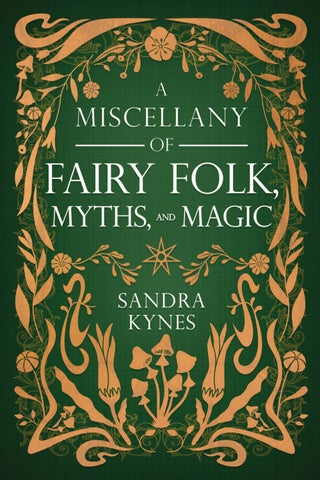
A Miscellany of Fairy Folk, Myths, and Magic by Sandra Kynes

Page 1


Praise for A Miscellany of Fairy Folk, Myths, and Magic

“If you’re an advanced fairy worker, or you’re new to the fairy realm, you’re sure to find everything you need in this fabulous new book. I thoroughly enjoyed it.”

—Jacky Newcomb, Sunday Times bestselling author of A Fairy Treasury

“When you pick up a book written by Sandra Kynes, you know you are in the hands of a master. I couldn’t wait to delve into the delicious pages of fairy history around the world, the traditions regarding fairies through the ages, the domiciles and indwelling places where they gather, and the delicate tales of those fairy spirits who live with us only a gnat’s whisker beyond the veil. There are no nursery rhymes here or Disney inventions, just pure fairy for those who believe in their magic. … Sandra Kynes’s mesmerizing book details how we can connect with the fae, attune to fairy vibrations, and communicate with them using a pendulum and the sacred meanings of the apple, oak, and black thorn trees to the fae. … In this book you will come away with a deeper understanding of what a fairy is and isn’t, and you’ll want to immediately book your trip to Ireland, England, and Wales and follow in the footsteps of the fairies with this book tucked proudly under your arm.”

—Kac Young, PhD, author of Living the Faery Life and Rainbow Witch

“A wonderful, well-researched resource for those who want to know a little about all things fae, deepened with spells and rituals to attune with their realm, and practical ideas, actions, and lessons to help you heal, connect, and bring the magic of the fairy folk into your life.”

—Serene Conneeley, author of Faery Magic and the oracle deck Practical Magic

“Kynes’s ‘pixie-led’ foray into the realms of all that is fairy assures the reader that she will hold their hand through the magical pathway she has curated. This is a guidebook for the serious exploration of spiritual fairy encounters, where a belief in fairies is the magical ingredient you will need to invite the fae into your life. Whether you want to learn how to create a dream pillow, banish the not-so-friendly fae, or attune to the fairy realm with step-by-step instructions, Kynes has created a comprehensive navigational tool through her vast experience to illuminate the fae away from the blur of our ‘busy’ nine-tofive lives. Kynes expertly directs the reader through a wealth of folklore, seen through the author’s eyes of a well-travelled, historically accurate handbook.”

A Miscellany of Fairy Folk, Myths

and Magic

About the Author

Sandra Kynes is an explorer of history, myth, and magic. Although she is a member of the Order of Bards, Ovates & Druids, she follows her own Goddess- and faery-centered path. She likes to develop creative ways to interact with the world (and otherworld) and integrate them into her spiritual path and everyday life. Her unique views and methods form the basis of her books, which serve as reference material for Pagans and anyone interested in experiencing spirituality and magic in a different way.

In addition to her books, Sandra’s work has been featured in numerous Llewellyn almanacs; Sage Woman, The Magical Times, The Portal, and Circle magazines; and The World Ocean Journal.

Sandra has lived in New York City, Europe, England, and now Midcoast Maine, where she lives with her family and cats in a mid-nineteenth-century farmhouse surrounded by meadows and woods. She loves connecting with nature through gardening, hiking, bird-watching, and kayaking. Visit her website at www.kynes.net.

© Jessica Weiser

A Miscellany of Fairy Folk, Myths and Magic

Sandra Kynes

A Miscellany of Fairy Folk, Myths, and Magic Copyright © 2026 by Sandra Kynes. All rights reserved. No part of this book may be used or reproduced in any manner whatsoever, including internet usage, without written permission from Llewellyn Worldwide Ltd., except in the case of brief quotations embodied in critical articles and reviews. No part of this book may be used or reproduced in any manner for the purpose of training artificial intelligence technologies or systems.

First Edition

First Printing, 2026

Book design by Rordan Brasington

Cover design by Shannon McKuhen

Interior illustrations by Llewellyn Art Department

Llewellyn Publications is a registered trademark of Llewellyn Worldwide Ltd.

Library of Congress Cataloging-in-Publication Data (Pending)

ISBN: 978-0-7387-8314-7

Llewellyn Worldwide Ltd. does not participate in, endorse, or have any authority or responsibility concerning private business transactions between our authors and the public.

All mail addressed to the author is forwarded but the publisher cannot, unless specifically instructed by the author, give out an address or phone number.

Any internet references contained in this work are current at publication time, but the publisher cannot guarantee that a specific location will continue to be maintained. Please refer to the publisher’s website for links to authors’ websites and other sources.

Llewellyn Publications

A Division of Llewellyn Worldwide Ltd. 2143 Wooddale Drive Woodbury, MN 55125-2989 www.llewellyn.com

Printed in the United States of America

GPSR Representation:

UPI-2M PLUS d.o.o., Medulićeva 20, 10000 Zagreb, Croatia matt.parsons@upi2mbooks.hr

Other Books by Sandra Kynes

From Llewellyn Worldwide

Poisonous Plants and Fatal Fungi (2025)

Witches’ Encyclopedia of Magical Plants (2024)

Magical Faery Plants (2022)

Tree Magic (2021)

Beginner’s Guide to Herbal Remedies (2020)

Magical Symbols and Alphabets (2020)

Llewellyn’s Complete Book of Essential Oils (2019)

365 Days of Crystal Magic (2018)

Crystal Magic (2017)

Plant Magic (2017)

Bird Magic (2016)

Herb Gardener’s Essential Guide (2016)

Star Magic (2015)

Mixing Essential Oils for Magic (2013)

Llewellyn’s Complete Book of Correspondences (2013)

Change at Hand (2009)

Sea Magic (2008)

Your Altar (2007)

Whispers from the Woods (2006)

A Year of Ritual (2004)

Gemstone Feng Shui (2002)

From Crossed Crow Books

The Avian Oracle (2024)

Forthcoming Books by Sandra Kynes

Plant Magic for Beginners

“Faerie cannot be caught in a net of words; for it is one of its qualities to be indescribable, though not imperceptible.”1
— J. R. R. Tolkien
1. Tolkien, Tree and Leaf, 10.

Introduction … 1

Working with Fairies … 9

Contents

Ancestors and Fairies’ Rocks … 17

Apples, Orchards, and Pixies, Oh My! 21

Banshee: A Legacy of Mourning and Release 25

Bells: Bane or Bling? … 29

Creepy and Strange … 33

Cross Stones and Crossroads … 37

Dragonfly: Make a Wish 41

Dream a Little Dream … 45

Elaby Gathon and Fairy Oil … 49

Enchanted Lakes and Pools … 53

Fairies and Elves: What’s the Difference? 57

Fairy Star and the Magical Number Seven … 61

Goblin Springs and Puck Wells … 65

Green: A Potent Fairy Color … 69

Hills and Mounds: Fairy Folk Places 73

Hobgoblin (Not Elf) on the Shelf … 77

Invisible Fairydom … 81

Islands of the Fae … 85

Jinn and Fairies of the East 89

Jokes, Luck, and Fairy Butter 93

Kings of Fairyland … 97

Korrigan Conundrum … 101

Let’s Go Underground 105

Looking for Lutins? Parler Fran ais 109

Magical Fern Seeds … 115

Manann n’s Horses … 119

Never Mess with a Blackthorn Tree … 125

Night Birds and a Lesson in Fairy Glamour … 129

Oak Trees and Fairy Doors 133

Ocean Fae of Scotland … 137

Peri in the Skies with Peridot … 141

Pin Wells: Pixies, Fairies, and Saints … 145

Quartz: Fairy Magic and Pixie Dust 149

Queens of Fairyland 153

Realm of the Merfolk … 157

Robin and Puck: The Merry Pranksters … 161

Shadows: Come Out and Play 167

Spinning: Magical Fairy Work 171

Through a Birchwood … 175

Toadstools and Fairy Rings … 179

Undines and Other Elementals 183

Unicorns: Part of History 187

Very Fairy: Milk and Cows … 191

Viviane: Lady of the Lake … 195

Whirlwinds and Fairy Winds … 199

Will-o’-the-Wisp: Mysterious and Mesmerizing 203

Xi Wang Mu: The Power of Love … 209

X-tra Bad Denizens of Fairydom … 213

Yellow Flower Fairy Power … 217

Yuletide and That Jolly Old Elf 221

Z ne, Zana, and Other Fae of the Balkans … 225

Zany Dances and Revel Places … 229

Conclusion … 233

Fairy Glossary … 235

Selected Bibliography … 245 Index 257

IntroduCtIon

Mythical and mystical, the inhabitants of fairyland have lingered at the edge of human awareness, usually allowing only brief glimpses into their world. Through the centuries, they have been regarded as spirit beings or demons as well as ethereal creatures with magical powers. They live in a realm that is separate yet close to our own, but our worlds are not divided with a solid wall. The barrier is permeable like a mist.

While there is so much to explore in fairydom, I have chosen to present themes that seem most interesting—where the everyday meets the magical— and to highlight some of the special places associated with various fairy folk. Although it has whimsical parts, this is not a book of make-believe or fantasy; it is a book for those who believe in the existence of fairies. It is for those who sense the presence of the fae and want to avoid the overtly sentimental and idealized concepts of fairydom. It is for those who may have had fairy experiences and those who would like to know more about them and, perhaps, make contact. This book is for people whose spirituality has been touched by the fae and those who would like to work with them magically.

Fairies have been variously described as dwarflike and dressing mainly in green; as tiny, diaphanous-winged beings; and as human sized or larger and extremely beautiful. The descriptions are seemingly endless because there are

many types of inhabitants in fairydom. They have been noted as being helpful, mischievous, protective, dangerous, and malevolent, and sometimes they were associated with the dead and witches. Be that as it may, we are attracted to and curious about them. As with anything veiled in mystery, we want to know more. To do so, all we have to do is follow the hints and information in the rich tapestry of folk stories and traditions, in the broad range of literature and art, as well as the personal experiences we may have had or read about. I like to think of these hints and threads as fairy trails, subtle pathways that lead to fairydom.

In his book Peter Pan and Wendy published in 1911, Scottish novelist and playwright J. M. Barrie (1860–1937) asked, “Do you believe in fairies?” While many of us would quickly answer yes, for many others, the notion of fairies is relegated to quaint children’s stories and often linked with the Victorian mania over all things fairy. While fairies were a component in the work of many Victorian writers, painters, and poets, they often represented a nostalgic yearning for an idealized world. The golden age of British fairy painting (1840–1870) also reflected sexual innuendo and a desire to explore the unknown. The unseen and the occult were popular interests during that period. However, the fondness for fairies and fairy imagery wasn’t limited to art and literature—it was also a feature of decorative arts and home interiors, such as wall panels with hand-painted illustrations of fairy stories. It was also reflected in garden design and in the Gothic revival of old ruins to appear like fairy castles.

Belief in fairydom has sometimes been regarded as a form of escapism. From the mid-nineteenth through the early twentieth century, the world was rapidly changing, becoming urbanized and mechanized. Along with the exodus from the countryside into the cities came dismal living conditions, factories, and exceedingly long work hours. Nature and enchantment were not part of most people’s lives, but fairy stories offered brief escape from the tediousness of the daily grind. Fairy tales also provided a nostalgia for a perfect rural past—that never really existed—and put hope into the lives of children and perhaps some adults. However, the notion of fairydom also went beyond escapism and quaint sentimentality. Most widely known as a poet and playwright, William Butler Yeats (1865–1939) has been lauded for his work in folklore, much of which was rooted in myth and magic. He collected folk legends and wrote the book Fairy and Folk Tales of Ireland in 1892. His book Celtic Twilight: Faerie and Folklore was first published in 1893 and is considered his most

famous. Although whimsical, English painter William Blake (1757–1827), who professed to have seen fairies, fitted them with gossamer butterfly-like wings. This is contrary to the folklore that indicates instead of wings fairies generally used magic spells, wore special caps, or turned certain plants into aerial steeds for travel. At any rate, Blake also said that he had witnessed a fairy funeral in his back garden. Charles Lutwidge Dodgson (1832–1898), better known as the widely beloved English author Lewis Carroll, took fairies seriously and noted that “one stood the best chance of seeing fairies on a hot day while in a sleepy, trance-like state.”1

While the iconic work of the German brothers Grimm, Jacob (1785–1863) and Wilhelm (1786–1859), has been regarded mainly as nursery tales, the Grimms were researchers and folklorists who adapted some of their stories from oral tradition. In fact, their work led to the serious study of folklore by scholars such as American anthropologist and author W. Y. Evans-Wentz (1878–1965). Traveling throughout the Celtic areas of the British Isles and Brittany, France, Evans-Wentz painstakingly collected reports of encounters with fairies. First published in 1911, his book The Fairy-Faith in Celtic Countries is still regarded as a scholarly and culturally important work. Unlike many scholars who investigate folklore, Evans-Wentz believed that his object of inquiry existed.

Also interested in folklore, the poet Lady Jane Wilde (1821–1896) gathered stories in her native Ireland and wrote about fairy legends and charms. The work of Irish poet and painter George Russell (1867–1935), who used the pseudonym A. E., noted that his artwork was influenced by his childhood visions and the fairy legends he’d heard. Physician and Sherlock Holmes author Sir Arthur Conan Doyle (1859–1930) was a believer despite being caught up in the Cottingley fairies hoax in 1920. Before her death, Elsie Wright (1901–1988), one of the girls involved in the deception, confessed that although most of the images had been faked, they saw it as a way to get people to believe what they had seen. She also swore that one of the photographs was not bogus but actually captured the image of a real fairy.

The Victorians were not the first to delve into fairydom; the fae have an extensive written trail that stretches back centuries. The earliest fairy accounts in England appear in Anglo-Saxon books and collections of manuscripts that

1. Mass, Trimpe, and Gere, Victorian Fairy Painting, 31.

contain medical prescriptions and charms to deal with enchantment and attacks by elves. Although these manuscripts date to the middle of the tenth and eleventh centuries, the information they contain is considered to have come from much older sources. English writer Walter Map (c. 1140–c. 1209) produced stories that often had their origins in oral folklore. One such tale from the Welsh borders was about a man known as Wild Edric and his fairy wife. The earliestknown woman poet in Europe, Anglo-Norman Marie de France (fl. c. 1160–1215), focused on courtly romances with magical themes. According to British author, folklorist, and scholar Katharine Briggs (1898–1980), “Marie de France’s thirteenth-century Sir Lanval is a true fairy story dressed as a romance.”2

The Victorians were also not the first to portray fairies as diminutive. Archdeacon and historian Gerald of Wales (c. 1146–c. 1223) relayed a story about tiny light-haired fairies who inhabited a subterranean world. English writer Gervase of Tilbury (c. 1150–1227) noted that a type of fairy known as portunes were only a half-inch tall.

Beyond the British Isles

A great deal of Norse and Germanic mythology has its source in two thirteenthcentury books collectively known as the Eddas. Icelandic chieftain Snorri Sturluson (1179–1241) wanted to preserve Norse mythology and wrote or compiled the Prose Edda. The Poetic Edda came from oral tradition and was written down around 1270.3 Later medieval mythographers compiled additional Norse and Germanic legends, and the realm of elves and dwarfs blossomed into wider consciousness.

From medieval times onward, some type of fairy could be found throughout European literature. Common in France, the medieval literary form known as the Romance was often populated with fairies. Two thirteen-century works by unknown authors, the story “Lancelot du Lac” and the epic poem “Huon of Bordeaux” greatly influenced Arthurian mythology and the works of English poets Edmund Spenser (1552/3–1599) and William Shakespeare (1564–1616). The work of Italian poets Matteo Boiardo (1441–1494) and Ludovico Ariosto (1474–1533) also influenced Shakespeare and Spenser, as did contemporary folk-

2. Briggs, The Fairies in Tradition and Literature, 10.

3. Lecouteux, Encyclopedia of Norse and Germanic Folklore, Mythology, and Magic, 3.

lore and beliefs. Ariosto’s epic poem “Orlando Furioso” is regarded as a precursor to Spencer’s poem “The Faerie Queene.” Although fairies were popping up everywhere, French courtier and author Charles Perrault (1628–1703) is often credited for creating the fairy tale genre with his book Tales of Mother Goose. However, his contemporary, French countess and author Marie-Catherine d’Aulnoy (1652–1705), was also crafting fairy tales, which we will see later in this book. With roots in fairy legends of the peasantry, he reworked the stories into a form that would appeal to the upper classes. However, Perrault’s inspiration and some source material seem to have come from Italian writer Giovanni Straparola (1486–1558), who collected and published fairy tales, and Italian poet and writer Giambattista Basile (c. 1575–1632), who wrote a series of stories based on folktales. Known today as The Pentamerone, Basile’s Lo cunto de li cunti, overo lo trattenemiento de peccerille (The Story of Stories, or Entertainment for Little Ones) was the first such collection in Europe published between 1634 and 1636.4

In addition to literature, the power of music also transported people to the realm of the fae and aided experiences with the mysterious. French composer Daniel-Fran ois-Esprit Auber (1782–1871) wrote and staged the opera Le Lac des F es (The Fairy Lake), and the first opera written by German composer Richard Wagner (1813–1883) was Die Feen (The Fairies).

While fairy folklore and literature were prevalent in medieval and Renaissance Britain and Europe, some form of fairy can be found in early writing from other parts of the world. A collection of Hindu sacred texts called the Vedas (1500–1000 BCE) contain mythological accounts that mention gandharvas, who were aerial beings likened to fairies, and apsaras, who seem more closely aligned with Western fae. Around the same time in the area of present-day Iran, Persian mythology included the peri (pari), who were also fairylike beings. In Greece, the poet Homer (fl. ninth or eighth century BCE) describes some of the heroes in the Iliad as having nymph or fairylike lovers, and in the Odyssey, the sirens were represented as a treacherous form of fae. Throughout Greek mythology, nymphs are often portrayed as fae-like, usually possessing some type of supernatural and magical power. In pre-Islamic Arabian mythology (prior to 610 CE), fairies are found in the form of the jinni

4. Stace, A Translation of Giambattista Basile’s The Tale of Tales, xv.

(jinn, plural). Because the jinn were associated with magic, they were popular subjects in the folklore and literature of the Middle East and North Africa.

The Fairy Faith and the Word Fairy

According to Dennis Gaffin (b. 1949), professor of anthropology at the State University of New York College at Buffalo, belief in fairies is not so different from the belief in angels. Although denigration by the Church coupled with urbanization led fewer people to accept fairies as real, in the last few decades, more people have been admitting to having had fairy experiences. Professor Gaffin and others have noted that these people are not superstitious rural folk, but often well-educated professionals.

The Fairy Faith is a centuries-long belief in the fairy folklore and associated traditions of the formerly Celtic areas of the British Isles and Brittany. The Fairy Faith never was—nor is it today—an organized religious system with a defined canon or leader-led movement. Although the practices of contemporary Fairy Faith vary, it consists of loose collectives of people who share a belief in and experiences with fairies. Some may orient their belief in fairydom with historical Celtic views or fairy folklore, while others ascribe it with a level of divinity and regard it as a spiritual path. And that’s the crux of the Fairy Faith— it is based on belief whether or not firsthand experience is involved, which is not so different from beliefs encountered in mainstream religions.

People have faith in and believe in angels—and a God, for that matter— even though science has not been able to prove their existence. This belief is generally not regarded as weird because major religions have put their stamp of approval on angels. However, the belief in fairies is regarded very differently. In Western thinking, except for angels, ethereal beings are considered part of mythology and fantasy. Fairies were outside of and didn’t fit the Christian Church’s canon and so they were demonized and belittled, but the people for whom fairies were a reality carried on believing, usually very quietly. Although the Victorians combined their fascination with fairies and their yearning to create an idealized world based on nostalgia, it is not what those of us who follow a fairy path seek today. While we may have a fascination with fairies, the yearning is to understand them, to contact and maybe explore their realm.

In recent times, the spelling fairy has come to refer to imaginary beings such as Tinker Bell, and the spelling faery is used to refer to actual beings. That said, I felt that maintaining the traditional spelling of fairy in folk names and other references, such as the Fairy Faith, and switching back and forth with the spelling faery could become rather cumbersome and confusing, and so except for a few instances I have kept with the former. I have also used the words fairy and fae interchangeably. Throughout the entries, variations in names and alternate spellings of beings and places are included in parenthesis.

About This Book

Writing this book has been an unusual experience. I usually get an idea, and then let it sit for a while to percolate before outlining the flow and developing further ideas. But not this time. I felt the need to immediately start writing. This also included getting up in the middle of the night and wee hours of the morning. I didn’t have a plan; I didn’t know where it was going, or rather, where it was taking me. Fiction writers often say that characters take on a life of their own, and my experience with this book didn’t seem so different. Eventually, the notion dawned on me that I was being pixie-led. After realizing that, I surrendered and said, “Okay, I’ll follow.” However, it wasn’t all smooth sailing, and there were times when I felt led down an erroneous path of research. I could almost hear the pixies laughing. The process and direction evolved for three years.

Despite having an A-to-Z arrangement, this book is not an encyclopedia or dictionary. The essay titles are a bit arbitrary and whimsical to make them fit an alphabetical arrangement, which was a fun challenge—there are two under each letter of the alphabet. Although you can skip around and read entries in any order you wish, you may want to first look at the section Working with Fairies (page 9) to aid you with the magical suggestions included in each entry. The glossary is a guide to the fairy beings mentioned throughout the entries.

A Miscellany of Fairy Folk, Myths, and Magic is a different type of tour through fairyland with interwoven paths from various cultures and traditions. It is a curated collection of folklore, curious legends, fairy topics, and places and includes a sprinkling of my own experiences. My intent is to offer a unique perspective. That said, there are a few entries based on types of fairies, such as banshees and

lutins, but most are based on themes such as enchanted lakes, fairy hills, and dancing. Although a great deal of the folklore included here comes from the British Isles, many of the entries illustrate the similarities in a range of fairy lore and demonstrate that not only are there intertwining threads running through various legends, but also across many countries. The world of fairydom is large and multifaceted and there are many paths, many subtle fairy trails for you to follow.

WorkIng WIth FaIrIes

Unlike Alice falling down a rabbit hole, we generally have the intention to find and, if possible, contact fairies.

Attuning to the Fairy Realm

Before reaching out to contact fairies, it is important to be mentally and energetically prepared. First introduced in my book Magical Faery Plants, the following method that I developed has three parts: engaging the breath, activating your energy, and aligning with your surroundings. At first it may seem like a lengthy process as you read through the details, however, after putting it into practice several times, you’ll find that it is not time consuming and can become a natural routine. Whenever you go through the attunement process, spend as much time on each of the steps that feels appropriate. There’s no need to rush; go at your own pace.

The first step is to engage with your breath to unite mind and body, which aids in bringing your attention and physical self into balance. Begin by sitting in silence. Just listen. Listening to silence isn’t about emptiness or creating a void; it is about being aware and present in the moment with your mind fully engaged. Listen carefully for the voice of your soul, your inner self. Through

this voice, wisdom arises. Through this voice, you can communicate with the fairy realm.

As you sit in silence, focus your attention on taking long, slow breaths. At the start of an inhalation, slowly count to seven. Stop, hold your breath in for a moment, and then begin to exhale as you slowly count to seven again. Stop, hold your breath out for a moment before beginning the next inhalation and slowly counting to seven. Do this until you feel the stillness within. Engaging the breath and mind will keep you rooted in the present moment, which will help cultivate a deep awareness of self and surroundings. Once we are able to move inward to that sense of self, we can use that awareness to outwardly sense any other beings that may be present.

In the second step of the attunement process, we activate the chakras, tune in to our flow of energy, and then connect it with the earth star chakra. That may sound like a lot, but let’s break it down. The chakras are energy fields in the subtle body—the energy that surrounds the body—with corresponding energy centers in the nerve plexuses of the physical body. Seven of these nerve plexuses or energy centers constitute the major chakras that run from the base of the spine to the top of the head. In addition to the chakras within the physical body, there are several others. Three of these are located above the head, and a fourth, the earth star chakra, is within the ground beneath our feet. It connects us with the energy of the earth. This chakra is instrumental in working with the natural world and, of course, the fairy realm.

Begin this step by standing comfortably. Place your left palm on your stomach and your right palm over your heart. Your left hand is over the solar plexus chakra, which is the seat of courage and power. Your right hand is over the heart chakra, the seat of love and compassion. With your hands in these positions, visualize the energy of these two powerful chakras expanding and merging. Imagine this comingling energy of the chakras as a soft white light expanding and surrounding you.

As this light combines with the energy of your heart and solar plexus chakras, visualize it rising to the top of your head. After a pause, it moves down along your spine, activating all seven chakras into one gentle flow of energy. Continue to visualize the light and energy moving down your legs as you bring your awareness to the soles of your feet, and then reach out and sense the power of the earth star keeping you connected with the ground. Visualize the white

light extending like a cord from your feet down through the earth star and deep into the earth. Feel the stability of the earth and your connection with it. This cord of energy will also connect you with the fairy realm. Once you feel your energy connecting with the earth, allow the image of the white light in your mind to fade. Your energetic connection with the earth will remain.

Focusing attention and integrating your energy with your surroundings helps expand awareness for finding and communicating with the fairy realm. After establishing your connection with the earth, the final step is to acknowledge and align with the seven directions. The seven directions are both vertical and horizontal. Vertically they are above, within, below; and horizontally, left, right, before, and behind. Using the horizontal directions, you can also attune to the cardinal directions by facing east. When you do so, the direction “before” aligns with east, “behind” with west, “left” with north, and “right” with south. When aligning with the directions, you can stand or sit. Hold your hands open in front of you with your elbows bent at waist height and palms facing up. Close your eyes and reach out with your energy as you speak the following words aloud or silently with your inner voice:

“The sky above me, the earth below me, and the spirit within me.

Unite with what lies before me, behind me, to my left, and to my right. In faith and truth, I acknowledge and honor all that is around me.”

As you may have noticed, this attunement process calls on the power of seven. Read more about it in the Fairy Star entry.

Of course, a fairy encounter can happen by chance, leaving no time for preparation. If that happens, simply take a deep breath or two and feel your connection with the earth. However, using the fairy attunement on a regular basis can be an aid when a surprise encounter occurs. In addition, the fairy attunement process also helps maintain overall balance and focus for other aspects of life.

Communicating with Fairies

Life nowadays is sometimes a blur. The daily pace often feels like a big rush to get everything done, which has been made worse by the expectation to be engaged 24-7. All this rushing about is not conducive to finding a trail to fairydom. If you’ve ever wondered why people of the past seemed to have had more contact with the fae, it may simply be that our daily pace of life is too fast. It is

important to learn how to slow down and move inward, which enables us to move outward in a way that is suitable for communicating with fairies.

Patience is also an important factor because it usually takes time and multiple attempts to communicate. Even though you may not be aware of it, fairies will check you out before allowing contact. Being extremely perceptive, they will sense what is in your heart and reflect back what you bring in your soul. Take your time so you can feel calm and express your sincerity and friendship. Also, do not hold any expectations about what you may experience.

After going through the fairy attunement process, sit quietly and observe the energy around you. You may feel a tingling rush of energy, or it may be subtle and feel only slightly different than usual. While you may not see a fairy, occasionally you may catch a tiny snip of movement out of the corner of your eye that is gone when you turn to look. It is not unusual to see faint, sparkly energy. At times for me, they have appeared as patches of little blue sparkles or swirls. No pun intended, but pixies have appeared to me several times as blue, shimmery pixelated images. It is not unusual to experience a welling of emotion, especially the first few times you make contact because it can be an extremely moving experience.

When you sense the presence of a fairy, say so and let it know what you are experiencing. When reaching out to fairies, you can speak to them aloud or in your mind. Whichever way you choose to communicate, do so clearly. Just as important as expressing yourself clearly is to pay attention and be sure you understand what is being communicated to you. Ask questions if you are unsure. Always be respectful and honest.

Because verbal communication does not often occur, a pendulum can be used to facilitate the process. Usually a tool for divination, a pendulum is often employed to communicate with spirits and can be used when contacting fairies. Keep in mind that it only works with questions that have yes or no answers. Instead of the traditional crystal or wood pendulum, try using a fairy star pendant or make a temporary fairy pendulum with flowers or leaves. Using plants that are associated with fairies is a good way to attract their interest.

The flowers or leaves will need stems long enough to tie a piece of thread onto. Suitable choices for flowers include buttercups, clover, daisies, dandelions, lavender, lily of the valley, and violets. For leaves, apple, hawthorn, oak, blackberry, and elder work well. Use enough flowers or leaves so their weight

will hold the string or thread taut. It is important to be mindful that the weight of this type of pendulum is lighter than one made of wood or a crystal and that your breath may interfere with its movement. When fresh flowers and leaves are not available, dried ones can be used by placing them in a tiny sachet, or use a piece of tissue paper to hold dried herbs.

Because a pendulum works with subtle vibrations, go through the fairy attunement process to prepare your energy and mental alertness. When you are ready to use the pendulum, hold the end of the string with the thumb and index finger of your dominant hand and rest your elbow on a table or other flat surface. When the pendulum is completely still, attune to it by asking it to show you which direction it will swing to indicate a yes response. Simply say, “Show me yes.” Repeat the process several times until the pendulum swings in a definitive pattern. It may swing backward and forward, right and left, or in a circle. When you feel it has given you confirmation, say thank you. Let the pendulum come to stillness, and then do the same for a no response. Repeat the entire process again to confirm how it will swing for each response.

Start your session with the fairy attunement and then ask the pendulum if it senses a fairy near you. If you receive an affirmative answer, explain to the fairy that you would like to communicate with it using the pendulum. Also explain that it will only work with yes and no answers. If the pendulum stills or swings in a way that is not clear, remind the fairy to use yes or no answers. Be respectful and be patient as working with a pendulum may be a new experience for the fairy. Of course, there is also the possibility that the fairy may be teasing or getting up to a bit of mischief. If communication is not working, thank the fairy and suggest that you try another time.

Whether or not you receive any response from a fairy, let it know why you are interested in communicating. If you do receive a response, ask simple questions, and speak clearly. Even though you are working with yes and no answers, pay attention to be sure you understand what is being communicated to you. Ask further questions if you are not sure. Always be respectful; you are dealing with an intelligent being and not a pet or plaything for your amusement. When you finish your conversation, and even if you didn’t receive responses, thank any fae that may have been present. Making contact takes time, and it doesn’t occur every time, even after you have done it once or twice. Don’t feel disappointed; be patient.

Protective Charms, Just in Case

Like the human world, the fairy realm is populated with good and bad individuals, which is why it is important to know about protection. Despite a general belief that fairies fear iron, it has been a point of debate. As British folklorist and scholar Katharine Briggs pointed out, some legends note that fairies are masters and teachers of metal skills.5 In addition, some fairies were said to use iron. While iron does not work against the iele, a type of fairy in Romania, mugwort and basil are said to be effective. If you decide to use iron as a protective charm, even an old nail will do the trick. Wrap a piece of red ribbon or yarn around the piece of iron three times and secure it with three knots. While the color red is an aversion for some fairies, it does not work on all of them.

With strong cleansing and purification properties, salt also works. It has been used for protection against the jinn. For centuries, a sprig of rue was worn as a protective amulet against fairies, witches, and anything deemed dangerous, including jinn. If you don’t have rue in your garden, the dried herb can be purchased. A word of caution: Rue is unsafe to burn and handling the fresh plant may cause dermatitis. For a protective amulet, carry a sachet of dried rue in your pocket or hang it from your belt. Sprinkle dried rue around your home if it needs protection.

On occasion, you meet a fairy that makes you uncomfortable for reasons that may not be obvious. As with any type of communication, make it clear that you do not want to continue your association. Be polite and respectful, but firm. The following ritual can aid in severing ties. Rue is also known as the herb of grace and provides a graceful way to sever connections.

Along with rue, place a bowl and a candle on your altar. Light the candle as you recall your last contact with the fairy. Crumble the rue into small pieces and let them drop into the bowl as you say:

“With this common plant of rue, I sever all my ties with you. Never again come near me, Fare thee well and blessed be.”

5. Briggs, The Fairies in Tradition and Literature, 27.

Repeat the incantation two more times as you visualize the fairy fading away. Afterward, bury the rue outside in the ground.

While there may be times when you want protection from certain fairies, the fae can also be called upon to help provide protection by using some of their favorite plants. Blackberries and briar roses are closely associated with fairies. These shrubs have long, arching stems called canes. Both plants tend to form thickets, which fairies are said to enjoy playing in. The arching canes also create liminal thresholds—in-between places that support magical energy and give access to other realms. According to legends in Europe and Britain, blackberry bushes mark areas frequented by elves, and blackberry is a plant under the protection of fairies. In Brittany, fairies were said to use the fruit for magic. In Scandinavia and Germany, roses were believed to be under the protection of elves and dwarfs. The rose hip (fruit) from a dog rose bush is known as a pixy pear. Roses sometimes sport fuzzy balls called rose galls, which are caused when a gall wasp lays eggs on a leaf bud. The galls are also known as briar balls, fairy pincushions, and Robin’s pillows—in reference to Robin Goodfellow—and can be used for magical purposes. A blackberry bush or briar rose on your property will attract fairies. If you allow the canes to grow long enough to form arches, you can create a special place for working with them. If you don’t have these shrubs or if you live in an apartment, you can set out a small bowl of blackberries or rose hips as a token of friendship. Eating a handful of blackberries or drinking a cup of rose hip tea before contacting fairies can aid in communicating with them.

A wreath of blackberry or rose canes can be used to call on the fae to amplify protective energy. The circle formed by a wreath is a powerful symbol and fairies are known to love dancing in circles. To make a wreath, you will need a couple of long canes. Be mindful of the little thorny prickles when you cut them from the bush. Before doing so, say:

“Fairies, fairies in my yard, May I share the bush you guard? Just a cane to make a wreath, A little circle with sharp teeth.”

After cutting, place a little gift of food or a crystal underneath the bush. When you are ready to make the wreath, bend the canes into a circle and hold them in place with ribbon or yarn. As you work, weave a protective spell by saying the following:

“Circle round, circle bound, Fairy magic can be found. Little prickle, little spear, Let only goodness enter here.

Fairy might, fairy bite, Anything bad is set to flight.

Fairy magic protect me, In faith and strength, so mote it be.”

Items such as a fairy pendant, small bells, a fairy star, or other decorative objects can be added to the wreath. When it is finished, hang it on your front door, in the garden, or wherever you feel it would be most effective. The first night it is in place, leave a little gift for the fae nearby. And now, it’s time to put what you have learned into practice. Always keep in mind that the inhabitants of fairydom are not playthings and they deserve to be treated with courtesy and respect.

“If you’re an advanced fairy worker, or you’re new to the fairy realm, you’re sure to find everything you need in this fabulous new book.”

Jacky Newcomb, Sunday Times bestselling author of A Fairy Treasury

Follow the Fairy Trails to Mesmerizing Folklore & Multicultural Wisdom

Featuring 52 immersive essays, this utterly charming collection balances scholarly depth with ethereal whimsy. Sandra Kynes’s intuitive storytelling and practical magic invite a true sense of wonder, opening pathways to genuine communion with the fae.

This unique book is for those who truly believe in the existence of fairies and want real encounters with them. Sandra supports your exploration and practice with protective charms, meaningful rituals, and more. Every essay radiates confidence and warmth, introducing you to:

Enchanted Lakes • Banshees • Pixies • Fairy Rings • Goblins • Lutins • Cross Stones • Unicorns • Undines • Fairy Wells • Jinn • Merfolk • Will-o’-the-Wisps • Fae of the Balkans

With so many topics to enjoy, this book inspires you to step outside fantasy and engage with fairies as vital, living presences in the world.
Jessica Weiser

SANDRA KYNES is the author of more than twenty books, including Poisonous Plants and Fatal Fungi, Magical Faery Plants, The Witches’ Encyclopedia of Magical Plants, and Llewellyn’s Complete Book of Correspondences. An explorer of history, myth, and magic, Sandra’s work has been featured in Sage Magazine, The Magical Times, and Llewellyn’s almanacs and datebooks. Visit her at Kynes.net.

Turn static files into dynamic content formats.

Create a flipbook