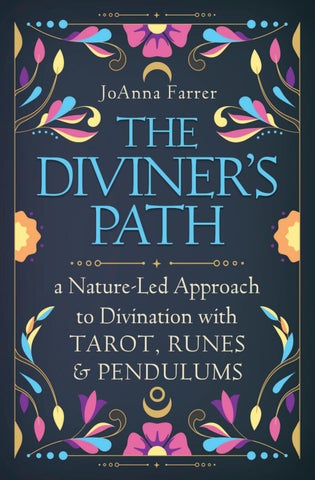
The Diviner's Path, by JoAnna Farrer

Page 1


About the Author

JoAnna Farrer is a seasoned witch, seer, and divination teacher who has dedicated decades to both her personal practice and public teaching in the arts of divination. She is a co-founder of the North Wyldewood Tradition and co-high priestess of her coven. As a professional musician and graduate of the Juilliard School, JoAnna is uniquely attuned to the world of symbols and their nuanced interpretations. She is the concertmaster of the Savannah Philharmonic and a violinist in the New Jersey Symphony. JoAnna is the host of the Coffee & Divination podcast, which features interviews with prominent authors and practitioners of occult, Pagan, and divinatory arts. Visit her at CoffeeAndDivination.com.

©Photo by Darryl Kubian (IndigoFox Media)

The Diviner’s Path: A Nature-Led Approach to Divination with Tarot, Runes & Pendulums

Copyright © 2026 by JoAnna Farrer. All rights reserved. No part of this book may be used or reproduced in any manner whatsoever, including internet usage, without written permission from Llewellyn Worldwide Ltd., except in the case of brief quotations embodied in critical articles and reviews. No part of this book may be used or reproduced in any manner for the purpose of training artificial intelligence technologies or systems.

First Edition

First Printing, 2026

Book design by Samantha Peterson

Cover design by Shannon McKuhen

Interior illustrations by Llewellyn Art Department

Llewellyn Publications is a registered trademark of Llewellyn Worldwide Ltd.

Library of Congress Cataloging-in-Publication Data

Names: Farrer, JoAnna author

Title: The diviner’s path : a nature-led approach to divination with tarot, runes & pendulums / JoAnna Farrer.

Description: First edition. | Woodbury, Minnesota : Llewellyn Publications, [2026] | Includes bibliographical references. | Summary: “Informed by her decades of experience as a witch and seer, JoAnna Farrer invites you to rediscover divination as a sacred dialogue with nature”—Provided by publisher.

Identifiers: LCCN 2026012242 (print) | LCCN 2026012243 (ebook) | ISBN 9780738782430 paperback | ISBN 9780738782492 ebook

Subjects: LCSH: Divination

Classification: LCC BF1751 .F37 2026 (print) | LCC BF1751 (ebook)

LC record available at https://lccn.loc.gov/2026012242

LC ebook record available at https://lccn.loc.gov/2026012243

Llewellyn Worldwide Ltd. does not participate in, endorse, or have any authority or responsibility concerning private business transactions between our authors and the public.

All mail addressed to the author is forwarded but the publisher cannot, unless specifically instructed by the author, give out an address or phone number.

Any internet references contained in this work are current at publication time, but the publisher cannot guarantee that a specific location will continue to be maintained. Please refer to the publisher’s website for links to authors’ websites and other sources.

Llewellyn Publications

A Division of Llewellyn Worldwide Ltd.

2143 Wooddale Drive

Woodbury, MN 55125-2989 www.llewellyn.com

Printed in the United States of America

GPSR Representation:

UPI-2M PLUS d.o.o., Medulićeva 20, 10000 Zagreb, Croatia, matt.parsons@upi2mbooks.hr

For Darryl, the North Star in my sky; and for the Ancestors, who tend the fires, cast the lots, and keep the keys in the eternal now. May we have grace and joy for our journeys.

Introduction • 1

Part 1: Reflection 15

1: Animism and the Diviner’s Path • 17

2: Unveiling Your Inner Diviner • 33

3: Mapping Your Sacred Landscape • 49

4: Offerings and Spiritual Hygiene • 65

5: Symbols and Wording in Divination • 83

Part 2: Divination 107

6: Categories of Divination • 109

7: The Pendulum • 121

8: Runes, Stones, and the Art of Sortilege • 139

9: Cartomancy and Image-Based Divination • 171

10: Augury • 201

11: Dreams • 229

12: Seer Work • 249

Part 3: Integration 267

13: Integration and Interpretation • 269

14: A Diviner’s FAQ • 287

15: Divination for Personal and Collective Transformation • 303

Conclusion • 311 Recommended Resources • 313 Bibliography • 321

INTRODUCTION

I know of no people, whether they be learned and refined or barbaric and ignorant, that does not consider that future things are indicated by signs, and that it is possible for certain people to recognize those signs and predict what will happen.

What brings you to divination? Are you seeking guidance on a major life decision, like whether to move to a new city or accept a job offer? Perhaps you’re looking for insight into a romantic relationship or ways to support a loved one through a difficult time. Whatever your reason, you’re part of a tradition as old as humanity itself.

Throughout history, people from all cultures and walks of life have sought to peer into the future. This desire to know what lies ahead is a fundamental part of what makes us human. We are curious storytelling creatures who constantly seek meaning in the

symbols and patterns around us. Divination taps into this innate human trait, offering a way to make sense of our complex world and find direction in times of uncertainty.

Fortune-telling practices have endured and even flourished in our contemporary age. Despite centuries of scientific skepticism telling us that such practices are irrational or outdated, interest in divination continues to grow. Every year, more people are drawn to learn tarot, runes, astrology, and other divinatory arts.

I believe this enduring popularity speaks to something deep within us—a need for connection, meaning, and guidance that goes beyond what materialist rationalism can provide. In my own life and work as a diviner, I’ve seen how these practices can offer comfort, clarity, and a sense of empowerment to those who engage with them sincerely.

As I’ve explored divination over the years, I’ve come to see it as deeply intertwined with an animistic worldview. Animism—the belief that all things (animals, plants, objects, and even natural phenomena) possess a spirit or consciousness—provides a rich foundation for divinatory practices. In an animistic worldview, we’re surrounded by a living, aware universe. The cards in a tarot deck, the stones used for casting runes, or the surface of a scrying mirror—all of these are seen as having their own essence or spirit. When we engage in divination, we’re not just manipulating lifeless objects, but communicating with conscious entities.

This perspective transforms divination from a mere technique into a relationship-building practice. Just as I’ve developed a deep bond with my tarot cards over decades of use, practitioners of various divinatory arts often speak of building connections with their tools. We come to see these items as partners in our spiritual work rather than just inanimate objects.

An animistic approach to divination also expands our understanding of who or what we’re communicating with during a reading. Are we tapping into our own subconscious? Connecting with nature spirits? Communing with ancestors or deities? In an animistic framework, all of these possibilities can coexist.

This worldview encourages us to approach divination with reverence and respect. If the tools we use and the forces we contact are alive and aware, it becomes important to treat them ethically and to consider the impact of our actions. Many traditional divinatory practices include elements of cleansing oneself, making offerings, and honoring the spirits involved. Animism also aligns well with the holistic, interconnected nature of many divinatory systems. In tarot, for example, we often look at how different cards relate to and influence each other, much like how various spirits or forces might interact in an animistic universe.

At the Threshold

As I sit down to write this book, I can’t help but reflect on my journey as a musician, witch, and diviner. It’s been a winding path, filled with unexpected turns and profound discoveries. I remember the day I purchased my first Rider-Waite-Smith tarot deck at the age of twelve. I was a “baby witch” then, browsing the shelves of my local bookstore in central New Jersey. Little did I know how those cards would shape my life over the next twentynine years.

That well-worn deck has been my constant companion, guiding me through countless situations and decisions, both joyful and challenging. I’ve watched in awe as it helped friends and family members navigate life-changing choices—where to move, when to leave a job, how to handle difficult relationships. There’s

a special kind of clarity that emerges when people take the time to unravel their desires and ask good, heart-centered questions.

My journey with divination has taken me to some unexpected places. For years now, I’ve served my coven and community as an oracular seer of Apollo. In deep trance states, I’ve described visions that range from heartrending to frightening to breathtakingly beautiful. What amazes me is how consistently these messages seem to resonate with those seeking guidance, offering just what they need to hear.

For the past four years, I’ve had the privilege of hosting the Coffee & Divination podcast, interviewing respected diviners and authors about their practices. Each conversation has inspired me and deepened my appreciation for the diverse ways people connect with the unseen.

What I’ve learned through all of this is that incorporating divination into daily life can be transformative. It helps people feel more confident and intuitive, and it fosters a sense of being supported by a living, inspirited Universe. The tools we work with—be they tarot cards, runes, or playing cards—evolve into guides and partners, building relationships that enrich our lives in countless ways.

The Little Witch Backstage

Outside of my work as a priestess and diviner, I’m a professional violinist in the New Jersey Symphony and the concertmaster of the Savannah Philharmonic. My journey in classical music began at a very young age; I started playing violin when I was just four years old. By the time I was six, I had already been accepted as a student at the Juilliard School in New York City.

My childhood was far from typical. While other kids were playing in the park, I was spending hours each day practicing violin. It was an intense schedule of lessons, performances, and competitions. I remember the thrill of performing with Itzhak Perlman at Carnegie Hall when I was twelve—the same age I began performing as a soloist with orchestras.

Like many child prodigies in both the arts and sports worlds, I worked almost single-mindedly every day. The dedication required was immense, and I’m forever grateful to my parents and violin teachers who supported me and helped me reach such high levels in my field at a young age.

But there was another side to my life that few people saw. In the quiet of my room at night, or backstage before concerts, I would pull out my tarot cards and practice magic. It was my secret world, a place where I could explore the mysteries that fascinated me just as much as music did.

Looking back, I can see how these two passions—music and magic—shaped me in different but complementary ways. The discipline and focus I learned from my musical training served me well in my spiritual practices, while the intuition and creativity I developed through divination enhanced my musical performances.

There was no single tarot reading that gave me, to quote a line from The Hitchhiker’s Guide to the Galaxy, the answer to the great question of “Life, the Universe, and Everything.”1 Instead, it was the answers to hundreds of little, important decisions: Should I practice for the chamber music competition or the solo one?

1. Douglas Adams, The Hitch Hiker’s Guide to the Galaxy: A Trilogy in Five Parts, Omnibus ed. (Random House, 1995), chapter 35.

Should I audition for the orchestra program or learn a new concerto? What will happen if I take a crazy chance and fly to Europe for that audition? Should I move to Europe? Which decision will make me happier? Which will move me closer to my purpose? Divination, like magic, is made up of more than just one grand spell or card: It is the many workings and readings that string together to create a life. It helps guide the choices we make, the things we create, the relationships we form, and the time we put into ourselves through self-reflection, work, and magic. As we develop as diviners, we more confidently follow our intuition—the still, quiet voice inside—and allow the path to unfold before us.

As I entered my teenage years, I found myself at a crossroads. The path of a violin soloist that had been laid out for me since I was six suddenly felt confining. I loved music deeply, but the prospect of a lonely life on the road, moving from one concert hall to another, began to lose its appeal. It was during this time that my tarot cards and dream work became invaluable guides. Night after night, I’d sit cross-legged on my bed, shuffling my well-worn deck, asking questions about my future. The cards didn’t always tell me what I wanted to hear, but they consistently pointed me toward a life filled with collaboration and community—qualities I found in chamber music and orchestral performance. One particularly vivid dream showed me standing on a stage, but instead of being alone with my violin, I was surrounded by other musicians, part of an immense orchestra. We were moving together, creating something greater than any one of us could achieve alone. When I woke up, I knew I needed to follow that path.

My journey wasn’t straightforward. There were countless small decisions along the way, each shaping my future in subtle

ways. I remember one night, spread out on my bedroom floor with tarot cards, runes, and my dream journal, trying to decide whether to accept an unexpected opportunity to travel to (and audition) in Europe. It was a huge risk—financially and emotionally. But the cards kept showing me the Fool, urging me to take a leap of faith. My dreams that week were filled with travel and new beginnings. In the end, I took the chance and flew to Europe. That decision opened doors to adventures I never could have imagined. Looking back, I can see how each of these individual choices, guided by my divinatory practices, wove together to create the tapestry of my life so far. It was, and continues to be, a process of constant dialogue with myself, my intuition, the spirits, and the tools I trust.

How we view the world and our place in it—whether we believe in psychic abilities, God or the gods, angels, spirits, etc.— either allows for the possibility that divination works, or it does not. The materialist-scientific worldview of general European and American culture over the last few hundred years—that matter and mind are all that is, and divination and magic (and even gods as well) are fantasies—is a rare one in human history. The belief that all matter is dead and without soul, and that spirits either don’t exist or don’t interact with us, can lead to feeling isolated and alone: No unseen help or advice is possible, should we ask. In contrast, for people in ancient Greece, almost everything in the natural landscape—mountains, lakes, streams, trees—were thought to be alive and full of gods.2 Far from being an empty canvas, the world was full of spirits and, potentially, gods—all of

2. Marianna Olivadese, “When Nature Speaks: Sacred Landscapes and Living Elements in Greco-Roman Myth,” Humanities 14, no. 6, 120 (2025), https:// doi.org/10.3390/h14060120.

whom could have impacts on the world, and who could potentially give advice to people via divination.

But what exactly is divination? And who are we talking to when we divine?

Asking Questions in a World Full of Gods

Divination is the art of obtaining knowledge through hidden or non-ordinary means. This broad definition encompasses everything from reading a fortune cookie that comes with your Chinese takeout to ancient Greek leaders consulting the Oracle at Delphi about founding a new city or starting a war. In both cases, we’re receiving advice that we can choose to act on or ignore.

Throughout history, world leaders have turned to oracles and seers for guidance in both their professional and personal lives. During World War II, Winston Churchill experienced what he called a “providential impulse” that led to a crucial decision, saving lives at 10 Downing Street.3 This event is recounted in one of his memoirs, Their Finest Hour, and corroborated by staff members Georgina Landemare and Nora Henty.4

One evening, while hosting a dinner for government officials at 10 Downing Street, Churchill suddenly excused himself from his guests. He went to the kitchen and ordered the staff to immediately set up the rest of the meal in the dining room and

3. Winston Churchill, Their Finest Hour, vol. 2, The Second World War (Rosetta Books, 2002), Kindle, 418.

4. “Below Stairs: Georgina Landamare,” Times Remembered, BBC Two, series 3, video, 15 minutes, https://www.bbc.co.uk/programmes/p014808z; Robert Henty, “Blitz Nights in Downing Street: Nora Henty Remembers,” The Churchill Project, Hillsdale College, May 8, 2019, https://winstonchurchill .hillsdale.edu/nora-burrows-downing-street/.

evacuate to the bomb shelter. Churchill then calmly returned to his guests and resumed the meal. There was an air raid in progress, and minutes later, the kitchen took a direct hit from a bomb. Churchill and his dinner guests were unharmed, but the kitchen staff would have been killed had they not evacuated.5

His experience raises an intriguing question: When we receive these flashes of insight or guidance, who—or what—are we really listening to?

Who Are You Talking To?

When we engage in divination, we’re not just shuffling cards or tossing runes—we’re initiating a conversation. It’s a two-way exchange with something or someone beyond ourselves. This might sound a bit strange at first, but it’s at the heart of what makes divination so powerful and transformative.

When you lay out tarot cards or scry with a candle flame, you’re asking a question and receiving an answer. You’re communicating with an “other”—though the nature of that other can vary widely. Some people view it as connecting with their higher self or tapping into the collective unconscious. Others see it as communing with ancestors, saints, or specific deities. In my own practice as an oracular seer of Apollo, when I drop down into deep trance for that work, I experience the connection as direct communion with the god himself.

The beauty of divination is that it doesn’t require you to adhere to any particular belief system. What matters most is approaching the practice with an open mind, genuine curiosity, and patience. Just like any meaningful relationship in your life, what

5. Churchill, Their Finest Hour, 418.

you get out of divination depends largely on what you’re willing to put into it. As you develop your divinatory skills, you’re really honing your ability to build and maintain relationships. This includes your connection with the tools you use—be they tarot cards, runes, or your own dreams—as well as your interactions with the various energies and entities you encounter in your practice. Over time, many diviners find that their tools become trusted friends, each with their own personality and way of communicating.

Learning divination is also about becoming fluent in new symbolic languages. Each system has its own set of symbols and meanings that you’ll gradually come to understand over time. As you immerse yourself in each form of divination, you’ll be building fluency in new forms of communication. Instead of wrestling with words and sentence structures, you’ll be absorbing new signals, patterns, and symbolic cues. As I’ve discovered on my own journey, cultivating patience and establishing consistent routines will yield tremendous rewards as you follow this path!

Stepping into the Forest

The idea for this book came to me initially in a vivid dream. Dream incubation for divination is something I’ve practiced since I was a very little girl, so it felt fitting that this project would begin that way. In the dream, I found myself in a familiar place: the deep, Wild Wood that I often visit in my work as a seer and Witch, as well as within our coven. There, in a central clearing, I saw a selection of the arts of divination I practice laid out beautifully before me. Each was a path leading off in different directions into the forest. It was a breathtaking sight, and I knew immediately that this was how the book needed to be structured.

So, dear reader, the book you’re holding is laid out as a series of “paths through the woods.” It’s meant to be experienced, not just read. You control the pace and timing of your journey through it. Please approach it in whatever way makes the most sense to you. Personally, I’m the type who likes to read books from cover to cover (yes, even when they tell you not to!) before I begin experimenting with what I’ve read. There are definite advantages to reading this book from beginning to end, and it’s what I suggest. However, if you prefer to skip around and read what you’re curious about, by all means, dive in and enjoy!

Whatever path you choose, I highly recommend first completing the exercises at the ends of chapters 1 and 2. It’s crucial to take the time to think about who you are, where you are in the world, and what is drawing you to divination. I also suggest reading the initial chapters in part 1 early on, as they will help you develop vital question-and-answer skills for divining.

In my animist, magical worldview, every book is “alive.” Your interactions with this text will be unique and sacred. Trust your intuition as you navigate these pages, and let the forest of divination reveal its secrets to you in its own time.

Mapping the Forest: What Is (and Is Not) Included in This Book

This book is an invitation to embark on a journey into the world of divination—a journey of self-discovery, connections to the unseen, and the awakening of your intuitive gifts. Within these pages, we’ll explore time-tested techniques like pendulum divination, the art of reading cards, and the ancient practice of augury, where nature herself whispers secrets to those who listen. While we won’t delve into the complexities of astrology, the I Ching, or

tasseography, the methods we will cover provide a strong foundation for anyone seeking to unveil the hidden layers of meaning that surround us.

Here’s a brief overview of what you’ll find in the chapters to come:

Part 1 is all about preparation: learning about ourselves, our environment, and the nature of receiving information through divination. We set our roots and learn the vital first steps to becoming effective diviners. In chapter 1, we’ll dive into the animist worldview that forms the foundation of this book, learn my sixstep divination cycle, which we’ll use as a framework throughout our journeys, and learn essential exercises.

I’ll guide you through self-discovery in chapter 2, helping you uncover your divinatory strengths and weaknesses while fostering a mindset that embraces your potential. Chapter 3 focuses on mapping your sacred landscape, helping you to assess your physical and spiritual surroundings and connect with natural and unseen energies.

I’ll teach you to connect with spirits through offerings and maintain spiritual hygiene in chapter 4, covering a basic ritual and energetic cleansing techniques. Chapter 5 explores symbolic language, helping you craft potent questions and broaden your symbolic vocabulary—crucial divination skills.

In part 2, we’ll step into the forest together and explore specific divination tools and techniques. Chapter 6 introduces some of the main categories, or “families,” of divination and how they offer different ways of receiving guidance. In chapter 7, we’ll dive into work with pendulums, move on to casting lots in chapter 8, and explore cartomancy and image-based divination in chapter 9. Chapters 10 through 12 will introduce you to augury, dream

divination, and seer work. Each chapter includes practical exercises to help you develop your skills.

Part 3 will bring us “back home” from the forest, where we’ll learn techniques to interpret information received via divination, apply it in our lives, and track results. Starting in chapter 13, we’ll look at interpreting our results—a crucial skill for every diviner! In chapter 14, I’ll address common concerns that diviners often face, such as reading ethics and how to navigate the sometimes-murky waters of professional conduct. I’ll also delve into strategies for handling challenging divinations: those times when the messages we receive are difficult or unclear. Additionally, I’ll share some personal insights and techniques for improving accuracy in your practice.

In chapter 15, our final section, we’ll explore the transformative potential of divination on both personal and collective levels. I’ll share how developing my skills as a seer has deepened my connection to the natural world and expanded my sense of purpose. We’ll discuss ways to use divination as a tool for healing, not just for ourselves, but for our communities and the planet as a whole. I firmly believe that as we hone our ability to listen deeply—to ourselves, to nature, and to the unseen realms—we become powerful agents of positive change in the world.

First Steps on the Path

I firmly believe that divination, when practiced sincerely and respectfully, changes people’s lives for the better. For twenty years, I’ve watched it happen, and I am excited for how it can change your life as well. My advice is to step on this path with an open heart and a curious mind.

As you embark on this journey into divination, remember that you’re not just learning a skill—you’re opening yourself up to a whole new way of experiencing the world. You’re inviting magic and mystery into your life, and in doing so, you’re tapping into an ancient wellspring of wisdom that has nourished seekers for millennia.

Begin today, and the Universe will pay attention.

Begin today, and the true, still voice of the answers you need will begin to come closer.

part 1

REFLECTION

Every act of divination begins in stillness. We have to take a breath in before we speak a question out loud— and figuring out what our questions really are takes self-reflection and care. Before casting runes or drawing cards, we need to briefly pause to notice where we are, consider what the heart of the matter is, and listen to the quiet voices within and around us. This is the first turn of the six-step diviner’s cycle: reflection.

In these opening chapters, you’ll explore the essential foundations of divination: cultivating selfknowledge, clarifying questions, and deepening your relationships with land, spirits, and your

own inner wisdom. Like preparing the soil before planting, this work will allow the answers you receive through divination to take root in fertile ground. With reflection as your beginning, the path ahead can unfold with clarity.

1 ANIMISM AND THE DIVINER’S PATH

You cannot learn from anyone or anything if you are not open to the possibility that it has the ability to teach you.

In divination, the art of deep listening is essential for success. We need to “speak” clear questions to the Universe, and then also know when and how to understand the answers we receive in return. This requires technique, trust, and patience. By allowing ourselves to be receptive to the messages that surround us, we can begin to understand the signs and symbols the world offers. Other beings around us—plants, animals, and spirits—often desire to communicate with us just as much as we want to speak with them.

This act of listening deeply to the world resonates with both animist perspectives and the permaculture principles. Animism teaches us that the earth and all its beings are alive, aware, and interconnected, forming a web of relationships where every voice matters. Similarly, permaculture invites us to observe and interact with natural systems, recognizing their inherent wisdom and responding in ways that foster balance and harmony. Divination, at its heart, is a practice of aligning ourselves with this living web—tuning in to the subtle rhythms and messages of the world to find guidance and connection. Graham Harvey, a respected scholar in the field of religious studies, expresses the idea beautifully: “Animists are people who recognise that the world is full of persons, only some of whom are human, and that life is always lived in relationship with others.” 6

It is also important to be aware that the term animism has a complicated, difficult history. It’s a concept that has been fraught with misunderstanding and misuse, particularly in academic and anthropological circles. Coined by anthropologists in the nineteenth century, animism was often used within a framework of social evolutionary theory, which unfortunately positioned Indigenous cultures and belief systems as inherently less advanced than Western thought. This hierarchical and ultimately racist view is now understood to be deeply flawed and harmful. As Gordon White explains in Ani.Mystic,

“Animism represented the anachronistic, vestigial survivals of unfit ideas.…A European theory of mind encountered non-European theories of mind that ac-

6. Graham Harvey, Animism: Respecting the Living World, 2nd ed. (Hurst, 2017), xiii.

counted for a living cosmos, for the importance of dreams, and found them disorderly, naïve, childlike.” 7

This origin is obviously extremely troubling, rooted as it is in outdated and harmful ideas about social evolution and the supposed “primitiveness” of certain cultures. It is a stark reminder of how academic language can be wielded as a tool of colonialism, erasure, and oppression.

Today, numerous academics and practitioners are striving to rehabilitate and reimagine the notion of animism. The goal is to distance it from its imperialistic heritage (without “forgetting history” or attempting to bypass harm done) and focus on some of its tenets: seeking to bring human awareness to the intricate web of life, honoring the individuality and personhood of the natural world, and embracing mutually beneficial connections with nonhuman entities that coexist with us. As a Witch and diviner, animism aligns beautifully with my personal philosophy and the ways I engage with the world.

When we embrace animism, we begin to see ourselves embedded in a vast network of relationships. The rustling of leaves in the wind, the pattern of clouds in the sky, the behavior of animals—all of these can be seen as forms of communication from the world around us. In many cultures worldwide, divination practices have evolved as ways to interpret and understand these messages. This worldview aligns perfectly with the principles of permaculture, which emphasize careful observation and interaction with natural systems. We’re taught to observe and interact—to pay close attention to the patterns and behaviors of the

7. Gordon White, Ani.Mystic: Encounters with a Living Cosmos (Scarlet Imprint, 2022), 13.

natural world before making any decisions or taking action. This practice of deep listening and observation is, in many ways, a form of divination itself.

Foreshadowing the Divination Journey

Just as permaculture teaches us to listen to the wisdom of the natural world, divination empowers us to engage in a more direct conversation with the spirits of the land, asking questions and receiving guidance. As the philosopher David Abram describes, “The spirits are not intangible; they are not of another world. They are the way the local earth speaks when we step back inside this world.” 8 This sentiment encapsulates the essence of what we’ll be exploring together, especially when paired with clear, repeatable practice.

The Six-Step Divination Cycle

To guide our divination and ensure we’re engaging in a meaningful, ongoing conversation, we’ll be following my six-step divination cycle throughout this book. This cycle will help you not just receive isolated answers, but integrate divination into your life and decision-making processes:

1. Reflect and craft: We’ll begin by thoughtfully reflecting on the nature of our questions, carefully crafting them for clarity and focus.

8. David Abram, “The Invisibles: Toward a Phenomenology of the Spirits” in The Handbook of Contemporary Animism, ed. Graham Harvey (Routledge, 2014), 124–32.

2. Choose and ask: Next, we’ll explore various divination methods, selecting the one that resonates most deeply with our intuition and the question at hand.

3. Interpret and record: Once we’ve received a message in answer to our question, we’ll learn to interpret its symbolism, taking care to record our insights.

4. Act and engage: Divination is a call to action! We’ll translate the guidance received into tangible steps and then bravely embark on those actions.

5. Reflect on results: After a period of time, we’ll reflect on the outcomes of our decisions. Did our interpretation resonate with our reality? What have we learned from the actions we took?

6. New questions arise: Often, this reflection will spark new questions, leading us back to the beginning of the cycle, ready to explore our next steps.

This cyclical approach honors the evolving nature of our relationships with the unseen and ensures that divination remains a dynamic, integrated part of our lives.

Tools for the Diviner’s Path

As we prepare to delve deeper into divination, I encourage you to choose a dedicated notebook that you’ll use for divination. It does not need to be fancy—a simple spiral-bound notebook will work great. However, if you are drawn to the idea of using an extremely ornate, leather-bound journal, go with your gut! The point is to choose something you have available now and that you’ll feel comfortable using frequently, both indoors and out. This will be your personal record book for exercises, observations, and, starting in

part 2, the results of your divination sessions. Having a physical record of experiences is crucial for developing your abilities.

Each chapter in this book will also include journaling prompts for reflection and practical exercises for you to try. In these first exercises, you’ll begin to cultivate a grounded presence and a receptive mind. You’ll also choose a nearby place in nature where you’ll regularly go to meditate, observe, and, eventually, divine. These practices will help you establish a strong foundation for connecting with your intuition and the realms from which divination draws wisdom.

How Do You Get to Carnegie Hall? Or Delphi?

As a violinist and diviner, it has always struck me how similar mastering an instrument and developing divinatory skills really are at their root. Both require focus, positivity, patience, and consistent practice. Both ask us to learn to quiet our minds, be focused, learn new symbolic languages, and, when the time is right, let go and trust our intuition. To progress in divination, just as in learning an instrument, you’ll need to master the basics first. Even if you already have experience with certain techniques, it’s crucial to practice regularly—several times a week if possible.

In our coven’s Wiccan tradition, we encourage students to have a “magical buddy” to practice exercises with, when possible. Outside of this, my fellow high priestess, Denise, and I serve as mentors when questions arise. If you have a friend who wants to work through this book with you, I encourage you to take them up on it! (But only if you are both able to be supportive in your attitudes to your progress.) I encourage you, for these sensitive, deeply personal areas of your life, to only share with people who you know will be open-minded and positive, and who will cheer

you on while still being “real” with you when needed. If you are working through this book alone and difficult questions come up, you can also reach out to me through my website. While I cannot promise to reply quickly, I am dedicated to providing what support I can when time allows.

For my readers who have been practicing divination or magic for some time already, you might find some of the initial exercises in the book unexpectedly tricky, since you may need to break ingrained patterns as the work unfolds. This is much like learning to play the violin: There are specific finger placements and bow techniques that are challenging initially, but which are all essential to advance beyond the basics. Committing to a routine of practicing the techniques in this book will allow you to establish a solid framework for your divination.

“Ars

longa, vita brevis.”

The words above are a Latin phrase based on an ancient aphorism attributed to the Greek physician Hippocrates. The translation, roughly, is “Art is long, and life is short.” 9 Any skill worth having takes time to develop, and our lives are brief. That reminder stays with me. Reflecting on my journey into divination and nature-based spirituality, I recall a pivotal moment from childhood. At thirteen years old, I excitedly proposed to my parents, “Can I design a garden for our backyard?” Being homeschooled, they saw it as a great ecology project and bought a simple garden layout kit for me. I spent weeks at our local library studying gardening books and sketching rough designs.

9. Pamela M. Jones et al., eds., introduction to A Companion to Early Modern Rome, 1492–1692 (Brill, 2019), 23.

When I revealed my ambitious plan—a sprawling English country garden with winding paths, exotic plants, and fruit trees—their jaws dropped. They gently explained that my lovely dream would cost thousands and was far beyond the budget for our modest East Windsor, New Jersey, backyard. While my teenage heart was disappointed, I learned an amazing amount from that first foray into design and ecology.

Looking back, this project ignited my passion for creating beautiful, functional spaces that promote biodiversity and support local wildlife, aligning with my budding Wiccan practice, which had begun a year earlier. Years later, in college, my friend Karen introduced me to permaculture, captivating me with its principles of working with nature to create sustainable systems.

Motivated by permaculture’s comprehensive philosophy, my husband and I decided to learn more about the process and figure out how to incorporate it into our lives. In 2014, we enrolled in a permaculture design course with renowned teacher Ben Falk. The intensive program revealed new ways to work with the land and deepened our understanding of ecological systems. After completing the course, we applied our knowledge on our Vermont property, beginning the lifelong process of becoming stewards of the land: building a barn, a greenhouse, and multiple gardens and forest plantings, all with the aim of nurturing biodiversity and joining a thriving ecosystem.

Similar practices of attunement, active participation, and reverence lie at the heart of both animism and divination, where our goals are achieved through relationship with both seen and unseen forces around us. It has been a long road (so far) since that garden plan I created as a child and the first time I picked up tarot cards.

Every seer and fortune teller in history once took their first tentative steps on this path, just as I did. Skillfulness takes time, and life is short. But every beginning matters. Now, you are entering into the same long tradition of seekers who’ve walked before you. The road map is clear, so let’s get started.

exercise 1

First Reflections

For this journaling exercise, choose the questions that call to you, and put your thoughts into writing at the beginning of your journey. Even a few quick sentences about the topics below will be helpful for the road ahead.

Exploring Animism

What resonates with you most about the concept of animism?

Have you ever experienced a moment where you felt a strong connection to the spirit of a place, a plant, or an animal? Describe that experience. How might viewing the world through an animistic lens change the way you interact with nature? With other people? With yourself?

Recalling Meaningful Places

Think back to your childhood. Was there a particular outdoor place—a forest, a park, a backyard, a beach—where you felt a sense of wonder, peace, or belonging? Describe that place in detail, engaging all your senses.

Connect with Nature’s Wisdom Through Tarot, Runes, Pendulums, and More

Explore a vibrant tapestry of divinatory practice where symbol, spirit, and self-knowledge effortlessly intertwine. Informed by her decades of experience as a witch and seer, JoAnna Farrer invites you to rediscover divination as a sacred dialogue with nature. Readers will meander through metaphorical forest paths and use practical exercises, learning to distinguish the voice of deep knowing from the noise of modern life.

Each chapter is a gentle unfolding, full of grounded animist insights and practical, creative ways to listen for signs and omens. JoAnna teaches you how to use a variety of divinatory art forms and devices with skill and grace, even combining them for more in-depth readings. Whether you’re just starting out or seeking to deepen a lifelong practice, this book awakens awe in everyday magic and nurtures heartfelt trust in the world’s hidden harmonies.

JOANNA FARRER is a witch, seer, and gifted musician who draws from a lifetime of divinatory practice and public ritual leadership to share grounded, empowering guidance. Her work bridges the symbolic world of music with animist spirituality. JoAnna also hosts the Coffee & Divination podcast. Learn more at CoffeeAndDivination.com.

© Photo by Darryl Kubian (Indigo Fox Media)

Turn static files into dynamic content formats.

Create a flipbook