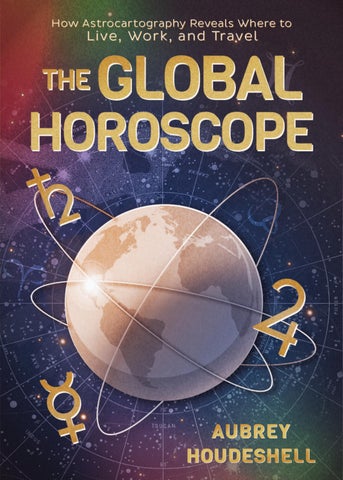
GLOBAL HOROSCOPE THE
GLOBAL HOROSCOPE THE
How Astrocartography Reveals Where to
Live, Work, and Travel
AUBREY HOUDESHELL
The Global Horoscope: How Astrocartography Reveals Where to Live, Work, and Travel Copyright © 2027 by Aubrey Houdeshell. All rights reserved. No part of this book may be used or reproduced in any manner whatsoever, including internet usage, without written permission from Llewellyn Worldwide Ltd., except in the case of brief quotations embodied in critical articles and reviews. No part of this book may be used or reproduced in any manner for the purpose of training artificial intelligence technologies or systems. First Edition First Printing, 2027 Book design by Christine Ha Cover design by Shannon McKuhen Llewellyn Publications is a registered trademark of Llewellyn Worldwide Ltd. Library of Congress Cataloging-in-Publication Data Names: Houdeshell, Aubrey, author Title: The global horoscope : how astrocartography reveals where to live, work, and travel / by Aubrey Houdeshell. Description: First edition. | Woodbury, Minnesota : Llewellyn Worldwide, [2026] | Summary: “Combine astrology and cartography to reveal which places on Earth will support your journey and spiritual growth. Whether you are planning a vacation, looking for love, or searching for somewhere to host an event, this book teaches you how to use the planets as a cosmic compass that points to successful travel for business, pleasure, and everything in between”— Provided by publisher. Identifiers: LCCN 2026041238 (print) | LCCN 2026041239 (ebook) | ISBN 9780738781792 trade paperback | ISBN 9780738781860 ebook Subjects: LCSH: Astrology and graphology | Astrology and travel Classification: LCC BF1729.G72 H683 2026 (print) | LCC BF1729.G72 (ebook) LC record available at https://lccn.loc.gov/2026041238 LC ebook record available at https://lccn.loc.gov/2026041239 Llewellyn Worldwide Ltd. does not participate in, endorse, or have any authority or responsibility concerning private business transactions between our authors and the public. All mail addressed to the author is forwarded but the publisher cannot, unless specifically instructed by the author, give out an address or phone number. Any internet references contained in this work are current at publication time, but the publisher cannot guarantee that a specific location will continue to be maintained. Please refer to the publisher’s website for links to authors’ websites and other sources. Llewellyn Publications A Division of Llewellyn Worldwide Ltd. 2143 Wooddale Drive Woodbury, MN 55125-2989 www.llewellyn.com Printed in the United States of America GPSR Representation: UPI-2M PLUS d.o.o., Medulićeva 20, 10000 Zagreb, Croatia matt.parsons@upi2mbooks.hr
Other Books by Aubrey Houdeshell Stellar Sex: Unlock Your Sexual Power with Erotic Astrology (Llewellyn, 2025)
The Cosmic Symposium: An Astrological Journey Through the Orchestra of the Planets (Illustrated by Rose Ides, Running Press, 2024) Oracle of Pluto: A 55-Card Exploration of the Undiscovered Self (Illustrated by Rose Ides, RP Studio, 2023)
For my darling Laura, without whom this book simply would not exist.
Contents Introduction — 1 Chapter One: What Is Astrocartography? — 7 Chapter Two: Sun Lines and Self-Love — 39 Chapter Three: Moon Lines and Emotions,
Intuition, and Dreams — 53
Chapter Four: Mercury Lines and Logic, Learning,
and Language — 67
Chapter Five: Venus Lines and Love, Beauty,
Romance, and Pleasure — 81
Chapter Six: Mars Lines and the Double-Edged
Sword of Passion — 95
Chapter Seven: Jupiter Lines and the Potential
for Abundance — 109
Chapter Eight: Saturn Lines and the Burden of
Responsibility — 121
Contents
Chapter Nine: Uranus Lines and Breaking
Free — 137
Chapter Ten: Neptune Lines and Creativity, Ideals,
and Fantasy — 153
Chapter Eleven: Pluto Lines and Profound
Changes — 169
Chapter Twelve: Chiron Lines and Finding
Healing — 185
Chapter Thirteen: North Node Lines and Gripping
Fate — 199
Chapter Fourteen: Unraveling the Story of Your
Cosmic Map — 215
Acknowledgments — 221 About the Author — 223
xii
R
M
O Introduction
I
want you to think about the place you grew up in. What comes to mind? Perhaps it’s the same place where you live now. Maybe it’s two or three different cities. Maybe it’s several different states or even countries. Now, I want you to think about what that place, or those places, feel like. Where does it feel like home to you? Is it your hometown? Is it where you live now? Maybe it’s someplace you’ve never lived in but only visited. Or perhaps you’re still searching, which is okay too. But what is it about that place that feels like you did or did not belong? Maybe it felt easy, like you just fit in, or maybe the opposite was true, and everything felt like a struggle all the time and you just couldn’t figure out why. Regardless of what your experience was where you grew up (and wherever you live now), the answer may very well lie within astrology, 1
Introduction
in a branch known as astrocartography. As we will see, the impact of astrocartography can have a life-changing and life-shaping influence based on where you are in the world. Have you ever heard the saying “Wherever you go, there you are”? It’s one of those sayings that has been around for so long, nobody actually knows who said it first. Sometimes it’s attributed to Confucius and sometimes to Alcoholics Anonymous, and it also happens to be the title of a selfhelp book by Jon Kabat-Zinn. Regardless of its origins, the phrase is meant to teach us that we cannot escape ourselves. No matter how far and wide we travel, who we are stays with us. I used to think that was true. Then I discovered astrocartography. While I still think that saying is true to a certain extent, through my own personal experiences with astrocartography it has become undeniable that there are places we can go that foster different circumstances, relationships, and experiences that ultimately help or hinder us. Thanks to astrocartography, there are locations that bring greater ease, abundance, and support into our lives and places that create harsher conditions. In this book you will learn how to generate your own astro map and then identify the different lines on the map, break down their meanings, and dive into the different kinds of experiences you can have in their respective 2
Introduction
regions. This book contains suggestions on the different kinds of activities that are best in certain locations, as well as some real-life examples to help demonstrate how different planetary energies can manifest and impact you. Keep in mind that astrocartography is just another layer to consider when unraveling your own astrology. It doesn’t operate by itself, but rather alongside your birth chart and transits. I often get asked why or how astrocartography matters or is useful. My answer to that is simple: We can use this branch of astrology to get more of what we want in life. Because there are places around the world that bring focus to different areas of our lives, we can work intentionally with astrocartography to cultivate the type of life we want to live. While I recognize that travel can be expensive, as can moving, most of us get at least some opportunity to leave our hometown and strike out in the world. We also have our own astrocartography we’re currently living under that influences our experiences in that place. Thus, discovering not only the astrocartographical energy where we live but also where else we can go to get more of what we want and/or need gives us the ability to learn, grow, and thrive. Understanding the different planetary energies and influences in certain locations can help us do things like plan a trip and identify the types of activities 3
Introduction
we want to do there. It can help us plan things like work presentations, family reunions, and even where to move. The possibilities are truly endless. Something else to consider is that astrocartography adds the element of physical space to astrology through where we live, work, and travel. Normally when we’re working with astrology and the transits, we are working almost exclusively with the element of time. At its core, astrology is really the study of cycles, but adding in the layer of physical space makes astrology more tangible for a lot of people. Like many spiritual concepts, astrology can feel nebulous, abstract, and intangible, but the firsthand experience of astrocartography enables those concepts to become solid matter. Of course, the other joy of astrocartography is in travel itself. Travel is one of the most enriching experiences life has to offer. We live in an indescribably beautiful, vast, and diverse world, and being able to see as much of it as we can manage in our limited time here is one of the most profound gifts we can give ourselves. Travel changes us, and changes us for the better. When we are able to immerse ourselves in new places and experience new cultures, people, languages, and ways of living, it knocks down our walls and preconceived notions. Our perspectives are fundamentally changed, and our hearts and minds open up to humanity. Travel builds bridges in places where they didn’t exist before. 4
Introduction
Once you have a better understanding of astrocartography and your own astro map, you can use it to plan where you’d like to travel and what you’d like to do there. You can identify activities that are best supported based on the astro influences in that area and avoid the ones that won’t work as well, and therefore have a more fulfilling, enjoyable experience. I like to travel as often as I can. It’s something I began doing at a young age to visit extended family and something I plan to continue doing throughout my life, as long as my body will allow. Being able to connect with the world around me is something I value very much, above most other things, in fact, and therefore is something I find to be deeply important. I hold so much reverence for our planet and the people in it and am always grateful to see a new part of the world. I also love helping people plan their trips! So once I discovered astrocartography, I was instantly hooked, as it’s a marriage between two of my passions. Being able to offer this service to others has transformed me into a kind of cosmic travel agent in both my personal and my professional life. All of this to say: I love travel, and if you’ve picked up this book, I’m willing to bet you do too.
5
R
M
O Chapter One
What Is Astrocartography?
A
strocartography, as we know it today, is a term that was coined and made popular back in the 1970s by an astrologer named Jim Lewis. This term is used almost exclusively by astrologers and astro fans alike in the modern age, although it’s really just another name for a much older practice known as locational astrology. Locational astrology was already in existence, with various forms of astro mapping dating all the way back to ancient Greece, but Jim Lewis streamlined the technique through the use of maps and modern (at the time) technology and software, thus expanding the field of locational astrology and making it much more accessible to the public. However, he did not create the software himself. But it was back in the 1970s that Gregg Howe and Neil F. Michelsen created the earliest software that provided astrolocality maps. Michael 7
Chapter One
Erlewine is credited with building upon and improving the existing software in 1977, thus eliminating the need for hand-drawn and hand-calculated maps. After becoming interested in the technique, Jim Lewis created his own techniques with the software. He submitted a patent in 1980 for the system he developed, called Astro*Carto*Graphy, and was granted said patent in late 1981. Throughout his life Lewis lectured around the world and regularly held seminars to teach students his technique, eventually developing a certification exam. Those who passed were granted a certificate as a professional Astro*Carto*Grapher. The brand name Astro*Carto*Graphy was trademarked even after Lewis’s death, which required astrologers to get certified and written permission to use the term. However, the patent for Lewis’s method expired in 2000 and his trademark on the term Astro*Carto*Graphy expired in 2011, thus opening the door to accessibility even further. This is why modern astrologers are now free to use the term and why we see it rising on social media. Note that there are actually four pillars of locational astrology: local space, the relocated chart, the geodetic map, and, naturally, astrocartography. Each of these techniques was developed over centuries by various astrologers. I will touch briefly on the other three techniques here, but the main focus of this book is astrocartography.
8
What Is Astrocartography?
Local space astrology, sometimes also referred to as planetary direction, is Michael Erlewine’s technique. He didn’t place as much of an emphasis on the angles in the chart (which I will explain later in this chapter) but instead believed the planets closest to the horizon on the local space map matter the most or are the most prominent and influential areas. He also believed that aspects between planets change or transform as you move around a person’s chart on a map. This technique is helpful for people who were born or live in the polar regions of the world and often have extreme differences in their charts from the rest of the world. The relocated chart is actually a fundamental part of astrocartography. In fact, in his book The Psychology of Astro*Carto*Graphy, Jim Lewis famously said that it’s unethical to interpret someone’s astro map without also using the relocated chart. I go into more detail about the relocated chart later in the chapter, but essentially this is a technique that casts the birth chart in various locations around the world, changing the birth location to whatever city a person is in at the time. For example, if you were born in Denver but moved to London, your birthday obviously stays the same, but your birth time is then translated into local London time, and the birth city changes to match. All your placements stay the same, but the way
9
Chapter One
they’re laid out in the chart shifts dramatically. While a relocated chart doesn’t supersede the real natal chart, it can give insights into the way your energy shows up differently in various regions and it functions as a complement to the regular birth chart. The geodetic map looks quite similar to an astrocartography map but projects the different zodiac signs across the globe. Each region gets its own set of angles and houses, too. Its use is great for mundane astromapping, or looking at things happening on a collective scale. This technique can also be used as a last resort with unknown birth times, though the influence is much less personal. As you can see, there’s much more to locational astrology than meets the eye. If this feels overwhelming to you, don’t worry. We’re going to break it down one step at a time.
A Little Astro 101
Before we start getting into the weeds with astrocartography, I’d like to lay a little foundational work around astrology in general. In my experience, locational astrology can start to go over people’s heads pretty quickly without a basic understanding of what astrology actually is and how it functions. To start, you’ll need access to your birth chart. There are tons of free apps and websites out there for you to use, such 10
What Is Astrocartography?
as cafeastrology.com, astro-seek.com, or astro.com (which you’ll also use to pull up your astro map). To generate your chart, you’ll need your birth date, the exact time of day you were born (yes, this matters), and the city where you were born. Don’t have your exact time of birth? There are a few options available. One is to ask your parents. Results may vary, but sometimes they’ll remember. Another is to locate your birth certificate. If your copy doesn’t have a time of birth, you can get in touch with the hospital you were born in and request a long-form birth certificate. On the off chance these options don’t work for you, there are excellent astrologers out there who can rectify your chart. Employing their services can help you nail down your birth time within minutes and grant you access to a full chart. Even without an exact birth time, you can still pull up part of your chart. The planetary placements will usually be accurate, though sometimes the minutes really do matter if a planet is on the brink of changing signs. Most sites will automatically put the Ascendant at an Aries rising or will default to using noon as the time of birth. Cafe Astrology is a bit different in that it will give you a table instead of a wheel, which can be easier to look at, especially if you’ve only got access to half a chart. So, once you’ve got your chart pulled up, what the heck are you looking at? 11
Chapter One
The birth chart is essentially a snapshot of the sky at the moment you were born. It shows where all the planets and placements were throughout the twelve zodiac signs, as well as which houses they fall into. There are also twelve houses in the chart, which correspond to pretty much every area and theme in life you can think of. Knowing which houses the planets fall into is where having your exact time of birth becomes important. At the exact moment you came into this life, there was a sign that was rising over the eastern horizon in the sky, hence the term “rising sign.” This sign becomes the ruler of your first house, which sets the stage for the way the rest of the chart is laid out. For example, if you were born with Aries rising in the east, then you’re an Aries rising/first house. The next sign, Taurus, then rules your second house (when using Whole Sign houses), and so on. Or maybe you’re an Aries Sun but a Libra rising, which means Aries would rule your seventh house, and your Sun, also in Aries, would fall into that house. This is just one example of innumerable possibilities, but you can see why having the right time becomes important fast. As you will see later in this chapter, it’s also necessary to have your correct birth time in order to cast your astro map. I know that looking at your chart can be overwhelming at first. Here’s a quick rundown of the major themes and roles of each of the planets and houses. 12
What Is Astrocartography?
The Planets
Sun: Individuality, identity, your core personality, self-
expression, vitality.
Moon: Your inner realm, intuition, emotions, your needs
around safety and nurturing, your relationship with your mother.
Mercury: Communication, learning, transportation,
travel, commerce, magic, the student.
Venus: Love, beauty, romance, aesthetic preferences,
what you value, what you are attracted to in relationships, intimacy, indulgence, pleasure.
Mars: Action and how you take it, anger, how you handle
conflict, sex, physicality.
Jupiter: Luck, abundance, expansion, growth, inter-
national travel, what you believe in or have faith in, religion, spirituality, philosophy, learning through experience, the teacher.
Saturn: Your limits, time, boundaries, commitment, hard
work, wisdom, rules and regulations, your relationship with your father.
Uranus: How you are different from others, rebellion,
sudden and unexpected changes or events, the future, authenticity, your inner genius. 13
Chapter One
Neptune: Dreams, fantasy, illusion and delusion, how
you like to escape reality, psychic gifts.
Pluto: Transformation, power, control, how you experience
extremes, destruction and creation.
Chiron: A double-edged wound that shows both a persis-
tent wound you struggle to heal and where your own natural healing gifts exist that you can offer to others.
Lunar Nodes: The lunar nodes are two placements, the
North and the South Node, that are said to point to our evolutionary path. The South Node shows where we’re coming from, as well as our natural gifts and talents, and the North Node is where we’re headed or what we’re growing toward in this life.
The Houses
First House: Identity, the way we present ourselves,
the way we look physically, beliefs, the physical body, beginnings.
Second House: Values, self-worth, comfort, material
possessions, resources, your money.
Third House: Your local community and environment,
siblings, learning (especially K–12), writing, shortterm travel, communication, divination.
14
What Is Astrocartography?
Fourth House: Your literal home, family, ancestors, roots,
foundations.
Fifth House: Creativity, joy, fun, play, children, romance,
self-expression, the present moment.
Sixth House: Your job and the work you’re obligated to
do, your physical health, your daily routines and the way you spend your time, pets.
Seventh House: Marriage, close and important one-on-
one relationships, business partnerships, contracts.
Eighth House: Deep intimacy, secrets, sex, death, taxes,
debts, shared resources and the way we receive money from others.
Ninth House: International travel and all connections
to foreign lands, peoples, and languages, plus higher education, religion, spirituality, dogma, philosophy, and publishing.
Tenth House: Your purpose or calling, career, and reputa-
tion, plus your relationship or role within the community at large.
Eleventh House: The future, social justice, your commu-
nity, social media and technology, your hopes, wishes, and dreams.
15
Chapter One
Twelfth House: The spirit world, dreaming, endings,
solitude and isolation, the subconscious mind, hospitals, jail or prison, anyplace where you are alone.
Once you’ve got a basic understanding of these principles, the next step is trying to understand what it means to have planets in a particular house or not. A helpful way to think about this is that the planets show us what is happening, the signs show us how it’s happening, and the houses show us where in our lives it’s happening. Keep in mind that having an “empty” house, meaning a house that doesn’t have any planets or placements in it, doesn’t mean that house isn’t still relevant. For example, an empty fourth house doesn’t mean you don’t have a family! It just means there’s less of a focus there or that area of your life isn’t as integral to your journey. In this case, you’d simply look at the sign on the cusp (the beginning) of the fourth house and think about the characteristics of that sign and how it’s relevant.
The Aspects
The final step in our foundational journey is the aspects between planets. Especially when looking at your chart as a wheel, you’ll notice there are lines between certain planets. There may be a lot of lines or maybe only a few. Either way, those lines are showing a connection between at least
16
What Is Astrocartography?
two planets, known as an aspect. For the sake of brevity, we’re only going to discuss the five main aspects. They are as follows: Conjunction (0–5 degrees): A conjunction is formed
when two (or more) planets are in the same sign, very close to one another, anywhere from 0 to 5 degrees apart. This is a harmonious, supportive aspect. Basically, these two planets want the same thing, and their energies are helping each other. Great ease exists with the conjunction.
Trine (120 degrees): A trine happens between planets
that share the same element (fire, earth, air, or water) and are at about the same degree, even though they’re in different signs. For example, maybe you have your Venus at 13 degrees Cancer and your Jupiter at 12 degrees Pisces. The trine, too, is a helpful and easy aspect between planets. Their journeys support one another through the characteristics of the elements and show a supportive connection in the chart.
Sextile (60 degrees): A sextile occurs between two plan-
ets in elements that are different yet have overlapping qualities and similarities. When using Whole Sign houses, this aspect happens only between air and fire signs or between earth and water signs. The sextile is a
17
Chapter One
more subtle aspect than any of the others covered here, yet it still creates an ease between the planets and their journeys. Opposition (180 degrees): An opposition is exactly what
it sounds like: when planets are opposite each other. There’s a bit of memorization involved around which zodiac signs oppose one another, but you can easily see this when looking at your chart wheel. The opposition is often touted as being a tense aspect, but my opinion of them is a bit different. Planets in opposition can act as balancing points or counterparts to one another. It may feel like you’re able to embody two sides of the same coin, though it may take some time and effort to get there as you learn to balance these areas of your life in a way that works.
Square (90 degrees): This final aspect is a tricky one.
Squares are harsh aspects that always occur between signs in the same modality (cardinal, fixed, or mutable) when using Whole Sign houses. But the trick here is that signs that square one another are 90 degrees apart, meaning they are in elements that do not speak to one another harmoniously, such as air and earth. The planets tied up in a square often feel they are fundamentally different, as their characteristics and themes have little to nothing in common outside of their modalities. These aspects create a push and pull 18
What Is Astrocartography?
in our lives that we may struggle to balance. However, the beauty of squares is that they force us to do something. Unlike oppositions, which can feel a bit stagnant, squares inspire action. Planets that aspect each other have their journeys linked together in an inextricable way. We cannot think about one without involving the other. In real life, this shows a connection between two areas of your life, and whether that feels easy or difficult depends on the aspect and your experiences. We work with aspects for life, just as we work with our entire chart for life. However, as you will see, astrocartography offers a cheat code to unlock the potential in the chart and can help you get more of what you want.
Back to Astrocartography
Astrocartography asserts that there are certain places in the world that activate various planets in our individual charts that help or hinder us in certain areas of our lives. Essentially, astrocartography takes the traditional wheel of the chart and its corresponding planets and placements and translates them into longitude and latitude lines, then throws them up on the world map. The idea is that when we live in or visit these special locations around the globe, different areas of our charts and therefore our lives get activated. In both my own firsthand experience with astrocartography and my experience with clients, I have found that 19
Chapter One
astrocartography is useful because it can help us determine where to go based on what we want more (or less) of in our lives. The idea is that the regions underneath these lines activate a certain energy in the birth chart that can help us embody or accomplish specific things in our lives. Through the practice of astrocartography, we can pinpoint the best places to live, put down roots, visit, find love, boost our career, and much more. Astrocartography also adds in the dimension of physical space, which I think is incredibly helpful in understanding the way astrology functions. Because astrology can be quite abstract to people, tangibility is a crucial component of being able to grasp its concepts. Astrocartography offers the practical application that makes things click, especially when applied to where that person lives and the astrocartography they’re living out each and every day.
How Astrocartography Works
As you’ll see when you have your own astro map pulled up, all the lines on an astrocartography map correspond to the four angles in the birth chart and are labeled either AC, IC, DC, or MC (short for Ascendant, Imum Coeli, Descendant, and Midheaven). These are the cusps of the first house, fourth house, seventh house, and tenth house, respectively. In astrology, these four houses are important 20
What Is Astrocartography?
places that make up the bones of a chart. Like all houses, they are determined by the exact time of birth, which plays a crucial role in casting a chart of any kind, including the astro map—so, yes, you’ve got to have it. As far as where and how the lines on an astro map are determined, they all correspond to the places around the world where a planet either would be on one of the angles, whether rising, culminating, or setting, or would be aspecting one of the angles, which I will discuss a bit later in this chapter. I know these concepts can feel a bit complicated, but stay with me. The places around the world where someone’s lines fall are directly determined using the information used to cast a birth chart in congruence with a technique known as a relocation chart. And that’s really all astrocartography is: different relocation charts, just on a map. Essentially what happens is an astrologer uses Greenwich Time (or Universal Time) and changes the place of birth across the different time zones. While the planets all stay the same, as does the birthday, the rising sign changes dramatically from Oceanside, California, to Portland, Maine, to Rabat, Morocco. If that feels confusing to you, basically you just need to think about time zones. If you were born at 1:00 a.m. in Seattle, Washington, it would be 2:00 a.m. in Denver, 4:00 a.m. in New York, and 9:00 a.m. in London. Because the Ascendant in the birth chart 21
Chapter One
is determined by the time at which you were born—as well as the longitude and latitude you were born at—the Ascendant changes in relocation astrology and astrocartography as you move around the globe. Because the Ascendant determines how a chart is laid out, the placements of the planets also change dramatically in their house positions. While someone might have their Moon in the eleventh house in Providence, Rhode Island, if they had been born instead in Seattle, Washington, their Moon would be in their first house, therefore creating a Moon Ascendant line in Seattle and thus making that person much more lunar in their personality there than on the East Coast and drastically changing the energy that person embodies between the two locations. All of this is to say that every single line on the astro map will speak to only one of the four angles mentioned above. You would never have a Moon eleventh house line, for example, nor a Uranus ninth house line, nor a Mercury third house line, and so on. Thus, having an understanding of what each of the four angles represents in a chart is an essential step in understanding your astrocartography. Before embarking on your astrocartography journey, I would like to preface things with the note that the main planetary lines all have a 150-mile radius (or 240 km). This means you don’t have to be at the exact location of the line
22
What Is Astrocartography?
in order to experience its effects! As long as you’re in the general area, you will be well within its sphere of influence. The aspect lines share this same radius.
ASC/First House Lines
The Ascendant (ASC), or rising sign, in a chart directly correlates to the sign that was rising over the eastern horizon at the time of birth. The Ascendant determines the rest of the layout of the natal chart and is therefore important to get right. Without the correct birth time and therefore the correct Ascendant, there is no way to generate an accurate astro map. In astrology, the first house represents the self. It deals with themes of identity, beliefs, appearance, and the way we show up and operate out in the world. It’s the energy we readily embody and show to others and is truly the only house in the chart that is just about us. Every other house is everything and everyone else, but the first house is us and our autonomy. In astrocartography, the places corresponding to an ASC line bring us experiences and opportunities to focus on ourselves and embody the energy of whatever planet(s) are drawn into the first house. These are places where we learn best from firsthand experience and discover much about who we are and what we believe.
23
Body, Mind & Spirit / Astrology
Astrology has been used to determine our fortunes, futures, strengths, and weaknesses. Now Aubrey Houdeshell shows you how incorporating physical locations through astrocartography makes it easier to live, learn, and thrive.
Aubrey teaches you the easiest way to obtain your personal astrocartography map, what experiences await you along each planetary line, and the radius of that line’s influence. You’ll follow Venus lines for love, Jupiter lines for abundance, and Mercury lines for better communication. Whether you’re planning a vacation or longing for a new career, this book teaches you how to use the planets as a cosmic compass that points to success in business, pleasure, and everything in between. © Anthony Perrotta
Aubrey Houdeshell has studied astrology for
more than a decade. She is the author of Stellar Sex, The Global Horoscope, The Cosmic Symposium, and the guidebook for Oracle of Pluto. Visit her at Instagram.com/AubreyCHoudeshell. Facebook.com/LlewellynBooks X: @LlewellynBooks Instagram: @LlewellynBooks
www.Llewellyn.com
$16.99 US