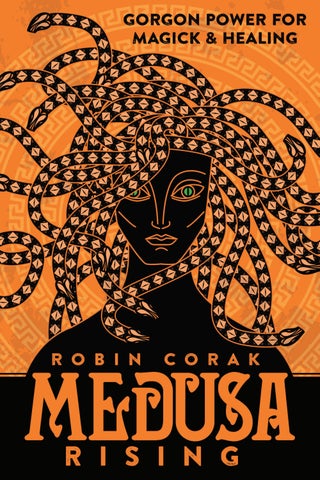
Praise for Medusa Rising “Robin Corak presents us with a captivating look at the intricacies in Medusa’s stories and the numerous ways that her imagery and presence have influenced modern collective consciousness. Corak brings us bright and engaged writing on the historical and mythic lore related to this enigmatic being while also balancing the academic learning with effective methods to integrate Medusa’s teachings on incredibly personal and spiritual levels. … This exhilarating deep dive brings the oft-feared Gorgon from a status of dangerous, misunderstood monster to that of a goddess of shadow work, healing and justice.”
—Nikki Wardwell Sleath, author of The Goddess Seals, Dream Sorcery, Ogham Sorcery, and Seals of the Tuatha “An exploration of trauma, power, and reclamation. Written with traumainformed awareness, this book approaches difficult material with respect for the reader’s autonomy, pacing, and boundaries. … This is both a rigorous exploration of myth and a living initiatory text: one that dares us to look unflinchingly at our shadows and emerge more whole, more powerful, and more truthful. This is an essential body of work for anyone seeking a deeper understanding of power, trauma, and rebirth and how it applies to the alchemy of transformation.”
—Frances Billinghurst, author of Dancing the Sacred Wheel, Encountering the Dark Goddess, Contemporary Witchcraft and On Her Silver Rays “A well-researched book about a much-needed ally in ever-precarious times. … Robin’s writing is personal, instructive, and service-oriented, helping readers find and claim their place with Medusa. With rituals, practices, and journal questions as prompts for reflection, Medusa Rising serves as a call to action. With action comes the responsibility to understand our own contradictions so we might move forward with discernment, wielding our unique gifts, just as Medusa does.”
—Irisanya Moon, author of many books, including Hecate: Goddess of Magick and Witchcraft “If you thought you knew all about Medusa as a monster in Greek mythology, get ready to enjoy an incredibly revealing and captivating look at one of the most recognizable Greek figures. In the book Medusa Rising by Robin Corak,
Medusa is finally getting the goddess treatment she has always deserved. This book provides meditations, exercises, and spells to help the reader personally explore the mythology, historical significance, and impact of Medusa in modern times. Whether you are interested in Greek mythology, goddesses, monsters, or just an amazing story of a figure long misunderstood, you will love this book!”
—Kanani Soleil, author of Witchcraft in the Cul-de-Sac “Anchored in meticulous scholarship and filtered through the lens of compassionate and wise experience, Medusa Rising is an exquisite book that calls to the needs of the time. … Delving into every corner of this intricate myth, Robin Corak unravels all the contradictions to create a seamless story both heartrending and profound. As a result, this is not just a book about Medusa. It offers a lush glimpse into the rich myths and customs of the ancient world that lay the foundation for our modern Western culture. Medusa Rising is a mythic feast and Robin has laid out a sumptuous spread for the soul, enticing out the most subtly nuanced of flavours embedded in Medusa’s myth to gift us with both wisdom from the past and the contemporary insight gleaned from personal experience.”
—Tiffany Lazic, author of Psychopomps & the Soul and The Psychopomps Oracle
© Photo by Emily Corak
About the Author Robin Corak is the author of Dream Magick, Persephone, and Demeter as well as the contributor of various essays and stories in Pagan anthologies. Robin is a certified death doula and life coach who has presented locally and at national conferences including Paganicon, Sacred Space, the Water Priestess Confluence, and the Ninefold Festival. A longtime member of the Sisterhood of Avalon, Robin has also been the writer of the Phoenix Rising blog for Agora Patheos. Previously she was CEO of a large nonprofit social services organization working with individuals experiencing challenges such as trauma, homelessness, and poverty. In addition to teaching workshops on a diverse array of metaphysical topics, she also offers services including Reiki, coaching, and tarot reading. More information can be found on Robin’s website: www.phoenixawenrising.com.
Medusa Rising: Gorgon Power for Magick and Healing Copyright © 2026 by Robin Corak. All rights reserved. No part of this book may be used or reproduced in any manner whatsoever, including internet usage, without written permission from Llewellyn Worldwide Ltd., except in the case of brief quotations embodied in critical articles and reviews. No part of this book may be used or reproduced in any manner for the purpose of training artificial intelligence technologies or systems. First Edition First Printing, 2026 Book design by Rordan Brasington Cover design by Shannon McKuhen Cover illustration by Delcarmat Editing by Sophia Kurtz Interior illustrations by Llewellyn Art Department: 130, 166, 170 All other Interior illustration elements by Delcarmat Llewellyn Publications is a registered trademark of Llewellyn Worldwide Ltd. Library of Congress Cataloging-in-Publication Data (Pending) ISBN: 978-0-7387-8175-4 Llewellyn Worldwide Ltd. does not participate in, endorse, or have any authority or responsibility concerning private business transactions between our authors and the public. All mail addressed to the author is forwarded but the publisher cannot, unless specifically instructed by the author, give out an address or phone number. Any internet references contained in this work are current at publication time, but the publisher cannot guarantee that a specific location will continue to be maintained. Please refer to the publisher’s website for links to authors’ websites and other sources. Llewellyn Publications A Division of Llewellyn Worldwide Ltd. 2143 Wooddale Drive Woodbury, MN 55125-2989 www.llewellyn.com Printed in the United States of America GPSR Representation: UPI-2M PLUS d.o.o., Meduli eva 20, 10000 Zagreb, Croatia matt.parsons@upi2mbooks.hr
Other Books by Robin Corak Dream Magick: Change Your Reality through the Liminal World of Sleep (Llewellyn, 2024) Demeter (part of the Pagan Portals series, Moon Books, 2022) Persephone: Practicing the Art of Personal Power (part of the Pagan Portals series, Moon Books, 2020)
Forthcoming Books by Robin Corak Working with the Muses: For Greater Inspiration and Creativity (Llewellyn)
I dedicate this book to my aunt, Linda Woodbury, and my niece, Anam Kelly. To Linda: You are and were one of the most compassionate and gentle people I have ever met, and yet you also were one of the strongest and most resilient. You showed me that soft could be strong and kind could be powerful. You are greatly loved and missed. To Anam: Your fierce kindness, quiet confidence, and advocacy for those who were bullied for being different are a constant inspiration. I love you and miss you dearly. To anyone who has ever been the target of oppression, sexual assault, or who has had their voice silenced—I see you. I hear you. May Medusa and this book offer healing and empowerment.
Disclaimer Many activities in this book use herbs and essential oils. These activities are not to be considered or understood as medical advice. Please be sure to do research on herbs, flowers, and oils before you use them to ensure that they are not toxic, that you do not have any allergies to them, and that they won’t adversely cause complications with any medications you may be taking or any medical states you may be in, such as pregnancy. In addition, this book covers some challenging topics (such as sexual assault) that can be triggering. The exercises in this book are not intended to replace mental health treatment in any way, shape, or form but are instead meant to be complementary. The author strongly encourages anyone experiencing trauma, depression, anxiety, thoughts of harming self or others, or any other emotional disturbances to seek out mental health treatment. The following resources can help: United States National Suicide Hotline: 988 National Alliance on Mental Illness (NAMI): www.nami.org National Sexual Assault Hotline: 1-800-656-HOPE Suicide and Mental Health Hotlines for countries other than the United States can be found here: https://blog.opencounseling.com /suicide-hotlines/
Contents Activities
xv
Acknowledgments
xvii
Introduction
1
Chapter 1: Who Is Medusa?
9
Chapter 2: Polarity: Medusa and Minerva/Athena
29
Chapter 3: Monsters and the Alchemy of Anger
49
Chapter 4: Medusa and the Shadow
79
Chapter 5: Medusa as Sovereign Entity
105
Chapter 6: Medusa as Protector
123
Chapter 7: Medusa as Transformer
147
Chapter 8: Medusa as Mother and Muse Chapter 9: In Worship of Medusa Conclusion
193
Appendix: Correspondences Bibliography Index
205
213
197
159
175
Activities Guided Meditation to Meet Medusa
24
Polarity Exercise 1 40 Polarity Exercise 2 41 Combined Medusa and Minerva Incense for Polarity Magick Creating a Sacred Object with Polarity Magick Keening Ritual
42
65
Sacred Dance 68 Guided Meditation: Alchemizing Anger Medusa’s Sight: The Tower Tour Medusa’s Healing Tea
75
84
90
Core Wound Timeline Activity A Funeral for the Shadow
95
97
Medusa’s Healing Blood Anointing Oil Core Strengths Timeline Activity Sovereignty Mirror Ritual
101
109
112
Create a Personal Table of Correspondences Make Your Own Sovereignty Sigil
118
119
Medusa Witch Bottle 126 Protective Sigil
130
Mirror Magick for Protection
131
Trapping the Impostor Within
133
Creating Your Own Aegis
134
Ecstatic Trance: The Gorgon as Protector
141
Glamour Magick: Enchanting an Object
153
Abridged Version of Medusa’s Glamour Spell Medusa as Muse Tarot Spread
166 xv
156
42
xvi
Activities
Ritual to Connect With Medusa for Creative Inspiration Crystal Grid for Manifestation Recipe for Medusa Incense
170
179
Guided Meditation: Connect with Medusa Keeping a Medusa Grimoire
183
Ritual of Dedication to Medusa
183
180
168
Acknowledgments Bringing a book to life is a lot like birthing a child. I am so grateful to have so many loved ones who continued to support me in a variety of ways as I birthed this book. There have been so many people who contributed to this book in some form that I probably cannot list them all, but I will do my best to at least provide an overview. As always, I am grateful to my family for supporting my dreams and doing what they could to make it possible for me to bring this book to life. My husband, Richard, spent endless hours taking care of household tasks so that I would have the time and sustenance to write this book. He has always supported me in going after my dreams, and his words of encouragement continue to sustain me when impostor syndrome rears its ugly head. Richard, thank you for traveling through life with me over these twenty years. Your love and support have helped me to pursue dreams and to grow as a person. I love you so much. My son, Owen, has long been my biggest cheerleader, and I am thankful for the many times he has reminded me that the only limits I face are the ones I impose on myself. Both he and my friend Maria Cohen have been there when I needed a sounding board and also when I needed a break or a laugh! I am also blessed to have two amazing stepchildren (Emily and Steven), a son-in-law (Barrett), and a daughter-in-law (Sapida), as well as three beautiful grandchildren (Zoe, Ben, and Danny), who amaze me and bring me such joy. I come from a long line of strong women, and my mother, Sandi; my sister Lisa, and my niece, O’Rian are no exception. Thank you for cheering me on and reminding me of my own strength. The same goes for my cousins, Leslie and Tracy, and my Aunt Linda. My sisters-in-law Joanne, Marilyn, and Sharon have had my back from the moment I met them, and I feel blessed to be a part of their family. Jhenah Telyndru and Tiffany Lazic—thank you for your knowledge, your support, your teachings, and your wisdom. Both of you as well as the rest of my sisters in the Sisterhood of Avalon have shown me that it’s possible to build a diverse community of strong, talented women who support each other and walk beside each other as we remember, reclaim, and renew. To my friends
xvii
xviii
Acknowledgments
Jackie, Stephanie, and Benjamin—thank you for always believing in me and making me laugh when I get overwhelmed. To my friend B-One, you have always challenged me to stretch outside of my comfort zone and go after my dreams. Your unconditional love and acceptance of me means the world to me, and we have had some incredible adventures! I have so much love and gratitude for you for being in my life and am proud to call you my friend. I am excited to see you continue to grow and evolve as an artist and musician, and to share your talent with the world. The kavorka is real baby, and it smells like patchouli! A huge thank you to Elysia Gallo and the staff at Llewellyn for believing in my vision and giving me the opportunity to bring another book into the world. You are so supportive and incredible to work with and I feel fortunate to be a part of the Llewellyn family. I would like to acknowledge my ancestors and other beloved dear ones who have passed before me and who continue to show up in my dreams. This includes family members and friends (of the two-legged and four-legged varieties), Both of my grandfathers and grandmothers have set an example of how to be kind, help others, and live an honorable life. I especially want to honor my father, Bill, and my niece Anam: I have learned so much from both of you. Dad, I was fortunate to have a father who believed that women could do anything men could do. I miss you and hope you know how much of an impact you had on me. Anam, beautiful soul, you continue to inspire me and I am so grateful that I got to be your aunt. Both of you are two of the most loving and pure souls I have ever met, and you continue to teach me even in death. Finally, I must acknowledge Medusa herself. It’s been a wild and crazy ride, but my path with her has been deep, rich in wisdom, and invaluable. I feel honored to be able to hold a mirror up to this beautiful goddess for the world to see her complexities, gifts, and hidden truths. To anyone I may have neglected to mention by name, my deepest apologies, but please know that if you have crossed my path in any meaningful way in this life, I have learned from you and you have contributed in some way to this book and to the person I am today. Thank you!
INTRODUCTION
Priestess. Gorgon. Monster. All of these titles can and have been used to describe Medusa. Despite not being one of the twelve primary Olympian deities of ancient Greece, she is arguably one of the most well-known figures in Greek mythology. Her story has captivated readers for centuries, inspiring infamous works of art, characters in modern movies, and even the logo for the well-known Italian fashion house Versace. Yet, there is so much more lurking beneath Medusa’s mask than the one-dimensional monster that most people are familiar with. Medusa is a being of contradictions. As authors Garber and Vickers point out, Medusa is at once monster and beauty, disease and cure, threat and protection, poison and remedy. The woman with snaky locks who could turn the wary onlooker into stone [has come] to stand for all that is obdurate and irresistible.1 A familiar symbol of both terror and protection, Medusa’s influence spread far beyond the boundaries of ancient Greece. In her book Priestesses, Norma Lorre Goodrich asserts that Medusa was venerated in locations as far-flung as
1. Marjorie Garber and Nancy J. Vickers, eds., The Medusa Reader (Routledge Publications, 2001), 1.
1
2
Introduction
Iran, Afghanistan, Tibet, and other parts of Asia.2 Various sources also refer to her origination and influence in Libya. You will find throughout this book that I refer to Medusa as a goddess. It is true that she is not referred to as a goddess in her original myths, yet there are multiple figures in Paganism considered to be deities in this day and age even though they may not have been referenced as such in their original stories. I believe that with any myth, it is important to read between the lines, which includes looking at the context and historical period in which the myth is born. The myths of Medusa were created primarily during a time that was patriarchal in nature. In fact, many authors have suggested that her myth was in part a cautionary tale meant to deter young women from being anything but modest and chaste. Certainly referring to Medusa as a goddess would likely have changed how she was viewed, not to mention limit Athena’s and Minerva’s ability to punish Medusa as harshly as they did. There are plenty of examples from various cultures in which a female character is seen as a goddess or later endowed with the title. One thing that these examples have in common is that the myths typically present the character as a queen or ruler of some sort. In Welsh mythology, Rhiannon is referred to as a queen. In fact, Rhiannon’s name is said to be derived from the old Celtic name Rigantona, literally “great queen” or “divine queen,” yet today she is worshiped by many as a goddess in her own right. Similarly, the word Medusa is said to be derived from the Greek words for “ruler” or “guardian.”3 If we look at characteristics of deities across many cultures, we can find some similarities: • They may look like humans or have some human characteristics. • The deity has supernatural abilities of some kind. • Deities often have interactions of some sort with humans and may even express human emotions such as love, jealousy, or rage. I would argue that Medusa has all of these characteristics. She is described as being a beautiful maiden prior to her transformation at Athena’s hand. 2. Norma Lorre Goodrich, Priestesses (Harper Perennial, 1989), 181. 3. “Medusa,” Etymology Online, accessed April 2, 2025, https://www.etymonline.com/word /medusa.
Introduction
3
Depending on which version of the myth you read, she is capable of experiencing love (or at least lust), sadness, and anger. Her ability to turn men to stone with her gaze is a supernatural ability. As authors Mankey and Taylor point out, Medusa is undeniably viewed and worshiped as a goddess by many in the Pagan community.4 Throughout my spiritual path, I have always been drawn to those often considered to be the dark goddesses, those liminal deities associated with death or who are known to be daunting in some way. Medusa was no exception, yet I must admit that for many years I was intimidated by her. I worked with her from time to time yet always kept a respectful distance, never truly plumbing the depths of her magick. In 2019, Medusa began to make herself known more and more. I am certainly no stranger to messages from the gods and I have long paid special attention to synchronicities. Still, I could not figure out why Medusa was trying to reach me. At the time, I had my hands full with the books I was already working on. Then the pandemic hit, and, like many people, I entered a phase of internal chaos and multiple life transitions. In hindsight, I can now see that the timing of her nudges made absolute sense. On a global scale, our world was turned upside down as a result of the coronavirus, prompting previously unthinkable changes in how we lived our lives. The panic was palpable as hundreds of thousands of people died from COVID-19 in the United States alone. Travel was restricted, masks were mandated in many areas, and workers who were considered nonessential were required to stay home for a time. For me personally, the pandemic kicked off a series of significant transitions in my life. As the CEO of a large social services nonprofit organization, I had to quickly find ways to provide much needed resources to vulnerable families while mitigating risks to their health and the health of my employees and volunteers. At the same time, the demand for services was drastically increasing. Within a period of six months in 2021, I also unexpectedly lost my beloved eighteen-year-old niece, Anam, and five other friends to various causes. Over the next few years, I became an empty nester, retired from the nonprofit I had worked for most of my career, lost my dad, sold my home of twenty-two years, 4. Jason Mankey and Astrea Taylor, Modern Witchcraft with the Greek Gods (Llewellyn Publications, 2022), 222.
4
Introduction
and moved to an island several hours away. Some of these changes were welcome beginnings that I had chosen, but even chosen transitions can be stressful and necessitate a period of soul-searching and adaptation. Throughout this time of major transitions, I began to enter into a deeper relationship with Medusa. I came to discover that she is far more multi-faceted than she may seem at first glance and that she has an uncanny ability to cut through the smoke and mirrors of any situation to reflect clarity and truth. I felt the first hints of her power when I attended a ritual in her honor. At the time, I was getting ready to present a workshop and felt the beginnings of impostor syndrome creeping in. In the ritual, I heard Medusa telling me quite emphatically that I needed to let go of my fears and doubts and remember who I was at my core. I made a commitment to her and to myself to work on my own shadow wounds and to let go of the negative self-narratives that were no longer serving me. When I returned home, however, I lapsed in my attention to actively healing my shadow. One night, I began spiraling with anxiety and feelings of abandonment due to a misunderstanding with a dear friend. The grief of that misunderstanding was compounded by minor unrelated stresses that had been building up. For some reason I decided that this would be a good time to undertake a pathworking to Medusa’s cave. Physically worn out and emotionally exhausted, I prepared my ritual space. My altar to Medusa was set up with various items, including a candle made in her image. In addition to lighting the Medusa candle, I lit a beautiful red candle that I had been given recently and had used multiple times in the past few weeks. As a longtime priestess of Persephone, I called on her to be present, as I often do. I dimmed the lights, lit some incense, and sat down with my tarot deck of Greek mythology. Centering myself to pull a card, I began to feel an odd energetic sensation, almost like a tug of war between two entities. I was in a light trance state and didn’t want to divert my attention, so I tried to ignore whatever it was that I was feeling. I pulled the Medusa card and quickly felt my attention pulled to the red candle. The flame of the candle was leaping high, and my efforts to quickly put it out were futile. I ran into the kitchen to grab some water and was able to douse the flames while my husband and son came running downstairs after hearing the fire
Introduction
5
alarm go off. The fire hissed as it was extinguished and broke the glass of the candleholder. After the smoke cleared, I looked into what was left of the candle and saw a clump of wax in the form of a serpent sitting at the very top. I looked over at the Medusa candle on my altar—it had gone out at some point without melting any of her distinguishing features. I must admit that this experience was a bit terrifying. It seemed as though a battle of wills had occurred, with Persephone trying to protect me from the energies of Medusa. Surprisingly, my instincts told me that now was not the time to retreat. I felt as though I had done something to displease Medusa and at the same time felt her emphatic desire to communicate with me. I had underestimated her power, and she had shown me in no uncertain terms that if I was to connect with her deeply, I must overcome any reluctance and fear standing in my way. I thanked Persephone for her concern and let her know it was important that I enter a meditation with Medusa. I cast a circle, put my wards in place, dimmed the lights once again, and reattempted a journey to her cave. Meeting with Medusa was daunting, but I kept my fear at bay as she proceeded to share her frustration with me for indulging in negative self-talk and allowing old fears and insecurities to resurface and overwhelm me. She was upset that I had momentarily forgotten the sense of empowerment I’d felt when I attended her ritual, and that I had lapsed in my commitment to rooting out old wounds in order to heal. In her words, I had been given tools to continue my own cycle of healing but instead of using those resources, I made myself small by wrapping myself in feelings of shame and despair. This was an extraordinary experience for me, and certainly one of the most dramatic shows of power I have observed in my twenty-five-plus years on a Pagan path. Medusa made it clear that she would not coddle me, but at the same time was emphatic that if I was willing to do the work, courageous enough to not shy away from the shadowy realm of my subconscious on what could be an even deeper and more profound journey than I had in the past, she would then be my ally, helping me to attain personal sovereignty and healing on a level that I had not yet experienced. Medusa has kept her promises, and I have been loyal in my attempts to learn from her and do the work necessary to continue to heal. She has reminded me time and time again through her words and actions that it is necessary, as
6
Introduction
Joseph Campbell is said to have avowed, to enter the cave we most fear in order to find the treasure we seek. Working with Medusa isn’t for the faint of heart, and, as with most deities, each person’s experience with her is quite unique. She seems to intuitively know what we need in order to move forward, even if it’s not what we think we want. However, I can tell you that the rewards I have experienced as a result of working with her have been far beyond what I could have imagined. I want to take a moment to acknowledge that as you’ll soon see, there are many aspects of Medusa’s myth that can be hard to digest, especially when so many people who are the victims of sexual assault are still blamed, and getting justice for this type of crime is still quite challenging. Sadly we still see far too many cases in which the victims of sexual assault never receive justice and even if they do, it doesn’t make up for the spiritual and emotional scars that can persist for years and years. It is my heartfelt intent in this book to unveil Medusa— that is, to look at her story from new perspectives and bring to light the many positive aspects of her being that are often overlooked. It is also my hope that working with Medusa can offer readers a path and an ally with whom to heal and reclaim personal power. In chapter 1, we dive into the various versions of Medusa’s myth, her family tree, her symbolism, and her connections to Libya. Chapter 2 explores how to use the polarity between Medusa and Minerva/Athena in your magick. Chapter 3 builds on this topic through a lens of alchemizing anger into the power to bring about positive change. This chapter also examines the function of monsters in myth, as well as Medusa’s lessons that are relevant to our current societal challenges. Chapter 3 also provides practical ways that we can enact advocacy, inclusivity, and allyship for ourselves and for those whose human rights may be threatened. Chapter 4 focuses on Medusa’s connection to healing and shadow work, as well as the symbolism and alignment with the Tower card of standard tarot decks. Moving out of the dark and further into the light, chapters 5 and 6 delve into Medusa’s guidance in achieving greater self-determination and working with her for protection. Chapters 7 and 8 look at Medusa’s lesser-known roles of transformer, mother, and muse. Finally, chapter 9 offers some practical ways to serve Medusa in modern times. Each chapter has hands-on activities designed to help you further your relationship with her. In addition, I have
Introduction
7
included journaling prompts throughout this book; I have found journaling to be quite effective in helping to reflect upon and better understand our own shadows and strengths as well as connecting to Medusa’s wisdom. It is my sincere hope that this book will shed some light on one of the most infamous yet misunderstood entities in Greek mythology. It is also my belief that by reading these words, you, dear reader, may benefit from her wisdom, strength, and guidance. It is important to note that much of this book reflects my own personal experiences with Medusa. Your experiences may differ. In my experience, Medusa is not a deity known to be warm and nurturing; she is a goddess who is determined to act as a mirror to show us our own gifts and power. She cultivates our ability to be resilient and shed anything that no longer serves us, and to petrify any and every obstacle that blocks our self-fulfillment and the realization of our potential. May your journey with her be fruitful, and may you reap the many rewards she has to offer.
8
Introduction
Journal Questions Why do you want to develop a stronger relationship with Medusa? As it relates to your desire to work with Medusa, what would success look like to you? Do you have any concerns about working with her? If so, what are they? What excites you most about working with Medusa? What scares you the most? Medusa can help bring about significant transformation and change. How do you feel about change in general? How do you typically react to unexpected or overwhelming changes?
Chapter 1
WHO IS MEDUSA? The first version of Medusa’s myth was written around 700 BCE as part of Hesiod’s Theogony, though some scholars theorize that her story is much older. In order to better understand Medusa’s mythological background, it is helpful to look at her family tree.
Medusa’s Family Tree Although a few scholars, such as Hyginus, refer to Medusa’s parents as Gorgon and Ceto, most sources agree that she was a daughter of Phorcys and Ceto. Phorcys (or Phorkys as it is sometimes spelled) was a Greek sea god who could be quite intimidating and was known as a god of the hidden dangers in the ocean’s depths. Given the title “Old Man of the Sea” by Hesiod, Phorcys was the son of Pontus, the personification of the sea. In Hesiod’s Theogony, Gaia is said to be Medusa’s great-grandmother, and in some myths Rhea is said to be Pontus’s sister. Oddly (though perhaps not so oddly given the nature of Greek myths), both Phorcys and Ceto were said to be the offspring resulting from Pontus mating with his mother. Ceto (or Keto as she is sometimes called), was described as a sea monster. In fact, in ancient Greek the word keto means “sea monster” or “whale.” Given that both Phorcys and Ceto were viewed as dangerous and monstrous deities, it is not surprising that together they produced some of the most monstrous children in the Greek pantheon. These children included: 9
10
Chapter 1
Thoosa, mother of the cyclops Polyphemus, who was later blinded by the hero Odysseus Echidna, a being that was half-woman and half-snake Ladon, a dragon-like monster that guarded the golden apples of the nymphs known as the Hesperides. (The golden apples were said to bestow immortality and divine favor.) Scylla, a legendary sea monster known to devour sailors according to Homer’s epic The Odyssey The triplets known as the Graiai The triplets known as the Gorgons The Graiai play an important role in Medusa’s myth. Described as being old from birth, this grouping of sisters was composed of Deino (“terror” or “fear”), Enyo (“horror,” not to be confused with the Greek war goddess of the same name), and Pemphredo (“alarm” or “destruction”).5 Hesiod described Pemphredo as “fine-robed” and Enyo as wearing a saffron robe.6 Hesiod also described the sisters as being “fair cheeked.”7 Like their siblings and their parents, the Graiai are associated with the sea. Author David Leeming describes them as having hair that is “gray like the rough sea.”8 Their most well-known characteristic—in addition to their old age at birth—is the fact that they share one eye and one tooth between them and must pass the eye from hand to hand in order to see. As we will see later when exploring Medusa’s myth, it is the Graiai who assist Perseus (albeit begrudgingly) in carrying out his task of slaying Medusa. Depending on the version, Perseus seeks the Graiai out in order to discover either the location of the Gorgons or the three objects needed in order to kill Medusa. Perseus accomplishes this by stealing the eye from the Graiai as they are passing it from one to another. Perseus holds the eye hostage until he gets the information he is seeking. 5. David Leeming, Medusa in the Mirror of Time (Reaktion Book, 2013), 10; “The Graiai: Sisters of Shared Sight,” Greek Mythology, accessed 5/15/25, https://www.greekmythology.com /Myths/Monsters/Graeae/graeae.html. 6. Hesiod, Hesiod’s Theogony, trans. Richard Caldwell (The Focus Classical Library, 1987), 44. 7. Hesiod, Theogony, 44. 8. Leeming, Medusa, 10.
Who Is Medusa?
11
This brings us to the triplets at the center of Medusa’s myth: the Gorgons themselves. The term “Gorgon” is derived from the Greek word gorgos, “fierce looking” or “dreadful.”9 Some believe that the Gorgon pre-dates Hesiod’s myth and that there may have been only one Gorgon, who was a powerful goddess of life and death.10 The Gorgons were three sisters, two of whom were immortal. Medusa, the third sister, was mortal but no explanation seems to be given for why this is. These sisters were said to be born in a grotto beneath Mount Olympus.11 In Mythologies, Fulgentius, a Latin writer who lived in the fifth to sixth century CE, theorizes that the sisters were meant to represent three kinds of terror: • Terror that makes the mind weaker • A dread that consumes the mind completely • Terror that “not only enforces its purpose upon the mind but also its gloom upon the face”12 We don’t know which of these sisters each attribute is assigned to, and what we do know about each of the sisters’ characteristics is somewhat limited. Stheno was the oldest of the Gorgons and by some accounts was the most savage of the three, having killed the most men.13 The middle sister, Euryale, possesses a name that in ancient Greek translates to “far roaming.” She is known by her piercing screams, especially upon learning of Medusa’s death. In some versions of the myth, she also had the power to turn people to stone.14 Descriptions of the Gorgons vary, though some similarities persist. The secondcentury scholar Apollodorus describes the Gorgons as having “scaly heads, boar’s tusks … protruding tongues, glaring eyes, and serpents wrapped around their waists as belts.”15 In some descriptions the Gorgons have wings and claws. Walter Burkert, author of Greek Religion, states that Hera’s sanctuary in Tiryns 9. Mankey and Taylor, Modern Witchcraft, 253. 10. Marijas Gimbutas, The Language of the Goddess (Harper and Row Publishers, 1989), 208. 11. Daniel B. Lewis, The Mythology of Medusa (CreateSpace Independent Publishing Platform, 2015), 62. 12. Gerber and Vickers, Medusa Reader, 48. 13. Lewis, Mythology, 62. 14. Lewis, Mythology, 46. 15. Stephen R. Wilk, Medusa: Solving the Mystery of the Gorgon (Oxford University Press, 2000), 21.
12
Chapter 1
has terracotta Gorgon masks dating from as early as the eighth century BCE, and characterized by heads with “wild tusk-like fangs.”16 While most Gorgons share common features of wide-open eyes, tongues hanging out, and tusks or fangs, there are some unique differing descriptions that occur. Miriam Robbins Dexter, PhD, associates Medusa with depictions of a horse. According to Dexter, a Greek Boeotian vase made in approximately 650 BCE shows Medusa as a centaur: half-woman, half-horse.17 The horse theme is also found on a vase from Rhodes (sixth century BCE) and an amphora from Naples, Italy.18 Renowned anthropologist Marija Gimbutas asserts that when Medusa’s “mask” was attached to a body (such as in painting or sculpture), it often had the wings of a bee.19 Snakes play a dominant role in the description of Medusa and her sisters. Initially, snakes either formed a belt the Gorgons wore or were part of one. The concept of snakes acting as hair for one or more of the sisters did not arise in writing until Ovid’s retelling of the myth in the year 8 CE. The eight-foothigh statue of Medusa at the Temple of Artemis in Corfu is one of the most striking visages of a Gorgon. According to the book, Re-visioning Medusa: From Monster to Divine Wisdom, this representation of Medusa is not raging, but radiant in her full potency. Snakes with open jaws extend from each side of her head and two copulating serpents encircle her waist. She wears winged sandals, her great wings are fully extended … her bent knee posture suggests she is flying.20 It is interesting and perhaps somewhat apt that, in at least some depictions, Medusa has equine and avian qualities, given the nature of one of her descendants. Rounding out Medusa’s family tree are the two children she bore the moment that Perseus cut off her head: Pegasus and Chrysaor. These two children were said to be fathered by Poseidon, himself associated with horses. The
16. Walter Burkert, Greek Religion (Harvard University Press, 1985), 104. 17. Glenys Livingstone, Trista Hendren, Kaali Cargill, and Pat Daly, Re-Visioning Medusa: From Monster to Divine Wisdom (Girl God Books, 2019), 42. 18. Livingstone et al., Re-Visioning Medusa, 42. 19. Gimbutas, Language of the Goddess, 207. 20. Livingstone et al., Re-Visioning Medusa, 3–4.
Who Is Medusa?
13
better known of the two siblings, the Pegasus was a winged horse famous for carrying Zeus’s thunderbolts. (We will explore this myth further in chapter 8.) Chrysaor was a golden-sword-wielding giant; however, in some depictions he is said to have been a winged boar.21 The depiction of Chrysaor as a winged boar certainly aligns with some of the descriptions of the Gorgons and Medusa herself. Chrysaor was not as famous as his sibling and did not have a large part to play in Greek mythology. He was a king of Iberia (what is now known as southwest Europe) who married Callirhoe, a daughter of Oceanus.
Geography of Medusa and Her Sisters It is hard to pinpoint an exact location where the Gorgons lived, though most descriptions place them near water. The French philosopher Louis Marin hypothesized that the Gorgons lived in western Greece, in the land of the dead near the Hesperides.22 We know that art featuring the Gorgons was found in places including Corfu, Tiryns, and Rhodes in Greece and in Naples, Italy. Perhaps most interesting is the connection Medusa seems to have with North Africa. To understand why some historians and authors believe that Medusa originated in North Africa, one must first take a look at the relationship between Greece and Libya. While there is some disagreement on how and why the Greeks came to Libya, it is a known fact that the Greeks established a colony there known as Cyrene around 631 BCE. It is likely that at least part of the motivation for the expedition was the desire to explore other lands in the Mediterranean in search of resources. The most common narrative asserts that the Greek island of Santorini was experiencing a lack of reliable food sources and social upheaval. After consulting with the Oracle of Delphi, Battus Aristoteles, the leader of the expedition, was told to establish a colony in Libya.23 Although Hesiod’s Theogony contains the first written account of the Gorgons and Medusa in particular, many speculate that the Gorgons pre-date this account. Hesiod wrote that the Gorgons lived far beyond the ocean, which later historians took to mean Libya. There is of course no way to verify that Hesiod was speaking specifically of Libya, but later authors and historians also 21. “Khrysaor,” Theoi, accessed 7/10/25, https://www.theoi.com/Ther/Khrysaor.html. 22. Gerber and Vickers, Medusa Reader, 140. 23. Dimitrio Gkinis, “How Ancient Greeks Shaped Libya,” Greek Reporter, September 18, 2025, https://greekreporter.com/2025/09/18/ancient-greeks-libya-cyrenaica-pentapolis/.
14
Chapter 1
place Medusa there. These include the Greek historian Herodotus, the Roman poet Ovid, and the Greek geographer Pausanias the Traveler. In his retelling of the Medusa myth in 8 CE, Ovid not only associates Medusa with Libya but asserts that when Perseus was traveling with Medusa’s head over the Libyan desert, the blood that dripped from the Gorgon’s head created the serpents that are said to live in abundance in the Libyan desert. Later, around 61 to 65 CE, the Roman poet Lucan credited Medusa with the creation of the amphisbaena, the mythical two-headed snake that lives in Libyan deserts and can move forward and backward.24 Pausanias believed that Medusa was a queen in Africa who was murdered by Perseus when he invaded her country.25 Diodorus Siculus, a first-century BCE Greek historian, also believed that Medusa and her sisters were women of power in Libya whom Perseus “subdued,” though he goes on to state that the Gorgons were ultimately destroyed by Heracles.26 And in a completely new direction, author Jane Harrison writes in Prolegomena to the Study of Greek Religion that the Gorgon was actually an animal: Some say the beast which the Libyans called Gorgon was like a wild sheep, others like a calf; it had a mane hanging over its eyes so heavy that it could only shake it aside with difficulty; it killed whomever it looked at … by a destructive exhalation from its eyes.27 Harrison appears to be referring to a claim made by ancient Greek writer Alexander of Myndus, who asserted that the Libyans possessed the type of animal Harrison describes.28
The Evolution of Medusa’s Myth The ancient Greeks took their myths very seriously. It was not uncommon for a resident of Greece to proudly trace their lineage back to a deity in great detail. 24. Lucan, Civil War, trans. Matthew Fox (Penguin Books Limited, 2012), 276. 25. Wilk, Medusa, 25. 26. Livingstone et al., Re-Visioning Medusa, 29. 27. Jane Ellen Harrison, Prolegomena to the Study of Greek Religion (Princeton University Press, 1991), 196. 28. Henry T. Riley, Metamorphoses of Ovid Volume 1 Books I-VII (Sherman & Co., 1899), accessed via https://www.google.com/books/edition/The_Metamorphosis_of_Ovid /choMAAAAIAAJ?hl=en&gbpv=1.
Who Is Medusa?
15
There are glimpses into the Gorgons via art and archaeological ruins that predate the first stories written about them as well as reason to suggest that the story of the Gorgons was already known prior to its recording. Oral versions appear to have portrayed all three of the Gorgon sisters as monstrous. HESIOD AND OVID The first written version of Medusa’s myth can be found in Hesiod’s Theogony, a detailed history of the Greek gods written around 730–700 BCE. Very little is known about Hesiod other than that he was both a farmer and a poet who lived in the region known as Boeotia. Hesiod describes himself as a shepherd who was visited by the nine muses on the slopes of Helikon. There, Hesiod states that the muses gifted him a laurel staff as well as a “beautiful song,” suggested to be Theogony itself. In Hesiod’s version of the Gorgons’ tale, Medusa was the only one of the three sisters who was not immortal. Her story in Theogony is brief, which is interesting considering the infamy of her myth. Hesiod doesn’t describe her beyond stating that she is unlucky and mortal, and he doesn’t make any mention of a transformation. In fact, he skips right from her dalliance with Poseidon to her death at Perseus’s hands: … .the Dark-Haired god lay with her in a soft meadow and flowers of spring. And when Perseus cut off her head, out jumped great Chrysaor and the horse Pegasos 29 Arguably the most well-known and in-depth version of Medusa’s myth comes to us from Ovid. Born in 43 BCE, Ovid came from a respectable, wealthy family and was known for his mastery of rhetoric. Ovid seemed to be on track for a career in politics, but he devoted himself to poetry, a decision that his father disapproved of. He had mostly finished his Metamorphoses when some unknown scandal with the imperial family caused Emperor Augustus to exile him to the other side of the world, to a city in Romania on the coast of the Black Sea. Cut off from his friends and family, Ovid eventually died in this place in 17 CE. 29. Hesiod, Theogony, 45.
16
Chapter 1
Metamorphoses contains the myth of Medusa but only as a function of Perseus’s myth. The story actually starts after Perseus has beheaded Medusa and ultimately works its way back to Medusa’s origin. The myth begins with an explanation of Perseus’s lineage as the son of Danaë and Jupiter (Zeus in the Greek pantheon). Upon Perseus’s birth, Danaë’s father, Acrisius, cast both of them out to sea as the result of a prophecy that foretold Acrisius being killed by his grandson. Both mother and son landed on the island of Seriphos. Once Perseus was grown, he became aware that the new ruler of Seriphos, King Polydectes, desired to marry his mother. In order to get Perseus out of the way, King Polydectes tricked Perseus into bringing back Medusa’s head, knowing it was a futile task. With the help of Athena and the Greek god Hermes, Perseus located the cave where the Graiai (the Gorgons’ sisters) lived. As mentioned previously, Perseus stole the one eye that all three shared, only returning it when the Graiai told him where the Gorgons could be found. Using tools the gods had given him, including winged shoes, a mirrored shield, and a sickle, Perseus slew Medusa. But it was only when he returned to court (accompanied by his new wife, Andromeda), that Perseus shared the crucial details of who Medusa originally was and how she came to be a monster. Specifically, Perseus was asked why Medusa was the only one of her sisters who had entwining snakes in her hair. Perseus replied that Medusa was once a beautiful maiden sought after by many men, describing her hair as her “crowning glory.”30 Perseus then added, “The story goes that Neptune the sea god raped this glorious creature inside the shrine of Minerva.”31 Here is where things get a little interesting. If you read Medusa’s myth online or ask people who Medusa was initially, most will say that she was a priestess of Athena (Minerva in Ovid’s telling). Yet there is nothing in either Hesiod’s or Ovid’s versions that explicitly states that Medusa was a priestess. It would seem that this vocation was added unofficially over time and has been repeated to the point that it has become an accepted piece of Medusa’s lore. The only explanation I can find is that perhaps assigning her a role as priestess would explain why she was in Minerva’s shrine at the
30. Ovid, Metamorphoses, trans. David Raeburn (Penguin, 2004), 170. 31. Ovid, Metamorphoses, 170.
Who Is Medusa?
17
time of the rape. Because significant energy has built in later years around the idea of Medusa being a priestess of Minerva/Athena, we will work with this aspect of her at times throughout this book. Perseus goes on to recount what occurred when Minerva learned of the assault that happened in her sacred shrine, saying, “Jove’s daughter screened her virginal eyes in horror and punished the sin by transforming the Gorgon’s beautiful hair into horrible snakes.”32 It seems horribly unfair that Minerva would punish Medusa when she was a victim. Unfortunately, we can still find examples in today’s more “civilized” society where victims of sexual assault are blamed for the crimes committed against them. We will delve into this in more depth in chapter 2, but here I will simply state that women had few rights in ancient Greece and Rome; desecration of a temple was a serious offense in both cultures. The remainder of Perseus’s story covers how he was able to slay Medusa, the events that occurred during his journey to bring Medusa’s head back to Seriphos, and what happened after telling his tale to his audience. Using his bronze shield, Perseus cut off Medusa’s head while she slept. He then traveled with the head to Atlas’s land. There, he made the mistake of telling Atlas of his parentage, thinking that this would gain him favor and that Atlas would grant his request for shelter. Unbeknown to him, Atlas had also received a prophecy: that the golden tree he so valued would be stolen by a son of Jove. Atlas tried to get Perseus to leave, but Perseus used Medusa’s head to turn him to stone. Another famed episode in Perseus’s journey home was meeting Andromeda. In what are known today as the lands of Ethiopia, the god Ammon had chained the princess Andromeda to a rock, a punishment for her mother’s boasts of beauty. Just as she was explaining her predicament to Perseus, who was passing through, a great sea monster came near to devour Andromeda. After fighting and killing the monster, Perseus asked for Andromeda’s hand in marriage as his reward. Perseus went to wash his hands clean in the ocean and, not wanting to damage Medusa’s head, softened the ground and laid a pile of seaweed down for protection. Ovid explains that coral was created from the drops of Medusa’s blood that trickled into the sea.
32. Ovid, Metamorphoses, 171.
18
Chapter 1
Perseus’s story continues with an account of an attack against him by Andromeda’s uncle and promised husband, Phineus. This attack turned into a full-fledged battle involving multiple people, and Minerva once again coming to Perseus’s aid. Perseus once again used Medusa’s head to turn men to stone and was victorious in this battle. He and his new wife returned to Seriphos where he murdered King Polydectes, once again using Medusa’s head. Overall, the theme of Perseus and Medusa’s myth, like all the stories in Metamorphoses, is that of passion (“pathos”) as well as transformation. OTHER WRITERS IN ANTIQUITY In the eighth century BCE, the concept of the Gorgon makes a brief appearance in Homer’s Odyssey, when Odysseus describes his journey to the Underworld. Odysseus states that he was panic-stricken that Hades might send to him the “head of that awful monster Gorgon.”33 It is intriguing that Homer did not make any effort to describe who or what “the Gorgon” was. It is possible that Homer assumed his audience was already familiar with the Gorgon due to Hesiod’s Theogony, though this could also be due to the existence of an oral story that pre-dated Hesiod. The next significant retelling of Medusa’s myth is by Pindar in the fifth century BCE in his Pythian Odes. In his twelfth ode, Pindar focuses on Perseus’s role in the myth, describing him as “despoiling fair-cheeked Medusa.”34 This is the first time we are given a motive for Perseus’s act, for Pindar states that he decapitated Medusa to make King Polydectes regret his feast and his enslavement of Perseus’s mother, Danaë.35 It is also in Pindar’s ode where we first see the idea of Athena creating music from the sounds of Medusa’s sisters grieving as Perseus ran off with Medusa’s head. Pindar refers to music as, “the art once invented by Pallas Athena, when she wove music from the savage Gorgons’ deadly dirge.”36 Aeschylus, the ancient Greek writer sometimes called “the father of tragedy,” adds to the reputation of the Gorgons as terrifying in his fifth-century BCE classic Prometheus Bound. Prometheus Bound dramatizes the story of Pro33. Homer, The Iliad and The Odyssey, trans. Samuel Butler (Benediction Classics, 2020), 331. 34. Pindar, The Complete Odes, trans. Anthony Verity (Oxford University Press, 2008), 87. 35. Pindar, Complete Odes, 87. 36. Pindar, Complete Odes, 87.
Who Is Medusa?
19
metheus, a Titan punished for stealing fire from the Greek gods and giving it to humanity. Prometheus warns Io, a priestess of the goddess Hera and the object of Zeus’s desire, about the dangers she may face on the journey she is undertaking in the story. Prometheus describes the Gorgons as “foes of man” who have wings and are encircled by snakes and warns Io that no mortal can look at the Gorgons and live.37 Attributed to the scholar Hyginus, the second-century CE Fabulae briefly mentions Perseus’s use of Medusa’s head to petrify King Polydectes as well as other enemies in a short entry entitled “Andromeda.” Apollodorus’s Library of Greek Mythology adds a new element to the story of Medusa. It describes the assistance Perseus received from Athena and other gods such as Hermes, who offered Perseus magical items such as winged sandals, a cap of invisibility, and a magic pouch.38 Apollodorus also states that Medusa may have been killed as a result of claiming that her beauty rivaled Athena’s. What is most unique about Apollodorus’s version of the myth is his assertion that Athena had given Asclepius (also known as Asklepios), the god of medicine, Medusa’s blood that could both heal and poison depending on which side of her body the blood originated from.39 Asclepius used the blood from the right side of Medusa to not only heal but to resurrect the dead, which ultimately resulted in Zeus striking him down with a thunderbolt only to resurrect him later on. Often known as Pseudo-Apollodorus, he was originally thought to be the Greek scholar Apollodorus of Athens. Initially, historians believed that Apollodorus wrote his book in the second century BCE, but later historians argued that the Library of Greek Mythology was likely written in the second century CE and that “Apollodorus” may have been a pseudonym.40 The last significant entry to the canon of what we would consider Medusa’s mythology prior to the second century CE comes from the Roman poet Lucan. Lucan featured Medusa in his work Civil War, believed to have been written sometime between 61 and 65 CE. Civil War focuses on the Roman conflict 37. Aeschylus, Prometheus Bound, trans. George Thomson (Dover Publications, 1995), 35. 38. Apollodorus: The Library of Greek Mythology, trans. Robin Hard (Oxford University Press, 1997), 67. 39. Apollodorus: Library of Greek Mythology, 119. 40. “Apollodorus, The Library of Greek Mythology 1,” Theoi, accessed February 4, 2026, https:// www.theoi.com/Text/Apollodorus1.html.
20
Chapter 1
between Julius Caesar and Pompey the Great. The story of Medusa in Civil War is a bit of a tangent, used to explain the serpents that Pompey’s forces had to contend with when stationed in Libya. Lucan seems to mostly stay true to Ovid’s version, focusing even more on Medusa’s terrifying nature. Lucan states that Medusa’s own family and even her beloved snakes feared her and tried to avoid her gaze.41 Lucan adds an element of sensuality to Medusa in describing her snakes, which he says flow down her back, “lashing Medusa’s neck, which gave her pleasure.”42 Oddly, Lucan does seem to express some empathy for her, unusual in comparison to previous versions of her myth: “Poor Medusa, these are what she had that everyone was free to gaze at with impunity.”43
Medusa’s Symbolism Throughout Art and Popular History Medusa’s myth has endured and evolved in the thousands of years since Metamorphoses was written. Medusa has been featured in well-known works of art including: • The breastplate of Alexander the Great in the mosaic of Alexander found in Pompeii around 120–100 BCE • The bases of columns at the Basilica Cistern in Constantinople • Oil paintings by artists Leonardo da Vinci, Caravaggio, and Peter Paul Rubens • The bronze statue “Perseus and Medusa” by Benvenuto Cellini in 1554 (and the 2008 statue crafted by Argentinian artist Luciano Garbati, in which Medusa holds Perseus’s severed head) • “Medusa,” a 1963 painting by Salvador Dalí
41. Lucan, Civil War, 274–75. 42. Lucan, Civil War, 274. 43. Lucan, Civil War, 274.
Who Is Medusa?
21
MODERN DEPICTIONS Medusa has been memorialized in other ways as well. Her head is featured on the flag of Sicily and in the coat of arms for Dohalice, a village in the Czech Republic. In the Romantic period, writers portrayed Medusa as a beautiful woman and victim rather than a monster. According to Re-Visioning Medusa, writers of the era perceived Medusa as representative of the “ecstatic discord between pain and pleasure, beauty and horror, and divinely forbidden sexuality.”44 Even the famous psychoanalyst Dr. Sigmund Freud chimed in on his interpretation of Medusa in his 1922 article, “Medusa’s Head.” In it, Freud frames the terror of Medusa as the fear of castration and conflates this with the example of a young boy seeing adult female genitals surrounded by pubic hair and realizing that the female doesn’t have a penis, ultimately assuming that she has been a victim of castration.45 As absurd as this may sound to modern readers, it is important to keep in mind that Freud’s theories—which often revolved around stages of psycho-sexual development—received mainstream acceptance for a time, making him an important figure in the field of psychology. Given that Medusa was written from the perspective of a patriarchal culture and that she had no voice in the myths, it is not surprising that her myth has been reclaimed and reinterpreted in more recent years. In modern times, Medusa has been used as a symbol of feminism, female empowerment, and fighting against oppressive patriarchies.46 In her groundbreaking 1976 essay “The Laugh of the Medusa,” French feminist Hélène Cixous emphasizes the importance of the female voice in writing and reframes Medusa as beautiful and laughing, a guide for female resistance.47 The trend to reclaim Medusa and her myth continues today, with an exhaustive list of novels that have attempted to tell her story from a feminist perspective. In the past five years alone, five novels retelling Medusa’s story from a more empathetic and feminist perspective 44. Livingstone et al., Re-Visioning Medusa, 5. 45. J. Jones, “Psychoanalysis and Mythology,” Freud File, accessed January 23, 2026, https:// freudfile.org/psychoanalysis/mythology.html. 46. Maysara Kamal, “Reclaiming Medusa: How Did She Become a Symbol of Female Empowerment?” The Collector, November 28, 2024, https://www.thecollector.com /reclaiming-medusa-symbol-of-female-empowerment/. 47. Hélène Cixous, “The Laugh of the Medusa,” trans. Keith and Paula Cohen, Chicago Journal 1, no. 4 (1976): 875–93, https://www2.csudh.edu/ccauthen/576F10/cixous.pdf.
22
Chapter 1
have been written by female authors, all of which have a ranking of four stars or more out of five on Amazon. Two of these novels rank in the top ten of all novels in Amazon’s ancient historical fiction category. Medusa has been featured in modern television series. A poem written about her by Percy Bysshe Shelley appears in a 1968 Doctor Who episode entitled “The Mind Robber.” Medusa is also a character in an episode of the much more recent television series Once Upon a Time. Medusa is given quite a horrific yet almost comedic appearance in the 1981 film Clash of the Titans, as well as its 2010 remake. Medusa has a role in the plot of the book Percy Jackson and the Olympians: The Lightning Thief and in the movie of the same name. She is a character in the well-known role-playing game Dungeons & Dragons, and in various video games such as Kid Icarus, Castlevania, and God of War. Perhaps most famously, her image was chosen for the logo for the Versace luxury fashion company in the 1990s. Increasingly, sexual assault victims are choosing to use Medusa symbolism in tattoos. According to UK tattoo artist Ruby Rose, Medusa has become a symbol of protection for assault victims.48
Setting Up a Medusa Altar or Shrine One way to develop a relationship with Medusa is to set up an altar or shrine in her honor. An altar provides a focal point for magickal workings; in this case, workings related to Medusa. This book contains some activities in which you would want to use a working altar. However, if you don’t have the ability to set up a working altar at this time, you can certainly establish a shrine to Medusa instead using the principles described below. There are no hard and fast rules about what your altar should contain or how big it should be, so you have the ability to be creative and find what works best for you. If you have space in your home, you may choose to set up your altar on a table, shelf, dresser, or fireplace mantle. You can even set up an outdoor altar, though it might not be practical for some of your altar workings due to the weather. If you do not have space in which to create a mid- to large-sized altar or you don’t wish to draw attention, there are still a variety of ways for you to 48. Anita Katee, “Here’s What You Need to Know About the Very Special Medusa Tattoo,” DailyOM, updated October 29, 2025, https://www.dailyom.com/spirituality/tattoos /medusa-tattoo-meaning/.
Who Is Medusa?
23
create a subtle yet powerful devotional space. These options include using a treasure or cigar box, a book that is actually a box, or even a small tin. You will want to incorporate items that relate to Medusa and/or the Gorgons, as well as the type of magickal working you anticipate doing. Personally, I have a Medusa altar set up with items that are permanent, and then I add and remove items as needed to correspond to whichever magickal intent I am focused on at the moment. Possible items for a Medusa altar include the following: • Statuary or pictures of Medusa • A mirror • Snake symbolism (e.g., a snake toy, snake shed, or pictures of snakes) • A candle to represent Medusa • Sea glass, ocean rocks, shells • Crystals such as Libyan glass, bloodstone, coral, serpentine • A feather to represent the wings Gorgons were said to have To get the most out of your Medusa altar, you will want to regularly spend time at it meditating and communing with Medusa. In my personal practice, I try to visit her altar daily. After lighting the candle on my altar, I might do a guided meditation to her realm, chant her name, or ask for her guidance and simply sit in silence and be open to any wisdom or thoughts that come to mind. Sometimes I will pull a tarot card from my Greek tarot deck and reflect on its meaning for the day. You can spend as long or as little time as you want at the altar. What’s most important is finding what works for you and your schedule so that you can make it a regular habit. I find it important to keep my altar and the surrounding area clear of clutter and dirt. This not only shows respect for and attentiveness to Medusa but also helps ensure that my mind is able to be focused on the magickal working at hand. Leaving offerings is another way to show your respect and develop a stronger connection with Medusa. Offerings can include but are not limited to items such as snake shed, sea glass and rocks, driftwood, honey, wine, water, obsidian, and herbs or resins such as eyebright, mugwort, myrrh, and herbs considered to be baneful. You can also give intangible offerings by chanting or singing to Medusa or reading a poem dedicated to her.
24
Chapter 1
GUIDED MEDITATION TO MEET MEDUSA In this meditation, you will encounter Medusa both in her priestess aspect ( prior to her being transformed into a monster, as per Ovid’s telling of her myth) and in her form as a terrifying Gorgon. Both aspects of Medusa are important to understand in order to access her full power. Sit or lie in a comfortable position in a space where you are not likely to be interrupted. Start by taking several deep, slow breaths in and out. When you feel sufficiently relaxed, visualize a door in front of you. It can be any type of door—even a portal. When you are ready, walk through the door. You are on a cliff and can hear the ocean waves roaring below. It is daytime, and the sun is at its full height. You walk away from the edge of the cliff and toward what looks like a great temple not too far away. As you approach the temple, you see a beautiful woman approaching you. She glows as if lit from within and is wearing a simple tunic with a cord loosely tied around her waist. She motions for you to come forward; when you do, she embraces you. Her voice is melodious as she welcomes you and asks who you are and why you are here. You tell her your name and let her know of your desire to get to know her better. She pauses for a moment in thought and then invites you to sit with her on the marble steps of the temple where she serves as a priestess. Once you are comfortably seated, she begins to tell you the story of her childhood. As she does, you can see glimpses of this woman as a newborn infant in a cave. Pictures of her life flash in and out of your mind as she weaves the tale of her family, particularly her sisters. You can see in these glimpses that she and her sisters were very close and that though she was different from them, she was beloved. She then begins to share with you her discomfort when, as a young woman, men sought her as their bride. She tells you that she wished to be independent, which was not easy unless you were a priestess serving in a temple dedicated to one of the goddesses. You ask her what truths she has to share with you about her story and what wisdom or help she can offer to you in your quest. Listen as
Who Is Medusa?
she responds. When she is done speaking, you notice that the sun has set. It is time for you to move on, to meet Medusa in her aspect as a fully transformed Gorgon. The priestess aspect of Medusa offers you a torch to make your way down the steps leading to the beach on the other side of the cliff. You take the torch and thank her, giving her a gift. With the torch, you slowly make your way to the steps. You are thankful for the torch as you notice the sky getting darker and darker. It is a dark moon, so there is very little light for you to see where you are walking. It is colder now, and you pull your cloak around you. You descend the steps and intuitively walk toward a cave that appears to your left. The entrance to the cave is set back just a bit from the water line, but you are close enough to the ocean to feel the waves lapping at your feet. You notice that the light from the torch has been slowly dimming. Just as you get close to the cave’s entrance, you hear a cacophony of hissing. You lower the torch to look inside the cave and are surprised to find that the floor of the cave is completely covered with snakes of every shape and size slithering on the ground. Startled, you move the torch away and just as you do, it goes out. You know you must somehow move past the snakes to the grotto at the far end of the cave. However, there is not any clear path from the entrance to the grotto, and you don’t know if the snakes are venomous. You may feel tempted to turn back, but you know that you must figure out a way to access the grotto in order to meet Medusa. You feel a magnetic force of some kind drawing you to her grotto, and it continues to get stronger and stronger. You must find a way to solve the puzzle, and it appears the only way in is through these reptile guardians. Finally, it dawns on you that you can enter the cave without fear if you are willing to transform into a snake that is bigger and more daunting than any of the snakes already in the cave. You imagine yourself slowly transforming into one of Medusa’s serpents. You may feel your body moving in a sinuous manner as arms and legs disappear. Your body is stretching and contorting as you change, until finally you find yourself thoroughly embodied in this
25
26
Chapter 1
new form. You slither into the cave’s entrance with determination and but one thought: making your way to Medusa. As you begin to move along the cave’s floor, the other snakes fall silent and draw away from you, giving you a clear path to the grotto. Slowly but surely, you slither across the cave floor until you come to the grotto at the back of the cave. When you reach the stone archway leading into it, you find yourself transforming once again into your human form. You then step into the grotto. You can hear Medusa’s laugh even before you see her. As you walk through the archway, you can also hear the sounds of water dripping. The air smells dank and this section of the cave is dark, but torches on the wall provide low lighting. You can see Medusa arising from a pool of water. Her wide eyes are a dazzling green, and while you may be a bit fearful, you know that you must not back down. Take a moment to really look at Medusa. How does she appear to you? Is she half woman, half snake? Or does she fully resemble a woman despite the snakes writhing on her head? Does she have any other features that the Gorgons were said to have? She comes closer to you and is silent for a moment before she asks, “Why are you here?” You quietly tell her you would like to get to know her better. Her voice is a bit sharp as she instructs you to repeat yourself more loudly and to look her in the eye when you speak. You look directly at her as you repeat your answer with more confidence. You then hold out your hand with an offering for her. This could be something like snake shed, honey, or even a piece of coral. She accepts the offering after a moment and says, “I see. And what purpose do you have for wanting to know me better, dear one?” Take a moment to think about your reasons for wanting to work with Medusa. When you are ready, share these reasons with her, again with directness and confidence. She listens, never taking her eyes off of you. Finally, she says, “Do you understand that I will not coddle you? That I will speak truth, even when you might not wish to hear it? It may seem harsh at times, but this is my way of helping those I consider worthy of my guidance. What I do is done with the intent of strengthening and protecting my followers so that they may embrace
Who Is Medusa?
their own worth and achieve sovereignty. I offer my wisdom and guidance with the understanding that you must do the work for yourself. I expect full honesty and a commitment to healing your own core wounds. If you do what I ask of you, I will hold up a mirror and will help you turn your fears to stone. Do you understand this? Do you freely accept these conditions?” You think about what she has told you. If you have any questions about these conditions, now is the time to ask her. When you are ready, if you have decided to move forward with her expectations, you bravely look her in the eyes and let her know you accept. (If you are not ready at this time, let Medusa know and ask her how best you can get to know her while you are still working on overcoming any fears or concerns you have about her expectations). Medusa smiles and nods. If you have accepted her terms, you may now ask her for a symbol that you can use both to access her grotto and develop a stronger connection with her. Pay attention as she places a symbol in your hands, taking note of what it looks like before you place the symbol in the pocket of your cloak. Medusa then shows you an image of what you and your life could look like as a result of doing the self-healing work that she asks of you. You see yourself both more confident and more at ease. You thank Medusa and she shows you a hidden door in the grotto that acts as an exit. You depart the grotto and the hidden door closes behind you. You see the steps ahead of you and you make your way back up to the cliff. As you reach the top of the steps, you see the portal or door that you came through at the beginning of this meditation. When you are ready, walk over the threshold and back to your present reality. Take a few deep breaths. If you need more grounding, wiggle your fingers and toes or place your hands on the ground. When you are ready, open your eyes.
27
28
Chapter 1
Journal Questions Which version of Medusa’s story do you prefer? Why? What elements of Medusa’s story resonate most strongly with you? What emotions do you feel when you think about Medusa’s myths? Why do you think that Minerva chose to punish Medusa instead of Neptune in Ovid’s version of her myth? What do you think caused the transformation of Medusa’s symbolism from that of a horrifying monster to be avoided to a woman of beauty and a symbol of feminism? How did you feel when you met Medusa in her guise as a beautiful priestess? Did these feelings change when you met her in her “monster” form? Which of the two forms did you resonate with most and why? Make a note in your journal of the symbol Medusa gave you to use as a key. Is there any personal meaning that you associate with the symbol? How do you feel about the expectations Medusa set forth?
Body, Mind & Spirit / Mythology / Magick Studies “This exhilarating deep dive brings the oft-feared Gorgon from a status of dangerous, misunderstood monster to that of a goddess of shadow work, healing, and justice.” —Nikki Wardwell Sleath, author of Dream Sorcery
Turn Tyranny and Exploitation to Stone with this Fierce and Powerful Ally to All Women Robin Corak gathers the Gorgon from the ruins of history and crowns her once more: guardian of the furious, the wounded, and those who will not bow. Follow the hissing of her serpents as they lead you through her ancient stories and unmask the tales that transformed female anger into monstrous fury. In return, you will learn practical magick for protection, justice, healing, and transformation. Welcoming both beginners and seasoned practitioners, this book offers magick and ritual for making courage from grief and power from resistance. Allow Medusa to infuse you with her power to become the priestess, advocate, and protector of your own life. The Gorgon’s gaze summons you to rise, embrace the fire of your anger, and use it to forge positive transformation. “This is both a rigorous exploration of myth and a living initiatory text: one that dares us to look unflinchingly at our shadows and emerge more whole, more powerful, and more truthful.”
© Emily Corak
—Frances Billinghurst, author of Encountering the Dark Goddess
Robin Corak has been a practicing Pagan for more than twenty years and has taught locally and at national and international conferences on a variety of metaphysical topics. She is the author of several books, including Dream Magick and Persephone, which was nominated for a 2020 Witchies Award. She also writes the Phoenix Rising blog and has been featured on podcasts such as Voices of the Sacred Feminine. Visit her at www.phoenixawenrising.com. Facebook.com/LlewellynBooks X: @LlewellynBooks Instagram: @LlewellynBooks
www.Llewellyn.com
$17.99 US