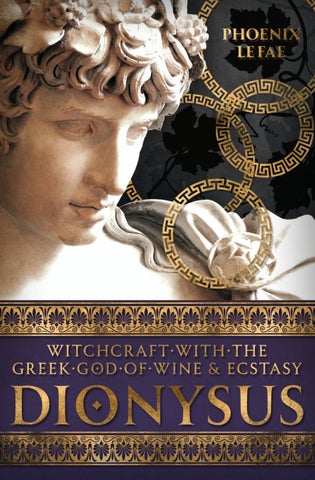
Praise for Dionysus “Dionysus has always stood for those on the edges of society; the queers, the outliers, and the seekers of truth. LeFae’s latest work celebrates the god of many forms, emphasizing the beauty of gender fluidity and the power of radical liberation. Through soul-stirring rituals and deep personal gnosis, this book serves as a sacred bridge between the ancient Thracian mysteries and the modern fight against oppression, proving that ecstasy is not just a luxury, but a birthright.” —Katrina Rasbold, author of Uncrossing “A masterfully crafted guide that stands apart from standard mythological overviews by seamlessly blending extensive historical research with a deeply personal, ritualistic approach. … What makes this book truly essential for devotees and modern practitioners is its intimate ‘love letter’ quality; it feels less like a dry textbook and more like a shared journey, offering practical ritual technology, from breath work to the creation of a thyrsus, that invites the wild god into the here and now. It is a powerful, inclusive resource that honors Dionysus as a living, evolving deity.” —Elhoim Leafar, author of Dream Witchery and Pagan Portals: Maria Lionza “A vibrant and necessary offering for modern witches seeking an authentic relationship with the old gods. This work moves beyond the static myths and into lived devotion, where Dionysus emerges as liberator, initiator, and ecstatic teacher—one who calls us back into the wild truth of our own divine nature. LeFae skillfully weaves historical context, personal gnosis, and practical ritual into a path that is both grounded and transformative, honoring the god’s ancient roots while embracing his living presence in the modern world.” —Heron Michelle, author of Elemental Witchcraft and Lunar Witchcraft
“This delightful book is one big ritual/party with many enthusiastic participants, and it’s perfect for anyone seeking to better connect with their freest, most authentic selves.” —Enfys J. Book, author of Queer Rites “Dionysus is a medley of myth and personal perspectives, at the same time informative and worshipful. The book includes a comprehensive exploration of myths surrounding Dionysus while also being deeply invitational, drawing readers in with exercises and rituals to create and celebrate their own unique relationship to the god. Thus we are empowered not just to learn about Dionysus in the ancient world but to experience such connection ourselves, in contemporary ritual and worship. The book is enriched by contributions from a number of other devotees and magical practitioners.” —Jane Meredith, author of Journey to the Dark Goddess “Phoenix LeFae offers a luminous and deeply engaging exploration of a deity too often reduced to wine, revelry, and sex. What emerges here is something far more intriguing: Dionysus as liberator, shapeshifter, ecstatic presence, patron of sacred excess, and force of profound spiritual transformation. Drawing from mythology, history, modern devotion, and practical witchcraft, Phoenix traces his movement from the ancient world into contemporary Pagan life with deep insight, clarity, warmth, and personal devotion.” —Lou Florez, author of The Modern Art of Brujeria “Phoenix’s writing about Dionysus is just like her witchcraft: smart, powerful, and cheeky. You’ll feel her love affair with this god in every line, and she opens the door for you to fall in love too. At a time when we need to braid together pleasure and subversion, Dionysus is a god for witches and visionaries, hedonists and rebels. But beware, he is hard to resist—and so is this book.” —Ember Andrews, creator of Lead Like a Witch
About the Author Phoenix LeFae (she/her) started her journey in the world of witchcraft in 1993 when her athame was a wooden-handled butter knife stolen from her mom’s kitchen. Her love of magic and mystery has led her down many paths, lineages, and traditions. She is an initiate in the Reclaiming tradition of witchcraft, the Avalon Druid Order, and Gardnerian Wicca. Phoenix has written several books, including What Is Remembered Lives, A Witch’s Guide to Creating and Performing Rituals, Witches, Heretics & Warrior Women, and more. She is a professional witch and the owner of the esoteric Goddess shop Milk & Honey, www.Milk-and-Honey.com. Find out more at www.phoenixlefae.com.
Dionysus: Witchcraft with the Greek God of Wine & Ecstasy Copyright © 2026 by Phoenix LeFae. All rights reserved. No part of this book may be used or reproduced in any manner whatsoever, including internet usage, without written permission from Llewellyn Worldwide Ltd., except in the case of brief quotations embodied in critical articles and reviews. No part of this book may be used or reproduced in any manner for the purpose of training artificial intelligence technologies or systems. First Edition First Printing, 2026 Book design by Samantha Peterson Cover design by Shannon McKuhen Llewellyn Publications is a registered trademark of Llewellyn Worldwide Ltd. Library of Congress Cataloging-in-Publication Data Names: LeFae, Phoenix, author Title: Dionysus : witchcraft with the Greek God of wine & ecstasy / by Phoenix LeFae. Description: First edition. | Woodbury, Minnesota : Llewellyn Worldwide, [2026] | Summary: “Phoenix LeFae, a devotee and priestess of Dionysus for over a decade, takes you past the stereotypical party-boy visage and teaches you how to worship and work with this wild god. Complete with spells and rituals to begin your devotional practice, this book empowers you to challenge the status quo, dance with your feral side, and break the chains of inequality and oppression.”—Provided by publisher. Identifiers: LCCN 2026028972 (print) | LCCN 2026028973 (ebook) | ISBN 9780738781464 trade paperback | ISBN 9780738781945 ebook Subjects: LCSH: Witchcraft | Dionysus (Greek deity)—Cult | Gods, Greek Classification: LCC BF1566 .L444 2026 (print) | LCC BF1566 (ebook) LC record available at https://lccn.loc.gov/2026028972 LC ebook record available at https://lccn.loc.gov/2026028973 Llewellyn Worldwide Ltd. does not participate in, endorse, or have any authority or responsibility concerning private business transactions between our authors and the public. All mail addressed to the author is forwarded but the publisher cannot, unless specifically instructed by the author, give out an address or phone number. Any internet references contained in this work are current at publication time, but the publisher cannot guarantee that a specific location will continue to be maintained. Please refer to the publisher’s website for links to authors’ websites and other sources. Llewellyn Publications A Division of Llewellyn Worldwide Ltd. 2143 Wooddale Drive Woodbury, MN 55125-2989 www.llewellyn.com Printed in the United States of America GPSR Representation: UPI-2M PLUS d.o.o., Medulićeva 20, 10000 Zagreb, Croatia, matt.parsons@upi2mbooks.hr
Other Books by Phoenix LeFae Spirit Magic (Llewellyn, 2026) A Witch’s Guide to Creating & Performing Rituals That Actually Work (Llewellyn, 2023) Witches, Heretics & Warrior Women: Ignite Your Rebel Spirit Through Magick & Ritual (Llewellyn, 2022) Life Ritualized: A Witch’s Guide to Honoring Life’s Important Moments (cowritten with Gwion Raven, Llewellyn, 2021) What Is Remembered Lives: Developing Relationships with Deities, Ancestors & the Fae (Llewellyn, 2019) Cash Box Conjure (Lucky Mojo Curio Company, 2018) Hoodoo Shrines and Altars (Missionary Independent Spiritual Church, 2015)
Disclaimer Working with any deity can bring up challenging emotions. If you find yourself overwhelmed by anything in this book, set it down and seek help. Dionysus is a god of ecstatic states and wine consumption. If you have issues with drugs or alcohol, you don’t need to drink to connect with Dionysus. If you notice yourself feeling triggered by your boundaries with drugs or drinking, seek help. The Substance Abuse and Mental Health Services Administration (SAMHSA) has a 24-hour Helpline for individuals and family members facing mental and/or substance use disorders, as well as a 988 Suicide & Crisis Lifeline. Visit www.samhsa.gov. SAMHSA Helpline: 1-800-662-HELP (4357) 988 Suicide & Crisis Lifeline: Call or text 988 Dionysus is a god of queer identity. If you need assistance with your own gender identity or sexuality while reading this book, seek help. Trans Lifeline: 877-565-8860 LGBT National Hotline: 888-843-4564 988 Suicide & Crisis Lifeline: Call or text 988 If you are allergic to any of the herbs, oils, or ingredients listed in this book, please don’t use them. Anything that may cause you problems should not be used and has an alternative. Nothing in this book should be used as a replacement for medical care or treatment. Always consult your medical provider before trying any new practices.
To Dionysus and all of those who hear his wild call
Contents
Introduction One: Mythology
1
9
Two: History 23 A Modern Dionysus by Melissa Zupan
32
Three: Meet Dionysus 43 The God Returns by Witchcamp Facilitators For Dionysus by Lorna Rose 51
45
Four: Dionysus the Liberator 57 The Wild Worship by Witchcamp Facilitators Five: God of Wine 69 It Was to Be Dionysus by Stephen Pocock Six: The Underworld (Death Becomes Him) Dionysos Descends into the Underworld by Witchcamp Facilitators 82 Seven: Ecstatic States 91 The Summer I Turned Feral by Shelby
98
75 79
60
xii
Contents
Eight: Sexuality and Gender 107 Emerging and Erupting in Ecstasy by Witchcamp Facilitators 109 Nine: The Shape-Shifter 119 Dionysus by Fio Gede Parma
124
Ten: A God by Any Other Name 129 Opening to Divinity by Laura Levin 132 Eleven: Women and Dionysus 139 Maenad by Lorna Rose 146 Twelve: Symbols and Associations
157
Thirteen: Worship 169 Fourteen: Ancient and Modern Celebrations
185
Fifteen: Dionysus Spells, Magic, and Rituals 207 The Gift of Dionysus by Ari and Jason Mankey 212 Conclusion
221
Contributors
227
Appendix: Timeline of Greek History Glossary Bibliography
233 235
Acknowledgments
241
231
Introduction
If you had told me ten years ago that I would come home from a trip to Australia devoted to a Greek deity, I never would have believed you. But that’s precisely what happened. It was dark. Night had fallen and the rain was finally letting up. The clouds were moving east, revealing a moonlit sky with bright twinkling stars. I was out under that moonlight, barefoot, barely clothed, painted in earth colors and sacred symbols. I remember being back-to-back with two other priestexes, and we all had the wild god drawn down and into our bodies. Then I remember nothing. Well, I remember what happened that night mostly in flashes, like a dream that is only half-spoken. In my memory, there was a flash and someone was speaking Greek to me with a deep, melodic voice. Their eyes were watching me with fire behind them. I felt an urge to kiss them, but my priestex mind knew this was not allowed. Then again, there was nothing. There was another flash and I saw a small creature running through the underbrush in the garden (I later learned it was a bandicoot) and I started chasing it. I was elated by the chase. It was wild and playful and I desperately wanted to catch that little creature. My blood was on fire, my heart was full, and I wanted nothing more than to join with 1
2
Introduction
the wild of the night. I remember hearing ecstatic laughter—mine or someone else’s, I do not know. That night, I was ridden by the wild god Dionysus for the first time. This ritual took place at CloudCatcher Witchcamp, an annual event outside Brisbane, Australia. It was my first time in Australia and my first time being in a deep ritual with the deity called Dionysus. Prior to this weeklong event, I had spent about a year studying, reading, and learning everything I could about Dionysus in order to prepare for the retreat. I had begun a devotional relationship with this entity as a solitary practitioner, but stepping into a weeklong intensive was like taking our relationship from the pages of a book into reality. I knew there was so much more to learn.
Introducing Dionysus Modern folks often dismiss Dionysus as a party god, a drunken god, a sexy young god. With all that’s going on in the world right now, his power might feel frivolous. But drunkenness and revelry are only part of the story. The label of party god is a red herring to distract you from his true power. That begs the question: What is the truth of this being? Where does he come from and how has his worship evolved? Who does it serve to minimize how he shows up to his followers? Dionysus Eleuthereus (one of Dionysus’s many epithets) is the liberator; he shows us how to use music and dance to free ourselves from the restraints of society. Dionysus Lyaeus is the loosener; he shows us the mysteries of the wild world. Dionysus Bromius is the roarer; his voice can lead us deeper into the mysteries of life, death, and resurrection. Dionysus Agrios is the wild; he teaches us how to use ecstasy to connect with our wild, divine selves. As Dionysus Androgynous, he shows us the power of gender-fluidity. And he is so, so much more.
Introduction 3
We know Dionysus as a being from ancient Greece, but he may also have connections to India, North Africa, and the Far East. He was known as a traveler, taking the wisdom and cultivation of the vine with him everywhere he went. Dionysus encouraged people to throw off the trappings of cultured society and live for who they truly were. Often followed by wild women and satyr-like men, he was androgynous and queer, embodying all the things that went against the status quo of the time.
Experiencing Dionysus I don’t easily step into devotional relationships with deities. From a young age, I have been fascinated by myths and legends. For many years, I devoured all the stories I could. Even before becoming a witch in my teenage years, there was something about the ancient gods and their stories that appealed to me. Because of my infatuation with the gods at an early age, there are still a lot of deities’ stories bouncing around in my head. I love all the myths, but that doesn’t mean I want to be dedicated to every god I’ve ever read about. At that retreat over a decade ago, Dionysus was one of those gods whose names and stories I knew; I knew them like you might know someone whose biography you’ve read, and I definitely wasn’t looking to commit to anything long-term. In fact, in my early days as a practicing witch and pagan, I wasn’t all that interested in working with male deities at all. I felt like there was plenty of masculine energy that was revered in the world, and I was much more interested in spending my energy with the divine feminine—whatever that means. After that night of running through a garden in Australia with the wild god sharing my body, everything changed. When I returned to the United States, Dionysus didn’t leave me. He continued to be present in my life. His energy and power simply
4
Introduction
moved in. After a lot of learning, exploring, playing, and falling on my face, I finally dedicated myself to him. I’ve led many classes and retreats where we have worked with his energy and learned from his stories. I’ve brought Dionysian rituals to events across the US and introduced his energy to many people. I’ve tattooed my body in his honor, and he has a substantial altar dedicated to him in my home. He is my beloved. I am introverted and mellow. If you compare Dionysus’s energy to my personal energy, you might not think we are a good match. I thought that at the beginning of all this too. However, in the decade over which our relationship has unfolded, Dionysus has shown me how to expand beyond my introversion. He has helped me revel in taking up my right size, which is a lot bigger than I would have admitted initially. He shows me how to get loose and even a little wild. He has helped me get in touch with the feral animal part of myself that I denied existed for so long. I am not Greek, nor do I have any Greek heritage. However, I have found that this ancient being doesn’t care about any of that. He doesn’t care about your age, race, gender, or background. He doesn’t care about your definitions around sexuality or if you drink wine or not. He isn’t a deity who judges, but he is a deity who pushes. He will push you out of the status quo. He will encourage you to run into the wilds. He will invite laughter, dance, and frenzy into your life. In a modern pagan and witchcraft context, I often find myself a solo woman in a sea of wild men in Dionysian spaces. It seems that for the past hundred years, he has spoken to the pagan men of the world. Like Pan, playing his pipes and calling for the phallic dances, Dionysus has helped men accept their wild sexual natures. But if we look at antiquity, a very different story is revealed. In the ancient world, Dionysus was a god of women and queers. I want to reclaim Dionysus in that image. Yes, let’s celebrate that wild, phallic nature that we all possess, but let’s not forget that his
Introduction 5
followers were the wild women, maenads, Korybantes, and satyrs who would tear unworthy men limb from limb. His followers were those who turned against the patriarchy of the overculture and chose a very different path from what would have been expected of them. In a world where we are stepping closer and closer to fascism, we need Dionysus’s power more than ever. We can break the chains and release ourselves from bondage, and we can have a really good time doing it. Dionysus shows up over and over again in cultures where there is inequality and oppression. As Sophie Strand says in her book The Flowering Wand, “Dionysus is the perfect example of a mythic mycelium. … But whenever he arrives at a new city or location, he ‘refruits.’ He adapts to circumstances, knowing that he will be most useful if he shifts his physical and spiritual form to fit the specific needs.” 1 This “refruiting” is what calls me to write about him today. Come with me on this journey, where we will travel back in time to ancient Greece and then fast-forward to the modern day. We will follow the thread of Dionysus’s energy over the ages, and we will learn how to connect with this wild god in a modern witchcraft landscape. More than drinking of the vine, we will drink of his divinity.
How to Use This Book This book is my love letter to Dionysus. The only reason it exists is because he assigned me this task, and here I am honoring my commitment to him. My intention is for this book to be read from beginning to end. The chapters build on each other. However, I am also a fan of bibliomancy and trusting in the process. If you feel so inclined to open the book at random and let the words flow over you, I totally encourage you to go for it. 1. Strand, The Flowering Wand, 39.
6
Introduction
However you approach this work, I hope you find love, pleasure, and connection through the words dedicated to Dionysus.
Use of the Word “Cult” In this book and in most writings about Dionysus, you will see the word cult used to describe his followers. This isn’t the same as the modern negative definition of a cult. Officially, the word cult describes devotion to a specific entity. However, in the modern world, this word has come to be associated with a sinister group devoted to a single individual. In the ancient world, it was normal for the common folk to belong to a specific deity’s cult. Those devoted to Dionysus would have been in the cult of Dionysus. A modern definition of cult is an organization that has a prescribed doctrine that all followers must adhere to, up to and including sexual intercourse with leadership, cutting off friends and family who are not part of the cult and handing over financial resources to the cult leadership. If you find yourself involved with a group like this, you are in danger. Please get help. However, when you come across the word cult in this book, it is a reference to the ancient practice and not the abusive religious doctrine of modern times.
Spelling of Name There are often two ways we see this god’s name written in a modern language. The first is Dionysos, which is considered closer to the traditional Greek spelling. Dionysus is the Latin version of the name, which is what I use throughout this book. Traditionally, the Greeks may have also called them Bakxos, and they would have been known by one of their many epithets in specific regions. All these options are valid.
Introduction 7
Ritual Terms Throughout this book, there are rituals and spells to perform. There are times when I offer a ritual technology without going into detail about what it looks like. If you come across a ritual term that you are unfamiliar with, consult the glossary at the end of the book.
Know Thyself The focus of any spiritual work should be to better know and understand ourselves as practitioners. Knowing how and why we get triggered gives us power. This is an ancient spiritual concept. In fact, above the entryway at the ancient Greek site of the Oracle of Delphi were the words “Know thyself.” Since Dionysus was known to spend his winters in Delphi, we see his power reflected in these words, as well as the power of Apollo, who ruled Delphi. As you explore the magic that is Dionysus in this book, may it help you to know yourself and grow as a spiritual being.
Gender and Dionysus Dionysus is gender-fluid. He is neither this nor that but both and somehow also something in between. Throughout this book, I have used different pronouns for Dionysus. Most often I use he/him pronouns, but I also use they/them. Pronouns aren’t important for the gods, but they are important for the humans who are in the world today. I use they/them for Dionysus because they are gender-fluid and it is a way to acknowledge that there have always been people beyond the binary of male and female. His power is beyond gender, and it is important to honor and recognize that. Dionysus is not only a gender-fluid deity but also a queer one. There are stories of him falling in love with men and women from antiquity. It is because of these stories that Dionysus has become a deity associated with the struggles of modern LGBTQI+ communities. This is a topic that will appear repeatedly on these pages. Io Evohe, Dionysus!
“Dionysus arrives grinning, virile, vegetal, embodied, with the grail already in hand. He has his kantharos (a ceremonial winged cup) filled with ferment and his flowering thyrsus (wand) conducting vegetal mayhem.” Sophie Strand, The Flowering Wand
one
Mythology
It’s more important to develop a relationship with Dionysus in the here and now than to worry about what his worship would have looked like in the ancient world. However, knowing the history, myths, and legends of his origins can help you build that modern relationship. The legends give us a foundation on which to build our connection to him. Dionysus has always been a deity to shake people out of the mundane. The cultures we are raised in greatly influence how we view the world, and it is so easy to accept that enculturation. However, not all of us fit into the box of cultural expectations. In fact, I would be willing to go so far out on a limb as to say that most of us don’t fit into that box. Dionysus shows us a way out. He reminds us that we are wild and don’t have to conform to anyone’s expectations. He teaches us that we are our own spiritual authorities. Dionysus speaks from the deep woods, reminding us that we are part of nature. True deep healing comes when we reconnect and remember. Dionysus has always stood for the reality beyond the status quo. He knows the ways of mystery, he has earned his power, and he 9
10 Chapter One
yearns for each of us to step into our power too. He is a god of the now, because people constantly need to be reminded that they are strong, sovereign, and wild.
Origin Story Long ago, Persephone and Zeus came together in love, or maybe it was just simple lust. It may also have been that Zeus took the form of a serpent and tricked the goddess into having sex with him. The reason for their coupling doesn’t matter for our story. What is important to know is that from their union, Persephone found herself with child. Whispers and rumors began to spread because a child born of both these gods would be a powerful being. There was excitement and fear among the rest of the gods waiting to see what would happen when this baby was born. One of those who heard these whisperings was Zeus’s wife Hera. When she learned of the pregnancy, she became enraged. Not only did Zeus impregnate another, but this offspring could destroy all she had built. Hera began planning the best course of action to address this potential problem. After what felt like forever and at the same time only moments, Persephone gave birth to the beautiful baby Zagreus, whose name means “great hunter” and is a nod to the chthonic realms of the Underworld, where Persephone was Queen. Even in Zagreus’s infancy, it was clear that he would grow into a powerful being. Soon after the baby could crawl, Hera was ready to enact her plan. She unleashed the Titans to attack the small babe. The Titans lured the baby away from his caretakers using mirrors and toys. Once they grabbed hold of him, they ripped him apart into six pieces.
Mythology
11
One of the six torn pieces was the heart of Zagreus. Athena heard of the horror that had taken place, and she made it to the site of the murder just in time to save the baby’s heart from being devoured by the Titans. She took the heart and made it into a potion, which she gave to Zeus, telling him that the sweet baby could live if he could find a human to drink the potion and carry the baby. One of Zeus’s lovers was a mortal woman named Semele. He gave her the potion and encouraged her to drink it down. Semele, in love with Zeus and not knowing that he was a god, drank the potion and, of course, became pregnant. Once again, Hera heard, through whispers and rumors, that the baby had survived her plots and plans. Angered, she devised a new strategy to destroy this being. Hera went to Semele and began sowing feelings of doubt in her mind. Hera told the mortal woman that if Zeus truly loved her, he would show her his true form. Hera convinced Semele that she must see Zeus in this fullness or else their love was a lie. Semele confronted Zeus, demanding to be shown his true form. “If you truly loved me, you would do this for me,” she insisted. So Zeus showed her his true form. But the true form of a god is something that a human cannot bear to witness, and upon seeing his full godhood, Semele was incinerated. However, the fetus survived the incineration. As Zeus looked down on the ashes that were once his lover, he saw the small form of the fetus that had been held in Semele’s womb. He carefully picked up the fetus and sewed it into his thigh. When the baby reached maturity, he was born again, this time from his father’s thigh. And there, Dionysus was born for a third time.
12 Chapter One
Zeus knew that Hera would soon discover this trickery, so he gave the baby to Hermes and asked the swift-footed god to take the babe to his aunts in the forest, where he could be raised in safety.
Growing and Learning Hermes took the wee bundle to the nymphs of Mount Nysa and Dionysus’s aunt Ino. He asked these women to be the baby’s nurses and raise him like a girl so that Hera would never suspect who he truly was. During this time, Dionysus learned much about the wilds and the joys that came from living with the land. At some point, when Dionysus reached the early stage of adulthood, Hera discovered that he was still alive and struck him with madness. He left his safe mountain home and wandered, unsure of who he was or where he was going. He was lost and confused. During his wanderings, Dionysus met up with the Great Goddess Rhea—or maybe it was Cybele. She saw that the boy had been goddess-struck, so she took him in and helped him learn to control his powers. She showed him how to step into his godhood, and in many ways the two became equals. But Rhea knew that Dionysus couldn’t stay with her forever. He was a wild spirit who needed to travel the world, helping others release their bonds and find their freedom. So once the boy was healed and whole, she sent him back into the world.
Adventures Dionysus had many adventures. He tended to lure women with his flute-playing. They would come to him and release their bonds of cultured life. They would turn into wild women, known as maenads. During one such adventure, Dionysus and his maenads were chased by King Lycurgus, who was unhappy that Dionysus was luring women away from their families.
Mythology
13
The king attacked the maenads and chased Dionysus into the sea, where he was taken in by a sea nymph called Thetis. There in the ocean, Dionysus learned about prophecy, divination, intuition, and how to go into the depths of himself. When Dionysus was released from the depths of the sea, after learning all he could from Thetis, he was walking along the beach, enjoying the feel of the sun on his skin, when some pirates saw him and decided to kidnap him. Dionysus was youthful and beautiful, so the pirates assumed he was likely worth ransom money. They dragged him aboard and attempted to tie him up, but no matter what they did, the ropes they wound around him would simply fall off. Every attempt to bind the wild god failed. Dionysus warned the pirates to let him be, but they kept trying—all but one pirate, the helmsman, who suggested they let him go because he could see the wild god for who he truly was. The other pirates didn’t listen and eventually Dionysus unleashed his full power onto the ship. The pirates turned into dolphins and jumped into the ocean waves, all except the helmsman, who knew the god and honored his truth. He got Dionysus safely to shore and took control of the ship from that day forward. Dionysus was left on a small island, where he came across the most beautiful woman weeping. She was alone on the island and clearly scared. He watched her for some time, falling in love with her in her grief. Finally he spoke, asking her to stop crying, for he was in love with her and wanted to take her with him. The girl was Ariadne, who had been abandoned on the island by Theseus after he slew her brother, the Minotaur. While Ariadne was sleeping, Theseus had snuck away in the night. But when she saw the shine of the wild god before her, all thoughts of Theseus left her and she saw nothing but Dionysus.
14 Chapter One
Reconnection Dionysus finally seemed to find some peace, but one thing continued to nag at him. He worried for his mortal mother and wished he could have done something to save her from death. So he decided to go to the Underworld and bring her back. Traveling to the Underworld was not an easy task, even for a god. There were only a few beings who could travel between the realms, and Dionysus was not one of them. Even though one of his mothers might have been Queen of the Underworld, that didn’t mean he could come and go as he pleased, or take a spirit away with him. Dionysus traveled to the lake where it was believed an opening to the Underworld existed and asked whether any of the mortals in the region knew how to reach the gates. Many wouldn’t talk to him about such things. Finally, one beautiful young shepherd man shared a story with Dionysus about where he’d heard the opening to the gates was located. The shepherd’s name was Prosymnus, and as the two talked, Dionysus found himself falling in love with the human man. Prosymnus was falling in love as well. He told Dionysus he would take him on his boat to the opening of the Underworld, but only if Dionysus promised to return and consummate their love. Dionysus agreed. Prosymnus took Dionysus to the location of the opening and the two kissed farewell. Dionysus headed into the depths to find Semele. He did locate her spirit and he did bring her back into the world of the living. As soon as his task was complete, he sought out Prosymnus to honor his promise. But time in the Underworld moves much differently than time on Earth, so when Dionysus finally made his way back to Prosymnus’s village, he discovered that the shepherd had been dead for hundreds of years.
Mythology
15
To honor his promise, Dionysus fashioned a phallus out of a fig tree branch, placed it on the grave of Prosymnus, and made love to it. Dionysus was not seen as one of the Olympians. He was the son of Zeus, but that can only get you so far. He wanted to be held to the same standard as the other Olympians. He went to the mountain to demand that Zeus give him his place there. But before he could speak to his father, the goddess Hestia stood and told the young god that she was ready to leave the hustle and bustle of Mount Olympus and would happily give him her seat. That is how Dionysus became the last of the gods of the Olympians.
Thrice-Born According to myth, Dionysus wasn’t born just once, or even twice, but three times. This many-layered birth made him special right from the get-go. Each birth was vital to who he became.
The First Birth Zeus was seen as the ultimate god of the Olympians. He was the head honcho, so to speak. The offspring of Zeus and mortal women were often heroes whose stories still inspire us. Many of his children became gods in their own right. Zeus is famous for overthrowing the Titans, the beings who ruled the earth before his birth. Zeus is the son of the Titan Cronus. It was foreseen that Cronus would have a son who would kill him and usurp his rulership. Cronus did all he could to prevent this prophecy from coming to pass, but it did, and Zeus took over the ancient world. The Titans were primordial beings. They weren’t representations of nature; they were nature itself. Zeus came along as a “sky daddy”
16 Chapter One
and subdued these forces of nature. He became the hero of man over nature. This switch from reverence for the Titans to worship of the Olympians reflected a cultural shift in the ancient world. The people went from a nature-based spiritual worship to a patriarchal order that honored rulership from the mountain on high. Persephone, Dionysus’s first mother, was both the spring maiden and Queen of the Underworld. The cycle of the seasons and the relationship between Persephone and her mother, Demeter, comprised a vast religious system in the ancient world. The Eleusinian Mysteries, as they were called, are still discussed in the modern world, although we know very little about what happened during them. Persephone is likely an ancient goddess who existed before the Olympians took the seat of power, much like Dionysus. Zeus and Persephone’s son was given the name Zagreus, or “great hunter.” One root of this name is zoe.2 For the ancient Greeks, zoe was a concept similar to the Celtic concept of awen or the Far Eastern concept of chi. Zoe is life and the energy that animates all living things. Therefore, Dionysus is seen as the animating force of life. Finally, in the epic poem Alkmeonis, Dionysus is connected to the Great Goddess: “Mistress Earth and Zagreus who art above all other gods!” 3 The idea is that the Great Goddess, called Gaia, Rhea, or Cybele, is above all others and Zagreus sits with her.4 The Alkmeonis has survived only in fragments and the author is unknown, but Greek scholar Kerenyi feels that this piece of the poem points to important religious information. In Dionysus’s first birth, he is described as primordial, a being older than the Olympians, older than his father, Zeus. 2. Kerenyi, Dionysos, xxxii. 3. Kerenyi, Dionysos, 83. 4. Kerenyi, Dionysos, 83.
Mythology
17
The Second Birth The second birth is what gave Dionysus his humanity. A mortal woman carried him in her womb. The sisters of Semele played an essential role in his development after his final birth, and human women were always around him. That connection to humanity was because of Semele, the one human who was part of his creation mythos. In this story, we also learn that the true form of a god will eviscerate a human. No mortal can gaze upon the face of a god without it causing harm. Dionysus was born from this interaction. As he grew and moved forward in his life, he had to rely on his humanity to keep from causing harm to his followers.
The Third Birth The fact that Zeus sewed the fetus into his thigh suggests that the most powerful of gods, the most masculine of the masculine, had to feminize himself to save his child. He offered his own body in this way, much as women in childbirth do. It suggests that Zeus had to give up some of his male virility to take on the power of the feminine, and we know that to be feminine was looked down upon by the ancient Greeks. Going through this third birth is what gave Dionysus the epithet Eiraphiotes, which means “he who has been sewn in.” It is also because of this part of the birth story that Dionysus is seen as the light of Zeus. Traditionally, the light of Zeus was the star Sirius. There is a connection between the harvesting of grapes and creation of wine and the movements of this star. The years when Dionysus’s celebrations would have taken place were also the years named for Sirius.5
5. Kerenyi, Dionysos, 75.
18 Chapter One
As the light of Zeus, Dionysus was seen as possessing fire as a weapon, and even his followers were believed to carry fire in their hair. In Sophocles’s version of the story Antigone, Dionysus is referred to as the one “who leads the round of fire-spraying stars” to heal an illness that had overtaken the city of Thebes.6
Thoughts on Hera’s Role in Dio’s Myth Hera is the goddess of marriage. In Homer’s writings, it is clear that she was angered to the point of hatred toward anyone or anything that could threaten the sanctity of marriage. She was an important figure in Greek culture, helping keep married women in line. This is why her hostility against Dionysus was so intense. He represented everything that went against her domain. However, this is only part of the story. Why does Hera not punish Zeus, her actual husband and the one who continues to belittle their relationship? Culturally, men of the time were allowed mistresses and concubines. It wasn’t uncommon for men to visit sex workers and even have children with women outside of marriage. Men were allowed to have full sexual lives, but women were not. Culturally, Hera pointed her anger at the offspring of her husband’s antics because that was what was appropriate. If men having children outside of marriage was culturally acceptable, what is it that Hera is furious about? Perhaps this anger is more a projection of our modern views than a reflection of the reality of her power. At first glance, Hera is the ultimate evil stepmother. She takes her anger out on the innocent being and not the one who deserves it. Hera strikes Dionysus with madness and sends him out into the world. As 6. Kerenyi, Dionysos, 78.
Mythology
19
the goddess of marriage and family, Hera likely sees the actions of Dionysus and his band of wild women who leave behind the expected world as a strike against her, as if their existence goes against hers. Perhaps Hera isn’t the jaded wife but instead a catalyst. Dionysus would never have been the thrice-born god without Hera’s meddling. Dionysus would never have been struck mad to wander in the wilds if not for Hera. He would not have found the Great Goddess Rhea or Cybele and learned the ancient ways of worship. Maybe Hera’s hatred is actually the source of her power as an initiatory being? 7 If we look through a modern lens at Hera as the initiator, it flips the script. Rather than seeing an angry housewife, we see a goddess of change. We don’t always get to ask for initiation; sometimes initiation is put upon us. When the gods put us through an initiation, we can’t ever know the hows or whys of it. But these initiations change us forever.
Thoughts on Zeus’s Role in Dio’s Myth Many modern pagan practitioners, especially those who are not part of a Hellenic focus, have a lot of distaste and even hatred for Zeus. He does seem to embody all that is wrong with patriarchy, so it is easy to paint him as the bad guy. However, this is where cultural context is important. Is Zeus problematic from a modern perspective? Yes. Does he look like patriarchy dressed up in a toga and calling himself a god? Yes, indeed. But historically, Zeus represents a shift in ancient Greek culture. Before Zeus, the Titans ruled the world. The Titans were the forces of nature, both generative and destructive. Zeus came along and subdued those forces, locking them away and taking over the rulership and putting his children in charge. Culturally, Zeus coming in to lock 7. Kerenyi, Dionysos, 187.
20 Chapter One
up the forces of nature is a reflection of a literal cultural shift that was happening in Greece at the time, where worshipers moved away from a nature-based faith to the gods being on high, on Mount Olympus. As witches and pagans, we might not fully support a shift from nature devotion to a separation of humanity and land, but that doesn’t change the fact that it happened. Zeus was the most powerful of the gods in his time. Calling on him was a big deal and not to be taken on lightly. Although Zeus may have been a philanderer in modern terms, that wasn’t against the social rules back then. Most married men didn’t spend a lot of time with their wives and would frequent sex workers. In fact, being a sex worker was a respected position for women of the time. Women in the sex industry had many more rights than housewives did.8 What we see from Zeus, in myth after myth, is how he often worked to save his children from harm. He hid them, disguised them, and sent them away, all in an attempt to keep them safe from harm— and often that harm was coming in the form of his wife Hera. Zeus was concerned with his legacy. He wanted to keep his children safe so his legacy might live on. He continually saved Dionysus from harm and death. Because of how Zeus interfered with Hera’s actions, Dionysus was able to live a full life and discover himself.
Exercise: Initiatory Exploration Zeus and Hera both serve as initiators of Dionysus. Zeus serves as a guide and protector, while Hera serves as a catalyst. A catalyst and a guide are both important parts of an initiation. The ways Zeus and Hera show up in the myths of Dionysus aren’t always gentle, but they are necessary. 8. Evans, The God of Ecstasy, 17.
Mythology
21
We all go through initiations in life. Some of these are mundane and some are magical. There are initiations we choose to take on and there are initiations that are put upon us, whether we want them or not. Dionysus is a deity of initiation. He understands what it is to choose and what it is to be chosen. Take out your journal and set a time for five minutes. During that time, write down all the initiations you have gone through. Think about all of them. There are probably a lot more than you might think. Here are a few potential initiations to get you started: • Graduations • Marriages/divorces • Having children • Getting a new job • Spiritual lineages • Spiritual dedications • Death of loved ones When the timer goes off, look at all the initiations you have listed. Pick out three and explore how they have changed the trajectory of your life. Explore how you were transformed by this process. You may want to write about this, dance it out, make some art, or choose some other way to express your initiation journeys.
Conclusion Mythology is only a jumping-off point. The gods are born when they are born, but I truly believe they continue to evolve to meet the needs of the people who look to them. Studying mythology teaches us about a deity’s past, and that can help us learn how to relate to them in the present.
“The god of ecstasy and terror, of wildness and of the most blessed deliverance—the mad god whose appearance sends mankind into madness— gives notice already, in his conception and birth, of his mysterious and paradoxical nature.” Walter F. Otto, Dionysus: Myth and Cult
Body, Mind & Spirit / Witchcraft “Through soul-stirring rituals and deep personal gnosis, this book serves as a sacred bridge between the ancient Thracian mysteries and the modern fight against oppression, proving that ecstasy is not just a luxury, but a birthright.” —Katrina Rasbold, author of Uncrossing
Phoenix LeFae, a devotee and priestess of Dionysus for over a decade, takes you past the stereotypical party-boy visage and reveals the depth and meaning of this Greek deity for modern witches and Pagans. Grounded in historical research and illuminated by her personal relationship with Dionysus, Phoenix teaches you how to connect, worship, and work with this wild god. Complete with spells and rituals to begin your devotional practice, this book empowers you to challenge the status quo, dance with your feral side, and break the chains of inequality and oppression. Learn how modern magic with Dionysus can turn your humdrum world into a place of ecstatic beauty. “A masterfully crafted guide that stands apart from standard mythological overviews by seamlessly blending extensive historical research with a deeply personal, ritualistic approach.” —Elhoim Leafar, author of Dream Witchery
© Jessamyn Harris
PHOENIX LEFAE is a professional reader, teacher, and ritualist. She has been practicing witchcraft for almost thirty years, and her teachings are connected to the Reclaiming Tradition, Druidry, and Gardnerian Wicca. She is also the owner of an esoteric Goddess shop called Milk & Honey. In addition to being the coauthor of Life Ritualized, she is the author of Spirit Magic, A Witch’s Guide to Creating & Performing Rituals, What Is Remembered Lives, and Witches, Heretics & Warrior Women. Facebook.com/LlewellynBooks X: @LlewellynBooks Instagram: @LlewellynBooks
www.Llewellyn.com
$17.99 US