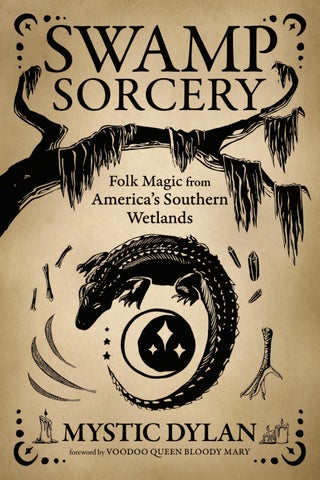
Swamp Sorcery, by Mystic Dylan

Page 1


Praise for Swamp Sorcery

“Diving into Swamp Sorcery, I found myself once again experiencing that familiar mix of shock, excitement, and deep pride that has followed each of Dylan’s books, but this time nothing quite prepared me for the world he creates here. With his signature charm and storytelling, he pulls the reader straight into the swamp, a place that felt surprisingly familiar to me and echoed my own memories of growing up in Puerto Rico and Miami surrounded by lakes, wildlife, and even the occasional alligator. Drawing from his own childhood near the Everglades, Dylan blends lived experience with rich and immersive detail. Beyond the personal, the book opens into a deeply researched and compelling exploration of the mystical traditions tied to these landscapes. He engages with Afro-Cuban beliefs and other protected spiritual practices with both respect and depth, creating a work that feels expansive, thrilling, and transportive. I would wholeheartedly recommend Swamp Sorcery to anyone even slightly curious about the hidden worlds that exist just beyond everyday life because once you step in, it feels incredible.”

“Lowland waters hold a very special place in North American folk practices, and this book viscerally captures the untamed magic of the swamp. Mystic Dylan has given us a rich array of possibilities to approach and befriend the spirits of the murky waters without us necessarily having to risk the danger of its fanged occupants. The workings outlined in this book, compiled not only from the author’s personal experience but from a century of authentic source material, will open you up to try your hand at swamp sorcery—even if you live far, far away from the bayou.”

“Swamp Sorcery is my first journey into this genre, and yet Mystic Dylan writes with the superfluous ease reminiscent of a Pat Conroy (The Prince of Tides, The Great Santini), taking the reader into the beauty and mystery of the swamps and wetlands and the secrets held there. Whether you’re a first-timer like me or you’ve read Mystic Dylan before, get ready for the magic.”

“Mystic Dylan takes you aboard a stealthy canoe into the hidden waters where danger, mysteries, and magic lurk to introduce us to the folk magic of the Louisiana swamp, the Mississippi Delta, and the Florida everglades. This is country magic at its heart—muddy waters, Spanish moss, snake skins, and gator heads used for healing, divination, justice, and even curses, with practical exercises and spells designed to make real magic in your everyday life. And, as a worker after my own heart, Mystic Dylan provides many rites and practices to employ the swamp in work with the ancestors and the spirits of the dead. This book ignores the armchair sorcery of occult theory and guides you to get down, dirty, and dangerous in one of nature’s most secret and magical places.”

—Christian Day, author, The Witches’ Book of the Dead (Warlock Press, 2021)

SWAMP SORCERY

About the Author

Mystic Dylan is a multicultural, professional witch with twenty years of experience and South Florida Cuban heritage. He is the author of Swamp Sorcery, The Witch’s Guide to Manifestation, Candle Magic for Beginners, and Throwing Bones, Crystals, Stones, and Curios. His education includes occult philosophy, Voodoo, Conjure, shamanism, and Greco-Roman magic. He has worked for over a decade as an independent scholar and film and academic consultant. When he’s not in the swamp, you’ll likely find Dylan performing readings and spellwork for clients, exploring haunted locations, tending to his pet snakes, or brooding over some obscure historical fact. Visit him at MysticDylanTheWitch.com.

SWAMP SORCERY

Folk Magic from America’s Southern Wetlands

MYSTIC DYLAN

Swamp Sorcery: Folk Magic from America’s Southern Wetlands Copyright © 2026 by Mystic Dylan. All rights reserved. No part of this book may be used or reproduced in any manner whatsoever, including internet usage, without written permission from Llewellyn Worldwide Ltd., except in the case of brief quotations embodied in critical articles and reviews. No part of this book may be used or reproduced in any manner for the purpose of training artificial intelligence technologies or systems.

First Edition

First Printing, 2026

Book design by Christine Ha

Cover art by Savannah Pogue

Cover design by Shannon McKuhen

Interior illustrations by Savannah Pogue

Llewellyn Publications is a registered trademark of Llewellyn Worldwide Ltd.

Library of Congress Cataloging-in-Publication Data

Names: Mystic Dylan author

Title: Swamp sorcery : folk magic from America’s southern wetlands / by Mystic Dylan.

Description: First edition. | Woodbury, MN : Llewellyn Publications, Aa division of Llewellyn Worldwide Ltd, [2026] | Includes bibliographical references. | Summary: “The swamp witch wanders through misty bayous and mysterious wetlands in search of ingredients for their magical work. From Spanish moss to bone curios, Mystic Dylan teaches you how to harness the fierce power of the natural world”-- Provided by publisher.

Identifiers: LCCN 2026002906 (print) | LCCN 2026002907 (ebook) | ISBN 9780738781297 paperback | ISBN 9780738781327 ebook

Subjects: LCSH: Magic | Witches | Witchcraft

Classification: LCC BF1611 .M977 2026 (print) | LCC BF1611 (ebook)

LC record available at https://lccn.loc.gov/2026002906

LC ebook record available at https://lccn.loc.gov/2026002907

Llewellyn Worldwide Ltd. does not participate in, endorse, or have any authority or responsibility concerning private business transactions between our authors and the public.

All mail addressed to the author is forwarded but the publisher cannot, unless specifically instructed by the author, give out an address or phone number.

Any internet references contained in this work are current at publication time, but the publisher cannot guarantee that a specific location will continue to be maintained. Please refer to the publisher’s website for links to authors’ websites and other sources.

Llewellyn Publications

A Division of Llewellyn Worldwide Ltd. 2143 Wooddale Drive Woodbury, MN 55125-2989 www.llewellyn.com

Printed in the United States of America

GPSR Representation: UPI-2M PLUS d.o.o., Medulićeva 20, 10000 Zagreb, Croatia, matt.parsons@upi2mbooks.hr

Other Books by Mystic Dylan

Candle Magic for Beginners

Throwing Bones, Crystals, Stones, and Curios

The Witch’s Guide to Manifestation

Disclaimer

Magic isn’t an exact science, and results may vary. This book is meant to educate, entertain, and maybe even challenge you. If you decide to try anything within these pages, you do so at your own risk. There are no guarantees that any of the spells and workings will remove the obstacles in your life, summon something from beyond the grave, grant you wealth, or make your ex come crawling back (and really, should they?). Exercise caution when dealing with spell components, tools, fire, herbs, and all physical materials, and refrain from attempting anything that could harm yourself or others, break the law, or put you in dangerous circumstances. Ensure you understand the spirits, deities, and forces you engage with, along with the cultural historical backgrounds of the involved practices. Consistently train in a manner that emphasizes safety, health, respect, and accountability.

“Anybody depending on somebody else’s gods is depending on a fox not to eat chickens.”
–Zora Neale Hurston

CONTENTS

Foreword: The Swamp Speaks xiii

Introduction 1

Part One: Roots & Riverbeds: Foundations, History & Folk Traditions

Chapter 1: Call of the Swamp 13

Chapter 2: A Witch’s History of the Swamp 25

Chapter 3: Signs, Omens & Superstitions 41

Chapter 4: Spirits of the Swamp 57

Chapter 5: Swamp Witch Allies 71

Chapter 6: The Swamp Witch’s Herbal 87

Chapter 7: Animal Magic 101

Chapter 8: The Altar & the Arsenal 113

Chapter 9: Cards, Bones & Smoke 129

Bayou Beliefs & Backwater Gossip: Denise Alvarado 137

Part Two: The Swamp Witch’s Grimoire: Spellcraft, Rituals & Practical Folk Magic

Chapter 10: Protection & Warding 147

Chapter 11: Banishing & Hex-Breaking 159

Chapter 12: Love, Lust & Attraction 169

Chapter 13: Prosperity & Luck 185

Chapter 14: Curses, Hexes & Justice 203

Chapter 15: Healing & Cleansing 223

Chapter 16: Working with Graveyards & the Dead 237

Chapter 17: Travel & Business 251

Chapter 18: Swamp Sabbats & Seasonal Magic 261

Bayou Beliefs & Backwater Gossip: Col. Welburn Hiram Kemp 273

Conclusion: The Swamp Witch’s Path Forward 279

Acknowledgments 285

Recommended Reading 287

Bibliography 291

Foreword

THE SWAMP SPEAKS

Ionceknew a swamp witch who was afraid of the swamps. I knew a Voodoo priestess who was afraid of snakes. I marched into the marsh for them. These were but a few of my teachers. My elder mentors were more direct: the land and the sea, which means the swamps and bayous to me here in New Orleans. Their flora and fauna were all in chorus alongside deities and the dead. The swamp is with me as a guide along the way. Its spirit never left New Orleans, yet much of her was pumped underneath. We live above the undercurrent of our Mother Mississippi and are surrounded by magical marshes bubbling above and so below.

I am sworn to this land, where my ancestors have roamed for over three hundred years. Remember our forests, for they anchor it all down. She is my pledge and I her protector. You can call me Swamp Mamma, but I am known as Voodoo Queen Bloody Mary. Most importantly, I function as the Griot: a sacred storyteller. As a local culture bearer and Magus of swamp secrets, I collect the wisdom of my hometown and the trust of the spirit world. I was born and raised by the bayou and in the swamps surrounding my hometown. I grew up playing on the levees, “crabbing” in the lake, and courting gators at our

old fishing camp. I still sing to “Grand Bois” while climbing in live oak and cypress trees and dancing through their Spanish moss. My grandma made Voodoo dolls out of that same moss; so do I.

I am a local-born eleventh-generation Creole New Orleanian. I am still tied to the land and sea as her Mamaissi, but I am also initiated as a priestess in many traditions! As New Orleans Voodoo Queen, I hold and teach the lineage of Marie Laveau in my own “house.” As a Congo Ya-Ya Nkisi and Haitian Mambo Asogwe, I stir up old friends to revive my Voodoo pot! I also am a twinned tradition of the old religion, which came to find me here. I am a practicing spiritist as well as a bornand-raised New Orleans Catholic. But I am not a witch. I will, however, embrace “swamp witch.” I am a priestess here and “traiteur” with a touch of local Indigenous Bayou Goula blood mixing in my French, Irish, Italian, Portuguese, and British bloods with a large dose of Carpathian Roma Polish. We traiteurs, as healers of the land, rarely use the word “sorceress”; however, we are indeed one with the land of the living and the dead. We did not say “shaman” either, but we are.

I channel the spirits regularly and feed them all the time. I still do public full-immersion bayou baptisms yearly on St. John’s Eve where I rebirth many; here is where I met a young Dylan. Here he remembered his roots.

Not all swamp magic is the same. The people, the religions, the conservativeversus-liberal attitudes of an area dictate how and if it is absorbed culturally and, therefore, how it evolves or dissolves.

My personal treatise, my formulae and folklore, may differ from Dylan’s, for they are more pointed to my homeland of New Orleans where the swamp traditions were woven together hundreds of years ago. I immersed myself into those multi-magics that were added in here, one by one.

A conjure lady could be a faith healer, an herbalist, a medium, a Voodoo queen, and a New Orleans Catholic all at the same time. It’s always been multicultural. The New Orleans Religious-Magico system started here in the early 1700s as a haven of support between all types of people—gathering knowledge and wisdom that the people had at hand. We also grew our own tradition from a Voodoo transplanted directly here from Mother source, Africa. Public rituals encircled the city with drumbeats echoing from “Congo Square” while groups of women quietly convened with more than just intention in their step. We grew our own Folk Catholicism at the same time. Candle-lit vigils dotted the swampy landscape indoors and out. Folk magic adapted. Hoodoo grew. New spells were orchestrated

as needed, blending the old ones near. People used what worked and, in some situations, what was necessary for survival.

So, yes, we borrowed other peoples’ magics and customs and imported their herbs and minerals. We gave back too. Trade of all kinds was normal and necessary especially here in this European port town. It all came in through the waters mixing with those already here—the spirit of place, the swamps. We grew our own traditions that outsiders still cannot understand! Remember, New Orleans was the gateway to the Caribbean and a displaced Latin-Catholic European colony. We were New France and New Spain, not an American colony, no matter who held the paper.

Today, most other global cultures still welcome outsiders, invite them to partake in traditions, and share. When secrets are guarded, it may be for individual reasons, but bloodline is not the main culprit. Even the swamp herself is very territorial and may not share all her secrets.

Dylan’s book reflects a modern American mix, where he marries in some New Orleans hoodoo and witchcraft in the cauldron hot. All of which may not be necessary to use, but it is interesting to see how his path forged forward. He’s traveled up to include mountain magic and back down through the Everglades where he was born, gone around through Alabama, and even tiptoed over to Texas. These places had folkways passed down and hidden in their root cellars where a Bible Belter threatened to swoop in at any moment! Only recently did they resurface to be aired out to strangers and see the light of day. I was lucky to grow up where magic was embedded in everyday life. Dylan brings these many magics out of the closet and gathers them into one basket for you. Whether you live in a concrete jungle, like most practitioners do, or a she-shack on the bayou, this becomes a great grimoire in a twenty-first-century remix that remembers the old ways.

Let this book help familiarize you to a swamp system that you can use. Start by learning about your own indigenous flora, especially the trees and other plants of the forests where you live, for they are wise. The fauna are guides and the spirits speak. The water flows and will carry you to and fro. Each of you live with your particular spirits of place and Le Morte. Start to dig in there and salute. This is sustainability! Ask their permission directly, for they are not owned and can speak for themselves! We need to learn how to listen! Be aware of your local laws and be respectful. Then slowly blend in any new traditions for your own swamp sorcery. This eclectic guide can easily add some swamp magic to your practice. There’s

a patchwork of folk magics and witchcraft blended here. These mixed traditions do not all need to be utilized together to have swamp magic in your arsenal, but can be.

You also need to remember to get your own traces: traces of Mississippi mud, moss, swamp water, crawfish, gator bones, and the true grit from land around you. Forage, feed, and protect. Share. Gather ethically—there and from your bloodlines too. You have some great examples to follow in this book with some bonus folklore and a smattering of saints and mysteries to work. Pick and choose. Use trial and error as you blend this sorcery workbook into your path. Use it and use what surrounds you, for both shape you. I suggest not to be afraid to get your hands dirty, make visits, and take traces with you, but bring something from your place to them too; continue to trade! I also advise you to study, initiate where you can, and learn a whole complete tradition first so you’re both respectful and protected. Always talk to the land, to the dead, and to your elders.

Go deep. “Anba dlo.” Too many expect gnosis at the snap of a finger! Can you even really expect an “automatic download” of instant knowledge? Perhaps at best it can be a forward to ignite a spark to light your path. Knowledge will not naturally come to you just through your bloodline alone. Though you may share the blood of your family, even share ancestors, you have your individual soul(s), chi, and karma that differentiate you.

In many ways, the gnosis carried in the culture itself can prove equally important. It holds generational wisdom. The traditions also hide secrets right in front of your eyes. Study is necessary and acceptance earned. Tread lightly in on your approach. Remember to listen, do the work, and honor the spirits involved. Expect gatekeeping; it paces you. Seek the sanction of elders and ancestors who also listened to the land and swamp before thee! Recognize your God family members when they come into the fold. Celebrate your holidays, learn the lore, and keep yours close.

When you read this book, take notes and feel free to add your own eye of newt. Look at the world with this amplified swamp lens! May it guide you to your own truth and these words lend credence as they travel at your side!

Bon voyage, —Voodoo Queen Bloody Mary, January 2026

There is magic in swamps and wetlands of the American South, from Louisiana and the Mississippi Delta to Florida, Georgia, and South Carolina. There is also magic weaving through the mangroves, marshes, and wetlands of the Caribbean, from Cuba to Haiti. If you’re holding this book, something is pulling you to the swamp, just like it pulled me. Maybe it’s the dark, murky water, the sound of frogs and cicadas singing through the night, or the vision of Spanish moss hanging from the trees in the bayou.

The image of the swamp witch lingers in the back of the mind: a wild, untamed person at home among the moss and muck, cloaked in silver mimosa and darkness, with fireflies twinkling around them. The swamp witch knows the land, speaks with spirits, and walks between worlds.

Folkloric witchcraft, especially swamp witchcraft, is based primarily in working with what’s available. Don’t have a bathtub for one spell? A sink, bucket, or cup will work. All the spells, rituals, and practices shared here are meant to be flexible, shaped by your environment and what you have on hand. The magic, lore, and practices in these pages

can be adapted to any wetland environment. No swamp nearby? A stream, pond, lake, or even a small homemade water feature can serve just as well.

No matter where you are, anyone can tap into the power of these lands, the spirits, and the ancestors who guide this work.

My Humble Swampy Beginnings

I was always drawn to what lurks in the shadows and swamps—things that are misunderstood, feared, or cast aside. Maybe that’s because I knew what it was like to feel different. Growing up as a queer kid in South Florida, I always felt like I existed on the outskirts. I didn’t fit in with the other kids, didn’t like the same things they did.

I was a bicoastal kid, bouncing between Los Angeles and Miami, getting the best of both worlds. On the West Coast, my mother encouraged my wild sense of self-expression, letting me dye my hair at twelve and even accompanying me to the once-feared Hot Topic of the 1990s. She also took me to places such as the famed Bodhi Tree, where she gifted me my first tarot deck.

In LA my eccentric personality and style were embraced. But in Miami? Not so much. My bold fashion choices drew criticism from both my grandfather and my classmates, and I was stuck wearing a school uniform that stifled any sense of individuality. With my parents in rehab struggling with addiction, I spent part of my early childhood at my grandmother’s house on the lake with her—Momcat, as everyone calls her—and my strict step-grandfather.

Before I ever had language for it, magic was already part of my life. As a child in Miami, I was blessed by a Santería woman who was an old friend of my grandmother’s. She pressed her hands to my head, murmured prayers I didn’t understand, and insisted I wear a Saint Christopher amulet for protection. In Miami, Catholicism and magic blurred into one another so seamlessly that no one thought twice about it. Saints, spirits, prayers, and charms all lived under the same roof. That early blending shaped me long before I realized it would become my path.

The South Florida storms rocked me to sleep as my grandmother prayed with me in English and then again in Spanish. Thunder was a lullaby, rainstorms my sleep aid. I spent hot Miami days catching lizards and toads—snakes too. My uncles showed me that if you held a lizard to your ear, it would bite and refuse to let go, so I wore them like earrings. Once, I snuck a lizard into school and proudly sported it until my teacher caught me.

I collected the bodies of frogs and lizards that had drowned in my grandmother’s pool, displaying them on my bookshelf like a tiny macabre museum.

In 2005 Hurricane Wilma tore apart Momcat’s dock, uprooted trees, and smashed the gate separating the lake from our backyard. The floodwaters merged everything into one. Gators swam right where I used to play. It felt like a scene straight out of Jurassic Park. It was a stark reminder that nature doesn’t care about boundaries; the swamp will always take back what it wants.

Watching these creatures penetrated my very soul. They were ancient, regal, powerful. The swamp wasn’t something to fear. It was alive, brimming with energy, with magic.

Both my mother and my grandmother inspired my path in different ways—on opposite coasts, with their own unique perspectives on spirituality. Miami is full of botánicas, where you can find candles, herbs, and spiritual supplies for Santería, Espiritismo, and other folk practices. Momcat had her little superstitions—things she never called magic but were. She explored spirituality in her own way. She taught me the importance of ritual, superstition, and honoring family traditions even if you don’t name them.

In LA my mother encouraged exploration, self-discovery, and the pursuit of mystical arcane knowledge. When I was finally ready to take my own first steps into witchcraft, it was my mother who took me to local bookstores and metaphysical shops. Like many 1990s kids, I was inspired by the witchcraft movies of the 1990s, such as The Craft (1996). I wore my pentacle necklace until it rusted and kept my goodies in the celestial drawstring pouch that came with it.

At first, I was drawn to Wicca’s structure, rituals, and sense of belonging. But as I got older, I felt disconnected. The more I read, the more I realized I wasn’t looking for religion, ceremony, or dogma. I was looking for something older, rawer, more untamed. That’s what led me to folk magic. I wasn’t interested in initiation or formal covens; I was drawn to working with spirits, using what I had, and embracing the wildness of it all. I was drawn to the spirit of place.

This was the kind of magic I had known instinctively as a kid, the kind I saw in the botánicas, the kind my Cuban heritage was steeped in.

When I first visited New Orleans, I met Bloody Mary, a voodoo queen, while I was dealing with tumultuous personal stuff. She took me in and became my mentor, introducing me to the spirits, the magic, and the pulse of the bayou and teaching me not only how to listen, move with the land, and show proper respect to the

unseen but also the history of the land itself. It changed everything. Bit by bit, the pieces were falling into place. The old cemeteries, the shops that were permeated with the smell of Florida water and incense, the offerings left on doorsteps—it all felt deeply familiar.

One afternoon, it finally all came together. The Louisiana swamp looked just like the Everglades I had grown up in. The spirits in the moss, the stillness of the water, the sense of being watched, it felt as if the magic had followed me from Florida to Louisiana. Or maybe it had always been with me.

What Is a Swamp Witch?

Now, let’s get to the real reason you’re here—the swamp witch. When folks hear the term swamp witch, one of two images usually comes to mind, most likely due to Hollywood. They either think of the classic hag, a moss-covered, claw-handed old crone with yellow eyes, crouched in the shadows, whisperin’ curses and cacklin’ as she drags poor fools into the black water. Or they might think of the bohemian youth, a free-spirited, Stevie Nicks-lovin’ witch who uses Louisiana swamp mud to heal the sick and raise the dead.

But a swamp witch isn’t just some spooky, old tale or pop culture trope. The swamp witch, for all intents and purposes, is a folkloric witch who works with the land, lore, and spirits of the swamp. And to be even more clear, not all folk witches are swamp witches, but all swamp witches are folk witches. This difference comes down to personal practice, geography, and preference.

Swamp witches are not bound to any single tradition or religion but take on the roles of conjurers, healers, seers, and tricksters. Much like the hedge witches of Europe—folk practitioners who lived on the margins of their communities and were known for their use of herbs, charms, and spirit lore—swamp witches practice a form of ecstatic magic that allows them to cross the “hedge” between worlds. In this way, they move between the natural and spiritual realms, using ritual, trance, and knowledge of the land for healing, protection, and communication with spirits.

The swamp witch understands that the swamp is both beautiful and dangerous, that nature is both giver and taker. They know which herbs can heal and which ones will send someone to an early grave. They listen—to the land, to the animals, to the spirits that wander through the mist and fog.

While I focus primarily on the wetlands of the American South, especially Louisiana, the Mississippi Delta, and Florida, the practices, lore, and magic can be adapted to other wetlands, such as bogs, marshes, and mangroves. No matter where you are, there’s a way to tap into this magic.

One important thing to remember going forward: Swamp sorcery, folk witchcraft, and the practices in this book require faith. You have to believe in your power and put in the work. If you expect the universe to do the heavy lifting while you just sit back, you’re missing the point. The knowledge collected here comes from folklore, practiced family traditions, old-timey recipes, academic research, and the wise folks I’ve met along the way. A lot of it is rooted in the wetlands themselves, with a generous sprinkling of my anecdotes and experiences to keep it all in my voice.

Some of the spells and recipes might make you uncomfortable. Swamp sorcery is far from the modern love and light magic that claims to be all positive. Here, it’s raw, messy, and sometimes unsettling. Folk witchcraft isn’t about playing nice or being good; it’s about reclaiming power, connecting with spirits, and tapping into the primordial forces that surround us. That said, abide by your own ethics. If blood, bones, or certain practices cross a line for you, skip those parts.

Ethics in Witchcraft

Before getting started, I do need to tackle a few general ethical topics. That’s right. I’m talking hexes, consent, and cultural considerations—topics that gets people more riled up than a gator in mating season.

Witchcraft is about power. It’s about manipulating natural forces to achieve a desired outcome. There is no cosmic rulebook keeping score, no witchy referee calling penalties, no judge or grand jury. The rule of three doesn’t apply to thee. If you cast a spell to land that promotion, you’re actively shifting the odds in your favor— potentially at the expense of someone else, who may even have a better work ethic or credentials. That’s not white magic or black magic. It’s just magic. Period.

Before anyone starts clutching their pearls, let’s begin with hexes.

Hexing

I’ve got absolutely nothing against hexing; I frequently use hexes myself. More often than not, I’m doing them for others. And despite being a jaded, cranky witch, I know when I should or shouldn’t deal out said hex or curse. Let’s not kid

ourselves, though. Those hex spells do leave a mark. As author Paul Huson discusses in Mastering Witchcraft, the act of casting a hex leaves an energetic imprint on the practitioner.1

I like to compare the concept to Dorian Gray’s portrait. Maybe you won’t see it right away, but somewhere in the ether, that energy accumulates. Keep throwing malefic magic around and eventually you’re going to feel the wear and tear. Does that mean you shouldn’t hex? No. It just means you should do it responsibly. Pick your battles. If someone is actively causing harm, then sure, unleash the full force of swamp justice. But if you’re cursing someone because they took your parking space, maybe take a step back and reconsider your priorities. Hexing out of anger is easy, but hexing with purpose? That’s true power.

Consent

Consent isn’t a pick-and-choose kind of deal. It’s a constant thread that weaves through everything we do in this practice. If you’re going to preach consent in witchcraft, you better be ready to apply it across the board, not just for love magic. If you’re casting spells to influence others, whether for good or ill and not matter the intent, you are taking control. And with that control comes responsibility. Magic is powerful, but it’s not a free pass to bend others to your will. So, if you want to manipulate energy, make sure you’re also respecting the boundaries of others, because no good deed or hex goes unpunished.

No Color in Swamp Magic

In the past, many modern magical practitioners categorized magic as either black or white. White magic was considered healing and uplifting. Black magic was baneful and negative. But in swamp witchcraft, as with many others forms of magical practice, there is no color. The swamp doesn’t care about human morality. It’s a place of life and decay, of creation and destruction, all at once. A snake eats a frog. A gator eats the snake. The gator dies, and its body feeds the swamp. That’s balance. That’s nature. That’s magic. And if you think a little candle spell is more pure than a hex, I’ve got news for you: You’re still manipulating energy. Whether it’s love magic, prosperity work, or a good old-fashioned curse, it all comes down to the same thing—you’re bending reality to your will. Own it.

1. Huson, Mastering Witchcraft, 13.

Cultural Considerations: Appreciation Versus Appropriation

All righty, now let’s wade into some real uncharted territory: the murky waters of cultural appropriation. First off, I’m going to rip the Band-Aid right off and say something that, while controversial, was taught to me in an anthropology class on magic, ritual, and shamanism: You cannot appropriate a multicultural practice. Folk magic, by its very nature, is a blend of different traditions, influences, and histories. If you’re practicing Southern folk magic, you’re working with a tradition that pulls from African, Indigenous, European, and Caribbean sources. It’s already a melting pot.

But—and this is important—there’s a big difference between appreciation and appropriation.

Appreciation

Appreciation means learning about a practice, respecting its origins, and understanding its context. It means studying Hoodoo, Voodoo, Santería, or Indigenous traditions found within swamp magic without trying to claim them as your own. It means acknowledging that some practices require lineage, training, or initiation and that if you’re not part of that lineage, they’re either not for you, require permission from someone within the practice, or may only be used in limited form.

Examples of cultural appreciation include:

• Learning the history and culture of a spiritual practice through books, classes, and verified sources to understand its roots, rather than just grabbing a spell from the internet.

• Respecting traditions by keeping your work and study personal, without claiming ownership or teaching it publicly.

• Seeking out verified or respected practitioners for guidance and not using that gained knowledge for social media clout.

• Supporting authentic cultural practitioners by purchasing from and promoting them, amplifying their work without appropriating their traditions.

Appropriation

Cultural appropriation is when someone takes elements from a culture that is not their own, particularly from cultures that have been historically oppressed, and

uses those elements without understanding, respect, or permission. It goes beyond simple borrowing and instead involves removing practices, symbols, or traditions from their original cultural and spiritual context and repackaging them for attention, profit, or aesthetic appeal. This can include presenting sacred or culturally specific practices as novelty items, publishing guides or teachings on traditions such as Conjure or Hoodoo without lived experience or meaningful community ties, or treating deeply rooted spiritual systems as interchangeable tools anyone can claim.

When traditions are stripped of their history, community grounding, and responsibility, they lose their meaning and cause harm rather than honoring the cultures they come from.

Examples of cultural appropriation include:

• Selling spells as “authentic” without knowledge or understanding of their cultural origins, such as “premade mojo bags” or “Voodoo dolls.”

• Using sacred symbols, such as a veve, hamsa, Om symbol, or ankh, purely as fashion or a trendy accessory without understanding their cultural or spiritual significance.

• Using culturally specific spiritual words out of context, such as calling any hex a Voodoo spell.

You must always use common sense and respect the history, people, and culture of the practices you explore; seek guidance from authentic sources; and always approach magic with humility and responsibility.

Even I have boundaries. I have Cuban heritage, but that doesn’t mean I have free reign in Cuban Santería. Some things are still off-limits to me. And even within the Cubandiaspora, practices differ. Santería in Miami isn’t the same as Santería in Cuba. Regional variations exist, and just because something might be categorized as folk magic doesn’t mean it’s a free-for-all.

I’ve also studied and trained in New Orleans Voodoo, but that doesn’t mean I’m an initiate or Houngan in Haitian Vodou. The two are distinct traditions with different lineages, practices, and levels of initiation, and it’s important to honor and respect those differences.

The bottom line? Respect the roots of living tradition. You don’t need to steal from a culture to practice powerful magic. There’s plenty of magic to be found in the swamp or in your backyard, literally. Folk magic is about working with what you have, honoring the land you’re on, and knowing your history.

Final Reminders

Everything in this book is open to anyone—except for certain practices that are included solely for historical and geographical context and may require further study, cultural ties, or permission from elders. Those closed practices will be clearly noted.

Many of the forms of witchcraft mentioned within these pages were born out of struggle and subjugation—used as a tool by the oppressed to fight back against racial, political, sexual, and financial injustices. The witch has always been and will always be the outsider, pushed to the margins.

To practice this form of folk magic while upholding systems of oppression is the absolute biggest form of hypocrisy. Traditional witchcraft, folk magic, and swamp witchery hold absolutely no space for racism, ableism, sexism, antisemitism, homophobia, transphobia, xenophobia, or any other form of bigotry. If your magic is rooted in prejudice or hatred, you’re doing it wrong.

Remember: Witchcraft is power, and with power comes responsibility. Every spell, spirit, and tool carries weight and consequence. Respect traditions, be clear in your intentions, and remember that your actions—magical or mundane— always ripple outward.

• If a tradition requires initiation, training, or cultural lineage, don’t treat it like a free buffet.

• Own your magic. If you hex, do it with purpose. If you heal, do it with consent. Magic isn’t about being “good” or “bad.” It’s about balance.

• Understand the consequences. As I stated before, magic is like Dorian Gray’s portrait—every spell leaves a mark. Use your power wisely.

And if you’re still clutching your pearls, then at least you’re thinking about it. And that’s a damn good start.

PART ONE

Roots & Riverbeds: Foundations, History & Folk Traditions

Chapter 1 CALL O F THE SWAMP

Well, mon cher, if you’ve made it this far in the book, it looks like you’re fixin’ to trade in your city shoes for a pair of good ol’ swamp boots. Welcome to the murky, magical world of swamp sorcery, where the air is thick with humidity and mystery, and primordial spirits lurk behind every tree. This here is a land of ghosts and gators, moonshine and moss, folk magic and folklore. It’s where you can’t trust the water, but you sure as hell can trust the spirits. Grab yourself a glass of sweet tea—maybe spike it with a little something extra—pull up a rocking chair, and let’s wade into this gumbo of enchantment together.

What in Tarnation Is a Swamp?

Before we get too deep into this—figuratively and literally, because we don’t want you drownin’ in the bayou just yet—let me clear up what exactly a swamp is. A swamp is a low-lying, waterlogged wonderland where trees grow right up out of the muck, Spanish moss drips from the branches like ghostly lace, and the air is filled with the sounds of frogs, crickets, and the occasional splash of something that you probably don’t want to know about. In simple terms, it’s still standing water.

Swamps are alive, not just with critters, such as gators, snakes, and wild boars, but with spirits, too. Some say the trees themselves are listening, watching. Some say the water remembers things and holds on to residual energies of centuries past. Some say if you’re real quiet, you can hear the whispers and messages of old ghosts rustling through the reeds.

Now, let’s talk bayous, because folks love to mix up the two. A bayou (pronounced BY-you or, if you’re feeling real Cajun, BAH-you) is a slow-moving river, stream, or marshy backwater that meanders its way through the land like a lazy snake. Not every bayou is a swamp, but a lot of swamps have bayous running through them. Think of a swamp as the whole dang haunted house, and the bayou is the creaky hallway leading you deeper inside. Now, while I’ve stressed the difference between the two types of wetland environments, you’ll notice that I reference them interchangeably at times. Don’t let it trip you up; it doesn’t matter.

Famous Swamps of the South

Down here in the deepest parts of the American South, swamps aren’t just a feature of the landscape—they are the landscape. These wetlands stretch from the edges of Texas all the way through southern Louisiana, Mississippi, Alabama, Georgia, South Carolina, and Florida, acting like nature’s sponge, soaking up water and teeming with life. Following is a list of some of the most legendary wetlands by region.

Atchafalaya Basin, Louisiana

The granddaddy of them all, Atchafalaya is the largest river swamp in the country. The Atchafalaya Basin is unique for its constantly shifting waterways fed by the Mississippi River. Bald cypress and tupelo trees dominate the area flood plain while floating vegetation mats create hidden channels. It’s a haven for river otters, alligators, and a variety of fish, including largemouth bass and catfish. The swamp seems alive, shifting overnight, and the folklore of wandering spirits and ghostly lights appear along its misty rivers.

Big Cypress Swamp, Florida

Just north of the Everglades, Big Cypress is defined by its elevated cypress strands rising above the sawgrass prairies and wet marl flats. Ghost orchids bloom here,

rare and fleeting, often attracting botanists and curious wanderers. The swamp is home to panthers and a rich bird population including roseate spoonbills. It is also home to some of the biggest, meanest gators you’ll ever see. What makes Big Cypress distinct is its mix of open prairies and forested strands, creating a patchwork of habitats unlike the dense, winding waterways of other swamps.

Congaree Swamp, South Carolina

The Congaree Swamp holds one of the largest old-growth hardwood forests in the country. Towering cypress and tupelo trees shelter owls, snakes, and bobcats. Stories of strange lights and eerie silences give the swamp a haunted reputation.

Everglades, Florida

Known as the “River of Grass,” the Everglades is a slow-moving, gator-infested swamp. It is one of the most unique ecosystems in the world, home to mangroves, sawgrass marshes, and a collection of creatures found nowhere else. This includes the massive Burmese python, an invasive species that rivals the gators. Folklore and stories of the Everglades’ spirits have been passed down for generations. It was one of my favorite places to visit growing up.

Honey Island Swamp, Louisiana

Located in St. Tammany Parish, the Honey Island Swamp is smaller than the Atchafalaya but intensely atmospheric. It’s as eerie as they come. Honey Island Swamp has tight, winding waterways and thick cypress-tupelo forests. Its dense understory is filled with ferns, water lilies, and other freshwater wetland plants, creating the perfect hiding spots for nutria, herons, and the occasional bobcat. Honey Island’s claim to fame is the legendary Honey Island Swamp Monster, a Bigfoot-like creature said to have glowing eyes and leave huge webbed tracks. Its haunting fog and narrow channels make it feel intimate and uncanny, as if the swamp is watching you back.

Okefenokee Swamp, Georgia

Stretching across the states of Georgia and Florida, the Okefenokee Swamp covers more than 400,000 acres of wetlands. It is home to alligators, black bears, and

moss-draped waterways. Folklore tells of ghostly lights and wandering spirits. Okefenokee comes from the Creek language and means “land of trembling earth.”

Other Southern and Caribbean Wetlands

There are plenty of other wetlands scattered throughout the Southern United States, but let’s not forget the Caribbean, where swampy mangroves and marshlands have their own rich magical traditions, tied deeply to Vodou, Obeah, Santería and other Afro-Caribbean folk practices. From Cuba or Haiti to Puerto Rico, these island wetlands hold unique wildlife, spirits, and folklore. They carry their own stories and mysteries. And each swamp continues to remind us that these lands have always carried power.

The Power of the Land

Many cultures view liminal spaces—spaces that exist in between two things—as places where the veil between worlds is thinner, making it easier to contact spirits, perform divination, or shift realities. The swamp naturally fits this idea. All swamps exist between elements: water and earth combined. This in-between nature makes swamps ideal for magic, especially spirit work, transformation, and banishment. Let’s see why.

Water: The Lifeblood of the Swamp

Water in the swamp is both nurturing and treacherous. It sustains life while also hiding dangers—quicksand-like mud, venomous creatures, and unseen currents that can pull even the strongest swimmer under. In magic, swamp water can be used for:

• Divination: You can water-scry in the still surface of a bayou.

• Cleansing and crossing: Purification can be done with swamp water, as can crossing or hexing.

• Spirit work: Offerings can be left on the water to appease nature spirits and the restless dead.

But not all water is the same. Stagnant water holds the weight of memory and death, useful for curses and banishing. Flowing water, such as the slow-moving river through a swamp, carries messages between worlds.

Mud: The Flesh of the Swamp

Mud is an earth-made fluid, a perfect metaphor for the magic of transformation. It preserves and consumes, capable of swallowing entire objects (or people) without a trace. In swamp magic, mud can be used for:

• Healing work: Use mud in spells for healing both the spiritual and the physical.

• Burial substitute: When something must be hidden or left to decay, it can be buried in mud.

• Curses: Names or objects can be buried in swamp mud to bind or silence enemies.

The act of sinking one’s spellwork into the mud is an act of surrender and power—letting nature take control and responsibility for the outcome of the spell.

Liminality and the Unseen

Despite being full of still, waterlogged terrain, swamps are also places of constant change, and this makes them powerful sites for working with spirits, the dead, and the unseen forces of nature. Many believe that the swamp itself chooses who may pass through unharmed and who will be lost. Stories abound of travelers disappearing without a trace, swallowed by the land.

It must be said that the spirits of the swamp are not to be taken lightly. Some are benevolent, guiding lost souls to safety, while others are tricksters, leading people deeper into dangerous terrain. Some are the ghosts of those who perished in the swamps—escaped enslaved peoples, pirates, or those seeking refuge—while others are far older, primordial, and tied to the land itself.

Practitioners of swamp magic often leave offerings to these spirits, whether at water’s edge or at an altar, acknowledging the spirits and asking for their favor. You will learn to make your own altar in chapter 8.

One word of caution to remember as you continue this journey: To call on a spirit, ask a favor, and then ignore them is to court disaster.

How Folk Magic Is Shaped by Nature and Survival

Swamp magic is a form of folk magic, and like all such traditions, swamp magic is practical magic. It is not concerned with spiritual enlightenment or occult

philosophy—it is about what works. It was created by those who had to survive in one of the most unforgiving landscapes on earth.

Unlike ceremonial magic, which often involves long rituals and carefully prepared ingredients, swamp magic uses what is available. Need protection? Use Spanish moss, gator teeth, or a snake’s shed skin. Need to call a spirit? Head to a crossroads at dusk, when the world hangs between day and night and the veil is thinnest.

This survivalist approach is why swamp magic has remained strong despite centuries of persecution. It was passed down in secret, taught by word of mouth rather than shared through written texts, and preserved through necessity. It is a craft of outlaws, exiles, and those who live on the edges of society. Let me share a swamp legend.

Introducing Swamp Witch Julia Brown

While we may have a nice assembly of swamp witches from Hollywood films we can emulate, let me tell you about a real swamp witch who truly reigns supreme: Julia Brown. Her name lingers in the Louisiana swamps like a ghostly whisper. She wasn’t just another woman living on the edge of the bayou—she was a healer, a seer, and, depending on who you asked, a Conjure woman.

Folks came to Julia when they needed help, when sickness plagued their families, when they needed protection from danger, both physical and supernatural. But like many women with power, she wasn’t always respected; she was feared. As time went on, the town of Frenier, Louisiana, began to turn on Julia. Some say it was because her predictions were too accurate and her knowledge of herblore and folk practices ungodly. Others say folks just didn’t like owing their well-being to an old woman who knew more than she should. Gradually, they stopped listening. They stopped thanking her. Eventually, they even shunned her. According to local legend, in the days before her death, she began to sing a chilling refrain: One day I ’m gonna die, and I’m gonna take the whole town with me.2

For the most part, people shrugged the legend off, dismissing her as a batty old lady with a sharp tongue. But on September 29, 1915, a massive hurricane roared through Louisiana, and Frenier was wiped off the map. Houses were ripped from

2. Lovejoy, “The Legend (and Truth) of the Voodoo Priestess Who Haunts a Louisiana Swamp”; see also regional oral histories recorded John M. Barry’s Rising Tide, 27.

their foundations, trees snapped like twigs, and nearly every soul in the town perished—just as Julia had warned. Her house, however? Still standing. Even in death, Julia Brown’s spirit is said to wander the swamps, a reminder that you don’t ignore a swamp witch’s warnings. Some claim to hear her song on the wind, drifting through the cypress trees. Others swear they’ve seen a shadowy figure standing at the edge of the bayou, watching, waiting. That, cher, is swamp magic in action.

What Makes Swamp Magic Unique?

Swamp magic differs from other magical practices in its adaptability, its primal connection to nature, and its deep reverence for both the living and the dead. It is a magic that does not rely on carefully prepared tools or rare ingredients—it is made from what is at hand. You can use mud, moss, and water instead of carefully consecrated ritual circles. You can use bones, roots, and household curios instead of store-bought herbs and crystals. And instead of worshipping hierarchical deities called from distant pantheons, you will call on the spirits of the land and lore. Swamp magic is also deeply syncretic, meaning it has absorbed and blended elements from numerous traditions. The swamps of North America, particularly those in Louisiana, Florida, and the Carolinas, became refuges for escaped enslaved peoples, outlaws, and displaced Indigenous tribes. In these places, African spiritual traditions mixed with Indigenous animism, Catholic folk practices, and European cunning craft. Over time, these beliefs merged into something distinct—something that was neither fully one nor the other but uniquely swamp-born.

The swamp witch fashions their craft through folklore, drawing wisdom from historical texts, witch trials, and generations of storytelling. These legends, whether fables, cautionary tales, or firsthand accounts, offer valuable insights that shape our craft, blending history with practice in a way that keeps tradition alive.

Where many modern magical traditions emphasize light, love, and harmony, swamp magic thrives on opposition and balance. Swamp magic heals and harms in equal measure. It hides and reveals depending on the intent. It feeds and devours, just as the swamp does.

Unlike traditions that separate the sacred from the mundane, swamp magic sees all things as connected. The mud beneath your feet is both graveyard and cradle; the water is both a source of life and a silent killer. The spirits here do not abide by human morality—they act as the swamp itself acts: without apology.

Embracin’ the Magic of the Swamp

To embrace the magic of the swamp, you must embrace the nature of the swamp. As I’ve shared, swamp sorcery is messy. It is not a practice of neat circles and pristine altars. It is a craft of damp earth, shadowy spirits, and Spanish moss in more places than one might be able to handle. It is a power both ancient and wild, formed in places where the land refuses to be tamed. Unlike the structured rites of ceremonial magic or the polished traditions of Wicca, swamp magic is raw, untamed, and deeply tied to survival.

You must learn to be comfortable with liminal spaces. Swamps are neither fully land nor fully water, existing in a constant state of transformation. They are places of life and decay, of birth and death intertwined. Magic performed here does not follow rigid rules; it shifts like the tides, shaped by what is available, what is needed, and what the spirits demand. It is not magic that asks for permission—it survives because it must.

Do I Need to Live Near a Swamp?

No, darlin’, you don’t need to pack up and move to the bayou. Swamp sorcery is about working with the spirit of the swamp. If the swamp’s magic resonates with you, you’re a swamp witch, whether you’re in Louisiana’s bayous or a big city without a wetland in sight. It’s not about where you are in the world; it’s about who you are in connection to the world. Walk your path and claim it however you wish: swamp witch, folk witch, or whatever else your heart desires. The swamp is not just some geographic area. It’s a mindset.

And you can harness its power through a variety of means that I will teach in the chapters to come, such as:

• Sympathetic magic: Using objects that represent the swamp, such as Spanish moss, swamp mud, or even something like alligator teeth, to work your spells and tether yourself to spirit of place.

• Astral work and journeying: Tapping into the energy of the wetlands through meditation and dream work.

• The swamp altar: Creating a small space in your home with items that hold swamp energy.

I’ll get to all of this—don’t worry. For now, just know you can be a swamp witch wherever you live.

What to Call Yourself and Your Practice

Now, what do you call yourself? Honestly, I sometimes still find myself struggling with this, trying to discern the “right” title. Witch? Sorcerer? Healer? Magician? But if there’s one thing I’m sure of, it’s that titles carry weight. When you give yourself the title witch, you’re taking on a whole lot of history, misunderstanding, and stigma. Even if you feel good about what you’re calling yourself, it’s important to know what the word means and what others may think or feel so you are justly prepared.

At present, I hold the title of witch with great pride, yet it is vital to grasp the essence of that word, the context of its usage, and the reality of what a witch does— more importantly, what a witch does in the context of swamp sorcery. A witch uses magic to manipulate nature for their own personal gain. Plain and simple. In folklore, the witch doesn’t just conjure up spells for fun—they work with spirits, honor ancestors, cast hexes, heal, and practice ecstatic and trance magic, leaving a legacy that will be immortalized in mythology and lore handed down through generations.

Now, about that word witch. Some witches, specifically those who desperately want to separate the word from any negative connotations, might argue that the word comes from an old root meaning “wise.” But let’s not kid ourselves here. Witch was a slur. It was used for centuries to accuse and incriminate people— usually women—of bad magic, which was pretty much a fancy term for doing anything that upset the status quo.

And let’s just be honest, in seventeenth-century New England, Goody Good wasn’t out there proudly waving her witchy banner. No, she was likely trying to avoid being burned at the stake or, in the case of the North American witch trials, avoid the noose. So no, honey. Until recently, there weren’t many people telling neighbors, “I’m a witch, y’all!” The word witch wasn’t exactly one you flaunted unless you wanted to find yourself on trial. It was a very dangerous label to have. However, we’ve come a long way. Thanks to British witch Gerald Gardner and the practice of Wicca, witchcraft has become more spiritual and even celebrated. It has also become more diverse. As I’ve said, the witchcraft in these pages is not the same as Wicca. Some modern witches, regardless of practice, prefer to distance themselves from the darker, malefic aspects of witchcraft, even going so far as ignoring the fact that the word witch has always been a slur. But here’s the thing: That slur is part of our history, and the witch has always lived on the fringe. We’re a symbol of rebellion and defiance, and that’s never going to change.

Dost Thou Wish to be a Swamp Witch?

Remember: This here is swamp witchery. It’s gritty. It’s wild and it’s as powerful as the gators lurking in the bayou. So, are you ready to roll up your sleeves and get your hands dirty in the muck and magic? Let’s see. Below are some of the key attributes of the swamp witch. This is not to say you must embody them all, but these are the basics that make up swamp witchery—and if one or more speak to you, you might just be one step closer to being besties with an alligator.

Talks to the Dead

You have a whole conversation going with the ancestors and spirits. They know your name. Whether it’s in the form of whispers in the wind, convos in your dreams, or a sudden chill down your spine, the dead aren’t silent around you. You might even invite them over for a spell or séance. Talk about having a kiki.

Interacts with the Spirits

You’re not merely requesting signs from the universe; you’re engaging directly with the spirits of the land. Whether these entities are well acquainted with you or just passing through the area, you can sense their presence in the trees, the shadows on the wall, and even in the cool shade of a moss-draped cypress.

Finds Omens in the Everyday

You see messages in the mundane, and you’ve learned to trust those instincts. A broom falls? Someone’s coming through your door soon, and you might want to clean up first. A bird flies in your house? Better figure out what’s going on. Nature’s got something to tell you.

Lives by Their Own Rules

You’re not out here to please anybody, especially not those folks who still think witches wear black pointy hats and brew potions in cauldrons. Swamp witches march to the beat of their own drum, and that drum’s usually playing a slow, steady rhythm that’s been passed down through generations of folk magic.

Will Hex as Well as Heal

Whether it’s helping someone in need or protecting yourself from someone who’s done you or a loved one wrong, you know how to balance the light and the dark. Healing is a gift, but a good hex when necessary can teach a lesson, too. You never forget: Muck around and find out!

Trusts Nature and Spirit over Dogma

You forgo rules and traditions that don’t acknowledge the spirit of place. You don’t need anyone telling you how to do magic; you feel it in the soil beneath your feet and the humming of cicadas and spirits. You find confirmation in the lore and magic written down by your ancestors. Nature, spirits, and ancestors are your teachers, guiding every step of your magical practice.

Finds Wisdom in Folklore and Fables

You know the old stories—told at bedtime or passed down from great-grandma. These stories hold more weight than a thousand textbooks. There’s real wisdom in those fables, and you’ve learned to listen to them. Whether it’s a warning or a lesson, you can sift the bits that strengthen your craft from the rubble. These stories contain pearls of wisdom that create the witch’s bible.

Thrives in the Wild

A swamp witch isn’t scared of a little humidity or a spider’s crawl. If anything, that sticky, musky air feels like home, where the world’s alive with magic and mystery. While some folks might run from a muddy path, you’re the one out there looking for the next sign from the spirits, collecting dead critters to add to your collection or in preparation for the next batch of death dust.

Ain’t Afraid of the Dark

Dark places hold secrets, and you’re not shy about seeking them out. Whether it’s the shadows of the forest or the hidden corners of your own mind, you know there’s power in embracing the darkness. There’s wisdom, too. After all, how can you find the light without the dark?

If any of this feels like it’s talking to you, you’re most likely well on your way to being a swamp witch—knowing it or not. This craft isn’t for the faint of heart. You’ve got to own your power, work with the land, and take both the pretty and the scary parts into your life and your practice. But if you’re ready to take the plunge, honey, the swamp is waiting for you.

Creating the Swamp Experience: A Beginning

Not everyone has a swamp in their backyard (lucky you if you do), but that doesn’t mean you can’t tap into the spirit of swamp magic. Remember: The heart of it isn’t just the murky water or the lurking gators. It’s about embracing the wild, the mysterious, and the beautifully untamed.

If you can’t get to a swamp, don’t worry. Just find a place that feels a little off the beaten path—a misty lake at dawn, a slow-moving river, a forest, or even an overgrown backyard full of buzzing life. The trick is to go where nature doesn’t care about being neat and tidy.

While you’re there, take a moment to soak it all in:

• How’s the air? Thick and heavy? Crisp and charged? Does it make you want to breathe deep or swat at mosquitoes?

• What’s making noise? Chirping bugs? A splash in the water? The eerie sound of something moving … but you’re not sure what?

• Who (or what) is watching? Birds? Frogs? That weird feeling that you’re not alone? (Don’t worry. Swamps and their kin always have an audience.)

• What’s beneath your feet? Solid ground? Soft mud? That weird inbetween that makes you question your life choices?

Swamp magic’s power is about how you connect. If you can’t get to a swamp, bring the swamp to you. Collect water from a pond or river. Work with bones, plants, and all things wild and weathered. Let nature be a little messy. Let yourself be a little messy.

The swamp doesn’t ask for perfection. It asks you to listen, adapt, and maybe— just maybe—get a little muddy.

A Grimoire of Practical Spells, Southern Charms, and Swampy Tales

Mystic Dylan, a professional witch and consultant to AMC’s Mayfair Witches, teaches you how to harness the power of the Southern Wetlands. Follow him down a path lit by fireflies, serenaded by cicadas, and guarded by alligators to discover the transformative magic of the dark and mysterious swamp. Float in the crawdad boat as Mystic Dylan teaches lessons from his Cuban heritage and shares highlights from other cultures, such as Creole and Cajun. He even regales you with a few ghost stories along the way.

Featuring rituals and spells for protection, hex-breaking, love, luck, healing, business, and more, this book will enhance your practice no matter where you live. So lay back, sip some sweet tea, and reapply your mosquito repellent. Once you feel the magic of the swamp, you may have trouble leaving those murky waters behind.

Features contributions from The Magic of Marie Laveau author Denise Alvarado and Saint Expedite Demystified author Col. WH Kemp

MYSTIC DYLAN is a multicultural, professional witch with twenty years of experience and South Florida Cuban heritage. He is the author of The Witch’s Guide to Manifestation, Candle Magic for Beginners, and Throwing Bones, Crystals, Stones, and Curios. His education includes occult philosophy, Voodoo, Conjure, shamanism, and Greco-Roman magic. He has worked for over a decade as an independent scholar and film and academic consultant. Visit him at MysticDylanTheWitch.com.

© Photography by Malik Kullam

Turn static files into dynamic content formats.

Create a flipbook
Swamp Sorcery, by Mystic Dylan by Llewellyn Worldwide, LTD. - Issuu