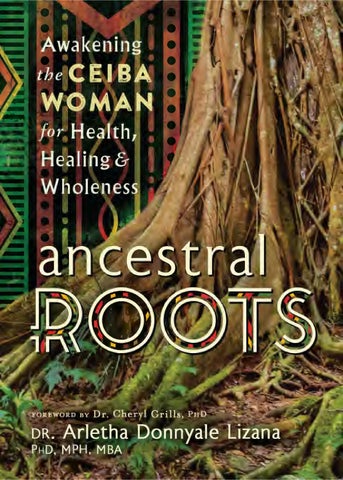
Ancestral Roots, by Dr. Arletha Donnyale Lizana

Page 1


About the Author

Dr. Arletha Donnyale Lizana, PhD, MPH, MBA, is a bridge between worlds—a distinguished health innovation strategist and traditionally trained spiritual leader. For over twenty-five years, she has been initiated as an Iyanifa (priestess of Ifá in the Yoruba tradition) and an Okomfo (priest in the Akan tradition), weaving ancestral wisdom into modern healing practices.

Her academic foundation from Spelman College, Temple University, and Emory University, combined with her leadership as Director of the Innovation Learning Laboratory at Morehouse School of Medicine, positions her uniquely to serve as both scholar and sacred practitioner. As founder of Transforming Communities, she guides organizations toward equity-centered innovation, while through Ceiba Women Inc., she creates transformative spaces where women of color reclaim their ancestral power through herbal medicine, spiritual technologies, and community healing.

With over twenty-five years advancing health equity and systemic change, she stands as living testimony that the old ways and new ways can dance together. Learn more at ArlethaLizana.com.

Awakening the Ceiba Woman for Health, Healing & Wholeness

Ancestral Roots: Awakening the Ceiba Woman for Health, Healing & Wholeness Copyright © 2026 by Dr. Arletha Donnyale Lizana, PhD, MPH, MBA. All rights reserved. No part of this book may be used or reproduced in any manner whatsoever, including internet usage, without written permission from Llewellyn Worldwide Ltd., except in the case of brief quotations embodied in critical articles and reviews. No part of this book may be used or reproduced in any manner for the purpose of training artificial intelligence technologies or systems.

First Edition

First Printing, 2026

Cover design by Shira Atakpu

Interior Eban symbol by the Llewellyn Art Department

Llewellyn Publications is a registered trademark of Llewellyn Worldwide Ltd.

Library of Congress Cataloging-in-Publication Data (Pending)

ISBN: 978-0-7387-8039-9

Llewellyn Worldwide Ltd. does not participate in, endorse, or have any authority or responsibility concerning private business transactions between our authors and the public.

All mail addressed to the author is forwarded but the publisher cannot, unless specifically instructed by the author, give out an address or phone number.

Any internet references contained in this work are current at publication time, but the publisher cannot guarantee that a specific location will continue to be maintained. Please refer to the publisher’s website for links to authors’ websites and other sources.

Llewellyn Publications

A Division of Llewellyn Worldwide Ltd. 2143 Wooddale Drive Woodbury, MN 55125-2989 www.llewellyn.com

Printed in the United States of America

GPSR Representation: UPI-2M PLUS d.o.o., Medulićeva 20, 10000 Zagreb, Croatia matt.parsons@upi2mbooks.hr

Dedication

The lessons, practices, and words that I share here are dedicated to my mother, my grandmothers, my sisters, my daughters, my niece, and all the women—past, present, and future—whose wisdom, strength, and resilience form the backbone of communities and humanity itself. Thank you. It is through their lessons, sacrifices, and love that I’ve come to understand and live the philosophy of the Ceiba Woman. And to you, the reader, may this book ignite a spark within you, a desire to explore, heal, and grow.

Contents

List of In Practice Exercises xi

Foreword by Dr. Cheryl Grills, PhD xiii

Invocation: Invitation to the Journey xvii

Introduction 1

Section 1: The Body (Nipadua) 7

Chapter 1: Navigating Independence 11

Chapter 2: We Don’t Stop for Nobody! 25

Chapter 3: My Grandmothers’ Dressers 39

Chapter 4: Don’t Give Me That 369! 53

Chapter 5: Finding Home 65

Closing Reflections, Section 1: The Body as Story 77

Section 2: The Mind (Adwene) 79

Chapter 6: An Educational Odyssey 85

Chapter 7: Know Thyself 97

Chapter 8: Music Soothes the Savage Beast 109

Chapter 9: Sacred Geometry 123

Chapter 10: Discovering the Passion 139

Closing Reflections, Section 2: The Mind as Bridge and Builder 151

x Contents

Section 3: The Spirit (Sunsum) 153

Chapter 11: Awakening to Spirituality 157

Chapter 12: Your Ancestors Roll Deep! 171

Chapter 13: Embody Your Archetypes 183

Chapter 14: The Spiritual Family You Choose 199

Chapter 15: Listen or Lissen! 211

Closing Reflections, Section 3: The Spirit as Root and Rise 223

Conclusion: A Ceiba Woman 225

Final Activation 237

Acknowledgments 239

Recommended Reading 243

Bibliography 247

In Practice Exercises

Foreword

When we awaken to our ancestral roots, we begin more than a journey of discovery. We begin a sacred revival of the body, mind and spirit—grounded in lineage, light, and liberation. In Ancestral Roots: Awakening the Ceiba Woman for Health, Healing & Wholeness, Arletha W. Lizana offers us exactly that: a road map and a mirror for the Ceiba Woman awakened.

Timing is critical and things happen in their due time. This book arrives during a period in which Black women are carrying disproportionate burdens of chronic disease, generational trauma, and erasure of our cultural inheritance. It reminds us that our bodies are not isolated laboratories but bodies of memory, possibility, and divinity. It reminds us too that healing is not a solo mission but a shared journey. Across decades of work in clinical and community psychology, I have witnessed the toll of disconnection— disconnection from mind, body, spirit, purpose, and

Foreword

heritage. I have also witnessed the power of reconnection: women reclaiming their stories, communities naming and transforming their trauma, systems exposed and held accountable. My intent as a psychologist, educator, and community-healer has been to help women and communities reconnect, step into their fullness, and upend internalized narratives of limitation.

The Ceiba tree, also known as the Yaxche or Tree of Life, represents the powerful celestial axis connecting the ancestors, the living world, and the spiritual abode. A sacred tree among Afro-Cubans, Mayan culture, and Africa, it connects with the very idea of creation and the generation of life. In Ancestral Roots, Arletha takes us on a journey of discovery, reconnection, renewal, and revitalization.

In Arletha’s book, we meet the Ceiba Woman, who mirrors the great Ceiba tree. We quickly discern that, like the Ceiba tree, the Ceiba Woman possesses roots that reach deep into the earth and high into the heavens. This metaphor holds the fullness of what it means to live in wholeness: grounded in heritage and African cultural values, resilient during adversity, open to transformation, connected to community, and guided by spirit.

What makes this text compelling is how it bridges three dimensions: the ancestral, the biological, and the sociocultural, equipping the reader with the capacity to engage in three-dimensional chess-like analyses and actions. In chapters that invite us into reflection, movement, nour-

Foreword xv

ishment, and community, we are called to heal not just our bodies but our relationships with ourselves, our ancestors, our communities, and the world. We are invited to challenge dominant health paradigms that too often decontextualize Black women’s lived experience and to reclaim a holistic praxis of wellness, rooted in justice, dignity, and liberation. In other words, Ancestral Roots invites us to see, hear, and feel our personal and collective past, present, and future as African women.

I have long held that health and healing must be a process founded in wholeness. This wholeness demands historical, psychological, community, and spiritual alignment. Arletha offers vivid examples of how the Ceiba Woman can interrogate her daily decisions, what she eats, how she connects with the mundane and spiritual worlds, how she is in community with others, and how she re-members herself through acts of ancestral honoring and synthesis. She shows us how to adopt wellness practices not as individual checkboxes but as personal and community rituals.

To the sister reading this, know that your body holds stories your tongue may not yet speak, your mind holds insights and wisdoms that your brain may not have yet processed, and your spirit contains an indefatigable verve that your soul may not have yet released for your benefit and the benefit of others. Know that when you heal, you bring healing power to your family and our community. Know

xvi Foreword that by awakening to your roots, you become a channel of actualization for self and for all.

The Ceiba Woman is not an image of perfection; she is an image of integrity: integrated, interwoven, embodied, and expansive. Ancestral Roots calls on all of us Ceiba Women out there to dig deep, drink at the well of wellness, and rise up! I am delighted to lend my voice in celebration of this work, and I invite you to rise with the Ceiba Woman. Let this book be your companion, your witness, your call-to-action as you live each day more deeply rooted, more fully alive, more whole and free.

Los Angeles, California

November 19, 2025

Invitation to the Journey

A note before we begin: You were never meant to be small.

This book is more than knowledge—it is a summoning. A summoning of your power, your voice, your wealth, and your place in the sacred circle.

These pages carry the breath of roots older than memory and remedies whispered across oceans by women who survived, created, healed, and dreamed us into being.

Ancestral Roots is a love letter, but it is also a mirror, reflecting back the truth that healing and power are not opposites.

They are siblings. They walk hand in hand.

xviii Invocatio n: Invitation to the Journey

In this space, we do not shrink to be spiritual. We do not go broke to be generous. We do not disappear to be good.

You are invited to remember:

• That healing can help you increase your abilities, help you find happiness, multiply your money, etc.

• That wholeness makes you more visible, not less.

• That spiritual women can—and must—be wildly abundant.

Let this book be your map and your matchstick.

Let it illuminate what’s been buried.

Let it light the fire under your purpose.

May you never again forget who you are.

Introduction

The Ceiba tree, a towering giant found across Africa, the Caribbean, and Central and South America, is revered in many cultures as a symbol of strength, protection, and spiritual connection. It is often considered sacred, standing as a bridge between heaven and earth, the past and the future, the seen and the unseen. Its roots run deep into the soil, anchoring its massive structure, while its branches stretch high into the sky, embracing infinite possibilities. In many traditions, villages were built around a Ceiba tree, its presence offering both physical and spiritual sustenance to the community.

Like the Ceiba tree, a Ceiba Woman is deeply rooted in ancestral wisdom while reaching boldly toward new heights. She embodies resilience, transformation, and the ability to nurture and protect, not just herself but those around her. Her journey is one of self-actualization, drawing from the past to shape the future. She is a mother, a healer, a leader, a

Introduction warrior, and a seeker—holding within her the power to inspire and uplift.

My Journey to the Ceiba Woman Concept

This book is a reflection of my own path—a journey shaped by resilience, ancestral wisdom, and an unyielding commitment to growth. I have been a student of life in many forms: a scholar, a healer, an innovator, and a traveler seeking wisdom in the traditions of my ancestors. From the villages of Ghana to the spiritual communities of the Caribbean, I have had the privilege of learning from teachers, elders, and practitioners who have illuminated the profound connections between mind, body, and spirit.

Yet, like many, my path was not always clear. There were moments of struggle—balancing the roles of single motherhood, academic pursuit, and leadership in spaces where my presence was not always welcomed. But through each challenge, I found strength in the teachings passed down through generations, in the wisdom of my foremothers, and in the knowledge that healing is a continuous journey. This book was born from a desire to share these lessons and to offer a framework for self-discovery and empowerment. The Ceiba Woman framework is not just a philosophy; it is a way of life, a road map for those who seek to integrate ancestral wisdom with modern-day selfactualization. It is built upon six interconnected stages:

1. Rooting: Honoring ancestral knowledge and building a foundation of self-awareness.

2. Nourishing: Healing through natural medicine, spiritual practices, and self-care.

3. Growing: Expanding knowledge, developing critical thinking, and honing leadership skills.

4. Flourishing: Embracing creativity, authenticity, and personal expression.

5. Giving back: Contributing to community upliftment through mentorship and service.

6. Becoming: Embodying wisdom, resilience, and the lifelong pursuit of growth.

These stages reflect the cycles of nature and the evolving path of self-mastery. Just as the Ceiba tree continues to grow for centuries, so is a Ceiba Woman’s journey ongoing, shaped by her experiences, her relationships, and her dedication to transformation.

Why This Book Now?

We are living in an era of immense change—social, environmental, and spiritual. The pressures of modern life, compounded by historical injustices and systemic challenges, often disconnect us from ourselves, our communities, and the natural world. Many of us feel uprooted, searching for grounding, for meaning, and for a sense of belonging in a world that often feels unstable.

This book is a response to that disconnection. It is a call to return to our roots, to honor the wisdom of our ancestors, and to embrace the lessons that emerge from introspection, spirituality, and community. It draws upon African worldviews, particularly those of the Akan people, whose principles of wisdom (nyansa) and love (akoma) serve as guiding beacons throughout these pages.

What You Will Find in These Pages

This book is divided into three sections, each focusing on a key dimension of self-actualization.

Section 1, “The Body (Nipadua),” includes stories of resilience, independence, and ancestral guidance. These chapters explore the physical and metaphorical journeys that shape our relationship with strength, survival, and endurance.

Section 2, “The Mind (Adwene),” encompasses lessons on overcoming challenges, embracing education, and forging identity. This section reflects on the intellectual, emotional, and spiritual growth required to thrive in a complex world.

Section 3, “The Spirit (Sunsum),” is a journey of spiritual awakening, ancestral connection, and the interplay between science and the sacred. These stories illustrate how spirituality and intuition guide us toward healing and transformation.

Throughout this book, you will find the following:

Personal narratives: Stories from my own life that illustrate the power of resilience, intuition, and growth.

Practical practices: Exercises, rituals, and reflections designed to help you integrate these lessons into your daily life.

Cultural insights: A deep exploration of African and diasporic traditions that provide pathways to healing and self-discovery.

Universal wisdom: Teachings that transcend cultural boundaries, offering guidance on how to align your life with purpose and balance.

An Invitation to Transformation

As you begin this journey, I encourage you to reflect on your own roots and revelations. What are the lessons your ancestors have left for you? How can you integrate their wisdom into your daily life? Whether you are seeking clarity, healing, or inspiration, this book offers a road map to rediscover the sacred connections that make us whole.

To be a Ceiba Woman is not to seek perfection but to embrace the process of becoming. It is a commitment to growth, balance, and transformation, to standing firmly rooted in your values while reaching toward your highest potential.

This is more than just a book. It is a movement toward self-actualization, healing, and collective upliftment. It is an invitation to honor the past, live fully in the present, and create a future brimming with possibility. Thank you for joining me on this journey. Together, let us honor our roots and embrace the revelations that lead us to a deeper understanding of ourselves and the world around us.

Section 1 The Body (Nipadua)

The body is more than a vessel; it is a living archive of resilience, inheritance, and transformation. Nipadua, in Akan philosophy, reflects this duality, the body as both sanctuary and storyteller, carrying the wisdom of those who came before us while shaping the path for those who will follow. It holds memory, strength, and the imprints of ancestral guidance, grounding us in the past while propelling us toward the future.

This section explores how the body serves as a foundation for independence, perseverance, and selfdiscovery. Each chapter highlights experiences that test and strengthen our physical, emotional, and spiritual resolve, whether through the demands of parenting, the lessons embedded in family heirlooms, or the ways movement shapes our lives.

We begin with chapter 1, “Navigating Independence,” which examines the strength required to carve a path of autonomy. Independence is more than selfsufficiency; it is a process of self-definition, deeply influenced by the guidance of those who came before us. This theme of resilience continues in chapter 2, “We

Don’t Stop for Nobody!,” which explores movement, both physical and metaphorical, as an act of perseverance and homage to our ancestors. The ability to push forward, even in adversity, is a testament to the body’s capacity to endure and evolve.

The role of inheritance, both tangible and intangible, emerges in chapter 3, “My Grandmothers’ Dressers.” Objects passed down through generations hold memory and meaning, much like the body itself, which carries the strength, struggles, and wisdom of those before us. The body is an heirloom, a bridge between past and present. This theme continues in chapter 4, “Don’t Give Me That 369!,” which explores the influence of male figures and the ways relationships leave lasting imprints. It highlights how physical and emotional strength intertwine, shaping our understanding of balance, legacy, and resilience.

The section concludes with chapter 5, “Finding Home,” a reflection on how physical relocation shapes both the body and the spirit. These movements in space and time demand adaptability, reinforcing the idea that resilience is an ever-evolving practice.

Together, these chapters illuminate how the body is both a sanctuary and a catalyst for change. It carries the echoes of our ancestors, the weight of our

choices, and the strength to forge new paths. The body (nipadua) reminds us that resilience is not just about surviving—it is about moving forward with intention, honoring where we come from while embracing where we are meant to go.

1

Navigating Independence

Let me take you back to the late ’70s: no cell phones, no Google Maps, just a whole lot of adventure waiting to happen, especially for a scared nine-year-old with a surprising amount of fearlessness.

I was starting third grade with a bang—or, rather, with a bus ticket. That morning, my mother had casually mentioned that I would eventually start riding the bus. When the school secretary handed me bus tickets, I figured today was the day and I embarked on my journey of independence. Little did I know, my interpretation of eventually would send my whole family into a mini frenzy.

After school, with the confidence of a seasoned traveler, I marched down to the public bus stop, about a half-mile hill trek from my school. I was a tiny, determined figure with a backpack almost as big as me, standing resolutely at a bus

12 Chapter 1

stop, ready to take on the world—or at least I was ready to take on the Pittsburgh public transportation system.

The adventure began with me getting on the first bus. With just a transfer to go, I was thinking I was a big girl headed back home for the day. Meanwhile, my family had arrived at school to pick me up. Today was not eventually. They were horrified when I wasn’t at the school. At first they thought another family member had picked me up and called around to find out. Remember, there were no cell phones at the time; they were calling homes and businesses.

Fast-forward a few hours and there I was, ringing the doorbell of my own home. My sister, a high schooler, answered the door. She looked at me and immediately said, “You’re in trouble!” I thought I was going to get a spanking when my mother got home.

Instead of delivering the expected yelling or spanking, my mother was impressed. “I guess you’ll be taking the bus alone now,” she said, a mix of astonishment and pride in her voice. That was the day I became a latchkey kid, a term commonly used then for kids who let themselves in the house when they got home from school, with no one around to help or supervise. I kept my house key on a shoestring tied around my neck.

In hindsight, the thought of a nine-year-old navigating public transportation alone is extremely scary. But back then, it was a different time, a different world. That

day marked the beginning of four years of commuting by public transport, a journey that taught me about people, responsibility, and independence. Reflecting on this adventure, I realize it was my first real lesson in self-trust and embracing the unexpected. It taught me the subtle art of balancing independence with the need for support, a lesson I carry with me to this day.

Cultivating Independence

Independence is not a solitary act but a harmonious dance between individuality and connection. The Ceiba tree, revered for its resilience and significance, stands as a metaphor for this balance. Just as the Ceiba draws strength from its roots to reach for the sky, independence thrives when grounded in heritage, community, and purpose.

Throughout history, women have shown how independence is intertwined with resilience and self-awareness.

Consider Wangari Maathai, the Kenyan environmental activist who founded the Green Belt Movement.1 Her work was not just about planting trees; it was about empowering women to reclaim their autonomy and dignity through environmental stewardship. Maathai’s legacy illustrates that independence often requires courage to stand against the tide while fostering collective growth.

1. Maathai, Unbowed: A Memoir.

Chapter 1

Similarly, the Ceiba Woman philosophy views independence as an act of reclamation and restoration. It is about understanding where you’ve come from, honoring that journey, and making intentional choices that align with your highest self. For me, this realization deepened through life’s challenges. It wasn’t enough to simply push forward; I had to look inward, reflecting on how my heritage and spiritual practices had shaped my resilience.

The act of reclamation and restoration is not just about breaking free from constraints but about restoring what was always ours: the power to define our own paths. For me, this realization did not come in a single moment but revealed itself over time, shaped by life’s challenges and the wisdom of those who came before me. Independence was not simply pushing forward; it was looking inward, understanding my lineage, and reclaiming the spiritual and cultural foundations that made resilience possible.

That first solo bus ride I took as a child, navigating unfamiliar streets on my own, was more than a lesson in independence; it was a moment of personal reclamation, a declaration that I was capable of finding my way. At the time, I didn’t recognize its significance. But looking back, I see that every independent step we take is built upon the sacrifices, teachings, and survival of those who walked before us. Independence is not about severing ties, but about choosing how to honor them while forging new paths.

Following are some ways to think about owning your autonomy.

Rewriting Personal Narratives

Independence often begins with reclaiming the stories we tell ourselves. So many of us have inherited limiting narratives, expectations shaped by culture, family, or society that dictate who we should be. For one woman I met at a retreat in Costa Rica, this realization became a turning point. She had spent years conforming to societal and familial pressures, feeling trapped by a script she never wrote. It was through journaling and meditation that she learned to articulate her own desires, setting boundaries that honored her personal evolution. Her story resonated deeply with me. I, too, have had to confront and rewrite the narratives imposed upon me, whether about success, motherhood, or the role of Black women in professional spaces. The power of independence lies in the ability to reclaim your own story and redefine what fulfillment looks like on your terms.

The Role of Silence in Strength

Silence is often misunderstood, yet in many Indigenous traditions it is seen as an essential practice for clarity and decision-making. The Apache concept of “speaking with

16 Chapter 1 precision” teaches that words hold power, and those who master silence learn to communicate with intention.2

Early in my career, I believed I had to constantly prove my worth through words, filling spaces with explanations, justifications, and reassurances. But through spiritual practice, I began to embrace silence, not as avoidance but as a form of powerful presence. Silence allows space for discernment, for listening deeply to intuition, and for making decisions from alignment rather than reaction. In moments of conflict or uncertainty, I now turn to stillness before speaking. Some of the most profound statements, I have found, come not from rushing to respond but from pausing long enough to hear what truly needs to be said.

Financial Autonomy

True independence is incomplete without financial autonomy, yet wealth building in African and African diasporic traditions is often rooted in communal principles rather than individual accumulation. The concept of Ujamaa, a Swahili term meaning “cooperative economics,” reflects this.3 Rooted in Kwanzaa principles,4 Ujamaa encourages

2. Basso, Wisdom Sits in Places: Landscape and Language Among the Western Apache.

3. Karenga, Kwanzaa: A Celebration of Family, Community, and Culture.

4. Karenga, Kwanzaa: A Celebration of Family, Community, and Culture.

communities to pool resources, invest in one another, and build sustainable wealth together.

I have seen this in practice in my own circles. Whether it was women entrepreneurs forming business cooperatives or community members creating rotating savings funds, collective economics has been a blueprint for financial resilience. Even my own journey—building businesses that center on community impact—has been shaped by the recognition that financial independence is not just about personal gain but about creating opportunities that uplift others.

This is why the Ceiba Woman philosophy views financial independence as a practice for transformation—not just for themselves but for their families, communities, and future generations.

The Science and Spirituality of Independence

The neuroscience of independence affirms what spiritual traditions have long understood—that our brains are wired for adaptation and growth. Research in neuroplasticity shows that engaging in goal-directed activities, such as learning a new skill or practicing resilience in the face of adversity, literally strengthens the neural pathways associated with self-efficacy and confidence.5

5. Bandura, “Toward a Psychology of Human Agency.”

18 Chapter 1

This aligns beautifully with spiritual traditions that emphasize mindfulness and intention as practices for selfactualization. Practices such as meditation, fasting, and ritual serve as neurological resets, enhancing discipline, focus, and emotional regulation.6

• Meditation increases gray matter density in the brain, improving decision-making, emotional control, and stress resilience.7

• Fasting triggers cellular regeneration and mental clarity, a process recognized in both traditional African healing practices and modern science.8

• Rituals, whether through prayer, movement, or symbolic acts, create psychological anchors that reinforce a sense of purpose and alignment.9

While cultivating independence is a sacred act of selftrust, it’s important to recognize when that strength begins to harden into hyper-independence, a survival response rooted not in empowerment but in past betrayal, abandon-

6. Kabat-Zinn, Wherever You Go, There You Are: Mindfulness Meditation in Everyday Life.

7. Hölzel, Carmody, Vangel, Congleton, Yerramsetti, Gard, and Lazar, “Mindfulness Practice Leads to Increases in Regional Brain Gray Matter Density.”

8. Longo and Mattson, “Fasting: Molecular Mechanisms and Clinical Applications.”

9. Winkelman, “Shamanism as the Original Neurotheology.”

ment, or burnout. Hyper-independence is the belief that “I must do everything alone,” because leaning on others has led to disappointment or pain. Though it may feel like control or resilience on the surface, this pattern often masks unresolved wounds and blocks the flow of support, softness, and collaboration that is vital to true healing. I caution you gently to discern the difference between healthy autonomy and protective isolation. Remember, real power includes the ability to receive, ask for help, and be held— without fear that it makes you weak or unworthy.

The African philosophy of Ubuntu, meaning “I am because we are,” reminds us that independence and interdependence must coexist.10 Independence is not about isolation; it is about cultivating inner strength while remaining connected to the collective.

The Ceiba Woman’s Commitment to Independence

A Ceiba Woman understands that independence is not a final destination but an ongoing process of growth, selfawareness, and transformation. It requires the courage to stand in your truth, the wisdom to seek guidance from ancestors and mentors, and the discipline to cultivate habits that sustain your freedom.

10. Tutu, No Future Without Forgiveness.

20 Chapter 1

Here is a Ceiba Woman Mirror Mantra. Try speaking this aloud while looking into your own eyes:

I commit my whole self—body, mind, and soul— to my sacred autonomy.

I honor the truth that lives in me, even when it challenges the world around me.

I call on the wisdom of my ancestors and the guidance of my mentors as I grow.

I choose discipline over distraction, devotion over doubt.

Each day, I reclaim my freedom— not as a destination, but as a divine way of being.

I am rooted. I am rising. I am a Ceiba Woman.

And in choosing my freedom first, I strengthen my power to serve, to love, and to liberate others.

Like the Ceiba tree, a Ceiba Woman is deeply rooted in her history yet fearless in her reach, stretching toward new possibilities. Her independence is not just for herself, but is also for the generations before her who fought for that freedom and for those who will follow in her footsteps.

What Independence Means for You

As you reflect on this chapter, consider:

• What stories have you been told about independence?

• Which of those stories serve you and which need rewriting?

• How can you create a version of independence that aligns with your values and purpose?

Independence is not about walking alone—it is about walking with intention, choosing the paths that honor both your personal freedom and your connection to the world around you.

Let’s explore strategies for nurturing independence in children and adults, ensuring that we empower rather than control, guide rather than dictate, and ultimately help others navigate their own journeys with confidence.

In Practice

Creating Your Mind Map

Here is a strategy for nurturing independence in others without losing sight of their need for guidance. After all, isn’t life all about finding the right bus, getting off at the right stops, and sometimes unexpectedly finding your way back home?

Mind mapping is a technique that allows for visual brainstorming, where central ideas are connected to related concepts, forming a “map” of thoughts and strategies. This process mirrors how the brain naturally organizes information, activating

22 Chapter 1

neural pathways that enhance memory, creativity, and problem-solving by engaging both hemispheres of the brain. This practice is an activity designed to help readers explore strategies for fostering independence in children and cultivating self-reliance in adults. The mind map will serve as a visual and conceptual practice, guiding readers to balance life’s responsibilities while promoting personal growth and autonomy.

Supplies needed

Paper

Pencils/pens (Colored ones are a nice touch.)

Directions

1. Set up your mind map. Start by writing a central idea in the middle of a blank page. For this exercise, the central idea is “Developing Independence in Children” or “Cultivating SelfReliance in Adults.”

2. Draw branches out from the central idea. Each branch represents a key theme or area to explore. Suggestions for branches include:

• “Encouraging Decision-Making”: Explore ways to allow children to make choices that are appropriate for their age.

• “Fostering Problem-Solving Skills”: Discuss methods to help children learn how to address challenges independently.

• “Building Responsibility”: Offer ideas for tasks or activities that can teach children about responsibility.

• “Balancing Responsibilities”: Strategies for managing personal, professional, and familial responsibilities.

• “Personal Growth”: Ideas for continuous learning and self-improvement.

• “Emotional Autonomy”: Tips for developing emotional intelligence and resilience.

3. Expand the mind map by adding branches and additional circles or leaves to each branch. These spaces should detail specific actions, examples, or further thoughts. I encourage you to personalize these with your own ideas and experiences.

4. Once the mind map is complete, reflect on the insights gained. Identify one or two strategies you can implement in your life today or in your approach to parenting, grandparenting, work, or self-growth.

5. Keep your mind map in a place where you can see it regularly. As you try out different strategies

24 Chapter 1 or gain new insights, you can add to and evolve your mind map.

This mind mapping exercise is not just an activity but also a journey into self-discovery and practical strategy development. It serves as a foundational practice for the themes explored in subsequent chapters of this book.

Return to Your Roots and Become a

Ceiba Woman

Discover a transformative path back to the knowledge, practices, and spiritual traditions that sustained our ancestors through centuries of resilience and triumph. Dr. Arletha Donnyale Lizana, PhD, MPh, MBA, guides you through the revolutionary Ceiba Woman framework—a dynamic six-stage journey that will help you step into your fullest power as a force for transformation in your family, your community, and the world.

Like the sacred Ceiba tree revered across cultures for its strength and healing properties, a Ceiba Woman is deeply rooted in ancestral knowledge while reaching boldly toward new possibilities. Drawing from profound insights across West African and African Diaspora traditions, Dr. Lizana provides a framework for integrating ancient healing with the demands of contemporary life.

Featuring authentic stories, academic rigor, and a commitment to justice and liberation, Ancestral Roots is your road map for reclaiming ancestral wisdom, healing generational wounds, and much more.

Dr. Arletha Donnyale Lizana, PhD, MPh, MBA, is a trailblazer in merging traditional healing with modern healthcare. With academic credentials from Spelman College, Temple University, and Emory University, she serves as Professor, Associate Vice President, and Director of the Innovation Learning Laboratory at Morehouse School of Medicine. An initiated Iyanifa in the Ifá tradition and Okomfo in the Akan tradition with over 25 years of practice, Dr. Lizana founded her company, Ceiba Women, to pioneer a holistic approach to wellness. Learn more at ArlethaLizana.com.

Turn static files into dynamic content formats.

Create a flipbook