
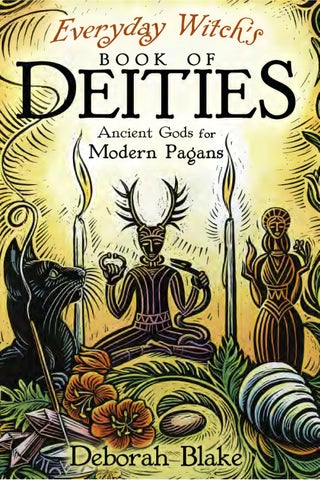
Everyday Witch's Book of Deities, by Deborah Blake

Page 1


Praise for Everyday Witch’s Book of Deities

“Deborah Blake has crafted a practical and accessible guide to spirit working for modern Pagans. Everyday Witch’s Book of Deities will prove especially beneficial for newcomers to this increasingly popular practice. Blake writes with her customary warmth, kindness, and clarity.”

—Judika Illes, author of Encyclopedia of Spirits

“A thoughtful exploration on how to forge a personal connection with Gods and Goddesses in a way that makes sense for your personal witchcraft path. This book is written for practitioners of magic in today’s world, emphasizing cultural context, respectful connections, communication, and everything you need to know about deity work. As always, Deborah offers a practical, no-nonsense approach as she guides you through the ins and outs like a dear friend. This book will show you how building a relationship with deity can bring depth to your magic and self-discovery in your craft.”

—Mickie Mueller, author of The Witch’s Mirror

“Deborah Blake goes beyond the usual lists and correspondences to explore the living cultural connections that still surround these deities, honoring the traditions that hold them while empowering witches to respectfully expand their own practice. This book meets readers where they are, guiding them through the often mysterious process of knowing when a deity is calling and how to reach out with clarity, confidence, and care. Blake has created a beautifully accessible, culturally aware, and genuinely practical companion for anyone ready to deepen their devotional path with deity work.”

—Elyse Welles, author of Sacred Wild

“Within this wise offering, our favorite Everyday Witch presents manners by which we can work directly, respectfully, and safely with deities from numerous cultures. This book’s expansive alphabetical listing gives readers introductions to various deities, providing stepping stones for those who are called to work with any given deity or who are simply curious to learn more! I will be referring to this book time and time again.”

—Raven Digitalis, author of The Empath’s Oracle and Shadow Magick Spellbook

“This is just the book for exploring a variety of pantheons and culture, with just enough detail about each deity to get a good grasp of what they’re all about and point the way for continuing study. Written in Deborah Blake’s clear, comforting, and calming style, it’s as if your dear friend is sitting down with you on the couch to explain all the mysteries of deities and how to incorporate them into your life and magical work. This book is a must-have for those seeking to add deity to their lives and practices, and it’s beginner friendly. Brava!”

About the Author

Deborah Blake is the award-winning author of nineteen books on modern Witchcraft, as well as two oracle decks and the hugely popular Everyday Witch Tarot. Her books and decks have been translated into multiple languages. She is the recipient of the coveted COVR award, and has contributed numerous articles to various Llewellyn annuals, along with her monthly column in Witches & Pagans Magazine. She is a regular guest on witchy podcasts and blogs.

Deborah has been a practicing Witch for over thirty years and has been the High Priestess of her own coven, Blue Moon Circle, since 2004. She is also the author of seventeen novels and multiple novellas across four different series, including the Baba Yaga paranormal romances.

When not writing, Blake can be found in the garden, giving tarot readings, or reading other people’s books. She lives in Upstate New York in an old farmhouse with assorted cats who supervise all her activities, both magical and mundane.

©
Bobbie Hodges

Everyday Witch’s Book of Deities: Ancient Gods for Modern Pagans Copyright © 2026 by Deborah Blake. All rights reserved. No part of this book may be used or reproduced in any manner whatsoever, including internet usage, without written permission from Llewellyn Worldwide Ltd., except in the case of brief quotations embodied in critical articles and reviews. No part of this book may be used or reproduced in any manner for the purpose of training artificial intelligence technologies or systems.

First Edition

First Printing, 2026

Book design based on a design by Rebecca Zins

Cover art by Jennifer Hewitson

Cover design by Shannon McKuhen

Llewellyn Publications is a registered trademark of Llewellyn Worldwide Ltd.

Library of Congress Cataloging-in-Publication Data (Pending)

ISBN: 978-0-7387-8032-0

Llewellyn Worldwide Ltd. does not participate in, endorse, or have any authority or responsibility concerning private business transactions between our authors and the public.

All mail addressed to the author is forwarded but the publisher cannot, unless specifically instructed by the author, give out an address or phone number.

Any internet references contained in this work are current at publication time, but the publisher cannot guarantee that a specific location will continue to be maintained. Please refer to the publisher’s website for links to authors’ websites and other sources.

Llewellyn Publications

A Division of Llewellyn Worldwide Ltd. 2143 Wooddale Drive Woodbury, MN 55125-2989 www.llewellyn.com

Printed in the United States of America

GPSR Representation: UPI-2M PLUS d.o.o., Meduli eva 20, 10000 Zagreb, Croatia matt.parsons@upi2mbooks.hr

Other Books by Deborah Blake

The Eclectic Witch’s Book of Shadows

The Eclectic Witch’s Book of Shadows Companion

Everyday Witch A to Z

Everyday Witch A to Z Spellbook

Everyday Witch Book of Rituals

Everyday Witch Oracle

Everyday Witch Tarot

Everyday Witch Tarot Mini

Everyday Witchcraft

Everyday Witch’s Familiars Oracle

The Everyday Witch’s Coven

The Goddess Is in the Details

The Little Book of Cat Magic

Llewellyn’s Little Book of Spellcraft

Llewellyn’s Little Book of Witchcraft

Midsummer

The Witch’s Broom

A Year and a Day of Everyday Witchcraft

A Year and a Day of Everyday Magic

To all those who believe.

c hapter F ive

Individual Deities and How to Connect with Them 39

c hapter S ix

Ancient Beliefs in the Modern World 135

Conclusion 151

Acknowledgments 153

Appendix A: Quick Reference Deity List 155

Appendix B: Deity List by Culture 161

Appendix C: Deity List by Correspondences and Goals 165

Bibliography 173

Guest Contributor Bios 177

Introduction

Modern Witchcraft is a religion and a spiritual path that is practiced by an estimated two million people in America alone with those numbers increasing every day. Many people are attracted to one or more of its variations, in part because of a dissatisfaction with the religions they were raised with, and in part because of its openness and acceptance of less traditional lifestyles.

And then there are the deities. So many options for worship that go far beyond a single stern male God.

There are as many approaches to Witchcraft as there are witches, and there is no one “right” way to follow this path. There are solitary witches and witches who belong to covens, those who primarily celebrate at the full moon and during the eight seasonal holidays known as the sabbats, and those who integrate magical work into their everyday life with kitchen magic, herbal magic, spellcasting, and more.

One thing that most of us have in common, though, is polytheism, or the belief in and worship of more than one deity. For me, one of the aspects of Witchcraft that attracted me most was the inclusion of a goddess. Growing up Jewish, we had no such thing. Not even a female figure to adore, like Mary in the Christian denominations. Nope; it was a patriarchal father God or nothing.

So you can imagine my delight when I discovered there was a spiritual practice that included someone who reflected my own vision of myself (only way cooler, obviously). As my exploration of the Witchcraft path continued, I learned that one of the benefits of having multiple deities to call on was that there was one for every aspect of myself, as well as those who had the traits

I felt I lacked. No matter what, there were options for deities to call on with questions or requests or simply gratitude. This was the path for me.

Not all witches or Pagans worship a specific deity. Some simply call on the Universe, or the Powers that Be, or whatever other term they are comfortable using. But for the rest of us, working with god and goddess—whether in a general or specific sense—is a major part of our magical practice, and often our daily lives.

This book is designed to help you do just that. First, by sharing many of the deities that are most commonly worshipped in modern Witchcraft, so you can find the one or ones you resonate with. Second, by giving you some simple suggestions for how to connect with deity on a personal level. For me, my interaction with deity is part of being an everyday witch. Whether I greet God and Goddess first thing in the morning, or call on Brigid for healing, or ask Bast to watch over my cats, my relationship with the divine is part of the fabric of my life, woven into the whole along with magic and ritual and an appreciation of nature.

These are just starting places, of course; as you build a relationship with your own personal deities, you will figure out the best ways to communicate with and worship them. At its core, witchcraft is a deeply personal religion, and what deity looks like for each of us can be very different. It is my hope that this book will help you explore the wonderful world of gods and goddesses, and be both an introduction and an inspiration for working with ones you may not have connected with before.

I also discuss a few of the issues involved in working with deity in modern Witchcraft, as well as suggestions for how to find the right deity for you, how to set up a basic altar, and also some basic cultural background for the most commonly used pantheons. Additionally, because I am fortunate enough to know a few witches who follow a modern version of the particular cultures I cover in this book, I’ve asked them to share their stories of what their worship entails. I’ve always found these firsthand glimpses into real-life practices fascinating, and I hope you do too. So later in the book, you will meet a Druid, a Heathen, a Hierophant in the Fellowship of Isis, a priestess who worships Roman gods (among others), and a Greek witch. Perhaps their experiences will inspire you.

Introduction

Keep in mind as you read that there are many, many, many different approaches to working with deity, and there is no wrong way. The important thing is to find what works best for you as you walk your own path so that you get the most out of being a witch every day.

Things get trickier when you look at deities who are still being actively worshipped by cultures that exist in the here and now. Two examples of this would be Native American or African divine beings, like the Orishas followed by those who practice Vodou or Santería. This is not to say that you can’t under any circumstances connect with those deities even if you are not allied with the culture—I have a friend who was claimed by Yemaya, and as I always say, you don’t say no to a God/dess—but you will want to be very careful in how you approach doing so.

Learn the proper ways to interact with these deities from someone who is part of that culture. Do your homework, and be extra careful to use respect when dealing with a culture not your own.

You’ll notice that I haven’t included any of these gods in this book. That isn’t because I don’t want to be inclusive or represent a wide range of options. It is because, frankly, I don’t feel qualified to teach anyone about them. It simply isn’t my area of expertise or study. If you are interested in expanding your horizons beyond the deities covered here, there are lots of great books out there written by people who know a lot more than I do, and I highly encourage you to seek them out.

Why and How Witches Work with Deities

There are as many ways to work with deity as there are witches, and not everyone is coming from the same motivation or inspiration. How you approach God/dess worship is as individual as you are and may change over time as your practice grows. In this chapter, I’ll give you some ideas for how and why some folks connect to deity, but how you choose to do so is completely up to you.

What Do We Mean by Deity?

This is an important question, and one that doesn’t have a simple answer. To begin with, deity can mean different things to different people. And to complicate the issue even further, it can mean more than one thing at the same time. I told you it wasn’t simple.

Witches and Pagans may look at deity as a formless, unfathomable presence, an essence too great for the human mind to fully grasp. The One, from which all things came and to which all things will return, infinite and powerful and unknowable. Ineffable, indescribable, and yet absolutely real.

Alternatively, deity is often seen as an individual being, one with specific traits and aspects with whom we can commune on a more personal level. These beings are given specific names by various cultures, although there can be a certain amount of crossover, especially between the Greeks and the Romans, and some deities show up across various cultures wearing different names, but they are recognizable by their attributes and often their stories. Witches may

choose to worship one or many of them. Generally, these deities are viewed as male (gods) or female (goddesses), although there are some whose gender can be more fluid, a topic I’ll touch on in a later chapter.

Many witches also worship God and Goddess in a more general way, without any particular cultural or character origins. In this instance, deity is seen to represent a higher power, but one that manifests in both feminine and masculine aspects, as most (but not all) creatures in the natural world do, as opposed to the singular masculine God of Judaism, Christianity, Islam, and some other religions.

This is where it gets a little bit complicated and confusing: All these forms of deity can exist simultaneously. You can worship deity in all these manifestations, and they are essentially the same thing while also being perceived differently at any given moment.

Here’s how I look at it. In the larger picture, I see deity as being huge, all encompassing, and far beyond my grasp as a mere mortal. But I also believe that this powerful source of light and love can come to each of us in a form that we can connect and communicate with more easily. So sometimes when I reach out, I call on the duality of God and Goddess, or simply Goddess, and sometimes I invoke a specific deity or deities who manifest using a particular name and set of attributes that suit my needs at that moment.

In the end, it is all about belief and communication. However deity manifests for you, however you envision it, whichever way is easiest for you to communicate with and feel a connection to it, that is deity. There is no wrong way.

Why Witches Work with Deity

As I said in the introduction, not all witches and Pagans work with deity. But the folks who don’t are more an exception than the rule. Almost all the witches I know, both personally and through my writing, have at least one God or Goddess they call on. Many have relationships with multiple deities, although often their connection is strongest to one or two.

You don’t, of course, have to have a specific deity you work with. I often simply call on “God and Goddess” when I am doing magical work or even in

my daily rituals, like greeting the day or blessing my food. When I do this, I am basically sending my words and thoughts out to deity in general, without attempting to connect with any one in particular.

On the other hand, if I have a specific goal, I might choose to do a spell that calls on a deity who is associated with whatever I’m trying to achieve, such as Brigid for healing, or Demeter for prosperity and abundance.

This is true for my group as well. I have a coven called Blue Moon Circle that has been practicing together since 2004. It is made up of a number of women, each with their own approach to their individual witchcraft paths and their own relationship with deity. When we gather for group rituals, though, we usually call on either the Goddess in a general way or one of the lunar goddesses if we are celebrating the full moon, or we call on specific deities on the holidays who are associated with that sabbat, like Brigid at Imbolc or Lugh at Lughnasadh.

It is not unusual for a witch to have a deity come to them and make themselves known—to say, in essence, “I claim you as one of mine.” If you are fortunate enough to have this happen, you will want to pay attention. Otherwise, we mostly follow our hearts and call on deity in whichever form feels right to us at the time.

As to why we work with deity, for most of us, it is a core part of our Witchcraft practice. Most witches believe in deity in some form, and for many, polytheism, and in particular a connection to both goddess and god, is one of the aspects that drew us to Witchcraft in the first place. The first time I stepped into a ritual circle, I reached out into the night, and God and Goddess reached back. In that moment, I knew I had found what I’d been looking for.

Of course, it doesn’t happen that way for all people. Some folks read about Witchcraft and Paganism and like the idea of deity, but it takes them a while to find the one or ones they connect with. Some people experiment until they find the approach or worldview that works for them. Others spend years exploring. But whichever way it happens for you, it all comes down to belief. We worship the gods because we believe in them. It really is that simple. The other half of the “why work with deities” question is one of practicality. As witches, there is a limit to what we can achieve, even using magic. If we ask

for help from deity, in whichever form feels right, we might get an extra boost to our power, a push in the correct direction, or even, if we’re lucky, a miracle. (Miracles aren’t necessarily big and showy. Sometimes they’re just marvelous and unexpected.)

Faith and function—a connection with the divine can widen your mind and open your heart. And isn’t that what Witchcraft is all about?

How Witches Work with Deity

This is too large a question to cover in just one chapter. I’ve written whole books about it, as have many other folks. So if you need more suggestions and guidance than you get here in this book, it’s a good idea to go looking for answers elsewhere. Heck, Witchcraft is all about learning and growing, so searching out more information is always a good idea.

But I’ll try to at least touch on the basics here, to give you some idea of ways you might work with the deities you’ll meet later in the book.

Although there are really no limits to the possibilities, here are the most common approaches:

• Prayer

• Spellwork

• Ritual

• Communion Prayer

Prayer is something witches and Pagans have in common with virtually all other religions. It is, at its most basic, talking to deity. In some religions, this can often take a formal approach, like going to church and reciting a prayer from an official prayer book of some sort, or reciting the Lord’s Prayer before bed. I grew up going to Temple, and every Friday night we would gather for the Sabbath and recite prayers together in unison. There is a lot of power in that, although it isn’t for everyone.

Most people who follow other religious paths also pray during times of need, asking for help, or solace, or protection. These prayers are more likely to be spontaneous and individual and may be said in a sacred space like a church or wherever the person happens to be.

This type of prayer is more like what witches tend to do. We mostly just talk to deity as needed. I sometimes stand in front of my altar, but I’m just as likely to be outside under the full moon. If a prayer is said in a more formal manner, it is likely to be associated with spellwork or ritual, but not always. Like everything else witchy, there is no right or wrong way.

You can call on a specific deity (“Brigid, please help me find peace and serenity”) or deity in general (“God and Goddess, please hear my prayer” or “Goddess, I come before you on the night of the full moon to ask for your assistance”). Either way, you want to make sure you are polite and respectful, but otherwise there are no rules for what to say or how to say it. Just speak from the heart.

Spellwork

When non-witches ask me about spells, I often tell them that they can be much like a prayer. After all, we are usually asking for help with something, or working on a goal or desire of some kind. So the spell itself may bear a strong resemblance to prayer. Are they different things? That’s really up to you to decide.

Regardless, spells are another way to work with deity. Spells are a set of words, often said aloud, but they can also be recited silently. They can be simple or complicated, long or short, rhyming or not, but they all have a purpose, which is to achieve some kind of goal by tapping into the power of magic, or deity, or the Universe. They are sometimes (but not necessarily) accompanied by using various tools, such as crystals, herbs, candles, and even witchy craft projects—for example, a charm bag.

However, spells can also be said on their own, whether outside with nothing other than heart and spirit, inside in front of an altar with only a candle, or even in the middle of a busy public space, although in that case you might want to say it very quietly.

Witches often choose to call on deity when casting spells to ask for help or guidance. This is one of the times when we may choose to work with a specific deity because of their association with that particular goal or request.

Ritual

Rituals can be much like spells in that they are a way of putting a magical request out into the Universe. When we do rituals for this purpose, we often include a spell at some point during the ritual. However, rituals can also be purely celebratory. We may reach out to deity during the sabbats just to say thank you or hello or to greet them as we have a ritual celebration with our witchy friends but not ask for anything.

Some witches have full moon rituals that are part of their practice and used to connect with Goddess energy, or even one of the lunar goddesses in particular, but aren’t used for spellwork unless they have an urgent issue. Rituals can be used to work with deity, or to acknowledge and appreciate them, or both.

Communion

Communion with the divine is an aspect of many religions, although in some it is a privilege reserved for specific people, like priests or nuns. In Witchcraft, we are all our own priest/ess (or whatever you want to call it), and anyone can commune with the gods at any time.

Unlike prayer, which is basically sending a request out, communion is just what it sounds like: sitting with the divine and establishing a deeper connection, with no purpose other than to create that link. It is a spiritual act with no agenda. Usually done in a quiet, solitary place, sometimes in a trance state but as often simply sitting on the couch or outside under a tree, you reach out for deity and open yourself to them reaching back.

Of course, just because it is simple doesn’t make it easy. For some people, this way of working with deity comes naturally. For others, it is a matter of practice and putting in the time, even if it is just a few moments a couple of days a week. Sometimes it can be difficult to tell if you are truly communing or just sitting and being present in the moment, waiting for a sign or a little voice in your head that comes from outside you. But that’s not a bad thing either.

If you are outside, remember that witchcraft is a nature-based path, and deity may manifest in the song of a bird, the whisper of the breeze through the trees, or some unexpected sight like a rainbow or an animal coming closer than you’d expect. Keep an open mind, since the gods don’t always communicate in predictable ways.

UV

In the end, only you can decide which approaches to working with deity work best for you. If you are new to the Craft, you may have to experiment with a number of different things before you discover what feels most satisfying or achievable, or what your own personal relationship with the divine looks like. What’s more, don’t be surprised if it changes and grows over time, as your practice of Witchcraft changes and grows. Life is not static; it is a journey we walk every day, following twisting paths that lead in directions we might not have anticipated when we started out. The same is true for our lives as witches. I am not the same person I was when I began my Witchcraft path, and therefore my practice has shifted and adapted and changed too.

And that’s as it should be. Don’t be afraid to be flexible, to experiment, and to leave behind whatever doesn’t work for you, so you can make more room for the things that do. I assure you, the gods will understand.

“A practical and accessible guide to spirit working for modern Pagans. …Blake writes with her customary warmth, kindness, and clarity.”

Judika Illes, author of Encyclopedia of Spirits

Find Your Divine Match Among 70 Deities from Diverse Pantheons

The latest entry in Deborah Blake’s Everyday Witchcraft series, this inclusive, beginner-friendly book shows you how to create your personal practice with deity—or expand your current worship—using spells, rituals, and activities designed for greater connection. Featuring Egyptian, Greek, Roman, Celtic, and Norse pantheons, this book offers practical suggestions for building relationships with the deities who resonate with you the most.

Deborah Blake presents a brief overview of each pantheon and the roles gods play in it. She also shares suggestions on how to set up altars and more effectively communicate with your chosen deity. Along with Deborah’s wisdom, you’ll learn keen insights from five contributors. Whether it’s Brigid’s healing prowess or Demeter’s gifts of abundance, these deities help enhance your spirituality and improve your daily life.
“This book is written for practitioners of magic in today’s world, emphasizing cultural context, respectful connections, communication, and everything you need to know about deity work.” —Mickie Mueller, author of The Witch’s Mirror

DEBORAH BLAKE is the author of nineteen books on modern Witchcraft, including The Eclectic Witch’s Book of Shadows, The Little Book of Cat Magic, and Llewellyn’s Little Book of Spellcraft , as well as the acclaimed Everyday Witch Tarot, Everyday Witch Oracle, and Everyday Witch’s Familiars Oracle. Deborah lives in upstate New York with numerous cats who supervise all her activities, magical and mundane. She can be found at deborahblakeauthor.com.

© Alethea Kontis

Turn static files into dynamic content formats.

Create a flipbook