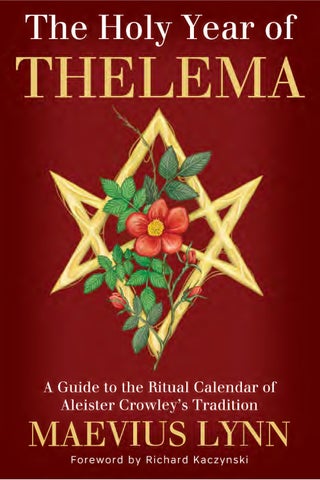
“With the exception of the Liber XV (The Mass of the Gnostic Catholic Church), a Thelemite’s menu of religious celebrations and observances is pretty limited. There are, however, ‘Rituals of the Elements’ and ‘Feasts of the Times’ that are prescribed in The Book of the Law, but, sadly, we are not told much more than that. Maevius Lynn’s marvelous new book, The Holy Year of Thelema, discusses each of these in depth and provides the practicing Thelemite exciting ideas and a year-long perpetual background meditation of simple yet profound spiritual observances.”
—Lon Milo DuQuette, author of Understanding Aleister Crowley’s Thoth Tarot and Low Magick
“In this much-needed contribution to the Thelemic body of texts, Maevius Lynn provides a wonderful foundation for those wanting to integrate more celebratory and seasonal practices into their magical and mystical work. My highest recommendation!”
—David Shoemaker, PsyD, prolocutor of the Temple of the Silver Star and author of Living Thelema and other titles
“A trail blazing labor of love that exposes the Thelemic spiritual flow throughout the year to the broader magickal community! Meticulously researched, Maevius Lynn introduces the reader to an often-misunderstood magickal perspective and provides insight for those eager to dive deeper. This groundbreaking book fearlessly challenges misconceptions about Thelema and Thelemic belief head-on without apology.”
—Temperance Alden, author of Year of the Witch
“Maevius Lynn has created an excellent and focused work for anyone seeking to better understand the specific observations, customs, and traditions of the Thelemic calendar as defined in The Book of the Law, a work that has until now been notably absent.”
—Colin D. Campbell, author of Thelema: An Introduction to the Life, Work, and Philosophy of Aleister Crowley
“The Holy Year of Thelema is equal parts education and invitation, reminding us that magick is not only to be studied, but experienced, shared, and lived. Maevius Lynn’s thoughtful approach makes the esoteric accessible, bridging cosmic philosophy with personal ritual. She guides readers through the Thelemic holy days with depth, insight, and practical tools for celebration. Each page breathes life into the turning of the Thelemic year, offering ways to embody the divine within each season’s shift.”
—Hannah Hawthorn, author of The Magick of Birthdays
“Maevius Lynn has given the magickally minded world a true treasure. With clean, clear writing, supportive instruction, and a wealth of historical gems and modern applications, Lynn offers a roadmap for the curious and an instrument of fine-tuning for the adept. This groundbreaking book pulls back the veil on Thelema, revealing it not as an antiquated tool of the elite but an inviting tradition for today’s soul-searcher. It honors the face of historic occult traditions while also turning that face gently toward the future.”
—Courtney Weber, author of Sacred Tears and Hekate
“Few writers manage to illuminate the inner fire of Thelema with such balance of intellect and heart. Maevius Lynn transforms the ritual calendar of Aleister Crowley’s tradition into a living cycle of devotion—where philosophy becomes prayer and practice becomes revelation. Moving from the Equinox of the Gods through the holy days of The Book of the Law, Lynn offers both newcomers and seasoned practitioners a way to inhabit the New Aeon as a year-long initiation. A luminous guide to making the Law of Thelema not merely studied but lived.”
—Gregory Peters, author of New Aeon Tantra and Yogini Magic
About the Author
Maevius Lynn is a writer, artist, international lecturer, and ceremonial magician who currently resides in the Southern United States. Her work approaches Thelema as a living tradition from the perspective of both a solitary practitioner and an initiate of Ordo Templi Orientis and Temple of the Silver Star. She is particularly interested in getting people to practice magick and not leaving it as a niche interest relegated to history books. Her efforts inspire others to make Thelema and magick a purposeful part of their lives. Her work includes YouTube (www.youtube.com/@ MaeviusLynn) educational videos, online study groups, workshops and lectures at Pagan and occult conferences, books, magazine articles, and art. As part of this work, she especially enjoys collaborating with educators and content creators of various traditions, building bridges of understanding and inclusion around the living tradition of Thelema. Website: maeviuslynn.com
Photography is used for illustrative purposes only. The persons depicted may not endorse or represent the book’s subject.
Llewellyn Publications is a registered trademark of Llewellyn Worldwide Ltd.
Library of Congress Cataloging-in-Publication Data (Pending)
ISBN: 978-0-7387-7935-5
Llewellyn Worldwide Ltd. does not participate in, endorse, or have any authority or responsibility concerning private business transactions between our authors and the public. All mail addressed to the author is forwarded but the publisher cannot, unless specifically instructed by the author, give out an address or phone number.
Any internet references contained in this work are current at publication time, but the publisher cannot guarantee that a specific location will continue to be maintained. Please refer to the publisher’s website for links to authors’ websites and other sources.
Llewellyn Publications
A Division of Llewellyn Worldwide Ltd. 2143 Wooddale Drive Woodbury, MN 55125-2989 www.llewellyn.com
Printed in the United States of America
GPSR Representation: UPI-2M PLUS d.o.o., Medulićeva 20, 10000 Zagreb, Croatia, matt.parsons@upi2mbooks.hr
As with men, it has always seemed to me that books have their own particular destinies. They go towards the people who are waiting for them, and reach them at the right moment. They are made of living material, and continue to cast light through the darkness long after the death of their authors.
—Miguel Serrano and Frank MacShane, C. G. Jung and Herman Hesse 1
1. Miguel Serrano and Frank MacShane, C. G. Jung and Herman Hesse: A Record of Two Friendships (Routledge and Kegan Paul, 1971), 14.
CONTENTS
Foreword xi
Introduction 1
Part One: Thelema Quick-Start
Chapter 1: Stepping into the New Aeon 11
Chapter 2: New Aeon Basics 35
Chapter 3: On the Practice of Ritual 57
Part Two: The Holy Days of Thelema
Chapter 4: Vernal Equinox: The Supreme Ritual and the Equinox of the Gods 71
Chapter 5: The Three Days of the Writing of the Book of the Law 95
Chapter 6: Summer Solstice 129
Chapter 7: The First Night of the Prophet and His Bride 159
Appendix II: Contact Information of Organizations 187
Further Reading 289
Bibliography 303
Art Credits 319
Index 323
FOREWORD
“But ye, o my people, rise up & awake!” 2
Around the world, in every celebration of Aleister Crowley’s Gnostic Mass, the Deacon exhorts those assembled to stand and heed a recitation of the Thelemic holy days: the rituals of the elements and the feasts of the times.3 The Deacon’s words quote The Book of the Law, the revealed text transmitted to Crowley in Cairo in 1904. This text is the foundation of Thelema, whose central tenet “Do what thou wilt shall be the whole of the Law” 4 bids us to obtain an understanding of our true nature, and to focus our energies on realizing that unique potential within the grand scheme of the universe. Magick provides the tools to arrive at this self-knowledge and to act upon it.
Despite the centrality of The Book of the Law to Thelema, and the countless times the Calendar has been recited over the last century plus, these sacred times often come and go with little fanfare. Crowley left no specific rituals or instructions for most of these occasions. Much like the Short Comment calls on each reader to interpret The Book of the Law for themselves, Crowley’s silence on the Calendar beckons Thelemites to figure it out for themselves. Consequently, few traditions have crystallized around the Thelemic Calendar.
2. Liber AL vel Legis, The Book of the Law (subsequently cited as “AL”) II:34.
3. [Aleister Crowley], “Ecclesiæ Gnosticæ Catholicæ Canon Missæ,” The International 12, no. 3 (1918): 70–74; rpt. The Equinox, 3, no. 1 (1919): 247–70 and The Master Therion [Aleister Crowley], Magick in Theory and Practice (Lecram, 1929–1930), 345–61.
4. AL I:40.
xi
This lack of official rituals from the founder of Thelema is a headscratcher. Aleister Crowley was a prolific writer and doer of rituals. He assembled beautiful rites of initiation for the various grades of Ordo Templi Orientis and A A , borrowing from Masonic, Rosicrucian, occult, poetic, classical, and original sources to craft something uniquely transformative. Inspired by the eucharistic rituals of Christianity, he penned the Gnostic Mass as the central ritual, public and private, of O.T.O. He wrote and staged the seven-ritual planetary cycle The Rites of Eleusis at London’s Caxton Hall in 1910.5 He expanded and elevated the Golden Dawn’s rituals of the pentagram and hexagrams into the Star Ruby, Star Sapphire, and Reguli rituals.6 Still other ritual examples appear in The Equinox, Magick in Theory and Practice, and elsewhere.
Crowley’s poetry was frequently magical, as well. His work teems with invocations like “Isis Am I,” 7 “Pan to Artemis,” 8 “Invocation of Hecate,” 9 and perhaps his best-known poem, “Hymn to Pan,” an infectious and powerful incantation, invocation…invitation, even…of the goat-footed god.10 Other poems were instructive (“Aha” 11), analytical (“Ascension Day” and
5. [Aleister Crowley], “The Rites of Eleusis,” The Equinox 1, no. 6 (1911): supplement. For a detailed account of these rites, see Crowley, The Rites of Eleusis, intro. Keith Richmond (Mandrake Press, 1990) and Tracy Tupman, Theatre Magick: Aleister Crowley and the Rites of Eleusis, doctoral dissertation, Ohio State University, 2003, http: //rave.ohiolink.edu/etdc/view?acc_num=osu1054580207, accessed April 30, 2025.
6. The Star Ruby and Star Sapphire rituals originally appeared in chapters 25 and 36 respectively of Frater Perdurabo [Aleister Crowley], The Book of Lies: Which is also Falsely Called Breaks. The Wanderings or Falsifications of the One Thought of Frater Perdurabo, which Thought is in Itself Untrue (Wieland & Co., 1913). Crowley reprinted these, along with the first appearance of “Liber V vel Reguli,” in the appendices to Magick in Theory and Practice.
7. This invocation, beginning with the words “Isis Am I,” is recited by Venus in Crowley, Tannhäuser: A Story of All Time (Kegan, Paul, Trench, Trübner & Co., 1902; rpt. Foyers: Society for the Propagation of Religious Truth, 1907).
8. Aleister Crowley, “Pan to Artemis,” The Equinox 1, no. 4 (1910): 197–98.
9. In Aleister Crowley, Orpheus: A Lyrical Legend (Foyers: Society for the Propagation of Religious Truth, 1905), book III, Orpheus begins “Invoking Hecate” with the words “O triple form of darkness! Sombre splendour!”
10. Aleister Crowley, “Hymn to Pan,” The Equinox 3, no. 1 (1919): 5–7; rpt. Magick in Theory and Practice, v–ix. The entire poem can be found in chapter 9.
11. Aleister Crowley, “Aha! The Sevenfold Mystery of Ineffable Love,” The Equinox 1, no. 3 (1909): 9–54.
“Pentecost” 12), and even ritualistic: He recaps the Gnostic Mass in “The Circle and the Point,” 13 and the elements of the Banishing Ritual in “The Pentagram.” 14
Given his wealth of ritualistic and magical output, the lack of Crowleypenned rituals for the Thelemic Calendar is, as Crowley himself might remark, conspicuous by its absence.15 We are left with his terse early commentary that “these rituals…are in preparation under the great guidance of V.V.V.V.V.” 16 Although he salted breadcrumbs aplenty throughout his writings, no such rituals were written. Perhaps it was because, as he wrote in his later years to William Bernard Crow,
many people, most perhaps, have not yet mastered the Osiran formula, and, of course, it still works and has in fact to be used for nearly everything by most people. But what we need is a genius to work out the dynamics of the formula of Horus. Of this I am, for all practical purposes, totally ignorant. The Book of the Law gives manifold instructions, mostly difficult, some seemingly almost impossible, but that is only in the eyes of one born and bred in the Old Aeon. Some of the rituals in Magick (appendices) may be considered as adumbrations of the new formula. There must be a lot of information in the secret meaning of much in the book. Abrahadabra, 418 and Mahashanah…but we must wait for that genius.17
12. The poems “Ascension Day” and “Pentecost” appear in Crowley, The Sword of Song: Called by Christians the Book of the Beast (Society for the Propagation of Religious Truth, 1904). A critical edition of the text has been edited, annotated, and introduced by Richard Kaczynski (Kamuret Press, 2021; rpt. Inner Traditions, 2025).
13. Crowley, “The Circle and the Point,” The Winged Beetle (Turnbull & Spears, 1910), 141.
14. Crowley, “The Pentagram,” The Winged Beetle, 149. Portions of this poem are quoted in chapter 9’s Winter Solstice ritual.
15. Legend has it that after moving to his home Boleskine on the shores of Loch Ness, Crowley complained to London’s Vigilance Society about the prostitution situation in Foyers. When they replied that their investigations turned up no conspicuous evidence of prostitution, Crowley reputedly shot back, “Conspicuous by its absence, you fools!”
16. Aleister Crowley, The Law is for All, ed. Israel Regardie (Llewellyn, 1975), 208.
17. Letter of Aleister Crowley to William Bernard Crow, July 3, 1944, Binder 24, Yorke Collection, Warburg Institute, London.
Was Crowley leaving the rituals of the elements and feasts of the times up to a later generation born in the New Aeon of Horus? If so, then the Deacon’s words in the Gnostic Mass are a clarion call.
“But ye, o my people, rise up and awake!”
Maevius Lynn heeds this call. She has risen up, asking us to consider the Thelemic Calendar and what it represents. In the course of this examination, readers will explore not just the holy days, but also concepts central to Thelema: True Will, Abrahadabra, the Holy Guardian Angel, Scarlet Woman, Great Beast, Babalon, Baphomet, Liber Oz, The Golden Bough, the Four Powers of the Sphinx, and so on, connecting Thelema’s tenets to its annual cycle of holy days. Seasoned followers of the 93 Current will find thought-provoking gems throughout this exploration. However, one need not be a Thelemite to find inspiration or enrichment in these pages. The casual or eclectic magician may find ideas that slot nicely into their rainbow-colored tapestry of practice.18 In rising to this task, the author challenges us to awaken ourselves to how these times can be celebrated—“rightly performed with joy & beauty” 19—as part of our practice. Throughout his works, Crowley invites magicians to be inventive. As he famously tells us in his Confessions:
I admit that my visions can never mean to other men as much as they do to me. I do not regret this. All I ask is that my results should convince seekers after truth that there is beyond doubt something worth while seeking, attainable by methods more or less like mine. I do not want to father a flock, to be the fetish of fools and fanatics, or the founder of a faith whose followers
18. Baphomet X° O.T.O. [Aleister Crowley], “Liber CXCIV: O.T.O.: Intimation with Reference to the Constitution of the Order,” The Equinox 1, no. 3 (1919): 239–46. Crowley says of the O.T.O. system, “we gather up all the threads of human passion and interest, and weave them into an harmonious tapestry, subtly and diligently with great art, that our Order may seem an ornament even to the Stars that are in the Heavens at Night. In our rainbow-coloured texture we set forth the glory of the whole Universe.”
19. AL II:35.
are content to echo my opinions. I want each man to cut his own way through the jungle.20
His methods may not work for everyone, and we should find what works for us. The Holy Year of Thelema does just that, building on what has gone before and pointing new ways forward. Maevius Lynn mines Crowley’s prose, rituals, and poetry to investigate, interrogate, and inspire the meaning of the Calendar within the magical system of Thelema. At the end of each chapter, she offers her own creativity and insights. Finally, each chapter is illustrated with an example of rituals celebrated by Thelemites around the world. Many of these ceremonies demonstrate how Crowley’s works—or other texts—can be quoted as ritual building blocks.
This book doesn’t aim to be the last word on celebrations of the Calendar, but the first one. Instead of codifying Thelemic holy day celebrations, the included rituals serve as examples, as inspiration, as a call to action for the ritualists of today and tomorrow. Whether or not one identifies as a Thelemite, The Holy Year of Thelema beckons us all to arise and awaken: to investigate the annual cycle and what it means to us; and to enrich our magical lives by observing it, throughout the year and in every day.
Richard Kaczynski
March 20, 2025 e.v.
0° , An Vxi
The Feast for the Equinox of the Gods
20. Aleister Crowley, The Confessions of Aleister Crowley: An Autohagiography, ed. John Symonds and Kenneth Grant (Jonathan Cape, 1969), 618.
INTRODUCTION
Do what thou wilt shall be the whole of the Law.
By opening this book, you have opened a door to the unique magick, history, and living tradition of Thelema. Within, you will find the tools to start on this magical and philosophical path, to reinvigorate your practice and make the Thelemic holy days a part of your spiritual life throughout the year. Whether you are an absolute beginner picking up your first book on Thelema or a seasoned practitioner, this book is for you. It provides new practitioners the history, context, and tools needed to effectively begin their journey with Thelema. The yearly cycle of seasons is a practical and familiar way to dive into an often complicated, overwhelming subject. More experienced practitioners will also benefit from this book’s exploration of the yearly cycle and feasts, which have long been neglected by our literature. This book will strengthen and enrich already-established practices connected with the changing calendar year.
What Is Thelema?
Thelema is an occult religion, philosophy, and system of mysticism that emerged in the early 1900s through the work of Aleister Crowley and other notable historic figures including Rose Edith Kelly. This magical tradition
takes its name from , the Greek word for “will.” 21 In this system, “will” refers to discovering your true nature and living that truth with intention. Living in accordance with your “Will” actively transforms your relationship with yourself and the world. Personally speaking, Thelema brought me profound insight. It gave me not only direction but also a spiritual connection that I didn’t even know was possible. Through my practice, I experience this life with joy and beauty, celebrating my unique path and the path of those around me. I believe Thelema has the power to deliver truth and understanding to all people who choose to walk it as their own path.
Thelema can mean different things to different people. It can function as a rich system of mysticism, philosophy, religion, or any combination thereof. As a system of mysticism, Thelema is a path to greater understanding of who you are and your place in the world. It is a path of radical self-knowledge and self-acceptance. It demands faith in yourself and a spirit of adventure to dive into its mysteries. As a philosophy, Thelema isn’t more dogma to tell us who we should be. It’s a call to find out who we are and a challenge to fully embrace that. Spiritually speaking, in a world that tells us we are lesser for simply being who we are, Thelema tells us that we are divine not despite our humanity but because of it. At the core of Thelema is an invitation to understand yourself, recognize the divinity that is already a part of you, and honor the intention (or “Will”) of your incarnation as the divine being that is you.
“Do
what thou wilt shall be the whole of the Law”
The central, unifying doctrine of Thelema is “Do what thou wilt shall be the whole of the Law.” 22 These are the words that welcome you to my introduction and serve as a common Thelemic greeting both in person and in writing. The statement does not mean that you should do whatever you want and give in to whatever whims you may feel at the time. It has a very specific meaning that is quite focused. It charges its adherents to
21. The Cambridge Greek Lexicon, eds. J. Diggle, B. L. Fraser, P. James, O. B. Simkin, A. A. Thompson, and S. J. Westripp, volume I: A–I (Cambridge University Press, 2021), 677; Henry George Liddell and Robert Scott, A Greek-English Lexicon, rev. Henry Stuart Jones and Roderick Mackenzie (Clarendon Press, 1968), 788. 22. AL I:40.
follow their True Will above all else and to not take any actions that may conflict with that. Your True Will is your innermost spark of divinity. It can be thought of as your divine life’s purpose or an expression of your true nature. The general idea is to discover your True Will so that you may then do it. As Aleister Crowley wrote to automotive magnate Henry Ford in 1926:
[M]an should seek perfection in his own true Nature, that “Know Thyself” is indeed the first of his duties, that his True Will is the expression in action of the Word of the purpose which God, or Nature, constructed him just as he is, and not in any other way.23
When you are acting in accordance with your True Will, you are in alignment with nature and the universe at large. You are flowing with the universe and not against it. This can bring many beautiful things into your life, like personal fulfillment, a deeper sense of purpose, and a greater connection to your own divinity. It’s worth noting that different people approach and interpret this concept of True Will differently. I hope on your own path you arrive at your own unique understanding and what it means to you. Your True Will is something for you to discover yourself. No one has the power to know and tell you what your True Will is. Aligning the life you lead with your True Will sets the course for your existence to be a profound and meaningful one. This is entirely your journey.
“Love is the law, love under will”
Another fundamental and important concept of Thelema is “Love is the law, love under will.” 24 This phrase isn’t referring to romantic love, although that could be a part of it too. This love refers to unification. It is our participation and unification with the universe that should be kept in check first and foremost by our True Will. Knowing and doing your True
23. Letter of Aleister Crowley to Henry Ford, April 4, 1926, reproduced in Crowley, Hymenaeus Beta, Richard Kaczynski, and S. A. Jacobs, The Revival of Magick and Other Essays (New Falcon Publications in association with Ordo Templi Orientis International, 1998), 188. 24. AL I:57
Will is the priority above all else. To quote an explanation taken from the centennial edition of Liber AL vel Legis (The Book of the Law), the central holy text of Thelema: “Each action or motion is an act of love, the uniting with one or another part of ‘Nuit’; each such act must be ‘under will,’ chosen so as to fulfill and not to thwart the true nature being concerned.” 25 In his essay “Duty,” Crowley elaborates: “Unite yourself passionately with every other form of consciousness, thus destroying the sense of separateness from the Whole, and creating a new base-line in the Universe from which to measure it.” 26
Who Gets to be a Thelemite?
Those who practice Thelema are known as Thelemites. This term comes from the The Book of the Law, which states, “Who calls us Thelemites will do no wrong.” 27 The question of how you become a Thelemite is something a lot of people wrestle with when they first approach Thelema. Thelema isn’t a church you join or club you sign up for. Thelema is a religion or spiritual philosophy that you practice. It is a path open to all people. You don’t need to be born into it or be formally initiated into any particular order to practice Thelema. Thelemic organizations like Ordo Templi Orientis (O.T.O.) or the A A can be very valuable to join for someone interested in Thelema, but they are not required. Everyone’s path will naturally look different because we are all different people. Thelema does not require dogmatic conformity except to your own Will. There is a lot of freedom in how you live your life and express who you are. With a practice that has so much freedom built into it, however, comes debate over who gets to call themselves a Thelemite. Various people over time have proposed a wide variety of criteria or lists of requirements one must meet in order to consider themselves a Thelemite. These proposed requirements are extremely diverse and usually come from highly opinionated, modern practitioners today. These types of lists do not
25. Aleister Crowley and Rose Edith Crowley, The Book of the Law Liber Al Vel Legis with a Facsimile of the Manuscript as Received by Aleister and Rose Edith Crowley on April 8, 9, 10, 1904 e.v., centennial ed. (Red Wheel/Weiser, 2004), 14.
26. Aleister Crowley, “Duty,” in Aleister Crowley, Revival of Magick, 138. 27. AL I:40
come from Aleister Crowley and are what some consider to be gatekeeping, which happens when someone decides who is worthy of participation often based on arbitrary rules. In theory, additional requirements can be a helpful way to protect the integrity of a tradition. However, gatekeeping becomes toxic when it is used to shame or exclude others to bolster another person’s ego. Unhealthy gatekeeping creates unnecessary hierarchies and turns an otherwise open practice into a closed club. Thelema is not an exclusive, snooty club. It’s a practice and living path open to all.
The debate on who gets to be a Thelemite may be ongoing, but I have found a great deal of personal clarity and truth in Grand Master Sabazius’s definition. Sabazius is the current Supreme and Holy King of U. S. Grand Lodge, O.T.O., and serves as the U. S. Primate of Ecclesia Gnostica Catholica. His definition of a Thelemite is anyone “who has accepted the Law of Thelema and the Book of the Law.” He additionally notes that the Thelemic community “is an extremely diverse, and extremely diffuse, community. The only thing they truly have in common is the Book of the Law.” 28 Those are the core beliefs you need to be considered a part of this tradition. The tools and practices you use to discover and do your Will are open ended and entirely up to you. Aleister Crowley left behind many useful rituals and practices to aid you on your spiritual path, but as a Thelemite you are not restricted to just those. Consider his work an example of what you can do and tailor your practice of Thelema to suit your needs. No one else will ever walk the exact same path with the same experiences and struggles as you. This is uniquely your journey and that is a beautiful thing.
This Book Is Something Different
For those new to Thelema, know that this book is notable not just for its contents but also due to the fact that the author is not a man. The subject of Thelema has been blessed by the scholarship and work of many people throughout history, and both men and women have given this tradition life. Without women, Thelema simply would not exist. From Thelema’s very first inception, it was Rose Edith Kelley alongside Aleister Crowley that brought about The Book of the Law. Despite this fact, the work of 28. Sabazius, “From the Grand Master,” Agapé 22, 1 (2022): 3.
women in this tradition has been notably under-represented from published works. Women have always played a vital role throughout occult history but are not necessarily recognized in the public sphere. Frieda Harris, Pamela Colman Smith, George Yates, Leonora Carrington, Steffi Grant, Jane Wolfe, Phyllis Seckler, and the historic Scarlet Women are among the notable in our occult history. This missing perspective is a profound loss for the tradition itself. It leaves gaps in our comprehension of the full spectrum of human experience. It is a blindness to a different point of view that leaves parts of this journey called life unexplored and underappreciated.
To address this missing piece, I have taken care throughout this book to include the history, work, and perspective of women. This brings a new depth and richness to the understanding of Thelema. I feel that this fuller picture will be incredibly beneficial. New knowledge brings new wealth to our shared tradition. As The Book of the Law states, “Every man and every woman is a star.” 29 Bringing women into the fold of published works fills our skies with more stars and makes our world so much brighter.
How To Use This Book
This book is a gateway to not only immerse yourself in the holy days revealed in The Book of the Law, but also to uncover deeper, connected wisdom woven throughout the path of Thelema. The chapters of this book reflect the cycle and progression of the holy days throughout the year. The holy days are laid out in chronological order starting with the Equinox of the Gods, as the vernal (spring) equinox marks the beginning of the Thelemic year. Reading the chapters in order starting with the Equinox of the Gods gives you a complete sense of the progression of the yearly cycle. As we journey through the holy days, we will pierce the heart of the mysteries and foundational principles of Thelema. I will introduce you to the historical context and core ideas connected to Thelema, then offer my own insights and the work of other modern practitioners. The background and history will provide you with a solid foundation. I then build upon that with my own insights and suggestions. These are simply little nudges
29. AL I:2.
to inspire your own creativity. I hope they ignite the spark that sets your soul aflame. Finally, the inclusion of rituals from modern practitioners gives readers a unique window into the diverse perspectives and voices of our community. These modern rituals have been previously performed, but have never been published in a book before. It’s incredibly special to be able to share these with a broader audience. I hope this book expands your awareness and gives you the guidance and inspiration to put what you learn into practice. Consider this your invitation to enrich your life with the magick of Thelema by weaving new insights and deeper understanding into your daily reality.
To get the most out of this book, your participation is essential. The topics, rituals, personal reflections, and sparks of inspiration explored in this book are all meant to inspire you into action. A vast wealth of writing and scholarship on Thelema exists from a historical or academic perspective. However, for those of us who embrace this as a living tradition, there is much less available. Moving your life from simply studying Thelema to actually practicing it is essential for embodying and progressing on this path. The holy days have the potential to be a beautiful piece of your practice. Though often overlooked, the holy days are there from the very inception of Thelema as spelled out in The Book of the Law. Over time, I came to realize how wonderful this annual cycle could be at introducing and reaffirming Thelemic practice throughout my year. Additionally, I noticed a need in the larger magical community for a resource that could be a practical reference and guide for people wishing to honor and understand these holy days. This book came into being because, quite frankly, I needed it. I desperately wished that a book on the holy days existed, and now it’s here for all those who share that same need. Although this book is firmly supported by academic rigor and citations, I wrote it with the practitioner in mind. Through practice, we may rise up to greet the truth, joy, and beauty available to us in this incarnation. Let this book be a guide and wellspring of inspiration no matter where your journey leads.
Love is the law, love under will.
Part One THELEMA QUICK-START
Chapter 1 STEPPING INTO THE NEW AEON
There is no escaping change. Our fragile existence on Earth is defined by change. How do you greet that change? Is it with despair, fear, anger, or perhaps with leaping laughter? As we all grasp desperately to hold on to the wild ride that is our lives, magick for myself and countless others has been a candle in the dark. Magick has the power to not only reveal profound knowledge and understanding but also act as a powerful tool for transformation. Times of the year march forward through seasonal cycles just like our lives. Celebrating the yearly cycle through the magick of Thelema connects us to the changes of our life, nature, and the New Aeon. It also offers the opportunity for reflection, fun, and celebration. Most of us are already familiar with annual celebrations of birthdays and various other holidays. We make the effort to honor times of the year that are spiritually meaningful. Including Thelemic practices into your yearly celebrations is a natural extension of that. In the following pages, join me on an exploration of the holy days of Thelema—their history, their significance, and the magical practices that accompany them.
Who Was Aleister Crowley?
The founder of Thelema, Aleister Crowley, lived a colorful and controversial life. He was a world traveler, mountain climber, poet, spy, writer, yogi,
philosopher, painter, occultist, and prophet of a new religious movement. He was relentlessly painted as a villain throughout his life. Some of this hostility stemmed from the fact that he was an iconoclast who didn’t fit the mold of respectable Victorian Christian society. As we shall see, he was also a promiscuous queer man at a time when it could land you in jail. I suspect that societal prudishness boiled over into the stories fabricated about him and his life. Indeed, many of the stories you will encounter are likely either complete fabrications or half-truths. This cloud of falsehoods still haunts his legacy today, and some may feel turned off regarding the beautiful spiritual path of Thelema based on what they have (mis)heard about him. You do not have to like Crowley to find value in the beliefs or practice of Thelema. Some people love him, some people hate him; how you feel about him is your choice. My only hope is that you arrive at your opinion based on facts; in the age of digital hyper-misinformation, it is a challenge. In this section, I will provide some balanced and factual information so that you may arrive at your own conclusions.
A famous photo of Aleister Crowley wearing his hooded red robe of the A A and giving the NOX sign of Vir. Photo first published in The Equinox, September 1910.
Crowley was a queer man who forged a path forward and made sense of the world using the occult. He was born October 12, 1875, in England into a wealthy family and a very strict Christian fundamentalist group known as the Plymouth Brethren. His father was particularly devout and spent time as a traveling preacher. When Crowley was just eleven years old, his father died of cancer. Crowley struggled after this point and exhibited defiant and uncooperative behavior at school, which led to severe punishment that escalated to the point of abuse. Crowley was locked away in solitary confinement for such a long period in poor conditions that he developed health issues and almost died. A rest cure in the countryside involving bicycling and other physical activities gave him a special appreciation for the outdoors and mountain climbing. In 1895, Crowley attended Trinity College Cambridge, where he studied philosophy and English literature. He was a voracious reader and quickly amassed a large library.30 His increasing skepticism of Christianity was apparent in his involvement in the Freethought movement during this time. Freethought is a philosophical belief that laws and understanding should be based on science and reason rather than religion. This liberated type of thinking made its way to his personal life as well. During this time, he had an active sex life with men and women despite same-sex relations being illegal. In 1897, Crowley entered a significant relationship with poet and performer Herbert Charles Pollitt. They moved in together, and their romance was a source of great inspiration for Crowley. Their relationship ended over Crowley’s increasing interest in Western esotericism. Later in life, he lamented of the break-up, “It has been my lifelong regret, for a nobler and purer comradeship never existed on this earth, and his influence might have done much to temper my subsequent trials.” 31
A big step in Crowley’s journey with magick and esotericism happened November 18, 1898, when he was initiated into the Hermetic Order of the Golden Dawn. Crowley considered this day to be his magical birthday,
30. Richard Kaczynski, The Weiser Concise Guide to Aleister Crowley, ed. James Wasserman (Weiser, 2009), 17.
31. Crowley, The Spirit of Solitude: An Autohagiography, Subsequently re-AntiChristened The Confessions of Aleister Crowley vol. 1 (Mandrake, 1929), 200; rpt. Crowley, Confessions, 149.
and he recognized that date the rest of his life as such in his diaries.32 The Golden Dawn was a secret society founded in late nineteenth-century London that synthesized many forms of magick into a coherent and practical system. Its degree structure is based on the Kabbalistic Tree of Life, and its teachings brought together Masonic, Rosicrucian, Enochian, Chaldean, French, and other traditions into a kind of grand unified theory of ceremonial magick. Included in it is a system of correspondences that equated ideas from astrology, tarot, mythology, angelic hierarchies, and even colors (in not one but four different systems: King, Queen, Prince, and Princess after the court cards of the tarot). I make use of the Queen scale throughout this book.
Crowley’s time as a member had an enormous impact on him, as noted by his one-time personal secretary Israel Regardie:
Beyond all other mundane events it was the influence of the Hermetic Order of the Golden Dawn that shaped Aleister Crowley’s life. Once exposed to its Qabalistic system of grades and philosophy, its magical practices and ceremonies he was never the same.33
The Golden Dawn was only the beginning of a lifetime of work in the area of the occult and esotericism. Over Crowley’s life, he studied Buddhism in Ceylon and Burma in 1902, founded his own Golden Dawn offshoot called the A A around 1909, became head of the paramasonic fraternal group known as Ordo Templi Orientis (O.T.O.) in 1912, started an intentional community, the Abbey of Thelema, in Cefalù, Italy, in 1920 (which later dissolved), traveled the world in dedication to his pursuit of spiritual truth, set numerous mountaineering records, and produced a large body of writing including esoteric texts. Crowley was particularly concerned that his dedication to teaching and spreading spiritual ideas not be seen as a money grab; he wanted his message and work to be taken seriously. As a result, he burned through his family fortune selling and
32. Richard Kaczynski, Perdurabo: The Life of Aleister Crowley (North Atlantic Books, 2010), 564, n.1.
33. Israel Regardie, The Eye in the Triangle (New Falcon Press, 1989), 59.
producing many of his books at cost.34 He funded his travel and various efforts with his own money. Additionally, the material he taught through his order the A A was made completely free. Many A A lineages today still respect this tradition of keeping the A A material free.
His personal life saw many ups and downs. Through life-altering love, marriage, divorce, illness, loss, slander, personal growth, spiritual enlightenment, and tragedy, he persisted. This incredible endurance Crowley demonstrated throughout his life harkens all the way back to his initiation in the Golden Dawn, when he took on the magical motto Perdurabo, which means “I will endure until the end.” I leave the full details of all of these moments in his life to the biographies of Crowley that I include in Appendix I: Suggested Reading.
During his life, Crowley practiced inclusivity with people of all genders, races, and sexualities in the magical orders with which he is associated. Additionally, he protested the rise of fascism and, during WWII, wrote wartime poetry as a magical act to oppose fascism.35 While many of his actions and philosophical beliefs called for inclusivity, it’s important to acknowledge that some of the language he used in his writing is occasionally racist, misogynistic, and outright offensive by today’s standards. An example of this would be in The International when Crowley wrote, “No; I do not think she was morally responsible. Women, with rare exceptions, are not. They are not soul, but sex; they have no morals, only moods.” 36 And when recounting his mountaineering exploits, he referred to his hired porters as “coolies,” a term in common usage in the early twentieth century that is now considered derogatory.37 Just because he got some things right doesn’t excuse what he got wrong. And on the flip side, his poor choice of words does not wipe away the other positive impacts of his life and work.
Regardless of how you may feel about Crowley, he is not all of Thelema. He is an important part of its inception and development, but you don’t
34. Kaczynski, Perdurabo, 136, 184, 561.
35. Louis G. Gordon, Nancy Cunard: Heiress, Muse, Political Idealist (Columbia University Press, 2007), 290–91; Kaczynski, Perdurabo, 511–12.
36. Aleister Crowley, “The Crime of Edith Cavvell,” The International 10, no. 1 (1916): 24–25.
37. See, for example, Crowley, Confessions, 136, 266–68, 288–93, et al.
have to like him to practice Thelemic magick. Also worth noting is that everything Crowley said or did does not equal Thelema. Crowley was not just the prophet of Thelema—he was also just a guy. There is a line between the prophet and the guy; where you find that line is up to you. And when I say “prophet of Thelema,” I don’t mean Crowley is revered in the same way Christians view Jesus or Muslims view Muhammad. Aleister Crowley is not Thelema Jesus. He was the delivery person, but you are not required to live like him. Those who align themselves with the framework of Thelema seek their own path and their own divinity within. Although Crowley was an interesting historical figure, Thelema is not about emulating or trying to be him. It’s about being yourself in the fullest sense. As Thelemic author and educator Lon Milo DuQuette remarks, “I admire Crowley. He’s my holy prophet. But I’m not obliged to comb my hair, or select my wardrobe, or my diet, or my lovers, or vote the way he did. Thelema is bigger than Aleister Crowley; and nobody can tell anybody how to interpret The Book of the Law.” 38
Like anyone else, Crowley was far from perfect. Despite his flaws, he managed to produce a mountain of brilliant work that has had a lasting impact on the occult and the practice of magick today. It can’t really be overstated how important and influential he has been. Understanding more about the reality of the man Aleister Crowley will help you not only navigate the sea of misinformation to form your own educated opinion on him, but also more successfully dive into the wealth of treasures he left behind.
Crowley stands as one of the most influential figures in the realm of occultism and magick. His impact extends far beyond Thelema. It can be found woven into different modern practices from Wicca, modern witchcraft, satanism, and chaos magick. His system was groundbreaking at the time because it integrated Eastern and Western practices at every level. He saw divine truth in different expressions of religion all over the world. This exposure to spiritual beliefs and ideas outside of his immediate surroundings is something we take for granted in the modern world. The
38. Lon Milo DuQuette, “Lunch with Lon: U. S. Deputy Grand Master General’s Thoughts on Fear and Fraternity” in NOTOCON XII: Fear Not At All: Proceedings of the Twelfth Biennial National Ordo Templi Orientis Conference, ed. Richard Kaczynski and Dionysius Rogers (Ordo Templi Orientis USA, 2023), 17–24.
internet has opened a floodgate of access to everything all the time. In Crowley’s day, collecting such knowledge required a lifetime of work and international travel that few could afford. Not only did Crowley write on many occult subjects and create systems and examples of how someone would approach such work, but he also gave us a collection of divinely channeled texts that speak to the human soul. All of this continues to be valuable in many people’s lives, including marginalized people who may find special value in a system of beliefs that see their abundance of differences as a beautiful and divine expression of what it means to be human. His lifetime of work is truly a gift to humanity.
What Is The Book of the Law?
The Book of the Law is a channeled text received by Crowley. It is the central, sacred holy text of Thelema and the blueprint for the holy days observed through the year. It is also the source of the core tenets of Thelema covered in our introduction: “Do what thou wilt shall be the whole of the Law” and “Love is the law, love under will.”
This text was not Crowley speaking as himself, but rather for a being, entity, or part of his consciousness known as Aiwass, who dictated this text through him. Practitioners have a wide range of beliefs around the nature and identity of the stated source of The Book of the Law. Some believe this was simply a part of Crowley’s consciousness speaking on the nature of divinity, while others believe it to be from an external source.
Crowley at the time of the reception of this book was a Buddhist, and echoes of that, or a reaction to that, can be found in the book itself. I leave the exact nature of the influence of Aleister Crowley’s reception of The Book of the Law up to the reader to decide. For additional context, something to consider is that in Buddhism there is this idea that all sentient existence is pure “suffering” or “dissatisfaction,” known as dukkha. 39 In this Buddhist understanding, dukkha is a result of our human desires rooted in ignorance. This is the origin of the cycle of life, death, and reincarnation (samsara), and the goal of our incarnation is to escape this cycle through eradication of this ignorance-craving complex. In Thelema, however, The 39. Chris Kang, “Sarkar on the Buddha’s Four Noble Truths,” Philosophy East and West 62, no. 2 (2011): 303–23.
Book of the Law asserts that “existence is pure joy.” 40 In this understanding, we incarnate into the separateness of existence for the opportunity to experience joy through reunification. Incarnation is an opportunity for joy and beauty. In the context of occult thought and philosophy, The Book of the Law offers a unique way to view the world.
At first, Crowley didn’t realize the significance or importance of the text at all; it took him a while to even get around to publishing it. If it wasn’t for his wife, Rose Edith Kelly, arguably the book wouldn’t even exist. You see, Aleister Crowley and Rose Edith Kelly went on an extended honeymoon that included Egypt in 1904, where they spent the night in the king’s chamber of the Great Pyramid of Giza. Here, Crowley demonstrated the Preliminary Invocation of the Goetia, which filled the chamber with astral light. Later, taking an apartment in Cairo, Crowley attempted another demonstration: to “shew the Sylphs” to Rose. She had no interest in the occult but ended up in a trance, repeating, “They’re waiting for you!” 41
After that, despite having no knowledge in this area, she said the name of Horus and insisted that he was waiting. Crowley was skeptical, so he took it upon himself to see if she actually had a connection to Horus or was simply making everything up. To test her, he asked numerous questions about Horus, which she answered accurately. As part of his testing, Crowley took Rose to a museum and asked her to point out an image of Horus. Rose correctly identified Horus on the stele of Ankh-af-naKhonsu, which was housed under inventory number 666. The number 666 already had special importance to Crowley, as it was a number he had identified with since childhood. 666 is additionally important because of its association with the Sun in the system of the Hermetic Order of the Golden Dawn, the secret society Crowley belonged to. The coincidence of Rose correctly identifying Horus on a stele numbered 666 made a believer out of Crowley, and he would go on to refer to this object as the Stele of Revealing.
40. AL II:9.
41. [Aleister Crowley], “The Temple of Solomon the King,” The Equinox 1, no. 7 (1912): 355–400.
The Stele of Revealing, which was located in the former Boulaq Museum in Cairo sporting 666 as its inventory number, is what Rose Crowley identified as containing an image of Horus. Image published in The Equinox, September 1911.
Replicas of this stele are used in Crowley’s Gnostic Mass and in many a Thelemite’s personal temple or altar.
Convinced that Rose’s insistence was genuine, Crowley invoked Horus according to the instructions she received. He called on Horus across three consecutive days between noon and one o’clock. The messages he received across these three days formed The Book of the Law, totaling three chapters. Each chapter introduces an expression of one of three gods or god-forms: Nuit, Hadit, and Ra-Hoor-Khuit. People interpret these beings or godforms in different ways, some as literal gods, others as aspects of divine qualities, literary devices, expressions of universal truths,
or even abstract metaphors. The Comment at the end of The Book of Law (added some twenty years later) instructs readers to interpret the book on their own. For this reason, you are encouraged to take the time to read it yourself and decide what it means to you. Others are forbidden from interpreting it for you.
In the years that followed, Crowley received several other texts which, like The Book of the Law, “may be changed not so much as the style of a letter: that is, they represent the utterance of an Adept entirely beyond the criticism of even the Visible Head of the Organization.” 42 Establishing your own understanding while consulting Crowley’s commentaries on the sacred texts of Thelema is important for a solid foundation. The sacred texts of Thelema are not meant to be read as unquestioned fact or works to be followed in blind faith. They demand introspection and exploration. Among all of the sacred texts, The Book of the Law is a great place to start because it’s the book that started it all.
The poetry found within The Book of the Law demands authenticity and thoughtfulness. It urges the reader to examine their own understanding of the nature of reality and their role in it. It is a look both outward and within. The seemingly endless depths serenade you to pursue the deeper meaning within its pages and inside yourself. This book is designed not only to be read but to be lived.
The Holy Days of Thelema
The holy days come from The Book of the Law, which outlines a number of important temporal considerations throughout the year including rituals and feasts:
34. But ye, o my people rise up and awake.
35. Let the rituals be rightly performed with joy and beauty.
36. There are rituals of the elements and feasts of the times.
37. A feast for the first night of the Prophet and his Bride.
38. A feast for the three days of the writing of the Book of the Law.
42. [Aleister Crowley], “A Syllabus of the Official Instructions of A A Hitherto Published,” The Equinox 1, no. 10 (1913): 41–56.
39. A feast for Tahuti and the child of the Prophet—secret, O Prophet!
40. A feast for the Supreme Ritual, and a feast for the Equinox of the Gods.
41. A feast for fire and a feast for water; a feast for life and a greater feast for death.
42. A feast every day in your hearts in the joy of my rapture.
43. A feast every night unto Nu, and the pleasure of uttermost delight.43
The Rituals of the Elements are celebrated when the Sun enters each cardinal sign of the zodiac: Aries, Cancer, Libra, and Capricorn. These signs initiate the beginning of each season: spring, summer, fall, and winter. In the words of Aleister Crowley, “In particular the entry of the Sun into the cardinal signs of the elements at the Equinoxes and Solstices are suitable for festivals.” 44
Although in practice “feasts” and “rituals” are often celebrated in a similar fashion, Crowley makes a distinction: “The difference between ‘rituals’ and ‘feasts’ is this: by the one a particular form of energy is generated, while there is a general discharge of one’s superfluous force in the other. Yet a feast implies periodical nourishment.” 45 In other words, rituals are structured workings designed to create and direct energy. Feasts are celebratory gatherings where you release excess energy in a joyful and communal way.
It is common practice after a ritual to have a communal meal. In the language of modern practice, eating food after a ritual is considered to be grounding. Although ritual generates energy and releases it, there is often still leftover energy. What to do with the buzz of excess energy after a ritual? Ground yourself and release it with a meal. While it is not mandatory, many O.T.O. groups have a feast after the Gnostic Mass. Many Priestesses who celebrate the Gnostic Mass report at the end of the ritual
43. AL II:34–43.
44. Aleister Crowley, Magical and Philosophical Commentaries on The Book of the Law, ed. John Symonds and Kenneth Grant (93 Publishing, 1974), 210. 45. Crowley, Magical and Philosophical Commentaries, 210.
needing to eat something to be grounded. For that reason, these modalities of raising energy and releasing it are often combined. That’s why in practice the rituals and feasts often follow the same model.
Taken together, these rituals and feasts are considered holy days and are sometimes referred to colloquially as holidays (see the following table). The chapters of this book dive into the respective meanings of the holy days and their possible celebrations.
A List of the Holy Days of Thelema
Yearly Cycle
Holy Day When Discussed in
Northern Hemisphere: March 20 or 21
Vernal Equinox
Southern Hemisphere: September 22 or 23
The Supreme Ritual and the Equinox of the Gods March 20
The Three Days of the Writing of the Book of the Law April 8, 9, and 10
Northern Hemisphere: June 20 or 21
Chapter 4
Chapter 5
Summer Solstice
Southern Hemisphere: December 21 or 22
The First Night of the Prophet and His Bride August 12
Autumnal Equinox
Winter Solstice
Northern Hemisphere: September 22 or 23
Southern Hemisphere: March 20 or 21
Northern Hemisphere: December 21 or 22
Southern Hemisphere: June 20 or 21
Chapter 6
Chapter 7
Chapter 8
Chapter 9
Stepping into the New Aeon 23
Life Cycle
Holy Day When Discussed in Life Birth
Fire/Water Puberty
Every Day/Every Night Daily
Death Death
Mystery of Mystery
Chapter 10
Holy Day When Discussed in Tahuti and the Child of the Prophet Secret, O Prophet!
Chapter 10
The life cycle feasts can be seen as following the elemental attributions of the four cardinal points of the compass: The Feast for Life would correspond to the Sun rising in the east. The Feast for Fire would correspond to the south, while the Feast for Water corresponds to the west. Finally, death refers to the “one womb” of the earth, cardinal north, wherein we all shall rest, according to the “Earth” Collect of Crowley’s Gnostic Mass.46 In this sense, the annual cycle reflects in small scale the life of us all. These holidays have a deep connection to the cycles found in nature throughout the year, as well as a connection to the history of magick and the birth of Thelema. In the yearly cycle, the Sun enters the cardinal or leading zodiacal signs and sets the tone for the elemental energy to manifest and evolve throughout each season. These seasonal transitions are a valuable time to capitalize on this energy through ritual and practice, for which I provide ample inspiration. Holidays weave heartfelt connections between us with history, other people, and the values we share. They offer an opportunity for reflection, togetherness, and growth. They are yearly reminders to return to our beliefs and embrace the things that give our lives a sense of purpose and direction. Choosing to recognize and celebrate the holy days of Thelema also connects you to pivotal moments
46. [Aleister Crowley], “Ecclesiæ Gnosticæ Catholicæ Canon Missæ,” The International 12, 3 (1918): 70–74; rpt. The Equinox 3, no. 1 (1919): 247–70 and The Master Therion [Aleister Crowley], Magick in Theory and Practice (Lecram, 1929–1930), 345–61.
in its magical history and thereby with that magical current. When we embrace these holy days, we embrace the New Aeon and all of the joy of incarnation. Thelema thus lives on through us, its practitioners.
The holy days are an invitation to explore and expand your world. You do not have to be a Thelemite to find meaning and value in Thelemic traditions, rituals, and practices. Spirituality is a deeply personal journey. Everyone walks a different path, and it is perfectly valid to participate only in traditions that resonate with you. Being able to construct the most meaningful yearly cycle for yourself personally starts with knowing. In these pages, you will find the practical knowledge and context you need to know all about the Thelemic holy days and how you might incorporate their observation into your year. Whether you seek to nourish your soul through incorporating new practices into your already established path or by blossoming into a newly practicing Thelemite, this book is full of inspiration and knowledge for you to make the most of this exploration.
Wiccan Wheel of the Year versus the Holy Days of Thelema
Many people are familiar with the Wiccan wheel of the year but have not heard of the yearly cycle of holy days in Thelema. The former is a depiction of the seasonal cycle as a wheel made of eight spokes representing eight sabbats. Just as a wheel keeps spinning, this cycle perpetually turns. There are a lot of similarities between the Wiccan wheel of the year and the holy days of Thelema, which makes sense since Gerald Gardner, the founder of Wicca, was influenced by Aleister Crowley. You can see the influence in the rituals Gerald Gardner wrote and the language he used, and there are echoes of Thelema throughout Wicca.47 A lot of similarities exist between the two yearly cyclical celebrations, such as the fact that both recognize solstices and equinoxes. Note, however, that even though both recognize these points on the calendar, the meaning and context behind the celebrations
47. Doreen Valiente, The Rebirth of Witchcraft (Robert Hale, 1989); Aiden Kelly, Crafting the Art of Magic, Book I: A History of Modern Witchcraft, 1939–1964 (Llewellyn, 1991); Lisa Crandall, Text A: Teasing Out the Influences on Early Gardnerian Witchcraft as Evidenced in the Personal Writings of Gerald Brosseau Gardner, Master’s Thesis, University of Ottawa, 2013.
“[Maevius Lynn] provides the practicing Thelemite exciting ideas and a year-long perpetual background meditation of simple yet profound spiritual observances.”
—Lon Milo DuQuette, author of Understanding Aleister Crowley’s Thoth Tarot
“A much-needed contribution to the Thelemic body of texts.”
—David Shoemaker, PsyD, author of Living Thelema
“A trailblazing labor of love.”
—Temperance Alden, author of Year of the Witch
Celebrate
the Holidays of Thelema with this Masterwork by a Modern Thelemite
As a system of ceremonial magick, Thelema can give you a profound understanding of who you are and your place in the world. Yet it is often intimidating to even seasoned magicians. With her fresh and accessible approach, Maevius Lynn provides a unique path to starting or enriching your practice through the celebrations of Thelema’s calendar year.
No matter your background or experience level, Lynn makes it simple to incorporate the Thelemic holy days into your spirituality. She shares in-depth rituals—with room for innovation—and insights into Aleister Crowley’s life and beliefs. She also showcases the forgotten women who helped pioneer Thelema and clearly explains complicated metaphysical topics.
This groundbreaking book’s practical, year-long format is the perfect way to dive into Thelema. Here you can gain the knowledge and tools to ascend into your best and most authentic self.
Maevius Lynn is a writer, artist, lecturer, and ceremonial magician. Her work approaches Thelema as a living tradition from the perspectives of both a solitary practitioner and an initiate of Ordo Templi Orientis, as well as the Temple of the Silver Star. Her work includes YouTube educational videos, online study groups, workshops and lectures at Pagan and occult conferences, books, magazine articles, and art.