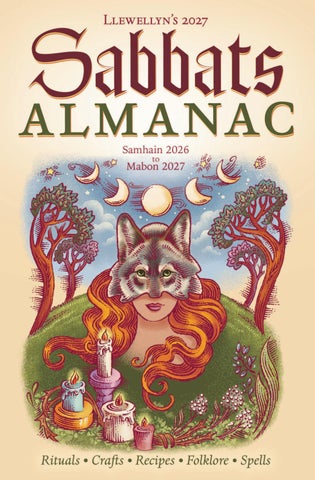
Llewellyn's 2027 Sabbats Almanac

Page 1


Llewellyn’s 2027 Sabbats Almanac

Samhain 2026 to Mabon 2027

Copyright © 2026 Llewellyn Worldwide Ltd. All rights reserved. No part of this book may be used or reproduced in any manner whatsoever, including internet usage, without written permission from Llewellyn Worldwide Ltd., except for brief quotations embodied in critical articles or reviews. No part of this book may be used or reproduced in any manner for the purpose of training artificial intelligence technologies or systems.

Cover art © Carolyn Vibbert

Editing by Hanna Grimson

Interior Art © Carolyn Vibbert, except on pages 15, 43, 46, 85, 87, 124, 128, 136, 162, 165, 202, 205, 241, 244, 282, 285, 319, and 322, which are by the Llewellyn Art Department

You can order annuals and books from New Worlds, Llewellyn’s catalog. To request a free copy, call 1-877-NEW WRLD toll-free or order online by visiting our website at http://subscriptions.llewellyn.com.

ISBN: 978-0-7387-7815-0

The publisher and the author assume no liability for any injuries caused to the reader that may result from the reader’s use of content contained in this publication and recommend common sense when contemplating the practices described in the work.

Published by Llewellyn Worldwide Ltd. 2143 Wooddale Drive Woodbury, MN 55125-2989 www.llewellyn.com

Printed in China

GPSR Representation: UPI-2M PLUS d.o.o. Medulićeva 20 10000 Zagreb, Croatia matt.parsons@upi2mbooks.hr

JANUARY

S M T W T F S 1 2 3

4 5 6 7 8 9 10

11 12 13 14 15 16 17

18 19 20 21 22 23 24

25 26 27 28 29 30 31

FEBRUARY

S M T W T F S 1 2 3 4 5 6 7 8 9 10 11 12 13 14

15 16 17 18 19 20 21 22 23 24 25 26 27 28

MARCH

S M T W T F S 1 2 3 4 5 6 7 8 9 10 11 12 13 14 15 16 17 18 19 20 21

22 23 24 25 26 27 28 29 30 31

S M T W T F S 1 2

3 4 5 6 7 8 9

10 11 12 13 14 15 16

17 18 19 20 21 22 23

24 25 26 27 28 29 30 31

SEPTEMBER

S M T W T F S

1 2 3 4 5

6 7 8 9 10 11 12

13 14 15 16 17 18 19

20 21 22 23 24 25 26 27 28 29 30 MAY

JANUARY

S M T W T F S 1 2

3 4 5 6 7 8 9

10 11 12 13 14 15 16

17 18 19 20 21 22 23

24 25 26 27 28 29 30

31

MAY

S M T W T F S 1

2 3 4 5 6 7 8

9 10 11 12 13 14 15

16 17 18 19 20 21 22

23 24 25 26 27 28 29 30 31

SEPTEMBER

S M T W T F S 1 2 3 4

5 6 7 8 9 10 11

12 13 14 15 16 17 18

19 20 21 22 23 24 25

26 27 28 29 30

JUNE S M T W T F S 1 2 3 4 5 6 7 8 9 10 11 12 13 14 15 16 17 18 19 20

21 22 23 24 25 26 27 28 29 30

OCTOBER

S M T W T F S 1 2 3

4 5 6 7 8 9 10 11 12 13 14 15 16 17

18 19 20 21 22 23 24 25 26 27 28 29 30 31

FEBRUARY

JULY

S M T W T F S 1 2 3 4

5 6 7 8 9 10 11

12 13 14 15 16 17 18

19 20 21 22 23 24 25 26 27 28 29 30 31

NOVEMBER

APRIL S M T W T F S 1 2 3 4 5 6 7 8 9 10 11 12 13 14 15 16 17 18 19 20 21 22 23 24 25 26 27 28 29 30 AUGUST S M T W T F S 1 2 3 4 5 6 7 8 9 10 11 12 13 14 15 16 17 18 19 20 21 22

23 24 25 26 27 28 29 30 31

S M T W T F S 1 2 3 4 5 6 7 8 9 10 11 12 13 14 15 16 17 18 19 20 21 22 23 24 25 26 27 28 29 30 DECEMBER S M T W T F S 1 2 3 4 5 6 7 8 9 10 11 12 13 14 15 16 17 18 19

2027

S M T W T F S 1 2 3 4 5 6

7 8 9 10 11 12 13 14 15 16 17 18 19 20 21 22 23 24 25 26 27 28

JUNE

S M T W T F S 1 2 3 4 5

6 7 8 9 10 11 12 13 14 15 16 17 18 19

20 21 22 23 24 25 26 27 28 29 30

OCTOBER

S M T W T F S 1 2

3 4 5 6 7 8 9

10 11 12 13 14 15 16

17 18 19 20 21 22 23

24 25 26 27 28 29 30 31

MARCH

S M T W T F S 1 2 3 4 5 6 7 8 9 10 11 12 13

14 15 16 17 18 19 20

21 22 23 24 25 26 27 28 29 30 31

JULY

S M T W T F S 1 2 3

4 5 6 7 8 9 10 11 12 13 14 15 16 17

18 19 20 21 22 23 24

25 26 27 28 29 30 31

NOVEMBER

S M T W T F S 1 2 3 4 5 6

7 8 9 10 11 12 13

14 15 16 17 18 19 20

21 22 23 24 25 26 27 28 29 30

20 21 22 23 24 25 26

27 28 29 30 31

APRIL

S M T W T F S 1 2 3

4 5 6 7 8 9 10

11 12 13 14 15 16 17

18 19 20 21 22 23 24

25 26 27 28 29 30

AUGUST

S M T W T F S 1 2 3 4 5 6 7

8 9 10 11 12 13 14

15 16 17 18 19 20 21 22 23 24 25 26 27 28 29 30 31

DECEMBER

S M T W T F S 1 2 3 4

5 6 7 8 9 10 11

12 13 14 15 16 17 18

19 20 21 22 23 24 25

26 27 28 29 30 31

Contents

Introduction . . . 9

About the Authors . . . 10

Samhain

Through the Veil: Samhain’s Animal Allies by Jen Sankey . . . 18

Cosmic Sway by Charlie Rainbow Wolf . . . 26

Tales and Traditions by Elizabeth Barrette . . . 31

Feasts and Treats by Dawn Aurora Hunt . . . 36

Crafty Crafts by Sara Mellas . . . 41

Animal Magic: Animal Remains in Spiritual and Magical Practice by Lupa . . . 48

Samhain Ritual: Messages from the Wild by Jen Sankey . . . 52

Yule

Things That Go Bump in the Night by Ron Padrón . . . 60

Cosmic Sway by Charlie Rainbow Wolf . . . 68

Tales and Traditions by Elizabeth Barrette . . . 72

Feasts and Treats by Dawn Aurora Hunt . . . 77

Crafty Crafts by Sara Mellas . . . 83

Animal Magic: Animal Spirit Shadow Work by Lupa . . . 89

Yule Ritual: To Tell a Scary Story by Ron Padrón . . . 93

Imbolc

A Time to Soften by Jenny C. Bell . . . 102

Cosmic Sway by Charlie Rainbow Wolf . . . 109

Tales and Traditions by Elizabeth Barrette . . . 113

Feasts and Treats by Dawn Aurora Hunt . . . 118

Crafty Crafts by Sara Mellas . . . 123

Animal Magic: Archetypal Animal Spirits by Lupa . . . 130

Imbolc Ritual: Using Rose Quartz to Soften by Jenny C. Bell . . . 134

Ostara

In the Footsteps of Persephone by Elyse Welles . . . 142

Cosmic Sway by Charlie Rainbow Wolf . . . 148

Tales and Traditions by Elizabeth Barrette . . . 152

Feasts and Treats by Dawn Aurora Hunt . . . 156

Crafty Crafts by Sara Mellas . . . 161

Animal Magic: Pets and Familiars by Lupa . . . 167

Ostara Ritual: Sunward We Bloom, Wand in Hand by Elyse Welles . . . 171

Beltane

Celebrating Fire by Enfys J. Book . . . 180

Cosmic Sway by Charlie Rainbow Wolf . . . 187

Tales and Traditions by Elizabeth Barrette . . . 192

Feasts and Treats by Dawn Aurora Hunt . . . 196

Crafty Crafts by Sara Mellas . . . 201

Animal Magic: Animal Spirits and Spells by Lupa . . . 207

Beltane Ritual: A Cleansing and Catalyzing Fire Ritual by Enfys J. Book . . . 212

Litha

Cerridwen’s Cauldron by Dallas Jennifer Cobb . . . 220

Cosmic Sway by Charlie Rainbow Wolf . . . 226

Tales and Traditions by Elizabeth Barrette . . . 231

Feasts and Treats by Dawn Aurora Hunt . . . 235

Crafty Crafts by Sara Mellas . . . 240

Animal Magic: Shapeshifting Magic by Lupa . . . 246

Litha Ritual: Cerridwen’s Cauldron by Dallas Jennifer Cobb . . . 250

Lammas

Lessening of the Light by James Kambos . . . 260

Cosmic Sway by Charlie Rainbow Wolf . . . 266

Tales and Traditions by Elizabeth Barrette . . . 271

Feasts and Treats by Dawn Aurora Hunt . . . 275

Crafty Crafts by Sara Mellas . . . 281

Animal Magic: Animals and Divination by Lupa . . . 287

Lammas Ritual: The Light Begins to Dim by James Kambos . . . 291

Mabon

Autumn in the Mountains by Brandon Weston . . . 298

Cosmic Sway by Charlie Rainbow Wolf . . . 304

Tales and Traditions by Elizabeth Barrette . . . 309

Feasts and Treats by Dawn Aurora Hunt . . . 313

Crafty Crafts by Sara Mellas . . . 318

Animal Magic: Giving Back to the Animals by Lupa . . . 323

Mabon Ritual: House Cleansing on the Autumn Equinox by Brandon Weston . . . 327

Introduction

The newly redesigned 2027 edition of the Sabbats Almanac provides a wealth of lore, rituals, creative projects, and recipes to inspire each of your sabbat celebrations. This almanac follows the Wheel of the Year from Samhain 2026 to Mabon 2027 and features recurring sections with information tailored to each sabbat. The contributors in this edition come from a variety of paths and personal approaches.

Each sabbat’s section begins with an introduction article exploring the season’s (and author’s) stories and experiences. In this edition, contributors Jen Sankey, Ron PadrÓn, Enfys J. Book, Elyse Welles, and more share their unique ideas and wisdom. Each section closes with an extended ritual by the same author, which may be adapted for both solitary practitioners and covens.

In addition to these insights and rituals, specialists in astrology, cooking, crafts, and more impart their expertise throughout.

Charlie Rainbow Wolf gives an overview of planetary influences most relevant for each sabbat season; Elizabeth Barrette explores the magical tools associated with each sabbat and provides ways to work with them; Dawn Hunt conjures up a feast for each festival that features seasonal appetizers, entrées, and desserts; Sara Mellas offers instructions on DIY crafts that will help you tap into each sabbat’s energy and fill your home with magic and fun; and Lupa explores animal magic and ways to use it in each season.

About the Authors

Elizabeth Barrette has been involved with the Pagan community for more than thirty-five years. She served as managing editor of PanGaia for eight years and dean of studies at the Grey School of Wizardry for four years. She has written columns on beginning and intermediate Pagan practice, Pagan culture, and Pagan leadership. Her book Composing Magic: How to Create Magical Spells, Rituals, Blessings, Chants, and Prayers explains how to combine writing and spirituality. She lives in central Illinois, where she has done much networking with Pagans in her area, such as coffeehouse meetings and open sabbats. Her other public activities feature Pagan picnics and science fiction conventions. She enjoys magical crafts, historic religions, and gardening for wildlife. Her other writing fields include speculative fiction, gender studies, and social and environmental issues. Visit her blog, The Wordsmith’s Forge (https://ysabetwordsmith.dreamwidth .org/), or website PenUltimate Productions (http://penultimate productions.weebly.com). Her coven site with extensive Pagan materials is Greenhaven Tradition (http://greenhaventradition.weebly .com/).

Jenny C. Bell is the author of Spirit Crystals: Discover Your Crystal Guide for Healing and Empowerment, Divergent Witchcraft: An Inclusive Approach to Making Magic, and the Cosmic Creator Oracle. She is a spiritual witch, creator, and founder of the inclusive, international, and online community Our Coven. For almost three decades, Jenny has practiced magic, fortune-telling, meditation, and crystal healing. Jenny is living her happy ever after in Southern Oregon with her

husband, children, and pets. Learn more and connect with Jenny at jennycbell.com, on TikTok: @jenny_c_bell, and on Instagram: @ourcovencommunity.

Enfys J. Book (they/them) is the author of Queer Rites: A Magickal Grimoire to Honor Your Milestones with Pride (Llewellyn, 2025) as well as the Gold COVR award-winning Queer Qabala, and coauthor (with Ivo Dominguez Jr.) of Sagittarius Witch. Enfys has taught classes on magickal practice around the world, including at the Omega Institute, Paganicon, ConVocation, and the Glastonbury Goddess Conference. They are also the creator of majorarqueerna.com, a website devoted to queer magickal practice, and host a podcast called 4 Quick Q’s: Book Talk with Enfys, where they interview Pagan authors using questions determined by a roll of the dice.

Dallas Jennifer Cobb lives in a magical village on Lake Ontario. A Pagan, mother, feminist, writer, and animal lover, she enjoys a sustainable lifestyle with a balance of time and money. Widely published, she writes about what she knows: brain injury, magick, herbs, astrology, healing, recovery, and vibrant sustainability. When she isn’t communing with nature she likes to correspond with likeminded beings. Reach her at jennifer.cobb@live.com.

Dawn Aurora Hunt, owner and CEO of Cucina Aurora Kitchen Witchery, has been teaching and writing on the topics of Kitchen Witchery and spiritual nutrition since 2010, when she started her own company making gourmet foods with a dash of magic and a heaping helping of positive vibes as the main ingredients. With simple ingredients and the power of intention, she teaches people how to cook simple meals in a mindful way to help achieve spiritual goals. Incorporating magic and energy work into food, she has grown her brand to reach people from all faiths and spiritual backgrounds. The

About the Authors

author of Kitchen Witchcraft for Beginners, A Kitchen Witch’s Guide to Recipes for Love & Romance, and A Kitchen Witch’s Culinary Oracle Deck, Dawn speaks at events all over the country, appears regularly on local TV, and is the host of popular podcast Conversational Witchcraft. In her downtime, you can find her spending cozy days in her New Hampshire home sharing a cup of coffee with her husband and two black cats.

James Kambos is a writer, artist, and herbalist. He has written numerous articles on the folk magic of Appalachia, Greece, and the Near East. An avid gardener, he raises herbs and wildflowers. He writes and paints from his home in the beautiful hill country of Southern Ohio.

Lupa is a nature-based Pagan author and artist living in the Pacific Northwest. She is the author of several books on Pagan and related practices and is the creator of the Tarot of Bones deck and companion book. More about Lupa and her work is at http://www.thegreen wolf.com.

Sara Mellas is a writer, musician, and psychic astrologer living in Nashville, Tennessee. She’s authored four books and has written about music, astrology, metaphysics, and kitchen arts for several publications. In addition to writing, she offers private psychic and astrological readings and works as a commercial food stylist. She spends her free time as the primary songwriter and lead singer for the rock band Miele and can usually be found with a canine friend by her side. Her website is www.saramellas.com; to book a reading, visit www.calendly.com/sara-saramellas.

Rev. Ron Padrón (he/him/his) is the creator of White Rose Witching. He is a gay, disabled Cuban American hedge priest from the swamps of Florida, now living in the mid-Atlantic. His personal

practice includes divination, Queer Ancestor veneration and necromancy, bioregional druidry, and spiritual activism. He has presented at gatherings such as the Salem Witchcraft & Folklore Festival, Hallowed Homecoming, Free Spirit Gathering, and the Sacred Space Conference. He is a cofounder and coeditor of a punk spirituality zine, ALTAR PUNK!, an interfaith project focused on reclaiming faith and spirituality from nationalist movements, and the founder of the PaganPunk Community Grimoire project, a collection of short zines on varying Pagan topics.

Jen Sankey is an author, deck creator, tarot reader, professional witch, and speaker. She weaves tarot, lunar magic, and spiritual wisdom into transformative tools for intuitive and magical growth. Her works include the award-winning Stardust Wanderer Tarot (self-published), Enchanted Forest Felines Tarot (Llewellyn), and Manifesting by the Moon: A Guide to Lunar Magic (Llewellyn, Feb. 2026). Passionate about guiding others, Jen teaches through workshops, events, and online platforms, helping people embrace their intuition and manifest their dreams. She encourages a deeper connection with magic and the moon through her decks, books, or teachings. Find her at www.stardustwanderertarot.com.

Elyse Welles is the bestselling author of Sacred Wild: An Invitation to Connect with Spirits of the Land. A native Greek priestess reviving the lost Earth Temple arts of the Mediterranean in her work with land spirits and the frame drum, she is also an initiated high priestess in the eclectic Faery Tradition of witchcraft. She holds an MA in spiritual studies and teaches online containers and guides immersive pilgrimages to Greece’s sacred places in and around Delphi and Eleusis. She hosts two podcasts, including the toptwenty show The Magick Kitchen. Learn more at elysewelles.com and follow her at @seekingnumina on Instagram and Facebook.

Brandon Weston is a healer, writer, and folklorist who owns and operates Ozark Healing Traditions, an online collective of articles, lectures, and workshops focusing on the Ozark Mountain region. As a practicing folk healer, his work with clients includes everything from spiritual cleanses to house blessings. He comes from a long line of Ozark hillfolk and is also a folk herbalist, yarb doctor, and power doctor. His books include Ozark Folk Magic, Ozark Mountain Spell Book, and Granny Thornapple’s Book of Charms

Charlie Rainbow Wolf is an old hippie who’s been studying the weird ways of the world for over fifty years. She’s happiest when she’s got her hands in mud, either making pottery in the “Artbox” or tending to things in the yarden (yard + garden = yarden). Astrology, tarot, and herbs are her greatest interests, but she’s dabbled in most metaphysical topics in the last four decades because life always has something new to offer. She enjoys cooking WFPB recipes and knitting traditional cables and patterns, and she makes a wicked batch of fudge. She lives in central Illinois with her very patient husband and her beloved Great Danes. Visit her at www .charlierainbow.com.

SAMHAIN YULE

Please note: All times and dates are set in Eastern time and have been corrected for Daylight Saving Time from March 14 to November 7.

Samhain

Through the Veil: Samhain’s Animal Allies

When the Wheel of the Year starts to turn toward the darker months, the sabbat of Samhain is one that most witches look forward to. Samhain is a time of transition, liminality, and connecting with the unseen. The sabbat of Samhain is celebrated from October 31 through November 1. Besides being the “Witches’ New Year,” this time of the year helps us prepare for the months ahead as we move into a time of introspection and shadow work. Animals hold a significant space during Samhain as messengers, companions, and signs of what those on the other side want us to give attention to. While many animals are associated with this liminal time of year, we will focus on a handful to work with throughout this article.

Black Cats

The black cat is a staple for Samhain and an icon for this time of year. Unfortunately, black cats are associated with bad luck, primarily because of movies and other media sources. We know this is untrue, and educating others is essential to break the bad-luck

Through the Veil: Samhain’s Animal Allies

stigma these poor kitties may face. Black cats have long been considered witches’ partners, helping them to sense when ancestors or other spirit beings were close by and wanted to communicate. Many folkloric stories say cats, especially black cats, walk freely between the spiritual realms. Black cats are also seen as protectors and the best confidants to anyone with witchy inclinations.

Bats

Besides black cats, bats are another animal associated with Samhain, and for good reason. With their nocturnal behaviors and preference for dark spaces, these creatures are related to transformation, rebirth, and death. Bats are another animal said to move through the realms quickly and can be great messengers for ancestor and spirit work. Navigating in the dark is a special skill, and as the dark months loom overhead during Samhain, having a bat as a guide can be helpful when tapping into your shadows. What better way to be guided than by animals that harness the darkness? Bats navigate through the night using sound, which calls us to pay attention to senses other than sight as we do inner work. Sometimes, what we see and hear can give different messages. Attention to your other senses can strengthen your intuition and give you valuable insight.

Crows and Ravens

We mustn’t forget our corvid friends, the crow and raven. These birds often deliver messages of prophecies, transformation, and death—not necessarily literal. Some folklore suggests that when a crow or raven circles above you, a loved one is nearby in spirit, mostly because corvids are considered companions of death deities and messengers between the worlds. (Green 1992, 176–77). The

Morrigan, a powerful goddess of war and prophecy, often took the form of a crow or raven (Freeman 2017, 22). People believed she emerged from Oweynagat, or the Cave of the Cats, on Samhain Eve and came out of the cave with the other Fae to celebrate and maybe lure a human into the woods (Weber 2019, 14).

During Samhain, corvids’ presence was seen as a sign of things to come or that ancestral spirits were near in spirit, since corvids have ties to the Otherworld. When working with corvids on this sabbat, many witches harness their wisdom and call for change to perform shadow work. They confront and seek deeper truths about themselves, knowing these mysterious yet powerful birds will divinely guide them.

Wolves

Wolves are connected to deep magic, especially during Samhain. In Celtic culture, Cailleach, the goddess of winter, returns every Samhain night riding on her wolf. She is the patron goddess of wolves (Lockett 2023). The wolf symbolizes transformation and is a profound animal to work with during Samhain shadow work. They lean into their intuition and will guide you to focus and trust your own. Since they are also pack animals, using wolves for ancestral work during Samhain can create a sense of kinship to accept your lineage and connect to your family’s past for healing and insight.

Owls

Now, we move on to the formidable owl. This nocturnal animal is a staple in Samhain folklore. The owl can see in the dark, symbolizing faith in your intuition and stepping into the unknown, trusting only your inner knowing. Calling on owl energy during Samhain is a great way to tap into inner wisdom and insight.

Through the Veil: Samhain’s Animal Allies

Owls have always been associated with witchcraft. Some medieval writers recorded that witches transformed into owls under the cover of night. These upperclass writers believed this was what the common folk thought, which cannot be necessarily verified. But the common folk did believe in the Wild Hunt that took place at the Samhain time of year (Goodare 2016, 64–65). The word strix in Latin meant both “owl” and “witch.” In Raven Grimassi’s book, Old World Witchcraft, he stated, “In Southern Europe we find the ancient creature known as a strix or a striga. This creature was a vampire-like being that took the form of a hideous owl and could also appear as an old woman” (Grimassi 2011, 32).

Owls have historically been associated with prophecies and death, but in modern times, this animal is more about harnessing the wisdom of the night and what you can find when you take that mask of daylight away during Samhain. The mysterious energy of the owl calls to you to be in touch with your inner wisdom.

Hedgehogs

The next animal we will discuss is one you may not expect, but it is a personal favorite of mine because I used to own one. His name was Simon, and he was a hedgehog. In the 1600s, most likely because hedgehogs are nocturnal creatures, these little prickly animals were thought to be witches’ familiars or companions. While being accused of being a familiar, the hedgehog’s bones were also said to ward off evil spirits. In Umbria, Italy, people would hang hedgehog jawbones for supernatural protection. And in Scottish superstition, seeing a hedgehog at night was considered bad luck (Sedwick 2025).

The hedgehog symbolizes persistence and knowing when to put your guard up. This is significant during the dark months of the year when dangers are more pronounced. This also figuratively symbolizes how we must be ready and willing to deal with

whatever challenges arise during the shadow months starting at Samhain. During Samhain, hedgehogs also symbolize being able to take risks and knowing when to set boundaries.

Spiders

Spiders’ ability to weave webs and trap unsuspecting prey presents many opportunities to work with this energy of change and transformation during Samhain. Spiders also demonstrate patience and diligence and help us realize that working toward our goals during the darker months is just as important as working on bigger goals any time of year. These eight-legged creatures show us that small, slow actions others may not see as valuable are just as, if not more, important than significant, showy actions.

Stags

The last animal we will focus on is the almighty stag. These creatures harness the natural rhythms of the Wheel of the Year, and we see that with the growing and shedding of their antlers. With this innate change that deer experience throughout the year, their energy is that of finding harmony through change. It will happen regardless, so embracing it and finding the perfect balance will enable a prosperous and abundant outcome as you emerge from the dark, transformative months.

As another creature related to the liminal time of Samhain, when access to the Otherworld is at its easiest, it is said that stags mediate between the gods and humans. (Green 1992, 163). This suggests spirituality and acceptance of the unseen are heightened at this time of year. Not only do stags suggest harnessing the power of the darker months to transform, but we can also take this time to look deep into our spiritual depths for enlightenment.

Through the Veil: Samhain’s Animal Allies

Working with Your Samhain Animal Ally

The animals of Samhain can be messengers, protectors, and symbols of power and transformation. By honoring them and including them in your Samhain workings, you harness the connection between animals, humans, the turning of the wheel, and the Otherworld. Ways to work with these animals during Samhain may include:

Divination

Using an animal-themed tarot or oracle deck, ask the cards which animal is your guide during Samhain, and follow up with any questions about the animal that chose you.

Create a Samhain Altar

Find a statue or picture of the animal you will be working with during this season and foods the animal may enjoy. Add offerings such as ethically sourced bones, and herbs. Use this space to communicate with your animal during your workings and as a place to focus your Samhain magic.

Meditation

Create a meditation or sit in a quiet space to connect and receive messages from the animal you’re working with. Imagine a lush forest, feel the comfort of this space, and call your animal to you for guidance or to connect. Journal about anything that happened during this time, even if it doesn’t make sense to you right now, and keep your journal on your animal altar.

Shadow Work

By choosing which aspects of shadow work you would like to work through, you can then choose an animal energy that most closely resonates with that shadow aspect. For instance, if you choose a bat

as your Samhain shadow work guide, you will be stepping into the energy of transition and rebirth. Having that animal energy as you step into the dark parts of yourself will give you focus and purpose for a successful outcome and much insight.

Dream Work

This method is one of my favorites and is the easiest way to start building your Samhain animal connection. Before going to bed, take a few minutes to bring the animal you chose to mind. Set an intention for that animal to visit and communicate with you in your dreams. For example, I may ask my animal for ways to use their guidance in my Samhain shadow work or for messages that may be helpful on my journey.

Embody Your Samhain Animal

A fun and creative way to harness Samhain’s animal energy is to create a mask or costume and physically embody the spirit of that animal. Creating a ritual around this animal is also a great way to become one with them for messages and to connect with ancestral magic. Creating a costume or mask and becoming an animal will help you fully connect with earth’s energy too.

Our animal guides can give us so much information, especially during Samhain, mainly because we tend to be more attentive to such things during liminal times of the year. When we prepare for the deep work of the dark months of the wheel, the animals of Samhain can assist us with starting that journey, be a guiding light, and show us a different perspective we didn’t know we needed. Including any animal that calls to you during the dark months, not just the ones I have mentioned here, is an excellent way to get to know this profound energy waiting for you, as well as learn more about yourself and your place in this magical world. These creatures want to

Through the Veil: Samhain’s Animal Allies

guide us, so if we let our intuition lead, it’s possible to create a whole new pathway in our practices.

Once you start working with animals, you will notice that they tend to appear in your daily life and other areas of your witchy practice. I love incorporating animal energy and the fresh perspectives they bring my way. Sometimes, their insight can be surprising or silly, and it’s up to me to embrace that because the animals showing up for me know exactly what I may need at that moment. During Samhain, the reverence these animals hold for this time of year always gives me a profound appreciation for the turning of the wheel and how it affects all of us—animals and humans—in some way.

References

Freeman, Philip. Celtic Mythology: Tales of Gods, Goddesses, and Heroes. Oxford University Press, 2017.

Goodare, Julian. The European Witch-Hunt. Routledge, 2016. Green, Miranda. Animals in Celtic Life and Myth. Routledge, 1992. Grimassi, Raven. Old World Witchcraft: Ancient Ways for Modern Days. Weiser Books, 2011.

Lockett, Rachel. “Cailleach: The Celtic Goddess of Winter.” March 1, 2023. https://historycooperative.org/cailleach/.

Millar, Charlotte Rose. “Dangers of the Night: The Witch, the Devil, and the ‘Nightmare’ in Early Modern England.” Preternature: Critical and Historical Studies on the Preternatural 7, no. 2 (2018): 154–81. https://doi.org/10.5325/preternature.7.2.0154. Sedgwick, Icy. “Hedgehogs in Folklore: Witches, Familiars, and Milk Thieves. Folklore Blog (blog). Wordpress. September 20, 2025. https://www.icysedgwick.com/hedgehogs-folklore/. Weber, Courtney. The Morrigan: Celtic Goddess of Magick and Might. Weiser Books, 2019.

Yule

Cosmic Sway

I’m very fond of midwinter, but I do not see it as the first calendar day of the winter season. How can something be the first if it’s also the middle? This is when we light the fires and welcome the Sun back into the evening skies as the days grow longer here in Illinois. We are once again heading toward the warmer weather. Our household makes this season last from Thanksgiving to New Year’s Day, with Yule and Christmas being the focal points.

The Moon

December opens with a waning Moon, and the New Moon is in Sagittarius on December 8, followed by the Full Moon on December 23 in Cancer. This highlights seasonal warmth and the traditional “good cheer,” but folks may be a bit oversensitive between midwinter and Christmas. Accept hugs and greetings cordially, and give grace to those who are feeling overwhelmed or hypersensitive.

The Moon’s orbit is fleeting, and so are its aspects, but it will make some challenging angles to both Venus and Mercury over the midwinter and holiday period, and its fullness could intensify

any stress or frustrations that arise. It’s an emotional time of year for some people anyway. Don’t let them steal your thunder. The New Moon in Capricorn on January 7 will soon be here to bring a bit of practicality to things.

The Sun

Midwinter occurs when the Sun moves from fun-loving Sagittarius into the more stoic Capricorn. Mercury catches up with the Sun, making a conjunction on New Year’s Day. Make sure that any resolutions are not just lip-service, for Mercury could bring the gift of the gab. It’s easy to talk about things, sometimes harder to execute them!

Also in January, the Sun moves into a quincunx with Jupiter, which could bring about some impatience and frustrations. Mars gets involved, too, throwing impatience and assertiveness around as it makes a quincunx with the Sun on January 28. Because this is such a busy time of year in so many ways for so many people, resilience may be low, and it could be easy to catch any germs going around. Be practical and diligent when it comes to personal care, and don’t let others cause confusion or disappointment if they’re simply looking after themselves.

Mercury

At least this scoundrel is not retrograde for the winter holidays! Over Yule, Mercury passes through Capricorn, catching up to the Sun on New Year’s Day. There’s a nice trine with Jupiter over midwinter and then with Mars at the end of December. Both have the potential to make plans and communications go favorably.

Mercury will activate the Uranus-Neptune-Pluto aspect pattern starting with Neptune on Boxing Day (December 26), then move on to Uranus, then Pluto. Being an interior planet, Mercury’s aspects

are quite short-lived and so is its influence—for the most part. It’s a personal planet, and while it will ding into this minor grand trine (UR-NE-PL), the transit of Mercury will have more impact when it hits planets in your natal chart.

Venus

Venus has been in direct motion since the middle of November. It made a sextile with Mars just as it was clearing its shadow, which may bode well for midwinter romances and an increase in interpersonal connections. There’s more than a touch of passion here, but remember that passion can mean anger as well as courtship. Venus rules finance as well as romance, so the inclination to spend and be overgenerous might heighten. Ensure the reserves match the outgoings when dealing with both finances and relationships. By New Year’s Day, Venus is making a square with Jupiter, the planet of expansion. Any overindulgences may come with some kind of a price to pay, either figuratively or literally!

Mars

Mars is making an exact inconjunct to Saturn this midwinter, and that may create some frustrations, as Mars is impulsive and Saturn is disciplined. The key to making this work is to drive Mars’s energy toward a long-term goal, something that cultivates tenacity and persistence. Saturn will reward hard work, and this is a great foundation for a New Year’s resolution. Mars turns retrograde on January 10 and won’t station direct until the start of April.

Jupiter

I’ve mentioned the Venus-Jupiter square over New Year’s previously, and that’s probably the main thing to watch for this winter.

Another noteworthy aspect to Jupiter is the Mercurial transit over Yule. Jupiter isn’t moving out of Leo for quite some time; Jupiter in Leo is expressive and dynamic and gregarious, but the retrograde motion—right through until April next year—may make this period more reflective than exuberant.

Saturn

Saturn is in Aries and stationed direct December 10, which makes it easier to harness inner power and become more self-reliant. However, don’t let this powerful influence become too self-reliant! After all, this is the season of social activities and gatherings. There are more opportunities for growth when we mix with others. The new year sees the Sun making a conjunction to Mercury, and they both square off with Saturn. As I have mentioned previously, this is mighty energy for saying New Year’s resolutions aloud, then writing them down and making them happen.

Uranus, Neptune, and Pluto

This minor grand trine is going to continue to ebb and flow for several more months. The alignment started in 2025, so rather than looking for something new and different, it’s more a case of diving in deeper to what is already surfacing. The Uranus-Neptune sextile is stronger at this time of year, bringing a more intense energy to spiritual awakenings and creativity. Dreams are likely to be more intense than normal.

Imbolc

Tales and Traditions

Imbolc carries a variety of associations. It is traditionally a fire festival. In this aspect, it focuses on candle flames rather than hearth fires or bonfires like some of the other sabbats. This represents the spark of life and light as the year begins to turn away from winter and toward spring. The goddess Brigid also serves as the patron of Imbolc. This brings in aspects of grain. People use wheat stems to make a Brigid’s cross or braid. These tools represent life and hope during this sabbat.

Candles

The earliest “candles” likely began by dipping a fiber wick in oil, fat, or resin. Rushes or reeds were also used. Later on, people began using beeswax or plant waxes instead. This made it possible to create a thicker coat for a longer-lasting light source. For spiritual purposes, people came to prefer fine candles made from beeswax or by boiling cinnamon, but these were too costly for everyday use.

Candles form a mainstay of Imbolc decor. They come in many styles and shapes. For instance, floating candles are flattened, sometimes molded to look like flowers, and make a striking display in

a large bowl or tub of water. Fire colors of red, yellow, orange, or white are popular. They can be purchased or crafted. You can also buy plain candles and decorate them as part of your festivities. Drip colorful melted wax over a white candle. Glue clusters of dried or silk flowers around the base. Cut shapes from wax sheets to press over the sides of a candle.

Diverse materials have been used to make candles. Beeswax candles are among the oldest and most traditional. They have a yellow color and pleasant honey scent. These may be molded into shapes, dipped as tapers, or rolled from “honeycomb” sheets. Some people prefer candles of coconut or soy wax, which come from plants. Paraffin derives from petroleum, which is less sustainable, but usually the most common type of candle wax. Gel candles are more synthetic and less popular for magical uses.

Paraffin, coconut, and soy waxes melt toward the lower end of the spectrum and are safer. Beeswax and palm wax melt toward the higher end of the spectrum, so take care to avoid spilling the hot wax. Blended waxes vary in properties depending on recipe. Additives can also change properties, so read labels carefully.

A modern option of electric candles may be used where safety is a concern. Some clear bulbs have special filaments that flicker like a real flame, while other translucent bulbs have a coating that gives them a flame-like appearance. From a distance, the look is pretty plausible. One tradition of wearing an evergreen crown topped with candles has largely fallen out of use, but electric candles make this custom safer and much less messy.

Dressing Candles

Candles may be prepared for spellcraft or ritual use by “dressing” them. First, choose a name, word, or phrase to focus the intent. Carve this into the side of the candle. Next, choose an essential

oil (mixed with a carrier oil) or Pagan holy water that matches your theme. Dip your fingertips into it. Hold the candle with its base pointing toward you and its wick pointing away from you. To attract something desirable to you, stroke from the wick of the candle toward you. To banish something undesirable, stroke from the base of the candle away from you. You can also roll the candle in another ingredient, such as dried herbs or flower petals. When you light the candle, that activates your intent.

Electric candles may be dressed with slight variations. Instead of carving, write a name, word, or phrase on the plastic case of the candle. Look for a paint pen or marker that says it writes on plastic. After that, pass the candle through blessed smoke (or, if not using fire, wave a bundle of herbs above it) for additional energy. Direct the strokes toward yourself for attraction or away from yourself for banishment.

Brigid’s Cross

Imbolc decor includes various objects made from grain, sometimes taken from a special sheaf saved during harvest. The most common materials are oat, barley, wheat stems, and rushes or reeds. A Brigid’s cross is shaped like an X, typically with a woven center and four arms extending outward to represent the four elements. Another variation is Brigid’s braid, in which braided stems are formed into shapes. Other shapes of corn dollies may also appear in this sabbat, such as fans or broomlike designs.

These objects convey protection from the harsh weather of late winter and early spring, as well as fire or other disasters. People customarily hang them in a home, such as over doorways or in kitchens. They used to appear in barns to protect livestock too. Contemporary Pagans often use them in Imbolc rituals.

The use of Brigid’s cross dates back to at least the 1600s, when the earliest records appear. As they come from a blending of Pagan and Christian traditions, their roots may go back much further. By the 1900s, they’d become less popular. However, some revival has occurred as people become more interested in historic folk crafts. These symbols in honor of Brigid may be bought or made. Watch for them in after-holiday sales because some people also use them as ornaments. Those are usually hand-sized and affordable, which makes them ideal for ritual use. Many elaborate patterns exist for crafty folks to attempt. If you have not saved grain stems, you can usually find some at a craft store or online supplier. The British and Irish sources seem to recommend rushes or reeds, while other sources recommend straw as well as synthetic options, such as pipe cleaners or raffia. I’ve seen wheat straw as a craft supply in local stores, but the only places I know of that offer reeds or rushes are seat-weaving supply shops, which are harder to find and higher in price. Use the materials you like and can find.

An even easier approach is to make a long braid and loop it into circle, heart, or lozenge shapes. Simplest of all is making two bundles tied into an X shape.

Brigid’s Blessing

Set an altar with a fire-colored altar cloth. Include a statuette or picture of Brigid if you have one. In an offering basket, place one Brigid’s symbol for each participant. Surround the basket with four fire-colored candles (wax or electric) at the quarters. If alone, you may read all the lines yourself; if in a group, spread them out.

Hold your hands above the basket and say:

Brigid, goddess of healing and hearth, of fire and water, grant us your protection at this time of renewal and bless these symbols.

May no harm approach from the east, not wind nor ill intent.

May no harm approach from the south, not fire nor hot temper.

May no harm approach from the west, not flood nor tears.

May no harm approach from the north, not blight nor hunger.

These symbols guard us from all harm.

So mote it be!

Afterward, distribute the symbols to the participants to hang up when they get home.

Ostara

Feasts and Treats

As winter melts away, the signs of spring are everywhere: fuzzy little buds on trees, the first brave crocus flowers poking through frost, fresh asparagus in local markets. Ostara, the Spring Equinox, celebrates the balance of day and night. This festival is often associated with foods that symbolize fertility, like eggs and milk, both of which hold the energy of joy, nurturing, and fertility. I look forward to the first of spring flavors like lemon, tender greens, and floral-inspired sweets.

Lemony Orzo Soup

Where I live in New England, winter can hold on for many months. Even in April, a chill can be felt as the sun sets. We’ve even been known to have snow flurries in early spring. This soup will still bring you cozy comfort on those chilly nights as winter melts into spring but has a light, lovely lemon flavor that reminds me of the renewal of the season.

Prep time: 20 minutes

Cooking time: 30 minutes

Servings: 4

2 tablespoons olive oil

1 pound boneless chicken thighs

Salt and pepper to taste

2 large carrots, peeled and diced

2 ribs celery, diced

1 large white onion, diced

4 cloves garlic, minced

8 cups low-sodium chicken stock

1 cup dry orzo or gluten-free orzo

3 bay leaves

Juice from one lemon

Freshly chopped dill and/or parsley to taste

Optional: ¼ cup white wine

In a large sauce pot or Dutch oven, heat 1 tablespoon of oil. Season chicken with salt and pepper. Cook chicken in the pot until browned on both sides and cooked through. Remove from pot and set aside. Once cooled, cut or shred the chicken. Add the remaining 1 tablespoon olive oil to the pot and stir in carrots, celery, onion, and garlic. Cook, stirring until fragrant and translucent, about 3–5 minutes. Add the white wine to deglaze the pot (or ¼ cup of the chicken stock), and be sure to scrape the bottom of the pot to release any bits that are stuck on the bottom. Add the chicken stock and raise the heat to high until broth is boiling. Add the cooked chicken, dry orzo, bay leaves, and salt and pepper to the boiling broth. Lower the heat to simmer and let cook until orzo has cooked through (about 8–10 minutes). Remove the pot from the heat, remove the bay leaves, and add lemon juice and fresh herbs. Serve immediately.

Vibrant Violet Jelly

Violets are one of the first flowers to be found in spring. They are entirely edible, but you need to be careful if harvesting them from the wild (even in your own yard). Make sure they are pesticide and chemical free as well as correctly identified as edible. If you are not sure, it is best to stick with violets purchased from an organic farm. Don’t be shocked as the color of this jelly changes throughout the process from bluish to pinkish-purple when you add lemon juice and pectin. Note: Pectin can be purchased online or in many well-stocked grocery stores.

Prep time: 25 minutes

Cooking time: 5–10 minutes

Servings: makes 3–4 16-ounce jars

2 cups violet flowers

4 cups water

¼ cup fresh lemon juice

1 container pectin (1.75 ounces)

4 cups sugar

Clean four 16-ounce glass Mason jars by boiling them in hot water. Set aside. Place 2 cups of violet flowers in a large pot. In a separate pot, bring 4 cups of water to boil. Pour boiling water over the violet flowers and let steep for 20–25 minutes. Add the lemon juice and stir gently. Gently strain the flowers from the liquid by pouring through a sieve into a saucepan and stir in the pectin. Turn this to high heat and boil for 1–3 minutes. Add the sugar and return it to boil for about 2 minutes. While the jelly is still hot and liquid, carefully ladle into the prepared jars, leaving ½ inch room at the top. Seal tightly with lids and cool at room temperature. Store in the refrigerator for up to 4 weeks.

Ostara Italian Pie (Easter Pie)

This Ostara dish is inspired by my own grandmother’s tradition of making Italian Easter Pie for the Catholic holiday of Easter. When talking to other people who grew up with similar traditions, there is a commonality of cooking Easter Pies for Italian New Yorkers, but each are variations on the same theme. It just so happens that the ingredients in this dish are synonymous with the energies of the Ostara season with lots of eggs for fertility, bacon for prosperity, and more cheese than should be allowed in any one given meal. Maybe that is why we only enjoy this dish once a year for our Ostara brunch.

Prep time: 20 minutes

Cooking time: 55 minutes

Servings: 12

1 tub ricotta cheese (32 ounces)

½ pound bacon, cooked crisp and crumbled

2 tablespoons freshly chopped parsley,

1 teaspoon garlic powder

1 teaspoon onion powder

2 eggs

1 ready-made pie crust or gluten-free pie crust (9 inch works best)

8 hardboiled eggs

½ pound thin-sliced Genoa salami

1 pound shredded mozzarella cheese

Coarse ground black pepper and chopped parsley for garnish

Heat the oven to 350ºF. In a large mixing bowl, combine ricotta cheese, crumbled bacon, parsley, garlic powder, onion powder, and 2 eggs. Mix until well combined and set aside. Using a shape knife or egg slicer, slice the 8 hardboiled eggs into ¼-inch slices. Spread

about half the ricotta mixture in the bottom of the pie crust to make the first layer, then add a layer of sliced eggs, then a layer of salami, and then a layer of mozzarella cheese. Continue layering in this order until the pie crust is full or all ingredients have been used. You may sprinkle extra shredded cheese on top if you like. Bake for 45–55 minutes or until cheese is bubbling. Remove from oven and let it come to room temperature or chill before serving.

Almanac / Witchcraft & Wicca

Harness the Sacred Energy in Every Season

Providing an abundance of articles and activities, this almanac guides you through the Wheel of the Year with fresh perspectives and oldworld wisdom.

Explore the animal allies associated with Samhain, celebrate Beltane with a cleansing and catalyzing fire ritual, and discover Cerridwen’s connection to Litha. For each sabbat, you’ll enjoy crafts by Sara Mellas, tools and traditions by Elizabeth Barrette, and feasts and treats like lemony orzo soup and baked corn hushpuppies with maple butter.

This year’s contributors include Ron Padrón, Jenny C. Bell, Elyse Welles, Jen Sankey, Enfys J. Book, James Kambos, Lupa, and others.

Includes more than fifty articles written for newcomers and experienced Witches: Creative, low-cost arts and crafts projects

Quick and easy recipes for delicious appetizers, entrees, and desserts

An overview of astrological influences for each sabbat season

Extended rituals for groups and individuals

Captivating Pagan folklore and customs

Turn static files into dynamic content formats.

Create a flipbook