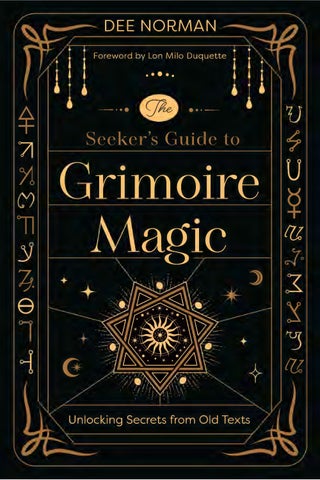
The Seeker’s Guide to Grimoire Magic
Unlocking Secrets from Old Texts
DEE NORMAN
Foreword
by
Lon Milo DuQuette
The Seeker’s Guide to Grimoire Magic: Unlocking Secrets from Old Texts Copyright © 2026 by Dee Norman. All rights reserved. No part of this book may be used or reproduced in any manner whatsoever, including internet usage, without written permission from Llewellyn Worldwide Ltd., except in the case of brief quotations embodied in critical articles and reviews. No part of this book may be used or reproduced in any manner for the purpose of training artificial intelligence technologies or systems.
First Edition
First Printing,
2026
Book design by Christine Ha
Cover design by Kevin R. Brown
Interior illustrations
Year of Intention wheel (112) and Nine Chambers Code images (138) by the Llewellyn Art Department
Margin comment image (124), Theban, Celestial (133), Passing the River, Malachim (134), Alphabet of the Magi, and Enochian alphabets (135), SATOR Theban code and square (142–143), curse tablet (248), and Catherine de Medici’s talisman labeled (283) provided by author
Cover image from Theatrum Chemicum Britannicum (147, 156, 157), alchemist’s laboratory image from Amphitheatrum sapientiae aeternae (162), and Catherine de Medici’s talisman (274) in public domain
Fourth Pentacle of Mars (221) and Fifth Pentacle of the Moon (244) © Emrys Abner
Photography is used for illustrative purposes only. The persons depicted may not endorse or represent the book’s subject.
Llewellyn Publications is a registered trademark of Llewellyn Worldwide Ltd.
Library of Congress Cataloging-in-Publication Data (Pending)
ISBN: 978-0-7387-7607-1
Llewellyn Worldwide Ltd. does not participate in, endorse, or have any authority or responsibility concerning private business transactions between our authors and the public.
All mail addressed to the author is forwarded but the publisher cannot, unless specifically instructed by the author, give out an address or phone number.
Any internet references contained in this work are current at publication time, but the publisher cannot guarantee that a specific location will continue to be maintained. Please refer to the publisher’s website for links to authors’ websites and other sources.
Llewellyn Publications
A Division of Llewellyn Worldwide Ltd. 2143 Wooddale Drive Woodbury, MN 55125-2989 www.llewellyn.com
Printed in the United States of America
GPSR Representation: UPI-2M PLUS d.o.o., Medulićeva 20, 10000 Zagreb, Croatia, matt.parsons@upi2mbooks.hr
Other Books by Dee Norman
Llewellyn’s Complete Book of North American Folk Magic Burn a Black Candle
Disclaimer
This book is not a substitute for professional medical, legal, psychological, or financial advice. The author and publisher disclaim any liability for harm or loss incurred directly or indirectly from the use or misuse of the information presented.
All magical operations are undertaken at the reader’s own risk and discretion.
Dedication
To the memory of Frater Pneuma (Michael), my mentor and friend whose untimely departure from the physical realm is still felt. It was an honor to inherit part of your library. I only wish you were here to talk with me about it. And to Soror Typus (Julie), who graciously and wisely guided me, despite her greater loss. Thank you for being you.
And to Selina: Kjltaxxvb ngyuxana jwm njcna xo yrwnjyyunb rw cqn mjat. Cqjwtb oxa jufjhb ngyuxarwp frcq vn.
And to Brent, who helped me through it all.
And, unexpectedly, to the angel Anael, who was a constant presence while writing this.
Contents
Foreword by Lon Milo DuQuette • xix
Introduction • 1
Chapter 1: Defining Magic and Magical Texts • 9
Chapter 2: Famous Figures • 27
Chapter 3: Spirits and the Structure of the Universe • 37
Chapter 4: Exploring Magical Texts • 45
Chapter 5: Finding Your Way • 59
Exercise: Triple Crossroad Visualization • 67
Exercise: Find Lost or Hidden Books and Manuscripts • 75
Chapter 6: Magical Timing • 81
Chapter 7: Magical Journaling • 93
Ritual: Magical Journal Consecration • 107
Exercise: Scrapbooking a Year of Intentions • 111
Chapter 8: The Magic of Languages • 115
Chapter 9: The Magic of Ciphers • 131
Exercise: Make a Sigil with a Magical Cipher • 137
Exercise: Make an Encoded SATOR Square for Protection • 141
Chapter 10: Working with Magical Images • 145
Exercise: A Tarot Layout for Connecting to an Image • 155
Exercise: Entering an Image’s World • 161
Chapter 11: Reading as a Magical and Spiritual Practice • 165
Exercise: Getting Clear Answers Using Bibliomancy or Stichomancy • 189
Exercise: Getting Clear Answers Using Textual Scrying • 193
Ritual: Announcement of Dedicatory Reading • 195
Ritual: Closure of Dedicatory Reading • 199
Ritual: Resumption of Dedicatory Reading After an Interruption • 203
Chapter 12: Designing and Using Talismans • 205
Exercise: Draw a Talisman for Bravery • 221
Ritual: Creating a Multipurpose Talisman • 225
Ritual: Dedicating or Repurposing a Talisman • 229
Chapter 13: Making the Old New • 233
Ritual: Moonlight Infusion Spell • 243
Ritual: Curse Your Heart to Heal It • 247
Ritual: Make a Witch Bottle to Protect Your Home • 255
Ritual: Create a Scrying Mirror • 261
Chapter 14: Putting It All Together • 273
Ritual: Re-Creating Catherine de Medici’s Talisman • 287
Conclusion: Write the Next Chapter • 291
Appendix A: Annotated Grimoires List • 293
Appendix B: Suggested Reference Materials • 299
Bibliography • 303
Foreword
These metaphysics of magicians, And necromantic books are heavenly; Lines, circles, scenes, letters, and characters; Ay, these are those that Faustus most desires. O, what a world of profit and delight, Of power, of honour, of omnipotence, Is promis’d to the studious artizan!
—Christopher Marlowe, The Tragic History of Doctor Faustus
The word grimoire suggests to the modern mind a dusty, cobwebbed volume of magic spells or a manual for conjuring spirits and devils. Indeed, most books displaying the word on their covers purport to be precisely that. The word itself is quite innocuous, an alteration of the Old French gramaire, a book of grammar, or simply a learned book. But there was a time when all writing was believed to be mysterious and magical—a gift of the gods to awaken and edify primitive humanity.
Thoth invented hieroglyphs; Nabu invented cuneiform; Odin invented runes; Hermes invented the Greek alphabet. Indeed, all writing was once considered magic. Its use was reserved for priests and scribes who (in obedience to their god) artfully fashioned graphic symbols and characters to enshrine divine laws, myths, and
prayers—strange images only priests were able to understand and interpret to their superstitious flocks.
When you stop to think about it, the written word is rather magical. It’s mind-to-mind communication. Person A’s invisible thoughts are captured in visible characters drawn upon clay or animal skins. The characters are then transported by horsemen or swift-footed messengers to Person B, who gazes upon the magical symbols and, like magic, receives the thoughts of Person A.
Predictably, the dark forces of commerce and war were quick to exploit and desecrate this gods-given technology. Crafty monarchs and warlords perfected the art of distorting and manipulating the magic power of the written word to misinform and deceive enemies and their own illiterate subjects. Is it any wonder that Mercury, the divine messenger of the gods, is also the god of liars, thieves, and lawyers?
Perhaps the greatest deception of all is the assertion that these magic words, laws, and scriptures originally sprang from an all-powerful and supernatural authority. To suggest otherwise has historically been dangerous and deadly (no one expects the Spanish Inquisition!) and has arguably resulted in the stunting of humanity’s intellectual and emotional development.
Of course, we can’t blame words or even books for all this madness. The fault lies clearly in the hearts and minds of the scribes who first put pen to paper—and it is this point I am hoping the reader will take away from my opening words to Ms. Norman’s important work:
Every ancient scripture, every magical grimoire, every talisman and amulet, every spell, prayer, curse, and blessing was originally conceived by, scribbled down, preserved, transcribed, translated, altered, amended, augmented, and edited by mortal human beings—perhaps many human beings.
All the grimoires, spells, and curses come out of the heads of people like you and me—individuals who share roughly the same proportion of intelligence, imagination, wit, wisdom, prejudices, fears, dreams, and aspirations as anyone else we might bump into every morning at the coffee shop. None of them could have honestly answered any of the great philosophical questions of life any better than you or me.
Don’t misunderstand me. I am by no means suggesting that magic books and grimoires are not magic. On the contrary, I am categorically asserting that they are indeed magic. But what makes them magic is not their antiquity or the words
Indulge me for a moment, and allow me to share a brief magical memoir. The first classic magical grimoire to find a home in the DuQuette family library materialized unexpectedly on my doorstep one September morning in 1976. (Don’t get too excited; the angel who delivered it was wearing shorts, a pith helmet, and a postal worker’s uniform.) It was sent by Helen Parsons-Smith (Soror Grimaud), a bona fide magician with rather impressive historic credentials.1 Helen had been a disciple of Aleister Crowley and (in the 1930s and 1940s) a senior initiate member of Agape Lodge, Ordo Templi Orientis (OTO), in Southern California.2 She had the distinction of being the widow of two very notable twentieth-century magicians, John (Jack) Whiteside Parsons and Wilford T. Smith.3
Helen had assisted as a ritual officer at my OTO First Degree initiation a few weeks earlier in Dublin, California, and told me she might send me a few books she thought might be helpful to a young magician just starting out. One of them was the newly published hardbound First Facsimile Edition of The Book of the Goetia of Solomon the King. 4
Even though my formal magical teacher discouraged this kind of magic, I was immediately drawn to all the symbols, diagrams, and demon seals.5 What fascinated me the most were the descriptions of the talents and abilities the
1. Helen Parsons Smith, née Mary Helen Northrup (1910–2003).
2. Ordo Templi Orientis (Order of the Temple of the East) is an occult secret society and magical order founded around 1900 as an Academia Masonica and reorganized and led by Aleister Crowley.
3. John (Jack) Whiteside Parsons (1914–1952), American chemist, rocket engineer, and a principal founder of the Jet Propulsion Laboratory and Aeroject. (There is a crater on the moon named for him.) He was also a magician and a controversial disciple of Aleister Crowley. Wilfred Talbot Smith (1885–1957), disciple and contemporary of Aleister Crowley, lodge master, and senior officer of Ordo Templi Orientis in North America.
4. Crowley, The Equinox, February 1976.
5. Phyllis Seckler (Soror Meral, 1917–2004).
• Foreword • xxi and images on the page. What makes them magic is you and me. And if we expect to squeeze real magic out of any grimoire or talisman or magical bric-a-brac, we will first need to become magicians.
seventy-two traditional spirits were said to bestow upon the adept magician. As I was at the time anything but an adept magician, such adventures seemed pure fantasy. Desperate life circumstances, however, would soon find me casting a masking tape magic circle around myself and conjuring a demon into a cardboard triangle on the carpet in our son’s bedroom.
The actual operation was an absurd and clumsy comedy of errors … a magical industrial accident that nearly cost me my eyesight.6 Nevertheless, the spirit delivered beyond my wildest expectation. The operation spiritually mutated me (in a very good way) and set the course of my spiritual life and magical development for the next fifty years. Most importantly, I learned that the only thing a magician can really change with magic is the magician. It is the changed magician who then goes on to accomplish the desired object of the operation.
Magic books are more than books about magic. They are living magical entities.
In 2006, I was asked to edit the first English translation of Georg von Welling’s classic alchemical treatise, Opus Mago-Cabbalisticum et Theosophicum. 7 First published in German in 1719, it went largely unnoticed by English-speaking occultists for over a hundred years. It would, however, inadvertently play an important role in the creation and development of occult, masonic, and quasi-Rosicrucian movements in Europe, which in turn inspired and spawned the formation of perhaps the most significant and influential magical societies of modern times: the Societas Rosicruciana in Anglia and the Hermetic Order of the Golden Dawn. Von Welling’s book played this significant role in a curiously indirect manner … in a popular play.
In addition to being a ponderously long exposition on the alchemical nature of the cosmos, von Welling’s Opus is filled with dramatic and complex handpainted alchemical and qabalistic diagrams, which were reproduced and circulated throughout Europe. The images remain familiar to modern occultists who, until recently, have been unaware of their origin. Opus is not, however, a magical grimoire per se. Indeed, if one were to quickly skim over it, one might simply think it was a ponderous and copiously illustrated essay about the alchemical virtues of salt. Nevertheless, this quaint and quirky tome could be called the magical
6. DuQuette, My Life with the Spirits. 7. Von Welling, Opus Mago-Cabbalisticum et Theosophicum.
grimoire of grimoires for the simple reason it likely served as a catalyst-prop that triggered the plot of the most famous magical play in German literature.
In Geothe’s Faust, an aging scholar broods alone in his university study and laments the fruitlessness of all his years of study.
I’ve studied now Philosophy
And Jurisprudence, Medicine, And even, alas! Theology
All through and through with ardour keen!
Here now I stand, poor fool, and see I’m just as wise as formerly.8
As young Lon Milo DuQuette did when he first opened The Book of the Goetia of Solomon the King, Faust opens a book and gazes in wonder upon the lines and symbols on a diagram of Macrocosm. The book in the play is not identified by name, but in 1772, when the play was first produced, the one German book in circulation that matched Faust’s description was Opus Mago-Cabbalisticum et Theosophicum.
As he turns the pages, Faust gives voice to the wonder that enchants the heart of all who seek power and enlightenment in books of magic.
What rapture, ah! at once is flowing
Through all my senses at the sight of this!
I feel a youthful life, its holy bliss,
Through nerve and vein run on, new-glowing.
Was it a god who wrote these signs that still
My inner tumult and that fill
My wretched heart with ecstasy?
Unveiling with mysterious potency
The powers of Nature round about me here?
Am I a god? All grows so clear to me!
In these pure lineaments I see
8. Goethe, Faust.
Creative Nature’s self before my soul appear. Now first I understand what he, the sage, has said:
“The world of spirits is not shut away; Thy sense is closed, thy heart is dead! Up, Student! bathe without dismay Thy earthly breast in morning-red!”9
I believe that deep down inside, each of us knows that the world of spirits is not shut away, but, for the moment, our senses are closed and our hearts are dead to that world. Magical texts entice the seeker with the opportunity to open our senses and resurrect our hearts. The Seeker’s Guide to Grimoire Magic could be the perfect place for you to begin.
—Lon Milo DuQuette
9. Goethe, Faust.
Introduction
This book is for you. Yes, you, the very person holding and reading it right now. If you are interested in historical magical texts like amulets, written charms, and grimoires, it is for you. The style of magic that is hidden in older historical texts is for everyone, in fact.
A magical text is any written or illustrated work that conveys magical knowledge, particularly when it includes information about how to perform magic or when it was written as a magical act itself. Historic magical texts are powerful tools filled with inspiration, beauty, and magic. And they are vital records of the world’s esoteric history. These texts help form the foundation of modern magical practices, and everything contained in them is there for the taking, ready for you to incorporate into your magical practice as you see fit.
Your background doesn’t matter.
Your style of magic doesn’t matter.
Your magical experience doesn’t matter.
Do I sound a little strident? If you permit me, I’ll tell you why. And then I’ll tell you again that this book is for you.
Three important things shaped me as I grew up. The first was a magical household. My family practices Italian American folk magic, so I grew up in an environment that was open to magical experimentation. The second was a fascination with all styles of magic, not just
my family’s techniques. And the third was an overwhelming and endless love of books. Mix those three things together, and it is no surprise I grew up eagerly exploring magical texts.
Due to my love for the occult, by the time I was in my early teens, I wanted to be a Freemason, a member of the Hermetic Order of the Golden Dawn, an initiate of Wicca, a member of the Ordo Templi Orientis, and a Rosicrucian (preferably all at once, and now, thank you very much). I was hungry for all the mysteries and secrets that magic promised.
Of course, since I was growing up in Kentucky, and since I wasn’t an adult yet, I couldn’t find a magical group that would have me—luckily. Any magical group that will take you unchaperoned or without parental consent before you are a legal adult is flying a major red flag. In a series of disappointments, I finally discovered the Golden Dawn was no more, the Rosicrucians were defunct, and Freemasons (at least the lodges near me) didn’t take girls.
Without access to the organizations or teachers that I longed for, I turned to books. I spent hours in my local bookstores and libraries, where I devoured any text on magic I could find. Eventually, an urge to build a magical library grew inside me. One filled with texts of all kinds—historical and modern, diabolical and angelic, and everything in between. Over the years, I watched the world of occult literature evolve, and once rare magical texts became more accessible, especially with the rise of the internet. Eventually, I had access to the world I had been dreaming about since my childhood.
Around that time, I also jumped into the local esoteric scene in my hometown. Unfortunately, instead of support, I often found myself facing skepticism from peers who insisted that the older sources I was interested in were dangerous. They were dismissed as evil or trapped in Christian symbolism. Some people warned me that such magic was too complex for someone like me to engage with.
For a long time, I believed them. I thought I wasn’t the “right kind” of person to work with such powerful and significant tools. The reactions of the people around me made me question my worth, leading to a crisis of confidence that lasted for years.
Lucky for me, a friend stepped in and encouraged me to embrace my path and my interests, regardless of what others thought. That little bit of support helped me see my own worth. And it helped me learn that anyone, regardless
of background, can engage with foundational magical texts and not only admire them but use them in their modern practices.
Doubts still occasionally crept in. Like many practitioners, I would get overwhelmed with the precision and detail required by the techniques I’d discovered. I questioned whether I, a busy mom, could keep up with the ritualistic discipline that was required. Yet, as I experimented, I found out that magic is as much about intent and adaptability as it is about following the rules. I could bring my own approach to the methods described in older texts without losing their essence. Anyone can discover workable magic, even in the most impenetrable texts. And that especially means you!
Everyone can do it, but don’t let that fool you. It’s powerful. Magic is a conversation between your deepest inner self and the universe. When it is done correctly, it transforms you and the wider world. That kind of double-ended change can be a scary concept. For some, it is much easier to accept making external changes than altering their fundamental selves. That is why caution is called for. To wield magical power in a responsible and constructive way reduces the possibility of injuring yourself and others. Each injury you cause through magical work, no matter to whom or how small, is a setback on your journey of personal growth and development.
Magic performed thoughtlessly can lead to all kinds of difficulties. But when approached with intention and care, magic becomes a powerful tool for transformation.
There are several things you can do to engage in magic in a thoughtful, constructive way and to insulate yourself from making magical mistakes, starting with making self-awareness and understanding a central part of your magical journey.
Regular meditation and reflection help you create the internal space that allows you to foster self-awareness. We live in a noisy world that is designed to distract us and take us out of and away from ourselves. If you want to work magic, don’t let this happen to you. Use regular meditation and alone time to carve out the space for your thoughts and realizations. This allows you to understand your true needs versus your fleeting desires. Wants are fleeting and may not satisfy you in the long run. Understanding where you are in life and what direction you are heading in helps you choose intentions that will get you where you need to go. Making space for noticing and recording intuitive insights will
allow them to inform and guide your practice. You know yourself best, so find a method for reflection that appeals to you. Whether that’s going out for a long walk, a nighttime drive, freewriting in a journal, or doing formal sit-down meditations, choose something that suits you and do it regularly.
Use divination to ensure the magic you are about to work will have the results you desire. Divination is a valuable tool in any magician’s tool kit. Before you engage in a magical working, use divination to explore the repercussions of your actions. You don’t have to be a divination expert to do this. Simple methods like flipping a coin or pulling a single card from a tarot or oracle deck can provide a lot of insight. The key is to ask the right questions. Asking how magic will achieve the intended goal, if there will be negative repercussions, and if you are ready for the changes the magic will bring are all good places to start.
Magic works with subtle and powerful forces. Even with divination and intensive preparation, it’s important to build safeguards into your magical work to ensure your intentions align with the higher good for yourself and others. One simple yet effective way to do this is to add phrases like “for the ultimate good of all” or “in accordance with the highest benefit” into your spells and rituals. These phrases act as channels, guiding magical power to work in a way that supports your intentions and the well-being of everyone involved. Phrases like this help ensure your magical work doesn’t have unintended consequences. They are an extra layer of protection. Whether you are working in isolation or as part of a group of magicians, find people you can talk to about your magical plans or ideas. Use your magical contacts as sounding boards to bounce ideas off. Ask for feedback and opinions. You don’t have to internalize and use any of the responses you receive, but some may provide you with enriching food for thought. Also cultivate relationships with nonphysical entities such as deities, spiritual guides, ancestors, or household spirits. They can provide support and guidance. When you are journeying through particularly thorny parts of your magical path, it is a relief to have spiritual mentors to turn to. Don’t wait until you need help to start building one or more relationships with otherworldly beings. Build the relationship first so you can rely on it when you need it.
Part of being a responsible magician is knowing that mistakes happen, and problems arise. You are tinkering with the powers that shape and form reality. Before performing a spell or ritual, consider how you would undo or reverse it if necessary. Having a plan in place for undoing your work gives you peace of mind,
allowing you to perform your magic wholeheartedly. If you can’t figure out a way you can reverse your planned spell or ritual, it’s a good sign that you should pause and reconsider your plans. Put things on hold until you have a full understanding of what you are doing.
Regularly engage with and pay attention to your intuition. When folks start experimenting with magic, they typically follow one of two approaches: making it up as they go or strictly following instructions. Neither approach is inherently wrong, and both offer distinct benefits.
By “making it up as they go,” I mean listening to one’s intuition and crafting a magical practice that feels authentic and personal. It’s about being guided by your internal urges and creative instincts. On the other hand, “strictly following instructions” refers to closely adhering to documented methods and procedures, often rooted in tradition. This approach can provide stability and tried-and-true techniques.
The good news is that both approaches can result in successful magic. But I believe there’s a third way, one that combines elements of both approaches with thoughtful self-awareness. When you blend your intuition with the knowledge found in magical texts, you create a practice that is uniquely yours. This fusion is what will make your magic more effective than any single method on its own. Tempered with self-knowledge, you’ll be well on the way to success.
As you read this book, you will note that the ideas I’ve just discussed are not incorporated into the magical techniques described in this book. What I’ve suggested is definitely a more modern approach to working magic. However, this book is here to talk about how to blend historical magical practices into our current-day systems, and the concept of caution can be one of those modern elements we carry with us.
Speaking of blending and adapting magical techniques, I get a lot of questions about what is and isn’t acceptable to change when it comes to working a spell I’ve described. And I think almost all the questions stem from either concerns about efficacy or validity. Which is completely understandable. Magic done right is often a challenge. If you put forth that kind of effort, you want to make sure what you are doing will work. And eventually doubts creep in about whether your magical choices and techniques are valid. More importantly, are they authentic?
Validity just means that something is logically or even factually sound. If a technique is comfortable and works for you, it’s valid.
Authenticity means something is real or true, or perhaps that it complies with an established framework. One of the most important secrets I can reveal is that authenticity is what you make it.
Though we can strive for authenticity, magic moves beyond the real and into the unreal. By the very fact that we are working magic, we are purposely moving beyond the boundaries of consensus reality and are entering uncharted territory. We must navigate this unfamiliar land using landmarks left for us by the people who previously explored it. But even those signs can be few and far between. Which leaves us to our own devices: our wits, our creativity, and our determination to forge our own paths.
In addition to a willingness to be reflective and thoughtful about the magic you work, don’t be afraid to wrestle with big concepts. Don’t be afraid to run contrary to widely held beliefs (even if those beliefs are held by well-regarded people in the magical world). Being a magician and working powerful magic requires discarding concerns about what others think and pushing on into unexplored depths.
Does it sound like a lot of work? It certainly can be. But it’s worth it.
Over the years, the magic I have found in textual sources has initiated me into newer and greater magical knowledge. It has provided me with practical solutions to real-world problems and given me entrance to a world of beautiful symbolism. It has enlightened me, delighted me, and frustrated the hell out of me. It is something that I want to share with everyone, especially you.
But that doesn’t mean that the doubts don’t occasionally return. Because they do. Even as I gathered reference materials in preparation for writing this book, I found myself asking the same questions and confronting the same fears. Am I good enough, do I know enough, am I serious enough? Am I educated enough? What if I don’t do it right? Maybe I don’t have what it takes. Maybe I shouldn’t have dropped out of college. Those kinds of thoughts can stop you dead in your tracks if you let them get to you. So, I mutter my magical motto, Bene, scopriamolo! (Well, let’s find out!), to banish them. And now, if you’d like, we can find out together.
I volunteer to be the guide through exploring and making historical textual magic a practical part of your spiritual path. In return, you must promise to be the judge, deciding what pieces are right for you to adapt and adopt. No one
single way is right for everyone, but knowledge like this belongs to anyone who seeks it.
My goal isn’t to provide a comprehensive tour of every grimoire, spellbook, or incantation ever written, though you’ll certainly meet many fascinating examples along the way. Instead, I want to offer you a practical framework for understanding and working with these texts, no matter how obscure or complex they may initially seem. From deciphering symbols and diagrams to unpacking obscure language or puzzling instructions, this book gives you foundational tools for exploring magical texts deeply and with discernment.
I’ll also share ways to adapt and adopt what you find, translating the wisdom of old texts into magical practices that feel alive and relevant today. Throughout this journey, you will notice reoccurring themes: how magical texts were created and transmitted, what kinds of books and short-form writings exist, how to decode their contents, and how to use them as inspiration in your own practice. My aim is to help you build a practical and dynamic relationship with these texts that honors the past while informing and inspiring your present magical path. To those ends, I’ve included an appendix that is an annotated list of significant grimoires and another that is an annotated list of the reference materials I found particularly useful while writing this book.
And never forget, this book is for you. And in a way, it’s for me, too.
Chapter 1 Defining Magic and Magical Texts
Words are the building blocks of understanding, and they are also very important to magicians. They play a central role in many types of magic. Magicians speak words of power, turn them into magical sigils, carve words on candles, and scribe them on spell papers. They also use them to record dreams, document magical experiments, and share their findings and experiences with others. Words lie at the very core of magic.
But each word has many different meanings, which can cause problems even in everyday life. Someone can wear a bow in their hair while taking a bow. They can chase their quarry in a quarry. Or hit a bat with a bat.
In addition to those obvious examples, there is the concept of connotation, the mood or associated thoughts that come along with a word. When someone hears the word easygoing, for example, it may call to mind someone who is lazy or someone who just happens to be pleasantly laid-back. It depends on the hearer’s personal experiences. Sometimes an intended meaning gets lost or scrambled due to alternate definitions or the personal connotations of the recipient.
This problem is compounded when a specialized topic like magic is being discussed. There are both external views of magic like those held by anthropologists or folklorists and internal views of magic like those held by people who practice it. These groups often have divergent definitions for the words they use when discussing magic. And even within the various groups of people who practice it, there are so many different perspectives that there isn’t even a consensus on what the word magic itself means or how it should be spelled.
When it comes to the topic of magic, without clear definitions, we are left to swim in vague pools of meaning, never sure if our feet are touching the bottom. Thankfully, this problem has a simple solution. The key to clear communication starts with something so simple that it is often overlooked—mutual agreement about what words mean. A vocabulary lesson may not be the most exciting way to kick off your grand occult adventure, but in the pursuit of magic, clarity is the starting point of the path to success.
This chapter defines essential magical terms and explores the different kinds of magical texts along with the types of information they contain. These texts, whether grimoires, ritual books, or other occult writings, serve distinct purposes and provide different kinds of knowledge.
These definitions may not match your definitions, and that is not only perfectly acceptable, but also perfectly wonderful! As each of us travels down our individual spiritual paths, our experiences inform our understanding, and no two paths are exactly alike. So let the definitions I share here simply serve to summon up some common ground on which we can stand as we delve into the world of historical magical texts.
Let’s start by defining magic. If you have read more than one or two books on magic, you might be rolling your eyes at yet another book defining the word for you; just indulge me for a few sentences. When I write words like ritual magic or ceremonial magic, I want you to know exactly what I am talking about.
As I mentioned before, magic has been defined in different ways by different groups of people. From an anthropological perspective, magic is any act that is intended to influence something without a direct link between the act and the result. By this definition, pushing a ball so that it rolls off a table is not a magical act because there is a direct link between the act of pushing the ball and the effect of the ball rolling off the table. But lighting a candle and using your mind to channel energy to move the ball off the table would be considered a magical act
because there isn’t a direct, definable link between the act—a candle spell—and the effect of the ball ending up on the floor.
For a basic definition of magic from a magical practitioner, people often turn to Aleister Crowley, an English occultist who lived from 1875 to 1947. Crowley stated that magic is “the Science and Art of causing change to occur in conformity with Will.”10 It is interesting to note that Crowley doesn’t concern himself with whether there is a direct definable link between the art and science that is performed and the change that takes place. To Crowley, all acts are magical if they conform to the practitioner’s true will. For him, pushing a ball so that it rolls and falls off a table is a magical act if the result is of the magician’s will.
For the purposes of this book, I narrow down the definition of magic as a means of accomplishing your intent through unseen or otherworldly forces. When you strip magic down to its core, it is a method to accomplish what you want while using techniques to call upon entities or influences that are normally unseen or unfelt. My definition is similar to Crowley’s, but for our topic, I’ll happily limit our discussions to powers like planetary, astral, celestial, or other typically unseen forces.
Don’t forget that Crowley’s definition or my definition doesn’t have to be your definition. You only need to understand my definition so you can understand what I am talking about when I use the word in this book. Your experiences will lead you to your own definition of magic and what it means to be a magician. Validation of the authenticity of your magical practice comes through your personal experiences and effort, not through definitions or information you find in books.
Categories of Modern Magic
Throughout its history, magic has been defined and categorized in different ways. Understanding these categories can provide useful insight into some of the topics that will arise later when we explore the types of magic that can be found in historical magical texts. I don’t necessarily promote or believe in all these definitions, and I’ll explain why along the way.
Since the nineteenth century, magicians have tended to categorize magic based on its general purpose or its style.
10. Crowley, Magick in Theory and Practice, xxi.
High Magic and Low Magic
Depending on how this categorization is being used, the words high and low can either talk about the way magic is performed or the morality of the magician. First, let’s look at how these words can identify the different ways a spell or ritual is performed.
In Modern Magick, Donald Michael Kraig theorizes that urban centers were the birthplace of complex magic that relied on literacy, used elaborate tools, and incorporated lengthy spells. Since many early settlements were located on high land, he uses “high magick” to identify that style of magical work.11 Conversely, Kraig states that folks who lived out in the countryside developed magic that was orally transmitted, evolved from earlier cultures, and used tools found in nature. His theory goes on to claim that this style of magic developed in the lowlands and therefore uses the term “low magick” to identify those practices.12
While defining these terms, Kraig makes it clear that there is no moral judgment involved in these definitions. But as you can see, there is a class difference that is clearly expressed. And someone might be easily tempted to saddle these words with assumptions about the quality of the magic related to the different geographic and economic statuses that his theory is based on.
In his book Low Magick, Lon Milo DuQuette tells us he is “uncomfortable with both terms,” which is primarily due to how the two words are constantly misused.13 But DuQuette does provide two much simpler and less fraught definitions. According to him, low magic takes place outdoors and is closely associated with nature, while high magic happens indoors and is ceremonial.14
Of course, the reality is more complex. Plenty of so-called low magic happens indoors, regardless of its earthy origins, and I’ve taken part in high magic rituals beneath open skies. Even with DuQuette’s more neutral framing, people still tend to interpret “high” and “low” as a kind of magical hierarchy. After all, in most contexts, “high” implies superiority, so why wouldn’t that assumption carry over when applied to magic?
11. Kraig, Modern Magick, 295.
12. Kraig, Modern Magick, 296.
13. DuQuette, Low Magick, 10.
14. DuQuette, Low Magick, 10.
When “high” and “low” do happen to get plugged into a hierarchy, the problems get worse. They are then used to describe the morality of the magician or the outcome of their magical work. As DuQuette goes on to explain, the words have also been used to differentiate magic that deals with God and good spirits (high magic) or magic that deals with the Devil and bad spirits (low magic). In this light, the terms are assigned and draw a line between the morality of the magician’s intentions. High magic, by these delineations, enlightens the soul or inner being of the practitioner to bring them closer to the god of their choice and low magic is performed for every other reason.
This is edging close to the ways the Catholic church defined magic in the Middle Ages, which I will cover later in this chapter. But at this point, you might be asking yourself who decides which spirits are good and which are evil. That is an excellent question. The fact is the hierarchy that is used to make this determination, at least when it is applied externally and sometimes internally, is usually based on Judeo-Christian beliefs.
Ritual, Ceremonial, and Practical Magic
Some modern practitioners categorize magic into more specific categories: ritual magic, ceremonial magic, and practical magic. This way sorts magic by its method or how it is performed, but it is important to note that one magical act may fit into more than one of these categories.
Ritual magic involves complex techniques that include elaborate circle casting, the use of a variety of tools, and formal spoken components. The use of the word ritual indicates that the process is generally performed the same way every time or that it uses the same framework each time. While there can be some variation, the practitioner usually follows a standardized format. This style of magic often requires a lot of planning, careful memorization, and consideration of timing. It usually involves working with nonphysical entities like gods, saints, or angels. It is interesting to note the word ritual comes from the Latin word ritualis, meaning something relating to a religious ceremony.
If you use a sword to cast a circle, chant a lengthy invocation, and summon an angel to help you find a better place to live, you are doing ritual magic.
Ceremonial magic is like ritual magic and can be considered a subcategory of it. This method incorporates all the elaborate details of ritual magic, but it adds multiple participants into the mix. It requires an equal amount of planning but
also includes ensuring that everyone participating in the magical act knows what to do and when.
If you invite some friends over to enact a coordinated ceremony within a sacred circle where everyone has their assigned role and (hopefully) knows what they are doing to send healing energy to someone, you and your buddies are performing ceremonial magic.
Practical magic, also called folk magic, involves less complex but equally powerful techniques like herbalism and candle magic. It doesn’t usually include circle casting and may or may not involve working with nonphysical entities like gods, saints, or angels.
If you grab some herbs, salt, and a candle and imbue them with your intent to foster clarity of mind and development of your inner vision, you are doing practical or folk magic.
Categories of Historical Magic
All the modern categories are nice and tidy, and they are very helpful when discussing modern magic, but the magic we delve into when we begin dabbling with historical textual magic was viewed through a different cultural lens. To understand how magic was categorized throughout much of history, we must consult the Catholic Church and its many offshoot denominations. Because let’s face it, the various Christian denominations had a heavy influence in many things during the time periods in which a lot of the magical texts we will be discussing were created, including the understanding and categorization of different types of magic in Europe.
Throughout history, magic was often categorized by the perceived source of the magical power that was being invoked.
Natural Magic
Natural magic is accomplished through the powers that are inherent in natural objects like gemstones, herbs, and metals. It is based on the idea that God imbued these physical items with special influences that could be harnessed to accomplish a magician’s goals. The Church’s view of this style of magic changed over time but it was often considered acceptable as a part of natural philosophy or science. That is, unless the power was actually secretly coming from demons
who were tricking the practitioner into thinking the power was coming from innocent rocks and plants.
If you brew up a magical tea to give yourself confidence, you’re performing natural magic.
Alchemy
Alchemy was often viewed as a subset of natural magic, particularly when it involved physical transformations like trying to turn lead into gold. It was usually understood that physical transformations were accomplished through the virtues or natures of the material substances involved. However, when alchemy strayed into attempts to create life or contravene natural laws, the Church viewed the practice with suspicion or outright condemnation, since doing so was considered God’s sole domain.
If you combine metals and other natural substances to create substances with new properties, you are doing alchemy.
Astral/Celestial Magic
Celestial magic’s power comes from energies and influences channeled from the source of all (God) through celestial bodies like stars, planets, and eclipses. This style of magic often includes the invocation of celestial spirits that contribute to the magician’s efforts. Due to its relation to the movement and positions of heavenly bodies, celestial magic is heavily reliant on timing and the correspondences between celestial bodies and earthly items like plants and gemstones.
If you cast a circle on just the right date and time to channel the power of God into a talisman you have prepared to help you learn the latest TikTok dance, you are doing astral or celestial magic.
Astrological Magic
A subset of celestial magic, astrological magic, is both predictive and corrective. It could be used to see into the future and to counteract any difficulties foreseen by the practitioner. It also relies upon the positioning of celestial bodies and often incorporates the creation of talismans.
If you cast a horary horoscope chart to determine the best time to set out on a journey and then use that information and other astrological influences to protect you on your trip, you are doing astrological magic.
Body, Mind & Spirit / Magic Studies
“Filled with delightful gems of history, wonderful spells and rituals, and practical practice, Dee Norman has gifted seekers of all paths a guidebook for the ages.”
—Courtney Weber, author of Hekate and Sacred Tears