TM
LIFE ELEVATED
MARCH 2026
Photographs by Victoriya Knapp 2
1
Love
WHERE YOU LIVE
Windsor Beach Club Cabana Bar
772.234.4130 | www.HurynConstruction.com | 1902 Wilbur Avenue | Vero Beach, FL 32960
LEGACY HAS A NEW ADDRESS Caldwell Trust Company Expands to Vero Beach
Founded in 1993 in Venice, Florida, Caldwell Trust Company has been a pillar of trust, stewardship, and independent financial guidance for over 30 years. Now proudly serving Vero Beach and the Treasure Coast, we’re bringing our commitment to legacy planning and fiduciary excellence to Florida’s East Coast.
David L. Osgood, AMWA®
Executive Vice President & Director of Vero Beach
William James Bryan
Assistant Vice President & Trust Officer
Rebecca Lachance Trust Associate
Meet Our Vero Beach Team At Caldwell, personalized service starts with people. Our Vero Beach professionals are experienced, local, and ready to help you protect, manage, and pass on your wealth.
The Way it’s Meant to Be.
Visit us in our new location! 3055 Cardinal Drive Suite 202 Vero Beach, FL 32963 (772) 213-9144 | ctrust.com 3
ANNUAL
SALE Save 10-50% Some exclusions do apply.
0 3 h c r a M To 11 l i r Ap
GRADUATE GEMOLOGISTS CUSTOM DESIGN JEWELRY REPAIRS WATCH REPAIRS
3401 OCEAN DRIVE VERO BEACH 772.234.8522 LEIGHJEWELERS.COM
V E RO B E AC H
Exclusively Represented by
O ceanfront Condos O ceanview Villas Full Flo or O ceanfront Penthouse
Starting from $2.995M
L ast Units Re m aining Schedule Your Private Tour 26 Indigo Drive Vero Beach, Florida 32963 772.222.4648 Just North of Village Beach Market
Proudly Developed by
Renowned National Firms & D eliveries beginning spring 2026 Projected completion end of 2026
3341 Cardinal Drive | Vero Beach, FL 32963 indigo@webbluxuryrealestate.com indigo32963.com | @WebbLegacyRE 6
7
Page
34
Barndominiums enjoy a building boom in Florida.
Page
40
Thrive leaders Carrie Lester, CEO, and Nancy Lynch, Board Chair.
MARCH 2026
CONTENTS 22 Editors’ Letter PIECES of the larger whole
26 Teak Outdoor Furniture
Beauty, durability, and environmental sustainability make teak perfect for the tropics. DESIGN HISTORY
28 Open Floor Plans—A Past Revolutionary Concept Yet recent trend towards hybrid layouts for privacy and quiet.
HEALTH AND WELLNESS
40 Thrive Makes Wellness Possible Thrive provides prevention strategies and recovery services to address substance use and behavioral health challenges. VERO BUSINESS
54 Claire and Bob Higgins
Engel & Völkers grows through service excellence on all fronts. VERO BUSINESS
HOME STYLES
34 The Florida Barndominium—Wow!
A hybrid building that combines a barn-style structure with (luxury) living space inside.
58 From the Hamptons to Vero Beach
Around The Fire brings ‘primal’ flare to catering luxury events. WINE AND FOOD
62 Discover the Other Americas
Bold Malbec and high-altitude whites redefine value and character; by the owners of Varietals and More.
8
“THE PURPOSE OF HUMAN LIFE IS TO SERVE, AND TO SHOW COMPASSION AND THE WILL TO HELP OTHERS.” —Albert Schweitzer, German-French theologian, philosopher, organist, medical missionary, peace activist.
UNCOMMON PERCEPTION Tocqueville Asset Management was established to manage the wealth of families and individuals for the long term. Our commitment to capital preservation and exceptional client service has not changed since we opened our doors.
To ind out more please email Joseph A. Zock jzock@tocqueville.com http://www.tocqueville.com/wealth +1 (772) 247-0400 ©TOCQUEVILLE ASSET MANAGEMENT L.P / ALL RIGHTS RESERVED. 9
Coming October to booksellers everywhere. Pre-order now at mckee.org
Architect: Gregory Anderson, PA Photography: Daisy Burns
CUSTOM HOMES LUXURY RENOVATIONS COMMERCIAL CONSTRUCTION
www.Building2Last.com n (772) 794-9799
BEAUTIFUL IS A WAY OF LIFE Alexandra Nuttall Design has evolved as part of Maison by Alexandra — a natural progression reflecting the growth of our studio. Maison by Alexandra unites our interior design work with expanded services under a single, cohesive brand, while preserving the personalized approach, refined aesthetic, and thoughtful process our clients have come to expect. With studios serving Vero Beach, Kansas City, Nantucket (by appointment only), and select projects in Europe, our reach has expanded — yet our design philosophy remains unchanged: timeless interiors, carefully curated, and beautifully lived in.
Vero Beach 4625 Highway A1A, STE 1B Vero Beach FL 32963 772-231-3746 Kansas City 6247 Brookside Plaza Kansas City MO 64113 913-954-9799 Nantucket and Beyond contact Alexandra directly www.alexandranuttall.com
Page
58
Adam Kelinson’s catering business raises cooking with fire to a modern and refined level.
Page
90
Intrepid travelers Adam and Bailey Schmitz undertake a whirlwind long weekend in London.
MARCH 2026
CONTENTS TRANSFORMATIVE FOOD
66 Oysters and Our Cold Snap
Interview with Nicolette Mariano, Founder and President, Treasure Coast Shellfish LLC. EDUCATION
70 A Trip to Cambridge and Harvard Saint Edward’s School students gain a fresh world view attending a Model UN conference. ARTIST TO ARTIST
74 Britt Bair
Where light, lineage, and intuition converge.
14
ART MASTERPIECES
80 Osprey and Weakfish
John James Audubon. 1829. Oil on canvas on hardboard. 40 x 26 in. TRAVEL
90 The 72-Hour Dare
A London weekend from D.C. SURFING SCENE
106 Photographer Frank Moore Lifetime devotion to surfing and its people.
“LIFE’S MOST PERSISTENT AND URGENT QUESTION IS, ‘WHAT ARE YOU DOING FOR OTHERS?” —Martin Luther King Jr., American Baptist minister and civil rights leader.
Oceanic Wealth Management
Welcomes Chase Perez-Blanco Financial Advisor
As we continue to serve founders, families, and business owners across the Treasure Coast and Palm Beach communities, this growth reflects our commitment to thoughtful and relationship-driven wealth management. Our team focuses on helping clients navigate major financial transitions, coordinate long-term planning, and steward wealth across generations. We are proud to continue growing our presence in Vero Beach and looking forward to serving our community together.
Oceanic Wealth Management Wells Fargo Advisors Financial Network 3387 Ocean Drive Ver0 Beach Florida 32963 772-200-3973 Razvan Ilie Senior Financial Advisor Jenna Suleman Senior Financial Advisor Chase Perez-Blanco Financial Advisor Wells Fargo Advisors Financial Network, LLC (WFAFN), Member SIPC, a registered broker-dealer and non-bank affiliate of Wells Fargo & Company, WFAFN uses the trade name Wells Fargo Advisors. Ad.
Where Time Matters 3315 Ocean Drive, Vero Beach, Florida mike@vbprivatejewelers.com | 772-867-3845 @vbprivatejewelers
European Chic
FROU FROU ST TROPEZ 3309 Ocean Drive, Vero Beach, FL 32963 (772) 907-5750 | lefroufroucouture.com @froufrousttropez
Fashion & Accessories
Page
106
Surf photographer Frank Moore chronicles the Treasure Coast’s vibrant surfing community.
MARCH 2026
CONTENTS SPACE EXPLORATION
122 SpaceX Fact Sheet
Baseline knowledge of a crucial and truly amazing American aerospace company.
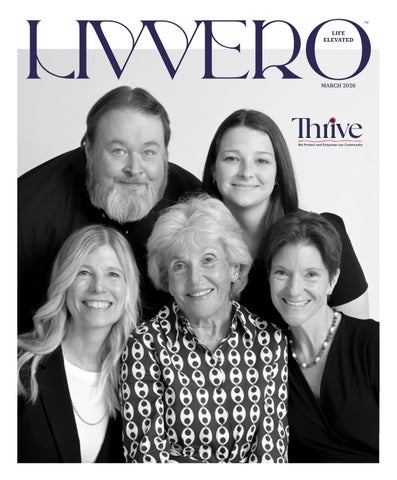
Thrive leadership team. Photograph by Martina Tannery. (L-R) Jill Amos, David Flynt, Nancy Lynch, Kyleigh Motiwala, and Carrie Lester.
SPACE EXPLORATION
126 Our Moon
Raise your eyes and behold it! Glorious!
136 Mark Your Calendar 144 Finito
18
Website: livvero.com. Instagram: @livveromagazine. Subscriptions: Go to livvero.com. Digital Edition: Access on livvero.com. Comments: Email to jim@livvero.com.
Page
122
SpaceX Falcon 9 rocket at liftoff.
Law Offices of
JENNIFER D. PESHKE, P.A. LEGAL SERVICES PROVIDED • ESTATE PLANNING • WILLS, TRUSTS, INCLUDING SPECIAL NEEDS TRUSTS • POWERS OF ATTORNEY & HEALTHCARE DIRECTIVES • PROBATE & TRUST ADMINISTRATION • GUARDIANSHIPS INCLUDING GUARDIANSHIP ADVOCACIES AND VOLUNTARY GUARDIANSHIPS • BUSINESS ENTITY FORMATION • REAL ESTATE (INCLUDING FULL BUYER & SELLER REPRESENTATION, CLOSING AGENT TITLE SERVICES, DEEDS, LEASES & CONTRACTS)
Two Vero Beach Locations: Pelican Plaza – 4731 Highway A1A 20th Street – 956 20th Street Phone: 772-231-1233 www.peshkelaw.com
EDITORS’ LETTER
TO GO ANY SHORTER WOULD BE A DISSERVICE TO THOSE WE ARE WRITING ABOUT.
DETAILS MATTER Hopefully you will have noticed that we invest a good deal of time and effort in researching and writing the articles we publish. This would seem to run counter to contemporary magazine publishing practices, which point to a deliberate strategy of dumbing down content to appeal to a dumbed-down audience. Specifically, I am informed, magazines have adapted content styles to match digital reading behavior. These would include shorter articles with stronger headlines; list-based or visual storytelling formats; use of video, audio, and interactive graphics. Notably, even archetypal long-form magazines (e.g., The New Yorker, Harper’s Magazine) now publish a mix of quick-read and deep-analysis content. Despite all this, LIV VERO Magazine plans to stay the course on word count and go even longer on select articles. The feedback I receive from incoming emails and in-person conversations offer three main insights: we
22
love the topic mix and quality of the writing; we appreciate the level of detail provided; we typically do not read magazines very often, but we will read LIV VERO from cover to cover. I am pleasantly surprised and appreciative. If even 50% of that is valid, that’s evidence enough for us to keep pounding our keyboards. This issue’s cover story profiling Thrive is a good indicator of the direction we are taking when warranted by the subject matter. In learning about Thrive, I was floored by the breadth of everything they do and their community impact. Truthfully, at one point I was unable to process new information, my mind swirling with acronyms, programs, therapies, and groups and sub-groups of individuals served. When you hit such a wall as a writer and editor, you can proceed down two alternative paths. The first is to cram everything into
a defined number of pages—ideally as few as possible to retain the issue’s restricted page count. The second is to just let it flow, in order to remain true to the story being conveyed and to honor the people involved: for their willingness to share, for the efforts they make, and for the results they achieve. Simply put, to boil it down is to remove the substance that makes the reading rich. And so Thrive comes to you “in full measure.” Our deeper purpose is to fully relay to readers their mission, activities, and outcomes so that each of you can profoundly appreciate what they contribute to our community, and why we are so blessed to have them. Terseness shrouds most of this.
CO-PUBLISHER CO-EDITOR JIM FIELD jim@livvero.com
CO-PUBLISHER CO-EDITOR DIANE FIELD diane@livvero.com
is proud to announce
Michael J. Curley promoted to Managing Director Please reach out and congratulate Mike on his notable achievement!
Michael J. Curley, CFA, Managing Director 772.234.1804 | mike.curley@morganstanley.com Visit advisor.morganstanley.com/mike.curley
Vero Beach Wealth Management Team
(L-R) Hanson Peirce, Kristie Edwards, Michael J. Curley, Selena Carnohan
When Morgan Stanley Smith Barney LLC, its affiliates and Morgan Stanley Financial Advisors and Private Wealth Advisors (collectively, “Morgan Stanley”) provide “investment advice” regarding a retirement or welfare benefit plan account, an individual retirement account or a Coverdell education savings account (“Retirement Account”), Morgan Stanley is a “fiduciary” as those terms are defined under the Employee Retirement Income Security Act of 1974, as amended (“ERISA”), and/or the Internal Revenue Code of 1986 (the “Code”), as applicable. When Morgan Stanley provides investment education, takes orders on an unsolicited basis or otherwise does not provide “investment advice”, Morgan Stanley will not be considered a “fiduciary” under ERISA and/or the Code. For more information regarding Morgan Stanley’s role with respect to a Retirement Account, please visitwww.morganstanley.com/ disclosures/dol. Tax laws are complex and subject to change. Morgan Stanley does not provide tax or legal advice. Individuals are encouraged to consult their tax and legal advisors (a) before establishing a Retirement Account, and (b) regarding any potential tax, ERISA and related consequences of any investments or other transactions made with respect to a Retirement Account. Advisory relationships may not be appropriate in certain situations. © 2026 Morgan Stanley Smith Barney LLC, member SIPC. CRC 5074327 01/2026
TM
Our Circulation and Reach
LIV VERO® Magazine is a registered trademark of Orchid Island Publishing Group LLC. © 2025 Orchid Island Publishing Group LLC. All rights reserved. Reproduction or distribution of any content without express written consent is prohibited. CO-PUBLISHER | CO-EDITOR Jim Field jim@livvero.com Diane Field diane@livvero.com
On Five Levels
Magazines mailed to EVERY residence in Indian River County (all 8 zip codes) with incomes equal to or greater than $200,000.
DIGITAL
Electronic Edition sent to curated, expanding list of over 3,200 email addresses.
IN PERSON
Hand delivery of 1,500 copies to advertising partners, other businesses, organizations, individuals—including hotels, airport, restaurants, real estate offices, physician offices, country clubs, drop points.
WEBSITE
Electronic Edition, in full, is accessible to all on our website livvero.com.
EDITORIAL CONTRIBUTING WRITERS John Stearns, Renee Morad, Amanda Blumberg, Diane Field, Jim Field, Joshua McMiller, Ani McManus ART CONTRIBUTING PHOTOGRAPHERS Victoriya Knapp, Jim Field, Ani McManus ADVERTISING AND EVENTS 703-851-0703 DIGITAL WEBSITE: livvero.com INSTAGRAM: @livveromagazine ORCHID ISLAND PUBLISHING GROUP LLC Vero Beach, FL 32963 President | Jim Field SUBSCRIPTIONS 10 issues: $45. Subscribe at www.livvero.com POSTMASTER SEND ADDRESS CHANGES TO: Orchid Island Publishing Group 3320 Cardinal Dr., Suite 648175 Vero Beach, FL 32963 LOCALLY OWNED & OPERATED
SUBSCRIPTION
Building list of subscribers locally and across country to primary/secondary residences. Subscribe at livvero.com.
@livveromagazine www.livvero.com
LIV VERO MAGAZINE: File No.: 440381.1 Serial No.: 98525418 (ISSN# pending) is published ten times per year by Orchid Island Publishing Group, 32963. SUBSCRIPTIONS: Free of charge to qualified residents of Vero Beach. Publisher reserves the right to determine qualifications. Annual subscriptions: U.S. and possessions $45, all other countries $125 U.S. funds (via air mail). Single copies: U.S. and possessions $5. No part of this publication may be reproduced without the written consent of the publisher. The publisher does not warrant, either expressly or by implication, the factual accuracy of any advertisements, articles or descriptions here in, nor does the publisher warrant the validity of any views or opinions offered by the authors of said articles or descriptions. The opinions expressed are those of the individual authors, and do not necessarily represent the opinions of Orchid Island Publishing Group. Orchid Island Publishing Group makes no representation or warranties regarding the accuracy or appropriateness of the advice or any advertisements contained in this magazine. SUBMISSIONS: We welcome submissions. Unless otherwise negotiated in writing by the editors, by sending us your submission, you grant Orchid Island Publishing Group permission by an irrevocable license (with the right to license to third parties) to edit, reproduce, distribute, publish, and adapt your submission in any medium on multiple occasions. Submissions will not be returned.
24
55 Royal Palm Pointe, Vero Beach | www.lplcreations.com
PIECES of the larger whole
TEAK OUTDOOR FURNITURE
Gorgeous, Durable, and Environmentally Sustainable
Teak plantation in Panama, Central America.
by Diane Field
Over my lifetime as a homeowner—across multiple homes in varied climates—I have owned outdoor furniture made of metal, wicker, and teak. My approach was always to match the furniture to both the style of the home and its geographic setting, with thoughtful consideration given to cushions and the degree of protection each piece would have from the elements. I chose teak for my recent purchase. Metal had begun to feel cold and industrial, whereas teak has always felt comforting and domestic. To be more specific, teak pairs naturally and beautifully with tropical foliage, its warm golden-brown tones contrasting and complementing the vibrant greens and colors of tropical foliage. In addition, its grain and texture mimic the patterns of leaves, tree bark, and palm fronds.
Prior to this purchase, however, I was curious to know about sustainability and the teak furniture industry. Historically, teak has been ruinously harvested for global use in shipbuilding, bridges, residential structures, furniture, carvings, architectural elements, and more. Yet how about today? What has the teak furniture industry done to embrace contemporary environmental aspirations, implement sound conservation practices, and appeal to concerned citizens like me? Primer on Teak Wood Teak (Tectona grandis) is a tropical hardwood native to Southeast Asia. It is dense, oily, and naturally resistant to moisture, rot, insects, and warping or cracking. Its grain is straight to slightly wavy; its texture smooth and slightly oily to the touch; its color golden to honey brown, becoming rich brown with age, and developing a silvery gray patina when left to weather naturally. In particular, its weather resistance is exceptional compared to most woods, performing well in sun, rain, heat, humidity, salt air, and coastal environments. Add to this its strength
26
and durability, plus workability (easy to machine, shape, drill, glue, and join), and teak is the perfect material for outdoor furniture, decks, and boat decks. Native vs. Plantation Teak Teak is native to South and Southeast Asia, countries such as India—its states of Madhya Pradesh, Maharashtra, and Karnataka—and Myanmar (Burma), historically a major supplier and source of some of the finest old-growth teak. Thailand, Laos, and Indonesia also have natural teak forests. Sustainably-sourced teak is almost exclusively supplied by plantations located in Central and South America, Africa, or Southeast Asia. Costa Rica has largescale dedicated plantations, also Ecuador and Panama. In Africa, plantations have taken root in Ghana, Ivory Coast, Nigeria, Tanzania, and Mozambique. And in Asia, Indonesia and India have embraced plantations as a means to significantly reduce pressure on remaining wild forests. Plantation teak is “as good” as natural teak for everyday furniture and outdoor uses. Natural teak grows slowly over many decades, producing tight, rich grain patterns and high oil content. In comparison, plantation teak grows faster, is harvested in 20-30 years, exhibiting a straighter and more uniform grain pattern, slightly less density while still naturally oily. Natural teak can have more variation in density/grain that complicates machining, while plantation teak is more uniform, making it conducive to scaled furniture production. Fewer irregularities mean less waste. Sustainability in Practice Sustainability refers to how responsibly teak is grown, harvested, manufactured, and sourced, ensuring that environmental, social, and long-term ecological impacts are minimized. Teak plantations harvest trees in regulated cycles, replant systematically after harvesting, manage soil health and biodiversity, and reduce deforestation of native forest ecosystems. Sustainability also means compliance with international trade laws, no illegal logging, fair labor practices, and transparent supply chains.
In addition, the environmental impact of teak furniture is minimized by longevity of the product (50+ years if cared for properly), teak’s ability to be repaired and repurposed, the fact that it does not require chemical preservatives to withstand weather, and the benefit of being fully biodegradable at end of life. The gold standard certification is FSC (Forest Stewardship Council), which verifies responsible forestry practices. Consumers should look for this certification when purchasing outdoor teak furniture. Founded in 1993, FSC was created in response to global concerns about deforestation, illegal logging, and habitat destruction. It is an independent, non-profit organization. FSC tracks wood from the forest to the finished product, facilitating an elevated “Chain of Custody” certification. It is possible to see one of three labels: FSC 100%, all wood comes from FSC-certified forests; FSC Mix, a combination of FSC-certified material, recycled wood, or controlled sources; FSC Recycled, made entirely from recycled wood or fiber. For teak furniture, FSC 100% is the strongest sustainability metric. Furniture photographs by Jim Field.
27
DESIGN HISTORY
OPEN FLOOR PLAN— REVOLUTIONARY CONCEPT
Yet Recent Trend Towards Hybrid Layouts for Privacy and Quiet
Fallingwater interior. Photograph source Wikimedia Commons.
by Diane Field
I grew up in a traditional New England center hall colonial house. Not counting bathrooms, there were nine rooms in total. The first floor was conventional: family room, kitchen with breakfast nook, formal living and dining rooms. There were no doors, and many of the cased openings were narrow. There were few room-toroom sightlines. The upstairs was a honeycomb of bedrooms with doors. Every room had a specific function, and as a result, a percentage of square footage was at times seldom used.
28
Fast forward, and the most sought after and constructed floor plan is the “open concept.” People love this layout because it makes the home feel bigger and brighter, connects spaces physically and visually, promotes social living and entertaining, allows flexible use of space, reduces hallways and dead zones, and aligns with modern living and working habits. Raising a family, parents cherish the ability to observe and supervise children from the kitchen.
A home I recently visited—built perhaps five years ago—takes open concept to the extreme. Entering through the front door, you stand in a single, enormous room. There is a small study—without a door— facing the street. Two bedrooms off to the left, two to the right, plus laundry room. No chance of getting lost. As open floor plans became more cavernous over time, I found myself becoming less of a fan. Noise travels to every inch of open living space (even creeping under doors absent carpet). Cooking smells too. Clutter in a family room is visible from the front door. The
Frank Lloyd Wright, photograph 1954 by Al Ravenna, New York World-Telegram and Sun. Collection at the Library of Congress. Source Wikimedia Commons.
only place to seek privacy and quiet is in a bedroom or perhaps a single office. In short, communal living can be trying on a 24/7 basis. This article does two things. First, it traces the history of the open concept floor plan. And second, it explores how people today are rethinking open floor plans in favor of hybrid layouts that balance openness with privacy.
Fallingwater, Mill Run, Pennsylvania, built 1937. Photograph source Wikimedia Commons.
29
DESIGN HISTORY
OPEN FLOOR PLAN— REVOLUTIONARY CONCEPT
Farnsworth House interior. Photograph source Wikimedia Commons.
Ludwig Mies van der Rohr, photograph Hamburg 1934, by Hugo Erfurth. Source Wikimedia Commons.
Radical Architects The single most revolutionary concept in modern interior design is the open floor plan. From its very inception, it made centuries of building and design thinking—the rule that rooms had to be sealed off—obsolete. Space itself would be flexible. There would be fewer interior walls, made possible by new materials. A living room wouldn’t be a room—but a zone. The home adapted to real life, not etiquette. Furniture, not walls, defined space. The theoretical and practical focus of interior design changed from decoration to composition. The three leading lights of the open plan— in the first decades of the 20th century— were Frank Lloyd Wright, Le Corbusier, and the Bauhaus movement. Of these, Frank Lloyd Wright was the foremost pioneer. His Prairie Houses feature flowing living, dining, and hearth spaces; there are minimal interior walls; low ceilings open to larger volumes; furniture and built-ins define zones. He believed rooms should unfold into one another, mirroring how people moved and lived.
Tugendhat House interior. Photograph source Wikimedia Commons.
30
Fallingwater (Mill Run, Pennsylvania, 1937) is an exceptional example of an early open plan, exemplifying Wright’s warm, layered, livable interpretation (in sharp contrast to van der Rohe’s). The design demonstrates that openness can
feel intimate, human. Openness applies equally to house and landscape.
work introduced the concept that interior design is architecture, not decoration.
In Germany, Ludwig Mies van der Rohe, a founder of the Bauhaus movement, engineered vast spatial openness using industrial materials—steel, glass, concrete—showcasing uninterrupted interior volumes, floor-to-ceiling glass, few interior partitions. The movement wasn’t merely designing unique residences, it was redefining how interiors should work in a modern, industrial world.
Pulling Back Today there is a shift away from the traditional open concept floor plan in favor of a balance between space and everyday functionality. Architects, builders, and designers are not abandoning openness, but evolving it to better accommodate how people live today. It would seem that the fundamental drawbacks of extreme openness are finally being spoken and legitimized.
Van der Rohe’s most famous open plan home is Farnsworth House (Plano, Illinois, 1945–1951). The client was Dr. Edith Farnsworth. It is a single, uninterrupted interior space enclosed almost entirely in glass. There are no interior walls—the living, dining, and sleeping areas all share the same volume. A single wood-paneled block contains the bathroom, kitchen, and mechanical systems. The downside was that the home is impractical and uncomfortable, lacking privacy, storage. Dr. Farnsworth herself criticized it. Tugendhat House (Brno, Czech Republic, 1930) is considered van der Rohe’s most livable and successful open plan house. While still open, it is a masterpiece in spatial zoning without walls, using furniture, curtains, and materials—e.g., a dramatic onyx partition defining the dining area, a curved Macassar ebony partition defining the sitting area. The
Specifically, high on the list of contemporary individuals and families is a demand for privacy, quiet, and purposespecific spaces. COVID-19 allowed a huge swath of the American workforce to work remotely, necessitating dedicated offices for reading, Zoom calls, hours of computer work. For entertainment, dedicated media rooms (with sound proofing) are necessary for acoustic privacy. Within a singular grand room, there is interest in pursuing a hybrid design, harking back to the creation of distinct zones for specific purposes. After all, kids play and do homework; parents work, cook, and relax; guests visit expecting dedicated time with hosts. There are even perceptions of having too much space—the area is too vast, too hard to decorate, too maze-like to navigate.
To create a hybrid floor plan with designated zones, consider these options:
• Architectural details (cased openings, archways, columns)
• Short walls or “pony walls” • Feature wall • Pocket doors • Glass partitions • Sliding room dividers • Moveable partitions and screens • Zoning through material, lighting, and furniture
• Dedicated closed rooms
31
lighter layers, brighter days SHOP SPRING ‘26 AT SASSY BOUTIQUE CARA CARA • BROCHU WALKER • L’AGENCE • OROTON • FARM RIO
BORGO DE NOR • MESTIZA • ASHA • CALA DE LA CRUZ • CINQ A SEPT • SIMKHAI • ALC •
• MOUSSY • MOTHER • FRAME • XIRENA • RAMY BROOK • TRINA TURK • PERFECT WHITE TEE
• ULLA JOHNSON • MISA • STAUD • CAROLINA K • ALEXIS • ROAME •
3365 Ocean Drive
772.234.3998 @sassyboutiquevb
Thank you for shopping small with us!
xoxo, The Sassy Girls
HOME STYLES
THE FLORIDA BARNDOMINIUM
Hybrid Metal Structures Combining Luxury Living With Other Use Cases
by Jim Field photographs courtesy of American Iron Am I the last to have discovered the barndominium?—also called the “barndo.” Or am I on the front edge of the broader learning curve?—a place generally unfamiliar to me. All I can say is that I recently came across a barndominium under construction on the barrier island near my home, and I had no idea what I had encountered. How often do you personally come across a new and foreign style of home? From my research I have learned that a barndominium is a hybrid building that combines a barn-style structure—simple rooflines, lots of symmetry—with living space inside. They are typically built with a steel frame and metal exterior— both roof and siding. Its large size allows for oversized windows and doors, expansive open interiors, high ceilings, exposed beams, and flexible layouts. A signature feature is that owners look to combine their living space with other interests—e.g., small business operations, workshop, car collections, fitness room, pet/animal facilities. Rather than having multiple outbuildings on a property, the barndominium co-locates everything under one roof.
34
Brief History The term “barndominium” traces back to Karl Nilsen, a Texas real estate developer, who in 1989 used it to describe barn-style structures that combined residential condos and horse stalls. Following World War II, pre-engineered metal buildings became common, their chief advantages being low cost to build, ease and speed of construction, durability, and customizable space. In the 1990s–2000s, as metal building technology improved, people began designing these structures as purpose-built homes from the start. Texas, the Midwest, and Plains states were early adopters due to inexpensive land, flexible zoning, and outdoor-oriented lifestyles that valued protected space for work, hobbies, or equipment. Going Mainstream Over the last decade, the barndominium concept tapped into current societal, economic, and residential building trends to propel widespread adoption in many regions of the country—especially rural areas, Texas and the Southeast. Against steadily increasing housing prices, barndos can be built for roughly onethird the cost of a comparable traditional
home. Similarly, maintenance costs are minimized. On the design side, the popularity of open floor plans and multiuse space align perfectly with the barndo’s large-scale structure. Popular homeoriented TV shows and social media sites have showcased and promoted hybrid rustic-modern interiors. Importantly, barndominium kits are widely available across the U.S., from basic steel shells to more advanced customized kits. Permitting, construction, and finishing will typically require the involvement of a local contractor. Florida-Specific Barndominiums Considering outdoor lifestyles, equestrian, ranching, and agricultural pursuits, and climate and prevailing weather conditions, barndominiums are particularly wellsuited for contemporary Florida. On the plus side, barndos are easily designed and built to meet Florida’s strict building codes for hurricanes, including accommodating impact-resistant windows and doors. Indeed, structures compliant with hurricane codes many qualify for lower home insurance premiums due to strong metal construction. In addition, steel and metal are resilient to weather, sun, rot, and destructive insects like termites. One special consideration, however, is Florida’s heat and high humidity, necessitating adequate investment in proper insulation (spray foam, vapor barriers), ventilation, and dehumidifiers. Finally, barndos are still fairly new to Florida, and may face special permitting requirements in some locales and scrutiny from HOAs.
35
A Selection Of Properties
2350 Quay Dock Road | $12.995 Million
507 Bay Drive | $8.65 Million
966 Painted Bunting Lane | $4.95 Million
615 Riomar Drive | $2.755 Million
v291788.com
v293755.com
Premier Estate Properties Presenting Properties Exclusively In Excess Of One Million Dollars TM
v292630.com
v291128.com
B R O W N TA L L E Y
V E R O B E AC H L I F E S T Y L E P R O P E RT I E S
OUR INCOMPARABLE GLOBAL NETWORK Luxury Portfolio International | Fiabci - International | Board Of Regents Who’s Who In Luxury Real Estate | Leading Real Estate Companies Of The World DISCLAIMER: Information published or otherwise provided by Premier Estate Properties, Inc. and its representatives including but not limited to prices, measurements, square footages, lot sizes, calculations, statistics, and videos are deemed reliable but are not guaranteed and are subject to errors, omissions or changes without notice. All such information should be independently verified by any prospective purchaser or seller. Parties should perform their own due diligence to verify such information prior to a sale or listing. Premier Estate Properties, Inc. expressly disclaims any warranty or representation regarding such information. Prices published are either list price, sold price, and/or last asking price. Premier Estate Properties, Inc. participates in the Multiple Listing Service and IDX. The properties published as listed and sold are not necessarily exclusive to Premier Estate Properties, Inc. and may be listed or have sold with other members of the Multiple Listing Service. Transactions where Premier Estate Properties, Inc. represented both buyers and sellers are calculated as two sales. Premier Estate Properties, Inc.’s marketplace is all of the following: Vero Beach, Town of Orchid, Indian River Shores, Town of Palm Beach, West Palm Beach, Manalapan Beach, Point
From Our Lifestyle Portfolio
295 Estuary Drive | $5.425 Million v292058.com
635 Live Oak Road | $2.295 Million v293095.com
790 Lake Drive | $4.998 Million v291886.com
4810 N Hwy A1A #2B | $1.275 Million v292226.com
Kay Brown | Melissa Talley Allison Ritter | Eddie Dunford
7 72 .6 3 3 .0 4 0 7 browntalleygroup.info
67 5 B e a c h l a nd B o ul ev a rd, Vero B ea ch, F L 32 963 Manalapan, Hypoluxo Island, Ocean Ridge, Gulf Stream, Delray Beach, Highland Beach, Boca Raton, East Deerfield Beach, Hillsboro Beach, Hillsboro Shores, East Pompano Beach, Lighthouse Point, Sea Ranch Lakes and Fort Lauderdale. Some affiliations may not be applicable to certain geographic areas. If your property is currently listed with another broker, please disregard any solicitation for services. Premier Estate Properties, Inc. cannot bind a seller to an obligation to compensate another broker, buyer or any other party. Promotion of compensation of a buyer’s brokerage commissions from a Seller or Premier Estate Properties, Inc. is not binding without a separate written compensation agreement signed by the Seller. No offer or agreement to compensate a buyer’s broker is binding upon a written purchase and sale agreement, without the express incorporation of the Seller’s agreement to compensate a buyer’s agent. Terms and conditions of promotion of compensation of a buyer’s brokerage commissions are subject to change at any time without notice. Copyright 2026 Premier Estate Properties, Inc. All Rights Reserved.
HEALTH & WELLNESS
Photograph by Victoriya Knapp 38
39
HEALTH AND WELLNESS
THRIVE MAKES WELLNESS POSSIBLE Prevention. Recovery Services
by Jim Field photography by Victoriya Knapp. Portrait and magazine cover photography by Martina Tannery
To lead To educate To create awareness To offer help To heal 40
Vero Beach is an exceptional place to live and each of us is blessed to be here. The climate and geographical setting are breathtaking. The city’s and county’s populations are still small and manageable by contemporary standards— we are indeed a throwback in time. Still, what makes Vero Beach and Indian River County (IRC) stand out are its people. This would sound trite if it we not true. People are drawn to us from across the country and globe. Apart from those born here, we all have our own stories of how we came to find our way here. At a restaurant you can strike up a conversation and soon find yourself chatting warmly with people from all walks of life—famous and private, wealthy and humble, worldly and wise. It’s a unique, vibrant community. Like many places in America, Vero Beach and the county are divided by socioeconomic lines. There are the haves, the have-nots, and a large middle group— skewed toward the latter—and the gap here may feel more pronounced than in some other towns. Another tribute to Vero Beach is that this divide is openly recognized and actively addressed by dozens of public and private initiatives. IRC’s philanthropic organizations are well-led, organized, and well-funded. In short, residents here are remarkably generous—their giving is a source of pride for our community. Of course, legitimate needs always outpace available resources. We cannot do enough to assist properly. The mission and quest to help never come to a halt—which creates great purpose, but sadness also.
Which brings us to Thrive. Nancy Lynch reached out to ask if we might be interested in profiling them. Immediately we responded yes. Our aim in this issue, as in the magazine generally, is to describe Thrive with enough detail and depth to give readers a clear understanding of everything it does and how it contributes to our community. Learning about Thrive left me overwhelmed by the scope of its activity and impact— almost too much to absorb. So, unusually, the pages to follow include Thrive’s organization chart. It honors the team’s capabilities and reflects the structure of many nonprofits: professionals and volunteers driven by passion for their work. What drew me most to Thrive are its two core focuses: substance use and behavioral health—two extremely challenging issues people face. “There but for the grace of God go I.” Few families have been untouched by these struggles; the number affected is vast, as are the individual tragedies—and triumphs, too. The scale of Thrive’s work and its achievements made them a clear choice to profile. We thank everyone at Thrive for the privilege of doing so.
There are foundational statistics that animate Thrive each day and drive its mission:
• One in two Americans (50%) has a
family member or close friend who struggles with substance use. • More than one in six Americans (17%) had a substance use disorder in the past year. • Only 16% of Americans who need treatment for their substance use ever access it. • Approximately 24,000 IRC residents at any given time have a substance use disorder, of which 2,600 are uninsured. In addition, a recent survey-based community needs assessment* for IRC reported a long list of troubling findings— the sorts of things that rattle your soul— including the following: Prevalence and Emerging Trends
• 88% of survey participants reported
knowing someone who has engaged in harmful substance use. • 32% of adults admitted to harmful marijuana use. • 73.3% of youth do not perceive trying marijuana as harmful. • The adult binge drinking rate was 20.5%. Factors Contributing to Substance Use • Trauma and stress. 26.3% of youth have experienced four or more Adverse Childhood Experiences (ACEs). • Mental health. 49.5% of youth reported feeling depressed or sad most days over the past year. • Economic strain: 12.6% of individuals aged 18 to 64 have incomes below the poverty line.
Impact of Substance Use • Overdoses in IRC. IRC’s drug overdose rate per 100,000 is 43.5—versus Florida’s 42.0. • ED visits. 317 overdose-related ED visits. 138 for opioid overdose. • Hospitalizations. 211 drug overdose hospitalizations. 55 for opioid overdose. These are extracted highlights only from the report—we could have easily listed dozens more. A necessary awakening for each of us is that the individuals represented by these data are not abstractions—not faceless, bloodless, database entries—but family members, friends, acquaintances, neighbors, churchgoers, school children and parents, service providers, and so on—they are our community. The vast majority of us live our lives removed from these challenges and needy souls. We trust there are others in the community who will do the hard work of assisting, and uplifting, and saving the lives of those in need. What if there were no devoted servants? What if everyone chose to rely on others to serve? This is precisely why we need to support those who do this crucial work to the fullest extent possible, for each according to one’s means. * Thrive Needs Assessment Comprehensive Report. (2025). Thrive IRC & CARE Consulting Group.
41
HEALTH AND WELLNESS
THRIVE MAKES WELLNESS POSSIBLE Interview with Carrie Lester, CEO
I struggled through high school but, to all outward appearances, was a high performer. I was able to keep my dysfunction under wraps. I went off to college. I became concerned about drinking and driving and the dangers of alcohol. So I began a new addiction—food and eating disorders. Depression, anxiety, food addiction, anorexia, bulimia, alcohol—all of this became my 20s. I tell people I lost a decade of my life to mental health and substance use and addiction. I was in and out of at least 13 treatment programs over the years. By the grace of God, my loving family, and the resources that were poured into me—I was able to access treatment, community services, and the support system I needed to keep me alive. Without that family love, financial support, and access to resources, I do not believe I would be here today.
JF: It is a real pleasure for me to have this opportunity to spend time with you. Thrive plays such a critical role in our community serving those struggling with substance use and mental health. There are lots of moving parts to your organization—and I’m ready to learn. Let’s start with some background on yourself and how you found your way to Thrive. CL: I was born and raised in Buffalo, New York. Youngest of four children in a very loving middle class home. I started to struggle with my own mental health and substance use in middle school—that was a really pivotal time for me. At that age I had no literacy or language or understanding of what was happening inside, and I just kept comparing my inside to everybody else’s outside. And I felt so different. Anxiety had really hit me hard, but I just kept pushing on pretending I felt okay. I discovered alcohol in middle school, and that was a solution to all my anxiety. I immediately felt free. I could connect with anyone, and I finally felt comfortable in social settings.
42
There were key people (some that I didn’t even know well) who went above and beyond to show they cared and helped make a difference on my journey. There was a professor in college who helped get me into my very first treatment center. There was a nurse in a hospital who came to visit my beside. She said, “I am so glad you made it through the night, I thought we were going to lose you, I just had to come up and see you.” She wrote down her number and said, “There are people who understand and can help you.” When you struggle like I was, you think it is all of your own making— the guilt and shame is so strong—and when people see beyond that and they see you as a person it makes all the difference. It is the culmination of those life experiences that eventually brought me to Thrive. Those experiences keep me committed to Thrive’s mission and I am personally dedicated to pouring myself into strengthening our services to ensure we are offering the best for this community. JF: My goodness. You made it so far and then the façade fell away. CL: Along my journey through various treatment centers I worked in the field sporadically. I would go into treatment for a time, but then say I needed to leave to go to work, I had bills to pay, I had a life. I was working in Ohio before I truly accepted the extent of my addictions. I remember my supervisor saying “What do
you mean you don’t think this person has alcohol dependence? Of course he does. What’s wrong with you?” And only later did I realize how mentally skewed I had become—if I diagnosed him with alcoholism, what did that say about me and my drinking? Eventually I found my way to treatment in Milwaukee, WI, and then, following suit, a job working on a traumatic brain injury unit. Working with these people, I realized I was just as brain injured as they were. My level of cognitive impairment due to my addictions mimicked those I was treating. Shortly after that my therapist, my parents, and my physician were all telling me that I needed to get into a long-term treatment center. I boarded an airplane in Milwaukee in August 2000, headed for a long-term treatment center in Miami. I remember I had a layover, and I was looking at all the departing flights to various cities, and I said to myself, “Do I really want to go and do this?” I thank God each day that I boarded that final flight to Miami; little did I know how much that decision would change my life. My plan was to only stay at this treatment center for 30 days—and I ended up staying for 10 months. The center was exactly what I needed, when I needed it. JF: What made Miami work out? CL: Lots of things. First, I think the culmination of my experiences and attempts at treatment and recovery prepared me to receive the tools and apply them. The length of treatment was critical to my success. I was there long enough to really improve myself and heal. It takes time to stabilize and rewire the brain. And the shorter stints didn’t give me the time I needed. And then when I got too stressed or I wasn’t able to manage or navigate life’s challenges, I went back to what I knew, the addictive behaviors and substances. In Miami I had sufficient time to practice recovery. I had ten months to focus on myself, one day at a time, and build a solid recovery foundation. I connected with recovery people, and that recovery community around me made a (Continued on page 128.)
Interview with Nancy Lynch, Board Chair
JF: Nancy, thank you for sitting down with me. Why don’t we start by sharing how you came to be involved with Thrive. NL: I have probably been volunteering for 40 years. It’s a part of my life. My focus has always been volunteering with my children’s schools and in health care— Greenwich Hospital, hospice, Fairfield University School of Nursing. I have always thought of myself as a frustrated “non nurse”—I love the medical field, and the biggest regret in my life is that I never trained as a nurse or counselor. In any event, Carrie came to speak at the John’s Island Community Service League luncheon about 5 years ago. I had no idea who she was, what the organization was—at the time it was called Substance Awareness Center. When she finished speaking, I knew that this was where I wanted to devote my personal time and effort. I told her, “I’m yours, use me however you want.” And within a couple of days, we met, I shared my background, and I was aboard.
JF: That was very easy—as if it was meant to be. How did you start out assisting? NL: I’m somebody who wants to get into the thick of it—I like to be hands on. There is a program offered at Thrive called CRAFT (Community Reinforcement and Family Training), which is for families whose loved ones are struggling with harmful addictions. This was right up my alley and required taking courses and becoming certified to work within this program. We have three children, and my middle son is a recovering alcoholic. He started drinking when he was 13 or 14 years old and didn’t go into recovery until he was roughly 19 years old. During that period we went through hell and back. When he went into his first recovery program, I started going to Al-Anon, a worldwide support organization for people affected by someone else’s drinking. I am still very much involved with Al-Anon, and it saved my life, because you learn very quickly that alcoholism is a lifelong disease and it wasn’t going to be over anytime soon. Within my family, I saw how much this disease—and it is a disease— was affecting me, my husband, my other children. At the time, I was determined to become deeply educated about this disease, so that I could help myself, my family, and better communicate with my son. JF: I’m sorry to hear this. But as you well know, more families than not have a similar story. NL: That’s true. So when Carrie came to speak to our group that day, everything she said I could relate to. Her words spoke to my heart. And as I’ve said, on that day I found my people, and I found my purpose. Five years later, I’m still working in this program every week, directly with families and, in addition, I have become more involved with the day-to-day operations of Thrive. JF: That is so special, when you find where you’re needed and can assist and have impact. NL: In the most general way, Carrie started using me as a sounding board, asking my input and opinion on various matters. Up to that point, there had never been any formal fundraising or development work. I felt very comfortable exchanging ideas and thoughts with her, thereby bringing more
awareness into the community and Indian River County about the organization’s mission and good work. I have never found anything quite as worthwhile and as fulfilling as working here. It is my way to give back. It is my home. JF: Let’s turn to your role as Board Chair. It’s a new position for you. How are things going? NL: I have not been on the Board long, but felt very strongly about taking a leadership position. I am not unfamiliar with this role and Carrie and I have such an incredible working and personal relationship. So this was very natural and comfortable for me to take on. Fundraising and development have also been a challenging and rewarding experience and Thrive is at a point where we need to expand and grow in that area. Within the past year we have a brand new facility and a new name. We are recruiting new Board members. So it’s time to grow our donor base. A year ago in February my husband and I had an event at our home and invited 55+ friends who all had some connection to substance abuse. It was important that I tell “my story” and take ownership. Carrie was there with key staff and introduced our guests to Thrive. As a result, these friends understand Thrive better and we had some wonderful donations from people who believe in us. From there we’ve maintained momentum, holding events in other Vero Beach venues—Quail Valley, for example. And I’ve hosted a lot of potential donors at Thrive, giving tours and showing them how we’re organized and how we operate. And I have to say, they’ve all been absolutely blown away by what’s going on. These people not only have the financial means to help support nonprofit organizations, but underlying this a true understanding of what resources our community and Indian River County require to better serve those in need. They have come through beautifully. (Continued on page 132.)
43
Thrive Organization Chart Mission Protect and empower our community by providing resources, prevention strategies, and recovery services that address substance misuse and behavioral health, promoting long-term wellness
Mission Pillars
44
To Lead:
To Educate:
To Create Awareness:
For the past 35 years our organization has been the pillar of prevention education, pioneering the implementation of evidencebased prevention strategies in our community. We are the trusted source for prevention and treatment, providing essential knowledge and resources to care providers, key leaders, and educators by adhering to the latest scientific protocols.
We teach evidence-based prevention curricula that creates a successful path for youth to never begin misusing substances. The award winning curricula give youth crucial knowledge and skills related to the risks of addictive substances. By teaching coping skills, interpersonal skills, refusal skills and mental wellness, we equip our youth and adults with the tools they need to navigate life’s challenges
We educate the community on prevention science and the progression of addiction. Our work addresses the risks associated with substance misuse and how to increase protective factors for our youth. Our evidence-based process focuses on root causes of substance misuse and problem behaviors through an active prevention coalition. Our goal is to eliminate substance misuse by implementing a data-driven community action plan thereby increasing community awareness and reducing youth substance use.
To Offer Help:
To Heal:
We provide effective, personcentered early intervention and adolescent treatment services, fostering hope and healing. Evidence-based early intervention strategies are proven effective and are lifesaving. We uphold the highest standards of care, combating the stigma that non-profit services lack quality. We continuously measure and evaluate our program outcomes to ensure we are meeting fidelity.
We are committed to serving our community and sharing the hope, healing, and possibilities that come with recovery from substance use disorders. Approximately 1 in 6 Americans have a substance use disorder, but only 6% access the specialty treatment they need.
Operations Prevention Works! • Community Prevention Services:
• Prevention Coalition: Partnership
• Universal Prevention Services: An
• Early Intervention Prevention
Partnerships with local leaders, organizations, and coalitions to promote a culture discouraging substance misuse.
important public health measure with goal to reach all youth in the community with evidence-based prevention curricula.
with key stakeholders to develop, implement, promote strategies to reduce youth risk factors and increase protective factors for substance misuse and adolescent problem behaviors.
• Youth Coalition Meetings: Building leadership skills for all youth in the community.
Services: Targets youth who have engaged in risky behavior.
Recovery Works! • Day Treatment Services: Highly
• Outpatient Treatment Services:
• Recovery Assisstance Homes: Safe,
• Recovery Support Services: Certified
• Certified Peer Outreach: Certified
• CRAFT Services: For family and friends
structured program of therapeutic services designed for moderate to severe substance use disorder.
Peers deliver services to clients, helping empower individuals on path to lasting recovery.
Flexible option for those needing less intensive care or stepping down from day treatment.
Peers bring hope of recovery into the community where most vulnerable population may be, including jails, behavioral health centers, hospitals, and homeless services.
stable supportive living environment for males in early recovery.
impacted by others’ substance use.
Prevention Evidence-Based Curricula: Botvin LifeSkills Training. Prevention Plus Wellness. Facts Your Future. Teen Intervene. Decision Points. Erika’s Lighthouse. Strengthening Families. WISE - Wellness Initiative for Senior Education.
Recovery Evidence-Based Interventions: Motivational Interviewing/Stages of Change. Cognitive Behavioral Therapy. Accelerated Resolution Therapy. Dialectal Behavioral Therapy Skills Group. Seeking Safety. Living in Balance. Decision Points. Wellness Recovery Action Planning. CRAFT - Community Reinforcement and Family Training.
Community Initiatives: Narcan training and dissemination. Chat & Chew. Family Fun Festival. Hidden In Plain View Trailer. DEA Takeback. Annual Freedom 5K Walk/Run. Overdose Awareness Summit, Marijuana Forum, Underage Drinking Town Hall. Community awareness campaigns: “Talk. They Hear You.” “One Pill Can Kill.” “Use Only As Directed.”
Testing Services: Provide accurate and reliable drug testing to support individual recovery, judicial compliance, workplace safety, and family peace of mind.
45
HEALTH AND WELLNESS
THRIVE MAKES WELLNESS POSSIBLE Interview with Jill Amos, Chief Clinical Officer
JF: I have been looking forward to meeting you to understand the clinical workings of Thrive. Thank you for your time and sharing your expertise. Perhaps we can start with an overview of your personal background? JA: I’m married and have three children, ages 24, 22, and 17. I moved to Vero Beach from South Florida in 1980 and graduated from Vero Beach High School in 1987. In my free time I enjoy spending time with family and friends, exercising, boating, and gardening. I graduated from Florida State University in 1991 with a Bachelor of Science degree in Rehabilitation Services. I graduated from Nova Southeastern University in 1997 with a Master of Science degree in Mental Health Counseling, becoming a licensed mental health counselor in 1999. I have worked in a variety of settings including psychiatric hospitals, therapeutic foster homes and groups homes, hospice, and private practice. I have a passion for working with both adults and adolescents and have had the good fortune to work with both populations throughout the decades. My areas of specialty include trauma, addiction, prevention, grief, 46
domestic violence, anxiety, depression, and coparenting. I’ve been with Thrive—formerly the Substance Awareness Center—for a decade. I am honored to serve Thrive as the Chief Clinical Officer. I am grateful to be able to work at an agency that provides high quality, compassionate care for youth, adults and families. I’m also excited about the work we do in the community through our coalition and universal prevention. My job description entails overseeing treatment, indicated prevention and Peer support. I provide individual and group supervision for treatment, prevention, and Peer teams. I monitor fidelity through observation of group and individual sessions, reviewing documentation, and ongoing trainings. Working collaboratively with each team member, we explore his or her strengths to determine a training development plan that facilities evidencebased treatments or interventions for each position, fostering growth within their position and the agency. We hold a multidisciplinary team meeting each week with Peers and Counselors, in which cases are staffed and input is provided from team members. As is necessary in the course of conducting clinical work, we will establish and monitor relationships with community partners. JF: What a wonderful career of service that you’ve made for yourself. Congratulations. I’m interested in how Thrive works with other organizations in the community. I assume you assist one another while performing your distinct services. JA: Yes, collaborating and referring to community partners is crucial. It starts with what is needed to best assist a client. Examples of collaborating with community partners are assisting clients to secure medical care, dental care, psychiatry, insurance, food stamps, food pantries, financial assistance, vocational training, Medicated Assistance Treatment, safe housing, and many more. Our ability to triage a client to the appropriate organizations is essential to a person’s well-being. Working hand-in-hand with other organizations is simply a fundamental piece of each of our missions.
JF: That is so encouraging and powerful—leveraging the power of many organizations towards common goals. Can you give me an idea of what an individual and/or family can expect when they come to Thrive for assistance? JA: Referrals to Thrive can happen any number of ways—clients have their own paths to us. It can be a self-referral where the client is seeking treatment on their own initiative. A referral could come through the courts—say, Department of Corrections, adult drug court, mental health court, the CORE program, which deals in part with individuals convicted of driving under the influence of alcohol/ drugs. Or it could be a family member who encourages a loved one to seek assistance. The first encounter a client has is with one of our Certified Peers—a person who has completed training and certification to use their lived experience to help others. Our Peers complete a pre-screen, typically done over the phone to gather enough information to determine if Thrive offers the proper services to meet their needs or, alternatively, referral to a different level of care would be more appropriate. For example, if someone is in need of detox, then the Peer will connect them to this service. The beauty of our Certified Peers is that most times the person calling in will be anxious and uncertain about what to expect—Will they be welcomed? Will they be respected? What do the services look like and how are they delivered? Is this the right place for me? And when the first voice they hear is a voice of recovery, a voice of lived experience, of someone who has been there before—it’s a magical moment that helps create safety and trust. Following the prescreen , the next step is an orientation where the client handbook is reviewed, consents are signed, and services are thoroughly explained. We also provide information about Narcan (a medication that can reverse an opioid overdose). In addition, we walk them through other services appropriate to their condition. And finally, when orientation is completed, they are scheduled to meet with their Counselor. The first session gathers more information that will drive treatment planning. (Continued on page 133.)
Kyleigh Motiwala, Chief Impact Officer Data and Outcomes—Midyear Report July 1, 2025 to December 31, 2025
• High School Outcomes: +31% Increase
in knowledge of the harms of substance use among program participants. +17% Increase in resiliency among program participants. +14% Increase in knowledge of healthy relationships among program participants.
Mission Pillar: To Create Awareness 2,387 Narcan Kits Distributed, 71 Narcan Trained, 2,656 Reached at Events, 150 Individuals Educated
• Adult Coalition Meetings: 44 active
Mission Pillar: To Lead 50+ Trained, 7 Presentations, 14 Meetings, 39 Members Presentations and Awards • Behavioral Health Conference. Wellness Initiative for Senior Education. • Tampa Public Safety Summit. Opioid Task Force Model. • CADCA Forum. Opioid Task Force Model. • Rx Summit. Opioid Task Force Model and CRAFT. • National Youth Prevention, Treatment, and Recovery Conference. CRAFT and Youth Vaping Prevention. • Peer Sector of the Year. KJ Demich. Mission Pillar: To Educate 6,883 Individuals Served, 18 Locations, 5 Curriculums, 989 Lessons
• Grade: Elementary: 276 students. Middle
School: 2,708 students. High School: 3,905 students. Percent Enrolled Reached: 91% • Middle School Outcomes: +49% Increase in healthy coping strategies among program participants. +35% Increase in decision making skills among program participants. +22% Increase in knowledge of the harms of substance use among program participants.
members from community sectors. 5 meetings focus on community prevention. • Youth Coalition Meetings: 66 youth members across 2 coalitions. 11 meetings held focused on youth-led prevention efforts. • Campaign Messaging: “One Pill Can Kill” and “Talk. They Hear You.” 611,329 impressions through movie theaters, digital ads, and bus wraps. Mission Pillar: To Offer Help 178 Youth Served, 180 Group Sessions, 365 Individual Sessions, 95% Successful Completions
• Age: 11-14: 53 youth, 15-18: 119 youth, Sex: • • • • • •
Male: 108 youth, Female: 70 youth, Top Referral: Tobacco Citation: 80 Goal Setting: Pre-Test 66%, Post-Test 83% Communication: Pre-Test 71%, Post-Test 82% Decision-Making: Pre-Test 81%, Post-Test 97% Coping Skills: Pre-test 47%, Post-Test 73% Refusal Skills: Pre-Test 72%, Post-Test 93% Relationships Skills: Pre-Test 52%, Post-Test 91%
Mission Pillar: To Heal 185 Clients Served, 926 Group Sessions, 1,363 Individual Sessions, 325 Peer Outreach
• Age: 18 and under: 13 clients, 19-24:
16 clients, 25-34: 40 clients, 35-44: 60 clients, 45-54: 23 clients, 55+: 33 clients, Sex: Male: 130 clients, Female: 55 clients. • Treatment Outcomes: - 77% of clients successfully completed treatment services, exceeding the state target of 51%. - 83% of clients were maintaining abstinence at their most recent treatment plan review. • Recovery after Services: - 91% of clients are maintaining recovery after discharge. - 87% of clients demonstrated 5 or more healthy coping skills during their most recent treatment review. - 97% of clients identified at least one sober support person during their most recent review. - 97% of clients continued using healthy coping strategies after completing treatment. • Over the past 6 months, 24 men received structured housing and recovery support through RAP, with 5 successfully completing the program. - 100% of clients secured stable housing at discharge. - 86% of clients were employed at discharge. • Peer Jail Services: Over the past 6 months, 110 individuals received peer support while incarcerated. - 95% of participants reported having wellness tools, an increase from 76% on the pretest. - 82% of participants reported refusal skills, an increase from 65% on the pre-test. - 97% of participants had hope for achieving the future they want, an increase from 77% on the pre-test. • CRAFT Services: Over the past 6 months, 32 family members and friends participated in 24 CRAFT sessions. - 98% of program participants reported being likely to use skills learned to support loved ones. 47
HEALTH AND WELLNESS
THRIVE MAKES WELLNESS POSSIBLE
Centralized Intake & Respite An Innovative New Service
Why Indian River County Needs It The 2024 National Survey on Drug Use and Health estimates that 1 in 6 adults have a substance use disorder. This equates to approximately 24,000 IRC residents, 2,600 of whom are uninsured. Crucially, IRC leads the Treasure Coast in overdoses and historically has exceeded Florida’s statewide averages for overdose deaths. The IRC Opioid Task Force identified the lack of Centralized Intake as a contributing factor to these overdose statistics. Community Impact Centralized Intake & Respite is positioned to provide four major benefits to the community, yielding an attractive and multi-faceted return on invested resources: Improved Access to Treatment. Every person will leave with an appointment and a plan for next steps in recovery. Individuals can stay until their appointment, reducing relapse risk and preventing crises from escalating.
Thrive’s current top priority is to fulfill an identified community need for a 24/7/365 accessible, safe, and caring location for individuals seeking immediate assistance with substance abuse. The IRC Opioid and Substance Use Community Needs Assessment uncovered a fragmented system of care in Indian River County (IRC). People do not know how and where to access treatment and support when they need it—oftentimes nights and weekends. Many also believed they could not afford the indicated care. In conjunction with community stakeholders serving on the IRC Opioid Task Force, Thrive proposes an innovative and forward-looking solution to address this need: Centralized Intake and Respite. What is Centralized Intake & Respite? Centralized intake is an opportunity to turn crisis into care and reduce taxpayer burden for people with substance use disorder, serving as a model program for other communities to follow. Currently, absent a centralized place to enter the system of care, individuals end up without care or in higher cost settings, including
48
the emergency department, behavioral health center, or jail. People struggling with substance use or their loved ones can enter Centralized Intake any day of the week at any time of day. They will be warmly welcomed by a certified Peer who has been trained to use their lived experience to help others. The intake center will offer information, screening, connection to care, Peer support and, most uniquely, eight respite beds. This service provides a safety net to help stabilize people while they await their next step in the care continuum, reducing relapse and crisis risk. Families will also be offered support and resources. Centralized Intake & Respite is not intended for people in medical crisis or in need of medical detox, but will appropriately serve those who do not need these higher-end services but currently struggle to find care, shelter, and safety. In addition to Centralized Intake & Respite, the current property under consideration would allow the addition of 20 certified recovery support beds to the care continuum. Notably, these beds will also be monitored 24/7.
Reduced Crisis Service Use. Fewer people will need emergency department or jail intervention, lowering costs and improving outcomes. Better Community Health Outcomes. More people will enter treatment, maintain recovery, and transition successfully to long-term supports, creating a healthier and more resilient Indian River County. Improved Provider Coordination. Hospitals, law enforcement, and treatment providers will work through a single referral system, streamlining access and communication. This reduces a burden on those providers and increases efficiency and effectiveness across community systems. Project Progress to Date Thrive has already secured over $1,000,000 in funds to support the project. If all goes as planned a late summer or early fall 2026 launch looks promising.
49
Oceanside Realty Partners joins Engel & Völkers Hutchinson Island Mother-daughter advisory team expands reach through global luxury real estate platform. The move brings Oceanside Realty Partners co-founders Angela Ackermann and Amanda Geller, with nearly three decades of combined market experience, under the Engel & Völkers platform. “Joining Engel & Völkers allows us to elevate our business while preserving the personalized service and local expertise our clients expect," Angela said. "The brand's global network, marketing capabilities and collaborative culture provide a powerful platform to connect Treasure Coast listings with an international audience.” “Angela and Amanda are trusted advisors with deep roots in the community, and their transition significantly enhances our presence along the Treasure Coast,” said Claire Higgins, License Partner of Engel & Völkers Hutchinson Island.
Amanda Geller | +1 772.332.3298 | Angela Ackermann | +1 772.418.4420 Engel & Völkers Hutchinson Island | 4007 N Hwy A1A, Hutchinson Island , FL 34949 ©2026 Engel & Völkers. All rights reserved. Each brokerage independently owned and operated. Engel & Völkers and its independent License Partners are Equal Opportunity Employers and fully support the principles of the Fair Housing Act.
Project Spotlight
Built Above the Everyday
Re-Roof Standing Seem Green Metal Completed 2026
On the ocean, multi-family properties face strong winds and salt air. Vero Beach Roofing delivers roofing systems engineered to endure ever changing coastal conditions with long-term performance.
www.verobeachroofing.com | 772.770.3782 Licensed/Insured CCC# 1331409, CCC# 1330283
ACROSS THE SPECTRUM Vero Beach Seascape
Photograph by Victoriya Knapp
VERO BUSINESS
CLAIRE AND BOB HIGGINS
Engel & Völkers Grows Through Service Excellence
by John Stearns photography by Victoriya Knapp Engel & Völkers real estate company entered Florida in 2004, originating in Naples, and had long coveted the Vero Beach market, according to Claire Higgins, who brought the brand to life locally three years ago with her husband, Bob, after they purchased franchise rights for Vero.
The Higginses were nearing retirement age and considering their options when the Engel & Völkers franchise opportunity arose. Self-described nurturers by nature, their love of helping others convinced them to pursue their passions in a place they’ve called home since 1999.
The Higginses, longtime Vero Beach residents, celebrated the grand opening of Engel & Völkers in Vero Beach in January 2023, followed by a North Hutchinson Island shop in March last year located on Highway A1A about 11 miles south. They have been building their business and agent base ever since, working to stand out in a competitive and consolidating field.
With work histories in the service industries—retail and real estate for Claire, and restaurants for Bob—the Engel & Völkers franchise was a natural fit for a new kind of service as business owners.
“I was out there yesterday running an open house just like everybody else was,” Claire, the License Partner and Managing Broker, said on a Monday morning in late January. “We’re all working towards the same goals.” That means helping people buy and sell homes, and helping agents—which Engel & Völkers refer to as Advisors—grow their business, a win for everyone.
54
Claire most recently spent six years at Keller Williams in Vero Beach as a luxury sales associate before opening EV, and before that spent 20 years in the corporate world building sales teams for the Estée Lauder Companies. Bob, who co-owns the franchise with Claire and is Vice President-Operations and Finance but is not a broker, comes from the restaurant industry, including Chili’s corporate roles in multiunit management of franchises and developing its general managers. “It’s fun, we enjoy the people, we enjoy the challenge,” said Claire, who strives to attract experienced agents who want
to elevate their business at the growing firm, which she praises for its culture, collaboration, and service to their clients. She makes herself available for Advisor questions, even while on vacation. In February, when an Advisor couldn’t get a competitive market analysis generated for a property, Claire opened her laptop in Los Angeles, did the analysis, and sent it off. For another Advisor who was new and had a question, Claire took the call. Helping her team assist their clients benefits all, she said. Engel & Völkers, often shortened to EV, has about 35 Advisors between its Vero Beach and Hutchinson Island branches. Its Vero shop resides inside a multitenant building fronting the north side of Beachland Boulevard between Cardinal and Eagle drives on the barrier island. Inside, the office resembles a boutique retail store with its contemporary, brightwhite furnishings and cabinetry whose shelves display Engel & Völkers swag complemented by regional photography. Worldwide, the Hamburg, Germanybased company, which says it focuses on high-end residential and commercial real estate, has about 16,700 people in 35-plus countries. Founded in 1977, it launched its U.S. presence in Naples 22 years ago, established its Florida headquarters there, then its Americas headquarters in New York in 2014. Its global network is valuable for connecting buyers and sellers around the world, said Claire, who recently linked an Engel & Völkers partner in Portugal to a local referral headed there. She has connected clients in the Bahamas and Canada as well. The local shops provide customized development plans, marketing, compliance, and customer-support staff in-house to ensure clients and Advisors get the tools they need, all backed by the infrastructure of a large company, Bob said. Engel & Völkers also has six local Advisors who are certified golf specialists who represent the area’s premier golf communities as well as a yachting Advisor who specializes in selling boats. “We may be a small local company, but because we have the international reach and support … this collaboration
is Engel & Völkers. The magazine’s cover notes GG is “The Engel & Völkers Magazine.” Engel & Völkers’ corporate website places the company in the premium sector of real estate. Luxury properties are clearly in EV’s wheelhouse locally, but it represents properties across the price spectrum from roughly the Brevard County line to Jensen Beach. “We define luxury really as a level of service versus a price point,” Bob said. “We’re going to give that same level of service to somebody with a $100,000 condo as we are to a multimillion-dollar property.” Claire calls it white-glove service. EV’s listing services include customized presentation books on the properties, in-house staging, marketing plans, defined client-agent communication, and multilevel advertising. Claire tends to represent more luxury properties. At Keller Williams, she became a multimillion-dollar producer in the island office. Passionate about real estate and her desire to do more in the industry, she and Bob signed the EV franchise agreement in late 2021, signed a lease for their Vero office in early 2022, had a soft opening later that year, then a grandopening kickoff in early 2023. Last year, Claire was No. 33 among EV’s “Top 100 Advisors” in Florida, a group setting the pace across the state’s luxury market, the company said in a LinkedIn post.
is throughout the company; it’s really remarkable that way,” he said. “They give us the support so that we can offer to the prospective client the advantage of a very large company that’s very dedicated to selling their property—and not just the two of us and 35 Advisors. … We have a broad reach, and yet we’re very personal because we’re local.” Claire emphasizes the business is personal to them, noting their decades in Vero where they raised four children after moving from Boca Raton.
“This is our home, so we’re very committed to growing in Vero Beach and representing the town we love,” she said. Full Service, Full Spectrum for Clients The company’s global presence in the luxury market is reflected in the Vero office, where glossy Engel & Völkers magazines with eye-catching photos feature properties worldwide. Also displayed are copies of GG, an attractive full-color independent magazine featuring global stories on architecture, lifestyle, fashion, design, yachting, luxury, and travel, and whose largest advertiser
While luxury properties are abundant on the barrier island, EV is establishing itself in the luxury market west of town, too. Claire in January secured the listing for a $3.5 million equestrian estate. Engel & Völkers had the exclusive for ten lots at the Polo Grounds adjacent to Pointe West Country Club and sold the lots out, including some with custom builds. Together with their equestrian specialist they worked to highlight the special attributes of the community and bring qualified buyers. Supporting Local agents When she’s meeting with prospective agents, Claire likes to ask what they’re missing in their current firm and what they need. 55
VERO BUSINESS
CLAIRE AND BOB HIGGINS Claire calls it more of a guided approach to business and said the office’s peerto-peer culture is collaborative, with Advisors willing to help one another. “What you earn, of course, is important, but you’re happiest when you feel a part of something,” Claire added. That includes providing Advisors with company swag, including hats, bags, key chains, and water bottles and a welcome gift when they join. “It’s just a way to have them align with the brand and with us,” she said. Engel & Völkers Advisors also like each other, Claire added. At monthly office meetings, people enjoy hanging out afterward or going to lunch together. The Higginses want to make their people the face of EV. That’s reflected in the advertising that features the Advisors behind the brand. Back to their nurturing DNA, “it’s very personal for us that way,” she said.
“One of the concerns is broker availability; I hear it a lot,” she said, “so that’s one thing that we really definitely try to compensate for.” She also hears a need for support: If an agent has a question, who do they go to? EV has that covered, as well, she said. In addition to Claire, the local shops have Vicki Antonio, Director of Development, who helps Advisors implement EV plans for growth. She’s been with Engel & Völkers for 12 years, largely helping new franchisees open throughout Florida, home to 50-plus EV brokerages. Additionally, when Advisors join, Engel & Völkers’ shop manager, Kate Gunkel, helps onboard them operationally as quickly as possible. That includes one-on-ones with the Compliance Director, Kelly Keenan; and Marketing Director, Maddy Partow. There’s also a customer relationship support manager, Theo Barber. EV’s development plans for Advisors include road maps to help them increase their business, Bob said, adding the company works to support everyone, not just top performers.
56
Bob emphasizes EV’s culture of collaboration is real. “I know everybody likes to talk about that, but Engel & Völkers and its local offices constantly manage to that outcome, ensuring consistency of culture,” he said. That includes little things like encouraging Advisors to invite spouses, significant others, or best friends to company holiday parties and other events. “That’s what creates our strength because we want everybody to feel like they truly belong somewhere,” Claire said, noting the importance of agent retention. Company culture is especially important in challenging years like 2025, she said. Statewide, single-family home sales rose 0.9% from 2024, but the median sale price, $413,990, fell 1.4%. In Indian River County’s Sebastian-Vero Beach Metropolitan Statistical Area, sales rose 2.4%, but median price, $394,000, fell 6.2%, according to Orlando-based Florida Realtors, the largest professional trade association in the state and largest Realtor organization in the country. Looking at townhomes and condos, the MSA posted a 1.5% sales decline, with prices flat at $270,000.
Nationally, home prices rose in 73% of metro markets during the fourth quarter of 2025 from the same quarter in 2024, the National Association of Realtors said in a February 4, 2026 news release. That was down from 77% in the third quarter. The national median single-family existinghome price grew 1.2% year over year to $414,900, down from 1.7% annual growth in the third quarter. In the South, the median sales price of existing single-family homes in the fourth quarter was $367,300, up 0.2% from a year ago, NAR said. “Home sales squeaked out a gain in the final quarter of 2025, helped by improving affordability conditions,” NAR Chief Economist Lawrence Yun said in the release. “… While most metro markets continue to see record-high housing wealth, some areas are experiencing home price declines. These declining markets are concentrated primarily in Florida and Texas, where robust supply and recent home construction are increasing competition among sellers to attract buyers.” Claire noted that in a down or transitioning real estate market, it can be difficult to keep agents positive because they’re earning less. Responding to market conditions, the Higginses reevaluated office expenses from 2025 and made changes for the Advisors this year, trying to keep fees straightforward and simple, and not be fee heavy. “That becomes an important part of helping them so they won’t be tempted to look at somebody else’s package,” she said. The Higginses say they strive to help Advisors succeed and enjoy celebrating their success. They believe a rising tide lifts all boats. “If you service your team, then they in turn are going to service their client, so it’s just a win-win for everybody,” Claire said.
Engel & Völkers Vero Beach 772-410-4155 821A Beachland Blvd Vero Beach, Florida 32963 Website: verobeach.evrealestate.com
E N R I C H YO U R L I F E WI TH M O D E R N W E LLN E S S
First Visit Free Reduce inflammation Enhance metabolic function Boost immunity & energy 12+ State of the Art Wellness Services
772-206-2724 verobeach@risemodernwellness.com @risemodernwellnessverobeach 3111 Cardinal Drive, Suite 100 Vero Beach, FL 32963 www.risemodernwellness.com
VERO BUSINESS
FROM THE HAMPTONS TO VERO BEACH
Kelinson was planning some pop-up cooking at public events to help advertise Around The Fire’s arrival, but its forte is private functions. The business can set up in a field, driveway, backyard, or park, curating small to large luxury events. Fire Cuisine—Not BBQ “The nature of what we do, we don’t require a kitchen,” Kelinson said. “We set up an outdoor kitchen and all the work that we do is outside. Because open-flame cooking is central to the operation, it becomes visual seasoning to complement the flavors.” He has a collection of openflame cooking implements and grills he designed and made with an artist welder in South Hampton. “Over the past ten years, we’ve built all sorts of prototypes and models of fire apparatuses for cooking,” he said. “At this point in time, I have a whole mastery of different apparatuses that we use, depending upon the menu.”
Around The Fire Brings ‘Primal’ Flare to Catering Luxury Events
by John Stearns photographs courtesy of Around the Fire Adam Kelinson’s catering business raises the millennia-long practice of cooking with fire to a modern and refined level—using customized apparatuses for open-flame outdoor cooking, locally sourced and organic food, handmade sauces and fermentations, all topped with stellar service. “We’ve wrapped our arms around this traditional, primal cooking experience and elevated it into this luxury format,” Kelinson said in explaining his business, Around The Fire Events & Hospitality, which is new to Vero Beach but has been rooted in East Hampton, New York, for the last decade. Around The Fire caters to serving private events, including weddings, birthdays, fundraisers, family gatherings, dinner parties, and more. Its equipment also includes a mobile kitchen and bar, plus a mobile wood-fired pizza oven for baking its specialty artisan organic pizzas. Its Facebook and Instagram sites offer colorful visual tastes of Around The Fire’s creations.
58
Kelinson—who has worked as a private chef for athletes and business executives, wrote the book, The Athlete’s Plate: Real Food for High Performance, lectured around the country on eating right for performance in life and sport, and was an endurance athlete himself—has brought his high-end catering company to Vero Beach to serve clients and their private events in Vero’s peak season. His plan is to wow Treasure Coast taste buds from late fall to early spring, before returning to East Hampton for its peak season in late spring to early fall. It’s a north-to-south rotation for Around The Fire that is just starting locally as he works to build recognition for his company and its capabilities serving discerning clients common to both markets. “Given the clientele that we have in the Hamptons and where we come from, we really understand the luxury market and its demands,” Kelinson said in an early February phone interview.
He has rotisserie equipment specific to cooking whole animals, like a pig or lamb, devices for hanging food as it cooks, and more. “We’ve got all sorts of exciting kinds of dinner theater,” the culinarian said. “Basically, at this point in time, we’re an events and hospitality business … and what we’ve really found and discovered and pride ourselves on is that our service and hospitality are as important, if not more so, than our food,” he said. “We pride ourselves certainly on our food as well … and the clientele that we have, they expect a really detailed and refined level of service.” Around The Fire isn’t like a barbecue outfit, he emphasized while expressing love for barbecue, but smoking food is not his skill set. Barbecuers do pit barbecue and smoking versus what he called “fire cuisine, if you will.” For him, that includes fermentationforward menus, noting the business’s extensive larder pantry he created based upon fermentation and preservation techniques. Around The Fire creates its own miso pastes, soy sauces, vinegars, and fermented condiments, with its preservation allowing foods to be season agnostic. “We’re like a farm to ferment to fire,” he said of Around The Fire’s theme.
Local Sourcing Is Everything Since his arrival in Vero with his partner, Jessica Bellofatto, and their 12-year-old daughter, Kelinson has been working to establish local suppliers, including small farmers for organic produce, ranchers for meats, and fishers for seafood. “That network takes time to build; it was the first thing that I did when I got here,” Kelinson said. “That starts for my family as well. That’s not just a business-oriented thing; that’s a lifestyle-oriented thing,” he said, noting that how he feeds his family and himself is part of what he describes as his relationship to the world. “Our sourcing is super important to us; it’s more than super important to us,” said Kelinson, who got a degree in natural resources and sustainable agriculture at the University of Vermont and later attended culinary school in Denver.
Passion for Food Grew Early Kelinson, who grew up in northern New Jersey, credits his mother and how she cooked with stimulating his whole-foodsbased foundation to eating, including different cultural cuisines. An interest in food, sustainability, and cooking blossomed into kitchen jobs that also supported his adventurous lifestyle of surfing, skiing, hiking, trail running, and guiding. He was outdoors by day, in kitchens by night. Steady kitchen work supported his traveling lifestyle. Eventually, he wanted something less cyclical and more enduring. While living in Colorado, he moved to Aspen and worked in professional kitchens and was looking for additional side work when he landed a private cooking job for an iconic business family. It was his first private chef job. “I didn’t know that there was a private chef world,” he said. “You really got to know people and I liked that aspect. … For me, food is about people and the connection—from food to the land, to the people, to the plate, and all the steps in between.”
A longtime friend whose family had a home in the Hamptons encouraged him to seek private chef work there. He visited for a weekend, got an interview with a woman well known in the fashion industry, landed the job, and stayed in the Hamptons. That was 20-plus years ago. He also cooked for athletes and other celebrities, but what mattered most to him was the work—and it still does. “I pride myself on what we do, not who we do it for,” he said, adding he doesn’t show celebrities on his Instagram account, for example. “It’s not how I market myself. We take the privacy of our clients very seriously.” What’s important, he said, is Around The Fire’s work and clients’ experiences. Along the way, Kelinson wrote his book, published in 2009, seeing a need for better recipes for athletes. He was an athlete, too, competing in endurance runs, triathlons, and other events. The book landed him speaking gigs at conventions and a chance to share his views on nutrition and eating right for performance.
59
VERO BUSINESS
FROM THE HAMPTONS TO VERO BEACH New Home and Business Extension Fast forward to today, and he’s thankful to be in Vero Beach, a location Jessica chose. They had spent several years scouting a wintertime venue in Florida that offered quality of life for them and their daughter. They most recently spent three winters in Nicaragua, operating Around The Fire in the Hamptons in the opposite season. Settled into their Vero home, Around The Fire now has year-round operability. Kelinson trusted Jessica’s instincts in choosing Vero and is enjoying their adopted home while introducing their new-to-Vero business. “I like to kind of go with it in that way, live life like that sometimes, and just trusted her,” he said. “I’ve always been able to recreate something where I am; people have got to eat everywhere.” He’s building his Vero business, tapping a handful of core kitchen staff and servers who travel to his events. For events of 40 to 60 people, he and his core nucleus can handle everything. “I’ve got staff from New York and we travel, so we do destination weddings all over the country and fundraisers and stuff all over the country,” he said, mentioning a fundraiser he and his team catered in early October for Pennsylvaniabased Longwood Gardens at its 505acre conservation area, Granogue, in Delaware’s Brandywine River corridor. For large events like that, or say a 150- to 250-person wedding, he has to bring in additional servers, a local network of which he’s already beginning to establish. Events have to be more than just about the elements, he said. “Events have to tap into the energy that makes them flow without the guests noticing,” Kelinson said. “It’s a special place where they experience the bliss of the event without being able to put a finger on it. That’s the magic we’re after.”
Around The Fire Events & Hospitality Email: info@aroundthefire.com Instagram: @aroundthefirecatering Website: aroundthefirecatering.com
60
61
WINE AND FOOD
DISCOVER THE OTHER AMERICAS
Bold Malbec and High-Altitude Whites Redefine Value and Character
by Michele and Rob Wayne, owners of Varietals and More photographs courtesy of Varietals and More Malbec originally comes from France— specifically the Southwest Region, around Cahors. In France, it was (and still is) known as Côt and is one of the traditional grapes of Cahors, where it makes dark, structured, tannic wines often called “black wine” because of their deep color.
Malbec became world-famous in Argentina. It was brought there in the mid1800s, and the high-altitude vineyards of Mendoza turned it into something softer, richer and more fruit-forward—the plush, velvety style most people think of today. We have chosen to highlight one of our favorites . . . Casarena is a boutique winery in Luján de Cuyo, Mendoza. It is owned by the Peter Dartley Family and we’re proud to share that they’re part of our Vero Beach community. It’s a Mendoza estate with a wonderful local connection!
62
It stands at the foothills of the Andes, known for crafting terroir-driven Argentine wines with a strong focus on Malbec. The estate works with old-vine vineyards, some dating back to the 1930s and emphasizes single-vineyard and soil-specific expressions that highlight the distinct character of Mendoza’s high-altitude growing conditions. Their wines tend to show rich dark fruit, violet aromatics, polished tannins, and a structured elegance. Housed in a restored historic winery building, Casarena blends traditional Argentine winemaking with modern precision, producing both refined, age-worthy wines.
Chimichurri Steak 2 ribeye or NY strip steaks Salt Black pepper Olive oil 1 cup fresh parsley, finely chopped 3–4 garlic cloves, minced 2 tbsp fresh oregano ½ tsp red pepper flakes 2 tbsp red wine vinegar ½ cup olive oil Salt to taste Naoki Malbec Naoki’s Vineyard is one of Casarena’s top single-vineyard Malbec bottlings, sourced from old vines planted in the 1930s in Luján de Cuyo. It’s part of their vineyarddesignate program, meaning the wine is made to showcase one specific site rather than blending across multiple parcels. In the glass, Naoki is structured and elegant. Think deep blackberry and plum, violet, cocoa and firm, polished tannins. It’s powerful but refined, with aging potential. This is the “serious Malbec” in the lineup, layered, expressive, and very terroir-driven.
Areyna Torrontés Casarena’s Areyna Torrontés is a vibrant, aromatic white from Mendoza that showcases Argentina’s signature grape with elegance and freshness. It offers expressive notes of jasmine, orange blossom, white peach, and citrus zest, while finishing dry and crisp with bright acidity. Clean and lifted rather than heavy, it highlights the sandy, well-drained soils of the estate. Perfect chilled, it pairs beautifully with seafood, spicy dishes.
Salt steaks generously and let sit at room temperature 30–45 minutes. Pat dry, brush lightly with olive oil, and season with black pepper. Grill or cook in a hot cast iron pan until medium-rare. Rest 5–10 minutes, then slice against the grain. Mix parsley, garlic, oregano, red pepper flakes, red wine vinegar, olive oil, and salt. Let sit at least 20 minutes. Spoon generously over sliced steak and serve with grilled vegetable and salad
63
WINE AND FOOD
DISCOVER THE OTHER AMERICAS
Grilled Citrus-Herb Shrimp 1 lb shrimp, peeled and deveined 3 tbsp olive oil Zest & juice of 1 lime 1 clove garlic, minced 2 tbsp chopped parsley & cilantro 1–2 tbsp olive oil Pinch chili flakes Salt & cracked pepper Arugula
64
Toss shrimp with olive oil, lime zest/juice, garlic, salt, pepper, and chili flakes. Let sit 15–20 minutes or longer. Thread onto skewers and grill over medium-high heat 2–3 minutes per side until just opaque. Sprinkle with parsley & cilantro and drizzle with a touch more olive oil. Serve over sliced avocado or a simple arugula salad, great over pasta too.
The Casarena tasting room experience feels intimate, elegant, and deeply connected to the vineyard. Set against the backdrop of the Andes, the restored 1930s estate offers guided tastings that walk you through their single-vineyard philosophy—showing how parcels like Naoki, Owen, and Lauren each express distinct soil and elevation characteristics. Tastings are relaxed and educational, often including estate selections and limited production wines not widely available outside Argentina. Large windows frame the mountains, and in the late afternoon light the vineyards glow gold, making the experience feel both refined and grounded in place. It’s less commercial and more personal, ideal if you want to truly understand Mendoza terroir.
And if you want to fully immerse yourself in the magic of Mendoza, you can even stay at Casarena’s Naoki Vineyard estate, where the experience goes far beyond a simple tasting. Surrounded by vines with the Andes rising in the distance, guests wake to vineyard views, enjoy private tastings, and savor quiet sunsets that turn the mountains pink. Staying on property allows you to slow down and truly connect with the land, the wines, and the rhythm of the vineyard—an unforgettable way to experience Casarena at its source.
Bodega Casarena Brandsen 5050, Perdriel, Luján de Cuyo, Mendoza, Argentina For more information please go to casarena.com Varietals and More 54 Royal Palm Pointe Vero Beach, FL 32960 772-217-2780 Instagram: @varietals Website: varietalsandmore.com
65
TRANSFORMATIVE FOOD
OYSTERS AND OUR COLD SNAP
Interview with Nicolette Mariano
Conducted by Jim Field Photography courtesy of Nicolette Mariano Please see preceding articles on Treasure Coast Shellfish LLC in our July/August 2025, September 2025, and November 2025 issues. Editor’s Note: We recently experienced a few nights of sub-30 degree Fahrenheit (F) weather, exacerbated by windy conditions, which made the “feels like” temperature drop below 20°F. I touched base with Nicolette Mariano, Founder and President of Treasure Coast Shellfish LLC in Sebastian, to see how the nursery and farm had weathered the cold spell.
66
JF: I’m thinking about oysters and cold weather—freezing air temperatures and chilly water temperatures. This is natural for New England oyster farms, but different for you. How are your oysters impacted and your farming operations? NM: In the Northeast, when it gets extremely cold, a big issue for oyster farmers is ice encroachment. This can be damaging to gear—specifically, cages that oysters are grown in. Also, the oysters can freeze, which in turn will kill them. To guard against this, farmers will sink
Company pier and oyster nursery in Sebastian, FL.
(L-R) Nicolette Mariano, Sarah Vanacore, Owner of Saltwater Cowgirl Shellfish.
the cages and maintain them close to the bottom. For us, we had frost on the dock and gear, but that was it. That’s one advantage of farming in Florida. All the same, four days of sub-freezing temperatures is rare for us. JF: What changes with the oysters? NM: As you know, we raise Eastern oysters (Crassostrea virginica), which are native to the eastern coast of North America and the Gulf of Mexico. Some people say they taste better in the cooler months—for example, exhibiting a sweeter finish— from October to April, when the water temperatures are cooler. That’s because oysters store up glycogen when their metabolism slows down, in tandem with less food in the water, enabling them to conserve energy. The increase in glycogen makes the oyster sweeter and plumper, lending a creamier feel. And sometimes with cooler water you might discern vegetal flavors—cucumber, melon. Finally, I’ve also been told colder water will bring out a Umami character, which is the fifth basic taste, alongside sweet, sour, salty, and bitter. It’s a savory, mouth-filling flavor that makes food taste deep, rich, and satisfying.
67
TRANSFORMATIVE FOOD
OYSTERS AND OUR COLD SNAP JF: So the lagoon water is clear? NM: Gosh, with the cold the water is crystal clear all the way down to the bottom. There’s still food in the water, but not much.
coming up on one year of very successful growth. Cooler temperatures may slow growth rates a little for a brief period, but we’re benefiting from very favorable 2025 farming conditions.
JF: And where are the water temperatures right now? NM: The past week we’ve been in the low to mid-50s°F—pretty cold for us. A week ago, especially with the wind, when we brought harvested oysters into the processing facility, they were at 39.6°F— already under the required temperature of 45°F to be maintained in our cooler.
JF: So in sum, everything is progressing just fine despite the freezing anomaly. Can you please remind our readers where they can purchase your oysters locally? NM: Of course. Local restaurants in Vero Beach include Mai Thai Bistro, Cooper’s Chop House & Seafood, Orchid Island Golf and Beach Club, and The Service Alley; in Sebastian, Farm & Flame, the Original Indian River Seafood Market; in Grant, Old Fish House Bar and Grill; in Fort Pierce, Pelican Seafood Company.
JF: What are average water temperatures in the lagoon? NM: We can hit as high as 90°F in summer, but usually in the mid-70s°F. Which means in winter we’ll see a 20-25°F swing. JF: And how about salinity? We haven’t received much rain in the past month or so. NM: My last salinity measurement was 35ppt (parts per thousand)—so somewhat salty, pretty much equivalent to the Atlantic Ocean. Without any rainfall or freshwater influx in the lagoon where the farm is located, this salinity level is normal. It’s perfectly fine at this level, producing a slightly saltier oyster, which some people prefer. Our location makes us align closely with the Atlantic—which I view as beneficial to a fresh, briny product. The Indian River Lagoon runs 156 miles north to south. Our farm is located just south of the Sebastian Inlet in the wider part of the lagoon. So we get pronounced tidal pulses twice a day, versus farms in other areas of the lagoon—say, further from an inlet, co-located with mangroves— where salinity could be higher or even lower at times. Salinity is simply an uncontrollable variable that occurs as a function of rainfall, water temperature, location of a farm, and tidal influence. JF: Will your harvest schedule be affected by the colder water, given that the growth rate of oysters will presumably slow down? NM: Good point, but not really. Our 2025 oyster crop has been growing insanely fast until the recent cooler months. Since they were spawned in March 2025, we’re
68
Company oyster farm in the Indian River Lagoon.
Also, retail customers can order directly from us online and pick up that same week. All dates, prices, and details are on the website.
Treasure Coast Shellfish LLC 735 Commerce Center Drive Suite A Sebastian, FL 32958 Email: info@treasurecoastshellfish.com Instagram: @treasure_coast_shellfish Website: treasurecoastshellfish.com (L-R) Tracey Vlasak, UF/IFAS Shellfish Aquaculture Extenstion, Leslie Sturmer, UF/IFAS Shellfish Aquaculture Extention, Nicolette Mariano.
69
EDUCATION
A TRIP TO CAMBRIDGE AND HARVARD
Students Gain a Fresh World View
Model UN students get their last dose of warm Florida temperatures before boarding the plane to Boston.
by Jack Curley photographs courtesy of Saint Edward’s School Last month, 17 ambitious Saint Edward’s School students took off from the Vero Beach Airport, headed straight for Boston, Massachusetts, on a new direct flight from JetBlue. Despite leaving the salubrious Florida weather and traveling to Boston during its coldest winter in decades, the students were all excited to be on their way to attending a Model UN conference. However, this wasn’t just your typical Model UN trip; this was Harvard Model UN, the oldest, largest, and most prestigious high school Model UN conference in the world.
70
For these students, it was their Super Bowl. This intensive four-day conference in Boston annually brings together hundreds of Harvard undergraduates and thousands of high school students from over 60 countries to address some of the world’s most important global issues. At the conference, students had the opportunity to voice their opinions on pressing international affairs, debate other delegations, and create resolutions to solve these important global issues. What is Model UN? Model United Nations is an international organization that brings together high school and college students from around the world to simulate the UN and its operations. Saint Edward’s chapter has been a part of the school culture for over 25 years, and club sponsor Terrence Mitchell says, “Model UN is both an upper school and collegiate activity that simulates the United Nations. We have traveled to conferences around the world,
including England, Ireland, Scotland, Russia, Canada, and China. Many of our students have excelled in these conferences: three former members have gone on to become Secretaries General of Model UN at Yale University, and two of our members recently won very prestigious awards at the conference in Ireland.” This intensive educational activity is widely practiced by students globally in classes or clubs, where they prepare for conferencing by developing skills in public speaking, diplomacy, and negotiation. At conferences, students act as ambassadors to the United Nations and serve on specific committees, where they represent their country’s views on a particular international development. The demands of these conferences are extremely intense, with students thoroughly prepared and eager to impress the Dais (i.e., the Chair) who facilitates debate and awards students for their performance.
Club Preparation At Saint Edward’s School, Model UN is one of the most popular clubs, where members prepare weekly for conferences through activities designed to replicate these committees and develop the essential skills they will need to succeed as both delegates and students. In meetings, club members often engage in debate and presentations on a variety of global developments currently under discussion at the UN. Moreover, the Model UN club gives students an opportunity to immerse themselves in new parts of the world and meet people from many different countries. Overall, the club brings together students who want to learn about the world around them and enhance their presentation and collaborative skills.
Wading In At the recent Harvard Conference, these Saint Edward’s School students excelled in their committees, presenting on important international challenges, including climate change, human rights, and conflict resolution. Freshman Arian Shaw explains, “The conference was a really positive experience for me because it helped me meet new people from around the world and exposed me to tons of new ideas.” Some of the different committees the students participated in included General Assemblies, Specialized Bodies, and Crisis Committees. Some students involved in Specialized Bodies or Crisis Committees worked with a smaller number of students: about 15 to 30. Others participated in
General Assemblies, where the committee ranged from 100 to 400 delegates. Also, some of these General Assemblies included double delegations, in which two students represented the same country. Most of the Saint Edward’s School students were assigned to represent Malaysia in the Large General Assembly committees. Others served on crisis committees, representing people such as Luca Maestri and David Coleman (Luca Maestri is the former CFO of Apple, and David Coleman is the CEO of the College Board). In their committees, these students expressed their opinions and solutions to issues, speaking as if they were the general public of Malaysia or one of these important business executives.
71
EDUCATION
A TRIP TO CAMBRIDGE AND HARVARD Great Exposure These off-campus travel opportunities, despite the freezing cold and an intensive conference schedule, allowed students to immerse themselves in local culture. While on the trip, they took the famous Boston T using Charlie Cards; walked along the famous Freedom Trail, seeing Paul Revere’s house; and toured the Harvard campus with Mr. Mitchell, a Harvard alumnus. The trips are truly a unique opportunity for all of the students to interact with each other from a fresh perspective, in addition to the invaluable experience they gain from the conferences.
Model UN students pose with bronze sculpture of John Harvard in Harvard Yard.
72
Junior Jack Curley is a prolific athlete, accomplished musician, and a young man who pursues answers to the big questions around him. He has been a student at Saint Edward’s School since second grade.
Junior Jack Curley gets his first glimpse of Johnston Gate at Harvard University.
73
ARTIST TO ARTIST
BRITT BAIR
Where Light, Lineage, and Intuition Converge
by Joshua McMiller photography by Joshua McMiller There is something disarming about stepping into Britt Bair’s artistic world. When I arrive at her Connecticut home, she greets me with warmth and ease. We sit surrounded by layers of her process, paintings that pulse with emotion, canvases that seem to hold both architecture and wind. I tell her that one of my favorite things is feeling people’s environments. Britt smiles. For her, environment is everything. Upon first glance of some of her work, light moves first. It slips across canvas, brushes past a multitude of pigment, and lands on works that feel both deliberate and completely untamed. You sense immediately that this is an artist who listens to color, to space, to memory, to something deeper than trend. The Kindergarten Conversion Britt grew up in Norwalk, Connecticut, just around the corner from where she now creates. Splitting time between Vero Beach and her hometown has many twist and turns but as an artist the journey begins with a rebellion against mess.
74
“I remember this vividly,” she says. “I’m in kindergarten. The teacher brings out finger paints. I didn’t want to get my hands gooey. So I just watched all the other kids.” She pauses, laughing. “Then I thought, I have to try this.” What followed was not caution but immersion. Once creation started, the teacher had to call her mother to take her home because she would not stop painting. That moment, hesitation turning into surrender, feels prophetic. Britt’s art today still carries that same tension, structure meeting release, order dissolving into instinct. As a child she copied comic strips, entered art contests, and even tried out for a scholarship competition at eight years old. “I didn’t care if I would win. I just wanted to try.” Trying became a pattern. In high school she entered poster contests and won one. In college, she majored in art and photography. But there was a caveat. No one told her she could make a living as an artist. So she became a graphic designer instead since she thought no one could really make a career as an Artist.
Lineage and Structure Creativity ran quietly through Britt’s family. On her mother’s side were painters, relatives whose works hung in the house. “I kind of knew,” she says. “There was something there.” Her father leaned towards architecture, form, structure, design. That duality, painterly sensitivity and architectural awareness, remains visible in her canvases today. Some works flow with color fields that seem to breathe. Others contain linear frameworks, scaffolding beneath emotion. “I love designing houses,” she says. She has renovated nine homes. “Light matters. Where the wall comes down matters. Space matters.” It is easy to see how those instincts translate to the canvas. Her paintings feel built as much as they are painted. There is something powerful in the idea that we are blends of our parents, masculine and feminine energies intertwined. In Britt’s case, structure and softness coexist effortlessly. After college, life took shape in other creative ways. Britt became a landscape designer, drawn to the choreography of perennials and annuals, to foliage
and seasonal shifts. She was always photographing nature, always noticing how color lived in the world. But painting, the deep immersive kind, paused. Until motherhood, and a new friend. “I met an artist and thought, I would love to get back into this.” Her husband bought her an easel and paints. That was it, a reawakening. “I was 35,” she says. “And I have been painting, drawing, doing collage, mixed media, everything, since then.” It was not a cautious reentry. It was a full body dive.
From Realism to Release Britt’s early return to painting was grounded in realism. She was a plein air (in the manner of a 19th-century style of painting outdoors, similar to French Impressionism) landscape painter for years and even founded the Fairfield County Plein Air Artists, organizing weekly painting sessions from May through October. Beaches. Farms. Architecture. Light. “Color and light were always the mainstay,” she says. Realism requires discipline, observation, patience. It is a different energy from abstraction, more controlled and exacting.
Today, she still creates whimsical dog portraits, vibrant 12 x 12 inch canvases that clients adore. But her deeper current has shifted. Abstraction found her. “It is completely intuitive,” she explains. “I do not plan. I do not sketch and then execute. It depends on what I am feeling that day.” If she has had a difficult week, the canvas may show aggression. If she is joyful, it flows. And because she often returns to a piece multiple times, her changing moods alter the painting mid creation. “It is emotional,” she says simply. That emotional elasticity gives her work its layered resonance. You are not looking at one moment. You are witnessing a 75
ARTIST TO ARTIST
BRITT BAIR sequence of internal weather patterns captured in pigment. Motherhood and Motion Parenthood deepened her creative well. Her husband’s intense work ethic gives her the freedom to spend long hours in the studio. Her children, both creatively inclined, remain deeply supportive. When they visit, she lays out paper, paint, brushes. The table becomes a laboratory again. Her son built elaborate Lego structures without instructions. Her daughter gravitated toward photography. Creativity was not forced. It was modeled. Beyond the studio, Britt moves constantly. Golf. Tennis. Walking. Fitness is part of her balance. Recently recovering from shoulder surgery, she speaks openly about the physical demands of painting. “You need both arms,” she says. “It is a dual process.” She also deliberately strengthens both hemispheres of her brain. Crossword puzzles each morning. A love of math and problem solving. Balance is essential. “If you do not use it, you lose it,” she says. This integration—physical, intellectual, emotional—mirrors her canvases. They feel active. Awake. College and California Britt’s college story reflects the cultural tensions of the 1970s. She initially attended a two-year all-girls school in New Hampshire, her father’s decision. It was an era when expectations for women were narrower. But she wanted more. After two years, she transferred to the University of California, Riverside, drawn by its art department and the influence of Ansel Adams, whose work had been exhibited there. “At the time, it was 4,000 students,” she recalls. “Now it is massive.” California expanded her, ski slopes an hour away, beaches another hour in the opposite direction. Freedom, scale, possibility. Later, she would live in San Francisco for seven years, where her children were born. She watched the culture shift over time, technology altering the creative landscape, but travel remained a constant source of inspiration. 76
Europe and Ancestry Britt is of Swedish descent. Taking her family to Sweden to meet relatives connected her to ancestral threads. London also became a touchstone, particularly the Tate Modern, whose bold contemporary collections left a mark. Travel, for Britt, is not tourism, it’s absorption. New light, new architecture, new cultural textures seep into her subconscious and later reappear in color choices or compositional shifts. Spiritual Stillness For all her movement, Britt’s process begins in stillness. She does not practice formal meditation rituals. Instead, she sits. She watches light. In Florida, her studio sits inside a garage with the door lifted open to trees, birds, wind. “I cannot start unless I am centered,” she says. She closes her eyes. Processes. Listens. Then she paints. The spirituality in her work is not overt symbolism. It is presence. It is the surrender to intuition once she begins. “I believe in God,” she says. “In a higher power. I am not sure what the plan is, but I feel like I am moving toward something.” The Hardest Part Like many artists, Britt identifies the greatest challenge not as technique but initiation. “The hardest part is getting away from the laundry, the phone, the emails,” she says. “Just getting into the studio.” But once she begins, time dissolves. She paints for four to six hours without moving. She forgets water. Food. The outside world. It is kindergarten again. Finger paint everywhere and total immersion. Q&A WITH BRITT BAIR JM: Were there artistic influences in your family? Britt: Yes. On my mother’s side, there were painters. We had their artwork in our home. My father leaned more toward architecture and design. I think I am a blend of both.
JM: What was your life like before returning to painting at 35? Britt: Art was always there in some form. I was a graphic designer, a landscape designer, always photographing nature. I renovated homes. I was constantly thinking about color and light. JM: How would you describe your process now? Britt: Completely intuitive. I do not plan. I do not sketch things out. It is emotional and it depends on what I am feeling. And because I return to a painting multiple times, my mood can change it. JM: Do you still work in realism? Britt: Only for dog portraits, but abstraction is where I live now. JM: What brings you joy outside the studio? Britt: Sports, golf, tennis, walking. I love moving. I also love puzzles and math. And I am always observing, color combinations, fashion, light in nature. JM: How has travel influenced your work? Britt: Europe has been important for connecting to my roots. London and the Tate Modern were huge inspirations. Travel always feeds my subconscious.
Follow Me, 62 x 52 in., acrylic and mixed media on canvas.
77
ARTIST TO ARTIST
BRITT BAIR Redwood, 36 x 48 in., acrylic and mixed media on canvas.
JM: What role does spirituality play in your art? Britt: I need to be centered before I start. I sit. I process. I listen. I believe in God and a higher power. I feel guided, even if I do not fully understand how. JM: What is the hardest part of creating? Britt: Just getting into the studio. Once I am there, I do not want to leave. Britt Bair paints the way some people breathe, instinctively, rhythmically, with complete surrender. Her work is not about replicating what the eye sees. It is about translating what the spirit processes. Website: brittbair.com Instagram: @brittbair2
Triumph, 20 x 16 in., collage and mixed media on paper.
78
79
ART MASTERPIECES
OSPREY AND WEAKFISH 1829. Oil on Canvas on Hardboard. 40 x 26 in. National Gallery of Art Painted by John James Audubon John James Audubon (1785–1851). American ornithologist, naturalist, artist best known for his monumental work documenting North American birds. Born 1785 in Haiti (then French colony of SaintDomingue). Raised in France. Moved 1803 to U.S. where he became deeply fascinated with birds and American wilderness. His masterpiece. The Birds of America (1827–1838). One of the most famous natural history books ever published. Contains 435 hand-colored engravings. Illustrations were revolutionary in depicting birds in dynamic, natural poses interacting with environment. Printed in London requiring immense financial backing and personal sacrifice.
Additional details. Enormous “double elephant folio” format. Birds shown at actual life size. Large birds dramatically curved or posed diagonally to fit page. Theatrical composition: hawk mid-strike, heron swallowing fish, snake twisting through nest. Worked directly from birds he collected in the wild. Developed technique using wires to pose freshly killed specimens. Carefully included habitat— native plants, regional landscapes. Painted watercolor originals while final plates were engraved in London by master engraver Robert Havell, imparting extraordinary tonal depth and detail. Scientific contributions. Identified and documented dozens of bird species. Popularized ornithology. Combined art and emerging scientific method. Time in Florida. Visited Florida several times in 1830s. St. Augustine (1831) a primary base while exploring surrounding marshes and coastal habitats. Traveled St. Johns River observing riverine and swamp species, river’s northward flow and vast wetlands provided rich birdlife. Key West (1832) a base for seabird studies. Importance of Florida to his work: subtropical species not found elsewhere in the country; vast rookeries of wading birds; pristine coastal ecosystems.
80
John James Audubon. Painted by John Syme. 1826. Oil on canvas. 35.5 x 27.4 in. “On Monday, November 27, 1826, Audubon recorded in his journal that he had to ‘stand up’ for a portrait, wearing his wolf-skin coat at [William Home] Lizars’s request. . . . On November 30 the portrait was finished . . . Although Audubon questioned the resemblance, it is only in a slight emphasis of the length of the head over its breadth that the artist deviated from his model. This is borne out by comparison with Audubon’s Self-Portrait (private collection) made two months earlier. As for his ‘enraged Eagle’ eyes, they were commented upon by others. Together with his beaklike nose and flowing hair, they made an indelible impression upon all who met the artist-naturalist. . . . “ Notes by Kloss, William, et al. Art in the White House: A Nation’s Pride. Washington, D.C. The White House Historical Association, 2008.
81
THE
KMK EXPERIENCE
W H AT I T ’ S L I K E T O W O R K W I T H K M K B U I L D E R S
A N E L E VAT E D BUILDING EXPERIENCE At KMK Builders, building a home is more than a project — it’s a collaborative journey. From the first conversation to the final walkthrough, we focus on listening, planning, and executing with purpose. Our team brings refined craftsmanship and thoughtful project management to every custom home, renovation, and addition, ensuring a seamless experience and exceptional results.
MICHAEL & KYLE KONDZIOLA 3201 Cardinal Drive, Vero Beach, FL 772-643-1353 kmkbuidersllc.com @kmkbuilders
WHERE YOUR IDEAS TA K E S H A P E We believe the best homes are created through
clear
communication
careful
attention
to
detail.
and Every
decision is guided by your lifestyle, your goals, and our commitment to quality — delivering a home that feels as intentional as it is beautiful.
Proud to be the only Renson Dealer along the Treasure Coast.
Optimal enjoyment of your indoor and outdoor spaces
How your ideal home looks is personal. But we all share one clear wish: we want a home in which we can recharge our batteries in comfort and that is a pleasant place to be all year round. Renson® helps you achieve that goal with sustainable solutions for a healthy, comfortable living environment. Inside and outside. Ventilation • Solar Shading • Pergolas • Wall Cladding • Carports
OUTDOOR LIVING RE-IMAGINED
Showroom & Factory • 1055 Commerce Avenue, Vero Beach Phone (772) 569-2200 • Toll Free (800) 741-2202 www.floridashuttersinc.com
NOW OPEN AT
NON-MEMBERS WELCOME “Explore for Free”
PRECISION PERFORMANCE MEDICINE INNOVATIVE WELLNESS & RECOVERY TREATMENTS WHOLE-BODY APPROACH HEALTH OPTIMIZATION AESTHETICS
hello@twsvero.com 1060 6th Ave VERO BEACH, FL 32960 772-567-1400
660 Beachland Boulevard Suite 204 Vero Beach, FL 32963 coastal.net | 772.492.6881
Gregory Ness-Vasko P R I N C I P A L DE S I G N E R
Crystal Lemley
SENIOR DESIGNER
RICHARD A. FRANCO, MD WELCOMES
BOARD-CERTIFIED IN INTERNAL MEDICINE Dr. Rahman-Garcia specializes in providing personalized, patient-centered care in partnership with patients and families, with a focus on wellness, prevention, diagnostics, primary care, and long-term health.
CONCIERGE PRACTICE Physician-patient partnership Same-day or next-day appointments Extended, comprehensive visits No waiting room time Personalized care plans 24/7 direct access
Joining
January 2026 TO LEARN MORE OR TO JOIN HER PRACTICE
772-567-6140
885 37TH PLACE, SUITE B VERO BEACH, FL 32960
TRAVEL
88
89
TRAVEL
THE 72-HOUR DARE
A London Weekend from D.C.
Graffiti Tunnel.
by Adam Schmitz photography by Bailey and Adam Schmitz Editor’s Note: The intrepid travelers, Adam and Bailey Schmitz, have returned. In the February issue they took us along on their honeymoon to Patagonia. We learned that Bailey is one tough camper. In this issue we join them on a whirlwind long weekend in London. A day before they departed Adam texted to ask if we might be interested in a story. Our reply: “Of course.”
90
What started as a “what if” thought quickly spiraled into a 72-hour proof of concept. In August, while indulging in my favorite subtravel hobby—obsessively combing airline apps for deals too good to pass up—I found something too good to believe: 30,000 miles and $200 for a round-trip ticket to London for a February trip. The catch? We’d only be in London for 72 hours. The mission was simple: prove that London can be a legitimate weekend getaway from Washington, D.C. if you have the stamina and a lack of respect for jet lag.
The Red-Eye Sprint Our journey began on the Thursday before President’s Day at Washington Dulles International Airport (IAD). I needed to check out the Emirates’ Lounge curated drink menu before we resigned ourselves to the ‘charms’ of economy seats in row 50-something. It was the last real piece of comfort we’d see before the seven hour sprint across the Atlantic. After a few hours, Bailey and I boarded our 10:20 p.m. Virgin Atlantic flight. After a largely uneventful red-eye flight across the ocean, we arrived in London just over an hour earlier than scheduled on Friday morning. By the time we cleared
customs at Heathrow and caught the Heathrow Express, which proudly lives up to its 15-minute transit boast, it was breathtakingly early—10:30 a.m. London time. We dropped our bags at Hilton 100 Queens Gate Hotel in Kensington, briefly freshened up, and immediately hit the pavement. To stave off the first wave of exhaustion, we wandered the halls of Harrods. Somewhere between the Louis Vuitton boutique and the iconic Egyptian Escalators, the “room ready” text arrived. After making our way back to the hotel, we finally had a chance to kick our feet up and get horizontal, a necessity if we would have the energy to survive the rest of the day. Main hall at the Victoria and Albert Museum.
91
ENVIRONMENT TRAVEL
THE 72-HOUR ST. WONDEROUS JOHNS RIVER DARE
92
Pints, Piety, and Public Art That night was a masterclass in Scottish hospitality at Boisdale of Belgravia. Over haggis meatballs and venison pie, we formalized the trip’s plans with local friends. Once dinner wrapped up, we caught a taxi back to Kensington. Since we’d booked our accommodations via American Express Fine Hotels & Resorts, we had a hotel credit to use at one of the property’s amenities. What better excuse for a nightcap with friends at the hotel’s ESQ Bar? Friday night was the perfect welcome to the city: pints and pies. The next morning, Saturday, found us on the District Line heading toward Westminster Abbey. Somehow, we had gotten lucky enough to be in London for the city’s first sunny day of the year! Despite the scaffolding of ongoing renovations, the abbey-provided audio tour did a great job explaining everything around us. The highlight for me was the RAF Chapel and the Medal of Honor gifted by General Pershing to the Abbey, a small, solemn piece of home tucked away in the heart of British history. After leaving the church, we made our way across the street to get a better view of the Abbey’s facade and nearby Big Ben. Attempting to escape the half-term crowds—a mix of foreign tourists and British families on holiday—we trekked across Westminster Bridge to the Graffiti Tunnel. This pedestrian stretch is a living canvas; artists were actively spraying new murals as we passed, adding layers to a tunnel already dripping in neon grit. We ducked into Draughts in Waterloo, a “board game club” that is exactly what the name suggests. It’s a cool concept: your table comes with access to a massive library of games ranging from Catan to obscure indie titles. After a quick “chippy” lunch at Fishcotheque, we split from our friends to prepare for the culinary crown jewel of the trip.
Kensington walk.
93
TRAVEL
THE 72-HOUR DARE
The future Her Royal Highness The Princess of Wales lived here.
We ended the night navigating the neon glow of Chinatown, which was dressed in its Chinese New Year finery, hunting for a room-temperature lager and live music. We found a wood paneled, low-key British pub, the White Swan. We spent the next hour or so listening to a local band before hitting our 36-hour wall. Rain, Relics, and Roadside Lobster Sunday brought the “real” London weather: horizontal, relentless rain. We took refuge in the Victoria and Albert Museum (V&A). Outside of being a breathtaking building, the exhibits are spectacular. In the hidden corners of the fourth floor, we found a hallway dedicated to architecture, a dream for my inner child who, until age ten, was convinced he’d be an architect. The highlight for Bailey was a section devoted to Frank Lloyd Wright’s customized furniture; seeing his meticulous design work seemed to complement his homes that we’ve had the pleasure of visiting. The rain was borderline torrential as we moved east toward Tower Hill, but we had a sanctuary waiting: High Tea at Vicinity. We were served afternoon tea with a showstopping presentation: the sweets and savories arrived on a three-tiered serving dish designed to look exactly like Tower Bridge. It felt almost a shame to dismantle it, but the smoked salmon sandwiches didn’t stand a chance. On such a cold, grey day, the endless pots of tea combined with the beautifully refined menu were the perfect fuel to keep us going.
The Soho Showstopper By the time we reached Soho, the time zone math was getting fuzzy. Our bodies thought it was mid-afternoon in DC, but our stomachs were ready for the culinary marathon ahead. Dinner was at Sabor, a Michelin-starred Spanish powerhouse in Soho. We opted for the El Asador feast—a ten course marathon featuring their world-renowned Segovian suckling pig. 94
Surprisingly, the standout for Bailey was the seafood rice. The kitchen substituted a vegetable broth for the prawn base, and the result was incredible—although the Pulpo a Feira deserves an honorable mention for being some of the best we’ve ever had.
Reluctantly, we forced ourselves back into the elements, though the rain had finally subsided into a rare sliver of sunlight. We made our way across Tower Bridge toward Borough Market, a culinary landmark we refused to leave London without visiting. By 3:00 p.m. on Sunday the stalls were beginning to shutter, but I had a singular mission: Bomba Paella. We wove through the thinning crowds until I spotted the massive pans, hissing with saffron-stained rice and seafood. The stand only offered two choices: prawn or lobster. While it felt almost sacrilegious to eat a succulent, full lobster tail with plastic cutlery on a crowded street corner, I decided then and there that I wouldn’t have it any other way.
Post-lobster indulgence, I came to the quick realization that while eating paella and lobster on the street had done wonders for my palate, my outfit had taken the brunt of the smell/juices as I ate my second meal of the afternoon. We split up from our friends for a few hours of recovery before meeting for one last pint at The Courtfield, a local pub in the Earl’s Court neighborhood near Kensington. I
was still stuffed from the day’s intake, but there is always room for a few final rounds while reflecting on a whirlwind 72 hours. Somehow, Bailey still found the capacity to order and finish an entire basket of wings while a one-man band wrapped up his set in the corner.
Tower Bridge.
95
TRAVEL
THE 72-HOUR DARE On our way out, we made a quick detour for one final point of interest. Just steps away from the noise of the pub, we found a quieter piece of history: the plaque identifying the late Princess Diana’s former apartment. Watching Bailey, a lifelong fan, pose for a photo with the second-floor marker was the perfect, quintessentially ‘London’ conclusion to our final night. The next morning we packed our bags, walked to the South Kensington station and caught the Piccadilly Line heading west toward Heathrow. Forty-five minutes later, we arrived at the airport. By Tuesday morning, we were back at our desks in D.C. Our emails were piled high, and the 3:00 p.m. slump hit with the force of a transatlantic gale, but the “What did you do this weekend?” small talk was a lot more colorful than usual. The Verdict Is 72 hours enough to see London? Of course not. But it’s exactly enough time to remember that a change of scenery is a better cure for burnout than a full night’s sleep. If you find the deal, pull the trigger. You’ll be exhausted, but you won’t regret it. Just pack an extra shirt for the Borough Market lobster—and a very large coffee for Tuesday morning.
96
Westminster Abbey.
97
APPLIANCES FOR LIFE
LOCAL LUXURY SHOWROOM WE FIX WHAT WE SELL
— —
TOP BRANDS, EXPERT ADVICE EASY REPLACEMENTS
ONE PHONE NUMBER, ONE TEAM
25 85 W Ne w Haven Ave. W e st Me l bourne 3 21- 6 7 6-0 1 1 1 w w w .capr i ttaapp lia nce.com
Expert Team in Dental Aesthetics • • • • • • • • •
Dental Veneers And Crowns Smile Makeover And Design Full Mouth Reconstruction Invisalign Gum Disease/Periodontal Care Dental Implants/All-On-4 Teeth Whitening Full And Partial Dentures Laser Dentistry
DR. EVA NAPOLES
772.567.2132 nuvadentalsmiles.com
www
.com
4000 Atlantic Boulevard, Suite 101 Vero Beach, FL 32960
Introducing Complete Women’s Health Exceptional, Personalized Care for Every Woman
Ask about our CARES cancer screening program.
At Complete Women’s Health, our mission is to deliver exceptional, personalized healthcare for women at every stage of life—combining clinical excellence, compassion, and empowerment in a state-of-the-art setting. Here, every woman feels valued, understood, and supported.
Women’s Health
Comprehensive Gynecologic Care Across All Stages
We specialize in caring for women through every phase of life: Now welcoming • Adolescence and early reproductive years new patients. • Midlife transitions and menopause • Post-menopausal health • Hormone Replacement Therapy administered by a Menopause Society Certified Practicioner (MSCP). Our board-certified providers deliver compassionate, individualized care for the full spectrum of gynecologic and hormonal needs—whether you’re managing a complex condition or focusing on preventive wellness.
We are your lifelong partner in women’s health.
On-Site Laboratory Services
Primary Care
Complete Wellness for the Modern Woman
Fast, Convenient, Coordinated
Our primary care services center on your overall well-being. We deliver personalized preventive care, chronic disease management, and evidence-based weight-loss support—including GLP-1 therapy.
Your health, supported every step of the way.
Feeling your best is an essential part of total health. We offer aesthetic treatments including skincare services, chemical peels, neurotoxins, fillers, and Sculptra—enhancing your natural appearance with subtle, rejuvenating results.
Our full-service diagnostic lab allows same-day specimen collection during your appointment. Results flow directly into your electronic health record, supporting faster care decisions and seamless follow-up.
Our Providers — Expertise With Heart
Efficient testing, right where you need it.
Aesthetic Services
Confidence Is Part of Wellness
Look vibrant. Feel confident.
James Presley, MD
Ashley Scent, APRN, FNP-C
Thanushiya Jeyakanthan, MD
Our highly trained medical team delivers compassionate, high-quality care that exceeds expectations—ensuring your comfort, confidence, and overall wellbeing.
Complete Women’s Health
Comprehensive Care. Compassionate Approach. For Every Woman. Contact us at 772-918-9500 to schedule your appointment or visit us at CompleteWomensHealth.org for more information. Conveniently located in the medical district at 840 37th Place, Suite B, Vero Beach
Evelyn Cutting, APRN, FNP-C
24 Years of Giving. $15.5 Million Making a Difference for Children in Indian River County.
Thank You,
From Quail Valley Charities! Thanks to the extraordinary generosity of our Members, donors, sponsors, participants and community partners, Quail Valley Charities raised $1.4 million this year to support 45 local non-profit organizations in Indian River County that support children, their education and well-being. For more information visit, www.quailvalleygolfclub.com/charities
SCAN TO LEARN MORE
.sted www
s . o rg
From Florida favorites to international universities, the Class of 2026 is charting a course shaped by challenge, support and opportunity. Inspired by experiences like the student travel feature in this month’s issue, our students learn to think bigger and...
R U T F HER O G
SURF SCENE Photograph by Frank Moore 104
105
SURF SCENE
FRANK MOORE
Surf Photographer
Lifetime Devotion to Surfing and Its People
Interview by Jim Field, photography by Frank Moore Editor’s Note. Frank Moore is a professional photographer who, in late career, now focuses exclusively on the surfing community. A long time Florida resident, he divides his working hours on the beaches in Stuart, Fort Pierce, and Vero Beach. Frank’s photographs have previously been published in our October and December 2025 issues. I love his photography, appreciating how challenging the aquatic environment can sometimes be. He is a generous man, giving of himself and his artwork. I admire and envy him for his ever curious and active mind, also his refusal to allow age to get in the way of spending creative time in boisterous surf—which is what you want and need to capture dramatic surfing images. I am extremely grateful to have him appear in a third issue. 106
JF: Frank, I’m curious about your background. I’m betting you’re not a Floridian by birth—just a gut instinct. FM: You’d be right. I was born in the Midwest, up in Indiana. My father was a telecommunications engineer, so we moved around a bit. I went to boarding school in Kentucky and a good friend there had this cousin who harked from Vero Beach and visited the school—he was a surfer. How coincidental was that? JF: That qualifies as an omen. FM: My first exposure to surfing culture— roughly speaking—was skateboarding back in the mid-1960s. This was before you could purchase a board at a store—you had to build your own from random parts. The
physical movements are similar and the experimentation side of it—spending time figuring it out. I skateboarded until I was in my mid-60s, when I stopped for obvious reasons. JF: How did you find your way to the ocean? FM: I joined the Coast Guard and was assigned to a cutter stationed in Portsmouth, Virginia. This duty station lasted four years. There were a couple of shipmates who were surfers—one was Ron from Seaside Heights, New Jersey—and he introduced me to the sport. I purchased my first surfboard, and at the time—around 1970—there was a shift from longboards to shortboards, and mine was called a “fish board” surfboard—or
Photograph by Cynthia Garcia-Moore. 107
SURF SCENE
FRANK MOORE about the same time, I took up painting and I’ve continued to paint all my life—cubism is my main interest. Actually, I went to boarding school on a scholarship based on my artwork. JF: You certainly were an active young man. FM: I started out painting still lifes, so I decided to become a still life photographer. I worked as a freelancer and shot everything I could to get published and paid—calendars, posters, and so on. And then I met a man named John Carter from New York who had some big accounts—Coca Cola for one. And I saw what he was doing and decided to go into commercial photography. Good fortune shined on me and I landed a job in a large commercial studio in Atlanta with a million dollar facility—just the latest equipment. We had set rooms for retailers such as JCPenny. We shot fashion, food—we had three fulltime food stylists—just a whole range of products and companies. JF: And you were using film at this time? FM: Oh yes. But I was lucky to get into digital photography early on. It was incredibly expensive at the beginning—the first converted cameras cost $69,000 each and we had two of them. And it was all done in conjunction with a personal computer—and these were very basic machines back then. You had to be a technical person to make it work.
simply a “fish”—which was short—five to six feet or so—and wide and designed for speed and fun. It had a split tail called a swallowtail. He bought it for me in Jersey and from there things took off. We drove down to Cape Hatteras to surf and other beaches along the coast. And then I bought another board, a Corky Carroll signature longboard. He was one of the first professional surfers and a major figure in 1960s surf culture. Buying and collecting boards is what surfers do. 108
JF: Sounds like a good time for you. FM: It definitely was. When my enlistment was up I left the Coast Guard and went to live with my parents in Lynchburg, Virginia. So I was landlocked for a time. I met a former U.S. Navy photographer who did some commercial photography and predominantly weddings. I assisted him for a while and eventually became a full-time wedding photographer at 25 years of age. That was pretty good work. Next I went to Atlanta to formally study photography. At
JF: So you’re living your dream in Atlanta. What was next in store for you? FM: The company decided they were going to open a studio in West Palm Beach. I volunteered to transfer to Florida to get back to the beach and surfing. So we brought down a bunch of equipment and set up a new studio, shooting commercial accounts and products like in Atlanta—except we were in sunny Florida. And I got back into surfing big time. Things worked out really well for a time, and then the company merged with a printing company. They said everything would stay the same—not to worry—but I had my own plans. JF: Good for you. FM: I decided to work for myself, and opened a photography school in downtown West Palm Beach. Most of my student-clients lived on Palm Beach Island. I set up eight computers and hooked them into a big LCD (liquid crystal display) screen. One of my students was the wife of a powerful
automotive executive. We became casual friends. She asked me to come over to her home, and I sort of stood her up—I didn’t know who she was. She asked a second time and said, “I miss seeing you and learning from you.” I apologized and drove to her home and pulled up to an enormous—I mean enormous—mansion. Turns out she had her own professional photo studio and black and white lab. She was also doing video production. She was very talented. During this period I had a couple of major accounts—notably sport fishing catalogs. Putting these together required a lot of photographs of gear. Then I hooked up with another guy who owned a large studio in Fort Lauderdale and I went back to work full time. Here again it was commercial accounts—Walmart, Black and Decker— and catalogs. Gradually companies began to build websites for ecommerce and our photographs shifted from catalogs to online.
109
SURF SCENE
FRANK MOORE JF: You had a very good run of work as a professional photographer. FM: I was definitely busy. One more type of work I did worth mentioning is tabloids, which I took on because it paid a huge amount of money. Basically I worked weekends for the National Enquirer covering large conventions held by corporations for their sales teams. Drug companies, cosmetics, food services, you name it. They would invite celebrities as speakers and to make appearances. We’d set up a press room of sorts and the executives would come in, the celebrities would come in, the top salespeople would come in, and we’d photograph everyone. Then that night we’d create a printed deliverable and individual photographs as keepsakes. A reporter would go with me and a graphic designer. I was the only one using a digital camera—a $35,000 two megapixel Kodak DCS 200, I think. I also was an early adopter of Photoshop. The guys using film would be crazy developing their photos, retouching them, turning them around. For me with digital, I did this in a fraction of the time. I went to Hawaii several times and spent a lot of time on the road. I’d work for months without a day off. I shot Halle Berry, Cindy Crawford, Terry Bradshaw, all kinds of people. JF: Did you ever think of slowing down at some point, surfing more? FM: Well, in 2020 when COVID hit I had been working professionally for more than thirty years, and commuting from Jupiter down to Fort Lauderdale every day for 15 years, getting up at 4:30 a.m. and getting home at 8:00 p.m. By that time I was even doing highend interior design photography for leading national publications. And then my wife said that I should retire. I wasn’t in the best of health—asthma and COPD—and she didn’t want me exposing myself to people and risk catching the virus. So I said okay. In any event, I kept on shooting for my own accounts and my wife opened her own photography business, doing weddings and portraiture. I was sort of a mentor to her. And at some point we moved north to St. Lucie County—which is perfect, putting me only 30 minutes from Fort Pierce Inlet and the beaches and surfing activity. JF: So here you are, poised to enter your next career as a surf photographer. It took you a while to get here! FM: That’s right. I got back into surfing 110
culture and that’s strictly what I’m concentrating on. I’m a big guy, but I still get in the water to take photos. It’s a new direction for me—the equipment, the correct positioning, learning to deal with the conditions—but I decided I was going to do this because it has been so much a part of my life. Everything in my life ties in some way to surfing. It’s been my life. I’m buying up equipment like crazy. Many, many telephoto lenses. Watertight housings. Gear in general. I’m working out what my body kit will look like and how I’ll configure my cameras. I was using a bodyboard but I ditched that. I’m using fins. I do use a buoyancy vest made for people on racing yachts—it’s absolutely perfect. I tread water if I have to. My housing is really big, it’s a little bit heavy, but it does float, keeping me right at water level. I wear a rash guard, a long sleeve topper over that, a pair of trunks and two millimeter neoprene bottoms over that. I might look like an orca.
111
SURF SCENE
FRANK MOORE JF: Tell me something about your future plans and projects. Will you keep perfecting what you do or maybe breaking new ground in some area? What excites you the most right now? FM: On the personal side, I have a small gallery at a coffee shop in Vero called Tribe Coffee. It’s owned by an amazing man named Sean Wisedale. My wife, Cynthia GarciaMoore, paints and pursues her photography. She moved to Vero Beach from Ohio when she was 19 years old. She had a friend growing up whose dad had a private jet and they would travel to Vero for sun, beach, and warm weather. And she just decided back then that this was the place for her. We know surfing people and families in Vero—people who have been part of the surfing culture going way back to the beginning—and we enjoy seeing them. Many of these people are getting older now, but some are still getting into the water as best they can. Actually, I’m working on a project right now that’s all about portraiture. My focus—of course—is portraits of surfers for whom surfing is their life. This is what they do. They’re not rich, but they’re rich in what they do, which is surf. One observation on surfing culture is that it can become very . . . obsessive. It’s not a pastime, but a lifestyle. They live it. They eat it. It’s an everyday thing. Their jobs sometimes center around surfing. Sometimes relationships don’t work out because of surfing. They have their priorities. Some have issues with substance abuse, and surfing is their saving grace. Some are busy professionals and it’s their favorite way to decompress. There are surfing families and this is how they stay together and celebrate their love for each other. There are lots of kids and surfing is their rite of passage. It is a shared therapy. Surfing saves and elevates people’s lives in many ways. It gets them outside, gets them into nature. It clears up your head. You put yourself out there, and that’s all you’re thinking about. There are other kindred spirits you meet up with, too. Of course, you’ll find similar people in skiing, climbing, hiking, fishing, diving, and so on. Surfing has these characters in spades. Good people, humble people, earnest people, uneven people, no pretenses, what you see is what you get. They have their own thing going. God bless them. 112
I’m shooting on a painted background with lighting. I’m using predominantly one light to create a certain look and feel. But the whole idea is not only to photograph the individual’s appearance but also capture the essence of their being, to get into their head. And then the photograph will be accompanied by a short paragraph of what surfing means to their life. My goal is to photograph about 25 people. Frank Moore 561-596-7362 Email: frankmoore28@icloud.com Instagram: @frankmoore28jupiter Website: frankmoorephotography.pixieset.com
113
114
115
Safe, beautiful trees begin with Scott Tree Services
Your trusted tree care profesionals
Transform your landscape with our expert tree care services!
DON’T GET NERVOUS, CALL SCOTT TREE SERVICES! scotttreeservices.com
640 Old Dixie Hwy. Vero Beach (772) 569-3874
SPACE 120
Artemis II crew practicing getting Orion spacecraft configured once in orbit, how to make it habitable, and suited up in their entry pressure suits to prepare for their return from the Moon. Space Vehicle Mockup Facility in Houston, Texas. January 30, 2025. Photograph courtesy of NASA.
121
SPACE EXPLORATION
SPACEX FACT SHEET
Baseline Knowledge of a Crucial Aerospace Company
8. Capsule spacecraft. Operates Dragon 2 capsules. Crew Dragon: Carries up to four astronauts for NASA missions (up to 7 total capacity) to International Space Station (ISS), delivers crew supplies and small cargo, returns astronauts and cargo back to Earth. Cargo Dragon: Uncrewed cargo version, delivers several tons of supplies to ISS, only current U.S. spacecraft that can return large amounts of cargo from the ISS. SpaceX became the first private company to send astronauts to orbit in 2020.
Cargo Dragon spacecraft.
by Jim Field photographs courtesy of SpaceX. SpaceX is a private American aerospace company founded in 2002 by Elon Musk. As its future success goes, so goes U.S. success in unmanned and manned missions to the Moon and Mars in the coming decades. More than any other company, SpaceX has made possible NASA’s “commercial model” of procuring spaceflight capabilities, whereby NASA purchases space transportation assets and related services from private sector companies that design, build, own, and operate their own systems—with NASA acting as a customer rather than owner. Here are 13 important facts to know about SpaceX: 1. Name and HQ. Space Exploration Technologies Corp. Headquartered at SpaceX Starbase in Starbase, Texas, a major development and launch facility. 2. Mission statement. “To revolutionize space technology with the ultimate goal of enabling people to live on other planets.” 3. What it does. Designs, builds, and launches reusable rockets, crew and cargo spacecraft, satellite internet systems, deep-space exploration vehicles. Launches military satellites, intelligence payloads, commercial satellites, scientific missions. 122
9. First exploration strategy. “Moon then Mars,” using the Moon as a testing ground and infrastructure base before attempting human missions to Mars. Step 1 through NASA’s Artemis program is to send astronauts back to the Moon, develop long-duration surface operations, test lifesupport, habitats, and resource extraction. Step 2 is Mars exploration involving longduration interplanetary travel, large cargo transport, self-sustaining habitats.
6. Rocket launch numbers. SpaceX has conducted more than 500 total rocket launches since its first orbital mission in 2008, with annual launch rates increasing sharply. SpaceX performed about 134 orbital launches in 2024—a world record for a single operator. In 2025, it set a new high with roughly 170 total launches.
10. Newest exploration strategy. February 8, 2026. Elon Musk revealed that SpaceX has changed its space exploration strategy to prioritize building a Moon city. Said Musk: “For those unaware, SpaceX has already shifted focus to building a self-growing city on the Moon, as we can potentially achieve that in less than 10 years, whereas Mars would take 20+ years. The mission of SpaceX remains the same: extend consciousness and life as we know it to the stars. It is only possible to travel to Mars when the planets align every 26 months (six month trip time), whereas we can launch to the Moon every 10 days (2 day trip time). This means we can iterate much faster to complete a Moon city than a Mars city. That said, SpaceX will also strive to build a Mars city and begin doing so in about 5 to 7 years, but the overriding priority is securing the future of civilization and the Moon is faster.” (Posted on X.)
7. Rocket systems. Falcon 9: Mainstay reusable rocket used for satellite launches and astronaut missions, first orbital-class rocket to routinely land and reuse boosters. Falcon Heavy: Heavy-lift rocket, one of the most powerful rockets in the world. Starship: Fully reusable next-generation rocket system, designed for Moon and Mars missions, presently undergoing flight testing.
11. Man on Moon. SpaceX targets March 2027 for an uncrewed Moon landing. President Trump signed an executive order accelerating NASA’s Artemis timeline to put astronauts on the Moon by 2028. The company holds a $4 billion Artemis program contract. U.S. and China are racing to return astronauts to the Moon since the last U.S. Apollo mission in 1972.
4. Ownership. Privately held. Elon Musk owns roughly 42% of equity, but controls a higher share of voting power (78–79%) through a dual-class structure. Remaining equity held by institutional investors, employees, other private stakeholders. 5. Pending IPO. Company plans an initial public offering in 2026 that could raise $50 billion. If successful, it would become the largest IPO in history. The company’s market capitalization is estimated to be as high as $800 billion.
Falcon 9
Falcon Heavy
123
SPACE EXPLORATION
SPACEX FACT SHEET 12. Starlink satellites. Operates Starlink, a low Earth orbit satellite constellation developed and operated to provide global broadband internet access. Designed to reach underserved and remote areas, it is the largest commercial satellite network ever built. First launch in 2019. Operational satellites (2025): about 7,500 active of 9,700 launched. The Starlink satellite internet system generates the majority of company income. NASA accounts for under 5% of SpaceX revenue. 13. AI Corp. acquisition. SpaceX acquired the AI company founded by Elon Musk, making xAI a wholly owned subsidiary. The acquisition aligns SpaceX’s space and satellite assets with xAI’s artificial intelligence capabilities, with goal to integrate AI technology into space-based systems.
124
MISSION
ROCKET/CAPSULE
Commercial Resupply Services
Falcon 9, Cargo Dragon
Commercial Crew Program
Falcon 9, Crew Dragon
Military, Intelligence, Science
Falcon Heavy
Lunar Lander
Starship
Starlink
Falcon 9
Starship full stack, full wet dress. October 12, 2022.
125
SPACE EXPLORATION
OUR MOON
The full Moon here is incredibly bright. I have never seen anything like this in places I have lived before. In its fuller phases, the Moon produces shadows on the ground, literally. No need for a flashlight. Facts to Ponder Here are some interesting things to know about our Moon. Reading these facts is a humbling exercise.
•
The Moon is an average of 238,855 miles distant from Earth. It is less than a third of the width of Earth. It was named “the moon” because humankind didn’t know other moons existed until Galileo Galilei discovered four moons orbiting Jupiter in 1610.
•
It is hypothesized that the Moon was formed several billion years ago after Earth collided with a Mars-sized object. It has a very weak atmosphere. Temperatures in full sun reach 260 degrees Fahrenheit, plummeting in darkness to -280 degrees Fahrenheit. The Moon’s surface gravity is onesixth that of Earth’s.
•
The Moon has a core, mantle, and crust. The iron-rich core is surrounded by a liquid iron shell, itself encased in a partially molten layer. The mantle extends from the molten layer to the base of the crust. The crust’s thickness varies between 43 and 93 miles, and is composed of oxygen, silicon, magnesium, iron, calcium, and aluminum, with small amounts of titanium, uranium, thorium, potassium, and hydrogen. Volcanic activity ceased millions of years ago. The discovery of water was made in 2008 by an Indian spacecraft orbiting 60 miles above the lunar surface.
•
Across time, asteroids, meteoroids, and comets have bombarded the Moon’s surface, reducing it to rubble— from dust to huge boulders. Roughly a million craters larger than half a mile wide are thought to exist. The South Pole-Aitken basin is an immense impact crater, measuring 1,600 miles in diameter and up to five miles deep.
Raise Your Eyes and Behold It by Jim Field
The race is on, again, to land Earthlings on the moon. It promises to be exciting— something to track and watch—a progression of dates, events, setbacks, and supreme accomplishments that will remain fresh in your memory for the rest of your life. Race #1 between the Soviet Union and United States ended with Apollo 11’s lunar landing on November 14, 1969. Race #2 involves the U.S. and China. NASA expects its Artemis III mission—placing two astronauts at the Moon’s south pole—to launch no earlier than mid-2027. China aims to land astronauts by 2030. The Artemis program has pushed back key milestones multiple times, meaning that the race is most likely far closer than NASA is willing to admit. But this is just icing on the cake. Our Moon is a spectacular object, worthy of interest and adoration, by each of us, on a daily basis. We take it for granted, and shouldn’t. Pretend for a moment that you are unaware of it—temporary amnesia— and someone, tonight, takes you to the
126
beach to watch the Moon rise out of the ocean—what would your reaction be? Answer: you’d be blown away. Homage to Our Moon Our homes are more then the structures we live in, but include the land we occupy and sky overhead, everything we see and interact with daily, both indoors and outdoors. As such, the Moon is part of our home: a constant and permanent presence, accessible at a glance. Acknowledging it, appreciating it, tracking its phases and illumination, links us directly to nature, expanding our personal universe. Vero Beach is an incredible place to interact with our Moon. Our air pollution is minimal. On the barrier island, you can walk to the beach to find a reasonably dark sky in which to observe. On the mainland, you can travel inland to areas almost wholly free of light pollution. All you need is a decent set of binoculars to observe detailed features on the Moon’s surface.
•
The Moon’s gravitational pull moderates Earth’s wobble on its axis, stabilizing our climate. This same force causes tides.
•
Curiously, the Moon appears bigger and closer when it’s in its full phase and near the horizon. This is untrue and called the “moon illusion.” The trick is related to how we perceive the Moon’s size relative to things we also see and compare it with, such as trees, a cityscape, or distant mountains.
Human Exploration Missions to the Moon began in 1959 with the Soviet Union’s Luna program.
•
The Moon is illuminated by sunlight. It rotates and revolves around Earth at the same rate, thus presenting the same hemisphere to Earth, referred to as the “near side.” As it orbits earth, different parts are in darkness or sunlight, which we, on Earth, perceive as phases. The Moon orbits Earth in 27 earth days; however, because Earth is moving as well—orbiting the Sun—the Moon appears to orbit Earth every 29 days.
Buzz Aldrin. Apollo 11. The Man.
Luna 1 (January 1959) was the first probe to leave Earth and fly past another astronomical body; it’s closest approach was 3,700 miles. Luna 2 (September 1959) intentionally impacted the Moon. Luna 3 (October 1959) observed and photographed for the first time the far side of the Moon. Luna 9 (January 1966) was the first spacecraft to achieve a controlled, softlanding. The U.S.’s first probe to fly by the Moon was Pioneer 4 (March 1959); a rocket malfunction resulted in a distant flyby at nearly 37,000 miles. Surveyor 1 (May 1966) was the U.S.’s first soft landing. Twelve men have walked on the Moon, all U.S. astronauts, between July 1969 and December 1972. Four are alive today. Eugene Cernan, the last man to walk on the Moon, died January 16, 2017. Since the U.S. and Soviet forays, the following nations and organizations (in chronological order) have visited (flybys, impacts, orbiters, soft landers, rovers, crewed missions) the Moon: Japan, European Space Agency, China, India, Luxembourg, Israel, Italy, South Korea, United Arab Emirates, Russia, Mexico, and Pakistan. Overall, there have been 138 planned Moon missions, including failures.
Suggestion Download an app on your phone to follow the Moon’s phases. A favorite of mine is Nav Clock. It also provides local time, sunrise and sunset, latitude and longitude, and atmospheric parameters. Suggestion After reading this article, make a promise to go outside and observe the next full Moon, using your naked eyes or assisted with binoculars. It will immediately enrich your life, lift your spirit. Suggestion Watch an outstanding documentary (2016) on the life of Eugene Cernan, titled “The Last Man on the Moon.” It will renew your faith in the American spirit and the true heroes our great nation produces. Touching. Powerful. Humbling.
127
HEALTH AND WELLNESS
THRIVE MAKES WELLNESS POSSIBLE (Continued)
Interview with Carrie Lester, CEO
huge difference. I found a sense of purpose in helping others—I recognized that people stepped in to help me in part so that I would help the next newcomer. And so there was purpose in that. Second, I woke up to the fact that all of my addictions were the same thing—instead of saying, “It’s anxiety. It’s depression. It’s substance use. It’s alcohol, pills, food.” They were all the same thing, just different manifestations of the same problem, which was addiction and lack of control. And third, the home I lived in mimicked the real world better than any of the other programs I’d been in, which previously were more hospital structured, imposing a protected environment. We lived in apartments together and I had to manage my own life skills. I had to go grocery shopping and prepare food, I could have people come pick me up and take me to support groups and meetings and different things. I was exposed to the real world while in treatment. So when I left there, it wasn’t such a stark contrast from treatment to living outside of treatment. They had a setup similar to our housing where I was able to live in apartments with others in the program. The longer I stayed in the program, I gained more freedom. It allowed me to live in a tight community and have services wrapped around me. The community and 12-Step Recovery Program helped a lot, but there were also other resources available that helped me build a life in recovery. JF: That all makes so much sense, right? Length of support, breadth of support. CL: So when I left, I’m thinking, “Gosh, what do I do now?” I had this degree as a counselor but how could I work in this field after all I had done? I supposed I would have to find a new career or field to work in. But there was a woman in the 12-Step program—she was a psychologist—who asked if I would do some pro bono work at an HIV clinic. How do you say no to that? She asked me to facilitate a group, and then a few weeks later there were a couple 128
of people who needed individual sessions. “Would you volunteer to meet with them?” she wanted to know. I said of course I would! And this psychologist mentor slowly but surely helped me see my value and what I had to give back in this field. In fact, I hadn’t thrown away a career—there was the possibility that I could be effective helping people even though I had my own troubled past. In due time I found a job and met my husband-to-be. And shortly after we met he started working up here. I would come to visit him. I was volunteering as well. And it soon became clear to me that my heart was up here. So I pulled the plug in Miami and started working at a treatment center in North Brevard County. I had a wonderful boss at the time who said, “You have this valuable degree. Why aren’t you licensed? You owe it to yourself to do something with that degree.” This encouraged me to start the process of certification and licensure. I became a Certified Addiction Professional and then a Licensed Mental Health Counselor and Qualified Supervisor through the Florida Board. I opened a private practice that specialized in substance abuse. I met my predecessor through some shared work we did with the Adolescent Drug Court. She encouraged me to start working for Thrive, which back then was named the Substance Abuse Council. That was 20 years ago! JF: There you go. So what was your first role? CL: At the time the organization only did prevention, no treatment. Then my boss got a call from the state, noting that there wasn’t a nonprofit doing substance abuse treatment in Indian River County, asking if we could provide this service. I said, “Of course we could do this, it’s what my private practice does.” So I ended private practice and built the policies and procedures to get this organization licensed and started with outpatient treatment services.
JF: That worked out well. Can you give me a thumbnail of the organization’s history? CL: Briefly, as I understand things, Mayor Mach in 1989 identified that there was nobody in the community addressing substance use. So an advisory committee was formed, and then spun off in 1990 as a 501(c)(3) named the Substance Abuse Council. Phone calls started to come in pointing out acute needs with juvenile behaviors, and so we started to do prevention work for at-risk youth, to include prevention education. I joined the organization in 2006 and everything was still focused on prevention, with new services launched under our Universal Prevention Education program, which was our school-based programming in partnership with the school district. And within this we provided evidencebased life skills training. Importantly, my predecessor helped lay the foundation for evidence-based prevention, understanding that there’s research that tells us what works and what doesn’t work when it comes to preventing youth substance use—for example, scare tactics don’t work. What the science does show is that skills building is a key component to effective prevention. In the early 2000s we began providing drug testing services to support individuals with substance use disorders who were in the criminal justice system. This later expanded to the child welfare system, as well as community business partners who utilize pre-employment testing and a drug-free workplace. Around 2007 we launched treatment and recovery services and shortly after that we opened our first of two recovery homes. JF: Tell me more about this expansion from prevention only to treatment and recovery. That’s a large addition to your mission. CL: At first it was just me providing the treatment services. Then we began hiring clinicians—I became the clinical director. We hire master’s-prepared clinicians who are licensed or eligible to become licensed under the Florida Board. I think that is an important distinction, the quality of the training and supervision of our staff.
JF: Given your mix of services, can you define your categories of clients? CL: Our traditional prevention track is primarily composed of middle and high school students. The vast majority of these youth don’t meet the criteria for substance use disorder. They are experimenters who can take it or leave it, but choose to take it because they like it. More recently, we’re encountering youth who are using higher potency nicotine and THC products. These youth have a much more difficult time taking or leaving the substance. Simply put, higher potency starts the process of addiction more rapidly. In response to seeing a higher percentage of kids showing signs and symptoms of substance use disorder—we opened adolescent treatment programming. In our recovery services, we see clients all along the spectrum with readiness for change. We see the person who is still contemplating whether or not they accept having a substance use disorder, to those who have been in multiple treatments and have almost lost all hope that recovery is possible for them. JF: OK, got it. When you talk about skills building as part of your prevention services, what exactly are you teaching? CL: Our life skills training casts a wide net of different types of skills. For example, general interpersonal skills, social skills, self-regulation skills; self-image and self-esteem; coping with anger, coping with anxiety; communication, decision making, healthy relationships. We do some dissecting of media and advertising, helping youth identify deceptive tactics of media and advertising. And we teach refusal skills. We even cover things such as how do you pay someone a genuine compliment? How do you introduce yourself? Using small-groups, behavior rehearsal is an important part of what we do to help youth learn and practice these essential skills. Before coming here, my background was all clinical and addiction focused. However, what I discovered was there is a field of prevention science that shows us how to prevent substance use disorders—imagine that: there is a science to preventing the
disease I’d been working so many years to treat! And we’re preventing more than substance use; we’re teaching coping skills and basic life skills, putting kids on a good track, giving kids the tools they need to navigate life’s challenges. JF: You mentioned having a home where clients can stay. Can you tell me more about that? For you, living in such a place seemed to be transformative. CL: It was. Back in 2011 I was on maternity leave and my boss called sharing the good news that we were gifted a home for women in early recovery. As soon as I came back from leave I jumped into the project. We worked to create a space that provided the safety, support and structure people need in early recovery (much like I did) combined with real world experiences. We knew it was critical to build a program that allowed people enough time to build a solid foundation in recovery. Later we bought a second home for women. There was a residential treatment center in our community that was a good pipeline into our two homes. But when this center closed, our census fell off, so we began operating one home for women and one home for men. Then COVID hit and entry into housing programs declined significantly across the state. Our women’s house was vacant and we had a waitlist for the men’s house; so we pivoted our operations and ran both houses for men. Since doing that we continue to average a full census in both homes, but we are exploring the idea of offering housing services again for women. JF: Can you paint the story of renaming and rebranding the organization? CL: To start with, we were the Substance Abuse Council of Indian River County. My predecessor recognized the term “abuse” wasn’t ideal, so our name was changed to the Substance Awareness Council. However, as we continued to grow it became clear that we were much more than a Council—we were a service center. So our name changed to the Substance Awareness Center. When I became CEO, I knew we needed to change our name yet again. We do so much more than substance and it is such a limiting and stigmatizing word for our clients. But how on earth could we change our name yet again!
Nonetheless, people were confused. I showed up places to see and hear various versions of our previous names. And so yes—it was time to rebrand ourselves, carefully and intentionally. The Board gave us the green light. We probably did it in record time—six months or so. We started in the summer of 2024, launched a soft rebrand in the fall of 2024 and by January 2025 were in full swing with a new name and ready to move into our new building. Bringing it all together, we rebranded and moved into our new building at about the same time. Encouragingly, it didn’t take long for people to become comfortable with Thrive. In fact, I think people were waiting for us to rename ourselves to something that accurately and simply conveyed who we are and what we do. And we landed on the name “Thrive” by asking ourselves one fundamental question: What is the single outcome we want to see across the vast array of services we deliver, from prevention to recovery? And Jill, our Chief Clinical Officer, said “Thrive.” We knew immediately that we had our new name! We love our community. We want it to thrive. We want the children and the families we work with to thrive. And of course, anyone with a substance use disorder, we don’t want them to survive— we want them to thrive! And that’s how we became Thrive. JF: I love it! Great story of ending up in the right place. Why don’t we switch gears and discuss your organizational structure and services in more detail. CL: I tell people that even though our name changed, our service delivery hasn’t changed. We simply reorganized ourselves around Five Mission Pillars, which are To Lead, To Educate, To Create Awareness, To Offer Help, and To Heal. Starting with To Lead, our thought leadership is built on the fact that we’ve been in this community for 35 years. We are the trusted source for prevention and recovery. I give credit to my predecessor who was on the forefront of advocating for evidence-based prevention programs and policies. And then as we brought
129
HEALTH AND WELLNESS
THRIVE MAKES WELLNESS POSSIBLE recovery into the fold, we continued to do the same, insisting that our clinicians are trained in and implement evidence basedinterventions—not just making up what we do. We present at national, state, and even international conferences about the work that we do here in Indian River County. We educate and train other communities on what we do and the outcomes we achieve— practices that they can adopt. Conversely, we attend conferences to bring back new ideas, practices, and learning for integration into what we do. We invest a lot to make sure we are staying abreast of the most effective interventions for the individuals we care for. Thought leadership has also taken us to build a prevention coalition, mobilizing key stakeholders in the community. Additionally, we undertook the work to push forward the community needs assessment for opioid and substance use in IRC. From that work, we have created a task force and identified strategic priorities that we report back to the county. For To Educate, we’ve already discussed the work we do with adolescents, teaching life skills to over 7,000 students working in partnership with the school district. And again, I need to reinforce that we are not just doing what we think will work— everything we teach is science-based curricula. In addition to the schools, we bring this evidence-based teaching to summer camps and into the community to different groups—including senior citizens—working with our community partners to ensure broad reach with the curricula. So, prevention doesn’t just apply to youth. More specifically, seniors are one of the fastest growing populations for substance abuse. Last year overdose deaths declined nationally, but increased for seniors. So now we have this amazing research-based 7-Lesson Prevention Program that we’re bringing into the community focusing on seniors. When you teach these 7-Lessons you start to see changes in seniors on knowledge, attitude, and behaviors when it comes to wellness, aging and substance use. Another example is our Strengthening Families program, seven weekly sessions that bring families together around a meal, skill building, and family engaging 130
activities. We provide dinner, and then the kids have a lesson in one room, parents have a similar lesson in another room, and young children receive free childcare. After the lessons, families come back together and have a common activity based upon the lesson they just had. This structured teaching and interaction can be invaluable to family dynamics. It’s about helping families with communication, shared language, shared values, establishing boundaries, empowering parents with skills they need and encouraging kids to respect and understand their parents’ perspectives. Research establishes that when you strengthen families, empower families, you’re not only going to reduce substance use—but also teen pregnancy, delinquency, violence, school dropout, depression, and anxiety. JF: Let me just say, this is very impressive. My goodness. Please continue. CL: The third pillar is To Create Awareness, which can be described as education that is scaled across the community. For example, we promote mass media campaign messaging out into the community, including “One Pill Can Kill.” And “Talk. They Hear You.” You might be in town and see our message on a bus that goes by or you might be at the movie theater and see one of these campaign messages on the big screen. We have QR codes and links back to more information and resources to help people understand what this message really means. For example, we are not trying to scare people, but the fact is, not all pills are “real”; pills can be counterfeit; they can look like regular pills but be laced with fentanyl or other substances—which, sadly, is a main contributor behind overdose deaths in our community. “Talk. They Hear You” empowers parents to start the conversation about the dangers of substance use for young people. We get most of the content from national campaigns. It falls under the rubric of mass media marketing. We also promote awareness and accessibility for Narcan, the overdose reversal medication that is safe, effective, and made for use in the community. We want Narcan to become the CPR of overdose, where everyone knows what it
is and how to use it in an emergency. We distribute Narcan for free and educate the community regarding its use and efficacy in saving lives. Another component of awareness has to do with our role as lead agency for the county’s prevention coalition. This is where key stakeholders come together to analyze data, share information and insights, and set priorities for taking action steps to constantly raise the bar for what we are doing and accomplishing in the prevention arena. The coalition has three working groups in place: adult, youth, and family. The coalition meets monthly and each working group breaks out during the meeting. Each group has an action plan to address risk and protective factors for not only substance use but other problem behaviors. Family management is a recognized risk factor that, as a result of data analysis, became the number one prioritized risk factor for our community. So we work together to address ways to improve family management through community partners. The central challenge for these groups is how do we come together to address these issues on a communitywide scale. The group has created Parent Academies, helped launch our Family Fun Fest, and supports the integration of the Strengthening Families Program. The working groups are comprised of stakeholder representatives from roughly 30 coalition members—examples being law enforcement agencies, the school district, youth-serving organizations, treatment providers, the Cleveland Clinic, Treasure Coast Community Health, to name a few. This coalition is special because it’s a symbol of how people really care about our community and will go above and beyond to improve community outcomes. As we know, the problem of substance abuse is so much bigger than anything one organization can do. We need and value community partners, and our missions intersect. The coalition is invaluable because we are convening key stakeholders and not only working together to create change. but we are learning from each other. We need different people at the table because their perspectives are so valuable. We welcome anyone who cares about making a difference to join us!
Lastly, we have a vibrant Youth Coalition where we are training our future leaders. The Youth Coalition meets throughout the year and their work culminates into a Youth Summit each June. At this summit our youth interact with a national speaker on leadership, they learn more skills, and our older members mentor new attendees. JF: I’m just thinking how important this cross learning is; how powerful it is to combine data and practical knowledge to identify priorities; how much poorer off the community would be if this coalition effort didn’t exist. CL: Again, its part of Vero Beach, of Indian River County, culture. Now, under our Prevention work we have our fourth pillar, To Offer Help. This is early intervention—our person-centered approach. Intervention is the key to mitigating the harms of substance use before it becomes a lifelong struggle. We are trusted by our court system and law enforcement partners to receive any youth who commits a misdemeanor. Florida has an initiative called Pre-Arrest Diversion, which empowers law enforcement agencies to divert youth from the juvenile justice system—avoiding an arrest record and a fingerprint for life. Under this protocol, the youth comes straight to us. We complete an assessment and identify which evidence-based prevention intervention(s) is going to help them the most—oftentimes a customized mix of several programs. It could be LifeSkills Training; if vaping’s a problem, then Prevention Plus Wellness Vaping curriculum; with youth who have ongoing substance use we incorporate Teen Intervene. It’s a person-specific plan. It keeps youth out of the juvenile justice system, exposing them to high quality evidence-based prevention programming. There’s a level of accountability with community service that the youth is required to complete. We have a less than 5% recidivism rate, which we’re really proud of. Initially kids don’t want to be here, but once they get here, they’re able to articulate the value of the program, what skills they learned, how they’ll be able to use those skills now and in the future. And we have to remind some of them, “You
don’t have to get in trouble and come back. We have a youth coalition that you can get plugged into.” This youth coalition is where we’re building our future leaders, because they’re more powerful than you and me as advocates for prevention. And for youth with signs and symptoms of a substance use disorder we can seamlessly move them into adolescent treatment which includes clinical services beyond the scope of prevention. The treatment program is where we can address trauma, triggers, and dig deeper with Cognitive Behavioral Therapy or Dialectical Behavior Therapy skills. And finally, our fifth pillar is To Heal, achieved through clinical treatment and Peer support services. We believe it is our job to share the hope and beauty that recovery is possible. One in six Americans will struggle with substance use in their lifetime and at any given time there are 24,000 residents in IRC who struggle. We work to stay abreast of trends in substance use and best practice interventions. We educate clients and the community regarding the efficacy of FDA approved medications to treat substance use disorders. We have funding for some of these medications, and we partner with Treasure Coast Community Health and the IRC jail to ensure anyone who needs or wants those medications has access. Overall, we are building and strengthening the continuum of services across health promotion, prevention, early intervention, adolescent treatment, and adult treatment services. JF: Perhaps we can close by discussing your staff—the people that make the organization function every day and dedicate themselves to Thrive’s mission. They must be an amazing team of professionals. CL: Definitely. First of all, all of our programs are licensed and accredited, which means that we adhere to the highest standards set forth in the industry. Nonprofit is not lower standard. I stand by any of the programs that we deliver, and I’m really proud of the hand-selected team that we have in both prevention and recovery.
It takes a special person to do this job, and we won’t take just anybody to fill a position. You have to have the right ethos. You have to have the right heart. You have to have care, compassion, and expertise to be able to provide our services. As someone who has received these types of services, I’ve been on the receiving end of good and not so good care. As an organization, we are learning all the time. We have a Performance Improvement Team that meets monthly to monitor the quality of our services and business functions. We seek continuous improvement; we take feedback to the team to make ourselves better— improvements happen daily. In meeting the highest standards we set the bar high and we’re very proud of the team in place, the services we’re delivering, and the outcomes we’re achieving. In addition, our front office/drug testing staff and administrative team are the essential glue that keep our programs operating. Our Chief Operating Officer, David Flynt, does a phenomenal job in managing the budget and operations on a day-to-day basis. He is an administrator over our recovery residences and the men we serve connect with him and his team. They understand how essential everyone is to ensuring the services they receive are not only high quality but accessible and available to them. It takes all of us to achieve the outcomes, impact, and success we celebrate. Final kudos to our volunteer Board of Directors. They commit time and expertise to govern the organization, maintaining fiduciary oversight and compliance as well as setting our strategy. We would not be where we are today without their dedicated leadership.
131
HEALTH AND WELLNESS
THRIVE MAKES WELLNESS POSSIBLE (Continued)
Interview with Nancy Lynch, Board Chair JF: Congratulations on your hard work and success. NL: We have made progress. We are a prominent nonprofit in Indian River County that is well respected by other organizations as well as those in the medical and mental health field. All you have to do is tour Thrive to see how many individuals we are reaching. Adolescents, youth, and adults are all able to get professional help for however long they need. The focus is on education, prevention, and recovery and everyone involved has a passion for those being treated. JF: Can you speak to your next big push in the future—where Carrie and her team and the Board are taking the organization next in terms of serving the community. NL: It’s big and bold to be sure. Our vision is to develop an outpatient facility where people in distress can come to be safe and access resources 24/7/365. We will have a centralized intake function, clinicians on duty, and eight or so rooms to accommodate people for a period of days. For example, if a person goes to an emergency room or a recovery center, and is discharged without knowing what to do next, rather than going back out on the street, and perhaps using again, there will be an interim place to go to be safe. For these people, something destabilizing could happen today, or maybe three days from now. You never know. But in any eventuality, we can assist. No stigma attached. Care delivered in a respectful manner. A period of safe time to figure out an appropriate next step. You know, for many of these troubled souls, things can unwind very fast. And once they’re on
the streets, they become unrecognizable. The county doesn’t currently have such a capability—a safety net, if you will—and we think we’re capable of doing it. And then separately, a new emerging challenge for the future is awareness of a large and growing number of senior citizens who are struggling with substance abuse, be it alcohol, or prescription medications, especially opioids. The critical question is how we can organize to reach out and assist them. They suffer from depression, anxiety, the unfolding epidemic of dementia. They are oftentimes homebound, without transportation. Many are taking care of a sick spouse, while being sick themselves. Elder children can be remote and uninvolved. In sum, addiction among seniors is the next emerging crisis that needs to be addressed and talked about. JF: That would be an amazing addition to your footprint. That is what is wonderful about nonprofits—the grassroots ability to identify an important, unfilled need for those without voices, and then dedicate themselves to crafting a solution. NL: The mission never gets easier. Not in our society with the proliferation of alcohol and narcotics. It’s a universal problem, potentially impacting everyone regardless of income, education, race, and background. JF: Can we go back and talk a bit more about your true passion, the CRAFT program? It sounds so worthwhile and important. NL: Again, CRAFT stands for Community Reinforcement and Family Training. It offers support for loved ones of individuals with substance use disorders. Services are designed to equip families and friends with skills to promote recovery through positive reinforcement, communication strategies, and self-care practices. Participants learn how to support their loved ones effectively while maintaining their own well-being. My legitimacy in working with families that seek assistance is that I have this exact life experience—I’ve been there and understand what they are going through. In addition, I am a certified partner working in tandem with a staff clinician.
132
It’s mostly women that come here, although we do have quite a few couples. Most have never been in a support group of any kind. Yet they have spent so much time and energy dealing with the alcoholic in their life, the drug addict, a son or daughter, a husband or wife, with mental health issues as well. And when they come to Thrive and the CRAFT program, they say “You mean this program is for me? You want me to take care of myself? You want me to consider myself a human being that’s hurting and in pain?” And I say, yes, let’s talk about that. It’s amazing how much they respond, and feel safe and feel heard. I can judge their reaction and engagement because I am sitting there with the lived experience, and I can sense that they feel very comfortable talking to me. There’s nothing they’re telling me that I haven’t experienced. We work on communicating better with their loved one. To find a source of positive reinforcement. To teach them to care for themselves which, in turn, enables them to take care of their loved one. And the program has been extremely successful. For me, it’s been extremely rewarding. At the time that I was beginning to go through all of this, I wish something like CRAFT had been there for me. You tell them they are not alone, and you can see them physically relax—wow, they’re thinking—and take a deep breath. And our clinician does a phenomenal job, bringing evidence-based science and practices to what we do, gathering data for feedback into our effectiveness and impact. JF: Do you see these individuals one time, or for a limited duration? NL: It’s up to them. But most come back every week. There’s no endgame. They can come for 10 weeks or two years. There isn’t a beginning and an end. I’ve been going to Al-Anon for 30 years, and I hear something new every single time I go. You don’t ever graduate—let’s put it that way. JF: Perhaps we can close with a few more details on where you are taking the Board. Your vision for its makeup and role. NL: We say that we are going to be a “premier” board this year. We are changing things around quite a bit. We want more ownership, more accountability on an individual level. And more financial
involvement, personally and/or cultivating donors. We will be creative with how we structure our work—for example, alternating monthly sessions between business issues and strategy. Every Board member should be able to recite our Five Mission Pillars by heart and speak in depth about what Thrive does. All of this is perfectly achievable, and we are going to make it happen.
based interventions to assist in dealing with anxiety. It could be CBT (Cognitive Behavioral Therapy) or DBT (Dialectical Behavior Therapy)—we’ll explain options to them, and then together craft a treatment plan. Everyone is different. We don’t do cookie-cutter services. Two people might present with similar problems, but their treatment plans will look different.
I am very hopeful that this is the beginning of a new chapter for Thrive— building on its tremendous record of service and accomplishments but taking things to an even higher level of capability and performance. I feel very honored to be doing what I’m doing—I really do. I feel that it’s a calling for me; something very important to me to do in my lifetime; that I can continue doing as long as I can; because it’s been part of who Nancy Lynch is for many years. And I love Vero Beach, and it’s very much my home and my husband’s home. There is so much talent here, so much capability. So many people with incredibly successful backgrounds. I encourage people to find their passion, find their purpose, and to go for it, because your time and commitment is exactly what this community needs and deserves. I am so very grateful for what I am able to provide, but I promise you that you will get back in spades what you put into whatever you follow.
Our groups allow us this customization and latitude. For someone with a trauma history, we have a DBT Skills group and a Seeking Safety group that both have evidence-based trauma components. And then we have a Living in Balance group, which applies an evidence-based curriculum to teach recovery management skills—such as how to retrieve some of the things they lost though addiction—and overall coping skills. Importantly, we have a group called Decision Points, which helps clients with the decision-making process. So we explain these group options to clients, giving them choices.
(Continued)
Interview with Jill Amos, Chief Clinical Officer Collecting detailed information on a client—their history, needs, strengths— is essential to our individual-centered approach to care. A given client might benefit from day treatment, but if they tell us there’s no way they can make it work with kids, or a job, then we’ll honor that; we’ll try to work with them in the evenings by participating in multiple groups; we’ll tell them about different resources to get them to the place they want to go. The Counselor is the clinical expert who engages deeply with the client. For example, the assessment might have identified anxiety as a key driver of drug use. The Counselor can then use evidence-
JF: This is amazing. How long will a client be treated? JA: A typical treatment plan lasts about three months, but again, it’s individualized. Some people could be here much longer than that. JF: Is there anything meaningfully different in how you approach someone who self-refers and someone who is ordered to seek assistance? JA: First we believe wholeheartedly that each person who walks through the door can recover, regardless of how they present initially. We consider everyone a volunteer, because people ultimately have a choice. A person could simply decide to be sentenced—I don’t need help, I don’t need my driver’s license back. People who are ordered through the courts look the same as people who come voluntarily. And we are really strong in meeting people where they are. Some might come in really angry. They don’t think they belong here. They’re resentful. They’ve been ordered here or feel forced by loved ones, and they don’t think they have a problem. We honor their thoughts, feelings, and experience, while exploring ways in which treatment can be helpful. It’s called motivational interviewing—meeting them right where they are, weighing discrepancies and
contradictions, active listening, engaging carefully and respectfully. Other people might present desperate for treatment and recovery. It’s amazing to see people go through the changes, to wake up and face their situation, to recognize they have a problem, and want to change some of their behaviors around substance abuse and other harmful behaviors. Not only does each person’s recovery positively change their life, but it can also make important generational changes in their family JF: I read a frightening static that a very high percentage of teenagers— especially females—have suicidal thoughts in any given month, some just thinking about it, others planning to do something, and so on. Can you tell me more about this terrible reality? JA: Thrive has a suicide prevention protocol applied to all the youth in our prevention program, all adolescents in treatment, all adults in treatment— everyone we serve. We conduct a PHQ-9 (Patient Health Questionaire-9) screening at every individual session, which is a nine question screening tool for depression. Specifically, it assesses the frequency of depressive symptoms over the past two weeks based upon criteria for major depressive disorder. If a client reports certain indicators, a Columbia assessment (Columbia-Suicide Severity Rating Scale), which is a structured tool specifically designed to assess suicide risk, is completed. Our common workflow is for the client to complete the PHQ-9, and if they have a score of 15 or higher, or reports “Thoughts of self-harm or suicide,” our clinician administers the Columbia for detailed suicide risk evaluation. Following the C-SSRS, a suicide safety plan is developed with the client and preferably also their family or support person, and we revisit it regularly. Of course, if a person presents and our assessment uncovers suicidal thoughts, we put the screening tools aside and apply protocols to immediately determine if they need to go to the hospital or if this is something we can handle. But the data are clear that these survey tools save lives. Living with substance use disorder places people at higher suicide risk. Should a client’s suicide risk be low to moderate, our Counselors can manage this as they are trained to treat concurrent disorders. Or we can arrange a psychiatric referral. 133
HEALTH AND WELLNESS
THRIVE MAKES WELLNESS POSSIBLE Anxiety, depression, trauma, suicide—it’s a spectrum that we’re used to evaluating constantly and managing expertly. JF: I am sitting here, taking all this in, because it’s complicated for a lay person. Humans indeed are complicated beings. Can you now describe your larger role at Thrive? JA: To start, I oversee and manage both the prevention and recovery programs at Thrive. Specifically on prevention, I review all new referrals and triage them appropriately. Do they look like prevention or more like treatment? I supervise the work of the prevention Specialists with the kids. I review PHQ-9s and Columbias. And same on the treatment/recovery side— prescreens, assessments, treatment plans, pending discharges. And I supervise the Peers and Counselors. Any pre-screen that is high risk will come immediately to me. JF: How do you keep track of every client’s status and progression? There are a lot of moving parts. JA: Great question. Every Monday at 1:00 p.m. we convene a multidisciplinary team meeting. Peers and Counselors attend. Counselors and Peers bring cases to staff, soliciting feedback and perspectives from the group. We’re problem solving. We might introduce a new service or intervention for a client. At any point between sessions, we might defer a decision when appropriate to present it to the multidisciplinary team. That way we’re confident we’ll be providing the best possible care to the client. All clients with high-risk substance use or risk for suicide are reviewed at every multidisciplinary team meeting. JF: And what about clients who might not be progressing ideally in a given program? JA: Occasionally a client might need a higher level of care requiring a referral to another resource such as detox or residential treatment. Importantly, we don’t look at that as unsuccessful— someone failed—it is merely a transition along a continuum of care. Sometimes a client will be in outpatient treatment, but is better served in day treatment, and we’ll make that happen—and vice versa. The larger point is that we manage clients using customized, flexible plans to ensure they are blossoming and succeed. 134
JF: Are Peers employees at Thrive? JA: They are and full time. We currently have three on staff. Their lived experience is very unique and important, but they do much more than that. They are certified to do what they do. They teach and apply evidence-based curriculum. They perform pre-screens, execute wellness recovery action plans, and lead groups. They are cherished assets to the organization. In addition, we have six master’s level Counselors. Remember, both Peers and Counselors are on the treatment/recovery side. And then on the prevention side, we have prevention Specialists, four currently and each is trained/certified to deliver the various evidence-based prevention curricula we use. Overall, we have a highly trained and qualified team of professionals. JF: What does a typical day look like for a Counselor? JA: Counselors meet with clients every day for individual sessions. They might also facilitate a group session, a family session, participate in supervision, attend a meeting, complete documentation and do case management JF: Can you please remind me of the various groups? JA: Our day treatment program is our most intensive service for clients with moderate or severe substance use disorders. These clients receive 16 hours a week of structured services, 9:00 a.m. to 1:00 p.m. Monday through Thursday. Then we have the option of outpatient treatment for clients who are stepping down from day treatment or who present with mild to moderate substance use disorder. Outpatient treatment is much more flexible—we offer services mornings, afternoons, or evenings with individualized frequency and intensity of services. Again, our objective is to meet clients where they are and tailor and schedule services to make them accessible and impactful. With this in place, to answer your question about our various groups, let me walk you through the key ones. Seeking Safety groups focus on addressing substance misuse and/or trauma symptoms and increasing safe coping skills in various areas: relationships, thinking, behavior
and emotions. Dialectical Behavior Therapy (DBT) groups aim to help individuals develop skills to manage intense emotions, improve relationships and reduce problematic behavior. The overall goal is to create a life worth living by reducing behaviors that interfere with a fulfilling life. The five main goals of DBT are: mindfulness, emotional regulation, distress tolerance, interpersonal effectiveness, and walking the middle path—that is, balancing acceptance and change. The Living in Balance group draws from cognitive, behavioral, experiential, and 12-Step approaches. It helps to build a solid recovery foundation and strengthen neglected areas of one’s life With day treatment, a typical session starts at 9:00 to 10:45 with the Seeking Safety group, led by a Counselor, focusing on trauma and substance use disorder. Following this they’ll have a 15-minute break, reconvening at 11:00 for a second group led by a Peer, say Smart Recovery. And then the 12:00 to 1:00 p.m. meeting will be experiential, for example, one day music therapy, one day art therapy, one day acupuncture., and one day yoga. The outpatient program offers groups every evening Monday through Thursday 5:30 to 7:00. Monday we offer Living in Balance, Tuesday Seeking Safety, Wednesday two groups, DBT and Living in Balance (men only). During the day we offer Seeking Safety Monday at 11:00, Living in Balance Wednesday at 12:00, and Seeking Safety (women only) Thursday at 10:00. We have expanded treatment to our Sebastian office on Wednesdays, including individual sessions and a 5:30 p.m. Living in Balance group. We are excited to hold treatment and drug testing in Sebastian, alleviating transportation barriers for our north county clients. Thrive adolescent treatment offers a Seeking Safety group and DBT group on Monday, both at 5:30 p.m. Last but not least, CRAFT (Community Reinforcement & Family Training) assists people who have a loved one with a substance abuse disorder. Its main goals are: (1) reduce harmful substance use in the family (2) encourage the person
struggling with a substance use disorder to find and start treatment or encourage them to stay engaged in their treatment program and (3) improve their own life through learning positive communication strategies and how to set healthy boundaries. This group is free and open to anyone in the community that has a loved one struggling with a substance use disorder. CRAFT is held Monday evenings at 5:30.
We also provide universal prevention curricula in our schools—all evidencebased learning and techniques—which is so critical. We can all identify “red flag” behaviors—tobacco use, skipping school— but how about the straight A student who is tortured by anxiety and thinking dark thoughts? How do they reach out? How do we identify them? We have to create opportunities for interaction with all students.
JF: I’d love to hear more about prevention. This would seem to be the key to the problem—stop young people from ever using alcohol and drugs and developing harmful behaviors. JA: We know that addiction is a disease of adolescence. If we can protect that developing brain, we can change the trajectory of their life. Our indicated prevention focuses on identifying and helping adolescents who have exhibited some sort of high risk behavior. We have a program called Civil Citation, which seeks to alter risky behaviors early on. Let’s say we have a young man who steals a $20 item at Walmart. The law enforcement officer has the option of arresting him or issuing a civil citation. As long as this person completes the intervention, the charge is never pursued. So if someone asks the young man, “Have you ever been arrested,” the answer is “No.” We also receive referrals to our indicated prevention program through a concerned parent, diversion, the schools, and other community partners.
JF: Cannabis use today is scary because of its potency. Is it a favorite among adolescents and teens, or alcohol? It’s curious that many “experts” in health care policy consider it benign, while most doctors consider it highly dangerous. JA: Exactly to your point, we opened the adolescent outpatient treatment center in part because cannabis issues have exploded. We were seeing more and more kids come through that were not able to stop. Our prevention platform was simply not up to the task. And so we identified a huge community need, and designed our adolescent outpatient treatment and recovery capabilities to tackle this problem head on. So now we’re seeing just as many direct referrals for treatment as what comes through our prevention platform. Adolescent treatment was new to Peers because they had worked primarily with adults, but they have really embraced and ran with assisting these youth and their families. Notably, we were referring such individuals out of town for this treatment—which wasn’t realistic. Our adolescent outpatient services here at Thrive are what our community needs and deserves.
In our prevention initiatives, we use research-validated interventions. All adolescents are taught and rehearse Botvin LifeSkills, which is considered a Model Plus prevention program. Youth who are referred with a substance-related offense also engage in Teen Intervene, which helps teens examine their substance use, identify pros and cons, and develop a plan for change. For example, motivational interviewing ponders questions such as: Do drugs improve my life? Is this the best I can do for myself and my family? Or do I want to make changes and set goals? These sessions can be highly effective. Like treatment, adolescent substancerelated referrals are screened by a clinician to determine level of care prevention or adolescent treatment.
JF: Finally, when clients have finished their plan of care, what future relationship can they have with Thrive? JA: When clients complete their program and are discharged, they have the option of continued support. One of our Peers holds open meetings—so people can come in and talk about what happened last week, what’s on their mind, an issue they are grappling with—and come away with suggestions and encouragement from others in the group. Or they might want a Peer to help them work on their Wellness Recovery Action Plan. Also, we ask clients to explore different mutual aid support groups in the broader community, which can be extremely helpful. Finally, should someone come back for a visit, and we notice that something is wrong, we’ll evaluate the situation and begin the process again of matching needs to services. Oftentimes this person is going through something—they definitely need assistance—but we don’t feel they need three months of treatment. So the best course of action might be a few sessions with their Counselor.
Going back to cannabis, if I may. Alcohol is trending down, while cannabis use has greatly increased. Going back just a few years, we’d see youth who were users but able to regulate themselves. Now with the high potency THC, it’s totally different— and the more potent the drug, the quicker the addition. There are a lot of kids who can’t make it through the school day without being high. The science tells us cannabis introduces significant mental health risks. So that’s where we are— encountering large numbers.
135
MARK YOUR CALENDAR
LIV LOCAL THIS MARCH AND APRIL 2026 MARCH 1st
5th
Vero Beach Opera Lecture: Puccini’s “Girl of the Golden West”: Vero Beach Museum of Art Sunday, 2:30 pmm Vero Beach Opera’s master of ceremonies, Ian Campbell, discusses the impact of the libretto and historical background of the 1910 Opera, “Girl of the Golden West” as it correlates to its storyline that had audiences and critics confused in the early twentieth century. vbmuseum.org, 772.231.0707 treasurecoastfoodie.com
Vero Beach Museum of Art: Cork, Canvas, & Company: Fishing Around Thursday, 6:30 Enjoy a fun evening with friends at this instructor-led painting course while enjoying snacks and drinks. vbmuseum.org, 772.231.0707
1
st
Jesus Christ Superstar: Riverside Theatre Based on the Gospels of Matthew, Mark, Luke and John, from the eyes of Judas, this rock score musical follows the last week of Jesus’ life and the exploration of His closest relationships and struggles. Witness this award-winning musical by Tim Rice and Andrew Lloyd Webber. Times, tickets, and dates are available on their website. riversidetheatre.com, 772.231.6990
136
5th Orpheus Chamber Orchestra: Community Church of Vero Beach Thursday, 7 pm Witness an astonishing piano performance from Marc-Andre Hamelin alongside the creative collaboration of the Orpheus Chamber Orchestra. 772.778.1070 riversidetheatre.com, 772.231.6990
6th 1st Friday Art Gallery Stroll: Historic Downtown Arts District Friday, 5 pm Enjoy art galleries, shops, and restaurants in Vero’s Downtown Art District for its monthly first Friday of the month Art Gallery Stroll. 772.217.3345
6th through 8th 38th Annual Italian American Food Festival Friday, 3 to 9 pm Saturday, 11 am to 9 pm Sunday, 11 am to 6 pm Eat authentic Italian cuisine, enjoy live entertainment, win prizes, and enjoy an adult beverage at this community event presented by the charitable Italian American Civic Association of Vero Beach. italianamericanvero. com,772.778.1522
7th St. Paddles Day Pickleball Tournament: South County Park Saturday, 8 am to 3 pm Enjoy a community charity event for a family-friendly day of pickleball with fast-paced action on the courts. unitedwayirc.org, 772.567.8900
7th and 8th Rum Distillers Workshop: Indian River Distillery Saturday, 9:30 am Sunday, at 4 pmm Participate in a hands-on learning experience with Indian River Distillery in this two-day Florida rum distilling class. Build a wash, ferment and distill Florida rum, pitch yeast, and run the hybrid under the guidance of head distiller Ray Hooker. Get the chance to fill and seal a barrel of fresh rum, enjoy lunch and local hospitality both days and take home a bottle of Treasure Fleet Rum. 772.538.3161
7TH
8th
Night Sounds Concert: Glory Days: Sebastian Inlet State Park at Coconut Point Saturday, 7 pm Dazzle under the stars overlooking the Indian River Lagoon with live music from local favorites Donnie Haight and Meg Hickey. This band covers songs from Fleetwood Mac, Don Henley, Bruce Springsteen, Billy Joel, The Zombies, and more.
Armani’s Italian Festival: Armani’s Cucina Sunday, 4 to 8 pm This small festival is ready to serve the community of Vero Beach with some of the finest and most authentic Italian foods found locally. Includes food, live entertainment, vendors, and a kids bounce house. Bring the family. armaniscucinafl. com, 772.296.2935
8th
9th
ChoZen Artisan Market: Love Edition Sunday, 10 am to 4 pm Connect with nature at this unique event featuring eco-friendly programming and a curated selection of local artisans. Every second Sunday of the month the Harvest House and in the Love Garden at the ChoZen Eco-Retreat & Sanctuary offers a soul-nourishing opportunity to participate in activities and eco-explorations to support small businesses, creatives, artisans, farmers, showcasing handcrafted, recycled, and regenerative goods. chozenretreat.com, 772.900.1111
2026 International Lecture Series: Conor Knighton: Vero Beach Museum of Art Monday, 4:30 pm National Correspondent for CBS News Morning, Conor Knighton, highlights in detail of his year-long exploration of every single National Park in the United States from his book: “Leave Only Footprints: My Acadia to Zion Journey Through Every National Park”. vbmuseum. org, 772.231.0707
10th E-Series Presents Olivia Redding on the History of Sea Turtles: The Emerson Center Tuesday, 7 to 9 pm Rescue and Research Coordinator at Coastal Connections Inc, Olivia Redding, presents a compelling rundown of the history and conservation of sea turtles in Southeastern Florida. Highlighting challenges, insights of her work, and information on conservation efforts towards the community and protection of sea turtles, Redding provides an enjoyably educational experiences for audience members through this opportunity to learn about our local wildlife in a way that connects to our community directly. theemersoncenter.com, 772.778.5880
13th through 15th 75th Annual Under the Oaks Fine Arts & Crafts Show: Riverside Park Friday and Saturday, 9 am to 5 pm Sunday, 10 am to 4 pm Recognized apart of the Top 200 Art Shows in the Nation, visit the Treasure Coast’s largest juried and judged Fine Arts & Crafts show featuring more than 200 acclaimed artists from across the US. verobeachartclub.org
137
MARK YOUR CALENDAR
LIV LOCAL THIS MARCH AND APRIL 2026
MARCH 14th
17th
19th
2026 High Roller Casino Night: 007 Casino Royale Saturday, 6 pm Sip on signature cocktails, enjoy live entertainment, and pose for uniquely sophisticated photo-ops during this glamorous and high stakes evening hosted by United Against Poverty at the Piper Aircraft Hanger. Test your luck at casino games and compete for prizes during this immersive James-Bond themed evening. All proceeds from this event benefit the programs at United Against Poverty of Indian River County. unitedagainstpoverty. org, 772.564.9365
Treasure Coast Social Tea Club: March Luncheon: Cobalt, Mac Evoy Real Estate Co. Tuesday, 11:30 am to 1 pm Attend this delightful in person gathering at the Treasure Coast Social Tea Club hosted by Mac Evoy Real Estate Co at Cobalt. The networking begins at 11:30 am and lunch goes until 1 pm. Bring your enthusiasm, business cards, and name tag, for an afternoon filled with treats, tea, and great company. tcsocialteaclub.org
‘Beyond Therapy’: Vero Beach Theatre Guild Thursday, 8 pm This theatre performance explores modern relationships and therapy through a comedic lens, following the story of Bruce and Prudence, two neurotic singles navigating the modern dating scene with the help of their therapists. Journeying through lessons of love and self-discovery through chaotic therapy sessions while examining the absurd concept of human connection. Information on ticket pricing, dates, and times, is available on their website. verobeachtheatreguild.com, 772. 562.8300
14th through 22nd Indian River County Firefighters’ Festival: Indian River County Fairgrounds Monday through Friday, 5 pm Saturday and Sunday, 1 pm This annual festival is back and full of more family fun rides, food, entertainment, vendors, livestock and horticulture exhibitions that celebrated our local firefighter’s. All proceeds go back to the community for scholarships, the burn fund, and more. firefightersfair.org, 772.571.3247
16th Academy of St Martin: Community Church of Vero Beach Monday, 7 to 9:45 pm Bestow upon the exquisite sounds of celebrated violinist, Joshua Bell with the Academy of St Martin in the Fields. Tickets sell out fast, be sure to secure your seats with the phone number provided. 772.778.1070
138
17th Michael J. Tougias Blizzard of 78’ Survival Story: The Emerson Center Tuesday, 7 pm New York Times Best Selling Author, Michael J. Tougias, presents an immersive and chilling narrated slide presentation of his book: “Ten Hours Until Dawn”. Reflecting on the day where Tougias alongside five other men, were called to assist a coastguard boat and oil tanker in distress, at the height of the blizzard when 40-foot waves and 100 mph winds challenged their willpower and bravery. theemersoncenter, 772.778.5880
20th Ballet Vero Beach Presents: Composer’s Notebook David Homan: Vero Beach High School Performing Arts Center Friday, 7:30 to 9:30 pm Ballet Vero Beach celebrates the musical composition of David Homan and his long history at Ballet Vero Beach at this performance. Alongside the company’s reimagined performance of ‘Firebird’, and a world premiere by Artistic Director, Adam Schnell: ‘Ribbons’. balletverobeach. org, 772.269.1065
20th through 22nd
22nd
24th
The 123rd Anniversary Celebration of Pelican Island National Wildlife Refuge Celebrate the history of our nation’s first National Wildlife Refuge during this weekend event. Events are held at various locations with more information on their website. Enjoy wine and cheese, a meet and great with “President Roosevelt”, wildlife displays and hands-on exhibits, and more. firstrefuge.org
Ballet Vero Beach: Spring Flings: Riverside Theatre Sunday, 2 to 3 pm The company is thrilled to expand their Accessible and Family Friendly Series this season that are tailored and geared towards audiences of differently abled individuals of our community, as well as families with young children. Performances are a bit informal and include modified audio and visual effects and venue setup that meet the needs of all attendees. More information and answers can be found on their website, email, or phone number. info@balletverobeach.org, balletverobeach.org, 772.269.2065
Pollinators in Florida: Nature’s Essential Workers at the Emerson Center Tuesday, 7 to 9 pm Welcoming Florida Master Naturalist, Dennis Mayo to explore the vital role of Florida pollinators from bees, butterflies, to bats, and birds, in this E-series lecture on how they maintain our ecosystems and food supply. As well as Buzz & Flutter: Art Inspired by Pollinators, a very special art exhibition celebrating the little creatures that make pollination possible for our survival and well-being. Dates, times, tickets, and additional information is found on their website or by phone. theemersoncenter.com, 772.778.5880
21st Vero Beach Concours in The Oaks 47th Annual Antique Auto Event: Riverside Park Saturday, 10 am to 4 pm The Indian River Region of the Antique Auto Club of America presents it’s 47th Annual Concours in The Oaks Show. Showcasing 325 vehicles and 6000 attendees, this renowned annual event will also offer a food court and DJ, contributing all income above expenses towards United Against Poverty. indianriver. aaca.com, 772.584.1842
21st Annual Mad Hatters Tea Party: Women’s Club of Vero Beach, Inc. Saturday, 2 to 4 pm Join the Women’s Club of Vero Beach in this whimsical and quirky teatime event featuring funky hats, while sipping on delightful teas, eating yummy treats, playing games, and more; in one social afternoon. This event is a great opportunity to spend time with your friends and make new ones in a very relaxed, social, and colorful setting. verobeachwomensclub.org, 772.205.2259
23rd 2026 International Lecture Series: Dr. Ashley Rose Young Ph.D.: Vero Beach Museum of Art Monday, 4:30 to 5:30 pm Smithsonian National Museum of American History historian and Research Associate, and Oxford University Press Author, examines the connections of culinary culture in American history and progression. vbmuseum.org, 772.231.0707
24th The Buffalo Philharmonic Orchestra: Community Church of Vero Beach Tuesday, 7:30 to 9:45 pm Wrapping up this season with the return of The Buffalo Philharmonic Orchestra led by JoAnn Falletta, and violinist, Simone Porter. 772.778.1070
24th ‘Almost, Maine’: Riverside Theatre Tuesday, 7:30 to 9:30 pm Propelled by the mystical energy of the aurora borealis, the town of Almost experience life-shifting occurrences in a series of loosely connected tales about loving and longing, with a touch of magic. Information on tickets, dates, and times are available on their website or by phone. riversidetheatre.com, 772.231.6990
139
MARK YOUR CALENDAR
LIV LOCAL THIS MARCH AND APRIL 2026
MARCH 25th
30th
3rd
Jazz at the Museum: the Larry Brown Jazz Quartet: Encore Performance: Majestic Theatre 11 Wednesday, 6:15 Returning by popular demand, the Larry Brown Jazz Quartet brings an encore performance of soulful, passionate jazz performance that has audiences raving. This accomplished group promises smooth grooves, lively interaction, and an unforgettable atmosphere perfect for jazz lovers and families alike. Proceeds benefit the Music Angels Education Fund. Children and students attend free; it’s a perfect cultural evening out! More information on ticket pricing is available on their website. musicangelsusa.org, 484.8857492
The Distinguished Lecturer Series: Kevin O’Leary: Riverside Theatre Monday, 4 pm and 6 pm Television personality and Canadian businessman Kevin O’Leary comes out of the Shark Tank and visits the WaxLax and Stark Stage for this part of Riverside Theatre’s Distinguished Lecturer Series. 772.231.6990
1st Friday Art Gallery Stroll: Historic Downtown Arts District Friday, 5 pm Enjoy art galleries, shops, and restaurants in Vero’s Downtown Art District for its monthly first Friday of the month Art Gallery Stroll. 772.217.3345
28th Easter Festival: Schacht Groves Saturday, 11 am to 2 pm Bring the family to this Easter fun festival featuring food trucks, face painting, a petting zoo, vendors, hay rides, and more. schachtgroves.com, 772.562.5858
29th Mozart’s The Impresario & Mascagni’s Cavalleria Rusticana: Vero Beach High School Performing Arts Center Sunday, 3 pm to 5 pm Vero Beach Opera presents this spectacular performance fully staged with the Brevard Symphony Orchestra and English supertitles, with an unexpected “twist” on Mozart’s hilarious one-act comedy then spun masterfully into Mascagni’s one-act tragedy. verobeachopera.org, 772.569.6993 140
4th
APRIL 1st ‘Almost, Maine’: Riverside Theatre Wednesday, 2 pm and 7:30 Propelled by the mystical energy of the aurora borealis, the town of Almost experience life-shifting occurrences in a series of loosely connected tales about loving and longing, with a touch of magic. Information on tickets, dates, and times are available on their website or by phone. riversidetheatre.com, 772.231.6990
2nd Vero Beach Museum of Art: Cork, Canvas, and Company: Pineapple Pop Thursday, 6:30 to 8:30 pm Enjoy a fun evening with friends at this instructor-led painting course while enjoying snacks and drinks. vbmuseum.org, 772.231.0707
Tipsy Turtle 2-mile Fun Run and Festival: Jaycee Beach Saturday, 7:30 am All running levels are welcome at this community race and festival. As sea turtle nesting season approaches, celebrate with this event offering activities for the whole family. All proceeds benefit Coastal Connections mission for advancing sea turtle survival and prosperity. runsignup.com/Race/Info/FL/ VeroBeach/TipsyTurtle2Mile
9th through 12th Vero Beach Film Festival Celebrate independent film makers from around the world with screenings of films from comedies to dramas, and short films to documentaries. During the festival this non-profit arts organization offers red carpet screenings, parties and filmmaker events that support both the independent and student film makers. Proceeds go back to the community in donations and local charities. vbfilmfest.org, 772.444.2827
10th
11th
11th and 12th
Ballet Vero Beach: Allusions and Allegories: Vero Beach High School Performing Arts Center Friday, 7:30 This program presented by Ballet Vero Beach, follows the storytelling of two main works of Camilo A. Rodriguez’s “And So It Goes” exploring human relationships, and the return of Yves de Bouteiller’s “West Side Story Suite”. The program highlights symbolic narrative techniques. Dates, times, and tickets are available on their website. balletverobeach.org, 772.269.106
Treasure Coast Craft Spirits Festival: Airport Dr. Saturday, 2 to 6 pm Taste Florida’s finest craft distilled spirits and cocktails that are also available for purchase. Enjoy a meal with your ticket during this event that benefits the Rotary Club of Vero Beach Sunrise Foundation. treasurecoastspiritfestival.com, 772.494.6306
13th Annual Spring Home and Remodel Show: Indian River County Fairgrounds Saturday, 10 am to 5 pm Sunday, 10 am to 4 pm In this combined event alongside the Spring Art and Craft Expo, this event features contractors, landscaping, and all things home remodeling. Tailoring to homeowners and DIY enthusiasts, this expo displays a diverse array of exhibitors, experts in renovation and home improvement projects, and interior design. patriothomeshows.com, 772.492.6105
11th 2026 Deeply Rooted Gala: Vero Heritage, Inc. This event celebrates and recognizes the young people of our county who are actively involved in their pioneer families’ business, community involvement, and leadership. Celebrate the young, determined, and loyal Indian River pioneer youths who are on track to making our county productive and prosperous for years ahead. veroheritage.org, 772.770.2263
11
11th and 12th 2026 Vero Beach Spring Boat Show: Riverside Park Saturday, 10 am to 5 pm Sunday, 10 am to 4 pm Enjoy this community event with all things water mobile. Boat dealers and suppliers from our local area display their product lines and businesses with experts available to answer your boatrelated questions. All things water vehicles from kayaks, paddle boards, jet skis, deck boats, and pontoon boats, offshore fishing machines and cruisers, and marine accessories and supplies. Food and refreshments will be available during the event. verobeachboatshow.com, 772.562.7922
Ballet Vero Beach: The Sleeping Princess: Riverside Theatre Sunday, 2 pm In this expansion of their Accessible/ Family Friendly Series this season, Ballet Vero Beach presents an extra hour-long performances specifically geared towards the needs of differently abled individuals of our community and families with young children. info@balletverobeach.org, 772.269.2065
13th
th
Vero Beach Museum of Art: Children’s Art Festival Saturday, 10 am to 3 pm Families and little ones are welcome to this community event honoring the annual celebration of the arts, artmaking, and creation. Featuring activities, music and dance performances, food trucks, tours of the galleries, and free admission to the museum and the kids’ art zone. vbmuseum.org, 772.231.0707
12th
11th and 12th 13th Annual Spring Art and Craft Expo: Indian River County Fairgrounds Saturday, 10 am to 5 pm Sunday, 10 am to 4 pm Enjoy live music, all things original artwork, and food, during this community event featuring more than 110 exhibitors. This is a combined event alongside the Vero Beach Home and Remodel Show. artandcraftexpo.com, 772.492.6105
2026 International Lecture Series: Regina Palm Ph.D.: Vero Beach Museum of Art Monday, 4:30 to 5:30 pm Join Dr. Regina Palm as she shares highlights from the exhibition ‘American Made: Painting and Sculptures from the DeMell Jacobsen Collection’ while celebrating the creativity and expression of American artists from over 250 years, and the voices that shape our understanding of American artistry. vbmuseum.org, 772.231.0707 141
MARK YOUR CALENDAR
LIV LOCAL THIS MARCH AND APRIL 2026
APRIL 15th
17th and 18th
24th through May 10th
Jackie Robinson Celebration Game: Holman Stadium, Jackie Robinson Training Complex Wednesday, 6 pm Held annually on the 15th of April, this special event honors Jackie Robinson’s achievements while supporting United Way’s mission to improve the lives of those in need. unitedwayirc.org, 772.567.8900
Wheels and Keels: 16th Annual Vintage and Exotic Car Show: Moorings Yacht and Country Club Enjoy this showcasing event of a stunning collection of classic cars and vintage boats on the water. Admire rare automobiles and sleek yachts in a day filled with nautical and horsepower elegance. wkvero. com, 772.559.9758
Agatha Christie’s: The Mousetrap: Vero Beach Theatre Guild This classic murder mystery by Agatha Christie is brought to the stage of the Vero Beach Theatre Guild. A group of strangers is trapped in a secluded guesthouse during a snowstorm and throughout a series of suspenseful and unfortunate events, the killer could be anybody. verobeachtheatreguild.com, 772.562.8300
15th through 17th
20th
2026 Rising Stars Opera Festival: Competition: Vero Beach High School Performing Arts Center Wednesday, Semi-Finals, 3 pm Thursday, Finals, 3 pm Friday, All Star Concert, 7 pm Vero Beach Opera presents the 2026 Rising Star Opera Competition Festival with a chance to witness the world’s top young uprising opera stars as they compete for cash prizes. verobeachopera.org, 772.569.6993
16th to May 10th ‘9 to 5’ The Musical: Riverside Theatre Based on the hit movie, ‘9 to 5’ The Musical is an upbeat and comedic story of female friendship and delightful revenge. When Violet, Judy and Doralee are pushed beyond their limit by their awful boss, they come up with a revenge plan. Taking hold of the company and making it a huge success, these three ladies have audiences enamored with their charm, wits, and humorous musical narration. riversidetheatre.com, 772.231.6990
142
Distinguished Lecturer Series: Former White House Press Secretary: Sarah Huckabee Sanders: Riverside Theatre Monday, 4 and 6 pm Inaugurated as the 47th Governor of Arkansas in January of 2023, and as the youngest governor in the country and first woman governor of the state, Sarah Huckabee Sanders comes to Vero Beach’s very own Riverside Theatre apart of their on going 28th season of the Distinguished Lecturer Series. Since taking office, Governor Huckabee Sanders has enacted conservative reforms in effort to radically transform and improve Arkansas educational system, public safety, and tax cuts. Learn more about Sarah Huckabee Sanders’ history as former White House Press Secretary from 2017 to 2019, and her political presence as current state Governor during this educationally enlightening lecture. riversidethreatre.com, 772.231.6990
TM
LIFE ELEVATED
Frou Frou St Tropez lefroufroucouture.com
Reilly Construction building2last.com
HBS - Impact Windows & Doors hbsglass.com
Rise Modern Wellness risemodernwellness.com
Hudson Advisors hudsonadvisors.com
Saint Edward’s School steds.org
Huryn Construction hurynconstruction.com
Sassy Boutique sassyboutique.com
KMK Builders kmkbuildersllc.com
Scott Tree Services scotttreeservices.com
Leigh Jewelers leighjewelers.com
6th Avenue Jewelers 6thavenuejewelers.com
Louden Bonded Pools loudenpools.com
Tocqueville Asset Management tocqueville.com
LPL Creations lplcreations.com
Varietals and More varietalsandmore.com
Caldwell Trust Company ctrust.com
Luke Webb and Associates Legacy Real Estate webbluxuryrealestate.com
VB Private Jewelers vbprivatejewelers.com
Complete Women’s Health completewomenshealth.org
McKee Botanical Garden mckeegarden.org
Capritta Appliance & Air Conditioning caprittafinelines.com
Morgan Stanley Financial Advisors morganstanley.com
Coastal Interiors coastal.net
Nuva Dental nuvadentalsmiles.com
Engel & Völkers Vero Beach, Hutchinson Island Claire Higgins, Broker verobeach.evrealestate.com
O’Dare Boga Dobson Group odareboga.com
THANK YOU FOR SUPPORTING OUR LOCAL PARTNERS Alexandra Nuttall Design alexandranuttall.com
Engel & Völkers Vero Beach Diane Field dianefieldrealtor.com Executive Medicine of Vero Beach 772-567-6140 Florida Shutters floridashuttersinc.com
Vero Beach Choral Society verobeachchoralsociety.org Vero Beach Pavers vbpavers.com Vero Beach Roofing Inc verobeachroofing.com Vero Fitness verofitness.fit
Jennifer D. Peshke, Law Offices of peshkelaw.com Premier Estate Properties Brown Talley Group browntalleygroup.info Prism Capital 772-200-3973 Quail Valley quailvalleygolfclub.com 143
thrives through FINITO Collaboration genuine friendships
Aaron and Victoriya Knapp on Blue Cypress Lake, Indian River County. For February’s issue they undertook the assignment to photograph the lake with its bald cypress trees and returned with a stunning—artistic—dramatic—poetic—portfolio of images. One in particular was easily worthy for the cover. We received dozens of compliments on this body of work. We are so appreciative for their many contributions to LIV VERO Magazine.
144
Planning today for tomorrow’s Peace of mind WE LISTEN. YOU PROSPER.
HUDSON ADVISORS
ESTABLISHED 1994
SERVICES Financial Planning Portfolio Management Private Wealth Management Complete Investment Review Customized Services Michael McGee CTFA Managing Director
4445 NORTH HIGHWAY A1A SUITE 233 VERO BEACH, FL 32963 772-559-9425
HUDSONADVISORS.COM
145
Finest Real Estate Worldwide
Follow Your Dream, Home. FEAUTURING 112 SEAWAY CT, VERO BEACH 32963 OFFERED BY HALLE DOLD
ENGEL & VÖLKERS VERO BEACH | 821A BEACHLAND BLVD | VERO BEACH | FL 32963 | 772.410.4155 ENGEL & VÖLKERS HUTCHINSON ISLAND | 4007 N HIGHWAY A1A | HUTCHINSON ISLAND | FL 34949 | 772.410.4140 146
©2026 Engel & Völkers. All rights reserved. Each brokerage independently owned and operated. Engel & Völkers and its independent License Partners are Equal Opportunity Employers and fully support the principles of the Fair Housing Act.