TM
AUGUST/ SEPTEMBER 2026
MADE IN VERO BEACH
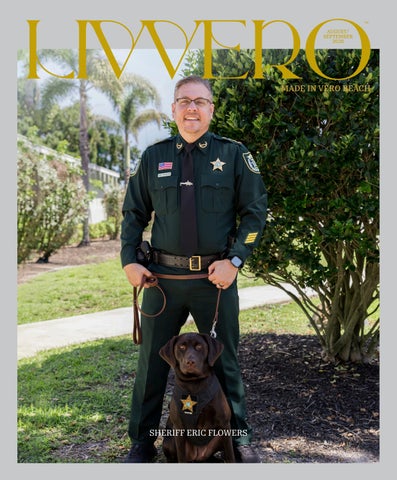
SHERIFF ERIC FLOWERS
1
Indian River County Sheriff’s Office Real-Time Crime Center (RTCC)
Photograph by Victoriya Knapp.
Architect: Gregory Anderson, PA Photography: Daisy Burns
CUSTOM HOMES LUXURY RENOVATIONS COMMERCIAL CONSTRUCTION
www.Building2Last.com n (772) 794-9799
3
Over 100 Million Views Over $100 Million Sold Since January 1, 2026
This is What Comes From Our Proven Approach
THE O’DARE BOGA DOBSON GROUP HAS CONSISTENTLY ACHIEVED 4
AN ANNUAL SALES VOLUME EXCEEDING $100 MILLION.
The Market Isn’t Always Predictable, But Your Results Can Be.
245 STRAND TERRACE | $2.275 MILLION
510 RIVER DRIVE | $12.9 MILLION
3634 OCEAN DRIVE | $5.97 MILLION
1000 SUNRISE TERRACE | $6.7 MILLION
3605 EAGLE DRIVE | $1.995 MILLION
2350 QUAY DOCK ROAD | $12 MILLION
1806 MOORINGLINE DRIVE | $5.55 MILLION
4600 NORTH A1A | $7.95 MILLION
1520 INDIAN BAY DRIVE | $5.95 MILLION
Call Us Today for a Confidential Consultation. CINDY O’DARE | 772.713.5899 RICHARD BOGA | 772.559.4800 ODAREBOGA.COM © 2026 ONE Sotheby’s International Realty. All rights reserved. Sotheby’s International Realty® and the Sotheby’s International Realty Logo are service marks licensed to Sotheby’s International Realty Affiliates LLC and used with permission. ONE Sotheby’s International Realty fully supports the principles of the Fair Housing Act and the Equal Opportunity Act. Each franchise is independently owned and operated. Any services or products provided by independently owned and operated franchisees are not provided by, affiliated with or related to Sotheby’s International Realty Affiliates LLC nor any of its affiliated companies. The information contained herein is deemed accurate but not guaranteed. Pricing subject to change without notice. This communication has been sent to a general market segment and pursuant to the applicable rules, is not intended to be a solicitation to any recipient who may have entered into an agreement with another broker. We are happy to work with them and cooperate fully.
5
AUGUST/SEPTEMBER 2026
CONTENTS 16 Editors’ Letter AMERICA AT 250
22 Abraham Lincoln
He preserved the United States during its darkest hour and championed human liberty.
PIECES of the larger whole
24 Using Crystal Stemware Today
Mix quality crystal with simpler glassware for warmth and personality.
DESIGN HISTORY
26 From Bohemian to Modern Coastal Boho Page
38
Sheriff Eric Flowers reflects on leadership, public safety, future challenges—and his lifelong passion for music.
The evolution of a relaxed and natural aesthetic.
HERITAGE NOTES
28 The Anchor at Indian River Shores
Artifact from the catastrophic 1715 Spanish treasure fleet.
BLOSSOMS
32 The Nora Grant Ixora
One of Florida’s most admired flowering shrubs.
LOCAL GOVERNMENT
38 Interview with Sheriff Eric Flowers, Indian River County Not a fan of politics, loves the work, says numbers speak for themselves. VERO BUSINESS
56 Pura Vida Flower Farm
Cultivating beauty, family, and community from the ground up.
Page
6
56
Pura Vida Flower Farm celebrates sustainable flowers, enduring family values, and community.
UNCOMMON PERCEPTION Tocqueville Asset Management was established to manage the wealth of families and individuals for the long term. Our commitment to capital preservation and exceptional client service has not changed since we opened our doors.
To find out more please email Joseph A. Zock jzock@tocqueville.com http://www.tocqueville.com/wealth +1 (772) 247-0400 ©TOCQUEVILLE ASSET MANAGEMENT L.P / ALL RIGHTS RESERVED. 7
B outique Representation B e g i n s w i t h Q u a l i t y Ad v i s o r s Luke Webb & Associates is intentionally selective, assembling a team of experienced professionals who share an unwavering commitment to integrity, local expertise, and personalized representation. The result is a boutique brokerage where every client benefits from the collective knowledge of trusted advisors. Luxury representation isn’t about having the most agents. It’s ab o ut hav ing the r ig ht o ne s.
Luke Webb 786.546.9603
Lange Sykes 772.473.7983
Nancy Hardy 772.321.8300
Carolyn Lange 772.473.7982
Stacy Allen 305.778.0369
Amy Maria Montemarano 772.766.4964
Ellyn Marshall 860.916.8505
Randy Fosgard 231.383.3042
Phil Sunkel 772.538.2339
Ryan Norvig 407.552.8811
B o utique REPRESENTATION. Lo cal EXPERTS. Perso nalize d SERVICE. Exc eptio nal RESULTS. LUKE WEBB is the #3 Agent in Vero Beach as ranked by 8
info@webbluxuryrealestate.com webbluxuryrealestate.com | @WebbLegacyRE 3341 Cardinal Drive | Vero Beach, FL 32963
SCAN FOR MORE INFO:
Appliances for Life Local Luxury Showroom Expert Advice, One Team, Easy Replacements We Fix What We Sell
LG Electronics Luxury-Tier Fully Built-In, Panel-Ready, Architect-Driven Kitchen Appliances, Available at Capritta Appliances.
Capritta Appliance & Air Conditioning 2585 W New Haven Ave. West Melbourne 321-676-0111 www.caprittaappliance.com
9
AUGUST/SEPTEMBER 2026
CONTENTS ART EXHIBITIONS
66 A Collection of STEWARDS People caring for land, wildlife, and community—love expressed as stewardship. SURF SCENE
72 Shaped and Painted
A collaboration of boards and fine art.
Page
66
The ongoing STEWARDS exhibit at Raw Space brings to life and shares the beauty of Indian River County. The artworks represent these remarkable treasures and honor those who actively guard its preservation.
WINE AND FOOD
76 A Summer of Rosé
Four bottles we love, favorite recipe, inspiration from France. Michele and Rob Wayne, Owners of Varietals and More. EDUCATION
80 Building More Than a Wind Tunnel
A classroom question sparked an extraordinary journey. ENVIRONMENT
86 Hurricanes and Property Elevation
Assessing the risk of neighborhood flooding in Vero Beach.
Page
76
The owners of Varietals and More share their passion for the elegance and versatility of rosé wine.
“MAGAZINES HAVE THE ABILITY TO SLOW PEOPLE DOWN AND MAKE THEM THINK.” — Graydon Carter, architect of modern magazine journalism, legendary editor of Vanity Fair.
Page
80
Saint Edward’s School’s student-built wind tunnel stands as a testament to curiosity and collaboration.
10
Law Offices of
JENNIFER D. PESHKE, P.A. LEGAL SERVICES PROVIDED • ESTATE PLANNING • WILLS, TRUSTS, INCLUDING SPECIAL NEEDS TRUSTS • POWERS OF ATTORNEY & HEALTHCARE DIRECTIVES • PROBATE & TRUST ADMINISTRATION • GUARDIANSHIPS INCLUDING GUARDIANSHIP ADVOCACIES AND VOLUNTARY GUARDIANSHIPS • BUSINESS ENTITY FORMATION • REAL ESTATE (INCLUDING FULL BUYER & SELLER REPRESENTATION, CLOSING AGENT TITLE SERVICES, DEEDS, LEASES & CONTRACTS)
Two Vero Beach Locations: Pelican Plaza – 4731 Highway A1A 20th Street – 956 20th Street Phone: 772-231-1233 www.peshkelaw.com
11
Page
100
The banana plant’s remarkable life cycle unfolds through spectacular flowers, ripening fruit, and continual renewal.
Page
118
Exploring how humans breathe in space. NASA’s newest lunar landing spacesuit—the Axiom Extravehicular Mobility Unit (AxEMU).
AUGUST/SEPTEMBER 2026
CONTENTS 94 A Legacy in Gold
Artist Mackenzie McKenzie discovers her true calling.
LIVING LANDSCAPE
100 Neighbors Bearing Bananas
The gift that keeps on giving—literally.
12
Because the future is launching in our backyard.
MADE IN VERO BEACH
Sheriff Eric Flowers and Miranda of the Indian River County Sheriff’s Office. Photograph by Victoriya Knapp.
SPACE EXPLORATION
118 Breathing in Space
NASA’s evolution in thinking and methods.
128 Endmark
LIVVERO.COM / VOLUME 3 / ISSUE 2
Claire Higgins, Owner/Broker, Engel & Völkers Vero Beach.
112 Why Space Matters in Vero Beach
TM
AUGUST/ SEPTEMBER 2026
LIV VERO MAGAZINE
REAL ESTATE TALK
98 What Luxury Buyers Are Really Looking For
SPACE EXPLORATION
AUGUST/SEPTEMBER 2026
JEWELRY
SHERIFF ERIC FLOWERS
Website: livvero.com. Instagram: @livveromagazine. Subscriptions: Go to livvero.com. Digital Edition: Access on livvero.com. Comments: Email to jim@livvero.com.
Life Happens at Home Care Should Too Life’s most meaningful moments are made at home. That’s why the Visiting Nurse Association brings expert, compassionate care to your doorstep. Whether you’re recovering from surgery, want to feel confident living independently or need support through end-of-life care, the VNA is here for you every step of the way.
Explore what care at home can mean for you
772.567.5551 | www.vnatc.com
13
• MOUSSY • MOTHER • FRAME • XIRENA • RAMY BROOK • TRINA TURK • PERFECT WHITE TEE
BORGO DE NOR • MESTIZA • ASHA • CALA DE LA CRUZ • CINQ A SEPT • SIMKHAI • ALC •
14
• ULLA JOHNSON • MISA • STAUD • CAROLINA K • ALEXIS • ROAME •
Shop timeless styles you’ll reach for ag “This time of year, I fall in love with Brochu Walker all over again!”
3365 Ocean Drive
772.234.3998
CARA CARA • BROCHU WALKER • L’AGENCE • OROTON • FARM RIO
@s
Shop timeless styles you’ll reach for again & again.
3365 Ocean Drive
772.234.3998
@sassyboutiquevb
15
EDITORS’ LETTER MADE IN VERO BEACH You may have noticed that we recently refined our logo to include the subtitle “Made in Vero Beach.” These words are important to us. They convey something fundamental about LIV VERO Magazine: the people responsible for creating it are not distant observers—we are your neighbors. We are the people you may see each day at local schools, in stores and restaurants, at traffic lights, in physicians’ offices, and at community gatherings.
• Diane and I have called Vero Beach home for eight years, and this community has become a place we deeply cherish. We launched LIV VERO Magazine with a simple purpose: to contribute to the community we love by telling its stories, introducing its people, and helping us all better understand the place we share.
Through our work, we have sought to explore Vero Beach’s culture, government, businesses, nonprofits, arts community, natural environment, and the challenges and opportunities that will shape its future. Most importantly, we hope to elevate the tone and tenor of civic dialogue—to encourage curiosity, thoughtful conversation, and a deeper appreciation for the remarkable community we call home.
• Our content focus is local. We are
dedicated to telling the stories of Indian River County, the City of Vero Beach, and our neighboring communities. Whenever possible, we work directly with the people and organizations we feature—sitting down together, listening to their stories, sharing ideas, and building genuine relationships. We believe the best storytelling begins with trust, conversation, and the simple human connection that comes from looking someone in the eye.
• Our writers, photographers, and models
are all Indian River County and Vero Beach residents. We seek out local talent and, we hope, provide a free, creative environment where they can practice their craft, develop their voices, and produce meaningful work that celebrates the people, places, and stories that define our
16
THE PEOPLE RESPONSIBLE FOR CREATING LIV VERO MAGAZINE ARE YOUR NEIGHBORS. community. We want them to take pride in what we collectively create and to grow as individuals, professionals, and colleagues. Just as importantly, they introduce us to a widening circle of talented friends, neighbors, and acquaintances who may contribute to the magazine. Our sole exception is travel writers. They may not live here—but they must be friends.
• We design and produce LIV VERO
Magazine in partnership with a local firm, and we have found ourselves surrounded by people of extraordinary creative talent and integrity. They bring organization, attention to every last detail, and a generosity of spirit—freely sharing their ideas, insights, advice, and time. Perhaps less wonderful for them, I can stop by anytime to see how things are progressing, exchange thoughts, and simply chat for a while. For me, that connection is one of the great pleasures of producing a publication in the community we call home.
• Our social media is created and managed
locally as well. We believe these platforms are most effective when they are curated by people who live here—people who instinctively understand our community, recognize the stories that matter, and know which photographs and videos will resonate most with our audience. That local perspective helps ensure our digital presence reflects the same authenticity, relevance, and sense of place that define every issue of LIV VERO Magazine.
• Our trusted CPA and legal advisors
are part of the Vero Beach business community.
• Alas, the one aspect of producing LIV
VERO Magazine that cannot be handled locally is printing. Our magazine is produced using “perfect binding”—the durable, square-spine binding found in most high-quality magazines and books—which requires specialized equipment unavailable in our area. As a result, we partner with an outstanding printing company outside our community whose craftsmanship, reliability, and commitment to quality consistently bring each issue to life.
We are deeply grateful to our readers and advertising partners for their trust, encouragement, and support. They make our work not only possible, but profoundly worthwhile. And to those we have not yet had the privilege of meeting or serving, we look forward to the opportunity. We hope you’ll allow us to earn your confidence, tell your stories, and welcome you into the LIV VERO family.
JIM FIELD CO-PUBLISHER CO-EDITOR jim@livvero.com
DIANE FIELD CO-PUBLISHER CO-EDITOR diane@livvero.com
55 Royal Palm Pointe, Vero Beach - T. 772-559-0395 I www.lplcreations.com
17
TM
OUR CIRCULATION AND REACH On Five Levels
Magazines mailed to EVERY residence in Indian River County (all 8 zip codes) with incomes equal to or greater than $200,000.
DIGITAL
Electronic Edition sent to a curated list of 11,000+ email addresses in Indian River County with incomes equal to or greater than $150,000.
IN PERSON
Hand delivery of 1,500 copies to advertising partners, other businesses, organizations, individuals—including hotels, airport, restaurants, real estate offices, physician offices, country clubs, drop points.
WEBSITE
Electronic Edition, in full, is accessible to all on our website livvero.com.
SUBSCRIPTION
LIV VERO® Magazine is a registered trademark of Orchid Island Publishing Group LLC. © 2026 Orchid Island Publishing Group LLC. All rights reserved. Reproduction or distribution of any content without express written consent is prohibited. CO-PUBLISHER | CO-EDITOR Jim Field jim@livvero.com Diane Field diane@livvero.com EDITORIAL CONTRIBUTING WRITERS John Stearns, Renee Morad, Amanda Blumberg, Diane Field, Jim Field, Analise McManus ART CONTRIBUTING PHOTOGRAPHERS Victoriya Knapp, Jim Field, Analise McManus, Frank Moore, Aaron Knapp ADVERTISING AND EVENTS 703-851-0703 DIGITAL WEBSITE: livvero.com INSTAGRAM: @livveromagazine ORCHID ISLAND PUBLISHING GROUP LLC Vero Beach, FL 32963 President | Jim Field SUBSCRIPTIONS 10 issues: $45. Subscribe at www.livvero.com POSTMASTER SEND ADDRESS CHANGES TO: Orchid Island Publishing Group 3320 Cardinal Dr., Suite 648175 Vero Beach, FL 32963 LOCALLY OWNED & OPERATED
Building list of subscribers locally and across country to primary/secondary residences. Subscribe at livvero.com. LIV VERO MAGAZINE: File No.: 440381.1 Serial No.: 98525418 (ISSN# pending) is published ten times per year by Orchid Island Publishing Group, 32963.
@livveromagazine www.livvero.com
SUBSCRIPTIONS: Free of charge to qualified residents of Vero Beach. Publisher reserves the right to determine qualifications. Annual subscriptions: U.S. and possessions $45, all other countries $125 U.S. funds (via air mail). Single copies: U.S. and possessions $5. No part of this publication may be reproduced without the written consent of the publisher. The publisher does not warrant, either expressly or by implication, the factual accuracy of any advertisements, articles or descriptions here in, nor does the publisher warrant the validity of any views or opinions offered by the authors of said articles or descriptions. The opinions expressed are those of the individual authors, and do not necessarily represent the opinions of Orchid Island Publishing Group. Orchid Island Publishing Group makes no representation or warranties regarding the accuracy or appropriateness of the advice or any advertisements contained in this magazine. SUBMISSIONS: We welcome submissions. Unless otherwise negotiated in writing by the editors, by sending us your submission, you grant Orchid Island Publishing Group permission by an irrevocable license (with the right to license to third parties) to edit, reproduce, distribute, publish, and adapt your submission in any medium on multiple occasions. Submissions will not be returned.
18
MADE IN VERO BEACH
THE PEOPLE CREATING LIV VERO MAGAZINE ARE YOUR NEIGHBORS Local Leadership The owners and publishers have proudly called Vero Beach home for the past eight years. They launched LIV VERO Magazine with a simple purpose: to enrich the community by chronicling its history and living heritage, profiling its people, and helping readers better understand and appreciate the amazing place we all call home. Local Focus Our editorial focus is local. We are dedicated to telling the stories of Indian River County, the City of Vero Beach, and our neighboring communities. We believe the best storytelling begins with genuine human connection, and most of our stories originate through recommendations from local residents. Every feature is a collaboration, and because we do not publish advertorials, each story is chosen solely for its value to our readers. Local Contributors Our writers, photographers, and models are local residents who share our passion for this community. We strive to provide a creative environment where they can develop their talents while producing meaningful work that celebrates the people, places, and stories of Indian River County. In turn, they introduce us to an ever-growing network of local talent that enriches the magazine.
Local Creation We design and produce LIV VERO Magazine in partnership with a local firm whose creativity, professionalism, and generosity elevate every issue. Beyond their talent and attention to detail, we value the simple pleasure of collaborating in person—stopping by to exchange ideas, review progress, and enjoy the camaraderie that comes from creating a fresh and dynamic publication. Local Social Media Our social media is created and managed locally as well. We believe these platforms are most effective when they are curated by people who live here—people who instinctively understand our community, recognize the stories that matter, and know which photographs and videos will resonate most with our audience.
WE ARE DEEPLY GRATEFUL TO OUR READERS AND ADVERTISING PARTNERS FOR THEIR TRUST, ENCOURAGEMENT, AND SUPPORT. THEY MAKE OUR WORK NOT ONLY POSSIBLE, BUT PROFOUNDLY WORTHWHILE.
READ. SUBSCRIBE. ADVERTISE. SUPPORT INDEPENDENT LOCAL PUBLISHING.
19
Oceanic Wealth Management
Welcomes Chase Perez-Blanco Financial Advisor
As we continue to serve founders, families, and business owners across the Treasure Coast and Palm Beach communities, this growth reflects our commitment to thoughtful and relationship-driven wealth management. Our team focuses on helping clients navigate major financial transitions, coordinate long-term planning, and steward wealth across generations. We are proud to continue growing our presence in Vero Beach and looking forward to serving our community together.
Oceanic Wealth Management Wells Fargo Advisors Financial Network 3387 Ocean Drive Ver0 Beach Florida 32963 772-200-3973 Razvan Ilie Senior Financial Advisor Jenna Suleman Senior Financial Advisor Chase Perez-Blanco Financial Advisor
20
Wells Fargo Advisors Financial Network, LLC (WFAFN), Member SIPC, a registered broker-dealer and non-bank affiliate of Wells Fargo & Company, WFAFN uses the trade name Wells Fargo Advisors. Ad.
FOUNDATIONS
EARLY INSPIRATIONS FROM LIV VERO
Close-up image of coconut tree frond. Photograph by Jim Field.
21
AMERICA AT 250
The Anatomy of Greatness A Tapestry of Vignettes
9. ABRAHAM LINCOLN Abraham Lincoln November 8, 1863. Photographic portrait by Alexander Gardner. Taken 11 days before his Gettysburg Address. By Jim Field Abraham Lincoln (1809–1865) rose from humble beginnings to become one of the most revered figures in American history, embodying the ideals of perseverance, integrity, and devotion to the Union. Born on February 12, 1809, in a one-room log cabin in Hardin County, Kentucky (now LaRue County), Lincoln grew up on the frontier, where hard work and self-reliance shaped his character. His mother, Nancy Hanks Lincoln, died on October 5, 1818, when Abraham was nine years old. She died from milk sickness, a mysterious and often fatal disease that afflicted settlers in the Midwest during the early 19th century. His formal education amounted to less than a year, but his insatiable curiosity led him to educate himself by reading every book he could borrow. As a young man, he worked as a farm laborer, rail splitter, store clerk, surveyor, and postmaster before studying law independently and becoming a successful attorney in Springfield, Illinois. Standing 6 feet 4 inches tall, a product of years of splitting rails, clearing forests, and working the frontier, Lincoln was recognized as a man of exceptional strength and endurance. His reputation for honesty earned him the nickname “Honest Abe.”
Lincoln entered politics as a member of the Illinois legislature and later served a single term in the U.S. House of Representatives. Although he returned to his legal practice, the growing national conflict over the expansion of slavery drew him back into public life. His eloquent debates with Senator Stephen A. Douglas in 1858 brought him national recognition, and in 1860 he was elected the 16th President of the United States. His election triggered the secession of eleven Southern states and the outbreak of the Civil War (1861-1865). Throughout the devastating conflict, Lincoln remained steadfast in his determination to preserve the Union while gradually redefining the war as a struggle for human freedom. On January 1, 1863, he issued the Emancipation Proclamation, declaring enslaved people in Confederate-held territory to be free and transforming the Civil War into a moral as well as political cause. Although the proclamation did not immediately end slavery, it paved the way for the Thirteenth Amendment, which permanently abolished slavery throughout the United States.
War. Just five days later, on the evening of April 14, Lincoln attended a performance at Ford’s Theatre in Washington, D.C., where he was shot by actor and Confederate sympathizer John Wilkes Booth. Lincoln died the following morning, becoming the first American president to be assassinated. His legacy is immense: He preserved the United States during its darkest hour, championed the cause of human liberty, strengthened the authority of the federal government, and demonstrated that principled leadership could endure even amid overwhelming adversity. Perhaps the most amazing aspect of Abraham Lincoln’s life is the fact that he grew up in primitive conditions—often barefoot, wearing rough homemade clothing, living in a world where even simple manufactured items like needles and buttons were precious and difficult to obtain—yet rose to become the author of some of the world’s most powerful and enduring words.
On April 9, 1865, Confederate General Robert E. Lee surrendered at Appomattox Court House, effectively ending the Civil
“With malice toward none; with charity for all; with firmness in the right, as God gives us to see the right, let us strive on to finish the work we are in; to bind up the nation’s wounds; to care for him who shall have borne the battle, and for his widow, and his orphan—to do all which may achieve and cherish a just, and a lasting peace, among ourselves, and with all nations.” –Second Inaugural Address, closing paragraph, delivered March 4, 1865. 22
23
PIECES of the larger whole
USING CRYSTAL STEMWARE TODAY
Mix Quality Crystal with Simpler Everyday Glassware for Warmth and Personality By Diane Field Photographs by Victoriya Knapp I have always loved cut crystal glassware. As a young woman, Ireland’s Waterford Crystal represented the ultimate expression of elegance and craftsmanship. It was the gift to give—and the gift everyone hoped to receive. A well-appointed home was expected to have enough crystal to entertain twelve guests with ease. Each place setting featured a water goblet, a white wine glass, a red wine glass, and a champagne flute, because every beverage had its proper vessel and every course its own sense of occasion. The table sparkled as candlelight danced through the deeply cut patterns. The collection rarely stopped with stemware. Crystal candlesticks, flower vases, butter dishes, condiment servers, bowls, decanters, and serving pieces all had their place in the dining room. In those days, there was never such a thing as too much crystal. It wasn’t merely glassware—it was an expression of 24
hospitality, celebration, and a tradition of gracious entertaining that made every gathering feel special. Contemporary Market In the U.S. fine crystal market, Waterford was long the dominant brand. During its peak years, the company reported that Waterford held roughly 40% of the U.S. fine crystal market (including its Marquis by Waterford line), making it the best-known name in American homes and wedding registries. Globally, however, the market is more fragmented. Some industry estimates place Baccarat among the leaders in the ultra-luxury segment, while Waterford, Riedel, Lalique, Baccarat, and other European makers compete across different niches. Baccarat dominates the world of exceptionally high-end, collectible crystal; Riedel is especially influential among wine enthusiasts; Lalique is known more for artistic and decorative crystal.
Waterford continues under the ownership of Fiskars Corporation and still produces luxury crystal pieces. While some production remains in Ireland, manufacturing also takes place elsewhere in Europe. The company has also moved from traditional lead crystal to a lead-free crystal formula designed to retain the brilliance, clarity, and quality associated with the brand. Vintage Waterford from the 1960s through the 1990s remains especially valued by collectors because it represents the height of the company’s classic era. Tablescape Guidance Tablescape designers almost universally recommend mixing crystal stemware with simpler glasses rather than trying to match every piece. The current trend is layered, collected, and purposeful—not a perfectly matched set. The key is to maintain harmony through proportion, color, and purpose.
Reducing things to practical steps, here are core principles used by professional stylists: Let crystal be the star. Allow crystal pieces to be the visual focal point. Pair them with understated water glasses rather than equally ornate goblets. This prevents the table from looking busy and gives crystal room to shine. Mix ornate with simple. A common combination is cut-crystal wine glass, plain, heavy-bottomed water tumbler, simple champagne flute. The contrast feels contemporary while preserving the elegance of the crystal. Keep heights varied. Different glass heights create rhythm on the table: water glass is the shortest, white wine glass is slightly taller, red wine glass is the next tallest, champagne flute often stands behind them. Stay within one color family. Most designers recommend clear glass throughout. If using colored glass—soft smoke, pale green, blue, or amber—limit it to one style so the table doesn’t become visually fragmented. Mix vintage and modern. Pair inherited crystal with contemporary dinnerware. For example: vintage Waterford crystal, white porcelain plates, linen napkins, matte flatware, modern clear tumblers. The result is elegance without feeling formal. Repeat one design element. If stemware styles differ, create unity by repeating another element, such as the same stem height, similar bowl shapes, matching clear glass, consistent spacing. Think “collected,” not “matched.” The best tables look as though they evolved over time rather than purchased as a boxed set. Mixing quality crystal with simpler everyday glassware creates warmth and personality. The key takeaway is that coordination trumps matching. A thoughtfully mixed collection of glassware often looks more sophisticated and welcoming than a table where every piece is identical. 25
DESIGN HISTORY
FROM BOHEMIAN TO MODERN COASTAL BOHO
The Evolution of a Relaxed Aesthetic By Diane Field
Beach décor in the United States—whether in Florida or California—often gravitates toward the casual and informal, reflecting the reasons we come to the beach: to kick off our shoes, spend long hours in swim attire, and unwind. When visiting beachside boutique hotels, bed-and-breakfasts, and the private residences of friends, it is not uncommon to encounter interiors that reflect this laid-back attitude. Relaxed furnishings, playful artwork, natural materials, and ocean-inspired objects (surfboards included) contribute to the ambiance, inviting guests and homeowners alike to leave their cares at the door. At first glance, these distinctive interiors might appear to be unplanned, organic creations that simply took shape over time—a product of eclectic collecting and carefree arrangement, and the very antithesis of formal design. But that interpretation misses the point. Their apparent spontaneity is not evidence of an absence of design, but rather the continuation of a long bohemian tradition—one that prizes personal expression, layered textures, handcrafted objects, and furnishings accumulated over time rather than purchased as a coordinated set from a showroom. 26
Historic Bohemian Movement The term bohemian originally described artists, writers, musicians, and intellectuals who rejected the conventions of mainstream society. In cities such as Paris, Prague, and London, these creative communities embraced a lifestyle defined by freedom, travel, and self-expression, and their homes reflected that outlook. Rooms were layered with books, textiles, art, handmade objects, and furnishings collected from distant places. Matching furniture sets gave way to eclectic assemblages gathered over time, each contributing to a larger and deeply personal story. By the middle of the twentieth century, bohemian design experienced a revival through the Beat Generation and, later, the counterculture movements of the 1960s and 1970s. The interiors of that era were exuberant and eclectic, characterized by macramé and beaded wall hangings, patterned rugs, hanging plants, floor cushions, wicker furniture, and an array of influences drawn from Morocco, India, Mexico, and the American Southwest. Above all, the aesthetic celebrated individuality, spontaneity, and a willingness to mix styles freely—though, at times, it also flirted with visual excess.
Coastal Boho As coastal living evolved in places such as Southern California, Hawaii, and Florida, designers began adapting bohemian principles to seaside environments. The result was coastal boho—a softer, lighter interpretation that retained the warmth and individuality of bohemian interiors while drawing inspiration from the ocean and an outdoor way of life. Coastal boho preserved the layered textures and collected character of traditional bohemian design but exchanged darker colors and heavy ornamentation for whites, creams, sandy neutrals, sea-glass blues, and weathered woods. Natural materials such as rattan, sisal, jute, cane, and linen became defining elements. Surfboards leaned casually against walls, tropical plants softened corners, and oversized slipcovered sofas encouraged a more relaxed style of living. Unlike traditional nautical décor—with its anchors, ship wheels, and overt maritime motifs—coastal boho sought to capture the feeling of life near the sea rather than decorate with literal symbols of it.
Modern Coastal Boho More recently, boho has undergone yet another transformation. Influenced by Scandinavian minimalism, contemporary architecture, and the understated elegance of luxury hospitality design, modern coastal boho has emerged as one of the defining aesthetics of twenty-firstcentury waterfront living. Today’s interpretation is considerably more restrained than its predecessors, emphasizing open space, natural light, and carefully curated materials. White walls and clean architectural lines provide a backdrop for woven pendant lights, handcrafted ceramics, textured rugs, vintage furnishings, and organic finishes. Decorative objects are used sparingly, allowing rooms to feel collected rather than crowded. In many ways, modern coastal boho reflects changing attitudes toward home itself. Increasingly, people seek spaces connected to nature, filled with personal meaning, and suited to everyday life. The style balances sophistication with informality, marrying the free spirit of bohemianism with the free spirit of life on the coast.
27
HERITAGE NOTES
THE ANCHOR AT INDIAN RIVER SHORES Artifact from the Catastrophic 1715 Spanish Treasure Fleet
Illustration by Howard Pyle. November 1894, Harper’s Magazine.
By Jim Field Photograph by Jim Field Image source Wikipedia Commons Editor’s Introduction. I live on the barrier island north of the City of Vero Beach. Nearly every day I drive south through the Town of Indian River Shores, meaning that I pass through this municipality a dozen times per week—at minimum—more often twice that amount. At the intersection of A1A and Fred R Tuerk Drive—the northwest corner—you will find an anchor on display. A simple plaque reads, “Spanish Galleon Anchor. Recovered from the wreckage of the ill-fated treasure ships in the 1715 hurricane off our shores, thus giving rise to the name ‘The Treasure Coast.’” I had noticed the anchor years before. Just recently, I chided myself for laziness and pulled over to look at it. Here is what I discovered about its lineage.
28
The 1715 Spanish Treasure Fleet was a convoy of 11 Spanish ships carrying the wealth of the New World back to Spain. It was formally known as the 1715 Plate Fleet (Flota de la Plata), named after the Spanish word plata, meaning silver. The ships departed from Havana, Cuba, in July 1715, after years of delays caused by war and political instability. On the night of July 30–31, 1715, as the fleet sailed north along the Florida coast, it encountered a powerful hurricane, producing enormous waves, violent winds, and dangerous currents. The ships were driven onto reefs and sandbars near present-day Fort Pierce, Vero Beach, and Sebastian. All vessels were lost and an estimated 700-1,000 people died, making
it one of the deadliest shipwrecks in Florida waters. Survivors were stranded along a remote coastline hundreds of miles from Spanish settlements. Many lived for weeks on the beach before rescue efforts arrived from Cuba and St. Augustine. The Cargo The 1715 Treasure Fleet and others like it transported wealth from the New World— especially silver from Mexico and Peru— along with gold, pearls, gemstones, spices, tobacco, cocoa, indigo, silk, porcelain, and other luxury goods, to the Spanish Crown and royal treasury. Fleets carried not only treasure but also passengers—families, soldiers, sailors, and colonial officials returning to Spain.
29
HERITAGE NOTES
THE ANCHOR AT INDIAN RIVER SHORES For more than two centuries, from 1566 to 1778, Spain dispatched one or two great treasure fleets across the Atlantic each year. Notably, the flota system was imposed in 1566 to protect treasure in transit, prohibiting individual ships from sailing alone, requiring vessels to gather into large, heavily protected convoys that crossed the Atlantic together. During this period, an estimated 300 to 400 convoys attempted the trans-Atlantic crossing (valued at billions of dollars in today’s currencies), making the 1715 Fleet one chapter in one of history’s greatest maritime enterprises.
Relevance Today If you get a chance, stop and check out the anchor—it’s large yet gracefully wrought. It is a humbling reminder that beneath the waters just offshore lies a remarkable archaeological time capsule—a moment when a powerful empire, a fleet of magnificent ships, and a devastating hurricane collided right off our beach.
The Ships The vessels composing the 1715 Treasure Fleet were not ordinary sailing ships— rather, they were large Spanish merchant vessels and armed escorts, including galleons, naos (large ocean-going ships), and fluyts (cargo vessels) designed to carry enormous quantities of treasure and trade goods long distances. Singling out the galleon, this ship type was built with a strong oak or hardwood frame with heavy internal ribs, covered with thick wooden planking and sealed with tar, pitch, and caulking to make the hull watertight. The structure had multiple decks, tall masts, and elaborate raised structures at the bow and stern. The high sterncastle provided living quarters for officers and helped protect the ship in battle, while also giving the vessel its distinctive profile. A large galleon of the early 1700s measured 120-160 feet in length and displaced roughly 500-1,000 tons. Crews varied depending upon the ship’s size and purpose. A large galleon might carry 100-300 people, including sailors, officers, soldiers, gunners, carpenters, cooks, and passengers. Merchant vessels had smaller crews, perhaps 50 to 100 sailors and support personnel, although numbers varied. These ships were armed as well as built for commerce. A heavily armed galleon might carry 20 to 50 cannons, ranging from small anti-personnel guns to large bronze or iron weapons capable of firing heavy cannonballs. However, many treasure fleet ships relied more on convoy protection than on their own firepower. 30
Spanish Galleon Firing Its Cannons. Cornelis Verbeeck. 1618–1620. Oil on panel. 19 x 55 in. National Gallery of Art, Washington, D.C. Although painted nearly a century before the 1715 Treasure Fleet disaster, it is one of the finest contemporary portrayals of the galleon ship type that carried Spain’s wealth across the Atlantic.
31
BLOSSOMS
Vero’s Everyday Floral Masterpieces
NORA GRANT IXORA
The Nora Grant ixora (Ixora coccinea) is one of Florida’s most admired flowering shrubs, celebrated for its glossy evergreen foliage and large clusters of vibrant pink blossoms. Blooming repeatedly through much of the year, it thrives in full sun, warm temperatures, and acidic, well-drained soil. Its compact, dense growth makes it an excellent choice for hedges, foundation plantings, butterfly gardens, and colorful tropical landscapes. Pink cultivar shown. By Jim Field Photograph by Jim Field 32
Coming October to booksellers everywhere. Available for pre-order now at mckeegarden.org
33
Proud to be the only Renson Dealer along the Treasure Coast.
Optimal enjoyment of your indoor and outdoor spaces
How your ideal home looks is personal. But we all share one clear wish: we want a home in which we can recharge our batteries in comfort and that is a pleasant place to be all year round. Renson® helps you achieve that goal with sustainable solutions for a healthy, comfortable living environment. Inside and outside. Ventilation • Solar Shading • Pergolas • Wall Cladding • Carports
OUTDOOR LIVING RE-IMAGINED
34
Showroom & Factory • 1055 Commerce Avenue, Vero Beach Phone (772) 569-2200 • Toll Free (800) 741-2202 www.floridashuttersinc.com
35
LOCAL GOVERNMENT
36
Photograph by Victoriya Knapp 37
LOCAL GOVERNMENT
SHERIFF ERIC FLOWERS OF INDIAN RIVER COUNTY Not a Fan of Politics, Loves the Work, Says Numbers Speak for Themselves By John Stearns Photography by Victoriya Knapp
Eric Flowers’ second term as Indian River County sheriff has included turbulence and tragedy in the last year, from a public battle with the county over Sheriff’s Office funding to losing a beloved deputy killed in the line of duty. Behind those high-profile stories, though, are the less-public pressures and obligations that come with running a large organization—one with a projected annual budget for fiscal 2026-27 north of $90 million, about 600 employees, and the responsibility that comes with ensuring public safety for county residents. Music is Flowers’ stress relief, side passion, and escape. “I love music,” Flowers said from his office, whose decor includes a couple guitars, including a 1936 Gene Autry Silvertone. “I love listening to music, watching live music, playing music, anything to do with music. That’s my thing.” He has a home studio where he’ll unwind after work, invite musician 38
friends to jam, and record songs with his biological son, Easton, 11, and three stepchildren, Charlotte, 6, Clay, 11, and Savannah, 14, from his marriage to Alyssa Offutt Flowers in 2023. He’ll ask the kids what song they want to sing, pull it up, record it, back out the original vocals, insert their vocals, and mix it to sound professional. He jokes that songs he’s recorded of his youngest, Charlotte, will be fun to blast in the car when she’s a teenager. “It’s pretty cool,” Flowers, 46, said with a wry smile. While Flowers’ inner rock star is on full display with friends and family, the career lawman—who joined the office in 2003 as a deputy, moved up the ranks, won his first election as sheriff in 2020, and was reelected in 2024—beats an unapologetic drum for doing what he believes is best for county safety, Sheriff’s Office personnel, and local taxpayers.
He has spent millions of dollars to increase deputies’ salaries to better match the region’s cost of living, installed license plate readers along key roads, opened the Real-Time Crime Center (RTCC), improved jail technology, reduced inmate recidivism, and embarked on a new administration building abutting 41st Street, east of 43rd Avenue, that he says will be the new face of the Sheriff’s Office. That facility will house the office’s roughly 200 civilian employees, not sworn officers or Flowers, who will remain in their current building. The $20 million structure is scheduled for completion in November, with a grand opening planned in March. It’s a capital project separate of IRCSO’s operating budget. The Sheriff’s Office budget has risen about 63% since Flowers was first elected nearly six years ago, from $57.1 million in fiscal 2020-21 to a projected $93.3 million for the fiscal year that begins October 1. When he didn’t get as much money last year as
has helped our relationship because they understand that I’m being serious about things. They understand that what we’re asking for is a critical part of what the county government is supposed to do. I’m not just asking because I feel like we want it; I’m asking because we need it, and while our budget has gone up a ton, it’s all been necessary things.” Flowers added, “We brought crime down. If we weren’t bringing crime down, if we weren’t bringing up morale, if we weren’t doing all the things that are expected, then I would say, ‘OK, I get it.’ But we’re doing all the things that are expected of our agency and so you’ve got to give us the money to continue to do those things. That’s kind of my feelings—and really the sentiment from the citizens is, ‘Hey, we like what they’re doing; we want them to continue doing it,’ and so funding us is a critical part of what the government is here to do.” To prove his point on less crime, he shared stats from staff showing declines in auto burglary, residential burglary, grand theft auto, and business burglary in the decade between 2015 and 2025 of 74%, 69%, 32%, and 57%, respectively. The numbers validate the office’s approach, he said from inside the RTCC. he requested for the current fiscal year, he sued the county, with the two sides eventually settling on a lesser increase. The county’s population growth, meanwhile, from 2020 to 2025, the latest year with estimates available, was 8.3%, according to a report prepared by the Florida Legislative Office of Economic and Demographic Research, which estimated last year’s population at 173,013. It’s projecting about 184,569 in 2030. In a late June interview with LIV VERO Magazine, as Flowers was preparing to approach county leaders on fiscal 2026-27 funding, he described his relationship with the county as being in a better place than a year ago. “I feel like we’ve made some significant progress,” Flowers said. “The county administrator (John Titkanich) and I are very cordial and we’re working together. I feel like me pushing back against them
Additional data provided by his office after Flowers’ LIV VERO interview showed theft, criminal mischief, shoplifting, robbery, and homicide down 25%, 50%, 41%, 33%, and 50%, respectively, for the same decade. Total calls for service declined 35% over the same period, with disturbances generating the most calls, including people fighting over something, whether husbands and wives, kids fighting, road rage, noise disturbances, and more.
“SO MANY OF OUR CALLS REVOLVE AROUND MENTAL HEALTH ISSUES. IT’S THE BIGGEST NATIONAL ISSUE THAT RARELY GETS TALKED ABOUT. SUBSTANCE ABUSE ISSUES GO HAND IN HAND WITH MENTAL HEALTH. UNTIL OUR COUNTRY/ STATE PRIORITIZES MENTAL HEALTH TREATMENT, WE WILL CONTINUE TO SEE THIS GET WORSE.” Flowers enjoys being sheriff but admits he was surprised at how distasteful politics can be. “I mean, I knew they were bad, but I didn’t know they were this bad,” he shared. “It’s just miserable. Politics are awful. I’m not saying that sheriffs shouldn’t be elected; I actually think all law enforcement leaders should be elected, but it’s just the least fun part of my job.” He treasures the work, though.
Asked what he hears from deputies on the street as being the most concerning issue, Flowers cited mental health.
“I love empowering the employees, I love taking care of our citizens, and putting bad guys in jail, and doing all the things with the job,” Flowers said. “But there’s this whole component of politics—that part is just not fun.”
“So many of our calls revolve around mental health issues,” he said. “It’s the biggest national issue that rarely gets talked about. Substance abuse issues go hand in hand with mental health. Until our country/state prioritizes mental health treatment, we will continue to see this get worse.”
He added, “I’ve become unapologetic almost about it. You saw the budget fight with me where I unapologetically said, ‘This is what I need. Give it to me, or don’t, and face the consequences.’ I’m at that point with politics–either you like me or you don’t. And if you don’t, that’s fine. Go do what you’re going to do.” 39
LOCAL GOVERNMENT
SHERIFF ERIC FLOWERS OF INDIAN RIVER COUNTY
Miranda (female), an IRCSO therapy dog.
A Sheriff in the Making Flowers was born in Clinton, Maryland, in 1980. His father was a mechanic and owned his own repair shop. When Flowers was around seven, his dad took a second job at night as a licensed and uniformed security guard at the hospital where Flowers was born. The job included a home police scanner and Flowers remembers its frequent chatter. “As a kid, the scanner was on probably more than the TV,” he recalled. About the same time, when the number of TV channels could be counted one hand, some of the available programs resonated, including “Cops,” “America’s Most Wanted,” “Rescue 911,” and “Unsolved Mysteries.” Like so many others who tired of the snow and high taxes, Flowers’ father moved his family to Florida in 1992, settling in southern Brevard County, where Flowers attended seventh through ninth grades. He spent 10th through 12th at Sebastian River High School and, after high school, worked five years at Walmart and Sam’s Club in roles that included check-out supervisor, team leader, and front-end area manager. In high school, he was part of a band and also did some radio gigs for WTTB in Vero. When he was selected for Florida American Legion Boys State in high school—a respected civic leadership program in which students become part of the operation of local, county, and state government—a local media outlet did a story and asked him what he thought he would do in life. He answered: broadcasting or law enforcement. He’s blended both at IRCSO, before and after becoming sheriff. In 2013, he started “C.O.P.S.” (Community Outreach and Public Service), with now Undersheriff Thom Raulen that was broadcast on local radio, and on YouTube and Facebook Live, a program that ran about seven years. In 2021, he started “In the Know at IRCSO,” with Raulen, which was shared with local media and broadcast on IRCSO social media until a couple years ago. The Indian River County Sheriff’s Office in late 2023 also participated in a documentary series, “On Patrol: Live,” 40
which airs on Reelz and featured IRCSO in several episodes into early 2024. He believes his media experience helped his election and also helps him communicate with county residents—a full-circle evolution from playing music and doing radio in high school. “I got to be a rock star without a guitar,” Flowers said with a laugh. After joining the Sheriff’s Office in 2003— hired by then Sheriff Roy Raymond in the same office Flowers occupies today—he spent years on what he called a long and winding college journey that he completed while working at IRCSO. He graduated from the police academy at Brevard Community College (now Eastern Florida State College) in Cocoa in 2003; got his associate degree there in general studies in 2004; graduated from the Florida Department of Law Enforcement’s leadership academy at Daytona State
College in 2010; and got his bachelor’s degree in business administration at Stetson University in DeLand in 2011. “It took me a long time because I was in adult learning,” he said, remembering driving to Stetson on Saturdays and working as a deputy during the week. He also earned a police leadership certificate at the University of Central Florida in Orlando in 2011; got a master’s in criminal justice there in 2012; and took a 10-week program in law enforcement executive leadership at the FBI National Academy in Quantico, Virginia, in 2017. Throughout his studies, his roles at IRCSO included deputy, honor guard, SWAT member and field training officer, detective, sergeant, lieutenant of community affairs, major of bureau of administration, and major of law enforcement before election to sheriff.
Sheriff Flowers in front of new administration building abutting 41st Street.
Author John Stearns and Sheriff Flowers.
41
LOCAL GOVERNMENT
SHERIFF ERIC FLOWERS OF INDIAN RIVER COUNTY Achievements Since Becoming Sheriff The Real-Time Crime Center is Flowers’ proudest accomplishment as sheriff. It’s a large, darkened room with big, glowing video monitors covering a front wall that provide staff inside with realtime views of intersections, traffic stops or other deputy encounters via their body cameras. Flowers implemented body cameras as sheriff-elect in 2020. The RTCC can access other cameras and video feeds throughout the county, including businesses. Convenience stores, for example, can share live security camera feeds for additional safety and vigilance, a free service IRCSO offers. RTCC staff hear every call for service placed to IRSCO, a number that totaled about 138,000 last year. At the push of a button, they can summon video from cameras at myriad points throughout the county or data from license plate readers, also a Flowers initiative. “You can’t get in or out of Indian River County without us knowing about it,” Flowers said, referring to license plate readers at all major intersections through which people could travel. The readers take seven to 12 photos, no video, of everything that passes by. It’s not Big Brother, he emphasized, noting staff are too busy to check anything other than major alerts. “If they dialed their alerts way down, they would get every expired tag, they would get every suspended driver; they don’t want to hear that stuff,” he said. “They’re hearing serious warrants, they’re hearing stolen vehicles, they’re hearing felony cars that are suspected of major crimes—things that matter that they can get out so that our deputies can make a dent in crime.”
1936 Gene Autry Silvertone.
42
Flowers started RTCC when he became sheriff. After visiting the New York Police Department’s Real-Time Crime Center during his stint at the FBI Academy, “I said, ‘It would be so cool if one day we had even a 10th of what they have.’ And to be honest with you, I think that we’ve kind of surpassed some of the stuff that they do. We were very fortunate that we were building this at the same time that a lot of this commercial technology—at least for law enforcement—was coming through.
Five years ago, it was an empty room with crime analysts just sitting there together looking at each other and we’ve added in constantly new technology.” He attributed much of the county’s decline in crime to RTCC. “It’s technology, it’s being proactive, it’s empowering our deputies to do their job instead of policing them out of their job,” Flowers said. “There are law enforcement leaders who put in too many guardrails and safety rails, and one of my goals when I took office was to let our guys work. I don’t want them handcuffed; I want them to be against the bad guys, not against the administration. I want them to know that the administration has their back and that the only bad people in this is the bad guy that’s out there—put that guy in jail, or girl, or whoever it is that’s committing that crime, I want you to deal with that—and so that’s what we’ve empowered them to do, and that’s why I don’t have job openings.” If there’s a shooting, for example, RTCC is on it immediately, he said. Its staff research on social media, open-source databases, anywhere they can find information to help resolve the situation.
RTCC also can detect drones in the county that enter no-fly zones, including over schools, government buildings, and critical infrastructures, and identify the registered pilot.
crime, why not allow that person to work and continue to work through this judicial process rather than just sit there and rot?” he said, calling it a good program that had about 100 people in late June.
Flowers also is proud of roughly $4 million in jail renovations currently under way, largely replacing antiquated technology and aging infrastructure from the jail’s construction 40 years ago. Other updates also are planned, all cheaper than building a new facility, he said.
If 100 people are on pretrial release and it costs roughly $90 to $130 a day to jail someone, that’s $9,000 to $13,000 saved each day. Costs per inmate vary due to factors like medical conditions. IRCSO pays for day-to-day medical needs, but the county at-large pays for major medical costs, like hospital visits. Either way, taxpayers are on the hook.
The jail, which has capacity for 700 inmates, had 464 in late June when Flowers met with LIV VERO. He said the office has worked hard to reduce recidivism to save money, including through pretrial release, which judges have wanted IRCSO to do for a long time, he said, and which he considers good savings of taxpayer money. Arrestees in IRCSO custody can continue working if they have a job, for example. “If you’re somebody that’s a potentially productive member of society, you’ve committed a crime that maybe doesn’t have an impact on a victim, or we’re not concerned about you committing another
People on pretrial release are tracked through apps and must update IRCSO regularly on where they are and what they’re doing, Flowers said, adding they’re returned to jail if they don’t cooperate. Some also wear ankle bracelets for tracking. “Nearly all the other counties our size or larger have been doing it for a long time; it was something that our county just hadn’t made it to yet, and I was fortunate to be able to enable and enact that when I took office as sheriff,” he said. 43
LOCAL GOVERNMENT
SHERIFF ERIC FLOWERS OF INDIAN RIVER COUNTY THE RTCC CAN ACCESS OTHER CAMERAS AND VIDEO FEEDS IN THE COUNTY, INCLUDING BUSINESSES. CONVENIENCE STORES CAN SHARE LIVE SECURITY CAMERA FEEDS FOR ADDITIONAL SAFETY, A FREE SERVICE IRCSO OFFERS. should be happening from this room right here, and I’ve tried so hard—like, just put your dispatchers in our room.”
Spirit (male) in 911 dispatch office.
One Key Objective Still Unmet Flowers referred to RTCC as the brain of the agency, with the adjacent 911 dispatch center the heart. Flowers, however, wants to strengthen that heart, creating a unified dispatch center for all of Indian River County, including the cities of Fellsmere, Sebastian, and Vero Beach. He’s sought that, but hasn’t succeeded, which is one of his biggest disappointments. “I’m most disappointed that we’re five years into me being sheriff and we still don’t have unified dispatch; we still don’t have unified records management,” he said from inside the dispatch office, where a friendly therapy dog, Spirit, also resides. “Right now if you’re in the city of Vero Beach and you call 911, you get sent to their dispatch center. They only dispatch for their police department, so if you’re having a heart attack and you’re in the city of Vero Beach and you pick up the phone and call 911, they’re going to answer—if their one dispatcher isn’t busy— and they’re going to say, ‘Hold on, let me transfer you to the county.’ You can die in that time frame. All of the dispatching 44
It’s the same for Sebastian, Fellsmere, and Indian River Shores, he said. All have their own police departments, and the Sheriff’s Office has good working relationships with each, but all can integrate better, he said, calling it his goal before he retires, “which is no time soon, but I’d like to get that done.” The current situation is unfavorable, he said, noting that two reports—the 2009 “Florida 911: The State of Emergency” and another by the Marjory Stoneman Douglas High School Public Safety Commission (often referred to as the Parkland Commission) in 2019—called for consolidating 911 dispatch statewide, yet it hasn’t occurred. The Florida Sheriffs Association is working to fix it, Flowers said. One of the many recommendations in the Parkland Commission report that was compiled after the school’s 2018 mass shooting killed 17 people, says, in part, “All public safety agencies should work toward consolidation of 911 call centers and eliminate the 911 call transfer process.” There’s no reason the county should have three dispatch centers, Flowers said, citing cities’ limited staffing. “The other side is we should all be on the same records system so that if my guys are out with a guy and they document,
‘Hey, this person’s a sex offender; hey, this person’s a gang member,’ whatever it is, the city of Vero should have the same information for their officers that we’re putting into our system and vice versa. If they document somebody, we should know about it, too. And because we don’t have the same systems, we’re not even talking the same.” Added Flowers, “The county pays all this money—the citizens, the taxpayers—for this 911 dispatch room and for the RealTime Crime Center. I want the cities to just work with us and be on the same page about all that stuff. We have way more resources than they could ever have in those tiny agencies, so just jump on board and be a part of what we’re doing. I don’t want to take over their policing. I don’t want to take their calls. I want them to continue to have police departments; I want them to have really good police departments. As the chief law enforcement officer, I have a vested interest in them providing really good services. There are times where I get complaints where people are like, ‘We don’t like how this area is being policed.’ I mean, the whole county is mine, but it’s their jurisdiction. I have a vested interest in seeing all the police departments succeed. I want them to be good at what they’re doing, so it’s a frustrating thing. I have no say over them whatsoever. It’s their city councils and their mayors, and their people who get to say what they do.” Flowers also would like to get a new training complex for IRCSO. The office leases a property in the western county, site of the former Indian River Correctional Institution that closed in 2012, but he would like more space. “We need a place that’s large enough to have a driving training area, and a canine training area, and all that stuff—and so it’s an ongoing conversation that we’re having with the county,” Flowers said, adding the facility would be for all county agencies, not just IRCSO. The office’s aviation unit, based at the IRCSO campus, also needs attention, he said. Two IRCSO helicopters that were Vietnam era military surplus were retired recently after about 40 years of IRSCO service. The office has since received two more military surplus choppers, one a late
‘90s model and one from the early 2000s. It has another that’s in and out of service and available about half-time, he said. Aircraft uses include searching for missing elderly people, autistic children who wander away, and assisting in criminal pursuits, among others.
platforms that are more mission-specific for their agencies. We’ve got a talented group of pilots; we’ve got a dedicated group of observers who help out over there. It’s going to be time for us to pony up and give them tools that they need to do a really good job over there.”
“It’s such a valuable tool,” Flowers said. “Drones are great, but drone batteries have to be changed every 15 minutes. My helicopter can stay up there for hours and keep an eye on what’s going on on the ground, and it’s a real person in the sky looking down with incredible technology to be able to give us information.” The IRCSO needs to either lease or buy a helicopter that has a more modern platform than the military surplus choppers currently in use. Previous military surplus choppers have cost $2,400 to $5,000 and it’s IRCSO’s responsibility to maintain them.
If the office can keep its two surplus choppers operational and add what he called a “flagship helicopter,” IRCSO would be well-positioned, he said. “What a lot of other counties are doing, too, is they’re partnering with mosquito control, with fire services; they’re getting something that can be multipurpose, multitask,” Flowers said. “So that flagship helicopter could serve multiple purposes,” including medical transports. “Right now, if somebody gets hurt badly in a crash, the helicopter’s either coming from Fort Pierce or it’s coming from Melbourne to come save somebody and get them to a hospital.”
“It’s harder for us to get the parts because we’re competing with everybody for the same parts,” he said. “And so you’ve seen a lot of other sheriff’s offices transition to
Reflecting and Projecting IRCSO suffered a painful loss in November when 25-year IRCSO veteran Sergeant Terri Sweeting-Mashkow was killed in
an ambush while attempting a courtordered eviction at a Vero Beach home where a mother had sought her adult son’s removal. A civil case, the department had no reason to anticipate violence based on the son’s history and previous visits to the home. Another deputy, Florentino “Tino” Arizpe, was wounded in the incident and a locksmith, David Long, who was opening the door, was shot and later died. Flowers said at the time, “There’s only one person who’s at fault for this terrible tragedy, and that’s the shooter that was killed who tried to ambush our deputies.” After months to reflect, he said the office’s response matched the knowledge at the time. “Our team has thoroughly reviewed everything that went down,” he said. “We’ve talked to some of the judges. The problem you have is in that instance, they’re there serving civil court paperwork; that’s not a criminal case in any way whatsoever. And so the powers of law enforcement are greatly 45
LOCAL GOVERNMENT
SHERIFF ERIC FLOWERS OF INDIAN RIVER COUNTY
diminished when you’re not acting in a criminal capacity. As soon as the shooter took criminal action, that changes the interaction completely. So our conversation with the judges was, ‘Is there an avenue for us to change how we handle some of these things?’” The process calls for a judge to tell the sheriff and deputies to evict the person. “I don’t have the power under a normal Tuesday to walk into somebody’s house and say, ‘Hey, you can’t live here anymore. Bye.’ A judge does,” Flowers said. The office has discussed if there’s a way to have a judge on standby so that if IRCSO has a case that’s concerning, where a person isn’t responsive, it can get additional orders from the judge to deal with the situation differently, he said. “We can’t have SWAT going out on every call; it’s just not practical,” Flowers said. “We did 500 evictions in two years. You can’t walk up to every house with a shield; that’s not real. You can’t walk up with your gun drawn. So it’s a matter of us assessing risk and if there’s a case where we think there might be a potential for concern, 46
then we’re going to go back to the judge and say, ‘Hey, we might need an additional order that allows us to do something differently,’ and they are amenable to that.” Added Flowers, “In the future, we may ask the judge, ‘Hey, this person isn’t responding; can we deploy chemical munitions in this situation?’ The person hasn’t taken any criminal action, so we’re in a bad spot because now we’re in a defensive posture; they’re in an offensive posture. It’s a hard thing to deal with.” Fortunately, those types of cases are rare, as is violent crime, in general, in the county. “We live in a very safe community,” Flowers said. “I’m not saying that to tell people to leave your doors unlocked. I’m not saying that for people to think we live in Mayberry, because we don’t. There’s real crime. There are murders, there are rapes, there are bad guys. Just since we’ve been sitting here (June 22), we just got an event notification. Literally 15 minutes ago, a guy, this wanted person escaped from Department of Corrections, from prison custody somewhere else. He was adopted by the U.S. marshals and located
here in our county. Our guys went and took this guy into custody as part of their U.S. marshal duties, took this bad guy who escaped from prison.” Asked about his leadership style as head of IRCSO, Flowers called it inclusive. “Good ideas can come from anywhere,” he said. “The people on the ground are as important in the decision-making process as the leadership team. You have to have buy-in for people to follow you.” He also enjoys helping staff who may not realize the motivation behind his moves. For example, “There are people who didn’t realize how big a deal night shift had taken on them and their families,” he said. “They didn’t realize how rough it was being in patrol for so long and they needed a different view of the world and of the agency. Nothing makes me happier than moving somebody. And they’re like, ‘I can’t believe you’re doing this to me.’ And then six months later they go like, ‘Thank you. I really needed that,’ and they didn’t realize it. That’s just so rewarding.”
REFLECTING ON WHAT HE’S LEARNED SINCE BECOMING SHERIFF, FLOWERS SAID HE’S “WAY LESS JUDGMENTAL OF PEOPLE AND I’VE GOT A LOT MORE FORGIVENESS IN ME. NOW I’M MORE OF LIKE, ‘HEY, YOU NEVER KNOW WHAT PEOPLE ARE GOING THROUGH.’” To the statement that everyone makes mistakes, Flowers responded, “Absolutely; it’s how you handle those things.”
Looking forward, Flowers hopes he can continue to build on his nearly six years of work as sheriff. One goal he hopes to achieve: serving as president of the Florida Sheriffs Association in 2030, which he’s on track for—assuming he gets reelected in 2028. FSA is a corporation comprising the state’s 67 sheriffs. “We haven’t had a sheriff from Indian River County serve as the president of the Florida Sheriffs Association since Sheriff (Richard T. “Tim”) Dobeck (served in 1989’90), and so that’s a pretty cool thing that I’m looking forward to and that I aspire to,” Flowers said. “I obviously need to get reelected one more time to be able to do that, so I’m hoping that the citizens will have me and that I’ll continue to be able to serve in that capacity on the Sheriffs Association.” As for those teenage dreams of rock stardom, “Look, it’s still not over, right?” he quipped.
Also, “Getting to promote people and put people in different roles is just a great honor to be able to help people through their careers. This truly is a career and I recognize that and I value each one of our employees and it’s my job to foster them through. Even though I’m younger than a whole lot of them, I’ve still got to help them through the process, and so that’s really rewarding. I’ve got 600 professionals here, I’ve got 500 inmates that are my responsibility, and you’ve got to keep them all fed and healthy and going in the right direction.” Reflecting on what he’s learned since becoming sheriff, Flowers said he’s “way less judgmental of people and I’ve got a lot more forgiveness in me. I used to be probably more judgy. I used to think like, ‘Oh, what’s wrong with this person? What’s going on here?’ And now I’m more of like, ‘Hey, you never know what people are going through. You never know what’s happening at home—and I don’t judge people.” Because he walked in those shoes? “Yeah, absolutely,” he said. “I’ve learned valuable life lessons. There’s no doubt about it. No doubt.” 47
BUILT FOR THE WAY VERO LIVES A coastal home should feel effortless, but getting there takes experience. At KMK Builders, we understand how Vero Beach families live, entertain, gather, and grow into their homes. From thoughtful renovations to ground-up custom builds, we create spaces that feel personal from the start and practical for years to come.
A HOME SHOULD NEVER FEEL TEMPORARY 48
Trends come and go. A well-built home should not. Our work is guided by the details that matter long after move-in day: how a room opens to the outdoors, how materials hold up in the coastal environment, how the layout supports everyday life, and how each decision adds lasting value. The result is a home that feels considered, comfortable, and built to belong.
MICHAEL & KYLE KONDZIOLA 3201 Cardinal Drive, Vero Beach, FL 772-643-1353 | kmkbuidersllc.com @kmkbuilders 49
Selling Vero’s Finest Communities
Claire Higgins Orchid Island
Ana Lucia Carlson Grand Harbor
Eddie Branigan Orchid Island
April Okun Orchid Island II
Lynn Grady Seaglass
Diane Field Seagrove
Bringing Qualified Buyers to Vero’s Premier Properties ENGEL & VÖLKERS VERO BEACH | 772.410.4155 821A BEACHLAND BLVD | VERO BEACH | FL 32963 ENGEL & VÖLKERS HUTCHINSON ISLAND | 772.410.4140 4007 N HIGHWAY A1A | HUTCHINSON ISLAND | FL 34949 50
©2026 Engel & Völkers. All rights reserved. Each brokerage independently owned and operated. Engel & Völkers and its independent License Partners are Equal Opportunity Employers and fully support the principles of the Fair Housing Act.
aesthetics + wellness
Longevity is the new luxury From injectables and skin rejuvenation to IV therapy, wellness, body contouring, and regenerative treatments. Your personalized journey starts here. Mary Lynn Shambo, RN, MSN, FNP-C
Your Blueprint for a Longer, Healthier, More Vibrant You. Scan to Book Now!
Natural results. Advanced technology. Expert Providers. A comprehensive approach to aesthetics and wellness designed around you.
2101 Indian River Blvd, Suite 106 Vero Beach, FL 32960 772.217.8664 Injectables
Skin Rejuvenation
Wellness & IV Therapy
Body Contouring
Regenerative Care
alignmedicalaesthetics.com
51
52
ACROSS THE SPECTRUM Photograph by Victoriya Knapp 53
Every Fourth of July morning, while most Americans celebrate on land, hundreds of Vero Beach residents head into the Atlantic. Their destination is the Breconshire Wreck, a quarter-mile offshore, where swimmers, paddleboarders, kayakers, and snorkelers gather in one of the community’s most distinctive traditions—the annual Swim to the Wreck. Equal parts patriotic celebration, reunion, and ocean adventure, it has become a uniquely Vero Beach way to begin Independence Day.
54
Photograph by Victoriya Knapp 55
VERO BUSINESS
PURA VIDA FLOWER FARM Cultivating Beauty, Family, and Community from the Ground Up
By Analise McManus Photography by Analise McManus What began as an effort to create a more intentional family culture has grown into something far larger—a ripple effect that now enriches Vero Beach as a whole. As Jarred and Natalie Greenlaw started their family and cultivated the values they hoped would define it, Pura Vida Flower Farm was born. Today, the farm not only nurtures the Greenlaw’s own family life, but also contributes to the cultural fabric of the community and beyond. Their commitment to raising close-knit relationships and resilient children is inseparable from the way they steward their land.
Analise: What is the story behind Pura Vida coming to be?
Pura Vida represents more than a business—it is part of a larger family legacy. Even the land itself carries history. Long before it became a flower farm, it was a citrus grove owned by the Lindsey family, another of Vero’s pioneering families. Although the citrus industry has changed dramatically over the years, we are grateful for the opportunity to preserve that history while creating something new for our family and community.
ACROSS THE SPECTRUM
Pura Vida is defined by sentiment, generosity, and a philosophy of slow, thoughtful growth in an increasingly fastpaced world. On their farm, Jarred and Natalie blend science with compassion, pairing a designer’s eye with the rhythms of sustainable agriculture. When they deliver 56
a bouquet to a bride, they have cared for those flowers from seed to bloom, tending each plant while their children run through the very fields where it was grown. In an age marked by consumerism and mass production, the Greenlaws offer something altogether different: beauty that is personal, meaningful, and deeply rooted in heritage.
Natalie: Much of the heartbeat behind Pura Vida lies in honoring the past while looking toward the future. My roots in Indian River County run six generations deep; my great-great-great-grandmother was born on John’s Island nearly 140 years ago. Both sides of my family helped pioneer this area, and agriculture has always been woven into our story.
Jarred: We have embraced a phrase that captures our vision: “Where heritage meets new horizons.” We see it reflected in the land itself. As we work the fields, we still uncover pieces of citrus bark, remnants of the grove that once stood here. Over time, they break down into nutrients that nourish our flowers and sustain the farm’s next chapter.
Natalie: When we started having children, we began searching for a slower, more intentional way of life. Flower farming gradually became the answer—a way to contribute meaningfully to our community while building a family culture rooted in our values. Along the way, we realized that flowers accompany many of life’s most significant moments. A bouquet may rest on a bedside table as someone takes their first breath— or their last—and flowers are present in countless milestones and quiet moments in between. There is something deeply fulfilling about knowing that what we grow becomes woven into the stories of others. Jarred: We have the privilege of contributing to some of life’s most meaningful occasions. When we partner with a bride and groom, the process
begins months earlier with seeds selected specifically for their vision. We nurture those flowers through every stage of growth, and the journey culminates in seeing them carried down the aisle. We feel deeply grateful to play even a small role in such moments. In an industry that can easily become transactional, we strive to maintain fresh eyes and never take these experiences for granted. Natalie: That hands-on involvement shapes the way we see our work. We farm with a designer’s eye, attentive to color, texture, and composition, and we design with the intimacy of farmers, carrying with us an understanding of each flower’s journey from seed to bloom. Analise: What makes your growing approach unique?
Natalie: Everything begins with the life of the soil. We believe that God has blessed us with this land and the opportunity to cultivate it, and we see ourselves as its current stewards. With that responsibility comes a commitment to leave it healthier and more vibrant than we found it. Guided by that philosophy, we prioritize biodiversity and regenerative practices. Cover crops, composting, and the cultivation of microbial life are all essential to enriching the soil and sustaining the ecosystem that allows our flowers to thrive. Jarred: Healthy soil produces healthy flowers. When the soil is carefully tended, the flowers naturally become more vibrant, more fragrant, and full of character. Everything begins beneath the surface.
Photograph by Victoriya Knapp
VERO BUSINESS
PURA VIDA FLOWER FARM
58
Natalie: Today, an estimated 80-90% of cut flowers are imported, often massproduced overseas and cultivated primarily to withstand shipping rather than maximize their beauty or fragrance. Our approach is different. By emphasizing slower, more intentional growth, we are able to produce blooms that are distinctive, fragrant, and deeply connected to the place where they are grown.
grown locally. Increasingly, both florists and consumers are seeking sustainably produced flowers, and we are grateful to be part of that movement.
This also allows us to offer varieties that simply cannot be found unless they are
So much of modern life—and many of the events we serve—can become streamlined
Jarred: That philosophy mirrors the kind of family life we hope to cultivate. Rather than treating the soil as something to extract from, we choose to invest in it, believing that thoughtful stewardship yields benefits that endure for generations.
and utilitarian. One of our hopes is that our flowers might inspire something different: a renewed appreciation for simple beauty and a reminder that some things are worth savoring. Natalie: Flower farming teaches us, both literally and metaphorically, to “stop and smell the roses.” The work is deeply intertwined with the lessons of everyday life and, for us, with the biblical truths that guide our family. In tending the fields, we are constantly reminded of the value of patience and living in the moment.
59
VERO BUSINESS
PURA VIDA FLOWER FARM
Jarred: We both found purpose in our previous careers, but flower farming has given us the feeling that we are truly accomplishing what we originally set out to do. It has allowed us to build a life that aligns with our shared values. In many ways, Pura Vida has become the fulfillment of a vision we carried long before the farm itself existed. Natalie: Farming is often difficult and demands sacrifice, but it also gives us the privilege of remaining close to our children, close to one another, and of creating a place where people can connect. Vero Beach occupies a remarkable crossroads. We are blessed to live in this unique sliver of paradise, surrounded by rich agricultural land and only minutes 60
from the coast. Beyond its geography, however, this place is defined by its history and by the people who shaped it. I am continually inspired by the perseverance of my own family and of so many others who endured the hardships of early Indian River County. They linked arms, built a meaningful community, and made sacrifices that continue to benefit future generations. We feel that God has opened doors at every step of this journey, and we are deeply compelled to share the blessings of this land with the people we love. Our hope is to build a thoughtful business that not only sustains our family, but also creates opportunities to be generous and give back.
Jarred: It feels as though we have been entrusted with a God-given calling—to honor what came before us while helping to shape what comes next. Analise: How did each of your backgrounds and stories prepare you for what you get to do presently? Jarred: Before entering flower farming, I served in the United States Air Force and later worked in the defense industry— experiences that instilled in me a profound sense of pride in our country. The perspective and practical skills I gained during those years now inform everything from designing irrigation systems and planning the farm’s layout to continually improving its efficiency.
Farming is both simple and remarkably complex. You place a seed in the ground, provide it with water, nutrition, and healthy biology, and, with time, it blooms. Yet behind that bloom lies an intricate process of planning, engineering, and problem-solving. My background taught me to approach the farm as an interconnected system, helping us grow in ways that are both efficient and sustainable. Natalie: My background is in nursing and medical research. Those experiences taught me the importance of scientific rigor and gave me a deep appreciation for the microbial processes that sustain healthy soil and, ultimately, healthy plants. Nursing also shaped the way I approach people. Much of the compassion and hospitality I once hoped to provide in medicine, I now have the privilege of offering on the farm alongside our children. Motherhood is not separate from our business—it is woven into it. Jarred: Parenthood has made us better business owners, better designers, and better farmers. It has deepened our compassion and shown us that empathy,
science, and efficiency are not competing values, but complementary ones.
to invest in something and, over time, reap the rewards.
Natalie: Parenthood has also strengthened our sense of purpose. As we work, our children are learning alongside us. They watch how we solve problems, make decisions, and treat others, and knowing that we are setting an example gives our work even deeper meaning.
Jarred: Children naturally want to be involved, and we wholeheartedly welcome that.
Our previous careers have also given us perspective on how uncommon this way of life is. They remind us not to overlook the simple joys that surround us each day: working together as a family and creating something beautiful with our own hands. Analise: To dive deeper into that idea, how does flower farming intersect with family life and culture? Natalie: Our marriage and family life are our highest priorities, and they are completely woven into the fabric of the farm. So many everyday lessons emerge naturally from the work we do, and we have the privilege of learning them alongside our children. They have experienced patience by planting seeds and waiting months to see what they become. They understand what it means
Natalie: Having your spouse as your business partner is a unique experience. It has challenged us to navigate difficult conversations and, in doing so, has strengthened our trust, respect, and communication. Jarred: Because marriage allows us to know each other so deeply, we are able to recognize one another’s strengths and help cultivate them. There is also something special about being raised on a farm. I am confident that our children will grow up to be hardworking, appreciative, and resilient, whether they continue our farming legacy or forge an entirely different path. Natalie: In many ways, the resilience of the land becomes the resilience of the people who work it. Farming teaches you to embrace the natural ebb and flow of life—to endure difficult seasons, celebrate fruitful ones, and trust the process in between. 61
62
63
VERO BUSINESS
PURA VIDA FLOWER FARM Analise: What are a few present and future endeavors in store for Pura Vida? Natalie: Right now, much of our focus is on investing in and expanding the farm itself. At the same time, we are continuing to build relationships with growers throughout Florida and beyond. Our longterm vision is establish a network of flower farms stretching from Maine to Key West, creating a system through which florists and consumers can enjoy reliable access to locally grown flowers throughout the year. We also hope to continue making the farm a place where people can gather and connect. Looking ahead, we are excited to bring our flowers into new spaces—from weddings and large-scale installations to home design—allowing locally grown blooms to become part of everyday life. Analise: To conclude, what inspires your craft? Jarred: It is an incredible gift to watch spaces transformed by something we have grown, and equally inspiring to see Natalie working in her element. She has a remarkable ability to blend scientific precision with artistic intuition. That balance informs every stage of her work, from selecting seeds and varieties to creating the final arrangement. Watching her thrive within her God-given purpose is one of the greatest inspirations in my own life. Natalie: My children inspire me, and so do our clients—their personalities, celebrations, and sorrows. I approach floral design as a form of storytelling, seeking to transform emotion into something tangible and beautiful. I love uncovering the details that make a person or a particular season of life unique and weaving those elements into my work. Nature has always been a source of inspiration, though I never truly considered myself creative while growing up. That changed in 2017, when I lost my father unexpectedly. Living through that grief profoundly altered my perspective, awakening in me a desire to live more intentionally and to appreciate what matters most. 64
In many ways, my father planted the seeds for the life we are living today. It was his dream to own the property where I grew up—the same land where Jarred and I are now raising our children and cultivating flowers. He worked tirelessly to purchase the land and build our home, making sacrifices whose impact continues to shape our family.
That experience helped form the person I am today and taught me that grief has the capacity to deepen joy. My mother and siblings now share this land with us, and together we have witnessed light emerge from seasons of loss. In many ways, that same balance exists at the heart of Pura Vida: our designs give the farm its engine, and the farm gives our designs their soul.
Pura Vida Flower Farm 8770 65th Street Vero Beach, FL 32967 772-538-1420 Instagram: @puravidaflowerfarm Website: puravidaflowerfarm.com
65
ART EXHIBITIONS
A COLLECTION OF STEWARDS
People Caring for Land, Wildlife, and Community: Love Expressed as Stewardship By Madeline Eberhard Photography by Madeline Eberhard and Bennett Biever STEWARDS. July 11-October 3 at Raw Space. Artworks, film, special guest speakers, workshops, poetry readings, live music.
you didn’t get to see a brilliant sunrise. Almost every morning we have one but today is so foggy,” she apologized.
Sean Sexton, a gentleman rancher, strokes the head of a young horse in his hundred-year-old barn. I ask him if he rides anymore, and he pauses before responding, “Not anymore. My life shifted a little when my horse died.” He proceeds to drive a four-wheeler through a cabbage palm-lined dirt road along his 700-acre pastures to check on the cows in the early morning fog.
Filming Sean on that morning in May of this year, I listened to him talk about the past and what remains. Reaching for some meaning in the perseverance of his family and the ranch, I was conscious of my futility.
His wife Sharon greeted me warmly after I spent half the day with him moving cattle from one pasture to another, peering through the fog, finding nesting bald eagles and shrikes darting from 80 foot palms to fence posts made of cypress limbs. “Sorry 66
I started reading A Land Remembered that same day. In the first chapter, Toby MacIvey says, “It’s all gone, just as Lake Okeechobee as we once knew is gone, and the custard-apple forest is gone, and the bald cypress trees are gone. You are trying to capture the fog, and no one can do that.” Stewardship is tough work. And for Sean, as he shared with me, “my work and my
life are one in the same. Not separate.” Ranching or making art, writing and drawing voraciously on anything in front of him–every act is self-expression. Like the cattle log spreadsheet he doodled sketches of his heifers on the day I filmed his cowboys round up the herd for vaccines. What he means, though, is love. Hard work, unbridled commitment, and giving without ever wanting anything in return. That is true stewardship. To be a steward, then, one must fall in love. With the land, a species, a waterway. A place. The work then becomes a labor of love–for Sean, it is true animal husbandry. Is love enough? I think so.
STEWARDS–the title of our art show– came about after several months of discussing our love for the natural world in Vero Beach. The show’s curator and one of the featured painters, Gabriela Hernandez, brought us together because she recognized a shared love–elevating the show to a much larger meaning and more significant collective energy. Curators generally focus on many different things in creation of an exhibit. There’s always the motivation of sales and selection of themes pertinent to contemporary issues and aesthetics. But Raw Space is not a gallery. It is a multidisciplinary rental venue with empty walls and Gabriela is a volunteer curator. Gabriela, unmotivated by sales, conventional objectives, or personal gains, chose love as a foundation for STEWARDS. Implicit in the title is an invitation for other “lovers” to come and share in the dialogue, learning, inspiration, and action this exhibition comprises. More than an art show, the power of STEWARDS is in connection. From July 11 through October 3, Raw Space is transformed into the hub. A community space bringing other stewards together. With the backdrop of the artworks and a film, STEWARDS is hosting special guest speakers, workshops, poetry readings, and live music to celebrate stewardship in Indian River County. The special events line-up includes programming by: • Indian River Land Trust • IRC, Parks, Recreation and Conservation • Native Plants & Ceramics Workshop by Christina Bates • One Lagoon • ORCA • Pelican Island Audubon Society • Poetry Reading by Sean Sexton The full calendar of events can be found on the website stewards-irc.org. Outside of programming, one can simply experience the immersive installation on first Friday gallery strolls from 5:30 p.m. to 8 p.m. September 4 and October 2.
67
ART EXHIBITIONS
A COLLECTION OF STEWARDS When you walk into the space, the balanced harmony immediately calms the senses. A plaque, surrounded by ceramic birds in flight, displays the show’s statement. Sean’s massive still life oil paintings envelop you into ranching, where life and death are part of everyday life. Christina Bate’s raw canvases abstracted with natural pallets feel like familiar landscapes without explicit details. Gabriela’s mix of abstract and dream-like large-scale paintings remind us of our child-like wonder we feel every time the sky turns pink, or the rain blurs our eyesight. And my own marine plastic sculptures take on new forms resembling stone or pottery, provoking questions about their discarded story. At the center of it all, my film narrates diverse stories of stewardship in Indian River County. Filmed from May through July, 2026, it encompasses scenes from every corner of the county. From Blue Cypress Lake to Sebastian River to the Atlantic beach to Treasure Hammock Ranch. Ranchers, conservationists, community volunteers, and concerned citizens collectively share their passion for stewardship. STEWARDS celebrates the voices making a difference and honors their perseverance to safeguard our community for generations to come. Visit, learn, and fall in love with the beauty of Indian River County at STEWARDS now through October 11. To watch the film, read more about the artists, see artworks, and event schedule, visit: stewards-irc.org.
Previous page: Moonlight Serenade by Gabriela Hernandez, oil on canvas. This page, clockwise: Stewards by Madeline Eberhard, short film. Blue Brush by Madeline Eberhard, marine plastic. Steward’s Hand by Sean Sexton, glazed and fired clay. Marsh Light by Christina Bates, acrylic on canvas.
68
Christina Bates My work is rooted in a deep connection to nature and a commitment to its care. I have dedicated much of my life helping to restore wetlands, preserves, and native habitats throughout Florida, and that work has profoundly shaped the way I see and create. As an abstract painter and ceramic sculptor, I draw inspiration from the landscapes, animals, raw textures, light, and quiet rhythms of the natural world. Through layered colors, subtle shifts in tone and markmaking, I strive to create work that has a watercolor-like atmosphere that feels alive. My ceramics sculptures express my appreciation for animals and their roles in our everchanging environments. Through both mediums, I hope to encourage reflection and a deeper awareness of beauty, mystery, and our connections to the living world.
Madeline Eberhard Stewardship, to me, is a covenant. A gift we are given from birth that we must actively uphold. Here on the Treasure Coast, “treasure” refers to Spanish coins lost long ago, but I sometimes wonder if the meaning is hidden in the name itself. This treasure we have, our rivers, lagoons, beaches, ranchlands, and communities, has been entrusted to us and must be preserved. Through my film, I share the voices of people who have devoted themselves to caring for this place. A rancher preserving a way of life. A citizen who helped save a treasured lake. Volunteers restoring shorelines. Conservationists working to protect species. Their stories remind us that stewardship can take many forms, and begins with a simple decision to care. My sculpture work reflects that same belief. I collect marine plastic weathered by time and water and assemble it without altering its form. Worn down, these pieces begin to resemble artifacts rather than trash, reminders that what we leave behind becomes part of the story others inherit. 70
Sean Sexton I don’t want to be outside of life and in my Art. I want them both at the same time. My works in the show comprise at least four media: drawing, painting, print-making and ceramics and present works spanning a period beginning 1986 to present. The last thing in the show I produced was a “doodle” on a sheet of workpaper, drawn as we weighed, graded and administered the second vaccines to our 2026 calf crop in preparation for weaning and sale. My life almost from infancy has been connected to family land now in our hands 82 years where I grew up, labored and formed an understanding of the world. Thus, I grew up in a love and belief of taking care of things: animals, the natural world, family, and within that frame of reference, also became an artist and writer raised by people who understood and appreciated the full meaning of all these things. I am first and foremost a child of privilege.
Gabriela Hernandez In my capacity as curator of STEWARDS, my intent is to create a space for the viewer to holistically experience Indian River County’s unique ecosystem. Having grown up here, I’ve witnessed an ever-changing landscape and witnessed the disappearance of some of the most wonderful aspects of this special place. STEWARDS brings to life and shares the beauty of our county with you. The work in this exhibit represents these remarkable treasures and honors those who actively guard its preservation. The mixed media work I’ve selected for STEWARDS embodies the juxtaposition of our textured landscape. From the reinterpretation of everyday objects to abstracted experiences of nature’s beauty, each piece explores our connection to the land and its native inhabitants. This space is for you to experience these sacred gifts and asks us to determine how we will serve in stewardship to ensure its safe passage to future generations.
71
SURF SCENE
SHAPED AND PAINTED
Photograph by Trevor Gallagher.
A Collaboration of Boards and Fine Art By Melissa Carter
I recently had the opportunity to collaborate with local custom surfboard shaper Paul Ritto. A Vero Beach native, Paul has spent most of his life surfing these waters, while also chasing waves around the world. Those experiences are reflected in every handcrafted board he creates. 72
Paul wanted to offer clients an even more personal touch by incorporating original hand-painted artwork into his custom boards. As an artist, one of the greatest rewards is seeing people connect with something I’ve created, so when Paul approached me with the idea, I was thrilled. Knowing that my artwork wouldn’t simply hang on a wall, but could also travel across the ocean, made the collaboration especially meaningful.
Each board is designed to be both functional and beautiful—equally at home displayed as a striking piece of art or ridden in the surf. In fact, after we shared a sneak peek of our first collaboration on social media, the board sold before it was even finished. To inquire about a custom board: Instagram: @pauljritto Instagram: @meligcarter.art
Photograph by Moselle Bagby.
73
SURF SCENE
SHAPED AND PAINTED PAUL RITTO AT WORK
Photography by Moselle Bagby.
74
NOW OPEN AT
NON-MEMBERS WELCOME “Explore for Free”
PRECISION PERFORMANCE MEDICINE INNOVATIVE WELLNESS & RECOVERY TREATMENTS WHOLE-BODY APPROACH HEALTH OPTIMIZATION AESTHETICS
hello@twsvero.com 1060 6th Ave VERO BEACH, FL 32960 772-567-1400
75
WINE AND FOOD
A SUMMER OF ROSÉ
Four Bottles We Love, Favorite Recipe, Inspiration from France By Michele and Rob Wayne, owners of Varietals and More Photography courtesy of Varietals and More
There’s something magical about summer. Long evenings on the patio, fresh seafood after a day at the beach, gathering friends around the table, and that first perfectly chilled glass of rosé. Here in Vero Beach, rosé isn’t just a seasonal wine, it’s part of the way we celebrate! As we prepare for our own journey back to France, we’re reminded of the places, people, and wines that continue to inspire Varietals and More. This trip we’ll be exploring Paris, Bordeaux, Champagne, and the Basque Country, discovering neighborhood markets, hidden cafés, regional flavors, and fresh ideas to bring home and share with you. Until then, we’re celebrating A Summer of Rosé—four bottles we love, each with its own story, each perfect for warm Florida days, and each delicious alongside one of our favorite seasonal recipes. Château Barbebelle Rosé Fleuri Coteaux d’Aix-en-Provence, France Our rosé story begins with Château Barbebelle, a wine that’s especially close to our hearts. During the years we lived in Provence, the winery was just a ten-minute walk from our home. It became part of everyday life, a place we’d visit often and one that reminds us that wine isn’t reserved for special occasions; it’s meant to be enjoyed with everyday moments. Produced from organically farmed vineyards in the Coteaux d’Aix-en-Provence, Rosé Fleuri is delicate and refreshing, with notes of wild strawberry, white peach, citrus, and fresh flowers. Every bottle brings us back to sunny afternoons in Provence.
76
Peyrassol Les Commandeurs Provence, France Founded by the Knights Templar in the 13th century, Peyrassol is one of the oldest and most respected wine estates in Provence. For more than eight centuries, the estate has helped define the elegant, pale rosés that have become the signature style of southern France. Les Commandeurs is beautifully balanced, offering bright citrus, white peach, fresh berries, subtle herbs, and a crisp mineral finish. It’s timeless, elegant, and everything we love about classic Provençal rosé. La Galaxia Rosado Dão, Portugal One of the joys of wine is discovering something unexpected, and La Galaxia is exactly that. Created through a collaboration between acclaimed Portuguese vintner Álvaro Castro and renowned winemaker Eulogio Pomares, this organically farmed rosé showcases the freshness and elegance of Portugal’s Dão region. Lively red berries, citrus, delicate floral notes, and a refreshing mineral finish make it wonderfully versatile. It’s equally at home alongside grilled seafood, fresh salads, or simply enjoyed on a warm summer evening. Coelho Cuvée Rosé Willamette Valley, Oregon Family-owned Coelho Winery reflects its founders’ Portuguese heritage while embracing Oregon’s celebrated Willamette Valley. Since opening in 2004, the Coelho family has become known for expressive Pinot Noir that beautifully captures the character of the region. Their Cuvée Rosé is bright and refreshing, offering flavors of strawberry, Rainier cherry, watermelon, and citrus balanced by lively acidity. It’s a wonderful reminder that exceptional rosé isn’t limited to Provence.
77
WINE AND FOOD
A SUMMER OF ROSÉ Rustic Tomato Galette with Gruyère Cheese & Fresh Herbs Nothing captures the flavors of summer quite like ripe tomatoes, nutty gruyère and fragrant herbs. This rustic galette is simple enough for a casual lunch yet beautiful enough to serve when friends gather around the table. While the galette bakes, share a charcuterie board with gruyère, creamy brie, prosciutto, soppressata, Marcona almonds, Castelvetrano olives, fresh strawberries, fig jam, honeycomb, and slices of a warm French baguette. Pour a chilled glass of rosé, relax, and savor the moment. Sometimes the best part of entertaining is slowing down before everyone gathers around the table. Ingredients 1 refrigerated pie crust 3–4 ripe heirloom or vine-ripened tomatoes 4 oz gruyère cheese, softened 2 generous tablespoons Dijon mustard 1 teaspoon herbs de Provence Fresh basil leaves, torn 1 tablespoon olive oil 1 egg, beaten Flaky sea salt Freshly ground black pepper Directions Preheat the oven to 400°F and line a baking sheet with parchment paper. Arrange the tomato slices on paper towels, sprinkle lightly with salt, and let them rest for about 15 minutes to draw out excess moisture. Roll the pastry onto the prepared baking sheet. Spread the Dijon mustard over the center, leaving about a two-inch border, then gently spread the gruyère cheese over the mustard. Sprinkle with herbs de Provence on top. Drizzle lightly with olive oil and season generously with freshly ground black pepper. Fold the edges of the pastry over the filling, pleating as you go, and brush the crust with the beaten egg. Bake for 40 to 50 minutes, until the crust is beautifully golden and crisp. Let the galette cool for about 10 minutes, then finish with torn basil, a sprinkle of flaky sea salt, and an extra drizzle of olive oil before slicing and serving warm or at room temperature. Caramelized onion under the tomatoes is a fun addition. Serve with a crisp green salad dressed with olive oil and squeezed lemon. Simple is the best. 78
Long afternoons by the pool, sunset dinners on the patio, fresh seafood, and warm ocean breezes–our Florida summers call for wines that are refreshing, versatile, and meant to be shared. Whether your favorite is a classic Provençal rosé or you’re discovering something new from Portugal or Oregon, we invite you to pour a glass, bake the galette, and celebrate the simple pleasures of summer.
Until then, here’s to slowing down, lingering a little longer around the table, opening a bottle with friends, and savoring the simple pleasures that make summer unforgettable.
As we wander through the streets of Paris, the vineyards of Bordeaux, the Champagne houses of Reims, and the markets and cafés of France, we’ll be gathering inspiration for the future. We look forward to bringing home new discoveries, favorite finds, delicious recipes, and stories to share with you.
Varietals and More 54 Royal Palm Pointe Vero Beach, FL 32960 772-217-2780 Instagram: @varietals Website: varietalsandmore.com
À votre santé! Cheers, Michele & Rob
79
EDUCATION
BUILDING MORE THAN A WIND TUNNEL
A Classroom Question Sparked an Extraordinary Journey By Monica Jennings Photographs courtesy of Saint Edward’s School Walking into the Upper School physics lab is like stumbling into the Caltech lab set of the “Big Bang Theory,” complete with a sign next to a closet that reads “Crying Closet.” It’s a space that welcomes humor, hard work, and creativity, all wrapped inside some serious scientific studies.
“THE IDEA ORIGINALLY STARTED AS A ‘WHY NOT?’” A STUDENT RECALLED.
What began as a classroom conversation in Saint Edward’s physics research program has grown into an ambitious engineering project involving student researchers, faculty mentorship, grant funding, and, ultimately, the support of dedicated alumni who helped turn a challenge into reality.
At the beginning of the school year, physics students were discussing how scientists develop research ideas. Rather than beginning with textbooks or formulas, the conversation focused on the real world and the problems people encounter every day.
The project: designing and building a functional wind tunnel. 80
Like many great ideas, it started with a simple question.
“One of the common denominators was transportation and how to make it more efficient,” one student explained.
As students brainstormed potential research topics, a discussion about the aerodynamic drag created by a bicycle rack attached to their teacher’s car sparked something bigger. They realized that many of the ideas they were considering—from quieter drone propellers to RC (radio-controlled) helicopter studies and rocket research—shared a common need: the ability to measure airflow and aerodynamic forces. The obvious solution (to physics students, at least) was a wind tunnel.
The less obvious question was whether a group of upper school students could actually build one. “The idea originally started as a ‘Why not?’” a student recalled. At many schools, that might have been where the conversation ended. Wind tunnels are sophisticated pieces of equipment typically found in university laboratories and research facilities, not high school classrooms. But one of the defining strengths of Saint Edward’s is the freedom that teachers have to follow student curiosity wherever it leads. Instead of steering students toward a more conventional project, their teacher encouraged them to explore the possibility. The class began reading scientific papers, studying professional wind tunnel designs, and learning the principles of fluid dynamics that would be required to make the project successful. As they dug deeper into the research, the idea gradually shifted from a dream to a realistic goal. “It was only after reading many research papers,” one student said, “that we all realized that this lofty goal may come to fruition.” The turning point came when the team completed its first prototype. “Once we finished the first prototype,” a student explained, “it felt like we were actually building a wind tunnel.” The prototype was constructed primarily from foam board, allowing students to test ideas quickly and make adjustments without the expense of fabricating a final version in metal. Even then, the project proved far more complex than anyone anticipated. The team discovered that understanding physics in theory and applying it in practice are two very different challenges. Designing the tunnel required careful attention to airflow, geometry, and turbulence reduction. The team spent months refining contraction chamber curves, sidewall angles, and structural supports. They searched for information about construction techniques only to
EDUCATION
BUILDING MORE THAN JUST A WIND TUNNEL find that many practical answers simply were not available online. There were two white boards marked “Do not erase,” full of formulas that might as well be hieroglyphics to the average Joe. “We are basically trying to simulate realworld conditions where the wind flow mirrors the airflow around an airfoil,” one student explained. “That is a very difficult goal to achieve.” The team encountered challenge after challenge. Multiple design iterations were required before they found a support structure that worked. Even something as simple as determining where to store the growing project became a problemsolving exercise. Funding presented another hurdle. The students successfully secured grant support that enabled them to purchase a large industrial fan, one of the most
critical components of the system. They also continued searching for specialized instrumentation, including a sophisticated load cell capable of measuring lift, drag, yaw, and roll forces across multiple axes. And through it all, anyone lucky enough to stop by the classroom could sense this project went far beyond scientific formulas. These students created a space that welcomed creativity, camaraderie, and plenty of brainy wit. Progress continued steadily throughout the year—until it didn’t. As construction plans for the final version came together, the team discovered that the wind tunnel required a very specific type of aluminum, and local metal shops weren’t even responding to bid requests because of the complexity of the project. The project’s budget had been exhausted, and graduation fast approached for four of the students. After months of research, planning, and prototyping, the project reached an impasse. Then something remarkable happened. A casual conversation with college counselor, golf coach, and teacher Dr. Scott Mohr connected brothers John (c/o ’96) and Danny Colontrelle (c/o ’96) to the project. Where better to source aluminum than Vero’s premier HVAC company? Immediately recognizing the family’s ongoing commitment to the Saint Edward’s community, educational value, and technical sophistication of the project, they reached out with an offer. Not only would they provide the specialized aluminum needed to complete the wind tunnel, but they would also open their shop and provide access to the professional tools required to fabricate the components properly. In a single moment, what had seemed like a roadblock became a pathway forward. Their generosity did more than solve a funding challenge. It created a powerful connection between current students and alumni who once sat in the same classrooms, pursued their own ambitious
82
ideas, and now had an opportunity to invest in the next generation. The project will continue into the next school year, when students plan to complete construction and begin extensive testing. Yet the lessons learned already extend far beyond aerodynamics. “The most surprising difference between physics in theory versus actually applying the physics,” one student reflected, “is how significant the role of theory is in practical uses.” The research papers and theoretical concepts that initially seemed abstract became essential guides throughout the design process. Students gained firsthand experience in engineering design, project management, budgeting, collaboration, and perseverance—skills that cannot be learned from a textbook alone. In many ways, the wind tunnel itself has become a symbol of what makes Saint Edward’s unique. It began with students asking questions. It grew because a teacher had the flexibility and vision to support an unconventional idea. It survived because a community believed in the project. And it will be completed because alumni chose to give back in a meaningful and tangible way. What started as a simple “Why not?” has become something far more significant: a testament to curiosity, innovation, and the enduring bonds that connect generations of Pirates. After over 15 years in broadcasting, Monica traded deadlines for storylines. Crafting and sharing the stories of the students and adults on Saint Edward’s campus is the best job she never knew existed.
83
Expert Team in Dental Aesthetics • • • • • • • • •
Dental Veneers And Crowns Smile Makeover And Design Full Mouth Reconstruction Invisalign Gum Disease/Periodontal Care Dental Implants/All-On-4 Teeth Whitening Full And Partial Dentures Laser Dentistry
DR. EVA NAPOLES
772.567.2132 nuvadentalsmiles.com 84
www
.com
4000 Atlantic Boulevard, Suite 101 Vero Beach, FL 32960
Complete Women’s Health Exceptional, Personalized Care for Every Woman
Complete Women’s Health welcomes Dr. Brandi Wilson, to our practice, offering complete gynecologic services.
At Complete Women’s Health, our mission is to deliver exceptional, personalized healthcare for women at every stage of life—combining clinical excellence, compassion, and empowerment in a state-of-the-art setting. Here, every woman feels valued, understood, and supported.
Women’s Health
Comprehensive Gynecologic Care Across All Stages
Brandi Wilson, MD, FACOG
We specialize in caring for women through every phase of life: Now welcoming • Adolescence and early reproductive years • Midlife transitions and menopause new patients. • Post-menopausal health • Hormone Replacement Therapy administered by a Menopause Society On-Site Certified Practicioner (MSCP). Our board-certified providers deliver compassionate, individualized care Laboratory for the full spectrum of gynecologic and hormonal needs—whether you’re Services managing a complex condition or focusing on preventive wellness.
Fast, Convenient, Coordinated
We are your lifelong partner in women’s health.
Primary Care
Complete Wellness for the Modern Woman Our primary care services center on your overall well-being. We deliver personalized preventive care, chronic disease management, and evidence-based weight-loss support—including GLP-1 therapy.
Your health, supported every step of the way.
Our Providers — Expertise With Heart Our highly trained medical team delivers compassionate, high-quality care that exceeds expectations—ensuring your comfort, confidence, and overall wellbeing.
Ask about our CARES cancer screening program.
James Presley, MD
Our full-service diagnostic lab allows same-day specimen collection during your appointment. Results flow directly into your electronic health record, supporting faster care decisions and Thanushiya Jeyakanthan, MD seamless follow-up.
Efficient testing, right where you need it.
Complete Women’s Health
Comprehensive Care. Compassionate Approach. For Every Woman. Contact us at 772-918-9500 to schedule your appointment or visit us at CompleteWomensHealth.org for more information. Conveniently located in the medical district at 840 37th Place, Suite B, Vero Beach
85
Ashley Scent, APRN, FNP-C
ENVIRONMENT
HURRICANES AND PROPERTY ELEVATION
86
Assessing the Risk of Neighborhood Flooding in Vero Beach By Jim Field
Editor’s Introduction. In our June/July issue, we published a companion article, Hurricane Impact on a Barrier Island: The Double Threat of Ocean-Side and Lagoon-Side Flooding, which explored how a hurricane’s track can determine whether flooding originates from storm surge overtopping oceanfront dunes or from winddriven waters pushed across the Indian River Lagoon onto the island’s western shore. This follow-up article examines another critical—and often overlooked—aspect of hurricane preparedness: a property’s elevation and FEMA flood zone designation. Together, they influence a home’s vulnerability to flooding, affect insurance requirements and premiums, and can shape decisions involving home purchases, renovations, and new construction. For homeowners and prospective buyers alike, understanding these factors is an essential part of making informed decisions about living on Florida’s Treasure Coast.
ELEVATION IS ONE OF THE FEW ASPECTS OF A PROPERTY THAT NEVER CHANGES. BEFORE PURCHASING, RENOVATING, OR INSURING A PROPERTY, UNDERSTANDING ITS ELEVATION MAY BE ONE OF THE SMARTEST INVESTMENTS YOU CAN MAKE. 87
ENVIRONMENT
HURRICANES AND PROPERTY ELEVATION Welcome to hurricane season. From June through November, many Vero Beach residents find themselves watching weather maps a little more closely, wondering whether this will be the year a powerful storm takes aim at Florida’s Treasure Coast. Living near the Atlantic comes with extraordinary rewards, but it also requires accepting a simple truth: hurricanes are not a matter of if, only when. While we cannot control the storms, we can better understand the risks our homes face—and one of the most important is flooding. Storm Statistics Florida experiences more tropical cyclone landfalls than any other state, accounting for roughly 40% of all hurricanes that have struck the U.S. For those who choose to live near the Atlantic or Gulf coasts, powerful storms are simply part of the landscape. Hurricane damage typically results from three hazards: wind, inland flooding from heavy rainfall, and storm surge—the rise of seawater pushed ashore by powerful winds. While major hurricanes command the most attention, even a tropical storm can produce destructive flooding and dangerous conditions. Historically, September is Vero Beach’s busiest hurricane month, followed by August and October. On average, the area experiences a hurricane approximately every 2.4 years, with a direct hurricane strike occurring every 6.2 years and a major hurricane every 21 years. The statistics serve as an important reminder that hurricane preparedness is not optional for Treasure Coast homeowners—it is part of the responsibility of living in one of America’s most desirable coastal communities. Elevation Matters When it comes to flood risk, a difference of just one or two feet in elevation can have significant financial and practical consequences. To the casual observer, neighboring homes on the same street may appear to sit at the same height. In reality, one property may be only a foot or two lower than the next—a difference that can determine whether floodwaters enter the home during a major storm.
88
Floodwater does not recognize property lines. It simply follows gravity, flowing to the lowest elevations first. Consequently, a home’s lowest adjacent grade and lowest finished floor are among the most important measurements used to assess flood risk. FEMA compares these elevations to the area’s Base Flood Elevation (BFE)—the estimated height floodwaters are expected to reach during a flood with a 1% annual chance of occurring. Homes built above the BFE generally face a lower risk of flooding than those built below it.
or a kitchen that can be renovated, a property’s elevation is permanent. Flood Zones Homeowners have a vested interest in protecting what is, for many, their single largest financial asset. A standard homeowners insurance policy provides valuable protection against common perils such as fire, lightning, windstorms, theft, and vandalism. Because the home also serves as collateral for the mortgage, lenders require borrowers to maintain adequate insurance coverage.
That difference can have a meaningful impact on flood insurance. Two nearly identical homes—built the same year, with the same floor plan and located on the same street—may carry substantially different insurance premiums simply because one sits a foot or two higher than the other. Over the life of a mortgage, the difference can amount to many thousands of dollars.
One important exception, however, is flooding. Standard homeowners insurance does not cover flood damage, whether it results from storm surge, overflowing waterways, or heavy rainfall that inundates a property. Yet flooding can produce some of the most costly and devastating losses a homeowner will ever face—from minor water intrusion and mold damage to the complete destruction of a residence.
For prospective buyers, elevation deserves the same attention as square footage, lot size, school district, or neighborhood amenities. Unlike a roof that can be replaced
To assess flood risk, the Federal Emergency Management Agency (FEMA) develops Flood Insurance Rate Maps (FIRMs) using detailed topographic
A GNSS RTK (Global Navigation Satellite System–Real-Time Kinematic) determines the precise elevation of a property. Measurements accurate to within a few centimeters help establish flood risk, prepare Elevation Certificates, and determine flood insurance requirements.
data, historical flood records, rainfall patterns, and other engineering analyses. These maps identify flood hazard areas down to the individual property and are used by homeowners, builders, lenders, insurers, and local governments to guide construction, insurance requirements, and development decisions. Indian River County maintains a Flood Information web page, accessible by scanning the accompanying QR code. From there, homeowners and prospective buyers can explore two interactive map tools that identify the flood risk associated with a specific property or neighborhood.
• One version, found under Flood Risk
InformationSearch Your Flood Information, shows FEMA flood zone designations (text and shading) and elevations in feet.
• A second version, found under
Important Notice Regarding New FEMA
Flood Insurance Rate MapsIndian River County Flood Zone Map, is more user friendly in providing a legend to map features, including color codes for seven different FEMA flood zones. Viewing the second interactive flood map, you’ll see Special Flood Hazard Areas identified by a series of colorcoded flood zone designations. Although FEMA recognizes nearly 20 flood zones nationally, Indian River County’s map is dominated by a handful of classifications. At the lowest end of the risk spectrum are Zone C and Zone X (Unshaded), which indicate minimal flood hazard. Zone B and Zone X (Shaded) represent areas with a moderate flood risk. Properties at the greatest risk are classified as Zones A, AE, and VE, with Zone VE identifying coastal areas subject to storm surge and wave action. As expected, oceanfront properties along the barrier island are almost universally designated Zone VE. 89
ENVIRONMENT
HURRICANES AND PROPERTY ELEVATION
Key Insight. One of the most revealing observations becomes apparent when viewing the barrier island as a whole. Most properties east of State Road A1A, toward the Atlantic Ocean but protected by the dune system, are designated Zone X (Unshaded), indicating minimal flood risk under FEMA’s mapping criteria. In contrast, much of the residential area west of A1A, adjacent to the Indian River Lagoon, falls within Zone X (Shaded) or Zone AE, reflecting a greater potential for flooding from heavy rainfall and winddriven lagoon waters. In some cases, FEMA even distinguishes between the home itself and the surrounding lot, assigning the building footprint to Zone X while classifying portions of the property as Zone AE. That distinction illustrates how even relatively small differences in elevation can influence flood risk and, ultimately, insurance requirements. Flood Insurance For homeowners residing in areas exposed to flooding from natural disasters, managing the greatest risks to their property should include considering the purchase of flood insurance. Surprisingly, many homeowners remain uninsured. Even in Indian River County—surrounded by the Atlantic Ocean, the Indian River Lagoon, and numerous low-lying coastal 90
areas—only about one-third of households carry flood insurance, meaning a significant number of residents remain financially exposed. The federal government, through FEMA, plays a central role in the nation’s flood insurance system. FEMA administers the National Flood Insurance Program (NFIP), the primary provider of flood insurance for residential properties throughout the U.S. Created by Congress in 1968, NFIP was designed to make flood insurance available to homeowners in communities where private insurers were unwilling to assume the risk. Today, it insures millions of properties nationwide, including tens of thousands in Florida. Advantages Makes flood insurance widely available. Ensures homeowners can obtain flood insurance even in highrisk coastal and riverine areas where private insurance may be unavailable or prohibitively expensive. Supports homeownership. Federal law requires flood insurance for many federally backed mortgages located in Special Flood Hazard Areas. Without the NFIP, financing many coastal properties would be much more difficult.
Standardized coverage. Policies use consistent coverage limits and definitions, making it easier for homeowners to compare options and understand what is—and is not—covered. Backed by the federal government. Claims are ultimately backed by the U.S. government, providing confidence that valid claims will be paid even after catastrophic disasters. Disadvantages Coverage limits may be insufficient. For residential properties, the NFIP currently provides up to $250,000 in building coverage and $100,000 for contents. Those limits may be inadequate for many homes in communities like Vero Beach, particularly on the barrier island. Does not cover everything. The NFIP generally excludes items such as landscaping, swimming pools, docks, most outdoor structures, vehicles. Thirty-day waiting period. Most new policies do not become effective until 30 days after purchase, preventing homeowners from waiting until a hurricane is approaching before buying coverage.
Even when flood insurance is not mandated by federal law, some lenders may require it as a condition of making a loan, particularly for properties they consider to have elevated flood risk. Likewise, many homeowners outside the highest-risk zones choose to purchase flood insurance voluntarily, recognizing that flooding can and does occur beyond FEMA’s designated Special Flood Hazard Areas.
An Elevation Certificate should not be confused with a property survey. A property survey establishes a parcel’s legal boundaries, dimensions, easements, and the location of buildings and other improvements. An Elevation Certificate serves a different purpose: It documents the elevations of the land and structure that are relevant to flood risk.
In recent years, private flood insurance has become more widely available in Florida. Depending on the property, private policies may offer:
• The elevation of the home’s lowest
• Higher coverage limits • Replacement-cost coverage in situations
where the NFIP provides actual cash value
• Additional living expense coverage • More flexible deductibles • Competitive premiums for some homes Premiums can be substantial. Homes in higher-risk flood zones—or those built below the Base Flood Elevation—may face significant annual premiums. Homeowners who own their property outright are generally free to decide whether to purchase flood insurance. While many choose to carry the coverage for added financial protection, others accept the risk and remain uninsured. The situation is different when a mortgage is involved. Federal law requires lenders to ensure that homes located within Special Flood Hazard Areas—generally FEMA’s Zones A and V—are covered by flood insurance for the life of the loan. The requirement protects both the homeowner and the lender by reducing the financial consequences of a flood. Flood zone designations, however, are not permanent. FEMA periodically updates its flood maps. As a result, some properties may be reassigned to higher- or lower-risk flood zones. When a home is newly mapped into a Special Flood Hazard Area, homeowners with federally regulated mortgages are typically notified by their lender that flood insurance is now required.
However, premiums and eligibility vary considerably, and not every property qualifies. For many homeowners— especially those in the highest-risk areas— the NFIP remains the primary source of coverage. Elevation Certificates An Elevation Certificate is one of the most valuable documents a homeowner can obtain when evaluating flood risk. Prepared by a licensed surveyor, engineer, or architect, it records the elevation of a structure in relation to FEMA’s Base Flood Elevation (BFE). Lenders, insurers, architects, builders, and local governments rely on this information when assessing flood risk, determining insurance premiums, reviewing construction plans, and ensuring compliance with local floodplain regulations. Although FEMA no longer requires Elevation Certificates for every new flood insurance policy, they remain an important tool. Many insurance companies continue to request one when underwriting a policy, particularly for properties located within or near Special Flood Hazard Areas. An Elevation Certificate can also help homeowners demonstrate that a structure sits higher than FEMA’s estimated flood level, potentially reducing flood insurance premiums.
Among the information typically included in an Elevation Certificate are: finished floor
• The lowest adjacent grade surrounding the structure
• The property’s FEMA flood zone • The applicable Base Flood Elevation (BFE)
• Construction characteristics that
influence flood risk, including attached garages, enclosed areas below the living space, and flood openings
Homeowners may wish to obtain an Elevation Certificate before purchasing a property, undertaking a major renovation, or shopping for flood insurance. In many cases, the cost of the survey—typically $500 to $2,000, depending on the property’s size and complexity—may be modest compared with the long-term savings it can produce through lower insurance premiums or better-informed purchasing decisions. Practical Advice—Flood Risk Checklist For most families, purchasing a home is the largest financial decision they will ever make. A few simple questions regarding risk of flooding—asked before signing a purchase contract—can prevent costly surprises later. 1. What FEMA flood zone is the property in? A property’s flood zone influences its estimated flood risk, whether flood insurance may be required by a lender, and the potential cost of that insurance. 2. Is an Elevation Certificate available? An Elevation Certificate documents a home’s elevation relative to FEMA’s Base Flood Elevation and can be invaluable in understanding both flood risk and insurance premiums.
91
ENVIRONMENT
HURRICANES AND PROPERTY ELEVATION 1. What is the finished-floor elevation? Knowing how high the home’s lowest finished floor sits above—or below— the Base Flood Elevation provides one of the clearest indicators of its vulnerability to flooding. 2. Has the property ever flooded? Ask the seller directly whether floodwaters have ever entered the home, garage, or other structures. Even minor flooding can reveal drainage or grading issues that may recur. 3. Have neighboring properties experienced flooding? Flood history is often local. Speaking with neighbors can provide valuable insight into how streets, yards, and homes performed during recent hurricanes and heavy rain events. 4. Is flood insurance currently carried on the property? If so, ask whether it is required by the lender or carried voluntarily. Request a copy of the current policy declaration page, if available. 5. What is the annual flood insurance premium? Insurance costs vary considerably depending on flood zone, elevation, construction characteristics, and coverage limits. Understanding this cost before purchasing helps avoid surprises after closing. 6. Are there any drainage or stormwater issues? Ask whether the property has standing water after heavy rainfall, whether nearby streets routinely flood, and whether any drainage improvements have been made. 7. Has the home been substantially renovated or elevated? Improvements may affect flood risk, insurance premiums, and compliance with current floodplain regulations. The answers to these questions should become part of every buyer’s due diligence. Elevation is one of the few aspects of a property that never changes. Before purchasing, renovating, or insuring a property, understanding its elevation may be one of the smartest investments you can make.
92
93
JEWELRY
A LEGACY IN GOLD
An Artist Discovers Her True Calling By Jim Field Photography by Analise McManus As Kenzie is speaking to me, I am imagining what the practice of her craft looks like. A small blue flame dances at the end of a jeweler’s torch, heating a sliver of precious metal until it glows a brilliant orange. Nearby lie wax carvings that will soon become gold rings, a fold of white cotton cradling a brilliant gemstone, and a collection of worn pliers, mandrels, and hammers—tools whose polished handles reveal decades of use. To the casual observer, the workspace appears timeless, little changed from those of master jewelers centuries ago. For Mackenzie McKenzie, however, every tool tells a story. Some belonged to her grandparents, who owned a jewelry store when she was growing up. Others she has acquired herself while building a business from the ground up. Together they represent more than equipment; they bridge generations of craftsmanship, connecting a childhood spent watching skilled hands at work with a career she never expected to pursue. That realization did not arrive 94
immediately. It took a global pandemic, an unexpected career change, a move to North Carolina, and ultimately a return to Florida before Kenzie discovered that the family trade she had quietly absorbed as a child had become her own calling.
exposing her to the creative process and the countless ways artists communicate ideas through their work. Looking back, she credits those years with shaping the artistic eye she brings to every piece she creates today.
Today, from her workspace on the Treasure Coast, she handcrafts fine jewelry using techniques that have changed remarkably little over centuries. Every piece begins not with a computer or a machine, but with an artist’s sketch, a block of carving wax, and the patience to shape an idea by hand. It is a slow, deliberate process in an age increasingly defined by speed—and that is precisely what draws her to it.
Then came 2020. Like millions of Americans, Kenzie’s carefully laid plans were suddenly interrupted by the COVID pandemic. South Florida came to a standstill, galleries closed their doors, and work disappeared almost overnight. What initially felt like an unwelcome detour would ultimately become the turning point that redirected her life.
Her Pathway to Home Originally from West Palm Beach, Kenzie spent her early years immersed in Florida’s vibrant art scene. She attended art school with plans to pursue interior design before realizing her interests were pulling her in a different direction. Instead, she accepted a position at a fine art gallery, where she spent a year and a half surrounded by remarkable paintings, sculptures, collectors, and artists. It was an education that extended far beyond the classroom,
With time on her hands and few opportunities outside her home, she found herself revisiting memories she hadn’t considered in years—memories of her grandparents’ jewelry store, the smell of heated metal, glimmering gemstones, and the quiet precision required to transform raw materials into something beautiful. Her grandparents had owned a jewelry store, and weekends often meant spending time in the shop while her father learned jewelry repair. At the time, she thought little of those experiences, but they quietly
left their mark. “I was young, so I didn’t really think too much of it,” she recalls. “But later it’s interesting how things come back into your life. Everything is placed there for a reason.” When her grandparents passed away, Kenzie inherited nearly all of their professional equipment—torches, mandrels, pliers, presses, polishing tools, and other specialized instruments that represented decades of craftsmanship. Rather than allowing them to gather dust, she decided to see what she could create. Professional jewelry schools were financially out of reach, so Mackenzie became her own instructor. She immersed herself in instructional videos, studied traditional techniques, and spent countless hours at the workbench learning through trial and error. “I just YouTubed everything,” she says. “I practiced every day for years and years.” Silver became her classroom. It was forgiving enough to experiment with yet demanding enough to teach patience, precision, and discipline. “If you make a mistake, it’s not going to cost you an arm and a leg,” she says with a smile. Every mistake became a lesson, every finished piece a little more refined than the last. Looking back, she describes those years as an apprenticeship she created for herself— one built on curiosity, persistence, and an unwillingness to give up. Her earliest work reflected a bold Southwestern influence, featuring substantial forms accented by turquoise. For several years she refined her skills through constant practice, local pop-up markets, and countless hours at the bench. Each piece taught her something new, gradually building both confidence and a loyal clientele. During that same period she met her future husband, Trevor McKenzie, online. Their shared surname has since become a favorite conversation starter—Mackenzie McKenzie, a name that often leaves people convinced a clerical error has been made. Trevor, an oceanographer at Harbor Branch Oceanographic Institute, specializes in ocean optics and develops software for autonomous underwater vehicles used in marine research. As
their relationship grew, Kenzie moved to Sebastian, where Trevor had a home, and the couple began building a life together. Eventually, they decided to relocate to Ocean Isle Beach, North Carolina, where Trevor’s extended family lived. It was an
opportunity to be closer to loved ones while embracing a slower pace of life on another beautiful stretch of coastline. They built a home near the ocean, anticipating a new chapter filled with family and the coastal lifestyle they both cherished. 95
JEWELRY
A LEGACY IN GOLD From Silver to Gold Meanwhile, her jewelry business had reached another milestone. Eventually, she felt ready for gold—a transition that represented far more than simply changing materials. Gold demanded an entirely different level of financial commitment. There was little room for mistakes. Each new piece often depended upon the successful sale of the one before it, making the business grow one careful step at a time. Through discipline, patience, and continual reinvestment, her collection gradually expanded. Today she creates pieces in 10-, 14-, 18-, and 24-karat gold using the traditional lost-wax casting process. Each design begins as a hand-carved wax model before being transformed into precious metal—a process whose origins stretch back thousands of years, making jewelry one of humanity’s oldest surviving artistic traditions.
As they settled in, however, they discovered that every coast has its own personality. Ocean Isle’s protected shoreline offered calmer waters and a different recreational experience than Trevor had known in Florida.
the warmer waters, year-round outdoor lifestyle, and familiar rhythm of life they had always known. Sometimes living elsewhere offers a fresh perspective on the qualities that made home so meaningful in the first place.
The weather also brought a surprise. In what locals described as a once-in-ageneration occurrence, the area received measurable snowfall two winters in a row after decades without snow. “We thought living on the ocean it wouldn’t get that cold,” Kenzie recalls with a laugh. “We were wrong.” For two transplanted Floridians, the cooler winters were an adjustment. “We’re just tropical people,” she says with a smile.
After two and a half years, they decided it was time to return to the Treasure Coast. Trevor was eager to resume working in person at Harbor Branch, where the collaborative nature of scientific research is best accomplished through direct interaction. Equally important, they both agreed they had missed the sense of community they found in Florida.
Perhaps most of all, the experience gave them a renewed appreciation for the distinctive character of Florida’s coast. While they enjoyed their time in North Carolina and treasured being close to family, they found themselves missing 96
They returned and now live in historic St. Lucie Village in Fort Pierce, in a beautifully restored nineteenth-century residence associated with President Grover Cleveland that has since been converted into condominiums. “We’ve only been back a half year or so,” Kenzie says, “and I love it.”
Her work features primarily diamonds, emeralds, and sapphires, though she enjoys sourcing unusual gemstones whenever a client’s vision calls for something different. Custom commissions now represent a significant portion of her business, allowing her to combine her background in fine art with traditional goldsmithing. Every project begins with conversation, sketches, and collaboration. “I love custom work because it gives me room to be creative,” she says. “I like people to be part of the whole process.” Although she enjoys creating engagement rings and wedding bands, Kenzie increasingly sees herself first as an artist rather than simply a jeweler. She hopes clients seek her out because they connect with her creative vision. “I don’t want people to come to me just because they need jewelry,” she says. “I want them to come because they like my art.” Ask Kenzie what she hopes people see when they encounter her work, and the answer extends well beyond gemstones and precious metals. She wants them to recognize the value of craftsmanship in an age of mass production—to appreciate that an object made slowly, thoughtfully,
and by hand carries a story that cannot be replicated by a machine. Every ring, pendant, or bracelet begins as an idea, passes through hours of careful design and fabrication, and ultimately becomes part of someone else’s story. “As a visual learner, an essential part of my creative process is assembling storyboards. They help me clarify my artistic vision and establish goals for what I’d like to design. To me, they’re a form of research and a way to communicate without words. Imagery is at the heart of everything I do, and storyboards allow me to organize my thoughts and share them with others. I’ve never been drawn to traditional textbook learning, but visual learning has always been where I thrive.” She photographs every stage of that journey—not simply to market her work, but to educate. “I want people to see that such an old art form can still be cool,” she says. “I think it’s encouraging when young people care about craftsmanship and creativity.”
As she establishes herself on the Treasure Coast, Kenzie is introducing her work through carefully selected trunk shows, boutique partnerships, and private events throughout the region. Rather than focusing on quick sales, she hopes every presentation becomes an opportunity for people to appreciate the history, skill, and artistry behind handcrafted jewelry. In many ways, her own journey has come full circle. What began as childhood memories in her grandparents’ jewelry store lay dormant for years before resurfacing during one of the most uncertain periods of her life. Today, those inherited tools—and the traditions they represent—have become the foundation of a career built on creativity, craftsmanship, and perseverance.
That simple philosophy may be the finest description of her work. Every finished piece represents far more than precious metal and gemstones. It is tangible proof that sometimes the most meaningful paths are the ones we never planned to follow. Mackenzie McKenzie KM Atelier 772-299-8708 Email: mackenzie@kmatelier.com Instagram: @kmatelierverobeach Website: kmatelier.com
She smiles when asked what continues to motivate her. “Transactional is necessary,” she says. “It keeps you going. But that’s not the reason I do what I do. I do it because I love it, and I love talking to people about it.”
97
REAL ESTATE TALK
WHAT LUXURY BUYERS ARE LOOKING FOR Finding the Lifestyle Behind the Address By Claire Higgins Photograph by Victoriya Knapp Claire Higgins is Owner/Broker of Engel & Völkers Vero Beach/ Hutchinson Island One question has become a favorite of mine to ask our advisors (i.e., agents): What are buyers of luxury real estate truly looking for? The answer, interestingly, has very little to do with square footage, the number of bedrooms, or even the latest designer finishes. Those elements certainly matter, but they are rarely what ultimately drives the decision to purchase an exceptional property. Today’s luxury buyer is investing in a way of life. What Research Tells Us The search often begins with the setting itself. Buyers are drawn to communities that are beautiful by design—places where mature trees, well-maintained landscapes, attractive streetscapes, and architectural harmony create an immediate sense of arrival. Whether overlooking the Atlantic Ocean, a championship golf course, or a pristine preserve, the natural environment can be just as important as the home itself. Equally important are security and privacy. Some buyers prefer the exclusivity of a gated community, while others seek quiet neighborhoods with established homes, generous lots, and a reputation for stability. In either case, they want confidence that the character of the neighborhood will endure. Lifestyle also plays a significant role. One client dreams of walking to dinner and boutique shopping. Another wants direct beach access, world-class golf, tennis, pickleball, or a private marina. Increasingly, buyers seek communities that make everyday living effortless while supporting the activities they value most. 98
Luxury buyers also appreciate qualities that are less tangible. They are drawn to neighborhoods with a strong identity, where homes complement one another without feeling identical, landscaping has matured over time, and architectural standards have been carefully maintained. They value peaceful surroundings and connections to nature, but also opportunities for meaningful social interaction. Perhaps surprisingly, a sense of community can be just as important as privacy. Buyers want to know who their neighbors are, whether residents are engaged, and whether the community has a welcoming, enduring culture. Luxury is not simply about seclusion; it is also about belonging. Long-term value matters as well. Exceptional locations, preserved green spaces, thoughtful architectural standards, and careful community planning protect both an investment and a way of life. Buyers recognize that they are purchasing something that cannot easily be replicated. World-Class Advisors The most effective luxury advisors recognize that every client defines luxury differently. For one buyer, it may mean waking to an unobstructed ocean sunrise. For another, it is a secluded estate surrounded by native vegetation, a home steps from a vibrant village, or a golf community where lifelong friendships are easily formed. Rather than beginning with a list of properties, exceptional advisors begin with thoughtful questions. They seek to understand not only what clients want to buy, but how they want to live. That requires skills extending well beyond market knowledge. The best advisors are attentive listeners, perceptive observers,
and trusted consultants. They recognize priorities clients themselves may not have fully articulated and possess deep knowledge of neighborhoods, architectural styles, community cultures, and long-term market trends. The finest luxury homes are remarkable, but the most successful transactions begin with understanding the person who will live there. When advisors understand a client’s lifestyle, values, and vision for the future, they are no longer simply selling a residence. They are helping a client choose a community, a lifestyle, and a place to call home.
ALL YOUR GLASS NEEDS
• Custom windows, doors, and shower doors • Impact windows and doors • Window replacement specialists • Featuring Competitive Pricing and utilizing our own EXPERT INSTALLERS locally for over 45 years! • Professional Service Before, During, and After Every Sale!
I M PAC T W I N D OW S & D O O R S
Proudly Serving Florida’s East Coast Since 1973.
722 Third Place (Old Dixie & Third Place), Vero Beach
I M PA C T W I N D O W S & D O O R S 772.567.7461 • www.HBSglass.com
99
THE LIVING LANDSCAPE
NEIGHBORS BEARING BANANAS The Gift That Keeps on Giving—Literally By Jim Field Photography by Jim Field
Years ago, shortly after moving to Vero Beach, a neighbor gave us a banana plant from her yard. It was a “pup”—a small offshoot carrying the exact DNA of its parent plant, though neither of us knew that at the time. We were delighted. Until then, my relationship with bananas had been limited to eating them—at least two a day. And why not? They’re nutritious, naturally packaged, filling, and inexpensive—one of the best values in the produce aisle. The idea of growing our own banana plant, however, was something entirely new. We planted it in a sunny spot, watered and fertilized it, then simply waited to see what would happen. I resisted the urge to research bananas beforehand. I wanted to be surprised—for better or worse—and let discovery become part of the experience. Before long, we noticed a curious pattern. Friends and neighbors were exchanging banana pups, sharing fruit, baking banana bread, and even serving fresh banana daiquiris at gatherings. Without realizing it, we had stumbled into an informal neighborhood banana economy. Watching our plant mature proved to be far more fascinating than I had imagined. Far from being an ordinary tropical plant, the banana is a botanical marvel— beautiful, unusual, and full of surprises. This article shares some of the discoveries we made along the way.
100
Banana Basics Bananas originated in Southeast Asia and have been cultivated in Florida for centuries. Indian River County’s subtropical climate is well suited to them, although occasional winter cold snaps can damage their leaves. In Vero Beach, their towering height and broad, emerald-green foliage lend many neighborhoods a lush, tropical character. Despite their appearance, bananas are not trees but the world’s largest herbaceous flowering plants. Their apparent trunk is actually a pseudostem formed by tightly wrapped leaf bases rather than wood. They spread by producing pups—new shoots that emerge from an underground corm. Gardeners often allow three generations to grow together: a mature fruiting stalk, a younger replacement, and a newly emerging pup. Perhaps most surprising, each pseudostem produces fruit only once. After the bananas are harvested, that stalk dies back while a younger shoot takes its place. In this way, a single banana patch can thrive and produce fruit continuously for decades, even though each individual stem lives only a few years. Anatomy of a Banana Plant Few garden plants reward closer inspection as richly as the banana. Beneath its familiar fruit lies an ingenious anatomy unlike almost any other plant commonly found in our landscapes. The banana’s anatomy is a study in efficiency. Every part of the plant serves a purpose, and what appears to be a single tree is actually a carefully orchestrated colony of successive generations.
The major parts include: Corm (Rhizome). Underground stem. The plant’s permanent base storing nutrients and producing new shoots called pups or suckers. Roots. Dense network of fibrous roots anchoring the plant and absorbing water and nutrients. May spread 15–20 feet horizontally in rich soil. Pup or sucker. New shoot emerging from the corm. Genetically identical to the parent plant and can be transplanted to grow a new plant. Pseudostem. What appears to be the trunk but is actually composed of tightly wrapped leaf bases. Leaves. Emerge from the center of the pseudostem as tubes, eventually unfurl. Can reach 6–10 feet long and easily shredded by wind. Flower stalk. Grows upward through the center of the pseudostem and eventually bends downward as it expands. Flower heart (male inflorescence). Purple, teardrop-shaped flower bud at the end of the flower stalk. As its bracts peel back, rows of flowers are revealed. Bunch. The entire collection of hands attached to the flowering stalk. Hands. Each tier or cluster of bananas is called a hand. Fingers. An individual banana is technically called a finger.
101
THE LIVING LANDSCAPE
NEIGHBORS BEARING BANANAS Unlike many fruiting plants, most cultivated bananas do not require pollination to produce fruit. Their seedless bananas develop naturally, while the plants reproduce by sending up genetically identical pups from an underground corm rather than by producing viable seeds. This is one of the reasons banana plants are so reliable in home landscapes—they can produce fruit even in the absence of pollinators. Timing: Pup to Fruit In Vero Beach’s subtropical climate, a banana pup typically requires about 12 to 18 months to produce its first crop. It generally takes nine to 15 months for the plant to produce a flower, followed by another two to four months for the bananas to mature and ripen. As such, you and your banana plant will have ample time to bond. The exact timing depends upon the variety and growing conditions. Warm temperatures promote rapid growth, while winter cold snaps can slow development and delay fruiting. Consistent watering and regular fertilization are also essential, as bananas are heavy feeders. Under favorable conditions, however, Indian River County provides an excellent environment for producing healthy, productive banana plants. Varieties of Bananas—and Confusion More than 1,000 varieties of bananas are grown around the world, ranging from sweet dessert bananas to starchy cooking bananas known as plantains. The common supermarket banana is a Cavendish variety. You are likely to encounter several different kinds around Vero: Dwarf Cavendish. Most common edible variety in residential yards. It produces the familiar sweet bananas found in grocery stores, although homegrown fruit is often richer in flavor. Lady Finger, Apple, Ice Cream. Popular among gardening enthusiasts because they produce distinctive fruit. Japanese Fiber and Black Thai. Grown primarily for their dramatic foliage and greater cold tolerance rather than for eating. 102
In practice, however, few neighborhood banana growers know the exact variety growing in their yard. Florida gardeners have exchanged pups for generations, and many plants have lost their original identity or become mislabeled along the way. Even experienced growers often rely on a combination of the plant’s height, stem color, flower structure, fruit characteristics, and flavor to make a confident identification. Undertaking my own classification exercise—comparing my plant with descriptions of the most common Florida varieties—I narrowed the possibilities to two likely candidates: Dwarf Orinoco. A variety prized for its tolerance of wind and occasional cold snaps. Its fruit is typically short and blocky—often just four to six inches long— and, while delicious when fully ripe, is also popular for cooking when still green.
Namwa, also known as Pisang Awak. Another Florida favorite producing compact, plump bananas that are noticeably sweeter and creamier than the supermarket Cavendish. In the end, I settled on Pisang Awak. The clues seemed to fit: short, full-bodied fruit; large, densely packed bunches; the classic deep-purple “banana heart”; gently curved bananas with smooth shoulders; and a vigorous, tropical-looking plant that thrives in South Florida. Better yet, Pisang Awak is widely regarded as one of the finest bananas for home gardens, often carrying subtle notes of vanilla or apple. And, I must admit, there was one final factor in its favor—I simply like the name Pisang Awak the best.
103
104
1
2
5
6
3
4
7
8 105
• Wine Cellar • Cheese Cave • Charcuterie • Gourmet | Epicurean • Unique Finds • Clothing | Jewelry • Gift Baskets • Charcuterie Boards • Wine Tastings
106
Safe, beautiful trees begin with Scott Tree Services
Your trusted tree care profesionals
Transform your landscape with our expert tree care services!
DON’T GET NERVOUS, CALL SCOTT TREE SERVICES! scotttreeservices.com
640 Old Dixie Hwy. Vero Beach (772) 569-3874 107
RECYCLE empty, clean & dry plastic bags & wraps at one of the 5 Customer Convenience Centers or the Main Landfill.
NOT in Curbside Recycling:
Carryout Bags
Newspaper Bags
Product Wrap
Retail Bags
Bubble Wrap
NO Chip Bags • Frozen Food Bags • Rigid Plastics Produce Bags
FoodBags Containers • Packing Bread Product Overwrap Dry Peanuts Cleaning Bags
NO Chip Bags • Frozen Food Bags • Rigid Plastics • Food Containers • Packing Peanuts Plastic bags get entangled in the machinery at the sorting facility.
PLEASE DO NOT BAG RECYCLABLES.
Thank you for your cooperation! PlasticFilmRecycling.org For more info visit indianriver.gov or call 772-226-3212.
108
Case Wrap
FIT CHECK. Sometimes the best next step starts with a second look.
INQUIRE TODAY
109
SPACE
First View of Earth from Near the Moon. The world’s first view of Earth taken by a spacecraft from the vicinity of the Moon. The photo was transmitted to Earth by the United States Lunar Orbiter I and received at the NASA tracking station at Robledo De Chavela near Madrid, Spain. This crescent of the Earth was photographed August 23, 1966 at 16:35 GMT when the spacecraft was on its 16th orbit and just about to pass behind the Moon. Image and caption credit: NASA.
The View That Changed Humanity
EXPLORATION
Before astronauts ever set foot on the Moon, Lunar Orbiter 1 looked back across space and revealed something extraordinary—not the Moon itself, but the fragile beauty of Earth. The image forever altered how humanity saw its home and its place in the universe.
SPACE EXPLORATION
WHY SPACE MATTERS IN VERO BEACH LOCATED JUST 70 MILES NORTH OF VERO BEACH IS THE WORLD’S BUSIEST SPACEPORT
Because the Future Is Launching in Our Backyard
By Jim Field Photography courtesy of NASA Nowadays in Vero Beach, you can step outside—day or night—and have a reasonable chance of spotting a bright point of light streaking across the sky, only to realize it is a rocket climbing toward orbit. After sunset, launches often illuminate the northern horizon with a glowing red-orange dome, while the rocket itself burns like a brilliant ember, trailing a luminous plume visible for hundreds of miles. Officially, Vero Beach is not considered part of Florida’s Space Coast. Yet in reality, it occupies the Space Coast’s southern frontier. As launch activity continues to accelerate, our skies will only grow busier, making rocket launches an increasingly familiar part of everyday life. Space exploration has, in a very real sense, arrived in Vero Beach. We should embrace it for what it is: one of the most remarkable spectacles of our time—a front-row seat to humanity’s next great era of exploration. 112
Historic Ambitions and Breathtaking Technology Humanity’s return to deep space is unfolding on a scale unlike anything that has come before. The rockets now taking shape are the largest, most powerful, and most sophisticated ever built. Spacecraft are being designed to carry astronauts farther from Earth than any previous generation dared imagine, while nextgeneration spacesuits, lunar habitats, and autonomous robotic systems are redefining the boundaries of exploration. Every mission represents the combined efforts of thousands of engineers, scientists, technicians, and visionaries pushing the limits of physics, materials science, computing, and human ingenuity. As remarkable as the Apollo era was, today’s technologies promise capabilities once confined to science fiction. We are witnessing the opening chapters of a new
Aerial view of Kennedy and Cape Canaveral. (May 13, 2026). An aerial view of NASA’s Kennedy Space Center and the surrounding Cape Canaveral, Florida area. Launch Complex 39A, Launch Complex 39B, Vehicle Assembly Building. Image and caption credit: NASA. (Note: To the right you can see Vehicle Assembly Building and, a bit further south, Gigabay under construction.)
THE ROCKETS NOW BEING BUILT ARE THE LARGEST, MOST POWERFUL, AND MOST SOPHISTICATED EVER CONCEIVED BY MANKIND. 113
SPACE EXPLORATION
WHY SPACE MATTERS IN VERO BEACH age of exploration—one in which humanity is not merely visiting space, but laying the foundation for a permanent presence beyond Earth. The World’s Busiest Spaceport Located just 70 miles north of Vero Beach is the world’s busiest spaceport—the combined launch complex formed by Cape Canaveral Space Force Station and Kennedy Space Center. For the record, a spaceport is a specialized launch and operations facility where rockets and spacecraft are assembled, tested, launched, and sometimes recovered, providing the infrastructure needed to support missions to Earth orbit, the Moon, and beyond. The term has become increasingly common because many facilities now support more than government launches. They host commercial spaceflight, satellite deployment, scientific missions, cargo flights, and, increasingly, human spaceflight. Like a major airport, a modern spaceport can accommodate multiple launch providers, spacecraft types, and missions. The combined facilities of Cape Canaveral Space Force Station and NASA’s Kennedy Space Center have served as America’s gateway to space for more than six decades, launching every U.S. crewed spaceflight from Mercury and Gemini through Apollo, the Space Shuttle, Commercial Crew, and Artemis, while today supporting more orbital launches each year than any other location on Earth. Space Coast Launch Report—2025 The Florida Space Coast Launch Report for 2025 underscores the region’s position as the world’s busiest spaceport complex, combining the operations of Kennedy Space Center and Cape Canaveral Space Force Station. Together, these facilities supported an estimated 109 orbital launches during the year, setting a new all-time record for Earth. This represents a significant increase from 2024’s total of 93 launches, reflecting approximately 17% year-over-year growth and highlighting the accelerating pace of modern spaceflight. The launch cadence is dominated overwhelmingly by SpaceX, which
114
accounts for roughly 80-85% of all missions launched from the Space Coast. These flights are primarily driven by the expansion of the Starlink satellite constellation and enabled by the company’s rapid reuse Falcon 9 system, which has fundamentally reshaped launch operations through high-frequency turnaround. United Launch Alliance continues to play a critical supporting role, focusing primarily on national security and government missions using Atlas V and early Vulcan rockets, with a lower flight rate but high-value payloads. Blue Origin is also beginning to establish an operational presence, with its New Glenn program entering initial test and early mission phases. Several key factors explain why Florida leads the global launch industry. Its geographic position on the U.S. East Coast allows rockets to fly safely over the Atlantic Ocean along efficient orbital trajectories. The region also benefits from a dense network of high-throughput launch infrastructure, including Space Launch Complexes 40, 39A, and 41. In addition, the emergence of reusable rocket technology— particularly SpaceX’s Falcon 9 system—has introduced airline-like operational cadence to spaceflight, while coordination through the U.S. Space Force Eastern Range enables the high launch tempo. Taken together, these elements have transformed the Space Coast into something far beyond a traditional launch site. In 2025, it functioned more like a continuous orbital production system, routinely delivering over 100 launches in a single year and operating at an industrial rhythm unprecedented in the history of space exploration. Next SpaceX Investment SpaceX is making the largest commercial infrastructure investment in the history of Florida’s Space Coast, transforming the region from a launch site into a comprehensive manufacturing, testing, and operations center for its nextgeneration SpaceX Starship system. The investment is valued at approximately $1.8 billion and is expected to create 600 highskilled jobs by 2030.
Starship is designed to be the fully reusable transportation system for deploying large satellite constellations, supporting NASA’s Artemis lunar missions, launching deepspace probes, and eventually carrying humans to Mars. Florida will complement the company’s Texas operations—Starbase, located at Boca Chica on the Gulf Coast, SpaceX’s headquarters—creating two Starship hubs. The Space Coast expansion includes several major components: Gigabay. Massive, 380-foot-tall vehicle integration facility at Kennedy Space Center. With more than 40 million cubic feet of processing volume, Gigabay will assemble, inspect, and prepare Starship vehicles and Super Heavy boosters for launch. Its scale far exceeds SpaceX’s current integration buildings and reflects the enormous size of Starship. Starfactory. Manufacturing complex where Starship components will be fabricated and assembled. The goal is to transition from producing rockets individually to manufacturing them almost like aircraft, dramatically increasing production rates. New Starship launch complexes. SpaceX is developing launch infrastructure capable of supporting the world’s largest rocket from Florida. Launch operations are planned from
Gigabay under construction.
Vehicle Assembly Building and Launch Control. (June 21, 2018). A brilliant blue sky forms the background for a panoramic view of the iconic Vehicle Assembly Building (VAB) and Launch Control Center at NASA’s Kennedy Space Center in Florida. Ten levels of work platforms have been installed in High Bay 3 of the VAB. They will surround and provide access for service and processing of NASA’s Space Launch System (SLS) rocket and Orion spacecraft. Image and caption credit: NASA.
both historic Launch Complex 39A and the former Space Launch Complex 37, which is being redeveloped specifically for Starship. Supporting infrastructure. The expansion also requires new roads, utilities, propellant systems, cryogenic storage, processing facilities, and logistics infrastructure capable of supporting a much higher launch cadence than today’s operations. SpaceX’s vision is to evolve launches toward “airport-like operations,” where rockets can be prepared and flown
with far greater frequency than has traditionally been possible. Impact on Space Coast SpaceX investment is expected to have broad economic impacts across the Space Coast. It will stimulate demand for aerospace suppliers, construction, engineering, transportation, hospitality, housing, and skilled labor, reinforcing Florida’s emergence as the world’s busiest commercial spaceport. However, this represents more than one company’s strategic expansion—it marks a transition from an era centered on government-
led launches to one in which commercial companies are investing billions of dollars to create a permanent, high-volume space transportation ecosystem. Overview of Space Coast Florida’s Space Coast is the 72-mile Atlantic coastline of Brevard County, stretching from the Volusia County line in the north to the Indian River County line in the south. The region combines government space operations, commercial launch companies, advanced manufacturing, defense contractors, tourism, and a rapidly growing technology sector.
115
SPACE EXPLORATION
WHY SPACE MATTERS IN VERO BEACH
Key Statistics (2025 estimates) Population: 664,000 Land area: 1,015 square miles Coastline: 72 miles Median household income: $78,500 Employer establishments: 15,500 Total employment: 205,000 Largest Cities Palm Bay Melbourne Titusville Cocoa Rockledge Cape Canaveral Cocoa Beach Satellite Beach
140,000 90,000 50,000 20,000 30,000 11,000 12,000 11,000
Largest city, residential and technology center Aerospace, engineering, headquarters of L3Harris Gateway to Kennedy Space Center Historic commercial center Medical and residential hub Adjacent to launch facilities Tourism and surfing destination Residential coastal community
Aerospace & Defense Anchors The region has one of the highest concentrations of engineers in the U.S.— about 48 engineers per 1,000 workers—and one of Florida’s most concentrated hightech economies. SpaceX Blue Origin L3Harris Technologies (headquartered in Melbourne) Northrop Grumman Boeing Lockheed Martin Collins Aerospace Leonardo DRS Embraer Axiom Space
Economy Although no official “Space Coast GDP” is published, Brevard County’s economy is estimated at approximately $35–40 billion annually, making it one of Florida’s strongest regional economies. Aerospace and defense are complemented by healthcare, tourism, advanced manufacturing, marine industries, education, and technology. 116
Kennedy Space Center, Florida as Seen from STS-60. (February 3-11, 1994). The Kennedy Space Center (KSC) and its partially cloud-covered environs were captured on 70mm by one of the STS-60 crew members during the eight-day mission. The Shuttle landing facility, on which Discovery landed February 11, 1994, is visible at left center. Image and caption: NASA.
Launch of STS-60 Shuttle Discovery. (February 3, 1994). The Space Shuttle Discovery heads toward an eight-day mission in Earth orbit with five NASA astronauts and a Russian cosmonaut aboard. Image and caption: NASA.
SPACE EXPLORATION
BREATHING IN SPACE NASA’s Evolution in Thinking and Methods
Crew cabin of Artemis’s Orion spacecraft. Spacious living.
By Jim Field Photography courtesy of NASA This article explores the fascinating and surprisingly complex subject of how humans breathe in space. Humans, of course, do not literally breathe in the vacuum of space. (Engineers generally define space as beginning at the 62-mile-high Kármán line, where the atmosphere becomes so tenuous that it is effectively a hard vacuum.) Rather, this article examines how NASA enables astronauts to breathe by applying principles of human physiology and engineering to create lifesupport systems capable of sustaining human life beyond Earth. For space enthusiasts, understanding this aspect of human spaceflight is perhaps the single most important key to understanding the technologies NASA is deploying as it returns astronauts to the Moon—and, ultimately, prepares for missions to Mars. It explains not only the design of spacecraft and spacesuits, but also why mission operations are conducted the way they are.
118
I encourage you to stay with me to the end. Some of the concepts are moderately technical, but they require little more than a grasp of high school physics. In return, you’ll gain an understanding that will forever change the way you think about humanity’s greatest engineering achievement: sending people safely into space and bringing them home again. Rockets are awesome . . . but breathing is necessary.
(He was my favorite astronaut.) Roger B. Chaffee, Pilot, was a gifted naval aviator preparing for his first journey into space.
Apollo 1 Catastrophe My interest in this topic goes all the way back to January 1967. I was 13 years old. Apollo 1 was to be the first crewed mission of NASA’s Apollo program, but it never reached space.
The crew was conducting a routine countdown rehearsal while the spacecraft sat atop a Saturn IB rocket. Because the rocket was unfueled, the test was not considered especially dangerous. Yet several hazardous conditions existed simultaneously:
The crew consisted of three astronauts who represented some of NASA’s most experienced and promising pioneers. Virgil “Gus” Grissom, the Command Pilot, had flown both the Mercury and Gemini programs and was the second American in space. Edward H. White II, Senior Pilot, had flown on Gemini 4 and became the first American to perform a spacewalk in 1965.
Then came tragedy. On January 27, 1967, during a pre-launch “plugs-out” test at Launch Complex 34 at Cape Canaveral Air Force Station (now Cape Canaveral Space Force Station), a fire swept through the spacecraft cabin, killing all three astronauts.
• The cabin was pressurized with 100%
oxygen at approximately 16.7 psi (pounds per square inch), slightly above normal sea-level atmospheric pressure.
• Flammable materials—including
nylon netting, Velcro, foam, and wire insulation—were used extensively throughout the cabin.
Apollo 1 crew (L-R): Roger B. Chafee, Edward H. White II, Virgil “Gus” Grissom.
• Investigators concluded that an
electrical arc from damaged wiring was the most likely source of ignition.
• The inward-opening hatch required
several steps to open and could not be opened against the rapidly increasing cabin pressure.
At 6:31 p.m. EST, a spark ignited combustible materials. Within seconds, flames raced through the oxygen-rich cabin. Temperatures soared, and cabin pressure increased so rapidly that the hatch could not be opened. The astronauts succumbed primarily to smoke inhalation and toxic gases within moments. The entire catastrophe unfolded in less than one minute. I remember hearing the news that evening and being devastated. For nearly 60 years thereafter, I regarded Apollo 1 simply as one of the tragic costs of pushing the frontiers of technology. Then, not long ago, I found myself thinking about the accident again. This time, however, I asked a different question: What exactly went wrong? Not just that a fire occurred, but
why it occurred. What design decisions and engineering assumptions made such a catastrophe possible? That question sent me on a journey to understand not only Apollo 1, but the science of how humans breathe in space. Detour to Scuba and Technical Diving Importantly, the same laws of physics govern both human spaceflight and underwater diving. One sends astronauts into the vacuum of outer space; the other sends aquanauts into the crushing pressures of “inner space.” Though one confronts the absence of pressure and the other an excess of it, both demand a precise understanding of gases, pressure, and human physiology. I earned my scuba (Self-Contained Underwater Breathing Apparatus) certification when I was 16—my first exposure to diving physics and physiology. Diving physics describes what happens to gases and pressure in the underwater environment, while diving physiology explains how the human body responds to those physical changes.
Entering the Navy, I attended Navy Scuba School and Second Class Salvage School. At the time, the Navy still trained divers using the iconic Mark V diving suit. In many respects, my diving education began anew. Over the next four decades, I continued recreational scuba diving while regularly taking advanced courses to develop new skills and keep existing ones sharp. About a decade ago, I ventured into technical diving, which employs carefully blended breathing gases—oxygen, nitrogen, and helium—to permit dives to greater depths than are practical with conventional recreational scuba. Technical diving demands a far more rigorous understanding of gas laws, decompression theory, and human physiology, making it one of the most intellectually challenging forms of recreational diving. All of which is to say that, for most of my life, I have never been far removed from thinking about spaceflight and diving physics and physiology. I have continually studied and refreshed my understanding of both disciplines as the underlying science has continued to advance. 119
SPACE EXPLORATION
BREATHING IN SPACE Against this backdrop, I will provide a simplified introduction to diving physics and physiology as a way to introduce the science underlying breathing in space. Gas. Until relatively recently, recreational scuba diving relied almost exclusively on compressed air as its breathing gas. Air consists of approximately 21% oxygen, 78% nitrogen, and about 1% other trace gases, primarily argon. This mixture is compressed to high pressure and stored in a scuba cylinder, providing the diver with a breathable supply of gas throughout the underwater excursion. Atmospheres. Pressure in diving is measured in atmospheres (abbreviated atm). An atmosphere is simply a unit of pressure equal to the weight of Earth’s atmosphere pressing down at sea level. At the surface, every person is already under 1 atm of pressure—the weight of the air above us—which equates to approximately 14.7 (psi). We don’t notice it because the pressure inside our bodies is equal to the pressure outside. As a diver descends, the weight of the water above adds to the atmospheric pressure. In seawater, pressure increases by approximately 1 atmosphere for every 33 feet of depth. Thus, a diver at 33 feet experiences a total pressure of 2 atmospheres, or 29.4 psi. At 66 feet, the diver experiences 3 atmospheres, or 44.1 psi. And so on.
Partial pressure. Partial pressure is a concept that explains how each component of a breathing gas behaves inside the human body. The key principle is that as a diver descends to greater depths, increasing ambient pressure causes greater amounts of oxygen and nitrogen to dissolve into body tissues, with different physiological consequences for each gas.
pressure reaches about 7.6 atmospheres absolute (ATA), giving oxygen a partial pressure of 1.6 ATA. At this level, the risk of central nervous system (CNS) oxygen toxicity rises sharply. Symptoms may occur without warning and can culminate in a violent seizure underwater, which often results in drowning if the diver cannot maintain the airway.
Continuing the example of breathing air, at sea level the total atmospheric pressure is 1 atm, or 14.7 psi. Since oxygen makes up approximately 21% of the mixture, its partial pressure is 0.21 atm (about 3.1 psi), while nitrogen’s partial pressure is about 0.78 atm (roughly 11.5 psi). Although a diver is breathing a single gas mixture, the lungs and tissues respond to the partial pressure of each individual gas, not just the total pressure.
The same principle explains why divers never breathe 100% oxygen at depth. Because pure oxygen has a fraction of oxygen of 1.0, its partial pressure is equal to the surrounding pressure. At only 20 feet of seawater, the ambient pressure is approximately 1.6 ATA, placing pure oxygen at the same partial pressure that represents the generally accepted upper limit for short-term exposure. For this reason, pure oxygen is used only under carefully controlled conditions, such as shallow decompression stops and hyperbaric medicine.
At a depth of 33 feet, where ambient pressure is 2 atmospheres absolute (ATA), the partial pressures double. Oxygen rises to 0.42 ATA, while nitrogen increases to approximately 1.58 ATA. These increases drive greater dissolution of gases into body tissues and directly influence both oxygen delivery and inert gas (i.e., nitrogen) loading. Importantly, the gas percentages remain constant; only the partial pressures change because total pressure increases with depth. The fundamental principle is this: the human body does not respond to the percentage of oxygen in a mixture alone—it responds to oxygen’s partial pressure. As partial pressure increases, so too do its physiological effects, which are described below. Oxygen. Oxygen is an essential gas required by every cell in the human body to produce energy. Yet, like many things in biology, too much can be harmful. In diving, oxygen toxicity is determined not by the percentage of oxygen in the breathing gas, but by its partial pressure. When breathing ordinary air (21% oxygen), the oxygen partial pressure increases as a diver descends. At approximately 218 feet, total ambient
120
Technical diving equipment configuration.
Nitrogen. Nitrogen is considered a physiologically inert gas, meaning it does not participate in human metabolic processes under normal conditions. However, in diving, increasing ambient pressure leads to greater amounts of nitrogen dissolving into body tissues. At sufficient partial pressures, nitrogen can exert a narcotic effect on the central nervous system, producing a state of impaired judgment and coordination similar to alcohol intoxication. This condition is known as nitrogen narcosis, often referred to as “rapture of the deep.” In addition, the longer a diver remains at depth, the more body tissues become progressively saturated with dissolved nitrogen. During ascent, ambient pressure decreases, reducing the solubility of nitrogen in tissues. If the ascent is too rapid, dissolved nitrogen can come out of solution and form bubbles within tissues and the circulatory system. These bubbles can cause a range of symptoms—from joint pain and fatigue to neurological impairment and, in severe cases, serious injury. This condition is known as decompression sickness, commonly referred to as “the bends.”
To reduce the risk of such injury, divers limit both depth and bottom time to control nitrogen uptake and ascend slowly in a staged manner. This controlled ascent, known as “decompression,” allows dissolved nitrogen to be gradually eliminated from the body through respiration via the lungs, reducing the likelihood of harmful bubble formation. Two final nuances. In recreational diving today, it is common practice to reduce nitrogen absorption by increasing the fraction of oxygen in the breathing gas from 21% to as high as 32–35%. This type of breathing gas is known as enriched air nitrox (EANx). By lowering the percentage of nitrogen, a diver reduces the rate at which nitrogen is absorbed into body tissues during a dive. The practical effect is that divers can extend their no-decompression limits, allowing longer bottom times within safe ascent profiles, or alternatively reduce required decompression time. However, this benefit comes with a tradeoff: because oxygen partial pressure increases with depth, enriched air must be used within stricter maximum depth limits to avoid the risk of oxygen toxicity. In technical diving, a similar principle is extended further through the use of helium-based breathing mixtures, such as trimix or heliox. Helium replaces part or all of the nitrogen in the breathing gas, reducing both nitrogen narcosis and overall gas density, which becomes increasingly important at greater depths where breathing resistance and narcosis would otherwise significantly impair performance. Summary. Across both recreational and technical diving, the governing principle remains the same: it is not the percentage of gases that determines physiological effect, but their partial pressures under changing ambient pressure. This same principle connects diving, aviation, and human spaceflight— three environments where survival depends on precisely managing the behavior of gases under pressure.
NASA’s First Approach to Breathing Gases In the formative years of human spaceflight, NASA engineers faced a deceptively simple question: what should astronauts breathe once they left Earth? The answer would shape spacecraft design, mission safety, and even the tragic lessons that followed. Mercury simplicity. In the Project Mercury program (1961–1963), NASA adopted a bold but elegant solution: a 100% oxygen atmosphere at low pressure, about 5.5 psi (0.37 atm). This choice was driven less by preference than by engineering necessity. Early spacecraft were extremely small and severely constrained in mass, volume, and life-support capability. Eliminating nitrogen from the cabin atmosphere allowed engineers to simplify nearly every aspect of the environmental
control system. The advantages were significant:
• Reduced system complexity by
removing gas-mixing hardware
• Lowered tank size and overall spacecraft weight
• Eliminated the risk of decompression sickness during transitions between suit and cabin environments
• Streamlined life-support design for short-duration missions
In spaceflight, every additional pound of equipment required additional launch thrust, and therefore a larger and more powerful rocket. Pure oxygen at reduced pressure provided enough partial pressure of oxygen to sustain human life while minimizing mass and complexity. Astronauts such as Alan Shepard and John Glenn lived inside this carefully engineered environment—an artificial atmosphere that traded Earth-like realism for efficiency, simplicity, and the 121
SPACE EXPLORATION
BREATHING IN SPACE engineering constraints of the earliest human steps into space. Gemini refinements. The Project Gemini program (1965–1966) continued the same approach but improved reliability and control. Gemini also used 100% oxygen at roughly 5.0 psi (0.34 atm), but with more refined environmental systems and longer mission durations. Gemini missions were designed to test spacewalking, orbital rendezvous, and docking. The pure oxygen environment made one critical challenge easier: astronauts exiting into space would not need to manage nitrogen saturation, which could otherwise cause decompression sickness when transitioning to low-pressure suits.
Astronaut Edward White during first U.S. EVA performed during Gemini 4 flight. (June 3, 1965). Astronaut Edward H. White II, Pilot on the Gemini 4 spaceflight, is shown during his egress from the spacecraft. His face is covered by a shaded visor to protect him from the unfiltered rays of the sun. He remained outside the spacecraft for 23 minutes during the third revolution of the Gemini 4 mission. He wears a specially designed spacesuit for the extravehicular activity (EVA). In his right hand, he carries a Hand-Held Self-Maneuvering Unit (HHSMU) with which he controlled his movements while in space. He was attached to the spacecraft by a 25-foot umbilical line and a 23-foot tether line, both wrapped together with gold tape to form one cord. He wears an emergency oxygen supply chest pack. Image and caption credit: NASA.
During the first American EVA (ExtraVehicular Activity, or spacewalk), which lasted 23 minutes, Ed White’s suit was a modified Gemini pressure suit known as the G4C. The suit was fully pressurized, designed to maintain body shape in vacuum, and used 100% oxygen at an operating pressure of about 3.7–5.0 psi consistent with Gemini cabin atmosphere. Unlike later Apollo suits, it was not self-contained: oxygen, communications, and power were supplied through an umbilical tether connected to the spacecraft; joints afforded limited mobility; there was limited cooling capability; and EVA time was restricted by oxygen and thermal constraints. The suit included a hard helmet with a gold-coated visor for glare and radiation protection, multiple layers for thermal insulation, and a small hand-held oxygen “gun” that provided limited maneuvering capability. White was quoted during the EVA as saying, “I feel like a million dollars.” He later added when told to return inside, “It’s the saddest moment of my life.” Apollo alterations and tragedy. The Apollo program initially adopted a similar pure oxygen approach, but with a key difference: early Apollo spacecraft were tested at higher-than-intended pressure during ground operations. Engineers did this mainly because they were trying to simulate “normal
122
working conditions” on the ground rather than flight conditions at roughly 5 psi of pure oxygen. Higher-pressure test environments created a more comfortable setting for crews, allowed easier communication and access, and supported standard pressure conditions for equipment checks—all of which were more practical for human operations than strict flight realism. However, while engineers understood that oxygen is highly reactive, they underestimated the extreme flammability effects of high-pressure pure oxygen in a confined spacecraft environment. In that configuration, many materials ignite far more easily, fires spread with exceptional speed, and even small electrical faults can become catastrophic. Following Apollo 1, NASA fundamentally changed its approach:
• Eliminated high-pressure pure oxygen ground testing
• Replaced materials with fire-resistant versions
• Improved emergency escape systems • Tightened test protocols • Re-evaluated oxygen use procedures at every stage
Nevertheless, the use of low-psi pure oxygen enabled NASA to complete eight successful lunar landings and numerous EVAs with relatively low system complexity. By eliminating nitrogen and its disadvantages and operating at reduced pressure, engineers were able to simplify spacecraft life-support systems, reduce weight, and make spacewalk operations more manageable at a time when every pound to the Moon mattered. Despite its risks—most starkly revealed in the Apollo 1 fire—the approach ultimately proved effective in flight, allowing astronauts to live and work safely on the lunar surface and return home, while laying the groundwork for the more robust mixedgas systems used in later spacecraft. Space Shuttle and ISS Approach After the Apollo program, NASA fundamentally changed its approach to cabin breathing gases, shifting from pure oxygen environments to an Earth-like mixture of oxygen and nitrogen. This change was driven largely by lessons
learned from Apollo, especially the fire risk associated with high-oxygen atmospheres. The goal became improving long-duration safety and creating a more stable environment for astronauts living and working in space for weeks or months at a time. As an important side note, breathing 100% oxygen for long periods carries oxygen toxicity risks. Over time, elevated oxygen exposure—especially under pressure—can irritate and inflame lung tissue, leading to symptoms such as coughing, chest discomfort, reduced lung capacity, and decreased exercise tolerance due to the physiological stress on lung tissue. In more extreme high-pressure environments, oxygen can also affect the central nervous system, potentially causing visual disturbances, nausea, twitching, and in severe cases, seizures, although this is less common in typical spacecraft conditions. The Space Shuttle adopted a sea-level cabin atmosphere of roughly 14.7 psi (1 atm), consisting of about 21% oxygen and 79% nitrogen. This “shirtsleeve” environment allowed astronauts to work without masks or special breathing procedures inside the spacecraft, improving comfort and simplifying daily operations. The presence of nitrogen also significantly reduced fire risk, since oxygen is no longer the dominant gas in the atmosphere. The tradeoff for this safer and more comfortable environment was added complexity. The Shuttle required nitrogen storage systems and more sophisticated environmental controls, and astronauts still had to manage decompression risks when preparing for spacewalks. The International Space Station (ISS) continues this Earth-like atmospheric approach but extends it for even longer missions. Inside the station, astronauts breathe a normal 1 atm air mixture similar to Earth. However, because spacewalks require a transition from this higher-pressure nitrogen-containing environment to a lower-pressure pure oxygen suit, astronauts must undergo careful preparation to avoid decompression sickness.
This preparation includes pre-breathing pure oxygen for several hours to remove nitrogen from the body, or using staged decompression techniques such as spending time in a lower-pressure airlock before an EVA. These procedures ensure that astronauts can safely transition to their suits without forming nitrogen bubbles in their tissues. Overall, NASA’s evolution from Apollo to the Shuttle and ISS reflects a broader shift in priorities: from lightweight simplicity for short lunar missions to safer, more physiologically natural conditions designed for sustained human life in space. Artemis Program Approach The Artemis program combines the best features of both the Apollo and Space Shuttle eras by using an Earthlike cabin atmosphere while retaining pure oxygen for spacewalks. Inside the Orion spacecraft, astronauts breathe a mixture of approximately 21% oxygen and 79% nitrogen at about 14.7 psi (1 atm), essentially the same atmosphere found at sea level on Earth. This mixedgas environment is more comfortable for extended missions, greatly reduces the fire risk associated with pure oxygen, and avoids the long-term health concerns of continuous oxygen exposure. When astronauts prepare to leave the Orion spacecraft for a lunar EVA, they transition to the AxEMU (Axiom Extravehicular Mobility Unit) spacesuit, which operates at approximately 8.2 psi (0.56 atm) using 100% oxygen. The lower operating pressure makes the suit far more flexible, allowing astronauts to bend, kneel, climb, and work efficiently on the Moon’s surface. Although the higher suit pressure compared with Apollo’s 3.7 psi suits further improves mobility while reducing decompression stress, it still requires astronauts to undergo a prebreathe protocol in which they breathe pure oxygen before exiting the spacecraft. This process gradually removes dissolved nitrogen from their bodies, minimizing the risk of decompression sickness as they transition from the higher-pressure cabin to the lower-pressure suit. Importantly, both envisioned lunar landers—SpaceX’s Human Landing 123
SPACE EXPLORATION
BREATHING IN SPACE While the Apollo suits successfully enabled astronauts to explore the Moon, they were bulky and relatively stiff, limiting mobility. The AxEMU has been engineered to allow astronauts to squat, kneel, bend, climb, and collect geological samples with far greater ease. It is specifically designed for exploration of the Moon’s South Pole, where Artemis crews will encounter permanently shadowed craters, steep terrain, and temperature extremes ranging from approximately +250°F to –250°F. The suit also incorporates improved protection against the Moon’s highly abrasive regolith, enhanced life-support systems capable of supporting longer moonwalks, and a much broader sizing range to accommodate astronauts of different body types.
Apollo 17 Mission (December 7-19, 1972). Astronaut Eugene A. Cernan, Apollo 17 commander, is photographed next to the deployed United States flag during lunar surface extravehicular activity (EVA) at the Taurus-Littrow landing site. The highest part of the flag appears to point toward our planet Earth in the distant background. This picture was taken by scientist-astronaut Harrison H. Schmitt, lunar module pilot. While astronauts Cernan and Schmitt descended in the Lunar Module (LM) to explore the moon, astronaut Ronald E. Evans, command module pilot, remained with the Command and Service Modules (CSM) in lunar orbit. Image and caption credit: NASA.
System (HLS) version of Starship and Blue Origin’s Blue Moon Mark 2 will prioritize life-support engineering. Notably, while neither SpaceX nor Blue Origin have publicly released the exact atmospheric specifications for their crewed lunar landers, both are expected to follow NASA’s Artemis architecture by using an Earth-like cabin atmosphere rather than the pure oxygen environments. The cabins of the SpaceX Starship HLS and Blue Moon Mark 2 are expected to maintain an atmosphere of approximately 21% oxygen and 79% nitrogen at about 14.7 psi (1 atm), thereby matching the environments aboard the Orion spacecraft and the International Space Station. This common atmosphere allows astronauts to move seamlessly between spacecraft without changing breathing gases or undergoing decompression procedures. Only when preparing for a lunar EVA do astronauts begin breathing pure oxygen to purge nitrogen from their bodies before entering 124
the lower-pressure AxEMU spacesuit. By standardizing the cabin atmosphere across the Artemis transportation system, NASA and its commercial partners have created a safer, more comfortable environment for long-duration missions while maintaining compatibility between every crewed vehicle in the lunar exploration architecture. The AxEMU Spacesuit NASA’s newest lunar landing spacesuit is the Axiom Extravehicular Mobility Unit (AxEMU), developed by Axiom Space for the Artemis program. In 2022, NASA selected Axiom to design, build, and operate the spacesuits that will be worn during the first crewed lunar landing of the Artemis era. (Note: Axiom Space is a privately held aerospace company headquartered in Houston.) The AxEMU represents a major leap forward from the Apollo-era A7L suits.
Among its most notable features are a rear-entry hatch through which astronauts enter the suit via the backpack, advanced gloves that provide substantially improved dexterity, highdefinition cameras and lighting mounted on the helmet, modern communications and telemetry systems, and a portable life-support system carried entirely on the astronaut’s back. Unlike the Apollo suits, the AxEMU is designed for repeated use during sustained lunar exploration rather than a handful of short missions. The suit traces its heritage to NASA’s Exploration Extravehicular Mobility Unit (xEMU), a prototype developed over many years by NASA engineers. After awarding the Artemis spacesuit contract, NASA transferred much of that technology to Axiom Space, which further refined, modernized, and commercialized the design. In 2024, Axiom announced a partnership with the Italian fashion house Prada, whose engineers contributed expertise in advanced materials and outer-layer durability, while Axiom remained responsible for the suit’s engineering, life-support systems, and overall performance. Although the AxEMU has progressed well beyond the prototype stage, it has not yet flown in space or been worn on the Moon. The suit is currently undergoing qualification testing before NASA certifies it for lunar operations.
EVOLUTION OF CABIN AND SPACESUIT ATMOSPHERES IN U.S. HUMAN SPACEFLIGHT Program/ Vehicle
Years
Cabin Atmosphere
Cabin Pressure
Spacesuit Atmosphere
Spacesuit Pressure
Comments
Mercury
1961-1963
100% O2
5.5 psi (0.37 atm)
100% O2
3.7-5.5 psi (0.25-0.37 atm)
First U.S. crewed spacecraft
Gemini
1965-1966
100% O2
5.0 psi (0.34 atm)
100% O2
3.7 psi (0.25 atm)
Supported first U.S. EVA
Apollo
1968-1972
100% O2
5.0 psi (0.34 atm)
100% O2
3.7 psi (0.25 atm)
Enabled lunar landings and EVAs Earth-like cabin atmosphere; prebreathe 100% O2 before EVA
Space Shuttle
1981-2011
21% O2 / 79% N2
14.7 psi (1.0 atm)
100% O2
4.3 psi (0.29 atm)
International Space Station
2000-Present
21% O2 / 79% N2
14.7 psi (1.0 atm)
100% O2
4.3 psi (0.29 atm)
Pre-breathe 100% O2 before EVA
Orion (Artemis)
2020s-Present
21% O2 / 79% N2
14.7 psi (1.0 atm)
–
–
Transit spacecraft
100% O2
Up to 8.2 psi (0.56 atm)
Lunar EVA suit; pre-breathe 100% O2 before EVA
Uses AxEMU
Up to 8.2 psi (0.56 atm)
Expected values; pre-breathe 100% O2 before EVA
Uses AxEMU
Up to 8.2 psi (0.56 atm)
Expected values; pre-breathe 100% O2 before EVA
AxEMU Spacesuit
SpaceX Starship HLS
Blue Moon Mark 2
Artemis
–
Artemis
Expected 21% O2 / 79% N2
Artemis
Expected 21% O2 / 79% N2
–
~14.7 psi (1.0 atm)
~14.7 psi (1.0 atm)
O2 = Oxygen N2 = Nitrogen 125
SPACE EXPLORATION
BREATHING IN SPACE
Artemis III Lunar Spacesuit Testing. (2024-2026) Axiom Space engineers and NASA crew members practice simulated lunar surface operations and use of various tools at NASA’s Johnson Space Center during an elevated suit pressure test where teams evaluate how well crew perform tasks in different suit pressure levels while wearing the AxEMU (Axiom Extravehicular Mobility Unit) spacesuit developed by Axiom Space. Images credits NASA and Axiom Space.
126
127
Photo by JLF.
ENDMARK Poke Indulgence
I am currently infatuated with poke bowls—the perfect expression of summer by the sea. Vibrant sashimi-grade tuna, creamy avocado, sweet tropical fruit, crisp vegetables, and pristine white rice create a feast for both the eyes and the palate. Paired with a chilled glass of crisp white wine, every bite evokes ocean breezes, warm sunshine, and the effortless elegance of coastal living. Expertly prepared and beautifully presented at the Grand Harbor Beach Club. JLF
128
Two Industry Leaders. One Shared Commitment: Your Success. Vicki Antonio, GRI, CIPS, brings more than 32 years of experience in luxury real estate, brokerage ownership, mortgage finance, and construction management. Her extensive market knowledge, negotiation skills, and strategic approach provide her clients with valuable insight and confidence in every transaction.
Combining decades of real estate experience, creative marketing, and strategic expertise, Diane Field and Vicki Antonio deliver exceptional service throughout Vero Beach and beyond.
Diane Field, ASP, GLN, brings a unique blend of real estate, interior design, and marketing expertise. A broker, accredited home stager, golf home sales specialist, and co-owner of LIV VERO Magazine, Diane helps sellers maximize value through expert presentation while providing enhanced exposure through one of Vero Beach’s premier lifestyle publications.
Curious what your home could sell for in today’s market? Let’s start with a confidential conversation and personalized strategy designed to help you achieve the highest return on your investment.
Diane Field | Broker Associate +1 (703) 915-4236 Diane.Field@evrealestate.com
Vicki Antonio | Broker Associate +1 (954) 226-1717 | Vicki.Antonio@evrealestate.com
Engel & Völkers Vero Beach | 821A Beachland Boulevard | Vero Beach | FL 32963
129 ©2026 Engel & Völkers. All rights reserved. Each brokerage independently owned and operated. Engel & Völkers and its independent License Partners are Equal Opportunity Employers and fully support the principles of the Fair Housing Act.
Follow Your Dream, Home. Featuring 3915 Mockingbird Dr
Finest Real Estate Worldwide ENGEL & VÖLKERS VERO BEACH | 772.410.4155 821A BEACHLAND BLVD | VERO BEACH | FL 32963 ENGEL & VÖLKERS HUTCHINSON ISLAND | 772.410.4140 4007 N HIGHWAY A1A | HUTCHINSON ISLAND | FL 34949 130
©2026 Engel & Völkers. All rights reserved. Each brokerage independently owned and operated. Engel & Völkers and its independent License Partners are Equal Opportunity Employers and fully support the principles of the Fair Housing Act.