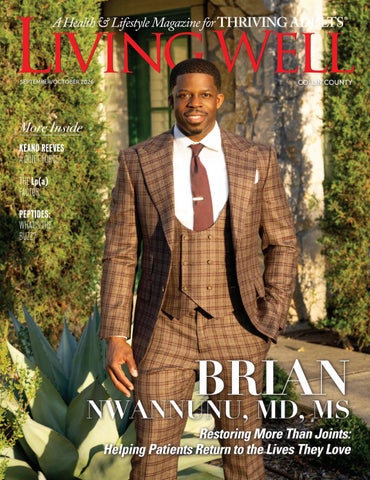
SEPTEMBER/OCTOBER 2026
COLLIN COUNTY
More Inside KEANU REEVES A QUIET FORCE THE Lp(a) FACTOR PEPTIDES: WHAT’S THE BUZZ?
BRIAN NWANNUNU, MD, MS
Restoring More Than Joints: Helping Patients Return to the Lives They Love
Kwame A. Ennin, MD, MBA Orthopaedic Surgeon
Kwame Ennin, MD, MBA, is a fellowship-trained board-certified orthopedic surgeon at Texas Joint Institute in McKinney and Plano, Texas who is an expert in hip and knee replacement procedures, adult reconstructive surgery, and nonoperative osteoarthritis care. Dr. Ennin earned his undergraduate degree in biochemistry from the State University of New York in Stony Brook. He then went on to receive his medical education at the University of Cincinnati College of Medicine, before completing his general internship and orthopedic surgery residency at The University of Texas Southwestern Medical Center in Dallas. He is fellowship-trained in adult reconstructive surgery from William Beaumont Hospital in Michigan. Dr. Ennin has a keen desire to educate. He is a presenter and educator to his colleagues regarding direct anterior total hip arthroplasty, total knee arthroplasty, revision total knee arthroplasty, partial knee replacement, and robotic surgery. He is committed to ensuring that the best understandings and techniques are available to all surgeons in the orthopedic community. Dr. Ennin is passionate about research. He has, throughout his career, been involved in and published numerous peer-reviewed studies. Dr. Ennin has been a leader in the North Texas orthopedic community since 2015. He delivers personalized, patientcentered, evidence-based care for his patients. He is committed to taking care of his patient’s joints for their lifetime.
Dr. Ennin specializes in: • • • • •
Hip Replacement Surgery Knee Replacement Surgery Revision Hip and Knee Replacement Surgery Orthopedic Surgery Osteoarthritis
4201 Medical Center Drive, Ste. 100, McKinney, TX 75069
(469) 796-4295 4650 Pres. George Bush Tpke., Suite 100, Sachse, TX 75048
(972) 566-5255 4001 West 15th St., Ste. 180, Plano, TX 75093
(972) 566-5255
txjointinstitute.com kwameenninmd.com
02 • SEPTEMBER/OCTOBER 2026
TRUSTED SPINE CARE FOR OVER 36 YEARS
Luis Antonio Mignucci, MD ADVANCED SPINE CARE. PROVEN EXPERIENCE. Dr. Luis Mignucci, the founder of Neurospine Surgical Consultants, has helped patients throughout the DallasFort Worth area find relief from spine and neurological conditions for more than 36 years. Awarded Top Doctor from Living Well Magazine and has been awarded Best Doctor by D Magazine an unprecedented 24 consecutive years. He is one of the few neurosurgeons in the nation certified by both the American Board of Spine Surgery and the American Board of Neurological Surgery. Dr. Mignucci specializes in the surgical management of spinal tumors and spine conditions, including scoliosis and spondylolisthesis. Additionally, he performs minimally invasive procedures to treat ruptured discs in the cervical, thoracic, and lumbar spine. Neurospine Surgical Consultants is located within Windhaven Medical Plaza, home to Windhaven Medical Imaging and its advanced 3T MRI technology. Patients can often be evaluated and complete diagnostic imaging the same day, helping expedite diagnosis and treatment. The building also houses the recently expanded Windhaven Ambulatory Surgery Center, offering state-of-the-art surgical care in one convenient location.
EXPERT DIAGNOSIS. ADVANCED TREATMENT. COMPASSIONATE CARE.
Windhaven Medical Plaza 6160 Windhaven Parkway, Ste. 200 Plano, TX 75093
Livingwell
(972) 378-6908
2026
TOP DOCS AND OTHER
HEALTHCARE PROVIDERS
neurospinesurgical.com COLLIN COUNTY • 1
YOUR ONE STOP FOR
Spine Health
ONE LOCATION. COMPLETE SPINE CARE. Windhaven Medical Plaza was intentionally designed to help make spine care simple and convenient by bringing the services you need together in one location. It houses Windhaven Medical Imaging, Neurospine Surgical Consultants, and the Windhaven Ambulatory Surgery Center. Coordinating all the care for your spine health can be tedious and challenging. Rather than traveling to different locations, at Windhaven Medical Plaza, patients can access a wide range of services, from face-to-face clinical encounters to expedited diagnostic studies and even outpatient procedures and treatments, all in one convenient location. 2 • SEPTEMBER/OCTOBER 2026
Windhaven Medical Imaging has the most advanced 3T MRI equipment and CT imaging. Often, patients can be evaluated and complete diagnostic testing on the same day, thereby enabling them to obtain an immediate solution. The recently remodeled and enlarged Windhaven Ambulatory Surgery Center provides patients with a state-of-the-art surgical, staffed by a highly trained and compassionate medical team. Neurospine Surgical Consultants offers a collaborative clinical team that utilizes their knowledge and experience along with the latest technologies in the diagnosis, management, and treatment of adult neurosurgical conditions, including acute and chronic musculoskeletal disorders.
6160 Windhaven Parkway, Ste. 220 Plano, TX 75093
Accepting all major insurance plans.
windhavensurgery.com
(972) 212-7463
COLLIN COUNTY • 3
FROM THE PUBLISHER
Living Well A Health & Lifestyle Magazine for THRIVING ADULTS
TM
SEPTEMBER/OCTOBER 2026
MEDICINE THAT PUTS YOU FIRST
A
s summer eases into fall, it always feels like a fresh start around here. It’s a good time to check in on your health, your habits and the people who help you stay well, and this issue is filled with exactly that. On this month’s cover is Brian Nwannunu, MD, MS, a board-certified, fellowship-trained orthopedic surgeon who believes his job involves far more than X-rays and operating rooms. In “Restoring More Than Joints” (page 8), Dr. Nwannunu writes about the conversations that inspire his work, the patients missing walks with the dog or time on the floor with grandchildren, and his belief that every treatment plan should fit the person and not just the diagnosis. It’s an approach that has earned him a loyal following across Collin County and a reputation for treating the whole patient rather than a single sore joint. Our celebrity spotlight this month lands on Keanu Reeves, an actor who has spent decades proving you can reach the top of a loud industry without ever raising your voice. Known as much for his quiet generosity and hard-won resilience as for his films, Reeves is a living reminder that strength and gentleness aren’t opposites. You’ll find “A Quiet Force” on page 24. From there we turn to a heart number many people have never heard of. In “The Lp(a) Factor” (page 14), writer Patrick Lane explains why this largely inherited marker has cardiologists paying attention, and why the newest guidelines suggest measuring it just once in your lifetime, even if you already do everything right. And because the word seems to be everywhere lately, we asked a simple question: what’s all the buzz about peptides? In “Peptides: What’s the Buzz?” (page 38), Julia Porter separates the real science from the social media noise, starting with what these tiny building blocks actually are and why the word “peptide” alone tells you very little. However you spend the season, we hope these pages leave you a little more informed and a little more inspired. Thank you for reading, and for letting LIVING WELL be part of your day. Live well, Sam & Spring Houston
4 • SEPTEMBER/OCTOBER 2026
PRESIDENT & CEO SAM HOUSTON VICE PRESIDENT & CFO SPRING HOUSTON EDITOR, FEATURE WRITER & SOCIAL MEDIA SONDRA BARR ART DIRECTOR VANESSA FRYER ACCOUNTS MANAGER JENNIFER BEAVERS WEBSITE LYDIA ROGERS ADVERTISING & SALES TEXAS: Denton County, Dallas County, Collin County TEXAS & OKLAHOMA: Texoma Area
WRITE TO US: Tell us who you would like to see featured on the cover, or what subjects you would like covered in upcoming editions of LIVING WELL MAGAZINE at info@livingwellmag.com
SUBSCRIPTIONS & CUSTOMER INQUIRIES
Houstons of Dallas Publishing, Inc. 102 E. Broadway, #901 Prosper, TX 75078 www.LivingWellmag.com Phone: (214) 507-1000 Fax: (855) 248-2132 LIVING WELL MAGAZINE is a source for quality educational articles on living a healthy, vibrant life. Our focus is on connecting our readers with the latest information on a host of topics relevant to their evolving life. From cutting edge medical news and procedures to top-tier financial, legal and lifestyle information. Connecting readers to leading medical and business professionals in their community in Texas and Oklahoma. All advertisements in this Magazine are placed by third parties. We do not control or endorse either the advertisements or their content. Further, we do not manufacture, sell, distribute or provide any of the goods or services advertised herein. We hereby expressly disclaim any liability with respect to information or goods and services contained herein. We further disclaim any and all warranties or representations, express or implied, with respect to such information, goods or services, including any warranty of merchantability or fitness for a particular purpose (it being understood that we do not acknowledge that any such warranty exists). We are not liable or responsible for any loss, injury, damage, or harm that you may suffer as a result of the information contained in any advertisement or goods or services contained herein. “We” refers to the name of this Magazine, and all versions of Living Well Magazine as well as Houstons of Dallas Publishing, Inc.
CONTENTS
AND MUCH MORE...
8
18
Don’t Know What to Say During Hospice Care
23
Digital Eye Strain
33
Who Should Handle the Funeral?
41
Is Fear Keeping You from Better Hearing?
44
The Science of First Impressions
46
Words of Hope
14
FEATURES 8
Brian Nwannunu, MD, MS Restoring More Than Joints: Helping Patients Return to the Lives They Love
14 24 38
The Lp(a) Factor One heart number to know
24
Keanu Reeves The Quiet Life
Peptides: What’s the Buzz?
SEPTEMBER/OCTOBER 2026
COLLIN COUNTY
FOLLOW US ON SOCIAL MEDIA
More Inside KEANU REEVES A QUIET FORCE
@ LivingWellmag
THE Lp(a) FACTOR PEPTIDES: WHAT’S THE BUZZ?
@ LivingWellmags
BRIAN
@ LivingWellmags
NWANNUNU, MD, MS
Restoring More Than Joints: Helping Patients Return to the Lives They Love
@ LivingWellmagaz
Visit LivingWellMag.com for a free digital subscription.
38 COLLIN COUNTY • 5
Stephen P. Courtney, MD Fellowship-Trained Orthopedic Spine Surgeon Over 28 Years of Experience Dr. Courtney is a board-certified orthopedic spine surgeon located in Plano, Texas. A Louisiana native, he attended Louisiana State University for medical school, and completed residency at Texas A&M followed by a fellowship at the Florida Neck and Back Institute. SPECIALTIES: • Back Pain • Neck Pain • Spine Pain • Disc Replacement • Microdiscectomy • Spinal Fusion • Minimally Invasive Surgery • Steroid Injections • Physical Therapy “I believe in treating each of my patients with honesty, dignity, and respect. My patients come away from our shared interactions feeling confident, assured that they are truly in the best hands. Throughout my career, I have remained laser-focused on providing world-class care and innovation to the patients I treat on a daily basis. I look forward to getting to know you!”
Livingwell TOP DOCS AND OTHER
HEALTHCARE PROVIDERS
2018-2026
Voted Top Doc for Orthopedic Spine Surgeon by Living Well Magazine readers.
6 • SEPTEMBER/OCTOBER 2026
2004 Ventura Drive, Suite 200, Plano, Texas 75093 (972) 499-5457 • scheduling@advancedspinecenters.com advancedspinecenters.com
INJURED PHYSICALLY OR FINANCIALLY? CALL GUS AT MIGNUCCI LAW FIRM. NO WIN, NO FEE. When the stakes are high, experience matters. Gus Mignucci is an award-winning trial lawyer known for taking on tough cases and fighting for the people and businesses he represents.
MIGNUCCI LAW FIRM
972-370-3378
MignucciLawFirm.com 5344 Alpha Road, Dallas, TX 75240
WE FIGHT FOR YOU PERSONAL INJURY • COMMERCIAL LITIGATION • BREACH OF CONTRACT • BUSINESS LAW COLLIN COUNTY • 7
8 • SEPTEMBER/OCTOBER 2026
WHY DOES THE JIFFY KNEE™ WORK SO WELL?
With Jiffy Knee and the soft tissue preservation techniques, Jiffy Knee surgeons DON’T cut ANY muscles or tendons to perform your knee replacement.
Traditional Knee Exposure
Majority of the surgeons cut the quadriceps tendon and then STITCH it back after the surgery. The quadriceps tendon is the work horse muscle after a knee replacement for walking and stairs. Imagine cutting the tendon and being asked to start walking on it.
Being part of Texas Joint Institute allows me to practice in an environment where advanced technology and personalized care go hand in hand. Our team shares my commitment to looking at each patient as an individual, understanding not only what is happening with their joint, but how it is affecting the way they live. I value being part of a team that continues to move orthopedic care forward while never losing sight of what matters most: helping our patients return to the activities and quality of life that are important to them. My commitment to excellence extends beyond the operating room. Through continuing education, collaboration with colleagues, and thoughtfully incorporating proven advancements in orthopedic surgery, I strive to ensure my patients benefit from the latest evidence-based care. Technical expertise is essential, but I believe it is most meaningful when paired with compassion, humility, and a genuine commitment to serving others. At the end of the day, my mission is simple: to help people move with greater comfort, confidence, and freedom. Whether my patients hope to return to work, enjoy time with family, stay active in retirement, or simply live without constant pain, I consider it an honor to help them achieve those goals. Being entrusted with someone’s care is one of the greatest privileges of my profession. My promise to every patient is that I will treat them with the same honesty, respect, and dedication that I would want for my own family. If I can help restore not only their mobility but also their confidence in what their future can look like, then I know we’ve accomplished something truly meaningful.
Livingwell TOP DOCS AND OTHER
HEALTHCARE PROVIDERS
2026
TO LEARN MORE, VISIT Jiffy Knee
Jiffy Knee surgeons DO NOT cut the Quadriceps or the VMO muscles. Rather we use special instruments and techniques to “lift” the muscle and slide it. Only the skin and capsule are cut. Surgery time typically takes 30 minutes to implant. This can provide LESS PAIN and QUICKER RECOVERY.
While no single surgical technique is appropriate for every patient, the Jiffy Knee procedure offers a less invasive approach designed to minimize disruption to the muscles and soft tissues surrounding the knee. Schedule an appointment with Dr. Nwannunu today so he can help determine the appropriate procedure for you.
10 • SEPTEMBER/OCTOBER 2026
txjointinstitute.com briannwannunumd.com jiffyknee.com/doctors/dr-brian-nwannunu McKINNEY 4201 Medical Center Dr., Ste. 100 McKinney, TX 75609 ALLEN 1125 Raintree Cir., Ste. 201 Allen, TX 75013 (972) 566-5255 Please call to make an appointment.
Every patient has a unique story, and it is a privilege to become part of their journey toward improved health and renewed independence.
COLLIN COUNTY • 11
STAND OUT
WITH THE EMINENT CHOICE IN HEALTHCARE
12 • SEPTEMBER/OCTOBER 2026
Eminent Medical Center is the premier treatment destination in the Dallas/Fort Worth area with three operating suites and five private patient rooms. Pain Management • Sports Medicine • General Surgery • Spine Surgery Orthopedic Surgery • Neurosurgery • Minimally Invasive Spine Surgery Total Joint Surgery • Foot & Ankle Surgery • Hand Surgery Headache and Migraine Treatment • Plastic Surgery
IN-NETWORK
Livingwell TOP DOCS AND OTHER
HEALTHCARE PROVIDERS
2018-2026
Eminent Medical Center is a premier, boutique treatment destination in the DFW area. We are an In-Network provider with Aetna, Blue Cross Blue Shield, Cigna, and United Healthcare.
ROBOTIC TECHNOLOGY Orthopedic surgeons and the medical staff at Eminent Medical Center are excited to offer Zimmer Biomet’s ROSA Knee System, which helps surgeons personalize surgical procedures for their patients.
PROVIDING SPECIALTY CARE We provide surgical services for pain management,
orthopedic & sports medicine, headache and migraine treatment, spine surgery and general surgery.
Eminent Medical Center is a proudly certified Center of Excellence Designation for Advanced Spine Surgery and Advanced Hip & Knee Replacement
www.eminentmedicalcenter.com • (469) 910-8800 1351 W. President George Bush Highway, Richardson, Texas 75080 COLLIN COUNTY • 13
The Lp(a) Factor One Heart Number to Know By PATRICK LANE
Y
ou probably know your cholesterol numbers, or at least recognize them when they appear on a lab report. Total cholesterol, LDL, HDL and triglycerides have been part of routine conversations about heart health for years. But there is another number receiving considerably more attention lately, and plenty of people who carefully follow their cholesterol have never heard of it. It’s called lipoprotein(a), usually shortened to Lp(a), and one of the most interesting things about it is that you can do many of the “right” things for your health and still have a high level. You can exercise regularly, eat thoughtfully, maintain a healthy weight and have respectable cholesterol numbers. Lp(a), however, plays by somewhat different rules because the amount circulating in your blood is determined largely by the genes you inherited. That doesn’t mean a high Lp(a) is a reason to panic. It does mean this once relatively obscure blood marker is becoming an important part of the conversation about cardiovascular risk. In March 2026, the American Heart Association and American College of Cardiology released updated guidelines on managing cholesterol and other blood lipids. Among the notable changes was a recommendation that Lp(a) be measured at least once in a person’s lifetime. Because levels are predominantly genetically determined and tend to remain relatively stable, one measurement is generally enough to identify someone with an elevated level, although certain health conditions and life changes can affect results.
14 • SEPTEMBER/OCTOBER 2026
So what exactly is Lp(a)?
To understand it, start with LDL, the cholesterol carrier most of us know as “bad cholesterol.” Lp(a) is a particle that resembles LDL but has an additional protein attached to it called apolipoprotein(a). That extra component changes the way the particle behaves and appears to contribute to cardiovascular risk. Elevated Lp(a) has been associated with atherosclerotic cardiovascular disease, which includes heart attack and stroke, as well as calcific aortic valve disease. The European Atherosclerosis Society concluded after reviewing extensive genetic and population research that the evidence supports Lp(a) as a causal cardiovascular risk factor rather than simply something that happens to be present in people who develop heart disease. This is where Lp(a) becomes particularly interesting. Someone may have LDL cholesterol that doesn’t raise immediate concern yet still have another inherited source of cardiovascular risk that wouldn’t necessarily appear on a standard cholesterol panel. And unless someone specifically tests for Lp(a), they may never know.
The Genetic Connection
Unlike many familiar cardiovascular risk factors, Lp(a) is largely inherited. Diet and exercise are tremendously important for overall cardiovascular health, but they generally don’t have much effect on
the Lp(a) number itself. That distinction matters because a person shouldn’t interpret an elevated result as evidence that they’ve done something wrong. It isn’t a report card on how well you’ve eaten or how many workouts you’ve completed. In many cases, it is simply part of the genetic hand you were dealt. It also explains why family history matters. When heart attacks, strokes or other cardiovascular problems have occurred unexpectedly or relatively early in a family, physicians may look beyond the traditional risk factors for additional clues. An inherited elevation in Lp(a) can sometimes be one piece of that puzzle. Because Lp(a) runs in families, learning that one person has a markedly elevated level may also lead to conversations with a healthcare professional about whether relatives should be evaluated.
Why Haven’t We Heard More About It?
This is probably the question many will have. If Lp(a) matters, why haven’t doctors routinely discussed it for decades? Part of the answer is that cardiovascular medicine continues to evolve. Researchers have known about Lp(a) for many years, but understanding of its role in cardiovascular disease has grown considerably. Another practical issue has been that, unlike LDL cholesterol, there historically hasn’t been a widely available treatment used specifically to lower Lp(a) with proven cardiovascular benefit. That created an unusual situation. Why routinely measure something if there was little doctors could do specifically about the number? Thinking around that question has changed. Knowing about an elevated Lp(a) can provide additional information about someone’s overall cardiovascular risk. Rather than looking at one laboratory value in isolation, physicians can consider Lp(a) alongside cholesterol, blood pressure, smoking history, diabetes, family history and other relevant factors. Think of it less as a diagnosis and more as another piece of information. A high number doesn’t mean someone is destined to develop heart disease, just as a lower number doesn’t guarantee that they won’t. Cardiovascular risk is much more complicated than any single blood test.
What Does a Result Mean?
This is one area where an internet search can create unnecessary confusion. Lp(a) can be reported in different units, most commonly milligrams per deciliter (mg/dL) or nanomoles per liter (nmol/L). Those units measure somewhat different characteristics of the particle and aren’t reliably converted with one simple mathematical formula. The European Atherosclerosis Society has described less than 30 mg/dL, or 75 nmol/L, as a lower-risk range and 50 mg/dL, or 125 nmol/L, and above as a level that can increase cardiovascular risk, with a gray zone in between. But a laboratory number shouldn’t be interpreted in isolation. Its significance depends on the rest of a person’s cardiovascular picture. That is one reason this isn’t a test to diagnose yourself with after seeing a result in an online patient portal. A physician can put the number into context with the rest of your health history. There is another useful feature of Lp(a) testing: fasting generally isn’t required. And because levels are primarily genetic and usually fairly stable, it isn’t necessarily another number that needs to be chased every few months.
If Lifestyle Doesn’t Lower It, Why Know?
This is perhaps the most important question of all. If someone learns that their Lp(a) is elevated and can’t simply lower it by eating more vegetables or walking another mile, wouldn’t knowing create unnecessary worry? Not necessarily. Cardiovascular health is made up of multiple factors. While someone may not be able to change the genes influencing Lp(a), a healthcare professional can use that information when considering the person’s overall cardiovascular risk and other factors that may be modifiable. The goal isn’t to become obsessed with one number. It’s to have a clearer picture. This distinction is especially important because healthy habits still matter enormously. Exercise, nutritious food, avoiding tobacco, maintaining appropriate blood pressure and addressing other cardiovascular risk factors remain important even though those behaviors may not significantly change the Lp(a) measurement itself. In other words, “I can’t change my Lp(a)” and “there’s nothing I can do for my heart health” are two very different statements.
What About Treatments?
This is an especially interesting area of research. Scientists are studying medications designed specifically to dramatically reduce Lp(a), including therapies that interfere with the body’s production of apolipoprotein(a). Several have advanced through clinical development, but lowering a laboratory value isn’t the only goal. Researchers need to establish whether reducing Lp(a) actually translates into fewer heart attacks, strokes and other cardiovascular events. Those studies are important because medicine has learned repeatedly that improving a biomarker doesn’t automatically guarantee better health outcomes. For now, treatment decisions for someone with elevated Lp(a) depend on the person’s broader cardiovascular picture and belong in a conversation with a qualified healthcare professional. This is also an area likely to change as new clinical-trial results become available.
One Number, Not the Whole Story
Perhaps the best way to understand Lp(a) is to resist making it either more frightening or less important than it deserves to be. Heart health has never been determined by one number. Not cholesterol. Not blood pressure. Not a calcium score. And not Lp(a). What Lp(a) offers is another window into risk, particularly a portion of risk that may have been inherited rather than acquired through lifestyle. For someone who has spent years carefully watching cholesterol, discovering that another cholesterol-related particle exists may initially feel frustrating. But more information doesn’t have to mean more fear. Sometimes it simply means asking a better question. The next time you’re discussing cholesterol or cardiovascular health with your healthcare provider, Lp(a) may be worth including in the conversation, particularly now that major cardiovascular guidelines recommend measuring it at least once during a lifetime. Your provider can determine whether testing makes sense in your individual circumstances and, if you already have a result, explain what that number means alongside the rest of your health information. For years, most of us learned that knowing our cholesterol was part of understanding our heart health. Medicine now knows the picture is a little more detailed than that. Lp(a) may be only one piece of the puzzle, but for some people, it could be a piece worth knowing about. COLLIN COUNTY • 15
Ahmed Siddiqi DO, MBA, FACS Fellowship-Trained Orthopedic Surgeon Specializing in Total Hip & Knee Replacement
Ahmed Siddiqi, DO, MBA, FACS is a fellowshiptrained orthopedic surgeon specializing in primary and complex revision hip and knee replacement. He believes joint replacement should be more than a procedure—it should be part of a personalized plan focused on restoring quality of life. Dr. Siddiqi combines advanced surgical techniques with an individualized approach to care, tailoring treatment to each patient’s anatomy, lifestyle, goals, and overall health. After helping build one of the Northeast’s busiest joint replacement programs, he now brings that experience to North Texas through the Texas Center for Joint Replacement. His patient-centered philosophy, known as Siddiqi 360, emphasizes education, preparation, recovery, rehabilitation, and long-term wellness. By focusing on the whole patient—including mobility, nutrition, physical conditioning, and pain management—he strives to optimize outcomes and help patients return to the activities that matter most. Patients often describe Dr. Siddiqi as approachable, honest, and accessible, with a commitment to listening first and treating every patient as an individual. 16 • SEPTEMBER/OCTOBER 2026
6020 West Parker Rd., Ste. 470 Plano, TX 75093
(972) 737-1168 tcjr.com teamsiddiqiortho.com
Orthodontics for Children and Adults
Dr. Mark S. Ozier
Nothing Expresses
Beauty and Confidence
Like The Perfect Smile.
Trusting an orthodontist with the future of your smile is a big decision. Our office is dedicated to delivering the highest level of orthodontic experience possible and to helping you unlock the smile you have always hoped for. That’s why our office proudly offers trusted orthodontic products from 3M. Created with your comfort and treatment goals in mind, 3M products offer aesthetic excellence with trusted performance. Ask us how our team can help you unlock the power of an amazing smile.
We have relocated to a new modernized office.
Call today to schedule your complimentary consultation. Most insurance plans accepted. 5225 Independence Pkwy., Ste. 200 Frisco, TX 75035 (972) 712-3300 www.ozierorthodontics.com
Livingwell TOP DOCS AND OTHER
HEALTHCARE PROVIDERS
2026
Named one of D Magazine’s Best Orthodontists 2007, 2011, and 2013-2024. COLLIN COUNTY • 17
OLIVIA ROGERS, RN, BSN, CHPN, CHPO, MBA, is a leading voice in health care and senior services and the Vice President, Chief Nursing Officer of VNA Texas. Dear Olivia, My husband is coming home from the hospital after a long battle with cancer, and we feel overwhelmed by the thought of caring for him at home. We know VNA hospice will support us, but we don’t know what to say to him—or if we should avoid talking about dying so that he doesn’t lose hope. Our grown children and I want to help him be at peace and make the most of the time we have left, but we don’t know how. ~Don’t Know What to Say Dear Don’t Know What to Say, First, I want you to know how deeply sorry I am that you and your family are walking through this. Bringing a loved one home on hospice can feel frightening and overwhelming. You are not alone—many families face these same questions and worries.
Some people want to talk openly about what’s ahead; others do not. Both are okay. Listen for cues, and follow his lead. • Be present, even when words are hard. You don’t need the “right” thing to say. Sitting quietly, holding a hand, sharing memories, or simply saying “I love you” can be incredibly comforting. • Use your hospice team. Social workers, bereavement counselors, and spiritual care providers are specially trained to help families navigate these conversations and emotions. They can guide both you and your adult children through this time. • Support the whole family. Hospice care includes support for loved ones of all ages. Asking for help is not a sign of weakness—it’s an important part of caring well.
Hospice is not a place, but a philosophy of care. It is focused on comfort, dignity, and quality of life—for your husband and for your entire family. It’s very common to wonder whether talking about dying will take away hope. In my experience, hope often changes rather than disappears. Hope may shift from cure to comfort, from more time to meaningful time, or from fear to peace.
Our goal is to help ensure your husband’s final days are as comfortable and meaningful as possible, while surrounding your family with compassion and support. We all want to ensure our loved ones get the best care possible at the right time.
Here are a few gentle guidelines that may help: • Let your husband lead the conversation.
With warmth and care, ~Olivia
vnatexas.org NIJH
ACCREDITED
To schedule your free in-home informational visit please call (214) 689-0000 or email gethelp@vnatexas.org For volunteer opportunities please call (214) 689-2271 or email volunteer@vnatexas.org 18 • SEPTEMBER/OCTOBER 2026
Left to right John S. Early, MD Terry K. Gemas, MD William F. Tucker, Jr., MD Duncan L. McKellar, Jr., MD J. Conner Ryan, MD Brian I. Nwannunu, MD Florian F. Dibra, MD Charles E. Toulson, MD Cyrus E. Abbaschian, MD Donald W. Hohman, MD J. Stephen Appleton, MD Alexander S. Greenstein, MD Kwame A. Ennin, MD Samuel K. Stephenson, MD Raj Yalamanchili, MD Emmanuel D. Eisenstein, MD
Expert Orthopedic Surgeons Close to Home ALLEN | DALLAS | FRISCO | LAKEWOOD | MCKINNEY | PLANO | SACHSE | SHERMAN
At Texas Joint Institute, our growing team of highly skilled orthopedic surgeons and medical professionals are at the forefront of bone and joint health. From joint replacements and minimally invasive treatment options to complex joint reconstruction and treatment of bone and soft tissue sarcomas, our team offers a wide range of services to help you get back to your daily activities you enjoy.
Livingwell TOP DOCS AND OTHER
HEALTHCARE PROVIDERS
2026
TXJOINTINSTITUTE.COM
Phone: (972) 566-5255
| Fax: (972) 566-5236
COLLIN COUNTY • 19
Brian Nwannunu MD, MS Brian Nwannunu, MD, MS, is an orthopedic surgeon specializing in hip and knee replacement. He cares for patients at Texas Joint Institute in Allen and in McKinney, Texas. Dr. Nwannunu, a native of Dallas, graduated Valedictorian from the High School for Health Professions at Townview Magnet Center in DISD. He then earned his bachelor’s degree in Biology at Morehouse College in Atlanta, Georgia, where he was part of the Morehouse College Honors Program. Upon graduation, he completed his master’s degree in Physiology at Georgetown University in Washington, D.C., with a concentration on complementary and alternative medicine. Dr. Nwannunu then graduated with his medical degree from Howard University College of Medicine in Washington, D.C., where he was inducted into the Alpha Omega Alpha Honor Medical Society. Dr. Nwannunu completed his residency in orthopedic surgery at the John Peter Smith Health Network in Fort Worth, Texas, before pursuing additional training with a fellowship in adult reconstruction at Baylor College of Medicine in Houston, Texas. In addition to his clinical training, Dr. Nwannunu enjoys mission work abroad, providing medical care and health education to populations in need. He is also one of the few official Jiffy Knee™ surgeons in the North Texas area. He is a member of the American Medical Association, National Medical Association, American Academy of Orthopaedic Surgeons and the American Association of Hip and Knee Surgeons. When not working, Dr. Nwannunu enjoys basketball, weight training, outdoor activities, attending art and music festivals, traveling, world news, and reading.
ALLEN 1125 Raintree Cir., Ste. 201, Allen, TX 75013 MCKINNEY 4201 Medical Center Dr., Ste. 100, McKinney, TX 75069
(469) 796-4295 • txjointinstitute.com
Livingwell TOP DOCS AND OTHER
HEALTHCARE PROVIDERS
2026
COLLIN COUNTY • 21
We Preserve, Enhance, and Protect your vision. OUR SERVICES: Macular Degeneration Diabetic Eye Disease Retinal Vein & Artery Occlusions Flashes & Floaters Retinal Tears & Detachments Macular Pucker/Epiretinal Membrane Macular Holes Uveitis
MATTHEW K. ADAMS, MD, MBA At Texas Macula & Retina, our mission is to provide exceptional eye care with a focus on the diagnosis, treatment, and management of retinal disorders. Dr. Adams is a board-certified Ophthalmologist and Ophthalmic Surgeon specializing in Vitreoretinal Surgery. His principal areas of interest include age-related macular degeneration, diabetic retinopathy, retinal detachment repair, macular surgery, retinal lasers, and secondary intraocular lens implantation. Dr. Adams and his team are committed to preserving and improving the vision and overall quality of life for our patients by offering the most advanced and personalized retina care available.
Livingwell
Texas Macula & Retina, PLLC 6843 Communications Pkwy., Ste. 810 Plano, TX 75024
TOP DOCS AND OTHER
HEALTHCARE PROVIDERS
2026
22 • SEPTEMBER/OCTOBER 2026
texasmr.com (972) 440-2020
Digital Eye Strain When Your Eyes Need a Break from Your Screen By MATTHEW K. ADAMS, MD, MBA
B
y the time you finish reading this article, there is a good chance you’ll have checked your phone, glanced at a text, looked at a television, or wondered why the font on your screen suddenly seems to have been designed for ants. Welcome to life after 50 in the digital age. Smartphones, tablets, computers, televisions, and even car dashboards become part of everyday life. While these devices are incredibly useful, hours spent staring at screens can leave our eyes tired, dry, irritated, blurry, and generally unhappy. These symptoms are commonly called Digital Eye Strain. And despite what you may have read on Facebook or Reddit, your smartphone probably isn’t permanently ruining your eyes. But it certainly can make them feel miserable. Why Screens Make Our Eyes Tired When we look at a screen for long periods, our eyes work harder than we realize. We constantly focus, refocus, track words, adjust to glare, and deal with differences in contrast and lighting. One of the biggest problems is surprisingly simple…we forget to blink! Normally, we blink regularly to spread tears across the surface of our eyes. When concentrating on a phone or computer, blinking can decrease significantly, resulting in dry, burning, and gritty eyes. And after age 50, dry eye is already more common. Add several hours of scrolling through Facebook, reading the news, answering emails, or watching videos, and your eyes may feel like they just spent the afternoon in a West Texas Haboob (that’s a big dust storm for those of you who did not grow up in Texas). Your Arms Aren’t Getting Shorter Many adults notice another phenomenon around their 40s and 50s: menus, medicine bottles, and phones seem increasingly difficult to read unless they are held farther away. This loss of near vision as you age is called Presbyopia. Screens can make this more noticeable because we spend so much time looking at small print at close distances. If you are constantly increasing the font size, squinting, removing your glasses, or holding your phone halfway across the room, it may be time for an updated prescription. What About Blue Light? Blue light has received plenty of attention, and blue-light-blocking glasses have become a booming business. Current evidence does not show that normal exposure to blue light from phones or computers causes permanent damage to your eyes.
However, bright screens, especially at night, can interfere with your sleep cycle and contribute to dry eyes. Turning down screen brightness and limiting screen use before bedtime may benefit both your eyes and your sleep. Give Your Eyes a Vacation Fortunately, reducing digital eye strain does not require moving to a cabin without Wi-Fi. Try the 20-20-20 rule: every 20 minutes, look at something approximately 20 feet away for at least 20 seconds. This allows your focusing muscles to relax and gives your eyes a break. You can also make a few other simple changes: • Increase the font size rather than squinting. • Keep your screen approximately an arm’s length away. • Reduce glare from nearby windows and lights. • Match your screen brightness to the room around you. • Remember to blink. • Consider artificial tears if your eyes frequently feel dry. And yes, scrolling through your phone while watching television technically counts as looking at two screens, not taking a break from one. Don’t Blame Everything on Your Phone This may be the most important point. Blurred vision, difficulty reading, headaches, dry eyes, or changes in vision should not automatically be dismissed as “too much screen time.” After age 50, conditions such as cataracts, glaucoma, macular degeneration, diabetic eye disease, and changes in your prescription become increasingly important to detect. Many serious eye diseases can develop with few or no symptoms in their early stages. That is why routine comprehensive eye examinations should be a priority, even if you think you see perfectly well. Your eye doctor can check your prescription, evaluate the health of your eyes, identify causes of dryness or discomfort, and look for potentially serious conditions before they begin affecting your vision. Technology is not going away, and thankfully, neither are cat videos, FaceTime with the grandkids, online shopping, or whatever rabbit hole YouTube sends you down at 11 p.m. Enjoy your screens. Just remember to give your eyes an occasional break. And most importantly, make sure those eyes get checked regularly. You only get one pair, and unlike your smartphone, there is no upgraded model coming out next year. COLLIN COUNTY • 23
The Quiet Life of
Keanu Reeves At 62, he has survived more than most, chased fame less than anyone, and built a life on kindness that costs him nothing and means everything.
K
eanu Reeves turns 62 in September, and his calendar is fuller than it was at 40. He spent last fall making his Broadway debut in one of the hardest plays in the English language, and this spring he put out an album with the rock band he started in his 20s and climbed back on a tour bus. For a man who has never seemed to want anything from fame, he keeps saying yes. The cottage industry devoted to marveling at his decency is built almost entirely on things other people reported. He gave Rolexes to his stunt team on John Wick: Chapter 4. He picked up the tab when the cast and crew of the last Matrix film took a trip to San Francisco. He funded a private cancer foundation after his sister Kim’s long fight with leukemia and never put his name on it. What is striking is not that he does these things. It is that he never talks about them. Keanu Charles Reeves was born in 1964, in Beirut, Lebanon, to an English costume designer named Patricia Taylor and an American father who left when Reeves was 3. His mother moved the children through New York and Sydney before settling in Toronto, where stepfathers came and went and Reeves passed through several high schools without collecting a diploma. He has never played that as tragedy. “When I see stuff in L.A. now, I realize how safe and sheltered my upbringing [in Toronto] was. We didn’t even do graffiti, you know?” he told Interview magazine in 1991, in a cover story the magazine reprinted in 2022. “I mean we did sling chestnuts at teachers’ heads.” What he collected instead were enthusiasms, and he has kept nearly all of them. Punk rock: “The Ramones changed my life,” he said in that same interview. Books: he was rereading Rilke’s Letters to a Young Poet. Motorcycles: he named a 1974 Norton Commando as the great love of his life and admitted he had wrecked it more than once. “But I love that bike, man.” And acting, which he described at 26 in terms that still explain most of what came after. “For me, acting is very self-involved, especially between projects,” he said. “Once you get a part, you’re liberated. You can find out what that character thinks.” Hollywood underestimated him early, and he let it. Bill and Ted’s Excellent Adventure made him famous in 1989 and stuck him with a reputation for being as vacant as the character. He does not appear to hold a grudge. “I think they still use, like, ‘Keanu’s Excellent Adventure.’ Or ‘dude,’” he told GQ in 2019. “That’s still around.” The interesting part is what he did with all that low expectation. He spent it. In 1991 alone he made Point Break for Kathryn Bigelow and My Own Private Idaho for Gus Van Sant, and the second was a genuine professional risk that apparently did not feel like one. He and River Phoenix, he told GQ, decided it the way young men decide things: “It was more like standing 100 feet in the air, and there’s this beautiful pool of water, and you’re looking at each other like, ‘You want to jump? Yeah, let’s jump!’” Speed made him a movie star in 1994. He turned down the sequel to play Hamlet onstage in Winnipeg, and the studio made him pay for it. “I didn’t work with [Fox] again until The Day the Earth Stood Still,” he said. That is a decade in the wilderness, described without a trace of bitterness.
24 • SEPTEMBER/OCTOBER 2026
By SONDRA BARR
Once you get a part, you’re liberated. You can find out what that character thinks.
COLLIN COUNTY • 25
LEFT PAGE: Performing with his band Dogstar, credit Davide Sciaky From the World of John Wick: Ballerina, Lionsgate Outcome, Apple TV. Starring Reeves, Jonah Hill, Cameron Diaz, and Matt Bomer. RIGHT PAGE: Good Fortune, Lionsgate A Walk in the Clouds, 20th Century Fox
26 • SEPTEMBER/OCTOBER 2026
When I see stuff in L.A. now, I realize how safe and sheltered my upbringing [in Toronto] was…
He absorbed losses in those years that would have flattened most people. Phoenix died in 1993. In 1999, the daughter Reeves was expecting with Jennifer Syme was stillborn, and Syme died in a car crash 18 months later. He has never traded on any of it. When GQ asked what finally got him thinking about the shape of his own career, somewhere in his mid-40s, he gave a cheerful one-word answer: “Death.” Then he changed the subject to Anthony Quinn. It was 1994, and Reeves was 29, shooting A Walk in the Clouds in the Napa Valley. Quinn, about to turn 80, played the family patriarch. Over lunch one day, Reeves watched him work the phone between setups, checking in with his people, seeing what he had booked. Six decades and two Oscars in, Quinn was still selling himself. “Still hustling,” Reeves said, still marveling about it 25 years later. “I was like, Whoa.” The next morning the two of them had a long walking shot to get through, alone in the mist and the rows of vines. “Anthony?” Reeves asked. “Is it always going to be like this?” “Yes,” Quinn said. “There’s this idea that, like, at some point you’re going to be set,” Reeves told GQ. “And then maybe there won’t be so much working on working.” He never got set. That may be the best thing that ever happened to him. The John Wick films arrived in 2014, when Reeves was 50, and handed him a second act almost nobody in his business gets. He spread out rather than cashed in. In 2011 he had co-founded ARCH Motorcycle with designer Gard Hollinger, building bikes by hand in Hawthorne, California. He co-created the comic series BRZRKR and co-wrote a novel with China Mieville. He has been
with the artist Alexandra Grant since they met in 2009, and their first collaboration was a book, not a red carpet. Mostly, though, he went back to the bass. Dogstar, the band he started in the early ‘90s and got mocked for, reunited during the pandemic and became a serious part of his life. “I just want a bass in my hands at all times,” he told Bass Magazine in July. “Whether I’m on the phone or watching a movie, I need to be holding one and playing.” Ask what he is chasing onstage and the answer doubles as a philosophy of aging. “I’m looking to have fun. I’m looking to pay attention. I’m looking to listen,” he said. Ask his role in the band and the answer is funnier. “I’m called ‘Switzerland.’ I mediate, I’m in the middle, and I solve conflicts.” Last September, at 61, he made his Broadway debut in Waiting for Godot opposite Alex Winter, his Bill and Ted co-star and friend of nearly 40 years. The idea was his own. “I was in a hotel room. I was thinking about what Alex and I could work on again,” he told NPR. “And then it just struck me: Waiting for Godot.” Asked what he was feeling before opening, he did not pretend to be serene. “Terror, anxiety, hope,” he said. He did it anyway, eight shows a week, and what made it possible was four decades of trust. “We had a trust and confidence in our art practice through our friendship,” he told Gothamist. In May, Dogstar released its fourth album, All In Now, and hit the road. More films are coming. At 62, he is still starting things he is not yet good at. Quinn’s answer, handed to a 29-year-old in a foggy vineyard, turns out to have been a kindness. Yes, it is always going to be like this. There will always be another part to chase, another song to learn, another thing you have not done yet.
COLLIN COUNTY • 27
Livingwell TOP DOCS AND OTHER
HEALTHCARE PROVIDERS
2026
Texas Back Institute Texas Back Institute (TBI) has served the North Texas area in spine care for nearly 50 years. An uncompromising desire to put patients first and provide individualized spine care has helped change the treatment options available to patients for neck and back pain. Today, TBI is a leader in artificial disc replacement, minimally invasive spine surgery, complex revision surgery, and treatment of spinal deformity. TBI has trained hundreds of surgeons, scientists, and allied health professionals now practicing worldwide. Its research institute employs state-of-the-art technology and is actively involved in many clinical trials, including artificial disc replacement, minimally invasive technologies, and robotic spine surgery. Texas Back Institute has remained one of the most academic practices in spine care. It is one of the largest multidisciplinary spine centers in the world, providing comprehensive care for neck and back pain. With a fully dedicated staff of board-certified orthopedic spine surgeons, neurosurgeons, physiatrists, and physical therapists, the TBI team works together to support its mission of helping patients get back to life. The 27 physicians at Texas Back Institute are leaders in the surgical
28 • SEPTEMBER/OCTOBER 2026
and nonsurgical treatment options for back and neck pain, from the most common outpatient procedures to the most complex cases. Thanks to the unmatched expertise of the medical staff, the advanced diagnostic testing, and an unparalleled commitment to patient care, the Texas Back Institute physicians can identify the potential cause of your pain and create a treatment plan specific to your needs. Texas Back Institute has developed several spine specialty programs. These include the Minimally Invasive Spine Surgery Center, Center for Disc Replacement, Scoliosis and Spine Tumor Center, and Complex Back Surgery Center. These programs give patients access to highly-trained care teams who focus specifically on these areas of spine care, allowing patients in the North Texas area access to treatment options for their individual problems from physicians with extensive experience in these areas. “At Texas Back Institute, finding the right solution for each patient and offering the least invasive treatment is core to our belief and the foundation for all treatment plans.” Dr. Michael Duffy.
TOP ROW: Sheena Bhuva, MD; Michael Duffy, MD; Alejandro Carrasquilla, MD; Brian Braaksma, MD; Theodore Belanger, MD; Stephen Tolhurst, MD; Blake Staub, MD; Alexander Satin, MD; Ivan Cheng, MD; Kevin Ju, MD; Akwasi Boah, MD; Junyoung “Jon” Ahn, MD; Chun Lin, MD BOTTOM ROW: Adewale Adeniran, MD; Thomas Kosztowski, MD; Rey Bosita, MD; Rajesh Arakal, MD; Jessica Shellock, MD; Isador Lieberman, MD, MBA, FRCSC; Richard Guyer, MD; Jack Zigler, MD, FACS; Scott Blumenthal, MD; Kevin Gill, MD; Nayan Patel, MD; Craig Lankford, MD; Michael Hisey, MD; Uche Davidson, MD
CENTRAL PLANO 4001 W. 15th St., Ste. 455 Medical Office Bldg. III Plano, TX 75093
ALLIANCE 3025 N. Tarrant Pkwy., Ste. 220 Fort Worth (Alliance), TX 76177
FORT WORTH 1650 W. Rosedale St., Ste. 301 Fort Worth, TX 76104
ARGYLE 310 FM 407E, Ste. 100 Argyle, TX 76226 DALLAS 12222 N. Central Expy. Pavilion II, Ste. 310 Dallas, TX 75243
FRISCO 5575 Frisco Square Blvd. Ste. 400 Frisco, TX 75034
PLANO 6020 W. Parker Rd., Ste. 200 Plano, TX 75093
MANSFIELD 2925 E. Broad St., Ste. 101 Mansfield, TX 76063
ROCKWALL 3164 Horizon Rd., Ste. 100 Rockwall, TX 75032
DENTON 3537 S. Interstate 35, Ste. 308 Denton, TX 76210
McKINNEY 4510 Medical Center Dr., Ste. 106 McKinney, TX 75069
FLOWER MOUND 4370 Medical Arts Dr. River Walk Bldg. III, Ste. 230 Flower Mound, TX 75028
NORTH RICHLAND HILLS 4351 Booth Calloway Dr. Ste. 404 Fort Worth, TX 76180
SACSHE 4650 President George Bush Turnpike, Ste. 100 Sachse, TX 75048 WICHITA FALLS 501 Midwestern Pkwy. E Wichita Falls, TX 76302
(972) 608-5100 • texasback.com COLLIN COUNTY • 29
Stay Informed, Stay Healthy
Subscribe now to our free digital magazine and get expert advice from local professionals, catch up with your favorite celebrities, and discover wellness tips to improve your life. Enjoy inspiring content, health insights, the latest lifestyle trends, and our annual Top Docs and Top Laywers issues—all delivered straight to you electronically!
www.LivingWellMag.com/Subscribe Subscribe for your FREE digital subscription.
Living Well A Health & Lifestyle Magazine for THRIVING ADULTS
30 • SEPTEMBER/OCTOBER 2026
®
PREMIER SURGEON FOR HIP AND KNEE REPLACEMENT Dr. Charles Toulson specializes in: • Robotic Joint Replacement • Total Hip Replacement • Total Knee Replacement • Partial Knee Replacement • Total Hip and Knee Revisions TO LEARN MORE, VISIT
txjointinstitute.com
ALLEN 1125 Raintree Cir., Ste. 201 Allen, TX 75013 MCKINNEY 4201 Medical Center Dr., Ste. 100 McKinney, TX 75069 SHERMAN 204 Medical Dr., Ste. 110 Sherman, TX 75092
(972) 566-5255
Please call to make an appointment.
Livingwell TOP DOCS AND OTHER
HEALTHCARE PROVIDERS
2026
VOTED TOP DOC IN DALLAS COUNTY AND COLLIN COUNTY. DR. TOULSON IS PROUD TO SERVE LOCAL RESIDENTS AND SURROUNDING COMMUNITIES.
COLLIN COUNTY • 31
Independent, family-owned, and rooted in service, we deliver exceptional care with integrity, respect, and unwavering attention to every detail. Rick Allen Melanie Allen Conner Allen
Meaningful
Appropriate
Affordable
Our New Dallas Arrangement Office Conveniently serving Park Cities families with Pre-Planning and At-Need Arrangements. Allen Family Funeral Options 2112 W. Spring Creek Pkwy., Plano, TX 75023 (972) 596-8200 32 • SEPTEMBER/OCTOBER 2026
Dallas Arrangement Office 5950 Sherry Ln., Suite 400, Dallas, Texas 75225 (214) 231-6911
www.affoplano.com
Who Should Handle the Funeral? By RICK ALLEN
I
am becoming more and more supportive of the concept of cutting out the middle man. Often this can make a product or service more affordable. It also seems like we are getting less and less service from service providers these days, so you wonder just what are we paying for when a third party is involved? Here in the Dallas/Ft. Worth area, there is a television commercial for an insurance agent who takes great pride in being a “middle-man”. He claims that in his case, as a middle man, he can save you time, money and get you the best value for your money spent. I have used this agent in the past and I will attest that as a middle man, he does a great job delivering what he promises. Funeral homes, however, have done a pretty poor job in the recent times identifying their value to consumers and a trend has begun that cuts them out of funeral services because some of the public view them as unnecessary middle men. The Texas Funeral Service Commission has published a brochure in which the subject of do-it-yourself funerals is discussed. While it is not recommended, it is actually possible for a family to bury their own, completely on their own. Self-sufficiency is not a bad idea, but where funerals are concerned, a growing number of people are confusing self-sufficiency with getting something for nothing. The bad part about this is, the entity being asked to provide something for nothing is not the funeral home, but rather the place where people go to church. Several people have told me that when they die they want to just be buried or cremated, and then if their family wants a service, they can work it out with their church. I have yet to hear of a church refusing to do this directly with a family, but when you get right down to what is right and what isn’t, is it really the responsibility of the church to act as funeral directors? In my opinion, taking this article is actually a denial of reality. One reason people claim to have a lack of interest in their own service is the concept that “I’m not going to be there or know anything about it
anyway.” I, too, believe this is true, but what about your spouse, your children, siblings, friends, or maybe even your parent or parents? How are they going to find an appropriate way in which to accept the fact that a death has occurred, and how will they be able to say good-bye? The Frank Capra Film “It’s a Wonderful Life” beautifully illustrates how one man failed to recognize the manner in which his life impacted so many others. Little did the character of George Bailey realize how his actions, no matter how small or insignificant to him, endeared him to so many others in very powerful ways. It’s far easier to assume that no one cares or that you yourself don’t care than to face the fact that you will be missed and people will want to honor you when your time here is done. Putting this responsibility on the doorstep of your church is an easy way around a tough subject, but a far cry from the appropriate thing to do. Our funeral home has been asked on many occasions to come in and put together the loose ends. At other times we simply hear the tales from church volunteers of how unstructured things seemed when the funeral home was not involved in a service. Things get overlooked in the planning stage and unfortunately are discovered absent when it’s too late. Other things that could have made a huge impact on the service as a whole are left out completely because no one knew they could be done. Simply put, a good funeral director and a thorough funeral home staff are worth every penny you may pay to them. They plan memorial tributes every day, and those that are really worth something are constantly searching for ways to innovate and contemporize the way people say good-bye. Does value exist at all funeral homes? No. That is why I encourage you to discuss your plans with more than one funeral home. See the difference for yourself and then make a decision on which one you think will do the best job at helping you and your family create something that is meaningful, appropriate and affordable. COLLIN COUNTY • 33
Urology Care Robert Brunner, MD is a general urologist with Urology Clinics of North Texas serving patients in our Dallas office located at Texas Health Presbyterian Hospital Dallas. A native of Toledo, Ohio, Dr. Brunner combines a robust academic foundation with extensive clinical expertise. He graduated magna cum laude from the University of Notre Dame, earning dual degrees in Economics and PreProfessional Studies. He then earned his Doctor of Medicine (MD) degree from the University of Toledo College of Medicine and Life Sciences, where he was inducted into the prestigious Alpha Omega Alpha Honor Medical Society. Following medical school, Dr. Brunner completed his residency in Urology at Baylor College of Medicine in Houston, Texas, where he received comprehensive training in all aspects of adult urology. He developed specialized expertise in the management of stone disease and in the use of robotic-assisted surgery, particularly with the Da Vinci robotic system. Dr. Brunner is skilled in treating a wide range of both benign and malignant urologic conditions, with a particular focus on leveraging advanced robotic technologies to improve surgical outcomes and accelerate patient recovery. Committed to providing exceptional care, Dr. Brunner is passionate about staying at the forefront of urologic advancements, ensuring that his patients benefit from the latest techniques and innovations in the field.
SOME CONDITIONS TREATED: • Bladder Cancer
• Penile curvature or Peyronie’s disease
• Blader Stones
• Prostate Cancer
• Enlarged prostate or benign prostatic hyperplasia (BPH)
• Stress urinary incontinence (Male & Female)
• Erectile dysfunction
• Ureteral Cancer
• Kidney stones
• Ureteropelvic juncion (UPJ) obstruction
• Low Testosterone
• Urethral stricture
• Male sexual dysfunction
• Urinary retention
• Overactive bladder
• Urinary tract infection (UTI)
• Testicular Cancer
PRIMARY OFFICE LOCATION: Urology Clinics of North Texas 8230 Walnut Hill Lane, Prof. Bldg. 3, Ste. 700, Dallas, TX 75231 (214) 691-1902 | urologyclinics.com 34 • SEPTEMBER/OCTOBER 2026
See Better. Look Better. Feel Better. Livingwell TOP DOCS AND OTHER
HEALTHCARE PROVIDERS
2026
Left to Right: Leslie Pfeiffer, MD; Anita Jacob, OD; Kimberly Warren, MD; Sadaf Razi ElHaffar, OD; Faisal Haq, MD
• Comprehensive Adult Eye Care • Light Adjustable Lens, Odyssey , Symfony®, PanOptix, Vivity® and the Eyhance IOL ™
• Management of Dry Eye, Glaucoma & Corneal Disease
Convenient locations to serve you in Allen, Arlington, Dallas, Frisco, Greenville, McKinney, Mesquite, North Fort Worth, Plano, Richardson, and Rockwall.
• Eyelid Surgery & Botox® • Laser Vision Correction, EVO ICL™
Follow us on
Give us a call today 972-769-2020 or Toll-Free 800-442-5330 www.keywhitman.com
(username: keywhitman) COLLIN COUNTY • 35
Don’t let hip or knee pain keep you from what you love.
Find a doctor who uses Mako, visit
MakoCan.com
All surgery carries risk. Talk to your doctor to see if joint replacement is right for you. JR-MKOSYM-GRAP-681675
36 • SEPTEMBER/OCTOBER 2026
Scan. Plan. Mako Can.
FLORIAN DIBRA, MD Florian F. Dibra, MD is an orthopedic surgeon located in Frisco, Texas who has extensive knowledge in hip and knee orthopedics and treats operative and non-operative hip and knee arthritis. He focuses on minimally invasive muscle-sparing total hip and knee replacement, anterior hip replacement, partial knee replacement, robotic joint replacement and complex hip and knee replacement revisions. Dr. Dibra is specialized in magIQknee™ and magIQhip™, muscle-sparing techniques with robotic technology. Dr. Dibra graduated with honors from Villanova University in Pennsylvania. Soon after, he received his medical degree, with cum laude honors from the esteemed Jefferson Medical College in Philadelphia, Pennsylvania. He completed his orthopedic surgery training at the University of Florida. He continued at the University of Florida Health Hospital to complete his fellowship in Adult Arthroplasty with an emphasis in hip and knee reconstruction. During Dr. Dibra’s surgical training, he accomplished several publications, book chapters, and poster presentations. Dr. Dibra’s family consists of his wife and two children. In addition to English, he is fluent in Albanian, Italian, and proficient in Spanish.
Livingwell TOP DOCS AND OTHER
HEALTHCARE PROVIDERS
2026
txjointinstitute.com (972) 566-5255
5575 Frisco Square Blvd., Ste. 530 Frisco, Texas 75034
4201 Medical Center Drive, Ste. 100 McKinney, Texas 75069 COLLIN COUNTY • 37
What’s the Buzz? By JULIA PORTER
A
few years ago, most of us could probably go through an entire week without hearing the word “peptide.” Now it seems to be everywhere. Peptides are showing up in conversations about weight loss, muscle, recovery, skin care, healthy aging, energy, longevity, and teeth! Scroll through social media long enough and you’re almost guaranteed to encounter someone talking enthusiastically about a peptide you’ve never heard of. So, what exactly are peptides, and why are we suddenly hearing so much about them? The first thing to understand is that peptides themselves aren’t new, exotic or inherently controversial. Your body has been making them all along. Peptides are short chains of amino acids, the same basic building blocks used to make proteins. One easy way to picture the difference is to imagine amino acids as individual beads. String several together and you have a peptide. Build a much longer and more complex chain and you’re moving into protein territory. That sounds simple enough, but what peptides do in the body is anything but simple. Different peptides can act as messengers, helping cells and organs communicate and influencing a wide range of biological processes. Some are involved in hormones, metabolism and immune function, while others play roles in appetite, blood sugar regulation and numerous other functions that researchers continue to study. This is also where today’s peptide conversation can become confusing. “Peptide” isn’t the name of one treatment any more than “vitamin” is the name of one nutrient. There are many different peptides, and they can have completely different effects. Saying that something is a peptide tells you something about its structure, but very little about whether it is effective, appropriate, FDA-approved or even well studied in humans.
You’ve Probably Heard of Peptide Drugs Already
Although the terminology may sound futuristic, peptide-based medicines have been around for decades. Insulin is one familiar example of a peptide hormone used therapeutically. Other peptide medicines have been developed for conditions ranging from osteoporosis to certain cancers. Then there are the medications that helped turn “peptide” into a mainstream word: GLP-1 receptor agonists. Some widely known medications used for diabetes and weight management are peptide-based drugs designed to interact with biological pathways involved in appetite and blood sugar regulation. These are pharmaceuticals that have gone through formal development, clinical trials and regulatory review for specific uses. That’s very different from seeing an unfamiliar peptide advertised online as a shortcut to faster healing, more muscle or slower aging. Unfortunately, those two worlds are increasingly being blended together in well38 • SEPTEMBER/OCTOBER 2026
ness marketing. Someone may hear that an established prescription medication is a peptide and reasonably conclude that another substance described as a peptide must have similar scientific credibility. It doesn’t work that way. Every individual compound has to stand on its own evidence.
Where Things Get Murkier
The current peptide boom extends well beyond FDA-approved medicines. Names such as BPC-157, CJC-1295, ipamorelin, MOTS-c and TB-500 have migrated from research discussions into gyms, wellness clinics, podcasts and social media feeds. They may be promoted for everything from injury recovery and muscle development to metabolism and longevity, but in several cases the enthusiasm has moved much faster than the science. For a number of peptides currently promoted for wellness purposes, human research remains limited or nonexistent. BPC-157 is a good example. Despite the attention it has received online for supposed healing and recovery benefits, the U.S. Food and Drug Administration says it has identified no, or only limited, safety information for proposed human uses and has raised concerns about possible immune reactions and peptide-related impurities. The agency has identified limited safety information or other potential concerns involving several additional peptides that have become popular in wellness circles. That doesn’t mean researchers will never discover useful applications for these compounds. Medicine advances because scientists investigate promising ideas, and today’s experimental compound could conceivably become tomorrow’s legitimate treatment. It simply means that “being studied” and “proven to work safely in people” are not interchangeable phrases. That’s an important distinction whenever something begins trending faster than the clinical evidence behind it.
The Compounding Question
Another word frequently heard alongside peptides is “compounded.” Compounding has a legitimate place in medicine. A pharmacist might prepare a special formulation for a patient who cannot use an available FDA-approved product because of an allergy, dosage requirement or another specific medical need. However, compounded medications aren’t FDA-approved. As the U.S. Food and Drug Administration explains, that means the agency does not review compounded drugs for safety, effectiveness or quality before they are marketed. The FDA also cautions that poor compounding practices can result in problems such as contamination or medications containing too much or too little of an active ingredient. That distinction can easily disappear in advertising. A
product being available through a clinic or compounding pharmacy doesn’t mean the FDA has evaluated and approved that particular compounded product. With peptides, manufacturing quality deserves particular attention because these molecules can be complicated to produce and characterize. The FDA has specifically raised concerns about peptide-related impurities and the potential for immune reactions with some compounded peptide substances. Put more simply, where a product comes from and how it was produced can matter considerably.
What About Peptide Supplements?
Walk through the supplement aisle or search online and you’ll find another category entirely: products marketed as peptide supplements, including collagen peptides. These shouldn’t automatically be grouped together with injectable or prescription peptide drugs. Collagen peptides, for example, are fragments of collagen protein typically consumed orally, and the digestive system breaks dietary proteins and peptides down as part of normal digestion. A collagen peptide powder and a prescription peptide medication may both contain the word “peptide,” but that doesn’t make them comparable products. The same caution applies to peptide skin-care products. Certain peptides are used in cosmetic formulations and marketed for their potential effects on the appearance of skin. That’s a very different route of exposure and purpose from injecting a peptide intended to produce effects throughout the body. One word is being used across several very different categories, which helps explain some of the confusion.
Why Peptides Are So Appealing
It’s not difficult to understand the fascination. The idea of sending a targeted message to the body sounds almost tailor-made for modern medicine. Instead of broadly affecting multiple systems, researchers hope certain peptide therapies can interact with particular receptors or biological pathways. That potential has made peptide drug development an active and legitimate area of pharmaceutical research. But promising science tends to attract marketing long before all of the questions have been answered. The wellness industry is particularly good at taking legitimate scientific concepts and moving them several steps beyond what the evidence actually supports. A laboratory finding becomes “breakthrough research.” Early animal research becomes “scientifically proven.” A compound being investigated for one purpose starts appearing online as a solution for five others. None of this means the underlying science is unimportant. It means consumers need to separate the excitement surrounding a field from the evidence supporting a particular product.
A Better Way to Think About the Peptide Boom
Perhaps the most useful way to approach the peptide conversation isn’t to decide whether peptides as a whole are “good” or “bad.” The category is simply too broad for that. A prescription peptide medication with years of clinical evidence and an experimental injectable promoted by an influencer may share a scientific classification while having little else in common. Instead, the important questions concern the particular product. Which peptide are we talking about? What is it supposed to do? Has that claim actually been studied in people? Is there an FDA-approved medication containing it for that purpose? Where is the product coming from? What is known about its risks? Those questions aren’t nearly as exciting as a dramatic before-and-after photograph on social media, but they’re considerably more useful. If a peptide you’ve heard about interests you, especially an injectable or one promoted for effects such as weight loss, muscle growth, healing or longevity, a qualified healthcare professional can help distinguish established medical uses from emerging research and marketing claims. Bringing the exact name of the compound to that conversation is far more useful than simply asking about “peptides.”
Worth Watching, Without the Hype
Peptides aren’t a passing invention created by the wellness industry. They’re fundamental parts of human biology, and peptide-based medicines already play important roles in modern healthcare. Research into new peptide therapies may eventually produce treatments we haven’t imagined yet. At the same time, the excitement surrounding peptides has created a marketplace where established medicine, experimental science and aggressive wellness marketing can look remarkably similar from the outside. That’s where a little healthy skepticism becomes valuable. You don’t need to memorize a list of complicated peptide names or become an amateur pharmacologist. You simply need to recognize that the word “peptide” by itself isn’t a stamp of safety, effectiveness or scientific proof. The next time peptides come up at dinner, at the gym, on a podcast or in your social media feed, you’ll know that the real question isn’t whether peptides are the next big thing. Some already are important medicines, others may someday become important medicines, and some may never live up to the promises currently being made about them. For now, that’s probably the most useful way to approach the peptide craze: be interested in the science, ask good questions, and don’t let the buzz get ahead of the evidence.
“Natural” Doesn’t Settle the Question
Peptides are sometimes marketed in language suggesting they’re safer because peptides occur naturally in the human body. That reasoning sounds reassuring, but it oversimplifies biology. The body carefully regulates when, where and how much of its signaling molecules are produced. Introducing a substance from outside the body isn’t necessarily equivalent to the body’s own tightly controlled production of it. Dose, purity, route of administration and possible interactions can all matter, as can the particular peptide itself. Even medicines based on substances naturally present in the body can have side effects, contraindications and meaningful biological effects. The word “natural” may sound comforting on an advertisement, but it doesn’t settle questions about safety or effectiveness. COLLIN COUNTY • 39
Better Hearing KEEPS YOU
Connected! » Staffed by 2 Licensed, Doctors of Audiology » Hearing Aid Fittings, Maintenance and Repairs » Invisible Fittings/Open Fittings » Evaluation Period On All Hearing Aids » Hearing Evaluations For All Ages » Wireless/Connectivity Hearing Solutions » Battery Purchase Programs » Custom Ear Protection » Assistive Devices
HEARING SERVICES OF McKINNEY
CASSANDRA WILSON, Au.D. DOCTOR OF AUDIOLOGY
hearinmckinney.com
972.838.1300 3600 Eldorado Pkwy., Building B, Suite 1 McKinney, TX 75070
TOP DOCS AND OTHER
HEALTHCARE PROVIDERS
2026
Monday–Thursday: 8:30am-5:00pm Friday: 8:30am-2:00pm
Locally Owned and Operated • Financing Options Available 40 • SEPTEMBER/OCTOBER 2026
Livingwell
Is Fear Keeping You From Better Hearing? Courtesy HEARING SERVICES OF McKINNEY
M
ost of us would rather not discover that something about our health has changed. We put off the eye exam because we’re getting by with drugstore readers. We ignore the tooth that’s becoming sensitive. And when family members suggest that the television seems awfully loud, we may insist that everyone else simply talks too quietly. Hearing can be particularly easy to put off. Sometimes the reason is denial, but often there’s something else behind it: fear. The possibility of hearing loss can bring up all kinds of concerns. Will I need hearing aids? Will people notice them? Will I still enjoy music? Does hearing loss mean I’m getting old? What if my hearing continues to get worse? Those concerns are understandable.
When Not Knowing Feels Easier
Hearing loss usually develops gradually, making it remarkably easy to accommodate. You turn the television up a notch. You start choosing a seat where you can see everyone’s face. At a restaurant, you smile when everyone else laughs even though you didn’t quite catch the joke. Eventually, those little adjustments can become normal. Family and friends often recognize the change first. Unfortunately, their well-intentioned comments can make someone defensive. “You need hearing aids” may be meant as helpful advice, but it can feel like criticism. That can make it even easier to avoid having your hearing checked. A hearing evaluation, however, doesn’t automatically lead to hearing aids. It simply provides information. You may discover your hearing is within a healthy range, learn that certain sounds have become more difficult to hear, or find that treatment could make everyday communication considerably easier. Knowing gives you options.
The Fear of Hearing Aids
For some people, the hearing test isn’t nearly as intimidating as what might come afterward. Hearing aids still carry outdated stereotypes. Someone may picture the noticeable devices a grandparent wore decades ago and decide, “I’m not ready for that.” Today’s hearing technology looks very different. Many devices are remarkably small and discreet, and some offer features such as rechargeable batteries, smartphone connectivity and Bluetooth streaming. Depending on the technology, you may be able to send phone
calls, music, podcasts and other audio directly to your hearing aids. There’s another question worth considering: What do people actually notice more, a small hearing device or repeatedly asking them to repeat themselves? Treating hearing loss isn’t an announcement that you’ve gotten older. It’s a practical decision to make communication easier.
When Fear Causes Us to Pull Away
Another concern we hear is that hearing loss will change relationships and favorite activities. Ironically, avoiding the problem can sometimes make those fears more likely to become reality. When following conversation becomes difficult, a dinner with friends can feel like work. Restaurants become frustrating. Group conversations move too quickly. Eventually, declining an invitation may seem easier than spending an evening struggling to keep up. Treating hearing loss isn’t only about hearing sounds. It’s about staying part of the conversation.
Replace Worry With Information
If you’re concerned about your hearing, start by noticing what’s actually happening. Are certain voices harder to understand? Do you struggle more when there’s background noise? Are you increasing the television volume? Do people seem to mumble more than they used to? Then replace guessing with facts. A professional hearing evaluation can identify whether hearing loss is present, what type it is and what options may be appropriate. If hearing aids are recommended, an audiologist can explain the choices and help you determine what works for your hearing needs and lifestyle. You don’t have to make every decision at the first appointment. The important thing is to stop allowing fear of what you might discover to keep you from learning what’s really going on. At Hearing Services of McKinney, we’re here to answer your questions, evaluate your hearing and help you understand your options without pressure. If you’ve been wondering about your hearing but have been hesitant to make that appointment, consider scheduling a hearing evaluation. You may find that knowing what’s happening is far less intimidating than worrying about it. COLLIN COUNTY • 41
David Shau, MD/MBA Texas Hip and Knee Center Fellowship Co-Director and Faculty at the Anne Burnett Marion School of Medicine at Texas Christian University Dr. David Shau is a native Texan, born in Fort Worth, TX. He graduated high school in Flower Mound, TX, and attended the University of Texas at Austin, where he studied biomedical engineering. Dr. Shau then ventured out-of-state to work at leading academic orthopedic surgery centers, including Vanderbilt University, Emory University, and University of California, San Francisco, before being recruited to return home to practice at the premier DFW joint replacement group, the Texas Hip and Knee Center (THK). Dr. Shau has quickly built his practice through connecting with his community, committing to quality service, and delivering excellent patient care. He utilizes a variety of techniques and approaches for hip and knee care, including direct anterior hip replacements, and offers technology-assisted surgeries, such as Mako Technology for partial and total joint replacements. He also specializes in revision joint surgeries and enjoys complex, challenging cases. As a result of dedicating himself to his craft, his partners at THK promoted him to Fellowship Co-Director early in his practice. Dr. Shau also serves as a Physician Development Coach and is an Assistant Professor at the Burnett School of Medicine at TCU, where he enjoys his roles as a teacher, mentor, and coach. In his free time, he enjoys food, sports, music, and spending time with his wife and daughter. For more information on Dr. Shau’s care philosophy and the techniques/approaches offered for hip and knee care, please visit DavidShauMD.com.
Dr. Shau has three office locations: 10900 Founders Way, Ste. 201, Fort Worth, TX 76244 6301 Harris Parkway, Ste. 300, Fort Worth, TX 76132 5450 Clearfork Main, Ste. 100, Fort Worth, TX 76109
Please call 817-433-8301 for an appointment. 42 • SEPTEMBER/OCTOBER 2026
T E X A S O N C O L O G Y. C O M
EXPERT COLON CANCER CARE RIGHT WHERE YOU LIVE.
Carly, Colon Cancer Survivor
When you’re diagnosed with colon cancer, you need comprehensive care from renowned physicians, advanced treatment options, leading edge technology, and clinical trials. But you also need to keep being Mom. With more than 280 locations across the state, Texas Oncology provides expert cancer care and keeps you close to those you love. Because we understand that hugs from your six-year-old are an important part of your treatment plan.
903.868.4700 COLLIN COUNTY • 43
The Science of
First Impressions By GRACE EVANS
Y
ou walk into a room and meet someone for the first time. Before you’ve learned where they’re from, what they do, or even whether they prefer dogs or cats, your brain has already started forming an opinion. Friendly. Intimidating. Confident. Trustworthy. All of this happens astonishingly fast. Researchers Janine Willis and Alexander Todorov at Princeton University found that people began forming impressions of qualities such as trustworthiness, competence and likeability after seeing an unfamiliar face for just 100 milliseconds. That’s one-tenth of a second. Even more interesting, giving participants additional time often increased their confidence in those judgments without substantially changing the impressions they had already formed. In other words, your brain can make up its mind before you’ve had much of a chance to think. Why are we so quick to judge?
44 • SEPTEMBER/OCTOBER 2026
Part of the answer may lie in the basic job our brains have always performed: rapidly making sense of the people and situations around us. Is this person friendly? Is something wrong? Should I approach or keep my distance? We constantly gather information from facial expressions, posture, eye contact, tone of voice and behavior. That ability can be remarkably useful. It can also be remarkably unfair. Imagine meeting someone at a party who barely speaks and avoids eye contact. You might leave thinking, “She certainly wasn’t very friendly.” But perhaps she was painfully shy. Maybe she had just received upsetting news. Or perhaps she simply felt uncomfortable walking into a room where she knew no one. You observed something real. Your interpretation of why it happened may be completely wrong. That distinction is important because first impressions are not always useless. Psychologists have studied something called “thin-slice”
The next time you immediately dislike someone, try becoming curious about your reaction.
judgments, our ability to draw conclusions from very brief glimpses of behavior. Research published in the Journal of Research in Personality found that people could make moderately accurate judgments about certain characteristics after only five seconds of observation. But accuracy depended heavily on what they were trying to judge. Some characteristics became easier to assess with additional exposure, while others remained much harder to read. Your instincts may pick up something meaningful, they’re just not mind readers. Our biggest mistake may be taking that first impression and turning it into a finished biography. A person who appears confident becomes arrogant. Someone who is quiet becomes unfriendly. We take one piece of information and start filling in the blanks. A person’s appearance complicates things further. Then something else happens. Once we have decided what we think about someone, we tend to notice things that support our original opinion. Suppose you decide a new coworker is inconsiderate. The next time she walks past without saying hello, you think, “I knew it.” But when she brings coffee for everyone the following morning, you may treat that as an exception rather than evidence that your original assessment deserves reconsideration. That’s one reason an inaccurate first impression can have such staying power. Of course, there is another side to this story: we are someone else’s first impression, too. That can be useful to remember before a job interview, first date, business meeting or introduction to a new
neighbor. You don’t need to manufacture a personality or become the most charismatic person in the room. Small signals matter. Looking up from your phone, making eye contact when appropriate, offering a genuine smile, or being a good listener. The next time you immediately dislike someone, try becoming curious about your reaction. What exactly caused it? Was it something the person actually did, or something you assumed about what the behavior meant? Likewise, be careful when your first impression is overwhelmingly positive. We tend to talk about trusting our gut only when our gut is warning us about someone, but positive snap judgments can be wrong, too. Charm isn’t character, confidence isn’t competence, and a warm first meeting doesn’t tell you everything you need to know about someone. Time reveals information that first impressions simply cannot. Perhaps that’s the most useful lesson from the science. Think about the people you love today. There’s a good chance at least one of them didn’t impress you very much when you first met. Perhaps you thought your closest friend talked too much. Your spouse seemed aloof. The coworker who eventually became a treasured friend initially drove you crazy. Fortunately, you kept gathering evidence. First impressions have their place. They help us navigate a complicated social world and occasionally alert us to things worth noticing. But they deserve to be treated as a first draft, not a final verdict.
COLLIN COUNTY • 45
WORDS OF HOPE
When You’re Tired of Being Strong By D.S. EMORY
I
have a feeling there are people reading this who are tired in a way that sleep doesn’t fix. You can get eight hours, wake up, have your coffee, and still feel it sitting there. It’s not exactly physical exhaustion, although sometimes that’s part of it. It’s the weariness that comes from being the person who keeps things going. The one who remembers what needs to be done, checks on everyone else, handles the problem, makes the appointment, offers reassurance, and says, “We’ll figure it out,” even when you’re not entirely sure how you’re going to do that. Maybe you’ve been doing it for so long that people have started describing you as strong. They mean it as a compliment, of course, and most of the time it is one. But I’ve learned there can be a strange loneliness in being considered the strong one. People tend to assume you’re okay because you usually are. Or at least you appear to be. You’ve become so capable at carrying things that sometimes no one thinks to ask whether they’re getting heavy. I’ve been thinking about that lately, especially about the expectations we place on ourselves as people of faith. Somewhere along the way, I think some of us picked up the idea that trusting God should make us almost endlessly resilient. We should handle disappointment gracefully, face uncertainty courageously, care for others without fatigue, and remain peaceful while doing it. If we become discouraged or overwhelmed, we wonder whether we’re failing some kind of spir-
46 • SEPTEMBER/OCTOBER 2026
itual test. Maybe if our faith were stronger, we think, we wouldn’t feel so tired. But when I look at Scripture, that’s not really the picture I find. I find people who loved God deeply and still became weary. Elijah became so depleted that he sat beneath a tree and told God he’d had enough. David filled the Psalms with questions, grief, fear, and exhaustion. Jeremiah wept. Job struggled to understand what had happened to his life. Even Jesus, during His earthly ministry, withdrew from crowds and rested. Scripture doesn’t seem embarrassed by human weakness. We are often far more uncomfortable with it than God is. That matters to me because there have been times in my own life when I’ve confused strength with faithfulness. I thought being faithful meant carrying whatever came without letting it affect me too much. Keep moving. Keep praying. Keep believing. Keep taking care of what needs to be taken care of. There is certainly something admirable about perseverance, but I’ve come to understand that perseverance and pretending are not the same thing. Sometimes the most honest prayer we can offer is simply, “Lord, I’m tired.” And I don’t think God is disappointed by that prayer. Jesus said something in Matthew that many of us have known for years: “Come to me, all you who are weary and burdened, and I will give you rest” [Matthew 11:28]. Familiar verses can become so
WORDS OF HOPE familiar that we stop hearing what they’re actually saying. Lately, I’ve noticed what Jesus doesn’t say. He doesn’t tell the weary to become stronger before coming to Him. He doesn’t ask the burdened why they allowed themselves to become overwhelmed. He simply says, come. There is such tenderness in that invitation. Come tired. Come confused. Come with the situation you still haven’t figured out and the responsibility you wish someone else could carry for a while. Come with the prayer you’ve prayed so many times you’re beginning to run out of words. Come even if all you have left is enough faith to say, “I need help.” Maybe that’s what we sometimes misunderstand about strength. We think it means having enough within ourselves to keep going indefinitely, but Christian faith has never really been about self-sufficiency. We are invited to depend, to trust, to receive, and sometimes to admit that what we’re carrying has become too much for us to carry alone. That’s harder than it sounds, especially for those of us accustomed to being capable. We know what to do with a problem. We make a list, make a phone call, research the options, solve what can be solved, and keep moving. Those aren’t bad qualities. But life eventually hands all of us something that doesn’t respond to effort. A diagnosis we can’t change. Someone we love making choices we can’t control. A loss we can’t undo. A future we can’t predict. A problem that remains stubbornly unresolved no matter how many times we’ve tried to fix it. Those seasons have taught me something I probably wouldn’t have chosen to learn: there are limits to what I can carry, and there is grace in finally admitting it. I wonder if that’s why Isaiah’s words have comforted so many people for so long. Isaiah 40 says that God “gives strength to the weary and increases the power of the weak.” A few verses later comes the familiar promise that those who hope in the Lord will renew their strength [Isaiah 40:29-31]. Notice who receives strength. It isn’t the person who already has plenty. Strength is given to the weary. It is offered precisely where our own resources have begun to run out. Sometimes there is no dramatic breakthrough. You simply get up the next morning and take another step. You make breakfast. You go to work. You sit beside someone you love in a waiting room. You pray the same prayer again. You do what needs to be done today without knowing what tomorrow will bring. It may not feel particularly courageous, but I’ve come to believe there is a quiet kind of courage in continuing to walk with God when you don’t have the energy to soar. There are also times when faithfulness means letting someone help you. Strong people don’t always enjoy learning that lesson. We are usually much better at offering help than receiving it. We don’t want to inconvenience anyone, and sometimes explaining everything feels more exhausting than simply handling it ourselves. But I’ve become convinced that God often answers prayers for strength through other people. A friend calls at the right moment. Someone brings dinner. A person sits beside you without trying to fix anything. Someone says, “I’ll take care of that,” and for once, you let them. And then there are burdens we simply have to put down, at least for today. Not every problem can be solved tonight. Not every decision must be made immediately. Not every person we love can be protected from every consequence. Not every unanswered question requires an answer before we can sleep. There is a humility, and perhaps even an act of faith, in remembering that God will still be awake when we are not. If you’ve been carrying a lot lately, I don’t want to give you another list of things to do. Tired people don’t need another assignment. I simply want to remind you of something I sometimes need someone to remind me of: weariness is not evidence that your faith is failing. Being overwhelmed doesn’t mean you’ve stopped trusting God. Needing rest doesn’t make you weak, and admitting that something hurts doesn’t mean you’ve forgotten His goodness. Maybe today you don’t feel you have enough strength for next month or next year. Maybe today’s grace is simply enough for today. Enough to take the next step. Enough to ask for help. Enough to rest without feeling guilty. Enough to whisper a prayer that isn’t eloquent or particularly hopeful, but is honest. I’ve spent a lot of years thinking strong faith looked like standing firmly no matter what came. I’m beginning to think it sometimes looks quite different. Sometimes it looks like leaning, resting, and finally opening our hands to admit to God that we cannot hold everything we’ve been trying so hard to carry. And perhaps that’s when we discover something we couldn’t learn while insisting we were fine: God was never asking us to prove how strong we could be. He was asking us to come to Him when we weren’t.
You’ve become so capable at carrying things that sometimes no one thinks to ask whether they’re getting heavy.
COLLIN COUNTY • 47
DALE EHMER JR., MD Board-Certified Otolaryngologist (ENT) Dr. Dale Ehmer Jr. received his medical degree from UT-Southwestern Medical school graduating in the top of his class with honors. He subsequently completed his ENT training at the UT-Southwestern Department of Otolaryngology-Head and Neck Surgery in Dallas, Texas. He is also board certified by the American Board of Otolaryngology-Head and Neck Surgery. Dr. Ehmer has multiple publications in medical journals and his research has been presented at multiple national conferences. Dr. Ehmer’s approach to medicine combines technologically advanced surgical experience with the ability to communicate and relate to his patients and their families to provide the best care possible. His goal is to apply extensive knowledge and expertise to enhance the quality of life for both children and adults seeking comprehensive ENT care.
AREAS OF CARE • • • • •
Ear infections Allergies Nasal Congestion Sinusitis Tonsillitis
• • • • •
Snoring Sleep Apnea Thyroid Disease Swallowing Disorders Hearing Loss
• Facial Trauma • Benign and Malignant Tumors of the Head and Neck
Relief starts with a conversation. Call (972) 731-7654 to schedule your visit. FRISCO
Centennial Medical Pavilion I 4401 Coit Road, Ste. 411 Frisco, TX 75035
48 • SEPTEMBER/OCTOBER 2026
McKINNEY
Eldorado Office Park 6717 W. Eldorado Parkway, Ste. 140 McKinney, TX 75070
enttex.net
PROSPER
940 Legacy Drive, Ste. 30 Prosper, TX 75078
Carrara
OVERALL
BY CANTEX CONTINUING CARE NETWORK
*AS MEASURED ON MEDICARE.GOV
Carrara is a 112-bed facility staffed by friendly professionals with extensive experience caring for high clinical acuity residents.
QUALITY MEASURES Livingwell TOP DOCS AND OTHER
HEALTHCARE PROVIDERS
2026
Carrara
4501 Tradition Trail, Plano, TX 75093 P: (469) 969-0740 • F: (214) 880-0053
Welcome to Carrara Transitional Healthcare in a Luxury Setting
• Private and Semi-Private Suites • Pastorial Services • Television with Satellite Service • Wi-Fi Internet Access
Rehabilitative, Complex or Chronic Care
Carrara offers both inpatient and out-patient rehabilitation services aimed at treating a variety of sub-acute and chronic medical conditions: • Orthopedic (Fractures, Joint Replacement, Amputation, etc.) • Cardiac (Congestive Heart Failure, etc.) • Comprehensive Wound Care • IV Therapy • Pain Management • Chronic Obstructive Pulmonary Disease • Stroke Recovery • Lymphedema Management • Bladder Control • Contractures • Care Transitions • Rheumatoid Arthritis • Post Operative Care • Neuromuscular Conditions (Such as Parkinson’s) • Balance Recovery • Swallow Function Recovery
• Electric Beds for Easy Comfort Adjustments • Restaurant Style Dining • Three-Course Meals at Lunch and Dinner
Services Include: • Clinical Services • Round-the-Clock Skilled Nursing Care • Intravenous Therapy • Physician Services • Enteral/Parenteral Therapy
• • • • • •
Housekeeping Transportation Bilingual Staff Activities and Outings Library Salon Services
• Medication Administration • Therapy Services • Physical Therapy • Occupational Therapy • Speech Therapy • Respiratory Therapy • Restorative Program
Our Clinical Capabilities Include: • Cardiac Drips • Dobutamine & Milrinone • LVAD • Lifevest • TPN • Trachs & Trach Collars • CPAP • BIPAP
• Trilogy for COPD Support • Wound Vacs • Chest Tubes • Pleurex • JP Drains • Hema Vacs • Long Term Antibiotics
Experience the Cantex Advantage
Cantex Continuing Care Network has been performing the highest standards of transitional healthcare and long-term residential services for more than 30 years. Ask anyone who knows: Cantex stands for quality. COLLIN COUNTY • 49
Left to right John S. Early, MD Terry K. Gemas, MD William F. Tucker, Jr., MD Duncan L. McKellar, Jr., MD J. Conner Ryan, MD Brian I. Nwannunu, MD Florian F. Dibra, MD Charles E. Toulson, MD Cyrus E. Abbaschian, MD Donald W. Hohman, MD J. Stephen Appleton, MD Alexander S. Greenstein, MD Kwame A. Ennin, MD Samuel K. Stephenson, MD Raj Yalamanchili, MD Emmanuel D. Eisenstein, MD
Expert Orthopedic Surgeons Close to Home ALLEN | DALLAS | FRISCO | LAKEWOOD | MCKINNEY | PLANO | SACHSE | SHERMAN
At Texas Joint Institute, our growing team of highly skilled orthopedic surgeons and medical professionals are at the forefront of bone and joint health. From joint replacements and minimally invasive treatment options to complex joint reconstruction and treatment of bone and soft tissue sarcomas, our team offers a wide range of services to help you get back to your daily activities you enjoy.
Livingwell TOP DOCS AND OTHER
HEALTHCARE PROVIDERS
2026
TXJOINTINSTITUTE.COM 50 • SEPTEMBER/OCTOBER 2026
Phone: (972) 566-5255
| Fax: (972) 566-5236