— Indiana —
Spring 2019
HEREFORD
N
E W S
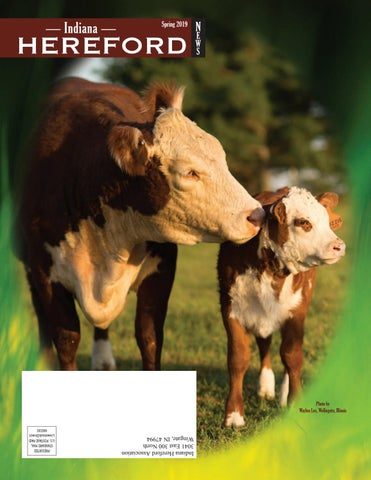
Photo by Waylon Lee, Wellingotn, Illinois
Indiana Hereford Association 3041 East 300 North Wingate, IN 47994
EF Penelope 710ET Chevelle’s first embryo calf by About Time
EF MONA CHEVELLE 907 3907 2014 JNHE Reserve National Champion Hereford Heifer
Embryos available out of Mona and Chevelle! Bulls, Heifers, s Steers & Embryo e! bl always availa
EF MONA 607 907 Mother of Chevelle
Minute with Meents Minute with the Meents
By: John Meents, AHA Field Staff 21555 SR 698, Jenera, OH 45841 419.306.7480 | E-mail: jmeents@hereford.org
John Meents, AHA Field Staff 2019 has started off with strong demand and tremendous Cell: 419 306 7480 jmeents@hereford.org interest in the Hereford breed. On January 1, the 12th Annual Great Midwest Certified Hereford Influenced Feeder Sale was held in Carthage, Illinois. This sale grossed over $1.15 million with a total of 1,324 head sold in semi-load lots. The average Hereford steer in this sale brought $945, and the average Hereford heifer brought $671.
The 113th National Western Stock Show was once again held in Denver, Colorado with the Hereford breed grabbing the spotlight of the cattle industry. I thought it might be the best Hereford bull show I had witness in the time that I have been with the American Hereford Association. Charlie, Jr. and Blake Boyd, Mays Lick, Ky., judged the 71 polled bulls and 64 horned bulls. The soundness, feet and leg structure was much improved this year. In the female show, there were 186 head of polled heifers and 114 horned heifers. Todd Herman, Lima, Ohio evaluated the Denver National Junior Show that saw 137 polled heifers and 83 horned heifers checked in.
Down in the Yards at the 2019 National Western, Herefords were in their glory as the arena was standing room only. There were 47 Pen of Bulls shown, five Carloads of Bulls, and 23 Pens of Heifers. This year the three-man judging system consisted of Cody Sankey, Economy, Ind., Brent Meeks, Taylor, Neb., and John McCurry, Burrton, Kansas. New in 2019, exhibitors were permitted to take one bull from their pen of bulls in the yards, and show them on the hill. Both the reserve grand polled and horned bulls were successfully shown both on the Hill and in the Yards both days.
Indiana
Hereford News
Published twice a year in March and September and mailed to Hereford breeders in Indiana and Illinois. Black/White Ad Rates: 1 page…$200 1/2 page…$150 1/4 page…$110 Business Card…$85
Three 4-color page ads are available on a first-come, first serve basis for $300. To place an ad, contact:
Jill Duncan, Wingate, Ind. 765-918-1567 indianaherefords@gmail.com
Sarah Aubrey, Monrovia, Ind. 765-621-8501 sarahbethaubrey@gmail.com
Always my highlight of the week are the sales. The Mile High Eve Sale is held in a ballroom atmosphere where elite Hereford donor flushes and embryos, along with rare Hereford semen is sold at a live auction. This sale grossed nearly a quarter million dollars this year.
The Mile High Night Sale was as exciting as always. It was estimated that around 5,000 people witnessed this sale again in 2019. The 34 Lots grossed $830,450 to average $24,425. Auctioneer Eddie Burks sold the top bull for $130,000. He was added Lot X bull, EXR Bankroll 8130 ET, who earlier was the reserve grand champion horned bull on the Hill, and a member of the champion pen of bulls in the Yards sired by the Supreme Champion of the 2019 National Hereford show, BR Belle Air 6011. Bankroll was consigned by Express Ranch, Yukon, Oklahoma. This year Lowderman Cattle Company, Macomb, Ill., and Michelini Cattle Co., Peru, Ill., donated LCC 6964 Queen Bee 43F ET to the Hereford Youth Foundation of America (HYFA). This female demanded a bid of $120,000 from Hopper Herefords, Upstream Ranch, Hoffman Herefords, HME Cattle Company, and Cort Scheer. Thank you to all the firms listed for their generous donations for the Hereford youth. MAKE YOUR CATTLE BETTER TODAY BECAUSE YOU HAVE TO MARKET THEM TOMORROW!
2
50 Years
and still a
work in progress! 1968 Indiana State Fair Facts: No Photoshop “Curl” on animals Saddle Soap on leg hair Photos by Frank Gash
Pictured left to right… Bob Felton (judge), dad Doc Hunt, Wayne Haygood (IHA), brother Bud Hunt, wife Julie and Ted Hunt
Pictured left to right… Bob Felton (judge), brother Bud Hunt, Buddy McGoughey (IHA), dad Doc Hunt, wife Julie and Ted Hunt
HUNT BROS. Herefords
7940 N. 500 E. • Battle Ground, IN Cell: 765-418-0651 Website: huntbrosherefords.com 3
Annual Meeting Over 60 adults and juniors took part in the 2019 IHA Annual Meeting on January 26, 2019 at the Sheraton Hotel in Indianapolis. The treasurer reported a checking balance of $2,293.87, a savings balance of $1,429.74 and the CD balance of $8,015.77. The IHA showed a loss of $225.73 in 2018. The slate of directors was approved, and we voted to break a tie for Quadrant 3. Sarah Aubrey discussed the opportunities to advertise in our semi-annual newsletter. Committee reports were given by the IBCA & Hoosier Beef Congress, Indiana Bull Evaluation Program, the Indiana Junior Hereford Association and the Indiana Hereford Women. The 2019 Preview Show will be held at the Boone County Fairgrounds in Lebanon from June 7-9. AHA Board member Bruce Everhart gave a review of 2018: Advancing the Breed. Strengthening the Industry. He covered how the breed fared in 2018, and it was a great year. AHA Field Representative John Meents gave some updates as well, including the results of the Hereford Influenced Feeder Sale held on January 1, 2019 where 881 steers averaged $943. Meents noted that there are always spots available for more feeders, and to contact him for more information. There will be a Midwest Regional show this year in Findlay, Ohio June 21-22. The 2019 Indiana Born and Bred Awards Program at the Indiana State Fair was discussed. New for this year‌cash awards will be given to the Champions as well as all class winners. Nominations were taken for the 2020 Indiana State Fair open show judges. The annual awards were presented as follows: Show Heifer and Show Bull of the year went to Collin Deatsman; Show Steer of the year went to Presley Zehring and the Family of the Year went to David Duncan and Family. For a copy of the complete minutes of the meeting, please email indianaherefords@gmail.com to request.
IJHA Presiden Dalton Davis gave an update on the juniors. 4
2019 Indiana Hereford Association Senior Board of Directors Seated L to R: Rick Davis - President, Nicole Edwards, Kristie McFatridge, Jill Duncan - Secretary/Treasurer, Joni Doig and Bruce Everhart Standing L to R: Dr. David Dixon, Dr. Bill Doig, Gordon Clinkenbeard, Scott Lawrence, Tony Schantz, Terry Hayhurst, Shawn McNealy and Robert Greives Not Pictured: Bryan Kelly - Vice President, David Duncan, Doug Musser and Gordon Carter
2019 Indiana Hereford Association Junior Board of Directors President: Dalton Davis, Vice President: Kylie McFatridge Treasurer: Hattie Duncan, Secretary: Jayden Simpson Media Relations: Sage Lawrence Senior Directors: Luke Dixon, Ray Duncan Payton Farmer and Michaela Marion Junior Directors: Mia Edwards and Chase Harker
Collin Deatsman was awarded 2018 Show Heifer and Show Bull of The Year Awards Presley Zehring (not pictured) won the Show Steer of The Year Award David Duncan Family (not pictured) was honored as Family of The Year
We Get Around
GG AA Fox Credence 632D owned by Paul Gallagher, Grey, ME (Picture taken October 3, 2018 after breeding 23 cows)
Watch for our cattle at… Ellis Farms Spring Sale on April 13, 2019 (Selling GG EF BEEF Cuda 815F, a top Cuda son) Indiana Bull Test on April 18, 2019 (Selling Two Bulls) National Reference Sire Program Herd bulls being tested include: EF BEEF X651 Tested D876 at Mershon Cattle, Missouri and GG Trust 167Y 632D at Olsen Ranch, Harrisburg, Nebraska
Bulls For Sale at the Farm Private Treaty
For Sale Fall 2019… We will have a group of two and three year old daughters of Times A Wastin’, Small Town Kid and Excede carrying heifer pregnancies!
GREIVES HEREFORDS Bob Greives | 7591 N. Armstrong Chapel Rd., W. Lafayete, IN 47906 | 765.583.3090, Cell: 765.491.6277 Gary Duncan: 765.366.6000 | E-mail: greivesgranite@yahoo.com | greivesherefords.com
5
6
Every Day! Cattle For Sale
— Open Heifers, Bred Heifers, Cows & Bulls —
Bulls like this available sired by About Time, Launch, Mason, Chosen One, Divergent, Catapult 109, Super Sport, Mountaineer and Acheiver.
#43954854 • Calved: March 2, 2018
#43944351 • Calved: January 17, 2018
Check our website videos: www.ableacres.com
#43944457 • Calved: January 27, 2018
L.R. Duncan and Family 1264 N. Mountain Rd. • Wingate, IN 47994 David Duncan, cell: 765-366-0295 Lawrence Duncan, cell: 765-918-2297 pduncan@tctc.com • www.ableacres.com 7
Member News
Everhart Elected to AHA Senior Board
Bruce Everhart was one of three members chosen as new directors on the American Hereford Association (AHA) Board at the AHA Annual meeting Oct. 27, in Kansas City Mo. Everhart Herefords is a 50-year purebred operation consisting of 25 head. The operation sells bulls, steers and heifers to commercial and junior members in the Midwest. Bruce recently retired after a 40-year career in ag banking. He managed an ag banking team in the Midwest with Wells Fargo Bank. Bruce is also a board member and past president of the Indiana Hereford Association.
Champions Named at Legendary Fort Worth Stock Show
Hereford exhibitors competed at the historic Fort Worth Stock Show and Rodeo to see who would win the title of grand champion Feb. 4 in Fort Worth, Texas. A total of 233 Herefords were exhibited during the event. In the female show, grand champion polled female and champion spring yearling female went to Aubrey’s Carly 4054 11E ET, owned by Gary and Kathy Buccholz, Waxahachie, Texas; and Aubrey Cattle Co., Monrovia, Ind. The April 15, 2017 female was sired by CRR About Time 743.
Good Luck
to all the Indiana Junior Hereford Association members exhibiting at the Junior National Hereford Expo in Denver this summer!
— The Maddox Family — Clay & Becky Maddox Weston & Chase Zionsville, Indiana
“Do what you love and you’ll never work a day in your life! ”
8
Industry Insight
October 27th, 2018 was a nerveracking day as I prepared to deliver my candidate speech to the delegates of the American Hereford Association Annual meeting held in Kansas City. I was uneasy telling my story and asking for support in front of leaders of this great breed By: Bruce Everhart of cattle but fell back on the advice AHA Board Member from my dad, Harry Everhart. “You 317-407-3618 Bruceeverhart56@gmail.com only get one chance to make a first impression, so make it count.” Growing up in a family of six kids during a difficult financial period of agriculture was really hard but mom and dad made a commitment that their kids would all do well in school, complete ten years of 4H and show Polled Hereford Cattle. I’m glad they made that pledge and kept it. It was a simple plan that Shoshanna and I tried to carry on with our children, Blake and Jordan. I’m feeling pretty confident that all six of our grandkids will get a similar roadmap. Hereford cattle have been an integral part of our family for over 50 years and telling the Hereford story has always been our passion. That’s why when I heard I was elected to the AHA Board of Directors the first person I called was my mom, Betty Lou. She was extremely happy for me but also for our family and knew that the pledge they made many years ago had continued to influence their children. The key theme of my campaign was “Respect for the Past and Belief in the Future”. This respect and belief that I am committed to is demonstrated by the following: 1. Supporting the youth program 2. Commitment to research 3. Enhancing member services 4. Transparent fiscal responsibility 5. Telling the Hereford story
The future of our breed and association is very bright and every metric that was reported at the annual meeting was positive and trending in the right direction. While the numbers and statistics were impressive, the enthusiasm of our Hereford family was evident. This strong sense of excitement carried over to the National Western Show in Denver as well. It is apparent we have much to be grateful for to those who laid the foundation for what we enjoy today. We also have some work to do. I’d like to recommend three things for you to consider in 2019: 1. Go to the Indiana Junior preview show and watch an impressive group of youth execute their plan of a successful show. While you are at it, book a summer flight to the Junior National Expo in Denver to see “Herefords on the Hill”. This will be the last show at the historic yards and you will see the best cattle in the breed and 900 youth showing at the iconic facility. 2. Continue to collect data on your cattle and report it via the new “My Herd” platform. Make the commitment to collect Enhanced DNA for your entire herd. These two tasks combine to power the genetic reliability of your cattle and give you powerful information to share with your customers. 3. Tell the Hereford story. The cattle are excellent and every commercial producer will gain pounds in the calf crop, improve fertility and lower cow carry cost on their F1 retained females. Your brand you represent is your bond with everyone who thinks about your farm. When you combine these economic benefits with a more docile herd and the toughness of Hereford influence it is like getting a free lunch. Thank you to everyone who supported me and I promise to work hard on your behalf. I want every one of you to know you can contact me anytime and I will listen and respect what you have to say and I promise to give you an empathic response. Best of luck during calving season and look forward to seeing you this summer.
S. E. L AW REN C E June 3-4, 2019 | Kansas City, MO Big or small, your Hereford operation has a story to tell. Producers put their heart and soul into genetic selection, calving, health, nutrition and more, but perhaps do not feel comfortable or knowledgeable on how to tell the unique story of their brand. Join us in Kansas City as we learn how to tell the story of two powerful brands — the Hereford breed and your operation.
HEREFORD.ORG/THEBRAND
Scott, Susan Samuel, Sarah, and Sage 0275 N. 800 E. • Avilla, IN 46710 (260) 564-0595 slawrence@whiteshirehamroc.com
— Reg istered H erefo rd C attle — 9
Member Profile Meet Ted Hunt – "Died in the wool Passionate" for Herefords By Susan Hayhurst for Indiana Hereford News
You can learn a lot about Hereford cattle by sitting on the Hunt Bros. worn, green show box at cattle shows. Some may even be factual. To say Ted Hunt is passionate about Hereford cattle is an understatement. Ted strongly believes that these creatures are dependent on us for their care. Many people ‘want’, but not many are willing to sacrifice to fulfill their goals. Anything you’re passionate about will bear fruit, because of your willingness to sacrifice. Ted "caught the Hereford cattle bug" when he was in his early teens. Jack VanNatta, former AHA president, was the Hunt family’s neighbor, and was instrumental in getting Ted’s father, "Doc" Hunt and his older brother Bud, started in the Hereford business with a few commercial Hereford cows prior to WWII. Huntbrosherefords.com states the family began showing at the International Cattle Show in Chicago in the late 1940’s. The operation bred and showed the Grand Champion Bull at NAILE in 1994. Bud showed the Reserve Grand Champion Steer at the 1948 ISF. Ted showed the Grand Champion Steer at the 1953 ISF, both Herefords of course. Another high was raising and showing a bull class winner at the International in Chicago. Ted is known for his dry humor, generous heart, and directness (not to be confused with political correctness). When visiting, you
will likely notice a comb being used on any animal in the vicinity. They know him and he knows them. It is not a rare event when every animal on the place, on a given day, is combed (likely just a few strokes). Herefords are known for being docile and a key reason they chose that breed. Since retiring, Ted’s cattle are seldom ‘made’ to do anything. Talking to them and helping them figure out what you want them to do, treating them with kindness, scratching with a show stick and comb, working slowly and often with a little feed is the routine at Hunt Bros. It is really satisfying when they can literally be ‘talked’ into doing what you want. The train wrecks occur when they are pushed without time to understand what is wanted. Working deliberately, one can often see the light come on when they figure out what is wanted. Hurrying cattle is a killer of good behavior. Reading their ears and eyes will tell an observant handler about all they need to know to help obtain the desired outcome. Ted loves to share this and other knowledge and wisdom with youth who are getting started with the breed. Ted will always be grateful for his first job in which he owned and drove school bus, coached and was acting principal for 36 students in two grades. In addition, he is thankful to God for allowing him to care for registered Hereford cattle.
Indiana Hereford Association
2019 Membership Form
Farm or Ranch Name____________________________________________________________________________________
Your Name_____________________________________________________________________________________________ Family Members________________________________________________________________________________________
Address________________________________________________________________________________________________ City___________________________________________________ Home Phone: __________________________________________
Email: _________________________________________________
State and Zip__________________________________
Cell Phone: ___________________________________
County: ______________________________________
Membership dues are $50 per household per year. Send form and money to: Jill Duncan, Secretary/Treasurer, Indiana Hereford Association 3041 East 300 North, Wingate, IN 47994 Email: indianaherefords@gmail.com • Phone: (765) 295-2065 10
“As cattle producers know, cow-calf operations need to have pregnant cows that are able to maintain a good body condition through the relatively harsher winter months while also providing needed nutrients to the as-yet-unborn calf inside them,” Lalman said. “If the cows can do that while consuming fewer nutrients, the reduction in input costs provides an advantage in annual cow costs.” The OSU study showed the black baldy cows averaged a better body condition score than the straight Angus cows. In fact, the crossbred cows maintained better body condition throughout both phases of the experiment.
Research Study Favors
the Baldy Female courtesy of OSU animal scientists By Donald Stotts Weight gain is almost a national obsession the first few months after the new year, and while humans may be most interested in dropping pounds, cattle breeders are more concerned with helping cows maintain a good body weight at a reasonable cost. “In this experiment, we set out to determine if we could potentially reduce annual cow maintenance costs with Hereford-sired black baldy cows compared to straight-bred Angus cows,” said Dave Lalman, Oklahoma Cooperative Extension Service beef cattle specialist with DASNR’s department of animal and food sciences. “While there is substantial older data available on the question of heterosis, there is not much data available on the influence of crossing a breed known for lower feed intake – the Hereford breed – with the popular Angus breed,” he said. First, a bit of background: Considerable research exists indicating that a simple crossbreeding system can result in improved cow longevity and fertility compared to a purebred or straight bred system. In fact, years of crossbreeding studies conducted at the Meat Animal Research Center showed an average improvement in weaning weight per cow when a simple two-breed rotation was used with bos Taurus breeds such as Hereford and Angus. This advantage is known as heterosis or hybrid vigor. Another potential benefit of crossbreeding, and one often overlooked, is to select the second breed in the crossbreeding system based on inherent characteristics that might reduce costs or improve income in the operation. The idea of selecting breeds that “compliment” one another in this way is known as “breed complimentarity” in the animal breeding world. The OSU researchers broke the study into two phases: Maintenance energy requirements and voluntary feed intake. How well do black baldy cows retain body condition compared to Angus cows? What is the forage intake difference between the black baldy cows and the straight Angus cows?
“On average, we measured just under 2 pounds per day less moderate quality forage intake in the crossbred cows,” Lalman said. “On an annual basis, the black baldy cows would be expected to consume about 725 pounds less forage.” And that has led to an interesting consideration for cow-calf producers: Some of the more productive native range in Oklahoma produces about 3,000 pounds of forage per acre. However, studies by rangeland ecologists have led to recommendations that cattle producers should aim for only about 25 percent consumption of available forage by livestock per acre. Do the math: 25 percent of 3,000 pounds is 750 pounds. “By using the crossbred female and taking advantage of lower feed intake and maintenance requirements of Hereford cattle in our crossbreeding system, we should be able to increase stocking rate or reduce the number of acres required by about one acre per cow-calf unit,” Lalman said. The OSU animal scientist stressed nobody is saying that raising purebred animals is a bad thing as there are many reasons to do so. However, simple, planned crossbreeding systems using breeds that complement one another can reduce the cost of maintaining a cow herd and increase ranch output through improved longevity and fertility. “Raising livestock is not, nor has it ever been, a one-size-fitsall solution,” Lalman said. “Cow efficiency is one more important feature in the cattle producer’s toolbox, relative to the decision-making process.” The Oklahoma Cooperative Extension Service and the statewide Oklahoma Agricultural Experiment Station system are state agencies administered by DASNR, and are key aspects of OSU’s state and federally mandated teaching, research and Extension land-grant mission.
11
…….BUT WON’T I GET MORE “WEIGHT” IF I WAIT? Proper timing of castration is very critical for health , pain and performance of the bull calves in your herd. I recognize that many reading this article want to sell performance tested bulls and hope most of their males never see a knife. If you apply correct selection pressure to your bull calves, you should be castrating a percentage of them every year. You may also be involved with a commercial herd or offering a buy back of the bull/steer calves out of the genetics you have sold. regardless the timing of your castrations is important. Borrowing a statement from Dr Casey Duxbury…”The only time that it is too early to castrate your bull calves is when they are still in utero.” There is a common thought that the bull calves receive a “testosterone effect” if castrations are delayed until later in life.. this is a myth. Research shows that significantly higher levels of testosterone were not achieved until the bull calves were 8 to 9 months of age. Not only will they not receive a benefit from testosterone but bull calves castrated at 500 pounds or greater will loose weight for 2 weeks post castration due to the effects of healing and lost appetite.
12
All of us care about our animals, otherwise we would not fight the cold, mud and the stress of calving season each year. We would find better things to do during that time. That goes hand in hand with the Beef Quality Assurance guidelines on castration: “All bulls that are not herd sire prospects should be castrated as early as possible. Early castration is less stressful on bull calves. Preferably, castrations should occur between birth and 4 months of age” Multiple studies show that the long term health status of calves is much higher in the early castrated groups. This will pay dividends in less antibiotics used as well as less death loss. Castrating early is a win-win. You get more weight gain plus better health. We often get asked what is the best method of castration. I prefer using bands when calves are born. This can be done early in the spring, and the calves never miss a beat. I do recommend using them past May 1. The band can cause a small open wound for a period time that allows flies to become a problem. Also if banding at birth, make sure both testicles are below the band before the calf is released. Banding one testicle high defeats the purpose and makes for a more stressful
open castration later in life. Castrating them with a knife is a good way any time of year. We castrate calves with a knife every day of the year, even during fly season. This method allows the calf to heal quickly and does not leave an open wound for an extended period of time. We spray them with fly spray and turn them out. Obviously with any, castration, method calves still need monitored closely. Another popular method is using a large band later in life. This goes against the principles we have discussed earlier but is an acceptable method as a last resort on larger bulls. Contact your local veterinarian to discuss proper timing and castration methods. They need to be involved in all health decisions with your herd. They know you and you cows better than any salesmen or magazine ad trying to sell you a product. A more in depth look about timing of castrations can be found in an Article from BEEF Magazine written by Dr Mark Hilton Jan 9, 2019.
14099 East County Line Road Edwardsport, IN 47528 Cell: 812-881-8988 E-mail: gjclink@hotmail.com
Club Steer & Heifers Sonora, Reload, Wideload, Long Drive, Rushmore, Catapult 320, Time Traveler and Times A Wastin’