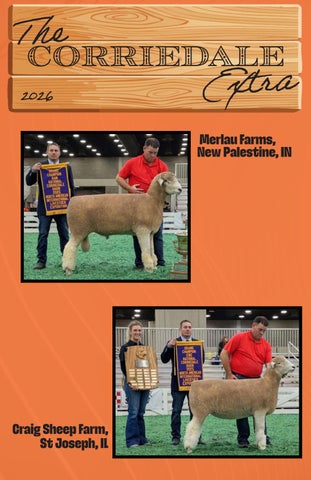
![]()


We are entering an exciting time for the Corriedale breed as we wrap up lambing season with record lamb prices at the markets. The Ohio Showcase Sale and the National Corriedale Sale in Sedalia, MO, should showcase the very best our breed has to offer; with this incredible lamb market, I expect only “top shelf” stock to be represented. I have also heard rumblings of a faint heartbeat in the wool market after several years of stagnation, giving us reason to be optimistic about our shared passion for show stock.
I am also pleased to welcome our new secretary, Laurie Majchrzak. Laurie and her husband, Steve, have been involved in the sheep world for many years with Oxfords and Cheviots. Laurie is incredibly passionate about the industry and has some exciting ideas to share with Corriedale breeders in the coming years. If you haven’t met Laurie yet, please look her up at Sedalia or the All-American Junior Sheep Show in her home state of Maryland.
Regarding the All-American Junior Show, this has been the site of our National Corriedale Junior Show for the past four years. It is a fabulous event showcasing youth from throughout the United States. This event is built entirely around junior activities, including showmanship, wool, market, and breeding shows, as well as an essay contest, advertising and photo contests, and a pee wee lamb camp. Please plan on attending this year’s show from July 2–5 in Timonium, MD. As I often say: the youth are our future, and without investing in them, we have no future.
It has been my pleasure serving as your president during this second term. If you haven’t served yet, please consider that we are in need of new board members willing to help guide our Corriedale family into the future.
Scott Peters President ACA


As I sit down to write this column, the snow is finally beginning to melt away and it feels like spring may truly be on the horizon. There’s something refreshing about this time of year — longer days, greener pastures ahead, and the promise of a new lamb crop finding its place in flocks across the country.
One of the greatest rewards of this season is watching repeat customers return to select their lambs. There is no better validation of a breeding program than seeing familiar faces pull into the driveway, confident in the genetics you’ve worked hard to build. Equally exciting is welcoming new customers who have found you because of the success others have experienced with your sheep. Word of mouth remains one of the strongest endorsements in our industry, and it speaks volumes about the dedication within the sheep community.
I’ve also noticed encouraging diversity within the wool market. There seems to be a renewed enthusiasm for utilizing every by-product our sheep provide. From hand-spinners to commercial ventures, more people are seeking quality wool and exploring innovative ways to incorporate it into finished products. As dual-purpose breeders, this renewed focus on wool adds strength and sustainability to what makes Corriedales so unique.
The Corriedale community itself continues to grow, and it was especially rewarding to meet new breeders at the North American. Opportunities to connect in person remind us that while we may be spread across many states and regions, we share common goals: preserving, promoting, and improving the Corriedale breed.
I am also very much looking forward to working with Willoughby Sales to bring you an outstanding National Sale in June. Events like our National Sale not only showcase elite genetics but also strengthen the friendships and partnerships that make this association special.
With spring finally arriving, I look forward to seeing many of you at upcoming Corriedale sales and events. Whether ringside, at the sale barn, or visiting pens, these gatherings are what keep our momentum strong.
Please know that my door is always open. If you have a comment, suggestion, or even criticism (none of us are perfect), I genuinely want to hear from you. Open communication is vital to a healthy and progressive association.
As many of you know, I do work full time as a nurse, so if I don’t answer the phone right away, please leave a message or send a text. I am always happy to help in any way I can.
I can be reached at 603-209-2234 or americancorriedaleassn@gmail.com.
Here’s to green grass, healthy lambs, strong wool markets, and a successful spring sale season for all of us.
Laurie Majchrzak Executive Secretary ACA


The Corriedale should at once give the impression of being a stylish sheep that is well balanced, heavy shearing, growthy and hardy. It is a dual purpose sheep; therefore, consideration should
Breed character represents the combination of characteristics that distinguish Corriedales from other breeds. More than any other feature the head gives the breed its character and individuality. The head of the ram should be bold and strong. It should be in proportion with the rest of his body and should display marked masculinity. The ewe’s head should indicate her femininity, but in no case should it be over refined. The nostrils should be wide and open with a black nose preferred. A solid pink or white nose should be discouraged.
The ears should be of medium size, preferable white, thin, and soft. Black or blue spots on ears are not defects, but black or brown spots on head hair or wool are defects. The Corriedale should have a bright, alert eye. Over-large tear ducts and excessive redness around the eyes are objectionable. The area immediately surrounding the eye and a channel from the eye forward should be completely free of wool. The wool should not grow on the bridge of the nose, below the level of a line drawn from the base of the ear through the eye and continued at the
A good covering of wool over the poll is desirable in both sexes. The sheep must be hornless and should have a well defined pit. Slight rudimentary horn growth (scurs) found attached to the skin on the ram’s head should be considered a minor defect; however, horn growth attached to the bone is unacceptable.
The mouth should display correct bite, neither over-shot nor under-shot , with the front teeth centered on the upper pad.

Front Quarter
Neck: The neck should be broad and strong and should fit smoothly into the shoulder with no drop in front of or behind the shoulders. The underside of the neck should be free from folds or wrinkles, although this defect may be forgiven if not present to a major degree. The neck should be long enough to contribute to an overall balanced appearance.
Shoulder: The importance of a reasonably wide and level shoulder cannot be stated too emphatically. Badly set, prominent shoulder blades, causing a depression behind the should, are a major fault and must be condemned. Corriedales should be smooth shouldered. Coarse shoulders and / or open shoulders should be considered a fault.
Chest: The chest should be wide and deep. These points are necessary both for the production of meat and for the constitutional vigor of the animal. It is in a the depth and width of the chest, and particularly in the depth, the that the vital organs of heart and lungs are housed. A shallow, narrow chest indicates small lung capacity, cramped heart room, and in general a weak, delicate constitution.
Underline: The should be level and as parallel to the back or top line of the body as possible. The tendency to slope upwards from the stomach to the chin of the sheep is a bad carcass and constitutional fault. The flank should be deep and full.
Middle
Ribs: Deep and well-sprung ribs should arch out and slights upwards from the spine and carry deeply down to the low brisket. The spring or arch of the ribs is essential for constitutional vigor and fattening qualities, and is also necessary to insure the maximum meat in the chop. The greater the arch to the spring of ribs, the more meat there will be in the important portion of the lamb.
Back: The back should be level and straight and reasonably long. Any tendency to a short dumpy back between should and hip, or between hip and tail head, is a serious conformation fault. A slight gradual lowering of the back line in the center of the back is not important.
Loin: The loin should be as long, wide and deep as possible. Muscling in this region is very important since this is the highest priced area of a lamb carcass. Loin eye area is an important criteria in carcass evaluation.
Hindquarters
Thighs: The leg of lamb or mutton should be wide and full as viewed from the rear. Length of rump is also an important aspect of total thigh evaluation. Width behind denotes a wide pelvis aperture and ease of lambing.
Rump: The top line should continue out level and straight to above the dock. Tendency to slope from the hip bones backwards and downward should be avoided.
Feet: The feet should be hard, oval in shape and neither completely round nor long and narrow. The should be large enough to bear the animal’s weight in soft ground, and yet not so large that they tend to splay open in walking. The feet should be black in color, though streaky feet or lighter colored feet are permissible, if they are not totally white.
Pasterns: The pasterns supply the spring and cushion of an animal’s walk. A tendency toward too straight a pastern means a jarring, stilted walk. On the other hand, too long and sloping a pastern places too great a strain on the tendons and joints and is a weakness.
Legs: The legs should be of moderate length, well apart and should set straight and be accompanied by strong bone. The bone of the legs should be heavy, and flat or oval in shape. This, light, round bone is a major fault. The legs should be set perpendicularly under the sheep, the front legs directly under the shoulder blades and of similar width to the shoulders. The should stand square in front and behind, and squarely on its feet. The hind legs should carry the hocks in line with the pin bones.
Testicle Size and Soundness: Testicles should be uniform in size, adequate in size for age, well descended from the body, and have no abnormalities. The scrotal circumference on rams 18 months of age or older should be a minimum of 35 centimeters, and 30 centimeters for a 6-month-old ram lamb.
Balance refers to the blending together of body parts. The parts of the sheep should be in proportion and any tendency toward extremes should be avoided. Corriedales are a dual purpose breed with growthiness being very important. Animals should be longer than they are tall, and adequate muscling and body capacity should be given strong consideration. Mature rams should weigh two hundred and seventy-five pounds (275lbs) and up and mature ewes one hundred and seventy-five pounds (175 lbs.) And up. An updated summary of weights and measurements of animals in recent National Sales can be found as an insert in the publication.
The Corriedale should carry a heavy, even fleece of bright, lustrous wool, showing good staple length and density, with a well-defined lock, an even tip, a uniform grade (spinning count) throughout and a uniform crimp that corresponds with breed standards. The fleece should be free from hair, kemp, and black or brown fibers. The desired quality is a long staple, bulky 5058 spinning count (of medium grade, approximately 25 to 31 microns) of even density. A somewhat lower spinning count, especially in a ram, should not be discriminated against provided that it is free from any harshness. In rams, the scrotum should be reasonably covered with wool that is not too course in texture.
Uniformity of Grade: The breeder should strive for the greatest uniformity of fleece possible. The wool known as “belly wool” should not extend above an imaginary line running from the fore flank to rear flank. This may be a moderate to severe fault depending on how high belly wool comes up on the side. Variation in grade from side to britch should be minimal.
Tip: An even tip is desirable. The long pointed tip, except in lambs, is to be avoided.
Crimp: The crimp should be clearly defined and even in character throughout the length of the fiber. It should be of a type and standard in keeping with breed spinning quality. It should be noted, however, that this quality is highly affected by environmental conditions.
Staple: Length of staple of a fleece is the major point in attaining maximum weight of wool. Breeders should strive for the
maximum length possible in relation to count, without impairing the density of the fleece, or the meat and milk producing qualities of the sheep.
Corriedale fleeces should show a great deal of density without feeling harsh to the touch. A soft fleece is very desirable. Very open fleeces often contain more vegetable matter and shed less water than dense fleeces. Placing too much emphasis on the density can result in reduced staple length and fleeces that are harsh to the touch, however.
Head Covering: The head should have a good covering of wool of similar type to the general fleece. A tendency for the head wool to vary slightly in count is not of great importance: however, weak and wasty wool around the ears or between the ears is a fault. The wool covering the poll and front portion of the head should not contain an excess of nonwool fibers, preferably none at all. This is one of the first places in the fleece where such faults may occur and indicates at least a possibility of similar faults in the main fleece in later generations. The horn depressions should not show an excess of course hair, or show dark or brown coloring. The excessively bare head leads to an eventual loss of wool weight and to weaknesses in the fleece of the breed, if not in the individual, and to the development of a plain, unattractive type of sheep. The other extreme is the wool blind animal. The Corriedale head covering should be somewhere within these broad limits.
Leg Covering: The legs should be free from black or brown coloring in the wool or hair, and as free as possible from kemp. A leg that is well wooled down to the fetlock is preferred.
The qualities of brightness and luster play an important part in the fleece evaluation and in the value of a fleece. Fleeces should be white or creamy white in color. Environmental conditions can temporarily affect fleece color. However, a canary yellow color exists in some Corriedales that has a genetic link and this should be discriminated against.


Yearling Ram
1. Brady Craig, IL
Craig 2333
2. Mark Purdy, OH
Purdy 360
3. Locust Lane Livestock, OH
Peters 2404
4. Mark Purdy, OH
Purdy 370
Senior Ram Lamb
1. Tanner Gann, IL Bandt 1324
2. Brady Craig, IL
Craig 2433
3. Riley Smith, OH R&R Farms 1077
Senior Champion Ram
Brady Craig, IL
Craig 2333
Reserve Senior Champion Ram
Tanner Gann, IL
Bandt 1324
Intermediate Ram Lamb
1. Brady Craig, IL
Craig 2513
2. Mark Purdy, OH
Purdy 392
Junior Ram Lamb
1. Joana Friesz, ND
Friesz 2595
2. Brady Craig, IL
Craig 2518
3. Dalissa Moser, IL
PVA 25-2025
4. Dalissa Moser, IL
PVA 20-2025
Junior Champion Ram
Brady Craig, IL
Craig 2513
Reserve Junior Champion Ram
Joana Friesz, ND Friesz 2595
Pair of Ram Lambs
1. Brady Craig, IL
Grand Champion Ram
Brady Craig, IL
Craig 2333
Reserve Grand Champion Ram
Tanner Gann, IL
Bandt 1324
Yearling Ewe
1. Brady Craig, IL
Peters 2400
2. Joana Friesz, ND Friesz 2402
3. Brady Craig, IL
Craig 2335
4. Joana Friesz, ND Friesz 2440
5. Connley Hoagland, MT Phillipi 4-61 Rita
Pair of Yearling Ewes
1. Brady Craig, IL
2. Joana Friesz, ND
Senior Ewe Lamb
1. Brady Craig, IL
Craig 2432
2. Locust Lane Livestock, OH DDF 24-69
3. John St. Amour Merlau 2432
4. Dalissa Moser, IL Bandt 1322
Senior Champion Ewe
Brady Craig, IL
Peters 2400
Reserve Senior Champion Ewe
Joana Friesz, ND Friesz 2402
Intermediate Ewe Lamb
1. Brady Craig, IL
Craig 2509
2. Connley Hoagland, MT
307 Corriedales 5-7 Fancy
3. Mark Purdy, OH
Purdy 405
4. Anja Lein, IA BWH 4128
5. Mark Purdy, OH
Purdy 387
6. Dalissa Moser, IL PVA 01-2025
Junior Ewe Lamb
1. Brady Craig, IL
Craig 2520
2. Joana Friesz, ND Friesz 25116
3. Joana Friesz, ND Friesz 25120
4. Brady Craig, IL
Craig 2516
5. Dalissa Moser, IL PVA 21-2025
6. Tayler Rinehart, KY
WM 003 Champ
7. Tayler Rinehart, KY 004 Sweetie
Junior Champion Ewe
Brady Craig, IL
Craig 2509
Reserve Junior Champion Ewe
Brady Craig, IL
Craig 2520
Pair of Ewe Lambs
1. Brady Craig, IL
2. Joana Friesz, ND
3. Mark Purdy, OH
4. Dalissa Moser, IL
5. Tayler Rinehart, KY
Grand Champion Ewe
Brady Craig, IL
Peters 2400
Reserve Grand Champion Ewe
Joana Friesz, ND Friesz 2402
Best-Headed
Joana Friesz, ND Friesz 25116
Best Fleece
Connley Hoagland, MT
Phillippi 4-61 Rita
Flock
1. Brady Craig, IL
2. Joana Friesz, ND
Premier Exhibitor
Brady Craig, IL


Riley & Trevor Smith with a Fall ram lamb at NAILE. They live in North Central Ohio, enjoy raising sheep and showing their family’s sheep and helping others with showing. Trevor loves school & Riley is a former OH promotional project participant.
Lukas Verbos & Willow at KILE leadline competition. Willow is wearing a wool purse & beret along with a hand spun/[woven] scarf.
Lukas is wearing a wool vest lined with sheep fabric that he made himself. He also competed in Make It with Wool, PA Farm Show & fleece to shawl competitions. He is from Central PA & a PA promotional ewe/ lamb project participant.


Levi Nitz & one of his bottle lambs he raised to start his Corriedale project. He wants to double the size of his family’s meat sheep flock by adding Corriedales as a separate flock for their hardiness & easy care. He is from North East Ohio.

Steven Clark and his sister, Gabriella, at the PA Farm Show with the ewe lamb that was awarded from the PA promotion program from Zach Claycomb. Steven participated in KILE leadline & sheep shows, PA Sheep and Wool Festival and fondest memory of showing at his local fair with his own sheep. He is from South Central PA, plans to grow his flock and improve his showmanship.
Abigail Willis, her mother (Loni) and her ram at her county fair in SW PA. She raises her sheep for high wool quality and provides her fleeces to handspinners.


Wool sweater hand knitted from Corriedale wool. Some of the great youth promoting Corriedales through showing, leadline, Make It with Wool, fleece to shawl, wool & meat production.
By dr. Kelsey Bentley, sMall ruMinant extension sPecialist, Kansas state university
Lamb death loss is one of the biggest drains on flock profitability, and the difference between a 5–10 percent loss and a 15 percent loss is usually management, not bad luck. Thinking ahead about nutrition, health, facilities, and close observation during lambing can turn more pregnancies into marketable lambs rather than losses.
Most lamb mortality is clustered in late gestation and the first few weeks of life. Stillbirths account for about a quarter of losses at or near lambing, while “normal” preterm loss from noninfectious causes is only about 2 – 4 percent. Up to 80 percent of all lamb crop loss (including fullterm stillborns) happens from birth to two weeks of age, when lambs are most vulnerable to stress and disease. The major culprits are abortion diseases, pregnancy toxemia, difficult births, starvation, hypothermia, scours, pneumonia, and predation. Even a simple habit of writing down abortion rate, ewe death loss, stillborns, and newborn mortality each year helps you see patterns and decide where management changes will make the biggest difference.

Prevention starts before lambs ever hit the ground. In late gestation, a ewe in good body condition (BCS 2-3) carrying twins typically needs good quality forage plus supplemental grain up to about 3 percent of body weight to meet her rising energy needs. Getting this plane of nutrition right helps prevent pregnancy toxemia, reduces the risk of stillborn lambs, and supports stronger ewes at lambing. When abortions or preterm stillborns creep above 2–4 percent, that is a red flag to work with your veterinarian. Submitting fetuses and placentas can identify abortion diseases such as Campylobacter, Chlamydia, or Toxoplasma so a targeted control and vaccination plan can be put in place instead of guessing. For producers here in Kansas, the Kansas State Veterinary Diagnostic Lab does a wonderful job working with producers and their veterinarians to diagnose abortive diseases.
Health work before lambing also pays off in live lambs. Prelambing CDT vaccination, good foot care, and targeted parasite control help ewes come into lambing with less stress and better immunity. Culling ewes with chronic udder problems, especially “hard bag,” prevents the frustration of raising lambs from mothers that cannot produce enough milk. In short, every decision you make in the last six weeks of gestation shows up in lamb vigor and survival when lambs hit the ground.
The first day of life is the most dangerous time for a lamb, and it is also where good shepherds can have the greatest impact. Colostrum is the cornerstone. A 10pound lamb should receive roughly 20–30 ounces of colostrum in the first 24 hours, divided into several feedings, with as much as possible offered in the first hours after birth. Colostrum provides both dense energy and the antibodies that jumpstart the lamb’s immune system. Lambs that miss this window are much more likely to die from scours, pneumonia, or vigor issues later on.
Temperature goes hand-in-hand with colostrum. A normal lamb temperature is about 102–103 °F; mild chill is 99–101 °F, and severe hypothermia is below 99 °F. Severely chilled lambs should be warmed first (using a warming box, heat source, or intraperitoneal injection of warm dextrose) before any tube feeding is attempted, because tubing a severely cold lamb can trigger shock and death. Many producers use a simple “clip–dip–strip–sip” routine: trim and dip navels in strong iodine or betadine to prevent infection, strip teats to remove wax plugs and confirm milk flow, and make sure each lamb is up and nursing within 30–60 minutes. In barn systems, keeping the lambing area around 35–40 °F with good ventilation and housing ewe–lamb pairs in jugs for at least 48 hours allows close observation and intervention before small problems become dead lambs.
How you manage barns and pastures has a big influence on whether vulnerable lambs survive. In the barn, clean drop pens followed by 4×4 or 6×6 lambing jugs give ewes a quiet space to bond with lambs and make it easier for you to spot trouble early. Wet grafting or the use of oxytocin is a useful tool to even up litters: for example, moving a triplet onto a ewe that lost her lamb or has extra milk can turn a highrisk lamb into a thriving one. When it is clear that a ewe does not have enough milk, making a
decision about artificial rearing within the first 24 hours improves the lamb’s chances.
On pasture or range, weather and predators become just as important as colostrum and milk. Timing lambing to avoid the worst storms, providing windbreaks or natural shelter, and keeping pairs on welldrained ground help reduce chilling and disease. At the same time, young lambs on range are highly attractive to coyotes and other predators. Investments in predator control, like tight fencing, guard dogs, donkeys, or llamas, and sometimes professional control assistance, can save a surprising number of lambs over the course of a season. No matter the system, training your eye to recognize a weak lamb is crucial. Lambs that are hunched, hollowbellied, unusually quiet, shivering, or coldmouthed are at high risk of starvation and hypothermia and should be warmed and given colostrum or milk without delay.
As lambs grow, offering creep feed starting around 2–3 weeks of age supports rumen development and improves weaning weights. This not only adds pounds at sale time but also helps lambs handle the stress of weaning with fewer setbacks, getting more value from each lamb you managed to keep alive in those early days.
Behind all of these practices is one simple tool: good records. A basic lambing notebook or a spreadsheet can tell you more about your flock than any guess ever will. Recording ewe and lamb IDs, date and time of birth, assistance at delivery, and any problems or treatments gives you a detailed picture of how each season went. Adding notes on mothering ability, lamb vigor, and every lamb loss with a suspected cause helps you evaluate which ewes to keep, which rams are siring hardy lambs, and which management changes are actually paying off.
Over several lambing seasons, these records reveal trends. You may notice, for example, that improving lategestation nutrition coincided with fewer stillbirths, or that adjusting lambing dates reduced exposure to severe weather and predator losses. With that information, you can steadily move toward the goal of 5–10 percent lamb loss instead of 15 percent or higher. In a tightmargin business, those extra live lambs can be the difference between a breakeven year and a profitable one.
CALIFORNIA
AMBER CLAFLIN
TRIPLE C FARM
1043 Woodlawn Ave
Devore Heights, CA 92407 (909) 322-5569
amber.claflin@gmail.com
DOUG CLAFLIN
TRIPLE C FARM
1043 Woodlawn Ave
Devore Heights, CA 92407 (909) 322-5569 amber.claflin@gmail.com
WILLIAM CLAFLIN
TRIPLE C FARM 1043 Woodlawn Ave
Devore Heights, CA 92407 (909) 880-2746 william.b.claflin@gmail.com
GLENDA RIDDLE
3479 Pleasants Trail Vacaville, CA 95688-9793 (707) 330-8338 trlsndrnch@aol.com
GEORGE SAUNDERS
22386 Pico St
Grand Terrace, CA 92313 (909) 783-0196 saundegm@gmail.com
COLORADO
ERIC WELLMAN
8456 County Road 45 Hamilton, CO 81638 (970) 701-9107 edwellman88@gmail.com
JOHN WELLMAN
3456 County Rd 45 Hamilton, CO 81638 (970) 824-4736 wellman5family@gmail.com
MARTHA & RONALD RICE
SLEEPY HOLLOW FARM 128 High St Terryville, CT 06786 (860) 309-1191
sleepyhollowfarm@hotmail.com
NATHANIEL TROJANOSKI 81 Young ST East Hampton, CT 06424 (860) 759-4469 ravenwoodfarmct@gmail.com
DELAWARE HUNTER MURRAY 6448 Seashore Hwy Bridgeville, DE 19933 (302) 542-0589
mdmpooh@aol.com
BEN & MICHELLE HECKART NON PAREIL CORRIEDALES 14623 190TH AVE Danville, IA 52623 (319) 457-0501 ben.heckart@ieawealth.com
NATHAN LEIN
7295 I Ave Arlington, IA 50606-8213 (319) 415-2574 leinfarm@outlook.com
ILLINOIS
KEVIN AND PENNY BLILER 2850 N. 1000 East Rd Mechanicsburg, IL 62545
RYAN CRAIG
CRAIG SHEEP FARM 1706 Juniper Ct St. Joseph, IL 61873 (217) 714-0552
craig_ryan_e@yahoo.com
MATTHEW DRENDEL
3951 South Mulford Rd
Rochelle, IL 61068 (815) 668-3176
RYAN GANN
11578 N MT Morris Rd
Leaf River, IL 61047 (815) 979-3117 gannfarms@hotmail.com
W.K. MITCHELL
KEEN MAR FARMS 1187 30TH Ave
Roseville, IL 61473 (309) 299-6543
RODNEY MORRIS
MORRIS CORRIEDALES
7938 E CR 250 N Lerna, IL 62440 (217) 273-5299
rmorris@firstmid.com
RODNEY & CATHY MORRIS
HILL CREEK FARM
7938 E CR 250 N Lerna, IL 62440 (217) 273-5299 rmorris@firstmid.com
DALISSA MOSER
553 German Rd Paw Paw, IL 61353 (608) 481-0077 moserdalissa@gmail.com
MAX L WOOLEVER
959 Co Rd 1900 E Greenup, IL 62428 (217) 508-3535 max@woolever.com
INDIANA REBECCA P BULL RPBULL
7365 Lakeside Drive
Indianapolis, IN 46278 (317) 797-6383 rebeccabull@comcast.net
KYLE DIXON
8557 E. CR 1100 S. Walton, IN 46994 (765) 753-0099
kdixon@beckshybrids.com
DAN & DAVE HAMPTON HAMPTON FARM 4211 N 680 E Darlington, IN 47940 (765) 794-4830
dan-kathy@att.net
JOHN S MERLAU
MERLAU FARMS PO Box 406 New Palestine, IN 46163 (317) 861-4795 john@merlau.com
JOHN MERLAU
MERLAU FARMS PO Box 406 New Palestine, IN 46163 (317) 409-2413 john@merlau.com
JOHN ST. AMOUR PO Box 406 New Palestine, IN 46163 (317) 861-4795 john@merlau.com
MASSACHUSETTS
CHRISTINE HUMPHREY
OWL RIDGE FARM
665 Hardwick Rd
New Braintree, MA 01531 (508) 864-1800
auburnsew@hotmail.com
Baldwinville, MA 01436 (978) 790-3862
auburnsew@hotmail.com MAINE
NEAL H WATSON, DVM BAPTIST HILL FARM
93 Sunken Bridge Rd Corinna, ME 04928 (207) 924-0087 MINNESOTA
38118 510th Ave
New York M ills, MN 56567
DEW DROP FARMS
38118 510th Ave
New York Mills, MN 56567 (218) 639-8484
10470 190th St
Park Rapids, MN 56470 (218) 255-1430
4796 20th St SW
Waverly, MN 55390 (763) 213-4811 northforkfarmmn@gmail.com SHANNON
15511 230th Ave
Herman, MN 56248 (320) 290-1359 smaltrich@yahoo.com
GENE
JOYCE MILLIGAN &
49022 Locust Hill St Novelty, MO 63460 (816) 284-3205
milligansheep@hotmail.com MONTANA
2470 Hammond Road
Hammond, MT 59332 (406) 529-8007
meghan.phillippi@gmail.com PHILLIPPI CORRIEDALES 2421 Hammond Rd Hammond, MT 59332 (406) 925-1352
bigskycorriedale@hotmail.com NORTH DAKOTA FRIESZ CORRIEDALES PO BOX 67 New Salem, ND 58563 (701) 400-8744
joana@northlandinsuranceagency.com NEW
DONNA
6489 Posson Rd Altamont, NY 12009 (518) 944-7030 dabbruzzese5@gmail.com
&
VEEDER-SHAVE 475 North Quaker Lane Hyde Park, NY 12538 (845) 380-9639
patchworkpastures475@gmail.com
R
5187 ARROW RD NW Minerva, OH 44657 (330) 771-7222
rogerclark80@yahoo.com
IRIS EPPLEY
FAIRVIEW FARM
2305 FAIRVIEW RD
Zanesville, OH 43701 (740) 453-4648 fairviewsheep@att.net
BRIAN HEIBERTSHAUSEN
2362 N St RT 19 Republic, OH 44867 (419) 217-4057 shorthorn15@yahoo.com
GARY & JOYCE HEIBERTSHAUSEN
5-H FARMS
10039 Ebenezer Rd. Aberdeen, OH 45101 (567) 224-9002 joyceheib@hotmail.com
AUSTIN HOWMAN HOWMAN FARM
2508 N. Firestone Rd Wooster, OH 44691 (330) 671-9791 howmanaustin@gmail.com
WAYNE KEMLER & FAMILY
3535 Hoaglin Center Rd Van Wert, OH 45891 (419) 587-3822 wkkemler@metalink.net
JIM KIN
KIN BROTHERS
12831 TWP Hwy 87 Forest, OH 45843 (419) 674-3346 jimkin57@outlook.com
PHIL KIN FAMILY
13342 Township Hwy 87 Upper Sandusky, OH 43351 (419) 674-3093 pnjkin@yahoo.com
DANA & MICHELLE MISSLER BITTERSWEET FAMILY FARM 13664 County Rd H Bryan, OH 43506 (419) 633-1179 mimissler1968@gmail.com
EMMA PETERS
PETERS’ CORRIEDALES 9809 Boyer Rd Versailles, OH 45380 (937) 214-1974
scottrpeters@gmail.com
MARK PURDY & FAMILY PURDY’S CORRIEDALES 2245 Woodstock Avenue Lewis Center, OH 43035 (513) 288-4634
mlpurdys98@gmail.com
SCOTT & MARY ROMINE ROMINE CORRIEDALES 9522 Co Rd 20 Galion, OH 44833 (419) 982-3185 romine.scott.mary@gmail.com
BEN & MARY BOW & FAMILY LOCUST RIDGE FARMING
100 Clear Spring Rd Annville, PA 17003 (717) 867-1305
BENJAMIN L BOW
100 Clear Spring Rd Annville, PA 17003 (717) 867-1305
ROGER & NANCY BOWMAN WINTERSIDE FARM 1402 Old RT 22 Lenhartsville, PA 19534 (610) 562-4875
rnmsbowman@aol.com
ZACHARY CLAYCOMB
1642 E Graceville Rd
Everett, PA 15537 (814) 977-6247
claycomb6@yahoo.com
LYNNE DORWARD
10257 Schoolhouse Rd
Kutztown, PA 19530 (610) 507-2326 dorwardlynne@gmail.com
MICHAEL & MARTENE FIRESTINE MAP FARM
4520 Conrad Weiser Parkway Womelsdorf, PA 19567 (717) 270-9232 mapfarm@hotmail.com
RALPH & MARIAN LOVELL
LOVELL’S MAPLE SPRING FARM
516 Maple Spring Rd Linden, PA 17744 (570) 494-0288 lovellfarm@msn.com
CAROLINE RUPPERT 271 Crum Road Fairfield, PA 17320 (240) 818-8871
GEOF RUPPERT RUPPERT’S CORRIEDALES 271 Crum Road Fairfield, PA 17320 (240) 818-8871 ruppertfamily1234@earthlink.net
SOUTH DAKOTA HOFFMAN CORRIEDALES 37039 US HWY 212 Zell, SD 57469 (605) 460-2681 laciehoffman@gmail.com
ROSALIE WEHLANDER
WEHLANDER FAMILY FARMS 21641 422 Ave
Iroquois, SD 57353 (605) 354-5368
lori.wehlander@gmail.com
57333 CORRIEDALES 39952 SD Hwy 34 Woonsocket, SD 57385 (605) 770-0828 missperi@santel.net
WISCONSIN MICHAEL & LISA BANDT BANDT CORRIEDALES 1650 Sandy Rock Rd Hollandale, WI 53544 (608) 387-5789
bandtcorriedales@gmail.com
NATHAN OVERHOLSER N 5412 CTH C Cecil, WI 54111 (269) 797-6375
noverholser1992@gmail.com
WYOMING BRYAN & GINA VINING
1900 County Rd 219 Cheyenne, WY 82009 (307) 421-0945 ginavining1@gmail.com
JACKSON JESKE
4348 Reding Way
Lakeland, FL 33813 (217) 273-5299
IOWA
ANJA LEIN
7295 I AVE
Arlington, IA 50606 (319) 415-2574
leinfarm@outlook.com
ILLINOIS
HENRY AHRENS
2626 Coyne Center Rd Milan, IL 61264 (319) 400-7574
iaurbanfarmgirl@me.com
HENLEY BLILER
1524 N 1600 E RD
Taylorville, IL 62568 (217) 827-2015
LAYNE BLILER
1524 N 1600 E RD
Taylorville, IL 62568 (217) 827-2015
BRADY CRAIG
CRAIG SHEEP FARM
1706 Juniper Ct
St. Joseph, IL 61873 (217) 714-0552
craig_ryan_e@yahoo.com
INDIANA
KATELYN MORROW
2MORROWS FARM
8025 South 550 East St. Paul, IN 47272 (317) 512-8401
anna.lee.morrow@gmail.com
VINCENT MORROW
8025 S 550 E St. Paul, IN 47272 (317) 512-8401
anna.lee.morrow@gmail.com
TAYLOR RINEHART 1000 Overstreet Lane Lagrange, KY 40031 (502) 693-4203
trinehart.solberg@gmail.com
MASSACHUSETTS
ASA JOHNSON 16 King Phillip Trail Baldwinville, MA 01436 (978) 790-3862
auburnsew@hotmail.com
MICHIGAN
AVERY & EMILY MILLS 7780 Hill Rd Ashley, MI 48806 (989) 763-6351
lbmills@casair.net
MINNESOTA
ROWLAND DYKHOFF
60439 335TH St Wadena, MN 56482 (218) 639-8484
ISAAC, SAMUEL, ELIZABETH & HANNAH MARQUETTE & FAMILY
NORTH FORK FARM
4796 20th St SW Waverly, MN 55390 (763) 213-4811
northforkfarmmn@gmail.com
MISSOURI
PETE BRADLEY
50019 N River St
Noveltry, MO 63460 (816) 284-3205
milligansheep@hotmail.com
MONTANA
CONNLEY HOAGLAND PO Box 95
Glendive, MT 59330
OHIO
CORTNEY COPELAND
DOUBLE C FARM
7476 Co Rd 23
Lewistown, OH 43333 (937) 844-6122
mcopeland@gmail.com
CARTER HEIBERTSHAUSEN
2362 N State Rt 19
Repbulic, OH 44867 (419) 217-4057 shorthorn15@yahoo.com
CAMDEN HEIBERTSHAUSEN
2362 N State Rt 19
Repbulic, OH 44867 (419) 217-4057 shorthorn15@yahoo.com
BROOKE HERSHEY
10530 W Smithville Western Rd
Wooster, OH 44691 (330) 464-6229
hershey07@hotmail.com
ANDREW FEEHAN
3901 Holcomb Rd
Bradner, OH 43406 (419) 788-0344 feehanfamilyfarm@gmail.com
DEVIN, GARRETT, EMERY, CLAIRE, & CALEB SACHS
5597 Palestine Union City Rd
Greenville, OH 45331 (574) 596-4973
shawnandjennifer@hotmail.com
EMILY, TREVOR &/OR RILEY SMITH 1593 St Rt 89
Jeromesville, OH 44840 (419) 651-2304 nssmith530@gmail.com
MARY THOMAS
7595 Co Rd 19 Fredericktown, OH 43019 (614) 313-7261
conserverica@gmail.com
CHLOE WYLLIE
13664 County Road H Bryan, OH 43506 (419) 633-1179 mlmissler1968@gmail.com
PENNSYLVANIA GABRIELLA CLARK
7951 King Saint Clair Road Osterburg, PA 16667 (717) 679-9472
bluesgirl907@yahoo.com
STEVEN CLARK
7951 King Saint Clair Road
Osterburg, PA 16667 (717) 679-9472
bluesgirl907@yahoo.com
ALEXANDER KASE
2893 County Line Rd
Riegelsville, PA 18077 (610) 428-4277
lmalivestock7590@gmail.com
ELLA J McGARGLE
7461 Panorama Pines Lane
Alexandria, PA 16611 (814) 386-4080
ejmcgargle@icloud.com
NORTH DAKOTA
BRAXTON PETERSON
37039 US Hwy 212 Zell, SD 57469 (605) 460-2681
SOUTH DAKOTA
BAILEY WEEGER
103 North Washington St Viborg, SD 57070 (605) 760-1540
bmweegar@gmail.com
Douglas, WY 82633 (406) 660-0930
c_phillippi@hotmail.com
CADEE & LAYLA VINING FEDERER CORRIEDALES 1900 Rd 219 Cheyenne, WY 82009


1) Entries are open to all ewe lambs born September 1 and later, to be divided into three classes: September 1 to December 31; January 1 to February 14; and February 15 and later.
2) A nomination fee of $25.00 is required and payable to the American Corriedale Association. Ewe lambs must be nominated and designated prior to entering the show ring of their class at each Futurity sale. Payment of nomination fees must also be made prior to the sale of the animal.
3) Each ewe lamb must be properly identified which in turn must correspond to the registration certificate.
4) Each ewe lamb must conform and abide by the rules and regulations of the individual sale to which it is consigned. All normal entry and commission fees will apply.
5) The American Corriedale Association will not be responsible and shall be held harmless for any disputes and/or disagreements between buyers and sellers.
1) All North American International Livestock Exposition rules shall apply. Juniors are expected to be knowledgeable of and to abide by these rules.
2) All juniors who meet the requirements for the junior show at the North American International Livestock Exposition are eligible. Rules for the N.A.I. L.E. are:
-Not more that 21 years of age at the date of the show in November
-Junior members must be present to show their own sheep unless physically impaired
-Animals must be registered in their respective breed organization by August 1 of that year
-Up to date paid membership in the junior breed association of said breed
3) Junior member must be at least 8 years of age with no partnerships, joint registrations, etc.
4) Ewe lambs and points earned in the Futurity are not transferable to any other person, nor are the points from one lamb to another.
5) Ewe lambs are to be registered to individuals only, no partnerships, joint registrations, etc. 6) No Futurity entrant can compete with more than two ewe lambs. Total points earned by two ewe lambs may not be combined into one lamb’s total.
7) If registration papers are not received by the first show it is the exhibitor’s responsibility to show the lamb in the correct class.
8) Lambs must compete in a class of registered ewe lambs to receive futurity points. Classes evaluating only one aspect of lambs are not eligible (ie Best Fleece, Best Headed).
9) Junior members must exhibit their own lamb within a class. If they have two lambs in the same class, another junior member may exhibit the second lamb.
10) If an exhibitor that owns a lamb is not present at the respective show, futurity points are not eligible and should not be submitted to the Association office.
11) Premiums - A jackpot of 80% of the nomination fees plus any donations will be awarded in premiums with the money total to be awarded as follows: FIRST: 20% SECOND: 15% THIRD 12.5% FOURTH: 11.25% FIFTH: 10% SIXTH: 8.75% SEVENTH: 7.5% EIGHTH 6.25% NINTH: 5% TENTH: 3.75%
POINT SCORING:
1) The point form must be filled out for each show and submitted to the Association within 14 days of the show. Forms may be submitted by mail or email, see below for address.
2) At each individual show the ewe lamb may earn Futurity points from both the open and the junior division – except at N.A.I.L.E., where only the junior show placing will be counted.
3) Ewe lambs can compete at an unlimited number of shows and submit for each show attended, with only the highest seven point award cards to be recorded as Futurity points.
4) Double point awards will be given at the following three shows: the National Sale Junior Show, All American Junior show and the junior show at NAILE in Louisville, KY. 5) Futurity awards will be announced following the point scoring that ends 12/1/25.
6) Following the year end points, all owners of futurity ewe lambs can exhibit in the National Junior Show in an added yearling ewe class (for futurity lambs purchased the previous year), as well as the regular yearling ewe class. This class will be funded with the remaining 20% of futurity nomination fees plus designated funds.
Please submit points for every show participated in. You may mail them to Laurie Majchrzak 3745 Bradley Rd Federalsburg, MD 21632 or email them to americancorriedaleassn@gmail.com
Forms can be downloaded from the website or they will also be available from the Corriedale secretary at the National sale, Sedalia sale, All American Junior Show and NAILE.
If you have purchased a nominated ewe lamb and would like to participate in the futurity program or need more information regarding this program feel free to call the Association office at (603) 309-2234. You may also reach out by email to americancorriedaleassn@gmail.com Good luck to all the Futurity participants!
Corriedale Ewe Lamb Futurity Points Scale
Placing in class
I, _____________________________have exhibited the Corriedale Ewe, ___________________________ Association Registry Number _____________________. This Ewe placed __________ in a class of __________ ewes, and was shown in the __________________ division at the following livestock show: _____________________________________________. The date of the show was _______________________ .
This placing is verified by the superintendent of the above listed show.
SUPERINTENDENT (signature)
SUPERINTENDENT'S PHONE NUMBER
Please fill our form completely and mail or email to Laurie Majchrzak within 14 days of the show.
Laurie Majchrzak 3745 Bradley Rd Federalsburg, MD 21632 americancorriedaleassn@gmail.com 603-209-2234
CONSIGNOR PRICE BUYER
YEARLING RAM
GRAND CHAMPION RAM - Senior Champion Ram
Peters Corriedales/
Locust Lane Livestock
$900 Wayne Kemler & Family, OH
Stormy Beginning Corriedales$1,300
Hoffman Corriedales
Friesz Livestock
Owl Ridge Farm
FALL RAM LAMB
Rebecca Bull, IN
$500 Rowland Dykhoff, MN
$500 Gary Heibertshausen, OH
$500
Bittersweet Family Farms, OH
RESERVE GRAND CHAMPION RAM - Reserve Senior Champion Ram
Dew Drop Farm
Hoffman Corriedales
Dew Drop Farm
Bandt Corriedales
JANUARY RAM LAMB
Owl Ridge Farm
FEBRUARY RAM LAMB
Junior Champion
$3,100 Merlau Farms, IN
$700 Dalissa Moser, IL
$2,000 Lynne Dorward, PA
$750 Tanner Gann, IL
$400 Rowland Dykhoff, MN
Stormy Beginning Corriedales $900 BB Farms Doug Brewer, MD
Reserve Junior Champion
Manor View Farm
Federer Corriedales
YEARLING EWE
$400 Hoffman Corriedales, SD
$500 Anna Morrow, IN
RESERVE GRAND CHAMPION EWE - Reserve Senior Champion Ewe
Dew Drop Farm
Peters Corriedales/
Locust Lane Livestock
Friesz Livestock
Hoffman Corriedales
Bandt Corriedales
Pasture Vewe Acres
Owl Ridge Farm
Gann Farms
Lein Sheep Farm
Owl Ridge Farm
$4,500 Merlau Farms, IN
$950 Emily Mills, MI
$1,100 Kin Brothers, OH
$1,100 Jackson Jeske, IL
$1,000 Michael Bandt, WI
$1,000 Roger Clark, OH
$800 Lynne Dorward, PA
$500 Emma Peters, OH
$500 Lissa Wyse, PA
$500 Lynne Dorward, PA
NATURAL YEARLING EWE-2 INCH
Owl Ridge Farm
FALL EWE LAMB
$500
Roger Clark, OH
GRAND CHAMPION EWE - Senior Champion Ewe
Dew Drop Farm
Hoffman Corriedales
Dew Drop Farm
Hoffman Corriedales
Bandt Corriedales
Owl Ridge Farm
JANUARY EWE LAMB
Junior Champion Ewe
Peters Corriedales/
Locust Lane Livestock
Hoffman Corriedales
Owl Ridge Farm
Owl Ridge Farm
Pasture Vewe Acres
Dew Drop Farm
Federer Corriedales
Wayne Kemler & Family
Federer Corriedales
FEBRUARY EWE LAMB
Reserve Junior Champion Ewe
Hoffman Corriedales
Wayne Kemler & Family
Lein Sheep Farm
$4,500
$2,100
$1,600
$1,200
$1,000
$700
Brady Craig, IL
Rebecca Kugler, PA
Emma Peters, OH
Double C Farm, OH
Dalissa Moser, IL
Roger Clark, OH
$1,800
$1,300
$700
$800
$1,400
$1,300
$800
$700
$500
Dalissa Moser, IL
Anja Lein, IA
Basyla Weis, SD
Kin Brothers, OH
Phil Kin Family, OH
Jackson Jeske, IL
Dew Drop Farms, MN
Addie French, OH
Braxton Peterson, SD
$1,300
$1,100
$600
Anja Lein, IA
Kin Brothers, OH
Ed Terhaar Family, IN
Stormy Beginning Corriedales $900 Jackson Jeske, IL
Federer Corriedales
Federer Corriedales
NATURAL EWE LAMB
Owl Ridge Farm
$700
$600
$900
Tanner Gann, IL
Addie French, OH
Braxton Peterson, SD
Hi everyone!
My name is Anja Lein, and I am your American Corriedale Queen! When they called my name at the banquet last May, I was SO surprised and a little nervous. I couldn’t believe it and I was so happy and thankful all at the same time. I hope everyone had a great year and lambing has gone well for everyone. Can't wait to see all the new lambs this year.
I love Corriedale sheep so much. They are not just animals to me — they are my friends. I love feeding them, washing their legs, playing with them, practicing showmanship, and talking to them in the barn. They teach me to work hard, be patient, and never give up. I decided that I wanted to show Corriedales because I like to show them with fluffy legs and because it's my dad's favorite breed!
I want to say thank you to my mom and dad for helping me every single day, even when it’s early or really late. Thank you to my brother for cheering me on and working with me. And thank you to my sheep for trusting me and being by my side in the show ring.
Being Queen means I get to share how amazing Corriedales are and meet new friends who love sheep just like I do. I promise to do my best, be kind, work hard, and represent this breed with all my heart. This past year I showed at the Show and Sale in Ohio in May with my new futurity lambs, All American Junior Show in Springfield, Illinois, Fayette County Fair, Iowa and Minnesota State Fairs, Wisconsin Sheep and Wool Festival and of course Louisville! We all had so much fun!
Thank you for believing in me. I am so excited for this year! I wish everyone a great show season and look forward to seeing everyone!
Love, Anja Lein American Corriedale Queen


B. Registrations United States 1.
C. Transfers
E. Christening Fee _________________________________________30.00
F. Retag Fee ________________________________________________5.00
G. Rush Fee (per each registration & transfer) ___________________________10.00
H.
I. Special Handling 1.