
Dalebanks Digest
Private Treaty Bulls Available Starting March 13
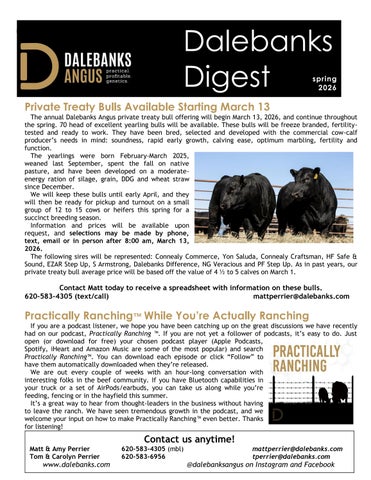
The annual Dalebanks Angus private treaty bull offering will begin March 13, 2026, and continue throughout the spring. 70 head of excellent yearling bulls will be available. These bulls will be freeze branded, fertilitytested and ready to work. They have been bred, selected and developed with the commercial cow-calf producer’s needs in mind: soundness, rapid early growth, calving ease, optimum marbling, fertility and function.
The yearlings were born February-March 2025, weaned last September, spent the fall on native pasture, and have been developed on a moderateenergy ration of silage, grain, DDG and wheat straw since December.
We will keep these bulls until early April, and they will then be ready for pickup and turnout on a small group of 12 to 15 cows or heifers this spring for a succinct breeding season.
Information and prices will be available upon request, and selections may be made by phone, text, email or in person after 8:00 am, March 13, 2026.

The following sires will be represented: Connealy Commerce, Yon Saluda, Connealy Craftsman, HF Safe & Sound, EZAR Step Up, S Armstrong, Dalebanks Difference, NG Veracious and PF Step Up. As in past years, our private treaty bull average price will be based off the value of 4 ½ to 5 calves on March 1.
Contact Matt today to receive a spreadsheet with information on these bulls. 620-583-4305 (text/call)
mattperrier@dalebanks.com
Practically Ranching™ While You’re Actually Ranching
If you are a podcast listener, we hope you have been catching up on the great discussions we have recently had on our podcast, Practically Ranching ™. If you are not yet a follower of podcasts, it’s easy to do. Just open (or download for free) your chosen podcast player (Apple Podcasts, Spotify, iHeart and Amazon Music are some of the most popular) and search Practically Ranching™. You can download each episode or click “Follow” to have them automatically downloaded when they’re released.
We are out every couple of weeks with an hour-long conversation with interesting folks in the beef community. If you have Bluetooth capabilities in your truck or a set of AirPods/earbuds, you can take us along while you’re feeding, fencing or in the hayfield this summer.
It’s a great way to hear from thought-leaders in the business without having to leave the ranch. We have seen tremendous growth in the podcast, and we welcome your input on how to make Practically Ranching™ even better. Thanks for listening!
Contact us anytime!

Matt & Amy Perrier
Tom & Carolyn Perrier
620-583-4305 (mbl)
620-583-6956
mattperrier@dalebanks.com
tperrier@dalebanks.com www.dalebanks.com
@dalebanksangus on Instagram and Facebook
The Cure For High Prices
by Matt Perrier
For all my life, producers of commodities have made their highest revenues when supplies were lowest. We all understand supply and demand fundamentals…if demand is held constant, the supply side of the equation is what drives prices up or down.
But over the past few decades, beef producers have successfully “de-commoditized” our products, seeing increasing demand especially for the highest quality cuts. So even though we have held beef supply stable (by drastically increasing days on feed and carcass weights), demand has driven all prices for beef and cattle through the roof. Now, we’re faced with a conundrum. There currently appears to be an insatiable demand for beef (at least given current domestic supplies of feeder cattle), yet data continues to show that cow-calf producers are not significantly increasing herd numbers. And given the value of these heifers on the market, who can blame them?
I have a good friend and mentor in the business who shutters any time an industry group or economist suggests that we expand the U.S. cowherd. His mindset is not unique. In a commodity market, overproduction leads to suppressed prices, just like the old adage, “the cure for high prices is high prices” states. But in this case, I fear that with each feedyard pen that lays open, each yearling operator who decides not to buy calves that won’t “pencil,” and each plant that either reduces shifts or closes entirely the future of the beef business gets murky.
Last month, I hosted Chandler Keys on our Practically Ranching Podcast. Chandler has worked as a lobbyist for various entities in the beef industry for over forty years, and he made an interesting observation. He said, “we've worked for forty years on the demand side, improving the quality of the product exponentially, and we haven't looked at the supply side at all …for forty years.”
Now please don’t misunderstand me. I don’t want to regulate or falsely incentivize heifer retention. I don’t love imported beef or even feeder cattle, if we can help it. But I do think that we as an industry need to recognize that an understanding of the consequences of prolonged levels of loss by some of the margin operators in our business (stockers, feedyards, processors and retailers) can have lasting effects on the entire industry structure. While I love the profitability that all of us in the cow-calf segment enjoy right now, when the market pendulum swings too far, it’s often not good for anyone. Markets always find a point of equilibrium, and this one will likely be no different.
As farmers and ranchers, we are well-aware of the cyclical nature of markets. When prices are poor, it’s our optimism that drives us to stay in the business. When prices are good, it’s our realism (some may say pessimism??) that keeps us from making irrational decisions. But as businessmen, I believe that it’s time that we recognize that beef is back, and people want more of it. What’s more, they’re willing to pay incredible prices for it.
But to meet this demand in the long term, we need to keep enough cattle in the supply chain to maintain or even expand our infrastructure. Since we have not yet seen a traditional “cowherd rebuild,” we must be prepared for growth through more non-traditional methods. And rest assured, the local coffee shop will not approve of most of these pipelines: imported feeders, imported beef, increased beef x dairy calves are just a few that come to mind.
Honestly, if row-crop farmers are honest with themselves, converting marginal farm ground that has been in corn, wheat or soybeans to some type of forage for grazing or hay production may make sense today…especially if government payments for farm commodity programs are factored out of the equation.

My crystal ball isn’t any shinier than another, but I will repeat a paragraph that I used in last year’s Digest (about a different topic), It has been my experience that the most successful business owners and managers have one thing in common: they constantly analyze the forces at work around them. They turn challenges into opportunities. They turn adversity into learning experiences. They ask others for input and then make decisions using the best information available.
Thanks to demand, we could be on the cusp of a growth phase of our industry. There will continue to be vast opportunities to meet this unprecedented demand for high quality beef. We look forward to being your partner as we take advantage of these opportunities to continue the beef business for generations to come.
Going Forward Is All We Know
by Matt Perrier
We’ve all heard of the devastating fires that occurred in mid-February in the Texas and Oklahoma panhandles and into southwest Kansas. Several of you reading this were affected by these tragic events, and our prayers continue to be with you as the recovery proceeds. Please let us know what else we can do.
Human nature often makes us question why tragedies happen…especially to the areas of the Oklahoma panhandle and Clark County, KS, which less than nine years ago suffered through the Starbuck Fire, the largest Kansas wildfire in recent memory. While we have little control of the occurrences of natural disasters, we certainly can control our response afterward.
The outpouring of support in the way of hay and monetary donations to the victims of the fires has been wonderful. These folks will continue to need these resources as we go forth through the winter and early spring, so please consider helping any way you can. The Ashland (Kansas) Community Foundation (www.ashlandcf.com), Kansas Livestock Foundation (kla.org), and Oklahoma Cattlemen’s Association (okcattlemen.org) all have relief funds that channel 100% of the donations to affected fire victims.
In addition to hay and money, there will continue to be needs in the future. Of course, manpower to assist with cleanup, fence building and additional tasks will be needed. But from a wider viewpoint, there is something that all folks who have been through trauma and grief like this need, and it’s likely the hardest thing for most of us to offer: good ol’ “moral support.”
I got the opportunity to help a few of the ranches that lost cattle, homes, grass and fences in the Starbuck fire of 2017, and I found out firsthand just how important it is to be present for these folks…whether in person or via a phone call, text or note. Most of these folks didn’t know me from Adam, so I was the perfect stranger who could listen, see a few tears and have no other connection or prejudice.
Following this Ranger Road fire (and others that were in the region the same day), I had the opportunity to record two conversations with folks from the Ashland area, Kendall Kay and Mark Gardiner. These episodes are both on our Practically Ranching podcast, and they’re worth a listen when you get time. Both gentlemen briefly shared their accounts of what happened during and immediately after the fires. But their humility and recognition of how God’s grace and their personal growth due to these fires was most inspirational.
At time of writing, we’re in a phenomenal time in the cattle business. Most of us have had favorable conditions for the start of spring calving (with exception of the last week of January). All classes of cattle continue to set new records, and cow-calf profitability is forecasted for quite a stretch. Times like these can often make us feel fairly comfortable. But as the old adage goes, “Smooth seas do not make skilled sailors.”
Challenges like wildfires, the loss of a child, or other tragic events come out of nowhere and often seem insurmountable. If we try to tackle these trials alone, they may be exactly that. But with help from those around us and God above, we can accomplish great things.
During our podcast, Mark Gardiner dropped three different quotes that give me hope and inspiration. They’re likely not original, but relevant for all of us when faced with adversity: “Our circumstances won’t take away our joy…or our faith,”
“There’s more work to do,” and “Going forward is all we know.”
I’ve said it before, but ranchers are a resilient bunch. We are well accustomed to hard times. We also are quick to offer help when needed. If you can help those who need it whether it’s after a wildfire or any rough patch please do. If you’re in the rough patch yourself, reach out. Together, we’ll go forward…after all, it’s all we know.
AVAILABLE AT PRIVATE TREATY
Beginning Friday, March 13
Selling 70 Yearling bulls sired by: Commerce, Craftsman, Saluda, Safe & Sound, Step Up, Armstrong, Rival, Difference, and NG Veracious.
Contact Matt today to receive prices and information (mattperrier@dalebanks.com)

Dalebanks bulls are:
*backed by more than 120 years of balanced-trait, disciplined breeding and data collection *forage developed *fertility tested *foot scored *freeze branded *evaluated for genomic & growth traits *docile * bred to thrive on forage
Also selling select groups of registered females throughout the spring:
• 15 fall-calving heifers, due October-Nov 2026
• 20 fall-calving cows, due October-November 2026 (late May)
• 20 spring-calving heifers, due March 2027 (available in mid-July)
Dalebanks Angus 1021 River RD Eureka, KS 67045
