
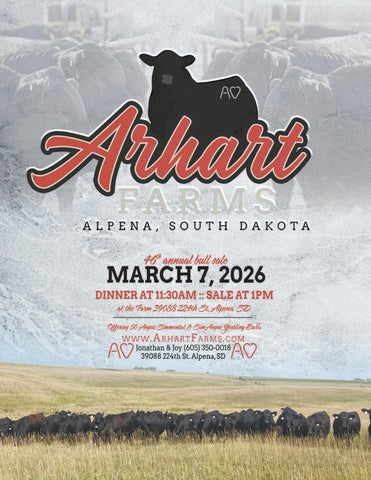
Arhart Farms 46th Annual Bull Sale

Page 1


Welcome

to the 46th Annual Arhart Farms Bull Sale.

My family consists of my wife, Joy, and our 5 children - Anna, Wyatt, Josie, Will and Jesse. Everyone has a part in keeping our farm running and it’s a joy to see their individual strengths and interests on the farm develop.

I was looking through my dad’s file from past bulls sales and realized our goals are still the same in cattle production. We strive to use proven sires that excel in growth and carcass traits while keeping birth weights and maternal efficiency at the forefront. We keep our sights on the cattleman and offer bulls that will help you reach new heights in your cattle operation.

I can’t write this better than my dad, LaVerne, so I will share this with you from the 1998 Arhart Farms catalog.

WHY SO MUCH EMPHASIS ON BULLS?

“Bulls have the greatest economic impact on any breeding program, the bull selected by the cowman is the most important decision and investment they can make during the course of a year. A bull sires 20-40 calves a year while a cow produces half or less this many offspring in her lifetime. It has been written that 80% of any herd improvement is directly attributed to bull selection.”

Arhart Farms has been collecting performance data on our herd for 69 years and incorporating top Angus and Simmental sires into our genetics via artificial insemination for 67 years. We also began evaluating carcass data using ultrasound technology in the early 90’s.

One thing that has changed is we now use Total Herd Enrollment (THE) through the American Simmental Association for record keeping. This is the 2nd calf crop we have used THE for recording and analyzing performance data. THE allows us to evaluate our cowherd and make evidence based decisions to produce bulls and females that can excel in all programs.

Two important characteristics of our cattle are docility and frame size. With our workforce consisting of 2 adults and 5 children, it is important that our herd have a high docility to keep everyone safe and make the work day enjoyable. When we choose bulls, knowing their frame size is important in our selection. Since it’s important to us, we feel it may be valuable to you and provided the frame score to each bull in the catalog.

If you have any questions before sale day, please call or stop by the farm to view the bulls or visit with us. Videos will also be available on dvauction.com for your convenience.

We invite you and your family to join us for a Steak Sandwich Dinner starting at 11:30am.

Jonathan & Joy Arhart family Arhart Farms

Jonathan & Joy Arhart Wyatt, Will, Jesse, Anna and Josie

Sales Staff:

Auctioneer

Matthew Magness - 605-695-6288

Sale Representatives

Jim Scheel, Special Assignment - 605-545-1521

Justin Dikoff, DV Auction representative - 605-290-0635

Sale Day Phones

Jonathan Arhart 605-350-0018

Joy Arhart 605-350-7404

Photography

LZ Livestock Photography

Terms & Conditions

• All cattle will sell under the suggested sale terms and conditions of the

• American Simmental Association. Terms available sale day.

EPDs:

Sale Location

39088 224th St., Alpena, SD FARM ON THE NORTH SIDE OF ROAD

From Alpena - 3 miles south on 392 Ave and 1 1/4 mile West on 224th St.

From US Hwy 281 - 2 3/4

miles east on 224th St., Farm on north side of road

All bulls have genomic enhanced EPD’s based on ASA EPD evaluation system, see page 19 for more information!

Data Glossary & Information

Data provided in this catalog compares our bulls as a contemporary group being fed and treated the same and experiencing similar environmental conditions.

MGD SIRE: Sire to the bull’s maternal grand dam.

Birth Weight: Actual birth weight.

Adjusted 205: Adjusted Weaning Weight.

Adjusted YW: 365-day Adjusted Yearling Weight

ADG: Total gain divided by the number of days on the test. We use the test gain as a tool to compare our bulls against each other, instead of feeding hard for high gains. We are careful to avoid over conditioning which can affect future fertility and soundness.

• Information in catalog is subject to change. Announcements made sale day take

• precedence over printed material.

• Buyer assumes risk of animal as soon as animal is declared sold.

• Arhart Farms (J & J Arhart Inc.) not responsible for accidents the day of sale.

• Seller retains 1/3 semen interest on all bulls selling. Buyers receive full possession and all salvage value.

Guarantee

We guarantee all bulls to be breeders and reserve the right to test any bull in question as a non-breeder for a reasonable amount of time before making an adjustment. And, if the bull is declared a sound breeder by a competent veterinarian, he will be returned to the buyer. In case an adjustment is required, it will be made with a replacement of equal value to animal in question or credit on purchase of another single animal. Credit must be used on following bull sale. Guarantee is not an insurance or mortality policy but a guarantee on functional fertility. The buyer assumes all risks for injuries due to running bulls together and management decisions out of genetic control.

• Bulls all have a magnet.

• Bulls will receive breeding shots and be semen tested before delivery.

• Arhart Farms will offer to feed bulls free of charge until May 20, 2026.

• Bulls delivered free of charge up to 300 miles.

Scrotal: Adjusted Scrotal circumference listed in centimeters.

Diet

Bulls have been fed a high roughage diet of corn silage, modified distillers, hay/rye mix, cracked corn and mineral supplement.

ADG was based on a 91 day trial.

Feed rations provided by Dave Loecker of Loecker Livestock Consulting, Fordyce, NE.

Health

Spring

Bovi Shield Gold 5

Vision 7 with Spur

July

Vista Once SQ

Vision 7 Somnus with Spur

Breed info

September

Express 5 HS Presponse Poured with Cydectin

CS = COMMERCIAL SIMMENTAL

SM = SIMMENTAL

AN = ANGUS

1Lot

Lot

• PB Angus bull out of a new sire for us, Granger Pacman.

• We chose Pacman for his MARB and frame size.

• Pacman calves come small but have the growth to get it done.

• Top 10% MARB & CW

Lot

2

• Here is a thick made 3/4 Angus Pacman son.

• He has been a favorite since he was born.

• A maternal brother was a top seller last year.

• A strong and steady Pacman son with

• It takes just 3 words to paint a picture of this massive Stock Fund Son.

• Top 4% Milk

• Out of Stock Fund - this bull gets it done on the growth side.

• Top 1% YW, ADG & CW

• Strong Maternal traits - Top 2% MCE, Top 5% Milk

• A

• Top 3% YW,

• AAA reg #21212831

Lot

• Southern Comfort son with lots of growth

• Whether you sell calves off the cow or background, he will add pounds which impacts your bottom line!

• Top 10% WW, YW & Milk

• Top 15% MARB

• PB Angus Southern Comfort Son that should produce calves that come easy and grow quickly.

• His dam has raised several calves retained for breeding, both replacement heifers and bulls.

• 3/4 Angus Southern Comfort Son out of a Proclamation daughter.

• This bull will add thickness to the hind quarters of your calves.

• Top 10% WW, Top 15% YW, Top 20% MARB

YON SOUTHERN COMFORT ♥ SIRE TO LOTS 7-13

TAG# 5039N DOB: 2/20/25

(4583364)

31/32 AN 1/32 CS

• An Angus bull that will add some pounds & carcass quality to your next set of calves.

• Top 5% MARB

• Southern Comfort calves range in the 5.8 - 6.2 frame size.

• This bull should be easy calving while adding yearling growth & carcass.

• Top 4% YW, ADG, CW

• Top 10% MARB

• The Southern Comfort calves are easy moving and docile.

• This one has strong carcass traits - Top 1% CW & top 3% MARB

• API & TI in the top 1% - you can use him to grow a herd or fill your feedlot

• Strong on carcass traits

• Solid maternal traits with MCE, Milk, MWW in top 5% or higher

• PB Angus Culmination son would be suitable for heifers.

• Top 5% MARB

• PB Angus Culmination son out of a 2nd calf heifer.

• He is suitable for breeding heifers.

• Strong maternal traits - Top 1% Milk & MWW, Top 10% MCE

• Top 4% YW, Top 5% MARB

• Culmination Son that is suitable for heifers.

• His dam is a promising young cow with 2 of her progeny retained for breeding thus far.

• He promises to pass along strong growth and maternal traits.

• Calving ease bull with top end growth!

• Top 1% YW, ADG, MWW, CW, Milk •

Lot

• A black baldy bull out of a first calf Falcon heifer

• Suitable for heifers

• Top 10% CE & MARB

• Top 15% BW & CW

• Culmination clicked with this Falcon mama!

• Top 1% Milk, CW, REA

• Solid growth & carcass traits come with this boy

• Covenant Son with a mid-6 frame.

• Thick made with plenty of growth.

• Make sure to look at this one sale day!

• Top 1% WW, YW & ADG

• This Covenant Son is the biggest framed bull on the sale

• He should make your next calf crop push the scales down!!!

• His dam is consistent and raises big calves each year.

• 1/2 blood Covenant Simmy bull.

• We picked Covenant to use in our herd to add some calving ease and growth.

• This bull should produce some awesome females that will bring a premium

Lot

• An absolute standout red bull

• Top 1% Docility - Top 2% CME - top 4% Milk - top 10%

• Out of a first calf heifer with strong maternal traits!

• Stunning Average Daily Gain of 5.2 lbs/day!!!

JC QUIET MAN 758K ♥ SIRE TO LOT 30
BSUM SUMMIT 303L

• 5/8 Simmental bull out of Gibbs Essential

• This was our first Essential calf crop and we like what he stamps on his calves.

• Top 2% CW

• Top 3% YW, ADG, MWW, REA

• Top 5% WW

• 1/2 Simmental Essential Son with stellar carcass traits

• Would be a good fit to breed to your PB Angus cows

• Top 20% BW, WW, Milk, MWW

• EPD’s are steady across the board.

• Gibbs Essential Son out of a beautiful uttered Falcon dam.

• Will add frame to you next set of calves

• Docility is strong in this bull at 17.6 which is top 3% in the breed

• Top 4% for $Gain shows he converts feed to pounds well!

36 Lot

Lot

• A high % Simmental bull with frame!

• His mama is an 11 yr old Right On daughter that grows a good calf for us year after year.

• This bull is docile and easy to work with.

Lot

• An Essential Son that came easy and grew well.

• We like the Essential calves and are sure you will too.

• A great bull to cross on Angus cows.

• Top 15% WW & YW and good docility 38 Lot

Lot

• PB Simmental with a moderate frame and impressive growth number

• Top 4% WW & YW

• Top 15% REA

• Good looking bull that is suitable for heifers.

• His lineage goes back to Sydgen Enhance who has made a strong impact on our cowherd.

Lot

• Out of an Eagle Son that I used on cleanup on heifers.

• He may be from the cleanup bull but you couldn’t tell the size difference in the pasture from the AI sired calves.

• Suitable for larger framed heifers. TAG# 5350N DOB:

Lot

• Eagle Son that could be used on heifers.

• His docility looks to match that of his sire.

• Top 10 or higher for YW, ADG, CW, MARB & TI

• This Eagle Son brings frame to the game!

• Top 15%

WS EAGLE 34K ♥ SIRE TO LOTS 39-42

• 5/8 Simmental bull with plenty of length.

• Top 10% WW & YW

• Top 3% Docility

Lot

• An Eagle Son that packs a punch on his 6+ frame size.

• Brings growth to the table with his WW & YW EPD’s

• Our Eagle bulls have strongly impacted our cowherd and we are hopeful they will do the same for yours.

• 5/8 SM Eagle Son from one of our best cows, a Added Value daughter

• These Eagle calves have grown great for us! Easy keepers that do well in the herd or feedlot.

• A high % Simmental bull with excellent growth numbers.

• Top 10% WW

• Top 20% YW, YG, REA

• His dam is a Sweet Meat daughter who has raised several calves retained for breeding.

• 3/4 SM Eagle Son with moderate BW.

• Would be a great one to retain heifers out of.

• This bull and lot 3 both go back to 843, who has consistently produced solid calves.

• Moderate framed

Thank you!

Livestock Photography & Videos

Catalog design by

It takes a team to put a sale offering together and we want to thank the team that helped our family this year!

Loecker Livestock Consulting

Quick Reference to ASA EPD and $ Indexes

Expected Progeny Differences (EPD): EPD are the most accurate and effective tool available for comparing genetic levels. In using EPD, the difference between two sires’ EPD represents the unit difference expected in the performance of their progeny. For example, if sires A and B have EPD of +10 and –5, a 15-unit difference would be expected in their progeny (moving from -5 to +10 yields 15 units). Key to using EPD is knowing what units they are expressed in. For example, if the above case referred to weaning weight EPD, A would be expected to sire 15-pounds more weaning weight than B. If calving ease were the trait, A would be expected to sire 15-percent more unassisted births in first-calf heifers; in other words, if B sired 30 assists in a group of 100 heifers, we’d expect A to require 15 assists. A percentile-ranking chart is required to determine where a bull’s EPD rank him relative to other bulls in the breed. For percentile rankings or more detailed information about EPD and $ indexes visit www.simmental.org. Listed below are the units ASA EPD are expressed in:

All-Purpose Index (API): Dollars per cow exposed under an all-purpose-sire scenario.

(See below for more details.)

Back Fat (BF): Inches of backfat.

Birth Weight (BW): Pounds of birth weight. Calving Ease (CE): Percent of unassisted births when used on heifers.

Calving Ease (CE): Percent of unassisted births when used on heifers.

Carcass Weight (CW): Pounds of carcass weight.

Maternal Calving Ease (MCE): Percent of unassisted births in first-calving daughters.

Milk (MLK): Pounds of weaning weight due to milk.

Marbling (MRB): Marbling score.

Maternal Weaning Weight (MWW): Pounds of weaning weight due to milk and growth.

Ribeye Area (REA): Square inches of ribeye. Warner-Bratzler Shear Force (WBSF): Pounds of force required to shear a steak. Stayability (STAY): Percent of daughters remaining in the cowherd at 6 years of age. Terminal Index (TI): Dollars per cow exposed under a terminal-sire scenario. (See below for more details.)

Stayability (STAY): Percent of daughters remaining in the cowherd at 6 years of age.

Weaning Weight (WW): Pounds of weaning weight.

Yearling Weight (YW): Pounds of yearling weight.

Yield Grade (YG): Yield grade score.

$ Indexes

Though EPD allow for the comparison of genetic levels for many economically important traits, they only provide a piece of the economic puzzle. That’s where $ indexes come in. Through well- conceived, rigorous mathematical computation, $ indexes blend EPD and economics to estimate an animal’s overall impact on your bottom line. The same technology that led to the dramatic progress in swine, poultry and dairy genetics over the last several decades was used to develop the following $ indexes: All-Purpose Index (API): Evaluates sires for use on the entire cow herd (bred to both Angus first-calf heifers and mature cows) with the portion of their daughters required to maintain herd size retained and the remaining heifers and steers put on feed and sold grade and yield.

Terminal Index (TI): Evaluates sire for use on mature Angus cows with all offspring put on feed and sold grade and yield.

Using API and TI: First, determine which index to use; if you’re keeping replacements use API, if not, TI. Then, just as with EPD, zero in on the unit difference between bulls. (As described above, index units are in dollars per cow exposed.) The difference can be used to determine how much a bull is worth compared to another. Or, put another way, how much you can pay for one bull compared to another. For example, when buying an all-purpose-type sire, you can quickly figure a bull scoring +100 for API is worth an extra $6,000 over a +50 bull if both are exposed to 30 cows over 4 years ($50 diff. x 30 hd. x 4 yr. = $6,000). A percentile-ranking chart is required to determine where a bull’s index value ranks him relative to other bulls in the breed. For percentile rankings or more detailed information about EPD and $ indexes visit www.simmental.org.

Genomically Enhanced EPD

Genomically Enhanced Expected Progeny Differences (GE-EPD) are a game-changer for commercial, seedstock, and all beef producers in between. ASA currently offers two different genomic panels to match your goals: the GGPuLD or the GGP100K. In the case of the GGP100k, the panel evaluates the molecular makeup of approximately 100,000 specific locations on the animal’s genome, some of which have influence on various traits we predict (growth, carcass, stay, etc).

The difference between GE-EPD and standard EPD is mostly seen in the form of increased prediction accuracy. Animals that have GE-EPD have significantly improved accuracy for all EPD as young animals. The way this improvement in prediction accuracy can be measured is by reflecting any improvement in a progeny equivalent. A progeny equivalent is the amount of progeny an animal would have to have born, measured for a trait, and reported to the ASA to receive the same increase in accuracy from a genomic panel. In the case of most of the growth traits, it would take ~25 progeny before a non-genotyped animal would receive the same prediction accuracy as a genotyped animal.

Important GE-EPD distinctions

A genomic panel is not guaranteed to move EPD in a favorable direction. In fact, all animals have equal opportunity to have EPD move in a favorable or unfavorable direction after a test.

The real value in performing a genomic panel on groups of young animals is by increasing accuracy of the prediction. This allows potential purchasers to have more confidence in the predictions, as well as increasing the rate of genetic progress in their herds.

You must allow at least one and up to two weeks from the date a genomic sample finishes at the lab for those results to be incorporated into the genetic evaluation. Phenotypes are still needed to continue to predict traits with accuracy. A genomic test will improve the accuracy of low- to medium-accuracy animals, but genomics alone can never replace the need for phenotypic measurements.

An important fact: While genomic tests add accuracy to low-accuracy animals, they can never replace reporting phenotypic data. For genomics to continue to have value, it is vital that breeders continue to submit quality phenotypic data.

2026 Average Hybrid Simmental EPDs

Turn static files into dynamic content formats.
Create a flipbook