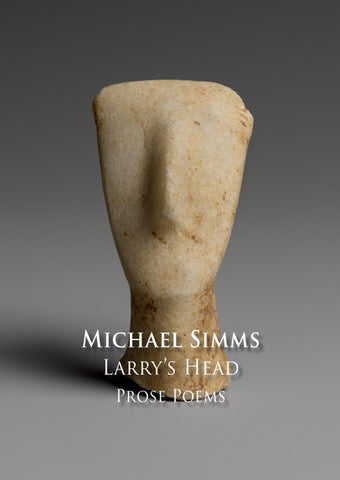
Michael Simms Larry’s Head Prose Poems
Photo credit: Eva Simms.
Michael Simms
Larry’s Head Prose Poems
Live Encounters Publishing
L A R R Y’ S H E A D - P R O S E P O E M S
Copyright © Michael Simms 2026 First published by Live Encounters Publishing October 2026 All rights reserved.
No part of this publication may be reporduced or transmitted in any form or by any means, electronic or mechanical without permission in writing from the author and publisher, except by a reviewer who may quote brief passages in a review.
Cover image: Cycladic, 2700–2300 B.C, Photo courtesy https://www.metmuseum.org/art/collection/search/329997 Designed and produced by Live Encounters Publishing https://liveencounters.net Email: editor@liveencounters.net
01
MICHAEL SIMMS
Contents Dedication 06 Preface 08 Introduction by David Rigsbee 10 Snail 12 My Life as a Flea 14 Larry’s Head 18 Piccolo’s Apology 22 Charly Jo and Her Many Children 26 The Summer of the Immortal Jellyfish 28 Grief 32 Envy: The Early Year 34 A Chair for My Father’s Ghost 36 What My Grandmother Saw 40 Convergence 42
02
L A R R Y’ S H E A D - P R O S E P O E M S
Angel of grief, a 1894 sculpture by William Wetmore Story.
03
MICHAEL SIMMS
For Janie Lu Cook Simms (1933 - 2012)
04
L A R R Y’ S H E A D - P R O S E P O E M S
Preface Why is Larry’s Head so weird? The eleven prose poems in this collection were written in the summer of 2025, a time of distress and confusion for me personally and for America at large. I was recovering from Covid and chronic asthma while also grieving the passing of my parents. Our nation had recently been taken over by fascists led by a convicted rapist and embezzler. As the editor of an online political magazine, I published many articles and poems critical of him and his administration, but I had a persistent feeling that the situation had become so absurdly unlike anything our nation had seen before that the type of realistic prose and poetry I’d been writing most of my life could no longer describe the experience of living as an American. In my unstill mind, I began playing with stories and images to describe the unfamiliar reality where I found myself. Sitting in my garden in the evening, I noticed a snail and realized how much in common I had with this mollusk. Then I realized I also shared many traits with a flea. Later, thinking of how we experience the political reality of America, I understood that we are being controlled by disembodied talking heads we see on screens. The poem Piccolo’s Apology is the true story of my 40 year marriage recounted as a surrealistic narrative set to imagined music in which the poet believes he is a piccolo. Charly Jo and Her Many Children is a semi-fictional genealogy of the sprawling beast of my extended family in rural Texas. The Summer of the Immortal Jellyfish is a short memoir of a season at my grandparents’ beach house on the gulf coast in 1962. Here, it is revealed that a jellyfish rejuvenates itself perpetually, a fascinating scientific fact we don’t tell children; instead we show them videos of creepy stories about fictional animals.
05
© Michael Simms
MICHAEL SIMMS
Let’s see... what else? Grief is a portrait of a grieving mother with an eating disorder who consumes everything on her island and then swallows an ocean. Envy personifies my feeling of being unloved as a child. Finding a Chair for my Father’s Ghost evokes the way that grief manifests itself in our memory of specific objects; in this case, my father’s ghost has nowhere to sit. What My Grandmother Saw references my wife’s work as a designer of women’s clothes and how the history of a garment resides in the fabric itself, giving the article of clothing a life of its own. And finally, Convergence is about the ways we ignore children in peril while institutionalizing our need to feel sympathy for the idea of childhood. A child falls down a well, and no one hears his cries because we make too much noise searching for him. Of course, the poems here could be interpreted in other ways, and I think the author is often the worst possible intermediary between text and reader since the poet necessarily sees the work as an extension of the self while the reader experiences the poem as a singular event. Well, maybe not...
In any case, this sequence of poems presents a reality where a man becomes a snail, then a flea, then a piccolo. Make of it what you will. Michael Simms Pittsburgh USA
06
L A R R Y’ S H E A D - P R O S E P O E M S
Photograph by Mark Ulyseas.
07
© Michael Simms
MICHAEL SIMMS
Introduction I have noticed over the years that Michael Simms’ imaginative reach exceeds the expectations of even the most benignly open reader. Larry’s Head: Prose Poems presents a case in point. We begin in the world of things —snails, fleas, jellyfish, chairs, scarves—and then quietly undo the boundaries between the factual and the imagined, the comic and the tragic, the ordinary and the metaphysical. A snail’s anatomy becomes a meditation on desire and companionship; the life cycle of a flea opens into a childhood marked by violence, theatrics, alcohol, and loss; a man who leaves his head on the breakfast table discovers a world in which almost everyone else has done the same. His gift is an ability to register the transformations taking place before our eyes seem not only possible but inevitable. As association bypasses argument, we follow the poet’s mind as it wanders from observation into memory, from memory into fantasy, and from fantasy toward meanings that stop at the gate of being named and colonized. The resulting prose poems are playful, surreal, sometimes mordantly funny, and often unexpectedly moving. Even when they seem to be inventing a world, they remain tethered to the stubborn facts of being alive in this one: childhood, desire, family, aging, grief, love, and death. The result is a liberating vision worthy of a latter-day Coleridge. David Rigsbee New York USA
08
L A R R Y’ S H E A D - P R O S E P O E M S
Vase with snails: Manufactory: Royal Copenhagen (Danish, 1775–present.)
09
© Michael Simms
MICHAEL SIMMS
Snail In daylight, Snail finds a dark place, closes himself in his small house and dreams of dirt and air. When Snail wakes, he touches his mouth to the ground and licks the rotting leaves with his rough tongue. Snail has a single foot lubricated with mucous attached to the back of his shell. Snail’s stomach is located in his foot.
Every night, Snail pushes himself forward, a little at a time, leaving a trail of dream-slime Snail manufactured during the day.
Snail has two sets of tentacles in his head. The top ones are his eye-stalks. The bottom ones are, you might say, his noses. Snail is very similar to you and me. And also to our dog who wants to eat Snail. The Mayans believed Snail was the manifestation of Uayeb, the god of sexual desire, because Snail produces both sperm and egg.
As we sit in the dark aroma of the garden, the whippoorwill grows silent. We listen to the rasping of Snail’s tongue on the leaves.
10
L A R R Y’ S H E A D - P R O S E P O E M S
Artist, Auguste-Adolphe Bertsch French 1853–5.
11
© Michael Simms
MICHAEL SIMMS
My Life as a Flea A flea can jump 110 times its body length repeatedly. I once jumped 110 miles from a friend’s house in west Houston to Country Cousins Famous Barbecue without remembering a thing. I’d been at a cast party and may have been drunk. A flea goes through four stages: egg, larva, pupa and imago.
I’ve gone through four stages: speechless dreamer, stunned witness, drunken wanderer and sober dad.
In male fleas, the first blood meal triggers the dissolution of the testicular plug, and copulation soon follows. Ditto. I had sex for the first time after a severe beating in the school parking lot. I was rushed to the emergency room. Susan, who played Helen of Troy in our production of The Trojan Women, snuck into my bedroom when I was healing.
Blood-only diets allow only 12% of flea larvae to mature, whereas diets of blood and yeast, flea feces, or dog chow allow almost all larvae to mature. My native diet includes pig knuckles, hog’s head cheese, pig intestines and fried chicken ovums. Lots of fried chicken ovums. I sampled kibble more than once. Where I come from, few males ever gain full maturity. The high immaturity rate may be related to diet. Flea larvae will eat the eggs containing its brothers and sisters.
continued overleaf...
12
L A R R Y’ S H E A D - P R O S E P O E M S
I was a merciless bully to my brothers, imitating my father who enjoyed slapping me around. My brothers still carry the mental scars of my cruelty. Flea larvae are blind and avoid sunlight, keeping to dark, humid places such as sand or soil, cracks and crevices, under carpets and in bedding. I was mute until the age of five. When I began to speak, it was with a Nebraska accent.
Adult fleas can live for several months without eating, so long as they do not emerge from their larval shell. At sixteen, I discovered the darkness behind the curtain, my hand on the panel that brought blue and amber light to center stage where Helen of Troy bargained for her life with her husband Menelaus who despised her. (Flea is an Australian musician and actor, best known as the bassist of the rock band Red Hot Chili Peppers. He has also played with many other bands, acted in films and TV shows, and co-founded a music school for underprivileged children. Flea’s real name is Michael Balzary. I feel sure that Michael Balzary is my spirit animal, and I am his.)
The oriental rat flea is a vector of Yersinia pestis, the bacterium that causes bubonic plague which has killed a sizeable fraction of the world’s people. The audience held steady, not even a cough, as Helen fell on her knees and spun lie after lie, but who could blame her? The joyful song of her youth had ended in Sparta, and here on this shore next to the winedark Aegean she knelt, her delicate touch on her husband’s sandal as he leaned back to kick her.
13
© Michael Simms
MICHAEL SIMMS
Fleas lay tiny, white, oval eggs. The larvae are small and pale, have bristles covering their worm-like bodies, lack eyes, and have mouth parts adapted to chewing. The larvae feed on organic matter, especially the feces of mature fleas, which contain dried blood. Adults feed only on fresh blood. I was the one who directed the light on Helen, allowing her family and mine to see where life would take us, but they chose to ignore the signs.
(Two years later, Susan was held prisoner, servicing guests at a hotel, her beauty sold for fifty dollars a pop while I had fallen into a trance of booze and delusion lasting a decade.) Fleas live in darkness. Some species are blind.
In those years, I chose to observe my life from the shadows.
14
L A R R Y’ S H E A D - P R O S E P O E M S
Cypriot ca. 600–480 BCE
15
© Michael Simms
MICHAEL SIMMS
Larry’s Head One morning Larry left his head on the breakfast table.
After he left for work, his head continued reading the newspaper, turning pages with its tongue. It consumed the front page, sporting section and stock reports, then grew bored.
Meanwhile Larry climbed into the front seat of his friend Frank’s car. It was Tuesday, Frank’s day to drive. Frank noticed that Larry had forgotten his head but decided not to mention it. After all, if Larry chose to leave his head at home, what business was it of Frank’s? Frank sometimes left his head at home, but this morning had decided to bring it to work, even though he wasn’t planning to use it. These days, his head was not much more than a fashion statement. Back home, Larry’s head rolled off the table and landed on a chair, and from there it was an easy fall to the floor. The head rolled over to the television remote which luckily happened to be lying on the carpet. The head surfed the channels with its tongue. A huge storm was headed this way. The economy was building a head of steam. The Steelers were ahead for the season.
When Larry arrived at work he didn’t notice that almost everyone in the building had lost their heads as well. Only the super boss, the boss of bosses on the top floor, had kept his head and was sitting at his desk watching his employees mindlessly going about their jobs. Their jobs, of course, were whatever the boss of bosses said they were.
continued overleaf...
16
L A R R Y’ S H E A D - P R O S E P O E M S
The Boss of Bosses wasn’t the Boss of Bosses for nothing. Afterall, he’d kept his head during the Great Crash when everyone else had lost their heads. So now here he was, the Head of a Big Corporation which made nothing and did nothing. And all this making of nothing required a lot of bodies staying busy all the time. Because the Big Corporation owned things which owned things which owned still more things. Important things that kept them ahead.
Larry’s head sat in front of the screen at home. Larry’s eyes were seeing all kinds of things. Larry’s brain was beginning to understand all kind of things. Big things. Like why are people leaving their heads at home? And now watching the news, Larry’s head noticed the President of the Presidents had lost his head. And the General of the Generals and the Ambassador of the Ambassadors had lost their heads as well. But there was one little man standing behind the President of the Presidents, and this little man was holding his head under his arm.
Larry’s head knew the little man must be the Head of the Department of Heads which reported directly to the trillionaires who were the Heads of Everything.
And the Head of the Department of Heads was holding his head in the air like a ventriloquist dummy. And Larry’s head could almost make out what the Head of the Head of the Department of Heads was saying.
17
© Michael Simms
MICHAEL SIMMS
Cypriot ca. 600–480 BCE
18
L A R R Y’ S H E A D - P R O S E P O E M S
Orissa, India, 13th century.
19
© Michael Simms
MICHAEL SIMMS
Piccolo’s Apology The stench in the air comes from the fumes of our world burning, but we were happy once. Remember when we drove the old bathtub through the circles of mortality the first time? Where the hell should we live now that we’ve arrived at the rest of our lives? I asked. You leaned your head back and shouted, Up there!
So I made a hard right that twisted through caves, emerging at the bottom of the sky.
Blue towers towered beside the green river where a regatta of sails sailed toward... Moundsville, I think. I want to live here, you piped, plucky as ever.
Excuse me, you said to a little man with a baton hobbling by. You look like a conductor. How much do the small houses on the cliff cost? Oh, Miss, he answered, shaking his head slowly, pointing his baton at the cottages. You can’t afford one of those. They cost an apple and an egg each.
continued overleaf...
20
L A R R Y’ S H E A D - P R O S E P O E M S
You and I exchanged a sly look, and you nodded.
What if we don’t have an apple or an egg? I asked shrewdly.
Well, then, the conductor said, I suppose you could trade your bathtub for one.
So we did. We traded our old bathtub for a small house with a stairway of notes that led to the sky. And then we started having gerbils. Half-tone gerbils they were, but we loved them all the same. They infested everything! Gerbils in the breakfast cereal. Gerbils in the crib. Gerbils in the yard playing gerbil baseball. It was a riot of gerbils!
We founded a school where gerbils could sing fur-baby songs and dance the day away. I loved the festivals with their ribbons and ostriches! We were the happiest piccolos ever.
After a time, though, we began to play in different symphonies.
Oh, we were careful to play the same songs around the gerbils, but your music no longer agreed with mine. I forgive you for saying my music was just the noise of men pissing in the wind while yours was devoted to teaching the trees around the house to sing.
21
© Michael Simms
MICHAEL SIMMS
My music, I admit, was not something you could dance to although the little conductor joined me nightly, rattling his baton along a picket fence and frolicking with coyotes who sang soprano. As for me, I shook a bucket of spit in rhythm and randomly ran my fingers over my body. To liven things up, I invited birds to the house. You said you were concerned for my sanity. Then you grew angry. I put up with all-night sessions with cats in heat, you shouted, but crows in the kitchen and raptors in the bedroom are too much.
I’m sorry for my squeaks and squawks, my love. I apologize for the falcons in the pantry and the robins in the attic. I’ll play better music. Please come home. I miss the wild arpeggios of our nights.
22
L A R R Y’ S H E A D - P R O S E P O E M S
Charly Jo and Her Many Children Charly Jo lived in a cabin under the wide sky for a long time before the motorcycle gang showed up and began eating everything in sight. Cattle, pigs, all the canned goods she’d stored. Charly Jo was old as dust. But man, she still had broad hips men loved to fool around with. Until they started eating children. So she dressed a possum like a baby and left it on the kitchen table. The leader of the gang swallowed the possum whole, refusing to share with the other men, so the men began hitting each other with sticks. Tired of their cruel nonsense, Charly Jo poisoned the men and buried their bodies in the field. She planted corn and named the rows for the twelve men underneath: Brom, Drogo, Cerdic, Hardwin, Aldred, Dina dan, Hamond, Lucan, Osric, Aglovale, Thurstan and Wolfstan.
Oh wait, Charly Jo thought. What was I thinking? Their names were actually Peter, James, John, Andrew, Bartholomew (or maybe Nathanael), James the Lesser, Judas the Traitor, Thaddeus, Levi, Philip, Simon the Zealot, and Thomas the Doubter. Well, whatever their names, the Gang of Twelve was dead, and Charly Jo was able to raise her remaining children: Oshie and his wife Tedi had lots of children who spread up the fertile valley and raised apples and plums. Minnie taught all the children to sing, dance and fiddle.
23
© Michael Simms
MICHAEL SIMMS
Ty’ Leah became a judge and decided who should be rewarded and who should be punished. The Mother of Fate, everyone called her. Colby became a scientist and traveled to the moon.
Paxton, whose name means “forethought” and his twin brother Elyan whose name means “afterthought” or perhaps “fool” became poets.
Atluri who was male and female, both and neither, carried everyone’s worries, lessening their burdens.
And Charly Jo? She still lives in her cabin under the wide sky, mother to all, and every night she cries herself to sleep. What have they done? What have they done?
24
L A R R Y’ S H E A D - P R O S E P O E M S
Image by Markus Kammermann from Pixabay
25
© Michael Simms
MICHAEL SIMMS
The Summer of the Immortal Jellyfish Jellyfish are immortal. They age backwards like butterflies becoming caterpillars.
One summer they invaded the beach. We couldn’t go in the water because their tentacles stung our legs. Jellyfish become younger by the day. But only when they’re starving. Kind of like kids.
There were seven kids. Me, my brothers, my sister, our two cousins. The summer of the jellyfish we were so bored, we lay in front of the television watching Howdy Doody and Roy Rogers. Gee willikers, Gabby Hayes was always saying.
Roy’s horse was a tall palomino named Trigger. Dale’s horse was a small buckskin named Buttermilk. Trigger and Buttermilk were beautiful -- nothing like the scraggly old horses on our farm. Gee willikers, I said, thinking about our horses growing old, not like jellyfish at all. My dad talked about needing to shoot the horses.
continued overleaf...
26
L A R R Y’ S H E A D - P R O S E P O E M S
Gee willikers, I said, thinking about how old my grandparents were. Gee willikers, I said. We’re all going to die.
That summer, I said Gee willikers, we’re all going to die so many times, my dad told me to shut up. Stop saying Gee willikers. Pinocchio and the Emperor of the Night was an animated sequel to the Disney classic. Pinocchio and a glow worm named Gee Willikers, voiced by Don Knotts, search for a magic music box owned by an evil raccoon named Scalawag, voiced by Ed Asner. My father once punched Ed Asner in a Chicago bar when they were in college. According to the story, Dad knocked him under the table. Gee willikers, I said to myself.
One morning, my grandfather Daddy Cook woke the kids early, and we drove to the ship channel where he taught us to tie a piece of bacon to a string and lower it in the foul-smelling water downstream from the oil refineries.
Daddy Cook showed us how to pull a crab slowly out of the channel still clinging to the bacon. One critic on television called the film deranged, wrenched out of the pitch-black recesses of some underground animator’s brain. Gee willikers.
27
© Michael Simms
MICHAEL SIMMS
Sitting all day in a bucket of brine, crabs release their toxins, so by the time we got back to the house, the water was murky, but the crabs were clean. I was starving.
As my grandmother boiled crabs for gumbo, I wondered whether I could age backwards like a jellyfish. Out the window, I could see the unbroken repetition of waves pushing against the shore. Gee willikers, I thought. We’re all going to die.
28
L A R R Y’ S H E A D - P R O S E P O E M S
Grief My mother lived on an island where planes flew low over the palm trees looking for her. She sank beneath the swamp to hide her face.
She was starving. When she wasn’t hiding her face, she ate bugs.
Also frogs, toads, dead fish and long tendrils of dry sea weed on the shore.
The other women of the village refused to eat bugs, frogs, toads, dead fish and long tendrils of sea weed, so they grew thin and beautiful. My mother told me that the shadows of the women were like water birds moving over the water. When the women were thin enough they swam out to sea where men were waiting for them on boats. But my mother stayed on the island.
She was not thin because she ate everything she could find.
When there were no more bugs, frogs and toads, no more dead fish or long tendrils of sea weed on the shore, she ate the bark of a palm tree. Then she ate the palm tree.
She ate sand. She ate the sky. She ate her own fingers. She swallowed her tongue and still she was hungry.
29
© Michael Simms
MICHAEL SIMMS
She was all alone on the island though I was there. My father was there. Even my dead sister was there. But my mother was all alone.
One day after she’d finished eating everything, she heard a plane overhead. She needed to hide.
But she had eaten the entire swamp. No more mud. No more minnows. No more slime. No place to hide. She walked into the sea until she was completely under water. She sank to the bottom and filled her lungs with the sea. And became the sea.
30
L A R R Y’ S H E A D - P R O S E P O E M S
Envy: The Early Years Envy rides his tricycle with red streamers flying behind him like a rocket headed to misery.
Every day Envy counts the hairs on his belly and compares them to Dad’s. Envy goes in Mom’s closet and tries on shoes. He looks best in heels. Exactly who he is
Is a far reach into the forgotten doorstopper of the O.E.D. What is the O.E.D? He doesn’t know, but he hates it.
Envy was last in line at the cafeteria of talents. The last in the looks department too.
He can’t throw hoops. The ball hits him in the head when he tries to catch it. Envy likes the way Dad laughs when he talks on the phone. He hates the way Dad laughs when he talks on the phone.
Envy always wanted to be someone not in the mirror. Someone with tousled hair. A smile of quiet confidence.
Contentment was a continent he’d never visited. A place of monuments and moments when the sea lapped the shore.
31
© Michael Simms
MICHAEL SIMMS
Envy sits on the spectrum between disfunction and overachievement, the specialist says.
The boy can’t decide if he wants less or more, Mom says. The boy shrugs. No difference he can see between less and more. It’s all the same, more or less. Envy envies the cherry snow cone the kid at the zoo holds in one hand while pointing at the aardvark with the other. Envy hates the double a of aardvark. That is, he likes it a lot.
Envy traces the letter a in the sand on the shore, his mother calling his name from far away. Envy, come home. Come home, Envy.
32
L A R R Y’ S H E A D - P R O S E P O E M S
Henry Hobson Richardson American ca. 1880
33
© Michael Simms
MICHAEL SIMMS
A Chair for My Father’s Ghost I was trying to find a chair for my father’s ghost.
He seemed uncomfortable standing in the hallway beside the umbrella stand. Everything he said was an echo.
He was the shadow of a plum tree on his grandfather’s farm inside a book he read long ago. Long ago a surgeon opened my eye and found scar tissue. The smashed ball had healed, leaving me half blind. I see things.
My father is standing next to an old chair his mother grabbed from a burning house long ago. I keep saying long ago. There is no long ago. Only now circling back on itself. Her father set his bed on fire after beating his son.
The chair in the hallway is constructed of three woods. Legs of hickory. Seat of oak. Ribs of pine.
Pine needs to be soaked in salt water for a month, then bent into a perfect curve like a sentence from Merleau-Ponty.
continued overleaf...
34
L A R R Y’ S H E A D - P R O S E P O E M S
Merleau-Ponty said our body applies itself to space like a hand to an instrument.
I live with a philosopher. Can you tell? My father tried to read her book, but couldn’t sit still. His mind wandered like a crow over an Illinois cornfield where I’m stitched to a cross of my own making.
The antique chair is not what my father needs. Scorch marks on its legs. The philosopher is peeling potatoes in the kitchen.
I invite my father in. He stands behind the philosopher as she prepares dinner.
The potatoes have been soaking in a pan of salt water. Now they’re soft. She removes the peels in a long spiral. You can actually make a pie from potato peels, but she doesn’t want to. She was invited to be chair of her department, but declined.
My father rose to become somebody, then retired and became nobody. I’ve been a nobody my whole life. Perhaps after I die I’ll be somebody. People will read my books and say now there was somebody. No they won’t.
35
© Michael Simms
MICHAEL SIMMS
I wonder what the antique chair is thinking. Does she remember her sisters sitting around the family table pretending to be content? Does she remember fire? Silly poet. Chairs don’t think. They sit and wait, dreaming of rich loam on the forest floor. Wind in high branches. When we sit in a chair, are we part of the forest dreaming of becoming chairs? I hate metal chairs. They remind me of Republicans.
A chair should be in complete agreement with the body.
When a chair disagrees with the body, the whole room hurts.
The redwood chairs sit on the patio beneath the elderberry tree. Everyone on the same page. We’ll see if my father joins us.
36
L A R R Y’ S H E A D - P R O S E P O E M S
What My Grandmother Saw Years ago, a woman wore a red silk scarf on her head as a babushka. The scarf took the shape of the woman’s head.
A few days later, she wore the scarf around her neck, and the scarf took the shape of her neck.
She hung the scarf on a hook next to her coats in the entry hall where a narrow shaft of sunlight hit the scarf a few minutes each day causing it to shimmer. The scarf took the shape of a waterfall.
The woman forgot the scarf. Over time, sunlight faded a bar across the top of the folds, leaving them pink.
The scarf sat next to a purple leather jacket. As the woman took the jacket off the hook in the morning and replaced it in the evening, the damp jacket rubbed against the scarf, leaving a hint of fuchsia. Over the years, hands touched the scarf. Sweaters, hats, shirts touched the scarf.
The woman dyed her hair platinum, and one rainy day, she covered her head with the scarf. When the woman died, her daughter threw the old scarf and other clothes in a bag which found its way to the Salvation Army. The scarf hung on a clothes tree with other scarves.
37
© Michael Simms
MICHAEL SIMMS
An artist rummaging for materials bought the old scarf for fifty cents.
She took the scarf to her studio and tore it into strips. She liked the ragged edges of the silk and the many shades of red and gray. She lay the strips on a canvas arranged by saturation and luminosity and glued them in place.
Along the bottom of the canvas, mahogany for the earth and amaranth for the dawn. Ascension into dark sky. Rose, apple, ruby, burgundy. Blood streaked with platinum. She lacquered the entire surface to reflect light. She threw sand on the wet lacquer for texture. In this way, the scarf became the artist’s memory of the levels of dawn over the ocean when she was a child. She called the piece What My Grandmother Saw.
38
L A R R Y’ S H E A D - P R O S E P O E M S
Photograph by Mark Ulyseas.
39
© Michael Simms
MICHAEL SIMMS
Convergence As you scratch a mosquito bite on your thigh, a boy falls down an abandoned well. The sky gathers in the east. A thundercloud moves this way.
Studying the mathematics of an expanding universe, an astronomer notices an anomaly surrounding the black hole at the center of the galaxy and suspects, not for the first time, that our only home is itself a black hole from which nothing escapes.
Living on a mountain in the middle of a city, you feel giddy sometimes. A hawk is circling overhead, sparrows hide beneath the boughs.
A bear emerges from the woods and walks down the middle of the street. Rain arrives on our roof like a message in a language we once undestood. The earth, the moon and Venus are in perfect alignment, but we’ve forgotten how to measure the light of three bodies in love.
Lying in bed, your body and my body and my body are wrapped in a horizontal spiral of years. Neighbors walk through the field calling the boy’s name, making so much noise they cannot hear him calling from the darkness.
40
Michael Simms is an American poet, novelist and publisher. He is the Founding Editor of Autumn House Press and Vox Populi Sphere; and the author of five collections of poetry, six speculative novels and a textbook about poetry. His poems have been published in Poetry (Chicago), Scientific American, Plume and Poem-a-day (Academy of American Poets). In 2014, Simms was awarded a Certificate of Recognition from the Pennsylvania Legislature for his service to the arts.
Cover image: Cycladic, 2700–2300 B.C,
Designed and produced by Live Encounters Publishing https://liveencounters.net Email: editor@liveencounters.net © Michael Simms