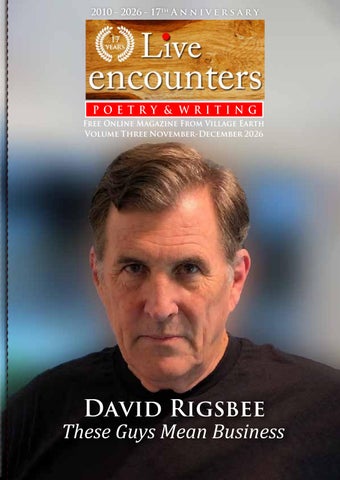
2010 - 2026 - 17th A n n i v e r s a r y
P O E T R Y & W R I T I N G Free Online Magazine From Village Earth Volume Three November-December 2026
David Rigsbee
These Guys Mean Business 2026 November-December POETRY & WRITING © liveencounters.net
LIVE ENCOUNTERS MAGAZINE
©Mark Ulyseas
View from plane. Photograph by Mark Ulyseas. © liveencounters.net POETRY & WRITING Volume Three November-December 2026 Celebrating 17th Anniversary
P O E T R Y & W R I T I N G
Volume Three 17th Anniversary November-December 2026
Support Live Encounters.
Donate Now and Keep the Magazine Live in 2027 Live Encounters is a not-for-profit free online magazine that was founded in 2009 in Bali, Indonesia. It showcases some of the best writing from around the world. Poets, writers, academics, civil & human/animal rights activists, academics, environmentalists, social workers, photographers and more have contributed their time and knowledge for the benefit of the readers of:
Live Encounters Magazine (2010), Live Encounters Poetry & Writing (2016), Live Encounters Young Poets & Writers (2019) and now, Live Encounters Books (August 2020).
We are appealing for donations to pay for the administrative and technical aspects of the publication. Please help by donating any amount for this just cause as events are threatening the very future of Live Encounters. Om Shanti Shanti Shanti Om Mark Ulyseas Publisher/Editor
All articles and photographs are the copyright of www.liveencounters.net and its contributors. No part of this publication may be reproduced without the explicit written permission of www.liveencounters.net. Offenders will be criminally prosecuted to the full extent of the law prevailing in their home country and/or elsewhere. 2026 November-December POETRY & WRITING © liveencounters.net
Contributors
© liveencounters.net POETRY & WRITING Volume Three November-December 2026 Celebrating 17th Anniversary
P O E T R Y & W R I T I N G
Volume Three 17th Anniversary November-December 2025
David Rigsbee – guest editorial John Philip Drury Stephanie Green Brian Kirk Indran Amirthanayagam Damen O’Brien Diane Fahey Tim Tomlinson Libby Sommer Maria Miraglia Dimitris P Kraniotis Karin Molde Michael Minassian Paris Rosemont Jonathan Cant Sarai Ades Ray Whitaker Luis Cuauhtémoc Berriozábal Alexandra Fraser
2026 November-December POETRY & WRITING © liveencounters.net
GUEST EDITORIAL
David Rigsbee © liveencounters.net POETRY & WRITING Volume Three November-December 2026 Celebrating 17th Anniversary
DAVID RIGSBEE David Rigsbee is the recipient of many fellowships and awards, including two Fellowships in Literature from The National Endowment for the Arts, The National Endowment for the Humanities (for The American Academy in Rome), The Djerassi Foundation, The Jentel Foundation, and The Fine Arts Work Center in Provincetown, as well as a Pushcart Prize, an Award from the Academy of American Poets, and others. In addition to his twelve collections of poems, he has published critical books on the poetry of Joseph Brodsky and Carolyn Kizer and coedited Invited Guest: An Anthology of Twentieth Century Southern Poetry. His work has appeared in Agni, The American Poetry Review, The Georgia Review, The Iowa Review, The New Yorker, The Southern Review, and many others. Main Street Rag published his collection of found poems, MAGA Sonnets of Donald Trump in 2021. His translation of Dante’s Paradiso was published by Salmon Poetry in 2023, and Watchman in the Knife Factory: New & Selected Poems was published by Black Lawrence Press in 2024.
The following is the opening scene of the third part of a memoir called Three Teachers: Kizer, Brodsky, and Rorty, that I have recently completed. While the first two parts recount my experiences with two poets over many years, the third is devoted to my friendship and study with the philosopher whom Harold Bloom once characterized as "the most interesting philosopher in the world today." This part tries to give a sense of the roiling poetry scene in the U.S. at the end of the century, which included the rise of Theory, and considers poetry's widening relevance as a practice for making sense in a fractious world.
David Rigsbee
These Guys Mean Business Back in the mid-’80s, Rodger Kamenetz, Andrei Codrescu, and I found ourselves sitting in a booth at IHOP in Baton Rouge about 3 a.m. We had the munchies. We had been talking nonstop all night about poetry and about the new M.F.A. program L.S.U. was putting in place. We talked about the rise of Theory in the English department and what that meant for those of us involved in creative writing. Rodger had a smartest-person-in-the-room reputation, it being known that he had gone to Yale at 16. He and I had met in the Johns Hopkins Writing Seminars, and when I went on to a job after getting my M.A., Rodger went out to Stanford to begin graduate work. The rumor was that he dropped out midway, bored, he said, bored with what they were doing at Stanford. In fact, he left with an M.A. in comparative literature. He was my type of person, an outlier who nevertheless had sharp insider skills when he needed them. I was more conventional and so grazed in the lower pastures of academia. Rodger had tenure, despite his lack of a Ph.D. He had convinced the English department to offer a position to Andrei, who lacked any degree at all but whose name was already established in the poetry world. He was also a man with impeccable Modernist credentials (he named his son after Tristan Tzara, the founder of Dadaism) and hung out with Allen Ginsberg. Andrei and Rodger were both wits and literary polymaths, and I enjoyed their company. Indeed, our friendship renewed almost from the moment I arrived in Baton Rouge.
continued overleaf... © David Rigsbee 2026 November-December POETRY & WRITING © liveencounters.net
GUEST EDITORIAL
The English department at LSU prided itself on being up to date at a time when the humanities generally were critiquing themselves to death, resulting in shrinking majors and constituencies, and beginning the long slide toward irrelevance as STEM education began to crest. Rodger, Andrei, and I took note of the preening faculty members among whom we worked. Tweed had given way to leather. Our department chair had been hired from SUNY Buffalo to sprinkle some critical serendipity on the humanities and ended up politicizing the department, a trend I would find again in my subsequent jobs. The creative writing program, solid as we understood it, was nevertheless not a fashionable part of the department. We were considered naive and self-centered artistes pretending to deserve equal regard from the scholars. I don’t remember which lecture we had attended. It could have been Frederic Jameson (in leather jacket) or Father Walter Ong in clerical collar, but it was theoretical and therefore important in some sense that we show up. The same could not be said for the poets we brought in, who seemed to draw fewer and fewer people as the year wore on. In fact, the same year I’m describing, Rodger and I invited the rotund southern poet Leon Stokesbury to give a reading. Leon arrived by bus from Georgia, and Rodger and I picked him up and drove to the venue, a classroom in the English building. No one was there. We waited. No one. Finally, Rodger shrugged in embarrassment and asked Leon if he would be willing to do a reading for the two of us, and we would record it on tape for the university library’s archives. He agreed to do this. He even mounted the podium. Afterward, we handed over the honorarium in a department envelope, which Leon didn’t bother to inspect. We tried to make light of the truant audience, but we were chagrined. The recorded reading, incidentally, was delightful, imaginatively alive and graced with humor. I ordered a patty melt, and the talk came round again to the rise of theory. Rodger was of the opinion that the presence of theory in poetry was, while lamentable, a passing fad. Rodger was not at all averse to experimentation, followed by criticism, but the poetry came first and was thus primary. Criticism was secondary because there had to be a text in the first place to be critical about. The critic, no matter how accomplished couldn’t exchange place with the poet. I countered that theory-wielding critics had a place so long as their analyses didn’t seek to overshadow the experience of poetry.
© liveencounters.net POETRY & WRITING Volume Three November-December 2026 Celebrating 17th Anniversary
DAVID RIGSBEE
Rodger said there must be a kind of fascination and sense of empowerment to think that one could take down a poem and substitute the illusion of control over something that couldn’t be accounted for by old school interpretive means. He said that grad students in the department now read only the secondary literature. There was no reason to have to read the original. This ass-backwardness was met by knowing laughter from Andrei. He had after all immersed himself in the Surrealists, and the theme of his own poems could be said to be, simply, absurdity. He pointed out that that poets of the rising L=A=N-G=U=A=G=E school, far from being the next generation’s sans culottes, were already aligning themselves with abstract language theorists in major universities, situating themselves with plummy jobs and tenure. I took Andrei’s point and pressed him to explain how he thought it could be that a poet could deconstruct herself, depriving her of transparency, authority, subjectivity, coherence, and aesthetics. “It’s easy,” he said. “It’s like Dada, except that it lacks a sense of humor. These guys take themselves very seriously, and the institutions that underwrite them by putting them on the faculty, placing them in front of students, and funding their projects have fallen in line because they want to be a part of the next big thing. Even if that thing is nihilism.” We all looked at each other. “Let’s face it,” Rodger said, “we’re old-fashioned.” While I wondered how it was that poets were drawn to the flames of theory, Andrei explained that it was an irony that such poets by and large were ignorant of Continental philosophy generally. “Look at the poets in Europe. They all have a background in philosophy as well as literature. In America, poets don’t turn to Hegel or Nietzsche to get their ideas. A surrealist poet from middle Europe would find that naive and irresponsible. American poets don’t work with ideas. Look at Williams: ‘no ideas but in things.’ It’s considered anti-intellectual.” Right at that moment, it occurred to me that I wanted to circumvent the battleground where poetry had to be propped up by Theory. I wanted to go to the source: philosophy.
continued overleaf... © David Rigsbee 2026 November-December POETRY & WRITING © liveencounters.net
GUEST EDITORIAL
I think we all had such reservations in the early ‘80s, but the matter is not so simple. Indeed, the mockery that swelled at the rise of L=A=N-G=U=A=G=E poetry eventually revealed itself to be a kind of envy that its practitioners had accrued such sudden prominence and acceptance. At length, the poets of this persuasion taught us that there was much to reexamine in our cosseted, drawing room art. They revealed real issues about the nature and practice of poetry, and they did so for the most part with insight and intelligence.
Except for a brief tour of the field at UNC as an undergraduate, under the vague and yet useful tutelage of phenomenologist Richard Smyth, in which we listened to lectures on Merleau-Ponty and Sartre, punctuated by extracts from Wallace Stevens, I realized that, as May Sarton wrote, “The wicked times have put me back to school.” While the encounter I describe here really did take place, the puppet-master in me has a harder time putting words in the mouths of Rodger and Andrei, but this is pretty close to the spirit of it. What it doesn’t have is the sense of concern that settled over a long night on the other side of a forgotten lecture followed by bar-hopping, driving around, and, finally, the International House of Pancakes where we discussed the currents of American poetry, what mattered and what didn’t, of who might be relevant, who not. These were things we were passionate about. I do remember quite literally Andrei looking me in the eye and delivering a verdict in his Dracula-inflected baritone, “These guys mean business, man.”
© liveencounters.net POETRY & WRITING Volume Three November-December 2026 Celebrating 17th Anniversary
DAVID RIGSBEE
Available at: https://blacklawrencepress.com/books/watchman-in-the-knife-factorynew-and-selected-poems/ © David Rigsbee 2026 November-December POETRY & WRITING © liveencounters.net
FANTASYLAND
John Philip Drury. Photo credit: Tess Despres Weinberg. © liveencounters.net POETRY & WRITING Volume Three November-December 2026 Celebrating 17th Anniversary
JOHN PHILIP DRURY John Philip Drury is the author of five full-length poetry collections, most recently The Teller’s Cage: Poems and Imaginary Movies (Able Muse Press, 2024). His first book of narrative nonfiction, Bobby and Carolyn: A Memoir of My Two Mothers, came out from Finishing Line Press in 2024. His awards include an Ingram Merrill Foundation fellowship, two Ohio Arts Council grants, a Pushcart Prize, and the Bernard F. Conners Prize from The Paris Review. After teaching at the University of Cincinnati for 37 years, he is now an emeritus professor. He and his wife, LaWanda Walters, live in Cincinnati.
Getting Lost in the Most Serene Republic Between a peeling wall and a wide canal, two boys with wooden swords are dueling. One blade shatters on a jutting windowsill. The other doesn’t thrust. Without a word, not a touché of victory, he drops his splintery weapon on the paving stones. They walk off, and the smiling loser claps, a sound that echoes down canals and lanes. I rub my hand along rough stucco walls, letting myself get lost in broad daylight. Down a long alley, standing with arms spread wide, a young man reads a tabloid. Upon his head he balances a platter heaped with fruit. Over the news, a shadow has fallen.
© John Philip Drury 2026 November-December POETRY & WRITING © liveencounters.net
FANTASYLAND
Fantasyland Gazing at Giovanni Bellini’s Madonnas, the loner spots a female saint, a green-eyed beauty in front of misty Apennine mountains, crenellated tower, a flock with their shepherd: a fine place for a picnic where picturesque delicacies unite. When he leaves the Accademia, it’s night, and a police launch like the ones in Donna Leon’s novels glides by, a photogenic opportunity for tourists, keen-eyed to catch clichés but too slow to unlock their cameras, waiting for vaporetto 1,
an exchange of Ist das unser Boot? and Nein. Daytrippers leaving, it’s a small town tonight. From the piazza, he walks beneath the clock and thinks of “Like a Virgin,” how Madonna danced in a gondola, shiny and renewed, and ducked below low bridges in the nick
of 4/4 time. And now he hears the symphonic slosh of canals and glimpses leonine doorknobs on shops. He can’t help making snide reflections on the daily crowds that ignite his embers of indignation, those prima donnas whose arias drone. If only he had a Glock
© liveencounters.net POETRY & WRITING Volume Three November-December 2026 Celebrating 17th Anniversary
JOHN PHILIP DRURY
to restore peace in paradise… No luck. Alone in a bar, drinking a gin-and-tonic, he hears the juke-box playing “Lady Madonna,” Paul’s raucous piano rousing his unknown fantasies. But could he be a knight whose quest meant murder, with no urge denied
if poison made it secret? Cyanide, almond-sweet and swiftly lethal. Hemlock, good enough for Socrates. Aconite from purple flowers. Classic arsenic, without the old and tattered lace. Strychnine from seeds. Nightshade from berries, belladonna.
But no, this culprit swears off hemlock, strychnine, finds arsenic sickening, cringes at cyanide, dreads picking aconite or belladonna.
© John Philip Drury 2026 November-December POETRY & WRITING © liveencounters.net
FANTASYLAND
Fleeing from the Mainland as Barbarians Approach Out of fear, a city emerges from mud. On islands where no stones are quarried, marble rises, transported on barges from ransacked churches, built over pilings cut from larch, oak, alder, spruce, and pine, driven through squishy layers to a clay substratum. Someone learns how to stand in a boat and pole it through twisty channels, to jump into brackish water and push at the hull when it runs aground in the muck. Someone mixes ground pigments with egg yolks and paints a tame lion, a dragon speared by a golden-haired saint in armor. Women perch on rooftop platforms and pull their long hair through haloes of hatless brims to bleach in the sunlight. Two strangers board a long black boat after midnight and enter a cabin that sways with the tides, while a rower stands at the stern, ducking under low bridges, negotiating corners, never getting lost in the zigzagging maze of waterways.
© liveencounters.net POETRY & WRITING Volume Three November-December 2026 Celebrating 17th Anniversary
JOHN PHILIP DRURY
©Mikyoung Cha
Photograph © Mikyoung Cha © John Philip Drury 2026 November-December POETRY & WRITING © liveencounters.net
PAUSES
Stephanie Green. Photo credit: Amanda Howell. © liveencounters.net POETRY & WRITING Volume Three November-December 2026 Celebrating 17th Anniversary
STEPHANIE GREEN Stephanie Green is an Australian poet, essayist, biographer and short story writer, widely published in Australian and international journals, and in recent anthologies such as Fire and Rain, eds Yuyutsu Sharma, Sally Breen and Jennifer Mackenzie (Pratik/ APWT 2023), The Incompleteness Book II, eds Julia Prendergast, Eileen Herbert-Goodall and Jen Webb (Recent Works Press 2021), and the Anthology of Australian Prose Poetry, eds Cassandra Atherton and Paul Hetherington (MUP 2020). Stephanie’s most recent collections are Seams of Repair (Calanthe, 2023) and Sahara Rain (Liquid Amber, 2026). Currently an Adjunct Senior Lecturer with Griffith University, she lives and works on the unceded lands of the Yugembeh/Kombumerri Peoples in south-east Queensland.
Pauses I put my ear to your chest and listen as your rattled lungs fill and empty. Like the sea you seem tireless. I want you to breath me in, to hold me inside your body always, but with each exhale you remind me nothing stays as it is. The weather always turns. Clear summer blue thickens with haze. The scent of smoke weighs on the breeze. We walk down to the harrowed beach, rutted dark yellow by storms, and watch the white tide together. You’re quieter than usual, counting the pauses between the waves. Is that how we live, I ask you, waiting for the pauses? There are no real still points, you remind me, only moments. Not even words stay the same, not even when you write them down. I can’t write your breath into being, but your words will always remind me of the in-between places, the moments, and the promise that we can begin again.
© Stephanie Green 2026 November-December POETRY & WRITING © liveencounters.net
PAUSES
In Pieces Everything is in pieces. Nothing is whole. The streets have become abstract compositions. Jagged edges, broken pathways, segmented oranges and apples spilling from their majolica plates, lips, eyebrows detached from their anchoring places, floating on the dusty air, flat oblongs that once were cars and trucks, a child’s plastic toy peeking from behind a fractured pylon. There is no straight path, no fast highway through this, no complete sentences to unsay it, only disjointed fragments and whispers telling us this way, and that way, and a faint breeze on our cheeks from the last distant windmill, the sun rising over a blackened sea.
© liveencounters.net POETRY & WRITING Volume Three November-December 2026 Celebrating 17th Anniversary
STEPHANIE GREEN
©Mark Ulyseas
Photograph of sunrise from a plane © Mark Ulyseas. © Stephanie Green 2026 November-December POETRY & WRITING © liveencounters.net
NONE SO BLIND
Brian Kirk © liveencounters.net POETRY & WRITING Volume Three November-December 2026 Celebrating 17th Anniversary
BRIAN KIRK Brian Kirk has published two poetry collections with Salmon Poetry, After The Fall (2017) and Hare’s Breath (2023) and a fiction chapbook It’s Not Me It’s You (Southword Editions, 2019). His first novel Riverrun is forthcoming from Library Tales Publishing in late 2026.
None So Blind Stupid blind man up ahead. He’s using a white stick with a ball on the end, testing the uneven footpath. It’s mid-morning, grey skies, hardly anyone else on the street. I’m on my way to the shop to get milk – I slept late, no breakfast yet, irritable, hungry. Supposed to be working from home, but I’ve already ignored two calls from my boss. This is bullshit. We argued again last night, Alison and me. Same old routine. We’re both sick of it at this stage. She says we’re stuck in a rut and she’s right, but I won’t give her the satisfaction. When she left to go to her parents’ house, I was relieved, opened a bottle of red and drank every drop before falling asleep on the couch. I can see the gaudy shop sign in the distance, but the blind man is slowing down now, useless eyes bent to the pavement while he pokes at some trash with this stick. When I get near, I drag my feet on the path, clear my throat, as a kind of warning to him I suppose. But just as I’m passing, he steps out suddenly to his left and I collide with him. I’m not a big man, but he’s smaller, feels light as a feather. He hits the ground before I can reach out to grab him. It’s all in slow motion, the sound of his skull hitting the pavement seems so loud and there’s blood – on the ground, on the side of his face. ‘Are you okay?’ I bend over him, take his arm, try to get him back on his feet.
He looks at me with his dead eyes – or he looks past me at something that may or may not be there. ‘Thank you,’ he says. His voice is hoarse, like a whisper.
I’m not sure what to do now. I need to get to the shop and get home to phone my boss. I should probably phone Alison too. ‘My stick!’ the man says, suddenly frightened.
continued overleaf... © Brian Kirk 2026 November-December POETRY & WRITING © liveencounters.net
NONE SO BLIND
‘It’s okay, I have it.’ I bend to retrieve the white stick, holding him steady with my left hand at the same time. His body rocks slightly, as if he might fall again. I put the stick in his right hand and take my hands away for a second to see how he fares on his own. Not good. ‘Take my arm, please,’ he says. I take it.
‘Where are you going?’ I ask as we set off together. He walks so slowly. ‘There’s a café along here soon,’ he says.
We walk on in silence. After a while we pass the shop. I wonder should I ask him to wait outside while I go in to get some milk, but I can’t do it.
When we reach the café, I realise he looks a mess, so I clean him up a little. There’s dried blood on his cheek and on the heel of his hand where he wiped it carelessly. I find a tissue in my pocket and spit on it the way my mother used to when I was a kid and wipe his face. I always hated that, but he suffers me to do it in silence. I assume they’ll all know him in the café and I’ll be able to leave him there and get on with my day. But no. Inside it’s busy and when I find a table no one comes to take our order, so I ask him what he wants. I get him tea and a cream doughnut and a latte for myself and we sit down together.
Cream oozes from his doughnut when he bites it. There are traces on his fingers, on his face, and I take a napkin and wipe him clean. He smiles for the first time, restored to himself by the hot tea and cake. ‘You’re very kind,’ he says.
I’m not. I hate so many things. Myself, my boss, the lousy work I have to do, maybe even Alison. Every time we meet these days is an ordeal. We square up to each other and exchange verbal blows. I know this isn’t what you’d call a normal relationship. © liveencounters.net POETRY & WRITING Volume Three November-December 2026 Celebrating 17th Anniversary
BRIAN KIRK
My phone begins to ring again. I silence it.
‘Someone’s looking for you,’ the blind man says. ‘I’ve kept you long enough.’ ‘It’s nothing,’ I say, ‘just work stuff. It’ll keep.’
I’m not sure why I lie to him. It’s Alison. For a moment I remember how things were between us at the start. I imagine she’s calling to say she’s sorry, that we should never fight again, and I’m saying yeah, no, you’re right, we really need to get away from here, to give ourselves a chance to find ourselves again. But I don’t answer it. I know she’s really calling to deepen the argument further, to take it to places we can never get back from. She’s like someone who storms out of a room to great effect having proclaimed the final word only to come back moments later with more to say: and another thing… I’m not myself anymore, and Alison is not herself either but a cranky simulacrum I have devised. I know there’s no going back to before. ‘Does it ever get too much?’ I ask him.
He tilts his head – he doesn’t understand.
‘You know …’ How do I ask him about his lack? ‘Not having your sight, missing so much of the world?’ He stands up to take his leave and pauses by the table for a moment. I don’t want him to leave. I want Alison to see us, me and the blind man together. ‘No,’ he says. ‘It’s just the way it is.’
I want to ask him to stay a bit longer, but I don’t. I watch him use his stick to negotiate his way between the crowded tables. My phone bursts into life again. I’m relieved to see it’s work this time.
© Brian Kirk 2026 November-December POETRY & WRITING © liveencounters.net
D O N’ T S T O P M E
Indran Amirthanayagam © liveencounters.net POETRY & WRITING Volume Three November-December 2026 Celebrating 17th Anniversary
INDRAN AMIRTHANAYAGAM Indran Amirthanayagam received Sri Lanka’s State Literary Award in 2026 for White Space Sonnets. The Elephants Of Reckoning won the 1994 Paterson Poetry Prize in the United States. Indran is a poet, editor, publisher, translator, youtube host and former diplomat. He is the author of more than 30 books and translations. For thirty years he worked for his adoptive country, the United States, on diplomatic assignments in Africa, Asia, Europe and North and South America. Amirthanayagam produced a unique record in 2020 publishing that year three poetry collections written in three different languages. He writes in English, Spanish, French, Portuguese and Haitian Creole. In music, he recorded Rankont Dout. He edits the Beltway Poetry Quarterly (www.beltwaypoetry. com).writes a weekly poem for Haiti en Marche and El Acento. Amirthanayagam has received fellowships from the Foundation for the Contemporary Arts, the New York Foundation for the Arts, the US/Mexico Fund for Culture and the Macdowell Colony. He is the 2025 Matwaala Poet of Honor. He is also the IFLAC World Poet/Poeta Mundial 2022.Amirthanayagam writes indranmx. substack.com; indranamirthanayagam.blogspot.com; hosts The Poetry Channel https://youtube.com/user/indranam. Indran is a publisher of poetry at Beltway Editions (www.beltwayeditions.com).
Don’t stop me The next day arrives with its music and dance, and I feel ready to say hello. You can’t stop this speech. I don’t care about anonymity
or that award. I have already had two invitations to Brazilian literary festivals, some poems published in newspapers.
I am a foreign correspondent for an academy of letters in Brasília. Go to Coventry, they say in England. Go to Timbuktu. I’ll keep writing
in the language of Camões because Camões is also an ancestor. I come from Colombo.
Our music is called “baila.”
© Indran Amirthanayagam 2026 November-December POETRY & WRITING © liveencounters.net
D O N’ T S T O P M E
The deadline is approaching and it’s urgent—finish the manuscript before midnight? What? Why not tomorrow or in six months, or a year? Why such a rush? Have you sensed a heart attack to come? You’re fine, your body is at peace. Why are you making up
an excuse to pick up your pen? The world of literature awaits you, of course, along with some friends and professors curious about the migrant’s choices. But everywhere you write on this theme. Do you think that each verse
is distinct, the product of a single indivisible breath? What’s indispensable? The poem or the poet? The need to meet the deadline on time?
© liveencounters.net POETRY & WRITING Volume Three November-December 2026 Celebrating 17th Anniversary
INDRAN AMIRTHANAYAGAM
A Break from Life Exchanging poems and comments on WhatsApp doesn’t help— it’s insistent, critical, annoying, depending on how you use it.
better to take a break, a moment of silence, and let others carry on the conversation. Ours was great—or so we thought. Enjoy your life, your wife, your children. We have nothing left in this life except poetry,
until it fails us, confusing ego with lyricism, the vanity of human desires, as Samuel Johnson wrote, as I note once again, in these times of repetition until WhatsApp becomes a battlefield once more,
a source of anxieties we don’t need. Remember the goal. To live, not to die in poetry.
© Indran Amirthanayagam 2026 November-December POETRY & WRITING © liveencounters.net
COCKTAIL SHAKER
Damen O’Brien © liveencounters.net POETRY & WRITING Volume Three November-December 2026 Celebrating 17th Anniversary
D A M E N O’ B R I E N Damen is a multi-award-winning Australian poet. His poems have been published in eight countries, nominated for Pushcart and Best of the Net prizes and highly commended in the Forward Prize. In 2026, Damen won the Poetry D’Amour Prize, the AAALS Creative Writing Competition and the fourW Poetry Prize. His poems can be found in Dust, Griffith Review, ANTAE Journal of Creative Writing and other journals. Damen is currently working on his third book.
Cocktail Shaker Two smugglers were rescued after spending weeks clinging to the cocaine they were smuggling. Shambles water and the vessel bubbling downwards but you’re buoyant as a tumbler full of ice and gin or the crush in a mojito, you’ve got more float than a hot lung full of smoke, a head packed with grass. If only an entrepreneurial by-line could fend of sharks: ‘let cocaine float your boat’, no, ‘cocaine saves your life’, or, ‘cocaine is a life preserver’. Good thing the coke is hurricane-wrapped for the difficult passage, each package bundled in its own little jacket, which the crew wasn’t given, not being precious cargo. Newly-made floatation devices. Powder-keg rafts. Delicious dilemmas. After a week clinging grimly to uncut contraband, death waits for both choices: to seek help and die choking from an assassin’s fingers while money changes hands outside their cell, or brave the black current, the fins and teeth of junkies circling, looking for another fix and the drug cartels waiting on some Columbian beach, not notorious for patience. Terrible ironies: consumable product in all directions but nothing edible. Those who live by the sword often die by it and it would have been a temptation to go out with one big overwhelming bang but the last wasted blast is actually the Navy ship’s horn bisecting the meniscus of the horizon and the choice is taken. Handcuffs for each sailor, warm soup from the galley and happy snaps for the officers beside the haul of soggy bales of cocaine and weepy bailed up smugglers. Ballast for brigands. Gas for gangsters. You don’t always know you were floating until you begin to sink. © Damen O’Brien 2026 November-December POETRY & WRITING © liveencounters.net
COCKTAIL SHAKER
The Night Watch I am the node around which the whole world turns, in pointe carrousel, or moon revolves and yearns, or that drop of old blood, the sun, slowly churns.
I am still, so that the hurried world may move, by my hand the croupier sweeps the felt and shoves the chips into their house, the ball rolls in its groove.
Turn me back, the trees retreat, their claws sheath, twig back to seed, ink draining out of grief, the man sloughs from the boy, doubt withers into belief.
Wind me forward and you’ll tumble into the grave, on weak and wandering legs, flames bristle in your love, you speak in sepia and ghosts, of dissolves, diminishments and leaks. I’ve seen your passions enacted like a third-rate play, your infidelities, thoughtless camelots and mandelays, your open hands, your fists, your parting of the ways. I’ve cut so fine that no one finds a scar, between my blades the seconds fall like chaff and in every one, the universe is kernelled entire, unseen.
I’ve seen the apple rot, under my swept hand sped, the second where the apple ripened, bubbled red, I’ve squeezed the beating out of every bed.
© liveencounters.net POETRY & WRITING Volume Three November-December 2026 Celebrating 17th Anniversary
D A M E N O’ B R I E N
I watched a girl sit beside her window in the dark, she stayed still for so long, I questioned my machinery. I could not ask what she was thinking. I could only see.
Mostly, I have seen the world degrade, the callus and the cataract, the curtains on the window fade, paint laid coat on coat, the old blunt new blade. Once anger got up and slammed a final door, the world out there was not the world I saw. In me, the actors take up the positions they held before,
I push them round the room like paper dolls, they pivot, turn, do it all again. I can only watch, I cannot learn. The girl waits for a man that won’t return.
© Damen O’Brien 2026 November-December POETRY & WRITING © liveencounters.net
COCKTAIL SHAKER
C Ash A small part of the fug that is cooking our planet is burning money. Treasuries and Mints allocate replacements for bank notes lost to fire. A small amount of tender has always burned as tinder that we all breathe in a peck of richness, we are coated in the works of Mammon. Fired up annually, furnaces ash the old consideration now obsolete. With an orange flame once, now polymer shrinks but once viridian ink burned like the spirits of gold possessed it. Votive offerings are still launched at acquisitive Gods, who know the real thing when they taste it and won’t settle for inflationary notes or empty Bit Coin: indigestible, un-exchangeable and incomprehensible rows of zeros. Pesos burn each year in the jungle economies and banana republics faster than they’re printed, a great expanding cough of money which for its rich art, its counterfeiters’ dismay was once coveted. Mulah melts, dough burns as easily as books do in the occasional spasm of deliberate forgetting mankind is prone to. Charring in mattresses and hidden deposits. Under the sack of armies, cities crisp in the bonfires of lucre and so many Gods are suddenly satisfied, they are glutted on the worth of things which are now become transitory. When the greedy raiders come to strip the wealth from our fields and set their torches in our thatches, the money hidden under our floorboards will run and flutter like a stop-motion cartoon of a bank robbery, like the confetti of a king. We will find that there is nothing special hidden in the paper, no ward or spell. When the leaves of that thorny tree burn, we cannot hope, as they spark and flare into new gold, to buy anything but warmth.
© liveencounters.net POETRY & WRITING Volume Three November-December 2026 Celebrating 17th Anniversary
D A M E N O’ B R I E N
Sound Asleep I bent a crowbar trying to open sleep – typing on the inside of my eyelids for hours – my neighbour’s cars snuffling up the street – the muffled slam of doors, stifled talk – nightbirds calling to each other like lost boys – cat, perhaps or possum, scratching at a bin. I listened to the pulse pump in my ears, sensed the textured darkness like a bat – insomniac industry of the Port’s low groan – a train’s dull horn calling out the hours to every drowsy station that it passed – this settling house, creaking in its blankets –
planes far above, dragging furniture around – scratching their long groove across the sky – my neighbour coughing quietly in his bed – mournful whimper of a dog, loud silence – embarrassed keys jingling at morning’s door – the sun’s crass marimba ringing up the day.
© Damen O’Brien 2026 November-December POETRY & WRITING © liveencounters.net
SPRINGTIME SPARROWS
Diane Fahey © liveencounters.net POETRY & WRITING Volume Three November-December 2026 Celebrating 17th Anniversary
DIANE FAHEY Diane Fahey is the author of sixteen poetry collections, most recently The Light Café, published by Liquid Amber Press in 2023, and Sanctuaries, published by Puncher & Wattmann in 2024. Her next book, Moonrise, is forthcoming from Puncher & Wattmann in early 2027. Diane has received various awards and fellowships for her poetry, including the ACT Government’s Judith Wright Prize, and has been shortlisted for six other major book awards. She holds a PhD in Creative Writing from UWS for her study, ‘Places and Spaces of the Writing Life.’ <dianefaheypoet.com>
Springtime Sparrows I hear, I spy, their spring energy at work – in giddy aerial roves, in sprightly mass picnics on lawns above the sea.
My blue-flowered tree hosts parties, upbeat and sparky – once inside they mix it up, dance/fly, twitter like mad. Meanwhile, on budding boughs nearby, two or three may alight, perch close quiescently, free to stay or leave.
A mother culls seeds from my lawn, her two newbies – more companions now than chicks – a few steps away, each delivery planted into a calmly opened beak. They stand or follow, silent under the waiting sky.
Later, a scene on a roof, played out in seconds: three acts of congress, ritually paced. He vanishes, she stays. As if I were some kind of tree, a young sparrow hops to my feet, turns aside to worry at a dead beetle.
Already, its plumage of brown, buff, grey is neatly plumped, primed for camouflage, a miraculous costume for life. And, endlessly, there’ll be songs and calls that diamond-cut the air, invite, connect, flit to the beyond and back in a heartbeat.
© Diane Fahey 2026 November-December POETRY & WRITING © liveencounters.net
SPRINGTIME SPARROWS
Magnolia Grandiflora, White Butterflies At the Geelong Botanic Gardens Not one of the giants but tall, very, with flowers up to its crown. Some are full and whole, some still aspirant, some tinged with decay.
Many thrive and surrender at the same time, petals too widely parted
while yet luscious and glorious in their creamy white strength and candour. The buds, flawless in outline, plumped, enigmatic, are their own art form,
leaning out from brown-backed leaves glossed silken-silver by this day’s sunlight. Meanwhile, on errant quests troupes and duets of cabbage whites
© liveencounters.net POETRY & WRITING Volume Three November-December 2026 Celebrating 17th Anniversary
DIANE FAHEY
travel at grass or flower bed level, at human eye level, some few ascended into clearer air – allowing, if they so wished, a fluttering overview:
this oasis of storeyed burgeoning, set with ruled pathways, bowered crescents. It’s almost summer, but rain, so much rain, has softly fallen –
perfect for the larkspurs, peonies, and for these magnolia blooms refreshing, congenial.
Each day, its own season. One rapturous floral stand is starting to have second thoughts but these gardens, true to origins, ever re-created, remain an enfolding invitation to peace, abundance; a memorial Eden, infinitely leaved.
© Diane Fahey 2026 November-December POETRY & WRITING © liveencounters.net
SPRINGTIME SPARROWS
Late in May Signing off on Sanctuaries
Before winter’s own radiance, whitely honed, rare, its thrash of grey winds, the setting in, if we’re lucky, of serious rain, this brief reprise of summer: warm light that wants only to hold you in care as it spreads through the day peaceably, equably.
Into that honeyed light I relinquish this book, a spellbound tribute to the birds. (Is every word, every feather, truly in place?) After, I’ll inhabit a space of refreshed communion with the sightings and the songs of birds who visit my garden – sparrow, honeyeater, thrush –
© liveencounters.net POETRY & WRITING Volume Three November-December 2026 Celebrating 17th Anniversary
DIANE FAHEY
some, by winter’s end, building homes inside my trees from twigs, grass and leaves, moss. And I’ll welcome, as ever, any lone, wild, endearing call that may come in the night hours of rainless silence or downpour as I lie touched by the air flowing in beneath my window – another breath meeting mine.
© Diane Fahey 2026 November-December POETRY & WRITING © liveencounters.net
I MUST NOT
Tim Tomlinson © liveencounters.net POETRY & WRITING Volume Three November-December 2026 Celebrating 17th Anniversary
TIM TOMLINSON Tim Tomlinson is the author of Listening to Fish: Meditations from the Wet World, a hybrid collection of poetry, prose, and photography concerned with the splendors of, and the perils facing, the world’s coral reefs. His other books include This Is Not Happening to You (fiction), Requiem for the Tree Fort I Set on Fire (poetry), and the chapbook Yolanda: An Oral History in Verse. He is the founder and director of New York Writers Workshop, and editor/co-author of its popular text, The Portable MFA in Creative Writing. He teaches in NYU’s Global Liberal Studies, and at the Deledda Master in Creative Writing, Sardinia
I MUST NOT Kindergarten was held on the North Country Road in an old converted chapel that had a vague resemblance to The Alamo. A bell tower capped the front façade. The exterior walls were salmon-pink stucco. A narrow, shamefully unkempt front yard led to the arched entranceway where Miss Elgar greeted us with gentle pats on our heads. Miss Elgar was a large woman with great thick white calves sticking out from her dresses and soft white doughy ankles pressing over the sides of her shoes like the crowns of cupcakes.
Inside, we hung our coats on hooks lining the vestibule. Above the coat hooks, narrow compartments held our Rest Time blankets. The classroom occupied the space where pews once lined the floor. In one corner, a semi-circle of pink plastic desks, with pink plastic chairs attached, faced a pair of tripod easels on which enormous pads rested. One pad was yellow and ruled with thick solid green lines and narrow dotted green lines – these were for letters and numbers. The other, plain white, was for drawings and finger paintings. The sheets folded back over the top. It was fun to go behind the pads and look at last week’s house, yesterday’s driveway, the morning session’s family, the daddy bigger than the car, and the mommy, unsmiling, holding the hand of the little boy whose eyes rested on the dog or the wagon or the bicycle. Out back the recess yard featured a sandbox, a seesaw, a glider, and swings. Beyond the swings, woods sloped down into a forest we imagined must once have hosted great battles, its trees filled with snipers or camouflaged forts that housed runaways.
Miss Elgar often remained by the sandbox. It was easy to dawdle near the woods and observe her seated on the edge of the sandbox, her knees akimbo; or bent at the waist officiating a sandbox altercation, her dress rising sometimes to her garters; or gently pushing someone on the swings, soft breezes billowing her skirts and slips over her fat-thick knees. continued overleaf... © Tim Tomlinson 2026 November-December POETRY & WRITING © liveencounters.net
I MUST NOT
Often we played “The Alamo,” we were Davy Crockett and Jim Bowie and Colonel William Travis and the rest of that motley crew of fringe-jacketed, coonskincapped “Texicans.” The John Wayne movie, currently at the Drive-in, provided many of our lines. “That don’t change the truth none,” we might say, completely out of context, or “Step down off your high horse, mister.”
When we could get the girls to play, they played the Mexicans – appropriately, since they were despised, and since the Mexican leader, Santa Ana, was in possession of an odiously feminized name. In our recess recreations, we, the Texicans, rewrote history a bit. We won, but at great costs, which we would acknowledge with flourishes like pronounced limps or erratic gasps. Defeat – the defeat we knew was our debt to history – would not occur until every girl was down, and recess officially over. “That’s not the way it ends,” the girls would complain.
True, we’d agree, but Miss Elgar had blown the whistle. We could only promise to expedite the siege, the subsequent massacre and the enemy victory at the next recess opportunity.
Snacks were milk and cookies, milk and Ring Dings, milk and Scooter Pies. Some kids—the spastics—ate apples or bananas or oranges, the fruits’ acidic odors curling our nostrils and corrupting the purity of our high sugar experience. At least we learned which houses to skip at Halloween. After snacks, we grumbled about the twenty minutes Rest Time. We’re not tired, we told Miss Elgar. Rest Time is not Nap Time, Miss Elgar explained. No one was required to sleep, she reminded us, and of course, she understood that none of us was even remotely tired. We could use the time, she suggested, to think of nice things to do for others: family, friends, or maybe workers with whom we might come in contact – a mailman, perhaps, or Darryl the school custodian. Under protest, we retrieved our blankets from the vestibule and found places to spread them on the floor.
© liveencounters.net POETRY & WRITING Volume Three November-December 2026 Celebrating 17th Anniversary
TIM TOMLINSON
My fuzzy wool blanket was blue, my favorite color. I held it in both arms and pretended to look for a space on the floor while secretly watching where Miss Elgar chose to sit. When she sat, I’d find a spot that would afford an un-obstructed view up her dress and between her knees. Her knees were fat, her thighs fatter. Against the wooden seat, they spread wide and flat and forced her knees apart while the thighs squished softly together. You could imagine your hand up there, or your ears, lost in the thick fleshy rolls. Between her legs, above the dimpled knees and the fleshy sacks of her thighs, snaps fastened her stockings to a girdle. Soft white flesh squished around the elastic. Sometimes she would rearrange the elastic where it dug pink grooves into the flesh. What would it feel like for Miss Elgar, I wondered, if over those pink grooves I lightly trailed my fingers? Those were my targets, the thighs, the pink grooves. I stared hard all through Rest Time, eyes wide open, thrilled to find my targets, but still, always, oddly unsatisfied. I guessed I really didn’t know what I was looking for exactly, but I did know I wanted to see it. I was always disappointed when Rest Time was over. One day my mother asked me if I liked Kindergarten.
I told her it was OK. I told her about the Alamo, how the girls were the Mexicans, how the spastic kids ate fruits at snack time.
“What about Nap Time?” Mom asked. She was ironing. From an ashtray on the ironing board, smoke climbed from the end of a Chesterfield. Chesterfields came with coupons she saved but never redeemed.
There is no Nap Time, I told her, there was Rest Time. Only the kids who ate fruit fell asleep, the rest of us rested. “What about Miss Elgar?” she asked.
continued overleaf... © Tim Tomlinson 2026 November-December POETRY & WRITING © liveencounters.net
I MUST NOT
I told her Miss Elgar didn’t take Rest Time, she was the teacher, but that she watched us when we rested. “No, of course,” she said, “but do you like her. Miss Elgar?” I said, “She’s OK, I guess.”
“You don’t think she’s pretty?” “Pretty? She’s fat!”
“But you don’t like her as, say, a girlfriend?” I said, “A what?”
The next day, I spread out on my blanket and faced the direction opposite Miss Elgar. When the room grew quiet, I turned to find her fat fleshy knees, but she was gone. I craned my neck in every direction and located her, finally, directly behind me. She saw me looking. Did she see how confused I was? Did she see how disappointed? She folded her hands together like a prayer and tilted her cheek against them. She encouraged me to do the same. Every Rest Time following I turned to face an empty chair. Never again was she seated where I could see her, see her thick white fat thighs grooved pink from elastic.
The leaves fell and the drive-in closed for the season and when it got cold we remained inside and played games that I never really enjoyed. Later, it was not uncommon for me to be the last person to wake from Rest Time.
© liveencounters.net POETRY & WRITING Volume Three November-December 2026 Celebrating 17th Anniversary
TIM TOMLINSON
In first grade Rest Time was only ten minutes. Miss Thornhill wasn’t fat like Miss Elgar, she was skinny. Her legs looked like two straws held together with ping pong balls. And she looked old, with skin like a baseball glove that had been left in the rain. She wore her hair in a braid pinned in a circle around her head. It looked like the scalloped edge of a Scooter Pie. When she sat at Rest Time, her thighs didn’t touch as far up her skirts as I could see. Maybe they came together at her neck. In Kindergarten Miss Elgar taught us words. In first grade Miss Thornhill taught us how words went together. She taught us sentences. She taught us writing: I
I must
I must not
© Tim Tomlinson 2026 November-December POETRY & WRITING © liveencounters.net
MISMATCH
Libby Sommer © liveencounters.net POETRY & WRITING Volume Three November-December 2026 Celebrating 17th Anniversary
LIBBY SOMMER Libby Sommer, award-winning Australian Poet & Author, has published seven books (five novels, two poetry collections). Her new collection of poetry, poetic prose, and candid street photographs, ‘The Rub of Urban Life’, is forthcoming from 5 Islands Press in 2027. More than 100 of her stories and poems published in literary journals, including regular contributions to Quadrant Magazine. Her debut novel, ‘My Year With Sammy’ won First Prize, The Society of Women Writers Fiction Book Award 2016. This year she won First Prize, Banjo Paterson Contemporary Poetry Prize 2026. She likes to tell people she finds inspiration in anything that moves or makes a noise.
Mismatch i) I WATCH: At the restaurant I can’t help but look at his mouth— small yellowing teeth—thin lips. A grain of rice clings to his cheek. I wonder whether to tell him, but it falls away before I decide.
We drive back through streets already emptied of the afternoon. “Will you come in?” he asks when I drop him to his front door. “No thank you. Early start tomorrow.” far beyond effort, eagles at sunset ii) I LISTEN: “I used to go to the theatre,” he says as he lowers himself into the passenger seat of my car, uses the lever to slide the seat back. “But not since I lost my wife.” “I hope it isn’t too cramped for you?” “No problem. I used to drive a sports car. I’m used to being squashed.”
At the theatre I can’t help but notice his sniffing, a regular involuntary sniff. And then there he is, asleep. He tips onto one armrest, then the other, drifting towards me. I brace for the weight of him. short night— rain-clouds forming in the west
continued overleaf... © Libby Sommer 2026 November-December POETRY & WRITING © liveencounters.net
MISMATCH
iii) I DRIVE: Taking him home in the rain, rhythmic waves of water sluice under the wipers. He says: “There are more accidents on roads on rainy days. People get frustrated.” At the crossroads, a cyclist appears, cycling fast down the hill on the wrong side of the road—and without lights. She bursts from darkness, a great black bird, all wing and momentum just dodging the windscreen. Then she’s gone, banking around the corner into a well-lit road. He’s the first to take a breath: “That was close.”
And—”I won’t ask you to come in.” His hand on the car door. “I know you’ve got an early start tomorrow.” departing by an unused road— near miss
© liveencounters.net POETRY & WRITING Volume Three November-December 2026 Celebrating 17th Anniversary
LIBBY SOMMER
© Libby Sommer 2026 November-December POETRY & WRITING © liveencounters.net
B R U S H S TR O K E S O F C O L O U R
Maria Miraglia © liveencounters.net POETRY & WRITING Volume Three November-December 2026 Celebrating 17th Anniversary
MARIA MIRAGLIA Maria Miraglia is an Italian poet, writer, translator, and essayist whose work explores the human soul across time, with poetry serving as a bridge between cultures and peoples. Her works have been translated into more than thirty languages and have appeared in international anthologies, literary magazines, and publications worldwide. Her numerous international recognitions include the title of World Poet Laureate in Literature, awarded by the World Nation Writers’ Union of Kazakhstan in 2018; Naji Naam Literary Prize -2019 Lebanon, 2019; the World Poet Laureate and Golden Medal in Xi’an, China, in 2020; the Madre Teresa Award in Kosovo in 2020; the International Award “The Princess Noble Poetry Skills” in Serbia in 2022; the Diploma OF Apreciation from the Russian Union of Professional Writers in 2022 and many more. In 2024, she was honoured in Rome among the “50 Memorable Women in Europe” for her contribution to disseminating literature. Founder of the World Foundation for Peace, Maria Miraglia has been invited to international literary and poetry events and is a member of the European Academy of Sciences and Arts, Salzburg, Class III – Literature. Her poetry continues to foster a dialogue across languages, cultures, and borders.
Brushstrokes Of Colour Time has tinted your hair white slowed your steps but it has not extinguished your longing for love and still you remain waiting for what you think life has not given you Your stubbornness makes me angry your refusal to take steps towards your destiny your vocation for solitude outrages me deaf to the calls of life forgotten by days and nights Come out of your limbo from those ancient and worn-out walls give yourself to life embrace its joys but also its pain brushstrokes of colour on the canvas of time
© Maria Miraglia 2026 November-December POETRY & WRITING © liveencounters.net
B R U S H S TR O K E S O F C O L O U R
Life And Death I crossed time through mists of cold winters and sun-drenched mornings observed the blue skies where stars smiled at each other from afar saw flocks of birds arrive from distant lands and depart when the leaves began to fall admired red sunsets and pearly sunrises quickly following each other and get lost in the night of time
New lives have crowded the streets of the world like multicoloured flowers blooming in spring and many more peter out their vital spark like glowing candles oblivious to their consumption in the very act of their burning
© liveencounters.net POETRY & WRITING Volume Three November-December 2026 Celebrating 17th Anniversary
MARIA MIRAGLIA
How many more seasons will come Of how many of them will I still admire the colours and smell the scent until the Angel of Death comes and snatches me from life It’s been a long time since his journey began with my first cry in the welcoming arms of my mother but will his step be slow or will he ride fast on his black steed
© Maria Miraglia 2026 November-December POETRY & WRITING © liveencounters.net
B R U S H S TR O K E S O F C O L O U R
Monologue The sea is quiet motionless as a flat table painted in azure the sky mirroring in it while a flock of birds flies away in search of the warm The air is fresh and the twilight draws an evening rainbow in the sky with shades of white and grey An unusual silence can be heard not even the last yellow leaves move from their sad branches And me with my Self asking thousands of questions I can give no answers to The whys of the days some sad others merry and happy as the changing of the seasons Is fate the absolute master of my life or it all depends on me is it up to us to pursue our dreams or accept everything just as it is
© liveencounters.net POETRY & WRITING Volume Three November-December 2026 Celebrating 17th Anniversary
MARIA MIRAGLIA
Fading the dimension of my identity detached from all the rest almost melting into the uniqueness of the cosmos so deep the thought of all that may be beyond the human knowledge am I at least a meaningful tiny thing in the infinite space My inner monologue lasts for a long while a strange almost frightening feeling fills my whole being The colours of the late afternoon have turned dark and the first drops of rain are falling down My hair wet and my face too I give a last look at the scenery around and go
© Maria Miraglia 2026 November-December POETRY & WRITING © liveencounters.net
UNPAID TIMES
Dimitris P Kraniotis © liveencounters.net POETRY & WRITING Volume Three November-December 2026 Celebrating 17th Anniversary
DIMITRIS P KRANIOTIS Dimitris P. Kraniotis was born in 1966 in Larissa Prefecture in Thessaly (Greece) and grew up in Stomio (Larissa). He studied Medicine at the Aristotle University of Thessaloniki with MSc in Medicine at the University of Thessaly. He lives in Larissa (Greece) and works as a medical doctor (internal medicine specialist physician). He is the author of 12 poetry books: “Traces” (Greece 1985), “Clay faces” (Greece 1992), “Fictitious line” (Greece 2005), “Dunes” (Romania 2007), “Endogram” (Greece 2010), “Edda” (Romania 2010), “Illusions” (Romania 2010), “Leaves Vowels” (Italy 2017), “Tie of public decency” (Greece 2018), “Minus one” (Spain 2022), “Wrinkles in the coffee” (Greece 2024) and “Hearing the same sound” (Kosovo 2025). He is also the Editor-in-chief of the anthology “World Poetry 2011” (205 poets from 65 countries). His poems have been translated into more than 40 languages & published in many countries. He participated in International Poetry Festivals. He is Doctor of Literature (Litt.D.), Academician, President of the 22nd World Congress of Poets (UPLI), Founder & Editor of the World Poets Magazine, President of the World Poets Society (WPS), Director of the Mediterranean Poetry Festival (Larissa, Greece) and Chairman of the Writers for Peace Committee of PEN Greece. His official website: https://www.dimitriskraniotis.com/
Unpaid times You pained joys Ostensibly In briberies Of unpaid times That didn’t wait
You locked tears Exceptionally On cheeks Of many insinuations That surpassed you
You hit lives Continuously At unguarded crossing Of unspoken desires That never arrived
© Dimitris P Kraniotis 2026 November-December POETRY & WRITING © liveencounters.net
UNPAID TIMES
Naked short stories The writing left And the silence remained Stuck in the sand of rhyme
That kneed With haiku ashes Odes of mixed expectations In difficult times With intermediate stations Naked short stories That couldn’t endure The mainland’s “decorum” And dressed poems That were punished In beaches for the nude With forbidden entrance
© liveencounters.net POETRY & WRITING Volume Three November-December 2026 Celebrating 17th Anniversary
DIMITRIS P KRANIOTIS
Untitled end I lay down with two dreams I woke up with three more Two cats stroked The words I didn’t drink A dog tried But I refused again I stumbled but I didn’t fall (I thus want to believe) I swore a poem To write without the end To walk for days and nights In verses that sink Fever governs the verb And leaves dust behind Naked I erase the titles Untitled like the death End without breath Life all over again
© Dimitris P Kraniotis 2026 November-December POETRY & WRITING © liveencounters.net
SO MUCH WRONGDOING
Karin Molde © liveencounters.net POETRY & WRITING Volume Three November-December 2026 Celebrating 17th Anniversary
KARIN MOLDE Karin Molde feels at home in Ireland, Germany and South Africa. She has published in numerous magazines, both print and online, and in anthologies. Her chapbook “Self-Portrait with Sheep Skull” was published with Moonstone Press, 2023. Her debut collection will be out with Yaffle Press in spring 2027. https://moonstone-arts-center.square.site/s/search?q=Karin%20Molde
So much wrongdoing after Bertolt Brecht, ‘To Those Who Follow in Our Wake‘, 1939 What is it about trees in our conflicted times? I doubt my senses the way one does when lost in the forest, craning your neck for all the small suns hovering in tree tops. Judge the value of Brecht’s a-effect: a lifeboat roped to the 1000-year-old oak the red inflatable hanging from its branches like strange fruit (forgive the quote but it singes) lightning split the trunk but never made it fall
What times are these in which petals fall, then float on the lake, droplets collect in their velvet; empty lifeboats dance on the Mediterranean, cup the sun and water admires its own reflection
a conversation about trees is the forester’s hymn to his proverbial cathedral. The atheist that I am starts praying to the crown shimmering with green tips of fresh leaves bathing in blue with foamy clouds
it is almost a crime as I betray my fundamentally anti-sentimental self, almost hug the tree’s trunk for in doing so I maintain composure; but praying the sun-sparkling dew drops split my lip like lightning break my silence about – so much wrongdoing
What is it about trees in our conflicted times?
© Karin Molde 2026 November-December POETRY & WRITING © liveencounters.net
SO MUCH WRONGDOING
Paperback a golden shovel after Bashō once a day I pull out the thin paperback of a life worn like a winter coat that’s threadbare, but warm, given to me on a chilly day; the chair I sit in presses the small of my back, forms a pool of sunlight like that of your hand. I seek shade from the day’s glare under a canopy of poems, the wickerwork of word a wide-brim hat
© liveencounters.net POETRY & WRITING Volume Three November-December 2026 Celebrating 17th Anniversary
KARIN MOLDE
Walking Tall The old hiking boots bog-forlorn, rain-drunk, sun-parched my worn leather heart Brittle leather boots bog-waxed, rain-lathered, sun-dried my old cobbled heart Cobbled traveller’s boots bog-trodden, rain-danced, sun-sung my wise bouncing heart
© Karin Molde 2026 November-December POETRY & WRITING © liveencounters.net
A HUNGRY WORKSHOP
Michael Minassian © liveencounters.net POETRY & WRITING Volume Three November-December 2026 Celebrating 17th Anniversary
MICHAEL MINASSIAN Michael Minassian is a Contributing Editor for Verse-Virtual, an online poetry journal. His poetry collections Time is Not a River, Morning Calm, A Matter of Timing, Jack Pays a Visit, and 1000 Pieces of Time are all available on Amazon. For more information: https://michaelminassian.com
A Hungry Workshop The old man who sits across the table from me pulls out a sheaf of poems from his briefcase and starts reading in a scratchy voice, releasing winged horses, a leopard, and she-wolf, then Beatrice in her mourning dress. Without pausing, I bleed all over my own typewritten lines, tear the wings off angels and devils, drawing a straight path to the next inferno.
When I look up from the page everyone else had fled except the old man and me, the wooden table aflame, fragments of poems like moths fluttering around our heads.
© Michael Minassian 2026 November-December POETRY & WRITING © liveencounters.net
A HUNGRY WORKSHOP
Between Two Shores My friends and I swim across the lake, dive off an outcrop of rock, watch the sun capsize like an orange clock dropped into the water.
We’re there to remember our friend Billy who drowned in the reservoir last summer, found tangled in underwater plants, his skin a pale blue tinge.
We watch the water grow into a black bowl reflecting back the night sky, wonder where Billy has gone. Seventeen, lost among the wheeling night’s open mouth. The rest of us soon off to college or the draft, while memories float on the skin of the lake.
© liveencounters.net POETRY & WRITING Volume Three November-December 2026 Celebrating 17th Anniversary
MICHAEL MINASSIAN
Poetry Prompt Today’s challenge was to write an anti-love poem. I ponder that for a while, not sure what anti-love means. Years ago, my students told me they never heard of a Dear John letter. After all, no one writes letters anymore, not even post cards, although I once received a break up message on my answering machine, another obsolete means of communication. Easier today to leave a note on social media, change your relationship status, or post a video of your newest love, in a compromising position wearing your ex’s favorite shirt he had the bad luck to leave behind the last time he snuck out your door.
© Michael Minassian 2026 November-December POETRY & WRITING © liveencounters.net
A HUNGRY WORKSHOP
Paris Rosemont © liveencounters.net POETRY & WRITING Volume Three November-December 2026 Celebrating 17th Anniversary
PARIS ROSEMONT Paris Rosemont is a multi-disciplinary Thai Australian writer and author of poetry collections Banana Girl, Barefoot Poetess, and chapbook >>glitch<<. Paris’s poetry has been published in literary journals worldwide including Australian Poetry Journal, Cordite, Splinter, and Sky Island Journal. Winner of the Matthew Rocca Poetry Prize 2025, shortlisted for the Bridport Poetry Prize 2026 and longlisted for the Blake Poetry Prize 2026, Paris is also a critic for Mascara Literary Review, Guest Editor for Written Off Literary Journal, and sits on the Hunter Writers’ Centre Board. She is currently working on her debut novel, Bruised Fruit, exploring diaspora, desire, and cultural inheritance. Find her on Instagram @msparisrose
Kaleidoscopic Kyoto (i)
(ii)
(iii)
(iv)
(v)
(vi)
Shibazakura Carpeting hillsides Vibrant fuchsia pop moss phlox Cherry blossom lawn
Maiko makeover Kimono for hire Please choose ‘wide’ size. Foreigners Are abundant blooms Camel toed Cobblestone laneways Blind date with zōri virgins Clomping like heifers
Captured Geishas in the wild Tourists clamour for a snap Okiya [escape] After the dust settles Bucket list complete Kyoto loosens her robe To hidden delights
Pink martini In the springtime breeze Branches are shaken—people stirred This is 42*
* In The Hitchhiker’s Guide to the Galaxy, Douglas Adams proclaimed: ‘the meaning of life, the universe, and everything is 42’
© Paris Rosemont
2026 November-December POETRY & WRITING © liveencounters.net
BETTER THAN DISNEYLAND
Jonathan Cant © liveencounters.net POETRY & WRITING Volume Three November-December 2026 Celebrating 17th Anniversary
JONATHAN CANT Jonathan Cant is a writer, poet, educator, and musician. His work was shortlisted in the 2025 Gwen Harwood Poetry Prize; won the 2023 Banjo Paterson Writing Awards for Contemporary Poetry; and was longlisted in the 2023 Fish Poetry Prize. His poems have appeared in Cordite, Island, Verandah, and Bristol Noir. Jonathan’s debut poetry collection, Finding Pan, is available at 5islandspress.com
Better than Disneyland There I was, aged 11… In a Mexican mercado, with the smell of leather, corn taquitos frying, and something less pleasant. There, death inhabited life’s wide smile.
Spending was like a board game. Each peso twenty to the dollar— a kid could be rich there! Even I could afford a handwoven rug in red and black and white with an eagle biting a rattlesnake while perched on a prickly pear—Heavens, the Underworld, and Earth. There, life smiled out from inside every fresh death.
I never knew that sterling silver bore a hallmark—a 9-2-5 worked into the metal. I learned that genuine cowhide is branded, too, with a little police badge of authenticity. I also learned that people who have nothing, feel everything. Poverty was friendly. Mexico was a party that needed no tequila (…not yet. In 1977, how could my innocent young mind have conceived of blue agave mezca let alone magical peyote cactus visions!) Mexico was synesthesia. A feast of visible flavours. And a Mother Culture of the World. There, was a cradle rocking to an endless beat.
continued overleaf... © Jonathan Cant 2026 November-December POETRY & WRITING © liveencounters.net
BETTER THAN DISNEYLAND
The cacophony of sounds. Shouting and touting in Spanish. The off-key mariachi laments—trumpets like traffic jams. Flamenco guitars fanning the flames of passion. Duende! Music both mournful and joyous. Wafting on the thick summer air through bustling streets. And I’d never seen such brightly coloured fruit—an edible colour chart. I gorged on watermelon, papaya, and cantaloupe. The men and women dressed just as colourfully. There I was in a plain white T-shirt and brown bell-bottomed slacks, Dad in his pale blue safari suit.
On the beachfront, parasailers dangled perilously close to high-rise hotels; as speedboat drivers—stoned and distracted—wove and circled Acapulco Bay. To the north, brave locals dove off 80-foot cliffs into the ocean and survived. There, was a carnival of chaos way better than Disneyland.
Outside Mexico City, at Teotihuacan, the Pyramids of the Sun and the Moon stood like two dark towers of death and power.
How coarse the feel of that volcanic rock in my youthful hands as I climbed skyward. And how the Pyramid of the Moon mimicked Cerro Gordo, the sacred mountain, behind it—as above, so below. I learned why they were built steep: so the bodies of the sacrificed could tumble all the way down to the ground to the fright and delight of waiting crowds. Aztec bread and circuses!
There, a half a century later, I’m still that curious boy standing at the top of those stone stairs thinking it would be a hell of a long way to fall.
© liveencounters.net POETRY & WRITING Volume Three November-December 2026 Celebrating 17th Anniversary
JONATHAN CANT
Crazy About Booze an ekphrasis after Ken Kesey Here we are now. Our little group of inpatients in the addiction ward. It’s movie night. Tonight’s feature film: Ken Kesey’s One Flew Over the Cuckoo’s Nest. (Spoiler Alert) Jack Nicholson plays the protagonist—the cocky, charismatic Randle Patrick McMurphy, RPM: Revs Per Minute. “Mac”, as they call him, is always revved up, ready for the action.
Fast forward to the Christmas Party scene. Mac smuggles in two women and some alcohol. Now everybody’s getting loose as Mac shows the mental patients how good it feels to just let go—to go with the flow. Someone in the audience says she finds this too triggering and excuses herself from the room.
Meanwhile, Mac bribes the nightguard and, with keys in hand, has a plan to escape the cuckoo’s nest with his Native American friend “Chief” Bromden. But, in a fateful and almost Christ-like act of altruism, Mac delays his getaway; and, instead, decides to do a favour for the shy and stuttering Billy by arranging for Candy to have sex with him. The patient to my right pipes up and says, my meds have just kicked in, goodnight everybody.
Time ticks on and more drink is drunk. Mac, in a haze and dazed by booze, passes out, missing his literal window of opportunity. Morning comes and, with it, reality. Her name is Nurse Ratched. She surveys the carnage; and, with her small, cruel mouth, berates Billy for taking Candy. Billy, with his newfound manhood stands up to her. She counters with a threat to tell his mother everything. In shame and desperation, Billy cuts* his throat and bleeds out.
continued overleaf... © Jonathan Cant
2026 November-December POETRY & WRITING © liveencounters.net
BETTER THAN DISNEYLAND
At this point, the patient to my left gasps and squirms uneasily. It’s a little too close to the bone. Then McMurphy snaps and, in a fit of frustrated rage, grabs the wretched nurse by the throat and nearly chokes her to death. This final act of defiance sees him sent “upstairs”. It’s now that I recall another recovering alcoholic, Tom Waits, who was known for the saying: I’d rather have a bottle in front of me than a frontal lobotomy.
Sadly, McMurphy gets both. One, then the other. Chief, who’d watched his father drink himself to death trying to numb the pressures of a mean society, chooses life. Inspired by Mac’s spirit—and with his spirit onboard—Chief breaks through that impossible wall of glass to reach the other side. The Outside. For a better life in Canada and freedom at last. When the film credits roll, one of the cheekier inpatients turns off the TV and, with a facetious grin, says sleep well, guys. I pick up my water bottle—which used to secretly contain vodka. As the last of us to leave the common room, I turn out the lights. And, in this momentary darkness and silence I, too, imagine busting out and heading for the hills just as Chief had done.
*Help is available. Lifeline Australia 13 11 14
© liveencounters.net POETRY & WRITING Volume Three November-December 2026 Celebrating 17th Anniversary
JONATHAN CANT
Frozen He was young and sensitive; maybe a tad too polite. People used to tell him: “nice guys finish last, you know?” He knew. She had blonde hair, glacier-blue eyes, fiery-red lips with an easily-ignited smile, and a confident laugh like someone without a care in the world.
One Sunday morning, on their way to a lunch date, she insisted they drop by a guy’s place because she’d left her handbag there the night before. Sliding back into the car excitedly, she boasted: “he’s a magic man!” “You mean, like a magician?”, he asked. “Oh no, I mean a magic man,” she assured him, chortling to herself over her little in-joke. Driving along the highway, things went quiet. She’d nodded off—all curled up in the passenger seat. Somebody’d had a big night, he thought to himself. Glancing at her, he noticed her pale blue jeans. There were fresh, greasy, grass stains on both knees—almost like someone had coloured them in with a green highlighter pen. She woke up just before they reached the restaurant. Lunch went smoothly enough. On the drive home, she complained about the seafood buffet he’d taken her to: asserting that she suspected the prawns had been frozen and thawed. How could he contradict her? After all, she worked in hospitality. She was a rostered manager for an express pizza store in a suburban shopping centre. Therefore she would know if food had been frozen. *
continued overleaf... © Jonathan Cant 2026 November-December POETRY & WRITING © liveencounters.net
BETTER THAN DISNEYLAND
Years later, their paths crossed once again. A sports car accident had left her date (on that particular night) dead at the wheel, and her no longer able to speak nor feed herself. Though, he still cared deeply. Come dinnertime, he’d make himself a simple, cold salad followed by lemon sorbet for dessert. But, for her meal, he really went out of his way. She was fussy about how she liked the consistency of her risotto. So, he’d prepare it properly, standing by the stove, attentively toasting the arborio rice in extra virgin olive oil and butter; with fresh garlic, chopped shallots, and dry white wine. He’d then add each cup of chicken stock, gradually mixing it through so that the rice would soak up the liquid evenly. When the desired creamy texture was just past al dente, it was in with a dash of cream, and the parmesan for that umami “magic”, plus a handful of highlighter-green peas—with some dill on top. He’d lovingly stir the pot. Just for her.
And when it came time to add the cooked prawns, he made sure they had once been as frozen as her cruel, little heart all those years ago.
Note: This piece is an ekphrasis after the 1992 Roman Polanski film Bitter Moon, featuring actors Peter Coyote and Emmanuelle Seigner. The film’s French title, Lunes de fiel, is a pun on the French phrase “lune de miel” meaning “honeymoon”. It’s based on the novel Lunes de fiel by French author Pascal Bruckner, published in English as Evil Angels.
© liveencounters.net POETRY & WRITING Volume Three November-December 2026 Celebrating 17th Anniversary
JONATHAN CANT
© Jonathan Cant 2026 November-December POETRY & WRITING © liveencounters.net
I S T A N D B E F O R E A M I R R O R...
Sarai Adès © liveencounters.net POETRY & WRITING Volume Three November-December 2026 Celebrating 17th Anniversary
SARAI ADÈS Sarai Adès is a 15-year-old emerging poet, singer, songwriter, dancer and actor. Her poem, ‘The Country’s Misplaced Tongue,’ won the Voice for Nature award in the Wilds With Words Poetry Competition.
I stand before a mirror that has learned too much Once it offered choices: this side, that side, this dress, that tie, the inherited choreography of wrists and eyes. Now it only reflects an endless footnote.
Every gesture arrives already deconstructed, each desire annotated in the margins. I reach for femininity and my hand closes around...what? History? Coalitions? Wounds?
I wear lipstick and hear the machinery. I reject lipstick and hear the machinery. The gears turn regardless, producing meaning from difference, difference from meaning. Meanwhile I still want— absurdly, stubbornly— to belong to the word woman. I can’t define it, but somewhere inside the collapse of certainty there remains a gravitational pull towards the label I seek to critique. Theory has done its work.
The walls are down, they lie in heaps around me, the bricks stamped with categories but I know better now.
I know gender is a performance, a citation, a repetition of a repetition of a repetition.
continued overleaf... © Sarai Adès 2026 November-December POETRY & WRITING © liveencounters.net
I S T A N D B E F O R E A M I R R O R...
But still, at three in the morning, I want to ask: yes, but what am I citing? And manhood—
What is that? A category? A costume?
I say I do not want to be a man, then spend hours interrogating the sentence. Do not want. To be.
A man.
This feels important.
Then immediately impossible.
If the category dissolves, why does my refusal remain? If there is no essence, why does the aversion survive? The body keeps asking questions the mind has already critiqued.
© liveencounters.net POETRY & WRITING Volume Three November-December 2026 Celebrating 17th Anniversary
SARAI ADÈS
Soon there is nothing left but syntax picking through its own wreckage. -I think femininity is just a rumour. I shouldn’t, but I follow its traces.
A hand on a collarbone. A certain way of occupying space. The collective memory of being looked at. The strange warmth I felt ‘being a girl, a woman.’
The old boundaries are gone. Good, I tell myself. They were cages.
The old boundaries are gone and now the horizon has entered the room.
But how do you represent yourself when the self has become a label, that carries an asterisk, that leads to another page, and another, and another? My identity arrives like an argument that keeps discovering new premises.
I circle womanhood the way a skeptical anthropologist circles a sacred site. I do not believe in the shrine. I cannot leave the shrine.
I write papers about the shrine. I dream about the shrine.
continued overleaf... © Sarai Adès 2026 November-December POETRY & WRITING © liveencounters.net
I S T A N D B E F O R E A M I R R O R...
Some mornings I assemble a body the way an archivist assembles fragments: only proximity to the truth I crave. I am not searching for an essence.
I am searching for a shape that remains after the theories have eaten their own tails. Until then, I live here: between the desire to name myself and the knowledge that names are weather. Perhaps all that remains
Is an orientation. A leaning. A recurring motion of the soul.
Like a sunflower that has forgotten what the sun is, studied the history of sunlight, published several critiques of heliocentrism, and still turns towards the beaming thing. The mirror waits. I wait.
© liveencounters.net POETRY & WRITING Volume Three November-December 2026 Celebrating 17th Anniversary
SARAI ADÈS
©Mark Ulyseas
Photograph © Mark Ulyseas. © Sarai Adès 2026 November-December POETRY & WRITING © liveencounters.net
EIGHT MILES FROM NOWHERE
Ray Whitaker © liveencounters.net POETRY & WRITING Volume Three November-December 2026 Celebrating 17th Anniversary
RAY WHITAKER All writers and poets are writing out of “the Self” however there are directions that the self speaks into, that change. Now Ray’s writing is to put foremost in his work, just who he is writing for. He intends on writing for the everyday man and woman. He firmly believes that poems need to reach into the everyday person’s pictures in their minds, and engage with those. This is where he aims to make a difference in his creative writing. He’s fulfilled when he sees that his work is provoking thought in his readers. Ray has six books published, and two chapbooks. His work has been published in fourteen different countries. He’s working on two new manuscripts now. Ray was a Delegate to both the 2023-24 Writer’s International Panorama Festival in January, and is a Delegate to this year’s 2025 Festival He participates regularly with several zoom poetic events worldwide. Among them, he has been spotlighted on a US National Poetry broadcast from Quintessential Listening Poetry Online Radio In April, ’24; and also an International Poetry Recital hosted by The Fertile Minds out of India this past April 19th, 2025. In May he was the reading featured poet in David Leo Sirois’ Spoken Word Online, associated with Spoken Word Paris. He is Moderator for Michael Lee Johnson’s FB “My Voice,Your Words- Poetry In Action” page; and Editor for Masticadores Canada Journal.
Eight Miles From Nowhere Shirtless, only Birkenstocks on feet in the breeze sun shining on this mid May day seated on the bank of the San Juan river. Weather finally broke here in Colorado when I can be concerned about sunburned toes, or be unconcerned, in this undefined moment of the Now having turned off the paved road past a State Park, going on towards infinity or maybe be satisfied, with just relaxation no internet signal here no clawing distractions of email or phones. I am not addicted to those here, not remorseful their absence replaced by a good wind off the river flowing fears and concerns down towards some whitewater it pops there dissipates vanishes gone about eight miles away from asphalt. A river camp that could hold ten sites however I am solitary, alone, I am tempted, to shed clothes, even unclothed the San Juan sings to me, fast water moving rocks downstream with the roar of a tympanic roll a symphony emphasis on a phrase there the music has taken us to another place a road unknown traveled to a Nirvana lost to civilization that, is a certain dismay.
© Ray Whitaker
2026 November-December POETRY & WRITING © liveencounters.net
EIGHT MILES FROM NOWHERE
Endless Range This set of mountains moves west, and wester still until they move north and south following the six directions. Their crags speak to the sky of the events below, all in the rocky languages poorly understood by those bound to two feet. Caressing the earth in moccasins, he, or was it she looks about in the craggy heights for a handhold in the pegmatite faces of canyons the reds and blacks in the most deeps, those purples of sheerness keeping the less adventurous at bay. Coming down to the valley below the gorges of distance barely seen she, or was it he, knows that off in the yonder reaches there might just be a place in that bigness, to drive their thoughts to. An abandoned two story ranch house sits the still, its invisible solitude quiet now of children’s voices. The hand split shingles on the roof still keep the weather out both the harsh winter snows and warm summer rains don’t touch the singularity of a dry interior as if waiting for the family to return from where they disappeared to, so long ago.
© liveencounters.net POETRY & WRITING Volume Three November-December 2026 Celebrating 17th Anniversary
RAY WHITAKER
That ranch house perched on the mountain side has the cook house and porch attached where a descendant has placed new tin over it. Then left it again. And there, under that is the place where the questions may have gotten answered, and maybe not, perhaps just having raised those inquiries into the meanings of the lives lived under the eaves.
© Ray Whitaker 2026 November-December POETRY & WRITING © liveencounters.net
EIGHT MILES FROM NOWHERE
Two Stars Perfectly ten miles high twinkling off ‘way up there a desire moving, as if to come together where a talking, a conversation might exist,
the fear of reaching out makes little sense in this night’s dark, it’s stealing in the way of a profound feeling of a joining in, a hand touching
another.
A nearly full moon illuminates the wants of two that live alone with all they need almost complete excepting their persistent shadows of loneliness, and in the light of the breaking dawn its streaks of crimsons and yellows a pink creeps in where the purples have given way from overcoming the dark greys of night.
© liveencounters.net POETRY & WRITING Volume Three November-December 2026 Celebrating 17th Anniversary
RAY WHITAKER
Do I see you there waiting for the full light of day to walk in living deep green woods to come and talk to me ‘bout your full life and the wistfulness,
do you see me there too walking under the only two stars shining in this restful night sky, you reaching out from under the quilt’s warmth to touch and be touched, be heard in talking with me.
© Ray Whitaker 2026 November-December POETRY & WRITING © liveencounters.net
NIGHT WALKS
Luis Cuauhtémoc Berriozábal © liveencounters.net POETRY & WRITING Volume Three November-December 2026 Celebrating 17th Anniversary
LUIS CUAUHTÉMOC BERRIOZÁBAL Born in Mexico, Luis live in California and works in the mental health field in Los Angeles. He is the author of Raw Materials (Pygmy Forest Press), Garden of Rocks (Kendra Steiner Editions), and Make the Water Laugh (Rogue Wolf Press). His poems have appeared in Blue Collar Review, Live Encounters Poetry & Writing, and Osiris.
Night Walks Night walks along the sky, drops its mist over each house, inside all the rooms without light. The imperturbable neighborhood without traffic of earlier hours, feels where the darkness has been. I think there is nothing better than this.
© Luis Cuauhtémoc Berriozábal 2026 November-December POETRY & WRITING © liveencounters.net
NIGHT WALKS
Bad Dreams Fear swallows its own tears as you face it and stand your ground. In your sleep you have such awful dreams where you must remain strong. One bad dream could take you back to places you do not want to return to. I have such dreams over and over. In my inconscient state, in my bed, I toss and turn. I kick fear in the teeth. I come outside of the dream victorious. The nightmare vanishes as I greet the new morning. I will not let fear extort me in dreams. I will not let it in. I will not let it sequester me. It will not take me back to days I left behind. Fear will not disturb my dreams.
© liveencounters.net POETRY & WRITING Volume Three November-December 2026 Celebrating 17th Anniversary
LUIS CUAUHTÉMOC BERRIOZÁBAL
Everything Happens For a Reason But if everything happens for a reason, I prefer to be unreasonable. I do not want to be subdued by reasonable sorts. I prefer to be myself in all my strange weirdness. My days are long enough. Stop shoving things down my throat. It muffles my song that makes no sense.
© Luis Cuauhtémoc Berriozábal 2026 November-December POETRY & WRITING © liveencounters.net
SWAN SONG
Alexandra (Sandra) Fraser © liveencounters.net POETRY & WRITING Volume Three November-December 2026 Celebrating 17th Anniversary
ALEXANDRA FRASER Alexandra (Sandra) Fraser has dabbled with writing poetry all her life. She became serious about the writing 20 years ago with a creative writing Masters course. She has had 3 poetry collections published and also had poems published in both Aotearoa NZ and overseas. She lives in Titirangi Auckland with her husband of many decades, obsesses about her family and wishes she could adopt a greyhound.
Swan song At this stage in my life I have completed thirty of the classic thirtytwo fouetté turns Two to go
Each turn my eye returns to the fixed point (and is that you or is it just one small dot painted on the passing scenery) That one still thing keeping me vertical holding up my belief in the laws of physics in me
I rather admire myself for not falling to the ground a tangled torso out of breath out of strength a mind given up control Yes I’ve staggered a bit lost the beauty of the spin but I’m still upright
After the final two turns I can only hope for a graceful exit perhaps some muted applause The accompanying music was not of my choosing
© Alexandra Fraser 2026 November-December POETRY & WRITING © liveencounters.net
SWAN SONG
Love’s geometry What is that love that falls wayside waits blossoms in the dark unexpectedly moonlit moth
Here at the crossroads we might have met spun rotations of symmetry and doubt diced with probabilities taken that other road Now we play the old songs the ones we always danced to they ricochet acute angles in our memory sharp enough to stab old bones skins I no longer remember the difference between exponential or logarithmic I doubt it matters that youthful swirling upwards passion the moremoremore of it all mood swings fouetté spins
© liveencounters.net POETRY & WRITING Volume Three November-December 2026 Celebrating 17th Anniversary
ALEXANDRA FRASER
Memory is angular the scent there and not there hot cut kikuyu and clover soft honey and a basenote singing of crushed pennyroyal sex in the grass and high cirrostratus threading the curvature of the earth Long days watching the rain our parallel lines don’t meet vertical staves of discord breathe on the cold window write initials runes after-thoughts
In dull light daisy petals close they will spread again some time later circles and colours in the sun
Breath tobacco and wine smoke and raspberries your touch is hard memory neural networks a congruence of vertices a four-dimensional fabrication
© Alexandra Fraser 2026 November-December POETRY & WRITING © liveencounters.net
2010 - 2026 - 17th A n n i v e r s a r y
P O E T R Y & W R I T I N G Free Online Magazine From Village Earth Volume Three November-December 2026
© liveencounters.net POETRY & WRITING Volume Three November-December 2026 Celebrating 17th Anniversary