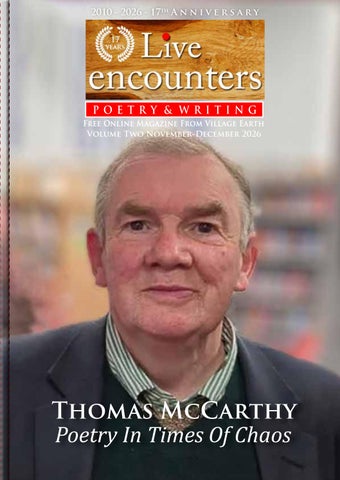
2010 - 2026 - 17th A n n i v e r s a r y
P O E T R Y & W R I T I N G Free Online Magazine From Village Earth Volume Two November-December 2026
Thomas McCarthy Poetry In Times Of Chaos 2026 November-December POETRY & WRITING © liveencounters.net
LIVE ENCOUNTERS MAGAZINE
©Mark Ulyseas
The Catholic Cathedral of Hanoi, Hoan Kiem, Vietnam. Photograph by Mark Ulyseas. © liveencounters.net POETRY & WRITING Volume Two November-December 2026 Celebrating 17th Anniversary
P O E T R Y & W R I T I N G
Volume Two 17th Anniversary November-December 2026
Support Live Encounters.
Donate Now and Keep the Magazine Live in 2027 Live Encounters is a not-for-profit free online magazine that was founded in 2009 in Bali, Indonesia. It showcases some of the best writing from around the world. Poets, writers, academics, civil & human/animal rights activists, academics, environmentalists, social workers, photographers and more have contributed their time and knowledge for the benefit of the readers of:
Live Encounters Magazine (2010), Live Encounters Poetry & Writing (2016), Live Encounters Young Poets & Writers (2019) and now, Live Encounters Books (August 2020).
We are appealing for donations to pay for the administrative and technical aspects of the publication. Please help by donating any amount for this just cause as events are threatening the very future of Live Encounters. Om Shanti Shanti Shanti Om Mark Ulyseas Publisher/Editor
All articles and photographs are the copyright of www.liveencounters.net and its contributors. No part of this publication may be reproduced without the explicit written permission of www.liveencounters.net. Offenders will be criminally prosecuted to the full extent of the law prevailing in their home country and/or elsewhere. 2026 November-December POETRY & WRITING © liveencounters.net
Contributors
© liveencounters.net POETRY & WRITING Volume Two November-December 2026 Celebrating 17th Anniversary
P O E T R Y & W R I T I N G
Volume Two 17th Anniversary November-December 2025
Thomas McCarthy – guest editorial Mary O’Donnell Nathanael O’Reilly David Ades Serena-Agusto Cox Sven Kretzschmar Thaddeus Rutkowski Peter A Witt Dominique Hecq Michael J Leach Trevor Landers Alicia Viguer-Espert Amy Abdullah Barry Jack Ross Denise Teresa O’Hagan Kim Ports Parsons Piers Davies Nigel Spence Fred Everett Maus
2026 November-December POETRY & WRITING © liveencounters.net
GUEST EDITORIAL
Thomas McCarthy © liveencounters.net POETRY & WRITING Volume Two November-December 2026 Celebrating 17th Anniversary
THOMAS MCCARTHY Thomas McCarthy was born at Cappoquin, Co. Waterford in 1954 and educated locally and at University College Cork. He was an Honorary Fellow of the International Writing programme, University of Iowa in 1978/79. He has published The First Convention (1978), The Sorrow Garden (1981), The Lost Province (1996), Merchant Prince (2005) and The Last Geraldine Officer (2009) as well as a number of other collections. He has also published two novels and a memoir. He has won the Patrick Kavanagh Award, the Alice Hunt Bartlett Prize and the O’Shaughnessy Prize for Poetry as well as the Ireland Funds Annual Literary Award. He worked for many years at Cork City Libraries, retiring in 2014 to write fulltime. He was International Professor of English at Macalester College, Minnesota, in 1994/95. He is a former Editor of Poetry Ireland Review and The Cork Review. He has also conducted poetry workshops at Listowel Writers’ Week, Molly Keane House, Arvon Foundation and Portlaoise Prison (Provisional IRA Wing). He is a member of Aosdana. His collections, Pandemonium and Prophecy, were published by Carcanet in 2016 and 2019. Last year Gallery Press, Ireland, published his sold-out journals, Poetry, Memory and the Party. Gallery Press published his essays Questioning Ireland in September; and Carcanet published a new collection, Plenitude, in April 2025.
Thomas McCarthy
Poetry In Times Of Chaos The world seems to be absolutely chaotic. The cruelties and genocides of recent days, in particular the wanton deaths of children, propel us into a darker understanding of human nature; but also that more depressing realization that our material sophistication has not altered our human, or inhuman, capacity for mass murder. Though, looking at history, the world is probably no more chaotic than it was in 1,000 CE or 1,000 BCE. In 1014 CE it would have been extremely dangerous to wander along the banks of the Dodder or the Liffey in the port of Dublin. After all, thousands of native Irish and invading Danish and Norse warriors were fighting in a last-ditch battle for survival: their prize was the High-Kingship of Ireland. In the Eastern Mediterranean around 1,000 BCE the collapse of Egyptian and Hittite power had led to the great battles between the Philistines and the Jewish powers under King David: this led us to David’s great Jerusalem projects. That story continues, as does Ireland’s doleful tale of territory and nationhood. All of this chaos in human affairs came back to me last week as I re-read Emily Wilson’s clear and unsentimental translation of Homer’s ODYSSEY (Norton, 2018). Today, thanks to film director Christopher Nolan’s screen version of the Homeric tale, we’ve all been pulled closer to a Greek world of myth-making and story-telling: ‘Tell me about a complicated man. Muse, tell me how he wandered and was lost when he had wrecked the holy town of Troy, and where he went, and who he met, the pain he suffered on the sea….’
© Thomas McCarthy 2026 November-December POETRY & WRITING © liveencounters.net
GUEST EDITORIAL
Thus begins one of the founding texts of Western civilization, rivalled over time only by the Bible and Dante’s Divine Comedy. All of these great texts speak to human cruelty; all of the texts interrogate the dead, those who died tragically and those who died well-loved. All speak of the capricious nature of human fate, all have suffering, bravery and faithfulness. They are a reminder too of the nature of our human nature, and of the hopelessness of that fond hope that humans might become universally moral and good. Great writing never offers such a simple hope, but it reminds us that human suffering is not likely to end anytime soon; that the human condition is a bitch and we’d better get used to living with it. But some portions of the times we live in become epic, they contain that expanse; expanse of both effect and change. We live in such an era, the days of Agentic AI, a time where tension in this world is like the urgent hours before the midnight of President Kennedy’s ultimatum to Soviet Russia. What the great texts teach us is that we are now living through Book 12 of Homer’s great work, we are inside the Wandering Rocks of AI where even the doves who carry ambrosia to Zeus are lost habitually: that though mankind may have overcome the Sirens of Microsoft, we still must sail though the crushing waves of Amphitrite.
As writers in this era we must maintain our own sense of calm. Creative work is a self-steering mechanism, a counter-magic in a time of chaos. If the chaos of this world is not likely to end any time soon, then projects in writing are moral islands, fed by the mythical doves with a creative ambrosia. Inside the act of making is a kind of optimism, still lurking, still surviving faithfully, like a faithful Penelope. We cannot find calm by looking outward, but something like a moral calm does exist inside the multiple tasks and projects of our artistic life. Perhaps this is why biographers idealize artists, giving them high motives and universal ambitions that we know never existed in the life. How many of us cannot recognise the writers we knew from their influential biographies? This is because writers flourish in the untilled fields of their own thoughts. They always set to ploughing as if they’d just come back from a war, but it is the war of their own lives. For a writer political ambitions are always suspect things: politics cannot accept irony and the best poetry and prose is nearly always created at the edge of scepticism, in the wheat-field of irony. In art there is never a complete closure, whereas tribal and national politics always yearns for a neat, hopeless closure; closures that are simply culturally impossible. Art knows this. © liveencounters.net POETRY & WRITING Volume Two November-December 2026 Celebrating 17th Anniversary
THOMAS MCCARTHY
Available at: https://gallerypress.com/product/questioning-ireland/ © Thomas McCarthy 2026 November-December POETRY & WRITING © liveencounters.net
GUEST EDITORIAL
In the ODYSSEY it is astonishing the number of times our wandering heroes are detained by story-tellers and sooth-sayers and poets. In Book 3 Nestor tells the story of how the Greeks destroyed Troy and were cursed by Athena, In Book 4 Telemachus cries after hearing the Trojan stories of Menelaus, in Book 11 Odysseus himself becomes the story-teller, recounting the tragic story of Agamemnon and of speaking with the ghost of Achilles; in Book 24 Odysseus visits his old father Laertes in the orchard and convincingly reveals himself by telling the story of how in childhood his father had taught him to name all the apple trees. Stories, therefore, are the true counter-magic in our sad time of chaos. And they are magical not because they are mythical but because they are personal. Every child lost in conflict, every son or daughter, is the true subject of poetry. Victims are the true subject of poetry because victims never inherit history. Art runs counter to the political project commonly called ‘history,’ poems refute history in the most abrupt and shameless manner. This sublime personal nature of the art of poetry came back to me also though this summer as, before I picked up Emily Wilson’s THE ODYSSEY, I was immersed in the Eighteenth century poems of Aodhagáin O Rathaille, specifically those poems edited and translated by the very great Rev. Patrick S. Dineen and Tadhg O’Donoghue. First published in 1911 by the Irish Texts Society, this book of poems was revised by Breandán O Buachalla in 2004 of the same Irish Texts Society, then based curiously in the Drummonds Branch of the Royal Bank of Scotland at Admiralty Arch. Ó Rathaille was a master-poet, a genius, with a voice that gave voice to an almost entirely suppressed national literature in the Ireland of the early Eighteenth Century. Ó Rathaille was born around 1670 in the still very Celtic lands of Sliabh Luachra on the county borders of Cork and Kerry. His family were comfortable land-holders, probably lease-holders from the Kenmare estate. Most of his poetry was written between 1700 and 1730, at the time when the great Kenmare estates had not been fully confiscated by the English administration. His family, though Catholic and Irish, seem to have held onto their land holdings for many years, including the townlands of Scrahanaveal and Stagmount. From an Exchequer Bill filed in May, 1701, we know that his family still farmed lands Annaghillymore, ploughlands that were still technically owned by the Gaelic MacCarthy More. Ó Rathaille’s world oscillated between these borderlands of the MacCarthys and the ‘improved’ and cultivated Anglophone estates of Killarney in Co. Kerry. © liveencounters.net POETRY & WRITING Volume Two November-December 2026 Celebrating 17th Anniversary
THOMAS MCCARTHY
Available at: https://gallerypress.com/product/questioning-ireland/ © Thomas McCarthy 2026 November-December POETRY & WRITING © liveencounters.net
GUEST EDITORIAL
Ó Rathaille wrote many accomplished and astonishing elegies and laments for dead neighbours, both the landed gentry and the landless. But no poem is more beautiful in its technical precision and verse craft and more powerful in emotion than the magnificent elegy he wrote for the three drowned children of Tadhg O’Cronin ‘Ar Bhás Trír Cloinne Thaidhg Uí Chróinín.’ The first line ‘Do géis an Ráth Mhór, do réabadh a seol’ is nearly untranslatable in its abruptness and shock. That word ‘géis’ means scream, cry, groan, roar, But it is not simply ‘gol’ (cry) or ‘scread’ (scream). It contains something of the swan’s cry at the loss of a cygnet, or some deep rent in the silk of nature. Its effect is deepened in the Irish line by the word ‘réabadh’ which means ‘tearing,’ ‘rending’ or ‘lacerating.’ It is more than physical, it is an emotional violence that the poet captures in its entirety in just one line. But the poem’s effect in Irish continues to deepen in this manner. The word choice in every verse is complex, highly educated, modulated for its emotional music. It is probable that Tadhg’s three beautiful children, Eileen, Diarmuid and Tadhg, drowned in a boating accident while on a picnic in Killarney. Their deaths, so sudden, so unexpected, so unjust, seem like so many deaths of innocent children in the conflict and chaos of our world today. A comfortable, landed family was indeed in full sail, full of happiness, and fate delivered its evil work, ripping, tearing, the full sail of a family. The three named children, insignificant. In history, these names explode across the world of poetry for three centuries. I tried to make my own version of the poem, a vain act for a non-scholar, but an act of homage. Their deaths became epic through the hand of a poet; their story survived, and through their story their names. This is the calm at the heart of making poems, it is our salvation.
© liveencounters.net POETRY & WRITING Volume Two November-December 2026 Celebrating 17th Anniversary
THOMAS MCCARTHY
Here are the first three stanzas of this great poem: for these troubled times:
Three Children Lost
(‘Ar bhás trír cloinne Thaidhg Uí Chróinín’ by Aodhagán O Rathaille) Rathmore’s heart is ruined, her mainsail torn, Her affluence diminished, a house exploding with grief; Such a quick fog descending I cannot see fields, Upon this mansion of welcomes a horrible disbelief. More devastating still, this sudden deluge Carries away all honour, jewels, the rafters, music: Flames leap to her forehead, flames burn her Rich beauty, all silken coverlets, all cups of gold.
Senseless sorrow and torture, groin-pain without end, Deep catastrophe from out west, black fever of illness, Ache of weeping, o sadness, heart-weariness: a seizure That Eileen is in graveyard clay, and Diarmuid and Tadhg.
© Thomas McCarthy 2026 November-December POETRY & WRITING © liveencounters.net
LABURNUM
Mary O’Donnell © liveencounters.net POETRY & WRITING Volume Two November-December 2026 Celebrating 17th Anniversary
M A R Y O’ D O N N E L L Mary O’Donnell is a prolific and well-known novelist, short story writer, and poet. Her latest novel ‘Sweep the Cobwebs off the Sky’ is published by Époque Press UK, and her tenth poetry collection ‘Tenderness’ appears with Wake Forest University Press in September. She is a member since 2001 of the artists’ affiliation Aosdána. www.maryodonnell.com
Laburnum By September it scarcely draws a glance When crisped yellow twists wilt to ground. Winter hacks the pewter bole, Whips the slim branches in every gale. No parading in style with the rest in spring—the birch’s March frieze,
the silent oak, bullet-hard for April release. Only in May, this cadmium eruption
as golden chains tumble loose, this grace of florets, when a pour of yellow bathes eyes, fills my ears with vibrations of bees. The peak, before true summer has arrived, high days of love released, as this tree dandles goldenly, careless and bright after harsh endurance. Now. That easy swagger.
© Mary O’Donnell 2026 November-December POETRY & WRITING © liveencounters.net
LABURNUM
Hermes on the Evening Train to Maynooth He places his bike in the gangway, sits, frowns, opens his phone, then scrolls. Hermes out for the day
sits opposite a woman alone, heavy holdall and tired feet, whose fingers fidget with rings, an out of date phone. He wafts scents of Olympus which she slowly inhales, a masculine, piping, lack of fuss,
the wings at his ankles, so feather-taut, now forced to rest. She turns away but notes through the window a hawk above the train-tracks, how it glides, floats, and the foraging goat astray near the winter-moored canal boats, steals a glance at the boy’s face, grave as he studies his phone; lightly he scrolls, his thumb shaving
© liveencounters.net POETRY & WRITING Volume Two November-December 2026 Celebrating 17th Anniversary
M A R Y O’ D O N N E L L
the screen. He has not seen her bright tired face. Nor will he ever. Hermes, blind to awkward fleshliness, stands lightly,
knee-sprung and alert before the train grinds to a halt. He gathers his bike, he is white vapour, the spokes are gleaming pine, as he whirls past and down the aisle, blinks, already the wings at his ankles flimmer wide, he is now without guile,
slips around rushing students, life-abandoned old evening men and women, as they shade off into the canal twilight—
© Mary O’Donnell 2026 November-December POETRY & WRITING © liveencounters.net
LABURNUM
North Inner City Evening Voices drift on the trudge from Amiens Street to Talbot. tongues of Igbo,
Yoruba, Arabic—present and correct in a city that hums to an off-beat,
transects time, tines my ears so that I hear. Bearded men move within crumpled shops on the stretch towards the Spire, here’s what’s various, the breads of life— knubz, ekmek, khlib, offered from each hatch window. And somewhere rashers and eggs,
limp pizza slices, further along shish kebab, shawarma, and pitta stuffed with lamb— wafer-thin breads, Holy Communions of the East, a yeasty hold on the roof of my mouth.
I wrangle it free with my tongue, lean towards the stories of people who have come, shouldering the unbuilt tower of the home they desire, tongues shape-shifting.
One clean English sentence could do it, delivered to raise them to the gate of god,
© liveencounters.net POETRY & WRITING Volume Two November-December 2026 Celebrating 17th Anniversary
M A R Y O’ D O N N E L L
where a case is heard, and PPS numbers, citizen rights, free medicines, fall softly, like MacNeice’s ladder of angels, so they can pass, freed, through the valley of darkness. I head for work
with students who would be writers, observe their struggle with their own known words.
How not to offend, dismiss, erase. Sometimes I am risen like a bread, shift shape as I hear the lexis understood and not. All words, phonemes, prefixes, suffixes, find my belly, tuck to my gut reflex
on this damp stretch of late evening, make me almost cry out in joy! Darkness now. The winding-down season, November: daytime’s glad rags stripped away,
this officed city shimmers merrily in strips of light and cobalt as I travel past the mussel-shell canopy of the bus station, opaline and pink. Further along, Amiens Street is mushroom grey, fleckered with lantern yellows. Finally, a path of cobble
continued overleaf... © Mary O’Donnell 2026 November-December POETRY & WRITING © liveencounters.net
LABURNUM
breaks the curve of tram tracks. I pause beside two of our own, settled on cardboard, sleeping-bags. Easy, chatty, they advise I watch myself. How could I not? Lifetime’s habits worn to thread, thin as I march forth my daily, cordial performance (so often repeated that I blush). At the train station I ascend the escalator,
relinquish voices, niche grammars beyond semantics. Those warm me
more than what I’ve known. One quick step from grim platform to suburban train, certain my known syllables are moulting
like feathers no longer needed and something new-born and naked occurs
after I’ve grazed and gazed these streets, found babblement, head half-crazed as the train sways, aways, towards the suburbs, and I hurtle, always hurtle out–—
© liveencounters.net POETRY & WRITING Volume Two November-December 2026 Celebrating 17th Anniversary
M A R Y O’ D O N N E L L
©Mark Ulyseas
Photograph © Mark Ulyseas © Mary O’Donnell 2026 November-December POETRY & WRITING © liveencounters.net
MANLY MAN ESSENTIALS
Nathanael O’Reilly © liveencounters.net POETRY & WRITING Volume Two November-December 2026 Celebrating 17th Anniversary
N A T H A N A E L O’ R E I L L Y Irish-Australian poet Nathanael O’Reilly’s fifteen collections include Scatter & Settle, Separation Blues, Dublin Wandering, Landmarks, Selected Poems of Ned Kelly, Boulevard, (Un)belonging and Preparations for Departure. His poetry appears in journals and anthologies published in fifteen countries, including The Belfast Review, Coastlines, Cordite, The Honest Ulsterman, Howl: New Irish Writing, Meanjin, New World Writing Quarterly, Oxford Magazine, Southerly, Southword: New International Writing, West Trade Review, Westerly and Wisconsin Review. He has been a finalist and winner in Australian, Irish and American poetry competitions; he is Associate Professor of Creative Writing at The University of Texas at Arlington.
Manly Man Essentials I’ve never owned: an angle-grinder, blowtorch or soldering iron – definitely not an anvil.
A chainsaw for cutting up trees felled by storms. A generator for powering the central heating
when the electricity goes out. A Ute or pick-up truck for hauling stuff and feeling tough. A tractor for ploughing fields and towing a trailer loaded high with baled hay. A set of golf clubs.
A fishing rod, reel and tackle box. A boat – not even a dinghy, kayak or canoe. A snowboard, despite snowboarding many times. A speargun, flippers and mask. A saddle, cowboy hat, boots
or belt buckle, despite living in Texas for decades. A muscle car. A gold chain. An electric guitar. Boxing gloves and a punching bag. A motorbike – not even an 80cc Yamaha dirtbike in my teens.
A hockey stick and skates (clearly, I’ve never lived in Canada). A gun – not even a .22 bolt-action
rifle for shooting rabbits, a double-barrel shotgun for shooting ducks, or a .303 semi-automatic rifle
for killing sprinting foxes and bounding kangaroos.
© Nathanael O’Reilly 2026 November-December POETRY & WRITING © liveencounters.net
MANLY MAN ESSENTIALS
From San Francisco to Sidney We reunited late last century in San Francisco, blasted U2’s Bullet the Blue Sky from the stereo leaving the airport
(outside it’s America! Americaaaaaaa!), browsed City Lights, quoted Ginsberg (starving hysterical naked), crossed the Golden Gate and Bay
Bridges, strolled the marina at Sausalito, climbed Coit Tower, swam at Half Moon Bay, bought Chinatown fireworks, navigated one-way streets
and Steve McQueen hills, turned right at red lights. We drove Interstate 80 from San Francisco to Sidney, Nebraska, traveled one thousand, two
hundred and seventy-one miles in a two-door red Nissan Sentra, dreamcatcher dangling from the rearview mirror, sang along with Counting Crows, Live, Nirvana, Pearl Jam and Alanis, visited a drug store in Berkeley, danced to Van Morrison in the rain in a pine forest
near Lake Tahoe, ran barefoot through June snow, gambled and lost in Reno, slept in the car between the railway line and the freeway near Elko, Nevada, were woken by the wind from a passing freight train, wrestled and performed headstands on the lawn outside the Mormon Tabernacle in Salt Lake City, mooned the west from a Utah red rock formation, picnicked on the prairie in Wyoming, drove over mountain ranges,
across vast deserts and salt plains, ate maple-syrup-soaked pancake stacks in working-class diners, overtook Dodges, Buicks and Chevrolets,
© liveencounters.net POETRY & WRITING Volume Two November-December 2026 Celebrating 17th Anniversary
N A T H A N A E L O’ R E I L L Y
sipped duty free Glenfiddich while lying on the hood in the desert after midnight beneath glorious constellations as Astral Weeks emanated from the stereo, passed hundreds of cheesy billboards, refueled at Little America gas stations, cruised down the Inter-
state beneath wide-open blue skies in bare feet wearing t-shirts, tank tops and shorts, gorgeous Arikara legs extending to the dashboard, rubbed
sunscreen into arms hanging out of windows, let the wind tear through hair, crossed the continental divide in Wyoming seven thousand feet
above sea level. On my seventh night in America we ate at Dude’s Steakhouse and Brandin’ Iron Bar in Sidney, Nebraska, then shared a room in the Deluxe Motel, drank cheap champagne in bed, stayed up late watching TV entwined, fantasized about a future together.
© Nathanael O’Reilly 2026 November-December POETRY & WRITING © liveencounters.net
MANLY MAN ESSENTIALS
The Craic in Brendan Lynch’s The sun is splitting the stones. Today was a super day. It’s the best January day ever. Ach, the climate is changing, for sure it is. Aye, the lough was frozen solid in 1963. We played fucking football on it and walked out to the island. There were one hundred and forty old people that used to go to The Larches. There’s only three of them alive now. The Duffys there was seven. There was eight at the O’Briens. All big families then. Nine or ten in every house. He’d be the same age as myself, seventy-one like. Give a man a bad name and it sticks forever. Ah well, first I said you’d be worried about travelling, but then I said you know it will work out, things will settle down like. Oh, sure you could manage going to a place like that you know. Yeah, but it’s funny, no checks coming back into England or anything? It would be hard to make sure they’d had the vaccines like. It is a wonder alright. Even getting out of Ireland would have been too hard. Jaysus, she’s a fine-looking woman for sixty-two!
NB: All of the phrases used in the poem were overheard in Brendan Lynch’s pub in Clonbur, Galway.
© liveencounters.net POETRY & WRITING Volume Two November-December 2026 Celebrating 17th Anniversary
N A T H A N A E L O’ R E I L L Y
©Mark Ulyseas
Photograph © Mark Ulyseas © Nathanael O’Reilly 2026 November-December POETRY & WRITING © liveencounters.net
KETTLE
David Adès © liveencounters.net POETRY & WRITING Volume Two November-December 2026 Celebrating 17th Anniversary
DAVID ADÈS David Adès is the author of Mapping the World, Afloat in Light and the chapbook Only the Questions Are Eternal. His latest collections are The Heart’s Lush Gardens (Flying Island Books 2024), A Blink of Time’s Eye (Five Islands Press 2025) and the chapbook The Toolmaker and Other Poems (Walleah Press 2025). David won the Wirra Wirra Vineyards Short Story Prize 2005 and the University of Canberra Vice-Chancellor’s International Poetry Prize 2014. Mapping the World was commended for the FAW Anne Elder Award 2008. David’s poems have been read on the Australian radio poetry program Poetica and have also featured on the U.S. radio poetry program Prosody. His poetry has been nominated for a Pushcart Prize three times and twice been shortlisted for the Newcastle Poetry Prize. His poems have been Highly Commended in the Bruce Dawe National Poetry Prize, a finalist in the Dora and Alexander Raynes Poetry Prize (U.S.) and commended for the Reuben Rose International Poetry Prize (Israel). David is the host of the monthly poetry podcast series “Poets’ Corner” which can be found at https://www.youtube.com/playlist?list=PLb8bHCZBRMBjlWlPDeaSan Z3qAZcuVW7N. He lives in Sydney with his wife and three children.
Kettle for Andrew B and Andrew T After a long day in the vineyard, down on our knees and up again,
picking every last bunch of grapes we could find, feeling the slow burn of tired muscles, Andrew and Andrew and I
sat around our kitchen table for fifteen minutes, waiting for the kettle to boil, time passing in a slow doze of conversation, the candle of our words guttering out,
waiting while a blanket of exhaustion draped itself over us, our thoughts becoming sludge, none of us noticing
as the minutes ticked away, that we hadn’t turned the kettle on.
© David Adès 2026 November-December POETRY & WRITING © liveencounters.net
KETTLE
Writing a Poem About Old Geezers for the class of 1973 Old geezers don’t lie. In a room full of old geezers, grey-haired or bald, heavy-jowled, well-girthed,
the gig is up: it is no longer possible to deny one’s own geezer-hood, to maintain that the mirror and camera lie, that your robust vitality is as robust as you think it is. But the boys in these geezer faces, the ones preserved in the amber of your memories, are still recognisably present, which fills you with an inordinate and incomprehensible joy, and when they recount, in three-minute turns,
their defeats and failures, their successes and achievements, like time-lapse photography
bearing witness to unpredicted, brimming lives, an ease spreads through the warming air of the room, the geezers breathe in the oxygen of one another and become light-headed, jolly, drunk with their transformation from boys into men, the rich, thick, books of their lives, and the triumph,
the unexpected, intoxicating triumph of their survival, to meet again, like this, after fifty years.
© liveencounters.net POETRY & WRITING Volume Two November-December 2026 Celebrating 17th Anniversary
DAVID ADÈS
The Parade, Norwood In memory of Colette Levy After the funeral, after another tent peg went flying from the tent of love
that sheltered me all these years, I visited a decades old stomping ground to find some things unchanged —
forgotten haunts, old cafes, bookshops, footpaths — and others transformed from I don’t remember what
to something strangely foreign as if, in those places where memory pulsed, I was viewing a stuttering hologram
of my former life, disturbingly visible and yet intangible, out of reach,
like both the person who lived it, and the other, who was there from the beginning and is now gone.
© David Adès 2026 November-December POETRY & WRITING © liveencounters.net
HARVEST MOON
Serena Agusto-Cox © liveencounters.net POETRY & WRITING Volume Two November-December 2026 Celebrating 17th Anniversary
SERENA AGUSTO-COX Serena Agusto-Cox is a Pushcart Prize nominee, editor at The Mid-Atlantic Review published by DayEight, contributing writer of Washington Unbound, and coordinator of poetry programming at the Gaithersburg Book Festival. Her poems appear in multiple magazines and anthologies. She founded Savvy Verse & Wit and Poetic Book Tours, respectively, to help other poets market their work. Echoes Carry, published by Beltway Editions, is her debut poetry collection.
Harvest Moon Cool white light illuminates the garden abundant with late ripening vegetables. As a child, I believed the moon summoned beasts and after sunset, farmers in the field were devoured. Now, I see lasting moonlight — not as a cry for wakefulness — I stay and marvel at the brightest night.
© Serena Agusto-Cox 2026 November-December POETRY & WRITING © liveencounters.net
HARVEST MOON
Writer’s retreat with a freight train Horn blares at the crossing of lines before the next stanza begins.
Rumble of its wheelsets on tracks, sounds of words in each line, a rhythm unbroken and held by the bogie. Rail friction reduced as each branch re-routes mid-poem. Pebble ballast, clues for travelers, picked up from the poet’s subgrade.
© liveencounters.net POETRY & WRITING Volume Two November-December 2026 Celebrating 17th Anniversary
SERENA AGUSTO-COX
Windowsill Pie Periwinkle blossoms dot the field. We run, hands touching petals, a sea of blue in our wake. Wild in our joy. Our tiny fingers plunge into deep, sweet indigo — snatched. Blueberry stains tell the tale. We stumble and laugh, hands ripe with sapphires. We couldn’t get enough. All that’s left are cobalt dribbles.
© Serena Agusto-Cox 2026 November-December POETRY & WRITING © liveencounters.net
SEASIDE AUTUMN
Sven Kretzschmar © liveencounters.net POETRY & WRITING Volume Two November-December 2026 Celebrating 17th Anniversary
SVEN KRETZSCHMAR Sven Kretzschmar hails from Germany. His poetry has been published widely in Europe and overseas, among other outlets in Writing Home. The ‘New Irish’ Poets (Dedalus Press, 2019), Hold Open the Door (UCD Press, 2020), Voices 2021 (Cold River Press, 2021) The Irish Times, and Das Gedicht. He was awarded 2nd place at the Francis Ledwidge International Poetry Award 2022. He has become a regular contributor to Live Encounters. In addition to poetry, he has started writing absurd and grotesque short prose in German.
Seaside autumn Fastnet, Lundy, Irish Sea: moderate maritime weather conditions, occasional gusts onshore, bringing city dwellers out onto sand for late summer tans, touristy stints on Bastardstown Beach, Rosslare Fort, Saltee Islands; mainly fair in the morning, by afternoon black seas swelling from the tab.
Cahore Pier, Kilmore Quay, Carnsore Point: yellow foam on stout waves rising toward evening, amber sundown in tumblers, no ice this season. Plastic cards, coins washing through publicans’ hands, live music swashing around Rosslare Harbour, Glendoyne, the Hook Lighthouse.
© Sven Kretzschmar 2026 November-December POETRY & WRITING © liveencounters.net
SEASIDE AUTUMN
The poet speaks to her in silence (after John Walsh) Just because I am a poet does not mean I am not capable of desire. Inside is a wilted knot garden of concealment waiting
for your come-upon. I am not coarse-knit, hard-shelled, badly shaven. I have washed off the soot of all that. When all the postures fold, can you sense how cramped I am? As strong as the world has made me. When twilight falls
I crave your arms and green-brown eyes still as a tree waiting for the lean of your shoulder. Being a poet in the end means nothing at all.
© liveencounters.net POETRY & WRITING Volume Two November-December 2026 Celebrating 17th Anniversary
SVEN KRETZSCHMAR
Taming a lynx The woodland and walkways of my inside I have never been a stranger to. A stranger
who never wasted a thought on taming a lynx
though I would not object to its company should it ever cross my dirt-tracks. The intimacy of a cold
cat nose more familiar than that of a trusted
human who never was. Would you have a worry
about entering the woods? Don’t be afraid! Somewhere I have been a stranger too.
© Sven Kretzschmar 2026 November-December POETRY & WRITING © liveencounters.net
BIG PEST
Thaddeus Rutkowski © liveencounters.net POETRY & WRITING Volume Two November-December 2026 Celebrating 17th Anniversary
THADDEUS RUTKOWSKI Thaddeus Rutkowski is the author of nine books, most recently Tracks in Snow, a poetry collection. His novel Haywire received an Asian American Writers’ Workshop award. He teaches at Medgar Evers College and at a YMCA. He received a New York Foundation for the Arts fellowship and a Best Small Fictions award.
Big Pest A large rodent was living in our apartment. It was too big to have come through a hole in the wall or a slot next to a pipe. Maybe it had slipped in behind one of us as we opened the front door.
It hid from us most of the time but came out at night. We saw its shadow at the edge of our vision but believed it was a trick of the eye. The shadow had big haunches, short forelegs, and a blunt nose. We wanted to get rid of it as soon as we could find it. We sensed that it was living quietly somewhere, behind the furniture or in the cabinetry. In the dark, it roamed our small space, looking for food. Fruits and cookies went missing. When we happened to see it running, we exclaimed, “There it is!” But we didn’t know what it was. “Is it a mouse?” I would ask.
“No, it’s too big,” my wife would reply. “A rat?”
“No, it’s much bigger.” “A capybara?” “That’s it!”
continued overleaf... © Thaddeus Rutkowski 2026 November-December POETRY & WRITING © liveencounters.net
BIG PEST
Like any rodent, the animal probably mated indiscriminately and gestated quickly. The other apartments in our building must have been infested, and we must have been hosting only one of the horde. At night, the adventurous ones traveled up and down the stairs and through the apartment doors, flitting in when people entered or left. When an exterminator arrived, we reported the problem. “We have a giant rodent,” we said. “You won’t see it now, but we have seen it.” “Do you want some glue traps?” the exterminator asked. “They will have to be big.”
The exterminator gave us a large sheet of cardboard with adhesive on one side. “We’ll try it,” we said.
After a few days, the trap remained empty. We didn’t know what we’d do if we actually caught something. It would be hard to discard the trap, with a kicking capybara, in the trash. The box was too big for the bin. We would have to take it to a dumpster on the street. But that mode of disposal would be inhumane. At night, we put out a bowl of greens, along with a block of poison bait. We filled the bowl with lettuce, kale, and arugula—we wanted to give the rodent a choice. In the morning, all of the greens were gone, but the bait remained untouched. We had to get used to the fact that our visitor would be living with us for a long time.
© liveencounters.net POETRY & WRITING Volume Two November-December 2026 Celebrating 17th Anniversary
THADDEUS RUTKOWSKI
Image courtesy Silvia from Pixabay. © Thaddeus Rutkowski 2026 November-December POETRY & WRITING © liveencounters.net
REMEMBERING THE SEASONS
Peter A Witt © liveencounters.net POETRY & WRITING Volume Two November-December 2026 Celebrating 17th Anniversary
PETER A WITT Peter A Witt is a Texas poet and a retired university professor. Peter’s poetry deals with personal experiences, both real and imagined. He is a twice published Best of the Net nominee. His poetry has been published on various sites including Inspired, Open Skies Quarterly, Medusa’s Kitchen, Active Muse, New Verse News, and Blue Bird Word. When not writing poetry, Peter is an avid birder and wildlife photographer.
Beach Findings The beach is bejeweled with driftwood, left at high tide or deposited by winter storm waves. The wood is of many shapes, one piece a child laying on its back, arms flailing the air, another a turtle, feet extended, trying to make its way back into the sea.
I choose a few pieces that will make fine sculptures once they are dried out, shaped, stained, and exhibited in my living room art gallery.
Friends drift around the room, looking at each piece on display, some ask where I got such beautiful things, I reply, from the beach, as they ooh and aah their appreciation.
© Peter A Witt 2026 November-December POETRY & WRITING © liveencounters.net
REMEMBERING THE SEASONS
Remembering the Seasons I remember a spring day basking in more warmth than cool, when the twitter of an orange-crowned warbler announced that spring migrants were heading north. I remember when that spring was overrun by the sudden heat of summer, arriving far too early in Texas for one raised in the slow, soft seasons of the Midwest. Air conditioning ran all day, and the dog no longer cared to lie on his back in the sun-scalded yard. I remember when early summer turned to the ferocious weight of July and August, heat strong enough to fry an egg on sunlit sidewalks. Then, around the third home football game, breezes hinted at autumn, and a light jacket was welcomed by the fourth quarter. Soon the leaves exhausted their palette, leaving the trees naked, and the wind shifted north, sending the six o’clock meteorologist to warn us to cover our plants before the overnight freeze.
© liveencounters.net POETRY & WRITING Volume Two November-December 2026 Celebrating 17th Anniversary
PETER A WITT
And then I remember the dark months, when nights stretched long, blankets were pulled to our chins, and steaming mugs of tea and cocoa replaced Dr Pepper and iced tea.
It won’t be long now before the wheel turns again, and I must laugh at myself forever complaining about the weather.
© Peter A Witt 2026 November-December POETRY & WRITING © liveencounters.net
REMEMBERING THE SEASONS
Journey of an Apple Pie She made me yesterday after coming home from the grocery store with honeycrisp apples, flour, a lemon, and a dozen eggs. She already had the sugar and cinnamon, along with the needed butter.
When all was mixed, she put me in a pan, and baked me, like a child sitting in the summer sun, for forty-five excruciating minutes, after which I cooled sitting on a rack as I exuded a smell that filled the house with anticipation. All was well, it felt good to reach room temperature, to feel whole, wanted, for some, even needed. But then came the moment I didn’t expect, as a knife was drawn from a kitchen drawer and deep cuts were made through my topping, the apples, and my crust. It hurt beyond belief. And the worst was yet to come, as parts of me were lifted onto plates, passed among a family of smiles, and eaten bite by bite with accompanying oohs and aahs.
© liveencounters.net POETRY & WRITING Volume Two November-December 2026 Celebrating 17th Anniversary
PETER A WITT
So now I am disintegrating in everyone’s digestive tract, no more a pie, just a memory.
© Peter A Witt 2026 November-December POETRY & WRITING © liveencounters.net
THE EAR IN THE HEART
Dominique Hecq. Photo by Fawn Collisomo Pavano. © liveencounters.net POETRY & WRITING Volume Two November-December 2026 Celebrating 17th Anniversary
DOMINIQUE HECQ Dominique Hecq is a widely anthologised and award-winning poet, fiction writer, essayist and translator. She lives and works on Wurundjeri Woi Wurrung land. Hecq writes in English and French. Her creative works comprise a novel, six collections of short stories and nineteen books of poetry. Errances (Recent Work Press) has travelled the world in 2026. She is currently writing a lyrical essay titled ‘Unleashed: My Life as a Dog’, a love poem to Artaud, a Kelpie, and a kind of farewell to Lacan. Among other honours Dominique Hecq is a recipient of the International Best Poets Prize administered by the International Poetry Translation and Research Centre in conjunction with the International Academy of Arts and Letters, and the James Tate for poetry.
The ear in the heart When I close my eyes & stumble around my thoughts I see everything I love is outside language
A dog’s beating heart underneath sleek fur the swift dispersal of lorikeets a child’s crackling laughter Ravel’s music & devastating silence Khalo & Basquiat’s loudness
Each night I return to pilfered forests parched billabongs hounded brumbies furrowing clouds light’s utterances fireballs & storms forking paths autumn catching fire & the stench of soaked pelt In each belated dawn
rhythm is unforced
I love the smell of ink washing over me the feel of paper I crave the dark for its stillness peripheral phantoms
continued overleaf... © Dominique Hecq 2026 November-December POETRY & WRITING © liveencounters.net
THE EAR IN THE HEART
Even though I know them
words do not know me
Words and I no longer share the same lexicons Letters wild
vowels discordant
The alphabet is
shapeless
consonants harsh
scratching
litter
Through the riddles of words death shimmies but its grimace may not be short lived I once found myself in another tongue
sometimes smirks
Now I uncover myself out of language for words know neither body nor the ear in the heart I find myself in the pulsing arteries of existence Language is a pyre my lungs thirst for air sucked out from them
I hanker for breath feel for the shape asleep by my side stroke the coat coming alive in breaking light Magpies erupt into trills
The dog stirs swivels his head surveys my face I inhale offer a caress & together we rush into the roaring wind
© liveencounters.net POETRY & WRITING Volume Two November-December 2026 Celebrating 17th Anniversary
DOMINIQUE HECQ
©Mark Ulyseas
Photograph © Mark Ulyseas © Dominique Hecq 2026 November-December POETRY & WRITING © liveencounters.net
AUGUST WALKS
Michael J Leach © liveencounters.net POETRY & WRITING Volume Two November-December 2026 Celebrating 17th Anniversary
MICHAEL J LEACH Michael J. Leach resides on unceded Dja Dja Wurrung Country in Australia. Michael’s poems are in journals such as Cordite, anthologies such as The Best Australian Science Writing (NewSouth Publishing), and his four books: Chronicity (Melbourne Poets Union), Natural Philosophies (Recent Work Press), Rural Ecologies (ICOE Press), and Chords in the Soundscapes (Ginninderra Press). Chords in the Soundscapes has been recognised as a Distinguished Favorite in the NYC Big Book Awards. Michael’s individual poems have been recognised in competitions such as the UC Health Poetry Prize, Woollahra Digital Literary Award, Liquid Amber Poetry Prize, and Philippa Holland Award for Poetry.
August Walks i. winter holiday we step out into spring air
ii. bush reserve the smell of smoke from a neighbour’s bonfire iii. we talk on the bush trail parrot’s beak orchids
iv. water tank the bushland mural stands out from graffiti v. halfway up the green hill two crimson rosellas
vi. we swig from canteens cockatoos lap up puddles
continued overleaf... © Michael J Leach 2026 November-December POETRY & WRITING © liveencounters.net
AUGUST WALKS
vii. a jogger the wallaby hops into the bush
viii. we picnic an echidna shovels out insects
ix. bare branches the purple of the last princess flower x. the trail darkens she still stops to smell the wattle
© liveencounters.net POETRY & WRITING Volume Two November-December 2026 Celebrating 17th Anniversary
MICHAEL J LEACH
Aftermaths i. both sides of the freeway— burnt gums sprout shoots ii. my sedan sprays floodwaters rosellas rise through mist
© Michael J Leach 2026 November-December POETRY & WRITING © liveencounters.net
WAINGORONGORO
Trevor Landers © liveencounters.net POETRY & WRITING Volume Two November-December 2026 Celebrating 17th Anniversary
TREVOR LANDERS Trevor Landers started writing creatively as far back as he can remember, encouraged by mentors who evinced a love of the luxuriance of language and literature. Published widely in New Zealand and internationally, his latest project is: Landers, Trevor and Hoskins, Tipene (Eds), Ngā Tāngata Tūturu: A literary paean to Ngāti Maru, Lasavia Publishing, Auckland and Berlin, (2026) which will be launched in Taranaki in November. He lives and works in Belgium.
Waingorongoro (The river that snores) Argent coil, ranges to shingle — a spine of water, unbowed. Ohawe waits; you arrive bearing centuries in suspension, Once: kahikatea cathedral, tōtara colonnade, root-lace holding whenua to earth. Titokowaru’s fire — prophet, strategist, insurgent flame against the surveyor’s chain — answered not with treaty but with torch: raupatu, muru, the ledger of theft. Barbarity in gaiters and Bible, rancid colonial alibi for plunder. Now: denuded flanks, plains flayed bare, bone-pale to the tide. Silt runs thin where forest once ran thick — ecocide’s quiet arithmetic. Mana whenua pauperised, iwi split to margins, the weaponisation of geography. Still the river carries what land cannot forget: awa, ngahere, whenua — one violated body, one undying testimony the dissidentism, the determination, the rebuke of death it is snoring, the unsleepable snuffle, it shall not die.
© Trevor Landers 2026 November-December POETRY & WRITING © liveencounters.net
WAINGORONGORO
Waingorongoro (a dreaming) II The river unstitches itself from the map wears the map as a scar. Waingongoro dreams backward: a redoubt grows teeth in a verdant paddock, the paddock chews on a name it was never taught to pronounce. Von Tempsky’s boots keep walking his legs have dissolved into fern-spore; crossing the Waingorongoro without wetting, measuring time in muskets & lost opportunities These stands, shady bush, close their green throat swallows the sound whole, the voice of conscience, keeps ringing; children watch the future through a pinhole burned in the present. Their eyes are the exact colour of the milk, the amnesia is an ally, the unremarked flow of anti-history. The eel does not recognise the water. The water doesn’t name itself, having been asked to carry nitrate instead of names, silt instead of song. The sacked watchtower blinks like an eyelid that forgot how to close. It is still deciding who the enemy is, a hundred and sixty years of deliberation
© liveencounters.net POETRY & WRITING Volume Two November-December 2026 Celebrating 17th Anniversary
TREVOR LANDERS
Apocalypse at Waingorogoro on dusk Griseous skies massing southward spiteful raging seas full of invective waves gurning disbelief at the land obmutescent river mouth forgoes ancient benediction— discerptment of brittle Ohawa cliffs and bluffs; like spoilt parchment toward a roiling abyss, our spent empire surrendered, sea-coast, bescumbered, detritus compressed into short profligate strata, the Anthropocene. Coastline—abased, drowned beneath refuse and avoidable oblation— this wrecked land surrenders, the risen, merciless sea washes us clean away.
© Trevor Landers 2026 November-December POETRY & WRITING © liveencounters.net
WAINGORONGORO
Waingorongoro Conundrum Perplexed, I am wavering Is the river natural or man-made The fish equivocate in turbidity.
it’s like they’ve forgotten how to be fish, mutant swimmers, gaping mouths, scintillant scales It all feels so grief-lorn and on-edge, like a poem struggling to kiss the sea.
this river, harbours a desire to be held by anyone, seen lamented, saved and loved.
© liveencounters.net POETRY & WRITING Volume Two November-December 2026 Celebrating 17th Anniversary
TREVOR LANDERS
Waingorongoro You are the river that flows through her, never happier as flotsam and jetsam, to have those broad banks breached and to feel craven to your mercurial tides.
© Trevor Landers 2026 November-December POETRY & WRITING © liveencounters.net
ADVICE TO A NOVICE POET
Alicia Viguer-Espert © liveencounters.net POETRY & WRITING Volume Two November-December 2026 Celebrating 17th Anniversary
ALICIA VIGUER-ESPERT Alicia Viguer-Espert, born and raised in Valencia, Spain is a three-times Pushcart nominee and a one-time Best of The Net nominee. Winner of the San Gabriel Valley Poetry Festival (2017) with her chapbook “Holding a Hummingbird.” Two chapbooks, “Out of the Blue Womb of the Sea” (2020) and “Four in 1” (2022) published by Four Feather’s Press. Her poem “Thirst and Fire” just won the “Best Poem of The Year, 2025-2026,” from Four Feather’s Press. Her poetry has appeared in numerous anthologies as well as Panoply, Amethyst Review, Four feathe’s Press, Lummox, Altadena Poetry Review, Odyssey, Valiant Scribe, Live Encounters, Galway Review, Thimble and Gyroscope
Dementia Slice it, I said, it will be easier to swallow small pieces can enter the mouth of the brain almost unnoticeable. Smallness changes density, the new clarity will help to see where crickets frolic at night, their silhouettes onyx-black.
As illumination expands filling the heart with starlight, your reflection will be seen on the pond water lilies bloom.
You’ll turn so transparent anyone could write their own script over you, watch how black ink blurs connecting hemispheres. Those nocturnal cleansing tears announce the finitude of time, the dance coming to an end erases the pain of forgetting.
© Alicia Viguer-Espert 2026 November-December POETRY & WRITING © liveencounters.net
ADVICE TO A NOVICE POET
Advice to a Novice Poet Castile, proud in its tormented history roasts under the August sun, ruined castles, monasteries, -a mote in the eye of a circling falcon surrounds a Romanesque shrine, Medinacelli,* the City of Selim, sleeps.
Fix that moment on a blank notepad, thoughts, emotions and the light you wish to become a mirror in the reader’s solitude.
Envision Las Lagunas de Ruidera’s* calm waters, simple fishing boats, migrating flamingos, gather the pieces of what you see, what you imagine it is, conscious that you’ll never comprehend it. Include them on the notepad.
Distracted gods don’t care if the picture sings or gets erased with your last breath. Eve learned it when tearful she left the Paradise of her future existence, recorded by no one.
© liveencounters.net POETRY & WRITING Volume Two November-December 2026 Celebrating 17th Anniversary
ALICIA VIGUER-ESPERT
Don’t get distracted like the gods, remember some manuscripts have lasted longer than the civilizations which created them. Consider black ink instead of smoke. Savor what the masters wrote, slowly, with open eyes walk the path in their company until it opens onto your own wide highway. Pay attention to cicadas’ songs mimicking the rhythm of your heart, listen, reflect, act.
Back in the kitchen, bake the quince with the hottest fire, watch the parchment paper caramelize. * Medinacelli, city in Soria, Spain. The Kelt Okelis. Today, Medinacelli, the “City of Salim” since the VIII century. * Lagunas de Ruidera: group of small lakes in an area where Don Quijote walked.
© Alicia Viguer-Espert 2026 November-December POETRY & WRITING © liveencounters.net
A LITTLE PIECE OF HEIDELBERG
Amy Abdullah Barry © liveencounters.net POETRY & WRITING Volume Two November-December 2026 Celebrating 17th Anniversary
AMY ABDULLAH BARRY Amy Abdullah Barry Award-winning writer, poet. Amy’s multicultural identity plays a crucial role in her writing, bringing together elements from her Asian roots and Irish life. She is published widely. Her poems have been translated into many languages. Chosen for the Poetry Ireland Introduction Series 2022. She regularly organises poetry & music events in Athlone, Dublin & Roscommon. She has performed her work in Ireland and internationally. Amy was honoured to perform as the opening half for headliner, Lemn Sissay’s ‘Let the Light In’ at Morecambe Poetry Festival, UK, 2024. ‘Flirting with Tigers’ is her collection of poems published by Dedalus Press.
The Chrysanthemum A flower blossoms for its own joy…Oscar Wilde It came from the principal at Clonown school. May Day – the year was already split open. I carried the pot — small and grey, knotted with ivy twine — in both my hands, the way we carry tidings that might yet turn.
At home I carved a circle in the soil, an opening just deep enough for roots to dream beyond their reach. I steadied the plant, brushed earth to its stem, a gesture that never recalled burial, but rather the tucking in of a child who insists they’re not tired but is already half dreaming.
Now, it stands, yellow petals swirl in a tall cement pot — Winter pressed its cold mouth to the leaves, the plant breathed back — slow, stubborn — as if its body held a history — In Japan, the kiku chrysanthemum, a cherished emblem of good fortune. All this while, the plant remains – Even when the nights grow taller than days. Even in the stripped January air, it stirs — a yellow pulse, teaching me how to endure in a world that isn’t always listening.
© Amy Abdullah Barry
2026 November-December POETRY & WRITING © liveencounters.net
A LITTLE PIECE OF HEIDELBERG
A Little Piece of Heidelberg For Renate This morning, picking rhubarb in the garden, the postwoman called at the gate and placed the chartreuse envelope in my hand. Soil still under my nails. Inside, a corner of serviette came home from Heidelberg— cut from the table on August 8th, her seventieth birthday.
Such a little thing to cross the miles— from Heidelberg to Athlone, to an August morning in my garden.
I held it for a moment, thinking how friendship can travel in unexpected ways. A remembered day and the simple gesture of saying:
© liveencounters.net POETRY & WRITING Volume Two November-December 2026 Celebrating 17th Anniversary
AMY ABDULLAH BARRY
You came. You stood among my guests and read a poem. I was glad you were there. Danke.
Only a fragment—but one that carries a whole afternoon, a friendship, a dance, and the quiet certainty that some moments do not end when the music does.
© Amy Abdullah Barry 2026 November-December POETRY & WRITING © liveencounters.net
WHAT HAPPENED TO THE MONKEYS?
Jack Ross © liveencounters.net POETRY & WRITING Volume Two November-December 2026 Celebrating 17th Anniversary
JACK ROSS Jack Ross is the author of four novels, five books of short fiction, and seven poetry collections, most recently Tesseract (2026). He was the managing editor of Poetry New Zealand (now Poetry Aotearoa) from 2014-2020, and has edited numerous other books, anthologies, and literary journals. He retired from his job teaching creative writing at Massey University in 2022, and lives with his wife, crafter and art-writer Bronwyn Lloyd, in an old Art Deco house in Auckland, New Zealand. He blogs at http://mairangibay.blogspot.com/.
What happened to the monkeys? That was the only question around our house this morning we’d been watching a film called The Raftsmen the night before about 12 guys on balsa rafts who sailed from Ecuador across the Pacific to Australia facing doldrums and mountainous seas sharks typhoons and every other conceivable peril all in the interests of the brotherhood of man but what happened to the monkeys? they started off with two of them free gifts from the crowd as they were setting out along with a parcel of kittens the kittens were great they served as weather gauges they’d get quite agitated when a storm was coming and wouldn’t settle down till it was past those monkeys though they did get up to mischief climbed up the masts and pissed on the crew watched the men tying knots and then untied them later once in the middle of a storm they fought with the kittens even tossed one of them into the sea it swam back to the raft with a smile on its furry face
© Jack Ross 2026 November-December POETRY & WRITING © liveencounters.net
WHAT HAPPENED TO THE MONKEYS?
then after the great five-day blow when one of the rafts was lost to sight for ages no monkeys no kittens in any of the shots d’you think they threw them overboard? I asked I bet they did said Bronwyn
how cruel! poor monkeys they never should have brought them towards the end there was just one snap of a kitten sleeping blissfully in the midst of all the wreckage on deck
but so it goes eventually they got there all of them careful never to utter the words Thor Heyerdahl or Kon-Tiki
no mention either that this was the third such expedition Captain Vital Alsar had undertaken the first time he sank in the middle of the ocean the second time he managed to get to Australia
© liveencounters.net POETRY & WRITING Volume Two November-December 2026 Celebrating 17th Anniversary
JACK ROSS
third time round he wanted to show you could do it with three rafts together as I hunted through websites blah blah great feat great navigator greater than Columbus finally at the end of one of them I came across the truth
one of the monkeys got caught in between two bins during a storm and got crushed the other one got an infection and we didn’t really know how to fix it the three kittens survived I doubt they even noticed as they strolled off the boat in Queensland and scarfed down treats
© Jack Ross 2026 November-December POETRY & WRITING © liveencounters.net
FINDING YOUR FEET IN A FOREIGN LAND
Denise Teresa O’Hagan © liveencounters.net POETRY & WRITING Volume Two November-December 2026 Celebrating 17th Anniversary
D E N I S E T E R E S A O’ H A G A N Denise Teresa O’Hagan has a Master of Creative Writing from AUT, a Botany Degree and several postgrads in various subjects. She writes both poetry and fiction and has had poems published in Fresh Ink, NZ Poetry Society’s Anthology, ‘a fine line’, takahē, Tarot, Fast Fibres, The Blue Nib and Live Encounters Poetry. She is currently working on several novels in historical and contemporary fiction.
Finding your feet in a foreign land You say hello and get a smile not a whisper of suspicion for your friendly overfriendly demeanour just a return like a tennis ball hit swiftly and with certainty back over the net.
Lush green nature spills out of every space, abounds in cracks on pavements, in dishevelled or well-kept front yards, punga cabbage trees, puriri, titoki, pohutukawa, rich dense city scape as emerald and full of friendliness and village charm as the humidity that encloses Tamaki Makaurau
In the mall carpark, I bump into Suzie, a checkout operator I’ve known for decades, wonders where I’ve been, we chat like long lost buddies. In the health food store, I start up a conversation with the shop owner an immigrant from Bolivia, came over in the 80s, we talk like friends about poverty in South America, politics and the state of this nation. Camaraderie second nature, our culture as lush, full and verdant as the flora
And as I face the dry, grey, ochre coloured earth flood of busy ‘somewhere to be’ faces at Melbourne airport Indigenous culture one word of welcome wominjeka soon lost amongst the colonised masses the sad plastic monstera flat dust covered searching for a way out the uber line stretching for 100 meters I snake my silent way “home”
© Denise Teresa O’Hagan 2026 November-December POETRY & WRITING © liveencounters.net
GIRL AND HORSE
Kim Ports Parsons © liveencounters.net POETRY & WRITING Volume Two November-December 2026 Celebrating 17th Anniversary
KIM PORTS PARSONS Kim Ports Parsons worked in education for thirty years. She lives in the Virginia mountains and volunteers for Cultivating Voices LIVE Poetry. Her poems appear in print and online publications, such as Poetry Ireland Review and Spillwords. Her first collection, The Mayapple Forest was published by Terrapin Books in 2022.
How to Grow Sweetness One spring morning, warm a last slice. Design this year’s patch as you chew. Savor walnuts, ginger, beginnings, fruition. Watch bluebirds loop from the arch to the budding ground. Out in the field, winter’s cast offs like so much dirty laundry.
No worry. Pull, hoe, and rake. Let the wheelbarrow explain the muscles of summer. What emerges is ripe humus, domed and ready. Not yet, but soon. No hurry. Arrange packets of fairy tale, candy roaster, butternut, and country gentleman. Peg in stakes to mark each chorus of abundance. Weed and water when you can. Listen to the shining blossoms, singing in July. Round tones to calm and refresh
in August. Some benign neglect is curative. Resting in a cool, dark place doesn’t hurt, either. Trust the squash to reach its own mellow conclusions. When snow laces the roof, roast a few, long and low. Fragrant steam gentles the house. Mash enough to smooth out tension.
Stir in eggs, spice, anticipation. Feel your mother’s hands as you grease and flour her old tins. Wash up while the bread is baking. Toss seed for the birds. Make sure butter is set out to soften. When the loaves have settled, lean slices down the length of the board.
© Kim Ports Parsons 2026 November-December POETRY & WRITING © liveencounters.net
GIRL AND HORSE
Girl and Horse I hold out my hand, stretch my palm flat, offer grass and clover to the pregnant mare, wait for the tickle of her chin whiskers. The knock of her iron shoe against the planks is a gentle sound. I saw the farrier once, how he muscled a horse’s legs between his own, how one animal snorted, whinnied, then settled, how another shook its head, snapped its ears, reared and neighed, then lunged, coming down with the power to crush. It’s cool and dark here in the horse barn. I’m trespassing. I sneak here sometimes, through unplowed fields, and climb the fence. The mare’s breath pulls her bulging sides in and out, heaving. She’s due soon, the old groom told me. Her eyes so deep and knowing seems like I could dive in and drown, or get lost, like Mama does, in a staring daydream.
I try to picture the foal’s entry, the push, the slipping, the sudden landing in a steaming pile. Our beagle moaned and cried when she gave birth, then washed each puppy so eagerly. I think a mother might do anything.
© liveencounters.net POETRY & WRITING Volume Two November-December 2026 Celebrating 17th Anniversary
KIM PORTS PARSONS
I’ve never ridden a horse, never worn a red velvet hat. Wish I could have her foal for my own, circle its tender neck, brush it, bring it carrots, raise it up to know my hand, to trust me. We could ride far and free.
It’s getting late now. I stroke her soft jaw, whisper, everything’s going to be okay, girl. I step into the late afternoon light, begin to walk home, then break into a gallop on the green.
© Kim Ports Parsons 2026 November-December POETRY & WRITING © liveencounters.net
EPITAPH
Piers Davies © liveencounters.net POETRY & WRITING Volume Two November-December 2026 Celebrating 17th Anniversary
PIERS DAVIES Piers Davies was born in Sydney, Australia but has lived most of his life in Auckland, Aotearoa New Zealand. He is a Law of the Sea specialist having graduated with an LL.B from Auckland University and a Diploma in ECL from the City of London College. He has been a long-time writer and reciter of poetry. His poems have appeared in journals and anthologies in New Zealand, Australia, U.K., France, Switzerland, South Africa, Poland, U.S.A., and India. Four books/chapbooks of his poetry have been published. He is co-facilitator of Titirangi Poets and co-editor of Titirangi Poets Ezines and anthologies. He was a scriptwriter of feature films (Homesdale and The Cars that Ate Paris (Australia) and Skin Deep (New Zealand)), short films and documentaries. He was sometime Poet Laureate of Haringey, London.
Epitaph Sic transit gloria mundi
We are strangers in a strange land our own land transformed by climate changes.
The Four Horsemen of the Apocalypse receive redundancy notices-not carbon neutral enough. Miasmic fear hangs over the meat works the animals know it will not end well.
The last COP meeting held in the Marianas Trench for greater security set a new non-binding target.
Venice was the first to submerge-scuba tours of Saint Marks were on everyone’s bucket list until the pirate attacks began.
© Piers Davies 2026 November-December POETRY & WRITING © liveencounters.net
EPITAPH
Smothered by sandstorms from the encroaching desert Los Angeles and San Diego lie desolate and abandoned. Along the skyline the fires rush forward wind fickle but ferocious eliminating all life.
Elegant skyscraper towers protrude like periscopes from the turgid waters covering Lower Manhattan. The last war ends in the mandatory victor’s parade through the pyramids of skulls.
Wondering how to explain these disasters to future generations became much easier-there are no future generations.
© liveencounters.net POETRY & WRITING Volume Two November-December 2026 Celebrating 17th Anniversary
PIERS DAVIES
©Mark Ulyseas
Cambodia. Photograph © Mark Ulyseas © Piers Davies 2026 November-December POETRY & WRITING © liveencounters.net
FINAL WINTER SWIM
Nigel Spence © liveencounters.net POETRY & WRITING Volume Two November-December 2026 Celebrating 17th Anniversary
NIGEL SPENCE Nigel Spence is an emerging poet who lives on Wallemudegal land (Hunters Hill), in Sydney. He worked for many years as a child and family social worker, child rights advocate, and CEO with overseas aid agency ChildFund before completing a PhD and working as a research fellow and associate lecturer at the University of New South Wales and University of Wollongong. His lifelong hankering for poetry has found time for expression in recent years, and the poems are coming. His poetry has been longlisted for the Lane Cove Poetry Prize, and he is a regular contributor in Mark Tredinnick’s Poetry Studio
Final Winter Swim Surf’s up for the final winter’s day. Walls rise from the ocean’s sheen, rumpling the surface as if a colossal underwater creature is moving landward, pushing up six-foot faces, glassy, muscling toward the beach’s arc, peeling left and right, surfers in the take-off zone hoot with delight. Inshore, he’s much less certain. The shore break lands with a force to hammer flatfish skimming the bank. Breathe, step in, dive. Cold clamps the lungs, bites the skull, and it’s a wave-smack throwdown with a surge through the gutter to lift and carry even the strongest bodies while the retreating suck foments a blithe, lethal intent. Barreled and tumbled, lost in the wash, he knows waves of elation. Found now, remade under spray blown back toward the horizon that cuts away, the offing as sharp as salt sting in split skin.
© Nigel Spence 2026 November-December POETRY & WRITING © liveencounters.net
FINAL WINTER SWIM
Sandy Evans Plays a Descending Minor Third The piano diminishes to one unresolved chord.
She steps forward, lips grip the mouthpiece, cheek lines sharp, fingers press pearled discs into a brass body. Faint laughter back at the bar, somewhere a cough. Then the horn breathes
two notes, slow, in low register, washing the room a kind of blue, a collective sigh as the mood descends with the interval, only
three half steps down to the tonic that holds everyone in place with a frequency fat
and warm, edged with spittle-crackle, rumbling below the stave like trains underground, tremoring up to pulse vital organs. Above, four overtones layer, smoking a blown language that all understand, each in their own time.
© liveencounters.net POETRY & WRITING Volume Two November-December 2026 Celebrating 17th Anniversary
NIGEL SPENCE
Flush Seven sauna days under morose cloud, the promised rain withheld, till drops float across the yard. We sit beneath the eve, drifts of spray ghost by the blue gums beyond the fence, drawing near.
Dots on the rail, tabletop, the deck at our feet, a cool spritz to settle the dust and calm
mad end-of-summer pollens that hang around the garden. The marsh frogs start their engines. Rain lines tauten to wire threads, gutters rouse and run, shifting desiccated leaves from beds, and the sky lets loose: a surge down the drive, the lawn floods, a dense spill from the roof
drenches us—longed for splatter, hammering hard surfaces, flushing away all matter.
© Nigel Spence 2026 November-December POETRY & WRITING © liveencounters.net
LAURA
Fred Everett Maus © liveencounters.net POETRY & WRITING Volume Two November-December 2026 Celebrating 17th Anniversary
FRED EVERETT MAUS Fred Everett Maus is a musician, writer, and teacher. They teach music classes on a range of topics, for example a recent course on “Music in Relation to Sexuality and Disability” and a recurring contemplative course “Deep Listening.” They are a trained teacher of mindfulness meditation and Deep Listening, and a student of music therapy and object relations psychoanalysis. They have published prose memoir, poetry, and fiction, for instance in Citron Review, Palette Poetry, Roanoke Review, Vox Populi, and Live Encounters Poetry & Writing. They live in a house in the woods north of Charlottesville, Virginia, and in Roma Norte, Mexico City. The Oxford Handbook of Music and Queerness, which they co-edited with the late Sheila Whiteley, was published in 2022. The Handbook received the 2023 Philip Brett Award for “exceptional musicological work in the field of gay, lesbian, bisexual, transgender/transsexual studies.”
Laura You live in a small city near Salt Lake City, Utah. You live alone in your small apartment, a short drive from your daughter’s home. Your daughter no longer allows you to drive. You love to walk and when you want, you can walk to nearby businesses. You have had two bad falls in the last year. You know that you will not always be able to live in your own apartment. You have a small garden in front of your house. You tend it carefully. For some reason it is not doing well this summer. You fret over this, mentioning it often. You are in your eighties. Your family has told you that you are in early stages of dementia. Your daughter Sheila visits you every day and drives you wherever you need to go. You know that you owe her everything at this time in your life. Sometimes you argue with her. You are both stubborn. You raised her carefully in the Church of Jesus Christ of Latter-Day Saints. She has not gone to church for years. When you are in her home, she and Pete, her husband, sometimes drink in your presence. Your church forbids drinking, but you know better than to say anything. You know, also, that they drink coffee every morning. You don’t mention it. But sometimes, when you are in their home, you sit quietly, frowning. You know that Our Heavenly Father does not want people to harm their bodies with hot drinks or alcohol. Sometimes Pete seems drunk and talks loudly. You look away and frown a little more. On Mother’s Day this year, sitting across from you, Pete talked loudly about how people do not need religion. You heard him say: “We live only a short time. We need to enjoy our lives, help others, and love our families. That’s all we need.” You know that when Pete is like that, he does not want a conversation. He wants to express his ideas. You just looked away.
continued overleaf... © Fred Everett Maus 2026 November-December POETRY & WRITING © liveencounters.net
LAURA
Your brother Frank, thirteen years younger, visited for three days starting with Mother’s Day. He brought his partner Héctor, a younger Mexican man. You did not criticize this relationship in conversation. As you saw, everyone else made the gay couple feel welcome. Frank had not seen you, nor others in your part of the family, for years. The gathering was warm and lively. You watched quietly and often seemed to be enjoying everyone’s presence. Your granddaughter Katie was there every day with her toddler Drew. The family members you see often are Sheila and Katie. Katie, after an unexpected pregnancy, and subsequent marriage, became a stay-at-home mom, with mixed feelings about it. You think staying at home with a toddler is the best way. So does Héctor. Katie and Drew visit Sheila almost every day. Sheila visits you every day and drives you wherever you need to go. Often you are in Sheila’s home during the day. On Monday evening after Mother’s Day, Pete got drunk and talked loudly about his views on religion. You sat quietly at a corner of the table. But near the end of the evening, you started to speak. You spoke about the importance to you of your visits to the Temple in Salt Lake City. The Temple is a sacred building that is open only to certain Mormons. You mentioned the Temple Conversations you have every two years and how beautiful they are. Frank asked what these are. They are meetings that you have with a Bishop or other leader of the church. In these meetings, you talk about your spiritual life and your obedience to church rules. A Temple is an especially sacred place, and no one can enter the Temple without a recommendation given after a Temple Conversation. Héctor is Catholic. Frank explained to him that entry to the Temple resembles the requirement of Confession before taking part in the sacrament of Communion. You agreed.
You said that obedience to church rules is important for entry to the Temple. Some rules are more important than others. You said that after your husband died many years ago, you have been celibate. It was sometimes difficult, but you have been strict. Sheila began to frown, irritated by what you were saying. You ignored it or didn’t see it. After talking about sexual behavior and church rules, you added that both Frank and Héctor are wonderful people. You also talked about your habit of drinking Diet Pepsi. You find that it clarifies your mind. The Church regulates some drinks, © liveencounters.net POETRY & WRITING Volume Two November-December 2026 Celebrating 17th Anniversary
FRED EVERETT MAUS
but Diet Pepsi is not considered a serious issue, nothing like the strictly forbidden coffee or caffeinated tea. You always talk about your Diet Pepsi use in your Temple Conversations. You want to hear again that it is all right. You know that Héctor is a committed Catholic. At one time, you and Frank were on the deck and Héctor was inside talking with Pete. You told Frank that you loved the depth of Héctor’s religious feelings, but that Héctor could do much better if he knew and followed your church’s rules. Frank, an atheist, just nodded.
Sometimes your garden has been wonderful in the spring and summer. But this year it is not doing well. Everyone tells you that it is because there is a drought now in Utah. But you are not sure. You think something else is going on, but you don’t know what it is.
On Tuesday night, the last night of the visit, Héctor was on the deck talking with Pete. They have enjoyed getting to know each other. Along with much else, they talk about sports, something Frank cares nothing about. You were inside, sitting at the dining table with Frank. The two of you started talking about music. As he grew up Frank was a serious piano student. You were a serious violin student and almost majored in violin in college. Now, years later, the two of you talked about your experiences as music students. You told Frank about your violin teacher in college. She was impressed with your talent. She said things were easier for you as a violinist than for any other student she knew. She wanted you to be a concert violinist. You told her that you did not enjoy performing for other people, although you enjoyed playing violin. All you wanted was a music education degree, not a degree as a concert performer, and certainly not a final recital. This made your teacher angry, and your relationship ended badly. She felt you were wasting a rare talent. Now you told this to Frank. He was interested, because this was different from what he believed before about why you did not complete your music degree. And he said that he also studied piano seriously, but did not become a professional pianist because, again, he did not love performing for other people. The two of you did not know this about each other before this conversation. In the end, you completed your commercial art degree but not a music degree. continued overleaf...
© Fred Everett Maus 2026 November-December POETRY & WRITING © liveencounters.net
LAURA
Frank had his laptop at the table. The two of you began to listen to music together, finding videos on YouTube. You listened to music that each of you studied as a music student in your teens and twenties. Often you could not remember the name of a piece that one of you had studied, but Frank could identify the piece. You listened together to music by Bach, Lalo, and Chopin that you studied, and music by Bach, Chopin, and Prokofiev that Frank studied. You remembered every note of all this music and had detailed thoughts about the specific performances. With the violin performances, you remembered your own performance decisions and compared them with the recordings. You listened with Frank to performances by Zino Francescatti, your mother’s favorite violinist and also yours. Frank also admires his performances deeply. You noted his energetic, fast playing, and commented on the advantages of his style for the music as well as missed opportunities in his performances. The conversation and listening went on for two hours. No one interrupted the two of you; everyone saw what the two of you were doing. Finally, Katie was ready to leave with Drew and offered you a ride home. You didn’t want to stop the conversation with Frank, but you agreed to leave; it was what everyone else seemed to want. After the music conversation ended you seemed, once again, unfocused and disoriented, as you often do. But just before leaving you gave Frank a big hug and said how good it was to see him. And you gave Héctor a big hug as well, saying goodbye and calling him by his name. He had not been sure you would remember his name. There is much that you do not know about what other people were saying during this visit. That evening, after you left, during a long, relaxed conversation with drinks, Sheila told Frank that in recent years, she had never seen you give such full attention over a long time. Nor had she seen you so happy. You had been like another person, everyone said. This was emotional for Frank. He could bring out something in you that no one else could. No one else knew the music, or how to talk about it, or how to connect it with personal memories in the ways that you and Frank knew. With his work schedule, Frank would not be able to return to Utah for many months after this visit. © liveencounters.net POETRY & WRITING Volume Two November-December 2026 Celebrating 17th Anniversary
FRED EVERETT MAUS
Photograph courtesy by Norbert from Pixabay. © Fred Everett Maus 2026 November-December POETRY & WRITING © liveencounters.net
2010 - 2026 - 17th A n n i v e r s a r y
P O E T R Y & W R I T I N G Free Online Magazine From Village Earth Volume Two November-December 2026
© liveencounters.net POETRY & WRITING Volume Two November-December 2026 Celebrating 17th Anniversary