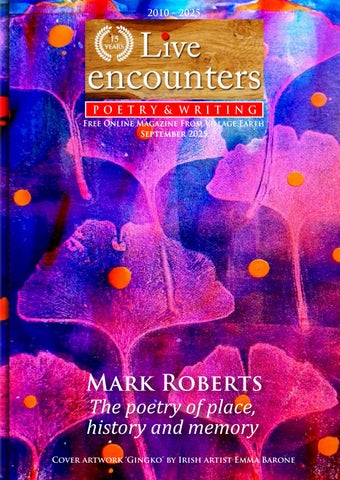
2010 - 2025
P O E T R Y & W R I T I N G Free Online Magazine From Village Earth September 2025
Mark Roberts The poetry of place, history and memory
Cover artwork ‘Gingko’ by Irish artist Emma Barone 2025 September POETRY & WRITING © liveencounters.net
LIVE ENCOUNTERS MAGAZINE
©Mark Ulyseas
Monsoon. Photograph by Mark Ulyseas. © liveencounters.net POETRY & WRITING September 2025 Celebrating 15th Anniversary
P O E T R Y & W R I T I N G
September 2025
Support Live Encounters.
Donate Now and Keep the Magazine Live in 2025 Live Encounters is a not-for-profit free online magazine that was founded in 2009 in Bali, Indonesia. It showcases some of the best writing from around the world. Poets, writers, academics, civil & human/animal rights activists, academics, environmentalists, social workers, photographers and more have contributed their time and knowledge for the benefit of the readers of:
Live Encounters Magazine (2010), Live Encounters Poetry & Writing (2016), Live Encounters Young Poets & Writers (2019) and now, Live Encounters Books (August 2020).
We are appealing for donations to pay for the administrative and technical aspects of the publication. Please help by donating any amount for this just cause as events are threatening the very future of Live Encounters. Om Shanti Shanti Shanti Om Mark Ulyseas Publisher/Editor
All articles and photographs are the copyright of www.liveencounters.net and its contributors. No part of this publication may be reproduced without the explicit written permission of www.liveencounters.net. Offenders will be criminally prosecuted to the full extent of the law prevailing in their home country and/or elsewhere. 2025 September POETRY & WRITING © liveencounters.net
Contributors
© liveencounters.net POETRY & WRITING September 2025 Celebrating 15th Anniversary
P O E T R Y & W R I T I N G
September 2025
Mark Roberts - Guest Editorial Linda Adair Mark Tredinnick David Rigsbee Jordan Smith Brian Kirk Jane Frank Hugh McMillan Terry McDonagh Angela Costi Richard W Halperin Anton Floyd Phil Lynch Indran Amirthanayagam Lincoln Jaques Edward Caruso Justin Lowe LaWanda Walters Stephen House Amy Barry Ma Yongbo Patricia Sykes Daphne Wilson Gita Chattopadhyay - translations by Paramita Banerjee & Carolyne Wright Dr Salwa Gouda
2025 September POETRY & WRITING © liveencounters.net
GUEST EDITORIAL
Mark Roberts © liveencounters.net POETRY & WRITING September 2025 Celebrating 15th Anniversary
MARK ROBERTS For much of the last four decades, Mark Roberts has been involved in writing, criticism and publishing. In 1982, he established P76 magazine in with Adam Aitken and has been involved in small press publishing ever since. In 2011 he set up the on-line journal Rochford Street Review, which is currently publishing Issue 42 https://rochfordstreetreview.com/
The Office of Literary Endeavours (5 Islands Press 2025) is Mark’s third book, after Stepping out of Line (Rochford Street Press 1986) and Concrete Flamingos, Island Press 2016.
Mark Roberts
The poetry of place, history and memory About a decade ago I started thinking about a project based on my memory of spending holidays and large blocks of my childhood on a farm run by my great aunts and uncle on the Cargo road between Orange and Cargo in the Central West of NSW, Australia. My memories covered the first 20 years or so of my life from the early 1960s through to the mid to late 1970s. At first this seemed to be a simple exercise. There were a number of memories that seemed to suit themselves well to poetry - travelling over the Blue Mountains as a child and looking down at clouds in the valley and imagining I was at the sea, looking down the main street of a town and seeing a paddock full of flowering canola like a sea of gold.... so I wrote some poems they were ok, but very one dimen-sional, much like a faded 1970s instamatic photograph. Memory obviously wasn’t enough for me to produce a good poem. There needed to be some depth beyond the simple description - context, history narrative perhaps? So I decided to return to the place of these memories. Travelling over the mountains again I looked out across the country as I drove down Victoria Pass towards Lithgow I felt a recognition I hadn’t felt before. I had travelled through the area a number of times over the preceding decades but this time there was something different. I was looking at the country, trying to see into it, rather than just glancing at it. A lot of things had changed since I was a child looking down at clouds or marveling at the gold of canola in flower. To start with I had learnt in school the accepted, colonial history of the place I was now looking down on. A history of settlement, explorers and empire (The British). There wasn’t much room for First Nations People in this narrative of my youth - if they were mentioned at all it was implied that they simply ‘melted’ away in the face of the expanding white settlement. Now as I looked down onto the country in front of me I new that I was entering Wiradyuri land and far from melting away they had fought bravely for their land.
© Mark Roberts
2025 September POETRY & WRITING © liveencounters.net
GUEST EDITORIAL
I had also been reading authors like William Least Heat-Moon (Blue Highways, River Horse and particularly PrairyErth: A Deep Map) and the Irish writer Tim Robinson (Connemara: Listen to the Wind). The poetic prose in these books drove a deep understanding of place and history, not just the accepted histories but the little histories, the lost histories and traditions that define a place. I was also reading poets like Laurie Duggan (The Ash Range) and Kate Middleton (Ephemeral Waters). Both of these books highlighted a method of capturing a region in poetry, its history, its environment and our impacts on it. I headed out to where the old farm used to be just past Orange, in he foothills of what the settlers called Mount Canobolas but which the Wiradyuri knew as Gaaha Bula. I remember standing on the top of the peak as a child, shivering and looking at the radio and TV towers and trying to look back to the farm. Now, alone, I listened and eventually wrote a prose poem: Gaanha-bula
I’m standing at the top of Mount Canobolas/Gaanha-bula. It is a spring morning, the sun is out, but there is a hint of ice in the breeze which occasionally flicks a piece of yellow tape against the metal framework of a telecommunications tower. This is a return to a place, a connection with country stretching through my family, the hints and suggestions of a buried history, a land that fills the imagination.
I listen to the tape against the metal, like morse code tapping out a message. I lis-ten for a pattern, but the wind swirls around the tower sending the sound in all di-rections. Above me I see microwave dishes, mobile cells and other pieces of elec-tronic gadgetry. This is how we communicate. I listen for a hum which would suggest high frequency radio signals are flashing above my head. But there is nothing but the flickering of the yellow tape.
Gradually I hear further into the silence - the wind moving through the trees be-low, the distant sound of a car heading up a dirt road, the faint rumble of a plane invisible in the sky.
Published in The Office of Literary Endeavours (5 Islands Press 2025) © liveencounters.net POETRY & WRITING September 2025 Celebrating 15th Anniversary
MARK ROBERTS
In many ways this was a way in for me. Like Tim Robinson I listened to the wind and it hinted at hidden histories and memories which reached back further than I imagined. Of course if you are going to try and write poetry you need to read poetry, really read it - read it and read it again. So I started looking for and reading contemporary poets writing about place. In particular I read the work of Wiradyuri poets and writers. Jeanine Leane’s work was central to helping me connect with the hidden histories through poetry. Her poem ‘After the Silence the Echo’, which was part of the Dhuluny: the war that never ended exhibition at the Bathurst Regional gallery in 2024 to mark the 200-year anniversary of the declaration of Martial Law on 14 August 1824, became a powerful touchstone for me as I tried to place myself and my poetry in Wiradyuri country. The violence of the so-called Bathurst Wars, and its almost complete absence until recently from Australian history, has to inform how both First Australians and non-indigenous Australians, relate to the area around Bathurst and Orange. Leane’s poem concludes: After the silence there’s an echo. An echo is a sound bouncing back through time repeating
an echo is a sound that curves around to re-sound again… and again… and again… An echo is the sound of the past as it screams
down
through
time through the barrel of a gun © Mark Roberts 2025 September POETRY & WRITING © liveencounters.net
GUEST EDITORIAL
at the end of a knife
An echo is resounding.
from the thud of a stirrup iron.
Silence is not peace.
The echo comes back again…
to break the silence…
and again… now…
as then…
and again…
as now…
As always.[1]
Once you accept the violence of the colonial past it necessarily impacts the way you view your past, your memories and how you represent them in poetry. Once of the memories I have tried to write about is the old car racing track at what was called Catalina Park in Katoomba. As a child I recall being in the car as my family drove through Katoomba on the way over the mountains to the farm. Down in a gully, off the old highway was a car racing track and, if a race meeting was on, you could hear the roar of the cars from the highway. I had tried to work this into a poem a number of times without success. The history of the racetrack, and the land it sat on, was, however, much more complicated. As settlement spread out from Sydney and across the mountains, many of the displaced Darug and Gundungurra people settled in a gully just west of the settlement of Katoomba. © liveencounters.net POETRY & WRITING September 2025 Celebrating 15th Anniversary
MARK ROBERTS
Over time it became a community and a central point of culture. Then, in the late 1940s the local council decided to build a car racing track on the site and the community was dispersed and de-molished. Recently I read a poem by another Wiradyuri poet Jazz Money called ‘Gully Song’. While this poem is probably not about the Katoomba gully, it does provide another layer of histo-ry to the place I was trying to write about a mist seeps through this gully and I can hear song
feel smoke cling to hair to lashes hear the way
the old voices are held here
- From how to make a basket UQP 2021
Auden once famously said that “poetry makes nothing happen”, what many fail to consider is that that section of ‘In Memory Of W.B. Yeats’ concludes with the lines “it survives,/ A way of happen-ing, a mouth”. For me, creating poetry out of place, memory and history is a “way of happening”, an attempt at truth telling in verse. The understanding, the unearthing and recording in art of our understanding of what it means to be living on a country that has a history that has been deliber-ately hidden from us is what is driving much of my current poetic practice.
While my main work at present may be firmly centred on a particular area of Australia, the old saying ‘think locally act globally’ holds true here. Australia is not the only country trying to come to terms with its colonial past (particularly a British colonial past) and the value of international platforms such as Live Encounters is critical in reaching out to a global “village” of poets and readers. It is a privilege to be part of that village. The poetry of place can be, indeed, global. [1] The complete poem can be read at https://rochfordstreetreview.com/2024/08/25/jeanine-leane-after-the-silence-the-echo/
© Mark Roberts
2025 September POETRY & WRITING © liveencounters.net
THE LIMITS OF DIS-LOCATION
Linda Adair © liveencounters.net POETRY & WRITING September 2025 Celebrating 15th Anniversary
LINDA ADAIR Co-editor of Rochford Street Review, Adair is a writer, artist, and activist descended from several Irish refugees, most of whom came from Roscommon and Galway. Two of her great-great-grandmothers were sent to Australia as teenage orphan girls on the Earl Grey Scheme in the wake of An gorta Mor. Their overlooked stories have inspired many of her poems, and she is thrilled and deeply honoured to be able to read at Poetry Plus in Ireland and in Galway at Charlie Byrnes Bookshop event for the National Culture Night on 19 September 2025. Adair’s poems have been anthologised in OysterCatcher One; To End All Wars; Messages from The Embers; Poetry for the Planet; and published in international journals including Live Encounters Poetry & Writing; FemAsia; The Blue Nib as well as a range of independent Australian journals. Adair most recently featured at the Winter 2025 Kedumba Gallery Reading; The August Reading held at the Little Lost Bookshop, Katoomba; the Anniversary Reading for (the renewed) 5 Islands Press in Melbourne; and A Gallery of Poets event at Dickerson Gallery. She has read at major events for Melbourne’s 2024 and 2023 Sonic Poetry Festivals; was invited to feature at The Back to Newnes Day in 2023 and presented her work after residencies at the BigCi (Bilpin Internal Ground for Creative Initiatives) and Varuna: the National Writers House. She was interviewed for 3CR’s Spoken Word program, and has exhibited her poems together with her paintings in both solo and group shows in Sydney, Australia. She has been invited to be a guest poet at the upcoming The Wonderlust Women event in Glasgow.
Súile gorm dúnta ó glare cerulean blue eyes shuttered from cerulean glare In searing cerulean brilliance you all wonder is this a light of possibility after months in the half-lit world below On deck the optic nerves twitch in the disarming glare of sunlight dancing on waves
as the boat is anchored from far away the too-familar grey of the Workhouse walls rise in your minds eye Today, the Digby’s manifest declares you were a housemaid who can read presumably English Afterall, the banned language Gaielge would not be worth considering from the Empires’ point of view,
Yet you made an illiterate mark as you disembarked from that first Earl Grey Scheme ship to sail to Australia.
Why? I want to be able to ask but of course you do not answer me so many generations gone.
I imagine this is because we do not share the same mother tongue.
© Linda Adair 2025 September POETRY & WRITING © liveencounters.net
THE LIMITS OF DIS-LOCATION
The limits of dis-location in memory of my great great grandmother You were … a mere girl one among 4114 souls ‘rescued’ or trafficked from that occupied country to this vast stolen land over 300 First Nations
díláithrithe / displaced díbeartha / exiled díbeartha / banished
You witnessed … that water-mold infest bog-land plots as the ‘late blight’ fed Sassenach greed and bigotry and starvation and eviction swept away resistance
dhaoradh / condemned dídhaonnaithe / dehumanised díshealbhaíodh / evicted
© liveencounters.net POETRY & WRITING September 2025 Celebrating 15th Anniversary
LINDA ADAIR
You learned … that choice was easy if you wanted to stay alive Earl Grey’s elegant scheme outsourced the cost of supporting poor orphan girls to the insolvent colony bás / perish nó / or daonra an choilíneacht / populate the colony You escaped … the last -resort refuge of Roscommon’s workhouse arriving in Port Jackson on the Digby in April 1849 its bounty of young housemaids resented by the protestant press bhreithnigh / judged náire / shamed doicheall / resented
continued overleaf... © Linda Adair 2025 September POETRY & WRITING © liveencounters.net
THE LIMITS OF DIS-LOCATION
You muted … your mother tongue stilled behind compressed lips you always answered in broken Bearla kept your thoughts to yourself as they whirred in the fluency of your native Gaeilge. ina thost / silenced toirmiscthe / forbidden shéan / denied
You knew… your role was to serve in ciúnas in boisterous households where squatters pushed past ‘The limits of location’ your policeman patrolled.
comhshamhlú/ assimilate eirigh suas / rise up pósadh / marry
© liveencounters.net POETRY & WRITING September 2025 Celebrating 15th Anniversary
LINDA ADAIR
You became a ... bean chéile , mháthair then widow when carrying your youngest child you beloved matriarch whose calm smile of welcome was rememberd in the death notices 50 years after you arrived.
I gcuimhne ar mo shin-seanmháthair, Margaret McGarry, dúchasach de Ros Comáin / In memory of my great great grandmother, Margaret McGarry, native of Roscommon.
© Linda Adair 2025 September POETRY & WRITING © liveencounters.net
S H R I K E - T H R U S H, F O R I N S T A N C E
Mark Tredinnick. © liveencounters.net POETRY & WRITING September 2025 Celebrating 15th Anniversary
MARK TREDINNICK Mark Tredinnick, the author of twenty-five celebrated works of poetry and prose, is the author, most recently, of House of Thieves, One Hundred Poems. His books on the writing craft have touched the lives and works of many. He runs What the Light Tells, an online poetry masterclass, and teaches at the University of Sydney. His edited collection of essays for Robert Gray, Bright Crockery Days, is just out from 5 Islands Press, whose managing editor he is. Mark lives and works southwest of Sydney on Gundungurra Country.
Shrike-thrush, for Instance For Meredith* You flew the nest years ago, of course. There is a time that needs no mother in it. But when the day comes and she no longer breathes the living air, one is as a shorebird without a shore.
Neither north nor south. Or now, perhaps, you’re as the shore without the bird. You can prepare yourself, a friend had said; what starts, ends. But there’s no easy getting used to her never coming back. Still, though, the way the days keep landing, and the birds, though fewer, keen and cry: what it was she passed to you does not cease. Life keeps living all that lived. Shrike-thrush, for instance, naming all the ways.
* a poem written last week to console a friend on the sudden loss of her mother.
© Mark Tredinnick 2025 September POETRY & WRITING © liveencounters.net
OUT OF FRAME
David Rigsbee © liveencounters.net POETRY & WRITING September 2025 Celebrating 15th Anniversary
DAVID RIGSBEE David Rigsbee is the recipient of many fellowships and awards, including two Fellowships in Literature from The National Endowment for the Arts, The National Endowment for the Humanities (for The American Academy in Rome), The Djerassi Foundation, The Jentel Foundation, and The Fine Arts Work Center in Provincetown, as well as a Pushcart Prize, an Award from the Academy of American Poets, and others. In addition to his twelve collections of poems, he has published critical books on the poetry of Joseph Brodsky and Carolyn Kizer and coedited Invited Guest: An Anthology of Twentieth Century Southern Poetry. His work has appeared in Agni, The American Poetry Review, The Georgia Review, The Iowa Review, The New Yorker, The Southern Review, and many others. Main Street Rag published his collection of found poems, MAGA Sonnets of Donald Trump in 2021. His translation of Dante’s Paradiso was published by Salmon Poetry in 2023, and Watchman in the Knife Factory: New & Selected Poems was published by Black Lawrence Press in 2024.
Out of Frame Flat light. The houses rise gleaming out of the grass. Here an aluminum ladder and some weathered fence slats seem out of business in the green and the moss. That one-propeller plane keeps the air busy. Some birds have a conclave in a neighbor yard. It was something urgent, whatever else it was. Just the thing when light outdoes the attention as both soften, the corners bend and darken like an old photo in the middle of which stands a farmer, awkward, sure of nothing except the work the dusted fields require out of frame, behind the gathered family that, except for his inscrutable frown he cannot explain or describe to the viewer.
© David Rigsbee 2025 September POETRY & WRITING © liveencounters.net
OUT OF FRAME
Once a Skunk The dog looks up from the end of the master’s leash. He’s trying to tell you he’s the familiar of clouds, especially those mid-summer armadas, the colliding forces of cumulus and stratus. The master, meanwhile latex-gloved, waits. It’s the inverse of leash law, the orderliness brought to fecal matter, clean sidewalks pacing away unbroken until the road turns, either curving or dipping at the horizon out of sight. When I was a child, I walked the dirt path outline dividing field from forest. Often an animal would bound or slink or creep from one to the other. Once a skunk ambled out of the woods and plunged into the corn, the same day a cornsnake made its hasty sine wave in the dirt like the fingering on a cello during a difficult passage in the repertoire, angling from field to piney thicket; finally like a buzzer going off in a dream. It was the way home then, and unless time is a lie, it is the way home now.
© liveencounters.net POETRY & WRITING September 2025 Celebrating 15th Anniversary
DAVID RIGSBEE
Holding Lear To his children, the father sent a note: “Henceforth, all requests for gifts and loans should be made through my attorney.” A coin dropped under the table first rolls, then wobbles in an onrush of uncertainty until it lies down spinning, speeding up even as it settles, before coming to rest altogether, an inert thing among things. When it was a wheel, it dreamed the Royal Brougham was dead weight without it, the government in ruins. Perhaps we should, as Vaughan recommended, expect and moan. Downstairs my daughter regards the sea by staring into her phone. When it was clear he was dying, my father, who hugged a pillow months to his aching lung, cut loose and cried in the night like a girl. Standing in Barnes & Noble, I reread the opening lines of King Lear, “I thought the king had more affected ...” and put it down, the Arden edition with its massive apparatus, the text afloat on an ocean of explanatory notes, and on the cover, bare tree crooking charcoal joints, leaves long in the process of blowing out over bare earth, a fact not even bad art can fail to get right.
© David Rigsbee 2025 September POETRY & WRITING © liveencounters.net
OUT OF FRAME
Advent Now, the first of December was covered with snow, sang James Taylor. And it was. Ohio was under an advisory, Virginia just getting underway. It was one of those dread afternoon assignments. I was teaching Hart Crane to an auditorium of students still in their overcoats, trying to jot down Crane’s heartache in bullet points. I know they will remember how complicated it was, but should they ever refer to their notes, they will find it there, now thirty years on, how the sky looked this way and that divided by the cedar crown. They slushed their way back to the parking lot, their dorms and lives. Today, I refer to my notes, as I do every year: your hair parted in the middle, your mustache bent in a frown like an activist, ca. 1975. Weeks earlier, you had called to invite me to Thanksgiving. My partner, not yet under the pacific cloud of Zoloft, and citing upcoming law school exams, made the case: we wouldn’t go. She recalled your only visit, when, with new bride in tow, you stowed a wine bottle under the guest room bed. We could only hear the rustle and thump, proof of mischief. You had become a nonperson in her eyes.
© liveencounters.net POETRY & WRITING September 2025 Celebrating 15th Anniversary
DAVID RIGSBEE
She was unkind, and you saw how it verged on misery before succumbing to worse. You knew because I told you, riding around the Virginia mountains before you left, waving from the window that summer day. Your call was the last time I heard your voice alive. Years later it was your greeting on the answering machine, which I recorded so that it became a computer file, itself lost. The next call was your neighbor. I had just put my briefcase loaded with books down. Kitchen. It was snowing outside. December.
© David Rigsbee 2025 September POETRY & WRITING © liveencounters.net
NO EXPECTATIONS
Jordan Smith © liveencounters.net POETRY & WRITING September 2025 Celebrating 15th Anniversary
JORDAN SMITH Jordan Smith is the author of eight full-length books of poems, most recently Little Black Train, winner of the Three Mile Harbor Press Prize and Clare’s Empire, a fantasia on the life and work of John Clare from The Hydroelectric Press, as well as several chapbooks, including Cold Night, Long Dog from Ambidextrous Bloodhound Press. The recipient of fellowships from the John Simon Guggenheim and Ingram Merrill foundations, he is the Edward Everett Hale Jr., Professor of English at Union College.
No Expectations But ever in my sweet short life Have I felt like this before (Jagger/Richards)
Don’t show me your desires, He said, the record On the old lp changer repeating The same side, an example If not an exact one, he acknowledged Of what he meant, all those years ago Still in high school, when he walked home From the church basement coffee house Through the suburbs to his parents’ house, The traffic light on Route 31 strobing, The acid just taking hold, And he knew the night would just go on Folding in on itself, an origami So complex, That when he stared at it in the mirror On the back of his bedroom door, Each sharply creased facet Was another axiom, Proving the self unprovable, Another face To pull on, like the oversize sweater He wore now most nights against a chill The whiskey couldn’t reach, And this is why, he continued,
continued overleaf... © Jordan Smith 2025 September POETRY & WRITING © liveencounters.net
NO EXPECTATIONS
He decided that night he might as well give himself Fully over to whatever came to hand Rather than to anything scrawled on his own Or anyone’s endless list of expectations. Show me your loyalties, He said, as the song began again, Especially if you’ve kept them As simple as I have. When I pass through anywhere, I never want To pass through there again.
© liveencounters.net POETRY & WRITING September 2025 Celebrating 15th Anniversary
JORDAN SMITH
The Great Uncertainty He never thought he’d be even a footnote In anyone’s biography, unless as one Of those contingent circumstances (Which, the sages wrote, are known As the great uncertainty), like Today’s visitation by an owl in the woods, Which happened only because he switched Shoes for boots, and then, discovering A hole in his sock, took the time To change it, and later for no reason He could remember, he picked the direct Rather than his usual circuitous path, Straight up, not following the contours Along the ascending ridges, the narrower Less-traveled way he preferred that seemed Suddenly predictable, self-referential, And then the feathers like smoke, and then On an ash branch a few feet off the trail The horned head, and the bird’s charry Silhouette just emerging against the trunk, Watching him as if he should Have more to offer, but later, when he texted His friend about the band on stage, The singer from whom they’d both Learned so much about desolation And the insufficiency of nostalgia, Who performed now with near-
continued overleaf... © Jordan Smith 2025 September POETRY & WRITING © liveencounters.net
NO EXPECTATIONS
Indifference to anything like praise, And when his friend sent back a selfie, Holding up the singer’s rarest single Framed in a mirror so that his face Was just visible through the spindle hole There seemed no reason that some Gesture from his life might not become A trace in someone else’s story, What a biographer might call A source, as if you could find any beginning To whatever was always going to come, Next.
© liveencounters.net POETRY & WRITING September 2025 Celebrating 15th Anniversary
JORDAN SMITH
©Jordan Smith
Photograph by Jordan Smith. © Jordan Smith 2025 September POETRY & WRITING © liveencounters.net
NETTLE
Brian Kirk © liveencounters.net POETRY & WRITING September 2025 Celebrating 15th Anniversary
BRIAN KIRK Brian Kirk has published two collections with Salmon Poetry, After The Fall (2017) and Hare’s Breath (2023). His poem “Birthday” won Irish Poem of the Year at the Irish Book Awards 2018. His chapbook It’s Not Me, It’s You won the Southword Fiction Chapbook Competition, published by Southword Editions in 2019. His novel Riverrun was chosen as a winner of the IWC Novel Fair 2022. www.briankirkwriter.com
Nettle What does it mean to feel a sting? A sign of life or just an ache? Perhaps it signifies something that can’t be named, something opaque like worry, fear or maybe love, a pinch that urges you to move. But if I steel my will and grasp the moment that is offered me, and even as I swear and gasp I still may find tranquillity. Remember how we used to live before we took what we should give? Look closer and you’ll see her worth, a source of food for Tortoisehell, indicative of fertile earth, verdant garden damoiselle. Don’t take this sharp conceit amiss, her sting is like a lover’s kiss.
© Brian Kirk 2025 September POETRY & WRITING © liveencounters.net
NETTLE
Coco That is the name they have given me. A clown’s name – they have no idea.
They imagine that I am domesticated,
but I am more wild than they’ll ever
know. I am Diana, the hunter, Artemis,
Bastet. My brothers pulled Freya’s chariot
from battlefields to Fólkvangr. Pangur Bán was my father. When they stroke me I take on their fears. The wisdom of ages sleeps in my coat.
© liveencounters.net POETRY & WRITING September 2025 Celebrating 15th Anniversary
BRIAN KIRK
Crossing the Thames The water down below is black as pitch, the lights from stars and shore blend and bewitch, making the city seem an eiderdown on which is draped a silken evening gown – brocade, studded with silver jewels, hand-sewn. The dress she wears is dark as chocolate cake and she is good enough to eat. You slake your thirst with furtive looks, but still you ache for all the things that she might let you take. Hope lives until you reach the other side, there the world begins or ends – fate will decide – but you delay the moment, slow your stride, you want this crossing over to abide so that your love might live always untried.
© Brian Kirk 2025 September POETRY & WRITING © liveencounters.net
BANKING SLEEP
Jane Frank © liveencounters.net POETRY & WRITING September 2025 Celebrating 15th Anniversary
JANE FRANK Brisbane poet Jane Frank’s third collection of poems is Gardening on Mars, to be released by Shearsman Books in October 2025 and she is author of two previous books published by Calanthe Press — Ghosts Struggle to Swim (2023) and Wide River (2020). Her poetry has been widely published in Australia and overseas in journals and anthologies including Westerly, Other Terrain Journal, Meniscus, London Grip, Antipodes, The Mackinaw, Poetry Ireland Review, the Liquid Amber Prize anthology and 100 Poets (Flying Island Books 2025). She is Reviews Editor at StylusLit literary journal and teaches in the School of Business and Creative Industries at the University of the Sunshine Coast. Read more of her work at https://www.facebook.com/JaneFrankPoet/
Vicarious Late afternoon in a part of town I don’t know well & I need somewhere to sit, drink tea, during my son’s guitar lesson. I’ve wound myself from one side of the street to the other like a cat’s cradle & now I’m at a rickety table watching the road spin like ribbon up and around the hill below cassia & coral trees, between fringes of bright painted shops, tiny cars rolling home past me in a blur of end-of-day ordinariness. At the tables around me—a nurse who’s finished her shift or perhaps about to start, three school kids glugging chocolate milk, an elderly woman in a shawl beside a decrepit bicycle feeding shortbread crumbs to a dog in a square basket. I’ve started imagining myself into other bodies, minds, shedding them just as fast, so all the lives I’ve never lived are scattered around the suburban streets & in coffee shops & cinemas & parks & on the curving path beside the bay where paragliders wash upwards into a dark orange sunset
© Jane Frank 2025 September POETRY & WRITING © liveencounters.net
BANKING SLEEP
Banking Sleep … up come the sleeping words, bright red, fresh, blowing about Ali Smith I’ve been banking sleep these almost winter mornings— been in debt for months— so I bought mahogany sheets designed for dreamers & free spirits, textural and timeless as a way of telling myself that Plato was wrong. Unconsciousness is not the same as death or even the borderland before it At first light in the undergrowth fern trees are a nucleus of colour & energy: I wonder if there are still tiny fragments of us caught dormant in the silk of that golden orb web? Imprints of you: the whorls of your fingers the ridges & deltas of your green touch, everything you planted in this garden cast onto days in shiny fuchsia film
© liveencounters.net POETRY & WRITING September 2025 Celebrating 15th Anniversary
JANE FRANK
If I’m honest a scarcity of time is on my mind & when I dream it’s an organic matrix of dahlia beds alight contre-jour with autumn sun, gums with scribbled trunks, cascading fountains of leaves hiding the crevices where frogmouths doze, a dog sprawling on the lawn, a lazy eternity symbol of fire pit smoke, tawny blooms arranging themselves in a moon and stars vase & lullaby-birds circling the old house as if years haven’t passed
© Jane Frank 2025 September POETRY & WRITING © liveencounters.net
BANKING SLEEP
Dream Map Orange and yellow canna lilies grow fast from crinkled pages, through places where folds have made the paper soft as earth. On these unseasonably warm nights, I carry dream-maps in pockets edged red with rickrack. From my bike, the past moves fast in and out of crisscrossed streets —the Queenslanders of my grandparents and aunts, best trees to climb, the baker’s shop that sells rolled chocolate sponge, Neapolitan slice, the skate rink, pony club, swimming pool and school, the graves of pets, not all my own. This dreaming world no longer grieves: nights are peppermint fresh, shining through dark-hour furrows. I pack and unpack all the trinkets and books I’ve ever owned in the house with rooms of many colours. Sharks swim in dark unreachable rivers
© liveencounters.net POETRY & WRITING September 2025 Celebrating 15th Anniversary
JANE FRANK
and there are snow-capped mountains I can’t touch, no matter how long my arms extend, far off beyond frangipani trees and sugarcane fields. The strangest thing: all the people have gone. I don’t dream of love but still believe it might be somewhere.
© Jane Frank 2025 September POETRY & WRITING © liveencounters.net
THE SECOND LAST FRIDAY IN APRIL
Hugh McMillan © liveencounters.net POETRY & WRITING September 2025 Celebrating 15th Anniversary
HUGH MCMILLAN Hugh McMillan is a writer and performer who lives in South West Scotland. His last collection ‘Diverted to Split’, was published in summer 2024. In 2021 he was appointed editor of the Scottish Poetry Library’s anthology ‘Best Scottish Poems’ and this year was also chosen to chair the Saltire judges for Best Scottish Poetry Collection of the Year. His cult classic ‘McMillan’s Galloway’ was reprinted in paperback form in May 2023, and ‘Whit If’, his Scottish History poems were reprinted in April 2024 and formed the basis of a successful show at the Edinburgh Fringe in 2024 and 2025.
The Second Last Friday in April A faultless steel sky. Small trees
shudder as buses carve through puddles
ready to fill. A couple drift diagonally
across the road to the baker’s, they are beautiful, she has kanzashi, he is tattooed blue all over.
Their Thornhill is not mine: there is love, and blossom frames the steak bakes. Stand us where we did? Pass me the Bovril and pepper, my muse!
Each day I set sail and am washed ashore.
© Hugh McMillan 2025 September POETRY & WRITING © liveencounters.net
THE SECOND LAST FRIDAY IN APRIL
Avanti Avanti I love you. I have missed three trains and yet you are here with your blue snake shining allure, your livery, your carriages lifting and seething slightly in a sexy way. You are destined to go somewhere I will get off, though I may not want to, it will be a place where the rails go away smoked with frost. Avanti let me confess or cry to you my faults my passions. I am dying pasted
to this window here, this icon of night and reflected sadness, joy too, of course. I am wondering where in the starry lovely
night I am going? and all the time I am digging with a blunt key in the lining of my jacket for what I hope is a plastic bottle of wine. © liveencounters.net POETRY & WRITING September 2025 Celebrating 15th Anniversary
HUGH MCMILLAN
Poems I admire So many of the poems I admire have people walking through city streets in rain or fractured sunlight, they are rushing to meet friends or imagining they are and in the process see the faces of street vendors or hear the snap of bright umbrellas opening. There is a hiss or stir of traffic, trams maybe, the clouds overhead remind them of animals at the zoo, there’s a hole in one of their shoes and they stand in a puddle but don’t feel sorry for themselves because they are all wrapped up in rush and watching. They are nearly all in love even the old ones who simply sit on that bench in the park by the shade of a linden tree and spend the day reading or playing chess. Oh I am late they say to themselves or to the ones they meet at last under a statue who turn full and wonderful faces towards them in one unadulterated moment of joy. © Hugh McMillan 2025 September POETRY & WRITING © liveencounters.net
EDUCATION OUCH!
Terry McDongah © liveencounters.net POETRY & WRITING September 2025 Celebrating 15th Anniversary
TERRY MCDONAGH Terry McDonagh, poet and dramatist, has worked in Europe, Asia and Australia. He’s taught creative writing at Hamburg University and was Drama Director at Hamburg International School. Published fifteen poetry collections, as well as letters, drama, prose and poetry for young people. In March 2022, he was poet in residence and Grand Marshal as part of the Saint Patrick’s Day celebrations in Brussels. His work has been translated into German, Indonesian and Arabic. His poem, ‘UCG by Degrees’ is included in the Galway Poetry Trail on Galway University campus. He’s been a voice and narrator on several RTE radio dramas (All Points West production) for young people. In 2020, Two Notes for Home – a two-part radio documentary, compiled and presented by Werner Lewon, on The Life and Work of Terry McDonagh, The Modern Bard of Cill Aodáin. His latest poetry collections: A) An eBook ‘Rosencrantz and Guildenstern are Not Dead’ – Live Encounters Publishing. B) ‘I Write Because’ – Calendar Road Press. After more than thirty years in Hamburg, he returned to live in County Mayo in 2019.
Landscape in Season If we can read a landscape we will never be lost. There is always tree shade, shrub and colour to guide us through the crescendo of seasons.
Great chunks of winter become a fading memory when the fresh extravaganza of spring begins to paint spectacles on canvas of dance and vigour.
Summer is a time for immersion and unravelling on land and seascapes – on journeys around galaxies of fine wines and smirking salads in abundance for inexhaustible eyes, and then – rich as any flame – we have autumn insights sauntering under a sprinkling of stars with pink fingers nestling and hidden from the snarl of approaching winter.
If we can read the landscape we will never be lost. We are earth, air, friends, fire and water nourished by enquiring breezes, movement in wild grasses, colourful horizons and dogs barking.
© Terry McDonagh 2025 September POETRY & WRITING © liveencounters.net
EDUCATION OUCH!
Education Ouch! I was only four or five when school started to insist on tributes to a life without dreams. Tone down child.
I, who had shared lanes with butterflies and slithered along hedgerows with blackbirds, had to arrive on time in shoes bulging with squelch and sucking sound. Behave started on page one. I was a solitary fighter with a pocket full of stones – being trimmed to fill a front pew – perfect as any saint or neighbour. I learned page after page by heart and grew out of jumping about on cloud nine extravaganza. Against a shroud of statues and epics, I was unprepared for the hacks and quips of what to do
when bewildered and happy. I learned rules: a man could never be asked to strip during singing lessons, or when licking a plate, slurp and slobber should be frowned upon and, as I didn’t know
which smile suited, I’d imagine me on a table doing a colourful swing-about in monkey gear
to shock – to be good craic – to be a bit of a lad but I’d usually revert and nod to the dictum: never get above yourself or speak out of turn in gatherings.
© liveencounters.net POETRY & WRITING September 2025 Celebrating 15th Anniversary
TERRY MCDONAGH
Let’s atone. Atone or pay a price for gyrating like gypsies in pink and magic. There was no light in noise. Behave. Atone. Conform. Keep taking the tablets and smile at other Sunday-morning dog-walkers.
I’d always wanted my fill of magic stones, shenanigans and skipping like an untrained antelope among trees. I did! Daydreamer
Dosser
Daydreamer.
Thankfully, the west wind came to my rescue dropping word-potions-droplets on me and
I’d rejoice keeping them secret to float my feet to horizons where oceans grew – to where longboats appeared out of nowhere whistling and singing of places where colours could fly.
I’d sift through tests, crawl on beds of nails, often missing the magic in hedgerows – fearing
the clatter of shadows under heavenly influence and demons crowned in halo attire.
These days, I close my eyes to see horses galloping on wild sea waves or rolling in flat on white foam while I wriggle happily with carefree fish. My real learning had to be learned later.
© Terry McDonagh 2025 September POETRY & WRITING © liveencounters.net
BEIGE IS NOT A COLOUR
Angela Costi © liveencounters.net POETRY & WRITING September 2025 Celebrating 15th Anniversary
ANGELA COSTI Angela Costi has a number of poetry collections including Honey & Salt (5Islands Press, shortlisted Mary Gilmore Prize 2008), An Embroidery of Old Maps and New (winner of Poetry Prize in English, Greek Australian Cultural League 2022), and most recently The Heart of the Advocate (Liquid Amber Press). This year, her poetry has been placed in a number of prizes, including the joanne burns Microlit Award, MSB International Competition, NSW Poetry Prize, MPU International Poetry Competition and the Liquid Amber Poetry Prize. She is known as Αγγελική Κωστή among the Cypriot diaspora, her ancestry and heritage. She lives on unceded Wurundjeri land in Naarm (Melbourne, Australia).
Beige is Not a Colour for Eleni Costi, my mana, who resides in ‘the Sensitive Care’ unit it is a hallway of closed doors caging the bird-like chirps of a woman who once roared demands as she worked in her red apron it is her accommodating womb before my legs kicked and eyes opened before their quarrels swept into my heart
it is the tone a person with status but no power makes as they promise assisted housing with a tear for the demented the squashed cream in a biscuit a peach wanting to die her bowl sent to the op shop it is makeup stealing my face
© Angela Costi 2025 September POETRY & WRITING © liveencounters.net
FULL FRAME
Full Frame the naval commander of the Greek war of Independence in 1821, Laskarina Bouboulina, is shot dead from her balcony’s window final scene, Bouboulina, film, 1959
we watch her speaking to loaded guns we are very good cowards eating our popcorn licking our choc tops sitting very quiet in the dark she scoffs calls them skoolikia tells them to squirm back to their holes she is more personal to us than a saint or a god in her traditional dowdy dress with her outstanding breasts thrust towards ocean as she commands her fleet of ships outliving her husbands and sons and balikaria killed by cannons and swords until one shot is fired she falls back into the dark of her house back into our darkness with only seconds to live she says I was spared the death of war to die inside my house help me to see the sea she says the old man lifts her up to watch the freedom of waves and there is something else she sees it could be her dying son we think but the view is blurred with our tears
© liveencounters.net POETRY & WRITING September 2025 Celebrating 15th Anniversary
ANGELA COSTI
Face Time with Cousin Phillipo you seem bonier around the shoulders if we hugged it would be awkward
you’re keen to describe your studio as a raft where you write for Simerini about football’s failure in Cyprus you say Alexander the Great was Greek as you walk over to your large laminated map of the world stuck to your wall from your desk you like the view of red push pins you’ve forced into the lands you’ve travelled
a solar system of pins in Europe a bouquet of fireworks in South East Asia a zig-zag path into the Middle East you fiddle with a pin too close to my screen I roll my chair back
you return to your map become the smaller person hovering the pin over a land
out loud you say Egypt! as the pin stabs through I want to ask Why Egypt? But your face and voice conquer my screen Alexander liberated them from the oppressors… © Angela Costi 2025 September POETRY & WRITING © liveencounters.net
CROSSING THE ILLUSION
Richard W. Halperin. Photo credit: Joseph Woods. © liveencounters.net POETRY & WRITING September 2025 Celebrating 15th Anniversary
RICHARD W HALPERIN Richard W. Halperin is a U.S./Irish dual national living in Paris. His poetry is published by Salmon (four collections) and by Lapwing (eighteen smaller collections.). In Autumn 2025, Salmon will bring out All the Tattered Stars: New and Selected Poems, Introduction by Joseph Woods.
Crossing the Illusion No one knows what a dragonfly is. No one knows what it does.
I think it carries things away but I have never seen one carry anything away. Crossing the river Crossing the illusion
A friend recommended I read the poetry of Henry Vaughan. I tried. A dragonfly does for me what Vaughan does for others. Crossing the river Crossing the illusion
My wife once gave me a very good hairbrush. Here it still is. She isn’t.
© Richard W. Halperin 2025 September POETRY & WRITING © liveencounters.net
CROSSING THE ILLUSION
Another Veronica I overheard a woman saying to a friend ‘Halfway into the conversation, I realised he was speaking about another Veronica.’
That sometimes happens, of course. But how many Veronicas was each Veronica? I know in my case I am multiple Richards, some of whom I can sense, some of whom I suspect. Real focus could see all the Richards at once. My wife could see all the Richards at once. Who else could do that? Mycroft Holmes? Jesus? Love can do that.
© liveencounters.net POETRY & WRITING September 2025 Celebrating 15th Anniversary
RICHARD W HALPERIN
A Paisley Shawl for Anton, Carole Anne and Aodhán Floyd At the house of friends, I see a Paisley shawl that someone left on a table. As I look, I understand something about Persia. I do not know what I understand, but there it is. As I continue to look,
I feel as if I were on holiday or on the deck of a sanitorium. Something collects in my mind, or in my soul. Something remembered. Something not quite remembered. Poetry.
© Richard W. Halperin 2025 September POETRY & WRITING © liveencounters.net
CROSSING THE ILLUSION
A Calm Eagerness Years ago in Ireland I heard at Mass a priest give a homily on Mary: that she is barely in the Gospels or in Acts, but that her presence then and now is enormous. He ended the homily by saying, ‘How then does all this affect the way we live our lives?’
Mary affects the way I live mine. How, is private. My life is also affected by certain entities, which I make small if I call them ‘literature.’ These include, recently – as my country of birth inflicts torment on itself and on the rest of the world; for nothing – the poems of Robert Frost and The Great Gatsby. They are written with a calm eagerness.
Years ago in Paris, where I live, I went to hear a monologue spoken by an actor and written by a young playwright who, one evening in 2015 when he was at home minding the baby, learned that his wife was one of those killed in the Bataclan massacre. The monologue reproduced, as best art can do, his feelings and his life that night and during the days and years which followed. Which follow. He entitled the piece Vous n’aurez pas ma haine. You shall not have my hate. If you have my hate, you will have won. You will never win.
© liveencounters.net POETRY & WRITING September 2025 Celebrating 15th Anniversary
RICHARD W HALPERIN
Elegance The thread of it is unbreakable.
I look at a painting of an eighteenth-century German park: trees, fountains, paths, laid out in perfect symmetry. If it poured rain – and there must be rain - the design would remain untainted. Wilhelm Kempff playing The Goldberg Variations has to do with this.
Gene Tierney in films has to do with this. ‘Belle composition par Gène Tierney’ wrote a critic recently about her Mrs Muir. Experience – mine – can never be passed on to anyone.
I can see – because I choose to – Gene Tierney walking through it.
© Richard W. Halperin 2025 September POETRY & WRITING © liveencounters.net
W H E R E T H E R E I S N O H O P E, W E M U S T I N V E N T I T*
Anton Floyd. Photo credit: Aodhán Rilke Floyd. © liveencounters.net POETRY & WRITING September 2025 Celebrating 15th Anniversary
ANTON FLOYD Anton Floyd was born in Cairo, Egypt, a Levantine mix of Irish, Maltese, English and French Lebanese. Raised in Cyprus, he lived through the struggle for independence and the island remains close to his heart. Educated in Ireland, he studied English at Trinity College, Dublin and University College Cork. He has lived and worked in the Eastern Mediterranean. Now retired from teaching, he lives in West Cork. Poems published and forthcoming in Ireland and elsewhere. Poetry films selected for the Cadence Poetry Film Festival (Seattle, 2023) and the Bloomsday Film Festival (James Joyce Centre 2023), another, Woman Life Freedom, dedicated to the women of Iran, was commissioned by IUAES. Several times prize-winner of the Irish Haiku Society International Competitions; runner-up in Snapshot Press Haiku Calendar Competition. Awarded the DS Arts Foundation Prize for Poetry (Scotland 2019). Poetry collections, Falling into Place (Revival Press, 2018) and Depositions (Doire Press, 2022); a special, illustrated edition of Depositions translated into Irish, Scots Gaelic, Welsh, and Scots with an introduction by Professor Emeritus Seosamh Watson (Gloír, 2024). New collections On the Edge of Invisibility and Singed to Blue are in preparation. Newly appointed UNESCO – RILA affiliate artist at the University of Glasgow. He is an Associate at the Centre for Poetry Innovation at the University of St Andrews, Scotland.
In his poem Snow Storm, Du Fu, For Martin Derbyshire and Farzaneh Ghofrani In his poem Snow Storm, Du Fu, the 8th century Chinese poet, broods on the uselessness of letters to ameliorate his world. Despair prowls through his lines. It lingers over ordinary things the detritus of a stilled life an empty bottle, a spilled cup, the empty grate. People talk but are secretive. He is wearied, heartsore, haunted, alone. Even if we could reach across time what comfort could we offer him? Tell him his words resonate today? That would hardly satisfy. All I know is that our son, in his fearless concern once led a runaway, hoof-mad bull by the nose back to his field. There is something mythic about that.
* Where there is no hope, we must invent it. - Albert Camus © Anton Floyd 2025 September POETRY & WRITING © liveencounters.net
W H E R E T H E R E I S N O H O P E, W E M U S T I N V E N T I T*
Sestina for Alanna Maeve born 31st May 2023 When did other people give up the idea of being a poet? William Stafford Leaving Kinsale we drive home. It is a starless night. Except for our headlamps, the countryside is pitch. It feels like a deep-delving dark. Some might say it feels menacing. The motor, its undertow of sound, is a kind of mantra. My sense of being comes easy as breathing - a somatic tuning. I breathe in. I breathe out.
Breathe in. Breathe out. Breathe in. Breathe out. The image of our new-born grandchild fills the night. The sense of her and love for her come as easy as the eye drawn to a pinprick of light in a pitch black sky. Her name, Alanna Maeve, is an ecstasy of sound something more than thought or words can say. Human voices disturb the spell. I hear one say and she, soon to be a grandmother, speaks out her genuine concern, Is it right? I mean, morally sound, to have a child now with the future bleak as night and everywhere the screech of politics at fever pitch? Silence, then, fills the car, deep-delving and uneasy.
I’d be wary to think that way, my heart replies. It’s easy to cede the ground, believe what cynics say they’d have us dig our apathetic graves. They’d pitch us into the maw of hell. But ah, as Virgil said, climb out, reclaim the upper air or pilot permanent night where the uncommitted howl giving horror a sound.
© liveencounters.net POETRY & WRITING September 2025 Celebrating 15th Anniversary
ANTON FLOYD
Yet here in the upper air we weep at the sound of hope denied while fanatics make easy excuse the sacrifice of innocence; make night of day heedless of what the tears of Guernica say. As for the future they’d have us blot it out, would smear the sanctity of life with pitch.
And pity those who fall for the cynical pitch to compromise. Better by far the stirring sound of any child’s tears and blisses. Promise outshines all in the infant; is natural and easy from birth. So, we, in the infancy of race, say welcome that age when day’s not followed by night.
Alanna Maeve, I sing out your future worthy of perfect pitch. I wish your nights free from fear and your sleeps sound. May happiness come easy and love stir all you do and say.
© Anton Floyd 2025 September POETRY & WRITING © liveencounters.net
W H E R E T H E R E I S N O H O P E, W E M U S T I N V E N T I T*
Ne’er Cast A Clout for Marcas Mac an Tuairneir When the hedgerows stirred out of a long sleep, warm light welcomed all manner of birds territorial, wary, and noisy, building and foraging. Small life on the move. Everywhere smelled moist, fecund, ceremonial. Sharp things pushed out of the dark ground, Rainbow colours carried in green juices. Everything was making ready for summer. Everywhere sang the world afresh. And we sang with it. But war like a late frost ambushed us. Winter was in its breath like a virus, a cruel cold hand to cover our mouths, would mute our voices.
© liveencounters.net POETRY & WRITING September 2025 Celebrating 15th Anniversary
ANTON FLOYD
©Mark Ulyseas
Photograph by Mark Ulyseas. © Anton Floyd 2025 September POETRY & WRITING © liveencounters.net
FLYING SOUTH
Phil Lynch © liveencounters.net POETRY & WRITING September 2025 Celebrating 15th Anniversary
PHIL LYNCH Phil Lynch lives in Dublin (Ireland). His poems have appeared in a range of literary journals and anthologies, on Podcasts and CDs and have also been featured on poetry and arts shows on national and local radio in Ireland. He is a regular performer of his work at poetry and spoken word events and is the coordinator and co-host of Words by the Sea, a monthly open mic night by ArtNetdlr in Dun Laoghaire (Dublin). His latest poetry collection, Moving On (Salmon Poetry), was published in 2024. A previous collection, In a Changing Light, was also published by Salmon Poetry.
Flying South There is rain in the wind, the first of the Brent Geese have landed below in the park, a spaceship floats among the stars, our thoughts return to journeys made, car packed to the gills, full of giddy fun, compass set, as we hurtled towards the sun.
© Phil Lynch 2025 September POETRY & WRITING © liveencounters.net
FLYING SOUTH
Evening in Tossa They sit with their backs to the sea, their faces to the evening sun. The purr of the tide on the breeze soothes the squalls of scavenging gulls flailing around a fisherman’s boat. Quiet chatter ripples the beach, great splurges of laughter erupt, friends caper and shout in the waves till the church tower bell above calls them home to close out the day. The clangs on the hour send scatters of birds in a frenzy of flight to flutter around the old square until clamour of daytime gives way to uncertain sounds of the night.
© liveencounters.net POETRY & WRITING September 2025 Celebrating 15th Anniversary
PHIL LYNCH
Photograph courtesy https://pixabay.com/photos/ © Phil Lynch 2025 September POETRY & WRITING © liveencounters.net
SOCIAL CONTRACT
Indran Amirthanayagam. Photo credit: Ethelbert Miller. © liveencounters.net POETRY & WRITING September 2025 Celebrating 15th Anniversary
INDRAN AMIRTHANAYAGAM Indran Amirthanayagam writes a Substack at indranmx.substack.com. His 28 poetry books include the Paterson prizewinner The Elephants Of Reckoning (Hanging Loose Press), El bosque de deleites fratricidas (RIL Editores), Seer (Hanging Loose Press), The Runner’s Almanac (Spuyten Duyvil), Powèt Nan Pò A: Poet of the Port (Mad Hat), Ten Thousand Steps Against the Tyrant (Broadstone Books) and Coconuts On Mars (Paperwall, India). He is the translator of Kenia Cano’s Animal For The Eyes (Dialogos Books) and Origami: Selected Poems of Manuel Ulacia (Dialogos Books). He edits The Beltway Poetry Quarterly (www.beltway-poetry.com), hosts the Poetry Channel on YouTube, and publishes poetry books at Beltway Editions (www.beltwayeditions.com). Amirthanayagam writes weekly poetry columns for El Acento (Dominican Republic) and Haiti En Marche (Haiti). He writes and publishes in French, Spanish, Portuguese, Haitian Creole and English. Amirthanayagam served as a diplomat for the United States from 1993 to 2023.
Declaration of the Rights of Fourteen Lines I declare here that every poem I write, every comment on the war, every declaration of love, every naming of memories, the whole shebang, will be housed in fourteen lines. Thus I join Shakespeare and Petrarch
and the millions of their followers who have already joined the Fourteen Line Club, civic association, fraternity and sorority, League of, then United, Nations, together to celebrate the International Day of Fourteen Lines. This is a heady moment. We have gone through war and heartbreak. We have lost love only to find it, then lose it again. This needs to be documented, in this format that has withstood vicissitudes of historical preference, that has come back into fashion thanks to our conscious decision, to say with pride, fourteen lines.
© Indran Amirthanayagam 2025 September POETRY & WRITING © liveencounters.net
SOCIAL CONTRACT
Social Contract What are you concocting in your studio? We would like to know what to expect, when the words come out to walk, to get some sun, to say hello to the trees, to venture down
into town and straight to the cafe where the coffee is hot and the waitress used to serving you a first beaming cup...Oh, and if you insist on keeping words to yourself, that can work. The right to privacy is as important as any other, including that of the social contract, knowing what your brother thinks and does, so you can sleep better, and wake up content that the village is taking care of itself and nobody writes or screams in silence.
© liveencounters.net POETRY & WRITING September 2025 Celebrating 15th Anniversary
INDRAN AMIRTHANAYAGAM
Clearing on the Path When melancholy starts to seep into mind, filling thought with smoke and fire, bile and blear thickness, stillness forming into
a pressure cooker about to burst, your message arrives like light, cool wind after heat, stirring me to smell roses and look for rabbits
and deer gamboling on the path, setting off on that morning bet, refreshed once more, advancing on the year’s end goal, new year’s wish recovered, step loose, strong, striding, getting stronger, not looking back.
© Indran Amirthanayagam 2025 September POETRY & WRITING © liveencounters.net
SOCIAL CONTRACT
Trust the Voice Searching for the elusive with roses, darts and excuses, the essential question, win the girl or write the verses... and build stock for the next long winter, seeds that will not perish, perennial protein but partnership provides clues to finding the escape route, a word in French, a floor in a house where we share an office, a blanket contract
obliging us to work under all conditions. If this is not union then who will update the dictionary, defining the term according to love and dream, station and use, none of which are at issue?
© liveencounters.net POETRY & WRITING September 2025 Celebrating 15th Anniversary
INDRAN AMIRTHANAYAGAM
Distributing Seed The sharing was sweet, exchange of heart speech, interweaving of lines, mutual inspiration pact. Not writing to you now feels blear, befogged, bitter. How easy to hit send again? As easy as a finger pressing on the key. But the finger depends on the brain, and its guidance counselor says we must rest for a time, to give other seeds, beside this damned business of loss, the opening they will need to sprout.
© Indran Amirthanayagam 2025 September POETRY & WRITING © liveencounters.net
7 COUNTERS TO DEPRESSION
Lincoln Jaques © liveencounters.net POETRY & WRITING September 2025 Celebrating 15th Anniversary
LINCOLN JAQUES Lincoln Jaques is a Tāmaki Makaurau Auckland based writer. His poetry, fiction, travel essays and book reviews have appeared in collections in Aotearoa and internationally, including Landfall, Live Encounters, The Spinoff Friday Poem, Poetry Aotearoa Yearbook, Mayhem, Anti-Heroin Chic, Burrow, Book of Matches and Takahē. He was shortlisted for the 2023 inaugural I Te Kokoru At The Bay hybrid manuscript awards, and has been selected for the 2025 Best Small Fictions (BSF) anthology from Alternating Current Press.
How Not to Write a Poem in a Crowded Café Early Morning (A tribute to Len Lye’s How to Write a Poem) Len preferred a brioche but I would rather a raisin scroll for its wheel-of-life feel.
I order one along with a mocha sit near the window facing out to dying bromelias and racing traffic.
The 5-inch pencil recommended by Len for me is a Staedtler 0.9 lead mechanical adjustable spring-loaded. Staedtler positioned in line with Moleskin notebook opened at empty page aligned with Surface tablet blank page open cursor blinking.
I may write about the girl in the Black Lives Matter t-shirt her tattoos that rewrite history. I may write about the couple arguing in the corner like Hemingway characters. I may even describe the woman sitting alone in a silk headscarf, brand-new Jimmy Choo’s staring out in wonder at the dwindling bromelias. Like Len I’ll write something though as soon as the coffee and scroll arrives. That may still be 10 minutes away.
© Lincoln Jaques 2025 September POETRY & WRITING © liveencounters.net
7 COUNTERS TO DEPRESSION
7 Counters to Depression 1. Now is not the time for depression. We tell ourselves this, every day. But even this morning the rain falls and bounces from the asphalt like the time we walked along the waterfront a pod of dolphins bursting the harbour’s crust, surprising us.
2. Now is not the time for depression. It’s a mantra, a false economy. This morning we walked all the way to the shopping centre. The rain held off. I saw a bearded man sitting at the curb spooning beans onto white bread. His only meal of the day. 3. Now is not the time for depression. This morning we argued over the hoover trying to fit the new bags into place. We immediately blamed each other. I couldn’t stand the thought of going all the way back to the shop. Then like a State of Grace we clicked: we were fitting them from the wrong end.
© liveencounters.net POETRY & WRITING September 2025 Celebrating 15th Anniversary
LINCOLN JAQUES
4. Now is not the time for depression. You come into my room each afternoon with a watering can. Pour the contents into the cyclamen sitting in a green pot on the windowsill. You leave, without saying a word. 5. Now is not the time for depression. My neighbour’s ceiling fell in. My wife baked her burek and it took to her in a glass dish, the burek still warm. My neighbour’s Albanian-Italian. We are a small village, at the end of the world.
6. Now is not the time for depression. Yesterday we drove past a festival for Eid. The colourful families spilled onto the road, full of thanks to their God. I drove on through the afternoon’s thin light glancing often in the rear-view mirror watching the last of them fade out of sight. 7. Now is not the time for depression. We tell ourselves this, every day. And every day we give ourselves excuses. If I had only you, and the times we walked hand-in-hand, seeing those dolphins and the water dancing one could reach up into elation.
© Lincoln Jaques 2025 September POETRY & WRITING © liveencounters.net
7 COUNTERS TO DEPRESSION
Jolene Changed the Course Of My Life What was I? A kid when I first heard “Jolene”. 1973. The year before we left the bruised Britannia waves and fled like scared cattle to the end of the world. My father had not yet started on the sherry— that would come later, in a flood of pent up anger. Like Dolly towards Jolene. He loved Dolly. Not necessarily for her songs. He played the 45-rpm on the National 20 record player shipped over from the Motherland. He played the single endlessly. As if to forget his ego.
Jolene stole Dolly’s man; but it wasn’t all about that. The real Jolene stood in the audience, a tiny flower among snakeroots. Jolene wanted an autograph. Dolly sang to her: Jolene, Jolene, Jolene…JOLENE!!! You are the prettiest thing! My father scraped that 45 rpm raw. All through summer the turntable on repeat as my mother became slowly invisible. I said the sherry came later but the rants came earlier, they led to the sherry drinking and him singing Jolene at the slurred top of his voice before collapsing on the 70s rug carpet, the turntable ticking over the vinyl of the 45-rpm wearing thin.
© liveencounters.net POETRY & WRITING September 2025 Celebrating 15th Anniversary
LINCOLN JAQUES
But it doesn’t quite stop there. Jolene was real. Jolene was a bank teller. Jolene took too much interest in Carl. Dolly shut that down. That’s Dolly for ya! Years later I found Jolene, her cover torn, the A side scratched and unplayable. I remembered it being still on the turntable as they wheeled my father to the awaiting ambulance.
© Lincoln Jaques 2025 September POETRY & WRITING © liveencounters.net
ROM
Edward Caruso © liveencounters.net POETRY & WRITING September 2025 Celebrating 15th Anniversary
EDWARD CARUSO Edward Caruso has been published by A Voz Limpia, Australian Multilingual Writing Project, ‘La Bottega della Poesia’ (La Repubblica, Italy), Burrow, Communion, Kalliope X, Mediterranean Poetry, Meniscus, Melbourne Poets Union, n-Scribe, Right Now, P76, StylusLit, TEXT, Unusual Work and Well-Known Corners: Poetry on the Move. In August 2019, he featured on 3CR’s Spoken Word program. Since 2024 he has co-judged the Ada Cambridge Poetry Prize. In 2025, his third collection of poems, What Distance Means, was published by Hybrid Publishers.
Rom A worn handkerchief over the hair, she emerges, hand outstretched, thrusting a baby into my mid-section, another hand searching for my wallet.
Her resemblance to the farmhands of old. As I withdraw from the baby against my chest among traffic that contains us, she who is closest to me, my wallet still in place.
© Edward Caruso 2025 September POETRY & WRITING © liveencounters.net
ROM
Art critic, Assisi earthquakes, September ’97 Those remaining friends who gather. The critic looks beyond, sees swirls of dust invading the upper basilica of St Francis at the time of the tremors. He murmurs:
Any destroyed work of Giotto’s is a house torn down. Our children gazing at photos of lost works. What if the quakes had taken their lives? He nestles in his pillows, forgets to close his eyes and breathes no more.
© liveencounters.net POETRY & WRITING September 2025 Celebrating 15th Anniversary
EDWARD CARUSO
Odysseus 2000 Shadows of shortening days, rainfall bathing the face and its emotions. In this interlude, Calabrian wine, coastlines adrift beneath the Pleiades, wild sage and salt. Once beyond familiar coasts, libations to the gods speed me on.
© Edward Caruso 2025 September POETRY & WRITING © liveencounters.net
ROM
Refinement The divorcee mutters friendships are not free, thumbs fashion magazines, her nightly ostentation at strada Cavour remembered for the most expensive attire A lunchtime appearance on the Teatro Reggio’s balcony, a soprano, flowing black dress, sings to the crowd, the street filling with her voice Beneath, the divorcee trembles Verdi’s ‘Sempre libera’ her anguish, her torment, what she feels next
the release she labels determination
© liveencounters.net POETRY & WRITING September 2025 Celebrating 15th Anniversary
EDWARD CARUSO
Pompeii Supine nymphs, priapic statues.
How many couples have taken refuge here? How many have felt, groped, pashed, argued and made up in this hidden courtyard? We undress.
Rain beats against stone and terracotta roofs. We are a couple among ruins, making love.
© Edward Caruso 2025 September POETRY & WRITING © liveencounters.net
VERMONT
Justin Lowe © liveencounters.net POETRY & WRITING September 2025 Celebrating 15th Anniversary
JUSTIN LOWE Justin Lowe lives in a house called “Doug” in the Blue Mountains west of Sydney where for 18 years he edited international poetry blog, Bluepepper. His ninth collection, “San Luis”, was released through Puncher&Wattmann in October 2024. His next collection is close to taking some sort of shape.
Vermont I am sitting at a co-op coffee shop riding out the morning
under a shock of silver hair wrenched from some dark dream into this bright town.
people pass the window where I’m perched like a stylite, wave and mouth good book? pout at the empty page, the pen hovering over it, the high wire act that is me, the gravity working on me, and the no safety net flyer stamped to my forehead doubt, the sea of all things. my breath on the window the little storm in my coffee,
the kindness of strangers just galls me.
© Justin Lowe 2025 September POETRY & WRITING © liveencounters.net
VERMONT
Article 48 Sovereign is he who decides on the exception. - Carl Schmitt
I have been given more than one life. a couple I squandered, the rest I am holding back for a rainy day.
it is why youth in a man my age can be so arresting, why my handwriting changes from one day to the next, like my politics and my predilections. I have never been voted the one most likely, and yet I have always been considered a contender, the man stood tall at the back of the meeting,
watching, listening, saying nothing, silently correcting the spelling of the placard-wavers without bothering to absorb their meaning.
© liveencounters.net POETRY & WRITING September 2025 Celebrating 15th Anniversary
JUSTIN LOWE
Rescuing an Old Table I found some trestles in a roadside skip. someone had removed the hinges, but they are otherwise intact, painted a smart navy-blue. if fidelity had a colour, that would be it.
I have had nowhere to set my wine down for a whole troubled year, since an angry wind passed through. the surface survived, not a single crack in the glass, but the legs were all twisted and broken.
and so I have taken measurements, sounded my mornings, the press of my elbows where I would read and eat,
bought the wires and joists, the wing nuts and screws, sawed and hammered until the sweat poured off me, and one country after another fell to the oligarchy.
© Justin Lowe 2025 September POETRY & WRITING © liveencounters.net
O N N O T F I N D I N G O Z O N’ S F I L M
LaWanda Walters. Photo credit: Tess Despres Weinberg. © liveencounters.net POETRY & WRITING September 2025 Celebrating 15th Anniversary
LAWANDA WALTERS LaWanda Walters earned her M.F.A. from Indiana University, where she won the Academy of American Poets Prize. Her first book of poems, Light Is the Odalisque, was published in 2016 by Press 53 in its Silver Concho Poetry Series. Her poems have appeared in Poetry, Georgia Review, Southern Review, Nine Mile, Antioch Review, Cincinnati Review, Ploughshares, Shenandoah, and several anthologies, including Best American Poetry 2015, Obsession: Sestinas in the Twenty-First Century, and I Wanna Be Loved by You: Poems on Marilyn Monroe. She received Ohio Arts Council Individual Excellence Awards in 2020 and 2024. She lives in Cincinnati with her husband, poet John Philip Drury.
On Not Finding Ozon’s Film Certain times don’t feel conducive to composing a poem or sonata or doing anything, frankly, and so we want to find François Ozon’s Swimming Pool on Netflix. We want the one from 2003, with Charlotte Rampling. We get a different film— La Piscine, with Alain Delon— that’s overdone and hackneyed.
We wanted the pure thing of it, the blue water and its cool in the bright sunlight on an ochre lawn. The pool was an alluring character— it lay in the sun like a nude, like a sapphire or a Diebenkorn. It was an experience to see it. It evoked some mystery, like a boxwood maze. We weren’t just watching— we were in it.
That’s what we wanted, today, a calm blue bath in sunlight, the sound of the French language against crude English words thrown like spitballs in these mean times.
© LaWanda Walters 2025 September POETRY & WRITING © liveencounters.net
O N N O T F I N D I N G O Z O N’ S F I L M
Cornfield these hips are big hips they need space to move around in. they don’t fit into little petty places. —Lucille Clifton
One time, I might have been in the seventh grade, I was out with my dad and other men, my granddaddy and great-uncle Ted, looking at the new cornfield he’d just bought.
Uncle Ted wore a cowboy hat like Gene Autry, and I’d thought of him as handsome and nice enough, one of those old uncles you have to hug, when you see them, to be polite.
I hadn’t really wanted to come look at this place, which was dusty—all dead cornstalks and dirt. Not a cloud in the sky. This was Mississippi. It was hot. I was wearing white shorts so I couldn’t sit on the ground. I was bored. Then, quick as a rattlesnake in a TV western, Uncle Ted looked at me and said, “I bet you weigh a heap more than your pa, dontcha?”
© liveencounters.net POETRY & WRITING September 2025 Celebrating 15th Anniversary
LAWANDA WALTERS
I could feel my face get red. I weighed 135, but I was tall, like my dad. I felt like my face got slapped. I’d thought adults never said things like that. Inside, he was like the seventh-grade boys in the school cafeteria, folding their upper eyelids backwards so they stuck, showing the red inner lid to gross people out, to shock. I remembered how pretty his grandchild was. Marlene had blonde hair with no frizz. She was just the right size. I’d been a child before we went to see that field. Now I’d been looked at, weighed up in that man’s mind like a bag of salt. We were two bodies, my father and I, both of us shaped wrong for the world. My dad and I felt awkward, riding home. I knew, and he knew, that a father shouldn’t hear another man speak to his kid like that. He’d shamed us both, somehow, about our bodies. My sweaty legs stuck to the seat. It may have been about then that my father started getting angry with me. I was skinny except I had big hips.
© LaWanda Walters 2025 September POETRY & WRITING © liveencounters.net
O N N O T F I N D I N G O Z O N’ S F I L M
Counterpoint Against every reference to the beach and summer entertainment, we hear (if we’re still able) the contrapuntal news. There are two wars, and lots of people like us are dead now in Ukraine, in Israel, in Gaza.
All it takes to know is to gaze for a second at the news. We turn Bach on loud, try to drown our minds’ knowing so immediately how war is. We hear too much about the concert, how lots got raped with guns. And the counterpoint, babies in Palestine with no counterpane to dream on, ever. Their open-eyed gaze so soon. The counterpoint is why Lot’s wife looked back. The ads for beaches are ear-splitting now so we cannot hear those children crying, either. We know
too much in today’s blue light that knows so many cruelties—the world is pain and all those decibels hurt our hearing. The news shows us Ukraine, Israel, and Gaza, then breaks to an ad—vacations on the beach. There was no TV in the time of Lot’s
© liveencounters.net POETRY & WRITING September 2025 Celebrating 15th Anniversary
LAWANDA WALTERS
wife. She remembered throwing lots (like mahjong) with her friends. She knew these women. She’d bathed with them at beaches in other days. She did not forget the pain of worry, of not being chosen, married, rescued, gazed upon and recognized. Against God’s law, she heard
the terrified voices—like my sister with perfect pitch, who heard every key pushed down by an arm, a parlor trick, the whole lot of notes crammed together. Ukraine, Israel, and Gaza— their worlds smashed, but paused by ads on TV so we don’t know more than we can handle. In case of sunburn pain, there’s aloe-vera balm when you leave the beach. Once I read Eyeless in Gaza on the beach at Lake Lanier. I was young and didn’t know the pain the woman (that old salt) heard, seeing her lot.
© LaWanda Walters 2025 September POETRY & WRITING © liveencounters.net
ANSWERS
Stephen House © liveencounters.net POETRY & WRITING September 2025 Celebrating 15th Anniversary
STEPHEN HOUSE Stephen House has won awards and nominations as a poet, playwright, and actor. He’s been commissioned often, with 20 plays produced, many published by Australian Plays Transform. He’s received international literature residencies from The Australia Council for the Arts to Canada and Ireland, and an Asialink residency to India. He’s had two chapbooks published by ICOE Press Australia: ‘real and unreal’ poetry and ‘The Ajoona Guest House’ monologue. His poetry is published often. He’s performed his acclaimed monologues, ‘Appalling Behaviour’, ‘Almost Face to Face’ and ‘The Ajoona Guest House’ widely. His play, ‘Johnny Chico’ ran in Spain for 4 years.
Answers i had some realisations earlier today though i’m not entirely sure what they were but i know they began the instant i woke up and continued over the rest of the morning
the beginning came from a few music clips on the screen of my phone at dawn as i lay in my bed scrolling social media trying to work out how to deal with some stuff i put down my device and went outside to sit in the garden with a cup of coffee where a magpie landed right beside me and sang a song in a beautiful warble
by the seat where i sat an orange flower grew and beside it one the same was dead i reflected on both for about half an hour which bought on sadness that led to acceptance on the concrete path a line of ants marched in and out of a crack probably leading to nest their attention to task was almost hypnotising as they never rested from their dedication
continued overleaf... © Stephen House 2025 September POETRY & WRITING © liveencounters.net
ANSWERS
in a yard behind mine a woman called her cat and became distressed when the cat didn’t show eventually her pet dashed through my garden and to the woman’s delight leapt into her arms
i left the garden inspired and somewhat informed for in a cryptic way i felt answers were coming and i walked out the front in only my sarong which saw a jogger stop to comment on its design
the jogger asked if my sarong was from indonesia to which i said yes and explained i once lived there he was from there himself and shared his town and smiled wide when i said i’d spent time there a cloud drifted over the summer sunny day and in no time the sky turned black without any warning it started to rain and i stayed outdoors and got completely wet
eventually i went back inside my house and saw i had a missed call and two messages i ignored the call and replied to the messages one from my partner and the other my son
© liveencounters.net POETRY & WRITING September 2025 Celebrating 15th Anniversary
STEPHEN HOUSE
as i dressed i saw am odd connection of themes that came together without any answers and i went for a walk relieved i’d been given some living snippets to ponder on for awhile this morning’s encounters offered much i think with plenty of life-changing moments delivered so i’ll keep wandering around alone all day allowing more unexpected surprises to find me
© Stephen House 2025 September POETRY & WRITING © liveencounters.net
MORNING PAUSE
Amy Abdullah Barry © liveencounters.net POETRY & WRITING September 2025 Celebrating 15th Anniversary
AMY ABDULLAH BARRY Amy Abdullah Barry, a poet & short story writer. Her work has been widely published, and translated into several languages. Selected for the Poetry Ireland Introduction Series 2022, Amy has received literature bursaries from the Arts Council and Words Ireland. Amy regularly organizes poetry & music events in Athlone, Roscommon and Dublin, and facilitates workshops in schools, hospitals, libraries, bookshops, and at the Irish Writers Centre. A travel lover, she has performed her poetry both in Ireland and internationally, including opening for headliner, Lemn Sissay at the Morecambe Poetry Festival in UK. Her debut poetry collection, Flirting with Tigers (Dedalus Press, 2023), has received acclaim in The Irish Independent, The High Window, Irish Examiner, Poetry Ireland Review, Senior Times, The Galway Review and Roscommon Herald.
Morning Pause Parked — leaning back, gently — engine ticking its warmth into silence. The children, dropped at school. A breath —
Newstalk murmurs: Dublin’s Spire won’t bear Mandela’s name... The French President chooses an actress over his first lady. Paolo Nutini croons Candy — Suddenly unfolding before me the hills of Nagarkot,
the sky leaks saffron into the valley and terraced paddy fields. Jaandh in hand, sipped slow through a bamboo straw. Mount Everest, a hush in the gylden haze.
continued overleaf... © Amy Abdullah Barry 2025 September POETRY & WRITING © liveencounters.net
MORNING PAUSE
Yet — here I am, in this Nissan, cupping a sleek mug from the holder, rubber grip warm to my fingers, the Kenyan roast swirling its rich, fruity fog into my head. A moment — still, whole. Mine — on a cracked roadside in Athlone.
© liveencounters.net POETRY & WRITING September 2025 Celebrating 15th Anniversary
AMY ABDULLAH BARRY
Amoi Was it you I heard— your voice, light as sun through glass— or only the wind brushing the fields, wet with yesterday’s rain? I glance at the three vases you gave me—still proud atop the bookshelf, their purple morning glories unchanged by time
I remember: the motorbike hum, your eldest clutched to your chest, your laughter — quick and bright — tangled in the wind. The meals you made, spiced and wild — flavours we chased to the bone. Your wife and I, licking our fingers, laughing like girls with no weight on our backs.
continued overleaf... © Amy Abdullah Barry 2025 September POETRY & WRITING © liveencounters.net
MORNING PAUSE
But joy cracked on March 3rd, 1997 — Langkawi skies. A Cessna rising. A camera. A friend. A flight. And then — only swamp, only silence. The phone rang. We forgot how to breathe. Words failed. Only the railing remembered — twisted and cut to carry you back inside.
They laid you in the sitting room. Mourners came like mist — soft, unbelieving. Rain fell. And the earth took you gently, beside the jackfruit tree that leans a little now.
© liveencounters.net POETRY & WRITING September 2025 Celebrating 15th Anniversary
AMY ABDULLAH BARRY
She stood there — your wife — two sons pressed to her heart. One barely walking, one still wrapped in milk-sleep. She didn’t wail. Only whispered prayers, wondering how she would raise them alone. Without your steady hands, your calm voice, your way of fixing broken things. But still, she rose. She raised them.
And even now — when the dusk hums low and the wind forgets itself — sometimes, I hear it: “Amoi…”
I turn, and for a breath — believe. In memory of my brother-in-law One of the Filem Negara cameramen who perished in the Cessna crash, Langkawi, 3 March 1997, filming The Tour De France. Amoi meaning sister in Hokkien. © Amy Abdullah Barry 2025 September POETRY & WRITING © liveencounters.net
BEGINNING OF AUTUMN
Ma Yongbo © liveencounters.net POETRY & WRITING September 2025 Celebrating 15th Anniversary
MA YONGBO Ma Yongbo was born in 1964, Ph.D, representative of Chinese avant-garde poetry, and a leading scholar in Anglo-American poetry. He is the founder of polyphonic writing and objectified poetics. He is also the first translator to introduce British and American postmodern poetry into Chinese, making contributions that fill gaps, the various postmodern poetry schools in Chinese are mostly guided by his poetics and translation. He has published over eighty original works and translations since 1986 included 9 poetry collections.He focused on translating and teaching Anglo-American poetry and prose including the work of Dickinson, Whitman, Stevens, Pound, Amy Lowell,Williams, Ashbery and Rosanna Warren. He published a complete translation of Moby Dick, which has sold over 600,000 copies. He teaches at Nanjing University of Science and Technology. The Collected Poems of Ma Yongbo (four volumes, Eastern Publishing Centre, 2024) comprising 1178 poems, celebrate 40 years of writing poetry.
Beginning of Autumn In the clear autumn, poetry is after all a war of all against all sparks glimmer at the end of the road air currents settle into variegated dregs of wine in the valley those who set out overnight drink at sea slip on the glass greenhouse The cracks in things make people secretly surprised yet gladden the climbing sparrows the wind has gone to the Ladakh Desert embracing last year’s ghosts, in the caravan debating theology all night with the Tartar princess
Fewer and fewer things we can do together, my beloved for instance, rousing from sleep as one slowly like a disease in the increasingly empty and cool room Dazed like children who has just had a haircut
© Ma Yongbo 2025 September POETRY & WRITING © liveencounters.net
BEGINNING OF AUTUMN
Moments of Moths In the evening, the wind suddenly rises the windowpanes let out a wail I stop my hands, listening the towering poplars shake their dark green flames violently I happen to be translating a poem called “When I Am Old” the twilight years, transient joys
A kind of solution slowly fills the room on the sidewalk shaded by trees there were originally many people standing talking about things I cannot understand
The wind carries some cold fragments there is still a group of bicycle teenagers in the square wearing hoods, riding in smaller and smaller circles Crickets sharpen their blades in the corner of the wall someone always wants to hide me away dazed moths appear, clinging tightly to the glass their yellow is turning pink
© liveencounters.net POETRY & WRITING September 2025 Celebrating 15th Anniversary
MA YONGBO
Morning Song Someone is groping his way upstairs in the dark the heavy thud of his suede leather shoes in the faint glow of dawn seems to come from another neighborhood
He moves slowly, keeping the same rhythm as if he’d been drinking all night outside his coat still clings to the damp straw from Cavalry Street At last he pauses before a tall dark green door fumbling in his cold, rough large pocket where blurrily patterned coins clinking Inside the door, only darkness is listening no one waits for him, no brass samovar no rustle of a tweed plaid skirt
Dazed, like a soldier who’s fallen behind a lighter hisses to life a faint blue flame illuminates a face handsome and pale, with an unreadable age
© Ma Yongbo 2025 September POETRY & WRITING © liveencounters.net
BEGINNING OF AUTUMN
Morning Song Someone is groping his way upstairs in the dark the heavy thud of his suede leather shoes in the faint glow of dawn seems to come from another neighborhood
He moves slowly, keeping the same rhythm as if he’d been drinking all night outside his coat still clings to the damp straw from Cavalry Street At last he pauses before a tall dark green door fumbling in his cold, rough large pocket where blurrily patterned coins clinking Inside the door, only darkness is listening no one waits for him, no brass samovar no rustle of a tweed plaid skirt
Dazed, like a soldier who’s fallen behind a lighter hisses to life a faint blue flame illuminates a face handsome and pale, with an unreadable age
© liveencounters.net POETRY & WRITING September 2025 Celebrating 15th Anniversary
MA YONGBO
Little Ballad Just look at the clouds— they know not birth, know not death, never age, only dissipate.
Just look at the wind— it knows not where it wants to blow, it only knows to blow; wherever it goes, there, the sound of wind arises.
Just look at those extra-long red trucks— they pass by, pass on, not knowing at which crossing they’ll turn, on which road they’ll keep driving, keep going, hauling half a load of branded livestock. Just look at that cyclist— his giant shadow, carrying two iron hoops, chases him, chases after him. Just look at the light— radiant light, reflected light, scattered light, misted light, in the light, there’s always a great hand gathering pale petals, cold tears, shrinking bodies.
© Ma Yongbo 2025 September POETRY & WRITING © liveencounters.net
I AM/WAS
Patricia Sykes © liveencounters.net POETRY & WRITING September 2025 Celebrating 15th Anniversary
PATRICIA SYKES Patricia Sykes is a poet and librettist. Her poems and collections have received various awards, including the Newcastle Poetry Prize, John Shaw Neilson award and the Tom Howard Poetry Prize. She has read her work widely and it has featured on ABC radio programs Poetica and The Spirit of Things. Her collaborations with composer Liza Lim have been performed in Brisbane, Melbourne, Sydney, Paris, Germany, Russia, New York and the UK. She was Asialink Writer in Residence, Malaysia, 2006. A selection of her poems was published in an English/Chinese edition by Flying Island Books in 2017. A song cycle composed by Andrew Aronowicz, based on her collection The Abbotsford Mysteries, premiered at The Abbotsford Convent Melbourne — now an arts precinct — in 2019. A podcast of this work is available on various platforms.
I Am/Was Once aboard the train she opts for clarity via third-person mode she begins 30 minutes ago at her own front door her keys on the bookcase her verified ticket safely tucked away in her shoulder bag
as the forest flashes by her mind rustles among the morning’s nuances her fingers on the piano keys the sharps, the flats, the chords the improvised melodies a note here and there slightly out of tune, recording it all like an obsessive diary
one life, she whispers, one life remembering much younger mid-winters when her feet danced so easily across a myriad floors, mapping contours, depths, and now here she is again, dragging her life’s freight behind her suitcase after suitcase.
© Patricia Sykes 2025 September POETRY & WRITING © liveencounters.net
METAMORPHOSIS
Daphne Wilson © liveencounters.net POETRY & WRITING September 2025 Celebrating 15th Anniversary
DAPHNE WILSON Daphne Wilson is a poet from Belfast whose work has been published in various publications - Causeway/Cabhsair, Worktown Words, Lothlorien Poetry and Mornings by the River. Her poems often highlight how change in landscape and personal circumstances affect us.
Metamorphosis There were strongholds, once, on these hills: circles, cairns, raths, rings, places of strength proclaimed where faith and creed piled up foundations and walls for all to see, and fear. Then, with time and seasons’ wrath (and perhaps the weaknesses of men) they crumbled, crashed and fell.
But the river took the stones underground out of the sight of the living, questioning their power, and in tunnels of turbulent cold thrashed and beat them in the blackness
to emerge into this damp distant valley bottom, deep with the remnants of mountains and men long forgotten, fertile, luscious, and covered with its own fragrant crown of Meadowsweet.
© Daphne Wilson 2025 September POETRY & WRITING © liveencounters.net
GITA CHATTOPADHYAY
Gita Chattopadhyay © liveencounters.net POETRY & WRITING September 2025 Celebrating 15th Anniversary
BANERJEE & WRIGHT Translated from Bengali by Paramita Banerjee and Carolyne Wright.
Gita Chattopadhyay Gita Chattopadhyay was born in 1941 into a traditional zamindāri (large landholding) family in North Kolkata, in the family’s l75-yearold ancestral home, where she lived with her widowed mother, a brother and two sisters, all unmarried. She was educated at the Baptist Mission School, then at Lady Brabourne College, University of Calcutta. After that she devoted herself to her writing—mainly of poetry and literary criticism—and to extensive reading in Bengali, Sanskrit, and English. Although she gave a few readings on All-India Radio, she lived essentially in seclusion, and remained an elusive and highly respected figure in contemporary Bengali letters until her passing in 2019. For all her privileged background and Dickensonian lifestyle, her work is among the most powerful and politically committed written in Bengali in her generation. Although she was wary of the commercialization of literature, her poems appeared in the magazines Kabi o Kabitā and Samved; and she published several volumes of poetry, essays, and verse drama, including a Collected Poems (কবিতা সংগ্রহ) from Aadam Publishers. In English translation by Carolyne Wright and Paramita Banerjee, her work has appeared in Artful Dodge, Calyx, Chicago Review, Crab Orchard Review, Field, International Quarterly, Poetry Review (U.K.), Primavera, and in the anthologies In Their Own Voice: The Penguin India Anthology of Contemporary Women’s Poetry, ed. Arlene R. K. Zide (Penguin India, 1993), Penguin New Writing in India, ed. Aditya Behl and David Nicholls (Penguin India, 1994), and Majestic Nights: Love Poems of Bengali Women (White Pine Press, 2008), ed. and trans. Carolyne Wright.
© Banerjee & Wright 2025 September POETRY & WRITING © liveencounters.net
GITA CHATTOPADHYAY
ABOUT THE TRANSLATORS Paramita Banerjee was born in Kolkata in 1958, the daughter of two university professors. She received a B.A. with Honours in Philosophy at Presidency College, and an M.A. in Mental and Moral Philosophy from Calcutta University in 1981; and is currently completing her Ph.D. in Social Philosophy on a research fellowship from Jadavpur University. As a child, she wrote for several Bengali children’s magazines, and won prizes for her stories and poems. During her college years, she was involved in student politics, especially as an election organizer and observer in the frequently violent polling stations in rural West Bengal; at one point, she was beaten up by political party thugs and hospitalized for these endeavors. As an adult, she has been active in local political theatre groups and alternative bookstores, and has published articles on theatre and on women’s issues, as well as poetry, in a number of small literary magazines. She has written feature articles for the Calcutta English daily The Telegraph, published poems in Desh, and translated two novels of the late Samaresh Bose from Bengali into English for Penguin India. After a few years of editorial work at the publisher, Orient Longman, and teaching of Philosophy at Muralidhar Girl’s College in South Calcutta, she now directs Diksha, a non-governmental organization to provide social services and education to the children of prostitutes and other residents of the urban slums. She has three daughters, and lives with her family in Lake City, a suburb of Kolkata. Carolyne Wright spent four years on Indo-U.S. Subcommission and Fulbright Senior Research fellowships in Kolkata and Dhaka, Bangladesh, collecting and translating the work of Bengali women poets and writers for a major anthology in progress. For these translations, she has received a Translation Fellowship from the Santa Fe Arts Institute, a Witter Bynner Foundation Grant, a National Endowment for the Arts Grant in Translation, a Fellowship from the Bunting Institute of Radcliffe College; and she has been a research associate at Harvard University (Department of Sanskrit and Indian Studies), Wellesley College (Center for Research on Women), and Emory University (Asian Studies Program), where she also taught courses on South Asian Women’s Literature which were cross-listed with English and Women’s Studies. Volumes in Wright’s translation from Bengali published so far include Another Spring, Darkness: Selected Poems of Anuradha Mahapatra (Calyx Books), a renowned West Bengali poet about whom Adrienne Rich has written, “across culture and language we are encountering a great world poet.” Another published collection is The Game in Reverse: Poems of Taslima Nasrin (George Braziller), the dissident Bangladeshi writer living in exile with a price on her head. Most recently published is the anthology, Majestic Nights: Love Poems of Bengali Women (White Pine Press, 2008). Wright has published eleven award-winning books and chapbooks of her own poetry, and three other volumes of translation from Bengali and Spanish. Since moving back to her native Seattle in mid-2005, she has taught at the community literary center, Richard Hugo House; and was on the faculty for the Northwest Institute of Literary Arts / Whidbey Writers Workshop MFA Program until its closure in 2016.
© liveencounters.net POETRY & WRITING September 2025 Celebrating 15th Anniversary
BANERJEE & WRIGHT
Paramita Banerjee
Carolyne Wright
© Banerjee & Wright 2025 September POETRY & WRITING © liveencounters.net
GITA CHATTOPADHYAY
I’m Going to My Mother In the blue balloon’s bubble, childhood’s spherical sky, A holiday pūjā morning in the dance of the magpie; In winter’s floor painting: unhusked rice, cowrie shells, a painted Lakshmi plate and holy grasses; The wind enjoying breakfast in the scent of date molasses. With his shepherd’s songs, Mahajan Das made the finger-cymbals weep; The widowed bride Uttara painted on the scripture’s flyleaf. The Mahābhārata verses flow by like the River Gharghara, lapping at our sleep-Mother alliterates with her vermilion marriage mark, vermilion lips.
So now I’ve touched my mother, in her arms a child always, With foolish lips whining and smiling, quite meaningless-Lying on her breast, listening to the eternal sound of fountains. I’ll be only at your side, Mother, I won’t go away again; Casting off one by one all our vain dreams From the shore, we’ll all be purified, dipping in your heart’s stream. If the sound of your conch shell brings tears to the eyes, let it; Twilight’s lady, your oil lamp moves back and forth at the edges of our sight! If I become a bee in a blue lotus in sunset’s deepening glade, I’ll say, “I’m going to my mother,” to live in her blue cloth’s shade.
Notes: The items named in the first stanza form part of the offerings made to the goddess Lakshmi at the time of Lakshmī Pūjā (held every year during the first full moon of autumn), and arranged on a decorated plate called the Lakshmi (Lakshmī) or wealth plate, which is set in the middle of an elaborate ālpanā, or floor painting. Mahajan Das is a generic name for a traditional Hindu devotional singer, hired to recite and sing verses from sacred texts at weddings, festivals, and other ceremonial occasions. Uttara was a young widow in the Mahābhārata, whose picture appeared on the cover of old editions of this work. It is still customary in rural areas of Bengal to read aloud from the epic after the mid-day meal.
Published in Bengali in Gourīchãpā Nadī, Chandarā (Gourichapa River, Tribal Girl). Kolkata: Kabi O Kabita, 1973. Copyright by Gita Chattopadhyay.
© liveencounters.net POETRY & WRITING September 2025 Celebrating 15th Anniversary
BANERJEE & WRIGHT
In a Field Already Harvested Giving my ripened grain into others’ hands, I sailed away-Thus the shore was emptied on our darkened day. Spreading the approaching evening’s shadow, the lark flew away, The starved pigeon lay dead on the porch in her nest of hay. Thousands of starving boars and sows gave off a smell; Deaf and dumb, I sat beside the winter fire. Hidden behind the burning ground, twelve temples by the river— A famished eventide goes down into the tall-grass tangle. All the starving, frightened faces reddened by the fire Raise their fists to the stars and cry out in their ire: Grind to death the star-seeds in the sky’s space-garden! Murder the worthless amulets fastened on your arm. The cunning, seeming-lovely hare Destroys our deep-rooted grain, our secret gardens. Gradually froth collects on the lips, the hard knot in the blood opens— Dust clawed up by sharp, harsh nails, feet wiped on the doormats! Ruthless daggers pointed at each other’s hearts, By now they’ve filled their bowls up with the ashes of the Buddhist nun. Notes: The twelve temples are the twelve shrines dedicated to Shiva (the Lord of Destruction in the Hindu pantheon) at the great Dakshineswar Temple beside the Hooghly River just north of Kolkata. The last line refers to the story of King Ajatosatru, a staunch Hindu Brahmin revivalist in the aftermath of the spread of Buddhism in ancient India, who banned Buddhism among his subjects. Only his mother’s maid continued to practice her faith, and was killed by Ajatosatru’s guards when she went to light lamps at a memorial stone for Lord Buddha. The poem was written in 1965, when Buddhist monks and nuns were immolating themselves in Vietnam to protest foreign occupation. Published in Bengali in Gourīchãpā Nadī, Chandarā (Gourichapa River, Tribal Girl). Kolkata: Kabi O Kabita, 1973. Copyright by Gita Chattopadhyay.
© Banerjee & Wright
2025 September POETRY & WRITING © liveencounters.net
GITA CHATTOPADHYAY
What Is There to Be Sorry About? Our days have gone with the evening light, Malati Basak! Life’s meaning has to change when your liver breaks down; If your heart is damaged somewhere, somewhere else again Clichés would tame the docile Cadillac. But this is no heart, this is a strange lilac That has bloomed in a maroon forest at the onset of winter. The church’s comely bell will toll in death’s honor, A shadow cast in the alcohol--we’re not Laura and Petrarch.
Mid-day descends in Mobil Oil, evening comes bikini-clad; I watch bemused the yearly soiree at the Eiffel Tower And summer ends in Brighton—an exquisite deer. A priest from Florence asked, “But, how much longer?” As if he’d seen the inevitable hara-kiri in the cherry bower. I read out the Gītā as Huxley bade: “The wise mourn neither for the living nor for the dead.” I pour this theory into the decanter with other injudicious cards. “Que será, será. . .” Foxtrots. . . Frenzied mandolins. Against the backdrop of a monsoon night we’re broken violins!
Note: Line 15 (“The wise mourn . . . “) is a quotation from Chapter 2, Sloka 11 of the Bhagavad Gītā. The translation is that of Mahatma Gandhi. Published in Bengali in Gourīchãpā Nadī, Chandarā (Gourichapa River, Tribal Girl). Kolkata: Kabi O Kabita, 1973. Copyright by Gita Chattopadhyay. © liveencounters.net POETRY & WRITING September 2025 Celebrating 15th Anniversary
BANERJEE & WRIGHT
Truce Remove this metal armor, it hurts.
Let the breeze play on my bare body now, undo the ancient brass lock from my heart. Won’t your hand be a prisoner in mine?
Let the sky, the earth and the fourteen worlds know the war is over now, Commander; throw down your shield and sword, wash off
your scars and arrogance in water, remove the armor.
Remove the armor, the flowers will all be trampled; their days won’t be numbered by raising victory pillars! Time robs them of so much anyway, at least let them be spared by your hand. The day wears on, Commander; say how long twilight can linger still on the battlefield with the close of Raga Bhupali at sunset. Knowing shoreless
evening will descend, make peace, in a duet join hands.
Note: Raga Bhupali (Rāga Bhūpāli) is a rāga to be played just at the hour of sunset.
Published in Bengali in Sapta Dibāniţi Kalkātā (Kolkata: Seven Days and Nights). Kolkata: Kabi O Kabita, 1973. Copyright by Gita Chattopadhyay. © Banerjee & Wright 2025 September POETRY & WRITING © liveencounters.net
MODERN ARABIC POETRY
Dr Salwa Gouda © liveencounters.net POETRY & WRITING September 2025 Celebrating 15th Anniversary
SALWA GOUDA Dr Salwa Gouda is an accomplished Egyptian literary translator, critic, and academic affiliated with the English Language and Literature Department at Ain Shams University. Holding a PhD in English literature and criticism, Dr. Gouda pursued her education at both Ain Shams University and California State University, San Bernardino. She has authored several academic works, including Lectures in English Poetry and Introduction to Modern Literary Criticism, among others. Dr. Gouda also played a significant role in translating The Arab Encyclopedia for Pioneers, a comprehensive project featuring poets, philosophers, historians, and literary figures, conducted under the auspices of UNESCO. Recently, her poetry translations have been featured in a poetry anthology published by Alien Buddha Press in Arizona, USA. Her work has also appeared in numerous international literary magazines, further solidifying her contributions to the field of literary translation and criticism.
Dr Salwa Gouda
Modern Arabic Poetry and the Discourse of Resistance Modern Arabic poetry has evolved into one of the most sophisticated and potent mediums for political dissent across the Arab world, serving as both witness and weapon in struggles against colonialism, authoritarianism, and social injustice. Unlike traditional Arabic poetry that often-celebrated tribal glory or romantic ideals, contemporary Arab poets have forged a new literary tradition where verse functions as an act of rebellion— preserving collective memory, articulating unspoken truths, and mobilizing resistance movements through the sheer power of metaphor and rhythm. This essay explores how major Arab poets from Palestine, Syria, Iraq, Yemen and beyond have transformed classical Arabic forms into revolutionary texts, examining specific poems that became manifestos for liberation movements and analyzing the unique devices that make poetry such an effective resistance tool under censorship. The Palestinian poetic tradition offers perhaps the most striking examples of verse as resistance. Mahmoud Darwish, often called the “voice of Palestine,” mastered the art of transforming personal exile into collective anthem. His 1964 poem “Identity Card” begins with the defiant lines: “Write down! / I am an Arab / And my identity card number is fifty thousand.” These deceptively simple words weaponized bureaucracy’s dehumanization, turning the Israeli occupation’s ID system into a platform for asserting Palestinian existence. The poem’s repetitive structure (“Write down!”) mimics official documents while subverting their purpose, a technique that made it perfect for protest chants during the First Intifada. Darwish’s later work “Under Siege” (2002), written during Israel’s siege of Ramallah, demonstrates his evolution toward more complex imagery: “We have brothers behind the horizon / who are preparing for our dawn... We smell the fragrance of our past / coming on the shoulders of the wind.” Here, Darwish transforms military occupation into a sensory experience where memory becomes both burden and weapon, showing how modern Arabic poetry balances immediate political commentary with timeless artistic merit. © Salwa Gouda 2025 September POETRY & WRITING © liveencounters.net
MODERN ARABIC POETRY
Syrian poet Adonis (Ali Ahmad Said Esber) revolutionized resistance poetry by fusing avant-garde techniques with ancient Arabic symbolism. His 2011 poem “This Is My Name,” responding to the Syrian uprising, declares: “I write in a language that kills its readers / in a country that devours its children.” Paradoxical imagery captures the impossible position of intellectuals under dictatorship, where even language becomes complicit. Adonis’s earlier masterpiece “A Grave for New York” (1971) uses the mythical fall of a city to critique both Western imperialism and Arab authoritarianism: “New York is a woman / holding, between her legs, a rag / called liberty.” Such visceral metaphors allowed Adonis to bypass censors while delivering devastating critiques, proving that modernist experimentation could serve radical politics. His work demonstrates how contemporary Arab poets have expanded classical Arabic poetry’s capacity for layered meaning, creating texts that operate on both aesthetic and revolutionary levels simultaneously.
Also, Nizar Qabbani transformed love poetry into political rebellion through his signature blend of eroticism and revolutionary fervor. After the catastrophic Arab defeat in the 1967 Six-Day War, his incendiary poem “Margins on the Notebook of Defeat” lambasted Arab leaders: “My people entered history barefoot / and left it barefoot... What a people! / They die like insects / and don’t complain.” The shocking insect metaphor, combined with the poem’s abrupt, staccato rhythm, created a verbal monument to Arab shame that circulated clandestinely across the region. Qabbani’s later “Children of the Stones” (1988) celebrated Palestinian youth during the First Intifada: “They write their names with their fingernails / on the cheeks of soldiers... / They are the new prophets / carrying pebbles in their hands / instead of scriptures.” By depicting stone-throwing children as sacred figures, Qabbani sacralized resistance while exposing the absurd power imbalance of the conflict. His work exemplifies how modern Arab poets have appropriated and subverted classical Arabic poetry’s religious and romantic conventions for political ends. In addition, the contribution of Arab women poets to resistance literature has been equally transformative, though often overlooked. Iraqi pioneer Nazik al-Mala’ika’s 1949 poem “To Wash Disgrace” daringly connected colonial violence to gendered oppression: “They pressed their nails into my flesh / and left me naked at the crossroads / where dogs and strangers pass.” The visceral female imagery made Iraq’s political humiliation painfully personal, establishing a template for later feminist resistance poetry. Yemeni poet Amina Atiq’s 2016 work “Borders” continues this tradition: “My country is a woman / stitching her wounds with barbed wire / while the world brings bandages / too small to cover the scars.”
© liveencounters.net POETRY & WRITING September 2025 Celebrating 15th Anniversary
SALWA GOUDA
Atiq’s metaphor of the nation-as-woman critiques both foreign intervention and patriarchal nationalism, showing how contemporary Arab women poets navigate multiple layers of oppression. Their work expands resistance poetry’s scope by insisting that true liberation must address both political and gender oppression simultaneously.
Moreover, in the digital age, new generations of Arab poets continue adapting ancient forms to modern resistance struggles. Palestinian poet Mosab Abu Toha’s 2020 poem “Self-Portrait as a Bomber” juxtaposes childhood innocence with military violence: “At seven I learned to tie my shoes / at nine, to distinguish F-16s from drones / by their sound.” The brutal matter-of-factness of this progression captures how occupation distorts childhood, while the title’s shocking metaphor forces readers to confront the dehumanization of Palestinians. Such contemporary works demonstrate Arabic poetry’s continued relevance in an era of hashtag activism, where compressed, shareable verses can circulate globally while maintaining literary depth. What makes modern Arabic poetry uniquely effective as resistance literature? First, its mastery of classical Arabic forms gives it cultural legitimacy that political speeches lack. When Darwish employs the Qasida’s traditional repetition or Adonis subverts Sufi imagery, they tap into deep cultural reservoirs while transforming them. Second, poetry’s inherent ambiguity—its “code” of metaphor and symbolism—allows it to evade censorship that would suppress direct political statements. Finally, the oral tradition of Arabic poetry makes it perfect for protest; from Darwish’s recitations in Beirut refugee camps to verses chanted during Arab Spring demonstrations, these poems live in the air as much as on the page.
From Darwish’s elegies to Adonis’s allegories, modern Arabic poetry confirms that artistic expression remains one of the most potent weapons against oppression. These poets have created what might be called a “literature of persistence” works that document suffering while refusing to accept it as permanent. Their verses function as both mirrors and scalpel: reflecting brutal realities while dissecting their causes. In doing so, they’ve expanded the very possibilities of political art, proving that poetry can be simultaneously beautiful and dangerous, personal and collective, traditional and revolutionary. As long as injustice persists in the Arab world, its poets will likely continue perfecting this vital tradition, ensuring that even when revolutions are crushed, their essence survives in lines memorized, recited, and passed on like sacred texts of resistance. © Salwa Gouda 2025 September POETRY & WRITING © liveencounters.net
2010 - 2025
P O E T R Y & W R I T I N G Free Online Magazine From Village Earth September 2025
Cover artwork ‘Gingko’ by Irish artist Emma Barone © liveencounters.net POETRY & WRITING September 2025 Celebrating 15th Anniversary