
April 2026
Support Live Encounters.
Donate Now and Keep the Magazine Live in 2026
Live Encounters is a not-for-profit free online magazine that was founded in 2009 in Bali, Indonesia. It showcases some of the best writing from around the world. Poets, writers, academics, civil & human/animal rights activists, academics, environmentalists, social workers, photographers and more have contributed their time and knowledge for the benefit of the readers of:
Live Encounters Magazine (2010), Live Encounters Poetry & Writing (2016), Live Encounters Young Poets & Writers (2019) and now, Live Encounters Books (August 2020).
We are appealing for donations to pay for the administrative and technical aspects of the publication. Please help by donating any amount for this just cause as events are threatening the very future of Live Encounters.
Om Shanti Shanti Shanti Om
Mark Ulyseas Publisher/Editor

All articles and photographs are the copyright of www.liveencounters.net and its contributors. No part of this publication may be reproduced without the explicit written permission of www.liveencounters.net. Offenders will be criminally prosecuted to the full extent of the law prevailing in their home country and/or elsewhere.
Contributors
April 2026
Brian Kirk - Guest editorial
Denise O’Hagan
Robyn Rowland
Stephen Haven
Richard W Halperin
Jane Williams
Scott Dodgson
Dianna Henning
Edward Caruso
Joe Kidd
Justin Lowe
Kate Maxwell
Luis Cuauhtémoc Berriozábal
Amy Barry
Julian Matthews
Margaret Kiernan
Brent Cantwell
Oz Hardwick
Marcella Remund
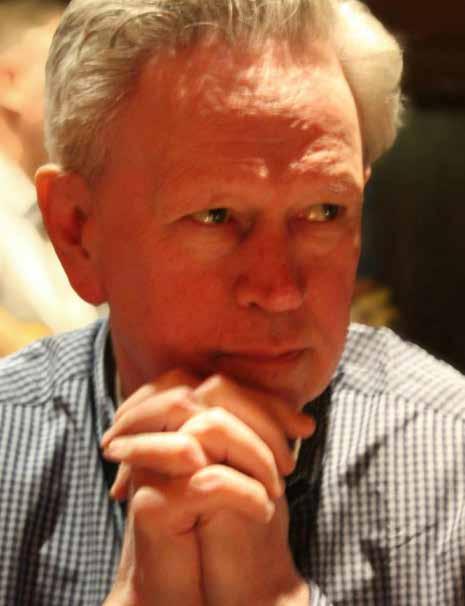
Brian Kirk is a poet, short story writer and novelist from Dublin. He has published two collections of poetry with Salmon Poetry, After The Fall (2017) and Hare’s Breath (2023). His poem “Birthday” won the Listowel Writers’ Week Irish Poem of the Year at the Irish Book Awards 2018. His short fiction chapbook It’s Not Me, It’s You won the Southword Fiction Chapbook Competition and was published by Southword Editions in 2019. He is a recipient of Professional Development and Agility Awards from the Arts Council of Ireland. His novel Riverrun was chosen as a winner of the Irish Writers Centre Novel Fair 2022 and was shortlisted for the Spotlight First Novel Award 2023. His poetry has been published in the Irish Times, Poetry Ireland Review, Cyphers, Abridged, Skylight 47, Crannóg, Live Encounters and many others, and has been featured on The Poetry Programme, RTÉ Radio One and the Words Lightly Spoken podcast. Brian has been a guest author and hosted events at literary festivals around the country including Dublin Book Festival, Listowel Writers’ Week, Red Line Book Festival, Cork Short Story Festival, Ó Bhéal Winter Warmer Poetry Festival, Belfast Book Festival and Bray Literary Festival.
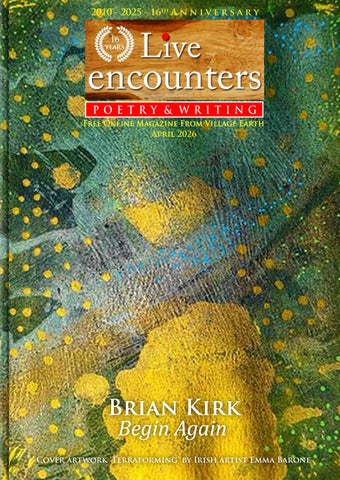
Brian Kirk Begin Again
It’s natural at the beginning of the year to feel low. The hoopla surrounding the celebration of new year encourages us to look to the future with renewed optimism, but it isn’t always easy. We have weathered the privations of winter, sated our appetites during the holiday festivities, and now it’s time to gaze outward again at a world that we hope will be brighter and offer some sort of renewal. From the beginning of time, in all cultures, our lives have been tied to the passage of time, to the changing of the seasons. Even now, in the post-digital age, with the uncertainty that AI threatens for artists and creatives, in a time of dramatic climate change, a time of war and hostility, we still align our lives with the rotation of the earth around our sun. Regardless of race or faith we have an innate need to feel a part of the natural order of things, to experience up close these cycles of birth, death and regeneration.
Some winters are longer and harder than others. This year in Ireland, the weather has been depressing, raining almost every day during January and February. That, coupled with the shorter hours of daylight, narrows the small window of opportunity to be out in the world interacting with others and nature. The absence of this tangible engagement with other people and the natural world works to erode us as humans. We become silent, distant, unsure of ourselves in a world that appears alien to us. We retreat into worlds that are not authentic, not reflective of life as it has been and should be lived. We have our private cares also. Maybe a loved one is sick, or a friend has passed on, or a job is in jeopardy. All this adds to our withdrawal from the world. And this year the world has become less enticing. War is waged for no reason, and the lives of the innocent are counted as nothing, truth and lies are two sides of the same coin for many who hold power. Where does that leave us? What can we do? What is the point of it all?
continued overleaf...
Every new year is a new beginning, but it is not always easy to begin again. For many years now reading and writing has been a hugely positive part of my life. And this year two groups have helped regenerate my creative journey. The first is the Hibernian Poetry Workshop which I’ve been a member of for a number of years now. We meet in person in the Teacher’s Club on Parnell Street in Dublin on the second Friday of every month to read and discuss our new poems. Last year, for a number of reasons, I missed most of our workshops, so this year I was determined to attend regularly. The group is made up of experienced and talented poets, so I always feel an urgent responsibility to bring good work to the table. Part of the success of the group is the social element of meeting up and chatting, but the poetry is ultimately the most important part. The poets are honest, fair, critical in the best possible way, and the comments received are taken in good faith in the manner in which they are offered.
The second writerly group I meet up with is more concerned with the role of the reader. At Story Club six prose writers (some of us poets also) meet once a month via Zoom to discuss and dissect a short story chosen and circulated by one of the group on rotation. We are all writers engaged in our own projects, and as a result we tend to read like writers. There is time for chat and personal and professional catching up as well as close reading and argument. It’s remarkable how opinions can vary in such a small group in relation to the perceived success or otherwise of a story. Each time we meet I come away with a better understanding of the form and what excites me as a reader and a writer.
These regular outlets, of course, feed directly into my own creative projects, sometimes sending me off to research writers that are new to me or to read more work by a given author who has touched a chord for me. As writers and as humans, we are learning all the time. Reading and writing, immersing oneself in another life or imagining how another life could be lived, is the root of all learned empathy outside of family and role models. And for me, empathy is the key trait we need to learn if we are to continue to live together in a world that seems to have lost its way. It is also the key component of great writing.
Writing can be a lonely undertaking at times. That’s why it is vital to spend time with fellow writers and artists, to get that sense of solidarity in the face of all that the world might throw at you. That’s why I love to attend readings, author events, book launches. They are milestones on the writer’s journey, celebrations of the work and the word. And the word is what we seek, the next word, the right word, until the line is finished, or the stanza, or the poem.
When I need fuel for the journey I go back to the books that rekindle the flame, the desire to create. At this time of year I go back to the poems and the poets that started me on the road that I’m still on as a writer and a human being. I’m thinking first of all of the Irish poet, Patrick Kavangh, whose poetry was a staple on every secondary school syllabus for years. I particularly think of lines from Canal Bank Walk, written after he was diagnosed with lung cancer and had a lung removed in Baggot Street Hospital in the 1950s.
O unworn world enrapture me, encapture me in a web Of fabulous grass and eternal voices by a beech, Feed the gaping need of my senses, give me ad lib To pray unselfconsciously with overflowing speech For this soul needs to be honoured with a new dress woven From green and blue things and arguments that cannot be proven.
Another poem I return to is Begin by Kerry poet, the late Brendan Kennelly. It starts:
Begin again to the summoning birds to the sight of the light at the window, begin to the roar of morning traffic all along Pembroke Road.
The poem is grounded in images of the everyday: rain, flowers, couples, girls, swans and seagulls on the canal. And it ends beautifully, with a message that is as apposite today as it was when it was written:
Though we live in a world that dreams of ending that always seems about to give in something that will not acknowledge conclusion insists that we forever begin.
And that is what we must do every year and every day. Begin again. More than ever at the moment the world seems intent on ending itself, but we must persevere somehow, and the words and work of writers and artists give us the strength to do so.
Despatches *
i.m. Edward Sheridan, Petty Officer Telegraphist, Royal Navy (1917 – 1945)
Struck amidships, the gaping hole invited water and the final memories of a short life lived in search of Boys’ Own exploits. You watched the ranks of swallows on the wires, when shadows lengthened on a midlands farm, and dreamt of Java, Alexandria, Ceylon. First time you ran away, they sent you back: too young. But two years later they took you as a Boy at fifteen years, six months. You learned your trade in peacetime, long before the Munich Crisis sparked orders to weigh anchor and embark for Freetown and a protracted war; tapping the code that sent the words to safety beyond the boom
of wave and ocean spume to harbours that were havens where all futures met. But yours was not assured. Although you dodged the fate of Perseus, it took a winter visitor to sink the Lapwing in the Barents Sea.
Homing torpedo from a U-boat broke the boat in two. A wife and daughter
waited, hoped a message would not come. The worst arrived in Royal livery,
O.H.M.S. and postage paid. By order of the King and the First Lord
of the Admiralty: he gave his life to save mankind from tyranny.
* HMS Lapwing was sunk by torpedo on 20 March 1945. Of the 229 officers and men aboard there were 61 survivors. Unfortunately, Edward Sheridan was not among them. He was posthumously awarded a Mention in Despatches, published in the London Gazette of the 7 August 1945.
Despatches was first published in Hare’s Breath, Salmon Poetry (2023)
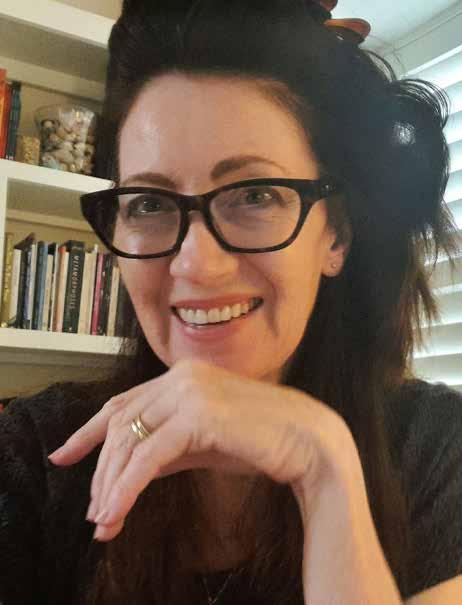
Denise O’Hagan is a Sydney-based editor and poet, born in Rome. She has a background in academic publishing in London and Sydney, and is poetry editor with The Marrow. Her third poetry collection, What the Mirror Tells, is forthcoming with 5 Islands Press (2026). Her awards include the Dalkey Poetry Prize, the Monica Taylor Poetry Prize and the NSW Poetry Prize. https://denise-ohagan.com
Reliquary
The elderly couple enter quietly. Her arm is tucked into his, and they cross the floor steady as snails after the rain, pausing neither at the lone woman crooning before traces of the torment of the damned, scratching at herself gently with her painted nails, nor before a flushed Virgin in prayer buoyed by a choir of androgynous angels halfway to heaven, or even at the child working the zip in a tourist’s handbag by the melancholy light of a hundred candles, until they reach the side chapel where the chipped tooth of the Saint is hanging by a golden chain from the top of a cage where, fingers raised to the glass, they stand as one, immobile, polishing its ivory with their passionate gaze—
Death of a goldfish
She stood silent in the shadow of the doorway, school bag plummeting to the floor. At eight, the shape of shock was globular, airy and inert. Emptied of its golden occupant, the bowl had lost all meaning.
Later there would be a burial, a small mound at the road’s edge, a pinecone for a headstone, a lily if she could find one—otherwise, wildflowers. Two gelato sticks, wiped clean of sticky residue, rubber-banded together to make a cross. How easily it would slide into crumbled rain-soft loam, make its home in the sunken city of roots, below a congregation of clouds.
Snowfall
The woman in the fur-trimmed coat and boots climbs the steps of the apartment. Her gloved hand is resting on the doorknob as he trudges past. He never really knew who she was anyway.
There he goes, the dark smudge of his overcoat traversing the yolk of lamplight. She pushes the bedroom window shut again: the edges of him fade, vanish. The street feels different now.
The snow falls more heavily, covering the footpath, filling in the curved dips left by the man’s footprints. The creak of the old wooden window sash flies away in the wind
the same wind that further on, later on, brushes the man’s cheek as he pushes himself on to where he believes he is going.
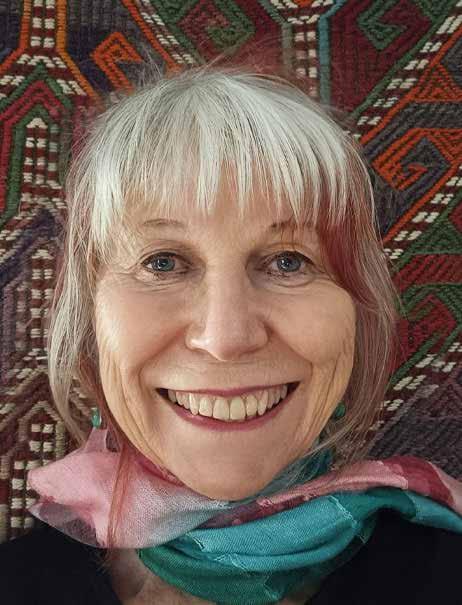
Robyn Rowland is an Irish-Australian citizen. Living between Ireland and Victoria for 40 years, working in Turkey since 2009, in December 2019 she moved back to Australia as companion then carer for her father, who died at 102. Now living in Victoria, her most recent book is Steep Curve (Five Islands Press, 2024). She has 12 books of poetry, including 2 bilingual Turkish/English: Under This Saffron Sun – Safran Güneşin Altında, (Knocknarone Press, Ireland 2019) and ‘This Intimate War Gallipoli/Çanakkale 1915 – İçli Dışlı Bir Savaş’: Gelibolu/Çanakkale 1915 (FIP, 2015; repub. Spinifex Press, Australia, 2018). She has won or been listed for various prizes e.g. Myslexia, ACU Poetry Prize, the Peter Porter Poetry Prize, Antipodes: Journal of Australian and New Zealand Literature International Poetry prize. Her poetry appears in national/international journals in 9 countries, fifty anthologies, 8 editions of ‘Best Australian Poems’ (Black Inc). She has read in India, Portugal, Ireland, UK, USA, Greece, Austria, Bosnia, Serbia, Turkey and Italy, and is published in translation. She is filmed reading in National Irish Poetry Reading Archive, James Joyce Library, UCD
Cold, Cold Feet
February 6, 2023, an earthquake magnitude 7.6, followed by another, 6.7 after 11 minutes hit central/southern Türkiye / Northern Syria, area the size of Germany. 14 million Turks were affected. Confirmed death toll in Turkey was 53,537; in Syria around 7,000. In Malatya city 1,393 died 6,444 were injured. 3 million in Türkiye, 2.9 million on Syria were left homeless. Her name is Sevgi (love)
Stumbling, then tumbling out, in mimicry of river-diving her head hits a hidden tree. Sliced open red by bark she thinks of radishes, strangely, voice clamped by scream.
Rising from hard cold-baked earth in darkness, snow on her skin is cold fire, burning. Or is it flames? No. Her feet have ossified, clods of ice.
Fifteen days with no water. No heat, no light, no food. Months under canvas are buried in her now, except for the vividness of hunger.
But memory is quicksand, and when the tide recedes and warm sun refreshes one year after, bubbles of recollection rise, explode.
We are at breakfast in Alesta hotel, 1300 kilometres from that broken place. My friend Meral creates food worth a Sultan’s table. Her guest feeds first, simply on its display.
continued overleaf...
Bread, tomatoes, menemen, olives, cheeses with herbs, plum chocolate cake, jars of fig, pumpkin, red poppy jam. Bowls of apricots, walnuts. It is the usual.
The niece tries to stop her, telling me in English she is ‘wounded’, ‘she can’t speak of it’, yet something between us unstoppers Sevgi’s anguish.
The way she tells it is mesmerising in Turkish. It is written on her tongue and in every feature: eyes, cheek ridges, face, her hands reaching.
Photos of her apartment are spilt onto the table. Sixth floor, traditional balcony, luckily made with iron. Inside – rugs, warm comfort, family photographs.
When the earthquake split, they were sleeping, then suddenly on a boat at sea, floor crack-crinkling. They wavered with it in night clothes, searching for the cat,
finally, with some neighbours, escaped the building collapsing downwards. She shows me the one thing saved: her wedding photo. But he is not in this story.
She needs to spill, can’t stop, seeing it all again. Middle-aged, dark, still beautiful, skin smooth as an olive before drying, she is shaking, hand upturned.
My friend translates, part by part. ‘Write’, the woman begs, ‘Write it!’, and I do. Blue ink on a handy serviette seems to weep into the light white paper.
Outside in the freezing dark, soil was undulating underfoot, like water it rippled then swept. The one thing we hold to, that the earth under our feet is solid – washed away.
Pyjamas iced up. One rug. Feet lost into the frozen tides. In the camp, an abandoned minibus was found for sleeping. Clothes were scavenged, wood hunted, desperation eager.
They boiled snow for water. They smelt the dead. They waited. After four months she managed to find a bus to Çanakkale where her daughter, grandchildren, slept in emptied school rooms.
Now renting, she waits for her crumpled home to be repaired. To sell. If so, she will buy a single storey, outside this city, that knows, surely, the restless earth will one day, too, waken here.
Meanwhile, she sleeps with all doors unlocked, in case. Her cat yowls at the wind, scurries from trees shaking. Meral’s fretful eyes sweep. Aman Tanrım! We are not ready!
Note: Aman Tanrım Oh my God
Possibilities
February 6, 2023, an earthquake magnitude 7.6, followed by another, 6.7 after 11 minutes, hit central/southern Türkiye / Northern Syria. An area the size of Germany was impacted. 14 million Turks were affected. The confirmed death toll in Turkey was 53,537; in Syria around 7,000. In Malatya city 1,393 died 6,444 injured.
It’s the night Malatya crumples, like foil crushed casually before binning. And I think of you, hoping you are in Istanbul, not home among the apricots.
I could draw your face from memory, earnest about the secret of the tulip. Did you tell me after all? Always look for the mystery you said.
Outside his shop down a small alley in Istanbul full of artisans, we talked embroidery and carpets with Evret; and of his son studying in Dublin –perhaps – I have heard many carpet-sellers’ stories.
‘Beautiful work, but nothing cheap here for me. I am no use to you’, I joke, leaving for the Grand Bazaar. There, a crush of silk, filigreed excess, spiced dreaming, but nothing strikes me. I know what I want.
Back in your alley, you were on your knees working. I could draw your hand roughened by carpet threads. Expert in repair, you take their hundreds of years in your fingers, making them young again, strong.
You close the holes inside the weave with stitches so fine no eye could find a flaw in them. See you said, how carefully matched they are. First, I have to know them, find their inner story, then re-thread them back.
I bought the bedspread I use now as a tablecloth, laden heavy with silken ottoman flowers; rose, gül, tulip, lalé, chrysthanemum, krizantem, weighted with history, colour still bold after fifteen years.
The light grew soft amber, the old stone walls lightened, yet the day was fading. You took me to a smoky café with hookah pipes burning red with each breath in the black interior.
Shisha smoke of apple and jasmine meandered. Bare-chested men heaped coal on smoking braziers at the door; above our dark corner, a heaven full of Turkish lights shattered by colour. It was old Istanbul.
Conversation in the half-dark. You speak of home. Malatya, you must go. Apricots are huge as a hand and so sweet and juicy you might live on them straight from the trees, warm and so smooth.
I will think of this in the years after, and when I visit Malatya, eat those fruit: everything you said they are. And learn one tulip secret: water triggers their stems to continue growth after being cut, staying fresh longer.
Your girlfriend had been South American but when you couldn’t bear to leave Türkiye, failed to board at the last minute, she finished it. Your apartment is bare you say, but for a bottle of champagne.
Would you like to share it? and I smile. I could draw your eyes chestnut brown and their creases curving outwards as if laughter is their medium reaching for the source of it.
‘I am too old for you’, I exclaim. But, you forget! you offer. I am an antique carpet restorer! Surprised, shocked even, we laugh wildly, you apologizing; me, loving the imagery of it. Tempted.
‘I am meeting a friend’ I lie, and grin all the walk back to solitude in my hotel. I know what I don’t want. Next year I walked by with a friend and you called out my name, beckoned me surprised.
Years later, it’s the night Turkish cities crumple like paper crushed casually before binning. I think of apricots, the flushed sweetness of them on a hot day. I hope dearly you were not home in Malatya.
This is what Stanley Built
Barrack Point, with thanks to Stanley Richard 15.9.1921 - 29.4.2020
Going to bed with the salt crust on me, hair stiff, smelling it in the house the breezed fizzing of it and its waved rhythm all night, shushing it in, I’d forgotten this is what it’s like – supposed to be – living by the sea almost forgotten in these chosen years of father-caring, covid settled in, pinning me to the house he built a mile away. Weary, why did I wait so long for this respite day? Bathing this morning where Little Lake and the Pacific meet right outside this old low gate, memories gritted into pearl and I carry that sheen on the inside of my skin.
Bedroom bunks in the kids’ room, rush into recollection those waves of light and buoyant youth. Here is my childhood in laughter. We thought the sea was coming inside, its gush and whoosh a lullaby never forgotten, never replaced. No footpath, no road, and sand acres surrounding the house where we all dreamed of nothing. There was no need; in the moment, everything there. No dark dank reminders under the house I grew up in where once the neighbour’s lad crushed me down under our house, struggling. Photos in a frame on the wall are black and white or you might say dusty grey, as if years have simply aged them, like us. Cousins Cathryn, Anne, Julie, me.
continued overleaf...
We sit in the shallows, ripples thrilling our skinny legs when the lake was open to the sea, no need for reinforcement with boulders or cement, waters so gentle we children risked nothing, yet everything was changing. My father’s impact is here too. A great fisherman, he once backed his boat in through the front glass full-length doors! The patio off it was built after that! On these walls are some works from his retirement. Leadlight dolphins, bright ultramarine and sea blue, leaping. The best of his tropical fish lead by Nemo, though their eyes seem to have disappeared! And in the children’s room, his glass dragonfly skims above the bed, hovering protective.
His small wooden dachshund, hidden by departing family members lured new arrivals into a puppy-hunt. I searched every cupboard, drawer, even the dryer. No show. Then looking up, there he is sitting on the kitchen shelf in full view. Spot; Spot the dog! Checked bow tie in place, oak legs and ears, cedar belly and face, and those round blue eyes. Dad was often back and forth visiting. At 98 years, his visits are still recorded in the visitor’s book, bringing duck à l’orange he’d slow-cooked from 7 am. My mother is here too. Not in the shadows, but in the briny breeze, the hot deck, the cool shallows. Thirty years dead, I think she was happy here. How nostalgia writes our story the way we want it to be.
Three seagulls still fly across the back wall, and the ping pong table takes up most of the main room, beside white-studded blue vinyl bench seats, drawers beneath filled with rugs. Open a cupboard: puzzles queue out, beside goggles, and the rubber scent of flipper and snorkel. Once, there was a kitchen nook, expanded as we did. White wicker highchairs, with deep blue legs on sapphire linoleum with faded black captain’s wheels, their centres holding seagulls in flight, or red, black and white compasses bedded in. So his house would always know where it is, facing forward. This is the humble holiday house that Stan my uncle built. Well – with S.J Wood and Co. in Parramatta, in 1952.
Transporting everything so far, handwritten bills show the progress: loads of nails, masonite, guttering, fibro. A concrete slab beneath the back door steps, since 1958 has captured the footprints of my cousins and their parents. Out front then was all beach for miles and empty miles. Beyond, Windang sand-hills later sold to Hawaii by a council so short-sighted they failed to see a month in the future, never mind decades. Flattened now, only the elders remember sliding down those slopes on old planks of timber shouting joy, screaming whoopee! Foolishly, a new council now stacks massive boulders against the shrinking edge of land and the sea mocks all efforts at retaining ground.
Now houses crowd in on our block. Cousins grew children, who grew children themselves, so this small dwelling cannot fit them in for one more family Christmas. This month the house must be razed and soon a modern duplex, double the size and rooms will face the ocean wind taking the salt on its new strong double-glazed windows. Nothing will rattle. Nothing fall. The memories remain in our bones. But not too long ahead my cousin and I will weave away into our own sea-fret and only faded photos carry the imprint of a house so full of loving times, that surely the soil itself will hold them on.
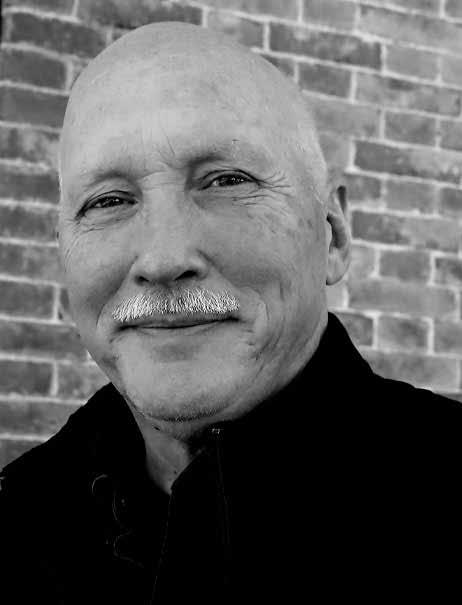
Stephen Haven’s fourth collection of poems, The Flight from Meaning, was a finalist for England’s International Beverly Prize for Literature and was published in 2025 by Slant Books. His three earlier collections are: The Last Sacred Place in North America, selected by T.R. Hummer as winner of the New American Poetry Prize; Dust and Bread, winner of the Ohio Poet of the Year prize; and The Long Silence of the Mohawk Carpet Smokestacks, runner-up for the Philip Levine Prize in the final year Levine served as judge. Twice a year-long Fulbright Lecturer at universities in Beijing, he has received fellowships from Yaddo, MacDowell, the Provincetown Fine Arts Work Center, and the Djerassi Foundation, as well as five Individual Excellence Awards in Poetry from the Ohio Arts Council. His work has appeared in The Southern Review, American Poetry Review, Parnassus, Literary Imagination, Crazyhorse, Guernica, Asheville Poetry Review, Salmagundi, The American Journal of Poetry, Arts & Letters, The Common, Blackbird, The European Journal of International Law, The Missouri Review, North American Review, Northwest Review, Image, Western Humanities Review, World Literature Today, and in many other journals. For more details, see https://www.stephenhaven.com/.
Psalm For Our Time
Yes, Father George Zabelka Blessed Fat Man, Little Boy, And then he cried, My God What have we done? Hibakusha Forgave him at the shrine. Then they asked him to genuflect On the vassals of their sins Even as civilians. Pearl Harbor? Nanjing? Please help us never, Ever forget! Then someone Brought up Dresden, the Battle Of the Bulge, the Babi War Ravine, not to mention, Ever since then, Auschwitz, Nagasaki, and our wars Without end. Lord, may we Never say amen, may we always, Always find, bloodied On that shrine, the broken Architecture of our time, One scraper still standing Like a man girding his face up With one hand, love that never Saps the artifice of innocence, Fingers sowing crumbs While each stray dove Snaps a wing, flaps in the mud.
Free Swim
Just why we swam buck naked at the Y no one ever Enlightened me. Men and Boys’ free swims, Weekly lessons, in the buff we dove in, The lifeguard the imperious exception. Whenever We asked the girls, for them it was always otherwise. No one ever gave such favor to our testicles Floating in water. One winter Saturday, our bums
Burnished glazed clay. General Patton inspected Our exposed positions. Lined up against the wall, Near the deep end, we thought we might have to Spread ‘em. Sour in the water, someone’s turd Still floated. One boy cried for his mother before The disgust our loined leader barked at us. Yes, There was a darkness in that free license imposed
On us. Locker-roomed again, we tucked it all Back in, dodged a forced confession. Now it seems So strange, passing tests from Minnow to Fish Without a stitch! No girl ever laned up a stroke Ahead or behind us. Was there ever even a bit Of innocence in this? Even my father found A joyful freedom in that suspended animation.
We never talked about gender stratification. Still, I have learned my lesson. Now my wife and I Love to bob our lives. We lean toward open water. A quarter mile out, no swim buoy tethered orange Around our ankles, what magnifies in the pond Plumbs also the clouds above. But there is an earlier Liberty that still cradles me: When I step away
From the forms that hold me, I like to give the boys Free reign, float ‘em in the fresh, or, warmer yet, Jellyfish a southern ocean. Did the ladies miss Out on sophomoric this? Only my wife will say When she unhooks the girls after a dog day If such a burst of reminiscent wonder Still treads for her in that abandoned pleasure.
The F-Bomb Takes Flight
The rich boys punched, pivoted with the poor. The poor lost their jobs a year or two Shy of their pensions. Arson flourished
In those canyons. Still the textile mills Graveled in the lots. Some machinists Never drove, always walked. The doctor’s kid
Smashed a curve ball spun by the janitor’s boy, The model son masked in the mass Of his rebellion. Buzzers blasted
Each dark dawn, called everyone to attention, Shifted or gave back some of what they’d lost. Each August hit the hole, hard and low,
With utter abandon, cracked the shins Of a running back, loved the contact. Everything the town once taught him!
They snatched it from a widow’s porch. It tasted like perfume his mother wore Out of bounds through an oak front door.
A case of Ballantine’s. They drank them on A backyard court. They offered up F-bombs He could never quite muster. Because he wouldn’t
Say them, just as his father never taught him, Always they mocked him. The ale was warm In his zipped bag. Against a savage world
His father never barbed him. As if his friends Might wake to it like a shot he bricked, Over dark rooftops he belched and let one rip.
Wounded Hawk
We eyed him from our high back porch. Plump on a low Fat branch, he bobbed our full attention back. Yesterday, Small birds ganged on him, flipped him to a damaged wing.
Down to sandy soil, he cocked his walk and they went After him, and still he managed with great effort To thrust himself back to our tallest pine, then came
Down to this low branch. All afternoon we heard Small alarms that warned, without compassion, What with the way he once ate their young.
As he pitched his cry from that diminutive space, We thought we might be interpreters: No mercy, No justice in the world, as he sang A sharp, shocked outrage with the state of things.
Or more simply, I am hurt here, or I am patched together, Or things are not well with me on Earth, As Rilke says so beautifully in The Book of Hours.
We felt for him the way we did the feeble Senator Who in his own silence lost himself in the camera, The poor old man who cast his afflictions
On the nation and came finally to his own dark wood
And for whole minutes uttered not one word
While the country heard
A hawk crying in the stab of its own wound
Calling out the lack of mercy, no justice in this world.
Hold’em After Mass
In the hole he aces his high hopes again. Then the sinkhole of the Flop. Considers odds He might be flush again. Then the Turn Flips to the River’s quick. The broken lifeline On one palm? A calloused finger Traces it. No truck with God holds him all in. Don’t bet on it, the priest once schooled him.
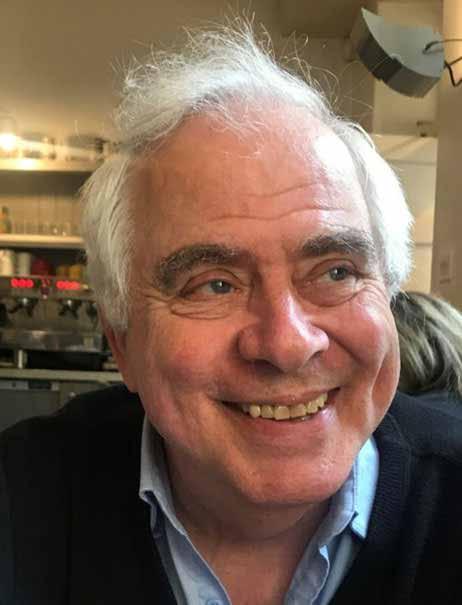
Richard W. Halperin holds U.S.-Irish dual nationality and lives in Paris. On 1 November 2025, Salmon Poetry/Cliffs of Moher brought out All the Tattered Stars: Selected & New Poems, Introduction by Joseph Woods, which showcases 92 poems published by Salmon and by Lapwing/Belfast since 2010 and 26 new poems. On 7 January 2026, Mr Halperin was Special Guest Reader in the First Wednesday Poetry and Open-Mic Series, White House Bar, Limerick.
An Unopened Letter
Over decades I have read and reread Henry James’ great short story
‘The Jolly Corner,’ a middle-aged man walking constantly through the deserted house he had been raised in, sensing the presence there of the being he would have become had he never left.
Tonight, a sentence early in the tale leapt off the page at me. The protagonist tells his confidante that at one point in his life he came across an unopened letter which he knew was important and burnt it, unopened. A love letter? A business letter? A deed to some property? A summons?
My soul lurched. When I was about thirty, I came across an unopened letter which I knew was important and burnt it, unopened. Only it wasn’t a letter and I didn’t use a match. My life went forward the way that it has. Which is not the way it would have gone had I read – really read –that letter.
Perfect Circles
Raindrops striking rather still water –no water is completely still – make perfect circles or, rather, almost perfect, because no circle is perfect.
I have noticed these all my life but now, thanks to the paintings of Gustave Caillebotte, rain on water, I have the feeling that they notice me. That they notice everything, because what is not an imperfect circle?
Life may not end with death –that may be village gossip, Hamlet was open-minded about that. When one stops living, the circle closes. But it may close imperfectly –an imperfect circle which instantly disappears, a raindrop forming it, now you see it, now you don’t.
Or do you? I just asked my mother, and think I heard her from where rain comes from, or from what rain is.
My mother was an artist: paintings and dress designs. For her, there was no difference between circles and ovals. Only scissors and good instincts.
She Walked Slowly
She walked slowly back to a house of her youth. She knew that the house’s paths and walls were gone or half gone. She walked slowly because she was not sure she was walking at all.
Later, she wrote a poem about it, but her walking was the real poem, fearful and beautiful,
like the pinwheel of the sun which the crowds had seen at Fatima and which Pius XII saw in 1950 while walking in his garden, because nothing is gone, only half-gone.
I do not know if the woman who was walking slowly back to a house of her youth was thinking of pinwheels, but I am.
Fugitive
´Elle était radieuse et charmante.´
A character in T.S. Eliot’s The Family Reunion says ´In a world of fugitives/The person taking the opposite direction/Will appear to be running away.’
That was my wife when she was here. That was a few other people whom I have had the privilege of knowing.
That was Samson in Samson Agonistes That is Niagara Falls.
No one knows what holds things together, or if indeed they are held together.
Some of the best minds in science say gravity isn’t. Enid Bagnold wrote a very good play Call Me Jacky in which gravity isn’t.
Just to see some people enter a room. They are almost transfigured already.
Between Two Worlds
Not between Ireland and France. Between two worlds within myself. Because of this, I like to think of lakes, not of the sea. Quiet waters. Although lakes are dangerous.
I like to think of Nōh plays. When the actor tips, very slightly, his mask up: happiness. When he tips, very slightly, his mask down: sorrow. Great sorrow.
Between two worlds.
When Bernadette, in the convent, had to agree to be officially photographed and, if asked, to give the photo, now pasted on a little card, to visitors, she wrote on each card ‘p.p.b.’ Priez pour Bernadette.
Presented to Malcolm
‘Presented to Malcolm by the Baptist Boys Club, April 27 1954.’ This, in beautifully formed letters, is written in the inner cover of my used copy of the Everyman’s Library Poetical Works of John Milton. I open it, as I often have done, in the morning, this morning the day after the beginning of another terrible war begun by fools voted into office, so begun by millions of fools. No one voted in Milton’s time but, in the same manner as now, blood ran in the name of Something. A friend wrote me in 2024 after an election in a country unnecessary to name, ‘I feel that hell is empty and all the devils are out.’
My friend lives with the balm of poetry, with the balm of her own art – collages –which is a balm for others, and with the attempted balm of being a kind person. In the beginning was The Word, which means in the very beginning something started which was entirely clean. What happened after is not my business, although I live in what happened. As I wrote those last five words, Sunday church bells began to ring. That also happens mornings.
This poem is a letter to, and a prayer for, Malcolm, wherever he is in 2026. Malcolm, I hope Milton helped. ‘I thought I saw my late espousèd saint’ helps me. There are helpers and there are destroyers. There are fools and fools. It is very humbling to know oneself a fool. Good luck, Malcom, and may that, and truth, be with you.
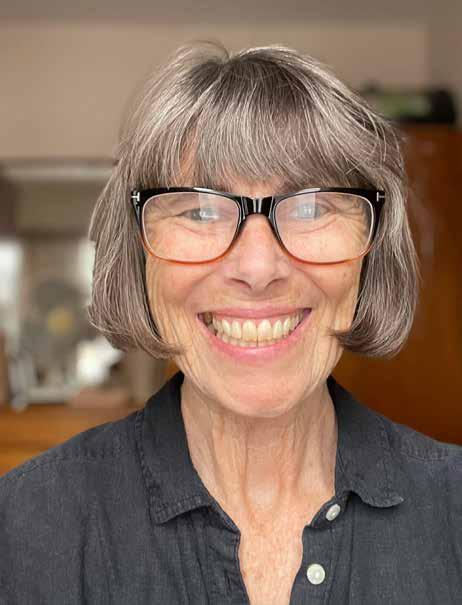
The heart’s resistance
When I look back on that time, a cruel rite of passage for which there could be no reckoning, you are all belly and precipice and future self. O the round robin song of you. I wish I had stayed. Even if there was nothing my staying could have changed. There are still days I wish it with all the hopelessness of unrequited love. The West Coast of Ireland promised a hardiness we fell for though the waiting wore us to blurs of our former selves until we must have resembled well-thumbed worry dolls. And then, because the window had closed and because my other life called and called I left and you were sisterless. At the train station a smile almost reaching your true blue eyes as you pushed a copy of Anam Cara into my hands like forgiveness. I read it all the way home on trains and planes, in waiting rooms and up and down escalators. Hanging everything on the good omen I willed your inscription to be - with gratitude and love from the three of you. It would be grand, why wouldn’t it be when all was pronounced primed and ready and any day now. Any day. Later, when the remembrance photo arrived, there he was wholly formed and wholly emptied, my nephew who was not. The small shock of it lodged in my sternum like bullet fragments deemed harmless enough to leave in not accounting for the mind’s capacity to churn. The heart’s resistance to the will of any god. The endless run of sorrow through veins. And for a time, the unbearable sight of lipstick in any shade of blue.
Permission to sing
The driver reels off a list of banned behaviours: The smoking of cigarettes and consumption of alcohol. Hot food and beverages. High volume conversations on or off the phone. Keep it G rated he seems to be suggesting. As for music, plug your headphones in and for the sake of all aboard (if not all that is holy) sing along in your head only. And this last one is going to be a problem for the man up front whose body barely fleshed pulses nonetheless like transfusion. Whose inner muse refuses to shut down. Who moments ago was chanting in the waiting room then curbside and now on the bus all hum and twitch asking for exception, for permission to express who he is among us. How can we not feel sorry, those of us who have known even the smallest measure of inhibition. Who can scream on the inside for just so long before the skin begins its inevitable peel. No matter how deft our hands at the invisible harp. How well-timed the beat of our bobbing heads, blinking eyes. Soon enough the inoffensive toe-tapping becomes a knee-jerk, hipsway, filling the chest cavity, thumping in the throat each unsung moment, until finally released in some universal but unteachable language of the undeniable self. Every bit as catchy and crucial as the wheels on the bus.
Care package
At first, I’m thinking The Sound of Music and Julie Andrews singing down a storm with a few of her favourite things but then I remember Austrian fathers and incoherent love the world over –how the first step out of fear and into mercy is letting go and what a tall order that can be. So, comfort food it is: cinnamon doughnuts for everyday scrapes profiteroles for deeper disappointments. The safety net of someone else’s memoir to fall through. The masseuse of your choice on tap five lucky bingo chips and a murder mystery-solving jigsaw puzzle to rein in chaos theory and ignite the illusion of control if only for a little while. Also, a travel guide to Sicily - the beginning and the end of nostalgia di casa. Finally, one of those shadow boxes (in case of emergency break glass) for your eyes only so don’t ask me what wonders it might contain.
A good boy
I say I’m not a dog person over and over until I remember how my brother never seemed without one. Never seemed quite grounded without one. Uncollared, their sex left whole. Only ever restrained by the beat of his voice. They had travelling names like Gypsy and Storm and he had big plans for the journey the last would accompany him on padding loyally alongside horse and rider in and out of Clint Eastwood sunsets.
And then he died. The brother, not the dog. And none of us were in a position to take on a high maintenance pet whose head had been filled with such daredevil dreams. It was of course doubly our loss. That’s the way of it. An ad placed in a paper and an elderly woman made to order, grieving her own shepherd.
I’ve wondered over the years how much of the man she found in the dog: Scent of Tiger Balm and medicinal weed. The itch to chase a ball and the animal from which it was fashioned.
To be told again and again by the leader of the pack good boy, there’s a good good boy…
Homes I have known
Where visitors are asked to wipe their feet before and after entering and the surface of everything is clean enough to eat off (though you wouldn’t dare) and every hair, every smile, quivers in its place.
Where there is no time and all the time in the world to talk and laughter can arise even from grief’s exhaustion and names are called in from the cold or the dark because they are so longed for.
Where mothers and children move like cat burglars weaving through webs of laser beams, imagining some prize (surely) for years of second-guessing. For diffusing fear with risky laughter and vivid make-believe in the forests and oceans of their desire.
Where a spare bed is made and turned down, the right book and some wild flowers placed within reach. The kitchen grimy with love and the couch blanketed in companionable dogginess and you are welcome, whoever you are.
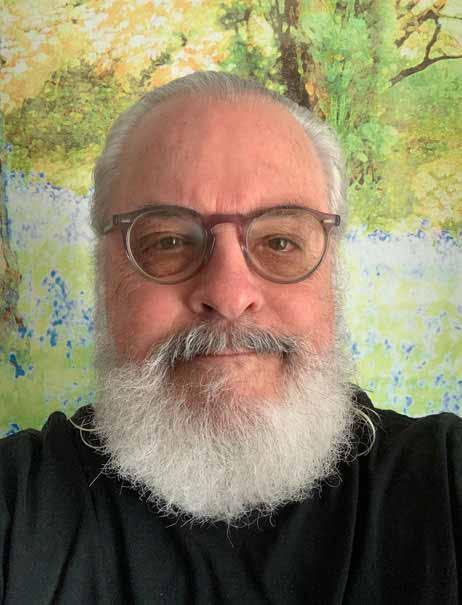
Scott Dodgson is a novelist of the European Salon tradition, blending history, philosophy, and deeply human storytelling. His work moves between continents and centuries, from war-torn Africa and postwar Paris to revolutionary Russia and the haunted terrain of memory itself, always guided by questions of identity, loss, resilience, and love. His novels are at once intimate confessions and sweeping epics, where philosophy and story converge with the cadence of lived experience. His published works include The History of Water, Le Pécheur, L’Auteur, The Bohemian Angels, The Madness of Beauty’s Light, and Swipe, along with the forthcoming novel The Vigneron’s Wife.
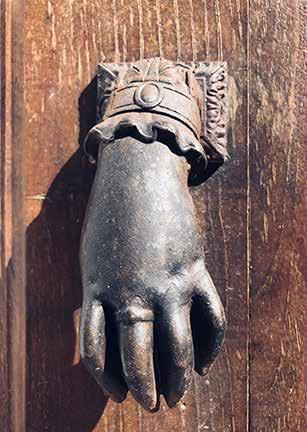
These four seasonal pieces come from The Vigneron’s Wife, a literary novel set in a small wine village in the Languedoc of southern France. The book follows a writer and a vigneron’s wife whose lives become entwined through memory, land, and the slow labor of cultivation, as past migrations, marriages, losses, and inheritances surface through the rhythm of the vineyard year. Moving between personal history and the longer memory of place, the novel explores how identity is shaped not by events alone but by repetition, weather, and return, suggesting that belonging is less an arrival than a practice learned over time.
The Hand
The hand waits where it has always waited, pressed to the wood, neither open nor closed. It is not asking to be welcomed, only to be answered. It is a knocker. This is a hand-shaped door knocker, known in French as a heurtoir en forme de main. It is a very old and layered form. Since the nineteenth century it has watched the avenue form itself below, the slow arrival of carts, then rails, then engines, the dust of hooves giving way to iron and smoke. The wrist is finished with a simple cuff, the kind found on doors throughout the south of France, a modest flourish meant less to display wealth than to mark a boundary, a threshold where the outside pauses. A thin ring circles one delicate finger, worn smooth by time and countless summons, a quiet reminder that even iron once learned its gestures from the human hand. Centuries have passed through its fingers, weather, dust, fear, hope, the impatience of travelers and the caution of those who lived behind the door. Before voices, before names, there was this gesture, a simple human claim made in iron: I am here. The house listens. The village listens. And only then does the door decide whether to open. I want to write a variation of this piece for the spring section. Same knocker, different invitation to the writer.
The Hand, in Autumn
The hand grows heavier in the fall.
Not with rust, but with memory. The summer light that once ran along the cuff now settles into it, slower, as if reluctant to leave the metal entirely. The ring holds a dull glow instead of a glint. Nothing announces itself quickly anymore. Even the avenue approaches in quieter steps, tires softer on the road, voices carried lower through the cooling air.
In autumn the hand does not invite. It considers.
I reach for it and feel not resistance but measure. The pause before contact lengthens. One does not arrive in this season without asking inwardly first. The village has turned back toward its interiors, toward cellars, toward accounts of what the year has yielded and what it has withheld. The gesture becomes less a declaration than a weighing: should this moment be shared, or kept?
The knocker answers nothing. It receives the decision.
I lift it and let it fall once against the wood. The sound is rounder than in spring, absorbed by the house rather than sent outward. Not I am here, not even you already are, but simply: now.
The house listens, as it always has, and the hand returns to its rest. The door will open or remain closed without explanation. Either way, the season understands.
Autumn asks no entry. It asks recognition.
The Hand, in Winter
The hand is cold again.
Not neglected, only returned to its element. The metal contracts against the wood as though the door and the knocker have agreed to speak less. Frost gathers in the cuff’s shallow crease and the ring no longer shines but holds a dim steadiness, the color of breath in air. The avenue passes in fewer sounds. Footsteps carry farther and then are gone.
In winter the hand does not invite and does not consider. It waits.
I hesitate before touching it, aware that the gesture will echo longer than intended. The village keeps to its interiors now, conversations lowered to kitchens and hearths, each visit chosen rather than wandered into. To knock is to mean it.
The metal meets my skin and gives nothing back except certainty. I lift it and let it fall once. The sound travels through the house like a line drawn through still water, widening and settling without reply.
There is comfort in this restraint. The door may open, or it may remain closed, and both answers feel complete. Winter does not ask presence or absence to explain themselves.
The hand returns to its place against the wood. It has done its work.
In this season, the gesture is enough.
The Hand, in Spring
The hand is warmer now.
Not in temperature but in permission. All winter it held its patience, pressed to the wood as if waiting for a thought to arrive from somewhere beyond the avenue. It never asked entry. It asked readiness. The metal knew the season before I did. Iron does not hurry, yet it changes its meaning with the light.
In spring the hand does not summon. It invites.
The cuff gathers sun along its edges and the thin ring catches a brightness that was absent months before. Dust has softened into pollen. The avenue no longer carries departures but errands, doors opening and closing without consequence. Even the pause before knocking feels shorter, as though hesitation has less to protect.
I touch it and the gesture is no longer announcement but acknowledgment. Not I am here, but you already are.
The village does not need introduction this time. It has decided I belong to its ordinary hours. The hand waits only to mark the moment when intention becomes action, when a thought becomes a visit, when a writer becomes a neighbor who has simply come by.
The house still listens. But now it listens for familiarity.
I do not knock to enter. I knock to confirm that I never truly left.
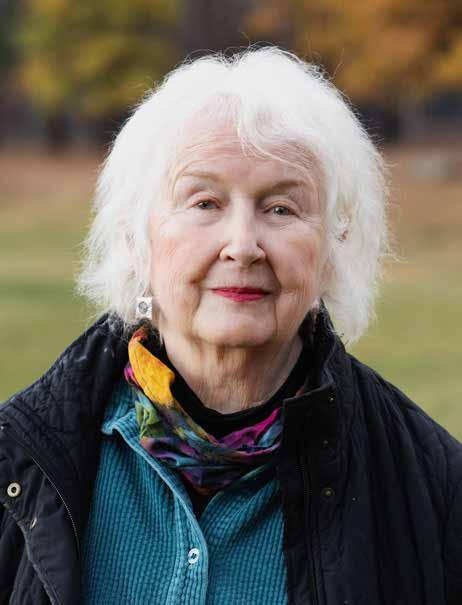
Dianna Henning received California Arts Council grants, taught poetry workshops for William James Association’s Prison Arts Program. Some publications: Poet News, Sacramento CA, 2025 & 2026; Blue Heron Review 2025; California Quarterly; Women in a Golden State, 2025; The Power of the Feminine Vol. II; The Tule Review; California Quarterly; 2023; Artemis Journal, 2021, 2022, 2023 and The Adirondack Review. 2021 Nomination by The Adirondack Review for a Pushcart Prize. Nominations from Blue Heron Review for a Pushcart Prize 2024 & 2025. MFA in Writing ’89, Vermont College. Henning’s “When Body Becomes House” short-listed in Madville Publishing’s 2025 Arthur Smith Poetry Prize. Dianna facilitates the Thompson Peak Writers’ Workshop. Henning’s new book “Rucksacks for the Leaf Cat” just released from Finishing Line Press.
A Hand Is a Fist that Won’t Open with Regret
Many years ago. She came to us. We passed her back and forth between us. Lovely child, cinnamon scented child.
You handed her to me. I passed her back to you. We shared her as one does a treasure, ever so carefully.
Who knew of storms? Of divorce and recriminations?
And what would happen to her in that thicket of trouble? We forgot we were parents. Married too young.
Now I’m an old woman and long for my daughter. The cinnamon scented child.
But a hand is a fist that won’t open with regret. I reach out to hold her, but only dimwitted air
greets me. I am a longing with arms that ache, a memory of past mistakes.
Who are you, daughter of long ago? Are you a walk? Am I a runner?
All night the portable fan clips the dissenting air, and a breeze smelling of wet chalk, sidestrokes through an open window.
Outside, frog colonies down by the pond sing their mating songs before slipping back into comfy beds of mud.
Spittle ekes from the scaffolding of my mouth onto the hand-embroidered pillowcase given me in my youth.
It seeps into my splayed hair, each strand stiffened.
Someone sleeps beside me. He’s the man I’m married to.
He’s less dangerous than the lovers who took my expectant breath, bottled it in green jars, and sold it on the black market for a mere pittance.
My husband struggles with nightmares, kicks me in his sleep.
I strangle him with my blood.
Who sleepwalked with the Milky Way,
drunk on distance, its expanse? I wanted to write with a torch but ended up with a pencil with no eraser. Because the sky turns contagious with stars, nighttime is best viewing that dust which becomes us.
I want my ashes to create their own planet. One where people, or whatever life forms exist, live in peace. I cannot cry for what we are.
But I am saddened by what we are not.
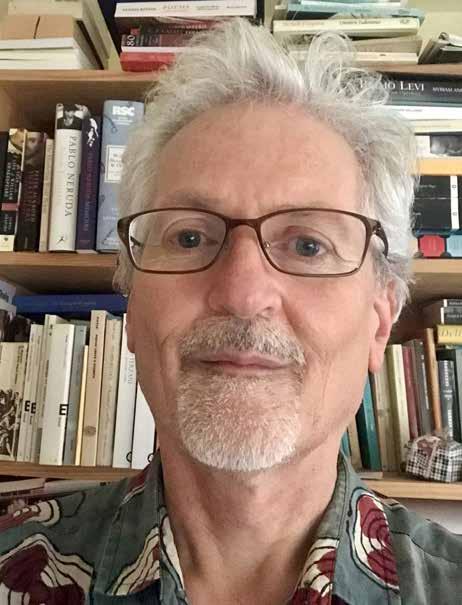
Edward Caruso has been published by A Voz Limpia, Australian Multilingual Writing Project, ‘La Bottega della Poesia’ (La Repubblica, Italy), Burrow, Communion, Kalliope X, Live Encounter P&W, Mediterranean Poetry, Meniscus, Melbourne Poets Union, n-Scribe, Right Now, P76, StylusLit, TEXT, Unusual Work and Well-Known Corners: Poetry on the Move. Since 2024 he has co-judged the Ada Cambridge Poetry Prize. In 2025, his third collection of poems, What Distance Means, was published by Hybrid Publishers. In October 2025, he featured on 3CR’s Spoken Word program.