2010 - 2025 - 16th A n n i v e r s a r y
Book - Reviews Free Online Magazine From Village Earth Volume Eight November-December 2025
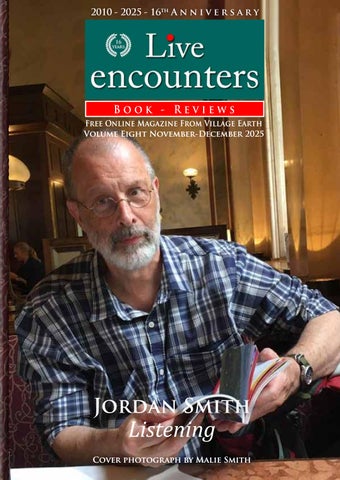
Jordan Smith
Listening
Cover photograph by Malie Smith 2025 November-December LE BOOK REVIEWS © liveencounters.net
LIVE ENCOUNTERS MAGAZINE
©Mark Ulyseas
Photograph by Mark Ulyseas. © liveencounters.net LE BOOK REVIEWS November-December 2025 Celebrating 16th Anniversary
book - reviews
Volume Eight 16th Anniversary November-December 2025
Support Live Encounters.
Donate Now and Keep the Magazine Live in 2026 Live Encounters is a not-for-profit free online magazine that was founded in 2009 in Bali, Indonesia. It showcases some of the best writing from around the world. Poets, writers, academics, civil & human/animal rights activists, academics, environmentalists, social workers, photographers and more have contributed their time and knowledge for the benefit of the readers of:
Live Encounters Magazine (2010), Live Encounters Poetry & Writing (2016), Live Encounters Young Poets & Writers (2019) and now, Live Encounters Books (August 2020).
We are appealing for donations to pay for the administrative and technical aspects of the publication. Please help by donating any amount for this just cause as events are threatening the very future of Live Encounters. Om Shanti Shanti Shanti Om Mark Ulyseas Publisher/Editor
All articles and photographs are the copyright of www.liveencounters.net and its contributors. No part of this publication may be reproduced without the explicit written permission of www.liveencounters.net. Offenders will be criminally prosecuted to the full extent of the law prevailing in their home country and/or elsewhere. 2025 November-December LE BOOK REVIEWS © liveencounters.net
Contributors Jordan Smith Guest editorial Jena Woodhouse review of The Heart of the Advocate by Angela Costi David Ades A Blink Of Time’s Eye David Morgan review of Eve Meets Dante by Dr Greta Sykes David Rigsbee Watchman in the Knife Factory: New and Selected Poems Jordan Smith review of The Indiana Series by Matthew Graham Kabir Deb review of The Book of Dawn by Randhir Khare Lynda Tavakoli Unbroken - The Gaza Poems
© liveencounters.net LE BOOK REVIEWS November-December 2025 Celebrating 16th Anniversary
book - reviews
Volume Eight 16th Anniversary November-December 2025
Michael J. Leach Chords in the Soundscapes Richard W Halperin Shy White Tiger Richard von Sturmer Slender Volumes Susan Azar Porterfield Voice/Poems Vasilis Manousakis review of Listening to Fish: Meditations from the Wet World by Tim Tomlinson
2025 November-December LE BOOK REVIEWS © liveencounters.net
GUEST EDITORIAL
Jordan Smith. Photo credit; Malie Smith. © liveencounters.net LE BOOK REVIEWS November-December 2025 Celebrating 16th Anniversary
JORDAN SMITH Jordan Smith is the author of eight full-length books of poems, most recently Little Black Train, winner of the Three Mile Harbor Press Prize and Clare’s Empire, a fantasia on the life and work of John Clare from The Hydroelectric Press, as well as several chapbooks, including Cold Night, Long Dog from Ambidextrous Bloodhound Press. The recipient of fellowships from the John Simon Guggenheim and Ingram Merrill foundations, he is the Edward Everett Hale Jr., Professor of English at Union College.
Jordan Smith Listening I’m on my usual walk in the woods near my house, and as usual I have earbuds in place and I’m listening to music. Today it’s an album by a group of Ornette Coleman alumni, Old and New Dreams, a long-time favorite. But today I am also depressed, anxious, angry—why doesn’t matter; you have your own list, I bet—so much so that the music hardly registers. I’m thinking about stopping it and putting my earbuds in my pocket, and that is not how it usually goes.
About a quarter mile into the stand of mixed hardwoods, I’ve gone past the wall of bugs that shimmers at the trailhead, down the steep hill with the little side trail to the ledge where the high school kids hang out, across the creek on the new bridge the Boy Scouts built, half-way up the equally steep other side, turned to follow the trail that climbs the edge of the ridge more gradually, before I actually begin to hear the music. The first cut is Ornette’s “Lonely Woman,” bluesy and melancholy. If I were looking for music to fit my state of mind, this might do it, but that’s neither how nor why I want to hear it. What catches me a minute or so in is Charlie Haden’s bass. © Jordan Smith 2025 November-December LE BOOK REVIEWS © liveencounters.net
GUEST EDITORIAL
Low pulses repeated, it might be the abstraction to near-zero of Coleman’s subtle, complex melody, beautifully articulated by Don Cherry’s trumpet, but I can’t imagine one apart from the other, not in this moment, any more than I can imagine silence without sound, consciousness without the binary oppositions that seem to make it possible. Ornette’s melody is a cry, a woman’s cry, as he tells us in the title. Cherry’s trumpet gives it voice, but a trumpet is not a woman, and we’ve no way of knowing if her loneliness is something he shares, but he inhabits it as she inhabits his horn. And if Haden’s bass is neither, neither is it separable. It is the Tao that cannot be told, it is Thomas’ “the force that through the green fuse drives the flower,” it is Dickinson’s “formal feeling” that witnesses loss but cannot stop for it. A few more minutes into the track, Haden takes a solo, playing the melody with great insistence and delicacy, after a passage in which Ed Blackwell’s low drum meshed so closely with the bass you could hardly anticipate which you’d hear next, a moment of unity, which is presence defined by the absence which it defines. It is beautiful and entirely without sentiment.
I’ve been listening to Charlie Haden since I discovered jazz in my mid-teens. I may have read about Ornette Coleman’s music in Downbeat or in a book by Nat Hentoff, but I first heard one of his records in the listening room of the Rundell Library in Rochester, the massive and elegant building along the Genessee River (on opposite bank was the National Casket Company, whose sign, clearly visible from the listening room, was the subject of a memorable piece of light verse in the local paper, a comedic version of the Buddhist evening gatha about the decreasing number of our days) where I came to check out books I couldn’t understand. If it was avant garde or difficult, I wanted to know about it, if not necessarily to know it. Finnegan’s Wake defeated me. James Merrill’s poems resembled nothing in my life, and the Cantos… When difficulty outweighed pleasure, I hadn’t the chops for it. But that album—Ornette!, with Blackwell, Cherry, and Scott LaFaro on bass instead of Haden—I got right away. Dancing in Your Head Ornette would title another album decades later, and that’s what this early album was doing, especially, I thought, an aspiring trumpet player myself, when Cherry took the lead. The idiosyncratic solos, like good monologues amidst the conversational interplay, the propulsions and provocations and asides. The band wasn’t playing who they were. They were playing an idea of freedom, of who we all might be. The next cut, “Togo,” begins as a Cherry solo, and then a voice articulates the rhythm. Blackwell joins in on percussion and then it’s his solo, his articulation of the pulse Cherry set up and, as at moments in “Lonely Woman,” the lowest drum fills in for what a bass might do, and it is hard to tell if I hear the bass as there or as absent. © liveencounters.net LE BOOK REVIEWS November-December 2025 Celebrating 16th Anniversary
JORDAN SMITH
I was so locked into Haden on “Lonely Woman” that missing him here is almost as intense as hearing him. I don’t think I would have noticed any of this if I hadn’t been reading Where the Heart Beats, Kay Larson’s study of the influence of Zen Buddhism on John Cage. Larson retells a story that Cage loved to repeat, of his visit to the anechoic chamber at Harvard in search of total silence. It wasn’t there. He heard what the technician said was the low sound of his blood circulating and the high pitch of his nerves firing. This might have been disappointing—where was the silence? Instead, Larson explains, it was liberating, an insight into the way in which all our oppositions are co-dependent, each arising in the midst of our desire for the other. Haden lays out on “Togo,” but if you come to that song after “Lonely Woman,” you can still hear his presence in what he might have played. The next cut on the cd, “Guinea,” opens with another Cherry solo. Cherry’s tone on this album, recorded with the ECM label’s typical clarity and precision, is gorgeous, in need of no electronic enhancement. But the engineer has added a shimmer of reverb at the end of each phrase. He’s there, then he isn’t, but he still is. Then the shimmer becomes Blackwell’s cymbals. One use of art, Larson quotes Cage as suggesting, is not self-expression, but selfalteration. Listening now as I reach the crest of the ridge where the hardwoods begin to shift towards the pine plantation that makes up the lower part of the park, I’m not so lost in myself; there’s less self to be lost in. Shimmer into something like that glint of cymbals. That possibility: like the music, it’s here and then it’s gone. And then the next song comes on, unexpectedly, T’ Monde’s Cajun version of Huddy Ledbetter’s “In the Pines.” I must have jiggled my phone in my pocket. Happens all the time. The music: here and then it’s gone, just like Mick Jagger sings.
And then it’s not. There are desolation and desperation in “In the Pines,” whether the version is T’Monde’s or Leadbelly’s or Fantastic Negrito’s or Bill Monroe’s or Kurt Cobain’s, that will not leave you when the music stops. If ever a song felt like a curse to be borne, this one is it. And an invitation too. How many versions are there, with each singer taking on the tangling and scraping of a scramble through those dense branches, as if there was another side to come out on. While the order of the verses floats depending on who is singing them, and so does the emphasis—infidelity, deadly labor, desperate love in a desolate landscape—two things persist: the deception that’s staring us in the face and the shiver when the cold winds blow through those woods. Presence and negation dancing. This world we recognize and barely know. © Jordan Smith 2025 November-December LE BOOK REVIEWS © liveencounters.net
GUEST EDITORIAL
Which is another way of describing poetry, not just poems, but the nature of poetic composition, a subject treated beautifully in Christopher Nicholson’s The Making of Poetry, a study of the early works of Coleridge and Wordsworth that the author carried out by living in the countryside where they’d retreated, visiting their houses, walking their walks, and speculating on just what state of mind they might have fallen into, a way of reading that does honor to the lives and the writing. One step, and then another. One step follows and alters the one that implied its possibilities; one word strikes the empty ground of the page and anticipates the emptiness just coming. I do a lot of writing in my head in these woods, in the hardwoods where the oaks frame the sharp blue sky of an upstate summer, in the pines that cross that same blue in winter, like strikethroughs on a page, elisions that finally make the light clearer, more intense: a shimmer, a shiver where the cold wind blows. The shimmer is the fear that we can’t hold what moves us most in the splendor of its presence. The shiver is the fear of the nothing that, as Stevens said, we cannot know until we became it. Now that I’ve let the music stop, it’s the poems that accompany me: “The Snowman,” and Dylan Thomas, and Emily Dickinson, the lines of Merrill and Pound that flummoxed me years ago in the library and that I live with now, complicated but companionable. (You’ve got your own list, I bet, and your own playlist of songs.) Marvin Bell’s “I’d have to ask the grass to let me sleep.” Marvin had a habit of interrupting a thought by saying, “You remember that poem by,” and he’d mention a poet, “the one that starts...” He knew I’d come to love Merrill’s work, so on our last visit, out of nowhere, he reminded me of the opening of JM’s “Mad Scene,” “Again last night I dreamed the dream of laundry.” It was his way of acknowledging that we were friends now, who were once teacher and student, and it was no more an interruption than the sudden revelation that comes just before the formulaic conclusion of a tale of Zen transmission, “and then he was greatly enlightened.” And then he was gone, but not, because see what I have remembered here between the hardwoods and the pines.
© liveencounters.net LE BOOK REVIEWS November-December 2025 Celebrating 16th Anniversary
JORDAN SMITH
Book available at: https://www.amazon.co.uk/Little-Black-Train-Jordan-Smith/dp/0998340642 © Jordan Smith 2025 November-December LE BOOK REVIEWS © liveencounters.net
ANGELA COSTI Angela Costi is a poet and writer with a background in social justice, law and community arts. Since 1994, her creative gatherings, including plays, short fiction and essays, have been published, produced, broadcast and translated. Her poetry collections include Honey & Salt (5Islands Press, shortlisted Mary Gilmore Prize 2008) and An Embroidery of Old Maps and New (winner of Poetry Prize in English, Greek Australian Cultural League 2022).
The Heart of the Advocate available here: https://liquidamberpress.com.au/product/the-heart-of-the-advocate/ © liveencounters.net LE BOOK REVIEWS November-December 2025 Celebrating 16th Anniversary
JENA WOODHOUSE Jena Woodhouse grew up in Queensland, Australia, in the Capricorn Coast hinterland. Her professional occupations include teaching English as a Second Language; examiner for international tests of competency in English; book editor; arts journalist (in Athens,Greece). All have involved language/s, literature/s and writing. Her lifelong interests include archaeology, mythology, other cultures and their literatures (especially that of Greece, where she lived and worked for ten years); travel; protection of habitat and thenatural world; and writing. Her widelypublished poetry and her fiction for children and adults have garnered a number of awards and honours, locally and internationally.
Jena Woodhouse Review of Angela Costi’s The Heart of the Advocate Liquid Amber Press (Australia), 2025
In the words of the author, poet Angela Costi, “This book brings together two previously divergent aspects of my experience— legal and poetic advocacy.” (“Opening Address,” 2)
The tension between the Law in theory and in practice; application of and adherence to the letter of the Law versus the dictates of the heart, where justice and compassion outweigh abstract legal codes, sets this collection on an incisive edge, which cuts to the heart of its matter, engendering, according to the nature of the case, recognition, outrage and empathy in the reader. One after another, the poems implode in the reader’s heart and mind, insisting not on sentiment, but action, acknowledgement, redress of the grievous wrongs suffered by the disenfranchised and the unempowered. If only by proxy, a sense of empowerment is restored to those for whom the formalities of justice are unattainable. While readers may be aware of similar instances, they are disarmed by the quandary of the advocate and the anguish of the wronged encountered in these poems, often simultaneously. The heart’s defences— if such there were— against feeling the pain of others, crumble in the eloquence and passion of these scripts, where we cannot look away, unsee, unhear what they convey. Initially the poems follow a chronological arrangement, documenting the poet’s parents’ separate arrivals in Australia from Cyprus, and her childhood as a member of a diasporic household in an outer suburb of Melbourne. As Costi’s awareness is sharpened by her experiences in adolescence and her studies and postgraduate experience in the legal profession, the scope of her comprehension and concern broadens as she encounters or reflects on those beyond legal reach and redress for the harm that has befallen them.
© Jena Woodhouse 2025 November-December LE BOOK REVIEWS © liveencounters.net
ANGELA COSTI
In the first of four sections, “From the Womb”, we learn more of Costi’s family background and cultural values. As she explains in her “Opening Address”: “Significantly, what poetry gave me was an opportunity to give voice to the needs, desires and stories of my kin who weren’t sent to school and didn’t write. Both sets of grandparents were from Cyprus, and their backstory is one of poverty and anxiety associated with civil unrest and imminent war.” (1)
In the poems that follow, a conscious sense of identity begins to emerge, in tandem with a sense of social and personal justice, often concomitant with, or defined against, encounters with the inequities experienced by members of immigrant communities in Australia of the post-World War II period. Her mother’s passport: “British Passport 94175”(7), reveals the profile that enabled her migration. … Your profession is ‘Schoolgirl’ without experience of classroom or study at thirteen you continue the official lie for Australian factories who need to work the bones of those who don’t easily fracture.
The second section of the collection, “Adversarial Practice”, opens with a powerful poem dedicated to “Vincent Shin, who pioneered the first School Lawyer Project… at a school in Melbourne’s outer west.” In “Case Dismissed” (24-25), the schoolgirl’s unflinching gaze sees beyond the conventional scenario her revered Greek teacher is about to enact with her imminent marriage: By way of persuasion I wrote an essay on Marriage…. to show tired Mama with stitched fingers from the sewing machine. Most of the class denied their souls the truth of their mothers’ folded arms, bent heads, bruised hearts Only Leonie Smith raised her arm when I stood up against rings squeezing fingers for life— we knew the fate of mothers given no back door to exit when the front door is barred
© liveencounters.net LE BOOK REVIEWS November-December 2025 Celebrating 16th Anniversary
JENA WOODHOUSE
But her urgent attempts to warn her teacher of entrapment were to no avail: the “Goddess” morphed into “Wife”.
While this second section of the collection details many instances of mortification on the path to maturity, and instances of individuals trapped in their circumstances, the dominant impression is of those who overcame disadvantage to be able to live life on their own terms and support others to do likewise. The subjects are both real and realistic, the style documentary. Not every person ensnared by a bully, or a brutal marriage, or by being cast as a social underdog, has the will or the means to escape their life situation. The poet as a high school student, young adult, undergraduate, new graduate, revisits her dreams, her influences, her ideals and aspirations, her gauche missteps, as she moves towards, and enters, her own social and professional identity, while striving for academic success and achieving it. The letter of the Law continues to hover, opaque and intimidating, as she pursues her tertiary studies, never able to dismiss inherited memories of parental ordeals, such as the Dictation Test, imposed routinely on immigrants seeking citizenship. Although the concept of intergenerational trauma may not have been formulated then in the terms we recognise today, the phenomenon as such is nothing new. Trauma of various kinds is a dominant theme of this second, lengthy section, but equally potent is the desire and the will to overcome it, though not to forget it. Writing of it is a thread that leads out of the labyrinth of fear and powerlessness. In charting her own journey, Costi is reminding herself of where she comes from, where she has been, and in which direction her destination lies. Moreover, in disentangling justice from the frequently obfuscating terminology of the Law, the poet/advocate is keeping alive her ability to respond, to act as advocate, in her own time of need and that of others, exercising the cultural concept of philoxenia (befriending the stranger), freeing her imagination so as to empathise and act effectively, in order to live her own life as she chooses and to offer support to others who are struggling. The physical form of many of the texts reflects the poet’s textual audacity and inventiveness; her clarity of thought; and the eclectic range of sources on which she draws in encapsulating the argument for justice, in ways and forms that capture the reader’s attention and stimulate reflection.
© Jena Woodhouse 2025 November-December LE BOOK REVIEWS © liveencounters.net
ANGELA COSTI
In the third section of the collection, titled “F(law)ed”, “The Heart of the Advocate”(46-7) frames in poetic form a particularly painful head-on encounter with the law. The outcome is implied rather than explicit; the three paragraphs of text are separated by the headings: “One word can change a truth into a lie”; “One doubt can change a truth into a lie”; “Justice must not be confused with law” and “Betrayal is harder to compensate than rape”. Needless to say, the story thus framed is a harrowing one. While the instances of individual victims of crime in these poems are actual (though not identified), based on cases familiar to the poet/advocate, they are representative of widely-perpetrated crimes (such as rape), and characteristic biases in the way the victims are perceived and treated by the judiciary, e.g. “She Will Not Parry” (48-9): ….
‘I put it to you madam that you wore that dress with intent to arouse a hunger that was forbidden as we all know that chiffon is a brazen fabric, not meant to be worn out in the open. Your intention was for the incident to take place…’ (1954) ‘You have been known to embellish for attention, haven’t you?’
(1996)
The poem “Crossing Over to Myth” (54-55) ends as follows: My page becomes bow my pen becomes arrow I aim for the Judge’s desk justice pierces through dust motes transforms the wig’s tight ringlets to spreading feather wings Goddess Nike announcing Acknowledge your bruising Of a traumatised woman
© liveencounters.net LE BOOK REVIEWS November-December 2025 Celebrating 16th Anniversary
JENA WOODHOUSE
Particularly biting (and witty) is “PLS (Principal Lawyer Syndrome)” (56-57), which draws an imaginary trajectory between the empress Catherine the Great of Russia (1729-1796), derided for her physical imperfections, and “Katherine, who should have been made Law Firm Partner”, whose work ethic comes under scrutiny: Two hundred years ago they stated that her face was a pity, her hips were a berth, her marriage was porous and her lovers were countless. In the 1990s, focus shifted to her work ethic, as young women outnumbered young men entering the ranks of law firms. An enduring role model was necessary for pin-up on the retina’s wall. ….
………………………. but it was me who went home while she continued writing the brief for the partner.
While poetry is not new to advocacy, and advocacy is not new to poetry, these are poems for our times, reminding the reader (if that were necessary) that justice (and the system that supports it) is a work in progress, and that it falls to us, the uninitiated, to be discerning in order to decipher the truth amidst the legalese and procedural trappings of the courtroom, and to cultivate our capacities for compassion and advocacy in the domestic, social and professional spheres. Apart from which, this is a wide-ranging collection of fine poetry from a poet/ advocate who has honed her skills both as a poet and as a qualified and accredited member of the legal profession.
If, however, I were to choose a figure from Greek mythology (as Costi has done in several poems) with whom to associate this poet/ advocate, it would be the goddess Artemis: in ancient Greek religion and mythology, the goddess of the hunt, the wilderness, wild animals, transitions, nature, vegetation, childbirth, care of children, and chastity; in later times, the personification of the Moon. Artemis as huntress, whose eye is unerring and whose aim, in countering injustice, is unswervingly accurate and unwavering.
© Jena Woodhouse 2025 November-December LE BOOK REVIEWS © liveencounters.net
A B L I N K O F T I M E ’S E Y E
A Blink Of Time’s Eye available at: https://www.5islandspress.com/product-page/a-blink-of-times-eye
© liveencounters.net LE BOOK REVIEWS November-December 2025 Celebrating 16th Anniversary
DAVID ADES David Adès is the author of Mapping the World, Afloat in Light and the chapbook Only the Questions Are Eternal. His next collection, The Heart’s Lush Gardens, is forthcoming from Flying Island Books. David won the Wirra Wirra Vineyards Short Story Prize 2005 and the University of Canberra Vice-Chancellor’s International Poetry Prize 2014. Mapping the World was commended for the FAW Anne Elder Award 2008. David’s poems have been read on the Australian radio poetry program Poetica and have also featured on the U.S. radio poetry program Prosody. His poetry has twice been nominated for a Pushcart Prize and twice been shortlisted for the Newcastle Poetry Prize. His poems have been Highly Commended in the Bruce Dawe National Poetry Prize, a finalist in the Dora and Alexander Raynes Poetry Prize (U.S.) and commended for the Reuben Rose International Poetry Prize (Israel). David is the host of the monthly poetry podcast series “Poets’ Corner” which can be found at https://www.youtube. com/playlist?list=PLb8bHCZBRMBjlWlPDeaSanZ3qAZcuVW7N. He lives in Sydney with his wife and three children.
David Adès Author of A Blink Of Time’s Eye Poetry Collection 5islands Press, release October 2025 “I have appointed myself detective to my own life,” David Adès writes in “Today’s Weather.” And nothing escapes the gaze of this persistent and perceptive investigator. This strange and unusual sort of detective work is undertaken not with any expectation of finding clear answers, but with finding a way to live with the realisation that they will never be found. The result is a book of bifurcations and multiplications; of roads taken and not taken; of living between the “here” and the “there”; of presences that look like absences, and absences that are oppressively present; and “of every prior certainty/burnt beyond recognition” (“Smoke”). The unexamined life, we were told many years ago, is not worth living. David Adès has taken this advice to heart; and through his rigorous scrutiny of a rich interior live, he has produced a volume of poems worth living for.
© David Ades 2025 November-December LE BOOK REVIEWS © liveencounters.net
A B L I N K O F T I M E ’S E Y E
The delicate, nuanced lines of David Adès’ poetry weaves coherence from an incoherent world. Always, this poetry, in its various unveilings of the deeper levels of self, has the ring of authenticity, of experience bitter and wonderful. A Blink in Time’s Eye is a very impressive collection.
– John Foulcher
David’s poetry has always been concerned with timeless moments, the frozen frames that compose our lives. In A Blink of Time’s Eye, he has brought together poems of family and memory, reflection and wondering, undercut with longing and grief and the strangeness of the normal. These are poems which should be read in moments of uncertainty and doubt because the poet has found his way out of those dark places with the torchlight of his poetry, and the reader will too. – Damen O’Brien
Like Walt Whitman’s songs, these poems are imbued with candour, long cadences and rhetorical segues that are beguiling, sombre, and insistent. David Adès is the gossamer chronicler of a temporal malaise. In A Blink of Time’s Eye, he turns his consciousness into a subject of formal inquiry as he questions not what do we believe in times of moral collapse, but how?
© liveencounters.net LE BOOK REVIEWS November-December 2025 Celebrating 16th Anniversary
– Michelle Cahill
DAVID ADES
“so many worlds residing within us, the books of our lives full of secrets.”
© David Ades 2025 November-December LE BOOK REVIEWS © liveencounters.net
GRETA SYKES Greta Sykes’ third novel came out in March this year. ‘Eve meets Dante’ invites the reader to join her on a captivating journey through time, weaving together the lives and legacies of extraordinary women from antiquity to the Renaissance. Together with her previous two novels ‘Under charred skies’ and ‘the defeat of Gilgamesh’ they form a trilogy exploring the fates of women in historical settings. Sykes has also published poetry volumes and a range of essays on psychology and politics which can be viewed on academia.edu. Some of them were previously published in liveencounters. net. Sykes is the convenor of the ‘London Voices’ poetry group which was founded in the 1970s. Sykes is a trained child psychologist who has worked for Camden Education Authority and London University.
Eve Meets Dante available on Amazon or from the author’s website https://www.gretasykes.com/
© liveencounters.net LE BOOK REVIEWS November-December 2025 Celebrating 16th Anniversary
DAVID MORGAN David Morgan is a journalist and editor who has been producing print and online content for more than forty years. He has written articles and reviews for newspapers, the commercial press, political, current affairs and historical journals. He has edited numerous books concerning diverse themes in modern history and has authored and co-authored historical studies, with titles such as The Good Old Cause and Writers of the Left in an Age of Extremes (co-authored) for the Socialist History Society. David also writes poetry and has had his poems published in different publications. He is a member of the London Voices group of poets. David continues to pursue historical research into various areas.
David Morgan Review of Greta Sykes’ Eve Meets Dante Vanguard Press, 2025
Eve Meets Dante, a new novel by London based writer Greta Sykes, puts women firmly centre stage and introduces us to some remarkable female pathbreakers from history.
I sat down with author and poet, Greta Sykes, in the kitchen of her North London home to have a relaxed discussion about some of the issues raised in her latest novel, the intriguingly titled, Eve Meets Dante and the reason why she felt compelled to write it. The sturdy pine kitchen table around which we were seated had witnessed many intense discussions over many years where we reflected on the state of the world, ethical matters, political struggles, the role of art, poetry, culture, cinema, human creativity and philosophy, among other topics. All these topics are touched on in the novel.
As if to emphasis the book’s theme, a striking recent photograph of Greta shot in profile alongside the Italian poet, Dante Alighieri, adorns the kitchen wall overlooking our conversation. Dante features in the novel, as the main guide, seer and the human embodiment of the spirit of poetry, who appears before the novel’s heroine in a kind of vision. Greta herself is an accomplished poet and views poetry as a vital expression of the human creative impulse, along with painting, another means of creative expression that is very important to her. One of her paintings graces the cover of the new book. I have known Greta now for some forty years, so I am well aware how seriously she takes the creative processes of writing and painting. The subject of the new novel is unashamedly women and their place in history. It is a depressing but irrefutable fact that the further one looks back into the annals of human history the fewer women you will discover, and the fewer female voices will be heard. © David Morgan 2025 November-December LE BOOK REVIEWS © liveencounters.net
GRETA SYKES
By this, I mean visible, real, named women and their biographies; women with distinctive personalities, voices and histories recorded and remembered for their participation in the shaping of their society and in contributing crucially to growth of human civilisation or what used to be called “progress” not only as mothers and nurturers, but as scientists, artists, leaders in religion and as political rulers. It is not that women were erased from the historical records; their activities were more often never even deemed worthy of being recorded in the first place. This is a cruel injustice inflicted on countless women over too many generations, as writers like Virginia Woolf, confronted in her book, A Room of One’s Own, where she examines the fate of women authors and imagines how women had to struggle to seek knowledge and learn for themselves. Eve Meets Dante is Greta’s third novel in what she intends to be a tetralogy and it introduces the reader to the lives of several unique and still influential women from ancient and Medieval history, mostly from the Middle East region known to us as the fertile crescent and said to be the origins of human civilisation. In the novel, Greta combines her longstanding interests in the development of these ancient civilisations, the history of women and the writing of poetry, where is embodied in the personality of Italy’s national poet, Dante.
The novel opens with a vivid description of the agony of birth, the bringing of a new life into the world during a war ravaged world; it was October 1944: “My mother named me Eva. I was a new beginning, a new hope for her that war could end soon.” As the novel unfold it introduces us to a disparate group of women from ancient myth, history and religion who are encountered by the story’s narrator, beginning with Beatrice, who was the inspiration for Dante’s remarkable poetry, and who Eva is surprised to meet with Dante, who remarks, “You thought we were far away in geography and time, but we are as near as your hand.” This is clearly no ordinary realist novel.
The work combines elements of lyrical dream-like episodes and autobiographical aspects. There are imaginary encounters and dialogues with heroines from the pages of history, Biblical stories and poetry intermingled with vivid descriptions of the brutal real experiences of life in a ravaged country that is slowly picking itself up after a long catastrophic war. © liveencounters.net LE BOOK REVIEWS November-December 2025 Celebrating 16th Anniversary
DAVID MORGAN
The book amounts to a powerful work of the imagination that captures all the hopes and struggles of one young woman and describes the great encouragement that she obtains from the eminent and courageous women met as she makes her journey through life growing from child into adult. In large part, the novel reflects many of the details of Greta’s own life and journey from post-war Germany to London.
After Beatrice, the other women that Eva guided by Dante meets are Hippolyta, Queen of the Amazons, Mary Magdalene, follower of Christ, Dido, Queen of Carthage, the Syrian Empress Zenobia, the Christian martyr Blandina, the scientist, Hypatia, the Christian martyr, Perpetua, the Queen of Sheba, poet Sappho, Byzantine empress, Theodora, Saint Etheldreda, the Medieval nun Roswitha of Saxony, the Benedictine abbess Hildegard von Bingen, the Ottoman ruler, Roxelana, Roman Queen, Tanaquil, and the renaissance painter, Artemisia Gentileschi. This is an impressive collection of women, and readers can be forgiven for not being aware of many of them; though they are neither obscure nor really erased from history, but most of them are certainly not exactly household names. It is one of the genuine achievements of this novel that these female figures are brought back to life for us and made to speak again directly to modern readers. As told by the author, the remarkable lives of these forceful women have much to say to us and insights to share with Eva, and the rest of us who open their minds to taking part in the voyage of discovery as the narrative unfolds. Given that women’s histories have until recently been left to remain in obscurity, it is a laudable accomplishment that Greta has found so many inspirational women to feature in this impressively ambitious novel.
Greta interweaves the fictionalised stories of these individuals with vivid details of personal memories from her own childhood and teenage years to create a unique work of fiction that seeks to inspire by offering reflections on the true meaning of life and human liberation. During the course of the novel, Greta takes us on a fascinating journey that encompasses the achievements and struggles of these inspirational women, taking us into the world of the imagination and the challenges of the everyday lives of people experiencing global conflicts, warfare and societal collapse in the twentieth century. Greta herself lived through the ending of the second world war and the economic recovery in post-war Germany, a country that was divided in half by the Cold War. Her experiences of growing up in these harshly difficult times inform the themes of the novel and help shape the emotional texture of its writing. © David Morgan 2025 November-December LE BOOK REVIEWS © liveencounters.net
GRETA SYKES
The personal experiences of uprooting to a new country and the challenges of establishing a home as a young mother in London, are also drawn on for material for the books she has written, Eve Meets Dante included. Her first novel, Under Charred Skies, was influenced by her family history, in particular that of her own mother. The second novel, The Defeat of Gilgamesh, explores some of the ancient stories that are featured in the latest work. To return to my conversation with the author, I was curious to learn what had motivated her to write the book in the first place.
The novel cleverly combines passages of narrative based on the author’s own real life memories alongside completely imaginary dream-like incidents of meeting these renowned women. I wanted to know which of these parts would have been easiest to write. Greta told me that she found it “easier to write the passages about other women, rather than to find the right tone and brevity of the personal experiences”.
I was curious to know why she had chosen the particular women whom her alter ego, Eva, meets in the novel. Greta said that she had “selected the early civilisations on purpose as I think they help us understand our world better, by knowing what we are getting wrong.” Before sitting down to start the novel, Greta did a wide amount of reading and cites as a main source, ‘A History of Their Own’ by Bonnie S Anderson and Judith P Zinsser, a work of feminist history from 1989.
She went on to tell me that of the women featured, “some are very well known and admired, others I gathered through my wide and open reading list, for instance the story of Roxelana. I also wanted to include the heretics, the Christian martyrs who adhered to an older and more egalitarian Christian faith”. Personally, I found it extremely bold to include female Christian martyrs among this group of inspirational women, especially as our secular times are increasingly intolerant of organised religion and when Christianity is no longer a universal faith as in earlier ages. Greta informed me that she wanted her readers to learn to feel good and powerful and in charge of their own lives. “Women’s subjugation lingers in the mind of any women and men. It’s a deep and long struggle to escape from it”, she insisted.
© liveencounters.net LE BOOK REVIEWS November-December 2025 Celebrating 16th Anniversary
DAVID MORGAN
She went on to tell me that of the women featured, “some are very well known and admired, others I gathered through my wide and open reading list, for instance the story of Roxelana. I also wanted to include the heretics, the Christian martyrs who adhered to an older and more egalitarian Christian faith”. Personally, I found it extremely bold to include female Christian martyrs among this group of inspirational women, especially as our secular times are increasingly intolerant of organised religion and when Christianity is no longer a universal faith as in earlier ages. Greta informed me that she wanted her readers to learn to feel good and powerful and in charge of their own lives. “Women’s subjugation lingers in the mind of any women and men. It’s a deep and long struggle to escape from it”, she insisted.
She describes the novel as part of her onward path towards better wisdom and said that of all the incidents that she has written, she was most pleased about the novel’s ending, which I wont divulged in this review, as it may spoil the experience of reading the novel. Others must find out for themselves why Greta was so pleased to think up the ending. Turning to the structure of the book, I noticed that aspects of the novel evoke classic novels, such as the use of multiple stories, the close interweaving of the real and imaginary and the jumping in and out of different time zones, which makes it close to science fiction.
Greta says, that she “intended the novel to have the characteristics of literary novels with a focus on depth, internal life and motivation, philosophical and theological deliberations with the use of metaphor, imagery and symbolism.” Projecting a positive message about human potential, Greta insists that her book is written “for those who are striving to overcome the subjugation of the past 2,000 years”.
© David Morgan 2025 November-December LE BOOK REVIEWS © liveencounters.net
GRETA SYKES
In a culture that more often than not concentrates on the darker sides of the human personality, aggression, acquisitive individualism and selfishness, the novel celebrates an alternative set of values as it projects a world where compassion, empathy, sharing and love are its guiding principles. The story of Eva is motivated by a relentless quest for meaning and curiosity about the world around us in all its multifaceted aspects and emphasises the fundamental contribution of women towards making that new world a reality. Eva’s search represents the possibility of hope, happiness and love and the realisation of her dreams, which are ultimately the common dreams of every individual. It amounts to a refreshing counterblast to the negativity and cynicism that we frequently encounter in the pages of literature and more importantly in the life around us. To conclude, it is not that you can simply escape the nightmare of existence through dreams, but it is through the experience of a waking dream that you can grasp the true power of the imagination and plunge into your inner thoughts to recognise the capacity for changing our circumstances at the most personal and wider social levels. This I take to be the powerful message conveyed by this ambitious novel.
Eve Meets Dante tells us that our salvation as a species can be secured through the power of human creativity and in choosing love and camaraderie over the suspicions, misunderstandings and conflicts that we witness driving the world headlong towards existential crisis and to the cusp of extinction. The book expresses a bold vision of hope in these dark times. It is a refreshingly inspiring read not least because it introduces us to some amazing women.
© liveencounters.net LE BOOK REVIEWS November-December 2025 Celebrating 16th Anniversary
DAVID MORGAN
Eve. Armenian icon, 1305. © David Morgan 2025 November-December LE BOOK REVIEWS © liveencounters.net
WATCHMAN IN THE KNIFE FACTORY
Watchman in the Knife Factory: New and Selected Poems available here: https://blacklawrencepress.com/books/watchman-in-the-knife-factory-new-and-selected-poems/
© liveencounters.net LE BOOK REVIEWS November-December 2025 Celebrating 16th Anniversary
DAVID RIGSBEE David Rigsbee is the recipient of many fellowships and awards, including two Fellowships in Literature from The National Endowment for the Arts, The National Endowment for the Humanities (for The American Academy in Rome), The Djerassi Foundation, The Jentel Foundation, and The Fine Arts Work Center in Provincetown, as well as a Pushcart Prize, an Award from the Academy of American Poets, and others. In addition to his twelve collections of poems, he has published critical books on the poetry of Joseph Brodsky and Carolyn Kizer and coedited Invited Guest: An Anthology of Twentieth Century Southern Poetry. His work has appeared in Agni, The American Poetry Review, The Georgia Review, The Iowa Review, The New Yorker, The Southern Review, and many others. Main Street Rag published his collection of found poems, MAGA Sonnets of Donald Trump in 2021. His translation of Dante’s Paradiso was published by Salmon Poetry in 2023, and Watchman in the Knife Factory: New & Selected Poems was published by Black Lawrence Press in 2024. https://blacklawrencepress.com/
David Rigsbee Author of Watchman in the Knife Factory: New and Selected Poems Black Lawrence Press, 2024
Like many poets who came of age in the 1970s, I was eager to see my work in book form. My first collection, Stamping Ground (1976), appeared in hardback and paperback through the kind recommendation of Joseph Brodsky and received generous reviews. Looking back nearly fifty years later while assembling Watchman in the Knife Factory: New and Selected Poems, I decided not to include any poems from that debut. Though it was the seedbed of later work, it lacked what I came to value most in others—the transformation of private experience into public expression. The idea for this book began as a thought: what about a “collected poems”? I had published twelve fulllength collections, most now out of print. But as I began compiling everything, the manuscript swelled to more than six hundred pages. My editor at Black Lawrence Press wisely reminded me that such a tome would be hard to promote. A close poet friend of my generation added that “selected poems”—like those of Lucille Clifton or Richard Hugo—are far more likely to be read and carried around than a poet’s “brick.” Carolyn Kizer once said that a poet’s collected is “a tombstone,” and I took that remark as cautionary. In the end, I chose a middle way: a new and selected that represented the full arc of my career while leaving out poems that no longer resonated. The resulting collection gathers poems that have first appeared in literary journals for over half a century, some rescued from out-of-print volumes, as well as new, previously uncollected, poems. I think of it as a life report, culminating in James Wright’s tender aspiration to offer “the poems of a grown man.” ----
© David Rigsbee 2025 November-December LE BOOK REVIEWS © liveencounters.net
WATCHMAN IN THE KNIFE FACTORY
“The cumulative effect of this massive collection is a lived sense of why one might care so much about this world, as flawed and wonderful as it is.” — Bill Tremblay, Rain Taxi “There is so much in this collection that should be lauded and we have limited space to do so, but moving from the first page to the last is a type of reverse engineering “There is so much in this collection that should be lauded and we have limited space to do so, but moving from the first page to the last is a type of reverse engineering of a poet’s mastery that we so rarely see anymore. Each page is vital. No word is unnecessary. These are poems written with a musician’s ear, an editor’s eye, a philosopher’s mind, and a poet’s heart, poet’s mastery that we so rarely see anymore. Each page is vital. No word is unnecessary. These are poems written with a musician’s ear, an editor’s eye, a philosopher’s mind, and a poet’s heart. — Shawn Pavey, Cultural Daily
For decades now, David Rigsbee has crafted poems of a bracing lyrical intensity that is both refined and tough-minded. They celebrate the blessings and consolations of a cultured life, one that can honor Auden and Roy Orbison, Faust, and one-hit doo-wop groups. These elegant and lovingly constructed poems deserve to be read and—more importantly—reread.
— David Wojahn
— Carolyn Kizer
As a fine poet and a fine translator, he is the closest thing to a potential Renaissance man that I’ve encountered in my career: intellectually brilliant, highly creative, and emotionally mature. Rigsbee’s poems offer as premise and example a sensibility at once tautly responsible and generous. — Jordan Smith © liveencounters.net LE BOOK REVIEWS November-December 2025 Celebrating 16th Anniversary
DAVID RIGSBEE
David Rigsbee keeps us with him at every step, whether in awe of his talent or nurtured by his insights. It is rare to pass through more than two or three pages without being punched in the gut or hugged by some greater, more understanding arm.
— Carolyne Wright
— Gerald Stern
Rigsbee’s poems are, above all else, quests. They are searches for meaning and endless haunts for an explanation, and they look not with envy but with grief at the more uncomplicated forms—flies, bears, tulips, sustaining their own lives. His poems are stubbornly honest and delicate, and I am moved by them. This is the voice of the American southern raconteur—musical, thoughtful, discursive, political. I’m drawn to the honesty of its unhurried recollections and its steady intelligence to its longings and angers and the twinkle in its eye. — Dorianne Laux
Few other poets so powerfully capture both the ignorant cruelty and profound love we bear one another. — Peter Makuck
Rigsbee’s tensile imagination takes on an air of achievement through the very strength and energy with which he makes the poem move. — David Ignatow
© David Rigsbee 2025 November-December LE BOOK REVIEWS © liveencounters.net
MATTHEW GRAHAM Matthew Graham is a professor emeritus of English at the University of Southern Indiana and is a former Indiana State Poet Laureate. He is a author of four previous collections of poetry.
The Indiana Series available here: https://freestatereview.com/product/the-indiana-series-by-matthew-graham/
© liveencounters.net LE BOOK REVIEWS November-December 2025 Celebrating 16th Anniversary
JORDAN SMITH Jordan Smith is the author of eight full-length books of poems, most recently Little Black Train, winner of the Three Mile Harbor Press Prize and Clare’s Empire, a fantasia on the life and work of John Clare from The Hydroelectric Press, as well as several chapbooks, including Cold Night, Long Dog from Ambidextrous Bloodhound Press. The recipient of fellowships from the John Simon Guggenheim and Ingram Merrill foundations, he is the Edward Everett Hale Jr., Professor of English at Union College.
Jordan Smith Review of Matthew Graham’s The Indiana Series Galileo Press, 2025
When I was a kid, I loved my father’s battered copy of Minute Biographies, a book from the 1930s, on each page a picture, in that old Depression-era style of illustration, of a famous person, and around it two or three paragraphs extolling their accomplishments. Joan of Arc and John Burroughs, Napoleon and Aaron Burr. Later, I came to think of this genre as boys’ history, written with the same sort of character-driven enthusiasm for the-past-as-adventure that made its way onto the murals in my elementary school cafeteria and into the mythohistorical sections of Hart Crane’s The Bridge. Matthew Graham’s chapbook, The Indiana Series, also views history refracted through the characters of those who have lived it, but there is nothing boyish about his portraits, which aren’t the emblems of myth-making history. He sees these figures within their own acts of seeing, recognitions which are also acts of the poet’s making in which the world is reconstructed at least a little closer to the truth. Recently the Poet Laureate of Indiana, Graham has taken that task seriously in this catalogue of the state’s residents and exiles, dispossessed and possessed. Cole Porter lands in the snow in Fort Wayne; he’ll leave soon enough, back to: An apartment in the Waldorf, Hangovers. Secrets that were never That secret. In the 1930’s But if baby I’m the bottom You’re the top meant then What it still means today.
© Jordan Smith 2025 November-December LE BOOK REVIEWS © liveencounters.net
MATTHEW GRAHAM
Back to someplace where the wit to rhyme gent with Pepsodent, Strauss with Mickey Mouse is the ticket to a life of tuxedos and champagne and other pleasures. And still he comes home, “Always, for now.” (“Beginning with a Line from Cole Porter”) Robert Johnson plays a gig on Indiana Avenue and finds himself in a Greyhound station on a Sunday afternoon having netted less than twenty bucks and a fight for his trouble; He won’t be back. (“Indiana Avenue”) Mari Evans looks out from her mural in Indianapolis, “down gentrified Mass Ave,” remembering years of segregation and violence, a history about to be erased by “the great machines of white renewal.” (“Beginning with a Line from Mari Evans”) Tecumseh, engraved, is a sharp reminder of “confederations and ceaseless betrayal.” (“Beginning with a Line from Tecumseh”) The repeated formula of the titles, the suggestion that our understanding of the past begins with the words of those who lived it, is also the acknowledgment that beginnings only take us so far. We still must be witnesses to what follows. And so in “Central Standard Time,” Graham begins with what’s to be known in a hobo’s landscape: Tattooed against the shimmering horizon: The brakeman’s yawn, the crop duster’s cough, The gravedigger’s bad back. The tracks and trains and grain silos And watchful water towers of the known world.
This is the world of occupations and their hazards, of the intersection of the local and the transient, and soon enough we’re in a cantina at the crossroads, “a sour cell block in Pendleton,” a derelict hotel, a pickup truck amongst “these fields of brown faces.” In this sympathetic tribute to labor and migration, Graham invokes the rover of Crane’s “Indiana,” that poem’s mournful, hopeful last quatrain translated into Spanish. And in “Indiana,” located in his own town of Evansville, he moves through memories of the war industries that once employed women while their men fought, past “the moored, fake stern-wheeled / Party boat,” “the sunken dry docks” where the craft built for the invasion of Normandy were moored, only to find himself heart-broken in the bus station, “all late 30s / Science fiction,” where once people had arrived in town, “rolled up their sleeves,” and found their work.
© liveencounters.net LE BOOK REVIEWS November-December 2025 Celebrating 16th Anniversary
JORDAN SMITH
This is the world of occupations and their hazards, of the intersection of the local and the transient, and soon enough we’re in a cantina at the crossroads, “a sour cell block in Pendleton,” a derelict hotel, a pickup truck amongst “these fields of brown faces.” In this sympathetic tribute to labor and migration, Graham invokes the rover of Crane’s “Indiana,” that poem’s mournful, hopeful last quatrain translated into Spanish. And in “Indiana,” located in his own town of Evansville, he moves through memories of the war industries that once employed women while their men fought, past “the moored, fake stern-wheeled / Party boat,” “the sunken dry docks” where the craft built for the invasion of Normandy were moored, only to find himself heart-broken in the bus station, “all late 30s / Science fiction,” where once people had arrived in town, “rolled up their sleeves,” and found their work. The town has “evacuated / Itself from time.” For redemption, it needs a memorial, a memory, a sense that the irony (the munitions factories now make washing machines, and “We know what happened / To the women who built the planes. / They’re doing the wash.”) might count for something. To make irony matter is the poet’s work, and Graham has rolled up his sleeves and gotten down to the job of using the past to take the present to task. We live in, are shaped by, act out and act out of a history we barely recognize, and if we let it, it meets us where we are. “The small and local must survive somehow,” sings Greg Brown, from his home in a state right next door to Indiana, (“It’s Your Town Now”), and if they don’t, then neither do we, not as we dreamed we would, not as we would want to be.
© Jordan Smith 2025 November-December LE BOOK REVIEWS © liveencounters.net
RANDHIR KHARE Randhir Khare is a national and international award-winning poet, writer, artist, teacher and folklorist. He has thirty-nine books to his credit, performed his poetry in twelve concerts, exhibited his art in seven solo shows and has inspired the work of photographers, artists and actors, and has collaborated with A.R Rahman who has set his poems to music. He is the recipient of the Sanskriti Award for Creative Writing, the Sahitya Akademi’s Residency Award, The Palash Award for Lifetime Achievement in Education and Culture, The Pegasus Gold Medal for Poetry awarded by the Union of Bulgarian Writers and a host of other prizes that recognise his contribution to literature and Education. As director of The Rewachand Bhojwani Academy in Pune he has introduced a number of arts and literature programmes including the Library Alive project. Two books, THE BOOK OF DAWN and TARA, THE DOG WHO ALWAYS WAS have just been released. https://www.randhirkhare.in/
The Book of Dawn available at: https://www.amazon.in/Book-Dawn-Randhir-Khare/dp/9348111388
© liveencounters.net LE BOOK REVIEWS November-December 2025 Celebrating 16th Anniversary
KABIR DEB Kabir Deb is a writer based in Karimganj, Assam. He is the recipient of Social Journalism Award, 2017; Reuel International Award for Best Upcoming poet, 2019; Nissim International Award, 2021 for Excellence in Literature for his book Irrfan: His Life, Philosophy and Shades. He reviews books, many of which have been published in national and international magazines. His last book, The Biography of The Bloodless Battles has been shortlisted for Sahitya Akademi Yuva Puraskar, 2025 and Muse India Young Writer’s Award, 2024. He works as the Interview Editor for the Usawa Literary Review.
Kabir Deb Review of Randhir Khare’s The Book of Dawn - Prayer-Poems Red River Press, 2025 The existence is a vast unit and we are tiny dots with maximum potential and kinetic energy. But with time, the latter fizzes out because of exhaustion and some mundane occurrences while the former stays with certain disturbances. Yet the potential energy makes a significant contribution in introducing us to a world beyond our limits. This does not mean that it adds a magical conspiracy to our cosmic appetite. Rather, we find a way to delimit ourselves and expand our horizon without pondering on the consequences. After experiencing a sufficient span of this existence, we trickle in whatever way possible to reach the objective to sharpen our senses and reduce chaos and noise.
Randhir Khare’s ‘The Book of Dawn: Prayer-Poems’, addresses the expanding ‘self’ of the poet as he dissolves himself in nature, the divine power (by not being particular) and finds contentment in being one, with everything and nothing. He dilutes the thin line between prayer and poetry since they have a trait to complement each other when needed. His pieces read like poems, but deep inside, they have their cries, urges and calling, thus making them prayers. These are not spiritual poems since they have the tendency to talk about instances where neither metaphysics nor any supernatural element gets involved. Even then, the poems are directed towards an entity that can only be felt or evoked when the dive is channelised within. ‘Dawn’ here is an image which plays the role of a catalyst. Since it refers to the beginning of the day, the first light, the time of silence and has the presence of a certain peace, both the time and word is used often to strengthen the poems, their intent and what the poet has in his mind. Khare’s prayers come in chains and loop since this is how the human mind thinks as one thought has to rejuvenate into another by being beads of a single string. His first prayer is where, for the first time, he discovers that his identity is mortal and is capable of evaporating. The idea of being one with both death and life is significant because it keeps us grounded. © Kabir Deb
2025 November-December LE BOOK REVIEWS © liveencounters.net
RANDHIR KHARE
It is not fear or joy. Rather, it is the uncertainty of experiencing this transition that humbles our magnanimous pride over what we possess or attain. Senses operate in a better way when the mind is awakened and so, the poet’s existence is about experiencing everything that carves and constructs the body of nature. Khare says that only after being nothing, one can become everything – a seed sprouts into a big tree – a collection of dust particles makes the sky blue. Even a grain of dust consists of the entire cosmos. “There are mass graves around me, inside me. I am one of them and what remains is the mist flooded night talking with owls.”
In the fourth prayer-poem, we get to read the decision of the poet to empty himself of everything. But this is not where anyone approaches with logic and concrete understanding. The concept is absurd but necessary because while living in this world, we are filling us up with voices, instances, memories, locations, which leave less space for anything substantial. To become something, one has to shed whatever he wears, even if they keep us tethered to an identity. The mind and body work in unison and to keep them functional, people must empty themselves by putting effort on both the agents. Body can be squeezed into water and breath. Mind can emanate out its thoughts. “In emptiness there is space enough to grow, become, un-become, and grow again till the heart, filled with stardust, becomes everything there ever was and I am free.”
The eighth prayer addresses how the human body wakes up from a long sleep. This sleep can be an image of our lack of conscience or a physical or mental exhaustion. We are susceptible to it in our daily life and sometimes, we get the opportunity to nudge ourselves slowly but intensely to come out of this dormant death. Khare redefines light for us to thrust into us its effectiveness and unadulterated form. It is not there to just free us from sleep. It is also there to take us out of the land of illusions which becomes our temporary reality – to construct us again into our original self. “We are creatures of light, illumined from within, and yet we let the dark drive us through nightmares and stumble us through night in search of day until it is dusk.”
In his twenty-third prayer poem, we come across the observer in the poet. This observation is required to transform ourselves from inside since our external part is what we fail to control. But to feed on what we get to see before us liberates us as projections of possibilities illuminate before our very eyes. © liveencounters.net LE BOOK REVIEWS November-December 2025 Celebrating 16th Anniversary
KABIR DEB
In that particular moment, like Khare writes, we wonder about the restrictions we create around us only to become social beings. Hope comes when our entirety has the liberty to choose and experience whatever it needs. Only in this particular state of mind, we will be able to create a better society. Our words will be remembered and everything we do would have an impact. This is a form of prayer or meditation where we get clarity about what we want to attain and keep. “I wait – For the cracking of the shell For the yolk to ooze, For my voice to become The voice of another, For the word To curl in my palm, For each breath to become a prayer bead, Still.”
We get heavier every day with our own and everyone else’s expectations, hope and wishes. It cannot be coined as burden, but it takes with it a significant part of our life. In his thirty-fourth prayer-poem, Khare is talking to the Divine One, without making it precise since anything that’s in your conscience does not expect highlighting. The poet is free of the emotions which hold us back and internalizes the thought of every moment sprouting something new and important. He even considers the droplets of rain falling of the leaves as gifts which cannot be measured but they reconfigure our body-mind unison. The poet also believes that once we are one with divinity, we lose our interim identity. What remains with us is an experience, an essence, an emotion, a transcendental echo of transformation. “I am the one spinning like a crystal ball, the past and future merging in its light. I am you and you are me. I trust the moment.”
Randhir Khare’s collection of prayer poems “The Book of Dawn”, gives us insight into the personal methods of working towards the divine and develop his inner being. The poems might appear as preachy and can be repetitive, but anything that’s an echo will repeat the source of the sound. Readers have to devour them with ease to process what each poem has to say. The book is an accumulative voice and the purpose is to bridge the gaps between the prayer-poems and then to allow them to stitch our own voids. It is an important collection to liberate us from within. © Kabir Deb
2025 November-December LE BOOK REVIEWS © liveencounters.net
UNBROKEN – THE GAZA POEMS
Unbroken - The Gaza Poems available here: https://liveencounters.net/le-ebooks/
© liveencounters.net LE BOOK REVIEWS November-December 2025 Celebrating 16th Anniversary
LYNDA TAVAKOLI Lynda Tavakoli lives in County Down, Northern Ireland, where she facilitates adult creative writing classes and has worked as a tutor for the Seamus Heaney Award for schools. She is a professional member of The Irish Writers Centre and has been nominated for Best of the Net and The Pushcart Prize. A poet and novelist, Lynda’s work has been published worldwide with Farsi and Spanish translations. She has been winner of a number of international poetry and short story awards and been published in numerous journals and anthologies including Live Encounters Poetry & Writing, Lothlorien Poetry Journal, The Galway Review, Skylight47, Abridged, CAP Seamus Heaney Anthologies, Eat the Storms, Drawn to the Light Press, amongst many others. Lynda’s debut poetry collection, The Boiling Point for Jam received wide acclaim for its raw honesty and authenticity while her second collection A Unison of Breaths has been recently published by Arlen House.
Lynda Tavakoli Author of Unbroken The Gaza Poems Live Encounters Publishing, May 2025
‘Tavakoli’s rich language and delicacy of touch are defining features of her poetry.’ — Pulsar Poetry ‘Her poetry often stuns through her originality in word usage, her imagery.’
— Robyn Rowland
‘Tavakoli’s ability to occupy fragile spaces with a muscular, sometime visceral presence, renders the deeply personal universal, often with startling clarity.’ — Eileen Casey
‘Tavakoli tackles her subject with a great deal of respect and a sense of shared humanity.’ — Jan Carson
‘There’s a raw honesty and palpable strain of acute authenticity running through her poems and Lynda Tavakoli’s linguistic sensibilities and powers of observation are portable.’ — The late John Maxwell O’Brien
© Lynda Tavakoli 2025 November-December LE BOOK REVIEWS © liveencounters.net
CHORDS IN THE SOUNDSCAPES
Chords in the Soundscapes available here: https://ginninderrapress.com.au/product/chords-inthe-soundscapes/
© liveencounters.net LE BOOK REVIEWS November-December 2025 Celebrating 16th Anniversary
MICHAEL J LEACH Michael J Leach lives and works on unceded Dja Dja Wurrung Country. Michael’s poems have appeared in journals such as Cordite Poetry Review, anthologies such as under the same moon: Fourth Australian Haiku Anthology (Forty South Publishing Pty Ltd, 2023), and his four poetry books: Chronicity (Melbourne Poets Union, 2020), Natural Philosophies (Recent Work Press, 2022), Rural Ecologies (In Case of Emergency Press, 2024), and Chords in the Soundscapes (Ginninderra Press, 2025). Michael’s poems have been recognised in various competitions, most recently first place in the Philippa Holland Award for Poetry (Eastwood/ Hills Fellowship of Australian Writers Literary Competition 2025).
Michael J Leach Author of Chords in the Soundscapes Ginninderra Press, September 2025
Chords in the Soundscape is a full-length collection of nonfiction poetry about sounds and emotions. This collection is divided into two interrelated sections: ‘The Science of Music’, which focuses more on the technical side of music and sounds in general, and ‘Love Notes’, which focuses more on emotions such as love and grief. The poems in Chords in the Soundscapes are largely autobiographical in that they capture and distil Michael J. Leach’s formative memories from childhood, adolescence, and adulthood. Connections between Leach’s life and songs from diverse genres are conveyed through various poetry types, from ghazals to prose poems, forming a cycle of deeply personal and human reflections. Michael J. Leach’s Chords in the Soundscapes is a polyphonic delight. His work is a poetic album of visual, sonic, and narrative compositions that weaves history, science, and theory into powerful emotive articulation. Leach is a textured storyteller with inventive phrasing. Make sure you bathe in sunlight as you curl up on the couch, drop an (imagined) stylus on Chords in the Soundscapes, and press play. — Alicia Sometimes More than a tribute to song, Chords in the Soundscapes moves us through music, science, art, confession, numbers, space, and time. Michael J. Leach is a poet ‘dabbling in eternalism’, sharing his playlist of connection and loss, waves of sound and light rendered through the prism of language. The philosopher Simon Critchley says: ‘We are mystics when we’re listening to the music we love.’ Leach has always seemed to know this. — Nathan Curnow
© Michael J Leach 2025 November-December LE BOOK REVIEWS © liveencounters.net
SHY WHITE TIGER
Shy White Tiger available here: https://www.salmonpoetry.com/
© liveencounters.net LE BOOK REVIEWS November-December 2025 Celebrating 16th Anniversary
RICHARD W HALPERIN Richard W. Halperin’s poetry is published by Salmon/Cliffs of Moher (four collections) and by Lapwing/Belfast & Ballyhalbert (eighteen shorter collections). In 2025-26 Salmon will bring out All the Tattered Stars: New and Selected Poems, Introduction by Joseph Woods. Many videos of Mr Halperin’s readings in Ireland are on the internet (e.g., Achill Island; Limerick; University College Dublin Irish Poetry Reading Archive).
Richard W Halperin Author of Shy White Tiger Salmon Poetry, June 2013
Mr Halperin’s work is part of University College Dublin’s Irish Poetry Reading Archive. All of his collections deal with love, death, shock, and hope. Shy White Tiger is the second of Mr. Halperin’s four books to-date for Salmon Poetry/Cliffs of Moher; there will be a fifth in autumn 2025: All the Tattered Stars: Selected and New Poems, Introduction by Joseph Woods. Shorter collections, eighteen to date – are published by Lapwing/ Belfast & Ballyhalbert. Mr Halperin chose Shy White Tiger for this issue because of the Endorser: the late legendary Irish poet Macdara Woods, who wrote a 265-word appreciation for the back-cover. A short excerpt of this (see below) was published by Barbara Dordi in The French Literary Review, No. 20, page 49. -----
These marvellously accomplished new-mint poems, as with those of his recent first collection, Anniversary, insist that ‘To try to change in the mind what happened/Is to block transfiguration.’ Richard Halperin must have lodged for a time with the sea-charts in the map-room of one of Calvino’s Invisible Cities; he deals so adroitly with any possible misunderstandings between the poem as it unfolds and the strange particulars from which it is unfolding. — Macdara Woods
© Richard W Halperin 2025 November-December LE BOOK REVIEWS © liveencounters.net
SLENDER VOLUMES
Slender Volumes available here: https://spoorbooks.org/slender-volumes
© liveencounters.net LE BOOK REVIEWS November-December 2025 Celebrating 16th Anniversary
RICHARD VON STURMER Richard von Sturmer is a New Zealand writer. He was born on Auckland’s North Shore in 1957. His recent books are the acclaimed memoir, This Explains Everything (Atuanui Press 2016), Postcard Stories (Titus Books 2019) and Resonating Distances (Titus Books 2022). In 2020 he was the University of Waikato’s writer-in-residence. He is currently working with filmmaker and musician Gabriel White as the Floral Clocks. They have recorded three albums: Desert Fire (2014), A Beautiful Shade of Blue (2017) and Gas Giant (2019). https://thefloralclocks.bandcamp.com/
Richard von Sturmer Author of Slender Volumes Spoor Books, 2024
Slender Volumes locates the cypress trees of Buddhist folklore in Onehunga and the teachings of the Zen tradition along its foreshore. Elaborating on kōans collected by poet-philosopher Eihei Dōgen, each poem fastens centuries and distances together to find insight in everyday things: seagulls on a handrail, insects drinking from a pan of water, sump oil glistening in a white bucket. Clear-sighted and compassionate, Slender Volumes recovers what it means to be intimate with our surroundings and to meet the particulars of our world with perfect curiosity. ---------
“Richard von Sturmer’s Slender Volumes is a collection of evocative, elegant and finely crafted prose poems; but it is also an epic about the progress of a soul; and a work of profound scholarship too. Here is writing which restores wisdom literature to its place in the centre of our endeavours and at the heart of our preoccupations.”
— Martin Edmonds
“Slender Volumes isn’t just profound – although it is - it’s funny, earthy, mesmerizing, warm, intricate. I read these poems wide-eyed with delight and wonder. On his journey through the material world, the poet shows us how every moment can be full of marvel and beauty; more than that, he makes it so with his exquisite telling. I do believe Slender Volumes is von Sturmer’s most miraculous work.” — Anne Kennedy “Illuminating, playful and delicious, each poem from Slender Volumes takes us to a different remembered detail in Richard von Sturmer’s storied life. Imbued with mischievous observations and whimsical side-eyes, everyday happenings are elevated into something more.”
— Renee Liang
© Richard von Sturmer
2025 November-December LE BOOK REVIEWS © liveencounters.net
VOICE/POEMS
Voice/Poems available here: https://www.amazon.com/Voice-Poems-Susan-AzarPorterfield/dp/1949487466
© liveencounters.net LE BOOK REVIEWS November-December 2025 Celebrating 16th Anniversary
SUSAN AZAR PORTERFIELD Susan Azar Porterfield is the author of three previous books of poetry: In the Garden of Our Spines, Kibbe (Mayapple Press) and Dirt, Root, Silk, which won the Cider Press Review Editor’s Prize. Individual poems are in Michigan Quarterly Review, Barrow Street, Mid-American Review, Rhino, Poetry Ireland Review, Slipstream, and more. She is the editor of Zen, Poetry, the Art of Lucien Stryk (Ohio UP) and has written for Poets & Writers, The Writer’s Chronicle, Translation Review, The Midwest Journal of the Modern Language Association. She is the recipient of an Illinois Arts Council Award for Poetry and a Fulbright to Lebanon. She has a Ph.D. in Literature and a M.A. in British Art from the Courtauld Institute in London.
Susan Azar Porterfield Author of Voice/Poems Trio House Press, 2025
In Susan Azar Porterfield’s Voice/Poems, readers will encounter various voices, not all of them sanguine. Some are testy, others reverential. Some are humorous, others not so much. The reader can expect a guide, but the guides may not bother to be consistent. Graceful and intimate, Voice/Poems plucks individual moments from the flow of time to show us how crazy remarkable our ordinary, day-in and day-out, lives are. We are a multitude and a solitude, “a glory, tiny veins in our fingers,/pulley of skin working index and thumb.” ---------
Susan Azar Porterfield is a master of restraint… through her speakers, she offers us meditations on family, loss, and presents us with the beauty of her lush mind. — Zeeshan Pathan, author of The Minister of Disturbances
“In the emptied dark of this world, Voice/Poems helps us hold onto mystery, knowing that nothing belongs to us and that everything is possible.” — Janine Certo, author of O Body of Bliss “Porterfield writes intelligently and surrealistically…with strong imagery and inventive language…her examination of the concepts of god and soul is both a questioning and a quest.” — Marge Piercy, author of The Moon is Always Female
© Susan Azar Porterfield 2025 November-December LE BOOK REVIEWS © liveencounters.net
TIM TOMLINSON Tim Tomlinson is the author, most recently, of Listening to Fish: Meditations from the Wet World, a poetry-prose--photo hybrid concerning the splendors of, and the perils facing, the world’s coral reefs. He is also the author of This Is Not Happening to You (fiction), Requiem for the Tree Fort I Set on Fire (poetry), and Yolanda: An Oral History in Verse. He co-authored The Portable MFA in Creative Writing by New York Writers Workshop, of which he is the director. He teaches in New York University’s Global Liberal Studies.
Listening to Fish: Meditations from the Wet World available at: https://niralapublications.com/product/listening-to-fish-meditations-from-the-wet-world/
© liveencounters.net LE BOOK REVIEWS November-December 2025 Celebrating 16th Anniversary
VASILIS MANOUSAKIS Vasilis Manousakis is a university professor, mental health counselor, writer, and translator, whose work has appeared in New American Writing, Hayden’s Ferry Review, Barcelona Ink, Parentheses and Drunken Boat among others. He is the author of six books, and his latest is Tango in Blue Nights (Liotrivi pubs, 2025). He holds a Ph.D. in Contemporary American Poetry and currently teaches Creative Writing, Language and Culture at the University of Patras, western Greece. At the same time, he is a faculty member of the New York Writers Workshop and has organized their annual symposium in Athens, Greece in May-June 2022 and 2025. He is also a part-time faculty member of the American College of Greece, where he teaches Creative Writing. He writes reviews and translates poetry and short stories for literary magazines and e-zines.His focus on human thought and behavior in his teaching and his writings has led him to Mental Health Counselling and he holds individual and group sessions with clients, specializing in Cognitive Behavioral Therapy, Couples Therapy and Mentoring for teenagers and young adults. Finally, he volunteers in prisons and teaches Creative Writing to inmates.
Vasilis Manousakis Review of Tim Tomlinson’s Listening to Fish: Meditations from the Wet World Nirala Publications, 2025
Listening to Fish is a book of many tropes, just like it is a book about many species of fish, swimming in its pages. You browse through the pages and by appearance only, you see prose (“First Entries”) giving its place to abstract poetry (“Eagle Rays”, in the shape of the title fish) and abstract poetry to haiku (“Cora-ku: haiku of the coral reef”), and then the strict and traditional form of haiku makes way for the very modern list poem (“The Names: Places”). Among them, we encounter odes (“Ode to Miro & Rothko & Calder & the Coral Reef”), a villanelle (“Frogfish: A Vilanelle”), and repeated meditations (“Wall Meditations”). The reader changes scenery at every turn of the page and the reading of the book acquires the feel of a documentary about the deep. Because, above all, that is what the book is about: Tim Tomlinson’s diving experience and we follow him as he dives in the deepest thoughts, the highest philosophical musings and his ecological sensitivity. Indeed, as the poet states in his poem “No Philosophy”: “I have no philosophy except to save the fish / I have no theory except without fish, we’re dead.” He dives underwater to “help” the fish as the same poem concludes and we follow him in this effort to care and fight to save them.
© Vasilis Manousakis 2025 November-December LE BOOK REVIEWS © liveencounters.net
TIM TOMLINSON
Listening to Fish is not a call-to-action book, though. We might end up caring and actually participating in Tomlinson’s endeavors, but while reading it, we feel no pressure. Instead, we feel the quietness of the ocean, and we start seeing the fish -the wordsswimming around us, calling us to think of our place on this planet. Tomlinson’s mastery of words and change of tone and pace present us with the opportunity to follow our own way in reading his book. One can follow the prosaic “Wall Meditations #1-6” or “Tank Fill 1-5” or “Emergency file #1-7”, where Tomlinson states his opinions, or one can focus only on poetry and see the colorful and multi-dimensional portrait of the ocean, the poet paints. Whichever way one chooses to read this book, there is one certainty: we will not get lost with Tomlinson as our guide. At the core of the book lies the belief, shared by the poet, that the responsibility lies on us to act against the extinction of what holds us together and alive. The coral reef becomes a metaphor for both the abundance and the beauty we can experience, and the self-destructive tendency of modern man.
One of the most beautiful poems in Listening to Fish is “Legitimate Questions We Might Put to a Garden Eel” where Tomlinson composes a poem out of questions only. This poem, in my opinion, epitomizes the philosophy of the book and is like a window to the poet’s mind. The garden eel, as the scientific information at the beginning of the poem tells us, is a very shy creature hiding in holes. And Tomlinson asks: “Have you ever been touched?”
“Have you ever wanted to be touched?”
“Did something happen that made you fear touching?”
It is as if the diver is in therapy exploring his own trauma, being asked questions about trust. Questions that are included as the poem continues: “Do you believe things that do bad things can change?”
© liveencounters.net LE BOOK REVIEWS November-December 2025 Celebrating 16th Anniversary
VASILIS MANOUSAKIS
“If I said, I’ve done bad things but I’ve changed, would you trust me?”
“Would you believe me if I told you that I’ve been hurt, too, but that I learned to trust, that I had to learn to trust?”
And the questions continue until the end of the poem, urging us to identify and selfreflect. “Anyone ever tell you how beautiful you are?”, Tomlinson concludes, and it is exactly this compassionate and empathetic stance of the whole book that makes it a great read. Fish are viewed with kindness and positivity. And so are people in the poet’s worldview. “They’re coming again, the fish. Night after night.” We should listen.
© Vasilis Manousakis 2025 November-December LE BOOK REVIEWS © liveencounters.net
2010 - 2025 - 16th A n n i v e r s a r y
Book - Reviews Free Online Magazine From Village Earth Volume Eight November-December 2025
Cover photograph by Malie Smith © liveencounters.net LE BOOK REVIEWS November-December 2025 Celebrating 16th Anniversary