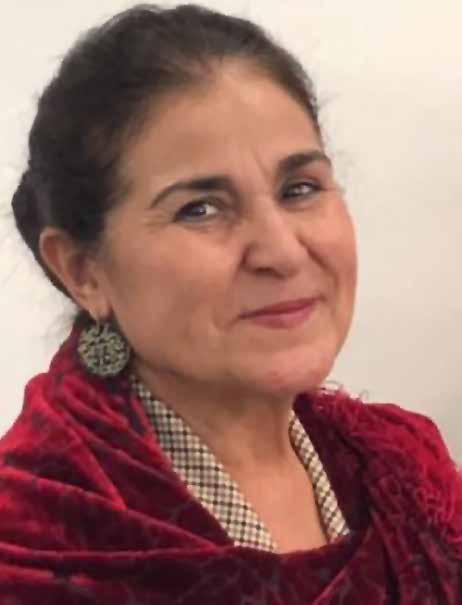
Dr Salwa Gouda Breaking boundaries and deconstructing the sacred In the writings of Arab Women Writers
I feel lucky to have had the chance to translate the literary works of 17 Arab women writers from a wide range of cultural and geographical backgrounds. For me, translation is never a mechanical process of swapping out Arabic words for English ones. Instead, it involves something more challenging and unavoidable: the act of making the text feel at home for the target reader, a process known as domestication. What is more astonishing for me with these texts is that they not only carry the themes historically connected with women, but they move further to express the dilemma of Man in modern life. Arab women poets and writers did not follow the advice of the French feminist critic Hélène Cixous to write only themselves and their suffering as a challenge for male norms and cannons “Je l’écris” but for these authors, the act of writing is a way to actively create a new reality or identity, not just to passively describe an existing one. Their understanding of “Je l’écris “ is to reclaim power and give voice to experiences, bodies, and truths that have been suppressed or ignored. It is, in fact, a political and personal act of defiance. Moreover, the texts of these Arab women writers show their full engagement with all the ills and pains of the world beside the challenges they face in their surrounding due to gender classification and cultural distinction. In fact, through this engaging experience of translating the literary works of Arab women writers, I’ve rediscovered myself and the world.
continued overleaf...
Within the literary and intellectual visions of Arab women writers, the sacred and rebellious body is deconstructed alongside generational conflict and existential emptiness, as time fractures into surreal absurdity and maternal grief turns death into a cryptic message. The impotence of poetry before national tragedy contrasts with feminine Sufism and a covenant with blue, as the poets deny the poetic self and experience alienation from their own being. Arab women writers also give voice to the oppressed marginal female, traces a failed Sufi journey toward independence, and portrays a wounded homeland in painful waiting. Structural female oppression renders the body a site of guilt, yet poetry remains like a loyal dog, and error resembles knowledge. Hunger for cuddling equates death with a job, love becomes a cross, the garment an extension, and the exiled homeland opens a window in the stone. What follows is a structural analysis that attempts to approach and trace their core ideas and dreams.
Dima Mahmoud believes that the dismantling of the sacred, the rebellious body and female as treasure of pain begin with the deconstruction of natural symbols and absolutes (“The rose does not acknowledge the absolute / so it practices contradiction twice”), and breaks sexual and class taboos (“The rose practices sex when crowds gather in public squares”), while presenting the female as a repository of pain (“The girl who planted her heart in her eyes / to season time and ghosts”). This intersects with the generational struggle and existential void of the poet Fawzia Alawi Alawi where the curse of poetry appears (“If not for this curse of poetry / that drank my heart”) versus the mother’s gaze, which she considers “a loser,” and the cosmic void (“Nothing but time, / nothing but space. / What am I to do with all this eternity?”), then with the deconstruction of time, absurdity, and artistic sacrifice of the Egyptian poet Ghada Kamal that makes death beautiful (“Death is beautiful but crying ruins it”) and shatters frames (“All picture frames must be broken”) and presents Van Gogh’s sacrifice as a model (“Van Gogh cut off his ear / and offered it as a sacrifice of silence”).
On the other hand, Hanna Metwally sees sorrow and death as messages that “Sorrow never runs out. / Sorrow renews itself,” with rituals of invoking the dead where “Samia lights incense... raises her voice with his favorite song” then comes the message “Mama... it was his voice.” This meets with the impotence of poetry and the dying homeland of the Libyan poet Hawaa Al-Qamudi where “My country is dying” while the threshold of morning wants a hot poem, and the girl who loves frogs turns into a frog because “the frog prince never came,” and the poet admits that “Nonsense I write means nothing to anyone / it does not warm a freezing child.”
As for the feminized Sufism and the covenant with blue, Heba Al Ghonaimy, offers a different spiritual solution: “No woman is sacred / except the one who keeps the covenant with blue,” where blue represents the motherhood of the universe and the clarity of silence. In Zaynab Laouedj ‘s poems, there are two main ideas: returning to paradise is possible (in “The Apple of Temptation”: “paradise is still open to its own people” and “your room is exactly as you left it”), and the complete collapse of language and existence (in “Nothing left but cold ash”: “alphabets with no spark in them except cold ash” and “we’re drowning in words worm-eaten from the inside”).
As for the negation of the poetic self and the poem as an existential structure Hind Zaytouni declares, “I have never written a poem in my life. / I was only removing / heavy rocks from my chest,” and one poem is enough “to build a house of living tears.” This aligns with the alienation of the self and the difficulty of anchoring in writing by Mastoura Mesfer Alorabi, who describes herself as “the one who is hard to pin down in writing: / my grapes were not eaten, / my baskets were not carried,” and admits, “Whenever my mirrors tremble / I shiver.” Connected to them is the voice of the oppressed and the marginalized woman by Nadia Mohamed, who says, “I am not important. / When I disappear, no one asks,” but she carries a bullet “for whoever breaks the ankle of my heart / with a stone of fire.” Also, In Maha Alautoom’s poems, the poet’s crisis revolves around her tense relationship with writing: at times she rejects the constraints of meter and rhyme and wishes for poetry as “light” as a slender body (“Without Conditions”); at other times she discovers she has given the poem everything (her lungs, her blood, her dreams) only for it to be the one to leave her and set her free (“What the Poem Left”); and at times she loses the poem completely and searches for it under stones and above the clouds, even though it once walked with her, declaring her rejection of all ready-made classifications of poetry (“Did you forget the way?”).
Moreover, the failed Sufi journey and complete independence in Rim Gomri ‘s poetry tests the path of salt in search of the sea (“I walked the path of salt, / searching for the sea, / and you watched me from afar”) then declares liberation: “Today, / no one saves me from myself / except me,” and “all my little things are mine... my voice / my body / the pallor of the moon on my face / all of them belong to me alone.” continued overleaf...
While the wounded homeland and the lover as a soothsayer by Roshan Ali Jaan cries out, “O country sleeping in its ruin / everything after you hurts me” and describes herself as “I am the scattered pain / on your precious smile,” and fears “the last wound” and “the mythical rituals / that give the mouth of the wound / to the pain of the poem.”
In addition, Safaa Elnagar reveals the structural oppression of the female and the body as a site of guilt and how the tall girl becomes a thief (“Grandmother threw her word: ‘She must have stolen her brother’s height while he was sleeping’”), and how “silence is the language I mastered,” and she shrinks into herself “terrified that someone might smell the scent of this new secret.” This meets with poetry as a loyal dog and error as knowledge in Samira Al Bouzidi, who abandons poetry but it “follows my trail like a loyal dog,” and declares, “Error is knowledge, / and knowledge is existence,” and asks, “How would I have discovered uprightness if I had not stumbled?” As for the hunger for an embrace and death as a job Sherine Fathy describes an institution that distributes hugs: “A hug is a human state. A right. A desire and a natural need to feel safe,” while an ad for “Employees Wanted for the Afterlife” haunts her, and she finds herself on a staircase with no return.
Also, the theme of love as crucifixion and the dress as an extension, the poet Tahani Hassan Alsubaih addresses her lover: “Come, crucify me between your sides as a lover,” and her dress becomes “a night of images” and “a bridge crossed by lovers, from the Bedouins to the city dwellers.” And finally, the exiled homeland and opening a window in the stone, the poet Touria Majdouline summarizes the collective experience: “A homeland that does not begin with your name-a place of exile. / A day that does not rise from your lips-a stone stretching out its limbs,” and she asks, “Let me open a window in the stone, / so that beautiful losses do not preoccupy me,” and chooses to remain “forever imagined.”
To conclude, I feel I need a whole life to interpret the ideas and read the hearts of these distinguished writers on the way of Sigmund Freud. These seventeen female voices are united by a profound awareness that women in the Arab world experience alienation on multiple levels: alienation from their own bodies, which are controlled; from their poetry, constrained by traditional meters and rhymes; from their homeland, which is stolen, occupied, or exiled; from their mothers, who mourn a bygone era; from their lovers, who are either absent or present in an incomplete way; from death, which comes suddenly or is long awaited; and even from the language itself, which is no longer able to express their suffering in an absurd uncontrollable universe. Yet this sorrowful awareness transforms into a space for rebellion: breaking boundaries, deconstructing the sacred, exposing contradictions, reinventing myths, opening windows in stone, and dancing madly on the ruins of the traditional poem. These poets remain, each in her own way, “forever dreamers”, for imagination alone, as Samira Al Bouzidi says, “an immortal devil kicking the earth.”
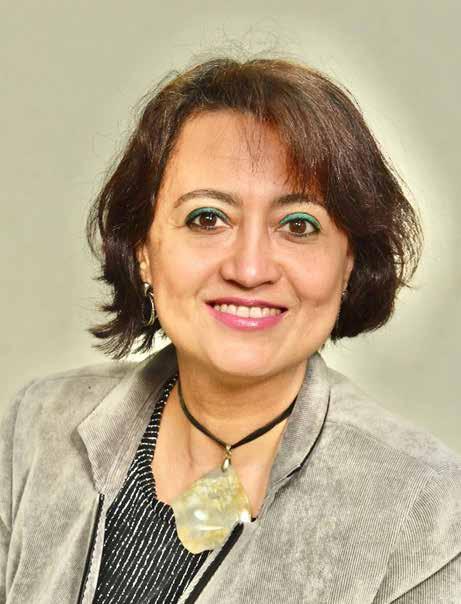
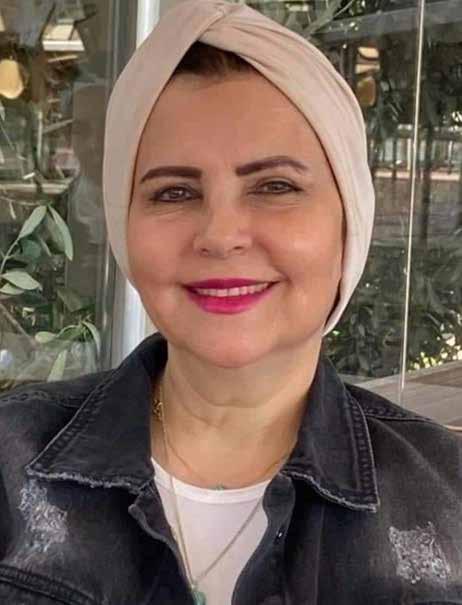
Dima Mahmoud
Dima Mahmoud is an Egyptian poet and a professional voiceover artist, broadcaster, and radio actress. A graduate in Computer Science and Statistics from King Abdulaziz University in Jeddah, she has authored several poetry collections, including Spiritual Braids (2015), Challenging the Horizon with a Violin (2017), With Tenderness, He Inscribes His Papyrus (2021), Bitten Fingers in a Bag (which won second prize in the Helmy Salem Award for New Poetry in 2021), and A Shadow and a Tremor – Songs for the Wind (2023). Two further collections are forthcoming. Her work has been translated into numerous languages—including English, French, Spanish, Portuguese, Bengali, and Chinese—and has appeared in international journals, websites, and printed anthologies. She has actively participated in local, Arab, and global poetry and cultural festivals.
Translated from Arabic by Dr. Salwa Gouda.
Then she walks to him
The girl who planted her heart in her eyes, to season time and ghosts. She stuffed her soul with song-sheets behind the walls until it became roomy enough. Then she walked, fragile, carrying small pigeons like talismans, feeding patience with her beak—hoping it might endure. Was her memory larger than the world, storing more grief than she should have, so that she overflows with this much tenderness and paints gardens with her antidote? Or did she absorb ancient fatigue, cramped as orchards with fever cheeks growing in the water of longing, eternity dozing, watching her like a broody hen packing an enormous suitcase of candles and rivers of pictures, from thirty storms and one house ago carrying it all, then walking to him.
The Rose
The rose is snow that melted from a mountain peak breaking free from oxygen starvation and low pressure. As a reaction to repression, it opens its arms to uncoupling, to embracing photosynthesis and the sting of bees.
The rose acknowledges no absolute, so it practices contradiction twice: when its promises wither yet are fiercely green, and when it’s scentless yet raises its voice in color.
The rose submits to no logic. Yesterday I saw yellow roses closing their petals as light receded at dusk, while my grandmother’s violets in her garden, once upon a time, only opened their lips at night.
No one dares accuse the rose of offending modesty not even by a fingertip. The rose has sex when crowds gather in public squares, in the thick of festivals and carnivals: the male pollen sticks to the female stigma while every eye and every 3D, 4D camera can watch live in the finest detail.
The rose is a backyard to the facades of civilization, dependency, or nationalization.
It might appear as giant wreaths a bourgeois ritual where delegations and noble families flock. Yet a single roadside rose serves those under the threat of poverty, while their crises, dreams, and prayers huddle in the damp.
The rose knows no paranoia, no fear of heights or dark places, no split between opposites or between theory and reality. It adapts quickly, grows regardless, keeping its fragrance and color intact.
The rose has no Oedipus complex. It stands at the same distance from everyone, bears no premeditated murder plot or anything of the sort, and always maintains a balance that ensures its efficacy and wholeness.
The rose isn’t subject to racial discrimination, recognizes no identities, uses no double standards.
Scent and color in the rose arrive at the same moment, equally and fully, to black and white, to peaceful and violent, despite the crushing crowd.
The rose is the chrysalis stage of music clustering together. It rebels against itself with a sharp uprising, sloughs off the circumstances of symbolism, gives birth to fragrance or spirit. At the peak, color melts from its core and it drowns in color, and fragrance climbs the ladder of fulfillment and eternity!
We do not resemble this world
The whitewashed one that lies in wait for us, washes us before we undress. This complacency doesn’t mean much as we poke out the world’s eye with a needle. The same world that jumps like a gleeful clown is the one aiming its nuclear and napalm warheads dead-on, while opportunism hobbles through its guts without hesitation or shame.
What would happen, I mean if we swapped halves of ourselves in a defiant attempt? If we said: Butter is half of society, and with a paintbrush we colored our upper halves green to support environmentalists and I swapped my leg for a lamppost to feel the abandonee’s pain, while your leg became a hammer in a lathe-boy’s hand? What if we said: “Nothing outside the text”?
Nothing inside it either! The egg is still an egg, and poets are stupid middlemen between reality and art. Should I lend you my bra strap now in the name of equality? And have my picture taken with your pipe as an unjustified longing for a bourgeois ritual? And between Trotsky and Lenin, we can turn the sickles upward, smear them blue, in a surrealist act, to pull the sky down, explore the metaphysics of the next twenty years, strategize against wars, labor strikes, bear flu, organize relief carnivals and elections, and lure investors from the Tibetan Plateau.
When your mobile rang as you slaughtered my two white doves, I didn’t mean to stop your hands from bloodying themselves. I only meant to say: It’s not just contradictions that keep the world up at night. You and I do too Even though we are as alike as two scissor blades!
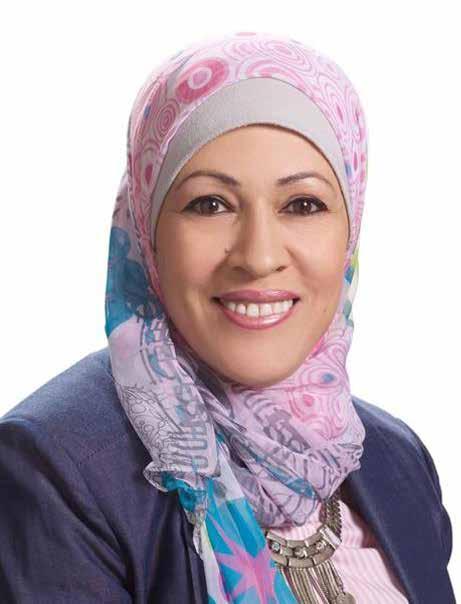
Fawzia Alawi Alawi
Fawzia Alawi Alawi is a Tunisian poet, novelist and essayist who has published nine poetry and short story collections, in addition to a novel entitled “Faces for One Woman” (2020). She also won several national and regional awards.
Translated from Arabic by Dr. Salwa Gouda.
Nebula
So now I have all this time and all this empty, ashen space. Nothing but time, nothing but space.
What shall I do with all this eon, and what, I wonder, shall I fill the hours with? I don’t have enough work to do, nor do I own a single thing— not even a reed hut to build, not even birds to invite so they might nest here.
If I were Solomon, I would summon the jinn to build their towers or fetch every giant cauldron, or bring me whatever throne I wished.
If I were Bilqis (the Queen of Sheba), I would bare my legs, I would command the direction of my longing’s bed, and call the sand grouse to accompany me back to my blessed land. If I were Mary, I would stand by the palm trunk.
continued overleaf...
But I have none of prophecy’s magic. So what do you think—how shall I fill this barren land? How will I save myself from emptiness, from this time drawn out like an epic?
What shall I recite into it?
And whom shall I call to keep me company, to comfort me with tears or with listening?
Oh, the tyranny of emptiness!
Oh, how this void has turned into a nebula.
Where could I possibly bring people from here?
Not even Cain, not even Abel so the raven could make peace between them. They both died, the earth lay empty, and all the tribes vanished at once.
So where shall I find another Dahḥās or Basūs to rewrite history again?
Where shall I find grammar to correct the great mistake? To record the days in pairs, like livestock, and give back to poetry what the narrators forgot?
Where shall I find an inkwell of gold to mend what the wind has torn?
Where, O house of Miyya on the heights, or revive the fallen places of lovers on Kabad?
This place is ruined and stretches on like a strange tomb. So where shall I find all the Ṭāsīns to call out to all existence: “I am the Truth”? And have the stars pledge allegiance to me forever?
A Loosing Woman
I hate winter now. Like any unpleasant surprise. And I hate this primitive, embroidered dress that makes me look like a shepherdess on steppes whose names I don’t know though I can perfectly picture the kind of women who live there: sad faces, hearts murdered by love. Maybe it’s a still from some old film stuck in my head, even though the movie back then was in another language and the subtitles blurred past like lightning.
The neighbors watch me with eyes that mix wonder and envy. A top-tier woman. Heavyweight. Her pictures are in newspapers and on TV.
My mother, unlike them, thinks I’m a loser. Because the papers I carry, the books I boil in the pot where meat and vegetables should go They’ve ruined me. She never stops mourning her own time, comparing it to what I live through.
She says: We wore colorful dresses, embroidered sweaters, scented our hair with Rêve d’Or, folded our feet with henna for three nights, then went to the beauty salon with silk bundles. When one of us passed by, The whole alley smelled of incense and perfume.
I listen to her, laughing, staring at my stained jeans, my dusty soldier-like boots, My unpolished pointed nails, my wedding ring that’s grown loose, my face that barely smiles a lily. I would have looked just like my mother if not for the curse of this poetry that has drunk my heart.
Ghada Kamal
Ghada Kamal is a multifaceted surrealist visual artist, writer, and poet who plays a central role in advancing the surrealist movement through numerous leadership and editorial positions. She is a co-founder of Sulfur Editions, where she serves as editorial and events director, and is a co-founding member of both the Middle East and North Africa Surrealist Group and the Chrysopoeia Surrealist Union. Kamal also edits the Surrealist Cities section for Room Surrealist Magazine and serves as an editor at Sulfur Surrealist Jungle Her organizational work includes coordinating performances, workshops, and cinema screenings for major international exhibitions such as the 2022 Cairo Saint-Cirq-Lapopie International Exhibition of Surrealism, the Echoes of Contemporary Surrealism Exhibition (Budapest/Alexandria), Échos Surréalistes Contemporains du Nil à Saint-Cirq-Lapopie (spanning Luxor, Saint-Cirq-Lapopie, Budapest, and Alabama), and the Luxor Surrealist Symposium: Interwoven Voices in Cairo.
Translated from Arabic by Dr. Salwa Gouda.
The Legend of Time
That one day you wake up to find one of your fingers missing or that your bedsheet wasn’t the right color for your dream
Bedroom ceilings are pregnant with stories beyond what their walls can hold Black is the origin of all colors and white is their patron saint.
I don’t like to grow old in time nor to go back
How complex time’s equations are where Lorca got lost when he ventured into the legend of time
The elder
The young
The child who feared his grave and the cat who died from the fools’ amusement
All of life’s equations are governed by time
The clock
hands moving with a sound like heartbeats
Love is a three-way relationship
You the other time
I knew a friend who died of cardiac arrest as if someone hung up the phone and whispered to him: take off your coat slowly and walk toward weightlessness.
One last tango
Our first astonishment will remain the most beautiful. Who can count the number of spoons in the kitchen or the plates broken on purpose or by accident over time
What are the numbers of the dead how many bullets have been used how many are the missing.
Phosphorescent dragons are beautiful
The cotton candy vendor is light on his feet
Carts filthy with winter mud make me feel warm
Movies turn reality into possible imagination
Coffee is bitter
wine droplets struggle to reach ecstasy
The first kiss is the most beautiful, but the last is always the most honest
Death is beautiful, but crying ruins it
Summer is annoying yet full of life
Those details that swirl inside us but we rarely voice are the bravest
Paper without ink is like dragons without wings
A woman whose breasts were torn away by war weeps
Train windows are gateway crossings
Lighthearted suicides are happy
The homeless are the lightest among us
Neatly rolled hashish cigarettes make us smile
All picture frames must be smashed and all the images set free
The feeling of gratitude might delay our suicides.
Frogs are beautiful
The iguana is a short silent film
The gods don’t dance... they only eat...
The sound of shoes in one last tango resembles a happy heartbeat.
The sacrifice of silence
The recurring images in our memory are boring
We sometimes like to act with the foolishness of children We break that dull tape with illogical details Like screaming stomping our feet on the ground or loving
I once lost my nose I wasn’t a she-wolf after that I roamed the wilderness without a nose without direction I once broke my foot and the hyenas devoured me
Those questions in our brains are dispelled by the yawns of alleyways The sun is green the sky has no doors nothing separates it from the earth except the spears of times crucified on cave walls.
What is the farthest distance between two sounds or rather, what was the last sound between two eras Einstein’s equations might answer but the question will remain a question, no matter how long it takes How, even if we explain the first sounds and the last, can we see them, sense the vibrations of their colors or smell the scent of their echoes in the distance Is that why Van Gogh cut off his ear and offered it as a sacrifice of silence to the talkative woman.
Life’s colors tend toward perfect harmony even at their peak of contradiction and toward total diminishment upon reaching the curve of perfection.
Hanaa Metwally
Hanaa Metwally is an Egyptian writer born in Mansoura, holding a bachelor’s degree in foreign Trade from Mansoura University. She has published several works, including the novel A Day Left to Kill (2024) and the short story collection Three Women in a Small Room (2025). She won the Suad Al-Sabah Award in 2019 and received grants from both Mufradat and Al-Mawred Al-Thaqafy foundations. Her play Philosophers Don’t Know Love was longlisted for the Doha Drama Award.
Translated from Arabic by Dr. Salwa Gouda.
Messages of the Dead
Knock… knock… knock
The wind rustling through the trees, the unrelenting rain, and a power outage.
Despite her clear signs of aging—her short stature and shrunken frame—the woman dashes toward the intended house, raps five steady knocks on the door. As always, the door opens before her with a mix of anticipation and unease. She speaks two fixed words: “Your message has arrived.”
A shy sunrise after a rainy night. Sanaa hurries in her woolen cloak and long cotton shawl, approaching the lone house overlooking the canal. Though built of mud bricks and sheltered by a thatched roof, it radiates warmth against the passage of time. She calls out expectantly: “Auntie!” The short, shrunken woman peers out with watchful eyes and repeats her usual phrase: “No messages for you!”
Sanaa scurries back, tightening the shawl around her broad shoulders and bending her tall frame. The cold attacks her fiercely, drying her heart out further.
She returns home, curls up in bed, careful not to touch her husband’s sleeping body, lest her cold wake him and uncover her secret.
Auntie holds court at the market, standing atop large stones, murmuring words and verses whose charm leaves people in awe. No one has ever known her to attend a Qur’anic school or any formal school, so where does she get such eloquent words?
On the night of her sister’s henna ceremony, Sanaa wore a violet velvet dress and a light pink headscarf. She kneaded the henna, watching the dancing and clapping with absent eyes. She was suddenly ambushed by a dense wave of grief that seized her soul and clenched her heart cruelly. She fled, locked herself in the grain storage room, and drowned in endless tears.
continued overleaf...
Her father forced her to eat a small piece of the bride’s cake; the moment she swallowed it, she vomited.
Her husband tried to playfully coax her, a futile attempt. She brushed him off with indifference at first, but he kept trying. She snapped at him. He didn’t stop. She screamed at him… and wept.
“How did you recover so quickly?”
Night raises its walls, hammered down around the village each evening. Her steps stumble in the dark; her tall frame thwarts her lightness. She reaches Auntie’s house and returns—as always—with a pale, exhausted face like mud bricks. Her husband, who she was shocked to find behind her, drags her by the arm like a sheep led to slaughter.
Auntie gathers with the village women at the livestock merchant’s house. His plump wife sits at the center of the gathering; coffee cups never stop moving between their fingers. Auntie reads their fortunes, hidden in the twists of their lines—giving good news to one, a warning to another. Sanaa is among them, trapped by stares that kill her with waiting.
Auntie pulls her aside:
-My dear, there’s nothing I can do…
-Your knowledge is enough.
-Perhaps there’s something blocking the messages from him.
She abandons the matrimonial bed and sleeps in the other room. For the first time in ages, she dozes off. She has a nightmare: thorns cover her body, and fire bursts from her chest.
In the morning, she dresses in white. She visits her only son’s grave. She spreads the dust before him, plays with him, bringing his old toys and the grapes he used to love. She sings to him, tells stories… and smiles!
Night pushes her home. She prepares food for her husband but doesn’t eat with him—retreating into solitude in the small room. She feels him spying on her but no longer cares.
She carries on like this for an entire month until her husband’s patience runs dry.
-Let’s forget our grief and have another child.
-You always wished for his death…
-I wished for peace—for him and for us.
She turns her face away and returns to her long silence.
She grows used to locking the room with a key and crying stone-heavy tears. Bitter memories return. Her husband often tried to convince her that their child’s physical and mental disability was a fate no worldly wealth could change, and that his death was inevitable. But she only curled tighter into her sobbing. During his final illness, he threw a sentence at her that still echoed in her ears: “The boy is dead.”
Hatred drives her out of the room. She sees him sitting on a chair by the door. “I hate you. Divorce me.”
In the morning, he leaves her the house.
She feels relief. For the first time, the house is empty except for her and the spirit of her little one. “Will you visit me tonight?”
continued overleaf...
Auntie’s miracles grow beyond the village. She has grown used to sitting before her house to watch the sunset, chewing tobacco leaves. And just like that, Sanaa surprises her like an angry wind. In a fleeting moment, she grabs Auntie’s shoulders with a furious face: “You liar, you charlatan. The dead don’t send messages.”
Sanaa lights incense. She wears white. She combs her hair and lets it flow down to her mid-back. She prepares a basket of red grapes, arranges the old toys, raises her voice singing his favorite song, and forces Auntie to stay with her until the message arrives, or else let whatever happen.
As an experienced woman, Auntie knows that a mother who slowly lost her only child won’t back down from her threat. Still, she tries to calm her as best she can.
-Why are you sitting there like an idol? Do something.
-My dear, I do nothing. The messages arrive by the will of those who send them.
Sanaa explodes. She smashes whatever her hands can reach. She tries to strangle Auntie with her silk scarf, but Auntie doesn’t fight back. She limps like a dead body. In truth, Sanaa had not tightened the scarf around her neck; it was merely an outburst, venting the bitterness of waiting and the long separation.
“Mama…”
It was his voice. She knew it was really him. She kissed Auntie’s head and feet, begged her forgiveness, but Auntie didn’t utter a word. She simply left her and walked away.
Sanaa closed her eyes to absorb his voice. She saw him-truly saw him. Standing as never before. His body taut, his face without pain. She hugged him, wept, breathed in his scent, touched his thick hair, and vanished into the sparkle of his eyes. “I’ve waited so long for you, my heart’s son.” He dried her tears; she offered him a cluster of grapes. He didn’t take it. She sang to him, told him stories. He fell asleep in his bed, wrapped in her arms. She lost track of time and fell asleep herself, her face relaxed and soft.
Now that she knew the way, she no longer wandered among the mud-brick sorrows. His voice stretched inside her ears; his spirit flowed into hers, taking her over.
Her husband returns home against her will. A heavy grief sits on her heart, because with his return, her son’s ghost leaves. She wonders about the mystery of the discord between father and son…
Grief never runs out.
Grief renews itself.
She stares into emptiness and mutters: “Why do you hate your father?”
In her dream, she sees her son in his final hour lying on a white bed, the machines implanted in his frail body barely humming. She sees her husband run his fingers through the boy’s hair, a single tear rolling down his cheek before he left the room as the machines fell silent.
Hawaa Al-Qamudi
Ghada Kamal is a multifaceted surrealist visual artist, writer, and poet who plays a central role in advancing the surrealist movement through numerous leadership and editorial positions. She is a co-founder of Sulfur Editions, where she serves as editorial and events director, and is a co-founding member of both the Middle East and North Africa Surrealist Group and the Chrysopoeia Surrealist Union. Kamal also edits the Surrealist Cities section for Room Surrealist Magazine and serves as an editor at Sulfur Surrealist Jungle Her organizational work includes coordinating performances, workshops, and cinema screenings for major international exhibitions such as the 2022 Cairo Saint-Cirq-Lapopie International Exhibition of Surrealism, the Echoes of Contemporary Surrealism Exhibition (Budapest/Alexandria), Échos Surréalistes Contemporains du Nil à Saint-Cirq-Lapopie (spanning Luxor, Saint-Cirq-Lapopie, Budapest, and Alabama), and the Luxor Surrealist Symposium: Interwoven Voices in Cairo.
Translated from Arabic by Dr. Salwa Gouda.
It’s Okay… A Few Tears
It’s okay, a few tears. Like a lost star, I talk to my heart: This road is not mine. This hand doesn’t know me. This country leaks through the cracks of my soul. Is this not me?
The rasp in my voice, a meowing song, or maybe a song that dies.
The nonsense I write means nothing to anyone. It doesn’t warm a freezing child, doesn’t soothe his trembling heart. It won’t silence the hunger gnawing the edges of the homeland.
My hand is bare. It cannot clothe a girl whose house was stolen. It’s okay!!!
The world is fighting terrorism, and your naked body is just a minor casualty. War is no longer an old crone war has long ages now. Beauty salons are perfectly capable of ugliness. So it’s okay… a few tears.
Ahhh… ahhh!!!
Did I forget something?
This idiocy has forced me camels are boring, they roll the rubble of my mind. It barks. There’s an apparition. The wind howls
Where am I?
The Threshold of Morning
The threshold of morning wants me to write hot poetry when a hand touches it, it burns with the flame of meaning, coursing with the sea’s breath: drums of love, rain’s jubilant cries. Wants me to bind the notebooks of days with colored thread, with spring-butterfly wings, wants the poem to flower like the first budding of a breast.
But every day I stop at the threshold of morning and say:
The sun is shining. Kids’ voices - full of thrill. Grocers flaunting their goods, strawberries flashing red. (And this is Reham, my little friend - she loves reading, craves Youssef Al-Sharif’s stories, her smile spills, her cheeks blush.) So why is my heart so full of gloom?
I stumble on the road stones and cement, men with long beards and djellabas cut too short.
How I need to scream to write a naked poem that flashes my longing for your kiss, the bleeding ache for your scent.
But my country is dying. And I am standing on the threshold of fifty-six.
That’s How She Screamed
That’s how she screamed, that girl, when she was small. She loved frogs. The ribbit-ribbit music never bothered her. She stood transfixed, watching those threads swim in the village pond how they grow fat with eggs, then, poof! tiny frogs hopping off.
An ordinary story. Because the girl will go on to love butterflies, starlings, even mice. But the frog prince never came.
She waited a long time. Wrote love letters, sent them far and wide. But one letter lost its way. A torn pocket hid it. Mistaking the letter for a landmine, he pulled its blue fuse, read its lines.
They say the war is savage. That the floods of love can no longer even touch a rose. Barrel bombs. Missiles. A shard will pierce my heart this heart that waits for you.
She waits for those lines. What will you answer my heart? Why did we turn away? Why did we let the lines slip? So that the girl never saw the frog parading around with medals and ribbons.
Should I go on chattering?
There’s a lump in the throat. A laughter cut short. And music that bird disturbs my soul.
I’m still chewing mulberry leaves. Still weeping. So much blood. The night still hasn’t cleared. And those lines, those lines I waited for, maybe they’re still waiting.
I say: maybe. Because the girl who loves you will turn into a frog. And over her speckled skin you’ll run your hand. She will never become a princess. But as she reads your lines, she turns back into a girl barefoot, weeping because the connective hamza came far too late, and that final hamza leaped right in her face.
O you agony That’s how she screamed.
Heba Al Ghonaimy
Heba Al Ghonaimy holds a Bachelor’s degree in Tourism & Hotels (Helwan University, 1995), a High Diploma in Ancient Egyptian Archaeology (Cairo University, 1998), a Master’s degree in Mythology from Cairo University (2004), and a PhD in Egyptian Archaeology from Mansoura University (2017), with a thesis focused on the social and political implications of fourth-millennium BCE artwork and public buildings in Egypt. Their expertise spans experiential soft skills training, adult teaching in archaeology and Egyptian history, tourism guidance assessments, and writing on Egyptology and culture. With 20 years of freelance tour guiding experience (1997–2017), they have also worked as a lecturer, trainer, safari consultant, writer, published author of novels and poetry, art curator for six exhibitions, and cultural seminar organizer.
Translated from Arabic by Dr. Salwa Gouda.
Mare of Secrets
A mare of secrets a green foal born of oak trees leaps between valleys in silence. Two small eyes play with the void and conquer.
She grazes with the confidence of sages, has lived a thousand turns of the wheel, wears the light of whiteness, and silver, stubborn hair. She stirs the wind with her scepter.
Night Journey
Night journey to your heaven — a thirst for forever.
A love the planets take refuge in, and the stone’s last will.
A seer’s withdrawal into stubborn symbols, hidden valleys, the mountain’s treasure, the blaze of a celestial kingdom on the desert’s body.
Woman on the Covenant of Blue
The clarity of color unleashed flowering between skin and veins. It grows wild from the body’s prisons, sighs with longing for the sky’s reins where nothing exists but Him. A praise rocks the stars, summons the crescent moons on pilgrimage to paradise’s palaces. A color without beginning a color against whose shoulders we collapse and weep, like one returning to their homeland after the road’s hardships.
The clarity of silence: the femininity of blue. The motherhood of the universe pillows itself on blue. No woman is sacred except the one who keeps faith with blue.
Silk Collar
A silk collar grows between skin and veins, wraps hearts in velvety love, radiates warmth. Tenderness rivals it, desire ignites it, mercy plants it. Its fruits are golden.
Wait blue is coming to wrap you in richness. Enter blue’s depths so it may rock you like a butterfly queen or like her peacock, strutting white in her light.
Hind Zituni
Hind Zituni is a Syrian-born poet and novelist currently living in the United States. She specializes in teaching English to non-native speakers and regularly writes literary articles for various newspapers and magazines worldwide. Zituni has published four novels and five poetry collections. She received the Short Story Award in 2020 and the Naji Naaman Award in 2024. Her poetry has been translated into several languages, and she has also translated two books into English: a collaborative poetry collection and a selection of short stories.
Translated from Arabic by Dr. Salwa Gouda.
Trading Tiredness for Air
I never wrote a poem in my life. The truth is I just used to shove heavy rocks off my chest, and dance. Dance like crazy. Like I was trading all my tiredness for air, like my body was shaking off its own shadow. So I’m not the one who gets tired sadness does.
A House of Tears
One poem, just one, is all it takes to build a house out of living tears, a house that holds the world up so it doesn’t slip off its heel into the mud.
The poet walks on a sea of grief, and when he runs out of strength, he drowns in it like he never knew it was there.
On the black market, he hangs his days on a clothesline of forgetting, and comes back holding a single, lonely rose so his lover won’t die that hand that used to save him.
He pawns his memory for a dream. Every time he gets close, the dream grows wider like a homeland you can’t go back to.
The Jacaranda Tree
Tonight I dream of nothing but you, and the jacaranda tree dropping its leaves on us like a soft secret.
I drown in purple, in the smell of your breath as it wraps the moment in a thin blanket of drowsiness.
Give me one letter of the alphabet I’ll build a whole safe city from it, then squeeze it into wine that never gets old.
Maha Alautoom
Maha Alautoom is a poet and academic, holding a PhD in Arabic Literature and Modern Criticism. She is a member of the Jordanian Writers Association and has authored several poetic works, including Circles of Mud (1999), Half of It is Lilac (2006), More like Her Dreams (2010), Down the River (2013), and Upper Rooms (2019). In recognition of her contributions, she was honored with the Jordanian State Appreciation Award in 2017.
Translated from Arabic by Dr. Salwa Gouda.
No conditions
The conditions of metaphors give me a headache and meter wears me out.
Ever since I gained weight I have thought about the lightness of words on the line, on the chest, on the belly. I walk a lot to chisel away the flab in my language.
I rehearse my words in front of mirrors as if writing is surgery and everything my hands have done has drained my blood.
Am I tired of walking or has bitterness weighed me down? Did fear torment me?
If only I had a different body to write lean poetry, light on my shoulders, something people could carry like a cellphone.
I’m sick of crawling, of flying.
I want poetry to handle my new intentions, not erase me like my old poems did. I want it to walk slowly beside me as if me and it we are the only lovers, walking through the night.
What the poem left behind
I left this poem more than poplar trees on my balcony.
I left fledglings naked, waiting for my hand to make them fly handkerchiefs fluttering behind windows in my name. I left my lungs for her and filled a spoon with oxygen so she’d know the air is scarce and that I spoil her.
I left my mistakes, my longing to cross through her to somewhere else. I left women who clung to my language like silk, and sewed a dress from my blood my loneliness wears it.
I left her half of everything: two obsessive women who shared their fear of where partnership leads in death when they become one, spreading like a spider over my face.
Truth is, I left her everything so she would leave me, so she’d believe I sing those little songs for myself, for love, for lovers like Sylvia Plath, and for death which teaches, like poetry, in my every step.
It teaches me that my small shadow on the earth fades with time.
To the boredom that bullies my voice I want to scream louder and louder, play without getting bored, come back a little lighter. Maybe I’ll return without rain lurking around the trapped words inside my cloud.
Did you forget the way?
As you edge along a thread of dawn, committing to nothing, unwinding only the night from the night’s spool you don’t weave. You tripped over description more than once. You forgot the way.
That poem’s recipe can’t be repeated or retrieved. You forgot. Maybe the coldness has a reason like women crying for no reason, like waiting for my lover. I try a field of chamomile: he comes back, or maybe not. I try my luck with a roll of dice. Where did I lose the truth? How did I forget the way?
I come back to spell out poems from the very beginning — from the alphabet. I lift every stone maybe the poem is underneath. I dig through every cloud maybe the poem is above. I part the wool, the chickens, the vermin. I vanish like all devotees in the presence of ancient poets, modern ones, and those who’ve stripped off modernity’s clothes without covering their nakedness underneath.
I see so much on my way. I see poetry in everything and forget the way.
Neither pre-Islamic imagery is poetry, nor modern rambling, nor elegant words, nor the garden’s daughter — jasmine.
The poem was walking right here with me, and I lost it in a minute.
Mastoura Mesfr Alorabi
Mastoura Mesfr Alorabi is a prominent Saudi poet, literary critic, and academic specializing in modern literature and criticism. An influential cultural figure, she co-founded the Professional Literature Society under the Ministry of Culture, chaired the Poetry Platform at the Arab Poetry Academy, and served on cultural committees for major events including Jeddah Book Fair and Okaz Cultural Market. Her poetry has been translated into Spanish and English, featured in international festivals across the Arab world, and included in the Encyclopedia of Arab Women’s Poetry (2021). Her notable publications include poetry collections like “What Confused Me... What I Never Left” (2020) and critical works such as “Meaning-Making in Saudi Poetry” (2020), with her creative and academic contributions being the subject of scholarly studies and the critical book “Revelations of Meaning” analyzing her poetic works.
Translated from Arabic by Dr. Salwa Gouda.
No need for the wind
A cloud rains, and a woman tucks me - a veil of sea spray under the pillow of memory, where drowsiness takes over. I was water before this water. In thirst, there is confusion. I blame the old luck nothing leans but my head, nothing gets measured but my shadow.
Walking
on a fine string inside the poem. My drunkenness — a silky melancholy, my hip — my own grandeur. Ever since I leaned on the Kurd mode, I haven’t whispered of those around me. My white, secret self seduces my own youth. I read in the book of art my weakness and my wholeness. And I, the one who’s hard to pin down in writing: my grapes have never been tasted, my baskets never carried.
The cloud resembles me so much
A vague, mad longing takes me over. I fear nothing except a damp direction. And from the evening of the soul, I steal the memory of rain. Oh God, the nook of the ribs how do I escape a treacherous silk that glides between me and myself? Whenever my mirrors turn, I shiver. I never betrayed my scent, but the songs and photographs betrayed me.
Nadya Mohamed
Translated from Arabic by Dr. Salwa Gouda.
To the Man Who Was
Why do I hold out? Or how long will I stay silent silent as graves, as stones, as sand?
That’s what the man who was said to the murdered street there, with no farewell worthy of him. For a year or a thousand years, the man keeps saying and saying…
He said it to a miserly eagle too, one who wants the house lights killed in front of his wide mansion and his chicks fattened on beaks.
He said it to a bullfighter already butchered, addicted to tug-of-war with the umbilical cord until the new day dies. He whispered his words to dogs howling from the weight of their bellies.
He said it to a woman complaining of the whip of fear on the skin of the one who sang of her hair and the black of her eyes on her sad birthday.
He said it to a lost child dressed in cold and a worn-out back belt— a thick-tongued man’s laugh dropped him behind the old wall.
He said it once, in every tongue, walking barefoot, holding his mother’s large breast like a nipple.
The man who was, companion to a stranger’s shadow, a river-like mark on his face, like an aging river, with a big cowlick on his wise head enough to raise the coffin high above the shoulders of the road’s blind lamps.
The strange man spoke long-sleeved words, clothing the dark girl’s body. How much the stranger said in the age of marvels to his defeated companions and the deaf crowd.
Nadya Mohamed an Egyptian journalist and poet. She has published three poetry collections: Laughs Open for Discussion (2020), Seasons of Love (2022), and A Lover’s Shadow (2025).
Woman on the Margin
I am not important. When I disappear, no one asks. Those who clap for me in the final moments when I sleep, no one rushes to wake me to say good morning.
Not even when I walk the full distance of the university bridge to throw memory-stones into the river, or hum an old song that resembles me or resembles a sharpened pencil.
I know I was a summer cloud torn apart by the wind’s hands in an angry moment from the sun.
Or maybe I was someone’s mannequin in a shop window— he winked at me inside his fantasy, then left with his sweetheart, mocking his own naughty thought.
Or a firework lighting up the sky for a poet who was bored one time.
That’s how I see myself, and how I see those around me.
But I’m not frowning. I’m not busy with all these trivial things. I keep company with lovers—they always stick to me like my shadow: Me / my mind / the poem / and a bullet in my hand I fire at anyone who tries to break my heart’s ankle with a stone of fire.
Rim Gomri
Rim Gomri is a Tunisian poet, short story writer, author, and media professional. She studied journalism and media. She has published three poetry collections: Women Are Waiting (2013), On My Body, My Amulets Are Tattooed (2016), and What the Dream Didn’t Say (2018). She also released a short story collection titled Another Life for a Past Age (2021). She is currently working on a short story series and a novel, and her fourth poetry collection is currently in press and will be published soon. She writes literary and cultural articles in Tunisian and Arab periodicals.
Translated from Arabic by Dr. Salwa Gouda.
Solo
I open doors I never close, heavy with memories, and the roads are crooked. I leap across cliffs, then tumble like a ball of cloth. I searched for that hidden voice that disturbed my sleep and made me play the part of a weary prophet. When I crawled out from under the rubble, after the earthquake that leveled the city, I looked for the old sage the one we once visited together. I lit the incense and the candles, tuned my voice for singing, something like a prayer. But the sage left us alone to face the road. I slept under an almond tree and dreamed you smashed the glass against my dry lips and my thirst only grew. I walked the salt path, searching for the sea, while you watched over me from afar, in silence. Behind me, I left our shadows dancing the tango.
I climb mountains, cross deserts, crawl like a snake but you are a hunter who’s lost the taste for killing, who amuses himself watching the sunset, and sees the world through the eye of a needle. Since then, I’ve been playing solo a piece that begins with I love you and ends with I loved you.
Lament
The streets and the sidewalks are mine. All my small things are mine. I have broken free from the hobble of waiting.
My voice my body the pallor of the moon on my face all mine, and mine alone.
I have no partner except my heart.
Nothing with me and yet, everything with me.
My voice is the cry of womanhood in its eternal desire. Every tattoo on my body not one has fallen off. My most secret moles are still here. And nothing calls me but the road.
On the edge of morning, I laugh a lot at every passing face so that the cloud of tears hovering over my soul does not soak me through.
Rising toward my dream, I do not bow my heart’s neck. Like water, I plant life wherever I pass. Rising, I carry my wound under my arm.
My pain has ripened. Sprinkle salt over it. My body has a memory that does not forget.
I come late, like seasonal winds. Inside me, I carry the seeds of my own extinction. I sing to the harvesters, the shepherds, the farmers songs they hide in time’s clay jars for the cold winter nights.
I come like an idea of love that broke the backs of lovers and still they never repented the first sin.
My voice is the wind. My home is the storm.
Everyone I ever loved left me their burdens. I carry them like crosses on the shoulder of my days. Everyone who loved me chose their own hearts, then left me.
I always come late like life on the brink of death.
I smashed the jars of waiting. I explored the depths of my body. I memorized its weaknesses and its strengths. I hung my amulets in the river of my blood. I tattooed the names of everyone who failed me above the wrist of my heart, and I said: Today, there is no one to save me from myself except me.
Roshan Ali Jaan
Roshan Ali Jaan is a Syrian poet, born in Damascus and residing in Sweden. A graduate of the Faculty of Education, she worked in the field of education in Syrian schools. She has published a poetry collection titled Amber of Darkness, and a second collection titled Requiem of the Rose is currently in print. Her poems have been translated into numerous languages, including English, French, Portuguese, Spanish, Bengali, and Kurdish.
Translated from Arabic by Dr. Salwa Gouda.
Drowning in Thirst
Nothing hurts suddenly
O country asleep in its own ruin.
Grant me a passion that follows the first step, like a heavenly miracle. Grant me a body with twisted feet, a hand that shakes the night inside an orphan’s eyes so I can tell you the journey of those who return from death without a guide. Grant me the sea’s inner sight, violets made of water’s senses so I can drown again in thirst.
I am the soothsayer of fading hopes. From your daylight, I conjure a longing that straightens anxiety’s features.
O country asleep in its ruin everything after you hurts me.
It hurts me—the flare of obsessions in the night of speech. The long talons of loneliness hurt me. The geranium flower veined in white, the wound of the stranger and his deep wishes. The slender hand that waving failed. The eyes that lost their gleam in absence.
O memory made of willow-meaning your face, lost in amber, hurts me. I am the scattered pain on your cherished smile.
Chrysalises of Longing
Sweetly you pass over childhood nests, drunk on the panting of delights, like a prayer stroking the face of day, like a moan for cities we were forced to leave.
Surprise arrivals suit you. The chrysalises of longing suit you. Your face is still a star lifting boredom off the universe’s orbits with a morning smile.
With your guilty silence, I will raid all the thirsting wildernesses and wait for seasons to plant you as grass in mirrors. The night’s delirium is no longer enough to drench lullabies on your cold fence.
Return with the majesty of excuses, so I can tell you of the north wind that broke my heart, left it hanging, rocking the shudder of emptiness there about the eloquence of color overthrown by the place’s trance, about a rose baptizing the fence so distance becomes a flute feeling the hip of spaces, about the lineages of pits when silence steals the river’s voice from my throat.
Ibex Fleeing the Violins
With her astonished eyes, she measures the naked distance of lost wildernesses. A woman branded with the henna of defenseless color. Deep inside her, prey of fear trembles. In her chest, blind violets strut.
She carpets herself with the reeds of eternal rivers. She throws her burning Kurdish shawl—iridescent over sunflowers. She scatters the loose breeze with her slender hands.
The mythical bird flies close to the nectar of her braids, reciting to her the pain of wildflowers.
It is absence the misguidance of struggling trees. Trees as naked as two lovers, trembling like a fig tree under kisses.
In a hoarse voice, she hums songs of longing. Long ago, the fire was in my heart. I am the exhausted one, bound by the power of wild ibex ibex fleeing the noise of violins as they weep for the stranger’s sorrow.
Forgetting
You are forgotten. Your star-tattooed letters returned sluggish with the silver of the blue mountain. Your mirrors are hollow. Do not tie the knot. The passages are safe. There—in the distant galaxy—an orchid flower still lives on the edge of love, dazzled by crimson red. Oh, you forgotten one you are still waiting.
I Fear the Final Wound
O autumn, tell me how to kick the world. Tell me how to trade the stillness of water in my soul for a curse of wine. How to leave the fragility of time without the face of water breaking.
O autumn, this yellow does not concern me. Let me escape the mania of coloring. This color—old with desire—confuses me. Your footsteps on the edge confuse me.
I have not died yet.
Teach me how to restore the sea’s imagination so I can leap over beads of speech. Teach me how to strut with chestnut’s restlessness as if I were a ballerina.
I fear the final wound. I fear the rituals of superstition that give the mouth of the wound to the pain of the poem.
For so long, I have propped my stature on the gasp of the repentant. I lean on the fence of morning like a mimosa flower. And with the longing of bronze imagination, I tie the rope of salvation to the eyes of the gods.
Safaa Elnagar
Safaa Elnagar (b. 1973) is an Egyptian writer and scholar with a PhD in Media (Radio and Television) from Cairo University. Her notable literary works include the short story collection The Girl Who Stole Her Brother’s Height (Merit Publishing, 2004), the novel The Resignation of the Angel of Death (Sharqiyat Publishing, 2005), and the short story collection The Maidens Shell Peas (Rawafed Publishing). Her academic and creative writings explore social and political themes in Egyptian society
Translated from Arabic by Dr. Salwa Gouda.
The girl who stole her brother’s height
What the grandmother said to the King of the Jinn, who visited her as she prayed the afternoon prayer:
My hands have grown weary from guarding these walls. My back is bent; my eyelashes have fallen out from sleepless vigils. On his deathbed, he made me swear to protect his legacy. I obeyed my father, married my cousin, settled for half a husband and half a son, and waited for my grandchildren. The first came, a boy, and I rejoiced, my longing for the second growing. But then she came, and no other grandchild followed. The cursed one blocked their way and stole their souls. Thievery has become her disease. She steals my stories and tells them to strangers. My ancestors’ legacy. Hurry, oh King. My hands are tired… I am tired… so tired.
What the mother said, not even daring to whisper to herself:
Her eyes urged me to stand by her, to speak up, to defend her. I cannot. Silence is the language I have mastered. In the few moments I do speak, the fires of rage from others’ faces scorch me. When her father came a week after she was born, he asked, and I answered, “A girl.” His face darkened, and he never smiled at me after that. And when her brother, who is a year older, was getting ready to submit his papers for high school, and she insisted the photographer take a picture of her with him, I stared hard at the photo and wondered, “Is there a girl taller than her brother?” The grandmother placed her in the dock, leaving the cage door ajar. Every so often, she would push me toward it, turn her face away, and mutter, “Turn the pot upside down on its mouth.”
What the brother said, sealing his large envelope, satisfied:
My grandmother holds my hand, a candle in her other hand, and parades me around the house. She points to the walls, their cracks gone wild, and promises me apricots if I fix them. Everything you fix, it’s yours. My shadow stretches across the walls, covering them, my head touching the ceiling. When I saw the picture, my shadow shrank. I retreated back into my lamp, my mother’s voice echoing, huge in my ears. “Is there a boy shorter than his sister?”
continued overleaf...
Safaa Elnagar
What the narrator said to her short daughter:
The day was set to distribute the paltry inheritance left by her father. She had no clear idea of what to expect. Her brother’s wife opened the door for her. Like a stranger, she sat in the farthest corner of the guest room, her two little girls huddled close – one in her lap, the other pressed against her right arm. The minutes dragged by. The house seemed ancient, surrendered to the tread of years. The new furniture only accentuated her estrangement.
Her mother entered, followed by the grandmother, and behind them, her brother. The scant light filtering through the window cast cold shadows on their faces. As always, her spirit withdrew, leaving her stranded in the arena, unsupported. Her brother asked her to sign some papers. She started to object. He shouted, “You’ve taken too much... more than you deserve.” With his fingernail, he picked at the dead scab of an everlasting wound. She searched her mother’s face for a reaction. Her mother, who hadn’t noticed she’d grown taller, that her summer clothes had become too short. Until the day she took that picture with her brother. The mother stared at the photo, then suddenly beat her chest and screamed, looking straight at her, “Where did you get this height?”
Confused, she looked at her grandmother, busy with her amber prayer beads. She remembered her own father, the ‘Chief of Guards,’ a man of towering stature. The grandmother threw in her two cents, blinking her lashless eyelids, “She must have stolen her brother’s height while he was asleep.”
Her brother tore the picture. She was startled. She knew from her grandmother— who saved her stories for her but fed her brother apricots—that every sin has its punishment. And so she recalled every sin she had ever committed: the piece of sweets she ate fifteen minutes before the cannon, the times she slept without saying the night prayer. But this sin… she tried to remember when she had committed it. How? She couldn’t remember. She couldn’t even go near his ruler or notebooks.
Her guilt multiplied when her mother had to sew her a new school uniform. A week before school opened, her mother sighed, “And of course, you’ll need shoes.” She surrendered to her guilt, accepted it as truth, and began to await her punishment. The grandmother slipped away to pray the afternoon prayer. Her brother ran out of patience, the papers trembling in her hand. “I don’t have time.”
Silence choked the room. The scowling faces were not the first punishment. The head PE teacher pointed at her from her spot on the balcony: “You. Go to the back of the line. Yes, you. The tall girl. Tallest girl in school. Back of the line.” All eyes focused on her. Life froze in her veins. Everyone knew her secret now. The teacher repeated the order, and a younger teacher moved to enforce it, ordering her to take her bag and follow her to the last row in the line.
The teacher looked up at her disapprovingly. “What is this? They turn out girls on a lathe now and they come out this tall?” That first lineup, and every lineup after, was a punishment session. “Tall girl, your hand up. Don’t look down. Louder. Higher. HIGHER.” Better to come late, she decided. She would lean her back against the school wall, endure the rhythmic cane strikes alternating on her hands, and enter the classroom to her seat in the last row.
The strange thing was her face-as the women who sympathized with her told it—was always calm. They forgot her extraordinary height; that wasn’t the source of their wonder. It was her total surrender. To the cane strikes. To the lower grades. To the result, landed her in a middling commercial trade school. Only once did she nearly lose her composure, when she read in a fashion magazine that the supermodel Naomi Campbell was over 180cm tall, taller than her. And her picture radiated happiness and pride. But before equilibrium could seep back into her soul, a sheikh on the microbus shouted in her ear, “A Muslim woman must not imitate the naked infidel.”
Her wound became deep. Whenever a dead scab formed, someone was there to pick it off. Her husband, who left her and their two little girls to go search for a son for them. Her grandmother, who marveled at the audacity of girls these days. Her silent mother. Her brother, who constantly reminded her she had taken what she didn’t deserve. She signed the papers. Renounced what was hers. And withdrew quietly, her two little girls behind her.
Broken needle
Alone, she carries her fear in her gut. Her security shaken, the veil she spent her life patching up torn apart. Her sense of responsibility pushes her head into a sea of worries. Black waves toss her toward islands of isolation and ghosts. Like a woman in the wrong, she tries every remedy. She beats her stomach. Jumps off the bed. But it defies her, clinging tighter. Desperate, she persists, but it overcomes her. So, she sits on the damp tiles of her room, dries her sweat with her housecoat sleeve, leans her back against the wardrobe, and stretches her legs over the rag rug woven from fabric scraps.
Scraps she learned to collect from under the sewing machines at the nearby workshop. Her mother would take the bulging bag and return with a long, thin rug. Its fabrics, like her days, are different colors and textures, but overall, they are faded.
Several winters have passed. From cold to rain, she earns her diploma from the middling commercial school. The workshop becomes a factory; she sits at one of its machines. Among the suitors who propose, her mother points one out: “Your cousin. You support him, he supports you.”
Joy cloaks the walls of the house she was born in. Her old bed is taken out, and a full bedroom set—bed, wardrobe, dresser—is brought in. Her fiancé paid 500 pounds as a down payment. Every evening, he returns, rubs his head on her chest, and places his meager daily wage in her hand. She smiles at him and says, “Don’t you worry. I don’t know where my own salary disappears to, anyway.”
The pressure on the motor (the industrial sewing machine) increases. She looks at the supervisor, coveting her beige lab coat and her commands: “Get moving, girls! The order must be finished today!” Thousands of dresses go in and out, stitched with bent backs and sharp eyes. Dresses that women strut in, and dresses that other women gaze at from behind the display windows.
She asked a scholar from Al-Azhar, after wrapping the question in “a friend of mine,” and the man was decisive, though a thread of pity showed in his eyes after her fervor and protruding upper body tore through the veil of “a friend of mine,” and her tense face and flustered hands screamed out: “What do I do?”
Before, she had continued working into her ninth month. Her belly pressed on her, she pressed harder on the machine. A needle breaks; she quickly replaces it. The bobbin keeps spinning. The supervisor asks her, as if she didn’t know the situation, “Aren’t you going to rest at home, already?” Her due date came, but labor was late. Her worry about losing a full month’s pay kept the little one in its hiding place. A coworker sympathized with her, “She deserves every day of it.” But once the wires of the C-section were undone, she left her baby in her mother’s lap and stuck her head out the factory door… but no one was waiting. Another girl was clinging to her machine. She begs the manager. He agrees, “This is the last time you leave work. This is a live machine.”
Bent over, gathering scraps, or standing straight, carrying bolts of cloth, she gazes at her old machine. Sometimes she touches it. At the end of the day, she might wipe it down with scraps… until her new secret took her by surprise.
She coils into herself, terrified someone might smell its trace. Whenever she glimpsed the machine, she turned her face the other way. And from behind the high glass windows, her depression mingled with the autumn clouds, heavy with postponed tears.
Samira Al Bouzidi
Samira Al Bouzidi is a Libyan poet. She has published eight poetry collections, and one of her collections has been translated into Italian.
Translated from Arabic by Dr. Salwa Gouda.
Killing Time
Life can bear anything golden contradictions, quick separations, virtual betrayals, killing time, killing the lover. Its scent is prose-like, like a modernist, deconstructive text the smell of a rain-soaked tree, burning wood, blind beetles searching for immortality inside the earth, a shiny label, overwhelming greenery, a beautiful body, a flower table, a forest of illusions, horses running among us, wasted ink, the sound of tearing paper, e-books that die easily, poems that love to undress late at night, a tear that fills the ocean until it overflows with strange compositions.
So, You Won’t Walk Away
I love reading poetry while sitting down. My hair is trapped inside my scarf so it won’t fly far from its roots. My feet are tied beneath me so they won’t think of running or falling.
Poetry intoxicates me.
Sitting like a tree with drooping branches, I listen to my own secret rustling. Sitting, I recite words the way mystics and madmen recite them. I break the poem’s bones so it won’t walk away and leave me alone here, under your staring eyes, your preconceived ideas, your baffled interpretations.
Sitting-this is always my way, while my soul flies far away. It’s there, above the mountains, with the oppressed, the poor, and the wayfarers. My soul has always been a wayfarer yearning for birds and those with torn spirits.
I don’t like podiums or the pretense of oration. I like being simple like a quick, painless bullet. Or hazy like fog that reaches out a hand but can’t see it.
I abandoned poetry, but it didn’t leave me alone. It sniffs my trail like a loyal dog, guarding me from collapse, guarding my wits from escape. I dismissed it; it tugged my sleeve. I fought it; it pinned me down. I slapped it; it embraced me and wept: “Who will you leave me for?”
Sitting on the ground I am closer to her soul here. Sometimes I put my ear to the earth to hear her heart.
Yes, the earth has a beating heart. While human hearts have stopped. I don’t know.
I look at my country and smell the scent of ruin and erasure. That’s why I always sit waiting for you.
Shirts of the Wind
We’ve lost life, my friends, but imagination remains an immortal demon kicking the earth. We write as if God poured ink into our hearts and thoughts into the shirts of the wind. Every poet has a shirt: whoever wears it, whirls away and never returns.
Oh, our world in the end we leave you hanging by a thin thread between life and illusion, because death is the only truth.
We are the wardens of your fantasy. We’ve read your giant letters carefully valleys and rivers overflowed. We got lost on your path. We are the door and the key, the dirty light, the wise shadows, the pure metals. We are your dimensions and your blind vision, your postponed children. In the end, we will remain a long sigh suspended between heaven and earth…
Mistakes
At night I inspect my mistakes and return them to the right. They must flourish and grow like a small, beautiful tumor that leads to ruin, like a blind day, a night kicking in the dark. That’s how I keep my soul from rotting in stagnation or weakening. That’s how I know: mistake is knowledge, knowledge is existence, and existence must be luminous.
How would I discover straightness if I never stumbled? How would I see clearly if I never went blind? There are many roads, and the lantern is almost withering.
The thugs in our lives spoiled it so much that we grew up cautious before walking, before shaking hands, before even thinking of leaving your house.
Sheren Fathy
Sheren Fathy is an Egyptian writer, born in November 1982. She graduated from the Faculty of Pharmacy and has published eight literary works, including novels and short stories. She won the 2023 State Encouragement Award for her novel Leila’s Threads and the Sawiris Cultural Award for her short story collection The Heroine Doesn’t Have to Be Fat
Translated from Arabic by Dr. Salwa Gouda.
The Dream Foundation
She takes a form from the receptionist. She sits and waits for her turn on one of the tightly lined chairs next to others like her, all seeking a hug. She waits for a hug she’ll receive from a stranger in a closed room for no more than five minutes.
They offer a warm drink for every hour of waiting. Hot chocolate, sometimes tea or French coffee. Soothing music drifts through every room, always.
“No kissing allowed.” That was one of the written conditions on the application form she signs every time.
Why? she asked them once.
Because a kiss is something very personal. It shouldn’t be done without love . And a hug? she asked.
A hug is a human condition. A right. A desire and a natural need to feel safe.
Even from someone we don’t know?
Yes. Exactly like hugging your pillow before sleep when you’re alone in bed.
Yeah.
She nodded shyly and fell silent. Then she signed her name on the form.
She loves dancing. She thought she might ask for a dance with the hug next time. She doesn’t know what good a hug does, nor does she understand the secret of its strange power—how it helps a fragile body, giving it life with just a simple squeeze. As if the body needs to be pressed just to make sure it exists, that it’s real. Exactly like pinching yourself inside a dream to check whether you’re actually dreaming or not—even though she’s pinched herself plenty of times in dreams and still hasn’t woken up.
continued overleaf...
Every time she visits the foundation, she feels like thanking all the staff for this place so full of love and tenderness. She doesn’t know how many requests she’s submitted, nor how many hugs she’s received since she first walked through the door. But she’s become a regular. She gets at least one hug a week. She feels she’s finally found a purpose for herself—after all the money she used to mindlessly spend on a handbag or a blouse she never really needed.
Minutes before entering the hug room, the staff places a piece of candy or chocolate in your hands. A bite-sized piece. It brings you straight back to childhood— with tiny frames, short pants, and big, effortless smiles. After the hug, clients are led to private rooms they call “recovery rooms.” No new client is allowed in until the previous one has definitely left. Hug-seekers often burst into sudden tears.
Before she found the foundation, she saw herself as a stiff, massive tree—full of tangled, broken branches, completely bare of leaves. Just a huge pile of deadwood. The weather around her cold and dry, no matter the season. The sun barely ever shines in her world. As if all four seasons conspire into one long winter—a winter that crushes her leaves, drains her water and softness from deep inside the bark and wood.
That image shifted a little after she discovered the foundation. The sun broke through a few times. One or two leaves sprouted among the wreckage of dry branches, even if the massive structure of the tree didn’t change much. In the recovery rooms, she found plenty of paper and pens. Sometimes she wrote down how she felt. Sometimes she drew a bare tree and stuck drops of her silver tears where the leaves should be—and the tree changed a little, for the better.
Clients were not allowed to speak during the hug. No confessing, no storytelling. Maybe that’s why words and sentences translated themselves into tears. Crying is the only thing allowed. In the room, you cry and let only that masked ghost hold you—without even knowing what they look like, or their gender. But she’d started recognizing them by their smells. Each scent has its own kind of hug.
“I always wished this service had existed in the past,” she wrote on a feedback form once, after receiving her hug. So she started thinking about making up for all the hugs she’d missed. She applied for a job at the foundation. They told her they’d call her as soon as they had an opening.
For months she waited. Nothing occupied her mind except getting that job—even if she worked for free.
For months, the phone rang endlessly in her dreams. Until she finally got the job. She hugged hundreds—no, thousands. Her body became real. Touchable, squeezable, alive. She made sure not to wear any recognizable scent so no one would identify her. But she became the most famous employee. Clients asked for her by name: “We want a hug with no smell.”
Despite all the hugs she’d given, her own body craved hugs even more. As if too much water doesn’t quench thirst, it only makes you more aware of it.
She kept her new job. But on her days off, she would line up with the other clients, looking for five minutes of her very own.
Employees Wanted for the Other World
“Employees Wanted for the Other World.”
I don’t know exactly when that sign first appeared—before it started spreading in such a terrifying way. Everywhere I look, I see the sign written in thick, oversized letters on the walls of large buildings, and in small, clear print on little white sheets that boys hand out on the streets.
That was before the other sign started showing up. The other sign was relatively small, similar to those metro signs that suddenly appear on a street to tell you there’s an entire hidden subway station underground. It looked very much like that—except the famous letter M wasn’t written. There were several letters, but they were blurry, never forming a real word. Every time I tried to read them, I came up with a different word, though all of them were ultimately meaningless. But the arrow pointing downward—that was the one clear, consistent thing on every sign. And the narrow opening in the ground, with long stairways sloping down beneath the arrow—that was the same too.
Over time, the number of signs multiplied suspiciously, and the number of boys too. White paper sheets rain down on you by the dozens or hundreds inside a single car. The more you throw them away, the more they attack you. Paper everywhere coming through the car window, the bus window, thrown at you by other passengers if you’re walking. On empty roads, you see it falling from buildings and rooftops, and sometimes straight from the sky.
I tried asking someone once about one of the signs that had suddenly risen out of the ground in front of me. But as soon as I started talking to him, he began dodging me. That was the typical response to my questions here—even before I became a resident of Cairo. That city I never visited except for heavy reasons: getting a new government document or visiting a dying relative. Because Cairo is always the last stop the sick make before passing away. Sometimes families bring their patients here just to prove to themselves and others that they did everything they could. Despite the grim image I had of this city, I was excited when I landed a job here as a newspaper editor.
At the end of each week, I’d go back to my provincial town to visit my mother—who refused to come with me. She didn’t like the city. She had her own bad memories there: my father’s death, the deaths of some relatives and neighbors.
At the end of every holiday, just before I left, my mother would ask the same question: How can you trust a city that puts ads for fenced burial plots at cheap prices at every entrance?
In the beginning, I’d get lost in the streets. Ask many people for directions and never get a straight answer. Either whoever I asked wouldn’t reply at all, or they’d smile falsely and say, “I’m lost too.”
After several times getting lost, I realized most residents of this city are lost. Half don’t know their way; the other half know only their own way. Either way, asking is useless. After a few years, I became just like them. I stopped answering anyone’s questions. I only knew my own route—and often, like them, I didn’t even know that.
The signs and downward openings kept increasing every day. But the ads began to change slightly. New phrases appeared: “No experience required” – “Both sexes” – “All ages.” These additions didn’t clarify no real criteria. It was as if the job was available to everyone.
The paper sheets were no longer just thrown into your car or dropped from the sky. You’d feel invisible hands slipping them into your pockets and then see no one around. When I undressed, I’d find my whole body covered in those small papers and phrases: “Employees Wanted for the Other World.” Sometimes the same phrase would appear on my phone screen and stay there for hours before disappearing.
As more time passed and more ads and signs appeared, the phrase started repeating on my tongue nonstop for no real reason. On Fridays, when my mother came to wake me and said good morning, I’d reply: “Employees wanted for the other world.”
Breakfast is ready. How are you today? Did you sleep well?
None of those questions got any reply except that phrase.
My mother began to get uneasy because I kept repeating it. She’d leave the room or pretend to be busy with housework, or sometimes just ignore me and keep talking about what she’d done during the week while I was away.
Even at work—when I went to my boss, who had decided to dock my pay two days for being late on my assignments—I found myself answering him with the same phrase. He got flustered and dropped the penalty.
But the phrase didn’t save me later when he fired me outright, after confronting me with my latest articles—or so I thought. The pages were all blank except for one phrase in the middle of each page: “Employees wanted for the other world.”
I tried to focus more on the signs and the staircases. I noticed some people on those stairs. Actually, I never saw any of them completely—just the top of a head disappearing, or fingertips waving goodbye. But I never saw a whole person. The stairs and passages swallowed them completely. Strangely, I never saw anyone come back up. As if there were no exits. Or maybe there never were any exits to begin with. That last thought scared me, especially when I remembered my mother’s question: How can you trust a city that swallows almost half its residents every day into underground tunnels?
But none of these thoughts stopped me from trying. On the day I got fired, I decided to give it a shot—especially since I was now jobless. And the ads had started adding more enticing phrases: “Competitive salaries” – “Free meals” – “Housing provided” –“Lifetime health insurance.”
As soon as I put my foot on the first step, my whole body got sucked into a tube that felt as if it had just been emptied of air. I was pulled along with the air as it was vacuumed out.
Inside the tube, I could see the city above me—but upside down, as if the tube’s roof was made of transparent glass. The asphalt was above my head, the car wheels, the feet of pedestrians. I panicked at first, trying to protect my head from being run over, until I realized the glass barrier existed—when I passed under a bridge and didn’t drown as I’d expected.
The tube dumped me into a vast space, like a giant reception hall. Plenty of employees were there to greet me. A huge number of entrances, employees, and even more job seekers. They really were from both sexes and all ages. Everyone except me was wearing an ID badge hanging from their necks, dangling over their chests like medals from past competitions. I saw children in school and sports uniforms, others in regular or home clothes. Elderly men and women, helped along by trainers, guided down paths before disappearing from my sight. I also noticed men in hospital-like uniforms. One was dragging a heart monitor behind him—its beep ringing nonstop, the flat line trailing the man as if to signal total cardiac arrest, yet he walked naturally, even briskly. There was a woman walking with an IV pole rolling behind her on its wheels, medical tubes linking her arm to the stand. Others looked perfectly normal. Others in wheelchairs. I saw every kind of person.
It seemed there was an endless number of entrances and exits. An endless number of employees, trainees, and applicants. The first thought that crossed my mind was: Why on earth do they still insist on plastering those signs everywhere and handing out those little white sheets, if they already have all these masses of people?
One employee led me down a hallway. I tried to tell him I didn’t have an ID like the others, and that I hadn’t brought any papers to apply for the job. I asked him to let me go home and get them. But he smirked and ignored me. As fear started creeping in, I insisted on leaving. Then two more employees came, pinned me down with their heavy hands, and sat me in a chair after dragging me into a room. I saw a sign on the door: Editors.
I sat there, unable to move. But after a while, I regained my mobility. Someone called my name as if he knew me. I told him about the ID and the papers. He said: Don’t worry. All your papers are with us.
He pulled a folder from a drawer. When I opened it, I found every document related to me—starting from my birth certificate and vaccination records, to all my academic degrees, plus a résumé that included everything I knew and didn’t know about myself.
He asked: Have you regained your senses? Because every time you visit your mother in one of her dreams, you come back to us confused, just like you are now.
The papers lay before me in handwriting that looked oddly familiar. They needed more phrases to add to the sign. I didn’t need to ask which sign they meant. I started writing:
“Employees wanted for the other world. All ages, all nationalities. Good looks not required.”
© Sheren Fathy
Photograph © Mark Ulyseas
©Mark Ulyseas
Tahani Hassan Abdul Mohsen Alsubaih
Tahani Hassan Abdul Mohsen Alsubaih is a Saudi Arabic poet and novelist who has published three books: two poetry collections and one novel. She has received the International Writers Union Award (Egypt, 2022), the Ambassador Hassan Qureshi Award (Egypt, 2018), and the National Day Award (Tabuk, 2018). She has been invited to participate as a poet in Saudi Arabia, Egypt, Jordan, the Emirates, and Bahrain, and served as an administrative member of Al-Ahsa Cultural Club from 2011 to 2019.
Translated from Arabic by Dr. Salwa Gouda.
The Crucified
On pillars made of paper...
He says to her: Return for my branch is wilted. Without you, no nightingales have ever alighted!!
Come to my heart, let passion find its home, and let it flourish fresh, for hearts are dwellings.
Come, let the river whisper every time the flowers embrace, and jealous streams recede.
Let sunlight pour on us across our skin I’d move it into shade, while your neck leans.
Let the moon loosen its night-lashes over you, coaxing you with secrets, now and then, flirting. Come, I’ve tried to let reunion open its first doors And I’m always trying!!
© Tahani Hassan Abdul Mohsen Alsubaih
He says: With every step, a pulse escapes you, breaths turn back, and an ankle sprouts.
The music of feeling intensifies when fingers climb every string we both hold.
And you—through all distances—are an ember burning me from afar; your absence kills.
If your eyes pulled at my ribs from longing, braids would cross over chests.
If your palms passed over the snow of my gray hair, a warmth from the soul, flowing, would melt me.
If your feet returned to follow my yearning— it’s enough for me that anklets long for me.
And your ears—from which labyrinth did you sharpen them to listen to me?
No reproacher shall escape damnation.
O my most faithful love—all others from my past are either tyrants or abandoners.
O my first laugh, by your lips, stars of laughter were lit; wicks blazed.
When will a cloud, soft as wool, wring out its longing, so we twist into branches and spindles rise?
When will love turn into a field of faithfulness, and wheatears gather us on our bed?
When will we meet, in a poem’s line in a union a flute’s breath, never erased by breaks?
Does it please you that wilting hides my features, that neglect robs me of life’s sweetness?
That your memory, a temptation betrays me through scent, a promise that drags its feet down the years?
If nearness to unknowns gives you doubt, come to meaning, let signs be made clear!!
If doubt seizes every secret in you, my heart will guide you, it’s a passionate arguer.
Come, crucify me between your sides as a lover and if they judge your sides, say: a deceiver!!
Her Dress
Her dress, a night made of images descending upon my fate, one fate after another.
She approaches in it—hearts tremble, and the spirit’s branch sways in caution.
In our tradition, nothing resembles it except the emancipation of roses and rain.
The arm of the beloved encircles it, shielding it from the eyes of strangers.
Her dress is a step—by which we measure how much trace is left on earth.
We stretch it into a bridge for lovers to cross— from nomads to city-dwellers.
She didn’t tailor it to her height she tailored it across the span of my life.
She walks swaying on melodies, on the whisper of steps and violin strings.
She brings it while Al-Marw paves it like a landmark paved with stone.
It flourishes because light weaves it, rippling from the first quarter of the moon.
It turns green if a shadow dances with it like dancing between wind and trees.
(Her Dress), still wings for dreamers, in the wonder of travel.
I asked myself, as she drew near, about the lover’s obsession at dawn’s edge.
How did I knot myself in the truth of her gaze like a thread knot with pearls?
How did I pair, dizzied, with her touch like a soul pair with earth?
To her I was drawn—her hand pulls me— I fall toward a river and a slope.
Then I knew: water is our source, and through it we pour generosity into hollows.
Our roots strike deep in the soil, with love, until the end of old age.
Her dress rose like a palm tree for the inspired-and shone from Hajar.
Touria Majdouline
Touria Majdouline is a distinguished Moroccan poet, novelist, and university professor with a Ph.D. in Criticism and Modern Arts. An award-winning writer, she has received the Nazik Al-Malaika Poetry Prize (2011), the ISESCO Prize for Cultural Work Development (2012), and the International Excellence Prize in Cultural Work (2024). She is an active cultural figure, serving as a founding member of the Association of Creative Women in Mediterranean Countries, head of the Moroccan-Andalusian Friendship Association (Ibn Rushd Forum), and an advisory board member of the Lebanese magazine Manarat. Her acclaimed works include poetry collections like A Sky That Slightly Resembles Me (2005, translated into Spanish) and Nothing More Beautiful (2023), the novel The Trace of the Bird (2025), and the critical study Vision and the Mask (2016).
Translated from Arabic by Dr. Salwa Gouda.
Open a window in the stone
A homeland that doesn’t begin with your name, exile.
A day that doesn’t rise from your lips stone, stretching its limbs.
In memory, a whole universe, and I am alone. I don’t know my alphabet, never reach my end. Returning from the crossroads of illusions, returning from the silence of a mirage.
I fill half the glass for you, the other half for a metaphor of the poem. I dream with half my imagination, leaving the other half for a new possibility.
An orchard of cherries inside my mind so where does the cactus grow?
You, homeland-exile, sit across from me. Let me settle my quarrel with you pluck the thorns of speech from your lips, trim the letters of your body, prune the little branches of joy from your secrets, so my imagination can reclaim you whole, drag you like a river to the earth’s wide bed!
My pulse stops at the edges of your name, loafing in my blood like a lazy wind. And I ask: how can you vanish, when you’re so deeply fixed in my eyes?
Sit across from me, raise your glass high. Come, let’s exchange the ends of love. Let your narcissus rest a little, open your seasons to a flock of words.
This is my blood, darker than a stranger’s night. This is my voice, like rain-soaked wind. My eyes have burned, and still I stare at pain in the darkness of the soul. I sit at the start of my exile one part of me watching another and oh, how alone my soul is, dancing in the darkness of light!
Be whatever you want, let the letters sleep without their dots. Take off the coat of darkness from your sky, so violets can appear, fields of bitter oranges and Bisan can appear.
What’s left of the days’ story except a bitter illusion and a monotonous rhythm? What’s left except the thud of hooves of a poem fleeing into a dream except the feeling of fragility inside stone, a deluded desire and a restless imagination?
So, tell me: what makes you sit in the poem’s courtyard, watching its damp fantasy like a night watchman?
O homeland where unknowns stagger your glass is empty, your hand full of farewells, escorting illusion to its last supper.
So let me open a window in the stone, so beautiful losses don’t preoccupy me more than they should.
O homeland of jasmine, hurl the unknown inside me away. Don’t mistake the meaning. Don’t play the stone’s role.
Don’t hurl flames into the guts.
It’s enough that I burn like a garden of fire between the noise of memory and the boredom of forgetting.
Don’t let the wind pant behind me like childhood.
I won’t stand in the poem alone. I will weave a carnation coat and lend it my body. I will provoke the gods to awaken desire in my language, so the sky trembles against the trunk of the earth.
I will put on the shirt of the wind that has kept me company so long, and say to it: O wind, from now until the final departure, be my longed-for bed.
The shadow of the absent
Don’t draw the features of the night alone. Go to the lote-tree of light light as the shadow of a rose. Reach your hands toward the ceiling of your soul. Learn the joy of dancing, for evenings pass quickly, and you only want to mend this heart and walk on. You want to know: who struck the sea with thirst? Who set the body of fire ablaze, so it burned through the firewood of your nights?
So, throw away your old shadows. You have every reason for temptation to paint a rainbow and enter the cherry orchard the cherries that grow between your hands, in presence and in absence. The cherries that keep nature’s secret to declare it in your presence.
You won’t need a grapevine to forget. You are already prepared for forgetting prepared to be the shadow of drowsiness and the shadow of an absence that follows the iridescence of meaning in the nakedness of the world.
You won’t need another night to make a dream and live inside it. You have the grapes of noon hung from the ceiling of your soul. You have what lips write on the wall of a glass. For you: the harvest and the playing, and whatever of the body’s light flickered in your eyes. You are the sovereign of this body!
A seed of light is enough to leave your shadow and return to you like suddenly closing the bow of remembering and plucking the feathers of speech from the stone of silence.
And you don’t need to rush the season of departure. The sea is busy with the wave, the wave busy with the sand, the sand absorbed in gathering its remains and drawing a map for the sea. Only the sea knows the secret of the drowned!
And if you find no opening in the night to pass into your dream, paint a wing for the day and slip your last desire into the sheath of noon.
And if, for example, the pain of loss blocks you, and you see departure in the fractures of the horizon, and the face of absence widening if you see the possibility of ash in the bundle of fire in your hand then don’t draw the features of the night alone. Don’t scatter a tear on the bench of evening.
Don’t be other than yourself. You are the river that gives its flood to grass, roses, and cactus. It doesn’t break its appointment with tree and stone. It doesn’t hide its nakedness or its hunger for roots. It doesn’t forcefully answer the call of the fire.
Don’t be other than yourself. Be a homeland where I renew my stay with every longing. Be my exile I write letters to the homeland inside you. And it’s alright if you stop a while at the heart’s balcony and enter the dome of passion, leaving your shadow hanging in absence like an exhausted journey on the wing of the wind.
Don’t hide the rose in your blood. It’s not certain that candle resembles you. Your eyes are prophetic, and acacias grow next to your name. There is no room for moaning inside your core.
Oh you you who are multiple around me don’t wait for anyone. Don’t stare too long into the mirrors of pain. Name the wounds after their owners, and bury them near your old name. Let the dream walk toward its dream. And stay as you are forever imagined.
Photograph © Mark Ulyseas
©Mark Ulyseas
Zaynab Laouedj
Zaynab Laouedj is one of the distinguished voices in Algerian poetry. She earned her master’s degree in Damascus in 1985 and later obtained her Doctorate of State in 1990. She taught as a professor at the Institute of Arabic Literature at the University of Algiers before moving in 1994 to teach at the University of Paris VIII.
Translated from Arabic by Dr. Salwa Gouda.
Nothing left but cold ash
You who watched all this loss who’s going to defuse the landmines of illusion? Who’s going to dive into the dew of mirrors that keep vanishing until they pass out?
Who set up all this tiny blossom-dust so that light slides down its back?
Shadows tangle with shadows. We have no shadow, alive or dead. Dead or alive, no shadow.
Faces and pupils flip inside out, mutter out loud the songs the grandmothers used to sing back in the good old days all tenderness and heartache.
What’s left for this earth to tell to the children of some blurry future, in a time when joy gets shoved back in its sheath like a beaten sword?
We’re drowning in words worm-eaten from the inside. We’re making alphabets with no spark in them except cold ash.
And a life running from its own fate, digging in forgotten corners, hiding seeds and cuttings, a language, a light, voices, features, a memory that hasn’t gone skinny yet— calling out: who’s going to say the prayer over us?
The Apple of Temptation
Adam forgotten father, seduced by exile, stranger with no grave, no country gather your dust, pack your bags. Come back to where you sprouted.
This isn’t clay anymore. This isn’t soil. This isn’t air. Even crazy isn’t crazy.
Eve, her wound naked, drags your broken rib. She carves into it the roar she’s been hiding all longing and absence stitches sea to sea, and warns us: water will tempt you too.
Come back to where you came from. If you ever really came.
Listen, my lord paradise is still open to its own people. Ever since you left its gardens, its streams, the dirt still smells like saffron, the gravel is still pearl and ruby. No one’s going to hold the past against you. Your room is exactly as you left it. And the apple of temptation? Newton put it back on the branch. And the devil who disobeyed God?
There he is, still bragging about embers and hellfire but in the end, he ended up where he started: in his ivory tower, right in the middle of the angels of the Merciful.
Come home, Adam. Back to your first place. You won’t find any sand, or stones, or people there. And you can grow a little bigger every day. And who knows?
Maybe the throne of God will take your side. Maybe you’ll become light, swimming in light, as if you’d always been a sun or a moon, or a star too big for any sky, no cloud big enough to hide you, no fire hot enough to burn you. Because you are the moon, the fire, the sun. Don’t be afraid, Adam. You’re almost there like a throne in the highest heavens, angels all around you, and a few devils doing your dirty work whenever an angel starts nagging you.
Between noise and dust
Between once and once upon a time, and whatever could still be light lost its compass. The song wanders in the hands of women who won’t break tender, ready, tired, drifting, calm, wise, carrying something that feels like fate, watching the sea get lost inside its own wave, a sky wrapping itself in clouds like a shroud.
The cloud that left home, deep in the unknown, waves the rags of everyone who’s gone.
In the eye of a splinter, in the belly of a whale softer than any homeland the wind throws its doors open to a sky that’s given up on everything, handing out its stars for free.
Two ghosts… two mountains… two shadows in the forest of forgetting. They lean out of emptiness. They stand in front of the fire. Volcano? Meteors? Or just noise, dust, ash?
On the edge of wedding cries, horses made of wood are dancing. Straw sparrows. A blur of dreaming butterflies.
Faces leaking into other faces, moving in.
Borrowed features measuring the rivers of time stolen from their own time.
The silence that screams strips the huddled ghosts on a single strand of spider silk. It sews a crumbling time with it. And gloves for rusty hands.
Bells ring at the door of the very first leaving. They gather up the crumbs of speech. Plains fold a dream between the pages of a book no one ever opened.
We’re drowning in a dream thick with questions, choked with symbols, encrypted messages. Eyes stuck in meaninglessness.
And between once and once upon a time, and whatever could still be sickness moves in.
Who’s going to open the doors and scrape the rust off the hidden parts of the locks?
artwork
Cover
‘Liminal Echo’ by Irish artist Emma Barone