Live Atlas
GUIDE · PLATE TECTONICS
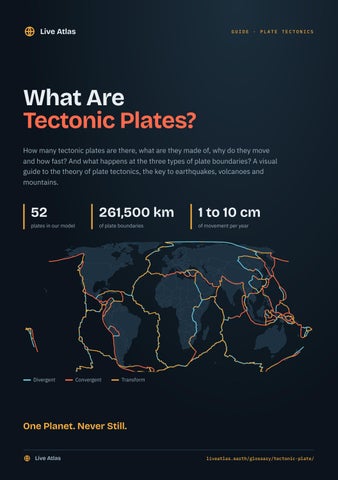
What Are Tectonic Plates? How many tectonic plates are there, what are they made of, why do they move and how fast? And what happens at the three types of plate boundaries? A visual guide to the theory of plate tectonics, the key to earthquakes, volcanoes and mountains.
52
plates in our model
Divergent
261,500 km of plate boundaries
Convergent
1 to 10 cm of movement per year
Transform
One Planet. Never Still. Live Atlas
liveatlas.earth/glossary/tectonic-plate/
Live Atlas
WHAT ARE TECTONIC PLATES?
01 What Are Tectonic Plates?
Tectonic plates are the huge, rigid slabs of rock that form the outer shell of the Earth. They fit together like the pieces of a cracked eggshell and move all the time, carrying the continents and the ocean floor with them.
Divergent
Convergent
Transform
THICKNESS
SPEED
LARGEST PLATE
A few tens to about 100 km
A few cm per year
Pacific, 105 million km²
The Earth's surface is broken into large rigid plates, a few tens to about a hundred kilometres thick. They ride on a hotter, softer layer of the mantle, the asthenosphere, and move a few centimetres a year, roughly as fast as fingernails grow. What are tectonic plates made of? Each plate is a piece of the lithosphere, the rigid outer layer formed by the crust and the uppermost part of the mantle. Oceanic crust, under the seas, is thin, dense and made mostly of basalt. Continental crust is thicker and lighter, which is why continents stay at the surface while old ocean floor can sink back into the mantle. THE THEORY OF PLATE TECTONICS
In 1912, Alfred Wegener proposed that the continents drift across the globe. The idea was long rejected, until the mapping of the ocean floor in the 1950s and 1960s revealed spreading ridges and showed that the Earth's surface moves. Plate tectonics became the founding theory of modern geology.
Live Atlas
liveatlas.earth/glossary/tectonic-plate/
Live Atlas
WHAT ARE TECTONIC PLATES?
02 How Many Tectonic Plates Are There?
There are 7 or 8 major tectonic plates, depending on whether the Indian and Australian plates are counted as one, and dozens of smaller ones. The detailed model used by Live Atlas counts 52 plates.
North American
Eurasian
Indian African Pacific
South American Australian
Antarctic
PACIFIC PLATE
AFRICAN PLATE
ANTARCTIC PLATE
104.6 million km²
58.5 million km²
58.2 million km²
NORTH AMERICAN PLATE
EURASIAN PLATE
AUSTRALIAN PLATE
55.4 million km²
48.6 million km²
46.0 million km²
SOUTH AMERICAN PLATE
INDIAN PLATE
41.8 million km²
12.4 million km²
The largest, the Pacific Plate, covers about 105 million km², about a fifth of the Earth's surface. Medium plates include the Nazca, Philippine Sea, Arabian and Caribbean plates. The smallest, such as the Manus Plate near Papua New Guinea, cover only a few thousand km². ONE PLATE OR TWO?
The Indian and Australian plates were long counted as a single Indo-Australian Plate. Studies of earthquakes and plate motions showed that they move slightly differently, so most modern models, including the one used here, treat them as two separate plates.
Live Atlas
liveatlas.earth/tectonic-plates/pacific-plate/
Live Atlas
WHAT ARE TECTONIC PLATES?
03 Why Do Tectonic Plates Move?
Tectonic plates move because the Earth is slowly losing its internal heat. Deep below, the mantle churns very slowly, and the plates are pushed and pulled by forces at their edges.
Divergent
Convergent
Transform
Heat from the Earth's core and from radioactive elements in the rock keeps the mantle moving in very slow currents, a process called mantle convection. The plates ride on top of this moving layer. Two forces at the plate edges do most of the work. At subduction zones, the old, cold and dense edge of a plate sinks into the mantle and drags the rest of the plate behind it, a force called slab pull, considered the strongest. At mid-ocean ridges, newly formed rock stands high and slides away from the ridge, a force called ridge push. WHAT WOULD HAPPEN IF PLATE MOVEMENT STOPPED?
No new ocean floor would form at the ridges and no plate would sink at the trenches. Earthquakes and eruptions along plate boundaries would gradually die out, while erosion would keep wearing the mountains down.
Live Atlas
liveatlas.earth/glossary/subduction/
Live Atlas
WHAT ARE TECTONIC PLATES?
04 How Fast Do Tectonic Plates Move?
Most tectonic plates move between 1 and 10 centimetres a year, roughly as fast as fingernails grow. Over millions of years, those few centimetres open oceans and raise mountain ranges.
Divergent
Convergent
Transform
PACIFIC PLATE
NAZCA PLATE
AUSTRALIAN PLATE
7.3 cm/yr
7.9 cm/yr
4.9 cm/yr
ANTARCTIC PLATE
SOUTH AMERICAN PLATE
NORTH AMERICAN PLATE
4.6 cm/yr
2.9 cm/yr
2.8 cm/yr
INDIAN PLATE
EURASIAN PLATE
AFRICAN PLATE
2.8 cm/yr
2.0 cm/yr
1.8 cm/yr
The figures above are the average speeds of each plate relative to its neighbours, measured along its boundaries. The Pacific and Nazca plates are among the fastest large plates, while the African and Eurasian plates move only about 2 cm a year. The record in the model belongs to the small Tonga Plate, with 11.5 cm/yr on average and up to 26.3 cm/yr along its edges. At these speeds, the Atlantic Ocean widens by a few centimetres every year. About 200 million years ago, all the continents were joined in a single supercontinent, Pangaea, which then broke apart into the continents we know today.
Live Atlas
liveatlas.earth/tectonic-plates/tonga-plate/
Live Atlas
WHAT ARE TECTONIC PLATES?
05 What Are the 3 Types of Plate Boundaries?
Plates meet along boundaries of three kinds. They pull apart at divergent boundaries, come together at convergent boundaries and slide past each other at transform boundaries.
Divergent
Convergent
Transform
DIVERGENT BOUNDARIES
CONVERGENT BOUNDARIES
TRANSFORM BOUNDARIES
94,900 km
92,200 km
74,400 km
Divergent boundaries create new crust, at mid-ocean ridges under the sea and in rift valleys on land. Convergent boundaries destroy crust or pile it up, at subduction zones and in mountain belts where continents collide. Transform boundaries neither create nor destroy crust, but their sudden slips cause strong earthquakes. Together, plate boundaries run for about 261,500 km around the globe. Most earthquakes and volcanoes are found along them, which is why a map of plate boundaries looks so much like a map of earthquakes and volcanoes.
Live Atlas
liveatlas.earth/glossary/tectonic-plate/
Live Atlas
WHAT ARE TECTONIC PLATES?
06 What Happens at a Divergent Boundary?
At a divergent boundary, two plates move apart. Magma rises from the mantle to fill the gap, cools and forms new crust.
LENGTH
MID-OCEAN RIDGES
CONTINENTAL RIFTS
94,900 km
67,400 km
27,500 km
A ridge is a long underwater mountain range where two plates move apart. Magma rises into the gap, cools and continuously builds new ocean floor. Earthquakes there are frequent but usually moderate. Iceland is a rare place where a ridge, the Mid-Atlantic Ridge, rises above the sea, which explains its intense volcanism. On land, divergent boundaries form rift valleys. In the East African Rift, the Somali Plate is slowly pulling away from the rest of Africa, and a new ocean may one day open there. FAST AND SLOW RIDGES
Slow ridges, such as the Mid-Atlantic Ridge, open only a few centimetres a year. The fastest spreading in the model is on the East Pacific Rise, where the Pacific and Juan Fernández plates separate at about 19 cm a year.
Live Atlas
liveatlas.earth/glossary/mid-ocean-ridge/
Live Atlas
WHAT ARE TECTONIC PLATES?
07 What Happens at a Convergent Boundary?
At a convergent boundary, two plates move toward each other. One plate may dive beneath the other, or the two may crumple together and build mountains.
LENGTH
SUBDUCTION ZONES
CONTINENTAL COLLISIONS
92,200 km
51,800 km
23,000 km
Subduction happens when two plates converge and the denser one, almost always an oceanic plate, dives beneath the other and sinks into the mantle. The contact zone forms an ocean trench, such as the Mariana Trench. When two oceanic plates collide, the older and denser one sinks, forming a deep trench and an arc of volcanic islands, such as the Mariana Islands or the Aleutians. When an oceanic plate meets a continent, the ocean floor sinks beneath it and raises a chain of volcanoes on land, like the Andes. When two continents collide, neither sinks easily and the crust piles up into high mountains. The Himalayas rose as India pushed into Asia, starting about 50 million years ago. THE RING OF FIRE
Subduction zones surround most of the Pacific Ocean, forming the Ring of Fire, home to most of the world's active volcanoes and largest earthquakes. The most powerful earthquake ever recorded, magnitude 9.5 in Chile in 1960, struck on a subduction zone. THE DEEPEST PLACE ON EARTH
In the Mariana Trench, where the Pacific Plate sinks beneath the Mariana Plate, the Challenger Deep lies nearly 11 km below sea level, the deepest point of the oceans.
Live Atlas
liveatlas.earth/glossary/subduction/
Live Atlas
WHAT ARE TECTONIC PLATES?
08 What Happens at a Transform Boundary?
At a transform boundary, two plates slide horizontally past each other. Crust is neither created nor destroyed, but friction locks the plates together and builds up stress that is released in earthquakes.
LENGTH
UNDER THE OCEANS
ON THE CONTINENTS
74,400 km
48,200 km
26,300 km
A transform fault is a boundary where two plates slide horizontally past each other, neither creating nor destroying crust. Most connect sections of mid-ocean ridges on the sea floor. A few cross continents, like the San Andreas Fault in California or the Alpine Fault in New Zealand. Locked for decades, they give way suddenly and cause shallow, often destructive earthquakes. The San Andreas Fault marks the boundary between the Pacific and North American plates, and the North Anatolian Fault in Turkey runs between the Anatolian and Eurasian plates. Both have produced some of the most destructive earthquakes of the 20th century. WHY DO RIDGES ZIGZAG?
Transform faults cut mid-ocean ridges into short segments, offset from one another. This is what gives the ridges their staircase shape on the map, as along the Mid-Atlantic Ridge. Only the part of the fault between two ridge segments is an active plate boundary.
Live Atlas
liveatlas.earth/faults/san-andreas-fault/
Live Atlas
THE LIVING PLANET
Follow the Earth Live Live Atlas brings earthquakes, erupting volcanoes, cyclones, wildfires and auroras together on one interactive world map, updated continuously from official sources. Every major earthquake, tsunami, eruption and cyclone of recent history has its own page.
The live map with plate boundaries
The Pacific Plate
What is subduction?
What is a transform fault?
Famous active faults
1,746 major earthquakes since 1900
liveatlas.earth
liveatlas.earth/tectonic-plates/pacific-plate
liveatlas.earth/glossary/subduction
liveatlas.earth/glossary/transform-fault
liveatlas.earth/faults
liveatlas.earth/earthquakes
Sources: Bird, P. (2003), An updated digital model of plate boundaries, Geochemistry, Geophysics, Geosystems (PB2002), for plates, boundaries and speeds; Natural Earth for the map. Speeds are relative to neighbouring plates; lengths are measured along the boundaries of the model. Live Atlas, published by Bigbang Media.
Live Atlas
liveatlas.earth/