Live Atlas
GUIDE · VOLCANOES
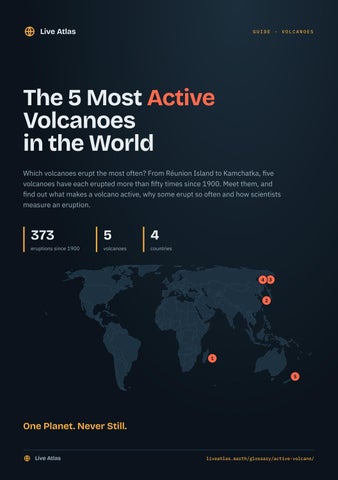
The 5 Most Active Volcanoes in the World Which volcanoes erupt the most often? From Réunion Island to Kamchatka, five volcanoes have each erupted more than fifty times since 1900. Meet them, and find out what makes a volcano active, why some erupt so often and how scientists measure an eruption.
373
eruptions since 1900
5
volcanoes
4
countries
4 3 2
1 5
One Planet. Never Still. Live Atlas
liveatlas.earth/glossary/active-volcano/
Live Atlas
THE 5 MOST ACTIVE VOLCANOES IN THE WORLD
01 What Is an Active Volcano?
There is no single official definition. Most volcanologists, including the Smithsonian Institution's Global Volcanism Program, call a volcano active if it has erupted in about the last 10,000 years, since the end of the last ice age, even if it looks perfectly quiet today.
Erupted since 1900
Older eruptions only
VOLCANOES ERUPTED SINCE 1900
ERUPTIONS SINCE 1900
NEW ERUPTIONS PER YEAR
486
4,454
About 37 (2000–2024)
Volcanoes are often sorted into three groups. An active volcano has erupted recently on a geological timescale and could erupt again. A dormant volcano is an active volcano that is asleep, sometimes for centuries. An extinct volcano is not expected to erupt again because it has lost its supply of magma. The line between dormant and extinct is hard to draw, and some volcanoes believed dead have come back to life. In a typical year, a few dozen volcanoes start a new eruption, while others carry on with eruptions that began earlier. Between 2000 and 2024, the number of volcanoes starting a new eruption ranged from 24 to 50 a year. ASLEEP, NOT DEAD
Pinatubo, in the Philippines, had been quiet for about 500 years before it erupted in 1991, in one of the largest eruptions of the 20th century. This is why scientists watch every active volcano, not only those that are erupting.
Live Atlas
liveatlas.earth/glossary/active-volcano/
Live Atlas
THE 5 MOST ACTIVE VOLCANOES IN THE WORLD
02 Why Do Some Volcanoes Erupt So Often?
A volcano erupts often when magma reaches it easily and in large amounts. Three things matter most: how much magma it receives, how runny that magma is, and whether the path to the surface stays open.
Volcanoes erupted since 1900, sized by number of eruptions
Plate boundaries
AT SUBDUCTION ZONES
IN RIFT ZONES
OVER HOTSPOTS
377 volcanoes
73 volcanoes
36 volcanoes
Runny basaltic magma, typical of hotspots and rifts, lets gas escape gently. Volcanoes fed by it, such as Piton de la Fournaise or Kī lauea, erupt often, usually with lava fountains and flows rather than explosions. Above subduction zones, magma is generally thicker and richer in gas, so pressure builds up and eruptions tend to be explosive. Yet volcanoes with a strong supply of magma and an open vent, such as Klyuchevskoy, still erupt again and again. Location matters too. More than three quarters of the volcanoes that have erupted since 1900 stand above subduction zones, mostly around the Pacific Ring of Fire, where a sinking plate releases water that helps the mantle above it melt. ONE LONG ERUPTION OR MANY SHORT ONES?
Stromboli, Kī lauea and Sakurajima have been erupting almost without pause for years or decades. In the Smithsonian record, such activity counts as one long eruption. This ranking therefore shows the volcanoes that erupt in the largest number of separate episodes.
Live Atlas
liveatlas.earth/glossary/hotspot/
Live Atlas
THE 5 MOST ACTIVE VOLCANOES IN THE WORLD
03 How Do Scientists Measure an Eruption?
Eruptions are compared on the Volcanic Explosivity Index, or VEI, a scale from 0 to 8 based on the volume of material thrown out and the height of the eruption column. From VEI 2 upwards, each step means about ten times more material. VEI
0 1 2 3 4 5 6 7 8
DESCRIPTION
MATERIAL
ERUPTIONS SINCE 1900
EXAMPLE
Non-explosive
< 10,000 m³
Gentle
> 10,000 m³
Explosive
> 1 million m³
Severe
> 10 million m³
Cataclysmic
> 0.1 km³
83
Eyjafjallajökull, 2010
Paroxysmal
> 1 km³
10
Mount St. Helens, 1980
Colossal
> 10 km³
3
Pinatubo, 1991
Super-colossal
> 100 km³
0
Tambora, 1815
Mega-colossal
> 1,000 km³
0
Toba, about 74,000 years ago
Lava flows, as often in Hawaii
532 1,175 1,962 455
Stromboli's small bursts Frequent ash eruptions Nevado del Ruiz, 1985
Small eruptions are by far the most common. Of the eruptions recorded since 1900 with a known VEI, 87% rated 2 or less. Only a handful reached VEI 5 or 6, and none has reached VEI 7 since Tambora in 1815. To see an eruption coming, observatories track the signs of rising magma. Seismometers record the small earthquakes and the tremor caused by magma on the move. GPS stations and tiltmeters measure the ground as it swells. Gas sensors follow sulphur dioxide and carbon dioxide, and satellites watch for heat and ground deformation from space. WHEN DOES AN ERUPTION END?
The Smithsonian's Global Volcanism Program counts two eruptions as separate when the volcano has stayed quiet for more than three months in between. A volcano that pauses often therefore adds many eruptions to its record, while one that never stops adds only one.
Live Atlas
liveatlas.earth/glossary/volcanic-explosivity-index/
Live Atlas
No.
5
THE 5 MOST ACTIVE VOLCANOES IN THE WORLD
57
ERUPTIONS SINCE 1900
Mount Ruapehu
New Zealand · Stratovolcano · 2,797 m
ERUPTION HISTORY
VEI 6 VEI 4 VEI 2
9850 BCE
1500
1800
1900
2000
COUNTRY
VOLCANO TYPE
ELEVATION
New Zealand
Stratovolcano
2,797 m
LAST ERUPTION
ERUPTIONS SINCE 1950
HIGHEST EXPLOSIVITY (VEI)
2007
42
4 out of 8
Mount Ruapehu, the highest point of New Zealand's North Island at 2,797 m, stands in Tongariro National Park, a World Heritage Site for both its volcanic landscapes and its importance to Mā ori culture. Its summit holds a warm, acidic crater lake, and ski areas cover its slopes. The crater lake makes the volcano dangerous even without a large eruption, because it can release lahars, fast mudflows of water and volcanic debris. In 1953 one of them destroyed the Tangiwai rail bridge, causing New Zealand's deadliest rail disaster. The 1995 and 1996 eruptions closed the ski fields and disrupted flights, and an alarm system now watches the lake.
Live Atlas
liveatlas.earth/volcanoes/mount-ruapehu/
Live Atlas
No.
4
THE 5 MOST ACTIVE VOLCANOES IN THE WORLD
58
ERUPTIONS SINCE 1900
Bezymianny
Russia · Stratovolcano · 2,882 m
ERUPTION HISTORY
VEI 6 VEI 4 VEI 2
7050 BCE
1500
1800
1900
2000
COUNTRY
VOLCANO TYPE
ELEVATION
Russia
Stratovolcano
2,882 m
LAST ERUPTION
ERUPTIONS SINCE 1950
HIGHEST EXPLOSIVITY (VEI)
2025
58
5 out of 8
Its name means “nameless” in Russian. Standing next to Klyuchevskoy, Bezymianny drew little attention and had been dormant for about a thousand years when it woke up in October 1955 with a series of explosions, while its eastern flank began to bulge. On 30 March 1956, the swollen flank collapsed and a sideways blast destroyed the summit, leaving a crater about 700 m deep. The event later helped scientists understand the 1980 eruption of Mount St. Helens, which followed the same pattern. Since then, a lava dome has grown inside the crater, with frequent explosive eruptions that send ash high into the sky.
Live Atlas
liveatlas.earth/volcanoes/bezymianny/
Live Atlas
No.
3
THE 5 MOST ACTIVE VOLCANOES IN THE WORLD
75
ERUPTIONS SINCE 1900
Klyuchevskoy Russia · Stratovolcano · 4,754 m
ERUPTION HISTORY
VEI 6 VEI 4 VEI 2
3950 BCE
1500
1800
1900
2000
COUNTRY
VOLCANO TYPE
ELEVATION
Russia
Stratovolcano
4,754 m
LAST ERUPTION
ERUPTIONS SINCE 1950
HIGHEST EXPLOSIVITY (VEI)
2025
53
4 out of 8
Klyuchevskoy, on Russia's Kamchatka Peninsula, is the highest active volcano in Eurasia, rising to about 4,750 m. It is young by geological standards, only several thousand years old, and its almost perfect cone grew quickly, fed by one of the most productive magma supplies of any volcano above a subduction zone. Its first recorded eruption dates from 1697, and it has rarely stayed quiet for long since. Eruptions combine lava fountains, lava flows down its flanks and ash plumes that can rise high enough to threaten air traffic over the North Pacific. The Kamchatka Volcanic Eruption Response Team watches it and alerts airlines.
Live Atlas
liveatlas.earth/volcanoes/klyuchevskoy/
Live Atlas
No.
2
THE 5 MOST ACTIVE VOLCANOES IN THE WORLD
78
ERUPTIONS SINCE 1900
Mount Aso
Japan · Caldera · 1,592 m
ERUPTION HISTORY
VEI 6 VEI 4 VEI 2
8050 BCE
1500
1800
1900
2000
COUNTRY
VOLCANO TYPE
ELEVATION
Japan
Caldera
1,592 m
LAST ERUPTION
ERUPTIONS SINCE 1950
HIGHEST EXPLOSIVITY (VEI)
2021
43
3 out of 8
Mount Aso, on the Japanese island of Kyushu, is a giant caldera about 25 km long and 18 km wide. It was formed by four enormous eruptions, the last and largest about 90,000 years ago, whose pyroclastic flows swept across much of Kyushu. Today about 50,000 people live on the fertile floor of the caldera, with towns, farms and a railway line. The activity is concentrated in Nakadake, one of the younger cones in the middle of the caldera. Only its northernmost crater has been active for decades, holding a hot, acidic lake. Access to the rim depends on gas levels and closes as soon as the volcano stirs. An explosion in September 1979 killed three people near the crater.
Live Atlas
liveatlas.earth/volcanoes/asosan/
Live Atlas
No.
1
THE 5 MOST ACTIVE VOLCANOES IN THE WORLD
105
ERUPTIONS SINCE 1900
Piton de la Fournaise France · Shield volcano · 2,632 m
ERUPTION HISTORY
VEI 6 VEI 4 VEI 2
2795 BCE
1500
1800
1900
2000
COUNTRY
VOLCANO TYPE
ELEVATION
France
Shield volcano
2,632 m
LAST ERUPTION
ERUPTIONS SINCE 1950
HIGHEST EXPLOSIVITY (VEI)
2026
66
5 out of 8
Rising from the Indian Ocean on the French island of Réunion, Piton de la Fournaise is fed by the Réunion hotspot. Its runny basaltic lava lets gas escape easily, so it erupts often and rarely explodes. Most eruptions open fissures on its flanks and send lava flows into the Enclos Fouqué, a vast horseshoe-shaped caldera, sometimes all the way down to the sea. When lava escapes the caldera, it reaches inhabited land. In 1977 a flow entered the village of Piton Sainte-Rose and partly invaded its church, since renamed Notre-Dame-des-Laves. Several eruptions have cut the coastal road across the Grand Brûlé, and the volcano is watched day and night by its own observatory.
Live Atlas
liveatlas.earth/volcanoes/piton-de-la-fournaise/
Live Atlas
THE LIVING PLANET
Follow the Earth Live Live Atlas brings earthquakes, erupting volcanoes, cyclones, wildfires and auroras together on one interactive world map, updated continuously from official sources. Every major earthquake, tsunami, eruption and cyclone of recent history has its own page.
The live map
liveatlas.earth
What is an active volcano?
The Volcanic Explosivity Index
liveatlas.earth/glossary/active-volcano
liveatlas.earth/glossary/volcanic-explosivity-index
Major volcanic eruptions in history
Free widgets for your website
Browser extension for Chrome, Edge and Firefox
liveatlas.earth/eruptions
liveatlas.earth/widgets
liveatlas.earth/extension
Sources: Global Volcanism Program, Smithsonian Institution, Volcanoes of the World (eruption counts, VEI, elevations, types); Japan Meteorological Agency; Kamchatka Volcanic Eruption Response Team; Bird (2003) for plate boundaries; Natural Earth for the map. Counts include confirmed and uncertain eruptions; an eruption lasting several years counts once. Live Atlas, published by Bigbang Media.
Live Atlas
liveatlas.earth/