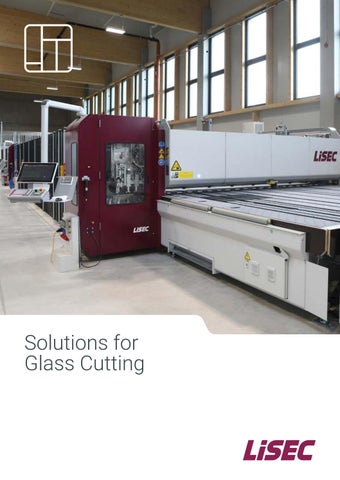
Solutions for Glass Cutting
Facts and figures: 1961 founding year 1 strong brand 1,300 employees 20 sites 300 million Euros turnover (2023) 95 % export rate 7 % of turnover for R&D more than 330 patents
Reliable processes, good quality, solid profit: LiSEC solutions provide flat glass processors around the world with security and drive in a challenging environment. For the last 60 years, we have been working hard to enable you to sustainably boost the efficiency, the system availability and the quality output of your flat glass production process. Thanks to forward-looking thinking, continuously striving to find the best solution and a great deal of personal commitment from our employees, we have grown from a one-man company to a technology leader.
02
Our advanced solutions generate a great cost-to-benefit ratio throughout the entire lifecycle of your machines and systems. Customers around the world can benefit from this: be they experienced manufacturers or newcomers to the industry; from family businesses to industrial glass processors. Three main factors are essential for long-term success:
1. Turn Key Solutions Everything from a single source including software. Customers benefit from the only company in the flat glass machine industry that can comprehensively plan and develop large projects - also thanks to the widest product range in the industry.
2. Excellent Service Investment security, highest availability and productivity enable the large, global LiSEC service network. A contact person familiar with the local language and customs is available close to you.
3. Performance through software integration Integration of the production management software and the machinery control (digitalization/Industry 4.0) allows top operation and optimization of all integrated machines or whole glass factories.
The benefits: Over 60 years of partnership, pioneering spirit and stability Investment security due to the size of our company Leading technology with a high resale value Great cost-to-benefit ratio throughout the entire system lifecycle
To improve readability, this brochure refers to groups of people in a neutral form, whereby both male and female persons are always meant.
03
Solutions for Glass Cutting & Logistics
Lines
Stand-Alone Machines
Combined Line
Float Glass Cutting
DSC-A-VB
Glass cutting system for laminated and float glass
DSC-VSL-A
Combined system for cutting float and laminated glass
S. 8
VSL-A
Double bridge system for the automatic cutting of laminated glass
Float Glass Breakout Systems Machines for Automatic Cutting and Breaking of Float Glass
DSC-A
S. 24
ESL-RS
S. 26
High-performance system for the automatic cutting of float glass and simple surface coatings
S. 12
Laminated Glass Cutting
Float Glass Line
S. 22
High-performance system for the automatic cutting of float glass
S. 16
Laminated glass cutting overview
S. 28
VB
S. 30
VSL-A
S. 32
System for the semi-automatic cutting of laminated glass
System for the automatic cutting of laminated glass
04
S. 20
baseCUT_TILT
System for the automatic cutting of float glass and simple surface coatings
S. 10
Laminated Glass Line
Float Glass Cutting Overview
Table of Contents
Break Out Systems
Overview of automatic float glass breakout systems S. 34
ARS / TCY
Automatic break-out device for front and rear trim cuts
TBX / TBY / TBZ TBR
Automatic break-out device for trim cuts and sub-plate breaks
GSA-CF/ GSA-CL
Automatic sheet disposal
oad
S. 47
label
S. 48
ident
S. 49
lis.analytics
S. 50
autofab
S. 52
mon
S. 54
Intelligent Cutting Solution to Avoid Defects
Label Management Solution
S. 37
Information and Ready Messaging Terminal at the Production
S. 38
Online service for the visualisation and analysis of production data
Disposal of broken glass
S. 46
Dynamic Cutting Optimisation
S. 36
Automatic break-out device for sub-plate breaks
dynopt
Solution for Automatic Sorting Systems
S. 39
Break-out display for glass cutting table
Software
prod
Production Planning Software for the Flat Glass Industry
opt
Software for Glass Cutting Optimisation
easy opt
Single glass optimisation software
Service S. 42 Services
S. 58
Training
S. 60
Project management
S. 62
We offer you worldwide service and the fastest possible supply of spare parts
S. 44 S. 45
05
LINES We adapt the LiSEC lines to your production requirements. Combine innovative systems from the glass processing, glass cutting, tempering and logistics areas into a complete line system. Our employees are happy to advise you in order to configure tailor-made line solutions with you. In order to use the full efficiency of your production, cross-line software solutions are available.
DSC-A-VB
Glass cutting system for laminated and float glass The DSC-A-VB system from LiSEC is characterized by its compact, precise and high-quality processing of float and laminated glass. The compact design and the arrangement of the two machine sections save space. With the DSC-A from LiSEC, both float and laminated glass are quickly decoated using the latest technology and to the highest quality. In a further processing step, float glass is cut using proven LiSEC direct cutting technology. The direct application of the cutting force and the precise and fast guidance of the cutting tool over the glass create an ideal scoring fissure on the glass, ensuring reliable break-up with the best edge quality. The DSC-A from LiSEC is used for the automatic cutting of laminated glass up to the maximum size, with automatic positioning. The storage plate is automatically and precisely positioned in the laminated glass cutting machine of type VB, sheet for sheet. Cutting is fast, the optional heating of the PVB film is carried out efficiently using the patented SIR heating technology, and the reliable cutting is done using the proven circular blade method. A positioning aid for cutting special shapes with straight cuts is included, and the automatic scoring of special shapes with rounded arches is optionally possible.
Highlights
Options
Space-saving compact design
Tiltable design for manual
Flexible float and laminated glass processing
loading and unloading Fully automatic tool changer for cutting wheels (float) Automatic removal of the film overhang Automatic scoring of special shapes (manual breaking and separating) Patented SIR film heating for particularly fast cutting of laminated glass Automatic printing and application of labels Z-scoring for series production
Laminated glass – residual plate
is cut first (RPI mode) VSL-A cutting and breaking unit for
even better edge quality Electronic cutting and breaking roller pressure control
8
XYZ flex production: Output max. 30 pcs/h
SIR - Selective Infrared Heating Patented heating system for PVB foils. Heating time: 7 sec for 44.2
9
DSC-VSL-A
Combined system for cutting float and laminated glass The basis for the successful processing of laminated glass is provided by the horizontal cutting system VSL-A from LiSEC. Since its market launch, the LiSEC VSL-A has been met with enthusiasm worldwide. Thanks to the patented SIR film heating system, output has been significantly increased. In addition, glass waste has been significantly reduced and fewer operator interventions are required due to the higher degree of automation. In order to provide solutions that best meet individual requirements, LiSEC has developed a modular laminated glass cutting system solution that can be adapted step by step to the respective requirements and expanded with an additional VSL-A bridge. The plant has different operating modes that can be selected at any time: output or comfort mode. In comfort mode, the plant produces cut glass almost without human intervention. In output mode, additional production capacities can be made available. Here, the operator supports the plant in separating residual cuts, which enables even higher output, which is particularly advantageous during production peaks.
Highlights
Options & Software
Up to 45 cut sheets of glass per hour with a
Version with an additional infeed
VSL-A cutting bridge (X-Y-Z cuts) Fully automatic cutting of laminated sheets of glass Reduction of operator interventions Cutting LSG quickly and flexibly (output versus comfort mode) Increase in edge strength Less wastage thanks to 20 mm trim cut Automatic off-cut disposal up to 300 mm Segmented infrared film heating (SIR) for rapid heating and reduced energy consumption Innovative operating concept with comprehensive machine intelligence Permanent work surface monitor with laser scanner for the highest system safety Laminated glass – remnant plate is cut first (RPI mode)
10
section to increase output Automatic turning up to maximum dimension Version with two cutting heads
for automatic tool changes Processing of 12.12.4.56 PVB mm Recording of edge deletion contour and possible automatic correction of the cut position Four conveyor belts for float glass Automatic float glass break-out thanks to X sub-plate break-out Six conveyor belts for automatic outfeed of cut LSG glass sheets as the basis for a subsequent VSL-A double bridge or downstream sorting system or robot Processing of W cuts Edge deletion with grinding wheel Automatic special shape cut Automatic cullet disposal (GSA-CL)
XYZ flex production: Output max. 45 pcs/h
SIR - Selective Infrared Heating Patented heating system for PVB foils. Heating time: 4 sec for 44.2
11
VSL-A
Double bridge system for the automatic cutting of laminated glass The basis is an automatic glass storage system in combination with a system for edge deletion and the removal of the laminated glass film overhang and a laminated glass cutting bridge of the type VSL-A with transport belt. Depending on the production volume and the variety of products, you can choose between two system solutions. Example: Customer “Type A” has a high variance in its product mix (many X-, Y-, Z-cuts). Here, an additional VSL-A system after the first laminated glass cutting bridge can already achieve an output of up to 75 sheets per hour and produce fully automatically. Thanks to the intelligent “Dynamic Load Balancing” (DLB), an optimal and dynamic utilization of the two VSL-A cutting bridges is guaranteed. In addition, the system solution has various operating modes, which can be selected at any time: Output or comfort mode. When the comfort mode is selected, the system produces almost unmanned, continuously cut glass. In output mode, additional production capacity can be made available. Here the operator supports the system, in particular, when cutting residual sections on the second cutting bridge, which enables a higher output and is particularly advantageous during production peaks. Example: Customer “Type B” produces a large number of identical products and is involved in series production (many X and Y cuts with identical dimensions). With a VSL-A system in tandem design (cutting of two sheets at the same time), it is possible to process up to 140 sheets per hour. In tandem mode, two sheets can be cut simultaneously and fully automatically on the second VSL-A. This system solution enables the highest output figures and is the fastest laminated safety glass cutting system on the market.
Highlights
Options
Dynamic Load Balancing (DLB) enables both
Tandem function on second
bridges to be utilised to an optimum level Up to about 75 cut sheets of glass per hour (X, Y and Z cuts) with the VSL-A double bridge Up to about 140 cut sheets of glass per hour (X, Y and Z cuts) with the VSL-A double bridge with tandem function Expansion option for the existing VSL-A system
12
VSL-A cutting bridge Processing of float glass and
automatic break-out of sub-plates on the second VSL-A bridge Automatic conveyor belt removal of LSG broken glass pieces
XYZ flex production: Output max. 75 pcs/h
XY serial prodution: Output max. 140 pcs/h
SIR - Selective Infrared Heating Patented heating system for PVB foils. Heating time: 4 sec for 44.2
13
14
EDGE QUALITY LiSEC glass cutting systems ensure continuously high edge quality and strength. Precise cutting without noticeable surface damage reduces splintering and prevents top and bottom breaks. This provides the basis for cost-efficient edge processing.
15
Float Glass Breakout Systems
Machines for Automatic Cutting and Breaking of Float Glass The automatic float glass breakout systems consist of an glass storage unit combined with a downstream float glass cutting table for Low-E edge deletion and for scoring the float glass sheets. Depending on the volume of production and the variety of products, it is possible to choose between three different variants: Example: Customer “Type A” would like to break X sub-plates and X edge sections automatically. With an automatic ARS edge deletion station and a TBX breakout station the operator can be optimally supported. Example: Customer “Type B” would like to break X and Y sub-plates as well as X and Y edge sections automatically. With an ARS edge deletion station, a TBX breakout station, a TDV rotary table and another TBR/TCY breakout station, it is only necessary to break Z sections manually. Example: Customer “Type C” would like to break X, Y and Z sub-plates as well as X, Y and Z edge sections automatically. With an ARS edge deletion station, a TBX breakout station, a TDV rotary table, a TBR/TCY breakout station and an SDV sheet turning unit, virtually unmanned and continuous production of float glass is possible. With a well thought out system arrangement, the number of crates of broken glass pieces is reduced and this has a positive impact on system availability. The optional automatic sheet disposal system maximises system availability.
Highlights
Options
Fully-automatic float breakout system
90° line variant depending on
Space-saving system concept
the building situation Y sub-plate tandem function is possible Automatic conveyor belt removal of broken float glass pieces
Modular expansion option Very space-saving straight line variant
16
Output max. 120 pieces/h with 1 operator
Output max. 150 pieces/h with 1 operator
Output max. 240 pieces/h with 1 operator
17
STAND-ALONE MACHINES
Ensure a smooth production with the LiSEC stand-alone machines. We do not only support you in the field of insulating glass production, with the LiSEC insulating glass machines, but also with machines for glass cutting or glass processing, sorting and logistics systems as well as tempering furnaces.
Float Glass Cutting Overview
baseCUT_TILT Max. glass thickness Cutting speed
ESL-RS
2 - 19 mm 140 m/min
160 m/min
120 m/min
4 m/s²
6 m/s²
4 m/s² X axis 6 m/s² Y axis
+/- 0,3 mm
+/- 0,2 mm
+/- 0,15 mm
Cutting wheel changer
Edge deletion
Edge deletion & simultaneous cutting
LOW-E coating removal speed (up to)
20 m/min
160 m/min
80 m/min
EASYPRO ® (up to)
112 m/min
25 m/min*
TPF (up to)
112 m/min*
25 m/min*
Enhanced extraction (15 l)
Enhanced extraction (200 l)
Tiltable design
DSC-A60/33T
Acceleration X/Y-axis Cutting tolerance
Standard Optional Not Available
* 2 passes, ** 1 pass (simultaneous cutting & grinding)
20
DSC-A
21
baseCUT_TILT
System for the automatic cutting of float glass and simple surface coatings The compact baseCUT_TILT glass cutting machine is ideally suited for cutting straight lines and shapes out of flat glass. Its design ensures maximum precision and minimum cutting tolerances, as well as a long service life of the machine. In the machine‘s basic model, loading is carried out manually through ‚free fall‘. After loading, the glass can be manually positioned against the reference marks. When the operator initiates cutting, the machine automatically detects the glass sheet‘s position in X and Y direction. The stock plate is positioned manually. This assures precise cutting of sheets of glass.
22
Technical data
baseCUT-37/26-TILT
Glass thickness
2 - 19 mm
Maximum size
3.700 x 2.600 mm
Cutting speedX/Y axis
140 m/min
Acceleration X/Y axis
4 m/s2
Glass cutting tolerance
+/- 0.30 mm
Edge deletion
Standard
Low-E edge deletion max, speed
20 m/min
EASYPRO® / TPF (up to)
Not possible
Edge deletion
Grinding pin
23
DSC-A
High-performance system for the automatic cutting of float glass The new DSC-A is a horizontal cutting machine for the automatic cutting of float glass. The machine combines massive processing flexibility with optimum precision, a reliable process and optimum quality of glass cutting as well as the option of Low-E edge deletion. Float glass cutting The glass-cutting table features LiSEC direct cutting technology and a gantry drive on the X-axis, assuring high precision of +/0.20 mm. Operation is simplified by automatic control of the cutting and grinding pressure. Operator interventions are reduced because, depending on the coating and glass thickness, different cutting and grinding pressures can be set automatically. The cutting oil and cutting wheel monitors analyse the consumption, display this preventively and draw attention to the pending need for a change of cutting wheel. Stock plates are sent in automatically on the belt transport system and fully automated alignment is carried out by glass positioning aids. Low-E edge deletion The complexity of coating systems is rising in response to the increasing proportions of solar protection and thermal protection coatings in the insulating glass sector. The DSC-A constitutes an optimum basis for the rapid and efficient Low-E edge deletion of single to triple layers of silver thermal protection or solar protection coatings as well as coating systems that use protective films (TPF or EASYPRO® ). With its recently developed design of grinding head and bridge structure, the DSC-A is equipped to meet future challenges. Machine construction The basic variant consists of a horizontal cutting table, equipped with conveyor belt, to combine this system with automatic loading systems. The DSC-A T-variant has a tilt function, which facilitates manual loading and unloading of glass sheets. In addition, conveyor belts or breaker bars can be added for stand-alone operation.
24
Highlights
Options
Precise glass cutting and high edge strength
Edge deletion of coated Low-E
thanks to LiSEC Direct Cutting Technology Up to 160 m/min Low-E edge deletion speed Enhanced suction with Hepa filter unit Decoating of stepped glass, TPF & EASYPRO ® glass 360° grinding in a single pass Automatic pressure control of grinding and cutting head Display of cutting wheel consumption and critical cutting oil level
glass lites sheets (grinding wheel widths of 20 to 26 mm) Fully automatic tool-changer for cutting wheels Integrated fixture for cutting off remnant formats (RP-I) Multi-touch design of the control unit Tilting design of breaker bars or belts
Perfect edge quality irrespective of glass thickness
The use of this directly driven cutting technology in combination with the highly stable and precise cutting bridge means that the glass cutting quality is always perfect, even with thick float glass.
Top quality with Low-E edge deletion regardless of coating
With the aid of decades of experience in the area of edge deletion, the system can be used to process single to triple silver as well as coatings with special protection (EASYPRO® or TPF) to an optimum standard and without any residue.
Simple and user-friendly
The system has been developed to ensure that the operator is always optimally supported by the machine, and such that system operation is largely possible without glass-specific know-how. This increases the efficiency of the system and ensures consistent glass cutting quality.
Technical data
DSC-A37/26
DSC-A37/33
Glass thickness Maximum size
DSC-A60/33
DSC-A60/33-T
3.700 x 3.300 mm
6.000 x 3.300 mm
2 - 19 mm 3.700 x 2.600 mm
3.700 x 3.300 mm
6.000 x 3.300 mm
Cutting speed X/Y axis
160 m/min
Acceleration X/Y axis
6 m/s²
Glass cutting tolerance
+/- 0,2 mm
Edge deletion
DSC-A37/33-T
optional - first grinding then cutting
Low-E edge deletion speed (up to)
160 m/min
EASYPRO ®/ TPF ® (up to)
112 m/min / 112 m/min - 2 passes
Edge deletion
Grinding wheel
Special size 6,600 x 3,700 mm up to 12,000 x 3,300 mm possible on request
25
ESL-RS
High-performance system for the automatic cutting of float glass and simple surface coatings Fully automatic cutting table for float and special glass using LiSEC direct cutting technology. The system is equipped with an additional grinding unit which allows soft coatings to be removed. Straight edges can thereby be simultaneously cut and ground in a single work step, which guarantees low cycle times while offering maximum quality. Shorter cycle times with maximum quality are thus guaranteed. Standard and digitalized special forms can be cut with ease. The CNC program adjusts the maximum axis speed and acceleration to the shape being cut. Cutting path optimisation provides the optional possibility of minimising axial movement and ensuring the shortest cutting and grinding times. The modular machine concept of LISEC offers almost unlimited possibilities for any future extension to suit requirements: integration into a sorting system, combination with a laminated glass cutting table or as a direct link to an automated glass loading system.
Technical data
ESL-37/26RS
Glass thickness Maximum size
3,700 x 2,600 mm
3,700 x 3,300 mm 120 m/min
Acceleration X/Y axis
4 m/s² X-Achse, 6 m/s² Y-Achse
Glass cutting tolerance
+/- 0.15 mm
Edge deletion
optional
Low-E edge deletion max. speed
120 m/min
Edge deletion
ESL-60/33RS
2 - 19 mm
Cutting speed X/Y axis
EASYPRO® / TPF (up to)
26
ESL-37/33RS
25 m / min* 2 passes Grinding wheel
6,000 x 3,300 mm
Highlights
Options
Simultaneous grinding and cutting of straight line cuts
Design with external industrial
Fastest glass cutting on the market for simple silver coatings
vacuum system (200l), specifically for EASYPRO® & TPF glass Fully automatic tool-changer for cutting wheels Dynamic scraper brush for the removal of glass release agent Integrated fixture for cutting off remnant formats (RP-I) before the glass cutting process
Optimum cutting quality with minimal tolerances 360° grinding or cutting in one cycle Great reliability & durability of the system Processing of the raw glass sheet without trim cut Design with external industrial vacuum system (15l)
27
Laminated glass cutting overview
VB
VSL-A
10.10.4,56 PVB mm, optional 12.12.4,56 PVB mm
8.8.2,28 PVB mm, optional 12.12.4,56 PVB mm
Max. cutting length
6,100 mm
6,000 mm
Automatic min. trim cuts (cutting, breaking-out & separating; depending on thickness of sheet of glass)
20 mm
150 mm
Trim cuts min. (only scoring)
20 mm
20 mm
Automatic feeding
Automatic sub-plate turning
Machine mode ‘Output mode’
Selected infrared heating (SIR heating)
Cutting wheel changes without interruptions
Edge deletion
Max. glass thicknesses
Standard Optional Not Available
28
29
VB
System for the semi-automatic cutting of laminated glass The basis for the processing of laminated glass is provided by the horizontal laminated glass cutting line of type VB in combination with a float cutting table (GFB/ESL) or an end-stop bridge (AL-A) from LiSEC. One important difference between this and the VSL-A system is the vacuum suction cups that act from below and are used during the entire cutting process (scoring, breaking and film separation process). The suction cups are movable so as not to put any additional tension into the glass. Furthermore, the raw glass plate is positioned on the cutting table by means of a suction bridge and cut in the VB. The remaining Y and Z cuts are made after the glass has been manually rotated and tapped. A significant increase in output can be achieved thanks to the optional patented SIR foil heating system. The system includes a laser positioning aid for special shape cutting as standard.
Technische Daten
VB-33
VB-37
Min. glass thickness (LSG)
22.1
Max. glass thickness (LSG)
88.2
Glass thickness (float)
2 - 19 mm (optional)
Min. processing length
200 mm
Min. processing width
150 mm
Min. trim cut thickness (LSG)
150 mm (automatic)
Min. trim cut thickness (LSG)
20 mm (only scoring)
Max. cutting speed
250 mm (optional)
Glass cutting tolerance Max. processing length
VB-60
140 m/min
Min. float glass sub-plate break-out
30
VB-45
+/- 0.4 mm 3,400 mm
3,800 mm
4,600 mm
6,200 mm
Highlights
Options
Up to approx. 30 cut sheets of glass per hour with
Automatic scoring of special mould
a DSC-A-VB cutting bridge (X, Y, Z cuts) Automatic cutting of laminated sheets of glass Innovative operating concept with comprehensive machine intelligence Laser-supported positioning for straight cuts Combination with a stop table (VB-AL-A) possible to increase the capacity of an existing system (DSC-A-VB-BTS) VSL-A cutting and crushing unit for even better edge quality Electronic cutting and crushing roller pressure control
cuts (manual breaking and cutting) Patented SIR film heating for particu-
larly fast cutting of laminated glass Z-scoring for series cuts Processing of 1010.12 Automatic float traverse breaking
up to 12 mm or 19 mm
SIR - Selective Infrared Heating Patented heating system for PVB foils. Heating time: 4 sec for 44.2
31
VSL-A
System for the automatic cutting of laminated glass The basis for the successful processing of laminated glass is provided by the horizontal laminated glass cutting system, type VSL-A, from LiSEC. Since its market launch, the LiSEC VSL-A has been met with enthusiasm worldwide. Thanks to the patented SIR film heating system, output has been significantly increased. In addition, glass waste has been significantly reduced and, due to the higher level of automation, fewer operator interventions are required. To provide solutions that best meet individual needs, LiSEC has developed a modular laminated glass cutting system solution that can be adapted step by step as required and expanded with another VSL-A bridge. The system has various operating modes between which you can select at any time: output or comfort mode. In comfort mode, the system continuously produces fully cut glass lites sheets with almost no human intervention. In output mode, additional production capacities can also be made available. Here the operator assists the system in separating remnants, which again makes for higher output, a special advantage during production peaks.
Technical data
VSL-A37/33
Min. glass thickness (LSG)
22.1
Max. glass thickness (LSG)
1010.12, optional 1212.12
Glass thickness (float)
2 - 19 mm
Min. processing length
200 mm
Min. processing width
180 mm
Min. size of sub-plate turning Max. turning diameter subplate
3.700 x 2.300 mm optional 3.700 x 3.300 mm
4.700 x 2.300 mm optional 4.700 x 3.300 mm
6.100 x 2.300 mm optional 6.100 x 3.300 mm
20 mm
Max. disposal of off-cuts
300 mm (automatisch)
Max. cutting speed
140 m/min
Min. float glass sub-plate break-out
250 mm (optional)
Glass cutting tolerance Max. processing length
VSL-A61/33
620 x 380 mm
Min. trim cut thickness (LSG)
32
VSL-A47/33
+/- 0,4 mm 3.700 mm
4.700 mm
6.100 mm
Highlights
Options
Up to approx. 45 cut sheets per hour with a
Design with an additional infeed
VSL-A cutting bridge (X-, Y-, Z-cuts) Fully automatic cutting of laminated glass panes Fewer operator interventions thanks to automatic sub-plate rotation Fast and flexible laminated glass cutting (output vs. comfort mode) Clamping bar technology increases edge strength Less waste thanks to 20 mm trim cut Automatic disposal of residual cuttings up to 300 mm Segmented infrared foil heating (SIR) for rapid heating and reduced energy consumption Innovative operating concept with comprehensive machine intelligence Permanent monitoring of the working surface with laser scanner for maximum safety at work Laminated glass residual plate is cut first (RPI mode)
section to increase output Automatic turning of large glass sheets Design with two cutting heads
for automatic tool changes Processing of 12.12.4,56 PVB mm Recording of edge deletion contour and possible automatic correction of the cut position Four conveyor belts for float glass Automatic float glass break-out thanks to X sub-plate break-out Six conveyor belts for automatic outfeed of cut laminated glass sheets Processing of W-cuts Edge deletion using a grinding wheel Automatic cutting of shapes Automatic cullet disposal (GSA-CL)
SIR - Selective Infrared Heating Patented heating system for PVB foils. Heating time: 4 sec for 44.2
33
Overview of automatic float glass breakout systems Using a break-out device to remove the front and rear trim cut and break-out devices with 3-point technology for sub-plate breaks in X, Y and Z dimensions can facilitate any desired automation variant. Rotating devices for straight break-out lines for glass pieces or 90° discharge stations in conjunction with automatic edge breaking devices are available.
ARS / TCY
TBX / TBY (-XX/12)
TBR
Max. glass thickness
12 mm
12 mm
19 mm (sub-plate breaking) 12 mm (trimcut breaking)
Automatic breaking
Trim cuts
Sub-plates
Trim cuts and sub-plates
Min. dimensions
350 x 350 mm
350 x 350 mm
350 x 350 mm
Automatic cullet disposal
Automatic cullet removal
Electrical breaking
Standard Optional Not Available
34
35
ARS / TCY
Automatic break-out device for front and rear trim cuts ARS breaks and removes front and rear trim cuts of already cut glass sheets across the entire width of the sub-plates. The TCY-A removes the top and bottom Y trim cuts. The intelligent breaking device used ensures that trim cuts are neatly broken apart. Pieces of broken glass are disposed of automatically into a container for broken glass situated below the machine. Even thin glass sheets can be easily processed and transported. Extendible support rollers prevent any of the cuts being broken apart unintentionally.
Technical data
ARS / TCY-26
Glass thickness Max. sub-plate width
2 - 12 mm 2.600 mm
3.300 mm
Front trim cut
15 - 60 mm
Rear trim cut
15 - 250 mm
Electrical breaking
36
ARS / TCY-33
optional
TBX / TBY / TBZ
Automatic break-out device for sub-plate breaks Once the front and rear trim cuts have been removed, the glass sheet is transported to the TBX on a belt transport unit. The TBX breaks out the existing X cuts into individual sub-plates. The TBY breaks out the existing Y cuts into individual sheets of glass. A pneumatic counter piece applies the counter pressure required to ensure neatly broken glass panes.
Technical data
TBX / TBY-26/12
TBZ-25/12
TBX / TBY-33/12
TBX / TBY-33/19
Glass thickness
2 - 12 mm
2 - 12 mm
2 - 12 mm
2 - 19 mm
3,300 mm
3,300 mm
Minimum size Max. sub-plate width Electrical breaking
350 x 350 mm 2,600 mm
2.500 mm Standard
37
TBR
Automatic break-out device for trim cuts and sub-plate breaks TBR can break apart both trim cuts and Y-cuts. The sub-plates previously turned in the TDV are broken out. In addition here, the front and, if required, the rear trim cuts are removed. Here too, pieces of broken glass are also disposed of automatically into a container for broken glass situated below the machine.
Technical data
TBR-33
Sub-plate break glass thickness
2 - 19 mm
Trim cut glass thickness
2 - 12 mm
Minimum size Max. sub-plate width
TBR-60
350 x 350 mm 3.300 mm
4.500 mm
Front trim cut
15 - 60 mm
Rear trim cut
15 - 250 mm
Electrical breaking
38
TBR-45
Standard
6.000 mm
GSA-CF/ GSA-CL Automatic sheet disposal
The automatic glass residue disposal for float glass as well as for laminated glass reduces downtimes as the manual emptying of glass cullet containers and crates in integrated production lines is no longer necessary. LiSEC‘s cullet disposal systems are available for float glass (type GSA-CF) and for laminated glass (type GSA-CL). Both systems are equipped with a modular steel conveyor belt that was specially developed for the high demands and low wear in the flat glass industry. The system for the disposal of float glass scraps uses a slowly rotating star roll to crush glass scraps safely, efficiently, quietly, and with little dust. The system for laminated glass disposal uses a special high-strength guillotine with low-wear blades to crush laminated glass residues safely, efficiently, quietly, and with little dust. Each station in an automated cutting line where glass residues are produced can be equipped with one of these systems. All glass residues and waste can be transported to a central location via interconnected conveyor belts. The advantages are as follows:
Highlights
Options
Higher degree of automation of the system
Model with two disposal containers
for changes without interruption
Compact design Increase in the quantity and quality of
glass waste per container Automatic fill level monitoring
Technical data
GSA-CF
GSA-CL
Glass thickness (float)
2 - 12 mm
-
Glass thickness (VSG)
-
22.1 - 1010.2
individual
individual
1 x 1,2 m container / custom container dimensions
1 x 1,2 m container / custom container dimensions
Conveyor distance Output
39
SOFTWARE With our broad product portfolio we offer our customers a modular set-up, from single-user to complex group solutions with central administration and decentralized sales and production branches. Our whole team supports the development and service of our products, with the goal of generating the greatest benefit for our customers.
prod
Production Planning Software for the Flat Glass Industry prod organises your production processes from the jumbo plate stock to the laminating process, the insulating glass production or any other kind of production process to the packaging of your products. The prod basic package already covers all main production planning functions relevant for the flat glass industry: production planning, scheduling, glass cutting optimisation, sequencing and remake management.
Extensions and additional products:
tso
dynopt
oad
proschedule
bar
assetcheck
cadcam
ident
pack
delivery
prodmon
Highlights
Functions
Overview of the running production
Production planning and control system
Machine load and bottleneck warning
Material- und Maschinenoptimierung
Packing optimisation
Dynamic optimisation
Stock location management
Rack optimisation
Avoiding manual sorting
Label printing (grafical generator)
Flexible reporting
Capacity planning
Simultaneous optimisation of multiple variants
Flexible reporting and analyses
Remake management and integration
Delivery- / route planning Order management Process overview via asset check Integrated quality management
Interfaces: Bottero, Hegla, Intermac, Bavelloni, Bystronic, etc.
Production status Control of LiSEC and
foreign machines
Overview of the Running Production
42
scancam
Overview of the Running Production The sales department benefits from the capacity planning due to real-time information about achievable delivery dates. This is possible thanks to a comprehensive overview of the production process, even in areas where numerous production stages and material routes would make it complicated. Orders are planned with precision regarding schedule and machine-specific requirements.
Machine Load and Bottleneck Warning prod reports the production progress to the plant management and the sales department in real time. The information tool provides an up-to-date status of the machine utilisation and individual orders. An invaluable advantage for a precisely planned utilisation of the production capacity or short-notice re-scheduling.
Packing Optimisation prod makes it possible to produce glass sheets in optimised packaging sequence and directly onto the delivery racks. This makes time-consuming searching, commissioning and re-packing redundant. The results are reduced order cycle times, reduced costs in the shipping department and fewer glass damages during transport.
43
opt
Software for Glass Cutting Optimisation With the software package opt, LiSEC provides a solution which extends far beyond the capabilities of a glass cutting optimization. Entry of complex insulating glass build-ups, even considering coatings and steps, are included in the standard. With a few more clicks grinding additions can be added, even to the edges of complex shapes.
Extensions and additional products: cadcam
scancam
hand
mon
tso
Highlights
Functions
Complex shapes and build-ups possible at order entry
Order import and editor
Optimization of special shapes – TSO
Parallel optimisation
Compatibility with different interfaces
Stock plate editor
Slot assignment on harp racks
Production lists, cutting plans, labels
Also suitable for the optimization of patterned glasses
Pre-defined reports Control of LiSEC and
non-LiSEC machines Interfaces: Bottero, Hegla, Intermac, Bavelloni, Bystronic, etc.
Order editor for capturing complex shapes
44
easy opt
Single glass optimisation software The Easy Optimizer Software makes typical optimisation functions available for the preparation of improvements in the office. It is used in an office environment for calculating the glass quantities to be used during the processing/calculation of quotations. Once created, the optimisations can then be imported in production by LiSEC cutting tables or external cutting tables in combination with a converter, or cutting plans can be printed out for manual cutting.
Extensions and additional products: cadcam
scancam
hand
mon
tso
Highlights
Functions
Rapid import of optimisation data from Excel files
Import and entry of optimisation data
Latest optimisation algorithms for waste optimisation
Raw glass sheet editor
New, intuitive raw glass sheet editor
Waste optimisation Cutting plans & labels Dividing and copying optimisation results CSV data export in the
breaking sequence
Raw glass sheet editor with the latest algorithms for waste optimisation
45
dynopt
Dynamic Cutting Optimisation The ideal situation for minimal glass cutting effort would be a continuous ribbon of glass, without any remnant glass sheets. dynopt tries to create this ideal situation by merging following optimisations and automatically integrating remakes. Through to the seamless integration of glass sheets from the following optimisation resp. remakes, remnant glass sheets are avoided and filled up. This permanent optimisation respects not only remnant glass sheets but also avoids eventually before developed optimisation gaps.
Highlights
Functions
Average glass wastage reduction: 1-2 %
Avoiding remnant glass sheets
Best possible optimisation result
Automated integration of remakes
Time saved in the cutting process: 5-10 %
Prioritsed treatment of remakes
Avoidance of glass breakages
Changing of cutting plan possible till
User-friendly interface Integration of remakes into existing optmisations
stock plate directly before cutting table Permanent optimisation Avoiding of possible optimisation gaps Automatic inclusion of
fill-up glass sheets
prod
Graphical representation of the dynopt functionality
46
oad
Intelligent Cutting Solution to Avoid Defects oad allows you to re-optimise respectively newly arrange the stock plate before cutting in the background to bypass defects within the raw glass. This optimisation puts the priority on shifting the glass sheets on the stock plate until the defect is contained in a waste area, trim cut, or at least the smallest glass sheets of the stock plate. The result is immediately transferred to the cutting line.
Highlights
Functions
Increasing the result from defective raw glass
Receive external error coordinates
Possibility to use lower quality glass
from LiSEC scanner or glassworks
mon
Comparison of a stock plate display without and with oad Error on stock plate
47
label
Label Management Solution Increasing production speed on the machines and changing customer-specific requirements create a need for a fast and flexible solution. With label LiSEC offers not only a quick and easy way to create and adapt labels but also an easy-to-use label management and control.
Highlights
Functions
Easy label creation
Usage of barcode, images, data
Automatic selection of assigned label layouts thanks to
versatile filter possibilities (e.g. customer, product, …) Central intelligent label generation for printing and application on the line
fields and texts on the label Standard labels for easy adaption available Creation of your own labels Simple printout control Usage of filters at printout control Display of shapes on the
label with real data Pdf-creation Generation of own barcode numbers
prod
Design and preview of a label
48
ident
Information and Ready Messaging Terminal at the Production The main function of ident is to inform the user within the production about relevant details resp. to register remakes and ready messages and transfer the information to the ERP system. The program also supplies work step specific information (e.g. shape position) and generates control codes for machines from third-party suppliers. LiSEC.prdCtrl - mobile app for industrial scanners and smartphones in the production. This app offers useful functions that support the daily work on the shop floor. By simply scanning barcodes, ready and breakage messages can be triggered. The management of transport racks is also significantly simplified.
Extensions & Additional Products: prdCtrl
Highlights
Functions
Paperless production list
Display of production drawings
Ready messages to release capacities and actualization
Entry of rack number and stock location
of the status e.g. for an order Remake messages for fast post-produciton Detail display for shapes and processings for error prevention Higher flexibility through real time adaptation at production planning Mobile app for production tracking and management of racks
Entry of remakes Online connection to processing
machines Synchronising to other ident Material management Label printout (switching production /
customer label) Status display
prod
49
lis.analytics
Online service for the visualisation and analysis of production data With the help of lis.analytics, it is possible to gain a precise insight into production, identify potential scope for improvement and derive appropriate measures. lis.analytics makes data from production available in an appropriate format and facilitates analysis. Key figures such as overall equipment effectiveness (or OEE) are automatically calculated for both machines and lines and on the basis of the shift schedule.
Highlights
Functions
Greater transparency in production
Custom dashboard for the trans-
Identification of improvement potentials
parent presentation of production figures in real time OEE dashboard
Analysis of downtimes Breakdown according to products and shapes
OEE dashboard
50
Visualisation of output key figures per machine Based on the configurable shift plan, the respective output can be compared over several days and even on an hourly basis in order to derive appropriate measures.
Calculation of OEE for machines and lines By combining several machines into lines, the OEE figure can be calculated not only for individual machines but also for entire lines.
Analysis of the causes of problems (alarms, product mix, availability, ...) If the output does not meet expectations, the causes can be found by analysing alarms that have occurred, the product mix or the reasons behind individual stoppages in more detail.
51
autofab
Solution for Automatic Sorting Systems autofab is the heart of the automatic sorting and/or buffering solution. This solution allows online control of a completely automated glass production process. The system automatically connects to all machines, controls, regulates and supervises the production processes, and reports the current status of e.g. the sorting systems, etc. With the system it is even possible to separate cutting from production sequence. This way, glass waste is minimised and is guaranteed an optimum production sequence on an insulating glass line, a furnace, etc.
Highlights
Functions
Individual production sequncees per machine
Support of loading / unloading Robot
The operator is informed about the current status
Support of piece rotation during
Traceability over the whole production sequence Optimum utilisation of machines, buffers etc. Support of different sorting systems
52
furnace bed loading and unloading Automatic calculation of suction cup
activation for pieces with cut outs Control of automatic dynamic cork applicator (for single glass) Support of North Glass Furnace Support of hourly movement figures Integration with lis.analytics Platform Support of washing machine and scanning in stock area Support of 2D data matrix code marking and reading Additional furnace bed optimization parameters Enhanced use of formulas for configuration Enhanced integration of preproduction pieces into main batches Ready messages to be shown in GPS.autofab overview Enhanced integration of capacity worksteps in the GPS.autofab logic Improved shape analysis Support of buffer resorting
Sample view of a sorting buffer
Toughening Bed Load Sheets are automatically optimised into a toughening bed, taking the furnace criteria into consideration. The furnace is automatically supplied with the sheets and the recipe data. After the tempering process the scanner and ripple data are automatically evaluated. Depending on the next processing step (delivery/IG), the individual sheets are automatically transported from the toughening bed to the correct position. Diverse tempering furnaces and scanning systems can be integrated.
Loading Display The loading display supports the operator loads the sheets onto the transport into the sorting system. The loading display shows all relevant information to load the sheets in the sorting system specified sequence, with the correct base edge and glass side.
Traceability over the Whole Production Sequence The fully automated glass production records every glass sheet. Each production step can be retraced.
Optimum Space Utilisation The function „Chaotic Sorting“ allows an optimum use of the harp cars. With fully automatic control the production becomes more efficient and economical.
53
mon
Break-out display for glass cutting table mon supports hand by displaying the cutting plans directly at the cutting machine. Widely visible monitors facilitate simultaneous work, unnecessary printouts are avoided. Storage position information like storage position number, resting edge and further information are clearly displayed in a paperless way.
54
Highlights
Functions
Paperless producible
Cutting plan display
Cutting plan display for standard cutting tables
Display in several modes
Laminated glass cutting tables
Shape display
Furnace bed load
Communication with breaking station
Loading display
Communication with foreign software
Label printing
Remake message generation
55
SERVICE Machines and systems for flat glass processing are in use for many years, sometimes even for decades. Ongoing maintenance and optimisation are essential to keep performance, efficiency and availability at a consistently high level and to ensure high-quality glass products.
Services
We offer you worldwide service and the fastest possible supply of spare parts From machine installations to modernization of existing systems, we offer a wide range of services, and stay on your side as a competent and reliable partner throughout the entire life cycle of your systems. Whether you need a customized training program, detailed machine inspections, online support, spare parts or upgrades – the LiSEC service team will take care of it for you.
Facts & figures
Service Products
More 140 service engineers worldwide
Machinery & Software Support
Global network with local partners all over the world
Service / Maintenance
Spare part deliveries worldwide within shortest time
Training
Super-fast problem solving via remote service
LONGLiFE
Compentent technical consulting
Spare parts Installation Repairs
Machinery & Software Support SUN 22:00 – FRI 21:00 (CET) | Phone: +43-7477 405-5700 Machine support: tbe.service@lisec.com | E-Mail software support: support@lisec.com Emergency contact for urgent issues outside our working hours: SAT 6:00 – 22:00 (CET) | SUN 6:00 – 22:00 (CET) | Phone: +43-7477 405-5700
58
59
Training Quality is our passion. Our goal is to qualify your employees to get the most out of your LiSEC equipment in your factory. Our team of experts looks forward to welcoming you to our top-equipped training center in Austria. Here you will have time to familiarize yourself with the operation and maintenance of LiSEC equipment, without the stress of production. Our experienced trainer team will support you with competence, advice and support. We train self-confident operators who work independently and quality-consciously and handle crisis situations with confidence. The knowledge acquired in the training in handling your LiSEC systems increases your productivity and product quality.
Die Vorteile The advantages eines ofTrainings: a training programme
w.lisec.com/de/service/schulungen/ Full Schnelleres production Erreichen output der is more vollen quickly Produktionsleistung achieved Higher Höheremachine Maschinenverfügbarkeit availability Increased Erhöhte Produktqualität product quality Increased Erhöhte Fertigkeit skills of des the operating Bedienpersonals personnel Increased Erhöhtes technologisches technological expertise Know-How of your Ihreremployees Mitarbeiter Increased Steigerungemployee der Mitarbeitermotivation motivation
Tel.: +43-7477 405-0 E-Mail: training.coordination@lisec.com
Good planning is key The LiSEC training program includes many different machine and software training courses. Details of the training content can be found on our website at: www.lisec.com/service/training/
Service/Training We offer personalized trainings for operators or maintenance personnel on request.
60
61
Project management COMPETENT. Time planning, cost and risk management, communication – a competent project manager is the key to project success. The LiSEC project management team supports you with highly qualified specialists, who are able to draw on years of experience and expertise in the flat glass industry. LiSEC project management begins during the run-up to the project. The project scope and environment are defined using tried and tested tools and methods. In this way, we enable you to achieve the greatest possible benefit with your resources and our products. A detailed project schedule forms the basis for the systematic realisation of the project goals. Problems are identified at an early point in time and individual solutions are formulated through continuous risk management.
RELIABLE. As a central point of contact, the project manager coordinates and controls the project, and intervenes quickly and effectively if deviations from planning arise. Well-considered documentation and information planning together with regular progress reports ensure that all relevant project details are fully available to all parties involved without delay, thereby forming the basis for efficient cooperation.
We use proven tools for project realisation: LiSEC CRM for management of the work packages, and for your traceable and transparent progress controlling Microsoft® Project for project and resource planning, including milestone management Group-wide SAP® project management for project controlling Microsoft® SharePoint for internal project coordination and version management Comprehensive library of standardised document templates
INNOVATIVE. Our goal is to use technologically leading machinery and systems to realise an optimum economic solution for you, as efficiently and effectively as possible. Following successful completion of the project, LiSEC Aftersales/Service supports the seamless operation of your systems. Our sales team is constantly available to you for the development of new solutions through which to utilise the growth potential resulting from changes in requirements and framework conditions.
62
63
LISEC Austria GmbH
Peter Lisec Straße 1 A-3353 Seitenstetten Austria Tel Fax Mail Web
09/24
Technical/Construction changes reserved. Text and symbol fotos may show optional equipment. This publication is protected by copyright. All rights reserved. The use or reproduction of any of its contents, even parts of it or in altered form, is allowed only with explicit permission of LiSEC.
+43-7477 405-0 +43-7477 405-40 sales@lisec.com www.lisec.com