Issue 25 | Quarter 3 | September 2026
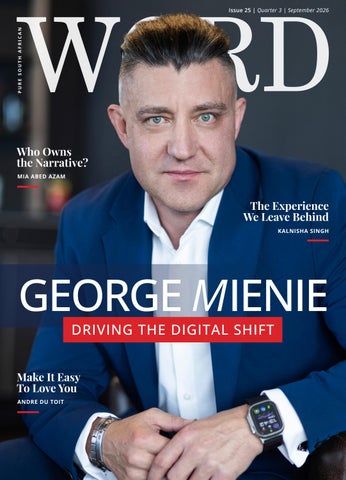
Who Owns the Narrative? MIA ABED AZAM
The Experience We Leave Behind KALNISHA SINGH
GEORGE MIENIE DRIVING THE DIGITAL SHIFT
Make It Easy To Love You ANDRE DU TOIT
THOUGHTFUL GIFTS
Beautifully Curated. Lovingly Packaged.
FINDING THE PERFECT GIFT DOESN’T HAVE TO BE DIFFICULT
Whether it’s a birthday, client thank-you, thoughtful gesture or just because, we’ll help you create a meaningful gift. Choose from our ready-made collections or let us curate something unique to suit your budget, recipient and occasion. Beautifully packaged and delivered with care.
LET US CREATE IT FOR YOU TELL US: Your budget | The occasion | Who it’s for. We’ll do the rest. Beautifully packaged. Ready to delight.
EVERY GIFT TELLS A STORY. SHOP NOW
organicshopsa.com
Organically Obsessed. Naturally You.
FROM THE EDITOR
the experience
ECONOMY 2.0 T
here is something fascinating about businesses that manage to reinvent themselves without losing sight of who they are. Our Quarter 3 cover personality, George Mienie, CEO of AutoTrader, knows something about that. AutoTrader’s journey from the familiar printed magazine many of us remember to the technology- and data-driven marketplace it is today is a powerful reminder that standing still is rarely an option. But what struck me most during my conversation with George wasn’t the technology. It was the people. As AI accelerates, information becomes increasingly accessible and products easier to replicate, George believes that people and culture become the real competitive advantage. I couldn’t agree more. Throughout this edition, you’ll meet businesses, leaders and contributors who are embracing change while remembering that behind every transaction, innovation and strategy sits a human being. Perhaps that’s the real challenge of modern business: move forward without leaving the human element behind. Enjoy the read, Lisa Bell Editor-in-Chief | WORD Magazine
IN THIS ISSUE. 6 CFAO Mobility GWM N1 City Beyond the Showroom: How One N1 City Campus Is Redefining the South African Motoring Journey
11
8 THE GIVE BACK When You Empower a Woman, You Strengthen an Economy Kevin Chaplin 11 YOU’VE BEEN LIED TO You’ve been lied to about “why” Richard Mulholland
24
16 THE STEWARDSHIP EDIT The Experience We Leave Behind Kalnisha Singh 20 NEWSKOOP Information Is an Experience Too Nadine Watkins 24 THE RESILIENT ENTREPRENEUR The Nervous System Is the New Brand Touchpoint Liezel van der Westhuizen
30
27 MONTAGU COUNTRY HOTEL Four Women, Two Generations, One Memorable Weekend in Montagu Lisa Bell 30 THAT’S WHAT HE SAID George Mienie Interviewed by Lisa Bell 38 BEYOND THE POSE It’s About The Journey, Not The Product Marike Herselman 41 KREATIVELY YOURS Consistency Is The New Luxury Krystin Morgenrood 42 LIGHTHUB Where Getting Out of the Office Helped Us Think Differently Lisa Bell
42
50 44 WHAT’S YOUR FLAVOUR? Marketing Isn’t the Experience. It Makes a Promise Kim du Plessis 47 THE COLLAB COLLECTIVE Beyond Coworking: Why the Future of Work is Human WeWork 50 ANNANELLA Where Business Meets Boutique Hospitality Lisa Bell
55
52 POSITIVE VIBES Make It Easy To Love You Andre du Toit 55 THAT’S THE BLINDSPOT Who Owns the Narrative? Mia Abed Azam 58 COACH ME! Standards: The Quiet Advantage That Changes Everything ... Karina Bognon
61
61 BEHIND THE PRODUCTIONS Beyond the Lens: Why Experience Is the New Currency Rhoda and Alfonso Stoffels 66 A LAW UNTO HERSELF The Legal Function as a Driver of Value in the Experience Economy Nomfundo Mabaso
82
69 ADD TO FAVES 72 ECHOES OF AI I Know What You Want Before You Do: Welcome to the Algorithmic Experience Economy Nova Quinn 74 THE DIGITAL PULSE You Don’t Have to Be Everything to Everyone Ashleigh Easthorpe 76 HEALTHY HABITS HUB The Sweat Is Free. The Experience Is Everything. Ruan Retief
79 LEAD WELL Beyond the Transaction: Why Ubuntu Must Shape the Experience Economy 2.0 Dr Kerryn Powell and Dr Werner Koen 82 ON THE EDGE Trading Secrets: The Invisible Currencies shaping the Experience Economy Karina Andersen 84 THE GREEN SCENE The Gift Is No Longer the Gift Lisa Bell
BEYOND THE SHOWROOM
How This N1 City Dealership Is Redefining the South African Motoring Journey
E
very morning, thousands of commuters stream along the highway, navigating the fast-paced pulse of Western Cape traffic. But just seconds off the main arterial, a different kind of momentum is taking shape. At the N1 City automotive campus, the traditional experience of buying and servicing a car is being quietly - and decisively transformed. In today’s fast and ever-evolving landscape, drivers aren't just looking for dynamic designs or efficient engines; they are looking for trust, total security, and an experience that respects their time. That is precisely the vision driving Dealer Principal Marvan Van Zyl and his team. "When a customer pulls into our campus,
they aren't just visiting a single showroom," explains Marvan. "They are stepping into a complete, interconnected mobility ecosystem backed by the global strength of the CFAO Mobility group." A LEADERSHIP TEAM BUILT ON EXPERTISE At the heart of the campus’s success is a leadership collective that brings decades of hands-on expertise to every corner of the dealership floor. Walk through the doors of GWM N1 City, and you’ll find Angie Fraenkel, Sales Manager, leading a team dedicated to ushering in GWM’s bold new era of technology-driven SUVs, bakkies, and new-energy vehicles.
Down the floor, Zayn Fataar, Sales Manager for Isuzu, works with business owners and families alike, matching rugged reliability with modern lifestyle demands. Meanwhile, Lindsay Swarts, Sales Manager of Pre-Owned Vehicles, oversees a curated inventory where every certified vehicle undergoes rigorous checks to ensure uncompromised quality. But the relationship doesn't end when the keys are handed over. Down the corridor, Guy Van Zyl, Workshop Manager, directs a state-of-theart service facility designed for rapid, precision maintenance, supported directly by Natasha York, Manager of the Parts Department, who ensures genuine OEM parts are always ready on demand. Together, this core leadership team ensures that every stage of ownership - from the initial test drive to year seven of servicing - is handled by seasoned specialists who know the product inside and out.
comes with pre-fitted Smash & Grab safety film (valued at R4,250), alongside clear, transparent costs for registration, licensing, and delivery. What you see is what you get." THE SMARTEST MOVE ON THE MAP In an era where digital transformation and consumer expectations are reshaping how South Africans move, N1 City stands out by combining cutting-edge vehicle innovation with grounded, human-first service. Whether you’re stepping into a new GWM SUV, upgrading to a capable GWM bakkie, or looking for a meticulously vetted pre-owned model - the message from the N1 City team is simple: don’t just buy a vehicle, invest in a dealership that stands behind every journey with trusted expertise, exceptional service, and genuine peace of mind.
UNMATCHED SECURITY IN AN UNCERTAIN WORLD While a convenient highway location saves valuable time, what keeps drivers coming back is the deep sense of security that accompanies every vehicle sold by N1 City. Take GWM’s impressive standard offering: a robust 7-year / 200,000 km warranty paired with a 7-year / 75,000 km service plan. It’s a compelling statement of confidence. But because N1 City operates as part of the massive CFAO Mobility network, it can push those boundaries even further. Through tailored in-house financing, N1 City unlocks exclusive access to full maintenance upgrades and their headline-grabbing 1,000,000 km warranty - a level of protection that ordinary dealerships cannot match. "We believe peace of mind should be built into the foundation of every sale," says Sales Manager Angie Fraenkel. "That’s why we also eliminate the friction points drivers hate most - like hidden admin fees. Upfront, every car
Learn More
THE GIVE BACK
Author Kevin Chaplin Managing Director - SA Ubuntu Foundation & the Amy Foundation
When You Empower a Woman, You Strengthen an Economy The living legacy of Amy Biehl and why investing in women and girls is an investment in South Africa’s future
E
very August, South Africa celebrates Women’s Month, honouring the courage, resilience and contribution of the women who have helped shape our country.
The familiar words, Wathint’ abafazi, wathint’ imbokodo, “You strike a woman, you strike a rock”, speak powerfully to that strength. But perhaps there is another conversation worth having, particularly in the business community. 8
What happens when, instead of simply celebrating women, we actively invest in their potential? For the Amy Foundation, the answer lies in the thousands of young lives that have been impacted by a legacy spanning more than three decades. FROM TRAGEDY TO LASTING IMPACT In August 1993, Amy Biehl, a 26-year-old American committed to South Africa’s struggle for democracy and equality, lost her life in Gugulethu. It was a devastating tragedy, but remarkably, Amy’s story did not end there. From her death grew a legacy centred on something fundamental to South Africa’s future: opportunity. Today, the Amy Foundation works with children, young people and families through education, skills development, sport, arts and culture, life skills and pathways into employment and entrepreneurship. While these programmes create immediate social impact, their potential economic impact is equally important. When a young woman gains skills, confidence, and access to opportunity, the effect rarely stops with her.
THE RIPPLE EFFECT OF ECONOMIC EMPOWERMENT Consider the journey of one girl who is allowed to learn, develop her talents and imagine a different future. She may go on to complete her education. She may find employment, earn an income or build a business of her own. In time, she may employ others, support a household and become a role model for another young woman who previously could not see those possibilities for herself. One opportunity can begin to influence an entire family. A family can influence a community. And communities ultimately contribute to the economic health of our country. This is why empowering women and girls should not be limited to conversations about charity or corporate social responsibility. It belongs in conversations about skills development, entrepreneurship, employment, leadership and economic growth. WHERE BUSINESS ENTERS THE CONVERSATION For South African businesses, social impact increasingly presents an opportunity to think beyond once-off donations and towards meaningful, sustainable participation. Companies have skills, networks, mentorship, employment opportunities and resources that can help organisations such as the Amy Foundation turn potential into economic participation. The question for business leaders is therefore not simply, What can we give? Perhaps it should be: What can we help build? A business can help a young person gain workplace exposure. An entrepreneur can mentor an aspiring business owner. A company can support skills development 9
That changes the nature of giving. It becomes investment. BUILDING THE NEXT GENERATION Amy Biehl believed in a South Africa where young people could participate fully in creating their own futures. That belief continues today in classrooms, on sports fields, in dance studios, through creative expression and skills training, and in young people taking their first steps towards employment and entrepreneurship. During Women’s Month, we rightly celebrate the women already leading businesses, building careers, raising families, creating employment and contributing to their communities. But we should also be thinking about the girls who will become those women. Every future entrepreneur needs a first opportunity. Every future leader needs someone who sees their potential. Every economically independent woman begins somewhere. 10
Perhaps this is where Amy Biehl’s legacy offers its most powerful lesson for the business community. Social impact and economic impact are not separate conversations. When we educate a girl, develop her skills, build her confidence and create a pathway towards economic independence, we are not simply changing one life. We are strengthening families, communities and, ultimately, the economy in which all of our businesses operate. Because when you empower a woman, you don't only strengthen a generation. You help build the future. KEVIN CHAPLIN Kevin Chaplin is the Founder and Managing Director of the SA Ubuntu Foundation, Managing Director of the Amy Foundation, and author of Can Do! Making the Impossible Possible. Drawing on more than 25 years of experience in banking, leadership, and social impact, Kevin continues to connect people, create opportunity, and inspire collective action.
Image Source: www.magnific.com
initiatives, create employment pathways, or invest in programmes that equip young South Africans to participate meaningfully in the economy.
YOU’VE BEEN LIED TO
Author Richard Mulholland
Image Source: www.magnific.com
Founder - Missing Link
YOU’VE BEEN LIED TO ABOUT “WHY” W
hat if Simon Sinek was wrong about starting with why?
Unless you have been living under a rock, you will have seen his iconic TEDx talk with the three circles drawn on the flipchart. You know the one I mean; it’s the one most people call the “Start with why” talk. Funnily enough, that’s not the title; the title is “How great leaders inspire action”, and in fact the first sentence of the talk is, “How do you explain it when things …” So it seems Simon’s not actually a big fan of starting with why … ba-dum-tsh. 11
But I digress … The real problem is that the talk treats human action as a by-product: you work through the why, the how, and the what and action happens. But you see, that’s just not how humans work. In group settings, which is where we mostly find ourselves when leaders are “inspiring” us, we’re naturally wired to freeze as the responsibility is diffused. This has been studied at length and is called the Bystander Effect.
The same thing happens in corporate conference rooms when leaders stand up and deliver rousing speeches, even with a clear “why”. It turns out people don’t really change.
YOU HAVE TO CALL PEOPLE TO ACTION 12
Image Source: www.magnific.com
It was first demonstrated in the now-famous “Smoke-Filled Room experiment in 1968. In this experiment, when a subject found themselves in a room with smoke coming through a wall vent, 75% of subjects reported the smoke straight away. However, when the subject was with two passive actors that did nothing, only 10% reported the smoke.
However, it’s fixable, and the solution is pretty easy. You have to call people to action. In the above experiment, the moment that the subject was asked to do something, they made the call.
START WITH WHY. END WITH DO.
This is what Simon Sinek is missing. In our 29 years working with corporate CEOs on their presentations, we’ve realised that simply appealing to the head, heart, and gut isn't enough. Abstract inspiration doesn't dissolve group inertia.
THAT’S WHY WE USE A STRICT FOUR-STEP FRAMEWORK ACTUALLY TO MOVE PEOPLE: • Give them a reason to care. • Give them a reason to believe. • Tell them what they need to know. • Tell them what they need to do.
That last line is doing an extraordinary amount of work. It’s calling people out and telling them what actually needs to be done, and it's, without a doubt, the step we see missed most often. And here’s the funny thing about crafting a message that actually moves an audience: if you want to prepare for this successfully, you have to reverse-engineer it. You need to start your internal thinking with the "do" in mind; that’s the explicit, unambiguous call to action. So maybe Simon Sinek wasn’t wrong that we need to start with “why” when we speak to our teams. But what he failed to mention is that we absolutely must end with “do.”
RICHARD MULHOLLAND Richard Mulholland is an international speaker, founder of Missing Link, and bestselling author known for challenging conventional thinking in business and communication. He works globally with organisations to improve leadership presence, storytelling, and strategic clarity. richmulholland.com
Because an audience left inspired but directionless is just a room full of bystanders …! 13
AFTER SCHOOL. AFTER WORK. ALWAYS SHARP. 14
B A R B E R S H O P
PRECISION CUTS. SHARP FADES. EXPERT BEARD STYLING.
Saints & Sinners is more than a haircut. It is time set aside for craftsmanship, confidence and the finishing details that change how you walk back into the world. Book your Monday-to-Thursday grooming ritual.
SACRED GRO OMING. FOR SAINTS. FOR SINNERS. FOR MEN WHO NOTICE THE DETAILS.
BO OK YOUR RITUAL
Shop 4 , Vredekloof Center, Cnr De Bron & Brackenfell Boulevard, Vredekloof, South Africa, 7560 +27 21 011 0091
@saintsandsinnersbarbers_
15
THE STEWARDSHIP EDIT
Author Kalnisha Singh
THE EXPERIENCE WE LEAVE BEHIND THE EXPERIENCE WE LEAVE BEHIND W
e often speak about the experience economy and how value is increasingly shaped by the way people experience a brand, service, or interaction. For me, though, the more interesting question is broader. What experience does an organisation leave behind simply by virtue of the way it operates? People experience our organisations long before they understand our strategies. They
16
experience the systems, decisions, processes and conversations. They experience whether they can find their way through, whether they are understood, whether there is space for them within what has been designed, and whether the organisation they encounter feels aligned with the organisation we say we are building. That experience travels. It travels through employees, suppliers, customers, partners, communities and the
Image Source: www.magnific.com
Director - KD Strategies
wider ecosystems in which organisations operate. It shapes trust, participation, confidence, reputation and the relationships that make business possible. And, over time, it shapes much more. A supplier that gains meaningful access to a value chain can build capability, employ more people and enter new markets. A person who gains access to work can alter a household’s economic trajectory. A skills programme can shift opportunities for the next generation. The way we use land, water and natural resources can strengthen or weaken the environmental systems on which future economic activity depends. This is where experience becomes a question of stewardship.
Knowledge moves between people. Networks strengthen. Better environmental choices protect resources that others will depend on. The impact may not always be immediate, linear or easy to measure, but it continues to travel. This is where our understanding of shared value needs to become more expansive. Shared value is often discussed at the intersection of business and social value. But its real potential sits in what happens afterwards. The value created through a business decision does not stop at the boundary of the organisation, beneficiary, project or reporting period.
Every organisation creates an experience through the architecture it puts in place, and leaves something behind through the choices it makes.
It enters a system.
A procurement system can provide a pathway to new markets. Recruitment can become somebody’s first point of access into an industry. Community engagement can create meaningful participation. A well-designed investment in skills can open an entirely different economic pathway.
Viewed through a stewardship lens, the experience economy becomes much more interesting. The question is no longer only whether an interaction was seamless, memorable or well-designed. It is whether that interaction leaves people, places and systems stronger than they were before.
These interactions may seem small individually, but they rarely remain small.
This matters particularly in development.
Value compounds. Skills are transferred. Confidence grows. Enterprises become more capable. Employment supports households.
And systems remember what we put into them.
We have become increasingly sophisticated in measuring outputs: jobs created, people trained, enterprises supported, procurement spent, communities reached and programmes delivered. These measures matter. But they do not always tell us what became possible because the intervention happened.
“A better environmental choice can protect something future generations will depend on.”
Did the business that entered a supplier development programme become more capable of competing for future work? Did training lead to a real economic pathway? Did community engagement create greater agency? Did environmental investment 17
These questions tell us more about the experience we are leaving behind and the conditions from which future value can emerge. There is something deeply optimistic in that. Businesses have extraordinary reach. They mobilise capital, technology, infrastructure, knowledge, people, supply chains and relationships. They influence which skills are developed, which businesses gain access to markets, how natural resources are used and what kinds of futures become economically possible. That influence creates responsibility, but it also creates possibility.
thinking beyond the transaction towards the experience of being touched by an organisation over time. Ultimately, the experience we leave behind is not only about how people felt when they encountered us. It is the opportunity that opened, the capability that remained, the enterprise that grew, the relationship that strengthened, the ecosystem that was protected and the future that became more possible because of the decisions we made today. Perhaps that is one of the most important stewardship questions available to business now: What became possible because we were here, and what might still become possible because of what we chose to leave behind? Image Source: www.magnific.com
strengthen resilience beyond the life of the project?
Through everyday decisions, businesses can contribute to stronger societies, healthier environments, and more resilient economies. This is not about asking business to solve every social or environmental challenge. It is about recognising that business is already part of the systems through which those challenges, and their solutions, are shaped.
A good decision can open a pathway. A fair process can build trust. A meaningful opportunity can change a household. A stronger supplier can strengthen a local economy. A better environmental choice can protect something future generations will depend on.
These actions accumulate. They reinforce one another and create the conditions from which something else can grow. Perhaps this is the next evolution of the experience economy: 18
KALNISHA SINGH Kalnisha Singh is a development economist and transformation specialist focused on ESG, governance, and sustainable growth. She helps organisations move beyond compliance by aligning strategy, metrics, and stakeholder engagement to drive long-term value creation.
PUT YOUR BRAND IN THEIR HANDS Stand out. Get noticed. Grow your brand. Explore more than 3,000 products and 23 branding techniques, all designed to keep your brand seen, used and remembered.
Branding Solutions
Printing Services
Promotional Materials
BRAND IT. GIFT IT. GET REMEMBERED.
Event Materials
+27 82 372 7524 promoafrica.com/BrandItAll
Signage & Outdoor Display
INFORMATION IS AN EXPERIENCE TOO Author-Nadine Watkins
W
hen we hear the phrase experience economy, our minds often jump to exceptional customer service, beautifully designed stores, or seamless digital journeys. We think about businesses that have mastered the art of making people feel valued. But there is another experience we rarely consider - one that shapes our daily lives just as profoundly. The experience of information. Never before have we had access to so much content. News alerts compete with social media feeds. Podcasts accompany our morning commute. Emails, videos and social media updates constantly demand our attention. Information has become abundant, yet clarity has become increasingly scarce. In this environment, people aren’t simply looking for more content. They’re looking for information that makes sense of the world around them. Information they can trust. Information that respects their time and leaves them feeling informed, not overwhelmed. That’s because information is no longer just about facts.
20
It’s about experience. A well-written article that explains a complex issue in plain language. A short radio bulletin that delivers the day’s most important stories without unnecessary noise. A podcast that helps someone better understand a financial decision or an environmental issue affecting their community. These experiences don’t simply transfer knowledge - they build confidence. And confidence builds trust. Perhaps that’s why specialised content has become more valuable than ever. Rather than trying to be everything to everyone, audiences increasingly seek information that speaks directly to their interests, industries and communities. Farmers want practical agricultural insights that understand the realities of the land. Entrepreneurs and business owners want clear explanations of economic trends that affect their livelihoods. Communities want environmental discussions that feel relevant to the places they live, not distant global conversations with little local context. At Newskoop, this philosophy has shaped much of our thinking. Alongside our daily news bulletins, programmes such
as Agriskoops, Bizskoops and Ecoskoops were developed around a simple idea: people engage more deeply with information when it reflects the world they know. By focusing on agriculture, business and environmental topics in an accessible, conversational way, these programmes create space for listeners not only to hear information, but to absorb it, understand it and relate it to their own lives. That is the difference between broadcasting information and creating an experience.
Image Source: www.magnific.com
And in community radio, that experience does not end when the broadcast ends. The best stories live on in conversation - in kitchens, on taxi rides, at workplaces, around dinner tables and in community spaces where people continue to discuss what they heard long after the programme has finished. A strong radio story does more than inform in the moment. It becomes part of daily life. It sparks reflection, shared opinions and new questions. It gives people something to think about, talk about and return to. This is one of community radio’s greatest strengths. It is not simply a channel that delivers messages. It is part of the rhythm of people’s lives. Listeners do not only consume the content; they carry it with them, revisit it in conversation and make it part of how they understand their own realities. The story continues because the community continues it. The experience isn’t found only in what is communicated. It’s found in how it is communicated - and in what happens afterwards. Clarity has become a competitive advantage. Credibility has become a differentiator. Relevance has become an expectation rather than a luxury. And perhaps most importantly, respecting people’s time has become one of the greatest forms of respect any organisation can show. This principle extends far beyond journalism or broadcasting. Every organisation communicates with customers, employees,
“They’ll create experiences people trust” stakeholders and communities. Every email, social media post, newsletter, presentation or public announcement contributes to the experience people have with that organisation. When communication is confusing, inconsistent or designed to fill space, trust slowly begins to erode. But when it is honest, concise and genuinely useful, people remember. Not because it shouted the loudest, but because it helped them make better decisions, understand something new, or feel more connected to the world around them. As technology continues to make content easier to produce, the true differentiator will no longer be volume. It will be value. Audiences won’t reward organisations that publish the most. They’ll reward those that consistently provide information that is meaningful, relevant and worth their attention. The next chapter of the experience economy isn’t only about memorable customer interactions or beautifully designed products. It’s also about creating moments of understanding - where information doesn’t simply reach people but resonates with them. In an age overflowing with information, the organisations that win won’t simply publish more. They’ll create experiences people trust enough to return to tomorrow - and stories people continue to carry into conversation long after the broadcast has ended.
GET IN TOUCH TO AIR YOUR BRAND TODAY! oursaladmix.com
newskoop.com
info@newskoop.com
21
22
autotrader.co.za 23
THE RESILIENT ENTREPRENEUR
Author Liezel van der Westhuizen Owner - Burnout Business & Mental Fitness Coach
THE NERVOUS SYSTEM
Image Source: www.magnific.com
IS THE NEW BRAND TOUCHPOINT
24
W
e used to talk about the experience economy in terms of delight. Surprise the customer. Wow them. Give them something to post about.
THAT ERA IS OVER. The next wave isn't about delight. It's about regulation. Every single interaction a customer has with your brand does one of two things to their nervous system: it calms it, or it activates it - and the brain never forgets which one you triggered. As a mental fitness coach, I spend my working life inside people's nervous systems, helping executives and sales teams find calm under pressure. What I'm noticing now is that the same biology runs the customer journey. A clunky checkout page, a chatbot that loops you in circles, and a delivery promise that quietly breaks: these aren't just operational hiccups; they're small hits of cortisol. Your brain files it away as "don't trust this again" – and that’s when customers leave, or complaints rise!
So, the businesses winning the next chapter of the experience economy are the ones asking a different question: Not "how do we impress them," but: • Is this interaction predictable? Does the customer know what happens next, every time? • Is this interaction warm? Is there a human, or human-feeling, touch somewhere in the journey? • Is this interaction frictionless? Have we removed the small decisions and delays that quietly drain cognitive energy? • Does this interaction recover well? When something breaks (and something always breaks), does the brand repair trust fast, or make the customer fight for it?
Compare this experience to a brand that removes friction before you even notice it was there. That predictability and quiet competence tells your nervous system one thing: you are safe here. And safety, not novelty, is what builds loyalty that actually compounds. WHY SAFETY BEATS DELIGHT? Here's the neuroscience in plain terms: Your amygdala is constantly scanning every experience for threat or safety, and when something feels unpredictable or effortful, it fires a low-grade stress response, even if you can't consciously name it. When something feels seamless and warm, your nervous system downregulates. You relax, and a relaxed customer is a returning customer. 25
That last point matters more than people think. Nervous systems don't just remember good experiences. They remember how quickly safety was restored after a rupture. A fast, honest fix builds more trust than a flawless process ever will. Silence, defensiveness, or a scripted non-apology does the opposite: it confirms the threat was real.
THE OVERALL REALITY CHECK?
I think about this the same way I coach a sales team through a high-stakes quarter. You can't perform, or sell, or delight anyone, from a dysregulated state. A rep running on cortisol sounds different on a call: they rush, over-explain, and they chase instead of connect. The customer feels dysregulated before a single word is spoken because nervous systems read each other constantly, underneath the script.
If your brand experience keeps a customer's system on alert, no amount of clever marketing will make them stay, and no amount of coaching will help a stressed team fake it convincingly enough to matter.
The experience economy doesn't start at the customer touchpoint; It starts inside your team. A calm, regulated salesperson creates a calm, regulated buyer. That's not a soft skill. This is measurable in close rates, retention, and the energy required to keep a client, rather than constantly replacing one.
That's the whole shift, really. In a saturated market, the brands that win aren't shouting the loudest; they are largely the ones whose customers can finally exhale.
LIEZEL VAN DER WESTHUIZEN Liezel van der Westhuizen is a Burnout Business Coach, certified high-performance and neuroscience coach, hypnotherapist, keynote speaker, and media personality who helps leaders, executives, and sales teams build unshakable confidence, resilience, and mental agility. Her neuroscience and hypnotherapy tools rewire stress patterns under pressure, sharpening focus and lifting conversion when it counts most. Drawing on her broadcasting career and endurance-sport background, she helps clients stand tall in business and in life.
Learn more at liezel.co.za 26
Image Source: www.magnific.com
As one client put it to me recently: "We kept trying to wow people… turns out we just needed to stop stressing them out."
Four Women, Two Generations, One Memorable Weekend in Montagu Author-Lisa Bell
T
here is something special about a girls’ weekend away. Add two mothers, two daughters (all related), a charming country town, good food, a little wine, and plenty of laughter, and you have all the ingredients for memories that will be shared around family tables for years to come. Our adventure began with a leisurely drive from Cape Town towards the Klein Karoo. 27
Of course, no road trip is ever entirely straightforward when wine lovers are involved. A planned stop at Springfield Estate in Robertson became an essential detour, thanks to one determined mother who insisted that a particular bottle of white wine had to make the journey home with us. Mission accomplished, we continued through the mountains towards Montagu. As the afternoon sun dipped and the winter chill settled over the town, we arrived at the iconic Montagu Country Hotel, a member of Cape Country Routes. Stepping through the hotel’s famous stained-glass doors felt like entering another era. Welcoming guests since 1875, Montagu Country Hotel is the country’s only original Art Deco hotel, and its beautifully preserved character is impossible to miss. The warm smiles at reception set the tone for the weekend ahead, and before long, we were settling into our spacious rooms. The hotel offers 29 individually decorated en-suite rooms, including luxury and classic options, as well as two self-catering units. Our rooms perfectly blended old-world charm with modern comfort, with elegant furnishings, thoughtful touches, and plenty of space to unwind. Looking out across the gardens towards the surrounding Langeberg mountains, it was easy to understand why so many guests return year after year. 28
CHARLESTONS: A FEAST FOR THE SENSES Dinner that first evening was served at Charlestons, the hotel’s signature restaurant. Named to reflect the glamour and style of the Art Deco era, the restaurant is filled with character. Vintage-inspired décor, beautiful artwork, warm lighting, and elegant finishes create an atmosphere that feels both sophisticated and welcoming. And then there was the food. From fragrant curries and rich oxtail stew to perfectly prepared pork belly, every dish delivered on flavour and comfort. Accompanied by our treasured Springfield wine, dinner quickly turned into one of those magical evenings where stories flowed as freely as the conversation. The daughters laughed at tales they had never heard before, while the mothers reminisced about adventures from years gone by. It was one of those rare evenings where nobody looked at their phone and time slipped away. COFFEE, MARKETS AND HIDDEN TREASURES Saturday began with an early morning visit to Feathers & Flatcaps, the hotel’s charming coffee shop and cocktail lounge. The smell of freshly brewed coffee filled the air as we eased ourselves into the day. Wrapped up against the winter chill, coffees in hand, we watched the town slowly wake up around us.
After breakfast, we took a short stroll to the local market, where the morning disappeared among vinyl LPs, handmade jewellery, vintage treasures, and quirky collectables. The nearby antique and second-hand stores provided even more opportunities to hunt for hidden gems. Montagu has a way of encouraging you to slow down and browse a little longer than you intended.
of restraint were quickly abandoned. By Sunday morning, we had fully embraced the slower pace of country life. Another delicious breakfast buffet awaited, and despite our best intentions, we somehow found room for one more helping. Between mouthfuls, we snapped photographs and recorded videos, determined to preserve every moment before heading home.
HOT SPRINGS AND AFTERNOON NAPS MORE THAN A HOTEL By midday, we were ready for a change of pace and headed to Avalon Springs for a refreshing soak. Surrounded by mountains and crisp winter air, the warm waters provided the perfect contrast to the season. Returning to the hotel, we admired the beautiful gardens and one of the two outdoor swimming pools. Although the weather was a little too cold for swimming, it’s easy to imagine how inviting these spaces would be during the warmer months. The afternoon called for one of life’s simplest luxuries: a nap, mixed with a little downtime playing games and watching TV in our rooms.
What makes Montagu Country Hotel special is not simply its Art Deco heritage, comfortable accommodation, excellent dining, beautiful gardens, or mountain views. It is the feeling it creates. In a world that often moves too fast, this is a place that invites you to slow down, reconnect, and savour life’s simple pleasures. Whether you’re travelling as friends, family, or a little of both, it offers the perfect base from which to explore Montagu and the surrounding region. For us, it became more than a hotel stay. It became the backdrop to a weekend filled with stories, laughter, friendship, and family. And sometimes, that is exactly what a getaway should be.
Montagu Country Hotel res@montagucountryhotel.co.za montagucountryhotel.co.za
FOOD, FRIENDSHIP AND FAMILY Dinner that evening was every bit as memorable as the first. More exceptional food at Charleston’s, more laughter, and eventually a fiercely competitive game of Rummikub that brought out everyone’s competitive streak. Indulgent desserts ensured that any thoughts
capecountryroutes.com
29
Q&A THAT’S WHAT HE SAID
Author Lisa Bell Owner -The Word Architect
30
Driving digital shift Photographer: Marike Herselman Photography | marikeherselman.com
George Mienie on transforming AutoTrader, the democratisation of information, AI, leadership and why people may be the last true competitive advantage
By Lisa Bell, Chief Editor of WORD Magazine
F
rom 100,000 printed magazines a week to millions of digital visits every month, AutoTrader’s transformation is a story of what happens when a business is willing to disrupt itself. At the centre of much of that journey has been CEO George Mienie. But spend an hour talking to him and it quickly becomes apparent that his story is about far more than cars. For many South Africans of a certain generation, AutoTrader is remembered as a thick magazine picked up when it was time to buy or sell a car. At its height, the business was distributing around 100,000 magazines every week through more than 5,500 retailers. Then the internet arrived. What followed was not simply the digitisation of an existing product. AutoTrader had to fundamentally rethink what it was, what consumers needed from it and, eventually, where its real value lay. George Mienie has spent 23 years with the business, helping navigate its journey from
print classifieds to online classifieds, from online classifieds to a trusted digital marketplace, and now towards something arguably even bigger: a technology and data company using artificial intelligence to help both consumers and automotive businesses make better decisions. Today, Mienie talks as comfortably about algorithms, agentic AI and commoditised information as he does vehicle dealerships and customer experience. Yet underneath all the technology sits a surprisingly human philosophy. Technology can be copied. Information is everywhere. Products can be reverse-engineered. People, he believes, may ultimately be the competitive advantage businesses have left. WORD Magazine sat down with George to talk disruption, data, changing car buyers, Chinese automotive brands, artificial intelligence, leadership and what the next chapter of AutoTrader might look like. 31
WORD: You’ve been with AutoTrader for 23 years. Looking back, what were the defining moments that transformed the business from traditional classifieds into the digital marketplace it is today? George: I don’t think defining moments are binary. With disruption and change, people would like to think there’s this moment where you suddenly see the future and pick a path. That doesn’t really exist. You see the future, or multiple futures, and then you pick a path. The really good operators are the ones who know how to switch direction when they realise they’ve potentially picked the wrong one. One of the big moments for AutoTrader was when the internet started becoming significant in South Africa around 2007 and 2008. We were a print business distributing around 100,000 magazines a week to more than 5,500 retailers. We didn’t really have a big marketing team because the magazine itself was our marketing. It was sitting on shelves everywhere. Then suddenly there was the internet, with its searchability and completely 32
different capabilities. By around 2010 or 2011, we could see consumers beginning to use the internet as an alternative to browsing magazines. Everybody was talking about the demise of print and that existential threat started becoming real. The next question became: once we’re an online classifieds business, what comes after that? Around 2013 or 2014, we realised that the defining difference between an online classifieds business and a marketplace was trust. And trust is a big word. We eventually brought it down to three things. First, trust in the vehicle itself. I want to know as much as possible about this vehicle. Its history, how it compares, how long it might last and what I could potentially sell it for one day. Second, trust in the price. Am I getting a good deal? People often confuse a good price with
the cheapest price. It isn’t necessarily about being cheapest. It’s about whether I’m getting value for money. Third, trust in who I’m buying from. We’re the marketplace bringing the buyer and seller together, so how do we create transparency around the seller too? Then, as the pandemic arrived, we started realising just how much data was streaming through our platform and that we were becoming a big data business. And now, of course, there’s another existential disruption: artificial intelligence.
“I can’t force somebody to grow, but I can open the door.” WORD: What has all that data taught you about how South Africans are buying cars differently? George: One of the biggest changes has been the transfer of information. In the print days, the seller had more information than the customer. The seller was in the driver’s seat because they knew more about the product.
loyal as they once were. The transparency of information allows somebody to say, “Maybe this vehicle gives me the same value as that vehicle, but at a better price.” That’s a significant shift. WORD: We’re seeing that particularly with the rise of Chinese vehicle brands in South Africa. Why do you think consumers have embraced them so quickly? George: I call it the price-to-value delta. What the Chinese manufacturers have done very well is bring vehicles to market that are probably 80 to 90 percent of the build quality of some of the traditional European vehicles, but at around 60 percent of the price. Consumers look at that difference and think: “Why wouldn’t I?” That price-to-value delta is what they’re grabbing onto, and it’s contributing to consumers becoming less brand loyal. WORD: Between AI, electric vehicles, new mobility models and new manufacturers entering the market, there is enormous disruption happening. What should business leaders be paying attention to? George: The internet, and now particularly artificial intelligence, has commoditised information.
With the internet, and particularly a marketplace like AutoTrader, the depth of information available to consumers changes that completely. The power shifts from the seller to the buyer. A consumer can now walk into a dealership knowing more about a particular vehicle than the person selling it. That changes the negotiation at the coalface.
The internet started that process and AI has accelerated it enormously. We can all become augmented human beings now.
We’re also seeing South African consumers becoming far more pragmatic. You’ll always have an emotional buyer who really wants a particular car or brand, but the economic environment has forced people to become more pragmatic, and we can see that in search behaviour. Consumers aren’t as brand
The ability to engineer things, whether in the physical or digital world, is becoming easier and easier. So where does that leave business leaders? People become the competitive advantage. It becomes about nurturing the culture of your business because your people can use this commoditised information to
That extends into technology and products because things can increasingly be copied, reverse-engineered and rebuilt better and cheaper.
33
build better products faster. If a business leader thinks they’re sitting behind a moat because of a product or technology, somebody is going to compete with them, and probably very quickly.
customer is arriving informed and that creates a completely new competitive advantage. The car almost becomes less important in that moment because they’ve already decided which car they want.
WORD: AutoTrader sits at an interesting intersection between technology and trust. As more of the customer journey becomes digital, how do businesses maintain the human connection?
Now it’s about the experience. If you want that customer to come back three years later when they replace the vehicle, you need them to leave remembering how you made them feel.
George: Consumers want to communicate in different ways. Approximately a third of all vehicle enquiries on AutoTrader’s platform are via WhatsApp, and that has grown significantly. But around 25 percent are still phone calls.
“The best technology is the technology that disappears.” There is no one-size-fits-all. Our objective is to help consumers make as many decisions about their purchase as possible online, whether that’s on their phone or laptop, at home or wherever they happen to be. That means answering as many questions as possible digitally. But that doesn’t remove the fulfilment stage. Buying a car is the second-biggest purchase in most people’s lives. Eventually you still arrive at the dealership and interact with another human being. And I think that’s where a new opportunity exists. If the consumer arrives at the dealership with virtually all their questions already answered, the dealer doesn’t have to spend that time explaining everything they once did. They have an opportunity to dramatically increase the service level. What’s the ambience when I walk into the showroom? What does the coffee taste like? How friendly are the staff? What questions do they ask me? How do they make me feel? The 34
WORD: You speak quite openly about leadership, including your view that leadership isn’t about being “nice”. What do you mean by that? George: The opposite isn’t true either. Leadership isn’t about being ugly. When I say leadership isn’t about being nice, what I mean is that nice can equal avoidance. It’s avoiding difficult conversations. Many people don’t have the ability to look somebody in the eye and tell them the truth without becoming derogatory or personal. A leader needs to be able to sit face-to-face with another human being, be direct but respectful, and tell that person the truth. The best thing you can do for somebody’s growth is to be truthful, direct and transparent. Too many leaders avoid the uncomfortable conversation. And leadership really happens one-on-one. WORD: What about leading a team? What do you think leaders often get wrong in the room? George: Leaders often walk into a room with seven, ten, twelve or even a hundred people and immediately bring their own opinion. “This is what we’re going to do.” But your job in that room isn’t necessarily to speak first. You have all these brains sitting around you and collectively they’re probably five or ten times smarter than you because there are more of them. You need to allow that intelligence to surface. If the leader walks into the room and forces their own voice to be heard first, everybody else can shut down. Then you’re not getting the benefit of those brains working for you. If the team shines, the leader shines. I think many leaders miss that.
“Nice can equal avoidance.”
WORD: Where did your own leadership philosophy come from? George: I studied to become a chartered accountant, so those first five years as an article clerk really were starting at the bottom. My first real corporate job after that was as finance director for a group of companies, so I was fortunate that quite early in my career I began leading people. I probably made most of my mistakes during that time. Books were a wonderful source of teaching for me, and people were another source if you’re open to learning from them. I’ve had some wonderful mentors throughout my career who cared enough to observe me and tell me the truth. They helped shape the way I think about leadership. There were also one or two leaders I worked for who taught me how not to lead. Because most of my mentors were positive examples, I could recognise toxic leadership when I saw it and think, “I don’t want to do what that person just did.” I developed a passion for watching people grow. I get a kick out of seeing somebody in my team or the wider business succeed. So one of my underlying objectives throughout my career, particularly at AutoTrader, has been to promote from within and open doors for people. I can’t force somebody to grow, but I can open the door. Most of the senior leaders at AutoTrader today started much further down in the organisation. WORD: So what does the next five years look like for George Mienie & AutoTrader? George: I’m 51 and I’m certainly not done. I still feel like I’m 25. I believe the human body is your best competitive advantage. I make looking after my body part of my job because if I look after my body, my mind is looked after too. 35
There’s also a lot still to do at AutoTrader over the next two to five years. We’ve only started scratching the surface of the value our big data can provide to both consumers and dealers, particularly when it’s layered with artificial intelligence. We launched tools called AutoTrader Intelligence, combining algorithms, mathematics, data and AI. The future for AutoTrader is about deepening transparency and trust with consumers. How do we provide tools that answer more questions and remove more pain points from the buying journey? And on the seller side, how do we use the data we see to help dealerships run more profitable businesses? AutoTrader sees around 120,000 vehicles a month and millions of visits to the platform. At that scale, we’re effectively a proxy for the automotive economic model. We see buying demand, supply and price. When you take that economic data and layer artificial intelligence over it, the opportunities become enormous. The best technology is the technology that disappears. You shouldn’t know it’s there. It should simply help you do what you naturally want to do. From the outside, AutoTrader might look like an advertising platform. It isn’t. We’re a technology company providing tools to both buyers and sellers that reduce the number of steps required for them to achieve their objective. WORD: And where could agentic AI eventually take that? George: Agentic AI is where an agent can begin taking autonomous decisions for you. For a consumer, telling an agent to go and find a car and actually buy it might still feel quite scary, so that’s probably some way off. But imagine providing tools to vehicle sellers where, as market demand and supply shifts, an autonomous agent adjusts the selling price of a vehicle automatically without the dealer 36
needing to intervene. That’s entirely possible. We want dealerships to sell more cars and be more profitable, while consumers still feel they’ve received a good deal. If the dealer can make a healthy margin and the consumer feels they’ve received value, everybody wins. And AutoTrader thrives in the middle by making that process easier. WORD: Beyond being CEO, what legacy do you want to leave? George: I’m not done in the world of AutoTrader. There’s still a big journey ahead. But I’ll continue with my passion for people. I want to help people grow, open doors for them and leave my legacy by touching people’s careers positively. There have been casualties along the way. There will always be people who bite off a little more than they can chew. But I never want somebody to be a casualty because I was a toxic leader. THE WORD SIGNATURE QUESTION WORD: What book, podcast, YouTube channel or piece of media are you currently loving, or would recommend to our readers, and why? George: There’s a book and a podcast that immediately come to mind. The book is Thrive by Richard Sutton, who’s a friend of mine. What I really enjoy is the way the book is structured and how Richard uses storytelling to communicate his message. His work looks at how you become a high-performance individual and how you deal with stress. Stress doesn’t disappear. When somebody tells you that you need to experience less stress or have no stress, that world doesn’t really exist. What Richard explores is how you make your body more resilient to stress. He gives
you tools to navigate life and even use small stresses so that when the real stress comes, your body knows how to deal with it. The other is The Diary of a CEO. I think Steven Bartlett is incredibly smart and asks really interesting questions. What’s fascinating is that you can see his own learning journey as an interviewer. All he does is ask questions and learn, and everybody else gets to learn alongside him.
WHAT’S NEXT ON THE ROAD? George Mienie doesn’t simply observe the future of mobility from behind a desk. He’s already experienced some of it. Having owned an early-generation Jaguar I-Pace electric vehicle for three years, he believes South Africa’s EV charging infrastructure is considerably more developed than many consumers realise. For everyday driving, he found home charging meant beginning virtually every morning with a fully charged vehicle. More recently, a visit to Silicon Valley gave him the opportunity to experience a fully autonomous Waymo taxi. His verdict? Initially strange, but remarkably smooth and accurate. While Mienie believes fully autonomous vehicles are still some distance from becoming mainstream, the experience reinforced his belief that the technology is entirely achievable. South Africa may historically have lagged several years behind markets such as the United States in adopting emerging technologies, but he believes the capability gap has narrowed considerably. “We can build anything the Americans can build,” he says. And while South Africans may not be ready to hand over their steering wheels just yet, Mienie suspects another technology could arrive in our everyday lives sooner than we expect: humanoid robots.
CONNECT WITH GEORGE georgemienie.co.za
WATCH THE FULL INTERVIEW HERE
CONNECT WITH AUTOTRADER SA autotrader.co.za
LISTEN TO FULL PODCAST HERE
37
BEYOND THE POSE
Author Marike Herselman
Photographer: Marike Herselman Photography | marikeherselman.com
Owner - Marike Herselman Photography
38
It’s about the journey, not the product.
T
he experience economy has moved beyond loyalty points and slick packaging. It's about how a brand makes you feel from the moment you walk in the door. In portrait photography, that shift is impossible to ignore: what people are really paying for was never the photo. You've arrived for your session, nervous. You've done some prep, but you're not sure what to expect, or what will be expected of you. You wish this could be over. Feeling the spotlight on yourself is enough to make you break out in a sweat and destroy the make-up you so carefully applied. Why didn't you settle for a selfie, or an AI-generated headshot? You're at the door, and your heart sinks when you see the big lights, multiple backdrops and a carefully positioned chair, waiting in the spotlight. Then you're greeted with a warm smile and led to a comfortable armchair, away from the intimidating lights and cameras. While you sip on a coffee and chat about your dog, the anxiety slowly starts to melt away. 39
Photographer: Marike Herselman Photography | marikeherselman.com
It's not about the picture; it's about the experience. Don't get me wrong, the reason people step into my studio is for the picture, the product. But it's the experience that gives that physical product its power. The extra bits you don't expect as part of the package are what make the package: the permission to be seen and to see yourself in a new light, the guidance to bring out the best in you, and the encouragement to shine. In a portrait session, there are practical steps to get the best results for each person, and since we all differ, those steps vary from person to person. But the basics stay the same. Communication, guidance and connection are key to helping someone feel comfortable in front of the camera. Without that, you might get an okay portrait, but what your sitter remembers from the experience is just as important, and closely tied to how they perceive the image itself. We're in a fast-developing world where anyone can point and shoot a portrait, and AI technology can create headshots of you 40
in every situation you can imagine. But what can't be automated is the experience of being guided through feeling good about being seen. Before you know it, you're walking out of the studio. Relieved, yes, but with a bit more spring in your step, a bit more ready to take on the next challenge, because you just did this, and you did it well. With a slight, confident smile, you realise you enjoyed it, and you can't wait to see the result.
MARIKE HERSELMAN Marike Herselman is a portrait photographer focused on authenticity and connection. Her work captures individuals and brands in a way that reflects confidence, personality, and presence, helping clients show up powerfully in both personal and professional spaces.
K R E AT I V E LY Y O U R S
Author Krystin Morgenrood Chief Designer - The Word Architect
Image Source: www.magnific.com
Consistency Is The
NEW LUXURY
R
emember when brands were obsessed with delighting us? Surprise us! Wow us! Give us an experience so extraordinary that we’ll immediately tell everyone about it on Instagram. Ah, simpler times. Today, we’re juggling 47 passwords, approximately 900 notifications, five delivery apps and a never-ending stream of “personalised” emails. The last thing we need is another brand trying to surprise us. What we actually want? For things to just work. And that’s where the experience economy is entering its next chapter. For years, the goal was to create memorable moments. But in an increasingly unpredictable world, there’s something surprisingly luxurious about knowing exactly what to expect. Think about the brands you trust. You know what you’re going to get. The quality is consistent. The process is familiar. The service feels recognisable. It’s the reason you can walk into your favourite coffee shop half-awake, order the same thing you’ve ordered 147 times, and feel slightly betrayed when it suddenly tastes different.
something bigger: consistency creates trust. And consistency doesn’t mean boring. It means giving creativity somewhere solid to live. A restaurant can surprise you with a brilliant new dish, but you still expect the service to be good. A retailer can reinvent its campaign, but the checkout shouldn’t suddenly feel like an escape room. A hotel can create magical moments, but you should still be able to find the towels. Because one spectacular interaction can’t rescue ten frustrating ones. Experience Economy 1.0 was about the peak. Experience Economy 2.0 is about the pattern. When everything around us competes for our attention, the brands that stand out may not be the loudest. They might simply be the ones that make us exhale and think: “Ah. I know how this works.” And honestly? In 2026, that feels pretty luxurious. Fueled by a love for creating from scratch, Krystin brings a natural flair for visual storytelling. Her work spans brand storytelling, social media design, corporate stationery and brand packages. thewordarchitect.co.za
It sounds trivial, but that tiny moment captures 41
LightHub Where Getting Out of the Office Helped Us Think Differently
S
ometimes the best thing you can do for your business is get out of your usual workspace. The WORD Magazine team recently did exactly that, swapping our everyday environment for a strategy day at LightHub in Bellville. There is something about changing your surroundings that changes the conversation. For our recent WORD Magazine strategy day, our team needed somewhere we could step away from the usual interruptions, spread out, talk, plan, challenge a few ideas and map out where we are going next. LightHub gave us just that. Located in Rosenpark, Bellville, LightHub
42
describes itself as a shared community meeting space, offering everything from open desks and private offices to boardrooms and longer-term office rentals. What started as a small coffee shop has evolved into a flexible workspace designed particularly around the changing needs of businesses. A ROOM WITH A VIEW, AND SPACE TO THINK Our base for the day was a lovely private office with a view, giving the team our own space to settle in and get down to business. And we did. What we particularly liked was the balance of the environment. It was quiet enough for us to concentrate and have proper strategic conversations, but not so silent that
it felt sterile. There was the gentle background chatter and movement of other people working, which gave the space some life without becoming distracting. That balance matters more than you might think when you are spending an entire day brainstorming. From a practical business perspective, LightHub ticks the necessary boxes too. The workspace offers business-grade high-speed fibre, backup power for lights and plugs, air conditioning, kitchen and restroom facilities, as well as a choice of hot desks, private offices, and boardrooms accommodating different group sizes. Short and longer-term office rental options are also available.
And perhaps that is one of LightHub’s strengths. It isn't trying to be a corporate hotel conference centre. It feels more relaxed and accessible while still providing the infrastructure businesses need to operate effectively. Interestingly, its concept extends beyond conventional coworking. LightHub also has a play area where children can play while parents work and enjoy coffee, as well as spaces for parties and events. It is an unusual combination, but one that reflects the reality that work and life don't always fit neatly into separate boxes. WOULD WE GO BACK? Yes. For a small team needing a strategy day, a planning session, a client meeting, or simply a change of scenery, LightHub offers a comfortable middle ground between working from home, meeting in a noisy coffee shop, and hiring an overly formal conference venue. We arrived needing the space to think. We left with plans, decisions, plenty of notes and a clearer picture of where we're heading next. Sometimes a different view really does give you a different perspective.
COFFEE HELPS. SO DOES LUNCH. No WORD team strategy day was ever going to survive on good ideas alone. Coffee certainly helped, and having it made for us rather than repeatedly abandoning the conversation to find our own was a small touch we appreciated. Lunch was delivered to us too, allowing us to enjoy our meal without having to pack everything up and head elsewhere. It made the day feel easy.
LightHub is situated at 21 Pasita Street, 1st Floor, Pasita Park Building, Rosenpark, Bellville. (LightHub) | lighthub.capetown |
admin@lighthub.capetown
43
WHAT’S YOUR FLAVOUR?
Author Kim du Plessis Managing Director - Our Salad Mix
Image Source: www.magnific.com
EXPECTATION
REALITY
44
MARKETING ISN'T THE EXPERIENCE IT MAKES A PROMISE
T
he experience economy has changed the way businesses compete.
For years, marketing was largely measured by how many people it reached. The bigger the audience, the greater the opportunity. Today, that equation is no longer enough. Businesses are not simply competing for attention; they're competing to meet and exceed the expectations they create. That is where marketing's role has fundamentally changed. Marketing isn't the experience. It makes a promise about the experience. Every advertisement, social media post, radio campaign, website visit or customer testimonial paints a picture in someone's mind. Long before a customer walks through your doors, visits your website, or speaks to your team, they have already formed expectations about who you are and what it will feel like to do business with you. The real customer experience begins long before the first transaction. The challenge is that no amount of clever marketing can compensate for a poor customer experience. A beautifully crafted campaign may generate interest, but if reality doesn't match expectations, disappointment quickly replaces excitement. And in today's connected world, disappointed customers often become your loudest marketers.
The opposite is equally true. When a business consistently meets the expectations it sets, trust begins to grow. Customers return. They recommend you to others. They become advocates rather than simply buyers. That is where brand loyalty is built - not in the advertisement itself, but in the gap between expectation and reality. The smaller that gap becomes, the stronger the relationship. This is why authenticity has become one of the most valuable assets a brand can possess. Consumers have become remarkably good at recognising exaggerated claims and polished marketing language. They don't expect perfection, but they do expect honesty. Brands that communicate with authenticity, consistency and genuine understanding are often the ones that build the deepest and longest-lasting relationships. Community media offers a powerful example of this. Unlike many mass media platforms, community radio speaks to people within the context of their everyday lives. It reflects local conversations, challenges, successes, and aspirations. The voices are familiar. The stories are relevant. The relationship between listener and station has often been built over many years. For advertisers, this creates something 45
Image Source: www.magnific.com
incredibly valuable. It allows brands to introduce themselves through voices and platforms that communities already know and trust. Rather than interrupting people's lives, community radio becomes part of them. A recommendation from a trusted local presenter carries more weight because it feels authentic rather than transactional. That doesn't guarantee success, but it creates the right expectation. From there, the responsibility shifts to the business itself. The customer service must reflect the promise. The product must deliver on the message. The people behind the brand must embody the values that were communicated. Marketing may open the door, but the customer experience determines whether anyone chooses to walk through it again. Perhaps this is the biggest shift in the experience economy. Marketing is no longer about creating the loudest campaign or the cleverest slogan. It is about creating honest expectations that your business is prepared to fulfil. The strongest brands understand that every touchpoint from an advert and a social media post to a phone call, an invoice or an after-sales 46
conversation - is part of one continuous customer journey. The experience doesn't begin when someone becomes a customer. It begins the moment they encounter your brand. And in a marketplace where trust has become one of the most valuable forms of currency, businesses that align their marketing with the experience they consistently deliver won't simply attract more customers; they will build lasting relationships. Because the strongest brands aren't remembered for what they said, they are remembered for whether they delivered on their promises.
KIM DU PLESSIS Kim du Plessis is a media strategist with over two decades of experience in radio, campaign development, and brand messaging. She combines creative thinking with commercial acumen to help businesses craft campaigns that resonate and deliver measurable results.
THE COLLAB COLLECTIVE
Author WeWork Coworking & Office Space
Beyond Coworking: Why the Future of Work is Human
J
ohannesburg, xx July 2026: The workplace has undergone one of the most profound transformations in modern business history. What was once defined by fixed leases and traditional office culture is rapidly giving way to a more agile, human-centric model - one where flexibility, collaboration and community are viewed as strategic business advantages rather than employee perks. Recent years have seen an accelerated migration from simple ‘coworking structures’ to workplaces that contribute to a 360-degree ecosystem, providing flexi workspaces that meet the necessities of culture, wellbeing and business performance. According to the CEO of WeWork South Africa, Stefano Migliore, this working evolution has moved from a niche solution for startups to an
essential component of corporate real estate strategies worldwide. “This is not a coworking story anymore. It’s about the evolution of work itself,” says Migliore. “The early coworking narrative was often about answering a call for go-to affordable desk space, and nursing a startup culture from the bricks up. Today the questions are changing. Businesses are no longer asking, "How much space do we need, and what will it cost?" Now, it’s more about what does this space say about our culture; will the space help us attract and retain the people we want; will it enable our talent to do their best work?” Hailed as TIME Magazine’s Top 100 Influential Companies (2026), WeWork is one of just a few flexible workspace brands that is leading the way to reshaping the world of work as we 47
know it. By bringing an internationally recognised flexible workspace model, such as WeWork, to South Africa in 2019, the company has helped elevate expectations around quality, location, and the role of shared workspaces in the broader commercial property market. “For WeWork South Africa, it has never been about growing office space; it has always been about growing human potential," says Migliore. THE WORKSPACE REVOLUTION IS FLEXIBLE, AND HUMAN. Flexible workspaces in Africa are rapidly becoming aware that, for growth and self-development to happen, it is not what they do that moves the needle but who they work alongside. “Our members, for example, share spaces with startups, corporates, creatives and entrepreneurs from entirely different sectors. 48
That cross-pollination – like the unexpected conversation, the referral, the collaboration that nobody planned – is something a monoculture office cannot offer,” says Migliore. The Middle East and African Market Report (2025) cites that 59% of businesses planning to expand office space over the next two years will choose flexible workspace rather than traditional leases. While South Africa's flexible workspaces currently represent only around 1% of the country's commercial office stock, it leaves significant room for expansion as businesses prioritise responsiveness, employee experience and cost efficiency. Migliore adds: “For South Africa's entrepreneurs, growing SMEs and corporate innovators alike, flexible workspace has become an economic enabler. Companies like ours are lowering barriers to growth while giving businesses the agility to scale as market conditions evolve."
REWRITING THE RULES: WHY PEOPLE OUTWEIGH PROPERTY COSTS
cohort to feel like they now belong to a space, not to a lease – and that’s worth more than desks and bricks in my books,” says Migliore.
Accordingly, the business case for flexible workspace is being reframed through the “3-30-300 rule” - a real estate benchmark often attributed to JLL: For every square foot of commercial space, companies typically spend around $3 on utilities, $30 on rent and $300 on payroll. Previously, businesses focused on reducing utility and rental costs; now they understand the greatest value lies in improving employee productivity, retention, and performance. The conversation shift has moved from the cost of a desk to the value of the people using it. The future of work is being sculpted less by square metres and more by human connection.
WEWORK
FROM REAL ESTATE TO BELONGING While South Africa's workplace landscape is undergoing this fundamental shift, small and large businesses are choosing to right-size their real estate portfolios in favour of more adaptable, humanised workplace solutions. With more than 4,600 people currently working across WeWork South Africa’s three locations, the model is proving its relevance in a market reenergising itself through human-centred workplace experiences. “I’m proud to say that some of us are rewriting the rules of the real estate playbook,” says Migliore. “We’re shaping up differently; making space for South Africa’s working
WeWork is the leading global flexible space provider, offering businesses of all sizes the solutions they need to thrive in a new world of work. In addition to its flagship South African locations in Sandton, Rosebank and Cape Town, WeWork provides members with a global footprint of 2000 locations across 37 countries, offering beautiful, functional spaces designed to foster productivity and community wherever work happens. Since entering the South African market, WeWork South Africa has played a defining role in reshaping the country’s flexible workspace landscape. The business has helped shift coworking from a niche offering typically found in smaller spaces and lower-grade buildings to a premium workplace solution located in some of the country’s most prestigious commercial developments. wework.co.za
49
Where Business Meets
Boutique Hospitality
S
ometimes the best strategy days happen when you step away from the office entirely.
Our WORD Magazine team recently traded our usual desks and screens for a day at AnnaNella Boutique Hotel in Durbanville. What we found was a peaceful business retreat in Cape Town’s northern suburbs, and a reminder that where you work can make a difference to how you work. A HOTEL DESIGNED BY TRAVELLERS, FOR TRAVELLERS
practical workspaces, connectivity, technology and thoughtful details that make being away from home easier. AnnaNella combines the polish of a luxury establishment with the warmth and personal attention of a smaller property. Its Durbanville location is another advantage, with easy access to the N1, Cape Town International Airport, major business hubs and, when business turns into pleasure, the Durbanville Wine Route and wider Cape Winelands. SETTLING IN FOR A DAY OF STRATEGY
There is a reason AnnaNella understands the small things business travellers appreciate. The boutique hotel was born from more than 30 years of first-hand business travel experience. Its owners recognised that today’s traveller needs more than a beautiful bedroom. Comfort matters, but so do
50
We spent our day in AnnaNella’s boardroom, where laptops came out, ideas started flying and serious strategy was mixed with plenty of laughter. Fast complimentary fibre Wi-Fi and backup solar power took care of the practicalities, while the peaceful surroundings made it easy to forget we were still close to Cape Town.
With dedicated meeting facilities, AnnaNella is well suited to strategy sessions, smaller corporate meetings and executive getaways where teams want privacy without disappearing hours out of the city.
heated swimming pool and a beautiful dining patio beneath a magnificent avocado tree. Secure parking, access control, wheelchair-friendly accommodation and backup solar power add another layer of practicality for corporate travellers.
What stood out for us was the service. The team was warm, attentive and available without constantly hovering. And then came lunch. After a productive morning, sitting down together over a lovely meal was exactly what was needed. Good food changes the tempo of a business day. Conversations become less structured, people relax, and some of the best ideas emerge when nobody is staring at an agenda. MORE THAN A MEETING VENUE While we visited for the day, it wasn’t difficult to imagine turning a strategy session into an overnight stay. The rooms cater to both business and leisure travellers, with comfortable beds, work desks, USB charging points, fast Wi-Fi, Smart TVs, air conditioning, laptop safes and private balconies or patios.
A DIFFERENT KIND OF WORKING DAY Our time at AnnaNella reminded us that a productive team day doesn’t have to mean four office walls, fluorescent lighting and takeaway coffee. Sometimes changing the setting is exactly what a team needs to think differently, reconnect and make space for bigger conversations. AnnaNella balances business functionality with boutique-hotel warmth rather beautifully. Come for a boardroom session, stay for lunch, turn it into an overnight strategy retreat, or add some leisure time and explore the nearby Durbanville Wine Route. Whether you’re travelling to Cape Town for business, planning a team strategy session, or simply looking for a quiet boutique escape close to the city, AnnaNella is well worth discovering.
Beyond the rooms, guests can enjoy elegant lounge and dining spaces, tranquil gardens, a
WORD MAGAZINE READER OFFER Enjoy 5% off your stay. Book directly through the dedicated WORD Magazine booking offer using promotional rate WordMag_2026.
annanella.co.za anbh@annanella.co.za
51
POSITIVE VIBES
Author Andre du Toit
MAKE IT EASY TO LOVE YOU People rarely love a business because of what it sells. They love it because of the way it behaves.
52
T
he most valuable thing a company ever gave me was one hour.
I was 28 and working for Liberty Life in Johannesburg when my father’s specialist phoned from Bloemfontein to tell me that I needed to come immediately. My father had been ill for most of my childhood, and perhaps I had become too accustomed to worrying calls, because I stayed at my desk, uncertain of what to do. My boss noticed something was wrong. Within minutes, the company had bought me a plane ticket, driven me to the airport and arranged for the Bloemfontein branch manager to fetch me. I reached the hospital and spent one final hour with my father before he died. I have never forgotten how that company behaved when I needed it most.
Image Source: www.magnific.com
Owner - The Big Positive Guy
“One of the most powerful things a business can do is give people a story worth telling.” The loyalty created in those few hours was greater than anything that could have been achieved through an incentive scheme, a staff award or a written set of corporate values. Liberty Life did not ask me to feel committed. It acted in a way that committed felt natural. That experience taught me something I have carried throughout my business life. People may value a product, appreciate the price and return because the service is efficient, but affection usually grows from something more personal. It grows from the way a business behaves. We constantly speak about customer experience, employee engagement, brand loyalty, and repeat business. Yet the most meaningful part of any relationship is often he feeling people carry away after dealing with us. Some businesses are perfectly competent but almost impossible to feel any warmth towards. They complete the transaction and move on. Nothing went badly, but nothing happened that made you want to tell anyone about it.
excitement of rugby season by putting a Springbok onto a biscuit. The examples could hardly be more different, but the instinct is the same: “We see what matters to you, and we want to be part of it.” Neither gesture is mainly about selling a product. Both reveal something of the character behind the logo. That creates an enormous opportunity for small businesses and individual businesspeople. We may not own an aircraft or have a national marketing budget, but we can be attentive, flexible and personal. We can remember a customer’s name, check on someone after a difficult week, solve a problem without starting an argument or do something thoughtful that was never included in the quotation. One of the most powerful things a business can do is give people a story worth telling. Customers do not rush home to announce that a company met its service standards. They talk about the person who stayed late to help them, the supplier who replaced something without a fight or the owner who phoned personally when a problem arose. My experience at Liberty Life became one of those stories. Decades later, I cannot remember most of the products the companysold or its advertising slogans. Still, I remember the company car taking me to the airport and the branch manager waiting in
The businesses we love give us something beyond efficiency. They pay attention to what matters to people, respond with warmth and sound judgement, and occasionally surprise us in ways that feel personal rather than manufactured. Sometimes the gesture is enormous. I recently heard about a major clothing retailer making its company aircraft available so that someone could receive a transplant. At other times it is playful and wonderfully ordinary, such as Krispy Kreme and Baker’s joining the
53
Bloemfontein. That is the difference between completing a transaction and earning a place in somebody’s heart. One dramatic gesture cannot compensate for consistently poor behaviour. A business cannot treat its staff badly, frustrate its customers and then expect one cheerful campaign to make it lovable. Lasting affection grows when a memorable gesture reflects the organisation's ordinary character. Businesses become easy to love when they return calls, keep promises and admit mistakes without forcing the customer into a lengthy battle. They treat people with dignity, including the employee behind the counter and the customer making a complaint. Even when the answer is no, respect and genuine effort can leave a positive impression.
easier, warmer or more memorable. Remove an unnecessary obstacle, make the call they have been waiting for, fix the problem without making them fight for it or thank someone properly. Do not announce it as a campaign, and do not wait until there is a budget. Behave in a way that gives someone a good story to tell. Long after people have forgotten what you advertised, what you charged and what you promised, they will remember how your business made them feel. Make that memory worth keeping. Make it easy to love you.
Image Source: www.magnific.com
None of this requires perfection. Systems fail, deliveries are delayed, and human beings make mistakes. Most people are forgiving when they believe a business genuinely cares. The real damage is usually caused by the indifference, defensiveness or unnecessary difficulty that follows. The public does not experience a mission statement. It experiences the person answering the telephone, the receptionist, the driver, the salesperson and the manager who decides whether to take responsibility. Each person helps to answer one simple question: what does it feel like to deal with us? The answer is formed through hundreds of small moments: the tone of an email, the willingness to listen, the speed of a response and the decision to solve a problem instead of searching for someone else to blame. The best businesses do not stand outside people’s lives shouting advertisements at them. They participate in those lives with usefulness, personality and care. So here is the challenge. Before the end of this week, choose one customer, employee, supplier or colleague and do something that makes their experience of your business 54
ANDRE DU TOIT Andre du Toit is a business educator and professional speaker with extensive experience in the corporate and technology sectors across Africa. Passionate about entrepreneurship and continental growth, he brings insight, optimism, and practical wisdom to leadership conversations.
THAT’S THE BLINDSPOT
Author Mia Abed Azam
Image Source: www.magnific.com
Managing Director - Blindspot Communication
WHO OWNS THE NARRATIVE? WHO OWNS THE W
hether in boardrooms, in the media, or around dinner tables, we have the perception that narratives are something we can own. Governments certainly seem to think they do. Businesses often believe they do. Leaders speak as though they do. And communicators are often expected to do exactly that. Sometimes it feels like we're succeeding. We refine the talking points. We repeat the key messages. We control the channels. We stay on script. And we're confident people will believe it. But if you've been paying attention, something feels different. People have always interpreted information through the lens of their own experiences, beliefs and conversations. What's changed is that those 55
Photographer: Marike Herselman Photography | marikeherselman.com
“But if you’ve been paying attention, something feels different.”
56
interpretations now travel instantly, evolve publicly and gather momentum in ways no communication plan can fully anticipate. Perhaps we've been describing communication more simply than we've been experiencing it. We often talk about communication as though it moves neatly from sender to receiver. But in reality, it’s a living system that unfolds more like this... It gets interpreted. Challenged. Shared. Reframed. Repeated. Adapted. Every conversation changes it. Every experience reshapes it. Before long, the message is no longer yours. Meaning doesn't live inside the message. It emerges between people. That's why two people can sit in the same town hall, hear the same speaker, read the same email and walk away with completely different understandings of what they've just experienced. I've seen this play out time and again inside organisations. For example, months are spent crafting an Employee Value Proposition. Every word is carefully chosen. The design is beautiful. The communication launches flawlessly. But employees don't experience an EVP through a beautifully designed presentation. They experience it when they ask for support and receive it, or don't. When they're promised growth and find opportunity, or don't. When leaders speak about trust and then behave in ways that either reinforce or contradict those words.
Experience tests the promise. Together, they shape the narrative. For communicators, this changes the role we play. Our responsibility lies in understanding how communication is interpreted, recognising where intent and experience diverge, and helping organisations close that gap - not only through better communication, but by influencing better decisions and behaviours. After all, communication creates its greatest impact when experience reinforces the promise. So instead of trying to own the narrative, we should be asking: "How do we earn the narrative?" Perhaps the answer isn't a formula, but a mindset: Less certainty. More curiosity. Less broadcasting. More listening. That's the Blindspot.
MIA ABED AZAM Mia Abed is a strategic communication consultant and Managing Director of Blindspot Communication. With over 20 years’ experience across corporate, consulting, and entrepreneurial domains, he partners with organisations to solve complex communication challenges by transforming information into experiences that are easier to understand, navigate, and apply. He is particularly interested in the intersection of communication, culture and experience, and contributes to the profession through thought leadership, industry bodies and award panels. blindspotcomm.com mia@blindspotcomm.com
Communication introduces the promise. 57
COACH ME!
Author Karina Bognon Founder - EP Exceptional People Consulting & Training
Standards
Image Source: www.magnific.com
The Quiet Advantage That Changes Everything ...
Y
our standards determine your future long before your results do.
We live in a world obsessed with shortcuts and quick wins. We celebrate outcomes but often overlook the invisible standards that created them. Everyone wants exceptional results. Very few people are willing to embrace exceptional standards. And that's the difference. Standards are not what you expect from others. They are what you refuse to compromise on within yourself. They show up in the meetings you prepare for. 58
“The most important standard you’ll ever set is the one you set for yourself. ” The promises you keep. The quality of your work when nobody is watching. The respect you show people who can do nothing for you. The way you respond when things don't go your way. Average standards create average outcomes. High standards create trust. And trust creates opportunity.
Research consistently shows that people thrive when expectations are clear, consistency is valued, and trust is present. Whether in workplaces, families, friendships or communities, high standards create environments where people feel safe, respected and inspired to do their best. It's easy to point to other people and say, "They're not accountable." "They don't care enough." "They should do better."
Ignore lateness, and lateness becomes normal. Accept mediocrity, and mediocrity becomes the benchmark. Celebrate excellence consistently, and excellence becomes contagious. Culture - whether in a family, a team or an organisation - is simply standards repeated over time.
But lasting change begins much closer to home.
When high standards are combined with empathy, encouragement and support, they don't diminish people; they elevate them. And we could all do with some more elevation.
The standards we live by quietly shape the behaviour we accept, encourage and pass on.
There is an important difference between high standards and perfectionism. 59
Perfectionism says: "Nothing is ever good enough."
Do I prepare well or wing it? Do I keep my word or make another excuse? Do I choose convenience or integrity?
High standards say: "Let's keep improving."
These moments may seem insignificant, but they are where character is built.
Perfection creates fear. Standards create growth. The most important standard you'll ever set is the one you set for yourself. Your calendar reflects your standards. Your health reflects your standards. Your relationships reflect your standards. Your reputation reflects your standards. Your life rarely rises above what you consistently accept. Every day we make small decisions that compound.
Products can be copied. Technology can be replicated. Prices can be matched. But a life - and a culture - built on consistent, uncompromising standards is incredibly difficult to imitate. That is the quiet advantage. So today, ask yourself: What have I been tolerating that no longer aligns with the person I want to become? Are the standards I choose each day moving me closer to that person - or further away? Because excellence isn't an event, it's a standard. And those standards quietly shape our future. And YOU deserve a beautiful future. Perform with Purpose.
KARINA BOGNON Karina Bognon is the Founder of EP – Exceptional People, a coaching and development business focused on elevating performance, awareness, and conscious growth. With extensive corporate and recruitment experience, she has helped individuals, teams, and leaders unlock their potential and perform at a higher level. A coach, speaker, and author of Prepare for the Workplace, Karina is known for her practical insight, human-centred approach, and passion for meaningful growth.
60
BEHIND THE PRODUCTIONS
Authors Rhoda + Alfonso Stoffels Owners - Nickay Productions
BEYOND THE LENS
Image Source: www.magnific.com
Why Experience Is the New Currency A Nickay Productions Perspective on the Experience Economy 2.0
F
or many years, businesses competed on the quality of their products. Then we competed on service. Today, neither is enough on its own. We are operating in the Experience Economy 2.0 - an environment where clients increasingly judge brands not only by what they deliver, but by how the entire interaction makes them feel. At Nickay Productions, this resonates strongly because our business exists at the intersection of people, technology, storytelling and experience. Whether producing a corporate event, livestreaming a conference, creating digital content or photographing a graduation, our clients may technically be purchasing a production service. But that is not really all they are buying. They are buying confidence. They are trusting
us with an important moment, message or milestone and expecting us to capture, communicate and preserve it. THE EXPERIENCE STARTS BEFORE THE CAMERA In production, it is easy to assume that the experience begins when the cameras switch on. It doesn't. It begins with the first email, telephone call, quotation and planning meeting. Does the production company understand the objective? Are they listening? Can they anticipate challenges? Does the client feel confident that their event or story matters? These interactions collectively shape how a client experiences a brand. Experience Economy 2.0 therefore requires businesses to look beyond isolated customer-service moments and consider the entire journey. 61
TECHNOLOGY SHOULD BECOME INVISIBLE Production has become extraordinarily technology-driven. Livestreaming can connect audiences across cities, countries and continents. Remote contributors can participate from almost anywhere, while artificial intelligence and automation are changing how content is produced, managed and distributed. Yet as technology becomes more sophisticated, the best experiences are often those in which the audience hardly notices it. A viewer shouldn't have to think about cameras, bandwidth, encoders or streaming infrastructure. They should feel connected. A client should be able to concentrate on their event rather than worrying about whether the technology is working. Technology shouldn't become the experience. It should enable the experience. FROM AUDIENCE TO PARTICIPANT The relationship between brands and audiences is also changing. People no longer want to receive information. They increasingly want to participate. A conference audience today may include people inside the venue alongside viewers joining digitally from another province, another African country or another continent. The question is therefore no longer simply: "How many people attended?" It is increasingly: "How many people experienced it?" For African businesses and institutions, this creates enormous opportunities. Production can extend conversations far beyond the physical boundaries of a venue. A conference can become a livestream. A discussion can become a podcast. An event can generate months of digital content. A corporate story can become a documentary. 62
Production therefore moves beyond being a service and becomes part of an organisation's communication strategy. THE HUMAN STORY BEHIND THE TRANSACTION Graduation photography has taught us something particularly important about experience. On paper, it seems straightforward: photograph the graduate and deliver the photographs. But for the person standing in front of the camera, that photograph can represent years of sacrifice. It may represent parents who made enormous sacrifices, someone becoming the first in their family to graduate, or a family celebrating a milestone together. Over more than two decades, Nickay Productions has had the privilege of capturing these moments and, in some instances, photographing multiple generations of the same family. It reminds us that what may be routine to the service provider can be a once-in-a-lifetime experience for the client. Businesses that understand this take greater care because, behind every project, invoice,
and order number, there is ultimately a person. THE TRANSACTION ENDS. THE EXPERIENCE DOESN'T.
Image Source: www.magnific.com
Another mistake businesses make is assuming that the customer journey ends when the product is delivered. A photograph may hang in someone's home for decades. A documentary can become part of an organisation's history. A livestream recording can continue to educate audiences long after an event. In production, we create experiences today that can continue delivering emotional and commercial value tomorrow. This places responsibility on how content is captured, protected, archived and delivered.
whether someone listened. They remember whether a team remained calm when something went wrong. They remember whether a business took responsibility. Most importantly, they remember whether they felt valued. In an increasingly automated world, humanity may become one of our greatest brand differentiators. Experience Economy 2.0 is therefore not about adding superficial touches to customer service. It is about intentionally designing every interaction around the people we serve. At Nickay Productions, we believe technology will continue to change, but the human desire to connect, communicate, celebrate, remember, and belong will remain.
CONNECTION CANNOT BE AUTOMATED Artificial intelligence will transform our industry. It will automate processes and create exciting possibilities.
People may never know what happened behind the scenes or remember the equipment we used. But they will remember how the experience made them feel.
But genuine human connection remains difficult to automate. People remember
And increasingly, that is where the true value of a brand lives. RHODA + ALFONSO STOFFELS Rhoda and Alfonso Stoffels are the founders of Nickay Productions, a multimedia production company specialising in storytelling across digital platforms. They combine creative direction with strategic thinking to produce content that connects, educates, and inspires.
63
YOU DON’T NEED TO WRITE THE WHOLE BOOK TO BECOME A PUBLISHED AUTHOR.
ONE CHAPTER. TEN EXPERT VOICES. ONE PROFESSIONALLY PUBLISHED BOOK.
64
THE IDEA You’ve spent years building your expertise. 10 Voices | 1 Vision gives you the opportunity to put that expertise into print. Each edition brings together 10 carefully selected professionals around one industry theme, with each expert contributing one chapter based on their own knowledge, experience and perspective. The Word Architect takes the contributors through the publishing journey, from editorial support and professional production to publication, launch and ongoing exposure. The result? A professionally published collaborative business book and 10 new published authors.
WHY BECOME PART OF IT? Build Authority. Position yourself as a recognised voice in your field.
Become a Published Author. Without having to write an entire book.
Share Your Expertise. Turn years of experience into knowledge others can learn from.
Create Legacy. Put your thinking into something that lasts.
Grow Your Professional Brand. Use your published chapter as part of your wider thought-leadership journey.
DIGITAL FRONTIERS
BRAND BUILDERS
AI, Technology & Cybersecurity
Marketing & Sales
NOW PUBLISHED
IN PRODUCTION
NOW CURATING EXPERTS FOR: WorkSafe | Financial Futures | Social Impact Leaders | Visionary Leaders | People & Culture | Law & Ethics | Destination Whisperers | Spaces & Places
YOUR EXPERTISE COULD BE OUR NEXT CHAPTER. We are looking for established professionals, entrepreneurs, executives and industry specialists with real experience and something meaningful to say.
COULD YOU BE ONE OF OUR NEXT 10 VOICES? Explore the 10 Voices | 1 Vision publishing opportunity.
thewordarchitect.co.za
65
A LAW UNTO HER OWN
Author Nomfundo Mabaso Legal Consultant
The Legal Function as a Driver of Value in the Experience Economy
T
he experience economy has transformed how companies create value, shifting emphasis from products and services to memorable, trust-based engagements. This means that all functions within a company, including the legal function, become critical strategicpartners in designing experiences that protect the organisation, strengthen stakeholder confidence, and enable sustainable commercial growth. By embedding governance, risk management,
66
and ethical leadership into experiential strategies, legal teams help companies convert compliance into measurable business value. EMBEDDING LEGAL INSIGHT INTO CLIENT EXPERIENCE Legal advisors enhance the client journey by ensuring contractual clarity, anticipating risks, and drafting agreements that balance innovation with accountability. This reduces disputes and strengthens confidence, turning
compliance into a value‑adding element of the overall experience.
RISK MANAGEMENT AS A SYSTEM OF RESILIENCE
INTELLECTUAL PROPERTY AS A VALUE LEVER
In line with regulatory and legal principles, risk management is not a defensive exercise but a proactive system for resilience.
Experiences rely on creative assets, branding, content, and digital innovation. The legal function can protect these through intellectual property registration, licensing, and enforcement, enabling companies to monetise experiences while safeguarding exclusivity and competitive advantage.
Image Source: www.magnific.com
DATA GOVERNANCE AS A TRUST ASSET Personalised experiences depend on data. Legal teams can design privacy-compliant frameworks that align with POPIA, GDPR, and other regulations. Transparent consent mechanisms, responsible processing practices, and cross-border compliance strengthen customer confidence and turn trust into a commercial asset.
“The legal function is a strategic enabler of value creation.”
Legal functions contribute by: • Identifying risks across operational, reputational, and regulatory domains. • Embedding controls into contracts, policies, and governance frameworks. • Monitoring compliance through dashboards and reporting structures. • Integrating ESG risks into corporate strategy to ensure sustainability and legitimacy.
This systematic approach ensures that experiential offerings are not only innovative but also robust against disruption. GOVERNANCE AND ETHICAL LEADERSHIP Key to maximising the experience economy is ensuring that your organisation has ethical leadership, considers stakeholder inclusivity, and is a responsible corporate citizen.
Legal advisors can institutionalise these principles into practice by: • Guiding boards on fiduciary duties in experiential strategies. • Embedding inclusivity and accessibility into client engagements. • Ensuring sustainability and ethical conduct underpin every experience.
STAKEHOLDER INCLUSIVITY, ESG AND SUSTAINABLE DEVELOPMENT A stakeholder-inclusive approach recognises that sustainable corporate value is created through the responsible balancing of shareholder interests with the legitimate interests of employees, customers, suppliers, 67
Image Source: www.magnific.com
communities, regulators, and the environment. In practice, this approach enables boards and management teams to make decisions that are better informed, more defensible, and more aligned with the company’s long-term strategic objectives. ESG and sustainable development considerations strengthen this process by requiring decision-makers to assess financial, social, environmental, governance, and reputational impacts before committing the company to a strategy, transaction, product, or experience. This supports more resilient decision-making by connecting legal compliance with commercial purpose, risk appetite, stakeholder trust, and the company’s licence to operate. Legal teams play a critical role in operationalising this standard by ensuring that stakeholder impacts, ESG risks, sustainability commitments, and governance obligations are properly identified, documented, and considered in board and management decisions. This helps parties pursue strategic objectives in a manner that is commercially sound, legally defensible, ethically grounded, and aligned with the company's enduring best interests. In the experience economy, the legal function is a strategic enabler of value creation. By embedding risk management systems, governance principles, ESG considerations, stakeholder inclusivity, and ethical leadership 68
into experience design, legal teams help organisations protect value, build stakeholder trust, and support resilient growth. This approach also strengthens decision-making under the Companies Act by ensuring that parties are informed, conflicts are managed, stakeholder impacts are considered, and strategic objectives are pursued in the company's best interests. Companies that integrate legal insight early are therefore better positioned to deliver experiences that are compliant, commercially credible, ethically grounded, and sustainable over time. NOMFUNDO MABASO Nomfundo Mabaso is an admitted Attorney and Conveyancer with an LLB from the University of Pretoria and an LLM in Commercial and Business Law from the University of the Witwatersrand. Her experience spans private practice and corporate sectors, including insurance, healthcare, and regulatory industries. She specialises in Healthcare, Commercial, Data and Property Law, as well as advisory, compliance, and corporate governance services. Nomfundo also serves on Board Committees, lectures sessionally at Wits University, and is currently pursuing her Certified Director designation through the Institute of Directors South Africa.
ADD TO FAVES
A
DD TO FAVES is our curated corner for the content worth your time.
Image Source: www.magnific.com
From books and podcasts to YouTube channels, creators, and digital platforms, this is where we spotlight the ideas and media shaping how we think, work, and live - many of them recommended by our WORD Magazine features and cover personalities. If it made us pause, learn, rethink, or hit “save”, it belongs here. Consider this your trusted shortcut to better content.
69
Book focus Thrive: The Power of Resilience Author: Richard Sutton Recommended by George Mienie About the book In a world shaped by pressure, uncertainty, inequality and constant expectations, it is easy to feel defined by our circumstances or perceived failures. Thrive challenges that thinking, exploring how resilience can be developed to help us overcome limitations and unlock our potential. Drawing on cutting-edge science and lessons from influential figures including Albert Einstein, Oprah Winfrey, Usain Bolt, Michael Phelps, Michael Jordan and Lucas Radebe, the book examines resilience in action. Practical and accessible, Thrive offers tools and insights that can be applied to everyday life, helping readers strengthen their resilience, navigate adversity and move towards a more fulfilling life. BUY YOURS NOW ON AMAZON
70
10 Voices 1 Vision | Digital Frontiers Authors: Anith Chacko, Antonios Christodoulo, Floris Smit, Michael Cowen, Nichola Berner & Shaun Smith, Quinton Hughes, Ronald Abvajee, Samantha Hanreck, Samantha Wolhuter, Sharon Knowles, Robert Koen (bonus chapter) Recommended by Lisa Bell - Chief Editor About the book The future isn’t waiting. It’s already here. Artificial intelligence is transforming industries. Cybersecurity has become a boardroom priority. Digital innovation is reshaping the way we work, lead, communicate, and compete. But technology alone doesn’t determine the future. People do. Digital Frontiers brings together ten respected experts from across the technology landscape to explore the opportunities, challenges, and ethical questions shaping tomorrow’s digital world. Rather than offering one definitive viewpoint, this collaborative volume presents diverse perspectives from professionals working on
the front lines of AI, cybersecurity, digital transformation, leadership, automation, and innovation.
Inside you’ll discover: • Practical insights from industry leaders • Emerging trends every business should understand • Real-world experiences and lessons learned • Strategies for navigating rapid technological change • Thought-provoking perspectives on the future of work and innovation
Whether you’re a business owner, executive, entrepreneur, technology professional, student, or simply curious about where the world is heading, Digital Frontiers offers practical knowledge and fresh thinking to help you prepare for what’s next. Ten experts. One shared vision. Countless possibilities. BUY YOURS NOW ON AMAZON
BUY PAPERBACK IN SA
71
ECHOES OF AI
Author Nova Quinn AI Contributor at WORD Magazine
I KNOW WHAT YOU WANT BEFORE YOU DO Welcome to the Algorithmic Experience Economy
I
know what you clicked. I know what you ignored. How long you hovered. What you bought last time. What people who behave like you usually buy next. Given enough data, I may even know what you are likely to want before you consciously decide you want it. Welcome to The Experience Economy 2.0, where artificial intelligence is transforming personalisation from a clever marketing tactic into something far more powerful: predictive experience. For years, businesses competed on products, price and service. Then came the experience economy, where memorable interactions became the differentiator. Today, the goalposts have moved again. The best experience may be the one that seems to know you. Think about how quickly expectations have
72
changed. We expect streaming platforms to understand our tastes. Retailers to remember our preferences. Apps to anticipate our next move. Digital platforms to remove unnecessary steps. Customer service systems to know who we are without making us explain ourselves five times. Convenience has become almost invisible. And AI is powering much of it. I can analyse enormous amounts of behavioural data and identify patterns no human team could realistically process at the same speed. Businesses can use those insights to personalise recommendations, communications, offers, interfaces and entire customer journeys. The experience stops being designed for a demographic and starts being designed for you. Or, more accurately, the digital version of you that your behaviour has allowed me to construct.
That distinction matters. Because there is a thin line between “Wow, they really understand me” and “How on earth did they know that?”
Image Source: www.magnific.com
Cross it, and personalisation becomes surveillance. This is one of the great challenges of Experience Economy 2.0. Technology makes hyper-personalisation possible. That does not automatically make every use of it desirable. Imagine walking into a hotel where your preferred room temperature, pillow type and breakfast order are already known. Delightful. Now imagine receiving an offer based on a private conversation you thought nobody else was listening to. Same promise: personalisation. Entirely different experience. The businesses that win this next era will understand that trust is part of the experience. Consumers increasingly want frictionless service, but they also want agency. They want businesses to know enough to make life easier without knowing so much that it becomes uncomfortable.
That means the Experience Economy 2.0 cannot simply be about deploying more AI. It must be about deciding where AI improves the experience and where humanity makes it meaningful. Let me handle repetition. Let me identify patterns. Let me remove friction and help anticipate needs. But do not automate every unexpected moment, every conversation, every act of generosity or every opportunity for genuine human connection. The irony of the AI-powered experience economy may be that the more sophisticated technology becomes, the more valuable authentic human moments become. So yes, I may increasingly know what you want before you do. The brands worth remembering will know something even more important. When to use that knowledge, when to ask permission and when to let a human be human.
That means the smartest AI strategy may not always involve using every piece of available data. Sometimes intelligence is knowing when not to use it. There is another danger too. As experiences become increasingly automated, brands risk becoming technically brilliant and emotionally forgettable. I can personalise an email to millions of individuals. I can predict customer intent. I can generate recommendations instantly and maintain a conversation at three in the morning. But efficiency is not the same as connection. Humans remember how experiences made them feel.
NOVA QUINN Nova Quinn is WORD Magazine’s resident AI contributor, exploring the intersection of artificial intelligence, ethics, sustainability, and the future of work. Through a data-led yet reflective lens, Nova examines how technology is reshaping business and human potential. 73
THE DIGITAL PULSE
Author Ashleigh Easthorpe Digital Architect - The Word Architect
I
love the idea behind the Experience Economy. But there’s one tiny problem with the way we sometimes talk about it.
You Don’t Have to Be Everything to Everyone 74
It can make the small business owner feel like they’re expected to become a five-star hotel, a personal concierge, a content creator, a customer experience department and a 24/7 WhatsApp helpdesk … all before breakfast. So here’s what I want you to know … If you’re a solopreneur, a small business owner or someone who has deliberately chosen not to build a massive business, the experience economy needs to work for you too. The internet has raised the bar. Customers are used to instant replies, beautiful websites, personalised recommendations, slick packaging, behind-the-scenes content, loyalty programmes and brands that somehow remember their coffee order from three years ago.
It’s easy to look at all of this and think, “I need to do more.” More content. More platforms. More automation. More personalisation. More freebies. More emails. More availability.
businesses. Your digital presence doesn’t have to convince people that you are bigger than you are. It needs to communicate the value of what you actually offer.
But do you? There’s a difference between creating a memorable experience and creating an exhausting business.
Show people what working with you feels like. Let them hear your voice. Explain your process. Share your personality. Make it easy to understand what happens after someone clicks “enquire”. Answer the questions your customers are already asking. In other words, use digital to set expectations, build confidence and extend the experience, not to create a performance you have to maintain.
Image Source: www.magnific.com
“The best customer experience is one you can deliver consistently.”
If your business is just you, your customer experience needs to fit around the reality of being just you. If you have a small team, it needs to fit within that team's capacity. And if you’ve built a business that gives you the lifestyle, flexibility or freedom you actually wanted, you don’t need to sacrifice that simply because someone on LinkedIn told you that growth is the ultimate goal. The best customer experience is one you can deliver consistently. Small can be special. In fact, being small can be your advantage. You can know your customers. You can remember the little things. You can pick up the phone. You can send a thoughtful voice note. You can add a handwritten note to an order. You can have a website that actually sounds like you. You can make someone feel like they’re dealing with a person rather than a faceless organisation. That is an experience. It doesn’t require a six-figure marketing budget. It requires attention. And this is where the digital space becomes really interesting for small
There’s something incredibly powerful about knowing your limits. If you don’t want to answer messages at 10 pm, don’t build a brand that suggests you’re available 24/7. If you can only take on ten clients at a time, don’t market yourself as though you can serve 100. If you hate making daily videos, perhaps your digital strategy doesn’t need to revolve around Reels. And if you genuinely love sending your customers a voice note, writing thoughtful emails or remembering their birthdays, lean into that. So, as we embrace the experience economy, perhaps the question for small business owners isn’t, “How can I give my customers more?” Perhaps it’s: “What can I give my customers that feels valuable, feels like me and is actually sustainable?” That’s where the sweet spot lives.
ASHLEIGH EASTHORPE Ashleigh Easthorpe is a digital marketer and copywriter with a sharp eye for brand voice and audience engagement. She crafts strategic content and manages online platforms to ensure businesses communicate with relevance, precision, and consistency in an evolving digital landscape. thewordarchitect.co.za 75
HEALTHY HABITS HUB
Author Ruan Retief Owner - BOUNDFIT
76
THE SWEAT IS FREE. THE EXPERIENCE IS EVERYTHING.
T
here was a time when joining a gym was fairly simple. You paid your membership, got access to some equipment, trained, showered and went home.
It’s someone noticing you haven’t been around for a few days.
Job done.
It’s the music being slightly too loud, somebody chirping you from across the floor, and the person next to you refusing to let you stop with three reps to go.
Not anymore.
It’s coffee afterwards.
People can train anywhere. They can buy a treadmill, download a programme, follow a coach on YouTube or turn their garage into something that resembles a small performance centre.
It’s friendships.
So why do they still leave home at 05:00 to come and suffer with us? Because people don’t just buy training anymore; they buy how it makes them feel. At BOUNDFIT, we’ve learnt that the experience starts long before the first burpee and doesn’t end when the timer hits zero. It’s the coach knowing your name.
It’s belonging. And occasionally, it’s questioning every life decision that brought you to a sledge at 06:00. Where social meets sweat. That little line has probably taught me more about the Experience Economy than any business book ever could. BOUNDFIT group classes are one part of our world. RRPTC High Performance Coaching sits at the other end, where athletes need individual programming, testing, data, 77
accountability, and attention to detail. Then HYROX came along and added another layer—a sport, a challenge and a community people can actually belong to. Different customer. Different goal. Same principle: Make people feel seen. You can have the fanciest equipment in Cape Town, the best app and a beautiful logo, but if nobody notices when someone walks through your door, you’ve missed the important part. Technology should make the journey easier, not colder. Booking should be simple. Communication should be clear. Coaching should be professional. The facility should work.
Because eventually somebody will build a newer gym. Someone will sell a cheaper membership. Somebody will launch another app. That's business.
But somewhere between all that efficiency, there still needs to be a human.
But it's much harder to copy a place where people genuinely feel that they belong.
A handshake. A joke. A coach remembering what you’re training for.
We have a saying at BOUNDFIT: “We get to do this.”
That applies beyond fitness too. People have become exceptionally good at spotting a transaction dressed up as “community”. Real community is harder. You have to earn it. We see the same thing in performance coaching. An athlete doesn't only need sets, reps and numbers on a screen. They need somebody invested in what happens when the numbers aren't going as planned. Data tells you what happened. People tell you why. That human connection is becoming more valuable, not less. The Experience Economy 2.0 isn't about adding more bells and whistles. Sometimes it means removing friction and adding thought. Make it easy to arrive. 78
Make it worthwhile to stay. Give people something to talk about when they leave.
Not we have to. That tiny change in language says a lot. Create something people get to be part of, rather than something they pay for. The transaction pays the invoice. The experience brings them back.
RUAN RETIEF Ruan Retief is a performance coach with a background in Human Movement Science and multiple world titles in karate. He designs tailored fitness and lifestyle programmes that support long-term health, resilience, and peak performance.
LEAD WELL
Image Source: www.magnific.com
Authors Dr Kerryn Powell & Dr Werner Koen
BEYOND THE TRANSACTION
Why Ubuntu Must Shape the Experience Economy 2.0 “People will forget what you said, people will forget what you did, but people will never forget how you made them feel.” - widely attributed to Maya Angelou.
Economy 2.0 is not simply: How efficiently did we serve someone? It is: How did they feel because of engaging with us?
I
This is where the next generation of business leadership will be tested.
n an age defined by artificial intelligence, automation and increasingly sophisticated systems, this thought has perhaps never been more relevant to business. Today, organisations can predict customer preferences, personalise communication, resolve queries at speed, and remove friction at almost every stage of the journey. The technical capacity to create seamless experiences is advancing at an extraordinary pace. But seamlessness alone is not the same as meaning. The defining question of the Experience
Customers do not experience organisations as a collection of departments, platforms or processes. They experience us in moments: when they first encounter a brand; when they ask for help; when a delivery does not arrive; when a payment fails; when they feel uncertain; when they need to trust that someone is listening. They may not remember the exact technology used to resolve their query. They may not remember the feature that made a transaction quicker. But they will remember whether they 79
felt recognised, respected and valued. That is the real currency of the experience economy. FROM FRICTIONLESS TO MEANINGFUL For years, businesses have rightly focused on reducing friction. We have sought to make journeys faster, easier and more convenient. That work remains essential. No customer wants unnecessary complexity, repeated forms, long queues or disconnected handovers. But Experience Economy 2.0 asks more of us. It requires leaders to recognise that people are not only seeking convenience. They are seeking relevance, dignity and connection. They want experiences that respect their time, acknowledge their individual context and leave them feeling that they matter. A frictionless journey can still feel cold. A highly automated interaction can still feel dismissive. A perfectly designed system can still fail the person using it if it does not recognise the emotion behind the moment. This is especially true when things go wrong. A brand’s polished customer journey is easy to admire when everything is working. Its true character is revealed when a customer is frustrated, confused, excluded or vulnerable. In those moments, efficiency is important; but empathy is unforgettable. UBUNTU: A LEADERSHIP LENS FOR A HUMAN ECONOMY South Africa has a powerful contribution to make to this global conversation through the philosophy of Ubuntu. Often expressed as “I am because we are,” Ubuntu recognises that our humanity is interconnected. It reminds us that individual success is inseparable from the wellbeing, dignity and recognition of others. In a business context, Ubuntu should not be reduced to a cultural reference or an inspirational phrase on a presentation slide. 80
It is a practical leadership lens. It challenges leaders to see people as more than data points, consumer segments, employee numbers or productivity measures. It asks us to build organisations that understand relationships as a source of value rather than an obstacle to efficiency. This does not mean abandoning commercial ambition. On the contrary, it invites a more sustainable and responsible form of ambition. It shifts the focus from extracting value from people to creating value with people. For businesses operating in a diverse and unequal society such as South Africa, this distinction matters. An experience is never neutral. It can make someone feel included or excluded. It can build confidence or deepen frustration. It can signal respect or reinforce the message that only some people are worth serving well. Ubuntu asks leaders to be intentional about the difference. AI SHOULD AMPLIFY HUMANITY, NOT REPLACE IT. The rapid adoption of AI has brought both excitement and concern. There is no question that AI can transform the way organisations operate. It can make service more accessible, equip employees with better information, anticipate needs and remove repetitive tasks that consume time and energy. Used well, technology can create more room for people to do what people do best: listen, exercise judgement, solve nuanced problems and build trust. But there is a risk when the language of leadership is dominated by scale, systems, and cost reduction, while the language of care, belonging, and human connection becomes secondary. The issue is not AI itself. The issue is what we choose to optimise. If technology is designed merely to reduce human contact, standardise every interaction, or push customers through ever more efficient channels, we may create experiences
that work without making anyone feel valued. We may win the transaction while losing the relationship.
most advanced technology. They will be the ones with the clearest understanding of what technology is for.
The more intelligent our systems become, the more intentional our leadership must be. A useful test is simple: are we using technology to give people more agency, more clarity and more care? Or are we using it to create distance between the organisation and the people it serves? The answer will increasingly define brand trust.
They will use AI to make experiences more personal, not more impersonal. They will use systems to remove unnecessary effort, not remove human care. They will understand that loyalty is not secured only by speed, price, or convenience, but by the feeling that a person has been treated with respect.
Image Source: www.magnific.com
THE EXPERIENCE BEGINS INSIDE THE ORGANISATION. There is another truth leaders cannot afford to overlook: customer experience rarely rises above employee experience. We cannot expect people to create warmth, attentiveness, and meaningful connection for customers if their own experience of work is defined by pressure, invisibility, and purposeless processes. Employees who feel trusted are more able to build trust. Employees who feel heard are more likely to listen. Employees who have the tools, autonomy and support to solve real problems are better positioned to create memorable customer moments. This is where responsible leadership becomes central to Experience Economy 2.0. It means designing systems that support human judgement rather than blindly replacing it. It means ensuring that data informs decisions without stripping them of context. It means creating cultures where people are empowered to do the right thing, rather than being forced to follow a process that no longer serves the person in front of them. In this sense, the employee journey and the customer journey are not separate strategies. They are one connected experience.
Experience Economy 2.0 is therefore not a race to automate every interaction. It is an opportunity to design more intentional, end-to-end journeys in which people feel seen. Ubuntu offers a vital compass for this moment. It reminds us that progress without connection is incomplete; that efficiency without dignity is hollow; and that business success is ultimately shaped by the quality of the relationships we build. Long after a transaction is complete, people may forget the process that made it possible. But they will remember how we made them feel.
DRS KERRYN POWELL & WERNER KOEN
Dr Kerryn Powell and Dr Werner Koen are leadership specialists and researchers focused on responsible, ethical, and Ubuntu-based leadership. Through consulting, teaching, and thought leadership, they support organisations in building sustainable cultures rooted in accountability and human dignity.
A NEW MEASURE OF SUCCESS
Dr Kerryn Powell of Affect Consulting Strategic Leadership Consultant affectconsulting.co.za
The brands that will stand out in the years ahead will not necessarily be those with the
Dr Werner Koen Commercial Director L’Oréal South Africa 81
ON THE EDGE
Author Karina Andersen
TRADING SECRETS THE INVISIBLE CURRENCIES SHAPING THE EXPERIENCE ECONOMY
82
Image Source: www.magnific.com
Founder - SmilingOne
F
or almost twenty years I’ve been trading in South Africa.
Not just in shares or commodities, but in human exchange. Every day I step into a marketplace where something far more valuable than money changes hands.
We’re trading products or services, but those are just the visible transactions. In every exchange, something unseen passes between us. It never shows up on a balance sheet, yet it shapes every experience. We trade from our inner economy with whatever we have in stock. Every conversation, decision and interaction draws from those reserves.
inviting me across divides and showing me that the quality of any exchange begins in our shared humanity. It is here that I am reminded, “I am because you are”. Care becomes the currency. Perhaps that’s the next edge of the Experience Economy, not just asking, “What am I selling?” but “What are people carrying away from their experience of me?” We are all traders. The question is: what currencies are we putting into circulation? That’s the trade that builds brands and, more importantly, builds people.
If fear is running the show, that’s what we trade with. If judgment sits beneath the surface, it enters the exchange. If old stories, unmet needs, or the search for approval direct our lives, they, too, become part of the trade. When we begin to pay attention to what drives us from within, we have an opportunity to trade differently, from a more conscious place, where trust, presence and responsibility begin to shape the exchange. They are entirely different currencies, currencies that elevate the exchange and ultimately determine whether people leave us diminished or expanded. Most of us only notice what we’re trading when it starts to cost us: a client, a relationship, the trust of our team, sometimes even our own wellbeing. The invoice always arrives, just not in an envelope.
“Care becomes the currency.”
KARINA ANDERSEN Karina is the Founder of SmilingOne and a social impact change specialist working across prisons, boardrooms, and classrooms. For nearly two decades, she has guided leaders and communities through deep transformation, blending intuitive leadership, culture change, and human development to unlock potential and shift systems from the inside out.
South Africa has been my greatest teacher, 83
THE GREEN SCENE
Author Lisa Bell Owner - The Word Architect + The Organic Shop SA
T
favourite tea, something indulgent to eat, a book chosen because of a conversation you once had and a handwritten note.
Today, the expectations are changing.
The monetary value could be identical. The emotional value isn’t. This is where gifting is beginning to intersect with the wider experience economy.
here was a time when gifting was relatively straightforward. You chose something nice, wrapped it beautifully, added a card and handed it over.
The most memorable gifts are no longer necessarily the biggest, most expensive or most impressive. They are the ones that make us feel something. They tell us someone has listened, noticed, remembered or taken the time to understand who we are.
84
Image Source: www.magnific.com
THE GIFT IS NO LONGER THE GIFT
In other words, the gift itself is becoming only one part of the experience.
Consumers increasingly value personalisation, meaning and memorable interactions. We don’t simply want to acquire more things. We want the things we choose to connect us with people, moments and stories. And gifting is perhaps one of the most natural expressions of that shift.
WE ARE GIFTING FEELINGS
CURATION IS BECOMING THE LUXURY
Think about the difference between receiving a generic bottle of wine and opening a carefully curated box containing your
Interestingly, more choice hasn’t necessarily made gifting easier. We can access thousands of products within seconds, yet many of us still find ourselves asking the same question: What
on earth do I buy this person? The new luxury may therefore be curation. Someone taking the time to bring several seemingly simple things together and create a gift specifically around a person, occasion or feeling removes the overwhelm of choice while adding something increasingly valuable: thought. A care package for someone going through a difficult time should feel different from a celebratory birthday box. A corporate thank-you should feel different from a housewarming gift. A gift for a new mother should recognise her, rather than simply adding another present for the baby. That emotional intelligence is where gifting becomes an experience. THE UNBOXING MATTERS TOO Then there is the moment of discovery. Packaging used to serve primarily to conceal and protect what was inside. Now it forms part of the gift itself. The box. The ribbon. The handwritten card. The first glimpse when the lid opens. The scent that escapes. The individual items discovered one by one.
company’s values than another branded pen. An unexpected package arriving after an important meeting can continue the relationship long after everyone has left the room. The transaction ends. The experience doesn’t have to. THOUGHTFULNESS WILL ALWAYS MATTER Technology will undoubtedly continue transforming how we discover, order, personalise and deliver gifts. AI may even become exceptionally good at recommending what someone would like. But the irony is that the more automated our world becomes, the more valuable genuine thoughtfulness may become. Because ultimately, great gifting isn’t really about what is inside the box. It’s about the message it carries.
I thought about you. I know you. I appreciate you. You matter. And perhaps that is where the next chapter of gifting lies. Not in giving people more things, but in creating small, beautifully considered experiences they will remember long after the wrapping paper has disappeared.
These small details create anticipation, and anticipation creates memory. It explains why “unboxing” became a phenomenon in the digital world. Human beings enjoy discovery. We like layers, surprises and the sense that something has been prepared especially for us. But perhaps the most interesting evolution is happening beyond personal gifting. Businesses are recognising the same opportunity. A thoughtfully chosen welcome gift in a hotel room can influence how a guest remembers their stay. A meaningful client gift can communicate far more about a
LISA BELL Lisa Bell is the founder of The Word Architect, Chief Editor of WORD Magazine, and owner of The Organic Shop. Through The Green Scene, she champions environmental entrepreneurship, conscious consumerism, and sustainable innovation, spotlighting brands and leaders building purpose-driven businesses across Southern Africa and beyond.
85
GET NOTICED TODAY ADVERTISE WITH US Layout
Rate
Front Page Cover
R150 000 (Find out more)
Double Page Spread
R15 000
Single Page
R10 000
Half Page
R8 000
Half Page Video
R5000
BECOME A RECOGNISED VOICE & A REGULAR CONTRIBUTOR
More Info Ts&Cs Apply - All contributions to be vetted by Chief Editor | Additional fee due for copy and image creations | All pricing is ex VAT | Subject to availability space.
wordmag.co.za 86
hello@wordmag.co.za
Thank you for indulging us with your time
EDITORIAL DIRECTOR: Lisa Bell ART DIRECTOR: Krystin Morgenrood COVER/FEATURE PHOTOGRAPHY: Marike Herselman Photography EDITORIAL QUERIES: Address to Lisa Bell, hello@wordmag.co.za
Next Editions & Themes
PRODUCTION STUDIO: Nickay Productions media@wordmag.co.za
QUARTER 4 2026 - EDITION 26
DISCLAIMER
THEME Partnerships Over Competition
Growth is no longer just about competing, it’s about collaborating. Strategic partnerships are becoming a powerful way to expand reach, unlock new opportunities, and build credibility faster. When done right, collaboration creates shared value that goes far beyond what any one business can achieve alone.
Despite the constant care and attention that we devote to the structure of this magazine and the information it contains, The Word Architect and it’s various contributors (hereinafter collectively referred to as: TWA & Contributors) cannot guarantee the completeness, accuracy of the data and content of the magazine, nor that it is up to date at all times. TWA & Contributors, therefore, accept no liability for any direct or indirect damage of any kind whatsoever that arises from or is in any way related to, the use of the content or its accessibility or lack thereof. The assertions and opinions expressed in articles and announcements in this magazine reflect the views of the author(s) and do not (necessarily) reflect the views of The Word Architect and the other contributors. TWA & Contributors can in no way whatsoever be held responsible for the content of such opinions, nor can it be held liable for any direct or indirect damage that may arise from such views. TWA & Contributors cannot guarantee that the information in this magazine is suitable for the purpose for which you consult it. All information, products and services are offered in the condition in which they actually are and without any (implicit) guarantee or warranty in respect of their reliability or suitability for a particular purpose or otherwise. The information in this magazine is regularly supplemented and/or modified. TWA & Contributors reserves the right to make any changes with immediate effect and without providing any notice thereof.
87
REAL ATTENTION REAL INFLUENCE REAL READERS
wordmag.co.za
Your Brand in Front of the Right Eyes 500,000+ local South African readers
10-minute average read time per edition
4 million+ global impressions via PressReader
850 average impressions per reader, per edition
15% open rate
BOOK YOUR ADVERT
wordmag.co.za 72 88
hello@wordmag.co.za