LIPSCOMB UNIVERSITY College of
HEALTH
A YEAR OF
BEGINNINGS
HUMAN SCIENCES 2026 REPORT
Cardiovascular Perfusion | Communication Sciences & Disorders Kinesiology | Nursing | Nutrition | Physician Assistant Studies Psychology, Counseling & Family Science | Social Work
Lipscomb University College of Health & Human Sciences
2026 Report
Contents 2 —
College of Health & Human Sciences Human science programs added to college | AI in the CHHS | New director for the simulation center | Health science missions | Interprofessional education | Summer Scholars
10 —
14 — 16 —
Nursing Tennessee Rural Workforce Initiative for Nursing | Mobile Community Corner Store | Healthcare Collaborative Grant | The Art of Anatomy, Culture and Healthcare | Faculty research
Cardiovascular Perfusion New rotations | New admission pathway | New director
Physician Assistant Studies Clinical Reasoning and Problem-Solving course series | Success coaching | Summer Excelerator Program | Student community service
18 —
20 —
Kinesiology Master of professional studies in kinesiology | Pre-health professions tracks | Sports medicine major | Strength and conditioning certification | Master of sports analytics first graduates
Nutrition MS-DI combined graduate program | New DIP director | Research | Sports dietetics alumni in the SEC
22 —
Social Work
24 —
Psychology, Counseling & Family Science
Fast-growing industry | Interprofessional education | Internships | Senior intern advances Davidson County District Attorney’s services
Integrated medical and behavioral health | Substance use disorder treatment | Interprofessional Health Education Collaborative | Real-world opportunities | Lipscomb Family Therapy Center anniversary
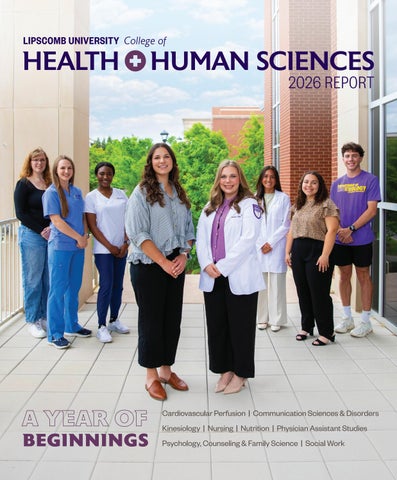
DEAN College of Health & Human Sciences Lynette Austin SENIOR PUBLICATIONS MANAGER Lipscomb University Janel Shoun-Smith WRITERS Janel Shoun-Smith Kim Chaudoin PHOTOGRAPHY Kristi Jones DESIGN Emily Kinney ON THE COVER: Students from each of the new College of Health & Human Sciences programs on the porch of the Nursing & Health Sciences Center. ABOVE: Physician assistant studies students in the Health Sciences Simulation Lab.
Creating a new team Lipscomb’s new College of Health & Human Sciences brings collaborative teamwork in patient care to a new level on campus. As many of you reading this report are practitioners in the health or human sciences, you may happen to know why the Mayo Clinic is called the “Mayo Clinic.”
Eight existing programs—six from the College of Health Sciences and two from the College of Liberal Arts and Sciences (CLAS)—are joining together as one team: the College of Health & Human Sciences.
It is named after its founding medical director, Dr. William Worrall Mayo. His name has survived to today on the walls of the hospital that was established in 1889.
The departments of Psychology, Counseling & Family Science and of Social Work & Sociology have joined the six majors in the health science college and will be known as the School of Social and Behavioral Sciences within the new college.
But actually there is much more to the story. In fact, Mother Alfred Moes, the leader of the Sisters of St. Francis, had the idea to start a hospital after a tornado struck Rochester, Minnesota, in 1883. Mayo and Moes worked for six years to establish the hospital, and then Mayo’s sons, Drs. Will and Charlie Mayo, took over when the original founders retired soon after and led the clinic for the next 40 years.
This move represents a strategic approach to preparing healthcare professionals for modern, team-based practice. Universities increasingly recognize that housing health professions together creates synergistic benefits that extend from education through clinical practice and research.
In short, the healthcare institution that has become known as the greatest in the world was created by a team. So many of the famous people in history are known for their great accomplishments as individuals, but the truth behind their success is more often about the people all around them: their team. “Teamwork” has become a watchword in healthcare, with national and international associations calling for integrated healthcare teams to treat patients. Accreditation associations require enhanced interprofessional education in colleges. Research studies have shown improved patient outcomes and patient satisfaction when they are treated by a collaborative health care team. At Lipscomb, this fall, we are creating a new team, one intended to produce graduates with enhanced confidence, improved conflict management skills and greater readiness for collaborative practice—attributes increasingly demanded by healthcare employers.
Bringing Lipscomb’s health programs and human science programs together will enable shared resources, coordinated curriculum development and streamlined administrative processes, as well as preparing Lipscomb graduates who understand professional roles, communicate effectively across disciplines, and function seamlessly in team-based care environments. Much like the integrated, team-based approach to medicine that the Mayo brothers pioneered in their ground-breaking clinic more than 130 years ago, Lipscomb is bringing together its students in eight health and human science professions to work as one team to improve patient care. I hope you will take a moment to look through these pages and see the exciting work that each of these programs is doing to contribute to the Lipscomb team, working in lock step to mold caring, knowledgeable, adept and professional health care providers of the future. Best wishes,
Dr. Candice McQueen (BS ’96) President, Lipscomb University
2 0 26 RE P ORT
1
MESSAGE FROM THE DEAN
A season of discovery W
hen I look back on the time since my arrival at Lipscomb University to lead the College of Health Sciences, which had just become its own standalone college, I feel a real sense of pride in the work of this growing team. I came in December 2023 to serve as founding dean for a college that consolidated some of Lipscomb’s most longstanding and successful programs into one academic structure. So much change and advancement has happened since, that it is hard to remember the days before I worked among these amazing people. As I have opportunities to experience the outstanding work of my colleagues I feel as though I’m continually unwrapping wonderful gifts. Here are a few of those accomplishments from the past year as our college continues to deliver its best. Board and certification examination pass rates for every Lipscomb health science program that requires them are outstanding— ranging over the past five years from 92% to 100% in the reporting year (You can see our latest pass rates throughout this report.). In every case, Lipscomb’s pass rates have exceeded the national average for the discipline, often by 8–10% and sometimes by as much as 30%. Those outcomes speak for themselves. Our accredited MS in Cardiovascular Perfusion is the only university program of its kind in Tennessee and one of only 21 such programs in the United States. If you aren’t
2
C O LLEG E O F H E ALTH & H U M AN SC IEN C ES
familiar with the work of a perfusionist, I encourage you to look it up—you will be impressed by the critical role they play in lifesaving cardiac care. Building on the faculty’s desire to innovate and collaborate together, we have added new programs in exercise science (specialty tracks in pre-PT, pre-OT, pre-PA and sports medicine), sport analytics and communication sciences and disorders (speech-language pathology). The School of Nursing was awarded almost $450,000 from the state of Tennessee over the last 12 months to bring its Accelerated Bachelor of Nursing program (ABSN), a 16-month degree combining online and inperson learning, to nursing students from rural areas, who will then serve in rural healthcare upon graduation. This summer has brought a new development that holds great potential for our college in the future: the Department of Social Work & Sociology and the Department of Psychology, Counseling and Family Science have now been consolidated into our college. As a group, we now have a new name to represent the entire team: the College of Health & Human Sciences. That consolidation brings many gifts, such as the play therapy education program within our clinical mental health counseling degree. This program was the first of its kind in Tennessee and remains as one of only a few
dozen Approved Centers of Play Therapy Education in the world (as recognized by the Association for Play Therapy) after 10 years. The clinical mental
health counseling program has pioneered integrating behavioral health into local health care teams since
2017 and earned a federal grant to develop a graduate
certificate in substance use disorder treatment designed for counselors, physician assistants, nurse practitioners, nurses and social workers.
In these pages, you will read stories of growth,
expansion and also innovations in interprofessional education, artificial intelligence education and
medical missions work. Above all, you will read about a faculty, centered in their faith in Christ, who seek to serve and mentor their students—walking alongside them in difficult moments and celebrating their successes as they forge ahead.
I am honored to serve with this group of talented,
loving Christian educators and staff members. I
hope that as you discover the work being done in Lipscomb’s now-College of Health & Human Sciences, you will feel as I do—that you have unwrapped something truly special.
Keep watching us in the months ahead!
Warmly,
Lynette Austin Dean, College of Health & Human Sciences
Walking with courage into the future of health and human sciences education Q
support clinician reasoning and manage author, affiliated with the workforce uestion: What do you get consultant Deel.com notes: in the coming lower-level tasks once completed by when you combine higher seasons “AI fluency will be baseline for providers, such as summarizing patient education in 2026 with programs every cohort entering the workforce” notes. There is potential for AI to relieve in health and human sciences? (Cunningham, 2026). healthcare providers of much of the Answer: Human-centered We gladly accept the charge to solutions to high-tech busywork that occupies their time each prepare students to be knowledgeable, healthcare challenges! day—but also there is potential for AI careful and responsible navigators of the This moment is a uniquely challenging to be misused in ways that could harm AI landscape, able to use each application time in higher education and in health patients or divulge private information. as a tool in the humanand human sciences. centered work of caring “WE KEEP MOVING FORWARD IN OUR Everywhere we look for others. We know there are questions: VERY HUMAN AND CHRIST-CENTERED this means intentional about access to a integration of ethics into BUSINESS OF TEACHING AND TRAINING college education, about every discussion and use the adequacy of the EACH STUDENT TO SERVE THE WORLD case of AI, and we’re healthcare workforce ready for that! THROUGH ALL THE APPLICATIONS OF pipelines seen in those Finally, we are HEALTH AND HUMAN SCIENCES.” institutions and about prayerfully working the impact of artificial on education access. BY LYNETTE AUSTIN intelligence (AI) on the I would love for every Dean, College of Health & Human Sciences whole education and student who wants to be training picture. educated in the Lipscomb What you’ve just read is a summary Let’s think for just a moment about University College of Health & Human of our working context. The reality is that the state of today’s workforce: to be very Sciences to be able to join us. That means we, as educators, in the College of Health blunt, there aren’t enough providers-toscholarships and partnerships. If you are & Human Sciences are never bored, and be in training at this time. The American an individual or business who would like here’s why. Hospital Association reported in 2024 to partner with us to help a student who First: as Christian educators, we that physicians, nurses, behavioral health otherwise would NOT be able to access a see that participation in the recruiting, Lipscomb education, we welcome you! and allied healthcare providers are facing retention and graduation of committed, In the meantime, we keep moving looming shortages, projecting, for example, Christ-animated individuals is a way forward in our very human and Christthat 42 states will experience significant we can minister to our community— centered business of teaching and nursing shortages by 2030 (AHA, 2024). both local and global. We are trained training each student to serve the world Their projections appear to be on target. through all the applications of health and practitioners (in a variety of disciplines); Hospitals and agencies work independently human sciences. to try to resolve workforce shortages in their we became educators to expand services own spaces through the use of innovative solutions such as virtual nursing programs, job sharing initiatives, use of traveling substitute providers and sometimes through partnerships with universities. Artificial intelligence is seen by some as the solution to shortages. AI is now used to extend practitioner engagement,
beyond what we could have provided on our own. We take this very seriously!
Second: we are committed to wise
integration of artificial intelligence into our educational programs. We KNOW
that our students must be AI-ready when they walk out of our classrooms. Their employers will demand that. As one
American Hospital Association. (2024, November). 2025 healthcare workforce scan. https://www.aha. org/system/files/media/file/2024/11/2025-Health-
Care-Workforce-Scan.pdf
Cunningham, Kim. (2026). Class of 2026 AI fluency. https://www.deel.com/deel-works/class-of-2026ai-fluency/
2 0 26 RE P ORT
3
Health science students prepped for an AI world through speaker series and faculty research Artificial intelligence (AI) has already transformed the healthcare world in ways both big and small, and Lipscomb’s future health science professionals will be prepped to navigate that world thanks to research and initiatives by college faculty. Faculty are not only exploring ways that AI can be used to enhance health science education, but also researching ways it is already used in the healthcare industry and bringing their findings to colleagues and students on campus. In fall 2025, the Healthcare Horizons Speaker Series was established, launching with a five-part series on AI. A team of CHHS faculty who developed the Applied Artificial Intelligence in Healthcare course, an elective within Lipscomb’s Master of Science in applied artificial intelligence, shared their expertise on the intersection of AI and healthcare delivery over the course of the 2025-26 school year. “We are all trying to look at what is currently possible and actively used in clinical situations and also spend some time thinking about what the future might hold as well,” said Matt Steidl (BS ’00), lead faculty for the elective course and associate professor in the physician assistant studies program. Speakers in the 2025-26 series included: • Steidl, who spoke on “Smart Care, Human Touch: Integrating AI into PA-Delivered Healthcare;” • Jay Dorris (LA ’07, Pharm.D. ’14), assistant professor in the College of Pharmacy and healthcare informatics program, spoke on “Scripting Logic: AI, Informatics and the Future of Medication Management;” • Meagan Spencer, director of communication sciences and disorders, and Amy Staggs Draper, assistant professor of nutrition, spoke on “Kit Upgraded: The AI Toolkit for Nutrition and Speech Pathology;” and • Jenna Sissom (LA ’03), assistant professor in the School of Nursing, discussed “AI in Nursing: How AI can Assist Nurses in Trending Data and Continuity of Care.”
In the Applied Artificial Intelligence in Healthcare course, summer 2025 students developed their own AIpowered medical scribe, said Steidl, who gave a live demonstration of that AI bot at the Horizons series lecture. Also this past fall, Steidl, Sissom and Spencer presented their AI expertise at Lipscomb’s premier event in its Presidential Signature Series, the Illuminate conference, a one-day October conference designed to help attendees discover how faith can inform and shape their professional lives. The 2025 conference focused on “Working with Purpose,” and the college empaneled a group of experts to discuss “Artificial Intelligence and Healthcare: A Challenge to Christian Ethics?” Other AI research is ongoing in classes, such as Assistant Professor Zach Droll’s innovative teaching project, where Droll’s students have coded an AI platform to provide assessments using a teaching principle called varied repetition. Using this principle, the AI system randomly presents test questions from curriculum units covered earlier in the semester, creating spaced and randomized retrieval across the semester. “The AI system is also adaptive,” said Droll. “As students consistently answer questions correctly, those questions are gradually phased out and replaced with more difficult ones that extend the same concepts. When questions are expanded, the AI is instructed to incorporate research from the past five years in leading journals such as the Journal of
Assistant Professor Zach Droll working with students on research into AI teaching.
4
C O LLEG E O F H E ALTH & H U M AN SC IEN C ES
Strength and Conditioning Research and publications from the International Society of Sports Nutrition.” Students track their usage of the system, and that data is anonymously compared with course performance. Each student serves as their own control by completing the first half of the semester without the AI system, allowing the students to evaluate whether AI-supported spaced retrieval improves learning outcomes. Jeffrey Adams, director of the Health Sciences Simulation Lab, also enacted a research project this spring semester focused on verifying if AI platforms provide consistent results when used to grade health sciences students’ work documenting patient care. Adams, co-principal investigator Steidl and student intern Charlotte Ran are inputting a set of 60 SOAP (Subjective Objective Assessment and Plan) notes that students write after a healthcare simulation and then faculty grade. The research is testing to see if AI can be trained to consistently grade SOAP notes across all students, providing a reliable grading method. If proven reliable, AI grading of SOAP notes could save faculty a great deal of time that could be re-focused on students, said Adams.
Learn more at lipscomb.edu/ healthcareAI26.
Jenna Sissom shared her expertise in AI use in the nursing field at the Horizons Speaker Series.
Heart of the CHHS is beating strong AI capabilities and new director take simulation center to a new level The Health Sciences Simulation Center is the beating heart of Lipscomb’s health professions programs, and the college is not neglecting its own cardiac health. With new Director Jeffrey Adams hired in 2025, the simulation center is providing a new level of clinical, academic and technological training, incorporating the latest in AI capabilities, to Lipscomb’s perfusion, physician assistant (PA) studies and nursing students. The simulation center opened in 2012 in the Nursing and Health Sciences Center, sporting 19 computerized mannequins capable of simulating symptoms of a range of illnesses and wounds in an authentic hospital-like setting. Over the years it has evolved to include assessment rooms for PA students and an operating room for the perfusion program, two cardiopulmonary manikins and three premature baby manikins, audio and visual equipment allowing professors to remotely run simulations while still interacting with students, and a 3-D printer used to make training devices such as silicone suture pads, plastic hands for an IV or simulated telemetry monitoring boxes. Adams, hired in summer 2025, has brought extensive knowledge in applying AI techniques to medical simulation education and operations and is developing a new slate of certificate programs targeted to those interested in, or already working in, the simulation industry. Adams is working to offer certificates covering simulation operations, standardized patient certification, and administration and leadership in health simulation education. “In the health simulation industry, there is no defined entry point. You just fall into it and learn the skills hands-on,” said Adams, who has experience in managing large, multi-campus simulation programs at colleges including Edward Via College of Osteopathic Medicine, Philadelphia College of Osteopathic Medicine and The Ohio State University. “So I have developed an entry-level program to be able to consistently train the next generation coming into the field, so that
simulation expertise is not so siloed within the industry.” At Lipscomb’s simulation center, Adams has led efforts to expand the center’s curriculum, implement innovative AI-driven simulation tools and foster interprofessional training opportunities for both students and practicing healthcare professionals. Adams is the author of the Textbook of Modern Medical Simulation and Engaging Minds: Rethinking Student Assignments in the Age of AI, which was informed by his experience incorporating the latest in AIdriven simulation tools to medical simulations in Pittsburgh and Virginia. Adams is an expert in strategies to leverage AI as a creative teaching partner, such as using AI to create case studies that better match specific course learning objectives. By building his own custom “bots” in today’s generative AI platforms, he has not only saved preparation time opening up hours to spend with students, but also ensured that pre-briefings, grading and assessments are all precisely aligned with learning objectives and accreditation requirements, he said. AI technology is also allowing him to program the patient mannequins to simulate more complex situations for students, including the ability for the simulators to converse with students, to react and change during the exercise based on the treatments provided and to simulate various cultural situations. He can also pre-program lab results to incorporate into simulations and to more quickly develop creative games for students
New Director Jeffrey Adams in the Health Sciences Simulation Lab.
and youngsters who visit the lab to learn about
healthcare using the simulators, he said.
“AI is a game changer for simulation,”
he said. “We’re just beginning to scratch the
surface of what’s possible, whether it’s making
mannequins more interactive or creating virtual patient encounters that are consistent and
measurable. My goal is to ensure Lipscomb is at
the forefront of these innovations.”
2 0 26 RE P ORT
5
01
Health science missions program gets a booster shot
02
03
03
04
For decades, medical missions have been integral to Lipscomb University. Today, the College of Health & Human Sciences is building on that legacy with strategic, interdisciplinary partnerships that integrate faith and clinical excellence in service to communities near and far. To support that effort, the Vultee Charitable Foundation, a local foundation created by the former Vultee Church of Christ in Nashville, provided a generous booster shot of support through a $100,000 donation in February. The responsibilities of leading a mission opportunity make for “a very intense time for faculty,” said CHHS Dean Lynette Austin. “It is difficult to ask faculty to give of their own money when they are already giving so much of their own heart. Through this donation, faculty can be supported financially so that they can pour all of their work and caring into the students.” The contribution, to support faculty and student mission trip scholarships, followed the October 2024 creation of an interdisciplinary College Medical Missions Committee, charged with creating meaningful partnerships with community stakeholders to promote and expand these transformative, spiritual and educational experiences, both locally and abroad. Since the creation of the CHHS missions committee, the group has been strategically developing processes and a formal evaluation for existing and potential new partnerships for trips, with other new locations currently undergoing evaluation. “The vision is to eventually create a donor-funded medical missions center in the college to broaden the impact for students, faculty and the communities served,” said Anne Lowery, chair of the CHHS missions committee, dietetic internship director and associate professor. “We want to increase interdisciplinary domestic and global trips led by faculty or alumni, through long-term, sustainable and ethical partnerships.” The committee’s work to form strategic partnerships is already bearing fruit. Two new mission trips were launched for spring break 2026: one to Predisan Health Ministries in Honduras (05-10) and the second to the Health and Hope Clinic in Pensacola, Florida (01-04).
Learn more at lipscomb.edu/VCFdonor26.
6
C O LLEG E O F H E ALTH & H U M AN SC IEN C ES
06
MISSIONS UPDATE
05
07 08
07
07 09
10
2 0 26 RE P ORT
7
Interprofessional Education Committee shapes the future of health science education Health science students college-wide learned from a unique experience in March designed to help them identify and aid victims of human trafficking in the emergency room or urgent care setting, a critical need in today’s world where up to 68% of survivors report seeing a healthcare professional during their exploitation but only 5% of healthcare professionals report having identified a victim in their care. Partnering with the Nashville Anti-Human Trafficking Coalition, the college’s Interprofessional Education (IPE) Committee developed a high-stakes clinical simulation and discussion for physician assistant (PA), nursing, dietetics, social work and marriage and family therapy students. Divided into mixed-discipline teams, students analyzed seemingly unrelated patient cases across various clinical settings. Initially, each group member focused on their specific scope of practice, however as the simulation progressed, the teams shared findings and clinical observations to identify the common denominator: human sex trafficking.
Summer Scholars attracts high-achieving students to healthcare There’s only one place where high-achieving rising high school seniors can tour an emergency medical helicopter and an ambulance, see a chocolate-making demonstration, see muscle structure through an ultrasound and diagnose a patient, all in eight days. 8
C O LLEG E O F H E ALTH & H U M AN SC IEN C ES
The session was designed to sharpen diagnostic intuition and highlight the power of interprofessional vigilance. After the simulation, students engaged in a facultyled debrief session along with guests from the coalition, who shared best practices to recognize and advocate for victims. This event was the latest to be coordinated by the college’s IPE committee, established in fall 2024. The committee focuses on creating shared learning opportunities that prepare students for the complex, team-based nature of modern healthcare delivery.
That would be the College of Health
& Human Sciences’ track in Lipscomb’s
Summer Scholars program, an eight-day
experience emphasizing experiential learning
in and outside the classroom.
This highly competitive program is
specially designed to give high-achieving
rising seniors the opportunity to earn college credit hours while still in high school.
The committee includes chair Abbey Wu of the PA program; Amy Draper, of dietetics; Libby McCurley of kinesiology; Beth Twomey and Daelyn Wright of nursing; Autumn Maxwell and Erica Vasquez, of social work; Meagan Spencer of communication sciences and disorders; Jeff Adams of the Health Sciences Simulation Center; and Meghan Lacks of marriage and family therapy.
Learn more at lipscomb.edu/ leadsIPE26.
Students selected complete real university coursework, explore Nashville and meet peers from across the country. The CHHS activities are designed to give the students a glimpse at each of the health science disciplines represented in the college, from a demonstration of a heart/lung perfusion machine to visiting a local non-profit clinic to learn about its wellness program and community garden. At the end of Summer Scholars, the students played a game in the Health Simulation Lab where each team had to decide which healthcare provider to contact based on the symptoms displayed by each patient simulator. The program not only steers more well-informed students into the healthcare field, but it also has a very successful record of bringing highachieving students into Lipscomb’s health science programs.
COMMUNICATION SCIENCES AND DISORDERS
New communication sciences and disorders program launches this fall As the only speech pathology bachelor’s program in Nashville, program addresses local workforce, healthcare gaps. The College of Health & Human Sciences announced a new endeavor in early 2025: the launch of a new undergraduate degree in communication sciences and disorders, designed to meet the growing demand for professionals in speech-language pathology and audiology (SLPA) and related fields. The enactment of the program in August 2026 will make it the only undergraduate program in communication disorders and the speech pathology field in Nashville. Graduates will be able to immediately enter the workforce or pursue advanced degrees in speechlanguage pathology or audiology. The college began offering courses in fall 2026. Meagan Spencer (pictured), a veteran speechlanguage pathologist, educator and advocate for rural healthcare access, was hired as the founding director of the undergraduate program in March 2025. She came to Lipscomb from FreedHardeman University where she served as program coordinator and director of the FHU Speech Clinic. As the current president of the Tennessee Association of Audiologists and Speech-Language Pathologists and a recognized leader in the field, Spencer brings expertise in clinical education, rural health advocacy and program development. Since onboarding at Lipscomb, Spencer has developed a curriculum with multiple pathways to the profession, including both a Bachelor of Arts or Science with clinical or non-clinical tracks, a three-year accelerated format for both degrees and leveling programs for postbaccalaureate students to apply for graduate school or SLPA licensing.
During the past year, Spencer has worked to build a bachelor’s program that tightly aligns with the American Speech-Language and Hearing Association (ASHA) standards, as required for entering master’s level SLPA programs. Within the coursework, Spencer has infused innovative educational approaches such as AI-assisted learning, experiential learning activities, a “book club” experience connecting literature to clinical concepts and Spencer’s own Trinity Learning Integration model, bringing mind, body and spirit to learning, thus reflecting Christcentered work. “I really believe that speech-language pathology is a vocational ministry,” said Spencer. “In this field, we have the opportunity to serve individuals across all ages and stages of life, from newborns in the NICU to elderly patients in the final stages of dementia. This profession is about restoring dignity, improving quality of life and empowering individuals and their families.” Students will start from their first semester engaging with the community in volunteer opportunities, shadowing SLPA professionals and working alongside the local SLPA community of practitioners and advocates. In 2027, a clinical director will be hired to coordinate the sites for students to earn
the required 25-hours of clinical observations and the required 100-hour clinical practicum, where students will work with a speech-language pathologist for one day a week in schools, private practices and community clinics. With its location in the heart of Nashville, a city known as a healthcare hub, Lipscomb’s new program is well-positioned to become a leading training ground for future speechlanguage pathologists. “There is a tremendous need for rehabilitative services in the region,” Spencer said. “This creates a wealth of opportunities for our students to gain meaningful clinical experiences across diverse settings, from schools and hospitals to private practices and community health centers, while making a real difference in the lives of those who need these services most.”
2 0 26 RE P ORT
9
NURSING
Opening doors to the nursing profession School of Nursing’s online accelerated program makes a nursing degree more accessible, more quickly for all. The demand for highly qualified nurses is not letting up any time soon, and Lipscomb’s School of Nursing is continually striving to create more pathways to a nursing career, the nation’s largest healthcare profession. Bachelor’s-level educated nurses are in great demand by employers, and in 2024 Lipscomb’s School of Nursing established a new Accelerated Bachelor of Nursing (ABSN), allowing students with a bachelor’s degree or higher in another field to earn a BSN in just 16 months through a hybrid format combining online and in-person learning components. While the ABSN offers remote learning for those not near Lipscomb’s campus, it also maintains the high academic standards of Lipscomb’s traditional nursing program, as evidenced by the 100% first-time NCLEXRN pass rate of the
10
C O LLEG E O F H E ALTH & H U M AN SC IEN C ES
inaugural ABSN cohort, who graduated in December 2025 and who all stepped directly into nursing roles. “With the Accelerated BSN program, we are opening doors for more individuals to join the most trusted profession in America,” said Chelsia Harris, executive director of Lipscomb’s School of Nursing. “Our program is designed to nurture the mind, body, and soul of both students and patients, providing a Christcentered environment that promotes academic success and character development.” In just the first cohort, the ABSN has brought post-baccalaureate candidates who already had healthcare experience in research, as a medical assistant and a specialist on an endoscopy team into the nursing field. And the
numbers are growing, with 120 people applying for 20 spots in the fall 2025 semester, said Ashley Jackson (MBA ’22), assistant program director in nursing. The ABSN program also opened a door to developing an additional pipeline for candidates who reside in rural areas pumping straight into the nursing field. In spring 2025, the school secured a nearly $220,000 grant from the Tennessee Department of Labor and Workforce Development’s Rural Healthcare Initiatives Program to launch the Tennessee Rural Workforce Initiative for Nursing (TN R-WIN). This innovative pilot program is designed to address the critical nursing shortage in Tennessee’s rural communities by recruiting and supporting students from underserved areas to complete Lipscomb’s ABSN degree.
Students are advancing community health to under-resourced seniors
The cohort of six students, hailing from Montgomery, Sumner, Giles and Williamson counties, began their studies in fall 2025, with the majority of their clinical rotations held at TriStar NorthCrest Medical Center in Robertson County, a rural area with a significant need for skilled nurses. TDLWD is providing comprehensive financial support for the first two semesters of the four-semester ABSN program, including full tuition, fees, supplies, travel expenses and overnight accommodations when necessary. In March, the TDLWD awarded Lipscomb another $225,000 to fund a second six-student cohort for the ABSN program, as well as a series of rural health lunch-andlearn sessions for all Lipscomb nursing students. The sessions will feature rural healthcare experts sharing on topics such as access to care, rural healthcare challenges, and the synergies and positive aspects of rural communities. “Our hope is that these lunch and learn sessions will inspire the next generation of nurses to consider careers in rural healthcare and advocate for rural communities and access to care,” said Harris. All Lipscomb nursing graduates continue to be highly sought after, with 100% of graduates reporting job placement in careers for which they were trained every annual report year for the last decade. The university’s strong partnerships with over 30 clinical sites, including Vanderbilt University Medical Center, Monroe Carell Jr. Children’s Hospital at Vanderbilt, National Healthcare Corporation, Ascension and HCA Healthcare provide students with diverse and practical clinical experiences.
Before even earning their degrees, Lipscomb nursing students are already on the front lines—delivering preventive care, health education and vital resources to neighbors through coordinated outreach, structured service-learning and sustained partnerships. Through the Community Health course, nursing students routinely visit local community centers to deliver health services, distribute donated supplies and engage in fellowship with participating seniors. Beginning in summer 2025, the course became the anchor of a formal initiative empowering student nurses to promote public health in diverse settings—beginning with sustained service to seniors at Nashville’s Hadley Park Community Center. After three semesters of highly effective collection drives, the school is advancing what is now called the Lipscomb School of Nursing Mobile Community Corner Store with plans for a dedicated on‑campus storehouse as well as a coordinated, interprofessional healthcare model that brings multiple disciplines together to enhance senior care and health education. Today’s students are advocating for senior participants by addressing social drivers of health, providing access to care and care essentials, empowering senior communities, reducing disparities and improving continuity of care. Fundraising began this February for future construction of the storage space in the Nursing and Health Sciences Center to house hygiene, household, wellness and medical essentials; health education materials; non-perishable food; undergarments; T-shirts; and socks, all items that the students continue to collect. There is also an initiative in progress to integrate comprehensive community health outreach into the activities of the college’s Interprofessional Education Committee, with a goal to strengthen community impact and enrich the educational experience for students across multiple disciplines, said Roletha Pillow, associate professor of nursing, who has coordinated these efforts through instruction of the Community Health course since summer 2025.
2 0 26 RE P ORT
11
New travel course offers nurses a convenient way to fit global learning into their academic schedule Lipscomb nursing students had a new opportunity this spring to combine health sciences with global learning and the arts, through the short-term travel course The Art of Anatomy, Culture and Healthcare, held in Italy in May. Twelve biology and nursing students signed up to participate in the two-week trip, where students learned about the connections between art and anatomy. The trip offered a rare opportunity for nursing students to be able to incorporate global travel into their rigorous course load. The Art of Anatomy, Culture and Healthcare course, expected to be offered every other year, not only serves as a nursing elective for Lipscomb nursing students, but it also allows them to fit global travel more conveniently into a four-year track for their undergraduate studies, said Jill Stafford, assistant professor in the School of Nursing and co-director of the trip. “Faith and history have shaped what we carry out as today’s best nursing practice, and a lot of that has emerged from other
cultures,” said Stafford. “We hope this trip will make student nurses more well-rounded, culturally sensitive practitioners. In addition, touring current Italian hospitals will allow them to see similarities and contrasts with their own clinical experiences in Tennessee.” The co-biology and nursing course utilizes Lipscomb’s villa in Florence as a home base for students as they study the history of art and how it has influenced anatomy and healthcare. Students also carry out online pre-travel assignments starting in March. Students visited two early dissection theaters, in Padua and Bologna, where public dissection was held for students during the transition from Medieval times to the Renaissance, when scholars began studying the actual make-up of the human body. Also on the agenda were visits to churches and a viewing of the David sculpture by Michelangelo, who actually dissected bodies to observe the accuracy of muscle placement on the human form, said Jill Kirby, associate professor in biology and co-director of the trip. “I want students to sharpen their observation skills, because in healthcare, noticing the small details can make all the difference,” she said.
Students viewing anatomical wax models inside La Specola Museum in Florence.
Students in a historic anatomical theater at the University of Bologna.
Students also heard a lecture by a healthcare professional about the hospital’s experience during the Covid-19 pandemic, which was particularly pervasive in Italy. “There is a historical connection there that goes all the way back to the plague,” said Kirby. “I want students to reflect on how trust in the healthcare system has changed over time—and what lessons from the past can teach us about today.”
100%
2025 Overall Pass Rate for NCLEX-RN *First-time 2025 NCLEXRN pass rate was 97.1%. 12
C O LLEG E O F H E ALTH & H U M AN SC IEN C ES
School secures THA Healthcare Collaborative Grant Lipscomb was awarded a $50,000 Healthcare Collaborative grant in 2025 from the Tennessee Hospital Association in collaboration with Ascension St. Thomas Midtown, a leading healthcare provider in Middle Tennessee. The grant will strengthen the school’s clinical education programs, through the Clinical Teaching Partnership (CTP), formed by the School of Nursing and Ascension St. Thomas Midtown in August 2023. The purpose of the partnership is to help bridge the nursing workforce shortage by providing Lipscomb nursing students with valuable clinical experiences and professional role immersion, thereby supporting both educational and staffing needs. “This grant will allow both Lipscomb and Ascension St. Thomas Midtown the opportunity to work collaboratively on how to sustain this partnership long term, while navigating the ever-changing nature of healthcare,” said Chelsia Harris, executive director of the school. “This partnership equips the future nursing workforce in a manner it would not have traditionally received.” The partnership with Ascension St. Thomas Midtown underscores Lipscomb’s commitment to excellence in nursing education and healthcare workforce development. “It provides students with hands-on experience in a dynamic healthcare setting, enhances their clinical and time management skills, and immerses them in the nursing profession early, fostering a strong sense of belonging within a professional team,” Harris said.
Faculty bring scholarship to nursing program Three nursing professors completed their doctorates in 2025-26 and have brought their scholarly expertise to Lipscomb students and the nursing field through their dissertation research projects. Ashley Jackson (MBA ’22), assistant program director of the Accelerated Bachelor of Science in Nursing program, earned her Doctorate of Nursing Practice from Vanderbilt University in May 2025. Her research involved the benefits of intentional mentorship on new RNs entering the practice. Sparked by a marked decline in the initial competency of new RNs since 2011, Jackson worked to develop and assess the effect of a six-week intentional mentorship program on new RNs’ perceptions of practice readiness and preparedness. At the conclusion of the mentoring program, 100% of new nurses reported practice readiness compared to 66% of new nurses in the control group. Ellen Campos, assistant professor, completed her Doctor of Nursing Practice at Belmont University in May 2025. Research that grew out of her dissertation work was published in Advances in Neonatal Care.
“Saving Lives at Birth: Launching a Neonatal Resuscitation Escape Room to Combat High Infant Mortality Rates,” was a quality improvement project to design and implement a simulated escape room to improve neonatal resuscitation outcomes among undergraduate students in South India. Undergraduate nursing students who completed an asynchronous maternal–fetal nursing course followed by an in-person simulated neonatal resuscitation escape room demonstrated a measurable increase in knowledge retention on the infant distress portion of the post-test following participation in the escape room. Christine Deere (BSN ’16), received her Doctor of Nursing Practice from Union University in May 2026. Deere studied the impact of a formal mentoring program on job satisfaction among new nursing faculty. The quality improvement project implemented a formal mentoring program at Lipscomb’s School of Nursing in which novice faculty were paired with experienced faculty mentors and met regularly over one academic semester. Results indicated improved perceptions of support, role clarity and overall job satisfaction among participants.
“WE ARE IMPRESSED WITH THE PROGRAM’S GOALS AND THE SCHOOL OF NURSING’S DEDICATION TO HEALTHCARE WORKFORCE DEVELOPMENT IN TENNESSEE. YOUR WORK WILL UNDOUBTEDLY IMPROVE THE LANDSCAPE OF THE HEALTHCARE WORKFORCE IN YOUR REGION AND BEYOND.” ANDREW BURNETT Vice President of Workforce and Rural Health at the Tennessee Hospital Association 2 0 26 RE P ORT
13
CARDIOVASCULAR PERFUSION
Partnerships to empower the heart professional experience in other At just five years old, Lipscomb’s cardiovascular have healthcare fields. As these candidates may be a few years removed from their foundational perfusion program is already making a big college education, they can find it difficult impact on the local healthcare industry, to be accepted into the perfusion field, yet they bring a great deal of professionalism including through expanded partnerships with with them, said Nicole Smith, the program’s director of operations. the city’s premier hospitals. Since its establishment in 2021, the program has expanded available spots for students, opened up admission to more students with professional backgrounds and graduated its fourth cohort this past May. As of 2026, the program partners with 45 clinical sites throughout the U.S. for student rotations. New agreements for both adult and pediatric rotations have been signed with Vanderbilt University Medical Center, the flagship of healthcare in Nashville, a city recognized as a global center of healthcare. Already in Tennessee, eight Lipscomb alumni are working in the state’s hospitals, seven of those in Middle Tennessee and six in Nashville, a healthy outcome for a field that only has 21 schools in
14
C O FDHU/ E ALTH & HOUNM AN SC IEN C ES L IOPLLEG S C O MEB.E E D U CATI
the nation producing only 300 graduates nationwide last year. One Lipscomb perfusion graduate has gone to work at a company developing a new cutting-edge technology for the perfusion field and some have moved immediately into the field of pediatric perfusion. “Historically, in perfusion, you would work three to five years in the profession before you would go into pediatrics, but we’ve had graduates who have gone straight into those programs, so that’s pretty exciting that they trust Lipscomb graduates for such a unique specialty,” said Chad Smith, director of perfusion education. The perfusion program has added four cohort spots, jumping from 12 to 16 students per year, and has added a new admissions pathway for candidates who
Lipscomb’s on-campus cardiovascular simulation lab is well-stocked to introduce students to the various devices they will be using before heading out to their first clinical rotation, including the same heart/lung machine they will see in operating rooms today, and an auto transfusion and HIPEC machine, among other equipment. “We find that there are hospitals who are on the lookout for our graduates. When they see them, they know the education that they’re getting, they know the experiences that they’re getting, and they know that this person will be a high quality candidate. So we’re excited that our students are helping build our reputation in the community,” said Nicole Smith. Lipscomb’s perfusion program is accredited by the Commission on Accreditation of Allied Health Education Programs (CAAHEP) and has graduated 50 since the program launched.
Top state official appointed as director of cardiovascular perfusion
“WE FIND THAT THERE ARE HOSPITALS WHO ARE ON THE LOOKOUT FOR OUR GRADUATES.” NICOLE SMITH Director of Operations for the Cardiovascular Perfusion Program
92% Retention
96% Job Placement
Chad W. Smith, a distinguished practitioner, state leader and educator in the field of cardiovascular perfusion science, was appointed in October as the new director of perfusion education at Lipscomb. Smith, who serves as chairman of Tennessee’s State CommitteeClinical Perfusion, contributed to Lipscomb’s program development and admissions processes as a member of the Advisory Committee for Perfusion since 2021. As a member of that committee, he provided recommendations to ensure the program is aligned with the latest advancements in the field, on new equipment, on procedures and industry trends and on how to allocate resources effectively. Smith, of Brentwood, has also served in the program as an instructor and as a crisis resource manager, providing training on unusual clinical circumstances. He has more than two decades of accomplished service spanning business ownership, clinical practice, academic administration and regulatory leadership. He was appointed to the Tennessee Board of Medical Examiners’ Committee for Clinical Perfusion by Governor Bill Lee in 2013 and became its chairman in 2017. In the clinical arena, Smith has served as managing partner and clinical cardiovascular perfusionist at Palm Perfusion PLLC since 2001 and as regional director and member at Comprehensive Care Services Inc./CCS-Palm LLC since 2021. As an entrepreneur, Smith helped establish and manage the Nashville Perfusion Conference beginning in 2015. The conference provides Continuing Education Units (CEUs) essential for licensure and certification. He also co-founded HealthcareCEUs.net PLLC. Smith’s academic credentials include a Master of Science in perfusion science from the University of Nebraska Medical Center, a Post-Baccalaureate Certificate in perfusion sciences from Vanderbilt University Medical Center, and a Bachelor of Science in respiratory therapy from the University of Central Arkansas.
94% First-time Pass Rate on ABCP Exams
2 0 225-26 0 26 RE P ORT
15
PHYSICIAN ASSISTANT STUDIES
The science of excellence School of Physician Assistant Studies improves access and quality of medical education with new courses, mentoring and resources. With six years of data on its six successful graduating cohorts, the School of Physician Assistant (PA) Studies is taking a decidedly scientific approach to maintaining its excellence and enhancing students’ access to a medical education. “The transition from undergraduate studies to the rigorous, fast-paced curriculum of PA school is one of the biggest leaps a student will make,” said Jason Huddleston, associate dean and director of the school. “Because our students come to us from varying academic backgrounds—some having completed their anatomy and physiology prerequisites several years ago—we believe in setting everyone up for success before day one.”
16
C O LLEG E O F H E ALTH & H U M AN SC IEN C ES
The program has implemented several programmatic changes to ensure that every student in the cohort has the foundational knowledge and critical thinking methods needed to advance to the clinical level of medical education. In spring of 2025, the school debuted the Clinical Reasoning and Problem-Solving three-course series, taken in semesters two, three and four, to better transition students from knowing how to gather knowledge to knowing how to apply that knowledge and synthesize it into practice. The courses use more case-based discussions and simulated patient experiences to help students develop and apply effective clinical reasoning strategies, analytical reasoning and evidence-based decision-making to diagnose and manage diseases, said Huddleston. While the program has always offered traditional faculty mentoring of
students, in 2025 the school moved to a success coaching model, where faculty collaboratively partner with students to support their personal well-being, to optimize study strategies and to empower them to recognize their own hurdles and create action plans, said Huddleston. After implementation in the fall semester, the program maintained all 50 students in the fall 2025 cohort through to the spring semester, a major retention win, he said. In additional efforts to ensure that all students enter the program at the same academic level, the PA school utilizes a standardized, diagnostic assessment, the Human Anatomy and Physiology Society (HAPS) Comprehensive A&P exam, prior to students entering the program.
PA students put service first
“The HAPS exam helps us personalize our onboarding process,” said Huddleston. “Based on these insights, we invite all incoming students to participate in our optional Summer Excelerator Program (SEP). This proactive initiative provides an academic runway, allowing students to refresh their foundational sciences, calibrate their study strategies and adjust to the velocity of graduate-level coursework in a low-stakes, highly supportive environment.” SEP, an optional six-week supplemental program of structured and self-guided academic resources, has proven very successful. After being offered for two incoming cohorts, the program has yielded highly encouraging results, demonstrating a clear link between active participation and early programmatic success. “As we look to the future, we are actively using these promising early indicators to continually refine and improve the curriculum, ensuring we maximize its impact as the program scales to reach more students,” said Huddleston.
Seven PA students and one faculty member participated in one of the two first mission trips coordinated through the CHHS Medical Missions Committee this past March. Linda Elrod, adjunct faculty, and the students traveled to Honduras to serve in partnership with Predisan Health Ministries, a Honduran-based, Christian healthcare organization based in the city of Catacamas (see page 6). The team provided health fairs and education as well as offering health clinics, to offer an interdisciplinary experience for all health sciences students. But that’s not the only helping hand that Lipscomb’s PA students provide. Student-led groups have: • Volunteered at Nashville’s Dream Streets, an organization that provides food banks, mom groups, job readiness programs and transitional housing; • Made greeting cards to be distributed to nursing homes and to families battling childhood cancer; • Coordinated a Thanksgiving food drive that collected 177 pounds of food and volunteered at Second Harvest Food Bank, packing 3,100 meals for those dealing with food insecurity across Middle Tennessee; • Sorted donations for Project Cure, which ships nearly expired donated medical supplies all over the world, and • Held two teddy bear repair clinic, one at Lipscomb in fall 2025 and one held at Nashville’s Johnson Elementary School this past spring.
2 0 26 RE P ORT
17
KINESIOLOGY
Moving from PE to health science Kinesiology keeps pace with rapidly evolving exercise science field in today’s fitness-conscious world. The world of exercise science has moved far beyond high school gym class, and Lipscomb’s Department of Kinesiology is leading the way. With new academic programs, online degrees, course tracks and accreditations, Lipscomb kinesiology is keeping all its graduates at the forefront of an industry that now reaches into hospitals, rehabilitation centers, the offices of professional athletics teams and individuals’ homes. Embracing the expanded role exercise science plays in today’s world, the department’s master’s degree is now called Master of Science in Professional Studies in Kinesiology and is offered as an asynchronous online degree with a goal to equip individuals, even while they are still working full-time, to improve health outcomes through sciencebased practice grounded in ethical leadership and faith-informed values. In 2025, the department launched three new 12-hour, fully online graduate-level certificate programs in exercise physiology, strength and conditioning, and exercise and sport nutrition, designed for professionals who already hold a bachelor’s degree in exercise science-related areas or other fields. In fall 2026, students will be able to stack these three certificates to earn the 36-hour Master of Professional Studies asynchronously,
18
C O LLEG E O F H E ALTH & H U M AN SC IEN C ES
through online courses that do not require specific times for live instruction, allowing students to work at their own pace, said Laurel Littlefield, graduate program director. These certificates, built on the firm foundation of Lipscomb’s longtime graduate offering—called Exercise and Nutrition Science and then Exercise and Human Performance—provides students the strategic opportunity to advance careers with specific top industry certifications in coaching, personal training, kinesiology, sports nutrition or allied health. Over the past year, the department has added pre-physical therapist, preoccupational therapist and pre-physician assistant course tracks designed to keep students on the right path toward their chosen health science career. Seventy-five percent of kinesiology students enter Lipscomb interested in one of these three career paths, which have strict prerequisites for entering their respective graduate programs. Following Lipscomb’s recommended course tracks takes the guesswork out of creating course schedules each semester and provides confidence that the course schedule will lead to a smooth entry into graduate school, said Matthew Ruiz, chair of the department.
The PT course track is boosted in value by the addition of faculty member Jennifer LaRocca, a physical therapist for over twenty years, who joined the faculty in 2024. Also in the clinical care field, a sports medicine major will debut in August 2026. With a large percent of majors expressing a desire to go into medical school, the major will funnel them through all the pre-medical prerequisites as well as key courses in kinesiology including Exercise Physiology, Anatomical Kinesiology, Biomechanics and Principles of Strength Training. Graduates of the sports medicine major can go into medical school for either an MD or DO degree in areas such as orthopedics, physical medicine, sport medicine and other medical fields that focus on musculoskeletal, neurological and functional rehabilitation to improve mobility and quality of life. Strength and conditioning is a growing field within high school and college athletic programs, said Ruiz, and certification is required in order for graduates to work in the field. To meet that demand, the department has added a strength and conditioning
Sport analytics program established, first graduates launched
course track and is currently developing courses and resources to achieve accreditation by the Council on Accreditation of Strength and Conditioning Education (CSN), to allow students to graduate as certified for strength and conditioning training. That accreditation requires two faculty certified as strength and conditioning specialists, and the department now has two: Libby McCurley, associate professor, who came to Lipscomb in 2024, and Zachary Droll, assistant professor, at Lipscomb since 2025. In order to enhance the instruction in the exercise and sports nutrition track, Droll has become a Certified Sports Nutritionist credentialed by the International Society of Sports Nutrition, thanks to an institutional grant from the university. His certification enhances the department’s ability to teach evidence-based nutritional strategies and the critical role of nutrition in athletic performance for those graduate-level students who pursue the CSN credential upon graduation.
In August 2024, the college launched the Master of Science in sport analytics, the first such program in Tennessee and one of only three programs in the southern United States. The fully online, asynchronous format offers flexibility to working graduate students who want to enter the fields of data analytics in professional and collegiate sports, e-sports, finance, media and sports marketing agencies. In August 2025, the first six Master of Science in sports analytics graduates earned their degrees, taking their advanced skills in data management, visualization and interpretation into colleges, high schools and professional sports organizations in the region. The graduates were Carter King (MS ’25), Caleb Waller (BS ’24, MS ’25), Connor Butler (MS ’25), Cade Botts (MS ’25), Jack Morris (BBA ’24, MS ’25) and Chad Farler (MS ’25). During their studies, these students carried out research, running statistics-based regression models on questions such as how music affects the strength and conditioning of baseball players and how analytics can help predict Cy Young Award winners in professional baseball. Members of the 12-student, online cohort in the program also competed against other universities in a “data bowl”, where they ran regression models on a dataset with 100-150 different variables related to sports marketing to predict which variables had a significant relationship with consumer viewership. The six graduates also carried out capstone research projects in partnership with local organizations such as Lipscomb Academy, PBR Baseball and Lipscomb Athletics.
Graduate Programs of Choice by Kinesiology Students since 2021
47% Physical Therapy
7% Occupational Therapy
12% Physician Assistant
35% Other Graduate Programs
2 0 26 RE P ORT
19
NUTRITION
The clinical side of nutrition Nutrition department deepens clinical and research education with establishment of MS-DI. In 2024, the Registered Dietitian (RD) title became a master’s level credential, and Lipscomb’s nutrition department, then an undergraduate and Dietetics Internship Program (DIP) only, faced a new challenge. Faculty embraced the opportunity, however, and began working in 2021 to turn the DIP into a combined internship and master’s program (MS-DI), resulting in a more rigorous academic program with more faculty that continues to offer a broader range of nutrition education than most university programs. Offering three tracks in sports, health promotion and wellness, and medical nutrition therapy, the MS-DI program requires all candidates to meet more clinical and rigorous competencies, such as
20
C O LLEG E O F H E ALTH & H U M AN SC IEN C ES
placing a GI feeding tube, checking blood pressure, monitoring glucose and conducting other blood tests, before entering their first clinical rotation. Guiding students through the process is Assistant Professor Amy Draper (A ’93), an RD with 25+ years of clinical experience specializing in ICU nutrition, metabolic support and clinical nutrition leadership. Over the course of 28 years, Draper served as clinical nutrition manager, metabolic support dietitian and a preceptor at Nashville’s Summit Medical Center. “It’s fantastic to have faculty who have very recently come out of clinical practice,” said Autumn Marshall, professor and chair of the nutrition department. “She has brought a whole new level of clinical and interprofessional education to the program.”
MS-DI candidates now participate in both outpatient counseling simulations and in-hospital bedside simulations with live standardized patients before moving on to clinical rotations, allowing them to experience the awkwardness, noise, interruption and stress of a real-life patient assessment, said Draper. “Our preceptors are telling us that they are significantly more well-prepared to go into the clinical setting,” she said. In fall 2025, Draper conducted an interprofessional training for both dietetics
Fueling the SEC and beyond
and nursing students, discussing the International Dysphagia Diet Standardisation Initiative, a global framework that defines food textures and drink thicknesses for individuals with swallowing difficulties. Draper discussed the process of bedside swallow studies, referrals to speech therapy and how to understand and create the various degrees of thickened fluids. Associate Professor Tracy Noerper becomes the new Dietetic Internship Program director this fall, as only the third director in the 24-year history of the DIP. Noerper, who has served as president of both the Nashville and Tennessee Academy of Nutrition and Dietetics associations, oversees dietetics candidates’ research requirements. MS-DI candidates, now numbering 22, are conducting scientific research on topics ranging from weight maintenance while in dialysis to toddler eating behaviors or vitamin supplement intake. The research component is strong enough that Lipscomb MS-DIP graduates have found success moving on to Ph.D. programs at the University of Alabama at Birmingham, Pennsylvania State University and Middle Tennessee State University, said Marshall. The department also trains seven candidates each year in its consistently popular sports nutrition track, and in 2026, it added five extra dietetic interns who needed to complete their internship requirements after Vanderbilt University eliminated its program.
Every day in America, college athletes are enduring grueling hours of practice, but today more student-athletes than ever before are fueling their workout with smart nutrition habits shaped by the growing presence of sports dietitians on college campuses. Lipscomb, which created its own pathway to train future sports dietitians in 2016, plays a major role in that change for the better. With its own full-time sport dietitian, Assistant Professor Ann Toy; rotations at the Nashville Soccer Club professional team and Vanderbilt University football as well as Lipscomb Athletics; and a “Fueling Station” (a kitchen space and snack depot for all student-athletes) in Allen Arena, the dietetics program is well-equipped to launch dietitians into the nation’s top sports organizations. Today there are around 70 people working as sports dietitians in just the Southeastern Conference’s (SEC) 16 universities alone, and at least five of those are Lipscomb University graduates. Alumni of Lipscomb’s Dietetics Internship Program’s (DIP) sports nutrition concentration have landed jobs or fellowships at the universities of Michigan, Kentucky, Mississippi and Tennessee; at Notre Dame, Vanderbilt, Clemson, Auburn and Purdue universities; and at North Carolina State University, Virginia Tech, Texas A&M University and Washington State University, among others.
Scan the QR code to get a glimpse of how Lipscomb Bisons are teaching athletes across the powerhouse SEC, at Vanderbilt, Kentucky, Auburn and Texas A&M, how to eat their way to victory.
Sports dietitian Madison Swartzmiller educates the Lipscomb baseball team on good nutrition.
2 0 26 RE P ORT
21
SOCIAL WORK AND SOCIOLOGY
Holistic person-centered care Social work department adds new dimension to the study of health science practice. Lipscomb’s social work program has been serving the local community through schools, churches, non-profits, advocacy and health organizations for well over half a century, but the program’s move into the College of Health & Human Sciences at this time recognizes the profession’s increasingly crucial role in healthcare in 2026. The U.S. Department of Labor identifies social work as a fast-growing industry, and it is common today to find them in health organizations well beyond hospitals. Lipscomb’s Bachelor of Social Work (BSW) graduates can be found at long-term care facilities and senior centers, in hospice facilities and home healthcare agencies, in programs for those with disabilities, for refugees or those suffering from substance abuse. They provide counseling, crisis intervention, discharge planning and care coordination to improve patient well-being and access to care. “It’s foundational for social workers to look at a client in a holistic way, so it’s natural for us to think about what is going on biologically, as well as socially and spiritually,” said Autumn
22
C O LLEG E O F H E ALTH & H U M AN SC IEN C ES
Maxwell, assistant professor and coordinator of field education. “We consider the person in the context of their entire environment.” The social work and sociology programs bring an average of 40 social work majors and about 45 contracts with community partners throughout Nashville into the CHHS’s new School of Social and Behavioral Sciences, which also includes the Department of Psychology, Counseling and Family Studies. Rebecca Clark, chair of the social work and sociology department is now also the director of the new school. The accredited social work program requires students to complete 450 clinical hours in a social service agency (more than required for accreditation) and a capstone project during their senior year. Seniors also take a Virtue, Flourishing and Vocation course specifically designed to highlight the intersections between career and faith. Already, for the past four years, social work students have been part of interprofessional education activities with health science students in the CHHS, and department leaders expect such activities to increase
now that the department is part of the health science college. In spring 2025, social work faculty presented a dementia and aging demonstration where students from all the health science disciplines stepped into the shoes of the aged, trying to accomplish daily tasks while experiencing simulated vision, balance and motor skill limitations. This past spring, all the health science students gathered along with social work students for a case study highlighting the cues to determine if a patient is a victim of human trafficking. In addition, social work students are included in a grant-funded series of interprofessional trainings held throughout the year coordinated by Lipscomb’s College of Pharmacy and focused on serving older adults. In these workshops they collaborate with Meharry Medical College medical students, Lipscomb pharmacy students and social work and pharmacy students from Union University.
Student’s proposed improvements enacted in Metro program
“The importance of interprofessional education is learning the roles of various team members. That is what enhances collaboration,” said Clark. “Once you know what each person brings to the team, you are able to work as a team more effectively.” No matter the setting—education, criminal justice, healthcare and beyond— social workers are always working in a team, “and they are the hub in the wheel,” said Clark. The social work program’s accrediting body, the Council on Social Work Education, requires programs to advance students’ interprofessional abilities, and Erica Vasquez, assistant professor, is a member of the Tennessee Interprofessional Practice and Education Consortium as well as serving on the education work group. Throughout their college career, social work students focus on learning personcentered care, including through internships in agencies throughout Nashville, a recognized national healthcare hub. The department has placement contracts with a wide range of organizations including Agape, the Davidson County District Attorney’s Office, Vanderbilt University Medical Center, Tennessee Prison Outreach Ministry, the YWCA, Woodmont Hills Church of Christ, Fifty Forward and Walk Bike Nashville. “Social workers work in a wide variety of settings,” said Clark. “We have a really strong health science college that is well-respected, with many disciplines. The social work program has the opportunity to support the ongoing success of these other disciplines even more.”
Senior Ava Noviello, from Portland, Connecticut, doesn’t have to wait until she gets her degree to see the positive impacts of her ideas and hard work. She spent the past school year working at the Davidson County (Tennessee) District Attorney’s Office’s Victim Witness Services Division, and her proposal for improvement, drafted as her senior capstone project for her Bachelor of Social Work degree, is already being implemented and having positive effects on Nashvillians. Noviello worked as a victim witness coordinator, who works one-onone with domestic abuse survivors during the course of their court case, educating them on how the court process functions and how they can access local resources such as temporary housing and food aid. In domestic abuse situations, survivors are often cut off from their main financial resource and can be isolated from family and friends during the legal processes. They may also need additional legal services, such as an order of protection, during the court case. Noviello’s supervisor Tracey Houston, director of victim witness services, was interested in enhancing the programs’ contact with victims after case closure, to ensure they remain on stable footing as they work toward recovery. Noviello took on the challenge and researched the impact of follow-up calls to survivors demonstrated in past studies and analyses. A survivors’ last day in court is often rushed, stressful and highly emotional, said Noviello, and research showed that within the first week after the close of a case, survivors’ emotions come to the surface and they begin to feel the full weight of the situation. So Noviello recommended that the program’s social workers reach out to survivors within the first week, a less intensely stressful time for them, and ask how they are doing, if they have any additional questions or if they require any additional resources. Affordable mental health counseling is one of the most requested resources at that time, said Noviello, as many bottled up emotions are usually expressing themselves. Noviello’s proposal also recommended a second contact in three-to-four weeks, to see if the survivor is still in need or has taken advantage of the recommended resources. “Even in the short period of time of my internship, I would say that during those follow-up calls. I interacted with survivors in situations where I realized that abuse was still occurring and that there were actions we could take,” said Noviello. “I have been hearing back from them that they were able to arrange counseling sessions, so there has definitely been improvement within this program.”
2 0 26 RE P ORT
23
PSYCHOLOGY, COUNSELING & FAMILY SCIENCE
Innovation in integration Shared resources with psychology and mental health programs will allow students to experience healthcare integration. The addition of the Department of Psychology, Counseling & Family Science (PCFS) to the College of Health & Human Sciences this fall reflects a growing approach to patient care that Lipscomb’s PCFS has focused on for many years: integrated medical and behavioral health. In 2017, the clinical mental health counseling (CMHC) program received the first of several million dollars in federal grant funds to fund a multi-year initiative integrating mental health with medical care teams. With benefits funded by the grants, Lipscomb has trained and placed many mental health interns on-site in Nashville medical clinics serving under-served patient populations from 2017 to this past school year. Integrated health care continues to be a strong part of the department’s mission. Student interns are placed in many of the same
After 10 years of existence, the play therapy program is still one of only a few dozen Approved Centers of Play Therapy Education in the world.
24
C O LLEG E O F H E ALTH & H U M AN SC IEN C ES
local clinics for clinical experiences. Integrated behavioral health electives have been developed in the Marriage & Family Therapy (MFT) program, and new MFT clinical internships in medical settings such as an emergency room or a pediatrician’s office are in active development. A separate federal grant awarded in 2023 is funding a CMHC graduate certificate in substance use disorder treatment targeted to counselors, physician assistants, nurse practitioners, nurses and social workers practicing in federally-funded health care facilities. Students learn to address the unmet co-occurring mental health and substance use disorder needs of underserved and vulnerable individuals. In addition, Lipscomb counseling and MFT students have been part of monthly interprofessional health science training with Vanderbilt University medical,
nurse practitioner and counseling students, Lipscomb pharmacy students and University of Tennessee social work students for the past two years. The Vanderbilt Interprofessional Health Education Collaborative (VIPHEC) sends students into patients’ homes to learn about their experiences with today’s healthcare system and teaches them to apply what they learn to integrated healthcare. The transition of the department into the CHHS this past summer, “aligns with our departmental goals as we strive to prepare graduate and undergraduate students with the skill sets to address our community’s integrated healthcare needs,” said DeAndrea Witherspoon Nash, chair of the department.
Family Therapy Center celebrates a decade of service
“Shared resources will naturally enhance teaching and research because our disciplines are addressing the holistic needs of the clients and patients our students will serve,” she said. “We look forward to interprofessional collaborative opportunities that will provide exposure to a broader range of health-related perspectives while remaining connected to our liberal arts roots.” On top of these ongoing ties with today’s healthcare industry, the department’s psychology and family science programs are also nurturing real-world opportunities for their students. In fall 2025, students in the Family Law, Policy and Ethics course worked on a project to propose an amendment to the Tennessee Code that would allow Certified Family Life Educators to be added to the list of approved providers for pre-marital education courses. These courses make couples eligible for a discount on their applications for marriage licenses. The students’ work was presented at the Southeastern Council on Family Relations annual conference in April. In the undergraduate psychology program, one of the biggest programs on campus with more than 100 students enrolled both in-person and online, five students earned internships for credit at various sites in Nashville in spring 2026, including the Mt. Juliet Police Department, a private practice called Sessions Psychology and the nonprofit DePriest Center in Murfreesboro. That number is higher than in recent years, thanks to concerted effort on the part of faculty to encourage students to take on internships so they can shadow, observe and become familiar with the business of therapy and mental health. In addition, the department’s chapter of Psi Chi, an international honor society to encourage excellence in scholarship to advance the science of psychology, inducted a larger number of student members in fall 2025 as well.
Bisons Weekend in November 2025 served as the backdrop to celebrate the 10-year anniversary of a small Lipscomb facility making an impact far beyond its modest square footage. The Lipscomb Family Therapy Center (LFTC) drew 75 friends and alumni to rekindle memories and see the updates to the center, housed in a small home nestled between Lipscomb Academy and Green Hills Church of Christ. The center launched in 2015 with a mission to offer affordable mental health and relational care to individuals, couples and families who may not be able to afford it elsewhere, and a decade later it has certainly succeeded, serving more than 4,000 clients and providing more than 44,000 hours worth of therapy, according to the clinic’s director Sean Surber. With an average fee of $23, the LFTC has saved clients more than $3.4 million over a decade, he said. In addition, more than 250 students have graduated from Lipscomb’s Marriage and Family Therapy (MFT) program and 61 are currently enrolled. The facility has seen 13 cohorts of student-therapists come through its doors, as the building has gone through some of its own changes, including all-new furniture with built-in desks creating 12 workspaces in the intern room; a new security door; updated interior design; and updated technology for video recording for supervision purposes. The center has moved with the times, adding upgraded technology to expand online therapy possibilities and electronic health records. In addition, the reunion served as the announcement of the Bridge to Healing Fund, intended to provide additional training and resources for MFT students and to make a bigger impact on the community through additional resources, support groups and eventually a bigger facility. The initial goal for the Bridge to Healing Fund is to raise $50,000 by the end of 2026.
Scan the QR code to make a donation to the Bridge to Healing Fund.
2 0 26 RE P ORT
25
NON-PROFIT ORG. U.S. POSTAGE
PAID
NASHVILLE, TN PERMIT NO. 921
One University Park Drive Nashville, TN 37204-3951 Address Service Requested
View this issue and more at lipscomb.edu/now lipscomb.edu/CHHS
Where Faith Meets
Health Innovation CARDIOVASCULAR PERFUSION
45 CLINICAL SITES
CLINICAL MENTAL HEALTH COUNSELING
100% CERTIFICATION EXAM
SOCIAL WORK
100 % JOB PLACEMENT for the last 2 years
PASS RATE
NURSING
100% JOB PLACEMENT 10 years running †
MARRIAGE & FAMILY THERAPY
97 % JOB PLACEMENT RATE
PHYSICIAN ASSISTANT
100%
PANCE EXAM OVERALL PASS RATE* KINESIOLOGY
100 % GRADUATE SCHOOL ACCEPTANCE RATE for the last 4 years
†REPORTED WITH A ONE-YEAR LAG, PER GUIDELINES (E.G. MAY 2024 COHORT REPORTED MAY 2025). *98% FIRST-TIME PASS RATE (2025), OVERALL RATE INCLUDES REPEAT TEST TAKERS.
LIPSCOMB.EDU