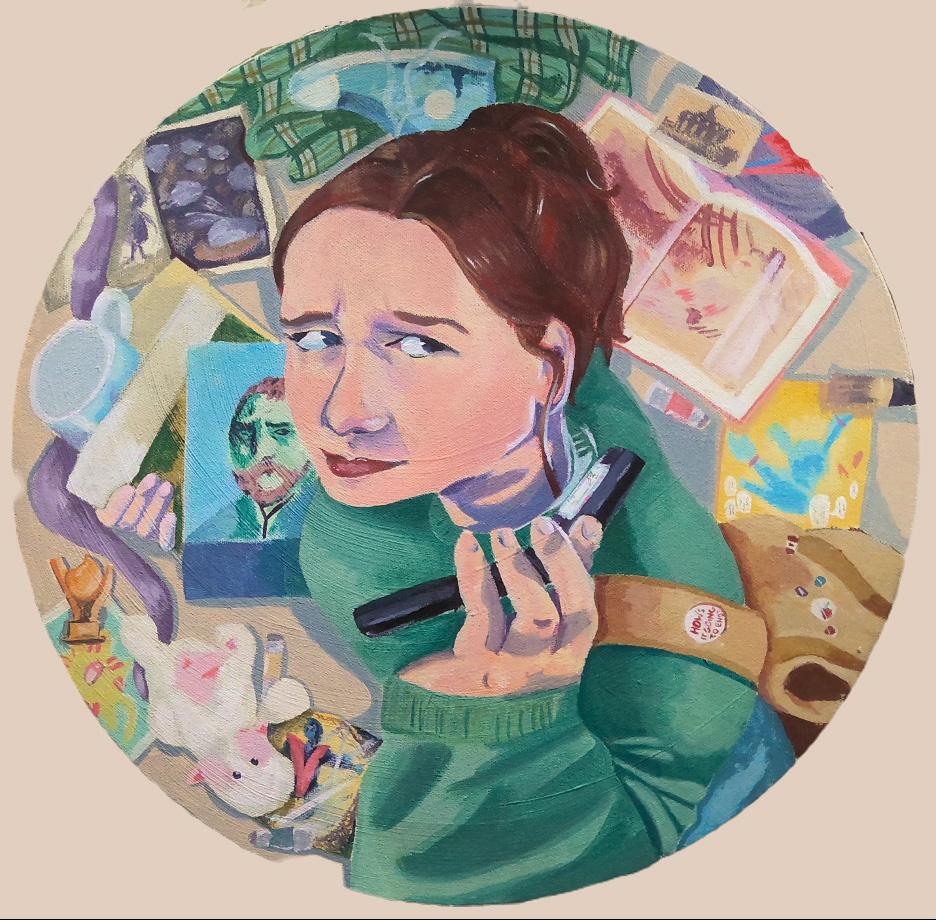
How's It Going to End?
Cover
Art
by Ella Kuhnell
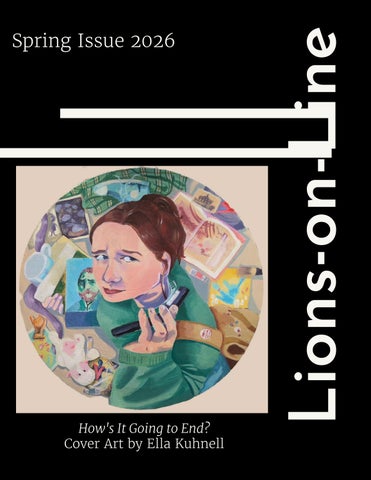
How's It Going to End?
Cover
Art
by Ella Kuhnell
1. Dark Chocolate, Poem by Alex Taft, P 1
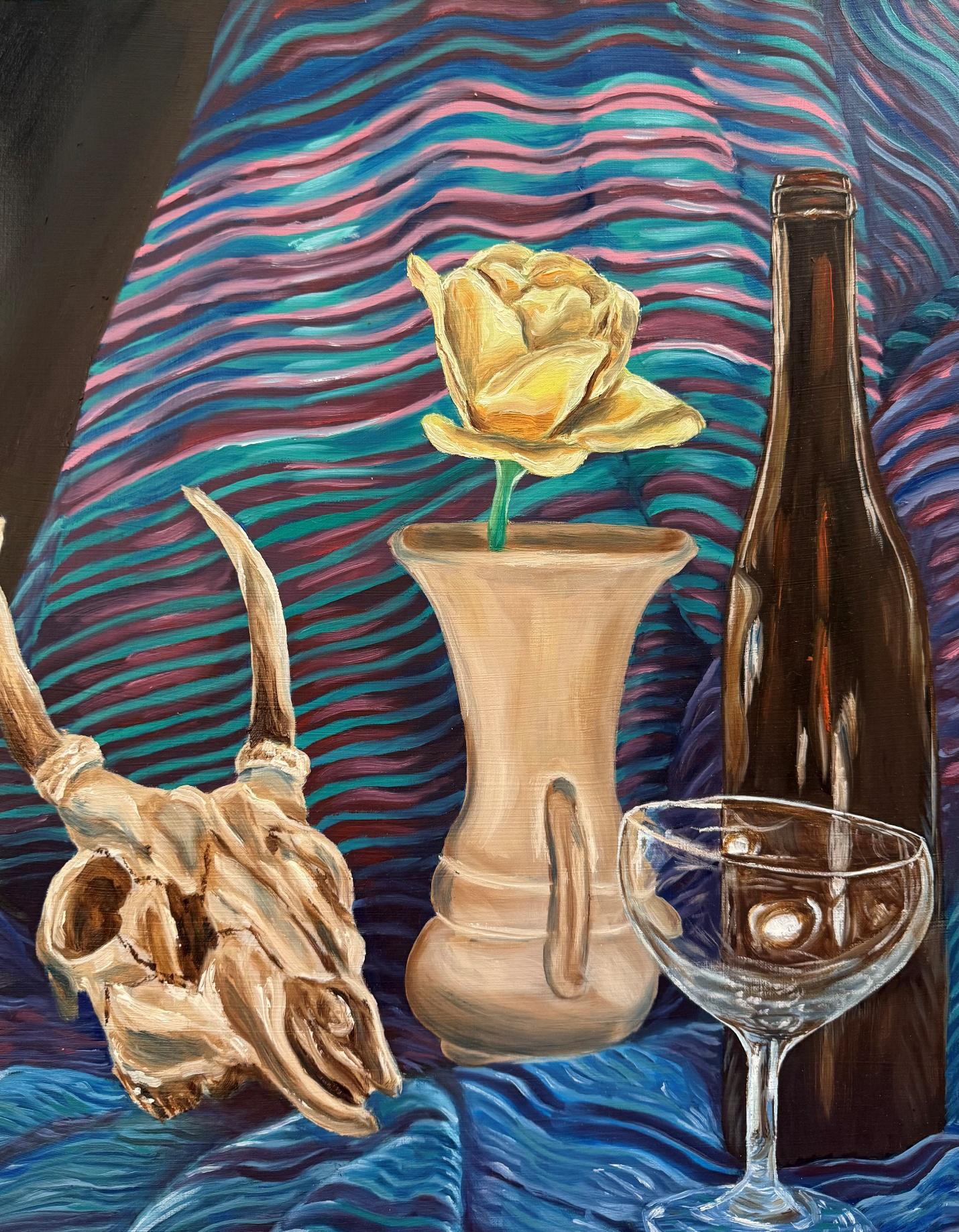
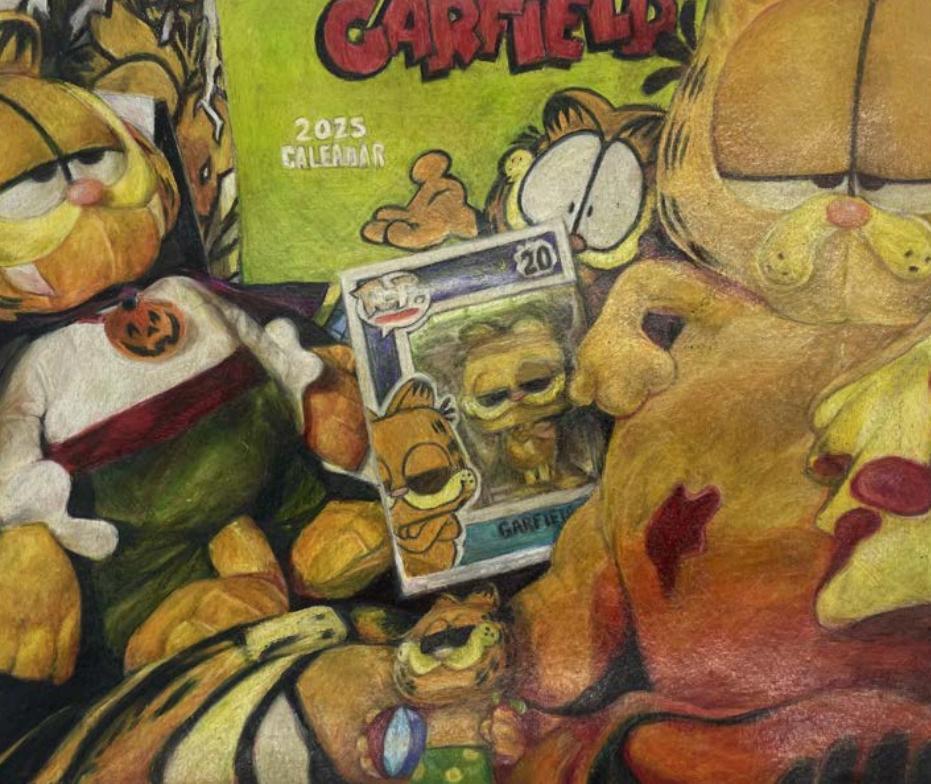
2. Oil Still Life, Artwork by Catherine Cole, P 2
3. Beach Glass and Clouds like Atom Bombs, Fiction by Joseph Knizner, P 3
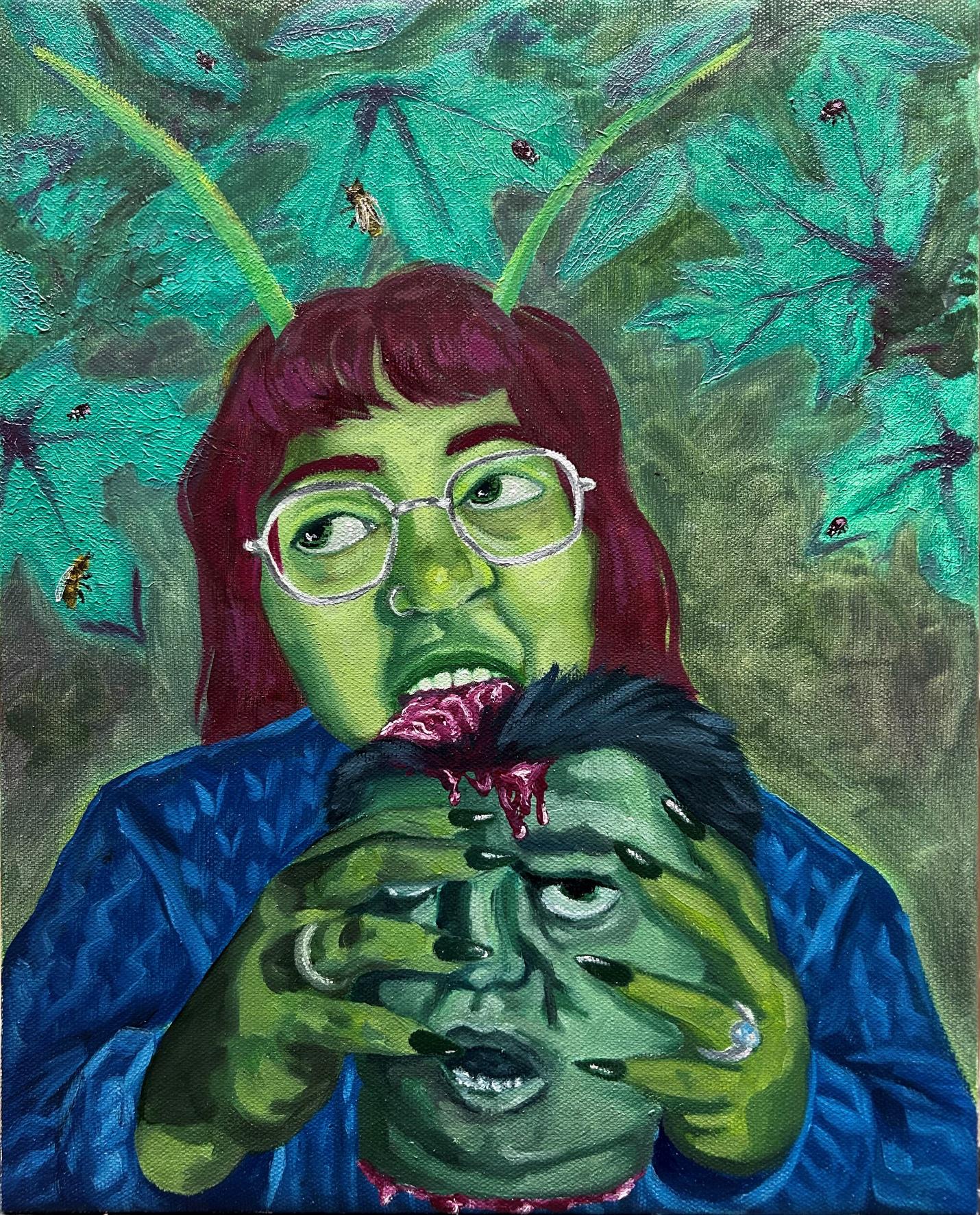
4. The Mantis Way, Artwork by Tori Orbegozo, P 5
5. Holy Rage, Poem by Loralei McCollister, P 6
6. Upholding the Catholic Mission: A Call for Mount St. Joseph University to Reject Institutionalized AI Use, Essay by Alex Taft, P 9
7. Time, Poem by Klohie Hinds, P12
8. How Two People Changed My Life Just by Talking, Essay by Kaitlyn Schulte, P 14
9. A Certain Quiet, Poem by Sophie Hirt, P 17
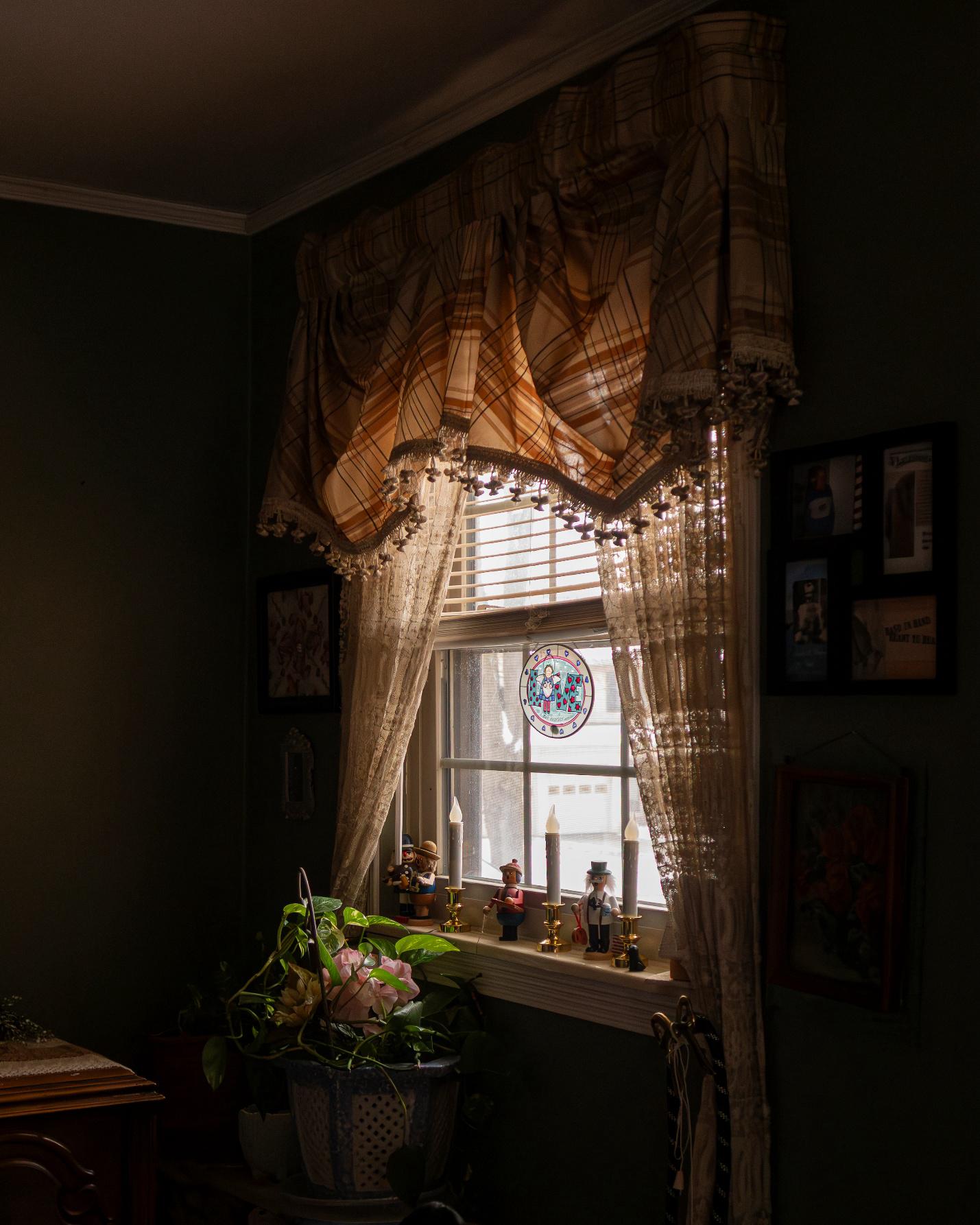
10. Light in Quiet Places, Artwork by Catherine Cole, P 18
11. Hearing Loss, Essay by Aidan Christy, P 19
12. What Will You Have to Say Goodbye to When You Die?, Fiction by Mary Pat Zink, P 22
13. Borrowed Tongues, Essay by Maria Wendling, P 25
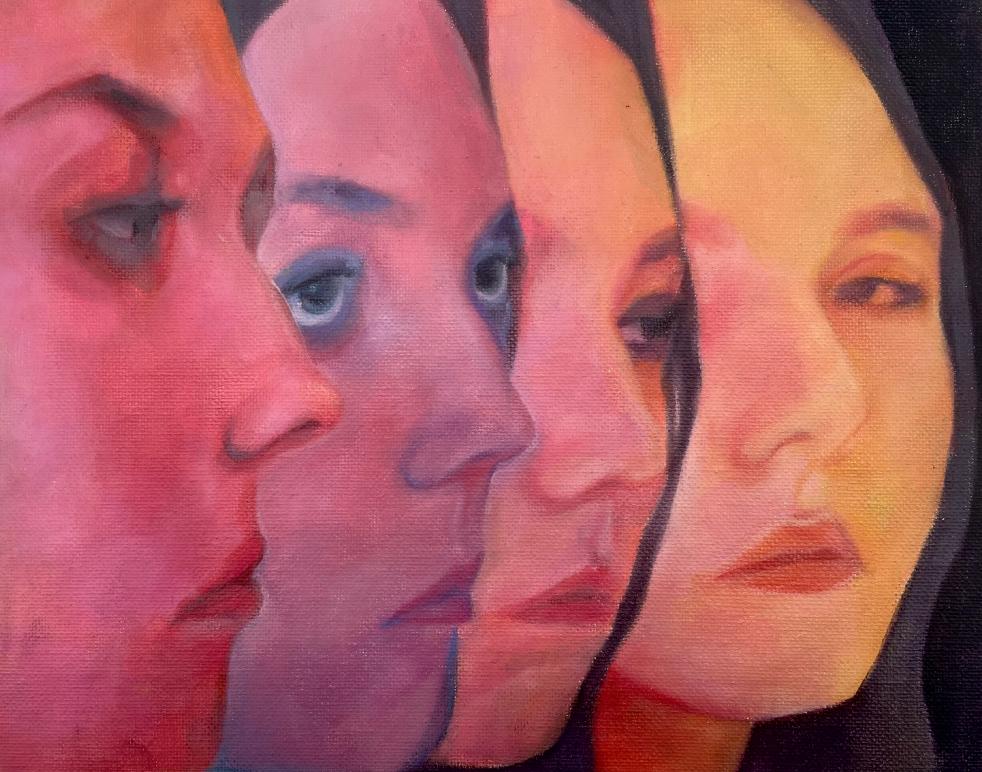
14. Woman in Disappearing Ink, Fiction by Isabelle Snyder, P 28
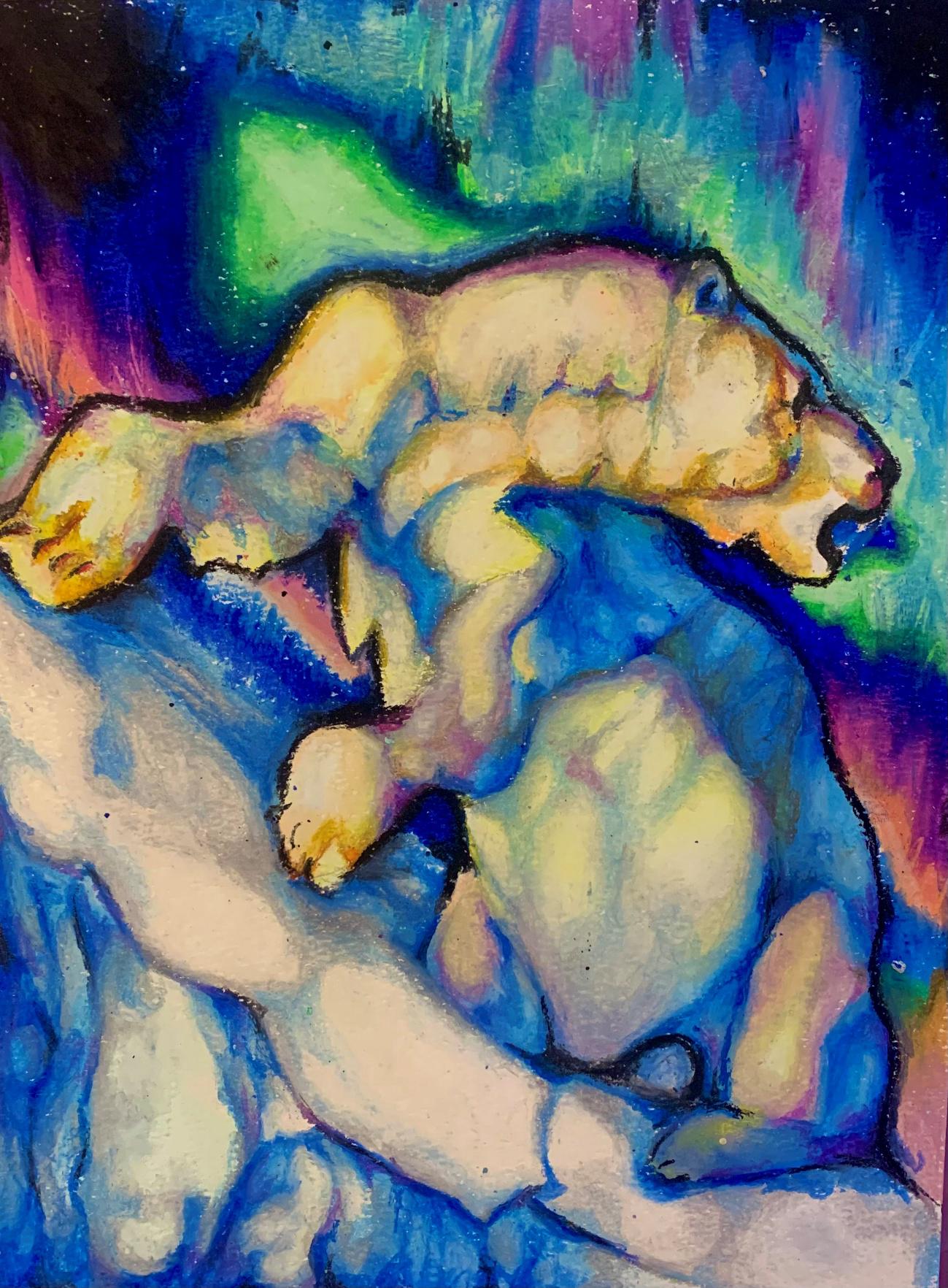
15. Polar Express, Artwork by Audrey Dailey, P 32
16. Microscopic Monsters, Poem by Tori Orbegozo, P 33
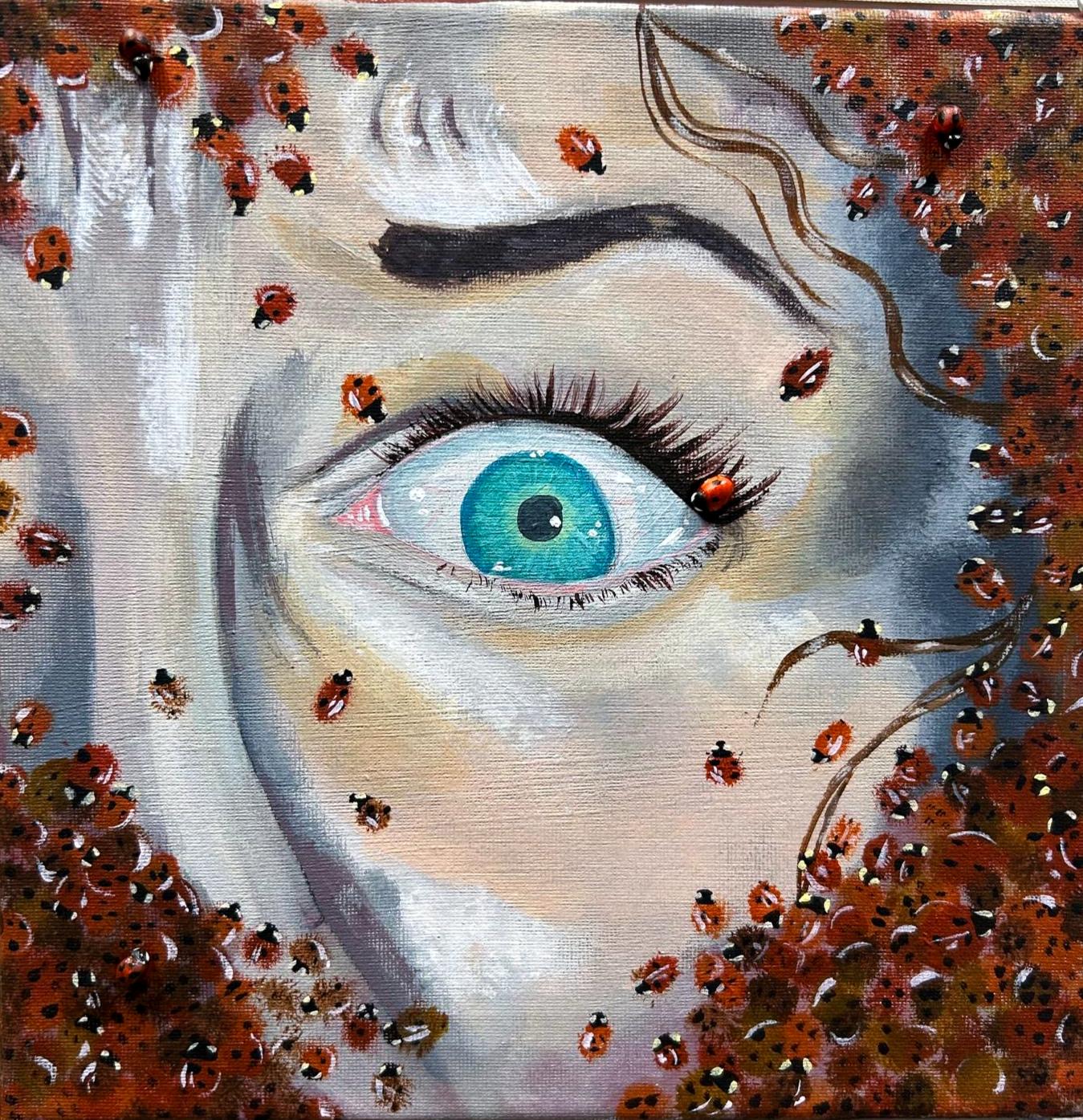
17. Good Luck, Artwork by Ella Kuhnell, P 34
18. to fly without a raincoat, Poem by Ethan Geiger, P 35
19. Hyperfixation, Artwork by Jordan Tinsley, P 36
20. This Message Will Self-Destruct in 60 Seconds, Poem by Margaret Utley, P 37
21. THIS LETTER WILL SELF-DESTRUCT IN 60 SECONDS, Poem by Megan Thompson, P 38
22. The Midnight Train to Timbuktu, Poem by Jim Barge, P 39
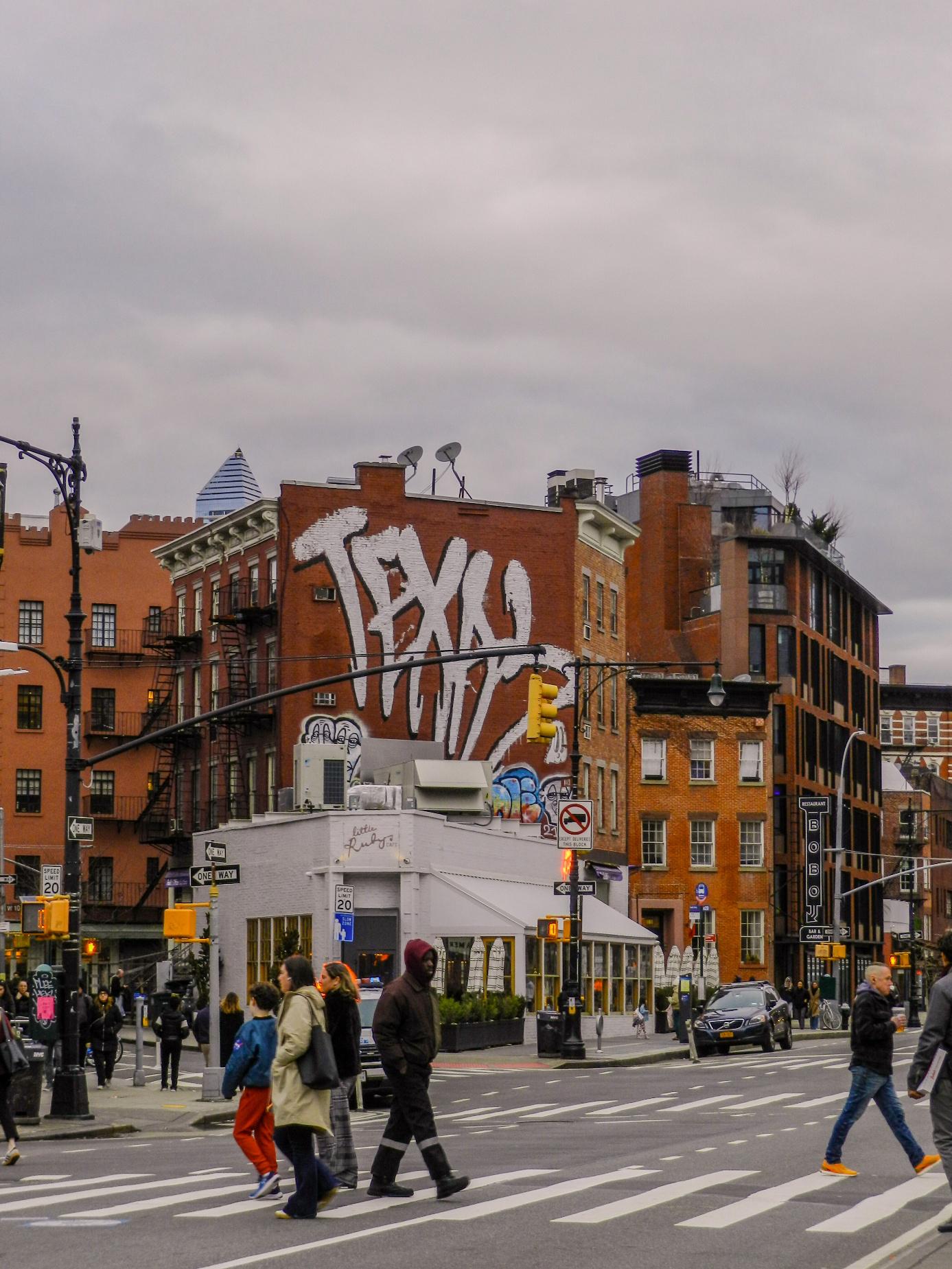
23. NYC #19, Photograph by Sarah Haverbusch, P 40
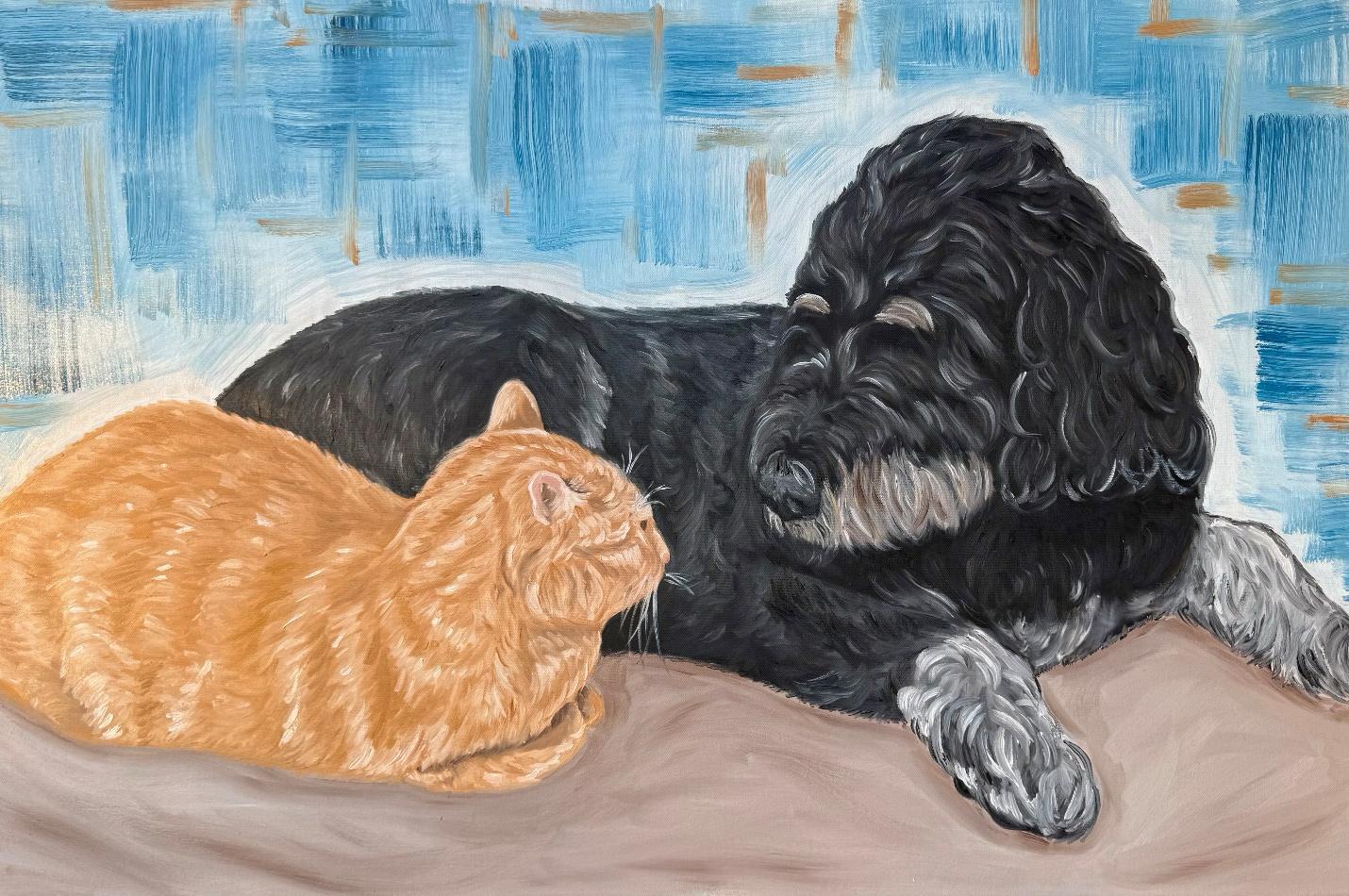
24. Winston and Bart, Artwork by Catherine Cole, P 41
25. If Only Dogs Lived Forever, Poem by Loralei McCollister, P 42
26. Trying Green Eggs & Ham, Poem by Margaret Utley, P 45
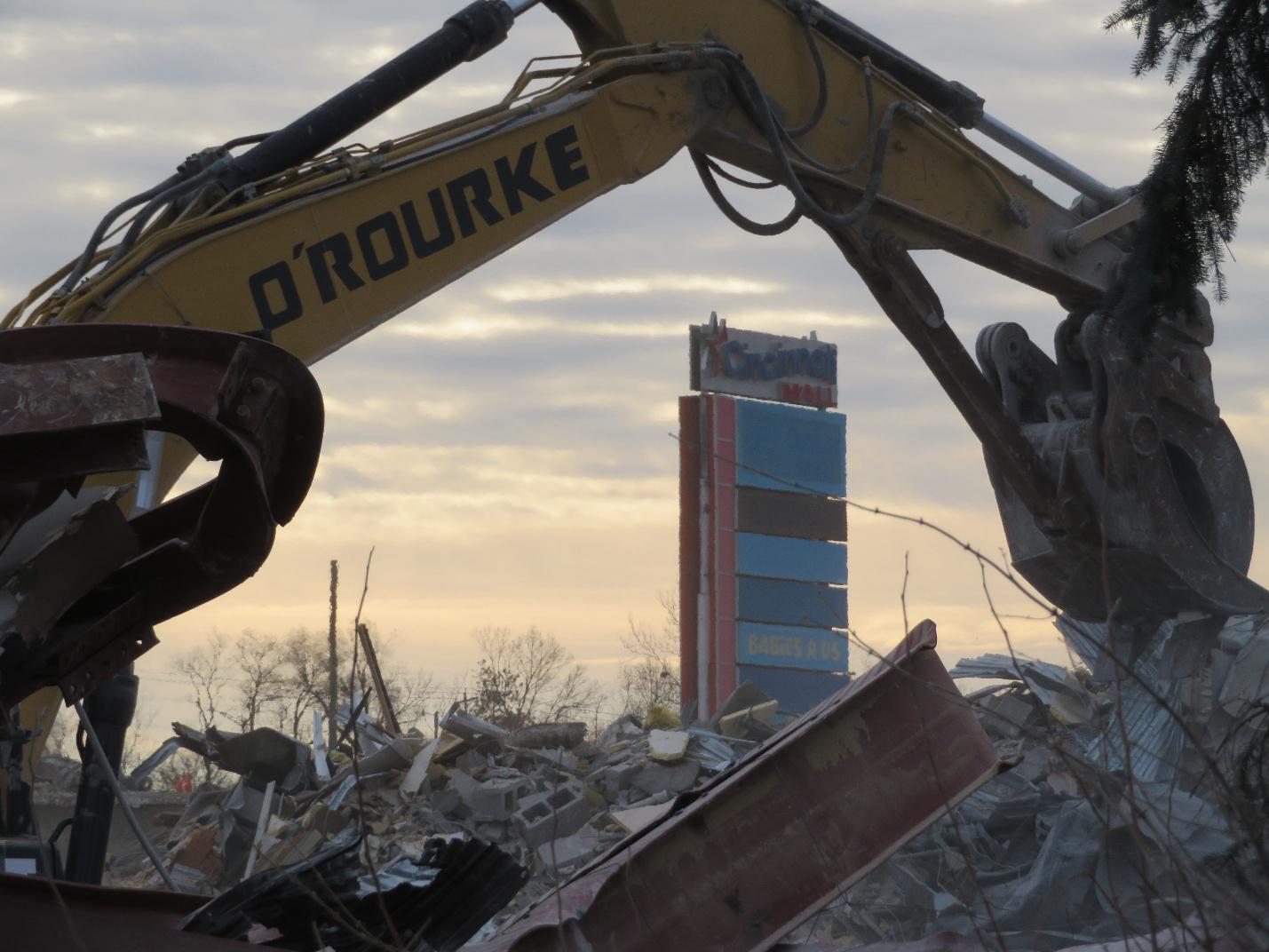
27. The Future Holds on to Even the Forgotten, Photograph by Ryan Bach, P 46
28. The Architecture of Us, Poem by Maria Wendling, P 47
29. Submission Guidelines, P 48
Alex Taft
Dark chocolate tastes kind of like getting punched in the face; It’s bitter and rough and unapologetic. As a child, I wasn’t a fan.
It was my mom’s favorite candy (one of her favorites, not sure entirely), But regardless, I saw her eating it regularly. Whenever I tried it, I wanted to spit it out. Maybe in my little brain I even thought at some point, How do I share genetics with this woman?
But now, I love dark chocolate. I like how it suffocates all of my taste buds, How it sticks to my gums, how it makes its presence known.
That’s how my mom was; She let you know when she was in the room. A bitter palate, a woman who’d punch those who wronged her in the face. Just like dark chocolate, she was a badass.
Dark chocolate makes me think of my mom, And pray that I have her fantastically bitter genes in my blood.
Fiction by Joseph Knizner
I am walking on the beach as the first rockets of the third world war explode, halfway across the world. The antiquated webs of war catch new prey, catch our future.
I stroll the peaceful shores dotted with families and debris searching for beach glass. My eyes track like missiles, eager for my target just little fragments of colors nestled among the sand as actual missiles acquire their targets; they lock onto nuclear plants and military leaders, pulverizing the slipping stability of the world.
I have read the news stories, the vaulting headlines. I know what is going on. But I am at the beach, so far away. (But how many battles and attacks have taken place on beaches and sand Dunkirk, Iwo Jima, Pearl Harbor? I think not of these things; the wind and sky are potent diversions.) The waves lap at my feet and the sun warms my shoulders. Scattered treasures are burrowed before me in the sand and water. The doom, death, and destruction, the wreckage and weapons, are far away.
Canada is merely a faint strip of land on the horizon, and I am distracted by glimmering waves, what is immediately before me. I think of nothing farther. Why should I worry? I am safe, happy, and having fun looking for beach glass with my family at our favorite vacation spot as distant missiles soar, dashing towards our future. Blue skies and white clouds like atom bombs. But it is so far away…
Why shouldn’t I focus on beach glass? Can one person’s beliefs, writings, or protest, really smother a fire that’s already burning far, far away like a smoldering sunset? I see sunsets, on the beach. They’re very pretty. It is easy to imagine, at those moments, that the world is at peace. Why should I worry myself? Can I really make a difference?
(Indifference is the same as assent. Perhaps that is why I must write this.)
And you can’t cut yourself on beach glass, like you can in politics, or war. I have only found one blood-red particle of beach glass, a matchless, lovely prize. There is no bloodshed on the beach. There is no danger here except sunburn, and I’m even helping the environment! I am removing something broken and out of place from the water, a pollutant; beach glass doesn’t belong in a lake or on the beaches that embrace it. However, there is too much delight in finding these little treasures to say that I do it out of pure ecological motivation. I walk miles of shoreline with my neck craned down, sunburnt, for myself; it happens to help the
lake too, but that is an accident. This is a selfish pursuit. And it is easy to tune everything else out during this beach pastime. That, too, is a selfish wall I build, though it is temporary and has its cracks. Major news, for example, gets through. My focus is on the trip, on our activities, on the beach, on beach glass.
Most beach glass is shattered and quite small. White, brown, green, blue, red they are colorful, a prismatic collection. These gems are non-threatening, and slip into the palm of my hand, smooth and dazzling from lake’s caresses and the summer sun’s gaze. These fragments and chips were once a bottle or jar or other industrial outcome, then discarded or lost in the lake. Now a treasure, these pulverized relics of industry and consumerism join their cousins in a jar on my desk, a perpetual reminder of pleasantness, of peace, of summer.
Our world, too, is shattered and is on the brink of splitting further. Our Earth is small, and the tides of the present threaten to shrink further the relative peace, health, and progress that has been achieved. Earth is colorful and unique and valuable. Irreplaceable. Our planet, too, was forged out of a landscape of lava and fury billions of years ago like sand in a crucible. Are we now approaching another crucible? The bombings and missile strikes have paused, but will it last? Is this war?
So, as bombs fall, missiles sketch the sky, and our world breaks, who among us will spearhead that remaking force that transforms sharp, belligerent shards of glass into smooth, glittering teardrop treasures? Who will reclaim our world again in the name of peace, democracy, and compassion after the instability and militancy of the present are through? When can radical healing occur, sanding the edges of a jagged world, emphasizing that which makes it glow radiant with health and kindness and warmth?
And when the crises are over and we put everything back together smoothing broken pieces into a shining, new status quo will we see Earth as our beloved shared treasure to protect? Will we remember it is fragile like glass? Or will the shards be too small, everything lost?
But why think about this now? I am on the beach, looking for beach glass. The metaphor and lyric can wait. The sun burns overhead, the wind pulls my hat, and the chilled water grabs my heel as I tread, footstep after footstep, across the sodden sands. The sounds of the beach splashing, shouting; whistles, radio, and gale fill my ears, and my eyes etch across the sand. Oh, there’s another piece.
Loralei McCollister
They tell me, "Don’t question God." They say, "Faith means silence, submission, obedience."
But what about the days when my heart is a storm, when my prayers come out as screams?
Because I’ve stood in the rubble of my plans, watched dreams dissolve like ash in my hands. I’ve whispered, "Why?" and the echo came back empty.
I’ve clenched my fists at the sky, daring lightning to strike me. I’ve yelled, "Where were You?" when the world fell apart, when my loved one didn’t get up, when the miracle didn’t come.
And they say, “Don’t be angry with God.” But have you read the Psalms? David was mad as hell sometimes. Job cursed the day he was born. Even Jesus cried out, "My God, why have You forsaken me?"
So don’t tell me my rage is unholy. It’s real. It’s raw. And it’s mine.
Anger is not the absence of faith it’s the evidence of it.
I wouldn’t rage at Someone I didn’t believe could hear me. I wouldn’t demand answers from Someone I thought didn’t care.
And maybe God isn’t afraid of my anger. Maybe He’s big enough to take it. Maybe He’s sitting in the silence with me, letting my fury burn like a wildfire, because He knows the ashes will make something grow.
They say, "Be still and know." But do they know how hard it is to sit in the stillness when the stillness feels like abandonment?
I’ve thrown rocks at heaven just to hear them fall. I’ve cursed His name in whispers, in shouts, in the kind of grief that breaks your voice.
And still, I keep talking to Him. Even in the anger, even in the doubt, my words keep climbing, keep reaching.
Because somewhere, deep down, I believe He’s listening. And maybe He’s weeping too. Maybe God’s heart breaks when ours do.
And I wonder if faith isn’t the absence of rage, but the courage to bring it to Him. To say, "This is where I am. Meet me here."
So, I’ll scream. I’ll rage.
I’ll cry until my voice is gone. And when the fire burns out, I’ll find Him in the smoke, not scolding me, not condemning me, but holding me.
Because being angry with God is still being with God. And if He’s love, if He’s really love, then He can handle my hate too.
So, bring your fists, bring your fury, bring your broken heart.
God’s not afraid of the storm inside you
He’s the One who calms it.
To be connected to our natural world is to be connected to our Creator. This is a truth that has been embraced by the Mount. It was embraced by Sr. Paula Gonzalez when she and 35 volunteers built La Casa del Sol, and it’s embraced now by the work of the MSJ Sustainability Committee. Taking care of the earth is an integral pillar of Catholic Social Teaching. The United States Conference of Catholic Bishops (USCCB) asserts that, “we show our respect for the Creator by our stewardship of creation.” Caring for the earth is a requirement of the Catholic faith, as nurturing care protects all of God’s creations, us included. The truth that we find God in the soil is evident enough; we are entirely inseparable from His works. But in the present day, I see the Mount in a crisis of faith. While the history of our campus calls the Mount to tend to our Lord’s garden, modern advances in technology tempt it to embrace the machine. AI (Artificial Intelligence), as most of us know, has exploded in recent years. It has embedded itself into the day-to-day lives of so many people and has become a topic of discussion here at MSJ. On the administrative level, Mount staff are determining what the Mount's AI policy should be. Some advocate for the use of AI by staff: whether it be to aid in teaching, used for marketing, or to analyze data. I, however, believe that the Mount’s attitude toward AI-use by campus administration should be a “no tolerance” policy, plain and simple.
AI causes massive amounts of damage to our earth and our communities to do work that can be, and historically has been, done through more modest means. To function, AI requires the building and operation of massive data centers that consume large quantities of energy and water both finite resources. Sarah Mangelsdorf and Lauren Behan, in a 2025 article published in the journal Brief, report that an average prompt entered into ChatGPT consumes approximately five times more energy than a simple web search, some estimates say ten. Furthermore, AI data centers need to consume water to use energy, “for each kilowatt hour of energy a data center consumes, it would need two liters of water for cooling.” Because heat is produced in the consumption of energy, data centers must also suck
up water resources to cool. These numbers may appear small or insignificant, but when millions of people enter prompts into ChatGPT daily, they start to add up. Beyond resource consumption, AI also creates large amounts of hazardous waste that threaten human communities. To create the Graphic Processing Units (GPUs) required in data centers that support AI, the mining of various raw materials and minerals such as chromium, copper, and lead must take place. The mining of these materials, according to the Brief report, can seriously impact nearby communities, as “The mining of these raw materials often causes pollution to land, water, and air.” As raw materials and minerals are mined, they create a runoff of waste that infects nearby streams and groundwater, infects soil, and releases harmful substances into the air. Take, for instance, cobalt, one of the materials needed for GPU production. The mining of cobalt “releases sulfides into the air and water, forming sulfuric acid, which can pollute streams and leach into groundwater.” These pollutants indicate that AI technology clearly poses a risk to the health of human communities.
And the waste problem doesn’t even end with the completion of an AI’s lifecycle. Because of the constant demands placed on AI to perform complex actions and process mass amounts of data, the hardware used in AI typically has a lifespan of only two to five years. This creates large amounts of e-waste, which often end up in landfills. When e-waste produced by AI enters landfills, it contaminates the soil and groundwater with toxic substances, posing health risks to communities immediately around the e-waste and even those more distant from it, as the contaminated water is often transported to communities farther away. According to Brief, “One study of soil and water samples in an e-waste scrapyard in Ghana showed significant levels of heavy metal contamination both in the soil and in the groundwater.” Even when AI is disposed of, it poses a threat to human communities by contaminating soil and water.
Some may argue that as unfortunate as the ecological and human consequences of AI are, AI is a new technology that the Mount must adapt to and find a means to use effectively. It could be used for so many different tasks and increase the efficiency of work done at the Mount. Here are my issues with those arguments.
1. The Mount doesn’t have to institutionalize a new technology just because other institutions are using it, the Mount has a choice.
2. All of the work that AI does is work that can be and has been done with our existing technology and human labor, and the Mount isn’t so in need of increasing the speed at which work is done that it warrants using
perhaps one of the most ecologically destructive technologies of our time.
Culturally, we feel so inclined to just accept any new technology thrown our way and forfeit personal responsibility by saying, “Everyone else uses it!” We see a technology that’s more “efficient” and our eyes light up. In our fascination, we forget to ask ourselves whether the cost of efficiency is worth it. We have plenty of great staff here at the Mount why do any of them need to use an AI to help with the university’s administration? Sure, work might be done a little slower if we refuse to use AI, but the fact is that the Mount has been able to operate successfully without it. There’s no point in using a remarkably destructive technology to fix a problem that we don’t have.
The Catholic faith calls Mount St. Joseph University to nurture God’s creations. The Mount has done it in the past and continues to do so. But AI threatens to corrupt the Catholic moral virtue of the Mount. By using AI at the institutional level, the Mount is participating in the overconsumption of the earth’s energy and water resources, and the destruction of communities by hazardous waste; just to create a solution to a problem that doesn’t exist in an effort to fall in line with other institutions. The Mount thus stands at a crossroads: Will it stand for God and use His creation with modesty and reverence, or will it worship a new god?
Works Cited
Mangelsdorf, Sarah, and Lauren Behan. “Born Electric, Buried Toxic: The Life Cycle of Generative AI and Its Environmental Impact.” Brief, vol. 54, no. 4, July 2025, pp. 28–35. EBSCOhost,research.ebsco.com/ linkprocessor/plink?id=d2e1b137-849e-322c-8a0b-75308d251963.
United States Conference of Catholic Bishops. “Seven Themes of Catholic Social Teaching.” USCCB, 2005, https://www.usccb.org/beliefs-andteachings/what-we-believe/catholic-social-teaching/seven-themes-of-catholicsocial-teaching.
Klohie Hinds
Time changes things. When I was a kid, it felt like everything took forever: the school day, doctors' appointments, getting older, waiting in lines. I felt like all I ever did was wait: for recess, for Christmas morning, for summer, constantly waiting for the ‘perfect moment,’ for ‘one day,’ but time changes things...
One day, the sound of your sisters Velcro shoes turns into helping tie shoelaces because somehow, she's already grown out of the other ones... but at least you don't have to hear that–God awful–noise again
One day, the unexpected sound of your bedroom door opening and little footsteps climbing the stairs becomes the sound of gentle knocks and whispered hellos... but at least now they understand privacy
One day, the images from the movie you've watched a thousand times, the only one you and your brother agree on, changes to clips of... whatever you want because now you have your own rooms but at least you don't have to agree.
Don't get me wrong, some things do–truly–take forever, like doctors' appointments and lines. But growing up? That happens in the blink of an eye. It's one of those things that you don't realize is happening until you watch it happen to someone else. Waiting for the perfect moment, for one day, is futile. So, I guess what I'm trying to say is use the pretty stickers, use the favorite pen, wear the outfit, tell them how you feel. Don't leave anything unsaid. Oh, and for the love of God, please don't wait, there's no better time than now.
Would the Earth spin without you, my darling? Maybe the gravity of the sun or moon might help, but truly, could it be? I think about how the earth spins with you on it so fast, so instantly. My mind spins with every revolution of this green planet. Does the earth spin without you? The way your hair smells down breeze, Events with you too special for the mind to let go of, Love so intense felt only by the strong pull on the earth. Your smile illuminates my heart like Jupiter in the sky, The beautiful rose in your heart, so delicate yet divine, Kisses that angels left on your nose, The beauty of your thoughts and the strength of your independence, The intricate details of your mind that only the creator of all knows. Does the earth spin without you? Yes. The earth of everyone else, but the earth of my own heart lies with you. No earth of mine could spin without you, my darling.
by Kaitlyn Schulte
Mildly sensitive topics read at your own risk.
Words have power regardless of how you use them. Recently, I have come to find this out. Not to get into much detail, my family and home life has not been all that great over the past few weeks and it has been incredibly rough in that regard. I have always struggled with anxiety and depression but over the last few years it has gotten worse and it comes and goes in waves. I am very insecure and mask a lot of what I struggle with. Not everyone knows and not everyone realizes the extent of it. Hell, even I don’t sometimes.
I am disabled in ways both “obvious” and not so “obvious.” I put this in quotations because nothing is ever truly obvious from the outside. You can’t just look someone and know what’s going on inside them.
I use a walker or a wheelchair in public. I have cerebral palsy, but I also have ADHD, anxiety, depression, stomach issues and processing delays. The only thing diagnosed at birth was my CP. I got diagnosed with everything else at very different times.
Due to lack of knowledge and support, all these issues have taken a toll on me, as you may imagine, over time. Society and family, whether they intend to or not have impacted me both negatively and positively. I can be hard on myself, in my own head.
I have come to realize that your birth family isn’t always your true family. Chosen families are just as important. Family is what you make of it. You consistently choose repeatedly to love and show love because you want to, not just because you must.
There have been times when I have felt relatively unlovable. Just stuck. I am deeply insecure and ashamed of my disabilities. And, directly or indirectly, these barriers cause me to struggle in more ways than one. Sometimes, I don’t feel heard or listened to and sometimes, I don’t believe people care about me or notice me as much as they do.
Deep down I know people do care. But, when you have a mind, a family member, or society telling you things that can make you feel bad about yourself, it weighs on you sometimes. My mom makes me feel as though I use my disabilities as an excuse. There is something truly daunting about that. It makes me feel like I’m exaggerating everything, or faking it, and then, I start to hate the way I am.
Maybe I do use my disability. I use it to see the world with a different world view. I use it to see others more sympathetically. I see other people with disabilities in a better light. And, if I’m being honest, my disability has, in good ways, made me who I am today.
While I hate being disabled sometimes, I also love it. Because I have found community and “calling” from it. Having to work harder has made me a better person. I am learning that it’s not my fault I struggle. I don’t have to pretend to be able-bodied. Sometimes, others need to help me. I don’t have to figure out everything alone.
Dr. Elizabeth Mason and Dr. Jennifer Morris have been my lifelines over the last few weeks. While I am not actively their student I graduated last semester and came back as a graduate student who is also taking undergraduate classes as I please and I am learning that they mean it when they say that by virtue of being in one of their classes, I will always be their student, both in and outside of the classroom.
Early this semester, I went to Liz because she not only gives the best hugs but because she also gives great pep talks. I talked with her about my family issues and basically poured my heart out. I said things I never thought I’d admit but she made me feel safe to do so.
After our conversation, I felt the lightest I had felt in weeks. Huge weights were lifted off my shoulders and my heart. A lot of what stuck with me during this meeting was something she said during the meeting but also something she said in the past that has stuck with me and helped keep me going.
Last spring, for my Liberal Arts Project for my LIB 400, I made a video about the challenges of navigating this campus with a physical disability and I presented my video to a room packed with faculty and other students and their families. Something that stuck with me is what Liz said in response to the video. She remembered a day when I arrived at her class disheveled and late, because the elevator from the ground floor of the classroom building was out of order and I had to get to the second floor for her class. That day, I got lucky, someone helped me up the steps. I never knew she knew that she quietly understood that I was late because the elevator was out of order. I didn’t know that she knew that someone had, quite literally, carried me up the stair. Honestly, I didn’t expect anyone to notice at all. Liz notices the little things.
The day we had our talk I knew that she heard me and paid attention to me. That day, she told me, “Be kind to yourself. You’re one of my favorite people. And be sure you’re proud of everything you have accomplished no matter what anyone
else says.” Sometimes, when I’m having a hard day, I say to myself, “If Liz wouldn’t say this to me or wouldn’t like me saying it, then I shouldn’t be thinking it.” Sometimes, I have to give myself my own pep talks, especially when my mom tells me things like, “Maybe you should write your own story instead of letting your disability do it for you. Get off social media and do things to make your life better.” This sort of comment could send me into a spiral and a panic. But I do know that I am trying to do an awful lot with my life and my disability run my life. It’s part of who I am, and it will forever guide what I want to do with my life.
I learned this from Dr. Morris too. She has given me so many pep talks, so many hugs and so much great advice, much like Liz. Jennifer was the professor for LIB 400 last semester and she helped me with my project. I came to her with an idea and she recommended Peak Productions and, ultimately, their crew helped me film my project. She also introduced me to Mount Alumn, Neil Kelly, who also uses a wheelchair and knows how challenging it can be to get around campus. I got to collaborate with him to show a wider audience about the accessibility issues on campus.
When we filmed, just like right now, MSJ had a lot of construction going on. Neil was willing to navigate that with me, and I feel forever grateful for everything he contributed to my project and to Dr. Morris for introducing us to one another. She made it very clear that she was just as excited and passionate about my project as I was. It helped to keep me going. She consistently reminded me that I was making a different and that hopefully someday I will be able to do even more.
I have always wanted to make a difference in people's lives. In writing this, I realize that sometimes the biggest differences are made just by being available and kind, by being open and aware. A little sentence goes a long way. You too can make a difference. Even the little things matter.
A kind of quiet that some might mistake for loneliness
But it’s hardly that.
Solitude is like a warm hug, When you just want to be alone for a while In the quiet.
The snow is a natural deafener
To the noise that the world brings, Because sometimes
We just need the quiet.
On these snowy days, just remember That solitude is a gift, A gift of comfort amidst this crazy world.
One day, in first grade, we had routine vision and hearing tests. We all lined up in a single file line and walked to the room where the tests were being held. Eventually, it was me who stepped up. The vision test went by without a problem, but the hearing test didn’t go as smoothly. I was held back in the room while the teachers called my mom, who took me to get an official hearing test with trained audiologists. There really was something wrong with my ears. I had lost hearing. We learned that my right ear had no hearing, and my left ear had lost some too, though not as much.
It was originally believed that I suffered from Pendred Syndrome, a genetic disorder that causes early hearing loss in children. It can also cause trouble with balance, and I had problems with balancing. As in my case, nearly all of the children who have Pendred Syndrome have bilateral hearing loss, meaning they have hearing loss in both ears. Often, one ear may have more significant hearing loss than the other. In my case, my left ear was significantly stable, compared to my right ear, which had entirely lost the ability to hear. Soon after the diagnosis of Pendred Syndrome, I was fortunate enough that I was outfitted with two Phonak hearing aids. Luckily, I had good insurance. If not, my family would’ve had to scrounge up thousands of dollars to pay for my hearing devices. At that age, I couldn’t possibly know how much these small devices could’ve set my parents back.
As the National Institute on Deafness and Other Communication Disorders mentions, a child’s hearing may fluctuate when they have Pendred Syndrome. In fact, it’s a key characteristic associated with the syndrome. Hearing can vary in severity over time. Someone with the condition may experience periods of better hearing followed by sudden declines in hearing. For years I wore both hearing aids, one red and one blue my two favorite colors at the time. Eventually, I was given an FM System to use in class. An FM or frequency-modulated system is a microphone-like system that helps a student with hearing loss listen and hear better in loud places like a cafeteria or classroom. It’s a transmitter device worn by the teacher that connects wirelessly to the student’s hearing aid. It keeps the speaker’s voice at a level just above the background noise, making it audible. Many hearing devices made my schooling easier and would do the same for others in similar situations. But in sixth grade, something changed in my hearing.
Towards the end of sixth grade, I again began having trouble hearing. This time, my trouble greatly impacted my good ear. Was I going deaf? It’s not rare for a child with Pendred Syndrome to lose their hearing entirely. So, fearing I would lose even more of my hearing, my audiologist suggested we get a Cochlear Implant for my right ear. It would send hearing from my right side to my left. It would be more costly than the hearing aids were, but luckily again, my insurance covered the price of the implants, which were between $30,000-$100,000. It wasn’t long until I got the surgery to have the implant put in. In this surgery, the surgeon made a small incision just behind my ear, and then a small electronic device was placed under my skin and connected to my inner ear, also known as the cochlea. The surgeon had to carefully put a thin wire with electrodes inside the cochlea. These electrodes are the tiny parts that send signals.
Once he was done, he closed the incision and wheeled me to the recovery room. I soon awoke and was able to head home to recover for a few weeks. I had to wear bandages around my head and keep my wound clean. Soon, I went to the audiologist to activate the implant. It’s important to note that a cochlear implant doesn’t bring back natural hearing, it just helps the brain understand sound in a new way. Over time, the person the person learns to recognize speech and sound. It just takes practice. For the first time that I could remember, I was hearing out of my right ear. Speech sounded strange out of it, but with practice, it began sounding normal. With practice, I heard sounds that I never had before. Even today, speech doesn’t sound complete, but both devices are constantly getting updated technology. Perhaps one day it will pick up speech more than ever.
It was also around the time that I got my cochlear implant that my diagnosis changed from Pendred Syndrome to EVA, or enlarged vestibular aqueduct, though EVA is heavily related to Pendred Syndrome. Vestibular aqueducts are the narrow bony ear canals that move from the inner ear all the way to the inside the skull. The National Institute on Deafness points out that, “Recent studies indicate that a vestibular aqueduct is abnormally enlarged if it is larger than one millimeter, roughly the size of the head of a pin. This is called an enlarged vestibular aqueduct, or EVA; the condition is also known as a dilated vestibular aqueduct or a large vestibular aqueduct.” Scientists believe that EVA affects the inner ear’s ability to help nerve signals send sound and balance information to the brain.
My hearing loss has taught me that I can push through anything. It was rough adjusting to a hard-of-hearing life. One where I had to get comfortable asking people to repeat themselves, as I don’t like speaking up much. I’ve had to get
comfortable handing my microphone to both professors and classmates and, sometimes, to ask for it back. That too was a difficult journey that I still haven’t fully overcome. My family, and especially my brother were my rocks during this process. Each of them helped me learn to speak up for myself once I couldn’t hear. They also helped me practice being assertive in loud situations. We used to go to restaurants and practice listening and hearing, so I’d grow accustomed to the sounds of a cafeteria. We also practiced speaking to waiters and waitresses when I misheard them. And today, despite many fluctuations, both improvements and decreases, the devices that I am fortunate enough to use have maintained my hearing and reminded me to keep pushing.
Resources:
U.S. Department of Health and Human Services. (n.d.). Enlarged vestibular aqueducts and childhood hearing loss. National Institute of Deafness and Other Communication Disorders. https://www.nidcd. nih.gov/ health/enlarged-vestibular-aqueducts-and-childhood-hearing-loss
U.S. Department of Health and Human Services. (n.d.-b). Pendred syndrome. National Institute of Deafness and Other Communication Disorders. https://www.nidcd.nih.gov/health/pendred-syndrome
Fiction by Mary Pat Zink
Inhale.
This is it. I’ve always wondered what death would feel like. Exhale.
I think I’ve had a good life. Most of it was happy. And the sad moments ultimately led to happiness. Inhale.
Wow, what now? I’m dying, so what happens? Exhale.
Will people miss me when I’m gone? There are so many friends I made, so many connections formed. So much in my life. Inhale.
Will I miss my life? It was good, but I was always told there’s something better past death. Does that mean I won’t miss everything I’ve experienced here? Exhale.
Maybe I should say goodbye. If I don’t miss everything or if I forget, I at least can find comfort knowing that I loved it all while I could. Saying goodbye is the best thing I can do for everyone. And for me. Inhale.
Goodbye my family. Goodbye my many sisters. Goodbye to our anime bingewatching sessions. I still remember the time when I first watched Avatar the Last Airbender and we were all squished together under one blanket. Goodbye to our girly fangirl screams over fake boys, real boys, and famous boys. Goodbye my few brothers. You annoyed me many times, like when you acted ten years younger or when we poked fun at each other. But sibling jokes are a way to show love. I know that. I hope that you know that too. Goodbye my mom. I loved how we would talk about anything. When I was stressed about life, talking about my boyfriend, or planning what the future would look like, you were always the one I talked to. Goodbye to the times we would watch Halloween baking championship and cooking shows like Hell’s Kitchen when you had a few minutes of downtime. Goodbye my dad. Goodbye to the times we would play pickleball; you would try to beat me as well as coach me to do better. You always tried to help me do better and I always strived to do that to make you proud. Goodbye to the times we watched crime shows like NCIS together. Even though they were full of death, I wasn’t
scared because you were there. Goodbye to my whole family and to the times we would spend together.
Exhale.
Goodbye my boyfriend. Though our time was short together, it was wonderful. I have been in love before, but never was it as good as what we had. Goodbye to the times we would cook dinner together. They were meals I never made or never tried before, but it was always fun. Goodbye to the times we would cuddle on the couch and watch movies, anime, or Father Brown. Goodbye to the times we would work on school together. Though we were in our own studies, being with you always made me the happiest. Goodbye my love and to the wonderful times we spent together.
Inhale.
Goodbye my many friends who I have made over the years. Goodbye volleyball and soccer teammates. We grew in athleticism as well as in character together. It was always fun growing together. Goodbye my stage friends. For years we were together on stage taking on different roles and different personas. Even when we were different people, we were always friends and always had fun. Goodbye my youth group friends. The time we spent together, I will treasure. I am who I am today because of all of you. We had fun playing games like dodgeball together, cried at retreats together, and grew in faith together over the years. My life would not have been the same without all of you in it. Goodbye my college friends. We just met, but our time together was fun. I loved eating meals with you, watching movies with you, and just talking with all of you. You made my time at college not lonely.
Exhale.
Goodbye to this life. It was quite the adventure. I would not change one moment of my life for the world. If death told me I could live longer if I changed an aspect of my life, I never would. Every moment is special. To each memory, to each experience, to each vacation, to each embrace, to each moment of this life I lived to the fullest, I say goodbye.
Inhale.
I think I’m ready now. Exhale.
My breath is growing shallower. Inhale.
I think I said goodbye to everyone. Exhale.
Goodbye life. It was fun. Inhale. I… Exhale. Loved… Inhale. Every… Exhale. Moment… Inhale. Of it… Exhale…
by Maria Wendling
Since I was little, I always thought my mom had a way with her words. She annunciates in just the right ways and is delicate with her word choice yet straightforward with her tone. She never dances around the subject, despite the message being hard to hear or understand. Her humor makes its way into every conversation, and it rubs off on me in the best ways. My mother is a strong woman with a past she doesn’t let define her despite the hardships she has faced. She is also the smartest woman I know, and her love for knowledge continues to grow every day. She has taught me so much not just about being a good human, but also about the world, history, religion, humanity, and love.
One thing my mother has always taught me is to speak my mind, but not all true things need to be said. With her being a devout Catholic, she always reminds me to be kind to those who may trespass against me, and to pray for those who are struggling. If I can recall one specific thing from my childhood that she told me, it would be, “You are most like Jesus when you forgive.” I can go to her about anything, and she always knows the right thing to say. She is my best friend and mother in one. She has taught me everything I know, and I owe not only my life to her, but that she has made me the person I am.
When I was in the third grade, my mother suffered a massive stroke. I didn’t quite understand what that meant at the time, but when I saw my mother again, I knew she was different. She was in there somewhere, but needed to find the light to crawl out of the tunnel she was trapped in. I could tell she understood me, but that she didn’t know how to tell me. It broke my heart seeing my once so well spoken, direct, and confident mother, not knowing how to tell me she loved me. I knew it was my job to help her remember. It was my turn to be a mother to her, like she was a mother to me. As time went on, I worked with my mother to help her relearn the things she thought she had lost. I never left her side like she never left mine. Before her stroke, my mom had been sick with Lupus since I was four. I always felt like her little assistant for anything she needed, and this made me feel fulfilled and like I was doing my part in our family.
Not only did I help my mom relearn to talk, but I also remember who she was. Her lingo, her sarcasm, her personality. Because she rubbed off on me so much, I knew exactly what kind of person she was. I wanted her to remember what kind of person she was. I wanted my mommy back, and even more so for her to remember how amazing she truly is. As time went on, she grew back into the person I knew
was in there all along. I didn’t only have my mother back, but she had herself back. We were two mouths, but one voice. Because of the language we gave each other, we taught each other what to say. First it was her voice, then it was mine. A mother’s love turned into a daughter’s mission.
Fiction by Isabelle Snyder
She drifts on this gravitational prison of rock and soil, suspended in the void, her thoughts spiraling endlessly around the unanswerable.
Why am I here? What does any of this mean?
Lost. Watching others fold their thoughts into neat, crisp origami with precise edges, deliberate creases, while her own mind bleeds and blurs like watercolor left in the rain.
She feels simultaneously at the molten core of existence and exiled to its coldest edge, a ghost pressing her palms against the glass of creation, forever outside looking in.
Every time she catches herself watching you.
God, how long has she been staring?
She feels the distance collapse. For one electric moment, she's close enough to breathe the same air.
She lifts her trembling hands skyward, and something ancient surges from her sternum: white-hot, celestial, terrifying in its intensity. The spirit knows her name. But she's been torn open too many times, the vessel cracked, and she can't hold it. Can't draw it in. It slips through her fingers like smoke.
I'm yours, I'm yours, she whispers to the indifferent universe.
But you don't even know I exist.
She moves through the world catatonic, convinced of her purpose, certain of her divine mission, yet she's already released you, opened her fists. Watched you disappear into the crowd.
Beyond her control now, beyond her grasp, she retraces old routes like a pilgrim seeking revelation, back to the towns where the streetlights still flicker the same amber glow, back to the spaces where the floorboards still creak in recognition. She haunts these places, hoping
Please, let me see you tonight.
Once she has you again, she won't let go. Won't make the same mistake twice.
She keeps you alive in the reliquary of her mind, tends to your memory with ritual devotion, even knowing...knowing...she'll never lay eyes on you again in this lifetime.
The thought of you doesn't just occupy her mind; it colonizes every cell, every synapse, until there's no room left for herself. But her wings have been severed, bloody stumps where freedom used to be.
Starving for the sensation, she playacts satisfaction. Performs contentment for an audience of none.
If only she'd left that October evening before your eyes met hers across the room. If only she'd never witnessed the architecture of your face, the geometry of your gestures. Then she wouldn't know this hunger...wouldn't need to be loved, held, seen by you specifically, only you, always you.
She tries to excavate her former self, claw back to her roots now that you've vanished. She chemically scorches her memories platinum blonde, erasing and erasing, but the dark brown truth keeps pushing through at the scalp. The past is relentless.
When she looks in the mirror, she's translucent, a woman sketched in disappearing ink. She forces herself to remember, somewhere beneath this dissolution:
I was real once. I was solid. I was true.
So she flees the city where it all began, where every corner is a crime scene of memory.
She returns home, a prodigal daughter, praying someone there still wants her.
She doesn't hate you... Hate would require structure, boundaries, and definition. Instead, she's simply come apart at the seams, unspooled, a woman-shaped pile of thread.
The traffic light ahead burns red, and she waits, and waits, suspended in that crimson glow that feels permanent, eternal. But then it shifts to green because that's what lights do, they change, time moves, whether she's ready or not.
She remembers the way you looked at her that night, eyes full of impossible promises:
I'll never leave, I swear, I swear.
But forty minutes down this same highway, there's a stop sign that triggers the other memory...you, leaving her stranded roadside, taillights disappearing into the dark while she stood there shaking.
She screams into the exile of her car, her apartment, her own skull, desperate for control while shackled to your ghost.
She wanted you to notice her absence the way you'd notice a lack of oxygen. Wanted to be special, irreplaceable, chosen. But you looked at her like she was strange.
Uncomfortable.
A weirdo to be pitied or avoided.
The tunnel narrows and darkens as she runs runs runs, her breath ragged, spiraling deeper into this elusive cave of her own making.
The air thins. Her lungs scream. She wants to give up, to stop running finally.
What the hell am I doing here? I don't belong here. I never did.
And then reality detonates against her skull with cruel clarity:
It was all a dream.
You were never real, not in the way she needed you to be. Only the thought of you exists, a phantom she built from wishes and delusion and the desperate architecture of her fragmenting mind.
She is mentally deranged. Sick.
An outcast from sanity itself. And she knows it now. She finally knows.
by Tori Orbegozo
I’ve always been scared of myself
What lies inside of me that I can’t see I imagine bacteria infecting my bloodstream
Making its home inside my stomach
Microscopic organisms squirming on my tongue
Foreign creatures that live to make me sick
To infect, to reproduce, without my permission
Inside my body, where they shouldn’t be I spend my free time looking up the statistics, What diseases correlate with my symptoms?
How long until the infection spreads to my brain
I’m probably already sick, I just can’t feel it yet I need to go to the doctor, but they’ll think I’m crazy I need to triple-check my pulse, my temperature I can feel them moving inside of me I want them out! I want them out! I know it's just in my head, but I wonder how long I will have left to live
Your saturated pixie dust coats every nook and cranny of my brain collecting in every fold every wrinkle.
I sneezed out your stardust last night, hoping to finally purge the infection it didn’t work.
Your face comes to me when my mind blanks, replacing my tranquil absent mindedness with butterflies
Blue and green speckled moths circle my head in a frenzy, eating away at the cloak of my heart
They swirl around my head, devouring my skull too, They lay eggs inside my head cocooning my skull too.
My brain is left vulnerable to the shower of rain from the night sky Pitter; patter; plop;
My cavity is filled with morning dew and starry droplets, and in the morning sun the mystical ether evaporates into dust, a concentrated and potent dust, sparkling through saturated cool hues; glowing like the innermost heart of a bonfire and in that blaze echoes your fiery blue eyes, concentrating on the sky in front of you; a crackling and mighty atmosphere, through which I will fly.
Margaret Utley
the words trickle out slowly, then gushing, running like you should be from the bomb inside my heart, wrapped with wick my tongue around
lashing sparks against your skin, evidence of fire trying to break free and find you you who can disarm the bomb the water to contain the flame.
Poem by Megan Thompson
I’m trapped in this cell of my mind, yet my heart wants to break free and find you. Jesus Christ, my mind feels heavy. Ready to heat up, pressurize, and explode the words that are trapped in there. So many words, like grains of gunpowder uselessly lying at the bottom of my brain until a match is struck.
I do love you. I could never tell you when I don’t. Never-ending apprehension. How could I put you through this pain?
The breeze cools my face as I write this, keeping my hand steady on the page. The ink will stain the page forever as I will stain your life. I can feel the world’s eyes on me as I stand here, at the precipice. There is so much to discuss, but that timer in my brain is ticking down.
I love you.
I love you, I love you, I love you, I love you.
I’m sorry.
I wish I wasn’t trapped in here so I could love you right. I’ve thought about this for a long time. You won’t walk me away from the edge this time. I will let you down one final time. I will cause you pain one final time, and maybe, just maybe, I can have peace.
I’m sorry, I loved you.
A whistle pierces the cold, still night
A sudden pronouncement, a magnificent sight Here I am, a passing hello
I’ll be quick, just so you know
I hate to wake you, but you know it’s right For me to whistle and shine a light.
I’m on my way, just passing through, The midnight train to Timbuktu
You know you wonder, what would it be like To wander with rails instead of a bike
The sights you would see, the sounds you would hear, An adventure, for certain, a dream held dear.
You heard me calling as I passed grandma’s house, Just over the trees, hidden by the boughs. I spoke to you plainly, I know you wanted to come, But fear kept you away, fear kept you mum.
I’ve got space, I’ve got room, Just jump the track and off we’ll zoom. What holds you back? What do you fear? The world is calling, can’t you hear?
I hate to wake you, but you know it’s right For me to whistle and shine a light.
I’m on my way, just passing through, The midnight train to Timbuktu.
Poem by Loralei McCollister
If love had a sound, it would echo in the pitter-patter of paws racing down the hallway like it’s the first time they’ve ever seen you, every time they see you.
It would bark and whine and spin in circles, because dogs don’t believe in pretending they’re not excited to love you.
And if loyalty had a shape, it would look like a dog’s eyes glassy, golden, forever locked on you like you’re the only star in their sky.
They don’t ask for much. A walk. A snack. A belly rub. And every last second of your attention if you’ve got it.
They don’t care what you did today. They care how you felt. They sit with you in the silence, press their head to your heartbeat like they know it hurts.
And somehow, they always know when it hurts. But the thing is dogs never outlive their love. Just their bodies.
And God, that feels like a design flaw. Like the blueprint for dogs got rushed on the timeline,
like no one stopped to say, “Hey, maybe give them more time they're the only ones who never let us down.”
Because one day, they go to sleep… and don’t come back.
One day you’re laughing at the way they snore or steal your socks like it’s some great heist, and the next, you’re clutching a leash with no one at the other end, wishing you could trade in every chew toy for one more minute.
And I get it some people say, “They’re just animals.” But I say: They were the first ones to greet me when I was broken. They were the only ones who listened when my voice cracked in ways no one else heard. They were family without ever saying a word.
So yeah, I wish dogs never died. I wish age never caught up to their wagging tails. I wish the sparkle in their eyes stayed clear, and their legs always had enough strength to chase butterflies and run toward life.
I wish the rainbow bridge came with a phone line, or a visitation day, or even just one dream where I could see them again without waking up in tears.
grief?
Grief is a ghost that smells like their blanket, like old treats in the back of the pantry, like Sunday mornings that feel… too quiet now.
But love?
Love is that same ghost that still follows me down the hall, curls up by my bed, and nudges my hand in the middle of nothing like it used to.
They may not be here, but they never leave. They live in the soft corners of our souls, in that instinct to smile when we see a dog pass by, in the way our heart jumps when we hear a bark that sounds almost like them.
So I’ll say it again I wish dogs never died. But maybe they don’t. Not really.
Because if love could take form, it would be fur-covered, muddy-pawed, tail-wagging, and eternal.
And mine still lives with me. Every step, every tear, every smile. Forever.
I read to my toddler siblings, looking for their reply:
“Do you like green eggs and ham?”
And giggling, they comply:
“I do not like them, Sam-I-am!”
I like these words, the way one line feeds into another, “You do not like them. So you say.”
Easy-peasy rhymes that I’ve learned from my mother.
“Try them! Try them! And you may.”
Some magic has engulfed me during this bedtime story shift, “I do like green eggs and ham!”
As the words become mine, the beginning of a lifelong gift.
“Thank you! Thank you, Sam-I-am.”
A lace curtain blowing in the wind.
Soft jazz over a set of sashaying feet.
The creak of a worn plank on the wooden floor.
A smothered laugh in the shoulder of a hug.
Cherry pie caramelizing in the oven.
The buzz of bees and chirps of canaries just outside the window.
Sunlight pouring onto frames with memories that remember for us.
The drip of the leaky bathroom faucet.
Doileys displayed on side tables passed down from generations.
A tired wooden whisper of the old swing swaying in the breeze.
Faded flower petals falling down, one by one as a chronological chorus.
A Tiffany lamp glowing in a bedroom of a child once bud, now bloomed.
Withered hands holding onto their youth.
Stories and laughter engraved with wrinkles.
The kettle sings songs as rocking chairs sway on the porch.
An overgrown garden with splintered fence, years growing with each leaf.
The old gray barn cat resting at their feet.
Sweet shared glances, falling in love again every day.
A gravel driveway to a well-lived home.
Two hearts, weaved as one.
Initiated in January 2005, Lions-on-Line is a literally collection of works by the students and alumni of Mount St. Joseph University published online with the cooperation of the Liberal Arts Department. Lions-on-Line is published online twice yearly, during the fall and spring semesters. When our budget allows, Lionson-Line goes “in print”. We take submissions during all twelve months of the year.
If you are currently affiliated with Mount St. Joseph and you would like to see your work published, you may submit your work to LOL simply by emailing poetry, fiction, creative nonfiction or artwork to LOL@msj.edu.
For full submission guidelines, consult our website. Lions-on-Line is always looking for new staff members. If you’re interested in joining LOL, please contact faculty advisor, Elizabeth Taryn Mason, Ph.D. at the following email address: elizabeth.mason@msj.edu.
Co-Editors-in-Chief: Sebastian Isaacs Avione DeVond
Editors: Aidan Christy Ethan Geiger
Klohie Hinds
Denzel Kirkland
Sophie Hirt
Joseph Knizner
Kristine Leonard Tori Orbegozo
Alex Taft
Megan Thompson
Margaret Utley Maria Wendling
SGA Club Rep: Sebastian Isaacs
Treasurer: Margaret Utley
Faculty Advisor: Elizabeth Taryn Mason, Ph.D.
Seniors Avione DeVond, Sophie Hirt, Sebastian Isaacs, Megan Thompson and Margaret Utley will graduate in May. They will leave behind a huge space in the universe and LOL will miss them terribly. We know them to be hugely talented, and the world is lucky to have them, even if we feel a little left behind.