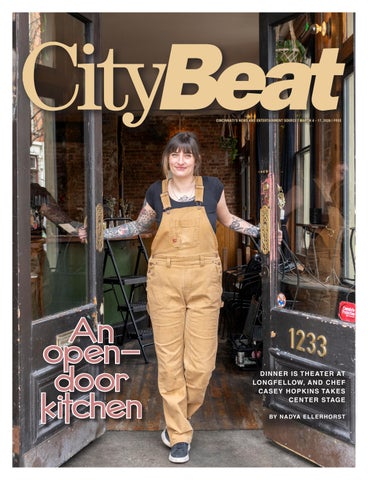
CityBeat - Volume 29, Issue 5 - March 4-17, 2026

Page 1


An opendoor kitchen

DINNER IS THEATER AT LONGFELLOW, AND CHEF

CASEY HOPKINS TAKES CENTER STAGE

VOL. 29 | ISSUE 05

The Inside Beat: Our mission, our values and our future

CityBeat was born in November 1994 with a simple but powerful idea: Cincinnati deserved an independent voice. One willing to tell the stories of communities too often overlooked and conversations that didn’t fit neatly into anyone else’s pages, and it quickly became a home for stories that were bold, unexpected and unapologetically local.

For 31 years, CityBeat has covered Cincinnati’s wins and losses, its music and meals, its politics and protests, its artists and agitators. They did it with a wink when it was warranted, a raised eyebrow when it was necessary and a full heart always. Along the way, they earned national, statewide and local journalism and design awards (including being named Ohio’s Best Weekly Paper by the Society of Professional Journalists in 2005) but what has mattered most isn’t the awards. It’s the trust.

Through multiple ownership changes — the first sale to SouthComm Communications in 2012, another to Euclid Media Group in 2018 and finally, to Big Lou Holdings in 2023 — the mission never wavered. CityBeat’s editorial staff remained committed to fearless local storytelling and a stubborn belief that independent journalism is critical to community health.

In December, LINK Media, the company I run, bought CityBeat, returning it to local ownership for the first time in more than a decade.

A CityBeat newspaper box. CityBeat file photo | Hailey Bollinger That matters.

Local journalism works best when it is rooted in the community it serves. LINK Media’s corporate mission is simple: strengthen vibrant communities through independent, sustainable local journalism. For CityBeat, that means doubling down on what they’ve always done best, while sharpening our focus on what Cincinnati needs most right now.

Our mission is clear: CityBeat serves Cincinnati with independent local journalism that informs our readers, elevates unheard voices and keeps our community vibrant.

That isn’t just a sentence we framed and hung on a wall. It’s a daily charge.

It means we don’t just report what happened. We ask why it happened, and what happens

Introducing CityBeat’s new community vibrancy reporter, Noah Jones

In 2014, while earning my journalism degree at Bowling Green State University, I sat in on a lecture from John Quiñones, host of the TV show, What Would You Do?

During his lecture to journalism students, he offered a piece of advice that has stayed with me ever since: “Good stories seek the moved and shaken, not just the movers and shakers. That’s how you shine light in the dark.”

Those words have guided my reporting ever since. They’ve shaped the way I approach interviews, the questions I ask and the stories I pursue. That’s what has ultimately led me to the role of community vibrancy reporter at Cincinnati CityBeat.

Good journalism isn’t about amplifying the loudest voices in the room; it’s about illuminating the voices that might otherwise go unheard. I believe strong local journalism can unite communities by providing not just reaction, but context and clarity.

As community vibrancy reporter, I plan to dig deep and to understand neighborhoods’ stories; I want to understand before writing. It’s not my job to solve Cincinnati’s challenges, but it is my responsibility to help bring them

That’s work I’ve been doing since the beginning of my career.

Since my first newspaper job in Nevada, Missouri and as an award-winning digital reporter in Mansfield, Ohio, I’ve covered stories at the intersection of crime, arts and culture, education and government.

When I moved to Cincinnati at the start of the pandemic, I wasn’t sure there was still a place

for me in journalism, but instead of stepping away from storytelling, I shifted. I founded NoJo Creative, a podcasting company where I worked with clients to produce, edit and host podcast shows. That included Brutally Informed, one of the first weekly news podcasts for Audible, and working with LINK nky, now owners of this publication.

Even outside traditional newsrooms, my focus has remained the same: telling the community’s stories.

While living in Cincinnati, I’ve also worked with several nonprofits, most recently as the social media guy at La Soupe, an organization reducing food waste while feeding neighbors facing food insecurity. That experience deepened my understanding of the city — not just its challenges, but the people actively working to solve them.

All of it has brought me here.

I love Cincinnati and its communities. I’m eager to tell the stories that make them vibrant. If you know of a story that deserves light, I’d love to hear from you; shoot me an email at NJones@citybeat.com.

next. We believe in solutions-focused journalism, digging into not only the problems facing Cincinnati but how this community might solve them. We know our readers are smart. You don’t just want outrage. You want information you can act on.

It means we are unapologetic Cincinnati fans. We believe in this city — in what it is and what it can be. Loving a place doesn’t mean ignoring its flaws. It means caring enough to hold it accountable and investing in its future. We want to see Cincinnati advance, and we understand the role independent journalism plays in that progress.

It means being inclusive — not as a buzzword, but as a responsibility. Cincinnati is not one story. It is many stories, and those stories have changed significantly in the past 31 years. Our job is to reflect the full complexity of this place: across neighborhoods, across backgrounds, across perspectives. We are committed to giving voice to communities that have too often been spoken about instead of listened to

It means being good stewards. Strong local journalism doesn’t exist without sustainability. The CityBeat we bought was struggling mightily. We are committed to rebuilding a business model that allows CityBeat to serve this community not just this year, but decades from now. Independence requires durability.

And yes, it means being independent. CityBeat does not make political endorsements. We are committed to fact-based reporting on the issues facing Cincinnati. We will seek outside opinions from multiple viewpoints and clearly label them as such. Our role is not to tell you what to think. It is to provide the information (and the robust debate) our community needs to make informed decisions about our shared future.

Some things, though, will never change.

We’ll still cover the restaurant openings and the up-and-coming bands. We’ll still spotlight the artists, organizers and everyday Cincinnatians who make this place vibrant. We’ll still be curious. We’ll still be a little irreverent. We’ll still call it like we see it.

But at the core of everything is this: CityBeat belongs to Cincinnati.

It belongs to the readers who have picked it up for three decades. It belongs to the small businesses that have advertised in its pages. It belongs to the musicians, chefs, activists and public servants who have trusted us to tell their stories. And it belongs to the next generation of Cincinnatians who deserve a strong, independent publication covering the city they’re inheriting.

Thirty-one years in, we are proud of where CityBeat has been.

And we’re even more excited about where we’re headed.

Noah Jones, community vibrancy reporter at CityBeat. Photo by Kane Mitten | LINK nky to light.

This woman is helping preserve Greater Cincinnati’s historic structures one stone at a time

Kelsey Stryffe knows her way around old stones and bricks. Few jobs call for this skill, but Stryffe is perfectly suited for her role as Cincinnati Observatory’s historic facilities manager and as a heritage masonry restoration contractor. Now, she’s using her skills and knowledge to help rebuild historical structures around Greater Cincinnati, one brick and stone at a time.

“My goal is to really just educate people on historic architecture, but also to show them traditional materials and traditional fixes are extremely important, especially when we want these buildings to last for years and years and years,” Stryffe told CityBeat.

Stryffe started working in heritage masonry in 2023, but her love of history and old homes and structures started long before.

As a teenager, she was fascinated by places like Savannah and Charleston and the architectural styles that dominate these historic Southern cities, from the grand Greek Revival mansions to charming and romantic Gothic Revival homes and gingerbread-decorated Victorians. She initially wanted to study art and architectural history at the prestigious Savannah College of Art and Design after high school, but opted for an art program closer to home, first at Bowling Green State University and then Miami University.

“Growing up, I was like, I can’t wait to get the heck out of Cincinnati,” Stryffe said. “I was like, Oh, my God — Savannah has this beautiful bubble of historic homes, and I just want to be there. But I wasn’t looking at what was right in front of me the whole time. … I don’t even know what other cities out there have as vast of a collection of historic structures still intact [as Cincinnati].”

After college, Stryffe took a job at the observatory, leading tours and teaching history to visitors, but in 2023, a new local program caught her eye and made her consider a shift in her career. At the time, the Covington Academy of Heritage Trades, or CAHT was a newly launched school promising to teach the skills and knowledge one would need to work in the heritage trades and restore old homes and buildings, offering intro weeks on subjects like restoring wood windows and masonry. Stryffe, already interested in brick and stone work, jumped into the masonry course and found it was something she could see herself doing as a job.

“I took the course just to see if I could do it, and then I was passionate enough to do it,” said Stryffe. “I was like, I want to learn how to do this as a career. … I always wanted to just get in and get my hands dirty, and I ran with that.” Stryffe took more intro week courses at CAHT, learning skills like plastering and fixing wood windows and getting hands-on experience and

practical knowledge in the school’s “living lab” on Madison Avenue in Covington.

“You’re actually working on a historic home and learning … And, we’d be in there fixing plaster or taking window sashes out and just kind of deconstructing this house, but also putting it back together,” she said. “And it was just so fascinating. And I’m like, I want to be able to do this, but I’ve always kind of been one-footin, one-foot-out, because I love my job at the observatory and it offers me the stability and support I needed while I also explored these additional passions.”

Stryffe continued her full-time job at the observatory and started apprenticing part time to gain more experience. She stopped apprenticing after a couple of years to focus more on her projects at the observatory, but a big restoration project at her workplace this past summer called her back to masonry.

Needing the stonework on the building’s façade to be repaired and cleaned, the observatory contacted contractors for quotes. After hearing there were contractors who wanted to powerwash the sandstone — a soft and porous type of rock that can erode under that kind of pressure — Stryffe had the chance to put her knowledge and skills to the test.

Continues on page 6

Above: Matt Black, Modesto, California. 2014. Corner store, 2014 Courtesy of the artist and Robert Koch Galler y; Left: Matt Black
Historic Facilities Manager Kelsey Stryffe scrubs a column clean at the Cincinnati Observatory. Photo provided | Kelsey Stryffe

“I was like, ‘You realize you can’t powerwash sandstone, right?’ At least to the extent they were offering. They’re like, ‘Well, how would you do this? Can you do it?’” she said.

Stryffe spent much of the summer with a spray bottle filled with a Dawn dish detergent-water solution and a fine-toothed, non-metallic bristle brush as she scrubbed away at years’ worth of algae and lichen that had accumulated on the stones — tough and dirty work, but it was also the start of something new.

“It was almost kind of healing in a way, because I was missing the jobs that I was on, and taking on such a large project on my own, on a National Historic Landmark, really made me feel confident in the skills I already knew I had but felt I couldn’t utilize.”

Brick & Bone

The summer observatory project influenced her promotion to historic facilities manager and jump-started an idea that would eventually become Stryffe’s business, Brick & Bone

Masonry Restoration, which she officially launched at the beginning of the year. It was something she hadn’t imagined doing before.

“I never really had the confidence to be, like, ‘I’m going to start my own business,’ and do this. But I loved the work and wanted to see what it was like to take on my own side projects, on my own schedule,” she said.

When Stryffe began easing into the idea of having her own business last year, she knew it would have to start off slow, but later in the summer, she was approached by her first client: a former manager who was looking to make repairs to his 1812 barn. Working on the barn reaffirmed that Stryffe could do her trade on the side.

“It’s just repairing his foundation, working with a lot of old stone, rebuilding a lot of the walls that are collapsing, using the correct mortar materials and just understanding the barn was built in 1812 — what materials did they use in 1812? Can we replicate it doing things like for like?”

With the launch of Brick & Bone, Stryffe says she’s not a house flipper and has no interest in becoming one. Instead, she wants to use her business to help those who own historical homes and buildings better understand how to properly care for these structures.

Part of that mission is also happening online. Since the observatory project, Stryffe’s been using her social media to share what she’s learned and help educate others on the importance of preserving these stones and bricks that are hundreds of years old. On her Instagram, you’ll see videos of her using a spray bottle to help cure lime mortar, repointing stones and showing the effects of time, elements and

improper material use on these often-overlooked, but wholly essential building blocks that need a specific touch.

“Especially in [the Tri-State] area, a lot of people, they’re in historic homes … They don’t know what materials are appropriate. We have contractors all over the place that are just like, ‘Yeah, I can fix that for you,’ and it’s not the right type of stuff,” she said.

A dying trade, a dying art

Understanding how to repair and restore the different facets of a historical building requires different skill sets than making similar fixes in a modern building. And while the number of people with that knowledge is dwindling, the demand for historical building repairs and renovations is growing.

A 2022 report from The Campaign for Historic Trades shows that by 2030, as many as 462,000 buildings across the country will be added to the National Register of Historic Places, and the total number of buildings that could be considered “historic” could grow to between 5.7 and 8.3 million. In that same report, experts in heritage construction agree that there’s a shortage of laborers with those kinds of skills and knowledge, and there’s a need to support traditional trades training, like the programs offered by CAHT.

A 2023 study of trades professionals and preservation specialists by the University of New Hampshire shows there are “severe workforce shortages in plastering, masonry, carpentry, materials conservation, decorative finishes, windows and iron work.” Seventy-five percent of the study’s survey respondents said they believe the demand for preservation trades is growing, but 93% felt young people lacked knowledge about career opportunities in these trades.

Stryffe has seen the gap in knowledge between caring for a historical structure versus modern ones firsthand, like layers of cement over a stone foundation, which will trap in moisture and eat away at the stone’s structural integrity, or the use of a foam insulation in a basement that isn’t vapor-permeable but is billed as the “latest and greatest” product.

“There’s not too many people out there that know the proper materials to use when fixing 1800s brick structures or plaster repairs”, said Stryffe.“They don’t know all it takes to go into the different layers of it and how they used to use animal hair as a binding agent. And there aren’t people out there that are willing to replicate that.”

Building a foundation and preserving history, brick by brick

Stryffe isn’t shy about her love of history and historic preservation, especially when it comes to the stones and bricks she works with.

“There’s something about bricks and stone that’s just so timeless to me. … There’s so many different kinds of bricks, and there’s a whole history to how bricks were made,” she explained. “A lot of these bricks were made by hand, either on site or from brick plants not far away.”

But her love of bricks and stones makes sense — they’re key to any good foundation. The long hours learning about various bricks and stones, how to clean them, what kind of mortar they need to be pieced back together again and then putting that to practice has been Stryffe’s foundation. And like any good mason, she’s continuing to build a foundation that will

stand the test of time, brick by brick.

“I do research every day. I’m always learning about different stone types, correct mortar materials. What’s appropriate to go on brick versus stone? Is this brick harder than this brick? What is this interior brick telling me versus the exterior? There’s so many aspects to it,” she said. “I want to be able to look at [a problem] and be like, ‘Okay, this is happening the way it’s happening because of this reasoning.’ And then going in and being like, ‘This is how I can fix it for you.’”

Stryffe’s foundation is built on learning, but also on the philosophy that things should be built to endure for centuries with the proper stewardship. She shares a quote from English polymath John Ruskin that informs her approach to historic preservation:

“When we build, let us think that we build forever. Let it not be for present delight nor for present use alone. Let it be such work as our descendants will thank us for; and let us think, as we lay stone on stone, that a time is to come when those stones will be held sacred because our hands have touched them, and that men will say, as they look upon the labor and wrought substance of them, ‘See! This our fathers did for us.’”

“Like, look at what these people built, and look how long it’s stood the test of time. We have buildings that are pre-Civil War that are still around,” said Stryffe. “[Preservation] is an important reminder of where we came from and that it’s not just us. … It’s almost poetic in a way to be able to rebuild something that somebody else had built hundreds of years ago.”

You can learn more about Brick & Bone Masonry Restoration and watch Stryffe’s journey in the heritage trade on her Instagram page, @kelsey_j_stryffe. She’s open to stone, brick and plaster work in Ohio, Kentucky and Indiana. You can also visit the observatory, where Stryffe leads tours on Tuesdays and Thursdays, to see her work firsthand.

Kelsey Stryffe works on cleaning the Cincinnati Observatory’s façade. Photo provided | Cincinnati Observatory via Facebook
A before and after of the Cincinnati Observatory’s porch after Kelsey Stryffe scrubbed away years of biological growth. Photo provided | Cincinnati Observatory via Facebook

According to the health care advocacy group Protect Our Care, more than 113,000 Ohioans are forgoing health care coverage on the federal marketplace because of a congressional decision requested by President Donald Trump’s administration to let tax credits expire on Affordable Care Act premiums.

An Ohio legislator, a fellow doctor and a retired Ohioan all said drops in enrollment to the Affordable Care Act due to the loss of federal assistance could cause longterm issues in the state.

The Ohio drop is the fourth highest in the country, behind North Carolina, Georgia and Florida, a study from the group found. Nationally, 1.2 million people have left the federal program.

The expiration of those tax credits meant increases in the amount Americans are paying for the Affordable Care Act coverage, sometimes doubling the amount needed to pay for the coverage.

“For me, the way I look at it, I have to pay $1,000 a month for the privilege of spending $10,000 a year in deductibles, just to have catastrophic coverage,” said Ohioan John Francis, on a virtual briefing hosted by Protect Our Care.

Francis is a retiree who thought the Affordable Care Act would be a good option as he waited to be eligible for Medicare at age 65. While he has chosen to continue on the insurance plan because he can afford it, he understands how quickly health coverage could become out of reach for Ohioans because of the cost.

He said seeing the cuts to Affordable Care Act tax credits, along with cuts to Medicaid that will amount to a more than $30 billion loss for Ohioans over the next decade, brings about a “moral question” about how America should be helping its own.

“If we’re going to allow people to work full time and still be at the poverty level, then at least we should have the common decency to cover them with health care,” Francis said. “I don’t know how we can look at it any other way.”

Dr. Anita Somani, an OB/GYN and state representative, said the tax credit expiration, along with things like work requirements being instituted into Medicaid, only negatively impact the health of the state and its residents.

“What we’re going to see is people delaying care,” she said.

In her practice, that would mean putting off pre-natal care, mammograms, Pap smears and other cancer screenings. It could also mean pregnant women with high blood pressure could develop pre-eclampsia, which could lead to a stillbirth.

“Everything points to basically health care costs going up, people getting sicker, people dying,” Somani said. Advocacy group says more than 113,000 Ohioans are now going without ACA coverage

If this bill passes, grabbing a drink with friends will soon cost 4% more in Kentucky

Ordering a cocktail at dinner or grabbing a case of beer from a liquor store in Kentucky may soon come with a bigger price tag if House Bill 612 becomes law.

The state introduced the bill, which would impose an additional 4% state regulatory license fee on gross receipts. If passed, it would add an additional 4% fee on all alcohol sold in Kentucky, affecting restaurants, bars, liquor stores and convivence stores.

“It’s [going to impact] the corner store on the west end of Newport, it’s Jeff Ruby’s in Lexington, it’s Pompilio’s in Newport, it’s One Stop Liquor, it’s Kroger, it’s everybody,” said Kentucky Restaurant Association 2026 Chairman and one of Pompilio’s owners, Joe Bristow.

Combined with Kentucky’s 6% sales tax, the consumer would effectively pay 10% on their alcohol purchases. A $100 purchase today would bring you $106 after the 6% sales tax. A $100 purchase under the bill would be $110.

HB 612 was introduced by Representative Matthew Koch, a Republican from Paris, on Feb. 10. Koch is the chair of the Licensing, Occupations & Administrative Regulations Committee. If passed, it would take effect on July 1, 2027.

Bristow said he found out about the proposed bill on Jan. 29 and got to work spreading the word.

“We got to spreading the word and it has worked,” he said. “Not only in Northern Kentucky, it’s spreading like wildfire, as it should. It’s huge. It’s a big deal.”

In Newport, customers already pay a 2% regulatory fee on alcohol sales. Meaning, if HB 612 passes, Newport customers would pay an extra 12% in fees. Bristow said Newport has offered some help to offset that fee, such as refunds on liquor license renewals. He said he knows Newport isn’t the only city in the state that has its own regulatory fee, but he didn’t know which others do.

Bristow said the restaurant could put “city of Newport regulatory fee 2%” on the check, or just raise its prices by 2%, which is what they chose to do to absorb the cost.

Now, Pompilio’s is back in the same boat. It could put the message at the bottom of the check. A customer would see “Kentucky sales tax 6%,” then another line item that says, “Kentucky regulatory fee 4%,” or raise its prices.

“We just want to be in control of our own pricing,” Bristow said. “This all happened so quick. It will be a major impact on Pompilios. It will not close us, but it’s certainly not going to help.” The bottom line: The consumer will pay for it.

“It’s not a position we want to be in,” Bristow said. “Being so close to Ohio, people know that if they stay in Ohio, they can get a discount, basically.”

Whitney Frommeyer is the managing partner at Bellevue’s One Stop Liquor Store on Donnermeyer Drive. The store opened in 1995. Her brother-in-law, Paul Kloeker, manages and operates the One Stop Fuel Mart BP Gas Station, which the family has owned since 2013.

Frommeyer said that when stores raise the price of their products, customers either don’t

come back or go somewhere else.

“Across the state, a lot of your liquor stores are small businesses,” Kloeker said. “It’s not an industry like grocery stores or gas stations, where it’s all the big corporate entities that own them. A lot of these liquor stores are family-owned. They have family running it, just like we have here.”

It’s a new day for the Cincinnati Reds— sort of.

Phil Castellini, the current president and CEO of the Reds, has assumed full control of the team, according to a report from the Associated Press. Previously, his father, Robert “Bob” Castellini, was in charge.

This transition began in July 2024, when Phil became president.

The younger Castellini has had a rough reputation during his time with the Cincinnati Reds. It’s true that the Reds have been to the playoffs once during his tenure as president — something that hasn’t happened since 2013 — but he’s had plenty of public gaffes

while he’s worked with the organization.

The most notable was his infamous “Where ya gonna go?” comment on Opening Day 2022, when he bashed Reds fans who had publicly declared that the Castellini family should spend more or sell the team. He later apologized, but Reds fans still haven’t forgotten; as recently as Jan. 14, he was booed by the crowd at a Xavier University basketball game.

Bob Castellini is not retiring just yet, though. Although his son is now running the ship, Bob is still expected to attend spring training in the coming weeks as he has done every year since he purchased the team in 2006.

One Stop Liquor in Bellevue. Photo by Haley Parnell | LINK nky
Phil Castellini takes control of Cincinnati Reds from his father
Mr. Redlegs. CityBeat file photo | Tony Wagner

An opendoor kitchen

DINNER IS THEATER AT LONGFELLOW, AND CHEF CASEY HOPKINS TAKES CENTER STAGE

When Chef Casey Hopkins appeared on my laptop screen via FaceTime, she had just gotten home from a Thursday shift at Longfellow. She was wearing a popular merch item from the bar — a gray sweatshirt emblazoned with a four-eyed, winking red cocktail — and she had her two little dumplings running amok in the background.

Having seen Hopkins’ packed bag ahead of an upcoming trip, her pug, Pierogi, had spent the day sulking. Her mood hadn’t improved. Meanwhile, Momo the French bulldog intermittently popped into the bottom right corner of my screen, seemingly oblivious to Hopkins’ impending departure and just hankering for some attention.

“ I’ve always cooked,” Hopkins said, occasionally patting Momo’s head and minding Pierogi’s grump-fueled antics. “I’ve always loved food. And Longfellow was the first real place that I was a cook, I was a chef, I was in the kitchen. So all of my real culinary experience has been within the walls of Longfellow in the last eight years.”

Working with people has pretty much been a focal point of any line of work Hopkins has found herself in. As a teenager, her gigs included working as a face painter at the Cincinnati Zoo, an assistant for studio dance classes and a camp counselor. Her first restaurant job was at a Chipotle, but even before then, she was no stranger to culinary environments.

“I was very close with my neighbors growing up,” Hopkins said. “They had a restaurant on the West Side, so I was always in a restaurant, and I was always at their house, in their kitchen learning how to cook.”

At that point, Hopkins was “just part of the family,” as opposed to staff, looking after the family’s children every night at the restaurant. Over time, she’s worked serving jobs, and picked up some kitchen work during her time at Chicago Gyros and Northside Yacht Club.

It was during her time at the yacht club that Casey met future Longfellow owner (and recent two-time James Beard nominee) Mike Stankovich. Stankovich opened his nationally ranked bar in February 2017, with Chef Evan Wallis at the helm of the kitchen. Wanting to involve Wallis in more of the kitchen management, Stankovich began seeking additional members for the kitchen staff — with a few qualifications in mind.

“Longfellow’s kind of a unique kitchen in the sense that it’s visible to the public, and a lot of people that work in kitchens don’t wanna have to talk to people,” Stankovich said. “Whenever we’ve had to hire for that position, we’ve had to try to find the right kind of personality that wants to talk to people, but also make food under people watching them. And Casey has that personality and does well at it.”

Hopkins ultimately joined in March 2018.

“She had a long history of working in bars and

For any challenges, the trial by fire ended up being an unintentional masterclass for the rising chef.

“When we opened back up inside, however long that was after, it was like, ‘Cool, alright, I know how to work this space, and make it work in a large scale. Now I can refine it,’” Hopkins said.

Wallis, who now owns College Hill bar Big Chill with his wife, Hannah Wheatley, also saw some serendipity in the circumstances.

“ I think it was a nice time, because it was a natural time to reset and let her do her own thing, and kind of see how things went from there,” Wallis said.

While she had to learn what Stankovich called the “medial” aspects of operating a kitchen — like getting acquainted with sources for ingredients and ordering them in the right quantity — Stankovich witnessed key growth in her confidence in skills she already possessed.

“She has whatever it takes to just make food taste good, but I think her kind of realizing that, or accepting that, was a big step,” Stankovich said.

Longfellow’s ever-evolving menu has steady items — the charcuterie board, the Scrap Sandwich, the egg salad (figures) — but Hopkins and her team still get plenty of freedom to conceptualize and experiment. Menu comings-and-goings have been born of trial-and-error, nostalgia and everyday cravings. Case in point: the bestselling mushroom melt.

restaurants, and just was a good worker, and learned quickly, and was willing to take advice,” Wallis said of Hopkins.

Longfellow was an all-hands-on-deck operation, with team members picking up different responsibilities to keep the busy bar running. According to Wallis, as he got busier assisting with the bartending side of Longfellow, Hopkins took on more of the food service side.

When Wallis moved on from Longfellow, Hopkins was selected to take his position. Stankovich cited her preexisting tenure with Longfellow, her culinary ability and her love for the work as reasons.

“She had to learn some stuff,” Stankovich said. “But any job anyone takes, you have to learn some stuff. So that’s not a deterrent, at least for me, to hire somebody. I’d rather teach someone to do the right thing than have them think they know everything.”

And not three days after transitioning into the position, the COVID-19 pandemic lockdowns began. What followed was a pivot to an all-takeout operation for Longfellow’s loyal base of customers — and a need to churn out a whole lot of egg salad.

“ We did have a couple regulars in that time who were buying two pints a week of Longfellow egg salad, which is amazing egg salad,” Hopkins remembered with a laugh. “I love the egg salad! But also, who’s eating a quart of egg salad in a week?”

“Our mushroom melt just happened one day because I wanted pizza, but I didn’t wanna buy pizza,” Hopkins said. “So I was like, ‘What do we have in here that can make me something that tastes reminiscent of pizza?’ And it worked out perfectly.”

Hopkins categorizes the mixed menu into “plates” and “snacks,” striving to make the latter “elevated comfort food.”

“The snack side in my brain is just like, ‘What are you eating in your cool aunt’s basement when she’s hosting a house party?'” Hopkins said. “Like, what is your awesome Aunt Kathy putting out on her table to feed you snackwise?’”

Enter hanky pankies, a Midwestern staple that Hopkins considers “an homage” to her own (presumably awesome) Great Aunt Jenny. A blend of ground meat, spices, and logs of glorious Velveeta cheese piled on bread, it's not your everyday printed menu item, but one that catches eyes and elicits joy nonetheless.

”It’s a fun thing to have on the menu,” Hopkins said of this family dish she’s long enjoyed annually on Christmas Eve. “People see them and they get excited.”

Many of Longfellow’s ingredients are sourced locally. Hopkins also taps into resources a stone’s throw (or streetcar ride) away, from Avril Bleh to Findlay Market. And she cultivates a small spice garden right outside the bar near its outdoor seating area. If you opt to sip your signature Shiso Painkiller outside, you might just be sitting near the namesake plant involved in its creation.

Longfellow’s Casey Hopkins with one of her dishes. Photo by Joe Simon | CityBeat contributor

Food is Hopkins’ passion, yet her recipes aren’t something she seems to agonize over.

“At the end of the day, it’s just food,” Hopkins said. “I mean, ‘It’s just food’ is such an understatement, but it’s gotta be good food. We wanna make good food, and it’s not the end of the world if we gotta change something.”

For any menu leeway, however, there are some challenges literally inherent to the establishment’s architecture. According to Stankovich, due to preservation requirements in the Overthe-Rhine neighborhood, Longfellow wasn’t permitted to install a kitchen hood within the historic building.

As a workaround, Stankovich drew inspiration from his work in the industry in New York City, where chefs built perfectly efficient kitchens without needing to install pricey hoods. Stankovich also explains the pivot was inherent to Longfellow’s design; its character channels that of a Japanese izakaya (casual, sometimes compact bars with kitchens that serve up small plates and bar snacks alongside drinks). And the Longfellow kitchen team has made it all work from the outset.

“Part of how we developed our menu was what we were able to do,” Wallis said. “And that was something that I think me, Mike and Casey all enjoyed — having limited resources and still seeing what you were able to do.”

These days, during busy times, Hopkins operates in what she approximates to be a 3-foot by 2-foot space, not to mention the other bartenders in motion around her (she’ll also bartend, when needed). Hopkins and her team work with an intentional set of tools that includes a hand crank meat slicer, hot plate, toaster oven and steam table.

“ I think it is a testament to that you don’t need a big, fancy kitchen or all the crazy hullabaloo to create good, comforting food,” Hopkins said.

Hopkins and her colleagues, Chef Mike Lizama and Chef Thearvy Long, continue to do their work in full view of patrons — which, while sometimes stressful, isn’t necessarily a negative for Hopkins.

“ A lot of cooks and a lot of chefs love being behind their closed door,” Hopkins said. “They love the fact that they don’t have to interact. I

personally love it, ‘cause I’m just a schmoozer. I love talking. I’ve made so many great friends and met so many awesome people by just being at my meat slicer and someone being like, ‘Is that this?’ And me being like, ‘No, it’s actually this.’”

Evidence of these connections can be found in a lineup of tcotchkes near that same meat slicer. What started as a photograph of one of Hopkins’ dogs and a shot glass emblazoned with aliens has grown into a collection of small offerings from patrons. Everything from baby photos to an E.T. figurine keep Hopkins company at her station.

Hopkins said the broader Cincinnati culinary scene Longfellow operates in is robust, yet not necessarily cutthroat.

”We do have this huge booming culinary scene, but nothing feels insanely competitive against each other,” Hopkins said. “Like, we’re all doing it together. We’re all there for one another. If one of our buddies up the street needs an extra bag of towels for the night, guess what? We got you.”

While an establishment of her own someday isn’t totally off the table, Hopkins deems herself “a short-term goal girl,” and keeps herself grounded in the present as she considers her future.

“ The goal right now is to just keep ripping, and keep learning, and just keep having fun, because that’s the coolest thing I think about my job is that I have a lot of fun doing it,” Hopkins said.

“She’s a crucial part of Longfellow,” Stankovich said of Hopkins. “But if she ever needed to move on or grow her career or something, I would support it, too. So I’m supportive of her outside of just her standing in the kitchen.”

For all of the industry experience she’s amassed over time, Hopkins still acknowledges that she never imagined being in her role today.

“ It is really cool to just be floating around with serving tables, working in random bars. And then now, you know what I do? I’m a chef now, and I run a kitchen side of a bar that’s very successful, because I work with great people, we have great guests and I have the openness to learn and soak in new skills.”

If needed, Hopkins will even hop behind the bar and make drinks. Photo by Joe Simon | CityBeat contributor
Gifts from regulars line Hopkins’ workspace near her meat grinder. Photo by Joe Simon | CityBeat contributor
Hopkins' carrot salad. Photo by Joe Simon | CityBeat contributor

ARTS & CULTURE

Anew bar just across the river wants you to roll for initiative.

Dice on Draft opened Feb. 13 in Covington, and it features over 200 board games to play alongside a full-service cocktail bar.

Owner McKenzie Crist decided to open the space out of her own love for tabletop games and the lack of a space to play them in the area; Cincinnati’s most prominent board game bar, The Rook, closed just before COVID.

“[There’s] kind of a gap in the community for something like this,” Crist said. “There’s been board game bars in the past, and some of those still exist, but we wanted to open here in Covington to… offer something just over the river for everyone.”

The bar sports over 200 different board games and tabletop games — 100 of which are from Crist’s personal collection. Classics like Scrabble, Pictionary and Battleship sit alongside modern favorites like Settlers of Catan, Wingspan and SmashUp in the bar’s main area.

A private room available to rent offers space for tabletop campaigns, with several rulebooks

New board game-focused bar opens in Covington

and guides for Dungeons & Dragons displayed. In addition, more complex games like Gloomhaven and Twilight Imperium are available for play in the room. Starting this month, the bar will run smaller D&D campaigns (referred to as “one-shots”) every other Thursday for patrons to participate in.

The most prominent feature in the bar (other than the shelves packed full of board games, of course) is an arcade machine for Killer Queen,

Crist’s favorite games — like the ‘Don’t Explode,’ a cherry-tinged take on a caipirinha named for Quacks of Quedlinberg, or the ‘Mars Reviver,’ which is inspired by Terraforming Mars and features gin, amaro nonino and cointreau. There are six beers on tap, too; classics like PBR and Rhinegeist Truth sit alongside seasonal beers from local breweries.

For Crist, opening a bar centered on board games was a no-brainer thanks to how they provide “so many options” to enhance social situations.

the popular 5v5 strategy-sports-platformer hybrid that’s become a mainstay of arcades everywhere since it released in 2013. While Crist doesn’t plan to feature any other arcade games at the bar, the sense of community building that the game brings in was too good to pass up.

“There’s lightweight games that are easier to chat with friends over, there’s more competitive games that really expand your imagination. I love party games where you ask your friends questions and learn more about them. I just think board games have so much potential, and they really enhance social situations in many ways,” she said.

The game she’s most excited for guests to play is Mysterium, a social deduction game where one player is a ghost and the other players must work together to find out who killed them and how they did it before time expires.

“We played it at Arcade Legacy in Sharonville and just found it really easy to play,” Crist said. “We loved the 10 person aspect. It’s really social, it encourages people to meet up together and play.”

The hope is that Dice on Draft will provide a space for Cincinnati’s tabletop community to enjoy what they love.

The game already has a passionate following in the Cincinnati area, and the bar will host ‘Learn to Play’ events where Killer Queen veterans will show newcomers some tips and tricks.

While there’s no kitchen at Dice on Draft, there are plenty of drinks to go around. An extensive menu features cocktails named after some of

“Our goal is just to be a safe, cool, easy place for people to hang out at. A place for people to experience new games and meet new people,” Crist said. “We’re really just excited to welcome everyone. A place like this… has been a long time coming.”

Dice on Draft is located at 20 E. 5th Street in Covington, near Madison Avenue.
Dice on Draft has more than 200 board games. Photo provided | WCPO
A selection of board games at Dice on Draft in Covington. Photo provided | Dice on Draft

opera program

Villa Hills native and performer Logan Wagner has performed in operas throughout the country.

Now, he has been accepted into the prestigious Merola Opera Program, a 10-week livein training program in San Francisco that, as Wagner put it, is “like a stamp of approval for your career.”

The program had a record number of applicants this year: over 1,500, from all over the world. Wagner was one of only 28 people accepted. Starting this summer, he and the other artists selected – who come from everywhere from South Korea to the UK to states throughout the United States – will travel to California to complete the program.

Merola alumni include Joyce DiDonato, who has won a Grammy for Best Classical Vocal Solo three times, and Stuart Skelton, who won Male Singer of the Year at the 2014 International Opera Awards, among numerous others dating back to the mid twentieth century.

“Once they have completed this program, they will join a vibrant community of distinguished alumni who have gone on to thrilling careers with major opera houses around the world,” said Merola Executive Director Sean Waugh in a press release.

“I grew up being really fascinated by music,” Wagner said.

His father, Tom Wagner, plays keyboards in local rock band The Fast Forward, which is still active in and around Northern Kentucky. Observing his father’s “sense of discipline,” Wagner said, “is the thing that taught me how to really be passionate about something.”

Regional coffee chain moves Downtown location inside the CAC

One of the biggest coffee chains in the city is moving its flagship Downtown location.

Urbana Café, which opened a storefront inside the Atlas Building during the COVID-19 pandemic, is now moving that location to the Contemporary Arts Center, or CAC.

The newest Urbana location will be on the first floor of the CAC and will operate seven days a week when it opens this April.

building was once Atlas Bank, then the home of Fifth Third Bank’s offices and is now being transformed into luxury apartments. That remodel will force Urbana out of the location it has held for four years, but the café’s founder looks back on their time in the building fondly.

He started doing plays and musicals in middle school and high school. He showed an aptitude for singing, so he started taking private voice lessons. One day his instructor, Carl Resnick at the Musical Arts Center in Cincinnati, asked him if he knew how to dance. Wagner said no, and so Resnick began teaching him how.

“I just started falling in love with opera because it was like all of these emotions in musical theater were then heightened by like 10,000,” Wagner said.

He went to the Cincinnati Conservatory of Music at the University of Cincinnati, often shortened to CCM, for both his undergraduate and graduate studies. He also earned an artist diploma after completing a post-master’s performance program there.

Since then he’s performed in programs in Des Moines, Santa Fe, Pittsburgh and Virginia. Last year, he performed with New World Orchestra, a program in Miami Beach Florida.

He has a handful of favorite operas. One is Fellow Travelers, which was actually developed in a collaboration between the Cincinnati Opera and CCM, about the 1950s lavender scare that saw mass firings and other forms of social persecution of gay employees in the government. He performed in a production of Fellow Travelers at the Pittsburgh Opera. Others include Peter Grimes, a twentieth century classic by Benjamin Britten, Tosca by Puccini and Eugene Onegin by Tchaikovsky, which is, in turn, based of a poetic novel by Pushkin.

Learn more about Wagner at loganwagnertenor.com/media.

“CAC has always seen itself as a living room for the city — a place where art, ideas and people come together,” said Carolyn Hefner, chief of external affairs at CAC. “Partnering with Urbana strengthens that vision by adding a daily ritual to the museum experience, inviting people to linger, connect and return.”

The coffee shop is changing locations due to the renovation of the Atlas Building by local developer Urban Sites. The century-old

“Those early days were quiet — but we believed in Downtown and what this space could become,” said Daniel Noguera, founder and president of Urbana Café. “Over time, the café grew into a place filled with connection and everyday rituals that make a neighborhood feel like home.”

This new iteration of Urbana Café in the CAC’s lobby will operate through summer 2027.

Other Urbana Café locations exist in Price Hill, Pendleton, East Walnut Hills and Findlay Market. The group also runs a pastry shop titled Moxy that sells freshly-baked goods just outside Findlay Market every day.

Playhouse in the Park summer youth program registration opens

Registration for Cincinnati Playhouse in the Park‘s summer theater camps and performance academies opened recently. Camps take place at locations in Mount Adams and Mason and are designed for students in grades 1 to 12.

“The campers grow every single week, and we see it,” said Ariana Moses, Playhouse’s education director, in a press release. “A camper who comes in on the first day of a five-day camp is not the same camper who leaves on Friday. They’ve made friendships, they’ve formed a community, they’ve learned new skills and they’ve put together something to show their family and friends.”

depending on the time slot and location. Scholarships are available for students who demonstrate financial need, and before and after care is available at all locations.

Tuition ranges between $365 and $795,

Get more details on specific camps, locations and pricing at cincyplay.com/learn/ summer-theatre-camps.

Logan Wagner performs. Photo provided | David Bachman Photography via Logan Wagner
The Contemporary Arts Center. Photo provided | Contemporary Arts Center via Facebook
Participants in one of Playhouse in the Park’s summer programs. Photo provided | Playhouse in Park

NKY Pizzeria’s ‘Let’s Get Weird’ Pie Series FOOD & DRINK

Cincinnati’s most eccentric pizzeria is getting even wilder thanks to a new collaboration series with several local restaurants.

Wayfarer Tavern’s pizza, located just across the river in Dayton, Kentucky, has become the favorite pie of many Cincinnatians thanks to its unusual form — a mix of Detroit, East Coast and square-cut Midwest stylings — and the restaurant’s embrace of unorthodox toppings (one of its best-selling pizzas, for example, prominently features pickles).

“[Our menu] is kinda like if we were a nice steakhouse that served pizza instead of steak,” Owner Mike Dew said, laughing. “You could come in here and get a nice cocktail and a little snack for a small get-together, or you could have a full-blown birthday party with an awesome bottle of wine and 10 pizzas with your best friends. The way I describe it: If something on our menu looks good, it is good.”

Now, he’s taking things up a notch by letting other chefs into the kitchen. Six of Cincinnati’s hottest eateries — Galactic Fried Chicken, Quan Hapa, Pata Roja Taqueria, Carmelo’s, The Aperture and The Pickled Pig — are headed to Wayfarer to put their own spin on classic ‘za, with innovations like a Reuben-style pie or a pizza styled after an okonomiyaki (Japanese savory pancakes).

Decadent? Sure. But not unexpected for a restaurant that already serves oysters, French onion soup and wagyu beef carpaccio alongside its pizzas.

Korean Central Presbyterian Church of Cincinnati: Associate Pastor

Prepare and deliver sermons and pastoral services for congregation to assist senior pastor. Instruct people who seek conversion to Christianity. Min. Master of Divinity or Theology is required.

Send resume to:

11256 Cornell Park Dr #514 Blue Ash, OH 45242

“The idea is really just to get people to try new things, like a new restaurant from another part of town or a new ingredient… this is for people who normally just order pepperoni pizza,” he said. “Like, let’s get weird, right?”

Dew started his journey to the restaurant world in 2013, when he still worked as a graphic designer and helped the Lang Thang Group (the ownership group behind local restaurants Pho Lang Thang and Quan Hapa) with its initial branding. In 2021, he was doing Detroit-style pizza parties at his house, and they were such a hit that Lang Thang Group co-owner Bao Nguyen encouraged him to pursue his own pizza pop-ups.

His first pop-up was at Pho Lang Thang in October 2023, and it was a massive success — but on the same day, he was laid off from his full-time job. Instead of finding another job, he continued doing pop-ups in hopes of one day opening his own restaurant. That dream came true when he opened Wayfarer Tavern just a year later. Now, he wants to give back to the people who helped him get to where he is today, and the owners of all six restaurants participating have a connection to Wayfarer’s beginnings.

Some were Dew’s former coworkers. Others at-

tended the first pop-up and forged a relationship. One has a familial connection: Carmelo’s co-owner, Mitch Arens, is friends with Dew’s younger brother. Wayfarer’s current head chef, Mikey Fabian, moved to Cincinnati specifically to work with The Aperture’s chef/owner, Jordan Anthony-Brown. And all six collaborations came from mutual admiration, like how Dew was a frequent customer of Gary Leybman’s wares at Findlay Market before he opened The Pickled Pig.

So what’s on the pizzas? Galactic Fried Chicken’s pie features the restaurant’s own tenders, chipotle honey mustard, chicken skins and spice rubs with a confit garlic cream white sauce and a five-cheese blend. As mentioned, Quan Hapa’s take on pizza will resemble okonomiyaki: Japanese mayo, tonkatsu sauce, furikake, bonito flakes and your choice of bacon or shrimp. And The Pickled Pig’s will feature sauerkraut and corned beef as toppings alongside a Reuben-style sauce (the rest are still in the works).

Obviously, calling these pizzas ‘weird’ is an understatement. But it makes sense for a restaurant that doesn’t “adhere to any specific pizza dogma.”

“Pizza is a blank canvas to us,” Dew said. “People will tell us ‘you can’t do this’ or ‘pizza can’t be that.’ I grew up in Northern Kentucky, I didn’t come from the East Coast… there’s all these rules, and it’s suffocating, so being able to say to heck with all that is part of our deal.”

With this collaboration series, which will debut a new pizza every week now through March 22,

Wayfarer Tavern hopes to shine a light on Cincinnati’s culinary scene, which Dew says is full of “a million awesome hidden gems around the area.”

“We’ve been getting some national attention lately, and we’re building on that momentum by letting people know that we have a lot of great independent restaurants in town, not just chains or big names like Jeff Ruby’s,” he said. “I’m a cheerleader for Cincinnati’s restaurant scene… it definitely punches above its weight class.”

Tavern is located at 635 Sixth Ave. in Dayton, Kentucky.

The pizza collaboration between Wayfarer and Galactic Fried Chicken. Photo provided | Wayfarer Tavern via Instagram
Wayfarer
Week two of the pizza collab was with Quan Hapa. Photo provided | Wayfarer Tavern via Instagram

FC Cincinnati’s home opener was Feb. 21 at TQL Stadium, and the team has a new kit and plenty of new food for fans to enjoy.

This year, the team based its newest jerseys and menu on a ‘Seven Hills’ concept, paying tribute to the history of Cincinnati.

“It was important for us to capture an important part of the Queen City’s legacy,” said Jeff Berding, FC Cincinnati president and co-CEO. “[Cincinnati] being the city of Seven Hills is more than just geography or a scenic landscape, it really is a big part of the cultural and historic growth of the city.”

The jerseys feature a zig-zag line pattern, with seven “elevations” in the line as a nod to the city’s famous seven hills — Mount Adams, Mount Auburn, Walnut Hills, Vine Street Hill, College Hill, Fairmount and Price Hill.

The new food, meanwhile, brings in several of the Queen City’s culinary traditions. Obvious Cincinnati nods like goetta sliders sit alongside collaborations from some of the city’s finest purveyors of food and drink, like loaded tots from Alfio’s Buon Cibo, a jerk

chicken bowl from Jay’s Nyam and Jam, and special brews from Rhinegeist and MadTree.

“With the menu this year, we really wanted to bring it back to Cincinnati,” said Executive Chef Sheldon Morgan. “In honor of the Seven Hills kit, we wanted to get a real feel for Cincinnati’s food scene… we got Gomez, Jay’s, Alfio’s, Chino’s, Skyline, LaRosa’s. It wouldn’t be Cincinnati without those guys.”

Another focus for this year’s menu was smaller items that are easier to eat in the stands so that fans don’t miss any of the game because they’re focused on whatever dish is on their lap.

Downtown Cincinnati restaurant named one of the best in America

Jose Salazar’s Latin-American restaurant Mita’s has, once again, been named one of the best restaurants in America.

The USA TODAY Restaurants of the Year 2026 article lists the popular Downtown eatery as one of the 39 best in the entire country.

Salazar launched the restaurant in 2015 as an homage to his Colombian grandmother (his “mita”) with vibrant cuisine that has taken the city by storm ever since.

Known for its superb, eclectic menu and its extensive Spanish wine program, it’s a perennial candidate at the James Beard Awards: Salazar has been a finalist for the Best Chef – Great Lakes Region award six times now, while Mita’s itself was also nominated for Most Outstanding Restaurant in the country in 2024.

Beloved Cincinnati restaurant celebrates 100 years in business

One beloved Cincinnati eatery is celebrating 100 years of business in a big way.

Zip’s Café in Mount Lookout will soon debut new beers and liquors developed in collaboration with local favorites, along with a series of fundraisers to give back to the local community.

The restaurant began in 1926 in the Prohibition era as a family-friendly restaurant that was also secretly a place for locals to gather, drink and bet on horse races. In the last 100 years, Zip’s has been a Cincinnati staple, famous for its burgers and chili as much as it is for serving the cold pints of beer that never really went away during Prohibition.

As part of the celebration, Cincinnati breweries MadTree, Rhinegeist and Great Lakes Brewing Company have all brewed special Zip’s 100th Anniversary flavored beers, and the Newport distillery New Riff has created a special proprietary bourbon just for the restaurant.

In addition, Zip’s is holding special fundraisers for other local businesses. Restaurant guests can make a $5 donation to the Zip Burgers for Life raffle, which is exactly what it sounds like. 100% of the proceeds from the raffle will be donated to local non-profits, which Owner Mike Burke said was the only appropriate way to mark the milestone.

“If it weren’t for the support of our community, we would have never made it to a century,” Burke said. “I’ve always treated our local schools, parks and nonprofits as the driveway to my business. Supporting them has always been important to me.”

Proceeds will go to groups like the Cincinnati Zoo, Recycle Reuse Hub, Cincinnati Museum Center, Freestore Food Bank, Keep Cincinnati Beautiful, La Soupe, Cincinnati Parks, Talbert House and more.

“We thought this would be a fun way to say thank you to the community that has supported us for a century,” Burke said.

The celebration of 100 years of business will conclude in July when the raffle ends and a winner is announced, giving one lucky winner free burgers for the rest of their lifetime.

Zip’s Cafe is located at 1036 Delta Ave. in Mount Lookout.

In a social media post on the restaurant’s Facebook page, a post from Salazar and his staff said they are “incredibly grateful” for the honor.

“Mita’s has always meant more than just a restaurant. It’s personal. It’s family. For 10 years, in the middle of Cincinnati’s central business district, we’ve been serving Spanish and Latin American inspired small plates with the belief that hospitality comes first, always,” the post reads. “This recognition belongs to our team, past and present, who show up every day and execute at the highest level. And to our guests who have supported us from day one. Thank you, Cincinnati, for being part of our story.”

Mita’s is located downtown at 501 Race St. It is open 5 p.m. to 10 p.m. Monday through Saturday.

A selection of food available at FC Cincinnati’s preview of this season’s options. Photo by Kane Mitten | CityBeat
Mita’s. Photo provided | Mita’s
Zip’s Café. CityBeat file photo.

If you were subjected to physical arrest during the curfew or protests in the City of Cincinnati from May 29 through June 8, 2020, were charged with a misdemeanor(s), and had those charges dismissed,

You Could Get a Cash Payment From a Settlement.

There is a proposed settlement in a class action lawsuit against the City of Cincinnati and Hamilton County regarding the injuries that protestors and others suffered when arrested during the curfew or protests in the City of Cincinnati from May 29 through June 8, 2020. The litigation is known as Kenney, et al. v. City of Cincinnati, Case No. 1:22-cv-295, in the United States District Court for the Southern District of Ohio Western Division.

WHO IS INCLUDED IN THE PROPOSED SETTLEMENT?

Claim Packages were mailed to Settlement Class Members on February 5, 2026. If you received a Claims Package, you were determined to be a member of the Settlement Class in this lawsuit. If you believe you should have received a Claims Package, please contact the Settlement Administrator at 1-800-598-3016 or info@cincinnatiprotestsettlement.com.

WHAT DOES THIS PROPOSED SETTLEMENT PROVIDE?

The Settlement Amount of $8,143,000 shall be allocated as follows: a) A Class Fund of $5,029,500 will be distributed to all Settlement Class Members. The Class Fund will be paid out in equal parts to every person in the Class listed. b) A Conditions of Confinement Subclass Fund in the total amount of $600,000 shall be distributed to members of the Settlement Class who timely submit Declarations in Support of Inclusion in Conditions of Confinement Subclass. The maximum award for each member who timely submits a Declaration will be $2,000, or, if more than 300 members of the Settlement Class timely submit Declarations, the total Conditions of Confinement Subclass Fund amount of $600,000 shall be divided evenly among all such members, resulting in a pro rata distribution. c) A Secondary Claim Fund of $300,000 will be distributed to Settlement Class Members who, in addition to being arrested, show they endured certain type of Uncompensated Injuries, to be adjudicated based on the evidence they submit.

d) A Class Representative Award Fund of $55,000.

e) An Attorney Fees, Cost, and Expenses Fund of $2,035,750 plus approximately $5,000 in costs will be distributed to Class Counsel to compensate the attorney fees and costs.

f) A Reserve Fund of $52,750 and an Administrative Expense Payment of $65,000 will be used to pay the expenses associated with distributing

and managing this money. These amounts are estimates and may increase or decrease based on actual expenses of administration, and on the actual number of class members who are determined to be eligible for payment.

HOW CAN I GET A CASH PAYMENT?

If you were determined to be a member of the Settlement Class, you are automatically eligible for compensation for your arrest. You are not required to do anything more. However, if you also fit into either one or both of the following categories, you may make an additional claim for more compensation.

You can also submit a Declaration in Support of Inclusion in the Conditions of Confinement Subclass by attesting that you were detained for more than five (5) hours in association with your arrest, AND/OR a Secondary Claim for Uncompensated Injuries, by showing evidence that you endured certain special injuries in addition to your arrest or arrest and confinement.

The deadline for submitting a Declaration of Inclusion in the Conditions of Confinement Subclass AND/OR a Secondary Claim is June 5, 2026, which can be completed online at www.cincinnatiprotestsettlement.com.

WHAT ARE YOUR OPTIONS?

Even if they do nothing, Class members will be bound by the Court’s decisions. Class members who want to keep their right to sue the Defendants themselves must exclude themselves from the Settlement Class by April 3, 2026. Any objection to the proposed settlement must be submitted to the Court by April 3, 2026

The Court has scheduled a final fairness hearing on May 7, 2026 to consider final approval of the proposed Plan of Allocation and to hear any objections. You may attend the final fairness hearing. If you wish to speak at the final fairness hearing, you must first file a written objection. You do not need to attend the hearing.

This notice summarizes the proposed settlement. For more information, visit www.CincinnatiProtestSettlement.com or contact the Settlement Administrator at 1-800-598-3016 or info@cincinnatiprotestsettlement.com.

For more information: 1-800-598-3016 • www.CincinnatiProtestSettlement.com

MUSIC

The Wombats played on Feb. 13 at Bogarts, and CityBeat photographer Martin Lopez-Isidro was there to capture the event in photos.

Look at a few of his shots below, or go to citybeat.com to see the full gallery.

Turn static files into dynamic content formats.

Create a flipbook