LINCOLN’S INN

Designed by Jamieson Eley.

Message from the Treasurer
It has been a great honour to serve as your Treasurer in this, our 600th Anniversary year.
In terms of governance, there were four developments which will hopefully assist the Inn to flourish for another 600 years. First and most importantly, we have harvested the benefits of all the detailed work undertaken by the Governance Working Group (GWG), which was established by Lord Neuberger when he was Treasurer. None of the reforms that have now been agreed would have been possible without the GWG Report, nor would they have been carried through without the critical engagement of fellow Benchers in the numerous debates that we conducted throughout the first half of 2022. Second, we have seen the introduction of a Code of Conduct for members, which is another essential tool in preserving the Inn’s standing as a welcoming, collegiate workplace for professionals. Third, we have published a statement of purpose, values and ambition which is similarly indispensable for an organisation such as ours today. Fourth, we have agreed to discontinue the practice of saying a Christian grace before and after dinner in Hall. That was a particularly delicate issue, and it justified an animated debate: but the final decision was undoubtedly the right one.
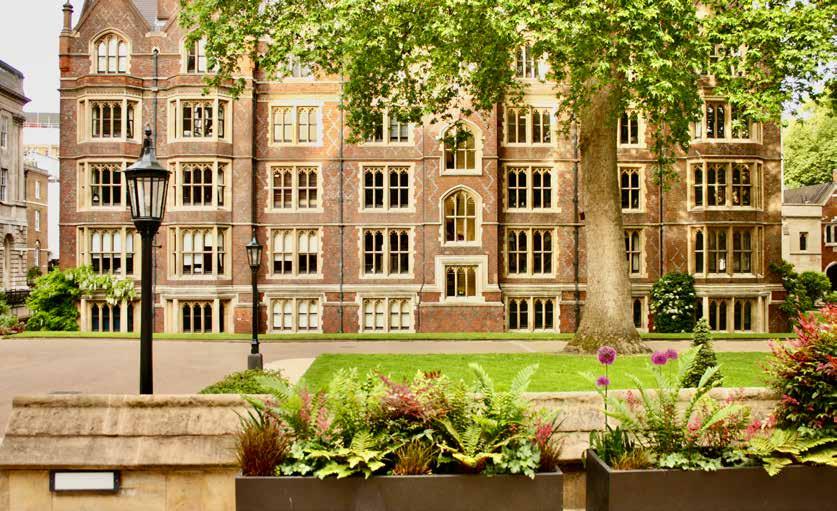
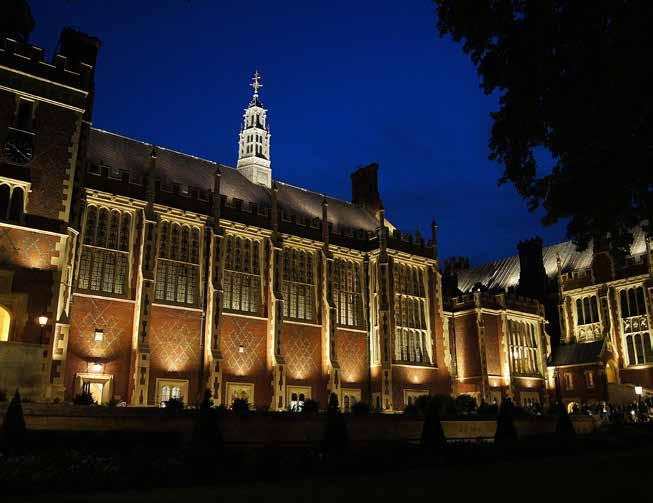
In terms of the Inn’s physical estate, we have seen the completion of a major project in reroofing the Great Hall and the Library, and cleaning all the brick and stone. The works also identified some hitherto unknown problems, particularly with the chimneys, which had been caused partly by age and the weather, and partly by sub-standard renovation works in earlier years. These have now been rectified, and the buildings are not only secure but they look glorious. Further works continue in New Square and at 77 Chancery Lane. Equally importantly, we have almost completed the Inn-wide fire risk assessment and mechanical & electrical works. It was the longest and most expensive of the projects, but it has come in under budget. It involved the replacement of the Victorian pipework throughout the Inn and a great deal of work necessary to comply with modern statutory requirements. It is perhaps the least visible and least exciting aspect of the works, but it is absolutely essential if the Inn is to continue as a working environment. Meanwhile, the first phase of the conservation programme for the stained glass in the Chapel was completed in September 2022.

The two central windows in the north elevation have been reinstalled with environmentally protective glazing which has allowed for the permanent removal of the unattractive polycarbonate sheeting which had been put up several decades ago.
The 600th Anniversary was celebrated across the year with events which reflected both the Inn’s heritage and also its present and future role in contemporary society. We had a magnificent historic dinner: the Inn cannot have served a stuffed boar’s head, mock turtle soup or stewed fish heads for many years, but the kitchen staff rose magnificently to the occasion, as they always do. We also held our first Diversity Dinner, which proved to be one of the most lively and well attended events of the year. The Inn threw open its grounds for the Open Gardens weekend, the Open House Festival, and it held another weekend of anniversary events which were particularly targeted at members from outside London who find it difficult to attend functions during the week.
The education department continues to deliver immensely high quality and enjoyable training sessions. The garden staff keep our magnificent grounds looking immaculate. The finance department has steered us judiciously through uncertain waters in the post-COVID-19 world. Catering, front of house, the porters, the wardens and the handymen have all done an outstanding job. The Library staff have maintained our unrivalled resource – and, I may add, provided invaluable assistance in the preparation of my lecture to the Black Books Society. The Preacher and Director of Music have delivered a beautiful and moving succession of services throughout the year. The Inn is immensely fortunate to have such talented and enthusiastic teams across all its numerous areas of activity.
Anything that has been achieved over the past twelve months is thanks to the tireless and selfless support given by fellow members, Benchers and staff, for which the Inn is immensely grateful. A special debt of thanks is due to the Under Treasurer for her wisdom and professionalism throughout the year, and most of all to my wife, Claudia, who has provided fathomless energy and support. Thank you both.
There is always an element of regret in reaching the end of any appointment, but on this occasion it is assuaged by the knowledge that the stewardship of the Inn has passed into the hands of Sir Geoffrey Vos, whose energy and dedication are legendary. The Inn is fortunate to have him as Treasurer.

Jonathan Crow KC

From the Under Treasurer
2022 was a year to remember: having weathered pandemic restrictions from March 2020 to December 2021, the Inn, like other organisations, emerged to a new normal with the benefit of greater capacity for remote working, alongside challenges of rising inflation and national skills shortages.
None of this dampened the enthusiasm of colleagues and members for revitalising the Inn’s activities, dining and working together, and embracing change as we valued our heritage in the 600th year of our continuous written records.
Highlights for me in the events calendar included in-person Call ceremonies, the Diversity Dinner, and Black Books society lectures from the Treasurer and from Lord Hague. Alongside this social activity we made real progress in reframing our purpose, ambition and values, setting out an Inn Code of Conduct and embedding our focus on equality, diversity and inclusion. All of this is crucial if we are to remain as relevant in the 21st century as we were six hundred years ago.
The Inn’s imposing buildings can seem intimidating and one of our priorities is to create a welcoming environment in this setting. It was wonderful to be part of the Open House and Open Gardens events, which brought through our gates curious members of the public, members of the Inn and their families. Restarting tours of the Inn has also helped us share our spaces and demystify our work, providing access to buildings and an insider view from employee guides.
Our buildings and estate require care and attention. As the Treasurer mentions in his message, 2022 saw completion of the work on the Great Hall and Library, which now probably look their best since Queen Victoria’s days. The first phase of a project to restore the Chapel’s stained glass was completed and felt privileged to be able to examine the craftmanship close up from the scaffolding. Outside, our gardens were at last largely freed from scaffolding and portacabins, and changes in planting enhanced New Square. Less visible was the completion of a major project to improve the fire safety of buildings constructed well before modern standards were in place.
None of this would have been possible without the dedication of members and colleagues. Every team was tested by new challenges – numbers of students continued to rise; recruitment of people with the skills we need reached a new level of difficulty; and at times a congested events programme placed relentless demands on the kitchen and front of house. I am very grateful for everyone’s hard work and commitment, whether colleagues or members, who give so freely of their time. And of course, special thanks are due to Jonathan as Treasurer whose leadership, unwavering support and challenge were fundamental in helping us achieve so much.


Editor’s Note
This year, the 41st since the Newsletter was first commissioned in 1981, sees probably the greatest change that has happened to it since then. Yes, the old type setting moved to computer and I stopped pasting lines of galley copy on pages in columns; yes, we added pictures, then two colours on four pages, until we went full colour; yes, we changed from being the Newsletter to the Annual Review; but this year we have become mainly digital (if you need a hard copy see how to order one at www.lincolnsinn.org.uk/annualreview2022.)
There are great advantages to going digital which cannot be achieved via a printed copy. There are many hyperlinks embedded throughout the publication. Where you see blue underlined writing within the text that means you can click on it and be taken to picture albums, video recordings of events and lectures given at the Inn, and webpages for more information which otherwise you might have missed and not realised you can still access.
We have taken the opportunity to reorganise the content slightly. Most of the Review looks back to 2022 and this content now comes first. You will find items relating to 2023 (the Officers of the Inn and the diary dates 2023-24) at the end of the Review.
We have also moved from our former printers, Furnival Press, with whom I have worked for many years and to whom I will always owe a great debt of thanks, to Jarrold Publishing (publishers of Lincoln’s Inn – A Guide). This has meant much more has been prepared by Helen Rynne and Dunstan Speight in the office and Library, and much less has been done by me by way of layout and selection of pictures. Many of the photographs have been personally chosen by the Immediate Past Treasurer, from those taken by the Inn’s professional photographer during the year. Pictures not taken by me have been generally credited to their taker, but not all uncredited pictures are mine.
I hope you will enjoy reading about the many 600th Anniversary events, the very successful Diversity Dinner held in June and finding out about the life of a BBC lawyer. Professor Sarah Brown has written a very interesting article on the stained glass windows in Chapel, which are being restored under her supervision at the York Glaziers Trust. After last year’s selection of heraldic panels, three more Benchers have written articles about their coats of arms, so if you have ever wondered about Lord Briggs’ spaniel, Jonathan Crow’s camel and Sir Simon Bryan’s penguins, all is now revealed.
While fewer of my pictures are on display directly, several links will take you to my albums on Flickr where you will be able to see many more pictures than we could ever cram into the Review, and while you are there, take a moment to look at the events not covered in this year’s review, and events from previous years and even some scanned pictures taken before I went digital with the camera, back in the late 1980s and 1990s.
I am grateful to all who have contributed without whom there would be no Annual Review. I very much hope that, although I love the printed copy, you will find the digital version offers much more than the paper ever could.
Nick Easterman, Editor
Anne Sharp CBE
Our Year in Numbers
758 Students Called to the Bar 92 Pupils trained 118 New Practitioners trained 11,102 Qualifying Sessions awarded 159 Scholarships granted 28 outreach events for prospective students
3,108 job requests raised with Estates
9,240 bulbs planted during the autumn/winter period
119.6 cubic metres (13 skips full!) of London Plane tree leaves collected during Michaelmas term 8000 linear metres of stone repointing completed for the Great Hall External Repair & Redecoration project
700m2 of new Welsh Penrhyn slates used to re-roof the Great Hall
1,258 members attended a Library training course 6,888 enquiries answered by Library staff
12,146 reader visits to the Library
3 weddings blessed
15,515 video views on YouTube
641,447 website page views
1,950 guests attended summer receptions on the North Lawn in June & July 6 babies baptised 5 couples married in Chapel
10,604 new social media followers
392 Tweets
65,533 cups of coffee served
53 filming recces carried out
An Anniversary Year to Remember
Not many organisations can say they have celebrated 600 years of continuous operations, doing the same thing in the same place. It’s longer than the Church of England! So, celebrating 600 years of our continuous records was an important milestone to mark, notwithstanding the lack of preparation and the uncertainty about being able to gather due to Covid. Despite all, we set ourselves some goals; to try and help members re-engage with the Inn, to open ourselves up more to the public, and of course, to celebrate our history.
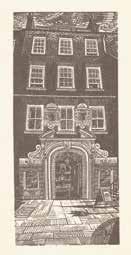
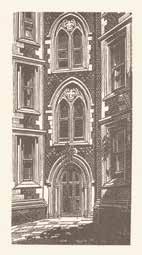
A few of the highpoints are described over the next few pages, but we should not forget the myriad of other activities that went on: the logo and our 600 pins, new merchandise, the flag, the wonderful series of Into the Archives videos released through the year, a fantastic series of Black Book Lectures, The Garden Party and Family Day, the relaunch of tours of the Inn delivered by volunteers from the Treasury team, a beautiful commission of prints from Anne Desmet (limited edition sets of which are available to purchase), a new guidebook Lincoln’s Inn –A Guide by Mark Ockelton, and to be released in 2023, the start of a collection of oral histories from members of the Inn.
The Anniversary Weekend
Our first major event of the year was the Anniversary Weekend. Our goal was to offer a variety of activities available at the Inn in a condensed form over a single weekend. We hoped that this would enable those members living at a distance to the Inn the opportunity to engage with multiple activities while having time to travel and perhaps a ‘weekend break’ in London.
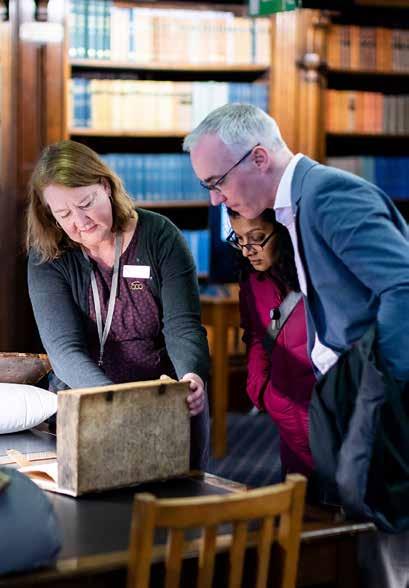
The weekend began with afternoon tea in the MCR, either a relaxing break after a journey up to London, or for those who had travelled up on Friday evening, perhaps a chance for a break after a morning of shopping and sight-seeing in the city. At the same time, the Library was open and the Keeper of the Library gave a short speech to those present to launch the new digital editions of the Black Books. This proved a popular opportunity to be able to firstly talk in the Library, and secondly talk with some of the Library staff and explore the Black Books close up, as well as online. At the same time, more energetic members were able to cycle (or walk) the F D Maurice Way, a route that linked up places of significance in his life.
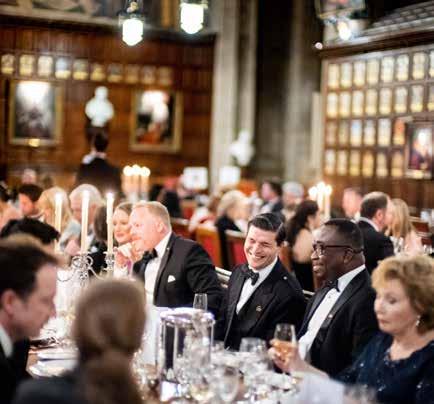
Then in the evening, we held a Black Tie Dinner in the Great Hall, which brought everyone together in our grandest and most traditional collegiate environment. Despite the awesome beauty and space of the Great Hall, dinners there still seem to be friendly and communal, and it was particularly satisfying to see so many members bringing guests to the evening.
On Sunday, we planned for a leisurely start, thinking the main focus would be Chapel and Sunday Lunch. Since before the Inn, when the site was the location of the Bishop of Chichester’s palace, Chapel and religious observance have been at the heart of life, so regardless of personal faith, it seemed appropriate to recognise this part of our history, and of course, like so many events at the Inn, it comes with a splendid meal afterwards.
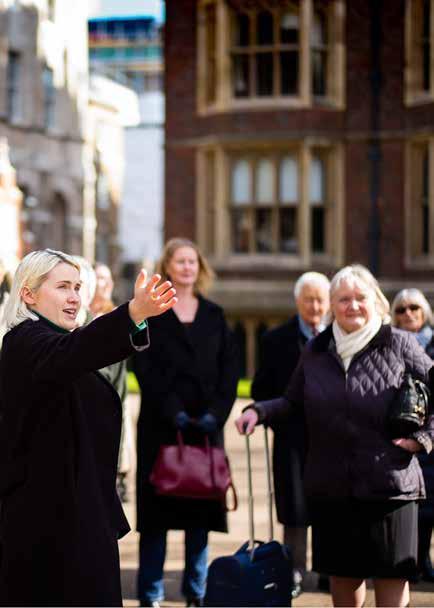
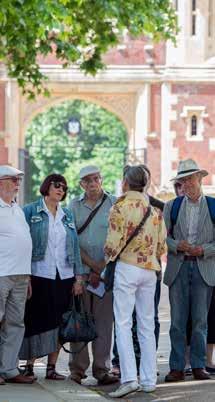
What we had clearly underestimated was the appetite of members to re-engage with our history. The tour filled immediately, so we added another which filled immediately, and eventually we offered four tours. This was especially pleasing for the Treasury team as we had recently decided to bring tours in-house and it enabled our volunteers, from across a number of departments, to ‘show off’ the Inn’s history.
In fact, ‘showing off’ was what we learnt from this weekend. We were successful in getting ‘regulars’ to return to the Inn post-pandemic, and also new members who hadn’t been able to visit during Covid. However, a lot of members used the weekend as an opportunity to ‘show off’ the Inn to family and friends by bringing larger groups. Duly noted, and we hope to offer similar opportunities in 2023.
Historic Dinner with Dr Annie Gray
One of the most memorable and talked about events of the Anniversary programme was undoubtedly the Historic Dinner, with food historian Dr Annie Gray. It will probably surprise no-one to discover that the Inn’s obsession with dining dates back to its earliest days. The Black Books show incredible detail about our food and wine purchases through the centuries, and thanks to the investigative efforts of the Library team we were able to present the chefs with a long list of strange creatures we used to dine on. Sadly, lampreys were out of season, but no-one who was there will forget the cods’ heads in a hurry. Nor the sight of the Treasurer heroically trying to carve the boar’s head that had taken 3 weeks to prepare.
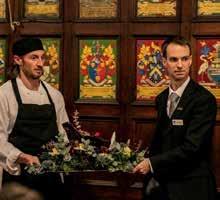
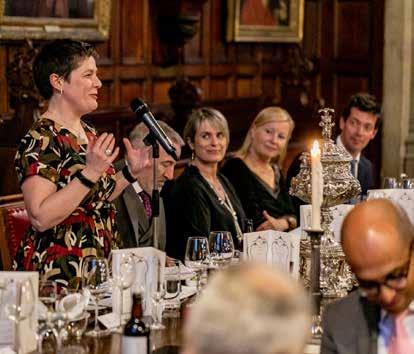
We began talking to Annie Gray in January, checking dates and then impressing her with the detail of our records and mediaeval shopping lists. It really was the case that we were spoilt for choice in terms of ingredients and we had to make some tough decisions on how we could cover a span of 600 years of dining within a single, enjoyable meal.
That preparation gave rise to one of the most unexpected email chains of the year – what is the best stitch to use when sewing up a boar’s head before it goes into a 24 hour slow cook? There were also long emails about how to best procure or make boar’s tusks, and how we might get about 60 pheasant tail feathers (Amazon as it turns out).
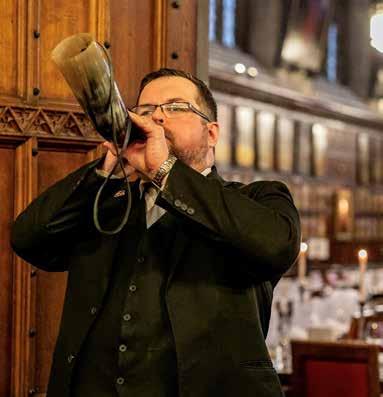
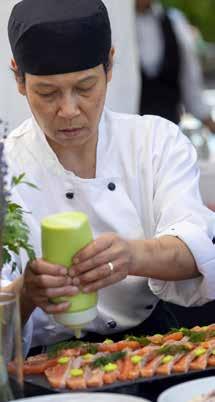
Pre-dinner canapes included crispy Colchester oysters with pickled vegetables, representing the 1500s; short rib of Herefordshire beef with plum pudding from the 1700s; mock turtle soup, the ‘must have’ of the 1800s; and potted salmon with a parsley emulsion, caviar and lemon from the 20th century. All in all, the classic ingredients of the period, produced with the finest skills of our chefs.
Tomasz rather heroically agreed to ‘horn in’ the diners, an Inn custom that only fell out of use we believe in the early part of the 19th century.
We began with platters of bread, manchet-style, but not quite manchet as our Tudor recipe refused to yield to modern yeast. Our home-made sourdough made an excellent standby though, as Dr Gray introduced us to the hierarchy of flours that defined the quality of bread.
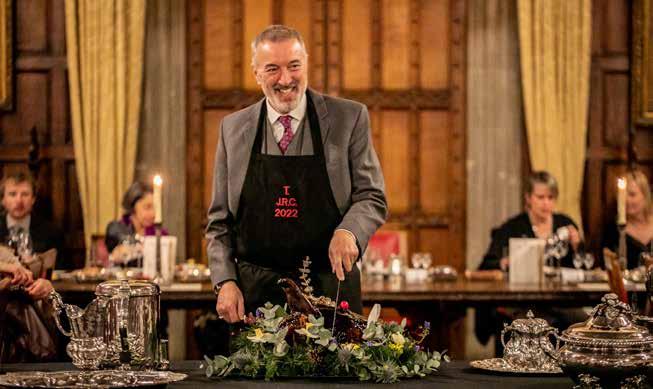
We then moved on to a wild boar terrine with pistachios and the very popular 16th century spice, mace, accompanied by a spiced pear preserve, Gorwydd Caerphilly cheese, apples, pears and nuts. In the early years of the Inn, up until the 1600s, all the food was laid out on the table at once, with no ‘courses’. Spices were popular and an indicator of wealth, but generally recipes were simple in the early years of the Inn.
One exception to this simplicity was the boar’s head. It’s fair to say that the chefs are prepared to repeat the stuffing of an entire boar’s head only in another 600 years - it was quite a challenge! No-one seems to have really written down the detail of how you manage this process, so shaving, deboning, brining and soaking, stuffing-making and reshaping were all somewhat trial and error. The only instructions were on decorating the head once stuffed, where it seemed that more or less anything was acceptable.
Many were witness to the Treasurer’s valiant attempts to ‘carve’ the head when it was brought in. But stuffed it most certainly was, and very solid, and Steve Matthews had to intercede when the Treasurer suggested eating some of it, noting the three weeks it had taken to make.
But the fish course awaited, as we moved into the 1600s and 1700s. That was a very impressive sight as the waiting team paraded out a dozen cods’ heads. Dr Gray entertained with stories of how ‘every part’ of most animals were used in cooking, and the various names for asparagus – or ‘sparrow grass’ as we had, with the contemporary presentation of fish egg emulsion and a caviar butter sauce.
Our main dish came from the 1800s and was more recognisable to today’s diners. A roast loin of venison, with a pheasant and venison pie. However, we kept to the tradition of the time, of indicating the contents of the pie with a large tail of pheasant feathers poking out of the pastry.
Then finally, we came right up to date with the post-war modernity of pineapple upside-down cake, candied cherry ice cream and custard. This seemed to inspire reminiscences from many members of childhood delights.
The dinner was a tour de force for the chefs, working with novel ingredients and food combinations with modern methods, to produce a delicious yet adventurous journey through the Inn’s culinary heritage. Annie Gray’s marvellously informative and entertaining talks between courses showed us just what significance dining and food had meant in society, and a further reminder of how lucky we were to be so well served by our kitchens throughout our history.


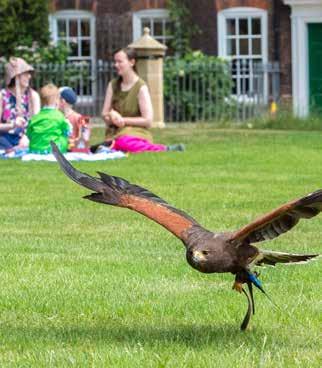
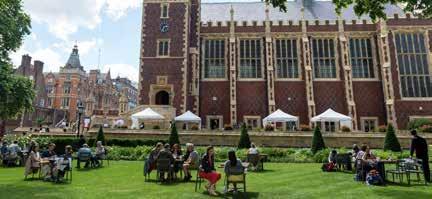
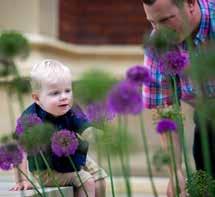
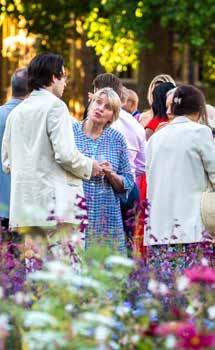
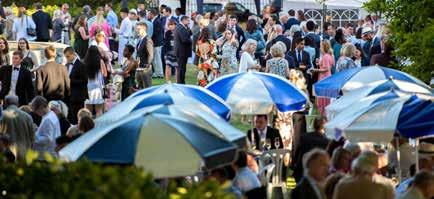
In the summer we turned to outdoor celebrations, and along with the comfort of restrictions being lifted and being able to enjoy our beautiful gardens, we participated in the London Open Gardens Weekend. We had participated in the event previously, though not for about five years, and this time we were determined to open ourselves up not only to members but to invite as many of the public in as we could.
By working with the London Open Gardens charity, we were able to support their wider aims of opening up gardens not normally open to the public, while supporting our ambition to dispel some of the mystery of what lies behind our walls.
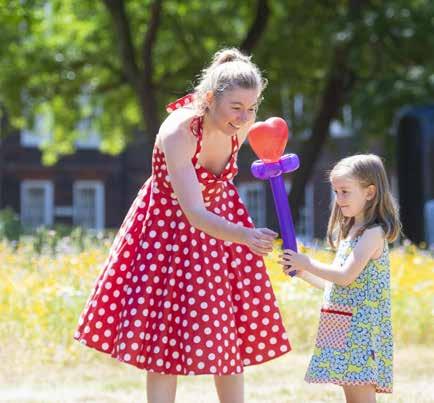
We devised a scheme of additional entertainments that broadly celebrated different aspects of our history, and that we thought would be of interest to all ages and stages of visitor. So, we had falconry displays and the opportunity to hold some marvellous and very patient birds of prey.
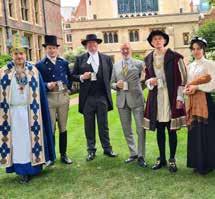
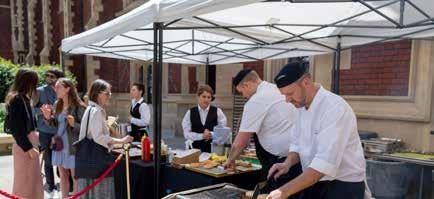
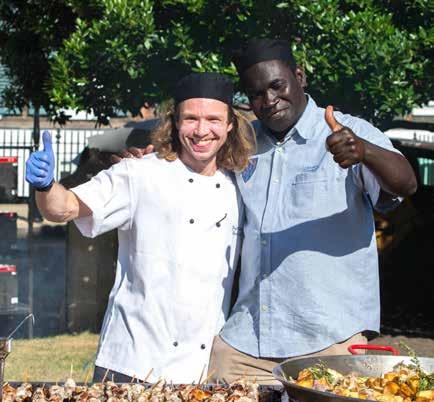
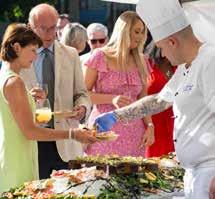
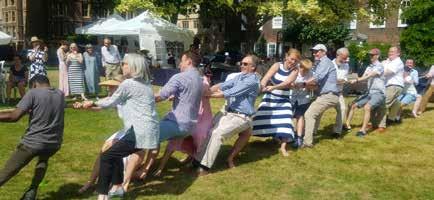
Several members bravely volunteered to don costumes and enact scenes that may, very loosely, have come from the Inn’s past. These strolling players depicting past members of the Inn, were not only able to describe life in the Inn and the legal profession in character, but also give up to date careers advice! They strolled, they held forth, they declaimed, they amused, and they may have even thrown in a sprinkling of historical facts as well. We also had games for all on North Lawn which provided amusement for all ages and some relief from walking between the various gardens across the city. The wonderful UK Soul Choirs community choir entertained us across Saturday lunchtime, and combined with the variety of food we served from the East terrace, it proved a very popular combination to be enjoyed in the warm summer sunshine. And of course, tours of the gardens by our Head Gardener were in demand. We provided four tours each day and they were very well attended - the London Naked Bicycle Ride’s parade down Newman’s Row adding an extra ‘something’ for the final tour of Sunday afternoon as visitors perused the West Walk!
We counted about 2,000 visitors to the Inn across the weekend, many more than we had ever received before. Many members and residents took the opportunity to enjoy a very relaxed event, where you could take as much or as little time as you wanted in the gardens. We received a lot of positive feedback on the day and on social media channels. It seems members of the public really valued discovering what went on in the Inn and finding such a positive and warm welcome.
And in complete contrast to the celebration of our history, we broke new barriers by actually allowing people to picnic on the Benchers’ Lawn. No walls fell, nor were roofs struck by lightning, so whisper it quietly, we will be doing it all again in June 2023.

Open Gardens
The Garden Party




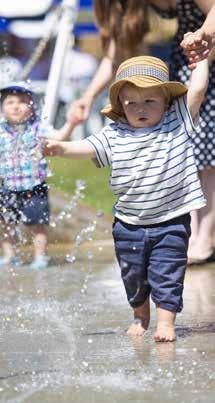
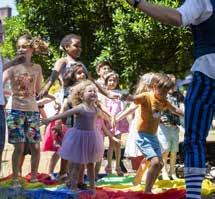
Photos: Pete McLaine
Photos: Ben Stevens
Family Day
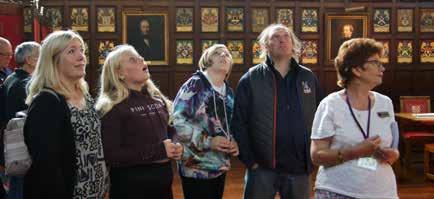
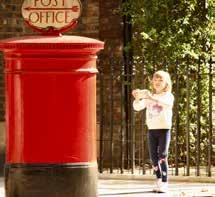
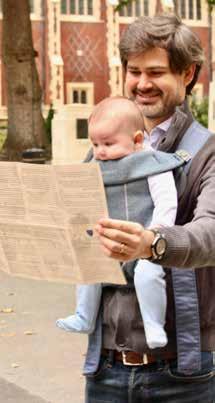


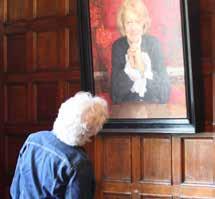


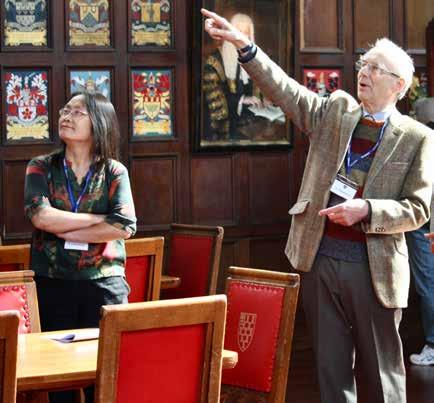
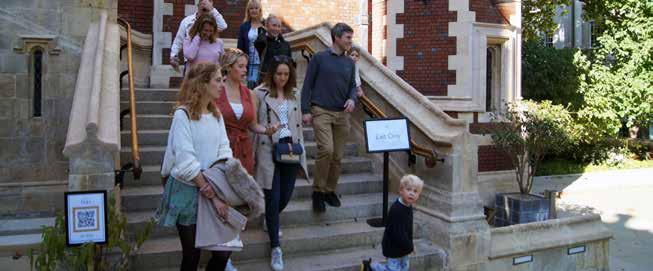
On Saturday 17 and Sunday 18 September 2022, the Inn took part in the Open House Festival, the largest annual festival of architecture and design in London. This was the first time in years that so many of the Inn’s buildings were open to the public who were given a specially produced self-guided tour map and let loose to explore the Inn at their leisure, with volunteers on hand to answer questions. We opened up the Great Hall and Library, the Old Hall, the Chapel, and the Ashworth Centre, where we also held talks and presented a digital exhibition on the history and architecture of the Inn. The MCR was also open for tea and cake.
“The beautiful @LincolnsInn unlocked their gates for the @openhousefestival and I got to wander in Lucienne’s Sandman library. Stunning!”
(Angelastephenson81 on Twitter)
Not having done this before and with pre-booking not required we did not know what to expect in terms of numbers. So we gathered together 10 members of the Inn’s team and 20 or so member volunteers and kept everything crossed for a decent turn out. Imagine our surprise on that sunny, chilly Saturday morning when we had a queue outside the Gatehouse before we had even opened! From there we had a steady stream of visitors throughout both days, with around 800 visitors on the Saturday and around 650 on the Sunday. Some of those on the Sunday were repeat visitors from the day before, either coming back for a second look or bringing friends and family. It was also lovely to see a number of members and employees bring their families to look around.
“It was a great feeling to be able to show friends and family around and give them an insight into my experience as a member of the Inn. They were beaming with pride as I shared this special moment at this historic estate with them”
(Mahila A. Lisa on LinkedIn)
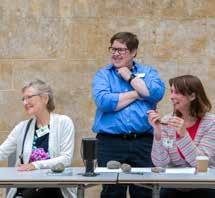
One of the reasons for taking part in the event was to inform the public about what the Inn and the profession does. On each day we had a panel of barristers from different practice areas talk about their day-to-day activities and answer questions. The panel was held twice on each day and the lecture theatre was reasonably full at each session.
“Joined a panel discussion yesterday about “What is a Barrister?” and I absolutely loved it. Anyone interested in becoming a barrister or simply interested in law should go.”
(Artnlaweve on Twitter)
We would like to take this opportunity to thank those from the Inn’s team and our member volunteers who gave up one or both days of their weekend, especially those who spent hours at a time sitting in a rather chilly Chapel or standing outside to direct people around the grounds. Our member volunteers were a great addition to the team on the day. They were warm and enthusiastic ambassadors for the Inn, and some had really done their homework and were hugely knowledgeable about the Inn’s history and architecture.
Altogether the weekend was a great success, feedback was excellent and we plan to take part again in September 2023.
Open House Festival
600 Years of Recorded History
By the Treasurer, Jonathan Crow KC
With 600 years of Black Books, the Inn has an abundant written record. It also owns a magnificent estate, with outstanding buildings, books, paintings and chattels. Apart from the long line of legal titans, its past members include seventeen Prime Ministers, two saints and a Nobel Prize winner for literature. With such a rich heritage, it is impossible to capture the Inn’s history within a manageable compass. What follows is accordingly an idiosyncratic ramble, based on choosing from each Century a single individual, an object or building, and some random entries from the Black Books to illustrate different aspects of the Inn’s life and evolution over the years.
The Fifteenth Century
The first entries in the Black Books show that the Inn was already in existence from some unknown date well before 1422, with a hierarchy of officers and an established function in educating students, calling new barristers to the Bar, and disciplining its members. Life revolved around the Hall, where moots were held, readings were given, and everyone ate together.
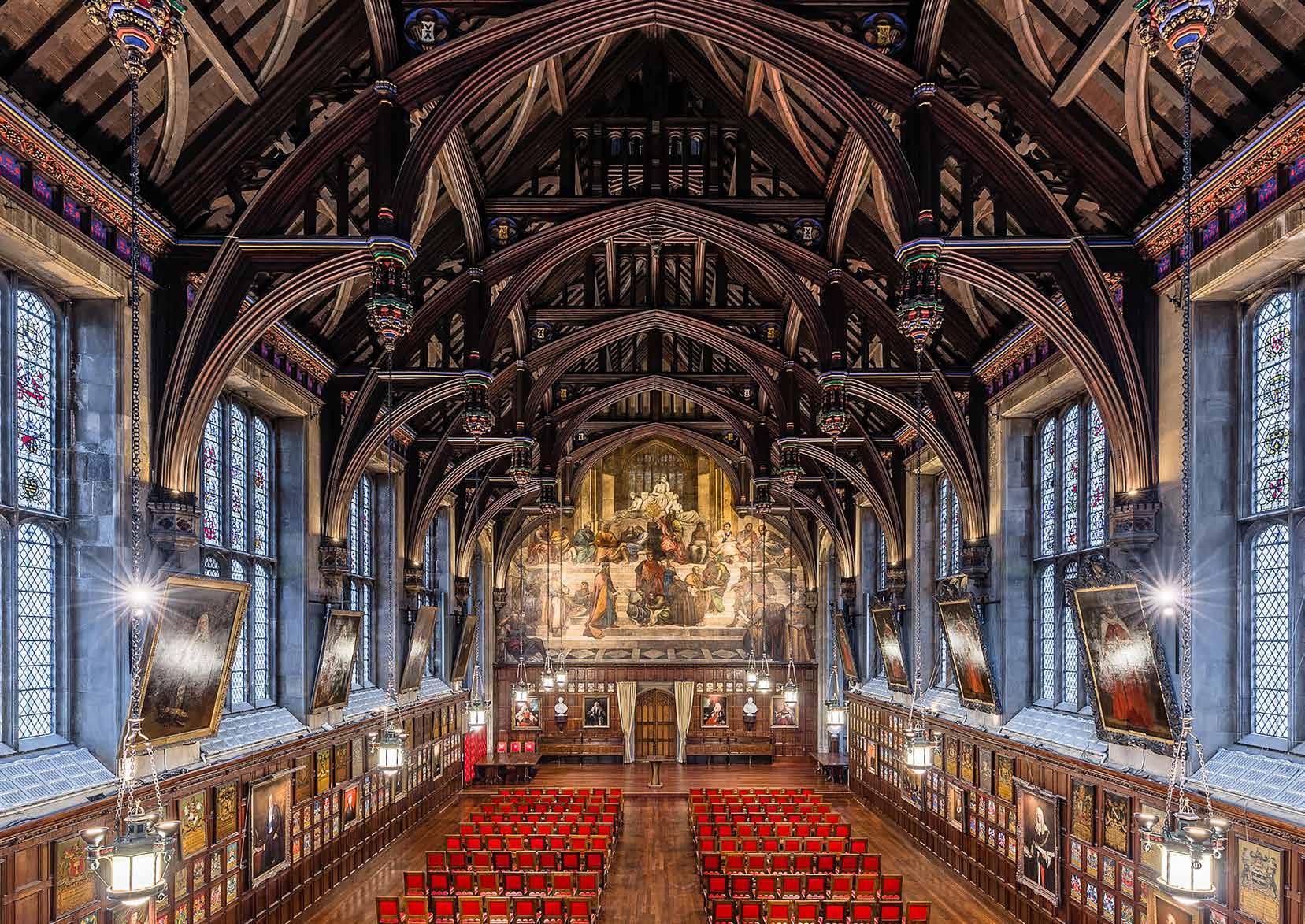
The Inn was far smaller then, occupying a site roughly equivalent to Gatehouse Court. It was initially rented from Ralph de Neville, who was Bishop of Chichester (hence Chichester Rents) and also Lord Chancellor (hence Chancery Lane). His face now stares at you beside the entrance to the Chapel, although it is no more than a Nineteenth Century imagining. The only surviving remnant of his palace is a single stone doorway, which was discovered during renovation works during the Nineteenth Century and is now built into the north end of the Old Hall.
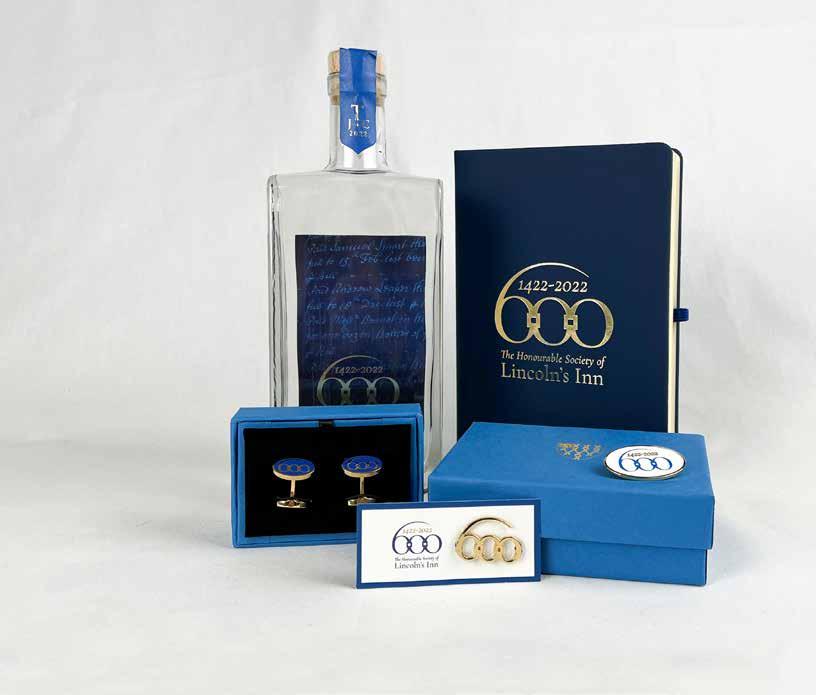
Limited Edition Anniversary Merchandise
Shop the range while stocks last.
As well as the Inn’s 600th Anniversary range, popular new additions to our core range of products include hooded sweatshirts, t-shirts, and more. Shop online: www.lincolnsinn.org.uk/shop/
Shop in person: visit the MCR, Library or Reception.
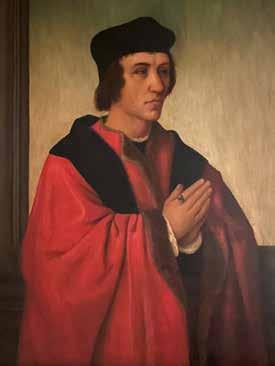
The stand-out figure in the Inn’s life in the Fifteenth Century was John Fortescue (1394 – 1479). He was notable both as a distinguished legal commentator and as a loyal supporter of the Lancastrian cause during the Wars of the Roses. That combination played to history’s advantage, because he was forced into exile after the Lancastrian defeat at Towton (1461). While he was away, he had enough spare time to write De laudibus legum Angliae. It contains not only an exposition of the superiority of English common law over Roman law, but also a uniquely valuable description of the Inns of Court and the legal profession at the time. According to his account, besides being “an academy of law” the Inns were also “a kind of public school of all the manners that the nobles learn” including singing, dancing “and all games proper for nobles”. As a kind of finishing school, the Inn also provided an opportunity for social mobility, and over the course of the Century there are numerous examples of the Inn’s Butlers and Stewards being allowed to join the Inn as members after long service. One such was John More, who was Sir Thomas More’s grandfather: the grandson of a Butler became Lord Chancellor.
As the fortunes of war swung back against the Yorkists, Fortescue returned to England, but then he faced attainder when the Lancastrians lost again at Tewkesbury (1471). This provided him with an opportunity to claim perhaps the earliest recorded example of the cab rank rule in operation. Instead of executing him, Edward IV made him write a justification of the Yorkist claim to the throne. He did so, and it saved his neck: the attainder was rescinded. So, his life illustrates both the developing self-confidence of English common law at the time, and also the political vicissitudes of a turbulent period of our national history. You pass Fortescue’s portrait on the left every time you approach the Library.
The Old Hall is our proudest inheritance from the Fifteenth Century, but we nearly lost it. During the Eighteenth Century, the mediaeval wooden ceiling was regarded as ugly and old fashioned, so a classical plaster ceiling was installed, suspended off the wooden beams. Its weight splayed the walls and the Old Hall threatened to collapse. Renovation work in the 1920s revealed the beautiful wooden beams underneath. The whole structure was restored, and the Hall was thankfully saved.
John Fortescue
The Sixteenth Century
Amid all the religious and political turmoil of the Sixteenth Century, with the Reformation and the break from Rome, it is charming to be reminded that people in the Inn were getting on with everyday life. Two examples have survived. In 1899, some drainage works were being undertaken, and a small lead tablet was unearthed. It is inscribed with a curse: “That Nothinge maye prosper Nor goe forwarde that Raufe Scrope taketh in hande”. Ralph Scrope was the Treasurer in 1564 – 65. One can only imagine what had animated some unknown member to lay a curse on him.
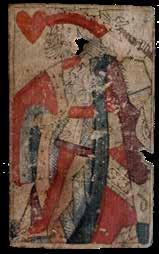
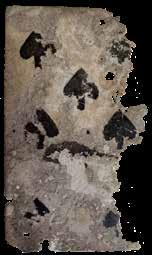
The other survival of quotidian life is an extraordinarily rare pair of playing cards that were discovered under the floorboards in Gatehouse Court. It is even more delicious to note the entry in the Black Books for 1 November 1518, which records that the Parson was fined for playing at cards and dice. How perfect would it be if the very cards that have survived were slipped between the floorboards by the Parson in an attempt to avoid detection?
More authorised forms of entertainment in the Inn took the form of revels. Despite John Fortescue’s description of the elegant instruction given to students in singing and dancing, the Inn’s revels appear to have been violent and unruly affairs. The Black Books contain numerous instances of members being fined for assaulting each other and the staff with daggers and swords. Nevertheless, More’s Utopia contains an idealised (or possibly ironic) description of communal dining, where “the gravity of the old people, and the reverence that is due to them, might restrain the younger from all indecent words and gestures”.
William Rastell (1508 – 1565) can stand as our exemplar for the Sixteenth Century. Apart from being Thomas More’s nephew, he was both a barrister and a publisher. Printed books transformed religious and political debate at the time as well as the dissemination of legal knowledge, which until then had depended precariously on the preservation of manuscript notes. Rastell’s life story also illustrates the religious controversies of the time. He was a Catholic and as such he had to go into exile under Edward VI, but he returned as Treasurer under Bloody Mary. The Black Books record that he donated many Catholic trappings to the Chapel in 1554. Subsequently, when Elizabeth succeeded to the throne, Rastell had to go back into exile, where he later died. A marginal note in the Black Books records that the superstitious, Popish adornments he had added to the Chapel were removed in 1580.
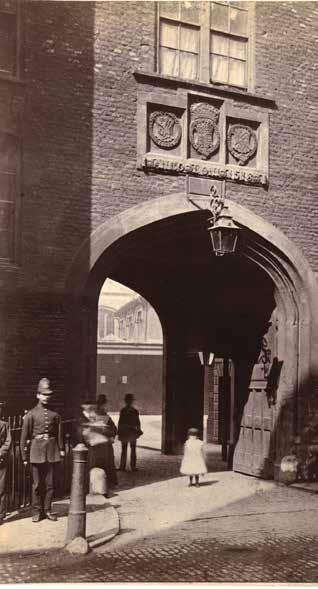
The Gate leading to Chancery Lane, formerly the main entrance to the Inn, was built in 1518 – 21. There is an intriguing photograph of the Gate taken in the late Nineteenth Century looking into the Inn. It illustrates both the permanent and the transient features of the estate: just visible inside the Inn are the temporary courts that were used until the Royal Courts of Justice were built on the Strand.
The Seventeenth Century
English history in the Seventeenth Century is scarred by Civil Wars, regicide, the Commonwealth, the Great Plague and the Great Fire. The political disruption and warfare drained the Inn of both manpower and finance. The readings dried up, and the silver was sold. The Black Books are full of references to borrowing money. Under Royal command, the social make-up of the Inn may also have started to petrify, after James I had decreed in 1604 “that non be frome henceforth admitted into the Socyete of any House of Court that is not a gentleman by discent”.
One might choose Matthew Hale, the great jurist, or John Donne, the preacher and poet, to illustrate the Century, but in an age characterised by confrontation William Prynne (1600 – 1669) stands proud as the most belligerent and contrarian of all. He produced hundreds of pamphlets, railing against the indecency of women on stage, or men with long hair. Under Charles I, he was twice fined £5,000, twice sentenced to life imprisonment, and twice had his ears cropped for seditious publications. On the second occasion, his cheeks were also branded with the letters “SL” for “seditious libel”. However, like many other lifers, he was soon out of prison and, after a brief exile in the Channel Islands, he was recalled to England under the Long Parliament in 1640. Nevertheless, querulous as ever, he was then imprisoned for opposing the Commonwealth following Pride’s Purge – thereby achieving the unique distinction of having been sent to the Tower both by Charles I and by those who ultimately killed the King.
Notwithstanding his controversial record, Prynne became Treasurer of the Inn in 1657. It seems unlikely that we will ever again elect someone who has been fined for sedition, given two life sentences, branded and exiled.
In due course, Prynne became a vocal advocate for the Restoration, and after 1660 he was ultimately appointed as keeper of the Royal records, which were stored in the Tower. He thereby ended his days happily working where he had previously been imprisoned. He is buried in the Undercroft, his tombstone now worn almost to the point of illegibility.
The Chapel, beneath which his body lies, is the greatest monument in the Inn from the Seventeenth Century.
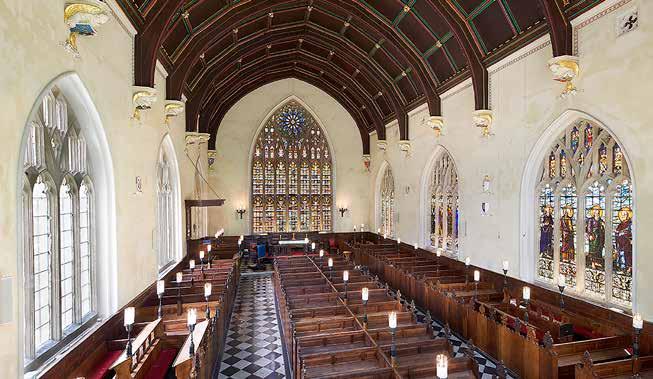
Replacing an earlier chapel whose exact location and appearance have been lost, it was built in a strangely out-dated style, perhaps replicating something of its predecessor, or perhaps simply reflecting the conservative tastes of the Bench. It was consecrated in 1623 in a service where John Donne preached. The bell, which tolls mournfully to announce the death of a Bencher, has recently been dated to 1615, which may lend credence to the Inn’s folklore that it provided the inspiration for Donne’s admonition: “Never send to know for whom the bell tolls; it tolls for thee”.
The Eighteenth Century
The decay in legal education which had started during the Civil Wars continued well into the Eighteenth Century, although some effort was made to improve matters. The four Inns started to collaborate in an effort to establish a common code for admissions and calls, but progress was painfully slow. Texts in legal French were still widely used, and the standard of legal education remained embarrassingly low.
In this discouraging state of affairs, it is tempting to raise one’s spirits by focusing for the Eighteenth Century on a legal giant such as Lord Mansfield, whose famous ruling in Somerset’s Case delivered the first legal crack in the maintenance of slavery, or a political genius like William Pitt, who steered the nation through the Napoleonic Wars and introduced income tax. But the career of William Garrow (1760 – 1840) offers a more earthy example of life in the law in the Eighteenth Century.
Garrow was a vicar’s son, called to the Bar in 1783. He made such a name for himself so rapidly that the very next year he was instructed to represent Charles James Fox in the House of Commons following a hotly contested election for Westminster. His cross-examination in court was legendary, and his approach to the defence of criminal cases is credited with contributing significantly to the establishment of the principle that an accused is innocent until proven guilty. He was working in a hostile and corrupt system where the availability of rewards for convictions led to bribery and suborning. Garrow was relentless in his cross-examination of prosecution witnesses, exposing their financial interests in procuring a conviction and destroying their credibility. To his credit, Garrow was also strongly opposed to the slave trade and refused an offer from the West Indian sugar planters to act as their legal representative, saying: “If your committee would give me their whole incomes, and all their estates, I would not be seen as the advocate of practices which I abhor, and a system which I detest.”
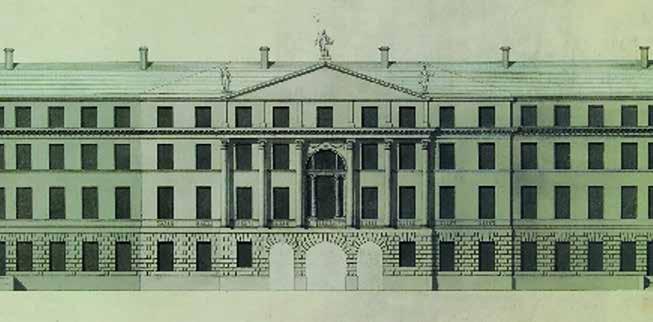
Stone Buildings, with its clean classical lines, represents the great architectural addition to the Inn during the Eighteenth Century, but it was never intended to look as it does today. The original plan was that it would be twice as long, wrapping round the Chapel where the west side of Old Square now stands, and beyond.
For good or ill, history got in the way: with the advent of the French Revolutionary Wars, money ran out and the project was halted at the mid-point. Only in 1847 was № 7 Stone Buildings added to finish the block as it now stands. Appropriately, the sun dial bearing William Pitt’s initials as Treasurer has been fixed on the north façade of № 4, Stone Buildings, where he had his rooms.

The Nineteenth Century
The Nineteenth Century saw British industrial, commercial and military power at its height. Meanwhile, the Black Books continue to illustrate the more mundane aspects of daily life in the Inn: in April 1857, the cook was summoned to explain why he had served rhubarb pie instead of gooseberry pie or plum pudding as dessert on the preceding Sunday.
More seriously, legal education remained (in the words of Lord Brougham) “at as low an ebb as it is possible for education to be in any country”. The Black Books reflect the increasing efforts that were made to introduce reforms. Equally importantly, they reflect the Inn’s recognition of the need to establish more generous scholarships to ensure that the profession was accessible to all comers.
The life of Edward Clarke (1841 – 1931) provides a spectacular example of the success of such efforts. The son of a shopkeeper, he was inspired at an early age by hearing the retirement speech of Lord Lyndhurst, who had risen from a similarly modest background to become Lord Chancellor. Clarke wrote in his autobiography that he “saw what height of public dignity and regard it was possible for a barrister to rise without the help of ancestral renown or family influence” and he dedicated himself to achieving similar success. He studied furiously hard and won a Tancred Scholarship which allowed him to study for the Bar, being called in 1864. Thus “the dream of my boyhood was fulfilled”. But the dream did not end merely with his call to the Bar.
Clarke became an expert on extradition law and wrote a treatise in 1867 which went through three further editions into the Twentieth Century. Touchingly, he dedicated every edition to “The Governors of the Tancred Trust”.
From the 1860s onwards, he also established himself as the most eminent barrister at the common law Bar. In the 1890s he achieved his apotheosis: he appeared as Counsel in the Parnell divorce case, and in the ‘Baccarat Case’, where the Prince of Wales (later Edward VII) had to give evidence; he represented Oscar Wilde in both his trials; and he defended the leader of the Jameson Raid. No one else at the time or since could possibly match such a stellar career. When asked what was required for success at the Bar, he answered that one needed to be “very poor, very ambitious, and very much in love.”
Clarke was elected Treasurer in 1906. Eight years later, the Inn held a dinner to mark the 50th anniversary of his call to the Bar which was, as the Black Books record, a “signal honour never before accorded during the period to a member of the Inner Bar.”
That dinner was held in the Great Hall, which we all know well. It was opened by Queen Victoria at a dinner which has been recorded for posterity in a painting by Joseph Nash. No doubt in the interests of symmetry rather than historical accuracy, every barrister in Hall is the same height.



The Twentieth Century
The Great Hall and the Library, built in the Nineteenth Century mock-Tudor style, are perhaps the proudest and most iconic buildings in the Inn. Turning to the Twentieth Century, the one thing for which we can be most grateful is what was not built. In the 1960s, there was a plan to erect two enormous office blocks on the North Lawn. The design may have been intended to mimic Stone Buildings, but the whole thing was out of proportion, and the overall effect would have been more Mussolini than Palladio.
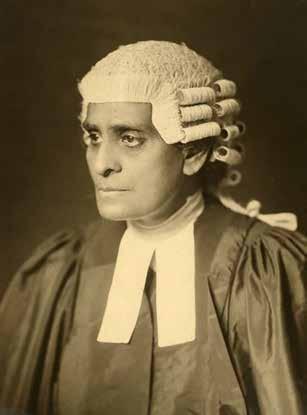
The Twentieth Century marks the entry of women into the profession. Gwyneth Bebb was one of the first women to join the Inn, and Mercy Ashworth was one of the first to be called to the Bar. Either of them could have served as a proud exemplar for the Century, but the list of ‘firsts’ claimed by Cornelia Sorabji is astonishing. Born in Bombay (as it was then known), she was the first woman to enter Deccan College, the first to gain First Class honours there, and the first woman professor in India. Her talents were recognised by Lady Hobhouse, who wrote what would now be called a crowd-funding letter to The Times to raise money for Sorabji to study at Oxford. The campaign was a success, and she went up to Somerville. In 1893, she became the first woman to pass the BCL, but as a woman she could not be awarded the degree. She returned to India to work for purdahnishins (women who suffered legal isolation as a result of their confinement in purdah) devising a scheme for their representation in court – again, a first. In due course, she returned to England and finally collected her degree. She joined this Inn, and she was called to the Bar on the same day as Lord Denning. Returning to India, she became the first woman to practise as a barrister there, but it was an uphill struggle and she returned to this country, living and studying in the Inn until her death in 1954. You pass her bronze bust on your way to the Library.
Reflections
Sorabji’s career illustrates the challenges faced by women in the legal profession. More positively, it also demonstrates the connections between this Inn and the Commonwealth and, alongside the other life-stories that have been mentioned all too briefly above, it serves as a model of what can be achieved by gritty determination. Above all, it illustrates the way in which the Inn’s life has constantly been enriched throughout its history by adapting and embracing the new. The legal professions (this Inn included) can hardly pretend to have been at the forefront of social change: Catholics were only admitted in the late Eighteenth Century; Jewish members were only admitted in the 1830s; the first women only joined the Inn in 1920. But each development has served to reinvigorate the Inn, whose standing has only ever faltered when it has allowed itself to develop sclerosis.
Any institution with such a long history needs constantly to conduct a conversation with itself, asking what is worth preserving, and what needs to be changed. On the one hand, mere novelty must not be mistaken for innovation. On the other hand, due respect for our inheritance cannot be allowed to ossify the Inn. The buildings we now enjoy, and the buildings that were never built, provide an allegory: we can all be grateful that the Old Hall was saved, and we can all be equally relieved that the North Lawn was not turned into an office block.
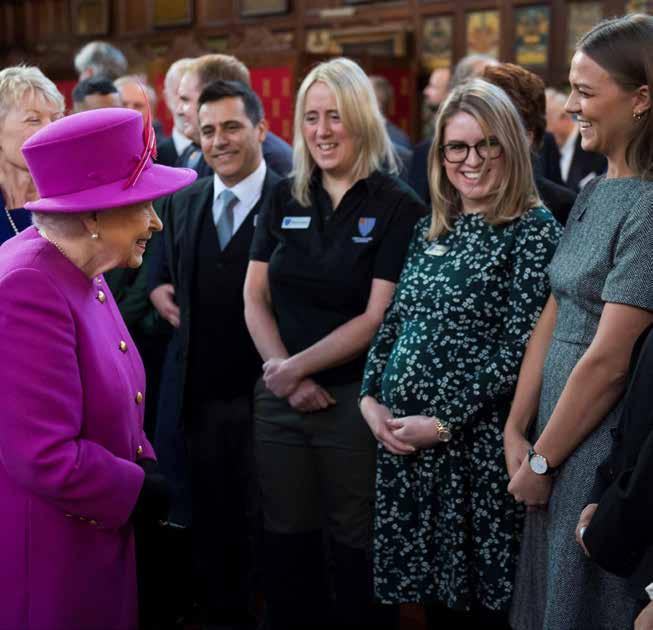
HM Queen Elizabeth II, on Her visit in 2018.
Cornelia Sorabji

Code of Conduct for Members
In December 2022 the Inn launched a Code of Conduct for members, following approval by the Inn’s Council of Benchers earlier in the year.
The Inn is committed to providing a welcoming, supportive, and inclusive environment for members and employees and the Code will help us continue to improve in this area.
The Code sets out the expectations the Inn has of its members when:
• Representing the Inn
• Using the Inn’s collegiate facilities
• Working on the Inn’s behalf
• Attending an Inn event
The Black Books show that the Inn has long set standards for the behaviour of members so it is apt that in the books’ 600th anniversary year we should codify the expectations that we have of our members today.
The Code applies to all members – Benchers, barristers, and students alike.
Alongside the Code in the Members section of our website you will find guidance on behaviour that is supportive of and contrary to the Code and how breaches of the Code can be reported.
Code of Conduct
Members of Lincoln’s Inn shall:
1. Behave with integrity and treat others with respect and consideration.
2. Promote an inclusive, welcoming, collaborative, and supportive environment at the Inn, recognising and valuing diversity.
3. Be aware of differences in power and influence and avoid conduct that exploits these, or might be perceived as doing so.
4. Respect other people’s personal space.
5. Treat sensitive or personal information with discretion and tact, respecting confidentiality.
6. Report and/or challenge the behaviour of others when it falls short of the standards expected.
Appointments and Retirements 2022
Appointed a Justice of the Supreme Court
October 2022 The Rt Hon Lord Richards of Camberwell
Appointed the President of the Lands Chamber of the Upper Tribunal
August 2022 The Honourable Mr Justice Edwin Johnson
Appointed a Senior Circuit Judge
September 2022 His Honour Judge Tindal October 2022 His Honour Judge Blohm KC
Retirement from Senior Circuit Bench
January 2022 His Honour David Cooke
Appointed a Circuit Judge
July 2022 Her Honour Judge Henley (North Eastern)
July 2022 His Honour Judge Unsworth KC (Northern)
August 2022 His Honour Judge Burns (Midlands)
August 2022 His Honour Judge Najib (Midlands)
August 2022 Her Honour Judge Kidd (North Eastern)
August 2022 His Honour Judge Guite (Northern)
October 2022 His Honour Judge Rimmer (South Eastern)
September 2022 Her Honour Judge Suh (South Eastern)
September 2022 Her Honour Judge Robertson (South Eastern)
September 2022 Her Honour Judge Talbot-Hadley (South Eastern)
Retirement from the Circuit Bench
March 2022 His Honour Nicholas Ainley
April 2022 His Honour David Tremberg
July 2022 His Honour Paul Batty KC
Appointed an Insolvency and Companies Court Judge
October 2022 Insolvency and Companies Court Judge Greenwood
Appointed a District Judge
October 2022 District Judge Mashembo (Western)
October 2022 District Judge Hanslip (North Eastern)
December 2022 District Judge Russell James (Western)
Appointed King’s Counsel
Tim Akkouh
Lucas Bastin
Tony Beswetherick
Matthew Bradley
Edward Brown
Jacqueline Carey
Rupert Choat
Adam Cloherty
Aidan Eardley
Mark Fell
Daniel Fritz
Neil Hart
Sebastian Isaac
Jeremy Lewis
Sarah Reid
Stephen Robins
Charles Row
Sara Sherafat Mansoori
Shaun Spencer
Laurence St Ville
Sultana Tafadar
Richard Thyne
Toby Watkin
Matthew Weaver
William Webb
Richard Whitehall
Lucy Wyles
Deaths of Benchers
7 February 2022 Sir Christopher Slade
28 February 2022 Sir Stuart McKinnon
3 March 2022 Sir Charles Gray
15 March 2022 Justice Randy J Holland
10 April 2022 Mr John Ross Martyn
31 August 2022 Mr Piers Reed
31 August 2022 Sir Francis McWilliams GBE
3 September 2022 Sir Donald Rattee
New Ordinary Benchers

Joel Donovan
Joel is a barrister at Cloisters in the Temple, where he was joint head of chambers from 2016 to 2018.
Born in Paris, Joel grew up in Melbourne, Australia and in south Norfolk. He attended local state schools and the City College in Norwich before reading law at Durham University, where he was editor of the student newspaper, ‘Palatinate’. He qualified as a solicitor at the firm now known as Hogan Lovells before transferring to the Bar in 1991, taking silk in 2011.
Joel specialises in claimant clinical negligence and personal injury. His work centres on severe brain and spinal injuries. He also practises as an arbitrator under the Motor Insurers’ Bureau’s Untraced Drivers Agreements.
He has a longstanding commitment to pro bono work, acting as a case reviewer and mentor for Advocate (formerly the Bar Pro Bono Unit). He appeared in the Supreme Court for the successful BPBU-backed claimant in the vicarious liability case of Mohamud v Wm Morrisons Supermarkets plc [2016] AC 677. Making his debut as an Inn advocacy trainer in 1998 he has continued to teach every year, latterly on the New Practitioner Programme, and has represented the Inn on advocacy training programmes in Dubai and Singapore. An active Bridging the Bar mentor, he also mentors on the Durham University Leadership Programme. Joel was formerly chair of the governing body at William Hogarth School, a diverse local primary in Turnham Green, west London.
Joel and his wife Clare form yet another of the myriad Durham graduate couples. Clare is a charity volunteer, specialising in fashion. Their daughter Esmée is in the sixth form at Chiswick School.
Matthew Hellens
Matthew came from a nonlegal background and, supported by his family, become the first member of the family to go to university. His studies in mathematics came to an abrupt halt after one unedifying term at the end of which he was given the option of either leaving university or changing subjects. The choice he made led him to a career in the law.
Having then spent six years at the Bar, Matthew left for a seven-year sojourn as a solicitor, returning seventeen years ago to the same chambers at which he had previously practiced. He practices now exclusively in family public law. He has, though, been sitting as a recorder in the Family Court throughout the last few years and has recently been ticketed to sit in Crime.
His involvement in the Inn is most often engaged with the pre-call students, working with them at University Open Days, mock interviews and the student weekends away. The Education Department is most often the first involvement that future members have with the Inn and, as such, is the shop window for the support that the Inn offers throughout a barrister’s career, so Matthew is keen to continue that work.

Nicholas Lumley KC
Nicholas lives in York with his wife Ruth, four children (two at university and two at prep school) and two dogs. In the same week that he was elected a Bencher, he was also appointed as Joint Head of Chambers at New Park Court. A specialist criminal and regulatory law advocate, he is also the Inn’s Senior Representative on the North Eastern Circuit.
“The Inn was so supportive of me as a Bar student, with Captain Carver RN, Sheila Geraghty, Judith Fox and co all making sure that I made the most of my time at the Inn - going to the most interesting dinners, spending such privileged time at Cumberland Lodge and travelling to University towns as a young ambassador for the Inn. The late (and, although I did not know or experience it, fearsome!) Master Mary McMurray QC sponsored my Call. She and her husband became friends with my mother for the remainder of their lives, as a result of that introduction and a shared love of cricket. I completed the circle by attending the service in Chapel to mark Mary’s death.
Where possible, I have assisted with advocacy training for the Inn on Circuit and will continue to do this and more in my new capacity. I look forward to spending time again in the Inn, when possible, but perhaps more importantly in supporting the engagement of the Inn with students and young practitioners on Circuit.”

Claire Palmer
Claire specialises in public/ administrative law and civil claims at 5 Essex Court. She is regularly instructed by Government departments, police forces and public and private bodies in inquests and public inquiries, and has significant experience across a broad range of civil cases.
Claire read Law at the University of Bristol and undertook the BVC at BPP. She was called to the Bar in 2003, undertook her pupillage at Littleton Chambers, and practised for nine years at Thomas More Chambers before joining 5 Essex Court in 2014. She was appointed to the Attorney General’s A Panel in 2019 and is also called to the SBA Bar in Cyprus.
As a student, Claire jointly won the Robert Wright moot in 2003, was a finalist in the Gluckstein competition, and held a Hardwicke Entrance Award and Thomas More bursary.
Claire has given talks and assisted on student weekends since being called to the Bar, and is now an Advocacy Tutor Trainer for the Inn.
In May 2020, Claire was appointed a Deputy District Judge (Civil) on the South Eastern Circuit.
Outside of the Bar, Claire is a Liveryman in the Worshipful Company of Security Professionals (“WCOSP”) and Chair of the WCOSP Charitable Trust. She is an aspiring gardener, gin lover, rugby supporter and lapsed runner.
The Unveiling of the Portrait of Sir Mota Singh by Dial Singh Sagoo and the Sir Mota Singh Memorial Lecture 2022
By The Rt Hon Lord Justice Singh
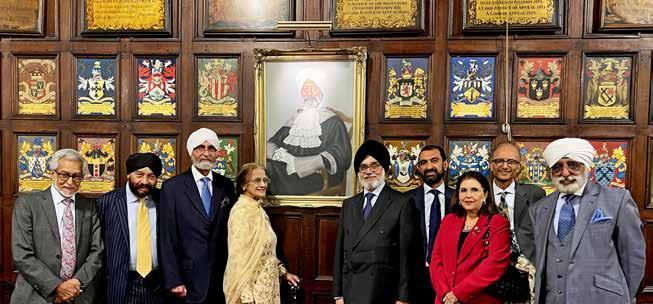
2022 the Inn received the very generous gift of a portrait of the late Sir Mota Singh from members of his family. The
members of Sir Mota’s family to the event.
Sir Mota Singh (1932 – 2016) was the first person of colour to be appointed a judge in the UK. He was born in Kenya in 1932. The tragic early death of his father, who was a garage owner, forced him into the role of family bread-winner and he began working as a clerk for a firm of advocates in Nairobi at the age of sixteen. He continued his studies in his free time and, on 3 April 1952, he joined this Inn.
In 1953 he and his family moved to England, so that he could continue studying for the Bar in London. He studied in the evenings, whilst working to support his family by day. Passing his Bar Finals in 1955, he returned to Nairobi and swiftly developed a successful career at the Bar in Kenya. He was also involved in politics, being elected a member of the Legislative Council and drafting some of the post-Independence legislation.
Sir Mota returned to England permanently in 1965. He was initially employed as in-house counsel by a property company, one of whose directors was so impressed by his knowledge, ability and hard work that he provided the financial support to allow him to establish his career at the Bar. He practised from 1 Mitre Court, in the Temple.
Mota Singh was appointed a Circuit judge in 1982. As well as being the first person of colour to be appointed, he was also the first judge to sit on the English Bench wearing a turban instead of a horse-hair wig. He sat at Southwark Crown Court, where he was a popular figure with the staff, other judges and those who appeared before him. He retired in 2002 and was knighted in 2010 for his services to the judiciary and for his charitable works.
The artist of the portrait was Dial Singh Sagoo (1921-2016). He was also born in Nairobi. He trained as an artist, spending time in Italy. On his return to Kenya he drew and painted portraits of many key figures, including a drawing of Jomo Kenyatta, the first President of Kenya, in 1961. Sagoo emigrated to England in 1962. He had a successful artistic career and exhibited at the Royal Academy. Other sitters for his portraits included Lord Mountbatten, the last Viceroy of India, and Sarvepalli Radhakrishnan, India’s second president.
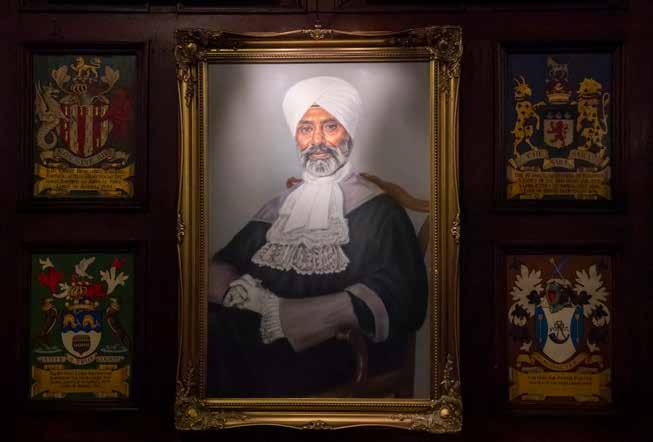
The portrait presents Sir Mota Singh in his judicial robes and wearing his white turban. The painting also reveals the judge’s character. Obituaries and profiles of Sir Mota refer to his wisdom, dignity, humour and generosity – all of which are faithfully captured by his friend Dial Singh Sagoo.
The Sir Mota Singh Memorial Lecture was established in 2018 to honour this distinguished member of the Inn and to celebrate diversity, in particular ethnic and religious diversity, at the Bar and in the wider legal profession. I delivered the first lecture, on Racial Equality and the Law, and in subsequent years we have been honoured to be addressed by Baroness Prashar, Lady Justice Simler, and Mr Justice Choudhury.
Our speaker in 2022 was I. Stephanie Boyce, President of the Law Society of England and Wales 2021-22 and an Honorary Professor of Law, The Dickson Poon School of Law, King’s College London. Ms Boyce addressed the topic of ‘Making justice seen to be done: putting diversity at the centre of the rule of law’.
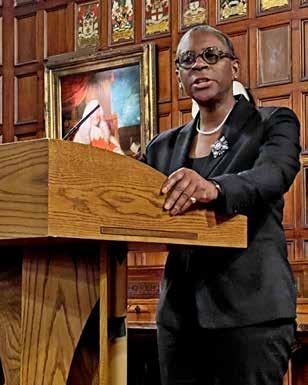
It was very appropriate that Ms Boyce should present this lecture since, like Sir Mota Singh, her career has established key legal landmarks. When she took office in March 2021, Ms Boyce was the first black person to become President of the Law Society and only the sixth woman to hold that office. Her lecture made an eloquent case for the importance of diversity in the judiciary. Ms Boyce reviewed the very limited extent of ethnic diversity among the judiciary and looked in detail at obstacles which have impeded the pace of change.
If you would like to see more photos taken at the portrait unveiling and lecture, please visit Nick Easterman’s photo gallery: https://flic.kr/s/aHBqjAf58C.-
Portrait of Sir Mota Singh by artist Dial Singh Sagoo.
I. Stephanie Boyce giving the Sir Mota Singh Memorial Lecture 2022.
In
portrait, which hangs on the west wall of the Great Hall, was formally unveiled at the lecture which bears his name, on 10 November 2022. We were delighted to welcome
The Rt Hon Lord Justice Singh (centre right) with members of Sir Mota Singh’s family in front of his newly unveiled portrait.
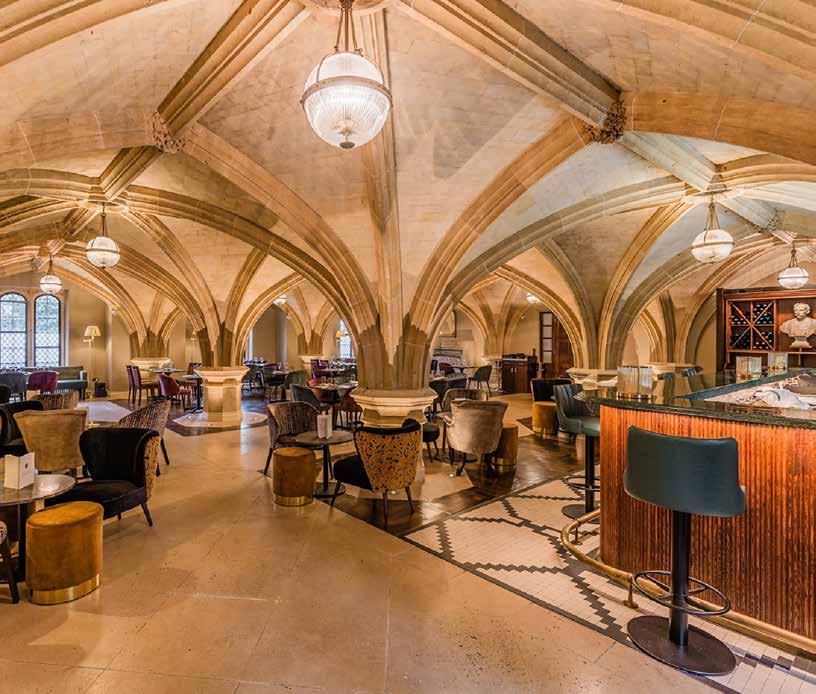
OPENING HOURS
Lunch: .............. 12.15 – 2.30 pm
Afternoon Tea: 3 – 5 pm (pre-booked only)
Evening dining: . 6 – 8 pm
Closed: 10.30 pm (Garden Terrace closed at 10 pm)
Bar open from 10.30 am
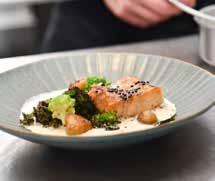

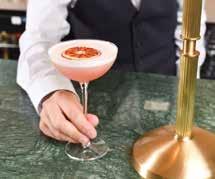
To book your table please call, email or speak to a member of staff.
email: themcr@lincolnsinn.org.uk tel: 020 7693 5139

Membership and Education in 2022
By Faye Appleton, Director of Membership and Education
We started 2022 in the odd halfway house of government advice on in-person activity, so we were delivering a mixture of remote, in-person, and hybrid activity. Overall though, there remained enthusiasm for in-person events and we put on as many as possible, while retaining the benefits that remote attendance brings.
Another impact of the pandemic has been a higher turnover in the Department than usual. Those who have left have largely done so because they have wanted to leave London, to be closer to family or to have a different lifestyle. While this has presented us with challenges at times, particularly when we had to wait to fill the vacancies, our remaining team have coped magnificently and our new starters are proving to be excellent additions to the team.
It was another busy but successful year and everyone in the Department is very grateful to all the members who contributed to our programmes this year. We experienced record numbers of admissions, student members on the Bar Course, and scholarship applicants this year, all of which have increased the demand on our volunteers, as well as on the Department. Each year our volunteers give up around 16,000 hours of their time and this is increasing. Thankfully members do not charge the Inn for their time but we have estimated that if they did this contribution would amount to at least £2 million. That our volunteers give up their evenings and weekends on top of their busy day jobs and personal lives is remarkable. Thank you to all our volunteers for their dedication to the Inn, and for how hard they have worked this year. We are always looking for new volunteers, and given the increased demand this is more important than ever. Information on how to get involved is available below and on our website
Scholarships
In 2022, the Inn awarded 32 GDL scholarships and 127 Bar Course scholarships. We had intended to hold the Bar Course scholarship interviews in-person but the continued impact of COVID meant we had to hold them online again. However, we were able to hold the GDL scholarship interviews in-person, while accommodating some candidates (and one interviewer) remotely. For the Bar Course scholarships, we interviewed 289 candidates across two Saturdays and four evenings with 55 interviewers taking part. For the GDL scholarships, we interviewed 68 candidates across one Saturday and an evening.
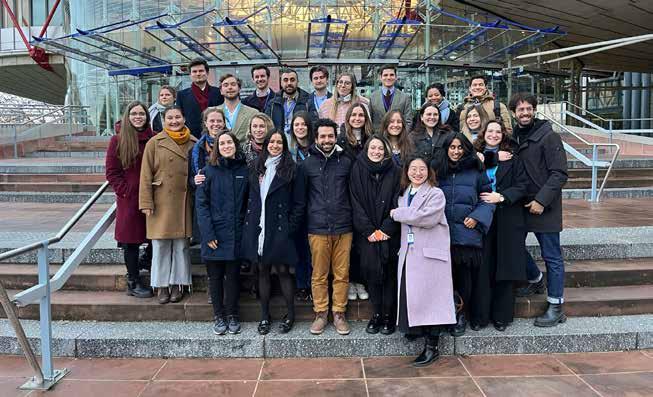
Alex Hughes, 2022 Nicolas Bratza Scholar, and fellow trainees outside the European Court of Human Rights.
Outreach
In 2022, the Inn took part in 28 outreach events for prospective students. These were a mixture of presentations and dinners organised by the Inn and panel events and law fairs organised by universities, including at the universities of Staffordshire, Kingston, Roehampton, and Aberdeen. We also participated in pupillage fairs organised by the Bar Council, Legal Cheek, and BPP University.
We were also able to resume tours of the Inn for prospective students, which we held twice a week during peak periods.
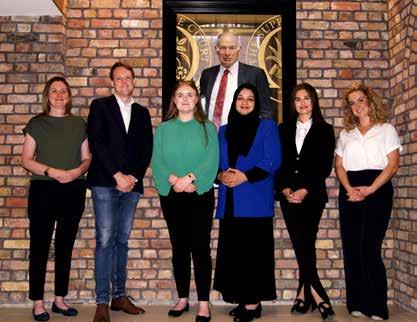
The Neuberger Prize was awarded for the eighth time. The prize is given to up to eight final year law undergraduates from non-Russell Group universities who are at or near the top of their year. The prize winners receive free membership of the Inn, a £250 cash prize, a summer school programme of workshops and court visits with expenses paid, and a mini-pupillage. There have been 45 prize winners to date, of whom 19 have so far received Bar Course scholarships from the Inn, with those awarded the prize in 2022 still awaiting the outcome of their applications. Eight of the prize winners have been Called to the Bar to date, with three securing pupillage so far and a number of others undertaking further legal study or work. In 2022, prizes were awarded to students from Aston University, St Mary’s University, Sheffield Hallam University, University of East London, University of the West of England, Open University, Goldsmiths, and Leeds Beckett University.
During 2022, we worked with our committee to develop a new social mobility prize for undergraduates. There will be eight prize winners and they will receive the same benefits as the Neuberger Prize and the selection criteria will be similar, but the eligibility criteria will be based on their socio-economic background. We will also aim to have at least 50% of the prizes go to students of black or mixed black ethnicity as we have identified that these students do less well in obtaining pupillage than students from other ethnic groups. This prize will be awarded for the first time in 2023.
In 2022, we continued the pilot of a social mobility initiative, in partnership with IntoUniversity, aimed at assisting A-Level students considering a career as a barrister.
Students
Our activities for students are divided into two main areas: Qualifying Sessions and Student Activities.
The Qualifying Sessions provide more formal education and training in advocacy, ethics, legal knowledge and the Rule of Law, career development, and equality, diversity, and inclusion. All students have to undertake sessions across these five themes, and two of their sessions must be interactive, requiring preparation and active participation. We have a quality assurance scheme of internal and external observation to assist with identifying best practice and areas for improvement.
Qualifying Sessions take the form of advocacy workshops, lectures, residential weekends and Domus dinners. For the first part of 2022, all the lecture sessions were held online as they had been for the 2020-21 academic year. From the spring, we were able to shift to a mixture of remote, in-person, and hybrid lecture sessions. We were able to hold all the other sessions in-person throughout the year.
The programme of Student Activities provides students with careers advice, competitions to take part in, and schemes to assist them in building their understanding of the profession, such as mentoring and marshalling. We also have schemes to review their pupillage applications and give them interview practice.
Post-Call Education and Training
In 2022, the Inn held three residential advocacy training courses for pupils and four courses in advocacy and ethics for new practitioners, two residential and two non-residential. We trained 92 pupils and 118 new practitioners.
We held our usual Advocacy Tutor Training course in July 2022. We trained 18 new tutors at this course. We also held a refresher course for our facilitators for the Advocacy and the Vulnerable course so that we could start offering this course again in 2023.
Member Engagement
During 2022, the Member Engagement team continued developing events and initiatives to expand the support and activities the Inn offers to its members, working with the Inn’s Circuit Representatives and the Bar Representation Committee (BRC) and its sub-committees.
Debating in the Old Court Room
We provided professional development events on presentation skills, vicarious trauma, how to mentor, and financial management and practical advice for pupils going into their second Six.
We also arranged events on reconnecting with the Inn and various social events, including a dinner in Bristol and receptions at the Inn for our new Silks, new practitioners, and new pupils.
We helped members who have completed the Bar Course and are still seeking pupillage through the Pupillage Foundation Scheme. This scheme provides mentoring, application form advice, and interview practice.
In addition, to the events offered we have also been working on other initiatives to encourage members to engage with the Inn. We created a film to highlight the diversity of background, experiences, and personal characteristics of our members.
We have continued our work to increase inclusion of our employed and circuit barristers.
Volunteering
We always need help from barristers and judges with our activities. We understand that as busy practitioners there will be many calls on your time, but I ask that, if not already involved, you consider taking part in the Inn’s education and membership activities. All volunteers are welcome, and we are particularly keen to increase involvement from employed barristers, barristers practising around the country, and those from underrepresented groups. It is important that we have representation of as wide a range of practitioners as possible on our teaching teams, speaker panels, and interview panels.
We arrange around 150 events each year, as well as a variety of schemes that support members of the Inn, and we could not run any of these without the contribution of many Bencher and Barrister members of the Inn. This includes attending our outreach events and talking to students considering the Bar as a career, providing advocacy and ethics teaching to students, pupils, and junior barristers, sitting on panels or giving lectures, and providing mentoring or careers advice. All the activities are rewarding and can be a lot of fun. Many of them also give you the opportunity to meet your peers practising in other areas, both geographically and legally. These are just some examples of how you can help:
• Teaching advocacy
• Mentoring
• Providing pupillage application advice
• Interviewing scholarship candidates
• Facilitating ethics, case analysis or vulnerable witness handling sessions
• Offering marshalling placements
• Giving careers talks
• Writing new exercises, ethics scenarios, and moot problems
There is more information on the volunteering page in the members section of our website about the events and activities you can assist with and a primary contact in the Department for each. You are also very welcome to contact me if you are interested in helping or want any more information.
Faye.Appleton@lincolnsinn.org.uk www.lincolnsinn.org.uk/members/volunteering
Neuberger Prize Summer School attendees (left to right): Kathryn Der Gregorian, James Leech, Freja Clacy, Mehwish Farhan, Phoebe-Jean Grainger, Deborah Speight.
Scholars and Prize Winners Awarded in 2022
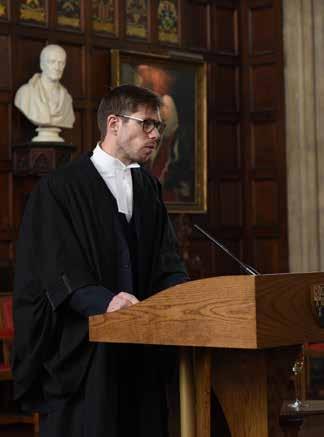
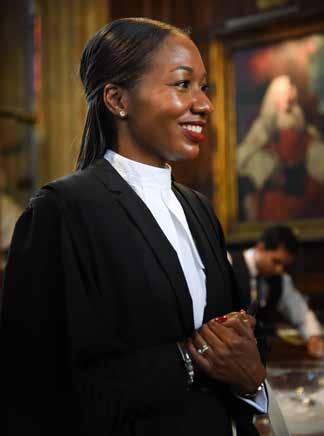
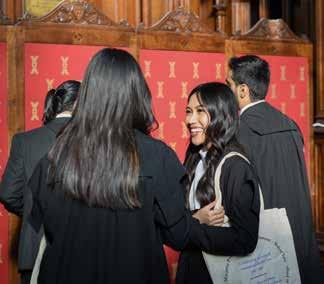
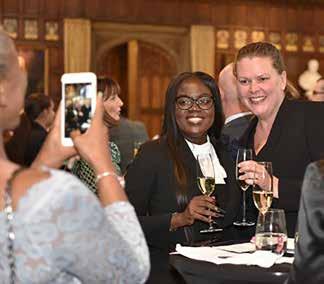
Photos: Tempest Photography
Photos: Tempest Photography
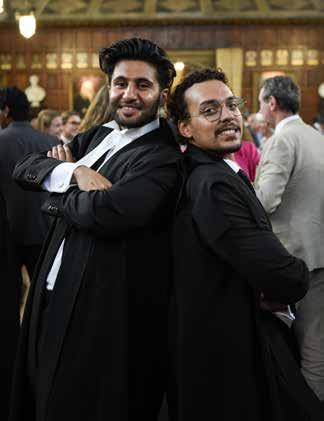
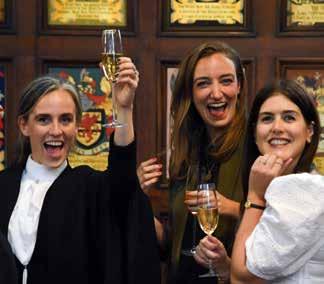
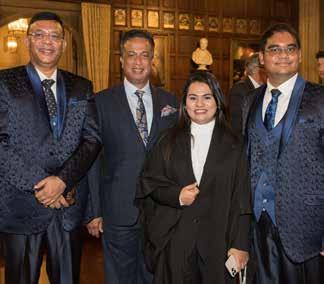
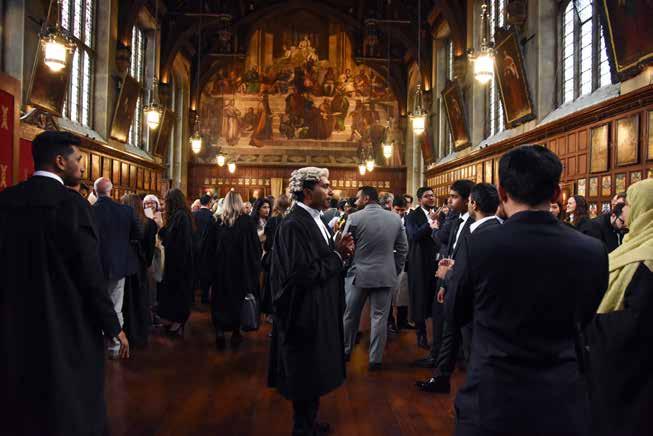
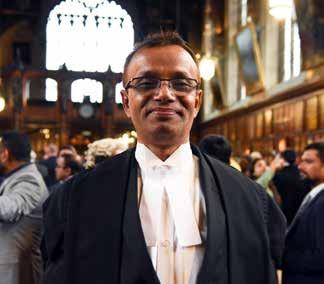
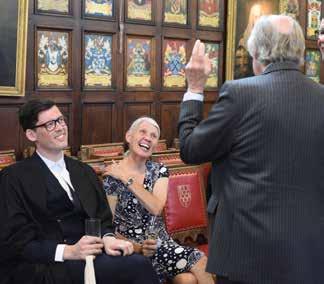
Congratulations to the 758 students that were Called to the Bar at Lincoln’s Inn in 2022.
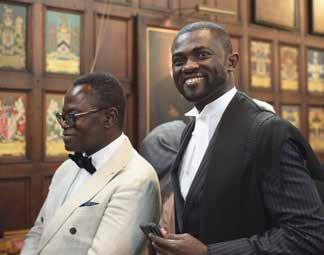

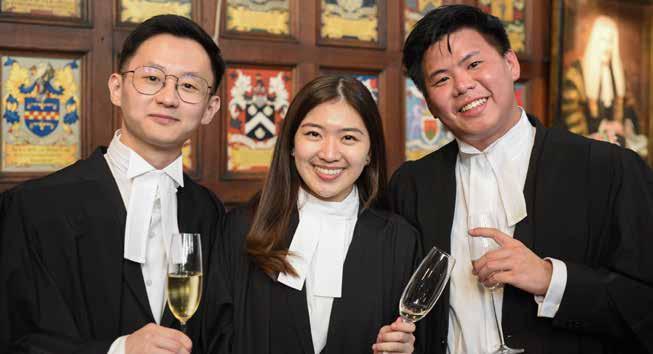
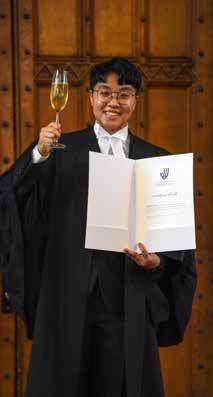
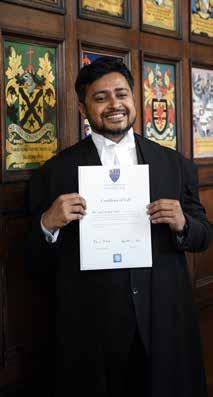
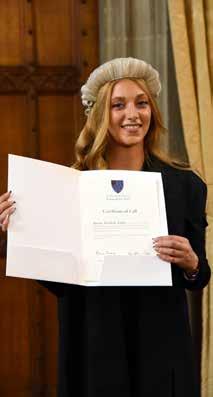
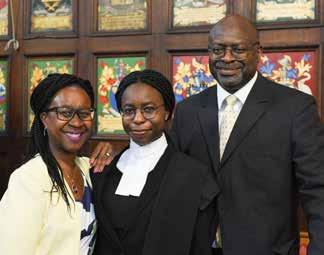
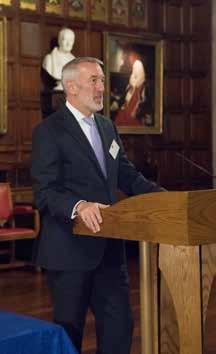
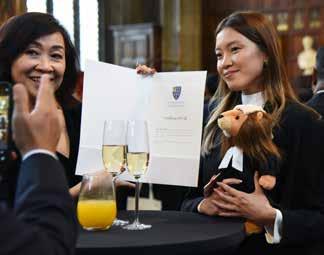
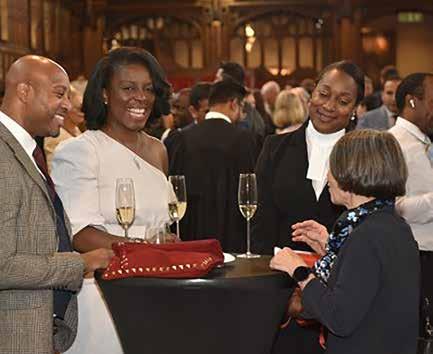

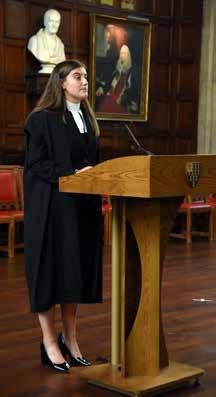
Photos: Tempest Photography
Photos: Tempest Photography
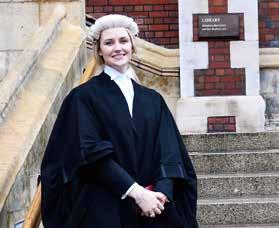
“This was a day I have been awaiting for many years. Studying the BPTC part-time at The University of Law with two under-fives was not an easy task but with some good teaching, discipline and supportive friends, family and colleagues, it proved possible.
Thank you to all of those at the Honourable Society of Lincoln’s Inn who made our Call Day so special and memorable. am very pleased to be part of such a supportive society.”
Catherine
Clark
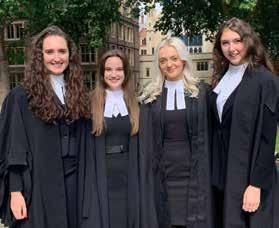
“It still feels surreal to know that something I’ve worked towards for so many years is finally a reality.
I am grateful to the Inn for their generous financial support and the opportunity to live onsite at Lincoln’s this year. It’s given me the chance to experience the warmth of a community.”
Rebekah Lee
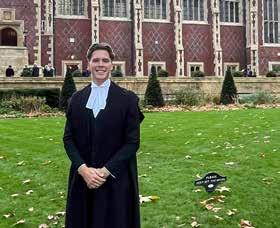
“To hear the words ‘Mr Howard, in the name of the Masters of the Bench, I call you to the degree of the Utter Bar’ in the presence of my family was unquestionably the proudest and greatest moment in my life to date and one which I will never forget.
I would also like to thank the Honourable Society of Lincoln’s Inn for all your support and assistance during my student years and the excellent opportunities you provided me with along the way.”
Max Howard
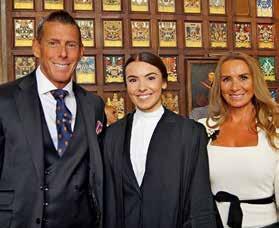
“I am forever grateful to Lincoln’s Inn for my generous scholarship award and for the lovely ceremony. I had the best day celebrating with those who have supported me to get to this point.”
Kiera Vinall
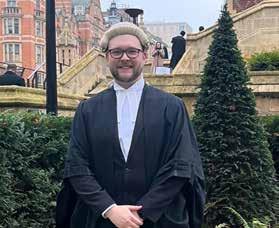
“The ceremony was a great opportunity to reflect on my successes so far whilst keeping an eye on the future.
To have my name called by the Treasurer brought to realisation that all the hard work that has gone in up until this point was all worth it. I could not have got this far without the help and support of my family, friends and tutors so a massive thank you goes to them. Looking forward to the exciting future to come!”
Callum Tyrer
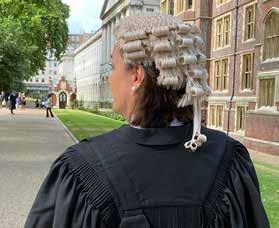
“As a Spanish lawyer and law professor I have always endeavoured to bridge the gap between the continental and the common law legal families. Becoming a barrister is the most gratifying reward I could have hoped for. Thank you to the Honourable Society of Lincoln’s Inn for the magnificent Call ceremony and for the enriching and helpful services it provides to its members.”
Natalia del Barrio

“It has been an incredibly challenging journey, one that I could not have done without my family, my partner and friends.
Thank you Lincoln’s Inn for the continuous support as a scholar and for hosting such a wonderful ceremony.”
Serpil Tas
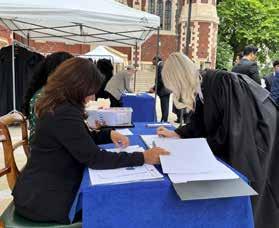
“I’ve wanted to be a barrister since I was 8 years old, so I’ve been waiting for this moment for 15 years. Passing the Bar was the hardest thing I’ve ever had to do, yet the past year has been one of the best of my life, largely in part to having lived at Lincoln’s and meeting some of my now best friends.”
Poppy Cleary
To browse photos taken by Nick Easterman at the Inn’s 2022 Call Days, visit his photo gallery here: https://www.flickr.com/photos/64305453@N02/albums
Circuit Activity
The Inn’s Representatives of the Circuit act as a line of communication between the Inn and members on Circuit. Their role is to inform, invent and introduce ways the Inn can increase engagement amongst members based outside of London.
Our current elected Representatives of the Circuits are:


Recruitment in progress (vacancy arisen due to Laura Gould’s election to Chair of the Bar Representation Committee)






Changes
We would like to express our thanks and congratulations to Laura Gould, who stood down as Northern Circuit Representative at the end of 2022, when she was elected Chair of the Inn’s Bar Representation Committee. We are recruiting for her replacement and look forward to seeing her excel as Bar Representation Committee Chair. In 2022 the representatives agreed to change the name of the role of “Master of the Circuit” to “Senior Representative of the Circuit”, to align with the Inn’s values.
Circuit Events
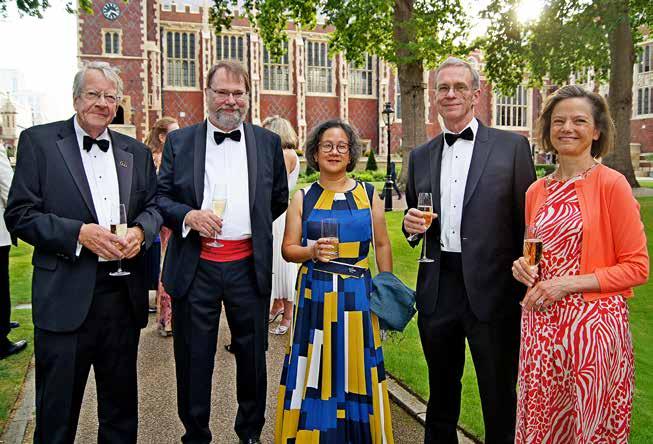
On Friday 15 July 2022 we held a Circuit Dinner at the Bristol Harbour Hotel for our members practising in the Western Circuit. The event provided an excellent opportunity for the Treasurer of Lincoln’s Inn, Jonathan Crow KC, and the Inn’s Under Treasurer, Anne Sharp CBE, to meet members based in the Western Circuit. The evening was a shining example of collegiality amongst our members, with delicious food and even better company. Special thanks to the Western Circuit Representatives, The Hon Mr Justice Cotter and Emma Southern, for helping us spread word about this dinner.
Following on from the Bristol Circuit dinner success, we will be hosting two more Circuit dinners in 2023 for members of the Inn to meet the new Treasurer, The Rt Hon Sir Geoffrey Vos. They will take place in Cardiff (Friday 21 April) and Birmingham (Friday 21 July). Members practising in the Wales & Chester and Midland Circuits will be contacted via email with booking information and further details – we hope to see many of you there.
We were also delighted to once again welcome Circuit judges and guests to the Inn’s annual Circuit Judges Dinner, which took place on Friday 8 July 2022 in Old Hall.
Feedback
The Inn is always open to feedback from members on Circuit. If you have any ideas or suggestions for Circuit events or initiatives, please contact your Circuit Representatives or the Inn’s Member Engagement team via members@lincolnsinn.org.uk
North Eastern Circuit Senior Representative
Nicholas Lumley KC
Circuit Judges Dinner.
Celebrating the Employed Bar
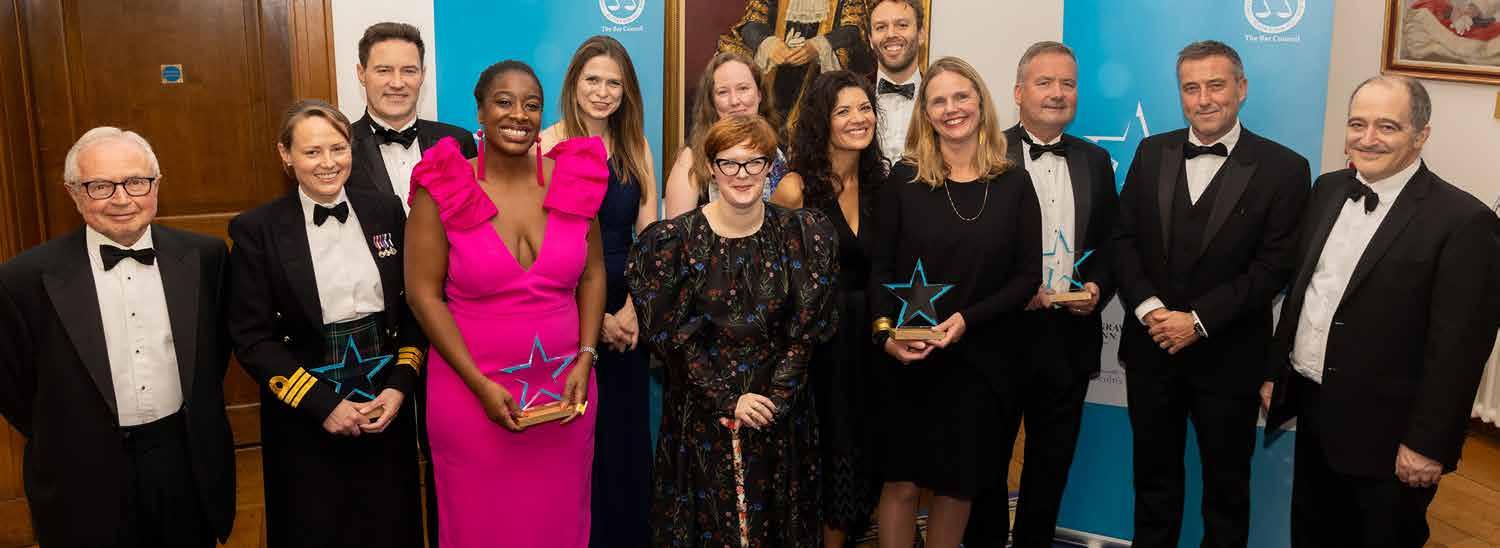
In 2022 the Inn was delighted to be one of the sponsors for the Bar Council Employed Bar Awards. The Employed Bar Awards showcase the wealth of talent amongst employed barristers. Launched in 2017 by the Bar Council, they celebrate the vital contributions that employed barristers make across numerous practice areas. The Awards are presented for high quality legal advice and an outstanding contribution by employed barristers to the work of their organisations and the law more generally. The judging panel included senior members of the profession and judiciary, alongside the Chair of the Bar, Mark Fenhalls KC.
On Thursday 20 October, the Bar Council partnered with Gray’s Inn to host the awards ceremony and dinner, where the winners were presented with their awards. The Treasurer, Jonathan Crow KC (4 Stone Buildings), and Thomas Barrett (Government Legal Department) attended the awards evening to represent Lincoln’s Inn.
The winners were:
• Charlotte Pope-Williams, Pinsent Masons LLP - Employed Barrister of the Year in a Law Firm (sponsored by The Honourable Society of Lincoln’s Inn)
• John Battle, ITN - Employed Barrister of the Year in Commerce, Finance, or Industry (sponsored by The Honourable Society of Gray’s Inn)
• John Swords, North Atlantic Treaty Organization - Employed Barrister of the Year in the Public Sector (sponsored by The Honourable Society of Inner Temple)
• Cdr Caroline Tuckett RN, Lead Legal Adviser, International Law for the Royal NavyEmployed Barrister of the Year in the Armed Forces (sponsored by BAE Systems)
• The Department of Health and Social Care - Employed Legal Team of the Year (sponsored by the Government Legal Department)
The Awards were also sponsored by the Bar Association for Commerce, Finance, and Industry (BACFI).
Congratulations to all the winners, in particular Charlotte Pope-Williams and John Battle, who are both members of Lincoln’s Inn.
“I have never regretted moving from private practice into the Employed Bar. The life of a media lawyer is exciting and interesting. Every day I play a part in advising reporters and editors on what we can broadcast or publish online and determining what millions of people see in their news.”
(John Battle, ITN)
“The Employed Bar Awards acknowledge the richness that a career at the Employed Bar can offer. As regards a rationale for coming to the Employed Bar, people often focus on the perks of employment (i.e. paid family leave, paid annual leave, a guaranteed stable salary, private health insurance and more discounts on a range of goods and services than you can shake a stick at). These perks are great; however, the true selling point for me is the quality and nature of the work that you can undertake, even as a junior… a career as an employed barrister enables a person to undertake all forms of advocacy, from courts and tribunals to internal decisionmakers and boardrooms.”
(Charlotte Pope-Williams, Pinsent Masons LLP)
A special thanks to the Bar Council and Gray’s Inn, for hosting a memorable evening.
Photo
credit:
The Bar Council
Life as a BBC Lawyer

Russia’s invasion of Ukraine in February 2022 heralded the start of another exceptionally busy year for BBC News. The UK government imposed sanctions on a range of Russian companies and banks within hours of military action starting.
We were potentially unable to pay our 100 Moscow-based Russian service employees and local suppliers, at a time when the need for impartial, independent reporting from Russia could not have been greater. Providing advice on the effect of the sanctions and how to mitigate against them was my focus for the first few days and weeks of the war.
Days later, new laws which effectively criminalised independent, impartial journalism in Russia were enacted. In common with several media organisations, the BBC suspended the work of all its journalists and support staff within the Russian Federation whilst we assessed the full implications. I spent the first weekend in March seeking advice from Russian lawyers and considering its implications for our local teams and their work. We decided to move most of our Russia-based employees to locations outside Russia. Many may never be able to return to their homeland.
Meanwhile, the BBC World News channel was taken off air in Russia, our English and Russian language websites blocked, and access to our social media outlets suspended.
As the UK announced more sanctions on Russia, the Kremlin retaliated with sanctions on our own journalists and management. Urgent advice on the implications was required.
The safety of our teams in Ukraine was a prime concern. The BBC’s Ukrainian service employs over 60 people in Kyiv, in addition to colleagues from our UK services on deployment. One of the most vivid memories I have of
those early days is being asked whether and how Ukraine’s mobilisation law might affect our journalists’ ability to continue their work from inside and outside Ukraine. The logistics of evacuating 60 staff and their families to safer locations called for immediate advice on contracting security support, employment contracts, and visas at a time when Ukrainian lawyers were themselves dealing with their own country’s invasion.
Away from Ukraine and Russia, the work is equally varied. For the last decade, the Iranian government has conducted a campaign of harassment and intimidation towards BBC News Persian journalists in the UK and their families in Iran. This has included death threats towards staff in London, their family members in Iran being interrogated, threats of imprisonment, online harassment and gendered attacks on women journalists, and a judiciary-imposed freeze on their assets in Iran. In some cases, family members are deprived of their liberty, held in degrading conditions, and ordered to tell their relatives to stop working for the BBC.

Working with Caoilfhionn Gallagher KC and Jennifer Robinson at Doughty Street Chambers, the BBC has filed urgent complaints against Iran with the United Nations amid escalating security concerns. In response the UN has raised ‘grave concern’ with Iran. The harassment has intensified in the wake of our reporting of the death of Mahsa Amini in September, and our work at the UN and beyond to demand an end to Iran’s attempts to censor our journalism continues. A new behind the scenes documentary examines the challenges faced by BBC News Persian teams and the personal sacrifices they make; it’s well worth half an hour of your time.
Press censorship is not confined to Russia and Iran. The World Press Freedom Index reported in 2021 that journalism is totally blocked, seriously impeded, or constrained in 73% of the 180 nations surveyed. BBC News has a presence in nearly 60 countries around the world, and much of my role centres around attempts to censor or undermine our reporting. This ranges from organising legal representation for journalists who have been detained or arrested, responding to overseas governmental regulatory and legal action against the BBC and those who work for it, and advising on how to comply with new laws and regulations aimed at restricting the press. We work with the BBC’s specialist in-house editorial legal and litigation teams, and a network of legal advisors around the world, to defend our journalism and ensure its availability to our audiences.
A whole host of other issues cross my desk on a weekly basis. Whether it’s advice on unfreezing one of our overseas bureau’s bank accounts, engaging a freelancer outside the UK, or growing the BBC’s audience by licensing our content to other providers, no two days are the same. Ultimately, my job is to help our journalists do theirs.
Reporting Iran: Inside BBC Persian is on BBC iPlayer in the UK.
BBC News Persian TV gallery.
Chris Loweth reflects on his first year as director of legal, rights and business affairs for BBC News
Chris Loweth in the BBC Newsroom.
Equality, Diversity and Inclusion at the Inn
2022 has been another incredibly busy year for the Inn in terms of its equality, diversity, and inclusion (EDI) activity, all of which has been overseen and supported by the EDI Committee.
We published our EDI Action Plan for 2022-23, which identifies the core areas that will be the focus of our work in this period. One of the objectives is to take proactive action that seeks to advance the state of equality, diversity, and inclusion within the Inn.
In June we invited LGBTQIA+ members and allies to celebrate Pride Month at the Inn with a Diversity Dinner. The feedback from attendees was overwhelmingly positive, including comments such as “It was wonderful to be able to dine in the Great Hall surrounded by an entirely LGBTIQA+ affirming and supportive community” and “A wonderful combination of tradition and formality mixed with openness and forward thinking”. We are incredibly grateful to the members who suggested the event and helped with the planning and organisation, Judge Barber, Brie Stevens-Hoare KC, Stuart Hornett, and Conor McLaughlin.
If you would like to browse more photos from the Diversity Dinner, you can visit Nick Easterman’s album: https://flic.kr/s/aHBqjzTSta
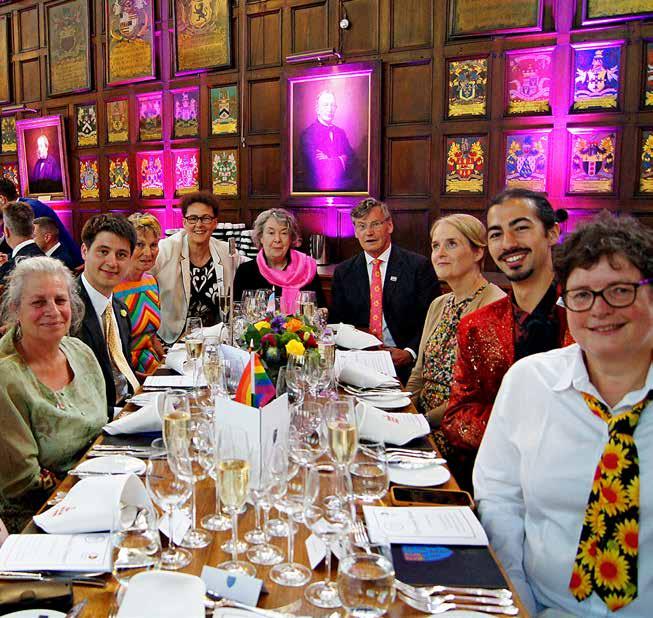
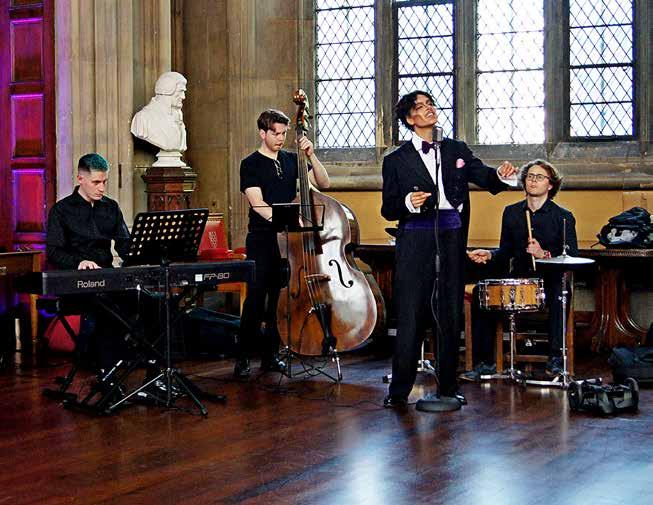
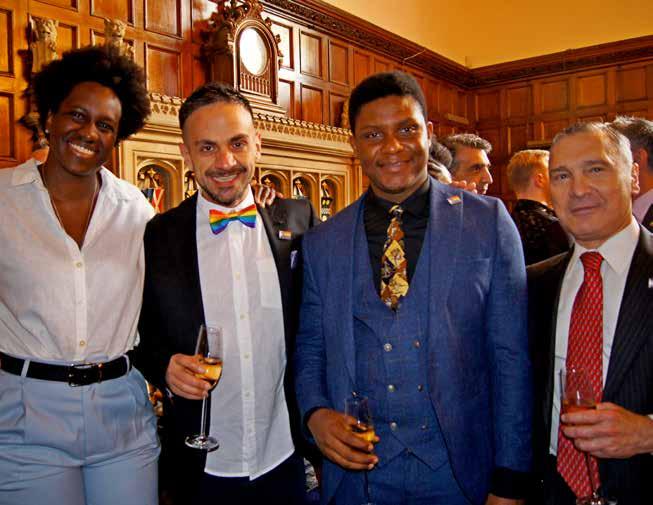
We held three EDI forums during the year. The first one, held in July, was on career progression within intersectional identities. The panel, chaired by Her Honour Judge Barbara Mensah, were Lady Justice Carr DBE, Rachel Krys, Gary Pryce, and Dr Douglas Board. They shared their experiences around intersectionality in the workplace and how it can affect selection processes, as well as career development.
In October we held the second forum, an online panel on social mobility. It was aimed at lawyers involved in management, recruitment, EDI, and career progression across the legal sector, and focused on what is meant by socio-economic status and how we can achieve social mobility. The panel was chaired by Chris Loweth, Co-Chair of the Inn’s Social Mobility Group. The panellists, Professor Anna Mountford-Zimdars (Joint Founder/ Director of the Centre for Social Mobility at the University of Exeter) and Helen Mountfield KC, discussed improving social mobility in organisations.
We held our final forum of the year in November, with a keynote speech by the Rt Revd Rose Hudson-Wilkin CD, MBE on the topic of “Making diversity and inclusion a reality”. Referencing the education system and the need to challenge its gatekeepers, Bishop Rose spoke passionately about what it takes to make sustainable cultural systemic change. By sharing her own journey, from serving as a priest for over sixteen years in Hackney, to becoming the first female appointed to the position of the 79th Chaplain to the Speaker of the House of Commons, she shone a light on what true inclusivity can look like.
The Inns of Court Alliance for Women (ICAW) launched in February, replacing its forerunner, the Temple Women’s Forum. The purpose of the alliance is to encourage and support women in the profession and increase diversity and retention. In March it held an event that focused on supporting Heads of Chambers and Senior Clerks/Practice Directors in their development of a practical solution to ensure a fairer and more transparent allocation of work. This kicked off a programme of events during the year that included the ICAW Garden Party in June. Held at Gray’s Inn, the event saw hundreds of women barristers, solicitors, judges, legal academics, and students come together to socialise, network, and share their experiences.
EDI is a central part of the qualifying sessions that we offer, and we ensure that the themes are thoughtprovoking and varied for our students. From subjects such as “Navigating EDI in Practice” to “Understanding unconscious bias and challenging it in yourself and others”, we are proud of the sessions that we have offered this year. In November, we ended the programme with the Sir Mota Singh Memorial Lecture on the subject of ‘Making justice seen to be done: putting diversity at the centre of the rule of law’ by the former President of the Law Society, Dr I. Stephanie Boyce. It was at this event that we also unveiled a portrait of the late Sir Mota Singh, which was generously gifted to the Inn by his family, whom we were delighted to be able to thank inperson at the event. (Read more about these on page 30.)
Karen Shuman (EDI Committee Chair).
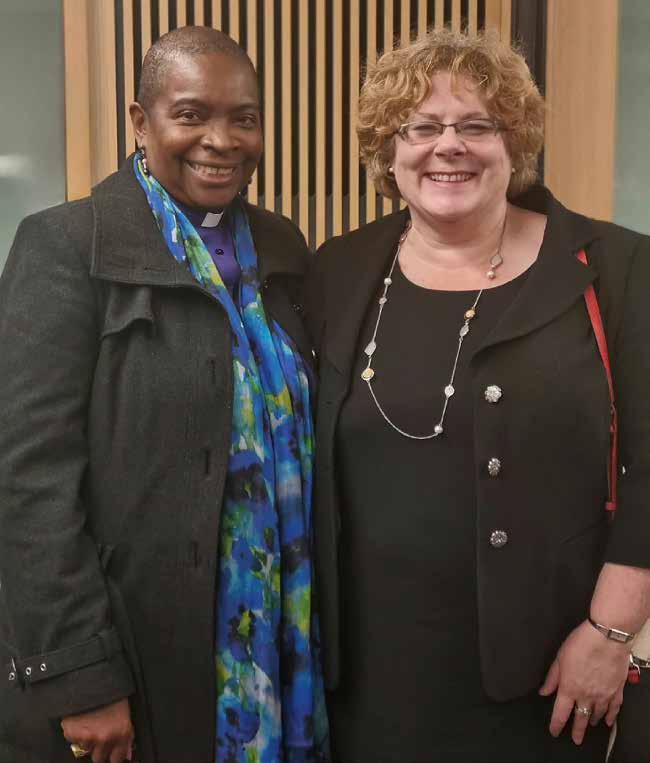
This year we started work on an exhibition on diversity at the Inn that aims to celebrate the achievements of our members who come from a diverse range of backgrounds. The first part of this exhibition focused on ethnic diversity and included Sir Francis Goldsmid, Leila Seth, Sir Muthu Coomaraswamy, and Lord Sinha. An early version was on display at the Sir Mota Singh Memorial Lecture. A second section will be displayed at the events celebrating 100 years of women barristers at the Inn in 2023. Both parts will be brought together and added to as part of a longer-term initiative that will, when complete, be widely shared and added to the Inn’s website. The objective is to encourage conversations and amplify the great work of these individuals.
A key part of our EDI action plan is to capture data and feedback from our members. In the summer of 2022, we launched a major survey on our members’ experiences of EDI issues at the Inn. It was also an opportunity to gauge a better understanding of the diversity of our members. We thank all members who took the time to complete the survey before it closed in October. We plan to utilise the findings, which we will receive in early 2023, in our EDI decisions and activities in the future.
Rt Revd Rose Hudson-Wilkin CD, MBE with Chief Chancery Master
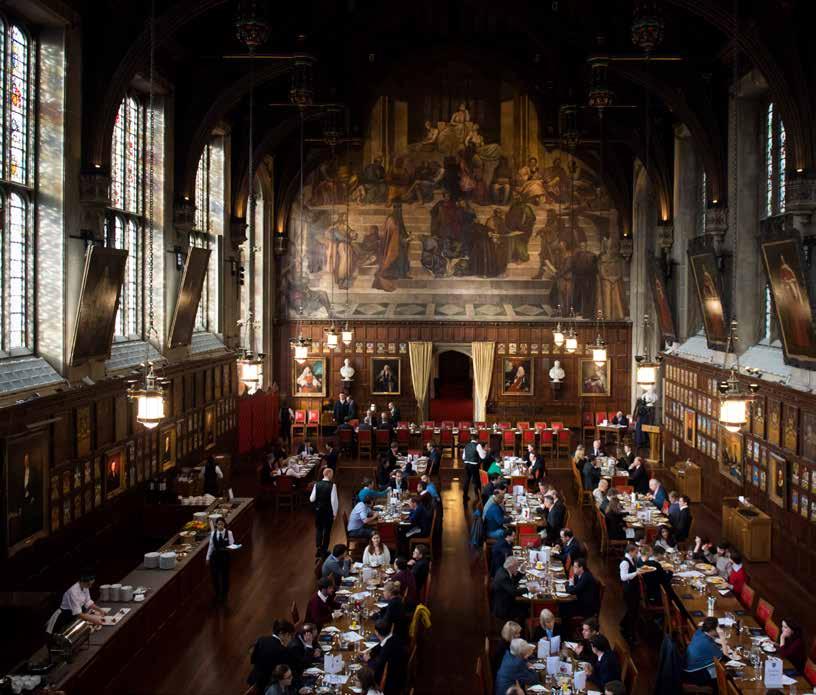
Members’ Lunch in Hall
Dress code: Smart casual.
We kindly request that you do not bring children under the age of 12 to lunch.
Members’ Lunch in Hall is not available during the Inn’s closure periods of Easter, August and Christmas.
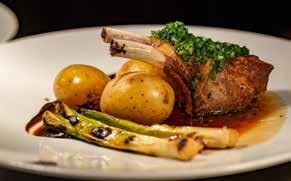
Grand Day
Grand Day is a major event in the Inn’s calendar in celebration of the Treasurer’s term in office. Distinguished guests from outside the legal profession are invited by the Treasurer to attend the event.
Guests of the Treasurer in 2022 were an eclectic mix from the worlds of fashion, theatre, music, literature and the media. They included Nicole Farhi OBE (sculptor and fashion designer), Sir David Hare (playwright, screenwriter and director of film & theatre), Dame Emma Walmsley DBE (Chief Executive Officer of GlaxoSmithKline), Clint Dyer, (Deputy Artistic Director at the National Theatre), and Major General Alexander Taylor CB (Director of Army Legal Services).
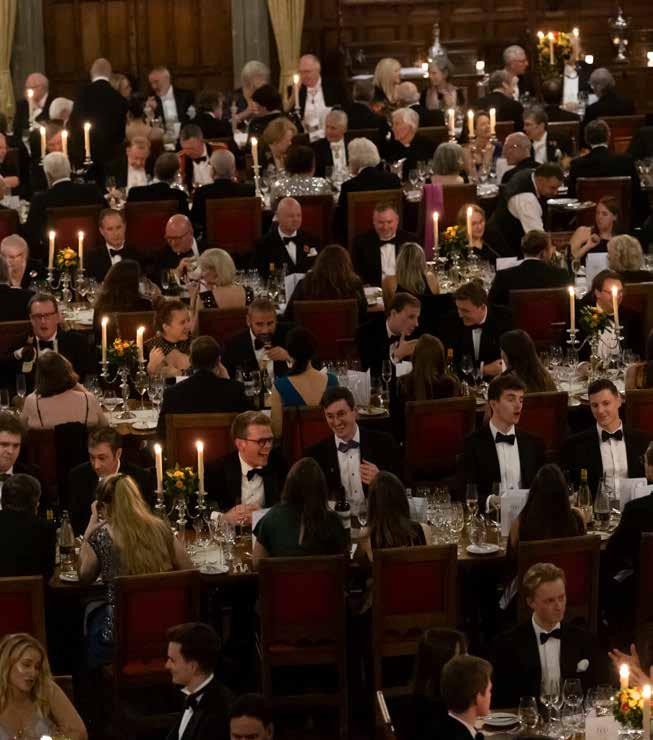
For further details and to view our daily menus, please visit our members’ lunch page
To see more Grand Day images, browse Nick Easterman’s album at https://flic.kr/s/aHBqjAdSP2
Photos: Ben Stevens
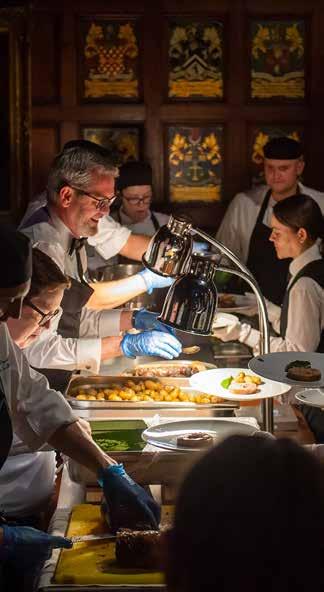
Grand Day 12 May 2022
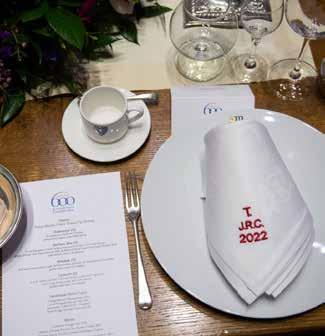
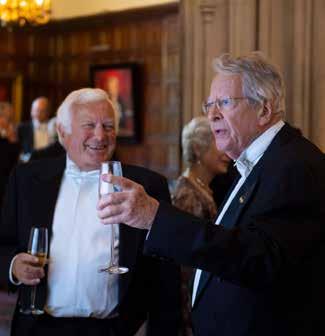
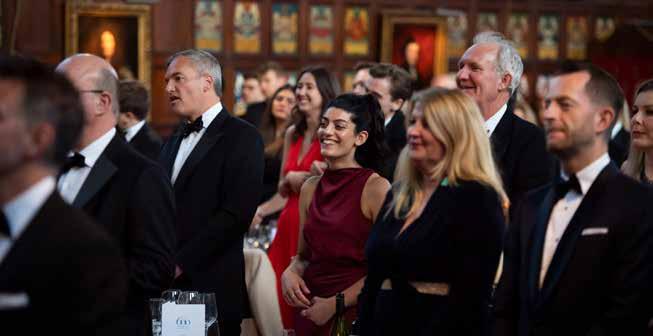

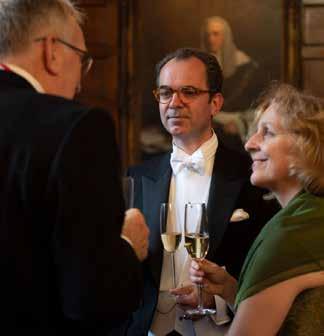
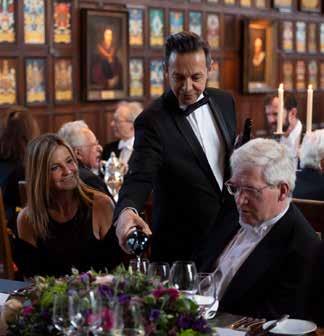
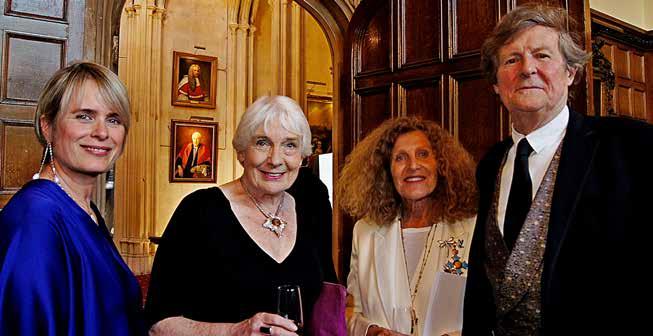
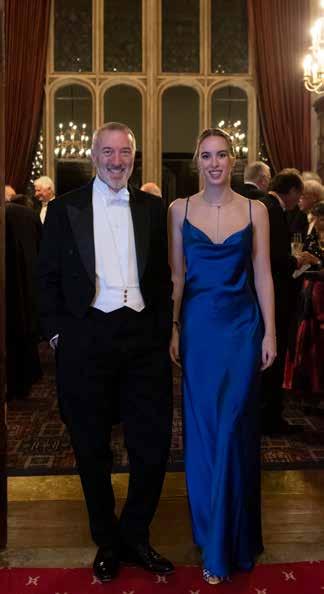
Grand Day 3 November 2022
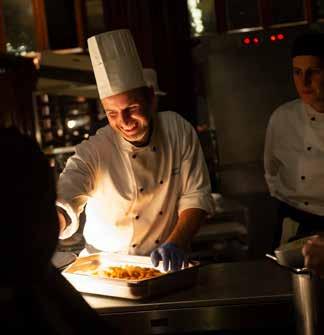

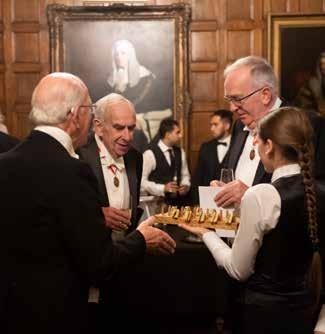

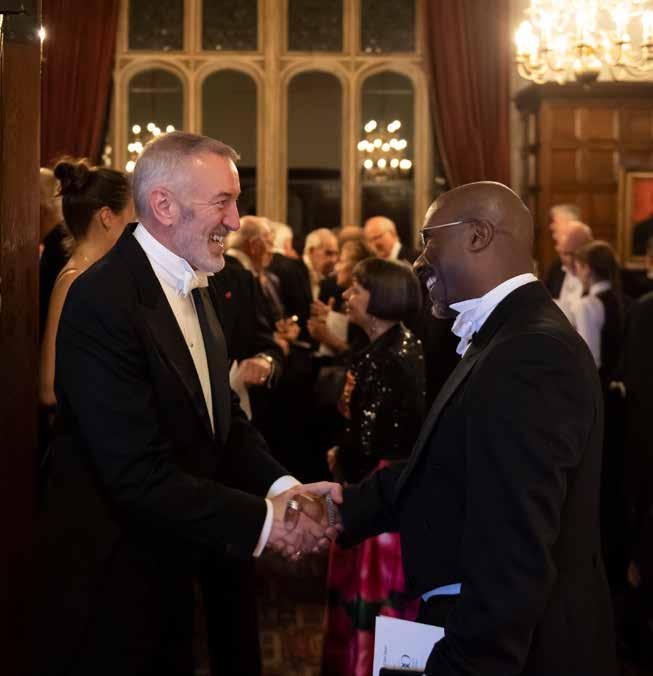

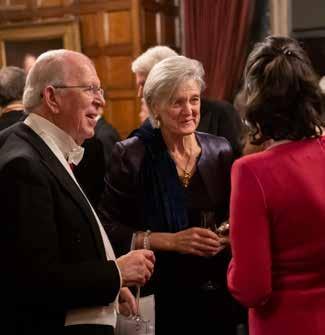
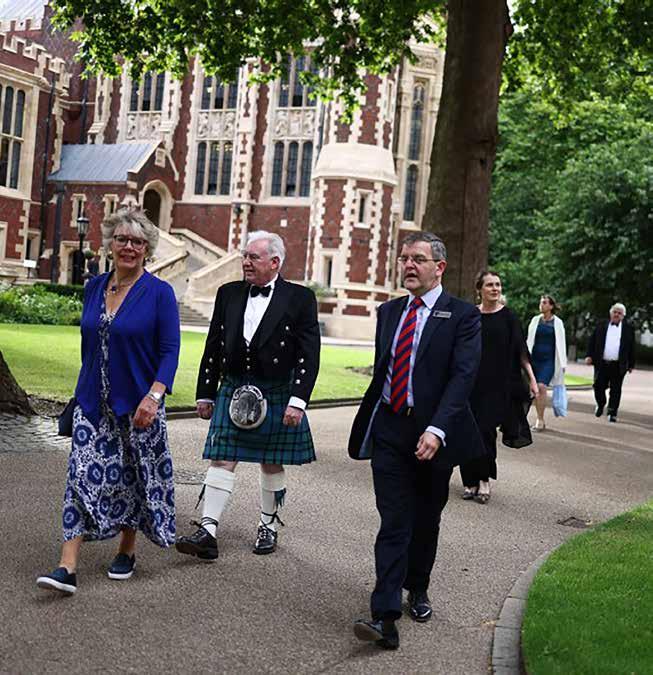
Amity Dinner
On 1 July 2022 Benchers of Lincoln’s Inn and their partners dined in amity with guests from the Inn of Court of Northern Ireland, King’s Inns Dublin and the Faculty of Advocates in Scotland. Guests were offered tours of the Inn by Dunstan Speight and Heidi Kinderman, and an exhibition of treasures from the rare books and archives was on display in the Library. Dinner was held in the Great Hall and the Lincoln’s Inn choir sang a quartet of folksongs from England, Scotland and Ireland; The Ash Grove, Danny Boy, My Love is like a red, red rose and Molly Malone.


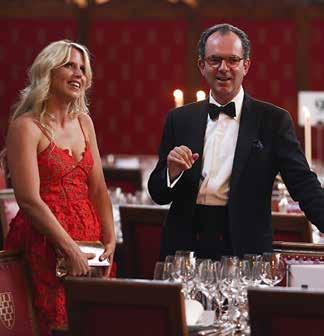
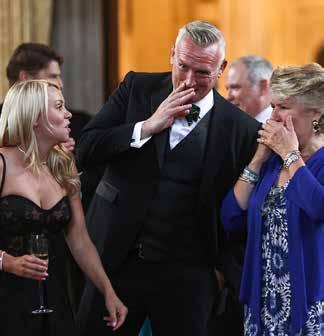
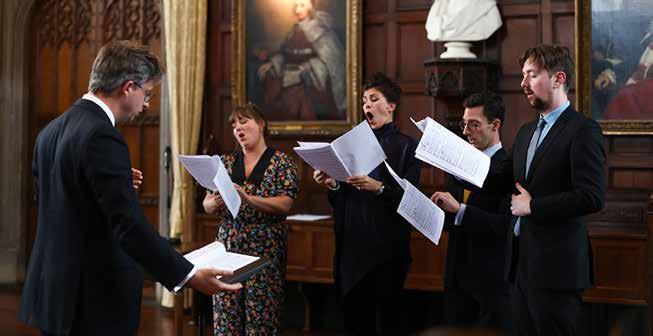
Estates Department Report
By Philip Ardley, Director of Estates
The work of the Estates Department is spread over three main sections: Project Management, Facilities Management and Property Management. The most visible of these sections, albeit no more important than the other two, is Project Management.
Project Management
A number of construction projects were carried out in 2022. The long running (three years on site) FRA/M&E (Fire Risk Assessment/Mechanical & Electrical) project finally completed, as did the Great Hall External Repair & Redecoration project, started in 2021. Also completed in 2022 was phase 1 of the Chapel’s stained glass window conservation, Old Buildings External Repair and Redecoration, as well as various flat and chambers refurbishments.
Projects underway in 2022 included the new roof at 5 & 6 New Square and the refurbishment of 77 Chancery Lane.
Great Hall
Much was said in last year’s review prior to completion of the Great Hall External Repair & Redecoration project, but the scale and nature of the project deserves a final piece of attention.
2022 saw the completion of major fabric conservation work to the Great Hall and Library. The project commenced in March 2020 and took 32 months to complete (notwithstanding minor snagging items). A major aspect of the work was replacement of the slates covering the Great Hall roof. 700m2 of new Welsh Penrhyn slates had to be placed on special order from the quarry due to the existing slates being of an uncommon size and the requirement that the new slates proportionally match the old. All lead to the Great Hall parapet gutters and bays was replaced, and various repairs were also carried out elsewhere, such as to the Library roof.
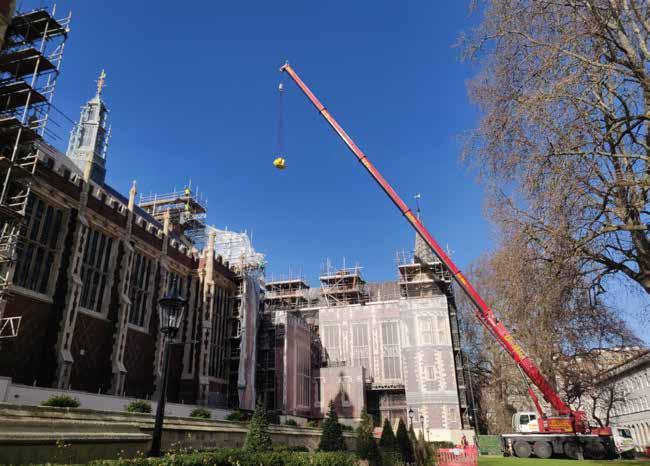
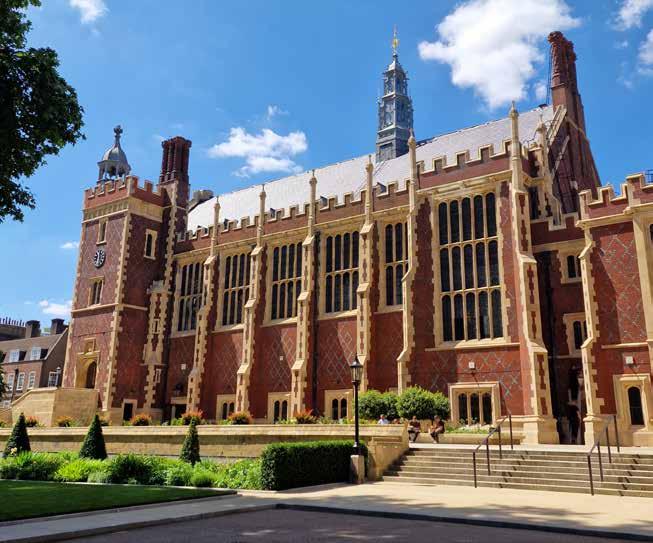

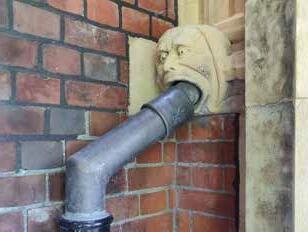
Next to the re-roofing, the second most major aspect of the project was brick and stone repairs and repointing thereof. This included deconstruction and rebuilding of the cluster of chimneys at the northern end of the Great Hall, necessary due to excessive inward lean. All brick and stonework was cleaned using a combination of ThermaTech (superheated steam under pressure) and poultice (a face mask for stone!). In total there were more than 1000 brick repairs or replacements, 750 stone indents, 1350 stone mortar repairs, 1200m2 and 1000 linear metres of brick repointing, and 8000 linear metres of stone repointing completed.
All previously painted surfaces were redecorated, metal work repairs were carried out to window ferramenta – the interlocking metal bars that sit in front of windows – various timber repairs were carried out to infill panels, doors and handrails, damaged glazing was replaced, new silver leaf was applied to the numerals and hands of Great Hall’s clock, the weathervane that sits atop the Great Hall lantern was regilded with gold leaf and a new scheme of external LED lighting was installed, replacing the old and less energy efficient halogen lights that previously illuminated the building.
The Great Hall after the scaffold was struck.
The Great Hall’s unstable chimneys were rebuilt.
New pre-cast concrete liners were used, with the old brick specials retained and renewed.
The gargoyle surrounding the lead rainwater pipe. More than lip service being paid to conservation here!
FRA/M&E (Fire Risk Assessment/ Mechanical and Electrical) Project
Part of this long project, incorporating fire compartmentation, new fire alarm systems and new water pipe infrastructure across the estate, was provision of new power for Electric Vehicle Charging (EVC) and for 10 New Square, which was drawing more power than it was designed to do.
Chapel
Phase 1 of Chapel’s stained glass conservation programme was completed in 2022. The photo below indicates in-progress reinstatement of the stained glass and new environmental protected glazing, protecting the old stained glass. This was installed in the rebate and sealed, providing better protection from pollutants, UV and condensation. This is the same process being used at Notre Dame.
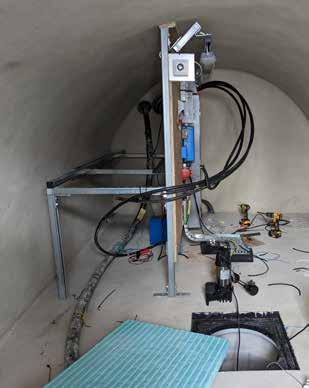

Old Buildings
External repairs and redecoration to Old Buildings included roof covering repairs, extensive repointing, the rebuilding of two chimneys found to be unstable, widespread window repairs, the replacement of TV aerial cables, render repairs, railing repairs, the replacement of existing roof access systems and redecoration.

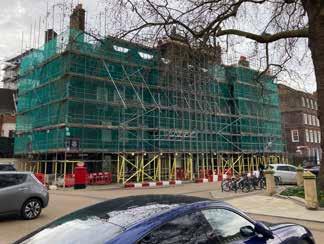
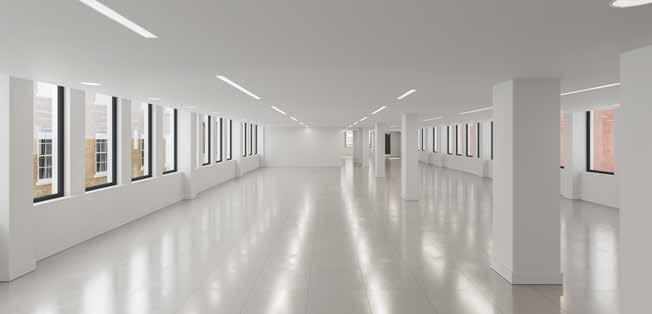
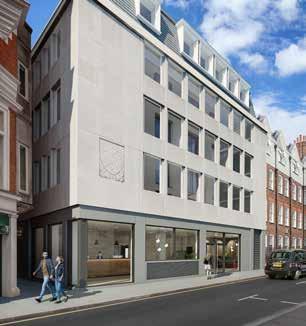
77 Chancery Lane
Following the vacation of the 1969 office building formerly known as Hardwicke Building, an extensive refurbishment was carried out throughout 2022. This involved removal of the roof tank room to be replaced by a roof plant, a fully fitted show floor, the remainder of the offices fitted as shells ready for the specific requirements of chambers or other users, showers, bicycle parking, a new lift core and replacement of the former Eat sandwich shop with a reception. This latter work enables flexible access from either Chancery Lane or New Square.
An artist’s impression of the show floor at 77 Chancery Lane.
The scaffolding to the majority of Old Buildings had to be independent and self-supporting due to the weak brickwork, which involved a specialist scaffold system.
Works on Old Buildings and 12-13 New Square – this involved various roof, chimney stack and elevation repairs, over a period of one year on site.
The old clouded plexi-glass which was in front of the stained glass window has been removed and clear glazing installed.
A new electrical board in a newly lined vault under the pavement/road in New Square, serving EVCs and 10 New Square.
An artist’s impression of the new-look 77 Chancery Lane elevation.
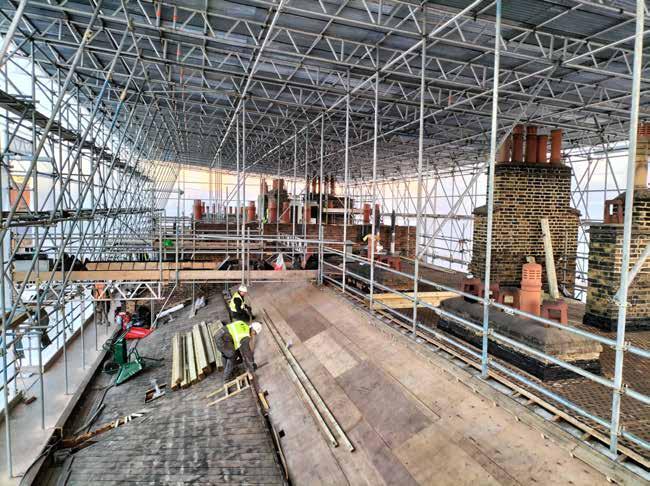
5 and 6 New Square Re-roofing
The roof at 5 and 6 New Square was in very poor condition.
Receiving statutory consents took over a year, with water ingress continuing during this time. A high level of tender index inflation necessitated a re-tender but ultimately work started in 2022 and is due for completion mid-2023.
Flat Refurbishments
From time to time, as people leave their residences at the Inn, flats are refurbished. This can be light touch – a “lick of paint” –through to a full refurbishment including rewiring, new gas appliances, a new bathroom and kitchen, new floor coverings, window repairs and redecoration. The decision on the appropriate level of work will usually be governed by the length of time since the last refurbishment.
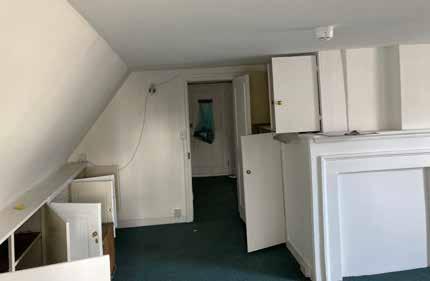

Facilities Management
The Facilities Management team is responsible for the ongoing maintenance of the Inn’s estate. The Inn’s workforce was previously augmented by a M&E (Mechanical & Electrical) term maintenance contractor. To ensure consistency of service, the Inn has taken this work in-house, necessitating the expansion of the Inn’s workforce. Work carried out in-house includes M&E/Gas safe work, plumbing, drains, roof leaf clearance, water quality hygiene and carpentry/general building. Specialist contractors are used for lifts, fire engineering, ground source heat pumps, and pest control.
Property Management
Acquisitions and disposals, lettings, lease renewals, rent reviews, licences, wayleaves, business rates and service charges rests with the Property Management of the estate.
A recent commercial letting was a new sandwich shop at 76a Chancery Lane.
Flat lettings proved buoyant, with several flats refurbished and let over 2022.
People and a Look Ahead
The Estates Department has a full set of projects for next year, together with a large programme of planned and reactive maintenance and repairs, and the ever-demanding field of Property Management.
Our teams carry out essential work across the Inn and are made up of highly skilled, dedicated employees without whom the Inn would not be able to function. For me, as this is the last Estates Review I will be writing before moving on to pastures new, I give my heartfelt thanks to the Estates teams, and to the Estates Committee for their unstinting support. The Committee’s membership is filled with highly knowledgeable, capable people, who generously give up their time for free and for whom I have the greatest respect. Thank you for your guidance over the years.
Thank you, and I wish you all a very bright and successful future.
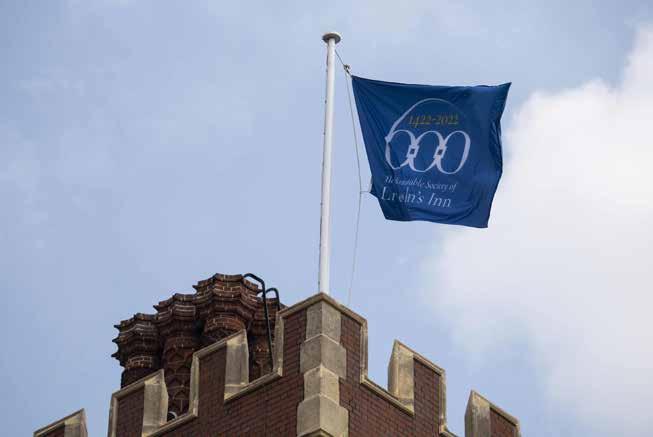
View from 6 New Square showing the temporary roof, and the old roof stripped of slates.
Before – Flat 7, 21 Old Buildings.
After – Flat 7, 21 Old Buildings.

Catering Department Report
By Steve Matthews, Head of Catering
It has been a remarkable 12 months that began, as you may remember, with the emergence of the Omicron variant of COVID-19. But we didn’t let this dampen our spirits. The team once again demonstrated their incredible resilience and as Spring approached, confidence returned in the events industry. The demand for external events was unprecedented. It was incredible to see how quickly we returned to pre-pandemic levels and so encouraging to see our loyal clients’ events reappearing in the calendar once again.
The Year in Highlights
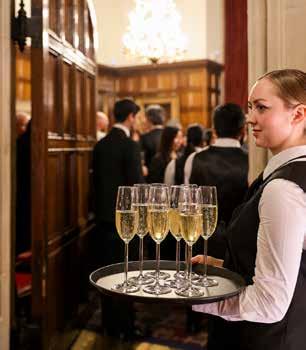
2022 saw the return of a full calendar of events coupled with the Inn’s 600th Anniversary celebrations, meaning an extremely busy yet incredibly successful year for Inn events. We not only saw a surge in attendance for traditional events such as Sunday Lunches, Ordinary Dining, Grand Days and Black Tie Guest Night, but we also opened our doors to the public with events such as Open House and Open Gardens. The diverse programme encouraged those who had fallen out of touch with the Inn to re-engage with us and opened us up to new audiences. The year was full of wonderful dining experiences, these are just a few of our highlights…
As part of the Anniversary celebrations, we were delighted to host renowned food historian Dr Annie Gray to create a culinary journey through the centuries of the Inn. The evening was a feast of innovative courses rooted in our history, creating a truly unforgettable dining experience. (Read all about it on page 10.)
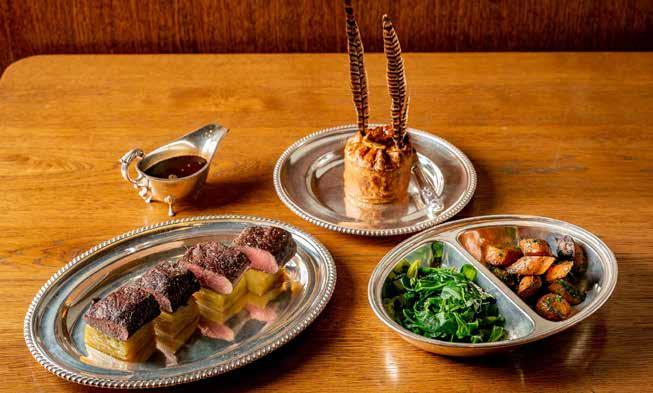
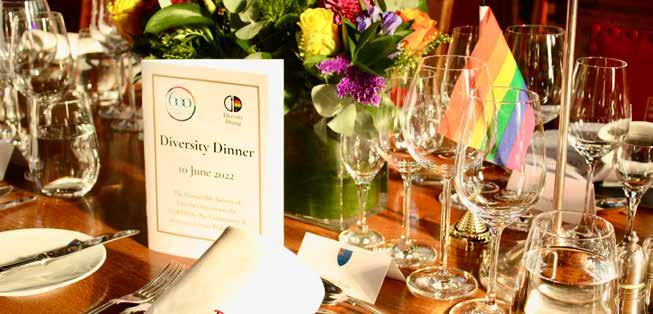
The first Diversity Dinner was held by the Inn to celebrate LGBTQIA+ Bar Community during Pride Month. Benchers, Members of Hall, Students, and their guests were invited for an evening of fun, fizz, food, music, and laughter. The evening was a huge success in promoting diversity and collegiality with Domus-style seating.
The MCR’s themed nights were hugely popular and included an inspired tutored food and beer tasting. MCR Chef Patron, Joseph O’Neill, curated a matching seasonal five-course British tasting menu, expertly paired and presented by Rupert Ponsonby, self-proclaimed hop geek, award winning Malting barley grower and co-founder of the Beer Academy.
We also saw the return of the much-loved Jazz and Bubbles night, which quickly sold out. As the name suggests, guests enjoyed Greyfriars sparkling wine and elegant small plates and danced to the marvellous Ana Leon Trio.
We also launched the MCR’s new website, giving the MCR its own identity and a taste of what to expect when visiting. It also allows members to easily book tables, view menus and book upcoming events. Members can enjoy delicious food from our talented team in the MCR and Members’ Lunch in hall Monday to Friday.

The Inn’s Garden Party, always memorable, was extra special celebrating the 600th Anniversary. Our talented chefs reimaged historic dishes inspired by research into the centuries-old Black Books, some of which were showcased at the Historic dinner earlier in the year. The food stalls were meticulously designed to take guests on a historic food tasting – think ‘Food in the Wild’, ‘Fish on Friday’, and a 15th Century cheese stall. Not forgetting the drinks menu, specially designed for the 600th Anniversary, guests enjoyed Lincoln’s Inn Anniversary Ale and ‘Gin Punch 1840’, a cocktail from the archives.
One for the Records
The summer of 2022 will certainly be remembered as a hot one! We made use of our beautiful lawns and outdoor spaces and erected a marquee on the North Lawn throughout June and July. As well as hosting member events, the marquee and lawns proved popular amongst chambers and external clients alike, as organisations gathered employees together to reunite and network. We welcomed an incredible 1,950 guests for summer receptions over June and July. For the first time, we opened our diary in August to external clients too. We held three successful film screening dates on the North Lawn, with Luna Cinema and San Pellegrino. All in all, it was a record summer of events for the Events team!
After two years of delays and cancellations, 2022 was deemed “The Year of the Wedding” and we have certainly held our fair share of weddings since the Inn received its ceremony licence. Along with members’ weddings, we welcomed 1,287 wedding guests across the estate to celebrate with family and friends.
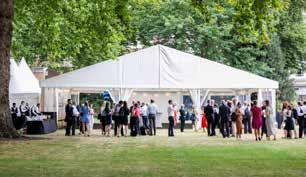

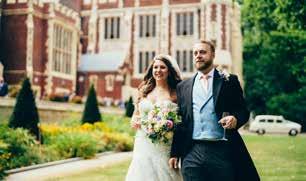
Award-winning
We are extremely proud of the talent and skills of our chefs, who are amongst the best in the country. Our talented Sous Chef, Aaron McLaughlin, showcased his exceptional culinary skills and creativity at the League of Chefs competition. Aaron had to cook a classical dish of smoked haddock Monte Carlo and designed a bespoke dish of guinea fowl with butternut squash puree, summer vegetables and crispy potatoes, for which he was awarded a well-deserved first place.
The annual Gourmet Dinner is also a great opportunity for our kitchen team to showcase their culinary creativity. Organised by the Inn’s Bar Rep Social and Wellbeing sub-committee, members and their guests are treated to a five-course tasting menu with dishes carefully curated to elevate and surprise.
Sustainability was firmly in mind when creating 2022’s Gourmet Dinner menu. Dishes used seasonal ingredients, and garnishes for the dishes were grown in the Inn’s gardens. The apples used in the beetroot ketchup even came from the garden of one of our Assistant Librarians, Heidi Kinderman! The wines were sourced from English vineyards (with the exception of the dessert wine and port) and the Harrow and Hope sparkling wine was a big hit at the reception!
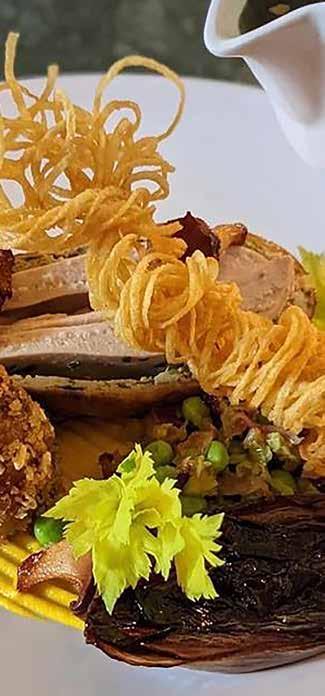
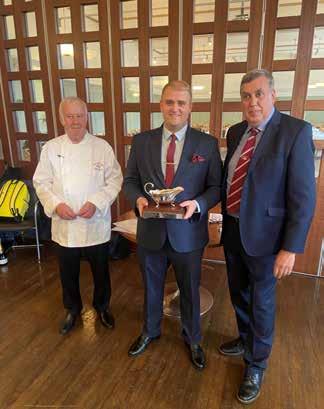
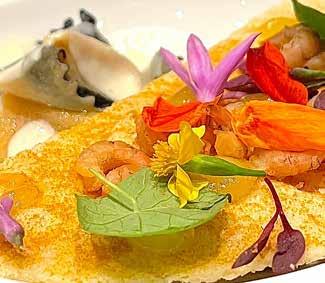
Photo credit: Michael Newington Gray
Aaron McLaughlin getting his award from the League of Club Chefs.
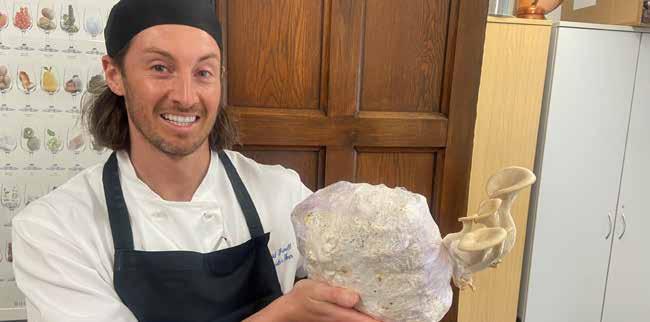
Going Green and Forward-thinking
The Inn is committed to reducing its negative environmental impact and managing its business in a sustainable manner. Green meetings and more sustainable ways of operating continue to be high on the agenda.
Over the past year we have taken actions to cut our waste and source sustainable partners in our supply chain. Nevertheless, a lot of waste and recycling is generated across the Inn. This stems not just from our collegiate buildings but across the wider estate as well, chambers and residents etc. In terms of volume 52,800 litres of waste is lifted from the Inn daily. Historically most would have gone to landfill. Now nothing goes into landfill. Recyclable materials get recycled and what cannot be recycled is baled up and used as ‘refuse derived fuel’ and incinerated. In terms of yearly volume that is almost 20 million litres of waste or enough to fill eight Olympic sized swimming pools that has been saved from landfill.
We continue to have success in growing oyster mushrooms from our coffee grounds. This year will see us focus more on using our food waste to contribute to the Inn’s gardens. We will be collaborating with the Gardens team on an edibles project to bring to life a kitchen garden that will see us grow more of our own produce onsite.
Interesting fact: We served 65,533 cups of coffee! In so doing we were able to support our coffee partner in protecting 10260 square metres of rainforest and storing 923.4 tonnes of carbon.
What a Year!
A full calendar of Inn events, the 600th Anniversary, and increased demand for external events, with shorter lead times than in the past, did not come without challenges. Despite the difficulties faced including rising costs, supply chain issues, recruitment challenges and rail strikes, the Front of House, Events and Catering teams have remained incredibly positive, hardworking, and committed.
As well as two halls, we now run events in the Ashworth Centre, the Old Court Room, and the MCR, with demand for receptions on the terraces and lawns during the summer months. All this activity meant that we surpassed pre-COVID levels and officially set a record year of sales and events for the Catering department.
We are enormously proud of what our department has managed to achieve. It is amazing being back doing what we do best, and we would like to thank our members for their continued support. We look forward to welcoming you in 2023 and beyond.
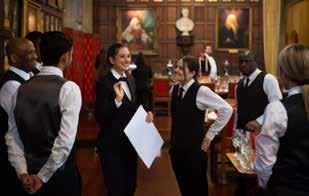

Library and Archives Report
By Dunstan Speight, Librarian
Anniversary Year
The Library and Archive team were very involved in preparations for the Inn’s celebrations for the Anniversary year. Megan Dunmall, the Archivist, wrote and presented a series of twelve monthly videos exploring aspects of the Inn’s history. These can all be viewed on the website at www.lincolnsinn.org.uk/library-archives/tales-from-the-archive/. They are also available on the Inn’s YouTube channel at www.youtube.com/@LincolnsInnOfficial
The Archives team of Megan and Carolyn carried out a considerable amount of background research on food and dining at the Inn, based on Black Books references, in preparation for the dinner with Dr Annie Gray, which took place on 12 April. Their research was used as the historical notes on the souvenir menu. I assisted John Goodall with enquiries for his two-part series of articles on the Inn for Country Life. I also assisted Mark Ockelton with sourcing images for the Inn’s new guidebook, which is available to purchase from the Inn and via our online shop
The Library was open on the afternoon of Saturday 2 April with a display of rare books and manuscripts as part of the Anniversary Weekend, and staff were also involved as tour guides. It was also open as part of the Open House weekend in September when Catherine and Carolyn acted as guides.
Digitisation of Manuscripts
Lord Briggs, in his role of Keeper of the Black Books for 2022, formally launched the Library and Archives Digital Collections pages on the Inn’s website as part of the Anniversary Weekend. This was entirely appropriate since this new mini-website contains the first nine volumes of the Black Books, covering the period 1422 – 1691. This was the culmination of several years work and development. The Black Books underwent conservation work to ensure that they were sufficiently robust for digitisation. The software for these pages was designed by Paul Appleton who rose magnificently to the technical challenges in devising a website where readers may ‘browse’ the pages of a manuscript online whilst also being able to go directly to a specific folio, and in dealing with a variety of archive materials of varying formats and structures.
David Powell holding a bag of used coffee grounds, out of which Oyster Mushrooms are growing.
The pages also contain digital images of more than half of the architect’s drawings for the Great Hall and Library complex, one of our mediaeval manuscripts (the Chartulary of Battle Abbey in Sussex), commemorative items from our 500th anniversary and a small sample of our considerable collection of manuscript law reports. (Some of the speeches from the banquet to celebrate the Inn’s 500 years, reproduced in the Quincentenary booklet, are worth a read as unwittingly humorous period pieces).
250th Anniversary of Somerset’s Case
In addition to the 600th anniversary of the Black Books, 2022 also marked the 250th anniversary of Somerset’s Case, one of the landmarks on the long road to the abolition of slavery in the United Kingdom and its overseas territories. Lincoln’s Inn has many associations with this case – Lord Mansfield, the judge who presided over the case and Francis Hargrave, counsel for James Somerset, whose liberty was the central issue at stake, were both members. The Library’s collection of manuscripts includes important documents for the case. Mr Justice Ashurst, one of the panel of judges, took notes of Lord Mansfield’s judgment, as he delivered it. These are contained in the Library’s Dampier papers. We also have a manuscript report of the case written by Serjeant Hill. This is generally held to be the most accurate contemporary report of the case. These items were digitised, added to our website and discussed in a series of blog posts. The posts also included a feature on the letter in the hand of Dido Belle, dictated by Lord Mansfield.
Exhibitions
Dido Belle’s 1786 letter to Francis Buller,

Library staff put together an exhibition on Diversity and the Inn, which was one of the displays shown throughout Open House weekend. This drew on research which Mark, Megan and I carried out and celebrated various milestones in the history of the Inn for people of colour. Figures included Sir Francis Goldsmid, Leila Seth, Sir Muthu Coomaraswamy and Lord Sinha. This exhibition was also on display for the reception after the Sir Mota Singh Memorial Lecture. We plan to develop this further in 2023 with a view to adding it permanently to the website.
Matthew organised an exhibition celebrating the life and work of F D Maurice, Preacher of the Inn (1846-60) and founder of the Christian Socialist movement. This was timed to coincide with the 150th anniversary of Maurice’s death and the charity fund-raising event in Chapel on 29 March.
Library Usage
Usage of the Library, which had held up so well throughout the pandemic, grew further throughout 2022. Daily monitoring of readers revealed a total of 12,146 reader visits throughout the year with average attendance at 50 readers per day. The highest daily attendance figure was 98 readers. Library Enquiry staff meanwhile answered no fewer than 6,888 enquiries throughout the year.
Library Training
The Library team have presented training courses for readers throughout the year. These ranged from bespoke courses for individual readers to lectures on the Library and legal research run in association with the Education Department. The fact that these courses can now be run online greatly extends the possibilities for members to participate in Library training courses and no fewer than 1,258 members attended a Library training course, either online or in person in 2022.
These courses are useful not only in demystifying legal research but also in encouraging students to use the Library, as demonstrated by this email Mark and Carolyn received after one of their courses:
“I just wanted to thank you for taking the time to conduct this evening’s legal research session. It was extremely useful and has put me at ease about carrying out my own research. The tip on starting with secondary sources will definitely stick with me! Very excited to visit the library, especially now know it’s ok for me to turn up in jeans and a hoody, so I look forward to hopefully meeting you in person soon.”
Lexis PSL Subscription
Following a period in which our Database User Group had trial access to Lexis PSL, the Library now subscribes to this database. The feedback from the User Group was positive and we have had many requests from readers. As part of our subscription we were also able to arrange 200 additional licences so that members can have their own username and password. This has proved popular.
Standing Committee Hansard
We recently received a donation of a large number of Standing Committee Hansard volumes from 1919 to fill gaps in our holdings. These were donated by Dandy Booksellers, who had taken these volumes out of their bindings to digitise them for their Public Information Online (PIO) database. The Library subscribes to Dandy’s PIO database but, in many cases, it is quicker and easier to use the hard copy sources for Pepper v Hart research.
Tours
2022 saw the revival of tours for members of the public but with the difference that members of the Inn’s staff acted as guides. Staff from the Library and Education teams, assisted by Rachel Hooper, act as guides and have received much positive feedback. We have experimented with offering pre-booked tours to groups and societies and have regular scheduled tours which members of the public can book via the website. The latter have proved very popular and, as they require very little administration, we will concentrate on these rather than tours for groups next year, running one scheduled tour per week.
The Education team continue to offer free tours for students interested in investigating a career at the Bar.
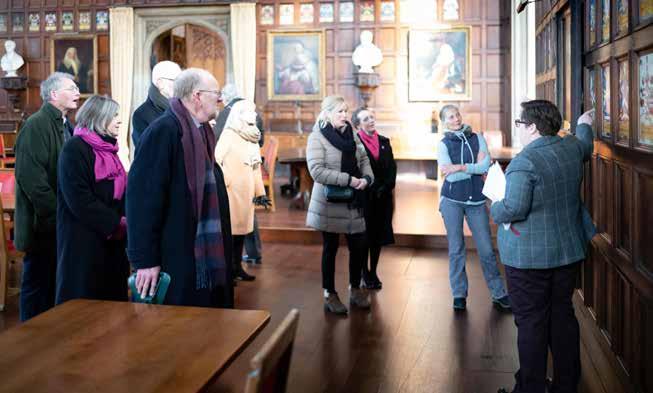
dictated by Lord Mansfield.
Rachel Hooper showing a tour group around the Great Hall.
Library Visitors
In addition to beginning tours of the Inn, we have also received a number of visitors to the Library. I gave a talk on the rare books and manuscripts to members of the Dulwich Arts Society and Catherine gave a similar talk to students from the Yale-NUS College.
We also put together a collection of materials relating to John Mensah Sarbah, the first African from the Gold Coast to be called to the Bar, for his biographer.
Heidi and I gave tours for guests at the Amity Dinner for the Bars of Ireland, Northern Ireland and Scotland on 1 July. We also arranged an exhibition of treasures from the Library and Archive for guests to view before dinner.
Other visitors in 2022 included the Keeper of the Library at the Faculty of Advocates in Edinburgh, the Temple Bar Scholars visiting from America, and members of the American Inns of Court.
Library Staff
Two members of staff received promotions during the course of the year. Heidi Kinderman completed her Librarianship course at UCL and was promoted to Assistant Librarian. Matthew Bland, meanwhile, completed his one-year contract as Graduate Library Trainee but has proved such an asset to the team that we were delighted to be able to offer him a permanent position as Library Assistant. Matthew is currently studying for a Masters degree in Librarianship at UCL. He is also assisting the Preacher with administrative work for Chapel.
Library Work Placements
The Library hosted a number of student placements. Students from the MPhil course in Heritage Studies at Cambridge worked on a number of Library and Chattels projects, including working with the collection of C P Hawkes caricatures given to the Library last December.
In May we welcomed a student from UCL studying the MA course on Librarianship who assisted in compiling metadata for the online version of manuscript case reports. Since October, we have had a Sixth Form student from Queen’s College London working a few hours each week in the Library.


The Gardening Year
By Miranda Kimberley, Head Gardener
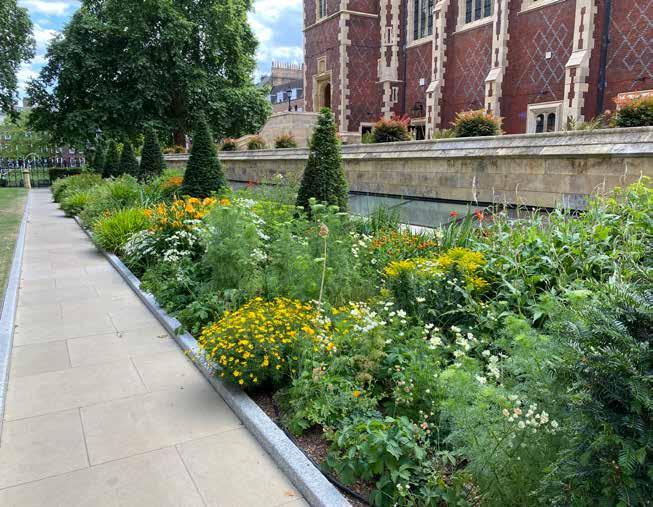
2022 started as it meant to go on – with confusing weather! An unusually warm two-day spell came on New Year’s Eve and New Year’s Day, during which St James’ Park recorded a temperature of 16.3C. It was an unwelcome reminder that the world is warming, despite later cooler temperatures during early winter.
January saw plenty of activity in New Square, with the Garden team pulling together to dig out the majority of the rather tired L D Braithwaite roses. New beds, with a more colourful cottage garden theme, were created to celebrate the Anniversary Year and add impact to planned events. These beds displayed beautifully throughout the summer, adding much colour and shape to the Garden Party and Family Day in particular.
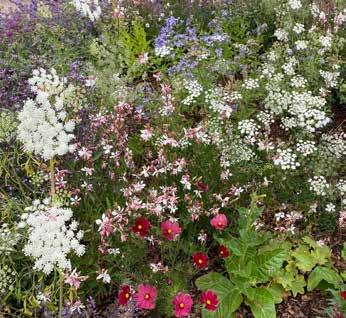
Benchers’ Border mid-July.
New Square bed in full flower.
Visitors are shown the rare books display in the Library during the Anniversary Weekend celebrations.
Sadly, in late February it was necessary for the majestic foxglove tree in New Square, Paulownia tomentosa, to be cut down. For many years it had suffered from a variety of problems including a foliar disease and bracket fungus. Attempts to improve its health, using air injection around the base, with the addition of nutrients such as bio char, had led to vigorous growth which then led to branch breakages. It was therefore with a heavy heart that our tree consultant and I applied to Camden Council for permission to fell the tree as it was becoming dangerous, and permission was granted. I was witness to this beautiful tree being felled and can attest to the fact that it was handled with great care by our tree surgeons, Down to Earth.
The felling was done in sections, taking five hours, with a large part of the lower trunk being taken in one piece. Final inspection of the trunk base revealed soft, rotting wood, which the tree surgeon assured me had been very dangerous, and we were absolutely correct to have taken the tree down for safety reasons.
With the deep red roses dug out of the side beds, and the Paulownia tree gone, we were able to enlarge and rotavate all three beds ready for planting. The tree circle where the Paulownia had stood was sown with cornfield annuals. The side beds were recut and curved to mimic the fountain edge. We retained three specimens of Rosa ‘L D Braithwaite’ in each bed, added the small shrub Prunus tenella ‘Fire Hill’, and planted the rest with robust, long-flowering perennials including Persicaria amplexicaulis ‘Rosea’, Nepeta ‘Walker’s Low’, Campanula lactiflora ‘Pritchard’s Variety’, Alchemilla mollis, Verbena ‘Bampton’, Astrantia ‘Roma’, Gaura ‘Whirling Butterflies’, Monarda ‘Prairienacht’ and Penstemon ‘Blackbird’. It was a vibrant cottage-garden style planting of pinks, blue and purple, with accents of lime green.
To add seasonal interest we also planted hardy and half-hardy annuals we had raised in our greenhouse, the frothy Ammi majus, Nicotiana alata ‘Grandiflora’, Antirrhinum ‘Liberty’ and a gorgeous Cosmos ‘Rubenza’, which starts deep red and ages to a dusky rose colour. We will definitely be growing the Cosmos again. We were rewarded with all the plants, apart from maybe the Monarda, flowering vigorously in their first year. They were perhaps at the best during July’s Garden Party but continued to give a good display even into December.
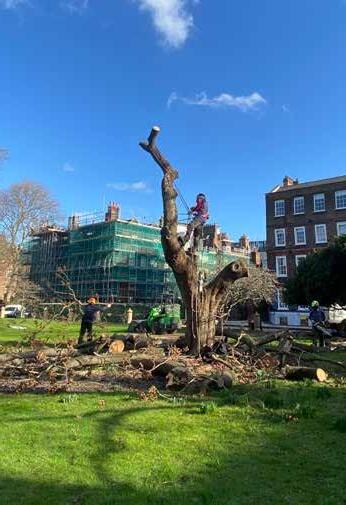
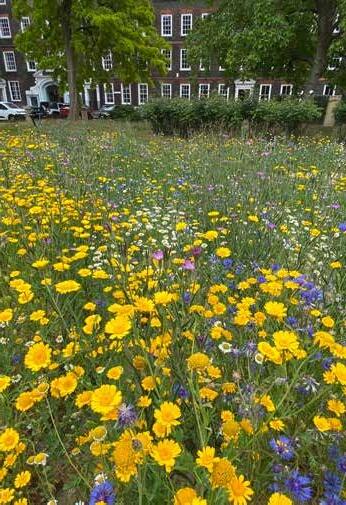

In the second weekend of June, we opened our grounds to the public as part of London Open Gardens, which the Inn had not taken part in since 2015. It was a fantastic event attended by over 2,000 people, dwarfing the previous highest attendance of 650. (Read more about it on page 12.) We plan to make this an annual event, helping to raise the profile of the Inn and its garden.
As summer progressed temperatures increased, with heatwaves seen between June and August, peaking in July at 40.3°C at Coningsby in Lincolnshire. It was challenging to work in, and plants suffered, which became more stressful when a hosepipe ban was threatened. Chafer-grubs continued to pose a challenge, or more specifically, the birds digging up the lawn to find the grubs, particularly on the banks around Old Buildings. The use of nematodes to destroy the grubs requires the areas to be kept moist, a task that proved very challenging given the scale of the damage and the hosepipe ban that precluded any automated watering.
Ironically the hosepipe ban seemed to come in just as the heavens opened, and it felt like it rained from late August until the end of November, making autumn planting and lawncare quite challenging.
In December we held a very successful wreath making workshop for staff. Imogen and Sonya had been collecting seedheads from plants throughout the year and drying them in the greenhouse. These included seedheads from Beth’s poppy, snake’s head fritillary, teasel, Ammi majus and Hydrangea ‘Annabelle’. Some were sprayed gold and others kept natural - it produced unique and beautiful wreaths of which all who attended were very proud. We prepared foliage from the Inn’s garden, which was bolstered with foliage from New Covent Garden Flower Market.
The year ahead is once again full of projects, from introducing garden volunteers to creating an edible garden in collaboration with the Inn’s chefs. We also plan to make changes to the North Lawn and New Square to improve the ornamental gardens. We look forward to showing you our new areas soon.
Garden team (Miranda, Sonya, Imogen and Dan) inspecting the roof and chimneys of Old Buildings.
Felling of the Paulownia tree. Wildflower meadow in New Square.
Chapel Report
By the Venerable Sheila Watson, Preacher
To see a World in a Grain of Sand ; And a Heaven in a Wild Flower, Hold Infinity in the palm of your hand ; And Eternity in an hour.
William Blake, Auguries of
Innocence
The Chapel historically lies at the spiritual heart of Lincoln’s Inn and in 2023 we celebrate our 400th anniversary. Look on the website for the varied programme of events taking place. It can take members a little time to find us (as unusually, Chapel is upstairs above the Undercroft!) but all are welcome. Sometimes a moment of quiet and space is much needed to remind ourselves of Blake’s words or our need ‘to go out of our mind to return to our senses’.
The Chapel itself is a significant renaissance building with some rare Flemish glass as well as family memories of the Inn with the Treasurers’ shields. York Glaziers Trust is currently hard at work on our four Van Linge windows, said to be the finest of their type in London and even Europe. (Discover more about the stained glass restoration project on page 82).
The present Chapel, whose foundation stone was laid by John Donne during his time as Preacher, contains in miniature much of the history of the Inn. This includes living traditions such as those of the bell which, alongside Donne’s Christian faith, inspired the lines ‘never send to know for whom the bell tolls: it tolls for thee’. The bell still tolls today – for services and to mark the death of a Bencher.
Chapel is also an inspiration for social justice. In 2022 we celebrated the 150th anniversary of F D Maurice, a former Chaplain, social activist and theological professor. Robert McCracken KC introduced a highly successful charity debate which included partners from King’s College London, as well as Queen’s College, London and the Working Men’s College (both of which Maurice founded).
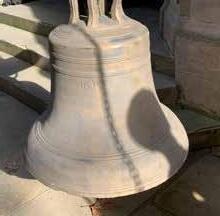
No summary of Chapel activity would be complete without special mention of our music. Nicholas Shaw (Director of Chapel Music), William Whitehead (Associate Organist) and the dedicated professional choir provide music of the very highest quality, both at services, including occasional midweek choral evensongs, and at the annual Chapel concert. In 2022 we were fortunate to have the first performances of several new commissions with more in store for our 400th anniversary year.
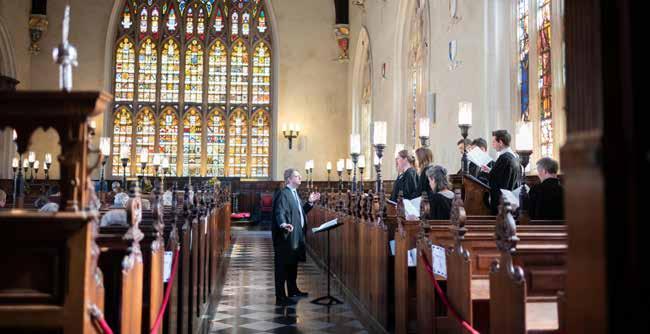

Commissions of New Works
By Nicholas Shaw, Director of Chapel Music
The Inn continues to commission new choral works based on the writings of John Donne. The basis for this project was the poem The Litanie, probably composed as Donne was recovering from serious illness between 1609 and 1610. The 28 stanzas of the poem are personal reflection by the poet, an internal dialogue of thankfulness for recovery, that weren’t intended for the public. They present challenges of language and meaning that our commissioned composers have responded to in different ways and the extraordinary range of colour and emotion that has been achieved has been a fascinating outcome of this. The Inn has received commissions from Richard Allain, Kerensa Briggs, John Casken, Jonathan Dove, Ēriks Ešenvalds, Cheryl Francis-Hoad, Matthew Martin, Daniel Saleeb and Alex Woolf at approximately yearly intervals. In 2022 it was possible to give first performances of works by Allain, Martin and Saleeb which went some way to clearing the backlog which had built up over the COVID-19 lockdowns. To date the works have been performed liturgically or in small concert settings in groups of two or three; but with three pre-existing settings by Richard Rodney Bennett, written in the 1960s, it is now possible to perform almost half the poem as a sequence. This would be a serious undertaking, challenging for both musicians and audience, and would run for almost an hour. At present there are no plans to present the Inn’s commissions in this way. There is no evidence that Donne intended his Litanie as a through-composed work to be read from beginning to end, and to try to do this musically may, to some extent, take away from the impact of the individual colours with which the poet infuses each stanza.
As Director of Chapel Music, I am sometimes asked whether I have a favourite commission. It is true that some works have appeared more frequently than others, but it is often the case that some are easier to rehearse in a single pre-service rehearsal than others. John Casken’s fine setting of the first two stanzas is an example of this – it is a superb setting but is challenging enough to need more rehearsal time than a Sunday morning affords so has only ever been heard in a concert setting.
For the Chapel’s 400th anniversary year the commissioning series will depart from the Litanie temporarily. Janet Wheeler is writing a new work based on a portion of text that Donne preached at the new Chapel’s dedication service on Ascension Day in 1623. This will have its first full performance at a concert in June 2023 when the Inn will welcome the Hackney Children’s Choir to Chapel to take part. This choir of young singers was founded as an offshoot of the music outreach work that St Paul’s Cathedral does in the local community, and it will be excellent to join the Inn and the Cathedral musically to mirror these two periods of John Donne’s life.
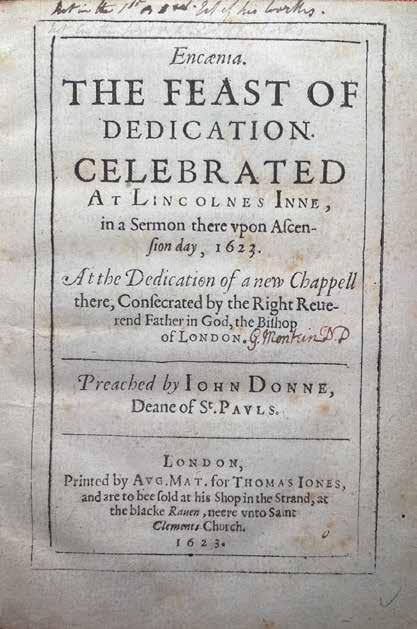
Title page of the 1623 dedication sermon preached by John Donne.

The Conservation and Protection of the Seventeenth-Century Chapel Windows by the York Glaziers Trust
By Professor Sarah Brown, Director, The York Glaziers Trust
Lincoln’s Inn Chapel, consecrated on Ascension Day 1623, boasts one of the most important surviving collections of stained glass of its date in England. The period up to the outbreak of the Civil War witnessed a revived interest in figural and narrative schemes of glazing, after a post-Reformation lull in which heraldic displays had provided one of the few outlets for the glazier’s craft. By the early seventeenth century the Holborn area of London had replaced Southwark as the centre for stained-glass artists in the capital, conveniently located in the vicinity of the Inns of Court and Chancery and close to potential clients. The windows of Lincoln’s Inn Chapel, created by both English and immigrant glaziers, combine striking monumental figures with brilliant and intricate displays of heraldry reflecting the identity of the subscribers to the glazing fund.
The Project
In the summer of 2021 the York Glaziers Trust (YGT) began a programme of stained-glass conservation and protection, starting with two of the most vulnerable windows on the north side of the building (windows nIII and nIV). In August the windows were removed for conservation in the studio of the YGT in the centre of the historic city of York. The following summer two more windows (sIII and sIV) were removed for conservation, and the windows of the first phase were returned to the Chapel, with the benefit of the environmental protective glazing that will keep them stable and safe for many generations to come. The south-side windows will come home again in the summer of 2023.
History and Significance of the Glass
The Chapel windows were commissioned between 1623 and 1624 to fill six windows on the North and South sides of the Chapel, with depictions of the twelve apostles on the South side and patriarchs, prophets and saints on the North (fig. 1).
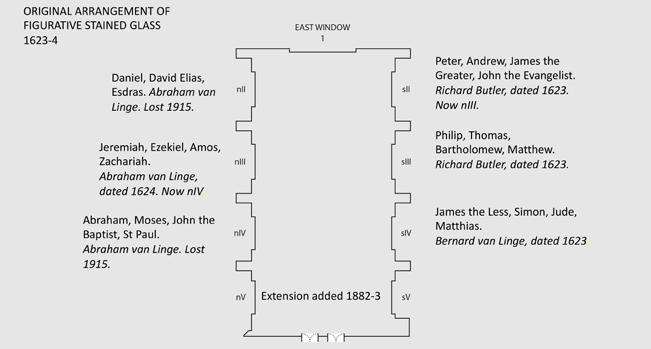
1 G. Lane, Geoffrey, ‘A world turned upside down: London glass-painters 1600-1660’, The Journal of Stained Glass, Volume XXIX, 2005, 45-75.
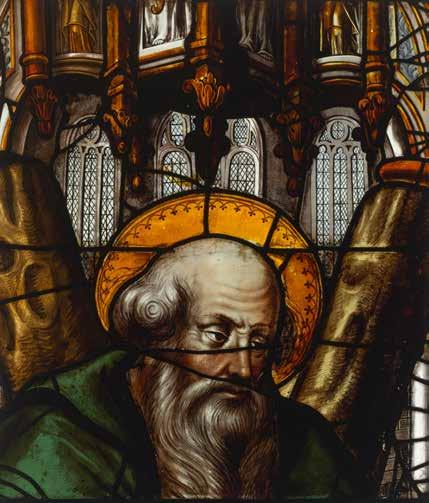

Each figure stands on a pedestal decorated with heraldic shields. Two of the windows are by the London glazier Richard Butler (d. 1638. Windows nIII and sIII, fig. 2). In 1609 he had collaborated with the French glazier Lewis Dolphin in creating stained glass for Elizabeth I’s secretary of state Robert Cecil (1563 – 1612), twelve Biblical scenes for the staircase window at Hatfield House in Hertfordshire.2
Three windows were executed by Abraham van Linge (nII, nIII, nIV, fig. 3) and one by his older brother Bernard van Linge (sIV), both natives of Emden.3 Bernard had arrived in London via Paris in 1621 and in the following year was commissioned to make the East window of Wadham College, Oxford.4 His brother Abraham followed him to England, and remained active in England after Bernard’s departure in 1623. Abraham was responsible for glazing schemes at Balliol and Lincoln Colleges in Oxford. Indeed, the Lincoln College windows were made to some of the same cartoons. Abraham was to remain in England until the outbreak of the Civil War.
2 Michael Archer, ‘Richard Butler, Glass-Painter’, Burlington Magazine 132 (May 1990), 308-315.
3 Michael Archer, ‘English Painted Glass in the Seventeenth Century: The Early Work of Abraham van Linge’ Apollo (January 1975), 27-31.
4 A. Faludy, ‘Linge, Bernard van [formerly Berent van Lingen]’, Oxford Dictionary of National Biography online
Fig 1: Plan of the Chapel showing original arrangement of the windows.
Fig. 2: The head of St Andrew, by Richard Butler, dated 1623, (originally sII, now in nIII). The face contains a repair piece of 1920.
Fig. 3: The head of Jeremiah by Abraham van Linge, dated 1624 (originally nIII, now nIV).
A History of Restoration
The early seventeenth century scheme has been repaired, restored and reorganised several times (fig. 4), notably in 1883 when an extra bay was added at the West end of the Chapel and the glass was moved about, disrupting the original scheme. A considerable amount of heraldic commemorative glass has been added to the scheme and continues to this day. The most serious damage was incurred following a blast from a Zeppelin raid in 1915. Two of the windows by Abraham van Linge were lost as a result, but in the 1920s the eminent firm of C E Kempe & Co. was entrusted with the restoration of what survived. The restorations have been undertaken with great skill and sensitivity and are often hard to spot. In the 1990s window sIII was almost completely re-leaded, but underlying problems were not addressed so the deterioration continued unchecked.

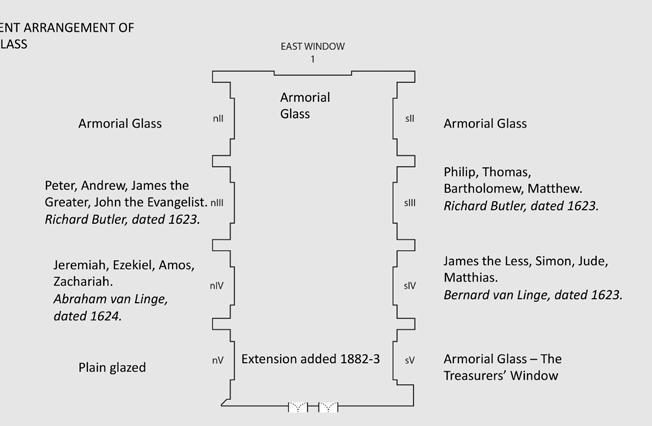
2021: The Conservation Issues
Seventeenth century window glass is very thin, making it susceptible to cracking and impact damage, and for this reason polycarbonate sheets had been mounted on the exterior of the windows, hiding the original window bars and reducing the light that could pass through the glass. Many cracks in the glass were unsecured and in window nIII, in particular, there was a real risk that glass would fall out (fig. 5).
The lead nets holding the glass in place were otherwise essentially sound and did not need replacing. The most alarming discovery was the evidence of progressive paint loss. Windows of this period were made with a combination of coloured glasses (often used for drapery), that have remained in remarkably good condition, and uncoloured glass coloured thorough the application of a coloured vitreous paint applied to the glass

surface and fired in the kiln. These coloured ‘enamels’, especially the blue, can become detached from the base glass, and a comparison of the current state of the glass with historic photographs taken in the early twentieth century showed that coloured enamel loss was progressively getting worse, undermining the legibility and meaning of the windows. The fracturing and peeling of the coloured enamel (fig. 6) is caused by differentials in rates of movement between base glass and applied colour, exacerbated by the attack of moisture in the form of condensation, which will form whenever the temperature drops and warm, wet air cools. Anyone who has enjoyed a cold glass of gin and tonic will have witnessed this phenomenon, as warm air condenses on the sides of the glass!
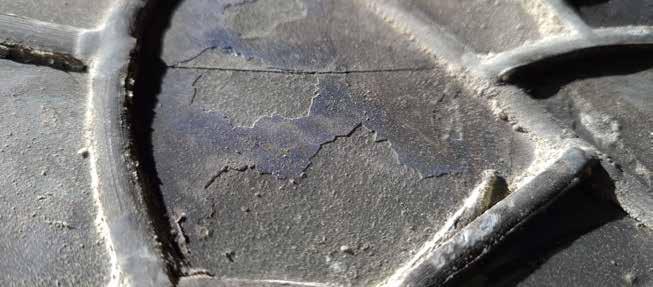
2021-2023: Conservation Solutions
The best defence against this deterioration is widely acknowledged to be ventilated environmental protective glazing (EPG), a tried and tested approach to stained glass conservation in use for over 70 years.5 This creates a stable environment for the historic glass and its vulnerable painted surfaces. The historic glass, mounted in a bronze frame, is relocated slightly forwards of its original position. A new window of clear modern glass takes its place, mortared into the window opening, keeping the building weather-tight. A gap at the top and bottom of the framed glass allows the space between the two layers of glass to be ventilated by the air from inside the building, and the movement of air into and out of the interspace ensures that both surfaces of the historic glass are kept cool and dry. Any condensing moisture will now form on the inside face of the modern exterior glazing. A lead-covered condensation tray at the base of the exterior glazing allows any water to leave the building without damaging stone or glass.
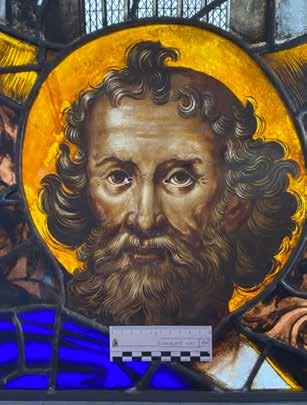
5 Bernardi et al, ‘Conservation of Stained Glass Windows with Protective Glazing: Main Results from the European VIDRIO Research Programme’, Journal of Cultural Heritage, Vol. 14 (2013), 527-536; Pender, Robyn, et al, Stained Glass Windows: Managing Environmental Deterioration. (London, Historic England, 2020): https://historicengland.org.uk/images-books/publications/stained-glass-windows-managing-environmentaldeterioration/heag195-stained-glass-windows/.
Fig. 6: A detail of peeling blue enamel photographed in the studio, summer 2022. The thick layers of dirt and dust can also be seen.
Fig. 4: Current arrangement of the glass in Chapel.
Fig. 5: The head of St Peter with unsecured cracks, photographed in situ prior to conservation.
Fig. 7: The head of St Peter following repair.

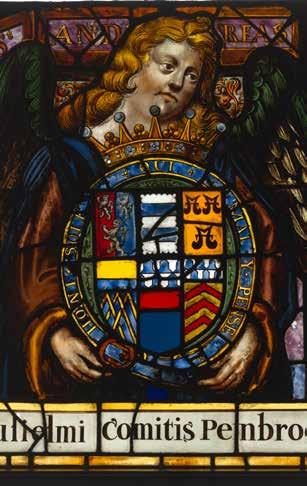
The creation of a dry and stable environment for the Chapel’s windows has also allowed the conservators of the YGT to use a range of conservation materials and treatments that cannot be employed in a damp environment. Breaks and cracks can be secured with modern epoxy resin adhesives, avoiding the addition of disfiguring mending leads (fig. 7).
An unfired ‘cold’ paint, which is fully reversible, has also been used, sparingly, to restore areas of enamel colour lost to the process of deterioration. This has been particularly helpful in recovering critical detail in some of the complex heraldry (figs. 8 & 9) which charts the history of the Chapel’s past benefactors. In a few places flaking enamel colour in danger of imminent loss, has been fixed with a paint consolidant.6
We have also taken the opportunity to clean the glass of decades of London grime, restoring brilliance and colour, but also removing layers of material that can hold moisture against the glass and encourage the growth of mould. The new exterior glazing, leaded in a simple pattern and fabricated out of a subtle mouth-blown glass (fig. 10), allows plenty of light to flood into the Chapel and allows the original hand-forged window bars to be revealed as the builders intended.
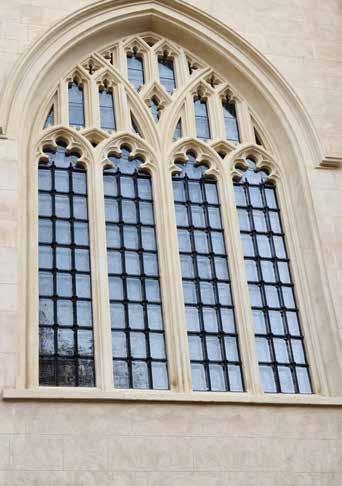

Bar Representation Committee Report
By Zoë Barton KC, BRC Chair (to August 2022)
I was delighted to serve as Chair of the Bar Representation Committee during the celebrations of the 600th Anniversary of the Inn. The variety of events ensured there was something to appeal to every member and these proved an excellent antidote to the effects of relative isolation during the pandemic lockdowns that we had all experienced, as well as an important opportunity for us all to reconnect with the Inn. The result was that this year the Inn received more visitors than ever before, due in no small part to a fantastic programme of activities in which members of Hall were active including the Black Books Society Anniversary Lectures, Open Gardens and Open House.
I am glad to report that the sub-committees of the BRC have also continued to provide a varied and successful programme of events to engage the Inn’s membership this year. A hybrid approach has continued to prove popular and extended the benefit of these events to a wider audience. Fuller reports of the sub-committees are set out below, but one noteworthy development at the Inn has been the development of the Social Mobility Prize, which is now very close to being launched. I have no doubt, not least of all because the BRC has worked for several years to develop social mobility initiatives, that it will do everything it can to promote it and ensure both that the Prize is a success, and that other initiatives follow.
This year also saw the fruits of the election rules that I introduced near the start of my term. Election campaigns and voting have been characterised by less confusion and, I believe, an absence of controversy. Furthermore, voting for this year’s BRC election was up by over 36%, which I hope reflects the positive member engagement work of the Committee.
I am also grateful to the International Working Group, which I set up last year and which has now reported. It had a diverse membership to enable it to draw upon examples of practice in other bodies facing a similar desire to address, among other things, the ways in which international members could best engage with each other and the Inn.
We have, of course, in all these matters been much supported by the staff of the Inn. I am especially grateful given that support has been provided against a backdrop of difficult circumstances resulting from staff shortages and role changes.
Lastly, I am glad to report that Laura Gould was elected Chair to follow me and started her term in August. I am sure that she will bring the energy that has been a hallmark of her contributions to the Social Mobility sub-committee and Northern circuit to this role with great success as well.
Social Mobility Sub-Committee Report
The year began with a successful event entitled “How to Mentor and be Mentored” led by trainer and coach, Cath Brown, and hosted by the Sub-Committee’s Co-Chair, Laura Gould. This free event ran in person and online and was followed by a reception, giving attendees the chance to speak to other mentors/mentees and members of the Inn.
Laura also chaired “Reconnecting with your Inn: How to make the most of your Membership” in May aimed at reacquainting members with, and demystifying, the Inn. She was joined by Clara Shepherd, Member Engagement Manager, Dunstan Speight, Librarian, the Venerable Sheila Watson, Preacher, and Steve Matthews, Head of Catering. The event was well attended and has been viewed online over 150 times.
Sub-Committee Co-Chair, Chris Loweth, hosted a discussion in October with Professor Anna MountfordZimdars (Professor of Education and Joint Founder/Director of the Centre for Social Mobility at the University of Exeter) and Helen Mountfield KC (expert in administrative and equality and human rights law at Matrix Chambers, and Principal of Mansfield College, Oxford, where she is also tutor for racial inclusion) entitled “Social Mobility: Where to start, and where to find answers”.
Filming for a new short film to bring to life the stories of some of the Inn’s practicing barristers from under-represented backgrounds took place in mid-October. The film will be published on the Inn’s website and YouTube channel and promoted widely as part of the Inn’s outreach work.
The Sub-Committee was delighted to lend its support to the idea of a new social mobility prize to be awarded by the Inn from 2023.
Fig. 10: The external protective glazing following conservation of stone and glass, with the window bars restored to view.
6 S. Chapman and D. Mason, ‘Literature Review: The use of Paraloid B-72 as a surface consolidant for stained glass’, Journal of the American Institute for Conservation 42/2 (2003), 381-392.
Fig. 8 Armorial panel (nIII, 1a) before conservation, displays extensive loss of blue enamel.
Fig. 9: Armorial panel (nIII, 1a) after conservation and application of reversible ‘cold’ paint.
The issue of state school educated barristers being under-represented in higher paid practice areas is being examined by the Sub-Committee, with work undertaken to understand the work being done by the relevant specialist Bar associations to address this.
The Sub-Committee has already started thinking about 2023 and is developing ideas for training for selfemployed barristers on a range of personal effectiveness, development, and practice management topics as part of the Inn’s Member Engagement Programme. It is also looking forward to the results of the Inn’s diversity survey to assist it in making decisions about where to best target its activities.
In September the Sub-Committee congratulated Laura Gould to election as Chair of the Bar Representation Committee and thanked her for her service to the Sub-Committee over the last two years following her decision to stand down as Co-Chair. The Sub-Committee also extends its thanks to the Inn’s staff who have provided enthusiastic support to the Sub-Committee and its work throughout the year.
Social Mobility Sub-Committee members: Laura Gould (Co-Chair), Chris Loweth (Co-Chair), Bryn Adams, Edmund Burge KC, Elizabeth Isaacs KC, His Honour Judge Fayyaz Afzal CBE, Honor Brocklebank-Fowler, Rabby Fozlay, Rifat Rahman, Susanna McGibbon and Dr Tariq Mahmood.
Social and Wellbeing Group Sub-Committee Report
Throughout 2022 Lincoln’s Inn Social and Wellbeing Group continued to hold meetings via Zoom.
Due to the COVID-19 pandemic, several events at the Inn had to be postponed in 2020 and 2021. Consequently, there has been a huge demand for the Inn’s facilities during 2022, especially as 2022 marked the Inn’s 600th Anniversary.
The SWG held a joint event “Vicarious Trauma” with the SE Circuit & CBA on 29 March 2022. All attendees fully enjoyed this event.
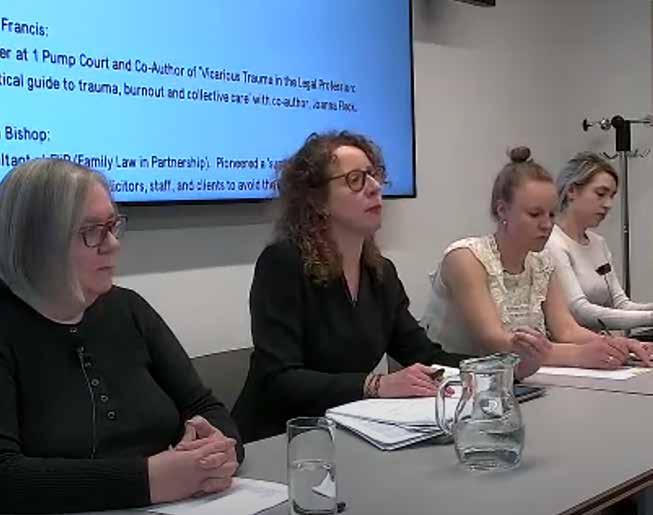
On 11 May 2022, we were able to hold the Theatre Workshop at The National Theatre. Feedback was extremely positive.
The Lincoln’s Inn 600th Anniversary Family Day took place on Sunday 10 July 2022. We were blessed with glorious weather and several children took full advantage of splashing about around the fountain. There were lots of activities for all ages to enjoy. As usual the chefs did us proud with a delicious barbeque.
The annual Quiz evening was held on Friday 4 November 2022. Teams pitted their wits against each other and also enjoyed a tasty sausage and mash supper.
The ever popular Gourmet Dinner took place on Friday 23 November 2022. Visit the Inn’s website for an insight into the menu and how it was created: www.lincolnsinn.org.uk/news/tasty-tidbits-secrets-of-the-gourmet-dinner/
We are already planning our Schedule of Events for 2023.
Social and Wellbeing Group Sub-Committee members: Laureen Husain (Co-Chair), Linda Turnbull (Co-chair), the Venerable Sheila Watson, Julie Whitby, Emma Southern, Ben Hamer, Alice Hawker and Nadeem Holland.
Junior Members’ Committee Report
The JMC has held hybrid, online and in person events over the last year, including the Pathway to Pupillage Event, for those seeking roles after the Bar Course (including a speaker from the Law Commission, a judicial assistant, a County Court advocate and a paralegal); and the Second Six and Beyond event for current pupils, with recent tenants and third six pupils panellists, followed by a Q&A.
A number of social events have also re-started, including drinks events for junior practitioners and the Junior Members’ Summer Dinner which also took place in June 2022, along with a ceilidh. This year the JMC sought new members from outside the Bar Representation Committee and following applications appointed a number of co-optees.
Junior Members’ Committee members: Ben Hamer (Co-Chair); Hazel Jackson (Co-Chair); Adam Kayani, Maxwell Myers, Rifat Rahman, Imogen Sadler, Olivia Waddell, Craig Fahey and Leo Graves.
Vicarious Trauma at the Bar panel.
Bar Representation Committee Members in 2022

Zoë Barton KC
(Chair until August)
Chancery barrister at Wilberforce Chambers specialising in property, trusts and related professional negligence. BRC member since 2011 (last elected 2020-2023). Zoë represents Hall on the Advisory (Benchers) Committee, the Finance & General Purposes Committee and the Estates Committee. She served as the Chair of BRC until August 2022.

Laura Gould
(Chair from August)
Self-employed barrister, practising in employment, commercial and sports law from Kings Chambers in Manchester, Leeds and Birmingham. BRC member since 2016 (elected 2020-2023). Up until August 2022, Laura was Co-Chair of the Social Mobility sub-committee, represented Hall on the Pre-Call Education Committee and the Equality, Diversity & Inclusion Committee, and was the Inn’s Northern Circuit Representative. In August she was elected the new Chair of the BRC.



Rafey Altaf
Advocate Supreme Court of Pakistan specialising in Public, Human Rights, Industrial Relations, Labour and Employment law. BRC member since 2020 (elected 20202023). Rafey represents Hall on the Chattels Committee.
Philip Bennetts
Employed barrister at CPS South East. BRC member since 2020 (elected 2020-2023). Philip represents Hall on the Advisory (Benchers) Committee and the Scholarships Committee.
Georgina Blower
Self-employed barrister specialising in criminal justice and public inquiries at The 36 Group. BRC member since 2017 (elected 2019-2022, re-elected 2023-2026).
Georgina represents Hall on the Chapel Committee.

Edmund Burge KC
Self-employed barrister at Five St Andrew’s Hill. BRC member since 2022 (elected 2022-2025).
Edmund represents Hall on the Estates Committee. He is also a member of the Social Mobility sub-committee.
Dilpreet Dhanoa
Self-employed tax barrister at Field Court Tax Chambers. BRC member since 2022 (elected 2022-2025).
Dilpreet represents Hall on the Finance and General Purposes Committee and the Investment Committee.
Ben Hamer
Media and communications barrister at 5RB. BRC member since 2018 (elected 2021-2024). Ben represents Hall on the Staff Committee, the Scholarships Committee and the Post-Call Education Committee. He co-chairs the Junior Members’ Committee and is a member of the Social & Wellbeing sub-group.



Alice Hawker
Commercial chancery barrister at Selbourne Chambers. BRC member since 2019 (elected 20192022). Alice represents Hall on the Post-Education Committee.
Nadeem Holland
Self-employed criminal barrister at the 36 Group. BRC member since 2020 (elected 2020-2023).
Nadeem is a member of the Social and Wellbeing Group. He represents Hall on the Post-Call Education Committee.
Laureen Husain
Self-employed criminal barrister at 187 Fleet Street. BRC member since 1999 (last elected 20212024). Lauren co-chairs the Social & Wellbeing sub-group. She represents Hall on the Staff Committee.


Chris Loweth Director of Legal, Rights & Business Affairs, BBC News. BRC members since 2021 (elected 2021-2024).
Chris chairs the Social Mobility SubCommittee and represents Hall on the Advisory (Benchers) Committee and the Equality, Diversity and Inclusion Committee.
Timothy Lyons KC
Self-employed barrister at 39 Essex Chambers with interests in tax, customs, trade and WTO matters, especially in relation to the EU. Also a member of the Irish Bar. BRC member since 2017 (elected 2021-2024). Timothy represents Hall on the Investment Committee and on the Advisory (Benchers) Committee. He is also a member of the Inn’s Regulatory Panel.

Dr Tariq Mahmood
Self-employed barrister at 33 Bedford Row. Has a broad commercial litigation and arbitration practice covering a wide range of contractual, property and public law disputes. BRC member since 2021 (elected 2021-2024). Tariq represents Hall on the Hospitality, Events and Dining Committee, and the Library Committee. He is also a member of the Social Mobility sub-committee.





Muhammed Ahmad Pansota
Self-employed barrister in Pakistan. BRC member since 2019 (elected 2019-2022). Muhammad represents Hall on the Pre-Call Education Committee.
George Payne
Self-employed criminal barrister at Furnival Chambers in London. Member of the BRC since 2017 (last elected 2022-2025). George represents Hall on Pre-Call Education Committee and the Hospitality, Events and Dining Committee.
Rifat Rahman
Corporate and Commercial Law Associate at Mahbub & Company, Bangladesh. General Corporate and Commercial Practice with specialisations in M&A, Foreign Investment, Employment Law and Arbitration. BRC member since 2021 (elected 2021-2024). Rifat represents Hall on the Gardens Committee. He is also a member of the Junior Members’ Committee and the Social Mobility sub-committee.
James Manning
Self-employed criminal barrister at Nexus Chambers. BRC member since 2017 (elected 2019-2022, re-elected 2023-2026). James represents Hall on the Library Committee, the Chattels Committee and the Gardens Committee.
Ayan Mustafa Memon
Advocate Supreme Court and Partner at Abid S Zuberi & Ayan M Memon Law Associates (Advocates & Barrister) in Karachi Pakistan.
Constitutional, Commercial and Civil Litigation. BRC member since 2019 (elected 2019-2022). Ayan represents Hall on the Scholarships Committee.
Maxwell Myers
Self-employed chancery barrister at Selbourne Chambers, London. BRC member since 2020 (elected 2020-2023). Max represents Hall on the Chapel Committee and the Scholarships Committee. He is also a member of the Junior Members’ Committee.



Imogen Sadler
Self-employed barrister at 4-5 Gray’s Inn Square. BRC member since 2022 (elected 2022-2025). Imogen represents Hall on the Library Committee. Imogen is also a member of the Junior Members’ Committee.
Amar Saeed Sheikh Barrister based in Pakistan, specialising in Civil, Corporate, and Commercial Law. BRC member since 2022 (elected 2022-2025). Amar represents Hall on the Pre-Call Education Committee.
Emma Southern
Self-employed family barrister at 3PB. BRC member since 2018 (elected 2022-2025). Emma represents Hall on the Chapel Committee and the Hospitality, Events and Dining Committee. Emma is also a member of the Social & Wellbeing group and is the Inn’s Western Circuit Representative.
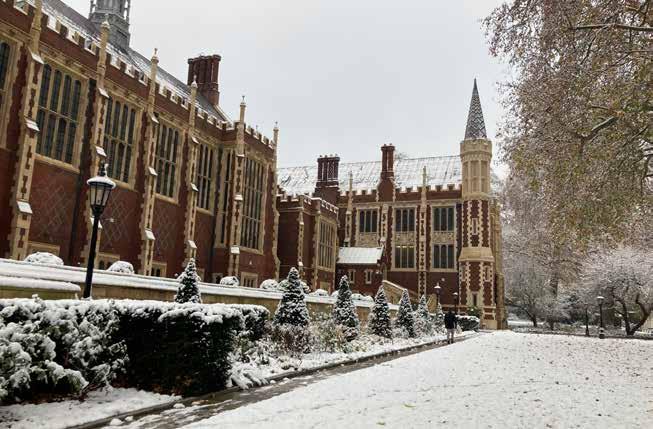
Inn
the snow, December 2022.
The Lincoln’s Inn Benchers’ Partners’ Association
By Vivien Blackburne and Deborah Todd, Co-Chairs of LIBPA
The Members of LIBPA (the Lincoln’s Inn Benchers’ Partners’ Association), have been delighted that 2022 allowed for a resumption of more activities and opportunities to get together again.
The May lunch was held in the Old Court Room and was a most convivial affair, enabling us to catch up with members we had not seen since before the pandemic. Everyone was full of praise for the Inn’s caterers who provided an excellent meal.
This was followed in July by a trip to Eltham Palace. Although it was one of the hottest days of the year we had a marvellous time exploring the Palace and the gardens. The staff were incredibly welcoming and ensured that we were able to enjoy the lunch they provided in a shady spot outside.
The Ven. Sheila Watson kindly agreed to give the Teatime Talk in October about her varied and interesting career. This proved to be a popular choice and was very well attended.
We are very keen to ensure that LIBPA continues to be of interest not only to the existing members but also to encourage new members, which is essential for the continued viability of the organisation, so we decided to take the opportunity this year to canvass the views of the current members about their likely level of participation in the future and their preferences for meetings and events.
The responses we received were overwhelmingly supportive of LIBPA and full of ideas.
Our next event takes on board some of the suggestions we received and will combine the May lunch (16 May 2023) with a talk by the historian Diana Preston.
LIBPA continues to be an excellent way for the partners of Benchers, especially those who live outside London, to get to know and maintain contact with the Inn and its people. New members and ideas are always welcome. There is a small annual subscription and more details can be obtained from one of our joint Chairs, Vivien Blackburne, vivienjblackburne@yahoo.co.uk or Deborah Todd deborahcollett1494@gmail.com.
Lincoln’s Inn –
A Guide
Learn about the richness of our history and architecture in this guide as we discuss the charmingly unplanned collection of elements that have accumulated between the 15th century and the 21st century.
Price: £7.50
www.lincolnsinn.org.uk/shop
Lincoln’s
in

Black Books Society 2022
By Mark Ockelton, Convenor of the Black Books Society
One of the great joys of 2022 was that, following the restrictions of the COVID-19 pandemic, we were finally able to resume a series of events which people could attend in person. Looking back over twelve months it is scarcely credible that there was still considerable uncertainty when organising events at the start of the year, lest the restrictions return. Happily, we were able to get back to normal and hosted five events.
Our first event was a lecture by Professor Sarah Brown, FSA, FRHistS, Director of the MA in Stained Glass Conservation and Heritage Management at the University of York and Director of the York Glaziers Trust. In this latter capacity, Professor Brown is in charge of the project to carry out conservation work on the Chapel’s stained glass.
In a fascinating lecture, Professor Brown discussed the significance of the Chapel glass and the work involved in its conservation. You can discover more about this by reading Professor Brown’s article (page 82) or by watching the lecture at www.lincolnsinn.org.uk/news/black-books-society-lecture-the-chapels-stained-glass/
On 13 July, Richard Wallington gave a brief lecture on the Inn’s architecture post-1660, followed by a walking tour of the Inn’s estate. The illustrations in the lecture provided illustrations of how the Inn’s buildings and estate have changed over time and included some striking photographs of buildings which seem to have been the inspiration for Hardwick’s Great Hall – notably the Great Hall at Hampton Court Palace and Westminster Hall. The guided walk was an excellent opportunity to take a leisurely look at our buildings as Richard pointed out many features which are often ignored, such as the parish boundary markers and evidence of frequent rebuilding in New Square.
In Michaelmas Term we held three lectures. For the first lecture we were delighted to welcome Lord Hague, an Honorary Bencher of the Society, to speak about William Pitt the Younger. Pitt, one of seventeen British Prime Ministers to have been members of the Inn, was the subject of Lord Hague’s award-winning biography. He is also clearly a great hero of Lord Hague and the lecture paid tribute to an extraordinary life and career.
In thanking Lord Hague for his lecture, the Treasurer paid tribute to a brilliantly well-informed and very amusing lecture, noting ruefully that he had set an extremely high bar for later lecturers to match. The Treasurer need not have worried. His own lecture on the history of the Inn, “600 Years of Recorded History” on 5 December, was a similar blend of erudition and humour. By taking an extract from the Black Books, a past member and a building or artefact for each century of the Inn’s existence, the Treasurer demonstrated the great changes witnessed by the Inn but the continuity of many values and traditions. You can read the Treasurer’s article based on his lecture on page 19.
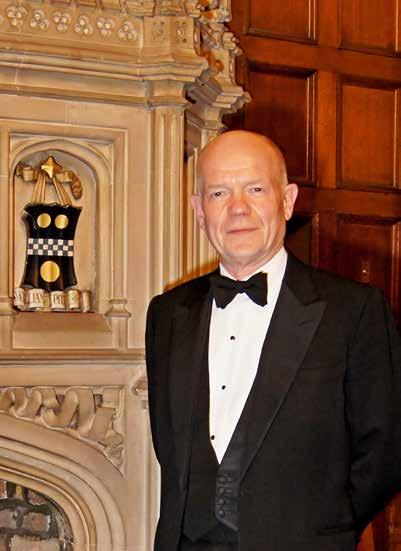

On 14 December, despite train strikes, but with a Zoom link for members who could not join in person, we heard a fascinating overview of the law in 1422 from Nicholas Le Poidevin KC. The first part of the lecture discussed the late mediaeval legal system – how and why people resorted to litigation, the structure of the courts, the system of pleadings and how cases were decided. Nicholas then looked in detail at specific areas of the law –challenging misconceptions about the position of the Church and of women and, explaining the minefield of legal issues confronting anyone involved in the sale of land. You can watch the lecture at www.lincolnsinn.org.uk/news/the-law-in-england-in-1422/
We have a busy programme for 2023, which will be published on the Inn’s website with more details nearer the time. Among the events are a presentation on 30 May, where Mark Kirkby will discuss the furnishings of the Chapel – a striking survival of an early 17th century church interior, close to the 400th anniversary of the date of its consecration. On 5 October we have a talk by Philip Jones KC on Lincoln’s Inn in the Civil War.
I am as always very grateful for the support and enthusiasm of the other members of the group, and in particular the Librarian, Dunstan Speight.
Lord Hague next to Pitt’s coat of arms on the Drawing Room fireplace.
Lord Hague taking questions.
Heraldic Panels in Hall

Jonathan Crow KC
Heraldry often includes a visual play on a person’s name. With a surname like Crow, the temptation was clearly irresistible. So, the family coat of arms, apparently issued to one Gyles Crow in 1586, consists of three cockerels crowing. But that image suggests a degree of hubris and triumphalism which is not immediately attractive. The other potential objection to using that coat of arms was charmingly pointed out by our Librarian, Dunstan Speight, when he asked with a twinkle: “Are you sure it’s yours?” Apparently many people assume they are entitled to use a coat of arms without troubling to establish their strict entitlement. It had never previously occurred to me that this was not our coat of arms but, as it happens, no one has kept a family tree going back to the late 16th Century, so there was no certainty that I am a direct lineal descendant of Gyles. In the circumstances, Dunstan suggested three alternatives: I could either bluff it and use the (assumed) family bearings; or I could commission a genealogical search by the College of Arms, thereby incurring the risk that the trail would go cold or (worse) the discovery that I spring from some cadet branch of the family with no right to the arms; or I could petition the College for a new grant. The latter seemed by far the most agreeable and reliable.
Guided expertly by Rouge Dragon Pursuivant, we conceived a design that was based on the same overall scheme as the grant to Gyles Crow – a chevron with three birds – but adapted to reflect my career. The three birds are now choughs, which have black plumage with a red beak and red legs. Apart from being visually striking, they provide a double reference. Choughs are a member of the crow family, but coincidentally they are also the supporters on the coat of arms of the Duchy of Cornwall. Having been Attorney General to the Duchy for a number of years, they offered a convenient reference to that aspect of my career. There are also three ‘charges’ on the arms, which are stylised images paying tribute to the three institutions that have enabled me to pursue my career. Each chough is holding an ‘annulet’ in its beak which alludes to the three annulets on the coat of arms of St Paul’s School. In the centre of the chevron is an ‘ermine spot’ which is borrowed from the coat of arms of Magdalen College, Oxford. The third ‘charge’ will be easily recognised as the millrind from this Inn’s coat of arms, a device which many Treasurers have incorporated into their bearings over the centuries. The crest is similarly adapted from my assumed inheritance. In Gyles Crow’s grant, it was a camel’s head “vulned in the neck”, meaning wounded. Why the camel was wounded, no one seems to know. Indeed, no one really knows why it was a camel’s head in the first place. It seems a little exotic for a family that had moved no further than from Suffolk to Kent in the reign of Edward IV. The explanation may simply be that the grant was issued by Robert Cooke, Clarenceux King of Arms, who seems to have been fond of camels, including them as supporters on the Merchant Taylors’ Company arms also in 1586, and earlier on the Coopers’ Company arms in 1574. However, no two crests are allowed to be identical, so Rouge Dragon hung a portcullis around the camel’s neck, in reference to my years as First Treasury Counsel.
The third and final element is the ‘badge’, which is the small device just visible on the helm’s visor. This is a jay mounted against six black bird’s wings. The jay is another member of the crow family (J. Crow), and the six wings represent our four children, my wife, and me.
In closing, I would like to express my sincere thanks to Baz Manning, the Inn’s heraldic artist, for his infectious enthusiasm, extraordinary skill and incomparable attention to detail in painting the panel. Engaging with him, with Rouge Dragon and with Dunstan in relation to the coat of arms has been one of the most delightful aspects of my year in office.
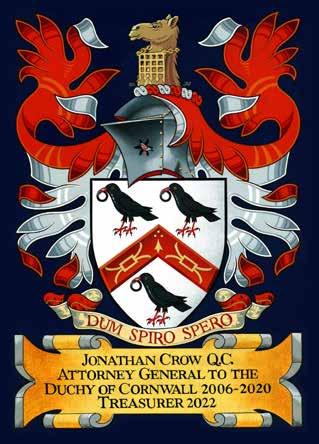

The Rt Hon Lord Briggs of Westbourne
I had no family precedents for arms, so had to start from scratch. I was looking for emblems reflecting my name, my family background and my principal interests outside the law, with a motto which said something about what lies at the heart of legal process.
Beginning at the top, the pennon is as near as we could get to the Royal Yacht Squadron (RYS) burgee, without just copying it. Hence the gold rather than white background. I am a member of the RYS. The pennon is carried by my then dog, Emma, a King Charles cavalier spaniel, one of the last bred by my mother in a life’s career of pedigree dog breeding, and my faithful companion walking to and from chambers and then court each day, and very occasionally in court. The eagle-eyed among you will notice that Emma also rests a paw on the Lincoln’s Inn millrind.

The dark blue background represents the sea, as does the foul anchor, which is a traditional naval emblem, reflecting my Royal Naval family background (brother, mother, father, grandfather) and my love of all things to do with sailing and the sea.
The four feathers reflect my third name: Featherstone. The motto “e colloquiis sapientia” means “from discussion comes wisdom”. It reflects and affirms my belief that the best way to the right result in legal proceedings is by oral argument in court, now a specially English tradition, particularly in the form of an oral process in which the judge takes a full part, so that the hearing is more like a discussion than an arid succession of speeches.
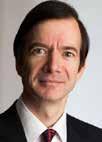
The
Hon. Mr Justice Bryan
My interest in heraldry stems from a chance encounter with Sir Thomas Woodcock, the former Garter Principal King of Arms, at the Lancashire Justice Service at Lancaster Castle a number of years ago. He kindly offered to assist me in relation to my Grant of Arms and I had a very enjoyable meeting with him at the College of Arms discussing the various allusions and references to be depicted.
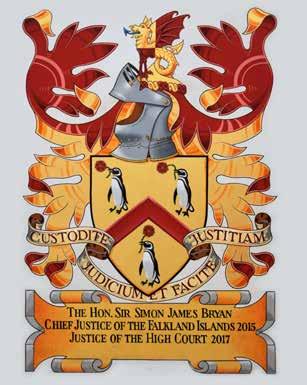
The three Magellanic penguins, are an allusion to my time as Chief Justice of the Falkland Islands and the British Antarctic Territory, and they each have the Lancastrian red rose in their beak, a reference to the county of my birth, and also a link to the arms of my wife’s family. The quartered wyvern (a two-legged dragon) is a reference to my alma mater Magdalene College Cambridge. As all heraldic references must be unique, it faces the opposite way to Magdalene College’s wyvern. It is sitting on a sand dune, a reference to the fact that grew up on the Fylde coast of Lancashire. The motto, “Custodite Judicium Et Facite Justitiam” is from Isaiah 56, and can be translated as, “ Keep ye judgment and do justice” which seems fitting for a judge. The white background to the panel was the suggestion of Baz Manning, to reflect the snow of the British Antarctic Territory.

Lincoln’s Inn as a Filming Location
By Naomi Johns, Executive Assistant to Director of Services and Communications
Lincoln’s Inn has long drawn interest as a filming location. Not only does it boast the appeal of interior and exterior backdrops from the 15th century to the modern day, as a private estate it offers onsite parking for technical vehicles, green room areas for cast and space for a crowd base (for hair, makeup and crowd holding). Having the potential to be a one-stop shop is very appealing to film crews. Our close proximity to Lincoln’s Inn Fields is also an advantage as it offers a large unit base space for crews to service their shoot.
The COVID-19 pandemic gave rise to new and unique opportunities for the Inn to facilitate larger and more complex shoots. The Library was added to the list of fantastic areas on offer, and along with the Upper Vestibule and Great Hall became very popular. The Reception, Lower Vestibule and staff offices were also available and were chosen as the location for the study of character Kate Woodcroft (played by Michelle Dockery) in Netflix’s Anatomy of a Scandal.

Productions Released in 2022
2022 was a big year for releases of commercial productions filmed at Lincoln’s Inn. Highlights include All the Old Knives (Amazon Prime) and Netflix productions The Crown, Anatomy of a Scandal and the long-awaited fantasy drama television series adapted from Neil Gaiman’s DC comics, The Sandman.
The Inn also hosted smaller productions including the BBC’s See Hear, Digging for Britain and Tom Daley’s Illegal to be Me documentary, publicity footage for Philippa Gregory’s novel Dawnlands (Simon & Schuster) and various member and Chamber requests.
Since 2020, filming has generated an income of £740,527 for the Inn, and of that, £279,714 was in 2022.
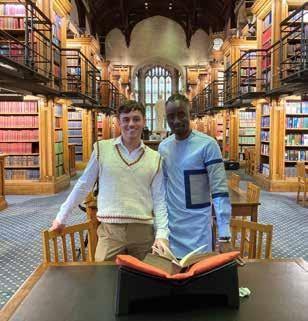
Inevitably not all filming enquiries progress to shoot. Some will not progress past the initial enquiry, some will reach the recce stage (pre-shoot site visits by the Location Manager and team), and others will fall at the final hurdle. The ever-changing digital landscape brings new challenges for location managers as directors and writers often change their requirements at the last minute.
In 2022 there were approximately:
• 8 productions • 17 shoot days • 53 in person recces (others will have occurred independently)
• 1330 cast/crew on site for shoot days • 49 requests
Location managers are a key part of every film crew and are very influential when it comes to location selection. They manage a wide range of people and must meet the varied demands of their director or writer. Word of mouth via location managers is the most effective way for the Inn to generate business, so there is a strong focus on ensuring we develop and protect these relationships. Our filming team has worked hard during recces and pre-filming correspondence to ensure location managers understand the environment they are working in, so they take due care when using our premises and are considerate of our residents, tenants, and members.
Developing good relationships with location managers, adopting clear communication, and being upfront about potential problems whilst trying to find solutions has been crucial in making a success of filming at the Inn. As a result, the Inn has earned a reputation as a filming friendly location, welcoming back regulars and establishing connections with new clients. In May 2022 the Inn was invited to feature in a ‘Behind the Scenes’ article for Film London about The Sandman which can be read here: www.filmlondon.org.uk/latest/the-making-of-the-sandman-at-lincolns-inn.
The growth of filming over the last few years has meant that every team at the Inn has been involved in some way in making it a success, and members, tenants and residents have kindly responded to changes to usual activity.
Historically, it has been difficult to gain contractual agreement for the release of photos from productions. Production companies are fiercely protective of confidentiality to ensure that no unauthorised images are leaked into the public domain prior to a production’s release. The development of relationships with location managers and producers has allowed the Inn access to photos within pre-agreed conditions that must be adhered to.
The Inn has instigated a new policy of communicating the release of productions filmed at the Inn to members and staff – email notifications are circulated to staff members once a production has aired commercially and a social media post with photos is published, if approved by the production.
Hosting several larger productions in 2022 developed our team’s knowledge, experience and understanding of how the Inn can best be used for filming. With several interesting productions in negotiation for 2023, we are looking forward to the opportunities that the year may bring.
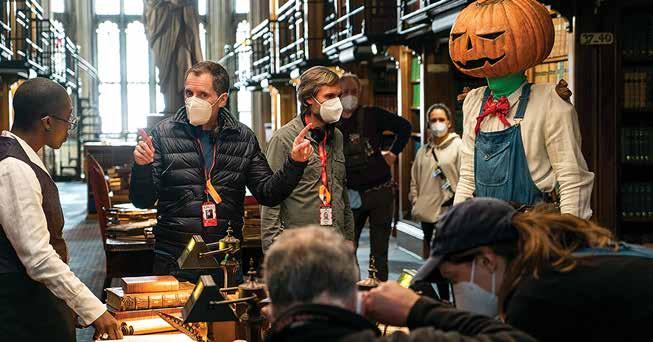
Michelle Dockery in Anatomy of a Scandal.
(Photo credit: Netflix)
Tom Daley: Illegal to be Me, BBC1. Courtesy of Brook Lapping Productions
The Sandman shooting in the Library. (Photo credit: Netflix)
Committee Activity in 2022
Audit and Risk Committee
The Audit and Risk Committee is responsible for overseeing governance, risk and management controls within the Inn. This includes oversight of the year end audit process, internal controls and processes, and risk management.
During the year the Committee received regular updates on the progress in managing risks, including reviewing the Inn’s approach to cyber risks.
Chapel Committee
The Chapel Committee considered a broad range of subjects in 2022, not least plans for the celebration of the Chapel’s 400th anniversary in 2023. The Committee has agreed to mark the occasion with special celebrations on Ascension Day and on 18 October 2023, which will include a special Evensong with the dedication of the latest Treasurers’ Shields followed by a dinner; as well as encouraging the further development of, and funding for, the Donne musical commissions.
2022 has been a significant year for Chapel works, with the completion of the setup of the livestreaming and sound systems, the Architect’s Quinquennial Inspection and the conservation work on the North and South Windows overseen by the York Glaziers Trust. The Committee agreed to a visit to the Trust’s workshop in York and looks forward to seeing the conservation work in action.
Charitable giving has also been at the forefront of the Committee’s mind over the last year and work continues on this. The charity evening held in Chapel on 29 March 2022 in honour of the 150th anniversary of F D Maurice’s birth was a marked success.
The Committee has adopted a revised Safeguarding Policy in line with recent guidelines and agreed the content of a new webpage making our safeguarding arrangements more transparent. The Committee also had discussions about various issues relating to the inclusivity of current arrangements for Sunday lunches and the Grace said before dinners.
Chattels Committee
New artworks
The Inn has been given a portrait of Sir Mota Singh by members of his family. The career of Sir Mota Singh is outlined on page 30 and it is very gratifying that the Inn now owns a portrait to commemorate his achievements. The artist of the portrait was Dial Singh Sagoo (1921-2016). Like his friend Sir Mota Singh, Dial Singh Sagoo was born in Nairobi. He trained as an artist, spending time in Italy. He had a successful artistic career and exhibited at the Royal Academy.
The following new heraldic panels have been installed this year: The Treasurer, Lord Justice Snowden, Sir Jonathan Cohen, Mr Hon. Justice Bryan and the Hon. Mr Justice Trower. On page 96 a number of Benchers give an insight into their coats of arms and explain the personal significance of the items included.
Conservation work
Our conservators Melanie Caldwell and Nicole Ryder have done wonders at making good the damage wrought by the leak in the Bench Rooms in autumn 2021. Work has been completed on nine of the seventeen damaged portraits and it is fair to say that they look better than before they were damaged. The conservation process required the removal of discoloured varnish and, in some cases, later overpainting. As a result, details are now visible which had been obscured. The portraits of Lord St Leonards and Lord Brougham have particularly benefitted from this.
Given the progress with this conservation project, it was particularly exasperating that on 21 April 2022 a further leak occurred over the south wall of the Upper Vestibule, caused by contractors cleaning the external brickwork. The main damage was to the portrait of Princess Margaret by Bryan Organ. Discoloured water also dripped on the bust of Lord Cairns and the plinth. Plowden & Smith carried out the necessary conservation
work on the items and all have now been returned to the Upper Vestibule. Evidence of the leak is still very obvious on the wall behind the portraits. Work to remedy this will be carried out in the summer of 2023.
Picture frames
The frame for the portrait of Prince Albert was found to be in a fragile condition and was restored by W. Thomas Restorations Ltd. In the course of the restoration, the restorers discovered that the original framer used an earlier frame for this, cutting it down to size. Some poor workmanship during this process was the root cause of the problem. This has now been rectified.
In April 2022 Ben Pearce carried out minor repairs to a number of the picture frames with the object of disguising areas of damage rather than carrying out a full restoration.
The glass over the portrait miniatures of Fitzroy Kelly and Thomas More has been replaced with museum glass which filters out ultra-violet light and reduces reflections.
Display cabinet in the Upper Vestibule
Following a suggestion from Judge Easterman, the display cabinet in the Upper Vestibule which contains a number of archaeological finds from the Inn, plus other miscellaneous items such as the ivory bust of Lord Brougham and the sixteenth century tablet cursing a former Treasurer, has been altered to enhance the display. The wooden shelves have been replaced with glass shelves and new lighting installed.
Silver
A silver muster was carried out on 16 January 2022. No irregularities were discovered and, pleasingly, one item, which was listed as missing on the inventory – item 114 (a silver plate engraved with a flowery script style “WH”, dated 1895) – was found.
Equality, Diversity and Inclusion (EDI) Committee
Please refer to page 50 for a report on the EDI Committee’s activity in 2022.
Estates Committee
The Estates Committee has responsibility for the management, maintenance and improvement of the estate and reports to Council. Property schedules are reviewed (lettings, rent reviews, voids and the like). As the Inn’s primary source of income these property transactions are the lifeblood of the Inn, ensuring its ongoing viability.
The progress of major projects is scrutinised monthly. The 2022 major projects were:
• Great Hall Complex – External Repair & Redecoration
• Fire Risk Assessment and Mechanical & Electrical Works
• Old Buildings - External Repair & Redecorations
• 77 Chancery Lane - Fit-out
This latter project had a delegated Working Group.
A major part of the Committee’s function is to approve (or reject) projects, and as such, the variety and importance of the papers submitted is striking. Some of these already have Category 2 approval (a budget place holder based on approximate costs); others are unbudgeted. All approvals are subject to Finance and General Purposes Committee approval.
At October’s meeting, the budget for the following year is interrogated. The Estates team is questioned in depth on these proposals and any that do not have a compelling case are rejected. Thereafter, meeting most months, the Committee reviews all monthly progress reports from larger projects, ensuring accountability to the Inn is maintained. From time to time, committee members will undertake site visits to ensure appropriate scrutiny.
In 2022, a substantial project workload was approved, including:
• Structural floor repairs and chambers refurbishment – 16 Old Buildings
• Flat refurbishment – 1 Stone Buildings
• Additional funding for 19 Old Buildings flat refurbishment after discovery of asbestos
• 5 and 6 New Square re-roofing
• Stone Buildings lightning protection survey
A new edition of the Contractor’s Handbook was signed off. This sets forth to contractors what behaviour is permitted, and what is not.
Finance and General Purposes Committee
The Finance and General Purposes Committee (F&GP) oversees the financial affairs of the Inn and other matters which do not fall within the remit of another committee. This includes annual budgets, medium and longer term cashflow forecasts and the financial implications of significant proposals.
During 2022 the Committee agreed the Inn’s medium term financial plan and a supporting medium term business plan. These documents provide a practical framework for decision making in a challenging economic environment.
Other routine business of the Committee included review and approval of individual items of expenditure, including development of a new scholarships online portal and refurbishment and maintenance of the Inn’s heritage estate.
Gardens Committee
Plans have been submitted to Camden Council to extend the main gardens building to include another garage space and an office for the Head Gardener. This will enable wheeled machinery to be stored separately to equipment, reducing the trip hazards, and improving access. It will also enable staff to take breaks in sufficient space, while office work continues uninterrupted. The development of the derelict space adjacent to Stone Buildings, with new decking and a potting shed will make the greenhouse a safer and cleaner workspace.
With support from the Estates team, Jubilee Fountain was brought back into working order in spring and moved water through the summer (until the hosepipe ban). The lights have also been fixed so, now the hosepipe ban has been lifted, the fountain is a feature in the darker evenings.
In May, the Committee agreed a trial allowing longer grass to grow in New Square, and to develop a wildflower meadow in the area much disturbed by the necessary removal of the Paulownia tree in March. While the longer grass looked reasonable from a distance, and the wildflower meadow was at its best for the Garden Party, they both gave a number of operational challenges. The Committee decided that the trial had been worthwhile for the year but did not deliver a result in keeping with the overall centrality and profile of New Square and that different planting would be tried in 2023.
The discovery of honey fungus in the Walnut tree in New Square was a setback but the Head Gardener is working with our retained arborists to devise the most effective scheme of control and removal. This may, however, be a multi-year project.
In October, the Committee began a review of the Gardens Strategy which had been planned to run from 2020-2022. Although much had been done, there was also a lot that had been impeded by the circumstances of COVID-19, and there have been other issues which have increased in significance. The Committee is therefore adapting the Strategy to run from 2023-26, and newly including such matters as sustainability, biodiversity and water management.
For a review of the gardening year, see page 77.
Hospitality, Events and Dining (HED) Committee
The HED Committee oversees the catering department’s activities, both operational and financial. It monitors the department’s performance in all events for our members and for private and corporate clients. The Committee fixes annual budgets, monitors income and expenditure within that budget, reviews and approves the purchase of equipment and reviews feedback on events. It also feeds in its ideas and suggestions on new events and possible improvements and oversees the promotion and marketing of all the Inn’s hospitality venues, those being Great Hall, Old Hall, the Old Court Room, the Ashworth Centre, the MCR Restaurant and Bar, and on occasion outdoor garden and terrace spaces.
The Inn’s hospitality function saw a sharp return of commercial events in the first quarter of 2022, and it continued at a pace throughout the year. The catering team created some truly memorable events to mark the 600th Anniversary year, both in and outdoors. We saw some firsts too - the Historic Dinner, a full weekend of Open Gardens activity, and Luna Cinema on the North Lawn – all of which were very much enjoyed. Increased event activities saw the Committee support a focus on the catering team, rebuilding to meet a busy Michaelmas term. Looking back on the achievements of 2022, we now focus on attracting business to the Ashworth Centre, capitalising on daytime conferences.
Investment Committee
The Investment Committee is responsible for the management of the assets of the Inn’s Investment Fund and Capital Repayment Fund and provides investment advice to the Trustees of the Inn’s charities.
During the year the Committee reviewed the Inn’s investment strategy and recommended some changes to the portfolio allocations, which were subsequently implemented. The Committee also made recommendations to the Trustees of the Inn’s charities on portfolio structure. These recommendations were agreed by the Trustees resulting in another investment manager taking a proportion of the funds.
Library Committee
Please refer to page 73 for the Library and Archives report.
Planning and Development Group (PADG)
PADG focuses on medium and long term matters, many of which span the interests of other, individual Inn committees. It is chaired by the Treasurer and reports on the outcomes of its discussions to each Council meeting.
During 2022 membership of PADG was expanded in the light of recommendations by the Governance Working Group. It now includes all members of the Cursus; the Immediate Past Treasurer; chairs of the large operational committees; the chair of the EDI committee; the chair of the Bar Representation Committee; the Under Treasurer; and up to three additional Benchers nominated by the Treasurer because of their expertise.
PADG met eight times in 2022. Business included taking forward the recommendations of the Governance Working Group; the development of an Inn Code of Conduct; the statement of the Inn’s purpose, values and ambition; and medium term financial and operational planning.
Post-Call Committee
The Post-Call Education Committee has oversight of all matters relating to advocacy and ethics training for pupils and new practitioners, education and training for established practitioners, training and grading of advocacy tutors and international advocacy training.
Much of the Committee’s work has concentrated on continuing to provide the compulsory training for our pupils and new practitioners as well as reintroducing some non-compulsory training events.
Since the closure of Highgate House during the pandemic, the Inn has been trialling new venues to host both the Pupils’ Advocacy Course and the New Practitioners’ Advocacy and Ethics Course. The requirements for these events have made finding venues difficult but we are hopeful to have found two suitable venues to host future courses.
In 2022, the Inn re-introduced ethics training for pupils. The BSB now requires pupils to pass a written professional ethics assessment during pupillage. The Inn’s training is not intended to directly prepare pupils for the exam but to offer an opportunity for them to think about and discuss potential ethical situations they may encounter in practice.
The Committee have been preparing to run the Advocacy and the Vulnerable Course again by providing refresher training to our facilitators in 2022. The first courses for trainees will take place in early 2023.
Pre-Call Committee
The Pre-Call Education Committee has responsibility for the oversight of all matters relating to outreach, admission, education and training and Call to the Bar of students. This includes insight events for prospective students and liaison with universities as well as qualifying sessions and additional activities for current students.
Once again, there was a considerable increase to the number of students undertaking the Bar Course in the 2021-22 and 2022-23 academic years. The increased number of students means that more qualifying sessions need to be provided in order to cover students’ requirements for Call to the Bar. The Committee has been working on ways to recruit more volunteer tutors to deliver these qualifying sessions whilst retaining those who already teach at these sessions.
In our outreach work, a new Social Mobility Prize has been approved to be launched in 2023. The prize was put forward to commemorate the 600th Anniversary of the Inn’s continuous records, with the aim of the prize being to improve access to the profession and to support high achieving undergraduate students from less advantaged backgrounds. In addition to the socio-economic criteria for the prize and owing to the evidence that black applicants for pupillage face extra disadvantage, there will be an aim to award at least 50% of the prizes to black applicants, including those of mixed black heritage.
Scholarships Committee
The role of the Scholarships Committee is to consider matters relating to the interviewing and awarding of the Inn’s GDL and Bar Course scholarships as well as the awarding of the Inn’s Pupillage Grants and Bar Course prizes. It is responsible for recommending the Inn’s annual Scholarships budget to the Finance and General Purposes Committee and for monitoring the progress and achievement of the Inn’s scholars.
There was a significant increase in the number of Bar Course Scholarship applications in 2022 which in turn led to the need to conduct 80 more interviews than the previous year. Unfortunately, the rise in COVID-19 numbers in the early part of 2022 prevented the Inn from running these interviews in-person and they were conducted remotely.
For the first time since 2019, the Inn was able to run the GDL Scholarship interviews in-person. This round of interviews also saw the first use of the Inn’s new scholarships criteria which were redrafted in an effort to be more inclusive.
Furthermore, the Inn has also appointed an external consultant to review all elements of the Inn’s scholarship processes. Any recommendations will then be implemented for future rounds of scholarships.
Staff Committee
The Staff Committee’s role is to consider matters relating to the recruitment, pay, management and discipline of the Inn’s staff, including staff pensioners. The Committee also recommends the Inn’s annual staff salaries budget to the Finance and General Purposes Committee.
The recovery from the pandemic was felt in all sectors of the economy in 2022 and sadly the Inn was not immune. All departments of the Inn were impacted in some shape or form, but the problems were most acute in our Catering Department with high levels of sickness, retention and recruitment difficulties, and skills shortages. You will have seen many new faces at the Inn and the Committee has had to consider how to ensure we remain competitive in an increasingly employee-led environment.
Equally, the rise and the impact of the cost of living on our staff members has been a real concern. The Committee has had to balance the erratic economic landscape with affordability. In order to better support our staff with rising costs, it was decided to have a mid-year salary review in July 2022. At the end of this year the Committee also discussed the annual pay rise for 2023, where it was decided to give weighted percentages to provide further support to the lowest paid workforce.
We are grateful to the Committee Members for their counsel, consistency, and commitment in what remained a challenging year.
Officers of the Inn 2023

Treasurer
The Rt Hon Sir Geoffrey Vos
Sir Geoffrey Vos was appointed Master of the Rolls and Head of Civil Justice in England and Wales on 11 January 2021. In addition to being President of the Court of Appeal’s Civil Division, the Master of the Rolls is chair of both the Civil Justice Council and the Civil Procedure Rule Committee. He is chair of the Advisory Council on National Records and Archives and of the Forum on Historical Manuscripts and Academic Research. As a member of the LawtechUK Panel and as chair of its UK Jurisdiction Taskforce, he contributes to the governmentbacked initiative supporting the technological transformation of the UK legal sector.
Called to the Bar by Inner Temple in 1977, Sir Geoffrey joined Lincoln’s Inn ad eundem in 1979. He was elected a Bencher in 2000 and is Treasurer of Lincoln’s Inn for 2023.
Keeper of the Library
The Rt Hon Lord Briggs of Westbourne
Michael Briggs was called to the Bar by Lincoln’s Inn in 1978 and elected a Bencher in 2001. He is a longstanding member of the Chapel Committee and its Chair since 2019. He grew up around Portsmouth and Plymouth, following his naval officer father between ships, before spending his later childhood in West Sussex. He attended Charterhouse and Magdalen College, Oxford.
A keen sailor and the first lawyer in his family, he practised in commercial and chancery work before being appointed to the High Court in 2006. He was the judge in charge of the extensive Lehman insolvency litigation from 2009 to 2013. Lord Briggs was appointed as a Lord Justice of Appeal in 2013. He was the judge in charge of the Chancery Modernisation Review in 2013 and led the Civil Courts Structure Review in 2015 to 2016. In January 2016 he was appointed Deputy Head of Civil Justice, and in October 2017 he became a Justice of the Supreme Court.

Keeper of the Black Book and Dean of the Chapel
The Hon Sir Paul Morgan
Paul Morgan was called to the Bar by Lincoln’s Inn in 1975 and took Silk in 1992. He specialised in property law. He was appointed a High Court Judge in 2007 and was assigned to the Chancery Division. He retired as a judge in September 2021 and now practises as an arbitrator and mediator from Wilberforce Chambers. He was appointed a member of the KC Appointments Panel with effect from January 2023.
He was elected as a Bencher in 2001 and in the past he has served as Chair of the Estates Committee and as a member of the Finance and General Purposes Committee and the Pre-Call Committee. He is now Chair of the Audit and Risk Committee and a member of the Equality, Diversity and Inclusion Committee.

Keeper of the Walks
Elspeth Talbot Rice KC
Elspeth Talbot Rice was called to the Bar by Lincoln’s Inn in 1990 and took Silk in 2008. She is head of chambers at XXIV Old Buildings, Lincoln’s Inn and specialises in contentious Chancery matters, in particular international trust disputes. She has served on the Hospitality, Events and Dining Committee since becoming a Bencher in 2012 and has been its chair for the last few years. She has also served on the Information Technology Board, and the Staff, Finance, PADG and Wine committees.
She was born in Newcastle upon Tyne and educated in Sunderland, Helmsley (North Yorkshire), Brighton and Durham. She lives in Hampshire with her husband, three daughters, horses and a dog. Apart from the intricacies of trust law, she enjoys the outdoors, family life, riding horses, food and wine.
Dates to Note: April 2023 – April 2024