

It has been a huge privilege to serve as the 516th Treasurer of Lincoln’s Inn during 2023. hope it can be said that 2023 brought welcome improvements to the transparency and inclusivity of the Inn’s governance and activities.
The Inn plays a vital role in supporting the rule of law and the Bar, as part of a vibrant UK legal profession. It aims to provide a home from home for its members here and abroad. I saw at first hand this year how our alumni in Malaysia and Brunei value their ongoing connections with the Inn.
As a professional community too, I think Lincoln’s Inn had a pretty good 2023. The direct impact of the pandemic had abated, and we enjoyed a full and varied programme of educational and social events. I am conscious that the Inn can be seen as London-centric, however much we strive to involve our members on Circuit and in other parts of the world. We must continue to make maximum use of technology to engage more effectively with those who join our meetings and events remotely. Ultimately, though, it is the contacts and friendships that are made in person that define the Inn.
This year, we held very successful Circuit Dinners in Cardiff and in Birmingham. The Under Treasurer and I also made a hugely valuable visit to the Lincoln’s Inn Alumni Association of Malaysia in September. The gala dinner they organised in Kuala Lumpur was attended by more than 400 Lincoln’s Inn members.
Closer to home, the 400th anniversary of the Lincoln’s Inn Chapel was a triumph, with a series of inspirational events widely supported by those of all faiths and none. I personally attended church more often in one year than probably ever before!
I said at my inauguration that I was committed to making the Inn an ever more inclusive place for all its members, whether Students, Barristers or Benchers, and for all its staff. The year has seen the consolidation of several initiatives that have made a material contribution to this objective.
The EDI Committee has grown in influence and impact. It published the results of our first EDI survey and is planning the steps we need to take to address the issues identified.
The new Code of Conduct has become embedded in the life of the Inn, setting expected standards of behaviour for all our members. And we have made the process by which we appoint future Treasurers more transparent and accountable.
The new secular grace has, I hope, gone some way to making those who felt uncomfortable with the traditional Christian wording feel more included. We have formally abandoned the use of the term “Master” to refer to Benchers. Our Diversity Dinner to mark South Asian Heritage Month was a great success and was seen by many who attended as providing a level of cultural recognition which they had never expected from the Inn.
Taken individually some of these changes may seem relatively minor, but together they demonstrate the continuation of a fundamental shift in the Inn’s philosophy and thinking. I have no doubt that the Inn will continue on this journey in 2024 and beyond. There remains much to be done.
The world in which we live and work continues to present new challenges. The pandemic and the economic downturn have driven all organisations to think hard about how they go about their business. We will need to continue to adapt if we are to thrive.
My successors will face continuing difficult decisions, but I they will do so with my support and with the support of fellow Benchers, members of Hall and of the professional team of Inn employees, all of whom are crucial to our success.
I am grateful for the daily support that I received from the Under Treasurer and so many other staff. Without that, I could not have combined the role of Treasurer with that of Master of the Rolls. We are fortunate to have a truly collegiate atmosphere in Lincoln’s Inn. I will continue to do all I can to support our work together.
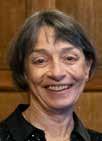
2023 was full of challenge and achievement for the Inn, as we continued to adapt to the demands of the post-pandemic world.
During the year we offered a broad range of educational and social activities, meeting the needs of increasing numbers of students, providing events aimed at new practitioners, and engaging with the Circuits. Our commitment to diversity and inclusion was reflected across our activities, through EDI events, the publication of our EDI survey and the new Helen Grindrod Social Mobility Prize.
None of our educational, scholarships and outreach work would be possible without the support of members who give their time freely to the next generation of barristers. As the number of student members rises and we seek to broaden the programme of events, the demand on these volunteers increases. The update from the Membership and Education Department later in this report explains the opportunities on offer and how you can get involved.
Looking to the world beyond our legal community, we brought non-members through our gates with the guided tours, Open House and Open Garden weekends. Such events are not simply an opportunity to share our lovely space and buildings, but are important in demystifying the profession and in reaching the wider society we serve. Our new Communications team played an important part in helping achieve this, while every day our wardens welcome visitors, passers-by and members with professionalism and pride.
The 400th anniversary of the consecration of our Chapel was marked throughout the year, culminating in the Anniversary Service and Dinner in October. The second phase of stained glass restoration was completed and dedication of the stained glass panels for 9 previous Treasurers was one of the memorable aspects of the Anniversary Service.
Like Education and the Chapel, the Library and Archives have been central to the life of the Inn for centuries. With access to online and hard copy resources, they continue to play a vital role for members, answering research queries, providing training and shedding light on the history of the Inn through fascinating exhibitions.
Work on the fabric of our buildings remains an important focus of activity, and I enjoyed clambering over the new roof on 5 & 6 New Square. 77 Chancery Lane (formerly Hardwick Building) has now been refurbished and is ready for fitting out to meet new tenants’ requirements. Our Works team in the Estates Department has successfully brought work back in-house which had been contracted out and is adopting modern technology to plan and deliver a broad range of tasks across the estate.
Many of you will have enjoyed the high standards delivered by our Catering team, whether through formal dinners, receptions, lunch in Hall or the MCR. It was wonderful to see this reflected in success at the London Venue and Catering Awards, and hardly surprising that demand for private events continues to grow.
The Inn depends on effective corporate services to make sure that we operate efficiently, effectively and securely. Our Finance, IT and HR teams play a crucial part in making sure that we can meet business needs –often unseen by members, they keep the show on the road. This year has been as demanding for them as for front line colleagues: managing our money in a difficult economic environment, updating IT infrastructure and recruiting in a challenging labour market. Their contribution will remain crucial as we navigate the complexities of the world in which we operate.
When I arrived at the Inn five years ago, I was struck by the range of expertise needed to deliver our services. I remain as impressed now as I was then by the hard work, professionalism and commitment of colleagues and grateful for the huge part that they play in our success. I take much pleasure in working alongside them towards a shared purpose.
I have been especially fortunate over the last year to have worked in partnership with Geoffrey Vos as Treasurer and am immensely grateful for his leadership and commitment. Despite the demands of his day job, he has been tireless in his commitment to the Inn and readiness to get involved.
Anne Sharp CBE

Once again it is that time of year where I find myself writing about last year's events in Lincoln’s Inn. Yet another year has passed. When I looked at the pictures of the Garden Party, I did not remember it being held on the North Lawn, rather than New Square. In disbelief I looked back at my pictures to be certain it was held on the North Lawn, it was. Still perplexed I looked at the pictures from 2022, where surely enough the Garden Party was held on New Square. It was only when read Steve Matthews’ report (on page 60), that I remembered the Garden Party was always held on the North Lawn, until we did the work on the Great Hall and the estates’ water supply, which necessitated moving it to New Square. Memory!
I hope you will find matters that interest you in this year's edition. Both the Treasurer and Under Treasurer give an account of how things have gone in the Inn, and I am sure you will all be pleased to know that everyone is doing what they can to make the Inn more relevant, and inclusive to all. have one word of caution with regard to throwing out bath water, it is important to remember the baby. Something new which may make some feel more included, can make others now feel excluded, just a small thing to remember, when changing long established customs.
Who knew that Lincoln’s Inn features high in the creation of Association Football? Page 91. And what did happen to Queen Victoria? Page 86. Who knew that the Treasury Solicitors did not provide legal advice for the FCDO (page 32), and who does advise that Ministry? Page 44. Who knew that the Inn has had so many novelists and authors? Page 68. Incidentally, I happen to know that the author of Harry Flatters is one more Lincoln's Inn novelist, nom de plume Carruthers J Lardy, and I would be interested to know of anymore. And what does “Nourrir La Justice” really mean? Page 89.
While some regular readers tell me they lament the change from primarily printed to primarily digital for the Review, I do not think anyone can really fail to appreciate the tremendous advantages of the digital version, with its links to lectures and other websites (including mine), where so much more can be easily explored. And the hard copy is still available to those who specifically ask for it (UK delivery only), so if that is what you would like, you have until Friday 3 May 2024 to order a print copy.
I think the standout issue for me this year is the request for volunteers. I often speak to members who tell me that they would like to be more involved in the Inn and ask how to go about it. Some express disappointment that they have given their names but heard nothing further. There is really no mystery to being involved if you want to be. Read Faye Appleton’s article on page 23 as a start, then watch the ‘How to Become a Bencher’ video on page 15 for even more insight into volunteering opportunities. If you have given your name and seem to have had no response, follow up – they will definitely want to get back to you. You can call the office on 020 7405 1393 and ask to speak to someone in Education. Or if you are interested in the Bar Representation Committee, find a member you know (pages 49-51). And most importantly, be active yourself in pursuing your wish. I cannot recall how many times, over the years, I have written in my Editorial or Editor’s Note that you will not get a gilt-edged invitation to get involved. You will need to make the effort at the start. Once you begin to become more involved, you will find increasing requests for your assistance.
As always, I am grateful to all our contributors for their interesting and informative articles, and to Helen Rynne who gathers in, compiles, and sets up the content, without whom there would be no Annual Review, and to Jarrold Publishing, our designers and printers, if that is what we are still calling them in this digital age.
Nick Easterman, Editor
Our Year in Numbers
753 Students Called to the Bar 96 pupils and 86 new practitioners trained 60+ Qualifying Sessions 154 Scholarships awarded 14 new advocacy tutors trained
3,250 new Narcissi, Crocus and species tulips planted in our wildflower meadow on North Lawn bank
1,260 visitors on Open Gardens weekend
2,572 call out requests responded to by the Works team
75 guided tours given to a total of 1,122 people
15,189 reader visits to the Library 7,414 enquiries answered by Library staff We held Held 4 Student Residential Weekends
5 memorial services
19 lease renewals completed across the Estate
837,589 website page views
990 events held in 2023 8 baptisms 5 weddings in Chapel
4,418 mini mince pies consumed in December food waste reduced by 30% 2,664 loaves of bread baked
11,448 new followers on social media 29,219 video views on YouTube 74 news stories published we hosted 136 dinners by switching coffee suppliers we protected of rainforest 1,980m²
6 large scale filming shoots took place, plus 4 smaller exterior shoots and 1 crowd base
Appointed a Senior Circuit Judge
April 2023 Her Honour Judge Whitehouse KC
Appointed a Circuit Judge
September 2023 His Honour Judge Doig (North Eastern)
October 2023 His Honour Judge Muzaffer (Wales)
October 2023 Her Honour Judge Pierpoint (Northern)
October 2023 His Honour Judge Close (Northern)
October 2023 His Honour Judge MacAdam (Northern)
October 2023 Her Honour Judge Cornell (Northern)
October 2023 His Honour Judge Straw (Midland)
October 2023 His Honour Judge Boyle (South Eastern)
October 2023 Her Honour Judge Griffiths (South Eastern)
October 2023 His Honour Judge Chawla (Midland)
October 2023 His Honour Judge Egan (Wales)
November 2023 His Honour Judge Tahir Khan KC (North Eastern)
November 2023 His Honour Judge James Carter (Midland)
November 2023 His Honour Judge O’Donovan (South Eastern)
November 2023 His Honour Judge Charman (Midland)
December 2023 Her Honour Judge Hunter KC (South Eastern)
Retirement from the Circuit Bench
April 2023 His Honour Judge Richard E Williams
September 2023 Her Honour Judge Helen Mifflin DL
Appointed a Chancery Master
January 2023 Master Brightwell
Appointed a District Judge
January 2023 District Judge Doman
January 2023 District Judge Worthley
January 2023 District Judge Catherine Jones
January 2023 District Judge Chataway
January 2023 District Judge Royle
January 2023 District Judge Banks
January 2023 District Judge Gooding
October 2023 District Judge Adrian Jackson
November 2023 District Judge Uddin
Appointed a District Judge (Magistrates’ Court)
February 2023 District Judge (Magistrates’ Court) Mitchell
Appointed President of Education Tribunal for Wales
June 2023 Judge Jane McConnell
Appointed a Salaried Employment Tribunal Judge
March 2023 Employment Judge Beyzade
April 2023 Employment Judge Shastri-Hurst
April 2023 Employment Judge Heath
Retirement from First-tier Tribunal
July 2023 Judge Duncan Maccallum Birrell
Retirement of Employment Tribunal Judge
January 2023 Employment Judge Bedeau
Appointed King’s Counsel
Mr Adam Baradon KC
Mr John Battle KC (Hon)
Miss Kuljit Bhogal KC
Mr Noel Casey KC
Mr Adam Cloherty KC
Mr Alexander Cook KC
Miss Kathleen Donnelly KC
Mr Owen Edwards KC
Mr Benedict Fitzgerald KC
Mr Alexander Goodman KC
Dr Matthew Lavy KC
Mr Jonathan Lennon KC
Mr Daniel Fritz KC
Mr Benjamin Newton KC
Miss Blinne Ní Ghrálaigh KC
Mr Luke Pearce KC
Miss Sarah Phipps KC
Mr Daniel Piccinin KC
Miss Laura Prince KC
Ms Lucy Reed KC
Mr Christopher Rees KC
Mr Matthew Reeve KC
Mr Andrew Roy KC
Mr Philip Rule KC
Mr Benjamin Shaw KC
Mr Shaun Spencer KC
Ms Claire Van Overdijk
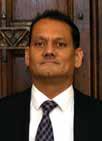
Dijen Basu was called to the Bar by Lincoln’s Inn in 1994 and took Silk in 2015. He was appointed a Recorder of the Crown Court in 2009 and was elected a Bencher in 2023. Dijen practises from Serjeants’ Inn Chambers, London, and specialises in public, police and employment law as well as in professional discipline cases involving the police and doctors, and in inquests.
Dijen serves on the Lincoln’s Inn Scholarships Committee.
Before coming to the Bar, Dijen studied medicine at Guy’s Hospital Medical School, qualifying in 1991, and practised as a doctor, full-time, for a year and part-time thereafter to fund his conversion to the Bar.
Outside of work, Dijen flies a paraglider.
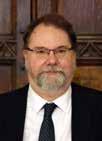
His Honour Judge Cadwallader
Neil Cadwallader was educated at Downside School, before reading Philosophy at Cambridge University and then training for the Bar. He was called to the Bar in 1984 and practised in Liverpool, Manchester and London in chancery and commercial law. He became accredited as a mediator and is an FCIArb. He was appointed a Chancery Recorder and a Deputy Adjudicator to HM Land Registry in 2009. In November 2020 he was appointed as a specialist Circuit Judge sitting full time in Liverpool. He is authorised to sit in the Chancery Division, Circuit Commercial List, and TCC list in Liverpool, Manchester and London. He was elected a Bencher of Lincoln’s Inn in November 2023.

Julia Cheetham KC
Julia Cheetham was born in 1967 in Niagara Falls, Canada to British parents. Educated at a comprehensive school, she did her law degree at Nottingham University. Julia was called to the Bar in October 1990 having been a Hardwicke Scholar and Bursar. She practised in family law from the outset, firstly at Hollins Chambers (latterly Cobden House Chambers) before moving to Deans Court Chambers in 2001 where she is Deputy Head of Chambers and Head of the Family team. She was appointed as a Recorder in 2008 and acquired a Section 9(1) ticket in 2014. Julia sits in private and public law and civil cases. She took Silk in 2015. Her practice mainly deals in complex care work. Julia is on the roll of advocates of St Helena, Ascension Island and Tristan da Cuhna.
She is married, has three children, and in her spare time she enjoys cycling, cooking and travelling.

Anna Dilnot was born in Cambridge in 1976 and grew up at or near various military bases in the Westcountry, her father being an aircraft engineer in the Royal Navy.
Anna read Law and French Law at University College London, and Université d’Assas in Paris, graduating in 1998. She then qualified as a solicitor in 2002 and went on to practise in the Commercial Litigation departments of two City law firms. Anna acquired her higher rights of audience in 2005 and was called to the Bar in 2008, becoming a tenant at 3 Stone Buildings (as it then was) shortly afterwards. Anna joined Essex Court Chambers in 2012, where she continues to practise, and was appointed Queen’s Counsel in 2021. Anna is the first (and only) lawyer in her family.
Anna has a wide-ranging practice in international and domestic commercial law, although with a speciality in civil fraud and asset recovery.
Outside of work, Anna is a trustee of a multi-academy trust in Greenwich, south-east London and is interested in encouraging young people from all different backgrounds to consider the Bar as a career. She also owns and rides motorcycles, usually parked by the Porter’s Office.
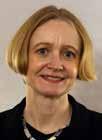
Her Honour Judge Emma Kelly
Emma grew up in Cheshire, where she attended local state schools before reading law at the University of Sheffield. Having no prior connections to the legal profession, she elected to join Lincoln’s Inn as a result of outreach work the Inn was undertaking with her university. She was called in 1997 and practised in Birmingham throughout her career at the Bar, largely at St Philips Chambers. Her practice was predominantly Chancery, with a particular emphasis on property and probate litigation.
Emma was appointed a Deputy District Judge in 2010 and, having developed a taste for life on the bench, became a District Judge (civil) in 2015 and a Recorder (crime and civil) in 2018. In January 2021 she became a Senior Circuit Judge and the Designated Civil Judge for Birmingham. She is authorised to sit as a Judge of the High Court in the King’s Bench and Chancery Divisions. She is actively involving in implementing the Judicial Diversity and Inclusion Strategy, both in terms of outreach work and by promoting a diverse and inclusive culture in Birmingham.
Emma is keen to raise the profile of the Inn with those who study or practise outside London. Her own experience has been that the Inn can feel too distant for those practising in the provinces.
Emma is married (unimaginatively to another Circuit Judge) and has two teenage children. When time permits, she enjoys walking, skiing and travelling.

The Hon Mr Justice Richards
In (hopefully) marked contrast with his later career, Jonathan Richards was an indecisive soul when he was younger. Having been at comprehensive schools in Cambridgeshire, he started at Balliol College Oxford in 1989 reading English literature. However, the absence of right answers in this discipline bothered him and he switched to Mathematics, graduating in 1992. He then joined Linklaters as a trainee solicitor and became a partner there in 2005, practising tax law. After Linklaters, he became a partner at Ernst & Young leaving private practice in 2015 to be a full-time judge in the First- tier Tribunal (Tax Chamber). He was appointed to the Upper Tribunal (Tax and Chancery) in 2018, a Deputy High Court Judge in 2020 and a High Court Judge (assigned to the Chancery Division) with effect from 11 January 2023.
As well as a love of the law (and a particular interest in tax law) Jonathan enjoys chess, bridge and classical music. He firmly believes that children benefit greatly from learning to play chess as it teaches concentration, sportsmanship and that actions have consequences. He put this idea into practice, teaching his younger daughter to play.
Now that she is a good player, who is shaping up to beat him quite soon, he is starting to wonder whether it was such a good idea after all.

Richard was the first in his family to attend university, studying law at Manchester before qualifying in 1994 as a commercial litigation solicitor with Jaques & Lewis (later, Eversheds London). He joined Allen & Overy in 1997, becoming a partner there in 2001, specialising in commercial litigation and arbitration.
His diverse practice included acting for witnesses before major public inquiries (BSE, Hong Kong Airport and Bloody Sunday) as well as representing clients in heavy insurance, shareholder and construction litigation and arbitration. He also specialised in arbitrationrelated disputes, including in the UK Supreme Court.
He was appointed as a Recorder (crime) in 2018 (South Eastern Circuit) and Deputy High Court Judge in 2019 (authorised to sit in the Chancery and King’s Bench Divisions). He has also sat as a commercial arbitrator.
In 2019, Richard returned to higher education, attending Cambridge University to study for the Master of Law degree.
In February 2023, he was appointed as a High Court Judge, assigned to the Chancery Division.

Margaret McGowan-Smyth
Margaret was lucky enough to be the Inn’s first scholar to the newly functioning International Criminal Court during her criminal pupillage. She took tenancy in crime and maintained her links with the Inn through the Euro Group. Margaret then moved in-house in the Home Office, enjoying being at the cutting edge of domestic law-making. For the past 10 years, she has been at the Foreign, Commonwealth and Development Office (FCDO), advising various Foreign Secretaries on a full gamut of public law and public international law issues. She was the legal counsellor to the UK Mission to the UN and other international organisations in Geneva and has represented the UK in numerous international fora. She is also a member of the Bar of the Republic of Ireland.
Margaret has been actively involved in the Inn’s education programme for many years, focusing on pre-call student activity. She has also continued her involvement with the Euro Group, including the scholarship programme. She is delighted to be joining the ranks of Bencher of the Inn and is looking forward to continuing her involvement in many aspects of Inn’s life.
You can read Margaret’s article about her role at the FCDO on page 44

Samuel Townend KC was called to the Bar of Lincoln’s Inn in 1999 (Hardwicke and Walter Wigglesworth Scholar), the Bar of Northern Ireland in 2014, and took Silk in 2021. He practises in domestic and international construction, engineering and professional negligence work from Keating Chambers, where he has been since pupillage in 1999. He acts as counsel in various forums, in particular, the TCC and Commercial Court, but also in arbitration, adjudication, dispute boards and mediation. He regularly acts as mediator, both at home and abroad, and as adjudicator. Sam has been counsel in some of the leading cases in relation to the Building Act 1984 and in relation to construction adjudication.
Sam was co-chair of the Bar Council’s Legal Services Committee until his election to be Vice-Chair of the Bar of England and Wales for 2023. In 2024 he will be the Chair of the Bar.
He formerly spent many years as a member of the LCLCBA Executive Committee and the Young Bar Committee. As a pupil, Sam was the Treasurer of the Free Representation Unit. In 2006 Sam was elected a councillor of the London Borough of Lambeth and has twice stood for Parliament (Reigate, 2005 and Bristol North West, 2010).

His Honour Judge Unsworth KC
Ian Unsworth comes from a non-legal background. He was the first member of his family to go to University, the then Huddersfield Polytechnic, where he was encouraged to apply to join the Inn after attending an inspiring talk delivered by Sheila Geraghty.
Called to the Bar in 1992 and taking Silk in 2010, Ian specialised in crime and also sports law, on the Northern Circuit. He was appointed a Recorder in 2018 and a Circuit Judge in 2022. He sits as a Judge in his native Lancashire. He has sat as a Disciplinary Chairman for many sporting organisations, including the RFU, 6 Nations, the FA and the Premier League.
As a former specialist jury advocate, and an enthusiastic supporter and user of courtroom technology, he has an interest in the teaching of advocacy in the modern world.
He is keen to assist and encourage students from diverse backgrounds and is hopeful that he can contribute to the Inn’s work on this, particularly in the North of England.
Outside the law, Ian has completed seven marathons and is looking to complete the World Marathon Majors (slowly).

The Honourable A.S. Bell
Chief Justice of the Supreme Court of New South Wales
The Hon. Andrew Bell was sworn in as Chief Justice of New South Wales on 7 March 2022. Prior to being appointed as Chief Justice, his Honour was President of the New South Wales Court of Appeal, having been appointed to that position on 28 February 2019. His Honour is also the Lieutenant Governor of New South Wales, President of the Judicial Commission and a Fellow of the Australian Academy of Law.
The Chief Justice graduated from the University of Sydney with a Bachelor of Arts and a Bachelor of Laws, receiving First Class Honours and the University Medal in both degrees, and was also awarded the Sydney University Convocation Medal. He was awarded a Rhodes Scholarship to Oxford University where he graduated in 1993 with First Class Honours in the BCL, also being awarded the Vinerian Scholarship for first place in that degree. His Honour completed his doctorate the following year with his thesis forming the basis for his subsequent book Forum Shopping and Venue in Transnational Litigation published by Oxford University Press. He is also co-author of Nygh’s Conflict of Laws in Australia
Since 2008, his Honour has been an Adjunct Professor of Law at the University of Sydney Law School and has taught part-time and also published extensively, especially in relation to private international law/conflict of laws, transnational litigation and international arbitration.
His Honour was admitted to the Bar in 1995 and was appointed Senior Counsel in 2006. During his time at the Bar, his Honour had a broad national practice at trial and appellate levels, and was also engaged in numerous international arbitrations. At the time of his appointment to the Bench, his Honour was Senior Vice-President of the New South Wales Bar Association.
Beyond the law, the Chief Justice is an avid cricket fan and was formerly the long- time Chairman of Sculpture by the Sea.

Justice Dhananjaya Y Chandrachud Chief Justice of India
Dr Justice Dhananjaya Y Chandrachud is the Chief Justice of India, taking oath on 9 November 2022. Before his appointment to the Supreme Court in May 2016, he was the Chief Justice of the Allahabad High Court (October 2013 - May 2016) and was a judge of the Bombay High Court (March 2000 - October 2013).
Justice Chandrachud joined the Bombay Bar after obtaining LLM and SJD degrees from Harvard Law School. He was designated as a Senior Advocate in June 1998 and served as Additional Solicitor General of India.
As an advocate he championed the right to privacy, the rights of HIV+ workers and religious and linguistic minority rights and was a Visiting Professor of Comparative Constitutional Law at the University of Bombay.
As a judge of the Supreme Court of India, Justice Chandrachud delivered seminal judgements including on the decriminalisation of homosexuality and adultery, declaration of privacy as a fundamental right, disability, combating caste and gender discrimination, and environmental law.
Justice Chandrachud has been a guest speaker at Harvard and Yale Law Schools and has addressed international conferences including the United Nations High Commission on Human Rights, United Nations Environmental Program, the World Bank, Asian Development Bank and the Association of Asian Constitutional Courts.

Sir Jon Cunliffe
Sir Jon Cunliffe is a former British central banker, diplomat and government official.
He served from 2013 to 2023 as Deputy Governor for Financial Stability at the Bank of England, responsible for: financial stability; the regulation and supervision of payments systems, clearing houses and central securities depositories; the Bank’s international work; and, until 2020, the Bank’s role as the UK resolution authority. Prior to this Sir Jon served in various government official roles including as the UK Permanent Representative to the European Union, advisor on Europe and international financial issues to two British Prime Ministers.
Sir Jon has held a number of international central bank roles: most recently as Chair of the Bank for International Settlements Committee on Payments and Financial Market Infrastructure. Prior to joining the Bank, Sir Jon served in a number of international government roles including as the UK Prime Minister’s representative (‘Sherpa’) to the G7 and G20 leaders’ groups.
Sir Jon has a Master’s and Bachelor’s degrees in English Literature and Language from the University of Manchester and also studied and taught at the University of Western Ontario, Canada. He is married with two grown daughters. He enjoys hiking, skiing and climbing and can often be found in the Alps.
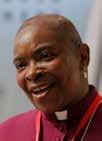
The Rt Rev Rose Hudson-Wilkin CD MBE Bishop of Dover
Rose was born and raised in Jamaica. She was educated at Montego Bay High School for Girls and later completed a BPhil Ed at Birmingham University. She trained with the Church Army and was commissioned in 1982 as an Evangelist; she later trained for ordination at Queens Theological College on their part-time course, ordained deacon in 1991, priested in 1994 and served in the Diocese of Lichfield. For sixteen and a half years she served as a priest in Hackney (Holy Trinity with St Philip, Dalston and All Saints, Haggerston). In 2007 she was appointed as a Chaplain to Her late Majesty Queen Elizabeth. In 2010, she became the first female appointed to the position of the 79th Chaplain to the Speaker of the House of Commons. In November 2014, she took on the additional responsibility as Priest in Charge of city Church, St Mary-at-Hill near Monument.
She is a member of the General Synod of the Church of England and is one of the Panel of Chairs of the Synod. She has twice represented the Church of England at the World Council of Churches (in Zimbabwe and Brazil); she served as the priest representative on the Anglican Consultative Council for 9 years. She also served as a Selection Secretary for the Church of England, helping to select men and women seeking to test their vocation to the ministry. She does numerous preaching and speaking engagements nationally (and occasionally overseas). She was a member of the Broadcasting Standards Commission and has wide experience of media engagement including some religious broadcasting. She is married to Kenneth, a retired prison Chaplain and they have three adult children.
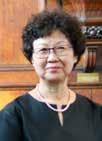
The Hon Justice Dato’ Mary Lim Thiam Suan Justice of the Federal Court of Malaysia and Secretary of the Lincoln’s Inn Malaysian Alumni Association
Justice Dato’ Mary Lim Thiam Suan read law at the University of Leeds, UK and graduated with a LLB (Hons) degree. She has been admitted to Lincoln’s Inn as a Barrister-at-law. In 1993 she obtained her Master of Laws degree from the University of Western Australia. Prior to her elevation to the High Court of Malaya where she sat in the New Commercial Court, her Ladyship served in various capacities at the Attorney General’s Chambers of Malaysia. These include as Federal Counsel, Senior Federal Counsel, Senior Assistant Parliamentary Draftsman, Legal Advisor to the State of Negeri Sembilan, Deputy Head of Civil Division and Commissioner of Law Revision and Law Reform.
Justice Lim was the first Judge of the Construction Court in Kuala Lumpur until her Ladyship’s elevation to the Court of Appeal. She is now a Judge of the Federal Court of Malaysia. Justice Lim is an ardent believer in judicial and legal training and is a qualified advocacy trainer with the Bar Council Malaysia as well as a member of the international faculty advocacy trainers. She has conducted numerous workshops on criminal, civil and appellate advocacy and has twice taught at the Advanced Advocacy Course at Keble College, Oxford. She has also delivered many public lectures on various topics associated with the law, both nationally and internationally.
In January 2023, the Inn hosted a panel event that covered Bencher selection and explored the variety of ways you can volunteer at the Inn. A recording of the event and more information about becoming a Bencher can be found on our website: www.lincolnsinn.org.uk/members/representation/becoming-a-bencher/
"My background is not what one might expect or assume for a Circuit Judge and Bencher, being a relatively young woman from a northern working class background who went to a comprehensive school and was the first generation in my family to go to university.
If you are considering applying for the Bench, I would suggest talking to friendly Benchers whom you know, and to members of the Advisory (Benchers) Committee. If you do not know any Benchers, you may find it helpful to go to student weekends, advocacy training weekends and other Inn events. This will allow you to meet members of the Bench and let them get to know you and what you can bring to the Inn. If you are on Circuit, it may help to get involved with the Inn’s Bencher and junior members and volunteer to assist with Inn events.
My advice would be to apply when you feel that you can submit a Bench register form that demonstrates your suitability to be a Bencher!"
Her Honour Judge Bispham (Bencher since 2019)

Amanda Jeffery, Director of Operations
Responsible for the Inn’s events and hospitality function, security, gardens, projects and communications, the role of the Director of Operations is at the heart of the Inn’s activities. They play a central part in the smooth running of the Inn, in maintaining standards of excellence and in delivering continual improvement in a cost-conscious environment.
“I joined Lincoln’s Inn at the end of November 2023 after a long career in the civil service. Entering the civil service straight from University, I was rather randomly assigned to the then Lord Chancellor’s Department and I spent my first couple of years as a court clerk at the Old Bailey, wearing a wig and gown, taking verdicts and taxing bills from solicitors and counsel. I have stayed within the justice system, in various guises, since that first job; my particular highlights were being Private Secretary to Lord Judge when he was Lord Chief Justice, being appointed as Deputy Secretary to the Leveson Inquiry and acting as Secretary to the Hillsborough Inquests from 2014-2016. I have most recently spent five years as Chief Executive of the Investigatory Powers Commissioner’s Office (IPCO), an organisation most know little about, but which is responsible for the authorisation and oversight of the most intrusive, covert investigatory powers by public authorities.
Those who have already met me will probably have worked out that my two daughters are my proudest achievement. Both left home for University but have come back to take advantage of a full fridge, hot water and regular laundry, as well as easy access to jobs in London without the associated rental costs. They are great company and I am making the most of having them around before they do properly leave me with that empty nest.
Turning to my role here, I am writing this in December 2023 when everything is still very new to me. Although in some ways the move to Lincoln’s Inn feels like a big change for me, the first line of our Purpose – supporting the rule of law and the administration of justice – gives me the direct link from the rest of my career. I have already met so many people who are passionate about their job and I am looking forward to learning more about the mix of responsibilities that fall under my wing. Some areas feel comfortable – governance, project management and communications are familiar territory for me – but there will be challenge and learning for me as I see how they are applied in a different working environment. And I have a lot to learn with some new areas of work such as gardening and catering. I am not sure my rather haphazard attempts in my own kitchen and garden will help. Most of all, though, I am hoping I can help co-ordinate activities across the team and more widely to ensure we are meeting the Purpose, Values and Ambition we have all signed up to. I am looking forward to meeting more of you over the coming months and working on all of this together.”
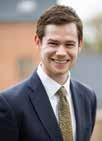
Henry Skinner, Director of Estates
Responsible for maintaining and managing the Inn’s built estate through the implementation of strategic policy and long-term planning, the Director of Estates provides guidance, direction and support to direct reports responsible for property management, external and internal maintenance and refurbishment projects and facilities management to ensure that the overall objectives of the Inn and the department are met.
“I have worked at Lincoln’s Inn for a little over 7 years, initially joining as an Estates Surveyor but for the majority of my tenure holding the position of Head of Projects and Facilities Management, working closely with colleagues in the department to develop and implement strategies for planned building fabric and plant maintenance. In April 2023 I took on the role of Director of Estates.
The foundation of my career in the built environment was laid when I left home at 18 to study stone masonry in Dorset. I practised masonry for 4 years, half of that time spent working on a banker (a discipline specialising in the manual reproduction of architectural stonework) and the other half learning about architectural history, geology and surveying. It was during this time that set myself the goal of becoming a chartered building surveyor and promptly on completing my masonry studies enrolled on to a part time building surveying degree. While studying, I spent time working for Historic Royal Palaces, based at Hampton Court Palace and the Tower of London, and later joined a graduate scheme run by a major multidisciplinary firm in the City, where I developed a broad understanding of building surveying professional practice and services as well as qualifying as a chartered building surveyor.
Since being at the Inn I have led on several major projects. One recent and notable project was the external works to the Great Hall and Library building, which ran through the height of the pandemic, from March 2020 to November 2022. What most will not know is that a great honour was bestowed upon me for my contribution to the delivery of the project: a gargoyle beyond repair on the west elevation of the hall was replaced by a new one carved in my ‘loose’ likeness (by agreement and approval from the Estates Committee). I am not sure it is obvious that it is supposed to me – but perhaps that is a good thing!
Maintaining and improving the Inn’s estate requires thoughtful and considerate planning to ensure effective prioritisation of fabric maintenance while not losing sight of long-term objectives such as energy performance and accessibility, both of which are essential to ensure the Inn’s portfolio stays relevant in an ever-changing world. I am looking forward to the challenges that lie ahead, and I am truly honoured to be charged with custodianship of the Inn’s buildings.”

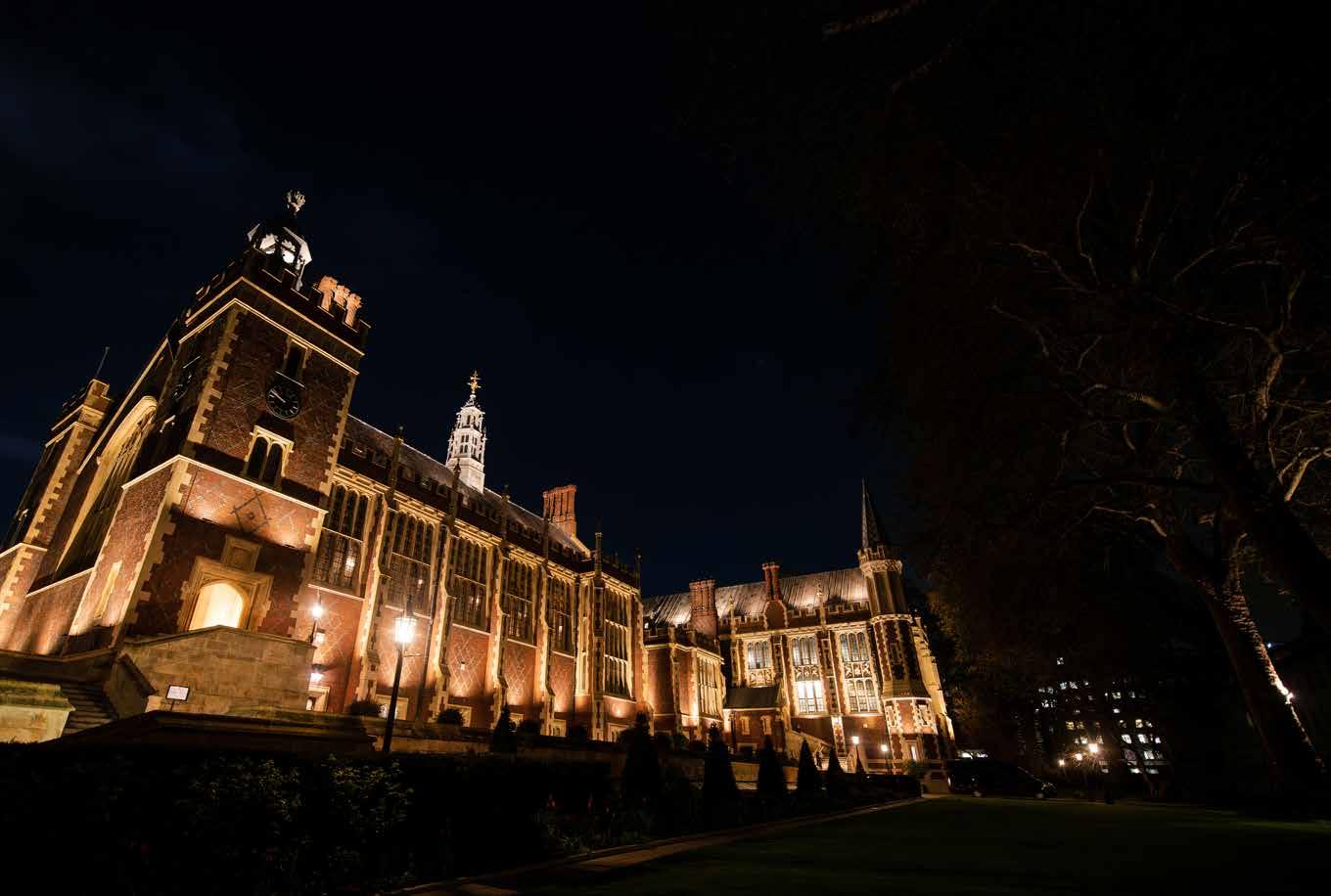
This year saw the publication of the fifth volume of the Inn’s annual Student Law Journal. Submissions for the law journal can be on any legal area of interest. In addition to selection for inclusion in the law journal, there is a prize for the overall winner.
Winner
Zain Sheikh (with his essay ‘Law of misuse of private information: Is the current balance struck between press freedom and a person’s right to privacy appropriate?’)
This competition gives students the opportunity to present a plea in mitigation on behalf of an historical or fictional character under timed conditions. Previous cases used include Guy Fawkes (conspiracy to cause an explosion), Lady Macbeth (soliciting a murder) and Goldilocks (burglary and criminal damage).
Winner
Youssef El-Guindy (with his plea in mitigation of King Herod, who was accused of the murder of young children in the Bible).
This is an internal debating competition to find the best debating team in the Inn. Four teams compete in the final, each comprising of two speakers. The eight finalists are selected following an open competition which all student and pre-pupillage members of the Inn are permitted to enter. The eight finalists are told the motion for debate and randomly allocated their speaking positions on the night.
Winners
Kadira Pethiyagoda and Nimansa Thalduwa (representing the 1st Opposition Team against the motion ‘This House Would Rejoin the European Union’).
You can find out more about debating at Lincoln’s Inn in our short film, ‘Inside Debating at Lincoln’s Inn’ on our YouTube channel: www.youtube.com/@lincolnsinnofficial
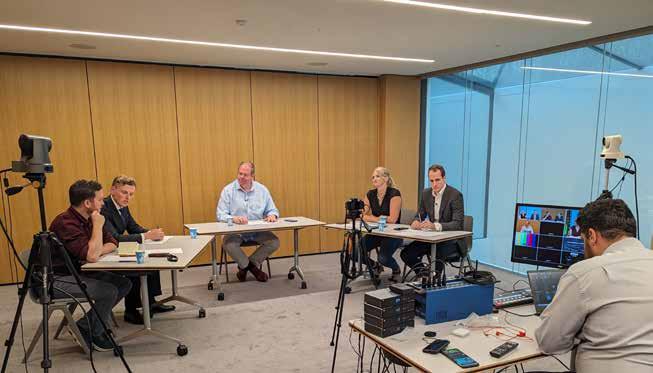
This competition aims to find the best mooting team from each of the Bar Course providers. Preliminary selection rounds are held for Lincoln’s Inn students at the BPTC providers, using a speed-mooting system. The two highest scoring students go through to represent their provider in the final rounds, when the teams compete against each other to decide the winning team.
Winners
Sebastian Dack-Owens and Harry McCourt (competing of behalf of BPP London).
Runners up
Allana Bennison and Mary Collingridge (competing of behalf of The University of Law, Bristol).
The Sir Louis Gluckstein Prize is awarded to the best junior advocate at the Inn. It is open to current Bar Course students and those up to one year Call. Competitors are asked to prepare two exercises, a mixture of criminal, civil and family, and are allocated randomly. The competition consists of an initial round from which the judges select up to eight participants to compete in the final.
Winner
Dominic Shingler
Second place
Helen Bunce
Third place
Owain Cooke
Neuberger Prize Winners
• Anisa Zina, Birkbeck University
• Beata Choraza, Wrexham Glyndwr University
• Caoimhe Mckay, University of Ulster
• Ethan Naish, University of Essex
• Jessica Linton, Leeds Beckett University
• Jessica Lockwood, Aberystwyth University
• Rosemina Din, Teeside University
• Ryan Zwetschnikow, Staffordshire University
Helen Grindrod Social Mobility
Prize Winners
• Amani Loonat, City University London
• Eeman Dad, Northumbria University
• Esther Olupona, University of York
• Florence Goodayle, Brunel University London
• Jardine Barrington-Cook, Oxford University
• Jordan Kiss, Durham University
• Kiera Hammond, University of Sussex
• Levon Curtis, University of Exeter
The winners of both Outreach prizes were invited to Lincoln’s Inn for a three-day Summer School, which took place from 12-14 July 2023.
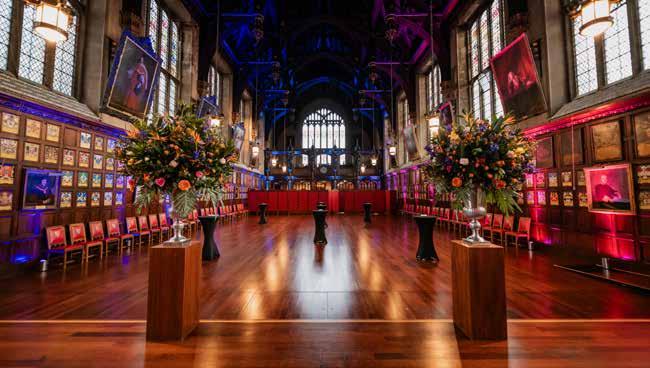
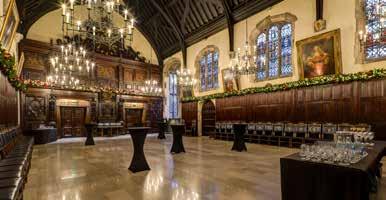
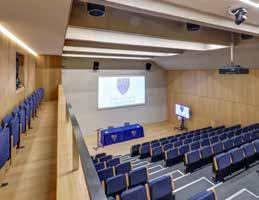
Our award-winning hospitality team are renowned for creating and delivering exceptional corporate events, innovative fine dining experiences and spectacular weddings that leave lasting memories.
Please contact our Events Office for
further information on your exclusive member discount.


eventvenues.lincolnsinn.org.uk
events@lincolnsinn.org.uk
020 7405 5969
Facebook Lincolnsinnevents
Instagram @lincolnsinnevents
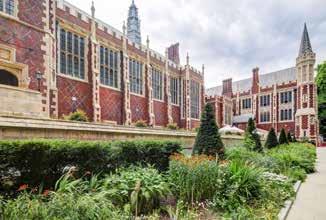

By Faye Appleton, Director of Membership and Education
2023 was our first full year without a significant COVID impact since 2019. It was another busy but successful year. We have continued to develop and improve the programme of activities and build on our experience of the right mixture of in-person and online activity.
As ever, our weekend courses for students, pupils, and new practitioners were particular highlights. These residential courses include a packed programme of teaching, but also have the added benefit of freeing trainees from distractions and allowing them to spend time outside of the sessions with their peers and tutors.
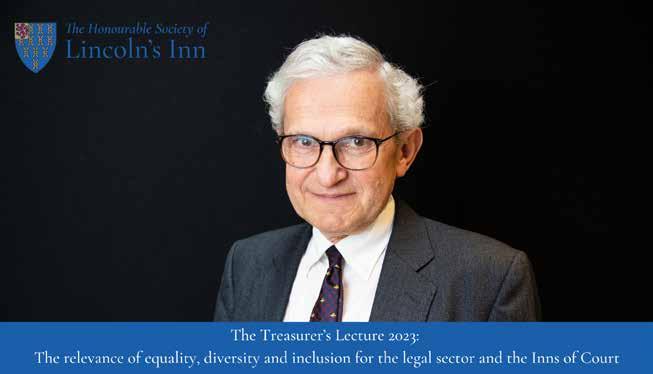
We had a full programme of lectures, both specifically for students and for our entire membership. Notable lectures this year included the Thomas More Memorial Lecture, the Sir Mota Singh Memorial Lecture, and the Treasurer’s Lecture. The Thomas More Lecture was given by Judge Angelika Nußberger, former Vice-President of the European Court of Human Rights on “Human Rights – Universalism in Retreat?”. The Sir Mota Singh Memorial Lecture took the form of a conversation between The Rt Hon Lord Justice Singh and special guest Anita Anand about the importance of remembering the history of the British Empire as part of our shared history. The Treasurer gave his lecture on the relevance of equality, diversity and inclusion for the legal sector and the Inns of Court. Transcripts and/or videos of these lectures and many others are available on the News & Media section of our website: https://www.lincolnsinn.org.uk/news/

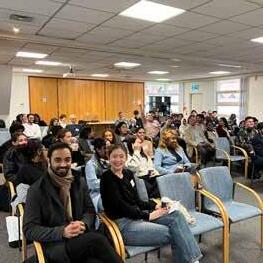
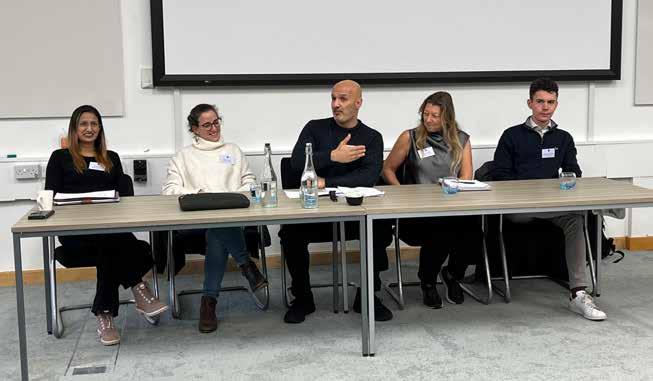
Our member engagement programme has continued to develop and grow. We aim to provide a mixture of professional development, career support, diversity and inclusion activities, and social and networking opportunities. Highlights in the 2023 programme included events celebrating 100 years of women being Called to the Bar by the Inn, a workshop on making evidence-based applications for panels and judicial posts, Circuit Dinners in Birmingham and Cardiff, and the Diversity Dinner celebrating South Asian Heritage Month (SAHM).
We published the results of our first survey of members’ experiences of equality, diversity, and inclusion at the Inn: https://www.lincolnsinn.org.uk/news/equality-diversity-and-inclusion-survey-report/. The results made for sobering reading, but it is better that we know when there are issues at the Inn, and we have developed an action plan that we will be implementing over 2024.
We launched a new prize for undergraduates this year. The Helen Grindrod Social Mobility Prize aims to improve access to the profession for high achieving students from less advantaged backgrounds. The prize winners take part in a summer school programme at the Inn, they are given a mentor, and have a minipupillage arranged for them.
You can read more about all aspects of our work in the committee activity section of this Review and in the reports on equality, diversity, and inclusion (page 34) at the Inn and the Bar Representation Committee (page 46).
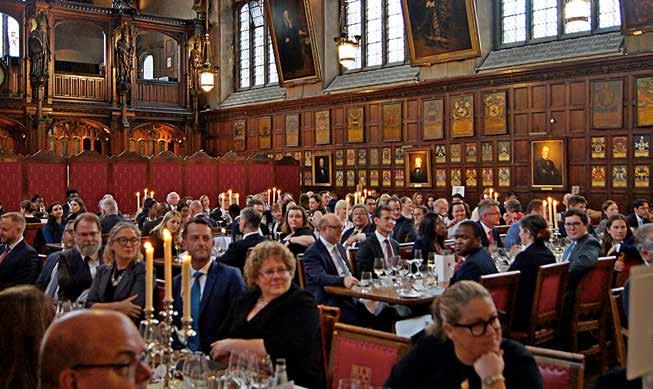
We could not do what we do without the support of our members, and everyone in the Department is very grateful to all the members who contributed to our programmes this year. After a record year last year, our student numbers and scholarship applicants have levelled off but remained high. This means we have a continued high demand on our volunteers, as well as on the Department. However, we are making progress on increasing the number of members who volunteer with us. This year we invited 380 volunteers to our annual Contributors’ Dinner, which is the highest number since I have been at the Inn. Thank you to all our volunteers for their giving up so much of their time to the Inn and supporting their fellow members and the future generation of barristers. We are always looking for new volunteers and given the increased demand, this is more important than ever.
You can view more photos from the Contributors’ Dinner by visiting Nick Easterman’s Flickr album: https://www.flickr.com/photos/64305453@N02/albums/72177720309307330/
We understand that as busy practitioners there will be many calls on your time, but I ask that, if not already involved, you consider taking part in the Inn’s education and membership activities. All volunteers are welcome, and we are particularly keen to increase involvement from employed barristers, barristers practising outside of London, and those from under-represented groups. It is important that we have representation of as wide a range of practitioners as possible on our teaching teams, speaker panels, and interview panels.
We arrange around 150 events each year, as well as a variety of schemes that support members of the Inn, and we could not run any of these without the contribution of many Bencher and barrister members of the Inn. This includes attending our outreach events and talking to students considering the Bar as a career, providing advocacy and ethics teaching to students, pupils, and junior barristers, sitting on panels, or giving lectures, and providing mentoring or careers advice. All the activities are rewarding and can be a lot of fun. Many of them also give you the opportunity to meet your peers practising in other areas, both geographically and legally. These are just some examples of how you can help:
• Teaching advocacy
• Facilitating ethics, case analysis or vulnerable witness handling sessions
• Mentoring
• Offering marshalling placements
• Providing pupillage application advice
• Giving careers talks
• Interviewing scholarship candidates
• Writing new exercises, ethics scenarios, and moot problems
We also provide an increasing amount of activity on Circuit, including scholarship interviewing in Birmingham and Manchester and student advocacy and ethics sessions across the country. So, even if you are not able to get to the Inn very often there are still ways you can help.
There is more information about the events and activities you can assist with and a primary contact in the Department for each on the volunteering page in the members section of our website. You are also very welcome to contact me if you are interested in helping or want any more information.
Faye Appleton, Director of Membership & Education Faye.Appleton@lincolnsinn.org.uk www.lincolnsinn.org.uk/members/volunteering
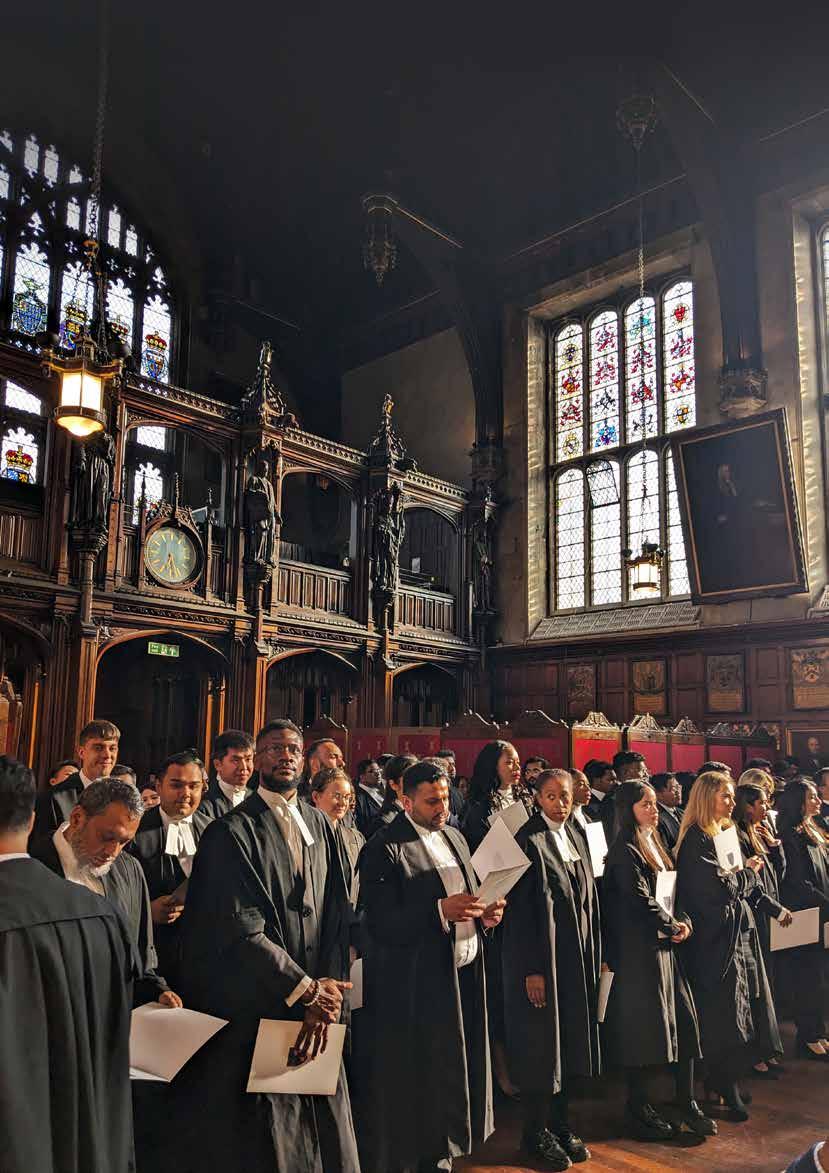
Congratulations to the 753 students called to the Bar at Lincoln’s Inn in 2023:
• 148 on 16 March: www.lincolnsinn.org.uk/news/call-to-the-bar-hilary-term-2023/
• 228 on 27 July: www.lincolnsinn.org.uk/news/call-to-the-bar-trinity-term-2023/
• 170 on 12 October: www.lincolnsinn.org.uk/news/call-to-the-bar-deferred-trinity-2023/
• 207 on 23 November: www.lincolnsinn.org.uk/news/call-to-the-bar-23-november-2023/

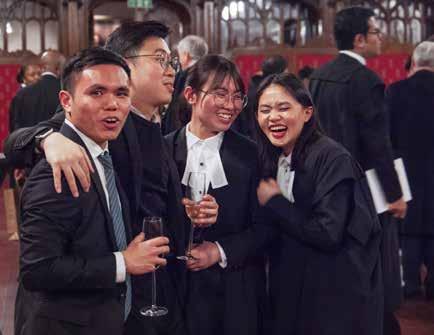
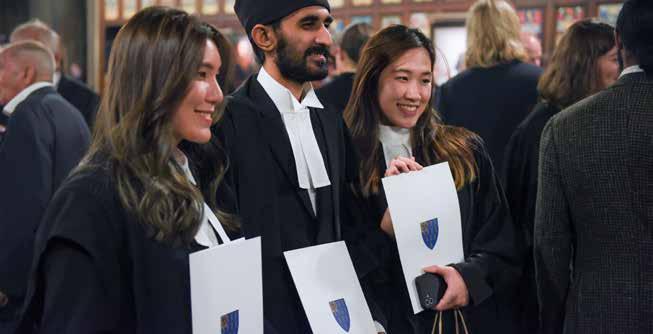
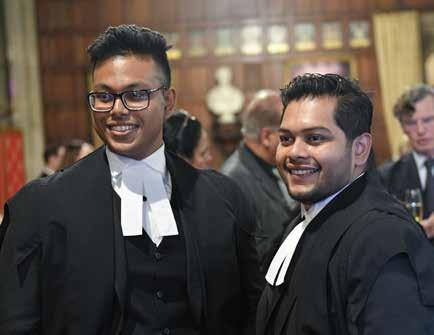
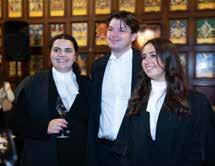
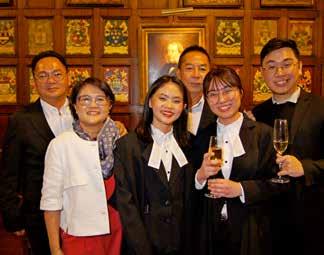
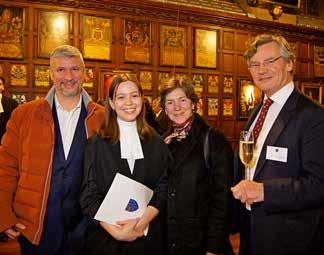
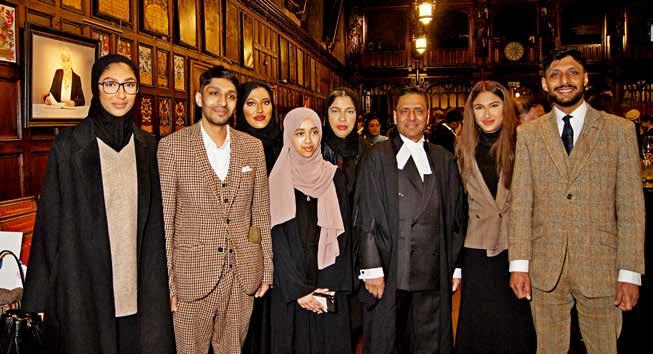
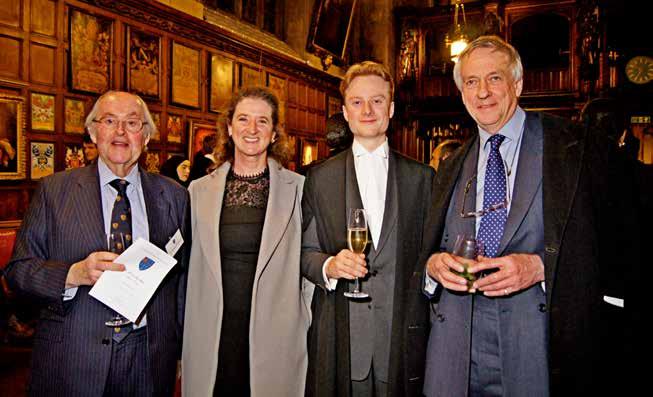
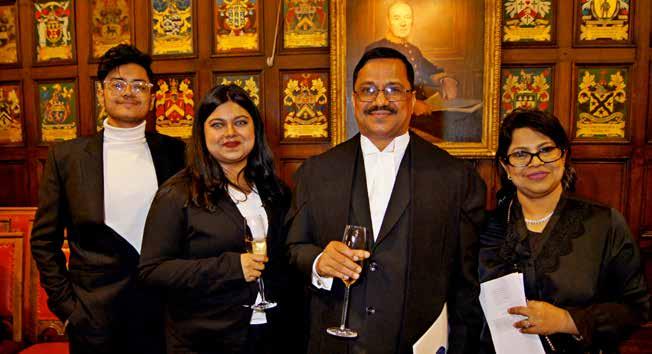
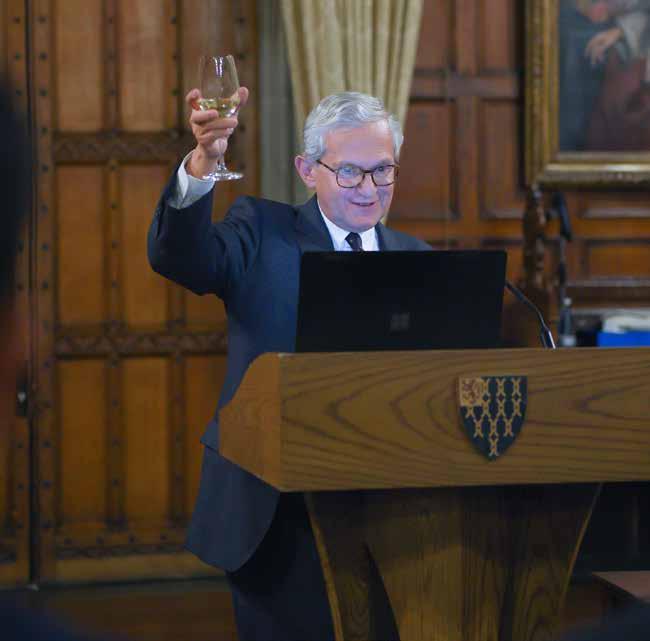
It is customary for the Treasurer of the Inn to give a speech at Call. This year, at the request of a number of those Called, we are delighted to publish the speech of 2023’s Treasurer, The Rt Hon Sir Geoffrey Vos, Master of the Rolls and Head of Civil Justice.
“I start by congratulating you all once again on being called to the Bar today. If I recall correctly the day many years ago when I was called to the Bar – the 28 July 1977 – to be precise – it was one of the proudest moments of my life. I am sure that you all feel justly pleased with your achievement. It is, though, as I shall say in a minute, very much only a staging post on the longer and even more exciting journey of practice as a barrister and a lawyer.
May I, then, formally welcome all of you newly called barristers and all the members of your family to Lincoln’s Inn. I very much hope that you are enjoying and appreciating the surroundings here at Lincoln’s Inn as much as we do. It is a true privilege for the Benchers of the Inn in general, and me in particular, to operate day by day in such a beautiful and historic environment.
Perhaps it would put the history in perspective if I told you that I am the 516th Treasurer of Lincoln’s Inn since 1422 – and I am the 98th Master of the Rolls since 1286. I find these small facts both fascinating and humbling. I so much hope that all of you will aspire to follow in my footsteps. Becoming a barrister here at Lincoln’s Inn is a truly historic experience.
I very much hope also that you will return to the Inn as often as you can in the course of your future career – wherever that may take you. I can promise you one thing – whenever you do return, you will be extremely welcome. The Benchers, barristers and staff of the Inn are all dedicated to staying in touch with every one of our members whether you practice here in London, outside London but In England and Wales – or outside the UK. Indeed, last September, I visited our Lincoln’s Inn alumni in Malaysia. The Under Treasurer and I had a marvellous trip and were made extraordinarily welcome.
At this point, I would like to say something to your families. Sometimes young people in general, (and young barristers in particular) forget how much support is provided for them by their families. I am sure none of our newly called barristers here today will make that mistake. Education and study is a hard road for everyone, and I want to thank you for standing behind your very own newly called barrister in so many ways so as to have enabled them to reach this highly significant point in their legal careers. I am sure you are very proud of them, and your pride is matched, and perhaps even exceeded, by the pride that I feel and all the Benchers of the Inn, feel for their achievement.
I mentioned a moment ago about this being a staging post. It certainly is. There is much more ahead of you than behind you. Some of you – most of you I hope - will already know where you are going – what your next steps will be on the road to practice as a barrister of Lincoln’s Inn and as a lawyer.
Let me be serious for a moment. In many ways, whatever steps you now take do not matter, because there is one overarching thing that does matter – and applies to each and every one of you. That is the responsibility that you now bear as a barrister of Lincoln’s Inn. You owe this responsibility to your future clients, to the courts in front of which you will appear, and indeed to everyone with whom you will have dealings as barrister of this Inn. Your responsibility, which will stay with you all your life, and affects us all equally, is to behave with total integrity in all you do, at all times and in all situations, professional and personal.
When you are faced, as you will be more often than you may now know, with a difficult decision as to how you should behave, remember today – please remember what I am now saying. It is perhaps the most important thing you will ever hear. You must always behave correctly and act in the way that you know is the way of honesty, integrity and honour. That is what you have learnt in becoming a barrister. Never forget it. It applies wherever you may go and whatever you may do. Everyone dealing with you will know that you have been published as a barrister of Lincoln’s Inn. They will expect high standards of you. I am sure that they will not be disappointed.
My father, who was not a lawyer, and who died nearly 50 years ago, used to put it this way. Always do what you know, in your heart, is the right and honest thing to do, and you will be alright.
Good reputations are hard to gain but easy to lose, so it is as well to hear this message loud and clear today. Being a barrister of Lincoln’s Inn gives you in the eyes of the world a badge of integrity. Please, please make sure that you live up to these high expectations.
That is the end of the lecture. Let me say that I have no doubt that you will give your family and friends, your professional colleagues, this Inn and yourselves every reason to remain proud of you.
You will remain members of the Lincoln’s Inn family for life. I have friends and colleagues here that have known since I started studying the law in 1973. The same will be true for you in 50 years’ time.
The Inn will help you whenever we can. But to enable us to do so, you must keep in touch. There is a regular electronic newsletter and a new website. Please look at them from time to time. Please visit us here whenever you can. Please keep your contact details with us up to date.
Let me finish then by asking our new barristers to turn to face their families and supporters and to give them the biggest round of applause possible.
Many thanks. I am now going to ask all the Benchers, friends and family present to raise their glasses and drink a toast to the new barristers of Lincoln’s Inn.
Thank you. Enjoy the rest of your evening.”

By Susanna McGibbon
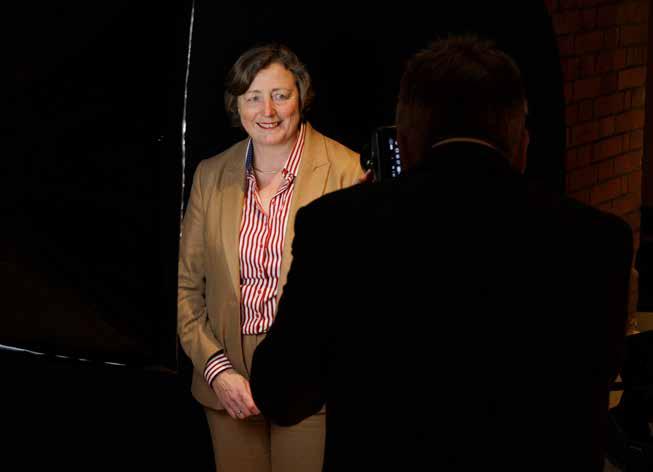
When publishing me as a Bencher of the Inn a couple of years ago, then Treasurer Jonathan Crow KC said that it is a typically British constitutional quirk that the Treasury Solicitor (TSol) neither works for the Treasury, nor is a solicitor . So, what is the role of TSol and how do I spend my days?
Although there is a Treasury Solicitor Act 1876, it does not really shed light on the role and functions of the TSol, it mainly creates a corporation sole to enable me to hold shares on behalf of government departments. For example, as the single shareholder of the Bank of England! Put simply, the Treasury Solicitor heads the Government Legal Profession as the most senior civil service lawyer. As the Permanent Secretary of the Government Legal Department (GLD), I am directly responsible for the provision of legal advice to most government departments2 on policy and legislation, commercial law and employment law as well as conducting litigation on behalf of government departments and agencies.
There are a couple of additional titles that go with the job – His Majesty’s Procurator General (King’s Proctor) with a role under the Matrimonial Causes Act – and Crown Nominee, administering Bona Vacantia.
Fortunately, I have excellent teams across GLD doing the hands-on work. It is a huge privilege to lead GLD, an organisation of around 3000 people, of whom around 2200 are lawyers. Our core purpose is “to help the government govern well, within the rule of law” and in addition to enjoying the fascinating and unique mix of law and politics, believe there is a strong public interest in ensuring the government of the day gets top quality legal advice from an impartial Civil Service.
1
2 Excluding FCDO and HMRC
I am an early riser and like to beat the rush and get to my desk in good time. Most days I cycle, and find the exercise and fresh air sets me up well for whatever the day has in store. I might spend the first hour or so with a coffee, reading the weekly reports that are provided by all teams across the department – updates on the legislation making its way through Parliament such as the now completed Online Harms Act 2023, the latest position on Russian sanctions related litigation or the early advice being provided to a Secretary of State as a new policy is being developed. After a quick catch up with my Private Office to review the diary, resolve any clashes and highlight imminent deadlines, I will head off to my first meeting. That might be a cross Whitehall meeting of fellow Permanent Secretaries chaired by the Cabinet Secretary where we will update each other on significant recent events nationally and internationally, key ministerial priorities and matters concerning us as leaders of the Civil Service. Whilst at the Cabinet Office I might pop in to see the GLD team advising the Cabinet Office on the COVID-19 Inquiry and thank them for their tireless efforts, alongside our litigation group, to co-ordinate the HMG response to the Inquiry as well as supporting individual witnesses, both Ministers and senior officials.
In addition to responding to calls from colleagues to deal with the pressing issues of the day, as you can imagine I have a regular rhythm of engagements to keep in touch with the many teams across GLD. I find it very valuable to hear first-hand from people at all levels of the department on topics as wide ranging as career opportunities, pay, flexible working, diversity and inclusion as well as hearing about their casework or advice. So, a typical day might have me attending a divisional meeting of our specialist statutory instrument (SI) drafters discussing the huge task of implementing the primary legislation enacted by Parliament through secondary legislation.
Drafting legislation is a great example of the unique work of government lawyers and we guard and nurture our specialism keenly. Our SI Hub supports all our advisory teams in tackling their secondary legislation programme – taking on a proportion of drafting projects and also acting as a centre of excellence for drafting practice across the department. Immersing myself in the technical detail of drafting a set of regulations is no longer a feature of my practice – probably just as well – but certainly something I found rewarding in the past!
Continuing the theme of legislation and its unique role in government legal work, GLD colleagues work very closely with the Office of Parliamentary Counsel in the preparation of primary legislation. I therefore have regular interaction with First Parliamentary Counsel, currently Dame Elizabeth Gardiner DBE KC (Hon), who is coincidentally, an Honorary Bencher of Lincoln’s Inn. Together we advise on departmental Bills as well as parliamentary and constitutional matters.
Whilst GLD is a non-ministerial department, the Attorney General is accountable to Parliament for our work. It is therefore an important part of my role to ensure both the Attorney General and the Solicitor General are briefed on the key issues we are advising on and the cases we have before the courts. As well as regular briefing from the teams themselves, that will find me popping over to the AG’s office in Parliament for regular meetings and occasionally catching up over a coffee. The AG, as a former Civil Service lawyer is a great champion of our legal teams and is always keen to promote the fascinating and important work that we do. Like me, she is keen that we continually raise the profile and improve awareness of the Government Legal Profession as a rewarding career choice.
We are both very excited about the opportunities we are developing outside London – in our Bristol, Croydon, Leeds and Manchester offices. I try to work from each of these offices at least once every quarter. As well as meeting GLD colleagues, I enjoy building relationships with the Circuits and local law firms, particularly those on the government panels.
After a day of meetings and telephone calls I might get some time back at my desk to catch up on emails and ensure I have everything ready for the next day. Early evening might see me dropping by the Inn on my way home to attend a Call ceremony or a Scholarships Committee meeting. Otherwise, I may be indulging my love of music at a concert at the Wigmore Hall or meeting up with friends for dinner locally. Sometimes of course there is nothing better than ending the day in front of Death in Paradise…!
Guided by the expertise and commitment of the Inn’s Equality, Diversity, and Inclusion (EDI) Committee, chaired by Chief Chancery Master Shuman, the Inn has made much progress in delivering its EDI action plan for 2022-2023.
This includes harnessing the EDI data that was gathered from our members via a survey that launched in 2022, as well as recording instances of bullying and harassment at the Inn. We have now produced an initial action plan that was shared with our members in November and will be carried out over the next 12 months.
A priority will be to establish a programme of diversity and inclusion training and awareness raising for all Benchers, as well as those who volunteer with the Inn, so as to improve inclusive behaviour and importantly, equip them with the tools to challenge non-inclusive behaviour.
In terms of our objective to take “proactive action to advance the state of EDI within the Inn and the profession more generally”, we collaborated with multiple organisations on initiatives to improve representation at the Inn and within the profession in general.
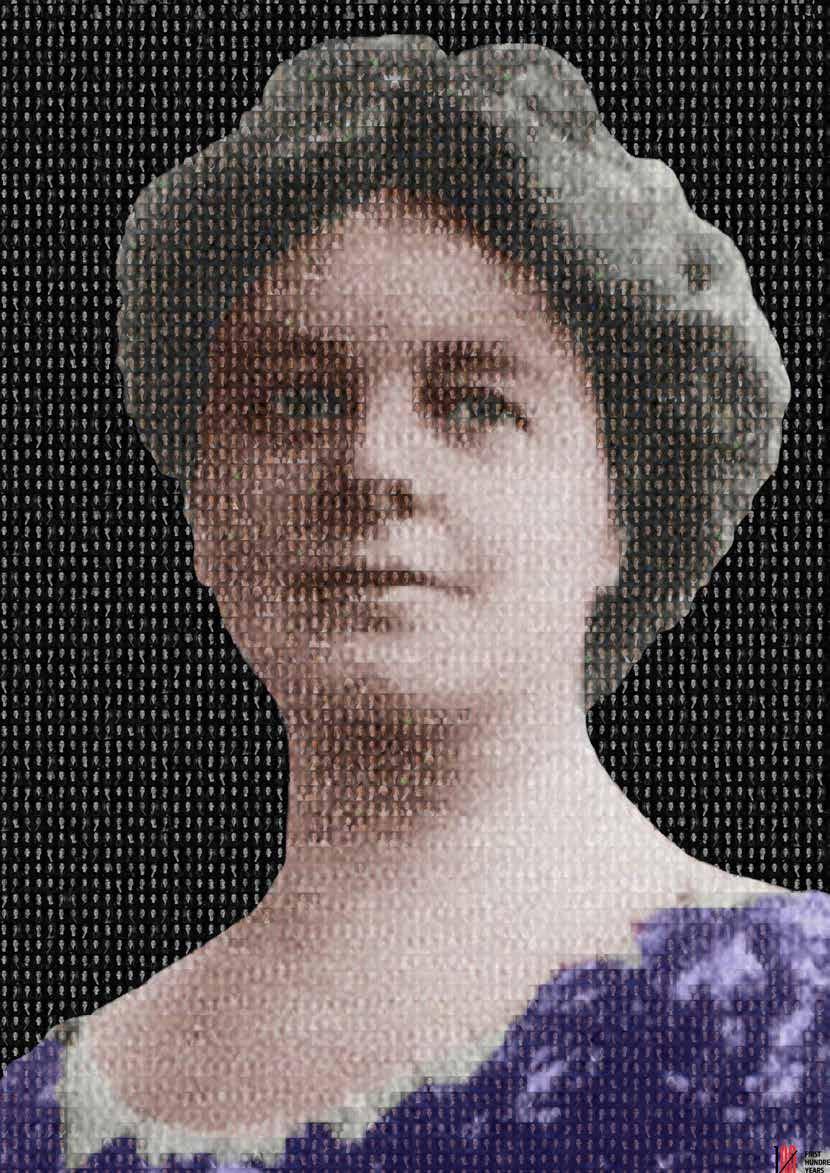
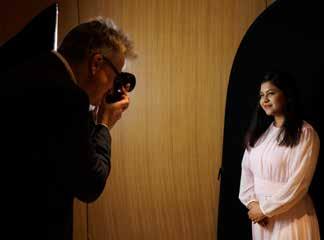
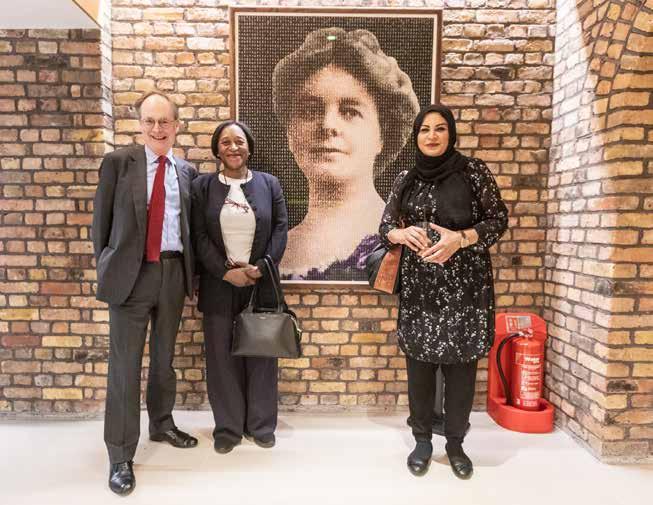
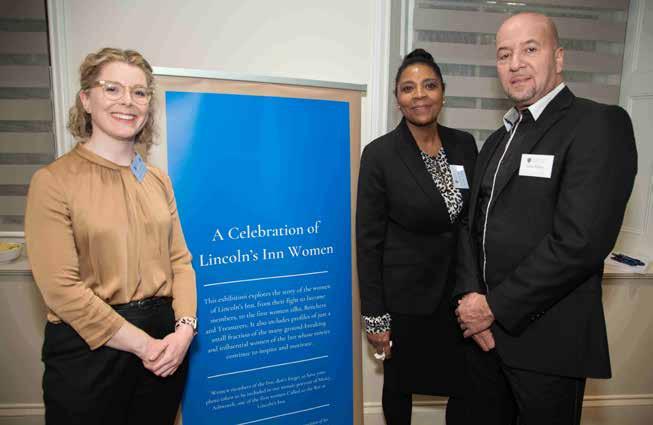
This included producing a mosaic portrait of Mercy Ashworth (featured on the front cover of this Annual Review). We worked with the charity Spark21 on this project and are grateful to Lady Neuberger for proposing it to us as a way to honour the centenary of the first women members of Lincoln’s Inn to be called to the Bar. Spark21 was founded to celebrate, inform and inspire future generations of women in law through multi-media processes, including photo mosaics.
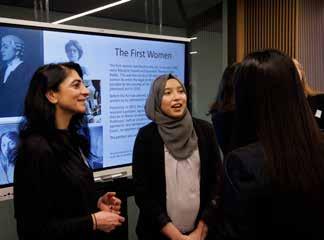
As part of this project, we held three events, in London, Manchester, and Leeds, where our women members were invited to have their photo taken. These photos were then used to create a mosaic portrait of Mercy Ashworth who, alongside Mithan Tata, was the first woman member of Lincoln’s Inn to be Called to the Bar in 1923, and who the Ashworth Centre is named after. An exhibition at these events also highlighted the progress that has been achieved in the legal profession through the stories of some of the most groundbreaking and influential women members of the Inn.
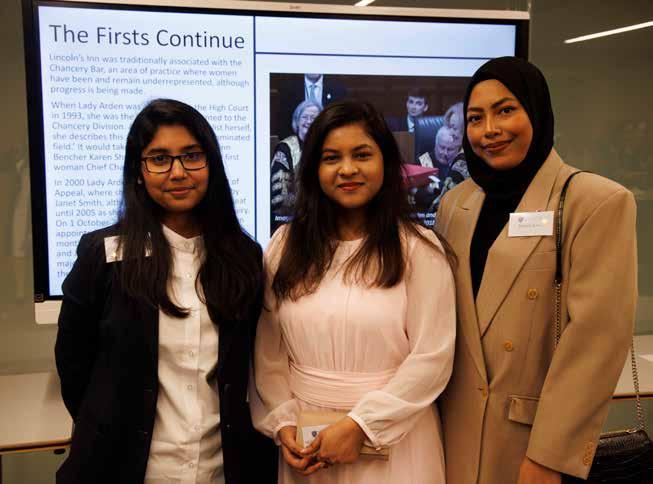
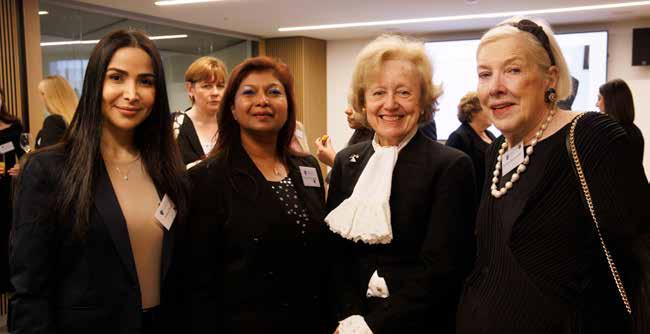
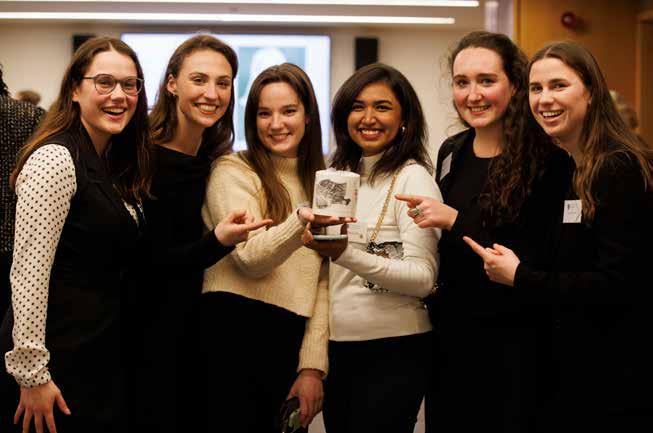
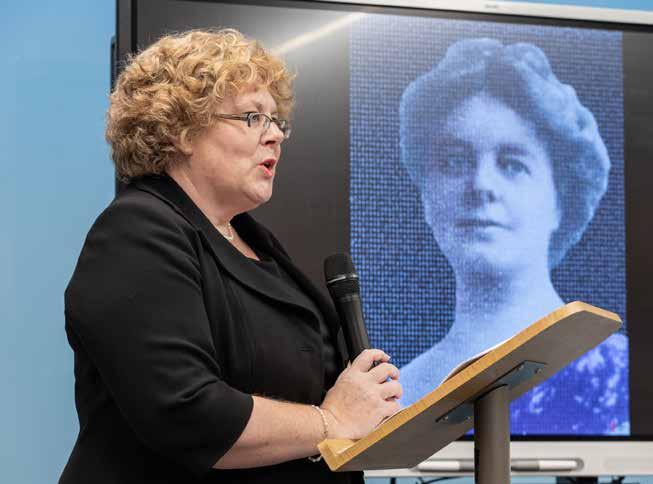
The artwork was unveiled at an event in September. Dana Denis-Smith, founder of Spark21 and First 100 Years (a campaign that celebrates the first 100 years of women in the legal profession in the UK and Ireland) spoke positively of the important signal that our collaboration will send to the profession.
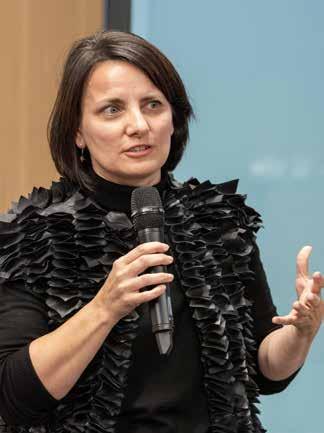
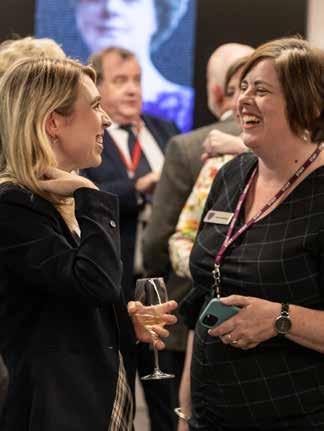
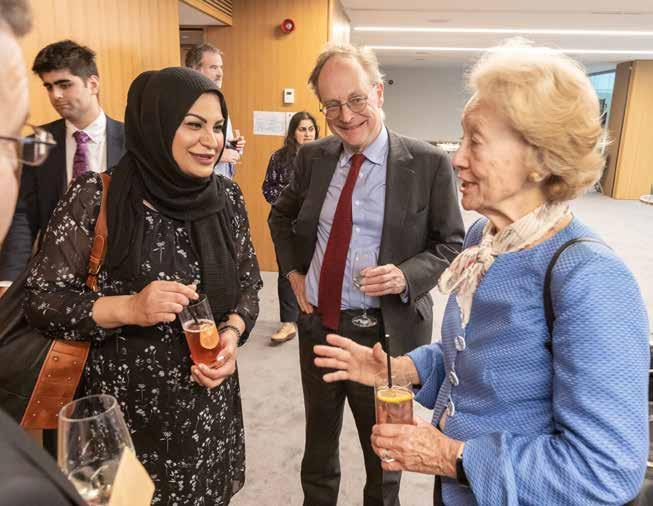
In March, we partnered with targetjobs for Aspire to the Bar as part of our Outreach programme. The event aimed to provide students of Black heritage with the knowledge and connections to help them on their path to the Bar.
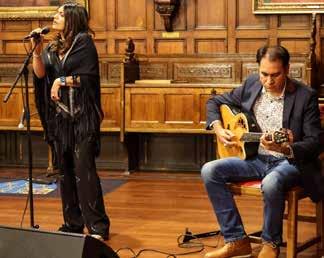
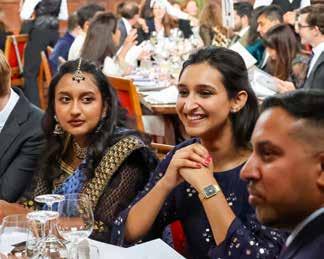
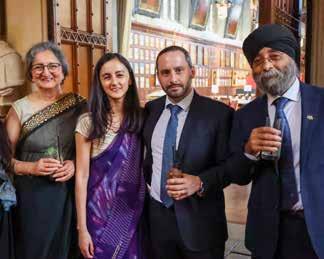
In July we held our third Diversity Dinner, this time to celebrate South Asian Heritage Month (SAHM), an initiative that seeks to elevate the prominence of British South Asian history and heritage. We were delighted to have co-founder of SAHM Jasvir Singh CBE, who is also a family law barrister, to speak about the aims of SAHM. We had entertainment from acclaimed sitar player Tommy Khosla accompanied by live tabla, as well as ghazal singer and Lincoln’s Inn member, Mehtab Malhotra. We opened our Library to guests to show important archive material relating to figures such as Muhammad Ali Jinnah, Muhammad Iqbal, Cornelia Sorabji, and Leila Seth. This display was available for visitors to view throughout the month and proved, along with the dinner, incredibly popular and well-received.


We continued to review and diversify our programme of EDI activities, considering ways we could create our own content to help broaden inclusion. In April, we invited members of the legal profession to attend an event focused on inclusivity and the exploration of practical solutions to make our workplaces and environments more welcoming to all. From the great work that came from those who attended the workshop, we are creating a short practical guide on ways to help make the workplace more inclusive.
The Inns of Court Alliance for Women (ICAW) had an incredibly busy and successful year, selling out events including a panel discussion on ‘Black Women Barristers: The Challenges Faced and a Fairer Future’, and the annual ICAW Garden Party, which this year took place at Lincoln’s Inn. We were honoured to have the Attorney General, The Rt Hon Victoria Prentis, speak at the event, which is an opportunity for women barristers, solicitors, judges, and students to come together to support one another and share the challenges that women continue to face within the legal profession.
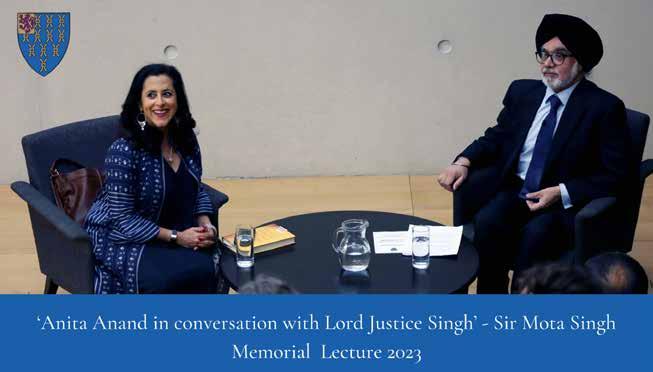
In November, we ended a fantastic programme of EDI-focused qualifying sessions with the Sir Mota Singh Memorial Lecture. Renowned presenter Anita Anand was in conversation with The Rt Hon Lord Justice Singh about the importance of remembering the history of the British Empire as part of our shared history.
Thank you to everyone who has helped support the EDI action plan and our events this year. We appreciate that there is still a long way to go, but we feel like we are making considerable progress in embedding a more inclusive and diverse culture at the Inn, and beyond. We look forward to making further advances in 2024.
Circuit Representatives
The Inn’s Circuit Representatives act as a line of communication between the Inn and our members on Circuit. Their role is to inform, invent and introduce ways the Inn can increase engagement amongst members based outside of London.
In December 2023, the terms of our outgoing Circuit Representatives ended, after four years of service. We would like to express our thanks and gratitude for the time they have given to increasing engagement with the Inn on Circuit.
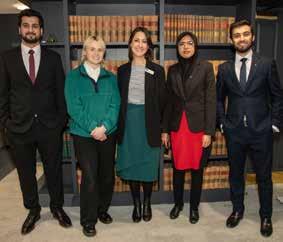
From January 2024, our new Circuit Representatives are:






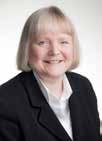



On Friday 21 April 2023, we held a Circuit Dinner at the Ivy Cardiff for our members practising on the Wales and Chester Circuit, and on Friday 21 July 2023, we held a Circuit Dinner at the Hotel du Vin in Birmingham for our members practising on the Midland Circuit.
The events were an excellent opportunity for the Treasurer to meet members based on these Circuits. We would like to thank the former Circuit Representatives for Wales and Chester and the Midlands, Theodore Huckle KC and Cerys Walters and His Honour Judge Neil Chawla and Stefan Fox, for their help in organising and promoting the dinners.
In 2023, we celebrated the centenary of the first women members of Lincoln’s Inn to be Called to the Bar. As part of these celebrations, we took an exhibition that highlighted the progress that has been achieved in the legal profession through the stories of some of the most ground-breaking and influential women members of the Inn to Manchester and Birmingham. You can read more about the exhibition and the mosaic portrait of Mercy Ashworth created from photos taken at these events in the article on pages 34-37 in this Review.
Feedback
The Inn is always keen to get feedback from members on Circuit. If you have any ideas or suggestions for Circuit events or initiatives, please contact your Circuit Representatives or the Inn’s Member Engagement team via members@lincolnsinn.org.uk.

by Justice Dato’ Mary Lim (Secretary) and Dinesh Nandrajog (Asst. Secretary) of the Lincoln’s Inn Alumni Association of Malaysia (LIAAM)
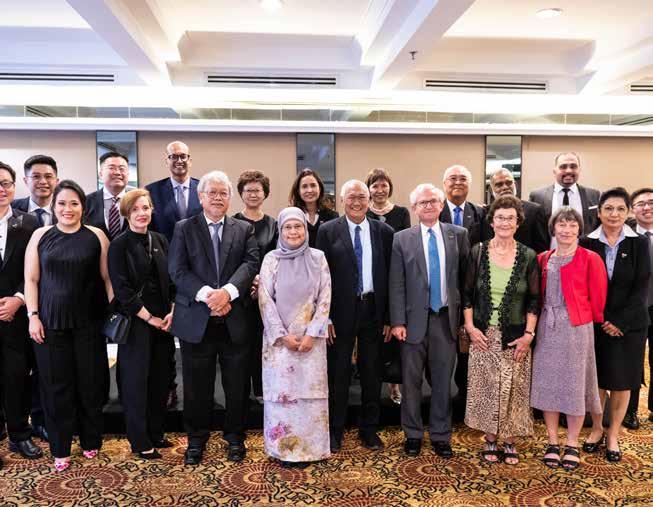
The Lincoln’s Inn Alumni Association of Malaysia (LIAAM) was honoured to welcome the Rt Hon Sir Geoffrey Vos and Anne Sharp in September 2023. This was a notable occasion in LIAAM’s history and a moment of celebration for the Malaysian legal community.
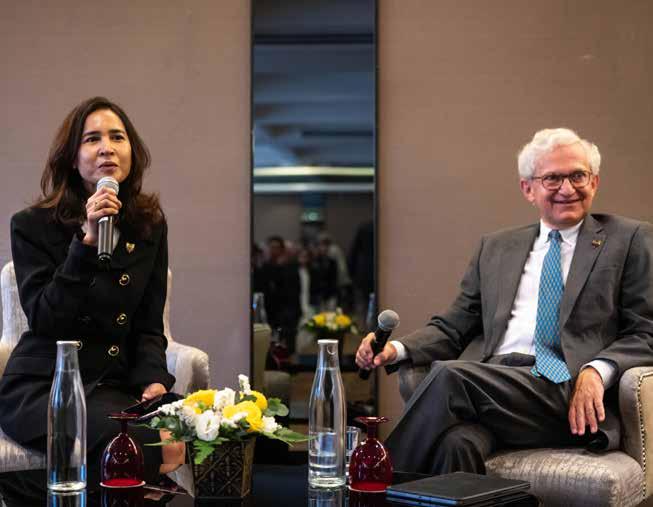
LIAAM hosted the Treasurer as part of its lecture series, ‘Justice in the Digital Age: Navigating Legal Challenges and Technological Innovations’. Set in the Majestic Hotel Kuala Lumpur, the event drew an audience of 250 individuals with diverse representation from within the legal community. Notable attendees included the Chief Justice of Malaysia, esteemed Judges from the Appellate and High Courts, and members of the Malaysian Bar.
Sir Geoffrey’s lecture explored the evolving justice landscape in the context of the digital age and was followed by a Q&A. The presentation touched on various points, including the proliferation of digital disputes and the transformative potential of artificial intelligence in legal practice. The Treasurer skilfully set out a roadmap for all stakeholders in understanding the legal profession’s future trajectory. The lecture series was a positive catalyst for further discussion amongst legal luminaries, including the Chief Justice of Malaysia, on the implications of technology for our legal landscape.
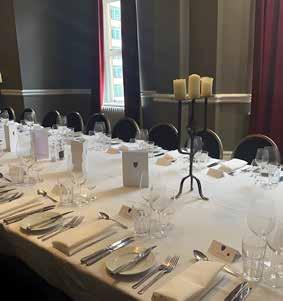
Following the lecture series, LIAAM hosted the Grand Dinner, which was held in the Majestic Hotel’s Grand Ballroom. This event brought together 400 guests, fostering intellectual exchange and camaraderie amongst the legal fraternity. A three-course meal provided the setting for discussions inspired by the preceding lecture, facilitating a smooth transition from the formal court and lecture hall atmosphere to a more relaxed social setting.
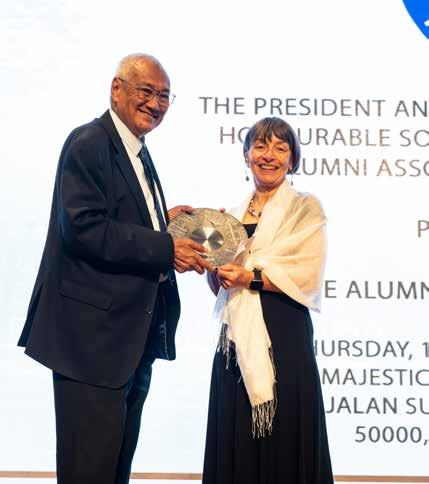
This memorable event was marked by the exchange of tokens between LIAAM and Anne Sharp as a representation of mutual appreciation for the valuable insights shared and connections forged over the evening.
The success of this event has helped to emphasise Malaysia’s leading role in discussions on justice in the digital age. Besides fostering global dialogue, this visit is a compelling reminder that legal practitioners are not observers of the legal profession’s future, but active participators who shape it.
LIAAM extends its gratitude to Sir Geoffrey Vos and Anne Sharp for contributing to the overall success of the Lecture Series. The Malaysian legal community eagerly anticipates future engagements of this nature, which will further enrich ongoing discourse on justice in the digital age. Token exchange to mark the occasion
by Margaret McGowan-Smyth
Legal Directorate in the Foreign, Commonwealth and Development Office (FCDO) is the leading team in Government for international law. Lawyers, both barristers and solicitors, working in the FCDO have a wide range of expertise from diplomatic and foreign relations law to national security law, international humanitarian law, domestic and international human rights law, international criminal law, overseas territories law, international law of the sea, EU law, public law, commercial law, information law, development law, sanctions and trade law.
But what does a FCDO lawyer actually do? One of the differences between the employed and self-employed Bar is that it is not possible to divorce the working day of any given lawyer from the overall objectives of the Legal Directorate. The stated objectives of the FCDO’s Legal Directorate are to: help the government to govern well, within the rule of law, using our expertise and influence to promote the UK’s national interest and maintain our high reputation in these fields; work to shape an open international order, advancing the values of freedom, the rule of law, the integrity of sovereign States, justice and accountability; and work collaboratively with colleagues in the FCDO and across Whitehall to build knowledge of international and EU law and to share best practice on treaty-making.
In practice, this means that in recent times, for example, lawyers have advised on many aspects of the UK’s response to Russia’s invasion of Ukraine, including the use of force, sanctions, potential compensation mechanisms and accountability for international crimes. This specialist legal advice required expertise in public international law, domestic law (e.g. the 2018 Sanctions Act) and public law. Many novel ideas have been considered requiring out-of-the-box thinking and analysis, both domestically and with international partners. Lawyers in the Legal Directorate have also lately been closely involved in the negotiation of the Windsor Framework with the EU, the successful conclusion of UN negotiations for the new treaty on Biodiversity Beyond National Jurisdiction (BBNJ), the FCDO response to the COVID-19 inquiry and lots more.
FCDO lawyers do not advise in a vacuum, but rather work with policy teams in the relevant geographic or thematic department to help in the development of policy options to meet the desired foreign policy objective. This may involve working with lawyers and policy leads in other government departments, where the expertise on a particular issue lies outside the FCDO. It may also involve working with international partners (whether States and/or international organisations eg the EU or NATO) to understand how they propose to approach a particular issue and their legal base for action and to coordinate responses for maximum impact. Involvement in international negotiations, such as the Windsor Framework or the BBNJ negotiations, will mean direct contact with lawyers from other States and international organisations. Not only do our lawyers need to know the law better than anyone else in the room, but they also need to understand how this knowledge and expertise should best be deployed in conjunction with the rest of the UK team in order to further the UK’s foreign policy objectives.
I have worked at the FCDO for over 10 years, including a three-year posting to the UK Mission to the UN in Geneva. Here are some examples of what have been involved in during my time.
In London-based roles:
• Drafting a set of regulations creating a new sanctions regime to further a particular foreign policy aim, based in domestic legislation. Such regulations must be able to withstand parliamentary and judicial scrutiny.
• Liaising with legal advisers from other likeminded States who are involved in the Antarctic Treaty System, in order to coordinate legal responses to those States who wish to undermine the System. One example where knowledge of the law is not sufficient, but rather needs to be combined with political awareness in order to agree a strategy which is most likely to be effective.
• Talking through the UK extradition provisions with an Attorney-General of an overseas territory to understand to what extent they may read across to the territory. If the end result is unsatisfactory on either side, then consideration is needed as to how to remedy any gaps or resolve any issues and what exactly that would involve on both sides.
In a multilateral-based role:
• Drafting speaking notes on a complex international human rights law legal issue to be used by the Ambassador in her interactions with her counterparts, seeking to persuade them to support a UK-sponsored UN resolution. This is an exercise in being precise, concise and persuasive all within the broader political context – what will be appropriate for a likeminded ally will not be appropriate for a middle-of-the-road undecided State.
• Negotiating with hard-line States who misstate international law for their own political purposes. Judging exactly what to say to move the undecided States from supporting the hard-liners to supporting the UK position, in keeping with international law.
Varied? Undoubtedly. Challenging? You bet! Representing the UK on the international legal stage is the most privileged job I can imagine as a barrister.
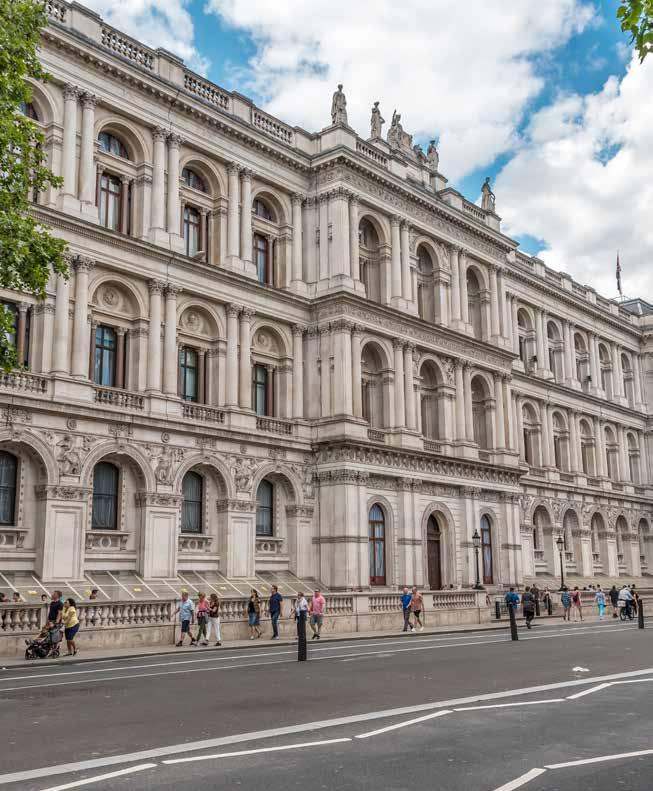

By Laura Gould, BRC Chair (August 2022 to August 2024)
was thrilled as a member practising from chambers outside of London to be elected Chair of the Bar Representation Committee (BRC) in summer 2022. My election is one of the many signs that the Inn is committed to providing an excellent service to all its members, not just those based in and around legal London. Through its various committees and departments, from education to equality, diversity and inclusion, the Inn continues to take steps to reach out to its members on all the Circuits of England and Wales and beyond. Much of this work is contributed to by the sub-committees of the BRC: Social and Wellbeing, Social Mobility, and Junior Members.
Following technological developments over recent years, the Inn continues to provide member engagement activities on a hybrid basis wherever possible, but members and staff have also enjoyed a return to in-person events both within the Inn and outside of London. This has included the Treasurer’s dinners in Cardiff and Birmingham, a successful student teaching weekend in Leeds, and a return to shorter in-person teaching events at various Bar Course providers.
This year’s BRC AGM was held in Manchester, the first time it has been held outside of London, and I am grateful to those staff and members who attended, both in person and online. The BRC rules were updated so that the Junior Circuit Representatives appointed by the Treasurer for the Northern, North Eastern, Midland, Wales and Chester, and Western Circuits will automatically become members of the BRC upon their appointment. This will ensure that our Junior Circuit Representatives are best able to represent the Inn on Circuit, to understand and learn about the governance of the Inn, and to provide the best support, insight, and service to the members they represent.
It is an incredibly difficult task to manage the Inn, its estate, activities, students, and the barristers that form the Inn. We are all indebted to the Inn’s staff for their hard work and the dedication that they show to ensure that the Inn is well run and secured for future generations.
I look forward to seeing many of you at the Inn and at our many events across the Circuits during the remainder of my term at Chair. Please, engage, enjoy, and benefit from what the Inn can offer you and help to re-introduce a colleague to our fantastic institution.
Members (January 2024): Laureen Husain (co-chair), Linda Turnbull (co-chair), Emma Southern, Benjamin Hamer, Sheila Watson, Julie Whitby, Alice Hawker, Chris Loweth
In March, the Group organised a ‘Building Resilience at the Bar Throughout Your Career talk’, in partnership with the charity LawCare, to discuss personal experiences around mental health and techniques to improve this in professional life.
In September, they held a joint hybrid event with the Family Law Bar Association on managing vicarious trauma and stress at the Bar.
The Group held the annual Member’s Quiz Night in November 2023, which was well attended and excellently hosted by our Outreach Coordinator, Alexis Friday. The group will host the event on a Thursday in 2024 and vary the food options to allow us to lower the ticket price.
The Gourmet Dinner was held in December 2023 and featured a delicious array of food, allowing the Inn’s chefs to show off their culinary skills. The next Gourmet Dinner will be held on Friday 19 April 2024.

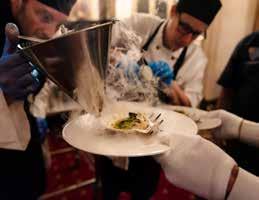
Members (January 2024): Benjamin Hamer (co-chair), Hazel Jackson (co-chair), Adam Kayani, Craig Fahey, Imogen Sadler, Leo Graves, Olivia Waddell, Rifat Rahman
In February, the group held their annual ‘Financial Management for Pupil Barristers’ event, which aims to inform current and future pupil barristers on how to manage their finances as self-employed earners.
The group also held an event in April on ‘Second Six and Beyond’, a panel event aiming to inform pupil barristers on their options after their second six months of pupillage.
In June, the Inn hosted the Junior Members’ Summer Dinner in the Old Hall, followed by music and dancing.
The Sub-Committee held a ‘Pathway to Pupillage’ event in November where a panel of junior members discussed previous roles and experiences they had undertaken that helped with their applications for pupillage. The event was very well attended, both in-person and online.
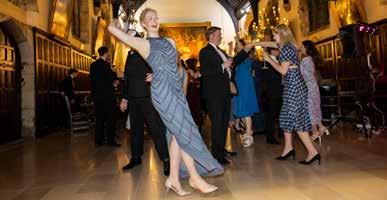

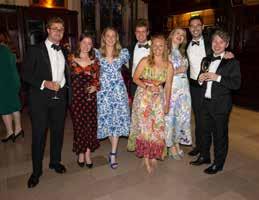
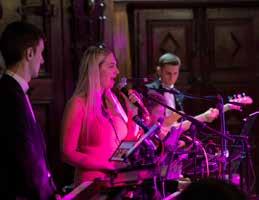
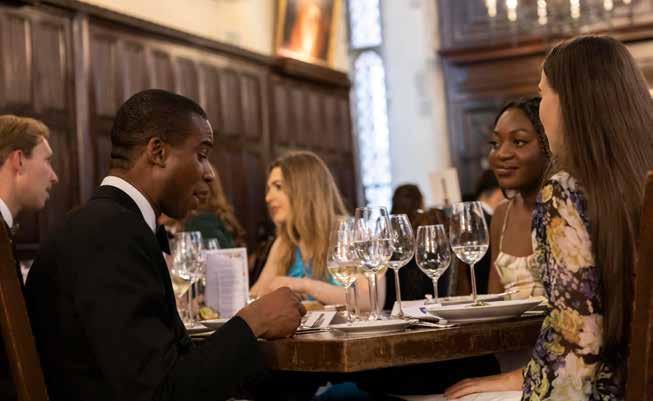
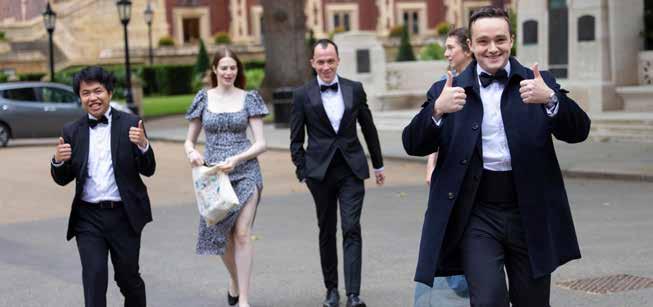
Members (January 2024): Chris Loweth (Chair), Susanna McGibbon, Fayyaz Afzal, Brynmor Adams, Rifat Rahman, Tariq Mahmood, Edmund Burge, Jack Meek
The Sub-Committee held a very successful applications workshop at the Inn in July. It was a skills-focused workshop for competence-based applications, such as judicial appointments. Given the success of the workshop, the group plan to hold something similar on circuit or online in 2024.
The group also reviewed the results of the Inn’s EDI Survey report and plan to use the findings to help focus the activities of the committee in the future.
The Sub-Committee were delighted to support the new ‘Becoming a Barrister’ film launched in May 2023 to encourage people to see the Bar as a career option, regardless of their background. The film has been a great success, gaining almost 9500 views on the Lincoln’s Inn YouTube channel. The Sub-Committee would especially like to thank our members who participated in the film, Simon Clarke, Kelly Cronin, Laura Gould, Mark McDonald, Charlotte Pope-Williams and Natasha Shotunde.
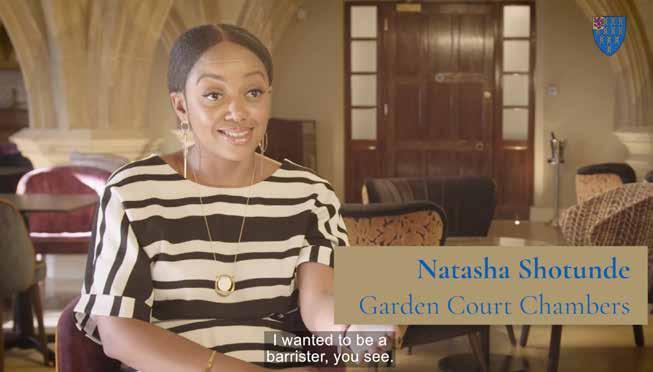
Get to know your BRC members for the year ahead





Adam Kayani
Self-employed family barrister at Harcourt Chambers. Adam has been a co-opted member of the BRC since January 2024. He represents Hall on the Chapel and the Staff Committee. He is also a member of the Junior Members’ Committee.
Amar Saeed Sheikh
Barrister based in Pakistan, specialising in civil, corporate, and commercial law. BRC member since 2022 (elected 2022-2025). Amar represents Hall on the Post-Call Education Committee.
Anthony James
Self-employed criminal and regulatory barrister at Mountford Chambers. Anthony has been a co-opted member of the BRC since January 2024. He represents Hall on the Gardens Committee.
Benjamin Hamer
Media and communications barrister at 5RB. BRC member since 2018 (elected 2021-2024). Ben represents Hall on the Advisory (Benchers) Committee and Estates Committee. He co-chairs the Junior Members’ Committee, together with Hazel Jackson. He is also a member of the Social & Wellbeing Group.
Cerys Walters
Self-employed civil and financial remedies barrister at 9 Park Place Chambers. Co-opted BRC member since 2023. Cerys represents Hall on the Equality, Diversity and Inclusion Committee She is also the Representative for the Wales & Chester Circuit.
Chris Loweth
Commercial, Rights & Business Affairs Director at BBC News. BRC member since 2021 (elected 2021-2024). Chris is Chair of the Social Mobility Sub-Committee. He also represents Hall on the Advisory (Benchers) Committee and Equality, Diversity, and Inclusion Committee.





Dilpreet Dhanoa
Self-employed tax barrister at Field Court Tax Chambers. BRC member since 2022 (elected 2022-2025). Dilpreet represents Hall on the Finance and General Purposes Committee and the Investment Committee.
Edmund Burge KC
Self-employed barrister at Five St Andrew’s Hill. BRC member since 2022 (elected 20222025). Edmund is a member of the Social Mobility SubCommittee.
Eleanor Marsh
Self-employed family barrister at 3PB (3 Paper Buildings). Co-opted BRC member since 2024 and the Representative of the Midland Circuit. Eleanor represents Hall on the Post-Call Education Committee.
Emma Southern
Self-employed family barrister at 3PB (3 Paper Buildings). BRC member since 2018 (elected 2022-2025). Emma represents Hall on the Chapel Committee. She is also a member of the Social & Wellbeing Group.
George Payne
Self-employed criminal barrister practising in London and the South East from Furnival Chambers. BRC member since 2017 (last elected 2022-2025). George represents Hall on the PostCall Education Committee and the Hospitality, Events and Dining Committee.
Georgina Blower
Self-employed barrister specialising in criminal justice and public inquiries at The 36 Group. BRC member since 2017 (elected 20192022, re-elected 2023-2026). Georgina represents Hall on the Scholarships Committee.

Holly Quirk
Employed barrister based in Manchester, practising in regulatory, education and inquest work at Browne Jacobson LLP. BRC member since 2024 (elected 20242027). Holly represents Hall on the Pre-Call Education and the Chattels Committee.






Imogen Sadler
Self-employed barrister at 4-5 Gray’s Inn Square practising in public and election law. BRC member since 2022 (elected 2022-2025). Imogen represents Hall on the Pre-Call Education Committee. She is also a member of the Junior Members’ Committee.
Isabelle Haddad
Self-employed barrister specialising in criminal law at 9 St John Street Chambers. BRC member since 2023 (elected 2023- 2026). Isabelle represents Hall on the Pre-Call Education Committee. She is also the Representative for the Northern Circuit.
Jack Meek
Employed barrister at the Government Legal Department. BRC member since 2023 (elected 2023-2026). Bar Council Social Mobility Advocate since 2021, Jack also sits on the Inn’s Social Mobility SubCommittee. Jack represents Hall on the Scholarships Committee.
James Manning
Self-employed criminal barrister at Nexus Chambers. BRC member since 2017 (elected 2019-2022, re-elected 20232026). James represents Hall on the Library Committee and the Gardens Committee.
Lara Kuehl
Self-employed commercial chancery barrister at Selbourne Chambers. BRC member since 2024 (elected 2024 –2027). Lara represents Hall on the Library and Post-Call Education Committee.
Laura Gould
Self-employed barrister practising in employment, commercial and sports law from Old Square Chambers. BRC member since 2016 (elected 2020-2023), elected as Chair in 2022. Laura represents Hall on the Advisory (Benchers) Committee, the Equality, Diversity and Inclusion Committee, the Finance and General Purposes Committee, and the Planning and Development Group.

Laureen Husain
Self-employed criminal barrister at 187 Fleet Street. BRC member since 1999 (last elected 2021-2024). Laureen co-chairs the Social and Wellbeing Group with Linda Turnbull. She represents Hall on the Staff Committee.

Mark McKone KC
Self-employed criminal barrister at Park Square Barristers. Co-opted BRC member since 2024 and Representative of the North Eastern Circuit. Mark represents Hall on the Scholarships Committee.

Rafey Altaf
Advocate High Courts of Pakistan specialising in public, human rights, industrial relation, labour and employment law. BRC elected member between 2020-2023. Co-opted from 2024. Rafey represents Hall on the Chattels Committee.

Rifat Rahman
Senior Associate at Mahbub & Company, Bangladesh, specialising in corporate and commercial litigation, white collar crime, arbitration, M&A, FinReg, and corporate restructuring. BRC member since 2021 (elected 20212024). Rifat represents Hall on the Pre-Call Education Committee. He is also a member of the Junior Members’ Committee and Social Mobility sub-committee.



Ryan Richter
Employed Barrister at CPS South East. Co-opted BRC member since 2023. Ryan is a member of the Employed Bar Committee of the Bar Council and Treasurer of the Surrey and South London Bar Mess. He represents Hall on the Library Committee.
Samar Abbas Kazmi
Self-employed barrister at Atkin Chambers specialising in commercial, construction and technology disputes. Elected member of the BRC since 2024 (elected 2024-2027). Samar represents Hall on the Estates Committee.
Sophie Howard
Self-employed barrister at St John’s Chambers. Co-opted BRC member since 2024 and Representative of the Western Circuit. Sophie represents Hall on the Chapel Committee.



Dr Tariq Mahmood
Self-employed barrister at 33 Bedford Row. Tariq has a broad commercial litigation and arbitration practice covering a wide range of contractual, property and public law disputes. BRC member since 2021 (elected 2021-2024). Tariq represents Hall on the Advisory (Benchers) Committee. He is also a member of the Social Mobility Sub-Committee.
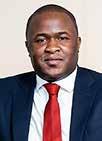

Tomas McGarvey
Self-employed barrister practising on the South East Circuit from 2 Bedford Row Chambers. BRC member since 2024 (elected 20242027). Tomas represents Hall on the Post-Call Education Committee.
Umar Ali
Self-employed criminal barrister at Holborn Chambers. BRC member since 2023 (elected 2023-2026). Umar represents Hall on the Hospitality, Events and Dining Committee.
Yasser Latif Hamdani Yasser is a self-employed advocate practising constitutional law and human rights law in Pakistan. Elected member of the BRC since 2024 (elected 2024 – 2027). He represents Hall on the Chattels Committee.

Zahrah Vayani
Assistant Attorney General of Pakistan and founder of Zahrah S. Vayani & Associates. Zahrah is also an Attorney at Law, New York and serves at the CEO of the Women Lawyers’ Association. BRC member since 2023 (elected 2023-2026). Zahrah represents Hall on the Hospitality, Events and Dining Committee.
Timothy Folaranmi
Employed barrister at Mishcon De Reya LLP. BRC member since 2024 (elected 20242027). Timothy represents Hall on the Pre-Call Education Committee.
Timothy Lyons KC
Self-employed barrister at 39 Essex Chambers with interests in tax, customs, trade and WTO matters, especially in relation to the EU. Also, a member of the Irish Bar. BRC member since 2017 (elected 2021-2024). Timothy represents Hall on the Investment Committee. He is also a member of the Inn’s Regulatory Panel.
Artist Anne Desmet RA has created a limited edition run of 40 hand cut woodcut print sets exclusively for Lincoln’s Inn. Each set consists of six prints depicting views of doorways around the Inn.
One of the country’s foremost wood engravers, Anne Desmet RA is a Fellow of the Royal Society of Painter-Printmakers and the Society of Wood Engravers and is only the third wood engraver to be elected a member of the Royal Academy.
The six views of doorways making up the series are:
Old Hall Gateway
(Image size:
7.7cm x 5.1cm / Paper size: 19.5cm x 13 cm)
Old Square (Image size: 9.8cm x 5cm / Paper size: 19.5cm x 13cm)
Chapel Undercroft
(Image size: 7cm x 10cm / Paper size: 17cm x 19cm)

Stone Buildings (Image size: 11.5cm x 3.8cm / Paper size: 19.5cm x 13cm)
Ashworth Centre
Wildy’s Gate (Image size: 11.2cm x 5cm / Paper size: 19.5cm x 13cm)
(Image size: 6.7cm x 5cm / Paper size: w19.5cm x 13cm)
Each of the six artworks is printed on Japanese Gampi Vellum paper, a very special heavy weight paper with a subtle and characterful appearance. This paper was chosen as it prints a good rich black while not losing any of the fine detail of the more extensively cut areas.
The prints are available to purchase as a set of six for the special price of £480, or individually (with prices ranging from £80 - £125 each). They will be supplied in transparent envelopes for customers to mount and frame to their own taste.
Visit www.lincolnsinn.org.uk/shop/ to purchase online or enquire in the MCR.

By the Venerable Sheila Watson, Preacher
2023 was an historic year, being the 400th Anniversary of the Chapel. The highlight of the year was the October Anniversary Service with a packed chapel followed by dinner in the Great Hall. During the service, Bishop Rose Hudson-Wilkin, Bishop of Dover and an Honorary Bencher, dedicated the coats of arms of nine former Treasurers, all of whom were present. This brings the historic record of armorial glass up to date to 2022.


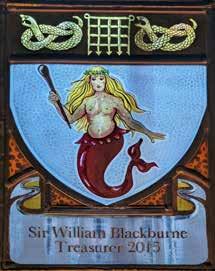
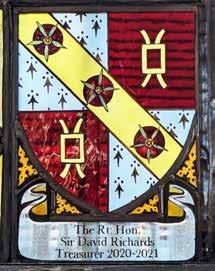
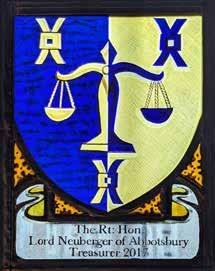
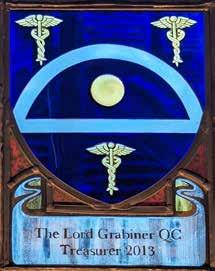
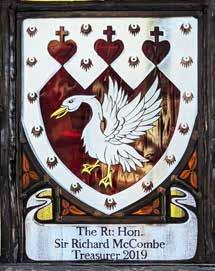
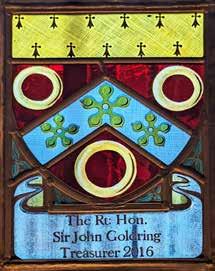
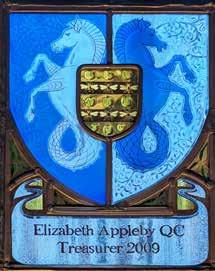

York Glaziers Trust completed their work on the Van Linge windows (in the two central bays) and the final two were returned in the summer. Professor Sarah Brown, who leads the team in York, oversaw the work on the Treasurers’ Coats of Arms and the whole comprehensive programme on the glass which is of exceptional quality and historic importance at a national level of significance. Professor Peter McCullough, of Lincoln College Oxford, the General Editor of the Oxford Edition of Donne’s sermons, delighted us with his address and the Bishop of London’s chaplain, The Reverend Sandra McCalla and a member of this Inn, read a prayer based on the consecration prayer by the Bishop of London.
The celebration included a wonderful exhibition in the Library, arranged and organised by our Librarian, Dunstan Speight, in which the 1623 Deed of Consecration, the Bible inscribed by Donne’s own hand and other rarely seen treasures from the Inn’s collection were on display.
Earlier in the year, on John Donne Sunday, Dr Katrin Ettenhuber, from Pembroke College Cambridge and editor of Donne’s consecration sermon in the Oxford series, challenged us with Donne, the Law and Chancery. We were joined for that service and lunch by the Dorothy L Sayers Society (the author was a great fan of Donne, as readers of Lord Peter Wimsey will know) thanks to Gregory Hill. We were also very pleased to have The Reverend Canon Professor James Walter, founding Director of the LSE Faith Centre, as a guest speaker for the Warburton Lecture. He discussed the work done by the Centre in his very topical talk on Christian Institutions and Inclusion in Multi-Faith Societies. It was a great pleasure to have one of our own Benchers as guest preacher when The Reverend Judge Sarah Whitehouse KC addressed us at a service in the Hilary Term.
Many of the lectures are available in print and some on video and can be accessed from the Inn website: https:// www.lincolnsinn.org.uk/about-us/chapel/services-events/.
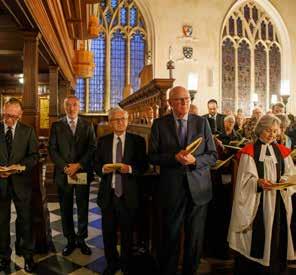
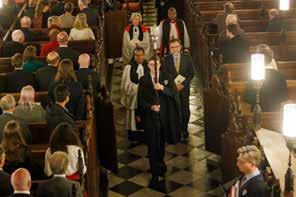

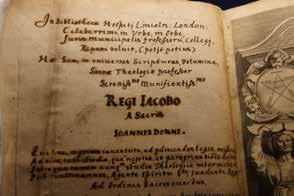
During the year we also welcomed many of those who had been married in Chapel to a Celebration of Marriage service. Baptisms have been a theme of the year with five in Michaelmas Term, and weddings in December as well as spring and summer. Memorial Services were held for Sir Donald Rattee, Mr Philip Gillyon, Mr Nicholas Legh-Jones, Dr Anthony Watson and Dame Sonia Proudman. The Committee owe a personal debt of gratitude to Dame Sonia Proudman for her longstanding membership of the Committee, which she chaired for twelve years. Crispian Cartwright, Sonia’s husband, brought a smile to all our faces when he read Browning’s Poem ‘Up at the Villa, Down in the City’ superbly, recalling Sonia’s feelings about her ‘exile’ from the Chelsea of her early years to Dulwich. We also interred Nicholas Legh-Jones’s ashes in the Columbarium in Chapel. The Columbarium, installed in October 2021, is one of a small number in churches in Central London, which provide a fitting resting place in perpetuity. At the end of October we had, for the first time, as part of the anniversary, an All Souls service, remembering especially those whose Memorial Services had taken place over the last ten years. Many family representatives returned for this. Lunches after all these special services and others have been very well attended and jovial occasions.
As usual, in July we had the Family Service in Chapel, complete this year with birthday candles for the 400th Anniversary lit by younger members, and with a fascinating demonstration of the organ’s versatility from Nicholas Shaw, our Director of Music, and William Whitehead on the organ. (For more on the Chapel’s distinguished musical tradition and activities, see page 56). This was followed by the Family Day Picnic with a barbeque, face painting and lots of activities and races for the energetic.

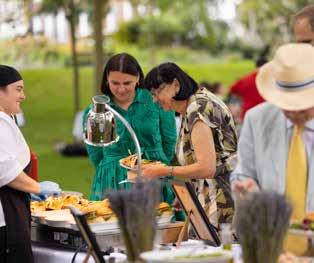


In November, the solemnity of Remembrance Service was enhanced, as usual, by the full Squadron of The Inns of Court and City Yeomanry with the cadets and the band parading at the War Memorial at the North End of New Square for the Remembrance and wreath-laying. The year ended with the customary Carol Services moving from darkness to light and our celebration of the Christ child, “the light that shines and the darkness comprehendeth it not”.

By Nicholas Shaw, Director of Chapel Music
The 400th anniversary year proved to be a particularly busy and satisfying musical time for the Chapel with three concerts and an anniversary celebration framing the usual round of Sunday and weekday services.
The annual concert took place appropriately on the dedication date of Ascension Day and focused on the year 1623, which in addition to the Chapel’s anniversary marked the deaths of two cornerstones of the English choral tradition, William Byrd and Thomas Weelkes.
The second concert in June was particularly special as we welcomed the young singers of Hackney Choral to join with the Chapel Choir. This group was founded as an outreach project by St Paul’s Cathedral and continues to champion sacred choral singing from a diverse group of 40 young people who perform around the city and who maintain a close connection with the Cathedral. It was a pleasure to welcome them to the Inn on a summer’s evening as well as their considerable following who enjoyed both the concert and the hospitality afterwards.
In the Michaelmas Term, a weekday concert given by one of the home team of singers, Daniel Joy, showcased Benjamin Britten’s rarely performed Holy Sonnets of John Donne and in a satisfying piece of symmetry the anniversary service a week later contained a new choral setting of one of these sonnets.
As might be expected, the work of John Donne featured in all four events during the year and three new musical commissions were performed. Kerensa Briggs’ setting of The Trinty from the Litany had originally been planned for 2021 and it was good to finally perform the work written for three trios of singers reflecting the Trinitarian subject. At the joint concert with Hackney Choral, Janet Wheeler set lines from Donne’s dedication sermon Be this thine ark and both choirs joined together to give a superb performance. The final new work, a setting of Batter my Heart three person’d God by Joanna Marsh formed the anthem for the anniversary service in October and is an outstanding addition to the repertoire. These three pieces join our considerable collection of commissions which will now be revisited in the next year or so.
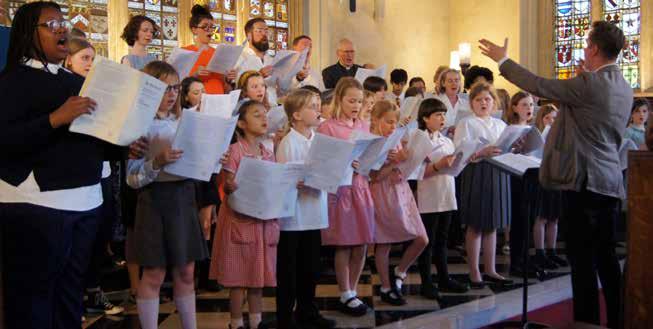
In our usual services, it was gratifying to see and hear the Chapel so full on several occasions during the year. To my mind there really is nothing like a chapel of committed singing from a full congregation and we had this many times in 2023. I am, as always, deeply grateful to my colleagues in the choir for singing and to our Associate Organist William Whitehead for playing throughout the year and for the whole team at the Inn who support the work that we do. Between them, The Preacher, the Librarian and the Chapel Clerk steered a wonderful year for the Chapel, and I am delighted that the music played such an important part.
By Henry Skinner, Director of Estates
2023 was another busy year for the Estates Department with all teams working at capacity throughout. It also saw a change of leadership, as stepped up to the role of Director of Estates.
The Property Management team is responsible for the letting of vacant property, lease renewals and rent reviews with existing tenants, and deals with requests for licences to assign, licenses to alter, and wayleaves.
During 2023, two suites of chambers were let: one with eight rooms, and one on two floors with six rooms. A further annexe of three rooms is currently under offer. The retail unit at 76a Chancery Lane was refitted by the tenant, who began trading as a cafe in April. Three residential flats were also let. One was fully refurbished and the other two were redecorated. Demand for these was extremely high.
The estate’s historic property requires more attention than typical modern buildings and we very rarely get a break from fabric maintenance. No sooner than one project finishes, another is about to start. Cyclical redecoration of timber windows is essential to ensuring their longevity and that the timber below does not rot, masonry pointing must be renewed and roof coverings must be repaired or, once aged beyond economic repair, replaced to ensure buildings are protected from water ingress and occupants kept dry.
Alongside fabric maintenance, the team project manages internal refurbishments of chambers and flats, and more comprehensive redevelopment programmes when entire buildings are vacated. Projects throughout 2023 have been quite varied.
Phase 1 of the refurbishment of 77 Chancery Lane was completed in November 2023, consisting of Cat A fit out work (basic operational fit out) to the third floor and two ground floor receptions, provision of end of trip facilities within the basement floor (bicycle store and changing rooms) and shell and core works to all other floors.
Further work will be required to complete Cat A and Cat B (a fit out term to describe a fully operation workplace that has been designed to a client’s unique specifications) to the rest of the building. Timing will be subject to market interest.
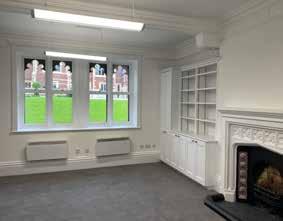
Phase 2 of a four phase programme of stained glass conservation was completed. It saw the return and reinstatement of the Chapel’s two central south elevation windows following principles established during phase 1, that is with the addition of new environmentally protected glazing to provide better long term protection from pollutants, UV and condensation.
The long standing tradition of Treasurers’ armorials being depicted as panels of stained glass saw its continuation with nine new armorials added. The new additions can be seen in the southwest window (the first window on your right after entering Chapel) – see page 53 for images of them in situ.
Work to repair the roof of Nos. 5 & 6 New Square started in 2022 and completed mid2023. All roof coverings were replaced, and new lead details were formed to improve rainwater dispersal. Midway through the project a design change was agreed with Camden Council, removing a hidden gutter that was hard to maintain and thus reducing the risk water ingress in the future.
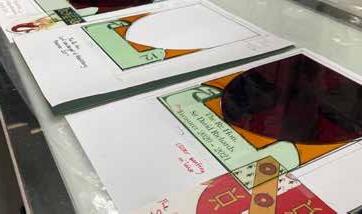

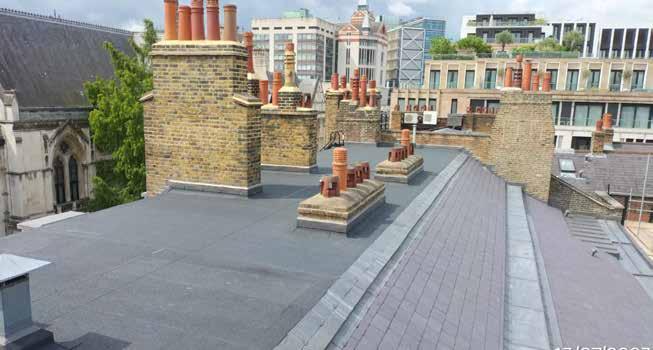
Following legionella risk assessments (LRAs) in 2022, a programme of remedial works was carried out throughout 2023 to address recommendations of the assessments. This included work such as removal of dead legs (redundant lengths of pipework), replacement of water heaters and pipework lagging.
We carried out lift refurbishment works at Nos. 4 & 8 New Square. This included new lift cars and operating equipment, for example motors, pulleys, ropes etc.
More’s Passage, 7 New Square – Wardens’ changing rooms
A long disused toilet block in the basement of 7 New Square was refurbished at the beginning of the year to provide changing rooms and a shower for the Inn’s wardens and porters.
Throughout August a range of works were completed as part of the department’s annual minor summer works programme. These included cleaning and repointing of the war memorial, repairs to the stone entrance steps to the Chief Porter’s office, stonework repairs to Old Gatehouse arch stones facing out into Chancery Lane, various joinery works such as redecoration of external doors and render repairs to 1 New Square.
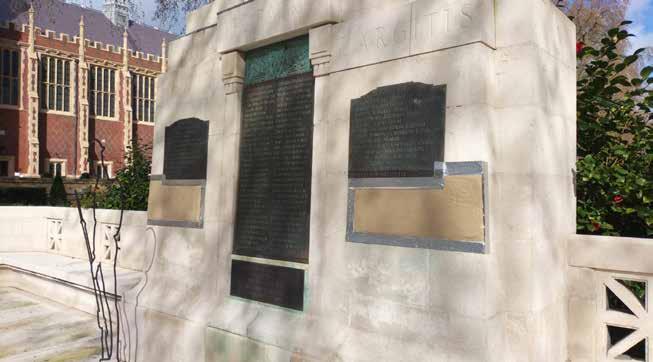
The work of the Facilities team is essential to maintaining the safety and welfare of building users. Many services previously provided by external contractors have been brought in-house, delivered through an expanded team of skilled staff. A core of specialist sub-contractors is retained for work such as fire alarm and lift maintenance. The team carry out maintenance and repair of mechanical and electrical equipment, gas safe work, gutter cleaning, water quality hygiene maintenance, carpentry works, painting and decorating and general building.
We provide a planned maintenance service for several of our tenants (as well as for collegiate buildings and common areas) and a reactive service to all, subject to priority and availability. We have recently gone live with a new Computer Aided Facilities Management (CAFM) programme for call out requests. This improves accountability and provides real time updates on the status of jobs, such as automated messaging to notify end users of logged calls and when a work order has been completed.
We have several planned projects and will be particularly busy at the north end of the North Lawn constructing additional space for our gardeners and refurbishing 30 Lincoln’s Inn Fields, the late 80’s red brick building in the northwest corner.
Our facilities management division and works team continue with their ceaseless planned maintenance tasks and the juggling of call out request for maintenance assistance. CAFM development will be progressed, specifically the migration of planned maintenance to sit within the system.
The important ongoing work of property management will continue; lettings, lease renewals, rent reviews, service charge management and so on.
By Steve Matthew, Head of Catering
It was an exceptional year with a full calendar of Inn and commercial events. With a diverse programme, we saw a surge in attendance at traditional events such as Ordinary Dining, Grand Days and Sunday Lunches, and new events including the South Asian Heritage Month Diversity Dinner. We hosted 35 dining events, welcoming over 3,300 Members and guests to the Inn. We opened the Estate again to the public at Open Gardens and Open House, where we saw attendance double from the previous year. Whatever the occasion, we planned and delivered incredible events, whilst maintaining the first-class service and food quality that the Inn is renowned for.
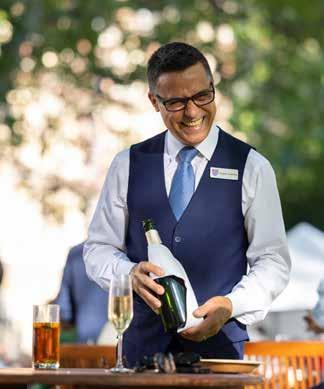



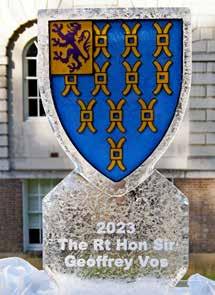

The annual Garden Party returned to the North Lawn, where we hosted a record number of guests. The Catering team outdid themselves, with impeccable service and sumptuous fare. The food stalls were designed to focus on seasonality, local produce, and sustainability, accentuating some exceptional regional dishes. Our seafood stall and oyster meister were particularly popular, impressing guests with Lincoln’s Inn gin-cured salmon, potted Brixham crab, and Cornish scallops. The South Asian stall was also a big hit, offering up Indian Punjabi spiced tandoori shoulder of lamb and Pakistani Lahore crispy pollock, Chana Chaat masala, which filled the North Lawn with a tantalising Asian spice. And who could forget the Lincoln’s Inn crest and shield biscuits? Each biscuit was hand-decorated by the talented pastry team and proved to be a firm favourite among attendees.
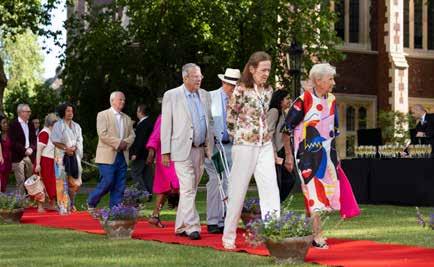
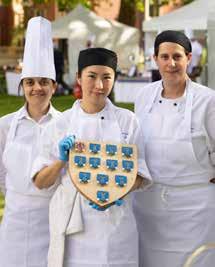
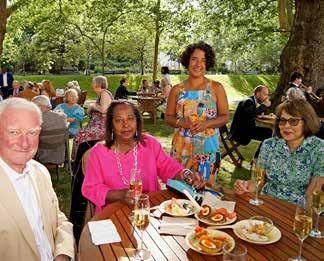
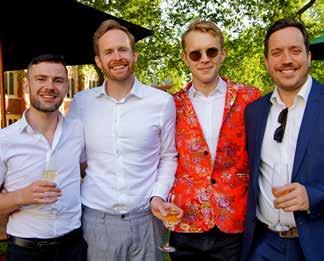
The prestigious Gourmet Dinner again delighted attendees and provided the chefs with a platform to showcase their talents and to stretch their creative skills. Organised by the Inn’s Bar Rep Social and Wellbeing Sub-Committee, members and their guests enjoyed a five-course tasting menu. The chefs used the freshest ingredients, highlighting the rich and diverse food produced by the British Isles. The starter featured Peterhead cod and scallop, wild fennel, salsify, bouillabaisse sauce with dry ice, which certainly impressed and enhanced the dining experience. The main course saw Launceston lamb saddle and cheek cooked to perfection and served with Roscoff onion, smoked almond mayonnaise, Lincolnshire red cabbage, and truffle potato gallet. Last but not least, the meal concluded with a delightful and surprising rice pudding parfait, white chocolate and clementine dome, white chocolate chantilly, and almond sponge. We cannot wait to see what is on the menu for the next Gourmet Dinner in April 2024!
The MCR Supper Clubs were an enormous success and each of them sold out. The year started with an Indian themed evening where guests enjoyed a delicious sharing menu curated by Chef Patron Joseph O’Neill. Highlights included tikka cod pakora, caramelised butter chicken, and chilled kulfi rice pudding. For wine and cheese enthusiasts, there was a tutored wine and cheese tasting. Guests were welcomed with Greyfriars Blanc de Blanc 2015 followed by a tutored flight of five wines paired with English cheeses. Throughout the summer, guests enjoyed the MCR terrace for alfresco dining, inventive cocktails, and a terrace barbeque. Over the festive period, the MCR saw many members and guests enjoy their Christmas lunches and Arseny’s secret recipe for red and white mulled wine went down a treat.
Members can enjoy delicious food from our talented team in the MCR, as well as Members’ Lunch in Hall, Monday to Friday.

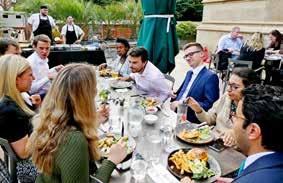
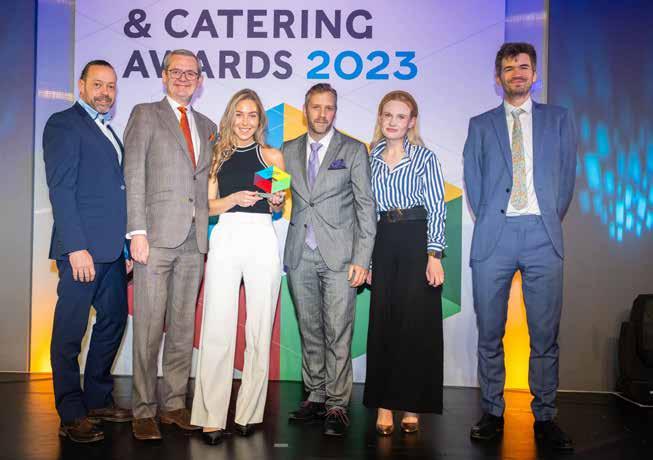
It was a double win for the Inn at the 2023 London Venue & Catering Awards. We took home two trophies, Winner of Best In-House Caterer and Bronze for the Best Historic Venue or Livery Hall. This is a significant industry-recognised achievement and a testament to the Catering and Events team incredible work.
“The testament of any team is long standing service and they have ticked that box. The food is delightful, focusing on the best that Britain has to offer. The continuous training offered is great, as is the ability to continue to attract the next generation of chefs. The judges were impressed with the real creativity on show that sets this venue apart from the other entries.”
Judges’ Comments, London Venue & Catering Awards 2023
We are committed to continuing to reduce our environmental impact and hosting events sustainably.
It was a successful year for the Green Team as they accomplished all the goals they had set out to achieve. We have expanded our kitchen and edible gardens to increase our own produce onsite, delivering flavour enhancements to our menus only footsteps away. We introduced a hot composter that converts our waste food into compost at the Inn. This helped reduce our food waste by 30%. Baking our own bread in-house, to be enjoyed daily at Members’ lunch and certain other events, brings more sustainability and positive change. An impressive 2,664 loaves of bread were baked in 2023! As well as the kitchen team learning new bread making skills, by making these changes, we have stopped our bread van delivering to the Inn daily.
The Green Team and Catering team continue to explore sustainable changes in their operation for 2024.
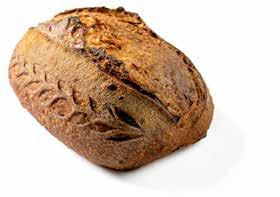
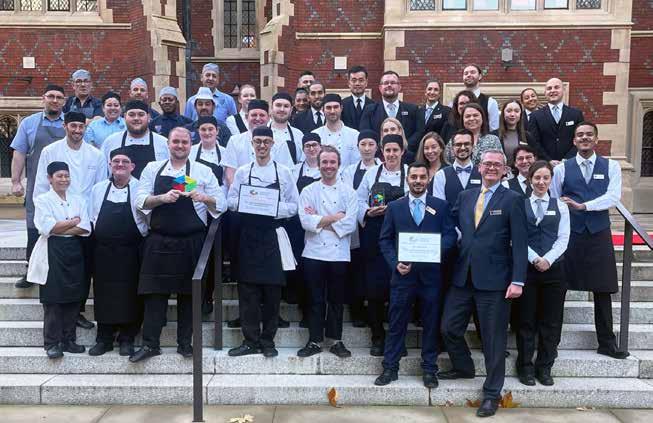
We recognise the importance of investing in and taking care of our staff to maintain the high-quality service for which the Inn is known. Last year, our Catering team made strides in their work-life balance and made time to focus on training and development including bread-making, wine training, butchery and fish filleting skills.
We are proud supporters of apprenticeships and believe that it is crucial to inspire and attract the next generation to the hospitality industry. We have two commis chef apprentices, and we provided training to eight Westminster Kingsway College students in 2023. We are proud ambassadors to the Hospitality Springboard Charity, which focuses its support on young workers wanting to enter the Hospitality industry. We are also members of the League of Club Chefs that provide us culinary apprenticeships in partnership with Westminster Kingsway College as well as a wide and diverse skills programme for all our chefs.
The entire team took a day out in the summer to “Go back to the Source.” We visited suppliers of all backgrounds, our Cheesemonger, a vineyard in Surrey, fruit and veg suppliers in Covent Garden as well as wine tasting with our trade experts. This was a fantastic opportunity to really understand what goes on our plates and into our glasses!
Despite staffing challenges, rail strikes, continuing supply chain issues, and the rising cost of doing business in general, our commercial success continued during 2023. There was heightened demand for events across our 18 venue spaces, including the two halls, the Ashworth Centre, the Old Court Room, the MCR, the East Terrace and of course the North Lawn in fair weather. We exceeded expectations setting a record high for commercial sales and events in 2023. Behind the scenes, our team continuously evolves, enhancing our menus, events and service at all Inn events.
We are immensely proud of what our Catering team has accomplished over the past year, and we would like to express our gratitude to our members for their continued support. We look forward to welcoming you in 2024 and beyond. Grand Day briefing. © Ben Stevens
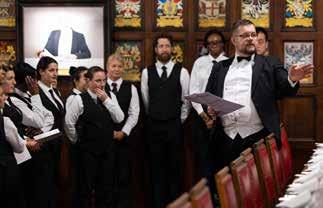
By Dunstan Speight, Librarian
Usage of the Library continued to increase in 2023 with a total of 15,189 reader visits and 7,414 enquiries answered.
In addition to the core tasks of research, cataloguing, acquisitions and training, the Library and Archives team play an important role in widening access to and appreciation of the Inn’s print and manuscript treasures. This is chiefly achieved through digitisation, exhibitions and talks.
The Library team has continued to add digitised material to the website, including some very important items in the collection. Items now available online at https://archives.lincolnsinn.org.uk include:
Misc MS 150 - the collection of mediaeval English romances which includes Piers Plowman. The last few pages of Piers Plowman were digitised in 2022 to seek to recover some of the text obscured by dirt and fading. We now have a digitised copy of the whole manuscript online, including the other three mediaeval texts: The Romance of Merlin, Alysaunder and Bellum Troianum
John Selden’s Table Talk - a manuscript copy of Selden’s Table Talk made in about 1689. This text, the best of six uncollated copies, was used by Sir Frederick Pollock for his Selden Society edition of the work in 1927 and has also been a key reference point for Joshua Eckhardt and Jason Rosenblatt for their new scholarly edition. Professor Eckhardt has described our digital edition as “a major contribution to readers of Pollock’s edition and our own.”
Misc MS 562 - an early manuscript report of Entick v Carrington (1765). This was produced soon after the case, unlike Hargrave’s 1781 report in the State Trials. It omits some of the famous quotes attributed to Lord Camden by Hargrave, raising the question as to whether they were ever uttered in court. As this case was influential in the drafting of the Fourth Amendment to the US Constitution, we publicised this addition to the website on the Fourth of July.
Enquiries to the Library from scholars and students demonstrate that these digital versions of our manuscripts are already providing an invaluable resource for research.
The Library team put together three exhibitions during the year and also assisted Claire Coveney with research for the online exhibition celebrating the first women Called to the Bar by the Inn.
“When I want to read a novel, I write one”: Novelists and Lincoln’s Inn opened on 1 March 2023. This covered fiction from the early modern period (including Utopia and Rosalynde) to the present day, taking in an impressive array of authors associated with the Inn. We were delighted to combine the opening of the exhibition with the launch party for the most recent novel by a Lincoln’s Inn author - Until Proven Innocent by Nicola Williams. The Treasurer opened the exhibition and Nicola gave a reading from the book. The exhibition was split between the two display cases and supplemented by a digital exhibition created by Mark Leonard, which provides an opportunity to show more images than can be seen in the physical exhibits. (A detailed look at the exhibition can be found on pages 68-71 of this Review.)
The next exhibition explored the Inn’s links with South Asia and was part of the events organised by the Inn to celebrate South Asian Heritage Month. The exhibition was launched on 17 July 2023 and members and their guests attending the Diversity Dinner were invited to view the exhibition during the pre-dinner reception. The two display cabinets showed items from the Library and Archive collections relating to Muhammad Ali Jinnah, Cornelia Sorabji and Mithan Tata. In addition, the displays also provided information about members who supported independence movements in India, Malaysia and Sri Lanka (then known as Ceylon) and those like Sir Mancherjee Bhownaggree and Abdullah Yusuf Ali who were supporters of Empire. We also featured the first members to be Called from each jurisdiction. In addition to books and archive material, the displays featured commemorative stamps and banknotes and a silvercovered cigarette box presented by Abdul Razak Hussein, borrowed from the Inn’s silver collection.
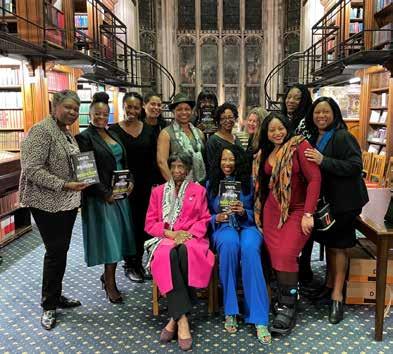
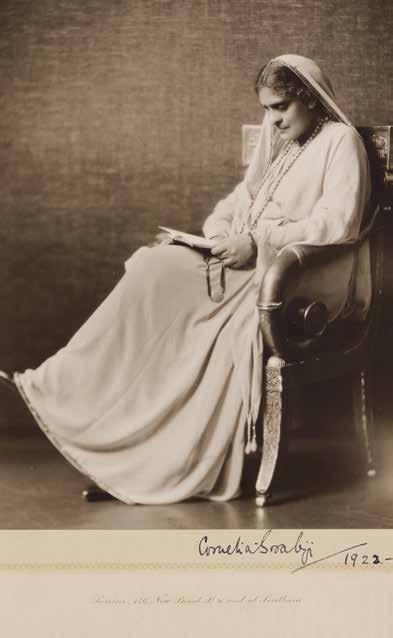
The exhibition was supplemented by a digital exhibition featuring 42 mini biographies and images of distinguished members from South Asia.
The Library’s final exhibition for the year celebrated the 400th anniversary of the consecration of the Chapel and included the Deed of Consecration, the manuscript account of the service and the text of the sermon preached by John Donne. Also included were the Bible presented to the Inn by Donne with his lengthy handwritten dedication and a 13th century manuscript Bible.
Tours have proved a wonderful way to increase public awareness of and access to our heritage assets, and are also a useful source of income for the Inn. We have been grateful for the support of colleagues from the Education and Treasury teams who have joined us as guides, enabling us to offer two tours per week plus the occasional private tour for groups.
In addition, we have begun offering self-guided tours of the Great Hall, Upper Vestibule and Library between 10:00 and 12:00 each day. Visitors pay £7.50 which gives them access to these spaces and entitles them to a £2.50 discount on the cost of the guidebook.
The Library team have carried out many training courses this year. Members of the team have presented courses open to all the Inn’s students both in person and online. The online courses have been particularly well attended: the legal research qualifying session presented by Mark Leonard and Carolyn Rampling was attended by 557 students and the legal databases qualifying session presented by Matthew Bland and Heidi Kinderman was attended by 401 students. A total of 1,668 members attended a Library training course, either in person or online during 2023.
Federico Botana has recently begun cataloguing the Inn’s mediaeval and early modern manuscripts. His detailed records will be used as the basis for the Library’s manuscripts catalogue.
The Library has purchased a set of chairs for the Pugin table. These were spotted by the Chairman on eBay and met our requirements very well. They are the right period and style for the table, have restrained decoration which does not distract from the table and are sound and comfortable. As a set of twelve they have provided four chairs for the table plus plenty of spares if any deteriorate in future. (The remaining chairs are currently in use for the tables near the Library entrance).

By Mark Leonard, Assistant Librarian
“When I want to read a novel, I write one.”
Benjamin Disraeli, quoted above, is only one of a remarkable number of novelists associated with Lincoln’s Inn. Barristers are a gift to authors as their profession involves them interacting with people at times of great drama in their lives. The Inn, meanwhile, as a self-contained world, visibly connected by its architecture to its roots in late-mediaeval times, also exerts a great fascination. Authors as diverse as Charles Dickens, 20th century detective novelists and, in our day, historical novelists CJ Sansom and Philippa Gregory, have all found inspiration in the Inn and its members.
Not only has Lincoln’s Inn provided characters and settings for novelists, it can also count a surprising number of novelists among its members. Some were people like Wilkie Collins, who joined the Inn but never practised at the Bar. Some, like Henry Rider Haggard, practised for a short period, until success as a novelist allowed them to write full time. Others, like Thomas Hughes, combined writing with a legal career.
Examples of works by all these authors – and others – were on show in the Library during March and April 2023. The exhibition was created to celebrate the fact that Lincoln’s Inn still has members who combine success at the Bar with success as a novelist.
The exhibition focussed on the English novel, a class of literature generally considered to be a product of the early 18th century – although early examples are often cited, including Aphra Behn and John Bunyan.
We began our selection with the first edition of Utopia (1516) by Sir Thomas More (1478-1535), which was possibly stretching a point but, whatever else it is – satire, philosophy, blueprint for an ideal society – Utopia is certainly a work of fiction and imagination. It is also a jewel in the Library’s collection, and More is one of the Inn’s most notable members.
Less well-known is Thomas Lodge, son of a Lord Mayor of London, who entered Lincoln’s Inn in 1578. His mother’s will, drawn up in 1579, provided that he would only receive his portion of the inheritance if he studied diligently at the Inn. Despite this threat, Lodge was not called to the Bar but continued to live in the Inn. Lodge was suspected of being a Catholic early in his career – and this may have been one reason for feeling at home in the Inn, which was seen as sympathetic to recusants. Lodge was certainly a Catholic later in the life.
Rosalynde (published 1590) is the work for which he is most famous today. This romance “hatcht in the stormes of the Ocean and feathered in the surges of many perilous seas” whose “everie line was wet with a surge”, was partly derived from The Tale of Gamelyn, an English verse romance of the mid-14th century. In turn, it furnished
Shakespeare with much of the plot and many characters for As You Like It. Shakespeare borrowed the setting of the Forest of Arden (the Ardennes) from Rosalynde as well as the name of Lodge’s title character. Lodge’s Rosader becomes Orlando in the play, Saladyne is Oliver and Alinda is Celia.
The exhibition then explored eminent Victorians associated with the Inn: Charles Dickens (1812-70), Anthony Trollope (1815-82), Benjamin Disraeli (1804-81), Edward Bulwer-Lytton (1803-73), Charles Kingsley (1819-75) and Thomas Hughes (1822-96). Although not a member of the Inn, Dickens’ evocation of the Court of Chancery sitting in the Old Hall is one of the most memorable descriptions of Lincoln’s Inn (Bleak House, 1853).
Trollope was not a member, but he has the unique distinction among our authors of being the only one to have been born in Lincoln’s Inn: his father was a lawyer based in 23 Old Square, where Trollope was born. Among his best-known works are the six books which make up The Chronicles of Barsetshire, and the further six which make up The Palliser Novels. His novels bring Victorian political, social, and economic issues to the fore, and depict a huge variety of characters, class and relationships with depth and humour.
Trollope’s knowledge of ‘legal London’ and the law come through in many of his novels, most notably Doctor Thorne (1858) and Orley Farm (1861-62). The latter included forty wood-engraving illustrations by the pre-Raphaelite artist John Everett Millais, which were commissioned for publication. It revolves around a disputed will, which leaves Orley Farm to Joseph Mason’s young second wife and son. Several bitterly fought court cases take place, and we see Lady Mason making a visit to chambers in the Inn. A major theme is the conflict between group and individual judgment, and the efficacy of juries; as a minor character, Mr Moulder, exclaims, ‘if a jury of her countrymen doesn’t make a woman innocent, what does?’
Although widely (and inaccurately) regarded as staid and puritanical, Victorian England was fascinated by novelty and exoticism, so the exhibition explored the adventure and sensation novels popular at the time. William Wilkie Collins (1824-1889) provided thrills in novels set close to home and wrote the first detective novel in English fiction, whereas Henry Rider Haggard (1856-1925) found success as a writer in describing the Africa he had known as a young man and capitalised on this by setting many of his novels in remote places.
Haggard is possibly the only member of Lincoln’s Inn to have spent part of his career as an ostrich farmer, a venture which was curtailed by the outbreak of the Anglo-Transvaal War in 1881. Haggard returned to England and entered Lincoln’s Inn. After the excitements of Africa, Haggard did not enjoy life as a barrister, but his career took a dramatic turn with the success of his adventure novel King Solomon’s Mines (1885). This was an instant success, and the central plot device of the discovery of a ‘lost world’ influenced many contemporary and later writers, including his friend Rudyard Kipling in The Man Who Would Be King (1888).
Despite his dislike of life at the Bar, Haggard derived the basis of the plot for his sensation novel Mr Meeson’s Will (1888) after a conversation at dinner in Lincoln’s Inn centred on the validity of a will tattooed on a person. In the novel, the will of a marooned sailor is tattooed on the back of a woman.

John Galsworthy (1867-1933) had a section of the exhibition dedicated to him alone, being the only Lincoln’s Inn novelist to have won the Nobel Prize for literature (so far). His most famous work is the trilogy The Forsyte Saga, and its two sequel trilogies A Modern Comedy and End of the Chapter. Altogether, these nine books and four ‘interludes’ make up the epic Forsyte Chronicles.
Galsworthy studied law at Oxford and was admitted to Lincoln’s Inn in 1887. He was called to the Bar in 1890, but did not go on to practise law, instead travelling abroad to work for his family’s trans-European shipping company and beginning to write. He used fiction to draw attention to the gulf between rich and poor and unfairness in the legal system, particularly solitary confinement in prisons, and championed causes including animal welfare and women’s rights.
The first six of the Forsyte Chronicles were on display in the exhibition, including The Silver Spoon (1926). The novels document the relationships between three generations of the eponymous family. The novel explores the class divide, London’s industrial growth and the disappearing countryside, conflicts between duty and desire, and the immense social changes over the Victorian to Edwardian eras. Galsworthy’s knowledge of the law influenced much of the Forsyte Saga, especially In Chancery (1920) and To Let (1921) – where the central character Soames Forsyte can often be found around Lincoln’s Inn Fields and Chancery Lane.
The exhibition concluded with two thematic overviews: crime and thrillers, and historical novels. Lincoln’s Inn has occasionally provided the setting for detective stories. The Inn has the advantage of being unknown to many readers and is an intriguing, cloistered world. It offers detective writers the sort of tight-knit community bound by its own regulations and customs which has long appealed as a setting. Many practising barristers, particularly those at the Criminal Bar, encounter a broad spectrum of society and unusual real-life events and characters. Their work also provides a detailed knowledge of the workings of the police and justice system in this country. This provides an added authenticity to their writing. Novelists explored in this section included Robert Machray (1857–1946), Michael Gilbert (1912-2006), Sarah Caudwell (the pen name of Sarah Cockburn, 1939-2000), Carruthers J. Lardy (the pen name of Nicholas Bleaney, a member of Drystone Chambers) and Nicola Williams.
Nicola Williams (Called to the Bar by this Inn in 1985) started her career as a barrister in private practice, specialising in criminal law, including three successful Commonwealth death-penalty appeals before the House of Lords sitting as the Privy Council.
Williams’ first novel Without Prejudice (first published in 1997) was recently selected to be republished in a series of novels celebrating Black Britain curated by Booker Prize-winner Bernardine Evaristo. Until Proven Innocent (2023), Nicola’s new legal thriller, sees the return of the main character in Without Prejudice – Lee Mitchell, a successful Black woman barrister battling prejudice and a succession of legal and ethical dilemmas.
If the setting of Inn today inspires writers of contemporary fiction, it is also a gift to writers of historical novels. Lawyers can make useful narrators – as characters who are at one remove from the action, but who have privileged access to important events.
CJ Sansom and Philippa Gregory are both writers who have responded to the Inn’s history. Sansom trained as a solicitor and was based at Lincoln’s Inn before his literary career, and the main character in his ‘Matthew Shardlake’ series is a 16th century lawyer who also works in the Inn.
Dawnlands (2022) is Philippa Gregory’s most recent novel and the third in the Fairmile series, after Tidelands (2019) and Dark Tides (2020). The series follows the Ferryman family, particularly Alinor and her brother Ned, from its roots in 17th century Sussex across Europe and the US. Parts of the book are set in Lincoln’s Inn, where the character Matthew da Picci has rooms in Gatehouse Court, and a coffee house in Serle Court (now New Square) is a recurring meeting place. Philippa Gregory also filmed some promotional short videos for the book at the Inn.
To read more about the connections between novelists and Lincoln’s Inn, see the chapter entitled ‘Poets, Playwrights and Novelists’ in A Portrait of Lincoln’s Inn (2nd ed. 2020).


By Miranda Kimberley, Head Gardener
With a changing climate and pests and diseases which threaten our plants and trees, gardening at the Inn continues to be a challenge, but the Garden Team and Committee continue to strive to improve the Inn’s gardens for members and visitors alike.
In the last few years it has been our goal to reimagine and enhance the look of New Square. The central beds were enlarged and changed from simple rose beds to ones with a variety of small shrubs, herbaceous perennials and annuals. In early spring this year, new corner beds were created under the large London Plane trees at the Brewster’s Gate end of the Square. This involved lengthy air spading by our tree surgeons to alleviate compaction, caused by years of mowing around the trees. The Gardens Team were able to incorporate plenty of organic matter into the soil to help establish the new yew hedges, evergreen structure (such as Osmanthus delavayi and Daphne odora), and flowering perennials. The new plants struggled through very warm conditions in late spring/early summer but the rains later in July and August helped. Additional planting has since taken place to bolster the display.
Another new bed was created at the same time on the south-west corner of the North Lawn, using a similar method. This bed was planted with native shrubs, including Euonymus europaeus, and woodland plants, creating a link with the Mulberry and Library borders across the path. A legacy bench from Jill Gillyon, widow of Philip Gillyon, has been placed by the Plane tree at the back of the new bed, with a way through the bed to the bench. This has become a destination bench for many people – a place for solitude and calm.
Our new Amazone tractor mower, with a lifting hopper on the back and optional scarifying blades, arrived in early spring. This has improved the cut on the lawns and has massively reduced the amount of manual lifting associated with putting lawn clippings and leaf litter into the skips. In the summer we added the scarifying blades to the mowing blades, enabling an efficient and effective removal of thatch from the two larger lawns, New Square and North Lawn.
Two volunteers joined the garden team in mid-March. Joy Corbett is an experienced, semi-retired gardener, who had worked with the team planting during the development project. Amanda Dweck came through Capel Manor College as an entry level gardener. Both have settled in well and have been a great benefit to the team. We thank them for their continuing hard work.
In mid-spring, the Edible Project began. Timber containers were built by Sonya and then filled by the team with a loam-based compost with some added drainage, ideal for growing vegetables and salads. Herb plants were planted into the gravel bed, in the area now known as the Edible Garden, behind the Treasurer’s Office. A first sowing of salads and herbs led to a summer crop for the chefs, followed by a later sowing in early autumn. We are also incorporating edible herbs into the herb garden in the Kitchen Garden, though we remain committed to retaining some of the ornamental structure because we want to prevent cropping from changing the display too drastically.

Our Walnut tree had to be felled as a result of honey fungus, which was found on the tree’s roots in November 2022, confirmed by the RHS advisory service. It was felled by our tree surgeons on 29 May 2023, with the roots in the vicinity ground out. The recommended procedure was to leave the area fallow for at least a year, in the hope that the honey fungus would die out and to limit its spread to the remaining trees in the area. At the time of writing, we have unfortunately seen several patches of honey fungus returning so we will have to turn to other techniques to try and control its spread.
In June the Inn took part in London Open Gardens once again, opening for the full weekend and offering a wide range of activities including garden tours, strolling players depicting past members of the Inn, falconry displays, a choir and refreshments on the East Terrace. The weekend saw temperatures of 30 °C, which was challenging for the staff and volunteers hosting the event. Happily, over the weekend 1,260 visitors attended and enjoyed the grounds.
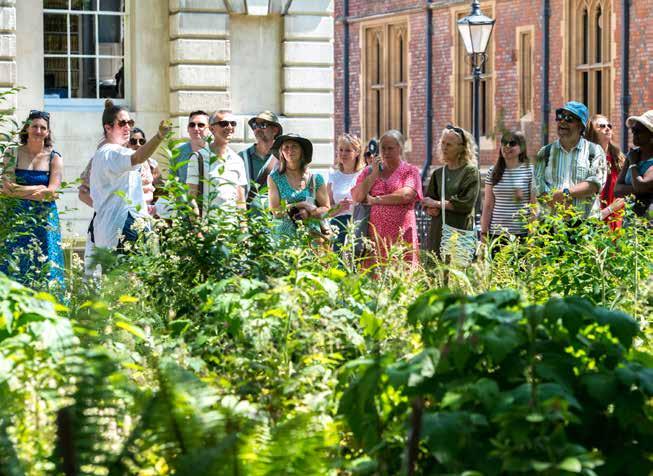
In October the Gardens Team scarified the North Lawn bank heavily and sowed the bank with a mixture of wildflowers and slow-growing grasses, including Ox Eye Daisy and Yellow Rattle. This project will take a few years to establish but should lead to a display of perennial wildflowers between May and August. It will need to be hand or machine scythed in early August and then will be kept short and mown throughout the autumn and winter, allowing spring bulbs to emerge.
The Garden Team remained incredibly busy throughout autumn, coping with the extensive leaf fall from all the trees within the grounds, but particularly the London Planes with their large, waxy leaves. Renovation planting work took place in the Kitchen Garden and Bencher’s Border, with additional plants also added to many of the newer beds and West Border. Bulbs were planted throughout, with the aim to plant more perennial types which will not need replacing each year, making our work more sustainable.
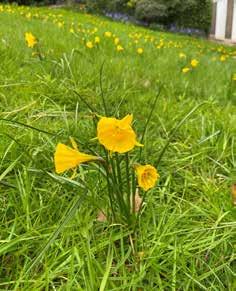
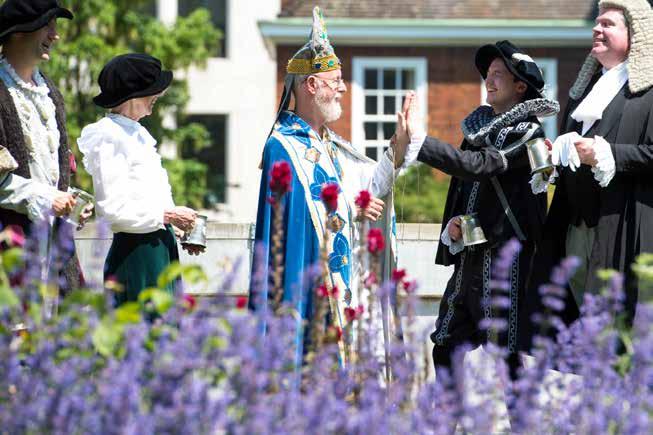
Unfortunately, birds began to dig up chafer grubs in December. Usually the grubs burrow lower to hibernate at this time of year but lack of prolonged cold temperatures are encouraging them to stay nearer the surface. Sadly, this is now affecting the main Benchers’ lawn, but treatment will not be possible until late spring 2024 at the earliest.
Our building project to provide extra facilities for the gardener’s area behind the North Gardens is imminent, having received final approval from Camden Council and the Inn’s committees. Construction is expected to begin in January 2024. This project will provide much needed space, and will comprise an extra garage space, office and potting shed.
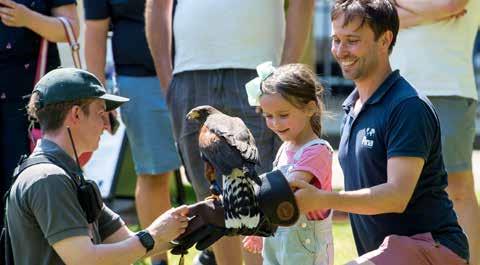
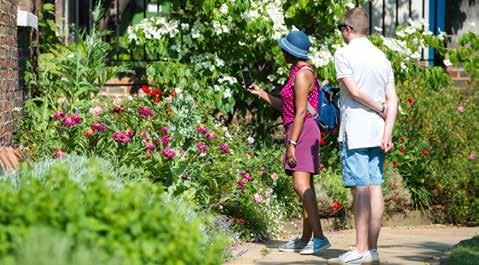
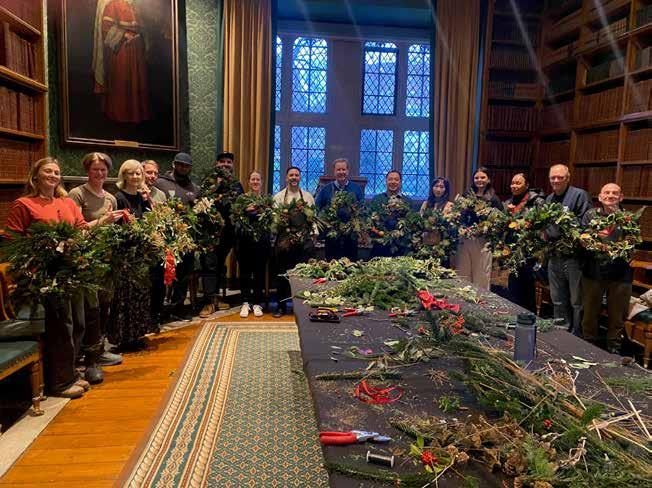
One of our last activities of 2023 was to hold another very successful wreath workshop for staff. The Garden Team provided foliage foraged from the garden, alongside some bought in from Covent Garden flower market, but the most impressive feature of the wreaths were the beautiful seedheads collected and stored painstakingly by Sonya and Imogen throughout the year, from Allium heads, to poppy capsules, to grass plumes. Every participant emerged with a smile on their face and an original and gorgeous wreath to be proud of.
Thank you so much to my hard-working team, Sonya, Imogen and Dan, and our volunteers Joy and Amanda, for all they do, in all weathers!
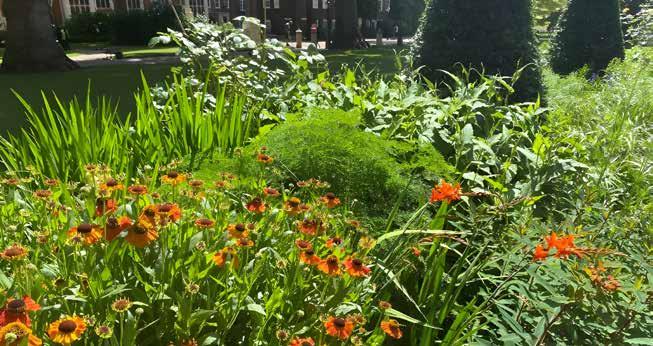
We were thrilled by the resounding success of 2023’s Open House Weekend at Lincoln’s Inn, held on Saturday 9 and Sunday 10 September. This annual event, a part of the Open House Festival celebrating London’s architecture and design, saw a remarkable turnout of 2,500 visitors – an impressive increase of 1,100 from the previous year.
At Lincoln’s Inn, we take great pride in demystifying the role of the Inns of Court and the esteemed profession of barristers. This year’s Open House Weekend played a pivotal role in achieving this goal, with 72% of attendees expressing that they had either not known or been unclear about the functions of Lincoln’s Inn before their visit. Through engaging exhibitions, talks and panel sessions, we offered a wide audience a rare glimpse into the rich history and intricate workings of our institution.
This increased participation aligns seamlessly with one of our core business purposes – to manage, use, and enhance our historic estate in the heart of London for the benefit of our members, barristers, tenants, residents, external customers, and the wider public. The overwhelming response from the community reaffirms our commitment to fostering transparency and understanding about the work that we do.
Thank you to all who contributed to making this Open House Weekend so successful. Your support enables us to continue our mission of enriching the public’s awareness of the legal profession and the invaluable heritage embodied by Lincoln’s Inn.
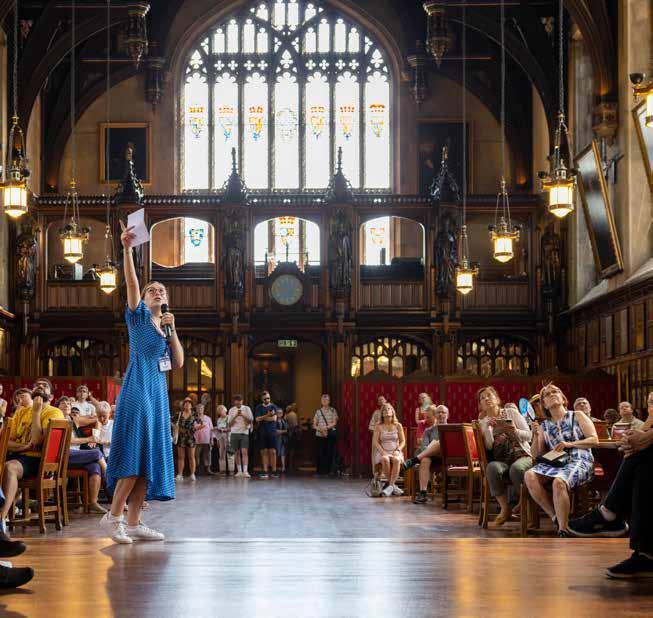
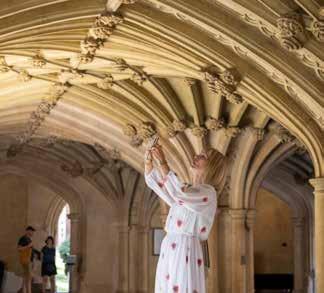
In addition to the success of our large-scale public awareness events such as Open House and Open Gardens, we gave 75 guided tours of the Inn to the public in 2023. These were attended by a total of 1,122 people. Of those, 677 came through online bookings, 355 were on private group tours, and 90 attended an Outreach tour.
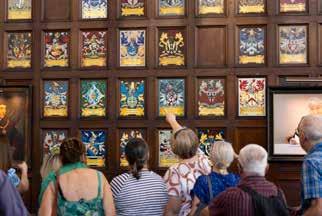

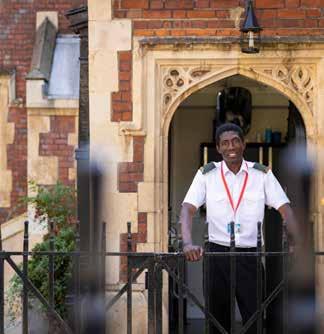
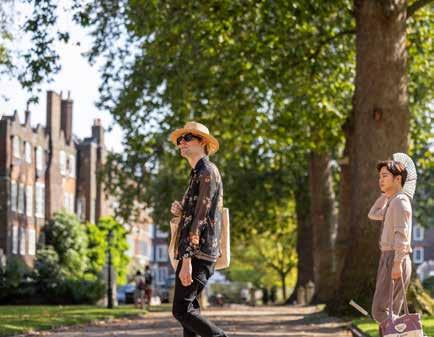
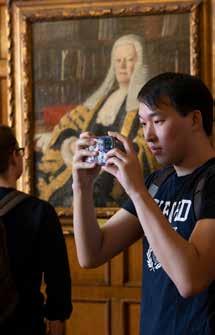
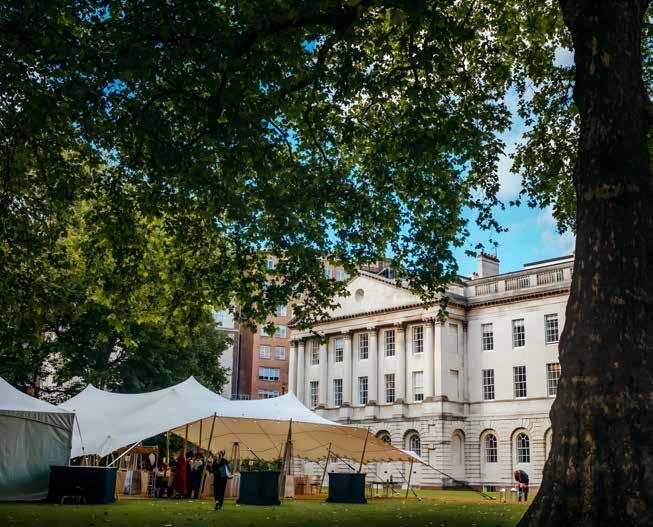
Discover your ideal summer party venue at Lincoln’s Inn. Our stunning gardens provide the perfect backdrop for your celebration, blending open-air charm with historic elegance.
The North Lawn, featuring a stylish stretch tent from 18 June to 12 July 2024, offers an idyllic setting for your summer reception. The East Terrace boasts breathtaking views of historic Halls and serene gardens, tailored for corporate parties, networking receptions, or summer barbecues.
events@lincolnsinn.org.uk 020 7405 5969
Facebook Lincolnsinnevents
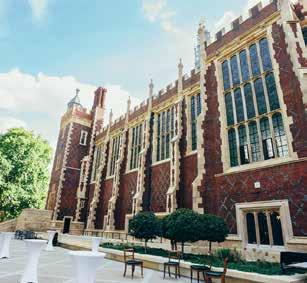
Instagram @lincolnsinnevents eventvenues.lincolnsinn.org.uk/summer-garden-party/
Grand Day is a major event in the Inn’s calendar. Taking place twice a year, it celebrates the Treasurer’s term in office. It is an opportunity for the Treasurer to invite distinguished guests from outside the legal profession to experience the full grandeur of the Inn.
The Treasurer’s guests for 2023 were an eclectic mix from the worlds of art, technology, politics and business. Amongst them were the artist Maggi Hambling CBE; journalist and writer Polly Toynbee; co-founder and CEO of legal technology scale-up Juro, Richard Mabey; former Chairman of Unilever plc and Centrica plc, Sir Michael Perry; President of the Society for Computers and Law, Prof Richard Susskind OBE KC (Hon); the Lord Mayor of London; former European Trade Commissioner and British First Secretary of State, The Rt Hon the Lord Mandelson; and The Lord Chief Justice of England and Wales.
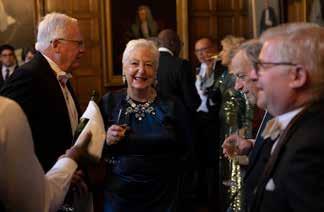
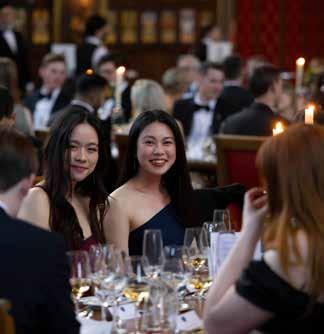
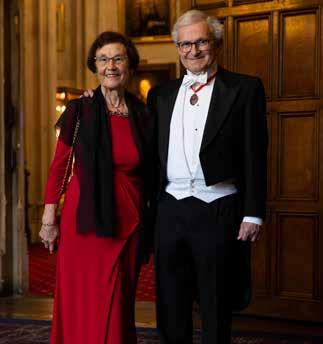
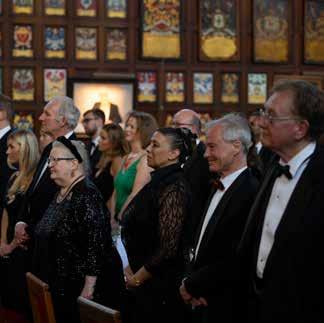
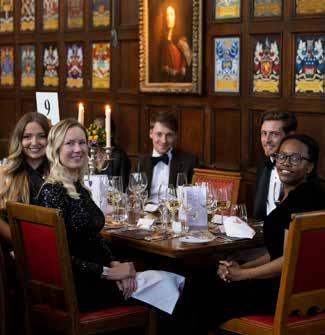
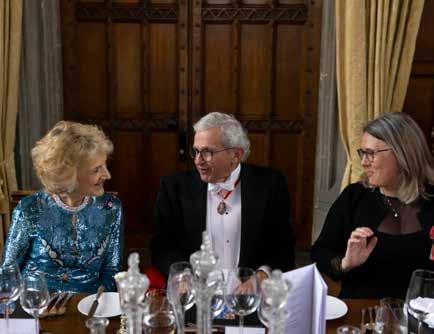
Grand Day, 11 May 2023
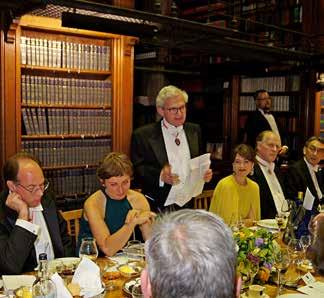
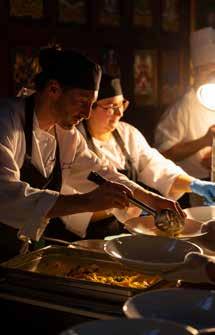
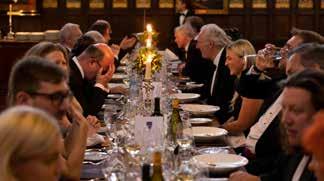
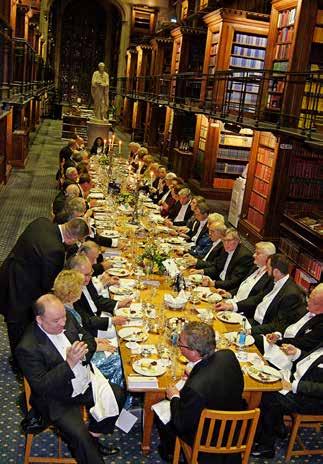
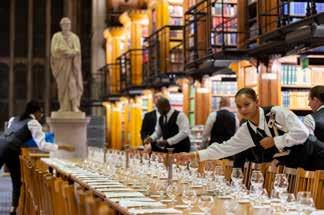
Grand Day, 2 November 2023
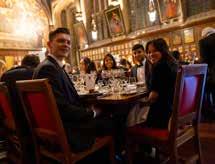
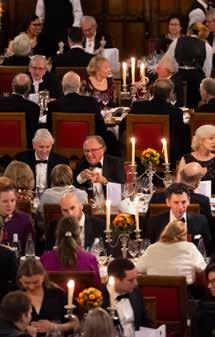
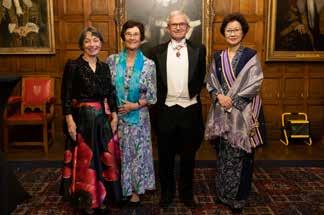

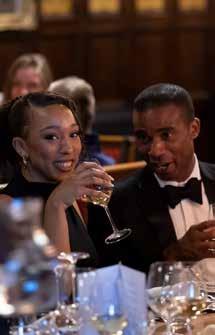
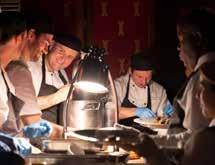
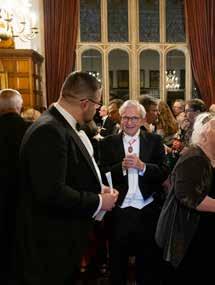
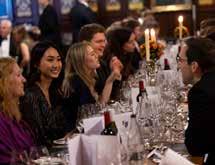
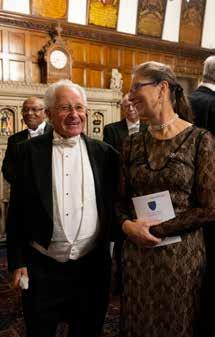
2023 marked the 25th anniversary of the establishment of what was originally known as the Lincoln’s Inn Benchers’ Ladies Association. Although the title has changed to reflect the more diverse membership, the aims “to foster friendship and co-operation between the [partners] of Benchers of the Inn” remain very much the same. The continued support of so many of the founders and original members is a testament to its success and their enthusiasm is a great encouragement to more recent recruits.
Our events this year have proved very popular indeed. The May lunch was preceded by a fascinating lecture by the historian and novelist, Diana Preston, about the loss of the RMS Lusitania in 1915 and how it hastened the involvement of the USA in the First World War. Diana and her husband, Michael (also an historian), spent quite some time answering the many questions and then joined us for an excellent lunch in the Old Court Room.
In October, we had an equally entertaining and wide-ranging ,alk from the art historian and Director of the Garden Museum, Christopher Woodward. This was followed by a delicious tea provided by the catering department, who excelled once again. Such was the interest generated by Christopher’s presentation that we are planning a trip to the Museum in summer 2024.
In 2024, the annual lunch will be held on 22 May and beforehand Librarian Dunstan Speight has kindly agreed to host a tour of some of the Inn’s paintings. The Tea Time Talk in October will be given by the biographer, Anne Sebba.
After four years, on 31 December 2023 Vivien Blackburne and Deborah Todd stood down as LIBPA Co-Chairs. They have been ably assisted by Sarah Cousins during 2023 and she will continue as an honorary Officer together with Sheila Morgan, Kate Hamblen and the long-serving Treasurer, Susan Sinclair.

LIBPA is always delighted to welcome new members. For details, please contact Sarah Cousins, sarahbcousins@gmail.com
By Mark Ockelton, Convenor of the Black Books Society
The Black Books Society hosted four well-attended lectures in 2023.
The first, on 2 February, was held online because of difficulties caused by threatened rail strikes. For this lecture we welcomed Dr Ian Williams, UCL Faculty of Laws, who talked about the collection, preservation and use of legal manuscripts after the invention of printing. We are used to thinking of the invention of printing with movable type as probably the most fundamental agent of change in early modern Europe. Dr Williams challenged this view with statistics and examples demonstrating the conservatism of English law publishers and their failure to provide lawyers and students with up-to-date case reports and commentary on emerging areas of law. In the absence of widely available printed sources, manuscripts continued to be vital and, when their circulation was restricted, provided their owners with privileged access to information: in Matthew Hale’s words, “Treasures, not fit for everyman’s view.” A recording of this lecture is available at https://www.lincolnsinn.org.uk/news/a-treasure-not-fit-for-every-mans-view/
On 18 April we welcomed Jane Ridley, Professor of Modern History at the University of Buckingham and author of a recent highly acclaimed biography of King George V. Professor Ridley discussed the lives of two of our Royal Benchers, whose combined associations with the Inn lasted from 1892, when the future George V (then Prince George of Wales) accepted the Inn’s invitation to become a Bencher, until 1953 and the death of Queen Mary, who had become the Inn’s first woman Bencher in 1943. The lecture was followed by a black tie dinner in the Great Hall.
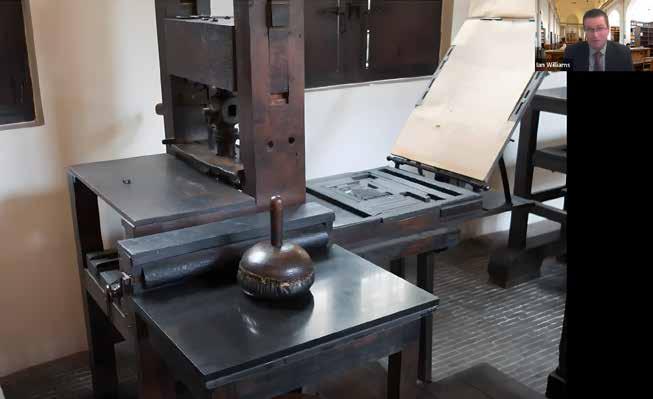
We returned to the 17th century on 30 May when Dr Mark Kirby, Child-Shuffrey Research Fellow in Architectural History at Lincoln College, Oxford, gave a lecture on the furnishings of the Chapel - a highly appropriate topic as we celebrated the 400th anniversary of the Chapel’s consecration, in 1623. The lecture also tackled the two key questions which are often asked of the building: why was it designed in a supposedly anachronistic Gothic style (particularly when the Benchers’ first action had been to consult Inigo Jones), and why did an organisation of a strongly Puritan bent create such a grand and finely furnished building? This lecture was recorded and can be viewed at https://www.lincolnsinn.org.uk/news/the-chapel-in-the-17th-century-lecture/
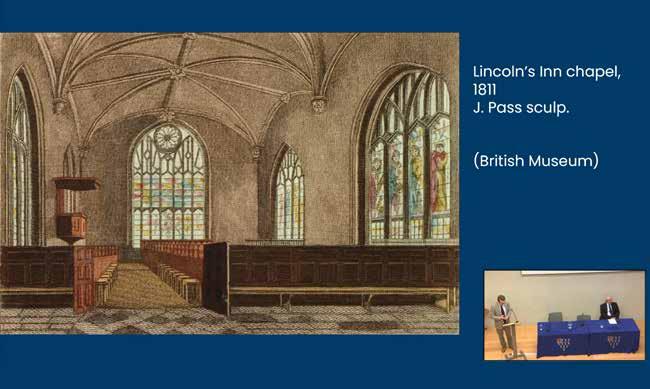
Our final lecture of the year took place on 5 October, when Philip Jones KC explored the role that members of Lincoln’s Inn played in articulating the opposition to the personal rule of Charles I and in enabling the body politic to adjust to a republic and then back to monarchy. The dramatic careers of figures such as William Lenthall and William Prynne are relatively well-known, but Philip Jones showed how many of the figures from the period who are commemorated in portraits on our walls, or stones in the Chapel Undercroft, managed to negotiate the bewildering succession of bouleversements to survive and influence the Interregnum and Restoration. The effect on the Inn itself was equally dramatic, and its very existence was threatened. The recording of the lecture can be viewed at https://www.lincolnsinn.org.uk/news/watch-troubled-times-lincolnsinn-and-its-lawyers-in-the-civil-war-period/
The annual lecture organised by the Selden Society and the historical societies of the four Inns of Court was hosted by Gray’s Inn in 2023 and was given by the Rt Hon Baroness Hale of Richmond, who considered the 200-year struggle to give parents equal rights in the upbringing of their children under the title ‘Matrimony, Patriarchy and the Welfare of Children.’ It is the turn of Lincoln’s Inn to host this event next year and we are delighted that the Rt Hon Lord Neuberger of Abbotsbury has accepted our invitation to speak. His topic will be Lord Mansfield.
Other events planned for 2024 include Heidi Kinderman discussing the Library’s magnificent manuscript of the statutes given to John Neville, brother of Warwick the Kingmaker, and Richard Wallington discussing the life and career of Lord Grimthorpe, who combined a lucrative career at the Bar, with success as an architect and horologist.
If you would like to be added to the mailing list of the Black Books Society please email Librarian@lincolnsinn.org.uk
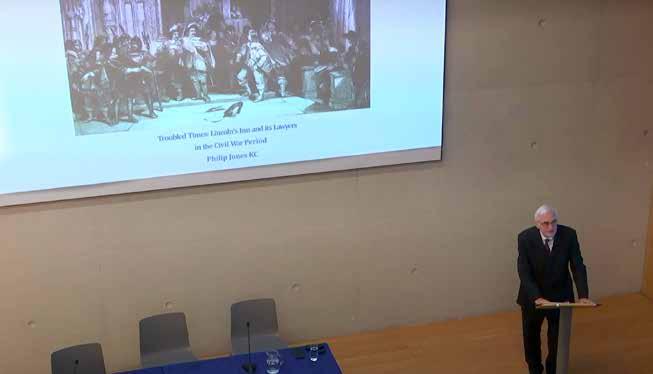
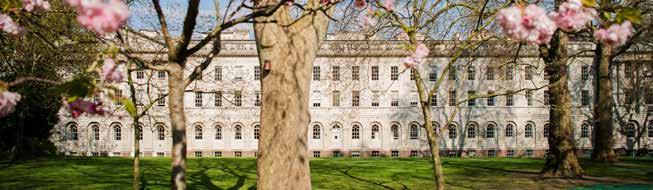
By Dunstan Speight, Librarian
One of the excitements of 2023 was the discovery of a painting which had long been missing from the Inn’s collections. In April Robert Pearce KC spotted a painting of the Great Hall in the catalogue of a forthcoming auction. The painting was signed and dated ‘Anna Airy 1944’ and we were able to confirm that it was formerly in the Inn’s possession but had been stolen at some point between 1978 and 1999. Thanks to the assistance of Philip Austin of Fine Art Specie Adjusters Ltd and David Scorey KC the Inn was able to recover the painting.
The painting now hangs on the north wall of the Upper Vestibule where Anna Airy’s depiction of the Hall can be compared with the real thing. Anna Airy’s painting records the repairs to the Hall following damage by a flying bomb on the night of 13 August 1944. This blew out the temporary windows in Hall which had been installed when the original windows were destroyed in 1941. Pleasingly, bomb damage and any concerns for health and safety have taken second place to the importance of lunch.
The painting was presented to the Inn in 1945 by Arthur Cole, a Bencher of the Inn, expert on heraldry and frequent benefactor to the Library.
Anna Airy (1882-1964) achieved great professional and critical success throughout her career but is, unfairly, little-known today. She trained at the Slade School of Art in London between 1899 and 1903 and won all the Slade prizes. Having completed her training, she set up a studio with the artist Gordon Pollock, whom she later married. She achieved success early on, exhibiting at the Royal Academy from 1905. She excelled in a number of genres - portraits, still life and landscape - and in different media - oils, watercolour, pastel and drawing. As early as 1912, the Studio magazine wrote “In addition to her considerable reputation as a painter, she is pre-eminent as a pastellist. We hardly know of another artist whose handling of that difficult medium is so instinctive.”
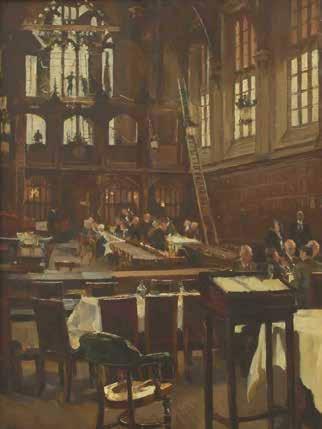
In the First World War, she was one of the first women to be officially commissioned by the Imperial War Museum as a war artist. Unlike the male artists, however, Airy was assigned to paint work on the home frontthe work of the munitions factories. Due to the harsh terms of her contract, the Museum failed to purchase one of her commissions, which she then destroyed. Fortunately, five of her commissions were purchased.
Titles such as ‘A Shell Forge at a National Projectile Factory, Hackney Marshes, London’ might not sound a promising subject for a painting but Anna Airy created very powerful images, finding beauty in the repeated abstract shapes and patterns of the factories and processes whilst conveying the noise, heat and pressure of the factories. Some of the factory paintings also recorded the vital, dangerous and demanding role which women played in the war effort, one of the factors which finally led to women gaining the vote.
For more information and other examples of Anna Airy’s paintings, demonstrating her range and skill see Alison Thomas’s excellent post on the ArtUK website at https://artuk.org/discover/stories/anna-airy-a-remarkableforgotten-artist
We are particularly pleased to have recovered this painting as it records a major event in the 20th century history of the Inn and is unusual in our collection in portraying an interior scene and showing everyday life. Above all, it is a very good painting by a first-rate, if under-appreciated, artist.
By Andrew Francis
This is the story about part of the external fabric of the Great Hall Lincoln’s Inn which is no longer there. The story starts in 1842 and ends in 1965.
On 30 October 1845, Queen Victoria and the Prince Consort attended a dinner to celebrate the opening of the Great Hall, Lincoln’s Inn. The event marked the practical completion of a project which had started in 1839 when the need for a new Hall and Library was identified because of pressure on the Inn’s resources. In 1842, Philip Hardwick was appointed architect. He drew up the plans for the Hall and Library which were approved by the Benchers. The foundation stone was laid by the Treasurer, Sir James Lewis Knight-Bruce on 20 April 1843. Exclusive of furniture, the building of the Great Hall and Library cost £83,367 (against a budget of £55,000). Including other building work in the Inn (eg what became 7 Stone Buildings - also designed by Philip Hardwick), furniture, fittings etc, the overall cost was just under £114,000. This was a huge outlay, equivalent to approximately £15m - £20m in today’s terms. Part of it was provided by two loans at 4% totalling £45,000. At that time the annual income of the Inn from all sources was about £20,000 and its annual expenditure was about £18,000, leaving a small surplus of £2,000. From this it can be seen why the loans were vital. (See Black Books Vol. 5, 1851, pp. 30-33 and 1885, p 245.)
It did not take long for paintings and engravings to emerge of these grand new buildings - fine examples of early Victorian Neo-Tudor architecture. After nearly 180 years, with only minor changes to the Great Hall (notably the Ashworth Centre, completed in 2018) and the seamless extension to the Library done in 1872 (designed by Sir George Gilbert Scott) these buildings would be familiar to Hardwick if he visited them now. But there is a large external feature on the Great Hall which no longer exists.
Hardwick’s drawings for the Great Hall (now digitised and available to view on the Inn’s website) show that at the apex of its south gable, provision was made for the housing of a statue within a hexagonal stone baldacchino. This structure was about 20 feet high with a carved stone top, enclosed on its rear three sides and with three open sides facing south, with stone tracery at the top. By the time of the completion of the Great Hall a stone statue of Queen Victoria had been placed on the structure, facing south, as anticipated by its design. Paintings, engravings and photographs from 1845 show the statue in its prominent stone canopy, adding an elegant focal point to the south elevation of the Great Hall.
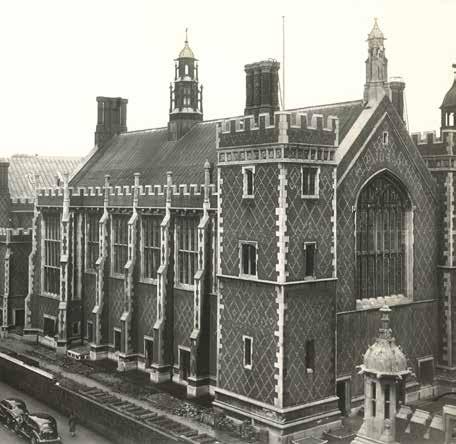
In the spring of 1965, the Inn’s surveyor expressed concern to the Inn’s Buildings Committee about the unsafe condition of the statue and its canopy. This was not surprising. As early as 1875, worries emerged about the state of the masonry of the Great Hall. These were repeated more firmly in 1899, when the Inn’s appointed surveyor Mr D. H. Barry reported that the masonry of the Great Hall and Library (and other Inn buildings) was in a very bad state. The stone used (as per the specification) was either Caen stone from north-western France, or Anstone stone from South Yorkshire. It was susceptible to degradation caused by the heavy atmospheric pollution of 19th century London. The cost of repairs was large, but it is not clear what, if anything, was done at the time. The First World War marked a pause in the normal affairs of the Inn and no major external restoration work seems to have been done to the Great Hall and Library for many decades. The Great Hall suffered some damage in the Second World War, but this was nothing compared to the tragic destruction of the Halls and buildings in the other Inns of Court. Work was done to repair the Great Hall roof in 1955. For another ten years, as it had for the previous 110 (to adapt the words of Philip Larkin in An Arundel Tomb) “Snow fell, undated. Light each summer thronged the [Inn]”. Queen Victoria stood serene in her canopy, protected from the north wind, facing south, looking over the towers, spires and finials of the Royal Courts of Justice, opened by her in 1882, 37 years after her inauguration of the Great Hall a few hundred yards away to the north.
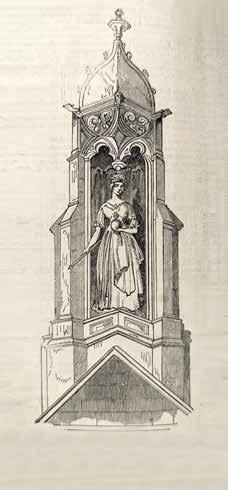
When the Inn’s Surveyor reported the unsafe condition of the statue and its canopy in April 1965, the recommendation for its removal at the cost of £750 was made to the Buildings Committee. (To put that in context, in 1965 a Mini cost about £500 and a good annual wage was £1,000.) The report was adopted by the Committee on 21 June, and on 30 June Council approved that report.
One question remains. What happened to the statue and its canopy? There seem to be no records held by the Inn which answer this question. In the 1960s Victorian buildings were fair game for demolition. The Euston Arch (designed by Philip Hardwick) and the Coal Exchange in Cannon Street had been demolished in 1962. The wonderful late Victorian Birkbeck Bank building in Holborn at the top of Chancery Lane went in 1964. Whilst there was a market for architectural salvage, it is probable that the statue and canopy had deteriorated beyond any further economic use. Moreover, it was not “fashionable”. It is likely that the contractor broke it up into pieces on the gable and they were lowered down, placed in a lorry and taken away to a dump. Unlike the large number of granite stones of the Euston Arch deposited in the River Lee in East London in 1962 and rescued in 1994, or Temple Bar, removed from Theobalds Park in Hertfordshire and re-erected in Paternoster Square in 2004, it must be assumed that there was nothing of the statue and its canopy worth saving.
This, of course, a sad ending. As the Inn’s Preacher, John Donne wrote: “No man is an island, Entire of itself; Every man is a piece of the continent, A part of the main.” In poetic terms it might be apt to say that the statue and the canopy, being part of the original fabric of the Great Hall, was “part of the main”. We have lost that part. In non-poetic terms, it simply had to go. In 1965 the prevailing sentiments did not favour its restoration or replacement.
So, when you next pass through the main gate of the Inn, look upwards to the top of the gable on the south elevation of the Great Hall. Imagine that the statue and the canopy are there. You may feel that something is missing, but you will now know why Queen Victoria was lost to the Inn. Perhaps one day we may erect something in her place?
My coat of arms was intended to contain elements which reflected both the backgrounds and interests of my wife, Wendy, and I, and of course my work as a judge.
The crest upon the helm with the rose and the acorn reflects my wife Wendy’s background –her family name is Castle-Bennett.
The three gold rings (Annulets Or) reflect my surname, Goldring. The three pierced cinquefoils vert refer to the City of Leicester, where I was born. Its coat of arms contains a pierced cinquefoil (although not in green).
The cornucopia azure contains snowdrops and wisteria, which are among the favourite flowers of my wife and I and reflect our keen interest in gardens.
The motto, “Scopus Laboris Justitia”, very broadly translated may be said to mean ‘to seek to act fairly.’
My coat of arms was created 2001/2 when, on my appointment as a judge, David Hills asked if I would like my arms to be displayed in the Great Hall. It was a great honour to be asked, but there were (of course) no extant arms to display.
The College of Arms was consulted, and with the advice of Rouge Dragon Pursuivant (and on payment of a fee), a design appeared and a grant of arms was made. It was a fascinating exercise.
Sometime before all this, my young daughter had produced a design of a medieval knight’s shield for an art exercise at school. Its main feature was a large swan. I took this along to the College. The Pursuivant thought the swan would be an ideal symbol for the Thames at Kew where I then lived. The swan was thus included. It is surrounded by ermine as a hint to judicial office. Above the swan are three red hearts, each surmounted by a cross: they are the ancient symbol of the Vendée area of France and of its counter-revolutionary forces who fought, in late 18th century France, for “Dieu et Le Roi”. These hearts symbolise for me the small house in the Vendée department of modern France which has been in the family since 1986. In the formal grant of arms, the College refers to me as being “of Kew in the county of Surrey and of Le Grand Village, St Pierre du Chemin in the Vendée department of the French Republic” – a nice touch which I greatly appreciated.
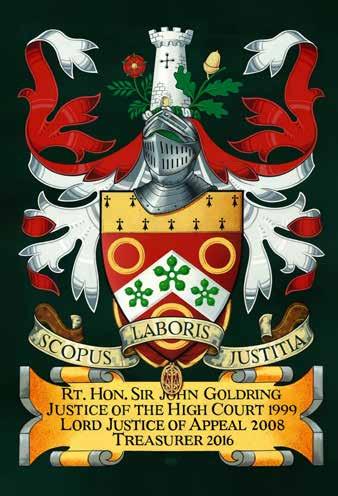
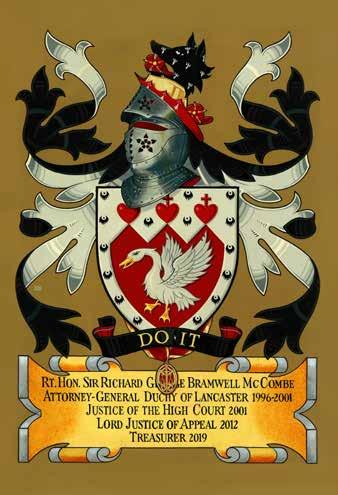
The motto, “Do it”, I was told, is the shortest to appear on a new grant since that of the late Sir Harry Secombe whose motto “Go on” needs no explanation to radio listeners of my generation. “Do it” came from the repeated exhortation, “Do it, do it, do it” uttered by my son, then very young, to family members engaged in a session of physical exercises. Apart from being an appropriate encouragement to effort, if quickly glanced at, the motto can be confused with the French “Doit” (as in “il doit”), conveying perhaps an appropriate sense of duty.
Not appearing in the Chapel window version of the arms, but on the full arms in Hall, is the wolf’s head crest, incorporated in the arms of my school from the Latin “lupus” and referring to Sir Roger Lupton, who founded the school in 1525. Surrounding the head are red roses recalling my Lancashire birth and upbringing and also my time as Attorney General of the Duchy of Lancaster, as well as my long membership of Lancashire County Cricket Club.
The end of the judicial career approaches and the realisation dawns that one has not left any great mark on the law - and never will do. The notion of leaving a mark on the Inn suddenly becomes attractive: and so off to the College of Heralds one goes to seek a grant of arms.
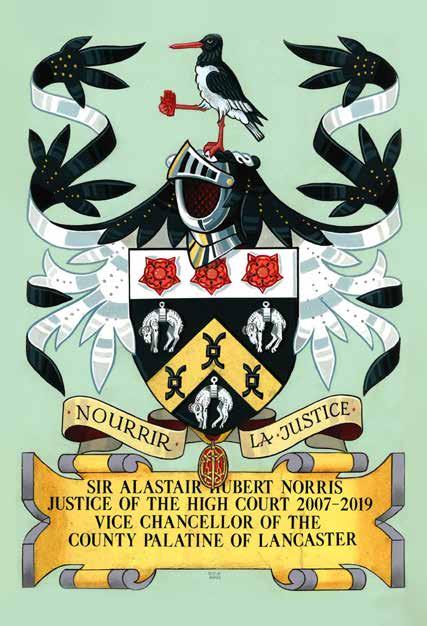
The therapy session goes well“And what has been important in sir’s professional life?” A jumble of thoughts tumbles out and Clarenceux King of Arms shifts through them, seeing what might bear heraldic significance. School: the arms of its founder Sir Richard Pate? That yields the chevron and the chief (in my case a chevron or and a chief argent). My family roots in a Cotswold farm? That yields three fleeces argent, which I find particularly endearing, for I am still a Gloucestershire man. They remind me of it being better to be hung for a sheep as a lamb. The three roses gules charged upon the chief have layers of meaning. A reference to my days at St John’s College, Cambridge which set my feet on the path to the law. A memorial to the happiest days of my judicial career, as Vice Chancellor of the County Palatine. One for each of my children. The three millrinds charged upon the chevron are a respectful reference to the Inn of which I am a proud member. What of the crest? “An oystercatcher proper holding in the dexter foot a sinister hand appaumy couped at the wrist gules”. The oystercatcher is my favourite bird. I love its formal attire, set off by those dashing red socks. Its plaintive piping brings to mind precious days on the Teifi Estuary in Ceredigion, sailing at high water and walking the flats at low tide in the glorious company of oystercatchers. And the “sinister hand”? It is the Red Hand of Ulster, a reminder of my other family roots.
The motto is my own invention. A pun on my name: but also a double entendre. In high French it is a worthy admonition to “Sustain justice”: and in low French an injunction to “feed the judge”. I thought that apposite for a panel in The Great Hall.
The Hon Mr Justice Trower
It is no accident that the arms on my shield bear some similarity to the arms of Lord Tomlin of Ash displayed on the adjacent heraldic panel and also in one of the Old Hall windows. Two of the quarters of my shield, those which incorporate three axes and three dexter hands, are the same as his. Lord Tomlin was my great grandfather. He became a law lord in 1929, leap-frogging the Court of Appeal when he did so, but died when he was still in his 60s. Apart from his distinguished legal career, the principal mark he left on the Inn was his gift of the gate and railings separating New Square from the old kitchen garden. They were designed by his youngest son, Stephen Tomlin, a sculptor who floated on the periphery of the Bloomsbury Group.
The other two quarters of my shield incorporate a tilting spear and three lions passant. These arms came through another of my great grandfathers, Sir Walter Trower, who was President of the Law Society in 1913 and practised from 5 New Square. The right to these arms had been granted to the male descendants of his own great grandfather in 1795.
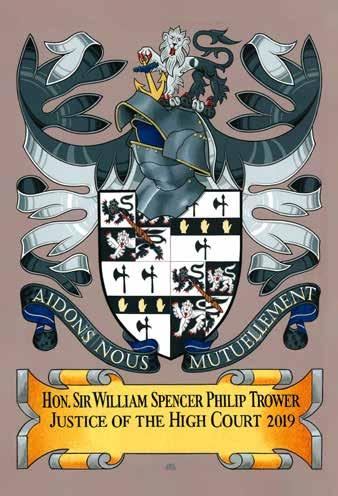
The quartering of the Tomlin and Trower arms to form the shield displayed on my heraldic panel results from one of the more arcane rules of heraldry. Lord Tomlin’s sons all died without issue, with the consequence that his two daughters, one of whom was my paternal grandmother, were his heraldic heiresses. This entitled my father and his male descendants to have the Trower arms quartered with the Tomlin arms in a single shield. The coat of arms, which was prepared by Chester Herald in 1995, also incorporates the Trower crest, a lion supporting a gold anchor with the dexter paw, and the Tomlin motto, “Aidons Nous Mutuellement”, to be displayed with the quartered shield.
There is one other Trower shield in the Inn. It appears in the east window of the Chapel. It bears the arms of a distant relative, James Trower, an early 19th century Master in Chancery, who was Treasurer in 1823. This shield also incorporates three lions passant, evidently a symbol of which the Trower family were fond, but it has no other similarities to mine.
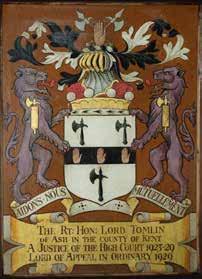
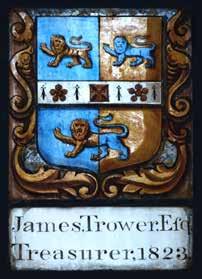
Unfortunately, family history does not relate why the axes, the dexter hands, the spear and the lions were chosen by those of my ancestors who were the original grantees, nor have I been able to discover why the Trower crest included an anchor. However, the quartering of the arms of two of my great grandfathers, both of whom were distinguished lawyers, has produced an attractive panel painted with great skill by Baz Manning. I am very grateful to him, as I am to the Treasurer who agreed that it could be placed next to that of Lord Tomlin.

By Phil Martin
In 2017, the football historian Martin Westby published the first edition of his authoritative work entitled England’s Oldest Football Clubs 1815-1889 I was intrigued to find a London based club named Dingley Dell listed as the second oldest after the Sheffield Football Club, who are acknowledged to be the oldest extant “association” football club in the world. I knew nothing of this club, so I began to research its origins using (inter alia) the British Newspaper Archive, an online resource containing more than 71 million digitised newspaper pages dating back to the 18th century. My research would uncover a significant addition to the history of football, particularly in London, emphasising the important role played by members of the legal profession generally and in this case Lincoln’s Inn specifically.
Dingley Dell were formed in 1858, and initially played cricket, but like many similar clubs at that time, they appear to have vanished into thin air during in the mid-1860s. I discovered 32 matches played in a six year period, and from the lineups published in match reports was able to identify in excess of 80 individual players. Every match was an away game for the Dellers (just one of their nicknames), as they appeared to neither own nor rent their own home football pitch. The fixtures were initially a series of matches arranged with both the Westminster and Charterhouse public schools in London. Later fixtures included those against Surbiton, Kingston, the War Office (Civil Service), Harrow School, and Eton College.
The Dellers were adept at playing fixtures utilising a variety of football rules (each school at that time had their own unique rules) and it is recorded that Dingley Dell had developed a set of rules of their own. Sadly, no copy of the DD rules is known to have survived, but we know that they played what can be described as a “kicking or dribbling game” rather than the alternative “handling game”.
Prior to 1863, there was no such thing as “association” football. The first six meetings of the newly formed Football Association were held in the period from October to December 1863 in the Freemasons’ Tavern, Great Queen Street. One newspaper report of those meetings suggested that the Dingley Dell club were represented at the first meeting.
Having identified the Dingley Dell players, began to research their backgrounds, concentrating on the 25 players with most appearances for the club. I looked into their school, university, and professional connections, and something extraordinary resulted from that analysis. When I looked into their professional connections, the result was astonishing - the large majority appeared to be members of the legal profession, and almost all had been called to the Bar. Of those top 25, 23 were connected with the Inns of Court: five were members of Inner Temple, one a member of Gray’s Inn, and…drum roll…seventeen were members of Lincoln’s Inn.
So, we discover what was predominantly a Lincoln’s Inn eleven playing a very early form of football in London. To use Martin Westby’s description, I claim that they were the first ever “workplace” team.
There is no evidence that the Dingley Dell club had any official recognition in Lincoln’s Inn. We must presume it was simply a group of friends and acquaintances who were all lawyers working at the Inns of Court at that time.
The origin of the club’s name is something of a mystery. Dingley Dell was of course the name of a village cricket club in Charles Dicken’s The Pickwick Papers, initially published in 1836. Could the club’s name have been influenced by Dickens himself, a local man? Was it just a favourite book of the players? We will probably never know.
This image of the Forest club, founded one year later in 1859, may give us some idea of the likely style of attire of the Dingley Dell club:
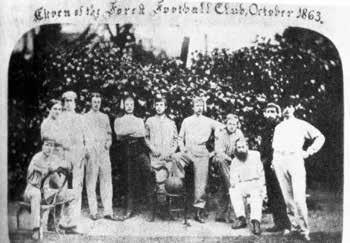
The early captain and effectively the founder of the Dingley Dell club was George Sills. Born in Lincolnshire, he was admitted as a student member of Lincoln’s Inn in November 1852 and was called to the bar on 26 January 1858. He was the Recorder of Lincoln from 1889 until his death in 1905. George played 24 games for the Dingley Dell club. To date, I have been unable to find an image of this pioneer of the game.
Other Dingley Dell players of note included:
Sir Richard Cayley, who like Sills, hailed from Lincolnshire was admitted to Lincoln’s Inn in November 1859 and was called to the Bar on 11 June 1862. He later became a Queen’s Advocate, and from 1879 through 1883 he was the Chief Justice of Ceylon (Sri Lanka). He was knighted in 1882. Richard played 17 games for the Dingley Dell club.
Henry Colville Marindin, who was born in Shropshire, was admitted to Lincoln’s Inn in November 1857 but does not appear to have been called to the Bar. He went to live and work in Kolkata (Calcutta) and died there at the early age of 37. Henry was the older brother of Colonel Sir Francis Arthur Marindin, KCMG who gained fame as a founder of and player with the future FA Cup winning Royal Engineers football club, and later President of the Football Association. Did Francis inherit his passion for the game from his elder brother? This research was the first to connect the two brothers’ involvement in the sport.
Loftus Adam Fitz-Wygram attended Eton and then University College, Oxford graduating in 1856. He became a student member of Lincoln’s Inn in February 1852 and was called to the bar on 17 November 1858. In the census of 1861 when answering the question “Rank or Profession?”, he simply answered “Baronet”.
Goerge Sills suffered a serious football injury in late 1862, and while he later made a few more appearances, it would seem that he retired from playing the game in 1864 aged 31.
The Dingley Dell name disappears from the newspaper records of football matches at the end of the 1863-64 season. What we can conclude however, is that the Dingley Dell football club led by the pioneering George Sills was a major influence in the development of the national game of association football in its earliest years, pre-dating and following the formation of the Football Association in 1863.
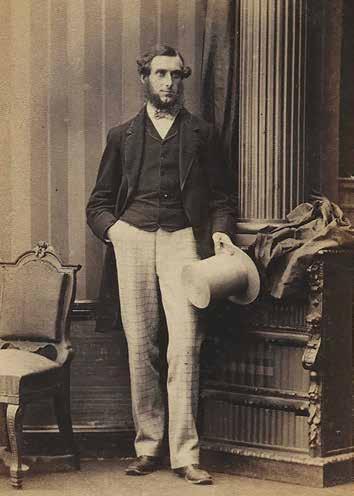
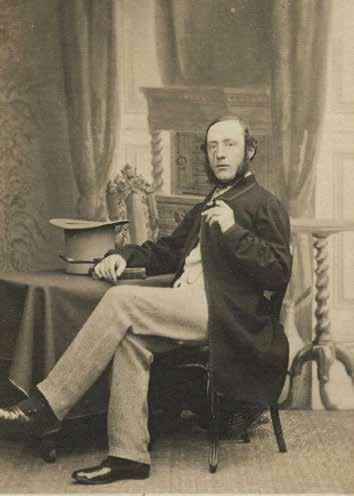
Conceived as part of the Inn’s 600th Anniversary celebrations, Listening Inn, an oral history podcast, was launched in August 2023. The project, overseen by the skilled oral historian Sarah Gudgin, offers listeners an intimate glimpse into the lives of five of our members, shedding light on their personal and professional journeys to the Bar. Each episode not only highlights the achievements and challenges faced by these members but also explores the nature of the legal profession and the role Lincoln’s Inn plays in shaping careers and fostering a sense of community.
The success of Listening Inn owes much to the generosity of the interviewees who willingly shared their time and insights. Their contributions have transformed this podcast into a treasure trove of anecdotes and wisdom, offering a valuable resource for both current and future members of Lincoln’s Inn.
Plug in your headphones and enjoy!
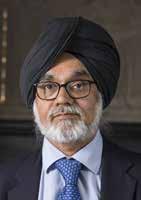
Episode 1: The Rt Hon Lord Justice Singh
Lord Justice Singh was the first lawyer in his family and the first person of Asian heritage to be made a High Court Judge. During our interview he reflects on the law being a great equaliser, an idea that has influenced him in his work both as a barrister and as a Judge
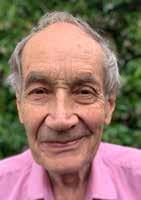

Episode 2:
David Ainger
Veteran Chancery barrister David Ainger reflects on his longstanding relationship with the Inn, spanning 66 years, as well as talking about some of the changes he has witnessed in that time.
Episode 3:
Elspeth Talbot Rice KC
Elspeth Talbot Rice KC speaks about the importance of truth and integrity, her career as a Chancery Barrister and the significance of the history and continuity of Lincoln’s Inn.

Episode 4: David Scorey KC
David Scorey KC looks beyond background and regional accents, as we follow his road from humble beginnings in Manchester to Oxford and the Bar, a path that required ability, application and merit.
Episode 5: Her Honour Judge Whitehouse KC
Her Honour Judge Whitehouse KC reflects on leaving a successful career in the City in order to become a barrister and her work as Silk at the Criminal Bar. She also shares insights into her time as a Senior Treasury Counsel and a Judge.

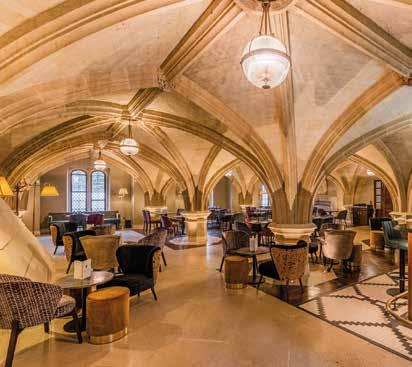
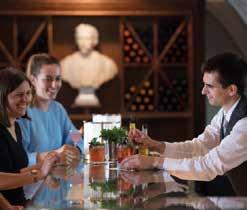
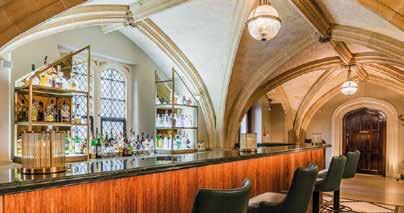
Come and visit us in the Lincoln’s Inn estate for innovative dishes, inventive cocktails and a warm welcome.
CONTACT US themcr@lincolnsinn.org.uk | 020 7693 5139
The MCR Restaurant and Bar, The Honourable Society of Lincoln’s Inn, London WC2A 3TL
Monday – Friday | 10:30 – 22:30 www.themcr.lincolnsinn.org.uk
The business of the year began with a report on the recent Quinquennial Inspection on the Chapel building, which detailed the success over the last five years of the audio rehaul, high-level masonry, joinery and lighting repairs, and the cleaning of the west elevation, as well as the repair and conservation of the glass and the commissioning of the latest Treasurers’ Coats of Arms, all of which were completed in time for the Chapel’s 400th Anniversary Year.
The Committee noted that the recording equipment in the Chapel would be used for sections of some special events this year, and as such the Warburton Lecture, and highlights from the 400th Anniversary Service, were recorded and published on the Inn’s website.
Considerations as to how the Chapel community might maximise its charitable giving, were a major theme in Committee discussions over the course of 2023. In consultation with the Inn, the Committee introduced a system offering members the opportunity to Gift Aid their donations or use CAF vouchers; a system which has proved highly popular and successful since its introduction at the Carol Services.
Among other new practices approved by the Committee over 2023 were: the introduction of a rota of members of staff who perform the role of Verger at Sunday Services; the approval of designs for a new and simplified set of cross and candlesticks for everyday use in Chapel (the present wooden cross to be transferred to the columbarium); and the offering of refreshments after, as well as before, Sunday Services, in an effort to be more welcoming to newcomers.
Anna Airy painting of repairs to bomb damage to the Great Hall 1944
The most exciting development of 2023 was the recovery of this stolen painting. (See page 85 for further details).
Mansfield and Hale frames
In 2022, Ben Pearce, an expert on picture frames who was carrying out some work for us, remarked on the oddity of having a portrait of Sir Matthew Hale (the version in the Lower Vestibule), a sombre 17th century judge, framed in a playful, Rococo 18th century frame whilst our portrait of Lord Mansfield (the early Van Loo portrait which shows him as a beautifully attired man-about-town) was framed in a sombre 17th century frame. The size of the canvas in each painting is identical and the temptation to swap them was irresistible. The result is that each painting now looks at home in its frame. It was not uncommon for paintings to be taken out of their frames for storage (e.g. during the War) and for the frames to be mixed up. This is our theory of what happened to these paintings.
WELCOME TO THE
WELCOME TO THE
WELCOME TO THE
WELCOME TO THE RESTAURANT AND BAR
AND BAR
RESTAURANT AND BAR
WELCOME TO THE
This year has seen two new portraits added to the collection. In February 2023, we received Alice Beavan’s portrait of Sir John Goldring. Alice Beavan chose to paint Sir John standing in the foyer of the Ashworth Centre with a glimpse of the Library building through the skylight. This was a highly appropriate setting as Sir John’s year as Treasurer coincided with the start of the Ashworth Centre’s construction.
In September, the Inn unveiled a portrait of Mercy Ashworth to celebrate the centenary of her Call. This took the form of a photographic collage of current women members of the Inn (see page 34 for further details)
The Silver Muster took place on Sunday 15 January 2023. After the muster, those present were treated to some remarks on a number of pieces of silver by Dr Timothy Schroder (President of the Silver Society and a wellknown expert on silver).
The muster discovered the following irregularity: a small number of items were noted as missing and it is obvious that someone removed the pieces of flatware remaining at their place at the end of a Grand Night dinner.
Silver at private dinners organised by a member of the Inn
In response to requests from a number of Benchers and members, the Committee agreed that members of the Inn may request pieces of the Inn’s silver to be on display if they book a private dinner in one of the Inn’s rooms, subject to the following conditions:
• This option is restricted to Hall members and Benchers of the Inn for reasons of security
• The event must be organised by a Hall member or Bencher. It is not enough for members to be attending the event.
• The items which can be requested are restricted to a list provided by the Committee
• A maximum of 15 items can be requested per event
• A charge of £10 per item, with a minimum of £100, will be added to the price charged to the member booking the event to reflect the additional staff time required for cleaning the silver and checking it in and out of the strong room.
• The charge will include insurance, as this is covered by the Inn’s insurance. If there is a specific request for something different, then permission should be sought from the Chairman of the Chattels Committee.
Conservation of the Bench Room paintings
The programme of conservation work on the paintings and armorial panels from the Bench Rooms damaged during the Great Hall roof project in 2021 is almost complete. The paintings of Lord Hardwicke and Sir John Franklin will be returned by the end of the year. The need to reverse the water damage has enabled our conservators to remove dirt and discoloured varnish. This has revealed or highlighted details which were previously obscured, such as details of clothing. For instance, the cravat and coat collar in the Andrew Morton portrait of Lord Brougham are now nicely defined when they were previously impossible to distinguish.
Conservation of portrait of Sir Thomas More
During the summer, we realised that the anonymous portrait of Sir Thomas More which used to hang in the crypt of the Old Hall was reacting badly to environmental conditions. This is an early copy of the Holbein portrait and is painted on panel, a base which is particularly susceptible to changes in atmosphere. Here the culprit seems to have been the hot, dry conditions in the early part of the year when the heating was on. The panel has been taken to Melanie Caldwell, who carries out much of our painting conservation work and should be returned in the new year. This will be an opportunity to re-evaluate this painting and hang it in a position where it can be better appreciated than the dark corner it previously occupied.
Following the May Committee meeting a small working party was formed to follow the progress of the Benchers’ Border throughout the year, taking notes and photos on a monthly basis. Their findings will be reported to Gardens Committee in mid-2024. The Committee will then consider what, if any, changes might be made to the Benchers’ Border, which because of its position is the highest profile of the Inn’s borders.
The chains around the New Square garden were removed for a filming project and placed in storage. The Gardens Committee supported keeping the space chain free and accessible in line with the rules of the North Lawn and gardens. However, following anti-social behaviour on the lawn and impact on the working environment, PADG decided to reinstate the chains. This change has led the Gardens Committee to put proposals, suggested by the Head Gardener, for revising the design of the New Square garden on hold. Meanwhile, work to improve the existing beds will continue.
In September, the Gardens Committee approved the Head Gardener’s proposal to create a wildflower meadow on the North Lawn bank, facing Stone Buildings. This will be a multi-year project, as perennial wildflower seedlings take longer than annuals to germinate and become established.
The Committee also reconfirmed its support of the gardeners’ buildings extension project. F&GP Committee gave the project full approval at its November meeting. The project will begin construction in spring 2024. It will provide an extra garage, office and potting shed for the Garden team.
The HED Committee oversees the Catering Department’s activities, both operational and financial. It monitors the Department’s performance in all events for our members and for private and corporate clients. The Committee fixes annual budgets, monitors income and expenditure within that budget, reviews and approves the purchase of equipment and reviews feedback on events. It also feeds in its ideas and suggestions on new events and possible improvements and oversees the promotion and marketing of all the Inn’s hospitality venues – the Great Hall, the Old Hall, the Ashworth Centre, the Old Court Room and the MCR Restaurant and Bar, together with the outdoor garden and terrace spaces.
It was an exceptional year with a full calendar of Inn and commercial events. With a diverse programme of Inn events, we saw a surge in attendance at traditional events such as Ordinary Dining, Grand Days and Sunday Lunches and extremely popular new events including the South Asian Heritage Month Diversity Dinner. Commercial events saw a significant increase throughout the year, utilising both Halls often simultaneously.
Increased event activities saw the Committee support the increase in the number of catering staff, navigating rising business costs, and managing the balance between Inn and commercial events. Looking back on the achievements of 2023, the year demonstrates our continuing focus on attracting fewer but larger high-value commercial bookings and capitalising on Ashworth Centre business whilst maintaining the collegiate and education events within the Inn.
Please refer to pages 65-67 for the Library and Archives report.
PADG continues to focus on medium- and long-term matters, many of which span the interests of other, subject-specific Inn committees. It is chaired by the Treasurer and reports on the outcomes of its discussions to each Council meeting.
PADG met 8 times in 2023. Business included discussion of the timing of Call,the Finance and General Purposes Committee strategy for managing the Inn’s financial challenges, the wording used to give thanks before dinners in Hall, the process for selection of the Keeper of the Walks and increasing the diversity of the Bench.
The Post-Call Education Committee oversees advocacy and ethics training for various groups, including pupils, new practitioners, and established professionals. Their responsibilities include education and training for practitioners, grading of advocacy tutors, and international advocacy training.
A significant focus of the Committee’s work has been on providing mandatory training for pupils and new practitioners, as well as reintroducing Advocacy and the Vulnerable training to our regular programme and delivering additional ethics training for pupils. We trained 96 pupils and 86 new practitioners. At our Tutor Training Course, we trained 14 new advocacy tutors.
The Committee carried out an extensive update of our course materials to ensure their continued relevance and appropriateness for the courses.
The Committee is pleased to have secured two new regular venues, Cranfield Management and Development Centre in Milton Keynes and Moor Hall in Maidenhead, to host the Pupils’ and New Practitioner Courses. We are working to identify a new venue for the Tutor Training Course.
The Pre-Call Education Committee is responsible for overseeing outreach, admission, education, training, and the Call to the Bar process for students. This includes organising insight events for prospective students, maintaining connections with universities, conducting qualifying sessions, and extracurricular activities for current students.
The number of student enrolments on the Bar Course remained high as with the previous year, maintaining pressure on staff and tutors to provide an adequate number of qualifying sessions. The Committee has been actively working on ways to recruit new tutors and retain current tutors to achieve this goal.
In 2023, the Inn held around 100 events for current and prospective students. The programme for current students included qualifying session lectures, workshops and residential courses and competitions, mooting and debating, and careers advice. Our outreach activities included information sessions, the summer school for prize winners, and the programme in partnership with IntoUniversity for sixth form students.
In 2023, the Helen Grindrod Social Mobility Prize was launched with the goal of improving access to the profession and supporting high-achieving undergraduate students from less advantaged backgrounds. The prize considers socio-economic criteria, and due to evidence indicating extra disadvantage faced by Black applicants for pupillage, the aim is to allocate at least 50% of the places to Black applicants, including those of mixed Black heritage. In its first year the prize received 26 applications, and efforts are underway to increase the number of applications in the coming years.
The role of the Scholarships Committee is to consider matters relating to the interviewing and awarding of the Inn’s GDL and Bar Course scholarships as well as the awarding of the Inn’s Pupillage Grants and Bar Course prizes. It is responsible for recommending the Inn’s annual scholarships budget to the Finance & General Purposes Committee and for monitoring the progress and achievement of the Inn’s scholars.
In 2023, the Inn awarded 33 GDL scholarships and 118 Bar Course scholarships. Bar Course scholarship interviews had been held remotely since 2020 due to the pandemic but fortunately it was possible to hold them in-person this year. The Inn arranged 234 interviews which took place in London, Manchester and Birmingham with a handful being held remotely when requested by the candidate.
Towards the end of 2022, the Inn appointed a consultant to review the Inn’s scholarship processes and make any recommendations for improvement. The consultant produced a report in the summer outlining the suggested changes and these are currently being reviewed and implemented by the Committee.
The Staff Committee plays a crucial role in addressing matters concerning the recruitment, pay, management, and discipline of the Inn’s staff, including staff pensioners. Additionally, the Committee is responsible for recommending the annual staff salaries budget to the Finance & General Purposes Committee.
In 2023, there was a reduction in the number of staff-related issues which arose compared to the three preceding years. However, recruitment and retention continue to pose challenges in an environment where the market favours employees. All departments have been affected by difficult-to-fill vacancies, prompting the Committee to reassess strategies for maintaining competitiveness. As part of this effort, the Committee regularly reviews salaries based on market-rate data. The Inn’s financial limitations have added pressure, requiring a delicate balance between retention and affordability. As last year, the rising cost of living remains a real concern for our staff members.
During discussions on the annual pay rise for 2023, the Committee decided against using a weighted percentage approach, which was employed in 2022. Affordability, issues of fairness and maintaining good employee relations were all important considerations, leading to the decision to apply a flat rate percentage increase to all staff in accordance with normal past practice, regardless of their position or salary band. This approach ensures some parity while keeping pay competitive.
Looking ahead, we anticipate that next year may bring some interesting developments, such as legislation that grants workers new rights in relation to their terms and conditions of employment. We express our gratitude to the Committee Members for their valuable guidance, consistency, and dedication throughout this challenging year.
In addition to the aforementioned activity, the following committees met throughout the year. Advisory (Benchers) Committee (ABC) selects candidates to be considered by Council for election as Ordinary Benchers. It is also responsible for considering proposals and recommendations for Honorary Benchers.
Audit and Risk Committee oversees the governance, risk and management controls withing the Inn. This includes oversight of the year end audit process, internal controls and processes, and risk management.
Finance and General Purposes Committee (F&GP) oversees the Inn’s financial affairs of the Inn and other matters which do not fall within the remit of another committee. This includes annual budgets, medium and longer term cashflow forecasts and the financial implications of significant proposals.
Investment Committee is responsible for the management of the assets of the Inn’s Investment Fund and Capital Repayment Fund and provides investment advice to the Trustees of the Inn’s charities.
Technology Programme Board (TPB) monitors, reviews and approves existing and prospective technology infrastructure to meet the developing business needs of the Inn. It reports to the Finance & General Purposes Committee.
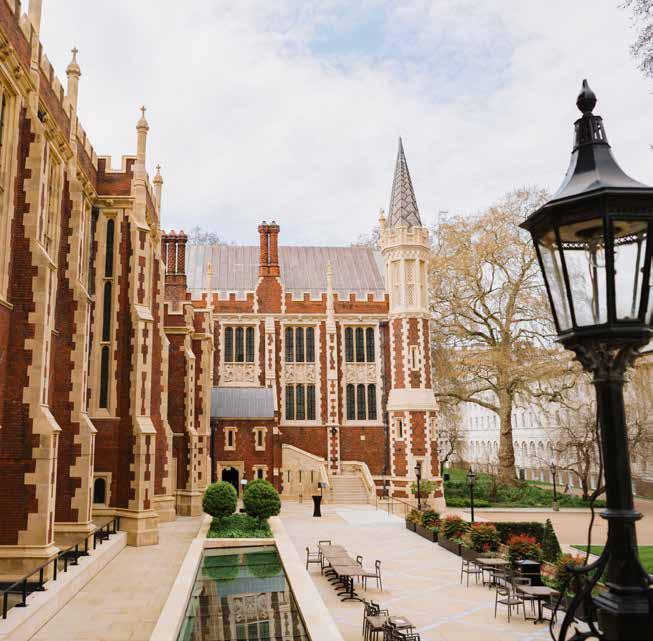

Treasurer – The Rt Hon Lord Briggs of Westbourne
Lord Briggs practised in commercial and chancery work before being appointed to the High Court in 2006. He had been the Attorney General to the Duchy of Lancaster from 2000 until 2005. He was the judge in charge of the extensive Lehman insolvency litigation from 2009 to 2013. He was appointed as a Lord Justice of Appeal in 2013. While there he carried out the Chancery Modernisation Review. In January 2016 he was appointed Deputy Head of Civil Justice and undertook the Civil Courts Structure review. He became a Justice of The Supreme Court in October 2017.
Elected as a Bencher in 2001, he serves as Chair of the Planning and Development Group. He previously served as Chair of the Chapel Committee and as a member of the Finance and General Purposes Committee, the Advisory (Benchers) Committee and the Rent Executive Committee.
Michael is married to Beverly Ann Rogers, who practices as a commercial mediator from Serle Court in New Square. They have four children. Michael’s leisure activities include sailing old boats, driving old cars, choral singing and garden railways.

Keeper of the Library – The Hon Sir Paul Morgan
Paul Morgan was called to the Bar by Lincoln’s Inn in 1975 and took Silk in 1992. He specialised in property law. He was appointed a High Court Judge in 2007 and was assigned to the Chancery Division. He retired as a judge in September 2021 and now practises as an arbitrator and mediator from Wilberforce Chambers. He was appointed a member of the KC Appointments Panel with effect from January 2023.
He was elected as a Bencher in 2001. He is Chair of the Audit and Risk Committee and serves on the Finance and General Services Committee, the Equality, Diversity and Inclusion Committee and the Library Committee.

Keeper of the Black Book and Dean of the Chapel – Elspeth Talbot Rice KC
Elspeth Talbot Rice was called to the Bar by Lincoln’s Inn in 1990 and took Silk in 2008. She is Head of Chambers at XXIV Old Buildings, Lincoln’s Inn and specialises in contentious chancery matters, in particular international trust disputes. Since becoming a Bencher in 2012, Elspeth has served on a number of committees including chairing the Hospitality, Events and Dining Committee. She currently serves on the Finance and General Services Committee and is a member of the Planning and Development Group and the Chapel Committee.
Elspeth was born in Newcastle upon Tyne and educated in Sunderland, Helmsley, Brighton and Durham. She lives in Hampshire with her husband, three daughters, horses and a dog. She enjoys the outdoors, family life, riding horses, food, and wine.
Keeper of the Walks – Michael Todd KC
Michael Todd KC was called to the Bar by Lincoln’s Inn in 1977 and took Silk in 1997. He is a practising barrister at Erskine Chambers, where he was Head of Chambers from 2011 to 2021. From 2008 to 2010, Michael was Chair of the ChBA and as such was a member of the General Council of the Bar of England & Wales (Bar Council). He was elected as Vice-Chair (2011) and Chair (2012) of the Bar Council. He was a trustee of the Bar Pro Bono Unit from 2012 to 2021 and an Executive Committee member and Council member of the Commonwealth Lawyers Association during that period.
Elected as a Bencher in 2006, Michael currently serves on the Equality, Diversity and Inclusion Committee, Planning and Development Group and Chapel Committee. He regularly teaches advocacy and ethics to pre-Call students of the Inn.
Michael is married to Deborah. They have no children but do have cats and horses.
Please note that all dates may be subject to change and 2025 dates are still provisional.
EASTER DINING TERM
9 April – 24 May 2024
TRINITY DINING TERM
4 June – 31 July 2024
April 2024 8 Inn Reopens 15-17 Pupils’ Advocacy Residential Weekend Cranfield Management & Development Centre
Books
Reception
Analysis
June 2024 7-9 NPP Residential WeekendCIM Moor Hall, Maidenhead 8 Open Gardens 20 Contributors Dinner
Amity Dinner with Gray’s Inn
Dining
Black Books Lecture & Reception 31 Hall and MCR closes after lunch
MICHAELMAS DINING TERM
1 October – 20 December 2024
HILARY DINING TERM
11 January – 16 April 2025
September 2024 3 Hall and MCR reopen 14-15 Open House 24 Introductory Event for New Students inside London
Introductory Weekend for BPTC Students Outside London October 2024 2 NPP Case Analysis
Ordinary Dining
History Month Diversity
Hall closes after lunch, MCR