A Road Map To A Brighter Future
Over the past 175 years Limestone has accepted the challenge of educating students from diverse backgrounds, many of whom might have found it difficult to find access to higher education elsewhere. While we were working our way through the Strategic Plan process for the past several months, our thoughts always came back to one singular thing:
Our Students.
It is vital that we collectively pursue education excellence by delivering to our Limestone students experiences that unite the advantages of a liberal arts institution with the strengths of a comprehensive University. Recognized exceptional programs promote social mobility and prepare our students for professional success. This document outlines a Strategic Plan that will chart Limestone University’s course for the next several years. We balance the elements that have been essential to making Limestone exceptional in the past with a vision that includes ambitious goals. We will create a vibrant community of scholars who will have a profound impact on our region and around the globe. Limestone already has a strong foundation with an extraordinary group of faculty, staff, students, alumni, and supporters. We are now in the midst of a period of growth and improvement that will take Limestone and its students to new heights. At this moment in time, a new strategic plan is necessary to chart our path moving forward. The process of crafting the 2021 Strategic Plan has been thorough and all-encompassing. During the past three years that I have been honored to serve as Limestone’s President, I have developed ideas to build a stronger, more impactful University. However, through this involvement of the campus community and our Board of Trustees, we have shaped a plan that surpassed my original expectations. With the multitude of contributions that we have received, it is clear that this is not purely my Strategic Plan. And it is not merely the plan of the Board of Trustees. It is Limestone’s Strategic Plan. It’s our road map to a brighter future. Now it’s time to roll up our sleeves and get started. Many people have contributed to the development of this strategic plan and we thank them for giving so generously of their time and ideas. We look forward to everyone’s continued participation as together we implement our new Strategic Plan. Sincerely,
Dr. Darrell Parker President
LIMESTONE UNIVERSITY 2021 STRATEGIC PLAN
1
The Process (2017-2020) How we got here...
Where we are going...
Much of the Strategic Plan that Limestone is currently operating began prior to 2017, when Limestone’s Board of Trustees contracted with the consulting firm Brailsford & Dunlavey to work with Limestone’s Strategic Planning Committee to conduct market research and interview stakeholders with the major deliverable being a new Strategic Plan. From that information, Brailsford & Dunlavey recommended to the Board of Trustees that Limestone focuses on four primary strategic goals. The execution of the Strategic Plan was projected for 7 to 10 years with three phases: Stabilization (2-3 years), Transformation (5-7 years), and Maturation (5-10 years). The Board of Trustees voted to implement the consultants’ Strategic Plan in Spring 2017 starting the academic year 2017-2018.
With Limestone completing its “Drive To University” initiative in the summer of 2020, Dr. Parker set a course later that year to develop a Limestone University Strategic Plan that will be considered for adoption by the Board of Trustees on April 16, 2021. Now is the time to focus on transformation.
Upon the arrival of Dr. Darrell Parker as Limestone’s President in January of 2018, he instituted 14 task forces to gather additional feedback from faculty, staff, and students, to reinforce and update the Strategic Plan that was initially adopted by the Board of Trustees in 2017. The actionable items were added to the Strategic Plan tracking document as action items to address strategic goals, tactics, and objectives. Dr. Parker also recommended adding a fifth strategic goal: Ensure Limestone’s stability and growth through support, recognition, transparency, and fostering a family culture for faculty and staff with goals, tactics, and objectives which also stemmed from the task force recommendations. The updated Strategic Plan was presented to and approved by the Board of Trustees in April 2018.
As it charts its path forward, Limestone will undoubtedly continue its mission to educate students from diverse backgrounds in the liberal arts and selected professional disciplines. In a nurturing, supportive environment based on Christian ideals and ethical principles, the University will also continue to offer opportunities for personal and professional growth to individuals who may find access to higher education difficult.
Running parallel with those essential beliefs and values, Limestone has also developed and implemented new programs and partnerships to enhance the University’s status and to reposition Limestone to better serve the needs of South Carolina and its students. Limestone University is dedicated to offering a private university quality education with the career pathways students want, but at a net cost comparable to the state’s regional public institutions. With new programs and partnerships underway and more on the horizon, the time was right to develop the 2021 Strategic Plan that will take Limestone University to new heights.
That updated plan provided a direction that was ambitious but achievable and a logical extension of Limestone’s historic strengths that would require the institution to stretch and change. The updated and adopted 2019 Strategic Plan – aimed at stabilizing Limestone and paving the way for growth – focused on goals surrounding recruiting, support infrastructure, community, resources, and culture. 2
LIMESTONE UNIVERSITY 2021 STRATEGIC PLAN
The Process (2021-2025) Gathering input for the plan...
Building a strategic road map...
Dr. Parker partnered with Credo to work with him, the President’s Cabinet, Faculty, Staff, and the Board of Trustees to build the framework needed to develop and implement a new Strategic Plan that is flexible, adaptable, and iterative.
In January of 2021, the President’s Cabinet and Strategic Plan Committee met three different times – twice virtually for a total of four hours, and a third time face-to-face for four hours – to review the data gathered from the Board of Trustees and the faculty/staff in order to prepare for the next steps in the planning process.
Credo is a comprehensive higher education consulting firm that specializes in working with independent colleges and universities. Credo has partnered with Presidents and Cabinet members around the country, garnering unprecedented access to and trust with independent higher education leadership. Limestone’s newest strategic planning started with Credo reviewing the University’s existing data and plans, and then the process began to build on our success by incorporating wide-reaching community buy-in and infusing that input with best- and next- practices. The President’s Cabinet met in-person with Dr. Parker and representatives from Credo for an 11-hour Strategic Plan Workshop on October 8 & 9. In addition to gathering input from the Vice Presidents, the group invited additional staff and faculty members to form a Strategic Plan Committee that would begin meeting in the early part of 2021. During the two-day session, as part of its “Strategy Map” development, the group identified three areas of concentration in creating a new Strategic Plan:
Commitment To & Belief In Success Transforming Expectations Focus On The Future
From there, the group identified four different objectives to consider (referred to by Credo as “file cabinet drawers”) under each theme. To categorize initiatives (referred to by Credo as “folders in the file cabinet drawers”), the group linked their objectives to four criteria:
Students & Stakeholders Internal Processes Organizational Capacity Financial Resources
On October 21, Credo conducted a virtual “Community Day” to gather input from the entire campus community. Well over 200 staff and faculty members took part in the three-hour session. The Credo virtual input session with the Board of Trustees took place on October 30.
Through those meetings, the Strategic Plan Committee developed three Theme Teams that would go on to meet in February four times for a combined total of eight hours each. A portion of those Theme Team meetings were held virtually, while others were held face-to-face. As agreed upon during the Theme Team Launch meeting with the President’s Cabinet and Strategic Plan Committee on January 22, 2021, the three Theme Teams were Co-Chaired by Mike Cerino/Stacey Mason, Monica Baloga/K.C. Barnhill, and Michael Scharff/Charles Wyatt. During that January 22 meeting, the Executive Committee did in-person training with Credo to practice suggested activities with the respective Theme Teams. Also, as part of the training on January 22, the President’s Cabinet and Strategic Plan Committee did training that would be used during the four February meetings with the Theme Teams. That training included reviewing/organizing data from the campus community (to create “file folders” for each drawer), determining what might have been missed that needs to be added to the file folder and shaping up some of the identified initiatives, identifying paths to success by giving each initiative a time-frame for completion, and prioritizing each initiative. Following the four meetings of the Theme Teams in February, the co-chairs of each team then summarized its findings and presented those to Dr. Parker for his review and consideration. The Theme Team co-chairs submitted reports to Dr. Parker that identified objectives (drawer title), initiatives (folders in each drawer), initiative descriptions, a success matrix for year one, a success plan for years 2-5, an Ultimate Success Metric to identify the aspirational/full goal for each initiative, and a prioritized list of initiatives. On March 18, 2021, the President, the President’s Cabinet, and the Strategic Plan Committee met virtually for six hours to provide feedback and recommend prioritization of the Theme Team summaries. From there, Dr. Parker edited the recommendations to formulate the Strategic Plan to be presented to the Board of Trustees on April 16, 2021.
LIMESTONE UNIVERSITY 2021 STRATEGIC PLAN
3
Mission, Vision, & Values
MISSION The mission of Limestone University is to educate students from diverse backgrounds in the liberal arts and selected professional disciplines. By providing degree programs throughout South Carolina and by way of the Internet, Limestone University offers opportunities for personal and professional growth including to those individuals who may find access to higher education difficult. In a nurturing, supportive environment based on Christian ideals and ethical principles, students are challenged to become critical thinkers and effective communicators who are prepared for responsible citizenship, successful careers, and graduate study.
VISION Limestone University’s vision is to continually foster a mentality of growth, responsible citizenship, and community for all constituents within the traditional ideals of a liberal arts environment while adapting and changing to meet the needs of current and future students.
ESSENTIAL BELIEFS & VALUES Limestone expects its students to be concerned with two closely related types of development: that of the productive citizen and that of the person working toward intellectual maturity and self-awareness. The undergraduate experience serves as a catalyst for the student’s intellectual development and as a means by which each student may reach his or her potential. Limestone University values excellent teaching and supportive student-faculty interaction encourage faculty to promote active learning in face-to-face and Internet classrooms and seeks to cultivate the intellectual curiosity of each member of the University community. Because our society presents continuing challenges to values, students are encouraged to cultivate respect for other individuals and cultures. Limestone University is a diverse community of women and men of different races, religions, geographic origins, socioeconomic backgrounds, personal characteristics, and interests. It aspires to be a community of learners that is harmonious in its differences, just and compassionate in its transactions, and steadfast in its commitment to an educational program of the highest quality. The University respects each student’s religious liberty and provides an environment consistent with the institution’s non-denominational Christian heritage. Limestone University, fulfilling its leadership role in South Carolina, strives to enhance aesthetic and cultural life, integrate qualities of liberal education and career preparation, improve the quality of social services, help meet human resource needs, and promote economic vitality.
4
LIMESTONE UNIVERSITY 2021 STRATEGIC PLAN
Strategy Map
LIMESTONE UNIVERSITY 2021 STRATEGIC PLAN
5
Themes, Objectives, & Initiatives OVERVIEW The Strategic Plan Committee was divided, based on the members’ preferences, into three different teams to evaluate each of the identified Strategic Plan Themes. Along with the Strategic Plan Committee, Limestone University faculty and staff members were also invited and encouraged to join the team of their preference.
THEME TEAMS
COMMITMENT TO & BELIEF IN SUCCESS
TRANSFORMING EXPECTATIONS
FOCUS ON THE FUTURE
OBJECTIVE & THEME GOALS The objectives of each theme were evaluated based on:
STUDENTS & STAKEHOLDERS
What is the impact of meeting the goal to those we serve?
INTERNAL PROCESS
What is the infrastructure needed to accomplish the goal?
ORGANIZATIONAL CAPACITY
Do we have the right people and programs in place?
FINANCIAL RESOURCES
What are the resources (input and output) needed?
This section provides an overview of those Themes, Objectives, and Initiatives that are being submitted for consideration of adoption by the Board of Trustees as the Limestone University 2021 Strategic Plan.
6
LIMESTONE UNIVERSITY 2021 STRATEGIC PLAN
THEME 1: COMMITMENT TO & BELIEF IN SUCCESS
LIMESTONE UNIVERSITY 2021 STRATEGIC PLAN
7
Theme 1: Commitment To & Belief In Success
Vibrant Experiences & Lasting Connections
Academic Advising For High Impact Learning & Engagement
Success Programs For First Generational Support
university culture and create a learning environment that will lead to more well-prepared graduates as they enter the job market and advance their careers. Such an environment will attract new students and retain our existing students. We will develop a summer course pipeline that helps students achieve graduation on time, focusing on specific courses that will move the most students to completion. Success will be not be an exception, but rather the expectation for all our students.
A commitment to serve our students by knowing who they are and how we can make things better for them. We will implement academic department advising for high impact learning and engagement. Rather than informing students on simply which classes to take in their field of study, our advising will be all-encompassing, including mapping of academic success, and advising on extra-curricular activities, professional opportunities, internships, and upper-class mentorship opportunities within the major. We will specifically develop success programs to support first generation students, as well as Online Program and adult students.
Engaging Learning Everywhere
Placement & Preparation
Empowering & Supporting Retention
Development For Faculty & Staff Retention
Enhance A Retention Culture
Strategically Use Financial Aid To Support Retention
An expanded summer program can provide a transition to help our students get a jump start on college. We will also develop opportunities for our faculty and staff. We will commit to investing in professional development and provide training to better understand our institutional policies. The bottom line is that we will take care of our people – students, faculty, and staff.
Outcomes That Matter
Continuous Summer Enrollment
A Student-Focused Culture In All Areas Of The University That Is Universal With All Stakeholders Within The Institution
Adequately supporting students, especially first-generation students, is largely dependent on the attitudes of the faculty and administrators who are charged with nurturing their success. The paths we take in our decision-making process will consider the ultimate destination of leading our students to a degree. Our goal will be to create emerging scholars, marketable professionals, and enlightened individuals. At an institutional level, our programs will be developed to see a greater emphasis on our students’ personal development. We will improve the
8
LIMESTONE UNIVERSITY 2021 STRATEGIC PLAN
Limestone will foster an institutional culture that will empower and support our student retention efforts. We will take responsibility for all phases of each student’s status. Through a collaborative effort, we will be focused on all aspects that guide our students toward successful degree completion. We will develop a communication system across campus to intervene if a student veers off the path to earn a degree. We will also develop data from institutional research to develop financial aid and perseverance scholarships to target the specific classifications of students where incremental aid can enhance retention. Student retention is the key to Limestone improving its graduation rates and decreasing the loss of tuition revenue from students who drop-out or move on to other institutions that they perceive to better suit their needs. Our university is committed to helping students achieve their goal of a Limestone degree. That commitment includes exceptional support services to help students transition during their first year of college, as well as the necessary resources to ensure student success to graduation. Our retention rate is a significant indicator of how responsive we are as an institution to the needs of our students – particularly new students.
THEME 2: TRANSFORMING EXPECTATIONS
LIMESTONE UNIVERSITY 2021 STRATEGIC PLAN
9
Theme 2: Transforming Expectations
Celebrating One Limestone
Promoting Excellence (Elevating Campus Service Centers Academically & Culturally) Developing Traditions & Build A Sense Of Belonging
We will celebrate all our students, no matter the pathway taken to earn their Limestone University degree. Whether they are On-Campus Residential, On-Campus Commuter, Transfer, Online Program, or Graduate Program students, Limestone will treat all students with the same respect and dedication to their success. We will promote excellence in student learning across all modalities by cultivating methods to enhance current traditions and student experiences across the board. We will develop, refine, and implement traditions to build a sense of belonging from orientation activities through post-graduation.
Compelling Storytelling & Purposeful Vision
Strategic Storytelling That Drives Recruitment
Intentional Story-Gathering & Directed Storytelling Based On Audience
Limestone’s story is its transformation of students’ lives. We will cultivate a greater understanding to integrate stories and efforts among departments and create a more intentional recruitment process. We will capture the heartbeat of campus life and tell the story of how and why Limestone transforms the lives of our students.
Intentional Spaces That Welcome & Delight
Renovations To Support Our New & Growing Health Professions Programs
Prioritized Capital Budget & Advancement Opportunities For The Physical Plant For Improving Our Campus
We will continue to develop and build a campus environment that will put the student experience first. We will prioritize our capital projects and Advancement opportunities to improve how our campus will serve our students. One primary area of focus will be the renovations needed to support our new and growing Health Professions programs. We will also implement a plan for more structured outdoor space, landscape beautification, care for our historic campus, modernization of our academic and cultural facilities, improve and expand student housing, and provide first-class athletic facilities for use by our student-athletes and the enjoyment by our study body and community.
Data In Action
Data Governance & Data Warehouse
Create A Culture Of Data-Driven Decision-Making
We will be an institution that will use improved data in its decision-making process. We will increase the overall quality of our data, develop processes, and invest in tools as needed to improve our processes and procedures. We will also increase transparency and efficiency through better data sharing and availability. We will communicate data and analyze results effectively for decision-making purposes.
10
LIMESTONE UNIVERSITY 2021 STRATEGIC PLAN
THEME 3: FOCUS ON THE FUTURE
LIMESTONE UNIVERSITY 2021 STRATEGIC PLAN
11
Theme 3: Focus On The Future
Programs For New Horizons
Develop & Launch New Programs
Laptop Initiative
With great urgency, we will continue to launch new programs from our best developed ideas in an effort to provide students pathways to meaningful careers. Limestone University will be a private, comprehensive University with Master’s Programs. Initial priorities will include expanding our offerings in Education and Health Professions, as well as Business and Professional Studies. At the same time, our Liberal Arts & Sciences area will preserve our liberal arts foundation. We will evaluate a plan to provide technology to our students.
Enhancing Partnerships
Develop Academic Partnerships With Businesses & Nonprofits
Enhance Partnerships With Alumni
We will further develop and build upon our existing partnerships, including VCOM, Spartanburg Regional Medical Center, Cherokee Medical Center, Spartanburg Community College, the Cherokee County School District’s Scholars Academy, Diamond Resorts, and others. We will also launch new partnerships designed for enrollment, continued education, and engagement opportunities. At the same time, we will enhance our partnerships with alumni and the various communities we serve across the state.
A Culture Of Online Excellence
Create A More Interpersonal Experience
Create An Online Orientation Course (Consider Orientation Broadly Particularly For Online Students)
We will increase Online Program enrollment by continuing to adopt many of the recommendations set forth in our Limestone University Online Growth Plan. To grow successfully, Limestone University is in the midst of making strategic adjustments to its approach to online learning. The adjustments center on the following: improved technology regarding its online application and data warehouse; increased resources to build brand awareness; improved online learning experiences and course offerings; and restructured enrollment processes to create fewer roadblocks for students and to operate more efficiently.
12
LIMESTONE UNIVERSITY 2021 STRATEGIC PLAN
Resources To Drive Change
Bold Goals To Bring In Resources
Institutional Resource Review & Business Development
The path we have chosen will lead to enrollment growth to 4,000 students by 2025 – with 1,500 on-campus students, 2,000 Online students, and 500 Graduate students. We will continue to recruit transfer and commuter students as part of this growth. Limestone will not be just a residential campus with 700 elite liberal arts students living in the dorms. Instead, we will attract a diverse student body from various backgrounds and degree paths. We will serve the needs of students who live in our community. In 2018, Limestone embarked on a “Drive To University” initiative that will invest by 2025 a total of $150 million into Limestone through $110 million in student aid – particularly for first-generation students with financial constraints – and $40 million in improvements to the physical plant, including the new Campus Center & Library. Currently at $30 million, our goal is to grow our endowment to $50 million in the next five years. All new programs will have a plan for financial sustainability, using market research and reliable data. We will continue to assess current programs for potential growth, need for revision, and sustainability. All programs will have data driven annual reporting, assessment, and goal setting.
LIMESTONE UNIVERSITY 2021 STRATEGIC PLAN
13
Strategic Planning Leadership & Theme Teams MEMBERS OF THE LIMESTONE UNIVERSITY STRATEGIC PLANNING LEADERSHIP & THEME TEAMS The Limestone University Strategic Planning process was spearheaded by President Dr. Darrell Parker and supported by members of the President’s Cabinet: Dr. Monica Baloga, Provost; Reggie Browning, Vice President for Finance & Administration; Michael Cerino, Vice President for Intercollegiate Athletics; Kelly Curtis, Vice President for Institutional Advancement; Brandi Hartman, Executive Assistant to the President; Chris Phenicie, Vice President for Enrollment Services; and Charles Wyatt, Vice President for Communications & Marketing. Theme team members are listed in alphabetical order with titles. The Strategic Plan will be presented to the Board of Trustees on Friday, April 16, 2021.
Board of Trustees
Rick Jiran
Randy Hines, Chair
Dr. Michelle Jolly
David Riggins, Vice Chair Eugene Moorhead, Secretary Samuel Burns, Treasurer Julius Anderson, Jr. Ashby Blakely Carolyn Borders Stephen Bryant Nancy Carlisle Frances Childers Betty Clark Michael Daniel David Dorman Sara Eddins Tony Fisher Paul Fleming Dr. Franklin Foster Lyman Hamrick Wardlaw Hamrick Dr. Michael Hoenig Brian Honeycutt
14
Julie Lowry
Michael Cerino, Vice President for Intercollegiate Athletics
Michael Cerino Kelly Curtis
Theme Team 1 Commitment To & Belief In Success
Andrew English, Michael Cerino, Director of Institutional Tommy Martin Co-Chair Research & Effectiveness Reverend Roy Mathis Stacey Mason, Brandi Hartman Co-Chair Dr. Rahul Mehra Brandi Hartman, Haydon Hutchings, Dr. Megan Anderson, Vera Mitchell Executive Assistant to the Facilities Manager Chair, Interdisciplinary President Harold Moore Hailey Martin, Studies Chris Phenicie, Assistant Athletics Director Dr. Ana Moss Morna Bailey, Vice President for for Diversity, Inclusion, Bookkeeper Phil Orr Enrollment Services & Community Engagement Teresa Baker, Charlie Patton Charles Wyatt, Student Recruitment Vice President for Stacey Mason, Grady Randolph Coordinator Communications & Associate Provost of Randall Richardson Marketing Student Success Lindsay Bartholomew, Career & Professional Dr. Barbara Smith Chris Phenicie Strategic Plan Development Dr. Jonathan Waller Committee Dr. Michael Scharff, Scott Berry, Department Chair of Tommy Windsor Dr. Darrell Parker Professor of Physics Management, Donald Yager Dr. Brian Ameling, Marketing, & Legal Dennis Bloomer, Dean, School of Natural & Studies Senior Associate Athletic President’s Cabinet Health Sciences Director for Compliance Candace Waters, Dr. Darrell Parker, Dr. Monica Baloga Associate Vice President for Daniel Francis, President Development Director of Community K. C. Barnhill Values Dr. Monica Baloga, Associate Vice President Jeremy Whitaker, Provost for Communications & Controller Brandy Green, Marketing Head Coach, Women’s Reggie Browning, Charles Wyatt Wrestling Vice President for Finance John Blalock, & Administration Director of Admissions Tim Hanshaw, Professor of Social Work Reggie Browning Kelly Curtis, Vice President for Institutional Advancement
LIMESTONE UNIVERSITY 2021 STRATEGIC PLAN
Rachel Hill, Executive Director of Academic Success
Kelly Tillinghast, Director of Student Enrichment
Dr. Suzanne Lindley, Professor of Biology
Daniel Huggin, Lieutenant, Campus Safety
Theme Team 2 Transforming Expectations
Robyn Miller, Student Recruitment Coordinator
Dr. Monica Baloga, Co-Chair
Jalin Miller-Kinard, Student Body President
K. C. Barnhill, Co-Chair
Dr. Gena Poovey, Dean, School of Arts & Humanities
Mary Hyatt, Associate Professor of Social Work Katie Jones, Director of Student Advisement for Online Program Ellen Long, Lecturer of English Jessica Mulhern, Assistant Coach, Field Hockey Summer Nance, Director of Financial Aid Chris Phenicie Joyce Phillips, Coordinator of Assessment & Accreditation James Prevost, Advisor Carleigh Ramsey, Director of Saints Club Noel Ridsdale, Assistant Professor of Management Donna Robertson, Student Advisement Coordinator Sundra Sarratt, Accounts Payable Lucy Steele, Assistant Professor of English
Selena Blair, Director of Equity & Inclusion John Blalock
Hailey Martin
Erin Pushman, Professor of English Michael Sanders, Coordinator of Digital & Social Media
Susan Butler, Lowcountry Marketing & Enrollment Coordinator Brian Turk, Head Coach, Football Dr. Felicia Cavallini, Professor of Physical Candace Waters Education Jeremy Whitaker Janie Corry, Director of Human Theme Team 3 Resources Focus On The Future Kelly Curtis Pennie Darwin, Registrar Sigourney Davidson, Student Success Coach Andrew English Mallory Gardner, Compliance Coordinator
Dr. Michael Scharff, Co-Chair Charles Wyatt, Co-Chair Eric Alsop, Head Coach, Men’s Soccer
Charlie Altman, Director of Operations for Online Program
Jordan Parry, Coordinator of Media Relations
Dr. Brian Ameling
Bill Petty, Chief, Campus Security
Dr. Justin Bailey, Professor of Psychology Reggie Browning Dr. Renee Dyer, Assistant Professor of Business Finance Adair Hudson, Director of Graduate Studies-Admissions & Enrollment Hayden Hutchings Curtis Lamb, Assistant Athletics Director for Sports Performance Justin Lovelace, Principal, Scholars Academy
Jasmine Stewart, Student Success Coach Dr. Jane Watkins, Department Chair of Computer Science Bill West-Davis, Assistant Professor of Theatre Dr. Amber Williams, Director of Nursing Program Mary Willis, Director of Social Work Technology Services Jingxian Zhang, Assistant Professor of Sport Management
Credo Team Dr. Shelly Meyers, Dean, School of Education Katie Sparrow, Senior Implementation & Behavioral Sciences Specialist Dr. Penelope Nall, Matt Trainum, Lecturer of Health Care Senior Consultant for Management Strategy Dr. Jaime Orejan, Department Chair of Sport Management
Dr. Dale Guffey, Associate Professor of Business Law Dr. Brian Holcolmb, Department Chair of English & Communications Dr. Jack Knipe, Associate Professor of English & Spanish
LIMESTONE UNIVERSITY 2021 STRATEGIC PLAN
15
Next Steps 2021 STRATEGIC PLAN TIMELINE
BOARD OF TRUSTEES VOTE TO ADOPT THE 2021 STRATEGIC PLAN Friday, April 16, 2021
IMPLEMENTATION
Summer and Fall 2021 Finalize the plan for Limestone University management to implement the adopted 2021 Strategic Plan, including key performance indicators for success.
ADAPTATION Fall 2021
Regular review of Limestone University Mission Statement, Vision, Core Values, and Purpose.
TRANSFORMATION 2021-2025
16
LIMESTONE UNIVERSITY 2021 STRATEGIC PLAN
LIMESTONE UNIVERSITY 2021 STRATEGIC PLAN
17
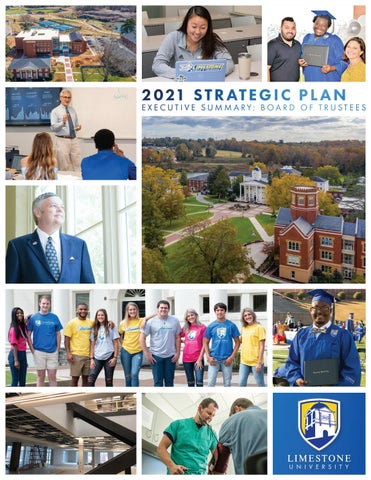
2 0 21 S T R AT E G I C P L A N
E X E C U T I V E S U M M A RY: B O A R D O F T R U ST E E S
“It’s our road map to a brighter future.” ~ Dr. Darrell Parker
1115 College Drive Gaffney, South Carolina 29340
www.limestone.edu