Literacy
Teacher’s Edition
Esther Aboud M.Ed in Special Education
Yehudis Leitner
Authors
Adam Isaacs
Augusta Stevenson
Ben Green
E. Aboud
E. Arden
E. Pam
Kenn Nesbitt
M. Frohlich
M. Jakubowicz
R. Samson
Robert Louis Stevenson
S. Miller
T. Bluming
Talia Bly
Tessa Barber
Victoria Friedrich
Y. Green
Y. Shimshon Yael Mermelstein
"How to Write a Very Long Poem" copyright © 2024 Kenn Nesbitt. "I’m Srot of Srcmabled Up Tdaoy" copyright © 2024 Kenn Nesbitt. "I Wrote this Little Poem" and "Fearless Frederick" copyright © 2012 Kenn Nesbitt. All Rights Reserved. Reprinted by permission of the author.
Esther Aboud Yehudis Leitner
Design
Akiva Leitner Project Manager
Fraydel Sharf M. Jakubowicz
Miriam Eisemann
Mirko Zunic Layout and design
Isaac Flores Comic Freepik, Wikipedia Illustrations
Lighthouse Literacy Level E Teacher’s Edition ISBN 978-1-955773-60-7
Lighthouse Curriculum
718.285.7100 • info@lighthousecurriculum.com For more information visit www.lighthousecurriculum.com
©Copyright 2024 Lighthouse Curriculum Inc. All rights reserved.
No part of this publication may be reproduced, stored in a retrieval system, stored in a database and/or published in any form or by any means, electronic, mechanical, photocopying, recording or otherwise, without the prior written permission of the publisher. To obtain permission to use portions of material from this publication, please contact Lighthouse Curriculum.
Dear Educators,
We are thrilled to introduce the Lighthouse Level E Literacy Program—a dynamic and comprehensive resource that empowers your students to excel in literacy. This book is thoughtfully designed to meet all educational standards while fostering critical reading and writing skills in a way that engages and inspires learners.
The book integrates key skills, such as finding and using quotes, identifying supporting details, and comparing and contrasting texts. Each lesson builds upon the previous one, offering a seamless progression that ensures mastery of essential literacy skills. Your students will not only develop a deeper understanding of the texts but also gain confidence in applying these skills across various subjects.
What makes this book truly remarkable is its ability to captivate students. With thoughtfully crafted activities and relatable content, it transforms literacy lessons into meaningful and enjoyable learning experiences.
We’re confident that the Lighthouse Literacy Program will be a valuable addition to your classroom, supporting both you and your students in achieving academic excellence.
LWarm regards, ighthouse Curriculum Team
Welcome to the Lighthouse Level E Literacy Book!
This book is packed with activities and tools to help you grow as a reader and writer. Here’s a quick look at what you’ll find in each section:

Lesson Introduction
Each lesson begins by introducing what you’ll be learning and why it’s important.
Vocabulary
Learn new words and their meanings! You’ll use clues from the text to figure them out. Later you’ll see these words in the story.


Practice
This is where you’ll try out the new skill for the first time. It’s your chance put what you’ve learned into action.

Dive into an engaging story. Explore different types of texts like nonfiction, informational, realistic fiction, historical fiction and more. It’s a chance to enjoy reading while seeing the skills you’re learning come to life.
Show your mastery of the new skill on this page. You’ll review the story as you sharpen your skills.
5.
6.
Activity
Time to get creative! You’ll complete fun activities or projects to show off your learning in a new way.
Write a paragraph about the story. It’s an opportunity to show off your writing as you review a new skill.

Wrap up each lesson by answering questions that show how much you’ve learned. There are two parts, vocabulary and comprehension. It’s a great way to track your progress.







Unit 5 Unit 6
Literary Elements Figurative Language
LESSON 17
Setting, Characters, and Plot A Race to the End of the World 250
LESSON 18 Character Development The Pocket Watch 266
LESSON 19 Theme The Bracelet 284
LESSON 20 Genre Exploring Fables 300
LESSON 21
Literal vs. Nonliteral Cassie and the Great Slime Disaster 316
LESSON 22
Figurative Language Say it Another Way: Secrets to Powerful Poems 332
LESSON 23
Idioms Birds of a Feather 346
LESSON 24

Visual Elements The Secret Message: A Revolutionary Adventure
Unit 1: Summarization
Strategies
Lesson 1: Main Idea and Details
Unit Goal Trajectory: Write a summary of a nonfiction or fiction text.
1. Identify and distinguish between the main idea and details. (Lesson 1)
2. Explain how the details support the main idea(s). (Lessons 1 and 2)
3. Find more than one main idea in a text. (Lesson 2)
4. Write a summary of a nonfiction text. (Lesson 3 and beyond)
5. Write a summary of a fiction text. (Lesson 4 and beyond)
We’re excited to start learning literacy together! Today, we'll explore how to find the main idea of a story. This is supported by details that make the story interesting. We’ll also learn how to spot key details. These details are important pieces that help us understand the big picture. Let’s get started!
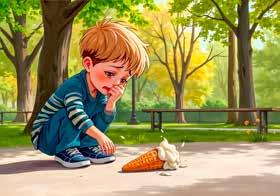
Here are some true facts about this picture:
→ The boy is crying.
→ The ice cream cone is on the ground.
→ The boy dropped his ice cream.
→ The ice cream is white (vanilla).
→ The boy is looking at the ice cream.
→ The boy is wearing a striped shirt.
The main idea is the most important idea the text is about.
Hint: Think about how you would title the image or passage.
→ The boy dropped his ice cream.
The key details help prove or support the main idea.
→ The boy is crying → because he dropped his ice cream.
→ The boy is looking at the ice cream → because he dropped it.
→ The ice cream is on the ground → because the boy dropped it.
These next points do not support the main idea, so they are just details.
→ The ice cream is white (vanilla).
→ The boy is wearing a striped shirt.
Read the passage. Then, answer the questions.
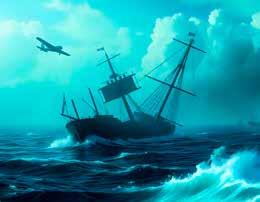
The Bermuda Triangle is a place in the Atlantic Ocean that is shaped like a triangle. It's known for being dangerous because many ships and planes have disappeared there. People have come up with different ideas to explain why this happens. Some think it might be because of strong storms or underwater currents. Others believe it might be because of aliens. What do you think?
1. What is the main idea of this passage?
a. The Bermuda Triangle is a beautiful place.
b. The Bermuda Triangle is known for being dangerous.
c. Some people think that aliens made planes disappear in the Bermuda Triangle.
d. The Bermuda Triangle is in the Atlantic Ocean.
2. Read the list of details from the passage. Circle the key details.
a. Ships and planes have disappeared in the Bermuda Triangle.
b. The Bermuda Triangle is shaped like a triangle.
c. People have different ways to explain the disappearances.
d. The Bermuda Triangle is in the Atlantic Ocean.
3. Choose one key detail from question 2. Explain how it supports the main idea.
Students may have a hard time noting which details are key details and explaining how they support the main idea.
Help students find a word or words that show how the key detail and main idea are related.
Examples:
• Main Idea is since Key Detail
• Key Detail is because of Main Idea
• Key Detail is an example of Main Idea
• Key Detail is used for Main Idea
• Key Detail explains _____ about Main Idea
• Key Detail shows _____ which means about Main Idea
If students are still having trouble identifying key details, tell them to check if the ENTIRE detail supports the ENTIRE main idea. Explain that the main idea is different than the topic (which, in this example, would be “The Bermuda Triangle”).
Synonym
Antonym
Examples
Additional Questions
1. Committed, verb
S Did A Failed
E Did a crime; Made a mistake; Stole
Q What might cause a person to commit a robbery?
2. Hijacked, verb
S Kidnapped E Held up an airplane; Took over a conversation; Hacked into a computer Q How do hijackers usually carry out their plans?
3. Crew, noun
S Team A Individual
E Flight attendants; Sailors; Astronauts
Q What are the responsibilities of a crew member on a ship?
4. Hesitate, verb
S Pause A Continue
E Stopping and thinking; Being unsure; Not making a decision right away
Q When might someone hesitate to make a decision?
5. Massive, adjective
S Big A Small
E Skyscraper, Elephant; A big storm; A huge decision
Q How do you feel next to something massive?
6. Unexpected, adjective
S Surprising A Planned
E Rain on a sunny day; A surprise party; Something you didn’t know about
Q Why can unexpected events be exciting?
The thief committed a crime by stealing the money.
The terrorists hijacked the airplane and forced the pilot to fly to an empty field.
The ship's crew worked hard to fix the hull.
He did not hesitate and answered the question right away.
The massive earthquake was so big that it caused shaking miles away.
The rain was unexpected on a sunny day.
I used the serial number on my fridge to find out how long my warranty was for.
After risking his life to save others, the firefighter became a local legend.
a group of people working together, especially on a ship, aircraft, or spacecraft
not foreseen or predicted; a surprise
carried out an action, especially something bad or harmful
a story told over many years or a person very famous for something specific a unique number assigned to identify something
took control of something by force, especially a vehicle or aircraft
stop or pause before doing something very large committed [kuh-MI-tid]; hijacked [HY-jakt]; crew [KROO]; hesitate [HEH-zuh-tayt]; massive [MA-siv]; unexpected [uhn-ik-SPEK-tid]; serial number [SEER-ee-uhl num-ber]; legend [leh-jnd]
7. Serial number, noun
S Identification number
E A number on a product you buy from a store; A number on a barcode
Q Why are serial numbers important?
8. Legend, noun
S Story E Benjamin Franklin; Albert Einstein; George Washington chopping down a cherry tree Q How do you think legends start?

Author: Tessa Barber Genre: Nonfiction
Are you ready to uncover a mystery that has puzzled people for many years? This story is about a man named D.B. Cooper. He pulled off something so daring, people still talk about it today. Who was he? What did he do? And how did he disappear without a trace? As you read, you’ll find clues and face big questions that no one has been able to answer. Will you be the one to solve the mystery of D.B. Cooper?
The passage we are about to read is about a real story that took place in 1971. Texts about true things are called nonfiction texts.
1. Can anyone tell me about a nonfiction text or story that you read? How did you know it was true? {Answers will vary.}
2. In 1971, airports were very different than they are today. Nowadays, when we fly, there is lots of security. In those days, people did not have to get their bags checked and were able to walk right onto the plane. Do you think this made it easier for bad people to commit crimes? Explain. {yes, there was less security}

Do you like mysteries? Some mysteries are so strange that they sound like they’re out of a book. This mystery is as strange as they come. Our story starts 50 years ago, and it’s about a man named D.B. Cooper. Who was D.B. Cooper? So, here’s the thing: nobody knows! What we do know is that he committed a daring crime and then disappeared without a trace.
It was the day before Thanksgiving, 1971. A man walked into an airport in Portland, Oregon. He bought a one-way ticket to Seattle, Washington — a quick 30-minute flight. He told the ticket agent his name was "Dan Cooper."
Dan Cooper looked like a regular businessman. He wore a nice suit and tie, and he carried a briefcase. He boarded the plane along with the rest of the passengers.
After the plane took off from Portland, Dan Cooper called over Florence, one of the flight attendants, and handed her a note. She slipped it into her pocket without paying any attention to it. Then, Cooper leaned in and whispered, "Miss, you'd better read that note. I have a bomb."
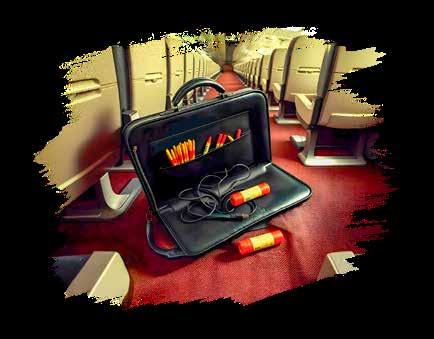
Florence looked at him with wide eyes. Her heart began to race. She opened the note and read the words that were written in black pen. I have a bomb in my briefcase, and I will use it. I want you to do everything I tell you. You are being hijacked!
Florence tried to stay calm.
"Can I see the bomb?" she asked quietly. Cooper nodded and opened his briefcase. Inside, she saw wires and red sticks. She gasped. He really did have a bomb! Cooper then
1. How do you know from the text that Dan Cooper did not use his real name? {It says that nobody know who he is and that he told the ticket agent that his name was Dan Cooper.}
2. What type of instructions do you think D.B. will give Florence? {Answers will vary.}

gave her a new set of instructions.
"Tell the pilot that when the plane lands, I want $200,000 in $20 bills and four parachutes."
Florence quickly went to the cockpit and told the pilot what was going on. He immediately called air traffic control to report the hijacking. They contacted the FBI and police. Quickly, they started to prepare the money and parachutes.

The plane landed in Seattle. Everything was ready. The police had the money and parachutes.
While the plane was still in the air, the crew did their best to stay calm. They didn’t want the other passengers to know what was happening. They told the passengers that there was a minor problem. They said that the plane would be delayed in Seattle, Washington. The flight attendants served drinks and snacks. They tried to keep everyone happy and unaware of the danger. The passengers didn’t know that their plane was being hijacked!
"We’ll be landing in Seattle soon," the pilot soon announced.
Only the crew knew the truth—that this was no ordinary landing.
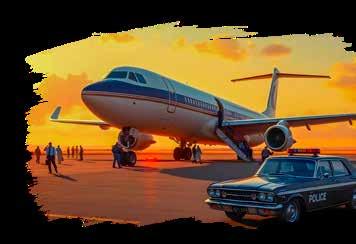
The plane landed in Seattle. Everything was ready. The police had the money and parachutes. Cooper let all the passengers and some of the crew leave the plane. Now, it was just Cooper, the pilot, the flight engineer, and one flight attendant named Tina.
A man dressed as a mechanic came onto the plane, carrying a bag with $200,000 in cash and the four parachutes. He handed them
1. What is the cockpit of an airplane? {the front of the airplane where the pilot sits}
2. Why did the flight attendants tell the passengers that they would be delayed in Seattle? {so they wouldn’t be nervous when they dealt with the hijacking}

to Tina, who then gave them to Cooper. The money was in $20 bills, packed neatly in a bag. It was a lot of money, but Cooper handled it calmly. It was like he had done this hundreds of times before.
Now that he had what he wanted, Cooper gave the crew new instructions.
"Take me to Mexico City. Fly slowly and low to the ground. Everyone must stay in the cockpit. Remember, I still have the bomb."
The crew had no choice. They took off and started flying toward Mexico. They wondered why he wanted the plane to stay low to the ground and why he needed a parachute. They were about to find out.

was happening. The plane made a sudden jump, and a warning light started flashing.
"The plane door is open!" Tina shouted. They rushed to check, but it was too late. D.B. Cooper was gone, and so was the money.
About 30 minutes later, the plane was flying over thick forests and mountains. All alone in the cabin, Cooper put on one of the parachutes and strapped the bag of money to his body. He walked to the back of the plane and opened the door. The cold wind rushed in. Was he really going to jump? Cooper didn’t hesitate. He leaped out into the dark, freezing night!
In the cockpit, the crew didn’t know what
The crew members were shocked, but there was nothing they could do. They had to keep flying the plane until they could land. As soon as they did, the police rushed on board. They found a parachute Cooper had left behind and the briefcase with the bomb—except the bomb wasn’t real!
D.B. Cooper had tricked everyone.
A massive search began right away. Hundreds of people, including FBI agents, police officers, and volunteers, searched the forests, rivers, and mountains where Cooper might have landed. They searched for days,
1. How did D.B. Cooper escape? {He jumped out the airplane with a parachute.}
2. Why did he need the plane to fly low? {so he could jump out}
weeks, and even months, but they found nothing—no parachute, no money, and no sign of D.B. Cooper. It was as if he had disappeared into thin air.
As the years went by, people continued to ask: Did D.B. Cooper survive the jump? It was a stormy night, and the area where he landed was filled with thick forests, dangerous rivers, and steep mountains. Many people thought he couldn’t have survived such a risky jump. Others believed that he was smart and prepared for anything.
In 1980, nine years after the hijacking, something unexpected happened. A young boy named Brian Ingram was playing near the Columbia River when he found a buried package. Inside was a stack of old $20 bills. It only added up to $5,580. Amazingly, the serial
numbers on the bills matched the money given to D.B. Cooper! But how did the money end up there, and where was the rest of it? Did Cooper drop it by accident? Did he survive the jump and lose some of the cash?
The FBI spent many years trying to find D.B. Cooper. They followed every clue, interviewed hundreds of people, and even came up with new ideas about what might have happened. Yet, in 2016, the FBI closed the case. They said that they had tried everything but couldn’t solve the mystery.
Although the case is closed, the legend of D.B. Cooper lives on. People all over the world still talk about him and read books trying to piece together the clues. Did he survive and start a new life under a different name? Did he hide the money somewhere, waiting for the perfect moment to rescue it? Or did he not survive that stormy night? No one knows for sure, and that’s what makes the story of D.B. Cooper so thrilling.
D.B. Cooper is the only person in U.S. history to hijack a plane and get away with it. Who knows? Maybe one day, you’ll be the one to solve the mystery of D.B. Cooper!

1. Why do you think D.B. Cooper hijacked the plane? {to get the money}
2. What do you think happened to him? {Answers will vary.}
3. Imagine a friend comes over to you and asks what this story is about. What would you say? {A man named D.B. Cooper brought a fake bomb on a plane, used parachutes to escape, and was never found again.}
If we say this shorter, we have the main idea. Remember, the main idea is just the most important part of the story.
4. What are some details from the story? {Answers will vary.}
5. How do we know if a detail is a key detail? {if it supports the main idea}
LESSON PRACTICE VOCABULARY STORY REVIEW ACTIVITY ASSESSMENT
Circle the main idea.
a. D.B. Cooper stole $200,000.
b. D.B. Cooper brought a fake bomb on a plane and used parachutes to escape.
c. D.B. Cooper hijacked a plane and disappeared.
d. D. B. Cooper became a legend.
Circle the key detail.
a. D.B. Cooper brought a fake bomb on a plane and used a note to threaten the flight attendants.
b. D.B. Cooper dressed as a regular businessman in a suit and tie.
a. D.B. Cooper forced the plane to fly to Mexico City.
b. D.B. Cooper jumped out of the plane while it was flying, along with the parachutes and money.
a. Nine years later, a boy found the missing $20 bills buried near a river.
b. The police and FBI couldn’t find D.B. Cooper.
a. D.B. Cooper is the only person in the United States to hijack a plane and escape.
b. The flight was from Portland, Oregon, to Seattle, Washington.
Choose a key detail from the story and explain.
1. 1. 1. 2. 3. 4. Example:
Key detail: D.B. Cooper brought a fake bomb on a plane and used a note to threaten the flight attendants.
How it supports the main idea: He used the fake bomb and note (detail) to hijack the plane (main idea).
Key detail:
(Answers will vary.) The police and FBI couldn’t find D.B. Cooper.
How it supports the main idea:
(Answers will vary.) If no one could find him, that means he disappeared.
LESSON PRACTICE VOCABULARY STORY REVIEW ACTIVITY ASSESSMENT
A paragraph is a group of sentences on the same topic that are written in an organized way.
Most paragraphs have three main parts.
1. Topic Sentence
→ Introduces the topic and says the main idea
2. Body Sentences
→ Three sentences
→ Tell the reader something specific about the main idea
→ Give examples or explanations of the main idea
3. Concluding Sentence
→ Ends off with a lesson, an opinion, or a summary of what was said
A body sentence MUST support the main idea.
A
Words that show that two things are similar
Words that show that two things are different
Words that show examples Also In addition First Second Third Similarly Furthermore Additionally But Although In contrast On the other hand Unlike Yet However At the same time Especially In other words Specifically In fact For example For instance In particular Whenever
Words that show the effect of something
Words to use for a conclusion
Words that show time and place
As a result In that case Therefore Then In effect For this reason Accordingly In summary In conclusion In short To summarize All in all Ultimately Overall Finally In the meantime Until now Presently In the middle Next Before
PRACTICE VOCABULARY STORY REVIEW ACTIVITY ASSESSMENT
Now let's practice what we just learned about paragraphs! Read the following paragraph. Then:
1. Fill in the missing transition words.
2. Highlight the topic sentence in yellow.
3. Highlight the three body sentences in pink.
4. Highlight the concluding sentence in green.
Look at the previous page for help!
Chocolate is the best food. , the texture is creamy and smooth. , it comes in different flavors like milk chocolate, dark chocolate, or hazelnut. , chocolate is good for you. , I really like chocolate!
The mystery of D.B. Cooper still has many unanswered questions. Who was D.B. Cooper? What happened to him? How did he disappear?
What do you think? Come up with your own idea! Write a paragraph or draw a picture that shows who D.B. Cooper was, what happened to him, and how he disappeared.
Circle the correct answer.
1. Which means “a group of people working together”?
a. Crew
b. Hijacked
c. Hesitate
d. Massive
2. The car's was found on a hidden part of the engine.
a. committed
b. hijacked
c. crew
d. serial number
3. Which of the following is an example of something that is massive?
a. An insect
b. A textbook
c. A skyscraper
d. A car
4. Which means “a story passed down from generation to generation or a person famous for something”?
a. Legend
b. Crew
c. Hijacked
d. Massive
5. Don't to ask for help if you need it.
a. committed
b. hesitate
c. hijack
d. unexpected
6. Which means “not expected or anticipated”?
a. Unexpected
b. Serial number
c. Hijacked
d. Hesitate
7. The crime was by a group of organized criminals.
a. committed
b. hijacked
c. crew
d. unexpected
8. Which of the following is an example of something that is hijacked?
a. A bird flying
b. A car parked illegally
c. A car being stolen in front of the owner
d. A book left unfinished
Circle the correct answer.
1. Where did D.B. Cooper want the plane to fly after he hijacked it? (detail)
a. Mexico City
b. Las Vegas
c. Miami
d. New York City
2. How did the discovery of the money affect the case? (cause and effect)
a. It solved the mystery.
b. It made the case even more mysterious.
c. It led to the arrest of D.B. Cooper.
d. It let the FBI know how D.B. Cooper escaped.
3. Why do you think D.B. Cooper hijacked the plane? (inferencing)
a. He wanted to get rich.
b. He was angry at the airline.
c. He wanted to prove that he could do it.
d. He thought it was exciting.
4. What is a main message of the text? (main idea)
a. Crime doesn't pay.
b. Sometimes, mysteries are never solved.
c. It is important to follow the law.
d. It is dangerous to fly on airplanes.
5. What happened after D.B. Cooper jumped out of the plane? (sequencing)
a. The plane crashed.
b. The crew landed the plane safely.
c. The FBI arrested D.B. Cooper.
d. The money was found.

6. What does the word "daring" mean in the sentence "D.B. Cooper committed a daring crime"? (context clues)
a. Scary
b. Fearless
c. Silly
d. Angry
7. How is D.B. Cooper different from other hijackers in the U.S.? (compare-contrast)
a. He was smarter.
b. He was more dangerous.
c. He was more successful.
d. He was more famous.
8. Which of the following is an opinion about D.B. Cooper? (fact vs. opinion)
a. D.B. Cooper demanded money.
b. The plane was forced to land.
c. D.B. Cooper hijacked a plane.
d. D.B. Cooper was a bad person.
Unit 1: Summarization
Strategies
Lesson 2: More Than One Main Idea
In the last lesson, we learned how the details in the story support the main idea.
Now, we will take this a step further.
Did you know that a text can have more than one main idea?
When a text has more than one main idea, there are two or more concepts that are equally important.
Let’s look at an example:
Unit Goal Trajectory:
Write a summary of a nonfiction or fiction text.
1. Identify and distinguish between the main idea and the details. (Lesson 1)
2. Explain how the details support the main idea(s). (Lessons 1 and 2)
3. Find more than one main idea in a text. (Lesson 2)
4. Write a summary of a nonfiction text. (Lesson 3 and beyond)
5. Write a summary of a fiction text. (Lesson 4 and beyond)
Words are everywhere. You can find them in books, on cereal boxes, in newspapers, on your backpack, or on buildings. There are even words in your brain.
Words are important for communication. We use them to share ideas and tell stories. When we talk or write, we let others know what we're thinking. When we listen or read, we learn what's on their minds. Words help us understand each other.
The topic of this essay is “words.”
We can divide it into two sections. The first section is about “words are everywhere,” and the second section is about “words are important for communication.”
Look at the bolded sentences. These are the main ideas. Notice that they are separate concepts but are equally important in the text.
Details that support a main idea are key details.
Tips - texts with more than one main idea:
1. Find the “topic.” This is usually hinted at in the title.
2. Divide the text into sections. Think about the main ideas in each section.
3. Write a list of details. Think about which details support each main idea.
Read each passage. Answer the questions.
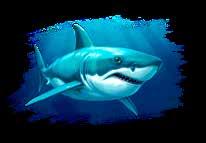
Sharks have amazing senses! They can smell a single drop of blood from far away. They also have a special sense where they can feel tiny electrical signals from other animals, even in the dark or under the sand. This makes sharks excellent hunters.
Not all sharks are the same. There are over 400 different species, in all different sizes. The tiny dwarf lantern shark is just a few inches long, while the massive whale shark reaches up to 40 feet! Most sharks eat meat, but some eat tiny ocean plants.
1. In one word, what is the topic of this passage?
2. Circle the two main ideas of this passage.
a. Different species of sharks are different sizes.
b. Sharks use electrical signals.
c. Some sharks eat meat.
d. Sharks use their senses to survive.
e. Sharks can smell blood from miles away.
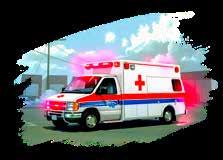
Paramedics help people in emergencies. They are not doctors, but they can still save lives. When someone is hurt or sick and needs help quickly, paramedics come right away. They give the first treatment so the patient will be well enough to make it to the hospital.
To become a paramedic, one must go through lots of training. Paramedics learn all about emergency medicine. They learn how to stop bleeding, give CPR, use a defibrillator, and give life-saving medications.
3. In one word, what is the topic of this passage?
4. Circle the two main ideas of this passage.
a. Paramedics are not doctors.
b. Paramedics can give CPR.
c. Paramedics are trained in emergency medicine.
d. Paramedics come right away.
e. Paramedics help people in emergencies.
Students may have a hard time understanding that there can be more than one main idea in a text. They may mistakenly identify a key detail as an additional main idea. Use the following statements to clarify.
Statement 1: “There are lots of different fruits.”
Statement 2: “Each type of tree grows a different type of fruit.”
Statement 2 helps explain statement 1. It explains why there are so many types of fruits. So, it is a key detail, not a main idea.
In contrast, read statement 3.
Statement 3: “Fruits are healthy.”
This statement does not explain statement 1, so it is not a supporting detail. It is a separate concept that is also about fruits. In a reading passage, it could be another main idea.
Antonym Examples
Non-examples
Additional Questions
1. Eerily, adverb
S Spookily A Normally
E How a creepy house feels; A dark, scary night; A haunted house N Regular feeling; Bright, open, and airy; A luxurious hotel
Q How would you create the eerie atmosphere of a haunted house?
2. Merely, adverb
S Only Q Is it enough to merely study hard to do well in school?
3. Debris, noun
S Trash A Treasure
E A piece of a crashed car; Garbage after a flood; Plastic bottles in the ocean
N A working car; A gem
Q What is the difference between debris and the general term trash?
4. Valve, noun
S Faucet E Sink; Part of the heart; Shower N A working car; A gem Q Why is it important to have a valve that can shut off the water?
5. Assumed, verb
S Supposed A Proved
E You guessed who will be in your class; You thought that your friend was coming to visit N Swimming pool; Cup
Q Can you think of a time when you assumed something that turned out to be wrong?
6. Trudge, verb
S Stumble A Glide
E Walking through snow; Walking through sand; Walking slowly because you are sad N You saw the class list; You did an scientific experiment Q What is the difference between trudge and normal walk?
Match the bolded words with their definitions. Highlight context clues.
The house was eerily silent after the family moved out.
The child merely wanted a glass of juice, not a whole meal.
The hikers need to trudge slowly through the snow.
The firefighter turned the valve to shut off the flow of water.
He assumed they were late because of traffic, but they were actually lost.
The old farmhouse hadn't been painted in a decade, and the peeling paint showed it.
After the storm, the streets were full of debris from fallen trees.
The witness claimed to have seen the entire accident. to say something as true only ten years to think something is true without having proof walk with difficulty in a strange or frightening way a device that controls the flow of liquid in a pipe scattered pieces of broken things
eerily [EE-ruh-lee]; merely [MEER-lee]; trudge [TRUHJ]; valve [VALV]; assumed [uh-SOOMD]; decade [DEK-eyd]; debris [deh-BREE]; claimed [KLAYMD]
7. Decade, noun
E Ten years N Running in a gym; Walking normally; Hopping Q What does it mean to say something has been going on for decades?
8. Claimed, verb S Declared A Denied E Someone said the moon is a rock; Someone said the moon is bread N Someone who is quiet; Someone who is not sure Q Are all claims true?

Author: E. Aboud Genre: Nonfiction
It’s a warm January day in Boston, 1919. Suddenly, something unexpected happens. It's dark, sticky, and moving faster than anyone can run! What could it be, and how could something so sweet cause so much trouble? Dive into the story of the Great Molasses Flood and discover the answers to these questions and more.
1. The story we will read today is true story that took place in the early 1900s. Are true stories fiction or nonfiction? {nonfiction}
2. This story is about a syrup called molasses. Did anyone ever see or taste molasses? What does it taste/look like? {it is a thick, dark brown syrup, it is super sticky like honey, it is very sweet, has a strong flavor, used to sweeten and flavor things}
As we read, we’ll pay attention to the main ideas. Let’s see if we can find more than one.
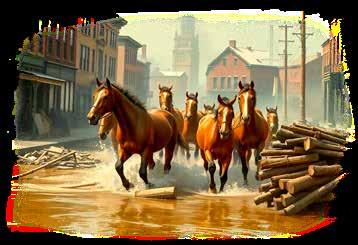
He was running for his life! All around him, buildings were collapsing. A giant wave of sticky syrup was chasing him, threatening to suffocate him!
He could hear screams all around him. Horses were knocked over, unable to move. People moaned and cried as they were trapped under heavy debris

He ran as fast as he could, but his feet were stuck to the ground! This was the end. There was no escaping the molasses. He felt a wave of syrup swoop down on him. He panted as he struggled to breathe.
Isaac Gonzales woke up, drenched with sweat. He trembled as he realized that it was nighttime, and he was in his own bed. He had this dream almost every night.
There would be no more sleep for him that night. Although it was the middle of the night, Isaac got dressed, left his house, and walked through the dark Boston streets.
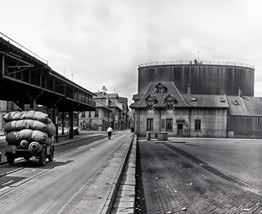
The city was eerily quiet. He made his way past the train tracks and toward 529 Commercial Street. The looming structure of a 50-foot steel tank came into view. Isaac looked up.
Three years before, in 1915, the massive tank had been built in Boston’s North End. The
tank was filled with over two million gallons of molasses, a sweet, dark sugary syrup. Isaac was one of the many workers who helped load up molasses and checked the tank.
1. What is the name of the man that the first three paragraphs are talking about? {Isaac Gonzales} 2. Did the molasses tank explode? How do you know? {No, it was just a dream.}

He found the valve that let molasses out. He opened it and started emptying the tank into the ocean.
There was a reason why Isaac was visited by the same dream, night after night. The tank was leaking. When Boston residents complained to the tank’s owner, the United States Industrial Alcohol Company (USIA), the response was to merely paint the outside of the tank brown.
But that didn’t solve any problems. The tank was still oozing. It became a common sight to see children collecting the sweet treat in pails.
Isaac had also noticed the tank groaning. He was nervous that it would collapse. When Isaac reported his concerns to his boss, Mr. Jell, he was told that if he continued to complain, he would be fired.
That was why he was here tonight. He had to do something!
Isaac crept to the back of the tank, which
faced the ocean. He found the valve that let molasses out. He opened it and started emptying the tank into the ocean. If he was caught now, he would surely lose his job. He might even be sent to jail.
But Isaac didn’t feel that he had a choice. If the tank collapsed, the city would be in danger. Isaac knew that his efforts weren’t enough. There was still lots and lots of molasses left in the tank. He was very scared, but there was no way he could empty the entire tank. It was huge!
Isaac wanted to stay there and stand guard for the rest of the night, but he realized that it was too dangerous. He had done his part. The only thing left to do was hope for the best.
Six months later; January 15, 1919
The Burnett family was seated around the dining room table, enjoying their supper of chicken and rice. It was 40 degrees outside, warmer than a typical Boston winter day. The Burnett children ate quickly so they could go outside and play.
1. Why do you think the USIA painted the outside of the tank brown? {They didn’t actually want to fix it.}
2. On the top of the left column is the word “surely.” Find the word. What does it mean? How do you know? {means “for sure”; it sounds like it, it makes sense in the sentence}
3. What is the main idea of this first section (until “Six months later”)? {Isaac Gonzales is nervous that the tank will explode.}
As they cleared their plates, they heard a rumble. Since they lived close to the train tracks, they assumed it was a passing train. But then, they heard a swish that sounded like a rushing wind.
Then, it turned dark.
Confused, the family ran to look out the window. Their mouths dropped open!
Their apartment was at 536 Commercial Street just opposite the giant tank and train tracks. But the giant tank was no longer there! Instead, they could see a huge black wave coming their way. It looked like the side of a mountain was falling!
They needed to escape before the windows cracked! Quickly, they ran to the hallway so they could get out of the building. They came to the top of the stairs and stopped. Molasses was entering the building. It had already covered the entire flight of stairs!
Thinking quickly, the Burnett family turned
around and ran up the stairs. It would be safer to go up to the roof. That decision saved their lives.
The storage tank had burst open. One crack had gotten a little too big, and the whole tank fell apart.
A massive wave of molasses burst forth.
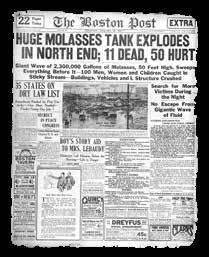
Two and a half million gallons of molasses rushed through the Boston streets at speeds of 35 miles an hour. It looked like a huge wall of sticky syrup. At some points, it reached 25 feet tall.
The molasses destroyed everything in its path.
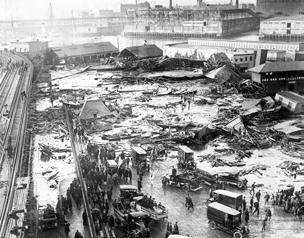
People, horses, vehicles, and even houses were swept up in the giant wave. Twentyone people were killed, and 150 were injured. Houses, cars, and buildings collapsed. Debris was everywhere.
Frank McManus was a Boston policeman. He was walking away from the tank when he
1. The passage says that the molasses moved at speeds of 35 miles an hour. When else might you move at 35 miles an hour? {a car driving fast down a street (not a highway)}
2. It also says that the molasses was 25 feet tall. That is very tall. Can anyone guess how tall 25 feet might be? What do you think is about that tall? {a two floor building, four refrigerators stacked on top of each other}
3. Why was the explosion so deadly? {the molasses was thick and sticky, there was a tall wall of it, it was moving really fast} What is the main idea of this page? {The tank exploded and caused lots of destruction.}
felt something wet and sticky hit him on the back and shoulders. At first, he thought it was mud, but when he looked back, he saw the tank collapse. A second later, he saw the wave of molasses.
He started running up a side street. Thankfully, he was faster than the molasses and managed to escape. His uniform, hat, and shoes were covered in molasses. He quickly found a phone and called for help.
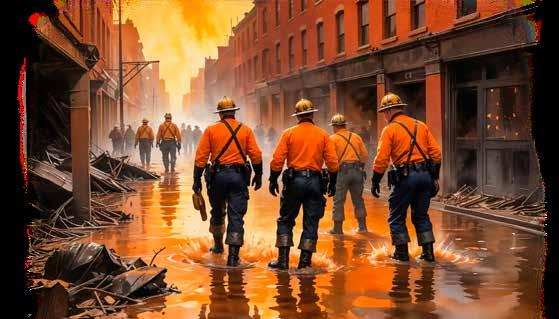
Policemen and firemen rushed to the site. They had a difficult job. They had to trudge through the heavy syrup to rescue trapped and injured people. To make matters worse, once the molasses stopped flowing, it cooled and thickened, making it harder to walk through. It took weeks to clean up the molasses. In the meantime, it continued to spread throughout the city. People had molasses stuck to the bottom of their shoes and their clothes. There was goo on subway platforms, train seats, and payphones. The entire Boston was
syrupy and sticky.
Cranes were used to clear the ruins. Saltwater was sprayed from a fireboat to break up the goo and wash it away. The smell of molasses lingered in Boston for decades
After the accident, 119 people sued the USIA. They claimed that the company hadn’t made sure the tank was safe enough. It was made cheaply and wasn’t tested properly. The company had also ignored warnings from people like Isaac Gonzales.
The USIA was held responsible, but it was too late to prevent the tragedy. The USIA had to pay people who got hurt or suffered because of the molasses flood.
In 1919, there were no laws to stop the USIA from building an unsafe structure. This disaster encouraged Boston to create rules for construction. Later, the entire United States also followed these rules. Today, these important laws help make sure buildings and structures are built safely.
1. Why do you think Frank McManus needed to “find a phone”? {In those days, people didn’t have cell phones.}
2. The passage says that “the USIA was held responsible.” What does this mean? {The people/government/court decided that the explosion was their fault and that they should pay.}
3. Let’s try to find two main ideas for this page. What are two important ideas that do not support each other on this page? {1. It was hard to clean up the mess. 2. The USIA was held responsible.}
4. Now, we will look back at the whole story. What was this story about? {the Great Molasses Flood} What are
some important ideas in the story (Hint: the main ideas that we’ve noticed)? {1. Isaac Gonzales is nervous the tank will explode. 2. The tank exploded and caused lots of destruction. 3. It was hard to clean up the mess. 4. The USIA was held responsible.}
Notice that main ideas 1 and 4 are related. (Isaac Gonzales is worried because the USIA is not taking proper care of the tank.) Main ideas 2 and 3 are also related. (Part of the destruction is the huge mess that needs to be cleaned up.)
So, if we combine those ideas, we can say that there are two main ideas.
1. The Great Molasses Flood was the USIA’s fault.
2. The Great Molasses Flood was a terrible tragedy.
LESSON PRACTICE VOCABULARY STORY REVIEW ACTIVITY ASSESSMENT
The passage The Great Molasses Flood has two main ideas.
Main ideas
The Great Molasses Flood was a terrible tragedy.
The Great Molasses Flood was the USIA’s fault.
Write the letter of the main idea that each key detail supports.
1. People complained to the USIA, but they only painted the tank.
2. The molasses killed 21 people and injured 150 others.
3. Isaac Gonzales was told he would be fired if he kept complaining.
4. The USIA had to pay people who were hurt by the disaster.
5. Houses and buildings were knocked down in the flood.
6. The tank was made cheaply and wasn’t tested properly.
7. Policemen and firemen had a hard job rescuing people.
Answer the questions.
1. Give three examples of details from the text that do not support either main idea.
The molasses tank was built in 1915.
The wave of molasses was 25 feet tall.
The tank was in Boston.
2. Are the details you provided key details? Explain why or why not.
No, they don’t support either main idea, so they are not key details.
An image, map, or chart can help with understanding a text. They can hint to the time, place, and other details about an event.
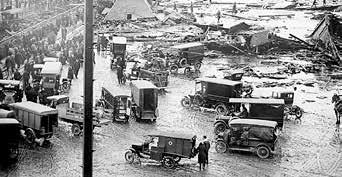
Write a paragraph explaining what you learned.
1. Write three things the image helps you understand about the story.
There were cars, but they were old-fashioned.
Lots of people were needed to help clean up. There were lots of collapsed buildings.
2. Complete the outline. Use your answers from step one to finish the body sentences.
Topic Sentence: The image helps me understand the story better.
Body Sentence 1: First, it shows that
Body Sentence 2: Second, it shows that
Body Sentence 3: Last, it shows that
in those days, there were cars, but they were old - fashioned. lots of people were needed to clean up the mess. the buildings collapsed and left a huge mess.
Concluding Sentence: In conclusion, the photo helps me picture what happened.
3. Write as a paragraph.
The image helps me understand the story better. First, it shows that in those days, there were cars, but they were old- fashioned. Second, it shows that lots of people were needed to clean up the mess. Last, it shows that the buildings collapsed and left a huge mess. In conclusion, the photo helps me picture what happened.
Write a diary entry.
Pretend you were in Boston during the flood. Write a diary entry describing that day. What did it look like? How did you feel?
Circle the correct answer.
1. Which word means "in a strange and frightening way"?
a. Debris
b. Eerily
c. Valve
d. Trudge
2. After walking for miles in the hot sun, we finally back to camp, very tired.
a. assumed
b. trudged
c. merely
d. valve
3. Which word means "a period of ten years"?
a. Claimed
b. Decade
c. Eerily
d. Trudge
4. The children that the old house was haunted because of the strange noises they heard.
a. eerily
b. debris
c. claimed
d. merely
5. Which of the following is an example of a valve?
a. A door handle
b. A water faucet
c. A light switch
d. A window pane
6. The police the missing jewels were hidden somewhere in the mansion.
a. assumed
b. eerie
c. decade
d. debris
7. Which word means "only" or "just"?
a. Claimed
b. Merely
c. Decade
d. Trudge
8. Which of the following is an example of debris?
a. A neatly organized bookshelf
b. Broken pieces of wood and glass
c. A shiny new car
d. A delicious meal
Circle the correct answer.
1. What did Isaac Gonzales do with the molasses he released from the tank? (detail)
a. He collected it in pails.
b. He emptied it into the ocean.
c. He spread it on the ground.
d. He drank it.
2. What was the effect of the molasses flood on the legal system? (cause and effect)
a. New laws were created to make sure people would be safe.
b. There were no changes.
c. The USIA closed down.
d. The city of Boston stopped making sure people followed their rules.
3. How would you describe the Burnett family's feelings after seeing the molasses flood? (inferencing)
a. They were calm and collected.
b. They were super happy.
c. They were scared and shocked.
d. They didn’t care.
4. What is the main idea of the last paragraph? (main idea)
a. The molasses flood led to important safety rules.
b. The USIA was responsible for the disaster.
c. The Burnett family sued the USIA.
d. The molasses flood could have been prevented.
5. What happened after the molasses flood? (sequencing)
a. The city rebuilt right away.
b. Lots of people helped clean up.
c. The USIA was praised for its response.
d. The Burnett family moved away from Boston.

6. “The smell of molasses lingered in Boston for decades.” What does the word "lingered" mean? (context clues)
a. Disappeared quickly
b. Stayed for a long time
c. Returned frequently
d. Was unpleasant
7. How did the weather on the day of the disaster compare to typical Boston winter weather? (compare-contrast)
a. It was colder than usual.
b. It was warmer than usual.
c. There was no difference.
d. It was impossible to compare.
8. Which of the following is an opinion about the molasses flood? (fact vs. opinion)
a. Twenty-one people were killed in the disaster.
b. The molasses flood could have been prevented.
c. The molasses covered the entire city.
d. The USIA paid people hurt by the disaster.
Unit 1: Summarization
Strategies
Lesson 3: Summarizing
Informational Texts
Unit Goal Trajectory:
Write a summary of a nonfiction or fiction text.
1. Identify and distinguish between the main idea and details. (Lesson 1)
2. Explain how the details support the main idea(s). (Lessons 1 and 2)
3. Find more than one main idea in a text. (Lesson 2)
4. Write a summary of a nonfiction text. (Lesson 3 and beyond)
5. Write a summary of a fiction text. (Lesson 4 and beyond)
Welcome Back!
Now that we know about main ideas and details, we can write a great summary.
What is a summary?
A summary is a short version of something longer. It tells us the most important parts using our own words.
Summaries:
→ Don't include every detail
→ Don't use the exact words from the text
→ Don't include your own ideas or opinions
To help us write summaries, we're going to use a helpful tool called the TAMKO strategy.
T = Type of Text
What kind of text are you reading? Include the title.
In the article “How Bees Make Honey”... A = Action
Name the author and verb that describes the purpose of the writing. …the author explains… M = Main Idea Lastly, state the main idea. …how bees collect nectar and turn it into honey.
K = Key Details
Write two to three sentences telling the most important things that happened.
Bees gather nectar from flowers. They bring the nectar back to the hive, where other bees turn it into honey. O = Organization
Put your summary in the same order as the original text.
(This summary follows the same order as the article.)
The following are topic sentences for summary paragraphs that use the TAMKO strategy. Circle the T (text type), make a box around the A (action), and underline the M (main idea).
1. In the book, “The Best Day,” John Smith describes a time he won the lottery.
2. The recipe “Chocolate Ice Cream” teaches how to make homemade ice cream.
3. The passage explains how optical illusions trick our brains.
4. This story is about a town that had a blackout for three months.
5. In the article “Amazing Deals,” the author writes about why stores offer coupons.
Imagine you read a story about when Abraham Lincoln was shot. Circle three details that you would include in a summary.
→ Lincoln loved telling stories to his children.
→ One night, a bullet was fired at him.
→ The bullet hit his hat and knocked it off his head.
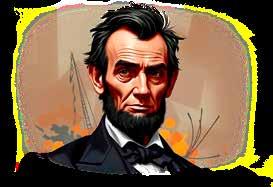
→ The hat became a symbol of his presidency.
→ Lincoln also enjoyed reading by the fireplace and taking long walks.
Text Type and Author: Text Type sometimes includes the title of the passage, and Action sometimes includes the name of the author. However, sometimes these are left out.
Explain that it is preferable to add in the title and name of the author, but it is not necessary.
Key Details: If students are having trouble picking out the key details, remind them that key details support, explain, or prove the main idea.
1. Classified, adjective
S Secret A Public
E How to make a nuclear bomb; Information that spies get; Secret information from the White House
Q Why are some documents (papers) classified?
2. Challenging, adjective
S Difficult A Easy
E Biking up a mountain; Calming down when you are angry; Doing advanced calculus Q Why might it be challenging to learn to ride a bike?
3. Determined, adjective
S Stubborn A Flexible
E Not stopped by challenges; Continuing something hard Q How can you stay determined even when things are hard?
4. Intense, adjective
S Extreme A Weak
E A strong feeling, A heavy rain pour; Doing hard exercise for hours straight
Q Can you think of a situation that requires intense concentration?
5. Sacrifice, noun
S Offering E Paying lots of money to go to school; Studying for hours so you can do well on a test
Q What is a sacrifice someone could make for a friendship?
6. Navigate, verb
S Steer E Finding your way through a forest; Steering a boat Q What do people use to navigate the streets when they drive?
Match the bolded words with their definitions. Highlight context clues.
The soldier couldn't tell anyone about his mission because the information was classified
The teacher said that doing well on the challenging test meant studying really hard.
I was determined to finish the puzzle, even though it took me hours.
The roller coaster ride was so intense that I screamed the whole time.
The doctor's sacrifice meant working long hours to care for patients during the pandemic.
The hikers used a map and compass to navigate the trails in the unfamiliar forest.
As she approached the house, a door and window came into focus.
It is essential to wear a helmet when riding a bike to stay safe.
to concentrate attention or effort
very strong or extreme
marked as secret
giving up something important for a goal
came near or closer to someone or something
find a way through or around something
very important difficult or demanding
classified [KLASS-uh-fide]; challenging [CHAL-uhn-jing]; determined [dih-TUR-mind]; intense [in-TENS]; sacrifice [SAK-ruh-fice]; navigate [NAV-uh-gayt]; approached [uh-PROHCHT]; essential [ih-SEN-shuhl]
7. Approach, verb
S Come A Leave E Walking up to a check-in counter; Going over to your mother to ask a question Q How to you feel when you approach your house after being away for a while?
8. Essential, adjective
S Needed A Unimportant
E Food and water; Pencils and paper for school; Plates or bowls for a meal
Q What are some things that are essential for a shopping trip?

Author: R. Samson Genre: Informational
Secret missions and daring rescues—that's the world of SEAL Team Six! This top-secret group of Navy SEALs takes on the most dangerous jobs imaginable. What kind of missions do they face? How do ordinary soldiers become members of this elite team? And what makes them so good at what they do? Get ready to dive into the world of SEAL Team Six and uncover the answers to these questions and more!
The passage we will read today tells us about a group of soldiers called Devgru Navy Seals.
Nonfiction texts that tell about or inform readers about something are called informational texts.
1. Does anyone know what the U.S. Navy is? {It is a part of the U.S. Army that operates on the water.}
As we read, pay attention to the main idea and key details. These will help us summarize later.
How does someone become a Navy SEAL in the first place? It certainly isn’t easy!
Imagine that you’re on a secret mission. Danger lurks in every shadow, and you have no idea where the enemy might be hiding. The stakes are high failure isn't an option. Sounds like a plot in a suspense novel? For some people, this is real life. This is what it’s like to be a United States Navy SEAL and no, we’re not talking about the animal. SEAL stands for Sea, Air, and Land Teams, and it refers to the U.S. Navy’s special operations force. These SEALS are brave, but there’s a special group that’s even more daring than this one. This group, known as DEVGRU SEAL Team 6, is called upon for the most impossible of missions.
So what does this special team do? No one knows! Their work is classified, meaning it's top secret. We do know that DEVGRU SEAL Team 6 handles the most dangerous jobs. They might be called upon to fight terrorists who use violence to harm people. They might be called in to rescue hostages who are held captive by dangerous groups. They might be told to take out leaders of terrorist organizations so they can no longer harm other people.
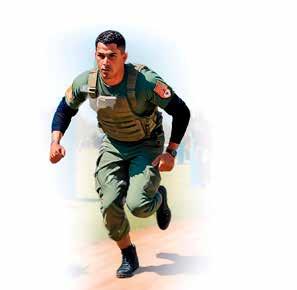
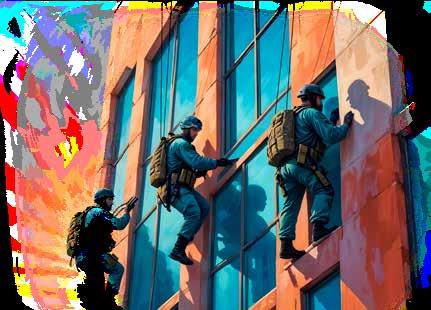
1. The passage says that Navy SEALS are part of the Navy’s special operations force. What do you think this means? {They go on special missions.}
What test takers need to do to pass DEVGRU SEAL tests
Note: They don’t just need to pass, they need to score higher than other test takers. Pass
Think of the most risky mission possible. That’s the type of mission that DEVGRU SEAL Team 6 is training for.
Becoming a Navy SEAL
How does someone become a Navy SEAL in the first place? It certainly isn’t easy! Most people who start the training program don’t end up finishing it. The training that SEALS undergo is one of the most challenging types of training in the world. SEALs are pushed to their limits. They must run endless miles, swim in freezing water, and go a long time with barely any sleep. Only the strongest and most determined make it through.
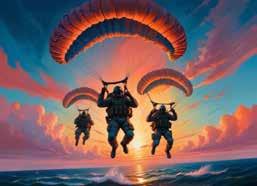
Becoming a SEAL is only the beginning. A SEAL who wants to join DEVGRU SEAL Team 6 faces another intense round of tests and training. He must be very strong and skilled in many areas. He knows how to parachute out of planes. He can dive into the deep sea and break into buildings. The training is nonstop, pushing these elite SEALs to the


1. (Before reading) Read the subtitles. What do you think this page will be about? {how to become a navy SEAL and DEVGRU SEAL and that their job is dangerous}
2. Why do you think the training for Team 6 is so intense? {They want to weed out soldiers who aren’t the best or determined enough.}
limit. In the end, only a small number of SEALs earn the right to wear the special badge of DEVGRU SEAL Team 6.
Finally, a Navy SEAL beats all odds and becomes part of DEVGRU SEAL Team 6. Now what? This is when the exciting and dangerous part starts. These brave men risk their lives over and over to keep our country safe. Sometimes, accidents happen, and things don’t go as planned. Being a member of this team is a huge sacrifice. SEALs must leave their worried families back home as they embark on a mission.
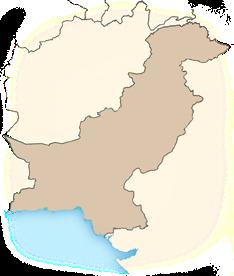
On September 11, 2001, the United States came under attack. The leader of the terrorist group that carried out the attacks was Osama bin Laden. He went into hiding, but the United States kept searching for him. Over the next ten years, intelligence experts pieced together small clues that told where bin Laden might be hiding. The DEVGRU SEAL Team 6 was called in. They discovered a strange compound in Pakistan with tall walls and barbed wire. No one ever went in or out of this compound. Could this be where bin Laden was hiding?
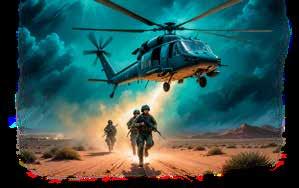
President Barack Obama decided it was time to act. DEVGRU SEALs built a model of this compound and practiced storming it over and over. Finally, on a moonless night, 24 Navy SEALs flew in two special helicopters, called the Black Hawks. They had to navigate carefully from Afghanistan to Pakistan.
The raid was risky and very dangerous. One helicopter crashed during the raid, but the DEVGRU team pressed on. They stormed the

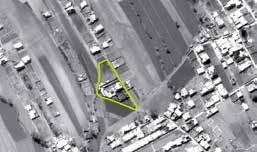
compound, moving from room to room. Finally, they found bin Laden. Mission accomplished! It was a historic victory against terrorism.
In April 2009, Captain Richard Phillips found himself in a terrifying situation. Pirates took control of his ship off the coast of Somalia, and his life was in danger. The U.S. Navy came up with a plan but they needed the help of the DEVGRU team.
1. The passage says that they found a strange compound in Pakistan. Based on clues from the text, what does this mean? {a building or set of buildings} Does anyone know where Pakistan and Afghanistan are located? {They are countries in the Middle east, and both are Islamic countries.}
2. What is the main idea of this page? {Devgru SEAL Team 6 works together to compete dangerous missions.}
3. What are two key details to support this main idea? {1. They found bin Laden. 2. They rescued Captain Phillips.}
DEVGRU SEAL Team 6 works like a well-oiled machine. Every single person has an essential role.
These brave heroes faced a challenging task. They needed to rescue Captain Phillips quickly and safely. Under the cover of night, they carefully approached the pirate-controlled ship. With incredible skill, three DEVGRU snipers took aim and fired. In mere minutes, Captain Phillips was brought to safety. The bravery and expertise of the DEVGRU team once again showed why they are considered one of the most respected special force units in the world.

What do DEVGRU SEALs do when they aren't fighting terrorists or rescuing hostages? They’re busy training, training, and training some more. There’s no end to their training. They learn how to shoot every kind of weapon, speak new languages, and study the tactics used by terrorists. This way, they’re always ready to face a new mission, no matter how risky or far away it is. Being part of this team requires incredible discipline, focus, and a deep love for their country.
They may be the best in the world, but they don't act alone. DEVGRU SEAL Team 6 works like a well-oiled machine. Every single person has an essential role. Snipers can hit a target a mile away. Communications experts keep everyone connected. Medics save lives on the battlefield. They trust each other completely and work together during dangerous operations, knowing that their teammates have their backs. It's this teamwork that allows them to succeed against all odds.
1. The passage says that DEVGRU Team 6 works like a “well oiled-machine.” What does this mean? {All the parts/people work well together.}
2. Look back at the subtitles in the passage. What are the most important points? {1. DEVGRU SEAL missions are top secret. 2. It is hard to join Team 6. 3. The work is dangerous. 4. The missions are important. 5. Training and teamwork is important.}
These would be key details that can be included in a summary.
Read each summary below and put a checkmark ( ) in the box if the summary follows the rule. If it doesn't, leave the box empty.
1. 2. 3.
Summary 1:
Navy SEAL Team 6 is really cool! It is really hard to become a SEAL. They save people. They use dangerous weapons. One time, I went to see a Navy base, and it was really huge!
Summary 2:
This passage is about DEVGRU SEAL Team 6. SEAL stands for Sea, Air, and Land Teams. They are given dangerous missions, like fighting terrorists, rescuing hostages, and killing terrorist leaders. “The training that SEALs undergo is one of the most challenging types of training in the world…They must run endless miles, swim in freezing water, and go a long time with barely any sleep.” Team 6 killed Osama bin Laden and rescued Captain Phillips. Finally, the passage talks about the importance of teamwork.
Type of Text
Action/Author
Main Idea
Key Details
- No opinions
- Own words
Type of Text
Action/Author
Main Idea
Key Details
- No opinions
- Own words
Summary 3:
This passage describes a secretive group of Navy SEALs called DEVGRU SEAL Team 6. They undertake dangerous missions like fighting terrorists or rescuing hostages. It’s very challenging to become a member of Team 6. They’re brave and risk their lives to keep America safe.
Type of Text
Action/Author
Main Idea
Key Details
- No opinions
- Own words
Now you will be the teacher! Read each summary and decide if it was done properly. Remember that Text Type, Action, and Main Idea will all be found in the first sentence. Make sure that the summary only includes key details, not any extra details. Which summary is the best?
Charts and graphs show the information instead of telling it. They help give a better understanding of the text.
What test takers need to do to pass DEVGRU SEAL tests
Note: They don’t just need to pass; they need to score higher than other test takers.
Write a paragraph explaining how the chart helps you understand how hard it is to become a DEVGRU SEAL.
1. Answer the questions.
a. What does the chart show?
It shows what DEVGRU SEALs need to do in order to pass their test.
b. Give an example from the chart.
2. Complete the outline. Use your answers from step one to finish the body sentences.
Topic Sentence: The chart explains that it is really hard to become a DEVGRU
Body Sentence 1: It shows
Body Sentence 2: For example,
Body Sentence 3:
I can only do five pushups, so 130 pushups is a lot!
Concluding Sentence: This chart helps me understand how hard it is to become a DEVGRU SEAL.
3. Write as a paragraph.
The chart explains that it is really hard to become a DEVGRU SEAL. It shows what DEVGRU SEALs need to do in order to pass their test. For example, if they want to be really good, they need to do 130 pushups. I can only do five pushups so 130 pushups, is a lot! This chart helps me understand how hard it is to become a DEVGRU SEAL. They need to do at least 80 pushups, but if they want to be really good, they need to do 130.
what DEVGRU SEALs need to do in order to pass their test. if they want to be really good, they need to do 130 pushups.
Much of what Navy SEAL Team 6 does is top secret! Imagine you could ask a SEAL anything you wanted. What would you be most curious about?
Write down five questions you'd ask a Navy SEAL Team 6 soldier if you had the chance: 1 2 3 4 5
Circle the correct answer.
1. The top-secret documents were kept , so only certain people could see them.
a. determined
b. sacrificed
c. essential
d. classified
2. Even with many problems, she stayed to reach her goals.
a. intense
b. sacrificed
c. determined
d. navigated
3. A good night's sleep is for being alert.
a. challenging
b. intense
c. approached
d. essential
4. In the sentence "The curious cat approached the dog's bowl," what did the cat do?
a. Stayed away from the bowl
b. Came closer to the bowl
c. Yelled at the bowl
d. Ignored the bowl
5. Which word means “very strong or focused”?
a. Essential
b. Intense
c. Navigated
d. Challenged
6. Which word means “difficult or hard”?
a. Sacrificed
b. Intense
c. Challenging
d. Essential
7. Which of these does NOT involve navigating?
a. Driving in a busy city
b. Sailing on the ocean
c. Cooking a meal
d. Hiking in a forest
8. Which of these does NOT involve a sacrifice?
a. Studying instead of going to a party
b. Volunteering at a nursing home on your day off
c. Skipping lunch to buy a brother a gift
d. Borrowing money from a friend
Circle the correct answer.
1. What does SEAL stand for? (detail)
a. Sea, Air, and Land Teams
b. Special Elite Attack League
c. Secret Espionage and Larceny
d. Underwater Demolition Team
2. Why did President Obama give orders to raid the compound? (Cause and Effect)
a. He was worried about 9/11.
b. Experts believed that bin Laden was hiding there.
c. The SEALs were ready.
d. Pirates had taken control.
3. Why would Navy SEALs need to learn new languages? (inferencing)
a. To impress people
b. To speak to people in different countries while on missions
c. To understand orders
d. Because it is a requirement
4. What is the main idea of the passage? (main idea)
a. The history of Navy SEALs
b. The teamwork in the military
c. The missions and training of DEVGRU SEALs
d. The dangers of terrorism
5. How does someone join this special SEAL team? (sequencing)
a. Anyone who completes SEAL training can join DEVGRU.
b. SEALs who meet special requirements undergo extra DEVGRU training.
c. No details are given in the passage.
d. Most SEALs become DEVGRU.

6. DEVGRU SEALs “study the tactics used by terrorists.” What does tactics mean in this context? (context clues)
a. Uniform design
b. Military strategies
c. Codes and languages
d. Machines and technology
7. How is DEVGRU work different from the work of regular soldiers? (compare-contrast)
a. They take on more dangerous missions.
b. Regular soldiers don’t train, and DEVGRU soldiers do train.
c. There is no difference.
d. DEVGRU SEAL Team 6 trains regular soldiers.
8. Which is a fact about DEVGRU SEALs? (fact vs. opinion)
a. DEVGRU SEAL Team 6 is the best in the world.
b. SEALs are brave.
c. SEALs need to prepare for difficult missions.
d. Most people do not succeed in becoming DEVGRU SEALs.
Unit 1: Summarization
Strategies
Lesson 4: Summarizing a Story
Unit Goal Trajectory: Write a summary of a nonfiction or fiction text.
1. Identify and distinguish between the main idea and the details. (Lesson 1)
2. Explain how the details support the main idea(s). (Lessons 1 and 2)
3. Find more than one main idea in a text. (Lesson 2)
4. Write a summary of a nonfiction text. (Lesson 3 and beyond)
5. Write a summary of a fiction text. (Lesson 4 and beyond)
In the last lesson, we learned how to summarize a nonfiction article. Today, we will learn how to summarize a story.
Let’s learn about two different strategies you can use to make summarizing stories easier. That way, you can choose the way you like best!
So: How does the main character try to solve the problem?
The following summary is written badly. Can you help find and fix the mistakes?
dog goes to school?! What is this, doggy daycare? Wait, there's a magic collar and an evil scientist trying to steal it? This is confusing. So basically, a dog with a collar that lets him talk goes on a boring school field trip and fights a scientist.
1. Why is this summary written badly? Find at least three mistakes.
There are questions about the story. It has the reader’s opinions. It is missing the key events of the story.
What advice would you give the person who wrote this summary?
Focus on the beginning, middle, and end of the story, and remove your own opinions.
Students may have a hard time explaining what is wrong with the story.
Tell students to follow these steps:
Step 1: Underline each part that just “sounds wrong.” Make sure to only underline small parts at a time.
Step 2: Think about one part at a time. Why does it “sound wrong”? How would you fix it?
1. Banister, noun
S Railing E Staircase; Railing to hold onto on stairs
Q Why are banisters needed on staircases?
2. Miniatures, noun
S Models A Giant E Little desserts; Mini toys; A little picture Q What materials might you use to create your own miniatures? What would they look like?
3. Presentation, noun
S Show E A speech; A play; A PowerPoint Q Did you ever give a presentation? What was it on?
4. Delicacy, adjective
S Treat E A dessert; A fancy type of meat; Your favorite food Q What is your favorite delicacy?
5. Culminating, verb
S Finishing E A project done after reading a book; A week of tests followed by a trip
Q Have you ever been part of a culminating event that wasn’t as good as you had hoped?
6. Relief, noun
S Comfort A Distress
E A good feeling when your fears don’t come true; Feeling better after taking medicine Q What might a person do when they feel relief?
Match the bolded words with their definitions. Highlight context clues.
Sarah held onto the banister as she climbed the stairs to the attic.
The girl loved playing with her miniatures in the tiny dollhouse.
The student gave a presentation to his class about the benefits of recycling.
He wanted a delicacy – a slice of chocolate cake from a fancy bakery.
The school year is culminating with a big graduation.
The lost hikers felt a big sense of relief when they saw the rescue team.
The room was filled with decorative objects like paintings, vases, and throw pillows.
The jokes were so hilarious that the audience couldn’t stop laughing.
something used to make things look pretty or interesting
a fancy or expensive food item a railing for a staircase
very funny, causing laughter
a formal talk or speech given to an audience
very small versions of things
building up to a big moment or ending in a high point
feeling better when hurt, trouble, or fear goes away
banister [BAN-uh-ster]; miniatures [MIN-ee-uh-chers]; presentation [preh-ZUHN-tay-shn]; delicacy [DEL-uh-kuh-see]; culminating [KUHL-muh-nay-ting]; relief [ri-LEEF]; decorative [DEK-ruh-tiv]; hilarious [hi-LAIR-ee-us]
7. Decorative, adjective
S For show A Plain E A small table that is just meant to look nice; Flowers in a house Q What is the difference between decorative and practical?
8. Hilarious, adjective
S Funny A Serious E A good joke; A funny thing that happens Q What makes something hilarious?
Author: Yael Mermelstein Genre: Fiction
Karl is worried about his dad's unique hobby and how it might embarrass him at school. What surprising thing does Karl’s dad do, and how do his classmates react?
As you read, think about Karl’s feelings and what he learns about himself and his father.
The story we will read today never actually happened. The characters are not real people but are like real people. Stories that never happened are called fiction. Fiction stories that could happen are called realistic fiction.
1. In this story, the main character is very worried about what his friends think of him. Think of a time when you were worried about what your friends would think. What did you do? {Answers will vary.}
As we read, pay attention to what happens in the story and when. Notice what the problem is and how the characters respond.
“Karley Barley, please come downstairs,” his father called from the kitchen.
Karl rested his chin on the banister as his father appeared in full view, pants splattered with paint.
“Please don’t call me that, Daddy. Somebody might hear.”
“But that’s the nickname we gave you, Karl Benjamin. Don’t be ashamed of it. Listen to me.
You could learn a thing or three from your dear old dad.”
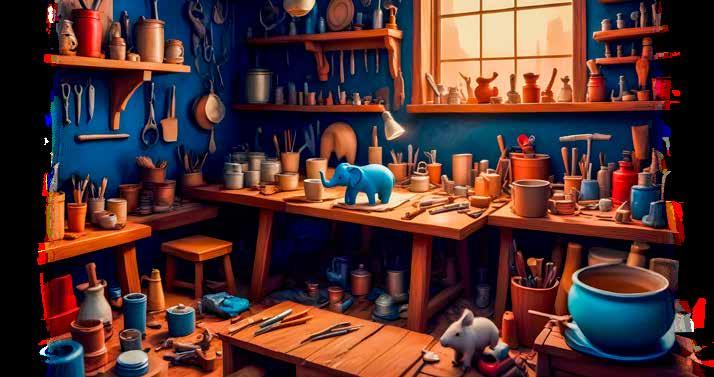
Karl covered his ears. All the windows in the house were open since his father was using oil paints on his miniatures today. His father was afraid of the fumes, but Karl was more afraid the neighbors might hear them. Ant Goodman’s cousins lived next door. Ant was the most popular kid in his class. If he ever found out Karl’s full nickname, he’d have to move to Alaska. He trudged down the stairs and flopped onto the couch at the entrance to his father’s studio.
“Not for your little lungs to inhale,” his father said, closing the door halfway. “Your lunch is on the kitchen table, waiting ever so patiently for you.”
Karl peeked through the crack in the door before making his way to the kitchen. His father was hunched over a miniature set of men playing musical instruments. He was using the finest brush to color one of the men’s beards in strokes of white and black.
A peanut butter and jelly sandwich, carved in the shape of a tuba, lay on a disposable plate in the middle of the kitchen table. Karl loved it. He only hoped his father wouldn’t pack anything similar in his lunch bag for school. Which 11-year-old boy brought sandwiches shaped like wind instruments?
He felt someone standing nearby. He looked up. His father was smiling, brown beard now flecked gray from paint.
“Karley Barley, you like it? I’m telling you, you could learn a thing or three from your dear
1. Why does Karl want the windows closed? {The most popular boy in his class’s cousins lived next door and might hear how strange his father is.}
2. What is Karl’s father like? Describe his personality. {he is goofy, says funny things, he is not typical, likes art, he is creative}
old dad. It’s a delicacy, no?”
“It’s delicious, thank you.”
His father studied his paint-stained nails.
“Your teacher, Mr. Segal, just called me,” he said.
Karl nearly spit out his sandwich. There was no way he was in trouble. He followed all the rules. He spent his life trying not to be noticed.
“Don’t get that deer-in-the-headlights look about you,” his father said. “He just called to tell me about Parent Tuesdays.”
Karl swallowed, the sandwich tasting like sawdust in his throat.
Parent Tuesdays. Each week, a different parent of a classmate would come in and do some show-and-tell about their job. Lev Weissmandel’s father was a graphics artist. He’d used a giant screen and put together an advertisement for soup nuts, right on the spot. Raphael Reiser’s father had talked about running a hotel. He had to travel to South America a few times a year, and he’d learned Spanish!
Karl’s mother didn’t work outside the home. And his father—well—he built and painted miniatures, which was certainly interesting.
“There’s an opening this coming Tuesday. You know I love sharing my miniatures! Why didn’t you ever mention it?”
Karl gulped. He could feel his sandwich lodged somewhere in his small intestine.
“I just—forgot.”
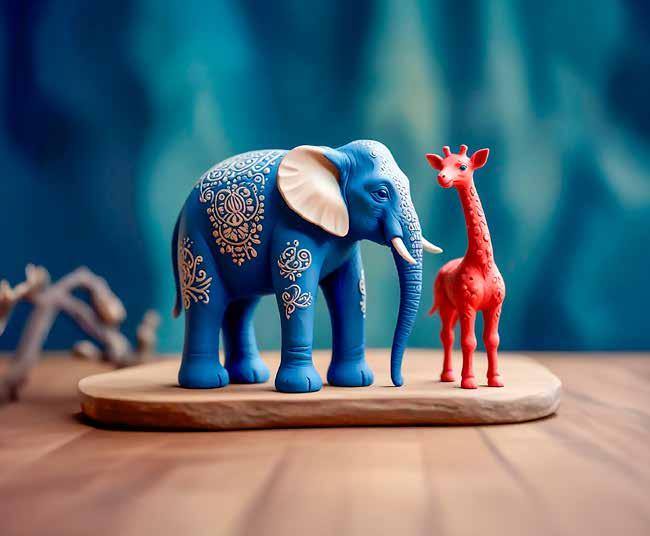
“Great,” his father said. “So, I’m going to need your help deciding which of my miniatures to show. Do you think your friends would like the farm animal set?”
Karl rested his chin on his hands as his father wandered back to the studio. He needed a solution, and fast. It was weird enough that his father was a miniature artist, even if his little models did make them enough money to live off of. But his father always had bits of paint on his clothing and in his hair, even when he thought he was “clean as a whistle.” And he spoke with his hands, making every word bigger than it had to be.

Karl loved his dad. But he did not belong in his classroom. What would Ant and the rest of the boys think? He needed to stop this in its tracks.
1. How does Karl react when his father says that his teacher called? {He is shocked.}
2. What problem does Karl face?
{His father wants to come present his miniatures to his class.}
* * *
Karl was grateful for the real-live stomachache he woke up with on Monday, culminating in a full, twisted-up tummy by Tuesday morning.
His father came to the door, dressed in baggy pants, with only the slightest paint splotch at the hem.
“Look how fine I look today for Special Tuesday!” he said. “I’m renaming the day because it is so special that I get to visit my Karley Barley’s class and meet his little friends!”
Karl’s stomach churned. He felt awful about what he was about to do. It was worse than the worst stomach ache. It was awful all the way deep in his bones.
“I feel bad,” he said. “But… I really feel sick. My stomach hurts. There’s no way I can go to school today.”
He waited for his father’s face to crumple with disappointment, but he only looked worried.
“Let me get Mom over here,” he said. “No worries, Karley Barley. Just feel better. Maybe


I’ll tuck my miniatures away for another Tuesday.”
Relief coursed through him. So much relief, the awfulness drowned in the sea of it.
He passed the day doing crossword puzzles, reading, and playing with his little brother Sammy when he came home from kindergarten. He avoided his father’s studio. Seeing him would only remind him of what he’d done. Even thinking about it made him feel as small as one of his father’s miniatures. But at least his stomach ache had all but disappeared. By dinnertime, he was starving.
“Oh, what a beautiful day,” his father sang in the kitchen, to a tune he’d clearly made up. Karl looked at the window to make sure it was closed.
His father smiled at him.
“There’s spinach in your tooth, Dad,” Sammy said.
“Excellent,” his father said. “It makes my mouth more decorative.”
1. Do you think Karl was actually sick? {No. He really did have a stomachache, but really he could have gone to school.}
2. What do learn from Karl’s dad’s reaction after Karl says that he can’t go to school on Tuesday? {He cares a lot about Karl.}
The phone rang. Karl picked up.
“Hi, Karl,” said a voice he sort of recognized, but couldn’t place. “It’s Ant Goodman.”
Karl gripped the receiver. “Ant?”
“I got your number from your father.”
“My father?” Karl glanced at his father, who stuck two thumbs up in the air.
“Yeah, at his presentation today. It was awesome! Everyone loved it. Too bad you couldn’t be there. I just wanted to see how you’re feeling.”
The phone dropped from his hand, clattering to the floor.
“Pick it up, my dear boy,” his father said. “You don’t want to keep your friend waiting.”
“Sorry, Ant. I dropped the phone.”
“No problem. Anyway, so, your father’s, like, a superstar. He’s hilarious. Do you just laugh all day?”
“Y-yeah,” Karl stammered. “All day.”
“And those miniatures are incredible. And—I dunno. He just seems like the type of person
who isn’t embarrassed by anything. We asked him how someone could get like that, and he said we should ask you. You’re his son and all.”
Karl stared at his father. He nodded slowly. So, he’d been expecting this. His father knew him inside out. He probably knew he was embarrassed of him. Not that it held him back from doing exactly what he wanted to do. His father leaned over and picked up a piece of paper. He held it over his head. Karl read the words.
INVITE HIM OVER TO PLAY!
Seriously? Boys his age didn’t play.
“Well,” he said. “I, uh, I’m not exactly like my father.”
“Yeah, me neither. I’m more like my mother. Anyway…”
His father made the sign bob back and forth. He could learn a thing or three from his dear old dad.
“Yeah, anyway,” Karl said. “Do you, uh, want to come over and I’ll tell you about it?”
1. What was unexpected about the ending? {The boys think Karl’s dad is really cool after Karl is nervous about them meeting him.}
2. Imagine a friend would ask you what this story is about. Without telling the whole story, what would you say? {It’s about a boy who is embarrassed of his father.}
PRACTICE VOCABULARY STORY REVIEW ACTIVITY ASSESSMENT
Summarize Tiny Art with either the Beginning-Middle-End or SWBST strategy. Use the chart to create your outline.
1. Choose the strategy: Beginning-Middle-End or SWBST
Topic Sentence: Body Sentence 1: Body Sentence 2: Body
Sentence 3:
The story is about Karl, a boy whose father is different from other fathers.
Karl didn’t want his friends to know about his father.
His father made a plan to visit Karl’s class to show his miniatures.
Karl stayed home sick while his father went to his school.
Concluding Sentence:
In the end, Karl’s friend thinks his father is cool.
2. Write as a paragraph.
The story is about Karl, a boy whose father is different from other fathers. Karl didn’t want his friends to know about his father. His father made a plan to visit Karl’s class to show his miniatures. Karl stayed home sick while his father went to his school. In the end, Karl’s friend thinks his father is cool.
Authors and characters have their own opinions. As the reader, it is your choice to decide if you agree with those opinions.
Write a paragraph explaining if you agree or disagree with Karl’s feelings about his father.
1. Do you agree or disagree with Karl?
In the story, Karl is embarrassed that his father makes miniatures. I disagree.
2. Give three reasons to explain your opinion.
His friends think his father is cool.
It is not embarrassing to have an interesting hobby. You shouldn’t be embarrassed of your parents.
3. Write an outline. For each reason, write one body sentence.
Topic Sentence: I (agree/don’t agree) that Karl should be embarrassed of his father.
Body Sentence 1: First,
I don’t think it is embarrassing to have an interesting hobby.
Body Sentence 2: Additionally,
Body Sentence 3: Last,
I don’t think kids should be embarrassed of their parents. in the end, Karl’s friends think his father is cool and not embarrassing. tell Ant more about his father so he won't be embarrassed.
Concluding Sentence: I think Karl should
4. Write as a paragraph.
I don’t agree that Karl should be embarrassed of his father. First, I don’t think it is embarrassing to have an interesting hobby. Additionally, I don’t think kids should be embarrassed of their parents. Last, in the end, Karl’s friends think his father is cool and not embarrassing. I think Karl should tell Ant more about his father so he won’t be embarrassed.
PRACTICE VOCABULARY STORY REVIEW ACTIVITY ASSESSMENT
Create a character collage.
1. Write the name of your character in the center of your paper. Choose Karl, his father, or Ant.
2. Create a collage around the name. Decorate with descriptions of your character. Use pictures and/or words.

Circle the correct answer.
1. The staircase was old and creaky, so I held onto the for support.
a. miniatures
b. delicacy
c. banister
d. relief
2. Which word describes something very small, like tiny versions of things?
a. Hilarious
b. Decorative
c. Relief
d. Miniatures
3. Which of the following is an example of a presentation?
a. A casual conversation
b. A formal speech
c. A private thought
d. A silent observation
4. Which of the following is an example of a delicacy?
a. Toast
b. Spaghetti
c. Expensive chocolate with a fancy filling
d. Cereal with milk
5. Which word means “ending in a big moment or event”?
a. Hilarious
b. Decorative
c. Culminating
d. Banister
6. When the fire alarm stopped ringing, everyone felt a wave of wash over them.
a. trudged
b. relief
c. delicacy
d. banister
7. What is something decorative?
a. A textbook
b. A sparkly party hat
c. A brown bag
d. A comfortable pair of shoes
8. Which word means “causing laughter, very funny”?
a. Delicacy
b. Banister
c. Relief
d. Hilarious
Circle the correct answer.
1. What does Karl's father make him for lunch? (detail)
a. Macaroni and cheese
b. A grilled cheese sandwich shaped like a guitar
c. A tuna salad sandwich shaped like a watch
d. A peanut butter and jelly sandwich shaped like a tuba
2. Why does Karl feel worried when his father mentions Parent Tuesday? (cause and effect)
a. He doesn't want his classmates to see his house.
b. He is afraid his father will embarrass him at school.
c. He thinks his classmates will find his work interesting.
d. He is worried he will forget to prepare for his presentation.
3. Why does Ant call Karl's father a "superstar" after his presentation? (inferencing)
a. He must be very wealthy.
b. He found the miniatures boring.
c. He was amazed by how excited and dedicated he was.
d. He thinks miniature making is a dangerous job.
4. What is the overall message of the story? (main idea)
a. Always listen to your parents, even if you don’t agree.
b. It's important to be popular in school.
c. Be proud of who you are and what makes you special.
d. Don't be scared to lie to get what you want.
5. What is the last thing that happens in the story? (sequencing)
a. Karl invites Ant to come over.
b. The phone rings.
c. Karl picks up the dropped phone.
d. Karl feels grateful for his real stomachache.
6. In the passage, "Karl rested his chin on the banister as his father appeared in full view, his pants splattered with paint," what does the word "splattered" suggest? (context clues)
a. Neatly folded
b. Covered in a messy way
c. Ironed perfectly
d. Brushed clean
7. How does Karl view his father differently at the end of the story? (compare-contrast)
a. He sees him as less successful.
b. He is proud of his confidence.
c. He finds his hobbies more childish.
d. He feels more distant from him.
8. Which is a fact from the story? (fact vs. opinion)
a. Karl’s father is a miniature artist.
b. Having a father who is different can be embarrassing.
c. Peanut butter and jelly sandwiches shaped like musical instruments are a delicious lunch.
d. Having paint on your clothes looks messy.
Unit 2: Text Structure
Lesson 5: Informational Text Structures: Chronology/ Sequence and Problem-Solution
Unit Goal Trajectory:
Compare the structures of two nonfiction texts and explain the structure of a fiction text.
1. Identify the text structure of an informational text. (Lessons 1 and 2)
2. Explain how the author uses text structure. (Lessons 1 and 2)
3. Compare the structures of more than one text. (Lessons 1 and 2)
4. Explain how the structure of a series of scenes provides the overall structure of a drama. (Lesson 3)
5. Explain how the structure of a series of stanzas provides the overall structure of a poem. (Lesson 4)
In this unit, we will be exploring informational text structures.
Text structure is the way an author organizes the information in the writing.
In this lesson, we will focus on two types of informational text structures.
The author tells about something in the order that it happened or will happen.
Examples:
→ a history book that tells about the order of events in the Civil War
→ a recipe for chocolate chip cookies
Key Words: first, before, next, during, finally, last...
Informational texts are writings that give you facts and information about a topic. They are made to teach you new things.
The author describes a problem and its solution.
Examples:
→ an advertisement
→ an article on the problems of pollution and how to solve them
Key Words: problem, issue, challenge, conflict, solution, fixed, solve...

Read each passage. Circle the correct text structure.
An egg hatches into a tiny caterpillar. The caterpillar eats leaves and grows quickly. Then, it turns into a chrysalis. This is the form a butterfly takes before it comes out of the cocoon. After some time, a butterfly comes out of the chrysalis.
Chronology/Sequence
Problem/Solution
Chronology/Sequence
irst, wake up at 7 a.m. Then, take a shower, get dressed, and eat breakfast. Next, pack your backpack, brush your teeth, and comb your hair. Finally, head out the door by 8:15 a.m.
Chronology/Sequence
Problem/Solution
h-oh, I have a flat tire! Luckily, I have a spare tire and jack in the trunk. I can pull over to the side of the road, fix the flat tire, and be back on my way in no time.
Chronology/Sequence
Problem/Solution
f you get lost in the woods, stay calm and try to retrace your steps. Look for landmarks or signs that might help you find your way back. If you can't find your way back, build a shelter and stay put. Signal for help by building a fire or using a whistle.
Problem/Solution
H U
ow to make pancakes: First, mix the dry ingredients in a bowl. Then, whisk together the wet ingredients in another bowl. Finally, combine the wet and dry ingredients, cook on a griddle, and flip once bubbles appear.
Chronology/Sequence
Problem/Solution
Students may have a hard time when passages do not use explicit language to express the text structure.
Tell students that sometimes, a text doesn’t use words that hint to the structure. To figure out the structure, first read the whole text. Then, decide if it is mainly telling the order of something or if it is describing a problem and solution.
1. Saddle, noun
S Seat E Leather seat on a horse Q What might it be like to ride a horse without a saddle?
2. Frequently, adverb
S Often A Rarely
E Something you do a lot; Breathing; Talking
Q What is a frequently asked question about our school?
3. Improving, verb
S Bettering A Worsening
E Practicing till you get better; Getting a good grade after a bad grade; A system that has started working faster
Q If something is improving, is it getting better or worse?
4. Method, noun
S Way A Disorganization
E A way of making bread; The way you choose to pay for something; A plan created for a specific purpose Q Can you explain a method for making a peanut butter and jelly sandwich?
5. Adopted, verb
S Used A Abandoned
E A method that is chosen to be used Q How would someone adopt a new habit?
6. Visual, adjective
S Graphic E A picture or video; Words that you can read; A diagram or chart
Q How are visuals helpful for learning?
Match the bolded words with their definitions. Highlight context clues.
The cowboy carefully put the saddle on his horse before climbing on.
If you remind me frequently, I will remember your name.
By practicing every day, the pianist was improving his skills.
The scientist hoped to get different results with a new method for his experiment.
My idea for saving money has been adopted by many families.
I like to read and see pictures in school because I am a visual learner.
In Japan, it’s traditional for men to wear a kimono during special ceremonies.
The delicate vase was fragile and needed to be handled with care.
relating to or using sight
becoming better or more advanced
easily broken or damaged
chosen to be used or followed way of doing something; procedure
a seat for a rider on a horse's back often or repeatedly
keeping to past or established ways of doing things
saddle [SAD-l]; frequently [FREE-kwent-lee]; improving [im-PROO-ving]; method [MEH-thud]; adopted [uh-DOPT-id]; visual [VIH-zhoo-uhl]; traditional [truh-DISH-uh-nl]; fragile [FRAJ-uhl]
7. Traditional, adjective
S Usual A New E A food eaten in a specific place for years; Speaking English in America; Wearing a cap and gown by a graduation Q What is a traditional American food?
8. Fragile, adjective
S Delicate A Strong E Glass; Crystal; Jewelry Q Why is it important to be careful with fragile objects?
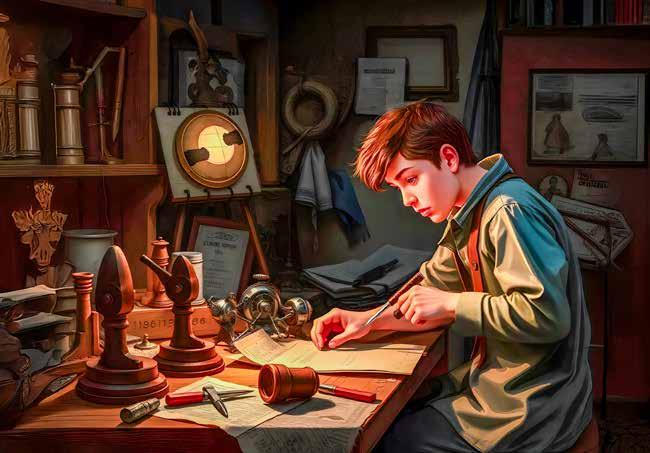
Author: E. Aboud Genre: Biography
An accident left young Louis Braille blind, but he wasn't going to let that stop him from learning. At his special school, the books were HUGE and hard to read. Louis knew there had to be a better way for blind children like him to read and write. He started to dream up a whole new system, and it all started with... dots! Could these little bumps really help blind people read and change their lives?
The passage we will read today is a type of informational text. Information texts are nonfiction.
1. This passage tells about the life of Louis Braille. What is a passage called when it tells about the life of a person? {a biography}
2. Has anyone ever heard of braille? What is it? {It is a reading system for the blind that uses raised dots.} This passage has two sections. Each section has a different structure. As we read, we’ll try to figure out what they are.
Section 1: Louis Braille
It was the early 1800s.
Monsieur (Mr.) Simon-Rene Braille lived together with his family in a small French village called Coupvray. He had four children and owned a successful business. He made harnesses, saddles, and other horse equipment. People needed these things since they traveled on horses to get from place to place.
One day, Monsieur Braille’s youngest child, Louis, was playing in his father’s workshop. The Braille children frequently visited the workshop.
Louis was three years old. He looked around at all the tools. The dusty workshop was a fun place to play!
He picked up a sharp tool called an awl, which is used to punch holes in leather or sew it together. He tried to punch a hole in the leather.
No one saw what Louis was doing. An awl is
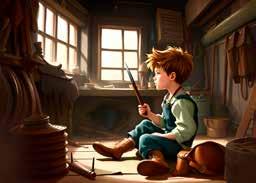
an extremely dangerous tool for a young child. He pushed the awl against the leather. Instead of making a hole, the awl slid across the leather and poked him in the eye!
Louis screamed. His parents came running. They rushed him to a doctor who tried to bandage the eye, but it was badly damaged. To make matters worse, the injury caused his eye to become infected. Sadly, the infection spread to the other eye. Antibiotics had not yet
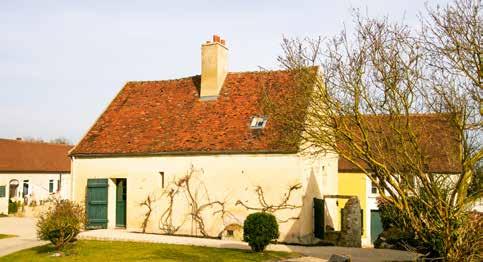
1. What do you think Monsieur Braille used the leather for? {making saddles}
2. How old was Louis when he became completely blind? {5}
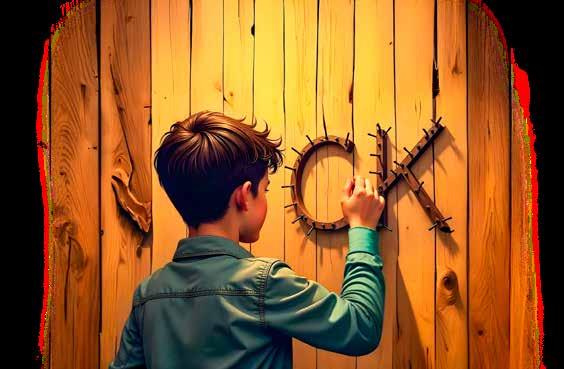
been invented, and infections were dangerous. Sometimes, they were even life-threatening.
Louis survived, but he lost his vision. Over the next two years, his eyesight got worse and worse until he was completely blind. The little boy didn’t realize that he couldn’t see, and he asked his parents why it was always so dark.
As Louis grew up, his parents did their best to help him live a normal life. In those days, children like Louis grew up to become beggars or peddlers. His parents didn’t want this to happen to their precious son.
Monsieur and Madame Braille did whatever they could for Louis. His father built him a cane so he could feel his way around. He went to a regular school and listened when the teachers taught.
Although Louis couldn’t see, his parents taught him how to read. They hammered nails into a wooden board in the shape of letters. Louis used his fingers to “read” the words.
When Louis was ten years old, his parents and
teachers decided to send him to a special school. The Institute for Blind Youth in Paris was the first school in the world for blind children. Louis traveled to Paris to attend the school. Here, he continued to read with his fingers. At the institute, children were given books written with the Hauy system. This system used regular letters that were raised. Students traced the words with their fingers so they could read them.
Besides reading, Louis learned Greek, Latin, algebra, geography, and music. He was a very smart boy and loved his new school.
When he was 12 years old, Louis worked on inventing his own system that could be used for sightless reading and writing. For the next three years, he spent all his free time improving this system. The young genius had invented braille.
When he was just 19 years old, Louis started teaching in the institute. He stayed there for most of his life, teaching history, geometry, and algebra.
1. Why do you think Louis’s parents sent him to the institute in Paris? {They wanted him to have the best opportunities for learning.}
2. In the right column is the word “sightless”. Find the word. What does it mean? How do you know? {without seeing- sight means seeing, less means without}
3. What is the structure of this section? How do you know? {chronology/sequence since it is telling a story in order}
At first, the school used the braille system. Then, a new principal was hired, and he did not allow it to be used.
Louis died when he was only 43 years old. Two years later, many of the students convinced the school to allow them to use Braille’s method
Soon, braille became popular among French speakers and was eventually adopted by blind students all over the world. Louis Braille’s invention changed the lives of the blind. It made it much easier for blind people to read and write.
If you pay attention, you can find braille everywhere. Door signs, key pads, public bathrooms, and elevators all use braille to help people with visual disabilities. Though 200
years have passed since its invention, braille is still widely used today.
Section 2: Why the Braille System?
Louis Braille learned how to read without using the braille system. Yet, he still worked hard to create a new method for sightless reading. Clearly, there was something he didn’t like about the original system. What was wrong with it?
When Louis joined the Institute for Blind Youth, the school used the Hauy system. The books printed with this system used regular letters. They were different from regular books because the letters were raised. Students used their fingers to feel the words.
The problem was that it was hard to read
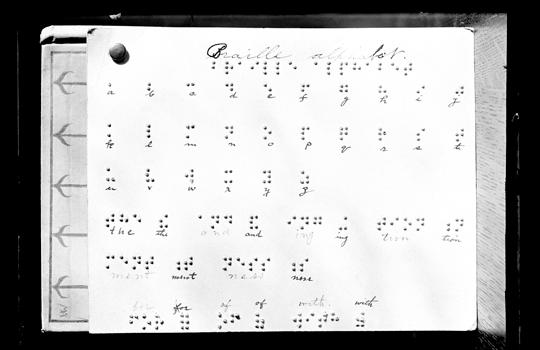
1. Do you think you’d have an easy time or a hard time reading a book using the Hauy system. Why or why not? {hard time- it is hard to read by feeling the letters}
like this. It took a long time to read the words and then understand them. These books had a lot less information than traditional books.
Louis wasn’t happy about this. He wanted to read on the same level as sighted people.
Another difficulty with the Hauy system was that the books were complicated to produce. In order to make each book, special tools were needed. The process was so complex that children who used this system didn't learn how to write. Louis knew that an important part of communication was the ability to write.
There were other problems, too. The books were heavy and uncomfortable for children to hold. They were fragile and expensive.
The Barbier system was another way for the blind to read. This system used a code made of raised dots. Each letter was represented by up to 12 dots.
Louis liked this system, but it still wasn’t perfect. The Barbier system was too large and complicated. Also, it was based on 36 sounds found in the French alphabet and not on spelling or punctuation.


Louis Braille spent three years coming up with a solution. His system would also use raised dots. Each letter would be represented by six dots instead of 12. That way, a letter could be read with just one touch of the finger. It was a simple system that was easy to learn. Each cell, or group of dots, would represent an alphabet letter, number, punctuation mark, or word.
Braille was also easy to write. Special tools called a stylus and slate could be used to write. Now, blind people could also write.
Louis Braille knew that old systems of reading for the blind had lots of problems. He worked hard to find solutions. His braille system became very popular and is still in use today.
1. How was braille different from other sightless reading methods? {It was made with six dots and was simpler.}
2. Section 2 is written with a different text structure. Which structure is it? How do you know? {problem solution, I know because it tells the problems with the old methods and explains how braille is the solution}
3. What are some differences between Section 1 and Section 2? {different structures, one focuses more on Louis Braille, and one focuses more on the braille method; one is more story-like and one is more of an explanation…}
LESSON PRACTICE VOCABULARY STORY REVIEW ACTIVITY ASSESSMENT
The passage “Introducing Braille: The Story Behind the Invention” has two sections. Each of them is written with a different text structure.
Complete the Venn diagram to compare and contrast how the author used text structure in each section. Place the answers below in the correct section of the Venn diagram.
[different/contrast]
Structure: Chronology/Sequence
Is written in order of when events happened
Purpose: Tells about the life of the inventor of braille
Uses these words: "later," "next," "soon"
Topic is the braille system
Structure: Problem/Solution
Section
[different/contrast]
[same/ compare]
About Louis Braille
Topic is the braille system
Purpose: Tells why the braille system was needed
Structure: Problem/Solution
Uses these words: "problem," "difficulty," "solution"
First the problem is written, then the solution
Answer box
Uses these words: "problem," "difficulty," "solution"
First the problem is written, then the solution
Is written in order of when events happened
Uses these words: "later," "next," "soon"
Purpose: Tells about the life of the inventor of braille
Purpose: Tells why the braille system was needed
Structure: Chronology/Sequence About Louis Braille
LESSON PRACTICE VOCABULARY STORY REVIEW ACTIVITY ASSESSMENT
To retell or summarize a story, we need to focus on the main idea and key details. We can use the TAMKO strategy.
Text type Action Main idea
Key ideas Organization
Topic sentence 2-3 body sentences
Write a summary of the passage “Introducing Braille: The Story Behind the Invention.”
1. Write a topic sentence. What is the text type?
Choose an action word that shows what the author does (writes, describes, tells...) What is the main idea or topic?
Put the answers from these questions into one sentence that makes sense:
In the passage Introducing Braille: The Story Behind the Invention, the author writes about how braille was invented. writes
2. List key details. Pick the three most important points.
He found problems with the current ways of reading for blind people. He invented his own better system.
3. Write a sentence explaining each detail.
Body Sentence 1:
Body Sentence 2:
Body Sentence 3:
passage How braille was invented Louis Braille was blind. Louis Braille was blinded as a child. So, he worked hard to invent his own system that would be better.
4. Write a paragraph.
In the passage Introducing Braille: The Story Behind the Invention, the author writes about how braille was invented. Louis Braille was blinded as a child. He wanted to read, but he found problems with the reading systems for blind people that he was given to use. So, he worked hard to invent his own system that would be better. He wanted to read, but he found problems with the reading systems that he was given to use.
LESSON PRACTICE VOCABULARY STORY REVIEW ACTIVITY ASSESSMENT
Write your name in braille!
Use the chart to learn how to place the dots for each letter. Real braille uses raised dots. You can use stickers to make your dots bumpy.
What else can you write?
Can you read this?
Circle the correct answer.
1. Which describes a seat for a rider on a horse?
a. Saddle
b. Method
c. Visual
d. Improving
2. The bus arrives late on rainy days.
a. frequently
b. improving
c. adopted
d. saddle
3. The student was focused on her math skills.
a. saddle
b. improving
c. visual
d. traditional
4. Which of the following is an example of a method?
a. A feeling
b. A recipe
c. A color
d. A noise
5. A person who adopted a hobby:
a. Stopped doing their old hobby
b. Started doing a new hobby
c. Got better at their old hobby
d. Hated their new hobby
6. Which word means “relating to sight”?
a. Traditional
b. Visual
c. Fragile
d. Method
7. Which word means “easily broken or damaged”?
a. Fragile
b. Adopted
c. Visual
d. Improving
8. We followed the recipe for apple pie passed down in our family through generations.
a. traditional
b. frequently
c. fragile
d. adopted
Circle the correct answer.
1. What tool caused Louis Braille's accident? (detail)
a. A hammer
b. A knife
c. An awl
d. A saw
2. Why did Louis Braille create a new reading system? (cause and effect)
a. He wanted to become famous.
b. He didn’t like the existing systems.
c. His teachers encouraged him.
d. He won a competition.
3. Based on the description of Louis Braille's childhood, what can you assume about him? (inferencing)
a. He was lazy and uninterested in learning.
b. He was curious and determined.
c. He was shy and withdrawn.
d. He was angry and resentful.
4. What is the main idea of Section 2? (main idea)
a. A comparison of different reading systems for the blind
b. The reasons why Louis Braille invented braille
c. The process of creating the braille system
d. The challenges of learning to read braille
5. What is the correct order of events after Louis Braille invented his system? (sequencing)
a. School adopted braille, Louis died, school banned braille, school re-adopted braille
b. School adopted braille, school banned braille, Louis died, school re-adopted braille
c. Louis died, school adopted braille, school banned braille, school re-adopted braille
d. School banned braille, Louis died, school adopted braille, school re-adopted braille
6. The process was so complex that children who used this system didn't learn how to write. What does the word "complex" mean? (context clues)
a. Simple
b. Easy
c. Difficult
d. Short
7. Compare and contrast the Hauy system and the braille system. (compare-contrast)
a. The Hauy system used raised letters, while the braille system used raised dots.
b. The Hauy system was easy to learn, while the braille system was difficult.
c. The Hauy system was more popular than the braille system.
d. The Hauy system allowed blind people to write, while the braille system did not.
8. Which of the following is a fact about Louis Braille? (fact vs. opinion)
a. Louis Braille was the smartest person in the world.
b. Louis Braille invented the braille system.
c. Louis Braille was a kind and compassionate person.
d. Louis Braille should have won a Nobel Prize.
Unit 2: Text Structure
Lesson 6: Informational Text
Structures: Cause and Effect and Compare-Contrast
Unit Goal Trajectory:
Compare the structures of two nonfiction texts and explain the structure of a fiction text.
1. Identify the text structure of an informational text. (Lessons 1 and 2)
2. Explain how the author uses text structure. (Lessons 1 and 2)
3. Compare the structures of more than one text. (Lessons 1 and 2)
4. Explain how the structure of a series of scenes provides the overall structure of a drama. (Lesson 3)
5. Explain how the structure of a series of stanzas provides the overall structure of a poem. (Lesson 4)
Welcome back!
In this lesson, we will continue learning about text structures. Here are three more informational text structures.
The author uses facts and descriptions to explain the topic.
Examples:
→ a book about dogs that describes the different foods they eat
→ a letter explaining how a submarine looks
Key Words: such as, for example, to show, characteristics of...
The author tells about an event (cause) and what happened as a result (effect).
Examples:
→ a report explaining how loud music can affect people’s hearing
→ a news article about a storm that caused school to be canceled
Key Words: because, as a result, therefore, if…then, so...
The author describes how two things are similar and different.
Examples:
→ a passage that compares two types of cats

→ an article explaining the differences between sugar and corn syrup
Key Words: similar, both, in contrast, however, compared to...
Read each passage. Circle the correct text structure.
Aecause of strong winds, the power lines swayed and snapped, causing a blackout in the entire neighborhood.

cheetah, the fastest land animal, has a slender build and long, powerful legs. Its fur is tan with small, black spots.
Airplanes and hot air balloons can both fly and take you on sight-seeing trips. Airplanes go fast, and you can control where you go. Hot air balloons are slow and go with the wind, but they are quiet and give you a good view from up close.
There were not enough animals that ate rabbits, so there were too many rabbits. Because rabbits eat plants, the rabbits ate up all the plants.
olphins and sharks are both ocean predators. Dolphins are mammals known for their intelligence and playful behavior, while sharks are fish with a strong sense of smell and powerful jaws. Both are fast swimmers. Dolphins use sound waves to see, while sharks can sense electrical signals.
Students may have a hard time when passages do not use explicit language to express the text structure.
Tell students that sometimes, a text doesn’t use words that hint to the structure. To figure out the structure, first read the whole text. Then, decide if it is mainly describing something, telling about a problem, or telling what happens as a result of an event.
Synonym Antonym Examples
Additional Questions
1. Affects, verb
S Impacts A Unchanged
E The changes after an earthquake; How exercise makes your muscles stronger
Q How can the weather affect your mood?
2. Produce, noun
S Fruit E Apples, oranges, peaches, mango, banana, cucumber, avocado, lettuce, potatoes, onions Q Why is it better if produce is fresh?
3. Products, noun
S Manufactured items
E Table, picture frame, peppers, ice creams, clothing, shoes, crackers, milk, lightbulbs, tires, water bottles, backpack, pencils Q Can you name some products made from wood?
4. Urgency, noun
S Importance E The level of need for something; The amount time before something is due; How serious something is Q Why is it important to act with urgency in a medical emergency?
5. Tempting, adjective
S Attractive A Unappealing
E Yummy looking food; A fun ride that you want to go on; A nap when you are tired
Q Why might it be tempting to push things off that need to be done?
6. Contrast, noun
S Difference A Similarity
E Black and white; Hot and cold; Sweet and sour
Q How could a contrast between characters make a story interesting?
Match the bolded words with their definitions. Highlight context clues.
The loud noise from the construction site affects my concentration.
The farmer and his family got to eat the freshest produce
The store has all kinds of products, from food to clothing.
The doctor acted with urgency to help the patient quickly.
The smell of fresh cookies was so tempting, I wanted to eat one right away.
The contrast between the dark night sky and the bright stars was beautiful.
There are lots of strategies that you can use to get better at remembering things.
I found a great bargain at the thrift store a used hat for only $5.
fruits and vegetables grown for food
impacts or causes a change
something bought for less than the usual amount
appealing in a way that makes someone want to have or do something items that are for sale a plan or method for reaching a specific goal
needing to act quickly
a strong difference between two or more things
affects [uh-fekts]; produce [pro-doos]; products [prod-uhkts]; urgency [ur-juhn-see]; tempting [temp-ting]; contrast [kon-trast]; strategies [strat-uh-jeez]; bargain [bahr-guhn]
7. Strategies, noun
S Methods E Ways to help you learn better; Methods for making a lot of money; Plans for getting everything done Q What strategies do you use to study for tests?
8. Bargain, noun
S Deal A Non-reduced
E Sale; Something for 80% off; Something that is way cheaper Q Where can you find a good bargain?

Sandy thought a boring shopping trip couldn’t get any worse—until she found herself piling up her cart with things she didn’t even need! How did a quick stop for fruit turn into a full-blown shopping spree? What tricks do stores use to make sure you spend more than you planned? Get ready to uncover the secrets behind those sneaky store strategies as you read two passages on marketing psychology. Are you a smart shopper, or do you fall for the traps? Find out as you read on!
Today, we will read two passages that teach how stores get people to buy things.
1. What is nonfiction text that informs or teaches readers about something called? {informational texts}
2. What do you think the main goal of a store is? {to make money} How do stores make money? { They sell things for more than they paid for them}
As we read, pay attention to the structure of each passage. Later, we will compare and contrast the two passages.

Author: Victoria Friedrich
Sandy sits back on the couch and sighs. It’s a hot, sticky, boring day.
“Sandy!” her mother calls. “I’m going shopping now. Do you want to come?”
Sandy thinks. She really doesn’t want to go shopping. It must be 100 degrees outside at least.
But there isn’t anything better to do at home.
Twenty minutes later, she finds herself stepping through sliding doors into the airconditioned store.
“Watermelon!” Sandy says, pointing. “Can we get one?”
She looks around at all the ripe summer fruit:
juicy peaches, sweet plums, tangy nectarines. Yum.
She wanders further down the aisle. “Buy one, get one!” a big sign says on top of a display of notebooks. School is right around the corner, Sandy realizes.
“Can we buy some notebooks?” Sandy asks. As they pass through the aisles, their cart fills up more and more.
Finally done, they head to the checkout line. There are three customers in front of them. Bored, Sandy looks around at the candy, at the cute little toys and miniatures that would look perfect on the shelf in her room.

1. What happens to Sandy when she goes shopping? Did she plan on buying all those things? {No, she bought things that she saw.}
Before she knows it, the shopping cart gets a little fuller…
Did you know that there are people whose job it is to get people to spend more money? They study the human brain to find out how to get shoppers to buy more. This is a science called marketing psychology.
Marketing psychologists work for stores. Stores want to make lots of money, so they try to get people to buy more than they planned. Let’s take a look at how marketing psychology affects the shopper.
Bright colors catch people’s attention. Stores use them everywhere, from signs to packaging. When shoppers walk in and see colorful displays, their eyes are pulled toward the shelves.

Did you ever notice that the fruit and vegetable section is always first in grocery stores? This is done on purpose. The bright colors and beautiful displays of fresh produce cause shoppers to load up their cart with fruits and vegetables. (Later, they will feel better about buying unhealthy food since their cart is filled with healthy food.)
Some stores use certain smells to get people to buy more. For example, vanilla, lavender, peppermint, cinnamon, lemon, or green tea are used for specific purposes in different types of stores. These smells affect how customers shop.
Music is also used to get customers to spend. Slower music makes shoppers move more slowly and spend a longer time shopping. Sometimes, stores interrupt the music with advertisements or deals for their products. This also causes shoppers to spend more.
Sometimes, stores use signs that say "Limited Time Only" or "While Supplies Last!" They might make special deals for short amounts of time. This makes shoppers feel like they have to buy something right now. Marketers call this creating a sense of urgency
1. What is marketing psychology? {a science where people study how to get people to buy more}
2. What are some ways stores get people to buy more? {with bright colors, certain sounds and smells, and a sense of urgency}
If shoppers think that supplies will run out or a deal will end soon, they are more likely to buy something now. But often, the item will probably be there next week or even next month.
Shoppers are more likely to buy easy-tofind items. Stores put the things they want shoppers to buy most at eye level. This causes shoppers to spend more money on these products.
Placing items at eye level is not only done for adults. This is also done for kids! Toys and sugary snacks are placed on lower shelves so they will be easy for children to see. Now, more kids want to buy more things!
The checkout line is another way stores get customers to spend. Stores know that waiting in line is boring. That’s why they place tempting treats like candy, chocolate, and drinks


there. Bored and hungry people often decide to buy treats. This means more customers buying things they don’t really need. All these marketing tools lead to more shopping. Stores then make more money.
As a customer, you can make smart shopping choices. Before you go to the store, make a list of what you need — and stick to it. Remember, there's no rush! Whatever you see will probably still be there tomorrow. By being a smart shopper, you can save your money for the things you really want.

1. What is product placement, and how does it work? {Stores put products in specific places like eye level so people will be more likely to buy them.}
2. Why are people more likely to buy things in the checkout line? {They are bored and hungry.}
3. What is the structure of this passage? How do you know? {Cause and effect, it uses these words, it tells about the effect of the marketing strategies}
Author: Emma Hart
Have you ever heard of Target, Walmart, or Home Depot? Each of these stores is big, and there are lots of them! Large stores that have many branches across the country are called chain stores.
In contrast, small shops usually have one location. These are smaller businesses that are known just in their area. The owner is usually more involved in their store and helps the customers.
Both big chain stores and small shops use marketing strategies. They both want customers. But since they are different sizes, they do this in different ways.
Large chain stores like to impress their customers. They use bright displays to make their stores exciting. They place products in specific places to help shoppers notice them. They also use special deals to create a sense of urgency.
On the other hand, small shops offer a smaller, more personalized shopping trip. Workers are often available to offer advice and recommendations. This gives shoppers a
feeling of trust when they shop. Smaller shops sometimes host events that get them more involved in the community.
Big chains usually have more money coming in. Therefore, they can charge less than small shops. Many shoppers prefer to shop in chain stores because they can get a better deal. In addition, chain stores are usually bigger. They have more items in stock. It’s convenient for shoppers to have lots of choices. They can also buy lots of different things in one place.
In contrast, small shops will choose to stock better products if they can’t afford to purchase a lot. They offer unique or local products that can’t be found in bigger stores. Shoppers who want one-of-a-kind items often find them in small shops.
Both big and small stores play an important role in our communities. They offer different experiences, making sure that shoppers have choices. Whether you're a bargain hunter seeking the best deal or a shopper looking for something one-of-a-kind, there's a store out there that's perfect for you.
1. What does the author mean by saying a “more personalized shopping trip”? {Workers give advice to try and get customers to trust them.}
2. Why is it important to have both big and small stores? {so people have choices, competition is good}
3. What is the structure of this passage? How do you know? {compare- contrast, it uses certain words, it compares big and small stores}
Fill in the blanks to write a paragraph comparing and contrasting the text structures of the passages "How Stores Get You to 'Shop Till You Drop'" and "Big vs. Small: The Battle for Your Shopping Cart."
The passages "How Stores Get You to 'Shop Till You Drop'" and "Big vs. Small: The Battle for Your Shopping Cart" are both about . "How Stores Get You to 'Shop Till You Drop'" has a text structure, while "Big vs. Small: The Battle for Your Shopping Cart" has a text structure. The passage "How Stores Get You to 'Shop Till You Drop'" explains the effect of It uses words like “ ,” “ ,” and “ .” In contrast, "Big vs. Small: The Battle for Your Shopping Cart" compares and . It uses words like “ ,” “ ,” and “ .” Although "How Stores Get You to 'Shop Till You Drop'" and "Big vs. Small: The Battle for Your Shopping Cart" are both about , they are written from different angles and with different text structures.
the strategies stores use to get cause and effect compare-contrast people to buy more affects in contrast both on the other hand marketing strategies
Choose a store. Use the description text structure to describe it. Write a few sentences.
1. How does it look? How does it sound? What does it smell like? How does it feel? What does it sell?
{Answers will vary.} Target is a big store. It has a large logo on the front of the building. Inside the store, there are lots of people, and it is noisy. There are many sections like clothing, food, toys, and soaps. The store smells like the new products that it sells (especially in the candle section). Sometimes, Target seems overwhelming to shop in! the marketing strategies of big small stores causes that's why market strategies on the shopper
Reasons and evidence are used to convince the reader of the main points in a text.
Do you think it’s better to shop in a big store or a small store?
Write a paragraph using reasons and evidence from the text to explain.
1. Choose whether it is better to shop in a large chain store or small shop.
2. Write three convincing reasons for shopping in a store of that size.
4. Write an outline. Tell more about each reason in the body sentences.
Topic Sentence:
It’s better to shop in a store because , , and (Answers will vary.) Large chain store big it’s cheaper there are lots of stores conveniently located It’s better to shop in a big store because there are more products,
There are more products, products are cheaper, there are tons of big stores all over it’s cheaper, and there are lots of stores conveniently located.
3. Write a thesis statement (topic sentence). Write your three reasons in just a few words.
Body Sentence 1:
Body Sentence 2:
Body Sentence 3:
In addition, you can usually find a better deal at a large chain store.
Lastly, large chain stores are all over, so if you are in a different location, you will still be familiar with the store. there are more products
Large chain stores have more products to choose from, so you can find what you are looking for.
Concluding Sentence:
I think large chain stores are the way to go!
5. Write a paragraph.
It’s better to shop in a large chain store because there are more products, it’s cheaper, and there are lots of branches. Large chain stores have more products to choose from, so you can find what you are looking for.
In addition, you can usually find a better deal at a large chain store. Lastly, large chain stores are all over, so if you are in a different location, you will be familiar with the store. I think large chain stores are the way to go!
Create an advertisement for a store.
Specify whether it is a large chain store or a small store.
Circle the correct answer.
1. Which action affects the environment?
a. Reading a book quietly
b. Planting trees in the park
c. Listening to a speech
d. Watching your siblings at home
2. The farmer's market sells fresh .
a. tempting
b. strategies
c. urgency
d. produce
3. There is a big between the rich neighborhoods and the poor areas of the city.
a. product
b. bargain
c. urgency
d. contrast
4. Tim heard an in the doctor’s voice when he asked for help.
a. affects
b. produce
c. products
d. urgency
5. Which thing is the LEAST tempting?
a. A fun trip
b. A boring book
c. A tasty treat
d. A chance to win a prize
6. Which word means “things that are made to be sold”?
a. Products
b. Urgency
c. Tempting
d. Bargain
7. Which word means “plans or methods used to reach a specific goal”?
a. Strategies
b. Products
c. Affects
d. Bargain
8. Which word means “something bought or sold for a lower price than usual”?
a. Bargain
b. Contrast
c. Urgency
d. Tempting
Circle the correct answer.
1. What do we call a large store that has many branches across the country? (detail)
a. A small shop
b. A chain store
c. Marketing psychology
d. A sense of urgency
2. Why do stores place toys and sugary snacks on lower shelves? (cause and effect)
a. To make them easier for adults to reach
b. To make them harder for kids to reach
c. To make them easier for adults to see
d. To make them easier for kids to see
3. How can shoppers avoid giving in to the urge to buy extra items at checkout? (inferencing)
a. Avoid the checkout line altogether
b. Bring a snack to the store
c. Don't use a shopping list
d. Buy everything they see
4. What is the main idea of the second article, "Big vs. Small: The Battle for Your Shopping Cart"? (main idea)
a. Big stores are better than small stores.
b. Small stores are better than big stores.
c. There are advantages and disadvantages to both big and small stores.
d. Stores are all the same.
5. What is the first thing compared in the second article? (sequencing)
a. The advantages of big stores and small stores
b. The prices of big and small stores
c. The sizes of big and small stores
d. The products offered by big and small stores

6. In the first article, the phrase "while supplies last" is used to create a sense of urgency. What does this phrase mean? (context clues)
a. There is a limited amount of the item.
b. The item is very popular.
c. The sale is for one week.
d. The item is very expensive.
7. According to the passage, how are large chain stores and small stores similar? (compare-contrast)
a. They both use marketing strategies.
b. They both have the same prices.
c. They both sell the same products.
d. They both have the same hours.
8. Which of the following is a fact? (fact vs. opinion)
a. Large chain stores are always better than small stores.
b. Marketing psychology is a science.
c. Marketing psychology is really good for stores.
d. Customers hate waiting in line.
Unit 2: Text Structure
Lesson 7: Structure of a Drama
Unit Goal Trajectory:
Compare the structures of two nonfiction texts and explain the structure of a fiction text.
1. Identify the text structure of an informational text. (Lessons 1 and 2)
2. Explain how the author uses text structure. (Lessons 1 and 2)
3. Compare the structures of more than one text. (Lessons 1 and 2)
4. Explain how the structure of a series of scenes provides the overall structure of a drama. (Lesson 3)
5. Explain how the structure of a series of stanzas provides the overall structure of a poem. (Lesson 4)
Ever wonder why your favorite books are divided into chapters or why plays have different scenes? Today, we're going to explore how authors use these parts to create stories!
Long stories are often broken up into chapters. Dramas (plays) are divided into scenes.
Reading a story or drama is like climbing a staircase. Each chapter or scene is a step.
Just like skipping a step makes it hard to climb, skipping a chapter makes it hard to understand the story.
In a story, chapters and scenes are created with a purpose. They link together to form the whole story.
Let’s take a look at the different ways an author uses chapters and scenes.
A chapter or scene can be used to…
…introduce the characters and setting
…make the reader curious
Drama Vocabulary Words
…tell what happens next in the story
…give the reader new information
…describe a problem
…answer the reader’s questions
script - what the actor or reader reads setting - when and where the scene takes place stage directions - extra instructions for the actors scene - a section of the script with characters and a setting cast of characters - a list of people who will speak in the scene dialogue - conversation between characters
Match each scene to where it belongs in a drama.
A scene where all the reader’s questions are answered
A scene where the reader learns about the characters
A scene with a problem
This is the beginning of a drama called The Man and the Alligator. Label the parts of the script. Use the word box below to help.

TIME: The morning after the cyclone PLACE: The man's garden
THE MAN THE ALLIGATOR
SCENE I
[The MAN enters the garden carrying his big stick and small net. The garden has been almost destroyed by the ALLIGATOR, who is still hiding among the flowers.]
MAN: (Looks at the ground) Hey, there should be enough apples to fill my net! That storm last night was rough! (Suddenly notices the alligator) Hey, you! What are you doing in my garden?
ALLIGATOR: (Whining a bit) Please don't be mad at me, mister! I didn't mean to...
MAN: (Interrupting and annoyed) Accident? You stomped all over my flowers by accident?
ALLIGATOR: (Sadly) Yes. It wasn’t my choice…
Students may not realize that some of the words in the scripts are directions for the actors and are not read aloud in the play.
Tell students that it is important to read all the words but that in a play, not all words are read aloud. In class, what is read out loud will depend on if the play is being acted out or just read.
In a play, the scene, setting, cast of characters, and stage directions are not read aloud.
In the dialogue, bolded names of characters and italicized words in parentheses are not read aloud. They tell who is speaking and give specific directions to those actors.
The rest of the dialogue is read aloud.
1. Anteroom, noun
S Hall E Waiting room; A lobby; A small room before a bigger room Q Why might an important person have an anteroom outside their main office?
2. Lad, noun
S Boy A Adult
E A nine-year-old boy; A 13-year-old boy; An 11-yearold boy Q In what kind of setting or time period might the word “lad” be used most often?
3. Presently, adverb
S Shortly A Later
E Something you will do soon; Something you are doing right now; Q Why might someone choose to use the word “presently” instead of saying “now”?
4. Timidly, adjective
S Shyly A Confidently
E Someone who acts in a shy way; Someone who acts in a fearful way; Someone who acts in a unconfident way
Q How would you describe someone acting timidly?
5. Salutes, verb
S Greets A Ignores
E Raises a right hand to the forehead; Stand up in respect for someone; Tell someone that you respect their idea Q Why do people salute in the army?
6. Lame, adjective
S Disabled A Able
E A horse that can’t walk; A leg that is sore and can’t move; A bad excuse
Q What do you think a “lame joke” means?
Match the bolded words with their definitions. Highlight context clues.
We waited in the anteroom before being called into the doctor's office.
The lad played with his friends out in the yard.
Wait one minute; I will be ready presently.
The shy child timidly approached the dog.
The soldier sees his officer and salutes in greeting.
The lame dog limped along behind its owner.
The principal announces the winner of the competition.
You can see from her smile that she has a cheerful disposition
soon; in a little while
in a shy or hesitant way
a small room or waiting area next to a larger or more important room a person's usual mood or attitude young boy or man
greeted someone in a formal way, especially as a sign of respect makes something known publicly
unable to walk normally because of an injury or illness to one or more legs
anteroom [AN-tee-room]; lad [LAD]; presently [PREZ-ehnt-lee]; timidly [TIM-id-lee]; saluted [suh-LOO-ted]; lame [LAYM]; announces [uh-NOWN-siz]; disposition [dis-puh-ZIH-shun]
S Nature E A person’s usual mood; A way a person often acts; A person’s regular attitude Q If someone has a cheerful disposition, what does that tell you about them?
8.
S Declares A Hides E To tell people about exciting news; An article that tells about a new project; To say something loud so everyone hears
Q What are some different ways that people can announce important news?
Author: Augusta Stevenson Genre: Drama
Agroup of boys must pass a mysterious and challenging test to prove their worthiness to guide the emperor. What kind of test will the boys face, and who will the emperor choose? As you read, think about what qualities the emperor might be looking for and who will succeed in this exciting challenge.
1. The passage we will read today is a play. What genre are plays? {drama}
2. In this drama, the emperor plays a big role. What is a similar name to an emperor? {king} As we read, let’s see what we learn in each scene.
Time: One spring noon
Place: An army camp on the banks of a large creek. A village is nearby. To the south, is a great forest.
• The EMPEROR
• The GENERAL
• The CAPTAIN
• First AIDE
• Second AIDE
• The MAYOR and his SON
• The RICH MERCHANT and his SON
• The POOR WOODCUTTER and his son, PIERRE
[An anteroom in the emperor's tent is seen. Great curtains separate this room from the emperor's room back. An AIDE waits in the anteroom. Enter the GENERAL from the emperor's room.]
GENERAL (to the aide) Have any yet come from the village? The emperor would know.
AIDE. Yes, General. They wait without.
GENERAL. Bid them enter.
AIDE (crossing; speaking to those without). You will please enter.
[Enter the MAYOR and SON; the RICH MERCHANT and SON.]
GENERAL. You have come to see the emperor?
THE FATHERS. General, we have.
GENERAL. His Majesty wishes you to leave your sons here in camp until evening.
MAYOR. General, could you not tell us the emperor's plans?
GENERAL. Yes, sir. The emperor must march southward where the enemy is in camp. He wishes a guide who can lead him safely through this great forest.
RICH MERCHANT. We were told the emperor would greatly honor the lad he chooses.
1. Is this a nowadays story? How do you know? {probably not- there is an emperor, they use tents in the forest, there are knights wearing armor}
2. The general says, “Bid them enter.” What do you think this means? {come in}
GENERAL. 'Tis true, sir. The lad chosen will be made an aide.
MAYOR. I thought only princes were chosen for the emperor's aides.
GENERAL. They have always been princes. This is a great opportunity for the lads of this village.
MAYOR. But how will the emperor make a choice?
GENERAL. A test will be given to every boy who comes. This test will prove his fitness to be a guide.
[Enter second AIDE from emperor's room.]
AIDE. General, the emperor would see you.
[The GENERAL bows to the men and leaves.]
1. What the does the emperor need? {a guide that will help him through the forest}
2. Why does the emperor need a guide? {he needs to march south toward the enemy camp}
3. What will happen to the boy who is chosen as a guide? {he will be made an aide, usually aides are princes}
AIDE (turning to the men). The Emperor will receive you presently
[AIDE goes. Enter the POOR WOODCUTTER and SON.]
POOR WOODCUTTER (timidly). I heard the emperor wanted a guide.
MAYOR. The emperor only wants the boys of the best families, sir.
[Enter the EMPEROR, GENERAL, and CAPTAIN; they remain back; are not seen by the men.]
POOR WOODCUTTER (sighing). I suppose that is true, but Pierre is a smart boy. If the emperor could only see him —
RICH MERCHANT (interrupting) The emperor wants a boy with proud manners such as our boys have.
EMPEROR (indignantly) Fiddlesticks!
THE FATHERS (bowing) Your Highness!
EMPEROR. Fiddlesticks and candles, I say!
POOR WOODCUTTER. I am sorry,Your Majesty. I didn't know how it was. Come, Pierre.
[He turns to go.]
EMPEROR. Remain. Pierre shall have the test with the others. Men, you shall know whom I have chosen when the test is finished. I bid you good day.
[The MEN bow and go.]
EMPEROR (turning to the boys) My lads, go through the forest southward till you come to the river. You may then return. Captain, see that guards go with them. My lads, you must not speak the one to the other until I have again seen you. I must have your word on that. Do you promise?
BOYS. Sire, we promise.
EMPEROR. 'Tis well. Captain, they are now in your charge. General, a word with you.
1. Why do you think the poor woodcutter spoke timidly? {he was embarrassed in front of the rich and high-class people}
2. What does the emperor mean when he says “fiddlesticks and candles”? {that what the rich merchant is saying is ridiculous and not true}
3. What is the test? {the boys will go to the river and come back, they shouldn’t speak to each other}
4. What do you think the emperor will ask them when they return? {Answers will vary.}
Time: Two hours later
Place: The emperor's tent; the emperor's room
• The EMPEROR
• First AIDE
• Second AIDE
• LUDWIG
[The EMPEROR is seen sitting at a table looking at maps. Enter an AIDE. He salutes.]
EMPEROR. Well?
AIDE. The prisoner has returned, sire.
EMPEROR. What prisoner?
AIDE. The one sent out for the test, sire.
EMPEROR. Who was sent?
AIDE. Ludwig, the prisoner who has been ill for so long.
EMPEROR. Ah, yes; bid him enter.
[AIDE goes; he reënters with LUDWIG, who wears an old, torn army cloak over his uniform. He salutes.]
EMPEROR. I notice you are a bit lame, Ludwig.
LUDWIG. Yes, sire; in my left leg. My dog was hit at the same time.
EMPEROR. Does your dog go to battle with you?
LUDWIG. If he can slip into the ranks, sire. He always goes where I go, sire.
EMPEROR. Then he went with you today, of course?
LUDWIG. Yes, sire.
EMPEROR. You are sure the boys didn't see you?
LUDWIG. No one saw me. I kept a sharp lookout. When I came to a clear space, I went to one side, hiding behind trees, to look ahead. Then, I ran across.
EMPEROR. That must have tired you, Ludwig. You're not quite well yet.
LUDWIG. I found I couldn't leap the streams; I had to climb down the banks and wade them.
EMPEROR. You rested by the way, didn't you?
LUDWIG. Yes, sire, and once I stopped to pick berries.
EMPEROR. You made the return trip by boat up the creek?
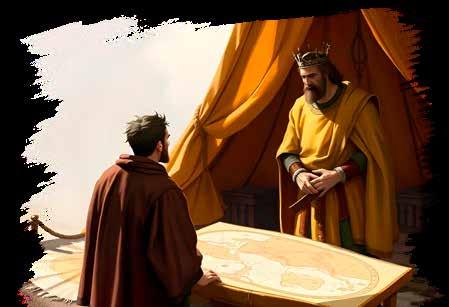
1. Who is Ludwig? {a prisoner who was asked to help out with test}
2. Where was Ludwig? {In the forest where the boys were}
LUDWIG. Yes, sire.
EMPEROR. That is all.
[The AIDE and LUDWIG go. The EMPEROR claps his hands. Enter second AIDE. He salutes.]
EMPEROR (to aide). Have the lads returned?
AIDE. No, sire.
EMPEROR. Do you know when the captain expects them?
AIDE. In about half an hour, sire.
EMPEROR. Bid their fathers return at that time. I wish them to be present at the test.
AIDE. Yes, sire.
[He salutes and goes.]
EMPEROR (slowly) Let me see — a lame man; a lame dog; running footprints across open spaces; wading streams instead of leaping them; stopping to pick berries — why, the story reads itself!
[He sits at table; takes up maps.]
Well, we shall see what we shall see!

Time: A half hour later
Place: The emperor's tent; the anteroom
• The EMPEROR
• The GENERAL
• The CAPTAIN
• An AIDE
• The MAYOR and his SON
• The RICH MERCHANT and his SON
• The POOR WOODCUTTER and his son, PIERRE
[The fathers wait in the lower end of anteroom. In the back is a great armchair.]
MAYOR. I cannot think why the boys were sent into the forest!
RICH MERCHANT. Nor I! It seems to me the emperor should have asked them what they could do. Now, my boy dances so prettily!
MAYOR. I was certain he would ask them to ride. Now, my boy rides so well — just like a prince!
RICH MERCHANT. Well, he will no doubt ask them all these things upon their return.
[He turns to Pierre's father.]
You see, sir, how little chance your boy has. I am sure he cannot dance?
POOR WOODCUTTER (sadly). No, sir.
MAYOR. I am certain he does not ride?
POOR WOODCUTTER (sighing). No, sir.
[Enter an AIDE; crosses to emperor's room; announces at curtains.]
1. What do the rich merchant and mayor think will help their sons pass the test? {the fact that they could dance or ride}
2. Why do you think the emperor sent the boys to the forest instead of asking them what they could (like the rich merchant suggests)? {If he wants a guide through the forest, he should test them in the forest.}
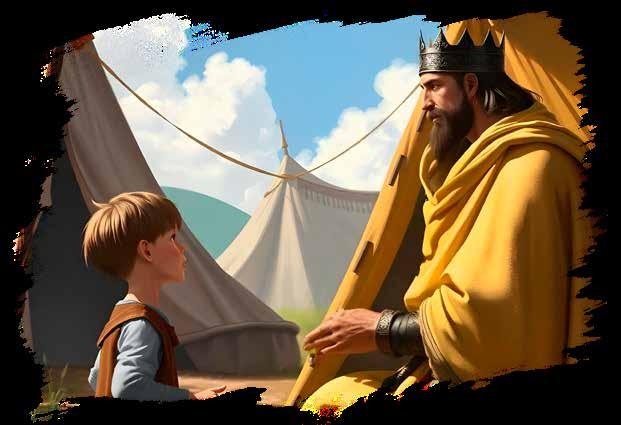
AIDE. The boys have returned, sire!
[Enter the CAPTAIN with the boys. Enter the GENERAL from emperor's room.]
GENERAL (announcing) The Emperor!
[Enter the EMPEROR; all bow.]
EMPEROR (sitting in armchair) I will now give the test. Captain, bring up the first boy.
[The CAPTAIN brings up the RICH MERCHANT'S SON.]
EMPEROR. Well, my lad, what did you see in the forest?
RICH MERCHANT'S SON. Many, many trees, sire.
EMPEROR. You saw nothing but trees?
RICH MERCHANT'S SON. That was all, sire — just trees.
EMPEROR. I shall not want you; you may go.
RICH MERCHANT. Oh, Your Majesty, if you could only see him dance!
EMPEROR. Candles and cheese! Do I want a dancing guide? Captain, bring up the next one.
[The CAPTAIN brings up the MAYOR'S SON.]
EMPEROR. Well, my lad, what did you see in the forest?
MAYOR'S SON. I saw trees and bushes, sire.
EMPEROR. Nothing more?
MAYOR'S SON. No, sire.
EMPEROR. I shall not want you; you may go.
MAYOR. Oh, Your Majesty, if you could only see him ride! Just like a prince, sire!
EMPEROR. Fiddlesticks! Captain, the last boy there.
1. What question did the emperor ask the boys? {What did you see in the forest?}
2. What do you think will happen next? Will anyone pass the test? {Answers will vary.}
[The CAPTAIN brings up PIERRE.]
EMPEROR. Well, my lad, what did you see in the forest?
PIERRE. I saw that a man had passed southward just before us, sire.
EMPEROR. How did you know that? Did you see him?
PIERRE. No, sire, I saw his footprints. He was lame in the left leg.
EMPEROR. How did you learn that?
PIERRE. The footprints were deeper on the right side. His dog was lame, also.
EMPEROR. He had a dog?
PIERRE. Yes, sire; a lame dog, I'm sure, because one of his tracks was always faint or missing.
EMPEROR. Did you trace this man and dog by their footprints?

PIERRE. Yes, sire, to the river. There were traces of them in the grass, in the mud, in the dust, on rocks, and in still water. I am certain they had passed but a short time before — not more than a half hour.
EMPEROR. How could you tell that?
PIERRE. The grass had not yet straightened up. The tracks in the mud had not yet filled with water. The prints in the dust were still clear although a wind was blowing.
EMPEROR. Good! But how did you know they had but just passed through still water and over rocks?
PIERRE. The water had not yet settled, and the rocks were still damp.
EMPEROR. Good! Very good!
PIERRE. Sire, I fear this man is one of the enemy!
EMPEROR. Indeed! What proof have you of that?
PIERRE. This, sire. (Handing a small piece of cloth to emperor)
'Tis the color of the enemy's uniform.
EMPEROR. It is, my lad. How came you by it?
PIERRE. I found it on a thornbush. It was torn from his cloak, sire.
EMPEROR. And why from his cloak?
PIERRE. The thornbush was at least three feet from the man's line of travel. The wind blew the cloak about.
EMPEROR (handing the cloth to an aide; whispering to him) Take this to Ludwig.
[The AIDE goes.]
1. How is Pierre’s answer different than the other boys’?
{he notices more than trees and bushes, he notices that a man had passed before them and lots of details}
2. Whose tracks did Pierre follow? {Ludwig’s}
Well, Pierre, do you think we should be in fear of this enemy?
PIERRE. I do not know, sire. I only know that he has a good disposition
EMPEROR (surprised). A good disposition? How do you know that?
PIERRE. The dog was always near him. When the man stopped to rest, the dog lay down at his feet.
EMPEROR. But he may have held the dog there, my lad.
PIERRE. Not while he was picking berries, sire.
EMPEROR. So our enemy picked berries, did he?
PIERRE. Yes, sire, the dog lying by the bushes all the while.
EMPEROR. Do you think we could capture this man?
PIERRE. Yes, sire, for he was very tired.
EMPEROR. How do you know that?
PIERRE. He climbed down the banks of every small stream. I should have leaped them.
EMPEROR. You think it would be an easy matter, then, to follow and capture him?
PIERRE. Not easy, sire, for he was always on the lookout.
EMPEROR. How do you know that?
PIERRE. Whenever he reached a clear space, he went to one side, hiding behind trees to look ahead. Then, he ran across the open.
EMPEROR. Your proof of this, my lad?
PIERRE. His footprints in every clear space showed only the balls of the feet.
EMPEROR. Good! You followed him only to the river?
PIERRE. Those were the orders, sire. Had I gone on, I could have overtaken him by evening.
EMPEROR. That you could not, my lad, for the man is now here, in camp. He returned by boat. Men, the test is over.
[He turns to Pierre's father.]
Sir, your son shall be my guide. I am proud to have a boy of such keen sight and quick thought in my kingdom. And 'tis much to be the father of such a lad. I salute you, sir! With greatest respect, I salute you!
[He bows to the happy man with great courtesy.]
EMPEROR (turning to the men) Men, I bid you farewell.
1. Why did the emperor choose Pierre as his guide? {He noticed Ludwig and was able to follow everything he did.}
2. Do you think Pierre was a good choice for a guide? Why? {Answers will vary.}
3. Which scene was your favorite? Why? {Answers will vary.}
Match each scene to its purpose in the play.
Scene 1
Scene 2
Scene 3
Answer the questions.
Shows the outcome, who wins the test
Introduces the characters and the test
Makes the reader curious about the test
1. What is one thing the reader does NOT learn in Scene 1?
a. The emperor wants a guide for the forest.
b. The mayor and merchant want their sons to be the guide.
c. Pierre is a good guide.
d. The boy who wins will become the emperor's aide.
2. Why is Ludwig's trip to the forest shown in Scene 2?
a. To show how hard it is to travel in the forest
b. So readers can see if the boys' answers in Scene 3 are correct
c. To help the boys know what to look for in the test
d. To show how tired Ludwig is
3. If you stopped reading after Scene 2, would the story make sense? Why or why not?
a. Yes, because the reader knows the emperor made a test.
b. Yes, because the reader knows Ludwig was in the forest.
c. No, because the reader doesn't know about the boys’ skills.
d. No, because the reader doesn't know what the test is and who wins.
4. Circle the statement that is INCORRECT about Scene 3.
a. It connects Scene 1 and 2 by showing what Ludwig’s trip has to do with the boys.
b. It shows the ending and who wins the test.
c. It tells why Ludwig has a dog.
d. It is an exciting scene that answers questions from Scenes 1 and 2.
Many stories have morals or lessons hidden in them. One way to find the moral of a story is to think about what the characters learn.
Write a paragraph about the moral in The Emperor’s Test.
1. Decide what you think the main lesson of the play is. Why did you pick that moral? Write at least three reasons or proofs from the story.
Moral:
Being rich or powerful doesn’t make a person better or smarter.
Proof:
Proof:
The woodcutter's son is not rich or powerful but is smart.
2. Write an outline. Fill in the blanks.
Proof:
The woodcutter's son passes the test.
Topic Sentence: The play, The Emperor’s Test, teaches the reader that
Body Sentence 1: In the story,
Body Sentence 2:
The rich merchant and mayor both think their sons are better. being rich or powerful doesn’t make a person better or smarter. the rich merchant and mayor both think their sons are better than the woodcutter’s son because they come from better families. In contrast, the woodcutter’s son is not rich or powerful but is good at observing and is smart.
Body Sentence 3:
In the end, the woodcutter’s son passes the test and receives honor.
Concluding Sentence:
I think that this is an important lesson because people shouldn’t judge other people based on their money or status.
3. Write as a paragraph.
The play, The Emperor’s Test, teaches the reader that being rich or powerful doesn’t make a person better or smarter. In the story, the rich merchant and mayor both think their sons are better than the woodcutter’s son because they come from better families. In contrast, the woodcutter’s son is not rich or powerful but is good at observing and is smart. In the end, the woodcutter’s son passes the test and receives honor. I think that this is an important lesson because people shouldn’t judge other people based on their money or status.
1. Pick a setting. For example: forest, castle, school
2. Pick a character who travels through the setting. Write a list of three to five places he went or things he did in the scene.
3. Either draw a picture or write a description.
Draw a picture: Draw a picture of the setting. Draw clues that hint to the places the character went or things he did. For example, if he walked across grass, draw grass that is bent over.
Write a description: Describe what the place looks like after the character arrived. Use lots of descriptive words. For example, if he walked on grass, write "The grass looks like a green carpet with small footprints leading to the big tree."
Circle the correct answer.
1. Which word means "soon"?
a. Presently
b. Timidly
c. Anteroom
d. Disposition
2. Though the captain had a gruff , he secretly cared deeply for his crew.
a. lad
b. presently
c. disposition
d. salutes
3. Which word means “unable to walk normally”?
a. Presently
b. Disposition
c. Lame
d. Anteroom
4. Which is an example of an anteroom?
a. A large, open living room
b. A small waiting area before a doctor's office
c. A bedroom with a comfortable bed
d. A spacious hallway leading to multiple rooms
5. Which word is most likely used at a meeting?
a. Salutes
b. Announces
c. Lame
d. Lad
6. The young helped his elderly neighbor carry groceries up the stairs.
a. anteroom
b. disposition
c. lad
d. presently
7. Which is an example of a boy who acts timidly?
a. He hides behind his father.
b. He jumps around the room.
c. He talks a lot.
d. He likes meeting new people.
8. When would someone make a salute?
a. When he goes to the doctor
b. When he raises a flag
c. When he meets a high-ranking official
d. When he wins a competition
Circle the correct answer.
1. What is the occupation of Pierre’s father? (detail)
a. Farmer
b. Merchant
c. Soldier
d. Woodcutter
2. What happens as a result of Pierre noticing the torn piece of cloth? (cause and effect)
a. He loses his chance to be the guide.
b. The emperor becomes suspicious of a spy.
c. He earns praise for his observational skills.
d. The emperor delays his journey.
3. What can we infer about the value system of the emperor? (inferencing)
a. He values social status and wealth.
b. He values bravery and fighting skills.
c. He values intelligence and resourcefulness.
d. He values fancy clothes and riding skills.
4. Why does the emperor decide to test the boys from the village? (main idea)
a. Because their fathers asked him to
b. Because he needs a guide for the forest
c. Because he wants to find Ludwig
d. Because he wants to see them ride horses
5. What most likely happened after the end of the story? (sequencing)
a. The emperor and Pierre go on their journey south.
b. The emperor says there will be another test for all the boys.
c. The emperor rewards the other fathers.
d. The emperor asks Pierre if they should be scared of the enemy.

6. From the sentence "Enter an aide from emperor's room," we can understand that an aide is most likely a: (context clues)
a. Prisoner
b. Soldier
c. Helper/assistant
d. Dancer
7. How do Pierre's answers to the test compare with the other boys' answers? (compare-contrast)
a. Pierre gave lots of details, but the others didn't.
b. Pierre talked about how pretty the forest was, but the others talked about how hard the trip was.
c. Pierre said the test wasn't fair, but the others were excited about it.
d. Pierre talked about unimportant things, but the others focused on the test.
8. Which of the following statements from the passage is an opinion? (fact vs. opinion)
a. The emperor's tent has an anteroom.
b. The emperor wants to find a guide to lead his army south.
c. The rich merchant's son is a good dancer.
d. Pierre noticed the footprints were deeper on the right side.
Unit 2: Text Structure
Lesson 8: Structure of a Poem
Unit Goal Trajectory:
Compare the structures of two nonfiction texts and explain the structure of a fiction text.
1. Identify the text structure of an informational text. (Lessons 1 and 2)
2. Explain how the author uses text structure. (Lessons 1 and 2)
3. Compare the structures of more than one text. (Lessons 1 and 2)
4. Explain how the structure of a series of scenes provides the overall structure of a drama. (Lesson 3)
5. Explain how the structure of a series of stanzas provides the overall structure of a poem. (Lesson 4)
Hi there!
Today, we will learn all about poems. Let’s take a look at some parts of a poem.
Poems are made up of lines. Lines can be as long or as short as the poet likes. They don’t have to be full sentences.
A group of lines in a poem is called a stanza. The poet chooses how many lines to put in each stanza and how many stanzas to put in the poem.
Some poems rhyme. Rhyming words are usually at the end of a line, but sometimes they are in the middle. Not all poems rhyme!
Some poems use repetition. Repetition is when the same words are used again.
Yesterday, upon the stair, I met a man who wasn't there He wasn't there again today I wish, I wish he'd go away...
When I came home last night at three
The man was waiting there for me
But when I looked around the hall I couldn't see him there at all!
Go away, go away, don't you come back anymore! Go away, go away, and please don't slam the door... (slam!)
Last night I saw upon the stair
A little man who wasn't there
He wasn't there again today Oh, how I wish he'd go away...

Read the poem
"I Met a Man Who Wasn't There." Answer the questions.
1. How many lines does this poem have?
2. How many stanzas does it have?
3. Does every stanza have the same amount of lines?
4. Which two stanzas look similar?
One example of repetition is underlined in the poem. Can you find another one?
The middle stanza is different than the other stanzas. Fill in the blanks and underline the correct answers to compare and contrast the first and third stanzas with the second stanza.
Stanzas 1 and 3 Stanza 2
They have lines
The length of line is (the same / different)
They share many of the same words Has lines
The length of each line is (the same / different) Has different words than the other stanzas The end of each pair of lines (rhymes / repeats)
2. Why do you think Hughes Mearns chose to make stanza 2 different than the other stanzas?
Students may have a hard time with both looking at the overall structure of the poem and at the details.
Tell students that we will need to pay attention to both.
1. Look at the poem as a whole. Notice the big things that jump out at you. How does it look? How many stanzas are there? Do they all look the same? Does the poem rhyme? In this example: We first notice that stanza 2 looks different.
2. Now, look out for details. These are little things in specific places. How long is each line? Which words repeat? Which stanza is shorter/ longer? In this example: Then, we notice the details in these differences.
3. Then, think about why the author made these decisions. In this example: Last, we decide why stanza 2 looks different.
1. Plight, noun
S Trouble A Solution
E A situation where someone has no food; Someone who is trapped; Someone who is homeless Q Can you describe the plight of a person who loses their job?
2. Famished, adjective
S Starved A Full
E Someone who is starving; Someone who is exaggerating when they are hungry
Q Do you think that when most people say, “I’m famished,” they actually don’t have anything to eat?
3. Utterly, adverb
S Totally A Partly
E Completely changed; Totally speechless; Absolutely exhausted Q If something is utterly destroyed, what does that mean?
4. Fairly, adverb
S Somewhat A Extremely
E A bit fast; Kind of hot; A little new Q What does it mean if the library is fairly quiet?
5. Perspire, verb
S Sweat A Dry
E What happens when you are very hot; What happens when you exercise; Wetness that comes from nervousness
Q When do people perspire?
6. Ignited, verb
S Lit A Extinguished
E Strike a match; Start a fire; Get somebody very angry
Q How is igniting someone’s temper similar to lighting a fire?
Match the bolded words with their definitions. Highlight context clues.
The plight of the lost child had rescue workers come from all over the city to look for him.
After hiking for hours without food, they were famished
The job was utterly impossible; no one could have completed it.
The painting was fairly expensive, costing over a thousand dollars.
They began to perspire after being in the sun for a while.
The spark ignited the dry grass, creating a fire.
He rushed to quench his thirst with a cold glass of water.
We tried to exterminate the ants, but they kept coming back.
sweat
destroy completely
totally, completely
extremely hungry
to satisfy a need or desire, especially for drink somewhat or kind of set on fire a difficult or dangerous situation
plight [PLYT]; famished [FAM-isht]; utterly [UT-ter-lee]; fairly [FAIR-lee]; perspire [per-SPYR]; ignited [ig-NY-tid]; quench [KWENCH]; exterminate [ik-STUR-muh-nayt]
7. Quench, verb
S Satisfy, Extinguish A ignite
E Drinking when you are thirsty; Putting out a fire; Satisfy a desire Q What is your favorite drink to quench thirst?
8. Exterminate, verb
S Kill A Save E Killing the bugs in your house; When bad people try to totally get rid of a group of people
Q Why is it sometimes necessary to exterminate pests (bugs and rodents)?
By: Kenn Nesbitt

If you want to write a poem and to make it nice and long, you should try this little writing trick. You really can’t go wrong. It’s a tried and tested method, or at least that’s what I’ve heard, if you make sure every line you write has just one single word.
Answer the questions.
1. How many stanzas does this poem have?
2. How many words are on each line?
2 1
3. Why did Kenn Nesbitt put only one word on each line?
He is showing a trick for writing a really long poem. Long - wrong heard - word
4. What are two sets of rhyming words in this poem?
1. Today, we will read a few poems by Ken Nesbit. What is the author of a poem called? {a poet} Notice that Ken Nesbit uses structure in creative ways to make his poems funny. (Not all poems are funny, and not all poems rhyme.)
2. (Before reading) What do you notice right away when you look at this poem? {There is only one word on each line.}
3. What does the poet mean when he says “it’s a tried and tested method”? {It’s been used, and it works.}
4. Does every line rhyme? Where are the rhyming words? {no, just at the end of each sentence}
By: Kenn Nesbitt
I wrote this little poem. It was so much fun to write that I scribbled through the afternoon, the evening, and the night.
When the morning sun was rising and the sky was growing light, I went searching for some breakfast but no breakfast was in sight. (If you’ve ever needed breakfast then you’ll understand my plight.)
Answer the questions.
I was feeling fairly famished so, although it isn’t right, I picked up this little poem and I took a tiny bite. It was utterly delicious! It was such a sheer delight that I nibbled through the afternoon, the evening, and the night.
When the morning sun was rising and the sky was growing light, I went searching for this poem but no poem was in sight. So I wrote it down again and it was so much fun to write that I scribbled through the afternoon, the evening, and the night.
If you think you know what happened next, I think you may be right.
1. How many stanzas does this poem have?
2. How many lines are in each stanza?
Stanza 1: Stanza 2: Stanza 3: Stanza 4:
3. What line or lines repeat themselves in the poem?
4. The repeating words in the poem show that there is a cycle and hint to what happened next. What do you think happened next?
It was so much fun to write that I scribbled through the afternoon, the evening, and the night 14 2 The narrator ate the poem and wrote it again.
1. (Before reading) Look at the poem. What do you notice? {The stanzas are all different lengths.}
2. What do you think the poet thinks when he says, “It was a such a sheer delight”? {It was so amazing and pleasurable.}
3. Which words in the poem rhyme? List them. What do you notice? {write, night, light, sight, plight, right, bite, delight; they are last word of every other line; they all end in “ight” sound}
By: Kenn Nesbitt
I’m srot of srcmabled up tdaoy.
I’m tolatly cnofsued.
You mgiht tihnk taht it’s fnuny, but I’m relaly not amsued.
I’m feeilng srot of sctaterbarined.
I’m trleuy in a tzizy.
I’m jsut not thniknig stragiht at all. I’m afwluly dzaed and dzizy.
I msut be hrad to udnersatnd.
My wrods are scuh a jmuble.
My mnid feles lkie it msised a setp and took a ltitle tmuble.
My haed is suepr wozoy and I’m wbobly on my legs.
I geuss I sholudn’t strat the day by etaing scrmabled eggs.
Answer the questions.
1. How many stanzas does this poem have?
2. How many lines are in each stanza?
3. What did Kenn Nesbitt do to the spelling of the words in the poem? Why?
He mixed up the letters in the middle of the words to show that the narrator is all scrambled up. That he is scrambled up because he ate scrambled eggs
4. In the first three stanzas, the narrator tells how mixed up he is. What new information does the narrator add in the last stanza?
1. (Before reading) What do you notice about his poem? {All the words are spelled wrong.}
2. What does the poet mean by saying, “I’m really not amused”? {I don’t think it’s funny.}
3. This poem has a surprising ending. Why is this ending surprising? {Eating scrambled eggs doesn’t usually scramble a person up.}
By: Kenn Nesbitt
Fearless Frederick had some hot sauce and it set his mouth afire. It made flames fly from his nostrils and his upper lip perspire
It ignited all his taste buds. It made steam shoot out his ears. He turned redder than a stop sign. He burst out in boiling tears.
He was hopping on the table. He was running ’round the room as his hair began to sizzle and his face began to fume.
He tried sucking on a popsicle and gargling in the sink. He drank everything he found inside the fridge that he could drink.
He tried glugging tubs of ice cream. He poured ice cubes on his head, but it didn’t help to quench the flaming mouth of Fearless Fred.
He tried all that he could think of to exterminate the blaze, why he even stuck his tongue inside in a jar of mayonnaise.
Answer the questions.
1. How many stanzas does this poem have?
2. How many lines are in each stanza?
7 4
3. Match the stanzas to their roles in the poem.
Stanzas 1-3
Stanzas 4-6
Stanza 7
And then when at last his mouth was cooled by bucket-loads of water, the first thing that he said was, “May I please have something hotter?”
Tells an unexpected ending
Tell what happened to Fearless Frederick after eating hot sauce
Tell how Fearless Frederick tried to cool his mouth
4. What is unexpected about the ending of the poem?
After Frederick had such a hard time cooling his mouth, he asked for something hotter.
1. (Before reading) What do you notice about his poem? {it is long, stanzas are even lengths}
2. What do you think “sizzle” means in “as his hair began to sizzle”? {make a hissing sound because it’s cooking}
3. This poem has a lot of exaggerations. What are some of them? How do you know? {mouth afire, flames fly from his nostrils…; These things don’t happen in real life if you eat hot sauce.}
4. Notice that this poem has nice, even rhythm, almost like a tune. Which parts of the poem do you think help make the rhythm? {the length of the lines, the rhyming, even length stanzas}
LESSON PRACTICE VOCABULARY STORY REVIEW ACTIVITY ASSESSMENT
Poems use rhythm and structure to express an idea in artistic or emotional way. Regular writing, called prose, is written in the sentence-paragraph format.
Choose one poem from this lesson. Rewrite the poem in prose (one paragraph).
1. Choose your poem.
Name of poem:
Answers will vary; Fearless Frederick
2. Divide the poem into five sections (can be different sizes). Write what happens in each section.
Section 1:
Fearless Frederick ate hot sauce. His mouth got burning hot. He used all kinds of ridiculous methods to cool his mouth.
Section 4: Section 5: Section 3:
Finally, he got his mouth cool.
But then, he asked to eat something hotter!
3. Turn each section into an interesting sentence.
Sentence 1:
Fearless Frederick ate hot sauce.
Sentence 2:
His mouth got burning hot; he was red and sweating.
Sentence 3:
So he ate and drank all kinds of cold things to try to cool his mouth off.
Sentence 4:
Finally, he got his mouth cool.
Sentence 5:
But then, he shocked everyone when he asked to eat something spicier!
4. Write a paragraph.
Fearless Frederick ate hot sauce. His mouth got burning hot; he was red and sweating.
So he ate and drank all kinds of cold things to try to cool his mouth off. Finally, he got his mouth cool. But then, he shocked everyone when he asked to eat something spicier!
LESSON PRACTICE VOCABULARY STORY REVIEW ACTIVITY ASSESSMENT
Recite a poem.
Choose one of the poems in this lesson to memorize. Once you know it by heart, recite it in front of your classmates.
Circle the correct answer.
1. Which word means “caused to burn”?
a. Perspire
b. Quench
c. Ignited
d. Exterminate
2. If something is fairly good, it is…
a. Very bad
b. Quite bad
c. Somewhat good
d. Very good
3. The soldiers tried to the enemy army.
a. quench
b. exterminate
c. plight
d. fairly
4. Which of the following is an example of someone who is famished?
a. A person who is sweating
b. A person who is bored
c. A person who is very hungry
d. A person who is feeling tired
5. The explorers found themselves in a after their ship sank.
a. fairly
b. famished
c. ignite
d. plight
6. Which word means “to sweat”?
a. Perspire
b. Famished
c. Utterly
d. Quench
7. Which word means “to satisfy a thirst or hunger”?
a. Quench
b. Plight
c. Famished
d. Utterly
8. The dog was exhausted after chasing the squirrel.
a. perspire
b. utterly
c. quench
d. famished
Circle the correct answer.
1. What does the narrator think about writing long poems? (inferencing)
a. He thinks it's difficult.
b. He thinks it's boring.
c. He thinks it's easy.
d. He thinks it's impossible.
2. How is this poem different from most poems? (compare-contrast)
a. It is shorter.
b. It only has one word on each line.
c. It doesn’t rhyme.
d. It is not funny.
3. What did the narrator do after writing a poem? (sequencing)
a. Wrote another poem
b. Ate the poem
c. Went to sleep
d. Stayed up all night
4. What caused the speaker to eat the poem? (cause and effect)
a. He was hungry.
b. He thought it was delicious.
c. He wanted to see if it tasted good.
d. He was trying to get rid of it.
5. What is the poem mainly about? (main idea)
a. The dangers of eating scrambled eggs
b. The importance of getting enough sleep
c. The feeling of being confused
d. The importance of taking care of your body
6. What does the word “tizzy” mean in the line “I’m trleuy in a tzizy”? (context clues)
a. Nervous excitement
b. Frying pan
c. Nauseous
d. Happy
7. Why was Fearless Frederick so hot? (detail)
a. He drank too much hot chocolate.
b. He sat in the sun.
c. He ate hot sauce.
d. He was scared.
8. Which is an opinion? (fact vs. opinion)
a. Fearless Frederick had some hot sauce.
b. The hot sauce ignited all his taste buds.
c. Fearless Frederick likes spicy food.
d. Fearless Frederick is really brave.
Unit 3: Using the Text to Answer Questions
Lesson 9:
More than One Main Idea
Answer all kinds of questions, specifically using text to support answers.
1. Think about the different types of questions and where to find the answers. (Lesson 1)
2. Answer all different types of questions. (Lesson 1 and 2)
3. Use the structure of the text to find the answers. (Lesson 2 and 3)
4. Answer questions asking for direct and indirect quotes from the text. (Lesson 3)
5. Use direct and indirect quotes to support answers with longer, more complex texts. (Lesson 4 and beyond)
Today, we are going to learn how to answer questions after we read using the Question-Answer Relationship (QAR) strategy. It’s a great tool to help us find answers more easily!
First, identify the type of question. Then, follow the rules for answering it.
The answer is right in the text. You can find the exact words or sentences that tell you the answer.
Examples: Who is… What did… Where did… When did… How many… List… Name…
Use a highlighter to show where you found the answer.
The answer comes from both what the author wrote and what you think. It isn’t directly in the text, so you have to use your own thinking.
Examples:
Do you agree… Why do you think… Predict… Write a new title…. What did the author mean…
Use clues from the text and what you know to answer.
The answer is in the text, but you have to look in different places to put the answer together.
Examples:
How do you know… Describe… Why does… Prove why… Compare/Contrast… Summarize…
Use a pencil to mark parts of the text that can answer the question.
You don’t need the text to answer these questions. The answer is based on your own thoughts or experiences.
Examples:
How would you feel… If you could… Have you ever… In your opinion… What do you think…
Everyone will have different answers.
type.
The answer is in different parts of the text.
The answer is written straight out in the text.
The answer uses the clues from the text and your own thoughts.
The answer is your opinion and/or what you already know.
It is difficult to determine the correct type of question without seeing the text.
Tell students to imagine they are reading a text. Where might they find the answer? If they are still having difficulty, have students refer to the chart on the previous page.
Synonym Antonym
Examples
Additional Questions
1. Telegram, noun
E A message sent in Morse code; A message sent in the olden days Q Why did people send telegrams?
2. Ammunition, noun
S Weapons E Bullets; Rockets; Missiles Q Why is ammunition important for an army?
3. Victory, noun
S Win A Defeated
E Winning a battle; Overcoming a struggle; Winning a game
Q Does a victory always feel good? Explain.
4. Underestimated, verb
S Minimized A Overrated
E Thinking something is easier than it is; Thinking something is cheaper than it is; Thinking something is newer than it is
Q What are times you might be happy to underestimate something? What are times you’d be upset?
5. Stunned, adjective
S Shocked A Nonchalant
E How you feel by a surprise; How you feel when you hear news you didn’t expect
Q What is a situation that could cause someone to be stunned?
6. Overcome, verb
S Beat A Lose (to)
E Get over a fear; Succeed when there are challenges; Go over obstacles in a race
Q How can people overcome a urge to do something they shouldn’t?
Match the bolded words with their definitions. Highlight context clues.
He sent a telegram to deliver the urgent news quickly.
The soldiers loaded their rifles with ammunition before the battle.
The team celebrated their victory with a pizza party.
He underestimated how hard the test would be and didn’t study enough.
He was stunned by the surprise party his friends threw for him.
She worked hard to overcome her fear of public speaking.
The cows were allowed to roam freely in the streets.
There are many different species of birds in the rainforest.
thought something was easier or smaller than it really was
groups of animals or plants that look and act similarly
wander or travel without a fixed destination
message sent by telegraph; machine that sends messages using Morse code success in a game, competition, or war
succeed in dealing with or controlling something difficult
objects (or materials) that can be shot from weapons
when someone is so shocked or amazed that they are unable to react or speak
telegram [TEL-uh-gram]; ammunition [AM-yoo-NISH-un]; victory [VIK-tuh-ree]; underestimated [UN-der-ESS-tuh-may-ted]; stunned [STUND]; overcome [OH-ver-kum]; roam [ROME]; species [SPEE-sheez]
7. Roam, verb
S Wander A Stay E Animals in the wild; Walking without a place to go; Walking around when you are lost
Q Why might someone roam around the hallways of a building?
8. Species, noun
S Type E Cats; Persian silk tree; Honey mushroom Q Why is it good that there are so many different species in the world?
Author: Tessa Barber Genre: Nonfiction
In 1932, Australia faced a strange and surprising problem. Soldiers were called in to help, thinking it would be easy to fix. But the enemy was faster and trickier than anyone had expected, and the soldiers soon found themselves in a tough battle. What strange enemy did they face, and how did they try to beat them? As you read, get ready to discover the surprising answer to this unusual battle!
1. Today, we will read a true story about a strange event that happened in Australia. What are true stories called? {nonfiction}
2. What do you know about Australia? {it is a small continent and country, an island, far from U.S., they speak English}
As we read, we will practice answering the different types of questions.
You may have learned about different wars in history. Did you ever hear of the Great Emu War? This wasn’t a war between soldiers. It was a war between the farmers of Australia and… a massive flock of birds! Wait, did you read that right? A war between people and birds?
If it sounds strange, that’s because it really is!
Our story starts in Australia, after World War I. The soldiers were returning home after a hard battle. The Australian government wanted to help these soldiers return to a peaceful life. They gave them land to farm so they could start a new life as farmers. These new farmers planted crops. They hoped to grow enough food to sell and make a living.
But things didn’t go so smoothly. Farming wasn’t easy in Australia. The soil was tough,

the weather was dry, and crops didn’t always grow well. Still, the farmers kept working the land. Soon, plants began to sprout. Then, in 1932, just as the first few crops of wheat began to appear, there was a new problem: emus!
The Emu Invasion
Emus live in Australia, so you’ve probably never seen them. These birds are very big. Some of them are even taller than people! They don’t fly, but they have very strong legs. This means they can run very fast. And they love to eat!
When the emus arrived at the new farms, they realized that these fields had plenty of delicious food. We’re not talking about a few emus. There were around 20,000 of them! It started slowly at first, with small groups of emus pecking at the edges of the fields. For the farmers, this was a disaster! Soon, more emus arrived, and the farmers realized they were facing a threat. The emus ran through the fields, destroying crops with their powerful legs and eating everything in sight. The farmers tried to chase them away, but the emus kept coming back. There were just too
1. Let’s start with a Right There question. When you find the answer, highlight or circle it the text. When did this story take place? {after World War I}
2. The next question we will answer is a Think and Search question. Before answering, underline clues that help you answer the question. Describe what emu is. {a tall bird native to Australia, they don’t fly, they run really fast, eat a lot…} What are some clues from the text that helped you answer this question? {Answers will vary.}
many of them. The wheat that the farmers had worked so hard to grow was disappearing before their eyes.
The farmers needed help. They wrote urgent letters and sent telegrams to the government.
HELP! EMUS EATING CROPS! CAN’T PROTECT FARMS! PLEASE SEND SOLDIERS. NEED HELP NOW!
The government decided to send soldiers with machine guns to help the farmers. The plan was to shoot enough emus so they could scare away the rest and save the crops. There was only one man who they felt was experienced enough to lead this battle: Major Meredith.
The Soldiers Arrive
"These birds won’t know what hit them."
Major Meredith was an experienced, wellknown soldier. He arrived with soldiers, two powerful machine guns, and 10,000 rounds of ammunition. He was confident that this would be a quick and easy victory
"We’ll have this sorted in no time," Major Meredith told the farmers when he arrived.
This was their first mistake! They had underestimated the emus. The birds were smarter, tougher, and faster than the soldiers expected. When the soldiers tried to shoot them, the emus scattered in all directions. They were so fast, the soldiers were stunned. It was impossible to hit them!
"Keep your aim steady!" Major Meredith shouted over the noise of the machine guns. But it was no use. The emus ran like the wind on their long legs.
The battle lasted for days. Sometimes, the soldiers would try to sneak up on a group of emus. Every time the soldiers thought they had trapped them, the birds split into smaller groups. They zigzagged through the fields, avoiding the bullets.
Then something even stranger started to happen. It seemed like the emus were starting to organize their own army. Every small flock of emus had a leader. A large emu would stand guard while the other birds ate and drank. The
1. Now, we will answer an Author and You question. Think about what we’ve read and then come up with an answer from your brain. Who do you think is going to win the war? Why? {Answers will vary.}
2. Last, we will practice answers in an On My Own question. You will not need to look inside to find the answer. What is a time you asked someone with more experience for help? {Answers will vary.}
emu leader would warn the other birds when danger was nearby. One very clever emu even led a group of soldiers on a wild chase, only to escape unharmed and leave the soldiers exhausted.
Day after day, the soldiers chased the emus. They managed to shoot some of the birds, but there were always more to take their place. The soldiers soon realized that the emus were not going to be overcome so easily.
One day, Major Meredith gathered his men around him.
"This is madness," he muttered. "We’re soldiers, not hunters. These birds...they’re winning."
His men, who were tired and frustrated, nodded. They decided to try one more time. The soldiers set a trap near a watering hole, where hundreds of emus went to drink.
"This is our chance," one of the soldiers whispered. "If we can catch them here, we might just win the battle.”
As the soldiers prepared to fire, the emus sensed danger. Suddenly, they started to run in every direction. The soldiers managed to shoot 12 emus, and then — their machine gun jammed!
By the time it was fixed, the emus had escaped. Once again, they had outsmarted the humans!
After a few weeks, the government decided to call off the Great Emu War. Although the soldiers had used up many bullets, they had only managed to kill about 1,000 emus. This was nowhere near enough to stop them from destroying the crops. The emus had won.
As the soldiers packed up to leave, Major Meredith sighed. He looked out over the fields that were still full of emus.
1. Do you agree with the decision to end the war? Why or why not? {Answers will vary.}
2. How did you answer that question? Which type is it? {I thought about the story and used my brain, Author and You}
3. How many emus did the soldiers manage to kill? {1,000} How did you answer that question? What type is it? {I found it in the text, Right There}
"We were outsmarted by birds," he said, shaking his head. "Who would have thought?"
The emus continued to roam the farmland. Soon, the farmers found other ways to keep them away. They built better fences and used other methods to protect their fields. After some time, life returned to normal for the farmers.
People all over Australia heard about the Great Emu War. People couldn't believe that a group of birds had beaten the soldiers and their machine guns. Even Major Meredith was amazed by the emus’ strength.
"If we had an army as strong as these birds,” he said, “we could face any army in the world.”
Over the years, the true events of 1932 have become one of history’s funny stories. Today, emus are a protected species in Australia. They may have once caused a lot of trouble for farmers, but now they are an important part of Australia’s wildlife. The tale of the Great Emu War is still remembered as a time when nature won over man.
1. Do you think the story of the emu war is funny? {Answers will vary.} How did you answer that question? What type is it? {I used my brain, On My Own}
2. How did Major Meredith feel about the end of the emu war? {he felt silly/disappointed that he was outsmarted by birds, he was amazed by their strength} How did you answer this question? What type is it? {I found clues in the text and put them together, Think and Search}
On the next page, you will answer questions on your own. Pay attention to how you answer, and mark the type of question it is.
Answer the questions. Write the letter of the question type.
a. Right There
b. Think and Search c. Author and You d. On My Own
1. Why did the Australian government give land to soldiers after World War I?
So they could start a new life as farmers
2. How would you feel if you were a farmer during the Great Emu War?
3. Why did emus start attacking the farmers' crops?
4. What lesson can we learn from the Great Emu War?
5. How did the emus behave during the war?
Answers will vary. They realized that these fields had plenty of delicious food. Answers will vary. They organized themselves into groups, avoided the soldiers, and outmaneuvered them.
6. What was the name of the experienced soldier who led the battle?
Question Type:
7. Tell about a time when you underestimated a challenge.
8. Do you think soldiers should have been sent to fight the emus?
Major Meredith Answers will vary. Answers will vary.
Events are things that happen. Usually, one event leads to another event. Many times, a big event is caused by lots of little events.
Write a paragraph explaining the events that caused the Great Emu War.
1. Write about the events that caused the Great Emu War. Fill out the diagram.
World War I is over
The government's decision to send soldiers to fight the emus So But So Which leads to
soldiers return home to Australia and get land to farm
farming isn’t easy, and 20,000 emus come and eat and destroy the crops
farmers try to chase the emus away and ask the government for help
2. Write a topic sentence. Tell over what your paragraph will be about. Hint: The directions above for writing a paragraph will tell you what it will be about.
There were many events leading up to the Great Emu War.
3. Complete the outline. Turn the diagram from step one into three body sentences.
Topic Sentence:
There were many events leading up to the Great Emu War.
Body Sentence 1:
Body Sentence 2:
Body Sentence 3:
Concluding Sentence: LESSON PRACTICE VOCABULARY STORY REVIEW ACTIVITY ASSESSMENT
After World War I, Australian soldiers received land to farm.
But, farming wasn’t easy, and 20,000 emus came and destroyed the farmers' crops. So, the farmers tried getting rid of the emus and then asked the government for help. This led to the decision to send soldiers to fight and the start of the Great Emu War.
4. Write as a paragraph.
There were many events leading up the Great Emu War. After World War I, Australian soldiers received land to farm. But, farming wasn’t easy, and 20,000 emus came and destroyed the farmers' crops. So, the farmers tried getting rid of the emus and then asked the government for help. This led to the decision to send soldiers to fight and the start of the Great Emu War.
LESSON PRACTICE VOCABULARY STORY REVIEW ACTIVITY ASSESSMENT
Look at these real newspaper articles from 1932. Pretend you are a reporter. Create a realistic newspaper article about one part of the Great Emu War.
Circle the correct answer.
1. The soldiers carried and other supplies into battle.
a. ammunition
b. telegram
c. stunned
d. overcome
2. Which word means “to wander freely, without a specific destination”?
a. Telegram
b. Ammunition
c. Victory
d. Roam
3. The lion is a known for its strength and hunting skills.
a. victory
b. telegram
c. roam
d. species
4. Which of the following is an example of a victory?
a. Losing a game
b. Winning a race
c. Failing a test
d. Getting lost
5. In the early 1900s, important news was sent by .
a. telegram
b. ammunition
c. stunned
d. overcome
6. Which word mean “to be shocked or amazed”?
a. Telegram
b. Ammunition
c. Victory
d. Stunned
7. If you overcome a challenge, what have you done?
a. You have avoided it.
b. You have succeeded in dealing with it.
c. You have made it harder.
d. You have given up on it.
8. Which word means “judged as less than it actually is”?
a. Telegram
b. Ammunition
c. Victory
d. Underestimated
Circle the correct answer.
1. What is one way the soldiers tried to trap the emus? (detail)
a. They dug a pit for them to fall into.
b. They built a fence around them.
c. They waited for them with guns near a watering hole.
d. They set a fire.
2. What caused the government to call off the Great Emu War? (cause and effect)
a. The soldiers were winning.
b. The emus were dying.
c. The farmers were giving up.
d. The soldiers were not making progress.
3. Why do you think the soldiers were so surprised that the emus escaped their attacks? (inferencing)
a. They had never seen emus before.
b. They thought emus were slow.
c. They thought emus were not very strong.
d. They had powerful weapons.
4. What is the main idea of the text? (main idea)
a. The Great Emu War was a battle between the Australian government and emus.
b. Emus are a dangerous species.
c. The Australian soldiers were very brave.
d. The emus won the Great Emu War.
5. What happened after the government called off the war? (sequencing)
a. The emus left the area.
b. The farmers gave up on their farms.
c. The soldiers continued to fight the emus.
d. The farmers found other ways to protect their crops.
6. What does the word "scattered" mean in “the emus scattered in all directions”? (context clues)
a. Gathered together
b. Spread out
c. Stayed in one place
d. Hid
7. How was the Great Emu War different from regular wars? (compare-contrast)
a. The Great Emu War involved people fighting animals, while regular wars involve people fighting other people.
b. The Great Emu War was fought with machine guns, while regular wars are fought with swords and spears.
c. The Great Emu War was a very short war, while regular wars can last for many years.
d. The Great Emu War was a very wild war, while regular wars are usually peaceful.
8. Which of the following is a fact about the Great Emu War? (fact vs. opinion)
a. Emus are the most interesting birds.
b. The emus were evil creatures.
c. The soldiers used machine guns to fight the emus.
d. The emus were the strongest animals in Australia.
Unit 3: Finding Answers in the Text
Lesson 10: Practice Finding Answers in the Text
Unit Goal Trajectory: Answer all kinds of questions, specifically using text to support answers.
1. Think about the different types of questions and where to find the answers. (Lesson 1)
2. Answer all different types of questions. (Lesson 1 and 2)
3. Use the structure of the text to find the answers. (Lesson 2 and 3)
4. Answer questions asking for direct and indirect quotes from the text. (Lesson 3)
5. Use direct and indirect quotes to support answers with longer, more complex texts. (Lesson 4 and beyond)
Students may have a hard time grouping and naming sections.
Guide them in finding appropriate starting and stopping points. Explain that a section has one clear main idea. The next section starts by the next important idea.
The section names should be the main idea in very short. Allow students to use their own wording that will remind them of what is written in that section.
Synonym Antonym
Examples
1. Distract, verb
S Divert A Focus
E Talking to someone who is reading a book; Giving a baby a different toy; Telling a joke to someone is sad Q What are some things that can distract you from your homework?
2. Witness, noun
S Viewer E Someone who sees a robbery; Someone who sees a an accident happen; Someone who saw someone sign a paper Q If you witnessed a crime, what would you do?
3. Participant, noun
S Member A Onlooker
E Someone who is part of a game; Someone who actively involved in class; Someone who enters a contest
Q What does it mean to be an active participant in a class?
4. Transformed, verb
S Changed A Kept
E An old room is painted to look like new; A frown that turns to a smile; A plain paper is made into paper boat
Q What are some animals that undergo transformations?
5. Alert, verb
S Warn E To tell about a danger; To let you know when you have a new message
Q When should you alert someone to a problem?
6. Effect, noun
S Result A Cause E What happens after a hurricane; The result when you study before a test; What happens when a war starts Q What is the effect of rain on plants?
7. Benefits, noun
S Advantages A Disadvantages
E The advantages of having a good job; The reasons why it is good to get a lot of sleep
Q What are the benefits of volunteering at an old age home?
8. Complex, adjective
S Complicated A Simple
E They way how a car is built; The process of buying a house; The problem of world hunger Q What makes a robot a complex machine?
The passage we will read today tells us about something interesting that happens to people.
1. What are texts that tell about or inform readers about something? {informational texts} Are informational texts fiction or nonfiction? {nonfiction}
Our brains are complex and sometimes surprising! Today, we will read about something our brains do that has surprising effects!
As we read, we will title each section. This will help us answer questions later.
1. What is the title of the first section? {Magicians Use Change Blindness} Why do you think the section includes these two paragraphs (and not later ones)? {these paragraphs are about magicians, other ones are not}
2. Look at the next section. What is the main idea of the three paragraphs? {an experiment in a school where person was switched behind a door} How can we title this in two to four words? Think of a title that will remind you of what these paragraphs are about. {Door Swap Experiment}
1. How can we title this section? {Hotel Experiment} Is there any part of this section that is not about the hotel experiment? {no}
1. What can we title the first section on this page? {Gorilla in the Room, Gorilla Experiment}
2. Why do you think the second section has only one paragraph? {It has one main idea that is not in the other paragraphs.} What can we name it? {Why Change Blindness Happens}
(We will wait to label the third section until we read the whole passage.)
1. Why do you think the section that starts on page 10 and continues onto page 11 is so long? {it is all about one topic, has one main idea} What is the main idea? What could the title be? {The Effects of Change Blindness}
2. What is the last section about? What can we title it? Why? {Benefits of Change Blindness - it talks about the benefits, conclusion - it finishes up the passage}
Now, we will use these titles to answer the questions. When we find the answer, we will write the name of the section we found the answer in.
Unit 3: Finding Answers in the Text
Lesson 11: Direct and Indirect Quotes
Lesson 12: Using Quotes to Support Answers/ Longer Texts
Unit Goal Trajectory: Answer all kinds of questions, specifically using text to support answers.
1. Think about the different types of questions and where to find the answers. (Lesson 1)
2. Answer all different types of questions. (Lesson 1 and 2)
3. Use the structure of the text to find the answers. (Lesson 2 and 3)
4. Answer questions asking for direct and indirect quotes from the text. (Lesson 3)
5. Use direct and indirect quotes to support answers with longer, more complex texts. (Lesson 4 and beyond)
Quotes are exact words or ideas from something we’ve read. Today, we’ll learn how to use these direct and indirect quotes to support and prove our answers and statements when we write about what we’ve read.
Direct quotes
are phrases or sentences that are copied exactly as they are from the text.
→ We use quotation marks around a direct quote to show that the words are directly from the text.
Indirect quotes are ideas taken from a text but written in your own words.
→ We don’t use quotation marks around indirect quotes.
Imagine you went to the zoo. When you come back, your friend asks where you were. You answer that you went to the zoo. Your friend says, “Prove it.”
Here are some proofs you might show your friend:
Mud and leaves stuck to the bottom of your sneaker

A souvenir you bought from the gift shop at the zoo

A parking pass with that day’s date on it
These are all evidence that support the idea that you just went to the zoo. We can also use evidence when reading. When we answer a question, we can “prove” that our answer makes sense. The way we do this is with quotes.
1. Find the answer in the text. Hint: If the text is long, divide it into sections.
2. Write the answer in your own words.
3. Pick one quote or sentence that best “proves” that your answer is right.
Read the paragraph. Circle the direct quotes and add quotation marks.
The little squirrel scampered up the tall oak tree. It was a sunny day, and the birds were singing happily. The squirrel found a hollow in the tree and peeked inside. It was a cozy little nest, perfect for a squirrel to sleep in at night.
a. It was a sunny day, and the birds were singing happily.
b. There was a squirrel that ran up a tree.
c. The squirrel looked inside an opening in the tree.
d. It was a cozy little nest, perfect for a squirrel to sleep in at night.
Write True or False after each statement.
1. Indirect quotes do not contain information from the text.
2. Direct quotes are exact words from the text.
3. Indirect quotes do not use exact words from the text.
4. Indirect quotes use quotation marks.
Imagine you just read a passage about George Washington. Which quotes from the passage would you use as evidence for the following statement?
George Washington was a very good president.
1. “George Washington was the first president of the United States of America.”
2. “He started off as a general during the Revolutionary War.”
3. “Under his leadership, the colonies worked together to create a new country.”
4. “George Washington cared about the people in his new country.”
5. “People trusted Washington because he wasn’t interested in power.”
6. “It is no wonder that everyone voted for him – twice.”
Students may have a hard time finding quotes that best support a statement.
Tell students to read the whole statement.
Statement 1: “There are lots of different fruits.”
Statement 2: “Each type of tree grows a different type of fruit.”
Statement 2 helps explain statement 1. It explains why there are so many types of fruits. So, it is a key detail, not a main idea.
In contrast, read statement 3.
Statement 3: “Fruits are healthy.”
This statement does not explain statement 1 so it is not a supporting detail. It is a separate concept that is also about fruits. In a reading passage, it could be another main idea.
1. Assured, verb
S Guaranteed A Uncertain
E Make someone not nervous; Tell someone that something is true or will happen Q What kind of tone of voice would someone use when assuring someone of something?
2. Module, noun
S Section A Whole
E Part of a lesson; A section of a spacecraft; Part of machine that can be separated
Q If you would create a course, how would you make sure that each module builds upon the last one?
3. Contagious, adjective
S Catching E Laughter; Infections or illnesses; A person who is sick Q What are some ways to prevent the spread of contagious illnesses?
4. Anticipation, noun
S Expectation
E Excitement about an event that will happen; Something done to prepare for something
Q What is a time when anticipation made you feel excited and nervous at the same time?
5. Eternity, noun
S Forever A Momentary
E Something that continues on and on; A long time that feels like forever; The number system Q If you could live for eternity, what would you do with your time?
6. Fate, noun
S Result A Cause
E What happens to someone; Something that is predetermined to happen to someone Q How can a person’s choices influence their fate?
Match the bolded words with their definitions. Highlight context clues.
The hiker assured the nervous group that he knew the safest route.
In each module, one part of the course is taught.
Laughter is contagious; when one person laughs, everyone starts laughing.
We couldn’t sleep in anticipation of the exciting trip that we would take.
It was only two minutes, but waiting for the bus felt like an eternity
The fate of the lost puppy was to wander until someone took it home.
When a ball bounces up, it goes against gravity.
The knight's shield protected him from the enemy's arrows.
a self-contained unit or small part of a larger system
what happens to someone or something
the force that pulls objects toward Earth
told something with certainty or confidence
endless amount of time easily spread from one person to another
something used to protect someone or something
a feeling of excitement or expectation
assured [uh-SHURD]; module [MOD-yool]; contagious [kun-TAY-juhs]; anticipation [an-TIS-uh-PAY-shun]; eternity [ee-TUR-ni-tee]; fate [fayt]; gravity [GRAV-i-tee]; shield [sheeld]
7. Gravity, noun
S Pull E An object that falls when dropped; Why we don’t fall off the Earth; Without it, we float
Q What would happen if the Earth’s gravity suddenly disappeared?
8. Shield, noun
S Protection A Attack
E A metal piece to protect from a sword;
A coat to protect from cold and wind; Sunglasses to protect from the sun
Q What kind of shield can you use to protect your skin from the sun?
Author: Tessa Barber Genre: Nonfiction

Get ready to blast off into one of the most thrilling space adventures ever! In 1970, three brave astronauts, Jim Lovell, Jack Swigert, and Fred Haise, set out on a daring mission to explore the moon. But things didn't go exactly as planned, and their adventure quickly turned into a fight for survival. As you read this incredible story, you'll discover the challenges they faced on their journey. What unexpected danger did they encounter in space? How did they manage to make it back to Earth? Read on to find out!
1. Today, we will read a chapter story about a dangerous space mission that took place in 1970. What are true stories called? {nonfiction}
2. What do you think is needed in anticipation of a space mission? {spaceship, spacesuit, oxygen tank, astronauts, lots of training}
As we read, we will practice finding quotes in the long story.

Meet the Heroes of Apollo 13
“Ready for another adventure, team?” Jim asked.
Jack grinned. “Absolutely, Jim! We’re going down in the history books!”
It was 1970. The year before, Neil Armstrong and Buzz Aldrin had taken the first steps on the moon. The world was still buzzing with excitement. People kept looking to the stars and dreaming about exploring space.
Jack and Jim were astronauts for the Apollo space program. This program sent Americans to the moon and brought them back home. Every mission was an adventure, both for the astronauts and for their countrymen cheering them on back at home. Brave astronauts traveled to space to carry out important experiments. These missions taught scientists a lot about space, the moon’s surface, and our own planet.
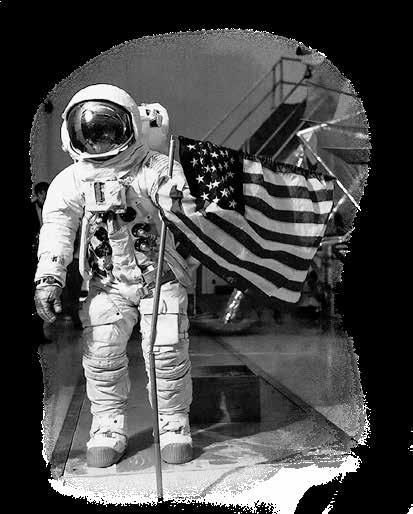
1. How long before Apollo 13 did humans land on the moon? {one year}
2. What is a quote from the story that shows the answer? {The year before, Neil Armstrong and Buzz Aldrin had taken the first steps on the moon.}
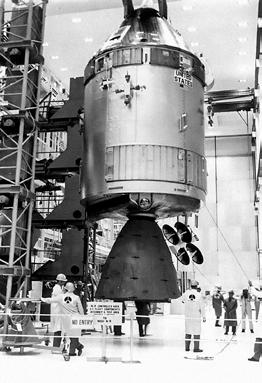
“I’ve got Odyssey under control,” Jack assured him. “We’re in good hands.”
Now, the world was turning its attention to Apollo 13. Soon, three brave astronauts — Jim Lovell, Jack Swigert, and Fred Haise — would land on the moon. They would explore a new area called the Fra Mauro Highlands. They would set up scientific equipment and collect samples from the moon. They hoped that this mission would shed some light on the moon and its mysteries.
Jack was the pilot for the module "Odyssey." The astronauts would spend most of their time in this part of the spacecraft. Jack was new to the team. He had the right skills for the job, and he wanted to make this mission a success.
“I can’t wait,” Fred said.
Fred was in charge of the module "Aquarius." This small craft had a big job: it was going to land on the moon! Fred couldn't wait to gather rocks from the moon and bring them back to Earth. His excitement was contagious
The countdown began. wikipedia.org
Jim looked at the members of his team. “Let’s go to the moon!”
Countdown to Adventure!
The world watched as Apollo 13 prepared for its journey.
Jim was the mission commander. He had already traveled to space three times, and he was a calm, confident leader. He was excited about the upcoming adventure, but he was nervous, too. Jack could see that Jim was tense.
On April 11, 1970, Apollo 13 was ready for takeoff. Thousands of people gathered at Kennedy Space Center in Cape Canaveral, Florida, to watch. The rocket was as tall as a 36-story building.
1. What job would Apollo 13 do once it landed on the moon? Give a direct quote. {“They would set up scientific equipment and collect samples from the moon.”}
2. What were the specific jobs of Odyssey and Aquarius? {Odyssey - where the astronauts would spend their time, Aquarius - the craft that would land on the moon}
"Ten... nine... eight..."
The atmosphere was electric.
“Seven… six… five…”
The crowd's anticipation grew. The tension was thick.
Inside the rocket, the astronauts were strapped in their seats. Their hearts thudded loudly.
"How are you holding up, Jim?" Jack asked. His voice was steady.
"Ready as ever," Jim replied. His eyes were focused as he reviewed the months of practice.
"Four... three… two…"
The astronauts’ families were watching in the audience. They were both proud and worried. They knew the risks involved, but they supported the dreams of these brave men.
The final seconds felt like an eternity
"One… liftoff!"
With a deafening roar, the rocket lifted off the ground. Flames and smoke erupted from the engines as the ground trembled. The rocket shot up, leaving behind a trail of fire and smoke.

1. Why do you think the astronauts families were both proud and worried? {it is dangerous and they are brave}
People cheered and gasped, their eyes glued to the sky. For a moment, the whole world seemed to hold its breath.
“Wow, this view is incredible!” Fred said, looking out the window. The astronauts were thrilled that their adventure was underway. They knew they were making history.
So far, everything was going smoothly. The astronauts floated around the spacecraft. They checked their equipment, conducted experiments, and kept in touch with Mission Control back on Earth.
“Mission Control, this is Odyssey. All systems are go!” Jack reported.
“Roger that, Odyssey,” came the response from Mission Control. “You’re doing great!”
The journey to the moon would take about three days. The astronauts looked out the window and admired the stunning views. Earth looked like a beautiful blue and white marble in the distance, growing smaller and smaller as they traveled farther from home.
They took many photos to share with everyone back home. Apollo 13 was promising to be another important milestone in space exploration.
"Houston, We Have a Problem"
For two days, everything went well. Jim, Jack, and Fred were enjoying their adventure in space. They were able to communicate with people back on Earth, and they enjoyed showing everyone how cool it was to be an astronaut. They were working hard and having fun.
Little did they know that danger was about to strike.
“Hey, Jim, did you hear that noise?” Fred asked, concerned.
Jim cocked his head and listened. He could hear the usual noise of the engines. Everything seemed fine. Suddenly…
1. Read the conversation between the astronauts and Mission Control. Explain what Jack reported and Mission Control’s answer. {Jack said that the systems were working well, Mission Control responded that they got the message and that they were doing great}
2. Foreshadowing is when a text gives a hint to what will happen next. What is an example of foreshadowing in chapter 3? {for two days, everything went well little did they know that danger was about to strike}
BANG!
It sounded like a giant firecracker! The spacecraft shook, and warning lights started to flash. An oxygen tank had exploded!
The astronauts were in big trouble. They needed oxygen to breathe. They also needed oxygen to keep the spacecraft working properly. This was a disaster!
Jack called Mission Control in Houston, Texas. He tried to stay calm.
“Houston, we have a problem,” he said, his voice steady.
“What’s going on up there, Odyssey?”
Mission Control responded. They were worried.
“The oxygen tank exploded,” Jack said. “We’re losing oxygen fast!”
The engineers and scientists at Mission Control sprang into action. They had to find out what had happened.
Inside the spacecraft, the astronauts were frightened — but there was no time to waste. They had to act fast. Jim looked out the window and saw something terrifying. Gas vapor was leaking out of the spacecraft! They were losing oxygen! Without it, they wouldn't be able to breathe or power the spacecraft. They had to figure out a solution, and quickly!
“We need to save power!” Jim instructed.
“Let’s start switching off whatever we can!”
They decided to move into the tiny Aquarius, which had its own supply of oxygen and power. But there was a problem: Aquarius was designed to make a short trip to the moon and back. It wasn’t built for the long journey all the way back to Earth. They knew they wouldn’t be able to survive inside it for long.
Back on Earth, Mission Control in Houston was a beehive of activity. Engineers, scientists, and experts worked day and night to find a
solution. They had to think fast, and they had to be creative. The safety of the astronauts depended on them. They needed to find a way to provide enough oxygen and power for the return trip to Earth. They had to make sure the astronauts could breathe and stay warm.
It was a race against time.
In the spacecraft, Jim, Jack, and Fred also worked tirelessly. They followed instructions from Houston and tried to stay calm, despite the fear. They knew their lives depended on staying focused and working as a team.
“Hang in there, Odyssey,” came the message from Mission Control. “We’re working on a solution.”
The clock was ticking, and the pressure was building. The world watched and waited, praying for a miracle. Every second counted, and every decision could mean the difference between life and death. The fate of Apollo 13 hung in the balance.
to be continued..
1. Why did Jim say that the team should start switching off whatever they could? {to save power}
2. How many quotes can you find that show that the astronauts were pressured for time? {there was no time to waste, they had to act/think fast, they had to figure out a solution and quickly, it was a race against time, the clock was ticking}
Write a direct quote from the text that says…
1. The names of the astronauts on Apollo 13
“Soon, three brave astronauts - Jim Lovell, Jack Swigert, and Fred Haise - would land on the moon.”
2. The person in charge of Aquarius
“Fred was in charge of operating the module ‘Aquarius.’"
3. How the families of the astronauts felt
“They were both proud and worried.”
4. How the rocket looked during takeoff
"Flames and smoke erupted from the engines as the ground trembled."
5. The problem that the astronauts encountered
“An oxygen tank had exploded!”
6. Who was responsible for helping the astronauts
“Back on Earth, Mission Control in Houston was a beehive of activity.”
Rewrite each direct quote in your own words to turn into an indirect quote.
Answers will vary.
1. “Jack was the pilot for the module ‘Odyssey.’" (page 171)
The name of Odyssey's pilot was Jack.
2. “People cheered and gasped, their eyes glued to the sky.” (page 173)
Everyone was excited as they watched the rocket take off.
3. “Earth looked like a beautiful blue and white marble in the distance, growing smaller and smaller as they traveled farther from home." (page 173)
As the rocket traveled, Earth looked smaller and smaller.
4. “Inside the spacecraft, the astronauts were frightened — but there was no time to waste." (page 176)
Even though the astronauts were scared, they needed to work.
The Long Journey Home
It was cold and dark inside the spacecraft. The astronauts knew there wasn’t enough food and supplies. They had to eat less food, save up their energy, and try to stay warm.
“I hope we have enough food to last us,” Fred said, shivering slightly.
“We’ll make it, Fred,” Jim said. “We just have to be careful.”
Yet there was a hidden danger: carbon dioxide. Carbon dioxide is a gas that humans breathe out. It’s dangerous to breathe in too much of it. The astronauts needed filters to clean the air inside the spacecraft, but they were running out of them.
“Jim, the carbon dioxide levels are rising,” Jack said. “We need a solution fast.”
Jim frowned. Jack was right, but this wasn’t what he wanted to hear.
Back on Earth, Mission Control had an idea. If the astronauts could find some plastic bags, duct tape, and hoses, they might be able to make their own filters.
“Okay, team, let's follow what they tell us,” Jim said.
“Got it, Jim,” Fred replied. “I’ll handle the duct tape.”
Following step-by-step instructions from the scientists, the astronauts managed to create a filter to fit around the openings of the module. With a great show of teamwork and creativity, the crew stayed alive.
It was time to go home. The long journey back to Earth in a damaged spacecraft was uncertain. Danger was all around them. One mistake could mean certain death. And they were running out of time. Soon, they wouldn’t
have enough power to get back home. They had to find a way to speed up the journey.
The solution was simple: gravity
“Jim, remember, we’re using gravity to get you home,” Mission Control said. “It’s our best shot.”
They would have to allow gravity to pull the spacecraft back to Earth. It would take a lot of courage, but Jim, Jack, and Fred stayed calm and recalled their training. They knew they could always rely on help and encouragement from Mission Control.
“Understood, Houston,” Jim responded. “We’re ready.”
And so the astronauts prepared to re-enter Earth’s atmosphere.
1. Why was it a problem that the carbon dioxide levels were rising? Use a direct quote. {It’s dangerous to breathe in too much of it.}
2. Why would it “take a lot of courage” for the astronauts to go back to Earth? {It was dangerous, and they were working under pressure.}
As the Apollo 13 spacecraft neared Earth, the astronauts faced the most frightening part of their journey: re-entry to Earth’s atmosphere.
Jim, Jack, and Fred were strapped tightly into their seats. They knew they were about to face the most intense heat and pressure they’d ever experienced. Temperatures would be hotter than molten lava. Would the spacecraft be able to protect them?
“Everyone ready?” Jim asked, trying to keep his voice steady.
“Ready as we’ll ever be,” Jack replied. He gripped his harness tightly.
The spacecraft zoomed toward Earth. They could see Earth growing larger by the second. The spacecraft trembled as it entered the upper atmosphere. A heat shield covered the spacecraft to protect it from heat. Now, the heat shield had to work overtime to keep out the deadly temperatures. Inside the
spacecraft, it was getting hotter and hotter. The astronauts had a hard time breathing.
Jim watched anxiously as the spacecraft began to glow and shake. Sweat dripped down his forehead, stinging his eyes. The shaking grew stronger, and the noise was deafening. It felt like they were inside a giant, rattling oven. They couldn’t move, they couldn’t breathe.
“Hang tight, guys! We’ve got this!” Jim shouted over the roar.
At Mission Control, the room fell silent. They had lost communication with the astronauts. The astronauts’ families and friends waited fearfully. Millions of people followed the spacecraft’s journey. It seemed as if the entire world was waiting, hoping that the spacecraft would hold together and the crew would survive the dangerous journey.
Inside the spacecraft, Jim, Jack, and Fred clung to their seats. Their hearts pounded as the glow outside the windows grew brighter. Suddenly, the spacecraft trembled. A set of parachutes opened. The spacecraft slowed down, but it was still dangerously hot. Then, the second set of parachutes opened, and the spacecraft stopped shaking.
1. Why was the re-entry into Earth’s atmosphere “the most frightening part of their journey”? {It would be very hot.}
2. What do you think will happen next? Explain. {Answers will vary.}
“We’re through the worst of it,” Jim said. His voice was hoarse with relief.
The flames died down, and the windows cleared. Outside, they could see the blue waters of the Pacific Ocean below. The spacecraft continued to fall. Above, the parachutes looked like giant, white flowers. Cool air started to come in.
Apollo 13 hit the water. They had made it! The entire world cheered. Rescue helicopters arrived quickly, and the astronauts were lifted to safety.
“We made it! We’re alive!” Fred shouted. Tears ran down his face.
The astronauts were exhausted but overjoyed to be home. As they were lifted aboard the helicopter, they waved at the cameras. They were weak and tired, but they knew that their incredible journey had touched the hearts of millions.
Around the world, people celebrated the
astronauts’ safe return. They became instant heroes. With courage and teamwork, they had faced impossible odds and lived to tell the tale. Their story inspired millions, proving that with determination and creativity, anything is possible.
1. Why do you think Fred had tears running down his face when they landed? {He was so happy to be alive and probably shaken up from the experience.}
2. What does “they had faced impossible odds” mean? {It was unlikely that they would make it.}
Answer each question in your own words. Then, find a quote to support your answer.
1. What was the major crisis faced by the Apollo 13 crew?
Answer: Quote:
The oxygen tank exploded.
“An oxygen tank had exploded!”
2. What role did Mission Control in Houston play in the journey of Apollo 13?
Answer: Quote:
They guided and helped the astronauts from Earth.
“The engineers and scientists at Mission Control sprang into action. They had to find out what had happened.”
3. How did the astronauts handle the threat of carbon dioxide?
Answer:
Quote:
They made their own filters out of plastic bags, duct tape, and hoses.
“Following step-by-step instructions from the scientists, the astronauts managed to create a filter to fit around the openings of the module.”
4. How did the fact that Apollo 13 took place a year after the first moon landing affect how people viewed it?
Answer:
Quote:
People were excited with the idea of space exploration.
“People kept looking to the stars and dreaming about exploring space.”
5. Why were the astronauts nervous during the landing?
Answer:
It was very dangerous.
Quote:
“Danger was all around them. One mistake could mean certain death.”
A chapter can be used to… LESSON PRACTICE
…introduce the characters and setting
…tell what happens next in the story
…give the reader new information …describe a problem
…answer the reader’s questions …make the reader curious
Write a paragraph explaining the role of each chapter in the story about Apollo 13.
1. Jot down some information about each chapter.
What happens?
Hint: Summarize the chapter.
Role of the chapter: Hint: Use phrases like the ones listed above.
Chapter 1 The astronauts prepare for takeoff. Introduces the characters and setting
Chapter 2
Chapter 3
Chapter 4
Chapter 5
Apollo 13 takes off.
Tells what happens next in the story
An oxygen tank explodes. Describes a problem
The astronauts prepare for an emergency landing.
Tells what happens next/makes the reader curious
The astronauts land safely. Tells the ending/answers the readers's questions
2. Write a topic sentence. Include the name of the passage and the number of chapters.
The story Apollo 13: The Incredible Space Adventure has five chapters.
3. Write a concluding sentence. Include which chapter was your favorite and why.
Answers will vary. My favorite chapter is Chapter 5 because it has a happy ending.

4. Write an outline. For each chapter, write one body sentence. Tell about the role of the chapter. It may be helpful to explain what happens in that chapter. Example: Chapter 1 introduces the characters (the astronauts) and setting (a rocketship).
Topic Sentence:
The story Apollo 13: The Incredible Space Adventure has five chapters.
Body Sentence 1:
Body Sentence 2:
Body Sentence 3:
Body Sentence 4:
Chapter 1 introduces the characters (the astronauts) and setting (a rocketship). for an emergency landing.
Body Sentence 5:
Chapter 2 describes the next event, when Apollo 13 takes off.
In Chapter 3, the astronauts face a problem when the oxygen
Then, in Chapter 4, suspense builds as the astronauts prepare
Lastly, Chapter 5 tells the ending, when the astronauts land safely.
Concluding Sentence:
5. Write a paragraph.
Chapter 5 tells the ending, when the astronauts land safely. My favorite chapter is Chapter 5 because it has a happy ending. tank explodes.
My favorite chapter is Chapter 5 because it has a happy ending.
The story Apollo 13: The Incredible Space Adventure has five chapters. Chapter 1 introduces the characters (the astronauts) and setting (a rocketship). Chapter 2 describes the next event, when Apollo 13 takes off. In Chapter 3, the astronauts face a problem when the oxygen tank explodes. Then, in Chapter 4, suspense builds as the astronauts prepare for an emergency landing. Lastly,
Build your own rocket.
Materials: → Straw → Paper → Tape → Markers/Pens
Directions:
1. Cut the paper into a small rectangle-shaped strip.
2. Fold the strip over the end of the straw.
3. Tape both long sides together. It should fit loosely over the straw.

Circle the correct answer.
1. The children's for the party was shown in their excited chatter.
a. eternity
b. shield
c. anticipation
d. fate
2. Which word means “a separate part of something larger”?
a. Module
b. Assured
c. Eternity
d. Anticipation
3. Which is an example of something contagious?
a. A cold
b. A rock
c. A feeling of hunger
d. A quiet room
4. When would a person assure somebody of something?
a. When they want them to rest
b. When they want them to cry
c. When they don’t want them to laugh
d. When they don’t want them to be nervous or doubtful
5. It felt like an before the doctor finally returned with the test results.
a. eternity
b. assured
c. module
d. anticipation
6. Which word means “what happens to someone or something”?
a. Fate
b. Gravity
c. Anticipation
d. Assured
7. The apple fell from the tree because of .
a. assured
b. gravity
c. module
d. eternity
8. Which word means “something used to protect someone or something”?
a. Shield
b. Anticipation
c. Fate
d. Assured
Circle the correct answer.
1. What was the name of the module that was supposed to land on the moon? (detail)
a. Odyssey
b. Aquarius
c. Apollo 13
d. Fra Mauro Highlands
2. Why did the astronauts move into the Aquarius module? (cause and effect)
a. They wanted to explore the moon.
b. The Odyssey module was too crowded.
c. It had its own power and oxygen supply.
d. They were bored with the Odyssey.
3. What can you infer about the relationship between the astronauts based on their actions during the crisis? (inferencing)
a. They were not a good team.
b. They were rivals.
c. They supported each other.
d. They blamed each other.
4. What is the overall main idea of the story? (main idea)
a. The importance of space exploration
b. The challenges faced by astronauts
c. The story of a successful emergency landing
d. The power of friendship
5. What happened after the astronauts created the makeshift carbon dioxide filter? (sequencing)
a. They landed on the moon.
b. They returned to Earth safely.
c. They ran out of food.
d. They prepared for re-entry.

6. What does the word "commander" mean in the sentence "Jim was the mission commander"? (context clues)
a. A person who cooks food
b. A person who pilots a plane
c. A person who is in charge
d. A person who plays music
7. How is the role of the astronauts different from the role of Mission Control? (compare-contrast)
a. Astronauts build rockets, while Mission Control flies them.
b. Astronauts do research on spacecrafts, while Mission Control keeps an eye on the spacecraft from Earth.
c. Astronauts conduct experiments, while Mission Control cooks meals.
d. Astronauts call Houston, while Mission Control calls Roger.
8. Which of the following is a fact about the Apollo 13 mission? (fact vs. opinion)
a. Apollo 13 was the best space mission ever.
b. The astronauts were very brave.
c. An oxygen tank exploded on the spacecraft.
d. The astronauts should have been more careful.
Unit 4: Point of View
Lesson 13: Point of View
Unit Goal Trajectory:
Analyze point of view and perspective of the narrator and/or the author.
1. Distinguish between text written in first, second, and third person. (Lesson 1)
2. Describe how the perspective of the narrator influences how events are described. (Lesson 1 and 2)
3. Compare firsthand and secondhand accounts of the same event, noting similarities and differences in their points of view. (Lesson 2)
4. Identify the evidence the author uses to support an argument. (Lesson 3)
5. Analyze the point of view and perspective of the narrator to determine the author’s purpose. (Lesson 4 and beyond)
Students may get confused between the author and the narrator.
Use the following examples to help students see the difference.
• “Hi, my name is Sam and I am in third grade.” - written by Dr. Mark Green Even though Dr. Green is the author, he uses a different character to tell the story.
• “John was always the tallest kid in his class.”written by Debra Gold We don’t know who is telling the story. It is a voice that knows what is going on.
1. Ask students if the author can also be the narrator. When would that happen? {This is common in autobiographies and persuasive writing.}
Synonym
Antonym
Examples
Additional Questions
1. Sprawled, verb
S Spread (out) A Stood
E Someone lying on a couch; A town that is spread out over a lot of land Q Can you give an example of a time when you might sprawl out on the floor?
2. Disappoint, verb
S Let down A Please
E When you do something that a parent doesn’t like; When something is not as good as you wanted
Q How might a person feel if they disappoint a friend?
3. Whiff, noun
S Smell E A hint of a smell; A short puff of air or smoke; A smell of something in the air
Q How is a “whiff” different from a “smell”?
4. Apologetic, adjective
S Sorry E Feeling bad about something you did; Saying sorry for something you did; Showing someone that you are sorry Q If someone is apologetic, what are they likely to say or do?
5. Discomfort, noun
S Annoyance A Happiness
E What you feel when something hurts a little; How you feel when something embarrassing happens
Q Why might you feel discomfort after doing the wrong thing?
6. Supervise, verb
S Oversee A Neglect
E A teacher watching a bunch of kids; A worker managing a project; A boss who watches and teaches a worker Q Who might supervise a child?
7. Inspect, verb
S Examine A Skim E Looking at something carefully to find problems; Looking at something really closely
Q Why is it important to inspect things carefully before buying them?
8. Eager, adjective
S Excited A Disinterested
E How you feel before trying something you want to do; How you feel when you want something a lot
Q How might an eager person act?
1. Today, we will read a that is not true but has a storyline and characters that could be real. What type of story is it? {realistic fiction}
2. The story we will read begins with two boys studying for a test. How do you study for a test? Do you study with a friend? {Answers will vary.}
This story has three parts. Each part is written with a different point of view. As we read, let’s pay attention to who the narrators are in each part.
1. Who is telling the story in part 1? {benny}
2. Why do the boys want to pass the test so badly? {they don’t want to have to go to summer school}
3. Look at the top of the right column. What does the word “mutter” mean? {say quietly to yourself}
1. Do you think Mr. Simon is a good teacher? Why or why not? {Answers will vary.}
2. What subject is the test on? {American history}
1. How does the point of view change from part two to part three? {In part two, it is second person; in part three, it is third person.}
2. If you were David, would you have given the answer key to Benny? Explain. {Answers will vary.}
1. Why did Benny’s jaw drop? {He didn’t expect Juan to tell the truth.}
2. How did Benny change in the story? {In the beginning, he wanted to cheat. Then, he saw an example of honest behavior and acted honestly.}
On the next page, you will answer questions about each part. Turn back to the story if you need help remembering the answers.
Unit 4: Point of View
Lesson 14: Perspective
Unit Goal Trajectory:
Analyze point of view and perspective of the narrator and/or the author.
1. Distinguish between text written in first, second, and third person. (Lesson 1)
2. Describe how the perspective of the narrator influences how events are described. (Lesson 1 and 2)
3. Compare firsthand and secondhand accounts of the same event, noting similarities and differences in their points of view. (Lesson 2)
4. Identify the evidence the author uses to support an argument. (Lesson 3)
5. Analyze the point of view and perspective of the narrator to determine the author’s purpose. (Lesson 4 and beyond)
We've learned that the narrator is the voice telling the story. Now, let's dig deeper and explore their perspective—how they see the world around them.
An account is the telling over of an event. Perspective is how the narrator views the event. How does the narrator think about, feel, or experience the event or topic?
Firsthand Account is told in first person by a person who experienced the event
there.
Let's look at an example:
Secondhand Account is told in third person by someone who didn't experience the event
It can have multiple perspectives.
In the Revolutionary War, the Americans fought against the British.
→ A diary from an American soldier might say that the British were bad. (firsthand)
→ A diary written by a British soldier might say that the Americans were bad. (firsthand)
→ A textbook might say that both were wrong. (secondhand)
Here we see conflicting ideas. How can we get a better understanding of what really happened?
Try stepping inside the minds of each author! Ask yourself:
→ What makes them think the way they do?
→ What in their life has made them see things this way?
→ What information do they have?
→ Were they there, or are they getting information from somewhere else?
→ What information are they missing?
→ Is there anything they might not know that could change their perspective?
Look at the scene below. What really happened here?

“That terrible thief stole everything here!” He should be caught and placed behind bars!”
“That guy looks suspicious. I will catch him.”

“An
Answer the questions by circling the correct answer(s).


Students may have a hard time understanding the concept of a narrator having multiple perspectives.
Use the news reporter as an example. Here are some perspectives he tells over:
1. His own - an armed robber broke into a bank
2. Police - view him as a suspect
3. Robber - says the bank owed him money
4. Doctor - thinks the thief may not be thinking straight
Ask students which narrators they would trust more and which they would trust less. Have students consider the following points:
• The reporter has multiple perspectives.
• The reporter wasn’t there.
• Robbers are not exactly honest people.
• The banker is angry.
1. Immigrants, noun
A Natives E People who move from a different country Q What challenges might immigrants face when they arrive in a new country?
2. Prospectors, noun
S Miners E People who search for gold or other precious metals or minerals
Q Where might prospectors go to look for valuable resources?
3. Panned, verb
E Washing gravel or sand in a pan to remove gold or other precious metals
Q What tools are needed to pan for something?
4. Extraordinary, adjective
S Unusual A Normal
E A painting that is very good; Someone who is unusually good at something
Q How is extraordinary different from ordinary?
5. Immediately, adverb
S Instantly A Later
E Doing something right away; A reaction that happens right after you do something Q Why is it sometimes important to
6. Vibrant, adjective
S Lively A Dead
E Bright colors; Someone who is full of life and energy;
A colorful and busy town
Q How can a person be vibrant?
Match the bolded words with their definitions. Highlight context clues.
Millions of immigrants came to America in search of a new and better life.
The prospectors traveled far, hoping to get rich by finding gold.
On their vacation, they panned for gold at an attraction.
His extraordinary talent for painting made him famous.
The fire alarm rang, and everyone immediately left the building.
The vibrant garden was filled with colorful flowers and happy people.
He borrowed money from his friend, creating debts he had to repay.
The village elders make important decisions for the community.
very unusual or amazing
money or goods owed to another person
people who come to live in a new country
right away, without delay or pause
people who explore an area for valuable minerals
used a pan to separate precious metals from wet sand
full of life and energy
older people, especially those respected for their age and experience
immigrants [IH-muh-grehnts]; prospectors [PRAH-spek-terz]; panned [PAND]; extraordinary [ik-STRAWR-dih-nuh-ree]; immediately [ih-MEE-dee-it-lee]; vibrant [VY-bruhnt]; debts [DETS]; elders [EL-derz]
7. Debts, noun
S Bills A Payments E Money owed to someone else; A favor that needs to be payed back, When someone needs to pay others Q How can people avoid getting into debt?
8. Elders, noun
S Seniors A Youths E Grandparents; Older siblings; Old people Q How can younger generations benefit from learning from their elders?
In 1848, gold was discovered in California, and people from all over the world rushed to find their fortune. This exciting story takes you on a journey with miners who faced dangerous trips and tough conditions. You'll also meet Luzena Wilson, who started a successful business during this time. But was it all gold and success? What challenges did the miners face, and how did the Gold Rush change the lives of Native Americans? Read three accounts to find out!
Today, we will read three true accounts about the Gold Rush. Accounts like these that tell over a story are called narratives.
1. The Gold Rush began in America in 1848. What are some things that you know about that time period? {no cars, hard life, no electricity, still slavery in the South}
As you read, pay attention to the perspective of each passage. Notice which accounts are firsthand and which are secondhand accounts.
Author: Tessa Barber
Imagine finding a treasure and becoming rich overnight. In 1848, this happened to a man working at a sawmill in California. He saw some gold sparkling in a river and scooped it out. The exciting news spread quickly. Soon, thousands of people were rushing to California to find their fortune. Over the next year, ten million dollars worth of gold was found.
But not everyone became rich.
Immigrants from all over the world traveled to California, hoping for a better life. They crossed rivers, climbed mountains, and traveled through deserts. It was a long, hard journey. At night, they slept in wagons and tents. They risked attacks from Native Americans and animals.
Those who managed to reach California safely started to search for gold. Miners, also called prospectors, dug for gold in the ground or panned for it in cold rivers. Life was tough. There wasn’t enough food, and they slept in
simple tents in miners’ camps. These places were overcrowded, leading to illness. Many accidents happened as well. Only a few miners became rich, but the hope of finding gold kept them going.
Miners from around the world lived and worked together. They were a community, full of life and friendship. But those who didn’t
1. Why do you think people were willing to go on a long, hard journey to get to California? {They wanted to find gold.}
2. Do you think it was worth it for them to come? Why or why not? {Answers will vary.}
including a flood and fire, but she never gave up. She showed that with hard work and bravery, they could make a new life in a new land.
find gold needed other ways to support their families. Some people made money by selling goods and services to the thousands of people living in California.
One woman, Luzena Wilson from Missouri, started to sell food. Her business became quite popular, and soon she had earned enough to open a hotel. She faced many challenges,
A man named Levi Strauss moved to San Francisco during the Gold Rush. Instead of mining, he sold pants to miners. He noticed that their clothes wore out quickly, so he made strong pants from strong fabric. These pants, called "Levi's," became popular. His business grew into a big company. Levi became very wealthy. Today, people still wear his pants.
But others weren’t so lucky. The Gold Rush caused some people tremendous suffering. California was home to many Native American tribes. They hunted, fished, and farmed the land. The arrival of thousands of people changed their lives. Sadly, many Native Americans lost their land, history, and way of life.
The California Gold Rush was an extraordinary and life-changing time. But it wasn't just about finding gold. It was about hopes, dreams, and struggles — and the desire to build a new life.
1. Why do you think the arrival of the prospectors affected the Native Americans in such a drastic way? {the prospectors took land and resources, the prospectors didn’t understand them, they brought a different culture with them}
Author: John Smith Adapted by: Tessa Barber

June 1, 1849
Today is the first day of my new life. It has been a long road to get here, and the adventure starts now! When I heard about gold in California, I was excited. I immediately left home for San Francisco.
San Francisco is so vibrant! There are people from every country here, all wanting to find gold. The streets are crowded and muddy. People live in tents and rough shacks. It’s messy and so different from home, but I don’t mind. I’m going to find gold and make my fortune!
August 5, 1849
I have been working in the goldfields for one week now. All day, I pan for gold in cold rivers and dig in rocky soil. It is boring, backbreaking, and slow. I swirl water and mud in my pan, hoping to spot some gold. Every time I see my pan is empty, I lose hope. My friend says you need patience and luck in this work. I want to give up, but I know I won’t.
October 15, 1849
I hate this mining camp! The tent doesn’t keep out the rain and mud. I’m always hungry. All I can hear is the sound of digging. Joking with the other men helps. A few days ago, someone found a huge nugget of gold and jumped for joy! Will it be me next time?
November 20, 1849
Gold! I found gold today! As I was washing my pan, I saw a glint of gold. It was a small nugget, but I am so happy! I’m glad I didn’t give up! Now, I am determined to keep going. I’m going to be rich! Tomorrow, I’ll trade it in for money. I can’t wait to tell my family!
December 30, 1849
Life is hard again. The money didn’t last long. After I sent some home, paid my debts, and bought clothes and food, there were just a few dimes left. I have to find more gold, but it feels like time is running out.
Many men in the camp are ill. Sometimes, we have terrible fires that destroy the tents. I miss my family and home.
January 1, 1850
I may not have a lot of money, but I am rich in friends. We are a community. We work hard and stick together. There have been highs and lows. I wonder: when will this adventure end?
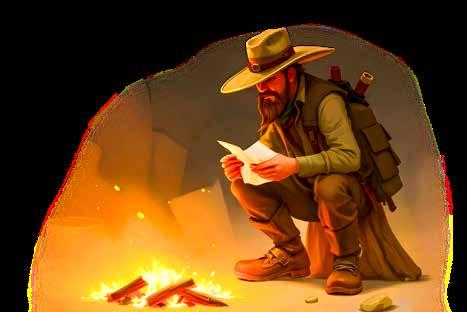
1. How does John feel about mining when he first arrived? How does it change after some time? {At first, he is excited, then he gets frustrated. After some time, he realizes that though life is hard, he has friends.}
2. How much time passes from John’s first diary entry to his last entry? {6 months}
Author: Little Deer Adapted by: Tessa Barber
My name is Little Deer.
Before the Gold Rush, my family and I lived peacefully with nature. We hunted, fished, and grew food on the land. Our way of life was simple and connected to the land. In 1848, everything changed. Suddenly, thousands of people rushed into our lands. They built towns, cut down trees, and dug up the earth to look for gold. The newcomers did not understand us. Some miners were kind, but others were not. They took our land and resources. They didn’t think about us. They didn’t ask us permission to be on our land, and they didn’t care about nature. Our rivers turned brown from the mining, and it became
hard to catch fish. When trees were cut down, the animals we needed for food and clothing disappeared. Losing these places felt like losing our history.
Many of us had to move, but some people decided to stay. They traded with the miners, offering food and supplies. We learned new ways to survive, but it was hard. Our elders told us to stay strong and remember who we are.
The Gold Rush made our lives difficult in many ways. We did our best to support each other and hold onto our traditions, even when it was hard. It was a time of great change, and the lives of my fellow Native Americans will never be the same again.

1. How was Little Deer’s life changed by the Gold Rush? {He used to hunt, fish, and grow food on the land, but the prospectors ruined the land, and rivers, so he couldn’t do that anymore.}
2. Why do you think some Native Americans decided not to move away? {They always lived there and didn’t want to start over.}
On the next page, you will determine if each account is firsthand or secondhand. Remember that in a first hand account, the narrator was actually there.
For each passage, choose whether it is a firsthand or secondhand account.
Miner's Diary
Native American Story
Match each passage to the perspective of the author.
Fever
Miner's Diary
Answer the questions. Golden Dreams: The California Gold Rush
Native American Story
The Gold Rush was difficult for the Native Americans because miners took their land and resources.
Some people became wealthy from businesses during the Gold Rush, but it was difficult for others.
Mining for gold has its ups and downs. It is hard but nice to do with friends.
1. What are some things that more than one account agree on?
2. In what ways do the accounts see the events differently?
The first and third accounts agree that the Gold Rush was difficult for the Native Americans. The first and second accounts say that lots of people didn’t make money. The second account didn’t mention any problems with the Native American lands. The third account didn’t talk about people who didn’t actually get rich.
Text structure is the way a piece of writing is organized. Common informational text structures are chronology, problem-solution, cause and effect, and compare-contrast.
Write a paragraph comparing and contrasting the text structures of A Miner’s Diary and A Native American Story.
1. Write some similarities and differences in how the texts are structured.
A Miner’s Diary
Topic: LESSON PRACTICE VOCABULARY STORY REVIEW ACTIVITY ASSESSMENT
Both
Structure:
Chronology/sequence
How it’s written: How it’s written: A Native American Story
Written as a timeline
Structure:
Cause and effect
Discusses what happened when miners came to their lands
2. Write a topic sentence. Include the names of both passages and the fact that they have different structures.
The passages A Miner’s Diary and A Native American Story have different structures.
3. Write an outline. Compare and contrast the text structures in the body sentences.
Topic Sentence:
Body Sentence 1:
Body Sentence 2:
Body Sentence 3:
The passages A Miner’s Diary and A Native American story have different structures. Both passages are about the Gold Rush, but they tell about it in different ways. A Miner’s Diary has the chronology structure and is written as a timeline.
In contrast, A Native American Story has the cause and effect structure and discusses what happened when miners came to Native American lands.
Concluding Sentence:
In conclusion, both text structures are used to tell the story of the Gold Rush. They are both about the Gold Rush.
4. Write a paragraph. Use transition words to make it interesting.
The passages A Miner’s Diary and A Native American Story have different structures. Both passages are about the Gold Rush, but they tell about it in different ways. A Miner’s Diary has the chronology structure and is written as a timeline. In contrast, A Native American Story has the cause and effect structure and discusses what happened when miners came to Native American lands. In conclusion, both text structures are used to tell the story of the Gold Rush.
LESSON PRACTICE VOCABULARY STORY REVIEW ACTIVITY ASSESSMENT
Write a play or script that takes place in California in 1848. Write at least two scenes. Include details from what you learned about the Gold Rush.
Circle the correct answer.
1. Which means very unusual or remarkable?
a. Debts
b. Extraordinary
c. Immigrants
d. Panned
2. Which is an example of a prospector?
a. Someone who searches for valuable minerals
b. A farmer growing crops
c. A scientist studying plants
d. A teacher working in schools
3. Someone who panned for gold would have .
a. searched for gold in a river
b. bought gold at a store
c. stolen gold from a bank
d. dreamt about finding gold
4. The United States is a country built by , people who came from other countries to start new lives.
a. immigrants
b. prospectors
c. elders
d. debtors
5. When she heard the news, she called her family.
a. panned
b. extraordinarily
c. immediately
d. vibrantly
6. Which means full of life and energy?
a. Vibrant
b. Debts
c. Panned
d. Immediately
7. Paying off your should be a priority.
a. immigrants
b. prospectors
c. debts
d. elders
8. Which means older people, especially those respected for their age and wisdom?
a. Vibrant
b. Immigrants
c. Panned
d. Elders
Circle the correct answer.
1. What kind of business did Luzena Wilson start in California? (detail)
a. A gold mine
b. A hotel
c. A clothing store
d. A farm
2. What was the effect of the Gold Rush on the Native Americans? (cause and effect)
a. They became rich.
b. They were unaffected.
c. They suffered greatly.
d. They all moved to a new land.
3. Why do you think so many people were willing to go through challenges to reach California? (inferencing)
a. They were bored with their lives.
b. They were looking for adventure.
c. They were hoping to become rich.
d. They were forced to leave their homes.
4. What is the main idea of A Native American Story? (main idea)
a. The different tribes of Native Americans
b. The traditional lifestyle of Native Americans
c. The impact of the Gold Rush on Native Americans
d. How Native Americans tried to fight the miners
5. What happened after the first gold rush excitement? (sequencing)
a. Everyone became rich.
b. The miners realized the hard reality of life.
c. The Native Americans attacked the miners.
d. The government took control of the gold mines.

6. What does the word "overcrowded" mean in the sentence "These places were overcrowded"? (context clues)
a. Very empty
b. Too many people
c. Well-organized
d. Quiet and peaceful
7. Which best compares and contrasts the prospectors and the Native Americans? (compare-contrast)
a. They had the same goals.
b. The prospectors wanted to find gold, while the Native Americans wanted to protect their land.
c. The prospectors were peaceful, while the Native Americans were not.
d. There were no differences between the two groups.
8. Which of the following is a fact about the Gold Rush? (fact vs. opinion)
a. Living conditions in mining camps were terrible.
b. The Gold Rush brought many people to California.
c. Finding gold was a matter of luck.
d. The Gold Rush was the greatest event in American history.
Unit 4: Point of View
Lesson 15: Persuasive Writing
Authors often share their opinions in their writings. Sometimes, they use facts and reasons to try and convince the reader to see things their way.
This type of writing is called persuasive or argumentative writing.
There are three parts to a persuasive writing:
→ The argument: the main idea or opinion the writer wants the reader to agree with
→ Reasons: the writer’s explanations for why the argument is true or important
Unit Goal Trajectory: Analyze point of view and perspective of the narrator and/or the author.
1. Distinguish between text written in first, second, and third person. (Lesson 1)
2. Describe how the perspective of the narrator influences how events are described. (Lesson 1 and 2)
3. Compare firsthand and secondhand accounts of the same event, noting similarities and differences in their points of view. (Lesson 2)
4. Identify the evidence the author uses to support an argument. (Lesson 3)
5. Analyze the point of view and perspective of the narrator to determine the author’s purpose. (Lesson 4 and beyond)
→ Evidence: the facts or examples the writer uses to support the reasons
at the following example:
Children should get more time to play outside. First, it helps them grow strong since they move more than when they play inside. In addition, playing outside can make them happier. Studies show that children and grown-ups feel less worried after being outside! Plus, playing outside makes kids smarter. It helps them learn to solve problems and be creative. If children got more time to play outside, they would be stronger, happier, and smarter.
Read the persuasive passage. Then, answer the questions.
It’s important to eat breakfast in the morning. First, it gives you needed energy because you haven't eaten in a while. In addition, eating breakfast helps your brain work better. Children who eat breakfast do better in school. Lastly, if you eat breakfast, you'll probably eat healthier during the day. People who don't eat breakfast snack more on unhealthy foods. You should eat breakfast because you'll be energetic, smarter, and healthier.
1. What is the argument of this passage?

It is important to eat breakfast in the morning.
2. Match each reason to the evidence that the author brings to prove or explain it.
Reason:
Eating breakfast helps your brain work better.
Eating breakfast gives you energy.
Eating breakfast helps you eat healthier.
Students may not understand how each piece of evidence proves or explains each reason.
Explain the connection between each reason and piece of evidence separately. Point out if the evidence proves the reason or explains it, and then, discuss how.
Examples:
People who don’t eat breakfast snack on unhealthy foods.
Children who eat breakfast do better in school.
You need energy in the mornings because you haven’t eaten in a while. Evidence:
3. Which reason do you think is the most convincing? Why?
[Answers will vary.] That eating breakfast makes your brain work better because I want to be smarter
• “Children who eat breakfast do better in school” could be proof that “eating breakfast helps your brain work better.”
• “You need energy in the mornings” explains why “eating breakfast gives you energy” is important
1. Bilingual, adjective
E Someone who speaks English and Hebrew Q Why might someone be bilingual?
2. Consider, verb
S Think A Forget E Think about all the options; View something in a certain way; Take something into account Q Why is it important to consider other people’s perspectives?
3. Significant, adjective
S Major A minor E A big difference between two things; An important event in history; Major changes to something Q How can a significant discovery change the world? Give an example.
4. Recalling, verb
S Remembering
A Forgetting
E Remembering a fact; Remembering something that happened; Remembering a face Q How can recalling past experiences help us learn from mistakes?
5. Crucial, adjective
S Important A Unimportant
E A battle that would determine the outcome of a war; Something that needs to be done Q What is a crucial step in baking a cake?
6. Decrease, verb
S Lessen A Increase
E When a price goes down; When the chances of something happening goes down Q Can you think of a situation where a decrease was a good thing?
Match the bolded words with their definitions. Highlight context clues.
As a bilingual speaker, Maria can speak both English and Spanish.
Before making a decision, it's important to consider all the options.
The speech was significant because it gave an important message.
I'm having trouble recalling the name of the park we went to last week.
It's crucial to wear a seatbelt while driving.
In past years, many people used public transportation, but now that number has started to decrease.
I accidentally knocked over my coffee.
There are many opportunities for young people to learn new skills in our community.
think about carefully remembering
chances for something to happen or be achieved
able to speak or understand two languages
become smaller or fewer by mistake extremely important or necessary
noteworthy, important, or meaningful
bilingual [bye-LING-gwuhl]; consider [kuhn-SID-er]; significant [sig-NIF-ih-kunt]; recalling [ree-KAW-ling]; crucial [KROO-shul]; decrease [dee-KREES]; accidentally [ak-si-DENT-uh-lee]; opportunities [oh-per-TOO-nuh-teez]
7. Accidentally, adjective
S Unexpected A Planned
E Something done by mistake; Something that happened that wasn’t planned Q (Without naming names,) can you describe a time you accidentally hurt someone’s feelings?
8. Opportunities, Noun
S Chances E Chances to learn something; Chances to make money; Chances to have fun Q Why is it important to grab opportunities when they arise?
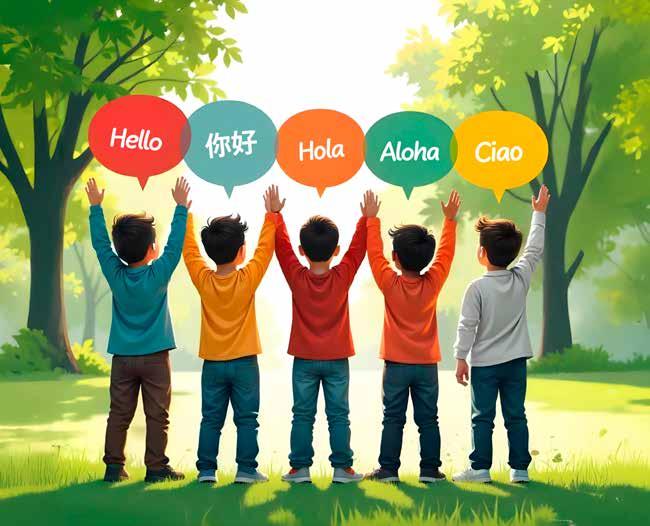
Author: E. Arden Genre: Persuasive
Did you know that in many places around the world, people speak more than one language? In Switzerland, they speak German, French, Italian, and Romansh, and in India, there are over 220 languages! So, why stick to just one language? Keep reading to find out how learning another language can open up a whole new world of fun and exciting possibilities!
1. Today, we will read a passage written to convince readers to learn a second language. What are passages written to convince called? {persuasive}
2. What languages do you speak? How did you learn them? {Answers will vary.}
As you read, we will pay attention the argument, reasons, and evidence the author brings.
Do you speak more than one language? If you do, that means you’re bilingual, and that’s pretty amazing! But what if you only speak English? You might wonder why you should learn another language when so many people around the world speak English. Well, there are some amazing reasons why you should definitely consider learning a new language!
Imagine being able to chat with people all around the world, no matter where you go. If you learn a second language, you can do just that! Even in the United States, there are lots of people who speak different languages. Wouldn't it be amazing if you could talk to them in their own language?
Boost Your Brain Power!
Did you know that learning a second language is like a workout for your brain? Scientists have discovered that people who speak more than one


You’ll start paying more attention to how words sound and how sentences are put together, making you an even better reader and writer.
1. What is one reason to learn a second language? {You can talk to more people.}
2. Why would speaking a second language help you talk to more people? {Maybe they don’t speak English.}
language have bigger brains. Even babies who hear more than one language become smarter! Here are some ways learning a second language can help your brain.
Bilingual people are better at staying focused and doing more than one thing at a time. This is known as multitasking. In today’s fast-paced world, multitasking has significant benefits.
Learning a new language is like lifting weights for your memory. You need to remember new words, phrases, and grammar rules. This makes your memory stronger. Bilingual people are better at recalling things like names, phone numbers, directions, and even long lists!
Creativity is super important, and learning a second language can help you see the world in new and exciting ways. When you understand more than one language, you start thinking about things from different points of view. This makes you a better problem solver, which is a pretty crucial skill.
Ever wish you could do better in school? Kids who are bilingual often score higher on tests in subjects like math and English. That’s because learning a second language helps you speak your first language better, too. You’ll start paying more attention to how words sound and how sentences are put together, making you an even better reader and writer.
This may seem like years away, but speaking a second language can protect your brain when you get older. Some older people become sick with Alzheimer’s disease, which makes them forget things. But guess what? People who speak more than one language can decrease the chances of memory loss, keeping their brains sharper for longer.
1. Why does speaking a second language help you speak your first language better? {You need to pay more attention to the language- how words sound, sentences are put together, etc.}
2. Can someone who is bilingual get Alzheimer’s disease? Explain. {Yes. The text says the chances are decreased, but that doesn’t mean they can’t get it.}

When you grow up, knowing a second language can open up new job opportunities Some jobs might even pay more if you can speak another language. Imagine having more choices and earning more money just because you took the time to learn a second language when you were younger!
Start
Here’s a tip: it’s easier to learn a new language when you’re young. As you get older, it becomes a little trickier. The good news is, once you’ve learned one language, it gets easier to pick up more. So why not start now?
With so many amazing benefits, it’s clear that learning a second language can unlock a whole new world. So, what language will you choose to learn?

1. What is another reason to learn a second language? {You might be able to get a better job and earn more money.}
2. Why do you think the author ended off by telling the reader that it is easier to learn a new language when you are young? {Once readers are convinced that it is good, this encourages them to start now when they are young and lets them know that it should be easy.}
Today, we’re chatting with Leo. He speaks both English and Spanish and has some fun stories to share about his language skills. Let’s find out how being bilingual makes his life exciting!
Hi there! Thanks for joining us today. Can you tell everyone your name and how old you are?
Leo: Hi! My name is Leo, and I’m 11 years old.
Awesome! So, I hear you speak more than one language. What languages do you know?
Leo: I speak English and Spanish! I've known how to speak both since I was little.
That’s really cool! What’s something fun or useful you can do because you know both languages?
Leo: Oh, I love helping people who don’t know much Spanish. Once, my classmate got confused with the directions on a snack bag during recess, and I translated it because the instructions were in Spanish. My friends thought I was like a real translator, just because I said, “Open here.”
That’s amazing! Has anything funny ever happened because you know two languages?
Leo: Yes! One time at school, my friend accidentally said "burro" instead of "butter" when we were talking about toast. He said, “I love putting burro on my bread.” I was laughing so hard because “burro” means “donkey” in Spanish! He was so confused because he speaks Italian, and "burro" in Italian means "butter." Now we joke about it all the time.
That’s a good one! Besides helping with translations, why else do you like being bilingual?
Leo: I like that I can talk to people in different places, like when I visit my relatives in Mexico. Also, sometimes I can figure out what people are saying. One time, I was at the grocery store buying a lot of snacks, and the worker said to another worker in Spanish, “He sure is buying lots of snacks today.” I smiled and replied in Spanish, “Of course I am! I have a trip tomorrow.” They were so surprised!
It sounds like you’ve got some fun snooping skills! If you could learn another language, which one would it be?
Leo: Definitely Japanese! I think it would be so interesting to learn how to write that language. I’ve seen how Japanese writing looks, and it’s so artistic. I would love to be able to write it and maybe even teach it to my friends.
That would be amazing! Well, thanks again, Leo. I’m sure everyone learned something new today. Keep using those super language powers!
Leo: Ha-ha, I will! Adiós!
1. Why do you think the interview with Leo was included after the passage? {to show readers an exciting example of a kid who speaks two languages} On the next page, you will state the argument and reasons given to support it in the passage. Then, you will match pieces of evidence to the reasons.
Answer the questions based on the passage “Why Learn a Second Language?”
1. What is the argument of the passage?
Note: If students answer question 2 in a different order, the answers to numbers 3 - 7 will vary.
2. What are the three main reasons the author gives to make their argument convincing?
Reason 1:
Reason 2:
You should learn a second language. You could talk to more people. It helps your brain get bigger and work better. You could get an interesting job.
Reason 3:
For each piece of evidence, circle the reason that it proves or explains.
3. Bilingual people are better at staying focused.
4. There are people in the United States who speak different languages.
5. People who speak more than one language can slow down memory loss as they get older.
6. Some jobs pay more to people who speak a different language.
7. Bilingual kids often score higher on tests.
A riddle poem gives clues about something without naming it. The reader has to guess what it is!
I rise every morning, I bring warmth and light, I hide behind clouds, But never at night. What am I?
The sun
Write your own riddle poem.
1. Pick something to describe. Choose something that is familiar. For example: airplane, avocado, rain, clock
2. Describe the object. Don’t use its name. Tip: Use these questions to help you write clues:
How does it look?
How does it sound?
Where do you find it?
What does it feel like?
What does it do?
3. Now, pick four to five of your best descriptions and turn them into a short poem.
Challenge:
1. Try adding an extra line to explain what your object is not. For example: I’m good to eat but not with a fork.
green, long, bumpy crunch when you eat it in a fridge/kitchen rubbery, bumpy you eat it I'm bumpy and rubbery, and my body's green and round. There's crunch when you eat me, though I don't make a sound.
2. Make your lines rhyme for an extra challenge! What am I?
4. Share Your Poem.
Read your riddle poem to a friend or the class, and see if they can guess what you’re describing!
Write a letter to a friend. In the letter, explain why your friend should learn a second language. Use reasons from the passage or think of your own reasons.
Dear ,
From,
Circle the correct answer.
1. He is able to talk with French speakers because he is .
a. bilingual
b. consider
c. significant
d. recalling
2. Which word means “remembering something”?
a. Bilingual
b. Consider
c. Significant
d. Recalling
3. The difference in their opinions made it hard for them to agree.
a. bilingual
b. consider
c. significant
d. recalling
4. Which of the following is an example of considering something?
a. Ignoring a problem
b. Making a decision without thinking
c. Weighing the pros and cons of a situation
d. Forgetting about something
5. The doctor said that exercise is for staying healthy.
a. recalling
b. decrease
c. crucial
d. bilingual
6. Which word means “chances for something to happen”?
a. Bilingual
b. Decrease
c. Accidentally
d. Opportunities
7. Which word means “without intention or planning”?
a. Bilingual
b. Decrease
c. Accidentally
d. Opportunities
7. Which of the following is an example of something that will decrease in size?
a. A plant
b. A balloon with a hole
c. A baby
d. A rock
Circle the correct answer.
1. What is one of the benefits of learning a second language mentioned in the text? (detail)
a. Better sleep
b. Losing weight
c. Stronger muscles
d. Better creativity
2. Which is NOT a benefit of learning a second language mentioned in the text? (cause and effect)
a. You can talk to more people.
b. You can delay memory loss when you are old.
c. You can talk faster.
d. You can improve your focus.
3. What is the main idea of the article? (main idea)
a. The benefits of learning a second language
b. The challenges of learning a second language
c. The history of being bilingual
d. The different types of languages
4. Which benefit is mentioned first in the text? (sequencing)
a. Talking to more people
b. Flexing your memory muscles
c. Boosting your brain power
d. Landing an interesting job
5. Why do you think it is easier to learn a new language when you are young? (inferencing)
a. Your brain is still developing.
b. You have more free time.
c. You are less interested.
d. You are smarter.

6. What does the word "Alzheimer's" mean in the text? (context clues)
a. A type of cancer
b. A type of heart disease
c. A type of brain disease
d. A type of skin disease
7. How is memory like working out? (compare-contrast)
a. They both make you sweat.
b. The more practice you have, the better you get.
c. They both help you remember shopping lists.
d. They are both not important.
8. Which of the following is a fact? (fact vs. opinion)
a. It is good to learn a second language.
b. All children can learn a second language.
c. Scientists have found that people who speak a second language have bigger brains.
d. Bilingual kids are always smarter.
Unit 4: Point of View
Lesson 16: Author’s Purpose
Unit Goal Trajectory: Analyze point of view and perspective of the narrator and/or the author.
1. Distinguish between text written in first, second, and third person. (Lesson 1)
2. Describe how the perspective of the narrator influences how events are described. (Lesson 1 and 2)
3. Compare firsthand and secondhand accounts of the same event, noting similarities and differences in their points of view. (Lesson 2)
4. Identify the evidence the author uses to support an argument. (Lesson 3)
5. Analyze the point of view and perspective of the narrator to determine the author’s purpose. (Lesson 4 and beyond)
Have you ever wondered why authors write? Why do they create stories, articles, and poems? Authors have their own reasons for writing. This is called an author’s purpose
Authors have three common reasons for writing. An easy way to remember them is by using PIE:

The author wants to convince you to believe something or do something. They will use strong words and opinions.
Common examples: Advertisements, speeches, letters
The author wants to teach you new things or give you information. They will stick to facts and details.
Common examples: Textbooks, non-fiction (true) books, articles, biographies
The author wants to tell a story or make you enjoy what you’re reading. They will use vivid descriptions and exciting events.
Common examples: Fiction (not true) stories, poems, songs, jokes
Sometimes, an author might have more than one purpose. They might try to inform you about something while also entertaining you. The important thing is to think about why the author wrote the text and what they wanted you to gain from it.
The next time you read something, try to figure out the author’s purpose(s). Ask yourself:
→ Are they trying to change my mind about something? (Persuade)
→ Are they teaching me something new? (Inform)
→ Are they trying to make me laugh or feel something? (Entertain)
Answer the questions to find the purpose for each of the following.
Explore the world, create memories that last a lifetime.
Wanderscape Travel Agency
1. What is the purpose of this text?
a. To persuade the reader to use Wanderscape Travel Agency
b. To inform the reader about making memories

c. To entertain the reader with interesting information from around the world
Thelittle firefly was nervous about lighting up. He squeezed his eyes shut and concentrated. A faint glow appeared. The other fireflies cheered.

2. What is the purpose of this text?
a. To persuade the reader to concentrate hard
b. To inform the reader about how fireflies light up
c. To entertain the reader with a story about overcoming a fear
Studies show that spending time outside can lower stress for both kids and grown-ups!
3. What is the purpose of this text?
a. To persuade the reader to spend less time outside
b. To inform the reader about a study
c. To entertain the reader with a story about spending time outside

If students have a hard time identifying the purpose, help point out additional clues.
1. Who wrote it? What are their goals? Why might they write it?
2. What form is it written in? Is it a story? Stories are usually written to entertain.
1. Physician, noun
S Doctor E A doctor
Q What are some of the tools a physician might use to examine a patient?
2. Absence, noun
A Attendance E When someone is not at school; A time that someone is away; Not having something like toys in a closet Q If the sun were absent from the sky, what would happen to the Earth?
3. Bacteria, noun
S Germs E Bad germs that cause infection; Good germs that are in yogurt or your stomach Q Why is it important to wash your hands to avoid the spread of bacteria?
4. Revolutionary, adjective
A Old E Activity to create a major change; An invention that makes a lot of change; A new method of doing something Q If a new form of transportation was revolutionary, how might it be different from existing forms of transportation?
5. Obtain, verb
S Get A Lose E Get permission from your parents; Get a drivers license; Get lots of toys for free Q How would you obtain a library card?
6. Countless, adjective
S Many A Few E Number of stars; Lots of people at an event; Lots of reasons for something Q If you had countless dollars, what would you do with them?
Match the bolded words with their definitions. Highlight context clues.
The physician listened to the patient’s heartbeat to check for any problems.
The absence of noise made the room a quiet place to study.
Millions of bacteria live on your skin, but most are harmless.
The invention of the wheel was revolutionary; it completely changed how we travel!
Jane worked hard to obtain a certificate in teaching.
For miles, all the hiker could see were the countless trees in the forest.
The child waited for his parents’ approval after he worked hard to clean his bedroom.
The school assembly was impactful and inspired the students to keep their classroom clean.
having a positive or good opinion about something
something different and new that changes the world
lack of something
tiny living things; some cause sickness, while others keep the body healthy
very many; too many to count something that has a strong effect or influence
doctor
get or gain something, like information, an object, or a skill
physician [fi-zish-uhn]; absence [ab-sehns]; bacteria [bak-teer-ee-uh]; revolutionary [rev-uh-loo-shuh-ner-ee]; obtain [uhb-teyn]; countless [kount-lis]; approval [uh-proo-vuhl]; impactful [im-pakt-fuhl]
7. Approval, noun
S Permission A Dislike E Permission to do something; Good opinion about something; Someone who likes what a person says Q How does it feel when someone shows their approval of your work?
8. Impactful, adjective
S Impressive A Uninteresting E A decision that affects a lot of people; A speech that gets someone to change; A bribe that gets you something you want Q What is an impactful event that happened in your life?
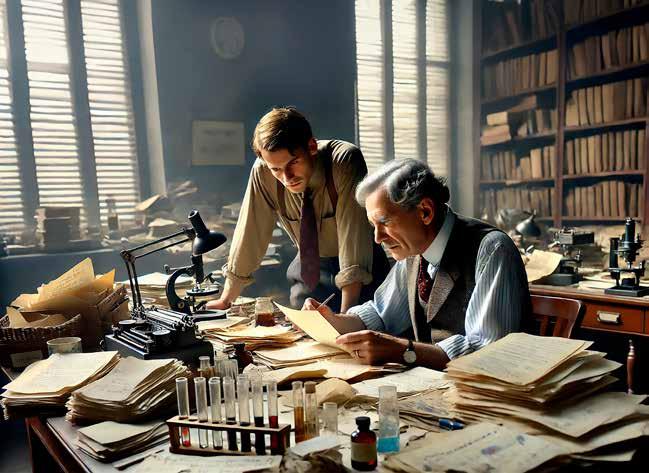
Author: E. Aboud Genre: Nonfiction
Imagine a world where even a small cut could be deadly. Alexander Fleming, a scientist, noticed something amazing in his messy lab that would change the world of medicine forever. What was Fleming’s extraordinary discovery, and how did it save millions of lives?
The passage we will read today tells about an invention that changed the world.
1. What genre is this passage? {nonfiction}
2. This story is about a scientist. Where do scientists work? {in a lab} What do they do? {research, experiments, make discoveries}
As you read, pay attention to the details. Why do you think the author wrote this story?
September 1928
It was a day that started out like any other. Horses pulled carriages through the London streets, their hooves clopping on the cobblestones. Busy people hurried along on this early morning. Street vendors shouted out their wares, trying to attract customers.
Dr. Alexander Fleming walked briskly through the crowds. His brown trench coat and leather bag blended in with his surroundings. It was his first day back at work after a month-long vacation in the countryside.
He passed by a newsstand. I may as well pick up a paper, he thought. I should catch up on what’s been going on in the world. He walked slower as he skimmed the daily news. There was nothing interesting in the
science section. He tucked the paper in his bag and continued on his way to work.
Fleming whistled a happy tune as he entered his lab in St. Mary’s hospital. As always, his lab was full of clutter. Test tubes of various colors lay jumbled on his desk, mixing with scattered papers. His face lit up when he saw his research assistant, Daniel Pryce.
“Welcome back,” Pryce said as they shook hands. “Congratulations! I heard you were just appointed professor of bacteriology at the hospital!”
Bacteriology is the study of bacteria. Bacteriologists are scientists who learn about and experiment with bacteria
“Yes, thank you,” Dr. Fleming responded humbly.
“Well, you sure deserve it.” Pryce clapped him on the back. “Everyone knows what a brilliant physician and scientist you are.”
Fleming smiled and turned
1. Who is Alexander Fleming? {a scientist who works with bacteria}
2. Was Dr. Fleming a neat person? How do you know? {No, his desk was full of clutter, as usual.}
his attention to his papers. He was ready to get back to work.
“Did anything eventful happen in my absence?” he asked.
“No.” Pryce laughed. “Just the usual.”
Fleming sat down and looked at the pile of papers on his desk. His desk really was a mess. He skimmed one paper, a report he was writing about the natural ways the body stops bacteria from growing.
He would finish writing it later. It was more important to clear his desk and get back to work. He skimmed a thank you letter from a soldier whose life he had saved in World War I and pushed some papers aside. One page caught his eye.
Curious, Fleming pulled it out. It was a paper with notes from his most recent project. He looked it over so he could remember what he had been doing before he left on vacation. Now, he recalled that he was in the middle of researching a type of bacteria called S. aureus.
Fleming turned to Pyrce. “Do you remember where I left the S. aureus I was researching?”
Pryce thought for a moment. “I do,” he said. “You set up some petri dishes to grow S. aureus bacteria as part of your experiments. I remember you saying that you didn’t want
A petri dish is a plastic circle that allows bacteria to grow so that humans can see it. Scientists use petri dishes to do experiments with bacteria.
them to be in anyone’s way while you were gone, so you left them on that table.”
Pryce pointed across the room. Pryce and Fleming made their way over to the table, where a few clear plastic circles lay. They never imagined that what they would find would change the world of medicine forever.
Sunlight streamed in from the windows, lighting up the room. The petri dishes were far from the windows and shrouded in shadows. Fleming picked up one of the dishes. It looked just how he had expected: a clear plastic circle with a few white blobs. He nodded in approval. When he had first put the bacteria inside, they were too small to see, and the dish looked empty. Now, the bacteria had grown. Fleming handed Pryce a paper and pencil. His job was to jot down some notes before they checked the other dishes. Fleming glanced at the dish again and counted the number
1. What is S. aureus? {a type of bacteria}
2. Dr. Fleming uses petri dishes in his experiments. How do they work? {When you apply the bacteria, it is invisible, but the agar in the dish causes it to grow, and then it looks like white blobs.}
of white blobs. These blobs were groups of bacteria. Pyrce wrote down the number and drew a quick sketch of their shapes.
It was time to examine the next petri dish. Fleming reached for the dish and frowned. Something strange was going on. The cover of the petri dish had been left open. He picked up the dish and looked at it closely.
Instead of big white splotches, there was blue-green fuzz. Yuck! The petri dish was moldy!
Fleming stared at the dish in awe. There were no white blobs near the mold. He could see only a few small white spots that were farther away. Fleming checked again to make sure he was seeing correctly.
“That’s funny,” he said.
Fleming’s mind raced. His heartbeat quickened. He looked again at the ruined petri dish.
“The mold must have killed the bacteria,” he whispered.
Fleming carefully handed the petri dish to Pryce so he could look at it. He sat down and closed his eyes. He thought about what this could mean for the world of science.
Up until that time, infections were extremely dangerous. There were many illnesses, such as strep throat, ear infections, bacterial meningitis, tuberculosis, pneumonia, and whooping cough. The patients were left with serious side effects and disabilities. Sometimes, they even died. Cuts or wounds that got infected could also become life-threatening. This was a revolutionary discovery! If bacteria could be killed with mold, infections could be healed. Countless lives could be saved.
Fleming stood up. There was work to do and lives to be saved! He took pictures of the dishes and saved samples of this mold for further
1. The petri dish had gotten moldy. What is mold? How does it come? {something that grows on food that was left out or on materials that are wet}
2. What is an infection? What are examples of some types of infections? {a type of sickness caused by bacteria, strep throat, ear infections, cellulitis…}
research. He called it “mold juice.” He planned to spend the next few months learning about the mold and how to make more of it.
Over the next year, Fleming continued experimenting with “mold juice.” He discovered that the mold only killed certain types of bacteria but not others. He created a way to obtain more “mold juice.”
On March 7, 1929, Fleming named this amazing “mold juice” penicillin. He chose this name because the type of mold in it was called Penicillium. Penicillin was the first antibiotic, or bacteria killer, ever discovered.
Fleming worked hard, but he couldn’t turn penicillin into a drug by himself. He needed help from other scientists. There was still a long way to go until penicillin would become useful.
It took more than ten years, but eventually, scientists and pharmaceutical companies were able to turn penicillin into the medicine
we have today. Did you ever take penicillin for strep throat or an ear infection? You’re not alone. Penicillin has saved millions of lives. Alexander Fleming’s accidental discovery of penicillin changed the world of medicine. Now that scientists knew about antibiotics, they were able to discover many more types. Medical procedures and surgeries that had been too dangerous because of the risk of infection were now possible. Illnesses that were the cause of so many deaths were now curable.
People began to live longer. Antibiotics became a normal part of life.
Sometimes, the most impactful discoveries happen by accident. When Alexander Fleming left out his petri dishes, he didn’t intend to find a cure for infections. He said:
“One sometimes finds what one is not looking for. When I woke up just after dawn on September 28, 1928, I certainly didn’t plan to revolutionize all medicine by discovering the world’s first antibiotic, or bacteria killer. But I suppose that was exactly what I did.”
1. Look at the word “pharmaceutical” in the first column. How do we pronounce that word? Break it into syllables to help you. {pharm-a-su-di-cal} What do think it means? How do you know? {a company that makes medicine- it sounds like the word pharmacy}
2. The author had more than one purpose for writing this passage. What do you think some other purposes might have been? {Answers will vary.}
If the statement is false, circle false. If the statement is true, circle the purpose that best matches it.
1. The author wants to teach the reader about the discovery of penicillin.
2. The author wants to convince the reader to use penicillin.
3. The author wants to tell the reader an interesting story.
4. The author wants the reader to believe that this discovery changed the world.
5. The author wants to explain that every discovery has pros and cons.
6. The author wants to convince the reader that penicillin was an amazing discovery.
A story can be written for more than one purpose. “The Accident That Changed the World” was written mainly to inform. How many other purposes can you find?
Prove your answer! Choose one true statement above. List three ways how you know it’s true.
Hint: Use direct or indirect quotes from the story to explain your answer.
I am proving that statement number is true. I know this because…
The author called the discovery of penicillin revolutionary. Quote from text: “Penicillin has saved millions of lives.” The author writes that people started living longer. 4
Direct quotes are exact words from the text. Indirect quotes say exactly what the text says but in different words.
Write a paragraph using direct and indirect quotes.
1. Choose a topic sentence.
a. It took a long time for penicillin to become a useful medicine.
b. Penicillin was discovered by accident.
c. Penicillin changed healthcare.
2. Find at least three quotes from the text that support your topic sentence.
Quote:
Quote:
Quote:
“Over the next year, Fleming continued experimenting with ‘mold juice’.” “There was still a long way to go until penicillin would become useful.”
3. Write an outline. Use at least one direct quote and one indirect quote in the supporting sentences.
Topic Sentence:
Body Sentence 1:
It took a long time for penicillin to become a useful medicine. First, Fleming spent a whole year experimenting just with the mold.
Body Sentence 2:
Body Sentence 3:
Even then, “there was still a long way to go until penicillin would become useful.” As the text explains, “It took more than ten years, but eventually,
“It took more than ten years, but eventually, scientists ... were able to turn penicillin into the medicine we have today." scientists ... were able to turn penicillin into the medicine we have today."
Concluding Sentence:
I am grateful that scientists worked so hard to create antibiotics.
4. Write as a paragraph.
It took a long time for penicillin to become a useful medicine. First, Fleming spent a whole year experimenting just with the mold. Even then, “there was still a long way to go until penicillin would become useful.” As the text explains, “It took more than ten years, but eventually, scientists and pharmaceutical companies were able to turn penicillin into the medicine we have today.” I am grateful that scientists worked so hard to create antibiotics.
LESSON PRACTICE VOCABULARY STORY REVIEW ACTIVITY ASSESSMENT
Create a comic strip that tells the story of the discovery of penicillin.
1. Include at least three boxes/scenes.
2. Add pictures, captions, and speech bubbles.
1
3 2 4
Circle the correct answer.
1. Sarah needed to see a about her earache.
a. physician
b. absence
c. bacteria
d. approval
2. Which word means “the state of not being present”?
a. Obtain
b. Absence
c. Countless
d. Impactful
3. Leaving your lunch out in the open can cause the growth of harmful .
a. physician
b. bacteria
c. revolutionary
d. obtain
4. The invention of the printing press was a truly change in the way people shared information.
a. physician
b. countless
c. revolutionary
d. approval
5. Which word means “to get or receive something”?
a. Revolutionary
b. Obtain
c. Absence
d. Impactful
6. Which is an example of something countless?
a. Ten apples
b. A basket full of fruit
c. A handful of pebbles
d. Grains of sand on a beach
7. The principal needed to give his before the project could begin.
a. impactful
b. approval
c. bacteria
d. physician
8. Which is an example of an impactful event?
a. A small problem
b. A life-changing discovery
c. A short conversation
d. A simple mistake
Circle the correct answer.
1. What was the name of the bacteria Dr. Fleming was studying? (detail)
a. Strep throat
b. Mold
c. Penicillin
d. S. aureus
2. How did the mold affect the bacteria in the petri dish? (cause and effect)
a. It caused the bacteria to grow faster.
b. It had no effect on the bacteria.
c. It did not kill any bacteria.
d. It killed the bacteria.
3. Why do you think the author included a quote from Alexander Fleming at the end of the passage? (inferencing)
a. To show that Fleming was bragging
b. To show that he found penicillin by accident
c. To show how Fleming did his experiments
d. To say that Fleming’s work wasn’t that big of a deal
4. What is the main benefit of penicillin that can be understood from the passage? (main idea)
a. It can kill all types of bacteria.
b. It’s easy to use as medicine.
c. It can cure sicknesses that used to kill people.
d. It’s a natural product with no side effects.
5. How did penicillin go from being a mold to a medicine we can use? (sequencing)
a. Dr. Fleming easily turned it into a drug.
b. Other scientists helped make it better over time.
c. It was ready to use right after it was found.
d. It stayed as mold juice and was never used.

6. The passage says that Dr. Fleming’s lab was “full of clutter.” What does clutter mean in this context? (context clues)
a. Clean and organized
b. Messy and untidy
c. Filled with supplies
d. Big and bright
7. How were the petri dishes with and without mold different? (compare- contrast)
a. The moldy dish had more bacteria than the non-moldy dishes.
b. Both dishes had about the same amount of bacteria, but different types.
c. The non-moldy dishes dish had lots of bacteria, while the moldy dish had few.
d. The passage doesn’t say how much bacteria was in each dish.
8. Which line from the passage is a fact? (fact vs. opinion)
a. “Dr. Fleming was a brilliant physician and scientist.”
b. “This was a revolutionary discovery!”
c. “Penicillin has saved millions of lives.”
d. “Sometimes, the most impactful discoveries happen by accident.”
Lesson 17: Setting, Characters, and Plot
Unit Goal Trajectory: Compare and contrast literary elements within or across texts.
1. Identify settings, characters, and the plot using details from the text. (Lesson 1)
2. Compare and contrast two characters in a text. (Lesson 2)
3. Find the theme of a text. (Lesson 3)
4. Explain how words, details, and/or actions in the story support the theme. (Lesson 3)
5. Compare and contrast two stories in the same genre. (Lesson 4)
Let’s help you get better at understanding stories. Literary elements are the building blocks of a story. Today, we will focus on three literary elements: setting, character, and plot.
Setting - Where and when a story takes place
A setting is a location, time period, or environment where a story takes place.
Example: Futuristic City
Settings are described with lots of descriptive words.
Example: “Tall, shiny buildings touched the clouds. Cars flew through the air. Lights flashed everywhere.”
Characters - The people or personalities in the story
Some stories have one character. Others have many.
The events or what happens in the story
A story can have one or more settings.
Exposition
Exposition: The beginning of the story, where the characters and setting are introduced Rising Action: The main events of the story; there is a problem or conflict Climax: The exciting part where the character faces the problem Falling Action: Problems are wrapped up and solved Resolution: The end of the story
Read the following passage. Then, answer the questions.
Afox fell into a well. Although it was not very deep, he could not climb out again. Finally, after he was in the well for a long time, a thirsty goat came by. The goat thought the fox had gone down to drink, so he asked if the water was good.
"The best in the whole country," said the crafty fox. "Jump in and try it. There is more than enough for both of us."
The thirsty goat immediately jumped into the well and began to drink. Just as quickly, the fox jumped onto the goat's back and leaped out of the well.
The trusting goat now saw what a plight he had gotten into. He begged the fox to help him out, but the fox was already on his way to the woods.
As he ran, he turned back and called to the goat, “Remember, it's always wise to think before you leap.”
1. What is the setting?
2. Who are the characters? Describe them.
outdoors, by a well the fox- tricky and mean and the goat- gullible and naive
3. Fill in the events in the plot diagram. Use the answer choice box.
Students may have a hard differentiating and defining the parts of a plot.
goat begs the fox to help him.
The goat jumps in, and the fox jumps out. The fox convinces the goat to jump in. The fox runs away.
fox is stuck in the well, and the goat comes by.
Tell students to think about the order the of the story to fill out the answer. Then, once students have completed the activity, go over each step and define it. Explain how each step fills that role of the plot.
1. Huddled, verb
S Crowded A Split up
E A group of people squished together; Crouched under a bed; Players on team that gather to plan Q Why might animals huddle together in cold weather?
2. Compass, noun
E A tool that shows direction; An inner voice that tells you the right and wrong way to act Q Why is a compass an important tool for hikers and sailors?
3. Majestic, adjective
S Royal A Ordinary
E A beautiful natural scene; Things that kings and queens wear; An impressive building or structure Q Can you think of a majestic animal? Why would you describe it that way?
4. Wispy, adjective
S Feathery A Solid
E Smoke; A thin child; Thin clouds Q How would you describe wispy hair?
5. Stakes, noun
S Posts E Pointed sticks that are pushed hard into the ground to hold tent in place; Bars to mark a place in the ground Q Why might you bring stakes on a camping trip?
6. Fierce, adjective
S Wild A Gentle
E A dangerous and wild animal; An intense and strong storm; Violent and intense fighting Q How would you describe a fierce competitor in a game?
Match the bolded words with their definitions. Highlight context clues.
The shivering children huddled together for warmth near the campfire.
The captain of the ship used a compass to find his way.
The mountain looked majestic all covered in snow.
The wispy clouds drifted across the clear blue sky.
We hammered the stakes into the ground to secure our tent.
The fierce lion roared loudly, scaring away the nearby animals.
During a war, governments need to ration food to make sure everyone has enough.
The remote cabin was located far away from other houses.
limit the amount of something (usually food or essentials) available to each person
very grand, beautiful, or impressive
pegs used to fasten a tent to the ground
gathered closely together
distant, far off
a tool that shows direction, usually using a magnetic needle
very strong
thin, light, and slightly hazy or indistinct
huddled [HUH-duhld]; compass [KUHM-puhs]; majestic [muh-JES-tik]; wispy [WIS-pee]; stakes [STAYKS]; fierce [FEERS]; ration [RASH-uhn]; remote [rih-MOHT]
7. Ration, verb
S Apportion A Keep E When a government limits the amount important items everyone can have; Controlling the amount you spend Q Why would someone ration their energy?
8. Remote, adjective
S Distant A Close E An island in the middle of nowhere; A far-off time; Low chances of something happening
Q What is a remote control used for?

Author: Talia Bly Genre: Informational
It’s a race to the end of the world! In 1911, brave explorers from Britain and Norway raced to be the first to reach the South Pole. Join the team from Norway as they seek to best the British. Will they survive the dangerous weather conditions and win the race?
1. The passage we are about to read is about a race that took place in 1911. What are true stories called? {nonfiction or informational texts}
2. In this story, we will read about a group that tried to reach the South Pole first. What you know about the South Pole? {it is at the bottom of the world (in Antarctica), it is very cold, there is snow and ice…}
As you read, pay attention to the settings, characters, and plot in the story.
The team from Norway had five men. They wanted to reach the South Pole first. They set up a camp at a place called Framheim. There, they worked hard to prepare for this dangerous mission.
Inside a cabin, a warm fire on the stove crackled and popped. It filled the room with a soft light. Dogs lay sleeping peacefully on the floor. These dogs would pull their sleds over snow and ice as they made their way to the South Pole.
Now, the explorers sat huddled around the stove, enjoying the warmth. The room smelled like burning coal and wood. The men were happy that they were protected from the freezing weather outside. A tall man named Roald Amundsen stood up. He was the leader of the group.
“Tomorrow,” Roald said, “we’ll get the sleds ready. Our dogs are strong, and we’re ready. We’re going to be the first to reach the South Pole. Let’s show the world what Norway can do!”
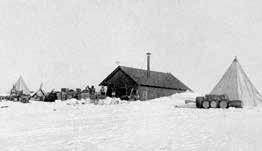
The men cheered. Pots clinked as the men talked about their upcoming journey. It would be hard, but they were ready.
“What’s for dinner tonight?” Oscar asked. He was an excellent skier. Part of the men’s journey would be made on skis.
“Penguin meat!” someone said. Oscar grinned. At the camp, the explorers ate penguin and seal meat. This made them healthy and strong, so they could survive the upcoming journey. Without these dishes, they were at risk of getting sick later on.
The cupboards and shelves in the cabin

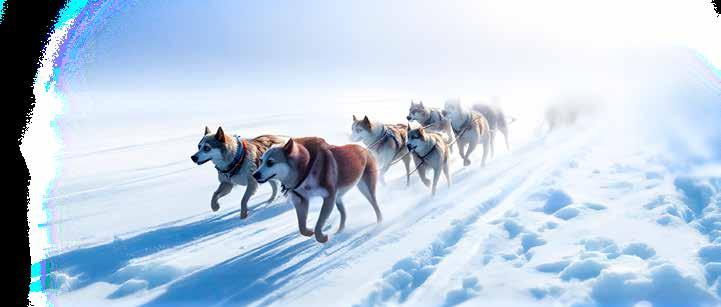
1. What animals did the team from Norway use on their journey? {dogs}
2. What was goal of the Norwegian team? {to get to the South Pole first}
were lined with silver cans. Every can was sealed tightly. The men would bring these cans with them on their trip. They would not go hungry.
Outside, the snow swirled. Inside the cabin, the team made last-minute preparations. They were ready to face whatever challenges the South Pole would bring.
The next morning, the men lined up with their dogs and sleds.
“We camped so much closer to the Pole than the British,” Oscar said. The other men laughed. “What were they thinking?”
The dogs barked, eager to get underway. “There’s no time to waste,” Roald said. “We must beat the British!"
And so began the 1,800-mile-long journey. They had five men, fifty-two dogs, and four sleds. The dogs pulled them along quickly on lightweight sleds. The first 150 miles passed faster than expected.
“I don’t know why the British don’t use dogs!” Roald laughed. “We hardly need to use our feet. This is so easy!”
The others smiled. They were quite fond of their dogs and looked after them like family members. In turn, the dogs were helpful in finding food and guiding them along the route.
As the weeks passed, the journey became more difficult. The air was thick with snow and fog. They faced days of storms and freezing temperatures. Would they ever make it to the South Pole?
Roald was terrified that the British would make it to the South Pole before them. That would mean that Norway had lost the race.
One day, Roald checked his compass. His eyes opened wide. They had reached the most southern point in the world.
“We’re here!” he shouted.
The team cheered. Then came the most important part of their journey — planting the flag. Roald decided that this special
1. How did the group travel to the South Pole? {They had packs of dogs pull them on sleds.}
2. About how long do you think it took the team to reach the South Pole? What quote from the text gives a clue? {“as the weeks passed” - at least a few weeks}
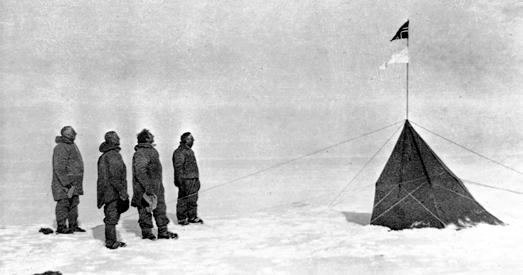
moment would be shared by all the members of the team. They had risked their lives and stuck together through tough times. Five cold, frostbitten hands gripped the flagpole. Together, they raised the flag at the South Pole.
"We plant you here, dear flag, at the South Pole!”
This moment would stay with them forever.
Exploring the South Pole: Camp Polheim
"Look at this place!" Oscar exclaimed. Snow blew around like a giant snow globe. The ground was frozen solid.
"It's just endless snow and ice!" another man cried. "We can't see anything else for miles!"
The South Pole was a giant, frozen desert. Snow and ice sparkled in the sunlight. The icebergs and glaciers were huge and majestic Overhead, the sky was pale blue, with wispy clouds.
Roald sent his men to check their location. When the men returned, Roald carefully
1. Why do you think the author chose to compare the South Pole to a snow globe? {A snow globe is very pretty and picture perfect. It also has snow flying around everywhere, and the author wants to show that it was pretty and snowy.}
2. What are glaciers? {giant boulders/mounds made of ice}
compared their compass readings. He smiled and pointed at a spot.
“This is the closest we can get to the South Pole. Let’s set up camp here!”
Putting up their tent was challenging. The wind was so strong, it felt like it could blow them away! They hammered in strong stakes to keep the tent from flying away. A tall central pole kept it standing despite the fierce Antarctic winds.
"I name this tent Camp Polheim!" Roald announced. Inside their tent, the five explorers slept close together in a row. It was cramped but warm. They huddled in their sleeping bags and ate small, flat oatcakes. They were tasteless and dry.
“Is there anything else to eat?” Oscar asked.
“Not in this camp!” Roald said. “We must ration our food. But tonight, we can open one can of dried meat.”
Oscar frowned. He missed the penguin meals they’d eaten in the camp in Norway.
Whenever the explorers stepped outside, it was like going on an adventure. The cold air was thin and crisp. The ground was slippery beneath their boots. There was a fresh, clean smell. The only sound was the howling wind.
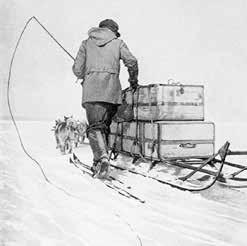
The place felt quiet and empty. There were no rustling leaves, no chirping birds, no other sounds of nature. They were all alone in this strange new world.
Three days later, it was time to go home. They had traveled to one of the most remote places on Earth and survived the journey.
The British team would arrive one month later to find the flag of Norway rippling in the wind. Norway had won the race!
Where did the British go wrong? The British team used sleds with motors and ponies to help them travel across the ice. However, things didn't go as planned. Their ponies struggled in the cold, and one of their sleds was lost in the sea when their equipment was unloaded. They faced terrible weather and didn't have enough supplies. When they finally reached the South Pole in January 1912, they discovered that the Norwegian team had beaten them to it. The British team faced more challenges on their return. They had to deal with extreme cold, exhaustion, and lack of supplies. Many of them did not survive the journey.
1. How did the food in Camp Polheim compare to Framheim? {it was better in Framheim- they had fresh meat but in Polheim they had dry oatcakes and dried meat}
2. Why did the British lose? {they used ponies, had bad weather, they didn’t have enough supplies}
3. Describe Camp Framheim and Camp Polheim. What were some differences between them? {Framheim was their base camp where they prepared for their journey- it was a real cabin with supplies, Polheim was a camp they were in for only three days- it was a tent that was squishy, and had worse food}
Compare and contrast Camp Framheim and Camp Polheim. Fill in the chart. Use detailed descriptions.
Type of lodging:
Temperature indoors:
Food in the camp:
Smells like:
Sounds like:
How it looks outdoors:
Cabin
Warm fire by the stove
Lots of food in cans, cooked meat Burning coal and wood
Sound of pots clinking
Snow swirled
Answer the questions.
1. Who is the main character?
a. Robert Scott
b. Roald Amundsen
c. Oscar
d. The other men on the Norway team
2. What is the climax of the story?
a. The team huddles by the stove in Framheim.
b. The team returns home to Norway.
c. The team plants a flag in the South Pole.
d. The team is pulled by dogs on sleds.
Tent, with tall pole in the middle
Cramped but warm inside the tent
Dry oatcakes and food from cans
Fresh clean smell
Quiet, with just howling wind
Endless snow and ice, strong winds
Persuasive writing is used to convince the reader of something. It includes an argument, reasons to support it, and evidence to prove those reasons.
What do you think about exploring and adventures? Write a persuasive paragraph convincing the reader of your opinion.
1. Write your argument. What do you want to convince the reader of?
It is fun to go on an adventure exploring parts of the world.
2. Write two reasons to convince the reader to agree with your argument. For each reason, add evidence (facts or examples).
Reason 1:
You can travel to places you’ve never been to.
Evidence 1:
3. Write a sentence explaining each detail.
Reason 2:
Evidence 2:
When the explorers planted the flag, they cheered and were happy.
The explorers from Norway had never been to the South Pole, and it was beautiful. It is fun to go on an adventure exploring parts of the world.
Topic Sentence (argument):
Body Sentence 1 (reason 1):
Body Sentence 2 (evidence 1):
Body Sentence 3 (reason 2):
Body Sentence 4 (evidence 2):
Concluding Sentence:
4. Write it as a paragraph.
For one, you can travel to places you’ve never been to. For example, the explorers had never been to the South Pole. In addition, it feels good to accomplish a goal.
When the explorers planted the flag, they cheered and were happy.
In conclusion, there are lots of reasons why you should go on an adventure. It feels good to accomplish a goal.
It is fun to go on an adventure exploring parts of the world. For one, you can travel to places you’ve never been to. For example, the explorers had never been to the South Pole. In addition, it feels good to accomplish a goal. When the explorers planted the flag, they cheered and were happy. In conclusion, there are lots of reasons why you should go on an adventure.
Build a diorama.
1. Choose one camp from the story.
2. Decorate the inside of a shoebox to look like that camp. Use 3D decorations.
Circle the correct answer.
1. Which word means gathered closely together, often due to cold or fear?
a. Wispy
b. Huddled
c. Majestic
d. Fierce
2. The hikers were lost and needed a to find their way back to camp.
a. ration
b. compass
c. stakes
d. majestic
3. Which word means having a grand and impressive appearance?
a. Huddled
b. Compass
c. Majestic
d. Wispy
4. Which of the following is NOT wispy?
a. A thin cloud
b. A thick blanket
c. A strand of hair
d. A bit of smoke
5. Which word means pegs used to fasten a tent to the ground?
a. Stakes
b. Ration
c. Remote
d. Huddled
6. The storm was , with strong winds and heavy rain.
a. rationed
b. huddled
c. majestic
d. fierce
7. Because we didn’t have much food, we had to our meals.
a. ration
b. compass
c. stake
d. wispy
8. Which of the following is NOT remote?
a. A small, isolated village
b. A busy city center
c. A deserted island
d. A far-off galaxy
Circle the correct answer.
1. What was the name of the Norwegian leader? (detail)
a. Robert Scott
b. Roald Amundsen
c. Oscar
d. None of the above
2. What was the effect of the strong winds on the explorers' tent? (cause and effect)
a. It made it hard to sleep.
b. It made it hard to put the tent up.
c. It blew the tent away.
d. It made it colder inside the tent.
3. How did the explorers feel about their journey to the South Pole? (inferencing)
a. Excited and adventurous
b. Scared and nervous
c. Bored and tired
d. Angry and frustrated
4. What is the main idea of the story? (main idea)
a. The Norwegian team's journey to the South Pole
b. The dangers of exploring the Antarctic
c. The importance of teamwork
d. The beauty of the South Pole
5. What happened right after the explorers reached the South Pole? (sequencing)
a. They set up camp.
b. They planted a flag.
c. They went home.
d. They ate dinner.

6. What does the word "cramped" mean in the sentence "It was cramped but warm"? (context clues)
a. Comfortable
b. Spacious
c. Crowded
d. Empty
7. Compare and contrast the Norwegian team and the British team. (compare-contrast)
a. Both teams were led by British explorers.
b. Both teams used dogs to pull their sleds.
c. The Norwegian team was larger than the British team.
d. The Norwegian team reached the South Pole first.
8. Which of the following is a fact? (fact vs. opinion)
a. The explorers were brave.
b. The explorers used sleds to travel to the South Pole.
c. The dogs were friendly.
d. The journey was scary.
Unit 5: Literary Elements
Lesson 18: Character Development
Unit Goal Trajectory:
Compare and contrast literary elements within or across texts.
1. Identify characters, settings, and the plot using details from the text. (Lesson 1)
2. Compare and contrast two characters in a text. (Lesson 2)
3. Find the theme of a text. (Lesson 3)
4. Explain how words, details, and/or actions in the story support the theme. (Lesson 3)
5. Compare and contrast two stories in the same genre. (Lesson 4)
Have you ever met a character in a book that you felt you really knew? Maybe they were brave, funny, or even a bit grumpy. Those qualities that make a character unique are called character traits.
Characters traits describe a person or character’s personality.
Note: A character trait is not a feeling. A feeling tells about the character at a particular time. Feelings come and go. A character trait describes how the character acts in general.
Example: A character who feels happy (feeling) might be friendly (character trait). A character who feels worried (feeling) might be insecure (character trait).
Authors don't always tell us directly what a character's traits are. Instead, they give us clues through the character's feelings, thoughts, actions, and conversations.
Read the following passage about Maya. Then, answer the questions.
1. Maya frowned at the misshapen lump of clay in her hands. She was frustrated. It was supposed to be a butterfly, with colorful wings and antennae. So far, it looked more like a lumpy potato.
2. Suddenly, she had an idea! Grabbing a nearby twig, she began carving feathers onto the clay. A small grin spread across her face. Maybe a butterfly wasn't the best first project.
3. "Hey, Maya! Can I help?" asked her little brother. Maya’s smile vanished. "No way! This is for the school art contest, and I need to win!"
4. As the afternoon wore on, Maya thought about stopping. She was hungry. Then, she thought about other projects that she never finished after taking a break. She decided to continue despite her hunger.
Circle the word that best completes each sentence.
→ In section 1, Maya’s feelings show that she is (impatient / bossy).
→ In section 2, Maya’s (conversations / actions) show that she is creative.
→ In section 3, Maya’s (conversations / actions) show that she is bossy.
→ In section 4, Maya’s thoughts show that she is (honest / determined).
Circle the correct answer.
What is something unexpected about Maya’s character in the story?
a. She stays impatient the whole time.
b. She is bossy toward her brother.
c. At first, she is impatient, but then, she becomes determined.
d. At first she is creative, but then she is bossy.
To explain this unexpected behavior, let’s look at what motivates Maya. Notice that Maya really wants to win the contest. It was this goal that led her to change from acting impatient to acting with determination.
Students may confuse feelings and character traits.
Explain that feelings tell something about the character now. Character traits tell what the character is generally like.
Feelings are like the weather in New York today. Character traits are like the climate in New York.
Examples:
• A character who gets angry (feeling) might be impatient (character trait)
• A character who feels happy (feeling) might be friendly (character trait).
1. Hurls, verb
S Throws A Holds
E A ball thrown with force; Accusations told over one after the other; Snowballs thrown quickly Q Can you describe a scene where someone hurls insults at another?
2. Flicker, verb
S Blink A Steady
E Candlelight; Light Bulbs going on for a second and then off Q Can you describe what a flicker of hope in someone’s eyes looks like?
3. Spectacles, noun
S Glasses E A pair of eyeglasses Q What kind of spectacles might be worn at a costume party?
4. Commotion, noun
S Disturbance A Calm
E When someone yells “Fire” in a big crowd; When exciting news is told to a group; A loud group talking Q What kind of things might lead to a classroom commotion?
5. Chaos, noun
S Confusion A Order
E A traffic jam; When a classroom is a mess with no control Q Can you think of a historical event that led to chaos?
6. Coward, noun
S Chicken A Hero
E Someone who is afraid of something; Someone who is not brave enough to do something Q How might a coward act in a dangerous situation?
Match the bolded words with their definitions. Highlight context clues.
The boy hurls a stone into the pond, making a big splash.
The old lamp began to flicker before finally burning out.
The old man had big spectacles perched on his nose.
A loud commotion outside woke everyone up.
After the hurricane, there was chaos, with trees and buildings damaged.
He felt like a coward because he was scared to stand up to the bully.
The kind man gave alms to the poor beggar.
He struggled to lift the hefty box onto the table.
loud noise and excitement
eyeglasses
someone who is afraid of danger or pain
complete disorder and confusion
throws with force
emit a weak, unsteady light
large or heavy
money or goods given to someone who is poor
hurls [herlz]; flicker [FLIK-er]; spectacles [SPEK-tuh-kulz]; commotion [kuh-MOH-shun]; chaos [KAY-ahs]; coward [KOW-erd]; alms [ahmz]; hefty [HEF-tee]
7. Alms, noun
S Donation E Charity that collectors ask for; Money given to the poor
Q Why do people give alms to the poor?
8. Hefty, adjective
S Heavy A Light E A heavy suitcase; A large and strong person; A fat person Q How might a hefty price tag affect a someone’s decision to buy something?

Author: M. Frohlich Genre: Historical Fiction
In the Victorian Era (1830-1900), children often lived two completely different lives. The rich dressed in fine clothes and followed strict rules, while the poor worked tough, dangerous jobs just to survive. Step into the busy streets of old London with James and Manny, an unexpected pair who bond over their struggles and adventures. As they dodge bullies and stand up for each other, they’re about to discover just how much their friendship might cost. Are they ready for the challenges ahead?
The story we will read today takes place in the 1800s during a time called the Victorian Era. Although the time period is real, the story did not actually happen. Stories that take place in specific time in history but are still fiction are called historical fiction.
In the Victorian Era, it was not unusual for a child to have a job and work. If their family was poor, they needed to work hard, dangerous jobs in order to get money. On the other hand, if a Victorian child’s family was rich, they lived fancy lives. They were raised by nurses and had to call their father’s “Sir.” There were lots of strict rules for them to follow. In this story, we will read about two Victorian children who came from different families. As you read, pay attention to the differences between them.
The London cobblestones glisten in the rain. James pays no heed to the mud splattering his new pants. He darts through narrow streets, almost getting run over by horse-drawn carriages.
“Run, James, run!” he hears Manny shout.
“Running back to your fancy old house, are you, coward?”
Boys shout and jeer. The pounding of their footsteps is getting closer. James glances behind him, his heart racing. Two boys in tattered clothing, their faces blackened with soot, are right behind him.
“Think you can run in those shiny shoes of yours?”
Someone hurls a stone, missing his head by inches. He stumbles over the legs of a beggar on the side of the road, then squeezes through a group of peddlers. He looks behind him again and keeps running.
“Watch your way, boy!” a tall peddler shouts.
He waves a fist in James’ direction.
“Sorry!” James mutters. He dashes toward the reeking alleyway behind the butcher’s place. On shaky legs, he squeezes into a narrow opening between two brick walls. He hopes no one can see him. Beads of sweat trickle

1. What type of house does James live in? How do you know? {a fancy house - the boys chasing him say it}
2. Are the boys chasing James rich or poor? How do you know? {poor - they are wearing tattered clothing, faces dirty, and make fun of James for being rich}
3. Who do you think Manny is? {Answers will vary; James’ friend}
down his back as he heaves great gulps of air. Frowning, he holds his hand over his nose to block out the stench.
What will Mum say when she sees me? he wonders.
He waits another few minutes, then peeks out to make sure the coast is clear. He sighs in relief. His bullies are nowhere in sight.
“Alms for the poor?” A little boy holds out a hand to James. His ragged clothing hangs loosely from his skinny shoulders down to his bare feet.
The boy reminds James of Manny. He met Manny a year ago, when he was working as a street sweeper. Manny’s friendly greeting had caught James by surprise, and he decided to visit the happy boy the next day. The two boys had become instant friends.
James digs a sweaty hand into his pocket. “Here you go,” he says. He tosses a penny into the boy’s hand, just as his mother had done to Manny.
“Oh, you can do better than that, James!” says a familiar voice.
“Manny!” James says with relief. “How did you manage to hold them up?”
Manny holds up a hefty fist. “No one calls my friend a coward!”
“Manny! Your lip is bleeding!” “Relax, James! Don’t you remember these streets used to be my home?” As usual, Manny brushes off his concerns, and they continue walking. “I can handle it. But you… you’re a different story.”
James laughs as the boys approach Percy Street. How different these large homes are from the alleyway they have just left.
“I still can’t believe Mum agreed to adopt you!” James says. “She probably saw how lonely I was, being an only child. And I think she was sorry for you.”
James notices a flicker of pain cross Manny’s face. He regrets bringing up the
1. Do you think James’ and Manny’s friendship would’ve been likely in the Victorian Era? Explain. {Answers will vary. Probably not, James grew up rich, and Manny grew up poor.}
2. What do you think it means that “As usual, Manny brushes off his concerns”? {Manny is usually not worried about hanging out in the streets.}
memory of Manny’s parents, who passed away from cholera in 1854. But Manny’s smile quickly reappears.
“I’m just glad you’re here, Manny. Heaven knows, you’re the only friend I’ve got!”
“Boys.” James and Manny look up. Bennet, the butler, stands at the entranceway of James’ house. His features are as stiff as the cobblestones under their feet. “Mrs. White has been waiting for you to arrive,” he says. “Please see her in the sitting room at once!”
James’ stomach sinks. What will his mother say? He trudges toward the sitting room, Manny at his side.
His mother’s eyes widen. She looks from James to Manny and back again. “Goodness, what on earth happened to you two?”
James runs into his mother’s arms. “You should have seen it, Mum,” he cries. “They would have beaten me dead, if not for ”
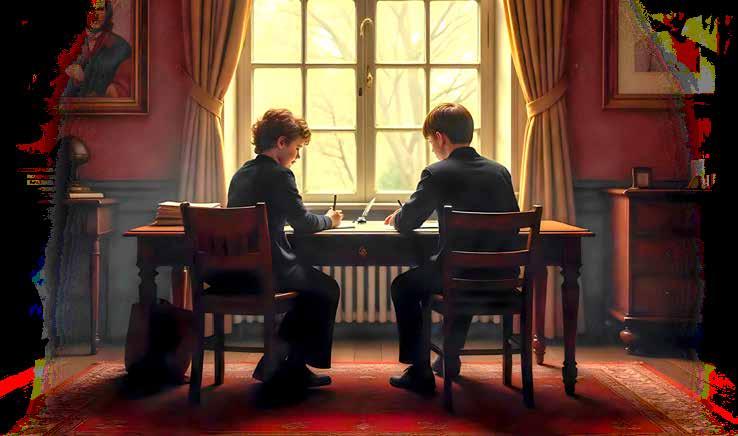
“They’re just jealous, that’s all,” Manny says. “James is fine!”
Mrs. White looks again at both of them, one eyebrow arching upward. “I want to hear more about this later, boys,” she says. “But right now, you’d better wash up before Sir Peppersmith arrives!”
The boys rush to get ready and soon find themselves facing their tutor. Sir Peppersmith looks sternly at them.
“In the seventeenth century,” he says, “the English monarch was busy with the conflicts of Parliament.”
Dipping his fountain pen carefully into the inkwell, James writes the dates in his copybook. He glances at Manny’s book. The open page is blank.
Manny is looking at the pocket watch dangling from Sir Peppersmith’s fingers. His
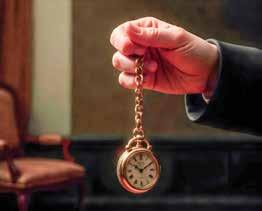
eyes move back and forth, back and forth, along with the watch. James quickly returns his attention to Sir Peppersmith.
“The civil wars that resulted caused considerable loss to our country…”
1. Who is Mrs. White? {James’ mother}
2. Why do Mrs. White’s eyes widen when she sees the boys?
{She doesn’t expect them to be dirty and a bit beaten up. She doesn’t approve of them running around the streets with the poor boys.}
Sir Peppersmith drones on, swinging his pocket watch back and forth like a pendulum. He speaks loudly, as if there’s a classroom of a hundred students in front of him and not just two boys.
“I have a question,” Manny says.
Sir Peppersmith glares at him over his spectacles
“What’s that watch made of?” Manny asks.
Sir Peppersmith coughs. “Excuse me, young man?”
“The one in your hand. It’s real gold, ain’t it?”
“Indeed!” Sir Peppersmith slides the watch into the desk drawer and slams it closed. Bang! Twirling his long mustache around his finger, he looks again at Manny. “Now, let’s return to our lesson!”
Manny stands up. “I need some fresh air.”
Sir Peppersmith freezes mid-twirl, his
mouth forming a large O.
James looks longingly at Manny. How he wishes he could join his friend. But what would Sir Peppersmith say?
Bennet appears at the doorway. “Teatime, gentlemen, in the sitting room.”
“Er, all right then,” Sir Peppersmith says. “Let us resume our lesson after tea!”
James heads to the sitting room, still thinking of that day’s events. How close he had been to being beaten to a pulp! As usual, Manny had rescued him from those cruel boys. If only I was as brave as Manny, James thought. I wish I could repay him somehow.
His thoughts are interrupted by a loud shout.
“My pocket watch!” Sir Peppersmith cries. “It’s gone!” He pats his pockets furiously.
“You put it in the desk drawer,” James says. He puts down his strawberry tart.
“It’s not there! It’s gone!” Sir Peppersmith’s eyes dart around the room. His gaze stops abruptly at the window. “Where is that boy?!”
James freezes. He remembers Manny’s interest in the watch, and he fears the accusing look in his tutor’s eyes.
1. What is Sir Peppersmith’s reaction to Manny’s questions? How do you know?
{He was surprised - his mouth formed a big O. He was a bit annoyed - he slammed the drawer closed.}
2. Who does Sir Peppersmith think stole the watch? {Manny}

Mrs. White rushes into the room, hearing the commotion. “What’s this about?” she asks.
“Call the police!” Sir Peppersmith shouts. “I’ve been robbed!”
Shortly after, two police officers arrive along with a dog. James sits quietly on the sofa and nibbles at his nails. Poor Manny, he thinks. He mustn’t get arrested!
“Manny!” Mrs. White says when Manny walks through the door. “Do you know anything about ”
“It was him!” Sir Peppersmith’s face is bright red, and his eyebrows form a V. He points a stubby finger at Manny. “Here is the culprit!”
Manny looks around in confusion. “What is going on?” he asks.
“You know exactly what this is about!” Sir
Peppersmith shouts. “My gold pocket watch! It’s gone!”
“But I don’t understand,” Manny says as the officers approach him. “I wasn’t even here!”
“Sorry, boy,” an officer says. “We’ll have to take you to the station.”
Mrs. White looks horrified as Manny is led to the door. “I’ll accompany him,” she says.
“Stop!” James shouts.
“James!” Mrs. White turns to her only son. “What is it?”
James steps forward, determined to save his friend. “It wasn’t Manny!” he says. “It was… me.”
“James!” his mother cries. “What are you saying?!”
James looks down as all eyes in the room
1. Do you think James stole the watch? Why or why not?
{Answers will vary.}
turn to him. “I… I take the blame.” He looks at the officer holding onto Manny. “Take me instead!”
Mrs. White inhales sharply.
“This is absurd!” Sir Peppersmith shouts. “We must see to justice at once!”
In the midst of all the chaos, Bennet enters the sitting room, tea tray in hand.
That’s strange, James thinks. Bennet doesn’t usually serve the tea.
“Woof, woof!” The dog barks wildly as Bennet passes.
“Settle down, Felix!” the officer shouts. But Felix pays no attention and continues barking at Bennet.
The second officer grabs Bennet by the shoulder. “Not so fast, Mister!”
Crash! The delicate tea tray falls to the floor. The china smashes to pieces.
The officer shoves his hand into a shocked Bennet’s pocket. Before the startled eyes of everyone present, he takes out a gold pocket watch.
“Well, well, what have we here?” the officer says.
“Looks like we caught the real thief!” the other officer says. He lets go of Manny and grabs a wriggling Bennet.
Mrs. White’s hand flies to her mouth. “Bennet! Of all people ”
Bennet’s face twists into an ugly sneer as he is led out the door.
Manny and James look at each other. “I can’t believe ” they say at the same time, and laugh.
“And I think,” Sir Peppersmith says, polishing his pocket watch with a handkerchief, “that we had better return to our lessons straight away!”

1. Why does Felix the dog bark at Bennet? {He could sense that Bennet stole the watch.}
2. Why did James admit to taking the watch if he didn’t steal it? {He wanted to protect his friend.}
Answer to compare and contrast James' and Mannys' character traits.
1. Circle the character trait shown by the quote. “If only I was as brave as Manny, James thought.”
1. Circle the character trait shown by the quote. “No one calls my friend a coward!”
2. Which quote shows that James is selfless?
a. “It wasn’t Manny!” he says. “It was… me.”
b. “What will Mum say when she sees me? he wonders.”
c. “The two boys had become instant friends.”
d. “On shaky legs, he squeezes into a narrow opening.”
3. Why do you think James said he stole the watch?
a. He was expecting a reward.
b. He stole the watch.
c. He knows Bennet has the watch.
d. He is a kind and loyal friend.
2. Which quote shows that Manny is brave?
a. “‘They’re just jealous, that’s all,’ Manny says.”
b. “He points a stubby finger at Manny. ‘Here is the culprit!’”
c. “Manny brushes off his concerns... ‘I can handle it.’”
d. “‘I can’t believe,’ they say at the same time.”
3. Why do you think Manny is interested in the watch?
a. He wants to steal it.
b. He grew up poor and thinks the watch is fascinating.
c. He doesn’t like living with the Whites.
d. He is a kind and loyal friend.
Use a separate piece of paper to draw a Venn diagram that compares and contrasts James' and Manny’s character traits. Add examples from the text. Hint: Reuse information from the questions above. What else do we know?
First person is when the narrator is part of the story and uses words like “me” or “I.”
Third person is when the narrator is not part of the story and uses words like “he” or “she.”
Write a paragraph telling the story in first person from Manny’s perspective.
1. Decide if you will tell the whole story or just one part. Write what happens in the beginning, middle, and end.
Beginning:
Manny is distracted during lessons.
Middle:
End:
He is accused of stealing the watch, but James admits to it. Bennet was caught as the the real thief.
2. Write an outline. Write one to three sentences each for the beginning, middle, and end. Remember that Manny is telling the story! Use words like “me,” “I,” or “my.”
Beginning:
Today during lessons with Mr. Peppersmith, I was really distracted.
When I came back, he started yelling and accusing me of stealing his watch. I had no idea I kept watching him play with his pocket watch. So, I took a break. what he was talking about. Then, James admitted to stealing the watch. I think he did it to save me.
Middle: End:
I was right. In the end, Bennet was the thief. James is a great friend.
3. Write a paragraph.
Today during lessons with Mr. Peppersmith, I was really distracted. I kept watching him play with his pocket watch. So, I took a break. When I came back, he started yelling and accusing me of stealing his watch. I had no idea what he was talking about. Then, James admitted to stealing the watch. I think he did it to save me. I was right. In the end, Bennet was the thief. James is a great friend.
LESSON PRACTICE VOCABULARY STORY REVIEW ACTIVITY ASSESSMENT
You are the illustrator! Pick a scene from the story and draw it. Make sure to include details from the story.
Circle the correct answer.
1. The angry customer his grocery bags across the parking lot.
a. hurls
b. commotion
c. spectacles
d. chaos
2. The candlelight began to as the last bit of wax melted away.
a. flicker
b. chaos
c. hurls
d. commotion
3. Which word means a pair of eyeglasses?
a. Commotion
b. Spectacles
c. Chaos
d. Flicker
4. Which word means a confusing state of disorder?
a. Spectacles
b. Chaos
c. Commotion
d. Flicker
5. Which is an example of a commotion?
a. A gentle whisper in the library
b. A quiet conversation between friends
c. A dog calmly wagging its tail
d. A group of people shouting and arguing
6. What is a coward?
a. Someone who enjoys taking risks
b. Someone who is afraid to face danger or difficulty
c. Someone who is always prepared
d. Someone who is always calm
7. Who might receive alms?
a. A wealthy business owner
b. A person who is poor
c. A famous person
d. A king
8. How can you tell if something is hefty?
a. By its color
b. By its smell
c. By its weight
d. By its sound
Circle the correct answer.
1. What is Bennet’s job? (detail)
a. He is a policeman.
b. He is a tutor.
c. He is a butler.
d. He is a cook.
2. Why does the officer arrest Bennet instead of Manny? (cause and effect)
a. James told on him.
b. The dog alerted the officer.
c. The watch was found in his pocket.
d. He admitted to stealing it.
3. What is the setting? (inferencing)
a. A city in Europe today
b. England in the 1800s
c. A dangerous city in America
d. A rich neighborhood in the year 2000
4. What is the main event of the story? (main idea)
a. James and Manny get into trouble with their teacher.
b. James learns about the English Civil War.
c. James and Manny are chased by bullies.
d. James takes the blame for a crime he didn't commit.
5. How does the story end? (sequencing)
a. James is punished for stealing the watch.
b. The police are called.
c. The real thief, Bennet, is caught, and the watch is returned.
d. James and Manny are expelled from their lessons for making noise.
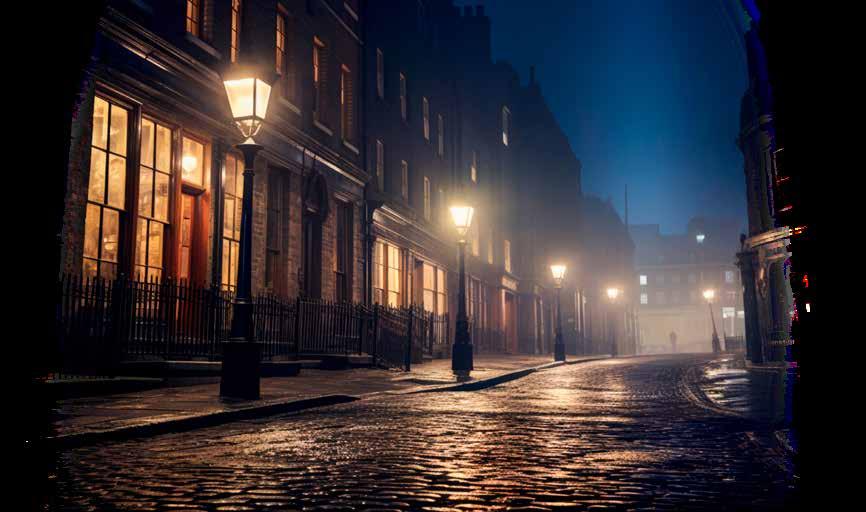
6. "He waits another few minutes, then peeks out to make sure the coast is clear." What does "coast is clear" mean in this context? (context clues)
a. The weather is calm and sunny.
b. There are no birds singing nearby.
c. The path ahead is safe to travel on.
d. The water at the beach is see-through.
7. How are James' and Manny's upbringings different? (compare-contrast)
a. They both grew up wealthy.
b. James comes from a wealthy family, while Manny used to be homeless.
c. They both grew up poor.
d. James is older than Manny and has more responsibilities.
8. Which is a fact from the passage? (fact vs. opinion)
a. Manny is a troublemaker because he interrupts Sir Peppersmith's lesson.
b. The watch Sir Peppersmith carries is made of real gold.
c. James is a coward for running away from the bullies.
d. Being chased by bullies is a scary experience.
Unit 5: Literary Elements
Lesson 19: Theme
Unit Goal Trajectory:
Compare and contrast literary elements within or across texts.
1. Identify characters, settings, and the plot using details from the text. (Lesson 1)
2. Compare and contrast two characters in a text. (Lesson 2)
3. Find the theme of a text. (Lesson 3)
4. Compare and contrast two stories in the same genre. (Lesson 4)
Today, we are going to learn how to find the theme of a story! A theme is an important idea that appears throughout a story. A theme is not what happens in the story (like the main idea). Instead, it’s a lesson or moral we can apply to real life. A theme is the author’s opinion. The reader doesn’t have to agree with it.
Common Themes:
→ Be careful what you wish for.
→ Things aren’t always the way they seem.
→ Honesty is the best policy.
→ Hard work pays off.
→ To have a good friend, you must be a good friend.
→ Face your fears.
Themes are not written straight out in the story. They are usually easier to find once you’ve finished reading.
A boy was given permission to put his hand into a pitcher to get some hazelnuts. But he took such a great fistful that he could not draw his hand out again. There he stood, unwilling to give up a single nut and yet unable to get them all out at once. Upset and disappointed, he began to cry. "My boy," said his mother, "be satisfied with half the nuts you have taken, and you will easily get your hand out. Then perhaps you may have some more hazelnuts another time."
what happens as a result.
The Boy and the Nuts
→ Problem: The boy wanted lots of hazelnuts.
→ How he reacts: He grabs too many.
→ What happens: His hand gets stuck, and his mother tells him to let some nuts go.
→ Theme: Don’t attempt too much at once.
Are meant to be applied in real life
Are the author’s opinion Are a lesson or moral
Can be repeated in many stories
Stories can have more than one theme.
x Are not the same as the main idea
x Are not the reader’s opinion
x Are not usually written straight out in the story
Read the story. Then, answer the questions to find the theme.
Arich old farmer, who felt that he did not have many more days to live, called his sons to his bedside.
"My sons," he said, "listen carefully to what I have to say. Do not part with the estate that has belonged to our family for so many generations. Somewhere on it is hidden a rich treasure. I do not know the exact spot, but it is there, and you will surely find it. Leave no spot unturned in your search."
The father passed away, and the sons set to work digging with all their might. They turned up every foot of ground with their spades and went over the whole farm two or three times.
They did not find hidden gold, but at harvest time, they pocketed more money than any of their neighbors. They then understood that the treasure their father had told them about was the wealth of a large crop. Indeed, they had found the treasure.
1. What is the problem/what do the characters want?
2. How do the characters react to the problem?
3. What happens next?
4. What is the theme?
They want to find the treasure.
They work hard digging.
They don’t find treasure, but lots of crops grew. and they made lots of money.
a. There are things that are more important than money.
b. It is better to work in a team than to work alone.
c. Hard work pays off.
d. Family is precious.
Students may have a hard time identifying the theme from the problems in the story.
Tell students to think about what happens after the character responds to the problem. If what happens is good, the character’s reaction is likely the theme. If what happens is not good, the opposite of the character’s reaction is likely the theme.
Example:
• Problem - A kid gets in trouble in school.
• Reaction - He is not honest about it with his parents.
• What happens nextHe gets in more trouble
Since what happens is not good, we can assume that the theme is the opposite of the reaction. The reaction is that he was not honest so the theme is “honesty is the best policy.”
In the example on the practice page, the ending is good (they found the treasure). Therefore, we can assume that the character’ reaction is the theme. The reaction is that they worked hard, so the theme is “hard work pays off.”
1. Desires, verb
S Wants A Dislikes
E When you want a new toy; A father who wants to be with his kids; Someone who wants to be a fireman
Q What are some common desires that people share?
2. Century, noun
E Someone who is 100 years old; This period of 100 years
Q What might life be like a century from now?
3. Adorned, adjective
S Decorated A Plain
E A person wearing jewelry; A house decorated with beautiful decorations for a party Q Can you think of a natural place that is adorned with colorful flowers?
4. Sidelines, noun
E The edge of a playing field; Watching something from the outside; A job done in addition to a main job
Q What does it mean to be on the sidelines of a major event?
5. Tense, adjective
S Tight A Relaxed
E Strings on a violin pulled tight; Tight muscles; When you are nervous
Q How does your body feel when you’re tense?
6. Frantic, Adjective
S Worried A Calm
E Freaking out when you can’t find something; Calling 911 quickly
Q How can frantic behavior be counterproductive (not helpful)?
Match the bolded words with their definitions. Highlight context clues.
The boy desires a bicycle for his birthday because he loves to ride.
Over a century ago, people traveled by horse and carriage.
Her hair was adorned with colorful ribbons.
The injured player was forced to watch the game from the sidelines
She was tense as she waited for the doctor to tell her the results of the test.
He became frantic when he couldn't find his homework.
He was furious when he found the broken vase.
The baby was babbling, making lots of cute sounds.
a period of one hundred years
nervous or anxious
extremely angry
talking fast in an excited way or in a way that is not understood
a position where someone is watching instead of participating wants or wishes decorated
very excited or desperate desires [dih-ZY-urz]; century [SEN-chuh-ree]; adorned [uh-DORND]; sidelines [SYDE-lynes]; tense [TENS]; frantic [FRAN-tik]; furious [FYOO-ree-us]; babbling [BAB-ling].
7. Furious, adjective
S Mad A Calm E When someone bothers you a lot; When someone makes you very mad; When you are feeling super angry Q How can you deal with a friend who is furious with you?
8. Babbling, verb
S Chattering A Pronouncing
E Sounds babies make before they talk; Talking on and on about something; The bubbling sound of a stream
Q What is the difference between babbling and speaking?

Author: M. Jakubowicz Genre: Realistic Fiction
Debby dreams of living a life as dazzling as that of Amanda, the girl who seems to have everything. When she's invited to Amanda's big party, Debby makes a risky choice to feel more special. Will this decision bring her the happiness she seeks, or will it lead to trouble she didn't expect? And what will she learn along the way? Come along on Debby's journey to find out!
1. Although the story we will read today could be true, it isn’t. What genre do you think this story is? {realistic fiction}
2. In this story, the main character is jealous of her friend. Jealousy can sometimes cause a person to do things they wouldn’t normally do. Can you think of an example? {Answers will vary.}
As you read, pay attention to clues that hint to the theme.
When Amanda’s invitation comes in the mail, my first thought is: What is this for?
My second thought is: Maybe I shouldn’t go. But I have to go. The entire class will show up at Amanda’s class get-together, which will take place on Sunday in her huge backyard.
My third thought is: Maybe it will rain…
I look down at the sparkly invitation. Lucky Amanda, who lives in a mansion and has a cleaning lady who makes her bed every day. Lucky Amanda, who gets whatever her heart desires
Including the event of the century taking place at her house. Since when does our class have such big get-togethers, anyway?
I don’t want to miss it, of course but I don’t want to be there, either.
I spend the rest of that day worried about the upcoming get-together. Trust Amanda to think of a way to get us to come to her house so she can show off how the rich and famous live.
If only I could live in a house like Amanda’s. Dreamily, I stare out the window and wonder what it would be like to have a cook preparing gourmet meals every day. A housekeeper would stick to me like a shadow, making sure I never had to bend down or strain myself. A fully stocked basement would have every game a kid could desire.
Hmm…
“What are you thinking about, Debby?” my sister Sarah asks when she comes into the room.
I make a face. “I want to know what it’s like to live in a fancy house.”
Sarah stares at me, and then she bursts out laughing. “Are you serious, Debby? I don’t know if it’s as great as you think it is. I mean, a
perfect house doesn’t make a perfect life.” I look at her. It doesn’t?
Of course it does.
Sarah goes to do her homework, and I continue staring out the window. The trees shake their bare branches at me, reminding me that winter is coming. I imagine spending the cold months in Amanda’s huge house. I would never be bored in such a place.
Lucky Amanda… And unlucky me…
When Sunday rolls around, I peek out the window. A few clouds drift across a pale blue sky. A perfect day for a perfect girl…


1. What point of view is the story written in? Who is the narrator? {First, Debby}
2. What does Sarah think about living in fancy house? How does that compare to what Debby thinks? {Sarah thinks it isn’t as good as it seems; Debby wants to}
I sigh.
If only there was a way that I could also feel like perfect Amanda, if only for a few moments. My eyes dart around the room and land on Sarah’s jewelry box.
And that’s when it occurs to me.
Sarah has a new charm bracelet. It was gifted to her by a neighbor whom she helped during the summer. Sarah only wears it on special occasions.
Surely, Amanda’s get-together counts as a special occasion.
I picture myself at the party, my wrist adorned with glittering charms. Just imagine, plain and boring me wearing fancy jewelry!
Except… the bracelet isn’t mine.
I take a step toward the jewelry box and then another one. I’ve never borrowed Sarah’s things without permission, but I don’t think she’ll let me wear her expensive bracelet even if I do ask.
My hands drop to my sides. I can’t do this to her. I can’t do this to me.
Just then, my mother calls, “Debby! Are you ready? Suzy will be here in a minute.”
My heart races. Without thinking, my hand shoots out, opens the jewelry box, and grabs the bracelet. My other hand fastens it around my wrist. The sunlight streaming through the window plays with the beads, making them sparkle. Hurriedly, I shove the bracelet under my sleeve and run out of the room.
A honk sounds, and I dash out of the house, calling a hurried “bye” behind me. I slide into the car, my heart thumping.
I’m safe!
Ten minutes later, we pull up at Amanda’s house, where the get-together is in full swing.
I walk in, feeling both excited and nervous.
1. What do you think Debby means when she says, “I can’t do this to her. I can’t do this to me.”? {I can’t take Sarah’s bracelet because it wouldn’t be nice to take it without permission. It also wouldn’t be good for me to do the wrong thing.}
2. What conflict (problem) does Debby face? {She wants to feel rich, but she doesn’t own a fancy bracelet.}

I’ve never worn such an expensive piece before. What will Amanda think?
An image of my sister appears in my mind. Quickly, I push that picture away. Sarah will never know that I borrowed her bracelet for a few hours. Now is my time to feel fancy… like Amanda.
“Hi!” I say to Amanda. I notice that she’s wearing a new necklace. I pull up my sleeve just a bit, letting the bracelet slide down my wrist.
No one seems to notice. A sour taste fills my mouth.
Girls are busy talking, laughing, and tasting the treats spread out on a long table. I join them, but my heart isn’t in it. All I can think about is the bracelet.
What if Sarah finds out? Will she ever trust me again? Oh, why did I take the bracelet without permission?
I try to act as if everything is fine. But the bracelet is starting to feel like a heavy weight on my wrist – like handcuffs on the hands of a prisoner.
Amanda’s mother teaches us how to decorate cookies. My friends are busy oohing and aahing over the samples she shows us. I stay on the sidelines, watching. All I want is for this party to be over and for the bracelet to be safely back in my sister’s jewelry box.
When I get home, Sarah looks worried and tense. My heart pounds. Did she notice…?
“My bracelet!” Sarah cries when she sees me. “Debby, did you see it? I can’t find it anywhere!”

1. Why do you think Debby doesn’t enjoy the party? {no one notices her bracelet and she feels guilty}
2. What is Debby nervous about when she gets home? {if Sarah noticed that she took the bracelet}
My heart sinks. I can feel the heat rising up my face.
No way. No way.
This can’t be happening.
Yet it is. Sarah is standing there, frantic. She isn’t blaming me; she has no idea I took her bracelet.
But I know. I can’t admit to the truth now. She’d be furious at me, and my mother would be so disappointed.
Not to mention the way I feel about myself. I can’t risk anyone finding out what I did. I just can’t.
What should I do? What should I do?
I head quickly to the stairs, hoping to find some quiet in my room. I need quiet from Sarah’s search for her bracelet, quiet from my own racing thoughts.
The bracelet jangles, and I stop in my tracks. I turn around slowly, wondering if anyone heard that. Thankfully, my mother is busy talking to Sarah. Neither of them looks at me.
I make a run for the stairs, taking them two at a time. Once I’m safely in my room, I shut the door behind me.
What do I do now?
My mind works hard, trying to find a way out.
I could put the bracelet under a bed and pretend to find it.
I could let it drop behind the dresser and “discover” it lying on the floor.
I could —
The door opens. Sarah walks inside. She looks so sad that before I know what I’m doing, I pull the bracelet off my wrist and hand it to her.
“Here,” I say. “I’m sorry, I took this without permission, I never meant for this to happen. I don’t even know why I wanted to wear it so badly. It’s not like I’ll ever be anything like Amanda, anyway.” I’m babbling, but I don’t know how to stop myself.
I peek nervously at Sarah, knowing that I deserve whatever she does next. But strangely, I also feel relieved.
I squeeze my eyes shut, preparing for the worst.
“If you wanted to wear it, why didn’t you just ask?” Sarah says.
My eyes fly open. She doesn’t sound angry, just upset. And very, very disappointed.
“I don’t know,” I whisper. My eyes fill, and tears spill down my cheeks as I cry, “I’m so sorry.”
“I forgive you,” Sarah says. “But Debby, don’t do that again, okay?”
Then my sister – my big sister, who has shown me how big she really is – gives me a hug. A moment later, she steps back and fastens the bracelet around her own wrist.
She looks at me. I look at her. I think of how awful the party turned out to be. And I know that I’ll never consider doing anything like that again. I have what truly counts, right here in this room.
And I don’t need a bracelet to prove it.
1. Why do you think Debby babbles when she admits taking the bracelet? {She is feeling nervous and other emotions, which just make her talk and talk.}
2. What do you think Debby means when she says, “my big sister, who has shown me how big she really is”? {She is impressed that Sarah acted maturely and didn’t get upset at her.}
On the next page, answer the questions to find the theme of the story.
Read the story. Then, answer the questions to find the theme.
1. In the story, Debby wants something. Which quote shows her main problem?
a. “If only there was a way that I could also feel like perfect Amanda, if only for a few moments.”
b. “The entire class will show up at Amanda’s class get-together, which will take place on Sunday in her huge backyard.”
c. “Amanda’s mother teaches us how to decorate cookies.”
d. “I join them, but my heart isn’t in it.”
2. Which quote best shows what Debby does to get what she wants?
a. “I imagine spending the cold months in Amanda’s huge house.”
b. “I head quickly to the stairs, hoping to find some quiet in my room.”
c. “Without thinking, my hand shoots out, opens the jewelry box, and grabs the bracelet.”
d. “I could put the bracelet under a bed and pretend to find it.”
3. Which quote best shows what happens next?
a. “My friends are busy oohing and aahing over the samples she shows us.”
b. “The door opens. Sarah walks inside.”
c. “I’m babbling, but I don’t know how to stop myself.”
d. “I stay on the sidelines, watching. All I want is for this party to be over and for the bracelet to be safely back in my sister’s jewelry box.”
4. Which is NOT a theme in the story?
a. Hard work is more important than money.
b. Happiness and fulfillment come from within.
c. Being dishonest doesn’t pay off.
d. Family is precious.
The plot is the events that happen in a story. A plot contains an exposition, rising action, a climax, falling action, and a resolution.
Write a paragraph that compares Debby’s feelings in at least two events in the story.
1. Circle at least two events in the plot diagram that you will compare. Exposition Debby is going to a fancy party.
Rising Action
Debby takes her sister’s bracelet without permission.
Climax Debby is not happy at the party, and Sarah realizes her bracelet is missing. Falling action Debby admits to taking the bracelet. Resolution Debby’s sister forgives her.
2. Describe what Debby is feeling during each event. Explain why.
Event 1:
At first, Debby is excited since she has the opportunity to be fancy, but then
Event 2:
At first, she is nervous because she is scared of Sarah’s reaction, but then she is she feels uncomfortable and guilty because she took something without permission. relieved and feels better once she admits to taking the bracelet.
3. Write an outline. In body sentences, compare and contrast Debby’s feelings during the events.
Topic Sentence:
Body Sentence 1:
In the story The Bracelet, Debby’s feelings about taking the bracelet change. At first, Debby is excited when she takes her sister's bracelet.
Body Sentence 2:
But then, as time goes on at the party, and when Sarah realizes it’s missing, she doesn’t feel good at all.
Body Sentence 3:
In contrast, once Debby admits to taking the bracelet, she feels much better.
Concluding Sentence:
In conclusion, Debby learns that it doesn’t feel good to take something that isn’t yours.
4. Write a paragraph.
In the story The Bracelet, Debby’s feelings about taking the bracelet change. At first, Debby is excited when she takes her sister's bracelet.
But then, as time goes on at the party, and when Sarah realizes it’s missing, she doesn’t feel good at all. In contrast, once Debby admits to taking the bracelet, she feels much better. In conclusion, Debby learns that it doesn’t feel good to take something that isn’t yours.
LESSON PRACTICE VOCABULARY STORY REVIEW ACTIVITY ASSESSMENT
In the story, Debby learns to appreciate what she has instead of being jealous of others.
Write or draw a list of things in your life that you appreciate.
Circle the correct answer.
1. Which means strong feelings or wishes?
a. Sidelines
b. Desires
c. Frantic
d. Babbling
2. The old oak tree had stood for over a .
a. tense
b. furious
c. century
d. babbling
3. The tree was with colorful autumn leaves.
a. desires
b. adorned
c. tense
d. frantic
4. Which of the following would probably NOT cause someone to feel tense?
a. A peaceful sunny day
b. A heated argument between friends
c. A scary chapter in a book
d. A stressful book report
5. Which means the outer edges or limits of something?
a. Sidelines
b. Century
c. Desires
d. Tense
6. She was so about the upcoming exam that she couldn't focus on anything else.
a. babbling
b. adorned
c. frantic
d. sidelines
7. Which means extremely angry?
a. Furious
b. Babbling
c. Tense
d. Adorned
8. Which of the following is an example of babbling?
a. Speaking in a short or clear way
b. Talking quickly in an unclear way
c. Whispering quietly
d. Singing a song
Circle the correct answer.
1. How did Sarah react to Debby’s confession? (detail)
a. Sarah was angry.
b. Sarah was surprised.
c. Sarah was forgiving.
d. Sarah was hurt.
2. Why doesn’t Debby want to go to the get-together? (cause and effect)
a. She doesn't like Amanda.
b. She is afraid she won't know anyone there.
c. She is worried about the weather.
d. She doesn't want to feel bad because Amanda is rich.
3. Why did Debby feel a "sour taste" in her mouth at the party? (inferencing)
a. The food was not good.
b. She was feeling sick.
c. She was feeling guilty about the bracelet.
d. She was jealous of Amanda's friends.
4. What is the first event in the story? (sequencing)
a. Debby goes to Amanda's party.
b. Debby confesses to Sarah.
c. Debby receives Amanda's invitation.
d. Debby borrows Sarah's bracelet.
5. Which best summarizes the main idea of the story? (main idea)
a. Debby learns a lesson about the dangers of jealousy and being happy with what she has.
b. Amanda is a popular and wealthy girl who throws a big party.
c. Sarah is a kind and forgiving sister.
d. The class get-together is an event everyone will remember.

6. What does the word "jangles" mean in the sentence "The bracelet jangles, and I stop in my tracks."? (context clues)
a. Sings
b. Cries
c. Clanks
d. Smiles
7. How is Amanda's house different from Debby's? (compare-contrast)
a. Amanda's house is smaller.
b. Amanda's house is older.
c. Amanda's house is larger.
d. Amanda's house is newer.
8. Which of the following is an opinion about the story? (fact vs. opinion)
a. Debby borrowed Sarah's bracelet.
b. The party was at Amanda's house.
c. Sarah forgave Debby.
d. Debby should have been more honest.
Unit 5: Literary Elements
Lesson 20: Genre
Compare and contrast literary elements within or across texts.
1. Identify characters, settings, and the plot using details from the text. (Lesson 1)
2. Compare and contrast two characters in a text. (Lesson 2)
3. Find the theme of a text. (Lesson 3)
4. Explain how words, details, and/or actions in the story support the theme. (Lesson 3)
5. Compare and contrast two stories in the same genre. (Lesson 4)


Circle the correct genre. Which genre would most likely…
1. …have the words “once upon a time…and they lived happily ever after”?
2. …have charts, diagrams, maps, and/or lists?
3. …have characters who are detectives, suspects, and a culprit?
4. …have a setting that takes place in the future, outer space, or other worlds?
5. …include a fake character and a real setting?
…be written in first person?
7. …have characters who go through real-life struggles?
Students may have a hard time noticing common features in a genre.
Discuss with students examples of stories or books they’ve read in each genre. Talk about commonalities of books in each genre. Then, discuss how the genres are different.
Synonym
Antonym
Examples
Additional Questions
1. Scampered, verb
S Ran A Strolled E How a small animal runs; Children running; People running off to something Q How would you use the word “scampered” in a sentence to describe a quick escape?
2. Scoffed, verb
S Belittled A Praised
E Laughed at someone’s fear; Put down someone’s idea; Made fun of something someone said Q How would you describe the tone of voice of someone who scoffed at an idea?
3. Judgment, noun
S Opinion A Fact
E A decision; The ability to make good decisions; An opinion you have something Q Can you think of a situation where a bad judgment led to bad things?
4. Strolling, verb
S Walking A Standing
E Walk without a purpose; Walk for enjoyment; Walk slowly Q How does strolling differ from walking?
5. Fury, noun
S Anger A Calmness
E A strong anger in a person; A violent action of something; A wild excited emotion in a person Q How might a person’s face look when they are filled with fury?
6. Rely, verb
S Depend A Doubt
E Depend on a sink for water; Trust in parents to take care of you; Depend on crutches to walk Q On whom or what do you rely for support?
Match the bolded words with their definitions. Highlight context clues.
The squirrel scampered up the tree as soon as it saw the cat.
He scoffed at the idea of aliens, thinking it was silly.
Using her good judgment, she decided to take an umbrella because the sky was cloudy.
We enjoyed strolling through the park on a sunny afternoon.
His fury was shown on his face as he slammed the door.
Don’t worry, you can rely on him to get the job done.
The ship stayed steady even though the waves were high.
The harsh winter wind made it hard to walk outside.
severe, unpleasant, or cruel
walking slowly in a relaxed way
very strong anger
not shaking or moving
ran quickly with light steps, especially from fear or excitement made fun of or looked down on something depend on
an opinion or decision
scampered [SKAM-puhrd]; scoffed [SKAWFED]; judgment [JUDG-ment]; strolling [STROH-ling]; fury [FYOO-ree]; rely [ree-LIE]; steady [STEH-dee]; harsh [harsh]
7. Steady, adjective
S Unchanging A Changing E A table that doesn’t shake; Driving at the same pace for a while; A job that is not likely to change Q Can you think of a situation where a steady hand is crucial?
8. Harsh, adjective
S Tough A Easy E A loud tough voice; An unpleasant punishment; A person who is cruel Q What is a harsh winter like?
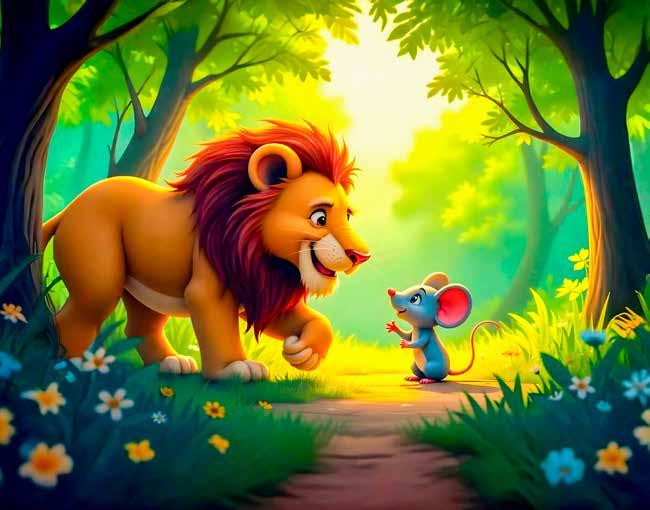
You are about to read two fables. First, you’ll meet a mighty lion and a tiny mouse who become the most unlikely of friends. Then, follow the hardworking ants and the lazy grasshopper as they prepare for winter. How can a small mouse help a powerful lion? And why is it important to work hard and plan for the future?
Today, we will read two stories. They are both fables. Fables generally have talking animals that teach a lesson.
1. Some animals have certain associations, which means that people think about certain traits when they hear about that animal. Can you think of any common associations? Which animal is generally considered the “king of the jungle”? {the lion} Which insect is known for being hardworking? {ants}
As you read, pay attention to similarities in the stories.
Adapted by: Tessa Barber

The lion lay beneath a tall tree, fast asleep. His golden fur shone in the sun. His mane was thick and wild, forming a crown around his face. It was not for nothing that he was called “the king of the jungle.” Wherever he went, animals ran away from him in fear.
As the lion slept, a small, gray mouse scampered through the leaves. His whiskers moved as he looked in all directions. He ran across a log and suddenly froze in terror.
He was standing on the lion’s giant paw!
The mouse’s eyes darted in all directions. Should he make a run for it? Could he manage to get away before the lion woke up?
It was too late. The lion’s eyes were open. His angry roar echoed through the jungle. Terrified birds flew into the sky. Small animals ran to hide.
“How dare you wake me, the king of the jungle?” the lion growled.
His paw slammed down on the mouse, trapping him beneath sharp claws. The
mouse’s heart pounded like a drum.
“Your highness,” he squeaked, trembling in fear. “Please let me go! I apologize for waking you. It was not on purpose! If you let me go, I promise to help you.”
The lion laughed. “You?” he scoffed. “Help me? How could a tiny thing like you ever help a mighty lion like me?” He roared again.
“It’s true that I am small,” the mouse said, his voice shaking. “But sometimes even the smallest

1. Why do you think the author chose to use describe the lion’s mane as “a crown around his face”?
{They are trying to make the lion seem like a king.}
2. Why does the lion think the mouse wouldn’t be able to help him? {The mouse is so small.}
creature can do great things. Please let me go. I promise to return the favor one day.”
The mouse squeezed his eyes shut as he awaited the lion’s judgment. Would the lion let him live?
“Very well,” the lion said, opening his paw. “Run along, little one. But make sure I never see you again.”
The mouse darted away into the tall grass. He ran and ran until he felt safe from the lion.
A few days later, the mighty lion was strolling through the jungle. Suddenly, a net shot up from the ground and thick ropes wrapped around his body. He’d stepped into a hunter’s trap! The lion roared in fury. He kicked and pulled at the ropes, but they only became tighter. He tried to slice through the net with his sharp claws, but the net was stronger than him.
“The lion must be in trouble,” he said. “I must go help him!”
The mouse raced through the jungle, following the sound of the lion’s roars.
He was trapped! His loud roars echoed through the jungle.
Far away, the little mouse could hear the lion’s cry.
When the mouse arrived, he saw the mighty lion trapped in a net. The lion’s eyes were filled with fear. Soon, the hunters would arrive and take him away.
The mouse looked at the trap. Silently, he began to nibble at the thick ropes with his sharp teeth. The lion watched in amazement as one by one, the ropes were sliced in half.
This tiny creature had done what the mighty lion could not.
Finally, the last rope snapped. The lion fell to the ground with a thud. He looked down at the tiny mouse.
“Thank you, my little friend,” the lion said. “I never thought such a small creature could help me. You have taught me a great lesson.”
The mouse’s whiskers moved in the breeze. “Even the smallest creature can help the mightiest.”
After that, the lion and the mouse became good friends. There were many dangers in the jungle, but they knew they could rely on each other to stay safe.
1. What was the mouse able to do that the lion could not? {he was able to break the ropes to get the lion free}
2. Do you agree with the lesson that “even the smallest creature can help the mightiest”? {Answers will vary.}

Adapted by: Y. Green
It was quiet in the field. Birds gathered twigs for nests, squirrels collected acorns, and bees buzzed from flower to flower. Soon, fall would turn to winter. The animals and insects were getting ready.
On the ground, a group of ants marched in a long line. Each ant carried a grain or seed. Their legs were steady under these huge loads. They kept moving and working. They needed to store this food so they could survive the long winter.
Nearby, a grasshopper lay in the soft grass. His long, green body stretched out on the ground as he closed his eyes and relaxed.
The line of ants passed by. Lazily, the grasshopper opened an eye.
“Why are you working so hard?” he called to
the ants. “Come rest with me in the sun!”
The ants continued their march. Their leader turned to look at the grasshopper.
“We don’t have time to rest now,” he said. “We are preparing for winter. When the cold comes, there will be no more food. You should be gathering food, too. The summer won’t last forever.”
The grasshopper laughed.
“Winter is yet far away,” he said. “I have plenty of time to gather food. Right now, I want to enjoy myself.”
The leader of the ants continued on his way. The ants worked from morning until night, taking no time to rest. Their nest was soon filled with grains, seeds, and dried leaves, but they didn’t stop. They knew they had to gather
1. Why do you think the grasshopper wanted the ants to join him? {Answers will vary.}
2. What do you think will happen next? {Answers will vary.}
more food to survive the harsh winter ahead. Meanwhile, the grasshopper lay in the sun. He was having a good time. He didn’t notice that the days were getting shorter, the leaves were turning colors, and the air was growing cooler.
One morning, all the animals and insects were gone. They had disappeared into their nests. The field was buried under a thick layer of snow. The stream was frozen.
The grasshopper shivered. He was cold, and his stomach growled with hunger. There was no food anywhere. He had to find something to eat, but he was so weak. He could barely make his way through the snow.
Finally, the grasshopper arrived at the ants’ nest. He was embarrassed to face them, but he had no choice.
“Please,” the grasshopper called, “I have no food. I’m cold and hungry. Can you help me?”
The ants were warm inside their nest, and their bellies were full. Their leader looked at the poor, shivering grasshopper.
“You spent the summer playing while we worked hard,” the leader said. “Now winter is here.”
The grasshopper hung his head. “I should have listened to you,” he whispered. “I thought I had more time. I was foolish and lazy.”
“We will share some of our food with you,” the leader said. “But remember, hard work today pays off tomorrow. Next time, prepare for the future, as we did.”
The grasshopper thanked the ants as he ate their food. Next winter, he knew, would be different.
This time, he would be prepared.
1. What words does the author use to show that winter came? {Answers will vary. “The field was buried under a thick layer of snow.”}
2. Do you agree with the lesson “Hard work today pays off in the future”? {Answers will vary.}
On the next page, compare and contrast the two stories.
Compare and contrast the fables in the chart below.
The Lion and the Mouse The Ants and the Grasshopper
Setting:
Characters:
Plot:
Theme:
The mouse wakes the lion. The lion doesn't believe the mouse can help him but lets him go. The mouse rescues the lion from a net.
Grasshopper, ants (and their leader)
The grasshopper laughs at the ants who gather food. In the winter, the grasshopper is hungry, while the ants have lots of food. The ants teach him a lesson.
Even the smallest creature can help the mightiest. Hard work today pays off tomorrow.
Answer the questions.
Hint: To answer the questions, use the mouse and grasshopper as the main characters.
1. Which is true about both stories?
a. Both take place in a field.
b. Both take place in the jungle.
c. Both take place outdoors.
d. Both take place at the zoo.
2. Which is true about both stories?
a. They both have characters that are courageous.
b. They both have characters that learn a lesson.
c. They both have characters that are lazy.
d. They both have characters that are bullies.
3. Which shows a difference in the ways the authors approach the topics?
a. In one story, the main character teaches another character a lesson. In the other story, the main character is taught a lesson.
b. In one story, the main character learns to help others. In the other story, the main character learns to escape nets.
c. In one story, the main character helps a big animal. In the other story, the main character helps little animals.
d. In one story, the main character learns not to annoy others. In the other story, the main character learns not to make fun of others.
A character trait describes how a character or person acts. You can find character traits by looking at a character’s thoughts, actions, conversations, and feelings.
Character trait examples: loyal, brave, respectful, responsible, kind, haughty, patient, etc.
Write a paragraph comparing and contrasting the character traits of two characters.
1. Choose two characters. Lion Mouse Grasshopper Ants
2. Write two character traits for each. Explain how you know this from the text.
Character:
Character Trait 1:
Evidence from text:
Character Trait 2:
Evidence from text:
He didn’t prepare for winter.
He didn’t prepare food for himself and then had to beg others for it.
They prepared for winter all fall.
They shared their food with the grasshopper even though he laughed at them.
3. Write an outline. For the body sentences, use the information from the chart.
Topic Sentence:
Body Sentence 1:
In the fable, the grasshopper acted differently than the ants.
For example, the grasshopper was lazy, while the ants were hardworking.
Body Sentence 2:
During the fall, the ants prepared for winter, while the grasshopper relaxed in the sun.
Body Sentence 3:
Even though the grasshopper was irresponsible, the ants were kind and shared their food with him.
Concluding Sentence:
I think the grasshopper should learn from the ants.
4. Write a paragraph. Add transition words to make it more interesting.
In the fable, the grasshopper acted differently than the ants. For example, the grasshopper was lazy, while the ants were hardworking. During the fall, the ants prepared for winter, while the grasshopper relaxed in the sun. Even though the grasshopper was irresponsible, the ants were kind and shared their food with him. I think the grasshopper should learn from the ants.
Rewrite the story as realistic fiction.
1. Choose one fable to rewrite: The Lion and the Mouse or The Grasshopper and the Ants.
2. Change the animal characters to human characters. Other details will need to change in order for the story to make sense.
3. Write as a story or comic strip. Use a blank paper if writing a comic strip.
Circle the correct answer.
1. The mouse across the floor to find food.
a. scoffed
b. strolling
c. scampered
d. judgment
2. Which word means strong feeling of anger?
a. Fury
b. Judgment
c. Rely
d. Steady
3. Which word means laughed at something or someone?
a. Scoffed
b. Scampered
c. Strolling
d. Rely
4. We on the weather forecast to make our plans.
a. fury
b. steady
c. scoffed
d. rely
5. Which of the following is an example of a judgment?
a. A decision about a criminal case
b. An object
c. A feeling of sadness
d. A plan for the future
6. The old man was down the street, enjoying the sunshine.
a. scampering
b. scoffing
c. judging
d. strolling
7. Which word means firm and not shaking?
a. Steady
b. Judgment
c. Rely
d. Harsh
8. Which of the following is NOT harsh?
a. A kind word
b. A rough surface
c. A very bitter taste
d. A freezing temperature
Circle the correct answer.
1. Where did the lion sleep? (detail)
a. In a cave
b. Under a tall tree
c. In a den
d. On a rock
2. Why does the lion get angry at the mouse? (cause and effect)
a. The mouse ate his food.
b. The mouse made noise.
c. The mouse woke him up.
d. The mouse played with his tail.
3. Which best describes the lion? (inferencing)
a. He is kind and generous.
b. He is selfish and greedy.
c. He is brave and fearless.
d. He is proud and strong.
4. What does the lion do to the mouse when he catches him?
a. He eats him.
b. He pushes him.
c. He traps him with his paw.
d. He throws him away.

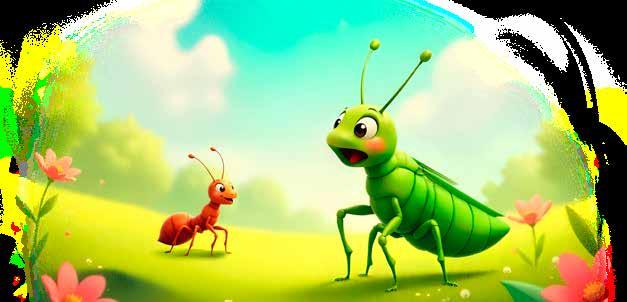
5. What is the theme of the story? (main idea)
a. The importance of friendship
b. The dangers of winter
c. The importance of hard work
d. The dangers of haughtiness
6. What does the word "shivered" mean in the sentence "The grasshopper shivered. He was cold, and his belly growled with hunger."? (context clues)
a. Jumped
b. Trembled
c. Slept
d. Ate
7. How does the ants' preparation for winter compare to the grasshopper's preparation? (compare-contrast)
The ants prepared, and the grasshopper did not.
The grasshopper prepared, and the ants did not.
Both the ants and the grasshopper prepared.
Neither the ants nor the grasshopper prepared.
Which of the following is a fact? (fact vs. opinion)
The ants prepared for winter.
The grasshopper wasn't nice to the ants.
Ants are the best animals.
Most animals prepare for winter ahead of time.
Unit 6: Figurative Language
Lesson 21: Literal vs. Nonliteral
Unit Goal Trajectory:
Define nonliteral language in context and explain how the author creates the meaning and feeling of the text.
1. Distinguish between literal and nonliteral language. (Lesson 1)
2. Explain what nonliteral language means in context. (Lessons 1, 2, and 3)
3. Categorize figurative language in the text. (Lessons 2 and 3)
4. Explain how visual elements contribute to the feeling and meaning of a text. (Lesson 4)
Hi there!
Did you ever hear anyone say something that sounds strange?
Sometimes, words mean exactly what they say. This is called literal language. Nonliteral language is when words mean something different than what they say.
Sounds confusing? Let’s look at some examples!
→ I slept twelve hours.
→ It is raining outside.
→ You look sad.
→ He’s very strong.
Nonliteral
→ I slept a bagel.
→ It is raining cats and dogs.
→ You look blue.
→ He is as strong as an ox.
Let’s take a look at some examples of nonliteral language.
What you say: What it sounds like: What you mean:
Yesterday, I bumped into Sam. I crashed into Sam.
Yesterday, I saw Sam (by chance). The classroom is a beehive of activity! There are bees in the classroom. The kids are very busy.
I've told you a hundred times! It was actually told 100 times. It was told a lot of times.


Yesterday, I bumped into Sam.
The classroom is a beehive of activity!


I've told you a hundred times!
Read the following passage. Highlight examples of nonliteral language. How many can you find?
Barry was having a terrible day. He woke up to the sound of his alarm clock. It sang a cheerful tune as if it were a bird. As he stumbled out of bed, he tripped over his cat, which was as graceful as a bull in a china shop.
"Great start," Barry muttered, rubbing his sore toe. He finally managed to get out the door, but of course, it started raining cats and dogs. "Just perfect," he grumbled. "I love waiting in miles-long lines for the bus." He tried to cheer up to prepare for the long day ahead.
For each nonliteral phrase, draw a picture of what it sounds like literally. Use it to explain what the phrase means. Tell how the nonliteral language adds to the meaning.
Nonliteral Phrase Picture
“it sang”

“as if it were a bird”
“which was as graceful as a bull in a china shop”
“it started raining cats and dogs”
“just perfect”
What does it mean?
The alarm clock played music. → makes it sound like the alarm clock is the one singing → it is more interesting to read
The alarm clock played sweet and chirpy music. - birds tweet in the mornings like an alarm clock
Very clumsy and destructive - a bull is not graceful and will break lots of china - makes a funny picture
It started raining really hard. - it is a well-known saying - sounds intense, as if cats and dogs are raining
Not perfect - we know this from context - it is sarcastic
Students may have a hard time explaining how nonliteral language adds meaning to the text.
Tell students to substitute the literal meaning in sentence. Then, read the sentence both with literal meaning and the nonliteral phrase.
Discuss the differences between the two sentences. How do each of them feel? What does the nonliteral phrase add?
1. Reactions, noun
S Responses A Effects
E A chemical turns blue when something is added; Responses to things that happen Q What are some common reactions to receiving a gift?
2. Market, verb
S Sell A Buy E Create an advertisement for a product; Sell something to a specific group; Get people to get a service Q What is the purpose of a market?
3. Precise, adjective
S Exact A Approximate
E Exact measurements; Specific directions to go somewhere; An exact number of people
Q What is the difference between a precise measurement and an estimate?
4. Borax, noun
E In cleaning products; In slime recipes Q What is borax used for?
5. Process, noun
S Method E The steps for baking a cake; The changes a caterpillar goes through; The steps needed to buy a house
Q How can you make a complicated process easier to understand?
6. Avoid, verb
S Escape A Face E Stay away from someone; Prevent something from happening; To not talk about a specific topic Q How can you avoid traffic during rush hour?
Match the bolded words with their definitions. Highlight context clues.
When the chemicals were mixed, a reaction took place, and the liquid turned bright blue.
The company wants to market their new product by hanging billboards on highways.
The scientist needed precise measurements for the experiment.
She used borax to clean stains in the kitchen.
The process of moving to a new country involves many steps.
To avoid getting lost, be sure to bring a map or use a GPS.
The earthquake was a catastrophe, destroying homes and buildings.
The cat pounced on the mouse, catching it with its sharp claws.
7. Catastrophe, noun
S Disaster A Success
E An earthquake; Wildfires; A burglary
Q Give an example of a time that a fun trip turned into a catastrophe.
a terrible disaster or event
jumped or sprang suddenly upon something
a white, powdery cleaning agent
keep away from or prevent
a change that happens when chemicals mix
a series of steps to do or make something
very accurate or exact to promote or sell a product or service
8. Pounced, verb
S Swooped E Attacked; A cat jumped on a mouse; To jump up and grab a ball
Q What is the meaning of the phrase “to pounce on an opportunity”?

Author: Tessa Barber Genre: Fiction
Cassie loves science class, especially on Tuesdays, when the experiments begin! But in "Cassie and the Great Slime Disaster," things don't go exactly as planned. What happens when Cassie doesn’t follow all the instructions to create slime? How will she clean up the gooey mess that follows? Keep reading to find out how Cassie’s love for science leads to a sticky catastrophe!
1. The story we will read today is not a true story. What genre do you think this story is? {fiction}
2. In this story, the main character makes slime with her class. Did you ever make slime? What went in it? {Answers will vary.}
As you read, pay attention to nonliteral language and how it is used in the story.
When Mrs. Thompson walked into the classroom on Tuesday, Cassie almost bounced out of her seat. Tuesdays were her favorite day of the week. On that day, the class did science experiments.
Mrs. Thompson was smiling, and she held a big bag in her hands. What did the teacher have in store for today?
be doing that by…” She looked around the classroom. Cassie sprang to her feet.
“How?” she cried. Her voice sliced through the silence. “How?”
The room was silent. Cassie flushed. Her cheeks turned as red as her hair. She knew that Mrs. Thompson was going to remind her to use her indoor voice and not to interrupt.

1. Why is Cassie excited? {it is Tuesday, and the class will be doing a science experiment.}
2. Can you find two examples of nonliteral language on this page? {what did the teacher have in store for today; her voice sliced through the silence}
was, “Today, we’re going to make slime!”
“YES!” the entire class shouted. If Cassie’s cheers were a little louder than everyone else’s, no one noticed.
Mrs. Thompson clapped her hands. “Listen carefully,” she said. “If you don’t want to mess up, you must follow instructions.”
She looked at Cassie. Cassie’s head bobbed up and down. Her mind was busy thinking. Maybe she would invent a new kind of slime. Then she could market it and sell it, and she’d be famous. Why, reporters would line up to interview her and…
“Cassie? Are you listening?”
Mrs. Thompson was looking at her. Cassie nodded and tried hard to pay attention.
"We’ll be using glue, borax, water, and food coloring,” Mrs. Thompson said. “If you want your slime to come out right, your measurements must be precise."
Cassie’s fingers twitched. Her mind whirred like a mixer on high speed. She couldn’t wait to get started.
Cassie carefully measured the ingredients.
“Two drops of food coloring,” she read aloud. She squeezed the dropper gently. What a beautiful color! She decided to add in a few more drops. The liquid in her bowl seemed to glow, almost as if it were alive. Cassie glowed, too. Wait till Mrs. Thompson saw her beautiful slime!

“Thank you!” Cassie said. “Eight tablespoons of borax, coming right up!”
Now she needed to add the borax. She leaned over to Sandy, who sat next to her.
“How much borax do I need?” she asked. “A tablespoon,” Sandy whispered. “What?” Cassie cupped a hand around her ear. “I can’t hear you.”
Sandy sighed. “I said a tablespoon,” she said, stressing the “a.”
She made sure to measure the tablespoons carefully, as Mrs. Thompson had said. When the borax made contact with the glue, it began to hiss. It sounded like a soda bottle that had been shaken too hard.
The mixture began to bubble. Cassie stared at it. Sandy leaned over, and her mouth dropped open.
“What is that?” she asked.
1. Why does Cassie put in eight tablespoons of borax?
{She hears Sandy say “a,” which sounds like “eight.”}
2. How many examples of nonliteral language can you find on this page? {Answers will vary.}

The mixture was bubbling so loudly, Cassie couldn’t hear her. She just smiled proudly, sure that Sandy was complimenting her slime.
“Cassie!” Sandy said nervously. “Tell Mrs. Thompson what’s happening.”
But Cassie couldn’t take her eyes off her slime. It was creeping over the sides of the container and spreading across her desk. Wait till the world found out what she’d created! There was sure to be a great demand for her discovery!
Mrs. Thompson's shoes squeaked as she rushed across the room. “Cassie, what’s going ” BOOM!
The slime exploded, and green goo splattered across Cassie’s desk, the floor, and all over Mrs. Thompson’s dress! Cassie’s red hair was streaked with slime. She looked up at Mrs. Thompson.
"Oops," she said. Was Mrs. Thompson going
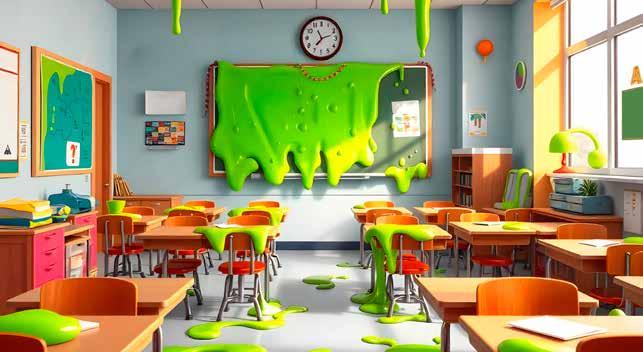
1. Explain why “Cassie couldn’t take her eyes off her slime” should not be understood literally. {if it was literal, it would mean Cassie’s eyes were on the slime.}
2. Do you think this story is realistic? Why or why not? {Answers will vary.}
to send her to the principal? Call her mother? Make her write a hundred times “I will never make slime again”?
But something unexpected happened. Mrs. Thompson threw back her head and laughed.
"Well, Cassie," she said. "I certainly didn’t plan on making exploding slime today!”
Cassie grinned and got to work cleaning up the mess. She scrubbed her desk with paper towels and knocked over a bottle of food coloring in the process. Before she could blink, it had spilled all over her desk and the floor.
“You’re turning the classroom into a swamp!” Sandy said.
"Oops!" Cassie said again. She grabbed some more paper towels. Sandy jumped out of her seat to avoid the green slime disaster and
escaped to the other side of the classroom.
Cassie swiped at the mess, but it only seemed to spread. Her slime seemed to grow in front of her eyes. Everyone gathered around to watch.
Cassie’s cheeks were redder than her hair.
"Oh no," she whispered.
She grabbed a big bowl and tried to scoop the slime into it. It stretched and stretched like a rubber band until SNAP! It flew through the air and hit Martha on her shoulder.
“Ouch!” Martha cried. “I’m being attacked!”
Girls started to dive under chairs, shouting, “Help! Get me out of here!”
“What a catastrophe,” Mrs. Thompson said, shaking her head.
“A catastrophe for Cassie!” Sandy shouted, as the slime zinged its way toward her. She shrieked and hid behind the garbage can.
Cassie chased the slime around and around the classroom. Everywhere it landed, it left a bright green streak.
Finally, she pounced on it and held it tightly in her hands. It flopped around like a fish out of water.
“Got it!” she said.
Mrs. Thompson looked a little green herself. “You can take it outside to the dumpster. Er… perhaps ask the janitor to help you.”
“Maybe the police should help,” Sandy said, looking scared.
“Or the fire department!” someone else said.
After that day, Cassie became known as “Cassie Catastrophe.” But she didn’t mind. Tuesdays were still her favorite day of the week. She tried extra hard to listen carefully and follow instructions.
When she slipped up, her classmates would say, “Cassie Catastrophe does it again!”
And Cassie would happily agree.
1. Do you think it was Cassie’s fault that her slime exploded? Explain. {Answers will vary.}
2. What does “Mrs. Thompson looked a little green herself” mean? {She looked a little sick or nauseous.}
3. Why does the author say that the slime “flopped around like a fish out of water”? {It gives the reader an image of fish in their head, which is so much more vivid - it shows that it was flopping everywhere and slippery.}
Circle the correct meaning of each nonliteral phrase.
1. “What did the teacher have in store?”
a. Which store did the teacher go to?
b. What was the teacher’s plan?
2. “Her voice sliced through the silence.”
a. Her voice was the only sound.
b. She held a knife while she talked.
3. “[The borax] sounded like a soda bottle that had been shaken too hard.”
a. The borax was in a soda bottle.
b. The sound the borax made was similar to fizzy liquid.
4. “Wait till the world found out.”
a. Wait until lots of people find out.
b. Wait until every person on Earth finds out.
5. “Before she could blink.”
a. It happened very quickly.
b. She was blinking slowly. LESSON PRACTICE VOCABULARY STORY REVIEW
For each phrase, draw a picture of the literal meaning. Then, write what it really means.
1. “Her mind whirred like a mixer on high speed.”
Her mind was busy thinking.
2. “Cassie couldn’t take her eyes off the slime.”
Cassie found looking at the slime fascinating.
3. “You’re turning the classroom into a swamp!”
You are getting the classroom wet and green.
4. “It stretched and stretched like a rubber band.”
The slime was very stretchy.
5. “[Slime] was creeping over the sides of the container.”
The slime overflowed out of the container.
The author’s purpose is the reason why the author wrote the text. You can remember three common purposes with PIE: Persuade, Inform, Entertain. A text that is written to inform teaches the reader something. A “how to” informs the reader how to do something.
In the story, Cassie learns how to make slime. Write a “how to” paragraph that teaches a skill.
1. Choose a simple skill you would like to teach. Examples: tying a knot, making a paper airplane, decorating a cake
2. Break it down into three to four steps.
Step 1:
Step 2:
Step 3: (Step 4:)
Tying a knot
hold the string with one hand, pick up the end with the other hand cross the end of the string over the middle to make a loop fold the end of the string over the middle so that it can be pulled through the loop pull through the loop and tighten
3. Write an outline. In the body sentences, use transition words to show the order of the steps.
Topic Sentence:
Here is how to tie a knot in four easy steps.
Body Sentence 1:
To start, hold the string with one hand and pick up one end with the other hand.
Body Sentence 2:
Then, cross the end of the string over the middle to make a loop.
Body Sentence 3:
Next, fold the end of the string over the middle so it can be pulled through the loop.
(Body Sentence 4:)
Last, pull the end through the loop and tighten.
Concluding Sentence:
Learning how to tie a knot is simple!
4. Write a paragraph.
Here is how to tie a knot in four easy steps. To start, hold the string with one hand and pick up one end with the other hand. Then, cross the end of the string over the middle to make a loop. Next, fold the end of the string over the middle so it can be pulled through the loop.
Last, pull the end through the loop and tighten. Learning how to tie a knot is simple!
Make your own slime.
Ingredients:
→ 1 tablespoon borax
→ 1 cup water + more water
→ Liquid glue
→ Food coloring
1. Mix 1 tablespoon of borax with 1 cup of water until it dissolves.

2. In a separate bowl, mix equal amounts of water and glue.
3. Add a few drops (not too many!) of food coloring to the glue mixture and mix.
4. Add a little of the borax solution at a time and keep mixing until you get a good consistency.
Circle the correct answer.
1. When you mix vinegar and baking soda, a chemical occurs.
a. reaction
b. catastrophe
c. market
d. process
2. Which word means to sell?
a. Market
b. Reaction
c. Precise
d. Pounce
3. Which word means clearly defined or exact?
a. Precise
b. Reaction
c. Market
d. Borax
4. Which is a common ingredient in cleaning products?
a. Reaction
b. Market
c. Precise
d. Borax
5. The of making a cup of tea involves boiling water and letting the leaves sit.
a. catastrophe
b. market
c. precise
d. process
6. To the accident, the driver swerved to the right.
a. pounce
b. market
c. avoid
d. precise
7. Which of the following is an example of something pouncing?
a. A child eating soup
b. A lion jumping on its prey
c. A car driving
d. A ball bouncing
8. Which is NOT an example of a catastrophe?
a. A hurricane
b. A flood
c. A pencil that needs to be sharpened
d. A war
Circle the correct answer.
1. What color was Cassie's hair? (detail)
a. Brown
b. Black
c. Red
d. Blonde
2. What caused Cassie's slime to explode? (cause and effect)
a. She added too much water.
b. She added too much borax.
c. She didn't mix it well.
d. She didn't use enough glue.
3. What lesson does Cassie learn in the story? (main idea)
a. It's important to follow instructions.
b. Slime is dangerous.
c. Mrs. Thompson is funny.
d. Science is boring.
4. What happens when Cassie gets her teacher’s dress dirty? (sequencing)
a. She gets sent to the principal's office.
b. She is not allowed to make slime anymore.
c. Mrs. Thompson laughs.
d. She gets detention.
5. Why do you think Cassie continues to enjoy science experiments even after the disaster? (inferencing)
a. She is afraid of disappointing her teacher.
b. She loves the excitement of the unknown.
c. She doesn’t want to do homework.
d. She has lots of friends.

6. What does the word "demand" mean in the sentence “There was sure to be a great demand for her discovery”? (context clues)
a. Desire
b. Hate
c. Rude
d. Ask
7. How is Cassie’s slime similar to a rubber band? (compare-contrast)
a. They are both green.
b. They are both stretchy.
c. They are both sticky.
d. They are both hard.
8. Which of the following is a fact about the story? (fact vs. opinion)
a. Cassie is the best student in the class.
b. Making slime is the best science experiment ever.
c. Mrs. Thompson is the funniest teacher.
d. The slime is green.
Unit 6:
Figurative Language
Lesson 22: Literal vs. Nonliteral
Unit Goal Trajectory:
Define nonliteral language in context and explain how the author creates the meaning and feeling of the text.
1. Distinguish between literal and nonliteral language. (Lesson 1)
2. Explain what nonliteral language means in context. (Lessons 1, 2, and 3)
3. Categorize figurative language in the text. (Lessons 2 and 3)
4. Explain how visual elements contribute to the feeling and meaning of a text. (Lesson 4)
Hi there!
Are you a big ball of energy, all ready to learn about figurative language?
Wait…
You can’t actually be a big ball of energy… But you can be very excited!

Figurative language is another way to say “nonliteral language.” “A big ball of energy” means that you’re so excited, you are full of energy.
There are a few types of figurative language. Today, we are going to talk about four of them.
Examples
Simile
Comparing two things using “like” or “as”
Metaphor
Comparing two things by saying something “is” something else, without saying “like” or “as”
Personification
Meaning
I’m as hungry as a wolf. Her face shone like the sun. This room looks like a tornado hit it. → I am very hungry. → She looked very happy. → The room is very messy.
Time is money. My closet is a nightmare. The room is a beehive of activity. → Time is valuable. → My closet is a mess. → People are working hard.
When human traits are given to something that is not human The flowers smiled in
Hyperbole
An extreme exaggeration
Match each phrase to the type of figurative language.
My backpack weighs a ton.
The sun raised its bright face to greet the day.
Her face was as white as a sheet.
Anger is a dangerous disease.
Complete the simile.
1. The tomato is as soft as a
2. Friendship is like a
Students may have hard time thinking of their own similes and metaphors.
(Answers will vary.)
(Answers will vary.)
(Answers will vary.)
3. is like a bottomless pit.
Complete the metaphor.
1. My stomach is a
2. The sky is a
Tell students to think creatively. Encourage them to think of the things with the same qualities.
(Answers will vary.)
(Answers will vary.)
(Answers will vary.)
3. is a playground.
Circle the things being personified. Underline what they are doing.
1. Those cookies are calling my name.
2. The stairs groaned under my weight.
3. The cat said, “I want to get that mouse.”
Explain the meaning of each hyperbole.
1. My shoes are killing me!
2. Sam knows everything about birds.
3. I could sleep for three weeks straight!
My shoes are hurting my feet. Sam knows a lot about birds. I am very tired.
Give students examples of things with similar qualities and explain why they’d make good similes and metaphors.
Examples:
• A shining face and the sun are both bright and shining. We can say “her face shone like the sun.”
• A hard test and a nightmare are both bad and scary. We can say “the test was a nightmare.”
1. Dread, noun
S Worry A Excitement
E How you feel about scary things; How you feel about something you don’t want to happen Q What is something you dread doing?
2. Absurd, adjective
S Strange A Realistic
E Thinking something that is unrealistic; Doing something very strange; Thinking in a way that is not logical
Q Describe a situation that you think is absurd.
3. Shame, noun
S Guilt A Respect
E A feeling of doing something wrong; Someone who lost honor; A word for feeling disappointment
Q What is a situation where someone might try to hide their shame?
4. Diagnose, verb
S Identify A Miss
E To name the problem about something; To identify a disease; To check someone for a disease Q How can a mechanic diagnose a problem with a car?
5. Vast, adjective
S Huge A Tiny
E Huge pieces of land; A large number of people; A big range of types
Q How does the vastness of the ocean make you feel?
6. Harbor, noun
S Port E A place to dock boats; A safe place
Q What might happen if a harbor is damaged?
Match the bolded words with their definitions. Highlight context clues.
The thought of failing the exam filled him with dread.
It's absurd to think that cats can fly.
The child hung his head in shame after breaking the vase.
The doctor diagnosed the patient with a strep throat.
The ocean is vast and deep.
The ships sailed into the harbor.
I had no notion that you were coming.
You ought to apologize for your mistake.
extremely large in size
a feeling of great fear or anxiety
ridiculous or unreasonable idea or thought about something should embarrassment or guilt
a place where ships can dock or shelter
identified a disease or disorder
dread [dred]; absurd [ub-SURD]; shame [shaym]; diagnosed [DYE-uhg-nohzd]; vast [vast]; harbor [HAR-bur]; notion [NOH-shun]; ought [awt].
7. Notion, noun
S Idea A Fact E An understanding of what is going on; A belief without knowing for sure; A sudden desire to do something
Q Can you think of a notion that you used to believe but no longer do?
8. Ought, verb
S Must E Something you feel you need to do; What is likely to happen soon; Something that would be good to do Q What is something you ought to do today?
By: Adam Isaacs

I'm lost in English class today, What did my teacher just say?
"Simile is like…" What was the rest? My brain's too tired to take this test.
Metaphors are battleships, strong and grand, But I’m sinking fast, someone lend a hand!
“Your grades are sinking,” my teacher said, I nodded slowly, filled with dread
Personification, what a word!
Giving life to things? How absurd!
“My pencil’s dancing!” my teacher grinned, I looked at mine—just wouldn’t begin.
Similes are sneaky, hiding like mice, Metaphors roar, and they sound so precise. The sun smiled down from the clear blue sky, But no matter how hard, I still wonder why!
Hyperbole? Just take a look!
I've read enough to fill a book. I'm so lost, my tears fill a river, These examples make my body shiver!
At least there's math to save the day, I’ll add and multiply—hooray!
But wait, what’s this? A final test? Isn’t school just the best?
Find an example of each of the following in the poem:
Metaphor:
Metaphors are battleships
Personification:
My pencil’s dancing
Simile:
hiding like mice
Hyperbole:
I’ve read enough to fill a book
1. How does the way the speaker feels about English class compare the way he feels about math? {doesn’t like English, likes math}
2. What is the general feeling of the poem? {frustration}
By: Kenn Nesbitt
I have a little teddy bear I like to hug and hold.
But yesterday, I told my mom, “I think he has a cold.”
I said, “I heard him sniffle, and he seems to have a chill. His forehead feels a little hot. My bear is very ill.
“Let’s take him to the doctor who can diagnose diseases, and cure him of his sniffles and his shivers and his sneezes.”
My mother said, “Don’t worry, dear. You might not be aware, but sniffles aren’t uncommon in your average teddy bear.”
She said, “His nose is runny and his eyes are red and puffy. But I don’t think he has a cold. He’s just a little stuffy.”
Write “Yes” if the phrase contains personification and “No” if it does not.
1. I have a little teddy bear
2. I like to hug and hold
3. He has a cold
4. He seems to have a chill
5. His forehead seems a little hot
6. My bear is very ill
7. Who can diagnose diseases
8. And cure him
9. His nose is runny
10. And his eyes are red and puffy
11. But I don’t think
12. He’s just a little stuffy

1. Who is the speaker of this poem? {a child who has a teddy bear}
2. How does the child use his imagination? {He imagines his teddy bear is sick like a real person.}
By: Adam Isaacs
Our school is a ship on a vast blue sea, Classes are decks where we learn and be. Teachers guide us like captains so wise, Under the endless school-day skies.
Books are our maps to find treasures unknown, Pencils are oars that we row on our own. Friends are the crew who share in our tale, Chatting and laughing as we set sail.
Recess is the harbor where we rest and play, Before setting sail to learn more each day. This school ship’s journey is joyful and bright, Each lesson a lighthouse guiding our sight.
Answer the questions.
1. Is the school on a ship? Explain.
No, it is compared to a ship.
2. How are teachers like captains?
They guide students.
3. How does the speaker feel about books? How do you know?
They are good; he says they help find treasures.
4. What is “setting sail” compared to?
5. Why do think the poet compares school to a ship’s journey?
Learning On a journey, you encounter new things; there are ups and downs; you start at one place and end up in another.
Write “S” if the comparison is a simile and “M” if it is a metaphor.
1. Our ship is a school
2. Classes are decks
3. Teachers guide us like captains
4. Books are our maps to find treasures
5. Pencils are oars that we row on our own
6. Friends are the crew
7. Recess is the harbor
8. Each lesson a lighthouse
1. Do you think the comparison of the speaker’s school to a ship is good comparison? Why or why not? {Answers will vary.}
2. What is the main feeling of the poem? {cheerful}
By: Robert Louis Stevenson (1850–1894)
I have a little shadow that goes in and out with me, And what can be the use of him is more than I can see. He is very, very like me from the heels up to the head; And I see him jump before me, when I jump into my bed.
The funniest thing about him is the way he likes to grow— Not at all like proper children, which is always very slow; For he sometimes shoots up taller like an India-rubber ball*, And he sometimes gets so little that there’s none of him at all.
He hasn’t got a notion of how children ought to play, And can only make a fool of me in every sort of way. He stays so close beside me, he’s a coward you can see; I’d think shame to stick to nursie** as that shadow sticks to me!
One morning, very early, before the sun was up, I rose and found the shining dew on every buttercup; But my lazy little shadow, like an arrant*** sleepy-head, Had stayed at home behind me and was fast asleep in bed.

* India-rubber ball: a ball that bounces very high ** nursie: nanny or babysitter *** arrant: total or complete
Match each simile to its meaning.
He sometimes shoots up taller like an India-rubber ball
I’d think shame to stick to nursie as that shadow sticks to me
My lazy little shadow like an arrant sleepyhead
The shadow is “in bed.”
The shadow grows very quickly.
It is embarrassing to follow a babysitter around all the time.
1. Who is the speaker, and what are they talking about? {a child talking about his shadow}
2. Does the child understand the point of having a shadow? How do you know? {No, he says, “and what can be the use of him is more than I can see”}
3. Why the does the child “see him jump before me, when I jump into my bed”? {The shadow follows him all the time.}
4. Why does the shadow grow and shrink so quickly? {Lots of light makes it big, and no light makes it go away.}
5. Is the speaker proud of his shadow? How do you know? {No, he says, “he hasn’t got a notion of how children ought to play and can only make a fool of me in every sort of way…he’s a coward…I’d think shame…as that shadow sticks to me.”} What does that tell you about the way the speaker views himself? {He is not proud of himself.}
6. Why was the shadow “fast asleep in bed” when it was very early in the morning? {A shadow needs light in order to be seen.}

Theme of a Poem
LESSON PRACTICE VOCABULARY STORY REVIEW ACTIVITY ASSESSMENT
Theme is the main message or idea of a story or poem. To find the theme in a poem, pay attention to what the speaker thinks about the topic.
Write a paragraph explaining the theme of “My Shadow.”
1. Answer the questions.
What is the poem about?
The speaker's shadow
What does the child think about his shadow?
shadow is like them and always following them.
How do you know?
Answers will vary; they think their “He is very, very like me from the heels up to the head”
What can we learn from the poem?
Answers will vary; Our shadows copy everything we do.
2. Write a topic sentence. Include the name of the poem and what it is about.
The poem My Shadow is about a child’s shadow.
3. Write an outline.
Topic Sentence:
The poem My Shadow is about a child’s shadow.
Body Sentence 1:
The speaker thinks that their shadow is like them and is always following them.
Body Sentence 2:
We know this because they say that “he is very, very like me from the heels up to the head.”
Body Sentence 3:
Therefore, the theme is that our shadows copy everything we do.
Concluding Sentence:
I think the way our shadows copy us is really cool!
4. Write a paragraph.
The poem My Shadow is about a child’s shadow. The speaker thinks that their shadow is like them and is always following them. We know this because they say that “he is very, very like me from the heels up to the head.” Therefore, the theme is that our shadows copy everything we do. I think the way our shadows copy us is really cool!
Write a “day in the life” of one of your school supplies. It does not have to be a poem.
1. Choose one of your school supplies.
2. Imagine how the object would describe its day if it could talk.
3. Write about the object’s day. Use personification.
Circle the correct answer.
1. I the thought of having to speak in public.
a. dread
b. absurd
c. shame
d. diagnose
2. Which of the following is an example of something that is absurd?
a. A cat chasing a mouse
b. A horse talking
c. A person sleeping
d. A dog barking
3. Which word means embarrassment or guilt?
a. Vast
b. Shame
c. Dread
d. Harbor
4. Which of the following is an example of something that can be diagnosed?
a. A broken bone
b. A good mood
c. A tasty meal
d. A beautiful sunset
5. Which word means extremely large or great in size?
a. Vast
b. Dread
c. Absurd
d. Shame
6. Which word means a place to park a boat?
a. Harbor
b. Diagnose
c. Notion
d. Dread
7. He has no of what you're talking about.
a. dread
b. absurd
c. shame
d. notion
8. You to respect your elders.
a. dread
b. absurd
c. ought
d. diagnose
Circle the correct answer.
1. What is the main idea of the last stanza? (main idea)
a. The speaker is relieved that it’s time to do math.
b. The speaker is confused by similes.
c. The speaker is tired.
d. The speaker likes English class.
2. What does the word "grand" mean in the line “metaphors are battleships, strong and grand”? (context clues)
a. Majestic
b. Wet
c. Small
d. Happy
3. What happened last in the story? (sequence)
a. The teddy bear was feeling better.
b. The narrator's mother said the teddy bear was stuffy.
c. The teddy bear was sneezing.
d. The narrator thought the teddy bear was sick.
4. Where does the story most likely take place? (inferencing)
a. The story takes place in a city.
b. The story takes place in a forest.
c. The story takes place in a school.
d. The story takes place in a house.
5. What are the teachers compared to in the poem? (detail)
a. Sailors
b. Pilots
c. Drivers
d. Builders
6. How are the students similar to a crew? (compare-contrast)
a. They both work under a leader.
b. They are both lazy.
c. They are both afraid.
d. They are both selfish.
7. Why does the speaker see his shadow jump before him? (cause and effect)
a. The shadow is fast.
b. The narrator is slow.
c. The shadow is playful.
d. The narrator is jumping.
8. Which of the following is an opinion? (fact vs. opinion)
a. The shadow is a coward.
b. The narrator saw dew in the morning.
c. The shadow copies the narrator.
d. The shadow is compared to an India rubber ball.
Unit 6: Figurative Language
Lesson 23: Idioms
Unit Goal Trajectory:
Define nonliteral language in context and explain how the author creates the meaning and feeling of the text.
1. Distinguish between literal and nonliteral language. (Lesson 1)
2. Explain what nonliteral language means in context. (Lessons 1, 2, and 3)
3. Categorize figurative language in the text. (Lessons 2 and 3)
4. Explain how visual elements contribute to the feeling and meaning of a text. (Lesson 4)
Today, we will focus on two types of figurative language called idioms and proverbs.
Idioms are phrases that are not meant to be understood literally.
Proverbs are non-literal sayings that teach a lesson.
Let’s take a look at a few examples of common idioms and proverbs.
Hot potato
A topic or situation that is uncomfortable or hard to deal with


Once in a blue moon
Very rarely
Raining cats and dogs
Raining hard


Stomach is in knots
An unpleasant feeling in the stomach from nervousness
Miss the boat Miss the point or chance
Apple of one's eye
Someone precious or dear
Rolling in dough
Very rich


Actions speak louder than words.
It’s easy to make a promise, but it’s hard to follow through.
The early bird catches the worm. You’ll be more successful if you do something early.
A stitch in time saves nine. Working harder earlier can save a lot of time later.
Every cloud has a silver lining. Even in hard times, there are positive things.
Birds of a feather flock together. Similar people end up together.
All that glitters is not gold. Something that looks good on the outside may not really be good.
A watched pot never boils. If something takes time, it doesn’t help to watch it.
A chain is as strong as its weakest link.
A group is only as successful as its weakest member.








Fill in the blanks. Choose idioms from the choice bank below.
1. That topic is a real ; no one wants to talk about it.
2. Solving that puzzle was ; I finished it in no time.
3. We only go to that store
4. It's outside; we should stay indoors.
hot potato a piece of cake once in a blue moon raining cats and dogs
5. The roller-coaster ride left my
6. If you don't apply now, you'll
7. Her little sister is the
stomach in knots. miss the boat. apple of her eye. rolling in dough
8. After winning the lottery, he was hot potato a piece of cake once in a blue moon raining cats and dogs stomach in knots miss the boat apple of her eye rolling in dough
Match each comment to the proverb that might be said in response.
"I should've fixed the hole in my bag because now I have a big mess.”
"If you want to get the best deal, you have to be the first one there."
"Even though we missed the bus, we got to explore a new part of town."
"He always says he'll help, but he never does."
Actions speak louder than words.
The early bird catches the worm.
A stitch in time saves nine.
Every cloud has a silver lining.
Students may have a hard time remember how idioms and proverbs are used in context.
Use the idioms and proverbs in your classroom language. The more students hear them used, the more they will remember the definitions.
1. Bonding, verb
S Attaching E Gluing or taping two things together; Spending time with someone to get close to them Q Can you describe a time when you bonded with someone new?
2. Strides, verb
S Steps A Wanders
E Go on a walk next to a river; Take steps towards reaching a goal Q How are strides different from stomps?
3. Positions, verb
S Places A Takes E To move a lamp so it gives good light; To decide where to put a chair; Arrange people standing on a stage Q How should you position yourself when picking up something heavy?
4. Chuckles, verb
S Laughs A Cries
E Laugh at a joke; Laugh to yourself; Laugh quietly
Q Can you describe a situation where someone might chuckle nervously?
5. Intend, verb
S Mean E Plan to do something; What you mean when you talk; To have a plan for a specific object
Q What do you intend to do this weekend?
6. Stiffly, adverb
S Firmly A Relaxed
E Movements with sore muscles; Choppy movements; Greeting someone without being friendly Q Can you describe a situation where someone might speak stiffly?
Match the bolded words with their definitions. Highlight context clues.
The two friends spent hours bonding, laughing, and talking together.
During the hike, he took big strides up the steep hill.
Tom positions his pieces on the game board.
When the teacher tells a funny joke, the whole class chuckles
I intend to finish this project by the end of the week.
The robot moved stiffly, its parts clicking as it moved.
The child squeals with delight as he runs toward the playground.
Her lunch was skimpy, so she grabbed an extra cookie.
in a way that is hard to bend or move
gives a high-pitched cry, often expressing excitement or fear
plan or mean to do something not enough puts in a specific place
laughs soft and quietly
making a connection between two people or things
long steps
bonding [BON-ding]; strides [STRYDZ]; positions [puh-ZISH-uhnz]; chuckles [CHUHK-uhlz]; intend [in-TEND]; stiffly [STIF-lee]; squeals [SKWEELZ]; skimpy [SKIM-pee].
7. Squeals, noun
S Squeaks E The sound of tires moving fast; Sounds happy children make; An excited scream Q Can you think of a situation where someone might squeal in fear?
8. Skimpy, adjective
S Lacking A Enough E Not enough food; Clothing that isn’t warm enough; Not giving a lot of money Q How can a skimpy meal be unhealthy?
Author: M. Jakubowicz Genre: Realistic Fiction

Have you ever looked forward to an adventure? Matt is eagerly preparing for an exciting camping trip to Big Deer State Park — until he finds out that this trip won’t be the one he dreamed of. How will Matt handle the challenges that come his way in the great outdoors? Join Matt on his trip as he discovers surprises he never expected!
1. Although the story we will read today could be true, it isn’t. What genre do you think this story is? {realistic fiction}
2. In this story, the main character goes camping. Have you ever gone camping? What supplies did you need? Did you see any animals? {Answers will vary.}
As you read, pay attention to idioms in the story.
Sleeping bag. Check.
Warm flannel pants. Check.
Two thick sweatshirts.
Check and check.
“Almost done, Matt?” Mom appears in the doorway, a smile on her face.
“Yeah!” I pump a fist into the air. “I can’t wait to go camping!”
Mom laughs. “Your dad is just as excited as you are.” She leans forward and winks. “And the trip is getting even better…”
My eyes widen. How could a camping trip to Big Deer State Park get any better?
“You’re going to have a friend come along!”
I stare at my mother in shock, then nearly knock her over with a bear hug. “Really? Yes! Yes!” I’d been begging my parents to let me bring along a friend. And they’d finally agreed.
“Can Jason come with me?” I ask. “Or maybe Stanley?”
My mind whirs, thinking of my friends’ reactions when I invite them.
My mother smiles. “Oh, Dad and I already arranged it. It was perfect, really. Mr. Lewis has a business trip this week, and his wife is going along. And so…”
My eyes are huge balls as I wait for the hammer to deliver its blow.
“… Dad invited Michael Lewis to come along. It’ll be the perfect bonding experience for both of you.”
My mother beams at me as if she’s won the lottery. A strange noise comes out of my throat. I can’t even form a proper word.
Mrs. Lewis and my mother work together and are good friends. Ever since they met, my mother has been hoping that Michael and I will be good friends. But… no.

1. How does Matt feel about the camping trip? What changes? {He is excited, but then when he hears Michael is coming, he isn’t anymore.}
2. Explain what “my eyes are huge balls as I wait for the hammer to deliver its blow” means literally. {My eyes opened wide as I waited for the bad news.}
No way.
Michael and I will never be friends. Ever.
“Why can’t I invite Jason?” I ask. “Michael is not the camping type of kid.”
My mother frowns. “Well, how would you know that?”
I think for a moment. Good point. I don’t really know too much about Michael. But I do know that I don’t want him to come along. Before I can say another word, my father strides into the room.
“All packed, son?” he asks, rubbing his hands together. “This is going to be the camping trip of the century!”
I gulp. It was going to be the best trip ever. But now…
Now Michael will be there. And my dreams of a perfect trip are vanishing like an ice cream cone left out in the sun.
Early the next morning, my mother makes sure that my father and I eat a filling breakfast. And then the doorbell rings.
My stomach twists into knots, and not because I just ate four pancakes.
My father goes to open the door, and I can hear his hearty welcome all the way in the kitchen. Sure enough, a moment later, Michael Lewis walks in. A huge floppy hat covers his head, and he’s wearing long pants and long sleeves that stretch all the way to his knuckles. When he sees my questioning look, he says, “For ticks! Cover is the best protection. I’ve got bug repellant, too. I like to be prepared.”
“You do think of everything, Michael,” my mother says. I head to the door.
And stop in my tracks.
There, blocking the front door, is the biggest backpack I’ve ever seen.
“What’s in there?” I ask in disbelief.
“Oh, loads of stuff.”
I jump. How did Michael creep up behind me so quietly?
“You really are prepared, Michael!” my mother says. I look at her. She’ll be lonely without us. Maybe – my eyes flick toward Michael – I should just stay home.
But no. I’ve been looking forward to this trip for so long. Why should I lose out because of Michael?
Soon, I’m squeezed into the back seat along with Michael and all our stuff. I watch as Michael puts binoculars around his neck and takes out a big book. The cover says “Bird Watching Guide.”
He buries his nose in the book and doesn’t come up for air until two hours later, when we pull into the camping grounds.
“Wow!” he says as we leave the car and stretch. “Look at all these birds!”
He positions his binoculars over his eyes. “This park is supposed to have the hermit thrush.”
1. Why do you think Matt doesn’t want Michael to come on the trip? {Answers will vary- he doesn’t like Michael, he finds him annoying}
2. What do you think Michael means when he says “cover is the best protection”? {He should wear lots of clothing to protect himself from bugs.}
I look around fearfully. What type of strange creature is that?
My father chuckles as he looks at me. “Vermont’s state bird,” he says. “It lives in forests and is supposed to chirp beautifully. I wouldn’t mind seeing — and hearing — one myself.”
Michael doesn’t remove the binoculars from his eyes the rest of that afternoon.
“You haven’t seen one yet?” my father asks him as he gets ready to roast potatoes and hot dogs.
“A watched pot never boils,” Michael answers, with the binoculars still in place.
“True,” my father says, and though I have no idea what Michael just said, I don’t intend to ask.
Finally, when delicious smells fill the air, Michael agrees to sit down and eat.
“Did you manage to see anything?” my father asks.
“Of course.” Michael nods and grins. “I saw
two robins and a blue jay. You know, sometimes I can see robins in my yard, but I only see blue jays once in a blue moon. I guess it’s true — every cloud has a silver lining.”
“Nice,” my father says.
I say nothing. Why can’t Michael speak like every other kid our age? I don’t understand half the things he says. Soon, I start to feel drops on my skin.
Michael jumps up. “Oh no! Before you know it, it’ll be raining cats and dogs!”
“Actually,” I say stiffly, “we already ate hot dogs.”
Michael looks at me. “Er… that’s not what I meant.”
But I don’t care to find out what he did mean. Because this is not the camping trip of my dreams. Not at all.
That night, when darkness drapes itself over the campgrounds, I find myself unable to fall asleep. And it’s not because I’m in a strange tent in the middle of nowhere.
The next morning, I wake up to find myself alone. Where is my father? And where is Michael?
When I leave the tent, I can see Michael dancing a jig in a clearing, his binoculars jumping along with him.
What in the world…?
“I saw it! I saw it!” he babbles.
“What did you see?” I ask.
“A bald eagle! And I even got a picture of it! I knew that if I woke up early, I would see something special. The early bird catches the worm!”
I stare at him. “You saw the bird eating a worm?”
It’s Michael’s turn to look confused. “What? I’m talking about a bald eagle. I – ”

1. What is the hermit thrush? {a bird that chirps beautifully}
2. What does “every cloud has a silver lining” mean? {Bad things can have something good come from them.}
3. What does “before you know it, it’ll be raining cats and dogs” mean? {It’ll start raining soon.}
4. What does “the early bird catches the word mean”? What does Michael mean when he says it? {When you do something early, you are more successful. Michael means that he woke up early, and he spotted the hermit thrush.}
“— saw it,” I finish. “I know, I heard.” I walk away, heading into the woods. I want to be by myself. I walk and walk, paying no attention to where I’m going. Soon, I’ll head back for breakfast.
But not yet.
Not when Michael is still celebrating. I round a bend – and hear a low growl.
Cautiously, I look around. Maybe I should head back. But I can’t.
Because there’s a black bear standing in my way. And it doesn’t look happy.
My heart pounds like a drum. Bang, bang, bang. Frantically, I try to think of all the bear safety tips I’ve learned. And I can’t remember a single one of them.
“Back away,” I hear someone whisper. Huh? I hadn’t realized anyone was behind me. Still, I’ll do whatever this anonymous person says. It’s not like I have a choice.
Then, before I realize what’s happening, I hear a hissing sound and see a canister pointed at the bear. Some sort of spray is shot into the air. The bear squeals, grunts, and goes running in the opposite direction.
My rescuer grabs my hand, and we run through the woods as if our lives depend on it.
Because they do.
Only when we reach the safety of the campgrounds do I fall to the ground, panting, and look up to thank the person who saved my life.
My eyes widen as Michael’s eyes twinkle back at me.
“Birds of a feather flock together,” he says. I have no idea what he means, but right now, I don’t care.
“Thank you,” I say, although the words sound skimpy even to my own ears.
Michael shrugs. “I’m glad I was there to help. I saw a hermit thrush, and I was following it. Except that it led me to you.”
“What did you spray at the bear?” I ask. Michael holds up a bottle. “Bear pepper spray. You know, I like to be prepared.”
“Yes,” I say, “you really do.”
And then together, we go off to eat breakfast.
1. How does Michael save Matt from the bear? {he sprays pepper spray at the bear}
2. How do you think Matt feels about Michael at the end of the story? {he thinks more positive about the things Michael does}
On the next page, answer the questions to explain the idioms and proverbs in the story.
Read each sentence from the story. Circle the meaning of the bolded words.
1. “My stomach twists into knots, and not because I just ate four pancakes.”
a. I am hungry.
b. I am nervous.
c. I have a stomach ache.
d. I am angry.
2. “‘A watched pot never boils,’ Michael answers, with the binoculars still in place.”
a. Michael says that he is watching birds.
b. Michael says that he is watching a pot.
c. Michael says that it will take a long time, and it won’t help to keep watching.
d. Michael says that everyone should help him watch for the hermit thrush.
3. “You know, sometimes I can see robins in my yard, but I only see blue jays once in a blue moon.”
a. I see blue jays once a month.
b. I see blue jays at night.
c. I rarely see blue jays.
d. I see blue jays when the moon is blue.
4. “‘Birds of a feather flock together,’ he says.”
a. Birds have feathers.
b. It is good to fly in a group.
c. People who are similar do things together.
d. A group is successful when everyone is strong.
Underline two idioms in the following sentence. What do you think they mean?
“He buries his nose in the book and doesn’t come up for air until two hours later, when we pull into the camping grounds.”
a. Idiom 1:
b. Idiom 2: reads take a break
PRACTICE VOCABULARY STORY REVIEW ACTIVITY ASSESSMENT
“Theme” is the main message or idea of a story or poem. To find the theme in a story, pay attention to what the characters want, what the problem is, what they do to get it or solve the problem, and what happens next.
Write a paragraph explaining the theme of Birds of a Feather.
1. Answer the questions.
What problem does Matt have?
What does Matt do in response to his problem?
What happens next?
What is the theme?
He doesn’t like that Michael is on the trip. He walks away to be by himself.
Michael saves him from a bear.
Don’t judge a book by its cover.
2. Write a topic sentence. Include the name of the story and what it is about.
The story Birds of a Feather is about a boy, Matt, who goes on a camping trip.
3. Complete the outline. Use your answers from step one for the body sentences. The concluding sentence should state the theme.
Topic Sentence:
The story Birds of a Feather is about a boy, Matt, who goes on a camping trip.
Body Sentence 1:
Body Sentence 2: So,
Matt doesn’t like that his parents invited Michael to go on the trip. he walks away in the woods to have some time to himself. when he encounters a bear, Michael comes to save him.
Body Sentence 3: Then,
Concluding Sentence: The theme of the story is
don’t judge a book by its cover.
4. Write a paragraph.
The story Birds of a Feather is about a boy, Matt, who goes on a camping trip.
Matt doesn’t like that his parents invited Michael to go on the trip. So, he walks away in the woods to have some time to himself. Then, when he encounters a bear, Michael comes to save him. The theme of the story is don’t judge a book by its cover.
Make an idiom poster.
1. Pick one idiom.
2. Write the idiom in the center of your poster.
3. Add pictures and/or drawings that show both the literal and figurative meanings of the idiom. You can either use the space below or use a separate piece of colored paper. Get creative!
Circle the correct answer.
1. The children with delight at the sight of the puppy.
a. whispered
b. grumbled
c. sighed
d. squealed
2. She didn't to hurt her sister’s feelings.
a. squeals
b. positions
c. intend
d. skimpy
3. What does it mean to take strides toward reaching a goal?
a. Fail in reaching a goal
b. Make progress in working toward a goal
c. Take a break from working toward a goal
d. Reach a goal
4. Which word means places someone or something in a particular place?
a. Bonding
b. Strides
c. Positions
d. Squeals
5. Which word means gives a quiet laugh?
a. Chuckles
b. Intend
c. Stiffly
d. Skimpy
6. The old man walked because his knees hurt.
a. positions
b. chuckles
c. intend
d. stiffly
7. Which of the following is an example of bonding?
a. Two friends talking about their day
b. A cat chasing a mouse
c. A rock falling from a cliff
d. A tree growing taller
8. Which word means not enough in quantity or quality?
a. Chuckles
b. Intend
c. Stiffly
d. Skimpy
Circle the correct answer.
1. What was the name of the bird Michael was hoping to see? (detail)
a. Blue jay
b. Robin
c. Bald eagle
d. Hermit thrush
2. How do Michael's preparations affect the camping trip? (cause and effect)
a. They make the trip boring.
b. They save Matt.
c. They excite Matt.
d. They impress Matt.
3. What is the main idea of the story? (main idea)
a. A boy and his friend get lost on a camping trip.
b. Two boys go on a camping trip and encounter a bear.
c. A boy finds a hermit thrush.
d. A boy packs for a camping trip.
4. What does the phrase "raining cats and dogs" mean in the story? (context clues)
a. It is raining very heavily.
b. There are many animals outside.
c. It is a strange weather phenomenon.
d. It is a figure of speech.
5. What can you guess about Matt's feelings toward Michael at the end of the story? (inferencing)
a. He still dislikes Michael.
b. He has grown to appreciate Michael.
c. He is indifferent toward Michael.
d. He is jealous of Michael.

6. What happens after Matt sees the bear? (sequencing)
a. Matt runs away from the bear.
b. Michael uses bear spray to scare the bear away.
c. Matt and Michael hide in a tree.
d. Matt faints from fear.
7. How does Michael's interest in birdwatching compare to Matt’s interests? (compare-contrast)
a. Both Michael and Matt are equally interested in birdwatching.
b. Michael is more interested in birdwatching than Matt.
c. Matt is more interested in birdwatching than Michael.
d. Neither Michael nor Matt is interested in birdwatching.
8. Which of the following is an opinion from the story? (fact vs. opinion)
a. Matt is going on a camping trip.
b. Michael uses bear spray to scare off a bear.
c. Michael is weird and annoying.
d. Matt is afraid of bears.
Unit 6: Figurative Language
Lesson 24
Unit Goal Trajectory:
Define nonliteral language in context and explain how the author creates the meaning and feeling of the text.
1. Distinguish between literal and nonliteral language. (Lesson 1)
2. Explain what nonliteral language means in context. (Lessons 1, 2, and 3)
3. Categorize figurative language in the text. (Lessons 2 and 3)
4. Explain how visual elements contribute to the feeling and meaning of a text. (Lesson 4)
In this lesson, we will learn how pictures and other elements can be used to show the meaning or feeling of a text.
Sam opened the gate.
Let’s add some exciting elements to this sentence and see how the meaning and feeling change!
Picture
Meaning: the gate is to a castle Feeling: happy and wonderous
Words
A shiver ran down Sam's spine as he gripped the rusty gate handle, the quiet broken only by the loud cry of a distant crow. I open the gate, the door, but for me, it is more. It’s my house, my space This gate, this door, opens my place that I call home.
Meaning: the gate is old and rusty Feeling: creepy and suspenseful
Meaning: the gate is to a house Feeling: hominess and warmth
Did you know that illustrators have special tricks for creating images?
→ Light colors: Make the story feel fun, happy, or cheerful
→ Dark colors: Make the story feel mysterious, sad, or like something bad might happen
→ Close-together objects: Make the picture feel cozy or crowded
→ Far-apart objects: Make the picture feel wide and open
→ Characters' faces: Show their feelings and help set the mood of the
Read the text. Then, look at the pictures. How do they change the meaning and feeling of the text?
I shut my suitcase and was ready to go. I was nervous. There was so much unknown.

Based on picture 1, what do you think the text means? Who and what is it talking about?
Answers will vary.

Based on picture 2, what do you think the text means? Who and what is it talking about?
Answers will vary.
Students may have a hard time describing the feeling of a picture.
A girl is going to visit her grandmother. Cheerful, fun, adventurous.
What feeling does the picture have?
What feeling does the picture have?
A man is about to face an enemy. Magical, scary, creepy
Use the text and pictures to answer the questions.
The air was cold and biting. The only sound was the howling of the wind and the occasional snap of a twig.


1. Which picture better matches the feeling of the text? Explain.
Picture 2; the bare branches and blue color make it look cold and wintery.
2. What does the text mean and feel like without a picture? How does the picture add to the meaning and feeling of the text?
Without the picture, it is quiet and cold, a bit creepy. With the picture, the setting is a forest, it is night. It seems colder and creepier with the picture.
As a class, come up with a list of feelings words that can be used to describe a picture. Discuss what these words mean and how they can describe a picture.
Example words: Cheerful, fun, adventurous, magical, scary, creepy, quiet, cold, happy, wondrous, suspenseful, homey, warm, sad, angry, mad, optimistic…
1. Authority, noun
S Power A Weakness
E Police can close off roads; A person who is in charge; Someone who knows a lot about a topic Q Who has authority in your classroom?
2. Cautious, adjective
S Careful A Careless
E Be careful when riding a bike; A sign that says floor is wet; Pay attention while doing something dangerous
Q What are some signs that someone is being cautious?
3. Troops, noun
S Soldiers A Civilians
E Boy scout group; Group of soldiers; A group that is working for a purpose Q Where might you find troops?
4. Swift, adjective
S Fast A Slow
E Fast runner; How deer moves; When mail arrives quickly Q What are some situations where swift action is needed?
5. Rustling, verb
S Crackling E How dry leaves sound in the wind; A soft whispering sound; The sound of a skirt when walking
Q What kind of rustling sounds would you hear in a library?
6. Halt, verb
S Stop A Go E A train when it stops at the station; Stop cars when you cross the street; A word to tell people to stop Q What do you think it means to “halt your progress”?
Match the bolded words with their definitions. Highlight context clues.
The general had total authority, and his orders were always followed.
The hikers were cautious, carefully watching their steps on the slippery trail.
The enemy troops were coming towards us quickly, forcing our army to retreat.
The rabbit was swift, running so quickly that it disappeared into the bushes in just a few seconds.
The rustling of leaves in the wind was a relaxing sound.
The train came to a sudden halt, throwing the passengers forward.
The kind stranger offered to assist the elderly woman with carrying her groceries. Oxygen is vital; without it, we cannot live.
7. Assist, verb S Help A Oppose E Help someone with homework; A nurse who helps a doctor; To help an old person walk Q Who assists the president of the United States?
moving very quickly or nimbly
the power or right to give orders and make decisions help absolutely necessary careful a soft, dry crackling sound, such as that made by leaves or paper stop groups of soldiers
8. Vital, verb
S Crucial A Unimportant E Stairs getting fixed so no injuries; Heart and lungs; Important information Q What are some vital skills for a student to learn?
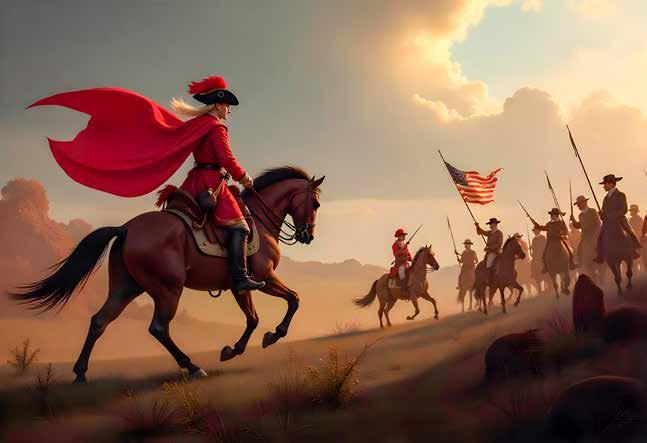
Illustrator: Isaac Flores Genre: Graphic Story
During the time of the American Revolution (1775-1783), the thirteen colonies in America were ruled by Great Britain and King George III. The British made laws and taxes that the colonists felt were unfair because they didn't have a say in them. Many Americans wanted to be free from British control so they could make their own laws and create their own country. This led to a war between the American Patriots, who wanted independence, and the British soldiers (Redcoats), who wanted to keep ruling over the colonies. Follow Samuel, a brave 12-year-old, as he experiences challenging situations and takes significant risks. As you read, think about how Samuel’s decisions shape the story and what you might do if you were in his place!
The story we will read today is a comic. Another name for a comic is a graphic story. This story is historical fiction since it takes place in a real time in history, but the characters and plot are not real.
1. This story takes place during the Revolutionary War. Samuel, the main character, was on the side of the American Patriots. What were the Patriots fighting for? What was the end of the war? {The Patriots were ruled by the British (England). They wanted to rule themselves, so they fought a war. They won and created the country the United States of America.}
As you read, pay attention to the pictures in the story and how they add to the meaning and feeling of the text.
Pennsylvania: 1776
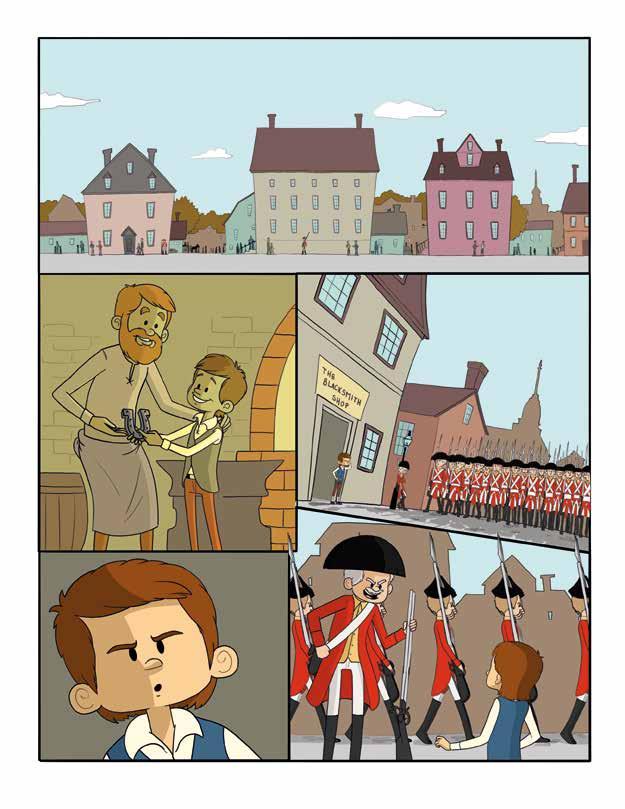
Good work, Samuel. You’re getting the hang of it.
Thanks, Father. I think I’ll step outside now for some fresh air.
Why must they always remind us of their authority? I wish they would just leave us be.
What are you looking at, boy?
N-nothing, sir. I’m just going on my way
1. What side are the soldiers on? How do you know? {the British, their uniform is red}
2. Where does Samuel live? {Pennsylvania}
What’s this?
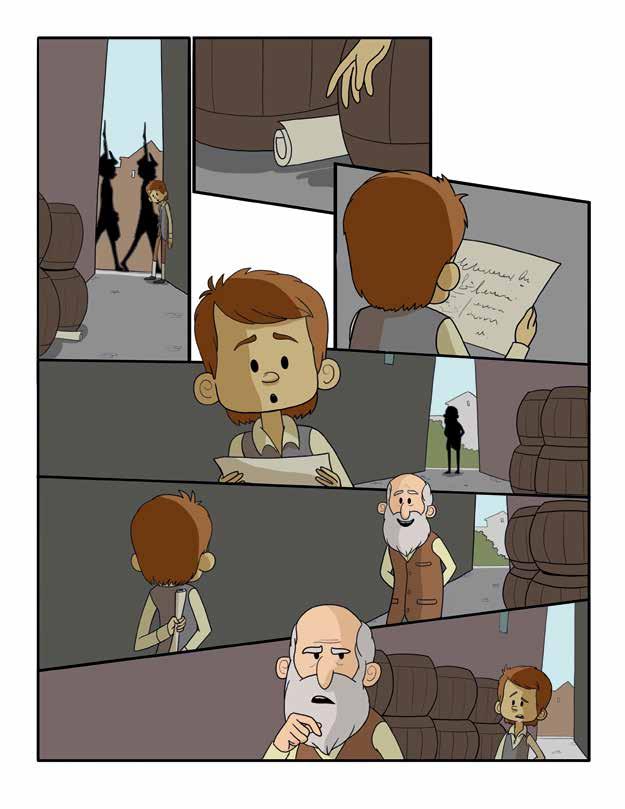
This looks important... but I can't read it.
Excuse me, young man. I am looking for important documents that are missing. Have you seen anything?
1. Why do you think Samuel hid the document from the old man? {Answers will vary.}
2. Do you think Samuel should’ve given it to him? Why or why not? {Answers will vary.}
I hope I did the right thing I need to find someone I can trust.
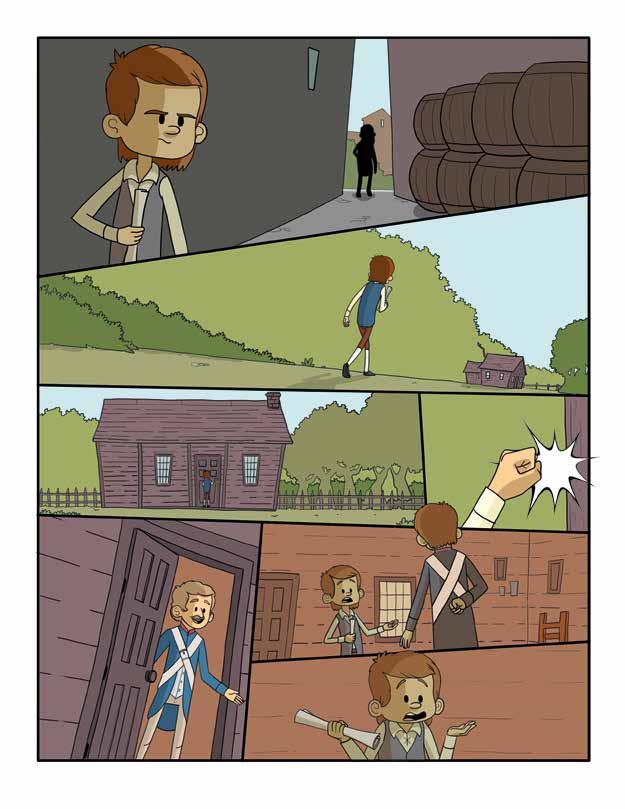
Mr. Jenkins? Are you home?
Samuel? What brings you here?
I found this. I believe it's important. Where did you get this? In
1. What side is Mr. Jenkins on? How do you know? {the Patriots, he is wearing blue, Samuel trusts him}
2. Why do you think Mr. Jenkins tells Samuel that he was “right to be cautious”? {It is a war, and it is hard to know who to trust.}
You found a secret British document. The information here could be very helpful for the Patriot troops if they receive it immediately. We can’t let it fall into British hands!
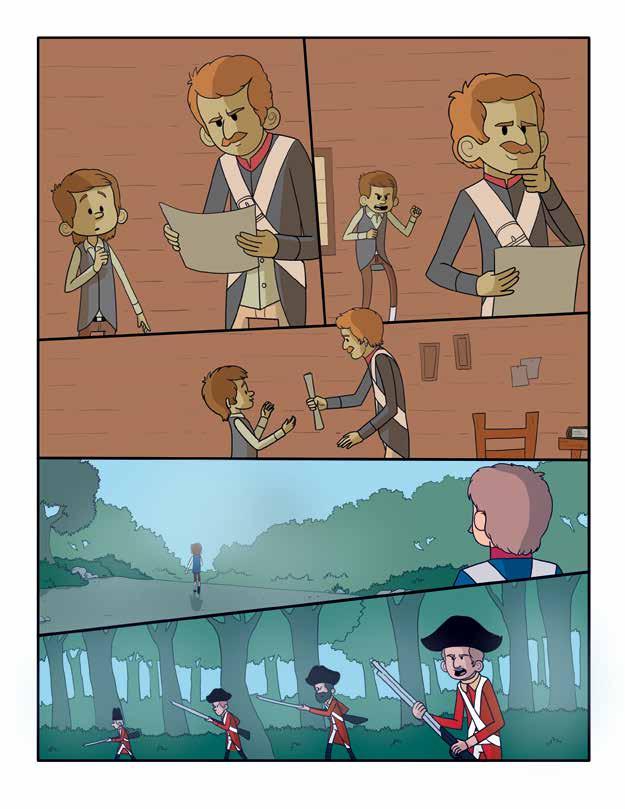
It's dangerous. The British are everywhere.
I know the town better than anyone. I can do it.
Very well. Take the forest path to avoid patrols. Be swift and stay hidden. Search every path! We must find that message!
1. How could the document help the Patriots? {It could let them know about secret British plans.}
2. What do you think the are British searching for? {the missing document}
Did you hear that rustling?
Probably just an animal. Keep moving.
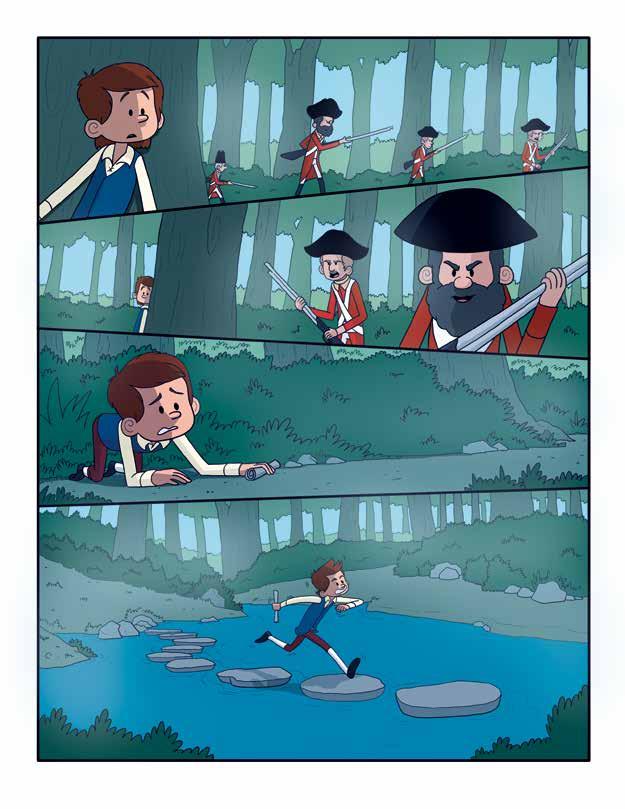
That was close. I mustn't stop now.
Teacher Script
1. Do you think Samuel
And where might you be headed in such a hurry?
I was just... picking berries!
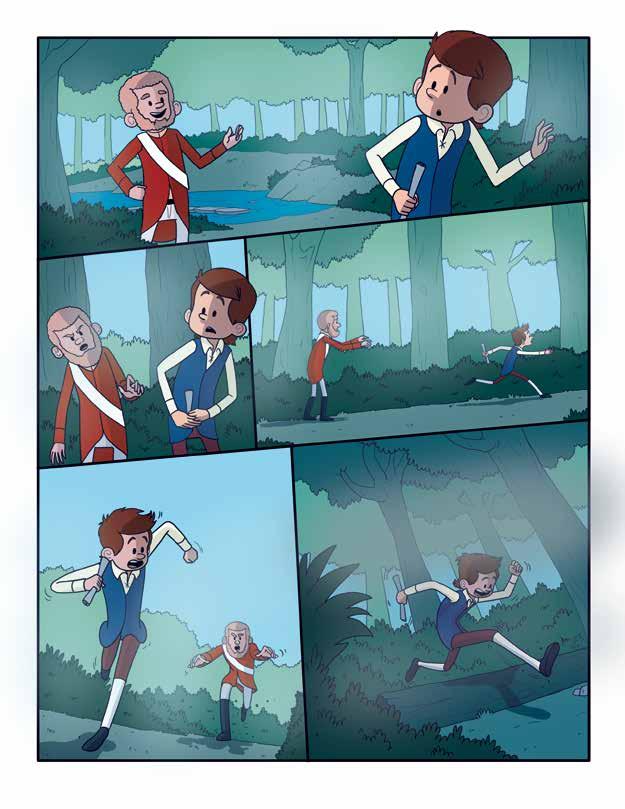
What's that you're hiding?
Over here! Help me catch him! Stop!
1. What do you think the soldier was doing in the forest? {Answers will vary. - He was on standard patrol.}
2. What king does he refer to when he says “halt in the name of the king”? {the king of England}
I
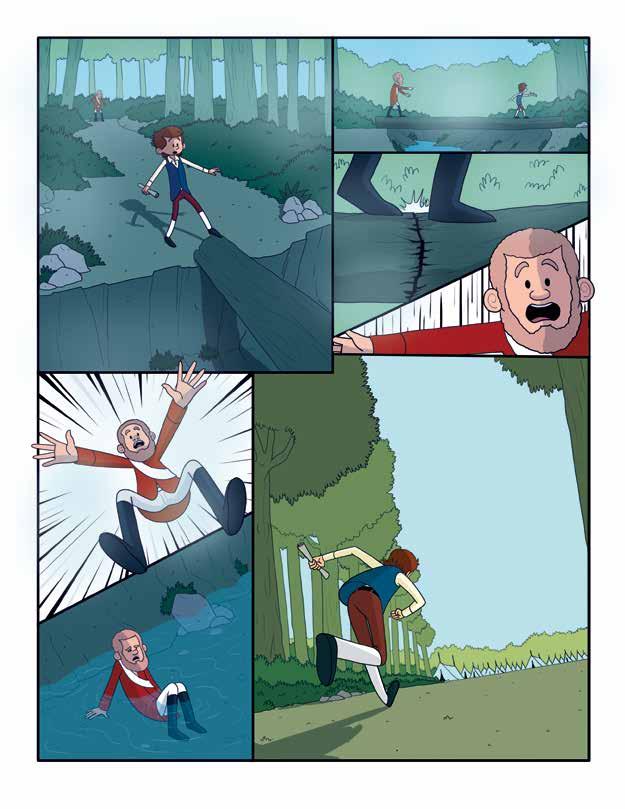
1.
What is it, son?
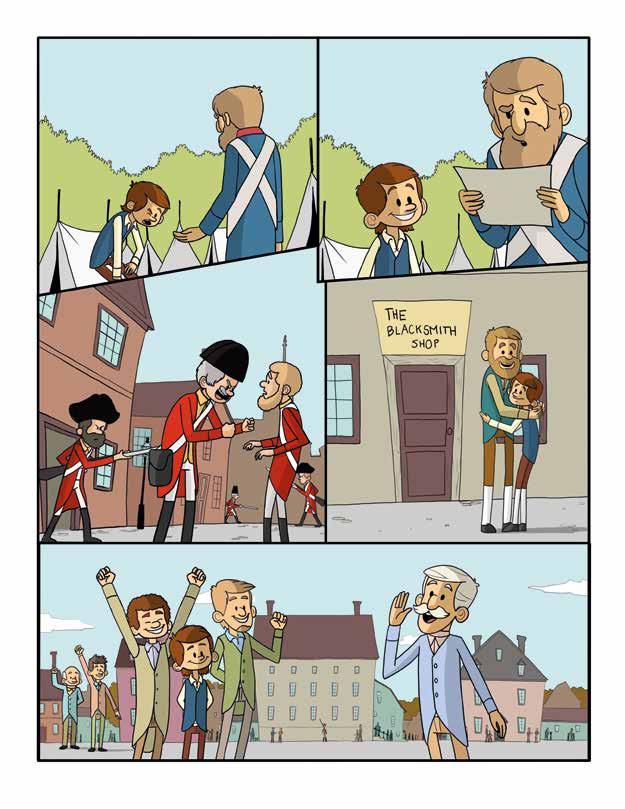
This information is crucial. Well done!
I’m glad I could assist.
A secret message... from town.
How could you let a child outsmart you?
Where have you been? I was worried.
Just helping out where I could.
Did you hear? The Patriots turned the tide!
1. How does Samuel help the Patriots? {He delivers the document with secret British plans to the Patriots, so now they know their plans.}
2. Do you think this story could have happened? Why or why not? {Answers will vary.}
On the next page, we will explain how the images in the text add to the meaning and feeling.
make it across.
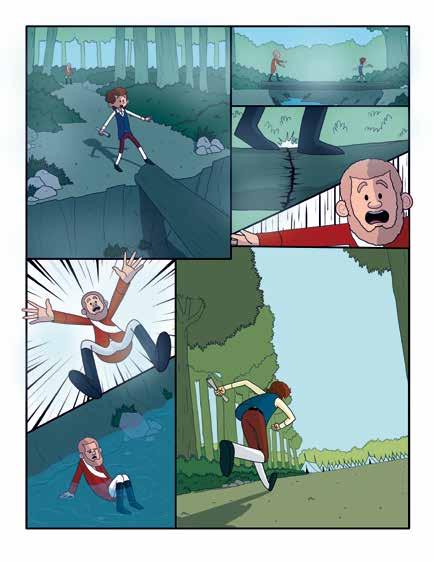
Choose a picture that matches each sentence. Then, fill in the blanks to explain how that picture adds to the meaning and/or feeling of the story.
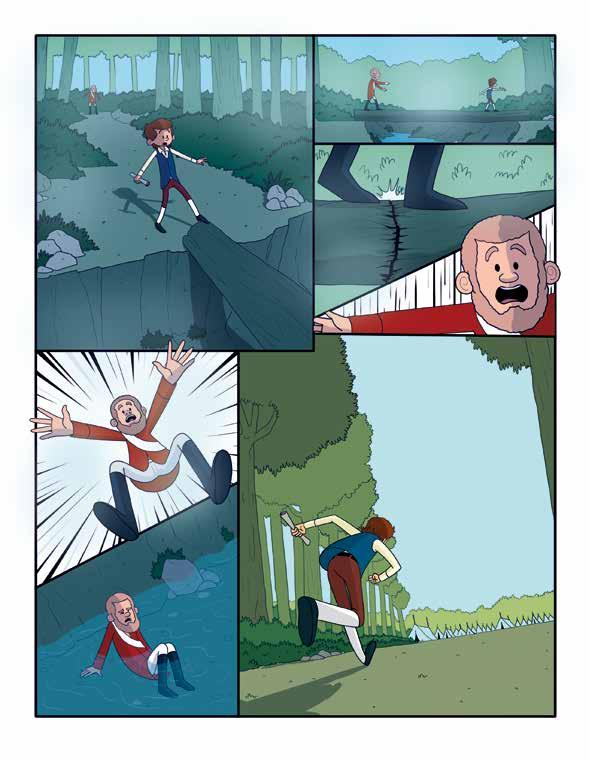
I have a message! It's urgent!
shows a character’s emotions. We can tell that they are feeling uses dark colors. The illustrator did this to make this part of the uses light colors. The illustrator did this to make this part of the has an unrealistic image or background. The illustrator did this . shows something the words don’t say. It shows and lets the reader know . has no words. It shows .
scary and suspenseful happy and optimistic that a character is falling characters hugging that Samuel’s father is proud of him and a soldier and Samuel running on a log that Samuel is being chased happy that he is home their fists are clenched
PRACTICE VOCABULARY STORY REVIEW ACTIVITY ASSESSMENT
The setting is when and where a story takes place.
Write a paragraph comparing and contrasting two settings from the story.
1. Choose two settings to compare and contrast.
A Pennsylvania town The alleyway
2. Use the Venn diagram to compare and contrast the settings. Use clues from the pictures and text.
The alleyway
Dark boring colors
Lots of hiding places Barrels
Mr. Jenkins' house
Pennsylvania
Bright brown color
Open A house
3. Write an outline. In the body sentences, compare and contrast the settings.
Topic Sentence:
The story takes place in Pennsylvania in the year 1776.
Body Sentence 1:
In the story, Samuel finds a document in an alley and then goes to Mr. Jenkins' house.
Body Sentence 2:
The alley is crammed with barrels, has lots of hiding places, and has dark, boring colors.
Body Sentence 3:
In contrast, Mr. Jenkins' house is open and airy with a brighter brown color.
Concluding Sentence:
I think the alley is meant to be scary, and Mr. Jenkins' house is supposed to be friendly.
4. Write a paragraph.
The story takes place in Pennsylvania in the year 1776. In the story, Samuel finds a document in an alley and then goes to Mr. Jenkins' house. The alley is crammed with barrels, has lots of hiding places, and has dark, boring colors. In contrast, Mr. Jenkins' house is open and airy with a brighter brown color. I think the alley is meant to be scary, and Mr. Jenkins' house is supposed to be friendly.
Create an audio recording of the story.
1. Rewrite the story in your own words. Remember that the listeners will not be seeing the pictures.
2. Record yourself reading the story.
Circle the correct answer.
1. The nurse was ready to the doctor during the surgery.
a. assist
b. cautious
c. swift
d. rustling
2. Which word means very important?
a. Vital
b. Swift
c. Rustling
d. Halt
3. Which of the following is an example of troops?
a. A group of friends
b. A flock of birds
c. A team of soldiers
d. A herd of elephants
4. Which of the following is an example of cautious behavior?
a. Running to the park
b. Looking both ways before crossing the street
c. Jumping off a high diving board
d. Eating a whole cake without sharing
5. Which word means a soft whispering or crackling sound?
a. Troops
b. Assist
c. Rustling
d. Cautious
6. The fox made a escape.
a. swift
b. authority
c. vital
d. rustling
7. The police officer had the to arrest the suspect.
a. rustling
b. swift
c. authority
d. cautious
8. Which word means to stop?
a. Assist
b. Halt
c. Cautious
d. Troops
Circle the correct answer.
1. What is Samuel's father’s job?
a. Farmer
b. Baker
c. Blacksmith
d. Tailor
2. How do the British react to Samuel’s actions?
a. They are amused.
b. They are grateful for Samuel's help.
c. They try to stop Samuel.
d. They don’t care.
3. Why do you think Samuel decided to help the Patriots? (inferencing)
a. He was forced to by the British.
b. He wanted to impress his father.
c. He believed in the Patriots' cause.
d. He was paid to do so.
4. What event happens immediately after Samuel finds the secret message? (sequencing)
a. He delivers the message to the Patriot leader.
b. He hides the message from the British.
c. He asks his father for advice.
d. He tries to read the message.
5. What is the theme of the story? (main idea)
a. The importance of following rules
b. The power of a small action
c. The dangers of taking risks
d. The importance of teamwork
6. What does “turned the tide” mean in “the Patriots turned the tide”? (context clues)
a. Changed the way things are going for the better
b. Flipped the beach
c. Lost the war
d. Ran away
7. How are Samuel and the British soldiers different? (compare-contrast)
a. Samuel is brave, and the British soldiers are cowardly.
b. Samuel is loyal to the Patriots, and the British soldiers are loyal to the king.
c. Samuel is rich, and the British soldiers are poor.
d. Samuel is old, and the British soldiers are young.
8. Which is a fact? (fact vs. opinion)
a. Samuel is the bravest boy in the town.
b. The British soldiers are mean and cruel.
c. The British soldiers are wearing red coats.
d. Mr. Jenkins is the wisest man in the town.
Lesson 25: Making Inferences
Today we're going to learn about inferences. An inference is something you figure out without being told directly. Inferences are made from evidence from the text and background knowledge (what you already know).
Inferences are not written straight out. You have to search for them! Let’s look at an example:
Unit Goal Trajectory: Make inferences and integrate information from written text.
1. Make inferences from informational texts. (Lesson 1)
2. Draw conclusions and predict outcomes in literature. (Lesson 2)
3. Compare and evaluate information from multiple sources on a topic. (Lessons 3 and 4)
4. Write knowledgeably about a topic using multiple sources. (Lesson 4)
Salt water taffy is a chewy candy with a confusing name. It doesn't have seawater in it, even though it uses salt and water. The taffy is made with corn syrup, glycerin, and butter. Pulling the taffy makes it light and chewy. This candy was first made at the Jersey Shore in the 1880s. There are a few stories about how it was invented, but they might not be true. Some say an assistant was making candy and used seawater by mistake. Others say a storm soaked the candy with seawater. Even though we're not sure how it was invented, salt water taffy is a popular treat enjoyed by many.
What’s not written but you can figure out
Inference 1
Salt water taffy is high in sugar and fat.
Evidence
“The taffy is made with corn syrup, glycerin, and butter.”
Background Knowledge
Corn syrup has lots of sugar, and butter is high in fat.
Inference 2
Salt water taffy was invented near the sea.
Evidence
“This candy was first made at the Jersey Shore” “used seawater by mistake”
Background Knowledge A shore is near the sea. Seawater comes from the sea.
Read each passage. Then, answer the questions.
Their fuzzy bodies brush against colorful petals, collecting pollen and nectar. They return to a crowded home built from wax. Here, they turn the nectar into honey.
1. Write one word to describe what this passage is talking about. How do you know? Write at least three quotes from the text.
2. Where do pollen and nectar come from? How do you know? Write a quote from the text.
These brave men wear yellow or tan heat-proof coats and helmets. Thick gloves protect their hands from burning hot temperatures. Sturdy boots help them climb and walk safely.
3. Write one word to describe what this passage is talking about. How do you know? Write at least two quotes from the text.
4. Why do you think these men need special boots to help them climb and walk safely?
“Fuzzy bodies” “Home built from wax” “Honey” "Burning hot temperatures" “Heat-proof” “Colorful petals” They might need to climb on uneven ground to rescue people. They also need to protect their feet.
Students may have a hard time explaining how they made their inferences.
Tell students that if they look closely at the text, they can find quotes that hint to the inference. Remind them that an inference can seem obvious, but the text doesn’t say it straight out.
1. Familiar, adjective
S Common A Unusual
E A song that you know; People you that you know; A book that you’ve read Q How can you become more familiar with a new topic?
2. Practical, adjective
S Useful A Useless
E A solution that could work; Paying bills; Being able to do everyday things Q Is it always best to choose the most practical option? Explain.
3. Ordinary, adjective
S Normal A Odd
E Typical pets like cats, dogs, or fish; The regular way of doing something; Nothing is strange Q Can you think of a way to make an ordinary task more interesting?
4. Civilizations, noun
S Cultures E A group of people living in a place; A way a group of people used to live; A group’s culture at a historical time Q How do civilizations develop and change over time?
5. Advanced, adjective
S Improved A Lowered
E Someone who is good at a skill; New technologies; A class that is a higher level
Q What does it mean to be an advanced learner?
6. Wit, noun
S Intelligence A Simpleness
E Using your brains; Saying clever things; The ability to make good judgments
Q Can you think of a situation where wit might be inappropriate?
Match the bolded words with their definitions. Highlight context clues.
The park was familiar to her since she played there every day.
Wearing comfortable shoes is a practical choice for a long walk.
The day was ordinary; there were no surprises.
The ancient Egyptian civilization is known for its pyramids.
The advanced math class was hard for even the smartest students.
Her sharp wit kept everyone entertained at dinner.
They used their school ID cards to prove their identities.
The thief was imprisoned for five years for stealing money from the bank.
normal; not special or unusual
an organized group of people with laws, jobs, and culture
sensible and useful for everyday purposes who a person or thing is quick thinking and cleverness
well known or frequently encountered ahead of others put in jail or prison familiar [fuh-MIL-yur]; practical [PRAK-ti-kuhl]; ordinary [OR-duh-ner-ee]; civilization [siv-uh-lih-ZAY-shuhn]; advanced [ad-VANST]; wit [wit]; identity [eye-DEN-tuh-tee]; imprisoned [im-PRIZ-uhnd].
7. Identity, noun
S Character E Who you are; What a passport or license shows; A character in a story or play Q What do you think identity theft means?
8. Imprisoned, adjective
S Jailed A Free E In jail; Tied up; Prevented from doing something
Q Why might someone be imprisoned?
Author: S. Miller Genre: Informational
The world of spies is filled with mystery and excitement! From ancient times until today, spies have used clever disguises and secret codes to gather information and complete their missions. How did spies in ancient Rome blend in? What kind of tricks did spies use during World War II? As you read, think about the incredible skills spies need and the daring adventures they undertake.
1. The passage we will read today tells about spies. What are texts that teach about something called? {infromational texts}
2. What does disguise mean? Have you ever worn a disguise? When? Why might spies need disguise? {Answers will vary.}
As you read, pay attention to what you can figure out from the text.
The market was buzzing with activity. Shoppers called out greetings as they passed familiar faces. Merchants shouted as they tried to sell their goods at the best price. The air was filled with the sweet smells of spices and the bright colors of silks. In the middle of this hustle and bustle stood a rather plain-looking man. His brown hair, covered by a cap, was neither too long nor too short. He had brown eyes, and a neatly trimmed beard hid the shape of his chin. He wore the simple, practical clothing of a traveling merchant.
No one who passed by him took a second look and that was exactly what he wanted.
As he watched the crowd, his eyes darted all
over the place.
He carried a sack of grain but this was no ordinary sack. Nestled inside the grain were a few maps with certain locations marked on them. In his hand was a coin with a tiny listening device hidden inside. He also carried a set of lockpicks hidden in a pen and a small bottle of disappearing ink. By now you’ve surely guessed that this was no ordinary merchant. Agent X, a spy, was a master of disguise. He could change his appearance to look like anyone, anywhere! Unlike other spies, Agent X's best tool was being able to change his appearance whenever necessary. He could become a shopkeeper in a busy city or a farmer in a sleepy village. No one ever suspected a thing!
1. Why did Agent X want to look like an ordinary merchant? {to avoid suspicion and blend in with the crowd}
2. What is hidden inside the coin? {a listening device}
The art of disguise is as old as spying itself. Even in ancient civilizations, spies understood that hiding in plain sight made their spying that much more effective. With clothing and makeup, they could change their appearance and blend into the crowd.
In ancient Rome, spies were the emperor’s secret weapon. They would sneak into enemy camps dressed as soldiers or lowly slaves. Their mission? To uncover top-secret plans and find out when the enemy was going to attack. These spies were able to fool everyone around them, but their coolest trick was their secret code language. They could talk in front of their enemies without anyone understanding what they were saying! Regular words took on hidden meanings “market” might mean “battle,” or “grass” could mean “danger.” Spies could hold conversations that made no sense to others! “Meet at the third hour, near the flagpole in the park.”
They also used secret signals, like placing stones on a path in a pattern. They could alert
their bosses where to find them or tell them that they had important information. Sometimes, they even hid messages in everyday objects, like a note tucked into a loaf of bread or a secret message written in invisible ink!
With the passage of years, spy tactics became even more advanced. During World War II, the major countries of the world were at war. It wasn’t enough for spies to change their clothes and disguise themselves; they had to become completely different people. Juan Pujol Garcia was a Spanish double agent.
1. How were spies a secret weapon in ancient Rome? {They would find out secret enemy plans so that Rome could foil them.}
2. What skills would be important for a good spy in ancient Rome? {quick thinking, acting ability, good judgment, the ability to remain calm under pressure…}

This means that he was spying for two sides the Germans (the Axis) and the British (the Allies). Juan, whose code name was “Garbo,” supported the Allies. To trick the Germans, he invented a team of make-believe spies! Garbo sent the Germans all sorts of fake information about the Allies’ secret plans. He changed his appearance and even his handwriting to match each of his imaginary agents. His sneaky tricks paid off for the Allies on D-Day. The Germans fell for his fake reports and sent their troops in the wrong direction. This helped the Allies launch a successful attack on France a big step toward winning the war!
History is full of clever spies with incredible disguises. One spy, Sidney Reilly, was such a master of disguises that he became known as the "Ace of Spies." Reilly used different appearances and personalities to trick his
enemies and gather information. His life was full of exciting adventures and narrow escapes. Once, the Russians captured him, but he managed to escape by jumping from a moving train! With his quick wit and clever disguises, he was always one step ahead of the enemy. Another brave spy named Virginia Hall worked for Britain during World War II. She lost her leg in an accident, but instead of letting this stop her, she used it as part of her disguise! She had a special wooden leg that helped her blend in while she traveled around dangerous areas, secretly collecting information and helping her country fight the enemy.
Today's spies have advanced tricks to help them hide their true identities. They have special makeup and tools that can change how their voices sound. But being a spy is harder
1. Explain what the “Allies” and the “Axis” were in World War Two. {the German side was called the Axis, the British side was the Allies}
2. What were some of Virginia Hall’s responsibilities as a spy? {collecting information, assisting the Allied war effort}
than it used to be. Today, there are cameras everywhere. Computers are also able to recognize faces. This makes it much harder for spies to keep their identities a secret. But spies are always finding new ways to stay hidden. They use sneaky disguises that can trick even the smartest computers. They might also use secret codes and hidden messages to talk to each other without anyone knowing what they are saying. “The weather forecast says sunny skies ahead. Perfect for a picnic. Let’s pack the red-checkered blanket and head to the meadow tomorrow!”
Even with all their tricks, spies are sometimes caught. In 2010, a Russian spy named Anna Chapman was living in America. She pretended to be a real estate agent but was secretly collecting information for Russia. She used a fake name and passport, but the FBI used special cameras and computers to figure out who she really was! She had to return to Russia. Some spies who are caught are imprisoned for their crimes.
Agent X’s work in the busy market was done. He had more important secrets to

uncover. He took off his cap and changed his clothes. He was no longer a merchant. Now, he looked like a tired traveler who had been on the road for days. He quickly exchanged the spy tools in his bag for ordinary objects, like dried fruit and a beat-up metal water bottle. As he slunk out of the market, he was already thinking about what his next mission would be. For spies like Agent X, changing their appearance is like playing a never-ending dress-up game. They lead exciting and sometimes dangerous lives. And when their mission is complete, they’re gone, disappearing without a trace. After all, it’s all in a day’s work.
1. Explain what the simile “changing their appearance is like playing a never-ending dress-up game” means. {They are constantly changing their disguises.}
2. How might the role of technology in spying change in the future? {Answers will vary.}
On the next page, answer the questions to make inferences in the story.
Use clues from the story and information you already know to answer the questions.
1. Did people in the marketplace know each other? How do you know? Write a quote from the text.
“Shoppers called out greetings as they passed familiar faces.”
2. Did ancient Roman spies work alone? How do you know? Write a quote from the text. Explain.
Quote:
“Used secret signals”
Explanation:
Codes and signals are only needed when people work together. They are in important positions in Allied countries. They are talented. Their information is good. He might say these things so the Germans would believe him and rely on his information.
4. How do you think Virginia Hall’s wooden leg helped her avoid being caught? Explain. Use a direct quote.
3. What might be some details Juan Garcia told the Germans about his make-believe spies? Explain.
A wooden leg can’t be faked, so it doesn’t seem like a disguise. It made her seem like an ordinary person who didn't have anything to hide. “...that helped her blend in...”
5. What old methods of disguise won’t work for spies today?
Wigs or makeup that cannot fool technology
How do you know? Write a quote from the text.
“They use sneaky disguises that can trick even the smartest computers.”
6. Was Agent X worried that someone would recognize him from the market? How do you know? Write a quote from the text.
“He took off his cap and changed his clothes.”
Yes Yes No
PRACTICE VOCABULARY STORY REVIEW ACTIVITY ASSESSMENT
Simile: A way of comparing two things using "like" or "as."
Example: The snow was as white as a fluffy cloud.
Metaphor: A way of comparing two things by saying one thing is something else.
Example: The clouds were fluffy cotton balls in the sky.
Write a poem that begins with simile or metaphor about spies.
1. Decide on a simile or metaphor. Use one of the following options to start off or write your own.
a. A spy is a .
2. Why is that a good comparison? Write down some thoughts. chameleon
b. Disguise is like .
c. Agent X is as a .
d. .
Both of them blend into surroundings.
Both change how they look.
Both do this to hide from danger.
3. Write a poem. It should be four to eight lines long. Use your simile or metaphor as the first line. Note: Your poem can rhyme, but it does not have to.
A spy is a chameleon
Outsides change in a snap
Blending in, trying to hide
Escape from danger’s lap
Safe
Pretend you are helping Agent X prepare for his next mission.
1. Choose the location. Decide how Agent X will blend into his surroundings.
2. Add gadgets. What will Agent X need? (You can invent your own.)
3. Draw a picture or write a description of Agent X in full gear.
Circle the correct answer.
1. Which word means something useful or helpful for everyday life?
a. Civilizations
b. Imprisoned
c. Practical
d. Alert
2. Throughout history, many have risen and fallen, leaving behind ruins.
a. identities
b. civilizations
c. wits
d. alerts
3. The restaurant served mostly food, like burgers and fries.
a. identity
b. alert
c. ordinary
d. imprisoned
4. Which of the following is an example of a familiar food?
a. A dish you’ve never tried or seen before
b. A bowl of cereal you eat every morning
c. A strange fruit you found at a new market
d. A complicated recipe you’re making for the first time
5. Which of the following is an example of advanced technology?
a. A simple calculator
b. An electric car
c. A wooden toy
d. A handwritten letter
6. Which word means put in a jail?
a. Imprisoned
b. Civilizations
c. Wit
d. Ordinary
7. The detective struggled to determine the of the mysterious caller.
a. alert
b. imprisoned
c. identity
d. civilization
8. In which situation would someone need to use their wit?
a. Following easy steps to bake a cake
b. Solving a tricky riddle
c. Doing simple addition in math
d. Using a map with clear directions to get somewhere new
Circle the correct answer.
1. How did Juan Pujol Garcia, the Spanish double agent, trick the Germans? (detail)
a. He sent them real information about the Allies.
b. He invented a network of fake spies.
c. He changed sides and fought for the Allies.
d. He used technology to disguise himself.
2. Why has it become harder for spies to keep their identities a secret in recent times? (cause and effect)
a. People are more suspicious of strangers.
b. Advanced technology makes it easier to identify them.
c. Disguises have become more expensive.
d. There are fewer places to hide.
3. Why do you think Virginia Hall continued working as a spy after losing her leg? (inferencing)
a. She didn't know how to do anything else.
b. She felt it was important to help her country.
c. She wanted to get caught.
d. She wanted to win a medal.
4. What is the main idea of the passage? (main idea)
a. Spies use disguises to blend in and complete their missions.
b. Ancient civilizations had the best spy tactics.
c. New technology makes it hard for spies to hide.
d. Spies always complete their missions.
5. What does Agent X do after he finishes his work in the market? (sequencing)
a. He uses gadgets to look at the information he got.
b. He celebrates with other undercover agents.
c. He changes his appearance to look like a tired traveler.
d. He tells everyone who he really is.
6. The passage describes Sidney Reilly as a “master of disguises.” What is a synonym for “master” in this context? (context clues)
a. Student
b. Beginner
c. Expert
d. Helper
7. How are the disguises used by ancient Roman spies similar to those used by modern spies like Agent X? (compare-contrast)
a. Both rely heavily on advanced technology.
b. Neither use makeup or clothing alterations.
c. Both aim to look like someone else to avoid being noticed.
d. Neither use fake identitites.
8. Which of the following is a fact from the passage?
a. It’s very exciting to be a spy.
b. The art of disguise is an important skill for spies.
c. In ancient Rome, spies used secret code languages to communicate.
d. The best way for spies to disguise themselves today is with makeup.
Lesson 26: Making Predictions
Are you ready for some detective work? A prediction is a guess about what will happen next. It is important make predictions as you read.
A prediction is not a random guess. It uses…
→ Clues/details from the story
→ Background knowledge
Let’s look at an example:
Unit Goal Trajectory: Make inferences and integrate information from written text.
1. Make inferences from informational texts. (Lesson 1)
2. Draw conclusions and predict outcomes in literature. (Lesson 2)
3. Compare and evaluate information from multiple sources on a topic. (Lessons 3 and 4)
4. Write knowledgeably about a topic using multiple sources. (Lesson 4)
A young mouse left his house in search of some cheese. He looked both ways, checking carefully for traps and cats.
He sniffed. The smell of cheese pulled him towards the shed. He quickened his pace and reached the edge of the shed. There was a small opening that was just big enough for him to slip inside.
He looked through the opening. It was dark though, and he could not see inside. The mouse crawled through the hole. But as he got to the other side, he bumped into something big that was blocking the way. Using his little paws, he felt fur. The little mouse jumped up, but it was too late; he had been spotted.
What might happen next? A prediction we can make is: A cat will chase the mouse. Here are the clues/details and background knowledge used to make this prediction.
Clues/details: From the story
"He looked both ways, checking carefully for traps and cats."
Background knowledge: From what you already know
People check for things that they commonly encounter. There are probably traps and cats out.
"Using his little paws, he felt fur." Cats are furry. He is probably feeling a cat.
"It was too late; he had been spotted."
When a cat spots a mouse, they usually chase and try to catch it.
Read the story and answer the questions.
Ethan's forehead beaded with sweat as he stared at the page. Words blurred together. He peeked at the clock. He tapped his pencil, then chased a fly buzzing around his head. The boy next to him flew through the questions, making Ethan feel like he was falling behind.
He closed his eyes for a moment. Come on, Ethan, you got this. You studied all night, you know this stuff. Deep breaths. Take it one question at a time. The clock ticked, but it didn't feel so scary anymore.
1. What is Ethan doing?
Taking a test
2. How do you know? Write a quote from the text.
“He stared at the page… flew through the questions”
3. Make a prediction: What do you think will happen next?
Ethan will pass his test.
4. Write two clues/details from the text (quotes) that you used make your prediction.
“Deep breaths. Take it one question at a time.”
“You studied all night, you know this stuff.”
5. Explain how the details helped you make a prediction. Use background knowledge.
When a person takes deep breaths and takes things slowly, it usually means that they are calming down. When a person is calm, they are more likely to pass a test. In addition, when a person studies, they usually know the material and can pass the test.
Students may have a hard time explaining how they made their predictions from the text.
Tell students that their explanation should include any information they were thinking that wasn’t written straight out in the text. Remind them that it could be information they consider obvious.
1. Historic, adjective
S Major A Small
E The day people landed on the moon; A very important speech today; An old castle
Q Can you name a historic event that took place in your lifetime?
2. Rowdy, adjective
S Lively A Quiet
E A group of loud students on a bus; A group of teenagers acting rough; A wild crowd Q What are some ways to calm a rowdy group of people?
3. Ancient, adjective
S Old A New E Old pyramids in Egypt; An old civilization; A very old diary
Q Do you think it is important to study ancient history? Why or why not?
4. Exhibit, noun
S Display E A section of a museum; A poster in science fair; A painting in an art show Q How can an exhibit help people learn about a particular topic?
5. Serpent, noun
S Snake Q What type of person would you use the word “serpent” to describe?
6. Mounted, adjective
S Attached A Detached
E Hang a picture on a wall; Climb onto a horse to ride it; Glue wood pieces on a board
Q What does it mean to say a picture is mounted?
Match the bolded words with their definitions. Highlight context clues.
The signing of the Declaration of Independence was a historic event.
The rowdy group made lots of noise on the bus.
The ancient pyramids of Egypt have stood for thousands of years.
My exhibit at the science fair showed the speed of light.
The serpent slithered through the grass, its scales shining in the sunlight.
The painting was mounted on the wall for everyone to see.
A group of people gathered to sign a petition against the new law.
I got flustered during the interview when I forgot one of the answers.
noisy and disorderly
a formal written request signed by many people a public display of something interesting famous or important in history
fixed on or attached to nervous and confused very old snake
7. Petition, noun
S Request E A request signed by lots of people; A prayer; A strong request for something Q What are some important issues that people might create petitions for?
8. Flustered, verb
S Confused A Calmed
E The feeling when you’re embarrassed; The feeling when you’re nervous
Q What does a flustered person look like?

Author: T. Bluming Genre: Mystery
Max and his classmates are heading to the Historic Land Museum, where they’ll explore ancient treasures and see incredible artifacts up close. But just as they start their tour, something unexpected happens. Will Max be the one to solve the mystery? What clues will help him uncover the truth? Get on your detective hat and see if you can solve the mystery, too!
1. The story we will read today is a mystery. What are some things mysteries have? {detective, problem, thief, clues…}
2. The setting of this story is a history museum. Have you ever been to a history museum? What type of exhibits did you see? {Answers will vary.}
As you read, stop at different points and answer questions to make a prediction. (Note: The students will be writing their predictions and explanations on the review page. This page can be completed as you answer each question, or it can be completed after reading the whole story.)
Max leaped off the school bus. He’d been waiting for this day ever since his teacher, Mr. Hayes, had announced that their class would be going on a trip.
Now, Mr. Hayes clapped his hands. His students gathered around him.
“Boys, before we enter the Historic Land Museum, we must go over some rules,” he said. “Number one, no loud talking. Number two, no food or drinks in the museum. Number three, no pushing or rowdy behavior.”
Max grinned. This was so exciting! He walked behind Mr. Hayes.
Oops! He didn’t notice a step leading into the museum, and he went flying. He bumped into Leon.
“Sorry,” Max said.
“Watch where you’re going!” Leon growled. “I almost dropped my camera.”
They entered the museum. Max looked around curiously. They passed towering sculptures and glass cases filled with ancient jewelry. They made their way to the Aztec exhibit. There were colorful masks and ancient calendars with mysterious symbols.
In the center of the room was a glass box. Inside was a glittering object.
A tall man walked over to Mr. Hayes. He nodded at Mr. Hayes and looked at the boys.
“My name is Mr. Wright,” he said. “I’m here to show you around this exhibit. Let me know if you have any questions.”
“I have a question,” Leon said. “What is that?”
He pointed at a glass case.
Max sucked in his breath. Whoa! He’d never seen such a thing.
“That is the famous Double-Headed Serpent from Tlatelolco,” Mr. Wright explained. “It’s an amazing piece of artwork from the Aztecs.”
Max stared at the snake. It looked like it was made from small turquoise tiles and mounted on a wooden board. The snake had two heads, one on each end. Both of its mouths were open.
Leon pushed through the crowd, holding his camera high. Flash! Max frowned. He couldn’t concentrate on what Mr. Wright was saying.
“This is our most prized piece,” Mr. Wright
1. What is an Aztec exhibit? Who were the Aztecs? {The Aztecs were an ancient civilization that lived in Mexico. The exhibit shows things about them and artifacts from that time.}
2. Imagine you were at the museum. What question would you have asked Mr. Wright? {Answers will vary.}
said. “It’s very valuable.” He sighed. “Another museum is offering our museum a lot of money for it. They may decide to sell it. We must do everything we can to make sure that doesn’t happen.”
“But what can we do?” Leon asked. He gripped his camera tightly.
“Well, you can always donate to the museum.” Mr. Wright chuckled as if he’d just told a good joke. “You can also sign this petition. Hopefully, that will convince the museum’s board members that the serpent should stay where it is!”
Max watched as many of his classmates signed the petition. Leon seemed very concerned. Max also didn’t want the museum to sell the serpent. He signed the petition, too.
“Hurry up, class!” Mr. Hayes said. “Time to move on!” Max pulled his eyes away from Mr. Wright and the serpent and followed Mr. Hayes toward another exhibit.
After seeing the Egyptian and Viking exhibits, the class moved on to Ancient Greece. Suddenly, a loud alarm rang out. A few minutes later, a man in a suit rushed over. He looked pale and flustered. His name tag read “Mr. Nelson, Museum Director.”
Why do you think the alarm rang? What do you think will happen next?
1. What else could the students do to try and save the serpent? {Answers will vary.}
2. Read the question at the bottom of the page. Why do you think the alarm rang? What do you think will happen next? What are some clues from the text? Explain using your background knowledge. {Answers will vary; see the review page.}
“Please stay put.” Mr. Nelson tried to sound calm. “Nobody can leave this area until the police arrive.”
Everyone gasped. The police? What was going on?
“What just happened?” Mr. Hayes asked. “Is it safe for the boys to be here?” He kept his voice low, but Max was still able to hear.
Mr. Nelson’s voice was high-pitched with worry. “We have an alarm that goes off if an artifact is removed from its case. You heard the alarm go off before. It was the alarm for the double-headed serpent!”
“But what could have happened?” Mr. Hayes asked. Max noticed some other boys listening, too.
“I rushed over to the exhibit,” Mr. Nelson said. “Mr. Wright came running over, too. He said that he’d been on his lunch break when he heard the alarm going off!”
Mr. Nelson shook his head and continued. “The strange thing is that the glass is broken but the serpent is still in its case. It’s almost like those giant closed mouths are laughing at us. Mr. Wright and I can’t make heads or tails of the whole situation. That’s why everyone needs to stay put until the police arrive.”
Max looked from Mr. Hayes to Mr. Nelson. There was something strange about Mr. Nelson’s words. Something seemed off… But what was it?
He turned to Mr. Nelson. “Mr. Nelson, can I go with you to see the serpent?”
Mr. Nelson nodded. “I don’t see why not.”
Max looked at Leon. “Leon, you come, too.”
“Me?” Leon squeaked. His eyes darted from side to side.
Mr. Nelson looked at him. “Yes, you,” he said sharply. “Please come with us.”
As the small group walked toward the exhibit, Mr. Nelson’s eyes fell on Leon. There was a lump in his jacket.
“Leon, what’s in your jacket?” he asked. Leon looked like he wanted to run out of the room. Max watched him. What would Leon do next?
Who do you think stole the serpent?
“Nothing!” Leon said. He hesitated for a moment, then pulled out a pack of licorice.
“Mr. Hayes said we can’t bring food into the museum,” he said. “But I was worried I’d be hungry. Sorry.”
“Okay,” Mr. Nelson said. “You can go back to your class.”
“Wait – that’s not why I asked Leon to come here,” Max said. “We need his camera.”
Max took the camera from Leon. He found a picture of the serpent in its case. He looked carefully at it, then looked back at the serpent in the shattered display. His mouth dropped open.

1. What does the word “artifact” mean in the story? {a very old object made by humans}
2. Read the question. Who do you think stole the serpent? What are some clues from the text? Explain using your background knowledge. {Answers will vary; see the review page.}
“Look!” he said. Mr. Nelson and Leon leaned over and looked at the camera. “See here? The serpent’s mouths are open. But the serpent here has mouths that are –”
“Closed!” Mr. Nelson and Leon shouted together.
“I think it’s clear what happened,” Max said. “Somebody wanted the real serpent and put a fake one in its place to throw us off. The question is, who did it and why?”
Why do you think the serpent was stolen? What do you think will happen next?
He thought hard. Had someone stolen it for money? Mr. Wright had said it was very valuable…
“Look here!” Leon exclaimed. He pointed at the fake serpent. “There’s a red thread on it! It matches the jacket Mr. Wright is wearing!”
Max picked up the thread and dashed over to Mr. Wright.
“Mr. Wright,” he said, “take a look.”
He showed Mr. Wright the red thread and the photo on Leon’s camera.
Mr. Nelson looked at Mr. Wright. “What’s this all about?”
“I…I...” Mr. Wright stammered. He took a step back. “I didn’t do it for money!”
“But you did steal it?” Max asked.
Mr. Wright nodded. “You have to understand.” Mr. Wright put his head in his hands. “I couldn’t let such an important exhibit leave the museum. No one would ever see it again. I wanted to hide it until after the sale.”
Mr. Nelson raised an eyebrow. “I see. You wanted to protect it, but instead, you ended up causing trouble.”
In the distance, they could hear the sound of sirens. The police were getting closer. Mr. Wright looked sick.
Mr. Nelson turned to the boys and smiled. “Thank you, boys! Case closed!”
“One minute,” Max said. “We still need to find out why Mr. Wright put a fake serpent in the case.”
Why do you think Mr. Wright put a fake serpent in the case?
Mr. Wright sighed. “Well, I thought that if I put in a copy, nobody would look too closely and realize it was a fake. Then, the museum would sell the copy but we’d still have the original. Who would know the difference?”
“But that’s dishonest!” Leon said. “Also, it wasn’t such a good plan. Max noticed the difference.”
Mr. Wright nodded sadly. “You’re right. I just wanted to keep history where it belongs — where everyone can enjoy it.”
Mr. Nelson smiled slightly. “Well, I think you made your point, but it’s time to return the serpent.”
“Now this case is really closed!” Max said.
1. Read the first question. Why do you think the serpent was stolen? What do you think will happen next? What are some clues from the text? Explain using your background knowledge. {Answers will vary; see the review page.}
2. Read the second question. Why do you think the serpent was stolen? What do you think will happen next? What are some clues from the text? Explain using your background knowledge. {Answers will vary; see the review page.}
On the next page, you will write down the predictions you made.
Fill in the predictions you made as you read the story. Then, answer the questions.
1. Prediction 1: Page 405
a. Why did you think the alarm rang? What did you think would happen next?
I thought that the alarm rang because there was a fire.
b. What details from the story and/or background knowledge did you use?
I know that alarms are lots of times fire alarms.
c. Was your prediction correct?
2. Prediction 2: Page 406
a. Who did you think stole the serpent?
b. What details from the story and/or background knowledge did you use?
Max called him to come, there was a lump in his jacket, and he was nervous.
c. Was your prediction correct?
3. Prediction 3: Page 407
a. Why did you think the serpent was stolen? What did you think would happen next?
For money; I thought they would find more clues.
b. What details from the story and/or background knowledge did you use?
It was valuable. The story is a mystery, so they would probably solve it.
c. Was your prediction correct?
4. Prediction 4: Page 407
a. Why did you think Mr. Wright put a fake serpent in the case?
To trick everyone
b. What details from the story and/or background knowledge did you use?
If there was a fake serpent, people wouldn’t realize it was missing.
c. Was your prediction correct?
LESSON PRACTICE VOCABULARY STORY REVIEW ACTIVITY ASSESSMENT
A mystery is a story that revolves around a puzzling event or crime. Mysteries usually have detectives, clues, suspense, and a believable resolution.
Write your own short mystery.
1. Prepare some ideas.
Puzzling event or crime:
Detective:
Clue 1:
Clue 2:
Resolution/culprit: a pet dog is missing
Howard, a ten-year-old who owns the dog
footprints leading to the park
barking heard near the library next to the park
Howard finds his sister walking his dog since she wanted to do Howard a favor.
2. Complete the outline. Write one or two sentences for each step.
Introduce the problem and detective:
Howard looked everywhere, but it seemed
Reveal the first clue:
Howard found footprints outside of his door. They led to the
Reveal the second clue:
In the park, he heard barking coming from the direction
Reveal the resolution/culprit:
He saw his sister, Claire, walking Ralf. “I took Ralf
Concluding sentence:
“Thank you,” said Howard. “But next time, please let me
know first,” he added with a smile.
3. Write a paragraph.
Howard found footprints outside of his door. They led to the park. In the park, he heard barking coming from the direction of the library. He followed the noise. He saw his sister, Claire, walking Ralf. “I took Ralf out on a walk as a favor for you,” she said. “Thank you,” said Howard. “But next time, please let me know first,” he added with a smile. that Ralf was missing! He went on a hunt to find his dog. park. of the library. He followed the noise. out on a walk as a favor for you,” she said.
Create an exhibit.
1. Choose an object to display. It can be something funny, something old, or something meaningful.
2. Write a description of your exhibit. Explain why you chose your object.
3. Set up the exhibit. Place the description near the object and show off your exhibit!
Circle the correct answer.
1. The slithered through the tall grass.
a. serpent
b. mounted
c. petition
d. flustered
2. Which means a display to show something interesting?
a. Exhibit
b. Mounted
c. Petition
d. Flustered
3. Which means very old?
a. Historic
b. Ancient
c. Rowdy
d. Flustered
4. Which of the following is an example of something mounted?
a. A picture hanging on a wall
b. A book lying on a table
c. A loose piece of paper
d. A falling leaf
5. The students created a to ask for more recess.
a. serpent
b. exhibit
c. petition
d. flustered
6. Which means noisy, wild, and difficult to control?
a. Rowdy
b. Historic
c. Ancient
d. Flustered
7. Which is NOT historic?
a. The Eiffel Tower
b. Your birthday party
c. The Great Wall of China
d. The American Revolution
8. The sudden news left her feeling and confused.
a. rowdy
b. ancient
c. historic
d. flustered
Circle the correct answer.
1. Who was the person who stole the double-headed serpent? (detail)
a. Mr. Hayes
b. Leon
c. Mr. Nelson
d. Mr. Wright
2. What was the reason for stealing the double-headed serpent? (cause and effect)
a. To sell it to make money
b. To protect it from being sold
c. To create chaos and confusion
d. To impress the other students
3. Why did Leon seem nervous when Mr. Nelson asked him about the contents of his jacket? (inferencing)
a. He was afraid of getting into trouble for bringing food into the museum.
b. He was hiding the stolen serpent.
c. He was worried about the safety of his camera.
d. He was embarrassed about being caught in a lie.
4. What is the main idea of the story? (main idea)
a. The importance of following museum rules
b. The dangers of theft and vandalism
c. The history of an ancient artifact
d. A young boy's adventure in solving a museum mystery
5. What event occurred right after the alarm went off? (sequencing)
a. Mr. Nelson explained the situation.
b. Max and Leon examined the serpent.
c. Mr. Wright confessed to stealing the serpent.
d. The police arrived at the museum.

6. What does the phrase "make heads or tails of" mean in the sentence “Mr. Wright and I can’t make heads or tails of the whole situation.”? (context clues)
a. Understand
b. Ignore
c. Be a snake
d. Be happy
7. How is the real double-headed serpent different from the fake one? (compare-contrast)
a. The real one is smaller and less valuable.
b. The real one has its mouth open, while the fake one has its mouth closed.
c. The real one is made of gold, while the fake one is made of plastic.
d. The real one has two heads, and the fake one has one head.
8. Which of the following is a fact about the double-headed serpent? (fact vs. opinion)
a. It is the most beautiful artifact in the museum.
b. It is part of Aztec history.
c. It should never be sold to another museum.
d. It is more important than any other artifact.
Lesson 27: Integrating Information
Unit Goal Trajectory: Make inferences and integrate information from written text.
1. Make inferences from informational texts. (Lesson 1)
2. Draw conclusions and predict outcomes in literature. (Lesson 2)
3. Compare and evaluate information from multiple sources on a topic. (Lessons 3 and 4)
4. Write knowledgeably about a topic using multiple sources. (Lesson 4)
Today, you will learn how to become an expert on a topic. To do so, you will need to research the topic by reading a lot about it.
Each text you read about the topic is called a source
As you read sources, you need to decide what information is more important and what information is less important.
You don’t have to trust everything you read!
Once you have read a few sources, how do you put together all that information?
…the same information as what I’ve read already? Pay attention. Information that repeats itself is usually important.
…different information than what I’ve read already? Great! You’re expanding your knowledge of the topic.
…contradicting information that I’ve read already? Read more on the topic. How reliable is each source?

Read three sources on the topic of Earth. Then, answer the questions.
Source 1:
Astronauts say that, from space, Earth looks like a blue marble with swirling bits of white. There are also brown, yellow, and green areas. In ancient times, people used shadows and stars to figure out that Earth was round. Today, scientists use satellites and special measurements to prove it. According to NASA, even though Earth is round, it's not a perfect circle.
Written for: Earth Explorations
Source 2:
You Are Being Tricked!
t's obvious that Earth is flat! Just look around you. If it were round, we'd all fall off. Those fake space photos are just tricks played by the government to control us. They don't want us to know the truth about our flat world. Wake up, people! Earth is flat, and they don't want you to know the truth!
Written for: The Anti-Government Group
Source 3:
Why We Don't Fall Off Earth
arth's gravity pulls everything towards its center. It prevents objects, including humans, from falling off. Try it! If you jump, you will come back to the ground. This means that even though Earth is round, if you stand at the South Pole, you won’t fall off!
Written for: Cool Facts for Kids
1. Which source do you trust the most? Why?
Answers will vary. Source 1- It is
2. Which source do you trust the least? Why?
Students may have a hard time deciding if a source is trustworthy.
Tell students to pay attention to who the source is written for. Talk about each organization and what motives they might have. Discuss which types of organizations would be more trustworthy and which might have other agendas.
For example:
• Earth Explorations sounds like an organization that wants to teach people about the world. Since they just want to teach people, they would want their information to be accurate.
• Similarly, Cool Facts for Kids would probably try and verify that their information is true.
Answers will vary. Source 2- It doesn’t
talk about gravity and is trying to get people to be anti the government.
3. What is something that at least two sources agree on?
Sources 1 and 3 agree that scientific and professional. It is also written for a trustworthy group.
4. What is something that at least two sources disagree on?
• The Anti-Government Group wants to convince people not to believe the government. They care more about people thinking they are being tricked than providing factual information.
Sources 1 and 3 that Earth is round. It says that Earth is flat.
5. What do you think is correct? Why? How can you find out the truth?
round because the sources are more reliable. I could find out the truth by researching more on the topic. Earth is round.
Source 2 disagrees with
I think Earth is
Have students think about different organizations and their motives. Does the name of the organization tell you enough to make a decision about a source’s trustworthiness? What else can you look at? {No, an organization can have misleading name. You can look at the information and see if makes sense or is told by multiple reliable sources.}
1. Ambassador, noun
S Representative
E Government worker from Japan in U.S, Government worker from U.S. in India; A representative in a fundraising program Q What is the job of an ambassador?
2. Evacuate, noun
S Empty A Fill E Leave an area with a flood; Get a bunch of people to leave a building on fire
Q Why might someone need to evacuate a building?
3. Verify, verb
S Confirm A deny
E Make sure a story is true; Check an answer with a calculator; Prove that your identity Q Why is it important to verify information before sharing it?
4. Designated, noun
S Assigned A Removed
E A marking to show spots to dig; To be chosen as a messenger; To be named as “the class clown” Q How are parking spaces often designated?
5. Invaded, verb
S Attacked A Protected
E Took control of a different country; Tons of bugs that come to one spot; To burst in on someone else’s space Q How do invasions impact the lives of people living in a country?
6. Agency, noun
S Office E A government department; A company to help people sell houses; A group that finds people jobs
Q What do you think a travel agency does?
Match the bolded words with their definitions. Highlight context clues.
The ambassador from France was invited to the White House for a state dinner.
People were urged to evacuate their homes because of the hurricane.
He decided to verify the information by checking multiple sources.
The designated meeting spot was under the large oak tree in the park.
My kitchen counter was invaded by thousands of ants.
The space agency made a new telescope to study distant galaxies.
Learning a foreign language can help when you visit another country.
The scientist carefully analyzes the data to find a pattern.
remove people from a dangerous place
from or having to do with another country; strange
a high-ranking official representing one country in another country
examines something in detail to understand it better check or confirm that something is true or accurate appointed or chosen for a purpose entered a place in large numbers, sometimes by force an organization that provides a particular service
[am-BASS-uh-der]; evacuate [ih-VAK-yoo-ate]; verify [VER-uh-fy]; designated [DEZ-ig-nay-tid]; invaded [in-VAY-did]; agency [AY-jun-see]; foreign [FOR-in]; analyzes [AN-uh-ly-ziz] .
S International A Local E A far-away country; A weird concept or idea; Something from a far country Q What are some examples of foreign languages?
8. Analyzes, verb
S Examines E Studies a poem; Takes apart a chemical to see parts; Breaks down a problem to solve it Q How can analyzing your mistakes help you improve?

Have you ever wondered how the United States keeps track of important secrets and events around the world? That’s the job of the CIA, or Central Intelligence Agency. It uses high-tech tools, secret missions, and even undercover agents to uncover what’s happening and what might happen next. Whether it’s cracking codes, using hidden cameras, or flying missions in faraway places, the CIA works to keep America safe. Let’s explore two exciting passages that give a glimpse of how it does it!
1. Today, we will read two passages about the CIA. Since these tell us about a real topic, what genre are they? {nonfiction or informational}
2. Have you ever heard of the CIA? What do you know about it? {Answers will vary. It has spies, in books, part of government…}
By: E. Pam
The helicopter’s rotors whirred loudly. Conrad LeGuex, known as Connie, didn’t notice. His eyes narrowed as he steered the helicopter to the Central Highlands in South Vietnam. He looked out the window at the land far below.
His eyes widened in amazement.
Route 7, the road leading south, was packed! Buses, jeeps, cars, and military trucks were stuck in major traffic jams.
Connie bit his lip. He needed to report to his superiors now.
He turned the helicopter around. He’d seen everything he needed to see.
He flew the helicopter back to Saigon, a city in South Vietnam. He rushed inside a building to see the U.S. ambassador to Vietnam, Graham Martin.
Connie proceeded to describe everything he’d just seen.
“It started with the reports,” he said. “I heard that North Vietnam attacked Ban Me Thuot, a South Vietnam city. This was after they agreed to a ceasefire.” He took a deep breath. “Anyway, it seems that South Vietnam lost. Instead of fighting back, they’re evacuating. The problem is, there are too many people, and they’re all stuck on the road.”
Connie looked Martin straight in the face. “We’re going to lose. We need to evacuate now!”
Martin leaned back in his seat. He didn’t seem too concerned. “Listen,” he said. “Did you verify this information?”
“Yes. I flew out in a helicopter to see the
Vietnam is a country in Asia. During the Vietnam War (1955-1975), the country was split. North Vietnam fought against South Vietnam.
The U.S. sided with South Vietnam and sent soldiers to help them fight.
1. Where is Vietnam? What countries do you think it is near? {Asia - China, Japan}
2. Why were there Americans in Saigon, South Vietnam? {They were helping the South Vietnamese people fight the North Vietnamese people.}
situation for myself. Here is the evidence to prove what I’m saying.” Connie held out some pictures he had taken of the thousands of people trying to flee.
Martin was still not convinced. “I think Saigon can withstand an attack. We’re safe here. Also, the entire U.S. embassy can’t just pick up and leave. I don’t see a reason for a full evacuation.”
Who was Conrad LeGuex, and what was he doing in Vietnam?
Conrad, or Connie, was a spy for the CIA. He was stationed in South Vietnam during the Vietnam War. The war was being fought between North Vietnam and South Vietnam. Connie’s job was to gather information about the war so the United States could make proper decisions.
Connie saw that Martin wasn’t interested in evacuating Americans. But he had past experience with war, and he knew he was right. North Vietnam was about to take over South Vietnam. Connie and his boss, Thomas Polgar, started evacuating CIA agents from Vietnam.
Three months later, Connie was proven right. The North Vietnam army surrounded Saigon. But there was no time for him to feel proud. There was work to do.
Travel by airplane was now impossible. Connie had to work quickly to get everyone out before it was too late.
And so Operation Frequent Wind began.
On April 29, 1975, Connie arranged for U.S. army and CIA helicopters to come to Saigon. They needed to get 70,000 people out of South Vietnam before the North Vietnam army took over.
Helicopters landed at designated spots around Saigon. They filled up with U.S. soldiers
1. Did Martin think that Saigon needed to be evacuated? Why or why not? {No, he thought Saigon could withstand an attack, and it would be too complicated.}
2. What problem did Connie have once North Vietnam surrounded Saigon? {It would be dangerous for the people living there, but people couldn’t leave by airplane.}

and their families, businessmen, reporters, and other U.S. agents.
Connie didn’t just arrange for Americans to escape. Thousands of Vietnamese who lived in Saigon also came on the helicopters.
The next day, only Connie, Martin, Polgar, and a few other Americans were left in
Vietnam. Polgar sent a final message to CIA headquarters in the United States. He told them that they had lost the war.
A few hours later, a helicopter landed at the U.S. embassy. A soldier got out and told the small group remaining that they needed to leave. Connie continued working right up until he got into the helicopter.
As a CIA agent, he needed to make sure that all American secrets were destroyed before the North Vietnam army invaded. Together with Polgar, he destroyed the equipment in the embassy.
Then, they climbed aboard the waiting helicopter and left Saigon. Hours later, the North Vietnamese army conquered the city. The war was over.
Connie rescued over 70,000 people from Saigon. His spy work and quick action saved thousands of American and Vietnamese lives.
1. Why did Connie leave Saigon last? {He needed to make sure everyone else was safely evacuated.}
2. Why did he have to destroy his equipment before he left?
{It had secret information that he didn’t want the North Vietnamese enemies to learn about.}
I’ve heard a lot of cool things about the CIA and spies. What does the CIA do?
The CIA (Central Intelligence Agency) is a U.S. government agency. Its job is to collect and provide intelligence to the president and government.
What is intelligence?
Intelligence is information about other countries. Usually, this information is secret.
Why does the U.S. government need information about other countries?
When the government knows what’s going on all over the world, it can use that information to make good decisions. This helps keep the U.S. safe and secure.
How does the CIA collect information?
In many different ways! It might collect information by translating foreign newspapers, magazines, and tapping phone calls. There are more secret ways to collect information, too, so the other country doesn’t know that it's being watched.
How does it do that?
Its agents use listening devices and hidden cameras. They take satellite pictures and crack codes and secret messages. Sometimes, they get people in other countries to give them information.
What about spying?
Well, there’s some of that, too! Some agents go undercover and secretly collect information.
What happens next?
The CIA analyzes the information to figure out what is happening, why it’s happening, what might happen next, and how this affects the United States. Then, it gives the information over to the government.
Can I be a CIA agent?
Well, you have to be at least 18 years old to apply for the job. Also, you need to be a U.S. citizen, be willing to move to the Washington, D.C., area, and pass security and medical tests. But, you never know!
1. How does the CIA collect intelligence? {They use spies and other equipment, they read foreign newspapers, and listen to phone calls.}
On the next page, answer the questions to put together the information from both passages.
PRACTICE VOCABULARY STORY REVIEW ACTIVITY ASSESSMENT
Write four things from each passage that you learned about the CIA.
Passage 1: Escape from Saigon
CIA agents have superiors.
CIA agents work in other countries.
CIA agents might get information about a war.
CIA agents help keep Americans safe.
Passage 2: Questions and Answers about the CIA
The CIA collects information about other countries.
The CIA uses intelligence to keep Americans safe.
The CIA collects information in open and secret ways.
Sometimes, agents go undercover.
Answer the questions.
1. What is one piece of information that is in both passages?
CIA agents work in other countries; they keep Americans safe.
2. What is one piece of information that is in passage 1 and not in passage 2?
CIA agents have supervisors.
3. What is one piece of information that is in passage 2 and not in passage 1?
Sometimes, agents go undercover.
4. Is there any contradicting information in the two passages?
No
Pretend you are explaining what the CIA is to a friend. Use information from both sources. Hint: Think about the most important points.
The CIA is a U.S. organization that collects information about other countries. It has many ways of collecting information. Sometimes, agents go to live in those countries. They give the information to the government, which uses the information to keep Americans safe.
The author’s purpose is the reason why the author wrote the text. You can remember the three common purposes with PIE: Persuade, Inform, Entertain.
The passages “Escape from Saigon” and “Questions and Answers about the CIA” were written to inform.
Write a short fiction story on the topic of the CIA that is meant to entertain.
1. Brainstorm some ideas that will make your story interesting and entertaining.
Include humor, a cool character, listening devices
2. What will you write about? Write down your ideas.
Main idea or topic:
A CIA agent, code name Blackbird, collects information secretly in Iran
3. Write an outline. Write one to two sentences for the beginning, middle, and end.
Beginning:
Blackbird gets on a bus. He reaches for the seat in front of him and sticks on a small sticker.
4. Write a short story.
Middle:
End:
The sticker is really a listening device. Blackbird gets off the bus and listens in to a conversation. He hears two people planning a terrorist attack. Now, he can stop it in time.
Blackbird was careful. As a CIA agent, he knew to check that he was not being followed as he boarded the bus. He pulled out a small sticker and carefully stuck it on the Iranian who was sitting in front of him. Blackbird smiled, knowing that the Iranian would never know about the listening device attached to him. Happily, he got off at the next stop. Using a special device, he listened to what the Iranian was plotting. “The attack will take place tomorrow,” he heard. Blackbird smirked. He knew all the terrorists' plans and was ready to stop them. Mission accomplished.
Get people to join the CIA!
1. Create a poster convincing people to become CIA agents.
2. Add character traits that would make a good agent.
3. Decorate with illustrations and slogans.
4. Hang the posters around the classroom.
Circle the correct answer.
1. Which means a high-ranking official who represents a country in another country?
a. Evacuate
b. Ambassador
c. Invaded
d. Analyzes
2. They had to the city because of the approaching hurricane.
a. invaded
b. evacuate
c. verify
d. analyze
3. Before making a decision, it's important to the information.
a. verify
b. evacuate
c. invade
d. designated
4. Which best describes a designated driver?
a. Is not allowed to drive
b. Was chosen to drive a specific person
c. Owns a car
d. Is afraid to drive
5. When an army enters a country by force, it has the country.
a. evacuated
b. verified
c. invaded
d. analyzed
6. Which is an example of an agency?
a. A supermarket
b. A class in a school
c. A person
d. A charity organization
7. Which means belonging to a country other than your own?
a. Foreign
b. Evacuate
c. Invaded
d. Designated
8. Which means examines something in detail to understand it better?
a. Analyzes
b. Ambassador
c. Verify
d. Agency
Circle the correct answer.
1. What was the name of the road leading south from Saigon? (detail)
a. North Vietnam
b. Route 7
c. Central Highlands
d. Ban Me Thuot
2. What caused Connie and Polgar to destroy the equipment in the embassy? (cause and effect)
a. They were angry at the U.S. government.
b. They didn’t want the North Vietnamese to get the secret information.
c. They were running out of time.
d. They were told to do so by the U.S. government.
3. What can you assume about Connie's character based on his actions? (inferencing)
a. He was a coward who was afraid to stay and fight.
b. He was a selfish person who only cared about his own safety.
c. He was a brave and determined person who put others before himself.
d. He was a reckless person who made impulsive decisions.
4. What is the main idea of passage 2, “Questions and Answers about the CIA”? (main idea)
a. The CIA is a dangerous organization.
b. The CIA is responsible for all U.S. foreign policy.
c. The CIA collects and analyzes information about other countries.
d. The CIA is only interested in spying.
5. What happened after Connie showed the ambassador the pictures? (sequencing)
a. The ambassador ordered a full evacuation.
b. The ambassador was convinced and started planning.
c. The ambassador dismissed Connie's concerns.
d. Connie resigned from the CIA.

6. What does the word "ceasefire" mean in the sentence "This was after they agreed to a ceasefire"? (context clues)
a. A declaration of war
b. An explosion
c. An agreement to stop fighting
d. A surrender
7. How does the role of a CIA agent compare to the role of a U.S. soldier? (compare-contrast)
a. Both are involved in fighting on the battlefront.
b. Neither are responsible for protecting the United States.
c. CIA agents focus on intelligence gathering, while soldiers fight on the front lines.
d. CIA agents have higher ranks than soldiers.
8. Which of the following is a fact? (fact vs. opinion)
a. The CIA is a U.S. government agency.
b. The CIA is the best intelligence agency in the world.
c. The CIA should have more power.
d. All CIA agents are brave.
Lesson 28: More on Integrating
Unit Goal Trajectory: Make inferences and integrate information from written text.
1. Make inferences from informational texts. (Lesson 1)
2. Draw conclusions and predict outcomes in literature. (Lesson 2)
3. Compare and evaluate information from multiple sources on a topic. (Lessons 3 and 4)
4. Write knowledgeably about a topic using multiple sources. (Lesson 4)
By now, you are almost an expert on the topic of spies! In this lesson, we will take everything we have learned and put it together in an essay.
Step 1: Organize the information. You will need…
→ The Main Idea - the main thing you want to say
→ Three Supporting Details - these will explain the main idea
→ Examples or Evidence - this will back up each supporting detail
Step 2: Prepare to write. You will need…
→ A Hook - a sentence that gets the reader interested
→ A Thesis Statement - one sentence that says the main idea along with three supporting details
Step 3: Write five paragraphs.
Paragraph 1: Introduction
Sentence 1: Hook
Sentence 1: Topic sentence - says main idea of the supporting detail
Sentence 2: Introduces the topic
Paragraphs 2-4: Body
Sentences 2-4: Gives two to three examples or evidence for the supporting detail
Paragraph 5: Conclusion
Sentences 1-2: Says the main idea/thesis statement in new words
Each body paragraph explains one supporting detail.
Sentence 3: Main idea/Thesis statement
Sentence 5: Gives two to three examples or evidence for the supporting detail
Sentences 2-3: Says an opinion or lesson about the topic
Read the five-paragraph essay and highlight each sentence using the color key below.
magine sitting on the ocean, watching the waves and enjoying the fresh air. For some people, this is how they live. Houseboats are boats that have rooms and can be lived in. People live in houseboats because they are cheap, there are nice views, and they can be used for fishing.
It is a lot cheaper to live on a houseboat than in a regular house. The cost of buying or renting a houseboat is usually less than a house. In addition, houseboats are smaller, so the cost of electricity and gas is a lot less. Houseboat owners don’t need to worry about shoveling snow or mowing the lawn. All in all, it costs less to live on a boat than in a house.
In addition, many people enjoy the beautiful views they see on a houseboat. Living on a houseboat means living on a lake or river. Since the home can travel, people can move around to see beautiful and natural scenery. People live on houseboats because they want to see nice views.
Lastly, houseboats are perfect for people who like to fish. Since the house is on the water, people who live in houseboats can fish from their front porch! The boat can be driven to areas with lots of fish. Houseboats are used for fishing.
In conclusion, there are many reasons a person would live in a houseboat. It is cheaper, it is beautiful, and it is practical for fishing. Would you consider living on a houseboat?
Introduction
→ Hook - purple
→ Topic introduction - green
→ Thesis statement - pink
Body Paragraphs
→ Topic sentence of body paragraphs - yellow
→ Examples or evidence for supporting details - orange
→ Concluding sentences of body paragraphs - blue
Conclusion
→ The thesis statement restated - pink
→ A lesson or opinion - purple
Students may a have hard time identifying and understanding the parts of a five-paragraph essay.
Tell students that a five-paragraph essay is like a five-sentence paragraph, just longer and with more examples. Instead of writing one body sentence for each supporting detail, you write another paragraph with it’s own examples.
When students highlight the sentences, remind them that some parts could be more than one sentence.
Antonym
Examples
Additional Questions
1. Intercept, verb
S Block A Free
E Listen in or join a private phone call; Stop a letter before it reaches a house; Block someone from leaving
Q What would happen if there were no anti-missile devices to intercept the enemies’ rockets?
2. Manager, noun
S Director A Worker
E The person in charge of a hotel; The person in charge of a store; The person in charge of an event Q Could a computer program act as a manager for certain things? Explain.
3. Infiltrate, verb
S Sneak into E Spies going into foreign buildings; An army sneaking into the enemy’s territory; A company that enters a new market Q What are some ways to prevent bugs from infiltrating your home?
4. Deciphered, verb
S Solved A Coded
E Get the message from a code; Read messy handwriting; Understand when words are not clear Q How might a detective try to decipher clues from a crime scene?
5. Represent, verb
S Symbolize E A map that shows a town; A person who speaks on behalf of a group; An arrow which means up
Q How can a lawyer represent a person in court?
6. Conceal, verb
S Hide A Show
E Hide a watch in a drawer; Keep something a secret; Don’t show your feelings
Q How can camouflage help an animal conceal itself from predators?
Match the bolded words with their definitions. Highlight context clues.
I was able to intercept the ball as my friends threw it back and forth.
The manager of the store is in charge of making sure that things run smoothly.
The enemy prepared to infiltrate the camp in the middle of the night, when everyone was asleep.
It was hard to decipher what she was saying when her mouth was numb.
Bread is used to represent food in general.
He tried to conceal his winning lottery ticket so people wouldn’t ask him for money.
In order to become a mathematician, one must learn a lot of math.
He shifted his backpack so it only rested on one shoulder instead of two.
a person who is in charge of a group of people or an organization
hide
secretly enter a place or group in order to get information
moved from one position or place to another
catch or stop something while it's on its way
act on behalf of someone or a symbol of something
a person who is an expert in math
interpret something that is difficult to understand intercept [in-ter-SEPT]; manager [MAN-uh-jer]; infiltrate [IN-fil-trate]; decipher [dih-SIGH-fer]; represent [rep-ri-ZENT]; conceal [kun-SEEL]; mathematician [math-muh-TISH-un]; shifted [SHIFT-id].
7. Mathematician, noun
E Someone who does math for their job
Q Would you want to be a mathematician? Why or why not?
8. Shifted, verb
S Moved A Stayed in place
E Wiggle in your chair; Move books on a shelf; Change places with someone else
Q What do you think it means to shift your weight from one foot to the other?

Author: E. Pam Genre: Informational
Roger could feel the pressure building as he stared at the strange symbols and letters before him. This wasn’t just a game or puzzle — lives depended on finding the hidden message. With every glance, he wondered if he would uncover the enemy’s secrets in time. But how did people create codes that were almost impossible to crack? What made some codes so strong that only the smartest minds could break them? And what clever tricks did Americans use to hide messages from their enemies? Let’s discover the secrets behind these mysterious messages.
1. Today, we will read two passage about codes. What are texts that are written about a true topic called? {informational texts (nonfiction)}
2. In this lesson, we will talk about two wars, the Revolutionary War and World War II. What do you know about each war? Where did they take place? Who fought against who? {Revolutionary War - fought in America - it was American Patriots against the British; the Patriots won and founded the United States of America. World War II - fought in Europe, was one group of countries, the Allies, against another group, the Axis powers; the Allies won; it was a bad war…}

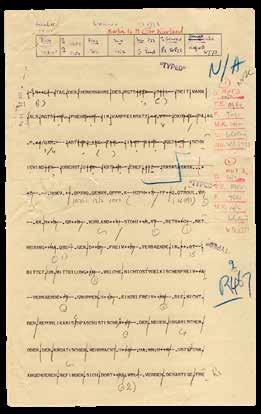
Roger frowned as he stared at the paper on his desk.
He’d been working on cracking this code for hours. His eyes burned with exhaustion. He just wanted to go to sleep but he couldn’t. There was a war going on. Intelligence agencies had managed to intercept this message from the enemy. If they could only figure out what it said, lives could be saved. Perhaps they could even win the war.
1. What do you think Roger’s job is? {a spy or someone who deciphers codes}
Throughout his career, Roger had managed to crack many codes. But this one was proving impossible. Would he be able to figure it out in time?
He took a sip of coffee and tried to blot out everything else.
Everything except for the code.
Codes have been used for centuries as a way to send secret messages. If the message falls into enemy hands, the secret stays safe. Or does it?
What if the code is cracked by the enemy? Let’s take a look at some famous codes used by the United States during wartime.
It was 1776. The Revolutionary War was in full swing. General George Washington, who would become the first president of the United States, was proving himself to be a great manager. This was especially so when it came to matters of intelligence.
In order to win the war, he needed to know the enemy’s plans. He sent spies to infiltrate the enemy camp. These secret agents reported back what the next steps of the British would be.
But that wasn’t enough.
General Washington had to make sure that the British didn’t learn about his own secret plans.
Secret agents working for Washington came up with a brilliant idea. They wrote messages in invisible ink. Once the message was safely in American hands, a special mixture containing secret ingredients could make the words visible. This was a great trick, but the British enemy managed to get its hands on over half
of these letters.
The American agents came up with another plan. They hid important messages in small containers that could be destroyed after they were read. The containers were either burned or sunk in water. Sometimes, agents swallowed the messages so the enemy wouldn’t find them. This was dangerous the containers were poisonous!
Besides sending secret messages, the Americans intercepted British mail. They read their letters and learned what the British were planning. Then, they sealed the letters again and let them travel on to the British. That way, the enemy wouldn’t know that their letters had been read and that the Americans were ready for them.
World War ll was a time of great tension and fear. Spies could be lurking anywhere. The Americans needed a code they could use to speak over the radio, but they were worried that
1. What was George Washington the manager of? {the Patriot army}
2. Do you think it was a good idea to write messages with invisible ink? Why or why not? {Answers will vary.}
the Japanese enemy would be listening in. They needed a code that could not be deciphered.
Phillip Johnston came up with an idea. He had fought in World War I, and he wanted to help his country win this war, too. He knew of a Native American tribe called the Navajo. The Navajo spoke a very complicated language that had no alphabet or written symbols to represent it. Besides the Navajo, few people knew this language.
About 400 Navajo men became “code talkers.” The code talkers used a radio to send messages. Other code talkers would listen at the other end and decipher the messages.
Here’s how the Navajo code worked: They started with a message in English. Each word was spelled out. Then, each letter was given an English word that started with that letter. The English words were translated to Navajo. This group of random Navajo words was sent as the code. Some Navajo words were used to represent English military words.
The Japanese tried hard to break this code, but they couldn’t. Thanks to the Navajo code talkers, the U.S. army was able to capture Iwo
Jima, an important Japanese island. As World War ll raged, the Germans worked hard to conceal their messages from the Americans and British. They used codes that were impossible for the Americans to understand.
How did they do it? The Germans invented a machine called the ENIGMA, which scrambled the letters in the message, making it very difficult to read. The code was almost unbreakable. The machine gave the code 150,000,000,000,000,000,000 possible solutions!
Despite the odds, the code was successfully broken!
A British mathematician named Alan Turing created his own machine that could decipher the ENIGMA. Alan Turing helped the Americans crack the German code. Many historians believe that this helped shorten the war by at least two years and saved countless lives.
As technology continues to advance, new codes will be invented. Agents who break codes certainly have their work cut out for them!
1. Who were the Navajo code talkers? {Native Americans who used their complicated language to make a code that the Japanese would not be able to decipher}
2. What was the ENIGMA machine? {a machine used by the Germans to send codes that were almost impossible to break}
3. Why are codes important during war? {Armies need to send secret messages in order to have the upper hand over the enemy.}

A “code” is when a word or phrase is switched with a different word or phrase to create a new meaning. A “cipher” changes or scrambles the letters in the message.
The Caesar Cipher
In the Caesar cipher, letters are shifted over a set amount of times. For example, every letter is exchanged with a letter that is three letters before it.
Step 1: Create your rule. Make sure to keep it a secret.
Example: Letters are exchanged with the letter nine times after it.
Step 2: Make a key that will help you write and decipher messages. Example:
Book Cipher
In this cipher, a book is used to write and decipher the code.
Step 1: Choose a book. It can be any book, as long as the person who needs to decode your cipher has the same book.
Step 2: Find each word of your code in the book.
Step 3: Write a three-digit number to represent each word. The first number is the page number, the second is the line number, and the third is the position of the word in the line. Example: 342 would be found on the third page, four lines down, and the second word on that line.
Step 3: Write your message. For each letter you write, use the letter underneath it in the key.
Example: hxd ljw farcn j lryqna!
Step 4: Use your key to decipher the message. Find each letter in the bottom row of the key and write down the letter on top.
Example: You can write a cipher!
Step 4: Use the book to find each word of the message.
Now, try creating your own cipher!
Choose a cipher and write a secret code. Trade with a friend and try to break each other’s codes.
1. What is the difference between a code and a cipher? {a code is when words or phrases are switched with other words or phrases, a cipher has scrambled up letters}
Turn to a friend and explain how to make one on the ciphers in the article. On the next page, choose a topic that has to do with codes or spies and write an outline for a five paragraph essay.
Write a five-paragraph essay about spies. Use information from at least two passages in this unit.
Step 1: Organize the information in a chart.
Write three separate things about the main idea.
Supporting Detail
Spies have lots of secrets.
Supporting Detail
They use secret codes.
What will you write about spies?
For example: Spies are cool. Spies have lots of secrets. Spies use lots of tools.
Supporting Detail
Example/Evidence
Example/Evidence
Example/Evidence
Give two examples or evidence for each supporting detail.
They don’t want their messages to fall into the wrong hands.
Example/Evidence
Countries work hard to make new codes that cannot be broken.
Example/Evidence
They use secret equipment. They use listening devices and hidden cameras.
Example/Evidence
Step 2: Prepare to write. Example: Spies have all kinds of training, such as how to disguise themselves, use weapons, and speak lots of languages.
Thesis statement: + + + = thesis statement
Spies have lots of secrets like disguises, secret codes, and secret equipment.
Hook: topic/main idea supporting detail 1 supporting detail 2 supporting detail 3
Did you ever wonder what it’s like to be a spy? They wear disguises, so no one knows who they are. Agent X wore a disguise in the marketplace.
Write a five-paragraph essay about spies. Use a separate sheet of paper if you need more space.
Did you ever wonder what it’s like to be a spy? People find spies interesting because there is a lot they don’t know about them. Spies have lots of secrets, such as disguises, secret codes, and secret equipment.
First, spies wear disguises so no one knows who they are. For example, Agent X disguised himself as a traveling merchant in the marketplace. Another example is Anna Chapman, who was pretending to be a real estate agent so she wouldn’t be caught. Spies don’t want people to know that they are spying, so they disguise themselves as ordinary people. Spies use secret codes to protect their messages. Their messages are secret, and they don’t want their enemies to hear them. We know how important codes are to spying because throughout history, countries have worked hard to make new codes that cannot be broken.
Codes allow spies to send messages without other people being able to read them.
Last, spies use secret equipment. They use special tools, such as listening devices and hidden cameras, that allow them to spy on other people without them knowing. There are other types of secret equipment that spies use that they don’t want their enemies to know about. For example, when Connie Leaguex left Vietnam, he destroyed American equipment so the enemy wouldn’t find out its secrets.
In conclusion, spies don’t want others to know that they are spying. Therefore, they use disguises, secret codes, and secret equipment. I think spies are really cool.
An inference is when you use the text and what you already know to figure out something the author doesn't tell you directly.
Write a paragraph about the personality traits that would make someone good at code-breaking.
1. Write three personality traits. For each trait, write why you think it’s important for code-breaking.
Trait 1: Why it's important:
It is hard to break codes, so it might take a lot of tries.
Trait 2: Why it's important:
Each code is different, so code-breaking needs creative solutions.
Trait 3: Why it's important:
It is dangerous to anger the enemy by breaking their codes.
2. Write a topic sentence/thesis statement. Include the main idea and three personality traits.
Code breakers need to be determined, creative, and brave.
3. Write an outline. Explain why you chose each personality trait in the body sentences.
Topic Sentence:
Body Sentence 1:
Body Sentence 2:
Body Sentence 3:
Concluding Sentence: determined
Code breakers need to be determined, creative, and brave.
It is hard to break codes, so code breakers need to be determined to try lots of times. Since each code is different, each code requires a new creative solution.
Lastly, code breakers need to be brave because it dangerous for them to anger the enemy by breaking their codes.
Code-breaking is not an easy job.
4. Write a paragraph.
Code breakers need to be determined, creative, and brave. It is hard to break codes, so code breakers need to be determined to try lots of times. Since each code is different, each code requires a new creative solution. Lastly, code breakers need to be brave because it dangerous for them to anger the enemy by breaking their codes. Code-breaking is not an easy job.
Circle the correct answer.
1. Which word means to catch or block something while it is moving from one place to another?
a. Intercept
b. Manager
c. Infiltrate
d. Deciphered
2. The store was responsible for hiring new employees.
a. intercept
b. manager
c. infiltrate
d. conceal
3. The code breaker the secret message.
a. deciphered
b. concealed
c. managed
d. shifted
4. What does it mean to infiltrate a group?
a. Join the group with secret intentions
b. Join the group openly
c. Leave the group with secret intentions
d. Leave the group openly
5. Which word means acting on behalf of someone or something?
a. Intercept
b. Manager
c. Infiltrate
d. Represent
6. What does it mean to conceal evidence?
a. To hide the evidence
b. To present the evidence
c. To lose the evidence
d. To share the evidence
7. A person skilled in mathematics is a .
a. intercept
b. manager
c. conceal
d. mathematician
8. The furniture was to the other side of the room.
a. shifted
b. intercepted
c. concealed
d. represented
Circle the correct answer.
1. What method did the Americans use during the Revolutionary War to hide secret messages? (detail)
a. Invisible ink
b. Navajo code
c. Enigma machine
d. Book cipher
2. Why did the Americans use invisible ink? (cause and effect)
a. They needed to protect secret messages.
b. They lacked paper.
c. It was very difficult to write in code.
d. They wanted to impress the British.
3. What can you infer about the importance of code-breaking in wartime? (inferencing)
a. It is a small factor in winning a war.
b. It can have a major impact on the outcome of a war.
c. It is only important during peaceful times.
d. It is not relevant nowadays.
4. What is the main idea of the section about the Caesar cipher? (main idea)
a. The Caesar cipher is the most secure code.
b. The Caesar cipher is easy to create and use.
c. The Caesar cipher was used in World War II.
d. The Caesar cipher works like the Enigma.
5. What happened after Alan Turing broke the Enigma code? (sequencing)
a. The war ended immediately.
b. The Germans created a new code.
c. The Allies gained a major upper hand.
d. Alan Turing was awarded a medal.

6. What does the word "scrambled" mean in the sentence "The Germans invented a machine called the ENIGMA, which scrambled the letters in the message"? (context clues)
a. Organized
b. Mixed up
c. Copied
d. Translated
7. How does the Caesar cipher compare to the Navajo code? (compare-contrast)
a. Both are simple to crack.
b. The Navajo code is based on a spoken language, while the Caesar cipher is based on written language.
c. The Caesar cipher is more complex.
d. The Navajo code is easier to learn.
8. Which of the following is a fact about the Enigma machine? (fact vs. opinion)
a. The Enigma machine was the most complex machine ever built.
b. Breaking the Enigma was a real challenge.
c. The Enigma machine was used by the Germans.
d. The Enigma machine was a work of genius.
Create a word map.
A word map is visual organizer for vocabulary words. Categories to include:
→ The word
→ Definition
→ Picture
→ Part of speech
→ Examples
→ Nonexamples
→ Sentence with the word
→ Synonyms
→ Antonyms
→ Other forms of the word
→ An association
Fill out the word map to introduce and discuss each vocabulary word.
Do a word sort.
A word sort is an activity that can completed before or after vocabulary words are taught.
1. Allow students to work in groups.
2. Give each group a stack of index cards that each have one word on it.
3. Have students come up with categories and sort each word into the correct category.
Pictionary is a game that can played in small groups or as a whole class.
1. A student is given or picks a vocabulary word.
2. They draw a picture of the word.
3. The other students guess which word they drew.
Charades is a game that can be played in small groups or as a whole class.
1. A student is given or picks a vocabulary word.
2. They act out the word without using any words.
3. The other students guess which word they drew.
Bingo can be used to focus on one or few vocabulary skills. In each version, the teacher calls out a hint and the students cross off the corresponding word on their boards. The winner is the first to get five in a row!
→ Focus on definition: a definition is called out
→ Focus on synonyms/antonyms: a synonym or antonym (specify which one) is called out
→ Focus on examples/non-examples: an example or non-example (specify which one) is called out
→ Focus on reading: the word itself is called out
→ Focus on categorization: a hint to the word is called out
Memory can be used practice different vocabulary skills. In each variation, students take one turn at a time to flip over two cards. If the cards don’t match, they replace them in the covered position. If they match, they get to keep the set.
→ Match vocabulary word to picture
→ Match vocabulary word to the definition
→ Match vocabulary word to a synonym
Taboo is great way for students to practice vocabulary words though it does require advance preparation.
1. Create index cards with each word. Beneath each word list the five most common words associated with that word.
2. Divide the class into two teams.
3. One student from the team is chosen to hint.. They are given one card that cannot be shown to their teammates.
4. Students from the other team are allowed to look at the card. There job is to catch the hinter if they make a mistake.
5. The student with hard must describe the word to their teammates without using the five listed words. If their teammates guess correctly, they get a point.
6. Play switches and the other team tries to get a point.
Bingo can be used to focus on one or few vocabulary skills. In each version, the teacher calls out a hint and the students cross off the corresponding word on their boards. The winner is the first to get five in a row!
1. Write each word on an index card.
2. One student picks a card.
3. They must say the first synonym or antonym (specify which one) they can think of.
4. The other students guess the word.
Aabsence ab-SENS, noun, not being there, Their absence was noticed by everyone. 16
absurd ab-SURD, adjective, very silly or doesn't make sense, It is absurd towear a coat in the summer heat. 22
accidentally ak-si-DEN-tlee, adverb, by mistake, I accidentally spilled my juice. 15
adopted uh-DOP-tid, adjective, choose to take as one's own, follow, or use, She adopted a new study routine. 5
adorned uh-DORNED, adjective, decorated, The room was adorned with colorful balloons. 19
advanced ad-VANST, adjective, being ahead of others in development, knowledge, progress, or skill, He is taking advanced math classes. 25
affect uh-FEKT, verb, to cause a change or make something happen, The weather can affect your mood. 6
agency AY-jun-see, noun, a business or organization that provides a service, He works at a travel agency. 27
alert uh-LURT, adjective, noun: a warning or alarm; adjective: watchful or ready, The fire alarm sounded an alert. The guard remained alert all night. 10
alms ahmz, noun, gifts of money or food often given to poor people, They donated alms to help the homeless. 18
ambassador am-BAS-uh-dor, noun, a person sent to a country to represent their country, The ambassador worked to strengthen ties between the two countries. 27
ammunition am-yoo-NISH-uhn, noun, something that is fired from a weapon, like bullets or bombs, Soldiers carry ammunition for their missions. 9
analyze AN-uh-lyze, verb, to study something carefully to understand it better, Scientists analyze data to find patterns. 13
analyze(s) AN-uh-lize, verb, to examine something closely and carefully, Scientists analyze data to find patterns. 27
ancient AYN-shent, adjective, very old; from a long time ago, They visited an ancient castle during their trip. 26
announce(s) uh-NOWNS, verb, to make known, The teacher announces all homework before the final bell. 7
anteroom AN-tuh-room, noun, a small room before the main room; waiting room, Please wait in the anteroom until it's your turn. 7
anticipation an-TIS-uh-PAY-shun, noun, a feeling of excitement or nervousness about something that is going to happen, The anticipation of the trip made her excited. 11/12
apologetic uh-POL-uh-jet-ik, adjective, feeling or showing regret or sorry, He gave an apologetic smile after breaking the vase. 13
approach(ed) uh-PROHCH(d), verb, to come near to start dealing with something, They approach the park slowly. She approached the problem carefully. 3
approval uh-PROO-vul, noun, agreement or acceptance, They wanted their parents' approval to buy the new toy. 16
argument AR-gyuh-muhnt, noun, a reason or set of reasons given to support an idea or opinion, The school had an argument for why homework is important. 15
assist uh-SIST, verb, to help someone, He offered to assist his friend with the homework. 24
assume(d) uh-SOOM(d), verb, to think something is true without proof to take on a role or job, I assume he will join us later. She assumed the role of team leader. 2
assure(d) uh-SHUR, verb, confident and certain; to promise or guarantee something, He spoke with an assured voice. 11/12
author AW-thur, noun, a person who writes books, stories, or other text, The author signed copies of his new book while selling it. 14
authority uh-TOR-i-tee, noun, 1. the power or right to give orders and make decisions; 2. a person or organization with such power, The teacher has authority in the classroom. 24
autobiography aw-toh-BYE-og-ruh-fee, noun, a written account of a person's own life, He wrote an autobiography detailing his adventures. 20
avoid uh-VOID, verb, to stay away from something or someone, He tries to avoid eating too much candy. 21
Bbabbling BAB-uhl-ing, noun, talk quickly without making sense; make meaningless sounds, The baby was babbling happily. 19
bacteria bak-TEER-ee-uh, noun, tiny, single-celled organisms that are found almost everywhere on earth, Some bacteria help us digest food, while others can cause illnesses. 16
banister BAN-uhs-ter, noun, a railing along a staircase, She held onto the banister as she walked down the stairs. 4
bargain BAR-gin, noun/verb, noun: a good deal or price; verb: to negotiate a price, They found a bargain on books. They bargained with the seller for a lower price. 6
benefits BEN-uh-fits, noun, advantages or good things that come from something, Exercising has many benefits for your health. 10
bilingual by-LING-gwuhl, adjective, able to speak two languages, He is bilingual and speaks both English and Spanish. 15
biography bye-AH-gruh-fee, noun, a written account of another person's life, I read a biography of Abraham Lincoln. 20
body sentence BOH-dee SEN-tuns, noun, sentences that provide details and support the main idea in a paragraph, Each body sentence should explain a different part of the main idea. 4
bonding BOND-ing, noun, forming a close relationship; uniting two materials or surfaces, The boys were bonding over shared interests. 23
borax BOR-aks, noun, a mineral powder commonly used as a household cleaner, They used borax to make their laundry cleaner. 21
Ccatastrophe ka-TAS-truh-fee, noun, a sudden disaster, The hurricane was a major catastrophe for the town. 21
cause kawz, noun, to make something happen, Lack of sleep can be a cause of bad grades. 6
cautious KAW-shus, adjective, being careful to avoid problems or dangers, She was cautious when crossing the busy street. 24
century SEN-chur-ee, noun, a period of 100 years, The 20th century lasted from 1901 to 2000. 19
challenging CHAL-uhn-jing, adjective, difficult but interesting, Solving the puzzle was challenging but fun. 3
chaos KAY-oss, noun, a state of complete disorder and confusion, The classroom was in chaos after the fire drill. 18
chronology KRO-nol-uh-jee, noun, the arrangement of events in the order they happened, The chronology of the events helps us understand the story better. 5
chuckles CHUCK-uls, verb, soft laughs, Many chuckles were heard after the speaker said a joke. 23
civilization siv-uh-li-ZAY-shun, noun, a big, organized group of people who live together with their own laws, The Roman civilization was one of the most powerful in history. 25
claim(ed) klaym(d), verb, to state as true, He claimed he saw a UFO last night. 2
classified KLASS-uh-fyd, adjective, officially secret organized into groups, The documents were classified and kept safe. The books were classified according to authors. 3
climax KLY-maks, noun, the most exciting or intense part of a story, The climax of the book was when the hero saved the day. 17
committed kuh-MIT-id, adjective, dedicated to something, She is committed to helping others. 1
commotion kuh-MOH-shun, noun, a state of noisy confusion or excitement, There was a commotion in the hallway during recess. 18
compare kuh-MPAIR, verb, to look at two or more things to see how they are similar or different, We can compare the weather in different cities. 5
compass KUM-pas, noun, an instrument for finding direction, He used a compass to navigate through the forest. 17
complex KOM-pleks, adjective, complicated, or hard to understand, The math problem was very complex. 10
conceal kon-SEEL, verb, to hide something, She tried to conceal the gift until her birthday. 28
concluding sentence kun-KLOO-ding SEN-tuns, noun, the last sentence in a paragraph that wraps up the main idea, Her concluding sentence summarized her thoughts perfectly. 4
conclusion kuh-KLOO-zhun, noun, the end or finish of an event, process, or text, The conclusion of the essay summarized all the main points. 26
cons konz, noun, the bad things about something, One of the cons of having a pet is having to clean up after it every day. 14
consider kuhn-SID-er, verb, think carefully about something, often to make a decision, Please consider my request for a better grade. 15
contagious kuhn-TAY-jus, adjective, easily spread from one person to another, The flu is highly contagious. 11/12
context KON-tekst, noun, the words or situation surrounding a word that help explain its meaning, Understanding the context helps you understand the word better. 21
contrast KON-trast, noun, the difference between two things, He is quite short in contrast to his tall brother. 6
countless KOWNT-lus, adjective, too many to count, There are countless stars in the sky. 16
coward KOW-erd, noun, a person who lis afraid to face danger or something difficult, He was called a coward for not standing up to the bully. 18
crew kroo, noun, a group of people who work together as a team, The ship's crew worked hard all day. 1
crucial KROO-shul, adjective, extremely important or necessary, It is crucial to study for the test. 15
culminating KUL-muh-nay-ting, verb, reaching the highest point, The culminating scene of the play was emotional. 4
Ddebris duh-BREE, noun, pieces left after something is broken, The storm left debris all over the street. 2
debts dets, noun, something owed to someone, He is trying to pay off his debts. 14
decade(s) DEK-ayd(s), noun, a period of 10 years, A man who is ninety has been alive for nine decades. 2
deciphered dih-SY-ferd, verb, to decode something, She deciphered the secret message. 28
decorative dek-uh-RAY-tiv, adjective, used to make something look better, The decorative vase made the table look pretty. 4
decrease dee-KREES, verb, to become smaller or less, They decided to decrease the amount of sugar in the recipe. 15
delicacy DEL-ih-kuh-see, noun, a fine or expensive food, Sushi is a delicacy in many countries. 4
designated dez-IG-nay-tid, adjective, officially chosen or selected for a particular purpose, He is the designated driver for the night. 27
desires dih-ZY-urz, noun/verb, noun: a strong wish; verb: to wish for somthing, Her biggest desires is to travel the world. He desires a new bicycle. 19
details dee-TAYLZ, noun, small pieces of information that add to the story or explanation, She added many details to make her story more interesting. 1
determined dih-TUR-mind, adjective, decided firmly, She is determined to finish the book today. 3
diagnose die-AG-noze, verb, to identify the nature of an illness or other problem, The doctor will diagnose your ill friend tomorrow. 22
dialogue DYE-uh-log, noun, conversation between two or more people, often in a story or play, The dialogue between the characters made the story interesting. 7
direct quotes duh-RAKT kwohts, noun, exact words taken from a speaker or text and repeated, He used direct quotes from the book in his report. 11/12
disappoint dis-uh-POINT, verb, to let someone down, I don’t want to disappoint you with bad news. 13
discomfort dis-KUM-fert, noun, a feeling of unease or small pain, He felt discomfort after running too fast. 13
disposition dis-puh-ZISH-un, noun, a person's usual mood, She has a cheerful disposition. 7
distract dis-TRAKT, verb, to draw someone's attention away from something else, Loud noises can distract you while studying. 10
drama DRAH-muh, noun, a type of play or story that is serious or emotional, They performed a drama about friendship and courage. 7
dread dred, noun/verb, noun: great fear; verb: to fear something a lot, They felt a sense of dread before the final exam. He dreads going to the dentist. 22
Eeager EE-ger, adjective, wanting to do something very much, She is eager to start her new school year. 13
eerily EE-ruh-lee, adverb, in a strange or scary way, The house stood eerily quiet at night. 2
effect ih-FECT, noun, result or outcome of something, The effect of the rain was a rainbow. 10
effect ih-FEKT, noun, a change that happens because of a cause, The effect of the rain was a beautiful rainbow. 6
elders EL-durz, noun, older people, The elders of the village share their wisdom. 14
entertain en-ter-TAYN, verb, to make someone interested or amused, The magician entertained the children with his tricks. 16
essential ih-SEN-shul, noun / adjective, adjective: necessary, needed, Water is essential for life. 3
eternity ih-TUR-ni-tee, noun, time without end, forever, They hoped to be friends for eternity. 11/12
evacuate ih-VAK-yoo-ayt, verb, to leave a place for safety, They had to evacuate the building during the fire. 27
evaluate ih-VAL-yoo-ayt, verb, to judge or decide the value or quality of something, You need to evaluate the results of your experiment. 27
evidence EV-i-dens, noun, facts or information that help prove something, The detective found evidence at the crime scene. 15
exhibit ig-ZIB-it, verb /noun, verb: to show or display something; noun: something displayed, The museum will exhibit new paintings. The science exhibit was fascinating. 26
exposition eks-PUH-zish-un, noun, the introduction of characters and setting in a story, The exposition explained the history of the main character. 17
exterminate ik-STUR-muh-nayt, verb, to destroy or get rid of completely, The company worked hard to exterminate the pests. 8
extraordinary ik-STRAWR-dih-ner-ee,adjective, very unusual, She has an extraordinary talent for singing. 14
Ffable FAB-ul, noun, a short story that teaches a lesson, often with animals as characters. The fable of the tortoise and the hare teaches us about perseverance. 20
fairly FAIR-lee, adverb, not very, but not very little, He did fairly well on the test. 8
familiar fuh-MIL-yur, adjective, well-known or easily recognized, That song is a familiar tune. 25
famished FAM-ishd, adjective, very hungry, After playing in the park, the boys were famished. 8
fantasy FAN-tuh-see, noun, a genre of fiction involving imagining impossible or improbable things, The child's imagination was filled with fantasy. 20
fate FAYT, noun, what is meant to happen, possibly by luck or chance, His fate was sealed when he was caught stealing. 11/12
fiction FIK-shun, noun, stories that are made up and not true, Science fiction is a popular genre. 1
fierce FEERS, adjective, wild and dangerous; very determined, The lion is a fierce animal. 17
figurative fig-YUR-uh-tiv, adjective, using words in a way that is different from their normal meaning, often to be more interesting or expressive, The poet used figurative language to create a vivid image. 22
firsthand account furst-hand uh-KOWNT, noun, a story or description based on personal experience, She gave a firsthand account of her trip to the mountains. 14
flicker FLIK-er, verb / noun, verb: to move back and forth quickly; noun: a small, quick movement or light, The flicker of the light caught her eye. 18
flustered FLUS-terd, adjective, to be confused, nervous, or upset, He felt flustered during the presentation. 26
folk tales fohk TAYLZ, noun, traditional stories passed down through generations, Folk tales often include magical creatures. 20
foreign FOR-in, adjective, from a different country; strange or unfamiliar, He learned to speak a foreign language. 27
fragile FRA-jul, adjective, easily broken delicate and needs careful handling, The vase is fragile and needs to be handled with care. The fragile glass shattered on impact. 5
frantic FRAN-tik, adjective, feeling or showing a lot of fear and worry, The frantic search for the missing boy covered the entire neighborhood. 19
frequently FREE-kwent-lee, adverb, often, He visits his grandparents frequently. 5
furious FYUR-ee-us, adjective, very angry, He was furious when someone broke her new toy. 19
fury FYUR-ee, noun, intense anger, He couldn't control his fury after losing the game. 20
Ggenre JEN-er, noun, a category of artistic composition, like fiction or poetry, The genre of my favorite book is mystery. 20
gravity GRAV-i-tee, noun, the force that pulls things toward earth seriousness or importance, Gravity keeps us on the ground. The situation was one of gravity. 11/12
Hhalt hawlt, verb, to stop moving or doing something, They had to halt the game because of the rain. 24
harbor HAR-bur, noun/verb, noun: a sheltered place where ships dock; verb: to give shelter or hide something, The boat stayed in the harbor. They harbored a secret. 22
harsh harSH, adjective, rough and not pleasing, The teacher's harsh words hurt the student's feelings. 20
hefty HEF-tee, adjective, large or heavy in size or amount, They paid a hefty price for the bike. 18
hesitate HEZ-uh-tayt, verb, to pause because you are unsure, Don't hesitate to ask for help if you need it. 1
hijacked HIGH-jacked, verb, to take control of something by force, The plane was hijacked by pirates. 1
hilarious hi-LAIR-ee-us, adjective, very funny, The clown's tricks were hilarious. 4
historic his-TOR-ik, adjective, famous or important in history, They visited a historic battlefield. 26
huddle(d) huh-dld, verb /noun, gather closely together, often for warmth or protection, The children huddled together for warmth by the fire. 17
hurl hurl, verb, to throw with force, He hurled the ball across the field. 18
hyperbole HYE-pur-boh-lee, noun, an exaggerated statement not meant to be taken literally, "I'm so hungry I could eat a horse" is an example of hyperbole. 22
Iidentity eye-DEN-ti-tee, noun, who someone is; a person's unique characteristics, His identity was confirmed with a photo ID. 25
idioms ID-ee-uhmz, noun, phrases that have a different meaning than the individual words, "Break the ice" is a common idiom meaning to start a conversation. 23
ignited ig-NIGH-tid, verb, to set on fire, They ignited the wood for a campfire. 8
immediately ih-MEE-dee-it-lee, adverb, right away, She ran to the door immediately after hearing the noise. 14
immigrants ih-MIH-gruhnts, noun, people who move to another country to live, Immigrants bring new cultures to our community. 14
impactful im-PAKT-ful, adjective, having a strong effect, Her speech was very impactful. 16
imprisoned im-PRIZ-uhnd, verb, to be put in jail, The criminal was imprisoned for his actions. 25
improving im-PROO-ving, verb, getting better, His grades are improving this year. 5
indirect quotes in-duh-RAKT kwohts, noun, paraphrased or summarized words from a speaker or text, She used indirect quotes to explain the character's thoughts. 11/12
inference in-FUR-ens, noun, a conclusion reached based on evidence and reasoning, She made an inference about the character's feelings based on his actions. 25
infiltrate in-FIL-trayt, verb, to enter secretly, The spies tried to infiltrate the enemy base. 28
inform in-FORM, verb, to give someone information or facts, The teacher will inform the class about the field trip. 16
informational in-fur-may-SHO-nul, adjective, providing information, giving facts or details, The speaker gave an informational speech about the current events. 6
inspect in-SPEKT, verb, to look at something carefully, The teacher will inspect your homework. 13
intend in-TEND, verb, to plan or mean to do something, I intend to finish my project byFriday. 23
intense in-TENS, adjective, very strong, The game was intense but fun. 3
intercept in-ter-SEPT, verb, to stop something before it reaches its destination, The goalie tried to intercept the ball. 28
invaded in-VAY-did, verb, to enter a place by force, often with an army, The army invaded the enemy territory. 27
judgement juhj-ment, noun, an opinion formed to make an official decision, The judge made a fair judgement. 20
key details kee dee-TAYLZ, noun, important facts or pieces of information that support the main idea, Key details in the article explained how plants grow. 1
Llad lad, noun, a boy or young man, The lad played ball after school. 7
lame laym, adjective, unable to walk properly because of injury not interesting or exciting, His leg was lame after the accident. The story was really lame. 7
legend LEJ-end, noun, a famous or important person who is known for doing something very well, Abraham Lincoln is a legend for leading the United States through the Civil War. 1
literal LIT-er-ul, adjective, not exaggerated, exactly true, accurate, or real, The literal meaning of the word is "exact". 21
Mmain idea mayn AY-dee, noun, the most important point or thought in a text, The main idea of the story is about friendship. 1
majestic muh-JES-tik, adjective, impressive in appearance, often due to size or beauty, The majestic mountains were covered in snow. 17
manager MAN-ij-er, noun, a person in charge of a team or organization, The manager organized the meeting. 28
market MAR-kit, noun /verb, noun: a place where things are bought and sold; verb: to sell or promote something, They went to the farmer's market on Tuesday. They plan to market a new product next month. 21
massive MAS-iv, adjective, very large, They built a massive treehouse. 1
mathematician math-uh-muh-TISH-un, noun, a person who studies or works with math, The mathematician solved the difficult problem. 28
merely MEER-lee, adverb, just, only, He is merely a beginner at chess. 2
metaphor MET-uh-fawr, noun, a figure of speech that directly compares two unlike things without using "like" or "as", "Time is a thief" is a common metaphor. 22
method METH-ud, noun, a way of doing something, They used a new method to solve the puzzle. 5
miniatures MIN-ee-uh-churs, noun, small versions of something, He collects miniature cars. 4
module MOD-yool, noun, a unit or part of a larger system, Each module in the course covers a different topic. 11/12
mounted MOWN-tid, adjective, fixed in place, riding on something, like a horse, The picture was mounted on the wall. The knight mounted his horse. 26
Nnarrator NARE-a-tor, noun, a person who tells the story, The narrator explained what was happening in the story. 14
navigate NAV-ih-gayt, verb, to find your way through something, He navigated through the crowd to reach his friend. 3
non-fiction non-FIK-shun, noun, stories based on facts or information, The life story of a president is a non-fiction book. 1
nonliteral non-LIT-er-ul, adjective, not taking words in their usual or most basic sense, He used nonliteral language when he said, "It's raining cats and dogs.", 21
notion NOH-shun, noun, a thought, idea, or belief, She has a notion of how to solve the puzzle. 22
Oobtain ob-TAYN, verb, to get something, You need to obtain permission before entering. 16
opinion uh-PIN-yun, noun, what someone thinks or believes about something, Everyone has their own opinion about the best game. 27
opportunities op-er-TOO-ni-teez, noun, chances to do something, There are many opportunities to learn new skills. 15
ordinary or-DIN-er-ee, adjective, typical, common, or not special, It was just an ordinary day. 25
ought awt, modal verb, used to express the need to do something, You ought to finish your homework before playing. 22
overcome OH-ver-kuhm, verb, to defeat or get over something, He will try to climb and overcome his fear of heights. 9
Ppanned pand, verb, to criticiz badly, The new book was panned for its boring plot. 14
participant par-TIS-uh-pant, noun, a person who takes part in something, Every participant received a certificate. 10
personality PUR-suh-NAL-i-tee, noun, the combination of qualities that make each person an individual, Her friendly personality makes her popular among her friends. 13
personification PUR-suh-nif-i-KAY-shun, noun, giving human characteristics to non-human things, The wind whispered through the trees is an example of personification. 22
perspective pur-SPEK-tiv, noun, a particular way of looking at something, His perspective on life is very positive. 14
perspire per-SPY-er, verb, to sweat, He began to perspire while running on a hot day. 8
persuade per-SWAYD, verb, to convince someone to do or believe something, He tried to persuade his friend to join the music classes. 16
persuasive per-SWAY-siv, adjective, able to convince someone to believe or do something, She gave a persuasive speech about recycling. 17
petition puh-TISH-un, noun, a formal wrtten request often signed by many people, They signed a petition to save the playground. 26
physician fi-ZISH-un, noun, a doctor, The physician examined the patient carefully. 16
plight plight, noun, a difficult or sad situation, The plight of the homeless is a serious issue. 8
plot plawt, noun, the main events of a story, including how they are arranged and presented, The plot of the book was full of twists and turns. 17
poetic po-ET-ik, adjective, related to poetry or having a beautiful and expressive style, The poet used poetic language to describe the sunset. 8
poetry POH-i-tree, noun, a type of writing that uses creative and imaginative language to tell stories, or create a picture, She enjoys writing poetry about nature. 20
point of view point uhv VYOO, noun, the perspective from which a story is told, The book is written from the main character's point of view. 15
positions po-ZISH-uns, noun, places where people or things are located; jobs or roles, We stood in our positions ready to begin our choir. 23
pounced pownsd, verb, to jump quickly or suddently on something, The cat pounced on the toy mouse. 21
practical PRAK-ti-kuhl, adjective, useful and sensible; can be put to everyday use, He has practical ideas for solving problems. 25
precise pri-sise, adjective, exact, no more, no less, He gave precise instructions for the game. 21
predict pri-DIKT, verb, to say what will happen in the future based on current information, Can you predict what will happen next in the story? 26
prediction pri-DIK-shun, noun, a statement about what will happen in the future, His prediction about the weather was accurate. 26
presentation prez-uhn-TAY-shun, noun, a speech or talk where a product or idea is shown, She gave a presentation about her science project. 4
presently prez-uhnt-lee, adverb, now, at the present time; soon, after a short time, She is presently reading a book. 7
problem PRAH-blum, noun, a question or situation that needs to be solved or fixed, The problem with the car was a flat tire. 5
process PROH-ses, noun /verb, noun: a series of actions to achieve a specific result; verb: to treat, prepare, or handle something in a specific way, The cooking process takes time. They will process the sheep wool today. 21
produce proh-DYOOS, verb, noun: things grown to be sold; verb: to make or create something, People can buy fresh produce at the farmers market. This factory produces pillows. 6
products PROH-duhkts, noun, items made to be sold, The store sells various products like toys and books. 6
pros prohz, noun, the good things about something, One of the pros of joining a group is making friends. 14
prospectors pruh-SPEK-turz, noun, people who search for valuable minerals, The prospectors searched for gold in the river. 14
proverbs PROH-vurbs, noun, short sayings that express a truth or piece of advice based on common sense or experience, "Actions speak louder than words" is a well-known proverb. 23
QQAR kay-AHR, noun, acronym: question-answer relationship, a reading strategy to help understand texts, Using the QAR strategy can improve your reading comprehension. 9
quench kwench, verb, to satisfy, He drank water to quench his thirst. 8
quotes kwohts, noun, repeated or copied words from a speaker or text, He included famous quotes in his presentation. 11/12
Rration RAY-shun, noun /verb, a fixed amount of something, When they got lost, each person had to ration their food. 17
reactions ree-AK-shunz, noun, responses to something, Her reactions to the story she heard were surprising. 21
recalling ree-KAW-ling, verb, remembering something, She is recalling her favorite vacation memories. 15
relief ri-LEEF, noun, the easing of pain or distress, He felt relief after finishing his surgery was over. 4
rely ri-LY, verb, to depend on someone or something, You can rely on me to help you. 20
remote ri-MOHT, adjective, far away or distant, The island is remote and difficult to reach. 17
repetition rep-i-TISH-un, noun, the act of saying or doing something again. Students often use repetition to learn new things. 8
represent rep-ri-ZENT, verb, to stand for something, to act on behalf of someone, She will represent her class at the meeting. Flags represent countries. 28
resolution rez-uh-LOO-shun, noun, a decision to do or not do something, the solving of a problem or difficulty, My resolution for the year is to spend more time reading. 17
revolutionary rev-uh-LOO-shuh-ner-ee, adjective, something new and different that changes things, The invention of the printing press led to a revolutionary change in the world. 16
rhyme RAHYM, noun /verb, noun: words that have the same ending sounds; verb: to have the same ending sounds, Cats and hats are examples of rhyme. She loves to rhyme in her poems. 8
roam rohm, verb, to wander or travel without a specific destination, They like to roam the forest on weekends. 9
rowdy ROW-dee, adjective, noisy and disorderly, The rowdy students were sent to the principal's office. 26
rustling RUS-ling, noun, a soft, muffled crackling sound, like leaves or paper moving, The rustling of the leaves sounded like whispers. 24
Ssacrifice SAK-ri-fys, noun /verb, noun: giving up something valuable; verb: to give up something you value for something else, His sacrifice was appreciated by the team. They had to sacrifice their free time to finish the project. 3
saddle SAD-ul, noun /verb, noun: a leath seat for riding a horse; verb: to put a saddle on a horse, He adjusted the saddle before riding. The farmer will saddle the horse today. 5
saluted suh-LOOT-id, verb, made a formal sign of respect to someone, The soldiers saluted their commander. 7
scampered SKAM-perd, verb, to run quickly often in a playful way, The squirrels scampered up the trees. 20
scene seen, noun, a part of a play, a particular place or setting, The final scene of the play was dramatic. 7
scoffed skawft, verb, to speak or laugh in a way that makes fun of someone or something, He scoffed at the idea of eating vegetables. 20
secondhand account sek-uhnd-hand uh-KOWNT, noun, a story or description based on someone else's experience, He shared a secondhand account of the event he heard from his friend. 14
section SEK-shun, noun, a part of something larger, like a book or a document, Read the first section of the chapter for homework. 2
sequence see-KWENSS, noun, the order in which things happen, The sequence of events in the experiment was clearly recorded. 5
serial number SEER-ee-ul NUM-ber, noun, a unique identifier for a product, Check the serial number on the back of the machine. 1
serpent SUR-punt, noun, a large snake, The serpent slithered through the grass. 26
shame SHAYM, noun, painful feeling of embarrassment or guilt, He felt shame after someone laughed at him. 22
shield sheeld, noun /verb, noun: a protective object used to defend oneself; verb: to protect someone or something from danger or something unpleasant, The soldier carried a shield. They shielded themselves from the rain. 11/12
shifted SHIF-tid, verb, moved from one place to another, changed position or direction, They shifted the table to the corner. Her opinion shifted after hearing the new information. 28
sidelines SIDE-linez, noun, to stand on the side and not be involved, He stayed on the sidelines during the game. 19
significant sig-NIF-ih-kunt, adjective, important, The scientific discovery was significant for the world. 15
simile SIM-uh-lee, noun, a figure of speech comparing two unlike things using "like" or "as", "As brave as a lion" is an example of a simile. 22
skimpy SKIM-pee, adjective, too small in size or quantity, or is barely enough, The meal portions were skimpy leaving us hungry. 23
solution suh-LOO-shun, noun, the answer or way to fix a problem, Finding a solution to the math example took some time. 5
source SAWRS, noun, where something comes from or starts, Books are a good source of information. 27
species SPEE-sheez, noun, a group of living things that share similar characteristics, The forest is home to many species of birds. 9
spectacles SPEK-tuh-kulz, noun, glasses; a public show or display, The fireworks show was a stunning spectacle. 18
sprawled sprawld, verb, to lie or sit with one's arms and legs spread out, He sprawled out on the couch after school. 13
squeals SKWEELS, noun, high-pitched cries or screams, The children's squeals of delight filled the room. 23
stakes stayks, noun, piece of wood or metal driven into the ground used to support something, They placed stakes around the garden. 17
stanza STAN-zuh, noun, a group of lines in a poem usually in a repeating pattern, Each stanza in the poem tells a different part of the story. 8
steady STEH-dee, adjective, no sudden change or movement; reliable and dependable, The table is steady and won't wobble. 20
stiffly STIFF-lee, adverb, in a rigid or inflexible manner, He walked stiffly due to the injury. 23
strategy(ies) STRAT-uh-jeez, noun, a plan or method used to reach a goal, Different strategies can solve different problems. 6
strides STRIDES, noun, long steps; significant progress, He made great strides at his job. 23
strolling STROHL-ing, verb, walking slowly in a relaxed way, often for pleasure, They were strolling around the park enjoying the nice weather. 20
stunned stuhnd, adjective, shocked or amazed, often to the point of being speechless, He stood stunned after hearing the happy news. 9
summarize SUM-uh-rahyz, verb, to give a brief statement of the main points, Can you summarize the story in a few sentences? 13
summary SUM-uh-ree, noun, a brief statement that gives the most important points of something, Write a summary of the book after you finish reading it. 3
supervise SOO-per-vise, verb, to watch over something or someone and make sure things are done, The teacher will supervise the students during lunch. 13
swift swift, adjective, very fast or quick, The swift rabbit escaped from the fox. 24
Ttactic TAK-tik, noun, a plan to achieve something, a way to handle a specific situation, They used a smart tactic to win the game. Her tactic helped solve the problem. 3
TAMKO TAM-ko, noun, t-text type, a-author and action, m-main topic, k-key details, o-organization, Use the T-A-M-K-O framework to analyze text and better understand it. 3
telegram TEL-uh-gram, noun, a long distance message sent over wires often using code, Before phones, people sent telegrams for important or urgent news. 9
tempting TEMP-ting, adjective, appealing and hard to resist, The chocolate cake looked tempting. 6
tense tens, adjective, nervous or anxious; stretched tight, He felt tense before the exam. 19
text structure STRUK-chur, noun, the way something is organized or put together, The structure of the essay includes an introduction, body, and conclusion. 5
timidly TIM-id-lee, adverb, in a shy, nervous, or not confident way, He approached the stage timidly. 7
topic TOP-ik, noun, the subject of a discussion, story, or study, The topic of today's lesson is the water cycle. 2
traditional truh-DISH-uh-nul, adjective, following old customs, based on tradition, They celebrated with traditional food. The traditional recipe has been passed down for generations. 5
trait trayt, noun, a characteristic or quality that makes someone unique, Honesty is an important trait to have. 18
transform trans-FORM, verb, to change completely, The caterpillar tranformed into a beautiful butterfly. 10
troops troopz, noun, soldiers or armed forces, The troops were sent to help with the rescue mission. 24
trudge truhj, verb, noun, an exhausting, long walk, to walk slowly with heavy steps, It was a long trudge home in the rain. She trudged up the hill tiredly. 2
Uunderestimated un-der-ES-tuh-may-tid, verb, to think something is smaller or less important than it really is, We underestimated how long it would take to finish the project. 9
unexpected un-ik-SPEK-tid, adjective, not expected, surprising, The gift was unexpected. The sudden rain was unexpected. 1
unfamiliar un-fuh-MIL-yur, adjective, not wellknown or not experienced before; strange or new, He explored the unfamiliar city. 25
urgency UR-juhn-see, noun, a need to do something quickly and immediately, There was an urgency to finish the project on time. 6
utterly UH-ter-lee, adverb, complete; total, He was utterly exhausted after the long day. 8
Vvalve valv, noun, a flap that controls the flow of liquid, The heart valve ensures blood flows in the right direction. 2
vast vast, adjective, very large in size or amount, They explored the vast desert. 22
verify VER-uh-fye, verb, to check or confirm the truth or accuracy of something, They verified the information before accepting the payment. 27
vibrant VY-brant, adjective, full of energy; bright, strong colors, The market was a vibrant place, full of noise and activity. 14
victory VIK-tuh-ree, noun, success, especially over an opponent or difficulty, The team celebrated their victory. 9
visual VIZH-oo-ul, adjective, relating to seeing or sight, The presentation was very visual, with lots of images. 5
vital VYE-tul, adjective, extremely important or necessary, Water is vital for all living things. 24
Wwhiff wif, noun /verb, a slight smell, She caught a whiff of the cookies she was baking. 13
wispy WIS-pee, adjective, thin and delicate, The wispy clouds floated in the sky. 17
wit wit, noun, use words in a clever and amusing way, Her wit made the conversation enjoyable. 25
witness WIT-niss, noun/verb, noun: someone who sees something happen, verb: to see or observe an event, He was a witness to the accident. He will witness the parade tomorrow. 10
www.lighthousecurriculum.com