Call or Text: (925) 837-6000 3860 Blackhawk Rd #140, Danville, CA 94506
Hours: Monday - Friday: 9:00am-6:00pm
Proudly Serving the Walnut Creek & Rossmoor Community
The Subaru Love Promise Subaru and Diablo Subaru of Walnut Creek believe in making a positive impact on the communities in which we live and work. Through the five core pillars - Environment, Health, Education, Pets and Community - we aim to create change in the areas we and our owners care about the most.
Hosting an onsite adoption with Joybound People & Pets to help shelter animals find their forever home.
In honor of Earth day, and with the help from Arbor Day Foundation, we will be gifting and planting 100 trees.
Partnering with AdoptAClassroom.Org to adopt 10 classrooms at Ygnacio Valley High School and donate 10 Classroom kits.
Working with Boys & Girls Clubs of Silicon Valley-Rocketship Futuro Academy to provide new high quality coats to children in need.
With the help from Leukemia and Lymphoma Society, we are bringing warmth and comfort to patients by donating blankets and care kits to aid during treatment.
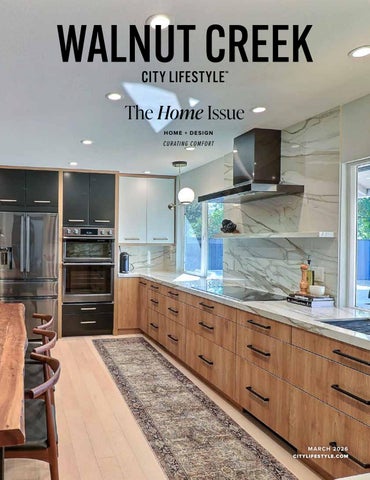
Welcome to the Home issue
Home is one of the most personal topics we cover, and each year we’re reminded just how many different meanings it holds.
For some, home is a place of comfort and routine. For others, it’s a creative outlet, a longterm investment, or a constant work in progress. Most often, it’s a combination of all of the above.
Home is where everyday life happens. It’s where we gather for meals, host friends and family, cele brate milestones, and unwind at the end of the day. It’s also the place that reflects our tastes and lifestyles—from how a space is designed to how it functions for the people who live there.
Of course, owning a home also comes with responsibility. There’s always a list of projects to tackle, improvements to consider, and decisions to make along the way. Whether it’s maintaining what you have, refreshing a space, or planning what comes next, caring for a home is an ongoing process.
In this issue, we explore the many ways we interact with our homes—from design and functionality to the people and services that help bring it all together.
In this issue, we chat with Gordon Reese from Gordon Reese Design Build, who shares his valuable insights on what to prepare before diving into your remodeling project. Plus, we hear from Bob Wilson at Downtown Walnut Creek Ace Hardware about the upcoming ban on gas-powered leaf blowers in Walnut Creek, and discover fantastic yard-care alternatives. We also feature Dalia Nishimori from Studio Nish, who offers valuable tips to help you tackle your bathroom remodeling with confidence and creativity.
We hope this Home issue inspires you to think differently about your space, discover new ideas, and appreciate the place you call home—whatever stage you’re in.
Learn how to start your own publication at citylifestyle.com/franchise.
city scene
WHERE NEIGHBORS CAN SEE AND BE SEEN
1-7: Dozens of visitors attended the business expo organized by the Walnut Creek Chamber of Commerce and Visitors Bureau, featuring over 50 vendor booths from local businesses.
Designing With Confidence
Gordon Reese Shares His Remodeling Philosophy
For decades, Gordon Reese, founder of the Walnut Creek–based remodeling firm Gordon Reese Design Build, has been setting the standard for home transformations across the East Bay. Launched 42 years ago, this family-owned, award-winning home remodeling company is known not only for expert craftsmanship but also for providing homeowners with a clear path
forward. This is achieved through thoughtful design, realistic investment ranges, and a defined process, ensuring clients proceed with confidence and without unwelcome surprises.
In this issue, we delve into Reese’s design inspirations and the essential advice he offers to homeowners considering a remodeling project.
ARTICLE BY WALNUT CREEK CITY LIFESTYLE TEAM
PHOTOGRAPHY BY
MARILYN CUNNINGHAM PHOTOGRAPHY
Q: TELL US ABOUT THE HISTORY OF THE COMPANY AND HOW YOU GOT INTO THE BUSINESS.
A: I started Gordon Reese Design Build 42 years ago after working for other contractors while I was still in high school and college. I enjoyed building and working with my hands, but early on I learned that craftsmanship alone doesn’t create a good remodeling experience. In the early days, I made plenty of mistakes—often trying to do too much myself—and our clients sometimes had to help us figure things out along the way. Those experiences taught me the value of strong teams, solid systems, and a clear process. Over time, those lessons shaped how we operate today.
Q: WHAT IS YOUR DESIGN APPROACH, AND WHERE DO YOU GET YOUR DESIGN INSPIRATION FROM?
A: Our design approach is built around clarity and confidence. We begin by understanding how our clients live, what isn’t working in their current space, and what they want their home to feel like when the project is complete.
A critical part of our process is the use of virtual 3D walkthroughs. This allows homeowners to see and experience their new space before construction begins—how it flows, how it feels, and how design choices work together. We implemented this approach years ago because it significantly improves decision-making. When clients can virtually walk through their project, they feel confident in their selections and don’t lose sleep wondering if they made the right decisions.
As a Certified Universal Design Professional (UDCP) and Master Certified Kitchen and Bath Remodeler (MCKBR), I believe good design should be intuitive, functional, and timeless. Inspiration comes from solving real problems thoughtfully—not chasing trends.
Q: WHAT IS THE ONE PIECE OF ADVICE YOU GIVE CLIENTS STARTING A REMODEL?
A: Talk to past clients of the companies you’re considering—and make sure those projects are similar in size and scope to yours. Ask how the process really went. Was the schedule kept? Was communication consistent? Were problems addressed promptly? Did they have a clear plan before construction began? These conversations often reveal far more than an estimate ever will.
Before thinking about finishes or layouts, homeowners should identify what isn’t working in their current space—and why. Sharing that information with the design team helps create solutions that truly improve daily life, not just the appearance of the home.
Q: WHAT ESSENTIAL PREPARATIONS SHOULD BE DONE BEFORE STARTING A REMODELING PROJECT?
A: A complete design process is essential. Design creates alignment between expectations, scope, and budget. It allows everyone involved to clearly understand what’s being built and what it will take to build it. Without this step, pricing becomes unreliable, and misunderstandings are common.
Q: HOW CAN HOMEOWNERS AVOID COMMON REMODELING PITFALLS?
A: Avoid starting construction without a detailed plan. Many of the most expensive and stressful problems occur when decisions are made mid-project. When details are resolved during design, projects tend to run more smoothly and predictably.
Q: WHAT BUDGET PLANNING TIPS SHOULD HOMEOWNERS FOLLOW?
A: Homeowners should establish realistic investment ranges early and ensure the design stays aligned with those numbers. Designing a project that later proves unaffordable often leads to frustration, redesign, and delays.
Q: WHAT SHOULD HOMEOWNERS KNOW ABOUT LIVING IN THE HOME DURING CONSTRUCTION?
A: If homeowners plan to live in their home during a remodel, there should be a detailed living remodeling plan in place before construction starts. This includes planning for temporary kitchens, bathroom access, dust control, and daily routines. Every family has unique challenges, and addressing them early makes the experience far more manageable.
Reese and his team
ARTICLE BY WALNUT CREEK CITY LIFESTYLE TEAM
PHOTOGRAPHY PROVIDED BY DOWNTOWN WALNUT CREEK ACE HARDWARE
A QUIETER Spring
Navigating Walnut Creek’s Gas Leaf Blower Ban
Changes are in the air for Walnut Creek—and they are significantly quieter. Starting April 1, 2026, the City of Walnut Creek will officially prohibit the use of gas-powered leaf blowers.
The move follows a growing trend across California, with over 100 cities—including neighboring Lafayette—already implementing similar restrictions to improve community health and meet environmental goals.
According to Downtown Walnut Creek ACE Hardware’s Business Development Manager, Bob Wilson, electric leaf blowers have three main benefits over gas models.
They are safer for operators, quieter, and have a significantly smaller impact on the environment, especially on climate change-related pollutants and air quality pollutants that affect public health, says Wilson.
For Walnut Creek residents who rely on professional landscapers, rather than owning their own leaf blowers, preparation will be key, says Wilson.
Downtown Walnut Creek ACE Hardware will be holding ongoing demo days now and throughout the year to help residents and professional landscapers have a “hands-on” experience with the solutions available at the store.
“Our associates and B2B Team will be happy to assist residents and their landscapers in making the right decision for conversion,” says Wilson. “Come meet with us and learn about the various options that work for you as a resident, and learn what is available for your landscaper.”
Wilson encourages residents to notify their landscapers about the upcoming ban and ask them how they can help with the transition.
“Some potential ways to help include allowing landscapers to charge batteries at your property or offering to keep a charged battery on site,” says Wilson. “Transitioning to batteries can be expensive for the landscaper, so be receptive to a price increase to help cover the cost.”
While adapting to the ban can take time, Wilson advises residents to be open-minded and flexible as they adjust to the new equipment. Wilson recommends three primary brands available at Downtown Walnut Creek ACE Hardware for residents to switch to battery-powered leaf blowers.
• Milwaukee: Ideal for homeowners already using the M18 battery platform . You can buy the blower tool and use your existing batteries. Milwaukee has both handheld and backpack blowers that operate on its 18V M18 platform. It also offers both handheld and backpack blowers, along with a full line of outdoor power equipment, including trimmers, hedge trimmers, and chainsaws.
• EGO: Known for having the most powerful residential and commercial handheld and backpack blowers on the market (ranging from 615CFM up to 11000 CFM). Working with EGO, Downtown Walnut Creek ACE Hardware also has a commercial loaner program that allows commercial landscapers to borrow equipment and test-drive it for up to a week under real-life conditions. Authorized dealers, like Downtown Walnut Creek ACE Hardware, can offer fleet pricing on the commercial line for up to 20% off for qualifying purchases.
• STIHL: Many commercial landscapers are familiar with the STIHL brand and have transitioned from gas-powered to
battery-powered equipment. STIHL has both residential and commercial product lines and utilizes several different battery platforms. They have a full line of blowers, from handheld to backpack. STIHL offers both handheld and backpack blowers, along with a full line of outdoor power equipment, such as trimmers, hedge trimmers, and chainsaws.
Downtown Walnut Creek ACE Hardware is also a qualified service center for both STIHL and EGO.
Residents who currently own gas-powered leaf blowers will have disposal options. The units with no gas remaining can be retired at the Concord Recycling Center or Rapid Recycle in Pacheco.
Downtown Walnut Creek ACE Hardware, a locally loved business since 2008, is owned by husband-and-wife team Kevin Fisher and Deb Donnelly. According to Wilson, their local ownership reflects their commitment to the community.
“We believe in doing the right thing,” says Wilson. “We look forward to working with you and sharing our knowledge and experience
with you to help you make the right decision. Change may not be easy, but we can help make it easier for you.”
For more information and resources on ban, visit the Downtown Walnut Creek ACE Hardware at: https://wcace.com/ or head on over to the city’s website: https://www.walnutcreekca.gov/government/ departments/e-c-o-sustainability/leaf-blowers
Downtown Walnut Creek ACE Hardware's B2B Lead Bob Flores with a Milwaukee leaf blower
Bob Flores holding a STIHL model.
Stock Photo
Downtown Walnut Creek ACE Hardware's B2B Lead Bob Flores with the EGO Commercial and EGO Residential line.
Aging With Grace
Preparing Your Home for a Loved One’s Care
As a home care agency owner, I often sit down with families, and the conversation usually starts the same way: “We want Mom to stay home, but we’re just not sure if it’s safe anymore.” When we think of “home design,” we often focus on aesthetics, but it should be viewed through the lens of functional longevity. Adapting a home isn’t about making it look like a hospital; it’s about making subtle, smart changes that give your loved one the confidence to move freely while keeping your home beautiful.
If you are preparing to bring care into the home, here are several design-focused pointers to help you get started:
• The “Traffic Lane” Rule: Walk through your home and imagine navigating it with a walker. Is there at least a 32-to-36-inch clear path? We often suggest rearranging furniture to create wider spaces next to the bed and in the bathroom. This allows a loved one to pull a walker right up to their side, ensuring they have a “stable partner” for every transition from sitting to standing.
• Grab Bars for Seamless Support: Many families worry that grab bars will make their home feel “clinical,” but modern design has solved this. You can find highend, brushed-gold or matte-black grab bars that look exactly like designer towel racks. When installed strategically—near
ARTICLE BY ROSHMI MUKHERJI
PHOTOGRAPHY BY ROSHMI MUKHERJI / STOCK PHOTOS
the toilet and inside the shower entry—they provide essential stability without compromising your style.
• Shower Safety: Families often ask, “Do we need a full remodel?” Usually, the answer is no. A sturdy, professional-grade shower chair and a handheld showerhead can immediately make bathing safer and more relaxing.
• Elevated Comfort: One of the most common questions I get is about bathroom safety. A raised toilet seat is a game-changer for those with hip or knee pain. To keep the aesthetic seamless, look for “comfort height” toilets or discreet, integrated seat risers that blend into the existing fixture.
• Lighting is Your Best Friend: Dim hallways are a major fall risk. I always suggest adding LED motion-sensor lights along baseboards. They light up automatically for those middle-of-thenight trips to the bathroom without anyone having to fumble for a switch.
Modern technology allows us to add layers of safety that are almost invisible to the eye but offer immense peace of mind:
• Fall-Detection Smartwatches: Devices like the Apple Watch or specialized medical alert watches (such as the MGMove) have built-in sensors that can detect a hard fall. If the wearer is unresponsive, the watch automatically calls emergency services and alerts family members.
• Traditional Medical Alerts: Systems like Life Alert remain a reliable gold standard. Modern versions now include mobile pendants with GPS, so help is just a button-press away, whether your loved one is in the garden or the grocery store.
• Ambient Fall Sensors: We now have “camera-free” sensors that use radar to detect a fall without infringing on privacy. These can be mounted discreetly on a wall and will automatically alert a care team if a fall occurs.
• Voice-Activated Assistants: Tools like Alexa or Google Home let a loved one turn on lights, adjust the thermostat, or even call for help with just their voice—keeping them safe and in control of their environment.By making these thoughtful design choices today, you aren’t just changing a house; you are building a safer, more supportive foundation for your loved one’s next chapter.
“Modern technology allows us to add layers of safety that are almost invisible to the eye but offer immense peace of mind.”
At Visiting Angels, we don’t expect you to have all the answers. When we begin working with a family, one of the first things we do is conduct a fall-prevention home safety assessment. We’ve walked through hundreds of homes, and our goal is to ensure the home remains a place of comfort and joy while giving you the peace of mind that your loved one is in a safe, beautifully adapted environment.
Visit: Visitingangels.com/walnutcreek/home
Roshmi Mukherji
Bookcase Styling your
Tips for an Organized and Aesthetic Display
ARTICLE BY SHANNON ROBERTS
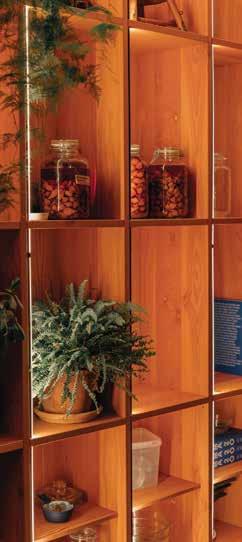
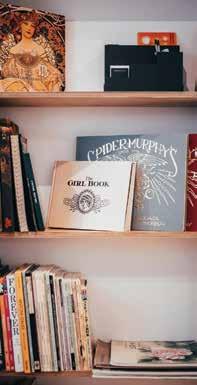
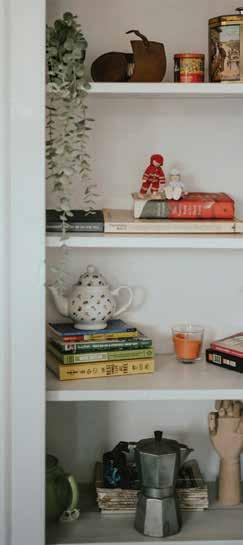
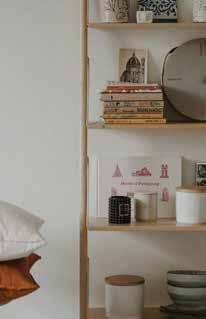
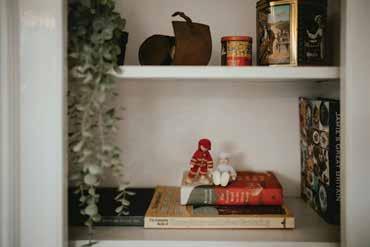
A bookcase is often more than just a storage unit for books; it’s a focal point of a room that can enhance the overall decor and reflect personal style. Styling a bookcase can be a rewarding endeavor, allowing you to showcase your literary collection and curate a space that feels inviting and visually appealing. Here are some tips to help you achieve a beautifully styled bookcase.
Styling a bookcase is a creative process that combines practicality with aesthetics. By using these tips, you can transform an ordinary bookshelf into a stylish, engaging focal point that complements your home’s decor while showcasing your personality and interests.
Step 1
Strategically Place Books on the Bookcase While Incorporating Decorative Elements.
When placing books back on the shelves, think about the arrangement, vertical stacks are more traditional, horizontal stacks more modern, or both for more visual interest. Adding decorative elements such as picture frames, vases, or sculptural objects to break the monotony. Incorporating items with varying heights can create a dynamic arrangement. Use larger items like art pieces or baskets on lower shelves and smaller decorative objects higher up. Aim for a balanced look while avoiding perfect symmetry. This creates an organic flow, drawing the eye naturally across the shelf. Incorporate asymmetrical groupings for added interest, mixing textures, colors, and shapes.
Step 2
Use Color Wisely and Add Natural Elements.
Color plays a role in styling a bookcase. You can opt for a monochromatic palette for a sophisticated look or introduce pops of color for a more energetic vibe. If your books are of various colors, pick a few colorful decorative pieces that complement or contrast them effectively. Integrating plants or natural elements can breathe life into your bookcase. Small potted plants can add color and texture.
Step 3
Create Zones and Add Personal Touches.
If your bookcase has multiple shelves, consider creating zones or themes for different sections. Infuse your personality into the bookcase through memorabilia, travel souvenirs, or personal artwork. These pieces add a storytelling dimension and make the space uniquely yours.
CREATING your SANCTUARY
The Art of the Modern Bathroom
ARTICLE AND PHOTOGRAPHY
BY DALIA NISHIMORI
We all dream of that “home spa” feeling—a space to luxuriate in after a long, hectic day or a calm corner to start a busy morning. However, achieving that sense of zen requires a bit of design acrobatics during the design and planning stages.
Because bathrooms are often smaller spaces with specific plumbing and electrical requirements, they require a level of care and attention to detail that other rooms don’t. Striking the perfect balance between a generous walk-in shower, an elegant vanity, and the necessary toilet placement is a study in scale and proportion.
If you are planning a renovation, here is how to navigate the flow of your future sanctuary.
THE SHOWER SWEET SPOT:
Showers are such an essential component of an exceptional home spa experience, but sizes are often miscalculated.
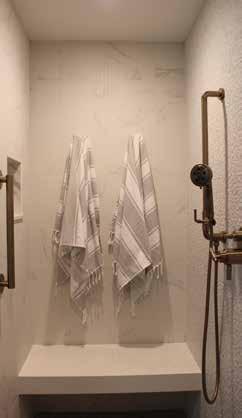
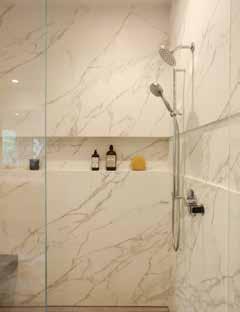
A generous shower in a medium-sized bathroom should be at least 34” wide by 50” long. This allows one to stand outside the stream of water without wasting space when square footage is at a minimum. It also leaves ample room for a 24-inch wall niche for your shampoos and soaps.
Don’t let drains be an afterthought. Their location dictates your tile sizes and layout. Considering a suitable drain location and type early in the design process is essential.
Also, consider going curbless. It is not only a sleek, modern aesthetic but also a smart choice for aging in place.
THE DOOR DEBATE: HINGE VS. SLIDE:
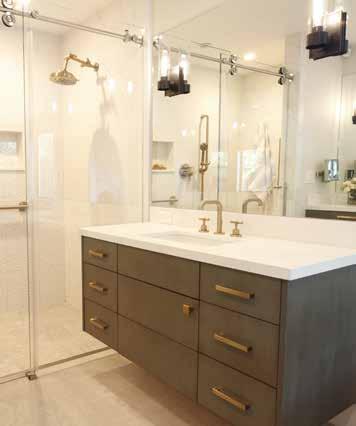
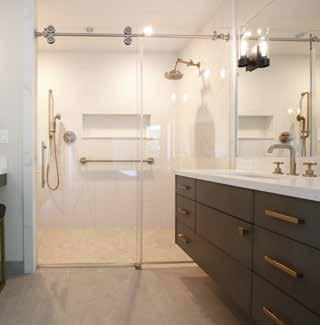
Shower doors typically need to accommodate other fixtures within the bathroom or adjacent door swings. Oftentimes, frameless sliding doors are necessary for these reasons, but hinging doors tend to have a cleaner aesthetic and are more desirable.
WARMTH AND COMFORT:
Nothing ruins a spa vibe faster than a cold winter morning. Heated floors are a game-changer for family bathrooms. Beyond the luxurious feeling of warmth underfoot, they help keep the space dry, reducing moisture buildup. Although they can increase energy costs, they also offer the benefit of quicker towel drying and warm the whole space. Alternatively, heated towel warmers achieve a similar drying effect without warming the floor tiles. These warmers are also excellent space-saving solutions when wall space for traditional towel bars is limited.
THE VANITY DILEMMA:
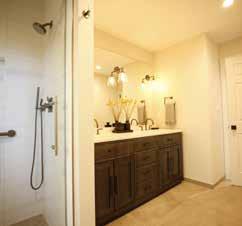
When designing the primary vanity, we all want two sinks. However, careful consideration must be given to usable counter space, storage below, and placement (location) of the sinks along the vanity run. For example, a sink cabinet with drawers typically requires U-shaped cutouts to accommodate the plumbing pipes, limiting what you can store.
We strive for maximum storage in bathroom vanities, but there is often a trade-off when sink cabinets take up what could be functional storage space. Therefore, careful review of sink placement and storage below allows for the best of both worlds.
THE “THRONE”, THE “BEST SEAT” IN THE HOUSE:
And lastly, the necessary toilet. When space allows, we propose a separate toilet room to provide the most comfortable and elevated bathroom experience. This is not always the case, and existing plumbing often dictates where the toilet can be located.
Dalia Nishimori of Studio Nish has been working in the world of interiors since 2004. She has worked with renowned firms such as Gensler and The Wiseman Group in San Francisco. After moving to Lamorinda in 2012 to raise a family, Dalia started her own design studio to work directly with homeowners on kitchen and bath design. Passionate about the perfect marriage of functionality and aesthetics, she adheres to a thorough design process, using detailed floor plans, elevations, and 3D renderings to ensure all elements of the space work for her clients. Richly detailed mood boards ensure smooth communication, enabling her clients to “see” their dream space come to life before making a single purchase. Above all, Dalia is very involved from concept through to completion on all her clients’ projects.
Visit: Studionish.com/
Dalia Nishimori
A
Checklist for Your Next Remodel:
Before you break ground, ask yourself these six questions to ensure your design flows:
1. The Shower:
What is the ideal threshold and drain placement?
2. The Doors: Are they hinging or sliding? What are my space constraints?
3. The Climate:
Will I regret not having heated floors in December?
4. The Towels:
Do I have wall space for bars, or is a warmer a better fit?
As lawns across Northern California begin to wake up from winter dormancy, spring presents a critical window for homeowners to get ahead of weeds before they take over.
With rising soil temperatures, increased moisture, and the season’s first growth surge, this is when both weeds and grass are actively absorbing nutrients—making it the most effective time to apply weedand-feed fertilizers.
When timed correctly, a spring application not only targets fast-growing broadleaf weeds like dandelions and clover, but also strengthens turf as it greens up and thickens, helping lawns naturally crowd out future weed growth.
1. Weeds Are Actively Growing — and Easier to Kill
• Broadleaf weeds like dandelions, clover, and crabgrass begin to grow aggressively in spring.
• Weed-and-feed products work when weeds are actively taking in nutrients, which helps the herbicide move through the plant and kill it effectively.
2. Spring Moisture Helps the Product Stick
• Most weed-and-feed formulas work best on slightly wet grass, so the granules stick to weed leaves.
• Spring typically provides the right moisture conditions, especially after early-season rains or morning dew.
3. Your Grass Is Coming Out of Dormancy
• After winter, your lawn begins its first major growth surge.
• The fertilizer portion of weed-and-feed gives your grass the nutrients it needs to green up, thicken, and outcompete weeds naturally.
4. Timing Aligns With First Mowing
• Experts recommend applying weed and feed after your first or second spring mow, when the lawn is actively growing, but weeds haven’t fully taken over yet. Controlling spring weed growth in early spring should be a priority. It is best to seed in the fall; however, you can spot seed smaller areas in the spring, once the temperatures are at least 50 degrees, which is usually in April and May.
Stock Photo
About Lawn Doctor Walnut Creek:
Lawn Doctor is a small-business franchise founded in New Jersey in 1967, with over 300 franchises nationwide. Lawn Doctor Walnut Creek started in the Bay Area in 2020, and we have over 800 customers in the East Bay. We service most of Contra Costa County, from San Ramon to Brentwood.
Lawn Doctor offers aeration and full-lawn seeding, as well as specializing in fertilization, weed, and grub control. We work with homeowners and their gardeners, offering proper watering and mowing recommendations. Visit: https://www.lawndoctor.com/concord-ca/
Stock Photo
Why SafetyHomeMatters
5 ESSENTIAL HOME SAFETY TIPS EVERYONE SHOULD KNOW
ARTICLE BY LUKE LUCHINI
Home is where we should feel the most at ease—but that comfort is best supported by preparation. Whether you live in a busy neighborhood or a quiet cul-de-sac, home safety isn’t just about preventing break-ins. It’s about protecting your family, your belongings, and the everyday moments that make a house feel like home.
Small, proactive steps can significantly reduce risk, deter unwanted activity, and provide peace of mind. As technology and modern living continue to shape how we use our spaces, thoughtful home safety practices help ensure your home remains a place of refuge.
Below are five essential home safety tips every homeowner and renter should know:
1. Secure All Entry Points
Make sure all doors, windows, and garages are locked at all times. Reinforced locks and smart security upgrades can help deter intruders. A secure entryway is your first line of defense.
2. Install Outdoor Lighting
Proper lighting discourages unwanted activity around your home. Motion-sensor lights near entry points, walkways, and backyards can significantly enhance nighttime security.
3. Use a Security System
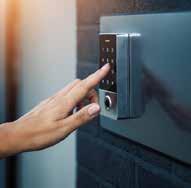
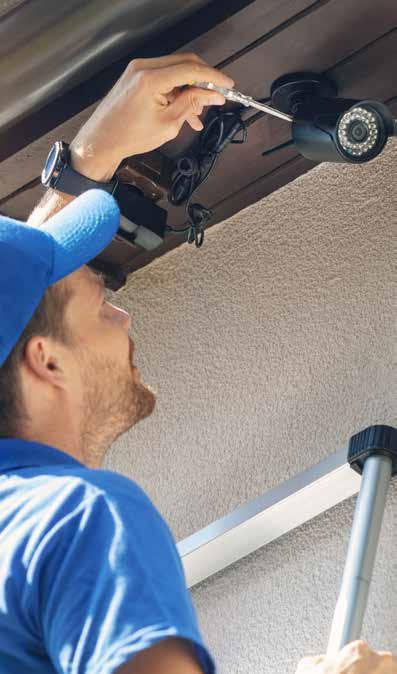
Invest in a reliable home security system that includes cameras, alarms, and motion detectors. Many modern systems allow for remote monitoring, providing peace of mind when you’re away.
4. Practice Fire Safety
Ensure your home has working smoke detectors and accessible fire extinguishers. Regularly check electrical outlets and appliances to reduce fire risks.
5. Be Cautious with Social Media
Avoid sharing travel plans or showcasing valuables online. Public posts can unintentionally make your home a target while you’re away.
Quick
Safety Checklist
Use this checklist to assess your home’s safety and identify easy upgrades:
• Doors, windows, and garage doors lock securely
• Outdoor motion-sensor lights are installed and working
• Entryways and walkways are well-lit
• A security system is installed and tested regularly
• Smoke detectors and fire extinguishers are up to date
• Travel plans and valuables are kept off social media
Luke Luchini is a corporate trainer at Inter-Con Security Systems. He specializes in residential and corporate security solutions, helping individuals and families take practical steps to protect what matters most—without overcomplicating daily life.
ARTICLE BY ANGELA BROOCKERD
MID-CENTURY WARMTH, REIMAGINED
There’s a certain moment when a house stops feeling new and starts feeling like home. It isn’t marked by square footage or finishes alone. It is something quieter, more emotional. In this home, designer Kate Manz set out to do exactly that: give a newly built home a heartbeat and a soul.
Rather than treating the house as one sweeping statement, she approached each room as its own story, layered with meaning, memory, and texture. The result is a home that feels collected, personal, and deeply lived-in.
“Tackling each space and room as its own story and concept is how to make a new space feel personal,” Manz explains. “But bringing it all together cohesively is always the challenge.”
Her solution? Warmth, intention, and a strong belief in the power of people. In new builds it can take years for a home to shed its newness. For this project, the goal was to fast-track that sense of belonging by layering in pieces with history and heart. Vintage market finds, local artists, and meaningful objects play a starring role throughout the home.
“My love for design goes hand in hand with the people and stories that bring it to life,” she says. “I absolutely love seeing the evolution from concept to completion and all the elements and people that help bring those ideas to reality.”
That philosophy becomes especially important in the home’s expansive open-concept living area, where scale could easily overpower intimacy.
PHOTOGRAPHY BY DAN JENKINS, AMANDA PROUDFIT
ENTRYWAY: A WARM WELCOME
The entryway sets the tone with a simple but powerful goal: Welcome to my home.
Natural stone underfoot grounds the space, while a soft vintage rug and living greenery immediately soften the experience. Art with personal meaning invites guests to linger rather than rush through.
THE OPEN CONCEPT, REIMAGINED
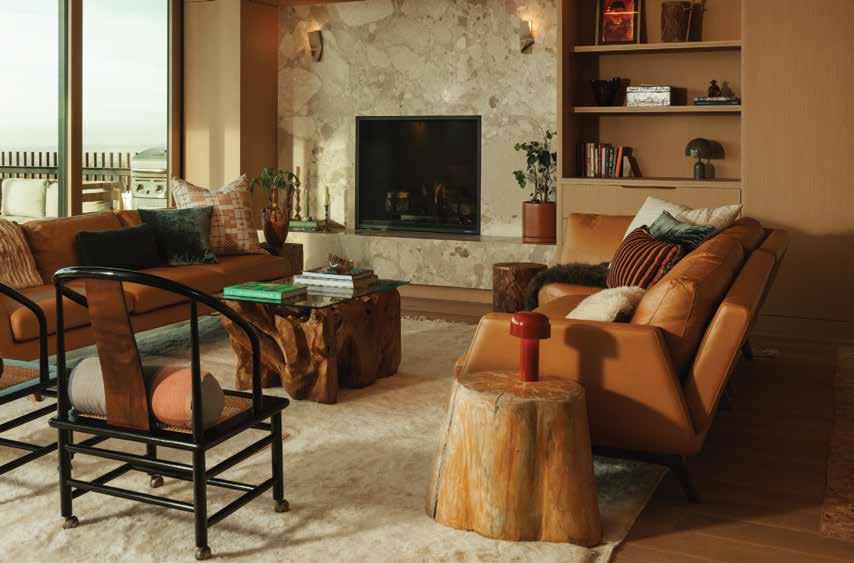
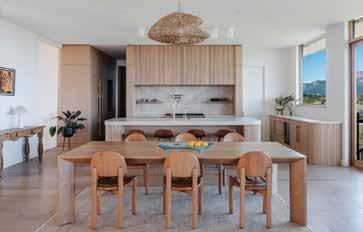
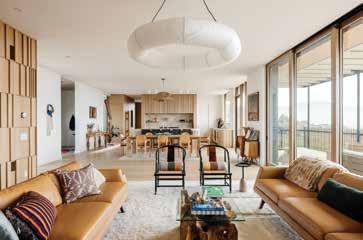
The main living space is defined by bringing the outside in with sweeping outdoor views and generous proportions. Rather than fighting that openness, embrace it.
“The big open concept room really highlights the expansive outdoor views,” she says, “but making intimate spaces within that open room was really important.”
A layered niche wall, created in collaboration with the interior architect Nick Flower, brings both structure and softness to the room. It introduces texture, depth, and a place for unique objects and family heirlooms to live, turning negative space into a personal gallery.
POWDER BATH: SMALL ROOM, BOLD SPIRIT
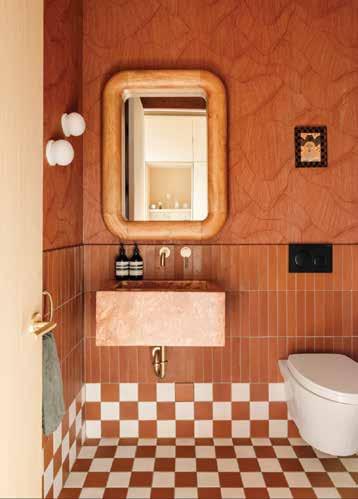
If there’s one place Manz encourages clients to take risks, it’s the powder room. Here, she leaned into terracotta earth tones, layering textures and tile sizes for visual interest and warmth. Patterned and solid tiles work together, while textured wall coverings and a sculptural stone sink elevate the space from functional to delightful.
LOUNGE: A STUDY IN CALM AND DEPTH
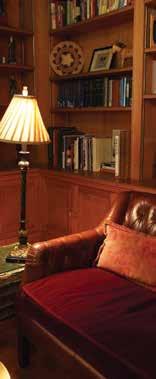
Designed as a counterpoint to the openness of the main living area, the lounge is a cocoon, both peaceful, layered, and deeply versatile. It’s a place for reading, movie nights and slow mornings.
Rich tones and varied textures do the heavy lifting here, creating depth without heaviness. Soft lighting and custom upholstery make the room feel both intentional and effortless. At its core, this home is a reminder that design isn’t about perfection, but rather it’s about feeling. By treating each room as its own narrative while weaving in warmth, history, and human connection, a space was created that already feels loved.
“My love for design goes hand in hand with the people and stories that bring it to life.”
PROJECT CREDITS
MARCH 1ST
Momentum Walnut Creek
Location: TBC | 12 PM
Join this one-of-a-kind wellness experience that combines movement, nourishment, and community, leaving you feeling inspired and refreshed. There will be demos hosted by local health-focused businesses and partners. If you’re into nutrition, fitness, and self-care, then this is where you should be. For more information, visit: https://walnutcreekdowntown.com/ do/momentum-walnut-creek-2026
MARCH 3RD
21st Annual East Bay Women's Conference
Lesher Center for the Arts, 1601 Civic Drive, Walnut Creek | 8:30 AM
Join this conference, presented by the Walnut Creek Chamber of Commerce and Visitors Bureau in Association with Kaiser Permanente, featuring multiple premier keynote speakers, an exhibitor marketplace, a speaker meet-and-greet session, networking opportunities, and more. Conference highlights include continental breakfast, lunch, and an afternoon reception with wine, hors d’oeuvres, entertainment, and more. Complimentary parking.
MARCH 21ST
California Symphony: Northern Lights
Lesher Center for the Arts, 1601 Civic Drive, Walnut Creek | 1:00 PM
California Symphony’s March concerts are back, featuring contemplative and calming music by Northern and Eastern European composers spanning the last century. Ukrainian composer Valentin Silvestrov’s Stille Musik from 2002 sets a calm, reflective tone with gentle melodies that take listeners on a meditative journey away from the noise of everyday life. Tickets are $50 onwards.