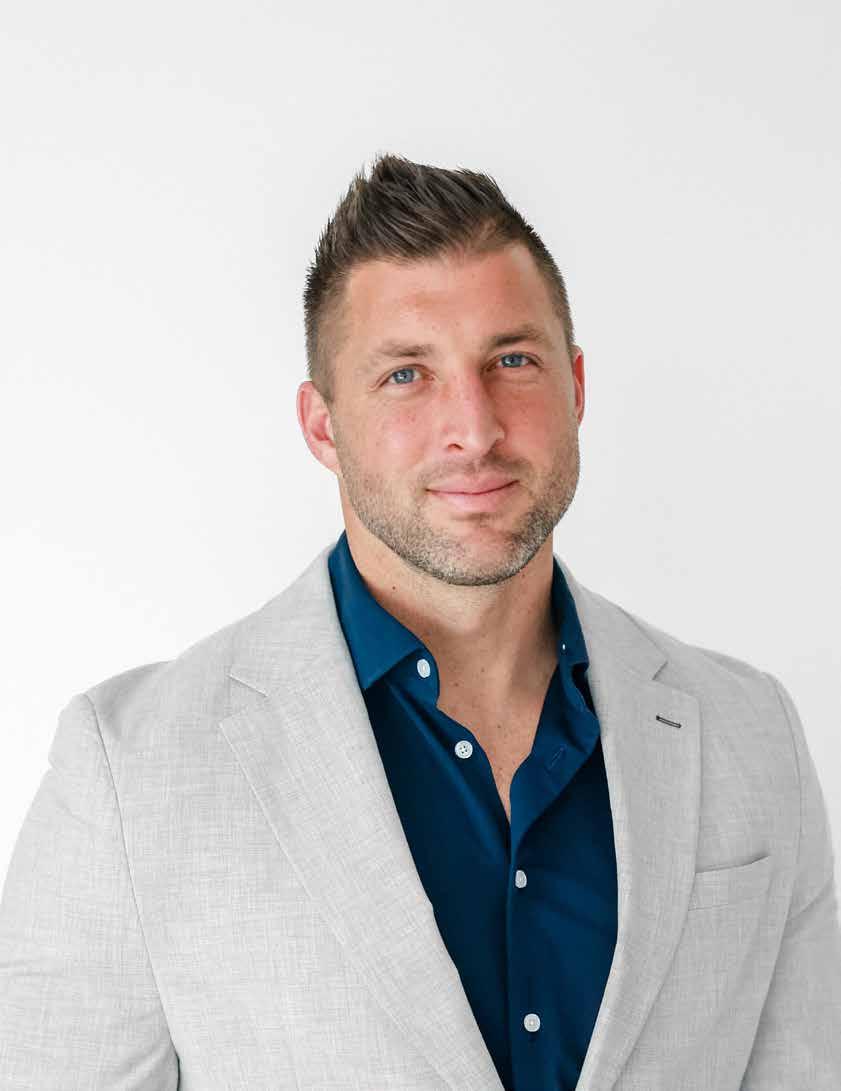

Tim Tebow
BUILDING A LASTING LEGACY






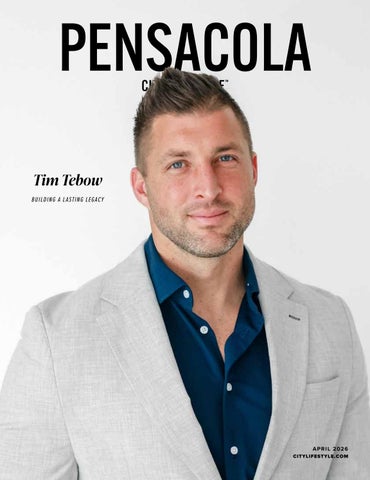
BUILDING A LASTING LEGACY
There’s something about April that refuses to stay small.
The days are longer. The air shifts. The world starts blooming whether it feels ready or not. Spring doesn’t wait for perfect conditions; it grows anyway. And maybe that’s the lesson.
This month’s issue is about investment in business, in leadership, in innovation, and in the future of Pensacola. You’ll read about bold thinking in public safety, powerful community impact, health, legacy, and the people who are building something that lasts.

But here’s what I’ve been thinking about lately: we talk a lot about investing money. What if we invested the same intentionality into how we live?
This past week, I found myself reflecting on what changes when we remember that time isn’t unlimited. Suddenly, forgiveness feels lighter. Judgment feels heavier. The small stuff loses its power. Showing up fully, honestly, and courageously becomes non-negotiable. You don’t have to overhaul your life. You just have to wake up inside it.
I recently revisited the book, A Course in Miracles : Every moment is a choice between fear and love. Not easy but powerful. What if the greatest return on investment is choosing love and kindness more often in our homes, in our businesses, and in the way we lead?
One of the clearest examples of that spirit is this month’s feature on Night to Shine, founded by Tim Tebow. When a community gathers to celebrate dignity and belonging, you see what happens when people invest in something bigger than themselves. The impact multiplies.
Pensacola is growing.
So are you. So am I.
If this year truly mattered, how would you show up differently?
Spring has an answer: start now.
The best portfolios aren’t just diversified. They’ve lived with heart.
With belief in what’s possible.

April 2026
PUBLISHER
Suzanne Pope | Suzanne.Pope@CityLifestyle.com
PUBLICATION DIRECTOR
Will Estell | Will.Estell@CityLifestyle.com
PUBLICATION MANAGER
Sydney Steffen | Sydney.Steffen@CityLifestyle.com
SOCIAL MEDIA COORDINATOR
Katie Harris | Katie.Harris@CityLifestyle.com
CONTRIBUTING WRITERS
Will Estell, Suzanne Pope, Alex Boykin, Bentley Estell, Victoria Behnke, Angela Broockerd
CONTRIBUTING PHOTOGRAPHERS
Shore Fire Media, Pensacola Symphony Orchestra, Stephen Spivey, Matthew Coughlin, Bentley Estell, Ford Motor Company
CEO Steven Schowengerdt
President Matthew Perry
COO David Stetler
CRO Jamie Pentz
CoS Janeane Thompson
AD DESIGNER Jenna Crawford
LAYOUT DESIGNER Kathy Nguyen
QUALITY CONTROL SPECIALIST Marina Campbell


SUZANNE POPE, PUBLISHER @PENSACOLACITYLIFESTYLE


The
. Sun on the horizon, waves in the distance, and a Ford Bronco built to take you exactly where you want to be With rugged capability and unmistakable style, the Bronco turns every coastline into your personal playground, ready for sandy trails, sunset drives, and endless adventure. Find yours today at Group1 Ford of Pensacola, your Gulf Coast home for exploration-ready vehicles.



An exclusive Q&A with City Lifestyle
ARTICLE BY ANGELA BROOCKERD
PHOTOGRAPHY PROVIDED
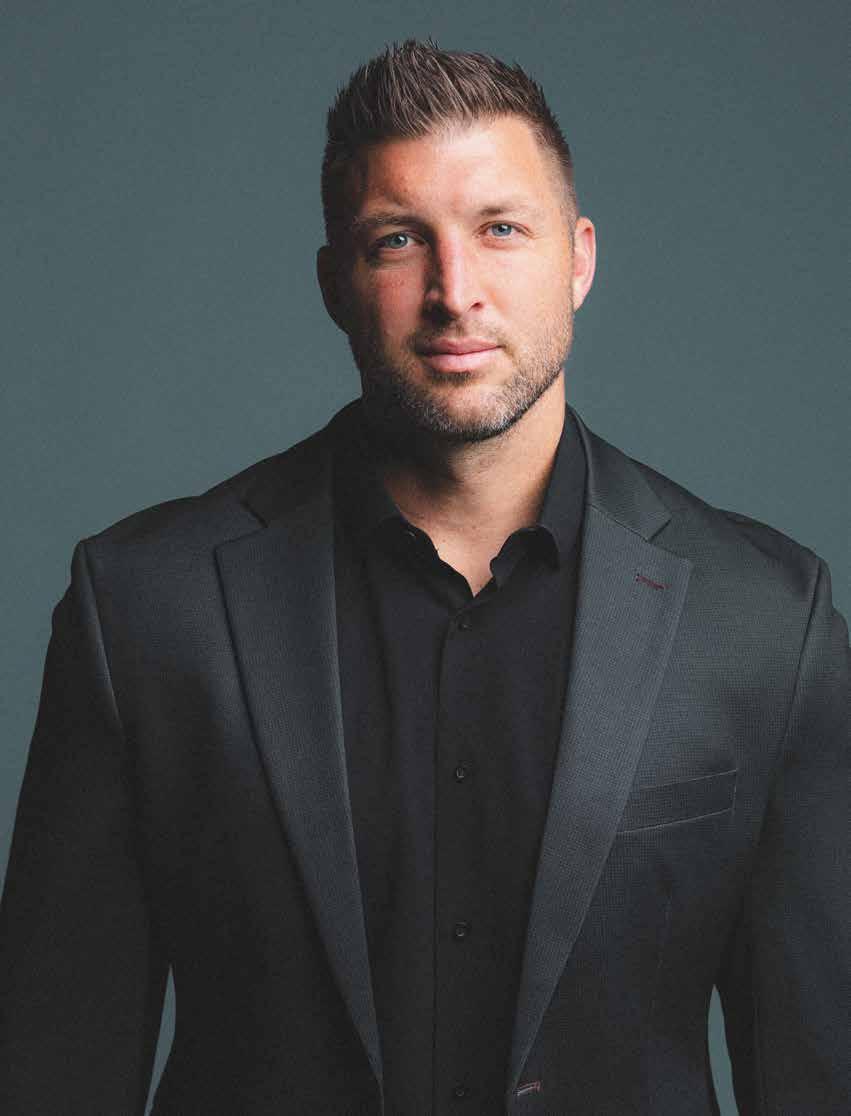
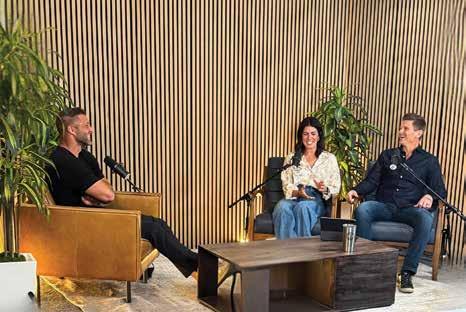
From championship trophies to global humanitarian impact, Tim Tebow’s journey has defied every standard playbook. In an exclusive conversation for the Share the Lifestyle podcast, Tebow pulls back the curtain on the moments that truly defined him, from a humbling middle school church retreat to the life-altering shift of fatherhood. This isn’t just a look back at a career; it’s an invitation into the heart of a man driven by purpose. Read the highlights below, then join us for the full, unfiltered experience by scanning the QR code at the end.
Q: WE ALL KNOW YOUR ACCOMPLISHMENTS ON THE FOOTBALL FIELD, BUT TELL US ABOUT THE CURL CONTEST.
A: I was competing for my future high school team (my brother’s team), and I pushed myself way past what was smart. I ended up collapsing and needing medical attention. But what stayed with me wasn’t the pain, it was the lesson. Would I be willing to do something that others aren’t? For much of my life, I strived to bring my best for a game, but I hope that I can say at the end of my life I was willing to do that for things that actually matter.
Q: YOU’VE ACHIEVED SO MUCH IN SPORTS. WHAT WOULD YOU SAY IS YOUR GREATEST ACCOMPLISHMENT NOW?
A: Becoming a dad. Nothing compares. From the moment I knew my wife was pregnant, I felt a new depth of love for our child, but when you bring your baby home, the responsibility hits you like nothing else. Suddenly, everything you see, every decision you make, you’re asking, “Is this corner too sharp? What happens if she reaches that drawer?” It changes how you see the world and how you see other people.
Q: YOU’VE SPOKEN OPENLY ABOUT DISAPPOINTMENT, ESPECIALLY AROUND FOOTBALL. HOW DID THAT SEASON OF LIFE SHAPE YOU?
A: I talked a lot about that very thing in my book Shaken . We all go through moments where our faith in our abilities and purpose feels rattled, but I believe it’s often in those storms when God can show us who we could become.
Q: YOU TALK A LOT ABOUT COMPARISON CULTURE. WHY DO YOU BELIEVE COMPARISON HAS BECOME SUCH A TRAP TODAY?
A: Because we’re comparing our real, everyday lives to someone else’s highlight reel. Social media shows people’s “best day,” often filtered and staged, and then we measure our reality against that. There’s a reason filters are so popular—it’s not real. We end up scrolling through images that don’t tell the full story, and without realizing it, comparison starts to steal our joy and our gratitude.
“We’re comparing our real, everyday lives to someone else’s highlight reel... comparison starts to steal our joy.”
Q: YOUR FOUNDATION FOCUSES ON THE “MOST VULNERABLE.” WHERE DID THAT CALLING BEGIN?
A: When I was 15, I met a boy in the Philippines who was treated as a throwaway because he was born with physical differences. That moment changed me. I realized God was calling me to pursue a different kind of MVP, not “Most Valuable Player,” but “Most Vulnerable People.”
Q: FINALLY, WHAT’S ONE THING PEOPLE MIGHT BE SURPRISED TO KNOW ABOUT YOU?
A: I have some weird coffee habits, which include protein powder, collagen, and cream all mixed together. I love golf dates with my wife. And every night, I bring snacks to bed to share with our dogs. It brings me more joy than it probably should.
This conversation barely scratches the surface. Tim goes deeper into the moments that rattled him, the joys of fatherhood, and one story he has never shared publicly until now. Scan the QR code for the full, exclusive City Lifestyle interview on Share the Lifestyle Podcast.

Bringing Love, Hope, And Honor to Prom Goers Along Our Coast and Around The Globe

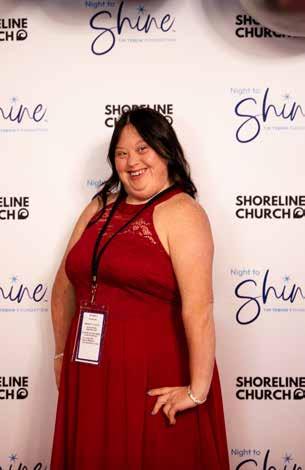
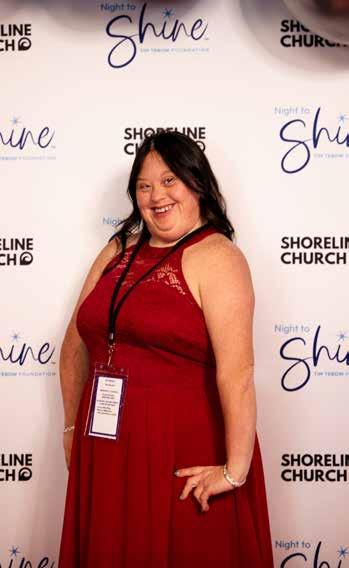
Every year, on the Friday just ahead of Valentine’s Day, something extraordinary happens in churches across the United States and beyond. Luxury cars, limos, and Corvettes pull up. Red carpet rolls out. Music plays. Cameras flash, and for one unforgettable night, people living with an array of special needs are celebrated as the honored guests they are.
That is the heart of Night to Shine: a global prom sponsored by the Tim Tebow Foundation and hosted by local churches
across Northwest Florida’s Gulf Coast and the world. At its core, Night to Shine is intentionally simple: a complimentary, fun-filled evening for its honored guests, whether they are fourteen or fifty-four. Age doesn’t matter here, because this prom is about love, respect, honor, and a belief that our God made everyone to be one of a kind.
Night to Shine launched in 2015 as a milestone project by Tim Tebow Foundation, and as of 2026 it celebrates more than 100,000
ARTICLE BY WILL ESTELL | PHOTOGRAPHY BY STEPHEN SPIVEY
people annually. Host churches across Northwest Florida, including: Shoreline Church in Destin, United Methodist in Pensacola, Upper Room Church in Gulf Breeze, Woodbine Church in Pace, and Church on Bayshore in Niceville all celebrate the event, along with churches across the country.
The foundation provides host churches with a structure and planning support, though each individual church builds a local expression tailored to their own community, volunteers, and honored guests. I believe the reason this phenomenal event has spread so far, so fast, is that Night to Shine fills a void many families know well: the longing to belong, to be welcomed without explanation, and to be celebrated without condition.
My wife, Laura, and I have had the privilege to twice serve at Shoreline Destin’s Night to Shine event, and I can tell you firsthand that the royal treatment is real, and it is strong. From the smiles on their faces when they exit the chauffeured vehicle, to being greeted as they walk the red carpet, to the dance floor, and on the stage to receive their crowns, these honored guests truly have the time of their life.
If you’ve never attended Night to Shine, you may be tempted to think of the red carpet, paparazzi-style photos, prom attire, corsages and boutonnieres, hair, makeup, and shoeshine stations, karaoke, dancing, dinner, and the crowning ceremony as simply fun details, but to those being honored, it’s so much more than that. It’s everything.
The message is powerful and memorable: You matter. You are seen. You are valued. Each church, along with all of the volunteers, explicitly frames the evening as a celebration of worth -culminating in a celebration where each honored guest takes the stage to be crowned King or Queen.
I have had the opportunity to talk with both honored guests and their family members, and I quickly realized that the night means more to those families than many of us immediately grasp. Some people with special needs spend their entire lives being managed, redirected, or overlooked. They are spoken about, rather than spoken with. Night to Shine flips that script, and it’s a beautiful thing to see and be part of.
Almost as important, Night to Shine honors the caregivers of these guests, offering a respite room for parents and caregivers
to relax, rest, and connect. Meanwhile, trusted volunteers spend the evening alongside their loved ones as “buddies” for the night. If you ask families why they return year after year, you’ll hear the same themes: confidence, belonging, and a love that lingers long after the crowns are placed and the last song has played.
For the churches and volunteers, Night to Shine becomes a crash course in what inclusive community really looks like. I’ve commented to family and friends that each year we served, I felt like I got more out of the event than even the guests. I believe Night to Shine trains the hearts and minds of those serving these guests, as much as it serves those being honored.
Night to Shine may be a one-night annual event, but its real impact is what happens in the weeks, months, and years afterward: The friendships formed. The churches awakened to inclusion. The families reminded they are not alone. And the love of God shown to, and by, all of His honored guests.



















Whether You Have 8 Bottles, or 800, Investing in Wine Can Be a Win
ARTICLE BY ALEXANDER BOYKIN
Because of my chosen profession, I moved around a lot as a young adult. That profession and the required moves that came at regular intervals made it nearly impossible to start collecting wine. I always had eight to ten bottles on hand that would cover any impromptu occasion that called for wine. Those bottles were mainly from my trips to Portugal, France, and Spain. They were supplemented by a few bottles that I would buy when I actually got to attend a tasting or wine dinner. It wasn’t until my wife and I had the opportunity to settle down in Pensacola that I could finally put some real effort and thought into starting a wine collection. If you decide to undertake your own, you cannot under estimate the effort or the thought that goes into it. In this article I will discuss the idea of a wine collection and briefly touch on the topic of wine as an investment.
In previous City Lifestyle articles, I discussed the essentials for storing your wine, and have often hit on it again since, so if you still have questions on how best to store your wine seek me out and we can talk. In another article we discussed the oenophile trait of Wine-Hunting. If the trill of the hunt for wine is as strong as mine then any bottle of wine can find its place in your collection. It doesn’t matter if that bottle costs $32 or $450, if you loved it then that bottle can be worth its place in your fledgling, or vast, collection. The storing of wine and hunting for wine both require effort and thought, and to start a proper wine collection, the two actions must meet. It will do you no good to start hunting for your prized bottle if you do not have the proper storage.
A proper wine collection is whatever you want it to be, whether that be eight bottles or 800, the effort and thought must be equal. For many it starts with getting a few bottles to have at the home. Storage starts out rudimentary, probably a small wine rack in a dark corner of the kitchen. It changes when you find a wine that you love, so you buy it and bring the bottle home. Then you try another wine and you bring two of them home. Now you need space to store those bottles so that you can enjoy them with friends at a future date…and that’s how it starts for many of us. That fledging collection, for most, usually culminates in a simple wine fridge. Although for others it is just the beginning. Knowing that you have proper storage allows you to hunt with more resolve. You can seek out “special” wine to have at “special” occasions. If you continue on this trajectory then a simple wine fridge will not be enough. Whatever your budget and desire, the effort that goes into ensuring your wine will have proper storage for future enjoyment must be equal to the thought that goes into each bottle that will live in that storage.
What is a bottle of wine worth? On the monetary side most bottles are worth roughly 20-40% less than what you paid for it. That’s not a typo. That is the average retail mark up for wine in the U.S. yet that only accounts for half of the true value of a bottle of wine. The other half of a bottle of wine’s value is the emotional value. This includes the thought that went into that bottle and
“Whatever your budget and desire, the effort that goes into ensuring your wine will have proper storage for future enjoyment must be equal to the thought that goes into each bottle that will live in that storage.”
its future enjoyment. That $32 bottle that you brought back from Napa after seeking out a winery you read about will be worth every penny when you open it to enjoy with close friends.
A quick word on wine as an investment. Based on auction sales and trust liquidations from 2025, approximately 90% of wine collections sold for less than what the owner put into them. Could your wine collection be in the 10% that would sell for more than you put into it? Maybe… and Good Luck! I will tell you is that the owners of those wine collections that sold for less probably hoped to enjoy some of those wines with family and friends. Yet, they didn’t put enough thought into how that wine was going to be, or meant to be enjoyed. That, in my opinion, is the real value and reason you should start a wine collection: to be enjoyed with those you enjoy being with. Cheers to collecting!

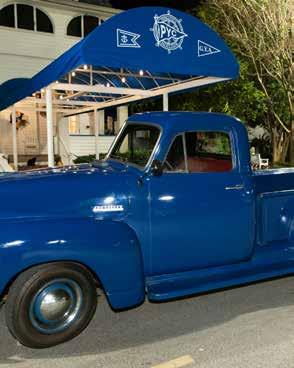








The 2026 Ford F-150 Is Again The Most Purchased Automobile In The Country
ARTICLE BY WILL ESTELL
Every generation of the Ford F-150 sets a new benchmark for capability, comfort, and technological prowess, and the 2026 lineup of America’s Bestselling vehicle is no exception. In its 14th generation, the F-150 is available in eight distinct trims, with a diverse suite of powertrains, best-in-class towing

figures, and an array of advanced features - proving again why this truck continues to outsell its competitors every year.
The 2026 F-150 is based on the 2021 redesign, and a 2024 facelift. The lineup covers basic workhorse models to luxury-oriented trucks and off-road champions. There’s even an all-electric version that revives the legendary Lightening name.
At the base of the range, the XL serves as a rugged and dependable truck offering entry-level capability without sacrificing modern tech. The STX brings sportier styling elements, unique exterior accents, and additional comfort features. The XLT elevates the experience with chrome details, enhanced seating materials, and advanced towing technology. For those desiring a balance of luxury and muscle, the Lariat, King Ranch, and Platinum trims provide premium interiors, cutting-edge connectivity, and comfort-focused amenities. At the top of the ladder, for drivers seeking thrill and terrain conquering abilities, are the Tremor and Raptor, serving to redefine what an F-150 can do off the pavement.
Central to the F-150’s appeal is its impressive range of engine options, designed to suit diverse driving needs. The 2026 F-150 offers multiple powerplants, from efficient turbos to high-output performance engines:
• 2.7L EcoBoost V6: This twin-turbocharged engine delivers 325 horsepower and 400 lb-ft of torque, providing a solid balance of performance and fuel economy for everyday tasks.
• 3.5L EcoBoost V6: A step up in capability, this twin-turbo V6 produces around 382-400 horsepower and 500 lb-ft of torque,
enabling robust towing up to 13,500 pounds.
• 3.5L PowerBoost Full Hybrid V6: Combining gas and electric power, the hybrid produces approximately 420-430 horsepower and up to 578 lb-ft of torque. The hybrid system also includes Pro Power Onboard, turning the F-150 into a mobile power hub for tools, appliances, or camping gear.
• 5.0L Ti-VCT V8: For traditionalists, this naturally aspirated V8 offers classic American muscle, with 400 horsepower and 410 lb-ft of torque.
• High-Output 3.5L EcoBoost and 5.2L Supercharged V8: Reserved for the Raptor and Raptor R models, these engines deliver serious performance. The high-output EcoBoost pushes around 450 horsepower, while the supercharged 5.2L V8 in the Raptor R absolutely dominates, with 720 horsepower and 640 lb-ft of torque, turning the F-150 into a desert-ready beast.
The 2026 F-150 starts in the high-$30,000s for a base trim like the XL (if you can find a base one) while well-appointed mid-range models typically range in the high $40,000s to $70,000s. Toptier trim levels and performance variants like the Raptor start at $70,000+ and range well above the six-figure line, depending on options and specific configurations.
Whether you’re towing a boat, camper, or trailer; navigating rural backroads, or simply commuting to work in comfort and style, the 2026 Ford F-150 lineup offers something for virtually every driver.
Jakob Carmichael was still in high school when the idea that would become RescAlert first took shape.
It was 2017. Hurricane Harvey had just devastated Texas. Watching news coverage from his Pensacola home, Carmichael noticed something that unsettled him. First responders were working tirelessly yet agencies appeared disconnected, resources overlapped, and communication lagged.
“I remember thinking, we have all this technology in the world, why aren’t these systems talking to each other?” he says.
He took the question to the person he trusted most: his father, a master electrician with a PhD in computer science.
The answer was simple and revealing. Emergency departments operate within separate systems, budgets, and software platforms. Each works well independently, but when disaster strikes and multiple agencies converge, those systems often don’t communicate seamlessly.
For a teenager already fascinated by programming and technology, that explanation wasn’t satisfying.
“That’s when I started asking, what if there was a way to connect them all?” Carmichael says. “What if you could see everything in one place and actually anticipate what’s coming instead of just reacting to it?”
That question became the foundation for RescAlert.
ARTICLE BY SUZANNE POPE
Born in Charlotte, North Carolina, but raised in Pensacola since first grade, Carmichael credits this community with shaping both his ambition and his sense of responsibility. Growing up in a region accustomed to hurricane season and later witnessing the impact of Hurricane Sally firsthand reinforced the reality that preparedness is not optional along the Gulf Coast.
“Pensacola feels like a big town with a small-town heart,” he says. “People here look out for each other.”
That mindset, protection, readiness, and community run through his company’s mission.
Today, at just 23 years old, Jakob Carmichael, President and Founder of RescAlert, leads a public safety technology firm operating in eight states with more than 40 employees and expanding rapidly. RescAlert’s core function is straightforward but powerful: move emergency response from reactive to proactive.
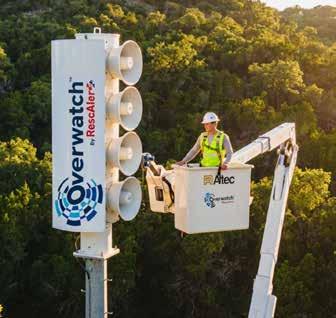

“Now, people are beginning to see that predictive tools aren’t optional. They’re part of the future.”
Using predictive analytics and artificial intelligence, the platform integrates multiple data sources — weather patterns, infrastructure monitoring, public alerts, environmental sensors, and more into one unified system. Instead of waiting for a river to overflow, agencies can anticipate flooding hours in advance. Instead of responding after impact, they can deploy resources earlier and with greater precision.
“If we can give decision-makers more time and better clarity, outcomes change,” Carmichael explains. “Time is everything in an emergency.”
Approximately 80 percent of RescAlert’s work serves local and state governments, particularly in hurricane-prone states like Florida and Texas. The remaining projects support industrial facilities requiring advanced safety monitoring.
What sets the company apart is its turnkey approach. RescAlert doesn’t simply design software it installs and integrates the infrastructure itself, from sensors and cameras to fiber networks and alert systems, bringing everything into one coordinated platform. An internal AI analytic engine filters overwhelming data into prioritized insights, helping leaders focus on what matters most.
The biggest hurdle, Carmichael admits, has not been technology but education. “Four years ago, AI sounded like science fiction,” he says. “Now, people are beginning to see that predictive tools aren’t optional. They’re part of the future.” And that future remains anchored here.
RescAlert is preparing to move into a larger facility near Nine Mile Road this spring, with plans to grow to more than 200 employees within two years many of them in Pensacola. The company has also secured additional land in Santa Rosa County to support long-term expansion.

“Pensacola supported me when this was just an idea,” Carmichael says. “I want our headquarters here. I want to grow with this city.”
His advice to readers to young dreamers and experienced leaders alike, is this: “Take the leap. I didn’t know everything on day one. I still don’t. But forward is forward. If you have an idea you believe can make a difference, don’t wait until you feel ready. You become ready by starting.”
As Pensacola continues to grow and define its next chapter, innovation in readiness may prove just as important as expansion itself. Sometimes the future of a city begins with a young person asking a simple question: Why can’t we do this better?
And then deciding to build the answer.

























































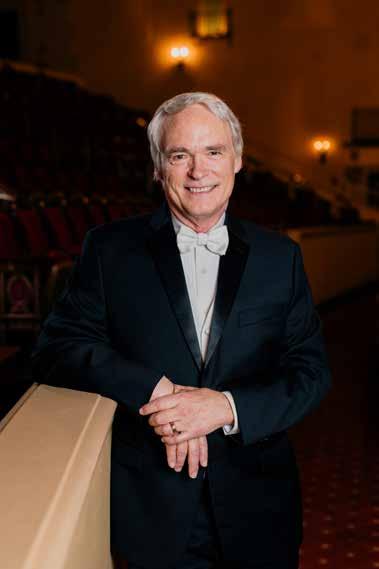
The Passion and Purpose of Maestro Peter Rubardt

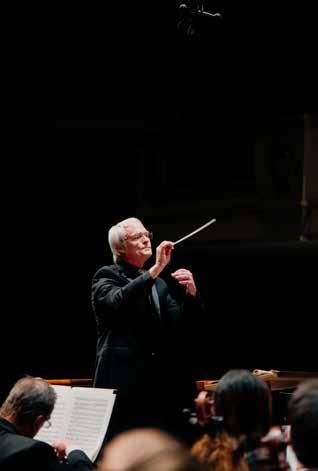
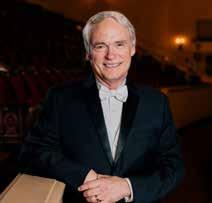
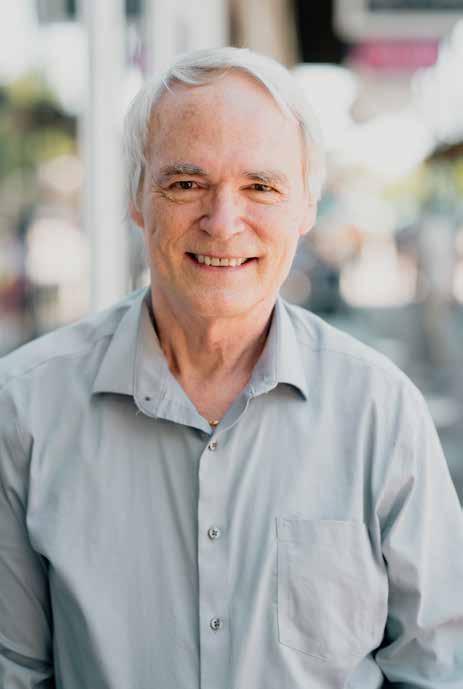
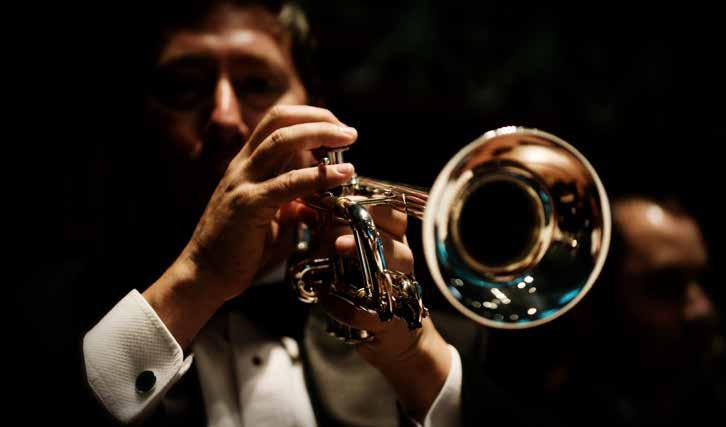
This year, as the Symphony celebrates its 100th season, its legacy is in focus: inspiring during times of triumph, healing during times of tragedy, and reminding us that we are stronger - and more connected - when we listen together. For nearly three decades, Maestro Peter Rubardt has stood at the podium of the Pensacola Symphony Orchestra, guiding not only performances, but a cultural institution.
Rubardt says by age 15, he knew music would define his life. He immersed himself in the great symphonic repertoire - Brahms, Tchaikovsky, Mahler, Strauss and others. The works still inspire him. “Ever since then I’ve done nothing else,” he said. “I’m glad it worked out because I don’t know what else I’d do at this point.”
That teenage fascination matured into a career centered not only on artistic excellence, but on understanding people. His primary instrument is the piano, yet he spent years studying violin as well — deliberately expanding his perspective.
“If you know what the string players in an orchestra have to do, then you can talk to them better,” he said. “So, I played violin for quite a while just to learn their language, so to speak.”
Learning another musician’s language is, in many ways, an act of respect. Conducting is not simply about keeping time; it is about translating vision into collaboration. “It’s the classic example of something greater than the sum of its parts,” he said, “which to me has always been an elusive but sort of quite charming goal to go after.”
Bringing those elements together requires patience and persistence. “Sometimes it’s completely opaque and impossible to make anything happen,” he said. “And then other times it all just comes together in a way that you can’t describe.” When it does, he says, “that’s when the magic kicks in.”
Before arriving in Pensacola, Rubardt spent eight years in roles that involved conducting but not serving as music director. Pensacola offered him the opportunity to lead — to shape programming, artistic standards and long-term vision. At the time, it was simply the next logical step. He did not imagine he would still be here 29 years later.
Yet like many who arrive on the Gulf Coast expecting a brief chapter, he stayed.
His wife, a professor in the Grier Williams School of Music at the University of West Florida, found professional fulfillment here as well. Their family grew. Roots deepened. What began as a job became a life.
That longevity has allowed Rubardt to invest deeply - not just in performances, but in relationships. When asked what brings him back to the podium each day, he points first to the people.
“Mostly it’s the people,” he said. “The Pensacola Symphony is a truly unique group of individuals.”
That community includes musicians, staff, board members, donors and audiences; all participants in a shared cultural endeavor. Rubardt sees his role not as the sole driver of success, but as one contributor within a larger ecosystem.
“There’s a sort of circular richness that builds around the art of music,” he said. “I’m lucky to be in the middle of it, but that doesn’t mean it all happens because of me.”
He describes the Symphony’s growth as an “incredibly fortunate confluence of elements”: talent, leadership, and a community that values the arts. Sustaining that requires steady attention. Programming must
challenge and inspire. Musicians must feel supported. Audiences must feel welcomed.
Each performance becomes an opportunity to share his inspiration — to create a moment where hundreds of listeners experience something together. The final chord may fade, but the impact lingers in conversation, in memory and in a renewed sense of connection.
For Rubardt, that is where the true investment lies. Not in prestige or longevity, but in cultivating experiences that uplift and endure.
“It’s a privilege. It’s an incredible privilege,” he said. “And I never thought I would have a career that was as nurturing and as satisfying as this situation has been.”
Rubardt continues to guide the orchestra with the same curiosity and commitment that first drew him to music as a teenager.
The Symphony wraps up its season with the 100th Anniversary Gala Concert on April 25, featuring the Pensacola Children’s Chorus and the newly established Pensacola Symphony Youth Orchestra.
The heartbeat of the community, like a great symphony, depends on many contributors. But it also depends on someone willing to set the tempo, shape the dynamics and bring disparate voices into harmony.
In Pensacola, that steady hand has been Peter Rubardt — investing, season after season, in the sound of a community coming together.
Redefining the Next Chapter at Latitude Margaritaville Watersound
Along the storied Emerald Coast, where white-sand beaches meet turquoise water, a refreshing new community is reimagining what 55+ living looks and feels like. This is Latitude Margaritaville Watersound, where the next chapter isn’t about slowing down, but stepping up to the life you haven’t yet lived.
Designed for those who believe the best years are still unfolding, Latitude Margaritaville Watersound is a vibrant resort-inspired community located just off Scenic Highway 30A beside the Intracoastal Waterway. Developed by Minto Communities in partnership with Margaritaville Holdings, the community blends elevated coastal design with a spirit of connection, activity, and easygoing fun.
This is nothing like your grandparents’ retirement. It is a place for reinvention, where the daily grind gives way to a full social calendar or hours of leisurely pursuits. Simply put, it’s the freedom to be exactly who you want to be.
From the moment you arrive, you feel a warmth that goes beyond the weather. Pastel-hued homes, swaying palms, and golf-cart-friendly streets set a tone that feels relaxed, yet alive. Neighbors wave as they stroll by. Music drifts across open-air gathering spaces. Even sunset becomes a social event.
At the heart of the community is the Latitude Town Square. This dynamic hub naturally brings residents together, complete with a bandshell concert stage, jumbo screen, and dance floor— this is where live music, movie nights, holiday celebrations, and spontaneous parties unfold under the Florida stars.
The Latitude Bar & Chill restaurant offers a refined-casual setting for dining and conversation, whether it’s a post-pickleball lunch or evening cocktails. Nearby, the lagoon-style Paradise Pool—framed by tiki-style cabanas—invites residents to cool off or simply soak up the sunshine.

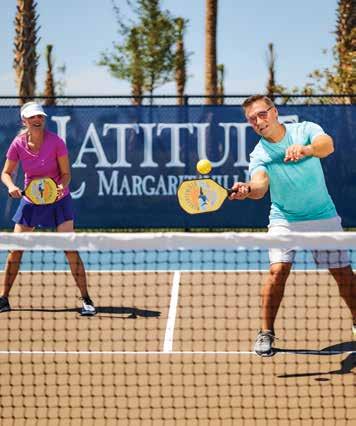
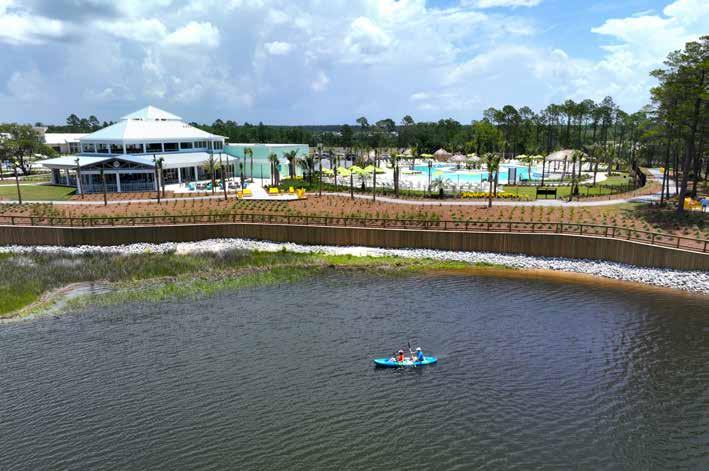
Wellness and recreation are seamlessly woven into everyday life. The Fins Up! The Fitness Center features state-of-the-art equipment and group classes, while tennis and pickleball courts keep competition friendly and frequent. The Workin’ N’ Playin’ Center accommodates both creative pursuits and remote work, while The Last Mango Theater hosts performances and special events. Even four-legged family members have their own little havens at the Barkaritaville Dog Park and Pet Spa.
Walking trails wind through the community, encouraging morning strolls, evening bike rides, and casual meetups along the way. Here, being active isn’t a scheduled obligation, but a shared enjoyment.
The homes at Latitude Margaritaville Watersound reflect the same thoughtful balance of comfort and style found throughout the community. With prices starting in the $300s, the collections include charming Conch Cottages, spacious villas, and a variety of single-family homes designed to suit different preferences and lifestyles.
Conch Cottages offer two bedrooms and two baths, ranging from 1,210 to 1,481 square feet of air-conditioned living space, all with two-car garages. Select plans include a den or hobby room—ideal for creative projects, a home office, or welcoming overnight guests.
Villas range from 1,507 to 1,865 square feet and feature two bedrooms, plus a den or hobby room, two or two-and-a-half baths, covered lanais, and two-car garages. Open layouts flow naturally
from indoor to outdoor living spaces for effortless entertaining.
Single-family homes span 1,685 to 2,568 square feet, offering two to three bedrooms, plus den options, two- or three-car garages, and expansive covered lanais.
A limited Vista Collection of two-story homes overlooking the Intracoastal Waterway provides an elevated option with three or four bedrooms and sweeping water views.
All home collections celebrate open-concept living, abundant natural light, and premium features. Spacious primary suites, large walk-in closets, and well-appointed baths deliver both comfort and everyday luxury.
For many residents, the appeal goes beyond the community itself. Situated near the beaches of 30A and Panama City Beach, Latitude Margaritaville Watersound offers convenient access to local boating, dining, arts, and culture. Whether it’s a morning at the beach, an afternoon of shopping, or an evening out, the location supports an active coastal lifestyle.
Latitude Margaritaville is currently offering up to $40,000 in savings, along with additional special offers and financing options.
For those considering a move to the Emerald Coast—or locals ready to embrace a new chapter close to home—this is an opportunity well worth exploring.
To learn more or schedule a tour of the community, visit LatitudeMargaritaville.com
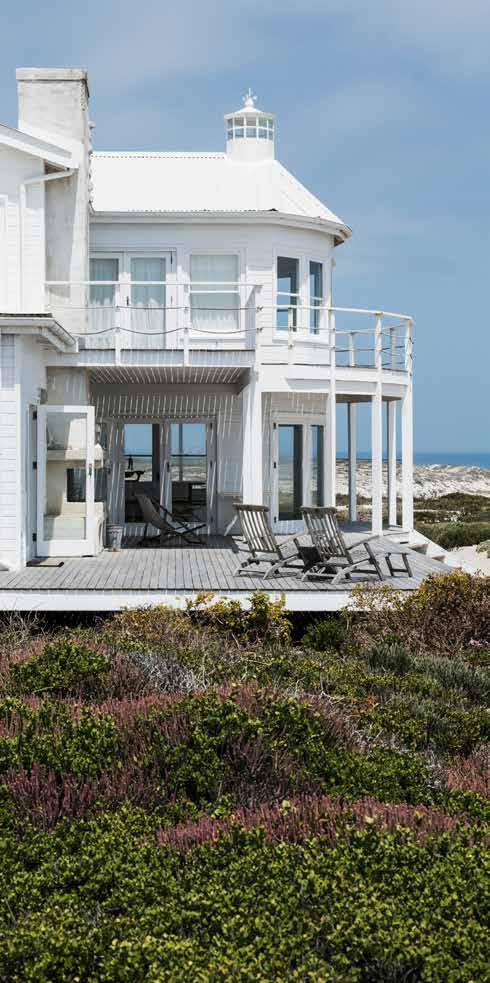

Connell & Company Realty, Inc. is comprised of a team of local Realtors committed to selling some of the most desired homes in Pensacola.
Our team of local experts is ready to guide you throughout the home buying or selling process. We are committed to fast, professional, and courteous service to help you understand and feel at ease throughout the home buying process.


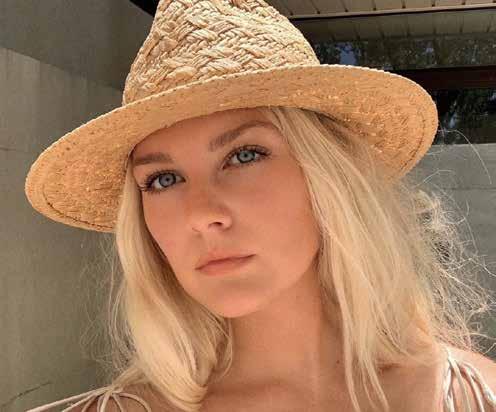
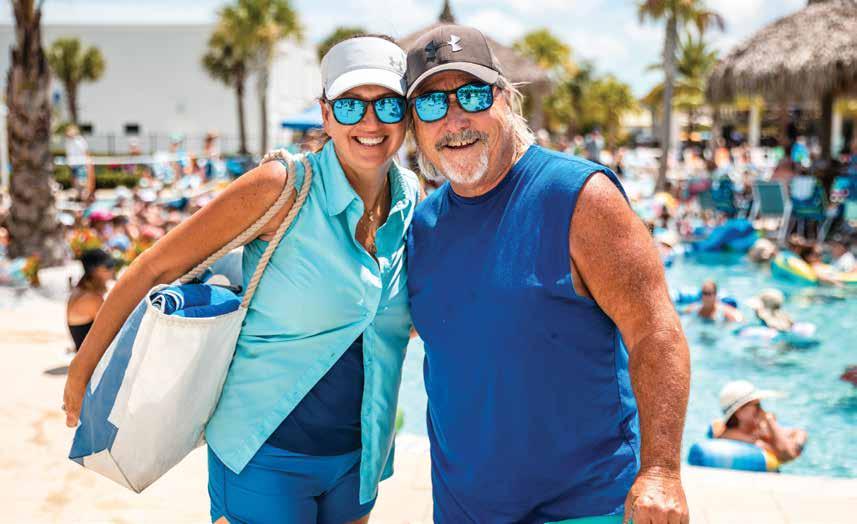
Many of us Floridians may be beach lovers who relish basking in the sun and salty air, but that doesn’t mean we want to look the part when it comes to the long-term damage those days can do to our skin. There’s no doubt we have all seen those people who look as if they’ve spent a few too many long days celebrating on the beach, lounging by the pool, or behind the console of their boat. While that radiant sun-kissed glow can be a rather attractive asset, no one wants to appear fifteen years older than they are just because they love the beach.
1. Use Sunscreen
Most of us have been lectured about sunscreen until someone was blue in the face. Yet, strangely, we still get red when we refuse to listen.
You should apply sunscreen whenever you’re outside for even a half hour, and you should reapply every two hours when you’re at the beach, pool, ballfield, or for any prolonged outdoor exposure. All sunscreens are formulated and manufactured to protect wearers against UVB rays, which are the primary cause of sunburn, sun damage, and most skin cancers. However UVA rays - which we seem to hear less about - are also causes of wrinkles, sunspots, skin cancers, and overall premature and unattractive aging of the skin. Because you need to protect yourself against both types of these sun derived culprits, most dermatologists recommend that their patients procure a good SPF 50, or higher, broad-spectrum sunscreen. It’s also worth noting that a water-resistant formula is good to have around. Be prepared to reapply after taking a swim or perspiration.
2. Choose the right soaps and cleansers
One of the best things you can do to protect your skin -particularly your face- from sun damage is to take care of your skin in other ways. For starters this means using the right soaps and cleansers for your skin type, your climate, and even the season. Many dermatologists will tell you that one of the best soaps for your face and skin is simply good old fashion white Dove. Yep, it’s even better than the majority of brand name cleansers that cost ten to twenty times as much.
In general, you’ll want to stay away from heavy oil-based cleaners and use those formulated for your specific skin type, most of which tend to be in foam pump form or light creams. The same goes for easing up on heavy astringents that are often alcohol based and tend to dry out skin. These are exactly what you don’t want before exposure to lots of sunlight.
3. Hydrate your body to hydrate your skin
We all hear so much about drinking enough water and the importance of staying hydrated.
Depending on our size and body composition, most of us need 60 to 150 ounces of water per day. Guess what? Most people don’t get even close to this. Remember, if your entire body is dehydrated then your skin is too. What I’ve found that works is simply keeping a 12-to-20-ounce bottle of cool purified water at home, work, or a cooler in your car, and making yourself drink a particular number of times per day to get the amount you need. The general rule is
It’s also worth noting that a water-resistant formula is good to have around. Be prepared to reapply after taking a swim or perspiration.
½ to 1 ounce of water daily, for every pound of body weight, with the variation in ounces being based largely on how much you are using or losing in various activities and climate conditions.
4. Watch alcohol content when outdoors
I like a cold beer as much as anyone I know, however, I think we’ve all established that alcohol is a dehydrant. So, if you have a tendency to load up a cooler of your favorite libations when heading out for a day on the sand or water just make sure you remember to slam those 60 to 150 ounces of water you need in between the other tastier drinks.
It’s also a good idea to limit daily drinking to a few drinks a day. I’m not telling you what to do or how to live your life, but we’ve all seen that guy who drinks six packs per night five or more days a week. And how does he look? Not the best skin, right?
5. Get your nutrients
Remember that whole, “you are what you eat” adage? Well, unfortunately it’s mostly true. A whole lot of things aren’t particularly good for you, so let’s skip that list and just go to what is specifically good for your skin: vitamin C rich foods, including fresh fruits and vegetables that are rich in polyphenols and beta-carotene. Things like soybeans, nuts and seeds, oily fish, and even coffee can be helpful in keeping healthy glowing skin from the inside out.
As for giving your skin -especially your face- a dose of nutrients, try a good vitamin C serum to help nourish your skin and keep that youthful glow all year long.
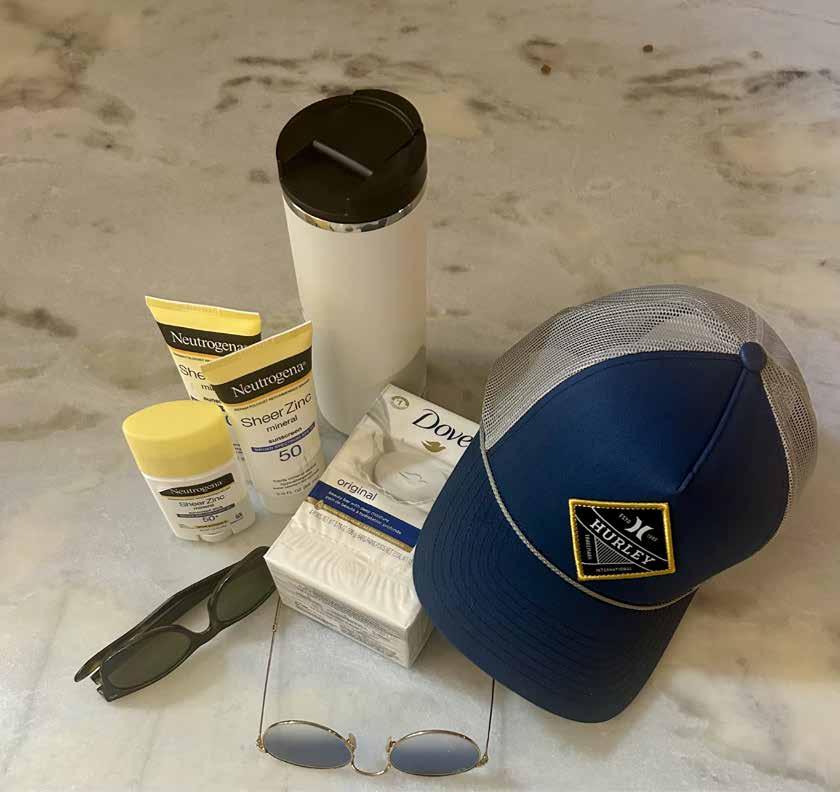
While it may seem almost too rudimentary to even mention, wearing a hat, neck cover, and even a long sleeve shirt with built-in sun protection, can go a long way in allowing you to stay outdoors longer, while still protecting your skin from too much sun. Look for shirts that state a particular level of sun protection but also be aware that simply carrying along a light-weight
white cotton button up or long sleeve tee is a smart move when heading out for a day at the beach or hours on the boat. The same goes for investing in the right sunglasses as a precaution against eye damage, and damage to the tinder skin around your eyes, that often can be protected by the sunglasses. While any shades are better than none, it’s best to choose sunglasses with polarized lenses.