LIFE + CULTURE
CLAIRE ZINNECKER'S VISION BRINGS IDA HOUSE BACK TO LIFE
LISTO VERDE! FIGHTING LESLIES SHOW UP AND SHOW OUT
ARTS + CULTURE
FORTY YEARS OF SXSW MUSIC FESTIVAL







LIFE + CULTURE
CLAIRE ZINNECKER'S VISION BRINGS IDA HOUSE BACK TO LIFE
LISTO VERDE! FIGHTING LESLIES SHOW UP AND SHOW OUT
ARTS + CULTURE
FORTY YEARS OF SXSW MUSIC FESTIVAL
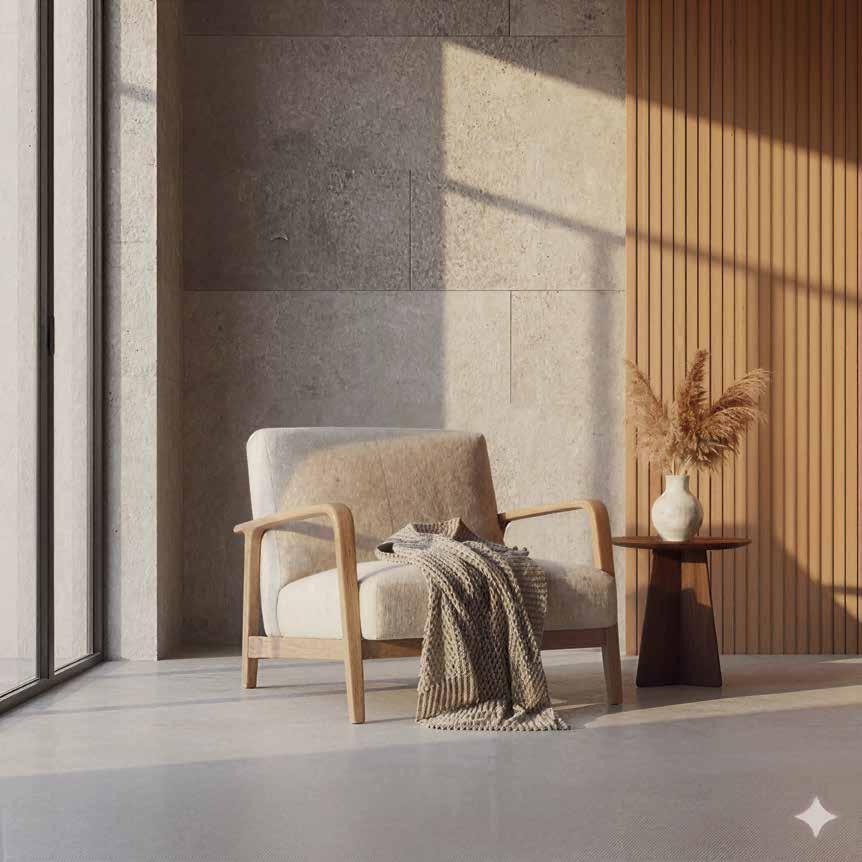
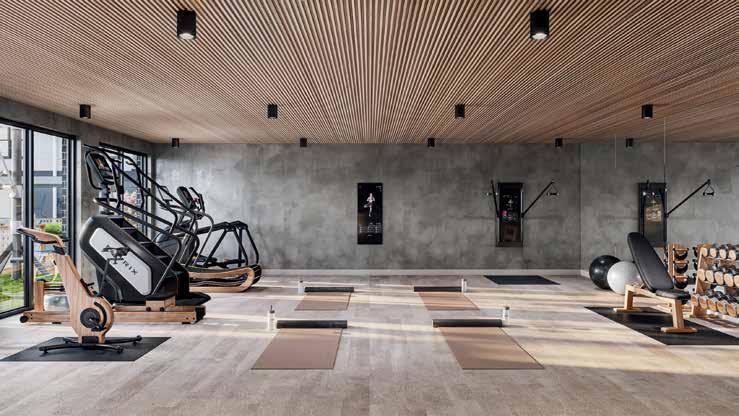
The Ander blends Austin's vibrant energy with restorative calm. Inspired by wellness and nature, the property features warm woods and soothing stone throughout. Amenities include a luxury pool, movement lounge with infrared sauna, and panoramic Skydeck.
Located in Crestview, The Ander offers 1-, 2-, and 3bedroom residences plus unique Live/Work units. For a limited time, buyers receive up to $20,000 in upgrade credits or one year of HOA dues paid. Schedule a private tour at our Sales Gallery: 2525 W. Anderson Lane, Suite 295.
512-859-5903
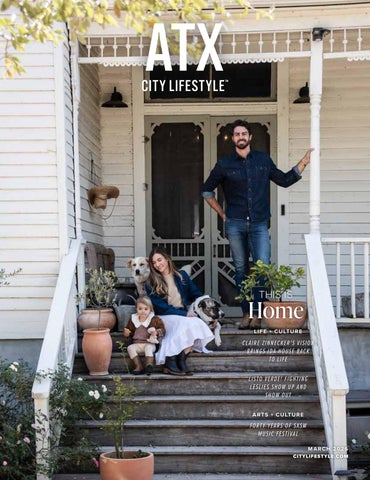
Home is more than an address. It’s memory, music, craftsmanship, and the quiet details that make a place feel like yours. In this month's issue, we explore what it truly means to belong, both within our walls and across the city we love.

We begin with the inspiring effort to save Ida House, a reminder that preserving Austin’s architectural history is also about honoring the stories embedded within it. That same sense of legacy carries through our celebration of 40 years of SXSW, a cultural institution that has shaped Austin’s creative identity and continues to make this city feel alive every spring.
Home also means protection and personalization. Businesses like Tarrytown Roofing and Closet Factory show how thoughtful investments, whether safeguarding what’s overhead or designing spaces that work beautifully, can transform how we live day to day. We also toast to community with The Fighting Leslie’s DC, where a little irreverent fun reminds us that home often extends well beyond our front door.
And finally, we look to the future through color. Pantone’s Color of the Year, Cloud Dancer, offers a calming, versatile neutral that reflects a collective desire for balance, clarity, and comfort — something many of us are craving right now.
However you define it, home is deeply personal. We hope this issue inspires you to celebrate yours.

JULIE ROYCE, MANAGING EDITOR @ATXCITYLIFESTYLE
March 2026
PUBLISHER
Zack Fogelman | zack.fogelman@citylifestyle.com
MANAGING EDITOR
Julie Royce | julie.royce@citylifestyle.com
CONTRIBUTING WRITERS
Janna Paulson, Julia Pinto
CONTRIBUTING PHOTOGRAPHER
Shara Nickell
CEO Steven Schowengerdt
President Matthew Perry
COO David Stetler
CRO Jamie Pentz
CoS Janeane Thompson
AD DESIGNER Evan Deuvall
LAYOUT DESIGNER Amanda Schilling
QUALITY CONTROL SPECIALIST Megan Cagle





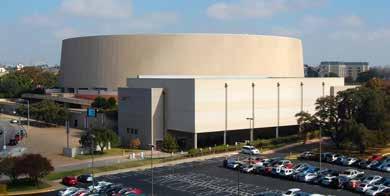





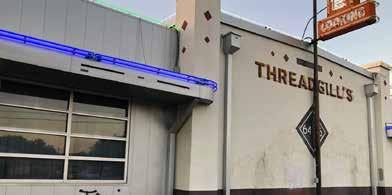
1: Designed like a cowboy hat, the Frank Erwin Center was home to many UT games and events. 2: Home to the original Night Hawk dinner, The Frisco closed its doors in 2018. 3: We miss Dart Bowl, home to "glow in the dark" bowling extravaganzas and delicious enchiladas. 4: Manor Downs was home to the oldest parimutuel racetrack, located right outside of Austin. 5: Before the Thinkery, Austin was home to Pandamonium. Two levels of endorphin rushes and chaos. 6: Rooster Andrews Sporting Goods was the spot to get all of your athletic gear. 7: If you were craving a home-cooked meal, Threadgill's was the place. Good food, better music.

Use code ATXCITY10 for 10% off your Innovation Badge* at sxsw.com/checkout.
*The 10% discount applies to the badge rate active at the time of purchase. Sales tax will be applied at checkout. Badges are non-transferable. Discount code expires on March 18, 2026
• Hundreds of cross-industry sessions
• Immersive tech across three Expos
• World-class networking
• Exclusive Innovation Clubhouse
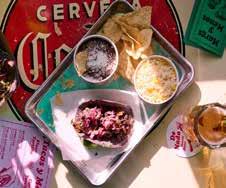


De Nada Cantina is bringing its tacos and margaritas in pink cups to South Austin with a second location at the former El Mercado space on South 1st Street. The East Austin favorite, known for homemade blue corn tortillas and vibrant atmosphere, has debuted, honoring El Mercado’s legacy while adding refreshed décor and expanded service.
Workshop No.5 is redefining residential development with a client-first, full-service model that streamlines everything from land acquisition and design to construction, interiors, and landscaping. The female-owned boutique firm debuts its William Holland project on the 2026 Austin Modern Home Tour, showcasing thoughtful design rooted in collaboration with local artists and builders.
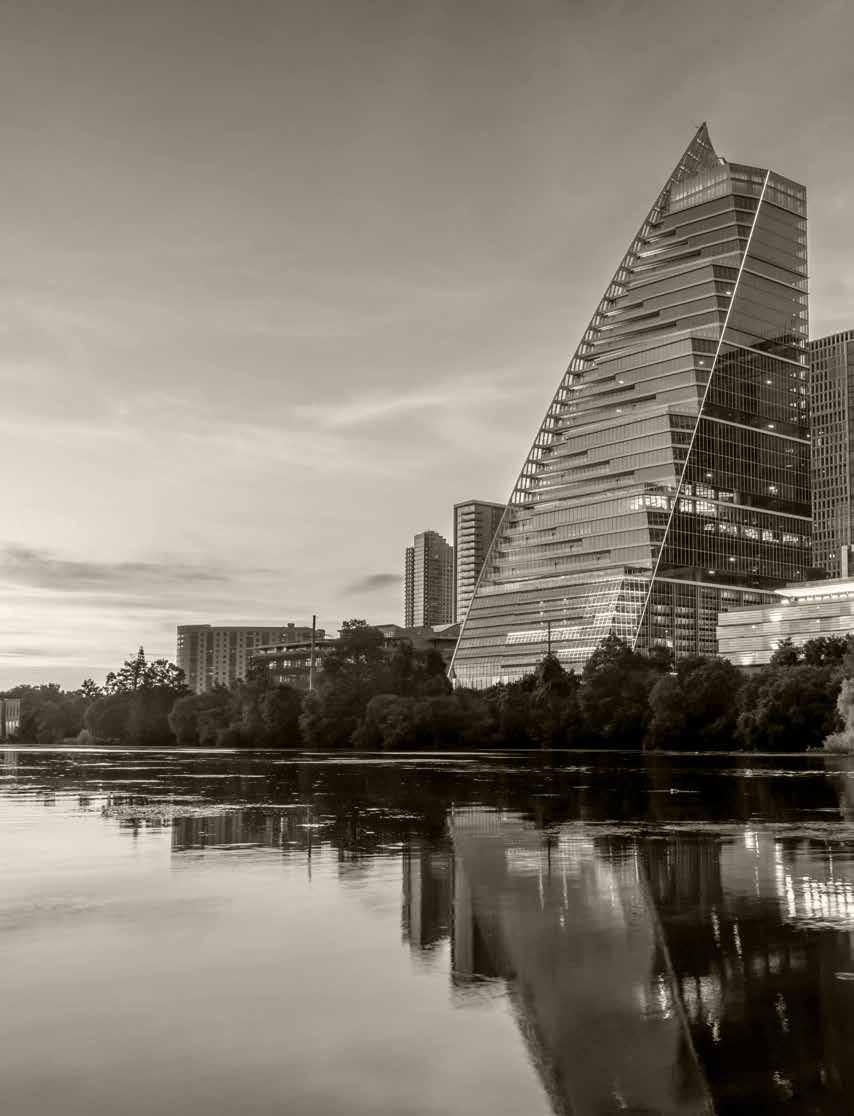
Something special is taking shape at 2001 W. Anderson Lane. The Ander, Ledgestone's latest, breaks ground this month, bringing 198 luxury residences to Crestview. Expect on-site concierge services, infrared sauna, movement lounge, resort-style pool, and a rooftop Skydeck with panoramic views. All just steps from local cafes, boutiques, and oak-shaded streets. Offering refined living with neighborhood soul. One to three bedrooms plus live/work units, priced from the $300s, occupancy 2028. Reserve now at theanderaustin.com.

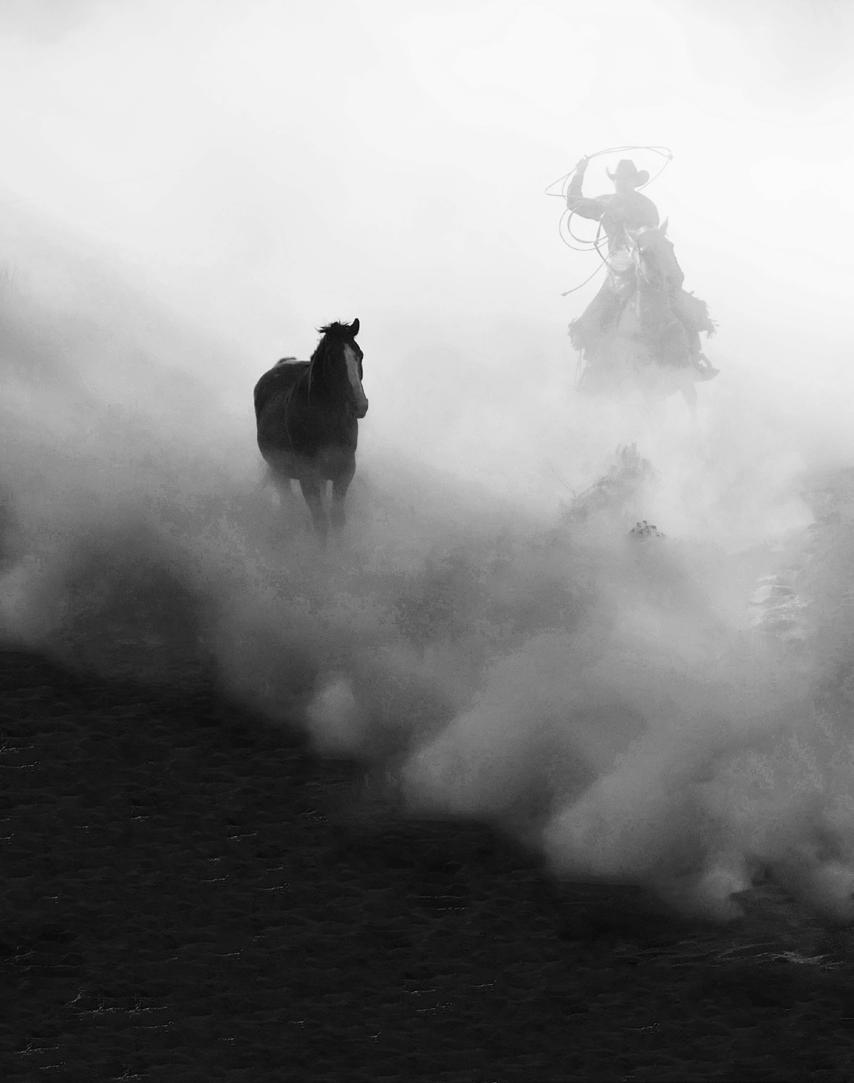
The story of Tarrytown Roofing started in the saddle. Founder James Wolfgang Kuntz began as a cowboy where long days and unpredictable challenges taught resilience, discipline, and integrity. Those same values shape Tarrytown Roofing’s forward-thinking, relationship-driven culture.
The result: a better kind of roofing company that blends rugged work ethic with a community-first mindset, bringing Texans reliable roofs built with pride and personal accountability. Tarrytown Roofing offers a neighborly approach, where every roof is a promise, every handshake a guarantee.


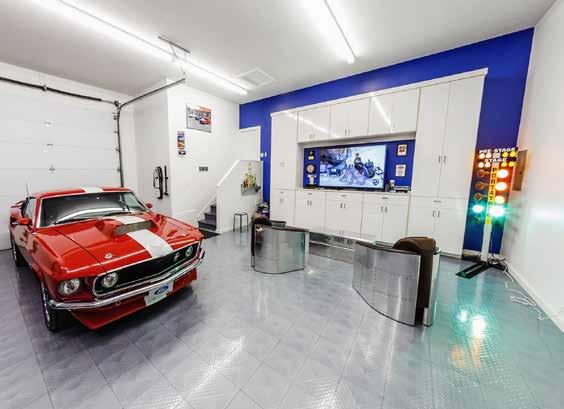
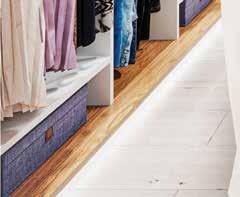
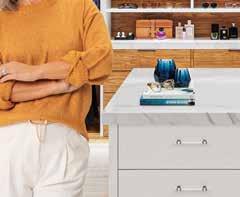
PERSONALIZED DESIGN TURNING EVERYDAY SPACES INTO CALM, FUNCTIONAL SANCTUARIES
PHOTOGRAPHY COURTESY OF CLOSET FACTORY AUSTIN
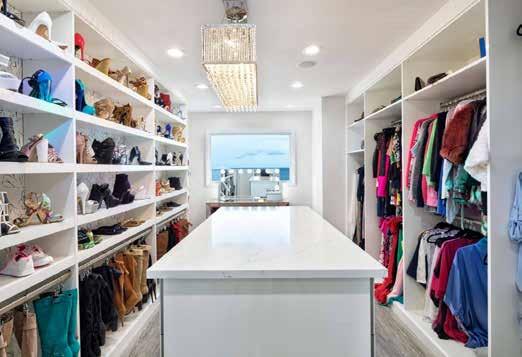
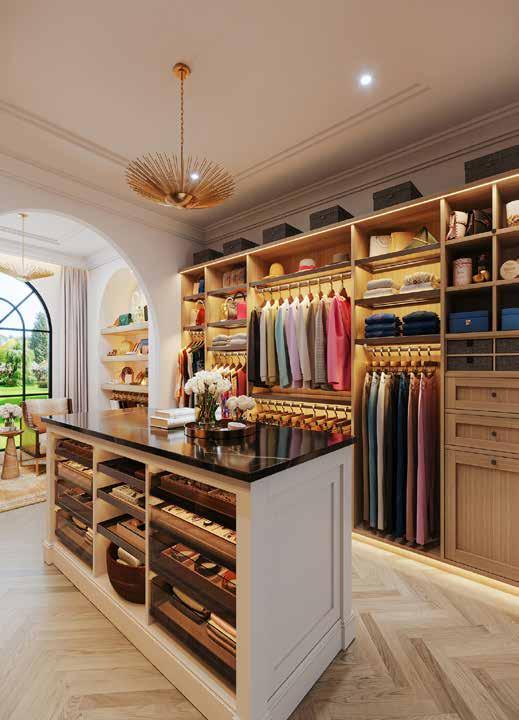
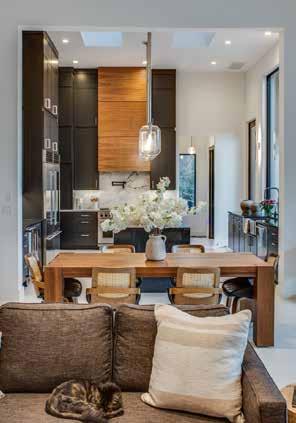
For many Austin homeowners, clutter shows up in small daily frustrations like rushed mornings, crowded counters, and spaces that never quite work the way they should. When rooms fall out of sync with how a family lives, even a beautiful home can feel harder to manage than it should.
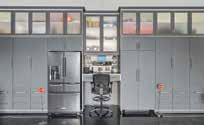
At Closet Factory Austin , the focus is on resolving those friction points through custom storage designed around real life. While closets are in the name, the company’s work extends well beyond them, with tailored solutions for home offices, pantries, laundry and mudrooms, garages, wall beds, entertainment centers, and more.
Owner Monica Fernandes says every project begins with listening.
“It starts with taking inventory of the client’s possessions and understanding how they move through their day,” she says. “Every family has its own rhythm, and every space will be different based on their needs.”
Fernandes approaches each project like a puzzle, seeking opportunities to transform cluttered or underutilized areas into spaces that feel intentional and easy to use. That often means blending practical planning with personal details, whether it’s a hidden nook inside a closet, a display drawer designed for a watch collection, an office that conceals cords behind clean cabinetry, or a garage configured around a specific hobby.
The reaction she hopes for when a project is complete is simple.
“First and foremost, calm,” Fernandes says. “A custom space isn’t just cabinetry. It becomes the backdrop for how you live every day.”
A well-organized pantry can make meal prep easier. A properly functioning garage can eliminate a sense of overwhelm. A closet designed with intention can make the start of the morning smoother.
Those moments of ease can be especially meaningful during periods of transition. Fernandes recalls a garage project where the homeowners had not parked inside for years, convinced there was no way to make the space work. With ceiling storage, cabinetry, shelving, and hooks, the garage was transformed, and the family could use it as intended again.
Other projects tell similar stories. A children’s play area, once overtaken by toys and craft supplies, was redesigned so everything had a designated place behind drawers and doors, making both playtime and cleanup more manageable. A guest room used only a few times a year was reworked with cabinetry, shelving, and a wall bed, allowing it to serve as a daily home office while still welcoming visitors when needed.
That philosophy extends to the balance between form and function. Fernandes believes one cannot succeed without the other. Storage that looks good but doesn’t hold up to daily use falls short, just as purely functional design can feel cold. Designers and craftsmen at Closet Factory Austin collaborate closely to ensure each project is precisely constructed while still visually refined. Integrated lighting, seamless wall beds, and thoughtful finishes help spaces feel cohesive rather than utilitarian.
“A custom space isn’t just cabinetry. It becomes the backdrop for how you live every day.”
The results often show up in quiet, everyday ways. Mornings feel less rushed. Meal prep becomes easier to navigate. Weekend plans can begin without clearing space first. Over time, those small improvements reshape how a home feels.
“When spaces work behind the scenes, the whole house feels calmer,” Fernandes says.
At its core, Closet Factory Austin’s work is about helping families rethink the space they already have. Rather than adding square footage, the focus is on using existing rooms more intelligently.
“If you’ve ever looked at an area of your house and thought, ‘This just isn’t working for us,’ that’s where we come in,” Fernandes says.
“These projects aren’t just about furniture or finishes,” Fernandes says. “They’re about restoring peace, order, and helping people use their homes more fully.”
By turning overlooked areas into purposeful spaces, the company helps homeowners move through their days with less friction and more ease. Often, wasted space becomes the part of the home that people enjoy the most.





May 26 - Aug 7
Ages 4-14
Transportation Included

ARTICLE BY JULIE ROYCE
PHOTOGRAPHY BY SHARA NICKELL
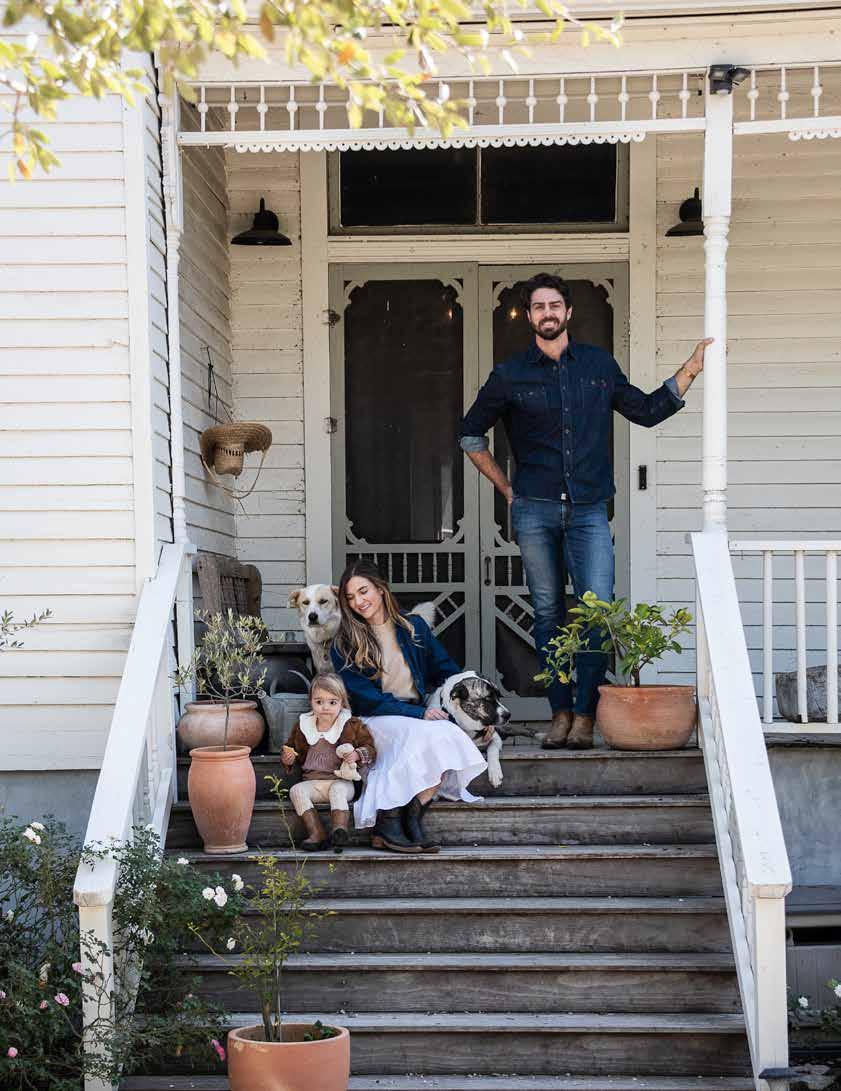
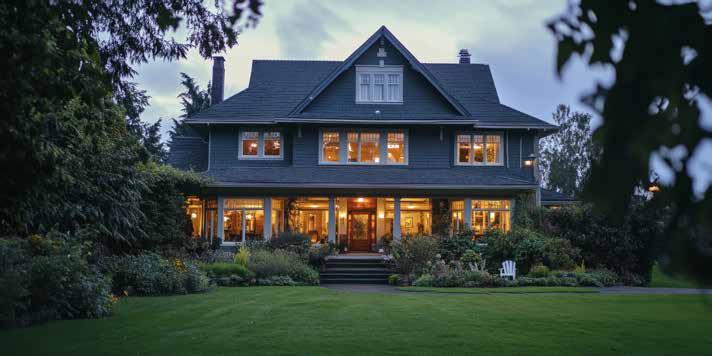
On a five-acre plot of land just outside Austin, a 1898 Folk Victorian stands with a dignity it hadn’t known in decades — all because interior designer Claire Zinnecker saw past cosmetic changes, dropped ceilings, and layers of past renovations. What others might have overlooked, Zinnecker recognized as a living piece of history worth saving.
Zinnecker didn’t discover Ida House while scrolling real estate listings. Instead, it was her aunt who spotted the Facebook Marketplace listing and sent it her way. The photos were dark and low quality, but the front porch and windows immediately stood out.
“The exterior was the first thing I saw,” Zinnecker said. “I knew there was a story there and I had to go see more.”
At the time, Zinnecker had recently purchased raw land outside Austin, planning to leave it untouched until she could eventually build. That plan changed quickly. She scheduled a visit, fell in love almost immediately, and wrote a check before fully understanding how the house would be moved.
“I didn’t understand the move portion yet,” she said. “I just knew she had to be mine.”
The house was originally built near downtown Austin in the late 19th century by Swedish immigrants Gus and Ida Anderson. Over the years, it had been thoughtfully lived in by just two families across multiple generations, each leaving behind a variety of updates and personal touches. When Zinnecker first walked through the home, she caught glimpses of original wood floors and ceilings peeking through layers of linoleum and sheetrock.
“I could see a glimpse of the wood floor and ceiling in one room,” she said. “I couldn’t wait for the demo and exploration phase to see what else we might find.”
She chose to preserve the name Ida to honor the original owners. “The name just fit her,” Zinnecker said.
Saving Ida required more than a renovation. As development closed in on the original lot, Zinnecker purchased the house outright and made the bold decision to relocate it to her property along the San Gabriel River in Georgetown.
Moving a 120-year-old home is no small feat. The structure had to be carefully cut in half, prepared, and transported overnight by professional movers before being reassembled the next morning.
“It was such a fun process,” Zinnecker said. “They were so careful and knowledgeable.”
However, not everything went smoothly. One major oversight, she said, was underestimating the urgency of replacing the roof after the move. Before that could happen, she spent countless evenings climbing onto the house during storms to re-secure tarps.
“I don’t think I factored in that I’d have to put a new roof on right away,” she said. “I spent many nights on top of the house in the rain.”
Once Ida was safely on its new foundation, the restoration began.
Zinnecker approached the renovation with deep respect for the home’s original narrative. While she had ambitious early plans, including architectural additions that didn’t survive budgeting, her overall philosophy remained consistent.
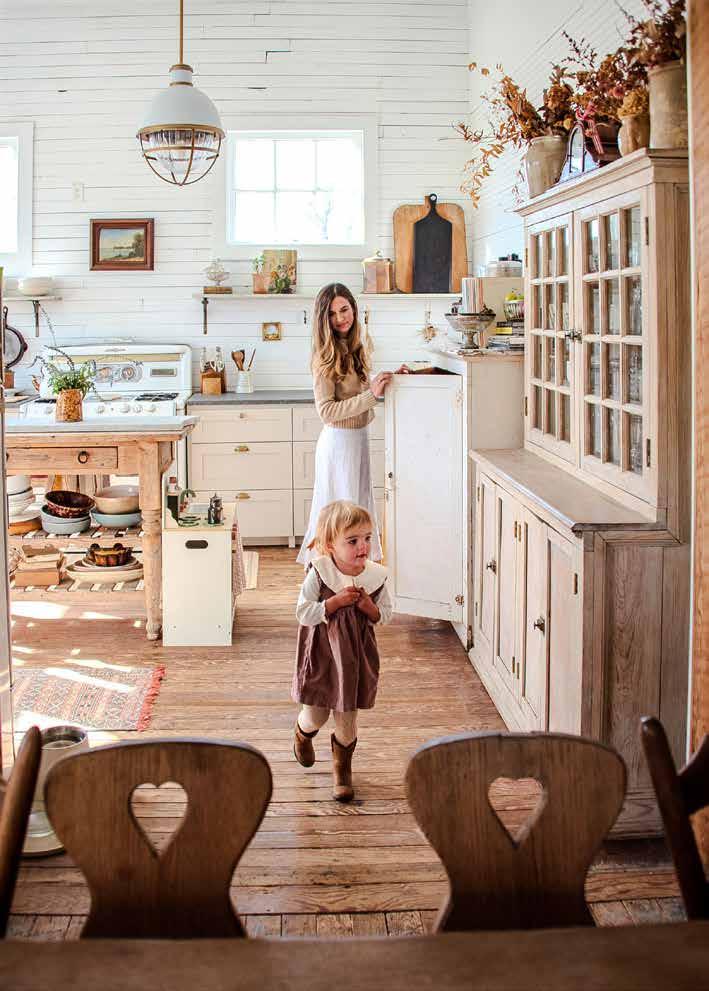
“I knew there was a story there and I had to go see more.”
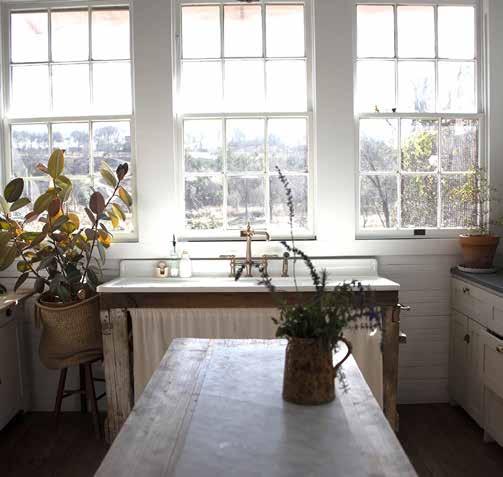
“I wanted to approach each space with the goal of keeping a bit of the original while also allowing myself to make it our own,” she said.
During demolition, Ida revealed unexpected treasures — including an entire front hallway lined with newspaper clippings dating from the 1920s through the 1960s. Preserved by the oils in old linoleum, the papers were carefully salvaged.
“That was a total surprise,” Zinnecker said. “I was able to save all of it.”
She prioritized preserving the doors, windows, floors, and trim, as well as original ceilings wherever possible.
“They’re beautiful,” she said, “and they really tell the story of the house.”
The layout was also thoughtfully reworked. Originally a two-bedroom, one-bath home, Ida was expanded to a three-bedroom, two-bath residence within the existing footprint. Zinnecker relocated the rear bathroom to maximize views of the land and spent months sketching possibilities before landing on a solution.
“I knew I wanted two bathrooms,” she said. “Figuring out how to puzzle that together took a lot of drawing.”
Modern updates were intentionally restrained. The home received new plumbing, electrical, and HVAC systems, but it still lacks a dishwasher. Vintage appliances remain, and insulation was addressed carefully to avoid damaging the original wood siding and windows.
“Insulation was the toughest design decision,” Zinnecker said. “I didn’t want to compromise the exterior or the windows.”
The restoration of Ida House became deeply personal. Zinnecker and her husband, local realtor Adam Mink, worked side by side, learning construction as they went. Mink handled many of the structural decisions, while Zinnecker led design, although she admits she often asked for his opinion.
“Framing doors and windows almost drove him crazy,” she said. “Nothing in this house is straight or level.”
“I wanted to approach each space with the goal of keeping a bit of the original while also allowing myself to make it our own.”
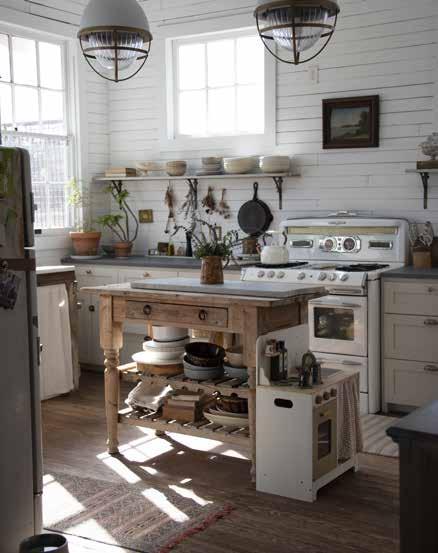
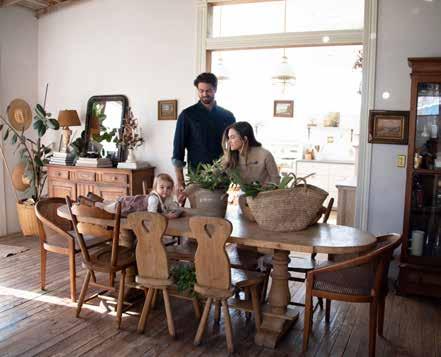
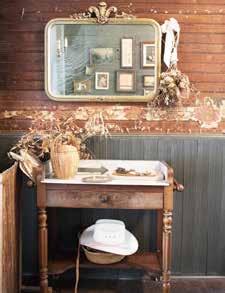
Entryway table with mirror sets the tone as you enter Ida.
The couple now lives in the home with their two-year-old daughter, Colette, nicknamed Lettie, and several pets. The house shows its age in places, with original materials and old-home quirks, a lived-in contrast to the sleek modern homes they design and sell professionally.
The project was not without hardship. Zinnecker was taken advantage of by a contractor who stole money and materials, costing her thousands of dollars and nearly derailing the renovation.
“It almost broke me,” she said. “The only reason I kept going is because I’m stubborn and determined.”
Zinnecker is the founder of the award-winning design studio Claire Zinnecker Design . Ida House, she notes, is both a portfolio piece and not one at all.
“People know me for this house,” she said, “but they wouldn’t necessarily hire me to design their home based on this.”
Living in Ida has reshaped how she thinks about design, ultimately inspiring her and Mink to launch a design-build company focused on thoughtful homes that feel grounded and enduring.
“Saving homes from demolition is so important for our history and for the planet,” she said. “This home will be standing for years after some of these new builds.”































With the Austin FC season underway, the city has slipped back into a familiar rhythm. Weekends carry stakes again, Verde and Black shirts reappear along Burnet Road, and “Listos?” pops up in group chats as fans reshape plans around kickoff. For a club only a few years old, Austin FC has moved fast, building culture, rituals, and identity in real time.
ARTICLE BY ZACK FOGELMAN PHOTOGRAPHY PROVIDED BY FLDC
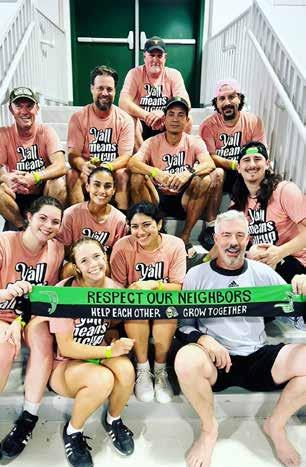
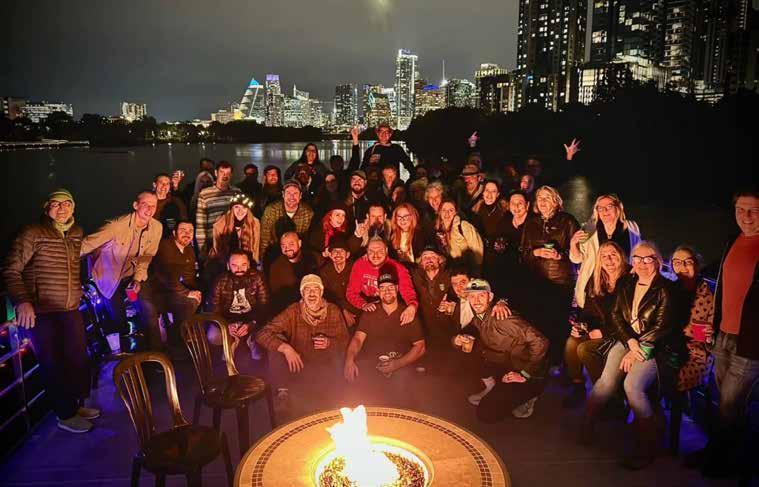
One of the most authentic traditions to emerge is Fighting Leslies DC, a grassroots group that blends humor, history, and heart without taking itself too seriously.
“First thing to clear up,” Todd “Aggie” Gardner said, “we’re a drinking club, not a supporter group.”
That distinction matters. Fighting Leslies DC has never chased official status, bylaws, or corporate polish. The “DC” isn’t a typo. It’s an intentional reminder that this is supposed to be fun.
FLDC formed before Austin FC ever kicked a ball. A small group of longtime Austinites who loved soccer and their city had one goal: sit together in the new stadium. That mission involved spreadsheets, seat strategies, and a Zoom call the night before ticket selection to practice logging in with a coordinated cadence.
When the plan worked, they needed a name.
“We threw out a lot of bad ideas,” Gardner said. “Then Jesse Proctor, owner of Burnet Go To, tossed out ‘The Fighting Leslies,’ and it immediately felt right.”
It was edgy, cool, and borderline offensive, a name that perfectly captured the group’s spirit.
The name honors Leslie Cochran, an iconic, complicated, and unmistakably local figure. For FLDC, it wasn’t just nostalgia. It anchored a brand-new club to something authentic, preserving Austin’s edge within a soccer culture being built from scratch.
Since then, the group has grown organically in Section 134. Today, Fighting Leslies occupy enough seats to be a presence without feeling institutional.
Membership remains deliberately loose.
“People ask how they can join all the time,” Gardner said. “The honest answer is… the organization is kind of a figment of our imagination.” His criteria are
simple: “Do you like soccer? Do you love Austin? Do you enjoy a good time? If yes, you’re basically in.”
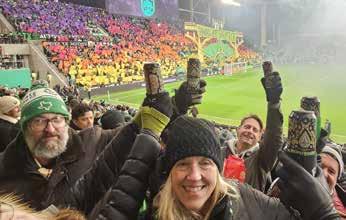
Matchdays typically begin at Burnet Go To, where scarves hang from the rafters, before the group heads toward Turnstile Coffee and Brews before the short walk to Q2 Stadium.
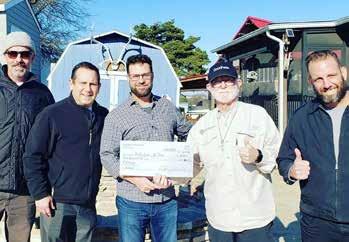
Early on, the group decided that if they were going to take up space, they should use it for more than themselves. While they remain nonconformists, the group includes professionals and business owners who want to give back. Their mantra is simple: have fun and do good.
They have raised funds for Community First! Village, supported The Laundry Project, and created a custom jersey for H.O.M.E., which helps aging musicians. They’ve collaborated with other groups on Spread Verde fundraisers benefiting The Other Ones Foundation, a rare feat in a typically territorial sports culture.
As Austin FC enters another season, FLDC steps into a new chapter with a bigger impact, all without sanding off the personality that made people care. They’ve proved community doesn’t take decades to grow. It just takes the right people and the belief that soccer is better when it’s rooted in its city.






barbarashallue.kw.com 512-657-0661
b barbarashallueaustin
v barbarashalluerealtor d barbarashallue 9606 N. Mopac Expy Ste 950
You don ’t have to be Irish You don ’t have to be Irish tto o have a Goodnight ! have a Goodnight !


How Austin’s defining festival honors its past while designing a more intentional future
ARTICLE BY JULIA PINTO PHOTOGRAPHY COURTESY OF SXSW
When inaugural South by Southwest unfolded across a handful of Austin venues in 1987, few could have predicted the effect it would have on the city. What began as a regional music gathering quickly became a global hub for creativity, tech, film, television, and music.
Early music showcases at places like the Electric Lounge and the Continental Club gave rise to a Music Festival and a city synonymous with live music and artist discovery. Packed screenings at the Paramount Theatre and State Theatre helped establish Austin as a major hub for the film and television industry and earned the Film & TV Festival a reputation for electric audiences and career-changing premieres.
Conference sessions that radiated from the Austin Convention Center made Austin a launchpad for ideas and startups that shaped industries far beyond Central Texas, and Innovation Conference programming evolved to include emerging technologies, social impact, design, education, and storytelling in all of its forms.
Each year brought new voices, formats, and ways of gathering, always reflecting the moment Austin itself was living in. Forty years later, SXSW stands as one of Austin’s most influential cultural exports.
For the first time, SXSW programming will run simultaneously across seven days, March 12–18, in downtown Austin. Creating deeper opportunities for the creative exchange with badge-specific neighborhoods that give each community a dedicated space.
SXSW 2026 represents a thoughtful recalibration and a nod to the festival’s roots, with an exciting new footprint that brings more of the festival out into Austin’s iconic venues and refreshed experiences designed with both attendees and the city in mind.


This evolution sharpens the event’s ambition with a more navigable downtown layout that creates spaces for deeper engagement and curated programming that makes it even easier for attendees to find their people, ideas, and moments of inspiration. For locals, it means a festival that feels more in sync with Austin's rhythm.
All of this comes to life through the 2026 programming that pushes SXSW and its attendees forward. Keynote conversations are accessible to all badge types and feature cultural voices such as Jennifer B. Wallace, Aza Rasking, and Rana el Kaliouby, alongside Bob Safian.


The SXSW Innovation Conference spotlights future-facing thinkers, including Amy Webb presenting her 2026 Emerging Tech Report, a social media master class led by former YouTube and Instagram insider John Youshaei, and a conversation by chef, humanitarian, and cultural force José Andrés.
On the film side, SXSW Film & TV opens the festival with I Love Boosters, directed by Boots Riley, alongside headlining premieres including Ready or Not 2: Here I Come, Pretty Lethal , and Over Your Dead Body, as well as a wide range of categorical screenings including documentaries, shorts, series, and XR.
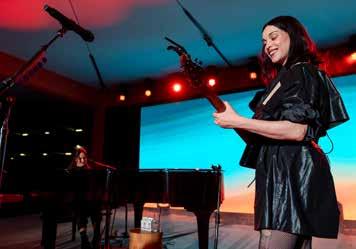
And SXSW Music is back louder than ever. Billboard’s THE STAGE showcase brings headliners Don Toliver, Junior H, and Mau P, while Rolling Stone’s Future of Music showcase spotlights Lola Young, Fuerza Regida, and BigXThaPlug. Additional artists joining the lineup include Sassy 009, La Texana, Deyloyd Elze, Austin’s own Bayonne, and more.
The All-American Rejects are set to headline the SXSW Music Festival Opening Party presented by Rivian.
Each conference and festival offers countless opportunities to connect and discover the values that made SXSW iconic: serendipity, cross-industry convergence, and the expectation of the unexpected. Each session, meet-up, workshop, stage, screening, party, and exhibition is designed to make those moments more meaningful.
As the city of Austin continues to grow and redefine itself, SXSW’s latest chapter feels like a recommitment to creativity, community, and the belief that the best ideas emerge when people from different worlds gather with a purpose.
Those ready to be part of what’s next can secure a badge now to save off walk-up rate and lock in their experience this March. For ultimate access across Innovation, Film & TV, Music, and more, the Platinum Badge offers an all-access pass to everything SXSW.

Founded in 1987, SXSW has grown from a regional music event into a global convergence of music, film and television, innovation, education, and culture. Over four decades, it has launched careers, premiered boundary-pushing projects, and helped Austin earn its reputation as a creative capital. Its 40th anniversary marks a new chapter rooted in intention, curated experiences, and a renewed focus on connection.
• Keynote Speakers Jennifer B. Wallace, Aza Rasking, Rana el Kaliouby, and Bob Safian
• Innovation sessions spotlight Amy Webb, John Youshaei, José Andrés, and more.
• Film & TV Opening Night Film: Boots Riley’s I Love Boosters
• Music Showcases Billboard’s The Stage and Rolling Stone’s Future of Music
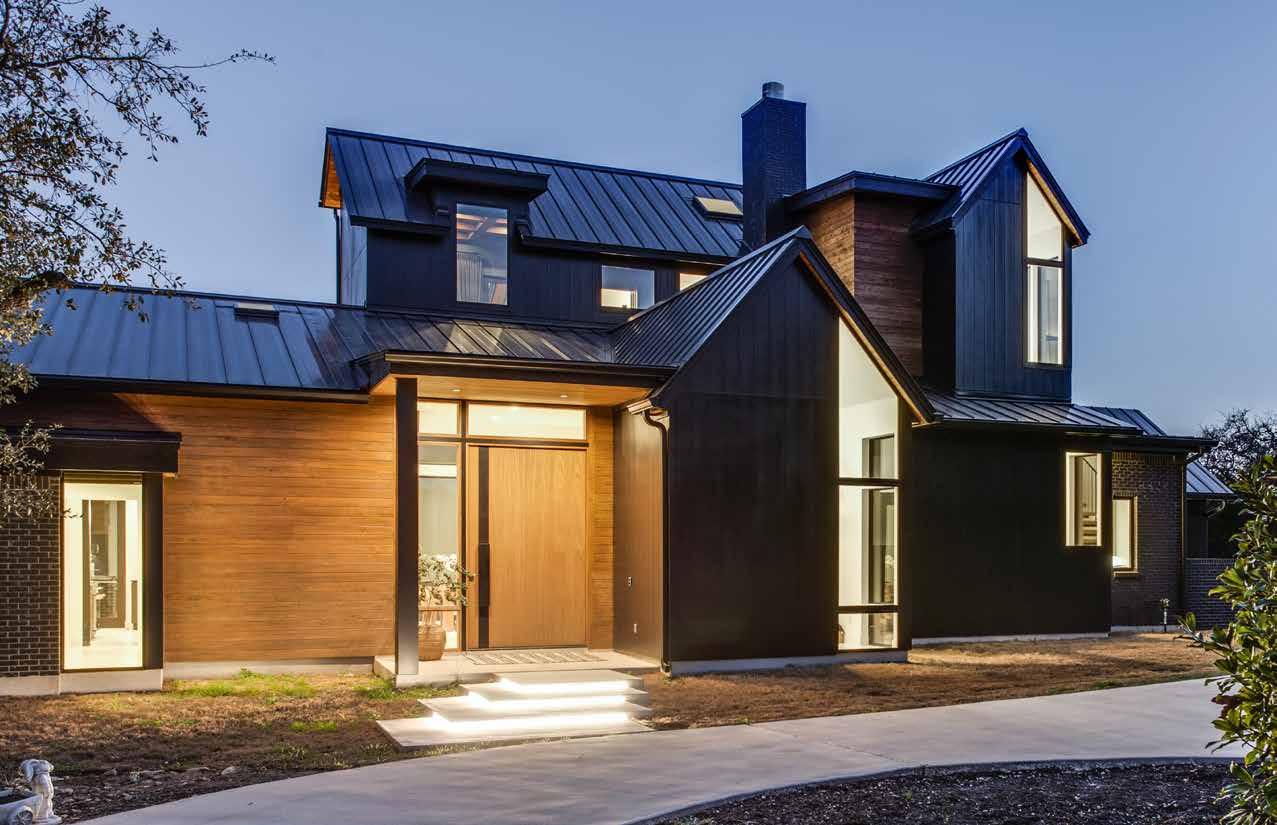
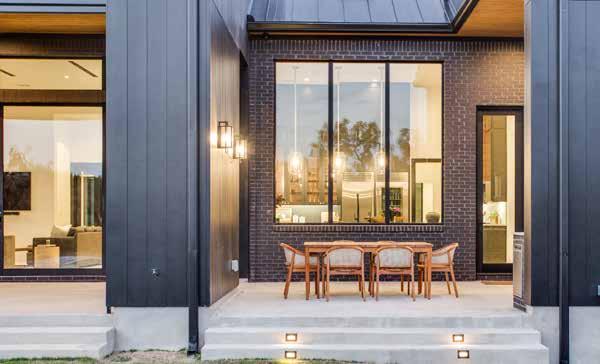

For many homeowners, replacing a roof ranks high on the list of stressful home projects. Between insurance claims, unfamiliar materials, and the fear of hidden costs, the process can feel overwhelming before the first shingle is ever lifted.
Tarrytown Roofing , however, has built its reputation around doing things differently, transforming what is often a transactional experience into one founded in communication, education, and trust.
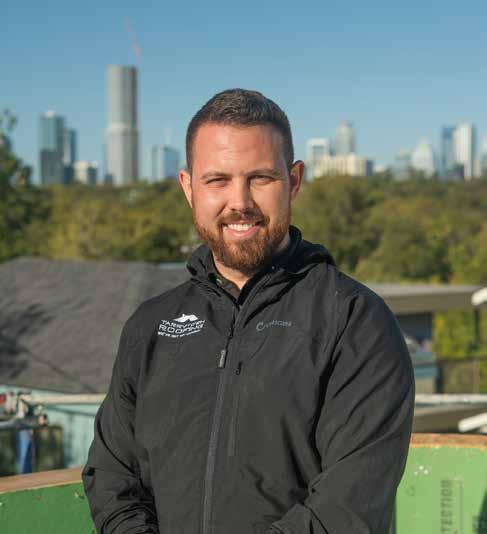
Owner James Kuntz saw the need for that shift early on. As he watched competitors rely on door-knocking and quick sales, he noticed homeowners voicing a deeper frustration.
“I kept hearing and seeing firsthand from homeowners that contractors weren’t even doing the minimum, which is as simple as doing what you say you’re going to do,” Kuntz said.
That gap between promise and performance became the foundation for Tarrytown Roofing’s customer-first model.
At the core of that model is clear communication. Roofing is complex, but Kuntz believes clarity removes much of the anxiety.
“It is all about expectation setting and painting the picture of what is happening,” he said. “We’re not just providing information on what’s next, but informing homeowners of the process from start to finish.”
ARTICLE BY JULIE ROYCE PHOTOGRAPHY COURTESY OF TARRYTOWN ROOFING
Clients are also told upfront that construction can be unpredictable and that Tarrytown Roofing has systems in place to handle issues if they arise.
Education plays an equally important role. Kuntz says homeowners should understand not only what is being installed, but also how their property will be protected and cared for throughout the project.
“Tarrytown Roofing has them covered,” he said. “Not only will we protect their property, install the best product and thoroughly clean up when we’re done, but we back that promise with a thirdparty guarantee.”
Even small details, like warning clients that the installation will be noisy and typically completed in a single day, help set realistic expectations.
That same attention to detail carries through every phase of a project. Project managers stay in close contact with homeowners
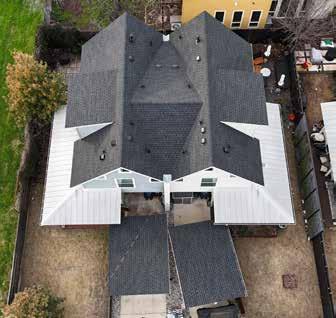
from inspection through installation, while neighbors are notified in advance to prepare.
“We treat every home and every project as if it were our own,” Kuntz said. “We put relationships over transactions, so honesty is key.”
For longtime Austin homeowner Margaret McDoniel, that approach made all the difference. Although she initially dreaded the insurance process, she said the experience was surprisingly smooth.
“It ended up being a really easy, painless, and enjoyable process,” she said. Kuntz and President Jeffrey Jones, she added, were consistently responsive. “They made me feel as though my project was their only and most important project.”
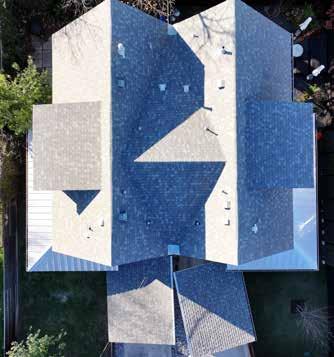
McDoniel said the team’s professionalism stood out from the first inspection.
“They were both very personable, professional, and explained the process clearly and precisely,” she said. The final result sealed it. “The new roof looks amazing.”
Kuntz credits those moments to doing the little things well. From pressure-washing driveways to tarping pools and using specialized magnets to collect stray nails, the goal is to reduce stress wherever possible.
“Doing the little things well makes a huge difference in lessening the stress of a large project like replacing a roof,” he said.
Ultimately, Tarrytown Roofing’s philosophy is simple: consistency builds trust.
“We do what we say when we say it,” Kuntz said. That mindsetis what he believes will continue to set his company apart in an industry ready for change.







Pantone’s 2026 Color of the Year, Cloud Dancer, embodies the clarity and balance designers often seek in a true foundational neutral. Soft without feeling washed out, refined without being cold, it offers a sense of visual calm that feels especially relevant right now.
Originally founded in 1950 as a printing company, Pantone introduced the Pantone Matching System in 1963 to create consistency and accuracy in color reproduction. That system — now integral across print, digital media, product design, interiors, and even cosmetics — gives designers a shared

language, ensuring color performs predictably across materials, finishes, and manufacturing processes. Cloud Dancer fits seamlessly into that legacy: dependable, adaptable, and thoughtfully calibrated.
Pantone launched its Color of the Year program in 1999 to highlight the evolving relationship between color and global culture. The first selection, Cerulean Blue, signaled a shift toward hues that reflect collective mood as much as aesthetic preference. Historically, moments of uncertainty or transition tend to usher in cooler, grounded palettes. Colors that offer reassurance, stability, and breathing room. Cloud Dancer feels very much of this moment, responding to a desire for softness, restraint, and emotional clarity.
For designers, Cloud Dancer functions as a highly versatile neutral. Its gentle warmth and balanced undertone make it an ideal base for interiors, hospitality environments, textiles, and product design. It pairs effortlessly with both warm and cool palettes and supports styles that favor understated elegance — think contemporary coastal and California casual.
The influence of Pantone’s Color of the Year extends well beyond the design studio, and Cloud Dancer is already appearing across textiles, consumer goods, and lifestyle brands. From Joybird Fabrics and Mandarin Oriental collaborations to products by Play-Doh, Motorola, Pura, and even Post-it, the color’s widespread adoption ensures accessibility across categories. For designers, this translates to ease of specification and cohesion across multi-touchpoint projects.
As the neutral backdrop of the year, Cloud Dancer offers a refined starting point. It invites designers to build palettes that feel current without chasing trends, and timeless without feeling static.
For me, Cloud Dancer represents a return to design that feels intentional and composed — allowing spaces to breathe while supporting everything built around them.
Pantone’s 2026 Color of the Year reflects cultural calm, versatility, and a desire for balance
ARTICLE BY JANNA PAULSON
MARCH 3RD
Lady Bird Johnson Wildflower Center
The Wildflower Center is staying open late every Tuesday during March to make more hours for wildflowers! Each evening will feature live music from local musicians, featured visual artists, and a rolling lineup of Austin's favorite food trucks. Take-and-walk adult beverages will be available for purchase.
MARCH 6TH
Circuit of the Americas
FoodieLand returns March 6-8, 2026, bringing global flavors, live music, games, and 200+ vendors together for a family-friendly outdoor food festival celebrating community, culture, and eats from around the world. Don't miss this vibrant culinary experience with food, shopping, and entertainment for all ages. Visit www.foodielandnm.com for more info.
MARCH 12TH
Various Austin locations
SXSW 2026 returns to Austin, March 12-18, with a streamlined, citywide celebration of music, film, comedy, and innovation. Expect standout showcases, bold conversations, immersive experiences, and legendary nightlife as creatives, technologists, and storytellers converge to shape what’s next across culture, media, and technology. For more info, visit https://sxsw.com/.
MARCH 13TH
Auditorium Shores
Coca-Cola hosts the annual Sips & Sounds music festival, March 13-14, featuring national headlining artists across two days and multiple stages. Enjoy stellar live music, premium listening experiences, and a selection of local food and drink vendors. Visit https://www. sipssoundsfest.com/.
MARCH 13TH
Rodeo Austin
Travis County Expo Center
Over the years, Rodeo Austin has grown from a show showcasing 16 animals into one of Austin's premier events, featuring pro rodeo events, daily concerts, livestock shows, and more. Join in the fun from March 13 through the 28. Visit www.rodeoaustin.com for more info.
MARCH 27TH
Circuit of the Americas
The fastest show on two wheels revs up Austin for three days of bar-banging motorcycle racing action with the greatest riders in the world. The only North American stop of the world's premier motorcycle racing series, the MotoGP Red Bull Grand Prix, comes to COTA March 27-29.

ABERCROMBIE & FITCH AWAY BLUE NILE BOSS BREITLING BRILLIANT EARTH CB2
CHANEL CULINARY DROPOUT DIPTYQUE DOLCE VITA DR. MARTENS DRYBAR EMA FAHERTY
FLOWER CHILD GORJANA HAYWIRE J.CREW JO MALONE JOYBIRD KIEHL’S
LORO ASIAN SMOKEHOUSE & BAR MEJURI NORDSTROM OMEGA PAIGE RAILS REFORMATION
RH THE GALLERY SEPHORA SKIMS TAG HEUER TECOVAS THE NORTH FACE VUORI WARBY PARKER
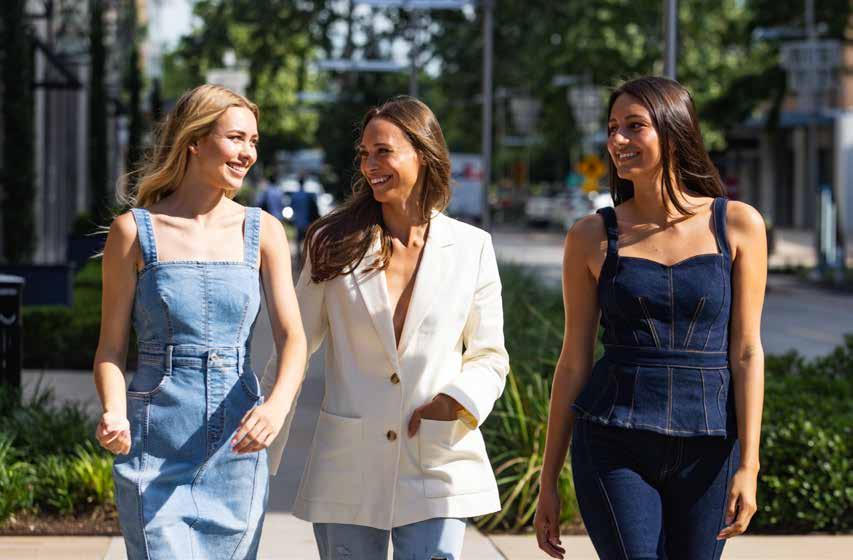
OVER 130 STORES AND RESTAURANTS, WITH MANY EXCLUSIVE TO AUSTIN.