The Miriam Memo 2026
COVER:
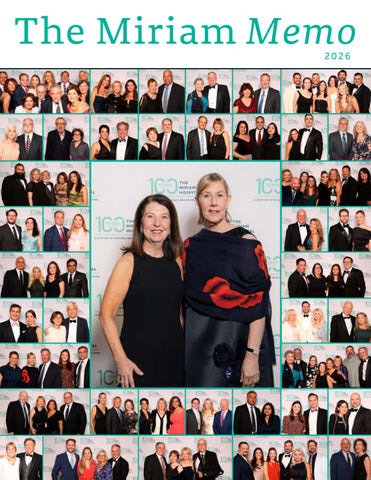
Centennial Celebration co-chairs Susan H. Kaplan (l) and Susan Bazar (r) pictured with guests from the event.
INSIDE COVER: Learn about advanced spinal navigation technology brought to The Miriam with donor support on page 9.
W
e are always excited to bring you the latest edition of this magazine and share important news about the world-class hospital your generosity supports. This time, however, we are even more thrilled than usual, as the energy of our milestone Centennial Celebration continues to resonate throughout the community. Earlier this year, we gathered to commemorate a remarkable milestone—100 years of healing, innovation, and compassionate care. As we reflect on that unforgettable evening and the legacy that it made possible, we are also looking ahead to an exciting future. Central to that future is an ambitious construction and renovation project that will transform how patient centered care is delivered for generations to come.
Maria P. Ducharme, DNP, RN
In these pages, you will also read inspiring stories of grateful patients and groundbreaking research, and the innovative, compassionate care that defines The Miriam every day. Of course, none of this would be possible without dedicated supporters like you. Your generosity sustains us, and we are profoundly grateful for your extraordinary commitment to The Miriam. You will also learn about the kindness and vision of some of our champion donors, whose philanthropy continues to fuel lifesaving and life-changing work. One hundred years after the first pushke box collected coins to help create The Miriam, that same spirit of community and generosity not only remains as powerful as ever, but it also continues to shape the hospital’s next century of impact. With deepest appreciation,
David F. Rampone
T
MARIA P. DUCHARME, DNP, RN
DAVID F. RAMPONE
President, The Miriam Hospital, and Chief Quality Executive, Brown University Health
Chair, The Miriam Hospital Foundation Board of Trustees
When it Comes to Gratitude, Sharing is Caring
he Miriam often hears from patients who express their gratitude for the care they’ve received—and we’re always grateful. Some send letters and share their stories, others make donations. No matter how it arrives, sharing appreciation creates the positive power to heal, to inspire, and to connect people in deeply profound ways.
Our “with Gratitude” grateful patient program aims to keep this energy going and make it easier for people to express their feelings about The Miriam Hospital. To read grateful patient stories—and to share your own or show support—please visit: www.brownhealth.org/TMH-gratitude. 3
I
Goldner Gift Aims to ‘Transform’ the Future of Urologic Cancer Care
n October of 2021, Brian Goldner, the visionary Chairman and CEO of Hasbro, Inc., lost his courageous battle with prostate cancer after years of compassionate care at The Miriam. He was just 58. Now, his wife Barbara is honoring her late husband and continuing their family’s legacy of inspired philanthropy with a $1 million gift to establish The Goldner Family Urologic Cancer (Transformer) Fund. The fund will provide support for the expansion of clinical trials; infrastructure improvements; disease prevention; faculty recruitment, retention, and training; and the integration of artificial intelligence tools. Overall, the goal is that the fund will help The Miriam and Brown University Health become a recognized leader in urologic cancer care innovation and a place where advanced scientific knowledge and discoveries translate into better patient outcomes.
What’s in a name? Everything. The fund’s name carries special significance for Barbara who added the word “Transformer” for two reasons. First, it was as a nod to the fact that Brian was an executive producer and champion of the wildly successful sci-fi action film franchise of the same name. Second, and more important, was because Brian himself was a transformer; his future-focused thinking literally helped transform Hasbro from a traditional toy maker into a global multimedia and entertainment powerhouse. Barbara says Brian had an innate curiosity, an appetite for learning, and was driven by a purpose of connecting with people and helping them become more than they imagined possible. “He had this gift of being able to see things in people before they could see them in themselves,” she says. “If he believed in you and saw something in you, he stayed with it. He opened doors for you and taught you how to open doors for yourself. That was his transformative nature at work.” That quality shaped Brian’s long friendship with Gyan Pareek, MD, FACS, Chief of the Division of Urology and a co-founder of the Minimally Invasive Urology Institute at Brown University Health. Dr. Pareek began treating Brian’s cancer nearly a decade before his passing. Their doctor-patient relationship evolved into a strong friendship built on trust, respect, and a shared vision for the future. 4
The Miriam Memo
Brian and Barbara Goldner
“We became really close,” Dr. Pareek says. “He was guiding my thought process on growth. I would share my vision, and over the years he provided guidance, advice, and encouragement. The friendship kept growing and I was welcomed into the family’s circle as well.” Brian’s belief in people left a lasting impression. Dr. Pareek recalls how Brian encouraged him to think boldly about building a world-class academic urology program—one where research, education, and patient care work together to improve lives.
Already, the impact is being felt. The fund is already helping create the foundation for significant growth in research programs and clinical trials. With this investment, Dr. Pareek reports, the department expects to expand its clinical trial portfolio substantially, opening new opportunities to evaluate innovative therapies and bring cutting-edge treatments to patients sooner. The strengthened research
infrastructure has also helped to position the program to secure additional external funding, creating a multiplier effect that will accelerate future discoveries. Barbara’s gift also complements her prior support for Anthony E. Mega, MD, Director, Genitourinary Oncology Program, Brown University Health Cancer Institute. Dr. Mega, who also played a critical role in Brian’s care, focuses on improving awareness, screening, and early detection of prostate cancer. Together, these funding efforts address both prevention and treatment—two areas Barbara views as equally important. “The gift to Dr. Mega was for more primary care physicians to be aware of detection and screening and prevention,” Barbara explains. “And the gift to Gyan was to help make this thing go away,” she adds hopefully.
Still a team Together for 35 years, the Goldners always approached giving the same way they approached life: as best friends and partners guided by a shared set of values and a commitment to helping others reach their potential. “We were a team in every sense of the word,” explains Barbara. “We did everything together.” That includes making the decision to establish the fund. “This is the first time I have made a gift like this by myself,” Barbara says. “But I did check in with him in my own way—‘What would Brian do?’—so, I know he’s proud that I did this for us.”
Gyan Pareek, MD and Barbara Goldner
Barbara adds that “Team Goldner” included the couple’s daughter Brooke and Brian’s brother Brad, who were both very supportive. Reflecting on the fund’s expected impact, Barbara, who holds BSN and LICSW professional credentialing and was a nurse before becoming a psychotherapist, says that improving others’ health and well-being is its own reward. “If I can save another family from the pain of losing a loved one, then it’s worth it,” she concludes.
“This is the first time I have made a gift like this by myself. But I did check in with him in my own way—‘What would Brian do?’—so, I know he’s proud that I did this for us ... If I can save another family from the pain of losing a loved one, then it’s worth it.” — Barbara Goldner
5
The Miriam Leading ‘First-in-the-World’ Prostate Cancer Trials
E
arlier this year, The Miriam Hospital achieved a remarkable milestone by treating the first patients in the world in two innovative Phase I clinical trials for prostate cancer. The pioneering studies—led by Benedito Carneiro, MD, Director of Cancer Drug Development for the Brown University Health Cancer Institute and Associate Director of the Division of Hematology/Oncology—underscore The Miriam’s growing role as a leader in early-phase cancer research and offer Rhode Island patients access to therapies years before they become widely available. “Our program allows us to bring the most cutting-edge cancer therapies to patients early and close to their home,” Dr. Carneiro explains. “At the same time, we are advancing research that could redefine how cancer is treated globally.” Moreover, he adds, these trials represent new hope for patients with advanced or high-risk prostate cancer, especially those whose disease has not responded to standard treatments.
6
The Miriam Memo
The Center for Innovative Cancer Research staff
Precision meets innovation The two studies, which are still ongoing at The Miriam, focus on treatments designed to precisely target prostate cancer cells while minimizing harm to healthy tissue. The first trial explores the potential of a new class of immunotherapy known as T-cell engagers. These therapies work by harnessing the body’s own immune system and guiding immune cells directly to prostate cancer cells and prompting them to attack. The second trial takes a different but equally targeted approach. It uses a precision drug designed to bind to a specific protein found on prostate cancer cells. “It effectively acts like a zip code to locate the tumor,” Dr. Carneiro says. Once attached, the drug delivers a potent cancer-killing agent directly into the cancer cell, limiting exposure to healthy tissue and reducing side effects. “Together, these emerging modalities are showing promising results and represent the future of oncology,” Dr. Carneiro points out, “because the therapies are smarter, more personalized, and more effective.”
Care close to home That these first-in-the-world trials are happening at The Miriam speaks volumes about the hospital’s capabilities and its commitment to patients. “In an era of rapid scientific advancement, new therapies are being developed faster than ever before, and researchers now have a deeper understanding of which patients are most likely to benefit from them,” Dr. Carneiro notes. “This progress has significantly expanded access. But location still matters.” For patients with advanced cancer, Dr. Carneiro points out, participating in a clinical trial can be demanding, requiring frequent visits, monitoring, and sometimes hospitalization. Historically, many Rhode Islanders had to travel to Boston or beyond to access such trials.
Designed with patients in mind, the CICR features a welcoming, sunlit environment with advanced treatment bays, family spaces, and state-of-the-art technology. Being at The Miriam, the CICR not only increases the number of trials available but also reduces wait times and ensures patients can begin new therapies more quickly. “These advances may not always be cures,” Dr. Carneiro acknowledges. “But they can extend lives, improve quality of life, and open doors to what comes next.” As innovation accelerates and philanthropy continues to fuel progress, The Miriam Hospital isn’t just participating in the future of cancer care, it’s helping to define it.
“But today, thanks to programs like the one at The Miriam, patients can receive these leading-edge treatments close to home surrounded by their care team and support network of family and friends,” Dr. Carneiro points out. “So, there is significant benefit to providing those opportunities for patients right here in Rhode Island.”
Philanthropy powers progress While the trials themselves are underwritten by industry partners—this one, for example, is sponsored by the global biopharmaceutical company, AstraZeneca—the ability to conduct such complex research locally is often rooted in philanthropy. In 2021, donor support—garnered from The Miriam’s Gala & Auction fund-a-need and spearheaded by a major gift from Stephen and Diana Lewinstein, for whom the space is named—helped fund the physical creation of The Center for Innovative Cancer Research (CICR) at The Miriam Hospital. The specialized, dedicated Phase I clinical research unit is housed in a reimagined space in the hospital’s Fain Building. That investment now proves transformative. “We simply would not be able to participate in these very sophisticated early-phase trials, like this one for prostate cancer, without that unit at The Miriam,” Dr. Carneiro says. “The complexity of these trials requires the infrastructure and staff expertise that hospital support provides. You need to have easy access to an emergency room, ICU, and a superior hematology oncology floor as well as truly exceptional clinical research nurses, which we have here.”
“Our program allows us to bring the most cutting-edge cancer therapies to patients early and close to their home ... we are advancing research that could redefine how cancer is treated globally.” — Benedito Carneiro, MD 7
A Friend ‘Til the End
Longtime supporter leaves his home to The Miriam “George thought the world of what The Miriam did for him and he wanted to show his appreciation. So, he decided to leave The Miriam the family home he had lived in for decades in North Providence.” — Barbara Whitbeck, George’s sister
G
eorge Quinn was a grateful patient of The Miriam, having received cancer care at the hospital for nearly a decade. He was also a longtime supporter who answered a solicitation and let the hospital know he was interested in including The Miriam in his estate plans. “George thought the world of what The Miriam did for him and he wanted to show his appreciation,” says his sister, Barbara Whitbeck. “So, he decided to leave The Miriam the family home he had lived in for decades in North Providence.” Barbara says George made the decision to gift the house a few years before he passed and with full intention. “George reached out to us with his wishes and we worked with him to make it happen,” says Chris Josephson, Senior Philanthropy Officer. With the help of an attorney, George was able to draw up a will that detailed his intentions. After he passed on Christmas Day of 2025, at the age of 84, the process of selling his home and donating the proceeds to The Miriam began. “Because of his thoughtful estate planning, George was able to make a large gift that he would not have
been able to make during his life,” Chris explains, “and his donation will make a real difference to our patients—which is what he wanted.” George worked for the Providence School Department as a guidance counselor until his retirement. After that, he volunteered teaching English as a second language; he was proficient in both Spanish and Portuguese. Traveling, writing, and storytelling were among George’s favorite pastimes. Heather Batista, RN, was George’s Nurse Care Manager during his final months. She says she built a strong bond with him over that time, and that his passing really affected her. “George was independent and smart and always appreciative of everything we did for him,” Heather says. “I enjoyed taking care of him.” Now, thanks to George’s generosity, she can continue taking care of others in his memory. “My brother was a very colorful, people-centered guy and he was very generous in many ways,” Barbara adds. “Knowing that his gift would be used to provide patient care and help others would make him very happy.”
Leave a lasting legacy
I
f you wish to follow George’s example, there are many options available to you. You can leave a specific asset or dollar amount to the hospital in your will or trust. You can also name The Miriam as a full or partial beneficiary of a retirement account or life insurance policy, often in just a few minutes by visiting the financial firms website or calling them directly. Estate gifts can also have potential tax benefits and donations of any amount will be greatly appreciated. For more information, visit brownhealth.org/TMHLegacy or contact Chris Josephson, Senior Philanthropy Officer, at 401-444-6412 or chris.josephson@brownhealth.org.
8
The Miriam Memo
Nattaly’s Second Chance:
T
How Support at the Gala Led to Success in the OR
he Miriam is a special place of hope and healing that was founded and funded by philanthropy a century ago. The hospital continues to be fueled by donor support today, and a recent patient success story exemplifies—in a very tangible way—just how direct an impact donor generosity has on the leading-edge care the hospital provides. During adolescence, Nattaly Alves, now 21, was diagnosed with scoliosis, a medical condition causing an abnormal sideways curvature of the spine. Initially, the pain caused by her condition was bearable, she says. But over the last few years, it became debilitating. “I had difficulty standing or sitting for long periods of time and only felt relief when I was lying down,” she remembers. “So, I was lying down all the time.” A job bussing tables at a restaurant, which required lifting and twisting, exacerbated matters, Nattaly adds, and left her with constant Dr. Diebo checking on Nattaly post-surgery pain in the middle of her shoulder blades, Before and after (right) surgery imaging forcing her to give the job up. Over time, Nattaly “These sophisticated tools provide unmatched surgical tried physical therapy, wearing back braces, taking pain precision and visualization,” Dr. Diebo explains, “and medication, and seeing a chiropractor. Nothing worked enable delivery of a more predictable and personalized and she was starting to lose hope. Until, that is, she patient experience.” The platform’s superpower, he says, visited with Bassel Diebo, MD, Co-director of the Spine is that it “closes the loop” between surgical planning, Center at The Miriam Hospital and an internationally intraoperative navigation, and post-operative monitoring renowned surgeon with technical expertise in treating in a seamless and accessible way. Thus, ensuring the best complex spinal conditions. outcomes possible. After carefully reviewing her case, Dr. Diebo determined In addition to accuracy, the guidance system improves that reconstruction and fusion surgery was necessary safety by reducing the radiation exposure for both to correct Nattaly’s severe deformities and restore her patients and staff compared to traditional intraoperative quality of life. This meant reshaping and strengthening X-ray systems. Less bleeding and pain, shorter hospital her spine and back with strategically placed screws and stays, and quicker recoveries are also benefits realized by rods to improve her alignment, stability, and posture. But patients who undergo spine surgery using the superior the delicate, complicated procedure would not be easy or platform. Nattaly’s surgery was the first at The Miriam without risk. Fortunately, Dr. Diebo and team would be using the next-generation tools. The positive results were aided in the operating room by the most advanced spinal swift and undeniable. “I felt a whole lot better within navigation technology available in Rhode Island. days of the surgery,” Nattaly remembers, “and the biggest Specifically, the Medtronic Stealth AXiS™ surgical improvement is that I am not in any pain . . . my care was system, the first-ever integrated planning, navigation, great and my team was amazing!” Today, Nattaly is well and robotics platform for spine surgery, and the down the road to recovery and overjoyed that soon her Medtronic GAiTEWAY™ digital software platform, which health will be in a place where she can resume a more connects AI-driven pre-operative planning with postactive life and pursue her dream of becoming a pediatric operative analytics. The state-of-the-art technology is nurse. “Success stories like Nattaly’s are why we do this now available at The Miriam thanks to donor support at work,” Dr. Diebo concludes, “and we are so grateful to the the 2025 Miriam Hospital Gala & Auction. donors who support us.”
9
F
or 100 years, The Miriam Hospital’s story has been inseparable from the story of the community that imagined it, built it, and sustained it. Founded through the vision and generosity of neighbors determined to create exceptional care close to home, the hospital has grown alongside the people it serves. The photographs that follow offer a glimpse into this rich history, celebrating the caregivers, volunteers, donors, and community members whose unwavering support has made a century of healing possible and continues to inspire the future. 31
31
32
1
10
33
On June 8, 1950, Miriam Hospital leaders gather to mark the groundbreaking of new building construction on the hospital’s campus.
The Miriam Memo
2
Members of The Miriam Hospital’s Women’s Association in the 1930s, shortly after leading the incredible fundraising effort that turned a shared vision for quality healthcare for all into reality.
34
3
Worker in The Miriam Hospital pharmacy prepares medication for patients in 1947.
Miriam Hospital nurse prepares the bed in 4 Aa patient room in 1932. 3
36
35
5 6
37
38
39
3 10
131
3 12
Linda Ricci, who works in The Miriam’s Baxt Building and offers a warm, calming presence for patients and their families prior to surgery, models a vintage 1940s Gray Ladies uniform at the hospital’s Centennial Celebration. Brown University Health and The Miriam Hospital Leadership celebrate the October 2025 groundbreaking of the ambitious $100+ million renovation project that will transform the delivery of care for generations to come.
7
Guests of The Miriam’s Centennial Celebration event at the WaterFire Arts Center take in highlights of the hospital’s rich history on special illuminated timeline displays.
8
Historic hospital artifacts artifacts on display at the WaterFire Arts Center during the Centennial Celebration.
9
More than 500 friends and supporters attended The Miriam’s Centennial Celebration in May and raised a toast to the hospital’s 100th birthday.
10
Maria Ducharme, President of The Miriam, cuts the hospital’s 100th birthday cake during a special celebration with staff.
11
The Rhode Island State House was illuminated in teal green from March 18–21, 2026, in recognition of The Miriam Hospital’s 100th anniversary.
12
A rendering of the new building. Transformation of The Miriam Hospital expected to be completed by spring 2028.
11
WITH GRATITUDE TO OUR GENEROUS EVENT SPONSORS FOR THEIR SUPPORT OF THE MIRIAM HOSPITAL CENTENNIAL CELEBRATION ON MAY 2, 2026, AT THE WATERFIRE ARTS CENTER
LEGACY OF EXCELLENCE SPONSOR
HASSENFELD FAMILY FOUNDATION
FOUNDERS’ TRIBUTE SPONSORS
UOI.com | 401.457.1500
FUTURE OF MEDICINE SPONSORS
12
The Miriam Memo
PILLAR OF HEALTH SPONSORS
Kathleen C. Hittner, MD and Barry G. Hittner, Esq.
Medical Staff Association
Sandra Oster and Family Dr. Herbert Rakatansky and Ms. Barbara Sokoloff Drs. Edward and Rena Wing The Winoker Family
CENTURY MILESTONE SPONSORS
The Murray Family Charitable Foundation
CENTENNIAL CHAMPION SPONSORS A. Autiello Construction Co. Inc.
Coastal1 Credit Union
Ms. Marie J. Langlois
Ahlborg Construction Corporation
Sarah T. Dowling, Esq.
Scott and Monica Laurans
Bank of America Private Bank
Michael A. D’Angelo
Lincoln Capital Corporation
BankNewport
Richard and Mary Engle
MOREgroup | E4H Environments for Health
The Bazar Group
Robin and Jim Engle
Partridge Snow & Hahn, LLP
Blue Fin Capital
A Friend of The Miriam
PEAK Event Services
Jeffrey and Jessica Brier
Harvard Pilgrim Health Care and Tufts Health Plan, Point32Health Companies
Roberts, Carroll, Feldstein & Peirce, Inc.
Mr. Keith and Dr. Rachel Hoffmann
The Vertex Companies, LLC
Barbara Horovitz Brown and Jeffrey A. Brown CBIZ Chace Ruttenberg & Freedman, LLP
HopeHealth Hospice & Palliative Care Jaffe Strategic Fundraising
The Sand Foundation The Westminster Group at Morgan Stanley
FRIEND OF THE CENTURY SPONSORS Sheryl C. Amaral Thomas A. Bosco Adler Pollock & Sheehan, PC Angela M. Caliendo, MD, PhD Compass Real Estate Dr. and Mrs. R. William Corwin
Duffy & Shanley The Egis Insurance Group Susan and Michael Eides The Foundry Corporate Office Center David and Hope Hirsch Ann Kashmanian
Judith C. Labossiere Wanda McLaughlin Providence Mutual Residential Properties Santoro Oil Cynthia M. Selya
13
Leading the Way The Miriam Hospital is proud to recognize the visionary donors whose extraordinary generosity and early leadership are making this transformational campaign possible. Their commitment is helping shape the future of care for generations to come.
PHILANTHROPIST
BENEFACTOR
Norman and Rosalie Fain Family Foundation
1829 Legacy Fund
$3,000,000 +
Mr.* and Mrs. Alan G. Hassenfeld and Hassenfeld Family Foundation
SUSTAINER
$1,000,000 – $2,999,999 Anonymous
Phyllis Chase
The Crimson Lion / Lavine Family Foundation Victor and Gussie Baxt Fund
Sandra and Richard Bornstein The Champlin Foundation Kay Cooper
Murray Family Charitable Foundation Barbara Papitto
University Orthopedics, Inc.
FOUNDER
$500,000 – $999,999 BayCoast Bank
The James M. Cox Foundation
Kathleen C. Hittner, MD and Barry G. Hittner, Esq. Alan and Marianne Litwin
Edward J. and Virginia M. Routhier Foundation
14
The Miriam Memo
$250,000 – $499,999 Ann and Arthur Barrett Clements’ Market
Drs. Maria and Joseph Ducharme
The Garabedian Family – Aram, Jane, Lisa and Gary Mrs. Suzanne Gilstein
Almon and Suzanne Hall
Ms. Ellen Hurvitz and Mr. Barry Strasnick
David and Betsey Kilmartin Charitable Foundation, Inc. Frank and Cheryl Paolino
David and Belle Rampone The Sigal Family
PATRON
$100,000 – $249,999 Anonymous (2)
Mr. Peter N. Arden
Dr. Robert and Susan Bahr
John Barylick and Jenna Wims Hashway
Helene and Bertram Bernhardt Foundation The Blacher Family
Elaine and Colby Cameron
Delta Dental of Rhode Island Robert and Rena DiMuccio
Kathleen and Jon Elion
Cynthia Ventre-Hewitt and Charles Walworth Hewitt
Saul and Susan Kaplan
Monica and Scott Laurans
Gloria Winston* / The Ruth and Samuel Markoff Fund
The Miriam Hospital Medical Staff Association
The Warren Alpert Foundation
Washington Trust Charitable Foundation The Zwetchkenbaum Family
Rebecca Z. Segal and Valerie Shulock
Marc Zwetchkenbaum and Linne Kimball John Zwetchkenbaum and Kimberly Zwetchkenbaum
Samuel Zwetchkenbaum and Deborah Carr
FRIEND
$50,000 – $99,999
Patty and Melvin Alperin
John P. and Helen Andrade
Buckler Family Giving Fund (Steven and Wendy) Robin and Jim Engle Family and Joan and Leonard Engle Fund
Elaine and Barry Fain
Barbara and Edward Feldstein Robert T. Galkin Foundation Peter T. Higgins
Steven and Patricia Issa
Dayle and Ronald Joseph Stephen and Laura Lang
Mr. and Mrs. Michael S. Litner
DONOR
The Miriam Hospital Women’s Association
Mary M. Antaya*
Mark and Jane Matrone
Navigant Credit Union Charitable Foundation James and Janet Rosati
Lynda and Arthur Sampson Fred and Gerri Schiffman The Stanford Family
Elizabeth B. Staples and Richard F. Staples, Jr. Mr. and Mrs. Donald R. Sweitzer Technic, Inc.
Touro Fraternal Association
$25,000 – $49,999 Kwame and Ruth Dapaah-Afriyie
Dr. Mark A. Deitch and Mrs. Lee Stevens Deitch Bonnie and Donald Dwares
Mr. and Mrs. Edward M. Evangelista Mara and Stuart Feldman
John and Susan Froehlich
Thomas and Susan Guerra
The Greg Hanna Charitable Fund and the Hanna Family
Melissa and Russell Triedman
Mrs. Nancy S. Harris
Constance Kane Tucker
The Izeman Family
Will and Mary Ann Tsonos
Mrs. Hope Hirsch
Continued 15
DONOR (Cont’d)
Mrs. Debbi Gilstein Jaffe and Dr. Jordan Jaffe
Marie J. Langlois and John F. Loerke
Ann Kashmanian
$25,000 – $49,999
Judy and Robbie Mann James R. Myers, MD
Nonna’s Garden Foundation & The Repole Family Ann B. Patton
Mr. and Mrs.* Joseph R. Perroni, III Mr. and Mrs. Michael K. Prescott Judith and Jay Rosenstein Mark and Donna Ross Wendy J. Schiller
The Joseph and Rosalyn Sinclair Foundation
CONTRIBUTORS $10,000 – $24,999
Amica Companies Foundation Anonymous (2)
Adler Pollock & Sheehan P.C.
Mr. and Mrs. Kenneth E. Arnold Aronson Foundation
Mrs. Miriam Berkelhammer Jeffrey and Jessica Brier
Gary Bubly, MD, MHCI and Karen Smigel, MD Nancy Cassidy and Jeffrey Schreck David N. Cicilline
Sherry and Mark Cohen
Dr. and Mrs. R. William Corwin Mr. and Mrs. Michael Costello
Mr. James A. Diossa and Ms. Sandra Cano-Diossa William and Colleen Fitzgerald
Dr. Timothy Flanigan and Dr. Luba Dumenco Mr. Michael R. Goldenberg
The Gertrude N. and Seebert J. Goldowsky Foundation
16
The Miriam Memo
Peter Karczmar, MD and Cathy Lund, DVM Dieter and Jacqueline R. Klein Judith C. Labossiere
Margaret and Bertram Lederer
Matthew A. Lopes, Jr. and Alexandra Lopes Mr. Anthony J. Mangiarelli Marinosci Law Group, PC Dr. Jeanette Matrone
David and Tina Odessa
Honorable and Mrs. Joseph R. Paolino, Jr. Mr. and Mrs. Robert Persons Yahaira “Jay” Placencia
Dr. and Mrs. Philip R. Rizzuto
Vanguard Charitable at the recommendation of The Roddy Holden Kintzel Charitable Fund Mrs. Bonnie A. Ryvicker
Jonathan N. Savage, Esq. and The Honorable Judith Colenback Savage Zachary and Brooke Seely
Rob and Mindy Sherwin Family Fund Judy Carol Siegel
Eugenia C. Shao and Neil D. Steinberg Joanne and Sheldon Summer Farah and Angel Taveras
Michael and Elizabeth Tikoian
Scott Triedman and Mary Jo Kaplan The Vanech Family
Drs. Edward and Rena Wing
Harold Winstead Charitable Trust Ms. Toots Zynsky * Denotes Deceased
Building on a Legacy: Progress Takes Shape
S
ince The Miriam Hospital’s campus transformation project officially broke ground last fall, visible progress has taken shape on the corner of Summit Avenue and Fifth Street. And with each passing week, new levels of excitement surround the modernization effort that will redefine care for generations to come. Over the spring and summer months, crews completed one of the most significant early phases of the project, excavating the future building site. The work took the footprint of the hospital’s former administrative building and turned it into a deep, L-shaped foundation area that’s nearly the size of a football field and approximately 20 feet below grade. The process required the removal of more than 100 truckloads of material. “Transforming this site into a foundation area of this scale required extensive coordination and planning, and an unrelenting commitment to safety,” says Michael Quinlan, a senior project manager with The Vertex Companies, the firm overseeing construction management. Equally important has been the focus on minimizing disruption to the surrounding residential neighborhood. A joint group of hospital and project team members meet monthly with neighbors to provide updates and to field questions and concerns. And ongoing street sweeping and dust control measures emphasizing cleanliness have helped to maintain strong community relationships throughout construction.
As work continues through the summer and fall, construction has shifted from excavation to the beginning of structural foundations, followed by the rise of the building’s superstructure. The goal is to achieve a “weather-tight” structure by early winter, a major milestone that will allow interior work to proceed through the colder months. From January onward, Michael expects crews to begin installing core building systems, including HVAC, electrical, and plumbing. The phase will also include the start of interior framing, bringing definition to the hospital’s new emergency department and inpatient spaces. Looking further ahead, the project remains on track for completion in 2027 or early 2028, with the first patients expected to be welcomed into the new space in spring 2028. Once finished, the project will significantly increase the number of private patient rooms and nearly double the size of the ED, which has become one of the busiest emergency units in the region. “This is a highly complex project involving a critical hospital that must remain fully operational throughout construction,” adds Michael. “But it’s also incredibly rewarding work, because at the end of the day, this is a building that heals people and plays an incredibly important role in this community.”
17
If you do not wish to receive mail solicitations from any Brown University Health institutions, please email privacyofficer@brownhealth.org, call and leave a message at 401-444-6500 or 866-626-0888, or write Brown University Health Compliance and Privacy Office, 15 LaSalle Square, Providence, RI 02903.
P.O. Box H, Providence, RI 02901
Alan G. Hassenfeld Posthumously Honored as The Miriam Person of the Year Alan G. Hassenfeld—a tireless and deeply invested ambassador and supporter of The Miriam Hospital— passed away unexpectedly on July 9, 2025. But his passion, vision, and abundant contributions to the hospital he cherished will live on forever. In honor of his lifelong commitment to The Miriam, Alan was recognized posthumously as the hospital’s Person of the Year for 2026. Maria P. Ducharme, DNP, RN, President of The Miriam Hospital and Chief Quality Executive at Brown University Health, highlighted the recognition at the hospital’s Centennial Celebration on May 2, 2026. “Being recognized as the Miriam Person of the Year is an honor that extends far beyond philanthropy,” she said. “A Miriam Person is a person of action who is caring and compassionate and committed to something greater than oneself. Alan Hassenfeld possessed these rare gifts and he paired them with a heart of gold and an insatiable drive to give back. Though he is no longer with us, his legacy continues to inspire us.” As Honorary Co-Chair of the Centennial Campaign and Life Trustee of The Miriam Hospital Foundation Board, Alan was an unwavering champion for The Miriam’s mission. He believed wholeheartedly that the hospital was worthy of bold goals and he challenged The Miriam to aim higher and dream bigger. He gave generously of his time, offering strategic insight, heartfelt advocacy, and constant encouragement. “Alan’s dedication to The Miriam was rooted in a proud family legacy—one he carried with grace, humility, and a profound sense of purpose,” President Ducharme explained. “In every conversation, he reminded us why our work matters and inspired us to envision what more we could achieve together.” The Miriam Memo, a publication of The Miriam Hospital Foundation, is published for our friends and supporters. At times we share news and information with our donors electronically. If you’d like to receive timely updates by email and help us reduce paper and postage costs, please email TMHGiving@brownhealth.org We invite you to learn more by contacting the Development Office at 401-793-2004, brownhealth.org/TMH-giving