© www.DNAforLife-Laws.com
1
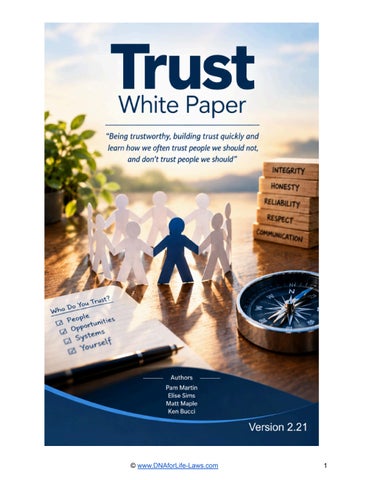
Trust White Paper
“Being trustworthy, building trust quickly and learn how we often we trust people we should not, and don’t trust people we should” Version 2.21 Table Of Contents
Authors
Jill Calderon Elise Sims Paul Wyner Ken Bucci 2
“Trust is a strange thing . . . so easily lost, so hard to gain and what causes one person to trust us, will cause distrust in others?”
“What’s even more strange . . . is that we often trust those we should not trust and don’t trust those we should trust!” Why? Actually there are many reasons and we’ll discuss many of those in this white paper.
© www.DNAforLife-Laws.com
3
Goal for White Paper Learn how to trust in a more effective manner. To bring to the reader, you, and those in your circle of influence to the point of realization as to your trustworthiness, how easily or not you trust, with what degree you trust and what prompts the trust or distrust. To give a clear picture of how trust or the lack thereof affects your business, relationships in fact everything in your life whether positively or negatively. To bring intentional thought to trust and enable you to utilize that trust to the benefit of you and everyone you impact and discard the trust which is harmful.
Warning There may be some parts of this white paper which are offensive to you . . . don’t stop reading. We hope as you continue to read, it will become more clear as to what is being shared. Our hope is that, through this white paper, that maybe . . . we can challenge . . . the minds of others, as our minds have been challenged, to Think Differently. A great first step before reading this white paper is to watch the following short video. www.DNAforSuccess.com/Video-Trailer-:Library/Thinking-Differently
Trust Before we dive into trust and your lack thereof, let’s examine an item in which you trust everyday ~ a simple chair. More than likely you are sitting on a chair as you read this. Did you fully examine the chair for any imperfections? Did you ask everyone around you if they had sat in the chair or if they trust the chair? Probably not, yet you sat on the chair without a thought as to its trustworthiness. Why? Prior experience, mindlessness, lack of attention to detail, conformity to the norm, expectations, subconscious belief? Many factors affect our ability or lack of ability to trust. Each and everyday we place trust in a multitude of objects, theories and people without giving it any thought at all. While other things and people, we question to the utmost as to their trustworthiness. How can we be confident our trust or lack thereof is beneficial to the situation and people involved?
4
Assignment Who are the five people you trust the most? 1. _______________________________ 2. _______________________________ 3. _______________________________ 4. _______________________________ 5. _______________________________ Reflect on why you trust people. Do you see any flaws in the way you trust people? What flaws do we have in how we trust people? Write down a few thoughts . . .
We tend to trust others who are like us . . . but are we really trust worthy? In the mortgage industry most of the predatory lending is ethnic on ethnic. We don’t see this reported in the press but . . . well . . . it’s “more exciting” to see different ethnic groups taking advantage of one another than it is within one’s own community. In addition to ethnic trust issues, we often tend to trust those who are of a similar age, gender, education, religious and culture to try to quickly determine who we should trust and who we shouldn’t trust. Think about it . . . we were born into this world to be very trusting, our parents will often say “too trusting” but . . . are we . . . really too trusting? What’s a most interesting study is how people trust based on personality / frequency. What causes one personality to trust someone will actually cause distrust in different personality / frequency type. What’s even more interesting is that we like people who tend to be of a similar frequency as we are . . . but we fall in love with those who are a totally different frequency type.
© www.DNAforLife-Laws.com
5
Amiable experiences trust by who else is trusting or how trusting will reduce conflict. Just jumping in and believing the outcome will be something different. Not weighing better or not ~ just different. Knows that learning and changing will bring some type of change or growth. Trust the system and know that growth will come, doesn’t matter what the growth is. Will end up a different person in the end. Analytical experiences trust through thinking it through, analyzing the situation, weighing the options and coming to a conclusion as to how trustworthy a person or system is. Looks for what the outcome will be and if it will be better. Wants to know what the change will bring. Asks who will I be in the end.
Expressive trusts the energy they feel from the person or system. Uses intuition to guide. Is distrusting of things which doesn’t “feel” right. Uses their energy to gain or provoke trust.
Driver trusts based on honesty even when it hurts and if there is movement forward. Will jump in and act just to see forward motion. Expects immediate trust from others and expects the action to move it forward. Trusts the method and end goal to guide the action.
Being trustworthy . . . ● Different frequencies / personalities build trust in very different ways. ● Everyone wants to be SEEN as being trustworthy but, how many people really want to BE trustworthy? Being seen as trustworthy is an action while BEING trustworthy is just that ~ a state of being. Which holds the true value? How can one become trustworthy? What does being trustworthy really mean? ● Each frequency/personality has a manner in which they go about being trustworthy.
6
Building trust quickly ● The power of the 30 minute Strategy Session ~ Learning who we are as a person. What makes us who we are. How we are wired and designed. Facing the reality we know lies deep within us and celebrating the strengths while confining the weaknesses. Trusting ourselves enough to develop into the magnificent individual we were created to be. What’s not to trust? Unless, you don’t fully look at the truth of your being. ● Building trust starts with understanding the viewpoint of the audience or person of which trust is desired. Finding common ground and relating from this standpoint is the fastest way to build trust. Once someone says, “hey they understand me” or “She is like me.” or “He knows where I have been and what I have been through” trust begins to build. Understanding without having to explain oneself builds trust in a profound way. Everyone wants to be understood and acknowledged for where they are in life. Genuine understanding and commonality makes one say, “that person is like me and who wouldn’t trust me? ● So why do some people struggle so with building trust? Could it possibly be they are not trustworthy? Probably not or possibly so remember, distrust breeds distrust. One who distrusts others possibly doesn’t feel others trust them or should trust them. Or they have been ‘burned’ by trusting those they shouldn’t trust. More on that later. Why would one feel they shouldn’t be trusted? Perhaps they do things half-way. Or they are not confident in their knowledge. Or they know they could be doing things better. They simply don’t trust themselves in some manner so why should they trust others? ● The Golden Rule states “Treat others as you would want to be treated.” I believe many people miss the true essence of this statement. We really don’t build trust and show true connection by treating others as we want to be treated. Instead the heart of the statement is we want to be treated in the manner we like to be treated and so do others. Learning how others want to be treated or serviced and delivering in that manner, builds immense trust. How do you learn how others want to be treated? By learning their personality. This speaks again to the fact that everyone wants to be understood and connected. We have all met that person who as we are speaking looks at us as though we have 3 heads because they just don’t ‘get’ us. Did you trust that person? How about that person who © www.DNAforLife-Laws.com
7
truly listened and connected to you on a deep level? You trusted them instantly. In both of these scenarios, a judgement call was made and trust was built or withheld. Was this always a good thing? Read on!
Trust people we should not, and don’t trust people we should ● Personality, ethnic, religious, testimonies, interest . . . etc. may not be the best way to base our trust. Suppose you are looking to get in shape. You connect very deeply with someone like you ~ out of shape, lazy, lacking knowledge in good physical fitness. Should you trust this person to guide you on your pathway to getting in shape? Everyone would naturally agree this is not the person to trust to gain fitness advice. However, how many times do we look to those like us to trust in vital areas of our life? Should this be the person to trust? Now I agree we can like them, appreciate them, walk through life with them. But, trust them to guide us to physical fitness ~ I think not. So, who do you trust if not someone like you? Trust the individual who has shown themselves trustworthy! This often does not feel comfortable because it is pushing us into an area of unknown, an area of fear, an area of untested waters. ● What seems to be good for us often isn’t and what doesn’t seem to be good for us often is. Frequencies - Past - Present and Future Often we think people care who do not, don’t think people care who do, trust those we shouldn’t don’t those we do, those we think are working for us, often aren’t, those we think are working against us, are often for us . . .So, who or what do we trust? Have you ever thought why you should trust? Nike says “Just Do It”, do what? How about “Just Trust”. Trust a larger plan is being played out in which each and every day, situation, person in your life is a part of that larger plan which has the end goal of simply bringing you to your full potential. To become fully who you are meant to be. That individual you trusted that proved to be untrustworthy, did they bring you to a greater knowledge of some area in your life? So was that misplaced trust? Or trust which brought about a result you were not anticipating yet was an integral part of the plan. The toddler that walks into the street without fear, trusts that he is safe everywhere. If a car screeches to a halt just barely missing the child, should the child no longer trust cars? No, he learns a knowledge of the dangers to be found in the street. And yet, we as adults hold back our trust from many of the greatest opportunities to grow and learn and become. We foolishly trust ourselves when we can be our own worst enemy. ● Humility is probably the best vaccine / way to prevent larger losses.
8
What’s bad can be good and what’s good can be bad . . . those we think may be for us, may be against us and those we think are against us may be for us. These we think are helping us may be hurting us and those we think are hurting us may be helping us. ● Learning how to trust deeply and quickly and the benefit of this. ● Learning how we are the only one’s who can hurt ourselves. ● See the truth of what we’re trusting in. ● Learning how to learn the “right things” rather than the “wrong things” from each time our trust seems to be violated, will help us to see greater success. ● Yes, we get hurt when we trust people we shouldn’t . . . but most likely we lose far more when we don’t trust people when we should . . . and . . . we’ll never get a bill for that and/or even be aware of the opportunities we lose as a result of not trusting when we should.
Questions . . . Need Help . . . Please feel free to call the individual you passed this along to you and/or feel free to call 888.230.2300 or 630.393.9909. If you have not had your complimentary 30 minute strategy session, great idea to do that. It takes three minutes to answer a few short questions on line. > www.DNAforSuccess.com/Examination/30min-strategy Great Websites . . . > 7 Steps To Success: www.DNAforSuccess.com/7-steps-to-success > White paper library: www.DNAforLife-Laws.com/cool-free-stuff > Video library: www.DNAforLife-laws.com/career-success > www.DNAforSuccess.com If this white paper was helpful please share this with others and considering making a generous contribution to help single moms and kids at risk. www.dnaforlife-laws.com/pay-it-forward Other great white papers: www.DNAforLife-laws.com/cool-free-stuff/success/system/member
© www.DNAforLife-Laws.com
9
Table Of Contents Table Of Contents Q1: Trust others … They will trust us? Q2: Can we be too trusting of people? Q3: What about when people / systems let us down? Q4: What is the “Feeling Deception” principle? Q5: Are our feelings important? Q6: Does everyone need validation? Q7: What if I’m too trusting? Q8: What does WiiFM have to do with trust? Q9: What If I’m not getting the ROI I want / need? Q10: Should I always get an ROI? Q11: How do I always get an ROI? Q12: How have your ActionVISION coaches helped you? Q13: Do we give the impression of trusting, when we don’t? Q14: How do I overcome trusting the wrong people? Q15: What if I’m stupid? Q16: Is being lazy a “trust killer?” Q17: Is there a right way and wrong way to trust? Q18: What is the difference between being trusting and lazy? Q19: When is delegating trusting vs. lazy? Q21: Hurt at a heart level? How does that connect into trust? Q22: How does the Flawless Thinking model help with trust?
8 9 10 11 13 14 15 16 16 16 17 17 17 18 18 18 19 20 20 20 25 25
10
Q&A Q1: Trust others … They will trust us? Is it true that if we are most trusting of others and systems, that others will be more trusting of us and our systems? Answer: This is almost always true in both the systems and the people side. Often systems don’t work because people don’t trust the system. People may think that they are trusting and using the system, but often they do not and people won’t use the system fully. Watch this 1 minute video from Matt King and share your thoughts? www.youtube.com/watch?v=r6ixtF_xiyo
Matt King’s construction company is getting worldwide publicity as a result of his trust ability to trust. Matt’s construction company is based out of Indiana and they are seeing such amazing success that they are in great need of employees. Do you know any amazing individuals who live in Indiana and/or who may be interested in moving to Indiana? What makes Matt’s company so unusual and powerful to work for is they work to each of their employees / team members discover their life vision and then live that vision each and every day. The have systems which assist each employee / team member connect their life vision into the company’s overall vision and together they believe they can accomplish far more together than they ever could on their own.
Call or Text Matt at: 260-336-2971 Who should you trust and/or what system should you be trusting that you’re not which will provide you and those around you far greater success in less time.
© www.DNAforLife-Laws.com
11
Q2: Can we be too trusting of people? Can giving everyone my trust until the trust is broken be a bad thing? Answer: Great question. Obviously there are different degrees of trust we give people. Trusting people with an understanding of both mine and their personality / frequency type is helpful. Yes, good to trust people in measures and the faster we can increase our trust of people and their trust of us the better it is for everyone. Understanding Dimensional Thinking / Dimensional Trust will be helpful. Often learning to check for things outside of our natural personality / frequency will help us to learn how to properly trust people for their benefit and mine.
12
Q3: What about when people / systems let us down? How do I deal with Thinking Differently about when someone or a system lets me down . . . breaks my trust? A Part Of The Answer: Did they really let us down or do we let ourselves down? Asking ourselves some very hard questions . . . which will create additional hurt, pain in addition to the pain which is caused from the failure . . . will hurt us in the short term but will heal us in the long term. It’s kind of like having a doctor reset a bone which is out of place. It hurts SO much when they reset it . . . but it provides healing. Here are some questions . . . which will help us. Obviously every situation is different and with groups it’s even more complex. Ideally meet with someone who is certified in both ActionVision and Discovery Learning. ~ ActionVision: www.dnaforsuccess.com/implementation/one-on-one ~ Discovery Learning: New website in process of being developed. ❏ 1. What % of the failure / letting us down is my responsibility? ❏ 2. Is there a pattern in myself / others where, BIG PICTURE wise this has happened in the past? ❏ 3. How do I own the “failure” and what can I learn from this? ❏ 4. How do I turn the “failure” into a success? ❏ 5. How do I / we get everyone involved to buy into this process? ❏ 6. Do we have a rock solid system in place? ❏ a. Is the system clear to everyone? ❏ b. Is the system designed to work with different personality types / frequencies AND with people in different Dimensions? ❏ c. Do we follow the system? ❏ d. Are we sure? Often we think we did but we really did not? ❏ e. Is everyone involved . . . seeking actively to taking personal ownership for their own role in the “failure.” ❏ 7. Are we seeking to not just “help” / fix the symptom but are we doing the very hard work of seeking to “heal” / fix the cure . . . OR . . . are we being lazy?
A great book to learn how to do a debrief is Flawless Execution. Be painfully honest at the end of each mission. DO NOT get defensive . . . everything is on the table and people don’t have to be nice . . . just truthful from their perspective. There is some % of truth probably in whatever is shared. It’s up to each of us to determine what % is true. It could be between 1% © www.DNAforLife-Laws.com
13
and 99%. If we / anyone gets defensive it most likely reveals that there is more truth to what is being shared than we / the person would like to admit. If we do not fix things at the CORE level, we’ll face the same challenges again and again. It seems . . . that each time we make the mistake, that the consequences continue to get worse, until we deeply learn the lesson.
14
Q4: What is the “Feeling Deception” principle? How do I deal with Thinking Differently about when someone or a system lets me down . . . breaks my trust? The Answer: Mark Boersma shares … “Years ago, I talked to a friend of Dave Libby who worked in the inner city. He shared a story of a highschool student who had 3 girlfriends who all knew about one another, as a leader in the school, a leader in sports and I think was a drug dealer as well. What was this guy's secret to ‘success?’ He shared that the guy said something like this … which was profound to me that, in my 40’s I didn’t realize what this high school kid realized in his teens.” “People … we often don’t realize … that our friends will hurt us and our enemies will help us and we’ll never even know it. We feel that people our allies will be there for us and our enemies will harm us, when in fact our allies often hurt us and our enemies will help us. Those we feel love us, often do not and neither them or we know it and those we think hate us, actually love us.”
© www.DNAforLife-Laws.com
15
Q5: Are our feelings important? The Answer: “Yes” they are very important but probably not in the way you’re feeling right now. Think about it … “What is the purpose of physical pain?” It’s to reveal that “Something is wrong.” So … what if the purpose of feelings were the same thing to reveal something? What if … when someone says something positive about us, too us … we feel great and we trust that person due to the feelings that we have due to something that they said to use or did for us? What if … that person, maybe without even knowing it, was saying / doing what they were saying not to reveal the truth to us but to make us feel good … so they could get something from us? What if they were actually manipulating us to feel a certain way, knowing that we would respond in a way that they would feel good? Maybe they aren’t even aware of this going on … and maybe we aren’t either and maybe we don’t want to know the truth … because maybe … just maybe we love being enslaved? Maybe … “good” feelings (love, happiness, excitement, passion, energy, etc.) aren’t really what we think they are? Maybe good feelings are bad? Hmmm … that’s an interesting thought to talk with others about. Maybe … “bad” feelings (anger, frustration, guilt, anxiety, fear, etc.) aren’t really bad, but actually good? Maybe … “If the truth hurts, maybe it was meant to hurt and maybe the more it hurts the more truth there is?” Maybe … when we have “bad” feelings maybe we project those feelings onto others rather than look in a mirror. It seems that when people have “bad” feelings, most people seem to project those bad feelings onto others … rather than own their own feelings and learn what they should learn from them.
16
Q6: Does everyone need validation? The Answer: Two people told a third person that the third person needed validation. When the third person asked why they said that, the two people said …”Everyone needs validation.” What they meant to say is “I need validation and all 8+ billion people in the world are like me, even though I’ve met very few of the 8+ billion people but I’m confident that I understand everyone and I’m confident that everyone is like me.” The two people … may say … “I didn’t say that. You are twisting my words, but the third person may say … ‘Am I … or … maybe you just don’t know what you are saying?” The third person started to do an experiment to see if the two people were right. They for sure seemed confident in their position, especially because there were two of them who were agreeing.
© www.DNAforLife-Laws.com
17
Q7: What if I’m too trusting? What if I lean towards distrust of everything and everybody? Answer: There could be many reasons for this. Often we have not been as trustworthy as we should be and we’re projecting our lack of trust in others from our own lack of trust in ourselves. We often SEE what we want to see and don’t see what we don’t want to see. To have relationships we need to learn to trust and the more relationships we have the more trust we need to have. Maybe the quote by Alfred Lord Tennyson: 'It's better to have loved and lost Than never to have loved at all.' . . . could be applied to trust . . . “To have trusted and been hurt is better than to have never trusted.” Maybe start journaling from recent hurt all the way back to our most early memories of being hurt due to us trusting people. Often, as a very young person, we were deeply hurt and we never really healed from that hurt. These short videos may assist us with this question. > The Conflict Resolution Model - http://dnaforlife-laws.com/career-success/#et_pb_accordion_item_7 > Magic Atomic Ball Principle - http://dnaforlife-laws.com/career-success/#et_pb_accordion_item_30
Q8: What does WiiFM have to do with trust? How did Pam Martin come up with your plan of attack prior to coming to Tanglewood to help Tanglewood / any event and grow my business at the same time? Learn how to be selflessly selfish, Wii-FM. Answer: I first looked at my reason for the trip to Tanglewood. I examined the information laid out before me, identified the challenge, evaluated the goal. Information ~ a small percentage of the team members were contributing to their retirement plan. Challenge ~ why were so little of the team members actively working towards their own futures Goal ~ Create a partnership approach to reaching the future life each team member desires. After these were identified, I looked to see ways in which I could bring them to the understanding that they can have an advocate to bring about their goal. > www.dnaforlife-laws.com/cool-free-stuff/success/system/member
Q9: What If I’m not getting the ROI I want / need? How did you determine your ROI prior to coming to Tanglewood / any event? Answer: Maybe you’re looking for the wrong ROI? Honestly, I did not examine this aspect until after the trip. I found an opportunity to stretch myself and trusted there would be a ROI whether financial or in other areas. Knowing what I know now, I would have used the 4 Steps To Great Leadership and then tapped into a Success Circle of 12 mastermind group to create a plan for a win win for everyone. > www.dnaforlife-laws.com/sc12
18
Q10: Should I always get an ROI? Do you always look to get an ROI from each engagement you do? Answer: Yes and No, but I know I should. When people think of ROI, they think of money and there’s nothing wrong with that … but talk to your ARRT Mentor about the 7 T’s to Stewardship and look for more than just a financial ROI. Often when we lead with one of the other 7 T’s … when that is our goal, we’ll get the financial ROI. My giving, trusting heart believes there will be a ROI even if I don’t see it immediately. What’s interesting is that I am doing that now as a direct result of answering this question. Learning to be Intentional & Disciplined is helping me a great deal. > www.dnaforlife-laws.com/cool-free-stuff/intentional-discipline
Q11: How do I always get an ROI? What questions do you ask yourself prior to an engagement? Do you have a routine? Answer: Who is my audience? How can I connect with them? What do they need to get from me? What am I willing to give them in terms of education? What is the time block for the presentation? What is my ultimate goal/outcome desired? How can I most effectively reach that goal? My routine includes 1) Evaluating the audience and how to best engage them quickly using my prior knowledge of who they are, where they come from, what they need help with 2) Modifying my stock presentation/talk according to #1 3) Trusting there is a greater plan at play which I may never see or understand but, I am to play my part to the best of my ability. 4) Do the work to bring about the goal 5) Have hosting company complete survey www.dnaforsuccess.com/mastermind-profiles/speakers/interested
Q12: How have your ActionVISION coaches helped you? Answer: I now have a very detailed plan customized to build my own BOS - Business Operating System. It’s the engine that runs my business. I earn the money I do, work the hours I work, have the stress I do and/or do not have due to my engine. My ActionVISION coaching team are helping me design systems to generate more and better leads, have systems work those leads in a more effective way to convert more prospects to clients, do so in less time and service clients in a way to create a Raving Fan experience which is generating more and better referrals. I am now connecting my BOS into the BOS of others in Coffee Connections, Legacy Partners, Success Circle of 12 mastermind groups. Without my ActionVISION plan helping me with very specific systems and learning to SEE - THINK and DO in a very different way I would be missing so many opportunities and would never even know it. > www.dnaforsuccess.com/implementation/one-on-one © www.DNAforLife-Laws.com
19
Q13: Do we give the impression of trusting, when we don’t? Can what is seen as trusting really be just wanting to get along with others or not “buck” the system? Answer: Yes, we are often fearful and/or selfish and miss so many opportunities to impact others. We think we’re being kind, because we’re nice … but maybe we’re just being deceptive because not only aren’t we not nice but we’re lazy as well. Deeply understanding our own personality / frequencies we then are able to better know how to create win win win for everyone we come in contact with. A great online course to learn this very quickly is Personality Masteries. > https://start.personalitymasteries.com/certification-101
Q14: How do I overcome trusting the wrong people? How can I overcome my past mistakes of trusting when I shouldn’t have or not trusting when I should have? Answer: Hmmm … good question. The first thing to do is to be humble and realize that maybe we’re not even seeing clearly here and now. Truly look at the situation and find the point in which the decision to trust or not trust provoked the action that followed. Yes, it was a decision whether conscious or not. Rewiring the thought process that went into the decision. Taking the thought under control and writing out what you could/should have thought differently. Review over all the personalities / frequencies of those involved and maybe we violated trust of others more than they did us or maybe we violated trust first. Take personal ownership for what was learned and turn the painful situation into a positive / profitable experience. Work on learning, that it’s not so much learning “not to trust” people but to learn to trust in a different way. Study the white paper Wii-FM and learn how to be selflessly selfish. www.dnaforlife-laws.com/cool-free-stuff/success/system/member
Q15: What if I’m stupid? What if I don’t see the big deal in trusting or not trusting the wrong things? Answer: Well . . . that may not go so well for you? Might be good to look into discovering your own life vision. Once we become clear on that, it becomes much more important to learn how important trust is. www.dnaforsuccess.com/video-trailer-library/discover-my-life-vision/
20
Q16: Is being lazy a “trust killer?” Can laziness to make a concrete decision be misinterpreted as trust? Answer: Yes, people may see your complacency as trust when it is really your way of not committing to a goal or system. People who do this often come back with, “I never said I agreed with you” when something goes wrong or it comes back at them. When we say “I’ll do something” good to share is that a “goal” or a “commitment.” We often think we or others are saying it’s a commitment when in fact someone is really saying it’s a goal. Some frequencies will seek to share with us what they think we want to hear. This is immature and when we think about it, it’s really lying, which obviously doesn’t build trust when we lie to people. If someone is lazy then we won’t trust them because when one is lazy it’s very hard to control laziness and laziness can spread. When will someone be lazy and how will the affect how they interact with us. Often lazy people will say . . .
“I didn’t mean to hurt you.” Kind of a silly or maybe stupid thing to say when you think about it. Do others think we purposely hurt someone? Probably not. It’s a manipulative statement really take the focus off of the hurt someone caused someone else and flip it. We’re not saying you should say the following . . . BUT . . . if you want someone to stop manipulating you, you may consider saying “Hmmm, so you’re
saying you didn’t purposely, intentionally, plan out to bring harm to me . . . that’s interesting . . . so am I supposed to feel better that you’re either lazy or stupid?” NOTE: This will tick them off and they will get upset with you. I guess if they get upset with you, you could then say “I’m sorry, I didn’t mean to make you upset.” :-)
“The reasons I ____________ was __________.” This kind of response is most interesting. You can ask them “Why are you sharing this with me?” What’s interesting is you’ll most of the time get this blank look and often the person won’t even know why they are talking. Kind of crazy when you think about it. People just saying words and not even knowing why they are saying it? Actually, often the reason someone will explain things is that they were lazy in the relationship and now they are working hard to help you SEE things they way they see things. Kind of seducing you to accept their laziness. We can choose to accept it or not. If we do, then they will continue to explain all the reasons they hurt us and will continue to hurt us.
“They make me feel ____________.” or “You need to understand ____________.” This is a most interesting technique to deflect something / not take ownership of something and to manipulate you to think like someone else. What the person is saying is not 100% wrong but it’s only one way of thinking, their way. Most of
© www.DNAforLife-Laws.com
21
the time it’s good to share . . . “Hmmm, that’s interesting. I wonder if there is any other way one could think about what you shared?”
Q17: Is there a right way and wrong way to trust? Answer: Hmmm . . . we sense that the answer to this might be “Yes.” :-) A great question to bring up on a Success Circle of 12 mastermind group. www.DNAforLife-Laws.com/sc12
Q18: What is the difference between being trusting and lazy? Answer: Wow . . . a most insightful question without question. Very few people would connect being lazy with trusting, but yes it can be the case. Is a parent trusting that their children are doing everything should be without checking up on them . . . or lazy? Is the manager trusting in giving those he / she manages so much room or are they lazy? That’s a hard one, without question to answer. If one is in a dimensional gap is where it’s most difficult. Do we “trust” others to make the right decision and then allowing them to fail? At times, when we say we’re trusting we very well may be being lazy. It’s a hard thing to properly judge when someone is moving from one dimension to another.
Q19: When is delegating trusting vs. lazy? Answer: When do we know we’ve properly delegated? It’s when the person who takes on the responsibility makes the right decision and/or make the wrong decision and will take ownership, without defensiveness or blaming someone else AND then can clean up their own mess. If we over delegate and/or delegate improperly we may think we’re trusting of others . . . when in fact . . . we may be just being lazy. If we think others are trusting us . . . by delegating things to us and/or not micromanaging us . . . that may be true or they may just be being lazy and / or they don’t care for us really.
If you have not had your complimentary 30 minute strategy session, great idea to do that. It takes three minutes to answer a few short questions on line. > www.DNAforSuccess.com/Examination/30min-strategy
22
© www.DNAforLife-Laws.com
23
Q20: I am taking LEVERAGE . . . The Course and I’m realizing that I trust people with my networks far, far, far more than others trust anyone with their networks? Why is this and how do I get others to learn to be more confident in connecting their networks to one another? Answer: Hmmm . . . this is a most interesting question and one that we have never run unto in the past. This is a very complex question as well as answer. We can probably reduce the three reasons people won’t share with their networks to a lack of thought / awareness, fear and a lack of INTERNALIZATION.
Lack Of Awareness ● In Wii-FM, we learn that we need to be selflessly selfish. Most people are so very selfish and don’t even realize. Most people don’t even realize how much their networks are missing when they are involved with something new and exciting so making them aware of this is a good first start. ● Most people don’t realize the power of asking EVERYONE in their networks the biggest challenge they are facing and the power and benefit it brings to them and to those who respond. ● If we don’t know those in our networks biggest challenges and/or what they would love help on, then we aren’t looking for solutions to bring value to those we are connected with. ○ In LEVERAGE . . . The Course, if someone is a great student and learning what they could be learning they would realize that it takes almost none of their time to get out an email sharing what they are learning and then pass along the website and let people in their network decide for themselves. ○ > https://leverage.dnaforsuccess.com/place-order
24
Fear ● Most people also believe they are more advanced than others in their networks so they fear that most of their network would not be interested in something as it’s too advanced for others in their networks. ● Engineered CLARITY helps us to overcome fears in all areas of life. If you look clearly at the LEVERAGE model and the Engineered CLARITY model you’ll see there is only one difference between the two . . . but that difference is HUGE in learning how to Think Differently about FEAR . . . and really anything that is holding us back. ● Analytic ~ Fearful that they will recommend something that their network may not like / find of value and will blame them. Solution ~ Realize that your network aren’t your young children and they can make a decision for themselves IF they are given the opportunity. Send them an email. Start out with asking them a question that will draw them in and then tell you story of why you are find it beneficial and give them a link. They are big boys and girls, let them grow up and make the decision for themselves and don’t not give them a chance to not even make a decision, due to a lack of awareness. ● Driver ~ Fear that it could cause something to get out of control and they will have to clean up the mess of others. Solution ~ Don’t worry about things getting things out of control. You are a disruptor and the course will tell people around you things you either have been saying or want to say. The course will help you and others around to be be far more serious about setting and hitting goals. ● Expressive ~ Hmmm . . . maybe that it’s not going to be fun or maybe that others will learn your secrets about motivation and manipulation? Solution ~ Are you kidding? It’s going to be more fun AND people will realize how amazing you are and that you are seeking to use manipulation for everyone’s benefit. :-) ● Amiable ~ You’re probably concerned about connecting your network to LEVERAGE due to potential conflict. Solution ~ Actually the total opposite will happen. People will better understand one another and work for the mutual benefit of everyone. Everyone will love you and thank you for bringing everyone together for the mutual benefit of all.
© www.DNAforLife-Laws.com
25
INTERNALIZATION ● Most people . . . sad to say . . . are kind of like zombies in that they aren’t clear as to why they were put on this planet and they don’t realize the significance of things, for themselves or others around them. ○ If we don’t realize the significance of our lives and the lives of those around us . . . well . . . we probably aren’t going to go out of our way to impact the lives of others. ● In LEVERAGE . . . The Course one will be given the chance to learn that if we don’t CHANGE / Take Action then we never really did INTERNALIZE something and we’ve missed the most important part of the course. ● Positive LEVERAGE comes from learning how to become AWAKENED (Questions), connecting that to our WHY (Listening), which then gives us deep INSIGHTS (See), which PURIFIES our (Intentions), which causes our (Thinking) to be RACIALLY changed . . . which produces increased (Capabilities) i.e. LEVERAGE. This then produces CHANGE through (Internalization) which causes us to take action DO something which then produces FAILURE . . . which is weird . . . right? ● In all of this we learn to GET IT and that is not to be fearful of “failure” of ourselves for those around us. We become like small children and our brains, our minds start to explode with new ideas, new insights and we grow in ways we never dreamed possible. There are many resources of added value where people can learn more about LEVERAGE. Let’s give everyone in our network the ability to make a decision for themselves if they want to consider joining for themselves. Again . . . email them “Ask a Question . . . And Tell A Story.” > https://leverage.dnaforsuccess.com/place-order Another great resource is “The LEVERAGE White Paper” ~ click here ~
26
Q21: Hurt at a heart level? How does that connect into trust? Answer: Check out this white paper. ~ click here ~
Q22: How does the Flawless Thinking model help with trust? Answer: ● Read about the model. https://clarity.dnaforsuccess.com/opt-in-flawless-thinking ● Talk with our ARRT Mentor and 2 ARRT Buddies about this white paper and the model and then share your thoughts with others around you. NOTE: If you don’t have an ARRT Mentor and 2 ARRT Buddies then connect with person who gave you this white paper and ask them to get you connected in www.Life-GPS.org If the person doesn’t know how to do that, feel free to call toll free 888.230.2300 or outside the US at 630.393.9909 and someone who really cares will introduce you to someone who may be interested in being your ARRT Mentor.
© www.DNAforLife-Laws.com
27
Q23: If we trust more, will we miss out on less? “It sounds like the white paper is making the point that if we trust more, then we will miss out on less and learn something from the times we incorrectly trusted. There is a possibility that trusting incorrectly can set us back or waste a lot of time. Take heartbreak for example. There is so much to learn from it, but you could also be in a dark cloud for the next 4 months missing out on other opportunities. Is that too much of a stretch?” Hmmm … this is a mind bender for sure! A lot to unpack here! It seems that often people make the same mistakes over and over again and again? Figuring that out is beyond the scope of this white paper … but good news a book is being written “Clean Windows” … “Learning to SEE things that we can’t SEE.” ~ click here ~ to hopefully travel the journey with the authors and those working to solve this life riddle.
28
Questions . . . Need Help . . . Please feel free to call the individual you passed this along to you and/or feel free to call 888.230.2300 or 630.393.9909. Great Websites . . . > 7 Steps To Success: www.DNAforSuccess.com/7-steps-to-success > White paper library: www.DNAforLife-Laws.com/cool-free-stuff > Video library: www.DNAforLife-laws.com/career-success > www.DNAforSuccess.com If this white paper was helpful please share this with others and considering making a generous contribution to help single moms and kids at risk. www.dnaforlife-laws.com/pay-it-forward Other great white papers: www.DNAforLife-laws.com/cool-free-stuff/success/system/member
Case Studies . . . Do you have a story as a result of reading and applying this white paper? Let us know and we’ll interview you and you’ll potentially get worldwide recognition just as Matt King did for his business. 888.230.2300 or 630.393.9909
© www.DNAforLife-Laws.com
29
Community Events Coffee Connection minutes)
LIVE: First Saturday of every month • 8 AM – Amish segment • 10 AM – Open to all 7720 W 200 N, Shipshewana, IN Breakfast provided: RSVP: Elaine 574-312-5318 Rosanna 630-649-4059
“What is your BIGGEST Challenge?”
Weekly Virtual Meeting (30
Phone / Zoom Meetings www.RavingFan.net Tue. 4 pm (et) // Thu. 6:30 am (et) Zoom: www.RavingFan.net Zoom Phone Number is: 312-626-6799 Meeting ID: 874 9858 7993
Thanks To Our Sponsors
Monthly brainstorming/discussions on: ● Gaining more free time & life balance ● Aligning employees with your vision ● Scaling up without risking business or family life ● Handling problem employees, clients, or family members
Share FREE 3-minute personality survey with others: > https://synergytools.net/md3/SurveyLink.aspx
Use QR code for 17-second Life GPS Personality >>>
So … if someone or anyone could help you in any area of your business and/or your life, what would you love help with?
30