FEEL ALIVE

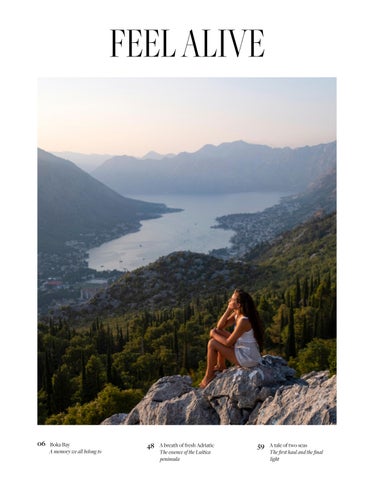
06 Boka Bay
A memory we all belong to
59 A tale of two seas The first haul and the final light
48 A breath of fresh Adriatic The essence of the Luštica peninsula
Stories make us who we are.
Stories make us who we are.
There are certain places that nudge us to live differently.
Places where the light pulls us outside early and conversations keep us there late. Where nature encourages us to take one giant exhale before we return to the values of a simpler time. And where days are marked by sunlight, salt air, movement, gathering, and the beautiful rituals that so often get misplaced within modern life.
It is this feeling - of freedom, connection, and living fully in the moment - that inspired the first edition of our Feel Alive Chronicle: a collection of stories that reveals the soul of our Boka Bay community and the Adriatic coast that surrounds us.
Within these pages, writers, fishermen, families, chefs, musicians and makers share the memories and moments that have shaped them and their ancestors. It is an honour to share their deeply personal reflections and, through each one, we hope you experience the spirit of this place as we know it: textured by heritage, guided by the sea, and alive with human connection.
Because to feel alive is rarely found in spectacle. More often, it arrives quietly. In the warmth of stone beneath bare feet. In the pause between one moment and the next. And in the pages of a long read.
On that note, we invite you to Feel Alive.
The Luštica Bay Team


There are places where the sea approaches the land as weather, commerce or a source of food. In Boka Kotorska, it arrives as a memory of civilisations, sailors and homecomings.

The sea passes through the narrow mouth of the Adriatic and folds itself inward, widening and narrowing between mountains that rise with the abruptness of a held breath. Stone leans towards water. Bell towers watch the tide. Villages settle along the edge in pale lines of shutters, steps, jetties and chapel walls, each one arranged as if listening for the next boat home.
Lord Byron gave Montenegro’s coast one of its most enduring compliments, saying that it was where “the most beautiful encounter between land and sea must have been.” Those words feel most prescient in Boka Kotorska as one stands beside its inner waters, in the shadow of Lovćen, in the Roman mosaics of Risan, in the medieval walls of Kotor, in the palaces of Perast and Dobrota, or simply down at the harbours where boats sleep as naturally as children.
Boka Kotorska - known locally as Boka, more internationally as Bay of Kotor - is often called a fjord, and the comparison is understandable. The drama of the landscape encourages grand categorisation: mountain massifs, enclosed waters, a depth of blue
that appears almost glacial beneath the cliffs. Yet Boka is a bay, a rare Mediterranean indentation shaped by geological force and human devotion.
Sailors departed under foreign flags and returned with Venetian mirrors, Russian medals, Spanish combs, Ottoman stories and the salt of far oceans in their clothes. Families remained onshorekeeping accounts, kitchens, lace, prayers and children in order. Faith moved through the year in processions. Trade entered through the harbour, music gathered in the squares, and life learned to look both outward and inward at once.
Nikola Malović, a writer from Herceg Novi, has often described Boka through this double perspective. With one eye, the Bokelian looks to the sea’s movement, exchange, opportunity and world beyond the horizon. With the other, they see the mountain’s endurance, isolation, inheritance and severe beauty of staying put. This dual gaze holds much of a local’s character: Bokelians have long been cosmopolitan without surrendering their rootedness. Hospitable without losing their own values.

The bay’s geography has given it an unusual temperament - open to the world by sea, protected from it by stone - that has created a civilisation of its own.
At the heart of Boka is Kotor - a medieval town, and UNESCO World Heritage Site, that’s pressed between water and mountain as if history had run out of space. Its walls climb from the old town to the fortress of San Giovanni in a long, muscular line of stone. They are a form of both defence and punctuation, a visible boundary between the city’s daily life and the centuries that shaped it. Touch them in the morning, when the stone still holds the night’s cool, and the past is close at hand.
In the middle of the old town is the Cathedral of Saint Tryphon, consecrated in 1166 and still among the Adriatic’s great Romanesque monuments. According to folklore, the relics of Tryphon were brought to Kotor from Constantinople in the ninth century, beginning a centuries-long bond between the city and its saint. Other older worlds continue to surface across the bay…
In Risan, Roman mosaics from the second century lie with the assurance of materials that have outlived empires. Among the mélange is a depiction of Hypnos, the god of sleep, reclined in tesserae. His presence is strangely appropriate in Boka, where time is rarely linear. Illyrian, Roman, Byzantine, Venetian, Austro-Hungarian and Yugoslav remnants remain, yet none entirely replaces the other. They accumulate like mineral deposits in the stone.
The legend of Queen Teuta adds her own shadow to the bay. This Illyrian ruler, remembered for resisting Rome, belongs to the larger mythic atmosphere of Boka’s coast: a sensibility of power and defiance associated with fortresses, steep corners, and the difficult freedom of those who refuse easy conquest. Indeed, empires arrived here often. Local memory learned to absorb them, translate them, then continue on.
Perhaps the best summation of Boka’s past and present comes in the words of Branko Sbutega, a former Catholic priest from the nearby Dobrota: “A majestic natural environment, dramatic and gentle, static and dynamic, epic and lyrical at the same time.”
Nature and culture are inseparable here. Bell towers rise as orientation points. Monasteries mark promontories. Processions bind the streets to the sea. Even silence has a liturgical quality when it gathers in the squares after noon.

The legend of Saint Tryphon Saint Tryphon is Kotor’s patron and one of its defining presences. According to tradition, his relics reached the city in the ninth century after sailors brought them from Constantinople, their journey shaped by storm and providence. The people of Kotor bought the relics and kept them forever, believing the saint would protect the city. The cathedral built in his honour was consecrated in 1166 and remains the spiritual heart of old Kotor. Each February, the Feast of Saint Tryphon gathers religion, civic pride and maritime ritual into one of Boka’s most enduring celebrations.
Continue your journey through Boka
Continue exploring Boka through the words of one of its finest contemporary storytellers.
Visit Bookstore So in the heart of Herceg Novi’s Old Town, where you’ll find Nikola Malović’s books on Boka Kotorska, along with an exceptional selection of titles on the bay’s maritime heritage, history, language and culture.


Housed in the 18th-century Grgurina Palace, the Maritime Museum of Montenegro preserves the lives behind Boka’s seafaring glory. Its collections include ship models, navigational instruments, family salons, silverware and personal belongings carried through generations of departure and return. Among its most compelling pieces is the model of Splendido, the ship on which Ivo Vizin circumnavigated the world. The museum also showcases the story of Dobrota lace, one of Boka’s finest crafts. For more information, visit museummaritimum.com.

A history of, by and for the sea
“The sea is the foundation of our existence,” says Maja Uskoković, director of the Maritime Museum in Kotor, and indeed, to understand Boka, one must understand its relationship with its waters.
The sea was a profession, route, risk, dowry, education and destiny. It carried men away and brought them home, their names changed by distance. It filled houses with objects from the world and shaped the architecture of life here: captains’ palaces facing the bay, ground floors built for storage, upper salons arranged for music, poetry, conversation and the retelling of voyages.
Among the most luminous figures in Boka’s maritime history is Ivo Vizin of Prčanj, a small town in the bay. In the mid-nineteenth century, aboard the ship Splendido, he became the first South Slav to circumnavigate the world. His journey lasted almost seven years, carrying him through storms, conflict and uncertainty on a vessel that now seems impossibly miniature against the scale of his achievement.
Despite seeing the world, Vizin would return to Prčanj, to the same bay that had first taught him how to read water. His house still stands near the Church of the Nativity of the Blessed Virgin Mary, among the old captains’ homes that look out across the inlet. It is a
reminder that one could leave Boka for the world’s furthest passages and still measure success by coming home.
Petar Želalić of Bijela carried that same Boka spirit into his role as a captain in the Imperial Russian Navy at a time when Bokelians sailed under many flags of the world. He’s remembered especially for the capture of an Ottoman vessel whose cargo included a diamondencrusted clock later presented to Catherine the Great. Today, the object survives in Saint Petersburg’s State Hermitage Museum under the title of ‘Petar Želalić’s Clock’. It is an extravagant trace of a modest coast, proof that Boka’s sailors were not provincial men gazing at the world from its edge. They were participants in its movement, just like Petar Zambelić…
A sailor and explorer from Luštica, Zambelić is one of those extraordinary figures whose biography makes geography seem elastic. Born in 1849 in the village of Zambelići, he would become the expert of South America’s Tierra del Fuego and the Strait of Magellan, among the most demanding maritime passages of that age.
Yet seafaring in Boka was never only about exploration or trade. Every departure carried uncertainty with it and, across the bay, the sea became inseparable from ritual, faith, and the hope of safe return.

These stories reveal Boka’s scale in reverse: the smaller the village, the more astonishing the reach. Men who knew every local current also came to understand the world’s harshest waters.

Few places express this union of seamanship and faith as powerfully as Our Lady of the Rocks, the church and island opposite Perast. According to legend, fishermen discovered an icon of the Virgin Mary on a rock in the sea. Each time it was taken away, it returned mysteriously to the same place. In gratitude, and believing the site sacred, the people of Perast began sinking stones and old boats around the rock, slowly creating the island that stands today.
In years past, before leaving the bay, sailors would circle the island three times, paying respect to Our Lady and praying for calm waters and safe return. Inside the church, silver votive plaques still line the walls, offerings left by sailors and families in gratitude for survival. Each one marks a private story of fear, endurance and homecoming. The Maritime Museum in Kotor preserves these lives and histories still. Beyond ship models, navigational instruments and portraits of great captains, lies something more intimate: the memory of ordinary sailors and yearning families. It’s a memory brought to life by the yearly Fašinada on 22 July when, at sunset, decorated boats cross the bay carrying stones which are cast ceremonially into the water around Our Lady of the Rocks.

In Boka, the sea’s presence even extends into everyday speech, with words such as mulo, mandrać and bonaca.

A mulo is the meeting point of land and sea, a space of everyday life where boats are tied, neighbours gather and children learn to swim. As Neven Staničić writes, from a mulo one looks “either into the distance or straight beneath oneself, into the sea. But to see anything at all, one must know how to wait.”
A mandrać, by contrast, is a sheltered piece of sea, a small harbour where boats rest safely during rough weather. In Boka, it represents a long understanding between people and water: protection without domination.
And then there is bonaca. Meteorologically, it describes a completely calm sea, the surface smooth as oil, without wave or disturbance. Yet in Boka, the word describes an emotional state as much as a sea condition. Bonaca is the moment when the weather settles and the mind follows. The stillness after labour, the quiet before departure, the rare feeling that, for a little while at least, everything is in balance.
In many ways, bonaca speaks to something central in Boka’s identity. A centuries-long desire to find steadiness within a life shaped by departure and return, openness and belonging, sea and home.


Days begin with bells and shutters as a broom moves across stone and coffee is carried to a doorway. On the pjaca, news travels faster than ceremony and slower than gossip. A fisherman adjusts a rope on the mulo. Someone calls across the square. A child learns to swim in water so clear that fear has nowhere to hide.

The old families of Kotor, Perast, Dobrota and Prčanj once lived by elaborate social codes. Venetian influence shaped their palaces: a central salon, four rooms, the kitchen above, storage below. Within those houses, Boka’s shore-bound world was kept intact. Women safeguarded customs through textiles, lace, food, language and the measured labour of domestic beauty. Dobrota lace, worked with exacting patience, was compared with Venetian lace for its delicacy.
If such history tells part of Boka’s story, the rest lives in the pace of everyday life.
“ Boka is a way of life that people have preserved through time,” says Stefan Đukonović of Miro & Sons, a Kotor guide raised among its customs and moods. He is wary of reducing the bay to dates and monuments, though he knows them well. Facts open the door but atmosphere sees you cross the threshold. He recalls guiding an American visitor who had asked for something authentic. They wandered through Kotor and eventually sat in a local kafana - a particular Balkan-Mediterranean room where tavern, parlour and neighbourhood parliament become one. Wine arrived, people passed, jokes moved between tables and conversation found its groove. “We didn’t mention a single fact,” Stefan says, “but afterwards he told me it was the best day of his entire cruise.”
Kotor still has that, Stefan says. The ability to make a stranger feel briefly included in its shared temperature. It’s a moment without reason, like the feštas and carnivals that take place in Boka.

The Church of Saint Luke
Built in 1195, the Church of Saint Luke stands in Kotor’s old town with one of the Mediterranean’s most eloquent stories of coexistence. Originally Catholic, it later became a shared sacred space where Catholic and Orthodox liturgies were served at two altars within the same church. The arrangement speaks to Boka’s deeper character: difference held close, community formed through proximity, and faith expressed without severing neighbour from neighbour. Today, the church remains a modest but powerful symbol of the bay’s layered identity.
Under Venetian influence, the masked carnivals that took place here grew into a civic theatre of satire, reversal and release. During today’s winter edition, the city places its troubles onto a symbolic culprit, the krnjo, and burns him before the year can continue.
Music completes the atmosphere: Klapa singing, brass bands, and spontaneous performances in squares. “When I hear the town band, that is Kotor,” Stefan says.
Cards remain another local speciality. Briškula and trešeta, played with traditional forty-card Italian decks, are games of wit and familiarity. To watch older men play is to see competition disguised as conversation. A raised eyebrow may accuse. A pause may provoke. Victory is welcome, of course, but the deeper purpose lies in continuity: the daily show of belonging.
Language carries the same sediment. Bokelian speech has absorbed Venetian, Italian and local words across centuries, upholding expressions that belong to climate, intimacy and temperament.
Kaldana names the heavy summer heat. Umideca carries humidity in the mouth. Gvera remembers war. Other words soften, tease, seduce and complain, as seen in Karampana, the bulletin for the aforementioned winter carnival. It has long espoused local humour with affectionate cruelty, saying aloud what polite society may only hint at.
Walking through Perast, Boka’s language becomes more visual. Set against blue water and green hills, white shutters dominate the old palaces. Crisp as a sail, the whiteness reflected the prosperity of a town once among the Adriatic’s wealthiest. In Dobrota, Prčanj and Stoliv, houses face the water with a similar confidence.
“No matter how many times you pass through Boka, it always feels like the first,” says Stefan. “And it always hits you.”
Boka belongs to the Adriatic. To Montenegro, the Mediterranean, those who sailed from it and those who waited by its windows. Yet it also asks something intimate of whoever enters. To move slowly enough. To listen before naming. To understand that beauty here is inseparable from endurance. Perhaps this is why Boka so often changes people when they least expect it. Its force rarely arrives as revelation but settles through repetition: a bell at the same hour, a boat in the same berth, a stone cast into the sea each July, a lace pattern remembered by hand, a child hearing the word bonaca for the first time.
Life here is made of small acts that outlast their makers. It’s why the bay is never encountered only once. It returns in fragments. The mirrored water of morning, the white geometry of Perast, the cathedral bells of Kotor, the smell of old stone after rain, the mulo where someone sat without speaking, the mandrać holding its boats

in the blue hush of afternoon. Each reminiscence feels personal though none belongs to one person alone.
This is how Boka preserves itself, through ritual and return. A civilisation of stone, salt, prayer, voyage, music, wisdom and patience, creating a place where the sea enters the land and shapes her people. Perhaps that is why Boka leaves such a lasting impression on those who pass through it, because this bay, deep inside the Adriatic, has always understood what it is within the world. For centuries, it looked out towards the horizon without ever losing hold of itself.
There is a confidence in places like this. Those born in Boka inherit it naturally. Those visiting recognise it more gradually, taking Boka’s sensations and sentiments with them. Something deep remains. That feeling of having been, however briefly, held by a place that knows exactly who it is, what it wants, and where it belongs.
For an experience of Boka shaped by local stories, customs and hidden details, Miro & Sons in Kotor offers guided tours led by people raised beside the bay’s traditions. You can contact them on +382 69 369 994 or at miroandsons.com.
To experience Boka in celebration, look to the Winter Kotor Carnival in February, the Summer Kotor Carnival in late July or early August, and Bokeljska Noć, usually held on the third Saturday of August, when illuminated boats parade across the bay.

The Boka Navy carries a maritime tradition that reaches back to 809, when the arrival of Saint Tryphon’s relics became inseparable from the city’s identity. Today, its ceremonial uniforms, ranks and dances keep alive a heritage of faith, honour and belonging. During the Feast of Saint Tryphon each February, members gather before the cathedral and perform the traditional dance, led by the kolovođa. The movement is precise, dignified and joyful, a living continuation of family memory. Since 2021, the Boka Navy has been recognised by UNESCO as intangible cultural heritage.
Saint Ozana came to the city in the 16th century and devoted her life to prayer as a recluse, living in a tiny cell beside the church. There are myths about her visions, counsel and spiritual strength, especially during Ottoman attacks on Kotor. During one such siege, she is said to have prayed without ceasing for the city’s protection, after which a sudden storm rose and helped prevent the attack. Her relics remain in Kotor today, and her story gives the old town one of its most intimate forms of courage: silence turned into security.


Perast glows in the early morning. Dawn light slides patiently across the façades of Baroque palaces, turning the stone ivory then honey-gold. Wooden boats rock against old pontoons as church bells travel across the water, their vibrations absorbed by the mountains surrounding the Bay of Kotor. The maestral wind slips through the Verige Strait.


Every year on 22 July, Perast returns to the sea. This event is named after the Italian word fascia - meaning ribbon or bandagebecause during the festival, a convoy of boats is decorated with apple branches, filled with stones, then tied together before setting sail towards Our Lady of the Rocks. One by one, stones are thrown into the water around the island, continuing the centuries-old tradition through which Perast first built the reef. Fašinada remains one of Boka Bay’s oldest living rituals - part procession, part remembrance.


Beyond the town’s waterfront, two islets emerge from the water as twin guardians of Perast’s past. One is bright, open to light and people. The other is dark, wrapped in cypress trees and quietude. These are Our Lady of the Rocks and Saint George respectively, and, together, they have shaped the memory and identity of Perast.
“Perast is most itself in the early morning and late evening,” says Andro Radulović, vice-admiral of the Bokelj Navy, former director of the Perast Town Museum, and descendant of one of the town’s old seafaring families. “That is when you hear only the gulls, see the fishermen leaving, and feel how deeply the spirit of this place has remained.”
Andro’s family home has stood here since 1623, the same year the bell tower of Saint Nicholas was completed. The house’s first floor still holds Boka’s last authentic Baroque interior: ceilings are painted in the manner of Dalmatian masters, portraits of ancestors hang high, a library is full of Italian and French books, and stone staircases are worn smooth by the passage of time.

Everything speaks of an epoch when Perast flourished as the Adriatic’s great maritime town.
During the Venetian era (1420-1797), more than one hundred ships sailed under Perast captains. Wealth arrived through Mediterranean trade routes and settled into the town’s limestone palaces: Murano glass, Florentine mirrors and porcelain brought home from distant ports.
A natural island shaded by tall cypress trees and enclosed by old stone walls. Home to a Benedictine abbey dating back to the twelfth century, the island endured Ottoman attacks and earthquake damage before taking on its present appearance. Closed to visitors today, Saint George became the burial place of many of Perast’s most prominent captains and noble families, earning the nickname ‘The Island of the Dead Captains’. Its haunting atmosphere is even believed to have inspired Arnold Böcklin’s famous painting ‘Isle of the Dead’.
During the Napoleonic occupation of the coast in 1813, a young French soldier and sailor named Ante Slović fell deeply in love with Katica Kalfić, a girl from Perast. Their romance blossomed despite the backdrop of occupation and cultural tension. However, tragedy struck when the sailor received orders to bombard the coastline, leading to the heartbreaking moment when he found his beloved’s lifeless body among the wreckage. In mourning, he took her body by boat to Saint George and buried her beside the monastery, forever binding the island to one of Perast’s most enduring love stories.


Yet for all that outward-facing prestige, every story in Perast returns to Our Lady of the Rocks.
According to local legend, in 1452 fishermen discovered an icon of the Virgin and Child upon a reef in the bay. They carried it home, only for it to reappear on the same rock the following morning. One of the fishermen, gravely ill at the time, soon recovered after praying before it, leading the people of Perast to believe the reef had been touched by something sacred.
Families began widening the reef by throwing stones into the sea and sinking old ships around its foundations. Across generations, an island emerged from the bay.
Upon it rose the church that still watches over Perast today, blue-domed and luminous against the mountains. Even now, the island continues to grow…
At sunset on 22 July, the annual Fašinada begins. Boats from Perast and across the Bay of Kotor sail towards Our Lady of the Rocks in a procession drawn from another age. Decorated with green branches, wooden boats are tied together, one beside the other, and filled with stones that will be thrown into the sea around the island.
“Everything is precisely known,” says Andro,
“which boat goes where, who sits in the first boat, who sings. It is not a performance - it is the continuation of life in this place.”
In the leading boat sit the parish priest and respected citizens of Perast. Behind them come the singers, followed by boats from Morinj, Risan, Prčanj, Muo and Stoliv. This is a tradition that people return home for. To row beside loved ones, hear familiar songs across the water, and reconnect with the ceremonies that made them.
If Our Lady of the Rocks is all about light and ritual, the opposing island of Saint George rests in shadow and silence.
It represents another mood entirely - more reflective and full of tales that still get passed from mother to daughter, father to son, including Perast’s own Romeo and Juliet legend. Tall evergreens surround its old Benedictine monastery and cemetery where many of Perast’s noble families were buried.
“When you close the gate of Saint George, you hear nothing anymore. Only the trees and birds remain,” says Andro. Together, these two islands are symbolic of Perast itself. One sustains devotion and continuity, the other silence and remembrance. Both belong to the sea and her people.


A few minutes by boat from Perast lies the Adriatic’s only man-made island. Built gradually over centuries by local families throwing stones around a reef, Our Lady of the Rocks remains the spiritual heart of the bay. Inside the seventeenth-century church are Baroque frescoes, silver votive plaques left by sailors, and embroidery created by the women of Perast while waiting for loved ones to return from sea. The most famous belongs to Jacinta Kunić who spent years stitching in the hope of her husband’s return. According to legend, strands of her own hair were woven into the embroidery: black in youth, grey by old age.

This relationship with the water continues far beyond Perast’s old town. In nearby Lepetane, Nikola and Jelena Serventi still maintain one of Boka’s traditional wooden boats by hand. Named Opet Ništa - Nothing Again - the vessel has been in the family for generations, formerly used for fishing by candlelight.
Nikola remembers his father once refusing work in Split because it would have meant leaving the family boat too far from home. “He chose Boka instead,” Nikola says. “The boat is still tied outside our house.”
That attachment to the sea guided every aspect of Perast life. Men spent months sailing across the Mediterranean while women remained ashore, diligently looking after homes, children, recipes and faith.
Their influence still survives in the town’s kitchens, particularly in Perast Cake - the rich almond dessert once prepared for sailors embarking on long voyages. Made with almonds, eggs, lemon and maraschino, it transported the flavour of Perast across distant seas, which returns us to Nikola.
“Boka, boats and the sea once meant fjaka,” he says, using the Dalmatian word for a peaceful, unhurried pace of life. “Today, even the sea has become hurried.” Wooden boats are slowly making way for plastic hulls and powerful engines. Boatbuilders are fading, so too are the old ways. Nikola’s family holds out, with hope and care: “Our children learned to step into a boat before they learned to swim, just as children in Boka once did many moons ago. As long as the next generation is taught to respect tradition, Perast’s story, its true way of life, will never disappear.”


This is why Perast is different from anywhere else on the Adriatic. History is everywhere in its open-air museum. It’s visible in the boats tied outside homes, in the songs shared during Fašinada, and in recipes gratefully inherited. Life moves alongside memory rather than away from it and, somewhere between Our Lady of the Rocks and Saint George, the town never forgets who it was and who it wants to be.
All of which makes Perast Boka’s last great Baroque dream. A preservation of what is most beautiful. And what is most human.


Originating in the homes of seafaring families as a dessert capable of lasting long voyages, Perast Cake is rich with almonds, eggs and maraschino liqueur. It was both a luxury and practical nourishment for sailors spending months at sea.
INGREDIENTS:
Dough:
8 egg yolks
200 grams sugar
250 grams butter
A small cup of white wine
Grated peel of one lemon
1 packet of vanilla sugar
About 750 grams of flour
Filling:
8 egg whites, beaten into stiff peaks
Juice of one lemon
400 grams sugar
1 tablespoon crushed biscuits or fine breadcrumbs
500 grams coarsely ground almonds
1.5 dl sour cherry liqueur (Maraschino)
METHOD:
1. Prepare the dough:
• Combine the egg yolks, 200 grams of sugar, butter, white wine, grated lemon peel, vanilla sugar, and about 750 grams of flour
• Mix until a smooth dough forms and leave to rest in the refrigerator for 15–20 minutes
2. Prepare the filling:
• Beat the egg whites into stiff peaks
• In a separate, large bowl, combine the lemon juice, 400 grams of sugar, the crushed biscuits or breadcrumbs, ground almonds and sour cherry liqueur
• Fold the beaten egg whites into the mixture
• Gently combine the ingredients until well incorporated
3. Assemble the tart:
• Line a 28cm cake mould with baking parchment
• Roll out the prepared dough, cut a circle for the base and wide strips for the sides, leaving a little aside to make narrow strips for the topping
• Line the cake mould with the pastry
• Add the filling then top with a lattice pattern made with the narrow strips of pastry
4. Bake:
• Preheat the oven to 180°C (or adjust according to your oven’s power)
• Bake for approximately 45–50 minutes
5. Final touches:
• While the Peraška Torta is still warm, add pieces of butter on top and sprinkle with sour cherry liqueur
• Allow to cool down completely before removing from the mould
• Dust the finished Peraška Torta with powdered sugar
Đardin remains one of Perast’s most atmospheric waterfront restaurants and wine cellars. Set within the seventeenth-century Brajković-Radulović Palace, Perast Cake is still prepared traditionally here, served beside views towards Our Lady of the Rocks and Saint George. Arrive towards sunset, order a slice with local wine or herbal liqueur, and watch the bay soften into evening light. For more information, scan the QR code.


Luštica Bay resident and author
reflects on the moments and memories that inspired ‘Secret Montenegro’ - her recently released book which shares an insider’s view of this country’s hidden treasures.

Every time my flight banks left over the point of Trieste and the Croatian islands begin to give way to the inky sea and dark, fairy-tale mountains of Montenegro, I feel that same heady mix of anticipation and nostalgia. This is the landscape of my infancy and my adulthood, a place where the people, the stone, and the history are all deeply woven into my own story.
To me, Montenegro has never been a series of coordinates on a map. Rather, it is an emotional pull of kinship. One informed by the black-green of the pine forests, the indigo waters, and the dawns when mountains are the colour of weathered pewter.
As soon as I land, the first thing I do is head to the rocks. I stand barefoot, feeling the cool, sun-warmed grey stone beneath my feet, letting the salty spray settle on my skin. It is a moment of profound gratitude for this sparsely populated expanse that pulls me back to her waters time and time again.
When I first started exploring the Luštica Peninsula it wasn’t to write a book. I simply wanted to capture the secret Montenegro that I’ve known since my childhood summers here. The forgotten orchards and the almost indescribable views that catch you off guard as you crest a ridge. I wanted to document the parts of this land that don’t shout for attention: that specific kind of silence found in the medieval churches tucked into the folds of the hills, or the quiet stone villages where the only sound is the call to worship and the wheeling of seagulls.
Luštica Peninsula is where I have found my purest sense of belonging.
Between the UNESCO-protected hush of Boka Bay and the crashing open waters of the Adriatic, this soil speaks to the soul of any wanderer. It was the pull that led me to make Luštica Bay my home in 2013, a place that feels like an organic extension of a life I’ve previously lived in these hills.
There is a particular romance to the lagano rhythm of Luštica Bay’s Marina Village. In the morning, the world awakens with a gentle bustle while the colours and contrasts bring fresh inspiration for my own fashion line. Montenegro’s culture of embroidery and making is deep-seated, and I work with local girls to keep that spirit alive. In the evenings, we often set up a table in front of the store. Friends drop by without invitation, watching the masts of the boats sway in the twilight as we share local cheese and wine.
Even in this contemporary setting, the secret Montenegro is never far away.
I think of the tiny island of Žanjice where I christened both of my sons in a modest church that feels as old as the sea itself. We swim here often, looking towards the three fortresses dating from the Austrian Empire that serve as informal gateways to Montenegro: Arza, Mamula, and Prevlaka. Then my mind meanders to the village of Rose where bougainvillea straggles over walls and the past unknowingly spills into the present. Or I dream of boat rides to Bigova and of sitting under a canopy of vine leaves, eating razor clams and those sacred, enormous tomatoes grown by the same family for generations.
Sometimes, I roll down the stripy roof of my restored 1959 Fiat Cinquecento - a little piece of history in itself - and chase the sunset into the higher reaches of the peninsula. I pass donkeys drifting across the road then women selling traditional embroidered cloth, urns and eccentricities while they deftly farm their flocks of goats.


This is the Montenegro I love. A country where the traditional life of agriculture, olive oil and fishing has remained relevant and resonant, coexisting beautifully with the present day.
It is a rare joy to weave through a life that remains so stubbornly and naturally itself, entirely indifferent to the outside world.
You see, Montenegro’s greatest treasures aren’t on display. Hence this very book. They are held closely by the land, shown only to those who move slowly enough to notice. They are unearthed in the labyrinth of fjords that were once the territory of pirates and the Venetian Republic, in the pale waters around Sveti Marko where the light seems to hold a different weight, and in the smiles of humble vegetable sellers who are the true guardians of this coast.
My life at Luštica Bay is an extension of these discoveries. This town respects the ancient architecture of the peninsula, allowing me to live within the same landscapes I once explored as a child. The modern world bows to the topography of the terrain, mirroring the central theme of Secret Montenegro: how wonderful it is to preserve the untouched while finding your place within it.
You can purchase your copy of the book Secret Montenegro at the Feel.Alive office on the Luštica Bay promenade, or via the QR code.


Jelena
travel influencer and editor of Journal.rs, explores what it means to feel alive
When was the last time you truly felt alive?
Completely. Fully. With your whole being.
The question may seem easy. You might quickly say: this very second, now, as I breathe! But, if we decide to be completely honest, it suddenly becomes more complex and surprisingly difficult. So, really, when?


If there’s one thing I firmly believe, it’s that art will save the world. Until that happens, save a piece of your soul by escaping into your creativity.
Adult days often line up like an endless highway: straight, forward, fast. We rush relentlessly, we move ahead, getting ever closer to… To what? This thought swarms my mind as I sit on the terrace of The Chedi Luštica Bay hotel one spring morning.
It’s just warm enough to enjoy my omelette in the sun, sip a cappuccino, and squint into the light. Then, in the marina, a sailboat catches my eye. Along its length is written: “It’s about the journey, not the destination.” A cliché? Absolutely. But clichés exist in truth.
We know very well what the final destination is, so why are we rushing toward it at full speed?
My own shift in awareness began almost seven years ago, around the same time the Luštica Bay project started taking shape as we know it today. Perhaps it was Uranus crashing recklessly into Taurus’s steady path,
or perhaps it was simply natural growth and maturation. I realised that achieving goals one after another means little if you don’t know how to pause, breathe, and simply exist.
We feel most alive precisely when we forget ourselves in flow - a state that feels both eternal and frustratingly fleeting. It happens when we truly disconnect, when we fully commit. Here. Now. Nothing else added.
The first time I visited Luštica Bay, it was only the beginning of an idea. A vision in the making. What stayed with me is the sense that this is a place designed for gently swaying at life’s softest frequency. A place where phrases like ‘I must’ and ‘just one more thing’ are simply banished. Luštica Bay is a place where distance is measured by a pebble I kick as I wind my way down to the sea. It’s where I recognise my route by the scent of immortelle blending with lavender, prompting me to stop and admire the colourfully striped birds. Yes, human intervention exists here,
but only to create a remarkable alchemy that perfectly balances nature and comfort, forgetting and flowing.
A thought has been chasing me more and more lately: I must urgently uncover the meaning of life and instantly resolve myself and my existence around it. Like any desperate thought, it serves little purpose other than to trouble me.
However, when it recently caught up to me, I came prepared to stare into the sea and search for infinity. I was on the peninsula and, instead of dramatically contemplating eternity, I resolved to remain in the present moment. And what do you think happened? A complete reset of my factory settings. A similar moment happened when I found myself on the golf course, on a lawn above the sea with a view stretching to the snowcovered Lovćen mountain. Everything calmed down. There was only me, learning
a new skill and the golf ball. I swung, high above my shoulder, once, twice, a hundred times.
Being a beginner is a blessing we fail to appreciate enough as adults. I had lost myself in a new skill, surrounded by 360-degree sea views. Thank you Mr Gary Player for designing such a perfect course!
The next day, I felt the consequences of such childlike playfulness in my shoulders.
A hundred balls is a hundred more than ever before. But that morning I practised my sun salutations on the breakwater with Katia, a yoga instructor here.
Can you feel anxious in a yoga pose while gazing at the open sea with a salty morning breeze brushing your face? Unlikely.
These slow, unpretentious experiences are a blessing we should gift to our stressed selves more often.
Childlike joy is found across the bay, but I’d draw you to three specific acts.
The first is an e-bike tour for those who wish to explore the Luštica peninsula. It is nearmagical when the vegetation bursts back to life in full splendour. Indeed, if you ever need a spiritual teacher, simply turn to nature and observe carefully what it tells you. Every cycle of decline, decay and barrenness eventually returns as a delicate bud, and then the kaleidoscopic beauty unfolds again.
Secondly, in Marina Village there is the Arto Gallery where anyone can join artistled workshops. I spent several hours breaking stones during a mosaic workshop, transforming fragments into shimmering waves. Time moves differently here and the only goal is to turn yourself inside out through visual expression. I’ve left my mosaic half-finished in my Luštica Bay apartment as a reminder of the freedom I found at the Arto Gallery, and a prompt to return again to continue my creativity. And finally, the crescendo of our three acts:
being on the water. While sailing, as the boat cuts through the waves and my sense of balance sways, I usually sit on my towel and eat my apricots in perfect bliss. However, on a recent occasion I had the chance to take the helm and learn the basics of sport sailing. I’m told that left is right and right is left. For those of us who are always a bit upsidedown, it sounds almost poetic. The Bay of Kotor is the perfect place for beginners to feel what it’s like to fill sails with wind. I’m locked in, acutely aware of how easily everything can stop with just one wrong turn.
And so we return to the big question… When was the last time you truly felt alive?
I don’t have the answers, but somehow that doesn’t matter. What matters more is letting go of the swarm of questions. If I must answer one, then fine, the last time I felt alive was just before heading home when I realised I hadn’t figured anything out, solved anything or understood anything, and that it was absolutely okay. Because, as you already know, “It’s about the journey, not the destination.”
Although some destinations are better than others.
See you soon in Luštica Bay.


In Boka Kotorska, sound travels differently.
Sound rolls across the water, steeped in heritage and soul. Church bells echo between mountains. Klapa voices drift through narrow stone streets. And brass bands and beating drums spill into crowded courtyards as the Bokelj Navy marches a centuries-old beat against polished limestone. By dusk, music rises above the waterfronts of Kotor, Perast and Herceg Novi, stirring itself into the Adriatic breeze before spreading languidly across the bay.
“Everything begins with listening,” says Andrea Živković, director of the Boka Symphony Orchestra. “As children, we listen to our elders, to the bells, to the town bands, to the dance of the Bokelj Navy. Listening colours the way people grow up here.”
In Boka, music is everywhere in both ceremony and memory. It accompanies feast days, processions and carnival celebrations. It gathers friends into squares. And it draws boats in from the water. It’s loud and in motion.
“Nothing stands still in Boka,” Andrea says. “The town bands move as they play, and now the symphony orchestra has begun to move too. There is always this impulse to carry tradition forward.”


The orchestra
That sense of continuity, from old to new, inspired Andrea to found the Boka Symphony Orchestra, together with Mirjana Jovanović and Lara Bubanja.
For decades, Boka had raised generations of musicians through local music schools and town bands in Kotor, Tivat and Herceg Novi. Many would then go abroad to continue their studies, so the orchestra was set up to bring those scattered notes home. Today, the ensemble connects around fifty musicians from across the bay.
“Kotor had an orchestra briefly during the 1950s,” Andrea says. “The idea of it never really disappeared - Boka has always had its own symphonic voice - we just wanted to give it structure to resonate.” And resonate it did…
In the stillness of the pandemic, when there were no tourists and no city crowds, music once again became a way of reconnecting
people. During the summer of 2020, as part of the KotorArt festival organisation, several musicians boarded a small wooden barka and sailed from Kotor towards Dobrota, Sveti Stasije and Orahovac, performing the melody of the Bokelj Navy dance along the shoreline.
“That was when we understood how far the sea carries sound,” Andrea recalls. “People heard us from one side of the bay to the other.”
In those quieter weeks and months, music became a way for the towns of Boka to hear from one another again. Locals waited along the stone piers with coffee, fritters and smiles while trumpet and flute reverberated across the dawn water.
“Music accompanies every important moment here,” says Andrea. “No one could ever stop the melody of the Bokelj Navy. No person, no group. It will continue, whether we are here or not.”


It’s here that children learn their first notes alongside veterans who have marched the same streets for years.
If orchestral music gives Boka a sense of spectacle, klapa (traditional ‘a cappella’ group singing) gives it its voice.
For Vlasta Mandić - founder of Bisernice Boke, Kotor’s oldest female klapa group - klapa is an expression of mentality, emotion, and the Mediterranean way of life: “It’s learned in little passageways and taverns,” she says, “brought forward from companionship, from the sea, from people who know how to enjoy life slowly, with fjaka and a bocun of wine.”
Vlasta created Bisernice Boke after Kotor’s devastating earthquake of 1979. “It was an act of resistance,” she says. “We held rehearsals in squares still covered in rubble. Music became a way for the town to feel itself again.”
Nearly five decades later, Bisernice Boke still sing in squares and piazzas, turning informal rehearsals into spontaneous concerts. “Every klapa group sings about its own personal memory,” says Vlasta. “Its own sea, stone and landscape. Without emotion, the songs are difficult to sing and to listen to. Every individual voice must become part of one united feeling.”
Long before the bay founded its orchestra and found its voice, the sounds that define Boka today can be traced back to its town bands, the oldest of which is the Kotor Town Band, formed in the nineteenth century. Its marches and ceremonial performances became inseparable from Saint Tryphon’s Day celebrations and the public dances of the Bokelj Navy beneath the walls of the Old Town.
Tivat’s town band has also remained one of the city’s defining cultural symbols for more than a century. Set up in the early 20th century during the Austro-Hungarian era, it has accompanied
generations through nearly every important public occasion. Local feast days, religious processions, and summer festivities along the waterfront. A similar spirit lives on in Herceg Novi. Established in 1886, the town band won first prize at a major competition in Ljubljana in 1922, with its music continuing through wars, political upheavals, changing states, the Mimosa Festival, and majorette parades.
Believe everything you hear
Wherever you are in the bay, during summer you won’t be far from classical strings, contemporary arrangements, klapa harmonies, and brass instruments. Together, they paint an acoustic portrait of Boka. Rich, emotional, and alive with stories of the bay.
Music may begin as a performance, but here it’s primarily a community exercise.
At a time when Mediterranean towns are changing at an accelerating pace, sound is a bastion of identity that cannot be replaced or replicated. In Boka, such identity is preserved through old and young continuing to sing, play, and gather together.
Perhaps that is why Boka is best understood with eyes closed and ears open, because within its sounds sits a collective memory. Carried across centuries, through families and communities, it’s one still shaping life today.


On a morning walk from Luštica Bay’s salt-misted shoreline up to The Peaks, the landscape reveals itself through scents as old as time.
One to watch: the maquis
Maquis (macchia) is a dense, evergreen Mediterranean vegetation that blankets the landscape. Composed of shrub species that are adapted to dry summers and mild winters - most notably the strawberry tree, spruce, and Spanish broom - it serves as the peninsula’s wild signature. Growing freely along the slopes and within olive groves, it is a habitat for numerous species and shapes the visual and olfactory identity of the entrance to the Bay of Kotor.

One to watch: the strawberry tree
Known locally as maginja or planika, the strawberry tree (Arbutus unedo) is an evergreen shrub renowned for its distinctive red fruits that ripen in late autumn. These edible berries are sweet with a slightly astringent note, resembling strawberries in appearance. Rich in vitamin C, the fruits are a staple for local jams, liqueurs, and a potent brandy called rakija Growing typically within the maquis, its glossy leaves and vivid orange-to-red November berries are often described as being ‘as sweet as sunlight.’

On the Luštica Peninsula, a day begins not with a view but with a scent. Before the eyes adjust to the light, your nose is greeted by an ancient aromatic language.
In this world, Luštica Bay is a natural oasis whose reigning vegetation is the maquis - a dense, low-growing Mediterranean woodland composed of hardy, evergreen plants. Within this tangled green tapestry, several ‘voices’ rise: the oak - indestructible, enduring and proud - provides the most exquisite summer shade; the laurel, whose pale green leaves are the foundation of Mediterranean cuisine; the cypress, slender and poised, a dark-green model of form in whichever forest it stands; and broom, a shrub with vivid yellow blossoms that serves as a literal note of sunlight within the greenery.
Finally, there is the magnificent strawberry tree, an evergreen unlike any other which, as summer yields to autumn, offers orange-red fruits that lend a rich, visual character to the Luštica maquis.
In the early morning hours, while the sea has not yet turned blue and the stone remains warm beneath the fingers, the maquis’ scents begin to show off. Blended with a saline cloud and freshly watered earth, its plants awaken beneath the slowly rising sun, inviting you on a walk that enchants like no other.

Marina Village’s prelude of salt and stone
From Marina Beach, a wisp of salt is first perceived. It lingers upon the skin and within the hair, returning one to early memories of seaside holidays. This mineral tang is interwoven with the waft of sunbaked algae and warm stone, forming the fundamental, grounding note of Luštica Bay.
As one moves away from the shoreline, the scents shift and layer themselves, mirroring the ascending landscape.
In Marina Village, the air is defined by the olive and strawberry tree. The olive tree stands as a symbol of endurance and rootedness, while the strawberry tree reveals the untamed soul of the terrain. With the intention to preserve and accentuate nature, surrounding you is a careful selection of plants that have always grown here, autochthonous species that have adapted to sun, stone and drought. The sun is responsible for everything here, as are the warm days that accompany the turning of the seasons. The year’s overture
is found in the spring efflorescence of mimosa with its powdery balm, in the Judas tree with its pink-purple blooms, and in the yellow spurges that cover the landscape. The promenade is dominated by jasmine, alongside the blossoming of citrus which floods the streets with a light freshness.
As summer’s temperatures rise, droughtresistant, hard-leaved plants release their essential oils into the air. The incense begins with immortelle - dry, warm and almost dusty.
Rosemary follows, its trace lingering throughout the day when brushed or rubbed between the fingers, then sage, discreet in appearance yet intense in the impression it imparts. Jasmine finishes our time here. Owing to the Luštica microclimate and the soil from which it emerges, jasmine carries a stronger and fuller body than you will have previously experienced. Pleasingly, its notes remain remembered long after one’s departure.
As one moves away from the shoreline, the scents shift and layer themselves, mirroring the landscape.ascending
Centrale’s resilience amid ancient resin
Our walk continues towards the Centrale neighbourhood and, as the aesthetic changes, so too does the landscape and its scent. Both adapt to their surroundings and new environment.
Here, the past dominates in its most magnificent preservation: tall cypress and pine trees have stood in this place longer than most can imagine. They remain steadfast, with no intention of leaving. Their resin melts each year beneath the summer sun, releasing that recognisable, almost soothing Mediterranean bouquet, while cicadas in the background perform the most evocative summer melodies.
The trees’ cologne is quieter than that produced by aromatic herbs yet long-lasting. Like a shadow that follows, it enters the nostrils and only departs the following day once it has been slept through.
In this sense, Centrale exhales stability. Of shade. Of stillness. Of a place that breathes more slowly.


Our journey continues uphill towards the golf course and The Peaks. Suddenly there is openness, elevation, and the air once again changes its character, revealing a different nature. It becomes lighter, with everything laid out as if in the palm of one’s hand.
The carefully maintained grass is denser than elsewhere and thus carries a clean, fresh and soft trace. Manicured lawns bear the familiar and calming note of summer, yet what renders the golf course at Luštica Bay unique is the environment that embraces them on all sides.
From the east, the gentle breath of the Adriatic’s pearl, the Bay of Kotor. From the west, the open sea and an infinite horizon. From the north, the slopes of Lovćen look over us, sending a breeze that lowers the temperature by a degree or two, aided by
nearby Vrmac and Orjen. The fragrant currents from the southern hinterland’s maquis build on our own, conversing, never competing.
The scents you carry home
Wherever a walk takes you, in truth, there is no single flower, plant, or tree by which Luštica Bay and its peninsula can be defined. You cannot point to one branch or one blossom and exclaim that you’ve found the source.
It is impossible to leave these shores with only one distinct scent. Instead, you leave with a breath of the whole peninsula. These aromas do not vanish as you travel away, but settle into memory, surfacing months later at the mention of the sea. They are the quiet, persistent ghosts of the landscape. A permanent part of who you have become.


The air is an interlacing infusion. A play of sea, land, plants and the shifting sun. It is the salt on your skin meeting the resin in the haze.


In the Bay of Kotor, there is the sea before dawn - a cold, steelgrey reality where the Lakićević family hauls a seven-century legacy from the deep - and there is the sea after dark - a silent, amber-hued solitude where Nebojša Delac navigates a ‘blue field’ of memory and ritual. Times may have changed, but at both hours certain traditions remain, binding the families to a history that refuses to wash away.
In the cold light before dawn, the waters surrounding Bijelila are as still as a held breath. One lone boat bobbles on its glass-flat surface, carrying four figures. A grandfather, a father, a brother and a child, different chapters of the same Lakićević family story. There is no sound except the slap of water against the hull and the wet friction of nylon as nets rise from the dark. The men’s movements are instinctive, remembered in the muscle. A choreography of the lean, the grip, and the steady haul that has been refined by every generation that came before. Right here, right now, this boat is the family’s entire world.
“You are born into this,” says Davor, the aforementioned father, his hands steady on the net, eyes fixed on the horizon. “It is not a job you choose but a life given to you, perhaps even imposed in a way. From a very young age, you live by the sea, you watch it, you listen to your elders. It gets under your skin. After that, there is no turning back. You bind yourself to it, and to your descendants.”
Bijelila, a stone-stitched village on the Luštica Peninsula, has been the Lakićević home for seven centuries. While the world beyond these shores accelerates, life here is guided by the tides. Davoralongside his brothers Slavko, Dragan and Jovan, and their sister Anita - continues a lineage of fishing as demanding as it is cherished.
On the boat, Dragan pulls the line taut, his face a counterpoint to his brother’s enthusiasm. “I see more of the sea’s practical side. It is not always easy, but it has a particular strength. At sea, trust is the only currency and there is no room for mistakes. Work and brotherhood must become one.”
Mihajlo, the boat’s grandfather, watches his sons Davor and Dragan with the authority of experience. “The sea is useful but dangerous,” he tells them. “You must never go against it, but work with it. You learn to recognise the signs of bad weather because that is what saves your life.”
The Adriatic is the ultimate authority, respected but never trusted.
The family carries the memory of storms with more reverence than their largest catches. They recall 2016, when they brought in 1,600 kg of amberjack in a single day, and the 70 kg swordfish of 2025, but the days the sea challenged them have created a deep humility.
Mihajlo’s attention switches to 1998 and a night that remains the greatest fishing loss the Bay of Kotor has seen. He turns to the boat’s child - his grandson, Davor’s son - Mihajlo ‘junior’.
“We were fishing a few kilometres from our home and there was an unusually large amount of fish under the feral, the strong light that attracts them. Encouraged by what we saw beneath the boat, we ignored the risk. The storm was faster than our thoughts. Suddenly, a powerful cyclone struck, first overturning the smaller boat with the net we were towing, and then sinking the main vessel. Your Uncle Dragan and I jumped into the sea and fought the waves for over two hours while family and friends searched for us. The storm was so strong that even the army was not allowed to set sail.”
Davor glances over to his father and son. “When the storms are strong, you are never afraid for yourself because you don’t even have time for that. Everything happens quickly. In those moments, I only worry about the engine and that a rope or net might get caught in the propeller which would be fatal for us. That night, you lost everything but you survived.”
Back on the stone quay, Anamarija, Davor’s wife, is preparing for the day. The family’s restaurant, Porto Bjelila, waits for the morning’s catch to be brought into its kitchen. A fish plate for two will be prepared, including red and black risotto, gambori, mussels, squid and whatever else can be caught. Guests may just visit for lunch with the Lakićevićs, but many also stay in the family’s apartments or come for the private boat tours to the Blue Cave, Gospa od Škrpjela and Perast.
Having come to the family from Tivat, Anamarija does not romanticise the water, but she understands it as the responsibility that binds them.

From a very young age, you live by the sea, you watch it, you listen to your elders. It gets under your skin. After that, there is no turning back. You bind yourself to it, and to your descendants.


“Life through this family has taught me to see the sea differently. Not just as beauty and enjoyment, but as dedication and patience. It is very special to see how everyone works together, even when they do not always agree, which is entirely normal for a big family.”
“Our household moves with the sea, as one, through the fish we catch, the catch we cook, and the guests we welcome to these waters.”
The day is long and full. There is no work/life balance here. It is all just life.
Out on the water, Davor helps his son Mihajlo with the nets. At nine years old, Mihajlo is proof that the family’s story is far from its final chapter. Every day, he wakes without an alarm, fuelled by the anticipatory buzz of being on the boat. He gets dressed straight away, guzzles his Nesquik, and heads quickly to the water.
“I like it when you let me steer the boat,” he says to his father with a prideful belonging as he watches the nets rise, looking for the first flash of silver. To Mihajlo, nothing matters bar the rush of the nets and the salt-sting of freedom. He’s a sturdy soul, carrying the weight of all those who came before him without even knowing it. He is the proof that we linger, that we persist. But he is also a question…
What world will Mihajlo find waiting for him when he takes the helm? The sea will remain, of course, it is eternal. But one wonders if the life of the hands, the salt and the stone will survive. Will the old ways stop being a necessity and start becoming a performance?
These are important questions, but ones which must wait.
The sea doesn’t pause for philosophy and today’s work is still to be done. As the boat returns to the quay, the heavy, wet reality of the nets returns.
“The sea has taken the ease out of life, because this is a hard way to earn a living,” Davor muses, watching his son help secure the lines.
“But it has given us everything: life, work, love and family. There is no feeling that can replace being at sea and doing what you love, and for that we can only be grateful.”

What world will Mihajlo find waiting for him when he takes the helm? The sea will remain, of course, it is eternal. But one wonders if the life of the hands, the salt and the stone will survive. Will the old ways stop being a necessity and start becoming a performance?

What is fishing by candlelight?
Locally known as ribanje pod ukres or ribanje pod kurćelu, this is a nearly extinct art form specific to the Bay of Kotor. Under the cover of a night’s darkness, one relies on a lamp ( feral ) to attract fish to the surface in shallow waters and a specialised spear (kurćela) to catch them. No talking and no nets. It is a test of silence, speed, precision and endurance.

“The sea,” Nebojša says, his voice carrying the grit of the coast, “is like a blue field. An existence that keeps me whole. I cannot live without it.”
In the dead of night, a single, trembling beam of amber lights up the water.
Beyond the circle it creates, the Bay of Kotor does not exist. There is no Tivat, no Island of Flowers, no static from the modern world. There is only the black glass of the water and the silence of the shallows. In the bow of the boat, the feral casts its luminescence downward, piercing the surface to reveal a nocturnal theatre of sand, seagrass, and the sudden glide of a passing pectoral fin.
Balancing over the gunwale, Nebojša Delac moves with the ghost-like economy of a man who has spent a lifetime tending these waters. Slow, steady, no wasted motion. Spear held low, his movement shifts to match the tilt of the tide. Known locally as ribanje pod ukres, this is fishing by candlelight.
For Nebojša, these waters were his first classroom. His education began at the age of six when he started rowing the boat for his father through the ink-black nights of the bay. His father sat in the stern, the master of the light, while the weight of the oars grew heavy in Nebojša’s small hands. It was quite a responsibility for a child. To maintain the pace, to keep the boat steady enough for his father’s spear to find its mark, to understand the silent language of a tilted head or a pointed finger.
“You learned early through routine, not instruction,” he recalls. “Every night. Always here. My father, he wasn’t teaching me how to catch a fish, he was showing me how to be a man. Discipline, patience, the duty of a promise. If we said we were going out, we went. The sea doesn’t care if you are tired.”
Even now, after a full day’s work, the sea exerts a pull he cannot resist. “It’s my night out on the town,” he says with a twinkling eye.
“I’m off, heading down to the boat,” he’ll tell his wife as he slips away into the darkness to empty his head.
“I simply have to go,” he says, dismissing the idea that it’s a choice. “Something calls me back. I go with the pressure of the day on my shoulders, and then, out in the circle of light, the world goes. I think of my father. I drift into the dark. Maybe I’m lucky, maybe not.”
Historically, Tivat was the beating heart of this craft. Its coastal waters were once crowded with the flickering lights of hundreds of boats, a floating constellation that mirrored the stars above. Those lights are a timeline of history, told in the evolution of the fuel. Nebojša remembers the hiss of carbide lamps, the smoky flicker of petroleum, the steady burn of gas, and later the transition to batteries. He might use solar-powered lights today, but the rest of the ritual remains untouched.
What the new lights do reveal is a changing coast. Life must progress, of course it must, but Nebojša rues how fishermen no longer respect one another as they once did, how the old codes are disappearing, and how parts of the natural breeding grounds have been damaged. The world is moving fast and there is less time for the sea. Despite this, Nebojša remains positive.
“A fisherman is a particular kind of person,” he leans onto his spear. “He may do all sorts of things. He may work in a shop, he may build houses, but he always returns to the sea. Water is blood.”
Despite the love he finds in its depths, Nebojša still speaks of the sea with the reverence of a man entering a cathedral. “It gives and it demands. If you do not respect her, you cannot take from her. You must learn to read the clouds and know the currents… The way the wind sounds before a storm.”


From father to son, lamp to lamp
For many coastal families in the Bay of Kotor, fishing by candlelight was a form of inherited knowledge, passed from one generation to the next. It taught children the geography of the dark: how to move through the shallows without a sound, how to read the weather in the taste of the air, and how to handle tools with the care of a craftsman. The carbide lamps have been replaced by solar power, but the lesson remains: the sea gives only to those who know how to approach it with respect.
He recounts, matter-of-factly, one such storm in the mid-nineties when his engine failed, pushing him towards the rocks. With a Boka-fisherman calmness, he readied himself for the water, stripping off his raincoat and boots, grabbing a plastic fuel container to use as a float. “‘Let’s try starting the engine one more time,’ I thought. Somehow it sparked and on I went.” There is no dramatic retelling, just a wry grin.
Fishing like this - standing for hours, eyes straining against the refraction of the light, the damp cold of the bay seeping into the joints - is an experience of endurance. But as he watches the water, Nebojša’s gaze is one of unwavering loyalty. From the six-year-old boy with his father, to the lifelong devotee he is today, the sea remains Nebojša’s place of solitude and recovery. He can spend hours on the water and return with only a kilogram or two of fish, barely enough for a meal.
“Catch anything?” his wife will ask the following morning. “Not really,” he’ll shrug.
To an outsider, it might seem like a waste of time for such labour, such a physical toll. “I fish for pleasure, not prize. There’s no catch, yet still I’m fine,” he smiles inside. “No one disturbs me.”
“What the sea can give you, nobody else can. A sense of peace, like a peace of soul. Out there is my release. My place. Where I belong. I’m committed, and that commitment ends only when the body finally breaks.”
Back on the boat, the light flickers on the surface and the spear is held ready. A needle of intent poised over that dark blue field. “As long as I can still step into a boat,” Nebojša says, his eyes never leaving the water, “I will fish. It is not what I do. It is what I am.”


Inside the old library of the Monastery Complex of St Nicholas in Boka’s Prčanj, shelves of worn books preserve traces of maritime histories, family names and fragments of another world. Outside, a table is set for lunch.
White linen flutters in the breeze. Wildflowers fetched from the mountains sit between glasses chilled with white wine. The Adriatic sun pours across this secret garden.
Today’s lunch is one of chef Damir Moskov’s Wild Tables - a style of heritage dining shaped around the seasons and stories of Boka Bay. His guest is Mašo Čekić - a journalist, chronicler of Boka’s culinary identity, and one of the region’s most passionate guardians of its customs, dialect and gastronomic memory. He’s also family, making the occasion feel all the more personal.
Damir’s Wild Table experience is a contemporary take on heritage dining, with menus deeply connected to the history, landscape and identity of a particular place. Every setting shapes the experience, from courtyards and olive groves to old captain’s villas overlooking the Bay.
Here, within the Monastery Complex of St Nicholas, that connection feels especially natural. The surrounding landscape, maritime history and slower pace of monastery life all find their way onto the table. Over the next few hours, dishes will trace the four seasons of Montenegro: wild spring herbs gathered from hillsides above the coast; summer mussels and small fish pulled from the waters; autumn sauces deepened with wine and spice; and winter desserts scented with orange peel and homemade liqueur.
For centuries in Boka, the season determined the table. Certain dishes appeared only briefly each year, tied closely to weather, harvests, fishing cycles and religious calendars. What could be retrieved from the mountains, pulled from the sea, preserved through winter or carried home from the market shaped daily life.
As such, to speak about the cuisine of Boka, its people and their very nature, one must journey through the seasons, just as this Wild Table does.
Damir’s first dishes arrive almost exclusively green.
Wild herbs dressed in olive oil sit beside potatoes and eggs, chicory retains its bitterness, and young asparagus carries the character of damp earth and coastal air. A fresh white wine cuts through any richness with a sharp minerality.
“As soon as the March bora winds settle, people go out foraging branje,” Mašo says, lifting a forkful of greens onto his plate. For generations, women would convene

across the hillsides above Boka, carrying woven baskets through vineyards, gardens and meadows. Grandmothers, daughters, neighbours and cousins went in search of spring’s green gold: nettles, sea fennel, dandelion, sorrel, fennel and more.
“Some call it parapać, pazija, mišancija, zelenjava… Every village has its own name,” adds Mašo. “Yet however one chooses to describe this mixture of wild edible herbs, branje is something magical, almost mystical.”
“After winter, when people lacked vitamins and minerals, this was medicine.

Real medicine. Hunger taught people how to recognise survival in plants.”
The little flour and cured meat remaining after winter, mixed with the green abundance of spring, gave families nourishment after the cold, difficult months. Yet branje was never simply practical. It became part of the social fabric of the coast itself.
“While harvesting herbs,” Mašo says, “stories were exchanged. Secrets revealed. Agreements made. Entire generations of women carried knowledge that way.”
Those sounds that accompanied walks through the hills have largely disappeared now. Urbanisation slowly replaced meadows and family gardens. Fewer daughters followed their grandmothers into the fields.
The markets of Boka no longer overflow with wild herbs tied into bundles the way they once did.
“The drone of tractors replaced the laughter of young women,” Mašo says wistfully.
Despite this, recent years have seen an upturn in foraging enthusiasts. People, chefs in particular, are rediscovering that wild herbs are often healthier and more beneficial than cultivated crops. What was once a necessity is today a marker of gastronomic identity.
Right on cue, Damir’s next dish arrives in shallow bowls: ravioli filled with foraged greens and young cheese. Warm pasta gives way to cool goat’s cheese mousse beneath delicate olive oil and spring shoots.
It’s a reinterpretation of branje dishes from a bygone era.
“You haven’t changed the identity of the dish,” Mašo says.
“Exactly,” Damir replies. “It may look like fine dining created for a five-star hotel, but how many hotels serve foraged greens? They’re the heart of the dish, just in a new form and presentation.”
That distinction sits at the centre of Damir’s work. Tradition isn’t used for theatre or nostalgia, but as a
conduit. “You cannot simply copy the past,” he says. “But you can save the feeling of it.”
Pasta is now one of his signatures. “Even in my own house, fresh pasta wasn’t made regularly,” he says. “My grandmother prepared it occasionally, but many of those skills disappeared gradually.”
It’s why, during the pandemic, Damir taught workshops on handmade pasta and dough preparation, encouraging people to rediscover forgotten techniques. Damir has also maintained his own sourdough starter since 2020, returning to older methods of bread-making that predate commercial yeast.
“In some ways,” he says, smiling, “I move forwards by going backwards.”
A square platter of fried whitebait arrives, another dish that’s less common than it once was. “These are the kinds of flavours people no longer expect,” Damir says. “Simple dishes often vanish first.”


When the days grow longer, the Bay changes flavour.
White wine is poured colder, and perhaps more often, with long lunches becoming evening dinners almost without notice. The smell of grilled fish drifts through stone alleyways and terraces overlooking the water.
Damir’s next dish arrives carrying the sea with it: mussels, buzara-style.
“The mussel is the symbol of Boka cuisine,” Mašo says. “And still, very little attention is given to it in restaurants.”
He begins recounting the story of Spila cave above Perast, where archaeological discoveries revealed that shellfish formed part of local diets more than five thousand years ago. The earliest inhabitants of Boka picked up mussels from the shoreline and carried them back into their prehistoric
homes: the caves along the Bay.
“The first cooking vessels discovered there were decorated with shell imprints,” Mašo says. “The oldest recipe for mussels was probably as simple as ‘open and eat’. Little from the sea requires heavy seasoning. Olive oil and a little salt are sufficient.”
The mussels Damir serves hold all the familiar flavours of traditional buzaragarlic, parsley, wine and sea - but presented through delicate stuffed shells and creamy textures. This idea of gentle refinement runs through the entire lunch, where memory is translated carefully into up-to-date language.
The next dish arrives deep red with tomato and olive oil: Muljanski brodet.
Unlike broader Boka versions traditionally prepared with larger fish, this brodet belongs to small catch once cooked by fishing families along the coast. “The
greatest dishes here often emerged from neglected ingredients,” Mašo says. “People disregard ingredients simply because they sound too ordinary on paper,” replies Damir.
“Take green beans as an example,” he smirks. “If my mother tells me we are having them for lunch, it never sounds particularly exciting. But then I sit down, eat two plates and realise it is fantastic. Often it is simply about language, the way something is presented.”
The next dish proves his point: sea bream baked ‘en papillote’ arrives beside citrus and fennel. Steam escapes as parchment is opened. Olive oil and sea air rise together from the plate.
Mediterranean cooking has always understood this restraint. The ingredient itself remains dominant, untouched by unnecessary complication or excess.
Perhaps that is why people relax into these meals so easily. “At the beginning of lunch,” Damir says, “people sit carefully. By the end, they become part of the same table.”
That feeling of togetherness is central to Boka cuisine. Another bottle of wine is opened.
In conversation
Mašo: “You know, people often speak about tradition as though it should remain untouched, but our cuisine was always changing.”
Damir: “It’s why I’d say my culinary style is ours, yet worldly. Historically, and even contemporarily, Boka was far more cosmopolitan and internationally connected than many people realise.
Mašo: “Of course. Through centuries of voyages, trade and hardship, the people of Boka encountered the cultures of the Mediterranean and those of far more distant worlds.”
“Seafarers carried flavours home constantly. Cloves, cinnamon, citrus, preserved fish, serving rituals. People forget how refined Boka once was. Here, food was never only functional. There were gala dinners, wine pairings, elaborate tables. Beauty mattered.”
Damir: “This is why people in Boka truly enjoy food. Honestly, I think we are slightly

Damir: “Aesthetics are important - what you see and connect to - but I never want to modernise dishes simply for effect. If you lose the emotion behind the food, then you lose the point entirely.”
spoiled because of our history, our seafaring tradition and all the influences that reached us from abroad. When you grow up surrounded by beauty, you begin to expect beauty.”
“I think we all search for beauty today, even if we don’t realise it. It’s why I never wanted Wild Table to become the expected version of outdoor dining: prosciutto, cheese and olives served in a meadow. Anyone can do that. What interests me is creating an environment where people arrive expecting something simple, and are then surprised by a refined gastronomic experience.”
Mašo: “Even our pastries speak of that refinement. On the coast, we never really had pies in the same way those inland did. We had beautiful strudels instead. You can see the Mediterranean in almost everything. Damir: “Aesthetics are important - what you see and connect to - but I never want to modernise dishes simply for effect. If you lose the emotion behind the food, then you

lose the point entirely.”
Mašo: “People remember feelings before they remember recipes.”
Damir: “And they remember atmosphere. Place influences food and food shapes the experience of place. The table. The conversation. Someone pouring wine. Bread being passed around. Those things matter just as much as technique.”
Mašo: “For Boka, this hospitality has always been sacred. Even families with very little would place their best food on the table for a guest.”
Damir: “People feel that generosity immediately. You can sense when a table has been prepared with care.”
Mašo: “And that care changes the entire experience. Food tastes different when people feel welcomed. The best seasoning for any dish is the company for whom you prepare it.”

The Wild Table
by Damir Moškov
This immersive heritage dining concept is inspired by the landscapes, flavours and culinary traditions of Boka Bay. Through seasonal menus, carefully selected local ingredients, and extraordinary locations from monastery courtyards and olive groves to private seaside villas, Wild Table reinterprets the spirit of Boka cuisine in a contemporary and elegant form. Each experience is shaped around seasonality, storytelling, wine pairings and the atmosphere of the destination, creating dinners that feel as much cultural as gastronomic.
Beyond the Wild Table, Damir brings these same themes to his work as a private chef in homes, villas and for intimate gatherings.
For more information, and to book, call +382 67 380 990 or via the QR code.


As the year deepens, so do Boka’s flavours. Wine reductions simmer leisurely. Figs dry beside windows. Plums darken into jam. Cinnamon, cloves and citrus peel begin appearing in sauces and cakes.
Damir’s next offering arrives: pašticada. A dish of braised meat, rich sauce, crisped butter-coated gnocchi and plum preserve.
“The meat is prepared according to the traditional method,” says Damir, “while the accompanying gnocchi is carefully shaped to mirror the size of the meat itself, creating visual balance on the plate.”
The presentation is refined without being disconnected from the original dish.
“When you taste it,” Damir says, “it remains pašticada. You do not transform something beyond recognition. You simply give it another form.”
For Damir, this is the key.
“When I research old wedding menus from Perast or historic celebratory feasts, I encounter dishes that simply cannot be served to a modern guest. You cannot present someone paying for a five-course dinner with boiled meat and boiled vegetables exactly as they were once served. But if you evolve them while protecting their essence, then it works beautifully.”
“As a chef, you eventually reach a point where you want to reinterpret your own culinary heritage, to modernise local dishes slightly without losing their authenticity.”
“So when you approach traditional ingredients in that way,” Mašo asks, “which from this region still has the most unexplored potential?”
Damir responds instantly.
“Polenta. Very few people use it in an interesting way, but I love working with it because there is so much you can do with it.”

“As a chef, you eventually reach a point where you want to reinterpret your own heritage,culinary to modernise local dishes slightly without losing their authenticity.”
As Damir’s dessert preparations begin, Mašo starts describing his grandmother’s kitchen in winter. Rain against shutters. Cast-iron pans heating above wood-burning stoves. Homemade liqueurs poured into tiny glasses beside biscuits scented with orange peel.
“Pork fat and fried potatoes were the foundation of my childhood diet,” explains Mašo. “Grandmother Draga always enlisted one of us to help peel the potatoes. Every so often she would even address the potatoes: “My beauties, my beauties, brown nicely and become crisp, my lovely ones!” Then she shared stories from her youth, school days, family mishaps and village gossip.”
“In Boka, food is always tied to story,” Damir calls over from the kitchen.
Nowhere is that connection stronger than with the potato, the humblest ingredient that carries entire childhoods within it.
Mašo smiles. “In our house,” he says, “potatoes appeared almost every evening in one form or another. Like in španjolicaBoka’s version of the Spanish tortilla made with crisp potatoes and eggs.”
Grandmothers across Boka were famously particular about their potatoes. For frying, they insisted on firm, red-skinned varieties known locally as ‘Russian’ potatoes, prized for the way they crisped in the pan. Despite the name, they had little to do with Russia itself.
According to local folklore, Petar I brought the seed potatoes back from Russia, though they are believed to have originally arrived through Trieste before spreading across Lovćen and Njeguši. Even today, many still insist that no potato fries quite like the old Russian variety.
“People underestimate old kitchens,” Damir says. “They were incredibly precise.”
By Mašo’s own admission, these are fond recollections within tough years. Years of poverty, post-war rebuilding and recovery. Years of UNRRA aid packages, hard
marmalade and powdered eggs. Meals of pasta eaten plain and slices of bread layered with lard and sprinkled with red pepper or sugar.
Back in the present, sweeter fragrances begin drifting across the table. Warm priganice (traditional Montenegrin fried dough balls) are dusted lightly with sugar before arriving beside orange truffles and machine-pressed biscuits shaped into hearts and circles. These are specialities from
Mikica Počanić, a Kotor native born in the Old Town.
“Even in the greatest poverty, when there was very little,” says Mikica, “priganice were the loveliest thing one could place before a guest. We still do this today.”
Homemade liqueurs hold a special place within that tradition. In winter, liqueur was made from medlar or orange, always with a mild homemade rakija that, “does not burn, but glides down the throat,” stresses Mikica.

It was served in small glasses known as bićerini - just a small sip alongside a biscuit and coffee.
“Orange appears in almost every cake I make,” adds Mikica, as tiny glasses of rose and medlar liqueur are passed around the table. “If you are angry, don’t make cakes. They won’t turn out properly.”
“And what should you do instead?” Damir asks.
“Sing!” Mikica exclaims. “A cake needs good spirits.”
Perhaps this is why the cuisine of Boka has endured for so long…
Not because it was elaborate, but because it was deeply human. Food and story as one. Women preserved knowledge and identity through kitchens, gardens and hillsides - passing recipes, remedies and rituals between generations. Meals were acts of resilience during years of scarcity and hardship. And the most memorable dishes were created from the smallest number of ingredients: a little flour, a handful of wild herbs, a few mussels pulled from the sea.
Today, through people like Mašo and Damir - one safeguarding Boka’s inheritance, the other carrying past flavours into present-day dining - these stories continue to find a new expression.
Season to season. Table to table. Host to guest. Guest to friend.
In Boka, a guest is always welcomed with warmth. Even during lean years, something homemade was prepared: a plate of warm priganice, a small glass of liqueur, a handful of biscuits scented with citrus. For Mikica Počanić, born within the stone walls of Kotor’s Old Town, those aromas still define the feeling of home today.
In her kitchen, orange, lemon and mandarin appear almost everywhere. Citrus is woven deeply into the identity of the Bay itself - growing in gardens, passed between neighbours, and folded into cakes, creams and homemade syrups. “If you don’t have oranges, your neighbour does,” Mikica says, remembering a culture where sharing ingredients mattered as much as the cooking itself.


A morning at the market, a meal born from Boka

We join The Chedi Luštica Bay’s ‘Chef’s Market Tour’, working our way through the seasons and flavours of Kotor.
The morning began gently, the sea almost completely still as we left Luštica Bay by boat and made our way deeper into Boka Bay, mountains rising steeply from the sea and old stone villages scattering themselves along the shoreline. Laundry was drying over balconies, fishing boats were drifting beside quiet pontoons, and church bells were ringing softly across the water before disappearing into the hills.

As we passed Perast, the boat slowed instinctively. Ahead, Our Lady of the Rocks rested in the middle of the water, surrounded by small wooden boats moving lazily across the blue. Conversations stopped for a moment. Everyone looked over.
Boka Bay has a way of stopping you in your tracks like this.
By the time we arrived in Kotor, the town was already fully awake. You could smell the warm bread and coffee from small cafés tucked inside the Old Town walls. Waiting for us beside the dock was one of The Chedi Luštica Bay’s Chef Boris, welcoming us with the kind of warmth reserved for old friends.
“This is the best time to come,” he smiled as we began walking towards the market.
“Before the heat. Before the crowds. This is when the city still belongs to the locals.”
The market was humming, not in a busy way, but in a familiar one. Elderly women arranged bunches of wild herbs into careful rows. Fishermen unloaded silver-skinned Adriatic fish still carrying the wash of the sea. Bees circled over crates of sun-warmed tomatoes and fresh fruit, jealous of us mortals, while buckets overflowed with colourful bouquets.


Everyone seemed to know our chef Boris. A cheesemaker from the hills above Risan called him over to try a young goat’s cheese wrapped in herbs. Another gentleman sliced open a tomato before handing it to us with sea salt sprinkled over the top. It tasted impossibly sweet, the kind of flavour that could only come from something picked that same morning.
At one stall, Boris picked up a handful of chard and began explaining how its sharpness could balance raw fish. He spoke about ingredients the way others share family stories: where they were grown, who brought them to market, and the generations of kitchens that shaped the tastes of the bay.

Then came the figs. Oh, the figs.
Dark, soft and perfectly ripe, they sat piled loosely inside wooden crates beneath the shade of a canvas awning. The woman selling them insisted we have one immediately, splitting it open with her hands before placing it into ours, its skin still warm from the morning sun. Inside, the fruit was a deep red, jam-like, delicate enough to fall apart after a single bite.
After all this, choosing what to buy felt easy. Everything. Paper bags began filling with figs, basil, wild herbs, peaches and mountain cheeses. Anything we could get our hands on.
On the boat ride back to Luštica Bay, all of us held that energy that comes from
living, even briefly, at the pace of local life. Naturally, conversations drifted towards food, though within them we also learned much of Montenegro’s past and present. The cyclical trends of the coast, its fishing traditions, long family lunches, and the simplicity of regional cooking.
Boris explained that menus are not planned in advance, but come together from whatever feels right that day. “Some ingredients already tell you what they want to become,” he said casually, glancing down at the bags beside him.
Back at The Chedi Luštica Bay, we left the team to prepare lunch, wandered the promenade, and sat down for a drink in the sun. The simple pleasures.


A short while later, it could have been minutes or hours, who knew and who cared, we reassembled beside the water at The Spot Restaurant for a tasting menu shaped entirely around the ingredients chosen earlier that day.
Delightfully, the figs bookended the meal. To start, they were paired with seabass crudo, basil oil and citrus. Sweet and fragrant against the freshness of the fish, the dish somehow tasted exactly like the day itself, and exactly how chef said it would.
Grilled fish followed, dressed only with olive oil and wild herbs, before soft cheeses arrived beside chilled Montenegrin wine. A final treat of figs, honey and flaky pastry carried us into the late afternoon.
This was something rare. Something special. A meal that felt so deeply connected to everything that came before it: the boat ride across the bay, the fishermen, the market, the herbs from the hills, the salt in the air… It had all gathered at our table.
And perhaps that is what defines gastronomy here. Food in Boka has always belonged deeply to place - shaped by a proximity to the sea and the dedication of farmers, producers and makers. It’s why the flavours of Boka feel impossible to recreate elsewhere. Unless, perhaps, our new favourite chef agrees to travel internationally.


The Chedi Luštica Bay offers this immersive gastronomic journey, rooted in the everyday culture of Boka Bay. Join the hotel’s chefs at Kotor’s market to handpick local ingredients which are guided by the season, the day’s freshest catch, and your own preferences. Later that day, you’ll enjoy a one-of-a-kind menu created around your selections at The Spot Restaurant. Find out more at chedilusticabay.com.


Set between the mountains and the marina, The Chedi Luštica Bay is a year round destination created for those who appreciate serenity, refined comfort and the quiet confidence of true luxury.
Awarded by Forbes Travel Guide and part of the prestigious Virtuoso network and The Leading Hotels of the World, the hotel brings together contemporary elegance, warm service and the natural beauty of the Montenegrin coast.
Here, mornings begin with the light of the Adriatic, afternoons unfold by the sea, and evenings are shaped by elegant dining, curated wellness experiences and the effortless rhythm of the Mediterranean. Every detail is designed to make each stay feel personal, calm and unforgettable.
Whether for a weekend escape, a romantic retreat or a longer seaside stay, The Chedi Luštica Bay invites you to experience Montenegro at its most refined.


Some holidays are made to be visited. Others are made to be lived.
Luštica Bay Vacation Homes offer the comfort, privacy and freedom of a private residence within one of Montenegro’s most inspiring seaside destinations. Designed for families, couples and guests who prefer a more personal way to travel, each home gives you the space to slow down, settle in and experience the coast at your own pace.
Wake up close to the sea, spend the day between beaches, promenades, restaurants and the marina, then return to a place that feels entirely your own.
With the lifestyle of Luštica Bay just moments away, every stay becomes more than a holiday. It becomes a way of living.


For the Moric family, producing organic olive oil from their ancestral lands is a vital way to celebrate and preserve their heritage. The scion of the family, Ilija Moric, shows us around.
My grandparents taught me that the olive tree is like a mother. She is infinitely generous, providing nourishment and medicine, but be warned… She will bear the marks of your occasional neglect with a silent, stoic grace.

Available at Luštica Bay’s Feel Alive Hub on the marina promenade, this unique ‘passport’ guides you through 12 cultural and natural treasures of the Bay of Kotor, including the Moric Farm, the Solila bird reserve, the Krtoli archipelago and hidden fortifications. Collect stamps as you explore our maritime heritage and gastronomic wealth, discovering the soul of the Luštica Peninsula, one landmark at a time.

To truly understand Luštica, you must head to the fields, close your eyes, and reach out your hand. Under your fingertips, you will feel the rough, corrugated bark of a trunk that has stood in this red soil since the 1700s. It feels like fossilised muscle - twisted, resilient, warm from the Balkan sun - but this is no mere tree. It is my ancestor. Here in the village of Tići, the scent of wild sage and crushed rosemary is sharpened by the salt spray of the Adriatic and the deep, earthy perfume of the međe (our dry-stone boundary walls). These walls are the longest monuments we have. They stretch for kilometres, a sprawling labyrinth of limestone stacked by the sweat of eight generations.
My grandparents, Pero and Jane, spent their lives in a quiet struggle against this karst landscape, coaxing life out of stone. There is a myth that the olive tree grew out of it. Looking at our groves, you realise it is the only myth that is entirely accurate. When you walk into our grove of over 1,000 trees, you are stepping into a sanctuary of touch. The silvery leaves are waxy against your palm, the iron-rich soil is crumbly and dry. Inside our family home, which has stood as long as the oldest trees, the air changes. It becomes cool and heavy with the faint, peppery aroma of oil. Adjacent to it is an old konoba - see page 92 - and a traditional stone mill, its surface worn smooth by centuries of animal-driven labour.
Walking through these structures today, I remember well the rituals of my childhood. The sting of the branches against my hands during the harvest and my grandfather’s calloused fingers guiding mine as we tasted the first drops of the press. It was then that I learned the superpower of the olive grower. Patience.
“I respect what belongs to others, but I take pride in what is mine.”
These words capture the mindset of Luštica’s people and my family’s faith in our indigenous olive variety of Žutica. We call her The Princess for she is a balanced marvel, one that tastes of freshly cut grass and green apple, a genetic hallmark that has thrived here for millennia. Through initiatives like the Luštica Passport, we’re able to present its story. When guests visit, we share in the sweet chew of dried figs, thick slices of prosciutto, and local cheese preserved in oil. We pour homemade Cornelian cherry rakija which warms the throat and clears the mind.
For those who wish to travel further into our past, I invite you to use your hands. In guest workshops we distill the essences of lavender and rosemary to create organic olive oil soaps - a fragrant, tactile souvenir of the peninsula. Or, for those seeking a more profound connection to the earth, we teach the ancient craft of međe-building. Constructing these dry-stone walls is physically demanding work, yet there is a deep satisfaction in stacking stones which require no mortar to stand for centuries. Beyond their utility, I see them as a form of land art. A way to express artistic ideas through subtle adjustments to the terrain.
Of course, our harvest remains the mystical peak of our existence. It brings a persistent ache to the neck and back, but it possesses an invisible force that gathers our family. In those moments, as we comb the fruit from the branches, the distinction between tradition and future dissolves, and we see the fullness of life and creation.
An olive grower may only have five or six chances in a lifetime to produce a truly miraculous oil. Like a fisherman mending his nets during a storm, we spend the quiet periods preparing for that great catch when climate, soil and olive trees ‘agree’ to give something extraordinary to us. Perhaps it’s those years that gave rise to an old saying on
the Luštica Peninsula: olives are as valuable as gold. For me, I see their value every day. Olive growing has created many treasures for my family. Health, togetherness, a connection with nature, and identity. By preserving these trees, we preserve ourselves, and in that there can be no greater mission.
For more information, scan the QR code.


Ivan Marinović, Montenegrin film director and screenwriter, traces the history of the Luštica Peninsula through the evolving role of a konoba - a Mediterranean household’s traditional cellar and storeroom.

Lucija, my seven-year-old daughter, belongs to a generation that will never remember a world before artificial intelligence.
Conversely, my parents remember a world without freon in the kitchen. They both grew up in the village of Mrkovi, between Klinci and Tićithat is, towards Žanjice, between Zabrđe and Erak, beyond Marovići. If you sit anywhere in Luštica Bay, you won’t see any of this, yet these are the toponyms that stretch across the peninsula towards Herceg Novi. Not long ago, I asked my parents what seemed like a trivial technological question: when did you get your first refrigerator?
The question arose from another realisation, a fact I had known all my life, that electricity only reached the peninsula in the 1950s. I do not mean ‘electricity’ as we understand it today though, for it was a single light bulb per household. If it worked in the kitchen, it could not work in the house. While this modest light extended the day, holding its ground against all the demons and creatures of the dark, it did not signify the comfort it represents today. The refrigerator came later. So much later that my parents clearly remember how life functioned before it. They were already halfgrown by then.
Try to imagine life without a refrigerator. Every meal suddenly contains many more decisions, planned in advance, tied to the cycle of the entire year. Of course, much can be bought at the market and carried home after a long journey, but how long does anything last without cool storage? Fresh meat must be eaten on the day it is bought and cannot appear several times a
week. This elementary necessity dictates an entire culture, a whole way of life.
In that vein, the space of the konoba becomes a household’s life and force. I used to understand a konoba as a storeroom, sometimes even a workshop, and from the 1980s onwards it became a fashionable name for restaurants serving local cuisine. Yet the ancient, expansive space of the konoba, viewed ontologically, is something entirely different. It is not an auxiliary room. Though always cool, it cannot be reduced to a mere refrigerator before refrigerators.
And what does it look like in its full splendour?
Hams, loins and sausages hang from its beams. Meat is dried here as is fish - octopus, luci, cod - their smells seeping directly into the cerebellum of anyone who steps inside. There are onions, cheese preserved in oil, wine and rakija. In jars lie lumpari (limpets) and bumbuljaci (snails), filled with iodine and with a historical memory of the ancient human who first dared to believe that something edible might be found in such tiny shells. Some of those jars, with their drifting contents, possessed an almost occult significance in my childhood eyes.
Outside the konoba, cheeses sit in mesh-covered boxes, drying and defying insects. Nearby in the garden, collard greens form the backbone of the landscape because they require little water (one does not plant what is most delicious, but what survives). Around the house grow olives, almonds, and oaks that feed the pigs - the outcome being prosciutto, once a prized delicacy exported to Venice, as Captain

Ivelić notes in his memoirs. He also mentions the fig, which, when dried, was more valued than other varieties traded in La Serenissima due to its delicate skin.
The flavour that emerges from this geography, and delights tourists today, is of consequence. Taste was the by-product of a system that had to function.
Within that same konoba there was another element I took for granted as a child: the mill. A stone wheel, a metre and a half in diametersometimes two smaller ones paired - stood at the centre of the room. Together with its other parts - the pressing beam, the screw, the keel,

the nuts - it formed a mechanism for the cold-pressing of olives, a design likely inherited from the Hellenistic world two millennia ago.
As a child, I helped in the process, pushing that wheel, naturally imagining the opening of John Milius’ Conan the Barbarian. I watched the oil emerge and be stored in stone vats. When we grew tired, my parents would lift us onto the beam and spin us around like a carousel until the work paused. At the time, it all seemed entirely ordinary. Today, I realise I was witnessing an ancient process that was not a historical re-enactment, but a part of everyday life.
konoba /kɒˈnɒbə/
(n)
1. A small, traditional restaurant or tavern in coastal regions of Croatia and Montenegro, typically serving local food and wine.
2. A (historical) cellar or storeroom for food, wine or olive oil, especially in Mediterranean households.
Origin:
From Latin cŏnōpa (small room or cellar), adapted through Mediterranean coastal languages.
The konoba is the womb of the house. The epicentre of a system of living.

In my film The Black Pin, the mill had to appear. Without it, we are not in Luštica. I used it as a metaphor. The film’s protagonist, a narcissistic priest confronted with his own limitations - having long ceased to love the people around him - is made drunk on maginjača and spun on the mill like a child. At the same time, as the villagers toy with their antagonist, the mill is no longer serving its original purpose. It has become a place for birthday celebrations, not a space where food is stored. Stone grinds against stone, symbolising that something essential has been lost.
Beyond the konoba and the mill, other structures once defined life
“Maginja.” Within that ironic remark lies much truth. Only the spirit distilled from maginja could push the limits of endurance and labour enough to overcome such a colossal, thankless task.
Technological development has never been uniform. Even today, hunters and gatherers exist. Different times coexist on the same planet. Luštica is simply one of those places where layers and traces remain visible to the naked eye, where the sedimentation of life is distinctly Mediterranean.
here: the trnica, where animal feed was kept; the guvno (or gumno in the Luštica dialect), a circular terrace for threshing grain; and the lime kiln. As a child, I encountered all of these in use. Passing through the courtyard meant seeing a flayed goat’s skin drying, horns embedded in the wall, and pig slaughter in all its brutality. A brutality I do not romanticise. It was part of the system, and endured only with generous quantities of rakija Rakija made from maginja - once the drink of the poor, now a raritybelongs to the same world. A Luštica anecdote tells of someone asking: “Who built all the kilometres of drystone walls across the peninsula?” To which a local replied laconically:
All that I describe are traces now fading. Some have disappeared entirely, others have become kitsch decorations in rental homes. Some have evolved, such as modern electric mills producing exceptional oil. But the system that created them no longer exists. It is losing its function, and thus its meaning, and here an intriguing moment emerges: identity begins to imitate itself. Luštica was long held back by a lack of water. People left in search of easier lives, but the land endured precisely because of its isolation. Today, it stands between two possible outcomes: to re-establish itself as a place of living, or to become a space one merely passes through. The refrigerator and freon once irreversibly altered life, opening a fork in time. The technologies arriving today will likely do the same, only faster and more radically.
My daughter will probably never have to think about how to preserve food beyond tomorrow. But I know that this very question once defined an entire world, one that can still be faintly discerned, before the stone grinds itself to dust.

For all these reasons, I often joke that I remember the seventeenth century in technological terms. It is an exaggeration, of course, but my childhood brushed against the final remnants of a way of life that lasted far longer than one might intuitively assume.


Within Mamula Island’s historic stone walls, the new Banyan Tree Spa adopts nature as both home and healer. Guided by Banyan Tree’s Eight Pillars of Wellbeing, the spa’s hydrothermal journey seeks to restore equilibrium, as we discovered for ourselves…
There’s a moment, just after you step off the boat and onto the island, when you reach for your pocket. Your phone still works. The signal is there and your emails are waiting. You could answer them but the island asks: what if you didn’t?
A 19th-century fortress rises ahead. Carved from limestone, and once the protector of Boka Bay, it is now one of the most beautifully restored landmarks in the region. A pathway takes you through seasonal plants and wild scents of rosemary, myrtle and lavender, leading you to the entrance. Along the way, you hear the sea, touch the wind, and feel an infant-like excitement grow.
You’re ready to step into this new world, not because you need to relinquish an old one, but because you simply want your mind to be where your feet are. The Spa at Mamula Island by Banyan Tree is designed for this very arrival: a sanctuary where the weight of the stone and the reach of the sea conspire to return you to yourself.
In the courtyard, the circular walls draw you towards the spa tower and you begin to breathe again.


“I invite you to inhabit your real self. Breathe consciously, feel your skin, allow your intuition to gently complete you, and honour your needs. In giving to your body, your mind and your senses, you offer the world your presence. Together, aware and connected, we are fully alive.”
Mirjana Tabucic, Spa Manager
The steam room is dense with minerals from the bay. Rosemary rises through the warmth, inhaled deeply to awaken the body. It restores energy, lifts and carries you, reflecting a tradition of fiercely protective care that has anchored the homes of these shores for generations.
Next, the herbal sauna, fragrant with fresh lavender and mint, gathered each morning from the island’s soil. The aromatic notes unfold gently, introducing you to the proven power of aromatherapy. Calming, balancing, restoring.
The Finnish sauna then envelops you in heat, preparing the body for movement, before the experience showers follow. Warm and cold alternate, touching the body in changing pressures and patterns. Each shift stimulates and activates the skin, sparking your senses into the here and now. Perhaps you pause. Perhaps the thermal lounge invites you into another cycle to deepen what has already begun, to confirm what your body is starting to remember. Finally, a visit to the salt room calls you to slow. Breath becomes deliberate, long and attentive, as fine particles of salt are absorbed into the body, reaching every place that matters.
When you emerge, your skin is ready. Like the land after a much-needed burst of rain.
Inspired by centuries of Asian wellness traditions, treatments at the spa are rooted in the island’s nature: limestone underfoot, rosemary in the air, olive oil pressed under the sun, medicinal herbs growing wild between stones. Each is shaped around you, personalised and intuitive.
The Boka Bay ritual commences with your feet immersed in warm water that’s been infused with the island’s herbs - a timeless Montenegrin gesture of welcome that grounds body, mind and spirit. Hands move
with expert and holistic intention, blending the restorative power of Mediterranean botanicals with the gentle exfoliation of Adriatic marine sponges. Rich oils of grape seed, apricot kernel and plum seed are worked into the skin, hydrating and restoring suppleness. Circulation is naturally stimulated and the body is renewed, revealing a smoother, more radiant surface. Facial care - infused with wild rose, chamomile, calendula, borage and sea buckthorn - moisturises and protects, reviving balance and vitality. Milk thistle strengthens resilience under the Adriatic sun, harmonising the skin with the natural energy of the island. Finally, pressure points in the feet are awakened, as if old maps are being redrawn.
You leave the treatment changed, luminous and aligned, your skin speaking the same language as your surroundings.

Further spaces for stillness and resonance are tuned to a different key.
Sound healing layers the air with vibrations that demand your full attention, leaving no room for the world outside to enter. Each tone, each hum, passes through stone walls and into you. At first, you notice the subtle stirring of awareness in your chest and the settled clarity behind your eyes. And then, gradually, everything softens. Questions, plans and the clamour of modern life recede, opening up a space for you to reinstate your foundations.
Yoga and breathwork are a further recentring. Beneath your palms, the ancient masonry offers a cool resistance, supporting each posture while the lungs expand in deliberate cycles that fill the vaulted room. Your body loosens and your mind follows. At the threshold of this release, the practice shifts inward and meditation begins. With each exhale you listen more deeply. A heartbeat emerges in strength and further quietness is heard.
If today you let yourself switch off with sound and vibration, perhaps tomorrow you will choose the floating tank. In this weightless journey, magnesium-rich water nourishes every cell and relaxes the muscles, suspending the mind from information, responsibility and expectation. You hover, bolstered by water and stillness, guided by your own cadence.

In each of these practices you are isolated from distraction yet supported by presence. A sense of safety and care unburdens you so that when you leave, you are full. An Adriatic stillness is now fixed within your skin. Your cells. Your core.
You return to the wider island’s embrace, cradled by its elements and aura. You are here. Life is now. Begin.

Questions, plans and the clamour of modern life recede, opening up a space for you to reinstate your foundations.


At the Peaks, the world is beautifully distant yet entirely present too. The day’s first hours are always quiet and spent doing very little at all. Then, stepping from our front door, we follow the footprints of Montenegro’s
only golf course as it flows across the hillside. A pre-lunch round always takes longer than expected. We pause often to take in the incredible views. By mid-afternoon, glasses are raised to every little triumph and the simple pleasure of having nowhere else to be.
A rare opportunity to own at The Peaks.

Begin your time here at lusticabay.com or contact the team on sales@lusticabay.com or +382 67 050 550


How a group of friends and family, and a royal legacy, grew the game of golf in Montenegro.
In the high, wild greens of Luštica Bay, where the mountain wind meets the crisp air of the Adriatic, Risto ‘Miško’ Lučić stands over his golf ball. A breath in, a meditative pause, and then the swing. Ping. A clean, sharp arc sends the ball soaring into the horizon.
Miško didn’t find this game until later in life, but it took hold of him with a startling speed. “It was love at first swing,” he says, his voice carrying the energy of a man who has spent his days in pursuit of athletic excellence.
A former basketball player and lifelong sportsman, Miško is a pioneer of golf in Montenegro. Alongside his wife Silva, and a few determined souls such as Slavoljub Čekić and Goran Radović, Miško set out to plant the seeds of golf in a land where the traditional pastimes are sailing and bocce
Together, they founded Montenegro’s first golf club, Knjaginja Milica. It wasn’t about prestige or memberships, just friends having a shared passion for the game and deciding that was enough to start a community.
“It’s not difficult to convince people that golf is a beautiful and engaging sport,” says Miško. “You just need to give them the opportunity to try. Once they do, they fall in love. It gives back to everyone in its own way.”
The days of containers and German balls
Before the manicured greens of Luštica Bay transformed the landscape, the birth of Montenegrin golf was a gritty, grassroots affair. There were no clubhouses, no professional shops, and certainly no luxury facilities.
“We rented land in Krimovica, a local village,” Miško recalls. “There was nothing there at first, but we built an improvised driving range, cut the grass ourselves, stored our equipment in containers, and ordered kit from abroad, waiting weeks for it to arrive.”
In those early days, the community was sustained by a unique brand of necessity. “Slavoljub had a spare set of golf clubs and offered them to me until I could buy my own. It was a time when equipment was not easy to obtain, but in golf there’s an unwritten rule: we help each other. Golf balls were also a particular challenge. A friend from Germany would bring us used ones and off we’d go.”


With the arrival of Luštica Bay’s Gary Player-designed course, golf is transitioning from a hidden hobby into an international draw.
For Miško, now a Golf Ambassador within the community, the geography of the course is a point of immense pride.
“I would come here for hours while the driving range was still being prepared,” he says. “In all kinds of weather - the sun, the wind - just to practice. What a privilege it is to play on a course with sea views from every hole.”
The upcoming 18-hole course, with its dramatic elevations and rugged beauty, is the modern face of a sport that actually has deep, royal roots in Montenegro: in 1906, Crown Princess Milica opened the country’s first club in Cetinje.
Today, Miško is helping the next generation rediscover that legacy.
On a recent afternoon, when we spoke to Miško for this article, sixty local schoolchildren were visiting the course to try their hand at golf for the first time. In a moment of pure chance, a visiting American golfer named Richard Gadbois was so moved by the sight that he offered to donate ten sets of equipment on the spot.
Afterwards, Miško told us: “I truly feel this course emotionally. My greatest satisfaction today is inspiring children to learn and experience this sport.”
A game for generations
That extends to his own children: Milan, Ivan, and Matija.
Matija and Ivan play alongside their wives and their parents. “In golf, we are divided into gentlemen and ladies,” says Miško, “but we are all equal, and relationships are stronger when couples play together.”
On the day we joined them, Milan was lining up his first-ever shot. There was no heavy coaching, just that specific kind of family silence when everyone is watching but no one wants to sneeze or breathe too loudly to break the spell. Ivan, Miško’s middle son, knows that silence well.
Growing up on the coast, he was used to the physical demands of the sea, but golf offered something different - a kind of quiet he hadn’t found elsewhere. “My father didn’t push me into playing,” Ivan explains, “he introduced me through time spent together. What attracted me was the sense of peace. There’s no noise, no pressure like in other sports, yet it demands focus and discipline. Very quickly I realised that
in golf, you compete mostly against yourself. I loved that.”
“As a family, golf has become our shared space where we were all on the same wavelength. Conversations are had and advice is shared. I’ve learned how to play, but also how to think and enjoy the moment.”
That wavelength now includes Ivan’s wife Jennifer who moved to Montenegro from Cuba. Her introduction to the sport at Luštica Bay was less of a slow burn and more of an immediate fit. “It was almost unbelievable how quickly she picked it up. Even on her first day she could do things better than me! She has what golfers call ‘a great swing’.” Ivan still spends as much time on the sea water as he does on the grass and, to him, the two are essentially the same pursuit. “Both connect you with nature. In sailing, you read the wind. In golf, you read the terrain. In both, patience, timing and emotional control are everything.”
“There are no excuses in golf because every result is yours. It teaches you to accept mistakes, stay calm and move forward.”
“Less than 10% of courses in the world have this, but here we are in Montenegro, leading the way. I could never have dreamed this when I first picked up a club.”
Miško
Golf is certainly moving forward in Montenegro, but it’s doing so with a camaraderie planted in the soil of those early, improvised days.
“The atmosphere among early golfers in Tivat is truly special. Supportive and motivating,” Ivan says. “As the sport grows, we all share the same desire to elevate it.”
Indeed, it is a rare thing to witness the birth of a tradition in real-time.
What started as Miško’s “love at first swing” has rippled outward, becoming a connective tissue between fathers and sons, husbands and wives, and a growing circle of friends who have taken a global sport and made it local.
They’ve shed the sport of its stiff, country-club formalities and dressed it in something more Montenegrin: plenty of salt air, laughter that is carried by the wind, and the kind of easy-going patience you only find by the sea.


A royal tee-off 120 years ago, Montenegro was already a pioneer of so-called ‘gentlemanly sports’ such as skating and tennis. Then, on 6th July 1906, Princess Milica took the first golf swing in Cetinje, opening a club - likely the first in this region - that welcomed diplomats and royals alike. The ceremony was a whirlwind of champagne, military music, and quadrille dancing. Today, the ‘stick’ Princess Milica used is still preserved in the Museum in Cetinje, a reminder that golf here is not a new trend, but a century-old legacy being rediscovered.
A ONE-OF-A-KIND SANCTUARY, SUSPENDED BETWEEN SEA AND SKY, WHERE CULTURE, HOSPITALITY, AND NATURE UNITE.

LEARN MORE


An insider account from across a decade: the author, a long-term Luštica Bay team member, brings together the voices of those who built the destination and the story of the place that built them.

Some places are discovered. Luštica Bay was decided. Someone looked at a wild limestone peninsula jutting into the Adriatic (all rock and wind and salt and silence) and made a choice that is almost audacious in retrospect: that a town would stand here. Not a resort. Not a development. But a town, with all the ordinary and extraordinary things that word implies: streets and neighbours, routines and restaurants, children growing up, people growing old, life accumulating in the way it only does in places where people have chosen to stay. That choice was made over a decade ago. What followed was the long, unglamorous, occasionally impossible work of making it true.
My son was born into a place that already exists. He will grow up with no memory of what came before: the silence, the emptiness, the years when all of this was still a set of drawings asking to be believed in. That gap between what was and what is, that distance crossed, is what this story is about.
The first road into what would become the town was designed in 2012, and it led, in our project manager Marko Ristanović’s words, , to the middle of nowhere. He had driven that same stretch on his way to Žanjice before any of this began and noticed what Montenegro was quietly hiding here: the turquoise of Trašte bay, the Bay of Kotor in the distance, Lovćen above it all. He couldn’t have known then that he would one day lay the infrastructure beneath what people now walk on, swim beside, and drive along. That he would know this ground from the inside.
“Deciding to join Luštica Bay was easy — it was the moment a dream began to come true. Creating a new town from scratch in a location like this, while facing the highest expectations — that is a huge responsibility. But when you feel an adrenaline rush just talking about it, that is a strong signal.” — Marko Ristanović, Senior Project Manager, Infrastructure
Tonino Fantić had known this land even longer, he was born on this coastline. When the project came, it felt to him less like a career move than something the landscape had been waiting for. The question was not whether to say yes. The question was whether the place itself could hold the weight of the vision.
“There is nothing more fulfilling than being given the opportunity to be part of developing a new town in the very place where you were born and raised — to help create history in which future generations will live and about which they will tell stories.”
— Tonino Fantić, Head of Destination Projects and Major Repairs and Maintenance


The master plan, in those early years, read more like a description of an alternate future than a near-term construction schedule.
Vanja Ivanović joined the planning team over a decade ago at the very beginning of her career, when both the team and the development were still taking shape. What the plan demanded was belief, and not just in the drawings, but in the long, patient distance between the drawings and the ground. She has spent ten years watching that distance close.
“Meaningful results take time. They require a clear direction, but also patience, consistency, and trust in the process. Being part of something long-term changes the way you see progress — you start valuing continuity over quick outcomes.”
— Vanja Ivanović, Planning Manager, Development
Mija Nenezić, who joined in 2014, describes her first encounter with Luštica Bay as something close to recognition, the feeling of meeting something before it becomes what it was always going to be. A little, she says, like meeting someone before they become iconic: before the wardrobe, before the confidence, before the magazine covers. What kept her wasn’t uncertainty about the place, but rather the pull of wanting to belong to something before it belonged to everyone.
“Luštica Bay didn’t ask you to admire what it was — it invited you to believe in what it could become. And that is a very powerful thing to be part of.”
— Mija Nenezić, Senior Sales Operations Manager
That invitation is a particular kind of thing to accept. It asks for years. And that belief, shared, tested, and sometimes fragile, is what has carried this destination forward.
The toughest week the team remembers was July 2018, the days before the Grand Opening of The Chedi hotel. The water infrastructure, the sewage, the traffic systems, the electrical and telecom networks, all of it going live simultaneously, days before the world would walk through those doors for the first time. Project managers, directors, contractors, workers, all of them together on site, around the clock.
What was being built in that week was not just a functioning hotel. It was proof. Proof the gap between the master plan and the ground could, in fact, be bridged. That what had existed only on paper could hold water, carry power, welcome people.
The opening of The Chedi Hotel, and alongside it the marina, the promenade, the first restaurants and shops and the yachts beginning to arrive - was when Tonino first felt the shift. Not a project anymore. A place. And for Jovana Knežević Kruta, who had joined the year before, there was a particular vertigo in it: she had sat in meetings where colleagues described roads and buildings that did not yet exist, in places that were still empty, and now she was spending her days inside the thing they had been describing.
“It was hard to imagine that just a few years later, I would be spending my days in a vibrant, fully functioning town that had once existed only on paper.”
—
Jovana Knežević Kruta, Lead Client Relations Manager
A place and a community are different things. A place can be built in years. A community takes longer and cannot be engineered. It must settle in of its own accord.
Mija describes the transition in terms of data. Early on, she says, the homebuyers and residents were figures in a spreadsheetbar lines and projections. At some point, without a specific moment she can name, they became something else: faces, neighbours, people with habits. Morning

coffee at the same table. An evening walk that follows the same path. “The future had already arrived,” she says, “and started unpacking its bags.”
Marko now lives in Luštica Bay yearround, with his family. He walks the same promenade he helped lay, past the infrastructure he knows from the inside. He is, by his own admission, not an easy visitorthe engineer’s eye is hard to switch off. But when he manages it, he says, this place holds its own against anywhere.
Jovana says that what excites her most about the next chapter is not a building or a milestone. It is people. New people arriving with their own energy, their own perspective, picking up a thread that has been running for years and carrying it
somewhere further.
Much of what made this place possible will never be visible to the people who enjoy it. The two years of preparation before a single stone is moved. As Mija notes, it is the coordination beneath a project of this scale: the systems, the sequencing, the institutional memory that keeps a decade-long process coherent. The invisible scaffolding that makes a place not just impressive but dependable.
Tonino puts it simply: anyone involved in developing something like this must treat it as their own. Otherwise, it would be nothing more than bricks and stone, without the soul that today clearly exists.
That soul, wherever it may live in a place, is not something that can be specified in a master plan. It accumulates. It comes from the planner who trusted the process through a decade of change, the operations manager who kept the invisible machinery running, the person who helped strangers become homeowners, and homeowners become neighbours. And so many others.
Luštica Bay is where my professional life was forged also, through years of decisions made in service of a place still finding itself. But it is also where I became a wife, and where I became a mother. I did not grow up here. But in every way that matters, I grew here.
In turn, my son will grow up knowing Luštica Bay as a place that simply exists, with no idea that any of it was ever a decision someone had to make and keep making, year after year, against considerable odds. He will never know this place as a promise. He will only ever know it kept.
I’ll tell him the story eventually. About the empty bay, the first road to nowhere, the week they laid an entire city’s infrastructure in the dark before the world arrived for breakfast. He’ll half-listen, the way children do when the past feels like someone else’s. And then he’ll look out at the marina and try to picture the silence underneath it all. And fail. I guess that failure of imagination is the best thing we could have given him.


DISCOVER UNFORGETTABLE WINTERS IN THE HEART OF SWITZERLAND. EXCLUSIVE STAYS. EXCITING EXPERIENCES. MICHELIN‑STARRED DINING.
EDITORIAL TEAM
Editorial Lead Kristina Škanata
Resident Columnist Maša Radulović
Columnists Ivana Maksimović, Jelena Karakaš, Ivan Marinović
Features Writer Jovana Dragojlov
Copywriter Ben Hayes
CREATIVE & DESIGN
Creative & Design Lead Milan Vukićević, Jovana Delać
Graphic Design Jovana Delać
Photography Ema Radončić, Matea Leš, Milena Popović, Ranko Maraš, Jelena Milutin, Bokeljski Simfonijski orkestar, Katarina Mandarina, Ivana MA, Jelena Karakaš, Mamula, Ivan Marinović, Vlasta Mandić
Printing Mouse Studio, Podgorica
Disclaimer All content in this magazine has been carefully compiled. Nevertheless, the publisher assumes no liability for the accuracy, completeness, or timeliness of the content. Contributions marked by name reflect the opinion of the respective author.
Copyright © 2026, Luštica Development. All rights reserved. Reproduction, distribution, or electronic processing of any content requires prior written permission
