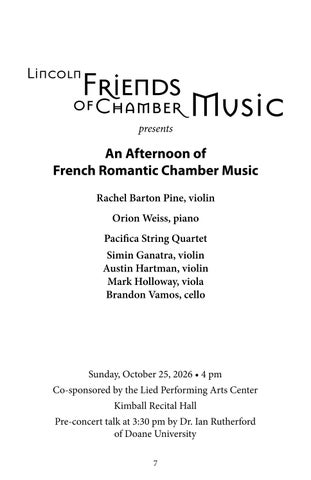
presents
An Afternoon of French Romantic Chamber Music Rachel Barton Pine, violin Orion Weiss, piano Pacifica String Quartet Simin Ganatra, violin Austin Hartman, violin Mark Holloway, viola Brandon Vamos, cello
Sunday, October 25, 2026 • 4 pm Co-sponsored by the Lied Performing Arts Center Kimball Recital Hall Pre-concert talk at 3:30 pm by Dr. Ian Rutherford of Doane University 7
An Afternoon of French Romantic Chamber Music Pastorale and Berceuse Rachel Barton Pine, violin Orion Weiss, piano String Quartet in G minor, op. 10
Tailleferre
Claude Debussy (1862-1918)
Animé et très décidé Assez vif et bien rythmé Andantino, doucement expressif Très modéré–En animant peu à peu –Très mouvementé et avec passion
Pacifica Quartet
Sonatine
Modéré (moderate) Mouvement de menuet Animé
Maurice Ravel (1875-1937)
Orion Weiss, piano
Sonata No. 3 in D minor, “Ballade”
Lento molto sostenuto Molto moderato quasi lento Allegro in tempo giusto e con bravura Poco meno A Tempo premier Tempo poco piú vivo e ben marcato Piú mosso
Ysaÿes
Rachel Barton Pine, violin INTERMISSION
Concert
Chausson
I. Décidé II. Sicilienne: Pas vite III. Grave IV. Finale: Très animé
Rachel Barton Pine, violin Orion Weiss, piano Pacifica Quartet 9
Program Notes Pastorale and Berceuse
Tailleferre
Marcelle-Germaine Tailleferre (1892–1983) is perhaps the most famous composer who (almost) no one knows anything about. Music students memorize her name as the only female member of the early20th-century group of French composers dubbed Les Six, but most would be hard-pressed to cite any of her compositions or achievements. Tailleferre was, in fact, a prolific composer of symphonic, chamber, stage, and film music who participated actively in French and international musical life for more than six decades. Tailleferre wrote her Pastorale for Violin and Piano in Grasse during 1942, just before she left war-torn Europe for the United States. Its gentle sicilienne rhythms and tranquil melody conjure the floral scents of the Côte d’Azur and suggest a nostalgic yearning for a better time. Berceuse for Violin and Piano, written in 1913 and published 11 years later, was affectionately dedicated to “mon Maître et Ami Monsieur H. Dallier,” who had been the composer’s Harmony professor at the Paris Conservatoire. The piano’s rocking accompaniment in this charming lullaby gently supports a continuously developing violin melody, incorporating a soupÇon of harmonic dissonance as it explores the full range of the violin. This early musical gem both foreshadows and encapsulates the spontaneity, succinct expression, and Gallic refinement of Tailleferre’s distinctive musical style.
String Quartet in G minor, op. 10
Claude Debussy (1862-1918)
Claude Debussy seems always to have been impatient with the musical establishment of his time, and with authority in general. His creative ideas as a young man consequently took a while to crystallize, but by about 1890 his novel, stylistically progressive yet appealing songs and piano music had made their mark on the musical scene. His string quartet – an isolated foray into chamber music in 1893 but a precursor to his immersion in the genre after 1910 – represents a further advance into the style that was eventually to be Debussy’s personal musical language. In retrospect, most commentators count the quartet as one of the first works of Debussy’s musical maturity. Like many instrument works of the late 19th century, especially those in the orbit of Liszt and Franck, this one employs the techniques of thematic transformation (the opening motive occurs over and over again, in many harmonic and rhythmic guises, throughout all four movements) 10
and cyclical construction (the appearances of the main themes of the first and second movement in the closing stages of the fourth are especially obvious.) But its shimmering textures, its evocations of exoticism, and its harmonic language, moving freely between quartet entirely characteristic of Debussy, whose masterly individuality has made him a source of inspiration for (and a cornerstone of) 20th-century musicians from Maurice Ravel to Bill Evans and beyond. by David Breckbill, October, 2006
Sonatine
Maurice Ravel (1875-1937)
Maurice Ravel composed his Sonatine between 1903 and 1905, a period when he was refining the crystalline textures and classical balance that would become hallmarks of his early style. The work began as an entry for a magazine competition that required the first movement to be no longer than seventy-five bars—a constraint that Ravel embraced with characteristic precision. Although the competition itself faded into obscurity, the piece it inspired became one of Ravel’s most beloved piano works, blending neoclassical clarity with the subtle harmonic color and rhythmic elegance that define his musical voice. The Sonatine received its public premiere in 1906, performed by the pianist Jeanne Leleu, who was one of Ravel’s most gifted young protégées. The debut helped cement Ravel’s reputation as a composer capable of revitalizing classical forms with fresh imagination. Audiences and critics were struck by the work’s refinement: its three movements unfold with a sense of proportion and poise that evoke the spirit of 18th‑century keyboard writing, yet its harmonic language and shimmering textures unmistakably belong to the early 20th century. The premiere marked an important moment in Ravel’s rise within the French musical world, showcasing his ability to balance innovation with restraint. In performance, the Sonatine demands a pianist who can unite elegance with expressive subtlety. The opening Modéré calls for delicacy and transparency, its phrases shaped with an almost conversational grace. The central Mouvement de menuet offers a nostalgic dance, poised and understated, requiring careful control of tone and pedaling. The final Animé bursts forth with fleet virtuosity, its rapid passagework and rhythmic vitality providing a brilliant conclusion without ever sacrificing refinement. Together, the three movements reveal Ravel’s mastery of miniature form—music that is intimate, impeccably crafted, and deeply rewarding for both performer and listener. 11
Sonata No. 3 in D minor, “Ballade”
Ysaÿes
Eugène Ysaÿe’s Sonata No. 3 in D minor, “Ballade” stands as one of the most electrifying and personal works in his set of Six Sonatas for Solo Violin, composed in 1923. Ysaÿe dedicated this sonata to his friend and colleague George Enescu, whose extraordinary musicianship and interpretive imagination deeply impressed him. Enescu’s blend of fiery virtuosity and poetic inwardness is reflected throughout the Ballade: its opening recitative seems to speak in Enescu’s own improvisatory voice, while its explosive, rhapsodic finale mirrors the Romanian violinist’s legendary command of color and character. In honoring Enescu, Ysaÿe created a work that is both tribute and portrait—an homage to a violinist whose artistry he considered among the greatest of his generation. The Ballade received its first performances among Ysaÿe’s circle of elite violinists, quickly becoming the most frequently played of the six sonatas. Its debut helped establish the set as a landmark in the 20th‑century solo‑violin repertoire, expanding the expressive and technical possibilities of unaccompanied writing beyond the Bach tradition. Audiences were struck by the sonata’s dramatic arc: a brooding, speech‑like introduction that erupts into a whirlwind of rhythmic drive, double‑stops, and sweeping arpeggiation. The piece’s theatrical immediacy and structural clarity made it an instant favorite, and it has remained a touchstone for violinists seeking to demonstrate both interpretive depth and fearless virtuosity. In the context of French chamber music—particularly the refined, color‑sensitive aesthetic that shaped Ysaÿe’s artistic world—the Ballade occupies a fascinating position. Though Belgian by birth, Ysaÿe was deeply embedded in the French musical scene, collaborating with composers such as Franck, Debussy, and Chausson. The Ballade reflects this environment through its emphasis on timbre, nuance, and narrative gesture, even as it pushes toward a more modern, expressionist intensity. In performance by Rachel Barton Pine, the sonata’s dual nature becomes especially vivid: she brings both the elegance associated with French chamber style and the bold, imaginative freedom that Enescu inspired. Her interpretation highlights the work’s fusion of lyricism and fire, offering listeners a compelling window into Ysaÿe’s world and the artistic lineage he sought to honor. by Dorothy Chung Javorsky
12
Concert
Chausson
Amédée-Ernest Chausson (1855–1899) was the personification of the French fin-de-siècle. In both life and works, he represented the summation of one era and the dawn of another. He was an ardent champion of French music and painting and an early champion (and financial supporter) of Claude Debussy, but also influenced by the music of Richard Wagner. Born into an affluent family, Chausson was educated privately. At age 16, his tutor introduced him to influential Parisian salons where he met artists Henri Fantin-Latour and Odilon Redon, and musicians including composer Vincent d’Indy. After briefly studying with Jules Massenet and César Franck at the Paris Conservatoire, Chausson undertook several “pilgrimages” to hear Wagner’s music in Munich and Bayreuth (including to hear Parsifal on his honeymoon in 1883). (He later disavowed this musical infatuation, writing to a friend that “de-Wagnerization” was necessary in order to embrace more clarity and a “healthier” outlook.) In his own Parisian salon, Chausson entertained renowned poets, artists, and musicians, such as Albéniz, Cortot, Debussy, and Ysaÿe. A prominent member of the Société Nationale de Musique, founded with the Latin motto Ars Gallica (French Art) in the aftermath of the Franco-Prussian War, Chausson was an influential voice in independent musical circles of early-Third Republic France. Chausson’s tragic death in a bicycling accident cut short a compositional career that hadn’t begun until he was nearly 30, with his first publication — a song collection — in 1884. While best known for his Poème for Violin and Orchestra, Op. 25 (1896), Chausson composed in many genres including operas, sacred music, symphonic poems, and songs. His contemporaries held his chamber music in the highest regard, however. His friend, French music critic Georges Jean-Aubry, wrote in homage that Chausson’s inherent personality came through in the “exchange of confidences [that] led him to seek out in narrower limits, all the qualities that could be drawn from individual instruments.” Highlighting Chausson’s Concert for Violin, Piano, and String Quartet, Op. 21 as one of the most important French chamber music works of the late-19th century, another contemporary writer described the work as “an enchantment without malice,” citing its reflection of the composer’s very being. Dedicated to virtuoso violinist and composer Eugène Ysaÿe and premiered by Ysaÿe (violin), Auguste Pierret (piano), and the Quatuor Crickboom in 1892. Chausson’s Concert is an extraordinary piece, 13
exploring and expanding the boundaries of chamber music genres. The work is scored for the unusual combination of solo violin, string quartet, and piano, alternately presenting the intimate sounds of a solo piano work or a violin sonata alongside the grand style of a violin concerto, utilizing the quasi-orchestral potential of the string quartet. The title, Concert, is also unusual and may reflect Chausson’s admiration for 18th-century French composers such as Jean-Philippe Rameau, who designated chamber works featuring keyboard and strings with the same title. Chausson’s performance indications in the work — Décidé (decisive), Calme, Librement (freely), Très animé (very lively) — are intentionally French (instead of Italian). The untitled first movement begins with a bold, fortissimo statement by the solo piano introducing the movement’s foundational motive. The string quartet echoes this three-note figure several times while the piano plays cascading arpeggios elaborating on the original motive. When the solo violin enters, it is in equal textural partnership with the piano, as the music fluidly shifts in character to take on another of its multiple genre personas. The movement reaches a high point as the piano offers virtuosic figurations while the string quartet plays in counterpoint with the soaring solo violin. The final section reintroduces the main motive in its original form, accompanied by the cascading arpeggios, now in both string quartet and piano, as the solo violin reaches stratospheric heights, fading away with a sustained pianissimo murmur. The Sicilienne second movement opens with characteristic, lilting rhythms in the solo violin, accompanied by familiar-sounding arpeggiation from string quartet and piano. The violin’s Sicilienne melody is taken up successively by the piano and individual members of the string quartet. Ultimately, all of the strings play in unison as the piano’s cascading accompaniment leads into an ascending gesture from the violin that suggests an offering to the heavens. The third movement has no title, just the performance indication Grave. An ominous chromatic ostinato in the piano establishes the emotional context of, as one contemporary wrote, “the most profound sadness” of a solemn ritual “celebrated in the crypt of the heart.” The basis of all the melodic material in the movement, the piano ostinato is first augmented by a slower version of the melody in the solo violin, establishing the duo instrumentation that predominates throughout. The string quartet takes a more active role at the movement’s climax, partnering with the increasingly virtuosic piano to create an almost-orchestral sound. The strings all come together playing in unison
14
texture as the piano restates the opening chromatic ostinato to bring the movement to a solemn close. The Finale, marked Très animé, provides a dramatic shift of mood, opening with lively, syncopated rhythms introduced by the piano then taken up by the ensemble in octaves. As with the first movement, the opening material here is varied by each of the instruments throughout the remainder of the piece. This last movement fully explores the sound genres alluded to in the previous movements, from the intimacy of a piano interlude or a piano-plus-violin duet, to the grandeur of a piano concerto, and the full utilization of each instrument in the piano-andstrings sextet. The result is often spectacular — in the French sense of the word, derived from spectacle or staged event. The piano has the last word, with a Gallic flourish that seems to say, with a wry smile, “it’s nothing; let’s do this all again!” © ELINOR OLIN 2025 Dr. Elinor Olin is a professor at Northern Illinois University School of Music and has a background in both music performance and music history.
15
Rachel Barton Pine The acclaimed American concert violinist Rachel Barton Pine thrills international audiences with her dazzling technique and lustrous tone. With an infectious joy in music-making and a passion for connecting historical research to performance, Pine transforms audiences’ experiences of classical music. She is a leading interpreter of the great classical masterworks and of important contemporary music. Pine performs with the world’s foremost orchestras, including the Los Angeles Philharmonic, Philadelphia Orchestra, the Royal Philharmonic Orchestra, Camerata Salzburg, and the Chicago, Dallas, Atlanta, Baltimore, Detroit, and Vienna Symphony Orchestras. She has worked with renowned conductors that include Teddy Abrams, Marin Alsop, Daniel Barenboim, Semyon Bychkov, Stéphane Denève, Neeme Järvi, Christoph Eschenbach, Erich Leinsdorf, Nicholas McGegan, Zubin Mehta, Tito Muñoz, and John Nelson. As a chamber musician, Pine has performed with Jonathan Gilad, Clive Greensmith, Paul Neubauer, Jory Vinikour, William Warfield, Orion Weiss, and the Pacifica and Parker quartets. Recital and festival appearances have included Davos, the Kennedy Center, Lincoln Center, Marlboro, Ravinia, Salzburg, Bravo! Vail, and Wolf Trap. Highlights of Rachel Barton Pine’s 2026-27 season include solo appearances with the Los Angeles Chamber Orchestra, National Symphony Orchestra of Colombia, Portland Symphony Orchestra (ME), Williamsburg Symphony (VA), Yakima Symphony Orchestra, Brown University Symphony Orchestra, and Marin Symphony, among others. She also returns to the Isabella Stewart Gardner Museum in Boston for a recital of Brahms Sonatas and gives additional recitals at Chamber Music Marin and Music in Corrales. Pine reunites with the Pacifica Quartet and pianist Orion Weiss at Lincoln Friends of Chamber Music to perform selections from their critically acclaimed French Impressions album. As part of her residency in Vermillion, South Dakota at the National Music Museum and the University of South Dakota, she will perform Bach’s entire six Sonatas and Partitas on an original-condition Stainer violin. She will also be a featured artist at Domaine Forget de Charlevoix in Québec and the American String Teachers Association National Conference.
16
Orion Weiss One of the most sought-after soloist and chamber music collaborators today, Orion Weiss is a “brilliant paints” (The New York Times). He has dazzled audiences worldwide with his “head-spinning range of colors”(Chicago Tribune)and has performed with all of the major orchestras of North America and at all of the major venues and music festivals. In February 2025, Weiss released Arc III,the final album in his recital trilogy on First Hand Records. Recent performances include cycles of Beethoven’s complete violin sonatas with violinist James Ehnes; a return to the Chicago Symphony Orchestra, led by Michael Tilson Thomas; his debut with the National Symphony Orchestra, led by Ken-David Masur; and performances in Tokyo, Seoul, Taipei, Hong Kong, and Seattle. Additional highlights include Weiss’s David Geffen Hall debut in New York with the American Symphony Orchestra, performances of the Goldberg Variations at the Santa Fe Chamber Music Festival and Newport Classical, performances in Italy, London, and Norway, and a tour with the Chamber Music Society of Lincoln Center. His recording with Augustin Hadelich won Opus Klassik’s Best Chamber Music Recording of 2025. Known for his affinity for chamber music, Weiss performs at venues and festivals around the United States with artists such as violinists James Ehnes, Augustin Hadelich, and William Hagen; pianists Michael Stephen Brown and Shai Wosner; and many string quartets, including the Ariel, Parker, and Pacifica Quartets. A native of Ohio, Weiss attended the Cleveland Institute of Music and made his Cleveland Orchestra debut performing the Liszt Piano Concerto No. 1 in 1999. That same year, with less than 24 hours notice, Weiss stepped in to replace André Watts for a performance of Shostakovich’s Piano Concerto No. 2 with theBaltimore Symphony Orchestra. Weiss’s awards include the Classical Recording Foundation’s Young Artist ofthe Year, Gilmore Young Artist Award, an Avery Fisher Career Grant, and more. His teachers include PaulSchenly, Jerome Lowenthal, and Sergei Babayan. In 2004, he graduated from the Juilliard School, where he studied with Emanuel Ax. Learn more:www.orionweiss.com
17
Pacifica Quartet Formed in 1994, the Pacifica Quartet quickly rose to prominence, winning chamber music’s top competitions, including the 1998 Naumburg Chamber Music Award. In 2002, the ensemble received Chamber Music America’s Cleveland Quartet Award and was named to Lincoln Center’s Bowers Program (formerly CMS Two). Four years later, it received the prestigious Avery Fisher Career Grant, affirming its position among the foremost American quartets. With its powerful energy and captivating, cohesive sound, the Pacifica has established itself as the embodiment of the contemporary American string quartet sound. Based in Bloomington, Indiana, the Pacifica Quartet has served as full-time faculty and Quartet-in-Residence at Indiana University’s Jacobs School of Music since 2012. Simin Ganatra, violin Simin Ganatra is a Grammy Award-winning violinist whose artistry combines luminous lyricism, intellectual depth, and expressive intensity. Praised as an “excellent and unique violinist” (The Strad) with a “miraculous sense of flow and otherworldly beauty” (St. Paul Pioneer Press), she has built a distinguished international career as a chamber musician, soloist, recording artist, and educator. Ganatra has appeared as a soloist across North America and abroad and has collaborated with many of today’s leading artists, including Menahem Pressler and Yo-Yo Ma. Critics have consistently highlighted her clarity of line, tonal warmth, and interpretive voice, qualities that shine in both solo and chamber performances. Austin Hartman, violin Grammy-award winning violinist, Austin Hartman, has distinguished himself as a chamber musician, soloist and educator with performances throughout the United States and abroad that critics have hailed as a “top flight…masterclass in chamber music.” As a soloist, Mr. Hartman has made numerous appearances with orchestras throughout his career that include two guest appearances with the Philadelphia Orchestra. In 1999, he was awarded the Gold Medal prize at the Stulberg International String Competition and since that time he has continued to present solo recitals around the world that included a number of humanitarian concert performances featured in China, the Dominican Republic, Haiti, Taiwan and Zambia. 18
Prior to joining the Pacifica Quartet, Mr. Hartman was the Assistant Professor of Violin at the University of Indianapolis where he conducted the orchestra and opera theatre while also co-founding the Indianapolis Quartet. He has earned Artist Diplomas from both the Juilliard School and Yale School of Music as well as degrees from the New England Conservatory and Cleveland Institute of Music. Mark Holloway, viola An artist of the Chamber Music Society of Lincoln Center, Mark Holloway has appeared at prestigious festivals and series such as Marlboro, Music@Menlo, Ravinia, Caramoor, Banff, Taos, Music from Angel Fire, Mainly Mozart, Alpenglow, Plush, Whittington, Olympic, Concordia Chamber Players, Kon-Tiki, Bay Chamber Concerts, and with the Boston Chamber Music Society. Performances have taken him to such far-flung places as Chile and Greenland, and he plays regularly at chamber music festivals in France, Musikdorf Ernen in Switzerland, and at the International Musicians Seminar in Prussia Cove, England. Mr. Holloway has been principal violist at Tanglewood and of the New York String Orchestra. Mr. Holloway was a student of Michelle LaCourse at Boston University, where he received his B.M. Summa cum laude, and he received his Diploma from the Curtis Institute of Music as a student of Michael Tree. Brandon Vamos, cello Brandon Vamos, a Grammy-award winning cellist, has performed solo and chamber music recitals both in the U.S. and abroad to critical acclaim. Called a “first-rate cellist” by the Chicago Reader and praised for his “gutsy bravura” by the Chicago Tribune, Mr. Vamos has appeared as soloist with orchestras worldwide, including performances with the Taipei City Symphony, the Suwon Symphony in Seoul, the Samara Symphony in Russia, and the New Philharmonia Orchestra, and the Elgin Symphony Orchestra. Mr. Vamos has collaborated with many distinguished artists, including Paul Katz, Michael Tree, Yo-Yo Ma, Menahem Pressler, and the Emerson Quartet, and has recorded for Cedille, Naxos, and Cacophony Records. Awarded a Performer’s Certificate at the Eastman School of Music, where he earned a Bachelor’s of Music Degree as a student of Mr. Katz, Mr. Vamos has also studied with distinguished artists such as Tanya Carey in Macomb, Illinois, and Aldo Parisot at Yale University, where he earned a Master of Music Degree. 19
FRIENDS+
Providing support to Lincoln Friends of Chamber Music Platinum Members ($500 or more) Scott & Sue Bulfinch Doug & Mary Campbell Tom Carr Albert Casullo William Haberfeld Kandra Hahn Hyatt Place Lincoln/DowntownHaymarket Robert Kuzelka Robert & Phyllis Narveson Nebraska Arts Council Liana Sandin – Pearle Francis Finigan Foundation April Stevenson John Woollam Gold Members ($250 - $499) Thomas M Carr Gunter Hofmann Dan & Mary Howell Shared & Becky Seth Nancy Whitman
Silver Members ($100 - $249) Mary Barton Teresa Bailey Carolyn Dow Laura Burton Franz Jocelyn Golden Penny Greer Robert Grimit Dorothy Chung Javorsky Betty Levitov & Carla Stormberg Jan Lipovsky Sophia Potter Jane & Peter Reinhardt Alison Stewart Mark Van Kekerix & Bob Tucker Roger & Sylvia Wiegand C Robert & Patricia Wikel Patrons (Up To - $99) Aleta Collier Bill & Donna Gustafson Carole Levin Bruce Mellberg
We are grateful to all donors and friends on this page. Listed are friends who made generous donations or pledges from May, 2025 through August, 2026. If you see an error or omission, please contact April Stevenson at aparilannstevenson@gmail.com. Add yourself to this list by sending your donation to: Lincoln Friends of Chamber Music, PO Box 82882, Lincoln, NE 68501. You can also give online at www.LFCM.US and click Donate at the top of the screen.