
The New West Digital Catalog

Page 1


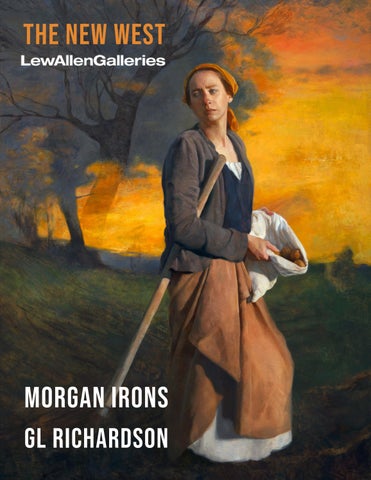
THE NEW WEST MORGAN IRONS

GL RICHARDSON

THE NEW WEST MORGAN IRONS

GL RICHARDSON

THE NEW WEST

Introduction and Historical Context

The American West has always existed as much in the mind of the people of this nation as it does in the dirt of its land. It became synonymous as a foundational myth of American identity characterized by strength, individualism, independence, new beginnings, and patriotic pride. Created as it was from the expansion of a new nation through perilous exploration and, tragically, too often violent conquest of Indigenous People, this story was more properly one about the “Wild West”. However, what remains in the collective consciousness of the broad American culture is the sense of the West’s imposing grandeur and extraordinary power to ignite an imagination of boundless possibility.

Correspondingly, generations of painters have sought to capture the beauty and majesty of the West’s physical landscape, as well as reflect impressions about the psychic one of those who dared to venture into the Frontier early on and those who came after and dared to settle and endure to build the West. What is called Western Art has functioned throughout its history as a vivid and ever evolving visual archive of richly diverse imagery that is both familiar and totemic of the vast and mythic place that is the Great American Frontier. In myriad ways, Western Art is the compendium of pictures that tell the stories of the history, people and places of this great and amazing part of America.

The early versions mainly dealt with imagery that chronicled and celebrated the so-called “winning of the West.” One of the representative examples is the 19th century Western artist Frederic Remington whose action-packed

paintings portrayed the scenes of the region as a highdrama stage for discovery and conquest—a place where the environment was a wild entity to be tamed. His subjects focused on cowboys, cavalry and Native Americans in dramatic, high-action compositions. Remington filled his works with “hard riding and hard fighting” scenes in order to depict the American Frontier as a place where heroic soldiers were “taming the West” and his cowboys were romanticized stereotypes of unabashed courage.

Other artists such as Albert Bierstadt, along with fellow

Morgan Irons, Harvest, 2026, oil on Panel, 48 x 36 in

Hudson River School artists, expressed the breathtaking grandeur of Western landscapes so vividly that their canvases helped inspire the movement to preserve America’s most notable Western landscapes. In the 20th century, Georgia O’Keeffe, Santa Fe and Taos Society of Artists all reinterpreted Western desert landscapes and brought new ways of looking at the beauty and significance of this part of the West.

Western Art at LewAllen Galleries

LewAllen Gallery’s original founder, Elaine Horwitch, innovated a new direction for her eponymous gallery’s approach to the subject of Western Art at the time of its founding in the 1970s. As noted above, prior to then, American Western painting had dealt almost

exclusively with traditional Western imagery and its reverence for stereotypical Cowboys, Indians and various forms of Western landscapes. Horwitch, however, brought artists whose approach to the Western Frontier departed from that tradition by introducing sophisticated humor and elements from the then-contemporary art practice such as brilliant colors, close-in perspective, and bold brush strokes.

Artists such as John Fincher (1941-2024), joined the gallery and soon his close-up brightly colored “trappings of the West” –spurs, cactus, saddles, lassos, pine branches and boots – became known as “Cowboy Pop.” That was the ‘70s into the ‘80s and those “Trappings of the West”, though to some degree tongue-in-cheek, were right for that time. They had a sense of serious whimsy while also encapsulating references that were both familiar and totemic of the Great American Frontier. Fincher’s vivid renditions of the details of the West were immediately comprehensible as elements that endure as powerful icons of America’s spirit.

Horwitch also introduced the work of the Native American artist, Fritz Scholder (19372005) into the genre of Western American art, expanding it. His work is credited with having reconceptualized the portrayal of Native Americans in the genre, away from traditional, romanticized stereotypes to a “new realism” with candid, truthful, even startling, images of modern-day Native people in contemporary settings. He became a leader of the New American Indian Art movement, which opened the door to Native American artists generally for invigorated prominence and a new artistic freedom in the contemporary art world.

GL Richardson, Middle Man, 2026, oil stick on canvas wrapped panel, 48 x 42 in

Today, now in its 50th year in the art business, LewAllen Galleries, as a cultural institution mindful of its role to exhibit art that it believes represents aesthetic excellence and technical mastery that builds on these important legacies, seeks to present works by new artists describing their own contemporized experience of the American West in ways that resonate with and evolve from those prior legacies that at their core seemed right for their times.

In this, the first of its new series of exhibitions entitled The New West, the Gallery looks to yet the next generation for their perception of the American West. It is pleased to present the visual expressions of lived experience in it by Morgan Irons and GL Richardson who epitomize two markedly different responses but who share crucial attributes essential for inclusion in the exhibition: their works possess creative originality, aesthetic beauty, emotional power, transformative import, technical accomplishment, and socially inflected meaning relevant to the contemporary time. In short, these works have the capacity to inspire a deep aesthetic interest and produce a sense of visual joy and wonder and, one thinks, make the culture richer and better.

These artists emerge as two voices sharing a similar artistic vision. Where their aesthetics differ—Richardson, leaning toward a more minimalist narrative, and Irons toward an historically inflected lush realism— are united by a shared depth of authenticity. The conviction for making their art is hard-earned and rooted in the fact that these artists do not merely observe the region, they inhabit it, intensely study it, love it, and labor assiduously to translate their

personal impressions and experiences of it onto their canvases.

Both also make use of archetypal figures in their works. Irons presents female individuals – farmers, mothers – as hardworking stewards of the land and figures of shared endurance engaged in the present-day realities of working and living on the land of the West. Richardson uses the metaphor of the cowboy, the classic mythic hero archetype of the Frontier Myth, to suggest new ways of thinking about this stereotypically male figure and, beyond that, about life in the West today.

Morgan Irons

Morgan Irons captures the psychological weight of her agrarian life in the today’s American West through a profound and sumptuous lens of naturalistic realism. Working from a remote mountaintop cabin in Montana, the artistic practice of Irons is rooted in a deep, personal connection to the land. Her work draws on an aesthetic lineage to 19th-century artists such as the French Barbizon painter Jean-François Millet, Hudson River School painter Thomas Moran, and Winslow Homer. Like Millet’s focus on the dignity of labor and Homer’s rugged realism, Irons’ work honors human endurance in the face of the powerful forces of nature and the rigorous demands of living on the land. In a genre historically defined by the masculine narratives of exploration and conquest, Irons subverts the canon by centering the quiet, essential labor of women as the primary stewards of the land.

Central to this practice is a framework where fields and her Montana landscape serve as a vast, neutral stage for her models to inhabit

specific, timeless roles. She utilizes traditional indirect oil techniques—a process of slowly building transparent layers—to achieve a depth and luminosity grounded in history. By prioritizing what she calls “clear, architectural shapes” of her subjects and simple fabrics with which she dresses them, Irons creates a deliberate nod to the conscious feminine, allowing her figures to exist in a space where time feels suspended, yet their presence remains undeniably rooted in the modern West.

In the context of The New West, Irons focuses in her paintings on the stories around her, elevating the quiet, essential labor of her own rural community in Montana. Her figures—

farmers, mothers, and stewards—stand as archetypal forms of endurance and deep respect for the Earth which is the life-giving source of sustenance for those who live in her community. This is an exercise in the integrity of intent, where light and dark shapes delineate a sensitive, awareness free from the blandishments of contemporary fashions and fads. She notes about this: “One of the stories happening is the move-ment of regenerative agriculture—a plea to living in alignment with the longevity of the resources Earth provides. Soil at the forefront.”

In Potato Harvester at Dusk, for example, a powerhouse combination of character and light is evident. The painting is intentionally still; the

Morgan Irons, Rapid Wings, 2026, oil on canvas, 40 x 70 in

figure stands in relationship to a horizon that clarifies her presence. Irons ensures the work remains a human document—a missing chapter that reminds her viewer that the heroic spirit is a living reality in the contemporary landscape. The warmth of the setting sun emphasizes the dignity of the agrarian steward that clearly she is, as she also honors the patience and negotiation required to live in partnership with a vast, shaping landscape. Everything about Iron’s work is refreshingly authentic and resides in the truth of her lived experience. There is a remarkable sublimity that emerges from the convergence of the pastoral, the imagined and the perseverance of character contained in these paintings that interact and confer upon them a grace and elegance that truly is extraordinary.

GL Richardson

Moving to Santa Fe, he began a profound exploration of aspects of human experience drawn from contemporary ranching traditions as he personally experiences it. Returning often to ranches where he ropes and brands, and does all manner of long arduous work required in that world of range and animals, he brings back to his making of art impressions and images drawn directly from his personal experiences. His paintings are therefore very much forms of storytelling, where moments in time become narratives of character, setting, feeling and tension, while mystery and resolution are left deliciously to linger in the viewer’s imagination. It is the alchemy of this combination that renders his oils on panel near to visual magic as vignettes of the new American West.

In contrast to any number of the various versions that have emerged over time that define the American Myth of the Cowboy as Hero, the New

American Adam, or Chivalrous Modern Knight, Richardson describes his work as a cowboy on ranches herding, branding, and wrestling calves, as long, physically demanding days, but also full of camaraderie, personal fulfillment, rejoicing in the purity of it all, and a sense of reassurance about the choice he made to take the route he chose to be a part of a life focused on deep stewardship of the land and a profound commitment to animal welfare. That is what being a cowboy means to him. He views the modern cowboy as the “king of physical labor” and it is with great respect for this and the other lived-aspects he has experienced that he resonates them in his paintings. With influences from forebears as diverse as Andrew Wyeth, Edward Hopper and Fritz Scholder, Richardson describes his approach to painting as a kind of contemporary Western Modernism that blends traditional landscapes, cowboys, and ranch animals with his own lively color palettes, abstracted figures and forms, through which he explores 21st century life in the West based in his own direct experience.

This focus on the essential puts the work of Richardson within a legacy of artists who utilize starkness and scale to reinvent the frontier on the canvas. His approach is characterized by a deliberate minimalism where the subject achieves an immediate, evocative power. His process—a visual shorthand combining found imagery and personal photography—moves the figure beyond simple documentation into the space between memory and metaphor. By stripping away the pop-culture chaff of the cowboy, he elevates his subjects to universal archetypes that feel familiar, trusted, real and instantly recognizable. Richardson’s paintings bring to visual presence evocative images of life in the New West.

GL Richardson, Heads Up, 2026, oil on panel, 48 x 36 in

MORGAN IRONS

Morgan Irons, August in Fields, 2026, oil on canvas, 48 x 48 in
Morgan Irons, Mother, 2026, oil on canvas, 60 x 48 in
Morgan Irons, Western Wind, 2026, oil on panel, 40 x 70 in
Morgan Irons, Come Summer, 2026, oil on panel, 60 x 48 in
Morgan Irons, Red Sun, 2026, oil on canvas, 60 x 48 in

GL RICHARDSON

GL Richardson, Intuition, 2026, oil on panel, 25 x 32 in
GL Richardson, Thoughts on Drought II 2026, oil on panel, 32 x 25 in
GL Richardson, Land of Lost Content, 2026, oil and charcoal on panel, 31 x 48 in
GL Richardson, Level on the Level (Her Vision), 2026, oil on panel, 32 x 40 in
GL Richardson, Seasons Keep Time, 2026, oil on panel, 42 x 54 in
GL Richardson, High Sun No Wind
2026, oil stick on canvas wrapped panel, 36 x 48 in
GL Richardson, Tell Me the Old, Old Story, 2025, oil stick on canvas wrapped panel, 20 x 16 in
GL Richardson, Tide Coming In, 2026, oil on panel, 30 x 90
GL Richardson, Weather Together, 2026, oil pon panel, 42 x .33 in
GL Richardson, Purgatory 2026, oil pon panel, 40 x .30 in
GL Richardson, As Gardens Do 2026, oil pon panel, 48 x .65 in

Turn static files into dynamic content formats.
Create a flipbook